EP2987553A1 - Catalyst regeneration method for cos conversion catalyst - Google Patents
Catalyst regeneration method for cos conversion catalyst Download PDFInfo
- Publication number
- EP2987553A1 EP2987553A1 EP14875785.9A EP14875785A EP2987553A1 EP 2987553 A1 EP2987553 A1 EP 2987553A1 EP 14875785 A EP14875785 A EP 14875785A EP 2987553 A1 EP2987553 A1 EP 2987553A1
- Authority
- EP
- European Patent Office
- Prior art keywords
- cos
- catalyst
- hydrolysis catalyst
- regenerating
- cos hydrolysis
- Prior art date
- Legal status (The legal status is an assumption and is not a legal conclusion. Google has not performed a legal analysis and makes no representation as to the accuracy of the status listed.)
- Withdrawn
Links
- 239000003054 catalyst Substances 0.000 title claims abstract description 88
- 238000006243 chemical reaction Methods 0.000 title abstract description 14
- 238000011069 regeneration method Methods 0.000 title abstract description 9
- JJWKPURADFRFRB-UHFFFAOYSA-N carbonyl sulfide Chemical compound O=C=S JJWKPURADFRFRB-UHFFFAOYSA-N 0.000 claims abstract description 158
- XLYOFNOQVPJJNP-UHFFFAOYSA-N water Substances O XLYOFNOQVPJJNP-UHFFFAOYSA-N 0.000 claims abstract description 21
- 238000005406 washing Methods 0.000 claims abstract description 20
- 239000007864 aqueous solution Substances 0.000 claims abstract description 14
- 238000001035 drying Methods 0.000 claims abstract description 12
- 159000000009 barium salts Chemical class 0.000 claims abstract description 7
- OKTJSMMVPCPJKN-UHFFFAOYSA-N Carbon Chemical compound [C] OKTJSMMVPCPJKN-UHFFFAOYSA-N 0.000 claims abstract description 4
- 229910052799 carbon Inorganic materials 0.000 claims abstract description 4
- 230000003301 hydrolyzing effect Effects 0.000 claims abstract description 4
- 238000006460 hydrolysis reaction Methods 0.000 claims description 53
- 230000007062 hydrolysis Effects 0.000 claims description 52
- QVQLCTNNEUAWMS-UHFFFAOYSA-N barium oxide Chemical compound [Ba]=O QVQLCTNNEUAWMS-UHFFFAOYSA-N 0.000 claims description 23
- 238000000034 method Methods 0.000 claims description 22
- 230000001172 regenerating effect Effects 0.000 claims description 18
- 239000000428 dust Substances 0.000 claims description 7
- 238000007654 immersion Methods 0.000 claims description 6
- 238000001354 calcination Methods 0.000 claims description 5
- 239000002994 raw material Substances 0.000 claims description 3
- 239000007789 gas Substances 0.000 abstract description 15
- 229910010413 TiO 2 Inorganic materials 0.000 abstract 1
- 239000007858 starting material Substances 0.000 abstract 1
- 239000000126 substance Substances 0.000 description 32
- 239000000243 solution Substances 0.000 description 15
- GWEVSGVZZGPLCZ-UHFFFAOYSA-N Titan oxide Chemical compound O=[Ti]=O GWEVSGVZZGPLCZ-UHFFFAOYSA-N 0.000 description 14
- ITHZDDVSAWDQPZ-UHFFFAOYSA-L barium acetate Chemical compound [Ba+2].CC([O-])=O.CC([O-])=O ITHZDDVSAWDQPZ-UHFFFAOYSA-L 0.000 description 9
- 239000000446 fuel Substances 0.000 description 8
- 238000010248 power generation Methods 0.000 description 8
- 239000002253 acid Substances 0.000 description 7
- 239000003513 alkali Substances 0.000 description 7
- CDBYLPFSWZWCQE-UHFFFAOYSA-L Sodium Carbonate Chemical compound [Na+].[Na+].[O-]C([O-])=O CDBYLPFSWZWCQE-UHFFFAOYSA-L 0.000 description 6
- HEMHJVSKTPXQMS-UHFFFAOYSA-M Sodium hydroxide Chemical compound [OH-].[Na+] HEMHJVSKTPXQMS-UHFFFAOYSA-M 0.000 description 6
- RWSOTUBLDIXVET-UHFFFAOYSA-N Dihydrogen sulfide Chemical compound S RWSOTUBLDIXVET-UHFFFAOYSA-N 0.000 description 4
- VEXZGXHMUGYJMC-UHFFFAOYSA-N Hydrochloric acid Chemical compound Cl VEXZGXHMUGYJMC-UHFFFAOYSA-N 0.000 description 4
- 239000003245 coal Substances 0.000 description 4
- 239000000463 material Substances 0.000 description 4
- 238000011084 recovery Methods 0.000 description 4
- 230000008929 regeneration Effects 0.000 description 4
- 150000003464 sulfur compounds Chemical class 0.000 description 4
- QAOWNCQODCNURD-UHFFFAOYSA-N Sulfuric acid Chemical compound OS(O)(=O)=O QAOWNCQODCNURD-UHFFFAOYSA-N 0.000 description 3
- 229910052783 alkali metal Inorganic materials 0.000 description 3
- 150000001340 alkali metals Chemical class 0.000 description 3
- PNEYBMLMFCGWSK-UHFFFAOYSA-N aluminium oxide Inorganic materials [O-2].[O-2].[O-2].[Al+3].[Al+3] PNEYBMLMFCGWSK-UHFFFAOYSA-N 0.000 description 3
- 150000001412 amines Chemical class 0.000 description 3
- 229910052788 barium Inorganic materials 0.000 description 3
- DSAJWYNOEDNPEQ-UHFFFAOYSA-N barium atom Chemical compound [Ba] DSAJWYNOEDNPEQ-UHFFFAOYSA-N 0.000 description 3
- 238000002309 gasification Methods 0.000 description 3
- 238000005470 impregnation Methods 0.000 description 3
- 239000012535 impurity Substances 0.000 description 3
- 239000007788 liquid Substances 0.000 description 3
- 231100000572 poisoning Toxicity 0.000 description 3
- 230000000607 poisoning effect Effects 0.000 description 3
- 229910000029 sodium carbonate Inorganic materials 0.000 description 3
- 150000004763 sulfides Chemical class 0.000 description 3
- VHUUQVKOLVNVRT-UHFFFAOYSA-N Ammonium hydroxide Chemical compound [NH4+].[OH-] VHUUQVKOLVNVRT-UHFFFAOYSA-N 0.000 description 2
- GRYLNZFGIOXLOG-UHFFFAOYSA-N Nitric acid Chemical compound O[N+]([O-])=O GRYLNZFGIOXLOG-UHFFFAOYSA-N 0.000 description 2
- IWOUKMZUPDVPGQ-UHFFFAOYSA-N barium nitrate Chemical compound [Ba+2].[O-][N+]([O-])=O.[O-][N+]([O-])=O IWOUKMZUPDVPGQ-UHFFFAOYSA-N 0.000 description 2
- 230000000694 effects Effects 0.000 description 2
- 239000002803 fossil fuel Substances 0.000 description 2
- 230000003472 neutralizing effect Effects 0.000 description 2
- 229910017604 nitric acid Inorganic materials 0.000 description 2
- 239000008188 pellet Substances 0.000 description 2
- 229910015806 BaTiO2 Inorganic materials 0.000 description 1
- 239000004215 Carbon black (E152) Substances 0.000 description 1
- WGLPBDUCMAPZCE-UHFFFAOYSA-N Trioxochromium Chemical compound O=[Cr](=O)=O WGLPBDUCMAPZCE-UHFFFAOYSA-N 0.000 description 1
- 238000003916 acid precipitation Methods 0.000 description 1
- 238000010306 acid treatment Methods 0.000 description 1
- 235000011114 ammonium hydroxide Nutrition 0.000 description 1
- 238000007664 blowing Methods 0.000 description 1
- 229910000423 chromium oxide Inorganic materials 0.000 description 1
- 238000005260 corrosion Methods 0.000 description 1
- 230000007797 corrosion Effects 0.000 description 1
- 229910052593 corundum Inorganic materials 0.000 description 1
- 230000003292 diminished effect Effects 0.000 description 1
- 238000003912 environmental pollution Methods 0.000 description 1
- 239000000295 fuel oil Substances 0.000 description 1
- 229910052602 gypsum Inorganic materials 0.000 description 1
- 239000010440 gypsum Substances 0.000 description 1
- 238000010438 heat treatment Methods 0.000 description 1
- 229930195733 hydrocarbon Natural products 0.000 description 1
- 150000002430 hydrocarbons Chemical class 0.000 description 1
- 229910000037 hydrogen sulfide Inorganic materials 0.000 description 1
- 229910052751 metal Inorganic materials 0.000 description 1
- 239000002184 metal Substances 0.000 description 1
- 239000010742 number 1 fuel oil Substances 0.000 description 1
- WHOPEPSOPUIRQQ-UHFFFAOYSA-N oxoaluminum Chemical compound O1[Al]O[Al]1 WHOPEPSOPUIRQQ-UHFFFAOYSA-N 0.000 description 1
- 238000000746 purification Methods 0.000 description 1
- 238000012827 research and development Methods 0.000 description 1
- 238000005507 spraying Methods 0.000 description 1
- XTQHKBHJIVJGKJ-UHFFFAOYSA-N sulfur monoxide Chemical class S=O XTQHKBHJIVJGKJ-UHFFFAOYSA-N 0.000 description 1
- 229910052815 sulfur oxide Inorganic materials 0.000 description 1
- 229910001845 yogo sapphire Inorganic materials 0.000 description 1
Images
Classifications
-
- B—PERFORMING OPERATIONS; TRANSPORTING
- B01—PHYSICAL OR CHEMICAL PROCESSES OR APPARATUS IN GENERAL
- B01J—CHEMICAL OR PHYSICAL PROCESSES, e.g. CATALYSIS OR COLLOID CHEMISTRY; THEIR RELEVANT APPARATUS
- B01J38/00—Regeneration or reactivation of catalysts, in general
- B01J38/48—Liquid treating or treating in liquid phase, e.g. dissolved or suspended
- B01J38/64—Liquid treating or treating in liquid phase, e.g. dissolved or suspended using alkaline material; using salts
-
- B—PERFORMING OPERATIONS; TRANSPORTING
- B01—PHYSICAL OR CHEMICAL PROCESSES OR APPARATUS IN GENERAL
- B01D—SEPARATION
- B01D53/00—Separation of gases or vapours; Recovering vapours of volatile solvents from gases; Chemical or biological purification of waste gases, e.g. engine exhaust gases, smoke, fumes, flue gases, aerosols
- B01D53/34—Chemical or biological purification of waste gases
- B01D53/74—General processes for purification of waste gases; Apparatus or devices specially adapted therefor
- B01D53/86—Catalytic processes
- B01D53/8603—Removing sulfur compounds
- B01D53/8606—Removing sulfur compounds only one sulfur compound other than sulfur oxides or hydrogen sulfide
-
- B—PERFORMING OPERATIONS; TRANSPORTING
- B01—PHYSICAL OR CHEMICAL PROCESSES OR APPARATUS IN GENERAL
- B01D—SEPARATION
- B01D53/00—Separation of gases or vapours; Recovering vapours of volatile solvents from gases; Chemical or biological purification of waste gases, e.g. engine exhaust gases, smoke, fumes, flue gases, aerosols
- B01D53/34—Chemical or biological purification of waste gases
- B01D53/96—Regeneration, reactivation or recycling of reactants
-
- B—PERFORMING OPERATIONS; TRANSPORTING
- B01—PHYSICAL OR CHEMICAL PROCESSES OR APPARATUS IN GENERAL
- B01J—CHEMICAL OR PHYSICAL PROCESSES, e.g. CATALYSIS OR COLLOID CHEMISTRY; THEIR RELEVANT APPARATUS
- B01J21/00—Catalysts comprising the elements, oxides, or hydroxides of magnesium, boron, aluminium, carbon, silicon, titanium, zirconium, or hafnium
- B01J21/06—Silicon, titanium, zirconium or hafnium; Oxides or hydroxides thereof
- B01J21/063—Titanium; Oxides or hydroxides thereof
-
- B—PERFORMING OPERATIONS; TRANSPORTING
- B01—PHYSICAL OR CHEMICAL PROCESSES OR APPARATUS IN GENERAL
- B01J—CHEMICAL OR PHYSICAL PROCESSES, e.g. CATALYSIS OR COLLOID CHEMISTRY; THEIR RELEVANT APPARATUS
- B01J21/00—Catalysts comprising the elements, oxides, or hydroxides of magnesium, boron, aluminium, carbon, silicon, titanium, zirconium, or hafnium
- B01J21/20—Regeneration or reactivation
-
- B—PERFORMING OPERATIONS; TRANSPORTING
- B01—PHYSICAL OR CHEMICAL PROCESSES OR APPARATUS IN GENERAL
- B01J—CHEMICAL OR PHYSICAL PROCESSES, e.g. CATALYSIS OR COLLOID CHEMISTRY; THEIR RELEVANT APPARATUS
- B01J23/00—Catalysts comprising metals or metal oxides or hydroxides, not provided for in group B01J21/00
- B01J23/02—Catalysts comprising metals or metal oxides or hydroxides, not provided for in group B01J21/00 of the alkali- or alkaline earth metals or beryllium
-
- B—PERFORMING OPERATIONS; TRANSPORTING
- B01—PHYSICAL OR CHEMICAL PROCESSES OR APPARATUS IN GENERAL
- B01J—CHEMICAL OR PHYSICAL PROCESSES, e.g. CATALYSIS OR COLLOID CHEMISTRY; THEIR RELEVANT APPARATUS
- B01J23/00—Catalysts comprising metals or metal oxides or hydroxides, not provided for in group B01J21/00
- B01J23/90—Regeneration or reactivation
- B01J23/92—Regeneration or reactivation of catalysts comprising metals, oxides or hydroxides provided for in groups B01J23/02 - B01J23/36
-
- B—PERFORMING OPERATIONS; TRANSPORTING
- B01—PHYSICAL OR CHEMICAL PROCESSES OR APPARATUS IN GENERAL
- B01J—CHEMICAL OR PHYSICAL PROCESSES, e.g. CATALYSIS OR COLLOID CHEMISTRY; THEIR RELEVANT APPARATUS
- B01J38/00—Regeneration or reactivation of catalysts, in general
- B01J38/02—Heat treatment
-
- B—PERFORMING OPERATIONS; TRANSPORTING
- B01—PHYSICAL OR CHEMICAL PROCESSES OR APPARATUS IN GENERAL
- B01J—CHEMICAL OR PHYSICAL PROCESSES, e.g. CATALYSIS OR COLLOID CHEMISTRY; THEIR RELEVANT APPARATUS
- B01J38/00—Regeneration or reactivation of catalysts, in general
- B01J38/48—Liquid treating or treating in liquid phase, e.g. dissolved or suspended
- B01J38/485—Impregnating or reimpregnating with, or deposition of metal compounds or catalytically active elements
-
- B—PERFORMING OPERATIONS; TRANSPORTING
- B01—PHYSICAL OR CHEMICAL PROCESSES OR APPARATUS IN GENERAL
- B01D—SEPARATION
- B01D2255/00—Catalysts
- B01D2255/20—Metals or compounds thereof
- B01D2255/204—Alkaline earth metals
- B01D2255/2042—Barium
-
- B—PERFORMING OPERATIONS; TRANSPORTING
- B01—PHYSICAL OR CHEMICAL PROCESSES OR APPARATUS IN GENERAL
- B01D—SEPARATION
- B01D2257/00—Components to be removed
- B01D2257/30—Sulfur compounds
- B01D2257/308—Carbonoxysulfide COS
-
- B—PERFORMING OPERATIONS; TRANSPORTING
- B01—PHYSICAL OR CHEMICAL PROCESSES OR APPARATUS IN GENERAL
- B01D—SEPARATION
- B01D2258/00—Sources of waste gases
- B01D2258/02—Other waste gases
- B01D2258/0283—Flue gases
-
- B—PERFORMING OPERATIONS; TRANSPORTING
- B01—PHYSICAL OR CHEMICAL PROCESSES OR APPARATUS IN GENERAL
- B01J—CHEMICAL OR PHYSICAL PROCESSES, e.g. CATALYSIS OR COLLOID CHEMISTRY; THEIR RELEVANT APPARATUS
- B01J2523/00—Constitutive chemical elements of heterogeneous catalysts
-
- B—PERFORMING OPERATIONS; TRANSPORTING
- B01—PHYSICAL OR CHEMICAL PROCESSES OR APPARATUS IN GENERAL
- B01J—CHEMICAL OR PHYSICAL PROCESSES, e.g. CATALYSIS OR COLLOID CHEMISTRY; THEIR RELEVANT APPARATUS
- B01J2523/00—Constitutive chemical elements of heterogeneous catalysts
- B01J2523/20—Constitutive chemical elements of heterogeneous catalysts of Group II (IIA or IIB) of the Periodic Table
- B01J2523/25—Barium
-
- B—PERFORMING OPERATIONS; TRANSPORTING
- B01—PHYSICAL OR CHEMICAL PROCESSES OR APPARATUS IN GENERAL
- B01J—CHEMICAL OR PHYSICAL PROCESSES, e.g. CATALYSIS OR COLLOID CHEMISTRY; THEIR RELEVANT APPARATUS
- B01J2523/00—Constitutive chemical elements of heterogeneous catalysts
- B01J2523/30—Constitutive chemical elements of heterogeneous catalysts of Group III (IIIA or IIIB) of the Periodic Table
- B01J2523/31—Aluminium
-
- B—PERFORMING OPERATIONS; TRANSPORTING
- B01—PHYSICAL OR CHEMICAL PROCESSES OR APPARATUS IN GENERAL
- B01J—CHEMICAL OR PHYSICAL PROCESSES, e.g. CATALYSIS OR COLLOID CHEMISTRY; THEIR RELEVANT APPARATUS
- B01J2523/00—Constitutive chemical elements of heterogeneous catalysts
- B01J2523/40—Constitutive chemical elements of heterogeneous catalysts of Group IV (IVA or IVB) of the Periodic Table
- B01J2523/47—Titanium
Definitions
- the present invention relates to a method for regenerating a COS hydrolysis catalyst.
- a low-quality fuel typically contains a large amount of sulfur compounds, and when a gas obtained by gasifying this fuel is combusted directly, the sulfur compounds are discharged from the chimney into the atmosphere as sulfur oxides, which become a source of environmental pollution such as acid rain. Therefore, in ordinary thermal power generation, a method of installing an exhaust gas desulfurizer is installed on the back stream side of the boiler so as to remove sulfur compounds as gypsum, for example, has been put into practical application.
- the inlet temperature of a gas turbine is higher than the boiler temperature in ordinary thermal power generation, so the corrosion of the material is substantial.
- the method for regenerating a COS hydrolysis catalyst according to the conventional art is an impregnation regeneration method using an alkali metal as a chemical, and the impregnation of the alkali metal does not necessarily result in the recovery of performance. Moreover, impregnation treatment is performed with material in a pellet shape, which is problematic in that the pellets make contact with one another and are pulverized at the time of regeneration.
- an object of the present invention is to provide a method for regenerating a COS hydrolysis catalyst with a high recovery rate in a state in which the catalyst shape is maintained.
- a first invention of the present invention is a method for regenerating a barium oxide-based carbonyl sulfide (COS) hydrolysis catalyst by hydrolyzing COS which is contained in a gas obtained by gasifying a carbon raw material, wherein a spent COS hydrolysis catalyst is immersed in an aqueous solution of a barium salt for a prescribed amount of time, dried, and then calcined.
- COS carbonyl sulfide
- a second invention is the method for regenerating a COS hydrolysis catalyst according to the first invention, wherein dust removal is performed prior to immersion.
- a third invention is the method for regenerating a COS hydrolysis catalyst according to the first or second invention, wherein drying is performed after water washing prior to immersion.
- a fourth invention is the method for regenerating a COS hydrolysis catalyst according to one of the first through third inventions, wherein the temperature of calcination is at least 200°C.
- the active component is re-supported, so it is possible to reuse a spent COS hydrolysis catalyst.
- the method for regenerating a COS hydrolysis catalyst according to Embodiment 1 is a method for regenerating a barium oxide (for example, Ba/TiO 2 ) based carbonyl sulfide (COS) hydrolysis catalyst by hydrolyzing COS which is contained in a gas obtained by gasifying a carbon raw material such as coal, for example, wherein a spent COS hydrolysis catalyst is washed with water, dried, immersed in an aqueous solution of a barium salt for a prescribed amount of time, dried, and then calcined.
- a barium oxide for example, Ba/TiO 2
- COS carbonyl sulfide
- the catalyst is a honeycomb-type catalyst, it is possible to regenerate the COS hydrolysis catalyst with a high recovery rate in a state in which the catalyst shape is maintained.
- an example of the catalyst of the present invention is a honeycomb-type TiO 2 catalyst supporting barium (Ba).
- TiO 2 was given as an example of a carrier, but a carrier of Al 2 O 2 alone or a carrier of a complex oxide of Al 2 O 3 and TiO 2 may also be used.
- the water washing in step (3) may be omitted depending on the amount of dust adhering to the catalyst.
- pretreatment may be performed before the active component in the aqueous solution of a barium salt in Embodiment 1 is re-supported.
- This pretreatment is performed by 1) immersing the substance in an acid solution, 2) treating the substance with an alkali solution and then neutralizing the substance with an acid, or 3) treating the substance with an acid solution and then neutralizing the substance with an alkali.
- sodium hydroxide NaOH
- ammonia water NH 4 OH
- sodium carbonate Na 2 CO 3
- concentration of at least 0.1 N and approximately 1 N can be used.
- the substance is left and chemically treated for approximately 15 to 60 minutes, for example, in this immersed state.
- the immersed COS hydrolysis catalyst is then immersed and water-washed in water (for example, ion-exchanged water) prepared in a separate vessel.
- water for example, ion-exchanged water
- the amount of washing water is at least an amount which allows the COS hydrolysis catalyst to be sufficiently hidden. More preferably, the amount is such that the volume ratio of washing water/COS hydrolysis catalyst is at least 3.
- the substance is left and water-washed for approximately 15 to 60 minutes, for example, in this immersed state.
- Drying may be performed by means of natural drying or heat drying.
- the substance may also be calcined.
- the active component is re-supported using the aqueous solution of a barium salt in Embodiment 1.
- test examples illustrating the effect of the present invention will be described, but the present invention is not limited to these test examples.
- Test Example 1 is an example in which a spent COS hydrolysis catalyst was immersed in a barium acetate aqueous solution and impregnated so that the barium oxide (BaO) content was 0.9 wt.%.
- Test Example 2 is an example in which a spent COS hydrolysis catalyst was immersed in a barium acetate aqueous solution and impregnated so that the barium oxide (BaO) content was 1.8 wt.%.
- the COS hydrolysis catalyst used in these tests is a Ba/TiO 2 based honeycomb-type COS hydrolysis catalyst.
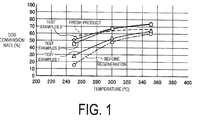
- FIG. 1 illustrates the relationship between the change in temperature of a COS hydrolysis catalyst and the COS conversion rate.
- the product of Test Example 3 has a higher COS conversion rate than a fresh catalyst from a temperature range exceeding approximately 280°C.
Landscapes
- Chemical & Material Sciences (AREA)
- Engineering & Computer Science (AREA)
- Chemical Kinetics & Catalysis (AREA)
- Materials Engineering (AREA)
- Organic Chemistry (AREA)
- Environmental & Geological Engineering (AREA)
- Analytical Chemistry (AREA)
- Health & Medical Sciences (AREA)
- Biomedical Technology (AREA)
- General Chemical & Material Sciences (AREA)
- Oil, Petroleum & Natural Gas (AREA)
- Thermal Sciences (AREA)
- Physics & Mathematics (AREA)
- Life Sciences & Earth Sciences (AREA)
- Sustainable Development (AREA)
- Catalysts (AREA)
Abstract
Description
- The present invention relates to a method for regenerating a COS hydrolysis catalyst.
- In recent years, there has been a demand for the effective utilization of low-quality fuels such as coal or heavy oil from the perspective of diversification so as to actively use low-quality fossil fuels in addition to high-quality fossil fuels. In addition, integrated coal gasification combined cycle (IGCC), in which gas turbines using gas fuel and steam turbines are used in combination, and power generation by means of introducing hydrocarbon gas into fuel cells are also becoming widespread from the perspective of improving power generation efficiency in the field of thermal power generation. Therefore, there is research and development underway to gasify low-quality fuels and use them for such power generation.
- Incidentally, a low-quality fuel typically contains a large amount of sulfur compounds, and when a gas obtained by gasifying this fuel is combusted directly, the sulfur compounds are discharged from the chimney into the atmosphere as sulfur oxides, which become a source of environmental pollution such as acid rain. Therefore, in ordinary thermal power generation, a method of installing an exhaust gas desulfurizer is installed on the back stream side of the boiler so as to remove sulfur compounds as gypsum, for example, has been put into practical application. However, in combined cycle power generation, the inlet temperature of a gas turbine is higher than the boiler temperature in ordinary thermal power generation, so the corrosion of the material is substantial. Therefore, it is necessary to protect the material by removing various impurities such as sulfur compounds on the front stream side rather than the back stream side of the gas turbine, so the aforementioned exhaust gas desulfurizer cannot be applied. For example, when installing a fuel cell power generator, it is essential to secure power generation efficiency and durability by protecting the material, and various impurities must be similarly removed on the front stream side of the fuel cell.
- A so-called wet gas purification process, wherein water-soluble components are removed with a water scrubber and hydrogen sulfide (H2S) is removed with an aqueous amine solution, has been put into practical application as such a method for removing impurities. However, although hydrogen sulfide (H2S) can be removed with an aqueous amine solution, carbonyl sulfide (COS) cannot be removed. Therefore, a hydrolysis reaction expressed by formula (1) is performed using a COS hydrolysis catalyst so as to accelerate a reaction for converting the substance into the form of hydrogen sulfide (H2S) which can be removed with an aqueous amine solution.
COS + H2O → H2S + CO2 ··· (1)
- Here, examples of known COS hydrolysis catalysts include catalysts containing titania, catalysts containing alumina, a group IV metal and barium, and catalysts containing an alkali metal, chromium oxide, and alumina (Patent Document 1).
- Incidentally, in integrated coal gasification combined cycle (IGCC), there is a problem in that when a COS hydrolysis catalyst is used continuously for COS in a gasified gas, so-called catalyst poisoning occurs, wherein the dust content (for example, sulfides) in the gasified gas covers the surface of the COS hydrolysis catalyst, which causes a decrease in catalyst performance.
- The catalyst with reduced performance as a result of poisoning is reused by means of regeneration treatment.
- A method of performing heat treatment on a catalyst and then re-supporting sodium carbonate, for example, has been proposed as such a catalyst regeneration method (Patent Document 2).
-
- Patent Document 1: Japanese Unexamined Patent Application Publication No.
2004-75712A - Patent Document 2: Japanese Unexamined Patent Application Publication No.
2001-162174A - The method for regenerating a COS hydrolysis catalyst according to the conventional art is an impregnation regeneration method using an alkali metal as a chemical, and the impregnation of the alkali metal does not necessarily result in the recovery of performance. Moreover, impregnation treatment is performed with material in a pellet shape, which is problematic in that the pellets make contact with one another and are pulverized at the time of regeneration.
- Therefore, there is a demand for the emergence of a method for regenerating a COS hydrolysis catalyst with a high recovery rate in a state in which the catalyst shape is maintained.
- In light of the problems described above, an object of the present invention is to provide a method for regenerating a COS hydrolysis catalyst with a high recovery rate in a state in which the catalyst shape is maintained.
- In order to solve the problem described above, a first invention of the present invention is a method for regenerating a barium oxide-based carbonyl sulfide (COS) hydrolysis catalyst by hydrolyzing COS which is contained in a gas obtained by gasifying a carbon raw material, wherein a spent COS hydrolysis catalyst is immersed in an aqueous solution of a barium salt for a prescribed amount of time, dried, and then calcined.
- A second invention is the method for regenerating a COS hydrolysis catalyst according to the first invention, wherein dust removal is performed prior to immersion.
- A third invention is the method for regenerating a COS hydrolysis catalyst according to the first or second invention, wherein drying is performed after water washing prior to immersion.
- A fourth invention is the method for regenerating a COS hydrolysis catalyst according to one of the first through third inventions, wherein the temperature of calcination is at least 200°C.
- With the present invention, the active component is re-supported, so it is possible to reuse a spent COS hydrolysis catalyst.
-
FIG. 1 illustrates the relationship between the change in temperature of a COS hydrolysis catalyst and the COS conversion rate. - The following is a detailed description of preferred embodiments with reference to the attached drawings. Note that the invention is not limited by the embodiments, and when a plurality of embodiments are present, the invention is intended to include a configuration combining these embodiments.
- The method for regenerating a COS hydrolysis catalyst according to
Embodiment 1 will be described. - The method for regenerating a COS hydrolysis catalyst according to
Embodiment 1 is a method for regenerating a barium oxide (for example, Ba/TiO2) based carbonyl sulfide (COS) hydrolysis catalyst by hydrolyzing COS which is contained in a gas obtained by gasifying a carbon raw material such as coal, for example, wherein a spent COS hydrolysis catalyst is washed with water, dried, immersed in an aqueous solution of a barium salt for a prescribed amount of time, dried, and then calcined. - With the present embodiment, by re-supporting the active component in a spent, degraded COS hydrolysis catalyst, it is possible to regenerate the catalyst. In addition, since the catalyst is a honeycomb-type catalyst, it is possible to regenerate the COS hydrolysis catalyst with a high recovery rate in a state in which the catalyst shape is maintained.
- Here, an example of the catalyst of the present invention is a honeycomb-type TiO2 catalyst supporting barium (Ba). In addition, TiO2 was given as an example of a carrier, but a carrier of Al2O2 alone or a carrier of a complex oxide of Al2O3 and TiO2 may also be used.
- The procedure of the method for regenerating a catalyst according to
Embodiment 1 will be described hereinafter. - (1) First, a honeycomb-type BaTiO2 based COS hydrolysis catalyst with which a COS conversion device of a coal gasification power plant has been filled is extracted.
- (2) The dust content adhering to the extracted Ba/TiO2 based COS hydrolysis catalyst is removed by a gas spraying device such as an air blower.
- (3) Next, a prescribed amount of washing water is placed in an immersion vessel, and the catalyst is immersed in the water in the vessel. Here, the amount of the water washing solution is at least an amount which allows the COS hydrolysis catalyst to be sufficiently hidden. More preferably, the amount is such that the volume ratio of washing water/COS hydrolysis catalyst is at least 3.
The water washing may be performed at room temperature or under heat. Ion-exchanged water, for example, may be used as the washing water. Water washing may also be omitted. - (4) The substance is left and water-washed for approximately 15 to 60 minutes, for example, in this immersed state.
- (5) After the substance is taken out from the washing water, the excess liquid in the COS hydrolysis catalyst is removed, and the substance is then dried.
The drying may be performed at room temperature or under heat. Here, in the case of heat drying, the temperature is preferably from 80°C to 200°C and particularly preferably from 110°C to 150°C. - (6) After the substance is dried and cooled to room temperature, the catalyst is then immersed in a barium acetate aqueous solution prepared in a separate vessel. Here, the amount of the barium acetate aqueous solution is at least an amount which allows the COS hydrolysis catalyst to be sufficiently hidden. More preferably, the amount is such that the volume ratio of the barium acetate aqueous solution/COS hydrolysis catalyst is at least 3.
- (7) The substance is left to stand for a prescribed amount of time, for example, in this immersed state. The immersion conditions are such that the substance is left to stand for 0.5 to 120 minutes and more preferably from 1 to 10 minutes.
Here, the barium acetate concentration is from 0.1 to 30 wt.% and preferably from 1 to 10 wt.%.
In addition, barium nitrate or the like, for example, may also be used as a barium source in addition to barium acetate. - (8) After the substance is immersed in the barium acetate aqueous solution, it is taken out and dried after the excess liquid in the catalyst is removed.
This drying may be performed by means of natural drying or heat drying. Here, in the case of heat drying, the temperature is preferably from 80°C to 200°C and particularly preferably from 110°C to 150°C. - (9) The dried COS hydrolysis catalyst is calcined.
The calcination temperature of calcination treatment is at least 200°C, and the calcination atmosphere is atmospheric air. - By performing chemical washing with an aqueous solution of a barium salt in this way, it is possible to re-support the active component in the COS hydrolysis catalyst and to reuse the catalyst.
- Here, the dust removal by means of air blowing in step (2) can be omitted depending on the amount of dust adhering to the catalyst.
- Here, the water washing in step (3) may be omitted depending on the amount of dust adhering to the catalyst.
- The method for regenerating a COS hydrolysis catalyst according to Embodiment 2 will be described.
- In the method for regenerating a COS hydrolysis catalyst according to Embodiment 2, pretreatment may be performed before the active component in the aqueous solution of a barium salt in
Embodiment 1 is re-supported. - This pretreatment is performed by 1) immersing the substance in an acid solution, 2) treating the substance with an alkali solution and then neutralizing the substance with an acid, or 3) treating the substance with an acid solution and then neutralizing the substance with an alkali.
- Here, as the acid solution in acid treatment, sulfuric acid (H2SO4), hydrochloric acid (HCl), nitric acid (HNO3), or the like with a concentration of at least 0.1 N and approximately 1 N can be used.
- In this chemical treatment, when the chemical solution is heated (for example, 60 to 80°C), the removal efficiency of adhering sulfides or the like improves.
- As the alkali solution in alkali treatment, sodium hydroxide (NaOH), ammonia water (NH4OH), sodium carbonate (Na2CO3), or the like with a concentration of at least 0.1 N and approximately 1 N can be used.
- In this chemical treatment, when the chemical solution is heated (for example, 60 to 80°C), the removal efficiency of adhering sulfides or the like improves.
- After chemical washing, the immersed COS hydrolysis catalyst is then immersed in a chemical (acid solution or alkali solution) prepared in a vessel and subjected to chemical washing. Here, the amount of the water washing solution is at least an amount which allows the COS hydrolysis catalyst to be sufficiently hidden. More preferably, the amount is such that the volume ratio of the chemical (acid or alkali)/COS hydrolysis catalyst is at least 3.
- The substance is left and chemically treated for approximately 15 to 60 minutes, for example, in this immersed state.
- After this chemical washing, the immersed COS hydrolysis catalyst is then immersed and water-washed in water (for example, ion-exchanged water) prepared in a separate vessel. Here, the amount of washing water is at least an amount which allows the COS hydrolysis catalyst to be sufficiently hidden. More preferably, the amount is such that the volume ratio of washing water/COS hydrolysis catalyst is at least 3.
- The substance is left and water-washed for approximately 15 to 60 minutes, for example, in this immersed state.
- After water washing, the COS hydrolysis catalyst is taken out and dried after excess liquid in the catalyst is removed.
- Drying may be performed by means of natural drying or heat drying. In addition, the substance may also be calcined.
- After pretreatment using this chemical, the active component is re-supported using the aqueous solution of a barium salt in
Embodiment 1. - By performing chemical washing with an acid or an alkali before re-supporting the active component in this way, it becomes possible to remove poisoning substances adhering to the COS hydrolysis catalyst, and re-supporting the active component in a fresh state makes it possible to reuse the substance.
- Next, test examples illustrating the effect of the present invention will be described, but the present invention is not limited to these test examples.
- Test Example 1 is an example in which a spent COS hydrolysis catalyst was immersed in a barium acetate aqueous solution and impregnated so that the barium oxide (BaO) content was 0.9 wt.%.
- Test Example 2 is an example in which a spent COS hydrolysis catalyst was immersed in a barium acetate aqueous solution and impregnated so that the barium oxide (BaO) content was 1.8 wt.%.
- Test Example 3 is an example in which a spent COS hydrolysis catalyst was immersed in a barium acetate aqueous solution and impregnated so that the barium oxide (BaO) content was 3.6 wt.%.
- The COS hydrolysis catalyst used in these tests is a Ba/TiO2 based honeycomb-type COS hydrolysis catalyst.
-
FIG. 1 illustrates the relationship between the change in temperature of a COS hydrolysis catalyst and the COS conversion rate. - Using the regenerated COS hydrolysis catalyst of Test Example 1, 2, and 3, the COS conversion rates at catalyst treatment temperatures (250°C, 300°C, and 350°C) were measured and shown in
FIG. 1 . - As illustrated in
FIG. 1 , it was confirmed that the COS conversion rate was consistently higher than the catalyst prior to regeneration in Test Examples 2 and 3 (products with a barium oxide content of 1.8 wt.% and 3.6 wt.%). - In addition, it was confirmed that the COS conversion rate was slightly higher than the catalyst prior to regeneration in Test Example 1 (product with a barium oxide content of 0.9 wt.%).
- In particular, it was confirmed that the product of Test Example 3 has a higher COS conversion rate than a fresh catalyst from a temperature range exceeding approximately 280°C.
- The chemical cost becomes expensive when the amount of the re-supported active component in the re-supported barium oxide exceeds 4.0 wt.% in terms of barium oxide content, so the content is preferably at most 4.0 wt.% in terms of barium oxide content. In addition, the performance diminished slightly in the product of Test Example 1 having a content of 0.9 wt.% in terms of barium oxide content, so the supported amount is preferably within a range of 1.0 wt.% to 4.0 wt.% in terms of barium oxide content.
Claims (4)
- A method for regenerating a barium oxide-based carbonyl sulfide (COS) hydrolysis catalyst by hydrolyzing COS which is contained in a gas obtained by gasifying a carbon raw material, wherein a spent COS hydrolysis catalyst is immersed in an aqueous solution of a barium salt for a prescribed amount of time, dried, and then calcined.
- The method for regenerating a carbonyl sulfide (COS) hydrolysis catalyst according to claim 1, wherein dust removal is performed prior to immersion.
- The method for regenerating a carbonyl sulfide (COS) hydrolysis catalyst according to claim 1 or 2, wherein drying is performed after water washing prior to immersion.
- The method for regenerating a carbonyl sulfide (COS) hydrolysis catalyst according to any one of claims 1 to 3, wherein a temperature of the calcination is at least 200°C.
Applications Claiming Priority (2)
| Application Number | Priority Date | Filing Date | Title |
|---|---|---|---|
| JP2013273465A JP6147663B2 (en) | 2013-12-27 | 2013-12-27 | Catalyst regeneration method for COS conversion catalyst |
| PCT/JP2014/079756 WO2015098319A1 (en) | 2013-12-27 | 2014-11-10 | Catalyst regeneration method for cos conversion catalyst |
Publications (2)
| Publication Number | Publication Date |
|---|---|
| EP2987553A1 true EP2987553A1 (en) | 2016-02-24 |
| EP2987553A4 EP2987553A4 (en) | 2016-07-27 |
Family
ID=53478197
Family Applications (1)
| Application Number | Title | Priority Date | Filing Date |
|---|---|---|---|
| EP14875785.9A Withdrawn EP2987553A4 (en) | 2013-12-27 | 2014-11-10 | Catalyst regeneration method for cos conversion catalyst |
Country Status (6)
| Country | Link |
|---|---|
| US (1) | US9486797B2 (en) |
| EP (1) | EP2987553A4 (en) |
| JP (1) | JP6147663B2 (en) |
| CN (1) | CN105228746A (en) |
| AU (1) | AU2014371677B2 (en) |
| WO (1) | WO2015098319A1 (en) |
Cited By (1)
| Publication number | Priority date | Publication date | Assignee | Title |
|---|---|---|---|---|
| EP2998024A4 (en) * | 2013-10-23 | 2016-11-30 | Mitsubishi Heavy Ind Ltd | PROCESS FOR REGENERATING COS CONVERSION CATALYST |
Families Citing this family (8)
| Publication number | Priority date | Publication date | Assignee | Title |
|---|---|---|---|---|
| JP7039286B2 (en) * | 2017-12-27 | 2022-03-22 | 三菱重工エンジニアリング株式会社 | Hydrolysis catalyst for carbonyl sulfide and its production method |
| JP7051451B2 (en) * | 2018-01-12 | 2022-04-11 | 三菱重工エンジニアリング株式会社 | Hydrolysis catalyst for carbonyl sulfide and its production method |
| CN112206835B (en) * | 2020-09-18 | 2025-07-08 | 中国石化扬子石油化工有限公司 | Regeneration method of carbonyl sulfide hydrolysis catalyst |
| CN113019471B (en) * | 2021-02-07 | 2023-05-23 | 铜仁市诚一环保科技有限公司 | Method and equipment for cleaning denitration catalyst |
| CN113181953A (en) * | 2021-04-23 | 2021-07-30 | 陕西驭腾能源环保科技有限公司 | Organic sulfur hydrolysis catalyst for coke oven gas and preparation method thereof |
| CN114367279B (en) * | 2021-12-31 | 2024-06-25 | 东南大学 | Low temperature anti-poisoning hydrolysis catalyst for blast furnace gas desulfurization and preparation method thereof |
| CN114522691B (en) * | 2022-02-21 | 2023-05-30 | 福州大学 | A kind of preparation method of composite metal oxide for organosulfur catalytic hydrolysis |
| CN115945227A (en) * | 2022-12-28 | 2023-04-11 | 中冶华天工程技术有限公司 | A kind of activation method of carbonyl sulfide hydrolysis catalyst |
Family Cites Families (10)
| Publication number | Priority date | Publication date | Assignee | Title |
|---|---|---|---|---|
| FR2501532B1 (en) | 1981-03-13 | 1985-12-13 | Rhone Poulenc Spec Chim | CATALYST AND METHOD FOR THE TREATMENT OF INDUSTRIAL WASTE GASES CONTAINING SULFUR COMPOUNDS |
| JPS57180433A (en) | 1981-04-28 | 1982-11-06 | Mitsubishi Heavy Ind Ltd | Regeneration of used denitration catalyst |
| US4511668A (en) | 1983-10-25 | 1985-04-16 | Catalysts & Chemicals Industries Co., Ltd. | Catalyst for use in hydrolysis of carbonyl sulfide |
| DE4206913A1 (en) * | 1992-03-05 | 1993-09-09 | Kronos Titan Gmbh | CATALYST FOR CARBONYL SULFID HYDROLYSIS |
| JP4263829B2 (en) | 1999-12-13 | 2009-05-13 | Jfeケミカル株式会社 | Catalyst regeneration method |
| CN1136054C (en) * | 2000-06-20 | 2004-01-28 | 中国石化集团齐鲁石化公司 | Regeneration method of carbonyl sulfide hydrolysis catalyst |
| JP2002102716A (en) * | 2000-09-29 | 2002-04-09 | Osaka Gas Co Ltd | Method for regenerating catalyst |
| JP4467872B2 (en) | 2002-08-09 | 2010-05-26 | 三菱重工業株式会社 | COS processing apparatus and method for gasification gas |
| JP2006143959A (en) * | 2004-11-24 | 2006-06-08 | Matsushita Electric Works Ltd | Desulfurization equipment and regeneration method of alumina catalyst |
| JP5955026B2 (en) * | 2012-02-24 | 2016-07-20 | 三菱重工業株式会社 | Use of catalysts for hydrolysis of carbonyl sulfide and hydrogen cyanide and titanium oxide-based compositions |
-
2013
- 2013-12-27 JP JP2013273465A patent/JP6147663B2/en active Active
-
2014
- 2014-11-10 EP EP14875785.9A patent/EP2987553A4/en not_active Withdrawn
- 2014-11-10 AU AU2014371677A patent/AU2014371677B2/en not_active Ceased
- 2014-11-10 US US14/897,104 patent/US9486797B2/en active Active
- 2014-11-10 CN CN201480029715.8A patent/CN105228746A/en active Pending
- 2014-11-10 WO PCT/JP2014/079756 patent/WO2015098319A1/en not_active Ceased
Cited By (2)
| Publication number | Priority date | Publication date | Assignee | Title |
|---|---|---|---|---|
| EP2998024A4 (en) * | 2013-10-23 | 2016-11-30 | Mitsubishi Heavy Ind Ltd | PROCESS FOR REGENERATING COS CONVERSION CATALYST |
| US9604206B2 (en) | 2013-10-23 | 2017-03-28 | Mitsubishi Heavy Industries, Ltd. | Method for regenerating COS hydrolysis catalyst |
Also Published As
| Publication number | Publication date |
|---|---|
| WO2015098319A1 (en) | 2015-07-02 |
| AU2014371677A1 (en) | 2015-12-03 |
| AU2014371677B2 (en) | 2017-02-16 |
| US20160136636A1 (en) | 2016-05-19 |
| CN105228746A (en) | 2016-01-06 |
| JP2015127037A (en) | 2015-07-09 |
| JP6147663B2 (en) | 2017-06-14 |
| EP2987553A4 (en) | 2016-07-27 |
| US9486797B2 (en) | 2016-11-08 |
Similar Documents
| Publication | Publication Date | Title |
|---|---|---|
| US9486797B2 (en) | Method for regenerating COS hydrolysis catalyst | |
| HUT77699A (en) | Regeneration of catalyst/absorber | |
| US9604206B2 (en) | Method for regenerating COS hydrolysis catalyst | |
| CN102630186A (en) | CO shift catalyst, CO shift reaction device, and method for refining coal gasification gas | |
| US9238208B2 (en) | CO shift reaction apparatus and gasification gas refining system | |
| JP2011157486A (en) | System for purifying gasified gas | |
| JP6249689B2 (en) | Exhaust gas treatment regeneration catalyst and exhaust gas treatment catalyst regeneration method | |
| CN105983340A (en) | Regeneration method for low-temperature SCR denitration catalyst | |
| US6079212A (en) | Gasification power generation process and gasification power generation equipment | |
| JP7039286B2 (en) | Hydrolysis catalyst for carbonyl sulfide and its production method | |
| JP5595385B2 (en) | CO shift catalyst and method for producing the same, and CO shift reaction apparatus using CO shift catalyst | |
| CN100580062C (en) | COS processing device and COS processing method for gasification gas | |
| CN118516139A (en) | A method for dry fine desulfurization of blast furnace gas | |
| JP5688748B2 (en) | Dry gas refining equipment and coal gasification combined power generation equipment | |
| JP2010215802A (en) | Dry gas purification facility and coal gasification combined power generation facility | |
| Kim et al. | The Utilization of Waste Seashell for High Temperature Desulfurization | |
| JP2012219225A (en) | Dry gas purification facility and coal gasification-combined power generation facility | |
| JP2008038014A (en) | Gas purification apparatus and method, gasification system, gasification power generation system |
Legal Events
| Date | Code | Title | Description |
|---|---|---|---|
| PUAI | Public reference made under article 153(3) epc to a published international application that has entered the european phase |
Free format text: ORIGINAL CODE: 0009012 |
|
| 17P | Request for examination filed |
Effective date: 20151119 |
|
| AK | Designated contracting states |
Kind code of ref document: A1 Designated state(s): AL AT BE BG CH CY CZ DE DK EE ES FI FR GB GR HR HU IE IS IT LI LT LU LV MC MK MT NL NO PL PT RO RS SE SI SK SM TR |
|
| AX | Request for extension of the european patent |
Extension state: BA ME |
|
| RIC1 | Information provided on ipc code assigned before grant |
Ipc: B01J 38/48 20060101AFI20160616BHEP Ipc: B01J 21/20 20060101ALI20160616BHEP Ipc: B01J 23/02 20060101ALI20160616BHEP Ipc: B01J 21/06 20060101ALI20160616BHEP |
|
| A4 | Supplementary search report drawn up and despatched |
Effective date: 20160623 |
|
| DAX | Request for extension of the european patent (deleted) | ||
| 17Q | First examination report despatched |
Effective date: 20170619 |
|
| STAA | Information on the status of an ep patent application or granted ep patent |
Free format text: STATUS: THE APPLICATION IS DEEMED TO BE WITHDRAWN |
|
| 18D | Application deemed to be withdrawn |
Effective date: 20180209 |