EP2984639B1 - Vorrichtung und verfahren zur 3d-videoüberwachung bestimmter objekte - Google Patents
Vorrichtung und verfahren zur 3d-videoüberwachung bestimmter objekte Download PDFInfo
- Publication number
- EP2984639B1 EP2984639B1 EP14717709.1A EP14717709A EP2984639B1 EP 2984639 B1 EP2984639 B1 EP 2984639B1 EP 14717709 A EP14717709 A EP 14717709A EP 2984639 B1 EP2984639 B1 EP 2984639B1
- Authority
- EP
- European Patent Office
- Prior art keywords
- tracks
- interest
- label
- objects
- track
- Prior art date
- Legal status (The legal status is an assumption and is not a legal conclusion. Google has not performed a legal analysis and makes no representation as to the accuracy of the status listed.)
- Not-in-force
Links
Images

Classifications
-
- H—ELECTRICITY
- H04—ELECTRIC COMMUNICATION TECHNIQUE
- H04N—PICTORIAL COMMUNICATION, e.g. TELEVISION
- H04N7/00—Television systems
- H04N7/18—Closed-circuit television [CCTV] systems, i.e. systems in which the video signal is not broadcast
- H04N7/181—Closed-circuit television [CCTV] systems, i.e. systems in which the video signal is not broadcast for receiving images from a plurality of remote sources
-
- G—PHYSICS
- G08—SIGNALLING
- G08B—SIGNALLING SYSTEMS, e.g. PERSONAL CALLING SYSTEMS; ORDER TELEGRAPHS; ALARM SYSTEMS
- G08B13/00—Burglar, theft or intruder alarms
- G08B13/18—Actuation by interference with heat, light, or radiation of shorter wavelength; Actuation by intruding sources of heat, light, or radiation of shorter wavelength
- G08B13/189—Actuation by interference with heat, light, or radiation of shorter wavelength; Actuation by intruding sources of heat, light, or radiation of shorter wavelength using passive radiation detection systems
- G08B13/194—Actuation by interference with heat, light, or radiation of shorter wavelength; Actuation by intruding sources of heat, light, or radiation of shorter wavelength using passive radiation detection systems using image scanning and comparing systems
- G08B13/196—Actuation by interference with heat, light, or radiation of shorter wavelength; Actuation by intruding sources of heat, light, or radiation of shorter wavelength using passive radiation detection systems using image scanning and comparing systems using television cameras
- G08B13/19602—Image analysis to detect motion of the intruder, e.g. by frame subtraction
- G08B13/19608—Tracking movement of a target, e.g. by detecting an object predefined as a target, using target direction and or velocity to predict its new position
-
- G—PHYSICS
- G06—COMPUTING OR CALCULATING; COUNTING
- G06T—IMAGE DATA PROCESSING OR GENERATION, IN GENERAL
- G06T7/00—Image analysis
- G06T7/10—Segmentation; Edge detection
- G06T7/12—Edge-based segmentation
-
- G—PHYSICS
- G06—COMPUTING OR CALCULATING; COUNTING
- G06T—IMAGE DATA PROCESSING OR GENERATION, IN GENERAL
- G06T7/00—Image analysis
- G06T7/70—Determining position or orientation of objects or cameras
- G06T7/73—Determining position or orientation of objects or cameras using feature-based methods
- G06T7/75—Determining position or orientation of objects or cameras using feature-based methods involving models
-
- G—PHYSICS
- G06—COMPUTING OR CALCULATING; COUNTING
- G06V—IMAGE OR VIDEO RECOGNITION OR UNDERSTANDING
- G06V40/00—Recognition of biometric, human-related or animal-related patterns in image or video data
- G06V40/10—Human or animal bodies, e.g. vehicle occupants or pedestrians; Body parts, e.g. hands
- G06V40/103—Static body considered as a whole, e.g. static pedestrian or occupant recognition
-
- H—ELECTRICITY
- H04—ELECTRIC COMMUNICATION TECHNIQUE
- H04N—PICTORIAL COMMUNICATION, e.g. TELEVISION
- H04N13/00—Stereoscopic video systems; Multi-view video systems; Details thereof
- H04N13/10—Processing, recording or transmission of stereoscopic or multi-view image signals
- H04N13/106—Processing image signals
-
- H—ELECTRICITY
- H04—ELECTRIC COMMUNICATION TECHNIQUE
- H04N—PICTORIAL COMMUNICATION, e.g. TELEVISION
- H04N7/00—Television systems
- H04N7/18—Closed-circuit television [CCTV] systems, i.e. systems in which the video signal is not broadcast
- H04N7/188—Capturing isolated or intermittent images triggered by the occurrence of a predetermined event, e.g. an object reaching a predetermined position
Definitions
- the invention relates to the field of security systems and more particularly addresses the 3D video tracking systems of objects of interest, the objects of interest may in particular be persons or vehicles.
- the first approach is to ensure that people in the secure area of the control system remain well separated to avoid interaction situations or potential errors for the tracking modules.
- the patent EP 2 204 783 A1 Thales offers a security system where only one person has to pass through a security corridor. This solution is viable in a very constrained context, which is less and less accepted by the operators.
- the second approach is to perform long-term probabilistic analyzes based on different appearance criteria and / or morphologies, in an attempt to recognize the different people who have interacted once separated.
- Several known algorithms allow to manage multiple hypotheses, in order not to take an immediate decision to associate the detections of persons with a track, a track being associated with a sequence of positions of people in space and time, and then waiting to have enough elements to confirm or disprove the pairings between tracks and detections.
- the article of B. Song and AK Roy-Chowdhury entitled “Stochastic Adaptive Tracking in a Camera Network” or the article of RY Khalaf and SS Intille entitled “Improving multiple people tracking using temporal consistency "Propose variations around this principle.
- the disadvantage of this approach called” probabilistic analyst is that it incorporates uncertainty and doubt. It therefore does not include the specific constraints of the security systems in terms of reliability .
- the present invention meets this need.
- An object of the present invention is to provide a security assistance system which comprises a robust and reliable 3D video object tracking module.
- Another object of the present invention is to provide a risk propagation device that allows the potential risks associated with one person not to be lost or associated with another person over time.
- the proposed risk propagation module makes it possible to create kinship links between the analyzed tracks, during interactions or when tracks disappear / reappear. It thus makes it possible to diffuse the highest risks to each track concerned.
- Another object of the present invention is to provide a simple and reliable method of use in real time.
- the method of the invention makes it possible to reinforce the reliability of a system for aggregating alarms from different sensors and makes it possible to limit non-detection of security assistance systems.
- Another advantage lies in the fact that the module takes into account the limits of object tracking algorithms in the context of a security system with specific constraints. The taking into account of these specific constraints, allows a rate of non-detection of danger almost zero.
- the device of the invention is based on a new interpretation of the need in terms of 3D video tracking of objects of interest in the context of a critical infrastructure security system, unlike existing solutions that are focused on the improvement of the monitoring algorithm, by greatly complicating the calculations, or by delaying the decision-making process to obtain more information, but at the cost of having difficulty coping with the real-time constraint resulting from the merger Datas.
- the method of the invention detects potentially delicate situations, that is to say interactions (people crossing, walking nearby, facing each other for some time) or disappearances / reappearing tracks.
- the proposed method constantly assesses the proximity between the different tracks and their ability to hide from the point of view of the cameras for a tracking algorithm, then the This method makes it possible to broadcast to all the tracks concerned the highest risk possessed by one of them.
- the method of the invention makes it possible to create a relationship between tracks having interacted and therefore likely to have been confused by the algorithm for tracking people, thereby creating information that better corresponds to the needs of the supervision systems.
- the method of the invention further offers the possibility of using different criteria to determine an interaction between tracks.
- the proposed risk propagation system covers the field of security assistance systems including a video system and more generally the field of video surveillance. It can be used in conjunction with any security information merging system, including a 3D video tracking step of people.
- the competence zone is associated with an input-output zone of the monitored space and with one or more overlapping zones.
- the method makes it possible to define interactions between tracks, by a proximity parameter, or by an occultation parameter.
- the interaction detection step consists in determining the repeated presence of a track in the ground projection ellipse of another track and the repeated blanking between these same tracks.
- the detectors are of the radiometric sensor type, metal detector, explosive trace detector, biological detector and / or epidemiological detector.
- the method of the present invention operates for a security assistance device in the tracking of objects of interest, the device comprising means for implementing the steps of the method.
- the steps of the method can be implemented in the form of a program computer apparatus comprising code instructions for performing all or part of the process steps.
- the figure 1 illustrates a known security assistance system in which advantageously implement the device of the invention. Only the main elements of such a system are illustrated, but those skilled in the art will appreciate that any variant of these elements does not change the functional principle of the invention.
- the architecture shown is composed of a limited number of cameras and sensors.
- three cameras (104-1, 104-2, 104-3) and three chemical sensors (106-1, 106-2, 106-3) are placed along a corridor (102) where can move people.
- the number of sensors and cameras may be different depending on the need of the monitoring system, without affecting the operation of the device of the invention, as well as the geometry, the size of the corridor.
- the positioning of the cameras presented in the figure 1 illustrates a particular and non-limiting case, the cameras being able to be positioned differently.
- the cameras instead of exploiting a point of view "seen from the sky", it is possible to place the cameras in such a way as to obtain a point of view exploiting the perspective along the length of the corridor or on the contrary according to the width of that -this.
- cameras with very different objectives ranging from "fish-eye” (very short focal length) to objectives called “pin-hole” (longer focal length).
- the system of the invention can operate with any type of security detector, such as radiometric sensor, metal detector, or explosive trace detector, biological detector or well still epidemiological detector.
- security detector such as radiometric sensor, metal detector, or explosive trace detector, biological detector or well still epidemiological detector.
- the monitoring system further comprises a module (108) for processing the data from the sensors and cameras.
- the data processing module (108) includes a person tracking algorithm.
- the tracking algorithm delivers a list of tracks associating a sequence of positions of the objects or people tracked in space and time as well as possibly a volume representing the tracked object.
- a risk propagation device (110), object of the present invention is coupled to the assistance system, and more particularly to the data processing module (108).
- the entire system of sensors and cameras is calibrated so that each element is positioned in space with respect to a common reference.
- the calibration allows to project in the same common space, the corridor in the example described, the area observed by the cameras and monitored.
- Calibration makes it possible to know the position in the corridor of all the objects (people, cameras, sensors) compared to a common reference (the entry of the corridor for example). Calibration thus makes it possible to link the fields of views of the cameras to facilitate the interpretation of the images.
- the inter-camera people tracking algorithm takes this assumption into account in order to optimize its performance.
- a detection from the first sensor (106-1) can be related to a track from tracking made from the images of the first camera (104-1).
- the calibration data also make it possible to track people in 3D by modeling people by cylinders.
- any other geometric shape more or less complex judiciously representing the object or the person of interest could be used, or pavers.
- the Figure 2 schematically illustrates a mapping of a monitored space to operate the device of the invention.
- the monitored space is divided into different areas.
- a skill area (201, 202, 203) is specified.
- the area of competence is associated with an input-output area (204, 205) of the monitored space and one or more coverage areas (206, 207) corresponding to inter-camera I / O.
- Any other definition of the zones, such as the definition of a single area of competence covering the entire corridor makes it possible to operate the device of the invention according to the same principles.
- the definition of a map makes it possible to limit image processing to defined areas and to facilitate the detection of potential interactions between tracks resulting from 3D tracking.
- the device of the invention operates according to interaction definition rules between tracks.
- the risk propagation device makes it possible to create relationships between tracks when an interaction between tracks is proven. A number of criteria make it possible to define a "proven interaction".
- a first criterion is "proximity".
- the perspective effect in a camera makes the uncertainty around the position of a person modelable by an ellipse on the ground whose main axis represents the axis between the person and the camera and the secondary axis the width of the person .
- the calibration data make it possible to pass information in the image to 3D data such as the location on the ground, the distance to the camera, the size of the person.
- a criterion indicating the proximity between two people can be determined by the superposition of their respective ellipses.
- An overlay threshold defines the importance of this overlap for to be relevant. It should be noted that other criteria can be used to detect proximity.
- Another criterion is "occultation".
- it is customary to model a person by a cylinder as part of a tracking algorithm, to have a simple model to operate.
- a criterion indicating the occultation of a person by another can be determined by the superposition of their cylinders from the point of view of the camera.
- a threshold makes it possible to define the importance of this recovery to be relevant.
- the calibration information makes it possible to switch from 3D data to 2D data. It should be noted that other criteria can be used to detect the occultation.
- Another parameter that can be used is "certainty". Indeed, some tracking systems are able to describe the certainty or conversely the uncertainty of positioning a person.
- Another parameter that can be used is the "convergence of trajectories" for situations not fixed for trajectories that come closer, cross and then move away.
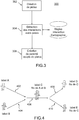
- the Figure 3 shows the steps of the risk propagation process (300) according to the principle of the invention.
- the risk propagator is designed to overcome the weaknesses of a 3D video tracking system of objects of interest, and operates in several steps.
- the initial step (302) consists in creating the tracks, that is to say for a track, determining the sequences of positions in space and in time of a tracked object.
- the process determines the interactions between the tracks created in the previous step.
- the process temporally aggregates the interaction criteria that are previously defined to determine the existence of an interaction between tracks.
- an interaction is determined by the repeated presence of a track in the ground projection ellipse of another track, this combined with a phenomenon also repeated occultation between these same tracks.
- the process also takes into account the mapping that has been previously defined to exclude certain areas of the analysis, such as global input / output areas. Indeed, in these areas, the lack of reliable data makes it impossible to interpret the scene sufficiently fine to trace the necessary information to the interaction rules.
- the Process proceeds to the next step (306) to enable the creation of kinship.
- the Figure 4 is an illustration of the process of relationship building.
- the creation of kinship occurs twice. A first time at the beginning of the interaction between tracks, and a second time at the end of the interaction.
- the present invention can be implemented from hardware and / or software elements. It may be available as a computer program product on a computer readable medium.
Landscapes
- Engineering & Computer Science (AREA)
- Physics & Mathematics (AREA)
- General Physics & Mathematics (AREA)
- Computer Vision & Pattern Recognition (AREA)
- Multimedia (AREA)
- Theoretical Computer Science (AREA)
- Signal Processing (AREA)
- Human Computer Interaction (AREA)
- Image Analysis (AREA)
- Alarm Systems (AREA)
Claims (11)
- Verfahren zur Sicherheitsunterstützung bei der 3D-Verfolgung bestimmter Objekte, wobei das Verfahren folgende Schritte beinhaltet:- Kalibrieren, in Bezug auf eine gemeinsame Referenz, einer Gruppe von Detektoren eines Verfolgungssystems für einen zu überwachenden Raum;- Definieren, für den überwachten Raum, von mindestens einer Zuständigkeitszone;- Erzeugen, für die Zuständigkeitszone, einer Liste von Spuren, wobei jede Spur für ein bestimmtes verfolgtes Objekt ein Label zur Identifizierung des verfolgten bestimmten Objekts und eine Folge von Positionen, die von den Detektoren bereitgestellt werden, beinhaltet;- Erkennen der Interaktionen zwischen den Spuren in der Zuständigkeitszone; und- Erzeugen eines Verwandschafts-Labels anhand derjenigen Labels, mit welchen jedes bestimmte, verfolgte Objekt identifiziert wird, für die in Interaktion erkannten Spuren.
- Verfahren nach Anspruch 1, bei welchem die Zuständigkeitszone mit einer Ein-/Ausgangszone (204, 205) des überwachten Raums und mit einer oder mehreren Überlappungszonen (206, 207) assoziiert ist.
- Verfahren nach Anspruch 1 oder 2, zudem beinhaltend einen Schritt des Definierens der Interaktionen zwischen Spuren.
- Verfahren nach Anspruch 3, bei welchem die Interaktionen zwischen Spuren durch ein Näheparameter definiert werden.
- Verfahren nach Anspruch 3, bei welchem die Interaktionen zwischen Spuren durch ein Verdeckungsparameter definiert werden.
- Verfahren nach einem der Ansprüche 1 bis 5, bei welchem der Schritt des Erkennens von Interaktionen darin besteht, die wiederholte Präsenz einer Spur in der Projektionsellipse einer anderen Spur am Boden und die wiederholte Verdeckung zwischen diesen Spuren zu bestimmen.
- Verfahren nach einem der Ansprüche 1 bis 6, bei welchem die Detektoren Detektoren vom Typ radiometrischer Sensor, Metalldetektor, Sprengstoffspurendetektor, biologischer Detektor und/oder epidemiologischer Detektor sind.
- Verfahren nach einem der Ansprüche 1 bis 7, bei welchem der Schritt des Erzeugens eines Verwandschafts-Labels folgende Schritte beinhaltet:- Löschen aus der Liste der Spuren der beiden Spuren der erkannten Interaktion zwischen zwei bestimmten Objekten;- Schaffen einer neuen gemeinsamen Spur zum Verfolgen der beiden in Interaktion befindlichen bestimmten Objekte; und- Assoziieren eines Interaktions-Labels mit der gemeinsamen Spur, wobei das Interaktions-Label die beiden in der Genealogie der gemeinsamen Spur gelöschten Spuren darstellt.
- Verfahren nach Anspruch 8, bei welchem der Schritt des Erzeugens eines Verwandschafts-Labels zudem folgende Schritte beinhaltet:- Schaffen, anhand der gemeinsamen Spur, zweier neuer individueller Spuren zum Verfolgen eines jeden der beiden bestimmten Objekte;- Löschen der gemeinsamen Spur; und- Einbinden des Labels der in der Genealogie einer jeden der beiden individuellen Spuren gelöschten gemeinsamen Spur, wobei die Positionen der beiden vom Verfolgungssystem identifizierten bestimmten Objekte mit den resultierenden Labeln assoziiert werden.
- Verfahren zur Sicherheitsunterstützung bei der 3D-Verfolgung bestimmter Objekte, wobei die Vorrichtung Mittel zum Umsetzen der Schritte des Verfahrens nach einem der Ansprüche 1 bis 8 beinhaltet.
- Computerprogrammprodukt, wobei das Computerprogramm Code-Befehle beinhaltet, welche es ermöglichen, einen Teil oder alle Schritte des Verfahrens nach einem der Ansprüche 1 bis 10 durchzuführen, wenn das Programm auf einem Computer ausgeführt wird.
Applications Claiming Priority (2)
| Application Number | Priority Date | Filing Date | Title |
|---|---|---|---|
| FR1353280A FR3004573B1 (fr) | 2013-04-11 | 2013-04-11 | Dispositif et procede de suivi 3d video d'objets d'interet |
| PCT/EP2014/056781 WO2014166823A1 (fr) | 2013-04-11 | 2014-04-04 | Dispositif et procede de suivi 3d video d'objets d'interêt |
Publications (2)
| Publication Number | Publication Date |
|---|---|
| EP2984639A1 EP2984639A1 (de) | 2016-02-17 |
| EP2984639B1 true EP2984639B1 (de) | 2018-10-31 |
Family
ID=48979912
Family Applications (1)
| Application Number | Title | Priority Date | Filing Date |
|---|---|---|---|
| EP14717709.1A Not-in-force EP2984639B1 (de) | 2013-04-11 | 2014-04-04 | Vorrichtung und verfahren zur 3d-videoüberwachung bestimmter objekte |
Country Status (5)
| Country | Link |
|---|---|
| US (1) | US10225523B2 (de) |
| EP (1) | EP2984639B1 (de) |
| CA (1) | CA2908779A1 (de) |
| FR (1) | FR3004573B1 (de) |
| WO (1) | WO2014166823A1 (de) |
Families Citing this family (1)
| Publication number | Priority date | Publication date | Assignee | Title |
|---|---|---|---|---|
| CN112489396B (zh) * | 2020-11-16 | 2022-12-16 | 中移雄安信息通信科技有限公司 | 一种行人尾随行为检测方法、装置、电子设备和存储介质 |
Family Cites Families (4)
| Publication number | Priority date | Publication date | Assignee | Title |
|---|---|---|---|---|
| EP1927947A1 (de) * | 2006-11-30 | 2008-06-04 | Mitsubishi Electric Corporation | Computerimplementiertes Verfahren und System zur Rückverfolgung von Objekten über eine Überwachungsdatenbank |
| EP2204783A1 (de) | 2008-12-31 | 2010-07-07 | Thales | Sicherheitssystem mit Sensoren in einem Korridor zur Aufdeckung von gefährlichen Elementen |
| WO2010098024A1 (ja) * | 2009-02-24 | 2010-09-02 | 三菱電機株式会社 | 人物追跡装置及び人物追跡プログラム |
| KR101158729B1 (ko) * | 2010-03-31 | 2012-06-22 | 한국과학기술원 | 실시간 다수 객체 추적시스템 및 방법 |
-
2013
- 2013-04-11 FR FR1353280A patent/FR3004573B1/fr not_active Expired - Fee Related
-
2014
- 2014-04-04 CA CA2908779A patent/CA2908779A1/en not_active Abandoned
- 2014-04-04 EP EP14717709.1A patent/EP2984639B1/de not_active Not-in-force
- 2014-04-04 US US14/783,412 patent/US10225523B2/en not_active Expired - Fee Related
- 2014-04-04 WO PCT/EP2014/056781 patent/WO2014166823A1/fr not_active Ceased
Non-Patent Citations (1)
| Title |
|---|
| None * |
Also Published As
| Publication number | Publication date |
|---|---|
| US10225523B2 (en) | 2019-03-05 |
| FR3004573A1 (fr) | 2014-10-17 |
| EP2984639A1 (de) | 2016-02-17 |
| WO2014166823A1 (fr) | 2014-10-16 |
| FR3004573B1 (fr) | 2016-10-21 |
| CA2908779A1 (en) | 2014-10-16 |
| US20160065904A1 (en) | 2016-03-03 |
Similar Documents
| Publication | Publication Date | Title |
|---|---|---|
| EP2965287B1 (de) | Verfahren zur verfolgung eines ziels in einer bildsequenz unter berücksichtigung der dynamik des ziels | |
| US10037607B2 (en) | Topology determination for non-overlapping camera network | |
| US8614744B2 (en) | Area monitoring using prototypical tracks | |
| US10713499B2 (en) | Real-time video triggering for traffic surveillance and photo enforcement applications using near infrared video acquisition | |
| US9520040B2 (en) | System and method for real-time 3-D object tracking and alerting via networked sensors | |
| EP3506166B1 (de) | Vorhersage der verschiebung und topologie für ein kameranetzwerk | |
| US20160180201A1 (en) | Image processing | |
| Haghighat et al. | A computer vision‐based deep learning model to detect wrong‐way driving using pan–tilt–zoom traffic cameras | |
| FR3079924A1 (fr) | Suivi par geolocalisation | |
| GB2562018A (en) | A method and system for analyzing the movement of bodies in a traffic system | |
| KR20200019280A (ko) | 시각 감지 시스템 및 이를 이용한 시각 감지 방법 | |
| CN119720064A (zh) | 基于全范围特征识别及四维轨迹追踪的安防方法及装置 | |
| WO2014166823A1 (fr) | Dispositif et procede de suivi 3d video d'objets d'interêt | |
| FR3007560A1 (fr) | Systeme centralise de surveillance du trafic routier | |
| FR2958774A1 (fr) | Procede et systeme de detection de pietons adaptee au contexte industriel | |
| Goenka et al. | Threat detection in self-driving vehicles using computer vision | |
| EP2916542A1 (de) | Verfahren und System zur Überwachung, das insbesondere für die Videoüberwachung eingesetzt wird | |
| Singh et al. | Automatic Helmet Detection from Videos Using Artificial Intelligence Method and Engage with Secured Driving System by Message Alert | |
| EP3491628A1 (de) | System zur überwachung eines stück lands, wie etwa ein golfplatz | |
| CN121366502A (zh) | 车辆哨兵模式的报警方法、设备、存储介质以及程序产品 | |
| US12620233B2 (en) | Scalable intelligent video surveillance for the artificial intelligence of things | |
| Beg et al. | Improving Vehicle Assistance Systems: Evaluation of Augmented Capabilities through Infrared Thermal Camera Integration | |
| Otero et al. | Advancing early warning systems: AI applications, challenges and emerging insights | |
| Vignesh | A Novel Framework for Vehicle Detection and Tracking in Night Ware Surveillance Systems | |
| WO2025128824A1 (en) | Methods and systems for video-based object tracking using isochrones |
Legal Events
| Date | Code | Title | Description |
|---|---|---|---|
| PUAI | Public reference made under article 153(3) epc to a published international application that has entered the european phase |
Free format text: ORIGINAL CODE: 0009012 |
|
| 17P | Request for examination filed |
Effective date: 20150921 |
|
| AK | Designated contracting states |
Kind code of ref document: A1 Designated state(s): AL AT BE BG CH CY CZ DE DK EE ES FI FR GB GR HR HU IE IS IT LI LT LU LV MC MK MT NL NO PL PT RO RS SE SI SK SM TR |
|
| AX | Request for extension of the european patent |
Extension state: BA ME |
|
| DAX | Request for extension of the european patent (deleted) | ||
| GRAP | Despatch of communication of intention to grant a patent |
Free format text: ORIGINAL CODE: EPIDOSNIGR1 |
|
| STAA | Information on the status of an ep patent application or granted ep patent |
Free format text: STATUS: GRANT OF PATENT IS INTENDED |
|
| INTG | Intention to grant announced |
Effective date: 20180604 |
|
| GRAS | Grant fee paid |
Free format text: ORIGINAL CODE: EPIDOSNIGR3 |
|
| GRAA | (expected) grant |
Free format text: ORIGINAL CODE: 0009210 |
|
| STAA | Information on the status of an ep patent application or granted ep patent |
Free format text: STATUS: THE PATENT HAS BEEN GRANTED |
|
| AK | Designated contracting states |
Kind code of ref document: B1 Designated state(s): AL AT BE BG CH CY CZ DE DK EE ES FI FR GB GR HR HU IE IS IT LI LT LU LV MC MK MT NL NO PL PT RO RS SE SI SK SM TR |
|
| REG | Reference to a national code |
Ref country code: CH Ref legal event code: EP Ref country code: GB Ref legal event code: FG4D Free format text: NOT ENGLISH |
|
| REG | Reference to a national code |
Ref country code: AT Ref legal event code: REF Ref document number: 1060326 Country of ref document: AT Kind code of ref document: T Effective date: 20181115 |
|
| REG | Reference to a national code |
Ref country code: IE Ref legal event code: FG4D Free format text: LANGUAGE OF EP DOCUMENT: FRENCH |
|
| REG | Reference to a national code |
Ref country code: DE Ref legal event code: R096 Ref document number: 602014035072 Country of ref document: DE |
|
| REG | Reference to a national code |
Ref country code: NL Ref legal event code: MP Effective date: 20181031 |
|
| REG | Reference to a national code |
Ref country code: LT Ref legal event code: MG4D |
|
| REG | Reference to a national code |
Ref country code: AT Ref legal event code: MK05 Ref document number: 1060326 Country of ref document: AT Kind code of ref document: T Effective date: 20181031 |
|
| PG25 | Lapsed in a contracting state [announced via postgrant information from national office to epo] |
Ref country code: LV Free format text: LAPSE BECAUSE OF FAILURE TO SUBMIT A TRANSLATION OF THE DESCRIPTION OR TO PAY THE FEE WITHIN THE PRESCRIBED TIME-LIMIT Effective date: 20181031 Ref country code: ES Free format text: LAPSE BECAUSE OF FAILURE TO SUBMIT A TRANSLATION OF THE DESCRIPTION OR TO PAY THE FEE WITHIN THE PRESCRIBED TIME-LIMIT Effective date: 20181031 Ref country code: LT Free format text: LAPSE BECAUSE OF FAILURE TO SUBMIT A TRANSLATION OF THE DESCRIPTION OR TO PAY THE FEE WITHIN THE PRESCRIBED TIME-LIMIT Effective date: 20181031 Ref country code: PL Free format text: LAPSE BECAUSE OF FAILURE TO SUBMIT A TRANSLATION OF THE DESCRIPTION OR TO PAY THE FEE WITHIN THE PRESCRIBED TIME-LIMIT Effective date: 20181031 Ref country code: BG Free format text: LAPSE BECAUSE OF FAILURE TO SUBMIT A TRANSLATION OF THE DESCRIPTION OR TO PAY THE FEE WITHIN THE PRESCRIBED TIME-LIMIT Effective date: 20190131 Ref country code: HR Free format text: LAPSE BECAUSE OF FAILURE TO SUBMIT A TRANSLATION OF THE DESCRIPTION OR TO PAY THE FEE WITHIN THE PRESCRIBED TIME-LIMIT Effective date: 20181031 Ref country code: FI Free format text: LAPSE BECAUSE OF FAILURE TO SUBMIT A TRANSLATION OF THE DESCRIPTION OR TO PAY THE FEE WITHIN THE PRESCRIBED TIME-LIMIT Effective date: 20181031 Ref country code: NO Free format text: LAPSE BECAUSE OF FAILURE TO SUBMIT A TRANSLATION OF THE DESCRIPTION OR TO PAY THE FEE WITHIN THE PRESCRIBED TIME-LIMIT Effective date: 20190131 Ref country code: AT Free format text: LAPSE BECAUSE OF FAILURE TO SUBMIT A TRANSLATION OF THE DESCRIPTION OR TO PAY THE FEE WITHIN THE PRESCRIBED TIME-LIMIT Effective date: 20181031 Ref country code: IS Free format text: LAPSE BECAUSE OF FAILURE TO SUBMIT A TRANSLATION OF THE DESCRIPTION OR TO PAY THE FEE WITHIN THE PRESCRIBED TIME-LIMIT Effective date: 20190228 |
|
| PG25 | Lapsed in a contracting state [announced via postgrant information from national office to epo] |
Ref country code: RS Free format text: LAPSE BECAUSE OF FAILURE TO SUBMIT A TRANSLATION OF THE DESCRIPTION OR TO PAY THE FEE WITHIN THE PRESCRIBED TIME-LIMIT Effective date: 20181031 Ref country code: PT Free format text: LAPSE BECAUSE OF FAILURE TO SUBMIT A TRANSLATION OF THE DESCRIPTION OR TO PAY THE FEE WITHIN THE PRESCRIBED TIME-LIMIT Effective date: 20190301 Ref country code: NL Free format text: LAPSE BECAUSE OF FAILURE TO SUBMIT A TRANSLATION OF THE DESCRIPTION OR TO PAY THE FEE WITHIN THE PRESCRIBED TIME-LIMIT Effective date: 20181031 Ref country code: SE Free format text: LAPSE BECAUSE OF FAILURE TO SUBMIT A TRANSLATION OF THE DESCRIPTION OR TO PAY THE FEE WITHIN THE PRESCRIBED TIME-LIMIT Effective date: 20181031 Ref country code: GR Free format text: LAPSE BECAUSE OF FAILURE TO SUBMIT A TRANSLATION OF THE DESCRIPTION OR TO PAY THE FEE WITHIN THE PRESCRIBED TIME-LIMIT Effective date: 20190201 Ref country code: AL Free format text: LAPSE BECAUSE OF FAILURE TO SUBMIT A TRANSLATION OF THE DESCRIPTION OR TO PAY THE FEE WITHIN THE PRESCRIBED TIME-LIMIT Effective date: 20181031 |
|
| PG25 | Lapsed in a contracting state [announced via postgrant information from national office to epo] |
Ref country code: DK Free format text: LAPSE BECAUSE OF FAILURE TO SUBMIT A TRANSLATION OF THE DESCRIPTION OR TO PAY THE FEE WITHIN THE PRESCRIBED TIME-LIMIT Effective date: 20181031 Ref country code: IT Free format text: LAPSE BECAUSE OF FAILURE TO SUBMIT A TRANSLATION OF THE DESCRIPTION OR TO PAY THE FEE WITHIN THE PRESCRIBED TIME-LIMIT Effective date: 20181031 Ref country code: CZ Free format text: LAPSE BECAUSE OF FAILURE TO SUBMIT A TRANSLATION OF THE DESCRIPTION OR TO PAY THE FEE WITHIN THE PRESCRIBED TIME-LIMIT Effective date: 20181031 |
|
| REG | Reference to a national code |
Ref country code: DE Ref legal event code: R097 Ref document number: 602014035072 Country of ref document: DE |
|
| PG25 | Lapsed in a contracting state [announced via postgrant information from national office to epo] |
Ref country code: RO Free format text: LAPSE BECAUSE OF FAILURE TO SUBMIT A TRANSLATION OF THE DESCRIPTION OR TO PAY THE FEE WITHIN THE PRESCRIBED TIME-LIMIT Effective date: 20181031 Ref country code: SK Free format text: LAPSE BECAUSE OF FAILURE TO SUBMIT A TRANSLATION OF THE DESCRIPTION OR TO PAY THE FEE WITHIN THE PRESCRIBED TIME-LIMIT Effective date: 20181031 Ref country code: SM Free format text: LAPSE BECAUSE OF FAILURE TO SUBMIT A TRANSLATION OF THE DESCRIPTION OR TO PAY THE FEE WITHIN THE PRESCRIBED TIME-LIMIT Effective date: 20181031 Ref country code: EE Free format text: LAPSE BECAUSE OF FAILURE TO SUBMIT A TRANSLATION OF THE DESCRIPTION OR TO PAY THE FEE WITHIN THE PRESCRIBED TIME-LIMIT Effective date: 20181031 |
|
| PLBE | No opposition filed within time limit |
Free format text: ORIGINAL CODE: 0009261 |
|
| STAA | Information on the status of an ep patent application or granted ep patent |
Free format text: STATUS: NO OPPOSITION FILED WITHIN TIME LIMIT |
|
| 26N | No opposition filed |
Effective date: 20190801 |
|
| PG25 | Lapsed in a contracting state [announced via postgrant information from national office to epo] |
Ref country code: SI Free format text: LAPSE BECAUSE OF FAILURE TO SUBMIT A TRANSLATION OF THE DESCRIPTION OR TO PAY THE FEE WITHIN THE PRESCRIBED TIME-LIMIT Effective date: 20181031 |
|
| REG | Reference to a national code |
Ref country code: CH Ref legal event code: PL |
|
| REG | Reference to a national code |
Ref country code: BE Ref legal event code: MM Effective date: 20190430 |
|
| PG25 | Lapsed in a contracting state [announced via postgrant information from national office to epo] |
Ref country code: MC Free format text: LAPSE BECAUSE OF FAILURE TO SUBMIT A TRANSLATION OF THE DESCRIPTION OR TO PAY THE FEE WITHIN THE PRESCRIBED TIME-LIMIT Effective date: 20181031 Ref country code: LU Free format text: LAPSE BECAUSE OF NON-PAYMENT OF DUE FEES Effective date: 20190404 |
|
| PG25 | Lapsed in a contracting state [announced via postgrant information from national office to epo] |
Ref country code: LI Free format text: LAPSE BECAUSE OF NON-PAYMENT OF DUE FEES Effective date: 20190430 Ref country code: CH Free format text: LAPSE BECAUSE OF NON-PAYMENT OF DUE FEES Effective date: 20190430 |
|
| PG25 | Lapsed in a contracting state [announced via postgrant information from national office to epo] |
Ref country code: BE Free format text: LAPSE BECAUSE OF NON-PAYMENT OF DUE FEES Effective date: 20190430 |
|
| PG25 | Lapsed in a contracting state [announced via postgrant information from national office to epo] |
Ref country code: TR Free format text: LAPSE BECAUSE OF FAILURE TO SUBMIT A TRANSLATION OF THE DESCRIPTION OR TO PAY THE FEE WITHIN THE PRESCRIBED TIME-LIMIT Effective date: 20181031 |
|
| PG25 | Lapsed in a contracting state [announced via postgrant information from national office to epo] |
Ref country code: IE Free format text: LAPSE BECAUSE OF NON-PAYMENT OF DUE FEES Effective date: 20190404 |
|
| PGFP | Annual fee paid to national office [announced via postgrant information from national office to epo] |
Ref country code: DE Payment date: 20200408 Year of fee payment: 7 Ref country code: FR Payment date: 20200430 Year of fee payment: 7 |
|
| PGFP | Annual fee paid to national office [announced via postgrant information from national office to epo] |
Ref country code: GB Payment date: 20200427 Year of fee payment: 7 |
|
| PG25 | Lapsed in a contracting state [announced via postgrant information from national office to epo] |
Ref country code: CY Free format text: LAPSE BECAUSE OF FAILURE TO SUBMIT A TRANSLATION OF THE DESCRIPTION OR TO PAY THE FEE WITHIN THE PRESCRIBED TIME-LIMIT Effective date: 20181031 |
|
| PG25 | Lapsed in a contracting state [announced via postgrant information from national office to epo] |
Ref country code: MT Free format text: LAPSE BECAUSE OF FAILURE TO SUBMIT A TRANSLATION OF THE DESCRIPTION OR TO PAY THE FEE WITHIN THE PRESCRIBED TIME-LIMIT Effective date: 20181031 Ref country code: HU Free format text: LAPSE BECAUSE OF FAILURE TO SUBMIT A TRANSLATION OF THE DESCRIPTION OR TO PAY THE FEE WITHIN THE PRESCRIBED TIME-LIMIT; INVALID AB INITIO Effective date: 20140404 |
|
| REG | Reference to a national code |
Ref country code: DE Ref legal event code: R119 Ref document number: 602014035072 Country of ref document: DE |
|
| GBPC | Gb: european patent ceased through non-payment of renewal fee |
Effective date: 20210404 |
|
| PG25 | Lapsed in a contracting state [announced via postgrant information from national office to epo] |
Ref country code: FR Free format text: LAPSE BECAUSE OF NON-PAYMENT OF DUE FEES Effective date: 20210430 Ref country code: GB Free format text: LAPSE BECAUSE OF NON-PAYMENT OF DUE FEES Effective date: 20210404 Ref country code: DE Free format text: LAPSE BECAUSE OF NON-PAYMENT OF DUE FEES Effective date: 20211103 |
|
| PG25 | Lapsed in a contracting state [announced via postgrant information from national office to epo] |
Ref country code: MK Free format text: LAPSE BECAUSE OF FAILURE TO SUBMIT A TRANSLATION OF THE DESCRIPTION OR TO PAY THE FEE WITHIN THE PRESCRIBED TIME-LIMIT Effective date: 20181031 |