EP2983509B1 - Silica based salt solution delivery system - Google Patents
Silica based salt solution delivery system Download PDFInfo
- Publication number
- EP2983509B1 EP2983509B1 EP14721098.3A EP14721098A EP2983509B1 EP 2983509 B1 EP2983509 B1 EP 2983509B1 EP 14721098 A EP14721098 A EP 14721098A EP 2983509 B1 EP2983509 B1 EP 2983509B1
- Authority
- EP
- European Patent Office
- Prior art keywords
- salt
- carrier material
- salt solution
- silica
- zeofree
- Prior art date
- Legal status (The legal status is an assumption and is not a legal conclusion. Google has not performed a legal analysis and makes no representation as to the accuracy of the status listed.)
- Revoked
Links
- VYPSYNLAJGMNEJ-UHFFFAOYSA-N Silicium dioxide Chemical compound O=[Si]=O VYPSYNLAJGMNEJ-UHFFFAOYSA-N 0.000 title claims description 80
- 239000012266 salt solution Substances 0.000 title claims description 44
- 239000000377 silicon dioxide Substances 0.000 title claims description 39
- 235000002639 sodium chloride Nutrition 0.000 claims description 101
- 150000003839 salts Chemical class 0.000 claims description 82
- 239000012876 carrier material Substances 0.000 claims description 72
- FAPWRFPIFSIZLT-UHFFFAOYSA-M Sodium chloride Chemical compound [Na+].[Cl-] FAPWRFPIFSIZLT-UHFFFAOYSA-M 0.000 claims description 35
- 235000013305 food Nutrition 0.000 claims description 21
- 238000000034 method Methods 0.000 claims description 18
- 239000011780 sodium chloride Substances 0.000 claims description 18
- 239000000203 mixture Substances 0.000 claims description 16
- 238000010521 absorption reaction Methods 0.000 claims description 12
- BPQQTUXANYXVAA-UHFFFAOYSA-N Orthosilicate Chemical compound [O-][Si]([O-])([O-])[O-] BPQQTUXANYXVAA-UHFFFAOYSA-N 0.000 claims description 8
- 239000011148 porous material Substances 0.000 claims description 6
- 239000000463 material Substances 0.000 description 27
- 239000002245 particle Substances 0.000 description 19
- XLYOFNOQVPJJNP-UHFFFAOYSA-N water Substances O XLYOFNOQVPJJNP-UHFFFAOYSA-N 0.000 description 16
- 235000019640 taste Nutrition 0.000 description 12
- 239000003921 oil Substances 0.000 description 11
- 235000019198 oils Nutrition 0.000 description 11
- -1 for example Substances 0.000 description 8
- 239000000243 solution Substances 0.000 description 7
- 210000003296 saliva Anatomy 0.000 description 6
- 239000011734 sodium Substances 0.000 description 6
- 238000012360 testing method Methods 0.000 description 6
- DGAQECJNVWCQMB-PUAWFVPOSA-M Ilexoside XXIX Chemical compound C[C@@H]1CC[C@@]2(CC[C@@]3(C(=CC[C@H]4[C@]3(CC[C@@H]5[C@@]4(CC[C@@H](C5(C)C)OS(=O)(=O)[O-])C)C)[C@@H]2[C@]1(C)O)C)C(=O)O[C@H]6[C@@H]([C@H]([C@@H]([C@H](O6)CO)O)O)O.[Na+] DGAQECJNVWCQMB-PUAWFVPOSA-M 0.000 description 5
- QAOWNCQODCNURD-UHFFFAOYSA-L Sulfate Chemical compound [O-]S([O-])(=O)=O QAOWNCQODCNURD-UHFFFAOYSA-L 0.000 description 5
- 239000008367 deionised water Substances 0.000 description 5
- 229910021641 deionized water Inorganic materials 0.000 description 5
- 235000011888 snacks Nutrition 0.000 description 5
- 229910052708 sodium Inorganic materials 0.000 description 5
- JYIMWRSJCRRYNK-UHFFFAOYSA-N dialuminum;disodium;oxygen(2-);silicon(4+);hydrate Chemical compound O.[O-2].[O-2].[O-2].[O-2].[O-2].[O-2].[Na+].[Na+].[Al+3].[Al+3].[Si+4] JYIMWRSJCRRYNK-UHFFFAOYSA-N 0.000 description 4
- 230000006870 function Effects 0.000 description 4
- 238000005259 measurement Methods 0.000 description 4
- 239000013078 crystal Substances 0.000 description 3
- 239000000796 flavoring agent Substances 0.000 description 3
- 235000019634 flavors Nutrition 0.000 description 3
- 235000019643 salty taste Nutrition 0.000 description 3
- 229920006395 saturated elastomer Polymers 0.000 description 3
- 210000001779 taste bud Anatomy 0.000 description 3
- IJGRMHOSHXDMSA-UHFFFAOYSA-N Atomic nitrogen Chemical compound N#N IJGRMHOSHXDMSA-UHFFFAOYSA-N 0.000 description 2
- WCUXLLCKKVVCTQ-UHFFFAOYSA-M Potassium chloride Chemical compound [Cl-].[K+] WCUXLLCKKVVCTQ-UHFFFAOYSA-M 0.000 description 2
- 239000000654 additive Substances 0.000 description 2
- 239000000378 calcium silicate Substances 0.000 description 2
- 229910052918 calcium silicate Inorganic materials 0.000 description 2
- OYACROKNLOSFPA-UHFFFAOYSA-N calcium;dioxido(oxo)silane Chemical compound [Ca+2].[O-][Si]([O-])=O OYACROKNLOSFPA-UHFFFAOYSA-N 0.000 description 2
- 238000004090 dissolution Methods 0.000 description 2
- 238000002474 experimental method Methods 0.000 description 2
- 239000005350 fused silica glass Substances 0.000 description 2
- 239000004615 ingredient Substances 0.000 description 2
- 235000021388 linseed oil Nutrition 0.000 description 2
- 239000000944 linseed oil Substances 0.000 description 2
- 239000007788 liquid Substances 0.000 description 2
- 230000000704 physical effect Effects 0.000 description 2
- 235000019608 salt taste sensations Nutrition 0.000 description 2
- 239000000523 sample Substances 0.000 description 2
- 239000007787 solid Substances 0.000 description 2
- 238000003756 stirring Methods 0.000 description 2
- 239000011800 void material Substances 0.000 description 2
- 238000004438 BET method Methods 0.000 description 1
- 239000001692 EU approved anti-caking agent Substances 0.000 description 1
- FKNQFGJONOIPTF-UHFFFAOYSA-N Sodium cation Chemical compound [Na+] FKNQFGJONOIPTF-UHFFFAOYSA-N 0.000 description 1
- 239000013543 active substance Substances 0.000 description 1
- 230000000996 additive effect Effects 0.000 description 1
- 230000002411 adverse Effects 0.000 description 1
- 238000013019 agitation Methods 0.000 description 1
- 150000001413 amino acids Chemical class 0.000 description 1
- 238000004458 analytical method Methods 0.000 description 1
- 210000000748 cardiovascular system Anatomy 0.000 description 1
- 239000003054 catalyst Substances 0.000 description 1
- 230000001419 dependent effect Effects 0.000 description 1
- 238000005516 engineering process Methods 0.000 description 1
- 239000003623 enhancer Substances 0.000 description 1
- 230000037406 food intake Effects 0.000 description 1
- 230000036449 good health Effects 0.000 description 1
- 239000008187 granular material Substances 0.000 description 1
- 230000005802 health problem Effects 0.000 description 1
- 230000003116 impacting effect Effects 0.000 description 1
- 229910052500 inorganic mineral Inorganic materials 0.000 description 1
- 150000002500 ions Chemical class 0.000 description 1
- 244000144972 livestock Species 0.000 description 1
- 238000011068 loading method Methods 0.000 description 1
- 238000004519 manufacturing process Methods 0.000 description 1
- 235000010755 mineral Nutrition 0.000 description 1
- 239000011707 mineral Substances 0.000 description 1
- 230000004048 modification Effects 0.000 description 1
- 238000012986 modification Methods 0.000 description 1
- 229910052757 nitrogen Inorganic materials 0.000 description 1
- 239000011236 particulate material Substances 0.000 description 1
- 230000008447 perception Effects 0.000 description 1
- VLTRZXGMWDSKGL-UHFFFAOYSA-M perchlorate Inorganic materials [O-]Cl(=O)(=O)=O VLTRZXGMWDSKGL-UHFFFAOYSA-M 0.000 description 1
- VLTRZXGMWDSKGL-UHFFFAOYSA-N perchloric acid Chemical compound OCl(=O)(=O)=O VLTRZXGMWDSKGL-UHFFFAOYSA-N 0.000 description 1
- 239000001103 potassium chloride Substances 0.000 description 1
- 235000011164 potassium chloride Nutrition 0.000 description 1
- 239000000843 powder Substances 0.000 description 1
- 239000003755 preservative agent Substances 0.000 description 1
- 230000008569 process Effects 0.000 description 1
- 239000012047 saturated solution Substances 0.000 description 1
- 238000003307 slaughter Methods 0.000 description 1
- 229910001415 sodium ion Inorganic materials 0.000 description 1
- 210000002784 stomach Anatomy 0.000 description 1
- 235000013343 vitamin Nutrition 0.000 description 1
- 239000011782 vitamin Substances 0.000 description 1
- 229940088594 vitamin Drugs 0.000 description 1
- 229930003231 vitamin Natural products 0.000 description 1
Images

Classifications
-
- A—HUMAN NECESSITIES
- A23—FOODS OR FOODSTUFFS; TREATMENT THEREOF, NOT COVERED BY OTHER CLASSES
- A23L—FOODS, FOODSTUFFS OR NON-ALCOHOLIC BEVERAGES, NOT OTHERWISE PROVIDED FOR; PREPARATION OR TREATMENT THEREOF
- A23L27/00—Spices; Flavouring agents or condiments; Artificial sweetening agents; Table salts; Dietetic salt substitutes; Preparation or treatment thereof
- A23L27/40—Table salts; Dietetic salt substitutes
-
- A—HUMAN NECESSITIES
- A23—FOODS OR FOODSTUFFS; TREATMENT THEREOF, NOT COVERED BY OTHER CLASSES
- A23K—FODDER
- A23K20/00—Accessory food factors for animal feeding-stuffs
- A23K20/20—Inorganic substances, e.g. oligoelements
-
- A—HUMAN NECESSITIES
- A23—FOODS OR FOODSTUFFS; TREATMENT THEREOF, NOT COVERED BY OTHER CLASSES
- A23L—FOODS, FOODSTUFFS OR NON-ALCOHOLIC BEVERAGES, NOT OTHERWISE PROVIDED FOR; PREPARATION OR TREATMENT THEREOF
- A23L27/00—Spices; Flavouring agents or condiments; Artificial sweetening agents; Table salts; Dietetic salt substitutes; Preparation or treatment thereof
- A23L27/70—Fixation, conservation, or encapsulation of flavouring agents
- A23L27/77—Use of inorganic solid carriers, e.g. silica
-
- C—CHEMISTRY; METALLURGY
- C01—INORGANIC CHEMISTRY
- C01B—NON-METALLIC ELEMENTS; COMPOUNDS THEREOF; METALLOIDS OR COMPOUNDS THEREOF NOT COVERED BY SUBCLASS C01C
- C01B33/00—Silicon; Compounds thereof
- C01B33/113—Silicon oxides; Hydrates thereof
- C01B33/12—Silica; Hydrates thereof, e.g. lepidoic silicic acid
-
- C—CHEMISTRY; METALLURGY
- C08—ORGANIC MACROMOLECULAR COMPOUNDS; THEIR PREPARATION OR CHEMICAL WORKING-UP; COMPOSITIONS BASED THEREON
- C08K—Use of inorganic or non-macromolecular organic substances as compounding ingredients
- C08K3/00—Use of inorganic substances as compounding ingredients
- C08K3/34—Silicon-containing compounds
- C08K3/36—Silica
Definitions
- the present disclosure relates to salt delivery compositions that can be useful for the delivery of salt in, for example, snacks and prepared foods.
- a salt enhancer such as an amino acid that could boost the perception of taste when lower quantity of salt was used. Care must be taken with these methods to insure a negative taste is not imparted into the food as a percentage of the salt is substituted with another ingredient.
- physical modification of the sodium chloride salt by manipulation of the physical form and/or the size of the salt crystals can be performed. Since salt needs to dissolve in the mouth before it can be tasted, any salt that does not dissolve in the mouth as the food is consumed simply passes to the stomach where it is absorbed into the body in its entirety.
- US 2011/0082040 A1 discloses a composition comprising precipitated silica granules and a liquid additive for delivering agricultural ingredients.
- GB 1588405 discloses a process for raising livestock for slaughter including feeding perchlorate.
- this disclosure in one aspect, relates to salt delivery compositions as defined in the claims, that can be useful for the delivery of salt in, for example, snacks and prepared foods.
- the present disclosure provides compositions and methods that can allow for reduced levels of salt in foods without sacrificing the salty taste.
- the terms "optional” or “optionally” means that the subsequently described event or circumstance can or cannot occur, and that the description includes instances where said event or circumstance occurs and instances where it does not.
- the surface area of a silica material can be determined using conventional surface area analysis techniques, such as, for example, Brunauer, Emmett, and Teller ("BET"). BET surface area measurements are determined by measuring the amount of nitrogen adsorbed on a surface, as described in Brunaur et al., J. Am. Chem. Soc., 60, 309 (1938 ).
- BET Brunauer, Emmett, and Teller
- Oil Absorption, frequently expressed as the oil absorption number ("OAN”), of a silica material can be determined using a rubout method, wherein a quantity of linseed oil is mixed with a silica material by rubbing with a spatula on a smooth surface until a stiff putty-like paste is formed. The amount of oil needed to form a stiff paste that curls when spread out is measured. The OAN can then be expressed as the volume of oil required per unit weight of silica material to saturate the silica material. A higher oil absorption level indicates a higher structure silica, for example, aggregates having a higher amount of void space between primary individual fused silica particles.
- a low oil absorption value indicates a low structure silica, for example, aggregates having a smaller amount of void space between primary individual fused silica particles.
- linseed oil can be used to determine the oil absorption value for a silica material.
- compositions disclosed herein have certain functions. Disclosed herein are certain structural requirements for performing the disclosed functions, and it is understood that there are a variety of structures that can perform the same function that are related to the disclosed structures, and that these structures will typically achieve the same result.
- the present disclosure provides a composition wherein a carrier material can be utilized to deliver a salt solution without adversely affecting the taste of a food product.
- the present disclosure provides a method wherein one or more salts and/or solutions thereof can be contacted with a carrier material having a porous surface, such that the carrier material containing the one or more salts and/or solutions thereof can impart desirable taste characteristics to a subject upon ingestion or contact with taste buds, while retaining all or a portion of the salt in the carrier material.
- such a method can reduce and/or prevent the absorption of salt by the subject.
- the present disclosure provides a method wherein a salt solution can be contacted with a carrier material, such as, for example, a silica or silicate material, such that at least a portion of the salt solution is absorbed or otherwise entrained in pores on the surface of the carrier particle.
- a carrier material such as, for example, a silica or silicate material
- the salt solution can be readily released upon contact with water or saliva, such that a salt taste can be imparted quickly and without the need to dissolve solid salt particles.
- the invention described below involves carrying a salt solution, such as, for example, a concentrated salt solution, on the surface of and/or in the pores of a carrier material, such as, for example, a silica or silicate based carrier, such that nearly the entire salt solution will exit the carrier particles when exposed to saliva and/or water. Since the salt is already dissolved, nearly all of the salt contained within or on the surface of the carrier material can contribute to taste. This can allow for reduced levels of salt in foods without sacrificing a desirable salty taste.
- a salt solution such as, for example, a concentrated salt solution
- the invention provides a salt delivery composition
- a salt delivery composition comprising a carrier material having a porous surface and one or more salt solutions disposed in a least a portion of the pores thereof wherein the carrier material has an oil absorption number of 200 to 300 cc/100 g and a salt solution carrying capacity of at least 50 %, wherein the oil absorption number and the salt solution carrying capacity are measured as defined in the description, the carrier material comprises a precipitated silica, a silicate, or a combination thereof and the one or more salt solutions comprises sodium chloride, iodized sodium chloride, sea salt, or a combination thereof.
- the carrier material of the present disclosure can comprise a particulate material capable of holding and/or carrying salt solution.
- the carrier material comprise a silica material, a silicate material, or a combination thereof.
- the carrier material can comprise a precipitated silica.
- the carrier material can comprise a silicate material, such as, for example, a calcium silicate.
- a silica material can be prepared from any method suitable for preparing a silica material that can carry a salt solution.
- the carrier material can comprise a ZEOFREE® precipitated silica, such as, for example, ZEOFREE® 5161, ZEOFREE® 5162, ZEROFREE® Plus 5191, ZEOFREE® Plus 5193, or ZEOFREE® 80 precipitated silica; a ZEOSYL® precipitated silica, such as, for example, ZEOSYL® 11OSD precipitated silica; a ZEOTHIX® precipitated silica, such as, for example, ZEOTHIX® 177 or ZEOTHIX® 265 precipitated silica; a ZEOLEX® precipitated silica, such as, for example, ZEOLEX® 7A precipitated silica; a HUBERSORB® calcium silicate, such as, for example, HUBERSORB® 250 or HUBERSORB® 600; or a combination thereof.
- Carrier materials, such as silica and/or silicate materials are commercially available. Each of the exemplary carrier materials, are commercial
- the carrier material can exhibit a particle size of up to about 50 ⁇ m, for example, about 2, 3, 4, 5, 7, 9, 11, 13, 15, 17, 19, 21, 23, 25, 27, 29, 31, 33, 35, 37, 39, 41, 43, 45, 47, 49, or 50 ⁇ m; or up to about 30 ⁇ m, for example, about 2, 3, 4, 5, 7, 9, 11, 13, 15, 17, 19, 21, 23, 25, 27, 29, or 30 ⁇ m.
- the carrier material can exhibit a particle size of from about 5 ⁇ m to about 45 ⁇ m, for example, about 5, 7, 9, 11, 13, 15, 17, 19, 21, 23, 25, 27, 29, 31, 33, 35, 37, 39, 41, 43, or 45 ⁇ m; from about 3 ⁇ m to about 30 ⁇ m, for example, about 3, 5, 7, 9, 11, 13, 15, 17, 19, 21, 23, 25, 27, 29, or 30 ⁇ m; from about 5 ⁇ m to about 30 ⁇ m, for example, about 5, 7, 9, 11, 13, 15, 17, 19, 21, 23, 25, 27, 29, or 30 ⁇ m; from about 10 ⁇ m to about 30 ⁇ m, for example, about 10, 12, 14, 16, 18, 20, 22, 24, 26, 28, or 30 ⁇ m; or from about 15 ⁇ m to about 30 ⁇ m, for example, about 15, 16, 18, 20, 22, 24, 26, 28, or 30 ⁇ m.
- particle size of a carrier material such as, for example, a silica and/or silicate material
- a carrier material such as, for example, a silica and/or silicate material
- any of the particle sizes recited herein can comprise a median particle size for a particular sample of carrier material.
- the carrier material can exhibit moisture level prior to contact with a salt solution of less than about 10 wt.%, for example, about 0.1, 0.5, 1, 1.5, 2, 2.5, 3, 4, 5, 6, 7, 8, 9, 9.5, or 9.9 wt.%; of less than about 8 wt.%, for example, about 1, 2, 3, 4, 5, 6, 7, or 8 wt.%; or from about 4 wt.% to about 8 wt.%, for example, about 4, 4.5, 5, 5.5, 6, 6.7, 7, 7.5, or 8 wt.%.
- a carrier material having a high moisture level for example, greater than about 10 wt.%, can, in various aspects, have a limited ability to carry a salt solution.
- the carrier material of the present disclosure exhibit a carrying capacity of at least about 50 %, as defined by the following equation: g salt solution g salt solution + g carrier ⁇ 100, for example, about 50, 55, 60, 65, 70, 75, 80, 85, 90, 95 % or more.
- the carrier material can exhibit a carrying capacity of from about 50 % to about 80 %, for example, about 50, 55, 60, 65, 70, 75, or 80 %; or from about 50 % to about 75 %, for example, about 50, 55, 60, 65, 70, or 75 %.
- the carrying capacities recited herein refer to a salt solution carrying capacity.
- Determination of carrying capacity can be performed by preparing a concentrated salt solution, for example, by adding 400 g of sodium chloride to 1,000 ml of deionized water. It should be noted that the solubility of sodium chloride in room temperature water is about 36 g per 100 g of water). 2 g of the carrier material, such as, for example, a precipitated silica material, can then be placed in a container wherein the concentrated salt solution is added in 0.25 g increments. After each addition of the concentrated salt solution, the container can be capped and agitated, for example, with a test tube vibrator, until all of the water is absorbed and the powder is free flowing and free of lumps. This can be repeated until lumps are present which do not disappear upon agitation. Once lumps appear, the previous measurement can be used to determine the carrying capacity.
- a concentrated salt solution for example, by adding 400 g of sodium chloride to 1,000 ml of deionized water. It should be noted that the solubility of sodium chloride in room temperature water is about
- a carrier material can have a sulfate level suitable for use in carrying and delivering a salt solution.
- the carrier material can exhibit a sulfate level of from about 0 wt.% to about 5 wt.%, for example, about 0.1, 0.3, 0.5, 0.7, 0.9, 1,1.3,1.5, 1.7, 1.9,2.1, 2.3, 2.5, 2.7, 2.9, 3.1, 3.5, 4, 4.5, or 5 wt.%; or from about O wt.% to about 3.5 wt.%, for example, about 0.1, 0.3, 0.5, 0.7, 0.9, 1, 1.3, 1.5, 1.7, 1.9,2.1, 2.3, 2.5, 2.7, 2.9, 3.1, or 3.5 wt.%.
- the carrier material can exhibit a sulfate level less than or greater than any value specifically recited herein and the present invention is not intended to be limited to any particular sulfate level.
- a carrier material can have a BET surface area suitable for use in carrying and delivering a salt solution.
- the carrier material can exhibit a BET surface area of from about 50 m 2 /g to about 400 m 2 /g, for example, about 50, 60, 80, 100, 120, 140, 160, 180,200, 220, 240, 260, 280, 300, 320, 340, 360, 380, or 400 m 2 /g; or from about 75 m 2 /g to about 325 m 2 /g, for example, about 75, 100, 125, 150, 175, 200, 225, 250, 275, 300, or 325 m 2 /g.
- a carrier material can have a pH suitable for use in carrying and delivering a salt solution.
- the carrier material can exhibit a pH of from about 6 to about 10, for example, about 6, 6.5, 7, 7.5, 8, 8.5, 9, 9.5, or 10; or from about 6 to about 8, for example, about 6, 6.25, 6.5, 6.75, 7, 7.25, 7.5, 7.75, or 8.
- the carrier material exhibit an oil absorption number of from 200 cc/100 g to 300 cc/100 g, for example, about 220, 240, 260, or 280 cc/100 g; or from 200 cc/100 g to about 270 cc/100 g, for example, about 210, 230, 250, or 270 cc/100 g.
- Oil absorption number of from 200 cc/100 g to 300 cc/100 g, for example, about 220, 240, 260, or 280 cc/100 g; or from 200 cc/100 g to about 270 cc/100 g, for example, about 210, 230, 250, or 270 cc/100 g.
- Table 2 Physical properties of materials tested Ex.
- the salt used in the present invention comprises sodium chloride, iodized sodium chloride, sea salt, or a combination thereof.
- the salt can further comprise anti-caking agents, minerals, flow control additives, or other materials typically found in food products.
- a salt solution can be prepared by dissolving a quantity of salt in water.
- the salt solution can comprise a concentrated salt solution that is saturated or partially saturated at room temperature.
- the salt solution can be a saturated or super-saturated solution at room temperature of one or more salt compounds.
- a saturated sodium chloride solution can be prepared by dissolving about 360 g of sodium chloride in 1,000 ml of deionized water.
- a super-saturated sodium chloride solution can be prepared by adding about 400 g of sodium chloride to 1,000 ml of deionized water and allowing the salt to dissolve.
- a higher concentration salt solution can allow higher loadings of salt for a given quantity of carrier material.
- the salt solution, or a portion thereof, can then be contacted with the carrier material.
- a portion of the salt solution can be contacted with the carrier material and agitated or mixed prior to adding an additional quantity of salt solution.
- the carrier material can be loaded up to, for example, about 70 %, 75 %, 80 %, 85 %, 90 %, or 95 % of the carrying capacity of the material. In a specific aspect, the carrier material can be loaded up to, for example, about 90 % of the carrying capacity of the material.
- a loaded carrier material can release all or a portion of the carried salt quickly upon contact with saliva and/or water. In one aspect, a loaded carrier material can release at least about 75 % of the carried salt within about 10 seconds after contact with saliva and/or water.
- the salt release rate of a loaded carrier material can be determined by measuring the conductivity of a volume of water upon addition of the loaded carrier material.
- the time needed to attain maximum conductivity can be an indicator of the salt release rate of the material.
- maximum conductivity can be attained within about 30 seconds after contact of the loaded carrier material with water.
- exemplary salt release i.e., conductivity
- 120 g of deionized water can be added to a 150 ml beaker and stirred with a 2.54 cm (1") stir bar at a rate sufficient to create a vortex approximately 1.27 cm (1/2") higher than the stir bar.
- a conductivity probe can then be placed in the beaker at a depth sufficient to cover the electrode.
- 100 mg of salt, or the quantity of loaded carrier material needed to deliver 100 mg of salt can then be added to the solution and the conductivity measured for 60 seconds.
- Table 3 The salt release profiles (conductivity vs. time) are illustrated in Figures 1-3 . Table 3.
- the conductivity of the salt and loaded carrier material samples can be about 1,500 to 1,600 ⁇ S at equilibrium.
- the equilibrium time for commercially available salt samples can be dependent upon, for example, the particle size of the salt, wherein a smaller particle size salt can be more rapidly dissolved.
- the loaded carrier material samples can exhibit conductivity values at least as high as a salt control for the 30 seconds of the experiment.
- conductivity values can increase.
- ZEOFREE® 5161 precipitated silica, with a large median particle size can exhibit a high conductivity in a conductivity based salt release test.
- a concentrations study was performed ( FIG. 3 ), wherein the quantity of salt for the loaded carrier material were adjusted to reach 75 mg salt (at 75%) and 50 mg salt (at 50%) in order to study the conductivity profile as a function of concentration.
- the loaded carrier material samples all exhibited greater conductivity values as compared to the commercially available salt control samples at 75% and 50% concentrations.
- ZEOFREE® Plus 5191 precipitated silica at 75% exhibited the same conductivity profile through the first five seconds as a MORTON® Salt control at 100 %, indicating that the solution concentration of the salt during the first five seconds of the consumption of a food would be the same.
- the overall salt concentration can be reduced with the loaded carrier material without compromising taste.
- ZEOFREE® Plus 5191 and ZEOFREE® 5161 precipitated silica at a 50% concentration also had a conductivity profile similar to the commercially available salt control at 75%.
- the present invention allows for the delivery of a salt solution that can be readily released upon contact with, for example, saliva.
- a rapid release of salt can impart a higher degree of salt flavor to a subject's taste buds than, for example, a solid salt product that must dissolve.
- such a salt delivery system can impart a desirable salt taste to food products, but does not leave significant amounts of salt not yet dissolved or in contact with taste buds, that can be absorbed by the subject.
- all or a portion of the salt solution disposed in the pores of the carrier material can be released quickly upon contact with water and/or saliva.
- a taste test can be performed to determine efficacy and salt release of a loaded carrier material.
- 50 mg of table salt can be tasted and judged for intensity of salt flavor and time to reach maximum intensity.
- the same test can be performed with a loaded carrier material, such as, for example, ZEOFREE® Plus 5191, such that an equal salt concentration can be delivered.
- a loaded carrier material such as, for example, ZEOFREE® Plus 5191, such that an equal salt concentration can be delivered.
- two subjects felt that the loaded carrier material delivered a more rapid release of salt (i.e., by taste) than a comparable salt material alone.
Landscapes
- Chemical & Material Sciences (AREA)
- Polymers & Plastics (AREA)
- Organic Chemistry (AREA)
- Life Sciences & Earth Sciences (AREA)
- Health & Medical Sciences (AREA)
- Engineering & Computer Science (AREA)
- Food Science & Technology (AREA)
- Inorganic Chemistry (AREA)
- Nutrition Science (AREA)
- Chemical Kinetics & Catalysis (AREA)
- Medicinal Chemistry (AREA)
- Animal Husbandry (AREA)
- Zoology (AREA)
- Seasonings (AREA)
- Coloring Foods And Improving Nutritive Qualities (AREA)
- General Preparation And Processing Of Foods (AREA)
- Food Preservation Except Freezing, Refrigeration, And Drying (AREA)
- Silicon Compounds (AREA)
Description
- The present disclosure relates to salt delivery compositions that can be useful for the delivery of salt in, for example, snacks and prepared foods.
- There is a need to improve the healthiness of snack and prepared foods. These foods commonly contain large quantities of salt and preservatives to achieve the desired taste, however, sodium has long been linked to health problems, especially those related to the cardiovascular system. As a result, there is pressure from governments around the world for producers to reduce the quantity of salt used in snack and prepared foods. Methods to reduce the quantity of salt in foods have been discussed in detail by Morley in "Novel Strategies for Reducing Sodium", Food Technology, January 2012, Volume 66, pages 53-62. Morley discusses several potential methods for achieving this goal. One possibility involves substituting the sodium ion in sodium chloride with another ion such as potassium chloride. Another option discussed was the addition of a salt enhancer, such as an amino acid that could boost the perception of taste when lower quantity of salt was used. Care must be taken with these methods to insure a negative taste is not imparted into the food as a percentage of the salt is substituted with another ingredient. Alternatively, it was mentioned that physical modification of the sodium chloride salt by manipulation of the physical form and/or the size of the salt crystals can be performed. Since salt needs to dissolve in the mouth before it can be tasted, any salt that does not dissolve in the mouth as the food is consumed simply passes to the stomach where it is absorbed into the body in its entirety. Changes to the salt crystal and/or salt particle size resulting in a faster dissolution rate could allow the quantity of the salt used in food to be reduced without negatively impacting taste, as long as the dissolution profiles are similar. Even with these manipulations of the salt crystal and/or salt particle size, it is likely that a percentage of salt still remains insoluble in the mouth during the limited timeframe of which the food is consumed, and not contributing to taste.
-
US 2011/0082040 A1 discloses a composition comprising precipitated silica granules and a liquid additive for delivering agricultural ingredients. - It is furthermore known from
EP 0937755 A1 that precipitated silicas can be used for the absorption of liquid active substances, in particular vitamins. -
GB 1588405 - It is furthermore known from
US 2012/0322983 A1 that granular silicas can be used as support material, especially as support for catalyst for fixed bed reactors. - Accordingly, there exists a general need to develop new methods and compositions that can allow for reduced levels of salt in foods without sacrificing the salty taste. This need and other needs are satisfied by the compositions and methods of the present disclosure.
- In accordance with the purpose(s) of the invention, as embodied and broadly described herein, this disclosure, in one aspect, relates to salt delivery compositions as defined in the claims, that can be useful for the delivery of salt in, for example, snacks and prepared foods.
- In one aspect, the present disclosure provides compositions and methods that can allow for reduced levels of salt in foods without sacrificing the salty taste.
- Additional aspects of the invention will be set forth in part in the description, examples, and figures which follow, and in part will be obvious from the description, or can be learned by practice of the invention. The advantages of the invention will be realized and attained by means of the elements and combinations particularly pointed out in the appended claims. It is to be understood that both the foregoing general description and the following detailed description are exemplary and explanatory only and are not restrictive of the invention, as claimed.
- The accompanying figures, which are incorporated in and constitute a part of this specification, illustrate several aspects and together with the description serve to explain the principles of the invention.
-
FIG. 1 is a graph of sodium release studies comparing two versions of commercially available salt to loaded carrier materials (i.e. silica samples) over a period of 30 seconds, in accordance with various aspects of the present disclosure. -
FIG. 2 is a graph of sodium release studies comparing two versions of commercially available salt to loaded carrier materials (i.e. silica samples) over a period of 30 seconds, in accordance with various aspects of the present disclosure. -
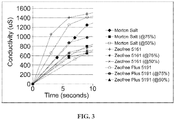
FIG. 3 is a graph of sodium release studies at reduced concentrations comparing commercially available salt samples with loaded carrier materials, in accordance with various aspects of the present disclosure. - The present invention can be understood more readily by reference to the following detailed description of the invention and the Examples and Figures included therein. Unless defined otherwise, all technical and scientific terms used herein have the same meaning as commonly understood by one of ordinary skill in the art to which this invention belongs. Although any methods and materials similar or equivalent to those described herein can be used in the practice or testing of the present invention, example methods and materials are now described.
- As used herein, the terms "optional" or "optionally" means that the subsequently described event or circumstance can or cannot occur, and that the description includes instances where said event or circumstance occurs and instances where it does not.
- The surface area of a silica material can be determined using conventional surface area analysis techniques, such as, for example, Brunauer, Emmett, and Teller ("BET"). BET surface area measurements are determined by measuring the amount of nitrogen adsorbed on a surface, as described in Brunaur et al., J. Am. Chem. Soc., 60, 309 (1938).
- Oil Absorption, frequently expressed as the oil absorption number ("OAN"), of a silica material can be determined using a rubout method, wherein a quantity of linseed oil is mixed with a silica material by rubbing with a spatula on a smooth surface until a stiff putty-like paste is formed. The amount of oil needed to form a stiff paste that curls when spread out is measured. The OAN can then be expressed as the volume of oil required per unit weight of silica material to saturate the silica material. A higher oil absorption level indicates a higher structure silica, for example, aggregates having a higher amount of void space between primary individual fused silica particles. Similarly, a low oil absorption value indicates a low structure silica, for example, aggregates having a smaller amount of void space between primary individual fused silica particles. In one aspect, linseed oil can be used to determine the oil absorption value for a silica material.
- Each of the materials disclosed herein are either commercially available and/or the methods for the production thereof are known to those of skill in the art.
- It is understood that the compositions disclosed herein have certain functions. Disclosed herein are certain structural requirements for performing the disclosed functions, and it is understood that there are a variety of structures that can perform the same function that are related to the disclosed structures, and that these structures will typically achieve the same result.
- As briefly described above, the present disclosure provides a composition wherein a carrier material can be utilized to deliver a salt solution without adversely affecting the taste of a food product. In another aspect, the present disclosure provides a method wherein one or more salts and/or solutions thereof can be contacted with a carrier material having a porous surface, such that the carrier material containing the one or more salts and/or solutions thereof can impart desirable taste characteristics to a subject upon ingestion or contact with taste buds, while retaining all or a portion of the salt in the carrier material. In another aspect, such a method can reduce and/or prevent the absorption of salt by the subject. In another aspect, the present disclosure provides a method wherein a salt solution can be contacted with a carrier material, such as, for example, a silica or silicate material, such that at least a portion of the salt solution is absorbed or otherwise entrained in pores on the surface of the carrier particle. In such an aspect, the salt solution can be readily released upon contact with water or saliva, such that a salt taste can be imparted quickly and without the need to dissolve solid salt particles.
- The invention described below involves carrying a salt solution, such as, for example, a concentrated salt solution, on the surface of and/or in the pores of a carrier material, such as, for example, a silica or silicate based carrier, such that nearly the entire salt solution will exit the carrier particles when exposed to saliva and/or water. Since the salt is already dissolved, nearly all of the salt contained within or on the surface of the carrier material can contribute to taste. This can allow for reduced levels of salt in foods without sacrificing a desirable salty taste.
- The invention provides a salt delivery composition comprising a carrier material having a porous surface and one or more salt solutions disposed in a least a portion of the pores thereof wherein the carrier material has an oil absorption number of 200 to 300 cc/100 g and a salt solution carrying capacity of at least 50 %, wherein the oil absorption number and the salt solution carrying capacity are measured as defined in the description, the carrier material comprises a precipitated silica, a silicate, or a combination thereof and the one or more salt solutions comprises sodium chloride, iodized sodium chloride, sea salt, or a combination thereof.
- In various aspects, the carrier material of the present disclosure can comprise a particulate material capable of holding and/or carrying salt solution. In one aspect, the carrier material comprise a silica material, a silicate material, or a combination thereof. In another aspect, the carrier material can comprise a precipitated silica. In yet another aspect, the carrier material can comprise a silicate material, such as, for example, a calcium silicate. In one aspect, a silica material can be prepared from any method suitable for preparing a silica material that can carry a salt solution. In various aspects, the carrier material can comprise a ZEOFREE® precipitated silica, such as, for example, ZEOFREE® 5161, ZEOFREE® 5162, ZEROFREE® Plus 5191, ZEOFREE® Plus 5193, or ZEOFREE® 80 precipitated silica; a ZEOSYL® precipitated silica, such as, for example, ZEOSYL® 11OSD precipitated silica; a ZEOTHIX® precipitated silica, such as, for example, ZEOTHIX® 177 or ZEOTHIX® 265 precipitated silica; a ZEOLEX® precipitated silica, such as, for example, ZEOLEX® 7A precipitated silica; a HUBERSORB® calcium silicate, such as, for example, HUBERSORB® 250 or HUBERSORB® 600; or a combination thereof. Carrier materials, such as silica and/or silicate materials, are commercially available. Each of the exemplary carrier materials recited herein are available from I.M . Huber Corporation (Atlanta, Georgia, USA).
- In one aspect, the carrier material can exhibit a particle size of up to about 50 µm, for example, about 2, 3, 4, 5, 7, 9, 11, 13, 15, 17, 19, 21, 23, 25, 27, 29, 31, 33, 35, 37, 39, 41, 43, 45, 47, 49, or 50 µm; or up to about 30 µm, for example, about 2, 3, 4, 5, 7, 9, 11, 13, 15, 17, 19, 21, 23, 25, 27, 29, or 30 µm. In another aspect, the carrier material can exhibit a particle size of from about 5 µm to about 45 µm, for example, about 5, 7, 9, 11, 13, 15, 17, 19, 21, 23, 25, 27, 29, 31, 33, 35, 37, 39, 41, 43, or 45 µm; from about 3 µm to about 30 µm, for example, about 3, 5, 7, 9, 11, 13, 15, 17, 19, 21, 23, 25, 27, 29, or 30 µm; from about 5 µm to about 30 µm, for example, about 5, 7, 9, 11, 13, 15, 17, 19, 21, 23, 25, 27, 29, or 30 µm; from about 10 µm to about 30 µm, for example, about 10, 12, 14, 16, 18, 20, 22, 24, 26, 28, or 30 µm; or from about 15 µm to about 30 µm, for example, about 15, 16, 18, 20, 22, 24, 26, 28, or 30 µm. It should be understood that particle size of a carrier material, such as, for example, a silica and/or silicate material, can be a distributional property and that at least a portion of particles can have a particle size less than and/or greater than the recited value. In yet another aspect, any of the particle sizes recited herein can comprise a median particle size for a particular sample of carrier material.
- In one aspect, the carrier material can exhibit moisture level prior to contact with a salt solution of less than about 10 wt.%, for example, about 0.1, 0.5, 1, 1.5, 2, 2.5, 3, 4, 5, 6, 7, 8, 9, 9.5, or 9.9 wt.%; of less than about 8 wt.%, for example, about 1, 2, 3, 4, 5, 6, 7, or 8 wt.%; or from about 4 wt.% to about 8 wt.%, for example, about 4, 4.5, 5, 5.5, 6, 6.7, 7, 7.5, or 8 wt.%. It should be understood that a carrier material having a high moisture level, for example, greater than about 10 wt.%, can, in various aspects, have a limited ability to carry a salt solution.
- The carrier material of the present disclosure exhibit a carrying capacity of at least about 50 %, as defined by the following equation:

- Determination of carrying capacity can be performed by preparing a concentrated salt solution, for example, by adding 400 g of sodium chloride to 1,000 ml of deionized water. It should be noted that the solubility of sodium chloride in room temperature water is about 36 g per 100 g of water). 2 g of the carrier material, such as, for example, a precipitated silica material, can then be placed in a container wherein the concentrated salt solution is added in 0.25 g increments. After each addition of the concentrated salt solution, the container can be capped and agitated, for example, with a test tube vibrator, until all of the water is absorbed and the powder is free flowing and free of lumps. This can be repeated until lumps are present which do not disappear upon agitation. Once lumps appear, the previous measurement can be used to determine the carrying capacity.
- A summary of exemplary carrier materials and their salt carrying capacities, are detailed in Table 1, below.
Table 1. A summary of salt carrying capacity on silica. Product NaCl Solution Carrying Capacity (%) 90% of Carrying Capacity (%) Quantity of NaCl (%) Quantity of Na (%) ZEOFREE® 5161 66.6 64.3 17.0 6.7 ZEOFREE® 5162 60.0 57.4 15.2 6.0 ZEOFREE® Plus 5191 70.4 68.2 18.1 7.1 ZEOFREE® Plus 5193 65.9 62.8 16.6 6.5 ZEOFREE® 80 (Ref.) 50.0 47.3 12.5 4.9 ZEOSYL® 1IOSD 66.6 64.3 17.0 6.7 ZEOTHIX® 177 52.9 50.4 13.3 5.2 ZEOTHIX® 265 52.9 50.4 13.3 5.2 ZEOLEX® 7A (Ref.) 42.9 40.2 10.7 4.2 HUBERSORB® 250 50.0 47.4 12.6 4.9 - In another aspect, a carrier material can have a sulfate level suitable for use in carrying and delivering a salt solution. In various aspects, the carrier material can exhibit a sulfate level of from about 0 wt.% to about 5 wt.%, for example, about 0.1, 0.3, 0.5, 0.7, 0.9, 1,1.3,1.5, 1.7, 1.9,2.1, 2.3, 2.5, 2.7, 2.9, 3.1, 3.5, 4, 4.5, or 5 wt.%; or from about O wt.% to about 3.5 wt.%, for example, about 0.1, 0.3, 0.5, 0.7, 0.9, 1, 1.3, 1.5, 1.7, 1.9,2.1, 2.3, 2.5, 2.7, 2.9, 3.1, or 3.5 wt.%. In still other aspects, the carrier material can exhibit a sulfate level less than or greater than any value specifically recited herein and the present invention is not intended to be limited to any particular sulfate level.
- In another aspect, a carrier material can have a BET surface area suitable for use in carrying and delivering a salt solution. In various aspects, the carrier material can exhibit a BET surface area of from about 50 m2/g to about 400 m2/g, for example, about 50, 60, 80, 100, 120, 140, 160, 180,200, 220, 240, 260, 280, 300, 320, 340, 360, 380, or 400 m2/g; or from about 75 m2/g to about 325 m2/g, for example, about 75, 100, 125, 150, 175, 200, 225, 250, 275, 300, or 325 m2/g.
- In another aspect, a carrier material can have a pH suitable for use in carrying and delivering a salt solution. In various aspects, the carrier material can exhibit a pH of from about 6 to about 10, for example, about 6, 6.5, 7, 7.5, 8, 8.5, 9, 9.5, or 10; or from about 6 to about 8, for example, about 6, 6.25, 6.5, 6.75, 7, 7.25, 7.5, 7.75, or 8.
- The carrier material exhibit an oil absorption number of from 200 cc/100 g to 300 cc/100 g, for example, about 220, 240, 260, or 280 cc/100 g; or from 200 cc/100 g to about 270 cc/100 g, for example, about 210, 230, 250, or 270 cc/100 g.General physical properties of exemplary carrier materials are illustrated in Table 2, below.
Table 2. Physical properties of materials tested Ex. Description Moisture (%) Sulfate (%) Oil (cc/100 g) BET (m2/g) pH Median Particle Size (µm) 1 ZEOFREE® 5161 6.4 0.7 229 112 7.4 22.7 2 ZEOFREE® 5162 6.2 0.8 221 114 7.2 18.0 3 ZEOFREE® Plus 5191 6.7 0.8 261 362 6.1 28.4 4 ZEOFREE® Plus 5193 4.9 1.0 258 308 6.3 13.6 5 ZEOFREE® 80 (Ref.) 6.0 3.4 193 81 7.1 14.2 6 ZEOSYL® 11OSD 6.2 2.2 203 84 7.5 20.8 7 ZEOTHIX® 177 5.9 0.3 215 110 7.7 3.5 8 ZEOTHIX® 265 6.0 0.7 214 146 7.3 3.3 9 ZEOLEX® 7A (Ref.) 6.6 --- 138 184 6.7 11.9 10 HUBERSORB® 250 6.3 0.5 259 109 9.9 18.5 11 HUBERSORB® 600 (Ref.) 6.8 0.4 461 198 9.9 7.5 - The salt used in the present invention comprises sodium chloride, iodized sodium chloride, sea salt, or a combination thereof. In other aspects, the salt can further comprise anti-caking agents, minerals, flow control additives, or other materials typically found in food products.
- To prepare the loaded carrier material of the present invention, the carrier material can be contacted with a salt solution. In one aspect a salt solution can be prepared by dissolving a quantity of salt in water. In another aspect, the salt solution can comprise a concentrated salt solution that is saturated or partially saturated at room temperature. In another aspect, the salt solution can be a saturated or super-saturated solution at room temperature of one or more salt compounds. In an exemplary aspect, a saturated sodium chloride solution can be prepared by dissolving about 360 g of sodium chloride in 1,000 ml of deionized water. In another aspect, a super-saturated sodium chloride solution can be prepared by adding about 400 g of sodium chloride to 1,000 ml of deionized water and allowing the salt to dissolve. In another aspect, a higher concentration salt solution can allow higher loadings of salt for a given quantity of carrier material.
- The salt solution, or a portion thereof, can then be contacted with the carrier material. In one aspect, a portion of the salt solution can be contacted with the carrier material and agitated or mixed prior to adding an additional quantity of salt solution.
- In another aspect, the carrier material can be loaded up to, for example, about 70 %, 75 %, 80 %, 85 %, 90 %, or 95 % of the carrying capacity of the material. In a specific aspect, the carrier material can be loaded up to, for example, about 90 % of the carrying capacity of the material.
- A loaded carrier material can release all or a portion of the carried salt quickly upon contact with saliva and/or water. In one aspect, a loaded carrier material can release at least about 75 % of the carried salt within about 10 seconds after contact with saliva and/or water.
- The salt release rate of a loaded carrier material can be determined by measuring the conductivity of a volume of water upon addition of the loaded carrier material. In one aspect, the time needed to attain maximum conductivity can be an indicator of the salt release rate of the material. In one aspect, maximum conductivity can be attained within about 30 seconds after contact of the loaded carrier material with water.
- In an exemplary salt release (i.e., conductivity) measurement, 120 g of deionized water can be added to a 150 ml beaker and stirred with a 2.54 cm (1") stir bar at a rate sufficient to create a vortex approximately 1.27 cm (1/2") higher than the stir bar. A conductivity probe can then be placed in the beaker at a depth sufficient to cover the electrode. 100 mg of salt, or the quantity of loaded carrier material needed to deliver 100 mg of salt, can then be added to the solution and the conductivity measured for 60 seconds. A description of samples prepared for salt release measurements is detailed in Table 3, below. The salt release profiles (conductivity vs. time) are illustrated in
Figures 1-3 .Table 3. Samples for Salt Solution Release Measurement Product Deionized water (g) Loaded Carrier Material added (g) Equivalent NaCl added (mg) MORTON® Coarse Salt (Ref.) 120.0 --- 100 MORTON® Salt (Ref.) 120.0 --- 100 ZEOFREE® 5161 120.0 588 100 ZEOFREE® 5162 120.0 657 100 ZEOFREE® Plus 5191 120.0 553 100 ZEOFREE® Plus 5193 120.0 601 100 - The conductivity of the salt and loaded carrier material samples can be about 1,500 to 1,600 µS at equilibrium. The equilibrium time for commercially available salt samples can be dependent upon, for example, the particle size of the salt, wherein a smaller particle size salt can be more rapidly dissolved. The loaded carrier material samples can exhibit conductivity values at least as high as a salt control for the 30 seconds of the experiment. As the particle size and the absorptive capacity of the carrier material increased (ex. ZEOFREE® Plus 5191 vs. ZEOFREE® Plus 5193 precipitated silica materials and ZEOFREE® 5161 vs. ZEOFREE® 5162 precipitated silica materials), conductivity values can increase. In one aspect, ZEOFREE® 5161 precipitated silica, with a large median particle size can exhibit a high conductivity in a conductivity based salt release test.
- In another aspect, a concentrations study was performed (
FIG. 3 ), wherein the quantity of salt for the loaded carrier material were adjusted to reach 75 mg salt (at 75%) and 50 mg salt (at 50%) in order to study the conductivity profile as a function of concentration. The loaded carrier material samples all exhibited greater conductivity values as compared to the commercially available salt control samples at 75% and 50% concentrations. In one aspect, ZEOFREE® Plus 5191 precipitated silica at 75% exhibited the same conductivity profile through the first five seconds as a MORTON® Salt control at 100 %, indicating that the solution concentration of the salt during the first five seconds of the consumption of a food would be the same. If the average time for the flavor experience for the consumption of a bite size snack food, for example, is five seconds, then the overall salt concentration can be reduced with the loaded carrier material without compromising taste. In another aspect, ZEOFREE® Plus 5191 and ZEOFREE® 5161 precipitated silica at a 50% concentration also had a conductivity profile similar to the commercially available salt control at 75%. - In one aspect, the present invention allows for the delivery of a salt solution that can be readily released upon contact with, for example, saliva. Such a rapid release of salt can impart a higher degree of salt flavor to a subject's taste buds than, for example, a solid salt product that must dissolve. In another aspect, such a salt delivery system can impart a desirable salt taste to food products, but does not leave significant amounts of salt not yet dissolved or in contact with taste buds, that can be absorbed by the subject. In one aspect, all or a portion of the salt solution disposed in the pores of the carrier material can be released quickly upon contact with water and/or saliva.
- In another aspect, a taste test can be performed to determine efficacy and salt release of a loaded carrier material. In an exemplary taste test, 50 mg of table salt can be tasted and judged for intensity of salt flavor and time to reach maximum intensity. The same test can be performed with a loaded carrier material, such as, for example, ZEOFREE® Plus 5191, such that an equal salt concentration can be delivered. In an exemplary experiment, two subjects felt that the loaded carrier material delivered a more rapid release of salt (i.e., by taste) than a comparable salt material alone.
Claims (7)
- A salt delivery composition comprising a carrier material having a porous surface and one or more salt solutions disposed in at least a portion of the pores thereof wherein the carrier material has
an oil absorption number of 200 to 300 cc/100 g and a salt solution carrying capacity of at least 50 %, wherein the oil absorption number and the salt solution carrying capacity are measured as defined in the description, the carrier material comprises a precipitated silica, a silicate, or a combination thereof and the one or more salt solutions comprises sodium chloride, iodized sodium chloride, sea salt, or a combination thereof. - The salt delivery composition of claim 1, wherein the carrier material comprises a precipitated silica.
- The salt delivery composition of any preceding claim, wherein the carrier material has a carrying capacity of from 50 % to 80 %.
- The salt delivery composition of any preceding claim, wherein the carrier material is loaded with one or more salt solutions up to 90 % of the carrier material's carrying capacity.
- A food product comprising the salt delivery silica composition of any preceding claim.
- A method of preparing a salt delivery composition according to any one of claims 1-4 comprising contacting the carrier material having a porous surface with the one or more salt solutions, such that a least a portion of the one or more salt solutions is disposed in at least a portion of the pores of the carrier material.
- A method comprising contacting the salt delivery composition of any of claims 1-4 with a food product.
Priority Applications (2)
| Application Number | Priority Date | Filing Date | Title |
|---|---|---|---|
| PL14721098T PL2983509T3 (en) | 2013-03-15 | 2014-03-14 | Silica based salt solution delivery system |
| DE14721098.3T DE14721098T1 (en) | 2013-03-15 | 2014-03-14 | System for delivering a salt solution based on silica |
Applications Claiming Priority (3)
| Application Number | Priority Date | Filing Date | Title |
|---|---|---|---|
| US201361793088P | 2013-03-15 | 2013-03-15 | |
| US14/204,660 US20140272012A1 (en) | 2013-03-15 | 2014-03-11 | Silica Based Salt Solution Delivery System |
| PCT/US2014/027677 WO2014152736A1 (en) | 2013-03-15 | 2014-03-14 | Silica based salt solution delivery system |
Publications (2)
| Publication Number | Publication Date |
|---|---|
| EP2983509A1 EP2983509A1 (en) | 2016-02-17 |
| EP2983509B1 true EP2983509B1 (en) | 2018-11-21 |
Family
ID=51528155
Family Applications (1)
| Application Number | Title | Priority Date | Filing Date |
|---|---|---|---|
| EP14721098.3A Revoked EP2983509B1 (en) | 2013-03-15 | 2014-03-14 | Silica based salt solution delivery system |
Country Status (9)
| Country | Link |
|---|---|
| US (1) | US20140272012A1 (en) |
| EP (1) | EP2983509B1 (en) |
| CN (1) | CN105101814A (en) |
| DE (1) | DE14721098T1 (en) |
| ES (1) | ES2564288T3 (en) |
| HU (1) | HUE043510T2 (en) |
| PL (1) | PL2983509T3 (en) |
| PT (1) | PT2983509T (en) |
| WO (1) | WO2014152736A1 (en) |
Families Citing this family (6)
| Publication number | Priority date | Publication date | Assignee | Title |
|---|---|---|---|---|
| KR102290178B1 (en) | 2013-03-13 | 2021-08-18 | 트리스 파마 인코포레이티드 | Benzonatate modified release solid tablets and capsules |
| JP6797194B2 (en) | 2015-09-28 | 2020-12-09 | エボニック オペレーションズ ゲーエムベーハー | Silica-based antimicrobial oral composition |
| US11938224B1 (en) | 2016-04-08 | 2024-03-26 | Tris Pharma Inc | Benzonatate modified release solid tablets and capsules |
| AU2018222468B2 (en) * | 2017-02-14 | 2023-05-11 | Dsm Ip Assets B.V. | Water dispersible formulations |
| CN111278774A (en) | 2017-08-29 | 2020-06-12 | 赢创运营有限公司 | Spherical silica particle size for RDA control |
| PL3807217T3 (en) | 2018-06-12 | 2024-04-08 | Evonik Operations Gmbh | Tin compatible spherical silica particles with reduced RDA |
Citations (3)
| Publication number | Priority date | Publication date | Assignee | Title |
|---|---|---|---|---|
| US2994642A (en) | 1954-10-16 | 1961-08-01 | Bossard Francois Jean | Sodium chloride toothpaste having a silica aerogel carrier |
| US20110082040A1 (en) | 2009-10-05 | 2011-04-07 | Dairy Manufacturers, Inc. | Composition and method for delivery of substances in a dry mode |
| US20120322893A1 (en) * | 2010-03-24 | 2012-12-20 | Evonik Degussa Gmbh | Coarse support silica particles |
Family Cites Families (7)
| Publication number | Priority date | Publication date | Assignee | Title |
|---|---|---|---|---|
| US2785051A (en) * | 1953-08-12 | 1957-03-12 | Jefferson Lake Sulphur Co | Method of making silica gel |
| US3033800A (en) * | 1959-04-10 | 1962-05-08 | Gulf Research Development Co | Impregnation of porous solids |
| GB1588405A (en) * | 1978-05-02 | 1981-04-23 | Yakimenko L M | Raising of animals and poultry for slaughter |
| DE19807700A1 (en) * | 1998-02-24 | 1999-08-26 | Degussa | Precipitated silica granules |
| AU2002240942A1 (en) * | 2001-04-03 | 2002-10-21 | Unilever N.V. | Improved delivery of benefit agents |
| EP1551570A4 (en) * | 2002-08-14 | 2008-04-09 | Du Pont | Solid flowable powder with high liquid loading |
| ATE524978T1 (en) * | 2008-07-30 | 2011-10-15 | Symrise Ag | COMPOSITION FOR REDUCING NACL CONTENT IN FOODS |
-
2014
- 2014-03-11 US US14/204,660 patent/US20140272012A1/en not_active Abandoned
- 2014-03-14 HU HUE14721098A patent/HUE043510T2/en unknown
- 2014-03-14 PT PT14721098T patent/PT2983509T/en unknown
- 2014-03-14 EP EP14721098.3A patent/EP2983509B1/en not_active Revoked
- 2014-03-14 DE DE14721098.3T patent/DE14721098T1/en active Pending
- 2014-03-14 CN CN201480014721.6A patent/CN105101814A/en active Pending
- 2014-03-14 ES ES14721098T patent/ES2564288T3/en active Active
- 2014-03-14 PL PL14721098T patent/PL2983509T3/en unknown
- 2014-03-14 WO PCT/US2014/027677 patent/WO2014152736A1/en not_active Ceased
Patent Citations (3)
| Publication number | Priority date | Publication date | Assignee | Title |
|---|---|---|---|---|
| US2994642A (en) | 1954-10-16 | 1961-08-01 | Bossard Francois Jean | Sodium chloride toothpaste having a silica aerogel carrier |
| US20110082040A1 (en) | 2009-10-05 | 2011-04-07 | Dairy Manufacturers, Inc. | Composition and method for delivery of substances in a dry mode |
| US20120322893A1 (en) * | 2010-03-24 | 2012-12-20 | Evonik Degussa Gmbh | Coarse support silica particles |
Non-Patent Citations (9)
| Title |
|---|
| ANONYMOUS: "Anti-Caking Agents - Flo-Gard | PPG Silica Products", 6 October 2016 (2016-10-06), XP055308432, Retrieved from the Internet <URL:http://www.ppgsilica.com/Applications/Carrier-and-Free-Flow/Food.aspx> [retrieved on 20161006] * |
| ANONYMOUS: "Flo-Gard SC-72, Silica Carrier Product", PPG INDUSTRIES - PRODUCT INFORMATION, 30 March 2008 (2008-03-30), XP055637922 |
| ANONYMOUS: "Hi-Sil® SC-72 Amorphous Precipitated Silica", PPG INDUSTRIES - SALES SPECIFICATION, 30 March 2005 (2005-03-30), XP055637915 |
| ANONYMOUS: "Huber Free-Flow Additives for the Food Industry", HUBER, 2010, XP055637928 |
| ANONYMOUS: "Huber Free-Flow Additives for the Food Industry", HUBER, July 2013 (2013-07-01), XP055637929, Retrieved from the Internet <URL:http://ethorn.com/wp-content/uploads/2016/10/Huber.pdf> |
| ANONYMOUS: "Soy Sauce", WIKIPEDIA, THE FREE ENCYCLOPEDIA, 13 March 2013 (2013-03-13), XP055637925, Retrieved from the Internet <URL:https://en.wikipedia.org/w/index.php?title=Soy_sauce&oldid=543784226> |
| ASTM: "Standard Test Method for Oil Absorption of Pigments by Spatula Rub-Out", ASTM D281-95, 2002, pages 1 - 2, XP003008176 |
| LI ET AL.: "Synthesis of Highly Ordered, Extremely Hydrothermal stable SBA-15/AI-SBA-15 under the Assistance of Sodium Chloride", CHEM. MATER., vol. 19, January 2007 (2007-01-01), pages 173 - 178, XP055637912 |
| TAO SUN ET AL.: "Specific Surface Area and Oil Adsorption of Calcinated Kaolin Clay", JOURNAL OF THE CHINESE CERAMIC SOCIETY, vol. 41, no. 5, May 2013 (2013-05-01), pages 685 - 690, XP055637901 |
Also Published As
| Publication number | Publication date |
|---|---|
| ES2564288T1 (en) | 2016-03-21 |
| EP2983509A1 (en) | 2016-02-17 |
| ES2564288T3 (en) | 2019-05-14 |
| PL2983509T3 (en) | 2019-05-31 |
| HUE043510T2 (en) | 2019-08-28 |
| US20140272012A1 (en) | 2014-09-18 |
| DE14721098T1 (en) | 2016-04-14 |
| PT2983509T (en) | 2019-02-26 |
| WO2014152736A1 (en) | 2014-09-25 |
| CN105101814A (en) | 2015-11-25 |
Similar Documents
| Publication | Publication Date | Title |
|---|---|---|
| EP2983509B1 (en) | Silica based salt solution delivery system | |
| Stoklosa et al. | Effects of storage conditions, formulation, and particle size on moisture sorption and flowability of powders: A study of deliquescent ingredient blends | |
| JP5800121B2 (en) | Solid dialysis agent | |
| CN102225070B (en) | Calcium carbonate effervescent granule | |
| Koutsopoulos et al. | The crystallization of hydroxyapatite in the presence of lysine | |
| JP5918058B2 (en) | Dialysis agent and method for producing dialysis agent | |
| CN102824313B (en) | Vitamin C effervescent granule and preparation method thereof | |
| WO2012108131A1 (en) | Cholesterol level-lowering agent, triglyceride level-lowering agent, blood sugar level-lowering agent, cholesterol adsorbent, adsorbent, triglyceride adsorbent, health food, health supplement, food with nutrient function claims, food for specified health use, quasi-pharmaceutical product, and pharmaceutical product | |
| Harrison et al. | The effect of sodium alginate on the absorption of strontium and calcium in human subjects | |
| CN104918503A (en) | Method for making mineral salt and mineral salt product | |
| EP2402018A1 (en) | Magnesium oxide fine granules | |
| US20030203019A1 (en) | Coated conditioners for use in foods and pharmaceuticals | |
| ES2655719T3 (en) | Auxiliary substance with low water content for tablet formation and manufacturing process | |
| Underwood et al. | Influence of various starches on dissolution rate of salicylic acid from tablets | |
| WO2023109435A1 (en) | Method for preventing caking of xylitol and calcium aspartate mixture | |
| JP5216385B2 (en) | Dialysis agent A, dialysis agent, method for producing dialysis agent A, and method for producing dialysis agent | |
| WO2018132880A1 (en) | Effervescent composition containing metamizole sodium monohydrate and method of preparing same | |
| Patel et al. | Liquisolid compacts: A review | |
| CN107176645A (en) | A kind of water treatment agent and preparation method thereof | |
| Holte et al. | Effect of charge and size of diffusing probe on the diffusion through calcium alginate gel matrices | |
| JPH0570357A (en) | Granule for hemodialysis | |
| JP2005239455A (en) | Method for producing fine particle sodium chloride excellent in anti-caking effect | |
| JP2005330241A (en) | Method for producing solid agent for dialysis | |
| JP4689417B2 (en) | Carbon dioxide absorbent | |
| JP2005198943A (en) | Dialysis correction fluid and dialysis agent |
Legal Events
| Date | Code | Title | Description |
|---|---|---|---|
| PUAI | Public reference made under article 153(3) epc to a published international application that has entered the european phase |
Free format text: ORIGINAL CODE: 0009012 |
|
| 17P | Request for examination filed |
Effective date: 20150924 |
|
| AK | Designated contracting states |
Kind code of ref document: A1 Designated state(s): AL AT BE BG CH CY CZ DE DK EE ES FI FR GB GR HR HU IE IS IT LI LT LU LV MC MK MT NL NO PL PT RO RS SE SI SK SM TR |
|
| AX | Request for extension of the european patent |
Extension state: BA ME |
|
| REG | Reference to a national code |
Ref country code: FR Ref legal event code: EL |
|
| REG | Reference to a national code |
Ref country code: DE Ref legal event code: R210 Ref document number: 602014036436 Country of ref document: DE Ref country code: DE Ref legal event code: R210 |
|
| DAX | Request for extension of the european patent (deleted) | ||
| 17Q | First examination report despatched |
Effective date: 20161012 |
|
| STAA | Information on the status of an ep patent application or granted ep patent |
Free format text: STATUS: EXAMINATION IS IN PROGRESS |
|
| RAP1 | Party data changed (applicant data changed or rights of an application transferred) |
Owner name: EVONIK DEGUSSA GMBH |
|
| INTG | Intention to grant announced |
Effective date: 20180611 |
|
| GRAP | Despatch of communication of intention to grant a patent |
Free format text: ORIGINAL CODE: EPIDOSNIGR1 |
|
| STAA | Information on the status of an ep patent application or granted ep patent |
Free format text: STATUS: GRANT OF PATENT IS INTENDED |
|
| GRAS | Grant fee paid |
Free format text: ORIGINAL CODE: EPIDOSNIGR3 |
|
| GRAA | (expected) grant |
Free format text: ORIGINAL CODE: 0009210 |
|
| STAA | Information on the status of an ep patent application or granted ep patent |
Free format text: STATUS: THE PATENT HAS BEEN GRANTED |
|
| REG | Reference to a national code |
Ref country code: DE Ref legal event code: R081 Ref document number: 602014036436 Country of ref document: DE Owner name: EVONIK OPERATIONS GMBH, DE Free format text: FORMER OWNER: J.M. HUBER CORPORATION, ATLANTA, GA., US Ref country code: DE Ref legal event code: R082 Ref document number: 602014036436 Country of ref document: DE |
|
| AK | Designated contracting states |
Kind code of ref document: B1 Designated state(s): AL AT BE BG CH CY CZ DE DK EE ES FI FR GB GR HR HU IE IS IT LI LT LU LV MC MK MT NL NO PL PT RO RS SE SI SK SM TR |
|
| REG | Reference to a national code |
Ref country code: CH Ref legal event code: EP |
|
| REG | Reference to a national code |
Ref country code: IE Ref legal event code: FG4D |
|
| REG | Reference to a national code |
Ref country code: DE Ref legal event code: R096 Ref document number: 602014036436 Country of ref document: DE |
|
| REG | Reference to a national code |
Ref country code: AT Ref legal event code: REF Ref document number: 1066465 Country of ref document: AT Kind code of ref document: T Effective date: 20181215 |
|
| REG | Reference to a national code |
Ref country code: RO Ref legal event code: EPE |
|
| REG | Reference to a national code |
Ref country code: PT Ref legal event code: SC4A Ref document number: 2983509 Country of ref document: PT Date of ref document: 20190226 Kind code of ref document: T Free format text: AVAILABILITY OF NATIONAL TRANSLATION Effective date: 20190219 |
|
| REG | Reference to a national code |
Ref country code: SE Ref legal event code: TRGR |
|
| REG | Reference to a national code |
Ref country code: NL Ref legal event code: FP |
|
| PG25 | Lapsed in a contracting state [announced via postgrant information from national office to epo] |
Ref country code: LV Free format text: LAPSE BECAUSE OF FAILURE TO SUBMIT A TRANSLATION OF THE DESCRIPTION OR TO PAY THE FEE WITHIN THE PRESCRIBED TIME-LIMIT Effective date: 20181121 Ref country code: IS Free format text: LAPSE BECAUSE OF FAILURE TO SUBMIT A TRANSLATION OF THE DESCRIPTION OR TO PAY THE FEE WITHIN THE PRESCRIBED TIME-LIMIT Effective date: 20190321 Ref country code: NO Free format text: LAPSE BECAUSE OF FAILURE TO SUBMIT A TRANSLATION OF THE DESCRIPTION OR TO PAY THE FEE WITHIN THE PRESCRIBED TIME-LIMIT Effective date: 20190221 Ref country code: HR Free format text: LAPSE BECAUSE OF FAILURE TO SUBMIT A TRANSLATION OF THE DESCRIPTION OR TO PAY THE FEE WITHIN THE PRESCRIBED TIME-LIMIT Effective date: 20181121 Ref country code: LT Free format text: LAPSE BECAUSE OF FAILURE TO SUBMIT A TRANSLATION OF THE DESCRIPTION OR TO PAY THE FEE WITHIN THE PRESCRIBED TIME-LIMIT Effective date: 20181121 Ref country code: BG Free format text: LAPSE BECAUSE OF FAILURE TO SUBMIT A TRANSLATION OF THE DESCRIPTION OR TO PAY THE FEE WITHIN THE PRESCRIBED TIME-LIMIT Effective date: 20190221 |
|
| REG | Reference to a national code |
Ref country code: ES Ref legal event code: FG2A Ref document number: 2564288 Country of ref document: ES Kind code of ref document: T3 Effective date: 20190514 |
|
| PG25 | Lapsed in a contracting state [announced via postgrant information from national office to epo] |
Ref country code: RS Free format text: LAPSE BECAUSE OF FAILURE TO SUBMIT A TRANSLATION OF THE DESCRIPTION OR TO PAY THE FEE WITHIN THE PRESCRIBED TIME-LIMIT Effective date: 20181121 Ref country code: GR Free format text: LAPSE BECAUSE OF FAILURE TO SUBMIT A TRANSLATION OF THE DESCRIPTION OR TO PAY THE FEE WITHIN THE PRESCRIBED TIME-LIMIT Effective date: 20190222 Ref country code: AL Free format text: LAPSE BECAUSE OF FAILURE TO SUBMIT A TRANSLATION OF THE DESCRIPTION OR TO PAY THE FEE WITHIN THE PRESCRIBED TIME-LIMIT Effective date: 20181121 |
|
| REG | Reference to a national code |
Ref country code: SK Ref legal event code: T3 Ref document number: E 30165 Country of ref document: SK |
|
| PG25 | Lapsed in a contracting state [announced via postgrant information from national office to epo] |
Ref country code: DK Free format text: LAPSE BECAUSE OF FAILURE TO SUBMIT A TRANSLATION OF THE DESCRIPTION OR TO PAY THE FEE WITHIN THE PRESCRIBED TIME-LIMIT Effective date: 20181121 |
|
| REG | Reference to a national code |
Ref country code: DE Ref legal event code: R026 Ref document number: 602014036436 Country of ref document: DE |
|
| PLBI | Opposition filed |
Free format text: ORIGINAL CODE: 0009260 |
|
| REG | Reference to a national code |
Ref country code: HU Ref legal event code: AG4A Ref document number: E043510 Country of ref document: HU |
|
| PG25 | Lapsed in a contracting state [announced via postgrant information from national office to epo] |
Ref country code: SM Free format text: LAPSE BECAUSE OF FAILURE TO SUBMIT A TRANSLATION OF THE DESCRIPTION OR TO PAY THE FEE WITHIN THE PRESCRIBED TIME-LIMIT Effective date: 20181121 Ref country code: EE Free format text: LAPSE BECAUSE OF FAILURE TO SUBMIT A TRANSLATION OF THE DESCRIPTION OR TO PAY THE FEE WITHIN THE PRESCRIBED TIME-LIMIT Effective date: 20181121 |
|
| PLAX | Notice of opposition and request to file observation + time limit sent |
Free format text: ORIGINAL CODE: EPIDOSNOBS2 |
|
| 26 | Opposition filed |
Opponent name: OMYA INTERNATIONAL AG Effective date: 20190820 |
|
| PG25 | Lapsed in a contracting state [announced via postgrant information from national office to epo] |
Ref country code: SI Free format text: LAPSE BECAUSE OF FAILURE TO SUBMIT A TRANSLATION OF THE DESCRIPTION OR TO PAY THE FEE WITHIN THE PRESCRIBED TIME-LIMIT Effective date: 20181121 Ref country code: MC Free format text: LAPSE BECAUSE OF FAILURE TO SUBMIT A TRANSLATION OF THE DESCRIPTION OR TO PAY THE FEE WITHIN THE PRESCRIBED TIME-LIMIT Effective date: 20181121 |
|
| PG25 | Lapsed in a contracting state [announced via postgrant information from national office to epo] |
Ref country code: LU Free format text: LAPSE BECAUSE OF NON-PAYMENT OF DUE FEES Effective date: 20190314 |
|
| RAP2 | Party data changed (patent owner data changed or rights of a patent transferred) |
Owner name: EVONIK OPERATIONS GMBH |
|
| PLBB | Reply of patent proprietor to notice(s) of opposition received |
Free format text: ORIGINAL CODE: EPIDOSNOBS3 |
|
| REG | Reference to a national code |
Ref country code: DE Ref legal event code: R081 Ref document number: 602014036436 Country of ref document: DE Owner name: EVONIK OPERATIONS GMBH, DE Free format text: FORMER OWNER: EVONIK DEGUSSA GMBH, 45128 ESSEN, DE |
|
| PG25 | Lapsed in a contracting state [announced via postgrant information from national office to epo] |
Ref country code: IE Free format text: LAPSE BECAUSE OF NON-PAYMENT OF DUE FEES Effective date: 20190314 |
|
| REG | Reference to a national code |
Ref country code: AT Ref legal event code: UEP Ref document number: 1066465 Country of ref document: AT Kind code of ref document: T Effective date: 20181121 |
|
| PG25 | Lapsed in a contracting state [announced via postgrant information from national office to epo] |
Ref country code: MT Free format text: LAPSE BECAUSE OF NON-PAYMENT OF DUE FEES Effective date: 20190314 |
|
| REG | Reference to a national code |
Ref country code: BE Ref legal event code: HC Owner name: EVONIK OPERATIONS GMBH; DE Free format text: DETAILS ASSIGNMENT: CHANGE OF OWNER(S), CHANGEMENT DE NOM DU PROPRIETAIRE; FORMER OWNER NAME: EVONIK DEGUSSA GMBH Effective date: 20200403 |
|
| REG | Reference to a national code |
Ref country code: NL Ref legal event code: HC Owner name: EVONIK OPERATIONS GMBH; DE Free format text: DETAILS ASSIGNMENT: CHANGE OF OWNER(S), CHANGE OF OWNER(S) NAME; FORMER OWNER NAME: EVONIK DEGUSSA GMBH Effective date: 20200928 |
|
| PGFP | Annual fee paid to national office [announced via postgrant information from national office to epo] |
Ref country code: CZ Payment date: 20210315 Year of fee payment: 8 Ref country code: CH Payment date: 20210319 Year of fee payment: 8 Ref country code: FI Payment date: 20210322 Year of fee payment: 8 Ref country code: IT Payment date: 20210329 Year of fee payment: 8 Ref country code: FR Payment date: 20210323 Year of fee payment: 8 Ref country code: RO Payment date: 20210304 Year of fee payment: 8 Ref country code: NL Payment date: 20210319 Year of fee payment: 8 Ref country code: PT Payment date: 20210315 Year of fee payment: 8 |
|
| REG | Reference to a national code |
Ref country code: AT Ref legal event code: HC Ref document number: 1066465 Country of ref document: AT Kind code of ref document: T Owner name: EVONIK OPERATIONS GMBH, DE Effective date: 20210315 |
|
| PG25 | Lapsed in a contracting state [announced via postgrant information from national office to epo] |
Ref country code: CY Free format text: LAPSE BECAUSE OF FAILURE TO SUBMIT A TRANSLATION OF THE DESCRIPTION OR TO PAY THE FEE WITHIN THE PRESCRIBED TIME-LIMIT Effective date: 20181121 |
|
| PGFP | Annual fee paid to national office [announced via postgrant information from national office to epo] |
Ref country code: BE Payment date: 20210319 Year of fee payment: 8 Ref country code: GB Payment date: 20210324 Year of fee payment: 8 Ref country code: DE Payment date: 20210319 Year of fee payment: 8 Ref country code: AT Payment date: 20210322 Year of fee payment: 8 Ref country code: SE Payment date: 20210319 Year of fee payment: 8 Ref country code: PL Payment date: 20210308 Year of fee payment: 8 Ref country code: TR Payment date: 20210311 Year of fee payment: 8 |
|
| REG | Reference to a national code |
Ref country code: DE Ref legal event code: R103 Ref document number: 602014036436 Country of ref document: DE Ref country code: DE Ref legal event code: R064 Ref document number: 602014036436 Country of ref document: DE |
|
| PGFP | Annual fee paid to national office [announced via postgrant information from national office to epo] |
Ref country code: SK Payment date: 20210312 Year of fee payment: 8 |
|
| RDAF | Communication despatched that patent is revoked |
Free format text: ORIGINAL CODE: EPIDOSNREV1 |
|
| REG | Reference to a national code |
Ref country code: SK Ref legal event code: TC4A Ref document number: E 30165 Country of ref document: SK Owner name: EVONIK OPERATIONS GMBH, ESSEN, DE Effective date: 20210721 |
|
| PGFP | Annual fee paid to national office [announced via postgrant information from national office to epo] |
Ref country code: HU Payment date: 20210420 Year of fee payment: 8 Ref country code: ES Payment date: 20210525 Year of fee payment: 8 |
|
| RDAG | Patent revoked |
Free format text: ORIGINAL CODE: 0009271 |
|
| STAA | Information on the status of an ep patent application or granted ep patent |
Free format text: STATUS: PATENT REVOKED |
|
| REG | Reference to a national code |
Ref country code: CH Ref legal event code: PL |
|
| REG | Reference to a national code |
Ref country code: FI Ref legal event code: MGE |
|
| 27W | Patent revoked |
Effective date: 20210614 |
|
| GBPR | Gb: patent revoked under art. 102 of the ep convention designating the uk as contracting state |
Effective date: 20210614 |
|
| REG | Reference to a national code |
Ref country code: SK Ref legal event code: MC4A Ref document number: E 30165 Country of ref document: SK Effective date: 20210614 |
|
| REG | Reference to a national code |
Ref country code: AT Ref legal event code: MA03 Ref document number: 1066465 Country of ref document: AT Kind code of ref document: T Effective date: 20140614 |
|
| REG | Reference to a national code |
Ref country code: SE Ref legal event code: ECNC |
|
| PG25 | Lapsed in a contracting state [announced via postgrant information from national office to epo] |
Ref country code: MK Free format text: LAPSE BECAUSE OF FAILURE TO SUBMIT A TRANSLATION OF THE DESCRIPTION OR TO PAY THE FEE WITHIN THE PRESCRIBED TIME-LIMIT Effective date: 20181121 |