EP2983186A1 - Electrode composition for supercapacitor, cured product of said composition, electrode comprising said cured product, capacitor comprising said electrode, and manufacturing method for said supercapacitor - Google Patents
Electrode composition for supercapacitor, cured product of said composition, electrode comprising said cured product, capacitor comprising said electrode, and manufacturing method for said supercapacitor Download PDFInfo
- Publication number
- EP2983186A1 EP2983186A1 EP13863700.4A EP13863700A EP2983186A1 EP 2983186 A1 EP2983186 A1 EP 2983186A1 EP 13863700 A EP13863700 A EP 13863700A EP 2983186 A1 EP2983186 A1 EP 2983186A1
- Authority
- EP
- European Patent Office
- Prior art keywords
- polymer binder
- electrode
- active carbon
- hardening polymer
- cross
- Prior art date
- Legal status (The legal status is an assumption and is not a legal conclusion. Google has not performed a legal analysis and makes no representation as to the accuracy of the status listed.)
- Granted
Links
Images


Classifications
-
- H—ELECTRICITY
- H01—ELECTRIC ELEMENTS
- H01G—CAPACITORS; CAPACITORS, RECTIFIERS, DETECTORS, SWITCHING DEVICES, LIGHT-SENSITIVE OR TEMPERATURE-SENSITIVE DEVICES OF THE ELECTROLYTIC TYPE
- H01G11/00—Hybrid capacitors, i.e. capacitors having different positive and negative electrodes; Electric double-layer [EDL] capacitors; Processes for the manufacture thereof or of parts thereof
- H01G11/22—Electrodes
- H01G11/30—Electrodes characterised by their material
- H01G11/32—Carbon-based
- H01G11/34—Carbon-based characterised by carbonisation or activation of carbon
-
- H—ELECTRICITY
- H01—ELECTRIC ELEMENTS
- H01G—CAPACITORS; CAPACITORS, RECTIFIERS, DETECTORS, SWITCHING DEVICES, LIGHT-SENSITIVE OR TEMPERATURE-SENSITIVE DEVICES OF THE ELECTROLYTIC TYPE
- H01G11/00—Hybrid capacitors, i.e. capacitors having different positive and negative electrodes; Electric double-layer [EDL] capacitors; Processes for the manufacture thereof or of parts thereof
- H01G11/84—Processes for the manufacture of hybrid or EDL capacitors, or components thereof
- H01G11/86—Processes for the manufacture of hybrid or EDL capacitors, or components thereof specially adapted for electrodes
-
- H—ELECTRICITY
- H01—ELECTRIC ELEMENTS
- H01G—CAPACITORS; CAPACITORS, RECTIFIERS, DETECTORS, SWITCHING DEVICES, LIGHT-SENSITIVE OR TEMPERATURE-SENSITIVE DEVICES OF THE ELECTROLYTIC TYPE
- H01G11/00—Hybrid capacitors, i.e. capacitors having different positive and negative electrodes; Electric double-layer [EDL] capacitors; Processes for the manufacture thereof or of parts thereof
- H01G11/22—Electrodes
- H01G11/30—Electrodes characterised by their material
- H01G11/32—Carbon-based
- H01G11/38—Carbon pastes or blends; Binders or additives therein
-
- Y—GENERAL TAGGING OF NEW TECHNOLOGICAL DEVELOPMENTS; GENERAL TAGGING OF CROSS-SECTIONAL TECHNOLOGIES SPANNING OVER SEVERAL SECTIONS OF THE IPC; TECHNICAL SUBJECTS COVERED BY FORMER USPC CROSS-REFERENCE ART COLLECTIONS [XRACs] AND DIGESTS
- Y02—TECHNOLOGIES OR APPLICATIONS FOR MITIGATION OR ADAPTATION AGAINST CLIMATE CHANGE
- Y02E—REDUCTION OF GREENHOUSE GAS [GHG] EMISSIONS, RELATED TO ENERGY GENERATION, TRANSMISSION OR DISTRIBUTION
- Y02E60/00—Enabling technologies; Technologies with a potential or indirect contribution to GHG emissions mitigation
- Y02E60/13—Energy storage using capacitors
Definitions
- the present invention relates to an electrode composition for a supercapacitor, an electrode including a cured material, and a supercapacitor including the electrode.
- a capacitor is one of energy storage devices.
- the capacitor storages electricity by forming a charge ion layer at both ends of an electrode, when a dielectric material is positioned between two metal plates which are apart by a predetermined distance, and the voltage is applied. At this time, the electricity may be simply generated by an electric double layer, rather than the chemical reaction which generates the electricity in batteries. Accordingly, the electrode is not damaged during the electricity generation of the capacitor, so that it has an almost unlimited cycle-life characteristic. Furthermore, times for charging and discharging are not long so that a large amount of current may be stored for a short time. Therefore, the capacitor is an important electricity storage device when high power is required.
- the capacitor has one disadvantage relating to poor electricity storage ability.
- the storage capacity of the capacitor is inversely proportional to the distance between the two plates and is proportional to the area of the two plates. Therefore, the storage capacity may be increased by increasing an area of the electrodes if the distance is fixed.
- the effective areas may be generally increased by forming minute pores in the electrode.
- the disadvantage may be addressed by using a porous material having a large effective area and having low electric resistance as an electrode material. Furthermore, it is required for the material that good conductivity allows to reduce Joule's heat, thereby lowering energy consumption.
- Active carbon may be conventionally used as the material to satisfy the above requirements. Active carbon has a large effective surface since it has abundant pores formed during carbonization, and has good conductivity so that it is widely used in the industrial purposes.
- the supercapacitor is a capacitor (condenser) of which the electrical capacity is mainly improved and is used as a battery.
- the capacitor used in an electronic circuit acts as a rechargeable battery. That is, the capacitor is used to store electricity and to emit, if necessary, and is an essential component for stable working of an electronic circuit.
- the supercapacitor includes electrodes and an electrolyte layer between the electrodes, and forms an electric double layer on the electrode and the electrolyte.
- the electrode includes active carbon as a main component, and active carbon includes a carbonaceous material with an extreme high surface area and has suitable structure to form the electric double layer with ions of the electrolyte due to the high surface area and the electrical conductivity of the carbon itself.
- the active carbon generally has a hydrophobic property at the surface of the carbon.
- the electrode includes a hydrophobic polymer binder such as polyvinylidene fluoride, and the electrolyte has a hydrophilic property since it has water-solubility. Thus, it is difficult to form an effective electric double layer.
- hydrophilic functional groups such as -COOH, -OH, etc.
- the functional active carbon has disadvantages in that it may be easily dissolved in the water-solubility electrolyte, since it has hydrophilicity at a surface.
- An exemplary embodiment of the present invention provides an electrode composition in which the functional active carbon is not dissolved in the electrolyte.
- Another embodiment of the present invention provides an electrode including the cured material.
- Yet another embodiment of the present invention provides a supercapacitor including the electrode.
- an electrode composition including an active carbon and a hardening polymer binder is provided.
- the active carbon may include a hydrophilic functional group.
- the hardening polymer binder may be at least one selected from a thermosetting polymer binder or a photo-curable polymer binder.
- the hardening polymer may have a hydrophilic functional group.
- the hardening polymer binder may be a compound represented by Formula 2. wherein, n is an integer of 1 to 30,000.
- the electrode composition may further include a cross-linking agent and a solvent.
- the cross-linking agent may be a compound represented by Formula 3. wherein, R 3 to R 6 are the same or are independently hydrogen, a C1 to C10 alkyl, or a C6 to C18 aryl, and m is an integer of 1 to 1,000.
- the solvent may be a compound represented by Formula 4.
- the total amount of the hardening polymer binder and the cross-linking agent may be 1 part by weight to 100 parts by weight based on 100 parts by weight of the active carbon.
- the total amount of the active carbon, the hardening polymer binder, and the cross-linking agent may be 0.01 w/v% to 10 w/v% based on the amount of the solvent.
- Still another embodiment provides a cured material by curing the composition, the photo-curable polymer in the cured material may form a three-dimensional cross-linked structure.
- Still another embodiment provides an electrode including a cured material by curing the composition.
- Still another embodiment provides a supercapacitor including: a pair of current collectors; a pair of electrodes each formed on one of the current collectors, the electrodes positioned facing each other and including the cured material; an electrolyte layer between the electrodes; and a separator between the electrolyte layers.
- the electrode for the supercapacitor according to embodiment may have a thickness of 1 nm to 2 ⁇ m and may be transparent or translucent.
- Still another embodiment provides a method of manufacturing a supercapacitor including coating a composition including active carbon, a curable polymer binder, a cross-linking agent, and a solvent on each of a pair of current collectors; curing the composition to prepare a pair of electrodes; injecting an electrolyte between the electrodes; inserting a separator to the electrolyte; and sealing the product.
- the coating numbers may be controlled in order to control transparency and thickness of the electrode.
- a hardening polymer binder is used to overcome a shortcoming of the functional active carbon.
- the use of the hardening polymer binder allows inking of the functional active carbon so that the resulting material may be applicable for various coating techniques (generally all coating techniques).
- the hardening polymer binder may effectively prevent the dissolution the functional active carbon to the electrolyte, since the hardening polymer binder forms a network having a three-dimensionally cross-linked structure.
- the network derived from the hardening polymer binder does not dissolve and only swells in the electrolyte, so that an electrode of a supercapacitor using the hardening polymer binder may form a maximal electric double layer by swelling the electrolyte, and provides good performance.
- Conductivity of the electrode of the supercapacitor may be guaranteed via the network derived from the hardening polymer binder without a conductive material.
- the functional active carbon having hydrophilicity at a surface has good affinity to the aqueous electrolyte so that the formation of the electric double layer may be maximized.
- the hardening polymer binder may prevent the dissolution of the functional active carbon to the aqueous electrolyte since the hardening polymer binder forms a network.
- the hardening polymer binder may provide sufficient conductivity without a conductive material by decreasing distances between the functional active carbon since the hardening polymer binder forms a network.
- the present invention relates to an electrode composition for a supercapacitor, a cured material of the composition, an electrode including the cured material, a supercapacitor including the electrode, and a method of manufacturing the supercapacitor.
- the electrode composition according to one embodiment may include an active carbon and a hardening polymer binder.
- the electrode composition may further include a cross-linking agent and a solvent.
- the electrode composition may include an active carbon, the hardening polymer binder, the cross-linking agent, and the solvent.
- the active carbon is a main component of the electrode composition, and is a porous material having a large effective area, good conductivity, and low electrode resistance.
- the active carbon may be a nanopowder, for example a nanopowder with a size of about 1 nm to about 1000 nm.
- the active carbon may preferably be a functional active carbon.
- the functional active carbon is active carbon of which a surface is introduced with a hydrophilic functional group.
- the active carbon introduced with the hydrophilic functional group may be active carbon with one or more of one type of hydrophilic functional group, or with various types of hydrophilic functional groups.
- the hydrophilic functional group is introduced into the surface of the active carbon, that is, the functional active carbon is prepared, it is suitable for forming an effective electric double layer.
- the hardening polymer binder acts to form a cured material when the electrode composition is cured, and particularly, acts to form a network of a three-dimensionally cross-linked structure in the cured material.
- the hardening polymer binder may be at least thermosetting polymer binder or photo-curable polymer binder.
- one type of the thermosetting polymer binder may be used, or various types of the thermosetting polymer binder may be used; alternatively, one type of the photo-curable polymer binder may be used, or various types of the photo-curable polymer binder may be used; or as a further alternative one type or various types of the thermosetting polymer binder may be used together with one type or various types of the thermosetting polymer binder.
- the hardening polymer binder with the hydrophilic functional group it is preferable for forming an effective network and more preferably an effective electric double layer.
- the hardening polymer binder may have a weight average molecular weight (Mw) of about 500 to about 500,000.
- the hardening polymer binder including the hydrophilic functional group may be a compound represented by Formula 2. wherein, n is an integer of 1 to 30,000.
- the compound represented by Formula 2 is poly(4-vinylphenol) (hereinafter referred to as "PVP").
- PVP poly(4-vinylphenol)
- the PVP may have a weight average molecular weight (Mw) of about 100,000 or less or of about 500 to about 100,000.
- Mw weight average molecular weight
- the weight average molecular weight (Mw) of PVP may be about 50,000 or less or about 5000 to about 50,000.
- the cross-linking agent binds with the hardening polymer binder to form a network of a three-dimensionally cross-linked structure in the cured material.
- the cross-linking agent is not limited, but may be one having an average molecular weight (Mn) of about 50 to about 500,000.
- the cross-linking agent may be a compound represented by Formula 3. wherein, R 3 to R 6 are the same or are independently hydrogen, a C1 to C10 alkyl, or a C6 to C18 aryl, and m is an integer of 1 to 1000. In one embodiment, R 3 to R 6 are independently hydrogen or methyl.
- the compound represented by Formula 3 may be (poly(melamine-co-formaldehyde), methylated) and may have a number average molecular weight (Mn) of 10,000 or less, or about 400 to about 10,000.
- the number average molecular weight (Mn) of poly(melamine-co-formaldehyde), methylated may be about 1000 or less, or about 400 to about 1000.
- the solvent makes the components used in the electrode composition enter a dissolution state and/or a distribution state, in order to manufacture an electrode using coating techniques.
- the solvent is not limited, but may be a compound represented by Formula 4.
- the compound represented by Formula 4 is propylene glycol methyl ether acetate.
- the total weight of the hardening polymer binder and the cross-linking agent may be 100 parts by weight or less based on 100 parts by weight of the active carbon. That is, the hardening polymer binder and the cross-linking agent may be used in an amount of the same or less than the amount of the active carbon, and the total weight, i.e., mixed amount of the hardening polymer binder and the cross-liking agent may be about 1 part by weight to 100 parts by weight based on 100 parts by weight of the active carbon, preferably, 1 part by weight to 50 parts by weight. If the total amount of the hardening polymer binder and the cross-linking agent is extremely smaller than that of the active carbon, the active carbon may be separated from the resulting electrode.
- the hardening polymer binder may act as a binder together with the cross-linking agent, so that the total amount of the hardening polymer binder and the cross-linking agent is critical, but the mixing ratio of the hardening polymer binder and the cross-linking is not critical, and may be suitably controlled in the above range.
- the total amount of the active carbon, the hardening polymer binder, and the cross-linking agent may be 10 w/v% or less based on the amount of the solvent. That is, the electrode composition mainly includes the solvent, and the balance of the remaining components except for the solvent may be about 0.01 w/v% to 10 w/v%, preferably 0.1 w/v% to 5 w/v%, and more preferably 0.5 w/v% to 2 w/v%. If the balance is extremely small, it is difficult to prepare the electrode or the cured material, or the physical properties are deteriorated. If the balance is extremely large, the coating is not performed well or the physical properties are deteriorated.
- Another embodiment provides a cured material by curing the composition.
- the cured material is cured due to heat or light.
- the hardening polymer binder in the cured material may form a network having a three-dimensionally cross-linked structure in the cured material, and that is, the hardening polymer binder in the cured material has characteristics for forming a network of the three-dimensionally cross-linked structure together with the cross-linking agent.
- Such a three-dimensionally cross-linked structure may prevent the dissolution of the functional active carbon by the electrolyte which is a shortcoming of the conventional art.
- an electrode including the cured material.
- the electrode for a supercapacitor may prevent the separation of the functional active carbon from the electrode since the electrode is formed by the cured material.
- a supercapacitor including: a pair of current collectors; a pair of electrodes each formed on one of the current collectors, the electrodes positioned facing each other and including the cured material; an electrolyte layer between the electrodes; and a separator between the electrolyte layers.
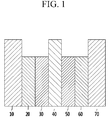
- the supercapacitor may include a pair of current collectors 10 and 70, a pair of electrodes 20 and 60, a pair of electrolyte layers 30 and 50, and a separator 40.
- the current collectors 10 and 70 may be formed by using a metal, glass, or plastics, or may be transparent.
- the current collector may be formed by using aluminum, nickel, copper, SUS, iron, silver, gold, platinum, transparent indium tin oxide, (poly(3,4-ethylenedioxythiophene)/poly(styrenesulfonate), etc.
- the current collector may be wire or a substrate coated with a coating layer.
- the wire or the coating layer may include Ag, Au, Al, Ni, Co, Cu, Pt, or conductive materials such as graphene, carbon nano tube (CNT), or a metal complex
- the substrate may be polyethylene terephthalate, polyimide, or glass.
- the electrodes 20 and 60 are formed on each of the pair of current collectors 10 and 70, and more specifically, the electrode 20 and 60 are positioned facing each other between the current collectors 10 and 70. As described above, the electrodes 20 and 60 include the cured material of the electrode composition according to one embodiment.
- the thickness of the electrodes 20 and 60 is not limited and may be suitably controlled by controlling the coating cycles (number of coats). For example, an electrode with an average thickness of about 2 ⁇ m or less, preferably 10 nm to 1500 nm, and more preferably 100 nm to 1000 nm may be formed as each coating. More specifically, if an electrode with an average thickness of 0.8 ⁇ 0.5 ⁇ m is formed for one coating cycle, six coating cycles gives an electrode with an average thickness of 5 ⁇ 1 ⁇ m.
- the thickness of the electrodes 20 and 60 is inversely proportional to the transparency, and thus, as the thickness of the electrodes 20 and 60 increases, the transparency decreases, and as the thickness of the electrodes 20 and 60 decreases, the transparency increases.
- the electrodes 20 and 60 having a thickness of 2 ⁇ m or less may be transparent or translucent.
- the transparency refers to one having light transmittance of more than 70 %
- the translucency refers to one having light transmittance of 30 % to 70 %
- the opaque refers to one having light transmittance of less than 30 %.
- the transparent or translucent electrode may be obtained by coating the electrode once or twice to control the thickness thereof to be about 2 ⁇ m or less. On the contrary, if the coating is repeated 5 times or more, the electrode material is full covered on the electrode, and the resulting electrode is opaque.
- the electrolyte layers 30 and 50 may be formed by injecting the electrolyte between the pair of electrodes 20 and 60.
- the electrolyte layer may be an aqueous electrolyte.
- the aqueous electrolyte may include an electrolytic salt and a solvent.
- the electrolytic salt may be any electrolytic salt as long as it may be useful in the aqueous electrolyte, and examples thereof may be an acidic electrolytic salt, a neutral electrolytic salt, or a basic electrolytic salt.
- Exemplary of the electrolytic salt may be potassium hydroxide, potassium chloride, sodium sulfate, or sulfuric acid, or a combination thereof, with high ion conductivity.
- the solvent may be water.
- the electrolyte has a concentration of about 0.1 M to about 6 M.
- the separator 40 is position between the pair of electrodes 20 and 60, that is, is formed between the electrolyte layers 30 and 50.
- the separator 40 may be a porous separator having a plurality of pores, and each pore has a sufficient size to pass only electrolyte.
- the separator may include cellulose, polyolefin, celgard S-20, rayon, etc.
- one embodiment provides a method of manufacturing the supercapacitor, including coating a composition including active carbon, a hardening polymer binder, and a cross-linking agent on each of a pair of the current collectors, curing the composition to form two electrodes, injecting the electrolyte between the electrodes, inserting a separator into the electrolyte, and sealing the resultant.
- an electrode composition including active carbon, a hardening polymer binder, a cross-linking agent, and a solvent is coated on each of a pair of current collectors.
- the coating process may be a general technique such as spray coating, slot-die coating, bar coating, and blade coating, but it is not limited thereto.
- the thickness and the transparency of the electrode may be controlled according the control of coating cycles.
- the coated electrode composition is cured to prepare a pair of electrodes 20 and 60 facing each other.
- the curing may be thermosetting and/or photo-curing, and for example, the thermosetting may be performed at 150 °C to 200 °C, and the photo-curing may be performed by irradiating ultraviolet rays.
- the electrolyte solution is injected between the two electrodes 20 and 60 to prepare electrolyte layers 30 and 50.
- the electrolyte solution includes an electrolytic salt with high conductivity such as potassium hydroxide, potassium chloride, sodium sulfate, sulfuric acid, or a combination thereof, and a solvent such as water.
- the separator 40 is inserted between the electrolyte layers 30 and 50 which are located between the electrodes 20 and 60 to prevent direct contact between the two electrodes 20 and 60.
- a supercapacitor is manufactured by sealing for inhibiting leakage of the electrolyte solution.
- the hardening polymer binder is used to overcome a shortcoming of the functional active carbon.
- the use of the hardening polymer binder allows inking of the functional active carbon so that the resulting material may be applicable for various coating techniques (generally all coating techniques).
- the hardening polymer binder may effectively prevent the dissolution of the functional active carbon by the electrolyte, since the hardening polymer binder forms a network having a three-dimensionally cross-linked structure.
- the network derived from the hardening polymer binder does not dissolve and only swells in the electrolyte, so that an electrode of a supercapacitor using the hardening polymer binder may form a maximal electric double layer by swelling the electrolyte, and provides good performance.
- Conductivity of the electrode of the supercapacitor may be guaranteed via the network derived from the hardening polymer binder without a conductive material.
- the functional active carbon having hydrophilicity at a surface thereof has good affinity to the aqueous electrolyte so that the formation of the electric double layer may be maximized.
- the hardening polymer binder may prevent the dissolution of the functional active carbon by the aqueous electrolyte since the hardening polymer binder forms a network.
- the hardening polymer binder may provide sufficient conductivity without a conductive material by decreasing the distances between the functional active carbon since the hardening polymer binder forms a network.
- An electrode composition included active carbon, a hardening polymer binder, a cross-linking agent, and a solvent was coated on each of a pair of current collectors to prepare electrodes.
- the electrode composition was prepared by adding 1 g of active carbon nanopowder to 100 ml of a solvent, and adding the hardening polymer binder and the cross-linking agent thereto, and the total amount of the hardening polymer binder and the cross-linking agent are shown in Table 1, within a range of 0.01 g to 1 g.
- the hardening polymer binder was PVP (Mw: 20,000)
- the cross-linking agent was poly(melamine-co-formaldehyde) (Mn: -511)
- the solvent was propylene glycol methyl ether acetate.
- the coating process was performed by spray coating, and was repeated for 5 cycles. Thereafter, the coated electrode composition was thermoset at 1800 °C to prepare a pair of electrodes facing each other, and an electrolyte solution was injected between the two electrodes to prepare an electrolyte layer.
- the electrolyte solution was 1 M sodium sulfate in water. Thereafter, a porous separator was inserted into the electrolyte located between two electrodes, and sealed to manufacture a supercapacitor.
- the charging capacities according to the total amount of the hardening polymer binder (PVP) and the cross-linking agent were measured on the supercapacitors according to Examples 3 to 6. The results are shown in FIG. 2 . As shown in FIG. 2 , as the amount of the binder and the cross-linking agent decreased, the charge capacity increased. From the results in Table 1 and FIG. 2 , it can be seen that the amount of the binder and the cross-linking agent is as little as possible within the range (0.05 g or more) in which active carbon was not detached from the electrode, to increase charge capacity.
- a supercapacitor was manufactured by the same procedures in Example 3 except that the coating was performed once.
- a supercapacitor was manufactured by the same procedures in Example 3 except that the coating was performed twice.
- a supercapacitor was manufactured by the same procedures in Example 3 except that the coating was performed three times.
- a supercapacitor was manufactured by the same procedures in Example 3 except that the coating was performed four times.
- a supercapacitor was manufactured by the same procedures in Example 3 except that the coating was performed six times.
- the thickness of the electrode according to Examples 7 and 11 were measured in order to confirm the thickness variation according to the coating cycles. Furthermore, the thickness of the electrode according to Example 3 was measured. The results are shown in FIG. 3 . It can be seen from FIG. 3 that as the coating cycles were increased, the thickness of the electrode was thicker, and when coating was repeated once, the average thickness of about 0.8 ⁇ 0.5 ⁇ m was determined.
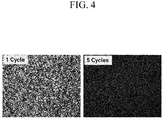
- FIG. 4 shows photographs of the electrodes according to Example 7 and Example 3, according to the coating cycles. As shown in FIG. 4 , when the coating procedure was performed once, the transparent or translucent electrode was prepared, whereas when the coating procedure was performed for 5 cycles or more, the electrode material was full covered.
Landscapes
- Engineering & Computer Science (AREA)
- Power Engineering (AREA)
- Microelectronics & Electronic Packaging (AREA)
- Chemical & Material Sciences (AREA)
- Materials Engineering (AREA)
- Manufacturing & Machinery (AREA)
- Electric Double-Layer Capacitors Or The Like (AREA)
- Battery Electrode And Active Subsutance (AREA)
Abstract
Description
- The present invention relates to an electrode composition for a supercapacitor, an electrode including a cured material, and a supercapacitor including the electrode.
- A capacitor is one of energy storage devices. The capacitor storages electricity by forming a charge ion layer at both ends of an electrode, when a dielectric material is positioned between two metal plates which are apart by a predetermined distance, and the voltage is applied. At this time, the electricity may be simply generated by an electric double layer, rather than the chemical reaction which generates the electricity in batteries. Accordingly, the electrode is not damaged during the electricity generation of the capacitor, so that it has an almost unlimited cycle-life characteristic. Furthermore, times for charging and discharging are not long so that a large amount of current may be stored for a short time. Therefore, the capacitor is an important electricity storage device when high power is required.
- The capacitor has one disadvantage relating to poor electricity storage ability. The storage capacity of the capacitor is inversely proportional to the distance between the two plates and is proportional to the area of the two plates. Therefore, the storage capacity may be increased by increasing an area of the electrodes if the distance is fixed. However, there is no advantage in merely increasing the apparent surface areas since it causes an increase in volume of the device. Therefore, it is necessary to increase effective areas. The effective areas may be generally increased by forming minute pores in the electrode.
- Thus, the disadvantage may be addressed by using a porous material having a large effective area and having low electric resistance as an electrode material. Furthermore, it is required for the material that good conductivity allows to reduce Joule's heat, thereby lowering energy consumption. Active carbon may be conventionally used as the material to satisfy the above requirements. Active carbon has a large effective surface since it has abundant pores formed during carbonization, and has good conductivity so that it is widely used in the industrial purposes.
- The supercapacitor is a capacitor (condenser) of which the electrical capacity is mainly improved and is used as a battery. The capacitor used in an electronic circuit acts as a rechargeable battery. That is, the capacitor is used to store electricity and to emit, if necessary, and is an essential component for stable working of an electronic circuit.
- The supercapacitor includes electrodes and an electrolyte layer between the electrodes, and forms an electric double layer on the electrode and the electrolyte.
- The electrode includes active carbon as a main component, and active carbon includes a carbonaceous material with an extreme high surface area and has suitable structure to form the electric double layer with ions of the electrolyte due to the high surface area and the electrical conductivity of the carbon itself.
- However, the active carbon generally has a hydrophobic property at the surface of the carbon. The electrode includes a hydrophobic polymer binder such as polyvinylidene fluoride, and the electrolyte has a hydrophilic property since it has water-solubility. Thus, it is difficult to form an effective electric double layer.
- Studies for forming an effective electric double layer are investigated by bonding hydrophilic functional groups such as -COOH, -OH, etc., to a surface of the active carbon to prepare a functional active carbon.
- However, the functional active carbon has disadvantages in that it may be easily dissolved in the water-solubility electrolyte, since it has hydrophilicity at a surface.
- An exemplary embodiment of the present invention provides an electrode composition in which the functional active carbon is not dissolved in the electrolyte.
- Another embodiment of the present invention provides an electrode including the cured material.
- Yet another embodiment of the present invention provides a supercapacitor including the electrode.
- According to an embodiment of the present invention, an electrode composition including an active carbon and a hardening polymer binder is provided.
- According to an embodiment, the active carbon may include a hydrophilic functional group.
- The hydrophilic functional group may be at least one selected from - COOH, -OH, -SO3H, -NH2, -NH4, -SO3, -COOM, wherein M is an alkali metal or NH4, =O, or -CO.
- The hardening polymer binder may be at least one selected from a thermosetting polymer binder or a photo-curable polymer binder.
- The hardening polymer may have a hydrophilic functional group. In one embodiment, the hardening polymer binder may be a compound represented by Formula 1.

- In another embodiment, the hardening polymer binder may be a compound represented by Formula 2.

- According to another embodiment, the electrode composition may further include a cross-linking agent and a solvent.
- The cross-linking agent may be a compound represented by Formula 3.

- The solvent may be a compound represented by Formula 4.

- In the electrode composition, the total amount of the hardening polymer binder and the cross-linking agent may be 1 part by weight to 100 parts by weight based on 100 parts by weight of the active carbon.
- The total amount of the active carbon, the hardening polymer binder, and the cross-linking agent may be 0.01 w/v% to 10 w/v% based on the amount of the solvent.
- Still another embodiment provides a cured material by curing the composition, the photo-curable polymer in the cured material may form a three-dimensional cross-linked structure.
- Still another embodiment provides an electrode including a cured material by curing the composition.
- Still another embodiment provides a supercapacitor including: a pair of current collectors; a pair of electrodes each formed on one of the current collectors, the electrodes positioned facing each other and including the cured material; an electrolyte layer between the electrodes; and a separator between the electrolyte layers.
- The electrode for the supercapacitor according to embodiment may have a thickness of 1 nm to 2µm and may be transparent or translucent.
- Still another embodiment provides a method of manufacturing a supercapacitor including coating a composition including active carbon, a curable polymer binder, a cross-linking agent, and a solvent on each of a pair of current collectors; curing the composition to prepare a pair of electrodes; injecting an electrolyte between the electrodes; inserting a separator to the electrolyte; and sealing the product.
- In the method of manufacturing, the coating numbers may be controlled in order to control transparency and thickness of the electrode.
- In the present invention, a hardening polymer binder is used to overcome a shortcoming of the functional active carbon. The use of the hardening polymer binder allows inking of the functional active carbon so that the resulting material may be applicable for various coating techniques (generally all coating techniques).
- The hardening polymer binder may effectively prevent the dissolution the functional active carbon to the electrolyte, since the hardening polymer binder forms a network having a three-dimensionally cross-linked structure. The network derived from the hardening polymer binder does not dissolve and only swells in the electrolyte, so that an electrode of a supercapacitor using the hardening polymer binder may form a maximal electric double layer by swelling the electrolyte, and provides good performance.
- Conductivity of the electrode of the supercapacitor may be guaranteed via the network derived from the hardening polymer binder without a conductive material. The functional active carbon having hydrophilicity at a surface has good affinity to the aqueous electrolyte so that the formation of the electric double layer may be maximized. The hardening polymer binder may prevent the dissolution of the functional active carbon to the aqueous electrolyte since the hardening polymer binder forms a network. The hardening polymer binder may provide sufficient conductivity without a conductive material by decreasing distances between the functional active carbon since the hardening polymer binder forms a network.
-
-
FIG. 1 is a cross-sectional view showing a structure of a supercapacitor. -
FIG. 2 is a graph showing the charging capacitance depending on the amounts of the hardening polymer binder (PVP) and the cross-linking agent. -
FIG. 3 is a graph showing thickness of the electrode according to the coating cycles. -
FIG. 4 shows photographs of the electrode according to the coating cycles. - Hereinafter, the present invention will be illustrated in more detail.
- The present invention relates to an electrode composition for a supercapacitor, a cured material of the composition, an electrode including the cured material, a supercapacitor including the electrode, and a method of manufacturing the supercapacitor.
- The electrode composition according to one embodiment may include an active carbon and a hardening polymer binder. The electrode composition may further include a cross-linking agent and a solvent. According to another embodiment, the electrode composition may include an active carbon, the hardening polymer binder, the cross-linking agent, and the solvent.
- The active carbon is a main component of the electrode composition, and is a porous material having a large effective area, good conductivity, and low electrode resistance. The active carbon may be a nanopowder, for example a nanopowder with a size of about 1 nm to about 1000 nm.
- The active carbon may preferably be a functional active carbon. The functional active carbon is active carbon of which a surface is introduced with a hydrophilic functional group. The hydrophilic functional group may be at least one selected from -COOH, -OH, -SO3H, -NH2, -NH4, -SO3, -COOM, wherein M is an alkali metal or NH4, =O, or -CO. The active carbon introduced with the hydrophilic functional group may be active carbon with one or more of one type of hydrophilic functional group, or with various types of hydrophilic functional groups.
- When the hydrophilic functional group is introduced into the surface of the active carbon, that is, the functional active carbon is prepared, it is suitable for forming an effective electric double layer.
- The hardening polymer binder acts to form a cured material when the electrode composition is cured, and particularly, acts to form a network of a three-dimensionally cross-linked structure in the cured material.
- The hardening polymer binder may be at least thermosetting polymer binder or photo-curable polymer binder. For example, one type of the thermosetting polymer binder may be used, or various types of the thermosetting polymer binder may be used; alternatively, one type of the photo-curable polymer binder may be used, or various types of the photo-curable polymer binder may be used; or as a further alternative one type or various types of the thermosetting polymer binder may be used together with one type or various types of the thermosetting polymer binder.
- The hardening polymer binder may include a hydrophilic functional group, and the hydrophilic functional group may be at least one selected from-COOH, -OH, -SO3H, -NH2, -NH4, -SO3, -COOM, wherein M is an alkali metal or NH4, =O, or -CO. When the hardening polymer binder with the hydrophilic functional group is used, it is preferable for forming an effective network and more preferably an effective electric double layer.
- The hardening polymer binder may have a weight average molecular weight (Mw) of about 500 to about 500,000.
- In one embodiment, the hardening polymer binder including the hydrophilic functional group may be a compound represented by
Formula 1.
- In another embodiment, the hardening polymer binder including the hydrophilic functional group may be a compound represented by
Formula 2.
- The compound represented by
Formula 2 is poly(4-vinylphenol) (hereinafter referred to as "PVP"). The PVP may have a weight average molecular weight (Mw) of about 100,000 or less or of about 500 to about 100,000. Furthermore, the weight average molecular weight (Mw) of PVP may be about 50,000 or less or about 5000 to about 50,000. - The cross-linking agent binds with the hardening polymer binder to form a network of a three-dimensionally cross-linked structure in the cured material. The cross-linking agent is not limited, but may be one having an average molecular weight (Mn) of about 50 to about 500,000.
- In one embodiment, the cross-linking agent may be a compound represented by
Formula 3.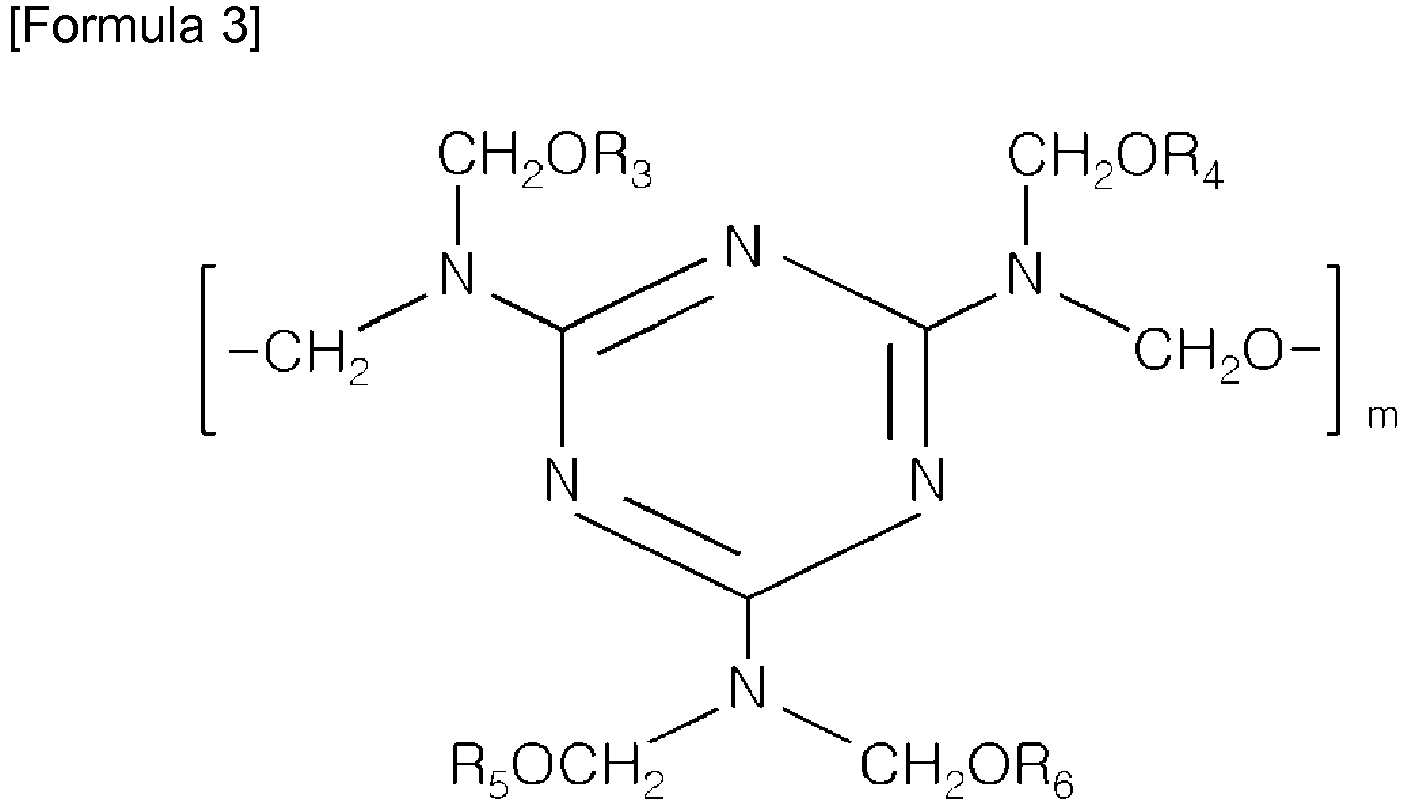
- In another embodiment, the compound represented by
Formula 3 may be (poly(melamine-co-formaldehyde), methylated) and may have a number average molecular weight (Mn) of 10,000 or less, or about 400 to about 10,000. The number average molecular weight (Mn) of poly(melamine-co-formaldehyde), methylated may be about 1000 or less, or about 400 to about 1000. - The solvent makes the components used in the electrode composition enter a dissolution state and/or a distribution state, in order to manufacture an electrode using coating techniques. The solvent is not limited, but may be a compound represented by
Formula 4.
- The compound represented by
Formula 4 is propylene glycol methyl ether acetate. - In the electrode composition, the total weight of the hardening polymer binder and the cross-linking agent may be 100 parts by weight or less based on 100 parts by weight of the active carbon. That is, the hardening polymer binder and the cross-linking agent may be used in an amount of the same or less than the amount of the active carbon, and the total weight, i.e., mixed amount of the hardening polymer binder and the cross-liking agent may be about 1 part by weight to 100 parts by weight based on 100 parts by weight of the active carbon, preferably, 1 part by weight to 50 parts by weight. If the total amount of the hardening polymer binder and the cross-linking agent is extremely smaller than that of the active carbon, the active carbon may be separated from the resulting electrode. If the total amount of the hardening polymer binder and the cross-linking agent is extremely higher than that of the active carbon, conductivity is decreased and the electrode resistance is increased. The hardening polymer binder may act as a binder together with the cross-linking agent, so that the total amount of the hardening polymer binder and the cross-linking agent is critical, but the mixing ratio of the hardening polymer binder and the cross-linking is not critical, and may be suitably controlled in the above range.
- In the electrode composition, the total amount of the active carbon, the hardening polymer binder, and the cross-linking agent may be 10 w/v% or less based on the amount of the solvent. That is, the electrode composition mainly includes the solvent, and the balance of the remaining components except for the solvent may be about 0.01 w/v% to 10 w/v%, preferably 0.1 w/v% to 5 w/v%, and more preferably 0.5 w/v% to 2 w/v%. If the balance is extremely small, it is difficult to prepare the electrode or the cured material, or the physical properties are deteriorated. If the balance is extremely large, the coating is not performed well or the physical properties are deteriorated.
- Another embodiment provides a cured material by curing the composition. The cured material is cured due to heat or light. The hardening polymer binder in the cured material may form a network having a three-dimensionally cross-linked structure in the cured material, and that is, the hardening polymer binder in the cured material has characteristics for forming a network of the three-dimensionally cross-linked structure together with the cross-linking agent. Such a three-dimensionally cross-linked structure may prevent the dissolution of the functional active carbon by the electrolyte which is a shortcoming of the conventional art.
- Furthermore, another embodiment provides an electrode including the cured material. The electrode for a supercapacitor may prevent the separation of the functional active carbon from the electrode since the electrode is formed by the cured material.
- Another embodiment provides a supercapacitor including: a pair of current collectors; a pair of electrodes each formed on one of the current collectors, the electrodes positioned facing each other and including the cured material; an electrolyte layer between the electrodes; and a separator between the electrolyte layers.
- As shown in
FIG. 1 , the supercapacitor may include a pair ofcurrent collectors electrodes separator 40. - The
current collectors - The
electrodes current collectors electrode current collectors electrodes - The thickness of the
electrodes - The thickness of the
electrodes electrodes electrodes electrodes - The electrolyte layers 30 and 50 may be formed by injecting the electrolyte between the pair of
electrodes - The electrolyte layer may be an aqueous electrolyte. The aqueous electrolyte may include an electrolytic salt and a solvent. The electrolytic salt may be any electrolytic salt as long as it may be useful in the aqueous electrolyte, and examples thereof may be an acidic electrolytic salt, a neutral electrolytic salt, or a basic electrolytic salt. Exemplary of the electrolytic salt may be potassium hydroxide, potassium chloride, sodium sulfate, or sulfuric acid, or a combination thereof, with high ion conductivity.
- The solvent may be water. The electrolyte has a concentration of about 0.1 M to about 6 M.
- The
separator 40 is position between the pair ofelectrodes separator 40 may be a porous separator having a plurality of pores, and each pore has a sufficient size to pass only electrolyte. The separator may include cellulose, polyolefin, celgard S-20, rayon, etc. - Furthermore, one embodiment provides a method of manufacturing the supercapacitor, including coating a composition including active carbon, a hardening polymer binder, and a cross-linking agent on each of a pair of the current collectors, curing the composition to form two electrodes, injecting the electrolyte between the electrodes, inserting a separator into the electrolyte, and sealing the resultant.
- First, an electrode composition including active carbon, a hardening polymer binder, a cross-linking agent, and a solvent is coated on each of a pair of current collectors. The coating process may be a general technique such as spray coating, slot-die coating, bar coating, and blade coating, but it is not limited thereto. As described above, the thickness and the transparency of the electrode may be controlled according the control of coating cycles.
- Thereafter, the coated electrode composition is cured to prepare a pair of
electrodes - An electrolyte solution is injected between the two
electrodes electrolyte layers - Thereafter, the
separator 40 is inserted between the electrolyte layers 30 and 50 which are located between theelectrodes electrodes - A supercapacitor is manufactured by sealing for inhibiting leakage of the electrolyte solution.
- In the present invention, the hardening polymer binder is used to overcome a shortcoming of the functional active carbon. The use of the hardening polymer binder allows inking of the functional active carbon so that the resulting material may be applicable for various coating techniques (generally all coating techniques). The hardening polymer binder may effectively prevent the dissolution of the functional active carbon by the electrolyte, since the hardening polymer binder forms a network having a three-dimensionally cross-linked structure. The network derived from the hardening polymer binder does not dissolve and only swells in the electrolyte, so that an electrode of a supercapacitor using the hardening polymer binder may form a maximal electric double layer by swelling the electrolyte, and provides good performance. Conductivity of the electrode of the supercapacitor may be guaranteed via the network derived from the hardening polymer binder without a conductive material. The functional active carbon having hydrophilicity at a surface thereof has good affinity to the aqueous electrolyte so that the formation of the electric double layer may be maximized. The hardening polymer binder may prevent the dissolution of the functional active carbon by the aqueous electrolyte since the hardening polymer binder forms a network. The hardening polymer binder may provide sufficient conductivity without a conductive material by decreasing the distances between the functional active carbon since the hardening polymer binder forms a network.
- Hereinafter, Examples of the present invention are illustrated. These examples, however, are exemplified or described, but is not limited thereto.
- An electrode composition included active carbon, a hardening polymer binder, a cross-linking agent, and a solvent was coated on each of a pair of current collectors to prepare electrodes.
- The electrode composition was prepared by adding 1 g of active carbon nanopowder to 100 ml of a solvent, and adding the hardening polymer binder and the cross-linking agent thereto, and the total amount of the hardening polymer binder and the cross-linking agent are shown in Table 1, within a range of 0.01 g to 1 g. The active carbon was a function active carbon nanopowder including -OH, -COOH, -CO, and =O as hydrophilic functional groups, and the hardening polymer binder was PVP (Mw: 20,000), the cross-linking agent was poly(melamine-co-formaldehyde) (Mn: -511), and the solvent was propylene glycol methyl ether acetate.
- The coating process was performed by spray coating, and was repeated for 5 cycles. Thereafter, the coated electrode composition was thermoset at 1800 °C to prepare a pair of electrodes facing each other, and an electrolyte solution was injected between the two electrodes to prepare an electrolyte layer. The electrolyte solution was 1 M sodium sulfate in water. Thereafter, a porous separator was inserted into the electrolyte located between two electrodes, and sealed to manufacture a supercapacitor.
- For the supercapacitors according to Examples 1 to 6, tests for whether or not active carbons were detached from the electrodes, according to the total amounts of the hardening polymer binders (PVP) and the cross-linking agents, were performed. The tests were performed on a three-electrode system including a Pt mesh counter electrode, an Ag/AgCl (3M KCl) reference electrode, and the electrodes according to Examples 1 to 6, at a scan rate of 1000mV/s for 50 cycles. The results were obtained from eye observation. The results are shown in Table 1.
Table 1 Amount of active carbon(g) Total amount of binder and cross-linking agent (g) Detachable of active carbon Example 1 1 0.01 Detached Example 2 1 0.02 Detached Example 3 1 0.05 Not detached Example 4 1 0.1 Not detached Example 5 1 0.5 Not detached Example 6 1 1 Not detached - As shown in Table 1, Examples 1 and 2 using 0.01 g or 0.02 g of the total amount of the binder and the cross-linking agent exhibited detached active carbon.
- The charging capacities according to the total amount of the hardening polymer binder (PVP) and the cross-linking agent were measured on the supercapacitors according to Examples 3 to 6. The results are shown in
FIG. 2 . As shown inFIG. 2 , as the amount of the binder and the cross-linking agent decreased, the charge capacity increased. From the results in Table 1 andFIG. 2 , it can be seen that the amount of the binder and the cross-linking agent is as little as possible within the range (0.05 g or more) in which active carbon was not detached from the electrode, to increase charge capacity. - A supercapacitor was manufactured by the same procedures in Example 3 except that the coating was performed once.
- A supercapacitor was manufactured by the same procedures in Example 3 except that the coating was performed twice.
- A supercapacitor was manufactured by the same procedures in Example 3 except that the coating was performed three times.
- A supercapacitor was manufactured by the same procedures in Example 3 except that the coating was performed four times.
- A supercapacitor was manufactured by the same procedures in Example 3 except that the coating was performed six times.
- The thickness of the electrode according to Examples 7 and 11 were measured in order to confirm the thickness variation according to the coating cycles. Furthermore, the thickness of the electrode according to Example 3 was measured. The results are shown in
FIG. 3 . It can be seen fromFIG. 3 that as the coating cycles were increased, the thickness of the electrode was thicker, and when coating was repeated once, the average thickness of about 0.8±0.5 µm was determined. -
FIG. 4 shows photographs of the electrodes according to Example 7 and Example 3, according to the coating cycles. As shown inFIG. 4 , when the coating procedure was performed once, the transparent or translucent electrode was prepared, whereas when the coating procedure was performed for 5 cycles or more, the electrode material was full covered. - While this invention has been described in connection with what is presently considered to be practical exemplary embodiments, it is to be understood that the invention is not limited to the disclosed embodiments. However, it, on the contrary, is intended to cover various modifications and equivalent arrangements included within the spirit and scope of the appended claims.
Claims (19)
- An electrode composition comprising:an active carbon; anda hardening polymer binder.
- The electrode composition of claim 1, wherein the hardening polymer binder is at least one selected from a thermosetting polymer binder or a photo-curable polymer binder.
- The electrode composition of claim 1, wherein the active carbon and the hardening polymer binder include a hydrophilic functional group.
- The electrode composition of claim 3, wherein the hydrophilic functional group is at least one selected from -COOH, -OH, -SO3H, -NH2, -NH4, -SO3, -COOM, wherein M is an alkali metal or NH4, =O, or -CO.
- The electrode composition of claim 1, wherein the hardening polymer binder is a compound represented by Formula 1:
 wherein, R1 is a C1 to C10 alkyl, a C6 to C18 aryl, or (-CH2CH-)n,n is an integer of 1 to 20,000,R2 is -OH, -COOH, -SO3H, -NH2, -NH4, -SO3, -COOM, =O or -CO, andM is an alkali metal or NH4.
 - The electrode composition of claim 1, wherein the hardening polymer binder is a compound represented by Formula 2:

n is an integer of 1 to 30,000. - The electrode composition of claim 1, further comprising a cross-linking agent and a solvent.
- The electrode composition of claim 1, wherein the cross-linking agent is a compound represented by Formula 3:
 R3 to R6 are the same or are independently hydrogen, a C1 to C10 alkyl, or a C6 to C18 aryl, andm is an integer of 1 to 1000.
 - The electrode composition of claim 7, wherein the solvent is a compound represented by Formula 4:
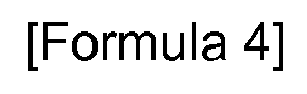

- The electrode composition of claim 7, wherein a total weight of the hardening polymer binder and the cross-linking agent is 1 part by weight to 100 parts by weight based on 100 parts by weight of the active carbon.
- The electrode composition of claim 7, wherein a total weight of the hardening polymer binder and the cross-linking agent is 1 part by weight to 50 parts by weight based on 100 parts by weight of the active carbon.
- The electrode composition of claim 7, wherein a total weight of the active carbon, the hardening polymer binder, and the cross-linking agent is 0.01 w/v% to 10 w/v% based on an amount of the solvent.
- A cured material by curing the composition according to Claim 1.
- The cured material of Claim 13, wherein the hardening polymer binder forms a network of the three-dimensionally cross-linked structure in the cured material.
- An electrode comprising the cured material according to Claim 13.
- A supercapacitor comprising:a pair of current collectors;a pair of electrodes each formed on the current collectors, the electrodes positioned facing each other, and comprising the cured material according to Claim 13,an electrolyte layer between the electrodes; anda separator between the electrolyte layers.
- The supercapacitor of Claim 16, wherein the first and the second electrodes have a thickness of about 1 nm to 2 µm and are transparent or translucent.
- A method of manufacturing a supercapacitor, comprising
coating a composition including active carbon, a hardening polymer binder, a cross-linking agent, and a solvent on each of a pair of current collectors;
curing the composition to prepare a pair of electrodes;
injecting an electrolyte to the electrodes;
inserting a separator into the electrolyte; and
sealing the product. - The method of Claim 18, wherein thickness and transparency are controlled by controlling coating cycles.
Applications Claiming Priority (2)
| Application Number | Priority Date | Filing Date | Title |
|---|---|---|---|
| KR1020130035016A KR101325952B1 (en) | 2013-04-01 | 2013-04-01 | High performance functionalized activated carbon supercapacitor by using curable polymer binder |
| PCT/KR2013/010914 WO2014163272A1 (en) | 2013-04-01 | 2013-11-28 | Electrode composition for supercapacitor, cured product of said composition, electrode comprising said cured product, capacitor comprising said electrode, and manufacturing method for said supercapacitor |
Publications (3)
| Publication Number | Publication Date |
|---|---|
| EP2983186A1 true EP2983186A1 (en) | 2016-02-10 |
| EP2983186A4 EP2983186A4 (en) | 2016-11-02 |
| EP2983186B1 EP2983186B1 (en) | 2023-08-30 |
Family
ID=49856884
Family Applications (1)
| Application Number | Title | Priority Date | Filing Date |
|---|---|---|---|
| EP13863700.4A Active EP2983186B1 (en) | 2013-04-01 | 2013-11-28 | Electrode composition for supercapacitor, cured product of said composition, electrode comprising said cured product, capacitor comprising said electrode, and manufacturing method for said supercapacitor |
Country Status (4)
| Country | Link |
|---|---|
| US (1) | US9318276B2 (en) |
| EP (1) | EP2983186B1 (en) |
| KR (1) | KR101325952B1 (en) |
| WO (1) | WO2014163272A1 (en) |
Cited By (19)
| Publication number | Priority date | Publication date | Assignee | Title |
|---|---|---|---|---|
| US9580321B2 (en) | 2009-07-01 | 2017-02-28 | Basf Se | Ultrapure synthetic carbon materials |
| US9985289B2 (en) | 2010-09-30 | 2018-05-29 | Basf Se | Enhanced packing of energy storage particles |
| US10141122B2 (en) | 2006-11-15 | 2018-11-27 | Energ2, Inc. | Electric double layer capacitance device |
| US10147950B2 (en) | 2015-08-28 | 2018-12-04 | Group 14 Technologies, Inc. | Materials with extremely durable intercalation of lithium and manufacturing methods thereof |
| US10195583B2 (en) | 2013-11-05 | 2019-02-05 | Group 14 Technologies, Inc. | Carbon-based compositions with highly efficient volumetric gas sorption |
| US10454103B2 (en) | 2013-03-14 | 2019-10-22 | Group14 Technologies, Inc. | Composite carbon materials comprising lithium alloying electrochemical modifiers |
| US10490358B2 (en) | 2011-04-15 | 2019-11-26 | Basf Se | Flow ultracapacitor |
| US10522836B2 (en) | 2011-06-03 | 2019-12-31 | Basf Se | Carbon-lead blends for use in hybrid energy storage devices |
| US10590277B2 (en) | 2014-03-14 | 2020-03-17 | Group14 Technologies, Inc. | Methods for sol-gel polymerization in absence of solvent and creation of tunable carbon structure from same |
| US10763501B2 (en) | 2015-08-14 | 2020-09-01 | Group14 Technologies, Inc. | Nano-featured porous silicon materials |
| WO2021080472A1 (en) | 2019-10-25 | 2021-04-29 | Общество с ограниченной ответственностью "Комберри" | Triazine copolymer-based transparent gel-polymer electrolytes |
| US11174167B1 (en) | 2020-08-18 | 2021-11-16 | Group14 Technologies, Inc. | Silicon carbon composites comprising ultra low Z |
| US11335903B2 (en) | 2020-08-18 | 2022-05-17 | Group14 Technologies, Inc. | Highly efficient manufacturing of silicon-carbon composites materials comprising ultra low z |
| US11401363B2 (en) | 2012-02-09 | 2022-08-02 | Basf Se | Preparation of polymeric resins and carbon materials |
| US11611071B2 (en) | 2017-03-09 | 2023-03-21 | Group14 Technologies, Inc. | Decomposition of silicon-containing precursors on porous scaffold materials |
| US11639292B2 (en) | 2020-08-18 | 2023-05-02 | Group14 Technologies, Inc. | Particulate composite materials |
| US12046744B2 (en) | 2020-09-30 | 2024-07-23 | Group14 Technologies, Inc. | Passivated silicon-carbon composite materials |
| US12577657B2 (en) | 2020-08-10 | 2026-03-17 | Group14 Technologies, Inc. | Vibro-thermally assisted chemical vapor infiltration |
| US12606443B2 (en) | 2020-08-18 | 2026-04-21 | Group14 Technologies, Inc. | Manufacturing of silicon-carbon composites materials |
Families Citing this family (3)
| Publication number | Priority date | Publication date | Assignee | Title |
|---|---|---|---|---|
| KR20180034031A (en) | 2016-09-27 | 2018-04-04 | 삼성전자주식회사 | Electrochemical mirror |
| KR20180034032A (en) * | 2016-09-27 | 2018-04-04 | 삼성전자주식회사 | Electrochemical mirror |
| KR20250094303A (en) | 2023-12-18 | 2025-06-25 | 연세대학교 산학협력단 | Self-powered pulse sensor for use in the carotid artery |
Family Cites Families (16)
| Publication number | Priority date | Publication date | Assignee | Title |
|---|---|---|---|---|
| EP0633618B1 (en) * | 1992-12-25 | 2000-03-22 | TDK Corporation | Lithium secondary cell |
| JPH10255806A (en) | 1997-03-07 | 1998-09-25 | Fujitsu Ltd | Electrode and battery using the same |
| JP3669429B2 (en) * | 2001-03-27 | 2005-07-06 | 信越化学工業株式会社 | Electrode composition and electrode material |
| KR20030026790A (en) | 2001-09-28 | 2003-04-03 | 안성현 | Ground stalk root stem powder ground by removing soil, sand and shells and drying with a dryer |
| WO2005050762A1 (en) * | 2003-11-21 | 2005-06-02 | Kureha Corporation | Electrode binder composition for nonaqueous electrolyte battery and use thereof |
| JP4276063B2 (en) | 2003-12-26 | 2009-06-10 | Tdk株式会社 | Electrode capacitor electrode manufacturing method and electrochemical capacitor manufacturing method |
| CN101147222A (en) | 2005-03-30 | 2008-03-19 | 日本瑞翁株式会社 | Electrode material for electric double layer capacitor, manufacturing method, electrode for electric double layer capacitor, and electric double layer capacitor |
| JP4616052B2 (en) | 2005-04-08 | 2011-01-19 | パナソニック株式会社 | Electrode material for electric double layer capacitor and manufacturing method thereof, electrode for electric double layer capacitor, and electric double layer capacitor |
| JP4490866B2 (en) | 2005-05-09 | 2010-06-30 | 信越化学工業株式会社 | Electrode for electrochemical capacitor, composition used therefor, method for producing the electrode, and electrochemical capacitor using the electrode |
| KR101320894B1 (en) * | 2006-07-05 | 2013-10-24 | 삼성디스플레이 주식회사 | Photoresist composition and method of manufacturing color filter substrate using the same |
| EP2058882A4 (en) * | 2006-08-29 | 2013-03-06 | Unitika Ltd | Binder for electrode formation, slurry for electrode formation using the binder, electrode using the slurry, secondary battery using the electrode, and capacitor using the electrode |
| JP2010034300A (en) * | 2008-07-29 | 2010-02-12 | Jfe Chemical Corp | Carbon material for use of polarizable electrode of electric double-layer capacitor, its manufacturing method, and the electric double-layer capacitor |
| US20120121981A1 (en) | 2009-07-31 | 2012-05-17 | Yukinari Harimoto | Electrode Active Material, Electrode, And Electricity Storage Device |
| JP6145693B2 (en) * | 2011-06-24 | 2017-06-14 | 三菱ケミカル株式会社 | Electrode element electrode binder, electrochemical element electrode composition, electrochemical element electrode and electrochemical element |
| KR20130017985A (en) * | 2011-08-12 | 2013-02-20 | 삼성전기주식회사 | Active agent slurry composition for electrodes and electrochemical capacitor comprising the electrodes using the composition |
| KR20130026790A (en) * | 2011-09-06 | 2013-03-14 | 삼성전기주식회사 | Active agent composition, and electrochemical capacitors using the same |
-
2013
- 2013-04-01 KR KR1020130035016A patent/KR101325952B1/en active Active
- 2013-11-27 US US14/091,990 patent/US9318276B2/en active Active
- 2013-11-28 WO PCT/KR2013/010914 patent/WO2014163272A1/en not_active Ceased
- 2013-11-28 EP EP13863700.4A patent/EP2983186B1/en active Active
Cited By (52)
| Publication number | Priority date | Publication date | Assignee | Title |
|---|---|---|---|---|
| US10141122B2 (en) | 2006-11-15 | 2018-11-27 | Energ2, Inc. | Electric double layer capacitance device |
| US10600581B2 (en) | 2006-11-15 | 2020-03-24 | Basf Se | Electric double layer capacitance device |
| US9580321B2 (en) | 2009-07-01 | 2017-02-28 | Basf Se | Ultrapure synthetic carbon materials |
| US10287170B2 (en) | 2009-07-01 | 2019-05-14 | Basf Se | Ultrapure synthetic carbon materials |
| US9985289B2 (en) | 2010-09-30 | 2018-05-29 | Basf Se | Enhanced packing of energy storage particles |
| US10490358B2 (en) | 2011-04-15 | 2019-11-26 | Basf Se | Flow ultracapacitor |
| US10522836B2 (en) | 2011-06-03 | 2019-12-31 | Basf Se | Carbon-lead blends for use in hybrid energy storage devices |
| US11401363B2 (en) | 2012-02-09 | 2022-08-02 | Basf Se | Preparation of polymeric resins and carbon materials |
| US11718701B2 (en) | 2012-02-09 | 2023-08-08 | Group14 Technologies, Inc. | Preparation of polymeric resins and carbon materials |
| US11725074B2 (en) | 2012-02-09 | 2023-08-15 | Group 14 Technologies, Inc. | Preparation of polymeric resins and carbon materials |
| US11732079B2 (en) | 2012-02-09 | 2023-08-22 | Group14 Technologies, Inc. | Preparation of polymeric resins and carbon materials |
| US12084549B2 (en) | 2012-02-09 | 2024-09-10 | Group 14 Technologies, Inc. | Preparation of polymeric resins and carbon materials |
| US10454103B2 (en) | 2013-03-14 | 2019-10-22 | Group14 Technologies, Inc. | Composite carbon materials comprising lithium alloying electrochemical modifiers |
| US10714744B2 (en) | 2013-03-14 | 2020-07-14 | Group14 Technologies, Inc. | Composite carbon materials comprising lithium alloying electrochemical modifiers |
| US11495793B2 (en) | 2013-03-14 | 2022-11-08 | Group14 Technologies, Inc. | Composite carbon materials comprising lithium alloying electrochemical modifiers |
| US12418023B2 (en) | 2013-03-14 | 2025-09-16 | Group14 Technologies, Inc. | Composite carbon materials comprising lithium alloying electrochemical modifiers |
| US12064747B2 (en) | 2013-11-05 | 2024-08-20 | Group14 Technologies, Inc. | Carbon-based compositions with highly efficient volumetric gas sorption |
| US10814304B2 (en) | 2013-11-05 | 2020-10-27 | Group14 Technologies, Inc. | Carbon-based compositions with highly efficient volumetric gas sorption |
| US10195583B2 (en) | 2013-11-05 | 2019-02-05 | Group 14 Technologies, Inc. | Carbon-based compositions with highly efficient volumetric gas sorption |
| US11707728B2 (en) | 2013-11-05 | 2023-07-25 | Group14 Technologies, Inc. | Carbon-based compositions with highly efficient volumetric gas sorption |
| US10711140B2 (en) | 2014-03-14 | 2020-07-14 | Group14 Technologies, Inc. | Methods for sol-gel polymerization in absence of solvent and creation of tunable carbon structure from same |
| US10590277B2 (en) | 2014-03-14 | 2020-03-17 | Group14 Technologies, Inc. | Methods for sol-gel polymerization in absence of solvent and creation of tunable carbon structure from same |
| KR20230093537A (en) * | 2014-03-14 | 2023-06-27 | 그룹14 테크놀로지스, 인코포레이티드 | Novel methods for sol-gel polymerization in absence of solvent and creation of tunable carbon structure from same |
| US11661517B2 (en) | 2014-03-14 | 2023-05-30 | Group14 Technologies, Inc. | Methods for sol-gel polymerization in absence of solvent and creation of tunable carbon structure from same |
| US11942630B2 (en) | 2015-08-14 | 2024-03-26 | Group14 Technologies, Inc. | Nano-featured porous silicon materials |
| US11611073B2 (en) | 2015-08-14 | 2023-03-21 | Group14 Technologies, Inc. | Composites of porous nano-featured silicon materials and carbon materials |
| US12562381B2 (en) | 2015-08-14 | 2026-02-24 | Group14 Technologies, Inc. | Nano-featured porous silicon materials |
| US12537192B2 (en) | 2015-08-14 | 2026-01-27 | Group14 Technologies, Inc. | Composites of porous nano-featured silicon materials and carbon materials |
| US10763501B2 (en) | 2015-08-14 | 2020-09-01 | Group14 Technologies, Inc. | Nano-featured porous silicon materials |
| US10756347B2 (en) | 2015-08-28 | 2020-08-25 | Group14 Technologies, Inc. | Materials with extremely durable intercalation of lithium and manufacturing methods thereof |
| US10923722B2 (en) | 2015-08-28 | 2021-02-16 | Group14 Technologies, Inc. | Materials with extremely durable intercalation of lithium and manufacturing methods thereof |
| US11495798B1 (en) | 2015-08-28 | 2022-11-08 | Group14 Technologies, Inc. | Materials with extremely durable intercalation of lithium and manufacturing methods thereof |
| US11646419B2 (en) | 2015-08-28 | 2023-05-09 | Group 14 Technologies, Inc. | Materials with extremely durable intercalation of lithium and manufacturing methods thereof |
| US11437621B2 (en) | 2015-08-28 | 2022-09-06 | Group14 Technologies, Inc. | Materials with extremely durable intercalation of lithium and manufacturing methods thereof |
| US10147950B2 (en) | 2015-08-28 | 2018-12-04 | Group 14 Technologies, Inc. | Materials with extremely durable intercalation of lithium and manufacturing methods thereof |
| US10608254B2 (en) | 2015-08-28 | 2020-03-31 | Group14 Technologies, Inc. | Materials with extremely durable intercalation of lithium and manufacturing methods thereof |
| US10784512B2 (en) | 2015-08-28 | 2020-09-22 | Group14 Technologies, Inc. | Materials with extremely durable intercalation of lithium and manufacturing methods thereof |
| US12155066B2 (en) | 2017-03-09 | 2024-11-26 | Group14 Technologies, Inc. | Decomposition of silicon-containing precursors on porous scaffold materials |
| US11611071B2 (en) | 2017-03-09 | 2023-03-21 | Group14 Technologies, Inc. | Decomposition of silicon-containing precursors on porous scaffold materials |
| WO2021080472A1 (en) | 2019-10-25 | 2021-04-29 | Общество с ограниченной ответственностью "Комберри" | Triazine copolymer-based transparent gel-polymer electrolytes |
| US12577657B2 (en) | 2020-08-10 | 2026-03-17 | Group14 Technologies, Inc. | Vibro-thermally assisted chemical vapor infiltration |
| US11498838B2 (en) | 2020-08-18 | 2022-11-15 | Group14 Technologies, Inc. | Silicon carbon composites comprising ultra low z |
| US12057569B2 (en) | 2020-08-18 | 2024-08-06 | Group14 Technologies, Inc. | Highly efficient manufacturing of silicon-carbon composite materials comprising ultra low Z |
| US11492262B2 (en) | 2020-08-18 | 2022-11-08 | Group14Technologies, Inc. | Silicon carbon composites comprising ultra low Z |
| US11174167B1 (en) | 2020-08-18 | 2021-11-16 | Group14 Technologies, Inc. | Silicon carbon composites comprising ultra low Z |
| US11611070B2 (en) | 2020-08-18 | 2023-03-21 | Group14 Technologies, Inc. | Highly efficient manufacturing of silicon-carbon composites materials comprising ultra low Z |
| US11335903B2 (en) | 2020-08-18 | 2022-05-17 | Group14 Technologies, Inc. | Highly efficient manufacturing of silicon-carbon composites materials comprising ultra low z |
| US11639292B2 (en) | 2020-08-18 | 2023-05-02 | Group14 Technologies, Inc. | Particulate composite materials |
| US12577114B2 (en) | 2020-08-18 | 2026-03-17 | Group14 Technologies, Inc. | Silicon-carbon composites |
| US11804591B2 (en) | 2020-08-18 | 2023-10-31 | Group14 Technologies, Inc. | Highly efficient manufacturing of silicon-carbon composite materials comprising ultra low Z |
| US12606443B2 (en) | 2020-08-18 | 2026-04-21 | Group14 Technologies, Inc. | Manufacturing of silicon-carbon composites materials |
| US12046744B2 (en) | 2020-09-30 | 2024-07-23 | Group14 Technologies, Inc. | Passivated silicon-carbon composite materials |
Also Published As
| Publication number | Publication date |
|---|---|
| WO2014163272A1 (en) | 2014-10-09 |
| KR101325952B1 (en) | 2013-11-07 |
| EP2983186B1 (en) | 2023-08-30 |
| US9318276B2 (en) | 2016-04-19 |
| EP2983186A4 (en) | 2016-11-02 |
| US20140293508A1 (en) | 2014-10-02 |
Similar Documents
| Publication | Publication Date | Title |
|---|---|---|
| EP2983186B1 (en) | Electrode composition for supercapacitor, cured product of said composition, electrode comprising said cured product, capacitor comprising said electrode, and manufacturing method for said supercapacitor | |
| Suriyakumar et al. | Role of polymers in enhancing the performance of electrochemical supercapacitors: a review | |
| Pan et al. | Recognition of ionic liquids as high-voltage electrolytes for supercapacitors | |
| Loh et al. | Challenges and Strategies in the Development of Zinc‐Ion Batteries | |
| US9892870B2 (en) | Charge storage devices containing carbon nanotube films as electrodes and charge collectors | |
| Cheng et al. | Proton-conducting polyoxometalates as redox electrolytes synergistically boosting the performance of self-healing solid-state supercapacitors with polyaniline | |
| Lee et al. | Highly ordered, polypyrrole-coated Co (OH) 2 architectures for high-performance asymmetric supercapacitors | |
| Li et al. | Highly reversible and anticorrosive Zn anode enabled by a Ag nanowires layer | |
| CN103682434B (en) | A kind of preparation method of gel type ionic liquid/polymer electrolyte | |
| US8520365B2 (en) | Charge storage device architecture for increasing energy and power density | |
| US20110261502A1 (en) | Charge storage device architecture for increasing energy and power density | |
| Meng et al. | Water-in-salt ambipolar redox electrolyte extraordinarily boosting high pseudocapacitive performance of micro-supercapacitors | |
| JP7018555B2 (en) | Conductive materials and their uses | |
| Jagadale et al. | Mitigating supercapacitor self-discharge through strategic materials modification | |
| Bissannagari et al. | Designing a bimodal BaTiO3 artificial layer to boost the dielectric effect toward highly reversible dendrite-free Zn metal anodes | |
| CN102217015A (en) | Electrical double layer capacitor | |
| Liu et al. | Constructing bilayer heterogeneous organogel electrolytes of Lewis acidic/basic polymers to suppress self-discharge of supercapacitors | |
| JP2017123471A (en) | Current conducting electrode and method for manufacturing the same | |
| Lee et al. | Polymethacrylate-comb-copolymer electrolyte for solid-state energy storage devices | |
| JP5372748B2 (en) | Paste electrolyte and rechargeable lithium battery including the same | |
| TWI668902B (en) | Electrode and electrochemical energy storage device | |
| Shruti et al. | Recent developments on MXene-based Zn-ion flexible supercapacitors | |
| CN102945754A (en) | Super electrochemical capacitor and preparation method thereof | |
| Li et al. | High sodium conductive polymer electrolyte-based nanoclusters in supercapacitor | |
| Zhou et al. | Redox electrolytes/mediators for Supercapacitors |
Legal Events
| Date | Code | Title | Description |
|---|---|---|---|
| PUAI | Public reference made under article 153(3) epc to a published international application that has entered the european phase |
Free format text: ORIGINAL CODE: 0009012 |
|
| 17P | Request for examination filed |
Effective date: 20140626 |
|
| AK | Designated contracting states |
Kind code of ref document: A1 Designated state(s): AL AT BE BG CH CY CZ DE DK EE ES FI FR GB GR HR HU IE IS IT LI LT LU LV MC MK MT NL NO PL PT RO RS SE SI SK SM TR |
|
| AX | Request for extension of the european patent |
Extension state: BA ME |
|
| DAX | Request for extension of the european patent (deleted) | ||
| A4 | Supplementary search report drawn up and despatched |
Effective date: 20160930 |
|
| RIC1 | Information provided on ipc code assigned before grant |
Ipc: H01G 11/38 20130101AFI20160926BHEP |
|
| STAA | Information on the status of an ep patent application or granted ep patent |
Free format text: STATUS: EXAMINATION IS IN PROGRESS |
|
| 17Q | First examination report despatched |
Effective date: 20200907 |
|
| GRAP | Despatch of communication of intention to grant a patent |
Free format text: ORIGINAL CODE: EPIDOSNIGR1 |
|
| STAA | Information on the status of an ep patent application or granted ep patent |
Free format text: STATUS: GRANT OF PATENT IS INTENDED |
|
| INTG | Intention to grant announced |
Effective date: 20230315 |
|
| GRAS | Grant fee paid |
Free format text: ORIGINAL CODE: EPIDOSNIGR3 |
|
| GRAA | (expected) grant |
Free format text: ORIGINAL CODE: 0009210 |
|
| STAA | Information on the status of an ep patent application or granted ep patent |
Free format text: STATUS: THE PATENT HAS BEEN GRANTED |
|
| AK | Designated contracting states |
Kind code of ref document: B1 Designated state(s): AL AT BE BG CH CY CZ DE DK EE ES FI FR GB GR HR HU IE IS IT LI LT LU LV MC MK MT NL NO PL PT RO RS SE SI SK SM TR |
|
| REG | Reference to a national code |
Ref country code: GB Ref legal event code: FG4D |
|
| REG | Reference to a national code |
Ref country code: CH Ref legal event code: EP |
|
| REG | Reference to a national code |
Ref country code: DE Ref legal event code: R096 Ref document number: 602013084551 Country of ref document: DE |
|
| REG | Reference to a national code |
Ref country code: IE Ref legal event code: FG4D |
|
| REG | Reference to a national code |
Ref country code: LT Ref legal event code: MG9D |
|
| REG | Reference to a national code |
Ref country code: NL Ref legal event code: MP Effective date: 20230830 |
|
| REG | Reference to a national code |
Ref country code: AT Ref legal event code: MK05 Ref document number: 1606518 Country of ref document: AT Kind code of ref document: T Effective date: 20230830 |
|
| PG25 | Lapsed in a contracting state [announced via postgrant information from national office to epo] |
Ref country code: GR Free format text: LAPSE BECAUSE OF FAILURE TO SUBMIT A TRANSLATION OF THE DESCRIPTION OR TO PAY THE FEE WITHIN THE PRESCRIBED TIME-LIMIT Effective date: 20231201 |
|
| PG25 | Lapsed in a contracting state [announced via postgrant information from national office to epo] |
Ref country code: IS Free format text: LAPSE BECAUSE OF FAILURE TO SUBMIT A TRANSLATION OF THE DESCRIPTION OR TO PAY THE FEE WITHIN THE PRESCRIBED TIME-LIMIT Effective date: 20231230 |
|
| PG25 | Lapsed in a contracting state [announced via postgrant information from national office to epo] |
Ref country code: SE Free format text: LAPSE BECAUSE OF FAILURE TO SUBMIT A TRANSLATION OF THE DESCRIPTION OR TO PAY THE FEE WITHIN THE PRESCRIBED TIME-LIMIT Effective date: 20230830 Ref country code: RS Free format text: LAPSE BECAUSE OF FAILURE TO SUBMIT A TRANSLATION OF THE DESCRIPTION OR TO PAY THE FEE WITHIN THE PRESCRIBED TIME-LIMIT Effective date: 20230830 Ref country code: NO Free format text: LAPSE BECAUSE OF FAILURE TO SUBMIT A TRANSLATION OF THE DESCRIPTION OR TO PAY THE FEE WITHIN THE PRESCRIBED TIME-LIMIT Effective date: 20231130 Ref country code: LV Free format text: LAPSE BECAUSE OF FAILURE TO SUBMIT A TRANSLATION OF THE DESCRIPTION OR TO PAY THE FEE WITHIN THE PRESCRIBED TIME-LIMIT Effective date: 20230830 Ref country code: LT Free format text: LAPSE BECAUSE OF FAILURE TO SUBMIT A TRANSLATION OF THE DESCRIPTION OR TO PAY THE FEE WITHIN THE PRESCRIBED TIME-LIMIT Effective date: 20230830 Ref country code: IS Free format text: LAPSE BECAUSE OF FAILURE TO SUBMIT A TRANSLATION OF THE DESCRIPTION OR TO PAY THE FEE WITHIN THE PRESCRIBED TIME-LIMIT Effective date: 20231230 Ref country code: HR Free format text: LAPSE BECAUSE OF FAILURE TO SUBMIT A TRANSLATION OF THE DESCRIPTION OR TO PAY THE FEE WITHIN THE PRESCRIBED TIME-LIMIT Effective date: 20230830 Ref country code: GR Free format text: LAPSE BECAUSE OF FAILURE TO SUBMIT A TRANSLATION OF THE DESCRIPTION OR TO PAY THE FEE WITHIN THE PRESCRIBED TIME-LIMIT Effective date: 20231201 Ref country code: FI Free format text: LAPSE BECAUSE OF FAILURE TO SUBMIT A TRANSLATION OF THE DESCRIPTION OR TO PAY THE FEE WITHIN THE PRESCRIBED TIME-LIMIT Effective date: 20230830 Ref country code: AT Free format text: LAPSE BECAUSE OF FAILURE TO SUBMIT A TRANSLATION OF THE DESCRIPTION OR TO PAY THE FEE WITHIN THE PRESCRIBED TIME-LIMIT Effective date: 20230830 |
|
| PG25 | Lapsed in a contracting state [announced via postgrant information from national office to epo] |
Ref country code: PL Free format text: LAPSE BECAUSE OF FAILURE TO SUBMIT A TRANSLATION OF THE DESCRIPTION OR TO PAY THE FEE WITHIN THE PRESCRIBED TIME-LIMIT Effective date: 20230830 Ref country code: NL Free format text: LAPSE BECAUSE OF FAILURE TO SUBMIT A TRANSLATION OF THE DESCRIPTION OR TO PAY THE FEE WITHIN THE PRESCRIBED TIME-LIMIT Effective date: 20230830 |
|
| PG25 | Lapsed in a contracting state [announced via postgrant information from national office to epo] |
Ref country code: ES Free format text: LAPSE BECAUSE OF FAILURE TO SUBMIT A TRANSLATION OF THE DESCRIPTION OR TO PAY THE FEE WITHIN THE PRESCRIBED TIME-LIMIT Effective date: 20230830 |
|
| PG25 | Lapsed in a contracting state [announced via postgrant information from national office to epo] |
Ref country code: SM Free format text: LAPSE BECAUSE OF FAILURE TO SUBMIT A TRANSLATION OF THE DESCRIPTION OR TO PAY THE FEE WITHIN THE PRESCRIBED TIME-LIMIT Effective date: 20230830 Ref country code: RO Free format text: LAPSE BECAUSE OF FAILURE TO SUBMIT A TRANSLATION OF THE DESCRIPTION OR TO PAY THE FEE WITHIN THE PRESCRIBED TIME-LIMIT Effective date: 20230830 Ref country code: ES Free format text: LAPSE BECAUSE OF FAILURE TO SUBMIT A TRANSLATION OF THE DESCRIPTION OR TO PAY THE FEE WITHIN THE PRESCRIBED TIME-LIMIT Effective date: 20230830 Ref country code: EE Free format text: LAPSE BECAUSE OF FAILURE TO SUBMIT A TRANSLATION OF THE DESCRIPTION OR TO PAY THE FEE WITHIN THE PRESCRIBED TIME-LIMIT Effective date: 20230830 Ref country code: DK Free format text: LAPSE BECAUSE OF FAILURE TO SUBMIT A TRANSLATION OF THE DESCRIPTION OR TO PAY THE FEE WITHIN THE PRESCRIBED TIME-LIMIT Effective date: 20230830 Ref country code: CZ Free format text: LAPSE BECAUSE OF FAILURE TO SUBMIT A TRANSLATION OF THE DESCRIPTION OR TO PAY THE FEE WITHIN THE PRESCRIBED TIME-LIMIT Effective date: 20230830 Ref country code: PT Free format text: LAPSE BECAUSE OF FAILURE TO SUBMIT A TRANSLATION OF THE DESCRIPTION OR TO PAY THE FEE WITHIN THE PRESCRIBED TIME-LIMIT Effective date: 20240102 Ref country code: SK Free format text: LAPSE BECAUSE OF FAILURE TO SUBMIT A TRANSLATION OF THE DESCRIPTION OR TO PAY THE FEE WITHIN THE PRESCRIBED TIME-LIMIT Effective date: 20230830 |
|
| REG | Reference to a national code |
Ref country code: DE Ref legal event code: R097 Ref document number: 602013084551 Country of ref document: DE |
|
| REG | Reference to a national code |
Ref country code: CH Ref legal event code: PL |
|
| PG25 | Lapsed in a contracting state [announced via postgrant information from national office to epo] |
Ref country code: MC Free format text: LAPSE BECAUSE OF FAILURE TO SUBMIT A TRANSLATION OF THE DESCRIPTION OR TO PAY THE FEE WITHIN THE PRESCRIBED TIME-LIMIT Effective date: 20230830 |
|
| PLBE | No opposition filed within time limit |
Free format text: ORIGINAL CODE: 0009261 |
|
| STAA | Information on the status of an ep patent application or granted ep patent |
Free format text: STATUS: NO OPPOSITION FILED WITHIN TIME LIMIT |
|
| PG25 | Lapsed in a contracting state [announced via postgrant information from national office to epo] |
Ref country code: LU Free format text: LAPSE BECAUSE OF NON-PAYMENT OF DUE FEES Effective date: 20231128 |
|
| PG25 | Lapsed in a contracting state [announced via postgrant information from national office to epo] |
Ref country code: CH Free format text: LAPSE BECAUSE OF NON-PAYMENT OF DUE FEES Effective date: 20231130 |
|
| GBPC | Gb: european patent ceased through non-payment of renewal fee |
Effective date: 20231130 |
|
| PG25 | Lapsed in a contracting state [announced via postgrant information from national office to epo] |
Ref country code: MC Free format text: LAPSE BECAUSE OF FAILURE TO SUBMIT A TRANSLATION OF THE DESCRIPTION OR TO PAY THE FEE WITHIN THE PRESCRIBED TIME-LIMIT Effective date: 20230830 Ref country code: LU Free format text: LAPSE BECAUSE OF NON-PAYMENT OF DUE FEES Effective date: 20231128 Ref country code: CH Free format text: LAPSE BECAUSE OF NON-PAYMENT OF DUE FEES Effective date: 20231130 Ref country code: SI Free format text: LAPSE BECAUSE OF FAILURE TO SUBMIT A TRANSLATION OF THE DESCRIPTION OR TO PAY THE FEE WITHIN THE PRESCRIBED TIME-LIMIT Effective date: 20230830 |
|
| REG | Reference to a national code |
Ref country code: BE Ref legal event code: MM Effective date: 20231130 |
|
| 26N | No opposition filed |
Effective date: 20240603 |
|
| REG | Reference to a national code |
Ref country code: IE Ref legal event code: MM4A |
|
| PG25 | Lapsed in a contracting state [announced via postgrant information from national office to epo] |
Ref country code: IE Free format text: LAPSE BECAUSE OF NON-PAYMENT OF DUE FEES Effective date: 20231128 |
|
| PG25 | Lapsed in a contracting state [announced via postgrant information from national office to epo] |
Ref country code: GB Free format text: LAPSE BECAUSE OF NON-PAYMENT OF DUE FEES Effective date: 20231130 |
|
| PG25 | Lapsed in a contracting state [announced via postgrant information from national office to epo] |
Ref country code: BE Free format text: LAPSE BECAUSE OF NON-PAYMENT OF DUE FEES Effective date: 20231130 |
|
| PG25 | Lapsed in a contracting state [announced via postgrant information from national office to epo] |
Ref country code: IE Free format text: LAPSE BECAUSE OF NON-PAYMENT OF DUE FEES Effective date: 20231128 Ref country code: GB Free format text: LAPSE BECAUSE OF NON-PAYMENT OF DUE FEES Effective date: 20231130 Ref country code: BE Free format text: LAPSE BECAUSE OF NON-PAYMENT OF DUE FEES Effective date: 20231130 |
|
| PG25 | Lapsed in a contracting state [announced via postgrant information from national office to epo] |
Ref country code: BG Free format text: LAPSE BECAUSE OF FAILURE TO SUBMIT A TRANSLATION OF THE DESCRIPTION OR TO PAY THE FEE WITHIN THE PRESCRIBED TIME-LIMIT Effective date: 20230830 |
|
| PG25 | Lapsed in a contracting state [announced via postgrant information from national office to epo] |
Ref country code: BG Free format text: LAPSE BECAUSE OF FAILURE TO SUBMIT A TRANSLATION OF THE DESCRIPTION OR TO PAY THE FEE WITHIN THE PRESCRIBED TIME-LIMIT Effective date: 20230830 |
|
| PG25 | Lapsed in a contracting state [announced via postgrant information from national office to epo] |
Ref country code: CY Free format text: LAPSE BECAUSE OF FAILURE TO SUBMIT A TRANSLATION OF THE DESCRIPTION OR TO PAY THE FEE WITHIN THE PRESCRIBED TIME-LIMIT; INVALID AB INITIO Effective date: 20131128 |
|
| PG25 | Lapsed in a contracting state [announced via postgrant information from national office to epo] |
Ref country code: HU Free format text: LAPSE BECAUSE OF FAILURE TO SUBMIT A TRANSLATION OF THE DESCRIPTION OR TO PAY THE FEE WITHIN THE PRESCRIBED TIME-LIMIT; INVALID AB INITIO Effective date: 20131128 |
|
| PGFP | Annual fee paid to national office [announced via postgrant information from national office to epo] |
Ref country code: FR Payment date: 20250930 Year of fee payment: 13 |
|
| PG25 | Lapsed in a contracting state [announced via postgrant information from national office to epo] |
Ref country code: TR Free format text: LAPSE BECAUSE OF FAILURE TO SUBMIT A TRANSLATION OF THE DESCRIPTION OR TO PAY THE FEE WITHIN THE PRESCRIBED TIME-LIMIT Effective date: 20230830 |
|
| PGFP | Annual fee paid to national office [announced via postgrant information from national office to epo] |
Ref country code: DE Payment date: 20250930 Year of fee payment: 13 |
|
| PGFP | Annual fee paid to national office [announced via postgrant information from national office to epo] |
Ref country code: IT Payment date: 20251022 Year of fee payment: 13 |