EP2982598A2 - Seitliches lagen-layup eines verbundholms - Google Patents
Seitliches lagen-layup eines verbundholms Download PDFInfo
- Publication number
- EP2982598A2 EP2982598A2 EP15177127.6A EP15177127A EP2982598A2 EP 2982598 A2 EP2982598 A2 EP 2982598A2 EP 15177127 A EP15177127 A EP 15177127A EP 2982598 A2 EP2982598 A2 EP 2982598A2
- Authority
- EP
- European Patent Office
- Prior art keywords
- layer
- spar
- plies
- flange
- fibers
- Prior art date
- Legal status (The legal status is an assumption and is not a legal conclusion. Google has not performed a legal analysis and makes no representation as to the accuracy of the status listed.)
- Withdrawn
Links
Images









Classifications
-
- B—PERFORMING OPERATIONS; TRANSPORTING
- B64—AIRCRAFT; AVIATION; COSMONAUTICS
- B64C—AEROPLANES; HELICOPTERS
- B64C3/00—Wings
- B64C3/18—Spars; Ribs; Stringers
- B64C3/185—Spars
-
- B—PERFORMING OPERATIONS; TRANSPORTING
- B32—LAYERED PRODUCTS
- B32B—LAYERED PRODUCTS, i.e. PRODUCTS BUILT-UP OF STRATA OF FLAT OR NON-FLAT, e.g. CELLULAR OR HONEYCOMB, FORM
- B32B37/00—Methods or apparatus for laminating, e.g. by curing or by ultrasonic bonding
- B32B37/14—Methods or apparatus for laminating, e.g. by curing or by ultrasonic bonding characterised by the properties of the layers
- B32B37/16—Methods or apparatus for laminating, e.g. by curing or by ultrasonic bonding characterised by the properties of the layers with all layers existing as coherent layers before laminating
- B32B37/20—Methods or apparatus for laminating, e.g. by curing or by ultrasonic bonding characterised by the properties of the layers with all layers existing as coherent layers before laminating involving the assembly of continuous webs only
-
- B—PERFORMING OPERATIONS; TRANSPORTING
- B32—LAYERED PRODUCTS
- B32B—LAYERED PRODUCTS, i.e. PRODUCTS BUILT-UP OF STRATA OF FLAT OR NON-FLAT, e.g. CELLULAR OR HONEYCOMB, FORM
- B32B2305/00—Condition, form or state of the layers or laminate
- B32B2305/10—Fibres of continuous length
- B32B2305/18—Fabrics, textiles
-
- B—PERFORMING OPERATIONS; TRANSPORTING
- B32—LAYERED PRODUCTS
- B32B—LAYERED PRODUCTS, i.e. PRODUCTS BUILT-UP OF STRATA OF FLAT OR NON-FLAT, e.g. CELLULAR OR HONEYCOMB, FORM
- B32B2309/00—Parameters for the laminating or treatment process; Apparatus details
- B32B2309/06—Angles
-
- B—PERFORMING OPERATIONS; TRANSPORTING
- B32—LAYERED PRODUCTS
- B32B—LAYERED PRODUCTS, i.e. PRODUCTS BUILT-UP OF STRATA OF FLAT OR NON-FLAT, e.g. CELLULAR OR HONEYCOMB, FORM
- B32B2605/00—Vehicles
- B32B2605/18—Aircraft
Definitions
- Structural components made from composite materials such as carbon fiber materials can result in strength to weight ratios that exceed those of metal alloys.
- the aircraft industry is generally considered a pioneer in this area (commercial and/or military aircraft).
- Other types of vehicles utilize structural components made from composite materials (e.g. cars, boats etc.).
- the composite structural components are utilized in other fields, such as the construction field.
- the fabrication of structural components utilizing composite materials can be time-consuming. This is especially the case with respect to structural components that have compound curves and/or that are non-uniform, such as tapered structures.
- the fabrication of structural components utilizing composite materials can also be limited with respect to the establishment of certain compound curves / tapered shapes.
- a structural component comprising a composite tapered wing spar including a first fiber layer and a main web, wherein respective longitudinal axes of fibers making up the first layer at least substantially lying on a plane corresponding to the main web of the wing spar are curved over at least most of the respective lengths of the fibers.
- a method that comprises laying down a plurality of fibers in a first layer to form a composite spar, wherein the first layer has a first component that extends generally in a first plane and a second component that extends generally in a second plane and a third component that extends generally in a third plane such that a first transition zone between the first and second components extends in at least a first generally linear manner and such that a second transition zone between the second and third components extends in at least a second generally linear manner in a different direction than the first generally linear manner, wherein the method further comprises steering plies of the fibers of the first layer to be, at the first transition zone, effectively normal to the direction of extension of the first transition zone and to be, at the second transition zone, effectively normal to the direction of extension of the second transition zone.
- a structural component comprising a composite tapered wing spar having a web and two flanges on opposite sides of the web, the composite tapered wing spar having a first fiber layer made up of plies that are effectively normal to directions of extensions of the respective flanges at respective transition zones of the flanges and web, wherein the directions of extensions of the respective flanges are obliquely angled relative to one another.
- an aircraft such as by way of example only and not by way of limitation, corresponding to a commercial passenger aircraft having, by way of example only and not by way of limitation, transatlantic ocean capabilities, having a composite wing spar according to one or more of the teachings detailed herein.
- an apparatus configured to automatically execute one or more of the methods detailed herein to automatically manufacture a structural component according to the teachings detailed herein.
- a composite tapered spar having a web and two flanges on opposite sides of the web, the composite tapered spar having a first fiber layer made up of a plurality of plies, wherein first plies of the plurality of plies have respective lengths that are substantially shorter than those of second plies of the plurality of plies, wherein the plies of the plurality of plies are arranged such that the first plies are generally evenly distributed amongst the second plies.
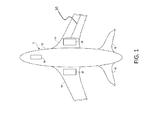
- FIG. 1 is a bottom view of a schematic of an aircraft 1 which comprises a fuselage 12, wings 14 and a tail plane 16. Functionally depicted in FIG. 1 is a nose landing gear assembly 18 and two main landing gear assemblies 20, in reinforced nacelles at the roots of the wings 14.
- FIG. 1 includes a "cutaway" view of one of the wings 14, where there is depicted a wing spar 10 in functional format.
- the spar extends from an inboard location of the wing 14 to an outboard location of the wing 14 ( i.e., from a first location of the wing to a second location of the wing, where the first location is closer to the fuselage 12 than the second location).
- the wing spar 10 is a main spar that supports substantially all of the weight of the wing (at least when the aircraft is parked on a runway / not in the air).
- the wing spar 10 is one a secondary spar (i.e., not a primary wing spar / main wing spar, a spar that does not serve as a primary wing spar) in the wing 14.
- the wing spar 10 extends the full-length of the wing 14, while in alternate embodiments, the wing spar 10 extends a partial length of the wing 14, which may include extension from the root of the wing, from the tip of the wing, or from a first position in between the root and the tip of the wing to a second position in between the root and the tip of the wing.
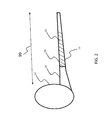
- FIG. 2 depicts a front view of a portion of the aircraft 1 of FIG. 1 , where a cutaway portion of one of the wings 14 is depicted, revealing a portion of spar 10.
- the wing 14 tapers from an inboard position to an outboard position. That is, the thickness of the wing (as measured in the vertical direction of FIG. 2 / the direction parallel to the direction of the pull of gravity when the aircraft is parked on a tarmac) decreases with location from inboard to outboard of the wing.
- the chord of the spar (as measured in the vertical direction of FIG. 2 / the direction parallel to the direction of the pull of gravity when the aircraft is parked on a tarmac) decreases with location from inboard to outboard of the wing.
- the wing spar 10 also tapers in a similar and/or same manner (e.g., a ratio of the height of the wing spar (as measured in the vertical direction) at two separate locations is at least about the same as the ratio of the thickness of the wing also at those locations). That said, in an alternate embodiment, the ratios can be different (i.e. the wing spar 10 does not taper in a similar manner as the wing).
- wing spars configurations of the exemplary wing spars detailed herein, as well as the uses thereof also detailed herein, are but exemplary and are presented for explanation purposes.
- the teachings detailed herein and/or variations thereof are applicable to any type of wing spar with which the teachings detailed herein and/or variations thereof can be utilized. Indeed, these teachings are not limited to only wing spars.
- Embodiments include applications of the teachings detailed herein and/or variations thereof to other types of spars other than wing spars and other types of structural components. For example, vertical tail spars, flap and aileron ribs, wing in-spar ribs, etc.
- embodiments include applications directed to technologies outside the aerospace technologies (e.g., automotive, etc.).
- the teachings herein can be directed to any cantilevered structure.
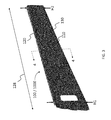
- FIG. 3 depicts an isometric view of an exemplary wing spar 100 and 1000 (the different reference numerals corresponding to different design features of the different spars associated with the different reference numerals - FIG. 3 is representative of both), which can correspond to the wing spar 10 depicted in FIGs. 1 and 2 . That is, the wing spar 100 depicted in FIG. 3 can be used as a wing spar (main wing spar or otherwise) in a wing of an aircraft (including a commercial aircraft, such as a commercial aircraft configured for trans ocean (e.g., trans-Atlantic travel). While FIG. 3 depicts an isometric view of the wing spar 100, it is noted that the tapering depicted in FIG.
- H1 is greater than H2 / the ratio of H1 to H2 is greater than 1.0. (In an alternate embodiment, the ratio of H1 to H2 can be less than 1.0.
- wing spar 100 includes a main web 110 and two flanges 120 and 130.
- flange 120 is referred to as the upper flange and flange 130 is referred to as the lower flange. It is noted that this nomenclature is utilized only because of the way that the spar 100 is depicted in FIG. 3 .
- flange 120 may be a flange located on the bottom and flange 130 may be a flange located on the top (i.e. the spar as depicted in FIG. 3 is inverted).
- FIG. 4 depicts a conceptual cross-sectional view taken through the approximate longitudinal center of the spar 100 (as depicted by the cross-section symbol 4-4 of FIG. 3 ).
- the cross-sectional view of FIG. 4 is conceptual in that it presents components of the wing spar 100 in exaggerated form for illustration purposes only. That is, the actual cross-section of the wing spar 100 may be different in at least some embodiments.
- the main spar web 110 is generally planar. That is, in an exemplary embodiment, the main spar web 110 is generally parallel to plane 110A.
- generally planar it is meant that the overall geometry of the web 110 extends in a planar fashion despite the fact that there may be some contours / or slight curvature that exist that result from manufacturing the spar or that there may be a modicum of curvature of the web by design - in the totality, the web would be considered generally planar.
- FIG. 4 includes the identifiers 121 and 131, which respectively correspond to transition zones of the flanges 120 and 130, respectively, where the spar transitions from the main web 110 to the planar portions of flanges 120 and 130.
- the transition zones are zones where the flanges include curved radii that extend from the planar portions of the web 110.
- these curved radii result from a change in direction of the layered composite materials that results from the manufacturing process that results in the establishment of the flanges that are connected to the web.
- the upper flange 120 includes an outer flange radius 123 and an inner flange radius 122
- the lower flange 130 includes an outer flange radius 133 and an inner flange radius 132.
- the outer radii begin, relative to the spar 110, at the portions of the transition zones 121 and 131 that are adjacent the web 110, respectively.
- the inner radii also begin at transition zones, which may be locally aligned with the transition zones 121 and 131, at least in the vertical direction (relative to FIG. 4 ), and or may be locally misaligned with the aforementioned transition zones, again at least in the vertical direction.
- the radiuses can be about 1 inch to about 4 inches, etc.
- the embodiments of the wing spar detailed herein are composite wing spars.
- the composite wing spars are made up of layers of graphite fibers.
- the composite wing spars are made up of layers of glass fibers (fiberglass, Kevlar, etc.).
- the aforementioned transition zones between the web and the flanges can be local to each layer. That is, in an exemplary embodiment, with respect to FIG. 4 , the vertical location of a transition zone of one layer of fiber can be different than that of another layer of fiber.
- FIG. 5 depicts a conceptual view of a portion 110B of the wing spar 110.
- the portion corresponds to a portion at about the center of section of FIG. 4 , as indicated in FIG. 4 , rotated 90° in the counterclockwise direction (i.e., portion 110B has vertical orientations in FIG. 4 - it is presented horizontally in FIG. 5 for discussion purposes).
- the portion 110B includes four fiber layers: layers 111, 112, 113 and 114. These layers are located one on top of the other (or more accurately, with respect to the frame of reference of FIG. 4 , one beside the other).
- embodiments of the wing spar can include more layers or fewer layers than that depicted in FIG. 5 (as noted above, FIG. 5 is presented for conceptual purposes).
- the layers of FIG. 5 represent layers of fiber material that are "laid up" at different fiber orientations relative to one another, although in alternate embodiments, the orientations of the fibers of one or more of the layers can be the same as the orientations one or more other layers.
- the fiber layers comprise individual plies that make up bands of respective layers.
- the layers are laid down utilizing automated fiber placement (AFP) machines.
- AFP automated fiber placement
- exemplary embodiments can include manufacturing actions which entails laying down 32 individual plies simultaneously or individually or in groups to make up bands (which may be 8 inch bands, 16 inch bands, etc.).
- the direction of extension of the plies / the direction of the fibers making up the given layer are locally parallel to adjacent plies / fibers.
- the composite plies are applied in a manner such that they follow the natural path over a compound surface (such as the surface of a tooling mold or a tooling die upon which the layers are stacked).
- the general vector of the portions of the fibers that make up the web defines the orientation of the fibers (even though the orientation of the fibers changes at the transition zones where the flanges begin).
- plies that have a general longitudinal direction of extension vector parallel to the direction of the span wise length 128 see FIG.
- the orientations of the fibers of the fiber layers of the spar 100 are defined by what is referred to herein as a general axis system, represented by a first coordinate system 140.
- the general axis system is such that the zero degree vector of the coordinate system is parallel to the vector average between the upper flange 120 and the lower flange 130.
- line 159 is the average of lines 129 and 139, the latter two lines being the vector average (which may be the exact vector if there is no deviation in the direction of extension of the flanges) of the upper and lower flanges, where the angle between the latter two lines is referred to as the taper angle (which can be about eight (8) degrees in an exemplary embodiment by way of example only and not by way of limitation).
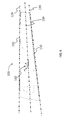
- FIG. 7 depicts fibers having a 0° fiber orientation relative to the first general axis system (i.e., fibers that are parallel to the vector identified by the 0° symbol of the first coordinate system 140) and thus fibers that are parallel to the vector average between the upper flange 120 and the lower flange 130 (line 159 of FIG. 7 ).
- FIG. 7 depicts a first layer (e.g., one of layers 111-114 of FIG. 5 ) of fibers made up of individual plies 151 (three of which are identified in FIG. 7 ).
- the plies 151 adjacent to the upper and lower flanges do not extend the full length of the spar (the full span of the spar). In at least some exemplary embodiments, this is because the AFP machine is unable to lay 0° plies over the flange radii and/or because the skew angle would cause bunching of the plies / unacceptable stress on the plies.
- FIG. 8 depicts an alternate arrangement of layer 111, with fibers having a 0° fiber orientation variously relative to 139 and 129.
- the second general axis system is such that there are two zero degree vectors respectively parallel to the vector average of the upper flange 120 and the lower flange 130 (again, which may be the exact vector if there is no deviation in the direction of extension of the flanges).
- the plies 151 adjacent to the upper and lower flanges 120 and 130 extend the full length of the spar (the full span of the spar), but the plies 151 in the middle do not extend the full length of the spar.
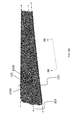
- FIG. 9A presents an exemplary layer of the spar 110, and depicts fibers 150 having a 90° fiber orientation relative to the first general axis system (i.e ., fibers that are parallel to the vector identified by the 90° symbol 140A of first coordinate system 140 and perpendicular to the vector identified by the 0° symbol 140B of the first coordinate system 140) and thus fibers that are perpendicular to the vector average between the upper flange 120 and the lower flange 130 (line 159 of FIG. 9A ).
- the 90° plies obliquely skew to follow their natural path about the flange radii.
- the layers of the spar 100 can have fibers having different orientations.
- FIGs. 7 to 9A only variously depict zero degree fibers and ninety degree fibers (relative to the longitudinal direction of the spar).
- other layers 150 can have fibers angled at different degrees relative to the pertinent axis systems.
- fibers can be generally angled at ⁇ 45°, ⁇ 30°, ⁇ 60°, etc., relative to the longitudinal axis of the system.
- the fibers of any particular layer 150 can be angled at ⁇ angles relative to the longitudinal direction of the spar in a range of 0 to 90 in 0.1 degree increments (e.g., +10, -7.6, ⁇ 43.9°, - 89.0° to + 55.7°, etc.).
- the fibers of FIGs. 7-9A can experience a situation where fiber skewing occurs at the upper and/or lower spar flange 120 / 130, thus resulting in zones where the spar is not as strong as that which would be the case in the absence of the fiber skewing.
- the fibers 150 oriented based on the first general axis system 140 can be skewed relative to the spar flanges 120 / 130 by about half the taper angle of the spar (e.g., about 4° in embodiments where the taper angle the spar is 8°).
- the skewing could result in one side of a ply strip being folded over upon itself and/or one side of a ply not adhering to the underlying layer.
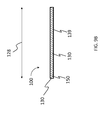
- FIG. 9B depicts a conceptual view of a bottom view of a portion of the spar 100 detailing plies 150 of the layer of FIG. 9A . More specifically, FIG. 9B depicts the bottom flange 130, where the rest of the spar component is eclipsed by the bottom flange. FIG. 9B depicts the plies wrapping around the transition zone from the planar web of the spar extending therefrom to the edge 139 of the flange. As can be seen, the plies 151 extend at an oblique angle (depicted in an exaggerated manner for purposes of conceptual illustration) relative to the span wise direction of extension of the bottom flange 130 / the direction of extension of the edge 139.
- FIG. 9B also conceptually represents the arrangement of the plies of the top spar (i.e., if reference number 130 was replaced with reference number 120, FIG. 9B would represent a top view of a portion of the spar 1000 of FIG. 9A , albeit the relative direction of extension of the plies may be different).
- FIGs. 10 to 16 present alternate embodiments of fiber layers for a spar where the orientation of the fibers as variously referenced by numbers as will be detailed below and/or the spatial extent of the fibers are different than those detailed above.
- wing spars that have a fiber layer that does not have one or more or all of any of the features of FIGs. 7-9B .
- Wing spar 1000 corresponds to wing spar 100, except that the ply orientations of one or more fiber layers are different, as will now be detailed. That is, while wing spar 100 utilizes fiber layers according to one or more or all of FIGs. 7-9B , wing spar 1000 utilizes fiber layer(s) corresponding to one or more of the features below.
- FIG. 10 depicts a layer of a composite tapered wing spar 1000 having a web 110 and two flanges 120 and 130 on opposite sides of the web (the outer geometry / overall geometry is basically identical, including identical, to the wing spar 100 detailed above - wing spar 1000 can be used as wing spar 100 in wing spar 10 of FIG.
- the directions of extensions of the respective flanges are obliquely angled relative to one another (e.g., as with spar 100, the angle between the direction of extension of the two flanges is 8°).
- the spar 1000 has a fiber layer made up of plies 1151 that are effectively normal to longitudinal directions of extensions of the respective flanges 120 and 130 at respective transition locations of the flanges and web, as indicated by the coordinate system 1141, which includes two zero degree vectors respectively parallel to the vector average of the upper flange 120 and the lower flange 130 (which may be the exact vector if there is no deviation in the direction of extension of the flanges).
- the ply paths of the fibers are steered such that they follow the natural path about the flange radii, or at least steered to more closely follow their natural path about the flange radii relative to that which is the case with respect to FIG. 9A , and thus are normal to directions of extensions of the respective flanges / or at least normal to the directions of extensions of the local transition zones (or at least closer to normal relative to that which is the case with respect to FIG. 9A ).
- this can reduce and/or eliminate the fiber skewing noted above.
- this can prevent the folding of a side of a ply strip over itself and/or separation of one layer from another layer at the transition zone.
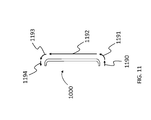
- the paths are curved as they arc from the bottom flange 130 to the top flange 120 (or visa-versa) across the plane of the web 110 of the spar 1000.
- the plies extend, as indicated by arrow 1190, from the edge of the bottom flange across the width thereof effectively at a normal angle relative to the edge of the bottom flange / relative to the spanwise direction of extension of the bottom flange.
- the plies curve around the transition zone 131 to the web 110 of the spar 1000, again still effectively normal to the edge of the bottom flange 130 / effectively normal to the direction of extension of the bottom flange (or at least the respective transition zone).
- the plies extend in a generally planar manner across the web to the transition zone of the upper flange, as indicated by arrow 1192.
- the plies curve as exemplary shown in FIG. 10 (relative to the plane of the cross-section of FIG.
- the plies extend through the transition zone in a curving manner (relative to the plane of the cross-section of FIG. 11 ) but normal to the direction of span wise extension of the upper flange until reaching the planar portion of the upper flange, and then extends, as indicated by arrow 1194 to the edge of the upper flange, still normal to the direction of said span wise extension of the upper flange/normal to the edge of the upper flange.
- ply application begins at the upper flange and ends at the lower flange.
- the plies e.g. plies
- fiber skewing at the upper and/or lower spar flange is eliminated in some embodiments, or at least reduced relative to that which would be the case for the comparable global fiber orientation of the embodiment depicted in FIG. 9A .
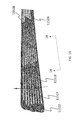
- FIG. 12 depicts conceptual view of a bottom view of a portion of the spar 1000 detailing plies 1151 of FIG. 10 . More specifically, FIG. 12 depicts a view looking from the bottom upwards towards the bottom flange 130, where the rest of the spar is eclipsed by the bottom flange. In this regard, FIG. 12 is comparable to FIG. 9B , save for the different orientation of the plies 1151 vs. plies 151. FIG. 12 depicts the plies wrapping around the transition zone from the planar web of the spar extending therefrom to the edge 1139 of the flange. As can be seen, the plies 1151 extend at a normal angle relative to the span wise direction of extension of the bottom flange 130 / the direction of extension of the edge 1139.
- FIG. 12 also conceptually represents the arrangement of the plies of the upper flange (i.e., FIG. 12 also represents a top view of a portion of the spar 1000 of FIG. 10 ).
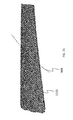
- FIG. 10 presents a composite tapered wing spar 1000, wherein respective longitudinal axes 999 of fibers making up a first layer at least substantially lying / extending on a plane that lies on the surface of the main web of the wing spar are curved over at least most of their lengths.
- the plies 1151 of the fiber layer depicted therein extend in a curve across the web 110 that has a substantially constant radius as the curve extends from the bottom flange 130 to the top flange 120. That said, in an alternate embodiment, the plies of the fiber layer extend in a curve across the web 110 that has a compound radius as the curve extends from the bottom flange 130 to the top flange 120.
- the curve could be elliptical or parabolic or any other type of curve that will enable the teachings detailed herein and variations thereof to be practiced.
- the plies could meander. That is, relative to one longitudinal end of the spar (e.g., the shorter end - the side on the right of FIG. 10 ), the plies could have convex portions and concave portions (whereas the curves of the plies 1151 of FIG. 10 are all concave relative to one end of the spar and convex relative to another end of the spar).
- the curvature exists over all of the length of the plies between the upper flange and the lower flange, while in some embodiments, the curvature exists over less than this amount (e.g., substantially all, most, etc.). Any type of curvature or trajectory of the plies 1151 that will result in the above-noted normal vector at the transition zones / at the spar can be used in at least some embodiments.
- the spar 1000 includes a first flange (upper flange or lower flange 120 / 130) having a first flange radius (122 / 123 / 132 / 133) connecting the main web 120 of the spar to the first flange.
- the first flange extends along at least a part of the spar in a longitudinal span wise direction of the spar.
- the local direction of the longitudinal axis 999 of the fibers at the first flange radius making up the first layer is effectively 90 degrees relative to the general direction of extension of the first flange.
- the spar 1000 includes plies that are different than that of FIG. 9A and/or 9B in one or more aspects / that do not include one or more aspects of the plies of FIG. 9A and/or 9B (e.g., the skewed features, the oblique angle features relative to the flange directions, etc.).
- FIG. 13 depicts another layer of the spar 1000 (e.g., one of layers 111-114 of FIG. 5 . More particularly, the layer depicted therein is layered directly and immediately over the first layer depicted in FIG. 10 , although in alternate embodiments, this layer, or, more accurately, a layer having the fiber orientations of FIG. 13 , can be located above and/or below a layer corresponding to that of FIG. 10 . As can be seen, the plies of the second layer have respective longitudinal axes that are straight. A first ply 1152A of the plurality of plies is effectively parallel to directions of extensions of the bottom flange 130 at the respective transition zone of the bottom flange 130 and the web 110.
- a second ply 1152B of the plurality of plies is effectively parallel to directions of extensions of the upper flange 120 at the respective transition zone of the flange 120 and the web 110.
- Most (including all) plies of the plurality of plies located between the first ply1152A and the second ply 1152B extend at different respective oblique angles to one another and to the directions of extension of plies 1152A and 1152B.
- the different respective oblique angles cumulatively results in the plies 1152A and 1152B having the aforementioned parallel features with respect to the respective flanges.
- the longitudinal axes of the respective plies were extrapolated out to the right with respect to the drawing of FIG. 13 , the longitudinal axes would meet at about the same focus point. However, in an alternate embodiment, such extrapolated axes can meet in two or more focus points.
- the angle of ply number 10 counting from but not including the parallel ply (e.g., one of plies 1152A or 1152B), would be about 4°.
- the angle of ply number 20, which would correspond to the ply that is parallel to the other flange/other transition zone (e.g., if the ply parallel to the flange/transition zone was applied number 1152A, ply number 20 would be ply 1152B) would be about 8° (which includes 8°), corresponding to the taper angle of the spar, confirming the equation.
- the oblique angle between the plies depicted in figure 13 are the same. That said in an alternate embodiment, the oblique angle between the plies can be different, at least for some plys. Any arrangement that can enable the teachings detailed herein and or variations thereof to be practiced can utilize in at least some embodiments.
- the plies of FIG. 13 are not all of the same length.
- the plies of the second fiber layer depicted in FIG. 13 have first plies 1152X that extend a full length of the spar and second plies 1152Y and 1152Z that extend a partial length of the spar.
- the first and second plies are generally uniformly dispersed relative to location in the chord wise direction of the spar 1000 (top to bottom), as can be seen.
- FIG. 14 depicts a conceptual view of a bottom view of a portion of the spar 1000 detailing some of the plies 1152 of FIG. 13 . More specifically, FIG. 14 corresponds to FIG. 12 , except for a different layer and depicts the bottom flange, where the rest of the spar is eclipsed by the bottom flange (the web is located at the top). In this regard, FIG. 14 is comparable to FIG. 12 , save for the different orientation of the plies 1151 vs. plies 1152. FIG. 14 depicts the plies wrapping around the transition zone, albeit with the curvature of the ply corresponding to the lateral direction of the ply as opposed to the longitudinal direction.
- FIG. 14 conceptually represents the arrangement of the plies of the top spar (i.e., FIG. 14 also represents a top view of a portion of the spar 1000 of FIG. 13 ).
- spar 1000 includes a main web 110 and a first flange (top or bottom flange 120 / 130) having a first flange radius connecting the main web 110 to the first flange, the first flange extending along at least a part of the spar in a longitudinal span wise direction of the spar.
- Local directions of the longitudinal axes of the fibers at the first flange radius making up the first layer are about zero degrees relative to the general direction of extension of the first flange, and these fibers are curved.
- the spar 1000 includes plies that are different than that of FIG. 7 and/or 8 in one or more aspects / that do not include one or more aspects of the plies of FIG. 7 and/or 8.
- the strength of the zero degree layer is more evenly distributed relative to that which would be the case if the fibers were oriented on that layer according to FIG. 7 or FIG. 8 (where in FIG. 8 , there is a zone of weakness 800 that generally runs parallel to line 159, as detailed above).
- FIG. 15 depicts an alternate embodiment of a fiber layer which can be located above and/or below any of the other layers detailed herein.
- This layer corresponds to an "oblique angle" layer in that the general orientation of the fibers extended oblique angle relative to the longitudinal direction / span wise direction of the spar.
- this layer corresponds to a 45° layer in that the general orientation of the fibers extend at about a 45° angle relative to the longitudinal direction/span wise direction of the spar.
- the fiber layer depicted therein is made up of oblique angle plies 1153 having local directional components that are oblique to respective local directional components of the plies of FIG. 10 .
- this feature is achieved by curving the plies 1153 in the plane of the web of the spar.
- the plies 1153 have a longitudinal axis that follows the arc 998.
- all of the plies of the layer depicted in FIG. 15 have longitudinal axes that follow the arc 998.
- the arc 998 is a constant radius arc, while in alternate embodiments, the arc 998 is a compound curve (parabolic curve, elliptical curve etc.). Any curvature that can enable the teachings detailed herein and or variations thereof to be practiced can utilize in at least some embodiments.
- the local directional components are, at substantially all local locations (including all locations) oblique to respective local directional components of the plies of FIG. 10 and/or FIG. 13 (and/or FIGs. 7 , 8 and/or 9).
- the oblique angle is 45° (or - 45°, as is depicted in FIG. 16 which depicts yet another layer that can be located above and/or below the layer of FIG. 10 and/or any other layer detailed herein and/or variations thereof, as will now be detailed).
- FIG. 16 depicts yet another alternate embodiment of a fiber layer which can be located above and/or below any of the other layers detailed herein.
- This layer corresponds to an oblique angle" layer in that the general orientation of the fibers extended oblique angle relative to the longitudinal direction / span wise direction of the spar.
- this layer corresponds to a -45° layer in that the general orientation of the fibers extend at about a -45 (or 135° angle) relative to the longitudinal direction/span wise direction of the spar.
- the fiber layer depicted therein is made up of oblique angle plies 1154 having local directional components that are oblique to respective local directional components of the plies of FIG. 10 and/or FIG. 13 .
- this feature is achieved by curving the plies 1156 in the plane of the web of the spar.
- the plies 1154 have a longitudinal axis that follows the arc 997.
- all of the plies of the layer depicted in FIG. 16 have longitudinal axes that follow the arc 997.
- the arc 997 is a constant radius arc, while in alternate embodiments, the arc 997 is a compound curve (parabolic curve, elliptical curve etc.). Any curvature that can enable the teachings detailed herein and or variations thereof to be practiced can utilize in at least some embodiments.
- the local directional components are, at substantially all local locations (including all locations) oblique to respective local directional components of the plies of FIG. 10 and/or FIG. 13 (and/or FIGs. 7 , 8 and/or 9A).
- the oblique angle is -45°.
- oblique angles can be utilized in the oblique angle layers. That is, the longitudinal direction of the fibers of any particular layer can be angled at ⁇ angle in a range of 0 to 90 in 0.1 degree increments (e.g., +10, -7.6, ⁇ 43.9°,-89.0° to + 55.7°, etc.). In an exemplary embodiment, this can result in the relative angle of ply orientations between these layers and the layer corresponding to FIG. 10 being the same for substantially all locations.
- the orientations of plies 1153 / 1154 of FIGs. 15 and 16 which have respective longitudinal axes that are respectively parallel to arc 998 and arc 997, reduce the natural path skew around the flange radii as compared to oblique angle plies of the same general angle oriented to the general axis system used to orient the plies of FIGs. 7 and 9A .
- spar 1000 in view of FIGs. 15 and/or 16, in an exemplary embodiment, includes a main web 110 and a first flange (top or bottom flange 120 / 130) having a first flange radius connecting the main web 110 to the first flange, the first flange extending along at least a part of the spar in a longitudinal span wise direction of the spar.
- Local directions of the longitudinal axes of the fibers at the first flange radius making up the first layer are about 45 degrees relative to the general direction of extension of the first flange, and these fibers are curved.
- a first layer 111 can correspond to the layer represented by FIG. 10
- a second layer 112 can correspond to the layer represented by FIG. 13
- a third layer 113 can correspond to the layer represented by FIG. 15
- a fourth layer 114 can correspond to the layer represented by FIG. 16 .
- the layers may be mixed up from this order.
- the first layer 111 can correspond to the layer represented by FIG. 10
- the second layer 112 can correspond to the layer represented by FIG. 15 or by FIG. 16
- the third layer 113 can correspond to the layer represented by FIG.
- the fourth layer 114 can correspond to the layer represented by the other of FIG. 15 or 16 .
- the various layers of FIGs. 10 to 16 can be utilized with the various layers of FIGs. 7 to 9B .
- a first fiber layer is laid down in a manner such that a first component extends generally in a first plane (e.g., the plane of flange 120) and a second component extends generally in a second plane (e.g., the plane of web 110) and a third component extends generally in a third plane (e.g., the plane of flange 130).
- This layer is laid down such that a first transition zone exists between the first and second components and extends in at least a first generally linear manner.
- This layer is laid down also such that a second transition zone between the second and third components extends in at least a second generally linear manner in a different direction than the first generally linear manner.
- these transition zones can correspond to transition zones 123 and 133 detailed above.
- the exemplary method further comprises steering plies of the fibers of the first layer to be, at the first transition zone 123, effectively normal to the direction of extension of the first transition zone 123 and to be, at the second transition zone 133, effectively normal to the direction of extension of the second transition zone 133.
- the result of this method results in a ninety degree layer (e.g., the layer of FIG. 10 ).
- the second layer has a fourth component (corresponding to flange 120) that extends generally in the first plane and a fifth component (corresponding to web 110) that extends generally in the second plane and a sixth component (corresponding to flange 130) that extends generally in the third plane such that a third transition zone between the fourth and fifth components extends in at least the first generally linear manner and such that a fourth transition zone between the fifth and sixth components extends in at least the second generally linear manner.
- these third and fourth transition zones can correspond to transition zones 123 and 133 detailed above.
- the method further comprises steering plies of the fibers of the second layer to be, at the third transition zone, effectively parallel to the direction of extension of the fourth transition zone and to be, at the fourth transition zone, effectively parallel to the direction of extension of the fourth transition zone.
- the result of this method results in a zero degree layer (e.g., the layer of FIG. 13 ).
- the additional layer can include a component that extends generally in the first plane and a component that extends generally in the second plane and a component that extends generally in the third plane such that a respective transition zones are established.
- the method further comprises steering ⁇ 45 degree plies of the fibers of the layer established by this method such that local directions of extensions of the fibers of this layer are about 45 degrees relative to the local directions of extensions of the fibers of the first layer or the second layer established by the above methods (or will be, if practiced prior to the establishment of such layers) for substantially all locations of the spar.
- this layer is duplicated to achieve the aforementioned angular orientation for the other of the first or second layer.
- FIG. 17 depicts an exemplary device 1700 that includes a robotic device 1710 and a control unit 1720.
- the control unit 1720 is housed in a chassis 1730, and the robotic device 1710 is connected to / extends from the chassis 1730.
- the robotic device 1710 further includes a component 1740 that can correspond to a fiber applicator and/or a fiber manipulator.
- control unit is configured to control the device 1700 to execute one or more or all of the methods detailed herein and/or variations thereof. In an exemplary embodiment, this is achieved by the control unit controlling the robotic device 1710 to move the component 1740 to apply the fiber plies in the layers detailed herein.
- any method action detailed herein corresponds to a disclosure of a resulting product made by that method. It is further noted that any method actions detailed herein corresponds to a disclosure of an apparatus that is configured to automatically, in whole or in part, execute the method. In particular, any method detailed herein corresponds a disclosure of an apparatus having a control unit that is configured to control a robotic device to automatically, in whole or in part, execute the method.
- any structure detailed herein corresponds to a disclosure of a method of making that structure, including automated methods of making that structure. It is further noted that any structure detailed herein corresponds to a disclosure of a apparatus configured to automatically in whole or in part make that structure.
- an aircraft such as a commercial passenger aircraft, having tapered wings.
- this can correspond to aircraft 1 of FIG. 1 , discussed above.
- the upper skin 26 and the lower skin 27 the wing 14 are not parallel in the span wise direction 99, and a composite spar, such as composite spar 1000, is present between the upper skin 26 and lower skin 27 of the wing 14.
- the upper flange of the spar is connected, either directly or indirectly, to the upper surface of the wing, and the lower flange of the spar is connected, either directly or indirectly, to the lower surface of the wing.
- the angle of taper of the spar is about 8°, although in alternate embodiments, the angle of tapering can be greater than or less than 8°.
- the spar can be a compound tapered spar, wherein a portion of the spar is tapered at a first angle and another portion of the spar is tapered at a second angle different from the first angle.
- analytical and/or manufacturing difficulties for the spars manufactured utilizing woven fiber, unidirectional tape, slip tape and/or tow material can be somewhat alleviated, at least relative to utilizing other embodiments (e.g., the embodiments of FIGs.
- the overall ply stack up that results is more closely related to the testing and analytical models that can be used to derive structural capability of the spar, at least relative to that which would be the case by steering the fiber paths according to those detailed in FIGs. 7 to 9B .
- This can have utility in that it can alter the ability to resist buckling (column buckling and/or panel buckling, etc.).
- This can have utility with respect to shear loading resistance (e.g., increased shear resistance).
- embodiments can have utility with respect to reducing stress and/or strain concentrations at holes, corners, etc. All of this relative to that which would be the case in the absence of at least some of the teachings detailed herein.
- the teachings detailed herein enable the ply layup to be within defined parameters of the existing test data.
- this can have utility in that it allows for an improved understanding of the strength behavior of the resulting spar, at least in spars utilizing the layers of FIGs. 10-16 , relative to that which is the case with respect to embodiments utilizing the layers of FIGs. 7-9B .
- the time and/or cost associated with producing a spar utilizing layers according to FIGs. 10-16 can be reduced relative to that associated with producing a comparable spar utilizing the layers according to FIGs. 7 to 9B .
- the resulting weight of a spar utilizing layers according to FIGs. 10-16 can be reduced relative to that associated with producing a comparable spar utilizing the layers according to FIGs. 7 to 9B .
- steering the fibers of the ninety degree layer to be effectively normal to the upper and/or lower flange allows the fibers to follow their natural path at the flange radii. This can enable a flange to be constructed that can have increased fuel pressure loads, at least relative to that which would be the case in the absence of the teachings detailed herein.
- steering the fibers of the zero degree layer to be effectively parallel to the upper and lower flange could allow the laying of continuous fibers over the flange radii, thereby reducing bulking issues and/or improving the spar flange for wing bending loads, at least relative to that which would be the case as compared to, by way of example only and not by way limitation, that resulting in practicing the fiber orientation of FIG. 7 .
Landscapes
- Engineering & Computer Science (AREA)
- Mechanical Engineering (AREA)
- Aviation & Aerospace Engineering (AREA)
- Moulding By Coating Moulds (AREA)
- Laminated Bodies (AREA)
Applications Claiming Priority (1)
| Application Number | Priority Date | Filing Date | Title |
|---|---|---|---|
| US14/455,291 US20160039514A1 (en) | 2014-08-08 | 2014-08-08 | Lateral ply layup of composite spar |
Publications (2)
| Publication Number | Publication Date |
|---|---|
| EP2982598A2 true EP2982598A2 (de) | 2016-02-10 |
| EP2982598A3 EP2982598A3 (de) | 2016-05-11 |
Family
ID=53793996
Family Applications (1)
| Application Number | Title | Priority Date | Filing Date |
|---|---|---|---|
| EP15177127.6A Withdrawn EP2982598A3 (de) | 2014-08-08 | 2015-07-16 | Seitliches lagen-layup eines verbundholms |
Country Status (2)
| Country | Link |
|---|---|
| US (1) | US20160039514A1 (de) |
| EP (1) | EP2982598A3 (de) |
Cited By (1)
| Publication number | Priority date | Publication date | Assignee | Title |
|---|---|---|---|---|
| US10427777B2 (en) * | 2016-05-19 | 2019-10-01 | Airbus Operations Limited | Aerofoil body with integral curved spar-cover |
Families Citing this family (2)
| Publication number | Priority date | Publication date | Assignee | Title |
|---|---|---|---|---|
| EP3875367B1 (de) * | 2020-03-02 | 2023-08-02 | Safran Landing Systems UK Limited | Flugzeugfahrwerksbaugruppe |
| CN112319840B (zh) * | 2020-11-04 | 2023-09-22 | 北京摩弈信息科技有限公司 | 太阳能无人机电池铺设方法、装置和设备 |
Family Cites Families (11)
| Publication number | Priority date | Publication date | Assignee | Title |
|---|---|---|---|---|
| US3768760A (en) * | 1970-10-30 | 1973-10-30 | Hercules Inc | Graphite fiber composite covering employing multi-directional |
| US6562436B2 (en) * | 2000-02-25 | 2003-05-13 | The Boeing Company | Laminated composite radius filler |
| GB0222288D0 (en) * | 2002-09-25 | 2002-10-30 | Airbus Uk Ltd | Method and apparatus for joining aircraft components |
| US7943076B1 (en) * | 2005-05-03 | 2011-05-17 | The Boeing Company | Method of manufacturing curved composite structural elements |
| ITTO20070659A1 (it) * | 2007-09-20 | 2009-03-21 | Alenia Aeronautica Spa | Procedimento di fabbricazione di un elemento strutturale curvilineo in materiale composito avente una sezione aperta complessa. |
| US9278484B2 (en) * | 2008-04-17 | 2016-03-08 | The Boeing Company | Method and apparatus for producing contoured composite structures and structures produced thereby |
| GB0820800D0 (en) * | 2008-11-13 | 2008-12-24 | Airbus Uk Ltd | Method of designing a composite laminate |
| US8905350B2 (en) * | 2010-06-18 | 2014-12-09 | Airbus Operations S.A.S. | Structural panel with integrated stiffening |
| US8795567B2 (en) * | 2010-09-23 | 2014-08-05 | The Boeing Company | Method for fabricating highly contoured composite stiffeners with reduced wrinkling |
| US9289949B2 (en) * | 2012-06-08 | 2016-03-22 | The Boeing Company | Optimized cross-ply orientation in composite laminates |
| US9527575B2 (en) * | 2012-11-26 | 2016-12-27 | The Boeing Company | Multi-box wing spar and skin |
-
2014
- 2014-08-08 US US14/455,291 patent/US20160039514A1/en not_active Abandoned
-
2015
- 2015-07-16 EP EP15177127.6A patent/EP2982598A3/de not_active Withdrawn
Non-Patent Citations (1)
| Title |
|---|
| None |
Cited By (2)
| Publication number | Priority date | Publication date | Assignee | Title |
|---|---|---|---|---|
| US10427777B2 (en) * | 2016-05-19 | 2019-10-01 | Airbus Operations Limited | Aerofoil body with integral curved spar-cover |
| US10479476B1 (en) | 2016-05-19 | 2019-11-19 | Airbus Operations Limited | Aerofoil body with integral curved spar-cover |
Also Published As
| Publication number | Publication date |
|---|---|
| EP2982598A3 (de) | 2016-05-11 |
| US20160039514A1 (en) | 2016-02-11 |
Similar Documents
| Publication | Publication Date | Title |
|---|---|---|
| EP3030413B1 (de) | Versteifte verbundplatten und verfahren zu deren herstellung | |
| US9862479B1 (en) | Methods of making and structures containing stiffeners having transition portions | |
| EP3287360B1 (de) | Flugzeugverbundflügelkastenintegration | |
| EP2907652B1 (de) | Verbundstofffüllmittel | |
| EP3482923B1 (de) | Gewebeummantelte unidirektionale nudel | |
| EP3000586B1 (de) | Verfahren zur Herstellung eines Verbundstoffmaterialteils mit einer Bahn und mindestens einem Flansch | |
| US11845236B2 (en) | Composite structure splice and method | |
| EP3919370B1 (de) | Flugzeugversteifungen mit durch cfk-material verstärkten gurten | |
| EP3078585B1 (de) | Rippenstruktur und verfahren zur formung davon | |
| CN107107485B (zh) | 制造复合结构的垫片的方法以及包含垫片的复合结构 | |
| EP2921287B1 (de) | Platzierung von prepreg-werg in übergangsregionen mit hohem winkel | |
| EP2982598A2 (de) | Seitliches lagen-layup eines verbundholms | |
| US9630376B2 (en) | Composite filler | |
| EP2759470A2 (de) | Kastenstruktur zum tragen von lasten und ihren herstellungsverfahren | |
| US20170043859A1 (en) | Trailing edge components, aircraft structures including trailing edge components and methods for manufacturing trailing edge components | |
| US20160039513A1 (en) | Longitudinal ply layup of composite spar | |
| EP3750795B1 (de) | Aerodynamischer oberflächennahtspleiss | |
| CN106428523A (zh) | 复合翼梁的纵向层片铺设 | |
| US11685503B2 (en) | Stringer assemblies and methods of forming thereof | |
| EP3702142B1 (de) | Verbundversteifung | |
| US11577814B2 (en) | Composite structure and method of forming | |
| EP3401207B1 (de) | Systeme und verfahren für in ein flugzeug integrierte verbundrahmen | |
| CN106428510A (zh) | 复合梁的侧向层片叠铺 |
Legal Events
| Date | Code | Title | Description |
|---|---|---|---|
| PUAI | Public reference made under article 153(3) epc to a published international application that has entered the european phase |
Free format text: ORIGINAL CODE: 0009012 |
|
| AK | Designated contracting states |
Kind code of ref document: A2 Designated state(s): AL AT BE BG CH CY CZ DE DK EE ES FI FR GB GR HR HU IE IS IT LI LT LU LV MC MK MT NL NO PL PT RO RS SE SI SK SM TR |
|
| AX | Request for extension of the european patent |
Extension state: BA ME |
|
| PUAL | Search report despatched |
Free format text: ORIGINAL CODE: 0009013 |
|
| AK | Designated contracting states |
Kind code of ref document: A3 Designated state(s): AL AT BE BG CH CY CZ DE DK EE ES FI FR GB GR HR HU IE IS IT LI LT LU LV MC MK MT NL NO PL PT RO RS SE SI SK SM TR |
|
| AX | Request for extension of the european patent |
Extension state: BA ME |
|
| RIC1 | Information provided on ipc code assigned before grant |
Ipc: B64C 3/18 20060101AFI20160405BHEP |
|
| STAA | Information on the status of an ep patent application or granted ep patent |
Free format text: STATUS: THE APPLICATION HAS BEEN PUBLISHED |
|
| STAA | Information on the status of an ep patent application or granted ep patent |
Free format text: STATUS: THE APPLICATION IS DEEMED TO BE WITHDRAWN |
|
| 18D | Application deemed to be withdrawn |
Effective date: 20161112 |