EP2975439A1 - Layered film and display device - Google Patents
Layered film and display device Download PDFInfo
- Publication number
- EP2975439A1 EP2975439A1 EP14764833.1A EP14764833A EP2975439A1 EP 2975439 A1 EP2975439 A1 EP 2975439A1 EP 14764833 A EP14764833 A EP 14764833A EP 2975439 A1 EP2975439 A1 EP 2975439A1
- Authority
- EP
- European Patent Office
- Prior art keywords
- hard coat
- coat layer
- layer
- laminated film
- preferable
- Prior art date
- Legal status (The legal status is an assumption and is not a legal conclusion. Google has not performed a legal analysis and makes no representation as to the accuracy of the status listed.)
- Granted
Links
- 239000010410 layer Substances 0.000 claims abstract description 257
- 230000003287 optical effect Effects 0.000 claims abstract description 91
- 239000002346 layers by function Substances 0.000 claims abstract description 79
- 229920005989 resin Polymers 0.000 claims abstract description 63
- 239000011347 resin Substances 0.000 claims abstract description 63
- 239000000178 monomer Substances 0.000 claims description 48
- 125000002887 hydroxy group Chemical group [H]O* 0.000 claims description 27
- 239000000203 mixture Substances 0.000 claims description 24
- 125000000524 functional group Chemical group 0.000 claims description 22
- 239000003999 initiator Substances 0.000 claims description 16
- 239000010954 inorganic particle Substances 0.000 claims description 8
- 238000003475 lamination Methods 0.000 claims description 5
- 230000001678 irradiating effect Effects 0.000 claims description 3
- 239000010408 film Substances 0.000 description 133
- 239000011248 coating agent Substances 0.000 description 105
- 238000000576 coating method Methods 0.000 description 105
- -1 polyethylene terephthalate Polymers 0.000 description 95
- 239000007788 liquid Substances 0.000 description 82
- 239000012790 adhesive layer Substances 0.000 description 49
- 238000000034 method Methods 0.000 description 49
- 150000001875 compounds Chemical class 0.000 description 44
- 239000004094 surface-active agent Substances 0.000 description 38
- 230000000052 comparative effect Effects 0.000 description 35
- XLYOFNOQVPJJNP-UHFFFAOYSA-N water Substances O XLYOFNOQVPJJNP-UHFFFAOYSA-N 0.000 description 34
- 239000007864 aqueous solution Substances 0.000 description 33
- 238000001723 curing Methods 0.000 description 32
- NIXOWILDQLNWCW-UHFFFAOYSA-M Acrylate Chemical compound [O-]C(=O)C=C NIXOWILDQLNWCW-UHFFFAOYSA-M 0.000 description 29
- 239000003795 chemical substances by application Substances 0.000 description 28
- QTBSBXVTEAMEQO-UHFFFAOYSA-N Acetic acid Chemical compound CC(O)=O QTBSBXVTEAMEQO-UHFFFAOYSA-N 0.000 description 24
- 229920000642 polymer Polymers 0.000 description 24
- 239000000463 material Substances 0.000 description 21
- 239000000126 substance Substances 0.000 description 21
- 239000001993 wax Substances 0.000 description 21
- 235000019589 hardness Nutrition 0.000 description 19
- 239000002245 particle Substances 0.000 description 19
- 230000002378 acidificating effect Effects 0.000 description 18
- VYPSYNLAJGMNEJ-UHFFFAOYSA-N Silicium dioxide Chemical compound O=[Si]=O VYPSYNLAJGMNEJ-UHFFFAOYSA-N 0.000 description 17
- 229920000139 polyethylene terephthalate Polymers 0.000 description 17
- 239000005020 polyethylene terephthalate Substances 0.000 description 17
- 239000000047 product Substances 0.000 description 17
- 239000000243 solution Substances 0.000 description 17
- 239000004925 Acrylic resin Substances 0.000 description 16
- 229920000178 Acrylic resin Polymers 0.000 description 16
- 238000003848 UV Light-Curing Methods 0.000 description 16
- 229920000728 polyester Polymers 0.000 description 15
- LYCAIKOWRPUZTN-UHFFFAOYSA-N Ethylene glycol Chemical compound OCCO LYCAIKOWRPUZTN-UHFFFAOYSA-N 0.000 description 14
- ATUOYWHBWRKTHZ-UHFFFAOYSA-N Propane Chemical compound CCC ATUOYWHBWRKTHZ-UHFFFAOYSA-N 0.000 description 14
- 125000004432 carbon atom Chemical group C* 0.000 description 14
- 239000003054 catalyst Substances 0.000 description 13
- 238000004132 cross linking Methods 0.000 description 13
- 235000014113 dietary fatty acids Nutrition 0.000 description 12
- 239000000194 fatty acid Substances 0.000 description 12
- 229930195729 fatty acid Natural products 0.000 description 12
- 239000012948 isocyanate Substances 0.000 description 12
- SCPYDCQAZCOKTP-UHFFFAOYSA-N silanol Chemical compound [SiH3]O SCPYDCQAZCOKTP-UHFFFAOYSA-N 0.000 description 12
- 239000007787 solid Substances 0.000 description 12
- 229920003171 Poly (ethylene oxide) Polymers 0.000 description 11
- NIXOWILDQLNWCW-UHFFFAOYSA-N acrylic acid group Chemical group C(C=C)(=O)O NIXOWILDQLNWCW-UHFFFAOYSA-N 0.000 description 11
- 238000009792 diffusion process Methods 0.000 description 11
- YCKRFDGAMUMZLT-UHFFFAOYSA-N Fluorine atom Chemical compound [F] YCKRFDGAMUMZLT-UHFFFAOYSA-N 0.000 description 10
- DGAQECJNVWCQMB-PUAWFVPOSA-M Ilexoside XXIX Chemical compound C[C@@H]1CC[C@@]2(CC[C@@]3(C(=CC[C@H]4[C@]3(CC[C@@H]5[C@@]4(CC[C@@H](C5(C)C)OS(=O)(=O)[O-])C)C)[C@@H]2[C@]1(C)O)C)C(=O)O[C@H]6[C@@H]([C@H]([C@@H]([C@H](O6)CO)O)O)O.[Na+] DGAQECJNVWCQMB-PUAWFVPOSA-M 0.000 description 10
- 229910052782 aluminium Inorganic materials 0.000 description 10
- 239000006185 dispersion Substances 0.000 description 10
- 229910052731 fluorine Inorganic materials 0.000 description 10
- 239000011737 fluorine Substances 0.000 description 10
- 239000011734 sodium Substances 0.000 description 10
- 229910052708 sodium Inorganic materials 0.000 description 10
- WSFSSNUMVMOOMR-UHFFFAOYSA-N Formaldehyde Chemical compound O=C WSFSSNUMVMOOMR-UHFFFAOYSA-N 0.000 description 9
- OKKJLVBELUTLKV-UHFFFAOYSA-N Methanol Chemical class OC OKKJLVBELUTLKV-UHFFFAOYSA-N 0.000 description 9
- DNIAPMSPPWPWGF-UHFFFAOYSA-N Propylene glycol Chemical compound CC(O)CO DNIAPMSPPWPWGF-UHFFFAOYSA-N 0.000 description 9
- 239000011230 binding agent Substances 0.000 description 9
- 150000002148 esters Chemical class 0.000 description 9
- PEDCQBHIVMGVHV-UHFFFAOYSA-N Glycerine Chemical compound OCC(O)CO PEDCQBHIVMGVHV-UHFFFAOYSA-N 0.000 description 8
- ISWSIDIOOBJBQZ-UHFFFAOYSA-N Phenol Chemical compound OC1=CC=CC=C1 ISWSIDIOOBJBQZ-UHFFFAOYSA-N 0.000 description 8
- 235000011054 acetic acid Nutrition 0.000 description 8
- XAGFODPZIPBFFR-UHFFFAOYSA-N aluminium Chemical compound [Al] XAGFODPZIPBFFR-UHFFFAOYSA-N 0.000 description 8
- 239000002585 base Substances 0.000 description 8
- 238000001035 drying Methods 0.000 description 8
- RCIJACVHOIKRAP-UHFFFAOYSA-N sodium;1,4-dioctoxy-1,4-dioxobutane-2-sulfonic acid Chemical compound [Na+].CCCCCCCCOC(=O)CC(S(O)(=O)=O)C(=O)OCCCCCCCC RCIJACVHOIKRAP-UHFFFAOYSA-N 0.000 description 8
- 239000004593 Epoxy Substances 0.000 description 7
- JOYRKODLDBILNP-UHFFFAOYSA-N Ethyl urethane Chemical compound CCOC(N)=O JOYRKODLDBILNP-UHFFFAOYSA-N 0.000 description 7
- 125000003647 acryloyl group Chemical group O=C([*])C([H])=C([H])[H] 0.000 description 7
- 239000003945 anionic surfactant Substances 0.000 description 7
- 239000012153 distilled water Substances 0.000 description 7
- KWIUHFFTVRNATP-UHFFFAOYSA-N glycine betaine Chemical compound C[N+](C)(C)CC([O-])=O KWIUHFFTVRNATP-UHFFFAOYSA-N 0.000 description 7
- 230000003301 hydrolyzing effect Effects 0.000 description 7
- 125000000962 organic group Chemical group 0.000 description 7
- 238000006116 polymerization reaction Methods 0.000 description 7
- 229920005862 polyol Polymers 0.000 description 7
- 150000003077 polyols Chemical class 0.000 description 7
- 239000004814 polyurethane Substances 0.000 description 7
- 229920002635 polyurethane Polymers 0.000 description 7
- VZCYOOQTPOCHFL-OWOJBTEDSA-N Fumaric acid Chemical compound OC(=O)\C=C\C(O)=O VZCYOOQTPOCHFL-OWOJBTEDSA-N 0.000 description 6
- MUBZPKHOEPUJKR-UHFFFAOYSA-N Oxalic acid Chemical compound OC(=O)C(O)=O MUBZPKHOEPUJKR-UHFFFAOYSA-N 0.000 description 6
- NBIIXXVUZAFLBC-UHFFFAOYSA-N Phosphoric acid Chemical compound OP(O)(O)=O NBIIXXVUZAFLBC-UHFFFAOYSA-N 0.000 description 6
- 239000000654 additive Substances 0.000 description 6
- IISBACLAFKSPIT-UHFFFAOYSA-N bisphenol A Chemical compound C=1C=C(O)C=CC=1C(C)(C)C1=CC=C(O)C=C1 IISBACLAFKSPIT-UHFFFAOYSA-N 0.000 description 6
- 239000004203 carnauba wax Substances 0.000 description 6
- 238000005266 casting Methods 0.000 description 6
- KRKNYBCHXYNGOX-UHFFFAOYSA-N citric acid Chemical compound OC(=O)CC(O)(C(O)=O)CC(O)=O KRKNYBCHXYNGOX-UHFFFAOYSA-N 0.000 description 6
- 239000008119 colloidal silica Substances 0.000 description 6
- 238000009833 condensation Methods 0.000 description 6
- 230000005494 condensation Effects 0.000 description 6
- 229920001577 copolymer Polymers 0.000 description 6
- 229940117927 ethylene oxide Drugs 0.000 description 6
- 239000010419 fine particle Substances 0.000 description 6
- 239000004973 liquid crystal related substance Substances 0.000 description 6
- 239000005056 polyisocyanate Substances 0.000 description 6
- 229920001228 polyisocyanate Polymers 0.000 description 6
- 230000008569 process Effects 0.000 description 6
- 239000001294 propane Substances 0.000 description 6
- 229920001187 thermosetting polymer Polymers 0.000 description 6
- IMSODMZESSGVBE-UHFFFAOYSA-N 2-Oxazoline Chemical compound C1CN=CO1 IMSODMZESSGVBE-UHFFFAOYSA-N 0.000 description 5
- LFQSCWFLJHTTHZ-UHFFFAOYSA-N Ethanol Chemical compound CCO LFQSCWFLJHTTHZ-UHFFFAOYSA-N 0.000 description 5
- IAYPIBMASNFSPL-UHFFFAOYSA-N Ethylene oxide Chemical compound C1CO1 IAYPIBMASNFSPL-UHFFFAOYSA-N 0.000 description 5
- 229910019142 PO4 Inorganic materials 0.000 description 5
- UCKMPCXJQFINFW-UHFFFAOYSA-N Sulphide Chemical compound [S-2] UCKMPCXJQFINFW-UHFFFAOYSA-N 0.000 description 5
- 239000002253 acid Substances 0.000 description 5
- 150000001412 amines Chemical class 0.000 description 5
- 125000000129 anionic group Chemical group 0.000 description 5
- 230000015572 biosynthetic process Effects 0.000 description 5
- 239000011203 carbon fibre reinforced carbon Substances 0.000 description 5
- 235000013869 carnauba wax Nutrition 0.000 description 5
- 239000003093 cationic surfactant Substances 0.000 description 5
- 238000006243 chemical reaction Methods 0.000 description 5
- 239000011247 coating layer Substances 0.000 description 5
- 230000018044 dehydration Effects 0.000 description 5
- 238000006297 dehydration reaction Methods 0.000 description 5
- 125000004435 hydrogen atom Chemical group [H]* 0.000 description 5
- 150000002513 isocyanates Chemical class 0.000 description 5
- 125000002496 methyl group Chemical group [H]C([H])([H])* 0.000 description 5
- 239000002736 nonionic surfactant Substances 0.000 description 5
- 150000002989 phenols Chemical class 0.000 description 5
- 235000021317 phosphate Nutrition 0.000 description 5
- 229920003229 poly(methyl methacrylate) Polymers 0.000 description 5
- 239000004926 polymethyl methacrylate Substances 0.000 description 5
- 238000002360 preparation method Methods 0.000 description 5
- 150000003457 sulfones Chemical class 0.000 description 5
- VZCYOOQTPOCHFL-UHFFFAOYSA-N trans-butenedioic acid Natural products OC(=O)C=CC(O)=O VZCYOOQTPOCHFL-UHFFFAOYSA-N 0.000 description 5
- JXUKBNICSRJFAP-UHFFFAOYSA-N triethoxy-[3-(oxiran-2-ylmethoxy)propyl]silane Chemical compound CCO[Si](OCC)(OCC)CCCOCC1CO1 JXUKBNICSRJFAP-UHFFFAOYSA-N 0.000 description 5
- QNODIIQQMGDSEF-UHFFFAOYSA-N (1-hydroxycyclohexyl)-phenylmethanone Chemical compound C=1C=CC=CC=1C(=O)C1(O)CCCCC1 QNODIIQQMGDSEF-UHFFFAOYSA-N 0.000 description 4
- MYRTYDVEIRVNKP-UHFFFAOYSA-N 1,2-Divinylbenzene Chemical compound C=CC1=CC=CC=C1C=C MYRTYDVEIRVNKP-UHFFFAOYSA-N 0.000 description 4
- VTYYLEPIZMXCLO-UHFFFAOYSA-L Calcium carbonate Chemical compound [Ca+2].[O-]C([O-])=O VTYYLEPIZMXCLO-UHFFFAOYSA-L 0.000 description 4
- 229920000298 Cellophane Polymers 0.000 description 4
- RTZKZFJDLAIYFH-UHFFFAOYSA-N Diethyl ether Chemical compound CCOCC RTZKZFJDLAIYFH-UHFFFAOYSA-N 0.000 description 4
- VEXZGXHMUGYJMC-UHFFFAOYSA-N Hydrochloric acid Chemical compound Cl VEXZGXHMUGYJMC-UHFFFAOYSA-N 0.000 description 4
- 229920000877 Melamine resin Polymers 0.000 description 4
- CERQOIWHTDAKMF-UHFFFAOYSA-N Methacrylic acid Chemical compound CC(=C)C(O)=O CERQOIWHTDAKMF-UHFFFAOYSA-N 0.000 description 4
- OFOBLEOULBTSOW-UHFFFAOYSA-N Propanedioic acid Natural products OC(=O)CC(O)=O OFOBLEOULBTSOW-UHFFFAOYSA-N 0.000 description 4
- PPBRXRYQALVLMV-UHFFFAOYSA-N Styrene Chemical compound C=CC1=CC=CC=C1 PPBRXRYQALVLMV-UHFFFAOYSA-N 0.000 description 4
- QAOWNCQODCNURD-UHFFFAOYSA-N Sulfuric acid Chemical compound OS(O)(=O)=O QAOWNCQODCNURD-UHFFFAOYSA-N 0.000 description 4
- BOTDANWDWHJENH-UHFFFAOYSA-N Tetraethyl orthosilicate Chemical compound CCO[Si](OCC)(OCC)OCC BOTDANWDWHJENH-UHFFFAOYSA-N 0.000 description 4
- ZJCCRDAZUWHFQH-UHFFFAOYSA-N Trimethylolpropane Chemical compound CCC(CO)(CO)CO ZJCCRDAZUWHFQH-UHFFFAOYSA-N 0.000 description 4
- MBHRHUJRKGNOKX-UHFFFAOYSA-N [(4,6-diamino-1,3,5-triazin-2-yl)amino]methanol Chemical class NC1=NC(N)=NC(NCO)=N1 MBHRHUJRKGNOKX-UHFFFAOYSA-N 0.000 description 4
- 125000001931 aliphatic group Chemical group 0.000 description 4
- 125000003118 aryl group Chemical group 0.000 description 4
- TZCXTZWJZNENPQ-UHFFFAOYSA-L barium sulfate Chemical compound [Ba+2].[O-]S([O-])(=O)=O TZCXTZWJZNENPQ-UHFFFAOYSA-L 0.000 description 4
- 229960003237 betaine Drugs 0.000 description 4
- 150000001718 carbodiimides Chemical group 0.000 description 4
- 238000003851 corona treatment Methods 0.000 description 4
- 239000003431 cross linking reagent Substances 0.000 description 4
- 230000000694 effects Effects 0.000 description 4
- 238000011156 evaluation Methods 0.000 description 4
- 235000011187 glycerol Nutrition 0.000 description 4
- 229940093915 gynecological organic acid Drugs 0.000 description 4
- 125000005842 heteroatom Chemical group 0.000 description 4
- 239000000314 lubricant Substances 0.000 description 4
- 238000004519 manufacturing process Methods 0.000 description 4
- 125000005395 methacrylic acid group Chemical group 0.000 description 4
- BDAGIHXWWSANSR-UHFFFAOYSA-N methanoic acid Natural products OC=O BDAGIHXWWSANSR-UHFFFAOYSA-N 0.000 description 4
- 150000007522 mineralic acids Chemical class 0.000 description 4
- 229910052757 nitrogen Inorganic materials 0.000 description 4
- 125000004433 nitrogen atom Chemical group N* 0.000 description 4
- 150000007524 organic acids Chemical class 0.000 description 4
- 235000005985 organic acids Nutrition 0.000 description 4
- 239000011112 polyethylene naphthalate Substances 0.000 description 4
- 239000000377 silicon dioxide Substances 0.000 description 4
- 239000002356 single layer Substances 0.000 description 4
- 239000002904 solvent Substances 0.000 description 4
- 238000011282 treatment Methods 0.000 description 4
- 125000000391 vinyl group Chemical group [H]C([*])=C([H])[H] 0.000 description 4
- ZMZHRHTZJDBLEX-UHFFFAOYSA-N (2-phenylphenyl) prop-2-enoate Chemical class C=CC(=O)OC1=CC=CC=C1C1=CC=CC=C1 ZMZHRHTZJDBLEX-UHFFFAOYSA-N 0.000 description 3
- YIJYFLXQHDOQGW-UHFFFAOYSA-N 2-[2,4,6-trioxo-3,5-bis(2-prop-2-enoyloxyethyl)-1,3,5-triazinan-1-yl]ethyl prop-2-enoate Chemical class C=CC(=O)OCCN1C(=O)N(CCOC(=O)C=C)C(=O)N(CCOC(=O)C=C)C1=O YIJYFLXQHDOQGW-UHFFFAOYSA-N 0.000 description 3
- 125000003504 2-oxazolinyl group Chemical group O1C(=NCC1)* 0.000 description 3
- RZVINYQDSSQUKO-UHFFFAOYSA-N 2-phenoxyethyl prop-2-enoate Chemical group C=CC(=O)OCCOC1=CC=CC=C1 RZVINYQDSSQUKO-UHFFFAOYSA-N 0.000 description 3
- UPMLOUAZCHDJJD-UHFFFAOYSA-N 4,4'-Diphenylmethane Diisocyanate Chemical compound C1=CC(N=C=O)=CC=C1CC1=CC=C(N=C=O)C=C1 UPMLOUAZCHDJJD-UHFFFAOYSA-N 0.000 description 3
- UHOVQNZJYSORNB-UHFFFAOYSA-N Benzene Chemical compound C1=CC=CC=C1 UHOVQNZJYSORNB-UHFFFAOYSA-N 0.000 description 3
- 229920002799 BoPET Polymers 0.000 description 3
- 239000004215 Carbon black (E152) Substances 0.000 description 3
- RWSOTUBLDIXVET-UHFFFAOYSA-N Dihydrogen sulfide Chemical class S RWSOTUBLDIXVET-UHFFFAOYSA-N 0.000 description 3
- 239000005057 Hexamethylene diisocyanate Substances 0.000 description 3
- 239000005058 Isophorone diisocyanate Substances 0.000 description 3
- 239000004952 Polyamide Substances 0.000 description 3
- 239000004698 Polyethylene Substances 0.000 description 3
- 239000004721 Polyphenylene oxide Substances 0.000 description 3
- KWYUFKZDYYNOTN-UHFFFAOYSA-M Potassium hydroxide Chemical compound [OH-].[K+] KWYUFKZDYYNOTN-UHFFFAOYSA-M 0.000 description 3
- XUIMIQQOPSSXEZ-UHFFFAOYSA-N Silicon Chemical compound [Si] XUIMIQQOPSSXEZ-UHFFFAOYSA-N 0.000 description 3
- HEMHJVSKTPXQMS-UHFFFAOYSA-M Sodium hydroxide Chemical compound [OH-].[Na+] HEMHJVSKTPXQMS-UHFFFAOYSA-M 0.000 description 3
- RTAQQCXQSZGOHL-UHFFFAOYSA-N Titanium Chemical compound [Ti] RTAQQCXQSZGOHL-UHFFFAOYSA-N 0.000 description 3
- FHLPGTXWCFQMIU-UHFFFAOYSA-N [4-[2-(4-prop-2-enoyloxyphenyl)propan-2-yl]phenyl] prop-2-enoate Chemical class C=1C=C(OC(=O)C=C)C=CC=1C(C)(C)C1=CC=C(OC(=O)C=C)C=C1 FHLPGTXWCFQMIU-UHFFFAOYSA-N 0.000 description 3
- 229910000147 aluminium phosphate Inorganic materials 0.000 description 3
- 238000007611 bar coating method Methods 0.000 description 3
- 230000001588 bifunctional effect Effects 0.000 description 3
- 239000002981 blocking agent Substances 0.000 description 3
- 230000000903 blocking effect Effects 0.000 description 3
- KGBXLFKZBHKPEV-UHFFFAOYSA-N boric acid Chemical compound OB(O)O KGBXLFKZBHKPEV-UHFFFAOYSA-N 0.000 description 3
- 239000004327 boric acid Substances 0.000 description 3
- 229910052796 boron Inorganic materials 0.000 description 3
- 239000013522 chelant Substances 0.000 description 3
- 230000003247 decreasing effect Effects 0.000 description 3
- 238000004049 embossing Methods 0.000 description 3
- 125000001301 ethoxy group Chemical group [H]C([H])([H])C([H])([H])O* 0.000 description 3
- 125000001495 ethyl group Chemical group [H]C([H])([H])C([H])([H])* 0.000 description 3
- 150000004665 fatty acids Chemical class 0.000 description 3
- 239000001530 fumaric acid Substances 0.000 description 3
- RRAMGCGOFNQTLD-UHFFFAOYSA-N hexamethylene diisocyanate Chemical compound O=C=NCCCCCCN=C=O RRAMGCGOFNQTLD-UHFFFAOYSA-N 0.000 description 3
- 229930195733 hydrocarbon Natural products 0.000 description 3
- 230000007062 hydrolysis Effects 0.000 description 3
- 238000006460 hydrolysis reaction Methods 0.000 description 3
- NIMLQBUJDJZYEJ-UHFFFAOYSA-N isophorone diisocyanate Chemical compound CC1(C)CC(N=C=O)CC(C)(CN=C=O)C1 NIMLQBUJDJZYEJ-UHFFFAOYSA-N 0.000 description 3
- 238000005259 measurement Methods 0.000 description 3
- JDSHMPZPIAZGSV-UHFFFAOYSA-N melamine Chemical compound NC1=NC(N)=NC(N)=N1 JDSHMPZPIAZGSV-UHFFFAOYSA-N 0.000 description 3
- 229910052751 metal Inorganic materials 0.000 description 3
- 239000002184 metal Substances 0.000 description 3
- 150000002736 metal compounds Chemical class 0.000 description 3
- 229910001507 metal halide Inorganic materials 0.000 description 3
- 150000005309 metal halides Chemical class 0.000 description 3
- 239000012788 optical film Substances 0.000 description 3
- 239000012188 paraffin wax Substances 0.000 description 3
- NBIIXXVUZAFLBC-UHFFFAOYSA-K phosphate Chemical compound [O-]P([O-])([O-])=O NBIIXXVUZAFLBC-UHFFFAOYSA-K 0.000 description 3
- 239000010452 phosphate Substances 0.000 description 3
- 239000011295 pitch Substances 0.000 description 3
- 229920003207 poly(ethylene-2,6-naphthalate) Polymers 0.000 description 3
- 229920001610 polycaprolactone Polymers 0.000 description 3
- 239000004632 polycaprolactone Substances 0.000 description 3
- 229920001225 polyester resin Polymers 0.000 description 3
- 239000004645 polyester resin Substances 0.000 description 3
- 229920000570 polyether Polymers 0.000 description 3
- 229920000573 polyethylene Polymers 0.000 description 3
- 239000003505 polymerization initiator Substances 0.000 description 3
- 230000000379 polymerizing effect Effects 0.000 description 3
- 229910052710 silicon Inorganic materials 0.000 description 3
- 239000010703 silicon Substances 0.000 description 3
- 239000000758 substrate Substances 0.000 description 3
- 229910052717 sulfur Chemical group 0.000 description 3
- 239000002344 surface layer Substances 0.000 description 3
- 239000010409 thin film Substances 0.000 description 3
- RMVRSNDYEFQCLF-UHFFFAOYSA-N thiophenol Chemical compound SC1=CC=CC=C1 RMVRSNDYEFQCLF-UHFFFAOYSA-N 0.000 description 3
- 239000010936 titanium Substances 0.000 description 3
- DVKJHBMWWAPEIU-UHFFFAOYSA-N toluene 2,4-diisocyanate Chemical compound CC1=CC=C(N=C=O)C=C1N=C=O DVKJHBMWWAPEIU-UHFFFAOYSA-N 0.000 description 3
- XSQUKJJJFZCRTK-UHFFFAOYSA-N urea group Chemical group NC(=O)N XSQUKJJJFZCRTK-UHFFFAOYSA-N 0.000 description 3
- BJEPYKJPYRNKOW-REOHCLBHSA-N (S)-malic acid Chemical compound OC(=O)[C@@H](O)CC(O)=O BJEPYKJPYRNKOW-REOHCLBHSA-N 0.000 description 2
- FKTHNVSLHLHISI-UHFFFAOYSA-N 1,2-bis(isocyanatomethyl)benzene Chemical compound O=C=NCC1=CC=CC=C1CN=C=O FKTHNVSLHLHISI-UHFFFAOYSA-N 0.000 description 2
- ZXHZWRZAWJVPIC-UHFFFAOYSA-N 1,2-diisocyanatonaphthalene Chemical compound C1=CC=CC2=C(N=C=O)C(N=C=O)=CC=C21 ZXHZWRZAWJVPIC-UHFFFAOYSA-N 0.000 description 2
- JAHNSTQSQJOJLO-UHFFFAOYSA-N 2-(3-fluorophenyl)-1h-imidazole Chemical compound FC1=CC=CC(C=2NC=CN=2)=C1 JAHNSTQSQJOJLO-UHFFFAOYSA-N 0.000 description 2
- KXGFMDJXCMQABM-UHFFFAOYSA-N 2-methoxy-6-methylphenol Chemical compound [CH]OC1=CC=CC([CH])=C1O KXGFMDJXCMQABM-UHFFFAOYSA-N 0.000 description 2
- PTFIPECGHSYQNR-UHFFFAOYSA-N 3-Pentadecylphenol Chemical compound CCCCCCCCCCCCCCCC1=CC=CC(O)=C1 PTFIPECGHSYQNR-UHFFFAOYSA-N 0.000 description 2
- XBIUWALDKXACEA-UHFFFAOYSA-N 3-[bis(2,4-dioxopentan-3-yl)alumanyl]pentane-2,4-dione Chemical compound CC(=O)C(C(C)=O)[Al](C(C(C)=O)C(C)=O)C(C(C)=O)C(C)=O XBIUWALDKXACEA-UHFFFAOYSA-N 0.000 description 2
- OXYZDRAJMHGSMW-UHFFFAOYSA-N 3-chloropropyl(trimethoxy)silane Chemical compound CO[Si](OC)(OC)CCCCl OXYZDRAJMHGSMW-UHFFFAOYSA-N 0.000 description 2
- LVNLBBGBASVLLI-UHFFFAOYSA-N 3-triethoxysilylpropylurea Chemical compound CCO[Si](OCC)(OCC)CCCNC(N)=O LVNLBBGBASVLLI-UHFFFAOYSA-N 0.000 description 2
- XDLMVUHYZWKMMD-UHFFFAOYSA-N 3-trimethoxysilylpropyl 2-methylprop-2-enoate Chemical compound CO[Si](OC)(OC)CCCOC(=O)C(C)=C XDLMVUHYZWKMMD-UHFFFAOYSA-N 0.000 description 2
- OSWFIVFLDKOXQC-UHFFFAOYSA-N 4-(3-methoxyphenyl)aniline Chemical compound COC1=CC=CC(C=2C=CC(N)=CC=2)=C1 OSWFIVFLDKOXQC-UHFFFAOYSA-N 0.000 description 2
- GZVHEAJQGPRDLQ-UHFFFAOYSA-N 6-phenyl-1,3,5-triazine-2,4-diamine Chemical compound NC1=NC(N)=NC(C=2C=CC=CC=2)=N1 GZVHEAJQGPRDLQ-UHFFFAOYSA-N 0.000 description 2
- KWOLFJPFCHCOCG-UHFFFAOYSA-N Acetophenone Chemical compound CC(=O)C1=CC=CC=C1 KWOLFJPFCHCOCG-UHFFFAOYSA-N 0.000 description 2
- HRPVXLWXLXDGHG-UHFFFAOYSA-N Acrylamide Chemical compound NC(=O)C=C HRPVXLWXLXDGHG-UHFFFAOYSA-N 0.000 description 2
- 229910002012 Aerosil® Inorganic materials 0.000 description 2
- 229910002020 Aerosil® OX 50 Inorganic materials 0.000 description 2
- CIWBSHSKHKDKBQ-JLAZNSOCSA-N Ascorbic acid Natural products OC[C@H](O)[C@H]1OC(=O)C(O)=C1O CIWBSHSKHKDKBQ-JLAZNSOCSA-N 0.000 description 2
- IJGRMHOSHXDMSA-UHFFFAOYSA-N Atomic nitrogen Chemical group N#N IJGRMHOSHXDMSA-UHFFFAOYSA-N 0.000 description 2
- KAKZBPTYRLMSJV-UHFFFAOYSA-N Butadiene Chemical compound C=CC=C KAKZBPTYRLMSJV-UHFFFAOYSA-N 0.000 description 2
- 229920002284 Cellulose triacetate Polymers 0.000 description 2
- FBPFZTCFMRRESA-FSIIMWSLSA-N D-Glucitol Natural products OC[C@H](O)[C@H](O)[C@@H](O)[C@H](O)CO FBPFZTCFMRRESA-FSIIMWSLSA-N 0.000 description 2
- TWRXJAOTZQYOKJ-UHFFFAOYSA-L Magnesium chloride Chemical compound [Mg+2].[Cl-].[Cl-] TWRXJAOTZQYOKJ-UHFFFAOYSA-L 0.000 description 2
- CSNNHWWHGAXBCP-UHFFFAOYSA-L Magnesium sulfate Chemical compound [Mg+2].[O-][S+2]([O-])([O-])[O-] CSNNHWWHGAXBCP-UHFFFAOYSA-L 0.000 description 2
- LRHPLDYGYMQRHN-UHFFFAOYSA-N N-Butanol Chemical compound CCCCO LRHPLDYGYMQRHN-UHFFFAOYSA-N 0.000 description 2
- GRYLNZFGIOXLOG-UHFFFAOYSA-N Nitric acid Chemical compound O[N+]([O-])=O GRYLNZFGIOXLOG-UHFFFAOYSA-N 0.000 description 2
- OAICVXFJPJFONN-UHFFFAOYSA-N Phosphorus Chemical compound [P] OAICVXFJPJFONN-UHFFFAOYSA-N 0.000 description 2
- 229920000954 Polyglycolide Polymers 0.000 description 2
- 229920000331 Polyhydroxybutyrate Polymers 0.000 description 2
- 239000004743 Polypropylene Substances 0.000 description 2
- 239000004793 Polystyrene Substances 0.000 description 2
- JUJWROOIHBZHMG-UHFFFAOYSA-N Pyridine Chemical compound C1=CC=NC=C1 JUJWROOIHBZHMG-UHFFFAOYSA-N 0.000 description 2
- DWAQJAXMDSEUJJ-UHFFFAOYSA-M Sodium bisulfite Chemical compound [Na+].OS([O-])=O DWAQJAXMDSEUJJ-UHFFFAOYSA-M 0.000 description 2
- ULUAUXLGCMPNKK-UHFFFAOYSA-N Sulfobutanedioic acid Chemical class OC(=O)CC(C(O)=O)S(O)(=O)=O ULUAUXLGCMPNKK-UHFFFAOYSA-N 0.000 description 2
- KKEYFWRCBNTPAC-UHFFFAOYSA-N Terephthalic acid Chemical compound OC(=O)C1=CC=C(C(O)=O)C=C1 KKEYFWRCBNTPAC-UHFFFAOYSA-N 0.000 description 2
- DKGAVHZHDRPRBM-UHFFFAOYSA-N Tert-Butanol Chemical compound CC(C)(C)O DKGAVHZHDRPRBM-UHFFFAOYSA-N 0.000 description 2
- GSEJCLTVZPLZKY-UHFFFAOYSA-N Triethanolamine Chemical compound OCCN(CCO)CCO GSEJCLTVZPLZKY-UHFFFAOYSA-N 0.000 description 2
- DAKWPKUUDNSNPN-UHFFFAOYSA-N Trimethylolpropane triacrylate Chemical class C=CC(=O)OCC(CC)(COC(=O)C=C)COC(=O)C=C DAKWPKUUDNSNPN-UHFFFAOYSA-N 0.000 description 2
- NNLVGZFZQQXQNW-ADJNRHBOSA-N [(2r,3r,4s,5r,6s)-4,5-diacetyloxy-3-[(2s,3r,4s,5r,6r)-3,4,5-triacetyloxy-6-(acetyloxymethyl)oxan-2-yl]oxy-6-[(2r,3r,4s,5r,6s)-4,5,6-triacetyloxy-2-(acetyloxymethyl)oxan-3-yl]oxyoxan-2-yl]methyl acetate Chemical compound O([C@@H]1O[C@@H]([C@H]([C@H](OC(C)=O)[C@H]1OC(C)=O)O[C@H]1[C@@H]([C@@H](OC(C)=O)[C@H](OC(C)=O)[C@@H](COC(C)=O)O1)OC(C)=O)COC(=O)C)[C@@H]1[C@@H](COC(C)=O)O[C@@H](OC(C)=O)[C@H](OC(C)=O)[C@H]1OC(C)=O NNLVGZFZQQXQNW-ADJNRHBOSA-N 0.000 description 2
- YRKCREAYFQTBPV-UHFFFAOYSA-N acetylacetone Chemical compound CC(=O)CC(C)=O YRKCREAYFQTBPV-UHFFFAOYSA-N 0.000 description 2
- 230000000996 additive effect Effects 0.000 description 2
- WNLRTRBMVRJNCN-UHFFFAOYSA-N adipic acid Chemical compound OC(=O)CCCCC(O)=O WNLRTRBMVRJNCN-UHFFFAOYSA-N 0.000 description 2
- 150000001298 alcohols Chemical class 0.000 description 2
- 150000001338 aliphatic hydrocarbons Chemical class 0.000 description 2
- 229920003232 aliphatic polyester Polymers 0.000 description 2
- 150000004703 alkoxides Chemical class 0.000 description 2
- BJEPYKJPYRNKOW-UHFFFAOYSA-N alpha-hydroxysuccinic acid Natural products OC(=O)C(O)CC(O)=O BJEPYKJPYRNKOW-UHFFFAOYSA-N 0.000 description 2
- VSCWAEJMTAWNJL-UHFFFAOYSA-K aluminium trichloride Chemical compound Cl[Al](Cl)Cl VSCWAEJMTAWNJL-UHFFFAOYSA-K 0.000 description 2
- 229920003180 amino resin Polymers 0.000 description 2
- 229940053200 antiepileptics fatty acid derivative Drugs 0.000 description 2
- 150000004945 aromatic hydrocarbons Chemical class 0.000 description 2
- 235000010323 ascorbic acid Nutrition 0.000 description 2
- 239000011668 ascorbic acid Substances 0.000 description 2
- 229960005070 ascorbic acid Drugs 0.000 description 2
- 125000000484 butyl group Chemical group [H]C([*])([H])C([H])([H])C([H])([H])C([H])([H])[H] 0.000 description 2
- 229910000019 calcium carbonate Inorganic materials 0.000 description 2
- 235000013877 carbamide Nutrition 0.000 description 2
- 229910052799 carbon Inorganic materials 0.000 description 2
- 125000003178 carboxy group Chemical group [H]OC(*)=O 0.000 description 2
- 125000002091 cationic group Chemical group 0.000 description 2
- 239000001913 cellulose Substances 0.000 description 2
- 229920002678 cellulose Polymers 0.000 description 2
- 235000015165 citric acid Nutrition 0.000 description 2
- 150000004696 coordination complex Chemical class 0.000 description 2
- VEZUQRBDRNJBJY-UHFFFAOYSA-N cyclohexanone oxime Chemical compound ON=C1CCCCC1 VEZUQRBDRNJBJY-UHFFFAOYSA-N 0.000 description 2
- GYZLOYUZLJXAJU-UHFFFAOYSA-N diglycidyl ether Chemical compound C1OC1COCC1CO1 GYZLOYUZLJXAJU-UHFFFAOYSA-N 0.000 description 2
- XBDQKXXYIPTUBI-UHFFFAOYSA-N dimethylselenoniopropionate Natural products CCC(O)=O XBDQKXXYIPTUBI-UHFFFAOYSA-N 0.000 description 2
- YRIUSKIDOIARQF-UHFFFAOYSA-N dodecyl benzenesulfonate Chemical compound CCCCCCCCCCCCOS(=O)(=O)C1=CC=CC=C1 YRIUSKIDOIARQF-UHFFFAOYSA-N 0.000 description 2
- 229940071161 dodecylbenzenesulfonate Drugs 0.000 description 2
- 239000000839 emulsion Substances 0.000 description 2
- 230000007613 environmental effect Effects 0.000 description 2
- 125000003700 epoxy group Chemical group 0.000 description 2
- JBKVHLHDHHXQEQ-UHFFFAOYSA-N epsilon-caprolactam Chemical compound O=C1CCCCCN1 JBKVHLHDHHXQEQ-UHFFFAOYSA-N 0.000 description 2
- NKSJNEHGWDZZQF-UHFFFAOYSA-N ethenyl(trimethoxy)silane Chemical compound CO[Si](OC)(OC)C=C NKSJNEHGWDZZQF-UHFFFAOYSA-N 0.000 description 2
- GTOKAWYXANYGFG-UHFFFAOYSA-N ethyl n-propylcarbamate Chemical compound CCCNC(=O)OCC GTOKAWYXANYGFG-UHFFFAOYSA-N 0.000 description 2
- 235000019253 formic acid Nutrition 0.000 description 2
- 150000008282 halocarbons Chemical class 0.000 description 2
- 125000005843 halogen group Chemical group 0.000 description 2
- TZMQHOJDDMFGQX-UHFFFAOYSA-N hexane-1,1,1-triol Chemical compound CCCCCC(O)(O)O TZMQHOJDDMFGQX-UHFFFAOYSA-N 0.000 description 2
- 150000002483 hydrogen compounds Chemical class 0.000 description 2
- RAXXELZNTBOGNW-UHFFFAOYSA-N imidazole Natural products C1=CNC=N1 RAXXELZNTBOGNW-UHFFFAOYSA-N 0.000 description 2
- QQVIHTHCMHWDBS-UHFFFAOYSA-N isophthalic acid Chemical compound OC(=O)C1=CC=CC(C(O)=O)=C1 QQVIHTHCMHWDBS-UHFFFAOYSA-N 0.000 description 2
- NLYAJNPCOHFWQQ-UHFFFAOYSA-N kaolin Chemical compound O.O.O=[Al]O[Si](=O)O[Si](=O)O[Al]=O NLYAJNPCOHFWQQ-UHFFFAOYSA-N 0.000 description 2
- TYQCGQRIZGCHNB-JLAZNSOCSA-N l-ascorbic acid Chemical compound OC[C@H](O)[C@H]1OC(O)=C(O)C1=O TYQCGQRIZGCHNB-JLAZNSOCSA-N 0.000 description 2
- RLSSMJSEOOYNOY-UHFFFAOYSA-N m-cresol Chemical compound CC1=CC=CC(O)=C1 RLSSMJSEOOYNOY-UHFFFAOYSA-N 0.000 description 2
- ZLNQQNXFFQJAID-UHFFFAOYSA-L magnesium carbonate Chemical compound [Mg+2].[O-]C([O-])=O ZLNQQNXFFQJAID-UHFFFAOYSA-L 0.000 description 2
- 239000001095 magnesium carbonate Substances 0.000 description 2
- 229910000021 magnesium carbonate Inorganic materials 0.000 description 2
- YIXJRHPUWRPCBB-UHFFFAOYSA-N magnesium nitrate Chemical compound [Mg+2].[O-][N+]([O-])=O.[O-][N+]([O-])=O YIXJRHPUWRPCBB-UHFFFAOYSA-N 0.000 description 2
- VZCYOOQTPOCHFL-UPHRSURJSA-N maleic acid Chemical compound OC(=O)\C=C/C(O)=O VZCYOOQTPOCHFL-UPHRSURJSA-N 0.000 description 2
- 239000011976 maleic acid Substances 0.000 description 2
- 239000001630 malic acid Substances 0.000 description 2
- 235000011090 malic acid Nutrition 0.000 description 2
- 239000006224 matting agent Substances 0.000 description 2
- 230000007246 mechanism Effects 0.000 description 2
- 229910052753 mercury Inorganic materials 0.000 description 2
- LVHBHZANLOWSRM-UHFFFAOYSA-N methylenebutanedioic acid Natural products OC(=O)CC(=C)C(O)=O LVHBHZANLOWSRM-UHFFFAOYSA-N 0.000 description 2
- 239000004200 microcrystalline wax Substances 0.000 description 2
- 235000019808 microcrystalline wax Nutrition 0.000 description 2
- 238000002156 mixing Methods 0.000 description 2
- 229910017604 nitric acid Inorganic materials 0.000 description 2
- QWVGKYWNOKOFNN-UHFFFAOYSA-N o-cresol Chemical compound CC1=CC=CC=C1O QWVGKYWNOKOFNN-UHFFFAOYSA-N 0.000 description 2
- 239000003921 oil Substances 0.000 description 2
- 235000019198 oils Nutrition 0.000 description 2
- 235000006408 oxalic acid Nutrition 0.000 description 2
- 125000004430 oxygen atom Chemical group O* 0.000 description 2
- IWDCLRJOBJJRNH-UHFFFAOYSA-N p-cresol Chemical compound CC1=CC=C(O)C=C1 IWDCLRJOBJJRNH-UHFFFAOYSA-N 0.000 description 2
- WXZMFSXDPGVJKK-UHFFFAOYSA-N pentaerythritol Chemical compound OCC(CO)(CO)CO WXZMFSXDPGVJKK-UHFFFAOYSA-N 0.000 description 2
- 125000005010 perfluoroalkyl group Chemical group 0.000 description 2
- 229920001568 phenolic resin Polymers 0.000 description 2
- 229910052698 phosphorus Inorganic materials 0.000 description 2
- 239000011574 phosphorus Substances 0.000 description 2
- XUWHAWMETYGRKB-UHFFFAOYSA-N piperidin-2-one Chemical compound O=C1CCCCN1 XUWHAWMETYGRKB-UHFFFAOYSA-N 0.000 description 2
- 239000005015 poly(hydroxybutyrate) Substances 0.000 description 2
- 229920002647 polyamide Polymers 0.000 description 2
- 239000004629 polybutylene adipate terephthalate Substances 0.000 description 2
- 229920002961 polybutylene succinate Polymers 0.000 description 2
- 239000004631 polybutylene succinate Substances 0.000 description 2
- 229920009537 polybutylene succinate adipate Polymers 0.000 description 2
- 239000004630 polybutylene succinate adipate Substances 0.000 description 2
- 229920001707 polybutylene terephthalate Polymers 0.000 description 2
- 239000004633 polyglycolic acid Substances 0.000 description 2
- 229920001155 polypropylene Polymers 0.000 description 2
- 229920001451 polypropylene glycol Polymers 0.000 description 2
- 229920002223 polystyrene Polymers 0.000 description 2
- 229920003053 polystyrene-divinylbenzene Polymers 0.000 description 2
- KCTAWXVAICEBSD-UHFFFAOYSA-N prop-2-enoyloxy prop-2-eneperoxoate Chemical compound C=CC(=O)OOOC(=O)C=C KCTAWXVAICEBSD-UHFFFAOYSA-N 0.000 description 2
- HJWLCRVIBGQPNF-UHFFFAOYSA-N prop-2-enylbenzene Chemical compound C=CCC1=CC=CC=C1 HJWLCRVIBGQPNF-UHFFFAOYSA-N 0.000 description 2
- 125000002572 propoxy group Chemical group [*]OC([H])([H])C(C([H])([H])[H])([H])[H] 0.000 description 2
- 125000001436 propyl group Chemical group [H]C([*])([H])C([H])([H])C([H])([H])[H] 0.000 description 2
- HNJBEVLQSNELDL-UHFFFAOYSA-N pyrrolidin-2-one Chemical compound O=C1CCCN1 HNJBEVLQSNELDL-UHFFFAOYSA-N 0.000 description 2
- 239000002994 raw material Substances 0.000 description 2
- GHMLBKRAJCXXBS-UHFFFAOYSA-N resorcinol Chemical compound OC1=CC=CC(O)=C1 GHMLBKRAJCXXBS-UHFFFAOYSA-N 0.000 description 2
- 150000003839 salts Chemical class 0.000 description 2
- CXMXRPHRNRROMY-UHFFFAOYSA-N sebacic acid Chemical compound OC(=O)CCCCCCCCC(O)=O CXMXRPHRNRROMY-UHFFFAOYSA-N 0.000 description 2
- 229910000077 silane Inorganic materials 0.000 description 2
- 235000010267 sodium hydrogen sulphite Nutrition 0.000 description 2
- 239000000600 sorbitol Substances 0.000 description 2
- 125000004434 sulfur atom Chemical group 0.000 description 2
- 229910052719 titanium Inorganic materials 0.000 description 2
- 238000002834 transmittance Methods 0.000 description 2
- ARCGXLSVLAOJQL-UHFFFAOYSA-N trimellitic acid Chemical compound OC(=O)C1=CC=C(C(O)=O)C(C(O)=O)=C1 ARCGXLSVLAOJQL-UHFFFAOYSA-N 0.000 description 2
- 229920002554 vinyl polymer Polymers 0.000 description 2
- 229940042596 viscoat Drugs 0.000 description 2
- 239000012855 volatile organic compound Substances 0.000 description 2
- JIAARYAFYJHUJI-UHFFFAOYSA-L zinc dichloride Chemical compound [Cl-].[Cl-].[Zn+2] JIAARYAFYJHUJI-UHFFFAOYSA-L 0.000 description 2
- ONDPHDOFVYQSGI-UHFFFAOYSA-N zinc nitrate Chemical compound [Zn+2].[O-][N+]([O-])=O.[O-][N+]([O-])=O ONDPHDOFVYQSGI-UHFFFAOYSA-N 0.000 description 2
- 229910052726 zirconium Inorganic materials 0.000 description 2
- OERNJTNJEZOPIA-UHFFFAOYSA-N zirconium nitrate Chemical compound [Zr+4].[O-][N+]([O-])=O.[O-][N+]([O-])=O.[O-][N+]([O-])=O.[O-][N+]([O-])=O OERNJTNJEZOPIA-UHFFFAOYSA-N 0.000 description 2
- DSEKYWAQQVUQTP-XEWMWGOFSA-N (2r,4r,4as,6as,6as,6br,8ar,12ar,14as,14bs)-2-hydroxy-4,4a,6a,6b,8a,11,11,14a-octamethyl-2,4,5,6,6a,7,8,9,10,12,12a,13,14,14b-tetradecahydro-1h-picen-3-one Chemical compound C([C@H]1[C@]2(C)CC[C@@]34C)C(C)(C)CC[C@]1(C)CC[C@]2(C)[C@H]4CC[C@@]1(C)[C@H]3C[C@@H](O)C(=O)[C@@H]1C DSEKYWAQQVUQTP-XEWMWGOFSA-N 0.000 description 1
- BNGXYYYYKUGPPF-UHFFFAOYSA-M (3-methylphenyl)methyl-triphenylphosphanium;chloride Chemical compound [Cl-].CC1=CC=CC(C[P+](C=2C=CC=CC=2)(C=2C=CC=CC=2)C=2C=CC=CC=2)=C1 BNGXYYYYKUGPPF-UHFFFAOYSA-M 0.000 description 1
- RYSXWUYLAWPLES-MTOQALJVSA-N (Z)-4-hydroxypent-3-en-2-one titanium Chemical compound [Ti].C\C(O)=C\C(C)=O.C\C(O)=C\C(C)=O.C\C(O)=C\C(C)=O.C\C(O)=C\C(C)=O RYSXWUYLAWPLES-MTOQALJVSA-N 0.000 description 1
- GHKBRNPRJNJGIM-SNAWJCMRSA-N (e)-4-butoxy-4-oxobut-2-eneperoxoic acid Chemical compound CCCCOC(=O)\C=C\C(=O)OO GHKBRNPRJNJGIM-SNAWJCMRSA-N 0.000 description 1
- FFJCNSLCJOQHKM-CLFAGFIQSA-N (z)-1-[(z)-octadec-9-enoxy]octadec-9-ene Chemical compound CCCCCCCC\C=C/CCCCCCCCOCCCCCCCC\C=C/CCCCCCCC FFJCNSLCJOQHKM-CLFAGFIQSA-N 0.000 description 1
- JYEUMXHLPRZUAT-UHFFFAOYSA-N 1,2,3-triazine Chemical group C1=CN=NN=C1 JYEUMXHLPRZUAT-UHFFFAOYSA-N 0.000 description 1
- OUPZKGBUJRBPGC-UHFFFAOYSA-N 1,3,5-tris(oxiran-2-ylmethyl)-1,3,5-triazinane-2,4,6-trione Chemical compound O=C1N(CC2OC2)C(=O)N(CC2OC2)C(=O)N1CC1CO1 OUPZKGBUJRBPGC-UHFFFAOYSA-N 0.000 description 1
- KOMNUTZXSVSERR-UHFFFAOYSA-N 1,3,5-tris(prop-2-enyl)-1,3,5-triazinane-2,4,6-trione Chemical compound C=CCN1C(=O)N(CC=C)C(=O)N(CC=C)C1=O KOMNUTZXSVSERR-UHFFFAOYSA-N 0.000 description 1
- 229940051269 1,3-dichloro-2-propanol Drugs 0.000 description 1
- DEWLEGDTCGBNGU-UHFFFAOYSA-N 1,3-dichloropropan-2-ol Chemical compound ClCC(O)CCl DEWLEGDTCGBNGU-UHFFFAOYSA-N 0.000 description 1
- OVBFMUAFNIIQAL-UHFFFAOYSA-N 1,4-diisocyanatobutane Chemical compound O=C=NCCCCN=C=O OVBFMUAFNIIQAL-UHFFFAOYSA-N 0.000 description 1
- ZMKVBUOZONDYBW-UHFFFAOYSA-N 1,6-dioxecane-2,5-dione Chemical compound O=C1CCC(=O)OCCCCO1 ZMKVBUOZONDYBW-UHFFFAOYSA-N 0.000 description 1
- UWFRVQVNYNPBEF-UHFFFAOYSA-N 1-(2,4-dimethylphenyl)propan-1-one Chemical compound CCC(=O)C1=CC=C(C)C=C1C UWFRVQVNYNPBEF-UHFFFAOYSA-N 0.000 description 1
- LGNQGTFARHLQFB-UHFFFAOYSA-N 1-dodecyl-2-phenoxybenzene Chemical compound CCCCCCCCCCCCC1=CC=CC=C1OC1=CC=CC=C1 LGNQGTFARHLQFB-UHFFFAOYSA-N 0.000 description 1
- ICLCCFKUSALICQ-UHFFFAOYSA-N 1-isocyanato-4-(4-isocyanato-3-methylphenyl)-2-methylbenzene Chemical compound C1=C(N=C=O)C(C)=CC(C=2C=C(C)C(N=C=O)=CC=2)=C1 ICLCCFKUSALICQ-UHFFFAOYSA-N 0.000 description 1
- IFBDFMPSOCGRKA-UHFFFAOYSA-N 1-octadecoxyoctadecane;phosphoric acid Chemical compound OP(O)(O)=O.CCCCCCCCCCCCCCCCCCOCCCCCCCCCCCCCCCCCC IFBDFMPSOCGRKA-UHFFFAOYSA-N 0.000 description 1
- AMBJXYFIMKHOQE-UHFFFAOYSA-N 2-(2,4,6-tribromophenoxy)ethyl prop-2-enoate Chemical compound BrC1=CC(Br)=C(OCCOC(=O)C=C)C(Br)=C1 AMBJXYFIMKHOQE-UHFFFAOYSA-N 0.000 description 1
- SMZOUWXMTYCWNB-UHFFFAOYSA-N 2-(2-methoxy-5-methylphenyl)ethanamine Chemical compound COC1=CC=C(C)C=C1CCN SMZOUWXMTYCWNB-UHFFFAOYSA-N 0.000 description 1
- JHQVCQDWGSXTFE-UHFFFAOYSA-N 2-(2-prop-2-enoxycarbonyloxyethoxy)ethyl prop-2-enyl carbonate Chemical compound C=CCOC(=O)OCCOCCOC(=O)OCC=C JHQVCQDWGSXTFE-UHFFFAOYSA-N 0.000 description 1
- OEPOKWHJYJXUGD-UHFFFAOYSA-N 2-(3-phenylmethoxyphenyl)-1,3-thiazole-4-carbaldehyde Chemical compound O=CC1=CSC(C=2C=C(OCC=3C=CC=CC=3)C=CC=2)=N1 OEPOKWHJYJXUGD-UHFFFAOYSA-N 0.000 description 1
- XPALGXXLALUMLE-UHFFFAOYSA-N 2-(dimethylamino)tetradecanoic acid Chemical compound CCCCCCCCCCCCC(N(C)C)C(O)=O XPALGXXLALUMLE-UHFFFAOYSA-N 0.000 description 1
- HZAXFHJVJLSVMW-UHFFFAOYSA-N 2-Aminoethan-1-ol Chemical compound NCCO HZAXFHJVJLSVMW-UHFFFAOYSA-N 0.000 description 1
- LXUNZSDDXMPKLP-UHFFFAOYSA-N 2-Methylbenzenethiol Chemical compound CC1=CC=CC=C1S LXUNZSDDXMPKLP-UHFFFAOYSA-N 0.000 description 1
- SYEWHONLFGZGLK-UHFFFAOYSA-N 2-[1,3-bis(oxiran-2-ylmethoxy)propan-2-yloxymethyl]oxirane Chemical compound C1OC1COCC(OCC1OC1)COCC1CO1 SYEWHONLFGZGLK-UHFFFAOYSA-N 0.000 description 1
- HDPLHDGYGLENEI-UHFFFAOYSA-N 2-[1-(oxiran-2-ylmethoxy)propan-2-yloxymethyl]oxirane Chemical compound C1OC1COC(C)COCC1CO1 HDPLHDGYGLENEI-UHFFFAOYSA-N 0.000 description 1
- PWOUDGCZDZTZAN-UHFFFAOYSA-N 2-[2-(oxiran-2-ylmethyl)but-2-enyl]oxirane;urea Chemical compound NC(N)=O.C1OC1CC(=CC)CC1CO1 PWOUDGCZDZTZAN-UHFFFAOYSA-N 0.000 description 1
- NREFJJBCYMZUEK-UHFFFAOYSA-N 2-[2-[4-[2-[4-[2-[2-(2-methylprop-2-enoyloxy)ethoxy]ethoxy]phenyl]propan-2-yl]phenoxy]ethoxy]ethyl 2-methylprop-2-enoate Chemical compound C1=CC(OCCOCCOC(=O)C(=C)C)=CC=C1C(C)(C)C1=CC=C(OCCOCCOC(=O)C(C)=C)C=C1 NREFJJBCYMZUEK-UHFFFAOYSA-N 0.000 description 1
- SHKUUQIDMUMQQK-UHFFFAOYSA-N 2-[4-(oxiran-2-ylmethoxy)butoxymethyl]oxirane Chemical compound C1OC1COCCCCOCC1CO1 SHKUUQIDMUMQQK-UHFFFAOYSA-N 0.000 description 1
- WTYYGFLRBWMFRY-UHFFFAOYSA-N 2-[6-(oxiran-2-ylmethoxy)hexoxymethyl]oxirane Chemical compound C1OC1COCCCCCCOCC1CO1 WTYYGFLRBWMFRY-UHFFFAOYSA-N 0.000 description 1
- TXBCBTDQIULDIA-UHFFFAOYSA-N 2-[[3-hydroxy-2,2-bis(hydroxymethyl)propoxy]methyl]-2-(hydroxymethyl)propane-1,3-diol Chemical group OCC(CO)(CO)COCC(CO)(CO)CO TXBCBTDQIULDIA-UHFFFAOYSA-N 0.000 description 1
- FSYPIGPPWAJCJG-UHFFFAOYSA-N 2-[[4-(oxiran-2-ylmethoxy)phenoxy]methyl]oxirane Chemical compound C1OC1COC(C=C1)=CC=C1OCC1CO1 FSYPIGPPWAJCJG-UHFFFAOYSA-N 0.000 description 1
- CKEUSTRYGVZRLN-UHFFFAOYSA-N 2-[tris(dimethylamino)methyl]phenol Chemical compound CN(C)C(N(C)C)(N(C)C)C1=CC=CC=C1O CKEUSTRYGVZRLN-UHFFFAOYSA-N 0.000 description 1
- DZZAHLOABNWIFA-UHFFFAOYSA-N 2-butoxy-1,2-diphenylethanone Chemical compound C=1C=CC=CC=1C(OCCCC)C(=O)C1=CC=CC=C1 DZZAHLOABNWIFA-UHFFFAOYSA-N 0.000 description 1
- SZIFAVKTNFCBPC-UHFFFAOYSA-N 2-chloroethanol Chemical compound OCCCl SZIFAVKTNFCBPC-UHFFFAOYSA-N 0.000 description 1
- ISPYQTSUDJAMAB-UHFFFAOYSA-N 2-chlorophenol Chemical compound OC1=CC=CC=C1Cl ISPYQTSUDJAMAB-UHFFFAOYSA-N 0.000 description 1
- BQBSIHIZDSHADD-UHFFFAOYSA-N 2-ethenyl-4,5-dihydro-1,3-oxazole Chemical compound C=CC1=NCCO1 BQBSIHIZDSHADD-UHFFFAOYSA-N 0.000 description 1
- PBYIFPWEHGSUEY-UHFFFAOYSA-N 2-ethenyl-4-methyl-4,5-dihydro-1,3-oxazole Chemical compound CC1COC(C=C)=N1 PBYIFPWEHGSUEY-UHFFFAOYSA-N 0.000 description 1
- HMEVYZZCEGUONQ-UHFFFAOYSA-N 2-ethenyl-5-methyl-4,5-dihydro-1,3-oxazole Chemical compound CC1CN=C(C=C)O1 HMEVYZZCEGUONQ-UHFFFAOYSA-N 0.000 description 1
- KMNCBSZOIQAUFX-UHFFFAOYSA-N 2-ethoxy-1,2-diphenylethanone Chemical compound C=1C=CC=CC=1C(OCC)C(=O)C1=CC=CC=C1 KMNCBSZOIQAUFX-UHFFFAOYSA-N 0.000 description 1
- SJEBAWHUJDUKQK-UHFFFAOYSA-N 2-ethylanthraquinone Chemical compound C1=CC=C2C(=O)C3=CC(CC)=CC=C3C(=O)C2=C1 SJEBAWHUJDUKQK-UHFFFAOYSA-N 0.000 description 1
- 125000000954 2-hydroxyethyl group Chemical group [H]C([*])([H])C([H])([H])O[H] 0.000 description 1
- BWLBGMIXKSTLSX-UHFFFAOYSA-N 2-hydroxyisobutyric acid Chemical compound CC(C)(O)C(O)=O BWLBGMIXKSTLSX-UHFFFAOYSA-N 0.000 description 1
- BQZJOQXSCSZQPS-UHFFFAOYSA-N 2-methoxy-1,2-diphenylethanone Chemical compound C=1C=CC=CC=1C(OC)C(=O)C1=CC=CC=C1 BQZJOQXSCSZQPS-UHFFFAOYSA-N 0.000 description 1
- WKNSMWHULXALLB-UHFFFAOYSA-N 2-methyl-1-[2-[3-(2-methylprop-2-enoyl)thiophen-2-yl]sulfanylthiophen-3-yl]prop-2-en-1-one Chemical compound C1=CSC(SC2=C(C=CS2)C(=O)C(C)=C)=C1C(=O)C(=C)C WKNSMWHULXALLB-UHFFFAOYSA-N 0.000 description 1
- LXBGSDVWAMZHDD-UHFFFAOYSA-N 2-methyl-1h-imidazole Chemical compound CC1=NC=CN1 LXBGSDVWAMZHDD-UHFFFAOYSA-N 0.000 description 1
- RDCHMDPGLCHQQM-UHFFFAOYSA-N 2-methyl-3-phenylphenol Chemical compound CC1=C(O)C=CC=C1C1=CC=CC=C1 RDCHMDPGLCHQQM-UHFFFAOYSA-N 0.000 description 1
- MSXVEPNJUHWQHW-UHFFFAOYSA-N 2-methylbutan-2-ol Chemical compound CCC(C)(C)O MSXVEPNJUHWQHW-UHFFFAOYSA-N 0.000 description 1
- QTWJRLJHJPIABL-UHFFFAOYSA-N 2-methylphenol;3-methylphenol;4-methylphenol Chemical compound CC1=CC=C(O)C=C1.CC1=CC=CC(O)=C1.CC1=CC=CC=C1O QTWJRLJHJPIABL-UHFFFAOYSA-N 0.000 description 1
- BSKHPKMHTQYZBB-UHFFFAOYSA-N 2-methylpyridine Chemical compound CC1=CC=CC=N1 BSKHPKMHTQYZBB-UHFFFAOYSA-N 0.000 description 1
- IQUPABOKLQSFBK-UHFFFAOYSA-N 2-nitrophenol Chemical compound OC1=CC=CC=C1[N+]([O-])=O IQUPABOKLQSFBK-UHFFFAOYSA-N 0.000 description 1
- LPIQIQPLUVLISR-UHFFFAOYSA-N 2-prop-1-en-2-yl-4,5-dihydro-1,3-oxazole Chemical compound CC(=C)C1=NCCO1 LPIQIQPLUVLISR-UHFFFAOYSA-N 0.000 description 1
- YZTJKOLMWJNVFH-UHFFFAOYSA-N 2-sulfobenzene-1,3-dicarboxylic acid Chemical compound OC(=O)C1=CC=CC(C(O)=O)=C1S(O)(=O)=O YZTJKOLMWJNVFH-UHFFFAOYSA-N 0.000 description 1
- VEORPZCZECFIRK-UHFFFAOYSA-N 3,3',5,5'-tetrabromobisphenol A Chemical group C=1C(Br)=C(O)C(Br)=CC=1C(C)(C)C1=CC(Br)=C(O)C(Br)=C1 VEORPZCZECFIRK-UHFFFAOYSA-N 0.000 description 1
- VTPXYFSCMLIIFK-UHFFFAOYSA-N 3-(oxiran-2-ylmethoxy)-2,2-bis(oxiran-2-ylmethoxymethyl)propan-1-ol Chemical compound C1OC1COCC(COCC1OC1)(CO)COCC1CO1 VTPXYFSCMLIIFK-UHFFFAOYSA-N 0.000 description 1
- DOYKFSOCSXVQAN-UHFFFAOYSA-N 3-[diethoxy(methyl)silyl]propyl 2-methylprop-2-enoate Chemical compound CCO[Si](C)(OCC)CCCOC(=O)C(C)=C DOYKFSOCSXVQAN-UHFFFAOYSA-N 0.000 description 1
- UDWIZRDPCQAYRF-UHFFFAOYSA-N 3-[diethoxy(methyl)silyl]propyl prop-2-enoate Chemical compound CCO[Si](C)(OCC)CCCOC(=O)C=C UDWIZRDPCQAYRF-UHFFFAOYSA-N 0.000 description 1
- LZMNXXQIQIHFGC-UHFFFAOYSA-N 3-[dimethoxy(methyl)silyl]propyl 2-methylprop-2-enoate Chemical compound CO[Si](C)(OC)CCCOC(=O)C(C)=C LZMNXXQIQIHFGC-UHFFFAOYSA-N 0.000 description 1
- MCDBEBOBROAQSH-UHFFFAOYSA-N 3-[dimethoxy(methyl)silyl]propyl prop-2-enoate Chemical compound CO[Si](C)(OC)CCCOC(=O)C=C MCDBEBOBROAQSH-UHFFFAOYSA-N 0.000 description 1
- SDOFNQUTVKJYKH-UHFFFAOYSA-N 3-butoxycarbonylbut-3-eneperoxoic acid Chemical compound C(C(=C)CC(=O)OO)(=O)OCCCC SDOFNQUTVKJYKH-UHFFFAOYSA-N 0.000 description 1
- KSCAZPYHLGGNPZ-UHFFFAOYSA-N 3-chloropropyl(triethoxy)silane Chemical compound CCO[Si](OCC)(OCC)CCCCl KSCAZPYHLGGNPZ-UHFFFAOYSA-N 0.000 description 1
- KEZMLECYELSZDC-UHFFFAOYSA-N 3-chloropropyl-diethoxy-methylsilane Chemical compound CCO[Si](C)(OCC)CCCCl KEZMLECYELSZDC-UHFFFAOYSA-N 0.000 description 1
- KNTKCYKJRSMRMZ-UHFFFAOYSA-N 3-chloropropyl-dimethoxy-methylsilane Chemical compound CO[Si](C)(OC)CCCCl KNTKCYKJRSMRMZ-UHFFFAOYSA-N 0.000 description 1
- MECNWXGGNCJFQJ-UHFFFAOYSA-N 3-piperidin-1-ylpropane-1,2-diol Chemical compound OCC(O)CN1CCCCC1 MECNWXGGNCJFQJ-UHFFFAOYSA-N 0.000 description 1
- URDOJQUSEUXVRP-UHFFFAOYSA-N 3-triethoxysilylpropyl 2-methylprop-2-enoate Chemical compound CCO[Si](OCC)(OCC)CCCOC(=O)C(C)=C URDOJQUSEUXVRP-UHFFFAOYSA-N 0.000 description 1
- XDQWJFXZTAWJST-UHFFFAOYSA-N 3-triethoxysilylpropyl prop-2-enoate Chemical compound CCO[Si](OCC)(OCC)CCCOC(=O)C=C XDQWJFXZTAWJST-UHFFFAOYSA-N 0.000 description 1
- KBQVDAIIQCXKPI-UHFFFAOYSA-N 3-trimethoxysilylpropyl prop-2-enoate Chemical compound CO[Si](OC)(OC)CCCOC(=O)C=C KBQVDAIIQCXKPI-UHFFFAOYSA-N 0.000 description 1
- LVACOMKKELLCHJ-UHFFFAOYSA-N 3-trimethoxysilylpropylurea Chemical compound CO[Si](OC)(OC)CCCNC(N)=O LVACOMKKELLCHJ-UHFFFAOYSA-N 0.000 description 1
- OAHMVZYHIJQTQC-UHFFFAOYSA-N 4-cyclohexylphenol Chemical compound C1=CC(O)=CC=C1C1CCCCC1 OAHMVZYHIJQTQC-UHFFFAOYSA-N 0.000 description 1
- SXIFAEWFOJETOA-UHFFFAOYSA-N 4-hydroxy-butyl Chemical group [CH2]CCCO SXIFAEWFOJETOA-UHFFFAOYSA-N 0.000 description 1
- MBLQIMSKMPEILU-UHFFFAOYSA-N 4-methyl-2-prop-1-en-2-yl-4,5-dihydro-1,3-oxazole Chemical compound CC1COC(C(C)=C)=N1 MBLQIMSKMPEILU-UHFFFAOYSA-N 0.000 description 1
- IGFHQQFPSIBGKE-UHFFFAOYSA-N 4-nonylphenol Chemical compound CCCCCCCCCC1=CC=C(O)C=C1 IGFHQQFPSIBGKE-UHFFFAOYSA-N 0.000 description 1
- NTDQQZYCCIDJRK-UHFFFAOYSA-N 4-octylphenol Chemical compound CCCCCCCCC1=CC=C(O)C=C1 NTDQQZYCCIDJRK-UHFFFAOYSA-N 0.000 description 1
- QHPQWRBYOIRBIT-UHFFFAOYSA-N 4-tert-butylphenol Chemical compound CC(C)(C)C1=CC=C(O)C=C1 QHPQWRBYOIRBIT-UHFFFAOYSA-N 0.000 description 1
- DUFCMRCMPHIFTR-UHFFFAOYSA-N 5-(dimethylsulfamoyl)-2-methylfuran-3-carboxylic acid Chemical compound CN(C)S(=O)(=O)C1=CC(C(O)=O)=C(C)O1 DUFCMRCMPHIFTR-UHFFFAOYSA-N 0.000 description 1
- IZSRJDGCGRAUAR-MROZADKFSA-M 5-dehydro-D-gluconate Chemical compound OCC(=O)[C@@H](O)[C@H](O)[C@@H](O)C([O-])=O IZSRJDGCGRAUAR-MROZADKFSA-M 0.000 description 1
- RIAHASMJDOMQER-UHFFFAOYSA-N 5-ethyl-2-methyl-1h-imidazole Chemical compound CCC1=CN=C(C)N1 RIAHASMJDOMQER-UHFFFAOYSA-N 0.000 description 1
- OEIDKVHIXLGFQK-UHFFFAOYSA-N 5-methyl-2-prop-1-en-2-yl-4,5-dihydro-1,3-oxazole Chemical compound CC1CN=C(C(C)=C)O1 OEIDKVHIXLGFQK-UHFFFAOYSA-N 0.000 description 1
- WDJHALXBUFZDSR-UHFFFAOYSA-N Acetoacetic acid Natural products CC(=O)CC(O)=O WDJHALXBUFZDSR-UHFFFAOYSA-N 0.000 description 1
- 229920002126 Acrylic acid copolymer Polymers 0.000 description 1
- NLHHRLWOUZZQLW-UHFFFAOYSA-N Acrylonitrile Chemical compound C=CC#N NLHHRLWOUZZQLW-UHFFFAOYSA-N 0.000 description 1
- LSNNMFCWUKXFEE-UHFFFAOYSA-M Bisulfite Chemical compound OS([O-])=O LSNNMFCWUKXFEE-UHFFFAOYSA-M 0.000 description 1
- ZOXJGFHDIHLPTG-UHFFFAOYSA-N Boron Chemical compound [B] ZOXJGFHDIHLPTG-UHFFFAOYSA-N 0.000 description 1
- 241000283153 Cetacea Species 0.000 description 1
- VEXZGXHMUGYJMC-UHFFFAOYSA-M Chloride anion Chemical compound [Cl-] VEXZGXHMUGYJMC-UHFFFAOYSA-M 0.000 description 1
- FBPFZTCFMRRESA-JGWLITMVSA-N D-glucitol Chemical compound OC[C@H](O)[C@@H](O)[C@H](O)[C@H](O)CO FBPFZTCFMRRESA-JGWLITMVSA-N 0.000 description 1
- 239000004641 Diallyl-phthalate Substances 0.000 description 1
- ROSDSFDQCJNGOL-UHFFFAOYSA-N Dimethylamine Chemical class CNC ROSDSFDQCJNGOL-UHFFFAOYSA-N 0.000 description 1
- PIICEJLVQHRZGT-UHFFFAOYSA-N Ethylenediamine Chemical compound NCCN PIICEJLVQHRZGT-UHFFFAOYSA-N 0.000 description 1
- 241000238631 Hexapoda Species 0.000 description 1
- 239000004166 Lanolin Substances 0.000 description 1
- 229920000106 Liquid crystal polymer Polymers 0.000 description 1
- 239000004977 Liquid-crystal polymers (LCPs) Substances 0.000 description 1
- 239000004640 Melamine resin Substances 0.000 description 1
- HGINADPHJQTSKN-UHFFFAOYSA-N Monoethyl malonic acid Chemical compound CCOC(=O)CC(O)=O HGINADPHJQTSKN-UHFFFAOYSA-N 0.000 description 1
- OKIZCWYLBDKLSU-UHFFFAOYSA-M N,N,N-Trimethylmethanaminium chloride Chemical compound [Cl-].C[N+](C)(C)C OKIZCWYLBDKLSU-UHFFFAOYSA-M 0.000 description 1
- AMQJEAYHLZJPGS-UHFFFAOYSA-N N-Pentanol Chemical compound CCCCCO AMQJEAYHLZJPGS-UHFFFAOYSA-N 0.000 description 1
- 241000047703 Nonion Species 0.000 description 1
- 240000007594 Oryza sativa Species 0.000 description 1
- 235000007164 Oryza sativa Nutrition 0.000 description 1
- 239000004695 Polyether sulfone Substances 0.000 description 1
- 239000004642 Polyimide Substances 0.000 description 1
- 239000004734 Polyphenylene sulfide Substances 0.000 description 1
- 229920001214 Polysorbate 60 Polymers 0.000 description 1
- 240000000111 Saccharum officinarum Species 0.000 description 1
- 235000007201 Saccharum officinarum Nutrition 0.000 description 1
- KEAYESYHFKHZAL-UHFFFAOYSA-N Sodium Chemical class [Na] KEAYESYHFKHZAL-UHFFFAOYSA-N 0.000 description 1
- DBMJMQXJHONAFJ-UHFFFAOYSA-M Sodium laurylsulphate Chemical compound [Na+].CCCCCCCCCCCCOS([O-])(=O)=O DBMJMQXJHONAFJ-UHFFFAOYSA-M 0.000 description 1
- VBIIFPGSPJYLRR-UHFFFAOYSA-M Stearyltrimethylammonium chloride Chemical compound [Cl-].CCCCCCCCCCCCCCCCCC[N+](C)(C)C VBIIFPGSPJYLRR-UHFFFAOYSA-M 0.000 description 1
- KDYFGRWQOYBRFD-UHFFFAOYSA-N Succinic acid Natural products OC(=O)CCC(O)=O KDYFGRWQOYBRFD-UHFFFAOYSA-N 0.000 description 1
- 229930006000 Sucrose Natural products 0.000 description 1
- NINIDFKCEFEMDL-UHFFFAOYSA-N Sulfur Chemical group [S] NINIDFKCEFEMDL-UHFFFAOYSA-N 0.000 description 1
- ATJFFYVFTNAWJD-UHFFFAOYSA-N Tin Chemical compound [Sn] ATJFFYVFTNAWJD-UHFFFAOYSA-N 0.000 description 1
- 229910021627 Tin(IV) chloride Inorganic materials 0.000 description 1
- BZHJMEDXRYGGRV-UHFFFAOYSA-N Vinyl chloride Chemical compound ClC=C BZHJMEDXRYGGRV-UHFFFAOYSA-N 0.000 description 1
- HCHKCACWOHOZIP-UHFFFAOYSA-N Zinc Chemical compound [Zn] HCHKCACWOHOZIP-UHFFFAOYSA-N 0.000 description 1
- QCWXUUIWCKQGHC-UHFFFAOYSA-N Zirconium Chemical compound [Zr] QCWXUUIWCKQGHC-UHFFFAOYSA-N 0.000 description 1
- XRMBQHTWUBGQDN-UHFFFAOYSA-N [2-[2,2-bis(prop-2-enoyloxymethyl)butoxymethyl]-2-(prop-2-enoyloxymethyl)butyl] prop-2-enoate Chemical compound C=CC(=O)OCC(COC(=O)C=C)(CC)COCC(CC)(COC(=O)C=C)COC(=O)C=C XRMBQHTWUBGQDN-UHFFFAOYSA-N 0.000 description 1
- YIMQCDZDWXUDCA-UHFFFAOYSA-N [4-(hydroxymethyl)cyclohexyl]methanol Chemical compound OCC1CCC(CO)CC1 YIMQCDZDWXUDCA-UHFFFAOYSA-N 0.000 description 1
- ZOIORXHNWRGPMV-UHFFFAOYSA-N acetic acid;zinc Chemical compound [Zn].CC(O)=O.CC(O)=O ZOIORXHNWRGPMV-UHFFFAOYSA-N 0.000 description 1
- PXAJQJMDEXJWFB-UHFFFAOYSA-N acetone oxime Chemical compound CC(C)=NO PXAJQJMDEXJWFB-UHFFFAOYSA-N 0.000 description 1
- HDYRYUINDGQKMC-UHFFFAOYSA-M acetyloxyaluminum;dihydrate Chemical compound O.O.CC(=O)O[Al] HDYRYUINDGQKMC-UHFFFAOYSA-M 0.000 description 1
- 150000007513 acids Chemical class 0.000 description 1
- 150000003926 acrylamides Chemical class 0.000 description 1
- 150000001252 acrylic acid derivatives Chemical class 0.000 description 1
- 239000001361 adipic acid Substances 0.000 description 1
- 235000011037 adipic acid Nutrition 0.000 description 1
- 238000004220 aggregation Methods 0.000 description 1
- 230000002776 aggregation Effects 0.000 description 1
- 229920003231 aliphatic polyamide Polymers 0.000 description 1
- 150000003973 alkyl amines Chemical class 0.000 description 1
- 150000004996 alkyl benzenes Chemical class 0.000 description 1
- 150000005215 alkyl ethers Chemical class 0.000 description 1
- 125000005211 alkyl trimethyl ammonium group Chemical group 0.000 description 1
- XYLMUPLGERFSHI-UHFFFAOYSA-N alpha-Methylstyrene Chemical compound CC(=C)C1=CC=CC=C1 XYLMUPLGERFSHI-UHFFFAOYSA-N 0.000 description 1
- DIZPMCHEQGEION-UHFFFAOYSA-H aluminium sulfate (anhydrous) Chemical compound [Al+3].[Al+3].[O-]S([O-])(=O)=O.[O-]S([O-])(=O)=O.[O-]S([O-])(=O)=O DIZPMCHEQGEION-UHFFFAOYSA-H 0.000 description 1
- 229940009827 aluminum acetate Drugs 0.000 description 1
- YNCDEEFMDXHURQ-UHFFFAOYSA-N aluminum;ethyl 3-oxobutanoate Chemical compound [Al].CCOC(=O)CC(C)=O YNCDEEFMDXHURQ-UHFFFAOYSA-N 0.000 description 1
- 125000003368 amide group Chemical group 0.000 description 1
- 125000003277 amino group Chemical group 0.000 description 1
- 239000012164 animal wax Substances 0.000 description 1
- 239000002518 antifoaming agent Substances 0.000 description 1
- 150000004982 aromatic amines Chemical class 0.000 description 1
- QVGXLLKOCUKJST-UHFFFAOYSA-N atomic oxygen Chemical group [O] QVGXLLKOCUKJST-UHFFFAOYSA-N 0.000 description 1
- FFBZKUHRIXKOSY-UHFFFAOYSA-N aziridine-1-carboxamide Chemical compound NC(=O)N1CC1 FFBZKUHRIXKOSY-UHFFFAOYSA-N 0.000 description 1
- 235000013871 bee wax Nutrition 0.000 description 1
- 239000012166 beeswax Substances 0.000 description 1
- 229940092738 beeswax Drugs 0.000 description 1
- 229960001950 benzethonium chloride Drugs 0.000 description 1
- UREZNYTWGJKWBI-UHFFFAOYSA-M benzethonium chloride Chemical compound [Cl-].C1=CC(C(C)(C)CC(C)(C)C)=CC=C1OCCOCC[N+](C)(C)CC1=CC=CC=C1 UREZNYTWGJKWBI-UHFFFAOYSA-M 0.000 description 1
- RWCCWEUUXYIKHB-UHFFFAOYSA-N benzophenone Chemical compound C=1C=CC=CC=1C(=O)C1=CC=CC=C1 RWCCWEUUXYIKHB-UHFFFAOYSA-N 0.000 description 1
- 239000012965 benzophenone Substances 0.000 description 1
- CADWTSSKOVRVJC-UHFFFAOYSA-N benzyl(dimethyl)azanium;chloride Chemical class [Cl-].C[NH+](C)CC1=CC=CC=C1 CADWTSSKOVRVJC-UHFFFAOYSA-N 0.000 description 1
- HTZCNXWZYVXIMZ-UHFFFAOYSA-M benzyl(triethyl)azanium;chloride Chemical compound [Cl-].CC[N+](CC)(CC)CC1=CC=CC=C1 HTZCNXWZYVXIMZ-UHFFFAOYSA-M 0.000 description 1
- HIFVAOIJYDXIJG-UHFFFAOYSA-N benzylbenzene;isocyanic acid Chemical class N=C=O.N=C=O.C=1C=CC=CC=1CC1=CC=CC=C1 HIFVAOIJYDXIJG-UHFFFAOYSA-N 0.000 description 1
- YXVFYQXJAXKLAK-UHFFFAOYSA-N biphenyl-4-ol Chemical compound C1=CC(O)=CC=C1C1=CC=CC=C1 YXVFYQXJAXKLAK-UHFFFAOYSA-N 0.000 description 1
- ZCLVNIZJEKLGFA-UHFFFAOYSA-H bis(4,5-dioxo-1,3,2-dioxalumolan-2-yl) oxalate Chemical compound [Al+3].[Al+3].[O-]C(=O)C([O-])=O.[O-]C(=O)C([O-])=O.[O-]C(=O)C([O-])=O ZCLVNIZJEKLGFA-UHFFFAOYSA-H 0.000 description 1
- ZXOATMQSUNJNNG-UHFFFAOYSA-N bis(oxiran-2-ylmethyl) benzene-1,3-dicarboxylate Chemical compound C=1C=CC(C(=O)OCC2OC2)=CC=1C(=O)OCC1CO1 ZXOATMQSUNJNNG-UHFFFAOYSA-N 0.000 description 1
- NEPKLUNSRVEBIX-UHFFFAOYSA-N bis(oxiran-2-ylmethyl) benzene-1,4-dicarboxylate Chemical compound C=1C=C(C(=O)OCC2OC2)C=CC=1C(=O)OCC1CO1 NEPKLUNSRVEBIX-UHFFFAOYSA-N 0.000 description 1
- JQDCYGOHLMJDNA-UHFFFAOYSA-N bis(oxiran-2-ylmethyl) butanedioate Chemical compound C1OC1COC(=O)CCC(=O)OCC1CO1 JQDCYGOHLMJDNA-UHFFFAOYSA-N 0.000 description 1
- KTPIWUHKYIJBCR-UHFFFAOYSA-N bis(oxiran-2-ylmethyl) cyclohex-4-ene-1,2-dicarboxylate Chemical compound C1C=CCC(C(=O)OCC2OC2)C1C(=O)OCC1CO1 KTPIWUHKYIJBCR-UHFFFAOYSA-N 0.000 description 1
- XFUOBHWPTSIEOV-UHFFFAOYSA-N bis(oxiran-2-ylmethyl) cyclohexane-1,2-dicarboxylate Chemical compound C1CCCC(C(=O)OCC2OC2)C1C(=O)OCC1CO1 XFUOBHWPTSIEOV-UHFFFAOYSA-N 0.000 description 1
- NFVGWOSADNLNHZ-UHFFFAOYSA-N bis(oxiran-2-ylmethyl) decanedioate Chemical compound C1OC1COC(=O)CCCCCCCCC(=O)OCC1CO1 NFVGWOSADNLNHZ-UHFFFAOYSA-N 0.000 description 1
- KBWLNCUTNDKMPN-UHFFFAOYSA-N bis(oxiran-2-ylmethyl) hexanedioate Chemical compound C1OC1COC(=O)CCCCC(=O)OCC1CO1 KBWLNCUTNDKMPN-UHFFFAOYSA-N 0.000 description 1
- QUDWYFHPNIMBFC-UHFFFAOYSA-N bis(prop-2-enyl) benzene-1,2-dicarboxylate Chemical compound C=CCOC(=O)C1=CC=CC=C1C(=O)OCC=C QUDWYFHPNIMBFC-UHFFFAOYSA-N 0.000 description 1
- 229920001400 block copolymer Polymers 0.000 description 1
- 150000003842 bromide salts Chemical class 0.000 description 1
- CDQSJQSWAWPGKG-UHFFFAOYSA-N butane-1,1-diol Chemical compound CCCC(O)O CDQSJQSWAWPGKG-UHFFFAOYSA-N 0.000 description 1
- KDYFGRWQOYBRFD-NUQCWPJISA-N butanedioic acid Chemical compound O[14C](=O)CC[14C](O)=O KDYFGRWQOYBRFD-NUQCWPJISA-N 0.000 description 1
- 239000004204 candelilla wax Substances 0.000 description 1
- 235000013868 candelilla wax Nutrition 0.000 description 1
- 229940073532 candelilla wax Drugs 0.000 description 1
- 239000004202 carbamide Substances 0.000 description 1
- VFFLQUNAMYWTLJ-UHFFFAOYSA-N carbamoyl isocyanate Chemical class NC(=O)N=C=O VFFLQUNAMYWTLJ-UHFFFAOYSA-N 0.000 description 1
- 150000007942 carboxylates Chemical class 0.000 description 1
- 239000004359 castor oil Substances 0.000 description 1
- 235000019438 castor oil Nutrition 0.000 description 1
- 230000015556 catabolic process Effects 0.000 description 1
- 239000012185 ceresin wax Substances 0.000 description 1
- YMKDRGPMQRFJGP-UHFFFAOYSA-M cetylpyridinium chloride Chemical compound [Cl-].CCCCCCCCCCCCCCCC[N+]1=CC=CC=C1 YMKDRGPMQRFJGP-UHFFFAOYSA-M 0.000 description 1
- 229960001927 cetylpyridinium chloride Drugs 0.000 description 1
- 230000008859 change Effects 0.000 description 1
- HNEGQIOMVPPMNR-IHWYPQMZSA-N citraconic acid Chemical compound OC(=O)C(/C)=C\C(O)=O HNEGQIOMVPPMNR-IHWYPQMZSA-N 0.000 description 1
- 229940018557 citraconic acid Drugs 0.000 description 1
- 229920006026 co-polymeric resin Polymers 0.000 description 1
- 239000008199 coating composition Substances 0.000 description 1
- 239000003240 coconut oil Substances 0.000 description 1
- 235000019864 coconut oil Nutrition 0.000 description 1
- 238000004040 coloring Methods 0.000 description 1
- 230000000295 complement effect Effects 0.000 description 1
- 239000000470 constituent Substances 0.000 description 1
- 238000011109 contamination Methods 0.000 description 1
- 229930003836 cresol Natural products 0.000 description 1
- 150000001896 cresols Chemical class 0.000 description 1
- LDHQCZJRKDOVOX-NSCUHMNNSA-N crotonic acid Chemical compound C\C=C\C(O)=O LDHQCZJRKDOVOX-NSCUHMNNSA-N 0.000 description 1
- PESYEWKSBIWTAK-UHFFFAOYSA-N cyclopenta-1,3-diene;titanium(2+) Chemical compound [Ti+2].C=1C=C[CH-]C=1.C=1C=C[CH-]C=1 PESYEWKSBIWTAK-UHFFFAOYSA-N 0.000 description 1
- 238000006731 degradation reaction Methods 0.000 description 1
- 230000000593 degrading effect Effects 0.000 description 1
- 150000001993 dienes Chemical class 0.000 description 1
- ZBCBWPMODOFKDW-UHFFFAOYSA-N diethanolamine Chemical compound OCCNCCO ZBCBWPMODOFKDW-UHFFFAOYSA-N 0.000 description 1
- ASGKDLGXPOIMTM-UHFFFAOYSA-N diethoxy-methyl-[2-(7-oxabicyclo[4.1.0]heptan-4-yl)ethyl]silane Chemical compound C1C(CC[Si](C)(OCC)OCC)CCC2OC21 ASGKDLGXPOIMTM-UHFFFAOYSA-N 0.000 description 1
- OTARVPUIYXHRRB-UHFFFAOYSA-N diethoxy-methyl-[3-(oxiran-2-ylmethoxy)propyl]silane Chemical compound CCO[Si](C)(OCC)CCCOCC1CO1 OTARVPUIYXHRRB-UHFFFAOYSA-N 0.000 description 1
- MNFGEHQPOWJJBH-UHFFFAOYSA-N diethoxy-methyl-phenylsilane Chemical compound CCO[Si](C)(OCC)C1=CC=CC=C1 MNFGEHQPOWJJBH-UHFFFAOYSA-N 0.000 description 1
- UJTGYJODGVUOGO-UHFFFAOYSA-N diethoxy-methyl-propylsilane Chemical compound CCC[Si](C)(OCC)OCC UJTGYJODGVUOGO-UHFFFAOYSA-N 0.000 description 1
- 125000005442 diisocyanate group Chemical group 0.000 description 1
- SLQTWNAJXFHMHM-UHFFFAOYSA-N dimethoxy-methyl-[2-(7-oxabicyclo[4.1.0]heptan-4-yl)ethyl]silane Chemical compound C1C(CC[Si](C)(OC)OC)CCC2OC21 SLQTWNAJXFHMHM-UHFFFAOYSA-N 0.000 description 1
- WHGNXNCOTZPEEK-UHFFFAOYSA-N dimethoxy-methyl-[3-(oxiran-2-ylmethoxy)propyl]silane Chemical compound CO[Si](C)(OC)CCCOCC1CO1 WHGNXNCOTZPEEK-UHFFFAOYSA-N 0.000 description 1
- CVQVSVBUMVSJES-UHFFFAOYSA-N dimethoxy-methyl-phenylsilane Chemical compound CO[Si](C)(OC)C1=CC=CC=C1 CVQVSVBUMVSJES-UHFFFAOYSA-N 0.000 description 1
- XXBDWLFCJWSEKW-UHFFFAOYSA-N dimethylbenzylamine Chemical compound CN(C)CC1=CC=CC=C1 XXBDWLFCJWSEKW-UHFFFAOYSA-N 0.000 description 1
- REZZEXDLIUJMMS-UHFFFAOYSA-M dimethyldioctadecylammonium chloride Chemical compound [Cl-].CCCCCCCCCCCCCCCCCC[N+](C)(C)CCCCCCCCCCCCCCCCCC REZZEXDLIUJMMS-UHFFFAOYSA-M 0.000 description 1
- 238000004090 dissolution Methods 0.000 description 1
- 239000004664 distearyldimethylammonium chloride (DHTDMAC) Substances 0.000 description 1
- 125000003438 dodecyl group Chemical group [H]C([H])([H])C([H])([H])C([H])([H])C([H])([H])C([H])([H])C([H])([H])C([H])([H])C([H])([H])C([H])([H])C([H])([H])C([H])([H])C([H])([H])* 0.000 description 1
- MOTZDAYCYVMXPC-UHFFFAOYSA-N dodecyl hydrogen sulfate Chemical compound CCCCCCCCCCCCOS(O)(=O)=O MOTZDAYCYVMXPC-UHFFFAOYSA-N 0.000 description 1
- 229940043264 dodecyl sulfate Drugs 0.000 description 1
- JZKFHQMONDVVNF-UHFFFAOYSA-N dodecyl sulfate;tris(2-hydroxyethyl)azanium Chemical compound OCCN(CCO)CCO.CCCCCCCCCCCCOS(O)(=O)=O JZKFHQMONDVVNF-UHFFFAOYSA-N 0.000 description 1
- DDXLVDQZPFLQMZ-UHFFFAOYSA-M dodecyl(trimethyl)azanium;chloride Chemical compound [Cl-].CCCCCCCCCCCC[N+](C)(C)C DDXLVDQZPFLQMZ-UHFFFAOYSA-M 0.000 description 1
- KWKXNDCHNDYVRT-UHFFFAOYSA-N dodecylbenzene Chemical compound CCCCCCCCCCCCC1=CC=CC=C1 KWKXNDCHNDYVRT-UHFFFAOYSA-N 0.000 description 1
- BXKDSDJJOVIHMX-UHFFFAOYSA-N edrophonium chloride Chemical compound [Cl-].CC[N+](C)(C)C1=CC=CC(O)=C1 BXKDSDJJOVIHMX-UHFFFAOYSA-N 0.000 description 1
- 238000007720 emulsion polymerization reaction Methods 0.000 description 1
- 238000005516 engineering process Methods 0.000 description 1
- 238000003912 environmental pollution Methods 0.000 description 1
- 239000012183 esparto wax Substances 0.000 description 1
- 125000004185 ester group Chemical group 0.000 description 1
- UIWXSTHGICQLQT-UHFFFAOYSA-N ethenyl propanoate Chemical compound CCC(=O)OC=C UIWXSTHGICQLQT-UHFFFAOYSA-N 0.000 description 1
- FWDBOZPQNFPOLF-UHFFFAOYSA-N ethenyl(triethoxy)silane Chemical compound CCO[Si](OCC)(OCC)C=C FWDBOZPQNFPOLF-UHFFFAOYSA-N 0.000 description 1
- MBGQQKKTDDNCSG-UHFFFAOYSA-N ethenyl-diethoxy-methylsilane Chemical compound CCO[Si](C)(C=C)OCC MBGQQKKTDDNCSG-UHFFFAOYSA-N 0.000 description 1
- ZLNAFSPCNATQPQ-UHFFFAOYSA-N ethenyl-dimethoxy-methylsilane Chemical compound CO[Si](C)(OC)C=C ZLNAFSPCNATQPQ-UHFFFAOYSA-N 0.000 description 1
- 238000007046 ethoxylation reaction Methods 0.000 description 1
- WIEGKKSLPGLWRN-UHFFFAOYSA-N ethyl 3-oxobutanoate;titanium Chemical compound [Ti].CCOC(=O)CC(C)=O WIEGKKSLPGLWRN-UHFFFAOYSA-N 0.000 description 1
- UHESRSKEBRADOO-UHFFFAOYSA-N ethyl carbamate;prop-2-enoic acid Chemical compound OC(=O)C=C.CCOC(N)=O UHESRSKEBRADOO-UHFFFAOYSA-N 0.000 description 1
- DPVLPIHPKRXIFH-UHFFFAOYSA-N ethyl n-[2-[2-(3-methoxypropoxy)propoxy]propyl]-n-(3-trimethoxysilylpropyl)carbamate Chemical compound CO[Si](OC)(OC)CCCN(C(=O)OCC)CC(C)OCC(C)OCCCOC DPVLPIHPKRXIFH-UHFFFAOYSA-N 0.000 description 1
- 239000012467 final product Substances 0.000 description 1
- 239000006081 fluorescent whitening agent Substances 0.000 description 1
- 239000006260 foam Substances 0.000 description 1
- 238000010528 free radical solution polymerization reaction Methods 0.000 description 1
- 235000011087 fumaric acid Nutrition 0.000 description 1
- 238000001879 gelation Methods 0.000 description 1
- ZEMPKEQAKRGZGQ-XOQCFJPHSA-N glycerol triricinoleate Natural products CCCCCC[C@@H](O)CC=CCCCCCCCC(=O)OC[C@@H](COC(=O)CCCCCCCC=CC[C@@H](O)CCCCCC)OC(=O)CCCCCCCC=CC[C@H](O)CCCCCC ZEMPKEQAKRGZGQ-XOQCFJPHSA-N 0.000 description 1
- 229920000578 graft copolymer Polymers 0.000 description 1
- 238000010438 heat treatment Methods 0.000 description 1
- IUJAMGNYPWYUPM-UHFFFAOYSA-N hentriacontane Chemical compound CCCCCCCCCCCCCCCCCCCCCCCCCCCCCCC IUJAMGNYPWYUPM-UHFFFAOYSA-N 0.000 description 1
- ACCCMOQWYVYDOT-UHFFFAOYSA-N hexane-1,1-diol Chemical compound CCCCCC(O)O ACCCMOQWYVYDOT-UHFFFAOYSA-N 0.000 description 1
- 229920001519 homopolymer Polymers 0.000 description 1
- 150000002430 hydrocarbons Chemical class 0.000 description 1
- GPRLSGONYQIRFK-UHFFFAOYSA-N hydron Chemical compound [H+] GPRLSGONYQIRFK-UHFFFAOYSA-N 0.000 description 1
- WGCNASOHLSPBMP-UHFFFAOYSA-N hydroxyacetaldehyde Natural products OCC=O WGCNASOHLSPBMP-UHFFFAOYSA-N 0.000 description 1
- 150000003949 imides Chemical class 0.000 description 1
- 150000002466 imines Chemical class 0.000 description 1
- IQPQWNKOIGAROB-UHFFFAOYSA-N isocyanate group Chemical group [N-]=C=O IQPQWNKOIGAROB-UHFFFAOYSA-N 0.000 description 1
- 125000001449 isopropyl group Chemical group [H]C([H])([H])C([H])(*)C([H])([H])[H] 0.000 description 1
- 239000012182 japan wax Substances 0.000 description 1
- 229940119170 jojoba wax Drugs 0.000 description 1
- 239000005453 ketone based solvent Substances 0.000 description 1
- 150000003951 lactams Chemical class 0.000 description 1
- 239000005001 laminate film Substances 0.000 description 1
- 235000019388 lanolin Nutrition 0.000 description 1
- 229940039717 lanolin Drugs 0.000 description 1
- UEGPKNKPLBYCNK-UHFFFAOYSA-L magnesium acetate Chemical compound [Mg+2].CC([O-])=O.CC([O-])=O UEGPKNKPLBYCNK-UHFFFAOYSA-L 0.000 description 1
- 239000011654 magnesium acetate Substances 0.000 description 1
- 235000011285 magnesium acetate Nutrition 0.000 description 1
- 229940069446 magnesium acetate Drugs 0.000 description 1
- 229910001629 magnesium chloride Inorganic materials 0.000 description 1
- UHNWOJJPXCYKCG-UHFFFAOYSA-L magnesium oxalate Chemical compound [Mg+2].[O-]C(=O)C([O-])=O UHNWOJJPXCYKCG-UHFFFAOYSA-L 0.000 description 1
- 229910052943 magnesium sulfate Inorganic materials 0.000 description 1
- 235000019341 magnesium sulphate Nutrition 0.000 description 1
- 239000000155 melt Substances 0.000 description 1
- QSHDDOUJBYECFT-UHFFFAOYSA-N mercury Chemical compound [Hg] QSHDDOUJBYECFT-UHFFFAOYSA-N 0.000 description 1
- 229910044991 metal oxide Inorganic materials 0.000 description 1
- 150000004706 metal oxides Chemical class 0.000 description 1
- SOOARYARZPXNAL-UHFFFAOYSA-N methyl-thiophenol Natural products CSC1=CC=CC=C1O SOOARYARZPXNAL-UHFFFAOYSA-N 0.000 description 1
- 125000000325 methylidene group Chemical group [H]C([H])=* 0.000 description 1
- 239000012184 mineral wax Substances 0.000 description 1
- 239000012170 montan wax Substances 0.000 description 1
- OMNKZBIFPJNNIO-UHFFFAOYSA-N n-(2-methyl-4-oxopentan-2-yl)prop-2-enamide Chemical compound CC(=O)CC(C)(C)NC(=O)C=C OMNKZBIFPJNNIO-UHFFFAOYSA-N 0.000 description 1
- DRRZZMBHJXLZRS-UHFFFAOYSA-N n-[3-[dimethoxy(methyl)silyl]propyl]cyclohexanamine Chemical compound CO[Si](C)(OC)CCCNC1CCCCC1 DRRZZMBHJXLZRS-UHFFFAOYSA-N 0.000 description 1
- WHIVNJATOVLWBW-UHFFFAOYSA-N n-butan-2-ylidenehydroxylamine Chemical compound CCC(C)=NO WHIVNJATOVLWBW-UHFFFAOYSA-N 0.000 description 1
- KYTZHLUVELPASH-UHFFFAOYSA-N naphthalene-1,2-dicarboxylic acid Chemical compound C1=CC=CC2=C(C(O)=O)C(C(=O)O)=CC=C21 KYTZHLUVELPASH-UHFFFAOYSA-N 0.000 description 1
- YCWSUKQGVSGXJO-NTUHNPAUSA-N nifuroxazide Chemical group C1=CC(O)=CC=C1C(=O)N\N=C\C1=CC=C([N+]([O-])=O)O1 YCWSUKQGVSGXJO-NTUHNPAUSA-N 0.000 description 1
- QJGQUHMNIGDVPM-UHFFFAOYSA-N nitrogen group Chemical group [N] QJGQUHMNIGDVPM-UHFFFAOYSA-N 0.000 description 1
- 150000001451 organic peroxides Chemical class 0.000 description 1
- 239000003960 organic solvent Substances 0.000 description 1
- 125000005375 organosiloxane group Chemical group 0.000 description 1
- 239000012168 ouricury wax Substances 0.000 description 1
- WCPAKWJPBJAGKN-UHFFFAOYSA-N oxadiazole Chemical group C1=CON=N1 WCPAKWJPBJAGKN-UHFFFAOYSA-N 0.000 description 1
- DAWBXZHBYOYVLB-UHFFFAOYSA-J oxalate;zirconium(4+) Chemical compound [Zr+4].[O-]C(=O)C([O-])=O.[O-]C(=O)C([O-])=O DAWBXZHBYOYVLB-UHFFFAOYSA-J 0.000 description 1
- 150000002923 oximes Chemical class 0.000 description 1
- 229910052760 oxygen Inorganic materials 0.000 description 1
- 239000001301 oxygen Substances 0.000 description 1
- 239000012186 ozocerite Substances 0.000 description 1
- NRZWYNLTFLDQQX-UHFFFAOYSA-N p-tert-Amylphenol Chemical compound CCC(C)(C)C1=CC=C(O)C=C1 NRZWYNLTFLDQQX-UHFFFAOYSA-N 0.000 description 1
- 230000002093 peripheral effect Effects 0.000 description 1
- 239000003208 petroleum Substances 0.000 description 1
- IMACFCSSMIZSPP-UHFFFAOYSA-N phenacyl chloride Chemical compound ClCC(=O)C1=CC=CC=C1 IMACFCSSMIZSPP-UHFFFAOYSA-N 0.000 description 1
- 229930015698 phenylpropene Natural products 0.000 description 1
- 238000000016 photochemical curing Methods 0.000 description 1
- XNGIFLGASWRNHJ-UHFFFAOYSA-N phthalic acid Chemical compound OC(=O)C1=CC=CC=C1C(O)=O XNGIFLGASWRNHJ-UHFFFAOYSA-N 0.000 description 1
- IEQIEDJGQAUEQZ-UHFFFAOYSA-N phthalocyanine Chemical class N1C(N=C2C3=CC=CC=C3C(N=C3C4=CC=CC=C4C(=N4)N3)=N2)=C(C=CC=C2)C2=C1N=C1C2=CC=CC=C2C4=N1 IEQIEDJGQAUEQZ-UHFFFAOYSA-N 0.000 description 1
- 230000000704 physical effect Effects 0.000 description 1
- 229920001643 poly(ether ketone) Polymers 0.000 description 1
- 229920002492 poly(sulfone) Polymers 0.000 description 1
- 229920003050 poly-cycloolefin Polymers 0.000 description 1
- 229920001515 polyalkylene glycol Polymers 0.000 description 1
- 229920000768 polyamine Polymers 0.000 description 1
- 229920001230 polyarylate Polymers 0.000 description 1
- 229920000515 polycarbonate Polymers 0.000 description 1
- 239000004417 polycarbonate Substances 0.000 description 1
- 229920005906 polyester polyol Polymers 0.000 description 1
- 229920006393 polyether sulfone Polymers 0.000 description 1
- 229920001721 polyimide Polymers 0.000 description 1
- 239000004626 polylactic acid Substances 0.000 description 1
- 229920006254 polymer film Polymers 0.000 description 1
- 229920002503 polyoxyethylene-polyoxypropylene Polymers 0.000 description 1
- 229920000069 polyphenylene sulfide Polymers 0.000 description 1
- 229920001296 polysiloxane Polymers 0.000 description 1
- 229920005990 polystyrene resin Polymers 0.000 description 1
- 229920003009 polyurethane dispersion Polymers 0.000 description 1
- ONQDVAFWWYYXHM-UHFFFAOYSA-M potassium lauryl sulfate Chemical compound [K+].CCCCCCCCCCCCOS([O-])(=O)=O ONQDVAFWWYYXHM-UHFFFAOYSA-M 0.000 description 1
- 229940116985 potassium lauryl sulfate Drugs 0.000 description 1
- 229940114930 potassium stearate Drugs 0.000 description 1
- FYFUQDOEHQSBFN-UHFFFAOYSA-M potassium;docosanoate Chemical compound [K+].CCCCCCCCCCCCCCCCCCCCCC([O-])=O FYFUQDOEHQSBFN-UHFFFAOYSA-M 0.000 description 1
- ANBFRLKBEIFNQU-UHFFFAOYSA-M potassium;octadecanoate Chemical compound [K+].CCCCCCCCCCCCCCCCCC([O-])=O ANBFRLKBEIFNQU-UHFFFAOYSA-M 0.000 description 1
- 238000001556 precipitation Methods 0.000 description 1
- 239000003755 preservative agent Substances 0.000 description 1
- 230000002335 preservative effect Effects 0.000 description 1
- 230000002035 prolonged effect Effects 0.000 description 1
- 230000001737 promoting effect Effects 0.000 description 1
- DZMOLBFHXFZZBF-UHFFFAOYSA-N prop-2-enyl dihydrogen phosphate Chemical compound OP(O)(=O)OCC=C DZMOLBFHXFZZBF-UHFFFAOYSA-N 0.000 description 1
- BDERNNFJNOPAEC-UHFFFAOYSA-N propan-1-ol Chemical compound CCCO BDERNNFJNOPAEC-UHFFFAOYSA-N 0.000 description 1
- 235000019260 propionic acid Nutrition 0.000 description 1
- UMJSCPRVCHMLSP-UHFFFAOYSA-N pyridine Natural products COC1=CC=CN=C1 UMJSCPRVCHMLSP-UHFFFAOYSA-N 0.000 description 1
- 150000003242 quaternary ammonium salts Chemical class 0.000 description 1
- IUVKMZGDUIUOCP-BTNSXGMBSA-N quinbolone Chemical compound O([C@H]1CC[C@H]2[C@H]3[C@@H]([C@]4(C=CC(=O)C=C4CC3)C)CC[C@@]21C)C1=CCCC1 IUVKMZGDUIUOCP-BTNSXGMBSA-N 0.000 description 1
- 238000011084 recovery Methods 0.000 description 1
- 235000009566 rice Nutrition 0.000 description 1
- 239000012176 shellac wax Substances 0.000 description 1
- 150000004756 silanes Chemical class 0.000 description 1
- 150000003377 silicon compounds Chemical class 0.000 description 1
- 229920002050 silicone resin Polymers 0.000 description 1
- 239000000344 soap Substances 0.000 description 1
- 235000019333 sodium laurylsulphate Nutrition 0.000 description 1
- ADWNFGORSPBALY-UHFFFAOYSA-M sodium;2-[dodecyl(methyl)amino]acetate Chemical compound [Na+].CCCCCCCCCCCCN(C)CC([O-])=O ADWNFGORSPBALY-UHFFFAOYSA-M 0.000 description 1
- 238000003860 storage Methods 0.000 description 1
- 229920003048 styrene butadiene rubber Polymers 0.000 description 1
- 150000003440 styrenes Chemical class 0.000 description 1
- 239000005720 sucrose Substances 0.000 description 1
- BDHFUVZGWQCTTF-UHFFFAOYSA-M sulfonate Chemical compound [O-]S(=O)=O BDHFUVZGWQCTTF-UHFFFAOYSA-M 0.000 description 1
- 150000003871 sulfonates Chemical class 0.000 description 1
- 239000011593 sulfur Chemical group 0.000 description 1
- 238000009864 tensile test Methods 0.000 description 1
- 150000003509 tertiary alcohols Chemical class 0.000 description 1
- 150000003512 tertiary amines Chemical class 0.000 description 1
- LFQCEHFDDXELDD-UHFFFAOYSA-N tetramethyl orthosilicate Chemical group CO[Si](OC)(OC)OC LFQCEHFDDXELDD-UHFFFAOYSA-N 0.000 description 1
- 229920002803 thermoplastic polyurethane Polymers 0.000 description 1
- HPGGPRDJHPYFRM-UHFFFAOYSA-J tin(iv) chloride Chemical compound Cl[Sn](Cl)(Cl)Cl HPGGPRDJHPYFRM-UHFFFAOYSA-J 0.000 description 1
- LDHQCZJRKDOVOX-UHFFFAOYSA-N trans-crotonic acid Natural products CC=CC(O)=O LDHQCZJRKDOVOX-UHFFFAOYSA-N 0.000 description 1
- IMFACGCPASFAPR-UHFFFAOYSA-N tributylamine Chemical compound CCCCN(CCCC)CCCC IMFACGCPASFAPR-UHFFFAOYSA-N 0.000 description 1
- JCVQKRGIASEUKR-UHFFFAOYSA-N triethoxy(phenyl)silane Chemical compound CCO[Si](OCC)(OCC)C1=CC=CC=C1 JCVQKRGIASEUKR-UHFFFAOYSA-N 0.000 description 1
- NBXZNTLFQLUFES-UHFFFAOYSA-N triethoxy(propyl)silane Chemical compound CCC[Si](OCC)(OCC)OCC NBXZNTLFQLUFES-UHFFFAOYSA-N 0.000 description 1
- UDUKMRHNZZLJRB-UHFFFAOYSA-N triethoxy-[2-(7-oxabicyclo[4.1.0]heptan-4-yl)ethyl]silane Chemical compound C1C(CC[Si](OCC)(OCC)OCC)CCC2OC21 UDUKMRHNZZLJRB-UHFFFAOYSA-N 0.000 description 1
- 239000013638 trimer Substances 0.000 description 1
- ZNOCGWVLWPVKAO-UHFFFAOYSA-N trimethoxy(phenyl)silane Chemical compound CO[Si](OC)(OC)C1=CC=CC=C1 ZNOCGWVLWPVKAO-UHFFFAOYSA-N 0.000 description 1
- HQYALQRYBUJWDH-UHFFFAOYSA-N trimethoxy(propyl)silane Chemical compound CCC[Si](OC)(OC)OC HQYALQRYBUJWDH-UHFFFAOYSA-N 0.000 description 1
- DQZNLOXENNXVAD-UHFFFAOYSA-N trimethoxy-[2-(7-oxabicyclo[4.1.0]heptan-4-yl)ethyl]silane Chemical compound C1C(CC[Si](OC)(OC)OC)CCC2OC21 DQZNLOXENNXVAD-UHFFFAOYSA-N 0.000 description 1
- BPSIOYPQMFLKFR-UHFFFAOYSA-N trimethoxy-[3-(oxiran-2-ylmethoxy)propyl]silane Chemical compound CO[Si](OC)(OC)CCCOCC1CO1 BPSIOYPQMFLKFR-UHFFFAOYSA-N 0.000 description 1
- 238000001132 ultrasonic dispersion Methods 0.000 description 1
- 238000009281 ultraviolet germicidal irradiation Methods 0.000 description 1
- 238000011144 upstream manufacturing Methods 0.000 description 1
- 150000003672 ureas Chemical class 0.000 description 1
- 239000012178 vegetable wax Substances 0.000 description 1
- 229920001567 vinyl ester resin Polymers 0.000 description 1
- 238000004078 waterproofing Methods 0.000 description 1
- 150000003739 xylenols Chemical class 0.000 description 1
- 239000011701 zinc Substances 0.000 description 1
- 229910052725 zinc Inorganic materials 0.000 description 1
- 239000004246 zinc acetate Substances 0.000 description 1
- 239000011592 zinc chloride Substances 0.000 description 1
- 235000005074 zinc chloride Nutrition 0.000 description 1
- NWONKYPBYAMBJT-UHFFFAOYSA-L zinc sulfate Chemical compound [Zn+2].[O-]S([O-])(=O)=O NWONKYPBYAMBJT-UHFFFAOYSA-L 0.000 description 1
- 229910000368 zinc sulfate Inorganic materials 0.000 description 1
- 229960001763 zinc sulfate Drugs 0.000 description 1
- ZPEJZWGMHAKWNL-UHFFFAOYSA-L zinc;oxalate Chemical compound [Zn+2].[O-]C(=O)C([O-])=O ZPEJZWGMHAKWNL-UHFFFAOYSA-L 0.000 description 1
- DUNKXUFBGCUVQW-UHFFFAOYSA-J zirconium tetrachloride Chemical compound Cl[Zr](Cl)(Cl)Cl DUNKXUFBGCUVQW-UHFFFAOYSA-J 0.000 description 1
- ZXAUZSQITFJWPS-UHFFFAOYSA-J zirconium(4+);disulfate Chemical compound [Zr+4].[O-]S([O-])(=O)=O.[O-]S([O-])(=O)=O ZXAUZSQITFJWPS-UHFFFAOYSA-J 0.000 description 1
Images
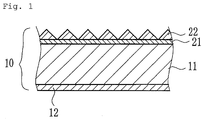
Classifications
-
- G—PHYSICS
- G02—OPTICS
- G02B—OPTICAL ELEMENTS, SYSTEMS OR APPARATUS
- G02B1/00—Optical elements characterised by the material of which they are made; Optical coatings for optical elements
- G02B1/10—Optical coatings produced by application to, or surface treatment of, optical elements
- G02B1/14—Protective coatings, e.g. hard coatings
-
- C—CHEMISTRY; METALLURGY
- C08—ORGANIC MACROMOLECULAR COMPOUNDS; THEIR PREPARATION OR CHEMICAL WORKING-UP; COMPOSITIONS BASED THEREON
- C08J—WORKING-UP; GENERAL PROCESSES OF COMPOUNDING; AFTER-TREATMENT NOT COVERED BY SUBCLASSES C08B, C08C, C08F, C08G or C08H
- C08J7/00—Chemical treatment or coating of shaped articles made of macromolecular substances
- C08J7/04—Coating
- C08J7/0427—Coating with only one layer of a composition containing a polymer binder
-
- C—CHEMISTRY; METALLURGY
- C08—ORGANIC MACROMOLECULAR COMPOUNDS; THEIR PREPARATION OR CHEMICAL WORKING-UP; COMPOSITIONS BASED THEREON
- C08J—WORKING-UP; GENERAL PROCESSES OF COMPOUNDING; AFTER-TREATMENT NOT COVERED BY SUBCLASSES C08B, C08C, C08F, C08G or C08H
- C08J7/00—Chemical treatment or coating of shaped articles made of macromolecular substances
- C08J7/04—Coating
- C08J7/043—Improving the adhesiveness of the coatings per se, e.g. forming primers
-
- C—CHEMISTRY; METALLURGY
- C08—ORGANIC MACROMOLECULAR COMPOUNDS; THEIR PREPARATION OR CHEMICAL WORKING-UP; COMPOSITIONS BASED THEREON
- C08J—WORKING-UP; GENERAL PROCESSES OF COMPOUNDING; AFTER-TREATMENT NOT COVERED BY SUBCLASSES C08B, C08C, C08F, C08G or C08H
- C08J7/00—Chemical treatment or coating of shaped articles made of macromolecular substances
- C08J7/04—Coating
- C08J7/046—Forming abrasion-resistant coatings; Forming surface-hardening coatings
-
- C—CHEMISTRY; METALLURGY
- C08—ORGANIC MACROMOLECULAR COMPOUNDS; THEIR PREPARATION OR CHEMICAL WORKING-UP; COMPOSITIONS BASED THEREON
- C08J—WORKING-UP; GENERAL PROCESSES OF COMPOUNDING; AFTER-TREATMENT NOT COVERED BY SUBCLASSES C08B, C08C, C08F, C08G or C08H
- C08J7/00—Chemical treatment or coating of shaped articles made of macromolecular substances
- C08J7/04—Coating
- C08J7/056—Forming hydrophilic coatings
-
- G—PHYSICS
- G02—OPTICS
- G02B—OPTICAL ELEMENTS, SYSTEMS OR APPARATUS
- G02B1/00—Optical elements characterised by the material of which they are made; Optical coatings for optical elements
- G02B1/04—Optical elements characterised by the material of which they are made; Optical coatings for optical elements made of organic materials, e.g. plastics
-
- G—PHYSICS
- G02—OPTICS
- G02B—OPTICAL ELEMENTS, SYSTEMS OR APPARATUS
- G02B5/00—Optical elements other than lenses
- G02B5/02—Diffusing elements; Afocal elements
- G02B5/0205—Diffusing elements; Afocal elements characterised by the diffusing properties
- G02B5/021—Diffusing elements; Afocal elements characterised by the diffusing properties the diffusion taking place at the element's surface, e.g. by means of surface roughening or microprismatic structures
- G02B5/0231—Diffusing elements; Afocal elements characterised by the diffusing properties the diffusion taking place at the element's surface, e.g. by means of surface roughening or microprismatic structures the surface having microprismatic or micropyramidal shape
-
- C—CHEMISTRY; METALLURGY
- C08—ORGANIC MACROMOLECULAR COMPOUNDS; THEIR PREPARATION OR CHEMICAL WORKING-UP; COMPOSITIONS BASED THEREON
- C08J—WORKING-UP; GENERAL PROCESSES OF COMPOUNDING; AFTER-TREATMENT NOT COVERED BY SUBCLASSES C08B, C08C, C08F, C08G or C08H
- C08J2367/00—Characterised by the use of polyesters obtained by reactions forming a carboxylic ester link in the main chain; Derivatives of such polymers
- C08J2367/02—Polyesters derived from dicarboxylic acids and dihydroxy compounds
-
- C—CHEMISTRY; METALLURGY
- C08—ORGANIC MACROMOLECULAR COMPOUNDS; THEIR PREPARATION OR CHEMICAL WORKING-UP; COMPOSITIONS BASED THEREON
- C08J—WORKING-UP; GENERAL PROCESSES OF COMPOUNDING; AFTER-TREATMENT NOT COVERED BY SUBCLASSES C08B, C08C, C08F, C08G or C08H
- C08J2483/00—Characterised by the use of macromolecular compounds obtained by reactions forming in the main chain of the macromolecule a linkage containing silicon with or without sulfur, nitrogen, oxygen, or carbon only; Derivatives of such polymers
- C08J2483/04—Polysiloxanes
- C08J2483/06—Polysiloxanes containing silicon bound to oxygen-containing groups
Definitions
- the present invention relates to a laminated film and a display device. More specifically, the present invention relates to a laminated film having an optical functional layer that condenses or diffuses incident light and a hard coat layer and a display device having the laminated film.
- An optical sheet such as a prism sheet, a lens sheet, or a diffusion sheet has been widely used as a constituent member of a backlight unit of a flat panel display.
- the optical sheet is produced by forming a plurality of prisms or lenses, which refract incident light in a predetermined direction, on a support and providing a diffusion layer which diffuses light by refracting the incident light in various manners, on a support.
- a layer formed of a plurality of prisms or lenses and a diffusion layer are collectively referred to as an optical functional layer.
- the optical sheet when an optical sheet is produced, the optical sheet may be scratched in some cases.
- the surface of a support when the surface of a support is coated with a material for forming an optical functional layer, the support tends to be scratched.
- the produced optical sheet is transported, accumulated, or incorporated in a backlight unit, scratches are generated on the surface of the support of the optical sheet due to a contact of the optical sheet with another optical member or the like.
- Patent Document 1 discloses a multilayer film which includes a transparent support in which a coating film to be photo-cured with irradiation light is formed on one surface in order for an optical functional layer that condenses or diffuses light by refracting incident light to be formed on the one surface; and a transparent hard coat layer which is disposed on another surface of the support and formed of a polymer, and the transmittance of light having a wavelength of 340 nm is in the range of 70% or more to 100% or less.
- the hard coat layer in which the transmittance of light having a wavelength of 340 nm used in Patent Document 1 is in the range of 70% or more to 100% or less is intended not to use a UV curing resin as a main component. Further, Patent Document 1 describes that the film thickness of the hard coat layer is in the range of 500 nm to 10000 nm.
- Patent Document 2 discloses that it is possible to sufficiently obtain adhesiveness with respect to various prism layers and also obtain brightness improving characteristics using a laminated film for a prism sheet which includes a support that is formed of biaxially oriented polyester; an easily adhesive layer that is provided on one surface of the support and contains a compound having a plurality of carbodiimide structures; and a rear surface layer that is provided on another surface of the support and has an average reflectance of 3.5% or less with respect to light having a wavelength of 380 nm to 780 nm.
- Patent Document 2 describes that the film thickness of a hard coat layer is controlled to be the film thickness having anti-reflection characteristics, but Examples in Patent Document 2 disclose only examples in which a hard coat layer having a thermosetting resin as a main component is used.
- Patent Document 3 describes that there is provided a lens film in which a lens layer formed of a concave lens and a convex lens is provided on a transparent substrate film and a hard coat layer is provided on the surface of the transparent substrate film on the opposite side of the lens layer. Further, scratch resistance is provided for the rear surface of the lens film, scratches which are already generated are repaired, a decrease in the commercial value of a final product because of scratches is prevented, and degradation of transparency which is an important property as a lens film is prevented by the lens film.
- the thickness of the hard coat layer is preferably in the range of 3000 nm to 15000 nm and also describes an example in which a hard coat layer having a thickness of 6000 nm is formed using a UV curable resin.
- a sheet using a thin sol gel single film as blocking or an oligomer block has been known in the technical field other than an optical film having an optical functional layer.
- the sheet becomes a sheet whose surface does not have a prism surface.
- Patent Document 4 discloses a sheet which includes a film having a thickness of 120 nm or less on the surface of a film substrate and in which the film is configured of a cured material of a curable composition and the curable composition contains a metal oxide sol and an organic metal compound and describes that a blocking phenomenon can be prevented without degrading optical characteristics, the sheet has excellent process suitability, and precipitation of an oligomer to the surface of a film can be prevented by the sheet.
- Patent Documents [Patent Document 1] JP-A-2011-123270 [Patent Document 2] JP-A-2009-199001 [Patent Document 3] JP-A-11-326607 [Patent Document 4] JP-A-2010-173296
- Patent Document 4 there is no description that a sheet disclosed in Patent Document 4 is applied to an optical film having an optical functional layer.
- An object of the present invention is to provide a laminated film which has excellent brightness and in which a hard coat layer has high hardness and the adhesiveness between the hard coat layer and a support is excellent.
- the present invention which is specific solving means for solving the above-described problem is as follows.
- Fig. 1 is a view schematically illustrating a section of a laminated film of the present invention.
- a laminated film of the present invention includes a support; an optical functional layer which is provided on one surface (A surface) side of the support and condenses or diffuses incident light; and a hard coat layer which is provided on the outermost layer of a surface (B surface) side on the opposite side of the A surface of the support on which the optical functional layer is provided and has an inorganic component formed of a hydrolyzate of alkoxysilane or a UV curable resin as a main component, and the thickness of the hard coat layer is 150 nm or less.
- the laminated film of the present invention has excellent brightness, the hardness of the hard coat layer becomes high, and the adhesiveness between the hard coat layer and the support becomes excellent.
- Fig. 1 illustrates an example of the laminated film of the present invention.
- a laminated film 10 is provided with an optical functional layer 22 on one surface (A surface) of a support 11.
- a hard coat layer 12 which has an inorganic component formed of a hydrolyzate of alkoxysilane or a UV curable resin as a main component and whose thickness is 150 nm or less is provided on the outermost layer of a surface (B surface) side on the opposite side of the A surface of the support on which the optical functional layer is provided.
- the support 11 is obtained by forming a polymer compound to have a film shape according to a melt film forming method or a solution film forming method. It is preferable that a transparent compound is used for the polymer compound used in the support 11.
- polymer compound used in the support 11 examples include polyethylene terephthalate (PET), polyethylene naphthalate (PEN), polybutylene terephthalate (PBT), polybutylene naphthalate (PBN), polyarylates, polyether sulfone, polycarbonate, polyether ketone, polysulfone, polyphenylene sulfide, a polyester-based liquid crystal polymer, triacetyl cellulose, a cellulose derivative, polypropylene, polyamides, polyimide, and polycycloolefins.
- PET polyethylene terephthalate
- PEN polyethylene naphthalate
- PBT polybutylene terephthalate
- PBN polybutylene naphthalate
- polyarylates polyether sulfone
- polycarbonate polyether ketone
- polysulfone polyphenylene sulfide
- polyester-based liquid crystal polymer triacetyl cellulose
- triacetyl cellulose
- PET, PEN, triacetyl cellulose, and a cellulose derivative are more preferable and PET and PEN are particularly preferable.
- biaxially oriented polymer film which is obtained by extending a long film-like polymer compound in two directions which are respectively orthogonal to the longitudinal direction and the width direction is used for the support 11.
- biaxially oriented film-like PET and PEN are particularly preferably used as the support 11 from viewpoints of elasticity and transparency.
- the support 11 is a support in which at least one of both surfaces (the A surface and the B surface) is subjected to a corona discharge treatment.
- the surface of the support 11 is hydrophilized by the corona discharge treatment and thus wet properties of various aqueous coating liquids described below can be improved and functional groups such as a carboxyl group and a hydroxy group can be introduced.
- functional groups such as a carboxyl group and a hydroxy group can be introduced.
- the adhesion force between the B surface of the support 11 and the hard coat layer 12 and the adhesion force between the A surface of the support 11 and the optical functional layer 22 or between the A surface of the support 11 and an easily adhesive layer 21 can be further improved.
- the support has a thickness of 50 ⁇ m to 350 ⁇ m.
- the refractive index varies depending on the material to be used, but it is preferable that the support has a refractive index of 1.40 to 1.80.
- the refractive index is in the above-described range, a sheet showing excellent toughness as a base material and having excellent transparency can be obtained.
- the laminated film of the present invention includes a hard coat layer which is provided on the outermost layer of a surface (B surface) side on the opposite side of the A surface of the support on which the optical functional layer is provided and has an inorganic component formed of a hydrolyzate of alkoxysilane or a UV curable resin as a main component, and the thickness of the hard coat layer is 150 nm or less.
- the hard coat layer is provided on the outermost layer on the surface (B surface) side on the opposite side of the A surface of the support on which the optical functional layer is provided.
- the hard coat layer 12 can protect the surface on the opposite side of the A surface of the support 11 on which the optical functional layer is provided as described above, improve the hardness as a laminated film, and complement scratch resistance, which is preferable.
- the hard coat layer may be laminated in a state of being in contact with the support or the hard coat layer may be laminated through the support and an easily adhesive layer.
- the hard coat layer is laminated in the state of being in contact with the support. Further, from a viewpoint of the cost, it is preferable that only the hard coat layer exhibits the anti-reflection function without using an easily adhesive layer.
- an easily adhesive layer described below preferably used between the support and the optical functional layer can be used as the easily adhesive layer.
- the hard coat layer may be formed of a single layer or a plurality of layers, but it is preferable that the hard coat layer is formed of a single layer. From a viewpoint of the cost, it is preferable that the hard coat layer formed of a single layer exhibits an anti-reflection function.
- a thickness T12 of the hard coat layer 12 is 150 nm or less from a viewpoint of obtaining excellent transparency and hardness.
- adjusting the film thickness to be within the above-described range only the hard coat layer can exhibit the anti-reflection function, light-transmitting properties are improved by suppressing the light reflectance of the hard coat layer, and the brightness can be improved as the entirety of the laminated film.
- the description of the anti-reflection function or the mechanism thereof is described in JP-A-2011-123270 or JP-A-2009-199001 .
- the film thickness of the laminated film of the present invention is preferably in the range of 50 nm to 150 nm and more preferably in the range of 50 nm to 120 nm. It is preferable that the film thickness of the hard coat layer satisfies the above-described range. Further, the film thickness thereof is preferably in the range of (550/ (4n)) ⁇ 40 nm and more preferably in the range of (550/ (4n)) ⁇ 30 nm. When the film thickness of the hard coat layer is in the above-described range, coloration does not occur and sufficiently low reflection performance can be obtained.
- the range of 40 nm to 130 nm or 55 nm to 100 nm can be exemplified.
- the thickness of the hard coat layer is in the above-described range, the adhesiveness between the support and the hard coat layer can be improved although the specific mechanism is unclear.
- the thickness T12 of the hard coat layer 12 can be controlled by adjusting the coating amount of a coating liquid for a hard coat layer, described below, which forms the hard coat layer 12.
- the hard coat layer 12 further has transparency.
- a refractive index n at a measurement wavelength of 550 nm is preferably in the range of 1.20 to 1.61 and more preferably in the range of 1.28 to 1.55.
- the refractive index n is in the above-described range, sufficiently low reflection performance can be obtained.
- the main component of the hard coat layer is an inorganic component formed of a hydrolyzate of alkoxysilane or a UV curing resin.
- the main component of a layer means a component included in the layer by the content of 50% by mass or greater.
- the hard coat layer two types of layers which are a first hard coat layer having an inorganic component formed of a hydrolyzate of the alkoxysilane described below as a main component and a second hard coat layer having a UV curing resin as a main component can be used in the present invention.
- the hardness of the hard coat layer can be more improved than the hard coat layer having a thermosetting resin as a main component which is used in Examples of JP-A-2009-199001 and, preferably, the hard coat layer 12 having excellent scratch resistance can be formed.
- First hard coat layer having inorganic component formed of a hydrolyzate of alkoxysilane as main component
- alkoxysilane used as a material for forming the first hard coat layer examples include a tetraalkoxysilane and an alkoxysilane having one or more organic functional groups other than a hydroxyl group.
- a water-soluble or water-dispersible material as an alkoxysilane. It is particularly preferable to use a water-soluble or water-dispersible material from a viewpoint of reducing environmental pollution caused by volatile organic compounds (VOC).
- VOC volatile organic compounds
- a method of hydrolyzing an alkoxysilane which is not particularly limited, in order to prepare an inorganic component formed of a hydrolyzate of the alkoxysilane, a method of hydrolyzing a coating liquid for a first hard coat layer, in a solvent, which contains the alkoxysilane used for forming the first hard coat layer can be exemplified.
- water is preferable from a viewpoint of the environment and acidic water (acidic aqueous solution) described below is more preferable.
- the coating liquid for a first hard coating layer contains an aqueous solution of a silanol generated by hydrolyzing an alkoxysilane in an acidic aqueous solution and a water-soluble curing agent used for dehydration condensation of the silanol and more preferable that the coating liquid for a first hard coating layer contains an aqueous solution of a silanol generated by hydrolyzing a tetraalkoxysilane and an alkoxysilane having one or more organic functional groups other than a hydroxyl group in an acidic aqueous solution and a water-soluble curing agent used for dehydration condensation of the silanol.
- the alkoxysilane having one or more organic functional groups other than the hydroxyl group which is not particularly limited, is the alkoxysilane represented by the following formula (1). (R 1 ) n+1 Si(OR 2 ) 3-n Formula (1)
- R 1 represents an organic group which does not include a hydroxyl group
- R 2 ' s each independently represent a methyl group or an ethyl group
- n represents an integer of 0 to 2.
- n in the formula (1) represents an integer of 0 to 2, is preferably 0 or 1, and more preferably 0.
- the compound represented by the formula (1) represents a trifunctional alkoxysilane in the case where n is 0 and the compound represents a bifunctional alkoxysilane in the case where n is 1.
- the trifunctional alkoxysilane and the bifunctional alkoxysilane may be used in combination.
- Examples of preferable compounds from among alkoxysilanes having one or more organic functional groups other than the hydroxyl group include vinyl trimethoxysilane, 3-methacryloxy propyl trimethoxysilane, 3-acryloxy propyl trimethoxysilane, 3-chloropropyl trimethoxysilane, 3-ureidopropyl trimethoxysilane, propyl trimethoxysilane, phenyl trimethoxysilane, 3-glycidoxy propyl triethoxysilane, 2-(3,4-epoxycyclohexyl)ethyl triethoxysilane, vinyl triethoxysilane, 3-methacryloxy propyl triethoxysilane, 3-acryloxy propyl triethoxysilane, 3-chloropropyl triethoxysilane, 3-ureidopropyl triethoxysilane, propyl triethoxysilane, phenyl triethoxy
- a trialkoxysilane which is the alkoxysilane represented by the following formula (1) and in which n represents 0 is more preferable and more preferable examples thereof include 3-glycidoxy propyl trimethoxysilane, 3-glycidoxy propyl triethoxysilane, 3-chloropropyl trimethoxysilane, 2-(3,4-epoxycyclohexyl)ethyl trimethoxysilane, 3-ureido propyl triethoxysilane, 3-trimethoxysilylpropyl-2-[2-(methoxyethoxy)ethoxy]ethylure thane, and 3-trimethoxysilylpropyl-2-[2-(methoxypropoxy)propoxy]propyl urethane.
- 3-glycidoxy propyl triethoxysilane is particularly preferable.
- KBE-403 manufactured by Shin-Etsu Chemical Co., Ltd.
- Shin-Etsu Chemical Co., Ltd. As a commercially available product, KBE-403 (manufactured by Shin-Etsu Chemical Co., Ltd.) is exemplified.
- the alkoxysilane having one or more organic functional groups other than the hydroxyl group does not contain a hydroxyl group as a functional group. That is, the alkoxysilane represented by the formula (1) includes an organic group R 1 free from a hydroxyl group. This is because the obtained film becomes vulnerable in a case where R 1 includes a hydroxyl group.
- the molecular chain length or the number of carbons of R 1 is not particularly limited, but it is preferable that R 1 represents an organic group which has 1 to 15 carbon atoms and has a molecular chain length.
- the number of carbon atoms of R 1 represented by the formula (1) is more preferably in the range of 3 or more to 15 or less and still more preferably in the range of 5 or more to 13 or less.
- an organic group represented by R 1 represented by the formula (1) includes heteroatoms such as oxygen, nitrogen, and sulfur.
- the organic group includes heteroatoms, the adhesion force between the organic group and the support 11 or the first easily adhesive layer 21 can be further improved.
- the organic group R 1 includes an epoxy group, an amide group, a urethane group, a urea group, an ester group, a carboxyl group, and the like.
- an organic silicon compound containing an epoxy group has an effect of improving stability of a silanol in acidic water, which is particularly preferable.
- a tetraalkoxysilane When a tetraalkoxysilane is used as a component of a raw material used for forming a first hard coat layer, the crosslinking density due to dehydration condensation of a silanol which is generated by hydrolyzing the tetraalkoxysilane and the alkoxysilane having one or more organic functional groups other than the hydroxyl group can be improved. In this manner, a hard coat layer 12 which is harder than a hard coat layer in the related art can be obtained.
- the tetraalkoxysilane is not particularly limited, but it is more preferable that the tetraalkoxysilane has 1 to 4 carbon atoms, particularly preferable that the tetraalkoxysilane is tetramethoxysilane or tetraethoxysilane, and still particularly preferable that the tetraalkoxysilane is tetraethoxysilane.
- the hydrolysis rate of the tetraalkoxysilane at the time of being mixed with acidic water does not become extremely slow and the time required for dissolution until the solution turns into a uniform aqueous solution becomes shorter compared to the case where the number of carbon atoms is 5 or more. In this manner, the production efficiency can be improved.
- KBE-04 manufactured by Shin-Etsu Chemical Co., Ltd.
- Shin-Etsu Chemical Co., Ltd. As a commercially available product of the tetraalkoxysilane, KBE-04 (manufactured by Shin-Etsu Chemical Co., Ltd.) can be exemplified.
- the laminated film of the present invention includes 30% by mole or greater of an alkoxysilane having one or more organic functional groups other than the hydroxyl group from among the entirety of the alkoxysilanes contained in the hard coat layer. That is, the substance amount of the alkoxysilane having one or more organic functional groups other than the hydroxyl group is set to X1 and the substance amount of tetraalkoxysilane is set to X2 in the hard coat layer, the molar ratio of the tetraalkoxysilane acquired by the formula " ⁇ X2/(X1 + X2) ⁇ ⁇ 100" is preferably 30% by mole or greater, more preferably in the range of 30% by mole or greater to 95% by mole or less, and particularly preferably in the range of 30% by mole or greater to 90% by mole or less.
- the molar ratio is in the above-described range, since the crosslinking density can be improved, the hard coat layer 12 with sufficiently high hardness and further improved brittleness can be obtained.
- the crosslinking density does not become excessively low and thus the hard coat layer 12 becomes sufficiently hard compared to the case where the molar ratio is less than 30% by mole.
- the crosslinking density does not become excessively high compared to the case where the molar ratio exceeds 95% by mole. Accordingly, the hard coat layer 12 which has excellent flexibility and is not brittle can be reliably obtained.
- the molar ratio thereof can be set to be in the range of 30% by mole or greater to 50% by mole or less or in the range of 30% by mole or greater to 46.3% by mole or less.
- acidic water is preferably used as the material for forming the first hard coat layer.
- the hydrogen ion exponent (pH) of the acidic water is preferably in the range of 2 or more to 6 or less and particularly in the range of 2.5 or more to 5.5 or less.
- the alkoxysilane is hydrolyzed to generate a silanol, condensation of a silanol is promoted in the aqueous solution, that is, the alkoxysilane aqueous solution, and then an increase in the viscosity of the aqueous solution is likely to occur in a case where the pH thereof is less than 2 or greater than 6.
- the above-described pH value is the value at a temperature of 25° which is considered as so-called "room temperature".
- the acidic water can be obtained by dissolving organic acids or inorganic acids in water.
- the acid which is not particularly limited, include organic acids such as acetic acid, propionic acid, formic acid, fumaric acid, maleic acid, oxalic acid, malonic acid, succinic acid, citric acid, malic acid, and ascorbic acid and inorganic acids such as hydrochloric acid, nitric acid, sulfuric acid, phosphoric acid, and boric acid.
- organic acids such as acetic acid, propionic acid, formic acid, fumaric acid, maleic acid, oxalic acid, malonic acid, succinic acid, citric acid, malic acid, and ascorbic acid
- inorganic acids such as hydrochloric acid, nitric acid, sulfuric acid, phosphoric acid, and boric acid.
- acetic acid is preferable in terms of handleability.
- the alkoxysilane aqueous solution is adjusted such that the amount of acidic water is in the range of 60 parts by mass or greater to 2000 parts by mass or less in a case where the total amount of the tetraalkoxysilane and the alkoxysilane having one or more organic functional groups other than a hydroxyl group, that is, the amount of the alkoxysilane being used is set to 100 parts by mass.
- the alkoxysilane aqueous solution has the above-described composition, a hydrolysis aqueous solution of alkoxysilane which has excellent hydrolyzability and stability of the generated silanol can be obtained.
- the hydrolysis aqueous solution of such an alkoxysilane that is, a coating liquid for a first hard coat layer which can be obtained using a silanol aqueous solution has excellent stability although the coating liquid is aqueous, the storage time taken until the laminated film starts to be produced is not restricted, and the production conditions of the laminated film do not need to be changed due to a change in properties of the coating liquid for a hard coat layer because the laminated film is continuously produced.
- the amount of the acidic water is more preferably in the range of 100 parts by mass or greater to 1500 parts by mass or less and particularly preferably in the range of 150 parts by mass or greater to 1200 parts by mass or less with respect to 100 parts by mass of the total amount of the tetraalkoxysilane and the alkoxysilane having one or more organic functional groups other than a hydroxyl group.
- the aqueous solution tends to be gelled due to the dehydration and condensation of a silanol generated by hydrolyzing the alkoxysilane when the amount of the acidic water is less than 60 parts by mass with respect to 100 parts by mass of the alkoxysilane, but the gelation of the aqueous solution can be reliably suppressed by adjusting the amount of the acidic water to be 60 parts by mass or greater.
- the coating amount for forming the hard coat layer 12 to be sufficiently thick does not become excessively large because the concentration of an alkoxysilane in the coating liquid is high when compared to the case where the amount of the acidic water exceeds 2000 parts by mass. Therefore, it is possible to reliably prevent generation of thickness unevenness of a coating film for a hard coat layer and prolongation of a drying time for the coating film.
- a silane compound which is different from both of the tetraalkoxysilane and the alkoxysilane having one or more organic functional groups other than a hydroxyl group may be used for the coating liquid for a hard coat layer.
- the tetraalkoxysilane, the alkoxysilane, and other silane compounds are mixed such that the amount of the acidic water is in the range of 60 parts by mass or greater to 2000 parts by mass or less with respect to 100 parts by mass which is the total amount of the tetraalkoxysilane, the alkoxysilane having one or more organic functional groups other than a hydroxyl group, and other silane compound.
- a curing agent as a material for forming the first hard coat layer. It is preferable that the curing agent serving as a component used when the first hard coat layer is formed from the coating liquid for a first hard coat layer is water-soluble.
- the curing agent accelerates the dehydration condensation of a silanol and promotes formation of a siloxane bond.
- the water-soluble curing agent include water-soluble inorganic acids, organic acids, organic acid salts, inorganic acid salts, a metal alkoxide, and a metal complex.
- Preferable examples of the inorganic acids serving as the water-soluble curing agent include boric acid, phosphoric acid, hydrochloric acid, nitric acid, and sulfuric acid.
- organic acids serving as the water-soluble curing agent include acetic acid, formic acid, oxalic acid, citric acid, malic acid, and ascorbic acid.
- organic acid salts serving as the water-soluble curing agent include aluminum acetate, aluminum oxalate, zinc acetate, zinc oxalate, magnesium acetate, magnesium oxalate, zirconium acetate, and zirconium oxalate.
- the inorganic acid salts serving as the water-soluble curing agent include aluminum chloride, aluminum sulfate, aluminum nitrate, zinc chloride, zinc sulfate, zinc nitrate, magnesium chloride, magnesium sulfate, magnesium nitrate, zirconium chloride, zirconium sulfate, and zirconium nitrate.
- a metal alkoxide serving as the water-soluble curing agent include an aluminum alkoxide, a titanium alkoxide, and a zirconium alkoxide.
- the metal complex serving as the water-soluble curing agent include aluminum trisacetylacetonate, aluminum acetylacetonate, aluminum ethylacetoacetate, titanium acetylacetonate, and titanium ethylacetoacetate.
- aluminum trisacetylacetonate a commercially available product may be used and aluminum chelate A (W) (manufactured by Kawaken Fine Chemicals Co., Ltd.) or the like can be exemplified.
- a compound containing boron such as boric acid, phosphoric acid, an aluminum alkoxide, aluminum trisacetylacetonate or aluminum acetylacetonate; a compound containing phosphorus; and a compound containing aluminum are particularly preferable from a viewpoint of water solubility and stability in water, and at least one kind from among these may be used as a curing agent.
- Examples of the commercially available products of the curing agent include aluminum chelate A(W) (manufactured by Kawaken Fine Chemicals Co., Ltd.).
- the curing agent is uniformly mixed and dissolved in a coating liquid and also preferable that the curing agent is dissolved in water as a solvent of the coating liquid for the first hard coat layer of the present invention in terms of securing transparency of the hard coat layer 12. Since the curing agent is present in a form of a solid in the coating liquid in a case where the curing agent has low solubility in water, the curing agent remains as a foreign substance after coating and drying and transparency of the hard coat layer 12 becomes low in some cases.
- the amount of the curing agent is preferably in the range of 0.1 parts by mass or greater to 20 parts by mass or less, more preferably in the range of 0.5 parts by mass or greater to 10 parts by mass or less, and particularly preferably in the range of 1 part by mass or greater to 8 parts by mass or less with respect to 100 parts by mass of the entirety of the alkoxysilanes contained in the hard coat layer that contains a tetraalkoxysilane and an alkoxysilane having one or more organic functional groups other than the hydroxyl group.
- a surfactant is preferably used as the material for forming the first hard coat layer.
- a surfactant is used, the surface tension of the coating liquid for a hard coat layer is decreased, coating unevenness of the coating liquid for a hard coat layer with respect to the support 11 is suppressed, and thus the hard coat layer 12 with a uniform thickness can be formed.
- surfactant examples include known anionic, non-ionic, cationic, fluorine-based, and silicone-based surfactants.
- the surfactant is described in, for example, "Handbook of Surfactants” (edited by Ichiro Nishi, Ichiro Imai, and Masatake Kasai, Sangyo-Tosho Publishing Co., Ltd., published in 1960).
- an anionic surfactant and/or a cationic surfactant is preferably used.
- anionic surfactant examples include higher fatty acid salts such as potassium stearate and potassium behenate; alkyl ether carboxylates such as sodium POE lauryl ether carboxylate; N-acyl-L-glutamates such as N-stearoyl-Lglutamic acid monosodium salt; higher alkyl sulfate ester salts such as sodium lauryl sulfate and potassium lauryl sulfate; alkyl ether sulfate ester salts such as POE lauryl sulfate triethanolamine and sodium POE lauryl sulfate; N-acyl sarcosinates such as sodium lauryl sarcosine; higher fatty acid amide sulfonates such as sodium N-myristoyl-N-methyl taurine; alkyl phosphates such as sodium allyl phosphate; alkyl ether phosphates such as sodium POE oleyl ether phosphate or sodium POE
- Examples of the commercially available anionic surfactant include RAPISOL A-90, RAPISOL A-80, RAPISOL BW-30, RAPISOL B-90, RAPISOL C-70 (trade name, manufactured by NOR CORPORATION) ; NIKKOL OTP-100 (trade name, manufactured by NIKKO CHEMICAL CO., LTD.) ; Kohakuru ON, Kohakuru L-40, Phosphanol 702 (manufactured by Toho Chemical Industry Co., Ltd.); Beaulight A-5000, Beaulight SSS, and Sandeddo BL (manufactured by Sanyo Chemical Industries, Ltd.).
- Examples of the cationic surfactant include alkyl trimethyl ammonium salts such as stearyl trimethyl ammonium chloride and lauryl trimethyl ammonium chloride; dialkyl dimethyl ammonium salts such as distearyl dimethyl ammonium chloride; alkyl pyridinium salts such as poly(N,N-dimethyl-3,5-methylene piperidinium) chloride and cetyl pyridinium chloride; alkyl quaternary ammonium salts, alkyl dimethyl benzyl ammonium salts, alkyl isoquinolinium salts, dialkyl Mori bromide salts, POE alkylamines, alkylamine salts, polyamine fatty acid derivatives, amyl alcohol fatty acid derivatives, benzalkonium chlorides, and benzethonium chloride. It is possible to suppress aggregation of particles during a process of drying a coating film and to form uniform unevenness on the surface using the above-described surfact
- Examples of other commercially available products of the cationic surfactant include a phthalocyanine derivative (trade name, EFKA-745, manufactured by MORISHITA & CO., LTD.), organosiloxane polymer KP341 (manufactured by Shin-Etsu Chemical Co., Ltd.), (meth)acrylic acid (co)polymer polyflow No. 75, No. 90, No. 95 (manufactured by KYOEISHA CHEMICAL Co., LTD.), and WO01 (manufactured by Yusho Co., Ltd.).
- a phthalocyanine derivative trade name, EFKA-745, manufactured by MORISHITA & CO., LTD.
- organosiloxane polymer KP341 manufactured by Shin-Etsu Chemical Co., Ltd.
- (meth)acrylic acid (co)polymer polyflow No. 75, No. 90, No. 95 manufactured by KYOEISHA CHEMICAL Co., LTD.
- nonionic surfactant examples include a polyoxyalkylene alkyl ether, a polyoxyethylene derivative, polyoxyethylene polyoxypropylene glycol, a polyoxyethylene fatty acid ester, a polyoxyethylene glyceryl ether fatty acid ester, a sorbitan fatty acid ester, a polyoxyethylene sorbitan fatty acid ester, a polyoxyethylene sorbitol fatty acid ester, polyoxyethylene hardened castor oil, and a sucrose fatty acid ester.
- Non-ionic surfactant examples include Naroacty CL-95, HN-100 (trade name, manufactured by Sanyo Chemical Industries Co., Ltd.), LITHO REX BW400 (manufactured by KOKYU ALCOHOL KOGYO CO., LTD.), EMALEX ET-2020 (Nihon Emulsion Co., Ltd.), Unilube 50MB-26, and Nonion IS-4 (manufactured by NOF CORPORATION).
- fluorine-based surfactant examples include Megafac F171, Megafac F172, Megafac F173, Megafac F176, Megafac F177, Megafac F 141, Megafac F142, Megafac F143, Megafac F144, Megafac R30, Megafac F437, Megafac F475, Megafac F479, Megafac F482, Megafac F554, Megafac F780, Megafac F780F, Megafac F781 (all manufactured by DIC Corporation), Fluorad FC430, Fluorad FC431, Fluorad FC171 (all manufactured by Sumitomo 3M Limited), Surflon S-382, Surflon SC-101, Surflon SC-103, Surflon SC-104, Surflon SC-105, Surflon SC1068, Surflon SC-381, Surflon SC-383, Surflon S393, Surflon KH-40 (all manufactured by DIC
- the hard coat layer may or may not contain inorganic particles other than a hydrolyzate of alkoxysilane.
- inorganic particles other than the hydrolyzate of the alkoxysilane colloidal silica can be exemplified. Further, colloidal silica described in JP-A-2011-123270 can be used and the contents thereof are incorporated in the specification of the present application.
- commercially available products such as Snowtex XL (manufactured by NISSAN CHEMICAL INDUSTRIES, LTD.) and a water dispersion of Aerosil OX-50 (manufactured by Nippon Aerosil Co., Ltd.) can be respectively used as colloidal silica and a silica fine particle dispersion liquid.
- the content of the inorganic particles other than a hydrolyzate of alkoxysilane in the hard coat layer is preferably in the range of 0% by mass to 200% by mass and more preferably in the range of 0% by mass to 150% by mass with respect to the mass of the hard coat layer.
- the hard coat layer does not contain inorganic particles other than a hydrolyzate of alkoxysilane from a viewpoint of transparency.
- a monomer or an oligomer can be exemplified.
- the second hard coat layer having a UV curing resin as a main component is formed using a coating liquid for a second hard coat layer.
- a known organic solvent or water can be used as the solvent of the coating liquid for a second hard coat layer and a ketone-based solvent such as MEK is preferably used from viewpoints of the solubility and the environment.
- the component of the coating liquid for a second hard coat layer is not particularly limited as long as the component is a monomer or an oligomer to be cured by UV rays.
- the coating liquid for a second hard coat layer is a coating liquid containing at least one of a monomer or an oligomer in water.
- the monomer or the oligomer is a monomer or an oligomer including a plurality of polymerizable double bonds in a molecule.
- the coating liquid for a second hard coat layer may be formed by adding a polymerization initiator, a curing agent, an additive, and the like.
- the coating liquid for a second hard coat layer is a UV curable coating liquid containing a photopolymerization initiator and a UV curable compound (a monomer or an oligomer) among the above-described substances. That is, it is preferable that the hard coat layer 12 is formed by being coated with a UV curable coating liquid and curing the coating liquid for a hard coat layer with UV irradiation.
- UV curable compound which is preferable to combine with a photopolymerization initiator
- a monomer or an oligomer which includes an acrylic group or a methacrylic group having a radically polymerizable double bond can be used.
- the monomer include a multifunctional monomer including a plurality of acrylic groups or methacrylic groups such as dipentaerythritol hexa(meth)acrylate, trimethylol propane tri(meth)acrylate, trimethylol propane polyethoxy tri (meth) acrylate, trimethylol propane polypropoxy tri(meth)acrylate, pentaerythritol tetra (meth) acrylate, and ditrimethylol propane tetraacrylate.
- an oligomer such as urethane acrylate, epoxy acrylate, polyester acrylate, or polyether acrylate which includes an acrylic group or a methacrylic group is preferable.
- styrene divinyl benzene, allyl benzene, dially benzene, triallyl isocyanurate, diallyl phthalate, or diethylene glycol bis(allyl carbonate) is also preferable.
- the commercially available product of the multifunctional acrylic monomer include Aronix M-405 and M-350 (manufactured by TOAGOSEI CO., LTD.). These monomers and oligomers are preferably used in combination of plural kinds thereof in order for the hard coat layer 12 to have predetermined physical properties.
- photopolymerization initiator a photopolymerization initiator generally used for polymerization of a monomer and an oligomer which have a radically polymerizable double bond can be used.
- the photopolymerization initiator examples include acetophenone, benzophenone, benzoin methyl ether, benzoin ethyl ether, benzoin butyl ether, chloroacetophenone, acylphosphine oxide, 2-ethyl anthraquinone, benzyl methyl ketal, acyl phosphine oxide, a halogenated hydrocarbon having a triazine skeleton, a halogenated hydrocarbon compound having an oxadiazole skeleton, a phenyl acrydine derivative, a ketone compound, a ketoxime compound, an organic peroxide, a thio compound, a hexaaryl biimidazole, aromatic onium salts, ketoxime ether, and a titanocene-based compound.
- a commercially available polymerization initiator such as IRGACURE 184 (manufactured by BASF Japan Ltd.) may be added.
- the amount of the photopolymerization initiator to be added is generally preferably in the range of 0.1% by mass to 10% by mass with respect to the coating liquid for a hard coat layer.
- the surface tension of the coating liquid for a hard coat layer is decreased, coating unevenness of the coating liquid for a hard coat layer with respect to the support 11 is suppressed, and thus the hard coat layer 12 with a uniform thickness can be formed.
- the surfactant is not particularly limited. Any surfactant from among an anionic surfactant, a cationic surfactant, a nonionic surfactant, a fluorine-based surfactant, and a betaine-based surfactant can be used. Among these, a surfactant whose HLB (Hydrophile-Lipophile Balance) value is in the range of 7 or more to 18 or less is preferable and a surfactant whose HLB value is in the range of 9 or more to 16 or less is particularly preferable.
- the HLB value is a value indicating the extent of affinity of a surfactant to water or oil.
- a preferable value of the HLB value is a value calculated by the Atlas HLB system.
- Examples or preferable ranges of the anionic surfactant, the cationic surfactant, and the nonionic surfactant are the same as the examples or the preferable ranges of respective surfactants used in the first hard coat layer.
- a surfactant containing a perfluoroalkyl group which is configured of CF 3 (CF 2 ) n - in a molecule is used.
- the surface tension can be further decreased, the hydrophilicity of a coating film is improved, and thus contamination resistance of the coating film is improved.
- fluorine-based surfactant examples include anionic fluorine-based surfactants such as a perfluoroalkyl carboxylate, a perfluoroalkyl sulfonate, a perfluoroalkyl phosphoric acid ester, a perfluoroalkenyl sulfonate, and a perfluoroalkenyl carboxylate; amphoteric fluorine-based surfactants such as a perfluoroalkyl betaine; cationic fluorine-based surfactants such as a perfluoroalkyl trimethyl ammonium; nonionic fluorine-based surfactant such as a perfluoroalkyl ethylene oxide adduct, a perfluoroalkyl amine oxide and an oligomer containing a perfluoroalkyl group.
- anionic fluorine-based surfactants such as a perfluoroalkyl carboxylate, a perfluoroalkyl sulf
- Examples of the commercially available fluorine-based surfactant include Megafac F171, Megafac F172, Megafac F173, Megafac F176, Megafac F177, Megafac F141, Megafac F142, Megafac F143, Megafac F144, Megafac R30, Megafac F437, Megafac F475, Megafac F479, Megafac F482, Megafac F554, Megafac F780, Megafac F781 (all manufactured by DIC Corporation), Fluorad FC430, Fluorad FC431, Fluorad FC171 (all manufactured by Sumitomo 3M Limited), Surflon S-382, Surflon SC-101, Surflon SC-103, Surflon SC-104, Surflon SC-105, Surflon SC1068, Surflon SC-381, Surflon SC-383, Surflon S393, Surflon KH-40 (all manufactured by ASAHI GLASS CO
- betaine-based surfactant examples include a 2-alkyl-N-carboxymethyl-N-hydroxyethylimidazoliumbetaine, and lauryl dimethyl amino acetic acid betaine.
- the second hard coat layer may contain a matting agent or a wax.
- matting agent examples include organic and inorganic substances such as silica, calcium carbonate, magnesium carbonate, barium sulfate, polystyrene, a polystyrene-divinyl benzene copolymer, polymethyl methacrylate, crosslinked polymethyl methacrylate, melamine, and benzoguanamine.
- organic and inorganic substances such as silica, calcium carbonate, magnesium carbonate, barium sulfate, polystyrene, a polystyrene-divinyl benzene copolymer, polymethyl methacrylate, crosslinked polymethyl methacrylate, melamine, and benzoguanamine.
- Examples of the wax include a paraffin wax, a microcrystalline wax, a polyethylene wax, a polyester-based wax, a carnauba wax, a fatty acid, a fatty acid amide, and a metal soap.
- Examples of the commercially available product include CELLOSOL 524 (manufactured by CHUKYO YUSHI CO., LTD.).
- the laminated film of the present invention is provided on one surface (A surface) of the support and includes an optical functional layer that condenses or diffuses incident light.
- the optical functional layer 22 illustrated in Fig. 1 condenses or diffuses light by refracting incident light.
- a lens layer, a prism layer, or a diffusion layer is exemplified.
- Fig. 1 illustrates a case in which the optical functional layer 22 is used as a prism layer.
- the optical functional layer 22 which is a prism layer is obtained by forming a plurality of prisms whose sections are triangular to have constant pitches.
- the laminated film 10 having such an optical functional layer 22 refracts incident light beams to a predetermined direction using the prisms when light is incident from the hard coat 12 side. In this manner, light is emitted and distributed so as to have a large peak in a predetermined direction. For example, when the incident light beams are refractive to the normal direction, the light is distributed so as to have a large peak in the normal direction. In this manner, when the laminated film 10 is used for a backlight unit of a liquid crystal display, the front brightness of the liquid crystal display is improved.
- the optical functional layer 22 condenses or diffuses incident light by refracting light as described above. In this manner, the path of the light is controlled. Since the light is refracted on the surface of the optical functional layer 22 due to the incident angle and a difference in the refractive index between the support 11 and the optical functional layer 22 or the incident light is refracted or reflected on a light emitting surface, these optical characteristics are further expressed and then used depending on the configuration of the optical functional layer 22.
- the optical functional layer 22 controls the concentration of incident light, emits and distributes light so as to have a large peak in a predetermined direction, and obtains the prism function and the lens function of adjusting the front brightness of the liquid crystal display when light from a light source is incident from the hard coat layer 12 side.
- the laminated film 10 with such functions can be used as a so-called prism sheet or lens sheet.
- the optical functional layer 22 has a diffusion function of diffusing incident light to be uniformly distributed when light from a light source is incident from the hard coat layer 12 side.
- the laminated film 10 having such a function can be used as a so-called diffusion sheet.
- the optical functional layer 22 is a lens layer
- a plurality of lenses refracting light are arranged at a predetermined pitch.
- the optical functional layer 22 controls the emitting angle of the incident light.
- the lens include cylindrical lenses obtained by dividing a cylindrical shape into two in an axial direction, a triangular prism, a spherical lens, and an aspherical lens.
- a triangular prism may be used as the lens.
- the optical functional layer 22 which is a prism layer as illustrated in Fig. 1 is considered as one of lens layer.
- the optical functional layer 22 further contains a polymerization initiator using a substance having a monomer, an oligomer, and a polymer generally having a radically polymerizable double bond as a main component.
- Examples of the monomer and the oligomer having a radically polymerizable double bond include an acrylic monomer and an acrylic oligomer.
- a resin which can be used as a main component of the optical functional layer is a resin obtained by curing a UV curable compound (a monomer or an oligomer).
- a material of the resin which can be used as a main component of the optical functional layer for example, a monofunctional or multifunctional monomer, oligomer, or prepolymer having a (meth)acryloyl group and a (meth)acryloyloxy group for forming a known optical sheet can be used.
- Examples of the monofunctional monomer include a vinyl monomer, a (meth)acrylic acid ester monomer, and a (meth)acrylamide derivative which are described in JP-A-2009-37204 , and the contents thereof are incorporated in the specification of the present application.
- multifunctional monomer examples include ethylene glycol di(meth)acrylate, bisphenol A polyethoxydiol di (meth) acrylate, and pentaerythritol tri (meth) acrylate which are described in JP-A-2009-37204 and the contents thereof are incorporated in the specification of the present application.
- Examples of the reactive prepolymer include epoxy (meth)acrylate, urethane (meth)acrylate, and polyester (meth)acrylate which are described in JP-A-2009-37204 and the contents thereof are incorporated in the specification of the present application.
- a resin which can be used as a main component of the optical functional layer can adjust the elasticity measured by elasticity measurement to be less than 20 MPa.
- the elasticity of a resin used as the main component of the optical functional layer is more preferably in the range of 5MPa to 19 MPa and more preferably in the range of 8 MPa to 19 MPa and, for example, an elasticity of 18 MPa or the like is included in the range thereof. In this manner, the restorability of the prism can be achieved and the scratch resistance thereof can be improved. Further, a resin with low elasticity has a high refractive index and can produce a laminated film with higher brightness, which is preferable.
- a (i-1-A) component is a (meth)acrylic resin having one (meth) acryloyl group as an active energy ray curable group and may be a chain aliphatic, cyclic alicyclic, or aromatic (meth)acrylic resin containing heteroatoms such as a halogen atom, a sulfur atom, an oxygen atom, or a nitrogen atom.
- a monofunctional (meth)acrylic resin described in JP-A-2009-37204 can be used and the contents thereof are incorporated in the specification of the present application.
- the (i-1-A) component include phenoxyethyl (meth)acrylate (also referred to as (meth)acrylic acid-2-phenoxyethyl) and a compound represented by the following formula (A).
- R 1 and R 2 each independently represent a hydrogen atom or a methyl group
- X represents a hydrogen atom, chain aliphatic hydrocarbon having 1 to 10 carbon atoms, alicyclic hydrocarbon having 1 to 10 carbon atoms, or aromatic hydrocarbon having 1 to 10 carbon atoms
- k represents an integer of 2 to 6.
- the compound represented by the formula (A) is contained in a composition, which is used to form the optical functional layer, together with the phenoxyethyl (meth)acrylate, the flexibility is provided for an optical functional layer which is a cured material of the composition. Further, even when external force is applied to the optical functional layer and thus the shape thereof is changed, the restorability for restoring the optical functional layer to the original shape can be provided.
- X represents a hydrogen atom, chain aliphatic hydrocarbon having 1 to 10 carbon atoms, alicyclic hydrocarbon having 1 to 10 carbon atoms, or aromatic hydrocarbon having 1 to 10 carbon atoms. Among these, it is preferable that X represents a hydrogen atom.
- k represents a positive integer of 2 to 6. From a viewpoint of improving the flexibility of the optical functional layer, k represents preferably an integer of 2, 3, or 4 and more preferably 2 or 3.
- the (i-1-A) component may be used alone or in combination of two or more kinds thereof.
- the content of the (i-1-A) component is preferably in the range of 20% by mass to 50% by mass with respect to the total mass of the solid content of the composition used for forming the optical functional layer.
- the phenoxyethyl (meth)acrylate is preferably in the range of 15% by mass to 30% by mass and more preferably in the range of 22% by mass to 27% by mass with respect to the total mass of the solid content of the composition used for forming the optical functional layer.
- the compound represented by the formula (1) is preferably in the range of 5% by mass to 20% by mass and more preferably in the range of 5% by mass to 15% by mass with respect to the total mass of the solid content of the composition used for forming the optical functional layer.
- the total mass ((i-1-A) + (i-1-B)) is preferably 50% by mass or greater and more preferably in the range of 85% by mass to 95% by mass with respect to the total mass of the solid content of the composition used for forming the optical functional layer.
- the total mass thereof is adjusted to be 50% by mass or greater with respect to the total mass of the solid content, the restorability for restoring the optical functional layer to the original shape can be improved.
- the (i-1-B) component is a (meth) acrylic resin having two (meth) acryloyl groups as an active energy ray curable group and may be a chain aliphatic, cyclic alicyclic, or aromatic (meth)acrylic resin containing heteroatoms such as a halogen atom, a sulfur atom, an oxygen atom, or a nitrogen atom.
- a bifunctional (meth)acrylic resin described in JP-A-2009-37204 can be used.
- Preferable examples of the (i-1-B) component include compounds represented by the following formula (B).
- the flexibility of the optical functional layer is further improved and the restorability of the optical functional layer becomes excellent.
- the content of the compound represented by the formula (B) is preferably in the range of 25% by mass to 50% by mass, more preferably in the range of 30% by mass to 50% by mass, and particularly preferably in the range of 35% by mass to 45% by mass with respect to the total mass of the solid content of the composition.
- UV curable compound with low elasticity examples include monofunctional or multifunctional (meth)acrylic compounds such as ethoxylated o-phenylphenol acrylate, ethoxylated bisphenol A diacrylate, ⁇ -caprolactone-modified tris(2-acryloxyethyl)isocyanurate, 2,4-dibromophenyl (meth)acrylate, 2,3,5-tribromophenyl (meth)acrylate, 2,2-bis(4-(meth)acryloyloxyphenyl)propane, 2,2-bis(4-(meth)acryloyloxyethoxyphenyl)propane, 2,2-bis(4-(meth)acryloyloxydiethoxyphenyl)propane, 2,2-bis(4-(meth)acryloylpentaethoxyphenyl)propane, 2,2-bis(4-(meth)acryloyloxyethoxy-3,5-dibromophenyl)prop
- ethoxylated o-phenylphenol acrylate ethoxylated bisphenol A diacrylate, or ⁇ -caprolactone-modified tris(2-acryloxyethyl)isocyanurate
- these may be used by combining plural kinds thereof.
- these low elastic resins can easily control the elasticity to be less than 20 MPa by controlling a chain of ethyleneoxide related to ethoxylation to be longer (to the extent that the number of ethyleneoxide repeating units is in the range of 5 to 20).
- Examples of the commercially available product of the low elastic resin whose elasticity is less than 20 MPa include NK ESTER A-LEN-10, A-BPE-10, and A9300-1CL (all manufactured by Shin Nakamura Chemical Co., Ltd.).
- a resin which can be used as a main component of the optical functional layer can adjust the elasticity measured by elasticity measurement to be 20 MPa or more.
- Such a resin with high elasticity has a low refractive index, but the upper layer of the optical functional layer is unlikely to be scratched, which is preferable.
- the elasticity of the resin which can be used as the main component of the optical functional layer is adjusted to be larger, the elasticity thereof is preferably in the range of 20 MPa to 2000 MPa and more preferably in the range of 100 MPa to 1200 MPa.
- phenoxyethyl acrylate ethyl acrylate, EO (ethyleneoxide)-modified TMPTA (trimethylol propane triacrylate), BrBPA (tetrabromobisphenol A skeleton-containing epoxy acrylate), ethyleneoxide addition bisphenol A methacrylic acid ester, and tribromophenoxy ethyl acrylate are preferable.
- EO ethyleneoxide
- TMPTA trimethylol propane triacrylate
- BrBPA tetrabromobisphenol A skeleton-containing epoxy acrylate
- ethyleneoxide addition bisphenol A methacrylic acid ester ethyleneoxide addition bisphenol A methacrylic acid ester
- tribromophenoxy ethyl acrylate tribromophenoxy ethyl acrylate
- n and m in the formula (B) each independently represent preferably an integer of 1 to 4 and more preferably an integer of 1 or 2. Further, it is preferable that the value of "n + m" is set to be in the range of 2 to 4.
- these high elastic resins can easily control the elasticity to be greater than or equal to 20 MPa by controlling a chain of ethyleneoxide to be shorter (to the extent that the number of ethyleneoxide repeating units is in the range of 1 to 4).
- Examples of the commercially available product of the UV curable compound with high elasticity include Viscoat #192 (manufactured by OSAKA ORGANIC CHEMICAL INDUSTRY LTD.), SR349 (manufactured by Sartomer Company, Inc.), NK ESTER BPE-200, A-BPEF (both manufactured by Shin Nakamura Chemical Co., Ltd.), and NEW FRONTIER BR-31 (manufactured by DIC Corporation).
- Examples and the preferable ranges of the photopolymerization initiator used for the optical functional layer 22 are the same as the examples and the preferable ranges of the photopolymerization initiator used for the second hard coat layer having the UV curing resin as a main component.
- the easily adhesive layer 21 is appropriately provided on one surface (A surface) side of the support 11 in order to improve adhesiveness of the support 11 with respect to the optical functional layer 22 and to improve adhesion force between the optical functional layer 22 and the support 11.
- the easily adhesive layer 21 is formed by coating one surface (A surface) of the support 11 with a coating liquid generally formed of a binder, a curing agent, and a surfactant.
- a binder may have self-crosslinking properties without using a curing agent and a self-crosslinking catalyst (for example, a catalyst for elastron, ELASTRON CAT-21) may be further added.
- the easily adhesive layer 21 may appropriately contain a lubricant, an antifoaming agent, a foam suppressor, a dye, a fluorescent whitening agent, a preservative, a water-proofing agent, organic or inorganic fine particles, or distilled water as needed.
- the binder used for the easily adhesive layer 21 is not particularly limited. However, from a viewpoint of adhesion force, it is preferable that the binder is at least one of polyester, polyurethane, an acrylic resin, a styrene butadiene copolymer, and an oxazoline resin. Further, the binder with water-soluble properties or water-dispersible properties is particularly preferable in terms of a small environmental load.
- Polyester is a general term of a polymer whose main chain has an ester bond and can be generally obtained by a reaction between polycarboxylic acids and polyols.
- the polycarboxylic acid include fumaric acid, itaconic acid, adipic acid, sebacic acid, terephthalic acid, isophthalic acid, sulfoisophthalic acid, and naphthalene dicarboxylic acid and examples of the polyol include ethylene glycol, propylene glycol, glycerin, hexanetriol, butanediol, hexanediol, and 1,4-cyclohexanedimethanol.
- Polyester and the raw material thereof are described in " Handbook of Polyester Resin” (written by Eiichiro Takiyama, NIKKAN KOGYO SHIMBUN, LTD., published in 1988 ) and the description can be applied to the present invention.
- polyesters examples include polyhydroxy butyrate (PHB)-based, polycaprolactone (PCL)-based, polycaprolactone butylene succinate-based, polybutylene succinate (PBS)-based, polybutylene succinate adipate (PBSA)-based, polybutylene succinate carbonate-based, polyethylene terephthalate succinate-based, polybutylene adipate terephthalate-based, polytetramethylene adipate terephthalate-based, polybutylene adipate terephthalate-based, polyethylene succinate (PES)-based, polyglycolic acid (PGA)-based, and polylactic acid (PLA)-based materials, a carbonate copolymer of aliphatic polyester, and a copolymer of aliphatic polyester and polyamide.
- PBS polycaprolactone butylene succinate
- PBSA polybutylene succinate adipate
- PBS polybutylene succinate adipate
- polyester examples include Finetex ES650, ES2200 (manufactured by DIC Corporation), Vylonal MD1245, MD1400, MD1480 (manufactured by TOYOBO CO., LTD.), Pesurejin A-110, A-124GP, A-520, A-640 (manufactured by TAKAMATSU OIL & FAT CO., LTD.), Plascoat Z561, Z730, Z687, and Z592 (manufactured by GOO CHEMICAL CO., LTD.).
- the polyurethane is a general term of a polymer whose main chain has a urethane bond and can be generally obtained by a reaction between polyisocyanates and polyols.
- the polyisocyanate include TDI (toluene diisocyanate), MDI (diphenylmethane diisocyanate), NDI (naphthalene diisocyanate), TODI (tolidine diisocyanate), HDI (hexamethylene diisocyanate), and IPDI (isophorone diisocyanate).
- the polyol include ethylene glycol, propylene glycol, glycerin, and hexanetriol.
- the isocyanate of the present invention a polymer whose molecular weight is increased by applying a chain extension treatment to the polyurethane polymer obtained by the reaction between polyisocyanates and polyols can be used.
- the above-described polyisocyanate, polyols, and chain extension treatment are described in, for example, " Handbook of Polyurethane” (edited by Keiji Iwata, NIKKAN KOGYO SHIMBUN, LTD., published in 1987 ).
- Examples of the commercially available products of polyurethane include Superflex 470, 210, 150HS, Elastron H-3 (manufactured by DKS Co., Ltd.), Hydran AP-20, AP-40F, WLS-210 (manufactured by DIC Corporation), Takelac W-5100, W-6061, and OLESTER UD-350 (manufactured by Mitsui Chemicals, Inc.).
- a mode of dissociating an isocyanate compound blocked by a blocking agent and reacting urethane on a coating film to be self-crosslinked is preferable from a viewpoint of adhesiveness.
- An acrylic resin is a polymer formed of a polymerizable monomer having a carbon-carbon double bond, which is represented by an acrylic monomer or a methacrylic monomer.
- the polymer may be a homopolymer or a copolymer.
- a copolymer of the polymer and another polymer for example, polyester, polyurethane, and the like
- a block copolymer or a graft copolymer can be exemplified.
- a polymer (a mixture of polymers in some cases) obtained by polymerizing a polymerizable monomer having a carbon-carbon double bond in a polyester solution or a polyester dispersion liquid is included.
- a polymer (a mixture of polymers in some cases) obtained by polymerizing a polymerizable monomer having a carbon-carbon double bond in a polyurethane solution or a polyurethane dispersion liquid is also included.
- a polymer (a mixture of polymers in some cases) obtained by polymerizing a polymerizable monomer having a carbon-carbon double bond in another polymer solution or a dispersion liquid is also included.
- a hydroxyl group or an amino group can be included.
- Examples of the polymerizable monomer having a carbon-carbon double bond as a particularly typical compound include various carboxylic group-containing monomers such as acrylic acid, methacrylic acid, crotonic acid, itaconic acid, fumaric acid, maleic acid, and citraconic acid and salts thereof; various hydroxyl group-containing monomers such as 2-hydroxyethyl(meth)acrylate, 2-hydroxypropyl(meth)acrylate, 4-hydroxybutyl(meth)acrylate, monobutyl hydroxy fumarate, and monobutyl hydroxy itaconate; various (meth)acrylic acid esters such as methyl(meth)acrylate, ethyl(meth)acrylate, propyl(meth)acrylate, butyl(meth)acrylate, and lauryl(meth)acrylate; various nitrogen-containing compounds such as (meth)acrylamide, diacetone acrylamide, N-methyloyl acrylamide, and (meth)acrylonit
- a polymer having an oxazoline group for example, a polymer obtained by copolymerizing a polymerizable unsaturated monomer having an oxazoline group and another polymerizable unsaturated monomer as needed according to a known method (for example, solution polymerization or emulsion polymerization) can be exemplified.
- Examples of the polymerizable unsaturated monomer having an oxazoline group include monomers containing 2-vinyl-2-oxazoline, 2-vinyl-4-methyl-2-oxazoline, 2-vinyl-5-methyl-2-oxazoline, 2-isopropenyl-2-oxazoline, 2-isopropenyl-4-methyl-2-oxazoline, or 2-isopropenyl-5-methyl-2-oxazoline in a unit of a monomer. Further, these may be used in combination of two or more kinds thereof.
- Examples of the commercially available products of the oxazoline-based resin include water-soluble resins such as EPOCROS WS-500 and EPOCROS WS-700; emulsion resins such as EPOCROS K-2010, EPOCROS K-2020, EPOCROS K-2030, EPOCROS K-2010E, EPOCROS K-2020E, and EPOCROS K-2030E (all manufactured by NIPPON SHOKUBAI CO., LTD.).
- water-soluble resins such as EPOCROS WS-500 and EPOCROS WS-700
- emulsion resins such as EPOCROS K-2010, EPOCROS K-2020, EPOCROS K-2030, EPOCROS K-2010E, EPOCROS K-2020E, and EPOCROS K-2030E (all manufactured by NIPPON SHOKUBAI CO., LTD.).
- crosslinking agent which can be used for the coating layer 21
- the following substances (1) to (8) can be exemplified.
- Examples of the (2) amino resin include methoxylated methyloyl urea, methoxylated methylol N,N-ethylene urea, methoxylated methyloyl dicyandiamide, methoxylated methylol melamine, methoxylated methylol benzoguamine, butoxylated methylol melamine, and butoxylated methylol benzoguamine.
- methoxylated methylol melamine, buthoxylated methylol melamine, and methylolated benzoguamine are preferable.
- Examples of the (3) multifunctional isocyanate compound include low molecular or high molecular weight aromatic or aliphatic diisocyanate, and tri- or higher valent polyisocyanate.
- polyisocyanate examples include tetramethylene diisocyanate, hexamethylene diisocyanate, toluene diisocyanate, diphenyl methane diisocyanate, hydrogenated diphenyl methane diisocyanate, xylylene diisocyanate, hydrogenated xylylene diisocyanate, isophorone diisocyanate, and a trimer of these isocyanate compounds.
- terminal isocyanate group-containing compounds obtained by reacting low molecular weight active hydrogen compounds such as an excessive amount of these isocyanate compounds, ethylene glycol, propylene glycol, trimethylol propane, glycerin, sorbitol, ethylene diamine, monoethanolamine, diethanolamine, and triethanolamine; and high molecular weight active hydrogen compounds such as polyester polyols, polyether polyols, and polyamides are exemplified.
- the (4) block isocyanate is synthesized by adding and reacting the above-described isocyanate compounds and a blocking agent according to a known method.
- isocyanate blocking agent examples include (a) phenols such as phenol, cresol, xylenol, resorcinol, nitrophenol, and chlorophenol; (b) thiophenols such as thiophenol and methyl thiophenol; (c) oximes such as acetoxime, methyl ethyl ketoxime, and cyclohexanone oxime; (d) alcohols such as methanol, ethanol, propanol, and butanol; (e) halogen-substituted alcohols such as ethylene chlorohydrin and 1,3-dichloro-2-propanol; (f) tertiary alcohols such as t-butanol and t-pentanol; (g) lactams such as ⁇ -caprolactam, ⁇ -valerolactam, ⁇ -butyrolactam, and ⁇ -propyllactam; (h) aromatic amines; (i) im
- crosslinking agent containing phenols examples include a phenol formaldehyde resin of a condensate with formaldehyde such as alkylated phenols or cresols.
- phenol formaldehyde resin examples include condensates of formaldehyde and phenols such as alkylated (methyl, ethyl, propyl, isopropyl, or butyl) phenol, p-tert-amyl phenol, 4,4'-sec-butylidene phenol, p-tert-butyl phenol, o-cresol, m-cresol, p-cresol, p-cyclohexyl phenol, 4,4'-isopropylidene phenol, p-nonyl phenol, p-octyl phenol, 3-pentadecyl phenol, phenol, phenyl o-cresol, p-phenyl phenol, and xylate.
- alkylated methyl, ethyl, propyl, isopropyl, or butyl
- phenols such as alkylated (methyl, ethyl, propyl, iso
- the (7) multifunctional epoxy compound is exemplified.
- An amine-based crosslinking catalyst containing N (nitrogen atom) is frequently used for crosslinking of an epoxy compound. Since the amine-based crosslinking catalyst contains N, the catalyst is highly likely to be colored due to heating or the like.
- a method of suppressing coloring a method of reducing the amount of a catalyst or using a catalyst which does not contain an amine or the like is exemplified. however, these methods are not preferable because crosslinking is not sufficiently performed or a gel-like mixture is increased at the time of recovery.
- the first layer 34 does not contain a compound which can be colored or a compound whose molecular amount is excessively large from a viewpoint of availability.
- Examples of the multifunctional epoxy compound include diglycidyl ether of bisphenol A and an oligomer thereof, diglycidyl ether of hydrogenated bisphenol A and an oligomer thereof, orthophthalic acid diglycidyl ester, isophthalic acid diglycidyl ester, terephthalic acid diglycidyl ester, p-oxybenzoic acid diglycidyl ester, tetrahydrophthalic acid diglycidyl ester, hexahydrophthalic acid diglycidyl ester, succinic acid diglycidyl ester, adipic acid diglycidyl ester, sebacic acid diglycidyl ester, ethylene glycol diglycidyl ether, propylene glycol diglycidyl ether, 1,4-butanediol diglycidyl ether, 1,6-hexanediol diglycidyl ether, and polyalkylene glycol diglycidyl esters, trimellitic
- Examples of the catalyst of a multifunctional epoxy compound include quaternary ammonium salts such as triethyl benzyl ammonium chloride or tetramethyl ammonium chloride; tertiary amine such as benzyl dimethylamine, tributylamine, or tris(dimethylamino)methylphenol; an imidazole compound such as 2-methyl-4-ethylimidazole or 2-methylimidazole; and a nitrogen-containing heterocyclic compound such as pyridine or methyl pyridine.
- examples of the catalyst which does not contain an amine or the like include a strong base such as sodium hydroxide or potassium hydroxide and a metal compound such as zinc borofluoride or tin tetrachloride.
- examples of the (8) carbodiimide include commercially available carbodilite V-02-L2 (manufactured by Nisshinbo Holdings Inc.).
- blocked isocyanate is particularly preferable.
- a catalyst which can be added for promoting a reaction of the blocked isocyanate include an amine in addition to an organic metal compound such as organic tin, organic titanium, or organic zirconium.
- the examples and the preferable ranges of the photopolymerization initiator which can be used for the easily adhesive layer 21 are the same as the examples and the preferable ranges of the surfactant used for the hard coat layer.
- an aliphatic wax or the like is preferably used as the lubricant used for the easily adhesive layer 21 as the lubricant used for the easily adhesive layer 21.
- the aliphatic wax examples include a vegetable wax such as a carnauba wax, a candelilla wax, a rice wax, a Japan wax, jojoba oil, a palm wax, a rosin-modified wax, an ouricury wax, a sugar cane wax, an esparto wax, or a bark wax; an animal wax such as a bees wax, lanolin, a whale wax, an insect wax, or a shellac wax; a mineral wax such as a montan wax, ozocerite, or a ceresin wax; a petroleum-based wax such as a paraffin wax, a microcrystalline wax, or a petrolactam wax; and a synthetic hydrocarbon-based wax such as a Fischer-Tropsch wax, a polyethylene wax, a polyethylene oxide wax, a polypropylene wax, or a polypropylene oxide wax.
- a vegetable wax such as a carnauba wax, a candelilla wax, a rice wax
- a carnauba wax, a paraffin wax, and a polyethylene wax are particularly preferable. These are preferably used as a water dispersion because of a small environmental load and excellent handleability.
- Examples of the commercially available product include CELLOSOL 524 (manufactured by CHUKYO YUSHI CO., LTD.).
- the lubricant may be used alone or two or more kinds may be used in combination.
- organic or inorganic fine particles which can be used for the easily adhesive layer 21 are transparent particles.
- transparent particles 15 examples include silica, calcium carbonate, magnesium carbonate, barium sulfate, polystyrene, a polystyrene-divinyl benzene copolymer, polymethyl methacrylate, crosslinked polymethyl methacrylate, a styrene-acryl copolymer, melamine, and benzoguanamine.
- at least one kind of particles selected from a group of melamine resin particles, hollow particles, polystyrene resin particles, styrene-acryl copolymer resin particles, and silicone resin particles are used.
- the particles may be used alone or in combination or two or more kinds thereof.
- the volume average particle diameter r of the transparent particles 15 is in the range of 0.02 ⁇ m or more to 3.0 ⁇ m or less, more preferably in the range of 0.03 ⁇ m or more to 2.0 ⁇ m or less, and still more preferably in the range of 0.04 ⁇ m or more to 1.5 ⁇ m or less.
- the transparent particles 15 may be used by mixing particles having two or more kinds of particle diameters.
- the front brightness and rainbow irregularity can be both improved or the appearance of the film surface or blocking can be improved by changing the refractive indices of respective particles.
- Examples of the commercially available product of organic or inorganic fine particles which can be used for the easily adhesive layer 21 include an acrylic resin particle MX-80H3WT, crosslinked PMMA particles MR-2G (both manufactured by Soken Chemical & Engineering Co., Ltd.), and silica particles SEAHOSTER KE-W10 (manufactured by NIPPON SHOKUBAI CO., LTD.).
- the thickness of the easily adhesive layer can be controlled by adjusting the coating amount of a solution for adhesion that forms the easily adhesive layer 21.
- a thickness T21 is more preferably constant in the range of 0.01 ⁇ m or greater to 5 ⁇ m or less.
- the adhesion force can be more reliably improved compared to the case where the thickness thereof is less than 0.01 ⁇ m.
- the thickness T21 is 5 ⁇ m or less, the easily adhesive layer 21 whose thickness is more uniform can be formed compared to the case where the thickness T21 is greater than 5 ⁇ m.
- the thickness T21 is more preferably in the range of 0.02 ⁇ m or greater to 3 ⁇ m or less.
- the easily adhesive layer 21 may be formed of a single layer or a plurality of layers. In a case where the easily adhesive layer 21 is formed of a plurality of layers, the total thickness of the respective easily adhesive layers 21 is set to the thickness T21.
- the method of producing the laminated film of the present invention is not particularly limited, and the laminated film of the present invention can be produced by appropriately changing the method described in the paragraphs [0116] to [0148] of JP-A-2011-123270 and the device described in Figs. 7 and 8 of the same publication according to the present invention to be used.
- a method of producing the support is not particularly limited and the support can be produced using the method described in JP-A-2011-123270 .
- a method of coating the support with a solution for an easily adhesive layer is preferable.
- the support may be coated with the solution for an easily adhesive layer in the inside of a support producing device.
- a base material before entering a stretching machine may be coated with the solution for an easily adhesive layer or the coating may be carried out between a first stretching process and a second stretching process in a case where the second stretching process is performed after the first stretching process.
- the hard coat layer 12 is formed of a coating composition of a liquid.
- the support 11 on which the easily adhesive layer is formed is continuously guided to a hard coat layer forming device.
- the hard coat layer forming device includes a coater 85 that coats the support 11 with the coating liquid for a hard coat layer and a heater that heats and dries the coating liquid for a hard coat layer.
- the support 11 being transported is coated with the coating liquid 3 for a hard coat layer and the coating film is heated by the heater to be cured, thereby obtaining a hard coat layer.
- a method of forming the easily adhesive layer 21 and the hard coat layer 12 is not particularly limited and coating may be performed by appropriately selecting a known coater according to the purpose thereof.
- coating can be performed using a spin coater, a roll coater, a bar coater, a curtain coater, or a gravure coater.
- the same method as UV curing for the optical functional layer described below can be used.
- the method of forming the optical functional layer a known method can be used.
- the optical functional layer 22 which is a prism layer or a lens layer can be formed according to an embossing method or a casting polymerization method, but the casting polymerization method with productivity higher than the embossing method is generally used.
- a plurality of predetermined prisms or lenses are formed by forming a film formed of a UV curable compound which is cured by ultraviolet rays (UV) to have a predetermined shape and allowing the compound to be cured using UV rays in a state of maintaining the shape, thereby obtaining the optical functional layer 22.
- UV ultraviolet rays
- a casting polymerization method is preferable than an embossing method and a casting polymerization method using a UV curable compound is preferable among various casting polymerization methods.
- the main emission wavelength of a metal halide lamp to be used for UV curing is in the range of 340 nm or higher to 400 nm or less and the main emission wavelength of a high-pressure mercury lamp is 365 nm.
- the prism layer can be produced according to the method described in JP-A-2011-123270 using the device described in Fig. 8 of JP-A-2011-123270 .
- An example of a method of forming a prism layer will be described below, but the present invention is not limited to the following example.
- the laminated film of the present invention on the upstream side of a position in which the laminated film is interposed between the nip roller 112 and the roller 111 for forming a prism is wounded around the nip roller 112 and the laminated film of the present invention on the downstream side of the position in which the laminated film is interposed therebetween is wounded around the roller 111 for forming a prism.
- the laminated film of the present invention continuously forms a plurality of prisms while being transported by the nip roller 112 and the roller 111 for forming a prism.
- a light source 116 for photocuring a coating film formed of a coating liquid 104 for a prism layer is disposed on the hard coat layer 12 side of the laminated film of the present invention and in the lower portion of the roller 111 for forming a prism.
- the light source 116 irradiates the coating film formed of the coating liquid 104 for a prism layer with light through the hard coat layer 12, the support 11, and the easily adhesive layer.
- a display device of the present invention includes the laminated film of the present invention.
- the display device of the present invention includes preferably at least one laminated film of the present invention and more preferably two laminated films.
- the display device of the present invention is not particularly limited and a display device having a known configuration and also having the laminated film of the present invention can be exemplified as the display device of the present invention.
- the display device of the present invention includes an edge light unit including a reflective sheet, a light source (for example, an LED light source), a light guide plate, or a diffusion film and more preferable that the laminated film of the present invention and the diffusion film are laminated with each other such that the top of the prism of the optical functional layer of the laminated film is orthogonal to the diffusion film.
- the display device of the present invention is not particularly limited and various display devices can be used for the display device of the present invention, but a liquid crystal display device is preferable.
- PET Polyethylene terephthalate
- a Ti compound was polycondensed as a catalyst and whose intrinsic viscosity was 0.66 was dried to have a moisture content of 50 ppm or less and dissolved in an extruder at which a set heater temperature was in the range of 280°C to 300°C.
- the dissolved PET resin was ejected onto a chill roll electrostatically applied from a die portion, thereby obtaining an amorphous base.
- the obtained amorphous base was stretched at a stretch ratio of 3.1 times in the base travelling direction, a coating liquid A for an easily adhesive layer described below was dried, and the amorphous base was coated in-line coating with the coating liquid A such that the thickness after stretching became 80 nm and then stretched at a stretch ratio of 3.8 times in the width direction, thereby obtaining a PET support to which in-line coating is applied having a thickness of 250 ⁇ m.
- the corona-treated surface side was coated with a coating liquid B for an easily adhesive layer described below according to a bar coating method.
- an easily adhesive layer was provided on one surface of the PET support by drying the surface at a temperature of 145°C for 1 minute.
- Polyester resin binder (Plascoat Z592, manufactured by GOO CHEMICAL CO., LTD.) 12.0 parts by mass Water dispersion of polyether polyester urethane resin (Superflex 150HS, manufactured by DKS Co., Ltd.) 51.0 parts by mass Aqueous emulsion of oxazoline resin (EPOCROS K-2020E, manufactured by NIPPON SHOKUBAI CO., LTD.) 7.7 parts by mass Acrylic resin (EM48D, manufactured by Daicel Corporation) 69.3 parts by mass Nonionic surfactant 29.7 parts by mass (1% aqueous solution of Naroacty CL-95, manufactured by Sanyo Chemical Industries, Ltd., nonionic) Anionic surfactant 12.3 parts by mass ((1% aqueous solution of RAPISOL B-90, manufactured by NOR CORPORATION), anionic) Carnauba wax dispersion (CELLOSOL 524, manufactured by CHUKYO YUSHI CO., LTD.) 0.6 parts by mass Acrylic resin fine
- the surface was coated with a coating liquid A for a hard coat layer formed of the following composition according to a bar coating method.
- the surface was coated with the coating liquid such that the coated film thickness became 130 nm at the time of drying the coated surface and then dried at 145°C for 1 minute. In this manner, a hard coat layer (sol gel) was formed on the opposite side of the surface on which the easily adhesive layer of the PET support was formed.
- the coating liquid A for a hard coat layer was prepared using the following method.
- 3-glycidoxy propyl triethoxysilane was added dropwise to an acetic acid aqueous solution for 3 minutes while the acetic acid aqueous solution was violently stirred in a thermostatic chamber whose temperature was 25°C. After the solution was stirred for 1 hour, tetraethoxysilane was added for 5 minutes while the acetic acid aqueous solution was strongly stirred in the thermostatic chamber whose temperature was 30°C, and then the solution was stirred for 2 hours. Further, the solution was cooled to 10°C for 1 hour. In addition, inorganic particles other than the hydrolyzate of alkoxysilane (for example, colloidal silica) was not added thereto. The aqueous solution obtained in this manner was set to an aqueous solution X.
- the aqueous solution Y, the surfactants C and B, and the distilled water were sequentially added to the aqueous solution X, and then the solution was cooled to 10°C.
- a silicon wafer was coated with the coating liquid A for a hard coat layer such that the dried film thickness was in the range of 3 ⁇ m to 4 ⁇ m and the silicon wafer was dried at a temperature of 105°C for 10 minutes.
- the refractive index of a sample was measured according to a prism coupler method using SPA-400 (manufactured by Sairon Technology, Inc.) at a wavelength 660 nm, 850 nm, 1310 nm, or 1550 nm.
- the refractive index at a wavelength of 550 nm was acquired according to the Sellmeier formula based on the refractive index and the wavelength. It was understood that the refractive index at a wavelength of 550 nm of a thin film coated with the coating liquid A for a hard coat layer was 1.480.
- a prism layer was formed on a surface on which the easily adhesive layer of the PET support, on which the hard coat layer was formed, was formed.
- a mold used for forming a prism pattern was filled with a coating liquid (hereinafter, referred to as a coating liquid A for forming a prism layer) that forms a prism layer described below.
- the coating liquid A for forming a prism layer contains a compound cured by UV rays.
- An optical film was pressed against the mold by a roller such that the easily adhesive layer of the PET support on which the hard coat layer was formed was in contact with the coating liquid A for forming a prism layer on the mole.
- the hard coat layer side of the PET support on which the hard coat layer was formed was irradiated with UV rays and cured under the condition of 1000 mJ/cm 2 .
- a metal halide lamp UVL-1500M2 manufactured by USHIO INC.
- the PET support forming a hard coat layer from a mold and the cured prism layer were peeled from the mole, thereby obtaining a prism sheet including a prism layer having an apex angle of 90°, a pitch of 60 ⁇ m, and a height of 30 ⁇ m.
- the obtained prism sheet was used as a laminated film of Example 1.
- composition of the coating liquid A for a prism layer is as follows (elastic modulus after curing the entire resins: 1139 MPa) Phenoxy ethyl acrylate (Viscoat #192, manufactured by OSAKA ORGANIC CHEMICAL INDUSTRY LTD.) 21 parts by mass EO-modified TMPTA (trimethylol propane triacrylate) (SR349 (manufactured by Sartomer Company, Inc.) 74 parts by mass Photopolymerization initiator (IRGACURE 184, manufactured by BASF Japan Ltd.) 5 parts by mass
- the elastic modulus after the entire resins contained in the coating liquid A for a prism layer described above and the coating liquid B for a prism layer described below were cured was measured according to the following method.
- a PET film without undercoating was coated with resin, further overlapped with a PET film, irradiated with UV rays which were the same as those used for generating a prism under the condition of 1000 mJ/cm 2 and then cured.
- a metal halide lamp UVL-1500M2 manufactured by USHIO INC.
- UVL-1500M2 manufactured by USHIO INC.
- the PET film on both sides was peeled and thus a resin film having a thickness of 10 ⁇ m was generated.
- the obtained resin film was cut to have a dimension of 5 mm ⁇ 2 cm, a tensile test was performed on the resin film using a Tensilon test machine at 10 cm/min, and then the elastic modulus thereof was measured.
- Laminated films of Examples 2 to 4 and Comparative Examples 1 and 2 were produced in the same manner as that of Example 1 except that a hard coat layer with the coated thickness listed in Table 1 was generated by changing the coating amount of the coating liquid A for a hard coat layer (sol gel).
- Laminated films of Examples 5 and 6 and Comparative Examples 3 and 4 were produced in the same manner as that of Example 1 except that the hard coat layer with the coated thickness listed in Table 1 was formed as a hard coat layer by drying the coating liquid B for a hard coat layer, coating a layer with the coating liquid B such that the film thickness after curing became 80 nm, drying the layer at 150°C for 2 minutes, irradiating the layer with a high-mercury lamp at an irradiation distance of 150 mm for 40 seconds such that the layer has an energy of 120 W/cm, and changing the coating amount of the coating liquid B for a hard coat layer.
- Multifunctional acrylic monomer Aronix M-405 (manufactured by TOAGOSEI CO., LTD.) 45 parts by mass Multifunctional acrylic monomer Aronix M-350 (manufactured by TOAGOSEI CO., LTD.) 14 parts by mass Photopolymerization initiator IRGACURE 184 (manufactured by BASF Japan Ltd.) 1.2 parts by mass Surfactant Megafac F780F (manufactured by DIC Corporation) 0.1 parts by mass MEK 30 parts by mass
- the refractive index at a wavelength of 550 nm of a thin film coated with the coating liquid B for a hard coat layer was measured in the same manner as that of the coating liquid A for a hard coat layer was 1.489.
- a laminated film of Comparative Example 5 was produced in the same manner as that of Example 1 except that the coating liquid A for a hard coat layer was not used and a hard coat layer was not formed.
- a coating liquid A for a rear surface layer having the following composition was applied in place of the coating liquid A for a hard coat layer using the bar coating method according to the materials and the production conditions described in Example 1 of JP-A-2009-199001 .
- the coating amount was set to be 7.1 cc/m 2 and the coated layer was dried at 175°C for 1 minute.
- a laminated film of Comparative Example 6 was produced in the same manner as that of Example 1 except that a hard coat layer with a thickness of 90 nm, for which a thermosetting resin was used was formed.
- Laminated films of Examples 7 to 12 and Comparative Examples 7 to 12 were produced in the same manner as those of Examples 1 to 6 and Comparative Examples 1 to 6 except that a coating liquid B for a prism layer was used as a coating liquid for a prism layer.
- the composition of the coating liquid B for a prism layer (elastic modulus of a resin: 18 MPa) is as follows. Ethoxylated o-phenylphenol acrylate (NK ESTER A-LEN-10, manufactured by Shin Nakamura Chemical Co., Ltd.) 20 parts by mass Ethoxylated bisphenol A diacrylate (NK ESTER A-BPE-10, manufactured by Shin Nakamura Chemical Co., Ltd.) 72 parts by mass ⁇ -caprolactone-modified tris(2-acryloxyethyl) isocyanurate (NK ESTER A9300-1CL, manufactured by Shin Nakamura Chemical Co., Ltd.) 3 parts by mass Photopolymerization initiator (IRGACURE 184 manufactured by BASF Japan Ltd.) 5 parts by mass
- the surface of a hard coat surface was damaged by making eleven scratches at an interval of 1 mm in the vertical direction and the horizontal direction using a single-edged razor, cellophane tape (No. 400, width: 24 mm, manufactured by 3M Japan Limited was stuck thereon), the cellophane tape was rubbed with an eraser such that the surface and the cellophane tape were tightly adhered to each other, the cellophane tape was peeled from the surface twice in the direction of an angle of 90°, and then ranking was performed by counting the number of squares peeled from the surface.
- the pencil hardnesses of hard coat layers included in respective laminated films were evaluated using pencils for a test in conformity with JIS-S6006 according to a pencil hardness evaluation method in conformity with JIS-K5400. Specifically, the surface of the hard coat layer was scratched 5 times with pencils having different hardnesses using a 500 g weight and the hardness with one scratch was measured.
- the pencil hardness is practically required to be HB or higher, preferably F or higher, more preferably H or higher, and particularly preferably 2H or higher.
- the laminated films of respective Examples and respective Comparative Examples were cut to have a dimension of 30 cm ⁇ 37 cm.
- One sheet was cut such that the top of a prism was parallel to the side having a length of 37 cm and another sheet was cut such that the top of the prism was parallel to the side having a length of 30 cm.
- Ten sheets were alternately arranged in a box having a dimension of 30.5 mm ⁇ 37.5 mm and transported from Tokyo to Fukuoka using a truck. Next, the extent of scratches on the rear surfaces of eight hard coat layers excluding 2 sheets of layers present on the top and the bottom in the box was confirmed.
- the scratch resistance is preferably C or higher and more preferable B or higher.
- the front brightness on the prism side was measured using the obtained display devices of respective Examples and respective Comparative Examples with a chromameter (BM-7, manufactured by TOPCON TECHNOHOUSE CORPORATION).
- the brightness in a case where a prism sheet was not placed on a display device was set to 100% and an increase in the brightness in a case where the prism sheet was placed thereon was evaluated based on the following criteria.
- the laminated film of the present invention has excellent brightness and in which a hard coat layer has high hardness and the adhesiveness between the hard coat layer and a support is excellent.
- Comparative Examples 1 to 4 and 7 to 10 in which the thickness of the hard coat layer exceeds the upper limit of the invention it is understood that the brightness is insufficiently improved and the adhesiveness between the hard coat layer and the support is more insufficient than that of Comparative Examples 1, 3, 4, 7, 9, and 10.
- Comparative Examples 5 and 11 without the hard coat layer being provided it is understood that the brightness is insufficiently improved.
- Comparative Examples 6 and 12 using a thermosetting resin as a hard coat layer it is understood that the hardness of the hard coat layer is insufficient.
Landscapes
- Chemical & Material Sciences (AREA)
- Physics & Mathematics (AREA)
- Health & Medical Sciences (AREA)
- Chemical Kinetics & Catalysis (AREA)
- Medicinal Chemistry (AREA)
- Polymers & Plastics (AREA)
- Organic Chemistry (AREA)
- General Physics & Mathematics (AREA)
- Optics & Photonics (AREA)
- Laminated Bodies (AREA)
- Surface Treatment Of Optical Elements (AREA)
- Optical Elements Other Than Lenses (AREA)
Abstract
Description
- The present invention relates to a laminated film and a display device. More specifically, the present invention relates to a laminated film having an optical functional layer that condenses or diffuses incident light and a hard coat layer and a display device having the laminated film.
- An optical sheet such as a prism sheet, a lens sheet, or a diffusion sheet has been widely used as a constituent member of a backlight unit of a flat panel display. The optical sheet is produced by forming a plurality of prisms or lenses, which refract incident light in a predetermined direction, on a support and providing a diffusion layer which diffuses light by refracting the incident light in various manners, on a support. A layer formed of a plurality of prisms or lenses and a diffusion layer are collectively referred to as an optical functional layer. With the expansion of the market, the performance of the flat panel display has been improved.
- However, when an optical sheet is produced, the optical sheet may be scratched in some cases. For example, when the surface of a support is coated with a material for forming an optical functional layer, the support tends to be scratched. In addition, when the produced optical sheet is transported, accumulated, or incorporated in a backlight unit, scratches are generated on the surface of the support of the optical sheet due to a contact of the optical sheet with another optical member or the like.
- Here, for the purpose of providing so-called scratch resistance which means scratches are unlikely to be generated, it is suggested that a hard coat layer is provided on a surface on the opposite side of the surface for which an optical functional layer of an optical sheet is provided (for example, see Patent Documents 1 to 3).
- Patent Document 1 discloses a multilayer film which includes a transparent support in which a coating film to be photo-cured with irradiation light is formed on one surface in order for an optical functional layer that condenses or diffuses light by refracting incident light to be formed on the one surface; and a transparent hard coat layer which is disposed on another surface of the support and formed of a polymer, and the transmittance of light having a wavelength of 340 nm is in the range of 70% or more to 100% or less. The hard coat layer in which the transmittance of light having a wavelength of 340 nm used in Patent Document 1 is in the range of 70% or more to 100% or less is intended not to use a UV curing resin as a main component. Further, Patent Document 1 describes that the film thickness of the hard coat layer is in the range of 500 nm to 10000 nm.
- Patent Document 2 discloses that it is possible to sufficiently obtain adhesiveness with respect to various prism layers and also obtain brightness improving characteristics using a laminated film for a prism sheet which includes a support that is formed of biaxially oriented polyester; an easily adhesive layer that is provided on one surface of the support and contains a compound having a plurality of carbodiimide structures; and a rear surface layer that is provided on another surface of the support and has an average reflectance of 3.5% or less with respect to light having a wavelength of 380 nm to 780 nm. Patent Document 2 describes that the film thickness of a hard coat layer is controlled to be the film thickness having anti-reflection characteristics, but Examples in Patent Document 2 disclose only examples in which a hard coat layer having a thermosetting resin as a main component is used.
- Patent Document 3 describes that there is provided a lens film in which a lens layer formed of a concave lens and a convex lens is provided on a transparent substrate film and a hard coat layer is provided on the surface of the transparent substrate film on the opposite side of the lens layer. Further, scratch resistance is provided for the rear surface of the lens film, scratches which are already generated are repaired, a decrease in the commercial value of a final product because of scratches is prevented, and degradation of transparency which is an important property as a lens film is prevented by the lens film. Patent Document 3 describes that the thickness of the hard coat layer is preferably in the range of 3000 nm to 15000 nm and also describes an example in which a hard coat layer having a thickness of 6000 nm is formed using a UV curable resin.
- Meanwhile, a sheet using a thin sol gel single film as blocking or an oligomer block has been known in the technical field other than an optical film having an optical functional layer. In this case, the sheet becomes a sheet whose surface does not have a prism surface.
- For example, Patent Document 4 discloses a sheet which includes a film having a thickness of 120 nm or less on the surface of a film substrate and in which the film is configured of a cured material of a curable composition and the curable composition contains a metal oxide sol and an organic metal compound and describes that a blocking phenomenon can be prevented without degrading optical characteristics, the sheet has excellent process suitability, and precipitation of an oligomer to the surface of a film can be prevented by the sheet.
- Patent Documents
[Patent Document 1] JP-A-2011-123270 [Patent Document 2] JP-A-2009-199001 [Patent Document 3] JP-A-11-326607 [Patent Document 4] JP-A-2010-173296 - However, when a laminated film having an optical functional layer that condenses or diffuses incident light and a hard coat layer is produced according to the methods described in Patent Documents 1 and 3, it is understood that the brightness is insufficient and adhesiveness between a support and the hard coat layer is insufficient.
- Meanwhile, when a laminated film having an optical functional layer that condenses or diffuses incident light and a hard coat layer is produced according to the methods described in Examples of Patent Document 2, it is understood that the brightness can be improved by controlling the film thickness thereof and the adhesiveness between a support and a hard coat layer can be improved although the reason is unclear. However, in the laminated film obtained according to the method described in Examples of Patent Document 2, the hardness of the hard coat layer formed using a thermosetting resin is insufficient.
- Further, in Patent Document 4, there is no description that a sheet disclosed in Patent Document 4 is applied to an optical film having an optical functional layer.
- An object of the present invention is to provide a laminated film which has excellent brightness and in which a hard coat layer has high hardness and the adhesiveness between the hard coat layer and a support is excellent.
- The present invention which is specific solving means for solving the above-described problem is as follows.
- [1] A laminated film including: a support; an optical functional layer which is provided on one surface (A surface) side of the support and condenses or diffuses incident light; and a hard coat layer which is provided on the outermost layer of a surface (B surface) side on the opposite side of the A surface of the support on which the optical functional layer is provided and has an inorganic component formed of a hydrolyzate of alkoxysilane or a UV curable resin as a main component, and the thickness of the hard coat layer is 150 nm or less.
- [2] In the laminated film according to [1], it is preferable that the hard coat layer is laminated to be in contact with the support.
- [3] It is preferable that the hard coat layer of the laminated film according to [1] or [2] has a thickness of 50 nm to 150 nm.
- [4] It is preferable that the laminated film according to any one of [1] to [3] contains an alkoxysilane including one or more organic functional groups other than a hydroxyl group as the alkoxysilane.
- [5] In the laminated film according to any one of [1] to [4], it is preferable that a ratio of the alkoxysilane having one or more of the organic functional groups other than the hydroxyl group to the entirety of the alkoxysilane contained in the hard coat layer is 30% by mole or greater.
- [6] In the laminated film according to any one of [1] to [5], it is preferable that the hard coat layer is free from inorganic particles other than the hydrolyzate of the alkoxysilane.
- [7] In the laminate film according to any one of [1] to [3], it is preferable that the UV curable resin is cured by irradiating a composition containing at least one of a monomer and an oligomer and a photopolymerization initiator with UV rays.
- [8] The lamination film according to [7], in which the monomer or the oligomer includes two or more polymerizable double bonds in a molecule.
- [9] In the laminated film according to any one of [1] to [8], it is preferable that the main component of the optical functional layer is a resin having an elastic modulus of less than 20 MPa.
- [10] In the laminated film according to any one of [1] to [8], it is preferable that the main component of the optical functional layer is a resin having an elastic modulus of 20 MPa or greater.
- [11] A display device including the laminated film according to any one of [1] to [10].
- According to the present invention, it is possible to provide a laminated film which has excellent brightness and in which a hard coat layer has high hardness and the adhesiveness between the hard coat layer and a support is excellent. Brief Description of Drawings
-
Fig. 1 is a view schematically illustrating a section of a laminated film of the present invention. - A laminated film of the present invention includes a support; an optical functional layer which is provided on one surface (A surface) side of the support and condenses or diffuses incident light; and a hard coat layer which is provided on the outermost layer of a surface (B surface) side on the opposite side of the A surface of the support on which the optical functional layer is provided and has an inorganic component formed of a hydrolyzate of alkoxysilane or a UV curable resin as a main component, and the thickness of the hard coat layer is 150 nm or less.
- By configuring the laminated film in this manner, the laminated film of the present invention has excellent brightness, the hardness of the hard coat layer becomes high, and the adhesiveness between the hard coat layer and the support becomes excellent.
- Hereinafter, preferable embodiments of the laminated film of the present invention will be described.
-
Fig. 1 illustrates an example of the laminated film of the present invention. - In
Fig. 1 , a laminatedfilm 10 is provided with an opticalfunctional layer 22 on one surface (A surface) of asupport 11. Ahard coat layer 12 which has an inorganic component formed of a hydrolyzate of alkoxysilane or a UV curable resin as a main component and whose thickness is 150 nm or less is provided on the outermost layer of a surface (B surface) side on the opposite side of the A surface of the support on which the optical functional layer is provided. - It is preferable that the
support 11 is obtained by forming a polymer compound to have a film shape according to a melt film forming method or a solution film forming method. It is preferable that a transparent compound is used for the polymer compound used in thesupport 11. - Examples of the polymer compound used in the
support 11 include polyethylene terephthalate (PET), polyethylene naphthalate (PEN), polybutylene terephthalate (PBT), polybutylene naphthalate (PBN), polyarylates, polyether sulfone, polycarbonate, polyether ketone, polysulfone, polyphenylene sulfide, a polyester-based liquid crystal polymer, triacetyl cellulose, a cellulose derivative, polypropylene, polyamides, polyimide, and polycycloolefins. - Among these, PET, PEN, triacetyl cellulose, and a cellulose derivative are more preferable and PET and PEN are particularly preferable.
- Moreover, it is preferable that a so-called biaxially oriented polymer film which is obtained by extending a long film-like polymer compound in two directions which are respectively orthogonal to the longitudinal direction and the width direction is used for the
support 11. Further, biaxially oriented film-like PET and PEN are particularly preferably used as thesupport 11 from viewpoints of elasticity and transparency. - Moreover, it is preferable that the
support 11 is a support in which at least one of both surfaces (the A surface and the B surface) is subjected to a corona discharge treatment. The surface of thesupport 11 is hydrophilized by the corona discharge treatment and thus wet properties of various aqueous coating liquids described below can be improved and functional groups such as a carboxyl group and a hydroxy group can be introduced. In this manner, the adhesion force between the B surface of thesupport 11 and thehard coat layer 12 and the adhesion force between the A surface of thesupport 11 and the opticalfunctional layer 22 or between the A surface of thesupport 11 and an easilyadhesive layer 21 can be further improved. - It is preferable that the support has a thickness of 50 µm to 350 µm.
- The refractive index varies depending on the material to be used, but it is preferable that the support has a refractive index of 1.40 to 1.80. When the refractive index is in the above-described range, a sheet showing excellent toughness as a base material and having excellent transparency can be obtained.
- The laminated film of the present invention includes a hard coat layer which is provided on the outermost layer of a surface (B surface) side on the opposite side of the A surface of the support on which the optical functional layer is provided and has an inorganic component formed of a hydrolyzate of alkoxysilane or a UV curable resin as a main component, and the thickness of the hard coat layer is 150 nm or less.
- In the laminated film of the present invention, the hard coat layer is provided on the outermost layer on the surface (B surface) side on the opposite side of the A surface of the support on which the optical functional layer is provided. By configuring the laminated film in this manner, the
hard coat layer 12 can protect the surface on the opposite side of the A surface of thesupport 11 on which the optical functional layer is provided as described above, improve the hardness as a laminated film, and complement scratch resistance, which is preferable. - In the laminated film of the present invention, the hard coat layer may be laminated in a state of being in contact with the support or the hard coat layer may be laminated through the support and an easily adhesive layer.
- From a viewpoint of improving the brightness by allowing only the hard coat layer to exhibit an anti-reflection function without using an easily adhesive layer, it is preferable that the hard coat layer is laminated in the state of being in contact with the support. Further, from a viewpoint of the cost, it is preferable that only the hard coat layer exhibits the anti-reflection function without using an easily adhesive layer.
- In the case where the hard coat layer is laminated through the support and an easily adhesive layer, an easily adhesive layer described below preferably used between the support and the optical functional layer can be used as the easily adhesive layer.
- In the laminated film of the present invention, the hard coat layer may be formed of a single layer or a plurality of layers, but it is preferable that the hard coat layer is formed of a single layer. From a viewpoint of the cost, it is preferable that the hard coat layer formed of a single layer exhibits an anti-reflection function.
- In the laminated film of the present invention, a thickness T12 of the
hard coat layer 12 is 150 nm or less from a viewpoint of obtaining excellent transparency and hardness. Not intended to adhere to any theory, by adjusting the film thickness to be within the above-described range, only the hard coat layer can exhibit the anti-reflection function, light-transmitting properties are improved by suppressing the light reflectance of the hard coat layer, and the brightness can be improved as the entirety of the laminated film. The description of the anti-reflection function or the mechanism thereof is described inJP-A-2011-123270 JP-A-2009-199001 - From a viewpoint of maintaining transparency and further improving the hardness of the hard coat layer, the film thickness of the laminated film of the present invention is preferably in the range of 50 nm to 150 nm and more preferably in the range of 50 nm to 120 nm. It is preferable that the film thickness of the hard coat layer satisfies the above-described range. Further, the film thickness thereof is preferably in the range of (550/ (4n)) ± 40 nm and more preferably in the range of (550/ (4n)) ± 30 nm. When the film thickness of the hard coat layer is in the above-described range, coloration does not occur and sufficiently low reflection performance can be obtained. The range of 40 nm to 130 nm or 55 nm to 100 nm can be exemplified.
- Moreover, when the thickness of the hard coat layer is in the above-described range, the adhesiveness between the support and the hard coat layer can be improved although the specific mechanism is unclear.
- The thickness T12 of the
hard coat layer 12 can be controlled by adjusting the coating amount of a coating liquid for a hard coat layer, described below, which forms thehard coat layer 12. - It is preferable that the
hard coat layer 12 further has transparency. - In the
hard coat layer 12, a refractive index n at a measurement wavelength of 550 nm is preferably in the range of 1.20 to 1.61 and more preferably in the range of 1.28 to 1.55. When the refractive index n is in the above-described range, sufficiently low reflection performance can be obtained. - As a method of controlling the refractive index n of the
hard coat layer 12, a method of changing the kind or the combination of the main component used for the hard coat layer and the kind or the amount of an additive can be exemplified. - In the laminated film of the present invention, the main component of the hard coat layer is an inorganic component formed of a hydrolyzate of alkoxysilane or a UV curing resin. In the present specification, the main component of a layer means a component included in the layer by the content of 50% by mass or greater.
- As the hard coat layer, two types of layers which are a first hard coat layer having an inorganic component formed of a hydrolyzate of the alkoxysilane described below as a main component and a second hard coat layer having a UV curing resin as a main component can be used in the present invention. When these hard coat layers are used, the hardness of the hard coat layer can be more improved than the hard coat layer having a thermosetting resin as a main component which is used in Examples of
JP-A-2009-199001 hard coat layer 12 having excellent scratch resistance can be formed. - Hereinafter, preferable modes of materials used for forming the first hard coat layer will be described.
- Examples of the alkoxysilane used as a material for forming the first hard coat layer include a tetraalkoxysilane and an alkoxysilane having one or more organic functional groups other than a hydroxyl group.
- It is preferable to use a water-soluble or water-dispersible material as an alkoxysilane. It is particularly preferable to use a water-soluble or water-dispersible material from a viewpoint of reducing environmental pollution caused by volatile organic compounds (VOC).
- As a method of hydrolyzing an alkoxysilane, which is not particularly limited, in order to prepare an inorganic component formed of a hydrolyzate of the alkoxysilane, a method of hydrolyzing a coating liquid for a first hard coat layer, in a solvent, which contains the alkoxysilane used for forming the first hard coat layer can be exemplified.
- As the solvent used in the method of hydrolyzing the alkoxysilane, which is not particularly limited, water is preferable from a viewpoint of the environment and acidic water (acidic aqueous solution) described below is more preferable.
- It is preferable that the coating liquid for a first hard coating layer contains an aqueous solution of a silanol generated by hydrolyzing an alkoxysilane in an acidic aqueous solution and a water-soluble curing agent used for dehydration condensation of the silanol and more preferable that the coating liquid for a first hard coating layer contains an aqueous solution of a silanol generated by hydrolyzing a tetraalkoxysilane and an alkoxysilane having one or more organic functional groups other than a hydroxyl group in an acidic aqueous solution and a water-soluble curing agent used for dehydration condensation of the silanol.
- It is preferable that the alkoxysilane having one or more organic functional groups other than the hydroxyl group, which is not particularly limited, is the alkoxysilane represented by the following formula (1).
(R1)n+1Si(OR2)3-n Formula (1)
- (Here, R1 represents an organic group which does not include a hydroxyl group; R2' s each independently represent a methyl group or an ethyl group; and n represents an integer of 0 to 2.)
- n in the formula (1) represents an integer of 0 to 2, is preferably 0 or 1, and more preferably 0. The compound represented by the formula (1) represents a trifunctional alkoxysilane in the case where n is 0 and the compound represents a bifunctional alkoxysilane in the case where n is 1. Moreover, the trifunctional alkoxysilane and the bifunctional alkoxysilane may be used in combination.
- Examples of preferable compounds from among alkoxysilanes having one or more organic functional groups other than the hydroxyl group include vinyl trimethoxysilane, 3-methacryloxy propyl trimethoxysilane, 3-acryloxy propyl trimethoxysilane, 3-chloropropyl trimethoxysilane, 3-ureidopropyl trimethoxysilane, propyl trimethoxysilane, phenyl trimethoxysilane, 3-glycidoxy propyl triethoxysilane, 2-(3,4-epoxycyclohexyl)ethyl triethoxysilane, vinyl triethoxysilane, 3-methacryloxy propyl triethoxysilane, 3-acryloxy propyl triethoxysilane, 3-chloropropyl triethoxysilane, 3-ureidopropyl triethoxysilane, propyl triethoxysilane, phenyl triethoxysilane, 3-glycidoxy propyl methyl dimethoxysilane, 2-(3,4-epoxycyclohexyl)ethyl methyl dimethoxysilane, vinyl methyl dimethoxysilane, 3-methacryloxy propyl methyl dimethoxysilane, 3-acryloxy propyl methyl dimethoxysilane, chloropropyl methyl dimethoxysilane, propyl methyl dimethoxysilane, phenyl methyl dimethoxysilane, 3-glycidoxy propyl methyl diethoxysilane, 2-(3,4-epoxycyclohexyl)ethyl methyl diethoxysilane, vinyl methyl diethoxysilane, 3-methacryloxy propyl methyl diethoxysilane, 3-acryloxy propyl methyl diethoxysilane, chloropropyl methyl diethoxysilane, propyl methyl diethoxysilane, phenyl methyl diethoxysilane, 3-trimethoxysilylpropyl-2-[2-(methoxyethoxy)ethoxy]ethylure thane, 3-triethoxysilylpropyl-2-[2-(methoxyethoxy)ethoxy]ethyluret hane, 3-tirmethoxysilylpropyl-2-[2-(methoxypropoxy)propoxy]propyl urethane, and 3-triethoxysilylpropyl-2-[2-(methoxypropoxy)propoxy]propylu rethane.
- Among these, a trialkoxysilane which is the alkoxysilane represented by the following formula (1) and in which n represents 0 is more preferable and more preferable examples thereof include 3-glycidoxy propyl trimethoxysilane, 3-glycidoxy propyl triethoxysilane, 3-chloropropyl trimethoxysilane, 2-(3,4-epoxycyclohexyl)ethyl trimethoxysilane, 3-ureido propyl triethoxysilane, 3-trimethoxysilylpropyl-2-[2-(methoxyethoxy)ethoxy]ethylure thane, and 3-trimethoxysilylpropyl-2-[2-(methoxypropoxy)propoxy]propyl urethane. In addition, 3-glycidoxy propyl triethoxysilane is particularly preferable.
- As a commercially available product, KBE-403 (manufactured by Shin-Etsu Chemical Co., Ltd.) is exemplified.
- The alkoxysilane having one or more organic functional groups other than the hydroxyl group does not contain a hydroxyl group as a functional group. That is, the alkoxysilane represented by the formula (1) includes an organic group R1 free from a hydroxyl group. This is because the obtained film becomes vulnerable in a case where R1 includes a hydroxyl group.
- In the formula (1), the molecular chain length or the number of carbons of R1 is not particularly limited, but it is preferable that R1 represents an organic group which has 1 to 15 carbon atoms and has a molecular chain length. However, in order to obtain the
hard coat layer 12 with further improved brittleness and to improve the adhesiveness between thehard coat layer 12 and thesupport 11, the number of carbon atoms of R1 represented by the formula (1) is more preferably in the range of 3 or more to 15 or less and still more preferably in the range of 5 or more to 13 or less. In addition, when the number of carbon atoms of R1 represented by the formula (1) is adjusted to be 15 or less, the flexibility of thehard coat layer 12 does not become excessively large and the hardness thereof becomes sufficient compared to a case where the number of carbon atoms is 16 or more. - Moreover, it is preferable that an organic group represented by R1 represented by the formula (1) includes heteroatoms such as oxygen, nitrogen, and sulfur. When the organic group includes heteroatoms, the adhesion force between the organic group and the
support 11 or the first easilyadhesive layer 21 can be further improved. Particularly, it is preferable that the organic group R1 includes an epoxy group, an amide group, a urethane group, a urea group, an ester group, a carboxyl group, and the like. Among these, an organic silicon compound containing an epoxy group has an effect of improving stability of a silanol in acidic water, which is particularly preferable. - When a tetraalkoxysilane is used as a component of a raw material used for forming a first hard coat layer, the crosslinking density due to dehydration condensation of a silanol which is generated by hydrolyzing the tetraalkoxysilane and the alkoxysilane having one or more organic functional groups other than the hydroxyl group can be improved. In this manner, a
hard coat layer 12 which is harder than a hard coat layer in the related art can be obtained. - The tetraalkoxysilane is not particularly limited, but it is more preferable that the tetraalkoxysilane has 1 to 4 carbon atoms, particularly preferable that the tetraalkoxysilane is tetramethoxysilane or tetraethoxysilane, and still particularly preferable that the tetraalkoxysilane is tetraethoxysilane. When the number of carbon atoms is 4 or less, the hydrolysis rate of the tetraalkoxysilane at the time of being mixed with acidic water does not become extremely slow and the time required for dissolution until the solution turns into a uniform aqueous solution becomes shorter compared to the case where the number of carbon atoms is 5 or more. In this manner, the production efficiency can be improved.
- As a commercially available product of the tetraalkoxysilane, KBE-04 (manufactured by Shin-Etsu Chemical Co., Ltd.) can be exemplified.
- It is preferable that the laminated film of the present invention includes 30% by mole or greater of an alkoxysilane having one or more organic functional groups other than the hydroxyl group from among the entirety of the alkoxysilanes contained in the hard coat layer. That is, the substance amount of the alkoxysilane having one or more organic functional groups other than the hydroxyl group is set to X1 and the substance amount of tetraalkoxysilane is set to X2 in the hard coat layer, the molar ratio of the tetraalkoxysilane acquired by the formula "{X2/(X1 + X2)} × 100" is preferably 30% by mole or greater, more preferably in the range of 30% by mole or greater to 95% by mole or less, and particularly preferably in the range of 30% by mole or greater to 90% by mole or less. When the molar ratio is in the above-described range, since the crosslinking density can be improved, the
hard coat layer 12 with sufficiently high hardness and further improved brittleness can be obtained. In a case where the molar ratio thereof is 30% by mole or greater, the crosslinking density does not become excessively low and thus thehard coat layer 12 becomes sufficiently hard compared to the case where the molar ratio is less than 30% by mole. In addition, in the case where the molar ratio thereof is 95% by mole or less, the crosslinking density does not become excessively high compared to the case where the molar ratio exceeds 95% by mole. Accordingly, thehard coat layer 12 which has excellent flexibility and is not brittle can be reliably obtained. For example, the molar ratio thereof can be set to be in the range of 30% by mole or greater to 50% by mole or less or in the range of 30% by mole or greater to 46.3% by mole or less. - As the material for forming the first hard coat layer, acidic water is preferably used. The hydrogen ion exponent (pH) of the acidic water is preferably in the range of 2 or more to 6 or less and particularly in the range of 2.5 or more to 5.5 or less. This is because, when an aqueous solution is obtained by mixing a tetraalkoxysilane and an alkoxysilane having one or more organic functional groups other than a hydroxyl group with the acidic water, the alkoxysilane is hydrolyzed to generate a silanol, condensation of a silanol is promoted in the aqueous solution, that is, the alkoxysilane aqueous solution, and then an increase in the viscosity of the aqueous solution is likely to occur in a case where the pH thereof is less than 2 or greater than 6. Further, the above-described pH value is the value at a temperature of 25° which is considered as so-called "room temperature".
- The acidic water can be obtained by dissolving organic acids or inorganic acids in water. Examples of the acid, which is not particularly limited, include organic acids such as acetic acid, propionic acid, formic acid, fumaric acid, maleic acid, oxalic acid, malonic acid, succinic acid, citric acid, malic acid, and ascorbic acid and inorganic acids such as hydrochloric acid, nitric acid, sulfuric acid, phosphoric acid, and boric acid. Among these, acetic acid is preferable in terms of handleability.
- It is preferable that the alkoxysilane aqueous solution is adjusted such that the amount of acidic water is in the range of 60 parts by mass or greater to 2000 parts by mass or less in a case where the total amount of the tetraalkoxysilane and the alkoxysilane having one or more organic functional groups other than a hydroxyl group, that is, the amount of the alkoxysilane being used is set to 100 parts by mass. When the alkoxysilane aqueous solution has the above-described composition, a hydrolysis aqueous solution of alkoxysilane which has excellent hydrolyzability and stability of the generated silanol can be obtained. In addition, the hydrolysis aqueous solution of such an alkoxysilane, that is, a coating liquid for a first hard coat layer which can be obtained using a silanol aqueous solution has excellent stability although the coating liquid is aqueous, the storage time taken until the laminated film starts to be produced is not restricted, and the production conditions of the laminated film do not need to be changed due to a change in properties of the coating liquid for a hard coat layer because the laminated film is continuously produced. The amount of the acidic water is more preferably in the range of 100 parts by mass or greater to 1500 parts by mass or less and particularly preferably in the range of 150 parts by mass or greater to 1200 parts by mass or less with respect to 100 parts by mass of the total amount of the tetraalkoxysilane and the alkoxysilane having one or more organic functional groups other than a hydroxyl group. The aqueous solution tends to be gelled due to the dehydration and condensation of a silanol generated by hydrolyzing the alkoxysilane when the amount of the acidic water is less than 60 parts by mass with respect to 100 parts by mass of the alkoxysilane, but the gelation of the aqueous solution can be reliably suppressed by adjusting the amount of the acidic water to be 60 parts by mass or greater. Meanwhile, when the amount of the acidic water is 2000 parts by mass or greater, the coating amount for forming the
hard coat layer 12 to be sufficiently thick does not become excessively large because the concentration of an alkoxysilane in the coating liquid is high when compared to the case where the amount of the acidic water exceeds 2000 parts by mass. Therefore, it is possible to reliably prevent generation of thickness unevenness of a coating film for a hard coat layer and prolongation of a drying time for the coating film. - Further, a silane compound which is different from both of the tetraalkoxysilane and the alkoxysilane having one or more organic functional groups other than a hydroxyl group may be used for the coating liquid for a hard coat layer. In this case, it is preferable that the tetraalkoxysilane, the alkoxysilane, and other silane compounds are mixed such that the amount of the acidic water is in the range of 60 parts by mass or greater to 2000 parts by mass or less with respect to 100 parts by mass which is the total amount of the tetraalkoxysilane, the alkoxysilane having one or more organic functional groups other than a hydroxyl group, and other silane compound.
- It is preferable to use a curing agent as a material for forming the first hard coat layer. It is preferable that the curing agent serving as a component used when the first hard coat layer is formed from the coating liquid for a first hard coat layer is water-soluble. The curing agent accelerates the dehydration condensation of a silanol and promotes formation of a siloxane bond. Examples of the water-soluble curing agent include water-soluble inorganic acids, organic acids, organic acid salts, inorganic acid salts, a metal alkoxide, and a metal complex.
- Preferable examples of the inorganic acids serving as the water-soluble curing agent include boric acid, phosphoric acid, hydrochloric acid, nitric acid, and sulfuric acid.
- Preferable examples of the organic acids serving as the water-soluble curing agent include acetic acid, formic acid, oxalic acid, citric acid, malic acid, and ascorbic acid.
- Preferable examples of the organic acid salts serving as the water-soluble curing agent include aluminum acetate, aluminum oxalate, zinc acetate, zinc oxalate, magnesium acetate, magnesium oxalate, zirconium acetate, and zirconium oxalate.
- Preferable examples of the inorganic acid salts serving as the water-soluble curing agent include aluminum chloride, aluminum sulfate, aluminum nitrate, zinc chloride, zinc sulfate, zinc nitrate, magnesium chloride, magnesium sulfate, magnesium nitrate, zirconium chloride, zirconium sulfate, and zirconium nitrate.
- Preferable examples of a metal alkoxide serving as the water-soluble curing agent include an aluminum alkoxide, a titanium alkoxide, and a zirconium alkoxide.
- Preferable examples of the metal complex serving as the water-soluble curing agent include aluminum trisacetylacetonate, aluminum acetylacetonate, aluminum ethylacetoacetate, titanium acetylacetonate, and titanium ethylacetoacetate. As the aluminum trisacetylacetonate, a commercially available product may be used and aluminum chelate A (W) (manufactured by Kawaken Fine Chemicals Co., Ltd.) or the like can be exemplified.
- Among the above-described curing agents, a compound containing boron such as boric acid, phosphoric acid, an aluminum alkoxide, aluminum trisacetylacetonate or aluminum acetylacetonate; a compound containing phosphorus; and a compound containing aluminum are particularly preferable from a viewpoint of water solubility and stability in water, and at least one kind from among these may be used as a curing agent.
- Examples of the commercially available products of the curing agent include aluminum chelate A(W) (manufactured by Kawaken Fine Chemicals Co., Ltd.).
- It is preferable that the curing agent is uniformly mixed and dissolved in a coating liquid and also preferable that the curing agent is dissolved in water as a solvent of the coating liquid for the first hard coat layer of the present invention in terms of securing transparency of the
hard coat layer 12. Since the curing agent is present in a form of a solid in the coating liquid in a case where the curing agent has low solubility in water, the curing agent remains as a foreign substance after coating and drying and transparency of thehard coat layer 12 becomes low in some cases. - The amount of the curing agent is preferably in the range of 0.1 parts by mass or greater to 20 parts by mass or less, more preferably in the range of 0.5 parts by mass or greater to 10 parts by mass or less, and particularly preferably in the range of 1 part by mass or greater to 8 parts by mass or less with respect to 100 parts by mass of the entirety of the alkoxysilanes contained in the hard coat layer that contains a tetraalkoxysilane and an alkoxysilane having one or more organic functional groups other than the hydroxyl group.
- As the material for forming the first hard coat layer, a surfactant is preferably used. When a surfactant is used, the surface tension of the coating liquid for a hard coat layer is decreased, coating unevenness of the coating liquid for a hard coat layer with respect to the
support 11 is suppressed, and thus thehard coat layer 12 with a uniform thickness can be formed. - Examples of the surfactant include known anionic, non-ionic, cationic, fluorine-based, and silicone-based surfactants. The surfactant is described in, for example, "Handbook of Surfactants" (edited by Ichiro Nishi, Ichiro Imai, and Masatake Kasai, Sangyo-Tosho Publishing Co., Ltd., published in 1960). Among these, an anionic surfactant and/or a cationic surfactant is preferably used.
- Examples of the anionic surfactant include higher fatty acid salts such as potassium stearate and potassium behenate; alkyl ether carboxylates such as sodium POE lauryl ether carboxylate; N-acyl-L-glutamates such as N-stearoyl-Lglutamic acid monosodium salt; higher alkyl sulfate ester salts such as sodium lauryl sulfate and potassium lauryl sulfate; alkyl ether sulfate ester salts such as POE lauryl sulfate triethanolamine and sodium POE lauryl sulfate; N-acyl sarcosinates such as sodium lauryl sarcosine; higher fatty acid amide sulfonates such as sodium N-myristoyl-N-methyl taurine; alkyl phosphates such as sodium allyl phosphate; alkyl ether phosphates such as sodium POE oleyl ether phosphate or sodium POE stearyl ether phosphate; sulfosuccinates such as sodium di-2-ethylhexyl sulfosuccinate, sodium monolauroyl monoethanolamide polyoxyethylene sulfosuccinate, or sodium lauyl polypropylene glycol sulfosuccinate; alkyl benzene sulfonates such as sodium linear dodecyl benzene sulfonate, linear dodecyl benzene, sulfonic acid triethanolamine, linear dodecyl benzene sulfonate, or dodecyl diphenyl ether disulfonate; higher fatty acid ester sulfate ester salts such as cured coconut oil fatty acid sodium glycerin sulfate.
- Examples of the commercially available anionic surfactant include RAPISOL A-90, RAPISOL A-80, RAPISOL BW-30, RAPISOL B-90, RAPISOL C-70 (trade name, manufactured by NOR CORPORATION) ; NIKKOL OTP-100 (trade name, manufactured by NIKKO CHEMICAL CO., LTD.) ; Kohakuru ON, Kohakuru L-40, Phosphanol 702 (manufactured by Toho Chemical Industry Co., Ltd.); Beaulight A-5000, Beaulight SSS, and Sandeddo BL (manufactured by Sanyo Chemical Industries, Ltd.).
- Examples of the cationic surfactant include alkyl trimethyl ammonium salts such as stearyl trimethyl ammonium chloride and lauryl trimethyl ammonium chloride; dialkyl dimethyl ammonium salts such as distearyl dimethyl ammonium chloride; alkyl pyridinium salts such as poly(N,N-dimethyl-3,5-methylene piperidinium) chloride and cetyl pyridinium chloride; alkyl quaternary ammonium salts, alkyl dimethyl benzyl ammonium salts, alkyl isoquinolinium salts, dialkyl Mori bromide salts, POE alkylamines, alkylamine salts, polyamine fatty acid derivatives, amyl alcohol fatty acid derivatives, benzalkonium chlorides, and benzethonium chloride. It is possible to suppress aggregation of particles during a process of drying a coating film and to form uniform unevenness on the surface using the above-described surfactant.
- Examples of other commercially available products of the cationic surfactant include a phthalocyanine derivative (trade name, EFKA-745, manufactured by MORISHITA & CO., LTD.), organosiloxane polymer KP341 (manufactured by Shin-Etsu Chemical Co., Ltd.), (meth)acrylic acid (co)polymer polyflow No. 75, No. 90, No. 95 (manufactured by KYOEISHA CHEMICAL Co., LTD.), and WO01 (manufactured by Yusho Co., Ltd.).
- Preferable examples of the nonionic surfactant include a polyoxyalkylene alkyl ether, a polyoxyethylene derivative, polyoxyethylene polyoxypropylene glycol, a polyoxyethylene fatty acid ester, a polyoxyethylene glyceryl ether fatty acid ester, a sorbitan fatty acid ester, a polyoxyethylene sorbitan fatty acid ester, a polyoxyethylene sorbitol fatty acid ester, polyoxyethylene hardened castor oil, and a sucrose fatty acid ester.
- Examples of the commercially available products of the non-ionic surfactant include Naroacty CL-95, HN-100 (trade name, manufactured by Sanyo Chemical Industries Co., Ltd.), LITHO REX BW400 (manufactured by KOKYU ALCOHOL KOGYO CO., LTD.), EMALEX ET-2020 (Nihon Emulsion Co., Ltd.), Unilube 50MB-26, and Nonion IS-4 (manufactured by NOF CORPORATION).
- Examples of the fluorine-based surfactant include Megafac F171, Megafac F172, Megafac F173, Megafac F176, Megafac F177, Megafac F 141, Megafac F142, Megafac F143, Megafac F144, Megafac R30, Megafac F437, Megafac F475, Megafac F479, Megafac F482, Megafac F554, Megafac F780, Megafac F780F, Megafac F781 (all manufactured by DIC Corporation), Fluorad FC430, Fluorad FC431, Fluorad FC171 (all manufactured by Sumitomo 3M Limited), Surflon S-382, Surflon SC-101, Surflon SC-103, Surflon SC-104, Surflon SC-105, Surflon SC1068, Surflon SC-381, Surflon SC-383, Surflon S393, Surflon KH-40 (all manufactured by ASAHI GLASS CO., LTD.), PF636, PF656, PF6320, PF6520, and PF7002 (manufactured by OMNOVA Solutions Inc.).
- In the laminated film of the present invention, the hard coat layer may or may not contain inorganic particles other than a hydrolyzate of alkoxysilane. As the inorganic particles other than the hydrolyzate of the alkoxysilane, colloidal silica can be exemplified. Further, colloidal silica described in
JP-A-2011-123270 - In the laminated film of the present invention, the content of the inorganic particles other than a hydrolyzate of alkoxysilane in the hard coat layer is preferably in the range of 0% by mass to 200% by mass and more preferably in the range of 0% by mass to 150% by mass with respect to the mass of the hard coat layer. In addition, it is particularly preferable that the hard coat layer does not contain inorganic particles other than a hydrolyzate of alkoxysilane from a viewpoint of transparency.
- Hereinafter, preferable modes of the material for forming the second hard coat layer will be described.
- As the material of a UV curing resin used as the material for forming the second hard coat layer, a monomer or an oligomer can be exemplified.
- It is preferable that the second hard coat layer having a UV curing resin as a main component is formed using a coating liquid for a second hard coat layer. Although not particularly limited, a known organic solvent or water can be used as the solvent of the coating liquid for a second hard coat layer and a ketone-based solvent such as MEK is preferably used from viewpoints of the solubility and the environment.
- The component of the coating liquid for a second hard coat layer is not particularly limited as long as the component is a monomer or an oligomer to be cured by UV rays.
- The coating liquid for a second hard coat layer is a coating liquid containing at least one of a monomer or an oligomer in water. In the laminated film of the present invention, it is preferable that the monomer or the oligomer is a monomer or an oligomer including a plurality of polymerizable double bonds in a molecule.
- Further, if necessary, the coating liquid for a second hard coat layer may be formed by adding a polymerization initiator, a curing agent, an additive, and the like.
- It is preferable that the coating liquid for a second hard coat layer is a UV curable coating liquid containing a photopolymerization initiator and a UV curable compound (a monomer or an oligomer) among the above-described substances. That is, it is preferable that the
hard coat layer 12 is formed by being coated with a UV curable coating liquid and curing the coating liquid for a hard coat layer with UV irradiation. - In addition, as the UV curable compound which is preferable to combine with a photopolymerization initiator, a monomer or an oligomer which includes an acrylic group or a methacrylic group having a radically polymerizable double bond can be used. Preferable examples of the monomer include a multifunctional monomer including a plurality of acrylic groups or methacrylic groups such as dipentaerythritol hexa(meth)acrylate, trimethylol propane tri(meth)acrylate, trimethylol propane polyethoxy tri (meth) acrylate, trimethylol propane polypropoxy tri(meth)acrylate, pentaerythritol tetra (meth) acrylate, and ditrimethylol propane tetraacrylate. Further, an oligomer such as urethane acrylate, epoxy acrylate, polyester acrylate, or polyether acrylate which includes an acrylic group or a methacrylic group is preferable. Moreover, styrene, divinyl benzene, allyl benzene, dially benzene, triallyl isocyanurate, diallyl phthalate, or diethylene glycol bis(allyl carbonate) is also preferable. Examples of the commercially available product of the multifunctional acrylic monomer include Aronix M-405 and M-350 (manufactured by TOAGOSEI CO., LTD.). These monomers and oligomers are preferably used in combination of plural kinds thereof in order for the
hard coat layer 12 to have predetermined physical properties. - As the photopolymerization initiator, a photopolymerization initiator generally used for polymerization of a monomer and an oligomer which have a radically polymerizable double bond can be used.
- Specific examples of the photopolymerization initiator include acetophenone, benzophenone, benzoin methyl ether, benzoin ethyl ether, benzoin butyl ether, chloroacetophenone, acylphosphine oxide, 2-ethyl anthraquinone, benzyl methyl ketal, acyl phosphine oxide, a halogenated hydrocarbon having a triazine skeleton, a halogenated hydrocarbon compound having an oxadiazole skeleton, a phenyl acrydine derivative, a ketone compound, a ketoxime compound, an organic peroxide, a thio compound, a hexaaryl biimidazole, aromatic onium salts, ketoxime ether, and a titanocene-based compound.
- A commercially available polymerization initiator such as IRGACURE 184 (manufactured by BASF Japan Ltd.) may be added.
- The amount of the photopolymerization initiator to be added is generally preferably in the range of 0.1% by mass to 10% by mass with respect to the coating liquid for a hard coat layer.
- When a surfactant is used, the surface tension of the coating liquid for a hard coat layer is decreased, coating unevenness of the coating liquid for a hard coat layer with respect to the
support 11 is suppressed, and thus thehard coat layer 12 with a uniform thickness can be formed. - The surfactant is not particularly limited. Any surfactant from among an anionic surfactant, a cationic surfactant, a nonionic surfactant, a fluorine-based surfactant, and a betaine-based surfactant can be used. Among these, a surfactant whose HLB (Hydrophile-Lipophile Balance) value is in the range of 7 or more to 18 or less is preferable and a surfactant whose HLB value is in the range of 9 or more to 16 or less is particularly preferable. The HLB value is a value indicating the extent of affinity of a surfactant to water or oil. A preferable value of the HLB value is a value calculated by the Atlas HLB system.
- Examples or preferable ranges of the anionic surfactant, the cationic surfactant, and the nonionic surfactant are the same as the examples or the preferable ranges of respective surfactants used in the first hard coat layer.
- As the fluorine-based surfactant, a surfactant containing a perfluoroalkyl group which is configured of CF3(CF2)n- in a molecule is used. When such a surfactant is added, the surface tension can be further decreased, the hydrophilicity of a coating film is improved, and thus contamination resistance of the coating film is improved.
- Examples of such a fluorine-based surfactant include anionic fluorine-based surfactants such as a perfluoroalkyl carboxylate, a perfluoroalkyl sulfonate, a perfluoroalkyl phosphoric acid ester, a perfluoroalkenyl sulfonate, and a perfluoroalkenyl carboxylate; amphoteric fluorine-based surfactants such as a perfluoroalkyl betaine; cationic fluorine-based surfactants such as a perfluoroalkyl trimethyl ammonium; nonionic fluorine-based surfactant such as a perfluoroalkyl ethylene oxide adduct, a perfluoroalkyl amine oxide and an oligomer containing a perfluoroalkyl group.
- Examples of the commercially available fluorine-based surfactant include Megafac F171, Megafac F172, Megafac F173, Megafac F176, Megafac F177, Megafac F141, Megafac F142, Megafac F143, Megafac F144, Megafac R30, Megafac F437, Megafac F475, Megafac F479, Megafac F482, Megafac F554, Megafac F780, Megafac F781 (all manufactured by DIC Corporation), Fluorad FC430, Fluorad FC431, Fluorad FC171 (all manufactured by Sumitomo 3M Limited), Surflon S-382, Surflon SC-101, Surflon SC-103, Surflon SC-104, Surflon SC-105, Surflon SC1068, Surflon SC-381, Surflon SC-383, Surflon S393, Surflon KH-40 (all manufactured by ASAHI GLASS CO., LTD.), PF636, PF656, PF6320, PF6520, and PF7002 (manufactured by OMNOVA Solutions Inc.).
- Preferable examples of the betaine-based surfactant include a 2-alkyl-N-carboxymethyl-N-hydroxyethylimidazoliumbetaine, and lauryl dimethyl amino acetic acid betaine.
- In order to control surface characteristics, particularly, a friction coefficient of the laminated film, the second hard coat layer may contain a matting agent or a wax.
- Examples of the matting agent include organic and inorganic substances such as silica, calcium carbonate, magnesium carbonate, barium sulfate, polystyrene, a polystyrene-divinyl benzene copolymer, polymethyl methacrylate, crosslinked polymethyl methacrylate, melamine, and benzoguanamine.
- Examples of the wax include a paraffin wax, a microcrystalline wax, a polyethylene wax, a polyester-based wax, a carnauba wax, a fatty acid, a fatty acid amide, and a metal soap. Examples of the commercially available product include CELLOSOL 524 (manufactured by CHUKYO YUSHI CO., LTD.).
- The laminated film of the present invention is provided on one surface (A surface) of the support and includes an optical functional layer that condenses or diffuses incident light.
- The optical
functional layer 22 illustrated inFig. 1 condenses or diffuses light by refracting incident light. As such an opticalfunctional layer 22, a lens layer, a prism layer, or a diffusion layer is exemplified.Fig. 1 illustrates a case in which the opticalfunctional layer 22 is used as a prism layer. - The optical
functional layer 22 which is a prism layer is obtained by forming a plurality of prisms whose sections are triangular to have constant pitches. Thelaminated film 10 having such an opticalfunctional layer 22 refracts incident light beams to a predetermined direction using the prisms when light is incident from thehard coat 12 side. In this manner, light is emitted and distributed so as to have a large peak in a predetermined direction. For example, when the incident light beams are refractive to the normal direction, the light is distributed so as to have a large peak in the normal direction. In this manner, when thelaminated film 10 is used for a backlight unit of a liquid crystal display, the front brightness of the liquid crystal display is improved. - The optical
functional layer 22 condenses or diffuses incident light by refracting light as described above. In this manner, the path of the light is controlled. Since the light is refracted on the surface of the opticalfunctional layer 22 due to the incident angle and a difference in the refractive index between thesupport 11 and the opticalfunctional layer 22 or the incident light is refracted or reflected on a light emitting surface, these optical characteristics are further expressed and then used depending on the configuration of the opticalfunctional layer 22. - Therefore, when the
laminated film 10 is used in the backlight unit of the liquid crystal display, the opticalfunctional layer 22 controls the concentration of incident light, emits and distributes light so as to have a large peak in a predetermined direction, and obtains the prism function and the lens function of adjusting the front brightness of the liquid crystal display when light from a light source is incident from thehard coat layer 12 side. Thelaminated film 10 with such functions can be used as a so-called prism sheet or lens sheet. In addition, the opticalfunctional layer 22 has a diffusion function of diffusing incident light to be uniformly distributed when light from a light source is incident from thehard coat layer 12 side. Thelaminated film 10 having such a function can be used as a so-called diffusion sheet. - In a case where the optical
functional layer 22 is a lens layer, a plurality of lenses refracting light are arranged at a predetermined pitch. When light emitted from the surface of thesupport 11 is incident on the opticalfunctional layer 22, the opticalfunctional layer 22 controls the emitting angle of the incident light. Examples of the lens include cylindrical lenses obtained by dividing a cylindrical shape into two in an axial direction, a triangular prism, a spherical lens, and an aspherical lens. Among these, a triangular prism may be used as the lens. Accordingly, the opticalfunctional layer 22 which is a prism layer as illustrated inFig. 1 is considered as one of lens layer. - It is preferable that the optical
functional layer 22 further contains a polymerization initiator using a substance having a monomer, an oligomer, and a polymer generally having a radically polymerizable double bond as a main component. - Examples of the monomer and the oligomer having a radically polymerizable double bond include an acrylic monomer and an acrylic oligomer.
- It is preferable that a resin which can be used as a main component of the optical functional layer is a resin obtained by curing a UV curable compound (a monomer or an oligomer).
- As a material of the resin which can be used as a main component of the optical functional layer, for example, a monofunctional or multifunctional monomer, oligomer, or prepolymer having a (meth)acryloyl group and a (meth)acryloyloxy group for forming a known optical sheet can be used.
- Examples of the monofunctional monomer include a vinyl monomer, a (meth)acrylic acid ester monomer, and a (meth)acrylamide derivative which are described in
JP-A-2009-37204 - Examples of the multifunctional monomer include ethylene glycol di(meth)acrylate, bisphenol A polyethoxydiol di (meth) acrylate, and pentaerythritol tri (meth) acrylate which are described in
JP-A-2009-37204 - Examples of the reactive prepolymer include epoxy (meth)acrylate, urethane (meth)acrylate, and polyester (meth)acrylate which are described in
JP-A-2009-37204 - A resin which can be used as a main component of the optical functional layer can adjust the elasticity measured by elasticity measurement to be less than 20 MPa. The elasticity of a resin used as the main component of the optical functional layer is more preferably in the range of 5MPa to 19 MPa and more preferably in the range of 8 MPa to 19 MPa and, for example, an elasticity of 18 MPa or the like is included in the range thereof. In this manner, the restorability of the prism can be achieved and the scratch resistance thereof can be improved. Further, a resin with low elasticity has a high refractive index and can produce a laminated film with higher brightness, which is preferable.
- In regard to the detailed description of other binders or additives which can be used in combination with a low elastic resin whose elasticity is less than 20 MPa, the contents in the paragraphs [0027] to [0060] of
JP-A-2012-208376 - A (i-1-A) component is a (meth)acrylic resin having one (meth) acryloyl group as an active energy ray curable group and may be a chain aliphatic, cyclic alicyclic, or aromatic (meth)acrylic resin containing heteroatoms such as a halogen atom, a sulfur atom, an oxygen atom, or a nitrogen atom. For example, a monofunctional (meth)acrylic resin described in
JP-A-2009-37204 - Preferable examples of the (i-1-A) component include phenoxyethyl (meth)acrylate (also referred to as (meth)acrylic acid-2-phenoxyethyl) and a compound represented by the following formula (A).

- When the compound represented by the formula (A) is contained in a composition, which is used to form the optical functional layer, together with the phenoxyethyl (meth)acrylate, the flexibility is provided for an optical functional layer which is a cured material of the composition. Further, even when external force is applied to the optical functional layer and thus the shape thereof is changed, the restorability for restoring the optical functional layer to the original shape can be provided.
- In the formula (A), it is preferable that X represents a hydrogen atom, chain aliphatic hydrocarbon having 1 to 10 carbon atoms, alicyclic hydrocarbon having 1 to 10 carbon atoms, or aromatic hydrocarbon having 1 to 10 carbon atoms. Among these, it is preferable that X represents a hydrogen atom.
- In the formula (A), k represents a positive integer of 2 to 6. From a viewpoint of improving the flexibility of the optical functional layer, k represents preferably an integer of 2, 3, or 4 and more preferably 2 or 3.
- The (i-1-A) component may be used alone or in combination of two or more kinds thereof.
- The content of the (i-1-A) component is preferably in the range of 20% by mass to 50% by mass with respect to the total mass of the solid content of the composition used for forming the optical functional layer.
- In addition, the phenoxyethyl (meth)acrylate is preferably in the range of 15% by mass to 30% by mass and more preferably in the range of 22% by mass to 27% by mass with respect to the total mass of the solid content of the composition used for forming the optical functional layer.
- In addition, the compound represented by the formula (1) is preferably in the range of 5% by mass to 20% by mass and more preferably in the range of 5% by mass to 15% by mass with respect to the total mass of the solid content of the composition used for forming the optical functional layer.
- In the above-described (i-1-A) component and the (i-1-B) component described below, the total mass ((i-1-A) + (i-1-B)) is preferably 50% by mass or greater and more preferably in the range of 85% by mass to 95% by mass with respect to the total mass of the solid content of the composition used for forming the optical functional layer. When the total mass thereof is adjusted to be 50% by mass or greater with respect to the total mass of the solid content, the restorability for restoring the optical functional layer to the original shape can be improved.
- The (i-1-B) component is a (meth) acrylic resin having two (meth) acryloyl groups as an active energy ray curable group and may be a chain aliphatic, cyclic alicyclic, or aromatic (meth)acrylic resin containing heteroatoms such as a halogen atom, a sulfur atom, an oxygen atom, or a nitrogen atom. For example, a bifunctional (meth)acrylic resin described in
JP-A-2009-37204 - Preferable examples of the (i-1-B) component include compounds represented by the following formula (B).

- When the compound represented by the formula (B) is contained in the composition, which is used for forming the optical functional layer, together with the above-described phenoxyethyl (meth) acrylate and the compound represented by the formula (A), the flexibility of the optical functional layer is further improved and the restorability of the optical functional layer becomes excellent.
- In the formula (B), n and m each independently represent a positive integer satisfying a relationship of "n + m = 2 to 20." Examples of respective values of n and m and the combination of n and m include "m + n = 2" when m is 1 and n is 1; "m + n = 4" when m is 3 and n is 1; "m + n = 4" when m is 2 and n is 2; "m + n = 10" when m is 6 and n is 4; "m + n = 10" when m is 8 and n is 2; "m + n = 10" when m is 5 and n is 5; "m + n = 20" when m is 12 and n is 8; and "m + n = 20" when m is 10 and n is 10. Further, from a viewpoint of improving the flexibility of a cured material, n and m are selected such that preferably a relationship of "m + n = 5 to 20" and more preferably a relationship of "m + n = 7 to 15" are satisfied.
- The content of the compound represented by the formula (B) is preferably in the range of 25% by mass to 50% by mass, more preferably in the range of 30% by mass to 50% by mass, and particularly preferably in the range of 35% by mass to 45% by mass with respect to the total mass of the solid content of the composition.
- Other examples of the UV curable compound with low elasticity include monofunctional or multifunctional (meth)acrylic compounds such as ethoxylated o-phenylphenol acrylate, ethoxylated bisphenol A diacrylate, ε-caprolactone-modified tris(2-acryloxyethyl)isocyanurate, 2,4-dibromophenyl (meth)acrylate, 2,3,5-tribromophenyl (meth)acrylate, 2,2-bis(4-(meth)acryloyloxyphenyl)propane, 2,2-bis(4-(meth)acryloyloxyethoxyphenyl)propane, 2,2-bis(4-(meth)acryloyloxydiethoxyphenyl)propane, 2,2-bis(4-(meth)acryloylpentaethoxyphenyl)propane, 2,2-bis(4-(meth)acryloyloxyethoxy-3,5-dibromophenyl)propane, 2,2-bis(4-meth)acryloyloxydiethoxy-3,5-dibromophenyl)propan e, 2,2-bis(4-(meth)acryloyloxypentaethoxy-3,5-dibromophenyl)pr opane, 2,2-bis(4-(meth)acryloyloxyethoxy-3,5-dimethylphenyl)propan e, 2,2-bis(4-(meth)acryloyloxyethoxy-3-phenylphenyl)propane, bis(4-(meth)acryloyloxyphenyl)sulfone, bis(4-(meth)acryloyloxyethoxyphenyl)sulfone, bis(4-(meth)acryloyloxypentaethoxyphenyl)sulfone, bis(4-(meth)acryloyloxyethoxy-3-phenylphenyl)sulfone, bis(4-(meth)acryloyloxyethoxy-3,5-dimethylphenyl)sulfone, bis(4-(meth)acryloyloxyphenyl)sulfide, bis(methacryloylthiophenyl)sulfide, bis(4-(meth)acryloyloxyethoxyphenyl)sulfide, bis(4-(meth)acryloyloxypentaethoxyphenyl)sulfide, bis(4-(meth)acryloyloxyethoxy-3-phenylphenyl)sulfide, bis(4-(meth)acryloyloxyethoxy-3,5-dimethylphenyl)sulfide, di((meth)acryloyloxyethoxy)phosphate, and tri((meth)acryloyloxyethoxy)phosphate. These can be used alone or in combination of two or more kinds thereof.
- Among these, as a low elastic resin which can be used as the main component of the optical functional layer, ethoxylated o-phenylphenol acrylate, ethoxylated bisphenol A diacrylate, or ε-caprolactone-modified tris(2-acryloxyethyl)isocyanurate can be preferably used and these may be used by combining plural kinds thereof.
- Particularly, these low elastic resins can easily control the elasticity to be less than 20 MPa by controlling a chain of ethyleneoxide related to ethoxylation to be longer (to the extent that the number of ethyleneoxide repeating units is in the range of 5 to 20).
- Examples of the commercially available product of the low elastic resin whose elasticity is less than 20 MPa include NK ESTER A-LEN-10, A-BPE-10, and A9300-1CL (all manufactured by Shin Nakamura Chemical Co., Ltd.).
- A resin which can be used as a main component of the optical functional layer can adjust the elasticity measured by elasticity measurement to be 20 MPa or more. Such a resin with high elasticity has a low refractive index, but the upper layer of the optical functional layer is unlikely to be scratched, which is preferable. When the elasticity of the resin which can be used as the main component of the optical functional layer is adjusted to be larger, the elasticity thereof is preferably in the range of 20 MPa to 2000 MPa and more preferably in the range of 100 MPa to 1200 MPa.
- As the monomer and the oligomer capable of forming a resin with high elasticity, acrylates described in
JP-A-2008-94987 - Among these, phenoxyethyl acrylate, EO (ethyleneoxide)-modified TMPTA (trimethylol propane triacrylate), BrBPA (tetrabromobisphenol A skeleton-containing epoxy acrylate), ethyleneoxide addition bisphenol A methacrylic acid ester, and tribromophenoxy ethyl acrylate are preferable.
- Further, the compounds represented by the formula (B) may be used, but, in this case, n and m in the formula (B) each independently represent preferably an integer of 1 to 4 and more preferably an integer of 1 or 2. Further, it is preferable that the value of "n + m" is set to be in the range of 2 to 4.
- Particularly, these high elastic resins can easily control the elasticity to be greater than or equal to 20 MPa by controlling a chain of ethyleneoxide to be shorter (to the extent that the number of ethyleneoxide repeating units is in the range of 1 to 4).
- Examples of the commercially available product of the UV curable compound with high elasticity include Viscoat #192 (manufactured by OSAKA ORGANIC CHEMICAL INDUSTRY LTD.), SR349 (manufactured by Sartomer Company, Inc.), NK ESTER BPE-200, A-BPEF (both manufactured by Shin Nakamura Chemical Co., Ltd.), and NEW FRONTIER BR-31 (manufactured by DIC Corporation).
- Examples and the preferable ranges of the photopolymerization initiator used for the optical
functional layer 22 are the same as the examples and the preferable ranges of the photopolymerization initiator used for the second hard coat layer having the UV curing resin as a main component. - In regard to the detailed description of other binders or additives which can be used in combination with a low elastic resin whose elasticity is less than 20 MPa, the contents in the paragraphs [0027] to [0060] of
JP-A-2012-208376 - The easily
adhesive layer 21 is appropriately provided on one surface (A surface) side of thesupport 11 in order to improve adhesiveness of thesupport 11 with respect to the opticalfunctional layer 22 and to improve adhesion force between the opticalfunctional layer 22 and thesupport 11. - The easily
adhesive layer 21 is formed by coating one surface (A surface) of thesupport 11 with a coating liquid generally formed of a binder, a curing agent, and a surfactant. In addition, a binder may have self-crosslinking properties without using a curing agent and a self-crosslinking catalyst (for example, a catalyst for elastron, ELASTRON CAT-21) may be further added. Moreover, the easilyadhesive layer 21 may appropriately contain a lubricant, an antifoaming agent, a foam suppressor, a dye, a fluorescent whitening agent, a preservative, a water-proofing agent, organic or inorganic fine particles, or distilled water as needed. - The binder used for the easily
adhesive layer 21 is not particularly limited. However, from a viewpoint of adhesion force, it is preferable that the binder is at least one of polyester, polyurethane, an acrylic resin, a styrene butadiene copolymer, and an oxazoline resin. Further, the binder with water-soluble properties or water-dispersible properties is particularly preferable in terms of a small environmental load. - Polyester is a general term of a polymer whose main chain has an ester bond and can be generally obtained by a reaction between polycarboxylic acids and polyols. Examples of the polycarboxylic acid include fumaric acid, itaconic acid, adipic acid, sebacic acid, terephthalic acid, isophthalic acid, sulfoisophthalic acid, and naphthalene dicarboxylic acid and examples of the polyol include ethylene glycol, propylene glycol, glycerin, hexanetriol, butanediol, hexanediol, and 1,4-cyclohexanedimethanol. Polyester and the raw material thereof are described in " Handbook of Polyester Resin" (written by Eiichiro Takiyama, NIKKAN KOGYO SHIMBUN, LTD., published in 1988) and the description can be applied to the present invention.
- Further, examples of the polyester include polyhydroxy butyrate (PHB)-based, polycaprolactone (PCL)-based, polycaprolactone butylene succinate-based, polybutylene succinate (PBS)-based, polybutylene succinate adipate (PBSA)-based, polybutylene succinate carbonate-based, polyethylene terephthalate succinate-based, polybutylene adipate terephthalate-based, polytetramethylene adipate terephthalate-based, polybutylene adipate terephthalate-based, polyethylene succinate (PES)-based, polyglycolic acid (PGA)-based, and polylactic acid (PLA)-based materials, a carbonate copolymer of aliphatic polyester, and a copolymer of aliphatic polyester and polyamide. Examples of the commercially available products of polyester include Finetex ES650, ES2200 (manufactured by DIC Corporation), Vylonal MD1245, MD1400, MD1480 (manufactured by TOYOBO CO., LTD.), Pesurejin A-110, A-124GP, A-520, A-640 (manufactured by TAKAMATSU OIL & FAT CO., LTD.), Plascoat Z561, Z730, Z687, and Z592 (manufactured by GOO CHEMICAL CO., LTD.).
- The polyurethane is a general term of a polymer whose main chain has a urethane bond and can be generally obtained by a reaction between polyisocyanates and polyols. Examples of the polyisocyanate include TDI (toluene diisocyanate), MDI (diphenylmethane diisocyanate), NDI (naphthalene diisocyanate), TODI (tolidine diisocyanate), HDI (hexamethylene diisocyanate), and IPDI (isophorone diisocyanate). Examples of the polyol include ethylene glycol, propylene glycol, glycerin, and hexanetriol. Further, as the isocyanate of the present invention, a polymer whose molecular weight is increased by applying a chain extension treatment to the polyurethane polymer obtained by the reaction between polyisocyanates and polyols can be used. The above-described polyisocyanate, polyols, and chain extension treatment are described in, for example, "Handbook of Polyurethane" (edited by Keiji Iwata, NIKKAN KOGYO SHIMBUN, LTD., published in 1987). Examples of the commercially available products of polyurethane include Superflex 470, 210, 150HS, Elastron H-3 (manufactured by DKS Co., Ltd.), Hydran AP-20, AP-40F, WLS-210 (manufactured by DIC Corporation), Takelac W-5100, W-6061, and OLESTER UD-350 (manufactured by Mitsui Chemicals, Inc.). A mode of dissociating an isocyanate compound blocked by a blocking agent and reacting urethane on a coating film to be self-crosslinked is preferable from a viewpoint of adhesiveness.
- An acrylic resin is a polymer formed of a polymerizable monomer having a carbon-carbon double bond, which is represented by an acrylic monomer or a methacrylic monomer. The polymer may be a homopolymer or a copolymer. Further, a copolymer of the polymer and another polymer (for example, polyester, polyurethane, and the like) is included. For example, a block copolymer or a graft copolymer can be exemplified. Alternatively, a polymer (a mixture of polymers in some cases) obtained by polymerizing a polymerizable monomer having a carbon-carbon double bond in a polyester solution or a polyester dispersion liquid is included. Similarly, a polymer (a mixture of polymers in some cases) obtained by polymerizing a polymerizable monomer having a carbon-carbon double bond in a polyurethane solution or a polyurethane dispersion liquid is also included. In the same manner, a polymer (a mixture of polymers in some cases) obtained by polymerizing a polymerizable monomer having a carbon-carbon double bond in another polymer solution or a dispersion liquid is also included. Further, in order to further improve adhesiveness, a hydroxyl group or an amino group can be included. Examples of the polymerizable monomer having a carbon-carbon double bond as a particularly typical compound, which is not particularly limited, include various carboxylic group-containing monomers such as acrylic acid, methacrylic acid, crotonic acid, itaconic acid, fumaric acid, maleic acid, and citraconic acid and salts thereof; various hydroxyl group-containing monomers such as 2-hydroxyethyl(meth)acrylate, 2-hydroxypropyl(meth)acrylate, 4-hydroxybutyl(meth)acrylate, monobutyl hydroxy fumarate, and monobutyl hydroxy itaconate; various (meth)acrylic acid esters such as methyl(meth)acrylate, ethyl(meth)acrylate, propyl(meth)acrylate, butyl(meth)acrylate, and lauryl(meth)acrylate; various nitrogen-containing compounds such as (meth)acrylamide, diacetone acrylamide, N-methyloyl acrylamide, and (meth)acrylonitrile; various styrene derivatives such as styrene, α-methylstyrene, divinyl benzene, and vinyl toluene; various vinyl esters such as vinyl propionate; various silicon-containing polymerizable monomers such as γ-methacryloxy propyl trimethoxysilane, and vinyl trimethoxysilane; phosphorus-containing vinyl-based monomers; various halogenated vinyls such as vinyl chloride and vinylidene chloride; and various conjugated dienes such as butadiene. Examples of the commercially available products thereof include JURYMER ET-410 (manufactured by TOAGOSEI CO., LTD.) and EM48D (manufactured by Daicel Corporation) which is an acrylic acid ester copolymer.
- As the oxazoline-based resin used for the easily
adhesive layer 21, a polymer having an oxazoline group, for example, a polymer obtained by copolymerizing a polymerizable unsaturated monomer having an oxazoline group and another polymerizable unsaturated monomer as needed according to a known method (for example, solution polymerization or emulsion polymerization) can be exemplified. Examples of the polymerizable unsaturated monomer having an oxazoline group include monomers containing 2-vinyl-2-oxazoline, 2-vinyl-4-methyl-2-oxazoline, 2-vinyl-5-methyl-2-oxazoline, 2-isopropenyl-2-oxazoline, 2-isopropenyl-4-methyl-2-oxazoline, or 2-isopropenyl-5-methyl-2-oxazoline in a unit of a monomer. Further, these may be used in combination of two or more kinds thereof. - Examples of the commercially available products of the oxazoline-based resin include water-soluble resins such as EPOCROS WS-500 and EPOCROS WS-700; emulsion resins such as EPOCROS K-2010, EPOCROS K-2020, EPOCROS K-2030, EPOCROS K-2010E, EPOCROS K-2020E, and EPOCROS K-2030E (all manufactured by NIPPON SHOKUBAI CO., LTD.).
- As the crosslinking agent which can be used for the
coating layer 21, the following substances (1) to (8) can be exemplified. - (1) Adducts of urea, melamine, benzoguamine, and formaldehyde
- (2) Amino resin such as an alkylether compound formed of these adduct and alcohol having 1 to 6 carbon atoms
- (3) Multifunctional isocyanate compound
- (4) Block isocyanate compound
- (5) Multifunctional aziridine compound
- (6) Oxazoline compound (the preferable range is the same as that of the above-described oxazoline resin)
- (7) Multifuntional epoxy compound
- (8) Carbodiimide
- Examples of the (2) amino resin include methoxylated methyloyl urea, methoxylated methylol N,N-ethylene urea, methoxylated methyloyl dicyandiamide, methoxylated methylol melamine, methoxylated methylol benzoguamine, butoxylated methylol melamine, and butoxylated methylol benzoguamine. Among these, methoxylated methylol melamine, buthoxylated methylol melamine, and methylolated benzoguamine are preferable.
- Examples of the (3) multifunctional isocyanate compound include low molecular or high molecular weight aromatic or aliphatic diisocyanate, and tri- or higher valent polyisocyanate.
- Examples of the polyisocyanate include tetramethylene diisocyanate, hexamethylene diisocyanate, toluene diisocyanate, diphenyl methane diisocyanate, hydrogenated diphenyl methane diisocyanate, xylylene diisocyanate, hydrogenated xylylene diisocyanate, isophorone diisocyanate, and a trimer of these isocyanate compounds.
- Further, terminal isocyanate group-containing compounds obtained by reacting low molecular weight active hydrogen compounds such as an excessive amount of these isocyanate compounds, ethylene glycol, propylene glycol, trimethylol propane, glycerin, sorbitol, ethylene diamine, monoethanolamine, diethanolamine, and triethanolamine; and high molecular weight active hydrogen compounds such as polyester polyols, polyether polyols, and polyamides are exemplified.
- The (4) block isocyanate is synthesized by adding and reacting the above-described isocyanate compounds and a blocking agent according to a known method.
- Examples of the isocyanate blocking agent include (a) phenols such as phenol, cresol, xylenol, resorcinol, nitrophenol, and chlorophenol; (b) thiophenols such as thiophenol and methyl thiophenol; (c) oximes such as acetoxime, methyl ethyl ketoxime, and cyclohexanone oxime; (d) alcohols such as methanol, ethanol, propanol, and butanol; (e) halogen-substituted alcohols such as ethylene chlorohydrin and 1,3-dichloro-2-propanol; (f) tertiary alcohols such as t-butanol and t-pentanol; (g) lactams such as ε-caprolactam, δ-valerolactam, γ-butyrolactam, and β-propyllactam; (h) aromatic amines; (i) imides; (j) active methylene compounds such as acetylacetone, acetoacetic acid ester, and malonic acid ethyl ester; (k) mercaptans; (1) imines; (m)ureas; (n) diaryl compounds; and (o) sodium bisulfite. Among these, sodium bisulfite is more preferable.
- Examples of the crosslinking agent containing phenols include a phenol formaldehyde resin of a condensate with formaldehyde such as alkylated phenols or cresols.
- Examples of the phenol formaldehyde resin include condensates of formaldehyde and phenols such as alkylated (methyl, ethyl, propyl, isopropyl, or butyl) phenol, p-tert-amyl phenol, 4,4'-sec-butylidene phenol, p-tert-butyl phenol, o-cresol, m-cresol, p-cresol, p-cyclohexyl phenol, 4,4'-isopropylidene phenol, p-nonyl phenol, p-octyl phenol, 3-pentadecyl phenol, phenol, phenyl o-cresol, p-phenyl phenol, and xylate.
- As a crosslinking agent which does not contain nitrogen atoms or phenols, the (7) multifunctional epoxy compound is exemplified. An amine-based crosslinking catalyst containing N (nitrogen atom) is frequently used for crosslinking of an epoxy compound. Since the amine-based crosslinking catalyst contains N, the catalyst is highly likely to be colored due to heating or the like. As a method of suppressing coloring, a method of reducing the amount of a catalyst or using a catalyst which does not contain an amine or the like is exemplified. however, these methods are not preferable because crosslinking is not sufficiently performed or a gel-like mixture is increased at the time of recovery. Further, when a catalyst does not contain N, occasionally, stability of a reaction is poor, crosslinking is not sufficiently performed, or the molecular amount becomes excessively large since crosslinking advances excessively. When the molecular amount becomes excessively large, the compatibility between a first layer 34 and polyester 75 becomes degraded at the time when the first layer 34 and a film base 30 are recovered and recycled as described below. Here, the (7) multifunctional epoxy compounds may be used. In this manner, it is preferable that the first layer 34 does not contain a compound which can be colored or a compound whose molecular amount is excessively large from a viewpoint of availability.
- Examples of the multifunctional epoxy compound include diglycidyl ether of bisphenol A and an oligomer thereof, diglycidyl ether of hydrogenated bisphenol A and an oligomer thereof, orthophthalic acid diglycidyl ester, isophthalic acid diglycidyl ester, terephthalic acid diglycidyl ester, p-oxybenzoic acid diglycidyl ester, tetrahydrophthalic acid diglycidyl ester, hexahydrophthalic acid diglycidyl ester, succinic acid diglycidyl ester, adipic acid diglycidyl ester, sebacic acid diglycidyl ester, ethylene glycol diglycidyl ether, propylene glycol diglycidyl ether, 1,4-butanediol diglycidyl ether, 1,6-hexanediol diglycidyl ether, and polyalkylene glycol diglycidyl esters, trimellitic acid triglycidyl ester, triglycidyl isocyanurate, 1,4-diglycidyloxy benzene, diglycidyl propylene urea, glycerol triglycidyl ether, trimethylol propane triglycidyl ether, pentaerythritol triglycidyl ether, and triglycidyl ether of a glycerol alkylene oxide adduct.
- Examples of the catalyst of a multifunctional epoxy compound include quaternary ammonium salts such as triethyl benzyl ammonium chloride or tetramethyl ammonium chloride; tertiary amine such as benzyl dimethylamine, tributylamine, or tris(dimethylamino)methylphenol; an imidazole compound such as 2-methyl-4-ethylimidazole or 2-methylimidazole; and a nitrogen-containing heterocyclic compound such as pyridine or methyl pyridine. Further, examples of the catalyst which does not contain an amine or the like include a strong base such as sodium hydroxide or potassium hydroxide and a metal compound such as zinc borofluoride or tin tetrachloride.
- In addition, examples of the (8) carbodiimide include commercially available carbodilite V-02-L2 (manufactured by Nisshinbo Holdings Inc.).
- Among these crosslinking agents, blocked isocyanate is particularly preferable. Examples of a catalyst which can be added for promoting a reaction of the blocked isocyanate include an amine in addition to an organic metal compound such as organic tin, organic titanium, or organic zirconium.
- The examples and the preferable ranges of the photopolymerization initiator which can be used for the easily
adhesive layer 21 are the same as the examples and the preferable ranges of the surfactant used for the hard coat layer. - As the lubricant used for the easily
adhesive layer 21, an aliphatic wax or the like is preferably used. - Specific examples of the aliphatic wax include a vegetable wax such as a carnauba wax, a candelilla wax, a rice wax, a Japan wax, jojoba oil, a palm wax, a rosin-modified wax, an ouricury wax, a sugar cane wax, an esparto wax, or a bark wax; an animal wax such as a bees wax, lanolin, a whale wax, an insect wax, or a shellac wax; a mineral wax such as a montan wax, ozocerite, or a ceresin wax; a petroleum-based wax such as a paraffin wax, a microcrystalline wax, or a petrolactam wax; and a synthetic hydrocarbon-based wax such as a Fischer-Tropsch wax, a polyethylene wax, a polyethylene oxide wax, a polypropylene wax, or a polypropylene oxide wax. Among these, a carnauba wax, a paraffin wax, and a polyethylene wax are particularly preferable. These are preferably used as a water dispersion because of a small environmental load and excellent handleability. Examples of the commercially available product include CELLOSOL 524 (manufactured by CHUKYO YUSHI CO., LTD.).
- The lubricant may be used alone or two or more kinds may be used in combination.
- It is preferable that organic or inorganic fine particles which can be used for the easily
adhesive layer 21 are transparent particles. - Examples of transparent particles 15 include silica, calcium carbonate, magnesium carbonate, barium sulfate, polystyrene, a polystyrene-divinyl benzene copolymer, polymethyl methacrylate, crosslinked polymethyl methacrylate, a styrene-acryl copolymer, melamine, and benzoguanamine. Preferably, at least one kind of particles selected from a group of melamine resin particles, hollow particles, polystyrene resin particles, styrene-acryl copolymer resin particles, and silicone resin particles are used.
- The particles may be used alone or in combination or two or more kinds thereof.
- The volume average particle diameter r of the transparent particles 15 is in the range of 0.02 µm or more to 3.0 µm or less, more preferably in the range of 0.03 µm or more to 2.0 µm or less, and still more preferably in the range of 0.04 µm or more to 1.5 µm or less.
- The transparent particles 15 may be used by mixing particles having two or more kinds of particle diameters. For example, the front brightness and rainbow irregularity can be both improved or the appearance of the film surface or blocking can be improved by changing the refractive indices of respective particles.
- Examples of the commercially available product of organic or inorganic fine particles which can be used for the easily
adhesive layer 21 include an acrylic resin particle MX-80H3WT, crosslinked PMMA particles MR-2G (both manufactured by Soken Chemical & Engineering Co., Ltd.), and silica particles SEAHOSTER KE-W10 (manufactured by NIPPON SHOKUBAI CO., LTD.). - The thickness of the easily adhesive layer can be controlled by adjusting the coating amount of a solution for adhesion that forms the easily
adhesive layer 21. In order to improve the transparency and express excellent adhesion force, a thickness T21 is more preferably constant in the range of 0.01 µm or greater to 5 µm or less. When the thickness T21 is adjusted to be 0.01 µm or greater, the adhesion force can be more reliably improved compared to the case where the thickness thereof is less than 0.01 µm. When the thickness T21 is 5 µm or less, the easilyadhesive layer 21 whose thickness is more uniform can be formed compared to the case where the thickness T21 is greater than 5 µm. Further, it is possible to prevent the drying time from being prolonged by suppressing an increase in the amount of a solution for adhesion to be used and to suppress an increase in the cost. The thickness T21 is more preferably in the range of 0.02 µm or greater to 3 µm or less. - Moreover, the easily
adhesive layer 21 may be formed of a single layer or a plurality of layers. In a case where the easilyadhesive layer 21 is formed of a plurality of layers, the total thickness of the respective easilyadhesive layers 21 is set to the thickness T21. - The method of producing the laminated film of the present invention is not particularly limited, and the laminated film of the present invention can be produced by appropriately changing the method described in the paragraphs [0116] to [0148] of
JP-A-2011-123270 - A method of producing the support is not particularly limited and the support can be produced using the method described in
JP-A-2011-123270 - As a method of forming the easily adhesive layer on the support, a method of coating the support with a solution for an easily adhesive layer is preferable. Further, the support may be coated with the solution for an easily adhesive layer in the inside of a support producing device. For example, a base material before entering a stretching machine may be coated with the solution for an easily adhesive layer or the coating may be carried out between a first stretching process and a second stretching process in a case where the second stretching process is performed after the first stretching process.
- From a viewpoint of improving the adhesiveness between the hard coat layer and the support in a case where the hard coat layer and the support are laminated in a state in which they are in contact with each other, it is preferable that the
hard coat layer 12 is formed of a coating composition of a liquid. - The
support 11 on which the easily adhesive layer is formed is continuously guided to a hard coat layer forming device. The hard coat layer forming device includes a coater 85 that coats thesupport 11 with the coating liquid for a hard coat layer and a heater that heats and dries the coating liquid for a hard coat layer. In the hard coat layer forming device, thesupport 11 being transported is coated with the coating liquid 3 for a hard coat layer and the coating film is heated by the heater to be cured, thereby obtaining a hard coat layer. - A method of forming the easily
adhesive layer 21 and thehard coat layer 12 is not particularly limited and coating may be performed by appropriately selecting a known coater according to the purpose thereof. For example, coating can be performed using a spin coater, a roll coater, a bar coater, a curtain coater, or a gravure coater. - For a method of curing the coating liquid for the coated hard coat layer, the same method as UV curing for the optical functional layer described below can be used.
- As the method of forming the optical functional layer, a known method can be used.
- The optical
functional layer 22 which is a prism layer or a lens layer can be formed according to an embossing method or a casting polymerization method, but the casting polymerization method with productivity higher than the embossing method is generally used. - In the casting polymerization method, a plurality of predetermined prisms or lenses are formed by forming a film formed of a UV curable compound which is cured by ultraviolet rays (UV) to have a predetermined shape and allowing the compound to be cured using UV rays in a state of maintaining the shape, thereby obtaining the optical
functional layer 22. From a viewpoint of mass production, a casting polymerization method is preferable than an embossing method and a casting polymerization method using a UV curable compound is preferable among various casting polymerization methods. - In general, the main emission wavelength of a metal halide lamp to be used for UV curing is in the range of 340 nm or higher to 400 nm or less and the main emission wavelength of a high-pressure mercury lamp is 365 nm.
- In a case of forming a prism layer as the optical functional layer, the prism layer can be produced according to the method described in
JP-A-2011-123270 JP-A-2011-123270 - In the device described in Fig. 8 of
JP-A-2011-123270 - A light source 116 for photocuring a coating film formed of a coating liquid 104 for a prism layer is disposed on the
hard coat layer 12 side of the laminated film of the present invention and in the lower portion of the roller 111 for forming a prism. The light source 116 irradiates the coating film formed of the coating liquid 104 for a prism layer with light through thehard coat layer 12, thesupport 11, and the easily adhesive layer. - A display device of the present invention includes the laminated film of the present invention.
- The display device of the present invention includes preferably at least one laminated film of the present invention and more preferably two laminated films.
- The display device of the present invention is not particularly limited and a display device having a known configuration and also having the laminated film of the present invention can be exemplified as the display device of the present invention.
- It is preferable that the display device of the present invention includes an edge light unit including a reflective sheet, a light source (for example, an LED light source), a light guide plate, or a diffusion film and more preferable that the laminated film of the present invention and the diffusion film are laminated with each other such that the top of the prism of the optical functional layer of the laminated film is orthogonal to the diffusion film.
- The display device of the present invention is not particularly limited and various display devices can be used for the display device of the present invention, but a liquid crystal display device is preferable.
- In addition, as preferable modes of the display device of the present invention, modes described in
JP-A-2013-047794 - The characteristics of the present invention will be described in detail with reference to Examples and Comparative Examples (Comparative Examples are not the same as the known techniques) below. Materials, the used amounts, the rates, the contents of treatments, and the procedures of the treatments shown in Examples described below can be appropriately changed within the range not departing from the scope of the present invention. Accordingly, the range of the present invention is not limited to the examples described below.
- Polyethylene terephthalate (hereinafter, referred to as "PET") resin in which a Ti compound was polycondensed as a catalyst and whose intrinsic viscosity was 0.66 was dried to have a moisture content of 50 ppm or less and dissolved in an extruder at which a set heater temperature was in the range of 280°C to 300°C. The dissolved PET resin was ejected onto a chill roll electrostatically applied from a die portion, thereby obtaining an amorphous base. The obtained amorphous base was stretched at a stretch ratio of 3.1 times in the base travelling direction, a coating liquid A for an easily adhesive layer described below was dried, and the amorphous base was coated in-line coating with the coating liquid A such that the thickness after stretching became 80 nm and then stretched at a stretch ratio of 3.8 times in the width direction, thereby obtaining a PET support to which in-line coating is applied having a thickness of 250 µm.
-
Self-crosslinking urethane Elastron H3 (manufactured by DKS Co., Ltd.) 91 parts by mass Catalyst for Elastron, Elastron cat-21 (manufactured by DKS Co., Ltd.) 1.1 parts by mass Polyester resin ES2200 (manufactured by DIC Corporation) 55 parts by mass Anionic surfactant (RAPISOL B-90, manufactured by NOR CORPORATION) 0.2 parts by mass Distilled water α parts by mass (α: the amount thereof was adjusted such that the entirety of the coating liquid A for an easily adhesive layer became 1000 parts by mass) - After a corona discharge treatment was performed on the coating layer side of the coating liquid A for an easily adhesive layer of the above-described PET support to which in-line coating is applied under the condition of 730 J/m2, the corona-treated surface side was coated with a coating liquid B for an easily adhesive layer described below according to a bar coating method. In addition, an easily adhesive layer was provided on one surface of the PET support by drying the surface at a temperature of 145°C for 1 minute.
-
Polyester resin binder (Plascoat Z592, manufactured by GOO CHEMICAL CO., LTD.) 12.0 parts by mass Water dispersion of polyether polyester urethane resin (Superflex 150HS, manufactured by DKS Co., Ltd.) 51.0 parts by mass Aqueous emulsion of oxazoline resin (EPOCROS K-2020E, manufactured by NIPPON SHOKUBAI CO., LTD.) 7.7 parts by mass Acrylic resin (EM48D, manufactured by Daicel Corporation) 69.3 parts by mass Nonionic surfactant 29.7 parts by mass (1% aqueous solution of Naroacty CL-95, manufactured by Sanyo Chemical Industries, Ltd., nonionic) Anionic surfactant 12.3 parts by mass ((1% aqueous solution of RAPISOL B-90, manufactured by NOR CORPORATION), anionic) Carnauba wax dispersion (CELLOSOL 524, manufactured by CHUKYO YUSHI CO., LTD.) 0.6 parts by mass Acrylic resin fine particles (MX-80H3WT, manufactured by Soken Chemical & Engineering Co., Ltd., average particle diameter: 0.8 µm) 0.21 parts by mass Distilled water α parts by mass (α: the amount thereof was adjusted such that the entirety of the coating liquid B for an easily adhesive layer became 1000 parts by mass) - After a corona discharge treatment was performed on the opposite surface of a coating layer side of the PET support for which the easily adhesive layer is provided under the condition of 310 J/m2, the surface was coated with a coating liquid A for a hard coat layer formed of the following composition according to a bar coating method. The surface was coated with the coating liquid such that the coated film thickness became 130 nm at the time of drying the coated surface and then dried at 145°C for 1 minute. In this manner, a hard coat layer (sol gel) was formed on the opposite side of the surface on which the easily adhesive layer of the PET support was formed.
-
Acetic acid aqueous solution 402.0 parts by mass (manufactured by Daicel Corporation, 1% aqueous solution of industrial acetic acid) 3-glycidoxy propyl triethoxysilane 110.0 parts by mass (KBE-403, manufactured by Shin-Etsu Chemical Co., Ltd.) Tetraethoxysilane 127.6 parts by mass (KBE-04, manufactured by Shin-Etsu Chemical Co., Ltd.) Curing agent (aluminum trisacetyl acetonate) 1.3 parts by mass (Aluminum chelate A(W), manufactured by Kawaken Fine Chemicals Co., Ltd.) Surfactant 14.7 parts by mass (10% aqueous solution of Sandeddo BL, manufactured by Sanyo Chemical Industries, Ltd., anionic) Surfactant 40.9 parts by mass (1% aqueous solution of Naroacty CL-95, manufactured by Sanyo Chemical Industries, Ltd., nonionic) Distilled water α parts by mass (α: the amount thereof was adjusted such that the entirety of the coating liquid A for a hard coat layer became 1000 parts by mass) - The coating liquid A for a hard coat layer was prepared using the following method.
- 3-glycidoxy propyl triethoxysilane was added dropwise to an acetic acid aqueous solution for 3 minutes while the acetic acid aqueous solution was violently stirred in a thermostatic chamber whose temperature was 25°C. After the solution was stirred for 1 hour, tetraethoxysilane was added for 5 minutes while the acetic acid aqueous solution was strongly stirred in the thermostatic chamber whose temperature was 30°C, and then the solution was stirred for 2 hours. Further, the solution was cooled to 10°C for 1 hour. In addition, inorganic particles other than the hydrolyzate of alkoxysilane (for example, colloidal silica) was not added thereto. The aqueous solution obtained in this manner was set to an aqueous solution X.
- Further, a curing agent, surfactants C and B, and distilled water were added thereto and subjected to ultrasonic dispersion for 5 minutes. The dispersion liquid obtained in this manner was set to an aqueous solution Y.
- The aqueous solution Y, the surfactants C and B, and the distilled water were sequentially added to the aqueous solution X, and then the solution was cooled to 10°C.
- A silicon wafer was coated with the coating liquid A for a hard coat layer such that the dried film thickness was in the range of 3 µm to 4 µm and the silicon wafer was dried at a temperature of 105°C for 10 minutes. The refractive index of a sample was measured according to a prism coupler method using SPA-400 (manufactured by Sairon Technology, Inc.) at a wavelength 660 nm, 850 nm, 1310 nm, or 1550 nm. The refractive index at a wavelength of 550 nm was acquired according to the Sellmeier formula based on the refractive index and the wavelength. It was understood that the refractive index at a wavelength of 550 nm of a thin film coated with the coating liquid A for a hard coat layer was 1.480.
- A prism layer was formed on a surface on which the easily adhesive layer of the PET support, on which the hard coat layer was formed, was formed. A mold used for forming a prism pattern was filled with a coating liquid (hereinafter, referred to as a coating liquid A for forming a prism layer) that forms a prism layer described below. The coating liquid A for forming a prism layer contains a compound cured by UV rays. An optical film was pressed against the mold by a roller such that the easily adhesive layer of the PET support on which the hard coat layer was formed was in contact with the coating liquid A for forming a prism layer on the mole. After 3 seconds from when the coating liquid A for forming a prism layer was started to be in contact with a layer formed using the coating liquid B for forming an easily adhesive layer among easily adhesive layers, the hard coat layer side of the PET support on which the hard coat layer was formed was irradiated with UV rays and cured under the condition of 1000 mJ/cm2. As a light source from which UV rays was applied, a metal halide lamp UVL-1500M2 (manufactured by USHIO INC.) was used. The PET support forming a hard coat layer from a mold and the cured prism layer were peeled from the mole, thereby obtaining a prism sheet including a prism layer having an apex angle of 90°, a pitch of 60 µm, and a height of 30 µm.
- The obtained prism sheet was used as a laminated film of Example 1.
- The composition of the coating liquid A for a prism layer is as follows (elastic modulus after curing the entire resins: 1139 MPa)
Phenoxy ethyl acrylate (Viscoat #192, manufactured by OSAKA ORGANIC CHEMICAL INDUSTRY LTD.) 21 parts by mass EO-modified TMPTA (trimethylol propane triacrylate) (SR349 (manufactured by Sartomer Company, Inc.) 74 parts by mass Photopolymerization initiator (IRGACURE 184, manufactured by BASF Japan Ltd.) 5 parts by mass - The elastic modulus after the entire resins contained in the coating liquid A for a prism layer described above and the coating liquid B for a prism layer described below were cured was measured according to the following method.
- A PET film without undercoating was coated with resin, further overlapped with a PET film, irradiated with UV rays which were the same as those used for generating a prism under the condition of 1000 mJ/cm2 and then cured. As a light source from which UV rays were applied, a metal halide lamp UVL-1500M2 (manufactured by USHIO INC.) was used. After exposure, the PET film on both sides was peeled and thus a resin film having a thickness of 10 µm was generated. The obtained resin film was cut to have a dimension of 5 mm × 2 cm, a tensile test was performed on the resin film using a Tensilon test machine at 10 cm/min, and then the elastic modulus thereof was measured.
- Laminated films of Examples 2 to 4 and Comparative Examples 1 and 2 were produced in the same manner as that of Example 1 except that a hard coat layer with the coated thickness listed in Table 1 was generated by changing the coating amount of the coating liquid A for a hard coat layer (sol gel).
- Laminated films of Examples 5 and 6 and Comparative Examples 3 and 4 were produced in the same manner as that of Example 1 except that the hard coat layer with the coated thickness listed in Table 1 was formed as a hard coat layer by drying the coating liquid B for a hard coat layer, coating a layer with the coating liquid B such that the film thickness after curing became 80 nm, drying the layer at 150°C for 2 minutes, irradiating the layer with a high-mercury lamp at an irradiation distance of 150 mm for 40 seconds such that the layer has an energy of 120 W/cm, and changing the coating amount of the coating liquid B for a hard coat layer.
-
Multifunctional acrylic monomer Aronix M-405 (manufactured by TOAGOSEI CO., LTD.) 45 parts by mass Multifunctional acrylic monomer Aronix M-350 (manufactured by TOAGOSEI CO., LTD.) 14 parts by mass Photopolymerization initiator IRGACURE 184 (manufactured by BASF Japan Ltd.) 1.2 parts by mass Surfactant Megafac F780F (manufactured by DIC Corporation) 0.1 parts by mass MEK 30 parts by mass - In addition, it was understood that the refractive index at a wavelength of 550 nm of a thin film coated with the coating liquid B for a hard coat layer was measured in the same manner as that of the coating liquid A for a hard coat layer was 1.489.
- A laminated film of Comparative Example 5 was produced in the same manner as that of Example 1 except that the coating liquid A for a hard coat layer was not used and a hard coat layer was not formed.
- A coating liquid A for a rear surface layer having the following composition was applied in place of the coating liquid A for a hard coat layer using the bar coating method according to the materials and the production conditions described in Example 1 of
JP-A-2009-199001 -
Acrylic resin binder 42.6 parts by mass (EM48D, manufactured by Daicel Corporation, solid content: 27.5%) Compound having plural carbodiimide structures 4.8 parts by mass (Carbodilite V-02-L2, manufactured by Nisshinbo Holdings Inc., solid content: 40%) Surfactant A 15.8 parts by mass (1% aqueous solution of RAPISOL B-90, manufactured by NOR CORPORATION, anionic) Surfactant B 15.8 parts by mass (1% aqueous solution of Naroacty CL-95, manufactured by Sanyo Chemical Industries, Ltd., nonionic) Silica fine particle dispersion liquid 1.9 parts by mass (Aerosil OX-50, manufactured by Nippon Aerosil Co., Ltd., solid content: 10%) Colloidal silica 0.8 parts by mass (Snowtex XL, manufactured by NISSAN CHEMICAL INDUSTRIES, LTD., solid content: 40.5%) Lubricant 1.9 parts by mass (Carnauba wax dispersion CELLOSOL 524, manufactured by CHUKYO YUSHI CO., LTD., solid content: 30%) Distilled water Added such that the total amount thereof became 1000 parts by mass - Laminated films of Examples 7 to 12 and Comparative Examples 7 to 12 were produced in the same manner as those of Examples 1 to 6 and Comparative Examples 1 to 6 except that a coating liquid B for a prism layer was used as a coating liquid for a prism layer.
- The composition of the coating liquid B for a prism layer (elastic modulus of a resin: 18 MPa) is as follows.
Ethoxylated o-phenylphenol acrylate (NK ESTER A-LEN-10, manufactured by Shin Nakamura Chemical Co., Ltd.) 20 parts by mass Ethoxylated bisphenol A diacrylate (NK ESTER A-BPE-10, manufactured by Shin Nakamura Chemical Co., Ltd.) 72 parts by mass ε-caprolactone-modified tris(2-acryloxyethyl) isocyanurate (NK ESTER A9300-1CL, manufactured by Shin Nakamura Chemical Co., Ltd.) 3 parts by mass Photopolymerization initiator (IRGACURE 184 manufactured by BASF Japan Ltd.) 5 parts by mass - After the laminated films of respective Examples and respective Comparative Examples were aged under the conditions of a temperature of 65°C and a relative humidity of 95% for 500 hours, the surface of a hard coat surface was damaged by making eleven scratches at an interval of 1 mm in the vertical direction and the horizontal direction using a single-edged razor, cellophane tape (No. 400, width: 24 mm, manufactured by 3M Japan Limited was stuck thereon), the cellophane tape was rubbed with an eraser such that the surface and the cellophane tape were tightly adhered to each other, the cellophane tape was peeled from the surface twice in the direction of an angle of 90°, and then ranking was performed by counting the number of squares peeled from the surface.
- A: There were no squares separated from the surface
- B: The number of squares separated from the surface was in the range of 1 to less than 5
- C: The number of squares separated from the surface was 5 or more and practically insufficient
- The results are listed in Table 1
- After laminated films of respective Examples and respective Comparative Examples were humidified under the conditions of a temperature of 25°C and a relative humidity of 60% for 2 hours, the pencil hardnesses of hard coat layers included in respective laminated films were evaluated using pencils for a test in conformity with JIS-S6006 according to a pencil hardness evaluation method in conformity with JIS-K5400. Specifically, the surface of the hard coat layer was scratched 5 times with pencils having different hardnesses using a 500 g weight and the hardness with one scratch was measured.
- The pencil hardness is practically required to be HB or higher, preferably F or higher, more preferably H or higher, and particularly preferably 2H or higher.
- The results are listed in Table 1.
- The laminated films of respective Examples and respective Comparative Examples were cut to have a dimension of 30 cm × 37 cm. One sheet was cut such that the top of a prism was parallel to the side having a length of 37 cm and another sheet was cut such that the top of the prism was parallel to the side having a length of 30 cm. Ten sheets were alternately arranged in a box having a dimension of 30.5 mm × 37.5 mm and transported from Tokyo to Fukuoka using a truck. Next, the extent of scratches on the rear surfaces of eight hard coat layers excluding 2 sheets of layers present on the top and the bottom in the box was confirmed.
- A: There were no scratches found
- B: The number of scratches found on the surfaces was in the range of 1 to less than 3
- C: The number of scratches found on the surfaces was in the range of 3 or more to less than 7
- D: The number of scratches found on the surfaces was 7 or more
- The scratch resistance is preferably C or higher and more preferable B or higher.
- The results are listed in Table 1.
- After two laminated films of respective Examples and Comparative Examples were placed on a diffusion film of an edge light unit for a liquid crystal television configured of a reflective sheet, an LED light source, a light guide plate, and a diffusion film such that the top of the prism was orthogonal to the laminated films, display devices of respective Examples and respective Comparative Examples were prepared.
- The front brightness on the prism side was measured using the obtained display devices of respective Examples and respective Comparative Examples with a chromameter (BM-7, manufactured by TOPCON TECHNOHOUSE CORPORATION). The brightness in a case where a prism sheet was not placed on a display device was set to 100% and an increase in the brightness in a case where the prism sheet was placed thereon was evaluated based on the following criteria.
- A: An increase rate of the brightness was 160% or greater
- B: An increase rate of the brightness was in the range of 155% or greater to less than 160%
- C: An increase rate of the brightness was in the range of 150% or greater to less than 155%
- D: An increase rate of the brightness was less than 150% and practically insufficient
- The results are listed in Table 1 below.
[Table 1] Hard coat layer Optical functional layer Evaluation Coating liquid for hard coat layer Thickness [nm] Alkoxysilane having functional group other than hydroxyl group Inorganic particles other than hydrolyzate of alkoxysilane Type Elastic modulus [MPa] Adhesiveness between support and hard coat layer Pencil hardness of hard coat layer Scratch resistance of hard coat Brightness Example 1 Sol gel 130 46.3mol% Not present A 1139 A H B B Example 7 B 18 A B Example 2 Sol gel 100 46.3mol% Not present A 1139 A H B B Example 8 8 18 A B Example 3 Sol gel 55 46.3mol% Not present A 1139 A H B B Example 9 B 18 A B Comparative Example 1 Sol gel 1000 46.3mol% Not present A 1139 C 2H B D Comparative Example 7 B 18 A D Comparative Example 2 Sol gel 200 46.3mol% Not present A 1139 B 2H B D Comparative Example 8 B 18 A D Example 4 Sol gel 40 46.3mol% Not present A 1139 A F C B Example 10 B 18 D C Comparative Example 3 UV curing 1000 - Not present A 1139 C 2H B D Comparative Example 9 B 18 A D Comparative Example 4 UV curing 200 - Not present A 1139 C H B D Comparative Example 10 B 18 A D Example 5 UV curing 100 - Not present A 1139 A F D B Example 11 B 18 D B Example 6 UV curing 55 - Not present A 1139 A HB D B Example 12 B 18 D B Comparative Example 5 None - - Not present A 1139 - HB D D Comparative Example 11 B 18 D D Comparative Example 6 Thermosetting 90 - Not present A 1139 A B D B Comparative Example 12 B 18 D B - As listed in Table 1 above, it is understood that the laminated film of the present invention has excellent brightness and in which a hard coat layer has high hardness and the adhesiveness between the hard coat layer and a support is excellent.
- Meanwhile, in Comparative Examples 1 to 4 and 7 to 10 in which the thickness of the hard coat layer exceeds the upper limit of the invention, it is understood that the brightness is insufficiently improved and the adhesiveness between the hard coat layer and the support is more insufficient than that of Comparative Examples 1, 3, 4, 7, 9, and 10. In Comparative Examples 5 and 11 without the hard coat layer being provided, it is understood that the brightness is insufficiently improved. In Comparative Examples 6 and 12 using a thermosetting resin as a hard coat layer, it is understood that the hardness of the hard coat layer is insufficient.
- Further, effects of preferable modes of the present invention can be understood from Table 1 above. In Examples using sol gel as a main component of the hard coat layer, it is understood that hard coating properties are exhibited even in a case of a thin film thickness with respect to a hard coat layer using acrylate which is a UV curing resin as a main component of the hard coat layer. It is understood that the brightness and the hard coating properties can be both improved when sol gel is used compared to a case of a hard coat layer using acrylate which is a UV curing resin although the film thickness suitable for an increase in the brightness is not changed in both cases. In addition, it is understood that effects of improving the scratch resistance can be easily exhibited in a case of using a low elastic resin as a main component of an optical functional layer.
-
- 10:
- Laminated film
- 11:
- Support
- 12:
- Hard coat layer
- 21:
- Easily adhesive layer
- 22:
- Optical functional layer
Claims (11)
- A laminated film including:a support;an optical functional layer which is provided on one surface, that is A surface, side of the support and condenses or diffuses incident light; anda hard coat layer which is provided on the outermost layer of a surface, that is B surface, side on the opposite side of the A surface of the support on which the optical functional layer is provided and has an inorganic component formed of a hydrolyzate of alkoxysilane or a UV curable resin as a main component,wherein the hard coat layer has a thickness of 150 nm or less.
- The laminated film according to Claim 1, wherein the hard coat layer is laminated to be in contact with the support.
- The laminated film according to Claim 1 or 2, wherein the hard coat layer has a thickness of 50 nm to 150 nm.
- The laminated film according to any one of Claims 1 to 3, which contains an alkoxysilane including one or more organic functional groups other than a hydroxyl group as the alkoxysilane.
- The laminated film according to any one of Claims 1 to 4, wherein a ratio of the alkoxysilane having one or more of the organic functional groups other than the hydroxyl group to the entirety of the alkoxysilane contained in the hard coat layer is 30% by mole or greater.
- The laminated film according to any one of Claims 1 to 5, wherein the hard coat layer is free from inorganic particles other than the hydrolyzate of the alkoxysilane.
- The laminated film according to any one of Claims 1 to 3, wherein the UV curable resin is cured by irradiating a composition containing at least one of a monomer and an oligomer and a photopolymerization initiator with UV rays.
- The lamination film according to Claim 7, wherein the monomer or the oligomer includes two or more polymerizable double bonds in a molecule.
- The laminated film according to any one of Claims 1 to 8, wherein the main component of the optical functional layer is a resin having an elastic modulus of less than 20 MPa.
- The laminated film according to any one of Claims 1 to 8, wherein the main component of the optical functional layer is a resin having an elastic modulus of 20 MPa or greater.
- A display device including the laminated film according to any one of Claims 1 to 10.
Applications Claiming Priority (2)
| Application Number | Priority Date | Filing Date | Title |
|---|---|---|---|
| JP2013051206A JP5914395B2 (en) | 2013-03-14 | 2013-03-14 | Laminated film and display device |
| PCT/JP2014/055924 WO2014142015A1 (en) | 2013-03-14 | 2014-03-07 | Layered film and display device |
Publications (3)
| Publication Number | Publication Date |
|---|---|
| EP2975439A1 true EP2975439A1 (en) | 2016-01-20 |
| EP2975439A4 EP2975439A4 (en) | 2016-03-16 |
| EP2975439B1 EP2975439B1 (en) | 2017-06-14 |
Family
ID=51536676
Family Applications (1)
| Application Number | Title | Priority Date | Filing Date |
|---|---|---|---|
| EP14764833.1A Not-in-force EP2975439B1 (en) | 2013-03-14 | 2014-03-07 | Laminated film and display device |
Country Status (4)
| Country | Link |
|---|---|
| US (1) | US20160003984A1 (en) |
| EP (1) | EP2975439B1 (en) |
| JP (1) | JP5914395B2 (en) |
| WO (1) | WO2014142015A1 (en) |
Cited By (1)
| Publication number | Priority date | Publication date | Assignee | Title |
|---|---|---|---|---|
| WO2020163312A1 (en) * | 2019-02-05 | 2020-08-13 | Ppg Industries Ohio, Inc. | Coated optical articles |
Families Citing this family (9)
| Publication number | Priority date | Publication date | Assignee | Title |
|---|---|---|---|---|
| JP6859097B2 (en) * | 2015-12-28 | 2021-04-14 | 積水化学工業株式会社 | Surface protection film for prism sheet and prism sheet with surface protection film for prism sheet |
| WO2017142174A1 (en) * | 2016-02-18 | 2017-08-24 | 삼성에스디아이 주식회사 | Composition for window film and flexible window film formed from same |
| KR101963003B1 (en) * | 2016-02-18 | 2019-03-27 | 삼성에스디아이 주식회사 | Composition for window film and flexible window film prepared using the same |
| CN105891915A (en) * | 2016-05-19 | 2016-08-24 | 江苏淘镜有限公司 | Manufacturing method of novel UV420 lens |
| KR101908186B1 (en) | 2016-06-15 | 2018-10-15 | 삼성에스디아이 주식회사 | Composition for window film, window film prepared by using the same and flexible display device comprising the same |
| WO2018070695A1 (en) * | 2016-10-11 | 2018-04-19 | 삼성에스디아이 주식회사 | Composition for window film and flexible window film formed therefrom |
| WO2018080034A1 (en) * | 2016-10-28 | 2018-05-03 | 삼성에스디아이 주식회사 | Composition for window film, and flexible window film formed therefrom |
| JP6952494B2 (en) * | 2017-05-25 | 2021-10-20 | 住友化学株式会社 | Adhesive composition and polarizing plate |
| CN112812596A (en) * | 2020-12-31 | 2021-05-18 | 上海飞凯光电材料股份有限公司 | Brightness enhancement film coating and application thereof |
Family Cites Families (12)
| Publication number | Priority date | Publication date | Assignee | Title |
|---|---|---|---|---|
| JP4197760B2 (en) | 1998-05-11 | 2008-12-17 | 大日本印刷株式会社 | Surface light source and liquid crystal display device |
| JP2008094987A (en) | 2006-10-13 | 2008-04-24 | Nippon Kayaku Co Ltd | Resin composition with high refractive index for optical material and its cured article |
| KR101496481B1 (en) | 2007-03-27 | 2015-02-26 | 다이니폰 인사츠 가부시키가이샤 | The sheet- |
| KR20090049518A (en) * | 2007-11-13 | 2009-05-18 | 주식회사 엘지화학 | Anti-reflective coating composition and anti-reflection film prepared using the same |
| JP5114438B2 (en) * | 2008-02-13 | 2013-01-09 | 富士フイルム株式会社 | Optical film, manufacturing method thereof, polarizing plate and image display device |
| JP2009199001A (en) | 2008-02-25 | 2009-09-03 | Fujifilm Corp | Laminated film for prism sheet, prism sheet and display device |
| JP2009235119A (en) * | 2008-03-25 | 2009-10-15 | Fujifilm Corp | Polymerizable composition, cured product thereof, method for producing cured product, and hard-coated goods |
| JP5322675B2 (en) | 2009-02-02 | 2013-10-23 | 株式会社きもと | Sheet, laminate and touch panel |
| JP5480608B2 (en) * | 2009-12-10 | 2014-04-23 | 富士フイルム株式会社 | Optical film and manufacturing method thereof |
| JP2012116184A (en) * | 2010-11-11 | 2012-06-21 | Fujifilm Corp | Laminated polyester film and transparent conductive film using the same |
| JP5803208B2 (en) | 2011-03-30 | 2015-11-04 | 大日本印刷株式会社 | Optical sheet, surface light source device, and image display device |
| JP2013047794A (en) | 2011-07-28 | 2013-03-07 | Fujifilm Corp | Liquid crystal display device |
-
2013
- 2013-03-14 JP JP2013051206A patent/JP5914395B2/en active Active
-
2014
- 2014-03-07 WO PCT/JP2014/055924 patent/WO2014142015A1/en not_active Ceased
- 2014-03-07 EP EP14764833.1A patent/EP2975439B1/en not_active Not-in-force
-
2015
- 2015-09-11 US US14/851,640 patent/US20160003984A1/en not_active Abandoned
Cited By (5)
| Publication number | Priority date | Publication date | Assignee | Title |
|---|---|---|---|---|
| WO2020163312A1 (en) * | 2019-02-05 | 2020-08-13 | Ppg Industries Ohio, Inc. | Coated optical articles |
| CN113396343A (en) * | 2019-02-05 | 2021-09-14 | Ppg工业俄亥俄公司 | Coated optical article |
| KR20210120086A (en) * | 2019-02-05 | 2021-10-06 | 피피지 인더스트리즈 오하이오 인코포레이티드 | coated optical article |
| US20220186065A1 (en) * | 2019-02-05 | 2022-06-16 | Ppg Industries Ohio, Inc. | Coated Optical Articles |
| CN113396343B (en) * | 2019-02-05 | 2023-10-31 | Ppg工业俄亥俄公司 | Coated optical products |
Also Published As
| Publication number | Publication date |
|---|---|
| EP2975439B1 (en) | 2017-06-14 |
| JP5914395B2 (en) | 2016-05-11 |
| EP2975439A4 (en) | 2016-03-16 |
| WO2014142015A1 (en) | 2014-09-18 |
| US20160003984A1 (en) | 2016-01-07 |
| JP2014176988A (en) | 2014-09-25 |
Similar Documents
| Publication | Publication Date | Title |
|---|---|---|
| EP2975439B1 (en) | Laminated film and display device | |
| KR101589883B1 (en) | Display device with touch panel | |
| KR102769686B1 (en) | Release film | |
| JP7567256B2 (en) | Cured film and laminate, and methods for producing the same | |
| CN104995028B (en) | Transfer film for decoration | |
| JP5934533B2 (en) | Multi-layer film and optical sheet | |
| US9776447B2 (en) | Inkjet recording sheet, method for manufacturing inkjet recording sheet, printed article, method for manufacturing printed article, and ornamental glass | |
| KR101855881B1 (en) | Biaxially stretched laminated polyester film | |
| JP7159547B2 (en) | release film | |
| JP2008183882A (en) | Optical laminated film and method for producing the same, antireflection film, and image display device | |
| EP2952938A1 (en) | Decorative lighting sheet, decorative lighting printed material and method for fabricating same, and decorative lighting sign | |
| JP2011123270A (en) | Multilayer film and method for manufacturing the same | |
| JP5127306B2 (en) | Protective polyester film for photosensitive adhesive resin | |
| JP2013197083A (en) | Multilayer film for supporting optical function member, prism sheet, light source unit, and display device | |
| JP2011126165A (en) | Hard coat film for molding | |
| KR20140101954A (en) | Optical hardcoating film | |
| KR101777578B1 (en) | Coating film | |
| JP2007203712A (en) | LAMINATED FILM, ITS MANUFACTURING METHOD, OPTICAL SHEET USING LAMINATED FILM, AND DISPLAY DEVICE | |
| JP2008018652A (en) | Laminated film and image display device | |
| CN111699212A (en) | Polyester film for dry film resist base material | |
| JP2011131406A (en) | Hard coat film for molding | |
| JP7327602B2 (en) | release film | |
| JP5605489B2 (en) | Hard coat film for molding with protective film | |
| JP5734405B2 (en) | Laminated polyester film | |
| JP5428831B2 (en) | Hard coat film for molding |
Legal Events
| Date | Code | Title | Description |
|---|---|---|---|
| PUAI | Public reference made under article 153(3) epc to a published international application that has entered the european phase |
Free format text: ORIGINAL CODE: 0009012 |
|
| 17P | Request for examination filed |
Effective date: 20150914 |
|
| AK | Designated contracting states |
Kind code of ref document: A1 Designated state(s): AL AT BE BG CH CY CZ DE DK EE ES FI FR GB GR HR HU IE IS IT LI LT LU LV MC MK MT NL NO PL PT RO RS SE SI SK SM TR |
|
| AX | Request for extension of the european patent |
Extension state: BA ME |
|
| A4 | Supplementary search report drawn up and despatched |
Effective date: 20160216 |
|
| RIC1 | Information provided on ipc code assigned before grant |
Ipc: C08J 7/04 20060101AFI20160210BHEP Ipc: G02B 1/10 20060101ALI20160210BHEP Ipc: G02B 5/02 20060101ALI20160210BHEP |
|
| DAX | Request for extension of the european patent (deleted) | ||
| 17Q | First examination report despatched |
Effective date: 20161010 |
|
| REG | Reference to a national code |
Ref country code: DE Ref legal event code: R079 Ref document number: 602014010828 Country of ref document: DE Free format text: PREVIOUS MAIN CLASS: G02B0001100000 Ipc: C08J0007040000 |
|
| GRAP | Despatch of communication of intention to grant a patent |
Free format text: ORIGINAL CODE: EPIDOSNIGR1 |
|
| RIC1 | Information provided on ipc code assigned before grant |
Ipc: G02B 5/02 20060101ALI20170119BHEP Ipc: G02B 1/10 20150101ALI20170119BHEP Ipc: C08J 7/04 20060101AFI20170119BHEP Ipc: G02B 1/14 20150101ALI20170119BHEP |
|
| INTG | Intention to grant announced |
Effective date: 20170207 |
|
| GRAS | Grant fee paid |
Free format text: ORIGINAL CODE: EPIDOSNIGR3 |
|
| GRAA | (expected) grant |
Free format text: ORIGINAL CODE: 0009210 |
|
| RIN1 | Information on inventor provided before grant (corrected) |
Inventor name: MIYAKE KAZUHITO Inventor name: HOSODA HIDEMASA Inventor name: NOMURA TATSUYA Inventor name: FUNAKUBO TAKESHI |
|
| AK | Designated contracting states |
Kind code of ref document: B1 Designated state(s): AL AT BE BG CH CY CZ DE DK EE ES FI FR GB GR HR HU IE IS IT LI LT LU LV MC MK MT NL NO PL PT RO RS SE SI SK SM TR |
|
| REG | Reference to a national code |
Ref country code: GB Ref legal event code: FG4D |
|
| REG | Reference to a national code |
Ref country code: CH Ref legal event code: EP Ref country code: AT Ref legal event code: REF Ref document number: 900924 Country of ref document: AT Kind code of ref document: T Effective date: 20170615 |
|
| REG | Reference to a national code |
Ref country code: IE Ref legal event code: FG4D |
|
| REG | Reference to a national code |
Ref country code: DE Ref legal event code: R096 Ref document number: 602014010828 Country of ref document: DE |
|
| REG | Reference to a national code |
Ref country code: NL Ref legal event code: MP Effective date: 20170614 |
|
| REG | Reference to a national code |
Ref country code: LT Ref legal event code: MG4D |
|
| PG25 | Lapsed in a contracting state [announced via postgrant information from national office to epo] |
Ref country code: GR Free format text: LAPSE BECAUSE OF FAILURE TO SUBMIT A TRANSLATION OF THE DESCRIPTION OR TO PAY THE FEE WITHIN THE PRESCRIBED TIME-LIMIT Effective date: 20170915 Ref country code: FI Free format text: LAPSE BECAUSE OF FAILURE TO SUBMIT A TRANSLATION OF THE DESCRIPTION OR TO PAY THE FEE WITHIN THE PRESCRIBED TIME-LIMIT Effective date: 20170614 Ref country code: NO Free format text: LAPSE BECAUSE OF FAILURE TO SUBMIT A TRANSLATION OF THE DESCRIPTION OR TO PAY THE FEE WITHIN THE PRESCRIBED TIME-LIMIT Effective date: 20170914 Ref country code: HR Free format text: LAPSE BECAUSE OF FAILURE TO SUBMIT A TRANSLATION OF THE DESCRIPTION OR TO PAY THE FEE WITHIN THE PRESCRIBED TIME-LIMIT Effective date: 20170614 Ref country code: LT Free format text: LAPSE BECAUSE OF FAILURE TO SUBMIT A TRANSLATION OF THE DESCRIPTION OR TO PAY THE FEE WITHIN THE PRESCRIBED TIME-LIMIT Effective date: 20170614 |
|
| REG | Reference to a national code |
Ref country code: AT Ref legal event code: MK05 Ref document number: 900924 Country of ref document: AT Kind code of ref document: T Effective date: 20170614 |
|
| PG25 | Lapsed in a contracting state [announced via postgrant information from national office to epo] |
Ref country code: NL Free format text: LAPSE BECAUSE OF FAILURE TO SUBMIT A TRANSLATION OF THE DESCRIPTION OR TO PAY THE FEE WITHIN THE PRESCRIBED TIME-LIMIT Effective date: 20170614 Ref country code: RS Free format text: LAPSE BECAUSE OF FAILURE TO SUBMIT A TRANSLATION OF THE DESCRIPTION OR TO PAY THE FEE WITHIN THE PRESCRIBED TIME-LIMIT Effective date: 20170614 Ref country code: BG Free format text: LAPSE BECAUSE OF FAILURE TO SUBMIT A TRANSLATION OF THE DESCRIPTION OR TO PAY THE FEE WITHIN THE PRESCRIBED TIME-LIMIT Effective date: 20170914 Ref country code: SE Free format text: LAPSE BECAUSE OF FAILURE TO SUBMIT A TRANSLATION OF THE DESCRIPTION OR TO PAY THE FEE WITHIN THE PRESCRIBED TIME-LIMIT Effective date: 20170614 Ref country code: LV Free format text: LAPSE BECAUSE OF FAILURE TO SUBMIT A TRANSLATION OF THE DESCRIPTION OR TO PAY THE FEE WITHIN THE PRESCRIBED TIME-LIMIT Effective date: 20170614 |
|
| PG25 | Lapsed in a contracting state [announced via postgrant information from national office to epo] |
Ref country code: CZ Free format text: LAPSE BECAUSE OF FAILURE TO SUBMIT A TRANSLATION OF THE DESCRIPTION OR TO PAY THE FEE WITHIN THE PRESCRIBED TIME-LIMIT Effective date: 20170614 Ref country code: RO Free format text: LAPSE BECAUSE OF FAILURE TO SUBMIT A TRANSLATION OF THE DESCRIPTION OR TO PAY THE FEE WITHIN THE PRESCRIBED TIME-LIMIT Effective date: 20170614 Ref country code: EE Free format text: LAPSE BECAUSE OF FAILURE TO SUBMIT A TRANSLATION OF THE DESCRIPTION OR TO PAY THE FEE WITHIN THE PRESCRIBED TIME-LIMIT Effective date: 20170614 Ref country code: SK Free format text: LAPSE BECAUSE OF FAILURE TO SUBMIT A TRANSLATION OF THE DESCRIPTION OR TO PAY THE FEE WITHIN THE PRESCRIBED TIME-LIMIT Effective date: 20170614 Ref country code: AT Free format text: LAPSE BECAUSE OF FAILURE TO SUBMIT A TRANSLATION OF THE DESCRIPTION OR TO PAY THE FEE WITHIN THE PRESCRIBED TIME-LIMIT Effective date: 20170614 |
|
| PG25 | Lapsed in a contracting state [announced via postgrant information from national office to epo] |
Ref country code: IT Free format text: LAPSE BECAUSE OF FAILURE TO SUBMIT A TRANSLATION OF THE DESCRIPTION OR TO PAY THE FEE WITHIN THE PRESCRIBED TIME-LIMIT Effective date: 20170614 Ref country code: IS Free format text: LAPSE BECAUSE OF FAILURE TO SUBMIT A TRANSLATION OF THE DESCRIPTION OR TO PAY THE FEE WITHIN THE PRESCRIBED TIME-LIMIT Effective date: 20171014 Ref country code: SM Free format text: LAPSE BECAUSE OF FAILURE TO SUBMIT A TRANSLATION OF THE DESCRIPTION OR TO PAY THE FEE WITHIN THE PRESCRIBED TIME-LIMIT Effective date: 20170614 Ref country code: ES Free format text: LAPSE BECAUSE OF FAILURE TO SUBMIT A TRANSLATION OF THE DESCRIPTION OR TO PAY THE FEE WITHIN THE PRESCRIBED TIME-LIMIT Effective date: 20170614 Ref country code: PL Free format text: LAPSE BECAUSE OF FAILURE TO SUBMIT A TRANSLATION OF THE DESCRIPTION OR TO PAY THE FEE WITHIN THE PRESCRIBED TIME-LIMIT Effective date: 20170614 |
|
| REG | Reference to a national code |
Ref country code: DE Ref legal event code: R097 Ref document number: 602014010828 Country of ref document: DE |
|
| PLBE | No opposition filed within time limit |
Free format text: ORIGINAL CODE: 0009261 |
|
| STAA | Information on the status of an ep patent application or granted ep patent |
Free format text: STATUS: NO OPPOSITION FILED WITHIN TIME LIMIT |
|
| PG25 | Lapsed in a contracting state [announced via postgrant information from national office to epo] |
Ref country code: DK Free format text: LAPSE BECAUSE OF FAILURE TO SUBMIT A TRANSLATION OF THE DESCRIPTION OR TO PAY THE FEE WITHIN THE PRESCRIBED TIME-LIMIT Effective date: 20170614 |
|
| 26N | No opposition filed |
Effective date: 20180315 |
|
| PG25 | Lapsed in a contracting state [announced via postgrant information from national office to epo] |
Ref country code: SI Free format text: LAPSE BECAUSE OF FAILURE TO SUBMIT A TRANSLATION OF THE DESCRIPTION OR TO PAY THE FEE WITHIN THE PRESCRIBED TIME-LIMIT Effective date: 20170614 |
|
| REG | Reference to a national code |
Ref country code: CH Ref legal event code: PL |
|
| GBPC | Gb: european patent ceased through non-payment of renewal fee |
Effective date: 20180307 |
|
| PG25 | Lapsed in a contracting state [announced via postgrant information from national office to epo] |
Ref country code: MC Free format text: LAPSE BECAUSE OF FAILURE TO SUBMIT A TRANSLATION OF THE DESCRIPTION OR TO PAY THE FEE WITHIN THE PRESCRIBED TIME-LIMIT Effective date: 20170614 |
|
| REG | Reference to a national code |
Ref country code: BE Ref legal event code: MM Effective date: 20180331 |
|
| REG | Reference to a national code |
Ref country code: IE Ref legal event code: MM4A |
|
| PG25 | Lapsed in a contracting state [announced via postgrant information from national office to epo] |
Ref country code: LU Free format text: LAPSE BECAUSE OF NON-PAYMENT OF DUE FEES Effective date: 20180307 |
|
| PG25 | Lapsed in a contracting state [announced via postgrant information from national office to epo] |
Ref country code: IE Free format text: LAPSE BECAUSE OF NON-PAYMENT OF DUE FEES Effective date: 20180307 |
|
| PG25 | Lapsed in a contracting state [announced via postgrant information from national office to epo] |
Ref country code: GB Free format text: LAPSE BECAUSE OF NON-PAYMENT OF DUE FEES Effective date: 20180307 Ref country code: LI Free format text: LAPSE BECAUSE OF NON-PAYMENT OF DUE FEES Effective date: 20180331 Ref country code: BE Free format text: LAPSE BECAUSE OF NON-PAYMENT OF DUE FEES Effective date: 20180331 Ref country code: CH Free format text: LAPSE BECAUSE OF NON-PAYMENT OF DUE FEES Effective date: 20180331 |
|
| PG25 | Lapsed in a contracting state [announced via postgrant information from national office to epo] |
Ref country code: FR Free format text: LAPSE BECAUSE OF NON-PAYMENT OF DUE FEES Effective date: 20180331 |
|
| PG25 | Lapsed in a contracting state [announced via postgrant information from national office to epo] |
Ref country code: MT Free format text: LAPSE BECAUSE OF NON-PAYMENT OF DUE FEES Effective date: 20180307 |
|
| PG25 | Lapsed in a contracting state [announced via postgrant information from national office to epo] |
Ref country code: TR Free format text: LAPSE BECAUSE OF FAILURE TO SUBMIT A TRANSLATION OF THE DESCRIPTION OR TO PAY THE FEE WITHIN THE PRESCRIBED TIME-LIMIT Effective date: 20170614 |
|
| PGFP | Annual fee paid to national office [announced via postgrant information from national office to epo] |
Ref country code: DE Payment date: 20200225 Year of fee payment: 7 |
|
| PG25 | Lapsed in a contracting state [announced via postgrant information from national office to epo] |
Ref country code: PT Free format text: LAPSE BECAUSE OF FAILURE TO SUBMIT A TRANSLATION OF THE DESCRIPTION OR TO PAY THE FEE WITHIN THE PRESCRIBED TIME-LIMIT Effective date: 20170614 |
|
| PG25 | Lapsed in a contracting state [announced via postgrant information from national office to epo] |
Ref country code: MK Free format text: LAPSE BECAUSE OF NON-PAYMENT OF DUE FEES Effective date: 20170614 Ref country code: CY Free format text: LAPSE BECAUSE OF FAILURE TO SUBMIT A TRANSLATION OF THE DESCRIPTION OR TO PAY THE FEE WITHIN THE PRESCRIBED TIME-LIMIT Effective date: 20170614 Ref country code: HU Free format text: LAPSE BECAUSE OF FAILURE TO SUBMIT A TRANSLATION OF THE DESCRIPTION OR TO PAY THE FEE WITHIN THE PRESCRIBED TIME-LIMIT; INVALID AB INITIO Effective date: 20140307 |
|
| PG25 | Lapsed in a contracting state [announced via postgrant information from national office to epo] |
Ref country code: AL Free format text: LAPSE BECAUSE OF FAILURE TO SUBMIT A TRANSLATION OF THE DESCRIPTION OR TO PAY THE FEE WITHIN THE PRESCRIBED TIME-LIMIT Effective date: 20170614 |
|
| REG | Reference to a national code |
Ref country code: DE Ref legal event code: R119 Ref document number: 602014010828 Country of ref document: DE |
|
| PG25 | Lapsed in a contracting state [announced via postgrant information from national office to epo] |
Ref country code: DE Free format text: LAPSE BECAUSE OF NON-PAYMENT OF DUE FEES Effective date: 20211001 |