EP2970269B1 - 2-(1h-indol-4-ylmethyl)-3h-imidazo[4,5-b]pyridine-6-carbonitrile derivatives as complement factor b inhibitors useful for the treatment of ophthalmic diseases - Google Patents
2-(1h-indol-4-ylmethyl)-3h-imidazo[4,5-b]pyridine-6-carbonitrile derivatives as complement factor b inhibitors useful for the treatment of ophthalmic diseases Download PDFInfo
- Publication number
- EP2970269B1 EP2970269B1 EP14719470.8A EP14719470A EP2970269B1 EP 2970269 B1 EP2970269 B1 EP 2970269B1 EP 14719470 A EP14719470 A EP 14719470A EP 2970269 B1 EP2970269 B1 EP 2970269B1
- Authority
- EP
- European Patent Office
- Prior art keywords
- methyl
- imidazo
- alkyl
- pyridine
- indol
- Prior art date
- Legal status (The legal status is an assumption and is not a legal conclusion. Google has not performed a legal analysis and makes no representation as to the accuracy of the status listed.)
- Not-in-force
Links
- 208000037265 diseases, disorders, signs and symptoms Diseases 0.000 title claims description 178
- 201000010099 disease Diseases 0.000 title claims description 97
- 238000011282 treatment Methods 0.000 title claims description 54
- 108090000056 Complement factor B Proteins 0.000 title description 38
- 102000003712 Complement factor B Human genes 0.000 title description 37
- 239000003112 inhibitor Substances 0.000 title description 3
- KQUIVKPCHCFJJQ-UHFFFAOYSA-N 2-(1h-indol-4-ylmethyl)-1h-imidazo[4,5-b]pyridine-6-carbonitrile Chemical class N1C2=CC(C#N)=CN=C2N=C1CC1=CC=CC2=C1C=CN2 KQUIVKPCHCFJJQ-UHFFFAOYSA-N 0.000 title 1
- 150000001875 compounds Chemical class 0.000 claims description 303
- -1 haloC1-C6alkyl Chemical group 0.000 claims description 170
- 206010064930 age-related macular degeneration Diseases 0.000 claims description 98
- 150000003839 salts Chemical class 0.000 claims description 85
- 208000035475 disorder Diseases 0.000 claims description 81
- 208000002780 macular degeneration Diseases 0.000 claims description 79
- 230000001404 mediated effect Effects 0.000 claims description 57
- 230000024203 complement activation Effects 0.000 claims description 56
- 230000000295 complement effect Effects 0.000 claims description 53
- 230000037361 pathway Effects 0.000 claims description 43
- 206010061218 Inflammation Diseases 0.000 claims description 37
- 230000004054 inflammatory process Effects 0.000 claims description 37
- 229910052739 hydrogen Inorganic materials 0.000 claims description 34
- 206010046851 Uveitis Diseases 0.000 claims description 33
- 239000001257 hydrogen Substances 0.000 claims description 31
- 239000003814 drug Substances 0.000 claims description 30
- 230000004913 activation Effects 0.000 claims description 29
- 125000004178 (C1-C4) alkyl group Chemical group 0.000 claims description 27
- 208000023275 Autoimmune disease Diseases 0.000 claims description 26
- 208000006673 asthma Diseases 0.000 claims description 24
- 206010001052 Acute respiratory distress syndrome Diseases 0.000 claims description 22
- 206010012689 Diabetic retinopathy Diseases 0.000 claims description 22
- 208000008069 Geographic Atrophy Diseases 0.000 claims description 22
- 108010002350 Interleukin-2 Proteins 0.000 claims description 22
- 201000000028 adult respiratory distress syndrome Diseases 0.000 claims description 22
- 125000000217 alkyl group Chemical group 0.000 claims description 22
- 239000008194 pharmaceutical composition Substances 0.000 claims description 22
- 230000010410 reperfusion Effects 0.000 claims description 22
- 208000011580 syndromic disease Diseases 0.000 claims description 22
- 201000000596 systemic lupus erythematosus Diseases 0.000 claims description 22
- 208000001344 Macular Edema Diseases 0.000 claims description 21
- 206010025415 Macular oedema Diseases 0.000 claims description 21
- 150000002431 hydrogen Chemical group 0.000 claims description 21
- 201000010230 macular retinal edema Diseases 0.000 claims description 21
- 125000002496 methyl group Chemical group [H]C([H])([H])* 0.000 claims description 21
- 208000007014 Retinitis pigmentosa Diseases 0.000 claims description 19
- 238000002560 therapeutic procedure Methods 0.000 claims description 18
- 125000002023 trifluoromethyl group Chemical group FC(F)(F)* 0.000 claims description 17
- 201000006417 multiple sclerosis Diseases 0.000 claims description 16
- 206010018364 Glomerulonephritis Diseases 0.000 claims description 15
- 206010034277 Pemphigoid Diseases 0.000 claims description 15
- 229910052760 oxygen Inorganic materials 0.000 claims description 15
- 125000004169 (C1-C6) alkyl group Chemical group 0.000 claims description 14
- 125000001072 heteroaryl group Chemical group 0.000 claims description 14
- 206010039073 rheumatoid arthritis Diseases 0.000 claims description 14
- 230000017423 tissue regeneration Effects 0.000 claims description 14
- 208000009137 Behcet syndrome Diseases 0.000 claims description 13
- 239000000428 dust Substances 0.000 claims description 13
- 238000001631 haemodialysis Methods 0.000 claims description 13
- 229910052736 halogen Inorganic materials 0.000 claims description 13
- 230000000322 hemodialysis Effects 0.000 claims description 13
- 125000002924 primary amino group Chemical group [H]N([H])* 0.000 claims description 13
- 125000001559 cyclopropyl group Chemical group [H]C1([H])C([H])([H])C1([H])* 0.000 claims description 12
- 125000002887 hydroxy group Chemical group [H]O* 0.000 claims description 12
- 238000011069 regeneration method Methods 0.000 claims description 12
- WSWGHGKCTBFCRQ-UHFFFAOYSA-N 2-[1-amino-1-(5-methoxy-7-methyl-1h-indol-4-yl)ethyl]-1h-imidazo[4,5-b]pyridine-6-carbonitrile Chemical compound C1=C(C#N)C=C2NC(C(C)(N)C3=C4C=CNC4=C(C)C=C3OC)=NC2=N1 WSWGHGKCTBFCRQ-UHFFFAOYSA-N 0.000 claims description 11
- AHFQPZOOGADZHL-UHFFFAOYSA-N 2-[1-hydroxy-1-(5-methoxy-7-methyl-1h-indol-4-yl)ethyl]-1h-imidazo[4,5-b]pyridine-6-carbonitrile Chemical compound C1=C(C#N)C=C2NC(C(C)(O)C3=C4C=CNC4=C(C)C=C3OC)=NC2=N1 AHFQPZOOGADZHL-UHFFFAOYSA-N 0.000 claims description 11
- QKNPPIQDEBBNJM-UHFFFAOYSA-N 2-[2,2,2-trifluoro-1-(5-methoxy-7-methyl-1h-indol-4-yl)-1-(methylamino)ethyl]-1h-imidazo[4,5-b]pyridine-6-carbonitrile Chemical compound N=1C2=NC=C(C#N)C=C2NC=1C(NC)(C(F)(F)F)C1=C(OC)C=C(C)C2=C1C=CN2 QKNPPIQDEBBNJM-UHFFFAOYSA-N 0.000 claims description 11
- IPJXGNWKRABQIP-UHFFFAOYSA-N 2-[hydroxy-(5-methoxy-7-methyl-1h-indol-4-yl)methyl]-1h-imidazo[4,5-b]pyridine-6-carbonitrile Chemical compound C1=C(C#N)C=C2NC(C(O)C3=C4C=CNC4=C(C)C=C3OC)=NC2=N1 IPJXGNWKRABQIP-UHFFFAOYSA-N 0.000 claims description 11
- 208000002267 Anti-neutrophil cytoplasmic antibody-associated vasculitis Diseases 0.000 claims description 11
- 208000003343 Antiphospholipid Syndrome Diseases 0.000 claims description 11
- 201000001320 Atherosclerosis Diseases 0.000 claims description 11
- 206010006482 Bronchospasm Diseases 0.000 claims description 11
- 208000006545 Chronic Obstructive Pulmonary Disease Diseases 0.000 claims description 11
- 208000035473 Communicable disease Diseases 0.000 claims description 11
- 208000011231 Crohn disease Diseases 0.000 claims description 11
- 208000000059 Dyspnea Diseases 0.000 claims description 11
- 206010013975 Dyspnoeas Diseases 0.000 claims description 11
- 206010014561 Emphysema Diseases 0.000 claims description 11
- 208000024869 Goodpasture syndrome Diseases 0.000 claims description 11
- 208000035895 Guillain-Barré syndrome Diseases 0.000 claims description 11
- 206010070476 Haemodialysis complication Diseases 0.000 claims description 11
- 208000000616 Hemoptysis Diseases 0.000 claims description 11
- 206010020751 Hypersensitivity Diseases 0.000 claims description 11
- 208000010038 Ischemic Optic Neuropathy Diseases 0.000 claims description 11
- 208000005777 Lupus Nephritis Diseases 0.000 claims description 11
- 206010049567 Miller Fisher syndrome Diseases 0.000 claims description 11
- 208000010164 Multifocal Choroiditis Diseases 0.000 claims description 11
- 208000009525 Myocarditis Diseases 0.000 claims description 11
- 208000012902 Nervous system disease Diseases 0.000 claims description 11
- 208000025966 Neurological disease Diseases 0.000 claims description 11
- 206010030924 Optic ischaemic neuropathy Diseases 0.000 claims description 11
- 208000030852 Parasitic disease Diseases 0.000 claims description 11
- 208000018737 Parkinson disease Diseases 0.000 claims description 11
- 206010035664 Pneumonia Diseases 0.000 claims description 11
- 208000010378 Pulmonary Embolism Diseases 0.000 claims description 11
- 208000006193 Pulmonary infarction Diseases 0.000 claims description 11
- 206010037457 Pulmonary vasculitis Diseases 0.000 claims description 11
- 206010063897 Renal ischaemia Diseases 0.000 claims description 11
- 208000013616 Respiratory Distress Syndrome Diseases 0.000 claims description 11
- 206010040047 Sepsis Diseases 0.000 claims description 11
- 208000006011 Stroke Diseases 0.000 claims description 11
- 206010042742 Sympathetic ophthalmia Diseases 0.000 claims description 11
- 208000030886 Traumatic Brain injury Diseases 0.000 claims description 11
- 208000011341 adult acute respiratory distress syndrome Diseases 0.000 claims description 11
- 208000026935 allergic disease Diseases 0.000 claims description 11
- 230000007815 allergy Effects 0.000 claims description 11
- 238000002399 angioplasty Methods 0.000 claims description 11
- 201000007058 anterior ischemic optic neuropathy Diseases 0.000 claims description 11
- 230000007885 bronchoconstriction Effects 0.000 claims description 11
- 230000002612 cardiopulmonary effect Effects 0.000 claims description 11
- 201000010002 cicatricial pemphigoid Diseases 0.000 claims description 11
- 208000019425 cirrhosis of liver Diseases 0.000 claims description 11
- 201000001155 extrinsic allergic alveolitis Diseases 0.000 claims description 11
- 230000003352 fibrogenic effect Effects 0.000 claims description 11
- 150000002367 halogens Chemical group 0.000 claims description 11
- 208000007475 hemolytic anemia Diseases 0.000 claims description 11
- 208000022098 hypersensitivity pneumonitis Diseases 0.000 claims description 11
- 230000007574 infarction Effects 0.000 claims description 11
- 208000015181 infectious disease Diseases 0.000 claims description 11
- 208000027866 inflammatory disease Diseases 0.000 claims description 11
- 210000003975 mesenteric artery Anatomy 0.000 claims description 11
- 206010028417 myasthenia gravis Diseases 0.000 claims description 11
- 208000010125 myocardial infarction Diseases 0.000 claims description 11
- 201000008383 nephritis Diseases 0.000 claims description 11
- 230000001537 neural effect Effects 0.000 claims description 11
- 230000002980 postoperative effect Effects 0.000 claims description 11
- 230000002062 proliferating effect Effects 0.000 claims description 11
- 208000005069 pulmonary fibrosis Diseases 0.000 claims description 11
- 230000008929 regeneration Effects 0.000 claims description 11
- 208000004644 retinal vein occlusion Diseases 0.000 claims description 11
- 230000001988 toxicity Effects 0.000 claims description 11
- 231100000419 toxicity Toxicity 0.000 claims description 11
- 230000009529 traumatic brain injury Effects 0.000 claims description 11
- SJQYIQVCNZHYNJ-UHFFFAOYSA-N 2-[1-(5-ethyl-7-methyl-1h-indol-4-yl)-2,2,2-trifluoro-1-hydroxyethyl]-1h-imidazo[4,5-b]pyridine-6-carbonitrile Chemical compound C1=C(C#N)C=C2NC(C(O)(C3=C4C=CNC4=C(C)C=C3CC)C(F)(F)F)=NC2=N1 SJQYIQVCNZHYNJ-UHFFFAOYSA-N 0.000 claims description 10
- HOGBCBSOBAACQQ-UHFFFAOYSA-N 2-[1-methoxy-1-(5-methoxy-7-methyl-1h-indol-4-yl)ethyl]-1h-imidazo[4,5-b]pyridine-6-carbonitrile Chemical compound C1=C(C#N)C=C2NC(C(C)(OC)C3=C4C=CNC4=C(C)C=C3OC)=NC2=N1 HOGBCBSOBAACQQ-UHFFFAOYSA-N 0.000 claims description 10
- 208000008589 Obesity Diseases 0.000 claims description 10
- 235000020824 obesity Nutrition 0.000 claims description 10
- 229910052717 sulfur Inorganic materials 0.000 claims description 10
- GVNPLJMRXUVHKE-UHFFFAOYSA-N 2-[1-(5-methoxy-7-methyl-1h-indol-4-yl)-1-(methylamino)ethyl]-1h-imidazo[4,5-b]pyridine-6-carbonitrile Chemical compound N=1C2=NC=C(C#N)C=C2NC=1C(C)(NC)C1=C(OC)C=C(C)C2=C1C=CN2 GVNPLJMRXUVHKE-UHFFFAOYSA-N 0.000 claims description 9
- 125000001997 phenyl group Chemical group [H]C1=C([H])C([H])=C(*)C([H])=C1[H] 0.000 claims description 9
- 125000000229 (C1-C4)alkoxy group Chemical group 0.000 claims description 8
- ZRJJMLANKTYWAF-UHFFFAOYSA-N 2-[1-amino-2,2,2-trifluoro-1-(5-methoxy-7-methyl-1h-indol-4-yl)ethyl]-1h-imidazo[4,5-b]pyridine-6-carbonitrile Chemical compound C1=C(C#N)C=C2NC(C(N)(C3=C4C=CNC4=C(C)C=C3OC)C(F)(F)F)=NC2=N1 ZRJJMLANKTYWAF-UHFFFAOYSA-N 0.000 claims description 8
- UFHFLCQGNIYNRP-UHFFFAOYSA-N Hydrogen Chemical compound [H][H] UFHFLCQGNIYNRP-UHFFFAOYSA-N 0.000 claims description 7
- 239000003937 drug carrier Substances 0.000 claims description 7
- 125000005842 heteroatom Chemical group 0.000 claims description 7
- 125000001246 bromo group Chemical group Br* 0.000 claims description 6
- 125000004093 cyano group Chemical group *C#N 0.000 claims description 6
- 125000002147 dimethylamino group Chemical group [H]C([H])([H])N(*)C([H])([H])[H] 0.000 claims description 6
- UEWBFGZWVFPGQW-UHFFFAOYSA-N 2-[1-(5-cyclopropyl-7-methyl-1h-indol-4-yl)-1-hydroxyethyl]-1h-imidazo[4,5-b]pyridine-6-carbonitrile Chemical compound N=1C2=NC=C(C#N)C=C2NC=1C(C)(O)C=1C=2C=CNC=2C(C)=CC=1C1CC1 UEWBFGZWVFPGQW-UHFFFAOYSA-N 0.000 claims description 5
- CEXZKNPZBJGBDS-UHFFFAOYSA-N 2-[1-amino-1-(5-cyclopropyl-7-methyl-1h-indol-4-yl)-2,2,2-trifluoroethyl]-1h-imidazo[4,5-b]pyridine-6-carbonitrile Chemical compound N=1C2=NC=C(C#N)C=C2NC=1C(N)(C(F)(F)F)C=1C=2C=CNC=2C(C)=CC=1C1CC1 CEXZKNPZBJGBDS-UHFFFAOYSA-N 0.000 claims description 5
- RCFXHYBGKNUDMF-UHFFFAOYSA-N 2-[2-(5-methoxy-7-methyl-1h-indol-4-yl)propan-2-yl]-1h-imidazo[4,5-b]pyridine-6-carbonitrile Chemical compound C1=C(C#N)C=C2NC(C(C)(C)C3=C4C=CNC4=C(C)C=C3OC)=NC2=N1 RCFXHYBGKNUDMF-UHFFFAOYSA-N 0.000 claims description 5
- 125000001309 chloro group Chemical group Cl* 0.000 claims description 5
- 125000001188 haloalkyl group Chemical group 0.000 claims description 5
- 125000006526 (C1-C2) alkyl group Chemical group 0.000 claims description 4
- 125000005913 (C3-C6) cycloalkyl group Chemical group 0.000 claims description 4
- 125000000391 vinyl group Chemical group [H]C([*])=C([H])[H] 0.000 claims description 4
- 229920002554 vinyl polymer Chemical group 0.000 claims description 4
- PMUUEKUKEOLSBU-UHFFFAOYSA-N 2-[(5-cyclopropyl-7-methyl-1h-indol-4-yl)-hydroxymethyl]-1h-imidazo[4,5-b]pyridine-6-carbonitrile Chemical compound N=1C2=NC=C(C#N)C=C2NC=1C(O)C=1C=2C=CNC=2C(C)=CC=1C1CC1 PMUUEKUKEOLSBU-UHFFFAOYSA-N 0.000 claims description 3
- HYWUNGUFGLSNOH-UHFFFAOYSA-N 2-[1-(5-ethyl-7-methyl-1h-indol-4-yl)-1-(methylamino)ethyl]-1h-imidazo[4,5-b]pyridine-6-carbonitrile Chemical compound C1=C(C#N)C=C2NC(C(C)(NC)C3=C4C=CNC4=C(C)C=C3CC)=NC2=N1 HYWUNGUFGLSNOH-UHFFFAOYSA-N 0.000 claims description 3
- 239000013543 active substance Substances 0.000 claims description 3
- 125000004435 hydrogen atom Chemical group [H]* 0.000 claims description 3
- 125000006536 (C1-C2)alkoxy group Chemical group 0.000 claims description 2
- 125000000882 C2-C6 alkenyl group Chemical group 0.000 claims description 2
- 125000002915 carbonyl group Chemical group [*:2]C([*:1])=O 0.000 claims description 2
- 125000004786 difluoromethoxy group Chemical group [H]C(F)(F)O* 0.000 claims description 2
- CBOIHMRHGLHBPB-UHFFFAOYSA-N hydroxymethyl Chemical group O[CH2] CBOIHMRHGLHBPB-UHFFFAOYSA-N 0.000 claims description 2
- 102000000588 Interleukin-2 Human genes 0.000 claims 2
- 241000237519 Bivalvia Species 0.000 claims 1
- 235000020639 clam Nutrition 0.000 claims 1
- 125000006437 ethyl cyclopropyl group Chemical group 0.000 claims 1
- XEKOWRVHYACXOJ-UHFFFAOYSA-N Ethyl acetate Chemical compound CCOC(C)=O XEKOWRVHYACXOJ-UHFFFAOYSA-N 0.000 description 263
- OKKJLVBELUTLKV-UHFFFAOYSA-N Methanol Chemical compound OC OKKJLVBELUTLKV-UHFFFAOYSA-N 0.000 description 162
- YMWUJEATGCHHMB-UHFFFAOYSA-N Dichloromethane Chemical compound ClCCl YMWUJEATGCHHMB-UHFFFAOYSA-N 0.000 description 122
- 239000000203 mixture Substances 0.000 description 96
- 235000019439 ethyl acetate Nutrition 0.000 description 93
- WYURNTSHIVDZCO-UHFFFAOYSA-N Tetrahydrofuran Chemical compound C1CCOC1 WYURNTSHIVDZCO-UHFFFAOYSA-N 0.000 description 90
- 238000006243 chemical reaction Methods 0.000 description 87
- 239000011541 reaction mixture Substances 0.000 description 79
- IMNFDUFMRHMDMM-UHFFFAOYSA-N N-Heptane Chemical compound CCCCCCC IMNFDUFMRHMDMM-UHFFFAOYSA-N 0.000 description 76
- 239000000243 solution Substances 0.000 description 75
- 238000000034 method Methods 0.000 description 70
- YXFVVABEGXRONW-UHFFFAOYSA-N Toluene Chemical compound CC1=CC=CC=C1 YXFVVABEGXRONW-UHFFFAOYSA-N 0.000 description 57
- XLYOFNOQVPJJNP-UHFFFAOYSA-N water Substances O XLYOFNOQVPJJNP-UHFFFAOYSA-N 0.000 description 57
- 229910001868 water Inorganic materials 0.000 description 56
- VYPSYNLAJGMNEJ-UHFFFAOYSA-N Silicium dioxide Chemical compound O=[Si]=O VYPSYNLAJGMNEJ-UHFFFAOYSA-N 0.000 description 47
- PMZURENOXWZQFD-UHFFFAOYSA-L Sodium Sulfate Chemical compound [Na+].[Na+].[O-]S([O-])(=O)=O PMZURENOXWZQFD-UHFFFAOYSA-L 0.000 description 45
- 229910052938 sodium sulfate Inorganic materials 0.000 description 45
- 239000007832 Na2SO4 Substances 0.000 description 44
- 239000012044 organic layer Substances 0.000 description 44
- SIKJAQJRHWYJAI-UHFFFAOYSA-N Indole Chemical compound C1=CC=C2NC=CC2=C1 SIKJAQJRHWYJAI-UHFFFAOYSA-N 0.000 description 43
- VEXZGXHMUGYJMC-UHFFFAOYSA-N Hydrochloric acid Chemical compound Cl VEXZGXHMUGYJMC-UHFFFAOYSA-N 0.000 description 40
- 239000002253 acid Substances 0.000 description 35
- 238000001914 filtration Methods 0.000 description 33
- 239000002904 solvent Substances 0.000 description 33
- WEVYAHXRMPXWCK-UHFFFAOYSA-N Acetonitrile Chemical compound CC#N WEVYAHXRMPXWCK-UHFFFAOYSA-N 0.000 description 31
- ZMXDDKWLCZADIW-UHFFFAOYSA-N N,N-Dimethylformamide Chemical compound CN(C)C=O ZMXDDKWLCZADIW-UHFFFAOYSA-N 0.000 description 29
- 239000010410 layer Substances 0.000 description 29
- LFQSCWFLJHTTHZ-UHFFFAOYSA-N Ethanol Chemical compound CCO LFQSCWFLJHTTHZ-UHFFFAOYSA-N 0.000 description 27
- 239000012267 brine Substances 0.000 description 27
- HPALAKNZSZLMCH-UHFFFAOYSA-M sodium;chloride;hydrate Chemical compound O.[Na+].[Cl-] HPALAKNZSZLMCH-UHFFFAOYSA-M 0.000 description 27
- UIIMBOGNXHQVGW-UHFFFAOYSA-M Sodium bicarbonate Chemical compound [Na+].OC([O-])=O UIIMBOGNXHQVGW-UHFFFAOYSA-M 0.000 description 24
- 239000002585 base Substances 0.000 description 24
- XMBWDFGMSWQBCA-UHFFFAOYSA-N hydrogen iodide Chemical compound I XMBWDFGMSWQBCA-UHFFFAOYSA-N 0.000 description 22
- 230000000694 effects Effects 0.000 description 21
- UHOVQNZJYSORNB-UHFFFAOYSA-N monobenzene Natural products C1=CC=CC=C1 UHOVQNZJYSORNB-UHFFFAOYSA-N 0.000 description 21
- CIWBSHSKHKDKBQ-JLAZNSOCSA-N Ascorbic acid Chemical compound OC[C@H](O)[C@H]1OC(=O)C(O)=C1O CIWBSHSKHKDKBQ-JLAZNSOCSA-N 0.000 description 20
- 102100020873 Interleukin-2 Human genes 0.000 description 20
- BWHMMNNQKKPAPP-UHFFFAOYSA-L potassium carbonate Chemical compound [K+].[K+].[O-]C([O-])=O BWHMMNNQKKPAPP-UHFFFAOYSA-L 0.000 description 20
- VZCYOOQTPOCHFL-UHFFFAOYSA-N trans-butenedioic acid Natural products OC(=O)C=CC(O)=O VZCYOOQTPOCHFL-UHFFFAOYSA-N 0.000 description 20
- QAOWNCQODCNURD-UHFFFAOYSA-L Sulfate Chemical compound [O-]S([O-])(=O)=O QAOWNCQODCNURD-UHFFFAOYSA-L 0.000 description 18
- 239000003795 chemical substances by application Substances 0.000 description 18
- 239000000725 suspension Substances 0.000 description 17
- FPGGTKZVZWFYPV-UHFFFAOYSA-M tetrabutylammonium fluoride Chemical compound [F-].CCCC[N+](CCCC)(CCCC)CCCC FPGGTKZVZWFYPV-UHFFFAOYSA-M 0.000 description 17
- 238000005160 1H NMR spectroscopy Methods 0.000 description 16
- QGZKDVFQNNGYKY-UHFFFAOYSA-N Ammonia Chemical compound N QGZKDVFQNNGYKY-UHFFFAOYSA-N 0.000 description 16
- 229910052805 deuterium Inorganic materials 0.000 description 16
- 150000002576 ketones Chemical class 0.000 description 16
- 238000000746 purification Methods 0.000 description 16
- 229940124597 therapeutic agent Drugs 0.000 description 16
- CSCPPACGZOOCGX-UHFFFAOYSA-N Acetone Chemical compound CC(C)=O CSCPPACGZOOCGX-UHFFFAOYSA-N 0.000 description 15
- KWYUFKZDYYNOTN-UHFFFAOYSA-M Potassium hydroxide Chemical compound [OH-].[K+] KWYUFKZDYYNOTN-UHFFFAOYSA-M 0.000 description 15
- VHYFNPMBLIVWCW-UHFFFAOYSA-N 4-Dimethylaminopyridine Chemical compound CN(C)C1=CC=NC=C1 VHYFNPMBLIVWCW-UHFFFAOYSA-N 0.000 description 14
- HBAQYPYDRFILMT-UHFFFAOYSA-N 8-[3-(1-cyclopropylpyrazol-4-yl)-1H-pyrazolo[4,3-d]pyrimidin-5-yl]-3-methyl-3,8-diazabicyclo[3.2.1]octan-2-one Chemical class C1(CC1)N1N=CC(=C1)C1=NNC2=C1N=C(N=C2)N1C2C(N(CC1CC2)C)=O HBAQYPYDRFILMT-UHFFFAOYSA-N 0.000 description 14
- YZCKVEUIGOORGS-OUBTZVSYSA-N Deuterium Chemical compound [2H] YZCKVEUIGOORGS-OUBTZVSYSA-N 0.000 description 14
- 150000001299 aldehydes Chemical class 0.000 description 14
- 125000004432 carbon atom Chemical group C* 0.000 description 14
- 238000003818 flash chromatography Methods 0.000 description 14
- 239000007787 solid Substances 0.000 description 14
- JOXIMZWYDAKGHI-UHFFFAOYSA-N toluene-4-sulfonic acid Chemical compound CC1=CC=C(S(O)(=O)=O)C=C1 JOXIMZWYDAKGHI-UHFFFAOYSA-N 0.000 description 14
- FMTYCFZKKKZIJM-UHFFFAOYSA-N 3-(2-trimethylsilylethoxymethyl)imidazo[4,5-b]pyridine-6-carbonitrile Chemical compound C[Si](CCOCN1C=NC=2C1=NC=C(C=2)C#N)(C)C FMTYCFZKKKZIJM-UHFFFAOYSA-N 0.000 description 13
- 108010053085 Complement Factor H Proteins 0.000 description 13
- FEWJPZIEWOKRBE-JCYAYHJZSA-N Dextrotartaric acid Chemical compound OC(=O)[C@H](O)[C@@H](O)C(O)=O FEWJPZIEWOKRBE-JCYAYHJZSA-N 0.000 description 13
- PZOUSPYUWWUPPK-UHFFFAOYSA-N indole Natural products CC1=CC=CC2=C1C=CN2 PZOUSPYUWWUPPK-UHFFFAOYSA-N 0.000 description 13
- RKJUIXBNRJVNHR-UHFFFAOYSA-N indolenine Natural products C1=CC=C2CC=NC2=C1 RKJUIXBNRJVNHR-UHFFFAOYSA-N 0.000 description 13
- 239000000741 silica gel Substances 0.000 description 13
- 229910002027 silica gel Inorganic materials 0.000 description 13
- YYROPELSRYBVMQ-UHFFFAOYSA-N 4-toluenesulfonyl chloride Chemical compound CC1=CC=C(S(Cl)(=O)=O)C=C1 YYROPELSRYBVMQ-UHFFFAOYSA-N 0.000 description 12
- IJGRMHOSHXDMSA-UHFFFAOYSA-N Atomic nitrogen Chemical group N#N IJGRMHOSHXDMSA-UHFFFAOYSA-N 0.000 description 12
- KFZMGEQAYNKOFK-UHFFFAOYSA-N Isopropanol Chemical compound CC(C)O KFZMGEQAYNKOFK-UHFFFAOYSA-N 0.000 description 12
- CSNNHWWHGAXBCP-UHFFFAOYSA-L Magnesium sulfate Chemical compound [Mg+2].[O-][S+2]([O-])([O-])[O-] CSNNHWWHGAXBCP-UHFFFAOYSA-L 0.000 description 12
- MUBZPKHOEPUJKR-UHFFFAOYSA-N Oxalic acid Chemical compound OC(=O)C(O)=O MUBZPKHOEPUJKR-UHFFFAOYSA-N 0.000 description 12
- FJDQFPXHSGXQBY-UHFFFAOYSA-L caesium carbonate Chemical compound [Cs+].[Cs+].[O-]C([O-])=O FJDQFPXHSGXQBY-UHFFFAOYSA-L 0.000 description 12
- 125000005843 halogen group Chemical group 0.000 description 12
- 239000000543 intermediate Substances 0.000 description 12
- ZCSHNCUQKCANBX-UHFFFAOYSA-N lithium diisopropylamide Chemical compound [Li+].CC(C)[N-]C(C)C ZCSHNCUQKCANBX-UHFFFAOYSA-N 0.000 description 12
- 229910000030 sodium bicarbonate Inorganic materials 0.000 description 12
- 229910000104 sodium hydride Inorganic materials 0.000 description 12
- DYHSDKLCOJIUFX-UHFFFAOYSA-N tert-butoxycarbonyl anhydride Chemical compound CC(C)(C)OC(=O)OC(=O)OC(C)(C)C DYHSDKLCOJIUFX-UHFFFAOYSA-N 0.000 description 12
- OKKJLVBELUTLKV-MZCSYVLQSA-N Deuterated methanol Chemical compound [2H]OC([2H])([2H])[2H] OKKJLVBELUTLKV-MZCSYVLQSA-N 0.000 description 11
- VZCYOOQTPOCHFL-OWOJBTEDSA-N Fumaric acid Chemical compound OC(=O)\C=C\C(O)=O VZCYOOQTPOCHFL-OWOJBTEDSA-N 0.000 description 11
- AFVFQIVMOAPDHO-UHFFFAOYSA-N Methanesulfonic acid Chemical compound CS(O)(=O)=O AFVFQIVMOAPDHO-UHFFFAOYSA-N 0.000 description 11
- 239000004480 active ingredient Substances 0.000 description 11
- WPYMKLBDIGXBTP-UHFFFAOYSA-N benzoic acid Chemical compound OC(=O)C1=CC=CC=C1 WPYMKLBDIGXBTP-UHFFFAOYSA-N 0.000 description 11
- 239000003153 chemical reaction reagent Substances 0.000 description 11
- 238000010511 deprotection reaction Methods 0.000 description 11
- QIQXTHQIDYTFRH-UHFFFAOYSA-N octadecanoic acid Chemical compound CCCCCCCCCCCCCCCCCC(O)=O QIQXTHQIDYTFRH-UHFFFAOYSA-N 0.000 description 11
- 239000000047 product Substances 0.000 description 11
- 238000000926 separation method Methods 0.000 description 11
- 239000000377 silicon dioxide Substances 0.000 description 11
- 229940095064 tartrate Drugs 0.000 description 11
- DTQVDTLACAAQTR-UHFFFAOYSA-N trifluoroacetic acid Substances OC(=O)C(F)(F)F DTQVDTLACAAQTR-UHFFFAOYSA-N 0.000 description 11
- BVKZGUZCCUSVTD-UHFFFAOYSA-M Bicarbonate Chemical compound OC([O-])=O BVKZGUZCCUSVTD-UHFFFAOYSA-M 0.000 description 10
- BVKZGUZCCUSVTD-UHFFFAOYSA-L Carbonate Chemical compound [O-]C([O-])=O BVKZGUZCCUSVTD-UHFFFAOYSA-L 0.000 description 10
- 102100035432 Complement factor H Human genes 0.000 description 10
- 239000007864 aqueous solution Substances 0.000 description 10
- 235000010323 ascorbic acid Nutrition 0.000 description 10
- 239000011668 ascorbic acid Substances 0.000 description 10
- 230000006378 damage Effects 0.000 description 10
- 230000007850 degeneration Effects 0.000 description 10
- NKLCNNUWBJBICK-UHFFFAOYSA-N dess–martin periodinane Chemical compound C1=CC=C2I(OC(=O)C)(OC(C)=O)(OC(C)=O)OC(=O)C2=C1 NKLCNNUWBJBICK-UHFFFAOYSA-N 0.000 description 10
- 238000010348 incorporation Methods 0.000 description 10
- VZCYOOQTPOCHFL-UPHRSURJSA-N maleic acid Chemical compound OC(=O)\C=C/C(O)=O VZCYOOQTPOCHFL-UPHRSURJSA-N 0.000 description 10
- BJEPYKJPYRNKOW-UHFFFAOYSA-N malic acid Chemical compound OC(=O)C(O)CC(O)=O BJEPYKJPYRNKOW-UHFFFAOYSA-N 0.000 description 10
- NUJOXMJBOLGQSY-UHFFFAOYSA-N manganese dioxide Chemical compound O=[Mn]=O NUJOXMJBOLGQSY-UHFFFAOYSA-N 0.000 description 10
- 229910000027 potassium carbonate Inorganic materials 0.000 description 10
- 125000006239 protecting group Chemical group 0.000 description 10
- 230000009467 reduction Effects 0.000 description 10
- 238000004808 supercritical fluid chromatography Methods 0.000 description 10
- FVIOQGLOWATVTL-UHFFFAOYSA-N tert-butyl 4-[6-cyano-3-(2-trimethylsilylethoxymethyl)imidazo[4,5-b]pyridine-2-carbonyl]-5-methoxy-7-methylindole-1-carboxylate Chemical compound N#CC1=CN=C2N(COCC[Si](C)(C)C)C(C(=O)C3=C4C=CN(C4=C(C)C=C3OC)C(=O)OC(C)(C)C)=NC2=C1 FVIOQGLOWATVTL-UHFFFAOYSA-N 0.000 description 10
- LNETULKMXZVUST-UHFFFAOYSA-N 1-naphthoic acid Chemical compound C1=CC=C2C(C(=O)O)=CC=CC2=C1 LNETULKMXZVUST-UHFFFAOYSA-N 0.000 description 9
- QTBSBXVTEAMEQO-UHFFFAOYSA-M Acetate Chemical compound CC([O-])=O QTBSBXVTEAMEQO-UHFFFAOYSA-M 0.000 description 9
- NLXLAEXVIDQMFP-UHFFFAOYSA-N Ammonia chloride Chemical compound [NH4+].[Cl-] NLXLAEXVIDQMFP-UHFFFAOYSA-N 0.000 description 9
- CPELXLSAUQHCOX-UHFFFAOYSA-M Bromide Chemical compound [Br-] CPELXLSAUQHCOX-UHFFFAOYSA-M 0.000 description 9
- VEXZGXHMUGYJMC-UHFFFAOYSA-M Chloride anion Chemical compound [Cl-] VEXZGXHMUGYJMC-UHFFFAOYSA-M 0.000 description 9
- KRKNYBCHXYNGOX-UHFFFAOYSA-K Citrate Chemical compound [O-]C(=O)CC(O)(CC([O-])=O)C([O-])=O KRKNYBCHXYNGOX-UHFFFAOYSA-K 0.000 description 9
- RGHNJXZEOKUKBD-SQOUGZDYSA-M D-gluconate Chemical compound OC[C@@H](O)[C@@H](O)[C@H](O)[C@@H](O)C([O-])=O RGHNJXZEOKUKBD-SQOUGZDYSA-M 0.000 description 9
- AEMOLEFTQBMNLQ-AQKNRBDQSA-N D-glucopyranuronic acid Chemical compound OC1O[C@H](C(O)=O)[C@@H](O)[C@H](O)[C@H]1O AEMOLEFTQBMNLQ-AQKNRBDQSA-N 0.000 description 9
- AEMRFAOFKBGASW-UHFFFAOYSA-M Glycolate Chemical compound OCC([O-])=O AEMRFAOFKBGASW-UHFFFAOYSA-M 0.000 description 9
- CPELXLSAUQHCOX-UHFFFAOYSA-N Hydrogen bromide Chemical compound Br CPELXLSAUQHCOX-UHFFFAOYSA-N 0.000 description 9
- CKLJMWTZIZZHCS-REOHCLBHSA-N L-aspartic acid Chemical compound OC(=O)[C@@H](N)CC(O)=O CKLJMWTZIZZHCS-REOHCLBHSA-N 0.000 description 9
- WHUUTDBJXJRKMK-VKHMYHEASA-N L-glutamic acid Chemical compound OC(=O)[C@@H](N)CCC(O)=O WHUUTDBJXJRKMK-VKHMYHEASA-N 0.000 description 9
- JVTAAEKCZFNVCJ-UHFFFAOYSA-M Lactate Chemical compound CC(O)C([O-])=O JVTAAEKCZFNVCJ-UHFFFAOYSA-M 0.000 description 9
- OFOBLEOULBTSOW-UHFFFAOYSA-L Malonate Chemical compound [O-]C(=O)CC([O-])=O OFOBLEOULBTSOW-UHFFFAOYSA-L 0.000 description 9
- QIAFMBKCNZACKA-UHFFFAOYSA-N N-benzoylglycine Chemical compound OC(=O)CNC(=O)C1=CC=CC=C1 QIAFMBKCNZACKA-UHFFFAOYSA-N 0.000 description 9
- 229910002651 NO3 Inorganic materials 0.000 description 9
- PVNIIMVLHYAWGP-UHFFFAOYSA-N Niacin Chemical compound OC(=O)C1=CC=CN=C1 PVNIIMVLHYAWGP-UHFFFAOYSA-N 0.000 description 9
- NHNBFGGVMKEFGY-UHFFFAOYSA-N Nitrate Chemical compound [O-][N+]([O-])=O NHNBFGGVMKEFGY-UHFFFAOYSA-N 0.000 description 9
- 229910019142 PO4 Inorganic materials 0.000 description 9
- KDLHZDBZIXYQEI-UHFFFAOYSA-N Palladium Chemical compound [Pd] KDLHZDBZIXYQEI-UHFFFAOYSA-N 0.000 description 9
- NBIIXXVUZAFLBC-UHFFFAOYSA-L Phosphate ion(2-) Chemical compound OP([O-])([O-])=O NBIIXXVUZAFLBC-UHFFFAOYSA-L 0.000 description 9
- XBDQKXXYIPTUBI-UHFFFAOYSA-M Propionate Chemical compound CCC([O-])=O XBDQKXXYIPTUBI-UHFFFAOYSA-M 0.000 description 9
- ZMANZCXQSJIPKH-UHFFFAOYSA-N Triethylamine Chemical compound CCN(CC)CC ZMANZCXQSJIPKH-UHFFFAOYSA-N 0.000 description 9
- DTQVDTLACAAQTR-UHFFFAOYSA-M Trifluoroacetate Chemical compound [O-]C(=O)C(F)(F)F DTQVDTLACAAQTR-UHFFFAOYSA-M 0.000 description 9
- WNLRTRBMVRJNCN-UHFFFAOYSA-L adipate(2-) Chemical compound [O-]C(=O)CCCCC([O-])=O WNLRTRBMVRJNCN-UHFFFAOYSA-L 0.000 description 9
- 229940072107 ascorbate Drugs 0.000 description 9
- 229940009098 aspartate Drugs 0.000 description 9
- 150000001555 benzenes Chemical class 0.000 description 9
- SRSXLGNVWSONIS-UHFFFAOYSA-M benzenesulfonate Chemical compound [O-]S(=O)(=O)C1=CC=CC=C1 SRSXLGNVWSONIS-UHFFFAOYSA-M 0.000 description 9
- SRSXLGNVWSONIS-UHFFFAOYSA-N benzenesulfonic acid Chemical compound OS(=O)(=O)C1=CC=CC=C1 SRSXLGNVWSONIS-UHFFFAOYSA-N 0.000 description 9
- 229940092714 benzenesulfonic acid Drugs 0.000 description 9
- 210000004369 blood Anatomy 0.000 description 9
- 239000008280 blood Substances 0.000 description 9
- 210000004204 blood vessel Anatomy 0.000 description 9
- MIOPJNTWMNEORI-UHFFFAOYSA-N camphorsulfonic acid Chemical compound C1CC2(CS(O)(=O)=O)C(=O)CC1C2(C)C MIOPJNTWMNEORI-UHFFFAOYSA-N 0.000 description 9
- 210000004027 cell Anatomy 0.000 description 9
- 239000013078 crystal Substances 0.000 description 9
- GHVNFZFCNZKVNT-UHFFFAOYSA-M decanoate Chemical compound CCCCCCCCCC([O-])=O GHVNFZFCNZKVNT-UHFFFAOYSA-M 0.000 description 9
- NBIIXXVUZAFLBC-UHFFFAOYSA-M dihydrogenphosphate Chemical compound OP(O)([O-])=O NBIIXXVUZAFLBC-UHFFFAOYSA-M 0.000 description 9
- MOTZDAYCYVMXPC-UHFFFAOYSA-N dodecyl hydrogen sulfate Chemical compound CCCCCCCCCCCCOS(O)(=O)=O MOTZDAYCYVMXPC-UHFFFAOYSA-N 0.000 description 9
- 229940043264 dodecyl sulfate Drugs 0.000 description 9
- AFAXGSQYZLGZPG-UHFFFAOYSA-L ethanedisulfonate group Chemical group C(CS(=O)(=O)[O-])S(=O)(=O)[O-] AFAXGSQYZLGZPG-UHFFFAOYSA-L 0.000 description 9
- 239000000706 filtrate Substances 0.000 description 9
- 229940050411 fumarate Drugs 0.000 description 9
- 229960001731 gluceptate Drugs 0.000 description 9
- KWMLJOLKUYYJFJ-VFUOTHLCSA-N glucoheptonic acid Chemical compound OC[C@@H](O)[C@@H](O)[C@H](O)[C@@H](O)[C@@H](O)C(O)=O KWMLJOLKUYYJFJ-VFUOTHLCSA-N 0.000 description 9
- 229940050410 gluconate Drugs 0.000 description 9
- 229940097042 glucuronate Drugs 0.000 description 9
- 229930195712 glutamate Natural products 0.000 description 9
- 229940049906 glutamate Drugs 0.000 description 9
- JFCQEDHGNNZCLN-UHFFFAOYSA-N glutaric acid Chemical compound OC(=O)CCCC(O)=O JFCQEDHGNNZCLN-UHFFFAOYSA-N 0.000 description 9
- IPCSVZSSVZVIGE-UHFFFAOYSA-M hexadecanoate Chemical compound CCCCCCCCCCCCCCCC([O-])=O IPCSVZSSVZVIGE-UHFFFAOYSA-M 0.000 description 9
- 238000004128 high performance liquid chromatography Methods 0.000 description 9
- QAOWNCQODCNURD-UHFFFAOYSA-M hydrogensulfate Chemical compound OS([O-])(=O)=O QAOWNCQODCNURD-UHFFFAOYSA-M 0.000 description 9
- 230000002401 inhibitory effect Effects 0.000 description 9
- SUMDYPCJJOFFON-UHFFFAOYSA-N isethionic acid Chemical compound OCCS(O)(=O)=O SUMDYPCJJOFFON-UHFFFAOYSA-N 0.000 description 9
- 229940001447 lactate Drugs 0.000 description 9
- 229940099584 lactobionate Drugs 0.000 description 9
- JYTUSYBCFIZPBE-AMTLMPIISA-N lactobionic acid Chemical compound OC(=O)[C@H](O)[C@@H](O)[C@@H]([C@H](O)CO)O[C@@H]1O[C@H](CO)[C@H](O)[C@H](O)[C@H]1O JYTUSYBCFIZPBE-AMTLMPIISA-N 0.000 description 9
- 229940049920 malate Drugs 0.000 description 9
- IWYDHOAUDWTVEP-UHFFFAOYSA-M mandelate Chemical compound [O-]C(=O)C(O)C1=CC=CC=C1 IWYDHOAUDWTVEP-UHFFFAOYSA-M 0.000 description 9
- JZMJDSHXVKJFKW-UHFFFAOYSA-M methyl sulfate(1-) Chemical compound COS([O-])(=O)=O JZMJDSHXVKJFKW-UHFFFAOYSA-M 0.000 description 9
- 235000001968 nicotinic acid Nutrition 0.000 description 9
- 239000011664 nicotinic acid Substances 0.000 description 9
- QIQXTHQIDYTFRH-UHFFFAOYSA-M octadecanoate Chemical compound CCCCCCCCCCCCCCCCCC([O-])=O QIQXTHQIDYTFRH-UHFFFAOYSA-M 0.000 description 9
- 229940049964 oleate Drugs 0.000 description 9
- ZQPPMHVWECSIRJ-KTKRTIGZSA-N oleic acid Chemical compound CCCCCCCC\C=C/CCCCCCCC(O)=O ZQPPMHVWECSIRJ-KTKRTIGZSA-N 0.000 description 9
- NBIIXXVUZAFLBC-UHFFFAOYSA-K phosphate Chemical compound [O-]P([O-])([O-])=O NBIIXXVUZAFLBC-UHFFFAOYSA-K 0.000 description 9
- 239000010452 phosphate Substances 0.000 description 9
- 230000008569 process Effects 0.000 description 9
- MOODSJOROWROTO-UHFFFAOYSA-N salicylsulfuric acid Chemical compound OC(=O)C1=CC=CC=C1OS(O)(=O)=O MOODSJOROWROTO-UHFFFAOYSA-N 0.000 description 9
- 229940116351 sebacate Drugs 0.000 description 9
- CXMXRPHRNRROMY-UHFFFAOYSA-L sebacate(2-) Chemical compound [O-]C(=O)CCCCCCCCC([O-])=O CXMXRPHRNRROMY-UHFFFAOYSA-L 0.000 description 9
- 229940114926 stearate Drugs 0.000 description 9
- 229940086735 succinate Drugs 0.000 description 9
- KDYFGRWQOYBRFD-UHFFFAOYSA-L succinate(2-) Chemical compound [O-]C(=O)CCC([O-])=O KDYFGRWQOYBRFD-UHFFFAOYSA-L 0.000 description 9
- 229940071103 sulfosalicylate Drugs 0.000 description 9
- 208000024891 symptom Diseases 0.000 description 9
- 239000003826 tablet Substances 0.000 description 9
- 229950000339 xinafoate Drugs 0.000 description 9
- QTBSBXVTEAMEQO-UHFFFAOYSA-N Acetic acid Chemical compound CC(O)=O QTBSBXVTEAMEQO-UHFFFAOYSA-N 0.000 description 8
- 150000001412 amines Chemical class 0.000 description 8
- 239000000460 chlorine Chemical group 0.000 description 8
- 230000004154 complement system Effects 0.000 description 8
- 230000005764 inhibitory process Effects 0.000 description 8
- 208000014674 injury Diseases 0.000 description 8
- 238000002360 preparation method Methods 0.000 description 8
- HEMHJVSKTPXQMS-UHFFFAOYSA-M sodium hydroxide Inorganic materials [OH-].[Na+] HEMHJVSKTPXQMS-UHFFFAOYSA-M 0.000 description 8
- 210000001519 tissue Anatomy 0.000 description 8
- 238000002054 transplantation Methods 0.000 description 8
- 229960000549 4-dimethylaminophenol Drugs 0.000 description 7
- VHUUQVKOLVNVRT-UHFFFAOYSA-N Ammonium hydroxide Chemical compound [NH4+].[OH-] VHUUQVKOLVNVRT-UHFFFAOYSA-N 0.000 description 7
- 229910021529 ammonia Inorganic materials 0.000 description 7
- 125000004429 atom Chemical group 0.000 description 7
- 229910052799 carbon Inorganic materials 0.000 description 7
- 239000012039 electrophile Substances 0.000 description 7
- 150000002430 hydrocarbons Chemical group 0.000 description 7
- 238000000338 in vitro Methods 0.000 description 7
- 238000001727 in vivo Methods 0.000 description 7
- INQOMBQAUSQDDS-UHFFFAOYSA-N iodomethane Chemical compound IC INQOMBQAUSQDDS-UHFFFAOYSA-N 0.000 description 7
- 239000000463 material Substances 0.000 description 7
- 229910052757 nitrogen Inorganic materials 0.000 description 7
- 238000012360 testing method Methods 0.000 description 7
- BYEAHWXPCBROCE-UHFFFAOYSA-N 1,1,1,3,3,3-hexafluoropropan-2-ol Chemical compound FC(F)(F)C(O)C(F)(F)F BYEAHWXPCBROCE-UHFFFAOYSA-N 0.000 description 6
- RYHBNJHYFVUHQT-UHFFFAOYSA-N 1,4-Dioxane Chemical compound C1COCCO1 RYHBNJHYFVUHQT-UHFFFAOYSA-N 0.000 description 6
- LMIQERWZRIFWNZ-UHFFFAOYSA-N 5-hydroxyindole Chemical compound OC1=CC=C2NC=CC2=C1 LMIQERWZRIFWNZ-UHFFFAOYSA-N 0.000 description 6
- PAYRUJLWNCNPSJ-UHFFFAOYSA-N Aniline Chemical compound NC1=CC=CC=C1 PAYRUJLWNCNPSJ-UHFFFAOYSA-N 0.000 description 6
- HEDRZPFGACZZDS-UHFFFAOYSA-N Chloroform Chemical compound ClC(Cl)Cl HEDRZPFGACZZDS-UHFFFAOYSA-N 0.000 description 6
- RTZKZFJDLAIYFH-UHFFFAOYSA-N Diethyl ether Chemical compound CCOCC RTZKZFJDLAIYFH-UHFFFAOYSA-N 0.000 description 6
- JGFZNNIVVJXRND-UHFFFAOYSA-N N,N-Diisopropylethylamine (DIPEA) Chemical compound CCN(C(C)C)C(C)C JGFZNNIVVJXRND-UHFFFAOYSA-N 0.000 description 6
- 208000027418 Wounds and injury Diseases 0.000 description 6
- 230000002159 abnormal effect Effects 0.000 description 6
- 125000003545 alkoxy group Chemical group 0.000 description 6
- 229910000024 caesium carbonate Inorganic materials 0.000 description 6
- 229910052801 chlorine Chemical group 0.000 description 6
- HPNMFZURTQLUMO-UHFFFAOYSA-N diethylamine Chemical compound CCNCC HPNMFZURTQLUMO-UHFFFAOYSA-N 0.000 description 6
- 238000007429 general method Methods 0.000 description 6
- 229910052943 magnesium sulfate Inorganic materials 0.000 description 6
- 238000004519 manufacturing process Methods 0.000 description 6
- 239000012299 nitrogen atmosphere Substances 0.000 description 6
- 230000003287 optical effect Effects 0.000 description 6
- 239000003755 preservative agent Substances 0.000 description 6
- 230000002829 reductive effect Effects 0.000 description 6
- 210000001525 retina Anatomy 0.000 description 6
- 239000007858 starting material Substances 0.000 description 6
- RSPKBJLYYKOYLJ-UHFFFAOYSA-N tert-butyl 3-(3-hydroxyphenyl)piperazine-1-carboxylate Chemical compound C1N(C(=O)OC(C)(C)C)CCNC1C1=CC=CC(O)=C1 RSPKBJLYYKOYLJ-UHFFFAOYSA-N 0.000 description 6
- PWBABTMPHYRSOF-UHFFFAOYSA-N tert-butyl 4-[[6-cyano-3-(2-trimethylsilylethoxymethyl)imidazo[4,5-b]pyridin-2-yl]-hydroxymethyl]-5-methoxy-7-methylindole-1-carboxylate Chemical compound N#CC1=CN=C2N(COCC[Si](C)(C)C)C(C(O)C3=C4C=CN(C4=C(C)C=C3OC)C(=O)OC(C)(C)C)=NC2=C1 PWBABTMPHYRSOF-UHFFFAOYSA-N 0.000 description 6
- FYSNRJHAOHDILO-UHFFFAOYSA-N thionyl chloride Chemical compound ClS(Cl)=O FYSNRJHAOHDILO-UHFFFAOYSA-N 0.000 description 6
- MWKJTNBSKNUMFN-UHFFFAOYSA-N trifluoromethyltrimethylsilane Chemical compound C[Si](C)(C)C(F)(F)F MWKJTNBSKNUMFN-UHFFFAOYSA-N 0.000 description 6
- MZASHBBAFBWNFL-UHFFFAOYSA-N 2-trimethylsilylethanesulfonamide Chemical compound C[Si](C)(C)CCS(N)(=O)=O MZASHBBAFBWNFL-UHFFFAOYSA-N 0.000 description 5
- CXYKLVCBNKNSEV-UHFFFAOYSA-N 5-bromo-7-methyl-1-(4-methylphenyl)sulfonylindole-4-carbonitrile Chemical compound C1=CC(C)=CC=C1S(=O)(=O)N1C2=C(C)C=C(Br)C(C#N)=C2C=C1 CXYKLVCBNKNSEV-UHFFFAOYSA-N 0.000 description 5
- 201000004569 Blindness Diseases 0.000 description 5
- 102100022133 Complement C3 Human genes 0.000 description 5
- IAZDPXIOMUYVGZ-UHFFFAOYSA-N Dimethylsulphoxide Chemical compound CS(C)=O IAZDPXIOMUYVGZ-UHFFFAOYSA-N 0.000 description 5
- JUJWROOIHBZHMG-UHFFFAOYSA-N Pyridine Chemical compound C1=CC=NC=C1 JUJWROOIHBZHMG-UHFFFAOYSA-N 0.000 description 5
- 230000002378 acidificating effect Effects 0.000 description 5
- 230000003321 amplification Effects 0.000 description 5
- 230000015572 biosynthetic process Effects 0.000 description 5
- 239000000872 buffer Substances 0.000 description 5
- 230000003197 catalytic effect Effects 0.000 description 5
- 238000002648 combination therapy Methods 0.000 description 5
- 238000002425 crystallisation Methods 0.000 description 5
- 230000008025 crystallization Effects 0.000 description 5
- 230000004438 eyesight Effects 0.000 description 5
- 150000002500 ions Chemical class 0.000 description 5
- 230000000670 limiting effect Effects 0.000 description 5
- VLKZOEOYAKHREP-UHFFFAOYSA-N n-Hexane Chemical compound CCCCCC VLKZOEOYAKHREP-UHFFFAOYSA-N 0.000 description 5
- 238000003199 nucleic acid amplification method Methods 0.000 description 5
- 239000012074 organic phase Substances 0.000 description 5
- 238000002953 preparative HPLC Methods 0.000 description 5
- 229920006395 saturated elastomer Polymers 0.000 description 5
- JQWHASGSAFIOCM-UHFFFAOYSA-M sodium periodate Chemical compound [Na+].[O-]I(=O)(=O)=O JQWHASGSAFIOCM-UHFFFAOYSA-M 0.000 description 5
- 239000011877 solvent mixture Substances 0.000 description 5
- 239000003381 stabilizer Substances 0.000 description 5
- 239000011550 stock solution Substances 0.000 description 5
- 125000001424 substituent group Chemical group 0.000 description 5
- HLDNUNSQGJBPME-UHFFFAOYSA-N tert-butyl 4-[1-[6-cyano-3-(2-trimethylsilylethoxymethyl)imidazo[4,5-b]pyridin-2-yl]-1-(2-trimethylsilylethylsulfonylamino)ethyl]-5-methoxy-7-methylindole-1-carboxylate Chemical compound N#CC1=CN=C2N(COCC[Si](C)(C)C)C(C(C)(NS(=O)(=O)CC[Si](C)(C)C)C3=C4C=CN(C4=C(C)C=C3OC)C(=O)OC(C)(C)C)=NC2=C1 HLDNUNSQGJBPME-UHFFFAOYSA-N 0.000 description 5
- KTVQSCSUGURNPD-UHFFFAOYSA-N tert-butyl 4-[1-[6-cyano-3-(2-trimethylsilylethoxymethyl)imidazo[4,5-b]pyridin-2-yl]-1-hydroxyethyl]-5-methoxy-7-methylindole-1-carboxylate Chemical compound N#CC1=CN=C2N(COCC[Si](C)(C)C)C(C(C)(O)C3=C4C=CN(C4=C(C)C=C3OC)C(=O)OC(C)(C)C)=NC2=C1 KTVQSCSUGURNPD-UHFFFAOYSA-N 0.000 description 5
- CJJCYKBXRLAFOS-UHFFFAOYSA-N tert-butyl 4-[6-cyano-3-(2-trimethylsilylethoxymethyl)imidazo[4,5-b]pyridine-2-carbonyl]-5-cyclopropyl-7-methylindole-1-carboxylate Chemical compound N=1C2=CC(C#N)=CN=C2N(COCC[Si](C)(C)C)C=1C(=O)C=1C=2C=CN(C(=O)OC(C)(C)C)C=2C(C)=CC=1C1CC1 CJJCYKBXRLAFOS-UHFFFAOYSA-N 0.000 description 5
- WIGLKLYVYAEGOR-UHFFFAOYSA-N tert-butyl 4-[6-cyano-3-(2-trimethylsilylethoxymethyl)imidazo[4,5-b]pyridine-2-carbonyl]-5-ethyl-7-methylindole-1-carboxylate Chemical compound N#CC1=CN=C2N(COCC[Si](C)(C)C)C(C(=O)C3=C4C=CN(C4=C(C)C=C3CC)C(=O)OC(C)(C)C)=NC2=C1 WIGLKLYVYAEGOR-UHFFFAOYSA-N 0.000 description 5
- AALPQXAUZLPJRR-UHFFFAOYSA-N tert-butyl 4-[[6-cyano-3-(2-trimethylsilylethoxymethyl)imidazo[4,5-b]pyridin-2-yl]-hydroxymethyl]-5-cyclopropyl-7-methylindole-1-carboxylate Chemical compound N=1C2=CC(C#N)=CN=C2N(COCC[Si](C)(C)C)C=1C(O)C=1C=2C=CN(C(=O)OC(C)(C)C)C=2C(C)=CC=1C1CC1 AALPQXAUZLPJRR-UHFFFAOYSA-N 0.000 description 5
- GCQVVLKDJOMDOY-UHFFFAOYSA-N tert-butyl 4-formyl-5-methoxy-7-methylindole-1-carboxylate Chemical compound COC1=CC(C)=C2N(C(=O)OC(C)(C)C)C=CC2=C1C=O GCQVVLKDJOMDOY-UHFFFAOYSA-N 0.000 description 5
- 150000003509 tertiary alcohols Chemical class 0.000 description 5
- GQHTUMJGOHRCHB-UHFFFAOYSA-N 2,3,4,6,7,8,9,10-octahydropyrimido[1,2-a]azepine Chemical compound C1CCCCN2CCCN=C21 GQHTUMJGOHRCHB-UHFFFAOYSA-N 0.000 description 4
- 208000037157 Azotemia Diseases 0.000 description 4
- 0 CCCC(*1)C(C(c2c(c(*)c[n]3*)c3c(*)c(F)c2*)O)=*c(c(*)c2C#N)c1nc2*#I Chemical compound CCCC(*1)C(C(c2c(c(*)c[n]3*)c3c(*)c(F)c2*)O)=*c(c(*)c2C#N)c1nc2*#I 0.000 description 4
- VTYYLEPIZMXCLO-UHFFFAOYSA-L Calcium carbonate Chemical compound [Ca+2].[O-]C([O-])=O VTYYLEPIZMXCLO-UHFFFAOYSA-L 0.000 description 4
- 102000016574 Complement C3-C5 Convertases Human genes 0.000 description 4
- 108010067641 Complement C3-C5 Convertases Proteins 0.000 description 4
- PIICEJLVQHRZGT-UHFFFAOYSA-N Ethylenediamine Chemical compound NCCN PIICEJLVQHRZGT-UHFFFAOYSA-N 0.000 description 4
- MHAJPDPJQMAIIY-UHFFFAOYSA-N Hydrogen peroxide Chemical compound OO MHAJPDPJQMAIIY-UHFFFAOYSA-N 0.000 description 4
- DGAQECJNVWCQMB-PUAWFVPOSA-M Ilexoside XXIX Chemical compound C[C@@H]1CC[C@@]2(CC[C@@]3(C(=CC[C@H]4[C@]3(CC[C@@H]5[C@@]4(CC[C@@H](C5(C)C)OS(=O)(=O)[O-])C)C)[C@@H]2[C@]1(C)O)C)C(=O)O[C@H]6[C@@H]([C@H]([C@@H]([C@H](O6)CO)O)O)O.[Na+] DGAQECJNVWCQMB-PUAWFVPOSA-M 0.000 description 4
- 208000019693 Lung disease Diseases 0.000 description 4
- FYYHWMGAXLPEAU-UHFFFAOYSA-N Magnesium Chemical compound [Mg] FYYHWMGAXLPEAU-UHFFFAOYSA-N 0.000 description 4
- BAVYZALUXZFZLV-UHFFFAOYSA-N Methylamine Chemical compound NC BAVYZALUXZFZLV-UHFFFAOYSA-N 0.000 description 4
- 238000005481 NMR spectroscopy Methods 0.000 description 4
- 208000000733 Paroxysmal Hemoglobinuria Diseases 0.000 description 4
- 102100036050 Phosphatidylinositol N-acetylglucosaminyltransferase subunit A Human genes 0.000 description 4
- UCKMPCXJQFINFW-UHFFFAOYSA-N Sulphide Chemical compound [S-2] UCKMPCXJQFINFW-UHFFFAOYSA-N 0.000 description 4
- RAHZWNYVWXNFOC-UHFFFAOYSA-N Sulphur dioxide Chemical compound O=S=O RAHZWNYVWXNFOC-UHFFFAOYSA-N 0.000 description 4
- 238000006069 Suzuki reaction reaction Methods 0.000 description 4
- XSQUKJJJFZCRTK-UHFFFAOYSA-N Urea Chemical compound NC(N)=O XSQUKJJJFZCRTK-UHFFFAOYSA-N 0.000 description 4
- XXROGKLTLUQVRX-UHFFFAOYSA-N allyl alcohol Chemical compound OCC=C XXROGKLTLUQVRX-UHFFFAOYSA-N 0.000 description 4
- 125000003178 carboxy group Chemical group [H]OC(*)=O 0.000 description 4
- 210000003161 choroid Anatomy 0.000 description 4
- 238000004587 chromatography analysis Methods 0.000 description 4
- 229910052681 coesite Inorganic materials 0.000 description 4
- 229910052906 cristobalite Inorganic materials 0.000 description 4
- 125000000753 cycloalkyl group Chemical group 0.000 description 4
- 239000003085 diluting agent Substances 0.000 description 4
- 239000002552 dosage form Substances 0.000 description 4
- 150000002148 esters Chemical class 0.000 description 4
- 238000009472 formulation Methods 0.000 description 4
- 230000006870 function Effects 0.000 description 4
- 230000000155 isotopic effect Effects 0.000 description 4
- 208000018769 loss of vision Diseases 0.000 description 4
- 231100000864 loss of vision Toxicity 0.000 description 4
- 239000000314 lubricant Substances 0.000 description 4
- 206010025135 lupus erythematosus Diseases 0.000 description 4
- 239000011777 magnesium Substances 0.000 description 4
- 229910052749 magnesium Inorganic materials 0.000 description 4
- 229910052751 metal Inorganic materials 0.000 description 4
- 239000002184 metal Substances 0.000 description 4
- SYSQUGFVNFXIIT-UHFFFAOYSA-N n-[4-(1,3-benzoxazol-2-yl)phenyl]-4-nitrobenzenesulfonamide Chemical class C1=CC([N+](=O)[O-])=CC=C1S(=O)(=O)NC1=CC=C(C=2OC3=CC=CC=C3N=2)C=C1 SYSQUGFVNFXIIT-UHFFFAOYSA-N 0.000 description 4
- 238000005935 nucleophilic addition reaction Methods 0.000 description 4
- 239000003921 oil Substances 0.000 description 4
- 235000019198 oils Nutrition 0.000 description 4
- 230000003647 oxidation Effects 0.000 description 4
- 238000007254 oxidation reaction Methods 0.000 description 4
- YJVFFLUZDVXJQI-UHFFFAOYSA-L palladium(ii) acetate Chemical compound [Pd+2].CC([O-])=O.CC([O-])=O YJVFFLUZDVXJQI-UHFFFAOYSA-L 0.000 description 4
- 201000003045 paroxysmal nocturnal hemoglobinuria Diseases 0.000 description 4
- 239000000546 pharmaceutical excipient Substances 0.000 description 4
- 239000012071 phase Substances 0.000 description 4
- 210000000608 photoreceptor cell Anatomy 0.000 description 4
- 239000000843 powder Substances 0.000 description 4
- 108090000623 proteins and genes Proteins 0.000 description 4
- 239000012279 sodium borohydride Substances 0.000 description 4
- 229910000033 sodium borohydride Inorganic materials 0.000 description 4
- 239000012453 solvate Substances 0.000 description 4
- 238000010561 standard procedure Methods 0.000 description 4
- 229910052682 stishovite Inorganic materials 0.000 description 4
- 238000003786 synthesis reaction Methods 0.000 description 4
- XFXKSPKCXGHMAB-UHFFFAOYSA-N tert-butyl 4-[(6-cyano-1h-imidazo[4,5-b]pyridin-2-yl)-hydroxymethyl]-5-cyclopropyl-7-methylindole-1-carboxylate Chemical compound N=1C2=NC=C(C#N)C=C2NC=1C(O)C=1C=2C=CN(C(=O)OC(C)(C)C)C=2C(C)=CC=1C1CC1 XFXKSPKCXGHMAB-UHFFFAOYSA-N 0.000 description 4
- 230000001225 therapeutic effect Effects 0.000 description 4
- 230000000699 topical effect Effects 0.000 description 4
- 229910052905 tridymite Inorganic materials 0.000 description 4
- 230000000007 visual effect Effects 0.000 description 4
- 230000004393 visual impairment Effects 0.000 description 4
- 239000003643 water by type Substances 0.000 description 4
- 239000011701 zinc Substances 0.000 description 4
- WXWLHDCCGVWTDZ-UHFFFAOYSA-N (2e)-2-[(2e,4z)-5-[1-[6-(2,5-dioxopyrrolidin-1-yl)oxy-6-oxohexyl]-3,3-dimethyl-5-sulfoindol-1-ium-2-yl]penta-2,4-dienylidene]-1-ethyl-3,3-dimethylindole-5-sulfonate Chemical compound CC1(C)C2=CC(S([O-])(=O)=O)=CC=C2[N+](CC)=C1\C=C\C=C\C=C(C(C1=CC(=CC=C11)S(O)(=O)=O)(C)C)\N1CCCCCC(=O)ON1C(=O)CCC1=O WXWLHDCCGVWTDZ-UHFFFAOYSA-N 0.000 description 3
- OISVCGZHLKNMSJ-UHFFFAOYSA-N 2,6-dimethylpyridine Chemical compound CC1=CC=CC(C)=N1 OISVCGZHLKNMSJ-UHFFFAOYSA-N 0.000 description 3
- VKYXXKCVELLYNT-UHFFFAOYSA-N 2-(5-methoxy-7-methyl-1h-indole-4-carbonyl)-3-(2-trimethylsilylethoxymethyl)imidazo[4,5-b]pyridine-6-carbonitrile Chemical compound N#CC1=CN=C2N(COCC[Si](C)(C)C)C(C(=O)C3=C4C=CNC4=C(C)C=C3OC)=NC2=C1 VKYXXKCVELLYNT-UHFFFAOYSA-N 0.000 description 3
- QQSVYSNEIJWHFF-UHFFFAOYSA-N 2-[2-[5-methoxy-7-methyl-1-(4-methylphenyl)sulfonylindol-4-yl]propan-2-yl]-1h-imidazo[4,5-b]pyridine-6-carbonitrile Chemical compound C1=CC2=C(C(C)(C)C=3NC4=CC(=CN=C4N=3)C#N)C(OC)=CC(C)=C2N1S(=O)(=O)C1=CC=C(C)C=C1 QQSVYSNEIJWHFF-UHFFFAOYSA-N 0.000 description 3
- GFTLCEKKNXHAGX-UHFFFAOYSA-N 2-[5-methoxy-7-methyl-1-(4-methylphenyl)sulfonylindole-4-carbonyl]-3-(2-trimethylsilylethoxymethyl)imidazo[4,5-b]pyridine-6-carbonitrile Chemical compound C1=CC2=C(C(=O)C=3N(C4=NC=C(C=C4N=3)C#N)COCC[Si](C)(C)C)C(OC)=CC(C)=C2N1S(=O)(=O)C1=CC=C(C)C=C1 GFTLCEKKNXHAGX-UHFFFAOYSA-N 0.000 description 3
- SQUUGFCETPITLP-UHFFFAOYSA-N 2-bromo-4-methyl-5-nitrobenzonitrile Chemical compound CC1=CC(Br)=C(C#N)C=C1[N+]([O-])=O SQUUGFCETPITLP-UHFFFAOYSA-N 0.000 description 3
- UMCMPZBLKLEWAF-BCTGSCMUSA-N 3-[(3-cholamidopropyl)dimethylammonio]propane-1-sulfonate Chemical compound C([C@H]1C[C@H]2O)[C@H](O)CC[C@]1(C)[C@@H]1[C@@H]2[C@@H]2CC[C@H]([C@@H](CCC(=O)NCCC[N+](C)(C)CCCS([O-])(=O)=O)C)[C@@]2(C)[C@@H](O)C1 UMCMPZBLKLEWAF-BCTGSCMUSA-N 0.000 description 3
- GAMYYCRTACQSBR-UHFFFAOYSA-N 4-azabenzimidazole Chemical class C1=CC=C2NC=NC2=N1 GAMYYCRTACQSBR-UHFFFAOYSA-N 0.000 description 3
- NTXDKQRDSVWPHN-UHFFFAOYSA-N 5-bromo-7-methyl-1-(4-methylphenyl)sulfonylindole-4-carbaldehyde Chemical compound C1=CC(C)=CC=C1S(=O)(=O)N1C2=C(C)C=C(Br)C(C=O)=C2C=C1 NTXDKQRDSVWPHN-UHFFFAOYSA-N 0.000 description 3
- PCTGOLAYXQKKBU-UHFFFAOYSA-N 5-bromo-7-methyl-1h-indole-4-carbaldehyde Chemical compound CC1=CC(Br)=C(C=O)C2=C1NC=C2 PCTGOLAYXQKKBU-UHFFFAOYSA-N 0.000 description 3
- MROQSXKNQBAPAH-UHFFFAOYSA-N 5-bromo-7-methyl-1h-indole-4-carbonitrile Chemical compound CC1=CC(Br)=C(C#N)C2=C1NC=C2 MROQSXKNQBAPAH-UHFFFAOYSA-N 0.000 description 3
- JLLFDNUAQWJSID-UHFFFAOYSA-N 5-ethyl-7-methyl-1-(4-methylphenyl)sulfonylindole-4-carbaldehyde Chemical compound C1=CC2=C(C=O)C(CC)=CC(C)=C2N1S(=O)(=O)C1=CC=C(C)C=C1 JLLFDNUAQWJSID-UHFFFAOYSA-N 0.000 description 3
- SIENDRQBDUOULO-UHFFFAOYSA-N 5-ethyl-7-methyl-1-(4-methylphenyl)sulfonylindole-4-carbonitrile Chemical compound C1=CC2=C(C#N)C(CC)=CC(C)=C2N1S(=O)(=O)C1=CC=C(C)C=C1 SIENDRQBDUOULO-UHFFFAOYSA-N 0.000 description 3
- JHRYFMNPBNAJOV-UHFFFAOYSA-N 5-ethyl-7-methyl-1h-indole-4-carbaldehyde Chemical compound CCC1=CC(C)=C2NC=CC2=C1C=O JHRYFMNPBNAJOV-UHFFFAOYSA-N 0.000 description 3
- MJSSJABRHJQGFR-UHFFFAOYSA-N 7-methyl-4-prop-2-enyl-1h-indol-5-ol Chemical compound CC1=CC(O)=C(CC=C)C2=C1NC=C2 MJSSJABRHJQGFR-UHFFFAOYSA-N 0.000 description 3
- WFDIJRYMOXRFFG-UHFFFAOYSA-N Acetic anhydride Chemical compound CC(=O)OC(C)=O WFDIJRYMOXRFFG-UHFFFAOYSA-N 0.000 description 3
- GUBGYTABKSRVRQ-XLOQQCSPSA-N Alpha-Lactose Chemical compound O[C@@H]1[C@@H](O)[C@@H](O)[C@@H](CO)O[C@H]1O[C@@H]1[C@@H](CO)O[C@H](O)[C@H](O)[C@H]1O GUBGYTABKSRVRQ-XLOQQCSPSA-N 0.000 description 3
- XKRFYHLGVUSROY-UHFFFAOYSA-N Argon Chemical compound [Ar] XKRFYHLGVUSROY-UHFFFAOYSA-N 0.000 description 3
- OYPRJOBELJOOCE-UHFFFAOYSA-N Calcium Chemical compound [Ca] OYPRJOBELJOOCE-UHFFFAOYSA-N 0.000 description 3
- OKTJSMMVPCPJKN-UHFFFAOYSA-N Carbon Chemical compound [C] OKTJSMMVPCPJKN-UHFFFAOYSA-N 0.000 description 3
- ZAMOUSCENKQFHK-UHFFFAOYSA-N Chlorine atom Chemical group [Cl] ZAMOUSCENKQFHK-UHFFFAOYSA-N 0.000 description 3
- 108010005939 Ciliary Neurotrophic Factor Proteins 0.000 description 3
- 102100031614 Ciliary neurotrophic factor Human genes 0.000 description 3
- 108010028780 Complement C3 Proteins 0.000 description 3
- 239000007821 HATU Substances 0.000 description 3
- 101000901154 Homo sapiens Complement C3 Proteins 0.000 description 3
- 101000710032 Homo sapiens Complement factor B Proteins 0.000 description 3
- GUBGYTABKSRVRQ-QKKXKWKRSA-N Lactose Natural products OC[C@H]1O[C@@H](O[C@H]2[C@H](O)[C@@H](O)C(O)O[C@@H]2CO)[C@H](O)[C@@H](O)[C@H]1O GUBGYTABKSRVRQ-QKKXKWKRSA-N 0.000 description 3
- 206010025421 Macule Diseases 0.000 description 3
- 208000004451 Membranoproliferative Glomerulonephritis Diseases 0.000 description 3
- LRHPLDYGYMQRHN-UHFFFAOYSA-N N-Butanol Chemical compound CCCCO LRHPLDYGYMQRHN-UHFFFAOYSA-N 0.000 description 3
- ZLMJMSJWJFRBEC-UHFFFAOYSA-N Potassium Chemical compound [K] ZLMJMSJWJFRBEC-UHFFFAOYSA-N 0.000 description 3
- 241000288906 Primates Species 0.000 description 3
- OFOBLEOULBTSOW-UHFFFAOYSA-N Propanedioic acid Natural products OC(=O)CC(O)=O OFOBLEOULBTSOW-UHFFFAOYSA-N 0.000 description 3
- 229920002472 Starch Polymers 0.000 description 3
- 208000000208 Wet Macular Degeneration Diseases 0.000 description 3
- HCHKCACWOHOZIP-UHFFFAOYSA-N Zinc Chemical compound [Zn] HCHKCACWOHOZIP-UHFFFAOYSA-N 0.000 description 3
- WEVYAHXRMPXWCK-FIBGUPNXSA-N acetonitrile-d3 Chemical compound [2H]C([2H])([2H])C#N WEVYAHXRMPXWCK-FIBGUPNXSA-N 0.000 description 3
- 150000007513 acids Chemical class 0.000 description 3
- 230000001476 alcoholic effect Effects 0.000 description 3
- 150000001298 alcohols Chemical class 0.000 description 3
- 230000029936 alkylation Effects 0.000 description 3
- 238000005804 alkylation reaction Methods 0.000 description 3
- 125000002947 alkylene group Chemical group 0.000 description 3
- 206010003246 arthritis Diseases 0.000 description 3
- 125000003118 aryl group Chemical group 0.000 description 3
- 238000003556 assay Methods 0.000 description 3
- 239000012298 atmosphere Substances 0.000 description 3
- 239000011230 binding agent Substances 0.000 description 3
- 229910052794 bromium Inorganic materials 0.000 description 3
- 210000001775 bruch membrane Anatomy 0.000 description 3
- 239000011575 calcium Substances 0.000 description 3
- 229910052791 calcium Inorganic materials 0.000 description 3
- KRKNYBCHXYNGOX-UHFFFAOYSA-N citric acid Chemical compound OC(=O)CC(O)(C(O)=O)CC(O)=O KRKNYBCHXYNGOX-UHFFFAOYSA-N 0.000 description 3
- 238000003776 cleavage reaction Methods 0.000 description 3
- 125000004122 cyclic group Chemical group 0.000 description 3
- 230000001419 dependent effect Effects 0.000 description 3
- 229940079593 drug Drugs 0.000 description 3
- 239000000839 emulsion Substances 0.000 description 3
- 125000001495 ethyl group Chemical group [H]C([H])([H])C([H])([H])* 0.000 description 3
- 239000000284 extract Substances 0.000 description 3
- 239000000796 flavoring agent Substances 0.000 description 3
- 125000001153 fluoro group Chemical group F* 0.000 description 3
- 235000003599 food sweetener Nutrition 0.000 description 3
- 238000001640 fractional crystallisation Methods 0.000 description 3
- 239000007903 gelatin capsule Substances 0.000 description 3
- 125000000623 heterocyclic group Chemical group 0.000 description 3
- 239000008241 heterogeneous mixture Substances 0.000 description 3
- 150000004677 hydrates Chemical class 0.000 description 3
- 238000011065 in-situ storage Methods 0.000 description 3
- BMFVGAAISNGQNM-UHFFFAOYSA-N isopentylamine Chemical compound CC(C)CCN BMFVGAAISNGQNM-UHFFFAOYSA-N 0.000 description 3
- 239000008101 lactose Substances 0.000 description 3
- 229940076783 lucentis Drugs 0.000 description 3
- RMGJCSHZTFKPNO-UHFFFAOYSA-M magnesium;ethene;bromide Chemical compound [Mg+2].[Br-].[CH-]=C RMGJCSHZTFKPNO-UHFFFAOYSA-M 0.000 description 3
- QARBMVPHQWIHKH-UHFFFAOYSA-N methanesulfonyl chloride Chemical compound CS(Cl)(=O)=O QARBMVPHQWIHKH-UHFFFAOYSA-N 0.000 description 3
- YDCHPLOFQATIDS-UHFFFAOYSA-N methyl 2-bromoacetate Chemical compound COC(=O)CBr YDCHPLOFQATIDS-UHFFFAOYSA-N 0.000 description 3
- BDERNNFJNOPAEC-UHFFFAOYSA-N n-propyl alcohol Natural products CCCO BDERNNFJNOPAEC-UHFFFAOYSA-N 0.000 description 3
- 210000000056 organ Anatomy 0.000 description 3
- 239000007800 oxidant agent Substances 0.000 description 3
- 239000002953 phosphate buffered saline Substances 0.000 description 3
- 125000006684 polyhaloalkyl group Polymers 0.000 description 3
- 239000011591 potassium Substances 0.000 description 3
- 229910052700 potassium Inorganic materials 0.000 description 3
- 230000002265 prevention Effects 0.000 description 3
- 108090000765 processed proteins & peptides Proteins 0.000 description 3
- 102000004169 proteins and genes Human genes 0.000 description 3
- 230000004044 response Effects 0.000 description 3
- 230000002207 retinal effect Effects 0.000 description 3
- 239000011734 sodium Substances 0.000 description 3
- 229910052708 sodium Inorganic materials 0.000 description 3
- 239000007921 spray Substances 0.000 description 3
- 235000019698 starch Nutrition 0.000 description 3
- 239000000126 substance Substances 0.000 description 3
- 125000000547 substituted alkyl group Chemical group 0.000 description 3
- 125000000475 sulfinyl group Chemical group [*:2]S([*:1])=O 0.000 description 3
- 239000003765 sweetening agent Substances 0.000 description 3
- CESUXLKAADQNTB-UHFFFAOYSA-N tert-butanesulfinamide Chemical compound CC(C)(C)S(N)=O CESUXLKAADQNTB-UHFFFAOYSA-N 0.000 description 3
- KJLSBXQEWLZKSZ-UHFFFAOYSA-N tert-butyl 4-(4-amino-6,7-dimethoxyquinazolin-2-yl)-3-[3-[2-(phenylmethoxycarbonylamino)ethoxy]phenyl]piperazine-1-carboxylate Chemical compound N=1C(N)=C2C=C(OC)C(OC)=CC2=NC=1N1CCN(C(=O)OC(C)(C)C)CC1C(C=1)=CC=CC=1OCCNC(=O)OCC1=CC=CC=C1 KJLSBXQEWLZKSZ-UHFFFAOYSA-N 0.000 description 3
- KLIHZGCEWJDZCU-UHFFFAOYSA-N tert-butyl 4-[(6-cyano-1h-imidazo[4,5-b]pyridin-2-yl)-hydroxymethyl]-5-methoxy-7-methylindole-1-carboxylate Chemical compound C1=C(C#N)C=C2NC(C(O)C3=C4C=CN(C4=C(C)C=C3OC)C(=O)OC(C)(C)C)=NC2=N1 KLIHZGCEWJDZCU-UHFFFAOYSA-N 0.000 description 3
- KXECCMLXMLMGHK-UHFFFAOYSA-N tert-butyl 4-[1-(6-cyano-1h-imidazo[4,5-b]pyridin-2-yl)-2,2,2-trifluoro-1-hydroxyethyl]-5-cyclopropyl-7-methylindole-1-carboxylate Chemical compound N=1C2=NC=C(C#N)C=C2NC=1C(O)(C(F)(F)F)C=1C=2C=CN(C(=O)OC(C)(C)C)C=2C(C)=CC=1C1CC1 KXECCMLXMLMGHK-UHFFFAOYSA-N 0.000 description 3
- QQZDEDDHPDPBCS-UHFFFAOYSA-N tert-butyl 4-[1-(6-cyano-1h-imidazo[4,5-b]pyridin-2-yl)-2,2,2-trifluoro-1-hydroxyethyl]-5-methoxy-7-methylindole-1-carboxylate Chemical compound C1=C(C#N)C=C2NC(C(O)(C3=C4C=CN(C4=C(C)C=C3OC)C(=O)OC(C)(C)C)C(F)(F)F)=NC2=N1 QQZDEDDHPDPBCS-UHFFFAOYSA-N 0.000 description 3
- GWLYCKLOGFKGIH-UHFFFAOYSA-N tert-butyl 4-[1-(tert-butylsulfinylamino)-1-[6-cyano-3-(2-trimethylsilylethoxymethyl)imidazo[4,5-b]pyridin-2-yl]-2,2,2-trifluoroethyl]-5-methoxy-7-methylindole-1-carboxylate Chemical compound N#CC1=CN=C2N(COCC[Si](C)(C)C)C(C(NS(=O)C(C)(C)C)(C3=C4C=CN(C4=C(C)C=C3OC)C(=O)OC(C)(C)C)C(F)(F)F)=NC2=C1 GWLYCKLOGFKGIH-UHFFFAOYSA-N 0.000 description 3
- WHZJWFFPXHFKQV-UHFFFAOYSA-N tert-butyl 4-[1-[6-cyano-3-(2-trimethylsilylethoxymethyl)imidazo[4,5-b]pyridin-2-yl]-1-(2-trimethylsilylethylsulfonylamino)ethyl]-5-ethyl-7-methylindole-1-carboxylate Chemical compound N#CC1=CN=C2N(COCC[Si](C)(C)C)C(C(C)(NS(=O)(=O)CC[Si](C)(C)C)C3=C4C=CN(C4=C(C)C=C3CC)C(=O)OC(C)(C)C)=NC2=C1 WHZJWFFPXHFKQV-UHFFFAOYSA-N 0.000 description 3
- BMLIRGKKANAXTD-UHFFFAOYSA-N tert-butyl 4-[1-[6-cyano-3-(2-trimethylsilylethoxymethyl)imidazo[4,5-b]pyridin-2-yl]-1-(methylamino)ethyl]-5-ethyl-7-methylindole-1-carboxylate Chemical compound N#CC1=CN=C2N(COCC[Si](C)(C)C)C(C(C)(NC)C3=C4C=CN(C4=C(C)C=C3CC)C(=O)OC(C)(C)C)=NC2=C1 BMLIRGKKANAXTD-UHFFFAOYSA-N 0.000 description 3
- NKTDTDITPVPUPC-UHFFFAOYSA-N tert-butyl 4-[1-[6-cyano-3-(2-trimethylsilylethoxymethyl)imidazo[4,5-b]pyridin-2-yl]-1-[methyl(2-trimethylsilylethylsulfonyl)amino]ethyl]-5-ethyl-7-methylindole-1-carboxylate Chemical compound N#CC1=CN=C2N(COCC[Si](C)(C)C)C(C(C)(N(C)S(=O)(=O)CC[Si](C)(C)C)C3=C4C=CN(C4=C(C)C=C3CC)C(=O)OC(C)(C)C)=NC2=C1 NKTDTDITPVPUPC-UHFFFAOYSA-N 0.000 description 3
- PGDVYFYZZUPZRX-UHFFFAOYSA-N tert-butyl 4-[1-[6-cyano-3-(2-trimethylsilylethoxymethyl)imidazo[4,5-b]pyridin-2-yl]-1-hydroxyethyl]-5-cyclopropyl-7-methylindole-1-carboxylate Chemical compound N=1C2=CC(C#N)=CN=C2N(COCC[Si](C)(C)C)C=1C(C)(O)C=1C=2C=CN(C(=O)OC(C)(C)C)C=2C(C)=CC=1C1CC1 PGDVYFYZZUPZRX-UHFFFAOYSA-N 0.000 description 3
- BQAANEGFSWGTTR-UHFFFAOYSA-N tert-butyl 4-[1-[6-cyano-3-(2-trimethylsilylethoxymethyl)imidazo[4,5-b]pyridin-2-yl]-1-methoxyethyl]-5-methoxy-7-methylindole-1-carboxylate Chemical compound N#CC1=CN=C2N(COCC[Si](C)(C)C)C(C(C)(OC)C3=C4C=CN(C4=C(C)C=C3OC)C(=O)OC(C)(C)C)=NC2=C1 BQAANEGFSWGTTR-UHFFFAOYSA-N 0.000 description 3
- DZPNJZOZMOADMX-UHFFFAOYSA-N tert-butyl 4-[1-[6-cyano-3-(2-trimethylsilylethoxymethyl)imidazo[4,5-b]pyridin-2-yl]-2,2,2-trifluoro-1-hydroxyethyl]-5-cyclopropyl-7-methylindole-1-carboxylate Chemical compound N=1C2=CC(C#N)=CN=C2N(COCC[Si](C)(C)C)C=1C(O)(C(F)(F)F)C=1C=2C=CN(C(=O)OC(C)(C)C)C=2C(C)=CC=1C1CC1 DZPNJZOZMOADMX-UHFFFAOYSA-N 0.000 description 3
- FEIRQUSOHBMGQB-UHFFFAOYSA-N tert-butyl 4-[1-[6-cyano-3-(2-trimethylsilylethoxymethyl)imidazo[4,5-b]pyridin-2-yl]-2,2,2-trifluoro-1-hydroxyethyl]-5-ethyl-7-methylindole-1-carboxylate Chemical compound N#CC1=CN=C2N(COCC[Si](C)(C)C)C(C(O)(C3=C4C=CN(C4=C(C)C=C3CC)C(=O)OC(C)(C)C)C(F)(F)F)=NC2=C1 FEIRQUSOHBMGQB-UHFFFAOYSA-N 0.000 description 3
- LLAUZRLUODEJLF-UHFFFAOYSA-N tert-butyl 4-[1-[6-cyano-3-(2-trimethylsilylethoxymethyl)imidazo[4,5-b]pyridin-2-yl]-2,2,2-trifluoro-1-hydroxyethyl]-5-methoxy-7-methylindole-1-carboxylate Chemical compound N#CC1=CN=C2N(COCC[Si](C)(C)C)C(C(O)(C3=C4C=CN(C4=C(C)C=C3OC)C(=O)OC(C)(C)C)C(F)(F)F)=NC2=C1 LLAUZRLUODEJLF-UHFFFAOYSA-N 0.000 description 3
- SGGIJLHGAHKGOR-UHFFFAOYSA-N tert-butyl 4-[1-amino-1-(6-cyano-1h-imidazo[4,5-b]pyridin-2-yl)-2,2,2-trifluoroethyl]-5-cyclopropyl-7-methylindole-1-carboxylate Chemical compound N=1C2=NC=C(C#N)C=C2NC=1C(N)(C(F)(F)F)C=1C=2C=CN(C(=O)OC(C)(C)C)C=2C(C)=CC=1C1CC1 SGGIJLHGAHKGOR-UHFFFAOYSA-N 0.000 description 3
- QCRDGPPDSKHLGE-UHFFFAOYSA-N tert-butyl 4-[[6-cyano-3-(2-trimethylsilylethoxymethyl)imidazo[4,5-b]pyridin-2-yl]-hydroxymethyl]-5-ethyl-7-methylindole-1-carboxylate Chemical compound N#CC1=CN=C2N(COCC[Si](C)(C)C)C(C(O)C3=C4C=CN(C4=C(C)C=C3CC)C(=O)OC(C)(C)C)=NC2=C1 QCRDGPPDSKHLGE-UHFFFAOYSA-N 0.000 description 3
- NNEVLBGNLRRCJG-UHFFFAOYSA-N tert-butyl 4-[n-tert-butylsulfinyl-c-(trifluoromethyl)carbonimidoyl]-5-methoxy-7-methylindole-1-carboxylate Chemical compound COC1=CC(C)=C2N(C(=O)OC(C)(C)C)C=CC2=C1C(=NS(=O)C(C)(C)C)C(F)(F)F NNEVLBGNLRRCJG-UHFFFAOYSA-N 0.000 description 3
- BBIQMEKKADFGCG-UHFFFAOYSA-N tert-butyl 5-bromo-4-formyl-7-methylindole-1-carboxylate Chemical compound CC1=CC(Br)=C(C=O)C2=C1N(C(=O)OC(C)(C)C)C=C2 BBIQMEKKADFGCG-UHFFFAOYSA-N 0.000 description 3
- NXTHIBAYFYVCOJ-UHFFFAOYSA-N tert-butyl 5-cyclopropyl-4-formyl-7-methylindole-1-carboxylate Chemical compound O=CC=1C=2C=CN(C(=O)OC(C)(C)C)C=2C(C)=CC=1C1CC1 NXTHIBAYFYVCOJ-UHFFFAOYSA-N 0.000 description 3
- WGMQRJABGRRTKY-UHFFFAOYSA-N tert-butyl 5-ethyl-4-formyl-7-methylindole-1-carboxylate Chemical compound CCC1=CC(C)=C2N(C(=O)OC(C)(C)C)C=CC2=C1C=O WGMQRJABGRRTKY-UHFFFAOYSA-N 0.000 description 3
- PRHFXWLSEGBHAE-UHFFFAOYSA-N tert-butyl 5-methoxy-7-methyl-4-(2,2,2-trifluoro-1-hydroxyethyl)indole-1-carboxylate Chemical compound COC1=CC(C)=C2N(C(=O)OC(C)(C)C)C=CC2=C1C(O)C(F)(F)F PRHFXWLSEGBHAE-UHFFFAOYSA-N 0.000 description 3
- 230000009466 transformation Effects 0.000 description 3
- 230000004304 visual acuity Effects 0.000 description 3
- 229910052725 zinc Inorganic materials 0.000 description 3
- YBJHBAHKTGYVGT-ZKWXMUAHSA-N (+)-Biotin Chemical compound N1C(=O)N[C@@H]2[C@H](CCCCC(=O)O)SC[C@@H]21 YBJHBAHKTGYVGT-ZKWXMUAHSA-N 0.000 description 2
- QBYIENPQHBMVBV-HFEGYEGKSA-N (2R)-2-hydroxy-2-phenylacetic acid Chemical compound O[C@@H](C(O)=O)c1ccccc1.O[C@@H](C(O)=O)c1ccccc1 QBYIENPQHBMVBV-HFEGYEGKSA-N 0.000 description 2
- VBICKXHEKHSIBG-UHFFFAOYSA-N 1-monostearoylglycerol Chemical compound CCCCCCCCCCCCCCCCCC(=O)OCC(O)CO VBICKXHEKHSIBG-UHFFFAOYSA-N 0.000 description 2
- RKMGAJGJIURJSJ-UHFFFAOYSA-N 2,2,6,6-Tetramethylpiperidine Substances CC1(C)CCCC(C)(C)N1 RKMGAJGJIURJSJ-UHFFFAOYSA-N 0.000 description 2
- OQZGYMRYZAKXAF-UHFFFAOYSA-N 2-(4-methylcyclohexyl)acetic acid Chemical compound CC1CCC(CC(O)=O)CC1 OQZGYMRYZAKXAF-UHFFFAOYSA-N 0.000 description 2
- BPXKZEMBEZGUAH-UHFFFAOYSA-N 2-(chloromethoxy)ethyl-trimethylsilane Chemical compound C[Si](C)(C)CCOCCl BPXKZEMBEZGUAH-UHFFFAOYSA-N 0.000 description 2
- OZMLUMPWPFZWTP-UHFFFAOYSA-N 2-(tributyl-$l^{5}-phosphanylidene)acetonitrile Chemical compound CCCCP(CCCC)(CCCC)=CC#N OZMLUMPWPFZWTP-UHFFFAOYSA-N 0.000 description 2
- HWIIAAVGRHKSOJ-UHFFFAOYSA-N 2-chloro-6,7-dimethoxyquinazolin-4-amine Chemical compound ClC1=NC(N)=C2C=C(OC)C(OC)=CC2=N1 HWIIAAVGRHKSOJ-UHFFFAOYSA-N 0.000 description 2
- IZHVBANLECCAGF-UHFFFAOYSA-N 2-hydroxy-3-(octadecanoyloxy)propyl octadecanoate Chemical compound CCCCCCCCCCCCCCCCCC(=O)OCC(O)COC(=O)CCCCCCCCCCCCCCCCC IZHVBANLECCAGF-UHFFFAOYSA-N 0.000 description 2
- NICYTXJGZRYCEQ-UHFFFAOYSA-N 3h-benzimidazole-5-carbonitrile Chemical compound N#CC1=CC=C2N=CNC2=C1 NICYTXJGZRYCEQ-UHFFFAOYSA-N 0.000 description 2
- MGWGWNFMUOTEHG-UHFFFAOYSA-N 4-(3,5-dimethylphenyl)-1,3-thiazol-2-amine Chemical compound CC1=CC(C)=CC(C=2N=C(N)SC=2)=C1 MGWGWNFMUOTEHG-UHFFFAOYSA-N 0.000 description 2
- MQROVUODFXPUQO-UHFFFAOYSA-N 5-methoxy-7-methyl-4-prop-2-enyl-1h-indole Chemical compound COC1=CC(C)=C2NC=CC2=C1CC=C MQROVUODFXPUQO-UHFFFAOYSA-N 0.000 description 2
- IGYHZJNICRWVJU-UHFFFAOYSA-N 7-methyl-1h-indol-5-ol Chemical compound CC1=CC(O)=CC2=C1NC=C2 IGYHZJNICRWVJU-UHFFFAOYSA-N 0.000 description 2
- WHPDSANSNOUOLZ-UHFFFAOYSA-N 7-methyl-2,3-dihydro-1h-indole Chemical compound CC1=CC=CC2=C1NCC2 WHPDSANSNOUOLZ-UHFFFAOYSA-N 0.000 description 2
- JXMIQZMPBWYBSX-UHFFFAOYSA-N 7-methyl-5-prop-2-enoxy-1h-indole Chemical compound CC1=CC(OCC=C)=CC2=C1NC=C2 JXMIQZMPBWYBSX-UHFFFAOYSA-N 0.000 description 2
- 208000024827 Alzheimer disease Diseases 0.000 description 2
- QGZKDVFQNNGYKY-UHFFFAOYSA-O Ammonium Chemical compound [NH4+] QGZKDVFQNNGYKY-UHFFFAOYSA-O 0.000 description 2
- 241000894006 Bacteria Species 0.000 description 2
- WKBOTKDWSSQWDR-UHFFFAOYSA-N Bromine atom Chemical compound [Br] WKBOTKDWSSQWDR-UHFFFAOYSA-N 0.000 description 2
- 241000282472 Canis lupus familiaris Species 0.000 description 2
- 208000018380 Chemical injury Diseases 0.000 description 2
- 101710172562 Cobra venom factor Proteins 0.000 description 2
- 102000004381 Complement C2 Human genes 0.000 description 2
- 108090000955 Complement C2 Proteins 0.000 description 2
- 102000016550 Complement Factor H Human genes 0.000 description 2
- 229940093817 Convertase inhibitor Drugs 0.000 description 2
- 206010012692 Diabetic uveitis Diseases 0.000 description 2
- 238000009007 Diagnostic Kit Methods 0.000 description 2
- RWSOTUBLDIXVET-UHFFFAOYSA-N Dihydrogen sulfide Chemical compound S RWSOTUBLDIXVET-UHFFFAOYSA-N 0.000 description 2
- 241000255581 Drosophila <fruit fly, genus> Species 0.000 description 2
- 102000004190 Enzymes Human genes 0.000 description 2
- 108090000790 Enzymes Proteins 0.000 description 2
- 206010014989 Epidermolysis bullosa Diseases 0.000 description 2
- 102000003974 Fibroblast growth factor 2 Human genes 0.000 description 2
- 108090000379 Fibroblast growth factor 2 Proteins 0.000 description 2
- BDAGIHXWWSANSR-UHFFFAOYSA-N Formic acid Chemical compound OC=O BDAGIHXWWSANSR-UHFFFAOYSA-N 0.000 description 2
- 208000001034 Frostbite Diseases 0.000 description 2
- 230000005526 G1 to G0 transition Effects 0.000 description 2
- 208000003098 Ganglion Cysts Diseases 0.000 description 2
- 108010010803 Gelatin Proteins 0.000 description 2
- AEMRFAOFKBGASW-UHFFFAOYSA-N Glycolic acid Chemical compound OCC(O)=O AEMRFAOFKBGASW-UHFFFAOYSA-N 0.000 description 2
- 208000032759 Hemolytic-Uremic Syndrome Diseases 0.000 description 2
- 241000282412 Homo Species 0.000 description 2
- 208000031226 Hyperlipidaemia Diseases 0.000 description 2
- 208000029422 Hypernatremia Diseases 0.000 description 2
- 206010020772 Hypertension Diseases 0.000 description 2
- 208000003623 Hypoalbuminemia Diseases 0.000 description 2
- 208000022559 Inflammatory bowel disease Diseases 0.000 description 2
- 108010005716 Interferon beta-1a Proteins 0.000 description 2
- XEEYBQQBJWHFJM-UHFFFAOYSA-N Iron Chemical compound [Fe] XEEYBQQBJWHFJM-UHFFFAOYSA-N 0.000 description 2
- 201000006165 Kuhnt-Junius degeneration Diseases 0.000 description 2
- 108090001090 Lectins Proteins 0.000 description 2
- 102000004856 Lectins Human genes 0.000 description 2
- 102000004058 Leukemia inhibitory factor Human genes 0.000 description 2
- 108090000581 Leukemia inhibitory factor Proteins 0.000 description 2
- 206010024602 Lipiduria Diseases 0.000 description 2
- TWRXJAOTZQYOKJ-UHFFFAOYSA-L Magnesium chloride Chemical compound [Mg+2].[Cl-].[Cl-] TWRXJAOTZQYOKJ-UHFFFAOYSA-L 0.000 description 2
- 241000124008 Mammalia Species 0.000 description 2
- 241001465754 Metazoa Species 0.000 description 2
- BAPJBEWLBFYGME-UHFFFAOYSA-N Methyl acrylate Chemical compound COC(=O)C=C BAPJBEWLBFYGME-UHFFFAOYSA-N 0.000 description 2
- 241000699670 Mus sp. Species 0.000 description 2
- MZRVEZGGRBJDDB-UHFFFAOYSA-N N-Butyllithium Chemical compound [Li]CCCC MZRVEZGGRBJDDB-UHFFFAOYSA-N 0.000 description 2
- SECXISVLQFMRJM-UHFFFAOYSA-N N-Methylpyrrolidone Chemical compound CN1CCCC1=O SECXISVLQFMRJM-UHFFFAOYSA-N 0.000 description 2
- 206010029113 Neovascularisation Diseases 0.000 description 2
- 108010025020 Nerve Growth Factor Proteins 0.000 description 2
- 102000015336 Nerve Growth Factor Human genes 0.000 description 2
- 102000003683 Neurotrophin-4 Human genes 0.000 description 2
- 108090000099 Neurotrophin-4 Proteins 0.000 description 2
- 206010030113 Oedema Diseases 0.000 description 2
- 241000721454 Pemphigus Species 0.000 description 2
- YGYAWVDWMABLBF-UHFFFAOYSA-N Phosgene Chemical compound ClC(Cl)=O YGYAWVDWMABLBF-UHFFFAOYSA-N 0.000 description 2
- NBIIXXVUZAFLBC-UHFFFAOYSA-N Phosphoric acid Chemical compound OP(O)(O)=O NBIIXXVUZAFLBC-UHFFFAOYSA-N 0.000 description 2
- GLUUGHFHXGJENI-UHFFFAOYSA-N Piperazine Chemical compound C1CNCCN1 GLUUGHFHXGJENI-UHFFFAOYSA-N 0.000 description 2
- 201000004681 Psoriasis Diseases 0.000 description 2
- IWYDHOAUDWTVEP-UHFFFAOYSA-N R-2-phenyl-2-hydroxyacetic acid Natural products OC(=O)C(O)C1=CC=CC=C1 IWYDHOAUDWTVEP-UHFFFAOYSA-N 0.000 description 2
- 241000700159 Rattus Species 0.000 description 2
- 206010063837 Reperfusion injury Diseases 0.000 description 2
- 201000007737 Retinal degeneration Diseases 0.000 description 2
- 206010038848 Retinal detachment Diseases 0.000 description 2
- 206010057430 Retinal injury Diseases 0.000 description 2
- CDBYLPFSWZWCQE-UHFFFAOYSA-L Sodium Carbonate Chemical compound [Na+].[Na+].[O-]C([O-])=O CDBYLPFSWZWCQE-UHFFFAOYSA-L 0.000 description 2
- 235000021355 Stearic acid Nutrition 0.000 description 2
- QAOWNCQODCNURD-UHFFFAOYSA-N Sulfuric acid Chemical compound OS(O)(=O)=O QAOWNCQODCNURD-UHFFFAOYSA-N 0.000 description 2
- 208000005400 Synovial Cyst Diseases 0.000 description 2
- FEWJPZIEWOKRBE-UHFFFAOYSA-N Tartaric acid Natural products [H+].[H+].[O-]C(=O)C(O)C(O)C([O-])=O FEWJPZIEWOKRBE-UHFFFAOYSA-N 0.000 description 2
- 229910021627 Tin(IV) chloride Inorganic materials 0.000 description 2
- OKJPEAGHQZHRQV-UHFFFAOYSA-N Triiodomethane Natural products IC(I)I OKJPEAGHQZHRQV-UHFFFAOYSA-N 0.000 description 2
- 208000015228 acquired partial lipodystrophy Diseases 0.000 description 2
- 239000002671 adjuvant Substances 0.000 description 2
- 239000000443 aerosol Substances 0.000 description 2
- 239000000783 alginic acid Substances 0.000 description 2
- 235000010443 alginic acid Nutrition 0.000 description 2
- 229920000615 alginic acid Polymers 0.000 description 2
- 229960001126 alginic acid Drugs 0.000 description 2
- 150000004781 alginic acids Chemical class 0.000 description 2
- 229910052783 alkali metal Inorganic materials 0.000 description 2
- 150000001336 alkenes Chemical class 0.000 description 2
- 239000012378 ammonium molybdate tetrahydrate Substances 0.000 description 2
- 150000003863 ammonium salts Chemical class 0.000 description 2
- 239000003242 anti bacterial agent Substances 0.000 description 2
- 230000009830 antibody antigen interaction Effects 0.000 description 2
- 239000003429 antifungal agent Substances 0.000 description 2
- 229940121375 antifungal agent Drugs 0.000 description 2
- 239000003963 antioxidant agent Substances 0.000 description 2
- 235000006708 antioxidants Nutrition 0.000 description 2
- 229910052786 argon Inorganic materials 0.000 description 2
- 239000010425 asbestos Substances 0.000 description 2
- 230000001363 autoimmune Effects 0.000 description 2
- 229940120638 avastin Drugs 0.000 description 2
- FIXLYHHVMHXSCP-UHFFFAOYSA-H azane;dihydroxy(dioxo)molybdenum;trioxomolybdenum;tetrahydrate Chemical compound N.N.N.N.N.N.O.O.O.O.O=[Mo](=O)=O.O=[Mo](=O)=O.O=[Mo](=O)=O.O=[Mo](=O)=O.O[Mo](O)(=O)=O.O[Mo](O)(=O)=O.O[Mo](O)(=O)=O FIXLYHHVMHXSCP-UHFFFAOYSA-H 0.000 description 2
- 230000008901 benefit Effects 0.000 description 2
- 125000003785 benzimidazolyl group Chemical group N1=C(NC2=C1C=CC=C2)* 0.000 description 2
- SWYCYNOFKCDJMI-HTDABEBESA-N benzyl n-[2-[3-[1-(4-amino-6,7-dimethoxyquinazolin-2-yl)-4-[(3r)-3-[(2-methylpropan-2-yl)oxycarbonylamino]-3-phenylpropanoyl]piperazin-2-yl]phenoxy]ethyl]carbamate Chemical compound N=1C(N)=C2C=C(OC)C(OC)=CC2=NC=1N1CCN(C(=O)C[C@@H](NC(=O)OC(C)(C)C)C=2C=CC=CC=2)CC1C(C=1)=CC=CC=1OCCNC(=O)OCC1=CC=CC=C1 SWYCYNOFKCDJMI-HTDABEBESA-N 0.000 description 2
- 229910052790 beryllium Inorganic materials 0.000 description 2
- ATBAMAFKBVZNFJ-UHFFFAOYSA-N beryllium atom Chemical compound [Be] ATBAMAFKBVZNFJ-UHFFFAOYSA-N 0.000 description 2
- 125000002619 bicyclic group Chemical group 0.000 description 2
- 230000031018 biological processes and functions Effects 0.000 description 2
- SIPUZPBQZHNSDW-UHFFFAOYSA-N bis(2-methylpropyl)aluminum Chemical compound CC(C)C[Al]CC(C)C SIPUZPBQZHNSDW-UHFFFAOYSA-N 0.000 description 2
- 230000031709 bromination Effects 0.000 description 2
- 238000005893 bromination reaction Methods 0.000 description 2
- 208000000594 bullous pemphigoid Diseases 0.000 description 2
- 229910000019 calcium carbonate Inorganic materials 0.000 description 2
- 235000010216 calcium carbonate Nutrition 0.000 description 2
- 239000001506 calcium phosphate Substances 0.000 description 2
- 229910000389 calcium phosphate Inorganic materials 0.000 description 2
- 235000011010 calcium phosphates Nutrition 0.000 description 2
- 239000002775 capsule Substances 0.000 description 2
- 239000004202 carbamide Substances 0.000 description 2
- 150000001732 carboxylic acid derivatives Chemical class 0.000 description 2
- 239000000969 carrier Substances 0.000 description 2
- 239000003054 catalyst Substances 0.000 description 2
- 230000001413 cellular effect Effects 0.000 description 2
- 210000003169 central nervous system Anatomy 0.000 description 2
- 239000002817 coal dust Substances 0.000 description 2
- 238000000576 coating method Methods 0.000 description 2
- 239000003086 colorant Substances 0.000 description 2
- 229940121394 complement c5 inhibitor Drugs 0.000 description 2
- 239000002720 complement component C5 inhibitor Substances 0.000 description 2
- 239000000470 constituent Substances 0.000 description 2
- 238000007796 conventional method Methods 0.000 description 2
- 239000006071 cream Substances 0.000 description 2
- 230000018044 dehydration Effects 0.000 description 2
- 238000006297 dehydration reaction Methods 0.000 description 2
- 230000005595 deprotonation Effects 0.000 description 2
- 238000010537 deprotonation reaction Methods 0.000 description 2
- 150000001975 deuterium Chemical group 0.000 description 2
- 238000011161 development Methods 0.000 description 2
- 230000018109 developmental process Effects 0.000 description 2
- 125000004982 dihaloalkyl group Chemical group 0.000 description 2
- XBDQKXXYIPTUBI-UHFFFAOYSA-N dimethylselenoniopropionate Natural products CCC(O)=O XBDQKXXYIPTUBI-UHFFFAOYSA-N 0.000 description 2
- 238000006073 displacement reaction Methods 0.000 description 2
- 208000011325 dry age related macular degeneration Diseases 0.000 description 2
- 230000004064 dysfunction Effects 0.000 description 2
- 238000004193 electrokinetic chromatography Methods 0.000 description 2
- 239000003792 electrolyte Substances 0.000 description 2
- 239000003995 emulsifying agent Substances 0.000 description 2
- 238000001704 evaporation Methods 0.000 description 2
- 230000008020 evaporation Effects 0.000 description 2
- 239000011888 foil Substances 0.000 description 2
- 235000013355 food flavoring agent Nutrition 0.000 description 2
- 235000019253 formic acid Nutrition 0.000 description 2
- 239000007789 gas Substances 0.000 description 2
- 239000008273 gelatin Substances 0.000 description 2
- 229920000159 gelatin Polymers 0.000 description 2
- 235000019322 gelatine Nutrition 0.000 description 2
- 235000011852 gelatine desserts Nutrition 0.000 description 2
- 102000054766 genetic haplotypes Human genes 0.000 description 2
- 230000024924 glomerular filtration Effects 0.000 description 2
- 239000008187 granular material Substances 0.000 description 2
- 229940093915 gynecological organic acid Drugs 0.000 description 2
- 150000004820 halides Chemical class 0.000 description 2
- 210000002216 heart Anatomy 0.000 description 2
- 208000019622 heart disease Diseases 0.000 description 2
- 208000006750 hematuria Diseases 0.000 description 2
- 230000002439 hemostatic effect Effects 0.000 description 2
- 150000003840 hydrochlorides Chemical class 0.000 description 2
- 229910000037 hydrogen sulfide Inorganic materials 0.000 description 2
- 125000002883 imidazolyl group Chemical group 0.000 description 2
- 150000002466 imines Chemical class 0.000 description 2
- 239000003701 inert diluent Substances 0.000 description 2
- 150000007529 inorganic bases Chemical class 0.000 description 2
- 229910052500 inorganic mineral Inorganic materials 0.000 description 2
- 125000002346 iodo group Chemical group I* 0.000 description 2
- 239000002085 irritant Substances 0.000 description 2
- 231100000021 irritant Toxicity 0.000 description 2
- 230000000302 ischemic effect Effects 0.000 description 2
- 210000004153 islets of langerhan Anatomy 0.000 description 2
- PHTQWCKDNZKARW-UHFFFAOYSA-N isoamylol Chemical compound CC(C)CCO PHTQWCKDNZKARW-UHFFFAOYSA-N 0.000 description 2
- QWTDNUCVQCZILF-UHFFFAOYSA-N isopentane Chemical compound CCC(C)C QWTDNUCVQCZILF-UHFFFAOYSA-N 0.000 description 2
- 210000003734 kidney Anatomy 0.000 description 2
- 239000002523 lectin Substances 0.000 description 2
- 210000000265 leukocyte Anatomy 0.000 description 2
- 239000003446 ligand Substances 0.000 description 2
- 239000007788 liquid Substances 0.000 description 2
- YNESATAKKCNGOF-UHFFFAOYSA-N lithium bis(trimethylsilyl)amide Chemical compound [Li+].C[Si](C)(C)[N-][Si](C)(C)C YNESATAKKCNGOF-UHFFFAOYSA-N 0.000 description 2
- 210000004185 liver Anatomy 0.000 description 2
- 210000004072 lung Anatomy 0.000 description 2
- HQKMJHAJHXVSDF-UHFFFAOYSA-L magnesium stearate Chemical compound [Mg+2].CCCCCCCCCCCCCCCCCC([O-])=O.CCCCCCCCCCCCCCCCCC([O-])=O HQKMJHAJHXVSDF-UHFFFAOYSA-L 0.000 description 2
- 230000014759 maintenance of location Effects 0.000 description 2
- 229960002510 mandelic acid Drugs 0.000 description 2
- 238000004949 mass spectrometry Methods 0.000 description 2
- 239000002609 medium Substances 0.000 description 2
- 210000004379 membrane Anatomy 0.000 description 2
- 239000012528 membrane Substances 0.000 description 2
- 230000002503 metabolic effect Effects 0.000 description 2
- 125000000956 methoxy group Chemical group [H]C([H])([H])O* 0.000 description 2
- 235000010755 mineral Nutrition 0.000 description 2
- 239000011707 mineral Substances 0.000 description 2
- 150000007522 mineralic acids Chemical class 0.000 description 2
- 239000012046 mixed solvent Substances 0.000 description 2
- 239000001788 mono and diglycerides of fatty acids Substances 0.000 description 2
- 125000002950 monocyclic group Chemical group 0.000 description 2
- 125000006682 monohaloalkyl group Chemical group 0.000 description 2
- 150000002772 monosaccharides Chemical class 0.000 description 2
- 229940053128 nerve growth factor Drugs 0.000 description 2
- 210000005157 neural retina Anatomy 0.000 description 2
- 230000000626 neurodegenerative effect Effects 0.000 description 2
- 229940097998 neurotrophin 4 Drugs 0.000 description 2
- 125000000449 nitro group Chemical group [O-][N+](*)=O 0.000 description 2
- JCXJVPUVTGWSNB-UHFFFAOYSA-N nitrogen dioxide Inorganic materials O=[N]=O JCXJVPUVTGWSNB-UHFFFAOYSA-N 0.000 description 2
- QJGQUHMNIGDVPM-UHFFFAOYSA-N nitrogen group Chemical group [N] QJGQUHMNIGDVPM-UHFFFAOYSA-N 0.000 description 2
- 229910000069 nitrogen hydride Inorganic materials 0.000 description 2
- 239000012038 nucleophile Substances 0.000 description 2
- OQCDKBAXFALNLD-UHFFFAOYSA-N octadecanoic acid Natural products CCCCCCCC(C)CCCCCCCCC(O)=O OQCDKBAXFALNLD-UHFFFAOYSA-N 0.000 description 2
- 150000007524 organic acids Chemical class 0.000 description 2
- 235000005985 organic acids Nutrition 0.000 description 2
- 150000007530 organic bases Chemical class 0.000 description 2
- 229910000489 osmium tetroxide Inorganic materials 0.000 description 2
- 230000001590 oxidative effect Effects 0.000 description 2
- 238000004806 packaging method and process Methods 0.000 description 2
- 208000036274 partial acquired susceptibility to lipodystrophy Diseases 0.000 description 2
- 230000008506 pathogenesis Effects 0.000 description 2
- 108091008695 photoreceptors Proteins 0.000 description 2
- 230000010118 platelet activation Effects 0.000 description 2
- 238000002600 positron emission tomography Methods 0.000 description 2
- LJCNRYVRMXRIQR-OLXYHTOASA-L potassium sodium L-tartrate Chemical compound [Na+].[K+].[O-]C(=O)[C@H](O)[C@@H](O)C([O-])=O LJCNRYVRMXRIQR-OLXYHTOASA-L 0.000 description 2
- LPNYRYFBWFDTMA-UHFFFAOYSA-N potassium tert-butoxide Chemical compound [K+].CC(C)(C)[O-] LPNYRYFBWFDTMA-UHFFFAOYSA-N 0.000 description 2
- 150000003141 primary amines Chemical class 0.000 description 2
- 208000011511 primary membranoproliferative glomerulonephritis Diseases 0.000 description 2
- 102000004196 processed proteins & peptides Human genes 0.000 description 2
- 230000000750 progressive effect Effects 0.000 description 2
- 201000008171 proliferative glomerulonephritis Diseases 0.000 description 2
- 230000000069 prophylactic effect Effects 0.000 description 2
- 201000001474 proteinuria Diseases 0.000 description 2
- UMJSCPRVCHMLSP-UHFFFAOYSA-N pyridine Natural products COC1=CC=CN=C1 UMJSCPRVCHMLSP-UHFFFAOYSA-N 0.000 description 2
- 238000010791 quenching Methods 0.000 description 2
- 230000002285 radioactive effect Effects 0.000 description 2
- 238000010992 reflux Methods 0.000 description 2
- 230000004258 retinal degeneration Effects 0.000 description 2
- 230000004264 retinal detachment Effects 0.000 description 2
- 230000004283 retinal dysfunction Effects 0.000 description 2
- 229910052895 riebeckite Inorganic materials 0.000 description 2
- 230000007017 scission Effects 0.000 description 2
- 239000013049 sediment Substances 0.000 description 2
- 210000002966 serum Anatomy 0.000 description 2
- 239000010703 silicon Substances 0.000 description 2
- 229910052710 silicon Inorganic materials 0.000 description 2
- 238000002603 single-photon emission computed tomography Methods 0.000 description 2
- 208000017520 skin disease Diseases 0.000 description 2
- 239000000779 smoke Substances 0.000 description 2
- LPXPTNMVRIOKMN-UHFFFAOYSA-M sodium nitrite Chemical compound [Na+].[O-]N=O LPXPTNMVRIOKMN-UHFFFAOYSA-M 0.000 description 2
- 239000001488 sodium phosphate Substances 0.000 description 2
- 235000011006 sodium potassium tartrate Nutrition 0.000 description 2
- 159000000000 sodium salts Chemical class 0.000 description 2
- 235000011152 sodium sulphate Nutrition 0.000 description 2
- 229940055944 soliris Drugs 0.000 description 2
- 238000000638 solvent extraction Methods 0.000 description 2
- 230000006641 stabilisation Effects 0.000 description 2
- 238000011105 stabilization Methods 0.000 description 2
- 239000008107 starch Substances 0.000 description 2
- 239000008117 stearic acid Substances 0.000 description 2
- 238000006467 substitution reaction Methods 0.000 description 2
- 239000000758 substrate Substances 0.000 description 2
- 229940124530 sulfonamide Drugs 0.000 description 2
- 150000003456 sulfonamides Chemical class 0.000 description 2
- 150000003457 sulfones Chemical class 0.000 description 2
- 239000000829 suppository Substances 0.000 description 2
- 230000009885 systemic effect Effects 0.000 description 2
- 239000000454 talc Substances 0.000 description 2
- 235000012222 talc Nutrition 0.000 description 2
- 229910052623 talc Inorganic materials 0.000 description 2
- 239000011975 tartaric acid Substances 0.000 description 2
- 235000002906 tartaric acid Nutrition 0.000 description 2
- XOAAWQZATWQOTB-UHFFFAOYSA-N taurine Chemical compound NCCS(O)(=O)=O XOAAWQZATWQOTB-UHFFFAOYSA-N 0.000 description 2
- WMHPXNKSNATFKJ-UHFFFAOYSA-N tert-butyl 3-[3-[2-(phenylmethoxycarbonylamino)ethoxy]phenyl]piperazine-1-carboxylate Chemical compound C1N(C(=O)OC(C)(C)C)CCNC1C1=CC=CC(OCCNC(=O)OCC=2C=CC=CC=2)=C1 WMHPXNKSNATFKJ-UHFFFAOYSA-N 0.000 description 2
- VNVOSAKOPQDLOG-UHFFFAOYSA-N tert-butyl 4-[1-(6-cyano-1h-imidazo[4,5-b]pyridin-2-yl)-1-hydroxyethyl]-5-methoxy-7-methylindole-1-carboxylate Chemical compound C1=C(C#N)C=C2NC(C(C)(O)C3=C4C=CN(C4=C(C)C=C3OC)C(=O)OC(C)(C)C)=NC2=N1 VNVOSAKOPQDLOG-UHFFFAOYSA-N 0.000 description 2
- FRHPSGCEFFYKSO-UHFFFAOYSA-N tert-butyl 4-[1-(6-cyano-1h-imidazo[4,5-b]pyridin-2-yl)-2,2,2-trifluoro-1-(methylamino)ethyl]-5-methoxy-7-methylindole-1-carboxylate Chemical compound N=1C2=NC=C(C#N)C=C2NC=1C(NC)(C(F)(F)F)C1=C(OC)C=C(C)C2=C1C=CN2C(=O)OC(C)(C)C FRHPSGCEFFYKSO-UHFFFAOYSA-N 0.000 description 2
- WLTMGOGKJJZGRQ-UHFFFAOYSA-N tert-butyl 4-[1-(6-cyano-1h-imidazo[4,5-b]pyridin-2-yl)-2,2,2-trifluoro-1-hydroxyethyl]-5-ethyl-7-methylindole-1-carboxylate Chemical compound C1=C(C#N)C=C2NC(C(O)(C3=C4C=CN(C4=C(C)C=C3CC)C(=O)OC(C)(C)C)C(F)(F)F)=NC2=N1 WLTMGOGKJJZGRQ-UHFFFAOYSA-N 0.000 description 2
- WLNNLCKKGRBASP-UHFFFAOYSA-N tert-butyl 4-[1-[6-cyano-3-(2-trimethylsilylethoxymethyl)imidazo[4,5-b]pyridin-2-yl]-1-[methyl(2-trimethylsilylethylsulfonyl)amino]ethyl]-5-methoxy-7-methylindole-1-carboxylate Chemical compound N#CC1=CN=C2N(COCC[Si](C)(C)C)C(C(C)(N(C)S(=O)(=O)CC[Si](C)(C)C)C3=C4C=CN(C4=C(C)C=C3OC)C(=O)OC(C)(C)C)=NC2=C1 WLNNLCKKGRBASP-UHFFFAOYSA-N 0.000 description 2
- HCYFROAJMCSYTE-UHFFFAOYSA-N tert-butyl 5-methoxy-7-methyl-4-(2,2,2-trifluoroacetyl)indole-1-carboxylate Chemical compound COC1=CC(C)=C2N(C(=O)OC(C)(C)C)C=CC2=C1C(=O)C(F)(F)F HCYFROAJMCSYTE-UHFFFAOYSA-N 0.000 description 2
- HPCFDTYZUXRTAE-UHFFFAOYSA-N tert-butyl 5-methoxy-7-methyl-4-prop-1-enylindole-1-carboxylate Chemical compound COC1=CC(C)=C2N(C(=O)OC(C)(C)C)C=CC2=C1C=CC HPCFDTYZUXRTAE-UHFFFAOYSA-N 0.000 description 2
- VBLPGEAOBWWYSO-UHFFFAOYSA-N tert-butyl 5-methoxy-7-methyl-4-prop-2-enylindole-1-carboxylate Chemical compound COC1=CC(C)=C2N(C(=O)OC(C)(C)C)C=CC2=C1CC=C VBLPGEAOBWWYSO-UHFFFAOYSA-N 0.000 description 2
- HPGGPRDJHPYFRM-UHFFFAOYSA-J tin(iv) chloride Chemical compound Cl[Sn](Cl)(Cl)Cl HPGGPRDJHPYFRM-UHFFFAOYSA-J 0.000 description 2
- 230000008733 trauma Effects 0.000 description 2
- QORWJWZARLRLPR-UHFFFAOYSA-H tricalcium bis(phosphate) Chemical compound [Ca+2].[Ca+2].[Ca+2].[O-]P([O-])([O-])=O.[O-]P([O-])([O-])=O QORWJWZARLRLPR-UHFFFAOYSA-H 0.000 description 2
- LENZDBCJOHFCAS-UHFFFAOYSA-N tris Chemical compound OCC(N)(CO)CO LENZDBCJOHFCAS-UHFFFAOYSA-N 0.000 description 2
- RYFMWSXOAZQYPI-UHFFFAOYSA-K trisodium phosphate Chemical compound [Na+].[Na+].[Na+].[O-]P([O-])([O-])=O RYFMWSXOAZQYPI-UHFFFAOYSA-K 0.000 description 2
- 208000009852 uremia Diseases 0.000 description 2
- 230000002485 urinary effect Effects 0.000 description 2
- 229910052720 vanadium Inorganic materials 0.000 description 2
- 239000000080 wetting agent Substances 0.000 description 2
- DTGKSKDOIYIVQL-WEDXCCLWSA-N (+)-borneol Chemical group C1C[C@@]2(C)[C@@H](O)C[C@@H]1C2(C)C DTGKSKDOIYIVQL-WEDXCCLWSA-N 0.000 description 1
- GMELMFSDPDSXOZ-UHFFFAOYSA-N (1,1,1-trichloro-2-methylpropan-2-yl) carbonochloridate Chemical compound ClC(Cl)(Cl)C(C)(C)OC(Cl)=O GMELMFSDPDSXOZ-UHFFFAOYSA-N 0.000 description 1
- OBETXYAYXDNJHR-SSDOTTSWSA-M (2r)-2-ethylhexanoate Chemical compound CCCC[C@@H](CC)C([O-])=O OBETXYAYXDNJHR-SSDOTTSWSA-M 0.000 description 1
- DNISEZBAYYIQFB-PHDIDXHHSA-N (2r,3r)-2,3-diacetyloxybutanedioic acid Chemical compound CC(=O)O[C@@H](C(O)=O)[C@H](C(O)=O)OC(C)=O DNISEZBAYYIQFB-PHDIDXHHSA-N 0.000 description 1
- JTNQFJPZRTURSI-LLVKDONJSA-N (3r)-3-[(2-methylpropan-2-yl)oxycarbonylamino]-3-phenylpropanoic acid Chemical compound CC(C)(C)OC(=O)N[C@H](CC(O)=O)C1=CC=CC=C1 JTNQFJPZRTURSI-LLVKDONJSA-N 0.000 description 1
- MPDDTAJMJCESGV-CTUHWIOQSA-M (3r,5r)-7-[2-(4-fluorophenyl)-5-[methyl-[(1r)-1-phenylethyl]carbamoyl]-4-propan-2-ylpyrazol-3-yl]-3,5-dihydroxyheptanoate Chemical compound C1([C@@H](C)N(C)C(=O)C2=NN(C(CC[C@@H](O)C[C@@H](O)CC([O-])=O)=C2C(C)C)C=2C=CC(F)=CC=2)=CC=CC=C1 MPDDTAJMJCESGV-CTUHWIOQSA-M 0.000 description 1
- MIOPJNTWMNEORI-GMSGAONNSA-N (S)-camphorsulfonic acid Chemical compound C1C[C@@]2(CS(O)(=O)=O)C(=O)C[C@@H]1C2(C)C MIOPJNTWMNEORI-GMSGAONNSA-N 0.000 description 1
- BJEPYKJPYRNKOW-REOHCLBHSA-N (S)-malic acid Chemical compound OC(=O)[C@@H](O)CC(O)=O BJEPYKJPYRNKOW-REOHCLBHSA-N 0.000 description 1
- VXNZUUAINFGPBY-UHFFFAOYSA-N 1-Butene Chemical group CCC=C VXNZUUAINFGPBY-UHFFFAOYSA-N 0.000 description 1
- QXOGPTXQGKQSJT-UHFFFAOYSA-N 1-amino-4-[4-(3,4-dimethylphenyl)sulfanylanilino]-9,10-dioxoanthracene-2-sulfonic acid Chemical compound Cc1ccc(Sc2ccc(Nc3cc(c(N)c4C(=O)c5ccccc5C(=O)c34)S(O)(=O)=O)cc2)cc1C QXOGPTXQGKQSJT-UHFFFAOYSA-N 0.000 description 1
- AFFLGGQVNFXPEV-UHFFFAOYSA-N 1-decene Chemical group CCCCCCCCC=C AFFLGGQVNFXPEV-UHFFFAOYSA-N 0.000 description 1
- FPIPGXGPPPQFEQ-UHFFFAOYSA-N 13-cis retinol Natural products OCC=C(C)C=CC=C(C)C=CC1=C(C)CCCC1(C)C FPIPGXGPPPQFEQ-UHFFFAOYSA-N 0.000 description 1
- XEZNGIUYQVAUSS-UHFFFAOYSA-N 18-crown-6 Chemical compound C1COCCOCCOCCOCCOCCO1 XEZNGIUYQVAUSS-UHFFFAOYSA-N 0.000 description 1
- OZYNGTUTZIFTBW-UHFFFAOYSA-N 1h-imidazo[4,5-b]pyridine-6-carbonitrile Chemical compound N#CC1=CN=C2N=CNC2=C1 OZYNGTUTZIFTBW-UHFFFAOYSA-N 0.000 description 1
- 125000003562 2,2-dimethylpentyl group Chemical group [H]C([H])([H])C([H])([H])C([H])([H])C(C([H])([H])[H])(C([H])([H])[H])C([H])([H])* 0.000 description 1
- IWWLVWWEZSOTJH-UHFFFAOYSA-N 2,3-dihydroxy-4-(4-methylbenzoyl)oxy-4-oxobutanoic acid Chemical compound CC1=CC=C(C(=O)OC(=O)C(O)C(O)C(O)=O)C=C1 IWWLVWWEZSOTJH-UHFFFAOYSA-N 0.000 description 1
- 125000003660 2,3-dimethylpentyl group Chemical group [H]C([H])([H])C([H])([H])C([H])(C([H])([H])[H])C([H])(C([H])([H])[H])C([H])([H])* 0.000 description 1
- 125000003821 2-(trimethylsilyl)ethoxymethyl group Chemical group [H]C([H])([H])[Si](C([H])([H])[H])(C([H])([H])[H])C([H])([H])C(OC([H])([H])[*])([H])[H] 0.000 description 1
- LBLYYCQCTBFVLH-UHFFFAOYSA-N 2-Methylbenzenesulfonic acid Chemical compound CC1=CC=CC=C1S(O)(=O)=O LBLYYCQCTBFVLH-UHFFFAOYSA-N 0.000 description 1
- WXHLLJAMBQLULT-UHFFFAOYSA-N 2-[[6-[4-(2-hydroxyethyl)piperazin-1-yl]-2-methylpyrimidin-4-yl]amino]-n-(2-methyl-6-sulfanylphenyl)-1,3-thiazole-5-carboxamide;hydrate Chemical compound O.C=1C(N2CCN(CCO)CC2)=NC(C)=NC=1NC(S1)=NC=C1C(=O)NC1=C(C)C=CC=C1S WXHLLJAMBQLULT-UHFFFAOYSA-N 0.000 description 1
- KMGUEILFFWDGFV-UHFFFAOYSA-N 2-benzoyl-2-benzoyloxy-3-hydroxybutanedioic acid Chemical compound C=1C=CC=CC=1C(=O)C(C(C(O)=O)O)(C(O)=O)OC(=O)C1=CC=CC=C1 KMGUEILFFWDGFV-UHFFFAOYSA-N 0.000 description 1
- 125000002941 2-furyl group Chemical group O1C([*])=C([H])C([H])=C1[H] 0.000 description 1
- XWKFPIODWVPXLX-UHFFFAOYSA-N 2-methyl-5-methylpyridine Natural products CC1=CC=C(C)N=C1 XWKFPIODWVPXLX-UHFFFAOYSA-N 0.000 description 1
- TYEYBOSBBBHJIV-UHFFFAOYSA-M 2-oxobutanoate Chemical compound CCC(=O)C([O-])=O TYEYBOSBBBHJIV-UHFFFAOYSA-M 0.000 description 1
- 125000004105 2-pyridyl group Chemical group N1=C([*])C([H])=C([H])C([H])=C1[H] 0.000 description 1
- 125000000389 2-pyrrolyl group Chemical group [H]N1C([*])=C([H])C([H])=C1[H] 0.000 description 1
- 125000000175 2-thienyl group Chemical group S1C([*])=C([H])C([H])=C1[H] 0.000 description 1
- BMYNFMYTOJXKLE-UHFFFAOYSA-N 3-azaniumyl-2-hydroxypropanoate Chemical compound NCC(O)C(O)=O BMYNFMYTOJXKLE-UHFFFAOYSA-N 0.000 description 1
- 125000003682 3-furyl group Chemical group O1C([H])=C([*])C([H])=C1[H] 0.000 description 1
- 125000003469 3-methylhexyl group Chemical group [H]C([H])([H])C([H])([H])C([H])([H])C([H])(C([H])([H])[H])C([H])([H])C([H])([H])* 0.000 description 1
- 125000003349 3-pyridyl group Chemical group N1=C([H])C([*])=C([H])C([H])=C1[H] 0.000 description 1
- 125000001397 3-pyrrolyl group Chemical group [H]N1C([H])=C([*])C([H])=C1[H] 0.000 description 1
- 125000001541 3-thienyl group Chemical group S1C([H])=C([*])C([H])=C1[H] 0.000 description 1
- DQAZPZIYEOGZAF-UHFFFAOYSA-N 4-ethyl-n-[4-(3-ethynylanilino)-7-methoxyquinazolin-6-yl]piperazine-1-carboxamide Chemical compound C1CN(CC)CCN1C(=O)NC(C(=CC1=NC=N2)OC)=CC1=C2NC1=CC=CC(C#C)=C1 DQAZPZIYEOGZAF-UHFFFAOYSA-N 0.000 description 1
- QJNLUNBGDFUULX-UHFFFAOYSA-N 4-n,4-n'-dimethyl-3h-pyridine-4,4-diamine Chemical compound CNC1(NC)CC=NC=C1 QJNLUNBGDFUULX-UHFFFAOYSA-N 0.000 description 1
- 125000000339 4-pyridyl group Chemical group N1=C([H])C([H])=C([*])C([H])=C1[H] 0.000 description 1
- KDDQRKBRJSGMQE-UHFFFAOYSA-N 4-thiazolyl Chemical compound [C]1=CSC=N1 KDDQRKBRJSGMQE-UHFFFAOYSA-N 0.000 description 1
- CWDWFSXUQODZGW-UHFFFAOYSA-N 5-thiazolyl Chemical group [C]1=CN=CS1 CWDWFSXUQODZGW-UHFFFAOYSA-N 0.000 description 1
- HXFLZWAZSSPLCO-UHFFFAOYSA-N 6,6-dimethylbicyclo[3.1.1]heptyl Chemical group C1[C-]2C([CH2+])([CH2-])[C+]1CCC2 HXFLZWAZSSPLCO-UHFFFAOYSA-N 0.000 description 1
- 241000251468 Actinopterygii Species 0.000 description 1
- 229920001817 Agar Polymers 0.000 description 1
- 239000005995 Aluminium silicate Substances 0.000 description 1
- USFZMSVCRYTOJT-UHFFFAOYSA-N Ammonium acetate Chemical compound N.CC(O)=O USFZMSVCRYTOJT-UHFFFAOYSA-N 0.000 description 1
- 239000005695 Ammonium acetate Substances 0.000 description 1
- 102000005590 Anaphylatoxin C5a Receptor Human genes 0.000 description 1
- 108010059426 Anaphylatoxin C5a Receptor Proteins 0.000 description 1
- 241000416162 Astragalus gummifer Species 0.000 description 1
- 241000271566 Aves Species 0.000 description 1
- 238000006159 Bartoli reaction Methods 0.000 description 1
- 239000005711 Benzoic acid Substances 0.000 description 1
- WVDDGKGOMKODPV-UHFFFAOYSA-N Benzyl alcohol Chemical compound OCC1=CC=CC=C1 WVDDGKGOMKODPV-UHFFFAOYSA-N 0.000 description 1
- KZMGYPLQYOPHEL-UHFFFAOYSA-N Boron trifluoride etherate Chemical compound FB(F)F.CCOCC KZMGYPLQYOPHEL-UHFFFAOYSA-N 0.000 description 1
- 241000283690 Bos taurus Species 0.000 description 1
- JQUCWIWWWKZNCS-LESHARBVSA-N C(C1=CC=CC=C1)(=O)NC=1SC[C@H]2[C@@](N1)(CO[C@H](C2)C)C=2SC=C(N2)NC(=O)C2=NC=C(C=C2)OC(F)F Chemical compound C(C1=CC=CC=C1)(=O)NC=1SC[C@H]2[C@@](N1)(CO[C@H](C2)C)C=2SC=C(N2)NC(=O)C2=NC=C(C=C2)OC(F)F JQUCWIWWWKZNCS-LESHARBVSA-N 0.000 description 1
- 108010074051 C-Reactive Protein Proteins 0.000 description 1
- 102100032752 C-reactive protein Human genes 0.000 description 1
- 241000283707 Capra Species 0.000 description 1
- 208000024172 Cardiovascular disease Diseases 0.000 description 1
- 241000282693 Cercopithecidae Species 0.000 description 1
- PTOAARAWEBMLNO-KVQBGUIXSA-N Cladribine Chemical compound C1=NC=2C(N)=NC(Cl)=NC=2N1[C@H]1C[C@H](O)[C@@H](CO)O1 PTOAARAWEBMLNO-KVQBGUIXSA-N 0.000 description 1
- 108010078015 Complement C3b Proteins 0.000 description 1
- 102100031506 Complement C5 Human genes 0.000 description 1
- 108010034753 Complement Membrane Attack Complex Proteins 0.000 description 1
- RYGMFSIKBFXOCR-UHFFFAOYSA-N Copper Chemical compound [Cu] RYGMFSIKBFXOCR-UHFFFAOYSA-N 0.000 description 1
- 229920002261 Corn starch Polymers 0.000 description 1
- XDTMQSROBMDMFD-UHFFFAOYSA-N Cyclohexane Chemical compound C1CCCCC1 XDTMQSROBMDMFD-UHFFFAOYSA-N 0.000 description 1
- PMATZTZNYRCHOR-CGLBZJNRSA-N Cyclosporin A Chemical compound CC[C@@H]1NC(=O)[C@H]([C@H](O)[C@H](C)C\C=C\C)N(C)C(=O)[C@H](C(C)C)N(C)C(=O)[C@H](CC(C)C)N(C)C(=O)[C@H](CC(C)C)N(C)C(=O)[C@@H](C)NC(=O)[C@H](C)NC(=O)[C@H](CC(C)C)N(C)C(=O)[C@H](C(C)C)NC(=O)[C@H](CC(C)C)N(C)C(=O)CN(C)C1=O PMATZTZNYRCHOR-CGLBZJNRSA-N 0.000 description 1
- 108010036949 Cyclosporine Proteins 0.000 description 1
- FBPFZTCFMRRESA-FSIIMWSLSA-N D-Glucitol Natural products OC[C@H](O)[C@H](O)[C@@H](O)[C@H](O)CO FBPFZTCFMRRESA-FSIIMWSLSA-N 0.000 description 1
- FBPFZTCFMRRESA-KVTDHHQDSA-N D-Mannitol Chemical compound OC[C@@H](O)[C@@H](O)[C@H](O)[C@H](O)CO FBPFZTCFMRRESA-KVTDHHQDSA-N 0.000 description 1
- FBPFZTCFMRRESA-JGWLITMVSA-N D-glucitol Chemical compound OC[C@H](O)[C@@H](O)[C@H](O)[C@H](O)CO FBPFZTCFMRRESA-JGWLITMVSA-N 0.000 description 1
- 238000006646 Dess-Martin oxidation reaction Methods 0.000 description 1
- BUDQDWGNQVEFAC-UHFFFAOYSA-N Dihydropyran Chemical compound C1COC=CC1 BUDQDWGNQVEFAC-UHFFFAOYSA-N 0.000 description 1
- XTHFKEDIFFGKHM-UHFFFAOYSA-N Dimethoxyethane Chemical compound COCCOC XTHFKEDIFFGKHM-UHFFFAOYSA-N 0.000 description 1
- IAZDPXIOMUYVGZ-WFGJKAKNSA-N Dimethyl sulfoxide Chemical compound [2H]C([2H])([2H])S(=O)C([2H])([2H])[2H] IAZDPXIOMUYVGZ-WFGJKAKNSA-N 0.000 description 1
- 206010061818 Disease progression Diseases 0.000 description 1
- 238000002965 ELISA Methods 0.000 description 1
- 238000012286 ELISA Assay Methods 0.000 description 1
- 241000283086 Equidae Species 0.000 description 1
- 241000588724 Escherichia coli Species 0.000 description 1
- 229910052693 Europium Inorganic materials 0.000 description 1
- HKVAMNSJSFKALM-GKUWKFKPSA-N Everolimus Chemical compound C1C[C@@H](OCCO)[C@H](OC)C[C@@H]1C[C@@H](C)[C@H]1OC(=O)[C@@H]2CCCCN2C(=O)C(=O)[C@](O)(O2)[C@H](C)CC[C@H]2C[C@H](OC)/C(C)=C/C=C/C=C/[C@@H](C)C[C@@H](C)C(=O)[C@H](OC)[C@H](O)/C(C)=C/[C@@H](C)C(=O)C1 HKVAMNSJSFKALM-GKUWKFKPSA-N 0.000 description 1
- 241000282326 Felis catus Species 0.000 description 1
- KRHYYFGTRYWZRS-UHFFFAOYSA-M Fluoride anion Chemical compound [F-] KRHYYFGTRYWZRS-UHFFFAOYSA-M 0.000 description 1
- PXGOKWXKJXAPGV-UHFFFAOYSA-N Fluorine Chemical group FF PXGOKWXKJXAPGV-UHFFFAOYSA-N 0.000 description 1
- WQZGKKKJIJFFOK-GASJEMHNSA-N Glucose Natural products OC[C@H]1OC(O)[C@H](O)[C@@H](O)[C@@H]1O WQZGKKKJIJFFOK-GASJEMHNSA-N 0.000 description 1
- DHMQDGOQFOQNFH-UHFFFAOYSA-N Glycine Chemical compound NCC(O)=O DHMQDGOQFOQNFH-UHFFFAOYSA-N 0.000 description 1
- 238000003747 Grignard reaction Methods 0.000 description 1
- 239000007818 Grignard reagent Substances 0.000 description 1
- XLYOFNOQVPJJNP-ZSJDYOACSA-N Heavy water Chemical compound [2H]O[2H] XLYOFNOQVPJJNP-ZSJDYOACSA-N 0.000 description 1
- 208000032843 Hemorrhage Diseases 0.000 description 1
- 101000808726 Homo sapiens Age-related maculopathy susceptibility protein 2 Proteins 0.000 description 1
- 101000941598 Homo sapiens Complement C5 Proteins 0.000 description 1
- 101000737554 Homo sapiens Complement factor D Proteins 0.000 description 1
- 238000004566 IR spectroscopy Methods 0.000 description 1
- 102000048143 Insulin-Like Growth Factor II Human genes 0.000 description 1
- 108090001117 Insulin-Like Growth Factor II Proteins 0.000 description 1
- 206010022557 Intermediate uveitis Diseases 0.000 description 1
- VQTUBCCKSQIDNK-UHFFFAOYSA-N Isobutene Chemical group CC(C)=C VQTUBCCKSQIDNK-UHFFFAOYSA-N 0.000 description 1
- KDXKERNSBIXSRK-YFKPBYRVSA-N L-lysine Chemical compound NCCCC[C@H](N)C(O)=O KDXKERNSBIXSRK-YFKPBYRVSA-N 0.000 description 1
- 240000007472 Leucaena leucocephala Species 0.000 description 1
- 235000010643 Leucaena leucocephala Nutrition 0.000 description 1
- 239000002841 Lewis acid Substances 0.000 description 1
- 239000012448 Lithium borohydride Substances 0.000 description 1
- 239000004472 Lysine Substances 0.000 description 1
- KDXKERNSBIXSRK-UHFFFAOYSA-N Lysine Natural products NCCCCC(N)C(O)=O KDXKERNSBIXSRK-UHFFFAOYSA-N 0.000 description 1
- 208000035719 Maculopathy Diseases 0.000 description 1
- 229930195725 Mannitol Natural products 0.000 description 1
- 238000003820 Medium-pressure liquid chromatography Methods 0.000 description 1
- 238000006751 Mitsunobu reaction Methods 0.000 description 1
- 241000699666 Mus <mouse, genus> Species 0.000 description 1
- FXHOOIRPVKKKFG-UHFFFAOYSA-N N,N-Dimethylacetamide Chemical compound CN(C)C(C)=O FXHOOIRPVKKKFG-UHFFFAOYSA-N 0.000 description 1
- MBBZMMPHUWSWHV-BDVNFPICSA-N N-methylglucamine Chemical compound CNC[C@H](O)[C@@H](O)[C@H](O)[C@H](O)CO MBBZMMPHUWSWHV-BDVNFPICSA-N 0.000 description 1
- QOVYHDHLFPKQQG-NDEPHWFRSA-N N[C@@H](CCC(=O)N1CCC(CC1)NC1=C2C=CC=CC2=NC(NCC2=CN(CCCNCCCNC3CCCCC3)N=N2)=N1)C(O)=O Chemical compound N[C@@H](CCC(=O)N1CCC(CC1)NC1=C2C=CC=CC2=NC(NCC2=CN(CCCNCCCNC3CCCCC3)N=N2)=N1)C(O)=O QOVYHDHLFPKQQG-NDEPHWFRSA-N 0.000 description 1
- GRYLNZFGIOXLOG-UHFFFAOYSA-N Nitric acid Chemical compound O[N+]([O-])=O GRYLNZFGIOXLOG-UHFFFAOYSA-N 0.000 description 1
- 208000022873 Ocular disease Diseases 0.000 description 1
- 241000283973 Oryctolagus cuniculus Species 0.000 description 1
- 235000019483 Peanut oil Nutrition 0.000 description 1
- 241001494479 Pecora Species 0.000 description 1
- 102000035195 Peptidases Human genes 0.000 description 1
- 108091005804 Peptidases Proteins 0.000 description 1
- 239000002202 Polyethylene glycol Substances 0.000 description 1
- 229920001213 Polysorbate 20 Polymers 0.000 description 1
- 239000004365 Protease Substances 0.000 description 1
- 108700005075 Regulator Genes Proteins 0.000 description 1
- 208000017442 Retinal disease Diseases 0.000 description 1
- 229910006124 SOCl2 Inorganic materials 0.000 description 1
- 240000004808 Saccharomyces cerevisiae Species 0.000 description 1
- BQCADISMDOOEFD-UHFFFAOYSA-N Silver Chemical compound [Ag] BQCADISMDOOEFD-UHFFFAOYSA-N 0.000 description 1
- 208000000453 Skin Neoplasms Diseases 0.000 description 1
- KEAYESYHFKHZAL-UHFFFAOYSA-N Sodium Chemical compound [Na] KEAYESYHFKHZAL-UHFFFAOYSA-N 0.000 description 1
- 108010090804 Streptavidin Proteins 0.000 description 1
- KDYFGRWQOYBRFD-UHFFFAOYSA-N Succinic acid Natural products OC(=O)CCC(O)=O KDYFGRWQOYBRFD-UHFFFAOYSA-N 0.000 description 1
- CZMRCDWAGMRECN-UGDNZRGBSA-N Sucrose Chemical compound O[C@H]1[C@H](O)[C@@H](CO)O[C@@]1(CO)O[C@@H]1[C@H](O)[C@@H](O)[C@H](O)[C@@H](CO)O1 CZMRCDWAGMRECN-UGDNZRGBSA-N 0.000 description 1
- 229930006000 Sucrose Natural products 0.000 description 1
- 210000001744 T-lymphocyte Anatomy 0.000 description 1
- 229910003074 TiCl4 Inorganic materials 0.000 description 1
- 229920001615 Tragacanth Polymers 0.000 description 1
- 239000007983 Tris buffer Substances 0.000 description 1
- 102000005789 Vascular Endothelial Growth Factors Human genes 0.000 description 1
- 108010019530 Vascular Endothelial Growth Factors Proteins 0.000 description 1
- 206010047115 Vasculitis Diseases 0.000 description 1
- FPIPGXGPPPQFEQ-BOOMUCAASA-N Vitamin A Natural products OC/C=C(/C)\C=C\C=C(\C)/C=C/C1=C(C)CCCC1(C)C FPIPGXGPPPQFEQ-BOOMUCAASA-N 0.000 description 1
- YFXWODPYUNGUEE-UHFFFAOYSA-N [I].[Li] Chemical compound [I].[Li] YFXWODPYUNGUEE-UHFFFAOYSA-N 0.000 description 1
- 230000005856 abnormality Effects 0.000 description 1
- 239000002250 absorbent Substances 0.000 description 1
- 230000002745 absorbent Effects 0.000 description 1
- 239000003070 absorption delaying agent Substances 0.000 description 1
- 238000010521 absorption reaction Methods 0.000 description 1
- 239000000370 acceptor Substances 0.000 description 1
- DPXJVFZANSGRMM-UHFFFAOYSA-N acetic acid;2,3,4,5,6-pentahydroxyhexanal;sodium Chemical compound [Na].CC(O)=O.OCC(O)C(O)C(O)C(O)C=O DPXJVFZANSGRMM-UHFFFAOYSA-N 0.000 description 1
- CSCPPACGZOOCGX-WFGJKAKNSA-N acetone d6 Chemical compound [2H]C([2H])([2H])C(=O)C([2H])([2H])[2H] CSCPPACGZOOCGX-WFGJKAKNSA-N 0.000 description 1
- WETWJCDKMRHUPV-UHFFFAOYSA-N acetyl chloride Chemical compound CC(Cl)=O WETWJCDKMRHUPV-UHFFFAOYSA-N 0.000 description 1
- 125000002777 acetyl group Chemical group [H]C([H])([H])C(*)=O 0.000 description 1
- 150000008065 acid anhydrides Chemical class 0.000 description 1
- 238000005903 acid hydrolysis reaction Methods 0.000 description 1
- YBCVMFKXIKNREZ-UHFFFAOYSA-N acoh acetic acid Chemical compound CC(O)=O.CC(O)=O YBCVMFKXIKNREZ-UHFFFAOYSA-N 0.000 description 1
- 125000005073 adamantyl group Chemical group C12(CC3CC(CC(C1)C3)C2)* 0.000 description 1
- 239000000654 additive Substances 0.000 description 1
- 230000000996 additive effect Effects 0.000 description 1
- 239000003463 adsorbent Substances 0.000 description 1
- 239000008272 agar Substances 0.000 description 1
- 235000010419 agar Nutrition 0.000 description 1
- 150000001340 alkali metals Chemical class 0.000 description 1
- 150000001341 alkaline earth metal compounds Chemical class 0.000 description 1
- 150000001350 alkyl halides Chemical class 0.000 description 1
- FPIPGXGPPPQFEQ-OVSJKPMPSA-N all-trans-retinol Chemical compound OC\C=C(/C)\C=C\C=C(/C)\C=C\C1=C(C)CCCC1(C)C FPIPGXGPPPQFEQ-OVSJKPMPSA-N 0.000 description 1
- IYABWNGZIDDRAK-UHFFFAOYSA-N allene Chemical group C=C=C IYABWNGZIDDRAK-UHFFFAOYSA-N 0.000 description 1
- OBETXYAYXDNJHR-UHFFFAOYSA-N alpha-ethylcaproic acid Natural products CCCCC(CC)C(O)=O OBETXYAYXDNJHR-UHFFFAOYSA-N 0.000 description 1
- 229910000147 aluminium phosphate Inorganic materials 0.000 description 1
- 235000012211 aluminium silicate Nutrition 0.000 description 1
- SNAAJJQQZSMGQD-UHFFFAOYSA-N aluminum magnesium Chemical compound [Mg].[Al] SNAAJJQQZSMGQD-UHFFFAOYSA-N 0.000 description 1
- 150000001408 amides Chemical class 0.000 description 1
- 229940024606 amino acid Drugs 0.000 description 1
- 150000001413 amino acids Chemical class 0.000 description 1
- 125000003277 amino group Chemical group 0.000 description 1
- MDFFNEOEWAXZRQ-UHFFFAOYSA-N aminyl Chemical compound [NH2] MDFFNEOEWAXZRQ-UHFFFAOYSA-N 0.000 description 1
- 229940043376 ammonium acetate Drugs 0.000 description 1
- 235000019257 ammonium acetate Nutrition 0.000 description 1
- 239000000908 ammonium hydroxide Substances 0.000 description 1
- 239000003708 ampul Substances 0.000 description 1
- 229940005553 analgesics and anesthetics Drugs 0.000 description 1
- 238000004458 analytical method Methods 0.000 description 1
- 239000002870 angiogenesis inducing agent Substances 0.000 description 1
- 150000008064 anhydrides Chemical class 0.000 description 1
- 238000005349 anion exchange Methods 0.000 description 1
- 150000001450 anions Chemical class 0.000 description 1
- 230000001772 anti-angiogenic effect Effects 0.000 description 1
- 230000002421 anti-septic effect Effects 0.000 description 1
- 230000000840 anti-viral effect Effects 0.000 description 1
- 229940088710 antibiotic agent Drugs 0.000 description 1
- 229940064004 antiseptic throat preparations Drugs 0.000 description 1
- 239000003443 antiviral agent Substances 0.000 description 1
- 239000000010 aprotic solvent Substances 0.000 description 1
- 239000012300 argon atmosphere Substances 0.000 description 1
- 150000004945 aromatic hydrocarbons Chemical class 0.000 description 1
- 229960005070 ascorbic acid Drugs 0.000 description 1
- QVGXLLKOCUKJST-UHFFFAOYSA-N atomic oxygen Chemical group [O] QVGXLLKOCUKJST-UHFFFAOYSA-N 0.000 description 1
- 229940003504 avonex Drugs 0.000 description 1
- 108010014210 axokine Proteins 0.000 description 1
- 210000003719 b-lymphocyte Anatomy 0.000 description 1
- 230000004888 barrier function Effects 0.000 description 1
- 150000007514 bases Chemical class 0.000 description 1
- 230000009286 beneficial effect Effects 0.000 description 1
- JUHORIMYRDESRB-UHFFFAOYSA-N benzathine Chemical compound C=1C=CC=CC=1CNCCNCC1=CC=CC=C1 JUHORIMYRDESRB-UHFFFAOYSA-N 0.000 description 1
- 150000001556 benzimidazoles Chemical class 0.000 description 1
- 235000010233 benzoic acid Nutrition 0.000 description 1
- SAGINAGERRNGGV-UHFFFAOYSA-N benzyl n-(2-hydroxyethyl)carbamate Chemical compound OCCNC(=O)OCC1=CC=CC=C1 SAGINAGERRNGGV-UHFFFAOYSA-N 0.000 description 1
- HTZCNXWZYVXIMZ-UHFFFAOYSA-M benzyl(triethyl)azanium;chloride Chemical compound [Cl-].CC[N+](CC)(CC)CC1=CC=CC=C1 HTZCNXWZYVXIMZ-UHFFFAOYSA-M 0.000 description 1
- 125000001743 benzylic group Chemical group 0.000 description 1
- WQZGKKKJIJFFOK-VFUOTHLCSA-N beta-D-glucose Chemical compound OC[C@H]1O[C@@H](O)[C@H](O)[C@@H](O)[C@@H]1O WQZGKKKJIJFFOK-VFUOTHLCSA-N 0.000 description 1
- 230000004071 biological effect Effects 0.000 description 1
- 239000012620 biological material Substances 0.000 description 1
- 229920001222 biopolymer Polymers 0.000 description 1
- 229960002685 biotin Drugs 0.000 description 1
- 235000020958 biotin Nutrition 0.000 description 1
- 239000011616 biotin Substances 0.000 description 1
- AZWXAPCAJCYGIA-UHFFFAOYSA-N bis(2-methylpropyl)alumane Chemical compound CC(C)C[AlH]CC(C)C AZWXAPCAJCYGIA-UHFFFAOYSA-N 0.000 description 1
- 238000010241 blood sampling Methods 0.000 description 1
- 230000037396 body weight Effects 0.000 description 1
- ZADPBFCGQRWHPN-UHFFFAOYSA-N boronic acid Chemical compound OBO ZADPBFCGQRWHPN-UHFFFAOYSA-N 0.000 description 1
- GDTBXPJZTBHREO-UHFFFAOYSA-N bromine Substances BrBr GDTBXPJZTBHREO-UHFFFAOYSA-N 0.000 description 1
- 239000006172 buffering agent Substances 0.000 description 1
- KDYFGRWQOYBRFD-NUQCWPJISA-N butanedioic acid Chemical compound O[14C](=O)CC[14C](O)=O KDYFGRWQOYBRFD-NUQCWPJISA-N 0.000 description 1
- 229940043430 calcium compound Drugs 0.000 description 1
- 150000001674 calcium compounds Chemical class 0.000 description 1
- 159000000007 calcium salts Chemical class 0.000 description 1
- 125000000609 carbazolyl group Chemical group C1(=CC=CC=2C3=CC=CC=C3NC12)* 0.000 description 1
- 125000001589 carboacyl group Chemical group 0.000 description 1
- 150000001720 carbohydrates Chemical class 0.000 description 1
- 235000014633 carbohydrates Nutrition 0.000 description 1
- 150000001721 carbon Chemical group 0.000 description 1
- BVKZGUZCCUSVTD-UHFFFAOYSA-N carbonic acid Chemical class OC(O)=O BVKZGUZCCUSVTD-UHFFFAOYSA-N 0.000 description 1
- 150000004649 carbonic acid derivatives Chemical class 0.000 description 1
- 239000001768 carboxy methyl cellulose Substances 0.000 description 1
- 150000001244 carboxylic acid anhydrides Chemical class 0.000 description 1
- 150000001735 carboxylic acids Chemical class 0.000 description 1
- 230000015556 catabolic process Effects 0.000 description 1
- 150000001768 cations Chemical class 0.000 description 1
- 230000030833 cell death Effects 0.000 description 1
- 210000002421 cell wall Anatomy 0.000 description 1
- 239000001913 cellulose Substances 0.000 description 1
- 229920002678 cellulose Polymers 0.000 description 1
- 239000007795 chemical reaction product Substances 0.000 description 1
- 239000003638 chemical reducing agent Substances 0.000 description 1
- 238000004296 chiral HPLC Methods 0.000 description 1
- 239000012069 chiral reagent Substances 0.000 description 1
- NEHMKBQYUWJMIP-UHFFFAOYSA-N chloromethane Chemical compound ClC NEHMKBQYUWJMIP-UHFFFAOYSA-N 0.000 description 1
- 125000004218 chloromethyl group Chemical group [H]C([H])(Cl)* 0.000 description 1
- DUIPMINAGWHGFI-UHFFFAOYSA-M chloromethylidene-methyl-phenylazanium;chloride Chemical compound [Cl-].ClC=[N+](C)C1=CC=CC=C1 DUIPMINAGWHGFI-UHFFFAOYSA-M 0.000 description 1
- WRJWRGBVPUUDLA-UHFFFAOYSA-N chlorosulfonyl isocyanate Chemical compound ClS(=O)(=O)N=C=O WRJWRGBVPUUDLA-UHFFFAOYSA-N 0.000 description 1
- 238000013375 chromatographic separation Methods 0.000 description 1
- 229960001265 ciclosporin Drugs 0.000 description 1
- 235000015165 citric acid Nutrition 0.000 description 1
- 229960002436 cladribine Drugs 0.000 description 1
- 238000003181 co-melting Methods 0.000 description 1
- 230000004456 color vision Effects 0.000 description 1
- 239000013066 combination product Substances 0.000 description 1
- 229940127555 combination product Drugs 0.000 description 1
- 238000011284 combination treatment Methods 0.000 description 1
- 239000004074 complement inhibitor Substances 0.000 description 1
- 229940126214 compound 3 Drugs 0.000 description 1
- 238000009833 condensation Methods 0.000 description 1
- 230000005494 condensation Effects 0.000 description 1
- 230000001276 controlling effect Effects 0.000 description 1
- 239000012050 conventional carrier Substances 0.000 description 1
- 238000001816 cooling Methods 0.000 description 1
- 229910052802 copper Inorganic materials 0.000 description 1
- 239000010949 copper Substances 0.000 description 1
- 239000008120 corn starch Substances 0.000 description 1
- 239000002537 cosmetic Substances 0.000 description 1
- 230000008878 coupling Effects 0.000 description 1
- 238000010168 coupling process Methods 0.000 description 1
- 238000005859 coupling reaction Methods 0.000 description 1
- 201000003278 cryoglobulinemia Diseases 0.000 description 1
- 238000011461 current therapy Methods 0.000 description 1
- 150000004292 cyclic ethers Chemical class 0.000 description 1
- 125000001995 cyclobutyl group Chemical group [H]C1([H])C([H])([H])C([H])(*)C1([H])[H] 0.000 description 1
- 125000000596 cyclohexenyl group Chemical group C1(=CCCCC1)* 0.000 description 1
- 125000000113 cyclohexyl group Chemical group [H]C1([H])C([H])([H])C([H])([H])C([H])(*)C([H])([H])C1([H])[H] 0.000 description 1
- 125000002433 cyclopentenyl group Chemical group C1(=CCCC1)* 0.000 description 1
- 125000001511 cyclopentyl group Chemical group [H]C1([H])C([H])([H])C([H])([H])C([H])(*)C1([H])[H] 0.000 description 1
- 229930182912 cyclosporin Natural products 0.000 description 1
- 230000004300 dark adaptation Effects 0.000 description 1
- DEZRYPDIMOWBDS-UHFFFAOYSA-N dcm dichloromethane Chemical compound ClCCl.ClCCl DEZRYPDIMOWBDS-UHFFFAOYSA-N 0.000 description 1
- 238000006731 degradation reaction Methods 0.000 description 1
- 208000022401 dense deposit disease Diseases 0.000 description 1
- 230000008021 deposition Effects 0.000 description 1
- 230000036576 dermal application Effects 0.000 description 1
- 238000013461 design Methods 0.000 description 1
- 238000001514 detection method Methods 0.000 description 1
- 230000006866 deterioration Effects 0.000 description 1
- 239000011903 deuterated solvents Substances 0.000 description 1
- 239000008121 dextrose Substances 0.000 description 1
- 125000006003 dichloroethyl group Chemical group 0.000 description 1
- 125000004774 dichlorofluoromethyl group Chemical group FC(Cl)(Cl)* 0.000 description 1
- YMWUJEATGCHHMB-DICFDUPASA-N dichloromethane-d2 Chemical compound [2H]C([2H])(Cl)Cl YMWUJEATGCHHMB-DICFDUPASA-N 0.000 description 1
- 125000004772 dichloromethyl group Chemical group [H]C(Cl)(Cl)* 0.000 description 1
- MXFYYFVVIIWKFE-UHFFFAOYSA-N dicyclohexyl-[2-[2,6-di(propan-2-yloxy)phenyl]phenyl]phosphane Chemical compound CC(C)OC1=CC=CC(OC(C)C)=C1C1=CC=CC=C1P(C1CCCCC1)C1CCCCC1 MXFYYFVVIIWKFE-UHFFFAOYSA-N 0.000 description 1
- ZBCBWPMODOFKDW-UHFFFAOYSA-N diethanolamine Chemical compound OCCNCCO ZBCBWPMODOFKDW-UHFFFAOYSA-N 0.000 description 1
- HQWPLXHWEZZGKY-UHFFFAOYSA-N diethylzinc Chemical compound CC[Zn]CC HQWPLXHWEZZGKY-UHFFFAOYSA-N 0.000 description 1
- 230000004069 differentiation Effects 0.000 description 1
- 125000006001 difluoroethyl group Chemical group 0.000 description 1
- 125000001028 difluoromethyl group Chemical group [H]C(F)(F)* 0.000 description 1
- 238000005906 dihydroxylation reaction Methods 0.000 description 1
- JMRYOSQOYJBDOI-UHFFFAOYSA-N dilithium;di(propan-2-yl)azanide Chemical compound [Li+].CC(C)[N-]C(C)C.CC(C)N([Li])C(C)C JMRYOSQOYJBDOI-UHFFFAOYSA-N 0.000 description 1
- AFABGHUZZDYHJO-UHFFFAOYSA-N dimethyl butane Natural products CCCC(C)C AFABGHUZZDYHJO-UHFFFAOYSA-N 0.000 description 1
- 229940113088 dimethylacetamide Drugs 0.000 description 1
- UXGNZZKBCMGWAZ-UHFFFAOYSA-N dimethylformamide dmf Chemical compound CN(C)C=O.CN(C)C=O UXGNZZKBCMGWAZ-UHFFFAOYSA-N 0.000 description 1
- XEYBRNLFEZDVAW-ARSRFYASSA-N dinoprostone Chemical compound CCCCC[C@H](O)\C=C\[C@H]1[C@H](O)CC(=O)[C@@H]1C\C=C/CCCC(O)=O XEYBRNLFEZDVAW-ARSRFYASSA-N 0.000 description 1
- 229960002986 dinoprostone Drugs 0.000 description 1
- LOKCTEFSRHRXRJ-UHFFFAOYSA-I dipotassium trisodium dihydrogen phosphate hydrogen phosphate dichloride Chemical compound P(=O)(O)(O)[O-].[K+].P(=O)(O)([O-])[O-].[Na+].[Na+].[Cl-].[K+].[Cl-].[Na+] LOKCTEFSRHRXRJ-UHFFFAOYSA-I 0.000 description 1
- 229940042399 direct acting antivirals protease inhibitors Drugs 0.000 description 1
- 230000005750 disease progression Effects 0.000 description 1
- 208000037765 diseases and disorders Diseases 0.000 description 1
- 239000007884 disintegrant Substances 0.000 description 1
- 239000002612 dispersion medium Substances 0.000 description 1
- 238000009826 distribution Methods 0.000 description 1
- CETRZFQIITUQQL-UHFFFAOYSA-N dmso dimethylsulfoxide Chemical compound CS(C)=O.CS(C)=O CETRZFQIITUQQL-UHFFFAOYSA-N 0.000 description 1
- 229940112141 dry powder inhaler Drugs 0.000 description 1
- 239000000975 dye Substances 0.000 description 1
- 238000000132 electrospray ionisation Methods 0.000 description 1
- 239000003480 eluent Substances 0.000 description 1
- 238000003821 enantio-separation Methods 0.000 description 1
- 230000002255 enzymatic effect Effects 0.000 description 1
- 238000006911 enzymatic reaction Methods 0.000 description 1
- 210000000981 epithelium Anatomy 0.000 description 1
- LHWWETDBWVTKJO-UHFFFAOYSA-N et3n triethylamine Chemical compound CCN(CC)CC.CCN(CC)CC LHWWETDBWVTKJO-UHFFFAOYSA-N 0.000 description 1
- CCIVGXIOQKPBKL-UHFFFAOYSA-M ethanesulfonate Chemical compound CCS([O-])(=O)=O CCIVGXIOQKPBKL-UHFFFAOYSA-M 0.000 description 1
- OCLXJTCGWSSVOE-UHFFFAOYSA-N ethanol etoh Chemical compound CCO.CCO OCLXJTCGWSSVOE-UHFFFAOYSA-N 0.000 description 1
- 150000002170 ethers Chemical class 0.000 description 1
- 125000001301 ethoxy group Chemical group [H]C([H])([H])C([H])([H])O* 0.000 description 1
- DEQYTNZJHKPYEZ-UHFFFAOYSA-N ethyl acetate;heptane Chemical class CCOC(C)=O.CCCCCCC DEQYTNZJHKPYEZ-UHFFFAOYSA-N 0.000 description 1
- RIFGWPKJUGCATF-UHFFFAOYSA-N ethyl chloroformate Chemical compound CCOC(Cl)=O RIFGWPKJUGCATF-UHFFFAOYSA-N 0.000 description 1
- OGPBJKLSAFTDLK-UHFFFAOYSA-N europium atom Chemical compound [Eu] OGPBJKLSAFTDLK-UHFFFAOYSA-N 0.000 description 1
- 229960005167 everolimus Drugs 0.000 description 1
- 230000005284 excitation Effects 0.000 description 1
- 239000003885 eye ointment Substances 0.000 description 1
- 210000000887 face Anatomy 0.000 description 1
- 230000004129 fatty acid metabolism Effects 0.000 description 1
- KKGQTZUTZRNORY-UHFFFAOYSA-N fingolimod Chemical compound CCCCCCCCC1=CC=C(CCC(N)(CO)CO)C=C1 KKGQTZUTZRNORY-UHFFFAOYSA-N 0.000 description 1
- 229960000556 fingolimod Drugs 0.000 description 1
- 235000019634 flavors Nutrition 0.000 description 1
- 239000012530 fluid Substances 0.000 description 1
- 239000011737 fluorine Chemical group 0.000 description 1
- 229910052731 fluorine Inorganic materials 0.000 description 1
- 125000004216 fluoromethyl group Chemical group [H]C([H])(F)* 0.000 description 1
- 230000022244 formylation Effects 0.000 description 1
- 238000006170 formylation reaction Methods 0.000 description 1
- 239000001530 fumaric acid Substances 0.000 description 1
- 235000011087 fumaric acid Nutrition 0.000 description 1
- 125000000524 functional group Chemical group 0.000 description 1
- 210000001035 gastrointestinal tract Anatomy 0.000 description 1
- 239000000499 gel Substances 0.000 description 1
- 230000002068 genetic effect Effects 0.000 description 1
- 230000007614 genetic variation Effects 0.000 description 1
- 229940074045 glyceryl distearate Drugs 0.000 description 1
- 229940075507 glyceryl monostearate Drugs 0.000 description 1
- 150000004795 grignard reagents Chemical class 0.000 description 1
- 238000000227 grinding Methods 0.000 description 1
- 230000012010 growth Effects 0.000 description 1
- 150000008282 halocarbons Chemical class 0.000 description 1
- 230000026030 halogenation Effects 0.000 description 1
- 238000005658 halogenation reaction Methods 0.000 description 1
- 239000007902 hard capsule Substances 0.000 description 1
- 238000010438 heat treatment Methods 0.000 description 1
- 125000006343 heptafluoro propyl group Chemical group 0.000 description 1
- 102000045507 human CFD Human genes 0.000 description 1
- BHEPBYXIRTUNPN-UHFFFAOYSA-N hydridophosphorus(.) (triplet) Chemical group [PH] BHEPBYXIRTUNPN-UHFFFAOYSA-N 0.000 description 1
- 229930195733 hydrocarbon Natural products 0.000 description 1
- 238000007327 hydrogenolysis reaction Methods 0.000 description 1
- 230000007062 hydrolysis Effects 0.000 description 1
- 238000006460 hydrolysis reaction Methods 0.000 description 1
- 150000004679 hydroxides Chemical class 0.000 description 1
- 238000003384 imaging method Methods 0.000 description 1
- 230000006872 improvement Effects 0.000 description 1
- 238000011534 incubation Methods 0.000 description 1
- 150000002475 indoles Chemical class 0.000 description 1
- 239000004615 ingredient Substances 0.000 description 1
- 239000007972 injectable composition Substances 0.000 description 1
- 230000015788 innate immune response Effects 0.000 description 1
- 239000013067 intermediate product Substances 0.000 description 1
- 238000003402 intramolecular cyclocondensation reaction Methods 0.000 description 1
- 239000003456 ion exchange resin Substances 0.000 description 1
- 229920003303 ion-exchange polymer Polymers 0.000 description 1
- 229910052742 iron Inorganic materials 0.000 description 1
- 208000028867 ischemia Diseases 0.000 description 1
- 125000000959 isobutyl group Chemical group [H]C([H])([H])C([H])(C([H])([H])[H])C([H])([H])* 0.000 description 1
- 238000006317 isomerization reaction Methods 0.000 description 1
- 125000001972 isopentyl group Chemical group [H]C([H])([H])C([H])(C([H])([H])[H])C([H])([H])C([H])([H])* 0.000 description 1
- 125000001449 isopropyl group Chemical group [H]C([H])([H])C([H])(*)C([H])([H])[H] 0.000 description 1
- JJWLVOIRVHMVIS-UHFFFAOYSA-N isopropylamine Chemical compound CC(C)N JJWLVOIRVHMVIS-UHFFFAOYSA-N 0.000 description 1
- 239000000644 isotonic solution Substances 0.000 description 1
- 239000007951 isotonicity adjuster Substances 0.000 description 1
- 230000009916 joint effect Effects 0.000 description 1
- NLYAJNPCOHFWQQ-UHFFFAOYSA-N kaolin Chemical compound O.O.O=[Al]O[Si](=O)O[Si](=O)O[Al]=O NLYAJNPCOHFWQQ-UHFFFAOYSA-N 0.000 description 1
- GKWPCEFFIHSJOE-UHFFFAOYSA-N laquinimod Chemical compound OC=1C2=C(Cl)C=CC=C2N(C)C(=O)C=1C(=O)N(CC)C1=CC=CC=C1 GKWPCEFFIHSJOE-UHFFFAOYSA-N 0.000 description 1
- 229960004577 laquinimod Drugs 0.000 description 1
- 150000007517 lewis acids Chemical class 0.000 description 1
- 229940057995 liquid paraffin Drugs 0.000 description 1
- 229910001496 lithium tetrafluoroborate Inorganic materials 0.000 description 1
- 239000006210 lotion Substances 0.000 description 1
- 239000007937 lozenge Substances 0.000 description 1
- 229960003646 lysine Drugs 0.000 description 1
- 210000002189 macula lutea Anatomy 0.000 description 1
- 229910001629 magnesium chloride Inorganic materials 0.000 description 1
- 159000000003 magnesium salts Chemical class 0.000 description 1
- 235000019359 magnesium stearate Nutrition 0.000 description 1
- 235000019341 magnesium sulphate Nutrition 0.000 description 1
- 239000011976 maleic acid Substances 0.000 description 1
- 239000001630 malic acid Substances 0.000 description 1
- 235000011090 malic acid Nutrition 0.000 description 1
- 239000000594 mannitol Substances 0.000 description 1
- 235000010355 mannitol Nutrition 0.000 description 1
- 230000007246 mechanism Effects 0.000 description 1
- 238000013160 medical therapy Methods 0.000 description 1
- 229960003194 meglumine Drugs 0.000 description 1
- COTNUBDHGSIOTA-UHFFFAOYSA-N meoh methanol Chemical compound OC.OC COTNUBDHGSIOTA-UHFFFAOYSA-N 0.000 description 1
- 208000030159 metabolic disease Diseases 0.000 description 1
- 150000002736 metal compounds Chemical class 0.000 description 1
- 150000002739 metals Chemical class 0.000 description 1
- 229940098779 methanesulfonic acid Drugs 0.000 description 1
- IZDROVVXIHRYMH-UHFFFAOYSA-N methanesulfonic anhydride Chemical compound CS(=O)(=O)OS(C)(=O)=O IZDROVVXIHRYMH-UHFFFAOYSA-N 0.000 description 1
- NTNUDYROPUKXNA-UHFFFAOYSA-N methyl 2-(triphenyl-$l^{5}-phosphanylidene)acetate Chemical compound C=1C=CC=CC=1P(C=1C=CC=CC=1)(=CC(=O)OC)C1=CC=CC=C1 NTNUDYROPUKXNA-UHFFFAOYSA-N 0.000 description 1
- MOVBJUGHBJJKOW-UHFFFAOYSA-N methyl 2-amino-5-methoxybenzoate Chemical compound COC(=O)C1=CC(OC)=CC=C1N MOVBJUGHBJJKOW-UHFFFAOYSA-N 0.000 description 1
- 229920000609 methyl cellulose Polymers 0.000 description 1
- 125000000250 methylamino group Chemical group [H]N(*)C([H])([H])[H] 0.000 description 1
- 239000001923 methylcellulose Substances 0.000 description 1
- 235000010981 methylcellulose Nutrition 0.000 description 1
- UAEPNZWRGJTJPN-UHFFFAOYSA-N methylcyclohexane Chemical compound CC1CCCCC1 UAEPNZWRGJTJPN-UHFFFAOYSA-N 0.000 description 1
- 238000004452 microanalysis Methods 0.000 description 1
- 244000005700 microbiome Species 0.000 description 1
- 239000011259 mixed solution Substances 0.000 description 1
- 238000002156 mixing Methods 0.000 description 1
- 125000004108 n-butyl group Chemical group [H]C([H])([H])C([H])([H])C([H])([H])C([H])([H])* 0.000 description 1
- WOOWBQQQJXZGIE-UHFFFAOYSA-N n-ethyl-n-propan-2-ylpropan-2-amine Chemical compound CCN(C(C)C)C(C)C.CCN(C(C)C)C(C)C WOOWBQQQJXZGIE-UHFFFAOYSA-N 0.000 description 1
- 125000003136 n-heptyl group Chemical group [H]C([H])([H])C([H])([H])C([H])([H])C([H])([H])C([H])([H])C([H])([H])C([H])([H])* 0.000 description 1
- 125000001280 n-hexyl group Chemical group C(CCCCC)* 0.000 description 1
- 125000000740 n-pentyl group Chemical group [H]C([H])([H])C([H])([H])C([H])([H])C([H])([H])C([H])([H])* 0.000 description 1
- 125000004123 n-propyl group Chemical group [H]C([H])([H])C([H])([H])C([H])([H])* 0.000 description 1
- 125000001971 neopentyl group Chemical group [H]C([*])([H])C(C([H])([H])[H])(C([H])([H])[H])C([H])([H])[H] 0.000 description 1
- 238000006386 neutralization reaction Methods 0.000 description 1
- 230000003472 neutralizing effect Effects 0.000 description 1
- 229910017604 nitric acid Inorganic materials 0.000 description 1
- 150000002825 nitriles Chemical class 0.000 description 1
- 125000004433 nitrogen atom Chemical group N* 0.000 description 1
- 231100000252 nontoxic Toxicity 0.000 description 1
- 230000003000 nontoxic effect Effects 0.000 description 1
- 238000007339 nucleophilic aromatic substitution reaction Methods 0.000 description 1
- 235000016709 nutrition Nutrition 0.000 description 1
- 230000035764 nutrition Effects 0.000 description 1
- 239000002674 ointment Substances 0.000 description 1
- JRZJOMJEPLMPRA-UHFFFAOYSA-N olefin Natural products CCCCCCCC=C JRZJOMJEPLMPRA-UHFFFAOYSA-N 0.000 description 1
- 239000004006 olive oil Substances 0.000 description 1
- 235000008390 olive oil Nutrition 0.000 description 1
- 239000003960 organic solvent Substances 0.000 description 1
- 125000002524 organometallic group Chemical group 0.000 description 1
- 239000012285 osmium tetroxide Substances 0.000 description 1
- 230000003204 osmotic effect Effects 0.000 description 1
- 235000006408 oxalic acid Nutrition 0.000 description 1
- 238000007248 oxidative elimination reaction Methods 0.000 description 1
- 239000001301 oxygen Chemical group 0.000 description 1
- 239000006174 pH buffer Substances 0.000 description 1
- LXNAVEXFUKBNMK-UHFFFAOYSA-N palladium(II) acetate Substances [Pd].CC(O)=O.CC(O)=O LXNAVEXFUKBNMK-UHFFFAOYSA-N 0.000 description 1
- 238000007911 parenteral administration Methods 0.000 description 1
- 239000002245 particle Substances 0.000 description 1
- 239000006072 paste Substances 0.000 description 1
- 244000052769 pathogen Species 0.000 description 1
- 239000000312 peanut oil Substances 0.000 description 1
- 235000019371 penicillin G benzathine Nutrition 0.000 description 1
- 125000006340 pentafluoro ethyl group Chemical group FC(F)(F)C(F)(F)* 0.000 description 1
- 239000000137 peptide hydrolase inhibitor Substances 0.000 description 1
- 230000000737 periodic effect Effects 0.000 description 1
- 229940021222 peritoneal dialysis isotonic solution Drugs 0.000 description 1
- 230000000144 pharmacologic effect Effects 0.000 description 1
- 150000003904 phospholipids Chemical class 0.000 description 1
- 238000002428 photodynamic therapy Methods 0.000 description 1
- 238000006303 photolysis reaction Methods 0.000 description 1
- 230000015843 photosynthesis, light reaction Effects 0.000 description 1
- XKJCHHZQLQNZHY-UHFFFAOYSA-N phthalimide Chemical compound C1=CC=C2C(=O)NC(=O)C2=C1 XKJCHHZQLQNZHY-UHFFFAOYSA-N 0.000 description 1
- 230000004962 physiological condition Effects 0.000 description 1
- 239000006187 pill Substances 0.000 description 1
- 229960005141 piperazine Drugs 0.000 description 1
- 230000036470 plasma concentration Effects 0.000 description 1
- 239000004033 plastic Substances 0.000 description 1
- 229920003023 plastic Polymers 0.000 description 1
- 229920001223 polyethylene glycol Polymers 0.000 description 1
- 102000054765 polymorphisms of proteins Human genes 0.000 description 1
- 239000000256 polyoxyethylene sorbitan monolaurate Substances 0.000 description 1
- 235000010486 polyoxyethylene sorbitan monolaurate Nutrition 0.000 description 1
- 229920001282 polysaccharide Polymers 0.000 description 1
- 239000005017 polysaccharide Substances 0.000 description 1
- 150000004804 polysaccharides Chemical class 0.000 description 1
- 239000001267 polyvinylpyrrolidone Substances 0.000 description 1
- 229920000036 polyvinylpyrrolidone Polymers 0.000 description 1
- 235000013855 polyvinylpyrrolidone Nutrition 0.000 description 1
- CHKVPAROMQMJNQ-UHFFFAOYSA-M potassium bisulfate Chemical compound [K+].OS([O-])(=O)=O CHKVPAROMQMJNQ-UHFFFAOYSA-M 0.000 description 1
- 229910000343 potassium bisulfate Inorganic materials 0.000 description 1
- 230000002035 prolonged effect Effects 0.000 description 1
- 239000003380 propellant Substances 0.000 description 1
- XJKQCILVUHXVIQ-UHFFFAOYSA-N properidine Chemical compound C=1C=CC=CC=1C1(C(=O)OC(C)C)CCN(C)CC1 XJKQCILVUHXVIQ-UHFFFAOYSA-N 0.000 description 1
- 235000019260 propionic acid Nutrition 0.000 description 1
- 125000004805 propylene group Chemical group [H]C([H])([H])C([H])([*:1])C([H])([H])[*:2] 0.000 description 1
- XEYBRNLFEZDVAW-UHFFFAOYSA-N prostaglandin E2 Natural products CCCCCC(O)C=CC1C(O)CC(=O)C1CC=CCCCC(O)=O XEYBRNLFEZDVAW-UHFFFAOYSA-N 0.000 description 1
- 230000004952 protein activity Effects 0.000 description 1
- 239000003586 protic polar solvent Substances 0.000 description 1
- 238000000425 proton nuclear magnetic resonance spectrum Methods 0.000 description 1
- 125000004307 pyrazin-2-yl group Chemical group [H]C1=C([H])N=C(*)C([H])=N1 0.000 description 1
- 125000002206 pyridazin-3-yl group Chemical group [H]C1=C([H])C([H])=C(*)N=N1 0.000 description 1
- 125000004940 pyridazin-4-yl group Chemical group N1=NC=C(C=C1)* 0.000 description 1
- YLHJACXHRQQNQR-UHFFFAOYSA-N pyridine;2,4,6-tris(ethenyl)-1,3,5,2,4,6-trioxatriborinane Chemical compound C1=CC=NC=C1.C=CB1OB(C=C)OB(C=C)O1 YLHJACXHRQQNQR-UHFFFAOYSA-N 0.000 description 1
- 125000000246 pyrimidin-2-yl group Chemical group [H]C1=NC(*)=NC([H])=C1[H] 0.000 description 1
- 125000004527 pyrimidin-4-yl group Chemical group N1=CN=C(C=C1)* 0.000 description 1
- 125000004528 pyrimidin-5-yl group Chemical group N1=CN=CC(=C1)* 0.000 description 1
- IUVKMZGDUIUOCP-BTNSXGMBSA-N quinbolone Chemical compound O([C@H]1CC[C@H]2[C@H]3[C@@H]([C@]4(C=CC(=O)C=C4CC3)C)CC[C@@]21C)C1=CCCC1 IUVKMZGDUIUOCP-BTNSXGMBSA-N 0.000 description 1
- 150000003254 radicals Chemical class 0.000 description 1
- ZAHRKKWIAAJSAO-UHFFFAOYSA-N rapamycin Natural products COCC(O)C(=C/C(C)C(=O)CC(OC(=O)C1CCCCN1C(=O)C(=O)C2(O)OC(CC(OC)C(=CC=CC=CC(C)CC(C)C(=O)C)C)CCC2C)C(C)CC3CCC(O)C(C3)OC)C ZAHRKKWIAAJSAO-UHFFFAOYSA-N 0.000 description 1
- 239000000376 reactant Substances 0.000 description 1
- 230000008707 rearrangement Effects 0.000 description 1
- 229940038850 rebif Drugs 0.000 description 1
- 238000001953 recrystallisation Methods 0.000 description 1
- 238000006722 reduction reaction Methods 0.000 description 1
- 230000001105 regulatory effect Effects 0.000 description 1
- 208000023504 respiratory system disease Diseases 0.000 description 1
- 230000000284 resting effect Effects 0.000 description 1
- 210000003583 retinal pigment epithelium Anatomy 0.000 description 1
- 238000004007 reversed phase HPLC Methods 0.000 description 1
- 230000002441 reversible effect Effects 0.000 description 1
- 238000005070 sampling Methods 0.000 description 1
- 231100000241 scar Toxicity 0.000 description 1
- 230000037390 scarring Effects 0.000 description 1
- 125000002914 sec-butyl group Chemical group [H]C([H])([H])C([H])([H])C([H])(*)C([H])([H])[H] 0.000 description 1
- 150000003335 secondary amines Chemical class 0.000 description 1
- 230000035945 sensitivity Effects 0.000 description 1
- 230000019491 signal transduction Effects 0.000 description 1
- 229910052709 silver Inorganic materials 0.000 description 1
- 239000004332 silver Substances 0.000 description 1
- 229960002930 sirolimus Drugs 0.000 description 1
- QFJCIRLUMZQUOT-HPLJOQBZSA-N sirolimus Chemical compound C1C[C@@H](O)[C@H](OC)C[C@@H]1C[C@@H](C)[C@H]1OC(=O)[C@@H]2CCCCN2C(=O)C(=O)[C@](O)(O2)[C@H](C)CC[C@H]2C[C@H](OC)/C(C)=C/C=C/C=C/[C@@H](C)C[C@@H](C)C(=O)[C@H](OC)[C@H](O)/C(C)=C/[C@@H](C)C(=O)C1 QFJCIRLUMZQUOT-HPLJOQBZSA-N 0.000 description 1
- 201000000849 skin cancer Diseases 0.000 description 1
- 229910001467 sodium calcium phosphate Inorganic materials 0.000 description 1
- 229910000029 sodium carbonate Inorganic materials 0.000 description 1
- 235000019812 sodium carboxymethyl cellulose Nutrition 0.000 description 1
- 229920001027 sodium carboxymethylcellulose Polymers 0.000 description 1
- 239000012312 sodium hydride Substances 0.000 description 1
- RMBAVIFYHOYIFM-UHFFFAOYSA-M sodium methanethiolate Chemical compound [Na+].[S-]C RMBAVIFYHOYIFM-UHFFFAOYSA-M 0.000 description 1
- 229910000162 sodium phosphate Inorganic materials 0.000 description 1
- AKHNMLFCWUSKQB-UHFFFAOYSA-L sodium thiosulfate Chemical compound [Na+].[Na+].[O-]S([O-])(=O)=S AKHNMLFCWUSKQB-UHFFFAOYSA-L 0.000 description 1
- 235000019345 sodium thiosulphate Nutrition 0.000 description 1
- 239000012321 sodium triacetoxyborohydride Substances 0.000 description 1
- 239000007901 soft capsule Substances 0.000 description 1
- 238000003797 solvolysis reaction Methods 0.000 description 1
- 239000000600 sorbitol Substances 0.000 description 1
- 241000894007 species Species 0.000 description 1
- 230000000087 stabilizing effect Effects 0.000 description 1
- 230000001954 sterilising effect Effects 0.000 description 1
- 238000004659 sterilization and disinfection Methods 0.000 description 1
- 238000003756 stirring Methods 0.000 description 1
- 239000005720 sucrose Substances 0.000 description 1
- 230000001629 suppression Effects 0.000 description 1
- 239000004094 surface-active agent Substances 0.000 description 1
- 230000004083 survival effect Effects 0.000 description 1
- 230000002459 sustained effect Effects 0.000 description 1
- 230000002195 synergetic effect Effects 0.000 description 1
- 239000006188 syrup Substances 0.000 description 1
- 235000020357 syrup Nutrition 0.000 description 1
- 229960003080 taurine Drugs 0.000 description 1
- 125000000999 tert-butyl group Chemical group [H]C([H])([H])C(*)(C([H])([H])[H])C([H])([H])[H] 0.000 description 1
- BCNZYOJHNLTNEZ-UHFFFAOYSA-N tert-butyldimethylsilyl chloride Chemical compound CC(C)(C)[Si](C)(C)Cl BCNZYOJHNLTNEZ-UHFFFAOYSA-N 0.000 description 1
- 150000003512 tertiary amines Chemical class 0.000 description 1
- UGNWTBMOAKPKBL-UHFFFAOYSA-N tetrachloro-1,4-benzoquinone Chemical compound ClC1=C(Cl)C(=O)C(Cl)=C(Cl)C1=O UGNWTBMOAKPKBL-UHFFFAOYSA-N 0.000 description 1
- YLQBMQCUIZJEEH-UHFFFAOYSA-N tetrahydrofuran Natural products C=1C=COC=1 YLQBMQCUIZJEEH-UHFFFAOYSA-N 0.000 description 1
- WHRNULOCNSKMGB-UHFFFAOYSA-N tetrahydrofuran thf Chemical compound C1CCOC1.C1CCOC1 WHRNULOCNSKMGB-UHFFFAOYSA-N 0.000 description 1
- 125000001712 tetrahydronaphthyl group Chemical group C1(CCCC2=CC=CC=C12)* 0.000 description 1
- 125000003831 tetrazolyl group Chemical group 0.000 description 1
- WROMPOXWARCANT-UHFFFAOYSA-N tfa trifluoroacetic acid Chemical group OC(=O)C(F)(F)F.OC(=O)C(F)(F)F WROMPOXWARCANT-UHFFFAOYSA-N 0.000 description 1
- 231100001274 therapeutic index Toxicity 0.000 description 1
- 125000000335 thiazolyl group Chemical group 0.000 description 1
- 238000002877 time resolved fluorescence resonance energy transfer Methods 0.000 description 1
- 238000003354 tissue distribution assay Methods 0.000 description 1
- XJDNKRIXUMDJCW-UHFFFAOYSA-J titanium tetrachloride Chemical compound Cl[Ti](Cl)(Cl)Cl XJDNKRIXUMDJCW-UHFFFAOYSA-J 0.000 description 1
- 239000012443 tonicity enhancing agent Substances 0.000 description 1
- 238000011200 topical administration Methods 0.000 description 1
- 239000000196 tragacanth Substances 0.000 description 1
- 235000010487 tragacanth Nutrition 0.000 description 1
- 229940116362 tragacanth Drugs 0.000 description 1
- 230000037317 transdermal delivery Effects 0.000 description 1
- TUQOTMZNTHZOKS-UHFFFAOYSA-N tributylphosphine Chemical compound CCCCP(CCCC)CCCC TUQOTMZNTHZOKS-UHFFFAOYSA-N 0.000 description 1
- 125000003866 trichloromethyl group Chemical group ClC(Cl)(Cl)* 0.000 description 1
- ZHSKFONQCREGOG-UHFFFAOYSA-N triethyl(trifluoromethyl)silane Chemical compound CC[Si](CC)(CC)C(F)(F)F ZHSKFONQCREGOG-UHFFFAOYSA-N 0.000 description 1
- 125000000026 trimethylsilyl group Chemical group [H]C([H])([H])[Si]([*])(C([H])([H])[H])C([H])([H])[H] 0.000 description 1
- BPLKQGGAXWRFOE-UHFFFAOYSA-M trimethylsulfoxonium iodide Chemical compound [I-].C[S+](C)(C)=O BPLKQGGAXWRFOE-UHFFFAOYSA-M 0.000 description 1
- BWHDROKFUHTORW-UHFFFAOYSA-N tritert-butylphosphane Chemical compound CC(C)(C)P(C(C)(C)C)C(C)(C)C BWHDROKFUHTORW-UHFFFAOYSA-N 0.000 description 1
- 229960000281 trometamol Drugs 0.000 description 1
- 229910052721 tungsten Inorganic materials 0.000 description 1
- 238000004704 ultra performance liquid chromatography Methods 0.000 description 1
- 238000001946 ultra-performance liquid chromatography-mass spectrometry Methods 0.000 description 1
- 238000010518 undesired secondary reaction Methods 0.000 description 1
- 125000005500 uronium group Chemical group 0.000 description 1
- 230000002792 vascular Effects 0.000 description 1
- ZQFGRJWRSLZCSQ-ZSFNYQMMSA-N verteporfin Chemical compound C=1C([C@@]2([C@H](C(=O)OC)C(=CC=C22)C(=O)OC)C)=NC2=CC(C(=C2C=C)C)=NC2=CC(C(=C2CCC(O)=O)C)=NC2=CC2=NC=1C(C)=C2CCC(=O)OC ZQFGRJWRSLZCSQ-ZSFNYQMMSA-N 0.000 description 1
- 229960003895 verteporfin Drugs 0.000 description 1
- 235000019155 vitamin A Nutrition 0.000 description 1
- 239000011719 vitamin A Substances 0.000 description 1
- 229940045997 vitamin a Drugs 0.000 description 1
- 239000003039 volatile agent Substances 0.000 description 1
- 238000010792 warming Methods 0.000 description 1
- 238000009736 wetting Methods 0.000 description 1
- 229910052727 yttrium Inorganic materials 0.000 description 1
- JRPGMCRJPQJYPE-UHFFFAOYSA-N zinc;carbanide Chemical compound [CH3-].[CH3-].[Zn+2] JRPGMCRJPQJYPE-UHFFFAOYSA-N 0.000 description 1
Classifications
-
- C—CHEMISTRY; METALLURGY
- C07—ORGANIC CHEMISTRY
- C07D—HETEROCYCLIC COMPOUNDS
- C07D471/00—Heterocyclic compounds containing nitrogen atoms as the only ring hetero atoms in the condensed system, at least one ring being a six-membered ring with one nitrogen atom, not provided for by groups C07D451/00 - C07D463/00
- C07D471/02—Heterocyclic compounds containing nitrogen atoms as the only ring hetero atoms in the condensed system, at least one ring being a six-membered ring with one nitrogen atom, not provided for by groups C07D451/00 - C07D463/00 in which the condensed system contains two hetero rings
- C07D471/04—Ortho-condensed systems
-
- A—HUMAN NECESSITIES
- A61—MEDICAL OR VETERINARY SCIENCE; HYGIENE
- A61P—SPECIFIC THERAPEUTIC ACTIVITY OF CHEMICAL COMPOUNDS OR MEDICINAL PREPARATIONS
- A61P1/00—Drugs for disorders of the alimentary tract or the digestive system
- A61P1/04—Drugs for disorders of the alimentary tract or the digestive system for ulcers, gastritis or reflux esophagitis, e.g. antacids, inhibitors of acid secretion, mucosal protectants
-
- A—HUMAN NECESSITIES
- A61—MEDICAL OR VETERINARY SCIENCE; HYGIENE
- A61P—SPECIFIC THERAPEUTIC ACTIVITY OF CHEMICAL COMPOUNDS OR MEDICINAL PREPARATIONS
- A61P11/00—Drugs for disorders of the respiratory system
-
- A—HUMAN NECESSITIES
- A61—MEDICAL OR VETERINARY SCIENCE; HYGIENE
- A61P—SPECIFIC THERAPEUTIC ACTIVITY OF CHEMICAL COMPOUNDS OR MEDICINAL PREPARATIONS
- A61P11/00—Drugs for disorders of the respiratory system
- A61P11/06—Antiasthmatics
-
- A—HUMAN NECESSITIES
- A61—MEDICAL OR VETERINARY SCIENCE; HYGIENE
- A61P—SPECIFIC THERAPEUTIC ACTIVITY OF CHEMICAL COMPOUNDS OR MEDICINAL PREPARATIONS
- A61P13/00—Drugs for disorders of the urinary system
- A61P13/12—Drugs for disorders of the urinary system of the kidneys
-
- A—HUMAN NECESSITIES
- A61—MEDICAL OR VETERINARY SCIENCE; HYGIENE
- A61P—SPECIFIC THERAPEUTIC ACTIVITY OF CHEMICAL COMPOUNDS OR MEDICINAL PREPARATIONS
- A61P21/00—Drugs for disorders of the muscular or neuromuscular system
- A61P21/04—Drugs for disorders of the muscular or neuromuscular system for myasthenia gravis
-
- A—HUMAN NECESSITIES
- A61—MEDICAL OR VETERINARY SCIENCE; HYGIENE
- A61P—SPECIFIC THERAPEUTIC ACTIVITY OF CHEMICAL COMPOUNDS OR MEDICINAL PREPARATIONS
- A61P25/00—Drugs for disorders of the nervous system
-
- A—HUMAN NECESSITIES
- A61—MEDICAL OR VETERINARY SCIENCE; HYGIENE
- A61P—SPECIFIC THERAPEUTIC ACTIVITY OF CHEMICAL COMPOUNDS OR MEDICINAL PREPARATIONS
- A61P25/00—Drugs for disorders of the nervous system
- A61P25/14—Drugs for disorders of the nervous system for treating abnormal movements, e.g. chorea, dyskinesia
- A61P25/16—Anti-Parkinson drugs
-
- A—HUMAN NECESSITIES
- A61—MEDICAL OR VETERINARY SCIENCE; HYGIENE
- A61P—SPECIFIC THERAPEUTIC ACTIVITY OF CHEMICAL COMPOUNDS OR MEDICINAL PREPARATIONS
- A61P27/00—Drugs for disorders of the senses
- A61P27/02—Ophthalmic agents
-
- A—HUMAN NECESSITIES
- A61—MEDICAL OR VETERINARY SCIENCE; HYGIENE
- A61P—SPECIFIC THERAPEUTIC ACTIVITY OF CHEMICAL COMPOUNDS OR MEDICINAL PREPARATIONS
- A61P29/00—Non-central analgesic, antipyretic or antiinflammatory agents, e.g. antirheumatic agents; Non-steroidal antiinflammatory drugs [NSAID]
-
- A—HUMAN NECESSITIES
- A61—MEDICAL OR VETERINARY SCIENCE; HYGIENE
- A61P—SPECIFIC THERAPEUTIC ACTIVITY OF CHEMICAL COMPOUNDS OR MEDICINAL PREPARATIONS
- A61P3/00—Drugs for disorders of the metabolism
- A61P3/04—Anorexiants; Antiobesity agents
-
- A—HUMAN NECESSITIES
- A61—MEDICAL OR VETERINARY SCIENCE; HYGIENE
- A61P—SPECIFIC THERAPEUTIC ACTIVITY OF CHEMICAL COMPOUNDS OR MEDICINAL PREPARATIONS
- A61P3/00—Drugs for disorders of the metabolism
- A61P3/06—Antihyperlipidemics
-
- A—HUMAN NECESSITIES
- A61—MEDICAL OR VETERINARY SCIENCE; HYGIENE
- A61P—SPECIFIC THERAPEUTIC ACTIVITY OF CHEMICAL COMPOUNDS OR MEDICINAL PREPARATIONS
- A61P31/00—Antiinfectives, i.e. antibiotics, antiseptics, chemotherapeutics
- A61P31/04—Antibacterial agents
-
- A—HUMAN NECESSITIES
- A61—MEDICAL OR VETERINARY SCIENCE; HYGIENE
- A61P—SPECIFIC THERAPEUTIC ACTIVITY OF CHEMICAL COMPOUNDS OR MEDICINAL PREPARATIONS
- A61P33/00—Antiparasitic agents
-
- A—HUMAN NECESSITIES
- A61—MEDICAL OR VETERINARY SCIENCE; HYGIENE
- A61P—SPECIFIC THERAPEUTIC ACTIVITY OF CHEMICAL COMPOUNDS OR MEDICINAL PREPARATIONS
- A61P37/00—Drugs for immunological or allergic disorders
- A61P37/02—Immunomodulators
-
- A—HUMAN NECESSITIES
- A61—MEDICAL OR VETERINARY SCIENCE; HYGIENE
- A61P—SPECIFIC THERAPEUTIC ACTIVITY OF CHEMICAL COMPOUNDS OR MEDICINAL PREPARATIONS
- A61P37/00—Drugs for immunological or allergic disorders
- A61P37/02—Immunomodulators
- A61P37/06—Immunosuppressants, e.g. drugs for graft rejection
-
- A—HUMAN NECESSITIES
- A61—MEDICAL OR VETERINARY SCIENCE; HYGIENE
- A61P—SPECIFIC THERAPEUTIC ACTIVITY OF CHEMICAL COMPOUNDS OR MEDICINAL PREPARATIONS
- A61P37/00—Drugs for immunological or allergic disorders
- A61P37/08—Antiallergic agents
-
- A—HUMAN NECESSITIES
- A61—MEDICAL OR VETERINARY SCIENCE; HYGIENE
- A61P—SPECIFIC THERAPEUTIC ACTIVITY OF CHEMICAL COMPOUNDS OR MEDICINAL PREPARATIONS
- A61P43/00—Drugs for specific purposes, not provided for in groups A61P1/00-A61P41/00
-
- A—HUMAN NECESSITIES
- A61—MEDICAL OR VETERINARY SCIENCE; HYGIENE
- A61P—SPECIFIC THERAPEUTIC ACTIVITY OF CHEMICAL COMPOUNDS OR MEDICINAL PREPARATIONS
- A61P9/00—Drugs for disorders of the cardiovascular system
- A61P9/10—Drugs for disorders of the cardiovascular system for treating ischaemic or atherosclerotic diseases, e.g. antianginal drugs, coronary vasodilators, drugs for myocardial infarction, retinopathy, cerebrovascula insufficiency, renal arteriosclerosis
Definitions
- the invention relates to the inhibition of the complement alternative pathway and particularly to inhibition of Factor B, in patients suffering from conditions and diseases associated with complement alternative pathway activation such as age-related macular degeneration, diabetic retinopathy and related ophthalmic diseases.
- the complement system is a crucial component of the innate immunity system and comprises a group of proteins that are normally present in an inactive state. These proteins are organized in three activation pathways: the classical, the lectin, and the alternative pathways ( V. M. Holers, In Clinical Immunology: Principles and Practice, ed. R.R. Rich, Mosby Press; 1996, 363-391 ). Molecules from microorganisms, antibodies or cellular components can activate these pathways resulting in the formation of protease complexes known as the C3-convertase and the C5-convertase.
- the classical pathway is a calcium/magnesium-dependent cascade, which is normally activated by the formation of antigen-antibody complexes.
- the alternative pathway is a magnesium-dependent cascade which is activated by deposition and activation of C3 on certain susceptible surfaces (e.g., cell wall polysaccharides of yeast and bacteria, and certain biopolymer materials).
- Factor B may be a suitable target for the inhibition of this amplification of the complement pathways because its plasma concentration in humans is typically about 200 ⁇ g/mL (or about 2 ⁇ M), and it has been shown to be a critical enzyme for activation of the alternative complement pathway ( P.H. Lesavre and H.J. Müller-Eberhard. J. Exp. Med., 1978; 148: 1498-1510 ; J.E. Volanakis et al., New Eng. J. Med., 1985; 312:395-401 ).
- Macular degeneration is a clinical term that is used to describe a family of diseases that are characterized by a progressive loss of central vision associated with abnormalities of Bruch's membrane, the choroid, the neural retina and/or the retinal pigment epithelium.
- the macula lutea In the center of the retina is the macula lutea, which is about 1/3 to 1 ⁇ 2 cm in diameter.
- the macula provides detailed vision, particularly in the center (the fovea), because the cones are higher in density and because of the high ratio of ganglion cells to photoreceptor cells. Blood vessels, ganglion cells, inner nuclear layer and cells, and the plexiform layers are all displaced to the side (rather than resting above the photoreceptor cells), thereby allowing light a more direct path to the cones.
- the choroid Under the retina is the choroid, a part of the uveal tract, and the retinal pigmented epithelium (RPE), which is between the neural retina and the choroid.
- Age-related macular degeneration is associated with progressive loss of visual acuity in the central portion of the visual field, changes in color vision, and abnormal dark adaptation and sensitivity.
- Two principal clinical manifestations of AMD have been described as the dry, or atrophic, form and the neovascular, or exudative, form.
- the dry form is associated with atrophic cell death of the central retina or macula, which is required for fine vision used for activities such as reading, driving or recognizing faces.
- About 10-20% of these AMD patients progress to the second form of AMD, known as neovascular AMD (also referred to as wet AMD).
- Neovascular AMD is characterized by the abnormal growth of blood vessels under the macula and vascular leakage, resulting in displacement of the retina, hemorrhage and scarring. This results in a deterioration of sight over a period of weeks to years.
- Neovascular AMD cases originate from intermediate or advanced dry AMD. The neovascular form accounts for 85% of legal blindness due to AMD. In neovascular AMD, as the abnormal blood vessels leak fluid and blood, scar tissue is formed that destroys the central retina.
- CNV choroidal neovascularizaton
- Complement factor H variant increases the risk of age-related macular degeneration. Science. 2005 Apr 15;308(5720):419-21 ; Klein RJ, et al Complement factor H polymorphism in age-related macular degeneration. Science. 2005 Apr 15;308(5720):385-9 ; Lau LI, et al. Association of the Y402H polymorphism in complement factor H gene and neovascular age-related macular degeneration in Chinese patients. Invest Ophthalmol Vis Sci. 2006 Aug;47(8):3242-6 ; Simonelli F, et al. Polymorphism p.402Y>H in the complement factor H protein is a risk factor for age related macular degeneration in an Italian population.Br J Ophthalmol.
- the present invention provides compounds that modulate, and preferably inhibit, activation of the alternative complement pathway.
- the present invention provides compounds that modulate, and preferably inhibit, Factor B activity and/or Factor B mediated complement pathway activation.
- Factor B modulators are preferably high affinity Factor B inhibitors that inhibit the catalytic activity of complement Factor B, such as primate Factor B and particularly human Factor B.
- the compounds of the present invention inhibit or suppress the amplification of the complement system caused by C3 activation irrespective of the initial mechanism of activation (including for example activation of the classical, lectin or alternative pathways).
- Factor B modulators provided herein are compounds of Formula I and salts and tautomers thereof:
- the invention provides a combination, in particular a pharmaceutical combination, comprising a therapeutically effective amount of the compound according to the definition of formula (I) or subformulae thereof and one or more additional therapeutically active agents.
- complement mediated diseases include ophthalmic diseases (including early or neovascular age-related macular degeneration and geographic atrophy), autoimmune diseases (including arthritis, rheumatoid arthritis), Respiratory diseases, cardiovascular diseases.
- ophthalmic diseases including early or neovascular age-related macular degeneration and geographic atrophy
- autoimmune diseases including arthritis, rheumatoid arthritis
- Respiratory diseases cardiovascular diseases.
- the present invention provides compounds that modulate Factor B activation and/or Factor B-mediated signal transduction of the complement system.
- Such compounds may be used in vitro or in vivo to modulate (preferably inhibit) Factor B activity in a variety of contexts.
- the invention provides compounds of Formula I and salts and tautomers thereof, which modulate the alternative pathway of the complement system.
- Compounds of Formula I are represented by the structure: Wherein
- the invention provides compounds, salts thereof and tautomers thereof of the first embodiment, according to Formula (Ia):
- the invention provides compounds, salts thereof and tautomers thereof of the first or second embodiment in which R 4 is absent.
- the invention provides compounds, salts thereof and tautomers thereof of any one of embodiments 1 to 3 in which R 3 is hydrogen, chloro or phenyl.
- the invention provides compounds, salts thereof and tautomers thereof of any one of embodiments 1 to 4 in which R 3 is hydrogen.
- the invention provides compounds, salts thereof and tautomers thereof of any one of embodiments 1 to 5 in which R 2 is methyl.
- the invention provides compounds, salts thereof and tautomers thereof of any one of embodiments 1 to 6 in which R 1 is halogen, C 1 -C 4 alkyl, vinyl, cyclopropyl, C 1 -C 4 alkoxy, hydroxyC 1 -C 4 alkyl, C 1 -C 4 alkoxyC 1 -C 4 alkyl, C 1 -C 4 alkoxyC 1 -C 4 alkoxy, cyclopropylC 1 -C 4 alkoxy, haloC 1 -C 4 alkoxy or S(O) 2 C 1 -C 4 alkyl.
- R 1 is halogen, C 1 -C 4 alkyl, vinyl, cyclopropyl, C 1 -C 4 alkoxy, hydroxyC 1 -C 4 alkyl, C 1 -C 4 alkoxyC 1 -C 4 alkyl, C 1 -C 4 alkoxyC 1 -C 4 alkoxy, cyclopropylC 1 -C
- the invention provides compounds, salts thereof and tautomers thereof of any one of embodiments 1 to 8 in which R 1 is C 1 -C 4 alkyl, C 1 -C 4 alkoxy, cyclopropyl, bromo or difluoromethoxy.
- the invention provides compounds, salts thereof and tautomers thereof of any one of embodiments 1 to 8 in which R 5 is hydrogen, methyl, ethyl. cyclopropyl or trifluoromethyl.
- the invention provides compounds, salts thereof and tautomers thereof of any one of embodiments 1 to 9 in which R 6 is hydrogen, hydroxy, methoxy, amino, mono- and di-methylamino or CH 2 R 10 ; or when R 5 is hydrogen, then R 6 may also be selected from CH 2 R 7 or CH 2 C(O)R 7 , [CH 2 ] 2 R 7 or [CH 2 ] 2 C(O)R 7 ; R 7 is hydroxy, amino, N(H)CH 3 or N(CH 3 ) 2 ; and R 10 is amino, N(H)CH 3 or N(CH 3 ) 2 .
- the invention provides compounds, salts thereof and tautomers thereof of any one of embodiments 1 to 10 in which R 5 is methyl or trifluoromethyl; R 6 is hydroxy, methoxy, amino, methylamino or CH 2 R 7 ; and R 7 is amino, N(H)CH 3 or N(CH 3 ) 2 .
- the invention provides compounds, salts thereof and tautomers thereof of any one of embodiments 1 to 11 in which R 1 is C 1 -C 4 alkyl, C 1 -C 4 alkoxy, or cyclopropyl; R 2 is methyl; R 3 and R 4 are hydrogen; R 5 is hydroxyl, amino, mono- and di-C 1 -C 2 alkylamino, C 1 -C 2 alkyl, or C 1 -C 2 alkoxy; and R 6 is hydrogen, amino, C 1 -C 2 alkyl, or trifluoromethyl.
- the invention provides compounds, salts or tautomers thereof of any one of embodiments 1 to 11 in R 5 is methyl or trifluoromethyl; R 6 is hydroxy, methoxy or amino.
- the invention provides compounds of embodiment 1 in which compound is selected from the group consisting of (+)-2-(1-amino-2,2,2-trifluoro-1-(5-methoxy-7-methyl-1 H -indol-4-yl)ethyl)-3 H -imidazo[4,5- b ]pyridine-6-carbonitrile; (-)-2-(1-amino-2,2,2-trifluoro-1-(5-methoxy-7-methyl-1 H- indol-4-yl)ethyl)-3 H- imidazo[4,5- b ]pyridine-6-carbonitrile; (+)-2-(hydroxy(5-methoxy-7-methyl-1 H -indol-4-yl)methyl)-1 H -imidazo[4,5- b ]pyridine-6-carbonitrile; (-)-2-(hydroxy(5-methoxy-7-methyl-1 H -indol-4-yl)methyl)-1 H -imidazo[4,5- b ]pyridine
- compositions which comprise one or more pharmaceutically acceptable carriers and a therapeutically effective amount of a compound of any one of formulae (I) or (Ia), or a subformulae thereof.
- combinations in particular pharmaceutical combinations, are provided which comprise a therapeutically effective amount of the compound of any one of formulae (I) or (Ia), or a subformulae thereof.
- methods of modulating complement alternative pathway activity in a subject comprise administering to the subject a therapeutically effective amount of any one of formulae (I) or (Ia), or a subformulae thereof.
- Also described are methods of treating a disorder or a disease in a subject mediated by complement activation, in particular mediated by activation of the complement alternative pathway, are provided, which methods comprise administering to the subject a therapeutically effective amount of the compound of any one of formulae (I) or (Ia), or a subformulae thereof.
- Also described are methods of treating age related macular degeneration in a subject which methods comprise administering to the subject a therapeutically effective amount of the compound of any one of formulae (I) or (Ia), or a subformulae thereof.
- the invention provides for the use of compounds of any one of formulae (I) or (Ia), or a subformulae thereof for use in the preparation of a medicament and more particularly for use in the manufacture of a medicament for the treatment of a disorder or disease in a subject mediated by complement activation or activation of the complement alternative pathway.
- the invention provides for the use of a compound according of any one of formulae (I) or (Ia), or a subformulae thereof in the treatment of age-related macular degeneration.
- the invention provides a combination, in particular a pharmaceutical combination, comprising a therapeutically effective amount of the compound according to the definition of formula (I), (Ia) or subformulae thereof or any one of the specifically disclosed compounds of the invention and one or more therapeutically active agents (preferably selected from those listed infra ) .
- alkyl refers to a fully saturated branched or unbranched hydrocarbon moiety having up to 20 carbon atoms. Unless otherwise provided, alkyl refers to hydrocarbon moieties having 1 to 16 carbon atoms, 1 to 10 carbon atoms, 1 to 7 carbon atoms, or 1 to 4 carbon atoms.
- alkyl include, but are not limited to, methyl, ethyl, n -propyl, iso -propyl, n -butyl, sec -butyl, iso -butyl, tert- butyl , n -pentyl, isopentyl, neopentyl, n -hexyl, 3-methylhexyl, 2,2- dimethylpentyl, 2,3-dimethylpentyl, n- heptyl, n -octyl, n -nonyl, n -decyl and the like.
- alkylene refers to divalent alkyl group as defined herein above having 1 to 20 carbon atoms. It comprises 1 to 20 carbon atoms, Unless otherwise provided, alkylene refers to moieties having 1 to 16 carbon atoms, 1 to 10 carbon atoms, 1 to 7 carbon atoms, or 1 to 4 carbon atoms.
- alkylene examples include, but are not limited to, methylene, ethylene, n -propylene, iso -propylene, n -butylene, sec- butylene, iso -butylene, tert- butylene , n -pentylene, isopentylene, neopentylene, n -hexylene, 3-methylhexylene, 2,2- dimethylpentylene, 2,3-dimethylpentylene, n -heptylene, n -octylene, n -nonylene, n -decylene and the like.
- haloalkyl refers to an alkyl as defined herein, that is substituted by one or more halo groups as defined herein.
- the haloalkyl can be monohaloalkyl, dihaloalkyl or polyhaloalkyl including perhaloalkyl.
- a monohaloalkyl can have one iodo, bromo, chloro or fluoro within the alkyl group.
- Dihaloalky and polyhaloalkyl groups can have two or more of the same halo atoms or a combination of different halo groups within the alkyl.
- the polyhaloalkyl contains up to 12, or 10, or 8, or 6, or 4, or 3, or 2 halo groups.
- Non-limiting examples of haloalkyl include fluoromethyl, difluoromethyl, trifluoromethyl, chloromethyl, dichloromethyl, trichloromethyl, pentafluoroethyl, heptafluoropropyl, difluorochloromethyl, dichlorofluoromethyl, difluoroethyl, difluoropropyl, dichloroethyl and dichloropropyl.
- a perhaloalkyl refers to an alkyl having all hydrogen atoms replaced with halo atoms.
- alkoxy refers to alkyl-O-, wherein alkyl is defined herein above.
- Representative examples of alkoxy include, but are not limited to, methoxy, ethoxy, propoxy, 2-propoxy, butoxy, tert- butoxy , pentyloxy, hexyloxy, cyclopropyloxy-, cyclohexyloxy- and the like.
- alkoxy groups typically have about 1-7, more preferably about 1-4 carbons.
- cycloalkyl refers to saturated monocyclic, bicyclic or tricyclic hydrocarbon groups of 3-12 carbon atoms. Unless otherwise provided, cycloalkyl refers to cyclic hydrocarbon groups having between 3 and 9 ring carbon atoms or between 3 and 7 ring carbon atoms. Exemplary monocyclic hydrocarbon groups include, but are not limited to, cyclopropyl, cyclobutyl, cyclopentyl, cyclopentenyl, cyclohexyl and cyclohexenyl and the like.
- Exemplary bicyclic hydrocarbon groups include bornyl, indyl, hexahydroindyl, tetrahydronaphthyl, decahydronaphthyl, bicyclo[2.1.1]hexyl, bicyclo[2.2.1]heptyl, bicyclo[2.2.1]heptenyl, 6,6-dimethylbicyclo[3.1.1]heptyl, 2,6,6-trimethylbicyclo[3.1.1]heptyl, bicyclo[2.2.2]octyl and the like.
- Exemplary tricyclic hydrocarbon groups include adamantyl and the like.
- heteroaryl refers to a 5-14 membered monocyclic- or bicyclic- or tricyclic-aromatic ring system, having 1 to 8 heteroatoms selected from N, O or S.
- the heteroaryl is a 5-10 membered ring system (e.g., 5-7 membered monocycle or an 8-10 memberred bicycle) or a 5-7 membered ring system.
- Typical heteroaryl groups include 2- or 3-thienyl, 2- or 3-furyl, 2- or 3-pyrrolyl, 2-, 4-, or 5-imidazolyl, 3-, 4-, or 5-pyrazolyl, 2-, 4-, or 5-thiazolyl, 3-, 4-, or 5-isothiazolyl, 2-, 4-, or 5-oxazolyl, 3-, 4-, or 5-isoxazolyl, 3- or 5-1,2,4-triazolyl, 4- or 5-1,2, 3-triazolyl, tetrazolyl, 2-, 3-, or 4-pyridyl, 3- or 4-pyridazinyl, 3-, 4-, or 5-pyrazinyl, 2-pyrazinyl, and 2-, 4-, or 5-pyrimidinyl.
- heteroaryl also refers to a group in which a heteroaromatic ring is fused to one or more aryl, cycloaliphatic, or heterocyclyl rings, where the radical or point of attachment is on the heteroaromatic ring.
- Nonlimiting examples include 1-, 2-, 3-, 5-, 6-, 7-, or 8- indolizinyl, 1-, 3-, 4-, 5-, 6-, or 7-isoindolyl, 2-, 3-, 4-, 5-, 6-, or 7-indolyl, 2-, 3-, 4-, 5-, 6-, or 7-indazolyl, 2-, 4-, 5-, 6-, 7-, or 8- purinyl, 1-, 2-, 3-, 4-, 6-, 7-, 8-, or 9-quinolizinyl, 2-, 3-, 4-, 5-, 6-, 7-, or 8-quinoliyl, 1-, 3-, 4-, 5-, 6-, 7-, or 8-isoquinoliyl, 1-, 4-, 5-, 6-, 7-, or 8-phthalazinyl, 2-, 3-, 4-, 5-, or 6-naphthyridinyl, 2-, 3-, 5-, 6-, 7-, or 8-quinazolinyl, 3-, 4-, 5-, 6-, 7-, or 8-c
- Typical fused heteroary groups include, but are not limited to 2-, 3-, 4-, 5-, 6-, 7-, or 8-quinolinyl, 1-, 3-, 4-, 5-, 6-, 7-, or 8-isoquinolinyl, 2-, 3-, 4-, 5-, 6-, or 7-indolyl, 2-, 3-, 4-, 5-, 6-, or 7-benzo[b]thienyl, 2-, 4-, 5-, 6-, or 7-benzoxazolyl, 2-, 4-, 5-, 6-, or 7-benzimidazolyl, and 2-, 4-, 5-, 6-, or 7-benzothiazolyl.
- halogen refers to fluoro, chloro, bromo, and iodo.
- the term “isomers” refers to different compounds that have the same molecular formula but differ in arrangement and configuration of the atoms.
- an optical isomer or “a stereoisomer” refers to any of the various stereo isomeric configurations which may exist for a given compound of the present invention and includes geometric isomers. It is understood that a substituent may be attached at a chiral center of a carbon atom. Therefore, the invention includes enantiomers, diastereomers or racemates of the compound.
- “Enantiomers” are a pair of stereoisomers that are non-superimposable mirror images of each other. A 1:1 mixture of a pair of enantiomers is a “racemic" mixture.
- the term is used to designate a racemic mixture where appropriate.
- the asterisk (*) indicated in the name of a compound designate a racemic mixture.
- "Diastereoisomers” are stereoisomers that have at least two asymmetric atoms, but which are not mirror-images of each other.
- the absolute stereochemistry is specified according to the Cahn- Ingold- Prelog R-S system. When a compound is a pure enantiomer the stereochemistry at each chiral carbon may be specified by either R or S .
- Resolved compounds whose absolute configuration is unknown can be designated (+) or (-) depending on the direction (dextro- or levorotatory) which they rotate plane polarized light at the wavelength of the sodium D line.
- Certain of the compounds described herein contain one or more asymmetric centers or axes and may thus give rise to enantiomers, diastereomers, and other stereoisomeric forms that may be defined, in terms of absolute stereochemistry, as ( R )- or ( S )-.
- the present invention is meant to include all such possible isomers, including racemic mixtures, optically pure forms and intermediate mixtures.
- Optically active ( R )- and ( S )- isomers may be prepared using chiral synthons or chiral reagents, or resolved using conventional techniques. If the compound contains a double bond, the substituent may be E or Z configuration. If the compound contains a disubstituted cycloalkyl, the cycloalkyl substituent may have a cis- or trans-configuration.
- the cyano substituted benzimidazoles of the invention may exist as a mixture of tautomeric forms, e.g., the 5-cyano-benzimidazole and 6-cyano-benzimidazole forms.
- the N-H hydrogen may exchange between the ring nitrogens of the benzimidazole ring.
- These forms may interconvert at or above temperatures of about 0 °C.
- compounds of Formula (II) exist as a mixture of tautomeric forms which may readily interconvert at therapeutically relevant temperatures.
- only one tautomeric form of the compounds are depicted in the instant application. However, one of ordinary skill in the art will recognize and appreciate that both tautomeric forms are contemplated to be within the scope of the invention.
- salt refers to an acid addition or base addition salt of a compound of the invention.
- Salts include in particular “pharmaceutical acceptable salts”.
- pharmaceutically acceptable salts refers to salts that retain the biological effectiveness and properties of the compounds of this invention and, which typically are not biologically or otherwise undesirable.
- the compounds of the present invention are capable of forming acid and/or base salts by virtue of the presence of amino and/or carboxyl groups or groups similar thereto.
- Pharmaceutically acceptable acid addition salts can be formed with inorganic acids and organic acids.
- Inorganic acids from which salts can be derived include, for example, hydrochloric acid, hydrobromic acid, sulfuric acid, nitric acid, phosphoric acid, and the like.
- Organic acids from which salts can be derived include, for example, acetic acid, propionic acid, glycolic acid, oxalic acid, maleic acid, malonic acid, succinic acid, fumaric acid, tartaric acid, citric acid, benzoic acid, mandelic acid, methanesulfonic acid, ethanesulfonic acid, benzenesuflonic acid, toluenesulfonic acid, sulfosalicylic acid, and the like.
- Pharmaceutically acceptable base addition salts can be formed with inorganic and organic bases.
- Inorganic bases from which salts can be derived include, for example, ammonium salts and metals from columns I to XII of the periodic table.
- the salts are derived from sodium, potassium, ammonium, calcium, magnesium, iron, silver, zinc, and copper; particularly suitable salts include ammonium, potassium, sodium, calcium and magnesium salts.
- Organic bases from which salts can be derived include, for example, primary, secondary, and tertiary amines, substituted amines including naturally occurring substituted amines, cyclic amines, basic ion exchange resins, and the like.
- Certain organic amines include isopropylamine, benzathine, cholinate, diethanolamine, diethylamine, lysine, meglumine, piperazine and tromethamine.
- the present invention provides compounds of formula I in acetate, ascorbate, adipate, aspartate, benzoate, besylate, bromide/hydrobromide, bicarbonate/carbonate, bisulfate/sulfate, camphorsulfonate, caprate, chloride/hydrochloride, chlortheophyllonate, citrate, ethandisulfonate, fumarate, gluceptate, gluconate, glucuronate, glutamate, glutarate, glycolate, hippurate, hydroiodide/iodide, isethionate, lactate, lactobionate, laurylsulfate, malate, maleate, malonate, mandelate, mesylate, methylsulphate, mucate, naphthoate, napsylate, nicotinate, nitrate, octadecanoate, oleate, oxalate, palmitate, pamoate,
- the present invention provides compounds of formula I in C 1 -C 4 alkyl sufonic acid, benzenesulfonic acid or mono-, di- or tri- C 1 -C 4 alkyl substituted benzene sufonic acid addition salt form.
- the present invention provides (-)-2-(Hydroxy(5-methoxy-7-methyl-1 H -indol-4-yl)methyl)-1 H -imidazo[4,5- b ]pyridine-6-carbonitrile in acetate, ascorbate, adipate, aspartate, benzoate, besylate, bromide/hydrobromide, bicarbonate/carbonate, bisulfate/sulfate, camphorsulfonate, caprate, chloride/hydrochloride, chlortheophyllonate, citrate, ethandisulfonate, fumarate, gluceptate, gluconate, glucuronate, glutamate, glutarate, glycolate, hippurate, hydroiodide/iodide, isethionate, lactate, lactobionate, laurylsulfate, malate, maleate, malonate, mandelate, mesylate, methylsulphate, mucate
- the present invention provides compounds of formula I in C 1 -C 4 alkyl sufonic acid, benzenesulfonic acid or mono-, di- or tri-C 1 -C 4 alkyl substituted benzene sufonic acid addition salt form.
- the present invention provides (+)-2-(1-Hydroxy-1-(5-methoxy-7-methyl-1 H -indol-4-yl)ethyl)-3 H -imidazo[4,5- b ]pyridine-6-carbonitrile in acetate, ascorbate, adipate, aspartate, benzoate, besylate, bromide/hydrobromide, bicarbonate/carbonate, bisulfate/sulfate, camphorsulfonate, caprate, chloride/hydrochloride, chlortheophyllonate, citrate, ethandisulfonate, fumarate, gluceptate, gluconate, glucuronate, glutamate, glutarate, glycolate, hippurate, hydroiodide/iodide, isethionate, lactate, lactobionate, laurylsulfate, malate, maleate, malonate, mandelate, mesylate, methyl
- the present invention provides compounds of formula I in C 1 -C 4 alkyl sufonic acid, benzenesulfonic acid or mono-, di- or tri-C 1 -C 4 alkyl substituted benzene sufonic acid addition salt form.
- the present invention provides (-)-2-(1-Methoxy-1-(5-methoxy-7-methyl-1 H -indol-4-yl)ethyl)-3 H -imidazo[4,5- b ]pyridine-6-carbonitrile in acetate, ascorbate, adipate, aspartate, benzoate, besylate, bromide/hydrobromide, bicarbonate/carbonate, bisulfate/sulfate, camphorsulfonate, caprate, chloride/hydrochloride, chlortheophyllonate, citrate, ethandisulfonate, fumarate, gluceptate, gluconate, glucuronate, glutamate, glutarate, glycolate, hippurate, hydroiodide/iodide, isethionate, lactate, lactobionate, laurylsulfate, malate, maleate, malonate, mandelate, mesylate, methyls
- the present invention provides compounds of formula I in C 1 -C 4 alkyl sufonic acid, benzenesulfonic acid or mono-, di- or tri-C 1 -C 4 alkyl substituted benzene sufonic acid addition salt form.
- the present invention provides (-)-2-(2,2,2-Trifluoro-1-(5-methoxy-7-methyl-1 H -indol-4-yl)-1-(methylamino) ethyl)-3 H -imidazo[4,5- b ]pyridine-6-carbonitrile in acetate, ascorbate, adipate, aspartate, benzoate, besylate, bromide/hydrobromide, bicarbonate/carbonate, bisulfate/sulfate, camphorsulfonate, caprate, chloride/hydrochloride, chlortheophyllonate, citrate, ethandisulfonate, fumarate, gluceptate, gluconate, glucuronate, glutamate, glutarate, glycolate, hippurate, hydroiodide/iodide, isethionate, lactate, lactobionate, laurylsulfate, malate, maleate, malonate, man
- the present invention provides compounds of formula I in C 1 -C 4 alkyl sufonic acid, benzenesulfonic acid or mono-, di- or tri- C 1 -C 4 alkyl substituted benzene sufonic acid addition salt form.
- the present invention provides (-)-2-(1-Amino-1-(5-methoxy-7-methyl-1 H -indol-4-yl)ethyl)-3 H- imidazo[4,5- b ]pyridine-6-carbonitrile in acetate, ascorbate, adipate, aspartate, benzoate, besylate, bromide/hydrobromide, bicarbonate/carbonate, bisulfate/sulfate, camphorsulfonate, caprate, chloride/hydrochloride, chlortheophyllonate, citrate, ethandisulfonate, fumarate, gluceptate, gluconate, glucuronate, glutamate, glutarate, glycolate, hippurate, hydroiodide/iodide, isethionate, lactate, lactobionate, laurylsulfate, malate, maleate, malonate, mandelate, mesylate, methylsulphide,
- the present invention provides compounds of formula I in C 1 -C 4 alkyl sufonic acid, benzenesulfonic acid or mono-, di- or tri-C 1 -C 4 alkyl substituted benzene sufonic acid addition salt form.
- the present invention provides 2-(2-(5-Methoxy-7-methyl-1 H -indol-4-yl)propan-2-yl)-3 H -imidazo[4,5- b ]pyridine-6-carbonitrile in acetate, ascorbate, adipate, aspartate, benzoate, besylate, bromide/hydrobromide, bicarbonate/carbonate, bisulfate/sulfate, camphorsulfonate, caprate, chloride/hydrochloride, chlortheophyllonate, citrate, ethandisulfonate, fumarate, gluceptate, gluconate, glucuronate, glutamate, glutarate, glycolate, hippurate, hydroiodide/iodide, isethionate, lactate, lactobionate, laurylsulfate, malate, maleate, malonate, mandelate, mesylate, methylsulphate, mucate, naph
- the present invention provides compouneds of formula I in C 1 -C 4 alkyl sufonic acid, benzenesulfonic acid or mono-, di- or tri-C 1 -C 4 alkyl substituted benzene sufonic acid addition salt form.
- the present invention provides ( ⁇ )-2-(1-(5-Cyclopropyl-7-methyl-1 H -indol-4-yl)-1-hydroxyethyl)-3 H -imidazo[4,5- b ]pyridine-6-carbonitrile in acetate, ascorbate, adipate, aspartate, benzoate, besylate, bromide/hydrobromide, bicarbonate/carbonate, bisulfate/sulfate, camphorsulfonate, caprate, chloride/hydrochloride, chlortheophyllonate, citrate, ethandisulfonate, fumarate, gluceptate, gluconate, glucuronate, glutamate, glutarate, glycolate, hippurate, hydroiodide/iodide, isethionate, lactate, lactobionate, laurylsulfate, malate, maleate, malonate, mandelate, mesylate, methyl
- the present invention provides compounds of formula I in C 1 -C 4 alkyl sufonic acid, benzenesulfonic acid or mono-, di- or tri-C 1 -C 4 alkyl substituted benzene sufonic acid addition salt form.
- the present invention provides ( ⁇ )-2-(1-Amino-1-(5-cyclopropyl-7-methyl-1 H -indol-4-yl)-2,2,2-trifluoroethyl)-3 H -imidazo[4,5- b ]pyridine-6-carbonitrile in acetate, ascorbate, adipate, aspartate, benzoate, besylate, bromide/hydrobromide, bicarbonate/carbonate, bisulfate/sulfate, camphorsulfonate, caprate, chloride/hydrochloride, chlortheophyllonate, citrate, ethandisulfonate, fumarate, gluceptate, gluconate, glucuronate, glutamate, glutarate, glycolate, hippurate, hydroiodide/iodide, isethionate, lactate, lactobionate, laurylsulfate, malate, maleate, malonate, mande
- the present invention provides compounds of formula I in C 1 -C 4 alkyl sufonic acid, benzenesulfonic acid or mono-, di- or tri- C 1 -C 4 alkyl substituted benzene sufonic acid addition salt form.
- any formula given herein is also intended to represent unlabeled forms as well as isotopically labeled forms of the compounds.
- Isotopically labeled compounds have structures depicted by the formulas given herein except that one or more atoms are replaced by an atom having a selected atomic mass or mass number.
- isotopes that can be incorporated into compounds of the invention include isotopes of hydrogen, carbon, nitrogen, oxygen, phosphorous, fluorine, and chlorine, such as 2 H, 3 H, 11 C, 13 C, 14 C, 15 N, 18 F 31 P, 32 P, 35 S, 36 Cl, 124 I, 125 I respectively.
- the invention includes various isotopically labeled compounds as defined herein, for example those into which radioactive isotopes, such as 3 H, 13 C, and 14 C, are present.
- isotopically labelled compounds are useful in metabolic studies (with 14 C), reaction kinetic studies (with, for example 2 H or 3 H), detection or imaging techniques, such as positron emission tomography (PET) or single-photon emission computed tomography (SPECT) including drug or substrate tissue distribution assays, or in radioactive treatment of patients.
- PET positron emission tomography
- SPECT single-photon emission computed tomography
- an 18 F or labeled compound may be particularly desirable for PET or SPECT studies.
- Isotopically labeled compounds of this invention and salts thereof can generally be prepared by carrying out the procedures disclosed in the schemes or in the examples and preparations described below by substituting a readily available isotopically labeled reagent for a non-isotopically labeled reagent.
- isotopic enrichment factor means the ratio between the isotopic abundance and the natural abundance of a specified isotope.
- a substituent in a compound of this invention is denoted deuterium, such compound has an isotopic enrichment factor for each designated deuterium atom of at least 3500 (52.5% deuterium incorporation at each designated deuterium atom), at least 4000 (60% deuterium incorporation), at least 4500 (67.5% deuterium incorporation), at least 5000 (75% deuterium incorporation), at least 5500 (82.5% deuterium incorporation), at least 6000 (90% deuterium incorporation), at least 6333.3 (95% deuterium incorporation), at least 6466.7 (97% deuterium incorporation), at least 6600 (99% deuterium incorporation), or at least 6633.3 (99.5% deuterium incorporation).
- selective deuteration of compounds of Formula (I) include deuteration of R 1 , R 3 , R 5 and/or R 6 , for example when any of R 1 , R 3 , R 5 and/or R 6 are methyl, methoxy, or ethoxy, the alkyl residue is preferably deuterated, e.g. CD 3 , OCD 3 or OC 2 D 5 . when R 3 is alkanoyl, e.g., C(O)CD 3 .
- Isotopically-labeled compounds of formula (I) can generally be prepared by conventional techniques known to those skilled in the art or by processes analogous to those described in the accompanying Examples and Preparations using an appropriate isotopically-labeled reagents in place of the non-labeled reagent previously employed.
- solvates refers to a molecular complex of a compound of the present invention (including salts thereof) with one or more solvent molecules.
- solvent molecules are those commonly used in the pharmaceutical art, which are known to be innocuous to a recipient, e.g., water, ethanol, dimethylsulfoxide, acetone and other common organic solvents.
- hydrate refers to a molecular complex comprising a compound of the invention and water.
- Pharmaceutically acceptable solvates in accordance with the invention include those wherein the solvent of crystallization may be isotopically substituted, e.g. D 2 O, d 6 -acetone, d 6 -DMSO.
- Compounds of the invention i.e. compounds of formula (I) that contain groups capable of acting as donors and/or acceptors for hydrogen bonds may be capable of forming co-crystals with suitable co-crystal formers.
- These co-crystals may be prepared from compounds of formula (I) by known co-crystal forming procedures. Such procedures include grinding, heating, co-subliming, co-melting, or contacting in solution compounds of formula (I) with the co-crystal former under crystallization conditions and isolating co-crystals thereby formed.
- Suitable co-crystal formers include those described in WO 2004/078163 .
- the invention further provides co-crystals comprising a compound of formula (I).
- the term "pharmaceutically acceptable carrier” includes any and all solvents, dispersion media, coatings, surfactants, antioxidants, preservatives (e.g., antibacterial agents, antifungal agents), isotonic agents, absorption delaying agents, salts, preservatives, drugs, drug stabilizers, binders, excipients, disintegration agents, lubricants, sweetening agents, flavoring agents, dyes, and the like and combinations thereof, as would be known to those skilled in the art (see, for example, Remington's Pharmaceutical Sciences, 18th Ed. Mack Printing Company, 1990, pp. 1289- 1329 ). Except insofar as any conventional carrier is incompatible with the active ingredient, its use in the therapeutic or pharmaceutical compositions is contemplated.
- a therapeutically effective amount of a compound of the present invention refers to an amount of the compound of the present invention that will elicit the biological or medical response of a subject, for example, reduction or inhibition of an enzyme or a protein activity, or ameliorate symptoms, alleviate conditions, slow or delay disease progression, or prevent a disease, etc.
- a therapeutically effective amount refers to the amount of the compound of the present invention that, when administered to a subject, is effective to (1) at least partially alleviating, inhibiting, preventing and/or ameliorating a condition, or a disorder, or a disease or biological process (e.g., tissue regeneration and reproduction) (i) mediated by Factor B, or (ii) associated with Factor B activity, or (iii) characterized by activity (normal or abnormal) of the complement alternative pathway; or (2) reducing or inhibiting the activity of Factor B; or (3) reducing or inhibiting the expression of Factor B; or (4) reducing or inhibiting activation of the complement system and particularly reducing or inhibiting generation of C3a, iC3b, C5a or the membrane attack complex generated by activation of the complement alternative pathway.
- a disease or biological process e.g., tissue regeneration and reproduction
- a therapeutically effective amount refers to the amount of the compound of the present invention that, when administered to a cell, or a tissue, or a non-cellular biological material, or a medium, is effective to at least partially reducing or inhibiting the activity of Factor B and/or the complement alternative pathway; or at least partially reducing or inhibiting the expression of Factor B and/or the complement alternative pathway.
- a therapeutically effective amount as illustrated in the above embodiment for Factor B and/or the complement alternative pathway.
- the term "subject" refers to an animal. Typically the animal is a mammal. A subject also refers to for example, primates ( e.g., humans), cows, sheep, goats, horses, dogs, cats, rabbits, rats, mice, fish, birds and the like. In certain embodiments, the subject is a primate. In yet other embodiments, the subject is a human.
- primates e.g., humans
- the subject is a primate.
- the subject is a human.
- the term “inhibit”, “inhibition” or “inhibiting” refers to the reduction or suppression of a given condition, symptom, or disorder, or disease, or a significant decrease in the baseline activity of a biological activity or process.
- the term “treat”, “treating” or “treatment” of any disease or disorder refers in one embodiment, to ameliorating the disease or disorder (i.e., slowing or arresting or reducing the development of the disease or at least one of the clinical symptoms thereof).
- “treat”, “treating” or “treatment” refers to alleviating or ameliorating at least one physical parameter including those which may not be discernible by the patient.
- “treat”, “treating” or “treatment” refers to modulating the disease or disorder, either physically, ( e.g., stabilization of a discernible symptom), physiologically, ( e.g., stabilization of a physical parameter), or both.
- “treat”, “treating” or “treatment” refers to preventing or delaying the onset or development or progression of the disease or disorder.
- a subject is "in need of” a treatment if such subject would benefit biologically, medically or in quality of life from such treatment.
- any asymmetric atom (e.g., carbon or the like) of the compound(s) of the present invention can be present in racemic or enantiomerically enriched, for example the ( R )-, ( S )-or ( R,S )- configuration.
- each asymmetric atom has at least 50 % enantiomeric excess, at least 60 % enantiomeric excess, at least 70 % enantiomeric excess, at least 80 % enantiomeric excess, at least 90 % enantiomeric excess, at least 95 % enantiomeric excess, or at least 99 % enantiomeric excess in the ( R )- or ( S )- configuration.
- Substituents at atoms with unsaturated bonds may, if possible, be present in cis- ( Z )- or trans- ( E )- form.
- a compound of the present invention can be in the form of one of the possible isomers, rotamers, atropisomers, tautomers or mixtures thereof, for example, as substantially pure geometric ( cis or trans ) isomers, diastereomers, optical isomers (antipodes), racemates or mixtures thereof.
- Any resulting mixtures of isomers can be separated on the basis of the physicochemical differences of the constituents, into the pure or substantially pure geometric or optical isomers, diastereomers, racemates, for example, by chromatography and/or fractional crystallization.
- any resulting racemates of final products or intermediates can be resolved into the optical antipodes by known methods, e.g. , by separation of the diastereomeric salts thereof, obtained with an optically active acid or base, and liberating the optically active acidic or basic compound.
- a basic moiety may thus be employed to resolve the compounds of the present invention into their optical antipodes, e.g. , by fractional crystallization of a salt formed with an optically active acid, e.g.
- Racemic products can also be resolved by chiral chromatography, e.g ., high pressure liquid chromatography (HPLC) using a chiral adsorbent.
- HPLC high pressure liquid chromatography
- the compounds of the present invention can also be obtained in the form of their hydrates, or include other solvents used for their crystallization.
- protecting group a readily removable group that is not a constituent of the particular desired end product of the compounds of the present invention.
- the protection of functional groups by such protecting groups, the protecting groups themselves, and their cleavage reactions are described for example in standard reference works, such as J. F. W. McOmie, "Protective Groups in Organic Chemistry", Plenum Press, London and New York 1973 , in T. W. Greene and P. G. M. Wuts, "Protective Groups in Organic Synthesis", Third edition, Wiley, New York 1999 , in “ The Peptides”; Volume 3 (editors: E. Gross and J.
- Salts of compounds of the present invention having at least one salt-forming group may be prepared in a manner known to those skilled in the art.
- salts of compounds of the present invention having acid groups may be formed, for example, by treating the compounds with metal compounds, such as alkali metal salts of suitable organic carboxylic acids, e.g. the sodium salt of 2-ethylhexanoic acid, with organic alkali metal or alkaline earth metal compounds, such as the corresponding hydroxides, carbonates or hydrogen carbonates, such as sodium or potassium hydroxide, carbonate or hydrogen carbonate, with corresponding calcium compounds or with ammonia or a suitable organic amine, stoichiometric amounts or only a small excess of the salt-forming agent preferably being used.
- metal compounds such as alkali metal salts of suitable organic carboxylic acids, e.g. the sodium salt of 2-ethylhexanoic acid
- organic alkali metal or alkaline earth metal compounds such as the corresponding hydroxides, carbonates or hydrogen carbonates
- Acid addition salts of compounds of the present invention are obtained in customary manner, e.g. by treating the compounds with an acid or a suitable anion exchange reagent.
- Internal salts of compounds of the present invention containing acid and basic salt-forming groups, e.g. a free carboxy group and a free amino group, may be formed, e.g. by the neutralisation of salts, such as acid addition salts, to the isoelectric point, e.g. with weak bases, or by treatment with ion exchangers.
- Salts can be converted into the free compounds in accordance with methods known to those skilled in the art.
- Metal and ammonium salts can be converted, for example, by treatment with suitable acids, and acid addition salts, for example, by treatment with a suitable basic agent.
- diastereoisomers can be separated, for example, by partitioning between polyphasic solvent mixtures, recrystallisation and/or chromatographic separation, for example over silica gel or by e.g. medium pressure liquid chromatography over a reversed phase column, and racemates can be separated, for example, by the formation of salts with optically pure salt-forming reagents and separation of the mixture of diastereoisomers so obtainable, for example by means of fractional crystallisation, or by chromatography over optically active column materials.
- Intermediates and final products can be worked up and/or purified according to standard methods, e.g. using chromatographic methods, distribution methods, (re-) crystallization, and the like.
- mixtures of isomers that are formed can be separated into the individual isomers, for example diastereoisomers or enantiomers, or into any desired mixtures of isomers, for example racemates or mixtures of diastereoisomers, for example analogously to the methods described under "Additional process steps”.
- solvents from which those solvents that are suitable for any particular reaction may be selected include those mentioned specifically or, for example, water, esters, such as lower alkyl-lower alkanoates, for example ethyl acetate, ethers, such as aliphatic ethers, for example diethyl ether, or cyclic ethers, for example tetrahydrofuran or dioxane, liquid aromatic hydrocarbons, such as benzene or toluene, alcohols, such as methanol, ethanol or 1- or 2-propanol, nitriles, such as acetonitrile, halogenated hydrocarbons, such as methylene chloride or chloroform, acid amides, such as dimethylformamide or dimethyl acetamide, bases, such as heterocyclic nitrogen bases, for example pyridine or N- methylpyrrolidin-2-one, carboxylic acid anhydrides, such as lower alkanoic acid anhydrides, for example acetic anhydride,
- the compounds, including their salts, may also be obtained in the form of hydrates, or their crystals may, for example, include the solvent used for crystallization. Different crystalline forms may be present.
- the invention relates also to those forms of the process in which a compound obtainable as an intermediate at any stage of the process is used as starting material and the remaining process steps are carried out, or in which a starting material is formed under the reaction conditions or is used in the form of a derivative, for example in a protected form or in the form of a salt, or a compound obtainable by the process according to the invention is produced under the process conditions and processed further in situ.
- the hydroxyl group of 2 can then be alkylated with allyl alcohol utilizing a Mitsunobu type reaction in a suitable solvent such as toluene.
- the product can then be converted to C-allyl derivatives such as 3 by thermally promoted sigmatropic rearrangement at temperatures between 200 °C and 250 °C without the use of solvent.
- Compound 3 can then be reacted with alcohols (e.g.
- Transformation of 8 (V a is either -CN or -CH 2 -OTHP) to the indole 9 can be achieved by Bartoli reaction using vinylmagnesium bromide in THF at temperatures ranging from -78 °C to room temperature, followed by protection of the indole. Protection can be effected by employing TsCl and an appropriate base preferably NaH, or alternatively protection can be accomplished with Boc 2 O in the presence of a catalytic amount of DMAP.
- R c vinyl 11 can be further transformed into 12 by a dihydroxylation preferably employing ADmix- ⁇ , followed by oxidative cleavage using NaIO 4 and reduction of the resulting aldehyde with NaBH 4 .
- Alkylation of the hydroxyl group of 12 can be achieved by deprotonation with an appropriate base, preferably NaH, and reaction with an appropriate electrophile such as Mel or SEM-Cl to afford 13.
- an appropriate base preferably NaH
- an appropriate electrophile such as Mel or SEM-Cl
- 12 can undergo Mitsunobu reaction with phthalimide.
- indoles of type 13 can be converted to 14 in accordance with Scheme 2 (i.e. 9 ⁇ 10).
- Aldehydes such as 18 or 19 can be prepared as described in Scheme 4.
- Indole 15a (CAS# 1190314-35-2) can be protected by employing TsCl and an appropriate base preferably NaH to afford 15b.
- Reduction of the nitro functionality preferably by employing zinc metal in a solvent mixture of EtOAc/MeOH can afford aniline 16, which can be converted to iodide 17 upon treatment with NaNO 2 , followed by I 2 .
- Treatment of 17 with butyl lithium in the presence of DMF can provide the aldehyde 18.
- Further elaboration can be accomplished by employing NBS to effect bromination of the indole, followed by Suzukicoupling with an appropriate aryl or heteroaryl boronate.
- Indole 20a (CAS# 4769-97-5) can be protected by employing TsCl and an appropriate base preferably NaH to afford 20b.
- Reduction of the nitro functionality of 20b preferably employing zinc metal in a solvent mixture of EtOAc/MeOH followed by bromination preferably with NBS can afford 21.
- Boc protection of the aniline 21 followed by Suzuki-coupling using potassium methyltrifluoroborate can afford 22.
- Acid mediated deprotection of the Boc group of 22, followed by halogenation using NBS or NCS can yield halides of type 23. Transformation of the aniline 23 to aldehyde 25 can be accomplished in accordance with Scheme 4 (i.e. 17 ⁇ 18).
- Heterocycles of type 26 wherein: W a is N-SEM, O, or S; Y a can be H, halo; R f is halo or alkyl; and Q N or CH, can be employed to access compounds such as 28 as outlined in
- Nucleophilic addition of 26 into aldehydes of type 5, 10, 14, 19, 25 can be achieved with an appropriate base preferably LDA at temperatures between 0 °C and -78 °C.
- Oxidation of the resulting hydroxyl group of 27 can be achieved by using an oxidant such as MnO 2 to afford ketones of type 28.
- Ketones of type 28 can afford alcohols of type 29 by addition of an appropriate nucleophile, preferably a Grignard reagent.
- CF 3 -TMS can be employed in the presence of a fluoride source such as TBAF. 29 can be further elaborated via alkylation of the hydroxyl with an appropriate electrophile such as Mel or methyl bromoacetate in the presence of strong base preferably NaH to furnish compounds of type 30.
- the ketone 28 can be transformed into the sulfinyl imine 33 by employing a dehydrating reagent such Ti(O- i -Pr 4 ) in the presence of tert- butyl sulfinamide without the need for additional solvent.
- a dehydrating reagent such Ti(O- i -Pr 4 )
- the dehydration can be achieved by utilizing Zr(O- t- Bu) 4 in a suitable solvent such as toluene.
- the sulfinyl imine 33 can be reacted with a suitable organometallic nucleophile such as MeMgl, followed by treatment with HCl in MeOH to furnish 34.
- Compounds such 34 can also be prepared starting from aldehydes such as 5.
- aldehydes such as 5.
- treating 5 with trifluoromethyltrimethylsilane in presence of TBAF in THF at temperatures between 0 °C and room temperature, followed by oxidation using for example Dess-Martin Periodinane (CAS# 87413-09-0) in DCM can afford ketone 35.
- Ketone 35 can be transformed into the sulfinyl imine 36 by employing a dehydrating reagent such Ti(O- i -Pr 4 ) in the presence of tert- butyl sulfinamide without the need for additional solvent.
- the dehydration can be achieved by utilizing Zr(O- t -Bu) 4 in a suitable solvent such as toluene.
- Removal of sulfinyl group to provide 34 can be accomplished by treatment with HCl in MeOH.
- an appropriate base e.g. DIPEA
- Ketones of type 28 can be reacted with 2-(trimethylsilyl)ethanesulfonamide in the presence of a Lewis Acid, preferably Zr(OtBu) 4 to afford imines of type 38.
- the imine can be reacted with alkyl Grignards such as methylmagensium iodide to afford sulfonamides of type 39.
- the resulting sulfonamide can be alkylated by reaction with a base in the presence of an alkyl halide, preferably K 2 CO 3 in the presence of Mel to furnish compounds of type 40.
- Compounds such 39 and 40 can undergo global be deprotection via treatment of TBAF in THF to afford compounds of type 41.
- Compounds of the type 42 can be obtained by reaction compound type 27 with MsCl in the presence of a mild base such as triethylamine in aprotic solvents such as DCM at rt followed by reaction of the product with Zn in acetic acid at rt.
- a mild base such as triethylamine
- aprotic solvents such as DCM
- Treatment of 43 with SOCl 2 in the presence of a catalytic amount of DMF in CH 3 Cl at 60 °C followed by reaction with alcoholic solutions of amines such 2M ammonia in EtOH or 33% methylamine in EtOH can furnish amines of type 44.
- R j is equal to H or R g ;
- Deprotection of 48 (which process is also suitable for deprotection of other compounds of the invention such as 28, 30, 31, 32, 34, 37, 41, 42, 44 supra ) is shown here.
- an appropriate acid solution preferably HCl in MeOH, BF 3 -Et 2 O in CH 2 Cl 2 , or LiBF 4 in aqueous CH 3 CN at the temperatures between 0 °C to 70 °C.
- TBAF preferably in the presence of ethylenediamine at temperatures between 50 °C to 70 °C in THF can be used to remove the SEM group of 45 .
- Sulfide 48 can be oxidized by ammonium molybdate tetrahydrate in the presence of hydrogen peroxide to provide sulfone 49. Removal of SEM group and then PG in accordance with Scheme 15 can afford compound of type 50.
- an appropriate electrophile such as NCS, chlorosulfonyl isocyanate
- suitable solvent such as DMF
- 50 can be reacted with anhydrides and chloro-imminium ions followed by reductions with LiBH 4 in THF to afford compounds of type 55 wherein R r is equal to alkyl or hydroxy subsitituted alkyls.
- Intramolecular cyclization of 56 can be achieved by treatment with a stoichiometric amount of Pd(OAc) 2 in the presence of oxidants such as tetrachloro-1,4-benzoquinone in an appropriate solvent such as AcOH at elevated temperature preferably 100 °C to afford 57.
- 58 can be hydrogenated in the presence of Pd/C in a suitable solvent such as MeOH under H 2 atmosphere to provide 59.
- Deprotection of SEM and Ts groups as shown in Scheme 15 can afford 60.
- a mild reducing agent such as NaBH 4 or sodium triacetoxyborohydride
- alcoholic solvents such as MeOH
- Indole 42 can be deprotonated with a suitable base such as NaH (especially when using MeI as the electrophile), LiHMDS or potassium tert -butoxide (with 18-crown-6) in a suitable solvent, such as THF (for LiHMDS and potassium tert -butoxide) and DMF (for NaH) and the anion quenched with the appropriate electrophiles such as: MeI, methyl bromoacetate, ethyl chloroformate, methyl acrylate to obtain compound 63.
- 63 can be further functionalized to introduce further benzylic substitutions (R t ) to give compound 64 using similar deprotonation/quench strategy as of 63.
- 63 and 64 can be deprotected using sequences presented in Scheme 15.
- R s and/or R t bear an ester moiety
- this can be hydrolyzed to the carboxylic acid using bases such as NaOH or Cs 2 CO 3 in protic solvents such as MeOH and/or water at temperatures that range from room temperature to 60 °C.
- protic solvents such as MeOH and/or water
- 63 or 64 can be reacted with SnCl 4 in dichloromethane at temperatures between 0 °C and room temperature to allow for deprotection of protecting groups.
- Ketone 28 can be reacted with methyl(triphenylphosphoranylidene)acetate in an appropriate solvent, such as toluene, at 110 °C to afford compound of type 67.
- 67 can be reacted with trimethylsulfoxonium iodide and a base such as NaH in the presence of DMSO at room temperature to afford compound 68.
- 68 can be reacted with SnCl 4 in dichloromethane at temperatures between 0 °C and room temperature to allow deprotection of Boc and SEM groups whilst lithium iodine in pyridine can hydrolyze the ester moiety to the wanted carboxylic acid of compound of type 69.
- the invention further includes any variant of the present processes, in which an intermediate product obtainable at any stage thereof is used as starting material and the remaining steps are carried out, or in which the starting materials are formed in situ under the reaction conditions, or in which the reaction components are used in the form of their salts or optically pure materials.
- the cyano substituted imidazo[4,5-b]pyridines of the invention may exist as a mixture of tautomeric forms, e.g., the 1 H -imidazo[4,5-b]pyridine and 3 H -imidazo[4,5-b]pyridine forms.
- the N-H hydrogen may exchange between the ring nitrogens of the benzimidazole ring.
- These forms may interconvert at or above temperatures of about 0 °C.
- compounds of Formula (I) exist as a mixture of tautomeric forms which may readily interconvert at therapeutically relevant temperatures. For convenience, only one tautomeric form of the compounds are depicted in the instant application.
- the present invention provides a pharmaceutical composition
- a pharmaceutical composition comprising a compound of the present invention, or a pharmaceutically acceptable salt thereof, and a pharmaceutically acceptable carrier.
- the composition comprises at least two pharmaceutically acceptable carriers, such as those described herein.
- solvates and hydrates are generally considered compositions.
- pharmaceutically acceptable carriers are sterile.
- the pharmaceutical composition can be formulated for particular routes of administration such as oral administration, parenteral administration, and rectal administration, etc.
- compositions of the present invention can be made up in a solid form (including without limitation capsules, tablets, pills, granules, powders or suppositories), or in a liquid form (including without limitation solutions, suspensions or emulsions).
- the pharmaceutical compositions can be subjected to conventional pharmaceutical operations such as sterilization and/or can contain conventional inert diluents, lubricating agents, or buffering agents, as well as adjuvants, such as preservatives, stabilizers, wetting agents, emulsifiers and buffers, etc.
- the pharmaceutical compositions are tablets or gelatin capsules comprising the active ingredient together with one or more of:
- Ophthalmic formulations for topical administration are also contemplated as being within the scope of this invention.
- the present invention further provides anhydrous pharmaceutical compositions and dosage forms comprising the compounds of the present invention as active ingredients, since water may facilitate the degradation of certain compounds.
- Anhydrous pharmaceutical compositions and dosage forms of the invention can be prepared using anhydrous or low moisture containing ingredients and low moisture or low humidity conditions.
- An anhydrous pharmaceutical composition may be prepared and stored such that its anhydrous nature is maintained. Accordingly, anhydrous compositions are packaged using materials known to prevent exposure to water such that they can be included in suitable formulary kits. Examples of suitable packaging include, but are not limited to, hermetically sealed foils, plastics, unit dose containers ( e . g., vials), blister packs, and strip packs.
- compositions and dosage forms that comprise one or more agents that reduce the rate by which the compound of the present invention as an active ingredient will decompose.
- agents which are referred to herein as “stabilizers,” include, but are not limited to, antioxidants such as ascorbic acid, pH buffers, or salt buffers, etc.
- the compounds of formula I in free form or in pharmaceutically acceptable salt form exhibit valuable pharmacological properties, e.g. Factor B modulating properties, complement pathway modulating properties and modulation of the complement alternative pathway properties, e.g. as indicated in in vitro and in vivo tests as provided in the next sections and are therefore indicated for therapy.
- pharmacological properties e.g. Factor B modulating properties, complement pathway modulating properties and modulation of the complement alternative pathway properties, e.g. as indicated in in vitro and in vivo tests as provided in the next sections and are therefore indicated for therapy.
- ALD age-related macular degeneration
- patients who are currently asymptomatic but are at risk of developing a symptomatic macular degeneration related disorder are suitable for administration with a compound of the invention.
- the methods of treating or preventing AMD include described herein, but are not limited to, methods of treating or preventing one or more symptoms or aspects of AMD selected from formation of ocular drusen, inflammation of the eye or eye tissue, loss of photoreceptor cells, loss of vision (including loss of visual acuity or visual field), neovascularization (including CNV), retinal detachment, photoreceptor degeneration, RPE degeneration, retinal degeneration, chorioretinal degeneration, cone degeneration, retinal dysfunction, retinal damage in response to light exposure, damage of the Bruch's membrane, and/ or loss of RPE function.
- the compound of Formula (I) of the invention can be used, inter alia, to prevent the onset of AMD, to prevent the progression of early AMD to advanced forms of AMD including neovascular AMD or geographic atrophy, to slow and/or prevent progression of geographic atrophy, to treat or prevent macular edema from AMD or other conditions (such as diabetic retinopathy, uveitis, or post surgical or non-surgical trauma), to prevent or reduce the loss of vision from AMD, and to improve vision lost due to pre-existing early or advanced AMD. It can also be used in combination with anti-VEGF therapies for the treatment of neovascular AMD patients or for the prevention of neovascular AMD.
- a complement related disease or disorder by administering to a subject in need thereof an effective amount of the compound(s) of the invention, wherein said disease or disorder is selected from uveitis, adult macuar degeneration, diabetic retinopathy, retinitis pigmentosa, macular edema, Behcet's uveitis, multifocal choroiditis, Vogt-Koyangi-Harada syndrome, intermediate uveitis, birdshot retino-chorioditis, sympathetic ophthalmia, ocular dicatricial pemphigoid, ocular pemphigus, nonartertic ischemic optic neuropathy, post-operative inflammation, and retinal vein occlusion.
- said disease or disorder is selected from uveitis, adult macuar degeneration, diabetic retinopathy, retinitis pigmentosa, macular edema, Behcet's uveitis, multifocal choroidit
- complement related diseases or disorders include: neurological disorders, multiple sclerosis, stroke, Guillain Barre Syndrome, traumatic brain injury, Parkinson's disease, disorders of inappropriate or undesirable complement activation, hemodialysis complications, hyperacute allograft rejection, xenograft rejection, interleukin-2 induced toxicity during IL-2 therapy, inflammatory disorders, inflammation of autoimmune diseases, Crohn's disease, adult respiratory distress syndrome, thermal injury including burns or frostbite, myocarditis, post-ischemic reperfusion conditions, myocardial infarction, balloon angioplasty, post-pump syndrome in cardiopulmonary bypass or renal bypass, atherosclerosis, hemodialysis, renal ischemia, mesenteric artery reperfusion after aortic reconstruction, infectious disease or sepsis, immune complex disorders and autoimmune diseases, rheumatoid arthritis, systemic lup
- lung disease and disorders such as dyspnea, hemoptysis, ARDS, asthma, chronic obstructive pulmonary disease (COPD), emphysema, pulmonary embolisms and infarcts, pneumonia, fibrogenic dust diseases, inert dusts and minerals ( e.g ., silicon, coal dust, beryllium, and asbestos), pulmonary fibrosis, organic dust diseases, chemical injury (due to irritant gases and chemicals, e.g ., chlorine, phosgene, sulfur dioxide, hydrogen sulfide, nitrogen dioxide, ammonia, and hydrochloric acid), smoke injury, thermal injury ( e.g ., burn, freeze), asthma, allergy, bronchoconstriction, hypersensitivity pneumonitis, parasitic diseases, Goodpasture's Syndrome, pulmonary vasculitis, Pauci-immune vasculitis, immune complex-associated inflammation, uveitis (including Behcet's disease and other sub-type
- a complement related disease or disorder by administering to a subject in need thereof an effective amount of the compounds of the invention, wherein said disease or disorder is asthma, arthritis (e.g ., rheumatoid arthritis), autoimmune heart disease, multiple sclerosis, inflammatory bowel disease, ischemia-reperfusion injuries, Barraquer-Simons Syndrome, hemodialysis, anca vasculitis, cryoglobulinemia, systemic lupus, lupus erythematosus, psoriasis, multiple sclerosis, transplantation, diseases of the central nervous system such as Alzheimer's disease and other neurodegenerative conditions, atypicaly hemolytic uremic syndrome (aHUS), glomerulonephritis (including membrane proliferative glomerulonephritis), dense deposit disease, blistering cutaneous diseases (including bullous pemphigoid, pemphigus, and epidermolysis bullosa), ocular cicatrical
- glomerulonephritis include, but not limited to, proteinuria; reduced glomerular filtration rate (GFR); serum electrolyte changes including azotemia (uremia, excessive blood urea nitrogen--BUN) and salt retention, leading to water retention resulting in hypertension and edema; hematuria and abnormal urinary sediments including red cell casts; hypoalbuminemia; hyperlipidemia; and lipiduria.
- GFR reduced glomerular filtration rate
- azotemia uremia, excessive blood urea nitrogen--BUN
- salt retention leading to water retention resulting in hypertension and edema
- hematuria and abnormal urinary sediments including red cell casts
- hypoalbuminemia hyperlipidemia
- hyperlipidemia and lipiduria.
- PNH paroxysmal nocturnal hemoglobinuria
- the compounds of the present invention can be used in any procedure which involves circulating the patient's blood from a blood vessel of the patient, through a conduit, and back to a blood vessel of the patient, the conduit having a luminal surface comprising a material capable of causing at least one of complement activation, platelet activation, leukocyte activation, or platelet-leukocyte adhesion.
- Such procedures include, but are not limited to, all forms of ECC, as well as procedures involving the introduction of an artificial or foreign organ, tissue, or vessel into the blood circuit of a patient. More particularly, such procedures include, but are not limited to, transplantation procedures including kidney, liver, lung or heart transplant procedures and islet cell transplant procedures.
- the compounds of the invention are suitable for use in the treatment of diseases and disorders associated with fatty acid metabolism, including obesity and other metabolic disorders.
- the compounds of the invention may be used in blood ampules, diagnostic kits and other equipment used in the collection and sampling of blood.
- the use of the compounds of the invention in such diagnostic kits may inhibit the ex vivo activation of the complement pathway associated with blood sampling.
- the pharmaceutical composition or combination of the present invention can be in unit dosage of about 1-1000 mg of active ingredient(s) for a subject of about 50-70 kg, or about 1-500 mg or about 1-250 mg or about 1-150 mg or about 0.5-100 mg, or about 1-50 mg of active ingredients.
- the therapeutically effective dosage of a compound, the pharmaceutical composition, or the combinations thereof is dependent on the species of the subject, the body weight, age and individual condition, the disorder or disease or the severity thereof being treated. A physician, clinician or veterinarian of ordinary skill can readily determine the effective amount of each of the active ingredients necessary to prevent, treat or inhibit the progress of the disorder or disease.
- the above-cited dosage properties are demonstrable in vitro and in vivo tests using advantageously mammals, e.g ., mice, rats, dogs, monkeys or isolated organs, tissues and preparations thereof.
- the compounds of the present invention can be applied in vitro in the form of solutions, e.g., aqueous solutions, and in vivo either enterally, parenterally, advantageously intravenously, e.g., as a suspension or in aqueous solution.
- the dosage in vitro may range between about 10 -3 molar and 10 -9 molar concentrations.
- a therapeutically effective amount in vivo may range depending on the route of administration, between about 0.1-500 mg/kg, or between about 1-100 mg/kg.
- the activity of a compound according to the present invention can be assessed by the following in vitro & in vivo methods.
- the compound of the present invention may be administered either simultaneously with, or before or after, one or more other therapeutic agent.
- the compound of the present invention may be administered separately, by the same or different route of administration, or together in the same pharmaceutical composition as the other agents.
- the invention provides a product comprising a compound of formula (I) and at least one other therapeutic agent as a combined preparation for simultaneous, separate or sequential use in therapy.
- the therapy is the treatment of a disease or condition mediated by alternative complement pathway.
- Products provided as a combined preparation include a composition comprising the compound of formula (I) and the other therapeutic agent(s) together in the same pharmaceutical composition, or the compound of formula (I) and the other therapeutic agent(s) in separate form, e.g. in the form of a kit.
- the invention provides a pharmaceutical composition comprising a compound of formula (I) and another therapeutic agent(s).
- the pharmaceutical composition may comprise a pharmaceutically acceptable excipient, as described above.
- the invention provides a kit comprising two or more separate pharmaceutical compositions, at least one of which contains a compound of formula (I).
- the kit comprises means for separately retaining said compositions, such as a container, divided bottle, or divided foil packet.
- a container, divided bottle, or divided foil packet An example of such a kit is a blister pack, as typically used for the packaging of tablets, capsules and the like.
- the kit of the invention may be used for administering different dosage forms, for example, oral and parenteral, for administering the separate compositions at different dosage intervals, or for titrating the separate compositions against one another.
- the kit of the invention typically comprises directions for administration.
- the compound of the invention and the other therapeutic agent may be manufactured and/or formulated by the same or different manufacturers. Moreover, the compound of the invention and the other therapeutic may be brought together into a combination therapy: (i) prior to release of the combination product to physicians (e.g . in the case of a kit comprising the compound of the invention and the other therapeutic agent); (ii) by the physician themselves (or under the guidance of the physician) shortly before administration; (iii) in the patient themselves, e.g . during sequential administration of the compound of the invention and the other therapeutic agent.
- the invention provides the use of a compound of formula (I) for treating a disease or condition mediated by the complement alternative pathway, wherein the medicament is prepared for administration with another therapeutic agent.
- the invention also provides the use of another therapeutic agent for treating a disease or condition mediated by the complement alternative pathway, wherein the medicament is administered with a compound of formula (I).
- the invention also provides a compound of formula (I) for use in a method of treating a disease or condition mediated by the complement alternative pathway, wherein the compound of formula (I) is prepared for administration with another therapeutic agent.
- the invention also provides another therapeutic agent for use in a method of treating a disease or condition mediated by the complement alternative pathway and/or Factor B, wherein the other therapeutic agent is prepared for administration with a compound of formula (I).
- the invention also provides a compound of formula (I) for use in a method of treating a disease or condition mediated by the complement alternative pathway and/or Factor B, wherein the compound of formula (I) is administered with another therapeutic agent.
- the invention also provides another therapeutic agent for use in a method of treating a disease or condition mediated by the complement alternative pathway and/or Factor B, wherein the other therapeutic agent is administered with a compound of formula (I).
- the invention also provides the use of a compound of formula (I) for treating a disease or condition mediated by the complement alternative pathway and/or Factor B, wherein the patient has previously ( e.g . within 24 hours) been treated with another therapeutic agent.
- the invention also provides the use of another therapeutic agent for treating a disease or condition mediated by the complement alternative pathway and/or Factor B wherein the patient has previously ( e.g . within 24 hours) been treated with a compound of formula (I).
- compositions can be administered alone or in combination with other molecules known to have a beneficial effect on retinal attachment or damaged retinal tissue, including molecules capable of tissue repair and regeneration and/or inhibiting inflammation.
- useful, cofactors include complement inhibitors (such as inhibitors of Factor D, C5a receptor and antibody or Fabs against C5, C3, properidin, factor H, and the like), anti-VEGF agents (such as an antibody or FAB against VEGF, e.g., Lucentis or Avastin), basic fibroblast growth factor (bFGF), ciliary neurotrophic factor (CNTF), axokine (a mutein of CNTF), leukemia inhibitory factor (LIF), neutrotrophin 3 (NT-3), neurotrophin-4 (NT-4), nerve growth factor (NGF), insulin-like growth factor II, prostaglandin E2, 30 kD survival factor, taurine, and vitamin A.
- complement inhibitors such as inhibitors of Factor D, C5a receptor and antibody or Fabs against C5, C3, properidin
- Suitable cofactors include symptom-alleviating cofactors, including antiseptics, antibiotics, antiviral and antifungal agents and analgesics and anesthetics.
- Suitable agents for combination treatment with the compounds of the invention include agents known in the art that are able to modulate the activities of complement components.
- a combination therapy regimen may be additive, or it may produce synergistic results (e.g., reductions in complement pathway activity more than expected for the combined use of the two agents).
- the present invention provide a combination therapy for preventing and/or treating AMD or another complement related ocular disease as described above with a compound of the invention and an anti-angiogenic, such as anti-VEGF agent (including Lucentis and Avastin) or photodynamic therapy (such as verteporfin).
- the present invention provide a combination therapy for preventing and/or treating autoimmune disease as described above with a compound of the invention and a B-Cell or T-Cell modulating agent (for example cyclosporine or analogs thereof, rapamycin, RAD001 or analogs thereof, and the like).
- a B-Cell or T-Cell modulating agent for example cyclosporine or analogs thereof, rapamycin, RAD001 or analogs thereof, and the like.
- for multiple sclerosis therapy may include the combination of a compound of the invention and a second MS agent selected from fingolimod, cladribine, tysarbi, laquinimod, rebif, avonex and the like.
- a method of modulating activity of the complement alternative pathway in a subject comprising administering to the subject a therapeutically effective amount of the compound according to the definition of formula (I).
- methods of modulating the activity of the complement alternative pathway in a subject by modulating the activity of Factor B comprising administering to the subject a therapeutically effective amount of the compound according to the definition of Formula (I).
- the invention provides a compound according to the definition of formula (I), (Ia), or any subformulae thereof, for use as a medicament.
- the invention provides the use of a compound according to the definition of formula (I), (Ia), or any subformulae thereof, for the treatment of a disorder or disease in a subject mediated by complement activation.
- the invention provides the use of a compound according to the definition of formula (I), (Ia), or any subformulae thereof, for the treatment of a disorder or disease mediated by activation of the complement alternative pathway.
- the invention provides the use of a compound according to the definition of formula (I), (Ia), or a subformulae thereof in the manufacture of a medicament for the treatment of a disorder or disease in a subject characterized by activation of the complement system. More particularly in the manufacture of a medicament for the treatment of a disease or disorder in a subject characterized by over activiation of the complement alternative pathway.
- the invention provides the use of a compound according to the definition of formula (I), (Ia), or subformulae thereof for the treatment of a disorder or disease in a subject characterized by activation of the complement system. More particularly, the invention provides uses of the compounds provided herein in the treatment of a disease or disorder characterized by over activiation of the complement alternative pathway or the C3 amplification loop of the alternative pathway. In certain embodiments, the use is in the treatment of a disease or disorder is selected from retinal diseases (such as age-related macular degeneration).
- the present invention provides use of the compounds of the invention for treating a disease or disorder associated with increased complement activity by administering to a subject in need thereof an effective amount of the compounds of Formula (I) of the invention.
- uses are provided for the treatment of diseases associated with increased activity of the C3 amplification loop of the complement pathway.
- uses of treating or preventing compelment mediated diseases are provided in which the complement activation is induced by antibody-antigen interactions, by a component of an autoimmune disease, or by ischemic damage.
- the present invention provides use of the compounds of the invention for treating or preventing age-related macular degeneration (AMD).
- AMD age-related macular degeneration
- patients who are currently asymptomatic but are at risk of developing a symptomatic macular degeneration related disorder are suitable for administration with a compound of the invention.
- the use in treating or preventing AMD include, but are not limited to, uses in treating or preventing one or more symptoms or aspects of AMD selected from formation of ocular drusen, inflammation of the eye or eye tissue, loss of photoreceptor cells, loss of vision (including loss of visual acuity or visual field), neovascularization (including CNV), retinal detachment, photoreceptor degeneration, RPE degeneration, retinal degeneration, chorioretinal degeneration, cone degeneration, retinal dysfunction, retinal damage in response to light exposure, damage of the Bruch's membrane, and/ or loss of RPE function.
- the compound of Formula (I) of the invention can be used, inter alia, to prevent the onset of AMD, to prevent the progression of early AMD to advanced forms of AMD including neovascular AMD or geographic atrophy, to slow and/or prevent progression of geographic atrophy, to treat or prevent macular edema from AMD or other conditions (such as diabetic retinopathy, uveitis, or post surgical or non-surgical trauma), to prevent or reduce the loss of vision from AMD, and to improve vision lost due to pre-existing early or advanced AMD. It can also be used in combination with anti-VEGF therapies for the treatment of neovascular AMD patients or for the prevention of neovascular AMD.
- a complement related disease or disorder by administering to a subject in need thereof an effective amount of the compound(s) of the invention, wherein said disease or disorder is selected from uveitis, adult macuar degeneration, diabetic retinopathy, retinitis pigmentosa, macular edema, Behcet's uveitis, multifocal choroiditis, Vogt-Koyangi-Harada syndrome, imtermediate uveitis, birdshot retino-chorioditis, sympathetic ophthalmia, ocular dicatricial pemphigoid, ocular pemphigus, nonartertic ischemic optic neuropathy, post-operative inflammation, and retinal vein occlusion.
- said disease or disorder is selected from uveitis, adult macuar degeneration, diabetic retinopathy, retinitis pigmentosa, macular edema, Behcet's uveitis, multifocal
- the present invention provides uses for treating a complement related disease or disorder.
- complement related diseases or disorders include: neurological disorders, multiple sclerosis, stroke, Guillain Barre Syndrome, traumatic brain injury, Parkinson's disease, disorders of inappropriate or undesirable complement activation, hemodialysis complications, hyperacute allograft rejection, xenograft rejection, interleukin-2 induced toxicity during IL-2 therapy, inflammatory disorders, inflammation of autoimmune diseases, Crohn's disease, adult respiratory distress syndrome, thermal injury including burns or frostbite, myocarditis, post-ischemic reperfusion conditions, myocardial infarction, balloon angioplasty, post-pump syndrome in cardiopulmonary bypass or renal bypass, atherosclerosis, hemodialysis, renal ischemia, mesenteric artery reperfusion after aortic reconstruction, infectious disease or sepsis, immune complex disorders and autoimmune diseases, rheumatoid arthritis, systemic lupus erythematosus (SLE), SLE
- lung disease and disorders such as dyspnea, hemoptysis, ARDS, asthma, chronic obstructive pulmonary disease (COPD), emphysema, pulmonary embolisms and infarcts, pneumonia, fibrogenic dust diseases, inert dusts and minerals ( e.g ., silicon, coal dust, beryllium, and asbestos), pulmonary fibrosis, organic dust diseases, chemical injury (due to irritant gases and chemicals, e.g ., chlorine, phosgene, sulfur dioxide, hydrogen sulfide, nitrogen dioxide, ammonia, and hydrochloric acid), smoke injury, thermal injury ( e.g ., burn, freeze), asthma, allergy, bronchoconstriction, hypersensitivity pneumonitis, parasitic diseases, Goodpasture's Syndrome, pulmonary vasculitis, Pauci-immune vasculitis, immune complex-associated inflammation, uveitis (including Behcet's disease and other sub-type
- the present invention provides use of the compounds of the invention for treating a complement related disease or disorder, wherein said disease or disorder is asthma, arthritis (e.g ., rheumatoid arthritis), autoimmune heart disease, multiple sclerosis, inflammatory bowel disease, ischemia-reperfusion injuries, Barraquer-Simons Syndrome, hemodialysis, systemic lupus, lupus erythematosus, psoriasis, multiple sclerosis, transplantation, diseases of the central nervous system such as Alzheimer's disease and other neurodegenerative conditions, atypicaly hemolytic uremic syndrome (aHUS), glomerulonephritis (including membrane proliferative glomerulonephritis), blistering cutaneous diseases (including bullous pemphigoid, pemphigus, and epidermolysis bullosa), ocular cicatrical pemphigoid or MPGN II.
- asthma arthritis
- arthritis e.g rheumatoid arthritis
- the present invention provides use of the compounds of the invention for treating glomerulonephritis.
- Symptoms of glomerulonephritis include, but not limited to, proteinuria; reduced glomerular filtration rate (GFR); serum electrolyte changes including azotemia (uremia, excessive blood urea nitrogen--BUN) and salt retention, leading to water retention resulting in hypertension and edema; hematuria and abnormal urinary sediments including red cell casts; hypoalbuminemia; hyperlipidemia; and lipiduria.
- PNH paroxysmal nocturnal hemoglobinuria
- the present invention provides use of the compounds of the invention for reducing the dysfunction of the immune and/or hemostatic systems associated with extracorporeal circulation.
- the compounds of the present invention can be used in any procedure which involves circulating the patient's blood from a blood vessel of the patient, through a conduit, and back to a blood vessel of the patient, the conduit having a luminal surface comprising a material capable of causing at least one of complement activation, platelet activation, leukocyte activation, or platelet-leukocyte adhesion.
- Such procedures include, but are not limited to, all forms of ECC, as well as procedures involving the introduction of an artificial or foreign organ, tissue, or vessel into the blood circuit of a patient. More particularly, such procedures include, but are not limited to, transplantation procedures including kidney, liver, lung or heart transplant procedures and islet cell transplant procedures.
- the disease or disorder mediated by complement activation is selected from age-related macular degeneration, geographic atrophy, diabetic retinopathy, uveitis, retinitis pigmentosa, macular edema, Behcet's uveitis, multifocal choroiditis, Vogt-Koyangi-Harada syndrome, imtermediate uveitis, birdshot retino-chorioditis, sympathetic ophthalmia, ocular dicatricial pemphigoid, ocular pemphigus, nonartertic ischemic optic neuropathy, post-operative inflammation, retinal vein occlusion, neurological disorders, multiple sclerosis, stroke, Guillain Barre Syndrome, traumatic brain injury, Parkinson's disease, disorders of inappropriate or undesirable complement activation, hemodialysis complications, hyperacute allograft rejection, xenograft rejection, interleukin-2 induced toxicity during IL-2 therapy, inflammatory disorders, inflammation
- (+)-2-(1-Hydroxy-1-(5-methoxy-7-methyl-1 H -indol-4-yl)ethyl)-3 H -imidazo[4,5- b ]pyridine-6-carbonitrile for use in the treatment of a disorder or a disease in a subject mediated by complement activation, in particular mediated by activation of the complement alternative pathway.
- the disease or disorder mediated by complement activation is selected from age-related macular degeneration, geographic atrophy, diabetic retinopathy, uveitis, retinitis pigmentosa, macular edema, Behcet's uveitis, multifocal choroiditis, Vogt-Koyangi-Harada syndrome, imtermediate uveitis, birdshot retino-chorioditis, sympathetic ophthalmia, ocular dicatricial pemphigoid, ocular pemphigus, nonartertic ischemic optic neuropathy, post-operative inflammation, retinal vein occlusion, neurological disorders, multiple sclerosis, stroke, Guillain Barre Syndrome, traumatic brain injury, Parkinson's disease, disorders of inappropriate or undesirable complement activation, hemodialysis complications, hyperacute allograft rejection, xenograft rejection, interleukin-2 induced toxicity during IL-2 therapy, inflammatory disorders, inflammation
- the disease or disorder mediated by complement activation is selected from age-related macular degeneration, geographic atrophy, diabetic retinopathy, uveitis, retinitis pigmentosa, macular edema, Behcet's uveitis, multifocal choroiditis, Vogt-Koyangi-Harada syndrome, imtermediate uveitis, birdshot retino-chorioditis, sympathetic ophthalmia, ocular dicatricial pemphigoid, ocular pemphigus, nonartertic ischemic optic neuropathy, post-operative inflammation, retinal vein occlusion, neurological disorders, multiple sclerosis, stroke, Guillain Barre Syndrome, traumatic brain injury, Parkinson's disease, disorders of inappropriate or undesirable complement activation, hemodialysis complications, hyperacute allograft rejection, xenograft rejection, interleukin-2 induced toxicity during IL-2 therapy, inflammatory disorders, inflammation
- the disease or disorder mediated by complement activation is selected from age-related macular degeneration, geographic atrophy, diabetic retinopathy, uveitis, retinitis pigmentosa, macular edema, Behcet's uveitis, multifocal choroiditis, Vogt-Koyangi-Harada syndrome, imtermediate uveitis, birdshot retino-chorioditis, sympathetic ophthalmia, ocular dicatricial pemphigoid, ocular pemphigus, nonartertic ischemic optic neuropathy, post-operative inflammation, retinal vein occlusion, neurological disorders, multiple sclerosis, stroke, Guillain Barre Syndrome, traumatic brain injury, Parkinson's disease, disorders of inappropriate or undesirable complement activation, hemodialysis complications, hyperacute allograft rejection, xenograft rejection, interleukin-2 induced toxicity during IL-2 therapy, inflammatory disorders, inflammation
- the disease or disorder mediated by complement activation is selected from age-related macular degeneration, geographic atrophy, diabetic retinopathy, uveitis, retinitis pigmentosa, macular edema, Behcet's uveitis, multifocal choroiditis, Vogt-Koyangi-Harada syndrome, imtermediate uveitis, birdshot retino-chorioditis, sympathetic ophthalmia, ocular dicatricial pemphigoid, ocular pemphigus, nonartertic ischemic optic neuropathy, post-operative inflammation, retinal vein occlusion, neurological disorders, multiple sclerosis, stroke, Guillain Barre Syndrome, traumatic brain injury, Parkinson's disease, disorders of inappropriate or undesirable complement activation, hemodialysis complications, hyperacute allograft rejection, xenograft rejection, interleukin-2 induced toxicity during IL-2 therapy, inflammatory disorders, inflammation
- the disease or disorder mediated by complement activation is selected from age-related macular degeneration, geographic atrophy, diabetic retinopathy, uveitis, retinitis pigmentosa, macular edema, Behcet's uveitis, multifocal choroiditis, Vogt-Koyangi-Harada syndrome, imtermediate uveitis, birdshot retino-chorioditis, sympathetic ophthalmia, ocular dicatricial pemphigoid, ocular pemphigus, nonartertic ischemic optic neuropathy, post-operative inflammation, retinal vein occlusion, neurological disorders, multiple sclerosis, stroke, Guillain Barre Syndrome, traumatic brain injury, Parkinson's disease, disorders of inappropriate or undesirable complement activation, hemodialysis complications, hyperacute allograft rejection, xenograft rejection, interleukin-2 induced toxicity during IL-2 therapy, inflammatory disorders, inflammation
- the disease or disorder mediated by complement activation is selected from age-related macular degeneration, geographic atrophy, diabetic retinopathy, uveitis, retinitis pigmentosa, macular edema, Behcet's uveitis, multifocal choroiditis, Vogt-Koyangi-Harada syndrome, imtermediate uveitis, birdshot retino-chorioditis, sympathetic ophthalmia, ocular dicatricial pemphigoid, ocular pemphigus, nonartertic ischemic optic neuropathy, post-operative inflammation, retinal vein occlusion, neurological disorders, multiple sclerosis, stroke, Guillain Barre Syndrome, traumatic brain injury, Parkinson's disease, disorders of inappropriate or undesirable complement activation, hemodialysis complications, hyperacute allograft rejection, xenograft rejection, interleukin-2 induced toxicity during IL-2 therapy, inflammatory disorders, inflammation
- the disease or disorder mediated by complement activation is selected from age-related macular degeneration, geographic atrophy, diabetic retinopathy, uveitis, retinitis pigmentosa, macular edema, Behcet's uveitis, multifocal choroiditis, Vogt-Koyangi-Harada syndrome, imtermediate uveitis, birdshot retino-chorioditis, sympathetic ophthalmia, ocular dicatricial pemphigoid, ocular pemphigus, nonartertic ischemic optic neuropathy, post-operative inflammation, retinal vein occlusion, neurological disorders, multiple sclerosis, stroke, Guillain Barre Syndrome, traumatic brain injury, Parkinson's disease, disorders of inappropriate or undesirable complement activation, hemodialysis complications, hyperacute allograft rejection, xenograft rejection, interleukin-2 induced toxicity during IL-2 therapy, inflammatory disorders, inflammation
- CVF-Bb complex prepared from purified cobra venom factor (1 ⁇ M), recombinant human complement factor B (expressed in drosophila cells and purified using standard methods) and human complement factor D (expressed in E. Coli, refolded and purified using standard methods).
- CVF-Bb complex at 3 nM concentration was incubated with test compound at various concentrations for 1 hour at room temperature in PBS pH 7.4 containing 10 mM MgCl 2 and 0.05% (w/v) CHAPS.
- Human complement C3 substrate purified from plasma was added to a final concentration of 1 ⁇ M. After 1 hour incubation at room temperature, the enzyme reaction was stopped by addition of a cocktail of concentrated pan-protease inhibitors. The product of the reaction, C3a, was quantified by means of an enzyme-linked-immunosorbent assay. IC 50 values were calculated from percentage of inhibition of CVF-Bb activity as a function of test compound concentration.
- (+) or (-)- tert -Butyl 4-(4-amino-6,7-dimethoxyquinazolin-2-yl)-3-(3-(2-(((benzyloxy)carbonyl)amino)ethoxy)phenyl)piperazine-1-carboxylate 60 mg, 0.078 mmol was dissolved in 4N HCl in dioxane (5 ml) and stirred for 1 hr at rt. The reaction mixture was evaporated.
- Recombinant human factor B (expressed in drosophila cells and purified using standard methods) labeled with biotin (10 nM), europium-labeled streptavidin (5 nM) and (+) or (-)-2-((1 E ,3 E ,5 E )-5-(1-(6-((2-(3-(4-(( R )-3-amino-3-phenylpropanoyl)-1-(4-amino-6,7-dimethoxyquinazolin-2-yl)piperazin-2-yl)phenoxy)ethyl)amino)-6-oxohexyl)-3,3-dimethyl-5-sulfoindolin-2-ylidene)penta-1,3-dien-1-yl)-1-ethyl-3,3-dimethyl-5-sulfo-3 H -indol-1-ium (Biological Example 2.6, 240 nM activity agaist factor B when
- the time-gated decrease in fluorescence intensity related to the competition between labeled and unlabeled factor B ligands was recorded at both 620 nm and 665 nm, 70 ⁇ s after excitation at 337 nm using a microplate spectrofluorimeter.
- IC 50 values were calculated from percentage of inhibition of complement factor B-(+) or (-)-2-((1 E ,3 E ,5 E )-5-(1-(6-((2-(3-(4-(( R )-3-amino-3-phenylpropanoyl)-1-(4-amino-6,7-dimethoxyquinazolin-2-yl)piperazin-2-yl)phenoxy)ethyl)amino)-6-oxohexyl)-3,3-dimethyl-5-sulfoindolin-2-ylidene)penta-1,3-dien-1-yl)-1-ethyl-3,3-dimethyl-5-sulfo-3 H -indol-1-ium ( Biological Example 2.6, 240 nM activity agaist factor B when tested using the assay of Biological Example 1) displacement as a function of test compound concentration.
- the compounds of the present invention can be produced by organic synthesis methods known to one of ordinary skill in the art as shown in the following examples.
- Proton NMR 1 H NMR is conducted in deuterated solvent. In certain compounds disclosed herein, one or more 1 H shifts overlap with residual proteo solvent signals; these signals have not been reported in the experimental provided hereinafter.
- 7-Methylindoline (CAS #: 65673-86-1) (10.4 g, 78 mmol) was dissolved in 100 mL of acetone and added to the reaction in one portion at room temperature. After 30 minutes the reaction was diluted with ethyl acetate and the organic layer was separated. The aqueous layer was then extracted with ethyl acetate. The organic layers were combined, dried over magnesium sulfate, filtered and concentrated.
- Example 2-A 7-Methyl-1 H -indol-5-ol (5.2 g, 35.3 mmol) (Example 2-A) was dissolved in toluene (221 mL) and prop-2-en-1-ol (2.42 mL, 35.3 mmol) was added followed by cyanomethylenetributyl-phosphorane (21.32 g, 88 mmol). The reaction was heated at 100 °C. After 1 hour the reaction was cooled to room temperature, concentrated and purified by silica gel flash chromatography (0:100 EA:heptanes) to provide the title compound. MS (ESI+) m / z 188.1 (M+H).
- Example 3-C tert -Butyl 5-methoxy-7-methyl-4-(prop-1-en-1-yl)-1 H -indole-1-carboxylate (0.29 g, 0.97 mmol) (Example 3-C) was dissolved in dioxane (7.27 mL) and water (2.4 mL) and 2,6-lutidine (0.23 mL, 1.94 mmol) was added followed by osmium tetroxide (0.24 mL, 0.019 mmol) and sodium periodate (0.83 g, 3.88 mmol) at 0 °C. The reaction was removed from the ice bath and let stir at room temperature for 1 hour. The reaction was diluted with methylene chloride and water.
- Example 5-A ( ⁇ )- tert -Butyl 4-(1-(6-cyano-3-((2-(trimethylsilyl)ethoxy)methyl)-3 H- imidazo[4,5- b ]pyridin-2-yl)-1-(1,1-dimethylethylsulfinamido)-2,2,2-trifluoroethyl)-5-methoxy-7-methyl-1 H -indole-1-carboxylate
- Example 5-B a) ( ⁇ )-2-(1-Amino-2,2,2-trifluoro-1-(5-methoxy-7-methyl-1 H +indol-4-yl)ethyl)-3 H -imidazo[4,5- b ]pyridine-6-carbonitrile
- the reaction mixture was heated to 50 °C for 2 h, and then the temperature was increased to 70 °C and heated for 3.5 h.
- the reaction mixture was then cooled to 0 °C and basified with 7N ammonia in methanol solution (5 ml).
- Example 6-C a) ( ⁇ )-2-(Hydroxy(5-methoxy-7-methyl-1 H -indol-4-yl)methyl)-1 H- imidazo[4,5- b ]pyridine-6-carbonitrile
- Example 7-A tert -Butyl 4-(6-cyano-3-((2-(trimethylsilyl)ethoxy)methyl)-3 H -imidazo[4,5- b ]pyridine-2-carbonyl)-5-methoxy-7-methyl-1 H -indole-1-carboxylate
- Example 7-D a) ( ⁇ )-2-(1-Hydroxy-1-(5-methoxy-7-methyl-1 H -indol-4-yl)ethyl)-3 H- imidazo[4,5- b ]pyridine-6-carbonitrile
- Example 8-A ( ⁇ )- tert -Butyl 4-(1-(6-cyano-3-((2-(trimethylsilyl)ethoxy)methyl)-3 H- imidazo[4,5- b ]pyridin-2-yl)-1-methoxyethyl)-5-methoxy-7-methyl-1 H -indole-1-carboxylate
- Example 8-B a) ( ⁇ )-2-(1-Methoxy-1-(5-methoxy-7-methyl-1 H -indol-4-yl)ethyl)-3 H- imidazo[4,5- b ]pyridine-6-carbonitrile
- Example 9-A ( ⁇ )- tert- Butyl 4-(1-(6-cyano-3-((2-(trimethylsilyl)ethoxy)methyl)-3 H- imidazo[4,5- b ]pyridin-2-yl)-2,2,2-trifluoro-1-hydroxyethyl)-5-methoxy-7-methyl-1 H- indole-1-carboxylate
- Example9-D a) ( ⁇ )-2-(2,2,2-Trifluoro-1-(5-methoxy-7-methyl-1 H -indol-4-yl)-1-(methylamino)ethyl)-3 H -imidazo[4,5- b ]pyridine-6-carbonitrile
- Example 10-A ( ⁇ ) -tert- Butyl 4-(1-(6-cyano-3-((2-(trimethylsilyl)ethoxy)methyl)-3 H- imidazo[4,5- b ]pyridin-2-yl)-1-(2-(trimethylsilyl)ethylsulfonamido)ethyl)-5-methoxy-7-methyl-1 H -indole-1-carboxylate
- the reaction was stirred at 100 °C for 3 h. The reaction mixture was then cooled to room temperature. Additional 2-(trimethylsilyl)ethanesulfonamide (264 mg, 1.46 mmol) was then added, followed by the additional 0.5 N Zr(O- t -BU) 4 toluene stock solution (4.4 mL, 2.190 mmol). The reaction was stirred and heated at 100 °C for an additional 2 h. Then the reaction mixture was cooled to -40°C and a 3 M solution of MeMgl in THF (3.0 mL, 9.0 mmol) was added dropwise very slowly via syringe.
- Example 10-B a) ( ⁇ )-2-(1-Amino-1-(5-methoxy-7-methyl-1 H -indol-4-yl)ethyl)-3 H- imidazo[4,5- b ]pyridine-6-carbonitrile
- Example 11-A ( ⁇ )- tert -Butyl 4-(1-(6-cyano-3-((2-(trimethylsilyl)ethoxy)methyl)-3 H- imidazo[4,5- b ]pyridin-2-yl)-1-( N -methyl-2-(trimethylsilyl)ethylsulfonamido)ethyl)-5-methoxy-7-methyl-1 H -ndole-1-carboxylate
- Example 12-A 2-(5-Methoxy-7-methyl-1 H -indole-4-carbonyl)-3-((2-(trimethylsilyl) ethoxy)methyl)-3 H -imidazo[4,5- b ]pyridine-6-carbonitrile
- Example 7-A tert -butyl 4-(6-cyano-3-((2-(trimethylsilyl)ethoxy)methyl)-3 H- imidazo[4,5- b ]pyridine-2-carbonyl)-5-methoxy-7-methyl-1 H -indole-1-carboxylate (Example 7-A) (430 mg, 0.766 mmol) in isopropanol (10 ml) was added K 2 CO 3 (1058 mg, 7.66 mmol). The reaction was heated to 65 °C for 2 h. The reaction mixture was then brought to room temperature and diluted with water and extracted with ethyl acetate twice. The combined organic layers were dried over Na 2 SO 4 . After filtration and concentration, the resulting residue afforded the title compound without the need for further purification. MS (ESI+) m / z 462.2 (M+H).
- Example 12-B 2-(5-Methoxy-7-methyl-1-tosyl-1 H -indole-4-carbonyl)-3-((2-(trimethylsilyl) ethoxy)methyl)-3 H -imidazo[4,5- b ]pyridine-6-carbonitrile
- Example 12-C 2-(2-(5-Methoxy-7-methyl-1-tosyl-1 H -indol-4-yl)propan-2-yl)-3 H -imidazo [4,5- b ]pyridine-6-carbonitrile
- Example 12-D 2-(2-(5-Methoxy-7-methyl-1 H -indol-4-yl)propan-2-yl)-3 H -imidazo[4,5- b ]pyridine-6-carbonitrile
- reaction mixture was then cooled to room temperature and diluted with water and acidified by 1N aqueous solution of hydrochloride and then neutralized by the addition of solid NaHCO 3 .
- Example 14-F tert -Butyl 4-(6-cyano-3-((2-(trimethylsilyl)ethoxy)methyl)-3 H- imidazo[4,5- b ]pyridine-2-carbonyl)-5-ethyl-7-methyl-1 H -indole-1-carboxylate
- Example 14-I a) ( ⁇ )-2-(1-(5-Ethyl-7-methyl-1 H -indol-4-yl)-2,2,2-trifluoro-1-hydroxyethyl)-3 H -imidazo[4,5- b ]pyridine-6-carbonitrile
- Example 15-A ( ⁇ )- tert -Butyl 4-(1-(6-cyano-3-((2-(trimethylsilyl)ethoxy)methyl)-3 H- imidazo[4,5- b ]pyridin-2-yl)-1-(2-(trimethylsilyl)ethylsulfonamido)ethyl)-5-ethyl-7-methyl-1 H -indole-1-carboxylate
- Example 15-B ( ⁇ )- tert -Butyl 4-(1-(6-cyano-3-((2-(trimethylsilyl)ethoxy)methyl)-3 H- imidazo[4,5- b ]pyridin-2-yl)-1-( N -methyl-2-(trimethylsilyl)ethylsulfonamido)ethyl)-5-ethyl-7-methyl-1 H -indole-1-carboxylate
- Example 16-C tert -butyl 5-bromo-4-formyl-7-methyl-1 H -indole-1-carboxylate (Example 16-C) (9.5 g, 14.05 mmol) in toluene (50 ml)/H 2 O (20 ml) at room temperature was added Cs 2 CO 3 (27.5 g, 84 mmol), potassium cyclopropyltetrafluoroborate (4.16 g, 28.1 mmol), and Ru-Phos (CAS#; 787618-22-8) (2.62 g, 5.62 mmol), followed by and Pd(OAc) 2 (0.631 g, 2.81 mmol).
- Example 17-A tert -Butyl 4-(6-cyano-3-((2-(trimethylsilyl)ethoxy)methyl)-3 H- imidazo[4,5- b ]pyridine-2-carbonyl)-5-cyclopropyl-7-methyl-1 H -indole-1-carboxylate
- Example 17-A To a solution of tert -butyl 4-(6-cyano-3-((2-(trimethylsilyl)ethoxy)methyl)-3 H- imidazo[4,5- b ]pyridine-2-carbonyl)-5-cyclopropyl-7-methyl-1 H -indole-1-carboxylate (Example 17-A) (600 mg, 1.049 mmol) in THF (10 ml) at -20 °C, was added a 3 M solution of CH 3 Mgl in THF (1.049 ml, 3.15 mmol). The reaction was stirred at -20 °C for 10 min, and then stirred at rt for 10 min. The reaction was quenched with sat.
- Example 17-D ( ⁇ )- tert -Butyl 4-(1-(6-cyano-3-((2-(trimethylsilyl)ethoxy)methyl)-3 H- imidazo[4,5- b ]pyridin-2-yl)-2,2,2-trifluoro-1-hydroxyethyl)-5-cyclopropyl-7-methyl-1H- indole-1-carboxylate
Landscapes
- Health & Medical Sciences (AREA)
- Chemical & Material Sciences (AREA)
- Organic Chemistry (AREA)
- Veterinary Medicine (AREA)
- Life Sciences & Earth Sciences (AREA)
- Animal Behavior & Ethology (AREA)
- Chemical Kinetics & Catalysis (AREA)
- General Chemical & Material Sciences (AREA)
- Medicinal Chemistry (AREA)
- Nuclear Medicine, Radiotherapy & Molecular Imaging (AREA)
- Bioinformatics & Cheminformatics (AREA)
- Pharmacology & Pharmacy (AREA)
- Engineering & Computer Science (AREA)
- Public Health (AREA)
- General Health & Medical Sciences (AREA)
- Immunology (AREA)
- Neurology (AREA)
- Pulmonology (AREA)
- Biomedical Technology (AREA)
- Neurosurgery (AREA)
- Urology & Nephrology (AREA)
- Diabetes (AREA)
- Hematology (AREA)
- Obesity (AREA)
- Heart & Thoracic Surgery (AREA)
- Transplantation (AREA)
- Tropical Medicine & Parasitology (AREA)
- Cardiology (AREA)
- Vascular Medicine (AREA)
- Psychology (AREA)
- Child & Adolescent Psychology (AREA)
- Pain & Pain Management (AREA)
- Rheumatology (AREA)
- Communicable Diseases (AREA)
- Oncology (AREA)
- Ophthalmology & Optometry (AREA)
- Orthopedic Medicine & Surgery (AREA)
- Physical Education & Sports Medicine (AREA)
- Pharmaceuticals Containing Other Organic And Inorganic Compounds (AREA)
- Nitrogen Condensed Heterocyclic Rings (AREA)
Description
- The invention relates to the inhibition of the complement alternative pathway and particularly to inhibition of Factor B, in patients suffering from conditions and diseases associated with complement alternative pathway activation such as age-related macular degeneration, diabetic retinopathy and related ophthalmic diseases.
- The complement system is a crucial component of the innate immunity system and comprises a group of proteins that are normally present in an inactive state. These proteins are organized in three activation pathways: the classical, the lectin, and the alternative pathways (V. M. Holers, In Clinical Immunology: Principles and Practice, ed. R.R. Rich, Mosby Press; 1996, 363-391). Molecules from microorganisms, antibodies or cellular components can activate these pathways resulting in the formation of protease complexes known as the C3-convertase and the C5-convertase. The classical pathway is a calcium/magnesium-dependent cascade, which is normally activated by the formation of antigen-antibody complexes. It can also be activated in an antibody-independent manner by the binding of C-reactive protein complexed to ligand and by many pathogens including gram-negative bacteria. The alternative pathway is a magnesium-dependent cascade which is activated by deposition and activation of C3 on certain susceptible surfaces (e.g., cell wall polysaccharides of yeast and bacteria, and certain biopolymer materials).
- Factor B may be a suitable target for the inhibition of this amplification of the complement pathways because its plasma concentration in humans is typically about 200 µg/mL (or about 2 µM), and it has been shown to be a critical enzyme for activation of the alternative complement pathway (P.H. Lesavre and H.J. Müller-Eberhard. J. Exp. Med., 1978; 148: 1498-1510; J.E. Volanakis et al., New Eng. J. Med., 1985; 312:395-401).
- Macular degeneration is a clinical term that is used to describe a family of diseases that are characterized by a progressive loss of central vision associated with abnormalities of Bruch's membrane, the choroid, the neural retina and/or the retinal pigment epithelium. In the center of the retina is the macula lutea, which is about 1/3 to ½ cm in diameter. The macula provides detailed vision, particularly in the center (the fovea), because the cones are higher in density and because of the high ratio of ganglion cells to photoreceptor cells. Blood vessels, ganglion cells, inner nuclear layer and cells, and the plexiform layers are all displaced to the side (rather than resting above the photoreceptor cells), thereby allowing light a more direct path to the cones. Under the retina is the choroid, a part of the uveal tract, and the retinal pigmented epithelium (RPE), which is between the neural retina and the choroid. The choroidal blood vessels provide nutrition to the retina and its visual cells.
- Age-related macular degeneration (AMD), the most prevalent form of macular degeneration, is associated with progressive loss of visual acuity in the central portion of the visual field, changes in color vision, and abnormal dark adaptation and sensitivity. Two principal clinical manifestations of AMD have been described as the dry, or atrophic, form and the neovascular, or exudative, form. The dry form is associated with atrophic cell death of the central retina or macula, which is required for fine vision used for activities such as reading, driving or recognizing faces. About 10-20% of these AMD patients progress to the second form of AMD, known as neovascular AMD (also referred to as wet AMD).
- Neovascular AMD is characterized by the abnormal growth of blood vessels under the macula and vascular leakage, resulting in displacement of the retina, hemorrhage and scarring. This results in a deterioration of sight over a period of weeks to years. Neovascular AMD cases originate from intermediate or advanced dry AMD. The neovascular form accounts for 85% of legal blindness due to AMD. In neovascular AMD, as the abnormal blood vessels leak fluid and blood, scar tissue is formed that destroys the central retina.
- The new blood vessels in neovascular AMD are usually derived from the choroid and are referred to as choroidal neovascularizaton (CNV). The pathogenesis of new choroidal vessels is poorly understood, but such factors as inflammation, ischemia, and local production of angiogenic factors are thought to be important. A published study suggests that CNV is caused by complement activation in a mouse laser model (Bora P.S., J. Immunol. 2005;174; 491-497).
- Human genetic evidence implicates the involvement of the complement system, particularly the alternative pathway, in the pathogenesis of Age-related Macular Degeneration (AMD). Significant associations have been found between AMD and polymorphisms in complement factor H (CFH) (Edwards AO, et al. Complement factor H polymorphism and age-related macular degeneration. Science. 2005 Apr 15;308(5720):421-4; Hageman GS, et al Acommon haplotype in the complement regulatory gene factor H (HF1/CFH) predisposes individuals to age-related macular degeneration. Proc Natl Acad Sci U S A. 2005 May 17;102(20):7227-32; Haines JL, et al. Complement factor H variant increases the risk of age-related macular degeneration. Science. 2005 Apr 15;308(5720):419-21; Klein RJ, et al Complement factor H polymorphism in age-related macular degeneration. Science. 2005 Apr 15;308(5720):385-9; Lau LI, et al. Association of the Y402H polymorphism in complement factor H gene and neovascular age-related macular degeneration in Chinese patients. Invest Ophthalmol Vis Sci. 2006 Aug;47(8):3242-6; Simonelli F, et al. Polymorphism p.402Y>H in the complement factor H protein is a risk factor for age related macular degeneration in an Italian population.Br J Ophthalmol. 2006 Sep;90(9):1142-5; and Zareparsi S, et al Strong association of the Y402H variant in complement factor H at 1q32with susceptibility to age-related macular degeneration. Am J Hum Genet. 2005 Jul;77(1):149-53.), complement factor B (CFB) and complement C2 (Gold B, et al. Variation in factor B (BF) and complement component 2 (C2) genes is associated with age-related macular degeneration. Nat Genet. 2006 Apr;38(4):458-62 and Jakobsdottir J, et al. C2 and CFB genes inage-related maculopathy and joint action with CFH and LOC387715 genes. PLoS One. 2008 May 21;3(5):e2199), and most recently in complement C3 (Despriet DD, et al Complement component C3 and risk of age-related macular degeneration. Ophthalmology. 2009 Mar;116(3):474-480.e2; Maller JB, et al Variation in complement factor 3 is associated with risk of age-related macular degeneration. Nat Genet. 2007 Oct;39(10):1200-1 and Park KH, et al Complement component 3 (C3) haplotypes and risk of advanced age-related macular degeneration. Invest Ophthalmol Vis Sci. 2009 Jul;50(7):3386-93. Epub 2009 Feb 21.). Taken together, the genetic variations in the alternative pathway components CFH, CFB, and C3 can predict clinical outcome in nearly 80% of cases.
- Currently there is no proven medical therapy for dry AMD and many patients with neovascular AMD become legally blind despite current therapy with anti-VEGF agents such as Lucentis. Thus, it would be desirable to provide therapeutic agents for the treatment or prevention of complement mediated diseases and particularly for the treatment of AMD.
- The present invention provides compounds that modulate, and preferably inhibit, activation of the alternative complement pathway. In certain embodiments, the present invention provides compounds that modulate, and preferably inhibit, Factor B activity and/or Factor B mediated complement pathway activation. Such Factor B modulators are preferably high affinity Factor B inhibitors that inhibit the catalytic activity of complement Factor B, such as primate Factor B and particularly human Factor B.
- The compounds of the present invention inhibit or suppress the amplification of the complement system caused by C3 activation irrespective of the initial mechanism of activation (including for example activation of the classical, lectin or alternative pathways).
- Various embodiments of the invention are described herein. It will be recognized that features specified in each embodiment may be combined with other specified features to provide further embodiments.
- Within certain aspects, Factor B modulators provided herein are compounds of Formula I and salts and tautomers thereof:
- In another embodiment, the invention provides a pharmaceutical composition comprising a therapeutically effective amount of a compound according to the definition of formula (I) or subformulae thereof and one or more pharmaceutically acceptable carriers.
- In another embodiment, the invention provides a combination, in particular a pharmaceutical combination, comprising a therapeutically effective amount of the compound according to the definition of formula (I) or subformulae thereof and one or more additional therapeutically active agents.
- Herein described are also methods of treating or preventing complement mediated diseases, the method comprising the steps of identifying a patient in need of complement modulation therapy and administering a compound of Formula (I) or a subformulae thereof. Complement mediated diseases include ophthalmic diseases (including early or neovascular age-related macular degeneration and geographic atrophy), autoimmune diseases (including arthritis, rheumatoid arthritis), Respiratory diseases, cardiovascular diseases.
- Other aspects of the invention are discussed infra.
- As noted above, the present invention provides compounds that modulate Factor B activation and/or Factor B-mediated signal transduction of the complement system. Such compounds may be used in vitro or in vivo to modulate (preferably inhibit) Factor B activity in a variety of contexts.
- In a first embodiment, the invention provides compounds of Formula I and salts and tautomers thereof, which modulate the alternative pathway of the complement system. Compounds of Formula I are represented by the structure:

-

- X is N or CH;
- p is 0, 1, or 2;
- Y is N(H), O or S;
- R1 is halogen, C1-C6alkyl, C2-C6alkenyl, C3-C6cycloalkyl, C1-C6alkoxy, haloC1-C6alkyl, hydroxyC1-C6alkyl, aminoC1-C6alkyl, C1-C6alkoxyC1-C6alkyl, C1-C6alkoxyC1-C6alkoxy, C3-C6cycloalkylC1-C6alkoxy, haloC1-C6alkoxy, S(O)pC1-C6alkyl, CH2NHC(O)C1-C4alkyl or OCH2C(O)R7,
- R2 is C1-C6alkyl, C1-C6alkoxy, hydroxyC1-C6alkyl or halogen;
- R3 is hydrogen, halogen, cyano, C1-C4alkyl, haloC1-C4alkyl, CH2C(O)R7, phenyl or 5 or 6 member heteroaryl having 1, 2 or 3 ring heteroatoms independently selected from N, O or S, wherein the phenyl or heteroaryl is optionally substituted with 0, 1, or 2 C1-C4alkyl groups, and wherein alkyl and haloalkyl optionally substituted with 0 or 1 hydroxy;
- R4 is 0, 1, or 2 substitutents independently selected at each occurrence from halogen and C1-C6alkyl;
- R5 is hydrogen, C1-C6alkyl, haloC1-C6alkyl, C3-C6cycloalkyl, phenyl or 5 or 6 member heteroaryl having 1, 2 or 3 ring heteroatoms independently selected from N, O or S;
- or R3 and R5 taken in combination form a divalent -CH2-CH2- or -CH2-N(H)- group;
- R6 is hydrogen, hydroxy, amino, C1-C6alkyl, C1-C6alkoxy, C1-C6alkoxyC1-C6alkoxy, mono- and di-C1-C4alkylamino, amino C1-C6alkylamino, [CRA 2]nR10, O[CRA 2]nR7, NHC(O)C1-C6alkyl, NHS(O2)C1-C6alkyl, CH2R9, OCH2R9, N(H)[CRA 2]nR7, C(O)R7, or N(H) [CRA 2]n C(O)R7;
- or CR5R6, taken in combination, form a divalent carbonyl group, a divalent =CH2 group or cyclopropyl which cyclopropyl is optionally substituted by CO2H or CH2OH;
- or when R5 is hydrogen, then R6 may also be selected from [CRA 2]nR7 or [CRA 2]nC(O)R7; n is 1, 2 or 3;
- RA is independently selected at each occurrence from hydrogen, halogen or C1-C4alkyl;
- R7 is hydroxy, C1-C4alkoxy, amino, or mono- and di-C1-C4alkylamino;
- R9 is a 5 member heteroaryl having 1 to 4 ring heteroatoms selected from N, O or S and optionally substituted with 0, 1, or 2 C1-C4alkyl groups; and
- R10 is amino or mono- and di-C1-C4alkylamino.
- In a second embodiment, the invention provides compounds, salts thereof and tautomers thereof of the first embodiment, according to Formula (Ia):

- Compounds of Formula Ia (and Formula I when X is N and Y is NH) exist as a mixture of tautomers in which the hydrogen of the imidazole ring may tautomerize between the two nitrogen atoms of the imidazole ring, as follows:

- In a third embodiment, the invention provides compounds, salts thereof and tautomers thereof of the first or second embodiment in which R4 is absent.
- In a fourth embodiment, the invention provides compounds, salts thereof and tautomers thereof of any one of embodiments 1 to 3 in which R3 is hydrogen, chloro or phenyl.
- In a fifth embodiment, the invention provides compounds, salts thereof and tautomers thereof of any one of embodiments 1 to 4 in which R3 is hydrogen.
- In a sixth embodiment, the invention provides compounds, salts thereof and tautomers thereof of any one of embodiments 1 to 5 in which R2 is methyl.
- In a seventh embodiment, the invention provides compounds, salts thereof and tautomers thereof of any one of embodiments 1 to 6 in which R1 is halogen, C1-C4alkyl, vinyl, cyclopropyl, C1-C4alkoxy, hydroxyC1-C4alkyl, C1-C4alkoxyC1-C4alkyl, C1-C4alkoxyC1-C4alkoxy, cyclopropylC1-C4alkoxy, haloC1-C4alkoxy or S(O)2C1-C4alkyl.
- In a eighth embodiment, the invention provides compounds, salts thereof and tautomers thereof of any one of embodiments 1 to 8 in which R1 is C1-C4alkyl, C1-C4alkoxy, cyclopropyl, bromo or difluoromethoxy.
- In a ninth embodiment, the invention provides compounds, salts thereof and tautomers thereof of any one of embodiments 1 to 8 in which R5 is hydrogen, methyl, ethyl. cyclopropyl or trifluoromethyl.
- In a tenth embodiment, the invention provides compounds, salts thereof and tautomers thereof of any one of embodiments 1 to 9 in which R6 is hydrogen, hydroxy, methoxy, amino, mono- and di-methylamino or CH2R10;
or when R5 is hydrogen, then R6 may also be selected from CH2R7 or CH2C(O)R7, [CH2]2R7 or [CH2]2C(O)R7;
R7 is hydroxy, amino, N(H)CH3 or N(CH3)2; and
R10 is amino, N(H)CH3 or N(CH3)2. - In an eleventh embodiment, the invention provides compounds, salts thereof and tautomers thereof of any one of embodiments 1 to 10 in which R5 is methyl or trifluoromethyl;
R6 is hydroxy, methoxy, amino, methylamino or CH2R7; and
R7 is amino, N(H)CH3 or N(CH3)2. - In a twelfth embodiment, the invention provides compounds, salts thereof and tautomers thereof of any one of embodiments 1 to 11 in which
R1 is C1-C4alkyl, C1-C4alkoxy, or cyclopropyl;
R2 is methyl;
R3 and R4 are hydrogen;
R5 is hydroxyl, amino, mono- and di-C1-C2alkylamino, C1-C2alkyl, or C1-C2alkoxy; and
R6 is hydrogen, amino, C1-C2alkyl, or trifluoromethyl. - In a thirteenth embodiment, the invention provides compounds, salts or tautomers thereof of any one of embodiments 1 to 11 in R5 is methyl or trifluoromethyl;
R6 is hydroxy, methoxy or amino. - In a fourteenth embodiment, the invention provides compounds of embodiment 1 in which compound is selected from the group consisting of
(+)-2-(1-amino-2,2,2-trifluoro-1-(5-methoxy-7-methyl-1H-indol-4-yl)ethyl)-3H-imidazo[4,5-b]pyridine-6-carbonitrile;
(-)-2-(1-amino-2,2,2-trifluoro-1-(5-methoxy-7-methyl-1H-indol-4-yl)ethyl)-3H-imidazo[4,5-b]pyridine-6-carbonitrile;
(+)-2-(hydroxy(5-methoxy-7-methyl-1H-indol-4-yl)methyl)-1H-imidazo[4,5-b]pyridine-6-carbonitrile;
(-)-2-(hydroxy(5-methoxy-7-methyl-1H-indol-4-yl)methyl)-1H-imidazo[4,5-b]pyridine-6-carbonitrile;
(+)-2-(1-hydroxy-1-(5-methoxy-7-methyl-1H-indol-4-yl)ethyl)-3H-imidazo[4,5-b]pyridine-6-carbonitrile;
(-)-2-(1-hydroxy-1-(5-methoxy-7-methyl-1H-indol-4-yl)ethyl)-3H-imidazo[4,5-b]pyridine-6-carbonitrile
(+)-2-(1-methoxy-1-(5-methoxy-7-methyl-1H-indol-4-yl)ethyl)-3H-imidazo[4,5-b]pyridine-6-carbonitrile
(-)-2-(1-methoxy-1-(5-methoxy-7-methyl-1H-indol-4-yl)ethyl)-3H-midazo[4,5-b]pyridine-6-carbonitrile;
(+)-2-(2,2,2-trifluoro-1-(5-methoxy-7-methyl-1H-indol-4-yl)-1-(methylamino)ethyl)-3H-imidazo[4,5-b]pyridine-6-carbonitrile;
(-)-2-(2,2,2-trifluoro-1-(5-methoxy-7-methyl-1H-indol-4-yl)-1-(methylamino)ethyl)-3H-imidazo[4,5-b]pyridine-6-carbonitrile;
(+)-2-(1-amino-1-(5-methoxy-7-methyl-1H-indol-4-yl)ethyl)-3H-imidazo[4,5-b]pyridine-6-carbonitrile;
(-)-2-(1-amino-1-(5-methoxy-7-methyl-1H-indol-4-yl)ethyl)-3H-imidazo[4,5-b]pyridine-6-carbonitrile;
(+)-2-(1-(5-methoxy-7-methyl-1H-indol-4-yl)-1-(methylamino)ethyl)-3H-imidazo[4,5-b]pyridine-6-carbonitrile;
(-)-2-(1-(5-methoxy-7-methyl-1H-indol-4-yl)-1-(methylamino)ethyl)-3H-imidazo[4,5-b]pyridine-6-carbonitrile;
2-(2-(5-methoxy-7-methyl-1H-indol-4-yl)propan-2-yl)-3H-imidazo[4,5-b]pyridine-6-carbonitrile;
(+)-2-(1-(5-ethyl-7-methyl-1H-indol-4-yl)-2,2,2-trifluoro-1-hydroxyethyl)-3H-imidazo[4,5-b]pyridine-6-carbonitrile;
(-)-2-(1-(5-ethyl-7-methyl-1H-indol-4-yl)-2,2,2-trifluoro-1-hydroxyethyl)-3H-imidazo[4,5-b]pyridine-6-carbonitrile;
(±)-2-(1-(5-ethyl-7-methyl-1H-indol-4-yl)-1-(methylamino)ethyl)-3H-imidazo[4,5-b]pyridine-6-carbonitrile;
(±)-2-((5-cyclopropyl-7-methyl-1H-indol-4-yl)(hydroxy)methyl)-3H-imidazo[4,5-b]pyridine-6-carbonitrile
(±)-2-(1-(5-cyclopropyl-7-methyl-1H-indol-4-yl)-1-hydroxyethyl)-3H-imidazo[4,5-b]pyridine-6-carbonitrile; and
(±)-2-(1-amino-1-(5-cyclopropyl-7-methyl-1H-indol-4-yl)-2,2,2-trifluoroethyl)-3H-imidazo[4,5-b]pyridine-6-carbonitrile; and salts and tautomers thereof. - In another embodiment, pharmaceutical compositions are provided which comprise one or more pharmaceutically acceptable carriers and a therapeutically effective amount of a compound of any one of formulae (I) or (Ia), or a subformulae thereof.
- In another embodiment, combinations, in particular pharmaceutical combinations, are provided which comprise a therapeutically effective amount of the compound of any one of formulae (I) or (Ia), or a subformulae thereof.
- Herein described are methods of modulating complement alternative pathway activity in a subject are provided which methods comprise administering to the subject a therapeutically effective amount of any one of formulae (I) or (Ia), or a subformulae thereof.
- Also described are methods of treating a disorder or a disease in a subject mediated by complement activation, in particular mediated by activation of the complement alternative pathway, are provided, which methods comprise administering to the subject a therapeutically effective amount of the compound of any one of formulae (I) or (Ia), or a subformulae thereof.
- Also described are methods of treating age related macular degeneration in a subject are provided which methods comprise administering to the subject a therapeutically effective amount of the compound of any one of formulae (I) or (Ia), or a subformulae thereof.
- In another aspect, the invention provides for the use of compounds of any one of formulae (I) or (Ia), or a subformulae thereof for use in the preparation of a medicament and more particularly for use in the manufacture of a medicament for the treatment of a disorder or disease in a subject mediated by complement activation or activation of the complement alternative pathway. In certain other aspects, the invention provides for the use of a compound according of any one of formulae (I) or (Ia), or a subformulae thereof in the treatment of age-related macular degeneration.
- In one embodiment, the invention provides a combination, in particular a pharmaceutical combination, comprising a therapeutically effective amount of the compound according to the definition of formula (I), (Ia) or subformulae thereof or any one of the specifically disclosed compounds of the invention and one or more therapeutically active agents (preferably selected from those listed infra).
- For purposes of interpreting this specification, the following definitions will apply and whenever appropriate, terms used in the singular will also include the plural and vice versa.
- As used herein, the term "alkyl" refers to a fully saturated branched or unbranched hydrocarbon moiety having up to 20 carbon atoms. Unless otherwise provided, alkyl refers to hydrocarbon moieties having 1 to 16 carbon atoms, 1 to 10 carbon atoms, 1 to 7 carbon atoms, or 1 to 4 carbon atoms. Representative examples of alkyl include, but are not limited to, methyl, ethyl, n-propyl, iso-propyl, n-butyl, sec-butyl, iso-butyl, tert-butyl, n-pentyl, isopentyl, neopentyl, n-hexyl, 3-methylhexyl, 2,2- dimethylpentyl, 2,3-dimethylpentyl, n-heptyl, n-octyl, n-nonyl, n-decyl and the like.
- As used herein, the term "alkylene" refers to divalent alkyl group as defined herein above having 1 to 20 carbon atoms. It comprises 1 to 20 carbon atoms, Unless otherwise provided, alkylene refers to moieties having 1 to 16 carbon atoms, 1 to 10 carbon atoms, 1 to 7 carbon atoms, or 1 to 4 carbon atoms. Representative examples of alkylene include, but are not limited to, methylene, ethylene, n-propylene, iso-propylene, n-butylene, sec-butylene, iso-butylene, tert-butylene, n-pentylene, isopentylene, neopentylene, n-hexylene, 3-methylhexylene, 2,2- dimethylpentylene, 2,3-dimethylpentylene, n-heptylene, n-octylene, n-nonylene, n-decylene and the like.
- As used herein, the term "haloalkyl" refers to an alkyl as defined herein, that is substituted by one or more halo groups as defined herein. The haloalkyl can be monohaloalkyl, dihaloalkyl or polyhaloalkyl including perhaloalkyl. A monohaloalkyl can have one iodo, bromo, chloro or fluoro within the alkyl group. Dihaloalky and polyhaloalkyl groups can have two or more of the same halo atoms or a combination of different halo groups within the alkyl. Typically the polyhaloalkyl contains up to 12, or 10, or 8, or 6, or 4, or 3, or 2 halo groups. Non-limiting examples of haloalkyl include fluoromethyl, difluoromethyl, trifluoromethyl, chloromethyl, dichloromethyl, trichloromethyl, pentafluoroethyl, heptafluoropropyl, difluorochloromethyl, dichlorofluoromethyl, difluoroethyl, difluoropropyl, dichloroethyl and dichloropropyl. A perhaloalkyl refers to an alkyl having all hydrogen atoms replaced with halo atoms.
- As used herein, the term "alkoxy" refers to alkyl-O-, wherein alkyl is defined herein above. Representative examples of alkoxy include, but are not limited to, methoxy, ethoxy, propoxy, 2-propoxy, butoxy, tert-butoxy, pentyloxy, hexyloxy, cyclopropyloxy-, cyclohexyloxy- and the like. Typically, alkoxy groups have about 1-7, more preferably about 1-4 carbons.
- As used herein, the term "cycloalkyl" refers to saturated monocyclic, bicyclic or tricyclic hydrocarbon groups of 3-12 carbon atoms. Unless otherwise provided, cycloalkyl refers to cyclic hydrocarbon groups having between 3 and 9 ring carbon atoms or between 3 and 7 ring carbon atoms. Exemplary monocyclic hydrocarbon groups include, but are not limited to, cyclopropyl, cyclobutyl, cyclopentyl, cyclopentenyl, cyclohexyl and cyclohexenyl and the like. Exemplary bicyclic hydrocarbon groups include bornyl, indyl, hexahydroindyl, tetrahydronaphthyl, decahydronaphthyl, bicyclo[2.1.1]hexyl, bicyclo[2.2.1]heptyl, bicyclo[2.2.1]heptenyl, 6,6-dimethylbicyclo[3.1.1]heptyl, 2,6,6-trimethylbicyclo[3.1.1]heptyl, bicyclo[2.2.2]octyl and the like. Exemplary tricyclic hydrocarbon groups include adamantyl and the like.
- As used herein, the term "heteroaryl" refers to a 5-14 membered monocyclic- or bicyclic- or tricyclic-aromatic ring system, having 1 to 8 heteroatoms selected from N, O or S. Typically, the heteroaryl is a 5-10 membered ring system (e.g., 5-7 membered monocycle or an 8-10 memberred bicycle) or a 5-7 membered ring system. Typical heteroaryl groups include 2- or 3-thienyl, 2- or 3-furyl, 2- or 3-pyrrolyl, 2-, 4-, or 5-imidazolyl, 3-, 4-, or 5-pyrazolyl, 2-, 4-, or 5-thiazolyl, 3-, 4-, or 5-isothiazolyl, 2-, 4-, or 5-oxazolyl, 3-, 4-, or 5-isoxazolyl, 3- or 5-1,2,4-triazolyl, 4- or 5-1,2, 3-triazolyl, tetrazolyl, 2-, 3-, or 4-pyridyl, 3- or 4-pyridazinyl, 3-, 4-, or 5-pyrazinyl, 2-pyrazinyl, and 2-, 4-, or 5-pyrimidinyl.
- The term "heteroaryl" also refers to a group in which a heteroaromatic ring is fused to one or more aryl, cycloaliphatic, or heterocyclyl rings, where the radical or point of attachment is on the heteroaromatic ring. Nonlimiting examples include 1-, 2-, 3-, 5-, 6-, 7-, or 8- indolizinyl, 1-, 3-, 4-, 5-, 6-, or 7-isoindolyl, 2-, 3-, 4-, 5-, 6-, or 7-indolyl, 2-, 3-, 4-, 5-, 6-, or 7-indazolyl, 2-, 4-, 5-, 6-, 7-, or 8- purinyl, 1-, 2-, 3-, 4-, 6-, 7-, 8-, or 9-quinolizinyl, 2-, 3-, 4-, 5-, 6-, 7-, or 8-quinoliyl, 1-, 3-, 4-, 5-, 6-, 7-, or 8-isoquinoliyl, 1-, 4-, 5-, 6-, 7-, or 8-phthalazinyl, 2-, 3-, 4-, 5-, or 6-naphthyridinyl, 2-, 3- , 5-, 6-, 7-, or 8-quinazolinyl, 3-, 4-, 5-, 6-, 7-, or 8-cinnolinyl, 2-, 4-, 6-, or 7-pteridinyl, 1-, 2-, 3-, 4-, 5-, 6-, 7-, or 8-4aH carbazolyl, 1-, 2-, 3-, 4-, 5-, 6-, 7-, or 8-carbzaolyl, 1-, 3-, 4-, 5-, 6-, 7-, 8-, or 9-carbolinyl, 1-, 2-, 3-, 4-, 6-, 7-, 8-, 9-, or 10-phenanthridinyl, 1- , 2-, 3-, 4-, 5-, 6-, 7-, 8-, or 9-acridinyl, 1-, 2-, 4-, 5-, 6-, 7-, 8-, or 9-perimidinyl, 2-, 3-, 4-, 5-, 6-, 8-, 9-, or 10-phenathrolinyl, 1-, 2- , 3-, 4-, 6-, 7-, 8-, or 9-phenazinyl, 1-, 2-, 3-, 4-, 6-, 7-, 8-, 9-, or 10-phenothiazinyl, 1-, 2-, 3-, 4-, 6-, 7-, 8-, 9-, or 10-phenoxazinyl, 2-, 3-, 4-, 5-, 6-, or I-, 3-, 4-, 5-, 6-, 7-, 8-, 9-, or 10- benzisoqinolinyl, 2-, 3-, 4-, or thieno[2,3-b]furanyl, 2-, 3-, 5-, 6-, 7-, 8-, 9-, 10 -, or 11-7H-pyrazino[2,3-c]carbazolyl,2-, 3-, 5-, 6-, or 7-2H- furo[3,2-b]-pyranyl, 2-, 3-, 4-, 5-, 7-, or 8-5H-pyrido[2,3-d]-o-oxazinyl, 1-, 3-, or 5-1H-pyrazolo[4,3-d]-oxazolyl, 2-, 4-, or 54H-imidazo[4,5-d] thiazolyl, 3-, 5-, or 8-pyrazino[2,3-d]pyridazinyl, 2-, 3-, 5-, or 6- imidazo[2,1-b] thiazolyl, 1-, 3-, 6-, 7-, 8-, or 9-furo[3,4-c]cinnolinyl, 1-, 2-, 3-, 4-, 5-, 6-, 8-, 9-, 10, or 11-4H-pyrido[2,3-c]carbazolyl, 2-, 3-, 6-, or 7-imidazo[1,2-b][1,2,4]triazinyl, 7-benzo[b]thienyl, 2-, 4-, 5- , 6-, or 7-benzoxazolyl, 2-, 4-, 5-, 6-, or 7-benzimidazolyl, 2-, 4-, 4-, 5-, 6-, or 7-benzothiazolyl, 1-, 2-, 4-, 5-, 6-, 7-, 8-, or 9-benzoxapinyl, 2-, 4-, 5-, 6-, 7-, or 8-benzoxazinyl, 1-, 2-, 3-, 5-, 6-, 7-, 8-, 9-, 10-, or 11-1H-pyrrolo[1,2-b][2]benzazapinyl. Typical fused heteroary groups include, but are not limited to 2-, 3-, 4-, 5-, 6-, 7-, or 8-quinolinyl, 1-, 3-, 4-, 5-, 6-, 7-, or 8-isoquinolinyl, 2-, 3-, 4-, 5-, 6-, or 7-indolyl, 2-, 3-, 4-, 5-, 6-, or 7-benzo[b]thienyl, 2-, 4-, 5-, 6-, or 7-benzoxazolyl, 2-, 4-, 5-, 6-, or 7-benzimidazolyl, and 2-, 4-, 5-, 6-, or 7-benzothiazolyl.
- As used herein, the term "halogen" or "halo" refers to fluoro, chloro, bromo, and iodo.
- As used herein, the term "isomers" refers to different compounds that have the same molecular formula but differ in arrangement and configuration of the atoms. Also as used herein, the term "an optical isomer" or "a stereoisomer" refers to any of the various stereo isomeric configurations which may exist for a given compound of the present invention and includes geometric isomers. It is understood that a substituent may be attached at a chiral center of a carbon atom. Therefore, the invention includes enantiomers, diastereomers or racemates of the compound. "Enantiomers" are a pair of stereoisomers that are non-superimposable mirror images of each other. A 1:1 mixture of a pair of enantiomers is a "racemic" mixture. The term is used to designate a racemic mixture where appropriate. The asterisk (*) indicated in the name of a compound designate a racemic mixture. "Diastereoisomers" are stereoisomers that have at least two asymmetric atoms, but which are not mirror-images of each other. The absolute stereochemistry is specified according to the Cahn- Ingold- Prelog R-S system. When a compound is a pure enantiomer the stereochemistry at each chiral carbon may be specified by either R or S. Resolved compounds whose absolute configuration is unknown can be designated (+) or (-) depending on the direction (dextro- or levorotatory) which they rotate plane polarized light at the wavelength of the sodium D line. Certain of the compounds described herein contain one or more asymmetric centers or axes and may thus give rise to enantiomers, diastereomers, and other stereoisomeric forms that may be defined, in terms of absolute stereochemistry, as (R)- or (S)-. The present invention is meant to include all such possible isomers, including racemic mixtures, optically pure forms and intermediate mixtures. Optically active (R)- and (S)- isomers may be prepared using chiral synthons or chiral reagents, or resolved using conventional techniques. If the compound contains a double bond, the substituent may be E or Z configuration. If the compound contains a disubstituted cycloalkyl, the cycloalkyl substituent may have a cis- or trans-configuration.
- All tautomeric forms are also intended to be included. In particular, the cyano substituted benzimidazoles of the invention may exist as a mixture of tautomeric forms, e.g., the 5-cyano-benzimidazole and 6-cyano-benzimidazole forms. Thus the N-H hydrogen may exchange between the ring nitrogens of the benzimidazole ring. These forms may interconvert at or above temperatures of about 0 °C. For example, compounds of Formula (II) exist as a mixture of tautomeric forms which may readily interconvert at therapeutically relevant temperatures. For convenience, only one tautomeric form of the compounds are depicted in the instant application. However, one of ordinary skill in the art will recognize and appreciate that both tautomeric forms are contemplated to be within the scope of the invention.
- As used herein, the terms "salt" or "salts" refers to an acid addition or base addition salt of a compound of the invention. "Salts" include in particular "pharmaceutical acceptable salts". The term "pharmaceutically acceptable salts" refers to salts that retain the biological effectiveness and properties of the compounds of this invention and, which typically are not biologically or otherwise undesirable. In many cases, the compounds of the present invention are capable of forming acid and/or base salts by virtue of the presence of amino and/or carboxyl groups or groups similar thereto.
- Pharmaceutically acceptable acid addition salts can be formed with inorganic acids and organic acids.
- Inorganic acids from which salts can be derived include, for example, hydrochloric acid, hydrobromic acid, sulfuric acid, nitric acid, phosphoric acid, and the like.
- Organic acids from which salts can be derived include, for example, acetic acid, propionic acid, glycolic acid, oxalic acid, maleic acid, malonic acid, succinic acid, fumaric acid, tartaric acid, citric acid, benzoic acid, mandelic acid, methanesulfonic acid, ethanesulfonic acid, benzenesuflonic acid, toluenesulfonic acid, sulfosalicylic acid, and the like.
- Pharmaceutically acceptable base addition salts can be formed with inorganic and organic bases.
- Inorganic bases from which salts can be derived include, for example, ammonium salts and metals from columns I to XII of the periodic table. In certain embodiments, the salts are derived from sodium, potassium, ammonium, calcium, magnesium, iron, silver, zinc, and copper; particularly suitable salts include ammonium, potassium, sodium, calcium and magnesium salts.
- Organic bases from which salts can be derived include, for example, primary, secondary, and tertiary amines, substituted amines including naturally occurring substituted amines, cyclic amines, basic ion exchange resins, and the like. Certain organic amines include isopropylamine, benzathine, cholinate, diethanolamine, diethylamine, lysine, meglumine, piperazine and tromethamine.
- In another aspect, the present invention provides compounds of formula I in acetate, ascorbate, adipate, aspartate, benzoate, besylate, bromide/hydrobromide, bicarbonate/carbonate, bisulfate/sulfate, camphorsulfonate, caprate, chloride/hydrochloride, chlortheophyllonate, citrate, ethandisulfonate, fumarate, gluceptate, gluconate, glucuronate, glutamate, glutarate, glycolate, hippurate, hydroiodide/iodide, isethionate, lactate, lactobionate, laurylsulfate, malate, maleate, malonate, mandelate, mesylate, methylsulphate, mucate, naphthoate, napsylate, nicotinate, nitrate, octadecanoate, oleate, oxalate, palmitate, pamoate, phosphate/hydrogen phosphate/dihydrogen phosphate, polygalacturonate, propionate, sebacate, stearate, succinate, sulfosalicylate, sulfate, tartrate, tosylate trifenatate, trifluoroacetate or xinafoate salt form. In yet another aspect, the present invention provides compounds of formula I in C1-C4alkyl sufonic acid, benzenesulfonic acid or mono-, di- or tri- C1-C4alkyl substituted benzene sufonic acid addition salt form.
- In another aspect, the present invention provides (-)-2-(Hydroxy(5-methoxy-7-methyl-1H-indol-4-yl)methyl)-1H-imidazo[4,5-b]pyridine-6-carbonitrile in acetate, ascorbate, adipate, aspartate, benzoate, besylate, bromide/hydrobromide, bicarbonate/carbonate, bisulfate/sulfate, camphorsulfonate, caprate, chloride/hydrochloride, chlortheophyllonate, citrate, ethandisulfonate, fumarate, gluceptate, gluconate, glucuronate, glutamate, glutarate, glycolate, hippurate, hydroiodide/iodide, isethionate, lactate, lactobionate, laurylsulfate, malate, maleate, malonate, mandelate, mesylate, methylsulphate, mucate, naphthoate, napsylate, nicotinate, nitrate, octadecanoate, oleate, oxalate, palmitate, pamoate, phosphate/hydrogen phosphate/dihydrogen phosphate, polygalacturonate, propionate, sebacate, stearate, succinate, sulfosalicylate, sulfate, tartrate, tosylate trifenatate, trifluoroacetate or xinafoate salt form. In yet another aspect, the present invention provides compounds of formula I in C1-C4alkyl sufonic acid, benzenesulfonic acid or mono-, di- or tri-C1-C4alkyl substituted benzene sufonic acid addition salt form.
- In another aspect, the present invention provides (+)-2-(1-Hydroxy-1-(5-methoxy-7-methyl-1H-indol-4-yl)ethyl)-3H-imidazo[4,5-b]pyridine-6-carbonitrile in acetate, ascorbate, adipate, aspartate, benzoate, besylate, bromide/hydrobromide, bicarbonate/carbonate, bisulfate/sulfate, camphorsulfonate, caprate, chloride/hydrochloride, chlortheophyllonate, citrate, ethandisulfonate, fumarate, gluceptate, gluconate, glucuronate, glutamate, glutarate, glycolate, hippurate, hydroiodide/iodide, isethionate, lactate, lactobionate, laurylsulfate, malate, maleate, malonate, mandelate, mesylate, methylsulphate, mucate, naphthoate, napsylate, nicotinate, nitrate, octadecanoate, oleate, oxalate, palmitate, pamoate, phosphate/hydrogen phosphate/dihydrogen phosphate, polygalacturonate, propionate, sebacate, stearate, succinate, sulfosalicylate, sulfate, tartrate, tosylate trifenatate, trifluoroacetate or xinafoate salt form. In yet another aspect, the present invention provides compounds of formula I in C1-C4alkyl sufonic acid, benzenesulfonic acid or mono-, di- or tri-C1-C4alkyl substituted benzene sufonic acid addition salt form.
- In another aspect, the present invention provides (-)-2-(1-Methoxy-1-(5-methoxy-7-methyl-1H-indol-4-yl)ethyl)-3H-imidazo[4,5-b]pyridine-6-carbonitrile in acetate, ascorbate, adipate, aspartate, benzoate, besylate, bromide/hydrobromide, bicarbonate/carbonate, bisulfate/sulfate, camphorsulfonate, caprate, chloride/hydrochloride, chlortheophyllonate, citrate, ethandisulfonate, fumarate, gluceptate, gluconate, glucuronate, glutamate, glutarate, glycolate, hippurate, hydroiodide/iodide, isethionate, lactate, lactobionate, laurylsulfate, malate, maleate, malonate, mandelate, mesylate, methylsulphate, mucate, naphthoate, napsylate, nicotinate, nitrate, octadecanoate, oleate, oxalate, palmitate, pamoate, phosphate/hydrogen phosphate/dihydrogen phosphate, polygalacturonate, propionate, sebacate, stearate, succinate, sulfosalicylate, sulfate, tartrate, tosylate trifenatate, trifluoroacetate or xinafoate salt form. In yet another aspect, the present invention provides compounds of formula I in C1-C4alkyl sufonic acid, benzenesulfonic acid or mono-, di- or tri-C1-C4alkyl substituted benzene sufonic acid addition salt form.
- In another aspect, the present invention provides (-)-2-(2,2,2-Trifluoro-1-(5-methoxy-7-methyl-1H-indol-4-yl)-1-(methylamino) ethyl)-3H-imidazo[4,5-b]pyridine-6-carbonitrile in acetate, ascorbate, adipate, aspartate, benzoate, besylate, bromide/hydrobromide, bicarbonate/carbonate, bisulfate/sulfate, camphorsulfonate, caprate, chloride/hydrochloride, chlortheophyllonate, citrate, ethandisulfonate, fumarate, gluceptate, gluconate, glucuronate, glutamate, glutarate, glycolate, hippurate, hydroiodide/iodide, isethionate, lactate, lactobionate, laurylsulfate, malate, maleate, malonate, mandelate, mesylate, methylsulphate, mucate, naphthoate, napsylate, nicotinate, nitrate, octadecanoate, oleate, oxalate, palmitate, pamoate, phosphate/hydrogen phosphate/dihydrogen phosphate, polygalacturonate, propionate, sebacate, stearate, succinate, sulfosalicylate, sulfate, tartrate, tosylate trifenatate, trifluoroacetate or xinafoate salt form. In yet another aspect, the present invention provides compounds of formula I in C1-C4alkyl sufonic acid, benzenesulfonic acid or mono-, di- or tri- C1-C4alkyl substituted benzene sufonic acid addition salt form.
- In another aspect, the present invention provides (-)-2-(1-Amino-1-(5-methoxy-7-methyl-1H-indol-4-yl)ethyl)-3H-imidazo[4,5-b]pyridine-6-carbonitrile in acetate, ascorbate, adipate, aspartate, benzoate, besylate, bromide/hydrobromide, bicarbonate/carbonate, bisulfate/sulfate, camphorsulfonate, caprate, chloride/hydrochloride, chlortheophyllonate, citrate, ethandisulfonate, fumarate, gluceptate, gluconate, glucuronate, glutamate, glutarate, glycolate, hippurate, hydroiodide/iodide, isethionate, lactate, lactobionate, laurylsulfate, malate, maleate, malonate, mandelate, mesylate, methylsulphate, mucate, naphthoate, napsylate, nicotinate, nitrate, octadecanoate, oleate, oxalate, palmitate, pamoate, phosphate/hydrogen phosphate/dihydrogen phosphate, polygalacturonate, propionate, sebacate, stearate, succinate, sulfosalicylate, sulfate, tartrate, tosylate trifenatate, trifluoroacetate or xinafoate salt form. In yet another aspect, the present invention provides compounds of formula I in C1-C4alkyl sufonic acid, benzenesulfonic acid or mono-, di- or tri-C1-C4alkyl substituted benzene sufonic acid addition salt form.
- In another aspect, the present invention provides 2-(2-(5-Methoxy-7-methyl-1H-indol-4-yl)propan-2-yl)-3H-imidazo[4,5-b]pyridine-6-carbonitrile in acetate, ascorbate, adipate, aspartate, benzoate, besylate, bromide/hydrobromide, bicarbonate/carbonate, bisulfate/sulfate, camphorsulfonate, caprate, chloride/hydrochloride, chlortheophyllonate, citrate, ethandisulfonate, fumarate, gluceptate, gluconate, glucuronate, glutamate, glutarate, glycolate, hippurate, hydroiodide/iodide, isethionate, lactate, lactobionate, laurylsulfate, malate, maleate, malonate, mandelate, mesylate, methylsulphate, mucate, naphthoate, napsylate, nicotinate, nitrate, octadecanoate, oleate, oxalate, palmitate, pamoate, phosphate/hydrogen phosphate/dihydrogen phosphate, polygalacturonate, propionate, sebacate, stearate, succinate, sulfosalicylate, sulfate, tartrate, tosylate trifenatate, trifluoroacetate or xinafoate salt form. In yet another aspect, the present invention provides compouneds of formula I in C1-C4alkyl sufonic acid, benzenesulfonic acid or mono-, di- or tri-C1-C4alkyl substituted benzene sufonic acid addition salt form.
- In another aspect, the present invention provides (±)-2-(1-(5-Cyclopropyl-7-methyl-1H-indol-4-yl)-1-hydroxyethyl)-3H-imidazo[4,5-b]pyridine-6-carbonitrile in acetate, ascorbate, adipate, aspartate, benzoate, besylate, bromide/hydrobromide, bicarbonate/carbonate, bisulfate/sulfate, camphorsulfonate, caprate, chloride/hydrochloride, chlortheophyllonate, citrate, ethandisulfonate, fumarate, gluceptate, gluconate, glucuronate, glutamate, glutarate, glycolate, hippurate, hydroiodide/iodide, isethionate, lactate, lactobionate, laurylsulfate, malate, maleate, malonate, mandelate, mesylate, methylsulphate, mucate, naphthoate, napsylate, nicotinate, nitrate, octadecanoate, oleate, oxalate, palmitate, pamoate, phosphate/hydrogen phosphate/dihydrogen phosphate, polygalacturonate, propionate, sebacate, stearate, succinate, sulfosalicylate, sulfate, tartrate, tosylate trifenatate, trifluoroacetate or xinafoate salt form. In yet another aspect, the present invention provides compounds of formula I in C1-C4alkyl sufonic acid, benzenesulfonic acid or mono-, di- or tri-C1-C4alkyl substituted benzene sufonic acid addition salt form.
- In another aspect, the present invention provides (±)-2-(1-Amino-1-(5-cyclopropyl-7-methyl-1H-indol-4-yl)-2,2,2-trifluoroethyl)-3H-imidazo[4,5-b]pyridine-6-carbonitrile in acetate, ascorbate, adipate, aspartate, benzoate, besylate, bromide/hydrobromide, bicarbonate/carbonate, bisulfate/sulfate, camphorsulfonate, caprate, chloride/hydrochloride, chlortheophyllonate, citrate, ethandisulfonate, fumarate, gluceptate, gluconate, glucuronate, glutamate, glutarate, glycolate, hippurate, hydroiodide/iodide, isethionate, lactate, lactobionate, laurylsulfate, malate, maleate, malonate, mandelate, mesylate, methylsulphate, mucate, naphthoate, napsylate, nicotinate, nitrate, octadecanoate, oleate, oxalate, palmitate, pamoate, phosphate/hydrogen phosphate/dihydrogen phosphate, polygalacturonate, propionate, sebacate, stearate, succinate, sulfosalicylate, sulfate, tartrate, tosylate trifenatate, trifluoroacetate or xinafoate salt form. In yet another aspect, the present invention provides compounds of formula I in C1-C4alkyl sufonic acid, benzenesulfonic acid or mono-, di- or tri- C1-C4alkyl substituted benzene sufonic acid addition salt form.
- Any formula given herein is also intended to represent unlabeled forms as well as isotopically labeled forms of the compounds. Isotopically labeled compounds have structures depicted by the formulas given herein except that one or more atoms are replaced by an atom having a selected atomic mass or mass number. Examples of isotopes that can be incorporated into compounds of the invention include isotopes of hydrogen, carbon, nitrogen, oxygen, phosphorous, fluorine, and chlorine, such as 2H, 3H, 11C, 13C, 14C, 15N, 18F 31P, 32P, 35S, 36Cl, 124I, 125I respectively. The invention includes various isotopically labeled compounds as defined herein, for example those into which radioactive isotopes, such as 3H, 13C, and 14C, are present. Such isotopically labelled compounds are useful in metabolic studies (with 14C), reaction kinetic studies (with, for example 2H or 3H), detection or imaging techniques, such as positron emission tomography (PET) or single-photon emission computed tomography (SPECT) including drug or substrate tissue distribution assays, or in radioactive treatment of patients. In particular, an 18F or labeled compound may be particularly desirable for PET or SPECT studies. Isotopically labeled compounds of this invention and salts thereof can generally be prepared by carrying out the procedures disclosed in the schemes or in the examples and preparations described below by substituting a readily available isotopically labeled reagent for a non-isotopically labeled reagent.
- Further, substitution with heavier isotopes, particularly deuterium (i.e., 2H or D) may afford certain therapeutic advantages resulting from greater metabolic stability, for example increased in vivo half-life or reduced dosage requirements or an improvement in therapeutic index. It is understood that deuterium in this context is regarded as a substituent of a compound of the formula (I). The concentration of such a heavier isotope, specifically deuterium, may be defined by the isotopic enrichment factor. The term "isotopic enrichment factor" as used herein means the ratio between the isotopic abundance and the natural abundance of a specified isotope. If a substituent in a compound of this invention is denoted deuterium, such compound has an isotopic enrichment factor for each designated deuterium atom of at least 3500 (52.5% deuterium incorporation at each designated deuterium atom), at least 4000 (60% deuterium incorporation), at least 4500 (67.5% deuterium incorporation), at least 5000 (75% deuterium incorporation), at least 5500 (82.5% deuterium incorporation), at least 6000 (90% deuterium incorporation), at least 6333.3 (95% deuterium incorporation), at least 6466.7 (97% deuterium incorporation), at least 6600 (99% deuterium incorporation), or at least 6633.3 (99.5% deuterium incorporation).
- In certain embodiments, selective deuteration of compounds of Formula (I) include deuteration of R1, R3, R5 and/or R6, for example when any of R1, R3, R5 and/or R6 are methyl, methoxy, or ethoxy, the alkyl residue is preferably deuterated, e.g. CD3, OCD3 or OC2D5. when R3 is alkanoyl, e.g., C(O)CD3.
- Isotopically-labeled compounds of formula (I) can generally be prepared by conventional techniques known to those skilled in the art or by processes analogous to those described in the accompanying Examples and Preparations using an appropriate isotopically-labeled reagents in place of the non-labeled reagent previously employed.
- The compounds of the present invention may inherently or by design form solvates with solvents (including water). Therefore, it is intended that the invention embrace both solvated and unsolvated forms. The term "solvate" refers to a molecular complex of a compound of the present invention (including salts thereof) with one or more solvent molecules. Such solvent molecules are those commonly used in the pharmaceutical art, which are known to be innocuous to a recipient, e.g., water, ethanol, dimethylsulfoxide, acetone and other common organic solvents. The term "hydrate" refers to a molecular complex comprising a compound of the invention and water. Pharmaceutically acceptable solvates in accordance with the invention include those wherein the solvent of crystallization may be isotopically substituted, e.g. D2O, d6-acetone, d6-DMSO.
- Compounds of the invention, i.e. compounds of formula (I) that contain groups capable of acting as donors and/or acceptors for hydrogen bonds may be capable of forming co-crystals with suitable co-crystal formers. These co-crystals may be prepared from compounds of formula (I) by known co-crystal forming procedures. Such procedures include grinding, heating, co-subliming, co-melting, or contacting in solution compounds of formula (I) with the co-crystal former under crystallization conditions and isolating co-crystals thereby formed. Suitable co-crystal formers include those described in
WO 2004/078163 . Hence the invention further provides co-crystals comprising a compound of formula (I). - As used herein, the term "pharmaceutically acceptable carrier" includes any and all solvents, dispersion media, coatings, surfactants, antioxidants, preservatives (e.g., antibacterial agents, antifungal agents), isotonic agents, absorption delaying agents, salts, preservatives, drugs, drug stabilizers, binders, excipients, disintegration agents, lubricants, sweetening agents, flavoring agents, dyes, and the like and combinations thereof, as would be known to those skilled in the art (see, for example, Remington's Pharmaceutical Sciences, 18th Ed. Mack Printing Company, 1990, pp. 1289- 1329). Except insofar as any conventional carrier is incompatible with the active ingredient, its use in the therapeutic or pharmaceutical compositions is contemplated.
- The term "a therapeutically effective amount" of a compound of the present invention refers to an amount of the compound of the present invention that will elicit the biological or medical response of a subject, for example, reduction or inhibition of an enzyme or a protein activity, or ameliorate symptoms, alleviate conditions, slow or delay disease progression, or prevent a disease, etc. In one non-limiting embodiment, the term "a therapeutically effective amount" refers to the amount of the compound of the present invention that, when administered to a subject, is effective to (1) at least partially alleviating, inhibiting, preventing and/or ameliorating a condition, or a disorder, or a disease or biological process (e.g., tissue regeneration and reproduction) (i) mediated by Factor B, or (ii) associated with Factor B activity, or (iii) characterized by activity (normal or abnormal) of the complement alternative pathway; or (2) reducing or inhibiting the activity of Factor B; or (3) reducing or inhibiting the expression of Factor B; or (4) reducing or inhibiting activation of the complement system and particularly reducing or inhibiting generation of C3a, iC3b, C5a or the membrane attack complex generated by activation of the complement alternative pathway. In another non-limiting embodiment, the term "a therapeutically effective amount" refers to the amount of the compound of the present invention that, when administered to a cell, or a tissue, or a non-cellular biological material, or a medium, is effective to at least partially reducing or inhibiting the activity of Factor B and/or the complement alternative pathway; or at least partially reducing or inhibiting the expression of Factor B and/or the complement alternative pathway. The meaning of the term "a therapeutically effective amount" as illustrated in the above embodiment for Factor B and/or the complement alternative pathway.
- As used herein, the term "subject" refers to an animal. Typically the animal is a mammal. A subject also refers to for example, primates (e.g., humans), cows, sheep, goats, horses, dogs, cats, rabbits, rats, mice, fish, birds and the like. In certain embodiments, the subject is a primate. In yet other embodiments, the subject is a human.
- As used herein, the term "inhibit", "inhibition" or "inhibiting" refers to the reduction or suppression of a given condition, symptom, or disorder, or disease, or a significant decrease in the baseline activity of a biological activity or process.
- As used herein, the term "treat", "treating" or "treatment" of any disease or disorder refers in one embodiment, to ameliorating the disease or disorder (i.e., slowing or arresting or reducing the development of the disease or at least one of the clinical symptoms thereof). In another embodiment "treat", "treating" or "treatment" refers to alleviating or ameliorating at least one physical parameter including those which may not be discernible by the patient. In yet another embodiment, "treat", "treating" or "treatment" refers to modulating the disease or disorder, either physically, (e.g., stabilization of a discernible symptom), physiologically, (e.g., stabilization of a physical parameter), or both. In yet another embodiment, "treat", "treating" or "treatment" refers to preventing or delaying the onset or development or progression of the disease or disorder.
- As used herein, a subject is "in need of" a treatment if such subject would benefit biologically, medically or in quality of life from such treatment.
- All methods described herein can be performed in any suitable order unless otherwise indicated herein or otherwise clearly contradicted by context. The use of any and all examples, or exemplary language (e.g. "such as") provided herein is intended merely to better illuminate the invention and does not pose a limitation on the scope of the invention otherwise claimed.
- Any asymmetric atom (e.g., carbon or the like) of the compound(s) of the present invention can be present in racemic or enantiomerically enriched, for example the (R)-, (S)-or (R,S)- configuration. In certain embodiments, each asymmetric atom has at least 50 % enantiomeric excess, at least 60 % enantiomeric excess, at least 70 % enantiomeric excess, at least 80 % enantiomeric excess, at least 90 % enantiomeric excess, at least 95 % enantiomeric excess, or at least 99 % enantiomeric excess in the (R)- or (S)- configuration. Substituents at atoms with unsaturated bonds may, if possible, be present in cis- (Z)- or trans- (E)- form.
- Accordingly, as used herein a compound of the present invention can be in the form of one of the possible isomers, rotamers, atropisomers, tautomers or mixtures thereof, for example, as substantially pure geometric (cis or trans) isomers, diastereomers, optical isomers (antipodes), racemates or mixtures thereof.
- Any resulting mixtures of isomers can be separated on the basis of the physicochemical differences of the constituents, into the pure or substantially pure geometric or optical isomers, diastereomers, racemates, for example, by chromatography and/or fractional crystallization.
- Any resulting racemates of final products or intermediates can be resolved into the optical antipodes by known methods, e.g., by separation of the diastereomeric salts thereof, obtained with an optically active acid or base, and liberating the optically active acidic or basic compound. In particular, a basic moiety may thus be employed to resolve the compounds of the present invention into their optical antipodes, e.g., by fractional crystallization of a salt formed with an optically active acid, e.g., tartaric acid, dibenzoyl tartaric acid, diacetyl tartaric acid, di-O,O'-p-toluoyl tartaric acid, mandelic acid, malic acid or camphor-10-sulfonic acid. Racemic products can also be resolved by chiral chromatography, e.g., high pressure liquid chromatography (HPLC) using a chiral adsorbent.
- Furthermore, the compounds of the present invention, including their salts, can also be obtained in the form of their hydrates, or include other solvents used for their crystallization.
- Within the scope of this text, only a readily removable group that is not a constituent of the particular desired end product of the compounds of the present invention is designated a "protecting group", unless the context indicates otherwise. The protection of functional groups by such protecting groups, the protecting groups themselves, and their cleavage reactions are described for example in standard reference works, such as J. F. W. McOmie, "Protective Groups in Organic Chemistry", Plenum Press, London and New York 1973, in T. W. Greene and P. G. M. Wuts, "Protective Groups in Organic Synthesis", Third edition, Wiley, New York 1999, in "The Peptides"; Volume 3 (editors: E. Gross and J. Meienhofer), Academic Press, London and New York 1981, in "Methoden der organischen Chemie" (Methods of Organic Chemistry), Houben Weyl, 4th edition, Volume 15/l, Georg Thieme Verlag, Stuttgart 1974, in H.-D. Jakubke and H. Jeschkeit, "Aminosäuren, Peptide, Proteine" (Amino acids, Peptides, Proteins), Verlag Chemie, Weinheim, Deerfield Beach, and Basel 1982, and in Jochen Lehmann, "Chemie der Kohlenhydrate: Monosaccharide und Derivate" (Chemistry of Carbohydrates: Monosaccharides and Derivatives), Georg Thieme Verlag, Stuttgart 1974. A characteristic of protecting groups is that they can be removed readily (i.e. without the occurrence of undesired secondary reactions) for example by solvolysis, reduction, photolysis or alternatively under physiological conditions (e.g. by enzymatic cleavage).
- Salts of compounds of the present invention having at least one salt-forming group may be prepared in a manner known to those skilled in the art. For example, salts of compounds of the present invention having acid groups may be formed, for example, by treating the compounds with metal compounds, such as alkali metal salts of suitable organic carboxylic acids, e.g. the sodium salt of 2-ethylhexanoic acid, with organic alkali metal or alkaline earth metal compounds, such as the corresponding hydroxides, carbonates or hydrogen carbonates, such as sodium or potassium hydroxide, carbonate or hydrogen carbonate, with corresponding calcium compounds or with ammonia or a suitable organic amine, stoichiometric amounts or only a small excess of the salt-forming agent preferably being used. Acid addition salts of compounds of the present invention are obtained in customary manner, e.g. by treating the compounds with an acid or a suitable anion exchange reagent. Internal salts of compounds of the present invention containing acid and basic salt-forming groups, e.g. a free carboxy group and a free amino group, may be formed, e.g. by the neutralisation of salts, such as acid addition salts, to the isoelectric point, e.g. with weak bases, or by treatment with ion exchangers.
- Salts can be converted into the free compounds in accordance with methods known to those skilled in the art. Metal and ammonium salts can be converted, for example, by treatment with suitable acids, and acid addition salts, for example, by treatment with a suitable basic agent.
- Mixtures of isomers obtainable according to the invention can be separated in a manner known to those skilled in the art into the individual isomers; diastereoisomers can be separated, for example, by partitioning between polyphasic solvent mixtures, recrystallisation and/or chromatographic separation, for example over silica gel or by e.g. medium pressure liquid chromatography over a reversed phase column, and racemates can be separated, for example, by the formation of salts with optically pure salt-forming reagents and separation of the mixture of diastereoisomers so obtainable, for example by means of fractional crystallisation, or by chromatography over optically active column materials.
- Intermediates and final products can be worked up and/or purified according to standard methods, e.g. using chromatographic methods, distribution methods, (re-) crystallization, and the like.
- The following applies in general to all processes mentioned herein before and hereinafter.
- All the above-mentioned process steps can be carried out under reaction conditions that are known to those skilled in the art, including those mentioned specifically, in the absence or, customarily, in the presence of solvents or diluents, including, for example, solvents or diluents that are inert towards the reagents used and dissolve them, in the absence or presence of catalysts, condensation or neutralizing agents, for example ion exchangers, such as cation exchangers, e.g. in the H+ form, depending on the nature of the reaction and/or of the reactants at reduced, normal or elevated temperature, for example in a temperature range of from about -100 °C to about 250 °C, including, for example, from approximately -80 °C to approximately 250 °C, for example at from -80 to -60 °C, at room temperature, at from -20 to 40 °C or at reflux temperature, under atmospheric pressure or in a closed vessel, where appropriate under pressure, and/or in an inert atmosphere, for example under an argon or nitrogen atmosphere.
- At all stages of the reactions, mixtures of isomers that are formed can be separated into the individual isomers, for example diastereoisomers or enantiomers, or into any desired mixtures of isomers, for example racemates or mixtures of diastereoisomers, for example analogously to the methods described under "Additional process steps".
- The solvents from which those solvents that are suitable for any particular reaction may be selected include those mentioned specifically or, for example, water, esters, such as lower alkyl-lower alkanoates, for example ethyl acetate, ethers, such as aliphatic ethers, for example diethyl ether, or cyclic ethers, for example tetrahydrofuran or dioxane, liquid aromatic hydrocarbons, such as benzene or toluene, alcohols, such as methanol, ethanol or 1- or 2-propanol, nitriles, such as acetonitrile, halogenated hydrocarbons, such as methylene chloride or chloroform, acid amides, such as dimethylformamide or dimethyl acetamide, bases, such as heterocyclic nitrogen bases, for example pyridine or N-methylpyrrolidin-2-one, carboxylic acid anhydrides, such as lower alkanoic acid anhydrides, for example acetic anhydride, cyclic, linear or branched hydrocarbons, such as cyclohexane, hexane or isopentane, methycyclohexane, or mixtures of those solvents, for example aqueous solutions, unless otherwise indicated in the description of the processes. Such solvent mixtures may also be used in working up, for example by chromatography or partitioning.
- The compounds, including their salts, may also be obtained in the form of hydrates, or their crystals may, for example, include the solvent used for crystallization. Different crystalline forms may be present.
- The invention relates also to those forms of the process in which a compound obtainable as an intermediate at any stage of the process is used as starting material and the remaining process steps are carried out, or in which a starting material is formed under the reaction conditions or is used in the form of a derivative, for example in a protected form or in the form of a salt, or a compound obtainable by the process according to the invention is produced under the process conditions and processed further in situ.
- All starting materials, building blocks, reagents, acids, bases, dehydrating agents, solvents and catalysts utilized to synthesize the compounds of the present invention are either commercially available or can be produced by organic synthesis methods known to one of ordinary skill in the art (Houben-Weyl 4th Ed. 1952, Methods of Organic Synthesis, Thieme, Volume 21).
- The following Examples serve to illustrate the invention without limiting the scope thereof.
- The following Examples serve to illustrate the invention without limiting the scope thereof.
- Typically, the compounds of formula (I) can be prepared according to the Schemes provided below.
- Compounds such as 5, wherein PG is a protecting group (preferably Boc or Ts), Ra is halo or alkyl, and Rb is alkoxyl, and Fa is hydrogen of fluoro can be prepared by the general method outlined in Scheme 1.

- Transformation of indoline 1 to the corresponding 5-hydroxyindole 2 can be accomplished by treatment with potassium nitrosodisulfonate preferably in a solvent mixture of acetone/aq. buffer at pH=7 either at 0 °C or room temperature. The hydroxyl group of 2 can then be alkylated with allyl alcohol utilizing a Mitsunobu type reaction in a suitable solvent such as toluene. The product can then be converted to C-allyl derivatives such as 3 by thermally promoted sigmatropic rearrangement at temperatures between 200 °C and 250 °C without the use of solvent. Compound 3 can then be reacted with alcohols (e.g. MeOH, BnOH) utilizing Mitsunobu-type conditions permitting differentiation at Rb. Subsequent protection of the nitrogen of the indole employing TsCl and an appropriate base, preferably NaH, or alternatively with Boc2O in the presence of a catalytic amount of DMAP can afford compounds such as 4. Isomerization of the double bond of 4 can be accomplished via treatment with Pd(OAc)2 in hexafluoroisopropyl alcohol (HFIPA). Cleavage of the olefin can then be effected by reaction with osmium tetraoxide and sodium periodate to afford 5.
- Compounds such as 5, wherein PG is a protecting group (preferably Boc), Ra is alkyl, Rb is alkoxyl, and Fa is hydrogen can be also prepared by formylation of indole 5a using Vilsmeier-type reagents such as N-(chloromethylene)-N-methylbenzenaminium chloride in acetonitrile at temperatures between 0°C and room temperature as shown in Scheme 1a.

- Compounds such as 10, wherein is Xa is -Cl, -Br, or -SMe, can be prepared according to Scheme 2.


- Nucleophilic aromatic substitution of 6 (CAS# 1202858-65-8) can be achieved by sodium thiomethoxide in DMF at 60 °C to afford 8 (Xa=SMe). Alternatively, 7 (CAS# 101580-96-5) can be transformed into 8 (Xa = Cl, Va= CH2OTHP) by reduction employing 1,1,1-trichloro-2-methylpropan-2-yl carbonochloridate and NaBH4, followed by protection of the resulting hydroxyl with 3,4-dihydro-2H-pyran in the presence of TsOH. Transformation of 8 (Va is either -CN or -CH2-OTHP) to the indole 9 can be achieved by Bartoli reaction using vinylmagnesium bromide in THF at temperatures ranging from -78 °C to room temperature, followed by protection of the indole. Protection can be effected by employing TsCl and an appropriate base preferably NaH, or alternatively protection can be accomplished with Boc2O in the presence of a catalytic amount of DMAP. The aldehyde 10 can be accessed by when Va = CN by reduction with DIBAL followed by acid hydrolysis preferably employing aq. HCl. Alternatively when Va=CH2OTHP 10 can be accessed by deprotection of the THP protecting group via acid mediated hydrolysis preferably employing TsOH in EtOH, followed by oxidation preferably using MnO2 or SO2-pyridine complex.
- Compounds such as 14, wherein Rc is alkyl and Rd is -CH2O-alkyl,, or -CH2-phthaloyl, can be prepared according to Scheme 3.


- Indole 9 (Xa= Cl or Br, Va= CN or CH2OTHP) can be transformed to 11 wherein Rc= alkyl or vinyl utilizing a Suzuki-coupling with an appropriate boronate (such as alkyl trifluoroborates, or 2,4,6-trivinylcyclotriboroxane-pyridine complex). Alternatively a Negishitype coupling employing an alkylzinc halide can be used in place of the Suzuki reaction. When Rc = vinyl 11 can be further transformed into 12 by a dihydroxylation preferably employing ADmix-α, followed by oxidative cleavage using NaIO4 and reduction of the resulting aldehyde with NaBH4. Alkylation of the hydroxyl group of 12 can be achieved by deprotonation with an appropriate base, preferably NaH, and reaction with an appropriate electrophile such as Mel or SEM-Cl to afford 13. Alternatively 12 can undergo Mitsunobu reaction with phthalimide. Lastly, indoles of type 13 can be converted to 14 in accordance with Scheme 2 (i.e. 9 → 10).
- Aldehydes such as 18 or 19 can be prepared as described in Scheme 4.

- Compounds such 25 where Xb = Cl, Br can be prepared by the sequence described in Scheme 5.

- Indole 20a (CAS# 4769-97-5) can be protected by employing TsCl and an appropriate base preferably NaH to afford 20b. Reduction of the nitro functionality of 20b preferably employing zinc metal in a solvent mixture of EtOAc/MeOH followed by bromination preferably with NBS can afford 21. Boc protection of the aniline 21 followed by Suzuki-coupling using potassium methyltrifluoroborate can afford 22. Acid mediated deprotection of the Boc group of 22, followed by halogenation using NBS or NCS can yield halides of type 23. Transformation of the aniline 23 to aldehyde 25 can be accomplished in accordance with Scheme 4 (i.e. 17→18).
- Heterocycles of type 26 wherein: Wa is N-SEM, O, or S; Ya can be H, halo; Rf is halo or alkyl; and Q = N or CH, can be employed to access compounds such as 28 as outlined in
-


- Nucleophilic addition of 26 into aldehydes of type 5, 10, 14, 19, 25 can be achieved with an appropriate base preferably LDA at temperatures between 0 °C and -78 °C. Oxidation of the resulting hydroxyl group of 27 can be achieved by using an oxidant such as MnO2 to afford ketones of type 28.
- Compounds such as 30, wherein Rg is alkyl, aryl or -CF3 and Rh is -alkyl, or substituted alkyl, can be prepared by the general method outlined in Scheme 7.

- Alkenes of type 31 can be prepared by treatment of the tertiary alcohol 29 (Rg= Me) with MsCl in the presence of base such as Et3N and catalytic amount of DMAP at 0 °C, followed by warming to room temperature as shown in Scheme 8.


- Compound such as 34, wherein Rg is equal to H or alkyl or CF3, can be prepared as described in Scheme 10.


- The ketone 28 can be transformed into the sulfinyl imine 33 by employing a dehydrating reagent such Ti(O-i-Pr4) in the presence of tert-butyl sulfinamide without the need for additional solvent. Alternatively, the dehydration can be achieved by utilizing Zr(O-t-Bu)4 in a suitable solvent such as toluene. The sulfinyl imine 33 can be reacted with a suitable organometallic nucleophile such as MeMgl, followed by treatment with HCl in MeOH to furnish 34. Alternatively, 33 can be reduced with NaBH4 in MeOH to afford compounds wherein Rg=H, and the resulted sulfinyl group can then be removed by treatment with HCl in MeOH to afford 34. Compounds such as 34 wherein Rg=CF3, especially when Wa=O and Q = N can be accessed by reacting 33 with trifluoromethyltriethylsilane in presence of tetramethylammonium fluoride in THF at temperatures between 0 °C and room temperature, followed by removal of the sulfinyl group by treatment with HCl in MeOH.
- Compounds such 34, wherein Rg is CF3, can also be prepared starting from aldehydes such as 5. For example, treating 5 with trifluoromethyltrimethylsilane in presence of TBAF in THF at temperatures between 0 °C and room temperature, followed by oxidation using for example Dess-Martin Periodinane (CAS# 87413-09-0) in DCM can afford ketone 35. Ketone 35 can be transformed into the sulfinyl imine 36 by employing a dehydrating reagent such Ti(O-i-Pr4) in the presence of tert-butyl sulfinamide without the need for additional solvent. Alternatively, the dehydration can be achieved by utilizing Zr(O-t-Bu)4 in a suitable solvent such as toluene. Nucleophilic addition of 26 into sulfinyl imine 36 can be achieved, especially when Q = N and Wa= N-SEM, with an appropriate base preferably LDA at temperatures between 0 °C and -78 °C. Removal of sulfinyl group to provide 34 can be accomplished by treatment with HCl in MeOH.
- Compound such as 37 wherein Rh is Me, -Ac, or -Ms can be prepared according to Scheme 11.

- Amine 34 (Rg= H) can be reacted with a variety of electrophiles such as Mel, MsCl, AcCl in the presence of an appropriate base (e.g. DIPEA) to furnish 37 wherein Rg= H. Alternatively, when Rg= Me the amine in 34 can be first protected utilizing neat Boc2O at 60 °C.
- Compounds such as 41, especially when Q=N and wherein Rg is equal to methyl or C1-C4alkyl and Rd is equal to H, methyl or C1-C4alkyl, and can be prepared according to Scheme 12.

- Ketones of type 28, can be reacted with 2-(trimethylsilyl)ethanesulfonamide in the presence of a Lewis Acid, preferably Zr(OtBu)4 to afford imines of type 38. The imine can be reacted with alkyl Grignards such as methylmagensium iodide to afford sulfonamides of type 39. The resulting sulfonamide can be alkylated by reaction with a base in the presence of an alkyl halide, preferably K2CO3 in the presence of Mel to furnish compounds of type 40. Compounds such 39 and 40 can undergo global be deprotection via treatment of TBAF in THF to afford compounds of type 41.
- Compound such as 42, can be prepared by the general method outlined in Scheme 13.

- Compounds of the type 42 can be obtained by reaction compound type 27 with MsCl in the presence of a mild base such as triethylamine in aprotic solvents such as DCM at rt followed by reaction of the product with Zn in acetic acid at rt.
- Compounds such as 44, especially when Wa= NSEM and wherein Ri is NH2 or N-alkyl, can be prepared as described in Scheme 14.

- Removal of the SEM group from 29 (Wa= N-SEM, Rg = CF3) to provide 43 can be accomplished by treatment with HCl in MeOH at 60 °C, or by employing TBAF in the presence of ethylenediamine in THF at temperatures between room temperature and 70 °C preferably 60 °C. Treatment of 43 with SOCl2 in the presence of a catalytic amount of DMF in CH3Cl at 60 °C followed by reaction with alcoholic solutions of amines such 2M ammonia in EtOH or 33% methylamine in EtOH can furnish amines of type 44.
- Compounds of type 47, wherein: Rj is equal to H or Rg; Rk is OH, ORh, NH2, NHRh or Ri; or Rj and Rk taken together to give =CH2 or =O; or Rj=Rk= H: can be obtained by deprotections outlined in Scheme 15.

Compound 50, wherein Wb = NH, O or S and especially when Wa=NSEM (Wb = NH) and Q=N and Rm is H or Me and Rn is OH, or OMe in Scheme 6 and Scheme 7, can be obtained as outlined in Scheme 16.
- Sulfide 48 can be oxidized by ammonium molybdate tetrahydrate in the presence of hydrogen peroxide to provide sulfone 49. Removal of SEM group and then PG in accordance with Scheme 15 can afford compound of type 50.
- Compounds such as 53, wherein: Rp/Rq taken in combination can be H and NH2, Me and NH2, CF3 and OH, CF3 and NH2, or CF3 and NH-alkyl especially when Wa= NSEM (Wb = NH) and Q=N: can be obtained as outlined in Scheme 17.


- 52 can be obtained by removal of the SEM group of 51 by treatment with HCl in MeOH at 60 °C, followed by oxidation of the sulfide by employing ammonium molybdate tetrahydrate in the presence of hydrogen peroxide. Removal of PG can afford 53 according to Scheme 15.
- Compounds such as 55, wherein Rr is halo, -CF3, -CN, methyl, 2,2,2-trifluoro-1-hydroxyethyl) especially when Wb = NH can be prepared as shown in Scheme 18.

- Indole 54 can be reacted with an appropriate electrophile such as NCS, chlorosulfonyl isocyanate, in suitable solvent such as DMF to furnish 55 (e.g. Rr= Cl, CN). Alternatively, 50 can be reacted with anhydrides and chloro-imminium ions followed by reductions with LiBH4 in THF to afford compounds of type 55 wherein Rr is equal to alkyl or hydroxy subsitituted alkyls.
- Compound such as 60 especially when Wa= NSEM (Wb = NH) and Q=N can be prepared according to Scheme 19.


- Ketone 56 can be obtained by nucleophilic addition of vinylmagnesium bromide to aldehydes of type 14 and 18 (PG= Ts) at temperatures between -78 °C to 0 °C, in a suitable solvent such as THF, followed by treatment with an oxidant such as Dess-Martin Periodinate in an appropriate solvent such as DCM at temperatures between 0 °C and room temperature, preferably at room temperature. Intramolecular cyclization of 56 can be achieved by treatment with a stoichiometric amount of Pd(OAc)2 in the presence of oxidants such as tetrachloro-1,4-benzoquinone in an appropriate solvent such as AcOH at elevated temperature preferably 100 °C to afford 57. Nucleophilic addition of 26 (Wa= N-SEM, Q=N) can be achieved to provide 58 similarly to the examples in Scheme 6. 58 can be hydrogenated in the presence of Pd/C in a suitable solvent such as MeOH under H2 atmosphere to provide 59. Deprotection of SEM and Ts groups as shown in Scheme 15 can afford 60.
- Compound such as 62 where Rr is -alkyl, or substituted alkyl, can be prepared by the general method outlined in Scheme 20.


- Indole 34 and 44 (where Ri=NH2), prepared as shown in Scheme 10 and 14 can be reacted with the appropriate aldehyde (such as ethyl glyoxylate) in the presence of a mild reducing agent such as NaBH4 or sodium triacetoxyborohydride, in alcoholic solvents, such as MeOH to give compound 61. Indole 62 can be obtained after deprotection of the protecting groups as shown in Scheme 15.
- Compound such as 65 and 66 where Rs and Rt can be -alkyl, substituted alkyl or carboxy, and especially when Wa is N-SEM or O (Wb is N-H or O) and Q = N can be accessed by the general method outlined in Scheme 20.


- Indole 42 can be deprotonated with a suitable base such as NaH (especially when using MeI as the electrophile), LiHMDS or potassium tert-butoxide (with 18-crown-6) in a suitable solvent, such as THF (for LiHMDS and potassium tert-butoxide) and DMF (for NaH) and the anion quenched with the appropriate electrophiles such as: MeI, methyl bromoacetate, ethyl chloroformate, methyl acrylate to obtain compound 63. 63 can be further functionalized to introduce further benzylic substitutions (Rt) to give compound 64 using similar deprotonation/quench strategy as of 63. 63 and 64 can be deprotected using sequences presented in Scheme 15. When Rs and/or Rt bear an ester moiety, this can be hydrolyzed to the carboxylic acid using bases such as NaOH or Cs2CO3 in protic solvents such as MeOH and/or water at temperatures that range from room temperature to 60 °C. In other examples where Rs and/or Rt bear an ester moiety and especially when Wb = O, 63 or 64 can be reacted with SnCl4 in dichloromethane at temperatures between 0 °C and room temperature to allow for deprotection of protecting groups.
- Compound such as 69, especially when Wa is N-SEM or O (Wb is N-H or O) and Q = N can be accessed by the general method outlined in Scheme 22.

- Ketone 28 can be reacted with methyl(triphenylphosphoranylidene)acetate in an appropriate solvent, such as toluene, at 110 °C to afford compound of type 67. 67 can be reacted with trimethylsulfoxonium iodide and a base such as NaH in the presence of DMSO at room temperature to afford compound 68. 68 can be reacted with SnCl4 in dichloromethane at temperatures between 0 °C and room temperature to allow deprotection of Boc and SEM groups whilst lithium iodine in pyridine can hydrolyze the ester moiety to the wanted carboxylic acid of compound of type 69.
- The invention further includes any variant of the present processes, in which an intermediate product obtainable at any stage thereof is used as starting material and the remaining steps are carried out, or in which the starting materials are formed in situ under the reaction conditions, or in which the reaction components are used in the form of their salts or optically pure materials.
- Compounds of the invention and intermediates can also be converted into each other according to methods generally known to those skilled in the art.
- All tautomeric forms are also intended to be included. In particular, the cyano substituted imidazo[4,5-b]pyridines of the invention may exist as a mixture of tautomeric forms, e.g., the 1H-imidazo[4,5-b]pyridine and 3H-imidazo[4,5-b]pyridine forms. Thus the N-H hydrogen may exchange between the ring nitrogens of the benzimidazole ring. These forms may interconvert at or above temperatures of about 0 °C. For example, compounds of Formula (I) exist as a mixture of tautomeric forms which may readily interconvert at therapeutically relevant temperatures. For convenience, only one tautomeric form of the compounds are depicted in the instant application. However, one of ordinary skill in the art will recognize and appreciate that both tautomeric forms are contemplated to be within the scope of the invention.

Typically, the pharmaceutical compositions are tablets or gelatin capsules comprising the active ingredient together with one or more of: - a) diluents, e.g., lactose, dextrose, sucrose, mannitol, sorbitol, cellulose and/or glycine;
- b) lubricants, e.g., silica, talcum, stearic acid, its magnesium or calcium salt and/or polyethyleneglycol; for tablets also
- c) binders, e.g., magnesium aluminum silicate, starch paste, gelatin, tragacanth, methylcellulose, sodium carboxymethylcellulose and/or polyvinylpyrrolidone; if desired
- d) disintegrants, e.g., starches, agar, alginic acid or its sodium salt, or effervescent mixtures; and
- e) absorbents, colorants, flavors and sweeteners.
- Ophthalmic formulations, eye ointments, powders, solutions, suspensions and the like, for topical administration are also contemplated as being within the scope of this invention.
- The present invention further provides anhydrous pharmaceutical compositions and dosage forms comprising the compounds of the present invention as active ingredients, since water may facilitate the degradation of certain compounds.
- Anhydrous pharmaceutical compositions and dosage forms of the invention can be prepared using anhydrous or low moisture containing ingredients and low moisture or low humidity conditions. An anhydrous pharmaceutical composition may be prepared and stored such that its anhydrous nature is maintained. Accordingly, anhydrous compositions are packaged using materials known to prevent exposure to water such that they can be included in suitable formulary kits. Examples of suitable packaging include, but are not limited to, hermetically sealed foils, plastics, unit dose containers (e.g., vials), blister packs, and strip packs.
- The invention further provides pharmaceutical compositions and dosage forms that comprise one or more agents that reduce the rate by which the compound of the present invention as an active ingredient will decompose. Such agents, which are referred to herein as "stabilizers," include, but are not limited to, antioxidants such as ascorbic acid, pH buffers, or salt buffers, etc.
- The compounds of formula I in free form or in pharmaceutically acceptable salt form, exhibit valuable pharmacological properties, e.g. Factor B modulating properties, complement pathway modulating properties and modulation of the complement alternative pathway properties, e.g. as indicated in in vitro and in vivo tests as provided in the next sections and are therefore indicated for therapy.
- Herein described are methods of treating a disease or disorder associated with increased complement activity by administering to a subject in need thereof an effective amount of the compounds of Formula (I) of the invention. Methods are described for the treatment of diseases associated with increased activity of the C3 amplification loop of the complement pathway. Described are methods of treating or preventing compelment mediated diseases are provided in which the complement activation is induced by antibody-antigen interactions, by a component of an autoimmune disease, or by ischemic damage.
- Herein described is a method of treating or preventing age-related macular degeneration (AMD) by administering to a subject in need thereof an effective amount of the compound of Formula (I) of the invention. In certain embodiments, patients who are currently asymptomatic but are at risk of developing a symptomatic macular degeneration related disorder are suitable for administration with a compound of the invention. The methods of treating or preventing AMD include described herein, but are not limited to, methods of treating or preventing one or more symptoms or aspects of AMD selected from formation of ocular drusen, inflammation of the eye or eye tissue, loss of photoreceptor cells, loss of vision (including loss of visual acuity or visual field), neovascularization (including CNV), retinal detachment, photoreceptor degeneration, RPE degeneration, retinal degeneration, chorioretinal degeneration, cone degeneration, retinal dysfunction, retinal damage in response to light exposure, damage of the Bruch's membrane, and/ or loss of RPE function.
- The compound of Formula (I) of the invention can be used, inter alia, to prevent the onset of AMD, to prevent the progression of early AMD to advanced forms of AMD including neovascular AMD or geographic atrophy, to slow and/or prevent progression of geographic atrophy, to treat or prevent macular edema from AMD or other conditions (such as diabetic retinopathy, uveitis, or post surgical or non-surgical trauma), to prevent or reduce the loss of vision from AMD, and to improve vision lost due to pre-existing early or advanced AMD. It can also be used in combination with anti-VEGF therapies for the treatment of neovascular AMD patients or for the prevention of neovascular AMD. Herein described are methods of treating a complement related disease or disorder by administering to a subject in need thereof an effective amount of the compound(s) of the invention, wherein said disease or disorder is selected from uveitis, adult macuar degeneration, diabetic retinopathy, retinitis pigmentosa, macular edema, Behcet's uveitis, multifocal choroiditis, Vogt-Koyangi-Harada syndrome, intermediate uveitis, birdshot retino-chorioditis, sympathetic ophthalmia, ocular dicatricial pemphigoid, ocular pemphigus, nonartertic ischemic optic neuropathy, post-operative inflammation, and retinal vein occlusion.
- Herein described are methods of treating a complement related disease or disorder by administering to a subject in need thereof an effective amount of the compounds of the invention. Examples of known complement related diseases or disorders include: neurological disorders, multiple sclerosis, stroke, Guillain Barre Syndrome, traumatic brain injury, Parkinson's disease, disorders of inappropriate or undesirable complement activation, hemodialysis complications, hyperacute allograft rejection, xenograft rejection, interleukin-2 induced toxicity during IL-2 therapy, inflammatory disorders, inflammation of autoimmune diseases, Crohn's disease, adult respiratory distress syndrome, thermal injury including burns or frostbite, myocarditis, post-ischemic reperfusion conditions, myocardial infarction, balloon angioplasty, post-pump syndrome in cardiopulmonary bypass or renal bypass, atherosclerosis, hemodialysis, renal ischemia, mesenteric artery reperfusion after aortic reconstruction, infectious disease or sepsis, immune complex disorders and autoimmune diseases, rheumatoid arthritis, systemic lupus erythematosus (SLE), SLE nephritis, proliferative nephritis, liver fibrosis, hemolytic anemia, myasthenia gravis, tissue regeneration and neural regeneration. In addition, other known complement related disease are lung disease and disorders such as dyspnea, hemoptysis, ARDS, asthma, chronic obstructive pulmonary disease (COPD), emphysema, pulmonary embolisms and infarcts, pneumonia, fibrogenic dust diseases, inert dusts and minerals (e.g., silicon, coal dust, beryllium, and asbestos), pulmonary fibrosis, organic dust diseases, chemical injury (due to irritant gases and chemicals, e.g., chlorine, phosgene, sulfur dioxide, hydrogen sulfide, nitrogen dioxide, ammonia, and hydrochloric acid), smoke injury, thermal injury (e.g., burn, freeze), asthma, allergy, bronchoconstriction, hypersensitivity pneumonitis, parasitic diseases, Goodpasture's Syndrome, pulmonary vasculitis, Pauci-immune vasculitis, immune complex-associated inflammation, uveitis (including Behcet's disease and other sub-types of uveitis), antiphospholipid syndrome.
- Herein described are methods of treating a complement related disease or disorder by administering to a subject in need thereof an effective amount of the compounds of the invention, wherein said disease or disorder is asthma, arthritis (e.g., rheumatoid arthritis), autoimmune heart disease, multiple sclerosis, inflammatory bowel disease, ischemia-reperfusion injuries, Barraquer-Simons Syndrome, hemodialysis, anca vasculitis, cryoglobulinemia, systemic lupus, lupus erythematosus, psoriasis, multiple sclerosis, transplantation, diseases of the central nervous system such as Alzheimer's disease and other neurodegenerative conditions, atypicaly hemolytic uremic syndrome (aHUS), glomerulonephritis (including membrane proliferative glomerulonephritis), dense deposit disease, blistering cutaneous diseases (including bullous pemphigoid, pemphigus, and epidermolysis bullosa), ocular cicatrical pemphigoid or MPGN II.
- Herein described are methods of treating glomerulonephritis by administering to a subject in need thereof an effective amount of a composition comprising a compound of the present invention. Symptoms of glomerulonephritis include, but not limited to, proteinuria; reduced glomerular filtration rate (GFR); serum electrolyte changes including azotemia (uremia, excessive blood urea nitrogen--BUN) and salt retention, leading to water retention resulting in hypertension and edema; hematuria and abnormal urinary sediments including red cell casts; hypoalbuminemia; hyperlipidemia; and lipiduria. Herein described are methods of treating paroxysmal nocturnal hemoglobinuria (PNH) by administering to a subject in need thereof an effective amount of a composition comprising an compound of the present invention with or without concomitent administration of a complement C5 inhibitor or C5 convertase inhibitor such as Soliris.
- Herein described are methods of reducing the dysfunction of the immune and/or hemostatic systems associated with extracorporeal circulation by administering to a subject in need thereof an effective amount of a composition comprising an compound of the present invention. The compounds of the present invention can be used in any procedure which involves circulating the patient's blood from a blood vessel of the patient, through a conduit, and back to a blood vessel of the patient, the conduit having a luminal surface comprising a material capable of causing at least one of complement activation, platelet activation, leukocyte activation, or platelet-leukocyte adhesion. Such procedures include, but are not limited to, all forms of ECC, as well as procedures involving the introduction of an artificial or foreign organ, tissue, or vessel into the blood circuit of a patient. More particularly, such procedures include, but are not limited to, transplantation procedures including kidney, liver, lung or heart transplant procedures and islet cell transplant procedures.
- In other embodiments, the compounds of the invention are suitable for use in the treatment of diseases and disorders associated with fatty acid metabolism, including obesity and other metabolic disorders.
- In another embodiment, the compounds of the invention may be used in blood ampules, diagnostic kits and other equipment used in the collection and sampling of blood. The use of the compounds of the invention in such diagnostic kits may inhibit the ex vivo activation of the complement pathway associated with blood sampling.
- The pharmaceutical composition or combination of the present invention can be in unit dosage of about 1-1000 mg of active ingredient(s) for a subject of about 50-70 kg, or about 1-500 mg or about 1-250 mg or about 1-150 mg or about 0.5-100 mg, or about 1-50 mg of active ingredients. The therapeutically effective dosage of a compound, the pharmaceutical composition, or the combinations thereof, is dependent on the species of the subject, the body weight, age and individual condition, the disorder or disease or the severity thereof being treated. A physician, clinician or veterinarian of ordinary skill can readily determine the effective amount of each of the active ingredients necessary to prevent, treat or inhibit the progress of the disorder or disease.
- The above-cited dosage properties are demonstrable in vitro and in vivo tests using advantageously mammals, e.g., mice, rats, dogs, monkeys or isolated organs, tissues and preparations thereof. The compounds of the present invention can be applied in vitro in the form of solutions, e.g., aqueous solutions, and in vivo either enterally, parenterally, advantageously intravenously, e.g., as a suspension or in aqueous solution. The dosage in vitro may range between about 10-3 molar and 10-9 molar concentrations. A therapeutically effective amount in vivo may range depending on the route of administration, between about 0.1-500 mg/kg, or between about 1-100 mg/kg.
- The activity of a compound according to the present invention can be assessed by the following in vitro & in vivo methods.
- The compound of the present invention may be administered either simultaneously with, or before or after, one or more other therapeutic agent. The compound of the present invention may be administered separately, by the same or different route of administration, or together in the same pharmaceutical composition as the other agents.
- In one embodiment, the invention provides a product comprising a compound of formula (I) and at least one other therapeutic agent as a combined preparation for simultaneous, separate or sequential use in therapy. In one embodiment, the therapy is the treatment of a disease or condition mediated by alternative complement pathway. Products provided as a combined preparation include a composition comprising the compound of formula (I) and the other therapeutic agent(s) together in the same pharmaceutical composition, or the compound of formula (I) and the other therapeutic agent(s) in separate form, e.g. in the form of a kit.
- In one embodiment, the invention provides a pharmaceutical composition comprising a compound of formula (I) and another therapeutic agent(s). Optionally, the pharmaceutical composition may comprise a pharmaceutically acceptable excipient, as described above.
- In one embodiment, the invention provides a kit comprising two or more separate pharmaceutical compositions, at least one of which contains a compound of formula (I). In one embodiment, the kit comprises means for separately retaining said compositions, such as a container, divided bottle, or divided foil packet. An example of such a kit is a blister pack, as typically used for the packaging of tablets, capsules and the like.
- The kit of the invention may be used for administering different dosage forms, for example, oral and parenteral, for administering the separate compositions at different dosage intervals, or for titrating the separate compositions against one another. To assist compliance, the kit of the invention typically comprises directions for administration.
- In the combination therapies of the invention, the compound of the invention and the other therapeutic agent may be manufactured and/or formulated by the same or different manufacturers. Moreover, the compound of the invention and the other therapeutic may be brought together into a combination therapy: (i) prior to release of the combination product to physicians (e.g. in the case of a kit comprising the compound of the invention and the other therapeutic agent); (ii) by the physician themselves (or under the guidance of the physician) shortly before administration; (iii) in the patient themselves, e.g. during sequential administration of the compound of the invention and the other therapeutic agent.
- Accordingly, the invention provides the use of a compound of formula (I) for treating a disease or condition mediated by the complement alternative pathway, wherein the medicament is prepared for administration with another therapeutic agent. The invention also provides the use of another therapeutic agent for treating a disease or condition mediated by the complement alternative pathway, wherein the medicament is administered with a compound of formula (I).
- The invention also provides a compound of formula (I) for use in a method of treating a disease or condition mediated by the complement alternative pathway, wherein the compound of formula (I) is prepared for administration with another therapeutic agent. The invention also provides another therapeutic agent for use in a method of treating a disease or condition mediated by the complement alternative pathway and/or Factor B, wherein the other therapeutic agent is prepared for administration with a compound of formula (I). The invention also provides a compound of formula (I) for use in a method of treating a disease or condition mediated by the complement alternative pathway and/or Factor B, wherein the compound of formula (I) is administered with another therapeutic agent. The invention also provides another therapeutic agent for use in a method of treating a disease or condition mediated by the complement alternative pathway and/or Factor B, wherein the other therapeutic agent is administered with a compound of formula (I).
- The invention also provides the use of a compound of formula (I) for treating a disease or condition mediated by the complement alternative pathway and/or Factor B, wherein the patient has previously (e.g. within 24 hours) been treated with another therapeutic agent. The invention also provides the use of another therapeutic agent for treating a disease or condition mediated by the complement alternative pathway and/or Factor B wherein the patient has previously (e.g. within 24 hours) been treated with a compound of formula (I).
- The pharmaceutical compositions can be administered alone or in combination with other molecules known to have a beneficial effect on retinal attachment or damaged retinal tissue, including molecules capable of tissue repair and regeneration and/or inhibiting inflammation. Examples of useful, cofactors include complement inhibitors (such as inhibitors of Factor D, C5a receptor and antibody or Fabs against C5, C3, properidin, factor H, and the like), anti-VEGF agents (such as an antibody or FAB against VEGF, e.g., Lucentis or Avastin), basic fibroblast growth factor (bFGF), ciliary neurotrophic factor (CNTF), axokine (a mutein of CNTF), leukemia inhibitory factor (LIF), neutrotrophin 3 (NT-3), neurotrophin-4 (NT-4), nerve growth factor (NGF), insulin-like growth factor II, prostaglandin E2, 30 kD survival factor, taurine, and vitamin A. Other useful cofactors include symptom-alleviating cofactors, including antiseptics, antibiotics, antiviral and antifungal agents and analgesics and anesthetics. Suitable agents for combination treatment with the compounds of the invention include agents known in the art that are able to modulate the activities of complement components.
- A combination therapy regimen may be additive, or it may produce synergistic results (e.g., reductions in complement pathway activity more than expected for the combined use of the two agents). In some embodiments, the present invention provide a combination therapy for preventing and/or treating AMD or another complement related ocular disease as described above with a compound of the invention and an anti-angiogenic, such as anti-VEGF agent (including Lucentis and Avastin) or photodynamic therapy (such as verteporfin).
- In some embodiments, the present invention provide a combination therapy for preventing and/or treating autoimmune disease as described above with a compound of the invention and a B-Cell or T-Cell modulating agent (for example cyclosporine or analogs thereof, rapamycin, RAD001 or analogs thereof, and the like). In particular, for multiple sclerosis therapy may include the combination of a compound of the invention and a second MS agent selected from fingolimod, cladribine, tysarbi, laquinimod, rebif, avonex and the like.
- Herein described isa method of modulating activity of the complement alternative pathway in a subject, wherein the method comprises administering to the subject a therapeutically effective amount of the compound according to the definition of formula (I). Herein further described are methods of modulating the activity of the complement alternative pathway in a subject by modulating the activity of Factor B, wherein the method comprises administering to the subject a therapeutically effective amount of the compound according to the definition of Formula (I).
- In one embodiment, the invention provides a compound according to the definition of formula (I), (Ia), or any subformulae thereof, for use as a medicament.
- In one embodiment, the invention provides the use of a compound according to the definition of formula (I), (Ia), or any subformulae thereof, for the treatment of a disorder or disease in a subject mediated by complement activation. In particular, the invention provides the use of a compound according to the definition of formula (I), (Ia), or any subformulae thereof, for the treatment of a disorder or disease mediated by activation of the complement alternative pathway.
- In one embodiment, the invention provides the use of a compound according to the definition of formula (I), (Ia), or a subformulae thereof in the manufacture of a medicament for the treatment of a disorder or disease in a subject characterized by activation of the complement system. More particularly in the manufacture of a medicament for the treatment of a disease or disorder in a subject characterized by over activiation of the complement alternative pathway.
- In one embodiment, the invention provides the use of a compound according to the definition of formula (I), (Ia), or subformulae thereof for the treatment of a disorder or disease in a subject characterized by activation of the complement system. More particularly, the invention provides uses of the compounds provided herein in the treatment of a disease or disorder characterized by over activiation of the complement alternative pathway or the C3 amplification loop of the alternative pathway. In certain embodiments, the use is in the treatment of a disease or disorder is selected from retinal diseases (such as age-related macular degeneration).
- The present invention provides use of the compounds of the invention for treating a disease or disorder associated with increased complement activity by administering to a subject in need thereof an effective amount of the compounds of Formula (I) of the invention. In certain aspects, uses are provided for the treatment of diseases associated with increased activity of the C3 amplification loop of the complement pathway. In certain embodiments, uses of treating or preventing compelment mediated diseases are provided in which the complement activation is induced by antibody-antigen interactions, by a component of an autoimmune disease, or by ischemic damage.
- In a specific embodiment, the present invention provides use of the compounds of the invention for treating or preventing age-related macular degeneration (AMD). In certain embodiments, patients who are currently asymptomatic but are at risk of developing a symptomatic macular degeneration related disorder are suitable for administration with a compound of the invention. The use in treating or preventing AMD include, but are not limited to, uses in treating or preventing one or more symptoms or aspects of AMD selected from formation of ocular drusen, inflammation of the eye or eye tissue, loss of photoreceptor cells, loss of vision (including loss of visual acuity or visual field), neovascularization (including CNV), retinal detachment, photoreceptor degeneration, RPE degeneration, retinal degeneration, chorioretinal degeneration, cone degeneration, retinal dysfunction, retinal damage in response to light exposure, damage of the Bruch's membrane, and/ or loss of RPE function.
- The compound of Formula (I) of the invention can be used, inter alia, to prevent the onset of AMD, to prevent the progression of early AMD to advanced forms of AMD including neovascular AMD or geographic atrophy, to slow and/or prevent progression of geographic atrophy, to treat or prevent macular edema from AMD or other conditions (such as diabetic retinopathy, uveitis, or post surgical or non-surgical trauma), to prevent or reduce the loss of vision from AMD, and to improve vision lost due to pre-existing early or advanced AMD. It can also be used in combination with anti-VEGF therapies for the treatment of neovascular AMD patients or for the prevention of neovascular AMD. Herein described are methods of treating a complement related disease or disorder by administering to a subject in need thereof an effective amount of the compound(s) of the invention, wherein said disease or disorder is selected from uveitis, adult macuar degeneration, diabetic retinopathy, retinitis pigmentosa, macular edema, Behcet's uveitis, multifocal choroiditis, Vogt-Koyangi-Harada syndrome, imtermediate uveitis, birdshot retino-chorioditis, sympathetic ophthalmia, ocular dicatricial pemphigoid, ocular pemphigus, nonartertic ischemic optic neuropathy, post-operative inflammation, and retinal vein occlusion.
- In some embodiments, the present invention provides uses for treating a complement related disease or disorder. Examples of known complement related diseases or disorders include: neurological disorders, multiple sclerosis, stroke, Guillain Barre Syndrome, traumatic brain injury, Parkinson's disease, disorders of inappropriate or undesirable complement activation, hemodialysis complications, hyperacute allograft rejection, xenograft rejection, interleukin-2 induced toxicity during IL-2 therapy, inflammatory disorders, inflammation of autoimmune diseases, Crohn's disease, adult respiratory distress syndrome, thermal injury including burns or frostbite, myocarditis, post-ischemic reperfusion conditions, myocardial infarction, balloon angioplasty, post-pump syndrome in cardiopulmonary bypass or renal bypass, atherosclerosis, hemodialysis, renal ischemia, mesenteric artery reperfusion after aortic reconstruction, infectious disease or sepsis, immune complex disorders and autoimmune diseases, rheumatoid arthritis, systemic lupus erythematosus (SLE), SLE nephritis, proliferative nephritis, liver fibrosis, hemolytic anemia, myasthenia gravis, tissue regeneration and neural regeneration. In addition, other known complement related disease are lung disease and disorders such as dyspnea, hemoptysis, ARDS, asthma, chronic obstructive pulmonary disease (COPD), emphysema, pulmonary embolisms and infarcts, pneumonia, fibrogenic dust diseases, inert dusts and minerals (e.g., silicon, coal dust, beryllium, and asbestos), pulmonary fibrosis, organic dust diseases, chemical injury (due to irritant gases and chemicals, e.g., chlorine, phosgene, sulfur dioxide, hydrogen sulfide, nitrogen dioxide, ammonia, and hydrochloric acid), smoke injury, thermal injury (e.g., burn, freeze), asthma, allergy, bronchoconstriction, hypersensitivity pneumonitis, parasitic diseases, Goodpasture's Syndrome, pulmonary vasculitis, Pauci-immune vasculitis, immune complex-associated inflammation, uveitis (including Behcet's disease and other sub-types of uveitis), antiphospholipid syndrome.
- In a specific embodiment, the present invention provides use of the compounds of the invention for treating a complement related disease or disorder, wherein said disease or disorder is asthma, arthritis (e.g., rheumatoid arthritis), autoimmune heart disease, multiple sclerosis, inflammatory bowel disease, ischemia-reperfusion injuries, Barraquer-Simons Syndrome, hemodialysis, systemic lupus, lupus erythematosus, psoriasis, multiple sclerosis, transplantation, diseases of the central nervous system such as Alzheimer's disease and other neurodegenerative conditions, atypicaly hemolytic uremic syndrome (aHUS), glomerulonephritis (including membrane proliferative glomerulonephritis), blistering cutaneous diseases (including bullous pemphigoid, pemphigus, and epidermolysis bullosa), ocular cicatrical pemphigoid or MPGN II.
- In a specific embodiment, the present invention provides use of the compounds of the invention for treating glomerulonephritis. Symptoms of glomerulonephritis include, but not limited to, proteinuria; reduced glomerular filtration rate (GFR); serum electrolyte changes including azotemia (uremia, excessive blood urea nitrogen--BUN) and salt retention, leading to water retention resulting in hypertension and edema; hematuria and abnormal urinary sediments including red cell casts; hypoalbuminemia; hyperlipidemia; and lipiduria. Herein described are methods of treating paroxysmal nocturnal hemoglobinuria (PNH) by administering to a subject in need thereof an effective amount of a composition comprising an compound of the present invention with or without concomitent administration of a complement C5 inhibitor or C5 convertase inhibitor such as Soliris.
- In a specific embodiment, the present invention provides use of the compounds of the invention for reducing the dysfunction of the immune and/or hemostatic systems associated with extracorporeal circulation. The compounds of the present invention can be used in any procedure which involves circulating the patient's blood from a blood vessel of the patient, through a conduit, and back to a blood vessel of the patient, the conduit having a luminal surface comprising a material capable of causing at least one of complement activation, platelet activation, leukocyte activation, or platelet-leukocyte adhesion. Such procedures include, but are not limited to, all forms of ECC, as well as procedures involving the introduction of an artificial or foreign organ, tissue, or vessel into the blood circuit of a patient. More particularly, such procedures include, but are not limited to, transplantation procedures including kidney, liver, lung or heart transplant procedures and islet cell transplant procedures.
- In one embodiment of the present invention, there is provided (-)-2-(Hydroxy(5-methoxy-7-methyl-1H-indol-4-yl)methyl)-1H-imidazo[4,5-b]pyridine-6-carbonitrile for use in the treatment of a disorder or a disease in a subject mediated by complement activation, in particular mediated by activation of the complement alternative pathway. In certain embodiments, the disease or disorder mediated by complement activation is selected from age-related macular degeneration, geographic atrophy, diabetic retinopathy, uveitis, retinitis pigmentosa, macular edema, Behcet's uveitis, multifocal choroiditis, Vogt-Koyangi-Harada syndrome, imtermediate uveitis, birdshot retino-chorioditis, sympathetic ophthalmia, ocular dicatricial pemphigoid, ocular pemphigus, nonartertic ischemic optic neuropathy, post-operative inflammation, retinal vein occlusion, neurological disorders, multiple sclerosis, stroke, Guillain Barre Syndrome, traumatic brain injury, Parkinson's disease, disorders of inappropriate or undesirable complement activation, hemodialysis complications, hyperacute allograft rejection, xenograft rejection, interleukin-2 induced toxicity during IL-2 therapy, inflammatory disorders, inflammation of autoimmune diseases, Crohn's disease, adult respiratory distress syndrome, myocarditis, post-ischemic reperfusion conditions, myocardial infarction, balloon angioplasty, post-pump syndrome in cardiopulmonary bypass or renal bypass, atherosclerosis, hemodialysis, renal ischemia, mesenteric artery reperfusion after aortic reconstruction, infectious disease or sepsis, immune complex disorders and autoimmune diseases, rheumatoid arthritis, systemic lupus erythematosus (SLE), SLE nephritis, proliferative nephritis, liver fibrosis, hemolytic anemia, myasthenia gravis, tissue regeneration, neural regeneration, dyspnea, hemoptysis, ARDS, asthma, chronic obstructive pulmonary disease (COPD), emphysema, pulmonary embolisms and infarcts, pneumonia, fibrogenic dust diseases, pulmonary fibrosis, asthma, allergy, bronchoconstriction, hypersensitivity pneumonitis, parasitic diseases, Goodpasture's Syndrome, pulmonary vasculitis, Pauci-immune vasculitis, immune complex-associated inflammation, antiphospholipid syndrome, glomerulonephritis and obesity. In certain preferred embodiments, the disease or disorder mediated by complement activation is selected from age-related macular degeneration, geographic atrophy, diabetic retinopathy, uveitis, retinitis pigmentosa, or macular edema.
- In another embodiment of the present invention, there is provided (+)-2-(1-Hydroxy-1-(5-methoxy-7-methyl-1H-indol-4-yl)ethyl)-3H-imidazo[4,5-b]pyridine-6-carbonitrile for use in the treatment of a disorder or a disease in a subject mediated by complement activation, in particular mediated by activation of the complement alternative pathway. In certain embodiments, the disease or disorder mediated by complement activation is selected from age-related macular degeneration, geographic atrophy, diabetic retinopathy, uveitis, retinitis pigmentosa, macular edema, Behcet's uveitis, multifocal choroiditis, Vogt-Koyangi-Harada syndrome, imtermediate uveitis, birdshot retino-chorioditis, sympathetic ophthalmia, ocular dicatricial pemphigoid, ocular pemphigus, nonartertic ischemic optic neuropathy, post-operative inflammation, retinal vein occlusion, neurological disorders, multiple sclerosis, stroke, Guillain Barre Syndrome, traumatic brain injury, Parkinson's disease, disorders of inappropriate or undesirable complement activation, hemodialysis complications, hyperacute allograft rejection, xenograft rejection, interleukin-2 induced toxicity during IL-2 therapy, inflammatory disorders, inflammation of autoimmune diseases, Crohn's disease, adult respiratory distress syndrome, myocarditis, post-ischemic reperfusion conditions, myocardial infarction, balloon angioplasty, post-pump syndrome in cardiopulmonary bypass or renal bypass, atherosclerosis, hemodialysis, renal ischemia, mesenteric artery reperfusion after aortic reconstruction, infectious disease or sepsis, immune complex disorders and autoimmune diseases, rheumatoid arthritis, systemic lupus erythematosus (SLE), SLE nephritis, proliferative nephritis, liver fibrosis, hemolytic anemia, myasthenia gravis, tissue regeneration, neural regeneration, dyspnea, hemoptysis, ARDS, asthma, chronic obstructive pulmonary disease (COPD), emphysema, pulmonary embolisms and infarcts, pneumonia, fibrogenic dust diseases, pulmonary fibrosis, asthma, allergy, bronchoconstriction, hypersensitivity pneumonitis, parasitic diseases, Goodpasture's Syndrome, pulmonary vasculitis, Pauci-immune vasculitis, immune complex-associated inflammation, antiphospholipid syndrome, glomerulonephritis and obesity. In certain preferred embodiments, the disease or disorder mediated by complement activation is selected from age-related macular degeneration, geographic atrophy, diabetic retinopathy, uveitis, retinitis pigmentosa, or macular edema.
- In another embodiment of the present invention, there is provided (-)-2-(1-Methoxy-1-(5-methoxy-7-methyl-1H-indol-4-yl)ethyl)-3H-imidazo[4,5-b]pyridine-6-carbonitrile for use in the treatment of a disorder or a disease in a subject mediated by complement activation, in particular mediated by activation of the complement alternative pathway. In certain embodiments, the disease or disorder mediated by complement activation is selected from age-related macular degeneration, geographic atrophy, diabetic retinopathy, uveitis, retinitis pigmentosa, macular edema, Behcet's uveitis, multifocal choroiditis, Vogt-Koyangi-Harada syndrome, imtermediate uveitis, birdshot retino-chorioditis, sympathetic ophthalmia, ocular dicatricial pemphigoid, ocular pemphigus, nonartertic ischemic optic neuropathy, post-operative inflammation, retinal vein occlusion, neurological disorders, multiple sclerosis, stroke, Guillain Barre Syndrome, traumatic brain injury, Parkinson's disease, disorders of inappropriate or undesirable complement activation, hemodialysis complications, hyperacute allograft rejection, xenograft rejection, interleukin-2 induced toxicity during IL-2 therapy, inflammatory disorders, inflammation of autoimmune diseases, Crohn's disease, adult respiratory distress syndrome, myocarditis, post-ischemic reperfusion conditions, myocardial infarction, balloon angioplasty, post-pump syndrome in cardiopulmonary bypass or renal bypass, atherosclerosis, hemodialysis, renal ischemia, mesenteric artery reperfusion after aortic reconstruction, infectious disease or sepsis, immune complex disorders and autoimmune diseases, rheumatoid arthritis, systemic lupus erythematosus (SLE), SLE nephritis, proliferative nephritis, liver fibrosis, hemolytic anemia, myasthenia gravis, tissue regeneration, neural regeneration, dyspnea, hemoptysis, ARDS, asthma, chronic obstructive pulmonary disease (COPD), emphysema, pulmonary embolisms and infarcts, pneumonia, fibrogenic dust diseases, pulmonary fibrosis, asthma, allergy, bronchoconstriction, hypersensitivity pneumonitis, parasitic diseases, Goodpasture's Syndrome, pulmonary vasculitis, Pauci-immune vasculitis, immune complex-associated inflammation, antiphospholipid syndrome, glomerulonephritis and obesity. In certain preferred embodiments, the disease or disorder mediated by complement activation is selected from age-related macular degeneration, geographic atrophy, diabetic retinopathy, uveitis, retinitis pigmentosa, or macular edema.
- In another embodiment of the present invention, there is provided (-)-2-(2,2,2-Trifluoro-1-(5-methoxy-7-methyl-1H-indol-4-yl)-1-(methylamino)ethyl)-3H-imidazo[4,5-b]pyridine-6-carbonitrile for use in the treatment of a disorder or a disease in a subject mediated by complement activation, in particular mediated by activation of the complement alternative pathway. In certain embodiments, the disease or disorder mediated by complement activation is selected from age-related macular degeneration, geographic atrophy, diabetic retinopathy, uveitis, retinitis pigmentosa, macular edema, Behcet's uveitis, multifocal choroiditis, Vogt-Koyangi-Harada syndrome, imtermediate uveitis, birdshot retino-chorioditis, sympathetic ophthalmia, ocular dicatricial pemphigoid, ocular pemphigus, nonartertic ischemic optic neuropathy, post-operative inflammation, retinal vein occlusion, neurological disorders, multiple sclerosis, stroke, Guillain Barre Syndrome, traumatic brain injury, Parkinson's disease, disorders of inappropriate or undesirable complement activation, hemodialysis complications, hyperacute allograft rejection, xenograft rejection, interleukin-2 induced toxicity during IL-2 therapy, inflammatory disorders, inflammation of autoimmune diseases, Crohn's disease, adult respiratory distress syndrome, myocarditis, post-ischemic reperfusion conditions, myocardial infarction, balloon angioplasty, post-pump syndrome in cardiopulmonary bypass or renal bypass, atherosclerosis, hemodialysis, renal ischemia, mesenteric artery reperfusion after aortic reconstruction, infectious disease or sepsis, immune complex disorders and autoimmune diseases, rheumatoid arthritis, systemic lupus erythematosus (SLE), SLE nephritis, proliferative nephritis, liver fibrosis, hemolytic anemia, myasthenia gravis, tissue regeneration, neural regeneration, dyspnea, hemoptysis, ARDS, asthma, chronic obstructive pulmonary disease (COPD), emphysema, pulmonary embolisms and infarcts, pneumonia, fibrogenic dust diseases, pulmonary fibrosis, asthma, allergy, bronchoconstriction, hypersensitivity pneumonitis, parasitic diseases, Goodpasture's Syndrome, pulmonary vasculitis, Pauci-immune vasculitis, immune complex-associated inflammation, antiphospholipid syndrome, glomerulonephritis and obesity. In certain preferred embodiments, the disease or disorder mediated by complement activation is selected from age-related macular degeneration, geographic atrophy, diabetic retinopathy, uveitis, retinitis pigmentosa, or macular edema.
- In another embodiment of the present invention, there is provided (-)-2-(1-Amino-1-(5-methoxy-7-methyl-1H-indol-4-yl)ethyl)-3H-imidazo[4,5-b]pyridine-6-carbonitrile for use in the treatment of a disorder or a disease in a subject mediated by complement activation, in particular mediated by activation of the complement alternative pathway. In certain embodiments, the disease or disorder mediated by complement activation is selected from age-related macular degeneration, geographic atrophy, diabetic retinopathy, uveitis, retinitis pigmentosa, macular edema, Behcet's uveitis, multifocal choroiditis, Vogt-Koyangi-Harada syndrome, imtermediate uveitis, birdshot retino-chorioditis, sympathetic ophthalmia, ocular dicatricial pemphigoid, ocular pemphigus, nonartertic ischemic optic neuropathy, post-operative inflammation, retinal vein occlusion, neurological disorders, multiple sclerosis, stroke, Guillain Barre Syndrome, traumatic brain injury, Parkinson's disease, disorders of inappropriate or undesirable complement activation, hemodialysis complications, hyperacute allograft rejection, xenograft rejection, interleukin-2 induced toxicity during IL-2 therapy, inflammatory disorders, inflammation of autoimmune diseases, Crohn's disease, adult respiratory distress syndrome, myocarditis, post-ischemic reperfusion conditions, myocardial infarction, balloon angioplasty, post-pump syndrome in cardiopulmonary bypass or renal bypass, atherosclerosis, hemodialysis, renal ischemia, mesenteric artery reperfusion after aortic reconstruction, infectious disease or sepsis, immune complex disorders and autoimmune diseases, rheumatoid arthritis, systemic lupus erythematosus (SLE), SLE nephritis, proliferative nephritis, liver fibrosis, hemolytic anemia, myasthenia gravis, tissue regeneration, neural regeneration, dyspnea, hemoptysis, ARDS, asthma, chronic obstructive pulmonary disease (COPD), emphysema, pulmonary embolisms and infarcts, pneumonia, fibrogenic dust diseases, pulmonary fibrosis, asthma, allergy, bronchoconstriction, hypersensitivity pneumonitis, parasitic diseases, Goodpasture's Syndrome, pulmonary vasculitis, Pauci-immune vasculitis, immune complex-associated inflammation, antiphospholipid syndrome, glomerulonephritis and obesity. In certain preferred embodiments, the disease or disorder mediated by complement activation is selected from age-related macular degeneration, geographic atrophy, diabetic retinopathy, uveitis, retinitis pigmentosa, or macular edema.
- In another embodiment of the present invention, there is provided 2-(2-(5-Methoxy-7-methyl-1H-indol-4-yl)propan-2-yl)-3H-imidazo[4,5-b]pyridine-6-carbonitrile for use in the treatment of a disorder or a disease in a subject mediated by complement activation, in particular mediated by activation of the complement alternative pathway. In certain embodiments, the disease or disorder mediated by complement activation is selected from age-related macular degeneration, geographic atrophy, diabetic retinopathy, uveitis, retinitis pigmentosa, macular edema, Behcet's uveitis, multifocal choroiditis, Vogt-Koyangi-Harada syndrome, imtermediate uveitis, birdshot retino-chorioditis, sympathetic ophthalmia, ocular dicatricial pemphigoid, ocular pemphigus, nonartertic ischemic optic neuropathy, post-operative inflammation, retinal vein occlusion, neurological disorders, multiple sclerosis, stroke, Guillain Barre Syndrome, traumatic brain injury, Parkinson's disease, disorders of inappropriate or undesirable complement activation, hemodialysis complications, hyperacute allograft rejection, xenograft rejection, interleukin-2 induced toxicity during IL-2 therapy, inflammatory disorders, inflammation of autoimmune diseases, Crohn's disease, adult respiratory distress syndrome, myocarditis, post-ischemic reperfusion conditions, myocardial infarction, balloon angioplasty, post-pump syndrome in cardiopulmonary bypass or renal bypass, atherosclerosis, hemodialysis, renal ischemia, mesenteric artery reperfusion after aortic reconstruction, infectious disease or sepsis, immune complex disorders and autoimmune diseases, rheumatoid arthritis, systemic lupus erythematosus (SLE), SLE nephritis, proliferative nephritis, liver fibrosis, hemolytic anemia, myasthenia gravis, tissue regeneration, neural regeneration, dyspnea, hemoptysis, ARDS, asthma, chronic obstructive pulmonary disease (COPD), emphysema, pulmonary embolisms and infarcts, pneumonia, fibrogenic dust diseases, pulmonary fibrosis, asthma, allergy, bronchoconstriction, hypersensitivity pneumonitis, parasitic diseases, Goodpasture's Syndrome, pulmonary vasculitis, Pauci-immune vasculitis, immune complex-associated inflammation, antiphospholipid syndrome, glomerulonephritis and obesity. In certain preferred embodiments, the disease or disorder mediated by complement activation is selected from age-related macular degeneration, geographic atrophy, diabetic retinopathy, uveitis, retinitis pigmentosa, or macular edema.
- In another embodiment of the present invention, there is provided (±)-2-(1-(5-Cyclopropyl-7-methyl-1H-indol-4-yl)-1-hydroxyethyl)-3H-imidazo[4,5-b]pyridine-6-carbonitrile for use in the treatment of a disorder or a disease in a subject mediated by complement activation, in particular mediated by activation of the complement alternative pathway. In certain embodiments, the disease or disorder mediated by complement activation is selected from age-related macular degeneration, geographic atrophy, diabetic retinopathy, uveitis, retinitis pigmentosa, macular edema, Behcet's uveitis, multifocal choroiditis, Vogt-Koyangi-Harada syndrome, imtermediate uveitis, birdshot retino-chorioditis, sympathetic ophthalmia, ocular dicatricial pemphigoid, ocular pemphigus, nonartertic ischemic optic neuropathy, post-operative inflammation, retinal vein occlusion, neurological disorders, multiple sclerosis, stroke, Guillain Barre Syndrome, traumatic brain injury, Parkinson's disease, disorders of inappropriate or undesirable complement activation, hemodialysis complications, hyperacute allograft rejection, xenograft rejection, interleukin-2 induced toxicity during IL-2 therapy, inflammatory disorders, inflammation of autoimmune diseases, Crohn's disease, adult respiratory distress syndrome, myocarditis, post-ischemic reperfusion conditions, myocardial infarction, balloon angioplasty, post-pump syndrome in cardiopulmonary bypass or renal bypass, atherosclerosis, hemodialysis, renal ischemia, mesenteric artery reperfusion after aortic reconstruction, infectious disease or sepsis, immune complex disorders and autoimmune diseases, rheumatoid arthritis, systemic lupus erythematosus (SLE), SLE nephritis, proliferative nephritis, liver fibrosis, hemolytic anemia, myasthenia gravis, tissue regeneration, neural regeneration, dyspnea, hemoptysis, ARDS, asthma, chronic obstructive pulmonary disease (COPD), emphysema, pulmonary embolisms and infarcts, pneumonia, fibrogenic dust diseases, pulmonary fibrosis, asthma, allergy, bronchoconstriction, hypersensitivity pneumonitis, parasitic diseases, Goodpasture's Syndrome, pulmonary vasculitis, Pauci-immune vasculitis, immune complex-associated inflammation, antiphospholipid syndrome, glomerulonephritis and obesity. In certain preferred embodiments, the disease or disorder mediated by complement activation is selected from age-related macular degeneration, geographic atrophy, diabetic retinopathy, uveitis, retinitis pigmentosa, or macular edema.
- In another embodiment of the present invention, there is provided (±)-2-(1-Amino-1-(5-cyclopropyl-7-methyl-1H-indol-4-yl)-2,2,2-trifluoroethyl)-3H-imidazo[4,5-b]pyridine-6-carbonitrile for use in the treatment of a disorder or a disease in a subject mediated by complement activation, in particular mediated by activation of the complement alternative pathway. In certain embodiments, the disease or disorder mediated by complement activation is selected from age-related macular degeneration, geographic atrophy, diabetic retinopathy, uveitis, retinitis pigmentosa, macular edema, Behcet's uveitis, multifocal choroiditis, Vogt-Koyangi-Harada syndrome, imtermediate uveitis, birdshot retino-chorioditis, sympathetic ophthalmia, ocular dicatricial pemphigoid, ocular pemphigus, nonartertic ischemic optic neuropathy, post-operative inflammation, retinal vein occlusion, neurological disorders, multiple sclerosis, stroke, Guillain Barre Syndrome, traumatic brain injury, Parkinson's disease, disorders of inappropriate or undesirable complement activation, hemodialysis complications, hyperacute allograft rejection, xenograft rejection, interleukin-2 induced toxicity during IL-2 therapy, inflammatory disorders, inflammation of autoimmune diseases, Crohn's disease, adult respiratory distress syndrome, myocarditis, post-ischemic reperfusion conditions, myocardial infarction, balloon angioplasty, post-pump syndrome in cardiopulmonary bypass or renal bypass, atherosclerosis, hemodialysis, renal ischemia, mesenteric artery reperfusion after aortic reconstruction, infectious disease or sepsis, immune complex disorders and autoimmune diseases, rheumatoid arthritis, systemic lupus erythematosus (SLE), SLE nephritis, proliferative nephritis, liver fibrosis, hemolytic anemia, myasthenia gravis, tissue regeneration, neural regeneration, dyspnea, hemoptysis, ARDS, asthma, chronic obstructive pulmonary disease (COPD), emphysema, pulmonary embolisms and infarcts, pneumonia, fibrogenic dust diseases, pulmonary fibrosis, asthma, allergy, bronchoconstriction, hypersensitivity pneumonitis, parasitic diseases, Goodpasture's Syndrome, pulmonary vasculitis, Pauci-immune vasculitis, immune complex-associated inflammation, antiphospholipid syndrome, glomerulonephritis and obesity. In certain preferred embodiments, the disease or disorder mediated by complement activation is selected from age-related macular degeneration, geographic atrophy, diabetic retinopathy, uveitis, retinitis pigmentosa, or macular edema.
- Inter Alia the following in vitro tests may be used
- CVF-Bb complex prepared from purified cobra venom factor (1 µM), recombinant human complement factor B (expressed in drosophila cells and purified using standard methods) and human complement factor D (expressed in E. Coli, refolded and purified using standard methods). CVF-Bb complex at 3 nM concentration was incubated with test compound at various concentrations for 1 hour at room temperature in PBS pH 7.4 containing 10 mM MgCl2 and 0.05% (w/v) CHAPS. Human complement C3 substrate purified from plasma was added to a final concentration of 1 µM. After 1 hour incubation at room temperature, the enzyme reaction was stopped by addition of a cocktail of concentrated pan-protease inhibitors. The product of the reaction, C3a, was quantified by means of an enzyme-linked-immunosorbent assay. IC50 values were calculated from percentage of inhibition of CVF-Bb activity as a function of test compound concentration.
-

- Resolution of the enantiomers of (±)-tert-butyl 3-(3-hydroxyphenyl)piperazine-1-carboxylate (CAS# 889956-76-7) was achieved by chiral HPLC using a CHIRALPAK AD column with heptane/EtOAc/MeOH 90/5/5 + 0.1 diethylamine to give (+) or (-)-tert-butyl 3-(3-hydroxyphenyl)piperazine-1-carboxylate (tr = 9.7 min) and (-) or (+)-tert-butyl 3-(3-hydroxyphenyl)piperazine-1-carboxylate (tr = 15.7 min).
-

- (Biological Example 2.1) (300 mg, 1.078 mmol) and benzyl 2-hydroxyethylcarbamate (210 mg, 1.078 mmol) were dissolved in THF (10 ml). Tributylphosphine (0.404 ml, 1.617 mmol) was added, and after cooling to 0°C, DEAD 40% in toluene (0.640 ml, 1.617 mmol) was added dropwise. The reaction was stirred for 2h at 0°C, then overnight at rt. The reaction mixture was diluted with aqueous NaHCO3. The layers were separated and the aqueous layer was extracted with AcOEt. The organic phase dried over MgSO4 and concentrated in vacuum. The crude residue was purified by preparative HPLC (Macherey-Nagel Nucleosil 100-10 C18, CH3CN/H2O (0.1% TFA)) to give the title compound. MS (ESI+) m/z 455.2 (M+H).
-

- A solution of 2-chloro-6,7-dimethoxyquinazolin-4-amine (CAS# 23680-84-4) (105 mg, 0.439 mmol) and (+) or (-)-tert-butyl 3-(3-(2-(((benzyloxy)carbonyl)amino)ethoxy)phenyl)piperazine-1-carboxylate (100 mg, 0.220 mmol) in isoamyl alcohol (5 ml) was stirred for 16 hr at 135 °C. After evaporation, the crude was purified by preparative HPLC (Macherey-Nagel Nucleosil® 100-10 C18, CH3CN/H2O (0.1% TFA)) to give the title compound. MS (ESI+) m/z 659.2 (M+H).
-

- (+) or (-)-tert-Butyl 4-(4-amino-6,7-dimethoxyquinazolin-2-yl)-3-(3-(2-(((benzyloxy)carbonyl)amino)ethoxy)phenyl)piperazine-1-carboxylate (60 mg, 0.078 mmol) was dissolved in 4N HCl in dioxane (5 ml) and stirred for 1 hr at rt. The reaction mixture was evaporated. The crude residue was dissolved in DMF (3 ml), and (R)-3-((tert-butoxycarbonyl)amino)-3-phenylpropanoic acid (21.0 mg, 0.079 mmol), DIPEA (0.041 ml, 0.238 mmol) and HATU (60.2 mg, 0.158 mmol) were added. The solution was stirred for 16 hr at rt. The reaction mixture was filtrated and evaporated in vacuum. The crude residue was purified by preparative HPLC (Waters SunFire™ Prep C18 OBD, CH3CN/H2O (0.1% TFA)) to give the title compound. MS (ESI+) m/z 806.2 (M+H).
-

- (+) or (-)-tert-Butyl ((1R)-3-(4-(4-amino-6,7-dimethoxyquinazolin-2-yl)-3-(3-(2-(((benzyloxy)carbonyl)amino)ethoxy)phenyl)piperazin-1-yl)-3-oxo-1-phenylpropyl)carbamate (17 mg, 0.021 mmol) was dissolved in EtOH (5 ml), and added Pd/C (2.24 mg, 2.109 µmol). The reaction was stirred under H2 for 16 hr at room temperature. The reaction mixture was filtered and evaporated. The resulting residue was dissolved in DMF (2 ml), and 2-((1E,3E,5E)-5-(1-(6-((2,5-dioxopyrrolidin-1-yl)oxy)-6-oxohexyl)-3,3-dimethyl-5-sulfoindolin-2-ylidene)penta-1,3-dien-1-yl)-1-ethyl-3,3-dimethyl-3H-indol-1-ium-5-sulfonate (Cy-5, CAS# 146368-14-1) (13.32 mg, 0.020 mmol), DIPEA (0.018 ml, 0.101 mmol) and HATU (15.40 mg, 0.040 mmol) were added. The solution stirred for 16 hr at rt. The reaction mixture evaporated in vacuum and purified by preparative HPLC (Macherey-Nagel Nucleosil® 100-10 C18, CH3CN/H2O (0.1% TFA)) to give the title compound. MS (ESI+) m/z 656.1 (M/2).
-

Biological Example 2.7. Recombinant human factor B (expressed in drosophila cells and purified using standard methods) labeled with biotin (10 nM), europium-labeled streptavidin (5 nM) and (+) or (-)-2-((1E,3E,5E)-5-(1-(6-((2-(3-(4-((R)-3-amino-3-phenylpropanoyl)-1-(4-amino-6,7-dimethoxyquinazolin-2-yl)piperazin-2-yl)phenoxy)ethyl)amino)-6-oxohexyl)-3,3-dimethyl-5-sulfoindolin-2-ylidene)penta-1,3-dien-1-yl)-1-ethyl-3,3-dimethyl-5-sulfo-3H-indol-1-ium (Biological Example 2.6, 240 nM activity agaist factor B when tested using the assay of Biological Example 1) (75 nM) were incubated with test compound at various concentrations up to 2 hours at room temperature in 20mM Tris/HCl, pH 7.4, 0.005% (v/v) Tween20. - The time-gated decrease in fluorescence intensity related to the competition between labeled and unlabeled factor B ligands was recorded at both 620 nm and 665 nm, 70 µs after excitation at 337 nm using a microplate spectrofluorimeter. IC50 values were calculated from percentage of inhibition of complement factor B-(+) or (-)-2-((1E,3E,5E)-5-(1-(6-((2-(3-(4-((R)-3-amino-3-phenylpropanoyl)-1-(4-amino-6,7-dimethoxyquinazolin-2-yl)piperazin-2-yl)phenoxy)ethyl)amino)-6-oxohexyl)-3,3-dimethyl-5-sulfoindolin-2-ylidene)penta-1,3-dien-1-yl)-1-ethyl-3,3-dimethyl-5-sulfo-3H-indol-1-ium (Biological Example 2.6, 240 nM activity agaist factor B when tested using the assay of Biological Example 1) displacement as a function of test compound concentration.
The following Examples, while representing preferred embodiments of the invention, serve to illustrate the invention without limiting its scope. -
- Ac
- acetyl
- AcOH
- acetic acid
- app
- apparent
- aq.
- aqueous
- atm
- atmosphere
- Boc
- tertiary butyl carboxy
- br.
- broad
- BuOH
- butanol
- calcd.
- calculated
- CHAPS
- 3-[(3-cholamidopropyl)dimethylammonio]-1-propanesulfonate
- CVF
- Cobra Venom Factor
- Cy5
- 2-((1E,3E,5E)-5-(1-(6-((2,5-dioxopyrrolidin-1-yl)oxy)-6-oxohexyl)-3,3-dimethyl-5-sulfoindolin-2-ylidene)penta-1,3-dien-1-yl)-1-ethyl-3,3-dimethyl-3H-indol-1-ium-5-sulfonate
- d
- doublet
- DBU
- 1,8-diazabicyclo[5.4.0]undec-7-ene
- dd
- doublet of doublets
- DCM
- dichloromethane
- DEA
- diethylamine
- DIBAL-H
- diisobutylaluminium hydride
- DIPEA
- N,N-diisopropylethylamine
- DMAP
- 4,4-dimethylaminopyridine
- DME
- 1,4-dimethoxyethane
- DMF
- N,N-dimethylformamide
- Dess-Martin Periodinane
- Dess-Martin reagent; 1,1,1-Triacetoxy-1,1-dihydro-1,2-benziodoxol-3(1H)-one
- DMSO
- dimethylsulfoxide
- ESI
- electrospray ionization
- EtOAc, AcOEt
- ethyl acetate
- Et
- ethyl
- EtOH
- ethanol
- FCC
- flash column chromatography
- g
- grams
- h
- hour(s)
- HATU
- 2-(1H-7-azabenzotriazol-1-yl)--1,1,3,3-tetramethyl uronium hexafluorophosphate methanaminium
- HC
- HPLC condition
- HFIP
- 1,1,1,3,3,3-hexafluoro-2-propanol
- HPLC
- high performance liquid chromatography
- IPA
- 2-propanol
- IR
- infrared spectroscopy
- L
- litter(s)
- LDA
- lithium diisopropyl amide
- TMP
- 2,2',6,6'-tetramethylpiperidine, 2,2',6,6'-tetramethylpiperidyl
- M
- molar
- MHz
- mega Herts
- m
- multiplet
- Me
- methyl
- MeI
- iodomethane
- MeOH
- methanol
- mg
- milligram(s)
- mm
- millimeter (s)
- min
- minutes
- mL
- milliliter(s)
- mmol
- millimoles
- MS
- mass spectrometry
- Ms2O
- methanesulfonyl anhydride
- m/z
- mass to charge ratio
- N
- normal
- NMR
- nuclear magnetic resonance
- PBS
- phosphate buffered saline
- Pd/C
- palladium on carbon
- Ph
- phenyl
- ppm
- parts per million
- PyBOP
- benzotriazol-1-yloxytripyrrolidinophosphonium hexafluorophosphate
- rac
- racemic
- RP-
- reverse phase
- rt
- room temperature
- tr
- retention time
- s
- singlet
- sat.
- saturated
- SEM
- 2-(trimethylsilyl)ethoxymethyl
- SFC
- Supercritical Fluid Chromatography
- t
- triplet
- TBAF
- tetra-n-butylammonium fluoride
- TBSCI
- tert-butyldimethylsilyl chloride
- TEA, Et3N
- triethylamine
- tert-
- tertiary
- TFA
- trifluoroacetic acid
- THF
- tetrahydrofuran
- TIPS
- triethylsilyl
- TMS
- trimethylsilyl
- Ts
- p-toluenesulfonyl
- TsOH
- p-toluenesulfonic acid
- v/v
- volume per volume
- w/v
- weight per volume
- The following examples are intended to illustrate the invention and are not to be construed as being limitations thereon. Unless otherwise stated, one or more tautomeric forms of compounds of the examples described hereinafter may be prepared in situ and/or isolated. All tautomeric forms of compounds of the examples described hereafter should be considered to be disclosed. Temperatures are given in degrees centigrade. If not mentioned otherwise, all evaporations are performed under reduced pressure, preferably between about 15 mm Hg and 100 mm Hg (= 20-133 mbar). The structure of final products, intermediates and starting materials is confirmed by standard analytical methods, e.g., microanalysis and spectroscopic characteristics, e.g., MS, IR, NMR. Abbreviations used are those conventional in the art.
- Further, the compounds of the present invention can be produced by organic synthesis methods known to one of ordinary skill in the art as shown in the following examples.
- All reactions are carried out under nitrogen or argon unless otherwise stated. Optical rotations were measured in MeOH.
- Proton NMR (1H NMR) is conducted in deuterated solvent. In certain compounds disclosed herein, one or more 1H shifts overlap with residual proteo solvent signals; these signals have not been reported in the experimental provided hereinafter.
- Multiple parent ion masses are reported for mass spectroscopy data when the compound of the invention contains one or more bromine atoms. Bromine exists as an approximately 1:1 molar ratio of 79Br:81Br. Thus, a compound with a single bromine atom will exhibit two parent mass ions having a difference of 2 amu.
- Following preparation methods were used for RP-HPLC.
-
- Stationary phase: Waters SunFire™ Prep C18 OBD™ 5µm, 30x100 mm
- Mobile phase: gradient, water with 0.1% TFA / acetonitrile HC-B
- Stationary phase: Gemini® NX 5µ C18 110A 100x30 mm
- Mobile phase: gradient, water with 0.1% (28% ammonium hydroxide) / acetonitrile
-

- To a solution of 3H-imidazo[4,5-b]pyridine-6-carbonitrile (CAS 517918-95-5, 2.5 g, 17.35 mmol) in DMF (100 ml) at 0 °C, was added sodium hydride (0.832 g, 60% in oil, 20.81 mmol). The reaction was stirred at 0 °C for 20 min, then (2-(chloromethoxy)ethyl) trimethylsilane (3.33 g, 19.95 mmol) was added. The reaction was stirred at 0°C for 15 min, then at room temperature for 30 min. The reaction mixture was cooled to 0°C and quenched with saturated aqueous NH4Cl slowly. The mixture was extracted with a mixed solvent of ethyl acetate and heptanes (1/1) three times. The combined organic layers were washed by brine and dried over Na2SO4, filtered and concentrated. The resulting residue was purified by FCC (ethyl acetate/heptanes=0 to 100%) to give title compound. MS (ESI+) m/z 275.1 (M+H).
-

- Potassium nitrosodisulfonate (46.1 g, 172 mmol) was added to a 0.1 M aqueous solution of sodium phosphate at pH=7 (1 L) at room temperature. 7-Methylindoline (CAS #: 65673-86-1) (10.4 g, 78 mmol) was dissolved in 100 mL of acetone and added to the reaction in one portion at room temperature. After 30 minutes the reaction was diluted with ethyl acetate and the organic layer was separated. The aqueous layer was then extracted with ethyl acetate. The organic layers were combined, dried over magnesium sulfate, filtered and concentrated. The resulting residue was absorbed onto silica and then purified by silica gel flash chromatography (0-50% ethyl acetate in heptanes) to provide the title compound. MS (ESI+) m/z 148.1 (M+H).
-

- 7-Methyl-1H-indol-5-ol (5.2 g, 35.3 mmol) (Example 2-A) was dissolved in toluene (221 mL) and prop-2-en-1-ol (2.42 mL, 35.3 mmol) was added followed by cyanomethylenetributyl-phosphorane (21.32 g, 88 mmol). The reaction was heated at 100 °C. After 1 hour the reaction was cooled to room temperature, concentrated and purified by silica gel flash chromatography (0:100 EA:heptanes) to provide the title compound. MS (ESI+) m/z 188.1 (M+H).
-

- 5-(Allyloxy)-7-methyl-1H-indole (2.02 g, 8.43 mmol) (Example 2-B) was heated neat at 230 °C for 6 min. The reaction was then cooled in an ice bath. The reaction was then dissolved in methanol and absorbed onto silica and then purified by silica gel flash chromatography (100% methylene chloride) to provide the title compound. MS (ESI+) m/z 188.1 (M+H).
-

- 4-Allyl-7-methyl-1H-indol-5-ol (Example 2-C) (2.77 g, 14.79 mmol) was dissolved in toluene (74.0 mL) and methanol (0.599 mL, 14.79 mmol) was added followed by cyanomethylenetributylphosphorane (8.93 g, 37.0 mmol). The reaction was heated at 110 °C for 1 hour. The reaction was cooled to room temperature and then concentrated. The residue was then absorbed onto silica and purified by silica gel flash chromatography (0-50% ethyl acetate/heptanes) to provide the title compound. MS (ESI+) m/z 202.2 (M+H).
-

- 4-Allyl-5-methoxy-7-methyl-1H-indole (6.4 g, 31.8 mmol) (Example 3-A) was dissolved in Acetonitrile (106 mL) and then Boc2O (11.07 mL, 47.7 mmol) was added followed by DMAP (0.039 g, 0.318 mmol). The reaction was then stirred at room temperature overnight. The reaction was concentrated and absorbed onto silica and then purified by silica gel flash chromatography (0-50% ethyl acetate/heptanes) to provide the title compound. MS (ESI+) m/z 302.2 (M+H).
-

- To a solution of tert-Butyl 4-allyl-5-methoxy-7-methyl-1H-indole-1-carboxylate (9.8 g, 32.5 mmol) (Example 3-B) in 1,1,1,3,3,3-hexafluoro-propanol (HFIPA) (40.6 mL) was added to palladium(II) acetate (0.073 g, 0.325 mmol) in 4 mL of HFIPA. The reaction was stirred at room temperature for 4 hours. The reaction was concentrated and absorbed onto silica and then purified by silica gel flash chromatography (0-30% ethyl acetate/heptanes) to provide the title compound. MS (ESI+) m/z 302.2 (M+H).
-

- tert-Butyl 5-methoxy-7-methyl-4-(prop-1-en-1-yl)-1H-indole-1-carboxylate (0.29 g, 0.97 mmol) (Example 3-C) was dissolved in dioxane (7.27 mL) and water (2.4 mL) and 2,6-lutidine (0.23 mL, 1.94 mmol) was added followed by osmium tetroxide (0.24 mL, 0.019 mmol) and sodium periodate (0.83 g, 3.88 mmol) at 0 °C. The reaction was removed from the ice bath and let stir at room temperature for 1 hour. The reaction was diluted with methylene chloride and water. The organic layer was separated, dried over sodium sulfate and then concentrated. The resulting residue was absorbed onto silica and then purified by silica gel flash chromatography (0-50% ethyl acetate/heptanes) to provide the title compound. MS (ESI+) m/z 290.1 (M+H).
-

- To a solution of tert-butyl 4-formyl-5-methoxy-7-methyl-1H-indole-1-carboxylate (0.44 g, 1.52 mmol) (Example 3-D) in THF (7.24 mL), trimethyl(trifluoromethyl)silane (0.71 mL, 4.56 mmol) and then TBAF (1 M in THF, 4.56 mL, 4.56 mmol) were added at 0 °C, and the reaction was stirred at room temperature. After 20 minutes the reaction mixture was diluted with aq. NH4Cl and brine, extracted with EtOAc, and the organic extract was dried over MgSO4, filtered and concentrated. The resulting residue was purified by flash chromatography (0-70% EtOAc in heptanes) to provide the title compound. MS (ESI+) m/z 360.1 (M+H).
-

- To a solution of (±)-tert-butyl 5-methoxy-7-methyl-4-(2,2,2-trifluoro-1-hydroxyethyl)-1H-indole-1-carboxylate (0.46 g, 1.28 mmol) (Example 4-A) in DCM (13 mL), Dess-Martin periodinane (0.814 g, 1.920 mmol) was added, and the reaction was stirred at room temperature. After 10 minutes the reaction mixture was quenched with aq. NaHCO3 and aq. sodium thiosulfate. The layers were separated and the aqueous layer was extracted with DCM. The combined organic extracts were dried over MgSO4, filtered and concentrated. The resulting residue was purified by flash chromatography (0-50% EtOAc in heptanes) to provide the title compound. MS (ESI+) m/z 358.3 (M+H).
-

- To a solution of tert-butyl 5-methoxy-7-methyl-4-(2,2,2-trifluoroacetyl)-1H-indole-1-carboxylate (0.45 g, 1.26 mmol) (Example 4-B) and 2-methyl-2-propanesulfinamide (0.46 g, 3.78 mmol) in toluene (12.6 mL), Zr(O-t-Bu)4 (2.52 mL, 6.30 mmol) was added at room temperature, and the reaction was heated to 100 °C. After 15 minutes the reaction mixture was cooled to room temperature and diluted with EtOAc and sat. aq. brine. The resulting mixture was filtered and the layers separated. The aqueous layer was extracted with EtOAc. The combined organic extracts were dried over MgSO4, filtered and concentrated. The resulting residue was purified by flash chromatography (0-50% EtOAc in heptanes) to provide the title compound. MS (ESI+) m/z 461.3 (M+H).
-

- To a solution of 3-((2-(trimethylsilyl)ethoxy)methyl)-3H-imidazo[4,5-b]pyridine-6-carbonitrile (Example 1) (519 mg, 1.890 mmol) in THF (9 ml) at -78°C under a nitrogen atmosphere, was added 2N LDA in THF (1.1 ml, 2.2 mmol). The reaction mixture was stirred at -78 °C for 15 minutes, then a solution of (±)-tert-butyl 4-(1-((tert-butylsulfinyl)imino)-2,2,2-trifluoroethyl)-5-methoxy-7-methyl-1H-indole-1-carboxylate
(Example 4-C) (512 mg, 1.112 mmol) in 2 ml of THF was added. The reaction mixture was stirred at -78°C for 15 min, then warmed to room temperature. The reaction mixture was quenched with sat. NH4Cl. The reaction mixture was extracted with ethyl acetate three times. The combined organic layers were dried over Na2SO4. Filtration and concentration afforded the title compound without the need for further purification. MS (ESI+) m/z 735.5
(M+H). -

- A solution of 1.25N HCl in methanol (10 ml) was added to (±)-tert-butyl 4-(1-(6-cyano-3-((2-(trimethylsilyl)ethoxy)methyl)-3H-imidazo[4,5-b]pyridin-2-yl)-1-(1,1-dimethylethylsulfinamido)-2,2,2-trifluoroethyl)-5-methoxy-7-methyl-1H-indole-1-carboxylate
(Example 5-A) (453 mg, 0.616 mmol). The reaction mixture was stirred at room temperature for 30 min. The reaction mixture was heated to 50 °C for 2 h, and then the temperature was increased to 70 °C and heated for 3.5 h. The reaction mixture was then cooled to 0 °C and basified with 7N ammonia in methanol solution (5 ml). The reaction mixture was evaporated to remove volatiles and the resulting residue was purified by FCC (methanol/DCM=0 to 7%) to give the title compound. 1H NMR (400 MHz, METHANOL-d 4) δ ppm 8.62 (d, J=1.64 Hz, 1 H) 8.28 (d, J=1.52 Hz, 1 H) 7.10 (d, J=3.28 Hz, 1 H) 6.79 (s, 1 H) 6.20 (d, J=2.91 Hz, 1 H) 3.54 (s, 3 H) 2.51 (s, 3 H). HRMS calcd. for C19H15F3N6O (M+H)+ 401.1338, found 401.1336. - Resolution of the enantiomers (±)-2-(1-amino-2,2,2-trifluoro-1-(5-methoxy-7-methyl-1H-indol-4-yl)ethyl)-3H-imidazo[4,5-b]pyridine-6-carbonitrile was achieved by chiral SFC using a AS-H column with 35% MeOH in CO2 to give (+)-2-(1-amino-2,2,2-trifluoro-1-(5-methoxy-7-methyl-1H-indol-4-yl)ethyl)-3H-imidazo[4,5-b]pyridine-6-carbonitrile (tr = 1.4 min) and (-)-2-(1-amino-2,2,2-trifluoro-1-(5-methoxy-7-methyl-1H-indol-4-yl)ethyl)-3H-imidazo[4,5-b]pyridine-6-carbonitrile (tr = 3.1 min).
-

- To a solution of 3-((2-(trimethylsilyl)ethoxy)methyl)-3H-imidazo[4,5-b]pyridine-6-carbonitrile (Example 1) (1.200 g, 4.37 mmol) in THF (30 ml) at -78°C under nitrogen atmosphere, 2N LDA in THF (2.47 ml, 4.94 mmol) was added. The reaction mixture was stirred at -78 °C for 15 min, then the solution of tert-butyl 4-formyl-5-methoxy-7-methyl-1H-indole-1-carboxylate (Example 3-D) (1.1 g, 3.8 mmol) in 5 ml of THF was added. The reaction mixture was stirred at -78°C for 30 min, then warmed to rt. The reaction mixture was then quenched with saturated aqueous NH4Cl and extracted with ethyl acetate three times. The combined organic layers were dried over Na2SO4. Filtration and concentration furnished the title compound without the need for further purification. MS (ESI+) m/z 564.3 (M+H).
-

- A solution of (±)-tert-butyl 4-((6-cyano-3-((2-(trimethylsilyl)ethoxy)methyl)-3H-imidazo[4,5-b]pyridin-2-yl)(hydroxy)methyl)-5-methoxy-7-methyl-1H-indole-1-carboxylate (Example 6-A) (320 mg, 0.568 mmol) in 1 N HCl in methanol solution (4 ml) was stirred at room temperature for 16 h. The reaction mixture was then diluted with CH2Cl2. The mixture was then washed successively with water and brine, then dried over Na2SO4, filtered, and concentrated to provide the title compound. MS (ESI+) m/z 434.2 (M+H).
-

- To a suspension of tert-butyl 4-((6-cyano-3H-imidazo[4,5-b]pyridin-2-yl)(hydroxy)-methyl)-5-methoxy-7-methyl-1H-indole-1-carboxylate (Example 6-B) (246 mg, 0.568 mmol) in methanol (4 ml) was added Cs2CO3 (1 g, 3.07 mmol), and the mixture was stirred at 60°C for 5 h. The reaction mixture was then cooled to room temperature and absorbed onto silica gel and purified by FCC (dichloromethane/ 2M NH3 in MeOH = 93/7, isocratic) to give the title compound. MS (ESI+) m/z 334.1 (M+H).
- Resolution of the enantiomers (±)-2-(hydroxy(5-methoxy-7-methyl-1H-indol-4-yl)methyl)-1H-imidazo[4,5-b]pyridine-6-carbonitrile was achieved by chiral SFC using a AD-H column with 35% MeOH (plus 5 mM NH4OH) in CO2 to give (-)-2-(hydroxy(5-methoxy-7-methyl-1H-indol-4-yl)methyl)-1H-imidazo[4,5-b]pyridine-6-carbonitrile (tr = 3.1 min) and (+)-2-(hydroxy(5-methoxy-7-methyl-1H-indol-4-yl)methyl)-1H-imidazo[4,5-b]pyridine-6-carbonitrile (tr = 5.1 min). Each of them was further purified by acidic HPLC (ACN/water with 0.1% TFA=10% to 40%) to give corresponding TFA salt. The first eluting enantiomer (tr = 3.1 min) data: 1H NMR (400 MHz, ACETONITRILE-d3) δ 9.20 (br. s., 1 H), 8.58 (d, J = 1.77 Hz, 1 H), 8.12 (d, J = 1.70 Hz, 1H), 7.16 (t, J = 2.80 Hz, 1H), 6.76 (s, 1H), 6.58 (s, 1H), 6.26 - 6.36 (m, 1 H), 3.76 (s, 3H), 2.44 (s, 3H); HRMS calcd. for C18H15N5O2 (M+H)+ 334.1304, found 334.1306. The second eluting enantiomer (tr = 5.1 min) data: 1 H NMR (400 MHz, ACETONITRILE-d3) δ 9.20 (br. s., 1 H), 8.59 (d, J = 1.90 Hz, 1 H), 8.09 (d, J = 1.90 Hz, 1 H), 7.15 (td, J = 2.80, 3.00 Hz, 1H), 6.74 (s, 1H), 6.57 (s, 1H), 6.31 (dd, J = 2.02, 3.03 Hz, 1H), 3.75 (s, 3H), 2.42 (s, 3H); HRMS calcd. for C18H16N5O2 (M+H)+ 334.1304, found 334.1312.
-

- To a solution of (±)-tert-butyl 4-((6-cyano-3-((2-(trimethylsilyl)ethoxy)methyl)-3H-imidazo[4,5-b]pyridin-2-yl)(hydroxy)methyl)-5-methoxy-7-methyl-1H-indole-1-carboxylate (Example 6-A) (2.142 g, 3.8 mmol) in DCM (50 ml) was added MnO2 (6.61 g, 76 mmol). The reaction was stirred at room temperature for 16 h. The reaction mixture was then filtered through a pad of Celite®. After concentration of the filtrate, the resulting residue was purified by FCC (ethyl acetate/heptanes =0 to 30%) to give the title compound. MS (ESI+) m/z 562.2 (M+H).
-

- To a solution of tert-butyl 4-(6-cyano-3-((2-(trimethylsilyl)ethoxy)methyl)-3H-imidazo[4,5-b]pyridine-2-carbonyl)-5-methoxy-7-methyl-1H-indole-1-carboxylate (Example 7-A) (560 mg, 0.997 mmol) in THF (10 ml) at -40 °C was added 3N MeMgl in THF (0.665 ml, 1.994 mmol) slowly. The reaction was stirred at -40 °C for 15 min and then was quenched with saturated aqueous NH4Cl solution and extracted with ethyl acetate three times. The combined organic layers were dried over Na2SO4, filtered and concentrated. The resulting residue was purified by FCC (ethyl acetate/heptanes=0 to 80%) to give the title compound. MS (ESI+) m/z 578.5 (M+H).
-

- (±)-Tert-butyl 4-(1-(6-cyano-3-((2-(trimethylsilyl)ethoxy)methyl)-3H-imidazo[4,5-b]pyridin -2-yl)-1-hydroxyethyl)-5-methoxy-7-methyl-1H-indole-1-carboxylate (Example 7-B) (490 mg, 0.848 mmol) was added to a solution of 1N TBAF in THF (42.4 mL, 42.4 mmol) followed by 0.5 ml of ethylenediamine. The reaction was heated to 60 °C for 40 min. The reaction mixture was diluted with brine and ethyl acetate. After separation, the aqueous layer was extracted with ethyl acetate three times. The combined organic layers were dried over Na2SO4, filtered and concentrated. The resulting residue was purified by FCC (ethyl acetate/heptanes=0 to 80%) to give the title compound. MS (ESI+) m/z 448.2 (M+H).
-

- To a solution of tert-butyl 4-(1-(6-cyano-3H-imidazo[4,5-b]pyridin-2-yl)-1-hydroxyethyl)-5-methoxy-7-methyl-1H-indole-1-carboxylate (300 mg, 0.670 mmol) (Example 7-C) in methanol (7 ml) was added K2CO3 (927 mg, 6.70 mmol). The reaction was heated to 45°C for 30 min. The reaction mixture was then diluted with brine and extracted with ethyl acetate three times. The combined organic layers were dried over Na2SO4, filtered and concentrated. The resulting residue was purified by FCC (ethyl acetate/DCM=0 to 100%) to give the title compound. 1H NMR (400 MHz, METHANOL-d 4) δ ppm 8.61 (s, 1 H), 8.22 (br. s., 1 H), 7.21 (d, J=3.2 Hz, 1 H), 6.53 - 6.80 (m, 2 H), 3.42 (s, 3 H), 2.49 (s, 3 H), 2.18 (s, 3 H). HRMS calcd. for C19H17N5O2 (M+H)+ 348.1461, found 348.1457.
- Resolution of the enantiomers (±)-2-(1-hydroxy-1-(5-methoxy-7-methyl-1H-indol-4-yl)ethyl)-3H-imidazo[4,5-b]pyridine-6-carbonitrile was achieved by chiral SFC using a IA-H column with 30% isopropanol (plus 10mM NH4OH) in CO2 to give (+)-2-(1-hydroxy-1-(5-methoxy-7-methyl-1H-indol-4-yl)ethyl)-3H-imidazo[4,5-b]pyridine-6-carbonitrile (tr = 4.6 min) and (-)-2-(1-hydroxy-1-(5-methoxy-7-methyl-1H-indol-4-yl)ethyl)-3H-imidazo[4,5-b]pyridine-6-carbonitrile (tr = 8.0 min).
-

- To a solution (±)-tert-butyl 4-(1-(6-cyano-3-((2-(trimethylsilyl)ethoxy)methyl)-3H-imidazo[4,5-b]pyridin-2-yl)-1-hydroxyethyl)-5-methoxy-7-methyl-1H-indole-1-carboxylate (Example 7-B) (280 mg, 0.485 mmol) in DMF (6 ml) at 0 °C was added NaH (60% suspension in oil) (38.8 mg, 0.969 mmol). The reaction was stirred at room temperature for 15 min, and then MeI (0.152 ml, 2.423 mmol) was added. The reaction was stirred at room termperature for 2 h and then was quenched with sat. NH4Cl aqueous solution and extracted with diethyl ether three times. The combined organic layers were washed with brine and dried over Na2SO4. After filtration and concentration, the resulting residue was purified by FCC (ethyl acetate/heptanes=0 to 60%) to give the title compound. MS (ESI+) m/z 592.2 (M+H).
-

- (±)-Tert-butyl 4-(1-(6-cyano-3-((2-(trimethylsilyl)ethoxy)methyl)-3H-imidazo[4,5-b]pyridin-2-yl)-1-methoxyethyl)-5-methoxy-7-methyl-1H-indole-1-carboxylate (Example 8-A) (206 mg, 0.348 mmol) and 1 N TBAF in THF (10 ml, 10.00 mmol) were mixed and heated to 65 °C for 48 h. The reaction mixture was cooled to room temperature and diluted with ethyl acetate and water. After separation of the layers, the aqueous layer was extracted with ethyl acetate three times. The combined organic layers were dried over Na2SO4. After filtration and concentration, the resulting residue was purified by FCC (ethyl acetate/DCM=0 to 100%) to give the title compound. 1H NMR (400 MHz, DMSO-d 6) δ ppm 13.14 (br. s., 1 H), 10.89 (br. s., 1 H), 8.34 (br. s., 1 H), 7.26 (t, J=2.8 Hz, 1 H), 6.72 (dd, J=3.0, 2.0 Hz, 1 H), 6.66 (s, 1 H), 3.20 (s, 3 H), 3.07 (s, 3 H), 2.44 (s, 3 H), 2.01 (s, 3 H). HRMS calcd. for C20H19N5O2 (M+H)+ 362.1610, found 362.1608.
- Resolution of the enantiomers (±)-2-(1-methoxy-1-(5-methoxy-7-methyl-1H-indol-4-yl)ethyl)-3H-imidazo[4,5-b]pyridine-6-carbonitrile was achieved by chiral SFC using a Chiralpak® IB column with MeOH (plus 5 mM NH4OH) gradient from 25% to 55% in CO2 to give (+)-2-(1-methoxy-1-(5-methoxy-7-methyl-1H-indol-4-yl)ethyl)-3H-imidazo[4,5-b]pyridine-6-carbonitrile (tr = 3.18 min) and (-)-2-(1-methoxy-1-(5-methoxy-7-methyl-1H-indol-4-yl)ethyl)-3H-imidazo[4,5-b]pyridine-6-carbonitrile (tr = 6.25 min).
-

- To a solution of (±)-tert-butyl 4-(6-cyano-3-((2-(trimethylsilyl)ethoxy)methyl)-3H-imidazo[4,5-b]pyridine-2-carbonyl)-5-methoxy-7-methyl-1H-indole-1-carboxylate (Example 7-A) (500 mg, 0.890 mmol) in THF (10 ml) at 0°C, was added CsF (13.52 mg, 0.089 mmol) followed by trimethyl-(trifluoromethyl)silane (0.417 ml, 2.67 mmol). The reaction was stirred at 0°C for 15 minutes, then at rt for 30 minutes. Then a 1 N solution of TBAF in THF (2mL) was added and the reaction was stirred for an additional 15 minutes. The reaction mixture was then quenched with sat. aqueous solution of NaHCO3 and extracted with ethyl acetate three times. The combined organic layers were washed with brine and dried over Na2SO4. After filtration and concentration, the resulting residue was purified by FCC (ethyl acetate/ heptanes=0 to 30%) to give the title compound. MS (ESI+) m/z 632.3 (M+H).
-

- A 1.25M solution of HCl in methanol (15 mL, 18.75 mmol) was added to (±)-tert-butyl 4-(1-(6-cyano-3-((2-(trimethylsilyl)ethoxy)methyl)-3H-imidazo[4,5-b]pyridin-2-yl)-2,2,2-trifluoro-1-hydroxyethyl)-5-methoxy-7-methyl-1H-indole-1-carboxylate (Example 9-A) (0.562 g, 0.89 mmol). The reaction was stirred at 40 °C for 1.5 h. The reaction mixture then was cooled to 0 °C and diluted with water and neutralized by slow addition of solid NaHCO3. The organics product were extracted with ethyl acetate three times. The combined organic layers were washed with brine and dried over Na2SO4. After filtration and concentration, the resulting residue was purified by FCC (ethyl acetate/ heptanes=0 to 50%) to give the title compound. MS (ESI+) m/z 502.1 (M+H).
-

- To a solution of (±)-tert-butyl 4-(1-(6-cyano-3H-imidazo[4,5-b]pyridin-2-yl)-2,2,2-trifluoro-1-hydroxyethyl)-5-methoxy-7-methyl-1H-indole-1-carboxylate (Example 9-B) (320 mg, 0.638 mmol) in CHCl3 (10 ml) was added one drop (∼10µL) of DMF. Then thionyl chloride (466 µL, 6.38 mmol) was added. The reaction was heated to 75 °C for 30 min, and then cooled to 0 °C. A 33% solution of methylamine in ethanol (5 ml) was then added very carefully and slowly to the reaction mixture. After addition, the reaction was stirred at room temperature for 15 min and diluted with ethyl acetate and brine. After separation of the layers, the aqueous layer was extracted with ethyl acetate three times. The combined organic layers were dried over Na2SO4. Filtration and concentration furnished the title compound without the need for further purification. MS (ESI+) m/z 515.0 (M+H).
-

- Resolution of the enantiomers (±)-2-(2,2,2-trifluoro-1-(5-methoxy-7-methyl-1H-indol-4-yl)-1-(methylamino)ethyl)-3H-imidazo[4,5-b]pyridine-6-carbonitrile was achieved by chiral SFC using a IA-H column with 30% MeOH (plus 5mM NH4OH) in CO2 to give (+)-2-(2,2,2-trifluoro-1-(5-methoxy-7-methyl-1H-indol-4-yl)-1-(methylamino)ethyl)-3H-imidazo[4,5-b]pyridine-6-carbonitrile (tr = 1.9 min) and (-)-2-(2,2,2-trifluoro-1-(5-methoxy-7-methyl-1H-indol-4-yl)-1-(methylamino)ethyl)-3H-imidazo[4,5-b]pyridine-6-carbonitrile (tr = 3.8 min).
-

- A 0.5 N stock solution of Zr(O-t-BU)4 in toluene was initially prepared. To a mixture of tert-butyl 4-(6-cyano-3-((2-(trimethylsilyl)ethoxy)methyl)-3H-imidazo[4,5-b]pyridine-2-carbonyl)-5-methoxy-7-methyl-1H-indole-1-carboxylate (Example 7-A) (820 mg, 1.460 mmol) and 2-(trimethylsilyl)ethanesulfonamide (397 mg, 2.190 mmol) under nitrogen, was added the 0.5 N Zr(O-t-BU)4 toluene stock solution (6.6 mL, 3.28 mmol). The reaction was stirred at 100 °C for 3 h. The reaction mixture was then cooled to room temperature. Additional 2-(trimethylsilyl)ethanesulfonamide (264 mg, 1.46 mmol) was then added, followed by the additional 0.5 N Zr(O-t-BU)4 toluene stock solution (4.4 mL, 2.190 mmol). The reaction was stirred and heated at 100 °C for an additional 2 h. Then the reaction mixture was cooled to -40°C and a 3 M solution of MeMgl in THF (3.0 mL, 9.0 mmol) was added dropwise very slowly via syringe. After the addition was complete, the reaction was quenched via successive slow addition of methanol, and 1 N HCl. The reaction mixture was then diluted with DCM and water and brought to pH ∼7 by addition of solid NaHCO3 solid. Celite® was then added and the mixture stirred for 30 minutes, at which time the heterogeneous mixture was filtered, through a Celite® pad, which was washed with DCM. The filtrate separation was portioned and the aqueous layer was extracted with DCM twice. The combined organic layers were dried over Na2SO4. After filtration and concentration, the resulting residue was purified by FCC ((30% ethyl acetate in DCM)/ heptanes=0 to 100%) to give the title compound. MS (ESI+) m/z 741.6 (M+H).
-

- A 1 N solution of TBAF in THF (3.5 mL, 3.50 mmol) was added to (±)-tert-butyl 4-(1-(6-cyano-3-((2-(trimethylsilyl)ethoxy)methyl)-3H-imidazo[4,5-b]pyridin-2-yl)-1-(2-(trimethylsilyl)ethylsulfonamido) ethyl)-5-methoxy-7-methyl-1H-indole-1-carboxylate (Example 10-A) and the mixture was heated to reflux for 48 h. The reaction mixture was then cooled to room temperature and diluted with water and ethyl acetate. After separation, the aqueous layer was extracted with ethyl acetate three times. The combined organic layers were dried over Na2SO4. After filtration and concentration, the resulting residue was purified by FCC (ethyl acetate/heptanes=0 to 100%) and further purified by acidic HPLC (acetonitrile/0.1% TFA in water=20% to 50%) to give the title compound as a TFA salt. 1H NMR (400 MHz, METHANOL-d 4) δ ppm 8.70 (d, J=1.8 Hz, 1 H), 8.31 (br. s., 1 H), 7.38 (d, J=3.3 Hz, 1 H), 6.87 (s, 1 H), 6.48 (d, J=3.3 Hz, 1 H), 3.53 (s, 3 H), 2.57 (s, 3 H), 2.48 (s, 3 H). MS (ESI+) m/z 347.2 (M+H). HRMS calcd. for C19H18N6O (M-NH2)+ 330.1355, found 330.1357.
- Resolution of the enantiomers (±)-2-(1-amino-1-(5-methoxy-7-methyl-1H-indol-4-yl)ethyl)-3H-imidazo[4,5-b]pyridine-6-carbonitrile was achieved by chiral SFC using a AS-H column with 35% isopropanol (plus 5mM NH4OH) in CO2 to give (-)-2-(1-amino-1-(5-methoxy-7-methyl-1H-indol-4-yl)ethyl)-3H-imidazo[4,5-b]pyridine-6-carbonitrile (tr = 2.0 min) give (+)-2-(1-amino-1-(5-methoxy-7-methyl-1H-indol-4-yl)ethyl)-3H-imidazo[4,5-b]pyridine-6-carbonitrile (tr = 3.8 min).
-

- To a solution of (±)-tert-butyl 4-(1-(6-cyano-3-((2-(trimethylsilyl)ethoxy)methyl)-3H-imidazo[4,5-b]pyridin-2-yl)-1-(2-(trimethylsilyl)ethylsulfonamido)ethyl)-5-methoxy-7-methyl-1H-indole-1-carboxylate (Example 10-A) (420 mg, 0.567 mmol) in acetone (15 ml), was added K2CO3 (783 mg, 5.67 mmol) followed by Mel (0.709 ml, 11.34 mmol). The reaction was stirred and heated to 65 °C for 16 h. The reaction mixture was then brought to room temperature, diluted with water and extracted with ethyl acetate three times. The combined organic layers were dried over Na2SO4. After filtration and concentration, the resulting residue was purified by FCC ((30% ethyl acetate in DCM)/heptane=0 to 100%) to give the title compound. MS (ESI+) m/z 755.3 (M+H).
-

- (±)-Tert-Butyl 4-(1-(6-cyano-3-((2-(trimethylsilyl)ethoxy)methyl)-3H-imidazo[4,5-b]pyridin-2-yl)-1-(N-methyl-2-(trimethylsilyl)ethylsulfonamido)ethyl)-5-methoxy-7-methyl-1H-indole-1-carboxylate (Example 11-A) (380 mg, 0.503 mmol) and a 1 N solution of TBAF in THF (10 ml, 10.00 mmol) were mixed and heated to 75 °C for 16 h. The reaction mixture was cooled to room temperature and diluted with ethyl acetate and water. The resulting layers were separated and aqueous layer was extracted with ethyl acetate three times. The combined organic layers were dried over Na2SO4. After filtration and concentration, the resulting residue was purified by FCC (ethyl acetate/DCM=0 to 100%) to give the title compound. 1H NMR (400 MHz, METHANOL-d 4) δ ppm 8.53 (d, J=1.9 Hz, 1 H), 8.14 (d, J=2.0 Hz, 1 H), 7.15 (d, J=3.3 Hz, 1 H), 6.76 (s, 1 H), 6.18 (d, J=3.3 Hz, 1 H), 3.46 (s, 3 H), 2.49 (s, 3 H), 2.32 (s, 3 H), 2.18 (s, 3 H). HRMS calcd. for C20H20N6O (M+H)+ 361.1777, found 361.1778.
- Resolution of the enantiomers (±)-2-(1-(5-methoxy-7-methyl-1H-indol-4-yl)-1-(methylamino)ethyl)-3H-imidazo[4,5-b]pyridine-6-carbonitrile was achieved by chiral SFC using a OD-H column with 15% ethanol (plus 0.2% diethylamine) in CO2 to give (-)-2-(1-(5-methoxy-7-methyl-1H-indol-4-yl)-1-(methylamino)ethyl)-3H-imidazo[4,5-b]pyridine-6-carbonitrile (tr = 7.1 min) and (+)-2-(1-(5-methoxy-7-methyl-1H-indol-4-yl)-1-(methylamino)ethyl)-3H-imidazo[4,5-b]pyridine-6-carbonitrile (tr = 9.2 min).
-

- To a solution of tert-butyl 4-(6-cyano-3-((2-(trimethylsilyl)ethoxy)methyl)-3H-imidazo[4,5-b]pyridine-2-carbonyl)-5-methoxy-7-methyl-1H-indole-1-carboxylate (Example 7-A) (430 mg, 0.766 mmol) in isopropanol (10 ml) was added K2CO3 (1058 mg, 7.66 mmol). The reaction was heated to 65 °C for 2 h. The reaction mixture was then brought to room temperature and diluted with water and extracted with ethyl acetate twice. The combined organic layers were dried over Na2SO4. After filtration and concentration, the resulting residue afforded the title compound without the need for further purification. MS (ESI+) m/z 462.2 (M+H).
-

- To a solution of 2-(5-methoxy-7-methyl-1H-indole-4-carbonyl)-3-((2-(trimethylsilyl) ethoxy)methyl)-3H-imidazo[4,5-b]pyridine-6-carbonitrile (Example 12-A) (270 mg, 0.585 mmol) in DMF (5 ml) at 0 °C was added NaH (60% suspension in oil) (46.8 mg, 1.170 mmol). The reaction was stirred at 0 °C for 15 min and then placed at room temperature for 15 min, then p-toluenesulfonyl chloride (167 mg, 0.877 mmol) was added and the mixture stirred for 1 h. The mixture was then quenched by the addition of an aqueous solution of 28% NH4OH (3 ml) and further diluted with 10 ml of water. The reaction mixture was extracted with mixed solvent (ethyl acetate/heptanes=1/1) three times. The combined organic layers were washed with brine and dried over Na2SO4. After filtration and concentration, the resulting residue was purified by FCC (ethyl acetate/DCM=0 to 60%) to give the title compound. 1H NMR (400 MHz, DICHLOROMETHANE-d 2) δ ppm 8.84 (d, J=1.89 Hz, 1 H) 8.39 (d, J=1.89 Hz, 1 H) 7.92 (d, J=3.79 Hz, 1 H) 7.31 (d, J=8.08 Hz, 2 H) 7.57 (d, J=8.34 Hz, 2 H) 7.10 (d, J=3.79 Hz, 1 H) 6.71 (s, 1 H) 5.87 (s, 2 H) 3.53 - 3.60 (m, 2 H) 3.47 (s, 3 H) 2.63 (s, 3 H) 2.39 (s, 3 H) 0.86 - 0.94 (m, 2 H) -0.07-0.02 (s, 9H).
-

- A 100 ml round-bottom flask was charged with 1 N TiCl4 in DCM (1.46 mL, 1.462 mmol) and DCM (10 ml) and placed at 0 °C. A 1 N heptane solution of Zn(CH3)2 (1.46 mL, 1.462 mmol) was then added. The reaction was then placed at room temperature and stirred for 15 minutes, then re-cooled to -40 °C and then a solution of 2-(5-methoxy-7-methyl-1-tosyl-1H-indole-4-carbonyl)-3-((2-(trimethylsilyl)ethoxy)methyl)-3H-imidazo[4,5-b]pyridine-6-carbonitrile (Example 12-B) (150 mg, 0.244 mmol) in DCM (3 mL) was added. The reaction mixture was stirred at -40 °C for 15 min, then was slowly warmed to room temperature. The reaction was stirred at room temperature for 16 h, and then was quenched with water and extracted with ethyl acetate three times. The combined organic layers were dried over MgSO4. After filtration and concentration, the resulting residue was purified by FCC (EtOAc/heptanes=0 to 80%) to give the title compound. MS (ESI+) m/z 500.4 (M+H).
-

- A microwave vial was charged with 2-(2-(5-methoxy-7-methyl-1-tosyl-1H-indol-4-yl)propan-2-yl)-3H-imidazo[4,5-b]pyridine-6-carbonitrile (Example 12-C) (22 mg, 0.044 mmol), potassium hydroxide (49.4 mg, 0.881 mmol), 3-methylbutan-1-amine (154 mg, 1.761 mmol) and MeOH (2 ml). The reaction mixture was heated under microwave irradiation at 100 °C for 2 h and at 110 °C for an additional 1.5 hr. The reaction mixture was then cooled to room temperature and diluted with water and acidified by 1N aqueous solution of hydrochloride and then neutralized by the addition of solid NaHCO3. The mixture was extracted with ethyl acetate three times. The combined organic layers were dried over Na2SO4. After filtration and concentration, the resulting residue was purified by FCC (ethyl acetate/DCM=0 to 100%) to give the title compound. 1H NMR (400 MHz, METHANOL-d 4) δ ppm 8.65 (d, J=1.8 Hz, 1 H), 8.19 (d, J=1.8 Hz, 1 H), 7.23 (d, J=3.3 Hz, 1 H), 6.72 (s, 1 H), 6.51 (d, J=3.3 Hz, 1 H), 3.38 (s, 3 H), 2.49 (s, 3 H), 2.04 (s, 6 H). HRMS calcd. for C20H19N5O (M+H)+ 346.1668, found 346.1668.
-

- To a suspension of 1 M vinylmagnesium bromide in THF (249 ml, 249 mmol) was added dropwise 2-bromo-4-methyl-5-nitro-benzonitrile (CAS# 1202858-65-8, 15 g, 62.2 mmol) in THF (100 ml) below -20 °C. After completion of the addition, the mixture was placed at room temperature and stirred at for 1.5h. The reaction mixture was then cooled to below -20 °C and quenched with MeOH while maintaining the internal reaction temperature below 0 °C. To the mixture was added Celite®, and 5% aq. NaHCO3 (50 mL). The mixture was diluted with CH2Cl2, and filtered through a SiO2 pad. The SiO2 cake was washed with 1:1 mixture of CH2Cl2/EtOAc. The filtrate was concentrated to give the title compound, which was used in the next reaction without the need for further purification. MS (ESI+) m/z 235.0, 237.0 (M+H).
-
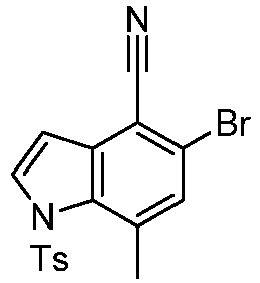
- To a suspension of 5-bromo-7-methyl-1H-indole-4-carbonitrile (Example 13-A) (11.99 g, 51 mmol), TsCl (14.58 g, 77 mmol), and triethylbenzylammonium chloride (1.162 g, 5.10 mmol) in CH2Cl2 (300 ml) was added NaOH (3.06 g, 77 mmol), and then the mixture was stirred at room temperature for 19h. The reaction mixture was quenched with H2O, and the mixture was vigorously stirred for 1h. The mixture was further diluted with CH2Cl2 and the mixture was successively washed with H2O and brine, and the organic layer then dried over Na2SO4, filtered, and concentrated. The resulting residue was triturated with MeOH and the solid was collected by filtration to afford the title compound which was used in the next reaction without the need for further purification. MS (ESI+) m/z 387.0, 389.0 (M-H).
-

- To a solution of 5-bromo-7-methyl-1-tosyl-1 H-indole-4-carbonitrile (Example 13-B) (7 g, 17.98 mmol) in THF (80 ml) was added a 1 M solution of ZnEt2 in hexanes (25 ml, 25.00 mmol), followed by Pd[(t-Bu)3P]2 (500 mg, 0.978 mmol). The mixture was then stirred at room temperature for 3 h and then quenched with MeOH under N2 atmosphere. The mixture was stirred for 1 h. The reaction was poured into a mixture EtOAc/Celite®/half satd. aq. KHSO4. The resulting heterogeneous mixture was filtered through a pad of Celite®. The filtrate was then partitioned and the organic phase was washed successively with H2O, and brine, dried over Na2SO4, filtered, and concentrated. The resulting residue was used in the next reaction without the need for further purification MS (ESI+) m/z 337.1 (M-H).
-

- To a solution of 5-ethyl-7-methyl-1-tosyl-1H-indole-4-carbonitrile (Example 14-A) (5.6 g, 16.55 mmol) in toluene (250 ml) at -78 °C was added a 1 M solution of DIBAL-H in toluene (21.51 ml, 21.51 mmol). The mixture was then stirred at -78 °C for ca. 1 h. The reaction was then quenched with MeOH at -78 °C. To the mixture was added 5N aq. HCl (50 mL), and the reaction mixture was then placed at room temperature and stirred for ca. 1 h. Next Na+/K+ tartrate (Rochelle's salt) and H2O (200 mL) was added. The mixture was then vigorously stirred at room temperature.for ∼ 12 h. The mixture was then diluted with EtOAc and filtered through a pad of Celite®. The filtrate was portioned and the organic layer was washed successively washed with 5% aq. NaHCO3, H2O, and brine, dried over Na2SO4, filtered, and concentrated to furnish the title compounds without the need for further purification. MS (ESI+) m/z 342.0 (M+H).
-

- A mixture 5-ethyl-7-methyl-1-tosyl-1H-indole-4-carbaldehyde (Example 14-B) (5.63 g, 16.5 mmol) and KOH (4.63 g, 83 mmol) in EtOH (50 ml) was stirred at 100 °C for 5 h under the microwave irradiation. The reaction mixture was then diluted with CH2Cl2 and filtered through SiO2 pad. The SiO2 pad was washed with CH2Cl2/MeOH (c.a. 6/1). The filtrate was concentrated to give the title compound without the need for further purification. MS (ESI+) m/z 188.1 (M+H).
-

- To a solution of 5-ethyl-7-methyl-1H-indole-4-carbaldehyde (Example 14-C) (3.09 g, 16.5 mmol), Boc2O (3.83 ml, 16.50 mmol) and Et3N (2.300 ml, 16.50 mmol) in CH3CN (100 ml) was added DMAP (2.016 g, 16.50 mmol), and then the mixture was stirred at room temperature. After ca. 4h the reaction was quenched with H2O. The whole mixture was vigorously stirred at room temperature for ca. 18h. The mixture was then diluted with CH2Cl2 and the organic phase was then washed successively with H2O and brine, dried over Na2SO4, filtered, and concentrated. The resulting residue was purified by silica gel flash column chromatography [heptane/30% EtOAc in CH2Cl2 = 82/18] to give the title compound. MS (ESI+) m/z 288.1 (M+H).
-

- To a solution of 3-((2-(trimethylsilyl)ethoxy)methyl)-3H-imidazo[4,5-b]pyridine-6-carbonitrile (Example 1) (1.2 g, 4.37 mmol) in THF (20 ml) at -78 °C under a nitrogen atmosphere, was added 2N LDA in THF (2.84 ml, 5.69 mmol). The reaction mixture was stirred at -78 °C for 15 min, then a solution of tert-butyl 5-ethyl-4-formyl-7-methyl-1H-indole-1-carboxylate (Example 14-D) (1.320 g, 4.59 mmol) in THF (10 mL) was added. The reaction mixture was stirred at -78 °C for 15 min, and then warmed to room temperature. The reaction mixture was quenched then with sat. aqueous solution of NH4Cl. The mixture was extracted with ethyl acetate twice. The combined organic layers were dried over Na2SO4. After filtration and concentration, the resulting residue was purified by FCC (ethyl acetate/heptanes=0 to 100%) to give the title compound. MS (ESI+) m/z 562.47 (M+H).
-

- To a solution of (±)-tert-butyl 4-((6-cyano-3-((2-(trimethylsilyl)ethoxy)methyl)-3H-imidazo[4,5-b]pyridin-2-yl)(hydroxy)methyl)-5-ethyl-7-methyl-1H-indole-1-carboxylate (Example 14-E) (2 g, 3.56 mmol) in DCM (30 ml) was added MnO2 (6.19 g, 71.2 mmol). The reaction was stirred at rt for 16 h. The reaction mixture was then filtered through a Celite® pad, washed with DCM. The collected organic layers were concentrated to give the title compound. MS (ESI+) m/z 560.33 (M+H).
-

- To a suspension of tert-butyl 4-(6-cyano-3-((2-(trimethylsilyl)ethoxy)methyl)-3H-imidazo[4,5-b]pyridine-2-carbonyl)-5-ethyl-7-methyl-1H-indole-1-carboxylate (Example 14-F) (660 mg, 1.179 mmol) and CsF (17.91 mg, 0.118 mmol) in THF (10 ml) at 0 °C was added trimethyl(trifluoro-methyl)silane (0.553 ml, 3.54 mmol). After addition, the reaction was stirred at 0 °C for 15 min, then at rt for 2 h. Next, a 1 N solution of TBAF in THF (4.72 mL, 4.72 mmol) was added and the reaction mixture which was then stirred at rt for 30 min, then brine was added to quench the reaction. The mixture was extracted with DCM three times. The combined organic layers were dried over Na2SO4. After filtration and concentration, the resulting residue was purified by FCC (ethyl acetate/heptanes=0 to 40%) to give the title compound. MS (ESI+) m/z 630.30 (M+H).
-

- To a 1.25 N solution of HCl in methanol (10 ml, 12.50 mmol) was added to (±)-tert-butyl 4-(1-(6-cyano-3-((2-(trimethylsilyl)ethoxy)methyl)-3H-imidazo[4,5-b]pyridin-2-yl)-2,2,2-trifluoro-1-hydroxyethyl)-5-ethyl-7-methyl-1H-indole-1-carboxylate (Example 14-G) (650 mg, 1.032 mmol). The reaction was stirred at 40°C for 1.5 hr. The reaction mixture was cooled to 0°C and diluted with water and neutralized by NaHCO3 solid slowly. The reaction mixture was extracted with ethyl acetate twice. The combined organic layers were dried over Na2SO4. Filtration and concentration, afforded the title compound without the need for further purification. MS (ESI+) m/z 500.30 (M+H).
-

- To a solution of tert-butyl (±)-4-(1-(6-cyano-3H-imidazo[4,5-b]pyridin-2-yl)-2,2,2-trifluoro-1-hydroxyethyl)-5-ethyl-7-methyl-1H-indole-1-carboxylate (220 mg, 0.440 mmol) (Example 14-H) in methanol (10 ml) was added potassium carbonate (609 mg, 4.40 mmol). The reaction was stirred at 45 °C for 30 min. The reaction mixture was cooled to rt and diluted with water and extracted with ethyl acetate. After separation of layers, the aqueous layer was extracted with ethyl acetate twice. The combined organic layers were dried over Na2SO4. After filtration and concentration, the resulting residue was purified by FCC (ethyl acetate/DCM=0 to 100%) to give title compound. 1H NMR (400 MHz, METHANOL-d 4) δ ppm 8.68 (br. s., 1 H), 8.36 (br. s., 1 H), 6.96 (d, J=3.3 Hz, 1 H), 6.88 (s, 1 H), 5.97 (d, J=2.0 Hz, 1 H), 2.94 - 3.11 (m, 1 H), 2.52 - 2.66 (m, 1 H), 2.47 (s, 3 H), 1.13 (t, J=7.3 Hz, 3 H). HRMS calcd. for C20H16F3N5O (M+H)+ 400.1385, found 400.1378.
- Resolution of the enantiomers (±)-2-(1-(5-ethyl-7-methyl-1H-indol-4-yl)-2,2,2-trifluoro-1-hydroxyethyl)-3H-imidazo[4,5-b]pyridine-6-carbonitrile (Example 14-I) was achieved by chiral SFC using a OD-H column with 10% ethanol (plus 0.2% diethylamine) in CO2 to give (+)-2-(1-(5-ethyl-7-methyl-1H-indol-4-yl)-2,2,2-trifluoro-1-hydroxyethyl)-3H-imidazo[4,5-b]pyridine-6-carbonitrile (tr = 10.46 min) give (-)-2-(1-(5-ethyl-7-methyl-1H-indol-4-yl)-2,2,2-trifluoro-1-hydroxyethyl)-3H-imidazo[4,5-b]pyridine-6-carbonitrile (tr = 15.44 min).
-

- To the mixture of tert-butyl 4-(6-cyano-3-((2-(trimethylsilyl)ethoxy)methyl)-3H-imidazo[4,5-b]pyridine-2-carbonyl)-5-ethyl-7-methyl-1H-indole-1-carboxylate (Example 14-F) (810 mg, 1.45 mmol) and 2-(trimethylsilyl)-ethanesulfonamide (394 mg, 2.17 mmol) under nitrogen, was added 0.5 M stock solution of Zr(O-t-Bu)4 in toluene (6.52 mL, 3.26 mmol). The reaction was stirred and heated at 100 °C for 3 hr. The reaction was then cooled to rt and additional 2-(trimethylsilyl)ethanesulfonamide (262 mg, 1.45 mmol) was added, followed by additional 0.5 M Zr(O-t-Bu)4 in toluene stock solution (4.34 mL, 2.17 mmol). The reaction was stirred and heated at 100 °C for 2 hrs. Then the reaction mixture was cooled to -40°C and a 3 M solution of MeMgl in THF (3.0 mL, 9.0 mmol) was added dropwise very slowly via syringe. After the addition was complete, the reaction was quenched via successive slow addition of methanol, and 1 N HCl. The reaction mixture was then diluted with DCM and water and brought to pH ∼7 by addition of solid NaHCO3 solid till pH>7. Celite® was then added and the mixture stirred for 30 minutes, at which time the heterogeneous mixture was filtered, through a Celite® pad, which was washed with DCM. The filtrate separation was portioned and the aqueous layer was extracted with DCM twice. The combined organic layers were dried over Na2SO4. After filtration and concentration, the resulting residue was purified by FCC ((30% ethyl acetate in DCM)/ heptanes=0 to 100%) to give the title compound. MS (ESI+) m/z 739.49 (M+H).
-
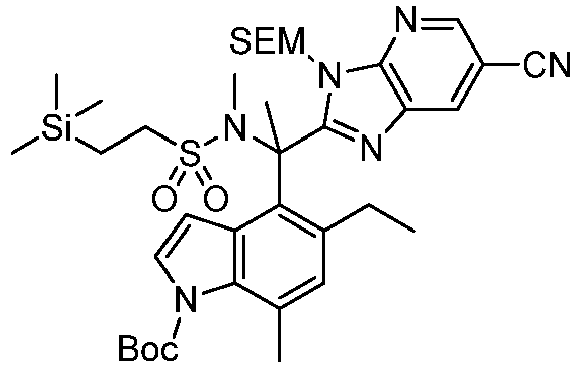
- To a suspension of (±)-tert-butyl 4-(1-(6-cyano-3-((2-(trimethylsilyl)ethoxy)methyl)-3H-imidazo[4,5-b]pyridin-2-yl)-1-(2-(trimethylsilyl)ethylsulfonamido)ethyl)-5-ethyl-7-methyl-1H-indole-1-carboxylate (Example 15-A) (300 mg, 0.406 mmol) and potassium carbonate (561 mg, 4.06 mmol) in acetone (15 ml) was added iodomethane (254 µl, 4.06 mmol). The reaction was heated to 65 °C and stirred for 20 h. The reaction mixture was cooled to rt and diluted with water. The mixture was extracted with ethyl acetate three times. The combined organic layers were dried over Na2SO4. After filtration and concentration, the resulting residue was used to next step without purification. MS (ESI+) m/z 753.45 (M+H).
-

- To a solution of (±)-tert-butyl 4-(1-(6-cyano-3-((2-(trimethylsilyl)ethoxy)methyl)-3H-imidazo[4,5-b]pyridin-2-yl)-1-(N-methyl-2-(trimethylsilyl)ethylsulfonamido)ethyl)-5-ethyl-7-methyl-1H-indole-1-carboxylate (Example 15-B) (440 mg, 0.584 mmol) in DMF (4 ml), was added CsF (887 mg, 5.84 mmol). The reaction is heated to 100 °C for 3 h. The reaction mixture was then diluted with water (10 ml) and extracted with 20 ml of a mixed solution of ethyl acetate and heptanes(1/1). The organic layer was separated and aqueous layer was extracted with ethyl acetate-heptanes (1/1) solution twice. The combined organic layers were washed with brine and dried over Na2SO4. After filtration and concentration, the resulting residue was purified by FCC (ethyl acetate/DCM=0 to 50%) to give the title compound. MS (ESI+) m/z 589.3 (M+H).
-

- To a 1.25 N solution of HCl in methanol (6.25 mL, 7.81 mmol) was added to (±)-tert-butyl 4-(1-(6-cyano-3-((2-(trimethylsilyl)ethoxy)methyl)-3H-imidazo[4,5-b]pyridin-2-yl)-1-(methylamino)ethyl)-5-ethyl-7-methyl-1H-indole-1-carboxylate (Example 15-C) (230 mg, 0.391 mmol). The reaction was stirred at 40 °C for 0.5 h and then the reaction mixture was cooled to 0 °C and diluted with methanol (10 ml), and then slowly charged with solid potassium carbonate (2.7 g, 19.54 mmol) to basicify the mixture. Then, the reaction mixture was heated at 45 °C for 1 h. The reaction mixture was then cooled to rt and diluted with water and extracted with ethyl acetate twice. The combined organic layers were washed with brine and dried over Na2SO4. After filtration and concentration, the resulting residue was purified by FCC (ethyl acetate/DCM=0 to 100%). The product was further purified by acidic HPLC (acetonitrile/0.1% TFA in water=20% to 80%) to give the title compound as TFA salt. 1H NMR (400 MHz, METHANOL-d 4) δ ppm 8.63 - 8.90 (m, 1 H), 8.06 - 8.63 (m, 1 H), 7.28 (br. s., 1 H), 7.02 (s, 1 H), 6.30 (br. s., 1 H), 2.67 - 2.79 (m, 1 H), 2.55 - 2.64 (m, 4 H), 2.54 (s, 3 H), 2.52 (s, 3 H), 1.05 (t, J=7.4 Hz, 3 H). HRMS calcd. for C20H22N6 (M-NHMe)+ 328.1562, found 328.2563. MS (ESI+) m/z 359.2 (M+H).
-

- To a solution of 5-bromo-7-methyl-1-tosyl-1H-indole-4-carbonitrile (Example 13-B) (10 g, 25.7 mmol) in toluene (500 ml) at -78 °C was added 1 M DIBAL-H (38.5 ml, 38.5 mmol) in toluene over 10 min. The mixture was then stirred at -78 °C for ca. 75 minutes. The reaction was then quenched with MeOH at -78 °C. To the mixture was then added 5 N aq. HCl (100 mL), and the reaction mixture was then placed at room temperature for 2 h at which time an excess of solid Na+/K+ tartrate (Rochelle's Salt) was added followed by H2O (100 mL The mixture was then vigorously stirred at room temperature for ca. 3h and then diluted with EtOAc. The mixture was filtered through Celite® pad and the filtrate was partitioned. The organic phase was successively washed with 5% aq. NaHCO3, H2O, and brine, dried over Na2SO4, filtered, and concentrated to furnish the title compound without the need for further purification need for further purification. MS (ESI+) m/z 392.0, 394.0 (M+H).
-

- To a solution of 5-bromo-7-methyl-1-tosyl-1H-indole-4-carbaldehyde (Example 16-A) (6.5 g, 16.57 mmol) in 1,4-dioxane (50 ml)/H2O (5 ml) was added KOH (2 g, 35.6 mmol). The mixture was stirred at 100 °C for ca. 3 h. The reaction mixture was then diluted with CH2Cl2, and the mixture was washed with H2O and brine, and the organic layer dried over Na2SO4, filtered, and concentrated to afford the title compound without the need for further purification.. MS (ESI+) m/z 237.9, 239.9 (M+H).
-

- To a solution of 5-bromo-7-methyl-1H-indole-4-carbaldehyde (Example 16-B) (3.6 g, 15.12 mmol) in CH3CN was added Boc2O (7.02 ml, 30.2 mmol), followed by DMAP (0.185 g, 1.512 mmol). The mixture was stirred at room temperature for ca. 1 h. Then the reaction was quenched with H2O. The whole mixture was vigorously stirred for 0.5h. The mixture was then diluted with CH2Cl2. The organic phase was then washed successively with H2O and brine, dried over Na2SO4, filtered, and concentrated. The resulting residue was purified by silica gel flash column chromatography [heptane/30% EtOAc in CH2Cl2 = 85/15] to give the title compound. MS (ESI+) m/z 338.0, 340.0 (M+H).
-

- To a suspension of tert-butyl 5-bromo-4-formyl-7-methyl-1H-indole-1-carboxylate (Example 16-C) (9.5 g, 14.05 mmol) in toluene (50 ml)/H2O (20 ml) at room temperature was added Cs2CO3 (27.5 g, 84 mmol), potassium cyclopropyltetrafluoroborate (4.16 g, 28.1 mmol), and Ru-Phos (CAS#; 787618-22-8) (2.62 g, 5.62 mmol), followed by and Pd(OAc)2 (0.631 g, 2.81 mmol). The whole mixture was then stirred at 100 °C for 2 h. The reaction mixture was cooled down to room temperature and diluted with CH2Cl2. The organic layer was washed successively with H2O and brine, dried over Na2SO4, filtered and concentrated. The resulting residue was purified by silica gel flash column chromatography [heptane/(30% EtOAc in CH2Cl2) =82/18] the resulting solid was triturated with heptane, and then the heptane layer was decanted out to furnish the title compound. MS (ESI+) m/z 300.1 (M+H).
-

- To a solution of 3-((2-(trimethylsilyl) ethoxy)methyl)-3H-imidazo[4,5-b]pyridine-6-carbonitrile (1.567 g, 5.71 mmol) (Example 1) in THF (20 ml) at -78°C under nitrogen atmosphere, was added a 1.8 M solution of LDA in THF (4.34 ml, 7.82 mmol). The reaction mixture is stirred at -78 °C for 15 min, then a solution of tert-butyl 5-cyclopropyl-4-formyl-7-methyl-1H-indole-1-carboxylate (Example 16-D) (1.8 g, 6.01 mmol) in THF (10 mL) was added. The reaction mixture was stirred at -78 °C for 15 min, then warmed to rt. The reaction mixture was quenched with sat. aqueous NH4Cl solution. The mixture was extracted with ethyl acetate twice. The combined organic layers were dried over Na2SO4. After filtration and concentration, the resulting residue was purified by FCC (ethyl acetate/heptanes=0 to 80%) to give the title compound. MS (ESI+) m/z 574.4 (M+H).
-

- A 1 N solution of HCl in methanol (10 mL, 10 mmol) was added to (±)-tert-butyl 4-((6-cyano-3-((2-(trimethylsilyl)ethoxy)methyl)-3H-imidazo[4,5-b]pyridin-2-yl)(hydroxy)methyl)-5-cyclopropyl-7-methyl-1H-indole-1-carboxylate (Example 16-E) (345 mg, 0.601 mmol). The reaction was stirred at 40 °C for 3 h. The reaction mixture was then cooled to 0 °C and diluted with DCM. The reaction mixture was washed with water and brine and dried over Na2SO4. After filtration and concentration, the resulting residue was purified by FCC (DCM / 2M ammonia in MeOH =96/4, isocratic) to give the title compound. MS (ESI+) m/z 444.1 (M+H).
-

- A suspension of (±)-tert-butyl 4-((6-cyano-3H-imidazo[4,5-b]pyridin-2-yl)(hydroxy)methyl) -5-cyclopropyl-7-methyl-1H-indole-1-carboxylate (Example 16-F) (220 mg, 0.496 mmol) and Cs2CO3 (323 mg, 0.992 mmol) in MeOH (5 mL) was stirred at 60 °C for 4 h. The reaction mixture was then cooled to rt and absorbed onto silica gel and purified by FCC (CH2Cl2 / 2M NH3 in MeOH = 96/4, isocratic) to give the title compound. 1H NMR (400 MHz, CD3CN with 5µL TFA) δ ppm 9.32 (br. s., 1 H), 8.78 (d, J=1.90 Hz, 1 H), 8.39 (d, J=1.89 Hz, 1 H), 7.16 (dd, J=2.80, 2.90 Hz, 1 H), 7.05 (s, 1 H), 6.82 (s, 1 H), 6.20-6.23 (m, 1 H), 2.46 (d, J=0.76 Hz, 3 H), 2.11-2.18 (m, 1 H), 0.74 - 0.94 (m, 3 H), 0.51 - 0.57 (m, 1 H). HRMS calcd. for C20H17N5O (M+H)+ 344.1506, found 344.1468
-

- To a solution of (±)-tert-butyl 4-((6-cyano-3-((2-(trimethylsilyl)ethoxy)methyl)-3H-imidazo[4,5-b]pyridin-2-yl)(hydroxy)methyl)-5-cyclopropyl-7-methyl-1H-indole-1-carboxylate (3.02 g, 5.26 mmol) (Example 16-E) in DCM (100 ml) was added MnO2 (9.15 g, 105 mmol). The reaction was stirred at rt for 16 h. The reaction mixture was filtered through a Celite® pad. DCM was used to wash the pad. The collected filtrate was concentrated to give the title compound. MS (ESI+) m/z 572.5 (M+H).
-

- To a solution of tert-butyl 4-(6-cyano-3-((2-(trimethylsilyl)ethoxy)methyl)-3H-imidazo[4,5-b]pyridine-2-carbonyl)-5-cyclopropyl-7-methyl-1H-indole-1-carboxylate (Example 17-A) (600 mg, 1.049 mmol) in THF (10 ml) at -20 °C, was added a 3 M solution of CH3Mgl in THF (1.049 ml, 3.15 mmol). The reaction was stirred at -20 °C for 10 min, and then stirred at rt for 10 min. The reaction was quenched with sat. aqueous NH4Cl and extracted with ethyl acetate twice. The combined organic layers were dried over Na2SO4. Filtration and concentration afforded the title compound without the need for further purification. MS (ESI+) m/z 588.2 (M+H).
- To the mixture of 1 N TBAF in THF (20.08 mL, 20.08 mmol) and (±)-tert-butyl 4-(1-(6-cyano-3-((2-(trimethylsilyl)ethoxy)methyl)-3H-imidazo[4,5-b]pyridin-2-yl)-1-hydroxyethyl)-5-cyclopropyl-7-methyl-1H-indole-1-carboxylate (Example 17-B) (590 mg, 1.004 mmol) was added 1 ml of ethylenediamine. The reaction mixture was heated to 45 °C for 30 min and then the reaction mixture was concentrated. The resulting residue was taken up in MeOH (15 mL) and charged with K2CO3 (2775 mg, 20.08 mmol). The reaction mixture was heated to 60 °C for 1.5 h. The reaction mixture was then cooled to rt and diluted with water and extracted with ethyl acetate twice. The combined organic layers were dried over Na2SO4. After filtration and concentration, the resulting residue was purified by FCC (ethyl acetate/DCM=0 to 100% at 70%) to give the title compound. 1H NMR (400 MHz, METHANOL-d 4) δ ppm 8.51 - 8.78 (m, 1 H), 8.02 - 8.41 (m, 1 H), 7.15 (d, J=3.3 Hz, 1 H), 6.74 (d, J=14.1 Hz, 1 H), 6.54 (s, 1 H), 2.43 (s, 3 H), 2.31 (br. s., 3 H), 1.71 - 1.91 (m, 1 H), 0.46 - 0.72 (m, 2 H), 0.40 (dd, J=8.0, 5.7 Hz, 1 H), 0.14 - 0.27 (m, 1 H). HRMS calcd. for C21H19N5O (M+H)+ 358.1668, found 358.1663.
-

- To a suspension of tert-butyl 4-(6-cyano-3-((2-(trimethylsilyl)ethoxy)methyl)-3H-imidazo[4,5-b]pyridine-2-carbonyl)-5-cyclopropyl-7-methyl-1H-indole-1-carboxylate (1.1 g, 1.924 mmol) (Example 17-A) and CsF (0.058 g, 0.385 mmol) in THF (15 ml) at 0°C, was added trimethyl(trifluoromethyl)silane (0.752 ml, 4.81 mmol). After addition, the reaction was stirred at 0 °C for 15 min, then at rt for 2 h. Then a 1 N solution of TBAF in THF (9.62 ml, 9.62 mmol) was added and the reaction mixture was stirred at rt for an additional 30 min. the mixture was then quenched with brine and extracted with DCM three times. The combined organic layers were dried over Na2SO4. After filtration and concentration, the resulting residue was purified by FCC (ethyl acetate/heptanes=0 to 40%) to give the title compound. MS (ESI+) m/z 642.2 (M+H).
-

- The mixture of 1.25 N HCl solution in MeOH (22.4 mL, 28.0 mmol) and (±)- tert-butyl 4-(1-(6-cyano-3-((2-(trimethylsilyl)ethoxy)methyl)-3H-imidazo[4,5-b]pyridin-2-yl)-2,2,2-trifluoro-1-hydroxyethyl)-5-cyclopropyl-7-methyl-1H-indole-1-carboxylate (Example 17-D) (900 mg, 1.402 mmol) was stirred at 40°C for 1 h. The reaction mixture was cooled to 0°C and diluted with water and neutralized by NaHCO3 solid slowly. The reaction mixture was extracted with ethyl acetate twice. The combined organic layers were dried over Na2SO4. After filtration and concentration, the resulting residue was used to next step without purification. MS (ESI+) m/z 512.3 (M+H).
-

- To a solution of (±)-tert-butyl 4-(1-(6-cyano-3H-imidazo[4,5-b]pyridin-2-yl)-2,2,2-trifluoro-1-hydroxyethyl)-5-cyclopropyl-7-methyl-1H-indole-1-carboxylate (Example 17-E) (250 mg, 0.489 mmol) in CHCl3 (5 ml) was added one drop of DMF (∼ 10 µL). Then thionyl chloride (357 µL, 4.89 mmol) was added. The reaction was heated to 75 °C for 30 min, and then cooled to 0°C. A 7 N solution ammonia in methanol (3 mL) was then added carefully and slowly to the reaction mixture. After addition, the reaction was stirred at rt for 15 min and then diluted with ethyl acetate and brine. The resulting layers were separated and the aqueous layer was extracted with ethyl acetate three times. The combined organic layers were dried over Na2SO4. After filtration and concentration, the resulting residue was purified by FCC (ethyl acetate/heptanes=0 to 100%) to give the title compound. MS (ESI+) m/z 511.2 (M+H).
-

- To a solution of (±)-tert-butyl 4-(1-amino-1-(6-cyano-3H-imidazo[4,5-b]pyridin-2-yl)-2,2,2-trifluoroethyl)-5-cyclopropyl-7-methyl-1H-indole-1-carboxylate (Example 17-F) (26 mg, 0.051 mmol) in methanol (2 ml) was added K2CO3 (70.4 mg, 0.509 mmol). The reaction was heated to 45 °C for 1 h. The reaction mixture was then diluted with brine and ethyl acetate. After separation of the resulting layers, the aqueous layer was extracted with ethyl acetate three times. The combined organic layers were dried over Na2SO4. After filtration and concentration, the resulting residue was purified by FCC (ethyl acetate/ heptane=0 to 100%) and further purified by acidic HPLC (ACN/water with 0.1% TFA=20% to 60%) to give the title compound as TFA salt. 1H NMR (400 MHz, METHANOL-d 4) δ ppm 8.66 (d, J=1.9 Hz, 1 H), 8.32 (d, J=1.6 Hz, 1 H), 7.10 (d, J=3.3 Hz, 1 H), 6.58 (s, 1 H), 6.50 (br. s., 1 H), 2.46 (s, 2 H), 2.46 (s, 3 H), 2.13 - 2.28 (m, 1 H), 0.78 - 0.86 (m, 1 H), 0.66 - 0.76 (m, 1 H), 0.46 - 0.55 (m, 1 H), 0.11 - 0.24 (m, 1 H). HRMS calcd. for C21H17F3N6 (M+H)+ 411.1545, found 411.1546.
- Compounds of invention are active on factor B inhibition. Data on Table 1 collected using the assay of Biological Example 2.7.
Table 1. Example number IC50 (nM) 5-B b) (+) 290 5-B b) (-) 140 6-C b) (-) 90 6-C b) (+) 700 7-D b) (+) 50 7-D b) (-) 130 8-B b) (+) 720 8-B b) (-) 30 9-D b) (+) 1525 9-D b) (-) 30 10-B b) (-) 40 10-B b) (+) 1380 11-B b) (-) 295 11-B b) (+) 3135 12-D 40 14-I b) (+) 2350 14-I b) (-) 100 15-D 540 16-G 460 17-C 60 17-G 90
Suitable compositions for oral administration include an effective amount of a compound of the invention in the form of tablets, lozenges, aqueous or oily suspensions, dispersible powders or granules, emulsion, hard or soft capsules, or syrups or elixirs. Compositions intended for oral use are prepared according to any method known in the art for the manufacture of pharmaceutical compositions and such compositions can contain one or more agents selected from the group consisting of sweetening agents, flavoring agents, coloring agents and preserving agents in order to provide pharmaceutically elegant and palatable preparations. Tablets may contain the active ingredient in admixture with nontoxic pharmaceutically acceptable excipients which are suitable for the manufacture of tablets. These excipients are, for example, inert diluents, such as calcium carbonate, sodium carbonate, lactose, calcium phosphate or sodium phosphate; granulating and disintegrating agents, for example, corn starch, or alginic acid; binding agents, for example, starch, gelatin or acacia; and lubricating agents, for example magnesium stearate, stearic acid or talc. The tablets are uncoated or coated by known techniques to delay disintegration and absorption in the gastrointestinal tract and thereby provide a sustained action over a longer period. For example, a time delay material such as glyceryl monostearate or glyceryl distearate can be employed. Formulations for oral use can be presented as hard gelatin capsules wherein the active ingredient is mixed with an inert solid diluent, for example, calcium carbonate, calcium phosphate or kaolin, or as soft gelatin capsules wherein the active ingredient is mixed with water or an oil medium, for example, peanut oil, liquid paraffin or olive oil.
Certain injectable compositions are aqueous isotonic solutions or suspensions, and suppositories are advantageously prepared from fatty emulsions or suspensions. Said compositions may be sterilized and/or contain adjuvants, such as preserving, stabilizing, wetting or emulsifying agents, solution promoters, salts for regulating the osmotic pressure and/or buffers. In addition, they may also contain other therapeutically valuable substances. Said compositions are prepared according to conventional mixing, granulating or coating methods, respectively, and contain about 0.1-75%, or contain about 1-50%, of the active ingredient.
Suitable compositions for transdermal application include an effective amount of a compound of the invention with a suitable carrier. Carriers suitable for transdermal delivery include absorbable pharmacologically acceptable solvents to assist passage through the skin of the host. For example, transdermal devices are in the form of a bandage comprising a backing member, a reservoir containing the compound optionally with carriers, optionally a rate controlling barrier to deliver the compound of the skin of the host at a controlled and predetermined rate over a prolonged period of time, and means to secure the device to the skin.
Suitable compositions for topical application, e.g., to the skin and eyes, include aqueous solutions, suspensions, ointments, creams, gels or sprayable formulations, e.g., for delivery by aerosol or the like. Such topical delivery systems will in particular be appropriate for dermal application, e.g., for the treatment of skin cancer, e.g., for prophylactic use in sun creams, lotions, sprays and the like. They are thus particularly suited for use in topical, including cosmetic, formulations well-known in the art. Such may contain solubilizers, stabilizers, tonicity enhancing agents, buffers and preservatives.
As used herein a topical application may also pertain to an inhalation or to an intranasal application. They may be conveniently delivered in the form of a dry powder (either alone, as a mixture, for example a dry blend with lactose, or a mixed component particle, for example with phospholipids) from a dry powder inhaler or an aerosol spray presentation from a pressurised container, pump, spray, atomizer or nebuliser, with or without the use of a suitable propellant.
Claims (17)
- A compound, or salt or a tautomer thereof, according to Formula (I):

 X is N or CH;Y is N(H), O or S;R1 is halogen, C1-C6alkyl, C2-C6alkenyl, C3-C6cycloalkyl, C1-C6alkoxy, haloC1-C6alkyl, hydroxyC1-C6alkyl, aminoC1-C6alkyl, C1-C6alkoxyC1-C6alkyl, C1-C6alkoxyC1-C6alkoxy, C3-C6cycloalkylC1-C6alkoxy, haloC1-C6alkoxy, S(O)pC1-C6alkyl, CH2NHC(O)C1-C4alkyl or OCH2C(O)R7,p is 0, 1, or 2;R2 is C1-C6alkyl, C1-C6alkoxy, hydroxyC1-C6alkyl or halogen;R3 is hydrogen, halogen, cyano, C1-C4alkyl, haloC1-C4alkyl, CH2C(O)R7, phenyl or 5 or 6 member heteroaryl having 1, 2 or 3 ring heteroatoms independently selected from N, O or S, wherein the phenyl or heteroaryl is optionally substituted with 0, 1, or 2 C1-C4alkyl groups, and wherein alkyl and haloalkyl optionally substituted with 0 or 1 hydroxy;R4 is 0, 1, or 2 substitutents independently selected at each occurrence from halogen and C1-C6alkyl;R5 is hydrogen, C1-C6alkyl, haloC1-C6alkyl, C3-C6cycloalkyl, phenyl or 5 or 6 member heteroaryl having 1, 2 or 3 ring heteroatoms independently selected from N, O or S;or R3 and R5 taken in combination form a divalent -CH2-CH2- or -CH2-N(H)- group;R6 is hydrogen, hydroxy, amino, C1-C6alkyl, C1-C6alkoxy, C1-C6alkoxyC1-C6alkoxy, mono-and di-C1-C4alkylamino, amino C1-C6alkylamino, [CRA 2]nR10, O[CRA 2]nR7, NHC(O)C1-C6alkyl, NHS(O2)C1-C6alkyl, CH2R9, OCH2R9, N(H)[CRA 2]nR7, C(O)R7 or N(H) [CRA 2]n C(O)R7;or CR5R6, taken in combination, form a divalent carbonyl group, a divalent =CH2 group or cyclopropyl which cyclopropyl is optionally substituted by CO2 or CH2OH;or when R5 is hydrogen, then R6 may also be selected from [CRA 2]nR7 or [CRA 2]nC(O)R7; n is 1, 2, or 3;RA is independently selected at each occurrence from hydrogen, halogen or C1-C4alkyl;R7 is hydroxy, C1-C4alkoxy, amino, or mono- and di-C1-C4alkylamino;R9 is a 5 member heteroaryl having 1 to 4 ring heteroatoms selected from N, O or S and optionally substituted with 0, 1, or 2 C1-C4alkyl groups; andR10 is amino or mono- and di-C1-C4alkylamino.
 - The compound of claim 1, or salt or tautomer thereof, according to Formula (Ia):

- The compound of claim 1 or claim 2, or salt or tautomer thereof, wherein R4 is absent.
- The compound of one of claims 1 to 3, or salt or tautomer thereof, wherein R3 is hydrogen, chloro or phenyl.
- The compound of one of claims 1 to 4, or salt or tautomer thereof, wherein R3 is hydrogen.
- The compound of any one of claims 1 to 5, or a salt or tautomer thereof, wherein R2 is methyl.
- The compound of any one of claims 1 to 6, or a salt or tautomer thereof, wherein R1 is halogen, C1-C4alkyl, vinyl, cyclopropyl, C1-C4alkoxy, hydroxyC1-C4alkyl, C1-C4alkoxyC1-C4alkyl, C1-C4alkoxyC1-C4alkoxy, cyclopropylC1-C4alkoxy, haloC1-C4alkoxy or S(O)2C1-C4alkyl.
- The compound of any one of claims 1 to 7, or a salt or tautomer thereof, wherein R1 is C1-C4alkyl, C1-C4alkoxy, cyclopropyl, bromo or difluoromethoxy.
- The compound of any one of claims 1 to 8, or a salt or tautomer thereof, wherein R5 is hydrogen, methyl, ethyl cyclopropyl or trifluoromethyl.
- The compound of any one of clams 1 to 9, or a salt or tautomer thereof, wherein R6 is hydrogen, hydroxy, methoxy, amino, mono- and di-methylamino or CH2R10;
or when R5 is hydrogen, then R6 may also be selected from CH2R7 or CH2C(O)R7, [CH2]2R7 or [CH2]2C(O)R7;
R7 is hydroxy, amino, N(H)CH3 or N(CH3)2; and
R10 is amino, N(H)CH3 or N(CH3)2. - The compound of any one of claims 1 to 10, or a salt or tautomer thereof, wherein R5 is methyl or trifluoromethyl;
R6 is hydroxy, methoxy, amino, methylamino or CH2R7; and
R7 is amino, N(H)CH3 or N(CH3)2. - The compound of claim 2, salt or tautomer thereof, wherein
R1 is C1-C4alkyl, C1-C4alkoxy, or cyclopropyl;
R2 is methyl;
R3 and R4 are hydrogen;
R5 is hydroxyl, amino, mono- and di-C1-C2alkylamino, C1-C2alkyl, or C1-C2alkoxy; and
R6 is hydrogen, C1-C2alkyl, or trifluoromethyl. - The compound of claim 1, or a salt or tautomer thereof, which compound is selected from the group consisting of
(+)-2-(1-amino-2,2,2-trifluoro-1-(5-methoxy-7-methyl-1H-indol-4-yl)ethyl)-3H-imidazo[4,5-b]pyridine-6-carbonitrile;
(-)-2-(1-amino-2,2,2-trifluoro-1-(5-methoxy-7-methyl-1H-indol-4-yl)ethyl)-3H-imidazo[4,5-b]pyridine-6-carbonitrile;
(+)-2-(hydroxy(5-methoxy-7-methyl-1H-indol-4-yl)methyl)-1H-imidazo[4,5-b]pyridine-6-carbonitrile;
(-)-2-(hydroxy(5-methoxy-7-methyl-1H-indol-4-yl)methyl)-1H-imidazo[4,5-b]pyridine-6-carbonitrile;
(+)-2-(1-hydroxy-1-(5-methoxy-7-methyl-1H-indol-4-yl)ethyl)-3H-imidazo[4,5-b]pyridine-6-carbonitrile;
(-)-2-(1-hydroxy-1-(5-methoxy-7-methyl-1H-indol-4-yl)ethyl)-3H-imidazo[4,5-b]pyridine-6-carbonitrile;
(+)-2-(1-methoxy-1-(5-methoxy-7-methyl-1H-indol-4-yl)ethyl)-3H-imidazo[4,5-b]pyridine-6-carbonitrile;
(-)-2-(1-methoxy-1-(5-methoxy-7-methyl-1H-indol-4-yl)ethyl)-3H-imidazo[4,5-b]pyridine-6-carbonitrile;
(+)-2-(2,2,2-trifluoro-1-(5-methoxy-7-methyl-1H-indol-4-yl)-1-(methylamino)ethyl)-3H-imidazo[4,5-b]pyridine-6-carbonitrile;
(-)-2-(2,2,2-trifluoro-1-(5-methoxy-7-methyl-1H-indol-4-yl)-1-(methylamino)ethyl)-3H-imidazo[4,5-b]pyridine-6-carbonitrile;
(+)-2-(1-amino-1-(5-methoxy-7-methyl-1H-indol-4-yl)ethyl)-3H-imidazo[4,5-b]pyridine-6-carbonitrile;
(-)-2-(1-amino-1-(5-methoxy-7-methyl-1H-indol-4-yl)ethyl)-3H-imidazo[4,5-b]pyridine-6-carbonitrile;
(+)-2-(1-(5-methoxy-7-methyl-1H-indol-4-yl)-1-(methylamino)ethyl)-3H-imidazo[4,5-b]pyridine-6-carbonitrile;
(-)-2-(1-(5-methoxy-7-methyl-1H-indol-4-yl)-1-(methylamino)ethyl)-3H-imidazo[4,5-b]pyridine-6-carbonitrile;
2-(2-(5-methoxy-7-methyl-1H-indol-4-yl)propan-2-yl)-3H-imidazo[4,5-b]pyridine-6-carbonitrile;
(+)-2-(1-(5-ethyl-7-methyl-1H-indol-4-yl)-2,2,2-trifluoro-1-hydroxyethyl)-3H-imidazo[4,5-b]pyridine-6-carbonitrile;
(-)-2-(1-(5-ethyl-7-methyl-1H-indol-4-yl)-2,2,2-trifluoro-1-hydroxyethyl)-3H-imidazo[4,5-b]pyridine-6-carbonitrile;
(±)-2-(1-(5-ethyl-7-methyl-1H-indol-4-yl)-1-(methylamino)ethyl)-3H-imidazo[4,5-b]pyridine-6-carbonitrile;
(±)-2-((5-cyclopropyl-7-methyl-1H-indol-4-yl)(hydroxy)methyl)-3H-imidazo[4,5-b]pyridine-6-carbonitrile;
(±)-2-(1-(5-cyclopropyl-7-methyl-1H-indol-4-yl)-1-hydroxyethyl)-3H-imidazo[4,5-b]pyridine-6-carbonitrile;
(±)-2-(1-amino-1-(5-cyclopropyl-7-methyl-1H-indol-4-yl)-2,2,2-trifluoroethyl)-3H-imidazo[4,5-b]pyridine-6-carbonitrile; and salts and tautomers thereof. - A pharmaceutical composition comprising one or more pharmaceutically acceptable carriers and a therapeutically effective amount of a compound of any one of claims 1-13.
- A combination, in particular a pharmaceutical combination, comprising a therapeutically effective amount of the compound according to any one of claims 1-13 and a second therapeutically active agent.
- A compound according to any one of claims 1-13, for use as a medicament.
- A compound according to any one of claims 1-13, for use in the treatment of a disorder or disease in a subject mediated by complement activation or activation of the complement alternative pathway, wherein the disease or disorder is age-related macular degeneration, geographic atrophy, diabetic retinopathy, uveitis, retinitis pigmentosa, macular edema, Behcet's uveitis, multifocal choroiditis, Vogt-Koyangi-Harada syndrome, imtermediate uveitis, birdshot retino-chorioditis, sympathetic ophthalmia, ocular dicatricial pemphigoid, ocular pemphigus, nonartertic ischemic optic neuropathy, post-operative inflammation, retinal vein occlusion, neurological disorders, multiple sclerosis, stroke, Guillain Barre Syndrome, traumatic brain injury, Parkinson's disease, disorders of inappropriate or undesirable complement activation, hemodialysis complications, hyperacute allograft rejection, xenograft rejection, interleukin-2 induced toxicity during IL-2 therapy, inflammatory disorders, inflammation of autoimmune diseases, Crohn's disease, adult respiratory distress syndrome, myocarditis, post-ischemic reperfusion conditions, myocardial infarction, balloon angioplasty, post-pump syndrome in cardiopulmonary bypass or renal bypass, atherosclerosis, hemodialysis, renal ischemia, mesenteric artery reperfusion after aortic reconstruction, infectious disease or sepsis, immune complex disorders and autoimmune diseases, rheumatoid arthritis, systemic lupus erythematosus (SLE), SLE nephritis, proliferative nephritis, liver fibrosis, hemolytic anemia, myasthenia gravis, tissue regeneration, neural regeneration, dyspnea, hemoptysis, ARDS, asthma, chronic obstructive pulmonary disease (COPD), emphysema, pulmonary embolisms and infarcts, pneumonia, fibrogenic dust diseases, pulmonary fibrosis, asthma, allergy, bronchoconstriction, hypersensitivity pneumonitis, parasitic diseases, Goodpasture's Syndrome, pulmonary vasculitis, Pauci-immune vasculitis, immune complex-associated inflammation, antiphospholipid syndrome, glomerulonephritis and obesity.
Applications Claiming Priority (2)
| Application Number | Priority Date | Filing Date | Title |
|---|---|---|---|
| US201361782750P | 2013-03-14 | 2013-03-14 | |
| PCT/US2014/026875 WO2014143638A1 (en) | 2013-03-14 | 2014-03-13 | 2-(1h-indol-4-ylmethyl)-3h-imidazo[4,5-b]pyridine-6-carbonitrile derivatives as complement factor b inhibitors useful for the treatment of ophthalmic diseases |
Publications (2)
| Publication Number | Publication Date |
|---|---|
| EP2970269A1 EP2970269A1 (en) | 2016-01-20 |
| EP2970269B1 true EP2970269B1 (en) | 2017-04-19 |
Family
ID=50549464
Family Applications (1)
| Application Number | Title | Priority Date | Filing Date |
|---|---|---|---|
| EP14719470.8A Not-in-force EP2970269B1 (en) | 2013-03-14 | 2014-03-13 | 2-(1h-indol-4-ylmethyl)-3h-imidazo[4,5-b]pyridine-6-carbonitrile derivatives as complement factor b inhibitors useful for the treatment of ophthalmic diseases |
Country Status (5)
| Country | Link |
|---|---|
| US (1) | US9475806B2 (en) |
| EP (1) | EP2970269B1 (en) |
| JP (1) | JP6387391B2 (en) |
| CN (1) | CN105229003B (en) |
| WO (1) | WO2014143638A1 (en) |
Families Citing this family (33)
| Publication number | Priority date | Publication date | Assignee | Title |
|---|---|---|---|---|
| CN105849090A (en) | 2013-10-30 | 2016-08-10 | 诺华股份有限公司 | 2-benzyl-benzimidazole complement factor b inhibitors and uses thereof |
| WO2017035405A1 (en) | 2015-08-26 | 2017-03-02 | Achillion Pharmaceuticals, Inc. | Amino compounds for treatment of immune and inflammatory disorders |
| AR106018A1 (en) | 2015-08-26 | 2017-12-06 | Achillion Pharmaceuticals Inc | ARYL, HETEROARYL AND HETEROCYCLIC COMPOUNDS FOR THE TREATMENT OF MEDICAL DISORDERS |
| EP3340983B1 (en) | 2015-08-26 | 2023-10-04 | Achillion Pharmaceuticals, Inc. | Aryl, heteroaryl, and heterocyclic compounds for treatment of immune and inflammatory disorders |
| WO2017035401A1 (en) | 2015-08-26 | 2017-03-02 | Achillion Pharmaceuticals, Inc. | Amide compounds for treatment of immune and inflammatory disorders |
| CN109414441A (en) | 2016-06-27 | 2019-03-01 | 艾其林医药公司 | The quinazoline and benzazolyl compounds for treating medical disorder |
| WO2018160891A1 (en) | 2017-03-01 | 2018-09-07 | Achillion Pharmaceutical, Inc. | Pharmaceutical compounds for treatment of medical disorders |
| WO2018160892A1 (en) | 2017-03-01 | 2018-09-07 | Achillion Pharmaceuticals, Inc. | Macrocyclic compounds for treatment of medical disorders |
| KR102632860B1 (en) | 2017-03-01 | 2024-02-02 | 아칠리온 파르마세우티칼스 인코포레이티드 | Aryl, heteroaryl, and heterocyclic pharmaceutical compounds for the treatment of medical disorders |
| EP3661493A4 (en) | 2017-08-02 | 2021-04-14 | Achillion Pharmaceuticals, Inc. | TREATMENT DIET FOR THE TREATMENT OF PAROXYSTIC NOCTURAL HEMOGLOBINURIA |
| BR112020003737A2 (en) * | 2017-08-31 | 2020-09-01 | Novartis Ag | uses of piperidinyl-indole derivatives |
| JP2021530505A (en) | 2018-07-16 | 2021-11-11 | ノバルティス アーゲー | Chemical process to prepare phenylpiperidinyl indole derivatives |
| US20230022157A1 (en) | 2018-08-20 | 2023-01-26 | Achillion Pharmaceuticals, Inc. | Pharmaceutical compounds for the treatment of complement factor d medical disorders |
| EP3846803A4 (en) | 2018-09-06 | 2022-08-10 | Achillion Pharmaceuticals, Inc. | MACROCYCLIC COMPOUNDS FOR THE TREATMENT OF MEDICAL DISEASES |
| US11814363B2 (en) | 2018-09-06 | 2023-11-14 | Achillion Pharmaceuticals, Inc. | Morphic forms of danicopan |
| EP3856164B1 (en) | 2018-09-25 | 2024-08-07 | Achillion Pharmaceuticals, Inc. | Morphic forms of complement factor d inhibitors |
| BR112021011727A2 (en) | 2018-12-17 | 2021-08-31 | Achillion Pharmaceuticals, Inc | DIRECTED DOSAGE FOR THE TREATMENT OF COMPLEMENT MEDIATED DISORDERS |
| WO2020198062A1 (en) | 2019-03-22 | 2020-10-01 | Achillion Pharmaceuticals, Inc. | Pharmaceutical compounds for the treatment of complement mediated disorders |
| CN115362162A (en) | 2020-02-20 | 2022-11-18 | 艾其林医药公司 | Heteroaryl compounds for use in the treatment of complement factor D mediated disorders |
| US20230331710A1 (en) * | 2020-08-07 | 2023-10-19 | Shanghai Meiyue Biotech Development Co. Ltd | Heterocyclic compound, preparation method and use thereof |
| US20230286947A1 (en) | 2020-08-07 | 2023-09-14 | Shanghai Meiyue Biotech Development Co. Ltd | Complement factor b inhibitor, and pharmaceutical composition, preparation method and use thereof |
| CA3193488A1 (en) | 2020-09-23 | 2022-03-31 | Jason Allan Wiles | Pharmaceutical compounds for the treatment of complement mediated disorders |
| CN119798256A (en) * | 2020-12-30 | 2025-04-11 | 江苏恒瑞医药股份有限公司 | Nitrogen bridge-containing heterocyclic compound, preparation method thereof and application thereof in medicine |
| EP4471021A4 (en) | 2022-01-26 | 2025-04-30 | Shanghai Meiyue Biotech Development Co., Ltd. | Salt type and crystal form of a complement factor B inhibitor, as well as production methods and applications thereof |
| JP2025530222A (en) | 2022-09-10 | 2025-09-11 | 江▲蘇▼豪森▲薬▼▲業▼集▲団▼有限公司 | 2-Substituted piperidine derivatives, their preparation method and medical uses |
| EP4617266A1 (en) | 2022-11-11 | 2025-09-17 | Shanghai Yisheng Biopharmaceutical company Limited | Piperidine-substituted benzoic acid compound, and pharmaceutical composition and use thereof |
| WO2024222852A1 (en) | 2023-04-27 | 2024-10-31 | 上海翰森生物医药科技有限公司 | Salt of piperidylindole compound and preparation method therefor |
| AU2024290587A1 (en) | 2023-07-04 | 2026-02-19 | Sitala Bio Ltd | 2-(1h-indol-4-yl)methyl)-isoindoline derivatives as factor b inhibitors |
| WO2025008451A1 (en) | 2023-07-04 | 2025-01-09 | Sitala Bio Ltd | 2-(1h-indol-4-yl)methyl)2h-indazole derivatives as factor b inhibitors |
| EP4739667A2 (en) | 2023-07-06 | 2026-05-13 | Sitala Bio Ltd | Indole derivatives with factor b inhibitory activity |
| WO2025008517A1 (en) | 2023-07-06 | 2025-01-09 | Sitala Bio Ltd | Indole derivatives with factor b inhibitory activity |
| TWI896250B (en) | 2023-07-26 | 2025-09-01 | 大陸商上海美悦生物科技發展有限公司 | Spirocyclohexene based or nitrogen-containing vinyl compound, and pharmaceutical composition, preparation method and use thereof |
| WO2025172535A1 (en) | 2024-02-15 | 2025-08-21 | Sitala Bio Ltd | Indole and benzimidazole compounds as factor b inhibitors |
Family Cites Families (42)
| Publication number | Priority date | Publication date | Assignee | Title |
|---|---|---|---|---|
| US4859684A (en) | 1986-09-15 | 1989-08-22 | Janssen Pharmaceutica N.V. | (1H-imidazol-1-ylmethyl) substituted benzimidazole derivatives and use thereof in treating androgen dependent disorders |
| US5342957A (en) | 1988-11-29 | 1994-08-30 | Janssen Pharmaceutica N.V. | Benzimidazoles useful in treating epithelial disorders |
| CA2026792A1 (en) | 1989-11-01 | 1991-05-02 | Michael N. Greco | (6,7-dihydro-5h-pyrrolo[1,2-c]imidazol-5-yl)- and (5,6,7,8-tetrahydroimidazo[1,5-a]pyridin-5-yl) substituted 1h-benzotriazole derivatives |
| US5216018A (en) | 1992-02-14 | 1993-06-01 | Du Pont Merck Pharmaceutical Company | Hydroisoindolines and hydroisoquinolines as psychotropic |
| FR2708609B1 (en) | 1993-07-29 | 1995-10-20 | Sanofi Elf | Methylguanidine derivatives, processes for their preparation and compositions containing them. |
| DE69518497T2 (en) | 1994-12-07 | 2001-04-19 | Japan Science And Technology Corp., Kawaguchi | Process for making an alcohol |
| GB9516943D0 (en) | 1995-08-18 | 1995-10-18 | Cancer Soc Auckland Div Nz Inc | Novel cyclopropylindoles and their secoprecursors,and their use as prodrugs |
| JP2002502844A (en) | 1998-02-03 | 2002-01-29 | ベーリンガー インゲルハイム ファルマ コマンディトゲゼルシャフト | 5-membered heterocyclic fused benzo derivatives, their preparation and their use as pharmaceuticals |
| US7338784B2 (en) | 1998-12-11 | 2008-03-04 | Clontech Laboratories, Inc | Nucleic acids encoding chromophores/fluorophores and methods for using the same |
| JP4362899B2 (en) | 1999-08-18 | 2009-11-11 | カシオ計算機株式会社 | Data receiving apparatus and storage medium |
| AR043692A1 (en) * | 2003-02-06 | 2005-08-10 | Novartis Ag | 2-CYANOPIRROLOPIRIMIDINAS AND ITS PHARMACEUTICAL USES |
| GB0302748D0 (en) * | 2003-02-06 | 2003-03-12 | Novartis Ag | Organic compounds |
| CA2514733A1 (en) | 2003-02-28 | 2004-09-16 | Transform Pharmaceuticals, Inc. | Pharmaceutical co-crystal compositions of drugs such as carbamazepine, celecoxib, olanzapine, itraconazole, topiramate, modafinil, 5-fluorouracil, hydrochlorothiazide, acetaminophen, aspirin, flurbiprofen, phenytoin and ibuprofen |
| EP1802609A2 (en) | 2004-10-08 | 2007-07-04 | Schering Corporation | Thrombin receptor antagonists |
| EP1848704A4 (en) | 2005-02-14 | 2011-05-11 | Bionomics Ltd | NEW TUBULIN POLYMERIZATION INHIBITORS |
| MX2007011234A (en) | 2005-03-14 | 2007-11-12 | Transtech Pharma Inc | Benzazole derivatives, compositions, and methods of use as b-secretase inhibitors. |
| EP1893576A4 (en) | 2005-05-27 | 2010-03-17 | Univ Kingston | TREATMENT OF PROTEIN FOLDING DISORDERS |
| WO2007034277A1 (en) * | 2005-09-19 | 2007-03-29 | Pfizer Products Inc. | Aryl substituted imidazo [4,5-c] pyridine compounds as c3a receptor antagonists |
| WO2007056111A1 (en) | 2005-11-02 | 2007-05-18 | The Government Of The United States Of America As Represented By The Secretary Of The Department Of Health And Human Services | Method evolved for recognition and testing of age related macular degeneration (mert-armd) |
| PT2500030E (en) | 2005-11-04 | 2015-09-24 | Genentech Inc | Use of complement pathway inhibitors to treat ocular diseases |
| GB0526258D0 (en) | 2005-12-22 | 2006-02-01 | Novartis Ag | Organic compounds |
| WO2007120975A2 (en) | 2006-02-13 | 2007-10-25 | The Government Of The United States Of America As Represented By The Secretary Of The Department Of Health And Human Services | Variants in complement regulatory genes predict age-related macular degeneration |
| JP5290772B2 (en) | 2006-02-13 | 2013-09-18 | ユニバーシティー オブ アイオワ リサーチ ファウンデーション | Mutants in complement regulatory genes predict age-related macular degeneration |
| US8012683B2 (en) | 2006-02-13 | 2011-09-06 | University Of Iowa Research Foundation | Variants in complement regulatory genes predict age-related macular degeneration |
| US20080146501A1 (en) | 2006-02-13 | 2008-06-19 | University Of Iowa Research Foundation | Protective complement proteins and age-related macular degeneration |
| US7951829B2 (en) | 2006-05-03 | 2011-05-31 | Janssen Pharmaceutica Nv | Benzimidazole modulators of VR1 |
| AU2007271188B2 (en) | 2006-07-03 | 2012-11-01 | Proximagen Limited | Indoles as 5-HT6 modulators |
| US9233106B2 (en) | 2006-07-12 | 2016-01-12 | Cornell Research Foundation, Inc. | Inhibition of beta-amyloid peptide aggregation |
| AU2008214359B2 (en) | 2007-02-05 | 2014-01-16 | Apellis Pharmaceuticals, Inc. | Local complement inhibition for treatment of complement-mediated disorders |
| NZ578873A (en) | 2007-03-01 | 2012-01-12 | Wellstat Ophthalmics Corp | Complement factor B analogs and uses for the treatment of complement mediated disease such as inflammation |
| WO2008140793A2 (en) | 2007-05-11 | 2008-11-20 | Tufts Medical Center | Polynucleotides associated with age-related macular degeneration and methods for evaluating patient risk |
| EP2211856A4 (en) | 2007-11-29 | 2011-02-09 | Hospital For Sick Children | COMPOSITIONS AND METHODS FOR TREATING LYSOSOMAL DISEASES |
| WO2009105757A2 (en) | 2008-02-21 | 2009-08-27 | Vanderbilt University | Methods and compositions for diagnosis of age-related macular degeneration |
| JP2010031250A (en) | 2008-06-23 | 2010-02-12 | Sumitomo Chemical Co Ltd | Composition and light-emitting element using the composition |
| JP5539635B2 (en) | 2008-08-08 | 2014-07-02 | 信一郎 礒部 | Fluorescent dye |
| GB0816702D0 (en) | 2008-09-12 | 2008-10-22 | Trinity College Dublin | Complement proteins |
| JO3265B1 (en) | 2008-12-09 | 2018-09-16 | Novartis Ag | Pyridyloxyindoles Inhibitors of VEGF-R2 and Use Thereof for Treatment of Disease |
| WO2010085542A2 (en) | 2009-01-23 | 2010-07-29 | Novartis Ag | Biomarkers related to age-related macular degeneration (amd) |
| WO2010127152A2 (en) | 2009-04-29 | 2010-11-04 | Irm Llc | Compounds and compositions as microsomal prostaglandin e synthase-1 inhibitors |
| WO2011017229A2 (en) | 2009-08-06 | 2011-02-10 | Tufts - New England Medical Center | Plasma complement components as expression markers for age-related macular degeneration and related phenotypes |
| US8846656B2 (en) * | 2011-07-22 | 2014-09-30 | Novartis Ag | Tetrahydropyrido-pyridine and tetrahydropyrido-pyrimidine compounds and use thereof as C5a receptor modulators |
| JP6180514B2 (en) | 2012-05-04 | 2017-08-16 | ノバルティス アーゲー | Complement pathway modulators and uses thereof |
-
2014
- 2014-03-13 CN CN201480012485.4A patent/CN105229003B/en not_active Expired - Fee Related
- 2014-03-13 JP JP2016502269A patent/JP6387391B2/en not_active Expired - Fee Related
- 2014-03-13 WO PCT/US2014/026875 patent/WO2014143638A1/en not_active Ceased
- 2014-03-13 EP EP14719470.8A patent/EP2970269B1/en not_active Not-in-force
- 2014-03-13 US US14/774,430 patent/US9475806B2/en not_active Expired - Fee Related
Non-Patent Citations (1)
| Title |
|---|
| None * |
Also Published As
| Publication number | Publication date |
|---|---|
| US9475806B2 (en) | 2016-10-25 |
| JP6387391B2 (en) | 2018-09-05 |
| CN105229003B (en) | 2017-03-15 |
| US20160024079A1 (en) | 2016-01-28 |
| CN105229003A (en) | 2016-01-06 |
| EP2970269A1 (en) | 2016-01-20 |
| WO2014143638A1 (en) | 2014-09-18 |
| JP2016513670A (en) | 2016-05-16 |
Similar Documents
| Publication | Publication Date | Title |
|---|---|---|
| US9475806B2 (en) | Complement factor B inhibitors and uses there of | |
| EP2872503B1 (en) | Complement pathway modulators and uses thereof | |
| US9815819B2 (en) | Complement pathway modulators and uses thereof | |
| EP2867229B1 (en) | Pyrrolidine derivatives and their use as complement pathway modulators | |
| US9676728B2 (en) | 2-benzyl-benzimidazole complement factor B inhibitors and uses thereof | |
| EP2867224B1 (en) | Pyrrolidine derivatives and their use as complement pathway modulators | |
| EP3022192B1 (en) | Piperidinyl indole derivatives and their use as complement factor b inhibitors | |
| EP2867225B1 (en) | Pyrrolidine derivatives and their use as complement pathway modulators | |
| US9487483B2 (en) | Complement pathway modulators and uses thereof | |
| US9056874B2 (en) | Complement pathway modulators and uses thereof | |
| US20150191462A1 (en) | Pyrrolidine derivatives and their use as complement pathway modulators | |
| EP2855456A1 (en) | Complement pathway modulators and uses thereof | |
| HK1221217B (en) | Piperidinyl indole derivatives and their use as complement factor b inhibitors |
Legal Events
| Date | Code | Title | Description |
|---|---|---|---|
| PUAI | Public reference made under article 153(3) epc to a published international application that has entered the european phase |
Free format text: ORIGINAL CODE: 0009012 |
|
| 17P | Request for examination filed |
Effective date: 20151014 |
|
| AK | Designated contracting states |
Kind code of ref document: A1 Designated state(s): AL AT BE BG CH CY CZ DE DK EE ES FI FR GB GR HR HU IE IS IT LI LT LU LV MC MK MT NL NO PL PT RO RS SE SI SK SM TR |
|
| AX | Request for extension of the european patent |
Extension state: BA ME |
|
| DAX | Request for extension of the european patent (deleted) | ||
| 17Q | First examination report despatched |
Effective date: 20160804 |
|
| GRAP | Despatch of communication of intention to grant a patent |
Free format text: ORIGINAL CODE: EPIDOSNIGR1 |
|
| INTG | Intention to grant announced |
Effective date: 20161025 |
|
| GRAS | Grant fee paid |
Free format text: ORIGINAL CODE: EPIDOSNIGR3 |
|
| GRAA | (expected) grant |
Free format text: ORIGINAL CODE: 0009210 |
|
| AK | Designated contracting states |
Kind code of ref document: B1 Designated state(s): AL AT BE BG CH CY CZ DE DK EE ES FI FR GB GR HR HU IE IS IT LI LT LU LV MC MK MT NL NO PL PT RO RS SE SI SK SM TR |
|
| REG | Reference to a national code |
Ref country code: GB Ref legal event code: FG4D |
|
| REG | Reference to a national code |
Ref country code: CH Ref legal event code: EP |
|
| REG | Reference to a national code |
Ref country code: AT Ref legal event code: REF Ref document number: 885828 Country of ref document: AT Kind code of ref document: T Effective date: 20170515 |
|
| REG | Reference to a national code |
Ref country code: IE Ref legal event code: FG4D |
|
| REG | Reference to a national code |
Ref country code: DE Ref legal event code: R096 Ref document number: 602014008825 Country of ref document: DE |
|
| REG | Reference to a national code |
Ref country code: NL Ref legal event code: MP Effective date: 20170419 |
|
| REG | Reference to a national code |
Ref country code: LT Ref legal event code: MG4D |
|
| REG | Reference to a national code |
Ref country code: AT Ref legal event code: MK05 Ref document number: 885828 Country of ref document: AT Kind code of ref document: T Effective date: 20170419 |
|
| PG25 | Lapsed in a contracting state [announced via postgrant information from national office to epo] |
Ref country code: NL Free format text: LAPSE BECAUSE OF FAILURE TO SUBMIT A TRANSLATION OF THE DESCRIPTION OR TO PAY THE FEE WITHIN THE PRESCRIBED TIME-LIMIT Effective date: 20170419 |
|
| PG25 | Lapsed in a contracting state [announced via postgrant information from national office to epo] |
Ref country code: NO Free format text: LAPSE BECAUSE OF FAILURE TO SUBMIT A TRANSLATION OF THE DESCRIPTION OR TO PAY THE FEE WITHIN THE PRESCRIBED TIME-LIMIT Effective date: 20170719 Ref country code: GR Free format text: LAPSE BECAUSE OF FAILURE TO SUBMIT A TRANSLATION OF THE DESCRIPTION OR TO PAY THE FEE WITHIN THE PRESCRIBED TIME-LIMIT Effective date: 20170720 Ref country code: FI Free format text: LAPSE BECAUSE OF FAILURE TO SUBMIT A TRANSLATION OF THE DESCRIPTION OR TO PAY THE FEE WITHIN THE PRESCRIBED TIME-LIMIT Effective date: 20170419 Ref country code: AT Free format text: LAPSE BECAUSE OF FAILURE TO SUBMIT A TRANSLATION OF THE DESCRIPTION OR TO PAY THE FEE WITHIN THE PRESCRIBED TIME-LIMIT Effective date: 20170419 Ref country code: ES Free format text: LAPSE BECAUSE OF FAILURE TO SUBMIT A TRANSLATION OF THE DESCRIPTION OR TO PAY THE FEE WITHIN THE PRESCRIBED TIME-LIMIT Effective date: 20170419 Ref country code: HR Free format text: LAPSE BECAUSE OF FAILURE TO SUBMIT A TRANSLATION OF THE DESCRIPTION OR TO PAY THE FEE WITHIN THE PRESCRIBED TIME-LIMIT Effective date: 20170419 Ref country code: LT Free format text: LAPSE BECAUSE OF FAILURE TO SUBMIT A TRANSLATION OF THE DESCRIPTION OR TO PAY THE FEE WITHIN THE PRESCRIBED TIME-LIMIT Effective date: 20170419 |
|
| PG25 | Lapsed in a contracting state [announced via postgrant information from national office to epo] |
Ref country code: BG Free format text: LAPSE BECAUSE OF FAILURE TO SUBMIT A TRANSLATION OF THE DESCRIPTION OR TO PAY THE FEE WITHIN THE PRESCRIBED TIME-LIMIT Effective date: 20170719 Ref country code: SE Free format text: LAPSE BECAUSE OF FAILURE TO SUBMIT A TRANSLATION OF THE DESCRIPTION OR TO PAY THE FEE WITHIN THE PRESCRIBED TIME-LIMIT Effective date: 20170419 Ref country code: IS Free format text: LAPSE BECAUSE OF FAILURE TO SUBMIT A TRANSLATION OF THE DESCRIPTION OR TO PAY THE FEE WITHIN THE PRESCRIBED TIME-LIMIT Effective date: 20170819 Ref country code: PL Free format text: LAPSE BECAUSE OF FAILURE TO SUBMIT A TRANSLATION OF THE DESCRIPTION OR TO PAY THE FEE WITHIN THE PRESCRIBED TIME-LIMIT Effective date: 20170419 Ref country code: LV Free format text: LAPSE BECAUSE OF FAILURE TO SUBMIT A TRANSLATION OF THE DESCRIPTION OR TO PAY THE FEE WITHIN THE PRESCRIBED TIME-LIMIT Effective date: 20170419 Ref country code: RS Free format text: LAPSE BECAUSE OF FAILURE TO SUBMIT A TRANSLATION OF THE DESCRIPTION OR TO PAY THE FEE WITHIN THE PRESCRIBED TIME-LIMIT Effective date: 20170419 |
|
| REG | Reference to a national code |
Ref country code: DE Ref legal event code: R097 Ref document number: 602014008825 Country of ref document: DE |
|
| PG25 | Lapsed in a contracting state [announced via postgrant information from national office to epo] |
Ref country code: EE Free format text: LAPSE BECAUSE OF FAILURE TO SUBMIT A TRANSLATION OF THE DESCRIPTION OR TO PAY THE FEE WITHIN THE PRESCRIBED TIME-LIMIT Effective date: 20170419 Ref country code: SK Free format text: LAPSE BECAUSE OF FAILURE TO SUBMIT A TRANSLATION OF THE DESCRIPTION OR TO PAY THE FEE WITHIN THE PRESCRIBED TIME-LIMIT Effective date: 20170419 Ref country code: DK Free format text: LAPSE BECAUSE OF FAILURE TO SUBMIT A TRANSLATION OF THE DESCRIPTION OR TO PAY THE FEE WITHIN THE PRESCRIBED TIME-LIMIT Effective date: 20170419 Ref country code: RO Free format text: LAPSE BECAUSE OF FAILURE TO SUBMIT A TRANSLATION OF THE DESCRIPTION OR TO PAY THE FEE WITHIN THE PRESCRIBED TIME-LIMIT Effective date: 20170419 Ref country code: CZ Free format text: LAPSE BECAUSE OF FAILURE TO SUBMIT A TRANSLATION OF THE DESCRIPTION OR TO PAY THE FEE WITHIN THE PRESCRIBED TIME-LIMIT Effective date: 20170419 |
|
| PLBE | No opposition filed within time limit |
Free format text: ORIGINAL CODE: 0009261 |
|
| STAA | Information on the status of an ep patent application or granted ep patent |
Free format text: STATUS: NO OPPOSITION FILED WITHIN TIME LIMIT |
|
| REG | Reference to a national code |
Ref country code: FR Ref legal event code: PLFP Year of fee payment: 5 |
|
| PG25 | Lapsed in a contracting state [announced via postgrant information from national office to epo] |
Ref country code: SM Free format text: LAPSE BECAUSE OF FAILURE TO SUBMIT A TRANSLATION OF THE DESCRIPTION OR TO PAY THE FEE WITHIN THE PRESCRIBED TIME-LIMIT Effective date: 20170419 Ref country code: IT Free format text: LAPSE BECAUSE OF FAILURE TO SUBMIT A TRANSLATION OF THE DESCRIPTION OR TO PAY THE FEE WITHIN THE PRESCRIBED TIME-LIMIT Effective date: 20170419 |
|
| 26N | No opposition filed |
Effective date: 20180122 |
|
| PG25 | Lapsed in a contracting state [announced via postgrant information from national office to epo] |
Ref country code: SI Free format text: LAPSE BECAUSE OF FAILURE TO SUBMIT A TRANSLATION OF THE DESCRIPTION OR TO PAY THE FEE WITHIN THE PRESCRIBED TIME-LIMIT Effective date: 20170419 |
|
| REG | Reference to a national code |
Ref country code: CH Ref legal event code: PL |
|
| PG25 | Lapsed in a contracting state [announced via postgrant information from national office to epo] |
Ref country code: MC Free format text: LAPSE BECAUSE OF FAILURE TO SUBMIT A TRANSLATION OF THE DESCRIPTION OR TO PAY THE FEE WITHIN THE PRESCRIBED TIME-LIMIT Effective date: 20170419 |
|
| REG | Reference to a national code |
Ref country code: BE Ref legal event code: MM Effective date: 20180331 |
|
| PG25 | Lapsed in a contracting state [announced via postgrant information from national office to epo] |
Ref country code: LU Free format text: LAPSE BECAUSE OF NON-PAYMENT OF DUE FEES Effective date: 20180313 |
|
| PG25 | Lapsed in a contracting state [announced via postgrant information from national office to epo] |
Ref country code: IE Free format text: LAPSE BECAUSE OF NON-PAYMENT OF DUE FEES Effective date: 20180313 |
|
| PG25 | Lapsed in a contracting state [announced via postgrant information from national office to epo] |
Ref country code: BE Free format text: LAPSE BECAUSE OF NON-PAYMENT OF DUE FEES Effective date: 20180331 Ref country code: CH Free format text: LAPSE BECAUSE OF NON-PAYMENT OF DUE FEES Effective date: 20180331 Ref country code: LI Free format text: LAPSE BECAUSE OF NON-PAYMENT OF DUE FEES Effective date: 20180331 |
|
| PGFP | Annual fee paid to national office [announced via postgrant information from national office to epo] |
Ref country code: GB Payment date: 20190313 Year of fee payment: 6 Ref country code: FR Payment date: 20190305 Year of fee payment: 6 Ref country code: DE Payment date: 20190226 Year of fee payment: 6 |
|
| PG25 | Lapsed in a contracting state [announced via postgrant information from national office to epo] |
Ref country code: MT Free format text: LAPSE BECAUSE OF NON-PAYMENT OF DUE FEES Effective date: 20180313 |
|
| PG25 | Lapsed in a contracting state [announced via postgrant information from national office to epo] |
Ref country code: TR Free format text: LAPSE BECAUSE OF FAILURE TO SUBMIT A TRANSLATION OF THE DESCRIPTION OR TO PAY THE FEE WITHIN THE PRESCRIBED TIME-LIMIT Effective date: 20170419 |
|
| PG25 | Lapsed in a contracting state [announced via postgrant information from national office to epo] |
Ref country code: PT Free format text: LAPSE BECAUSE OF FAILURE TO SUBMIT A TRANSLATION OF THE DESCRIPTION OR TO PAY THE FEE WITHIN THE PRESCRIBED TIME-LIMIT Effective date: 20170419 |
|
| PG25 | Lapsed in a contracting state [announced via postgrant information from national office to epo] |
Ref country code: HU Free format text: LAPSE BECAUSE OF FAILURE TO SUBMIT A TRANSLATION OF THE DESCRIPTION OR TO PAY THE FEE WITHIN THE PRESCRIBED TIME-LIMIT; INVALID AB INITIO Effective date: 20140313 Ref country code: CY Free format text: LAPSE BECAUSE OF FAILURE TO SUBMIT A TRANSLATION OF THE DESCRIPTION OR TO PAY THE FEE WITHIN THE PRESCRIBED TIME-LIMIT Effective date: 20170419 Ref country code: MK Free format text: LAPSE BECAUSE OF NON-PAYMENT OF DUE FEES Effective date: 20170419 |
|
| PG25 | Lapsed in a contracting state [announced via postgrant information from national office to epo] |
Ref country code: AL Free format text: LAPSE BECAUSE OF FAILURE TO SUBMIT A TRANSLATION OF THE DESCRIPTION OR TO PAY THE FEE WITHIN THE PRESCRIBED TIME-LIMIT Effective date: 20170419 |
|
| REG | Reference to a national code |
Ref country code: DE Ref legal event code: R119 Ref document number: 602014008825 Country of ref document: DE |
|
| PG25 | Lapsed in a contracting state [announced via postgrant information from national office to epo] |
Ref country code: DE Free format text: LAPSE BECAUSE OF NON-PAYMENT OF DUE FEES Effective date: 20201001 Ref country code: FR Free format text: LAPSE BECAUSE OF NON-PAYMENT OF DUE FEES Effective date: 20200331 |
|
| GBPC | Gb: european patent ceased through non-payment of renewal fee |
Effective date: 20200313 |
|
| PG25 | Lapsed in a contracting state [announced via postgrant information from national office to epo] |
Ref country code: GB Free format text: LAPSE BECAUSE OF NON-PAYMENT OF DUE FEES Effective date: 20200313 |