EP2964780B1 - Discrimination of blood type variants - Google Patents
Discrimination of blood type variants Download PDFInfo
- Publication number
- EP2964780B1 EP2964780B1 EP14703082.9A EP14703082A EP2964780B1 EP 2964780 B1 EP2964780 B1 EP 2964780B1 EP 14703082 A EP14703082 A EP 14703082A EP 2964780 B1 EP2964780 B1 EP 2964780B1
- Authority
- EP
- European Patent Office
- Prior art keywords
- rhd
- seq
- rhce
- nucleotide sequence
- primer
- Prior art date
- Legal status (The legal status is an assumption and is not a legal conclusion. Google has not performed a legal analysis and makes no representation as to the accuracy of the status listed.)
- Active
Links
Images




Classifications
-
- C—CHEMISTRY; METALLURGY
- C12—BIOCHEMISTRY; BEER; SPIRITS; WINE; VINEGAR; MICROBIOLOGY; ENZYMOLOGY; MUTATION OR GENETIC ENGINEERING
- C12Q—MEASURING OR TESTING PROCESSES INVOLVING ENZYMES, NUCLEIC ACIDS OR MICROORGANISMS; COMPOSITIONS OR TEST PAPERS THEREFOR; PROCESSES OF PREPARING SUCH COMPOSITIONS; CONDITION-RESPONSIVE CONTROL IN MICROBIOLOGICAL OR ENZYMOLOGICAL PROCESSES
- C12Q1/00—Measuring or testing processes involving enzymes, nucleic acids or microorganisms; Compositions therefor; Processes of preparing such compositions
- C12Q1/68—Measuring or testing processes involving enzymes, nucleic acids or microorganisms; Compositions therefor; Processes of preparing such compositions involving nucleic acids
- C12Q1/6876—Nucleic acid products used in the analysis of nucleic acids, e.g. primers or probes
- C12Q1/6881—Nucleic acid products used in the analysis of nucleic acids, e.g. primers or probes for tissue or cell typing, e.g. human leukocyte antigen [HLA] probes
-
- C—CHEMISTRY; METALLURGY
- C12—BIOCHEMISTRY; BEER; SPIRITS; WINE; VINEGAR; MICROBIOLOGY; ENZYMOLOGY; MUTATION OR GENETIC ENGINEERING
- C12Q—MEASURING OR TESTING PROCESSES INVOLVING ENZYMES, NUCLEIC ACIDS OR MICROORGANISMS; COMPOSITIONS OR TEST PAPERS THEREFOR; PROCESSES OF PREPARING SUCH COMPOSITIONS; CONDITION-RESPONSIVE CONTROL IN MICROBIOLOGICAL OR ENZYMOLOGICAL PROCESSES
- C12Q2600/00—Oligonucleotides characterized by their use
- C12Q2600/156—Polymorphic or mutational markers
-
- C—CHEMISTRY; METALLURGY
- C12—BIOCHEMISTRY; BEER; SPIRITS; WINE; VINEGAR; MICROBIOLOGY; ENZYMOLOGY; MUTATION OR GENETIC ENGINEERING
- C12Q—MEASURING OR TESTING PROCESSES INVOLVING ENZYMES, NUCLEIC ACIDS OR MICROORGANISMS; COMPOSITIONS OR TEST PAPERS THEREFOR; PROCESSES OF PREPARING SUCH COMPOSITIONS; CONDITION-RESPONSIVE CONTROL IN MICROBIOLOGICAL OR ENZYMOLOGICAL PROCESSES
- C12Q2600/00—Oligonucleotides characterized by their use
- C12Q2600/16—Primer sets for multiplex assays
Definitions
- the invention relates to methods for genotyping and blood cell antigen determination, which in particular may discriminate the RHD*r's or RHD*r's -like blood type variants, which encode C +W antigen and no D antigen, from RHD*DIIIa, RHD*DIVa-2 and other blood type variants.
- the invention also relates to products, in particular, probes, primers and kits for use in such methods.
- the success of blood transfusion often depends on the degree of compatibility between donor and recipient.
- the degree of compatibility is a function of the similarity in Red Blood Cell (RBC) antigen content between donor and recipient.
- RBC Red Blood Cell
- Expression of many RBC antigens in an individual can be predicted from the analysis of their genomic DNA. Therefore, analysis of donor and/or recipient DNA can be used to facilitate blood matching and thus enable proper blood transfusion practice.
- SCD Sickle Cell Disease
- RHD*DIIIa-CE(4-7)-D also known as RHD-CE-D S , RHD-CE(4-7)-D, (C)ce S , or r' S , ( RHD*r' S henceforth) can be found in up to 5-10% of the African-American population, but is extremely rare in Caucasians.
- This variant poses a special challenge to blood transfusion because it encodes a rather complex antigen profile, which includes absence of D antigen, altered forms of C (C +W ) and e antigens, expression of low-frequency VS antigen, no expression of V antigen, and absence of the high-frequency hr B antigen.
- D and C antigens are the clinically most relevant ones.
- RHD*r' S correlates with its genetic complexity, which includes a substitution of part of RHD exon 3, RHD exons 4-7, and the intervening introns by their RHCE counterparts, a G>T substitution at position 186 (exon 2), a C>T substitution at position 410 (hybrid exon 3), a C>G substitution at position 733 (exon 5), and a G>T substitution at position 1006 (exon 7).
- RHD*r' S occurs in cis with RHCE*ce S 1006T, an RHCE gene that also encodes substitutions C>G at position 733 (exon 5) and G>T at position 1006 (exon 7).
- RHD*r' S To add to the antigenic and genetic complexity, knowledge about the molecular basis of RHD*r' S is incomplete. For instance, the precise points of RHCE / RHD recombination have not been reported to date. Furthermore, two types of RHD*r' S variant have been described and named Type 1 and Type 2, which differ not only in their genetic composition but also in their antigen profiles.
- RHD*r' S has uncovered the genetic similarity between RHD*r' S and other RHD variants, in particular RHD*DIIIa and RHD*DIVa / RHD*DIVa-2 (RHD*DIVa-2 henceforth).
- RHD*DIVa-2 henceforth.
- a number of molecular methods for the specific detection of RHD*r' S rely on the detection of polymorphisms located in D-CE hybrid exon 3 locus of RHD.
- EP1780217 describes the detection of RHD positive haplotypes in D-negative individuals. Silvy et al., British Journal of Haematology, (2012 Dec 30) doi: 10.1111/bjh. 12179 [Epub ahead of print], describe identification of a polymorphism said to be restricted to the (C)ce S type 1 haplotype.
- WO2012/171990 describes discrimination of blood type variants in a method making use of polymorphisms in intron 7 of the RHD gene and/or intron 7 of the RHCE gene.
- EP2471949 describes a method for the identification by molecular techniques of genetic variants that encode no D antigen (D-) and altered C antigen (C +W ).
- EP2471949A1 describes a method for the identification by molecular techniques of genetic variants that encode no D antigen (D-) and altered C antigen (C +W ).
- WO 01/77384 A2 describes detection of SNPs and cytosine-methylations.
- WO2012/171990 describes a method for detecting the presence or absence of, or for discriminating between, blood type variants, the method comprising genotyping a sample obtained from a human subject at one or more positions in intron 7 of the RHD gene and/or intron 7 of the RHCE gene.
- Antibody reagents commonly used to detect C antigen do not discriminate between C +W and C + . Therefore, the phenotype is often reported as C + .
- the antibody reagent does discriminate between C +W and C + but the sample contains a normal RHCE*C allele in trans to a RHD*r' S allele, C +W is obscured by C + , resulting in a C + phenotype for the sample. Therefore, RHCE*C needs to be tested for and shown absent prior to assignment of a C +W phenotype to a sample. Accordingly, there remains a need for further methods for distinguishing RHD*r' S from RHD*DIIIa and RHD*DIVa-2. The present invention addresses these and other objects.
- the present inventors have surprisingly found that methods and, in particular, PCR primers as described herein are able to amplify a portion of intron 3 of the RHD gene found in r' S samples in a specific manner, and that this specificity is retained even under multiplex PCR conditions.
- Considerable disadvantages of previously-described primers and reaction methods are addressed by the methods and primers of the present invention, as demonstrated by the examples herein.
- the present invention mitigates false positive readings displayed by previously-described methods and primers, and is advantageously able to discriminate r' S from closely-related alleles, including a newly-described variant of RHD*DIIIa.
- oligonucleotide polymerase chain reaction (PCR) primer comprising a nucleotide sequence which is of the formula: X-Y-Z wherein:
- the primer of this and other aspects of the invention is such that X 1 is the nucleotide sequence of AAATTTGATCATGT (SEQ ID NO: 3) or ATGT. That is to say, n may, in some cases, be 14 or 4. In certain cases, n may be 2, 3, 4, 5, 6, 7, 8, 9, 10, 11, 12, 13, 14, 15, 16, 17, 18, 19 or 20.
- Y 1 is selected from the group consisting of: ACTAATCATAC (SEQ ID NO: 4); ACTAATGATAC (SEQ ID NO: 5); and AGTAATCATAC (SEQ ID NO: 6).
- S 1 is G
- S 2 is C
- S 1 is C
- S 2 is preferably C.
- the selection of S 1 and S 2 may be chosen to keep the number of mismatches with the intended target template sequence to not more than one nucleotide mismatch.
- the number of mismatches may be more than one.
- both S 1 and S 2 may be G.
- the number of nucleotide mismatches may be zero.
- both S 1 and S 2 may be C.
- the primer of the invention may have no Z, with the result that the last nucleotide in Y (which is a C that corresponds to the C/A polymorphic nucleotide at position 3046 of RHD intron 3, as numbered in Figure 7 ) is the 3' nucleotide of the primer of the invention.
- Y which is a C that corresponds to the C/A polymorphic nucleotide at position 3046 of RHD intron 3, as numbered in Figure 7
- m may be 1, 2, 3, 4 or 5.
- the primer is not more than 30, 29, 28, 27, 26, 25, 24, 23, 22, 21 or 20 nucleotides in length. In some cases, the primer may be at least 13, 14, 15, 16, 17, 18, 19, 20, 21, 22, 23, 24 or at least 25 nucleotides in length. In certain cases the primer may be between 15 and 25 nucleotides in length. Particular cases include a primer in accordance with the first aspect of the invention which has a length of exactly 13, 14, 15, 16, 17, 18, 19, 20, 21, 22, 23, 24, 25, 26, 27, 28, 29 or 30 nucleotides.
- the primer may be DNA or RNA.
- the primer is preferably DNA.
- the primer may include one or more, e.g. 1, 2, 3, 4 or 5 altered or non-natural bases and/or derivatised or modified nucleotide bases.
- one or more bases e.g. a 5' or a 3' base
- one or more bases may be locked nucleic acid (LNA) bases.
- the nucleotide sequence of the primer consists of a nucleotide sequence selected from the group consisting of:
- the primer is suitable for use as a forward PCR primer in a PCR amplification of a portion of the r' S allele of intron 3 of the RHD gene.
- the present invention provides a plurality of oligonucleotide primers comprising:
- said reverse primer (ii) hybridises to the reverse complement of a portion of the r' S intron 3 sequence that is shown in Figure 7 and which lies 3' of position 3050, as numbered in Figure 7 .
- said reverse primer hybridises to a portion of intron 3 of r' S , or its complement, which portion includes the G/A polymorphism position 3189 of intron 3 of the RHD gene, said numbering being as shown in Figure 7 .
- the plurality of primers comprises:
- the plurality of oligonucleotide primers comprise at least:
- the plurality of oligonucleotide primers comprise at least the primer pair:
- the present invention provides a kit for assessing a subject's blood type, said kit comprising:
- the present invention provides a system for use in determining a subject's blood type, the system comprising:
- the present invention provides a method for determining the presence or absence of, or for discriminating between, blood type alleles in a DNA-containing sample, which method comprises amplification by polymerase chain reaction (PCR) of at least a portion of intron 3 of the RHD gene, wherein said PCR employs at least a forward primer and a reverse primer each capable of hybridising to the r' S sequence set forth in SEQ ID NO: 31 ( Figure 7 ), or its complement, and wherein said forward primer is the primer of the first aspect of the invention.
- PCR polymerase chain reaction
- the blood type alleles are alleles that comprise an RHD / RHCE hybrid exon 3.
- the blood type alleles may be selected from the group consisting of: RHD*r' S ; RHD*r' S -like; RHD*r' S Type 1; RHD*r' S Type 2; RHD*DIIIa; RHD*DIIIa IVS3+3100G; RHD*DIII_FN; RHD*DIVa-2; RHD*DIVa; RHD*DIII-type4; RHD*DIII-type6; RHD*DIII-type7; RHD*DIII-type8; RHCE*ce S ; RHCE*ce S 1006T ; RHCE*ce S 1006C; RHCE*ce733G; RHCE*ce48C,733G,1025T; RHCE*ce48C,697G,733G; RHCE*ce340T,
- the PCR amplifies r' S , but does not amplify one or more of: RHD; RHCE*ce; RHD*DIIIa; RHD*DIIIa IVS3+3100G; and RHD*DIVa.
- said PCR may in certain cases amplify r' S , but not any of RHD; RHCE*ce; RHD*DIIIa; RHD*DIIIa IVS3+3100G; and RHD*DIVa.
- the method is for discriminating r' S from RHD*DIIIa IVS3+3100G.
- the newly-described variant, "RHD*DIIIa IVS3+3100G” comprises the same RHD intron 3 position 3100 A to G polymorphism that has previously been reported to be specific for r' S (see Silvy et al., 2012).
- the method in accordance with this and other aspects of the present invention utilises a forward primer of the first aspect of the invention.
- a forward primer of the first aspect of the invention includes a primer that consists of the nucleotide sequence AAATTTGATCATGTACTAATCATAC (SEQ ID NO: 7).
- the method further utilises a suitable reverse primer, which may be any reverse primer capable of yielding a PCR product when used in combination with the forward primer of the first aspect of the invention.
- the reverse primer is capable of hybridising to a portion of intron 3 of r' S , or its complement, which portion includes at least one position of single nucleotide polymorphism (SNP) that differs between r' S and RHD.
- SNP single nucleotide polymorphism
- said position of SNP comprises the G/A polymorphism at position 3189 of intron 3 of the RHD gene, said numbering being as shown in Figure 7 (see also SEQ ID NO: 31).
- the reverse primer is of between 26 and 30 nucleotides in length and comprises the nucleotide sequence GGAAAAGGTTTGAGAGGAATTATATT (SEQ ID NO: 11). In certain cases, the reverse primer consists of the nucleotide sequence GGAAAAGGTTTGAGAGGAATTATATT (SEQ ID NO: 11).
- the PCR is multiplex PCR.
- the multiplex PCR may further comprise amplification of one or more RHD and/or RHCE gene segments other than RHD intron 3.
- the one or more RHD and/or RHCE gene segments are selected from the group consisting of: RHCE c; RHCE C; RHCE exon 1; RHCE exon 5; and RHCE exon 7.
- the method may employ additional PCR primers to be used in multiplex with the above-described PCR primers.
- the multiplex PCR further comprises employing 1, 2, 3, 4, 5, 6, 7, 8, 9 or all 10 of the following primers:
- the sample is a sample which has previously been determined to comprise an RHD-RHCE hybrid exon 3.
- the sample may be suspected to comprise an RHD-RHCE hybrid exon 3 or be an unknown sample.
- the method may therefore further comprise a preceding step of determining whether the sample contains an RHD-RHCE hybrid exon 3.
- the method further comprises determining the presence or absence of an RHCE*C allele in the sample. In some cases the method further comprises genotyping the sample at one or more positions of polymorphisms in the RHD and/or RHCE gene loci. In certain cases, the method comprises genotyping the sample at position 410 of the RHD exon 3. In certain cases, the method comprises genotyping the sample at position 602 of the RHD exon 4. In certain cases, method comprises genotyping the sample at position 1048 of the RHD exon 7. In certain cases, the method comprises genotyping the sample at position 1006 of the RHCE exon 7. In certain cases, the method comprises genotyping the sample at position 3100 of the RHD intron 3.
- the method comprises genotyping not more than 50, 40, 30, 25, 20, 15, or not more than 10, single nucleotide polymorphic positions in the RHD gene locus and/or the RHCE gene locus.
- the method further comprises predicting an RHD phenotype and/or an RHCE phenotype for the subject based on, at least, the degree of amplification by PCR of said at least one portion of intron 3 of the RHD gene.
- This may, for example, include a visual or computer-aided inspection of the intensity of a band on a gel where the intensity is related to the degree of amplification of the PCR product.
- the skilled person will of course be readily able to make us of suitable techniques to evaluate the degree of PCR amplification, e.g., for classification of a sample as containing r' S .
- Such techniques include, without limitation, real time PCR (qPCR), Luminex bead-based detection and agarose gel-based evaluation.
- the method may comprise detecting a positive result for r' S -specific PCR amplification and thereby classifying a sample as containing an r' S allele.
- the phenotype prediction is further based on:
- the sample is found to contain r' S and is therefore predicted to have C +W serology.
- the sample is preferably obtained or has been previously obtained from a human subject.
- the subject is undergoing, or is a candidate for, blood transfusion or bone marrow transplantation.
- the subject has sickle cell disease (SCD) or Thalassemia major.
- the subject has non-Caucasian ancestry.
- the subject has African ancestry.
- the sample may be any suitable biological sample from which it is possible to obtain nucleic acid, particularly genomic DNA, for use in a PCR reaction.
- suitable samples include any material of bodily origin (liquid, solid or aspirate) such as blood, hair, cheek cells and skin cells.
- the sample may be subjected to one or more treatments to extract a nucleic acid prior to or as part of said amplification by PCR.
- the method may comprise Allele-Specific Polymerase Chain Reaction (ASP).
- ASP Allele-Specific Polymerase Chain Reaction
- the method may comprise labelling a nucleic acid obtained from the sample or labelling the amplicon produced by said PCR amplification.
- the method may further comprise carrying out serological analysis on a blood sample that has been obtained from the subject. This may be particularly useful to corroborate or clarify a phenotype prediction made. Combining the genotype-based prediction of blood type with a serological-based prediction may be useful, e.g., to improve accuracy or to resolve ambiguous results.
- the method of this and other aspects of the present invention may not comprise carrying out serological analysis. Removing the need to carry out serological analysis provides considerable savings in terms of time, cost and/or resources.
- the present invention provides a method of blood matching, the method comprising:
- the subject may be undergoing, or may be a candidate for, blood transfusion.
- the subject may have SCD, or any other disease requiring repeated blood transfusions, such as Thalassemia major or certain blood cell malignancies.
- the subject may be of non-Caucasian race.
- the subject may be of African ancestry (e.g. "Black persons").
- the subject may have an ancestral origin in a Mediterranean country.
- the sample may be any suitable biological sample from which it is possible to amplify at least a portion of intron 3 of the RHD gene locus and/or from which it is possible to determine the genotype of the subject at one or more polymorphic positions in the RHD gene and/or the RHCE gene.
- the sample may conveniently take the form of a blood sample.
- the method may comprise carrying out an Allele-Specific Polymerase Chain Reaction (ASP) and/or Allele-Specific Hybridization (ASH).
- ASP Allele-Specific Polymerase Chain Reaction
- ASH Allele-Specific Hybridization
- the method may comprise labelling a nucleic acid obtained from the sample or labelling an amplicon derived from a nucleic acid obtained from the sample.
- the label is preferably a detectable label.
- DNA derived from the sample e.g. PCR product resulting from use of the DNA from the sample as template, may be labelled using a fluorescent label or dye (e.g. by conjugating said fluorescent label or dye to the PCR product before or after fragmentation of the PCR product).
- the method in accordance with the sixth aspect of the invention may be carried out for a plurality of recipient subjects and a plurality of potential donor subjects.
- the present invention finds use in the determination of the clinically relevant RHD- and RHCE- encoded antigen phenotypes of a blood sample.
- the invention provides a method for detecting the presence or absence of, or for discriminating between, blood type variants, which method comprises amplification by polymerase chain reaction (PCR) of at least a portion of intron 3 of the RHD gene, wherein said PCR employs at least a forward primer and a reverse primer each capable of hybridising to the r' S sequence set forth in SEQ ID NO: , or its complement, and wherein said forward primer nucleotide sequence is of the formula: X-Y-Z wherein:
- the method of the present invention may further comprise determining the presence or absence of an RHD / RHCE hybrid exon 3 in said sample and/or genotyping a sample obtained from a human subject at one or more positions in intron 7 of the RHD gene and/or in intron 7 of the RHCE gene.
- Blood typing by making use of intron 7 polymorphisms is described in WO2012/171990 .
- Blood typing by making use of a combination of polymorphisms in the RHD gene and/or the RHCE gene are described in US2012/0172239 and EP2471949 .
- Rh blood group D antigen is encoded by the RHD gene, which comprises 10 exons.
- the complete RHD gene sequence is available at NCBI Reference Sequence: NG_007494.1 No. NG_007494.1, GI:171184448, (SEQ ID NO: 22.
- Rh blood group C antigen is encoded by the RHCE gene, which comprises 10 exons.
- the complete RHCE gene sequence is available at NCBI Reference Sequence: NG_009208.2, GI:301336136, (SEQ ID NO: 23).
- sample as used herein is intended to encompass any material (solid, liquid or aspirate) obtained directly or indirectly from a human subject and from which the identity of one or more nucleotides in a relevant genomic locus (e.g. intron 7 or the RHD locus and/or intron 7 of the RHCE locus) can be determined.
- sample includes any biological fluid such as blood, plasma, urine, saliva, cerebrospinal fluid and interstitial fluid, any solid matter, such as tissue, bone and hair, any cell or cell extract, any derived cell line, such as an immortalised tumour cell line and stem cell line, an extract of any of the preceding sample types, such as fixed or paraffin-embedded tissue.
- the sample is an extract of human genomic DNA, optionally amplified and/or purified.
- genotyping is intended to encompass any method for determining the identity of the nucleotide at a particular position such as a polymorphic position at a specified locus. Thus, genotyping includes identifying one or both alleles of a particular gene. Genotyping may employ any of a variety of techniques, including but not limited to, allele-specific hybridisation, allele-specific PCR, sequencing of all or part of a gene.
- nucleic acid sequences such as primer sequences, are set forth herein in the direct 5' to 3'.
- primer sequence AAATTTGATCATGTACTAATCATAC (SEQ ID NO: 7) may equally be written as 5'-AAATTTGATCATGTACTAATCATAC-3' (SEQ ID NO: 7).
- blood type alleles are less common and a typically referred to as “variants,” (e.g. RHD*r' S ) .
- Variant blood type alleles are in some cases referred to herein simply as “blood type variants”.
- the present invention provides methods and products for the identification by molecular techniques of genetic variants RHD*r' S or RHD*r' S -like, which encode no D antigen (D-), an altered form of D antigen (partial D), altered forms of C (C +W ) and e antigens, expression of low-frequency VS antigen, no expression of V antigen, and/or no hr B antigen (hr B- ) in blood cells.
- D- D antigen
- partial D altered forms of C
- C +W C +W
- e antigens e antigens
- expression of low-frequency VS antigen no expression of V antigen
- hr B- hr B antigen
- the method of the invention provides considerable efficiency savings in comparison with, for example, full DNA sequencing, or genotyping of a large number of polymorphisms, or determining the phenotype by serological methods. Nevertheless, it is specifically contemplated that the method of the invention may, in some cases, involve DNA sequencing in order to genotype the sample obtained from the subject.
- Allele-specific oligonucleotides for example, used in a competitive or non-competitive PCR (ASP henceforth), can also be used to detect genetic variants.
- functional segments or their portions may be amplified, for example by PCR, using as a template genomic DNA.
- Amplified functional segments or their portions can be labelled (e.g. with a fluorescent label) to allow for their detection, and optionally fragmented to facilitate their pairing with oligonucleotide probes.
- labelled and fragmented functional segments or their portions may be incubated under conditions that maximize the sensitivity and specificity of pairing with probes attached to the solid support.
- the presence of probe-paired functional segments or their portions may be determined indirectly from the measurement of label, usually a fluorochrome, attached to the solid support. This measurement is referred to herein as signal intensity.
- the fluorescence emitted by the fluorochrome may be collected by means of a fluorescence detection device, such as a confocal scanner.
- the following example relates to a method of discriminating among RHD / RHCE hybrid exon 3 variants RHD*r's, RHD*DIIIa and RHD*DIVa-2 and a newly-discovered variant designated herein as "RHD*DIIIa IVS3+3100G".
- Genomic DNA was extracted from nucleated cells in a blood sample by cell lysis. Extracted DNA was purified on an affinity column. Both, cell lysis and DNA purification are performed with a QIAamp Blood kit (Qiagen, Germany) by following manufacturer protocols and recommendations. Purity of DNA was determined by spectrophotometry on a Nanodrop instrument (Nanodrop, DE). Only DNA solutions with an OD 260 /OD 280 1.8 ⁇ 0.2 proceeded to subsequent analysis.
- Cycling conditions consist of a denaturation/polymerase activation step at 95°C for 15 min, followed by 40 cycles of denaturation at 95°C for 30 sec, annealing at 60°C for 30 sec, extension at 72°C for 80 sec, and a final extension step at 72°C for 7 min.
- Amplified DNA was separated by electrophoresis on a 2% agarose gel, stained with SYBR Safe dye (Invitrogen, OR), and photographed under UV illumination. Amplification vs. no amplification of a segment was determined visually by a trained laboratory technician.
- primers for amplification of HgH were also employed.
- the PCR reaction products were run on an agarose gel (see Figure 1 ).
- a single probe may be used to determine presence or absence of the intron 3 amplicon because the PCR is allele-specific (due to the design of the forward primer). In other words, it is not necessary for the detection probe itself to interrogate a sequence that is specific to r' S .
- PCR products must be labeled immediately after hybridization. The process cannot be stopped after the hybridization step.
- Proprietary software (Progenika Biopharma S.A.) is used to transform fluorescence intensity values for the particular allelic variants detected, singly or in combination, into blood group genotypes, and from genotypes into predicted blood group phenotypes.
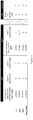
- Figure 2 shows the output and graphical representation (vertical axis is "normalised intensity") of a Luminex assay for r' S samples, the newly-discovered variant "RHD*DIIIa IVS3+3100G", and other non-r' S samples following multiplex PCR using the r' S -specific primers shown in Table 1 and one or more primer pairs shown in Tables 2 and 3.
- the data shown in Figure 2 confirm that the r' S samples are successfully amplified by PCR in multiplex and that the Luminex normalised intensity signal is markedly higher for the r' S samples than for non-r' S samples, including the newly-discovered variant "RHD*DIIIa IVS3+3100G".
- the ability of the r' S -specific primers of the present invention to work in multiplex with primers for amplification of other segments of the RHD gene and/or RHCE gene loci allows for efficient use of sample, e.g., to interrogate other polymorphisms relevant to the classification of blood type variants.
- segments including all or part of one or more RHD and/or RHCE exons and/or introns may be amplified and the amplification products interrogated by allele-specific probes in order to detect the presence or absence of, and/or identity of: an RHCE c; an RHCE C; RHCE exon 1; RHCE exon 5; RHCE exon 7; an RHD/RHCE hybrid exon 3 allele; a G/C polymorphism at position 602 of RHD exon 4; a C/G polymorphism at position 1048 of RHD exon 7; presence or absence of an RHCE*C allele; a G/T polymorphism at position 1006 of RHCE exon 7; and/or a G/A polymorphism at position 3100 of RHD intron 3.
- the specificity is achieved by means of the intersection of the two specific primers, RHD-for and RHCE-rev, rather than either primer itself being specific for r' S .
- RHD-for primer also hybridises to other RHD sequence-containing template, including RHD*DIIIa and RHD*DIVa2.
- the forward primer of Silvy et al. will anneal to all of the following: RHD, r' S , DIVa, DIIIa and the newly-described "RHD*DIIIa IVS3+3100G" sample.
- RHD-for the forward primer of Silvy et al.
- the forward primer of the present invention is specific only to r' S .
- the inventors sought to mitigate the drawbacks associated with the forward primer disclosed in Silvy et al.
- Figure 4 shows the results of using the RHD-for primer of Silvy et al. having the sequence GCAAATATGGAAATTTGATCATGTA (SEQ ID NO: 25) together with the RHCE-specific reverse primer having the sequence GGAAAAGGTTTGAGAGGAATTATATT (SEQ ID NO: 11) under PCR conditions suitable for multiplex PCR.
- the upper band shows the amplification control (HgH), while the lower band is, theoretically, an amplicon which is specific for r' S .
- Lane 1 shows that the sample "BGG-10-656", which is a known r' S sample is indeed amplified by the above primer combination.
- lane 2 which is the sample “BGG-10-628”, being a known DIIIa sample
- lane 3 which is "L22”, a known RhD+ sample
- results demonstrate that the forward primer RHD-for of Silvy et al. results in false positive results under the conditions tested.
- results may be contrasted with the results obtained when using a forward primer of the present invention, in which case no such false positive results were found.
- the present inventors sought to provide primers that contain sequence modifications compared with the "reference" forward primer having the sequence AAATTTGATCATGTACTAATCATAC (SEQ ID NO: 7).
- the following changes were made to the "reference” forward primer sequence, while retaining r' S -specificity.
- the reference primer was shortened by deleting 10 nucleotides at the 5' end, in order to decrease annealing temperature for the PCR.
- This modification results in the forward primer of the invention having the following nucleotide sequence:
- the reference primer was altered by introducing one nucleotide substitution (replacing a C with a G) to increase specificity.
- This modification results in the forward primer of the invention having the following nucleotide sequence (the substitution position being underlined):
- the reference primer was altered by introducing one nucleotide substitution that differs from the substitution described above in relation to the second modification. This substitution was also a replacement of a C with a G to increase specificity, but was at a different position.
- This modification results in the forward primer of the invention having the following nucleotide sequence (the substitution position being underlined):
- Figure 6 shows PCR results obtained using: the reference forward primer of the invention AAATTTGATCATGTACTAATCATAC (SEQ ID NO: 7); the "inspecific" forward primer of Silvy et al. GCAAATATGGAAATTTGATCATGTA (SEQ ID NO: 25); the variant primer of the invention having modification 1 ATGTACTAATCATAC (SEQ ID NO: 8); the variant primer of the invention having modification 2 AAATTTGATCATGTACTAATGATAC (SEQ ID NO: 9); the variant primer of the invention having modification 3 AAATTTGATCATGTAGTAATCATAC (SEQ ID NO: 10); and a modified version of the inspecific" forward primer of Silvy et al. having the sequence G G CAAATATGGAAATTTGATCATGTA (SEQ ID NO: 28).
- the reverse primer used was GGAAAAGGTTTGAGAGGAATTATATT (SEQ ID NO: 11).
- Figure 6 shows the PCR amplification results of the above-described primers.
- the top band is a control and the lower band is intended to be an r' S -specific amplification product, to the extent that the primers used in fact amplify in an r' S -specific manner under the conditions employed.
- the reference forward primer (upper panel) exhibits r' S -specific amplification (positive for three known r's samples (lanes 1, 2 and 6) and negative for non-r' S (RhD+ in lane 3, RhD- in lane 4 and DIIIa in lane 5).
- the negative control of lane 7 shows no amplification.
- the inspecific forward primer in box 1 (second panel down; left hand side) exhibits positive r' S band presence of not only r' S samples, but also RhD+ and DIIIa (see lanes 3 and 5), thus confirming false positive results.
- the primer modification 1 results are shown in box 2 (spanning the second panel, right hand side and third panel, left hand side).
- the r' S band although somewhat less bright than the upper control band, is clearly visible in all r' S samples (lanes 1, 2 and 6), while all other lanes (RhD+, RhD-, DIIIa and negative control) are without any r' S band.
- the primer modification 2 results are shown in box 3 (third panel, centre).
- the r' S band is clearly visible in all r' S samples (lanes 1, 2 and 6), while all other lanes (RhD+, RhD-, DIIIa and negative control) are without any r' S band.
- the primer modification 3 results are shown in box 4 (spanning the third panel, right hand side and fourth panel, left hand side).
- the r' S band is clearly visible in all r' S samples (lanes 1, 2 and 6), while all other lanes (RhD+, RhD-, DIIIa and negative control) are without any r' S band.
- the inspecific forward primer in box 5 exhibits positive r' S band presence of not only r' S samples, but also RhD+ and DIIIa (see lanes 3 and 5), thus confirming false positive results. There is even a faint r' S band visible in the RhD- sample (lane 4).
- the present results demonstrate that the reference forward primer of the present invention exhibits superior performance compared with that of the Silvy et al. RHD-for primer and that the forward primer of the present invention is tolerant to a number of sequence modifications, including a 5' truncation of 10 nucleotides (i.e. reducing the value of n in the formula X-Y-Z as defined herein) and nucleotide substitutions that result in mismatches with the target sequence (i.e. selection of S 1 , S 2 and/or changes reflected in the substitution possibilities of X 2 and/or Y 2 of the formula X-Y-Z as defined herein.
- the present invention therefore provides, inter alia, a genus of related forward PCR primer designs that address the need for r' S -specific amplification and mitigate the drawbacks associated with a previously-described primer.
Landscapes
- Life Sciences & Earth Sciences (AREA)
- Chemical & Material Sciences (AREA)
- Proteomics, Peptides & Aminoacids (AREA)
- Health & Medical Sciences (AREA)
- Organic Chemistry (AREA)
- Zoology (AREA)
- Analytical Chemistry (AREA)
- Wood Science & Technology (AREA)
- Immunology (AREA)
- Engineering & Computer Science (AREA)
- Biotechnology (AREA)
- Microbiology (AREA)
- Molecular Biology (AREA)
- Biophysics (AREA)
- Physics & Mathematics (AREA)
- Cell Biology (AREA)
- Biochemistry (AREA)
- Bioinformatics & Cheminformatics (AREA)
- General Engineering & Computer Science (AREA)
- General Health & Medical Sciences (AREA)
- Genetics & Genomics (AREA)
- Measuring Or Testing Involving Enzymes Or Micro-Organisms (AREA)
Description
- The invention relates to methods for genotyping and blood cell antigen determination, which in particular may discriminate the RHD*r's or RHD*r's-like blood type variants, which encode C+W antigen and no D antigen, from RHD*DIIIa, RHD*DIVa-2 and other blood type variants. The invention also relates to products, in particular, probes, primers and kits for use in such methods.
- The success of blood transfusion often depends on the degree of compatibility between donor and recipient. The degree of compatibility, in turn, is a function of the similarity in Red Blood Cell (RBC) antigen content between donor and recipient. Expression of many RBC antigens in an individual can be predicted from the analysis of their genomic DNA. Therefore, analysis of donor and/or recipient DNA can be used to facilitate blood matching and thus enable proper blood transfusion practice.
- Hemolytic reactions are more common in multi-transfused than in singly transfused individuals, not only because of the increased probability of such an event as the number of transfused units increases, but also because of the accumulative nature of the immune response in the recipient. An example of a condition whose treatment includes repeated blood transfusions is Sickle Cell Disease (SCD). From the above follows that a high degree of compatibility with donor blood is often critical for the long-term success of transfusion in SCD patients.
- While SCD is more prevalent among individuals of African ancestry, the blood donor population in the USA and other Western countries is largely Caucasian. As a consequence of this disparity, differences in RBC antigens between both racial groups often become responsible for blood transfusion failures in SCD patients.
- The genetic variant RHD*DIIIa-CE(4-7)-D, also known as RHD-CE-DS, RHD-CE(4-7)-D, (C)ceS, or r'S, (RHD*r'S henceforth) can be found in up to 5-10% of the African-American population, but is extremely rare in Caucasians. This variant poses a special challenge to blood transfusion because it encodes a rather complex antigen profile, which includes absence of D antigen, altered forms of C (C+W) and e antigens, expression of low-frequency VS antigen, no expression of V antigen, and absence of the high-frequency hrB antigen. Among them, D and C antigens are the clinically most relevant ones.
- The antigenic complexity of RHD*r'S correlates with its genetic complexity, which includes a substitution of part of
RHD exon 3, RHD exons 4-7, and the intervening introns by their RHCE counterparts, a G>T substitution at position 186 (exon 2), a C>T substitution at position 410 (hybrid exon 3), a C>G substitution at position 733 (exon 5), and a G>T substitution at position 1006 (exon 7). In addition to the changes in the RHD gene, RHD*r'S occurs in cis with RHCE*ceS1006T, an RHCE gene that also encodes substitutions C>G at position 733 (exon 5) and G>T at position 1006 (exon 7). - To add to the antigenic and genetic complexity, knowledge about the molecular basis of RHD*r'S is incomplete. For instance, the precise points of RHCE/RHD recombination have not been reported to date. Furthermore, two types of RHD*r'S variant have been described and named
Type 1 andType 2, which differ not only in their genetic composition but also in their antigen profiles. - Several publications (Westhoff et al., Transfusion (2010), 50: 1303-1311, Pham et al., Transfusion (2009), 49: 495-504, and Tax et al., Transfusion (2002) 42: 634-644) have uncovered the genetic similarity between RHD*r'S and other RHD variants, in particular RHD*DIIIa and RHD*DIVa/RHD*DIVa-2 (RHD*DIVa-2 henceforth). A number of molecular methods for the specific detection of RHD*r'S rely on the detection of polymorphisms located in D-
CE hybrid exon 3 locus of RHD. These polymorphisms are now known to be shared with variants RHD*DIIIa and RHD*DIVa-2. Consequently, to date, identification of RHD*r'S in a sample by DNA analysis requires detection ofhybrid exon 3 polymorphisms and discrimination from RHD*DIIIa and RHD*DIVa-2. This discrimination is clinically relevant since the latter variants encode a different antigen profile, which includes expression of partial D and absence of C+W. -
EP1780217 describes the detection of RHD positive haplotypes in D-negative individuals. Silvy et al., British Journal of Haematology, (2012 Dec 30) doi: 10.1111/bjh. 12179 [Epub ahead of print], describe identification of a polymorphism said to be restricted to the (C)ceS type 1 haplotype.WO2012/171990 describes discrimination of blood type variants in a method making use of polymorphisms inintron 7 of the RHD gene and/orintron 7 of the RHCE gene.EP2471949 describes a method for the identification by molecular techniques of genetic variants that encode no D antigen (D-) and altered C antigen (C+W). - Silvy et al., British Journal of Haematology, 2013, Vol. 160, pp. 851-867, describes identification of a novel polymorphism, termed IVS3+3100a>g, which is restricted to the (C)ceS type 1 haplotype and which is suggested to avoid the risk of transfusion deadlock in sickle cell disease (SCD) patients.
-
EP2471949A1 describes a method for the identification by molecular techniques of genetic variants that encode no D antigen (D-) and altered C antigen (C+W).WO 01/77384 A2
WO2012/171990 describes a method for detecting the presence or absence of, or for discriminating between, blood type variants, the method comprising genotyping a sample obtained from a human subject at one or more positions inintron 7 of the RHD gene and/orintron 7 of the RHCE gene. - Antibody reagents commonly used to detect C antigen do not discriminate between C+W and C+. Therefore, the phenotype is often reported as C+. In cases where the antibody reagent does discriminate between C+W and C+ but the sample contains a normal RHCE*C allele in trans to a RHD*r'S allele, C+W is obscured by C+, resulting in a C+ phenotype for the sample. Therefore, RHCE*C needs to be tested for and shown absent prior to assignment of a C+W phenotype to a sample. Accordingly, there remains a need for further methods for distinguishing RHD*r'S from RHD*DIIIa and RHD*DIVa-2. The present invention addresses these and other objects.
- The present inventors have surprisingly found that methods and, in particular, PCR primers as described herein are able to amplify a portion of
intron 3 of the RHD gene found in r'S samples in a specific manner, and that this specificity is retained even under multiplex PCR conditions. Considerable disadvantages of previously-described primers and reaction methods are addressed by the methods and primers of the present invention, as demonstrated by the examples herein. The present invention mitigates false positive readings displayed by previously-described methods and primers, and is advantageously able to discriminate r'S from closely-related alleles, including a newly-described variant of RHD*DIIIa. - Accordingly, the present invention provides, in a first aspect, an oligonucleotide polymerase chain reaction (PCR) primer, comprising a nucleotide sequence which is of the formula:
X-Y-Z
wherein: - X is X1 or X2, wherein:
- X1 is the final n nucleotides in the nucleotide sequence ATATGGAAATTTGATCATGT (SEQ ID NO: 1), wherein n is a number between 2 and 20, inclusive; and
- X2 is a variant of X1 differing by no more than one nucleotide substitution;
- Y is Y1 or Y2, wherein:
- Y1 is the nucleotide sequence AS1TAATS2ATAC (SEQ ID NO: 2), wherein S1 and S2 are independently selected from G and C; and
- Y2 is a variant of Y1 differing from Y1 by no more than one nucleotide substitution, provided that said nucleotide substitution is not a substitution of the first A or final C of Y1;
- Z is the first m nucleotides in the nucleotide sequence TAAAG, wherein m is a number between 0 and 5, inclusive.
- In some cases, the primer of this and other aspects of the invention is such that X1 is the nucleotide sequence of AAATTTGATCATGT (SEQ ID NO: 3) or ATGT. That is to say, n may, in some cases, be 14 or 4. In certain cases, n may be 2, 3, 4, 5, 6, 7, 8, 9, 10, 11, 12, 13, 14, 15, 16, 17, 18, 19 or 20.
- In some cases in accordance with this and other aspects of the present invention, Y1 is selected from the group consisting of: ACTAATCATAC (SEQ ID NO: 4); ACTAATGATAC (SEQ ID NO: 5); and AGTAATCATAC (SEQ ID NO: 6). Preferably, if S1 is G, S2 is C. Likewise, if S1 is C, S2 is preferably C. Thus, the selection of S1 and S2 may be chosen to keep the number of mismatches with the intended target template sequence to not more than one nucleotide mismatch. However, it is specifically contemplated herein that the number of mismatches may be more than one. For example, in certain cases, both S1 and S2 may be G. Alternatively, the number of nucleotide mismatches may be zero. In certain cases, both S1 and S2 may be C.
- In some cases in accordance with this and other aspects of the present invention, m is 0. Therefore, the primer of the invention may have no Z, with the result that the last nucleotide in Y (which is a C that corresponds to the C/A polymorphic nucleotide at position 3046 of
RHD intron 3, as numbered inFigure 7 ) is the 3' nucleotide of the primer of the invention. Alternatively, m may be 1, 2, 3, 4 or 5. - In some cases in accordance with this and other aspects of the present invention, the primer is not more than 30, 29, 28, 27, 26, 25, 24, 23, 22, 21 or 20 nucleotides in length. In some cases, the primer may be at least 13, 14, 15, 16, 17, 18, 19, 20, 21, 22, 23, 24 or at least 25 nucleotides in length. In certain cases the primer may be between 15 and 25 nucleotides in length. Particular cases include a primer in accordance with the first aspect of the invention which has a length of exactly 13, 14, 15, 16, 17, 18, 19, 20, 21, 22, 23, 24, 25, 26, 27, 28, 29 or 30 nucleotides.
- In some cases in accordance with this and other aspects of the present invention, the primer may be DNA or RNA. The primer is preferably DNA.
- In some cases in accordance with this and other aspects of the present invention, the primer may include one or more, e.g. 1, 2, 3, 4 or 5 altered or non-natural bases and/or derivatised or modified nucleotide bases. In particular, one or more bases (e.g. a 5' or a 3' base) may be biotinylated or conjugated to a detectable label. Alternatively or additionally, one or more bases (e.g. 1, 2, 3, 4 or 5 nucleotide bases) may be locked nucleic acid (LNA) bases.
- In some cases in accordance with this and other aspects of the present invention, the nucleotide sequence of the primer consists of a nucleotide sequence selected from the group consisting of:
- (i) AAATTTGATCATGTACTAATCATAC (SEQ ID NO: 7);
- (ii) ATGTACTAATCATAC (SEQ ID NO: 8);
- (iii) AAATTTGATCATGTACTAATGATAC (SEQ ID NO: 9); and
- (iv) AAATTTGATCATGTAGTAATCATAC (SEQ ID NO: 10).
- In some cases in accordance with this and other aspects of the present invention, the primer is suitable for use as a forward PCR primer in a PCR amplification of a portion of the r'S allele of
intron 3 of the RHD gene. - In a second aspect, the present invention provides a plurality of oligonucleotide primers comprising:
- (i) an oligonucleotide primer of the first aspect of the invention; and
- (ii)
- (a) a reverse primer that hybridises to a portion of
intron 3 of r'S, or its complement, which portion includes at least one position of single nucleotide polymorphism (SNP) that differs between r'S and RHD; or - (b) one or more primers that hybridise to a region of the RHD gene and or the RHCE gene.
- (a) a reverse primer that hybridises to a portion of
- Preferably, said reverse primer (ii) (a) hybridises to the reverse complement of a portion of the r'S
intron 3 sequence that is shown inFigure 7 and which lies 3' ofposition 3050, as numbered inFigure 7 . In some cases in accordance with this and other aspects of the present invention said reverse primer hybridises to a portion ofintron 3 of r'S, or its complement, which portion includes the G/A polymorphism position 3189 ofintron 3 of the RHD gene, said numbering being as shown inFigure 7 . - In some cases in accordance with the second aspect of the present invention, the plurality of primers comprises:
- (i) an oligonucleotide primer of the first aspect of the invention; and
- (ii) at least one primer selected from the group consisting of:
- (a) an oligonucleotide primer of between 26 and 30 nucleotides in length comprising the nucleotide sequence GGAAAAGGTTTGAGAGGAATTATATT (SEQ ID NO: 11) or a variant thereof differing by not more than 3 (e.g. not more than 2 or not more than 1) nucleotide substitutions from the nucleotide sequence of SEQ ID NO: 11, provided that said substitutions do not include substitution of the final T in the nucleotide sequence of SEQ ID NO: 11;
- (b) an oligonucleotide primer consisting of the nucleotide sequence GGAAAAGGTTTGAGAGGAATTATATT (SEQ ID NO: 11);
- (c) the RHCE c forward primer consisting of the nucleotide sequence TGGGCTTCCTCACCTCAAA (SEQ ID NO: 12);
- (d) the RHCE c reverse primer consisting of the nucleotide sequence TGATGACCACCTTCCCAGG (SEQ ID NO: 13);
- (e) the RHCE C forward primer consisting of the nucleotide sequence GGCCACCACCATTTGAA (SEQ ID NO: 14);
- (f) the RHCE C reverse primer consisting of the nucleotide sequence GGTAGCAGGCGTCTGTAAAAA (SEQ ID NO: 15);
- (g) the
RHCE exon 1 forward primer consisting of the nucleotide sequence CATAGACAGGCCAGCACAG (SEQ ID NO: 16); - (h) the
RHCE exon 1 reverse primer consisting of the nucleotide sequence TGCCCCTGGAGAACCAT (SEQ ID NO: 17); - (i) the
RHCE exon 5 forward primer consisting of the nucleotide sequence AAATTAAAATAAGCATTTGACCATC (SEQ ID NO: 18); - (j) the
RHCE exon 5 reverse primer consisting of the nucleotide sequence CCTGAGATGGCTGTCACCAC (SEQ ID NO: 19); - (k) the
RHCE exon 7 forward primer consisting of the nucleotide sequence ACATGCCATTGCCGTTC (SEQ ID NO: 20); and - (l) the
RHCE exon 7 reverse primer consisting of the nucleotide sequence TCTCACCTGCCAATCTGCT (SEQ ID NO: 21).
- In some cases the plurality of oligonucleotide primers comprise at least:
- an oligonucleotide primer of the first aspect of the invention, and
- an oligonucleotide primer of between 26 and 30 nucleotides in length comprising the nucleotide sequence GGAAAAGGTTTGAGAGGAATTATATT (SEQ ID NO: 11) or a variant thereof differing by not more than 3 (e.g. not more than 2 or not more than 1) nucleotide substitutions from the nucleotide sequence of SEQ ID NO: 11, provided that said substitutions do not include substitution of the final T in the nucleotide sequence of SEQ ID NO: 11.
- In some cases the plurality of oligonucleotide primers comprise at least the primer pair:
- AAATTTGATCATGTACTAATCATAC (SEQ ID NO: 7); and
- GGAAAAGGTTTGAGAGGAATTATATT (SEQ ID NO: 11).
- In a third aspect the present invention provides a kit for assessing a subject's blood type, said kit comprising:
- a plurality of primers of the second aspect of the invention;
- optionally, one or more probes and/or primers that span one or more polymorphic positions in
intron 3,exon 3,exon 4,intron 7 and/orexon 7 of the RHD gene locus; and/or - optionally, one or more probes and/or primers that span one or more polymorphic positions in
exon 7 of the RHCE gene locus. - In a fourth aspect, the present invention provides a system for use in determining a subject's blood type, the system comprising:
- a kit of the third aspect of the invention; and
- at least one detector arranged to detect a signal from detectably labelled DNA obtained from said subject or a detectably labelled amplicon produced by PCR amplification carried out on DNA obtained from said subject;
- at least one controller in communication with the at least one detector, the controller being programmed with computer-readable instructions to transform said signal into predicted blood type haplotypes, and optionally, to transform said predicted blood type haplotypes into a predicted blood type phenotype.
- In a fifth aspect the present invention provides a method for determining the presence or absence of, or for discriminating between, blood type alleles in a DNA-containing sample, which method comprises amplification by polymerase chain reaction (PCR) of at least a portion of
intron 3 of the RHD gene, wherein said PCR employs at least a forward primer and a reverse primer each capable of hybridising to the r'S sequence set forth in SEQ ID NO: 31 (Figure 7 ), or its complement, and wherein said forward primer is the primer of the first aspect of the invention. - In some cases in accordance with the method of this and other aspects of the invention, the blood type alleles are alleles that comprise an RHD/
RHCE hybrid exon 3. In particular, the blood type alleles may be selected from the group consisting of: RHD*r'S; RHD*r'S-like; RHD*r'SType 1; RHD*r'SType 2; RHD*DIIIa; RHD*DIIIa IVS3+3100G; RHD*DIII_FN; RHD*DIVa-2; RHD*DIVa; RHD*DIII-type4; RHD*DIII-type6; RHD*DIII-type7; RHD*DIII-type8; RHCE*ceS; RHCE*ceS1006T ; RHCE*ceS1006C; RHCE*ce733G; RHCE*ce48C,733G,1025T; RHCE*ce48C,697G,733G; RHCE*ce340T,733G; and RHCE*ce48C,733G,748A. - In some cases in accordance with the method of this and other aspects of the invention the PCR amplifies r'S, but does not amplify one or more of: RHD; RHCE*ce; RHD*DIIIa; RHD*DIIIa IVS3+3100G; and RHD*DIVa. In particular, said PCR may in certain cases amplify r'S, but not any of RHD; RHCE*ce; RHD*DIIIa; RHD*DIIIa IVS3+3100G; and RHD*DIVa.
- In some cases in accordance with the method of this and other aspects of the invention the method is for discriminating r'S from RHD*DIIIa IVS3+3100G. The ability to distinguish r'S from the newly-described variant, "RHD*DIIIa IVS3+3100G", which as far as the present inventors are aware has not previously been reported, is a major advance. The newly-described variant, "RHD*DIIIa IVS3+3100G" comprises the
same RHD intron 3 position 3100 A to G polymorphism that has previously been reported to be specific for r'S (see Silvy et al., 2012). Reliance on the presence of theRHD intron 3 position 3100 A to G polymorphism to uniquely identify r'S would be expected to result in false positive results. The provision of a method that discriminates r'S from RHD*DIIIa IVS3+3100G is expected to provide a significant clinical contribution. - The method in accordance with this and other aspects of the present invention utilises a forward primer of the first aspect of the invention. Particular examples include a primer that consists of the nucleotide sequence AAATTTGATCATGTACTAATCATAC (SEQ ID NO: 7). The method further utilises a suitable reverse primer, which may be any reverse primer capable of yielding a PCR product when used in combination with the forward primer of the first aspect of the invention. In certain cases, the reverse primer is capable of hybridising to a portion of
intron 3 of r'S, or its complement, which portion includes at least one position of single nucleotide polymorphism (SNP) that differs between r'S and RHD. In a certain cases, said position of SNP comprises the G/A polymorphism at position 3189 ofintron 3 of the RHD gene, said numbering being as shown inFigure 7 (see also SEQ ID NO: 31). In some cases, the reverse primer is of between 26 and 30 nucleotides in length and comprises the nucleotide sequence GGAAAAGGTTTGAGAGGAATTATATT (SEQ ID NO: 11). In certain cases, the reverse primer consists of the nucleotide sequence GGAAAAGGTTTGAGAGGAATTATATT (SEQ ID NO: 11). In some cases in accordance with the method of this and other aspects of the invention the PCR is multiplex PCR. The multiplex PCR may further comprise amplification of one or more RHD and/or RHCE gene segments other thanRHD intron 3. - In some cases, the one or more RHD and/or RHCE gene segments are selected from the group consisting of: RHCE c; RHCE C;
RHCE exon 1;RHCE exon 5; andRHCE exon 7. Accordingly, the method may employ additional PCR primers to be used in multiplex with the above-described PCR primers. In certain cases, the multiplex PCR further comprises employing 1, 2, 3, 4, 5, 6, 7, 8, 9 or all 10 of the following primers: - (i) the RHCE c forward primer consisting of the nucleotide sequence TGGGCTTCCTCACCTCAAA (SEQ ID NO: 12);
- (ii) the RHCE c reverse primer consisting of the nucleotide sequence TGATGACCACCTTCCCAGG (SEQ ID NO: 13);
- (iii) the RHCE C forward primer consisting of the nucleotide sequence GGCCACCACCATTTGAA (SEQ ID NO: 14);
- (iv) the RHCE C reverse primer consisting of the nucleotide sequence GGTAGCAGGCGTCTGTAAAAA (SEQ ID NO: 15);
- (v) the
RHCE exon 1 forward primer consisting of the nucleotide sequence CATAGACAGGCCAGCACAG (SEQ ID NO: 16); - (vi) the
RHCE exon 1 reverse primer consisting of the nucleotide sequence TGCCCCTGGAGAACCAT (SEQ ID NO: 17); - (vii) the
RHCE exon 5 forward primer consisting of the nucleotide sequence AAATTAAAATAAGCATTTGACCATC (SEQ ID NO: 18); - (viii) the
RHCE exon 5 reverse primer consisting of the nucleotide sequence CCTGAGATGGCTGTCACCAC (SEQ ID NO: 19); - (ix) the
RHCE exon 7 forward primer consisting of the nucleotide sequence ACATGCCATTGCCGTTC (SEQ ID NO: 20); and - (x) the
RHCE exon 7 reverse primer consisting of the nucleotide sequence TCTCACCTGCCAATCTGCT (SEQ ID NO: 21). Preferably, the primers are employed in pairs, said primers being paired as follows: (i) with (ii); (iii) with (iv); (v) with (vi); (vii) with (viii); and (ix) with (x). - In some cases in accordance with the method of the present invention, the sample is a sample which has previously been determined to comprise an RHD-
RHCE hybrid exon 3. Alternatively, the sample may be suspected to comprise an RHD-RHCE hybrid exon 3 or be an unknown sample. The method may therefore further comprise a preceding step of determining whether the sample contains an RHD-RHCE hybrid exon 3. - In some cases in accordance with the method of the present invention, the method further comprises determining the presence or absence of an RHCE*C allele in the sample. In some cases the method further comprises genotyping the sample at one or more positions of polymorphisms in the RHD and/or RHCE gene loci. In certain cases, the
method comprises genotyping the sample at position 410 of theRHD exon 3. In certain cases, the method comprises genotyping the sample atposition 602 of theRHD exon 4. In certain cases, method comprises genotyping the sample atposition 1048 of theRHD exon 7. In certain cases, the method comprises genotyping the sample atposition 1006 of theRHCE exon 7. In certain cases, the method comprises genotyping the sample atposition 3100 of theRHD intron 3. - In some cases in accordance with the method of the present invention, the method comprises genotyping not more than 50, 40, 30, 25, 20, 15, or not more than 10, single nucleotide polymorphic positions in the RHD gene locus and/or the RHCE gene locus.
- In some cases in accordance with the method of the present invention, the method further comprises predicting an RHD phenotype and/or an RHCE phenotype for the subject based on, at least, the degree of amplification by PCR of said at least one portion of
intron 3 of the RHD gene. This may, for example, include a visual or computer-aided inspection of the intensity of a band on a gel where the intensity is related to the degree of amplification of the PCR product. The skilled person will of course be readily able to make us of suitable techniques to evaluate the degree of PCR amplification, e.g., for classification of a sample as containing r'S. Such techniques include, without limitation, real time PCR (qPCR), Luminex bead-based detection and agarose gel-based evaluation. The method may comprise detecting a positive result for r'S-specific PCR amplification and thereby classifying a sample as containing an r'S allele. In some cases, the phenotype prediction is further based on: - (i) the presence or absence of an RHD/
RHCE hybrid exon 3; - (ii) the identity of one or both alleles present at
position 602 of theRHD exon 4; - (iii) the identity of one or both alleles present at
position 1048 of theRHD exon 7; - (iv) the presence or absence of an RHCE*C allele in the RHCE gene locus;
- (v) the identity of one or both alleles present at
position 1006 of theRHCE exon 7; and/or - (vi) the identity of one or both alleles present at
position 3100 of theRHD intron 3. - In some cases the sample is found to contain r'S and is therefore predicted to have C+W serology.
- In accordance with this and other aspects of the present invention, the sample is preferably obtained or has been previously obtained from a human subject. In some cases the subject is undergoing, or is a candidate for, blood transfusion or bone marrow transplantation. In some cases the subject has sickle cell disease (SCD) or Thalassemia major. In some cases the subject has non-Caucasian ancestry. In some cases, the subject has African ancestry.
- In accordance with this and other aspects of the present invention, the sample may be any suitable biological sample from which it is possible to obtain nucleic acid, particularly genomic DNA, for use in a PCR reaction. Suitable samples include any material of bodily origin (liquid, solid or aspirate) such as blood, hair, cheek cells and skin cells.
- In accordance with this and other aspects of the present invention, the sample may be subjected to one or more treatments to extract a nucleic acid prior to or as part of said amplification by PCR.
- In accordance with this and other aspects of the present invention, the method may comprise Allele-Specific Polymerase Chain Reaction (ASP).
- In accordance with this and other aspects of the present invention, the method may comprise labelling a nucleic acid obtained from the sample or labelling the amplicon produced by said PCR amplification.
- In accordance with this and other aspects of the present invention, the method may further comprise carrying out serological analysis on a blood sample that has been obtained from the subject. This may be particularly useful to corroborate or clarify a phenotype prediction made. Combining the genotype-based prediction of blood type with a serological-based prediction may be useful, e.g., to improve accuracy or to resolve ambiguous results. However, it is also specifically contemplated herein that the method of this and other aspects of the present invention may not comprise carrying out serological analysis. Removing the need to carry out serological analysis provides considerable savings in terms of time, cost and/or resources.
- In a sixth aspect the present invention provides a method of blood matching, the method comprising:
- carrying out the method of the fifth aspect of the invention on a recipient sample from a recipient subject in need of donor blood and on a donor sample from a potential donor subject;
- comparing the blood type alleles present in the recipient sample with those present in the donor subject and thereby determining the compatibility of the recipient subject to receive blood from the potential donor subject.
- In accordance with the present invention, the subject may be undergoing, or may be a candidate for, blood transfusion. In some cases, the subject may have SCD, or any other disease requiring repeated blood transfusions, such as Thalassemia major or certain blood cell malignancies.
- In accordance with the present invention, the subject may be of non-Caucasian race. In particular, the subject may be of African ancestry (e.g. "Black persons"). In certain cases, the subject may have an ancestral origin in a Mediterranean country.
- In accordance with the method of the invention, the sample may be any suitable biological sample from which it is possible to amplify at least a portion of
intron 3 of the RHD gene locus and/or from which it is possible to determine the genotype of the subject at one or more polymorphic positions in the RHD gene and/or the RHCE gene. In certain case, the sample may conveniently take the form of a blood sample. - In certain cases in accordance with the method of the invention, the method may comprise carrying out an Allele-Specific Polymerase Chain Reaction (ASP) and/or Allele-Specific Hybridization (ASH).
- In certain cases in accordance with the method of this and other aspects of the invention, the method may comprise labelling a nucleic acid obtained from the sample or labelling an amplicon derived from a nucleic acid obtained from the sample. The label is preferably a detectable label. In some cases, DNA derived from the sample, e.g. PCR product resulting from use of the DNA from the sample as template, may be labelled using a fluorescent label or dye (e.g. by conjugating said fluorescent label or dye to the PCR product before or after fragmentation of the PCR product).
- In some cases, the method in accordance with the sixth aspect of the invention may be carried out for a plurality of recipient subjects and a plurality of potential donor subjects.
- The invention will now be described in more detail, by way of example and not limitation, by reference to the accompanying drawings.
-
-
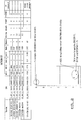
Figure 1 shows a gel image depicting the PCR results of a reaction utilising primers for an amplification control (HgH) (upper band) and r'S (lower band) for a variety of samples (including RhD+, DIIIa, RHD*DIIIa IVS3+3100G, r'S, DIVa and a negative control; -
Figure 2 shows Luminex intensity results for a variety of samples r'S, RHD*DIIIa IVS3+3100Gand other non-r'S samples following multiplex PCR using the r'S-specific primers shown in Table 1 and one or more primer pairs shown in Tables 2 and 3; -
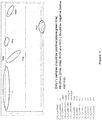
Figure 3 shows a table of certain RHD and RHCE exon and intron features for r'S, DIIIa, DIVa and the new variant "RHD*DIIIa IVS3+3100G"; -
Figure 4 shows a gel image depicting the PCR results of a reaction utilising primers for an amplification control (HgH) (upper band) and r'S (lower band) for a variety of samples (including RhD+, DIIIa, RhD- and r'S); -
Figure 5 shows Luminex intensity results for a variety of samples r'S, r'S/RHD+ heterozygous, r'S hemizygous, DIVa-2, DIIIa, RHD- and RHD+ samples; -
Figure 6 shows a gel image depicting the PCR results of a number of PCR reactions comparing different primer combinations. An amplification control (HgH) (upper band) and r'S (lower band) are shown for a variety of samples (r'S, RhD+, RhD-, DIIIa and a negative control; -
Figure 7 shows an alignment of a portion ofintron 3 of the RHD gene numbered positions 3001 to 3250, numbered according to the RHD sequence (upper row). An identical nucleotide to that above is represented by a dot; a omitted/deleted nucleotide (i.e, a gap) is represented by a dash. The sequences shown are (from top to bottom): RHD, RHCE*ce, r'S, DIVa, DIIIa and the newly-described variant RHD*DIIIa IVS3+3100G (shown as #425). The locations of the reference forward primer and reverse primer are indicated by shaded boxes. - The present invention finds use in the determination of the clinically relevant RHD- and RHCE- encoded antigen phenotypes of a blood sample. The invention provides a method for detecting the presence or absence of, or for discriminating between, blood type variants, which method comprises amplification by polymerase chain reaction (PCR) of at least a portion of
intron 3 of the RHD gene, wherein said PCR employs at least a forward primer and a reverse primer each capable of hybridising to the r'S sequence set forth in SEQ ID NO: , or its complement, and wherein said forward primer nucleotide sequence is of the formula:
X-Y-Z
wherein: - X is X1 or X2, wherein:
- X1 is the final n nucleotides in the nucleotide sequence ATATGGAAATTTGATCATGT (SEQ ID NO: 1), wherein n is a number between 2 and 20, inclusive; and
- X2 is a variant of X1 differing by no more than one nucleotide substitution;
- Y is Y1 or Y2, wherein:
- Y1 is the nucleotide sequence AS1TAATS2ATAC (SEQ ID NO: 2), wherein S1 and S2 are independently selected from G and C; and
- Y2 is a variant of Y1 differing from Y1 by no more than one nucleotide substitution, provided that said nucleotide substitution is not a substitution of the first A or final C of Y1;
- Z is the first m nucleotides in the nucleotide sequence TAAAG, wherein m is a number between 0 and 5, inclusive.
- Advantageously, the method of the present invention may further comprise determining the presence or absence of an RHD/
RHCE hybrid exon 3 in said sample and/or genotyping a sample obtained from a human subject at one or more positions inintron 7 of the RHD gene and/or inintron 7 of the RHCE gene. Blood typing by making use ofintron 7 polymorphisms is described inWO2012/171990 . Blood typing by making use of a combination of polymorphisms in the RHD gene and/or the RHCE gene are described inUS2012/0172239 andEP2471949 . - The Rh blood group D antigen is encoded by the RHD gene, which comprises 10 exons. The complete RHD gene sequence is available at NCBI Reference Sequence: NG_007494.1 No. NG_007494.1, GI:171184448, (SEQ ID NO: 22.
- The Rh blood group C antigen is encoded by the RHCE gene, which comprises 10 exons. The complete RHCE gene sequence is available at NCBI Reference Sequence: NG_009208.2, GI:301336136, (SEQ ID NO: 23).
- The term "sample" as used herein is intended to encompass any material (solid, liquid or aspirate) obtained directly or indirectly from a human subject and from which the identity of one or more nucleotides in a relevant genomic locus (
e.g. intron 7 or the RHD locus and/orintron 7 of the RHCE locus) can be determined. In particular, the term "sample" includes any biological fluid such as blood, plasma, urine, saliva, cerebrospinal fluid and interstitial fluid, any solid matter, such as tissue, bone and hair, any cell or cell extract, any derived cell line, such as an immortalised tumour cell line and stem cell line, an extract of any of the preceding sample types, such as fixed or paraffin-embedded tissue. In certain preferred embodiments, the sample is an extract of human genomic DNA, optionally amplified and/or purified. - As used herein, the term "genotyping" is intended to encompass any method for determining the identity of the nucleotide at a particular position such as a polymorphic position at a specified locus. Thus, genotyping includes identifying one or both alleles of a particular gene. Genotyping may employ any of a variety of techniques, including but not limited to, allele-specific hybridisation, allele-specific PCR, sequencing of all or part of a gene.
- Unless specified otherwise, all nucleic acid sequences, such as primer sequences, are set forth herein in the direct 5' to 3'. Thus, for example, the primer sequence AAATTTGATCATGTACTAATCATAC (SEQ ID NO: 7) may equally be written as 5'-AAATTTGATCATGTACTAATCATAC-3' (SEQ ID NO: 7).
- As described herein in detail, certain blood type alleles are less common and a typically referred to as "variants," (e.g. RHD*r'S ). Variant blood type alleles are in some cases referred to herein simply as "blood type variants".
- Broadly, the present invention provides methods and products for the identification by molecular techniques of genetic variants RHD*r'S or RHD*r'S -like, which encode no D antigen (D-), an altered form of D antigen (partial D), altered forms of C (C+W) and e antigens, expression of low-frequency VS antigen, no expression of V antigen, and/or no hrB antigen (hrB-) in blood cells. The present inventors have found that amplification of a region of
intron 3 of the RHD locus may be r'S-specific when primers as described in detail herein are employed. This r'S-specific amplification enables discrimination between variants RHD*r'S or RHD*r'S-like and other RHD/RHCE hybrid exon 3 variants, including but not limited to RHD*DIIIa, RHD*DIIIa IVS3+3100G, RHD*DIII_FN and RHD*DIVa-2. In certain embodiments, the method of the invention provides considerable efficiency savings in comparison with, for example, full DNA sequencing, or genotyping of a large number of polymorphisms, or determining the phenotype by serological methods. Nevertheless, it is specifically contemplated that the method of the invention may, in some cases, involve DNA sequencing in order to genotype the sample obtained from the subject. - A wide variety of techniques are suitable and may be used in accordance with the present invention. Allele-specific oligonucleotides, for example, used in a competitive or non-competitive PCR (ASP henceforth), can also be used to detect genetic variants.
- In accordance with any aspect of the present invention, functional segments or their portions may be amplified, for example by PCR, using as a template genomic DNA. Amplified functional segments or their portions can be labelled (e.g. with a fluorescent label) to allow for their detection, and optionally fragmented to facilitate their pairing with oligonucleotide probes.
- In accordance with any aspect of the present invention, labelled and fragmented functional segments or their portions may be incubated under conditions that maximize the sensitivity and specificity of pairing with probes attached to the solid support. The presence of probe-paired functional segments or their portions may be determined indirectly from the measurement of label, usually a fluorochrome, attached to the solid support. This measurement is referred to herein as signal intensity. By way of example, the fluorescence emitted by the fluorochrome may be collected by means of a fluorescence detection device, such as a confocal scanner.
- Discrimination among genetic variants that share a RHD/
RHCE hybrid exon 3 but encode different forms of D Ag (Partial D Ag vs. No D Ag) and RhC Ag (Normal C Ag vs. Altered/Weakened C Ag, sometimes abbreviated as C+W) - The following example relates to a method of discriminating among RHD/
RHCE hybrid exon 3 variants RHD*r's, RHD*DIIIa and RHD*DIVa-2 and a newly-discovered variant designated herein as "RHD*DIIIa IVS3+3100G". - Genomic DNA was extracted from nucleated cells in a blood sample by cell lysis. Extracted DNA was purified on an affinity column. Both, cell lysis and DNA purification are performed with a QIAamp Blood kit (Qiagen, Germany) by following manufacturer protocols and recommendations. Purity of DNA was determined by spectrophotometry on a Nanodrop instrument (Nanodrop, DE). Only DNA solutions with an OD260/OD280 1.8±0.2 proceeded to subsequent analysis.
- Purified DNA was used as a template for multiplexed Polymerase Chain Reaction (PCR) amplification of the gene segments of interest in a GeneAmp 9700 thermal cycler (Perkin-Elmer, CA). Primer sequences were as follows (5'-3'):
Table 1 r'S Forward AAATTTGATCATGTACTAATCATAC SEQ ID NO: 7 Reverse GGAAAAGGTTTGAGAGGAATTATATT SEQ ID NO: 11 - Cycling conditions consist of a denaturation/polymerase activation step at 95°C for 15 min, followed by 40 cycles of denaturation at 95°C for 30 sec, annealing at 60°C for 30 sec, extension at 72°C for 80 sec, and a final extension step at 72°C for 7 min.
- Amplified DNA was separated by electrophoresis on a 2% agarose gel, stained with SYBR Safe dye (Invitrogen, OR), and photographed under UV illumination. Amplification vs. no amplification of a segment was determined visually by a trained laboratory technician.
- The following samples of known identity were subjected to allele-specific PCR using the above r'S-specific primer pair: RhD+ (one sample), DIIIa (17 samples), the newly-discovered variant "RHD*DIIIa IVS3+3100G" (one sample), r'S (one sample), DIVa (3 samples) and a water negative control (one sample).
- As a positive control for PCR amplification, primers for amplification of HgH were also employed. The PCR reaction products were run on an agarose gel (see
Figure 1 ). - As shown in
Figure 1 , the upper band which indicates the presence of the HgH positive control PCR product is visible for all samples with the exception of the water negative control. The r'S-specific band (lower band) is visible only on the r'S sample (lower panel; lane 4). These results clearly demonstrate that r'S-specific PCR is able to discriminate between r'S and other RHD/RHCE hybrid exon 3 variants such as DIIIa, DIVa and the newly-discovered variant "RHD*DIIIa IVS3+3100G". - The following primers (5'-3') were used in multiplex with the r'S primers described above:
Table 2 RHCE c Forward TGGGCTTCCTCACCTCAAA SEQ ID NO: 12 Reverse TGATGACCACCTTCCCAGG SEQ ID NO: 13 RHCE C Forward GGCCACCACCATTTGAA SEQ ID NO: 14 Reverse GGTAGCAGGCGTCTGTAAAAA SEQ ID NO: 15 Table 3 RHCE Exon 1Forward CATAGACAGGCCAGCACAG SEQ ID NO: 16 Reverse TGCCCCTGGAGAACCAT SEQ ID NO: 17 RHCE Exon 5Forward AAATTAAAATAAGCATTTGACCATC SEQ ID NO: 18 Reverse CCTGAGATGGCTGTCACCAC SEQ ID NO: 19 RHCE Exon 7Forward ACATGCCATTGCCGTTC SEQ ID NO: 20 Reverse TCTCACCTGCCAATCTGCT SEQ ID NO: 21 - The following probe sequence was used to determine the presence of absence of the
intron 3 amplicon: - CAAAAGCTGATATGTCATGTTTAGTTA (SEQ ID NO: 24)
- A single probe may be used to determine presence or absence of the
intron 3 amplicon because the PCR is allele-specific (due to the design of the forward primer). In other words, it is not necessary for the detection probe itself to interrogate a sequence that is specific to r'S. - As a non-limiting example, the procedure for Luminex® xMAP® - based detection employed herein, was as follows:
-
- Human genomic DNA was extracted from whole blood with EDTA as anti-coagulant. Genomic DNA extraction was carried out in the pre-PCR area.
- Genomic DNA input was 100 ng. Genomic DNA purity (OD260/OD280 ratio) was in the 1.63-1.95 range.
- Genomic DNA samples were stored frozen at -15 to -25 °C for up to one month. Multiple freeze/thaw cycles were avoided.
- The following procedure was applied:
-
- The ID-CORE XT™ protocol consists of 4 steps:

- Eacg batch of samples was processed with a negative control (molecular biology grade water that is known to be free of any DNA contamination).
-
• Work in the pre-PCR area and use aerosol-barrier tips. Use a new tip for each DNA sample.
• Briefly vortex and spin tubes before use.
• It is not necessary to set up the PCR reaction on ice.
1. Turn on the thermocycler.
2. Take the following reagents out of the refrigerator and freezer: ID-CORE XT™ PCR Master Mix and HotSartTaq® DNA polymerase, respectively.
Note: HotStarTaq® DNA polymerase must be removed from the freezer immediately before use and returned to the freezer immediately after use. Alternatively use ice or a microtube cooler. The stock enzyme should be mixed by gently flicking the tube.
3. Set up the ID-CORE XT™ PCR reaction mix as shown in the following table (all volumes in µl):Number of samples 1 8 24 48 ID-CORE XT™ PCR Master Mix 22.5 180 540 1080 HotStarTaq® DNA Polymerase (5 U/µL) 0.5 4 12 24 NOTE: the stated volumes already include an excess to account for pipetting error.
4. Vortex and spin the ID-CORE XT™ PCR reaction mix.
5. Immediately dispense 20 µL per sample into the wells of a 96-well PCR plate.
6. Add 5 µL of sample DNA, positive control DNA and negative control to the appropriate wells in this order.
7. Seal the plate with the adhesive film.
• Work in the post-PCR area.
8. Spin down the PCR plate to collect the liquid at the bottom of the wells.
9. Verify that all wells are properly sealed and that the lid of the thermocycler has reached the pre-set temperature.
10. Place the plate in the thermocycler. Place the compression pad over the plate.
11. Close the thermocycler lid and start the ID XT PCR amplification program.Temperature Time Cycles Polymerase Activation 95°C 15 min 1 Denaturation 95°C 30 s 40 Annealing 60°C 30 s 40 Extension 72°C 80 s 40 Final extension 72° C 7 min 1 Hold 4°C ∞ 1 Amplification reaction volume: 25 µL -
• Work in the post-PCR area. Use a new tip for each sample.
• Whenever necessary during dispensing steps, dry the surface of the Costar plate using a low-lint wipe.
• Handling and storage of the ID-CORE XT™ Beads Master Mix: - a. Beads settle and aggregate with time. Before pipetting, bring them to a homogeneous suspension by vigorous vortexing for 30 seconds.
- b. During ID-CORE XT™ Beads Master Mix dispensing, keep beads in suspension by vortexing frequently (every 8 samples).
- c. Do not centrifuge the plate once the ID-CORE XT™ Beads Master Mix has been dispensed to avoid bead aggregation.
- d. Beads contain an internal fluorescent dye. To avoid photobleaching, protect them from light during storage and usage.
- a. Turn on the Luminex® 100/200™ system between 30 minutes and 4 hours before assaying the samples.
- b. Set the XYP instrument heater temperature at 52 °C and verify that the heater block is on the plate holder.
- c. Perform Luminex® 100/200™ daily startup maintenance.
- Note: PCR products must be labeled immediately after hybridization. The process cannot be stopped after the hybridization step.
-
• Work in the post-PCR area.
1. Bring the following reagents to room temperature: SAPE and SAPE Dilution Buffer.
2. Prepare the labeling mix as shown in the following table (all volumes in µL):Number of samples 1 8 24 48 SAPE Dilution Buffer 87 696 2088 4176 SAPE 4.6 36.8 110 221 NOTE: the stated volumes already include an excess to account for pipetting error.
3. Vortex the labeling mix and keep it protected from light at room temperature.
4. At the 52 °C hold step, open the thermocycler lid and remove the compression pads and the sealing film with care, while keeping the plate on the thermocycler for the labeling step.
5. Dispense 80 µL of the labeling mix into each well of the hybridization plate and mix gently by pipetting up and down once.
6. Analyze the samples using the Luminex® system immediately after labeling. -
- Refer to Luminex® User's Manual (Luminex® 100™ IS 2.3. User Manual, Luminex® 200™ User Manual, or xPONENT® 3.1 Software Manual) for instrument preparation and operation, including daily startup, calibration, maintenance, and shutdown procedures.
- 1. Select Create a New Batch from an existing Protocol in the HOME page (for Luminex® IS 2.3 software) or Batches tab option (for Luminex® xPONENT® 3.1 software) and select the corresponding protocol.
- 2. Enter the sample IDs.
- 3. Follow the stepwise instructions that appear on the screen for creating batches. For further instructions on creating batches and multibatches, refer to the corresponding Luminex® User's Manual.
- 4. Select the Eject icon to eject the plate holder. Place the hybridization plate in the Luminex® XYP instrument heater block present on the plate holder.
- 5. Select the Retract icon. The samples are now ready to be analyzed.
- 6. Start the analysis process by clicking the Start icon (for Luminex® IS 2.3 software) or the Run icon (for Luminex® xPONENT® 3.1 software).
- 7. After a batch is complete, the data are exported as a Comma Separated Values (csv) file. This file is saved in a folder with the Batch Name entered into the Luminex® software.
- 8. Perform Luminex® 100/200™ daily shutdown maintenance.
- 9. The system can be turned off at this point if it is not going to be used for the remainder of the day.
- Proprietary software (Progenika Biopharma S.A.) is used to transform fluorescence intensity values for the particular allelic variants detected, singly or in combination, into blood group genotypes, and from genotypes into predicted blood group phenotypes.
-
Figure 2 shows the output and graphical representation (vertical axis is "normalised intensity") of a Luminex assay for r'S samples, the newly-discovered variant "RHD*DIIIa IVS3+3100G", and other non-r'S samples following multiplex PCR using the r'S-specific primers shown in Table 1 and one or more primer pairs shown in Tables 2 and 3. The data shown inFigure 2 confirm that the r'S samples are successfully amplified by PCR in multiplex and that the Luminex normalised intensity signal is markedly higher for the r'S samples than for non-r'S samples, including the newly-discovered variant "RHD*DIIIa IVS3+3100G". Indeed, the separation of normalised signal (greater than 6-fold higher for r'S samples) provides clear unambiguous discrimination between r'S samples and closely related non-r'S samples, despite the relatively less stringent PCR conditions utilised for multiplex PCR. These results therefore underscore the surprising adaptability of the primers of the present invention, in particular the forward primer as set forth in Table 1, for use in multiplex allele-specific PCR for identification of r'S samples. - As shown in
Figure 3 , the ability of the r'S-specific primers of the present invention to work in multiplex with primers for amplification of other segments of the RHD gene and/or RHCE gene loci allows for efficient use of sample, e.g., to interrogate other polymorphisms relevant to the classification of blood type variants. In particular, segments including all or part of one or more RHD and/or RHCE exons and/or introns may be amplified and the amplification products interrogated by allele-specific probes in order to detect the presence or absence of, and/or identity of: an RHCE c; an RHCE C;RHCE exon 1;RHCE exon 5;RHCE exon 7; an RHD/RHCE hybrid exon 3 allele; a G/C polymorphism atposition 602 ofRHD exon 4; a C/G polymorphism atposition 1048 ofRHD exon 7; presence or absence of an RHCE*C allele; a G/T polymorphism atposition 1006 ofRHCE exon 7; and/or a G/A polymorphism atposition 3100 ofRHD intron 3. - Silvy et al., British Journal of Haematology, (2012 Dec 30) doi: 10.1111/bjh. 12179 [Epub ahead of print], describe PCR amplification of a portion of
intron 3 of the RHD gene. The amplification is said to be selective for r'S (referred to therein as (C)ceS type 1 haplotype. The primer pair employed by Silvy et al. included (seeFig. 1 and Supporting information Appendix S1 of Silvy et al.): - a forward primer ("RHD-for") that is specific for RHD-containing sequence having the sequence (5' to 3'):
- GCAAATATGGAAATTTGATCATGTA (SEQ ID NO: 25);
- a reverse primer ("RHCE-rev") that is specific for RHCE-containing sequence having the sequence (5' to 3'):
- CTTAATCACAAGATTATTTTCAGAATCTAAC (SEQ ID NO: 26); and
- a control reverse primer ("RHDCE-rev") that hybridised to both RHD-containing and RHCE-containing sequence having the sequence (5' to 3'):
- GGGCCTTGGACAAGTTGTTA (SEQ ID NO: 27).
- The method taught by Silvy et al. relies on the amplification of a 240bp amplicon by the primer pair RHD-for and RHCE-rev being specific for r'S, as compared with, e.g., RHD*DIVa2 and RHD*DIIIa (see Silyv et al.,
Fig. 1(B) ). Although Silvy et al. report amplification of 52 (C)ceS type 1 haplotype samples and negative amplification of all other samples in a 118 sample set, regardless of the RHD and RHCE alleles present, this method suffers from a number of important drawbacks. In particular, the specificity is achieved by means of the intersection of the two specific primers, RHD-for and RHCE-rev, rather than either primer itself being specific for r'S. This means that, for example, the RHD-for primer also hybridises to other RHD sequence-containing template, including RHD*DIIIa and RHD*DIVa2. - As described below, the present inventors have found that the method and primers of Silvy et al. result in poor discrimination of r'S from, e.g., RHD*DIIIa and RHD*DIVa2 under the less stringent PCR conditions typically employed in multiplex PCR.
- Moreover, Silvy et al. teach that the IVS3+3100a>g SNP is specific to (C)ceS type 1 haplotype (i.e. r'S). However, the present inventors have now discovered that this is not the case. In particular, a variant provisionally termed "RHD*DIIIa IVS3+3100G" has been identified herein, which is not r'S, but actually a variant of RHD*DIIIa having the
same intron 3 position 3100 A to G polymorphism. Therefore, reliance on the presence of theintron 3 position 3100 A to G polymorphism in order to identify r'S can and will lead to false positive results where a "RHD*DIIIa IVS3+3100G" sample would be incorrectly assigned as an r'S sample. This is clinically relevant because "RHD*DIIIa IVS3+3100G" is C-serologically, rather than C+W. Thus, reliance on the presence ofintron 3 position 3100 A to G polymorphism in order to identify r'S is undesirable. - As shown in the alignment of
Figure 7 , the forward primer of Silvy et al. (RHD-for) will anneal to all of the following: RHD, r'S, DIVa, DIIIa and the newly-described "RHD*DIIIa IVS3+3100G" sample. Although the intersection of sequences that match the RHD-for and RHCE-rev primers of Silvy et al. can be expected to be confined to r'S, the amplification will only be specific under stringent conditions. Under less stringent conditions, the forward primer of Silvy et al. results in a number of non-specific amplifications. In contrast, the forward primer of the present invention is specific only to r'S. - In the process of designing the forward primers of the present invention, the inventors sought to mitigate the drawbacks associated with the forward primer disclosed in Silvy et al.
-
Figure 4 shows the results of using the RHD-for primer of Silvy et al. having the sequence GCAAATATGGAAATTTGATCATGTA (SEQ ID NO: 25) together with the RHCE-specific reverse primer having the sequence GGAAAAGGTTTGAGAGGAATTATATT (SEQ ID NO: 11) under PCR conditions suitable for multiplex PCR. The upper band shows the amplification control (HgH), while the lower band is, theoretically, an amplicon which is specific for r'S.Lane 1 shows that the sample "BGG-10-656", which is a known r'S sample is indeed amplified by the above primer combination. However,lane 2, which is the sample "BGG-10-628", being a known DIIIa sample, andlane 3, which is "L22", a known RhD+ sample, both exhibit positive amplification of the supposedly r'S-specific amplicon. These results demonstrate that the forward primer RHD-for of Silvy et al. results in false positive results under the conditions tested. These results may be contrasted with the results obtained when using a forward primer of the present invention, in which case no such false positive results were found. - The results shown in
Figure 5 likewise demonstrate that the forward primer of Silvy et al. results in non-specific amplification and therefore false positive results. In particular, samples which are known DIVa, DIIIa and RhD+ all exhibited Luminex mean fluorescence intensity signal above the threshold line to be classified as r'S (as did the samples known to be r'S). Samples known to be RhD- did not exhibit positive results in this experiment. These data can be contrasted with the r'S-specific results shown inFigure 2 , wherein a forward primer of the present invention was employed. - The present inventors sought to provide primers that contain sequence modifications compared with the "reference" forward primer having the sequence AAATTTGATCATGTACTAATCATAC (SEQ ID NO: 7). By way of example, the following changes were made to the "reference" forward primer sequence, while retaining r'S-specificity.
- In a first modification, the reference primer was shortened by deleting 10 nucleotides at the 5' end, in order to decrease annealing temperature for the PCR. This modification results in the forward primer of the invention having the following nucleotide sequence:
- ATGTACTAATCATAC (SEQ ID NO: 8).
- In a second modification, the reference primer was altered by introducing one nucleotide substitution (replacing a C with a G) to increase specificity. This modification results in the forward primer of the invention having the following nucleotide sequence (the substitution position being underlined):
- AAATTTGATCATGTACTAATGATAC (SEQ ID NO: 9).
- In a third modification, the reference primer was altered by introducing one nucleotide substitution that differs from the substitution described above in relation to the second modification. This substitution was also a replacement of a C with a G to increase specificity, but was at a different position. This modification results in the forward primer of the invention having the following nucleotide sequence (the substitution position being underlined):
- AAATTTGATCATGTAGTAATCATAC (SEQ ID NO: 10).
-
Figure 6 shows PCR results obtained using: the reference forward primer of the invention AAATTTGATCATGTACTAATCATAC (SEQ ID NO: 7); the "inspecific" forward primer of Silvy et al. GCAAATATGGAAATTTGATCATGTA (SEQ ID NO: 25); the variant primer of theinvention having modification 1 ATGTACTAATCATAC (SEQ ID NO: 8); the variant primer of theinvention having modification 2 AAATTTGATCATGTACTAATGATAC (SEQ ID NO: 9); the variant primer of theinvention having modification 3 AAATTTGATCATGTAGTAATCATAC (SEQ ID NO: 10); and a modified version of the inspecific" forward primer of Silvy et al. having the sequence GGCAAATATGGAAATTTGATCATGTA (SEQ ID NO: 28). In all cases the reverse primer used was
GGAAAAGGTTTGAGAGGAATTATATT (SEQ ID NO: 11). -
Figure 6 shows the PCR amplification results of the above-described primers. The top band is a control and the lower band is intended to be an r'S-specific amplification product, to the extent that the primers used in fact amplify in an r'S-specific manner under the conditions employed. As shown inFigure 6 , the reference forward primer (upper panel) exhibits r'S-specific amplification (positive for three known r's samples (lanes lane 3, RhD- inlane 4 and DIIIa in lane 5). The negative control oflane 7 shows no amplification. - The inspecific forward primer in box 1 (second panel down; left hand side) exhibits positive r'S band presence of not only r'S samples, but also RhD+ and DIIIa (see
lanes 3 and 5), thus confirming false positive results. - The
primer modification 1 results are shown in box 2 (spanning the second panel, right hand side and third panel, left hand side). The r'S band, although somewhat less bright than the upper control band, is clearly visible in all r'S samples (lanes - The
primer modification 2 results are shown in box 3 (third panel, centre). The r'S band is clearly visible in all r'S samples (lanes - The
primer modification 3 results are shown in box 4 (spanning the third panel, right hand side and fourth panel, left hand side). The r'S band is clearly visible in all r'S samples (lanes - The inspecific forward primer in box 5 (fourth panel right hand side) exhibits positive r'S band presence of not only r'S samples, but also RhD+ and DIIIa (see
lanes 3 and 5), thus confirming false positive results. There is even a faint r'S band visible in the RhD- sample (lane 4). - Taken together, the present results demonstrate that the reference forward primer of the present invention exhibits superior performance compared with that of the Silvy et al. RHD-for primer and that the forward primer of the present invention is tolerant to a number of sequence modifications, including a 5' truncation of 10 nucleotides (i.e. reducing the value of n in the formula X-Y-Z as defined herein) and nucleotide substitutions that result in mismatches with the target sequence (i.e. selection of S1, S2 and/or changes reflected in the substitution possibilities of X2 and/or Y2 of the formula X-Y-Z as defined herein. The present invention therefore provides, inter alia, a genus of related forward PCR primer designs that address the need for r'S-specific amplification and mitigate the drawbacks associated with a previously-described primer.
-
- <110> Progenika Biopharma S.A.
- <120> Discrimination of Blood Type Variants
- <130> CSC/FP6960132
- <140>
<141> - <150> 13/791,284
<151> 2013-03-08 - <160> 32
- <170> PatentIn version 3.3
- <210> 1
<211> 20
<212> DNA
<213> Artificial sequence - <220>
<223> Synthetic sequence: Primer - <400> 1
atatggaaat ttgatcatgt 20 - <210> 2
<211> 11
<212> DNA
<213> Artificial sequence - <220>
<223> Synthetic sequence: Primer - <400> 2
astaatsata c 11 - <210> 3
<211> 14
<212> DNA
<213> Artificial sequence - <220>
<223> Synthetic sequence: Primer - <400> 3
aaatttgatc atgt 14 - <210> 4
<211> 11
<212> DNA
<213> Artificial sequence - <220>
<223> Synthetic sequence: Primer - <400> 4
actaatcata c 11 - <210> 5
<211> 11
<212> DNA
<213> Artificial sequence - <220>
<223> Synthetic sequence: Primer - <400> 5
actaatgata c 11 - <210> 6
<211> 11
<212> DNA
<213> Artificial sequence - <220>
<223> Synthetic sequence: Primer - <400> 6
agtaatcata c 11 - <210> 7
<211> 25
<212> DNA
<213> Artificial sequence - <220>
<223> Synthetic sequence: Primer - <400> 7
aaatttgatc atgtactaat catac 25 - <210> 8
<211> 15
<212> DNA
<213> Artificial sequence - <220>
<223> Synthetic sequence: Primer - <400> 8
atgtactaat catac 15 - <210> 9
<211> 25
<212> DNA
<213> Artificial sequence - <220>
<223> Synthetic sequence: Primer - <400> 9
aaatttgatc atgtactaat gatac 25 - <210> 10
<211> 25
<212> DNA
<213> Artificial sequence - <220>
<223> Synthetic sequence: Primer - <400> 10
aaatttgatc atgtagtaat catac 25 - <210> 11
<211> 26
<212> DNA
<213> Artificial sequence - <220>
<223> Synthetic sequence: Primer - <400> 11
ggaaaaggtt tgagaggaat tatatt 26 - <210> 12
<211> 19
<212> DNA
<213> Artificial sequence - <220>
<223> Synthetic sequence: Primer - <400> 12
tgggcttcct cacctcaaa 19 - <210> 13
<211> 19
<212> DNA
<213> Artificial sequence - <220>
<223> Synthetic sequence: Primer - <400> 13
tgatgaccac cttcccagg 19 - <210> 14
<211> 17
<212> DNA
<213> Artificial sequence - <220>
<223> Synthetic sequence: Primer - <400> 14
ggccaccacc atttgaa 17 - <210> 15
<211> 21
<212> DNA
<213> Artificial sequence - <220>
<223> Synthetic sequence: Primer - <400> 15
ggtagcaggc gtctgtaaaa a 21 - <210> 16
<211> 19
<212> DNA
<213> Artificial sequence - <220>
<223> Synthetic sequence: Primer - <400> 16
catagacagg ccagcacag 19 - <210> 17
<211> 17
<212> DNA
<213> Artificial sequence - <220>
<223> Synthetic sequence: Primer - <400> 17
tgcccctgga gaaccat 17 - <210> 18
<211> 25
<212> DNA
<213> Artificial sequence - <220>
<223> Synthetic sequence: Primer - <400> 18
aaattaaaat aagcatttga ccatc 25 - <210> 19
<211> 20
<212> DNA
<213> Artificial sequence - <220>
<223> Synthetic sequence: Primer - <400> 19
cctgagatgg ctgtcaccac 20 - <210> 20
<211> 17
<212> DNA
<213> Artificial sequence - <220>
<223> Synthetic sequence: Primer - <400> 20
acatgccatt gccgttc 17 - <210> 21
<211> 19
<212> DNA
<213> Artificial sequence - <220>
<223> Synthetic sequence: Primer - <400> 21
tctcacctgc caatctgct 19 - <210> 22
<211> 64956
<212> DNA
<213> Homo sapiens - <400> 22


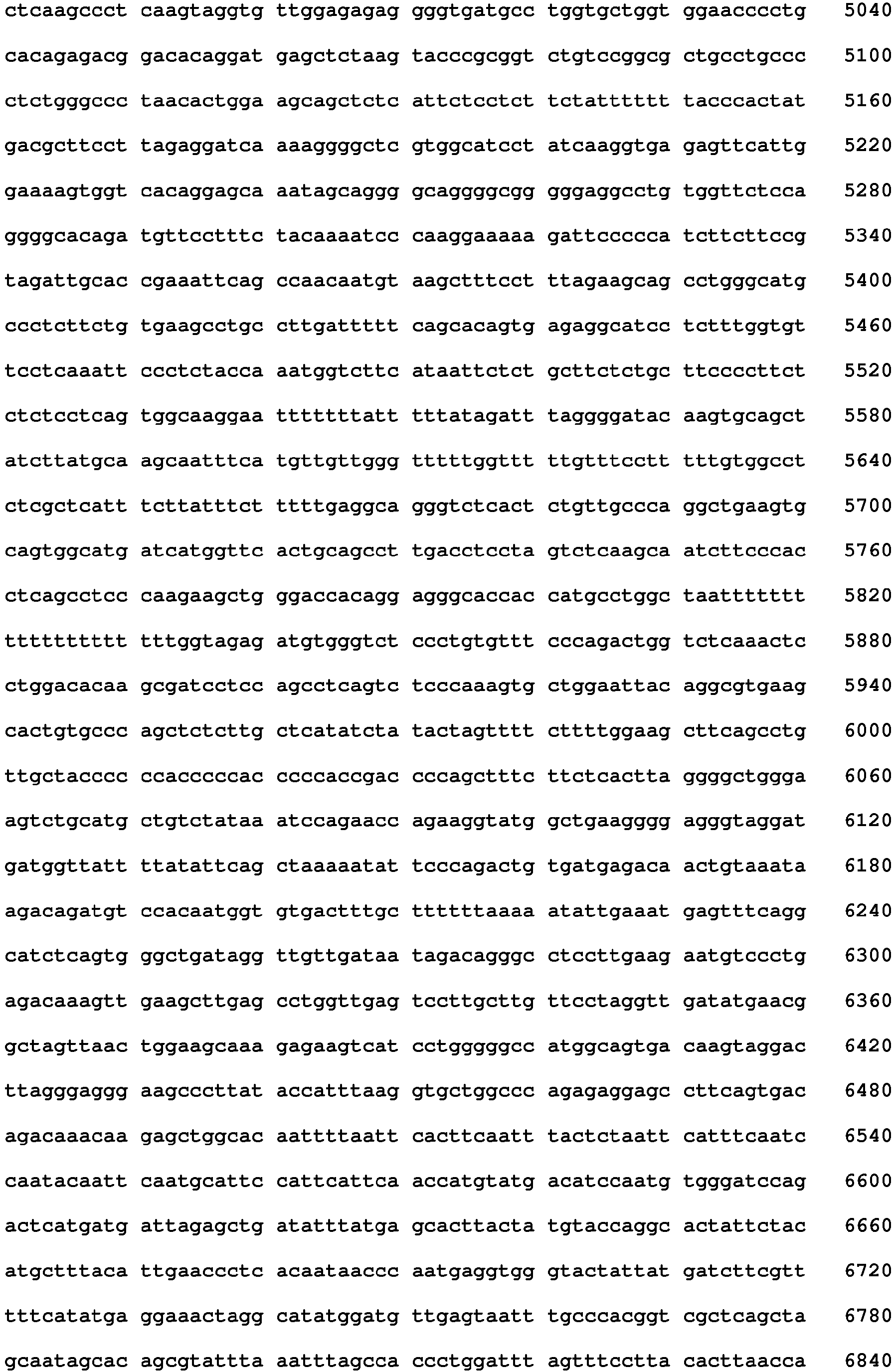





- <210> 23
<211> 65624
<212> DNA
<213> Homo sapiens - <400> 23






- <210> 24
<211> 27
<212> DNA
<213> Artificial sequence - <220>
<223> Synthetic sequence: Probe - <400> 24
caaaagctga tatgtcatgt ttagtta 27 - <210> 25
<211> 25
<212> DNA
<213> Artificial sequence - <220>
<223> Synthetic sequence: Primer - <400> 25
gcaaatatgg aaatttgatc atgt 25 - <210> 26
<211> 31
<212> DNA
<213> Artificial sequence - <220>
<223> Synthetic sequence: Primer - <400> 26
cttaatcaca agattatttt cagaatctaac 31 - <210> 27
<211> 20
<212> DNA
<213> Artificial sequence - <220>
<223> Synthetic sequence: Primer - <400> 27
gggccttgga caagttgtta 20 - <210> 28
<211> 26
<212> DNA
<213> Artificial sequence - <220>
<223> Synthetic sequence: Primer - <400> 28
ggcaaatatg gaaatttgat catgta 26 - <210> 29
<211> 250
<212> DNA
<213> Homo sapiens - <400> 29
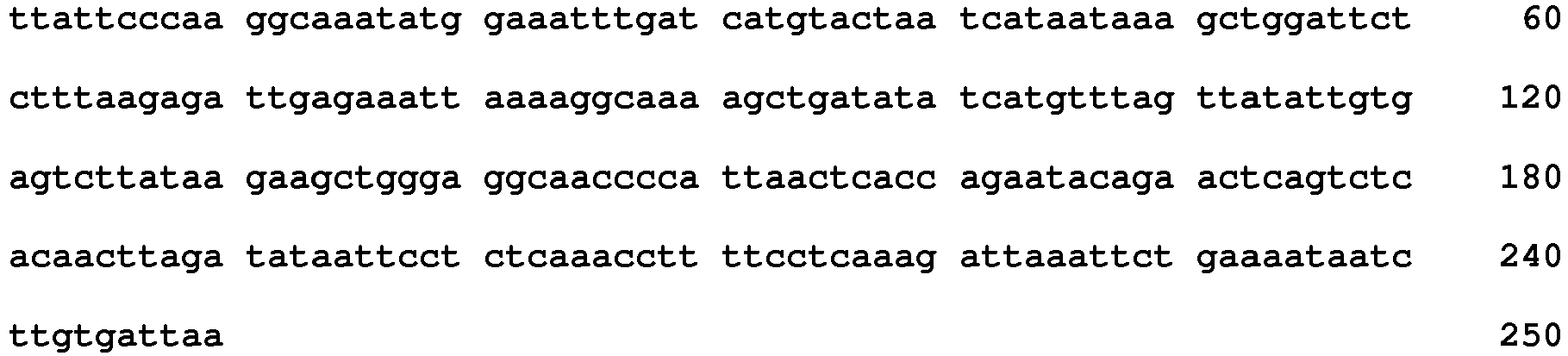
- <210> 30
<211> 249
<212> DNA
<213> Homo sapiens - <400> 30


- <210> 31
<211> 249
<212> DNA
<213> Homo sapiens - <400> 31

- <210> 32
<211> 250
<212> DNA
<213> Homo sapiens - <400> 32

• Luminex® system preparation:
1. Turn on the thermocycler.
2. Take the ID-CORE XT™ Beads Master Mix out of the refrigerator and let equilibrate to room temperature.
3. Vortex the ID-CORE XT™ Beads Master Mix for 30 seconds.
4. Dispense 46 µL of the ID-CORE XT™ Beads Master Mix into a Costar plate. Avoid bubble formation during dispensing.
5. Spin down the PCR plate to collect the liquid at the bottom of the wells.
6. Add 4 µL of PCR product into each well of the Costar plate.
7. Mix gently by pipetting up and down several times. Avoid bubble formation during dispensing and pipetting.
8. Seal the plate with a BioRad sealing film.
9. Verify that all wells are properly sealed and that the lid of the thermocycler has reached the pre-set temperature.
10. Place the plate and the corresponding silicone compression mats on the thermocycler block.
11. Close the thermocycler lid and start the ID XT HYB hybridization program.
| Temperature | Time | |
| Denaturation | 95° | 2 min |
| Hybridization | 52° | 30 min |
| Hold | 52°C | ∞ |
12. During the hybridization step prepare the labeling mix (see Labeling section) and perform the "Create a New Batch" step in the Luminex® software (see Data Acquisition section).
Claims (15)
- An oligonucleotide polymerase chain reaction (PCR) primer, comprising a nucleotide sequence which is of the formula:
X-Y-Z
wherein:X is X1 or X2, wherein:X1 is the final n nucleotides of the nucleotide sequence ATATGGAAATTTGATCATGT (SEQ ID NO: 1), wherein n is a number between 2 and 20, inclusive; andX2 is a variant of X1 differing by no more than one nucleotide substitution;Y is Y1 or Y2, wherein:Y1 is the nucleotide sequence AS1TAATS2ATAC (SEQ ID NO: 2), wherein S1 and S2 are independently selected from G and C; andY2 is a variant of Y1 differing from Y1 by no more than one nucleotide substitution, provided that said nucleotide substitution is not a substitution of the first A or final C of Y1;Z is the first m nucleotides in the nucleotide sequence TAAAG,wherein m is a number between 0 and 5, inclusive. - A primer according to claim 1, wherein the nucleotide sequence of said primer consists of a nucleotide sequence selected from the group consisting of:(i) AAATTTGATCATGTAGTAATCATAC (SEQ ID NO: 10);(ii) AAATTTGATCATGTACTAATCATAC (SEQ ID NO: 7);(iii) ATGTACTAATCATAC (SEQ ID NO: 8); and(iv) AAATTTGATCATGTACTAATGATAC (SEQ ID NO: 9).
- A primer according to claim 1, wherein X1 is the nucleotide sequence of AAATTTGATCATGT (SEQ ID NO: 3) or ATGT.
- A primer according to claim 1 or claim 3, wherein Y1 is selected from the group consisting of: ACTAATCATAC (SEQ ID NO: 4); ACTAATGATAC (SEQ ID NO: 5); and AGTAATCATAC (SEQ ID NO: 6).
- A primer according to any one of the preceding claims, wherein said primer is suitable for use as a forward PCR primer in a PCR amplification of a portion of the r'S allele of intron 3 of the RHD gene.
- A plurality of oligonucleotide primers comprising:(i) an oligonucleotide primer as defined in any one of claims 1 to 5; and(ii) at least one primer selected from the group consisting of:(a) a reverse primer that hybridises to a portion of intron 3 of r'S, or its complement, which portion includes the G/A polymorphism position 3189 of intron 3 of the RHD gene, said numbering being as shown in Figure 7;(b) an oligonucleotide primer of between 26 and 30 nucleotides in length comprising the nucleotide sequence GGAAAAGGTTTGAGAGGAATTATATT (SEQ ID NO: 11) or a variant thereof differing by not more than 3 nucleotide substitutions from the nucleotide sequence of SEQ ID NO: 11, provided that said substitutions do not include substitution of the final T of the nucleotide sequence of SEQ ID NO: 11;(c) an oligonucleotide primer consisting of the nucleotide sequence GGAAAAGGTTTGAGAGGAATTATATT (SEQ ID NO: 11);(d) the RHCE c forward primer consisting of the nucleotide sequence TGGGCTTCCTCACCTCAAA (SEQ ID NO: 12);(e) the RHCE c reverse primer consisting of the nucleotide sequence TGATGACCACCTTCCCAGG (SEQ ID NO: 13);(f) the RHCE C forward primer consisting of the nucleotide sequence GGCCACCACCATTTGAA (SEQ ID NO: 14);(g) the RHCE C reverse primer consisting of the nucleotide sequence GGTAGCAGGCGTCTGTAAAAA (SEQ ID NO: 15);(h) the RHCE exon 1 forward primer consisting of the nucleotide sequence CATAGACAGGCCAGCACAG (SEQ ID NO: 16);(i) the RHCE exon 1 reverse primer consisting of the nucleotide sequence TGCCCCTGGAGAACCAT (SEQ ID NO: 17);(j) the RHCE exon 5 forward primer consisting of the nucleotide sequence AAATTAAAATAAGCATTTGACCATC (SEQ ID NO: 18);(k) the RHCE exon 5 reverse primer consisting of the nucleotide sequence CCTGAGATGGCTGTCACCAC (SEQ ID NO: 19);(l) the RHCE exon 7 forward primer consisting of the nucleotide sequence ACATGCCATTGCCGTTC (SEQ ID NO: 20); and(m) the RHCE exon 7 reverse primer consisting of the nucleotide sequence TCTCACCTGCCAATCTGCT (SEQ ID NO: 21).
- A plurality of oligonucleotide primers according to claim 6, wherein said primers comprise the primer pair:AAATTTGATCATGTACTAATCATAC (SEQ ID NO: 7); andGGAAAAGGTTTGAGAGGAATTATATT (SEQ ID NO: 11).
- A kit for assessing a subject's blood type, said kit comprising:a plurality of primers as defined in any one claims 6 to 7;optionally, one or more probes and/or primers that span one or more polymorphic positions in intron 3, exon 3, exon 4, intron 7 and/or exon 7 of the RHD gene locus; andoptionally, one or more probes and/or primers that span one or more polymorphic positions in exon 7 of the RHCE gene locus.
- A system for use in determining a subject's blood type, the system comprising:a kit as defined in claim 8; andat least one detector arranged to detect a signal from detectably labelled DNA obtained from said subject or a detectably labelled amplicon produced by PCR amplification carried out on DNA obtained from said subject;at least one controller in communication with the at least one detector, the controller being programmed with computer-readable instructions to transform said signal into predicted blood type haplotypes, and optionally, to transform said predicted blood type haplotypes into a predicted blood type phenotype.
- A method for determining the presence or absence of, or for discriminating between, blood type alleles in a DNA-containing sample, which method comprises amplification by polymerase chain reaction (PCR) of at least a portion of intron 3 of the RHD gene, wherein said PCR employs at least a forward primer and a reverse primer each capable of hybridising to the portion of r'S intron 3 sequence set forth in SEQ ID NO: 31, or its complement, and wherein said forward primer is as defined in any one of claims 1 to 5.
- A method according to claim 10, wherein said blood type alleles are selected from the group consisting of: RHD*r'S; RHD*r'S-like; RHD*r'S Type 1; RHD*r'S Type 2; RHD*DIIIa; RHD*DIIIa IVS3+3100G; RHD*DIII_FN; RHD*DIVa-2; RHD*DIVa; RHD*DIII-type4; RHD*DIII-type6; RHD*DIII-type7; RHD*DIII-type8; RHCE*ceS; RHCE*ceS1006T ; RHCE*ceS1006C; RHCE*ce733G; RHCE*ce48C,733G,1025T; RHCE*ce48C,697G,733G; RHCE*ce340T,733G; and RHCE*ce48C,733G,748A.
- A method according to claim 10 or claim 11, wherein:(a) said PCR amplifies r'S, but does not amplify one or more of: RHD; RHCE*ce; RHD*DIIIa; RHD*DIIIa IVS3+3100G; and RHD*DIVa;(b) said PCR amplifies r'S, but does not amplify any of RHD; RHCE*ce; RHD*DIIIa; RHD*DIIIa IVS3+3100G; and RHD*DIVa; or(c) the method is for discriminating r'S from RHD*DIIIa IVS3+3100G.
- A method according to any one of claims 10 to 12, wherein:(a) said forward primer consists of the nucleotide sequenceAAATTTGATCATGTAGTAATCATAC (SEQ ID NO: 10) orAAATTTGATCATGTACTAATCATAC (SEQ ID NO: 7);(b) said reverse primer hybridises to a portion of intron 3 of r'S, or its complement, which portion includes at least one position of single nucleotide polymorphism (SNP) that differs between r'S and RHD, optionally wherein said position of SNP comprises the G/A polymorphism at position 3189 of intron 3 of the RHD gene, said numbering being as shown in Figure 7;(c) said reverse primer is of between 26 and 30 nucleotides in length and comprises the nucleotide sequence GGAAAAGGTTTGAGAGGAATTATATT (SEQ ID NO: 11); or(d) said PCR is multiplex PCR, which further comprises amplification of one or more other RHD and/or RHCE gene segments.
- A method according to claim 13(d), wherein(a) said one or more other RHD and/or RHCE gene segments are selected from the group consisting of: RHCE c; RHCE C; RHCE exon 1; RHCE exon 5; and RHCE exon 7; or(b) said multiplex PCR further comprises employing 1, 2, 3, 4, 5, 6, 7, 8, 9 or all 10 of the following primers:(i) the RHCE c forward primer consisting of the nucleotide sequence TGGGCTTCCTCACCTCAAA (SEQ ID NO: 12);(ii) the RHCE c reverse primer consisting of the nucleotide sequence TGATGACCACCTTCCCAGG (SEQ ID NO: 13);(iii) the RHCE C forward primer consisting of the nucleotide sequence GGCCACCACCATTTGAA (SEQ ID NO: 14);(iv) the RHCE C reverse primer consisting of the nucleotide sequence GGTAGCAGGCGTCTGTAAAAA (SEQ ID NO: 15);(v) the RHCE exon 1 forward primer consisting of the nucleotide sequence CATAGACAGGCCAGCACAG (SEQ ID NO: 16);(vi) the RHCE exon 1 reverse primer consisting of the nucleotide sequence TGCCCCTGGAGAACCAT (SEQ ID NO: 17);(vii) the RHCE exon 5 forward primer consisting of the nucleotide sequence AAATTAAAATAAGCATTTGACCATC (SEQ ID NO: 18);(viii) the RHCE exon 5 reverse primer consisting of the nucleotide sequence CCTGAGATGGCTGTCACCAC (SEQ ID NO: 19);(ix) the RHCE exon 7 forward primer consisting of the nucleotide sequence ACATGCCATTGCCGTTC (SEQ ID NO: 20); and(x) the RHCE exon 7 reverse primer consisting of the nucleotide sequence TCTCACCTGCCAATCTGCT (SEQ ID NO: 21).
- A method of blood matching, the method comprising:carrying out the method according to any one of claims 10 to 14 on a recipient sample from a recipient subject in need of donor blood and on a donor sample from a potential donor subject;comparing the blood type alleles present in the recipient sample with those present in the donor subject and thereby determining the compatibility of the recipient subject to receive blood from the potential donor subject.
Applications Claiming Priority (2)
| Application Number | Priority Date | Filing Date | Title |
|---|---|---|---|
| US13/791,284 US9359643B2 (en) | 2013-03-08 | 2013-03-08 | Discrimination of blood type variants |
| PCT/EP2014/052411 WO2014135331A1 (en) | 2013-03-08 | 2014-02-07 | Discrimination of blood type variants |
Publications (2)
| Publication Number | Publication Date |
|---|---|
| EP2964780A1 EP2964780A1 (en) | 2016-01-13 |
| EP2964780B1 true EP2964780B1 (en) | 2018-04-11 |
Family
ID=50069000
Family Applications (1)
| Application Number | Title | Priority Date | Filing Date |
|---|---|---|---|
| EP14703082.9A Active EP2964780B1 (en) | 2013-03-08 | 2014-02-07 | Discrimination of blood type variants |
Country Status (4)
| Country | Link |
|---|---|
| US (2) | US9359643B2 (en) |
| EP (1) | EP2964780B1 (en) |
| ES (1) | ES2674518T3 (en) |
| WO (1) | WO2014135331A1 (en) |
Families Citing this family (7)
| Publication number | Priority date | Publication date | Assignee | Title |
|---|---|---|---|---|
| CN106967808B (en) * | 2017-04-11 | 2020-11-27 | 青岛市中心血站(青岛市公民义务献血办公室青岛市输血医学研究所) | Primer group for detecting RhD negative blood type and application thereof |
| CN108103204B (en) * | 2017-12-15 | 2018-10-02 | 东莞博奥木华基因科技有限公司 | Rh blood type typing method and device based on multiplex PCR and second-generation sequencing |
| CN108681661B (en) * | 2018-05-16 | 2022-02-18 | 杭州迈迪科生物科技有限公司 | Method for generating sample ID (identity) along with experiment |
| CN110942806A (en) * | 2018-09-25 | 2020-03-31 | 深圳华大法医科技有限公司 | Blood type genotyping method and device and storage medium |
| CN111304211B (en) * | 2020-03-10 | 2020-12-01 | 无锡市第五人民医院 | RHD-T268A mutant and its detection |
| CN114496209B (en) * | 2022-02-18 | 2022-09-27 | 青岛市中心血站 | Intelligent decision-making method and system for blood donation |
| CN118932038A (en) * | 2024-10-12 | 2024-11-12 | 青岛大学 | A SNP marker for detecting RHD blood type mutation sites and its application |
Family Cites Families (6)
| Publication number | Priority date | Publication date | Assignee | Title |
|---|---|---|---|---|
| US5846727A (en) * | 1996-06-06 | 1998-12-08 | Board Of Supervisors Of Louisiana State University And Agricultural & Mechanical College | Microsystem for rapid DNA sequencing |
| AU784319B2 (en) | 1999-11-02 | 2006-03-09 | Willy A. Flegel | Molecular structure of RHD negative locus |
| AU2001250572A1 (en) | 2000-04-07 | 2001-10-23 | Epigenomics Ag | Detection of single nucleotide polymorphisms (snp's) and cytosine-methylations |
| CA2399276A1 (en) | 2000-11-10 | 2002-05-16 | Agriculture Victoria Services Pty, Ltd. | Novel therapeutic compositions for treating infection by lawsonia spp |
| ES2445709T3 (en) | 2010-12-31 | 2014-03-04 | Progenika Biopharma, S.A. | Method for the identification by molecular techniques of genetic variants that do not encode D (D-) antigen and encode altered C (C + W) antigen |
| WO2012171990A1 (en) | 2011-06-17 | 2012-12-20 | Progenika Biopharma, S.A. | Discrimination of blood type variants |
-
2013
- 2013-03-08 US US13/791,284 patent/US9359643B2/en active Active
-
2014
- 2014-02-07 ES ES14703082.9T patent/ES2674518T3/en active Active
- 2014-02-07 WO PCT/EP2014/052411 patent/WO2014135331A1/en not_active Ceased
- 2014-02-07 EP EP14703082.9A patent/EP2964780B1/en active Active
-
2016
- 2016-04-29 US US15/142,881 patent/US10253366B2/en active Active
Also Published As
| Publication number | Publication date |
|---|---|
| WO2014135331A1 (en) | 2014-09-12 |
| US10253366B2 (en) | 2019-04-09 |
| US9359643B2 (en) | 2016-06-07 |
| US20140255923A1 (en) | 2014-09-11 |
| US20160244830A1 (en) | 2016-08-25 |
| EP2964780A1 (en) | 2016-01-13 |
| ES2674518T3 (en) | 2018-07-02 |
Similar Documents
| Publication | Publication Date | Title |
|---|---|---|
| US10253366B2 (en) | Discrimination of blood type variants | |
| CN108913757B (en) | Primer group and detection kit for chromosome aneuploid number abnormality and application thereof | |
| CN110484621B (en) | Early warning method for liver cancer | |
| US9637788B2 (en) | Discrimination of blood type variants | |
| CN104152556B (en) | A kit and application for judging curative effect of trastuzumab in adjuvant therapy for breast cancer | |
| EP2821503B1 (en) | Method for detecting hla-a*31:01 allele | |
| EP2450443A1 (en) | Target sequence amplification method, polymorphism detection method, and reagents for use in the methods | |
| US20160053333A1 (en) | Novel Haplotype Tagging Single Nucleotide Polymorphisms and Use of Same to Predict Childhood Lymphoblastic Leukemia | |
| US9139881B2 (en) | Method for assessing breast cancer susceptibility | |
| CN102827834A (en) | Susceptibility gene of hyperthyroidism disease and application thereof | |
| US20120202708A1 (en) | Complement factor h copy number variants found in the rca locus | |
| Zacarias et al. | Frequency of RHD variants in Brazilian blood donors from Parana State, Southern Brazil | |
| CN104131101B (en) | A kind of reagent and application thereof detecting P53 gene SNP site | |
| EP1741791A9 (en) | Method and kit for the genotypification of hla-b27 based on real time pcr | |
| KR20230036504A (en) | Markers for diagnosing Sarcopenia and use thereof | |
| EP3458603B1 (en) | Penta e polymorphisms for human identification | |
| Zhao et al. | Common variation in the CYP17A1 and IFIT1 genes on chromosome 10 does not contribute to the risk of endometriosis | |
| KR20160040677A (en) | Method for detecting predisposition for hepatitis B to become chronic | |
| CN105765077B (en) | Detection method for determining risk of anti-thyroid drug-induced agranulocytosis and kit for determination | |
| US7432362B2 (en) | Assay for human DNA for gender determination | |
| RU2352641C1 (en) | Method of diagnosing heredotary predisposition to thrombophilia | |
| Sebastian-delaCruz et al. | A fast, cheap, and easy protocol for celiac disease HLA haplotype typing using buccal swabs | |
| US7074567B2 (en) | Assay for human DNA for gender determination | |
| US20080145853A1 (en) | Methods and Kits for Detection of Chromosome Aneuploidy by High Performance Liquid Chromatography with Post-Column Fluorescence Detection | |
| JP4533979B2 (en) | Human toll-like receptor 3 gene polymorphism and its use as a genetic predisposition marker for allergic diseases |
Legal Events
| Date | Code | Title | Description |
|---|---|---|---|
| PUAI | Public reference made under article 153(3) epc to a published international application that has entered the european phase |
Free format text: ORIGINAL CODE: 0009012 |
|
| 17P | Request for examination filed |
Effective date: 20150902 |
|
| AK | Designated contracting states |
Kind code of ref document: A1 Designated state(s): AL AT BE BG CH CY CZ DE DK EE ES FI FR GB GR HR HU IE IS IT LI LT LU LV MC MK MT NL NO PL PT RO RS SE SI SK SM TR |
|
| AX | Request for extension of the european patent |
Extension state: BA ME |
|
| DAX | Request for extension of the european patent (deleted) | ||
| 17Q | First examination report despatched |
Effective date: 20160714 |
|
| STAA | Information on the status of an ep patent application or granted ep patent |
Free format text: STATUS: EXAMINATION IS IN PROGRESS |
|
| GRAP | Despatch of communication of intention to grant a patent |
Free format text: ORIGINAL CODE: EPIDOSNIGR1 |
|
| STAA | Information on the status of an ep patent application or granted ep patent |
Free format text: STATUS: GRANT OF PATENT IS INTENDED |
|
| INTG | Intention to grant announced |
Effective date: 20171215 |
|
| GRAS | Grant fee paid |
Free format text: ORIGINAL CODE: EPIDOSNIGR3 |
|
| GRAA | (expected) grant |
Free format text: ORIGINAL CODE: 0009210 |
|
| STAA | Information on the status of an ep patent application or granted ep patent |
Free format text: STATUS: THE PATENT HAS BEEN GRANTED |
|
| AK | Designated contracting states |
Kind code of ref document: B1 Designated state(s): AL AT BE BG CH CY CZ DE DK EE ES FI FR GB GR HR HU IE IS IT LI LT LU LV MC MK MT NL NO PL PT RO RS SE SI SK SM TR |
|
| REG | Reference to a national code |
Ref country code: GB Ref legal event code: FG4D |
|
| REG | Reference to a national code |
Ref country code: CH Ref legal event code: EP |
|
| REG | Reference to a national code |
Ref country code: AT Ref legal event code: REF Ref document number: 988088 Country of ref document: AT Kind code of ref document: T Effective date: 20180415 |
|
| REG | Reference to a national code |
Ref country code: IE Ref legal event code: FG4D |
|
| REG | Reference to a national code |
Ref country code: DE Ref legal event code: R096 Ref document number: 602014023646 Country of ref document: DE |
|
| REG | Reference to a national code |
Ref country code: ES Ref legal event code: FG2A Ref document number: 2674518 Country of ref document: ES Kind code of ref document: T3 Effective date: 20180702 |
|
| REG | Reference to a national code |
Ref country code: NL Ref legal event code: MP Effective date: 20180411 |
|
| REG | Reference to a national code |
Ref country code: LT Ref legal event code: MG4D |
|
| PG25 | Lapsed in a contracting state [announced via postgrant information from national office to epo] |
Ref country code: NL Free format text: LAPSE BECAUSE OF FAILURE TO SUBMIT A TRANSLATION OF THE DESCRIPTION OR TO PAY THE FEE WITHIN THE PRESCRIBED TIME-LIMIT Effective date: 20180411 |
|
| PG25 | Lapsed in a contracting state [announced via postgrant information from national office to epo] |
Ref country code: FI Free format text: LAPSE BECAUSE OF FAILURE TO SUBMIT A TRANSLATION OF THE DESCRIPTION OR TO PAY THE FEE WITHIN THE PRESCRIBED TIME-LIMIT Effective date: 20180411 Ref country code: BG Free format text: LAPSE BECAUSE OF FAILURE TO SUBMIT A TRANSLATION OF THE DESCRIPTION OR TO PAY THE FEE WITHIN THE PRESCRIBED TIME-LIMIT Effective date: 20180711 Ref country code: AL Free format text: LAPSE BECAUSE OF FAILURE TO SUBMIT A TRANSLATION OF THE DESCRIPTION OR TO PAY THE FEE WITHIN THE PRESCRIBED TIME-LIMIT Effective date: 20180411 Ref country code: PL Free format text: LAPSE BECAUSE OF FAILURE TO SUBMIT A TRANSLATION OF THE DESCRIPTION OR TO PAY THE FEE WITHIN THE PRESCRIBED TIME-LIMIT Effective date: 20180411 Ref country code: NO Free format text: LAPSE BECAUSE OF FAILURE TO SUBMIT A TRANSLATION OF THE DESCRIPTION OR TO PAY THE FEE WITHIN THE PRESCRIBED TIME-LIMIT Effective date: 20180711 Ref country code: SE Free format text: LAPSE BECAUSE OF FAILURE TO SUBMIT A TRANSLATION OF THE DESCRIPTION OR TO PAY THE FEE WITHIN THE PRESCRIBED TIME-LIMIT Effective date: 20180411 Ref country code: LT Free format text: LAPSE BECAUSE OF FAILURE TO SUBMIT A TRANSLATION OF THE DESCRIPTION OR TO PAY THE FEE WITHIN THE PRESCRIBED TIME-LIMIT Effective date: 20180411 |
|
| PG25 | Lapsed in a contracting state [announced via postgrant information from national office to epo] |
Ref country code: RS Free format text: LAPSE BECAUSE OF FAILURE TO SUBMIT A TRANSLATION OF THE DESCRIPTION OR TO PAY THE FEE WITHIN THE PRESCRIBED TIME-LIMIT Effective date: 20180411 Ref country code: HR Free format text: LAPSE BECAUSE OF FAILURE TO SUBMIT A TRANSLATION OF THE DESCRIPTION OR TO PAY THE FEE WITHIN THE PRESCRIBED TIME-LIMIT Effective date: 20180411 Ref country code: GR Free format text: LAPSE BECAUSE OF FAILURE TO SUBMIT A TRANSLATION OF THE DESCRIPTION OR TO PAY THE FEE WITHIN THE PRESCRIBED TIME-LIMIT Effective date: 20180712 Ref country code: LV Free format text: LAPSE BECAUSE OF FAILURE TO SUBMIT A TRANSLATION OF THE DESCRIPTION OR TO PAY THE FEE WITHIN THE PRESCRIBED TIME-LIMIT Effective date: 20180411 |
|
| REG | Reference to a national code |
Ref country code: AT Ref legal event code: MK05 Ref document number: 988088 Country of ref document: AT Kind code of ref document: T Effective date: 20180411 |
|
| PG25 | Lapsed in a contracting state [announced via postgrant information from national office to epo] |
Ref country code: PT Free format text: LAPSE BECAUSE OF FAILURE TO SUBMIT A TRANSLATION OF THE DESCRIPTION OR TO PAY THE FEE WITHIN THE PRESCRIBED TIME-LIMIT Effective date: 20180813 |
|
| REG | Reference to a national code |
Ref country code: DE Ref legal event code: R097 Ref document number: 602014023646 Country of ref document: DE |
|
| PG25 | Lapsed in a contracting state [announced via postgrant information from national office to epo] |
Ref country code: SK Free format text: LAPSE BECAUSE OF FAILURE TO SUBMIT A TRANSLATION OF THE DESCRIPTION OR TO PAY THE FEE WITHIN THE PRESCRIBED TIME-LIMIT Effective date: 20180411 Ref country code: RO Free format text: LAPSE BECAUSE OF FAILURE TO SUBMIT A TRANSLATION OF THE DESCRIPTION OR TO PAY THE FEE WITHIN THE PRESCRIBED TIME-LIMIT Effective date: 20180411 Ref country code: AT Free format text: LAPSE BECAUSE OF FAILURE TO SUBMIT A TRANSLATION OF THE DESCRIPTION OR TO PAY THE FEE WITHIN THE PRESCRIBED TIME-LIMIT Effective date: 20180411 Ref country code: DK Free format text: LAPSE BECAUSE OF FAILURE TO SUBMIT A TRANSLATION OF THE DESCRIPTION OR TO PAY THE FEE WITHIN THE PRESCRIBED TIME-LIMIT Effective date: 20180411 Ref country code: EE Free format text: LAPSE BECAUSE OF FAILURE TO SUBMIT A TRANSLATION OF THE DESCRIPTION OR TO PAY THE FEE WITHIN THE PRESCRIBED TIME-LIMIT Effective date: 20180411 Ref country code: CZ Free format text: LAPSE BECAUSE OF FAILURE TO SUBMIT A TRANSLATION OF THE DESCRIPTION OR TO PAY THE FEE WITHIN THE PRESCRIBED TIME-LIMIT Effective date: 20180411 |
|
| PLBE | No opposition filed within time limit |
Free format text: ORIGINAL CODE: 0009261 |
|
| STAA | Information on the status of an ep patent application or granted ep patent |
Free format text: STATUS: NO OPPOSITION FILED WITHIN TIME LIMIT |
|
| PG25 | Lapsed in a contracting state [announced via postgrant information from national office to epo] |
Ref country code: SM Free format text: LAPSE BECAUSE OF FAILURE TO SUBMIT A TRANSLATION OF THE DESCRIPTION OR TO PAY THE FEE WITHIN THE PRESCRIBED TIME-LIMIT Effective date: 20180411 Ref country code: IT Free format text: LAPSE BECAUSE OF FAILURE TO SUBMIT A TRANSLATION OF THE DESCRIPTION OR TO PAY THE FEE WITHIN THE PRESCRIBED TIME-LIMIT Effective date: 20180411 |
|
| 26N | No opposition filed |
Effective date: 20190114 |
|
| PG25 | Lapsed in a contracting state [announced via postgrant information from national office to epo] |
Ref country code: SI Free format text: LAPSE BECAUSE OF FAILURE TO SUBMIT A TRANSLATION OF THE DESCRIPTION OR TO PAY THE FEE WITHIN THE PRESCRIBED TIME-LIMIT Effective date: 20180411 |
|
| REG | Reference to a national code |
Ref country code: CH Ref legal event code: PL |
|
| PG25 | Lapsed in a contracting state [announced via postgrant information from national office to epo] |
Ref country code: LU Free format text: LAPSE BECAUSE OF NON-PAYMENT OF DUE FEES Effective date: 20190207 Ref country code: MC Free format text: LAPSE BECAUSE OF FAILURE TO SUBMIT A TRANSLATION OF THE DESCRIPTION OR TO PAY THE FEE WITHIN THE PRESCRIBED TIME-LIMIT Effective date: 20180411 |
|
| REG | Reference to a national code |
Ref country code: BE Ref legal event code: MM Effective date: 20190228 |
|
| REG | Reference to a national code |
Ref country code: IE Ref legal event code: MM4A |
|
| PG25 | Lapsed in a contracting state [announced via postgrant information from national office to epo] |
Ref country code: LI Free format text: LAPSE BECAUSE OF NON-PAYMENT OF DUE FEES Effective date: 20190228 Ref country code: CH Free format text: LAPSE BECAUSE OF NON-PAYMENT OF DUE FEES Effective date: 20190228 |
|
| PG25 | Lapsed in a contracting state [announced via postgrant information from national office to epo] |
Ref country code: IE Free format text: LAPSE BECAUSE OF NON-PAYMENT OF DUE FEES Effective date: 20190207 |
|
| PG25 | Lapsed in a contracting state [announced via postgrant information from national office to epo] |
Ref country code: BE Free format text: LAPSE BECAUSE OF NON-PAYMENT OF DUE FEES Effective date: 20190228 |
|
| PG25 | Lapsed in a contracting state [announced via postgrant information from national office to epo] |
Ref country code: TR Free format text: LAPSE BECAUSE OF FAILURE TO SUBMIT A TRANSLATION OF THE DESCRIPTION OR TO PAY THE FEE WITHIN THE PRESCRIBED TIME-LIMIT Effective date: 20180411 |
|
| PG25 | Lapsed in a contracting state [announced via postgrant information from national office to epo] |
Ref country code: MT Free format text: LAPSE BECAUSE OF NON-PAYMENT OF DUE FEES Effective date: 20190207 |
|
| PG25 | Lapsed in a contracting state [announced via postgrant information from national office to epo] |
Ref country code: CY Free format text: LAPSE BECAUSE OF FAILURE TO SUBMIT A TRANSLATION OF THE DESCRIPTION OR TO PAY THE FEE WITHIN THE PRESCRIBED TIME-LIMIT Effective date: 20180411 |
|
| PG25 | Lapsed in a contracting state [announced via postgrant information from national office to epo] |
Ref country code: IS Free format text: LAPSE BECAUSE OF FAILURE TO SUBMIT A TRANSLATION OF THE DESCRIPTION OR TO PAY THE FEE WITHIN THE PRESCRIBED TIME-LIMIT Effective date: 20180811 |
|
| PG25 | Lapsed in a contracting state [announced via postgrant information from national office to epo] |
Ref country code: HU Free format text: LAPSE BECAUSE OF FAILURE TO SUBMIT A TRANSLATION OF THE DESCRIPTION OR TO PAY THE FEE WITHIN THE PRESCRIBED TIME-LIMIT; INVALID AB INITIO Effective date: 20140207 |
|
| PG25 | Lapsed in a contracting state [announced via postgrant information from national office to epo] |
Ref country code: MK Free format text: LAPSE BECAUSE OF FAILURE TO SUBMIT A TRANSLATION OF THE DESCRIPTION OR TO PAY THE FEE WITHIN THE PRESCRIBED TIME-LIMIT Effective date: 20180411 |
|
| P01 | Opt-out of the competence of the unified patent court (upc) registered |
Effective date: 20230509 |
|
| PGFP | Annual fee paid to national office [announced via postgrant information from national office to epo] |
Ref country code: GB Payment date: 20260227 Year of fee payment: 13 |
|
| PGFP | Annual fee paid to national office [announced via postgrant information from national office to epo] |
Ref country code: ES Payment date: 20260302 Year of fee payment: 13 |
|
| PGFP | Annual fee paid to national office [announced via postgrant information from national office to epo] |
Ref country code: DE Payment date: 20260227 Year of fee payment: 13 |
|
| PGFP | Annual fee paid to national office [announced via postgrant information from national office to epo] |
Ref country code: FR Payment date: 20260225 Year of fee payment: 13 |