EP2963569A2 - Informationsverarbeitung - Google Patents
Informationsverarbeitung Download PDFInfo
- Publication number
- EP2963569A2 EP2963569A2 EP15171045.6A EP15171045A EP2963569A2 EP 2963569 A2 EP2963569 A2 EP 2963569A2 EP 15171045 A EP15171045 A EP 15171045A EP 2963569 A2 EP2963569 A2 EP 2963569A2
- Authority
- EP
- European Patent Office
- Prior art keywords
- metadata
- information item
- trust
- current information
- information items
- Prior art date
- Legal status (The legal status is an assumption and is not a legal conclusion. Google has not performed a legal analysis and makes no representation as to the accuracy of the status listed.)
- Granted
Links
Images


Classifications
-
- G—PHYSICS
- G06—COMPUTING OR CALCULATING; COUNTING
- G06F—ELECTRIC DIGITAL DATA PROCESSING
- G06F16/00—Information retrieval; Database structures therefor; File system structures therefor
- G06F16/50—Information retrieval; Database structures therefor; File system structures therefor of still image data
-
- G—PHYSICS
- G06—COMPUTING OR CALCULATING; COUNTING
- G06F—ELECTRIC DIGITAL DATA PROCESSING
- G06F16/00—Information retrieval; Database structures therefor; File system structures therefor
- G06F16/40—Information retrieval; Database structures therefor; File system structures therefor of multimedia data, e.g. slideshows comprising image and additional audio data
- G06F16/48—Retrieval characterised by using metadata, e.g. metadata not derived from the content or metadata generated manually
-
- G—PHYSICS
- G06—COMPUTING OR CALCULATING; COUNTING
- G06F—ELECTRIC DIGITAL DATA PROCESSING
- G06F16/00—Information retrieval; Database structures therefor; File system structures therefor
- G06F16/90—Details of database functions independent of the retrieved data types
- G06F16/907—Retrieval characterised by using metadata, e.g. metadata not derived from the content or metadata generated manually
-
- G—PHYSICS
- G06—COMPUTING OR CALCULATING; COUNTING
- G06T—IMAGE DATA PROCESSING OR GENERATION, IN GENERAL
- G06T7/00—Image analysis
Definitions
- This invention relates to information handling.
- Systems have been proposed which attempt to allow a user to search a content repository by identifying video and/or audio statistics of an item of interest and search in the repository for similar content items. Such statistics are often called "ground truth" metadata, as they are derived in a repeatable way from video and audio properties of the content.
- the searching may be performed by defining a feature vector (based on at least a set of significant aspects of the ground truth metadata) for each available content item, and detecting close matches by distance in the vector space. This type of search may return a subset of information from which the user can subjectively determine which are relevant to his requirements. It has been proposed that a user may select relevant hits subjectively, and cross search their feature vectors back into the repository to find further similar content items or hits. This will be termed a "reinforced find similar" search.
- Some asset management repositories may include content items having associated textual metadata, while other items in the same repository have no associated metadata.
- New content items may be ingested with or without associated textual metadata.
- a search by ground truth metadata can be used to generate a visual representation of available content items to give the user an appreciation of what the types of content stored in the repository. The user may select a number of candidate items from this visualisation and perform a keyword search on those selected to find content items required.
- those items without textual metadata can only be identified as relevant from the visualisation search. It has been proposed that when ingesting new content items into the repository without having associated textual metadata, a feature vector for the new content item could be derived and searched into the asset management system to identify similar content items.
- the closest match in vector space to the new item could be identified and, if it has associated textual metadata, that metadata could be automatically assigned to the new content item.
- the new content item can be identified by a textual metadata search without the burdensome requirement for a human to review it and assign, manually metadata to it.
- the repository may include a number of shots of racing cars on a track and each car has a metadata defining it as a Formula One racing car (A).
- A Formula One racing car
- B metadata defining the shot as a motorcycle
- B a new shot is ingested of a superbike race on a racing track
- an automated system may determine that (A) is relatively more similar to (C) than (B) due to the presence of a racing track. In such cases, (C) would be incorrectly assigned the metadata "Formula One Racing Car” rather than "motorcycle”.
- the risk of this happening could be reduced by ensuring that metadata is only assigned when a similar item is identified within a threshold distance in the vector space.
- the system could identify say, the 20 closest items and process their metadata to identify a term frequency for individual words or phrases and assign e.g. the top three words/phrases to the newly ingested content item.
- This invention provides information handling apparatus in which metadata (e.g. textual metadata) is generated in respect of a current information item by reference to an ensemble of information items having associated metadata, the metadata having corresponding indicator data representing a degree of trust associated with that metadata, the apparatus comprising:
- such automatic metadata labelling is performed and, within the database structure, a field is defined by which metadata can be entered (preferably automatically, or potentially manually) which indicates a relative degree of trust in the accuracy of the metadata.
- a field is defined by which metadata can be entered (preferably automatically, or potentially manually) which indicates a relative degree of trust in the accuracy of the metadata.
- This could for example be on a scale of 1 to 10, where 1 indicates unproven accuracy and 10 indicates high confidence in the accuracy.
- it could be a simple two-state trusted or untrusted flag. Such a flag could be changed once a human has verified the accuracy of the metadata.
- the invention therefore provides a technique by which the automated assignment of metadata (for example to a newly ingested item) can still be used, but with a reduced danger of a database becoming clogged with potentially inaccurate metadata which is indistinguishable from useful metadata.
- Figure 1 is a schematic diagram of an information storage and retrieval system based around a general-purpose computer 10 having a processor unit 20 including disk storage 30 for programs and data, a network interface card 40 connected to a network 50 such as an Ethernet network or the Internet, a display device such as a cathode ray tube device 60, a keyboard 70 and a user input device such as a mouse 80.
- the system operates under program control, the programs being stored on the disk storage 30 and provided, for example, by the network 50, a removable disk (not shown) or a pre-installation on the disk storage 30.
- the embodiments are applicable to many types of information items.
- a non-exhaustive list of appropriate types of information includes patents, video material, emails, presentations, internet content, broadcast content, business reports, audio material, graphics and clipart, photographs and the like, or combinations or mixtures of any of these.
- a piece of broadcast content such as audio and/or video material may have associated "MetaData" defining that material in textual terms.
- Feature vectors could be formed from information items formed of text (e.g. on the basis of their textual content, number of words, distribution of uncommon words and the like), and so on.
- the information items are loaded onto the disk storage 30 in a conventional manner. Preferably, they are stored as part of a database structure which allows for easier retrieval and indexing of the items, but this is not essential.
- a process is used to apply textual metadata to the items. An example of such a process will be described below.
- the indexed information data need not be stored on the local disk drive 30.
- the data could be stored on a remote drive connected to the system 10 via the network 50.
- the information may be stored in a distributed manner, for example at various sites across the internet. If the information is stored at different internet or network sites, a second level of information storage could be used to store locally a "link" (e.g. a URL) to the remote information, perhaps with an associated summary, abstract or MetaData associated with that link. So, the remotely held information need not be accessed unless the user selected the relevant link (e.g. from the results list 260 to be described below), although for the purposes of the technical description which follows, the remotely held information, or the abstract/summary/MetaData, or the link/LTRL could be considered as the "information item".
- a formal definition of the "information item” is an item from which a feature vector is derived and processed (see below).
- the information items could be stored across a networked work group, such as a research team or a legal firm.
- a hybrid approach might involve some information items stored locally and/or some information items stored across a local area network and/or some information items stored across a wide area network.
- system 10 of Figure 1 is but one example of possible systems which could use the indexed information items. Another example will be described below with reference to Figure 6 . In general, practically any device having a display could be used for the information-accessing phase of operation.
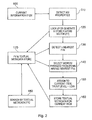
- Figure 2 is a schematic flowchart illustrating the operation of the present embodiment. It will be understood that the operations and storage requirements referred to in Figure 2 may be carried out with respect to the apparatus described in reference to Figure 1 .
- An information item 100 including audio/video material is processed by steps 110, 120, 130, 140, 150 and 160 in order to generate textual metadata (e.g. a title, keywords and/or free text description) to be stored in a feature vector and textual metadata store 170 (which could be a separate store or could be formed by respective database entries associated with each information item). This allows a separate step 180 of searching by text to be carried out.
- textual metadata e.g. a title, keywords and/or free text description
- textual metadata is used as an example of the types of metadata that could be involved.
- the metadata could instead (or in addition) represent one or more of: an internet or network hyperlink (for example, a link to a similar information item), analytically generated audio and/or video data representing audio and/or video properties of an information item, or other types of metadata.
- the textual metadata has associated indicator data representing a degree of trust attached to that metadata.
- the indicator data and how it is set and modified, will be described in detail below.
- the indicator data can apply to all of an information item's metadata (i.e. considering that metadata as a group) or separate indicator data can apply to sub-sections of the metadata, e.g. to each phrase or word group.
- the indicator data has at least two states, though preferably more, indicating various levels of trust in the metadata. At a minimum, the indicator data can indicate a "low” or a "high” level of trust. Of course there are no absolute measures of trust, nor any units by which it is measured.
- the indicator data is primarily a relative measure of a subjective quantity, but (as will be seen below) is one which can be set and modified by automatic means.
- the steps 110 to 160 are particularly relevant to an information item for which textual metadata is being generated for the first time, i.e. no textual metadata is currently held in respect of that information item.
- the technique may also be applied to update or supplement the textual metadata associated with an information item, in which case it is likely that the detection of A/V properties in the step 110 (see below) and the generation of a feature vector in the step 120 (see below) will already have taken place.
- a feature vector (in fact, using the terminology below, a "reduced feature vector”) is generated and stored in the feature vector and textual metadata store 170. It is important, for the purposes of comparison of feature vectors (see below) that the feature vectors have a manageable length, or number of values, while still providing a useful representation of the information item. There is no absolute quantity for this. In the embodiment described below, a 30 value feature vector is used. Probably 3 values would be too few and 1000 values would require too much processing to compare the feature vectors, but it is for the skilled man to select an appropriate number of values in dependence on the available processing resources.
- the feature vector for the current information item 100 is compared with stored feature vectors in respect of other information items.
- the comparison is by the known technique of detecting a Euclidean distance between vectors in a q-dimensional space (where q is the number of values in each feature vector).
- the n closest feature (shortest Euclidean distance) vectors are selected by this test. For example, n may be 20.
- a selection is made from the textual metadata associated with the n closest information items.
- words and/or phrases from this selection are applied as metadata in respect of the current information item.
- the current information item is automatically populated with a predetermined number of most-frequently-occurring words and/or phrases from this selection, or with words and/or phrases having at least a threshold frequency of occurrence, or a combination of these.
- the indicator data associated with the automatically populated metadata is automatically set to a level representing a low degree of trust - preferably the level indicating the lowest degree of trust.
- the textual metadata which has been chosen (by the user or automatically) to accompany the current information item is stored in respect of that information item in the feature vector and textual metadata store.
- the step 180 schematically illustrates a separate process of searching for information items by textual metadata. It will of course be appreciated that this step may be carried out by the same apparatus at which the steps 110-160 were carried out, or by a different apparatus having access to at least the feature vector and textual metadata store 170. The searching process will be described separately with reference to Figure 5 below.
- Figure 3 is a schematic flow chart illustrating a so-called "feature extraction” process corresponding to the steps 110 and 120 of Figure 2 .
- Feature extraction is the process of transforming raw data into an abstract representation. These abstract representations can then be used for processes such as pattern classification, clustering and recognition. In this process, a so-called “feature vector” is generated, which is an abstract representation of various audio and video properties of the item.
- Audio and/or video properties of each information item in turn are detected at a step 210.
- steps 220 and 230 a process of detecting the more significant and less significant property data is carried out, leading to the discarding of less significant property data.
- the remaining (non-discarded) property data is concatenated at a step 240 to generate a "reduced" feature vector. Once the "reduced" feature vectors have been generated for the information item collection, they are available for use in the step 130 of Figure 2 .
- An optional further reduction process (e.g. by the known technique of random vector mapping, involving matrix-multiplying a p-valued feature vector by a p x q matrix of random numbers to generate a q-valued feature vector) may optionally be carried out.
- a further step is not relevant to the present embodiment where a 30-valued feature vector is generated by the process to be described below.
- random vector mapping could be used in place of the steps 220, 230 and 240 to produce a feature vector of a manageable size.
- the steps 220 to 240 could be carried out in another order, so that the data is discarded after concatenation (or indeed the discarding process could occur before and/or after concatenation).
- the aim of the technique is to automatically extract (from audio and video) a feature vector that represents a media item's genre with as few variables as possible (or at least a reduced number of variables); this feature vector is from now on called "reduced feature vector”.
- the reduced feature vector consists of a combination of several "basic feature vectors".
- the basic feature vectors encapsulate a specific type of feature like colours, shape etc.
- the first stage, represented by the step 210, is to detect so-called “basic feature vectors" representing respective properties of the information item.
- a 20-bin histogram is calculated for each frame in a media item, the average and standard deviation for each column in the histogram is taken over the whole media item.
- the average and standard deviation vectors are used as basic feature vectors representing a media item.
- the concatenation of the average and standard deviation is also used as a basic feature vectors and is then called "combination" in the list below.
- the colour models and feature vectors calculated from them are:
- face features Two different types of face based feature vectors are described; one called “face features” and the other one called “face statistics”.
- the face statistics basic feature vector is generated as follows:
- the face features basic feature vector is generated as follows:
- the features described above forms a 20-value feature vector, the average and standard deviation is taken column wise over the whole media, and concatenated to a 40-value feature vector.
- a 41 variable is added to the feature vector by taking the ratio of silent frames verses total amount of frames for the whole media item.
- EPFH edge/plain field histogram
- HSV Human Saturation Value
- the quantification step aims to divide the cone into different blocks. Each block is indexed with a number; the number itself is irrelevant the only function of the number is to work as an index.
- the index is the value generated (or "returned") by the saturation quantisation set out first. This in turn refers to hue and luminance quantisation set out below.
- the Saturation is quantised into 4 parts:
- the Hue is quantised into 7 non-uniform parts:
- LuminanceC (Value) is quantised in 3 parts:
- LuminanceA (Value) is quantised in 4 parts in an achromatic region:
- each pixel is compared with its surrounding pixels (that is a group of 8 pixels). If any one of the surrounding pixels has a different colour index value than the current centre pixel then the centre pixel is considered a "edge" pixel; otherwise it is considered a plain field pixel.
- centre refers to the pixel's spatial (image) position with relation to the pixels with whose colour properties it is being compared.
- edge and “plain field” refer to the current centre pixel's position in colour space with reference to the spatially surrounding pixels.
- a pixel is classified as an edge pixel it is added to an "edge” histogram; otherwise it is added to a "plain field” histogram.
- the bins in each of the histograms are the colour indices described above.
- edge histogram and the plain field histogram are both individually normalised so their length equals 1.
- the ratio of edge pixels to total pixels in the image is also calculated (the "edge ratio").
- the final feature vector comprise a concatenation of the normalised edge histogram, the normalised plain field histogram and the edge ratio.
- the basic colour feature vector consists of the average and standard deviation of a 60 bin RGB histogram (20 bin per colour) over the whole media item. This gives a feature vector consisting of 120 variables.
- the colour histogram is transformed with the Hotelling transform and truncated so that the 7 first variables are kept.
- the Hotelling Transform is based on statistical properties of the feature vectors.
- a transformation of a 20 variable vector will result in a 20 variable vector with the top/first variables being the one with most variance (i.e. they could be considered to be the more significant variables). This means that the transform moves the most important features in the feature vector to the beginning of the vector.
- Each frame is resized from its starting size (e.g. 720*576 pixels) to 64*64 with bilinear interpolation.
- the shape feature vector is transformed with the Hotelling transform and truncated so that the 10 first variables are kept.
- the audio feature is created as described above and that creates a 41-value feature vector.
- the 7 most significant values are retained.
- the face feature vector is created as described above and that creates a 6-value feature vector.
- the sub-feature vectors are normalised with mean standard deviation normalisation and concatenated to form a 30-value feature vector.
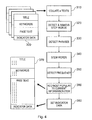
- Figure 4 schematically illustrates a process corresponding to the steps 140 and 150 of Figure 2 . It is assumed that the n closest information items (in terms of their feature vectors) have been identified at the step 130, and that textual metadata 300 in respect of at least some of those information items is stored in the feature vector and textual metadata store 170.
- the textual metadata 300 is arranged as a title, some keywords, some free text description of the information item and indicator data (corresponding to the whole of the metadata or to respective parts of it). It will of course be appreciated that this exact arrangement of the textual metadata is not essential and indeed that the textual metadata need not be partitioned at all, apart from some denomination of the indicator data within the textual metadata.
- the textual metadata corresponding to the n nearest information items is collated into a single set for a sorting process.
- this collated set of textual metadata will be considered as a document, but this is just for ease of description and understanding.
- Stop-words are extremely common words on a pre-prepared list, such as “a”, “the”, “however”, “about”, “and”, and “the”. These words are sufficiently common that they are not likely to be useful as information item-specific suggestions to the user or as automatically generated textual metadata.
- stop words serves another purpose, which is to delimit "phrases" at a step 330.
- a phrase is considered to be those words (or the first predetermined number, e.g. 3, of such words in the case of longer phrases) between two stop words.
- phrases are treated as words for the assessment of frequency of occurrence and the suggestion of candidate items for inclusion in the textual metadata.
- the remaining words are "stemmed” at a step 340, which involves finding the common stem of a word's variants. For example the words “thrower”, “throws”, and “throwing” have the common stem of "throw”.
- the words and phrases are sorted by frequency of occurrence, and the most frequently occurring words or phrases are identified. Where such a word had been stemmed, the most frequently occurring version of that word prior to the stemming process is used as the version to be presented to the user.
- a number of the most frequently occurring such words and phrases are added to a set 370 of words and phrases to be stored in respect of the current information item.
- the example set 370 shown in Figure 4 has different sub-lists in respect of the title, keyword and free text metadata fields.
- the analysis of the steps 310-360 could be carried out separately for these three fields in the data 300.
- the lists could be based on the same selection, but perhaps with fewer entries in the title and keyword lists.
- a single candidate list could be provided.
- the indicator data associated with the set 370 is initialised. In one embodiment, this is initialised to a value representing the lowest degree of trust within the available range of values. In another embodiment, a sub-range of values (i.e. the value representing the lowest degree of trust and one or more other values indicating next lowest degrees of trust) are available.
- the selection of the value to be initialised for the set 370 depends on the degree of trust associated with the source metadata. That is to say, if the metadata in the set 370 (or an item of that metadata) was previously associated with indicator data representing a high degree of trust (i.e. in the instance where that metadata was associated with an information item found to have a feature vector near to that of the current information item) then the indicator data for that metadata in respect of the current information item could be initialised to a level of trust a little higher than the lowest possible level.
- the indicator data is associated with the whole of the metadata corresponding to an information item (or even to a sub-group of information items).
- Metadata for information item n Indicator data: Trust 3/10
- the indicator data could be associated with subsets of the metadata for a single information item.
- the indicator data is preferably initialised to a low value when the corresponding metadata is copied across from one or more nearest information items at the steps 150 or 360/370.
- the reason is that even if that metadata accurately describes the "nearest" information items, it may be quite inaccurate as a description of the current information item, since the only thing that the nearest and current information items have in common is an analytical measure of their audio and video properties.
- a mechanism is therefore provided for the user to upgrade the level of trust in the metadata, if it proves that the metadata is accurate.
- a similar mechanism can be provided for the user to downgrade the level of trust, or even to delete the metadata, should the metadata be grossly inaccurate.
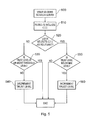
- Figure 5 schematically illustrates one example of a mechanism for handling variations in trust level. This example relates to a so-called reinforced search. An example of this is the reinforced find similar search mentioned above.
- a search query to search amongst the ensemble of information items.
- a set of results is returned at a step 510.
- the user then reviews those results.
- the user can select a result as relevant to the query, for example by clicking (using a user control such as the mouse 80) on a screen icon representing that result. This could be a further (or an initial) selection for a "find similar" search.
- the user might be interacting with the system for another purpose, and such interaction is detected and used in the process which follows.
- a current information item (CII) (not the current information item referred to in respect of Figure 2 , but a current one in terms of the process of Figure 5 )
- control passes to a step 550. If the user does not select it as relevant (or positively selects it as not being relevant) then control passes to a step 530.
- modifications may be made to trust levels associated with the CII. Such modifications could relate to a single trust level associated with the whole of the metadata associated with the CII. Or, if there are plural trust levels each associated with an aspect or subset of the CII's metadata, the modification preferably applies only to the one or more trust levels associated with metadata which (a) is the same as or very similar to metadata of the information item which started the find similar search, or (b) is the same as or very similar to the textual search query which prompted the current search.
- a test is applied to see if the trust level is at or above a threshold level (e.g. 8/10). If it is, then no action is taken. If not, then the trust level is decremented and the process (as regards the modification of the trust level in this instance) ends.
- a threshold level e.g. 8/10
- step 540 If the result of the step 540 is that the trust level is now zero, or if the trust level before the step 540 was already at its lowest possible value, then an optional step can be carried out in which the respective metadata is automatically deleted.
- step 550 a test is carried out to detect whether the trust level is below its maximum allowable level. If the answer is yes, then at a step 560 the trust level is incremented. If the answer is no, then the process ends.
- the system detects user input (e.g. the selection of an item as relevant to a search query) which is relevant to the trust level of metadata (or a subset of metadata) which is associated with an information item. In response to such a detection, the system automatically modifies the trust level associated with that metadata.
- user input e.g. the selection of an item as relevant to a search query
- the system automatically modifies the trust level associated with that metadata.
- Such a system could be employed in peer to peer networks if content items or in a shared community style database of video clips (for example one in which a user can upload content items and is free to add or change metadata associated with content items), as well as in a commercial asset management database.
- the metadata could be used in a content recommendation system, in which a user can choose whether to receive recommendations based on trusted or untrusted metadata to assist in the discovery of new content of which he had previously been unaware. There could be some incentives (financial or otherwise) to verify the metadata. Traceability of changes implemented would be needed for security for peer reviewed metadata.
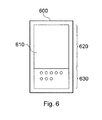
- FIG 6 schematically illustrates a personal digital assistant (PDA) 600, as an example of portable data processing apparatus, having a display screen 610 including a display area 620 and a touch sensitive area 630 providing user controls; along with data processing and storage (not shown).
- PDA personal digital assistant
- the PDA may be used as described above in place of or in association with the system of Figure 1 , possibly accessing information items and/or metadata stored on the system of Figure 1 , for example via a wireless link (not shown).
- embodiments of the invention may be implemented by adaptation to existing parts of a conventional equivalent device, which may be implemented in the form of a computer program product comprising processor implementable instructions stored on a data carrier such as a floppy disk, optical disk, hard disk, PROM, RAM, flash memory or any combination of these or other storage media, or transmitted via data signals on a network such as an Ethernet, a wireless network, the Internet, or any combination of these of other networks, or realised in hardware as an ASIC (application specific integrated circuit) or an FPGA (field programmable gate array) or other configurable circuit suitable to use in adapting the conventional equivalent device.
- a data carrier such as a floppy disk, optical disk, hard disk, PROM, RAM, flash memory or any combination of these or other storage media
- a network such as an Ethernet, a wireless network, the Internet, or any combination of these of other networks, or realised in hardware as an ASIC (application specific integrated circuit) or an FPGA (field programmable gate array) or other configurable circuit suitable to use in adapting the
- information items may be stored or transmitted along with their associated metadata and indicator data indicating a degree of trust associated with the metadata.
- the information items may be collated with the metadata and indicator data to form a database operable for searching as shown in Figure 5 .
- the Hotelling transform is also known as Principal component, eigenvector and discrete Karhunen-Loéve transform.
- the Hotelling transform is a very useful way to reduce the redundancy within feature vectors.
- Vector normalisation is a standard algebraic procedure, where one divides the vector by its own norm. This results in a vector of length 1.
Landscapes
- Engineering & Computer Science (AREA)
- Theoretical Computer Science (AREA)
- Physics & Mathematics (AREA)
- General Physics & Mathematics (AREA)
- Databases & Information Systems (AREA)
- Data Mining & Analysis (AREA)
- General Engineering & Computer Science (AREA)
- Library & Information Science (AREA)
- Multimedia (AREA)
- Computer Vision & Pattern Recognition (AREA)
- Information Retrieval, Db Structures And Fs Structures Therefor (AREA)
Applications Claiming Priority (2)
| Application Number | Priority Date | Filing Date | Title |
|---|---|---|---|
| GB0709145A GB2449125A (en) | 2007-05-11 | 2007-05-11 | Metadata with degree of trust indication |
| EP08251558.6A EP2015203B1 (de) | 2007-05-11 | 2008-04-29 | Auf Vertrauen basierende Informationsverarbeitung |
Related Parent Applications (2)
| Application Number | Title | Priority Date | Filing Date |
|---|---|---|---|
| EP08251558.6A Division EP2015203B1 (de) | 2007-05-11 | 2008-04-29 | Auf Vertrauen basierende Informationsverarbeitung |
| EP08251558.6A Division-Into EP2015203B1 (de) | 2007-05-11 | 2008-04-29 | Auf Vertrauen basierende Informationsverarbeitung |
Publications (3)
| Publication Number | Publication Date |
|---|---|
| EP2963569A2 true EP2963569A2 (de) | 2016-01-06 |
| EP2963569A3 EP2963569A3 (de) | 2016-04-06 |
| EP2963569B1 EP2963569B1 (de) | 2019-11-27 |
Family
ID=38219287
Family Applications (2)
| Application Number | Title | Priority Date | Filing Date |
|---|---|---|---|
| EP08251558.6A Ceased EP2015203B1 (de) | 2007-05-11 | 2008-04-29 | Auf Vertrauen basierende Informationsverarbeitung |
| EP15171045.6A Ceased EP2963569B1 (de) | 2007-05-11 | 2008-04-29 | Informationsverarbeitung |
Family Applications Before (1)
| Application Number | Title | Priority Date | Filing Date |
|---|---|---|---|
| EP08251558.6A Ceased EP2015203B1 (de) | 2007-05-11 | 2008-04-29 | Auf Vertrauen basierende Informationsverarbeitung |
Country Status (5)
| Country | Link |
|---|---|
| US (1) | US8117528B2 (de) |
| EP (2) | EP2015203B1 (de) |
| JP (1) | JP5518301B2 (de) |
| CN (1) | CN101308514B (de) |
| GB (1) | GB2449125A (de) |
Families Citing this family (12)
| Publication number | Priority date | Publication date | Assignee | Title |
|---|---|---|---|---|
| DE102009031872A1 (de) * | 2009-07-06 | 2011-01-13 | Siemens Aktiengesellschaft | Verfahren und Vorrichtung zur automatischen Suche nach Dokumenten in einem Datenspeicher |
| US9081856B1 (en) * | 2011-09-15 | 2015-07-14 | Amazon Technologies, Inc. | Pre-fetching of video resources for a network page |
| GB2495978A (en) * | 2011-10-28 | 2013-05-01 | Maurizio Pilu | Smartphone application |
| US9367745B2 (en) | 2012-04-24 | 2016-06-14 | Liveclips Llc | System for annotating media content for automatic content understanding |
| US20130283143A1 (en) * | 2012-04-24 | 2013-10-24 | Eric David Petajan | System for Annotating Media Content for Automatic Content Understanding |
| US9547549B2 (en) * | 2013-01-16 | 2017-01-17 | Microsoft Technology Licensing, Llc | Handling file system corruption |
| US9842142B2 (en) * | 2013-03-15 | 2017-12-12 | Ebay Inc. | Self-guided verification of an item |
| US10349093B2 (en) * | 2014-03-10 | 2019-07-09 | Cisco Technology, Inc. | System and method for deriving timeline metadata for video content |
| CN107291884A (zh) * | 2017-06-20 | 2017-10-24 | 郑州云海信息技术有限公司 | 一种数据关系构建方法和装置 |
| JP2023110106A (ja) * | 2020-06-05 | 2023-08-09 | 言語研究開発合同会社 | 言語学習支援装置、プログラム及び情報処理方法 |
| CN113420077B (zh) * | 2021-06-10 | 2024-01-30 | 浙江大华技术股份有限公司 | 一种数据处理方法、装置、设备及介质 |
| US11960618B2 (en) * | 2021-09-01 | 2024-04-16 | International Business Machines Corporation | Access rights based search results |
Family Cites Families (24)
| Publication number | Priority date | Publication date | Assignee | Title |
|---|---|---|---|---|
| US5911139A (en) * | 1996-03-29 | 1999-06-08 | Virage, Inc. | Visual image database search engine which allows for different schema |
| US6363380B1 (en) * | 1998-01-13 | 2002-03-26 | U.S. Philips Corporation | Multimedia computer system with story segmentation capability and operating program therefor including finite automation video parser |
| US6564206B1 (en) * | 1998-10-05 | 2003-05-13 | Canon Kabushiki Kaisha | Information search apparatus and method, and storage medium |
| GB2393012B (en) * | 1999-07-05 | 2004-05-05 | Mitsubishi Electric Inf Tech | Representing and searching for an object in an image |
| JP3738631B2 (ja) * | 1999-09-27 | 2006-01-25 | 三菱電機株式会社 | 画像検索システムおよび画像検索方法 |
| US20040125124A1 (en) * | 2000-07-24 | 2004-07-01 | Hyeokman Kim | Techniques for constructing and browsing a hierarchical video structure |
| US6804684B2 (en) * | 2001-05-07 | 2004-10-12 | Eastman Kodak Company | Method for associating semantic information with multiple images in an image database environment |
| US7143354B2 (en) * | 2001-06-04 | 2006-11-28 | Sharp Laboratories Of America, Inc. | Summarization of baseball video content |
| US7403938B2 (en) * | 2001-09-24 | 2008-07-22 | Iac Search & Media, Inc. | Natural language query processing |
| JP3903783B2 (ja) * | 2001-12-14 | 2007-04-11 | 日本電気株式会社 | 顔メタデータ生成方法および装置、並びに顔類似度算出方法および装置 |
| US20030123737A1 (en) * | 2001-12-27 | 2003-07-03 | Aleksandra Mojsilovic | Perceptual method for browsing, searching, querying and visualizing collections of digital images |
| JP2004054768A (ja) * | 2002-07-23 | 2004-02-19 | Nippon Telegr & Teleph Corp <Ntt> | コンテンツ提供方法とシステム、コンテンツ利用者の端末とコンテンツ提供者の端末、およびプログラムと記録媒体 |
| US7392477B2 (en) * | 2003-07-18 | 2008-06-24 | Microsoft Corporation | Resolving metadata matched to media content |
| KR100754387B1 (ko) * | 2004-12-06 | 2007-08-31 | 삼성전자주식회사 | 그래픽 컨텐츠 제작장치와 방법 및 컴퓨터 프로그램을저장하는 컴퓨터로 읽을 수 있는 기록매체 |
| US7660468B2 (en) * | 2005-05-09 | 2010-02-09 | Like.Com | System and method for enabling image searching using manual enrichment, classification, and/or segmentation |
| US7809192B2 (en) * | 2005-05-09 | 2010-10-05 | Like.Com | System and method for recognizing objects from images and identifying relevancy amongst images and information |
| US7512580B2 (en) * | 2005-08-04 | 2009-03-31 | Sap Ag | Confidence indicators for automated suggestions |
| US7761399B2 (en) * | 2005-08-19 | 2010-07-20 | Evree Llc | Recommendation networks for ranking recommendations using trust rating for user-defined topics and recommendation rating for recommendation sources |
| US7469257B2 (en) * | 2005-09-08 | 2008-12-23 | Microsoft Corporation | Generating and monitoring a multimedia database |
| US7644373B2 (en) * | 2006-01-23 | 2010-01-05 | Microsoft Corporation | User interface for viewing clusters of images |
| JP5170961B2 (ja) * | 2006-02-01 | 2013-03-27 | ソニー株式会社 | 画像処理システム、画像処理装置および方法、プログラム、並びに記録媒体 |
| US7421455B2 (en) * | 2006-02-27 | 2008-09-02 | Microsoft Corporation | Video search and services |
| US7668405B2 (en) * | 2006-04-07 | 2010-02-23 | Eastman Kodak Company | Forming connections between image collections |
| US20070255755A1 (en) * | 2006-05-01 | 2007-11-01 | Yahoo! Inc. | Video search engine using joint categorization of video clips and queries based on multiple modalities |
-
2007
- 2007-05-11 GB GB0709145A patent/GB2449125A/en not_active Withdrawn
-
2008
- 2008-04-29 EP EP08251558.6A patent/EP2015203B1/de not_active Ceased
- 2008-04-29 EP EP15171045.6A patent/EP2963569B1/de not_active Ceased
- 2008-05-09 US US12/118,138 patent/US8117528B2/en not_active Expired - Fee Related
- 2008-05-09 CN CN2008101287588A patent/CN101308514B/zh not_active Expired - Fee Related
- 2008-05-12 JP JP2008125328A patent/JP5518301B2/ja not_active Expired - Fee Related
Non-Patent Citations (1)
| Title |
|---|
| None |
Also Published As
| Publication number | Publication date |
|---|---|
| EP2963569A3 (de) | 2016-04-06 |
| CN101308514A (zh) | 2008-11-19 |
| GB0709145D0 (en) | 2007-06-20 |
| JP5518301B2 (ja) | 2014-06-11 |
| CN101308514B (zh) | 2013-06-19 |
| GB2449125A (en) | 2008-11-12 |
| EP2015203B1 (de) | 2016-10-12 |
| US20080282184A1 (en) | 2008-11-13 |
| JP2008282407A (ja) | 2008-11-20 |
| EP2963569B1 (de) | 2019-11-27 |
| US8117528B2 (en) | 2012-02-14 |
| EP2015203A1 (de) | 2009-01-14 |
Similar Documents
| Publication | Publication Date | Title |
|---|---|---|
| EP2963569B1 (de) | Informationsverarbeitung | |
| US6826576B2 (en) | Very-large-scale automatic categorizer for web content | |
| US6522782B2 (en) | Image and text searching techniques | |
| US20070236712A1 (en) | Image classification based on a mixture of elliptical color models | |
| KR100471927B1 (ko) | 웹 기반 영상 데이터 검색 시스템 및 그 방법 | |
| US8402037B2 (en) | Information handling | |
| CN105718597A (zh) | 一种数据检索方法及系统 | |
| US6522780B1 (en) | Indexing of images and/or text | |
| JP4937578B2 (ja) | 情報処理方法 | |
| CN113971207A (zh) | 文档关联方法及装置、电子设备和存储介质 | |
| CN117556065A (zh) | 基于深度学习的大模型数据管理系统及方法 | |
| JP2002342374A (ja) | データ検索システムおよびデータ検索方法 | |
| CN112464015B (zh) | 一种基于深度学习的图像电子证据筛选方法 | |
| Tankala et al. | A content-based image retrieval scheme with object detection and quantised colour histogram | |
| EP1973046A1 (de) | Indexierung von Präsentationsfolien | |
| JP2008171299A (ja) | コンテンツ検索装置、コンテンツ登録装置及び方法 | |
| US20150046437A1 (en) | Search Method | |
| Robles et al. | Towards a content-based video retrieval system using wavelet-based signatures | |
| US20240086448A1 (en) | Detecting cited with connections in legal documents and generating records of same | |
| Nodari et al. | Color and texture indexing using an object segmentation approach | |
| Hervé et al. | Document description: what works for images should also work for text? | |
| CN118940835A (zh) | 一种基于大数据的科技成果关联分析方法、系统和介质 | |
| Liu et al. | Region-based image retrieval with high-level semantics | |
| Lepisto et al. | Data mining on nonhomogenous textures |
Legal Events
| Date | Code | Title | Description |
|---|---|---|---|
| PUAI | Public reference made under article 153(3) epc to a published international application that has entered the european phase |
Free format text: ORIGINAL CODE: 0009012 |
|
| 17P | Request for examination filed |
Effective date: 20150609 |
|
| AC | Divisional application: reference to earlier application |
Ref document number: 2015203 Country of ref document: EP Kind code of ref document: P |
|
| AK | Designated contracting states |
Kind code of ref document: A2 Designated state(s): DE FR GB |
|
| PUAL | Search report despatched |
Free format text: ORIGINAL CODE: 0009013 |
|
| AK | Designated contracting states |
Kind code of ref document: A3 Designated state(s): DE FR GB |
|
| RIC1 | Information provided on ipc code assigned before grant |
Ipc: G06F 17/30 20060101AFI20160303BHEP |
|
| STAA | Information on the status of an ep patent application or granted ep patent |
Free format text: STATUS: EXAMINATION IS IN PROGRESS |
|
| 17Q | First examination report despatched |
Effective date: 20181011 |
|
| REG | Reference to a national code |
Ref country code: DE Ref legal event code: R079 Ref document number: 602008061733 Country of ref document: DE Free format text: PREVIOUS MAIN CLASS: G06F0017300000 Ipc: G06F0016480000 |
|
| RIC1 | Information provided on ipc code assigned before grant |
Ipc: G06F 16/48 20190101AFI20190517BHEP |
|
| GRAP | Despatch of communication of intention to grant a patent |
Free format text: ORIGINAL CODE: EPIDOSNIGR1 |
|
| STAA | Information on the status of an ep patent application or granted ep patent |
Free format text: STATUS: GRANT OF PATENT IS INTENDED |
|
| INTG | Intention to grant announced |
Effective date: 20190628 |
|
| RAP1 | Party data changed (applicant data changed or rights of an application transferred) |
Owner name: SONY EUROPE B.V. |
|
| GRAS | Grant fee paid |
Free format text: ORIGINAL CODE: EPIDOSNIGR3 |
|
| GRAA | (expected) grant |
Free format text: ORIGINAL CODE: 0009210 |
|
| STAA | Information on the status of an ep patent application or granted ep patent |
Free format text: STATUS: THE PATENT HAS BEEN GRANTED |
|
| AC | Divisional application: reference to earlier application |
Ref document number: 2015203 Country of ref document: EP Kind code of ref document: P |
|
| AK | Designated contracting states |
Kind code of ref document: B1 Designated state(s): DE FR GB |
|
| REG | Reference to a national code |
Ref country code: GB Ref legal event code: FG4D |
|
| REG | Reference to a national code |
Ref country code: DE Ref legal event code: R096 Ref document number: 602008061733 Country of ref document: DE |
|
| REG | Reference to a national code |
Ref country code: DE Ref legal event code: R097 Ref document number: 602008061733 Country of ref document: DE |
|
| PLBE | No opposition filed within time limit |
Free format text: ORIGINAL CODE: 0009261 |
|
| STAA | Information on the status of an ep patent application or granted ep patent |
Free format text: STATUS: NO OPPOSITION FILED WITHIN TIME LIMIT |
|
| 26N | No opposition filed |
Effective date: 20200828 |
|
| PGFP | Annual fee paid to national office [announced via postgrant information from national office to epo] |
Ref country code: FR Payment date: 20230321 Year of fee payment: 16 |
|
| PGFP | Annual fee paid to national office [announced via postgrant information from national office to epo] |
Ref country code: GB Payment date: 20230321 Year of fee payment: 16 |
|
| P01 | Opt-out of the competence of the unified patent court (upc) registered |
Effective date: 20230606 |
|
| PGFP | Annual fee paid to national office [announced via postgrant information from national office to epo] |
Ref country code: DE Payment date: 20230321 Year of fee payment: 16 |
|
| REG | Reference to a national code |
Ref country code: DE Ref legal event code: R119 Ref document number: 602008061733 Country of ref document: DE |
|
| GBPC | Gb: european patent ceased through non-payment of renewal fee |
Effective date: 20240429 |
|
| PG25 | Lapsed in a contracting state [announced via postgrant information from national office to epo] |
Ref country code: DE Free format text: LAPSE BECAUSE OF NON-PAYMENT OF DUE FEES Effective date: 20241105 |
|
| PG25 | Lapsed in a contracting state [announced via postgrant information from national office to epo] |
Ref country code: GB Free format text: LAPSE BECAUSE OF NON-PAYMENT OF DUE FEES Effective date: 20240429 |
|
| PG25 | Lapsed in a contracting state [announced via postgrant information from national office to epo] |
Ref country code: FR Free format text: LAPSE BECAUSE OF NON-PAYMENT OF DUE FEES Effective date: 20240430 |
|
| PG25 | Lapsed in a contracting state [announced via postgrant information from national office to epo] |
Ref country code: GB Free format text: LAPSE BECAUSE OF NON-PAYMENT OF DUE FEES Effective date: 20240429 Ref country code: FR Free format text: LAPSE BECAUSE OF NON-PAYMENT OF DUE FEES Effective date: 20240430 Ref country code: DE Free format text: LAPSE BECAUSE OF NON-PAYMENT OF DUE FEES Effective date: 20241105 |