EP2963078A1 - Fluorinated polymer and use thereof in the preparation of hydrophilic membranes - Google Patents
Fluorinated polymer and use thereof in the preparation of hydrophilic membranes Download PDFInfo
- Publication number
- EP2963078A1 EP2963078A1 EP15172666.8A EP15172666A EP2963078A1 EP 2963078 A1 EP2963078 A1 EP 2963078A1 EP 15172666 A EP15172666 A EP 15172666A EP 2963078 A1 EP2963078 A1 EP 2963078A1
- Authority
- EP
- European Patent Office
- Prior art keywords
- group
- glycidyl ether
- formula
- fluorinated polymer
- poly
- Prior art date
- Legal status (The legal status is an assumption and is not a legal conclusion. Google has not performed a legal analysis and makes no representation as to the accuracy of the status listed.)
- Granted
Links
- 0 CC*(C)O*(*)N Chemical compound CC*(C)O*(*)N 0.000 description 4
Images

Classifications
-
- B—PERFORMING OPERATIONS; TRANSPORTING
- B01—PHYSICAL OR CHEMICAL PROCESSES OR APPARATUS IN GENERAL
- B01D—SEPARATION
- B01D71/00—Semi-permeable membranes for separation processes or apparatus characterised by the material; Manufacturing processes specially adapted therefor
- B01D71/06—Organic material
- B01D71/66—Polymers having sulfur in the main chain, with or without nitrogen, oxygen or carbon only
-
- B—PERFORMING OPERATIONS; TRANSPORTING
- B01—PHYSICAL OR CHEMICAL PROCESSES OR APPARATUS IN GENERAL
- B01D—SEPARATION
- B01D67/00—Processes specially adapted for manufacturing semi-permeable membranes for separation processes or apparatus
- B01D67/0081—After-treatment of organic or inorganic membranes
- B01D67/0093—Chemical modification
-
- B—PERFORMING OPERATIONS; TRANSPORTING
- B01—PHYSICAL OR CHEMICAL PROCESSES OR APPARATUS IN GENERAL
- B01D—SEPARATION
- B01D71/00—Semi-permeable membranes for separation processes or apparatus characterised by the material; Manufacturing processes specially adapted therefor
- B01D71/06—Organic material
- B01D71/30—Polyalkenyl halides
- B01D71/32—Polyalkenyl halides containing fluorine atoms
-
- C—CHEMISTRY; METALLURGY
- C08—ORGANIC MACROMOLECULAR COMPOUNDS; THEIR PREPARATION OR CHEMICAL WORKING-UP; COMPOSITIONS BASED THEREON
- C08G—MACROMOLECULAR COMPOUNDS OBTAINED OTHERWISE THAN BY REACTIONS ONLY INVOLVING UNSATURATED CARBON-TO-CARBON BONDS
- C08G65/00—Macromolecular compounds obtained by reactions forming an ether link in the main chain of the macromolecule
- C08G65/02—Macromolecular compounds obtained by reactions forming an ether link in the main chain of the macromolecule from cyclic ethers by opening of the heterocyclic ring
- C08G65/04—Macromolecular compounds obtained by reactions forming an ether link in the main chain of the macromolecule from cyclic ethers by opening of the heterocyclic ring from cyclic ethers only
- C08G65/06—Cyclic ethers having no atoms other than carbon and hydrogen outside the ring
- C08G65/14—Unsaturated oxiranes
-
- C—CHEMISTRY; METALLURGY
- C08—ORGANIC MACROMOLECULAR COMPOUNDS; THEIR PREPARATION OR CHEMICAL WORKING-UP; COMPOSITIONS BASED THEREON
- C08G—MACROMOLECULAR COMPOUNDS OBTAINED OTHERWISE THAN BY REACTIONS ONLY INVOLVING UNSATURATED CARBON-TO-CARBON BONDS
- C08G65/00—Macromolecular compounds obtained by reactions forming an ether link in the main chain of the macromolecule
- C08G65/02—Macromolecular compounds obtained by reactions forming an ether link in the main chain of the macromolecule from cyclic ethers by opening of the heterocyclic ring
- C08G65/04—Macromolecular compounds obtained by reactions forming an ether link in the main chain of the macromolecule from cyclic ethers by opening of the heterocyclic ring from cyclic ethers only
- C08G65/22—Cyclic ethers having at least one atom other than carbon and hydrogen outside the ring
-
- C—CHEMISTRY; METALLURGY
- C08—ORGANIC MACROMOLECULAR COMPOUNDS; THEIR PREPARATION OR CHEMICAL WORKING-UP; COMPOSITIONS BASED THEREON
- C08G—MACROMOLECULAR COMPOUNDS OBTAINED OTHERWISE THAN BY REACTIONS ONLY INVOLVING UNSATURATED CARBON-TO-CARBON BONDS
- C08G65/00—Macromolecular compounds obtained by reactions forming an ether link in the main chain of the macromolecule
- C08G65/02—Macromolecular compounds obtained by reactions forming an ether link in the main chain of the macromolecule from cyclic ethers by opening of the heterocyclic ring
- C08G65/26—Macromolecular compounds obtained by reactions forming an ether link in the main chain of the macromolecule from cyclic ethers by opening of the heterocyclic ring from cyclic ethers and other compounds
- C08G65/2636—Macromolecular compounds obtained by reactions forming an ether link in the main chain of the macromolecule from cyclic ethers by opening of the heterocyclic ring from cyclic ethers and other compounds the other compounds containing sulfur
-
- C—CHEMISTRY; METALLURGY
- C08—ORGANIC MACROMOLECULAR COMPOUNDS; THEIR PREPARATION OR CHEMICAL WORKING-UP; COMPOSITIONS BASED THEREON
- C08G—MACROMOLECULAR COMPOUNDS OBTAINED OTHERWISE THAN BY REACTIONS ONLY INVOLVING UNSATURATED CARBON-TO-CARBON BONDS
- C08G65/00—Macromolecular compounds obtained by reactions forming an ether link in the main chain of the macromolecule
- C08G65/02—Macromolecular compounds obtained by reactions forming an ether link in the main chain of the macromolecule from cyclic ethers by opening of the heterocyclic ring
- C08G65/26—Macromolecular compounds obtained by reactions forming an ether link in the main chain of the macromolecule from cyclic ethers by opening of the heterocyclic ring from cyclic ethers and other compounds
- C08G65/2639—Macromolecular compounds obtained by reactions forming an ether link in the main chain of the macromolecule from cyclic ethers by opening of the heterocyclic ring from cyclic ethers and other compounds the other compounds containing elements other than oxygen, nitrogen or sulfur
-
- C—CHEMISTRY; METALLURGY
- C08—ORGANIC MACROMOLECULAR COMPOUNDS; THEIR PREPARATION OR CHEMICAL WORKING-UP; COMPOSITIONS BASED THEREON
- C08G—MACROMOLECULAR COMPOUNDS OBTAINED OTHERWISE THAN BY REACTIONS ONLY INVOLVING UNSATURATED CARBON-TO-CARBON BONDS
- C08G75/00—Macromolecular compounds obtained by reactions forming a linkage containing sulfur with or without nitrogen, oxygen, or carbon in the main chain of the macromolecule
-
- B—PERFORMING OPERATIONS; TRANSPORTING
- B01—PHYSICAL OR CHEMICAL PROCESSES OR APPARATUS IN GENERAL
- B01D—SEPARATION
- B01D2323/00—Details relating to membrane preparation
- B01D2323/02—Hydrophilization
-
- B—PERFORMING OPERATIONS; TRANSPORTING
- B01—PHYSICAL OR CHEMICAL PROCESSES OR APPARATUS IN GENERAL
- B01D—SEPARATION
- B01D2325/00—Details relating to properties of membranes
- B01D2325/36—Hydrophilic membranes
-
- C—CHEMISTRY; METALLURGY
- C08—ORGANIC MACROMOLECULAR COMPOUNDS; THEIR PREPARATION OR CHEMICAL WORKING-UP; COMPOSITIONS BASED THEREON
- C08G—MACROMOLECULAR COMPOUNDS OBTAINED OTHERWISE THAN BY REACTIONS ONLY INVOLVING UNSATURATED CARBON-TO-CARBON BONDS
- C08G2650/00—Macromolecular compounds obtained by reactions forming an ether link in the main chain of the macromolecule
- C08G2650/28—Macromolecular compounds obtained by reactions forming an ether link in the main chain of the macromolecule characterised by the polymer type
- C08G2650/52—Macromolecular compounds obtained by reactions forming an ether link in the main chain of the macromolecule characterised by the polymer type obtained by dehydration of polyhydric alcohols
- C08G2650/54—Polyglycerols
Definitions
- Hydrophobic polymers in particular fluoropolymers, have been used for preparing porous membranes, for example, microfiltration membranes or ultrafiltration membranes, in view of their desirable bulk properties such as mechanical flexibility, thermal stability, and chemical resistance.
- fluoropolymers when used to filter water based fluids, the surfaces of such membranes need improvement in terms of hydrophilicity, wettability, and/or low protein adsorption.
- the present invention provides a facile method for improving the hydrophilicity of fluoropolymer membranes without significantly affecting their performance characteristics.
- the invention provides a fluorinated polymer of the formula: R-S-P, wherein R is a fluorocarbyl group, S is sulfur, and P is: (i) polyglycerol; (ii) poly(allyl glycidyl ether); (iii) a copolymer of glycidol and allyl glycidyl ether, said copolymer having one or more allyl groups; or (iv) poly(allyl glycidyl ether) or copolymer of glycidol and allyl glycidyl ether, wherein one more of the allyl groups have been replaced with 1,2-dihydroxypropyl group or a group of the formula: -(CH 2 ) a -S-(CH 2 ) b -X, wherein a is 3 and b is 1 to 3, and X is selected from an acidic group, a basic group, a cation, an anion, a
- the fluorinated polymer of the invention can be used to improve the hydrophilicity of hydrophobic membrane surfaces such as hydrophobic fluoropolymer membranes.
- the fluorinated polymer adheres strongly to hydrophobic surfaces of membranes through van der Waals forces, and provides membranes with increased surface tension, with critical wetting surface tension (CWST) values as high as 95 dynes/cm or more.
- CWST critical wetting surface tension
- the surface modification is stable to treatment with harsh chemicals such as acid, alkali, or bleach.
- the hydrophilic membranes resist dewetting.
- the hydrophilic membranes have a low protein binding capacity.
- the invention provides a fluorinated polymer of the formula: R-S-P, wherein R is a fluorocarbyl group, S is sulfur, and P is: (i) polyglycerol; (ii) poly(allyl glycidyl ether); (iii) a copolymer of glycidol and allyl glycidyl ether, said copolymer having one or more allyl groups; or (iv) poly(allyl glycidyl ether) or copolymer of glycidol and allyl glycidyl ether, wherein one more of the allyl groups have been replaced with 1,2-dihydroxypropyl group or a group of the formula: -(CH 2 ) a -S-(CH 2 ) b -X, wherein a is 3 and b is 1 to 3, and X is selected from an acidic group, a basic group, a cation, an
- R can be any suitable fluorocarbyl group, for example, a fluoroalkyl group, a fluoroalkenyl group, or a fluorocycloalkyl group.
- the fluoroalkyl or fluoroalkenyl group can be linear or branched.
- the fluorocarbyl group is a fluoroalkyl group of the formula: C n F 2n+1 (CH 2 ) m -, wherein n and m are independently 1 to 20, preferably n is 4 to 12 and m is 2 to 6, and more preferably n is 8 and m is 2.
- n is 1, 2, 3, 4, 5, 6, 7, 8, 9, 10, 11, 12, 13, 14, 15, 16, 17, 18, 19, or 20.
- m is 1, 2, 3, 4, 5, or 6.
- P is polyglycerol or a polymer of glycidol.
- the polyglycerol has one or more of the following repeat units:
- the polyglycerol comprises of one or more of the following structures, the point of attachment to the sulfur of R-S-P being indicated by the squiggly line below:
- P is a copolymer of glycidol and allyl glycidyl ether, said copolymer having one or more allyl groups.
- the copolymer comprises the following structure:
- P is a polymer of allyl glycidyl ether where the allyl group has been replaced with a functional group.
- P has one of the following structures: wherein m is about 10 to about 1000, preferably from about 30 to about 300, and more preferably from about 50 to about 250.
- P is a copolymer of glycidol and allyl glycidyl ether, where one or more of the allyl groups have been replaced with a functional group.
- P is of the formula: wherein R is allyl and/or -(CH 2 ) b -X.
- X is selected from amino, dimethylamino, -CH 2 CH 2 SO 3 H, -CH 2 CH 2 CH 2 SO 3 H, -CH 2 CO 2 H, and -CH 2 CH 2 N + (CH 3 ) 3 , and combinations thereof.
- P has one of the following structures:
- the fluorinated polymer has the following structure:
- the fluorinated polymer has the following structure:
- the present invention further provides a method of preparing a fluorinated polymer of the formula: R-S-P, wherein R is a fluorocarbyl group, S is sulfur, and P is: (i) polyglycerol; (ii) poly(allyl glycidyl ether); (iii) a copolymer of glycidol and allyl glycidyl ether, said copolymer having one or more allyl groups; or (iv) poly(allyl glycidyl ether) or copolymer of glycidol and allyl glycidyl ether, wherein one more of the allyl groups have been replaced with 1,2-dihydroxypropyl group or a group of the formula: -(CH 2 ) a -S-(CH 2 ) b -X, wherein a is 3 and b is 1 to 3, and X is selected from an acidic group, a basic group, a cation
- fluorocarbyl thiol can be used to initiate the ring opening polymerization.
- suitable fluorocarbyl thiols include fluoroalkyl thiols, such as C n F 2n+1 (CH 2 ) m SH, wherein n and m are independently 1 to 20, preferably n is 4 to 12 and m is 2 to 6, and more preferably n is 8 and m is 2.
- n is 1, 2, 3, 4, 5, 6, 7, 8, 9, 10, 11, 12, 13, 14, 15, 16, 17, 18, 19, or 20.
- m is 1, 2, 3, 4, 5, or 6.
- Glycidol or 2,3-epoxy-1-propanol contains one epoxide ring and one hydroxyl group as functional end groups. Both ends are capable of reacting with each other to form macromolecules which are glycerol derivatives. The resulting macromolecules continue to react to form polyglycerol. Allyl glycidyl ether contains one epoxide ring, which is capable of undergoing ring opening polymerization.
- the opening of the epoxide ring in glycidol and/or allyl glycidyl ether is initiated by the thiol group of the fluorocarbyl thiol.
- the ring opened epoxide continues to open the epoxide of the next glycidol and/or allyl glycidyl ether, and the polymerization of glycidol and allyl glycidyl ether proceeds in this manner.
- the ring opening polymerization is carried out in the absence of a solvent.
- the ring opening polymerization can be carried in a suitable solvent, particularly a polar aprotic solvent.
- suitable solvents include N, N-dimethylacetamide, N, N-dimethylformamide, dimethyl sulfoxide, N-methylpyrrolidone, tetrahydrofuran, dioxane, and anisole, and mixtures thereof.
- the amount of the fluorocarbyl thiol, glycidol, and/or allyl glycidyl ether can be present at any suitable concentration, for example, each can be present at a concentration of about 5% to about 60% or more, preferably about 10% to about 50%, and more preferably about 20% to about 40%, by weight of the polymerization medium. In an embodiment, the concentration of each is about 30% by weight.
- the ring opening reaction by the thiol can be carried out in the presence of a base.
- the ring opening polymerization is conducted such that the ratio of the thiol to glycidol is from about 1:1 to about 1:1000, preferably from about 1:1 to about 1:100, and more preferably from about 1:1 to about 1:50.
- the ring opening polymerization is conducted such that the ratio of the thiol to allyl glycidyl ether in the reaction mixture is from about 1:1 to about 1:1000, preferably from about 1:1 to about 1:100, and more preferably from about 1:1 to about 1:50.
- the ring opening polymerization is conducted such that the ratio of the thiol, glycidol, and allyl glycidyl ether in the reaction mixture is from about 1:1:1 to about 1:1000:1000, preferably from about 1:1:1 to about 1:100:100, and more preferably from about 1:1:1 to about 1:50:50.
- the ring opening polymerization is conducted at a suitable temperature, for example, from 25 °C to about 130 °C, preferably about 50 °C to about 120 °C, and more preferably about 60 °C to 80 °C.
- the polymerization can be carried out for any suitable length of time, for example, about 1 hr to about 100 hrs, preferably about 2 hrs to about 40 hrs, more preferably about 3 to about 20 hrs.
- the polymerization time can vary depending on, among others, the degree of polymerization desired and the temperature of the reaction mixture.
- the resulting fluorinated polymer can be isolated from the reaction mixture by precipitation with a nonsolvent, e.g., water.
- a nonsolvent e.g., water.
- the resulting polymer is dried to remove any residual solvent or nonsolvent.
- one or more of the allyl groups of the copolymer can be replaced with 1,2-dihydroxypropyl group or a group of the formula: -(CH 2 ) a -S-(CH 2 ) b -X, wherein a is 3 and b is 1 to 3, and X is a group selected from an acidic group, a basic group, a cation, an anion, a zwitterion, halo, hydroxyl, acyl, acyloxy, alkylthio, alkoxy, aldehydo, amido, carbamoyl, ureido, cyano, nitro, epoxy, a group of the formula -C(H)(COOH)(NH 2 ), and a group of the formula -C(H)(COOH)(NHAc), or a salt thereof, by reacting the block copolymer with an agent selected from an oxidizing agent, a carboxyl alkane
- X can be any acidic group, for example, sulfonic acid, phosphoric acid, phosphonic acid, or carboxylic acid
- the basic group can be any basic group, for example, an amino group, an alkylamino group, or a dialkylamino group
- the cation can be any cationic group, for example, a quaternary ammonium group
- the zwitterion can be, for example, a quaternary ammonium alkyl sulfonate group of the formula -N + (R 1 R 2 )(CH 2 ) c SO 3 - , wherein R 1 and R 2 are alkyl groups and c is 1 to 3.
- One or more of the allyl groups can be reacted with a suitable agent to effect the desired changes.
- the allyl group can be converted to 1,2-dihydroxypropyl groups by reacting with an oxidizing agent such as osmium tetroxide, alkaline permanganate, or hydrogen peroxide.
- the allyl group can be converted to a group of the formula: -(CH 2 ) a -S-(CH 2 ) b -X, wherein a is 3 and b is 1 to 3, and X is an acidic group by reacting the allyl group with an acid group bearing thiol such as HS-(CH 2 ) b -X, wherein X is COOH, PO 4 H, PO 3 H, or SO 3 H, wherein b is 1 to 3.
- the allyl group can be converted to a group of the formula: -(CH 2 ) a -S-(CH 2 ) b -X, wherein a is 3 and b is 1 to 3, and X is a basic group by reacting the allyl group with a basic group bearing thiol such as HS-(CH 2 ) b -X, wherein X is NH 2 , NHR, or NRR, where R is a C 1 -C 6 alkyl group, and b is 1 to 3.
- the allyl group can be converted to a group of the formula: -(CH 2 ) a -S-(CH 2 ) b -X, wherein a is 3 and b is 1 to 3, and X is a cationic group by reacting the allyl group with a cationic group bearing thiol such as HS-(CH 2 ) b -X, wherein X is NH 3 + , NHRR + , or NRRR + , where R is a C 1 -C 6 alkyl group, and b is 1 to 3.
- the allyl group can be converted to a group of the formula: -(CH 2 ) a -S-(CH 2 ) b -X, wherein a is 3 and b is 1 to 3, and X is a zwitterionic group by reacting the allyl group with a zwitterionic group bearing thiol such as HS-(CH 2 ) b -X, wherein X is group bearing a zwitterion, for example, -N + (R) 2 -(CH 2 ) c -SO 3 - , where R is a C 1 -C 6 alkyl group, and b and c are independently 1 to 3.
- One or more of the allyl groups can be replaced by reacting with a haloalkane thiol, for example, with a fluoroalkane thiol, a chloroalkane thiol, a bromoalkane thiol, or an iodoalkane thiol.
- the acyl group of acyl alkane thiol can be formyl, acetyl, propionyl, or butanoyl.
- the alkoxy part of alkoxy alkane thiol can be a C 1 -C 6 alkoxy group.
- the alkylthio part of alkylthio alkane thiol can be a C 1 -C 6 alkyl group.
- one or more of the allyl groups can be reacted with a carboxylic alkane thiol or a salt thereof, a phosphoric alkane thiol or a salt thereof, a phosphonic alkane thiol or a salt thereof, a sulfonic alkane thiol or a salt thereof, a (dialkylamino)alkane thiol or a salt thereof, an aminoalkane thiol or a salt thereof, an alkylamino alkane thiol, a dialkylaminoalkane thiol, and a sulfonic alkylammonium alkane thiol or a salt thereof.
- the present invention further provides a method of increasing the hydrophilicity of a hydrophobic polymer membrane comprising coating the hydrophobic membrane with a fluorinated polymer as described above.
- the hydrophobic polymer membrane comprises a fluoropolymer, i.e., a polymer comprising fluorine, for example, a polymer selected from polytetrafluoroethylene, poly(vinylidene fluoride), copolymers of vinylidene fluoride, poly(chlorotrifluoroethylene), poly(fluoroethylene-propylene), poly(ethylene-chlorotrifluorethylene), poly(tetrafluoroethylene-co-hexafluoropropylene), pol(ethylene-tetrafluoroethylene), poly(tetrafluoroethylene-co-perfluoroalkylvinyl ether), perfluoroalkoxy polymer, perfluoropolyether, polyvinylfluoride, and fluorinated ethylene-propylene, preferably polytetrafluoroethylene or poly(vinylidene fluoride).
- a fluoropolymer i.e., a polymer comprising fluorine
- a fluorinated polymer of the invention is dissolved in a suitable solvent and applied as a coating on a fluoropolymer membrane.
- the solvent can be selected from water, alcohol solvents, e.g., methanol, ethanol, or isopropanol, ester solvents, e.g., ethyl acetate, propyl acetate, ethyl formate, propyl formate, and amyl acetate, ketone solvents, e.g., acetone, methyl ethyl ketone, and cyclohexanone, amide solvents, e.g., N,N-dimethylformamide, N,N-dimethylacetamide, and N-methylpyrrolidone , cyclic ethers, e.g., dioxane and dioxolane, and mixtures thereof.
- the solvent is a mixture of methanol and water at a ratio of 50:50 v/v
- the fluorinated polymer can be present in the solution at a suitable concentration, for example, from about 0.01% to about 5%, preferably from about 0.1% to about 2%, and more preferably from about 0.25% to about 1% by weight.
- the fluoropolymer membrane Prior to coating, the fluoropolymer membrane can be optionally pre-wet with isopropanol, ethanol or methanol and rinsed with water.
- the fluoropolymer membrane is contacted with the coating solution for a suitable length of time, for example, from about 1 minute to about 2 hours or more, preferably from about 10 minutes to about 1 hour, and more preferably from about 20 minutes to about 50 minutes.
- the contacting of the fluoropolymer membrane with the coating solution can be carried out in any suitable manner, for example, by immersing the membrane into the coating solution, by passing the coating solution through the membrane with or without vacuum applied across the membrane, by meniscus coating, by dip coating, by spray coating, or by spin coating, or any combination thereof.
- the coated membrane is heated to a temperature of about 40 °C or higher, for example, to about 60 °C to about 160 °C, preferably from about 70 °C to about 115 °C, and more preferably from about 80 °C to about 110 °C.
- the above heating can be carried out for a suitable period of time, for example, for about 1 minute to about 2 hours, preferably for about 10 minutes to about 1 hour, and more preferably for about 20 minutes to about 40 minutes.
- the coated membrane is optionally washed in hot water, for example, at about 80 °C, for a suitable period of time to remove any free fluorinated polymer or water soluble polymer, for example, for a period of about 5 minutes to 2 hours, following which the coated membrane is dried at a suitable temperature, for example, at about 80 °C to about 110 °C, for a period of from about 2 minutes to about 20 minutes.
- the resulting hydrophilic fluoropolymer membrane has a CWST of greater than 72 dynes/cm, for example, 73, 75, 80, 85, 90, or 95 dynes/cm.
- the porous membranes of the invention are stable to exposure to a solution containing 2% NaOH and 2000 ppm of NaOCl at least for 7 days, in 5M NaOH at least for 7 days, or in 5M HCl at least for 7 days, at room temperature. In embodiments, the membranes are stable to such exposures up to 30 days at room temperature.
- porous membranes of the invention resist fouling.
- the porous hollow fiber membranes when tested with a surface water, exhibit high permeate flow rates, e.g., at least 7.0 mL/min/cm 2 , and high permeate flow rates are maintained over repeated cycles, for example, 5 cycles or more.
- Porous membranes according to embodiments of the invention find use in as microfiltration or ultrafiltration membranes or in the preparation of nanofiltration membranes, reverse osmosis membranes, gas separation membranes, pervaporation or vapor permeation membranes, dialysis membranes, membrane distillation, chromatography membranes, and/or forward osmosis membranes and pressure retarded osmosis membranes.
- Porous membranes according to embodiments of the invention have a pore size of about 0.005 ⁇ m or greater, for example, from about 0.02 ⁇ m to about 10 ⁇ m, preferably from about 0.03 ⁇ m to about 0.5 ⁇ m, and more preferably from about 0.01 ⁇ m to about 0.2 ⁇ m.
- Porous membranes according to embodiments of the invention can be used in a variety of applications, including, for example, diagnostic applications (including, for example, sample preparation and/or diagnostic lateral flow devices), ink jet applications, filtering fluids for the pharmaceutical industry, filtering fluids for medical applications (including for home and/or for patient use, e.g., intravenous applications, also including, for example, filtering biological fluids such as blood (e.g., to remove leukocytes)), filtering fluids for the electronics industry (e.g., filtering photoresist fluids in the microelectronics industry), filtering fluids for the food and beverage industry, clarification, filtering antibody- and/or protein-containing fluids, filtering nucleic acid-containing fluids, cell detection (including in situ ), cell harvesting, and/or filtering cell culture fluids.
- diagnostic applications including, for example, sample preparation and/or diagnostic lateral flow devices
- ink jet applications filtering fluids for the pharmaceutical industry
- filtering fluids for medical applications including for home and/
- membranes according to embodiments of the invention can be used to filter air and/or gas and/or can be used for venting applications (e.g., allowing air and/or gas, but not liquid, to pass therethrough).
- Porous membranes according to embodiments of the invention can be used in a variety of devices, including surgical devices and products, such as, for example, ophthalmic surgical products.
- Porous membranes according to embodiments of the invention can also be used for water purification, such as, for example, purification of surface, ground, or industrial water.
- the porous membrane can have a variety of configurations, including planar, flat sheet, pleated, tubular, spiral, and hollow fiber.
- Porous membranes according to embodiments of the invention are typically disposed in a housing comprising at least one inlet and at least one outlet and defining at least one fluid flow path between the inlet and the outlet, wherein at least one inventive membrane or a filter including at least one inventive membrane is across the fluid flow path, to provide a filter device or filter module.
- a filter device comprising a housing comprising an inlet and a first outlet, and defining a first fluid flow path between the inlet and the first outlet; and at least one inventive membrane or a filter comprising at least one inventive membrane, the inventive membrane or filter comprising at least one inventive membrane being disposed in the housing across the first fluid flow path.
- At least one inventive membrane or filter comprising at least one inventive membrane is disposed in a housing comprising at least one inlet and at least two outlets and defining at least a first fluid flow path between the inlet and the first outlet, and a second fluid flow path between the inlet and the second outlet, wherein the inventive membrane or filter comprising at least one inventive membrane is across the first fluid flow path, to provide a filter device or filter module.
- the filter device comprises a crossflow filter module, the housing comprising an inlet, a first outlet comprising a concentrate outlet, and a second outlet comprising a permeate outlet, and defining a first fluid flow path between the inlet and the first outlet, and a second fluid flow path between the inlet and the second outlet, wherein at least one inventive membrane or filter comprising at least one inventive membrane is disposed across the first fluid flow path.
- the filter device or module may be sterilizable. Any housing of suitable shape and providing an inlet and one or more outlets may be employed.
- the housing can be fabricated from any suitable rigid impervious material, including any impervious thermoplastic material, which is compatible with the fluid being processed.
- the housing can be fabricated from a metal, such as stainless steel, or from a polymer, e.g., transparent or translucent polymer, such as an acrylic, polypropylene, polystyrene, or a polycarbonate resin.
- This example illustrates the preparation of a fluorinated polymer in accordance with an embodiment of the invention, wherein perfluorodecanethiol was conjugated with polyglycerol to produce a PG-PFDT.
- This example illustrates the preparation of another fluorinated polymer in accordance with an embodiment of the invention, wherein perfluorodecanethiol was conjugated with polyglycerol to produce a PG-PFDT.
- Perfluorodecanethiol (5 g) was mixed with glycidol (7.5 g) and potassium carbonate (0.2 g), and the reaction mixture was stirred at 60 °C for 6 hours. The resulting white waxy solid was dried in a vacuum oven overnight at 60 °C. Elemental analysis revealed that the product, PG-PFDT, contained 1.7% sulfur and 20% of fluorine.
- This example illustrates the preparation of another fluorinated polymer in accordance with an embodiment of the invention, wherein perfluorodecanethiol was conjugated with polyglycerol to produce a PG-PFDT.
- Perfluorodecanethiol (5 g) was mixed with glycidol (10 g) and potassium carbonate (0.2 g), and the reaction mixture was stirred at 60 °C for 6 hours. The resulting white waxy solid was dried in a vacuum oven overnight at 60 °C. Elemental analysis revealed that the product, PG-PFDT, contained 1.2% sulfur and 12% of fluorine.
- This example illustrates the preparation of another fluorinated polymer in accordance with an embodiment of the invention, wherein perfluorodecanethiol was conjugated with polymerized glycidol and allyl glycidyl ether to produce a PFDT-PG-AGE.
- Perfluorodecanethiol (3 g) was mixed with glycidol (2 g) and allyl glycidyl ether (5 g) and potassium carbonate (0.12 g). The reaction mixture was stirred at 80 °C for 20 hours. Excess glycidol and allyl glycidyl ether were evaporated under vacuum overnight at 60 °C. Proton NMR confirmed the presence of 60 mol% of allyl groups.
- This example illustrates the preparation of another fluorinated polymer in accordance with an embodiment of the invention, wherein perfluorodecanethiol was conjugated with polymerized glycidol and allyl glycidyl ether to produce a PFDT-PG-AGE.
- Perfluorodecanethiol (5 g) was mixed with glycidol (1 g), allylglycidyl ether (4 g), and potassium carbonate (0.2 g), and the reaction mixture was stirred at 100 °C for 12 hours.
- THF 200 mL was added to the reaction mixture and the solution was extracted with DI water (2x100 mL). The THF solution was concentrated under vacuum at 60 °C overnight to obtain 8 g of the desired product as a viscous liquid.
- Proton NMR analysis confirmed the presence of 50 mol% of allyl groups.
- This example illustrates the preparation of another fluorinated polymer in accordance with an embodiment of the invention, wherein perfluorodecanethiol was conjugated with polymerized glycidol and allyl glycidyl ether to produce PFDT-PG-AGE.
- Perfluorodecanethiol (5 g) was mixed with glycidol (2 g) and allylglycidyl ether (10 g), and potassium carbonate (0.2 g). The reaction mixture was stirred at 100 °C for 20 hours. The resulting white viscous material was dried in a vacuum oven overnight at 60 °C. Proton NMR confirmed the presence of 70 mol% of allyl groups.
- This example illustrates the preparation of hydrophilic PTFE and PVDF membranes in accordance with an embodiment of the invention.
- a 0.25%, 0.5%, or 1.0% solution by weight of PG-PFDT (Example 1) or PFDT-PG-AGE (Example 4) was prepared in water/methanol solvent mixture at 50/50 volume ratio.
- Hydrophobic flat sheet PTFE and PVDF membranes pore size 0.02 mm to 0.2 ⁇ m
- hollow fiber membranes made of PTFE pore size 0.1 ⁇ m to 0.2 ⁇ m
- CWST 25 dynes/cm
- PVDF pore size 0.02 ⁇ m to 0.5 ⁇ m
- the membranes were cured at 100 °C for 30 minutes.
- the cured membranes were leached in hot water at 80 °C for one hour, and dried at 100 °C for 10 minutes to obtain hydrophilic PTFE and PVDF membranes.
- hydrophilic PTFE and PVDF membranes prepared in accordance with an embodiment of the invention are stable to leaching treatments in acid, alkali, and alkaline hypochlorite solutions.
- the PTFE and PVDF membranes prepared in Example 7 were soaked in a solution containing 2% NaOH and 2000 ppm of NaOCl for 7 days, in 5M NaOH for 7 days, or in 5M HCl for 7 days, all at 80 °C.
- the membranes were washed with water and dried for 10 minutes at 100 °C. Surface tension measurements indicated that there was no change in surface tension after these treatments.
- An SV4 membrane (virus removal membrane from Pall Corp) had a CWST of 73 dynes/cm when treated with 0.5% solution of PG-PFDT. After heating at 100 °C for 8 hours, the CWST remained at 73 dynes/cm.
- the SV4 membrane had a CWST of 81 dynes/cm when treated with 0.5% solution of PFDT-PG-AGE. After heating at 100 °C for 8 hours, the CWST remained at 81 dynes/cm.
- This example illustrates some of the properties of the hydrophilic PTFE and PVDF membranes prepared in accordance with an embodiment of the invention.
- CWST values of the hydrophilic PTFE and PVDF membranes illustrated in Example 8 after the leaching treatments are set forth in Table 1.
- Table 1 CWST of Fluoropolymer Membranes Conjugate Polymer Instant CWST (dynes/cm) on PTFE flat sheet Instant CWST (dynes/cm) on PVDF flat sheet Instant CWST (dynes/cm) on PTFE hollow fiber Instant CWST (dynes/cm) on PVDF hollow fiber PFDT-PG-AGE 105 105 95 105 (outside) PG-PFDT 90 73-81 81 81 (outside)
- This example illustrates the ability of hydrophilic membranes prepared in accordance with an embodiment of the invention to resist fouling.
- a PTFE membrane and a PVDF membrane modified by a 0.5% solution of PG-PFDT as illustrated in Example 7 were tested with a surface water, which was a lake water with the following characterization: pH 6.25, conductivity 25.5 mS/cm, total dissolved solids 32 mg/L, and total organic carbon 6.9 mg/L, over a number of filtration cycles.
- a surface water which was a lake water with the following characterization: pH 6.25, conductivity 25.5 mS/cm, total dissolved solids 32 mg/L, and total organic carbon 6.9 mg/L, over a number of filtration cycles.
- the membranes of the invention resisted fouling as indicated by the higher permeation rates maintained compared to those of the control membranes, over the filtration cycles.
- This example illustrates the ability of hydrophilic membranes prepared in accordance with an embodiment of the invention to resist protein binding.
- PTFE and PVDF membranes prepared as in Example 7 with 0.5% solution of the PG-PFDT or the PFDT-PG-AGE were tested for protein binding in a static soak test, known as the Micro BCATM test. The amount of bound protein, bovine serum albumin, was measured. The results obtained are set forth in Table 2. Table 2.
- This example illustrates that the surface modification in accordance with an embodiment of the invention does not significantly reduce water flux.
Landscapes
- Chemical & Material Sciences (AREA)
- Chemical Kinetics & Catalysis (AREA)
- Health & Medical Sciences (AREA)
- Medicinal Chemistry (AREA)
- Polymers & Plastics (AREA)
- Organic Chemistry (AREA)
- Manufacturing & Machinery (AREA)
- Engineering & Computer Science (AREA)
- Inorganic Chemistry (AREA)
- Separation Using Semi-Permeable Membranes (AREA)
- General Chemical & Material Sciences (AREA)
- Coating Of Shaped Articles Made Of Macromolecular Substances (AREA)
- Manufacture Of Porous Articles, And Recovery And Treatment Of Waste Products (AREA)
- Polyethers (AREA)
- Other Resins Obtained By Reactions Not Involving Carbon-To-Carbon Unsaturated Bonds (AREA)
- Macromonomer-Based Addition Polymer (AREA)
- Materials Engineering (AREA)
- Paints Or Removers (AREA)
Abstract
Description
- Hydrophobic polymers, in particular fluoropolymers, have been used for preparing porous membranes, for example, microfiltration membranes or ultrafiltration membranes, in view of their desirable bulk properties such as mechanical flexibility, thermal stability, and chemical resistance. However, when used to filter water based fluids, the surfaces of such membranes need improvement in terms of hydrophilicity, wettability, and/or low protein adsorption.
- Attempts have been made to improve the one or more of the above properties of fluoropolymer membranes. For example, high energy irradiation, sputtering, and plasma treatments have been employed to improve the hydrophilicity of fluoropolymer membrane surfaces. However, such attempts have produced membranes with insufficient improvement in hydrophilicity, or when they have sufficiently improved hydrophilicity, the membrane surfaces have been modified to such an extent that the solute rejection performance has been significantly degraded from the original membrane performance.
- The foregoing shows that there exists an unmet need for a method of improving the hydrophilicity of fluoropolymer membranes without significantly affecting their performance characteristics.
- The present invention provides a facile method for improving the hydrophilicity of fluoropolymer membranes without significantly affecting their performance characteristics.
- Thus, the invention provides a fluorinated polymer of the formula: R-S-P, wherein R is a fluorocarbyl group, S is sulfur, and P is: (i) polyglycerol; (ii) poly(allyl glycidyl ether); (iii) a copolymer of glycidol and allyl glycidyl ether, said copolymer having one or more allyl groups; or (iv) poly(allyl glycidyl ether) or copolymer of glycidol and allyl glycidyl ether, wherein one more of the allyl groups have been replaced with 1,2-dihydroxypropyl group or a group of the formula: -(CH2)a-S-(CH2)b-X, wherein a is 3 and b is 1 to 3, and X is selected from an acidic group, a basic group, a cation, an anion, a zwitterion, halo, hydroxyl, acyl, acyloxy, alkylthio, alkoxy, aldehydo, amido, carbamoyl, ureido, cyano, nitro, epoxy, a group of the formula -C(H)(COOH)(NH2), and a group of the formula -C(H)(COOH)(NHAc), or a salt thereof
- The fluorinated polymer of the invention can be used to improve the hydrophilicity of hydrophobic membrane surfaces such as hydrophobic fluoropolymer membranes. The fluorinated polymer adheres strongly to hydrophobic surfaces of membranes through van der Waals forces, and provides membranes with increased surface tension, with critical wetting surface tension (CWST) values as high as 95 dynes/cm or more. The surface modification is stable to treatment with harsh chemicals such as acid, alkali, or bleach. The hydrophilic membranes resist dewetting. The hydrophilic membranes have a low protein binding capacity.
-
-
Figure 1 depicts the permeate filtrate in grams as a function of the number of cycles when a hydrophilic fluoropolymer membrane in accordance with an embodiment of the invention was tested with surface water. -
Figure 2 depicts the permeate filtrate in grams as a function of the number of cycles when another hydrophilic fluoropolymer membrane in accordance with an embodiment of the invention was tested with surface water. - In accordance with an embodiment, the invention provides a fluorinated polymer of the formula: R-S-P, wherein R is a fluorocarbyl group, S is sulfur, and P is: (i) polyglycerol; (ii) poly(allyl glycidyl ether); (iii) a copolymer of glycidol and allyl glycidyl ether, said copolymer having one or more allyl groups; or (iv) poly(allyl glycidyl ether) or copolymer of glycidol and allyl glycidyl ether, wherein one more of the allyl groups have been replaced with 1,2-dihydroxypropyl group or a group of the formula: -(CH2)a-S-(CH2)b-X, wherein a is 3 and b is 1 to 3, and X is selected from an acidic group, a basic group, a cation, an anion, a zwitterion, halo, hydroxyl, acyl, acyloxy, alkylthio, alkoxy, aldehydo, amido, carbamoyl, ureido, cyano, nitro, epoxy, a group of the formula -C(H)(COOH)(NH2), and a group of the formula -C(H)(COOH)(NHAc), or a salt thereof.
- In accordance with an embodiment, R can be any suitable fluorocarbyl group, for example, a fluoroalkyl group, a fluoroalkenyl group, or a fluorocycloalkyl group. The fluoroalkyl or fluoroalkenyl group can be linear or branched.
- In an embodiment, the fluorocarbyl group is a fluoroalkyl group of the formula: CnF2n+1(CH2)m-, wherein n and m are independently 1 to 20, preferably n is 4 to 12 and m is 2 to 6, and more preferably n is 8 and m is 2.
- In embodiments, n is 1, 2, 3, 4, 5, 6, 7, 8, 9, 10, 11, 12, 13, 14, 15, 16, 17, 18, 19, or 20.
- In any of the above embodiments, m is 1, 2, 3, 4, 5, or 6.
- In accordance with any of the embodiments above, P is polyglycerol or a polymer of glycidol. In accordance with an embodiment, the polyglycerol has one or more of the following repeat units:


- In accordance with any of the embodiments above, the polyglycerol comprises of one or more of the following structures, the point of attachment to the sulfur of R-S-P being indicated by the squiggly line below:


- In accordance with an embodiment, P is a copolymer of glycidol and allyl glycidyl ether, said copolymer having one or more allyl groups. For example, P, the copolymer comprises the following structure:

- In accordance with an embodiment, P is a polymer of allyl glycidyl ether where the allyl group has been replaced with a functional group. For example, P has one of the following structures:


- In accordance with an embodiment, P is a copolymer of glycidol and allyl glycidyl ether, where one or more of the allyl groups have been replaced with a functional group. Thus, for example, P is of the formula:

- In an embodiment of the block copolymer, X is selected from amino, dimethylamino, -CH2CH2SO3H, -CH2CH2CH2SO3H, -CH2CO2H, and -CH2CH2N+(CH3)3, and combinations thereof.
- Thus, for example, P has one of the following structures:


- In accordance with an embodiment, the fluorinated polymer has the following structure:

- In accordance with an embodiment, the fluorinated polymer has the following structure:

- The present invention further provides a method of preparing a fluorinated polymer of the formula: R-S-P, wherein R is a fluorocarbyl group, S is sulfur, and P is: (i) polyglycerol; (ii) poly(allyl glycidyl ether); (iii) a copolymer of glycidol and allyl glycidyl ether, said copolymer having one or more allyl groups; or (iv) poly(allyl glycidyl ether) or copolymer of glycidol and allyl glycidyl ether, wherein one more of the allyl groups have been replaced with 1,2-dihydroxypropyl group or a group of the formula: -(CH2)a-S-(CH2)b-X, wherein a is 3 and b is 1 to 3, and X is selected from an acidic group, a basic group, a cation, an anion, a zwitterion, halo, hydroxyl, acyl, acyloxy, alkylthio, alkoxy, aldehydo, amido, carbamoyl, ureido, cyano, nitro, epoxy, a group of the formula -C(H)(COOH)(NH2), and a group of the formula -C(H)(COOH)(NHAc), or a salt thereof; the method comprising: (i) providing a fluorocarbyl thiol; (ii) carrying out a ring opening polymerization of glycidol, allyl glycidyl ether, or a mixture of glycidol and allyl glycidyl ether on the fluorocarbyl thiol; and/or (iii) replacing one more of the allyl groups with 1,2-dihydroxypropyl group or a group of the formula: -(CH2)a-S-(CH2)b-X, wherein a is 3 and b is 1 to 3, and X is selected from an acidic group, a basic group, a cation, an anion, a zwitterion, halo, hydroxyl, acyl, acyloxy, alkylthio, alkoxy, aldehydo, amido, carbamoyl, ureido, cyano, nitro, epoxy, a group of the formula -C(H)(COOH)(NH2), and a group of the formula -C(H)(COOH)(NHAc), or a salt thereof.
- Any suitable fluorocarbyl thiol can be used to initiate the ring opening polymerization. Examples of suitable fluorocarbyl thiols include fluoroalkyl thiols, such as CnF2n+1(CH2)mSH, wherein n and m are independently 1 to 20, preferably n is 4 to 12 and m is 2 to 6, and more preferably n is 8 and m is 2.
- In embodiments, n is 1, 2, 3, 4, 5, 6, 7, 8, 9, 10, 11, 12, 13, 14, 15, 16, 17, 18, 19, or 20.
- In any of the above embodiments, m is 1, 2, 3, 4, 5, or 6.
- Glycidol or 2,3-epoxy-1-propanol contains one epoxide ring and one hydroxyl group as functional end groups. Both ends are capable of reacting with each other to form macromolecules which are glycerol derivatives. The resulting macromolecules continue to react to form polyglycerol. Allyl glycidyl ether contains one epoxide ring, which is capable of undergoing ring opening polymerization.
- The opening of the epoxide ring in glycidol and/or allyl glycidyl ether is initiated by the thiol group of the fluorocarbyl thiol. The ring opened epoxide continues to open the epoxide of the next glycidol and/or allyl glycidyl ether, and the polymerization of glycidol and allyl glycidyl ether proceeds in this manner.
- In accordance with an embodiment, the ring opening polymerization is carried out in the absence of a solvent.
- Alternatively, the ring opening polymerization can be carried in a suitable solvent, particularly a polar aprotic solvent. Examples of suitable solvents include N, N-dimethylacetamide, N, N-dimethylformamide, dimethyl sulfoxide, N-methylpyrrolidone, tetrahydrofuran, dioxane, and anisole, and mixtures thereof. The amount of the fluorocarbyl thiol, glycidol, and/or allyl glycidyl ether can be present at any suitable concentration, for example, each can be present at a concentration of about 5% to about 60% or more, preferably about 10% to about 50%, and more preferably about 20% to about 40%, by weight of the polymerization medium. In an embodiment, the concentration of each is about 30% by weight.
- Optionally, the ring opening reaction by the thiol can be carried out in the presence of a base.
- In an embodiment, the ring opening polymerization is conducted such that the ratio of the thiol to glycidol is from about 1:1 to about 1:1000, preferably from about 1:1 to about 1:100, and more preferably from about 1:1 to about 1:50.
- In an embodiment, the ring opening polymerization is conducted such that the ratio of the thiol to allyl glycidyl ether in the reaction mixture is from about 1:1 to about 1:1000, preferably from about 1:1 to about 1:100, and more preferably from about 1:1 to about 1:50.
- In an embodiment, the ring opening polymerization is conducted such that the ratio of the thiol, glycidol, and allyl glycidyl ether in the reaction mixture is from about 1:1:1 to about 1:1000:1000, preferably from about 1:1:1 to about 1:100:100, and more preferably from about 1:1:1 to about 1:50:50.
- The ring opening polymerization is conducted at a suitable temperature, for example, from 25 °C to about 130 °C, preferably about 50 °C to about 120 °C, and more preferably about 60 °C to 80 °C.
- The polymerization can be carried out for any suitable length of time, for example, about 1 hr to about 100 hrs, preferably about 2 hrs to about 40 hrs, more preferably about 3 to about 20 hrs. The polymerization time can vary depending on, among others, the degree of polymerization desired and the temperature of the reaction mixture.
- If a solvent is used for polymerization, the resulting fluorinated polymer can be isolated from the reaction mixture by precipitation with a nonsolvent, e.g., water. The resulting polymer is dried to remove any residual solvent or nonsolvent.
- In the above fluorinated polymer, one or more of the allyl groups of the copolymer can be replaced with 1,2-dihydroxypropyl group or a group of the formula: -(CH2)a-S-(CH2)b-X, wherein a is 3 and b is 1 to 3, and X is a group selected from an acidic group, a basic group, a cation, an anion, a zwitterion, halo, hydroxyl, acyl, acyloxy, alkylthio, alkoxy, aldehydo, amido, carbamoyl, ureido, cyano, nitro, epoxy, a group of the formula -C(H)(COOH)(NH2), and a group of the formula -C(H)(COOH)(NHAc), or a salt thereof, by reacting the block copolymer with an agent selected from an oxidizing agent, a carboxyl alkane thiol or a salt thereof, a sulfonic alkane thiol or a salt thereof, a (dialkylamino)alkane thiol or a salt thereof, a haloalkane thiol, hydroxyalkane thiol, an acyl alkane thiol, an alkoxy alkane thiol, an alkylthio alkane thiol, an aldehydo alkane thiol, an amidoalkane thiol, a carbamoyl alkane thiol, an ureido alkane thiol, a cyanoalkane thiol, a nitro alkane thiol, an epoxy alkane thiol, cysteine, an acyl cysteine, an aminoalkane thiol or a salt thereof, an alkylamino alkane thiol, a dialkylaminoalkane thiol, and a sulfonic alkylammonium alkane thiol or a salt thereof.
- In accordance with an embodiment, X can be any acidic group, for example, sulfonic acid, phosphoric acid, phosphonic acid, or carboxylic acid, the basic group can be any basic group, for example, an amino group, an alkylamino group, or a dialkylamino group, the cation can be any cationic group, for example, a quaternary ammonium group, and the zwitterion can be, for example, a quaternary ammonium alkyl sulfonate group of the formula -N+(R1R2)(CH2)cSO3 -, wherein R1 and R2 are alkyl groups and c is 1 to 3.
- One or more of the allyl groups can be reacted with a suitable agent to effect the desired changes. For example, the allyl group can be converted to 1,2-dihydroxypropyl groups by reacting with an oxidizing agent such as osmium tetroxide, alkaline permanganate, or hydrogen peroxide.
- The allyl group can be converted to a group of the formula: -(CH2)a-S-(CH2)b-X, wherein a is 3 and b is 1 to 3, and X is an acidic group by reacting the allyl group with an acid group bearing thiol such as HS-(CH2)b-X, wherein X is COOH, PO4H, PO3H, or SO3H, wherein b is 1 to 3.
- The allyl group can be converted to a group of the formula: -(CH2)a-S-(CH2)b-X, wherein a is 3 and b is 1 to 3, and X is a basic group by reacting the allyl group with a basic group bearing thiol such as HS-(CH2)b-X, wherein X is NH2, NHR, or NRR, where R is a C1-C6 alkyl group, and b is 1 to 3.
- The allyl group can be converted to a group of the formula: -(CH2)a-S-(CH2)b-X, wherein a is 3 and b is 1 to 3, and X is a cationic group by reacting the allyl group with a cationic group bearing thiol such as HS-(CH2)b-X, wherein X is NH3 +, NHRR+, or NRRR+, where R is a C1-C6 alkyl group, and b is 1 to 3.
- The allyl group can be converted to a group of the formula: -(CH2)a-S-(CH2)b-X, wherein a is 3 and b is 1 to 3, and X is a zwitterionic group by reacting the allyl group with a zwitterionic group bearing thiol such as HS-(CH2)b-X, wherein X is group bearing a zwitterion, for example, -N+(R)2-(CH2)c-SO3 -, where R is a C1-C6 alkyl group, and b and c are independently 1 to 3.
- One or more of the allyl groups can be replaced by reacting with a haloalkane thiol, for example, with a fluoroalkane thiol, a chloroalkane thiol, a bromoalkane thiol, or an iodoalkane thiol. The acyl group of acyl alkane thiol can be formyl, acetyl, propionyl, or butanoyl. The alkoxy part of alkoxy alkane thiol can be a C1-C6 alkoxy group. The alkylthio part of alkylthio alkane thiol can be a C1-C6 alkyl group.
- In an embodiment, one or more of the allyl groups can be reacted with a carboxylic alkane thiol or a salt thereof, a phosphoric alkane thiol or a salt thereof, a phosphonic alkane thiol or a salt thereof, a sulfonic alkane thiol or a salt thereof, a (dialkylamino)alkane thiol or a salt thereof, an aminoalkane thiol or a salt thereof, an alkylamino alkane thiol, a dialkylaminoalkane thiol, and a sulfonic alkylammonium alkane thiol or a salt thereof.
- The present invention further provides a method of increasing the hydrophilicity of a hydrophobic polymer membrane comprising coating the hydrophobic membrane with a fluorinated polymer as described above.
- In accordance with an embodiment, the hydrophobic polymer membrane comprises a fluoropolymer, i.e., a polymer comprising fluorine, for example, a polymer selected from polytetrafluoroethylene, poly(vinylidene fluoride), copolymers of vinylidene fluoride, poly(chlorotrifluoroethylene), poly(fluoroethylene-propylene), poly(ethylene-chlorotrifluorethylene), poly(tetrafluoroethylene-co-hexafluoropropylene), pol(ethylene-tetrafluoroethylene), poly(tetrafluoroethylene-co-perfluoroalkylvinyl ether), perfluoroalkoxy polymer, perfluoropolyether, polyvinylfluoride, and fluorinated ethylene-propylene, preferably polytetrafluoroethylene or poly(vinylidene fluoride).
- A fluorinated polymer of the invention is dissolved in a suitable solvent and applied as a coating on a fluoropolymer membrane. The solvent can be selected from water, alcohol solvents, e.g., methanol, ethanol, or isopropanol, ester solvents, e.g., ethyl acetate, propyl acetate, ethyl formate, propyl formate, and amyl acetate, ketone solvents, e.g., acetone, methyl ethyl ketone, and cyclohexanone, amide solvents, e.g., N,N-dimethylformamide, N,N-dimethylacetamide, and N-methylpyrrolidone , cyclic ethers, e.g., dioxane and dioxolane, and mixtures thereof. In an embodiment, the solvent is a mixture of methanol and water at a ratio of 50:50 v/v.
- The fluorinated polymer can be present in the solution at a suitable concentration, for example, from about 0.01% to about 5%, preferably from about 0.1% to about 2%, and more preferably from about 0.25% to about 1% by weight.
- Prior to coating, the fluoropolymer membrane can be optionally pre-wet with isopropanol, ethanol or methanol and rinsed with water.
- The fluoropolymer membrane is contacted with the coating solution for a suitable length of time, for example, from about 1 minute to about 2 hours or more, preferably from about 10 minutes to about 1 hour, and more preferably from about 20 minutes to about 50 minutes.
- The contacting of the fluoropolymer membrane with the coating solution can be carried out in any suitable manner, for example, by immersing the membrane into the coating solution, by passing the coating solution through the membrane with or without vacuum applied across the membrane, by meniscus coating, by dip coating, by spray coating, or by spin coating, or any combination thereof.
- The coated membrane is heated to a temperature of about 40 °C or higher, for example, to about 60 °C to about 160 °C, preferably from about 70 °C to about 115 °C, and more preferably from about 80 °C to about 110 °C.
- The above heating can be carried out for a suitable period of time, for example, for about 1 minute to about 2 hours, preferably for about 10 minutes to about 1 hour, and more preferably for about 20 minutes to about 40 minutes.
- The coated membrane is optionally washed in hot water, for example, at about 80 °C, for a suitable period of time to remove any free fluorinated polymer or water soluble polymer, for example, for a period of about 5 minutes to 2 hours, following which the coated membrane is dried at a suitable temperature, for example, at about 80 °C to about 110 °C, for a period of from about 2 minutes to about 20 minutes.
- The resulting hydrophilic fluoropolymer membrane has a CWST of greater than 72 dynes/cm, for example, 73, 75, 80, 85, 90, or 95 dynes/cm.
- The porous membranes of the invention are stable to exposure to a solution containing 2% NaOH and 2000 ppm of NaOCl at least for 7 days, in 5M NaOH at least for 7 days, or in 5M HCl at least for 7 days, at room temperature. In embodiments, the membranes are stable to such exposures up to 30 days at room temperature.
- The porous membranes of the invention resist fouling. For example, when tested with a surface water, the porous hollow fiber membranes exhibit high permeate flow rates, e.g., at least 7.0 mL/min/cm2, and high permeate flow rates are maintained over repeated cycles, for example, 5 cycles or more.
- Porous membranes according to embodiments of the invention find use in as microfiltration or ultrafiltration membranes or in the preparation of nanofiltration membranes, reverse osmosis membranes, gas separation membranes, pervaporation or vapor permeation membranes, dialysis membranes, membrane distillation, chromatography membranes, and/or forward osmosis membranes and pressure retarded osmosis membranes.
- Porous membranes according to embodiments of the invention have a pore size of about 0.005 µm or greater, for example, from about 0.02 µm to about 10 µm, preferably from about 0.03 µm to about 0.5 µm, and more preferably from about 0.01 µm to about 0.2 µm.
- Porous membranes according to embodiments of the invention can be used in a variety of applications, including, for example, diagnostic applications (including, for example, sample preparation and/or diagnostic lateral flow devices), ink jet applications, filtering fluids for the pharmaceutical industry, filtering fluids for medical applications (including for home and/or for patient use, e.g., intravenous applications, also including, for example, filtering biological fluids such as blood (e.g., to remove leukocytes)), filtering fluids for the electronics industry (e.g., filtering photoresist fluids in the microelectronics industry), filtering fluids for the food and beverage industry, clarification, filtering antibody- and/or protein-containing fluids, filtering nucleic acid-containing fluids, cell detection (including in situ), cell harvesting, and/or filtering cell culture fluids. Alternatively, or additionally, membranes according to embodiments of the invention can be used to filter air and/or gas and/or can be used for venting applications (e.g., allowing air and/or gas, but not liquid, to pass therethrough). Porous membranes according to embodiments of the invention can be used in a variety of devices, including surgical devices and products, such as, for example, ophthalmic surgical products. Porous membranes according to embodiments of the invention can also be used for water purification, such as, for example, purification of surface, ground, or industrial water.
- In accordance with embodiments of the invention, the porous membrane can have a variety of configurations, including planar, flat sheet, pleated, tubular, spiral, and hollow fiber.
- Porous membranes according to embodiments of the invention are typically disposed in a housing comprising at least one inlet and at least one outlet and defining at least one fluid flow path between the inlet and the outlet, wherein at least one inventive membrane or a filter including at least one inventive membrane is across the fluid flow path, to provide a filter device or filter module. In an embodiment, a filter device is provided comprising a housing comprising an inlet and a first outlet, and defining a first fluid flow path between the inlet and the first outlet; and at least one inventive membrane or a filter comprising at least one inventive membrane, the inventive membrane or filter comprising at least one inventive membrane being disposed in the housing across the first fluid flow path.
- Preferably, for crossflow applications, at least one inventive membrane or filter comprising at least one inventive membrane is disposed in a housing comprising at least one inlet and at least two outlets and defining at least a first fluid flow path between the inlet and the first outlet, and a second fluid flow path between the inlet and the second outlet, wherein the inventive membrane or filter comprising at least one inventive membrane is across the first fluid flow path, to provide a filter device or filter module. In an illustrative embodiment, the filter device comprises a crossflow filter module, the housing comprising an inlet, a first outlet comprising a concentrate outlet, and a second outlet comprising a permeate outlet, and defining a first fluid flow path between the inlet and the first outlet, and a second fluid flow path between the inlet and the second outlet, wherein at least one inventive membrane or filter comprising at least one inventive membrane is disposed across the first fluid flow path.
- The filter device or module may be sterilizable. Any housing of suitable shape and providing an inlet and one or more outlets may be employed.
- The housing can be fabricated from any suitable rigid impervious material, including any impervious thermoplastic material, which is compatible with the fluid being processed. For example, the housing can be fabricated from a metal, such as stainless steel, or from a polymer, e.g., transparent or translucent polymer, such as an acrylic, polypropylene, polystyrene, or a polycarbonate resin.
- The following examples further illustrate the invention but, of course, should not be construed as in any way limiting its scope.
- This example illustrates the preparation of a fluorinated polymer in accordance with an embodiment of the invention, wherein perfluorodecanethiol was conjugated with polyglycerol to produce a PG-PFDT.
- 2 g of perfluorodecanethiol was mixed with 2 g of glycidol, and the reaction mixture was stirred at 60 °C for 6 hours. The resulting white solid waxy material was dried in a vacuum oven overnight at 40 °C. Elemental analysis revealed that the product, PG-PFDT, contained 3% sulfur and approximately 30% fluorine.
- This example illustrates the preparation of another fluorinated polymer in accordance with an embodiment of the invention, wherein perfluorodecanethiol was conjugated with polyglycerol to produce a PG-PFDT.
- Perfluorodecanethiol (5 g) was mixed with glycidol (7.5 g) and potassium carbonate (0.2 g), and the reaction mixture was stirred at 60 °C for 6 hours. The resulting white waxy solid was dried in a vacuum oven overnight at 60 °C. Elemental analysis revealed that the product, PG-PFDT, contained 1.7% sulfur and 20% of fluorine.
- This example illustrates the preparation of another fluorinated polymer in accordance with an embodiment of the invention, wherein perfluorodecanethiol was conjugated with polyglycerol to produce a PG-PFDT.
- Perfluorodecanethiol (5 g) was mixed with glycidol (10 g) and potassium carbonate (0.2 g), and the reaction mixture was stirred at 60 °C for 6 hours. The resulting white waxy solid was dried in a vacuum oven overnight at 60 °C. Elemental analysis revealed that the product, PG-PFDT, contained 1.2% sulfur and 12% of fluorine.
- This example illustrates the preparation of another fluorinated polymer in accordance with an embodiment of the invention, wherein perfluorodecanethiol was conjugated with polymerized glycidol and allyl glycidyl ether to produce a PFDT-PG-AGE.
- Perfluorodecanethiol (3 g) was mixed with glycidol (2 g) and allyl glycidyl ether (5 g) and potassium carbonate (0.12 g). The reaction mixture was stirred at 80 °C for 20 hours. Excess glycidol and allyl glycidyl ether were evaporated under vacuum overnight at 60 °C. Proton NMR confirmed the presence of 60 mol% of allyl groups.
- This example illustrates the preparation of another fluorinated polymer in accordance with an embodiment of the invention, wherein perfluorodecanethiol was conjugated with polymerized glycidol and allyl glycidyl ether to produce a PFDT-PG-AGE.
- Perfluorodecanethiol (5 g) was mixed with glycidol (1 g), allylglycidyl ether (4 g), and potassium carbonate (0.2 g), and the reaction mixture was stirred at 100 °C for 12 hours. THF (200 mL) was added to the reaction mixture and the solution was extracted with DI water (2x100 mL). The THF solution was concentrated under vacuum at 60 °C overnight to obtain 8 g of the desired product as a viscous liquid. Proton NMR analysis confirmed the presence of 50 mol% of allyl groups.
- This example illustrates the preparation of another fluorinated polymer in accordance with an embodiment of the invention, wherein perfluorodecanethiol was conjugated with polymerized glycidol and allyl glycidyl ether to produce PFDT-PG-AGE.
- Perfluorodecanethiol (5 g) was mixed with glycidol (2 g) and allylglycidyl ether (10 g), and potassium carbonate (0.2 g). The reaction mixture was stirred at 100 °C for 20 hours. The resulting white viscous material was dried in a vacuum oven overnight at 60 °C. Proton NMR confirmed the presence of 70 mol% of allyl groups.
- This example illustrates the preparation of hydrophilic PTFE and PVDF membranes in accordance with an embodiment of the invention.
- A 0.25%, 0.5%, or 1.0% solution by weight of PG-PFDT (Example 1) or PFDT-PG-AGE (Example 4) was prepared in water/methanol solvent mixture at 50/50 volume ratio. Hydrophobic flat sheet PTFE and PVDF membranes (pore size 0.02 mm to 0.2 µm), and hollow fiber membranes made of PTFE (pore size 0.1 µm to 0.2 µm) with a CWST of 25 dynes/cm) and PVDF (pore size 0.02 µm to 0.5 µm) with a CWST of 34-36 dynes/cm were first pre-wet with isopropanol and rinsed with water, following which the membranes were soaked in the solutions of PG-PFDT or PFDT-PG-AGE for 30 minutes.
- The membranes were cured at 100 °C for 30 minutes. The cured membranes were leached in hot water at 80 °C for one hour, and dried at 100 °C for 10 minutes to obtain hydrophilic PTFE and PVDF membranes.
- This example illustrates that the hydrophilic PTFE and PVDF membranes prepared in accordance with an embodiment of the invention are stable to leaching treatments in acid, alkali, and alkaline hypochlorite solutions.
- The PTFE and PVDF membranes prepared in Example 7 were soaked in a solution containing 2% NaOH and 2000 ppm of NaOCl for 7 days, in 5M NaOH for 7 days, or in 5M HCl for 7 days, all at 80 °C. The membranes were washed with water and dried for 10 minutes at 100 °C. Surface tension measurements indicated that there was no change in surface tension after these treatments.
- An SV4 membrane (virus removal membrane from Pall Corp) had a CWST of 73 dynes/cm when treated with 0.5% solution of PG-PFDT. After heating at 100 °C for 8 hours, the CWST remained at 73 dynes/cm. The SV4 membrane had a CWST of 81 dynes/cm when treated with 0.5% solution of PFDT-PG-AGE. After heating at 100 °C for 8 hours, the CWST remained at 81 dynes/cm.
- This example illustrates some of the properties of the hydrophilic PTFE and PVDF membranes prepared in accordance with an embodiment of the invention.
- The CWST values of the hydrophilic PTFE and PVDF membranes illustrated in Example 8 after the leaching treatments are set forth in Table 1.
Table 1. CWST of Fluoropolymer Membranes Conjugate Polymer Instant CWST (dynes/cm) on PTFE flat sheet Instant CWST (dynes/cm) on PVDF flat sheet Instant CWST (dynes/cm) on PTFE hollow fiber Instant CWST (dynes/cm) on PVDF hollow fiber PFDT-PG-AGE 105 105 95 105 (outside) PG-PFDT 90 73-81 81 81 (outside) - This example illustrates the ability of hydrophilic membranes prepared in accordance with an embodiment of the invention to resist fouling.
- A PTFE membrane and a PVDF membrane modified by a 0.5% solution of PG-PFDT as illustrated in Example 7 were tested with a surface water, which was a lake water with the following characterization: pH 6.25, conductivity 25.5 mS/cm, total dissolved solids 32 mg/L, and total organic carbon 6.9 mg/L, over a number of filtration cycles. As can be seen from
Fig. 1-2 , the membranes of the invention resisted fouling as indicated by the higher permeation rates maintained compared to those of the control membranes, over the filtration cycles. - This example illustrates the ability of hydrophilic membranes prepared in accordance with an embodiment of the invention to resist protein binding.
- PTFE and PVDF membranes prepared as in Example 7 with 0.5% solution of the PG-PFDT or the PFDT-PG-AGE were tested for protein binding in a static soak test, known as the Micro BCA™ test. The amount of bound protein, bovine serum albumin, was measured. The results obtained are set forth in Table 2.
Table 2. Protein Binding Data Membrane BSA bound (µg/cm2) 0.2 µm PTFE control 11.2 PFDT-PG-AGE on 0.2 µm PTFE 0 PG-PFDT on 0.2 µm PTFE 0 0.2 µm PVDF control 25.4 PFDT-PG-AGE on 0.2 µm PVDF 0.3 0.02 µm SV4 PVDF control 1.43 PG-PFDT on 0.02 µm SV4 PVDF 0.5 - This example illustrates that the surface modification in accordance with an embodiment of the invention does not significantly reduce water flux.
- PTFE and PVDF membranes prepared as in Example 7, by the use of 0.5% solution of the PG-PFDT, were tested for water permeation, and the results obtained are set forth in Table 3.
Table 3. Water Flow Rates of Membranes Membrane Water Flow Rate (mL/min/cm2) at 24 psi 0.1 µm PVDF control 8.2 PFDT-PG-AGE on 0.1 µm PVDF 7.8 0.2 µm PVDF control 14.8 0.5% PFDT-PG-AGE on 0.2 µm PVDF 13.5 1% PG-PFDT on 0.2 µm PVDF 15.8 0.2 µm PTFE control 30 (after pre-wet with IPA) 0.5% PFDT-PG-AGE on 0.2 µm PTFE 10.1 0.5% PG-PFDT on 0.2 µm PTFE 5.9 0.02 µm SV4 PVDF control 4.25 (cc/min/psi/sq.ft.) 0.5% PG-PFDT on 0.02 µm SV4 2.9 (cc/min/psi/sq.ft.) - All references, including publications, patent applications, and patents, cited herein are hereby incorporated by reference to the same extent as if each reference were individually and specifically indicated to be incorporated by reference and were set forth in its entirety herein.
- The use of the terms "a" and "an" and "the" and "at least one" and similar referents in the context of describing the invention (especially in the context of the following claims) are to be construed to cover both the singular and the plural, unless otherwise indicated herein or clearly contradicted by context. The use of the term "at least one" followed by a list of one or more items (for example, "at least one of A and B") is to be construed to mean one item selected from the listed items (A or B) or any combination of two or more of the listed items (A and B), unless otherwise indicated herein or clearly contradicted by context. The terms "comprising," "having," "including," and "containing" are to be construed as open-ended terms (i.e., meaning "including, but not limited to,") unless otherwise noted. Recitation of ranges of values herein are merely intended to serve as a shorthand method of referring individually to each separate value falling within the range, unless otherwise indicated herein, and each separate value is incorporated into the specification as if it were individually recited herein. All methods described herein can be performed in any suitable order unless otherwise indicated herein or otherwise clearly contradicted by context. The use of any and all examples, or exemplary language (e.g., "such as") provided herein, is intended merely to better illuminate the invention and does not pose a limitation on the scope of the invention unless otherwise claimed. No language in the specification should be construed as indicating any non-claimed element as essential to the practice of the invention.
- Preferred embodiments of this invention are described herein, including the best mode known to the inventors for carrying out the invention. Variations of those preferred embodiments may become apparent to those of ordinary skill in the art upon reading the foregoing description. The inventors expect skilled artisans to employ such variations as appropriate, and the inventors intend for the invention to be practiced otherwise than as specifically described herein. Accordingly, this invention includes all modifications and equivalents of the subject matter recited in the claims appended hereto as permitted by applicable law. Moreover, any combination of the above-described elements in all possible variations thereof is encompassed by the invention unless otherwise indicated herein or otherwise clearly contradicted by context.
Claims (15)
- A fluorinated polymer of the formula: R-S-P, wherein R is a fluorocarbyl group, S is sulfur, and P is: (i) polyglycerol; (ii) poly(allyl glycidyl ether); (iii) a copolymer of glycidol and allyl glycidyl ether, said copolymer having one or more allyl groups; or (iv) poly(allyl glycidyl ether) or copolymer of glycidol and allyl glycidyl ether, wherein one more of the allyl groups have been replaced with 1,2-dihydroxypropyl group or a group of the formula: -(CH2)a-S-(CH2)b-X, wherein a is 3 and b is 1 to 3, and X is selected from an acidic group, a basic group, a cation, an anion, a zwitterion, halo, hydroxyl, acyl, acyloxy, alkylthio, alkoxy, aldehydo, amido, carbamoyl, ureido, cyano, nitro, epoxy, a group of the formula-C(H)(COOH)(NH2), and a group of the formula -C(H)(COOH)(NHAc), or a salt thereof
- The fluorinated polymer of claim 1, where R is a fluorocarbyl group of the formula: CnF2n+1(CH2)m-, wherein n and m are independently 1 to 20, preferably
wherein n is 4 to 12 and m is 2 to 6, more preferably
wherein n is 8 and m is 2. - The fluorinated polymer of claim 1 or 2, wherein the fluorocarbyl group is linear.
- The fluorinated polymer of any one of claims 1-3, wherein P is polyglycerol.
- The fluorinated polymer of any one of claims 1-3, wherein P is a copolymer of glycidol and allyl glycidyl ether, said copolymer having one or more allyl groups.
- The fluorinated polymer of claim 4, wherein the polyglycerol has one or more of the following repeat units:


- The fluorinated polymer of claim 4 or 6, wherein the polyglycerol comprises of one or more of the following structures:
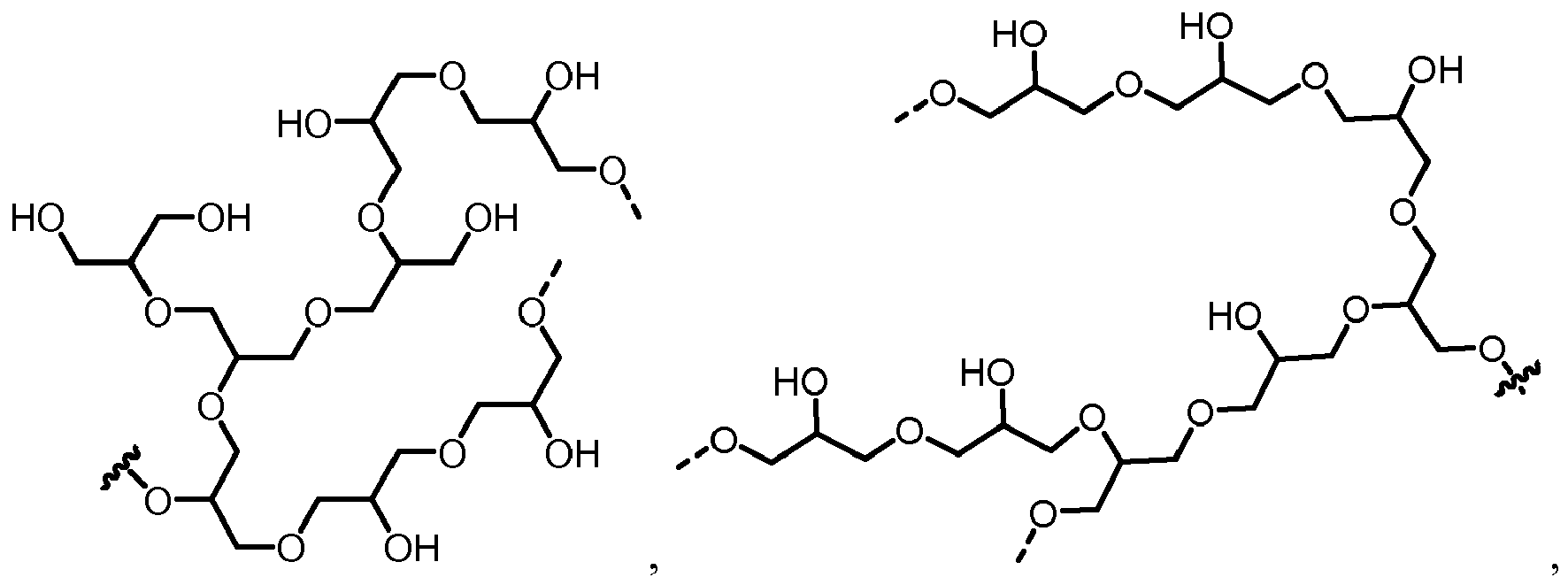

- The fluorinated polymer of claim 5, wherein the copolymer comprises the following structure:

- The fluorinated polymer of any one of claims 1-4, which has the following structure:

- The fluorinated polymer of any one of claims 1-3 and 5, which has the following structure:

- A method of preparing a fluorinated polymer of the formula: R-S-P, wherein R is a fluorocarbyl group, S is sulfur, and P is: (i) polyglycerol; (ii) poly(allyl glycidyl ether); (iii) a copolymer of glycidol and allyl glycidyl ether, said copolymer having one or more allyl groups; or (iv) poly(allyl glycidyl ether) or copolymer of glycidol and allyl glycidyl ether, wherein one more of the allyl groups have been replaced with 1,2-dihydroxypropyl group or a group of the formula: -(CH2)a-S-(CH2)b-X, wherein a is 3 and b is 1 to 3, and X is selected from an acidic group, a basic group, a cation, an anion, a zwitterion, halo, hydroxyl, acyl, acyloxy, alkylthio, alkoxy, aldehydo, amido, carbamoyl, ureido, cyano, nitro, epoxy, a group of the formula -C(H)(COOH)(NH2), and a group of the formula -C(H)(COOH)(NHAc), or a salt thereof; the method comprising:(i) providing a fluorocarbyl thiol; and(ii) carrying out a ring opening polymerization of glycidol, allyl glycidyl ether, or a mixture of glycidol and allyl glycidyl ether on the fluorocarbyl thiol; and/or(iii) replacing one more of the allyl groups with 1,2-dihydroxypropyl group or a group of the formula: -(CH2)a-S-(CH2)b-X, wherein a is 3 and b is 1 to 3, and X is selected from an acidic group, a basic group, a cation, an anion, a zwitterion, halo, hydroxyl, acyl, acyloxy, alkylthio, alkoxy, aldehydo, amido, carbamoyl, ureido, cyano, nitro, epoxy, a group of the formula -C(H)(COOH)(NH2), and a group of the formula -C(H)(COOH)(NHAc), or a salt thereof.
- A method of increasing the hydrophilicity of a hydrophobic polymer membrane comprising coating the hydrophobic membrane with a fluorinated polymer according to any one of claims 1-10.
- The method of claim 12, wherein the hydrophobic polymer membrane comprises a polymer selected from polytetrafluoroethylene, poly(vinylidene fluoride), copolymers of vinylidene fluoride, poly(chlorotrifluoroethylene), poly(fluoroethylene-propylene), poly(ethylene-chlorotrifluorethylene), poly(tetrafluoroethylene-co-hexafluoropropylene), pol(ethylene-tetrafluoroethylene), poly(tetrafluoroethylene-co-perfluoroalkylvinyl ether), perfluoroalkoxy polymer, perfluoropolyether, polyvinylfluoride, and fluorinated ethylene-propylene.
- The method of claim 12 or 13, wherein the hydrophobic polymer membrane comprises polytetrafluoroethylene or poly(vinylidene fluoride).
- A hydrophilic fluoropolymer membrane comprising a coating of a fluorinated polymer according to any one of claims 1-10 disposed on a hydrophobic fluoropolymer membrane, optionally
wherein said hydrophilic fluoropolymer membrane has a critical wetting surface tension greater than 72 dynes/cm.
Applications Claiming Priority (1)
| Application Number | Priority Date | Filing Date | Title |
|---|---|---|---|
| US14/320,454 US9962662B2 (en) | 2014-06-30 | 2014-06-30 | Fluorinated polymer and use thereof in the preparation of hydrophilic membranes (vi) |
Publications (2)
| Publication Number | Publication Date |
|---|---|
| EP2963078A1 true EP2963078A1 (en) | 2016-01-06 |
| EP2963078B1 EP2963078B1 (en) | 2017-08-09 |
Family
ID=53433134
Family Applications (1)
| Application Number | Title | Priority Date | Filing Date |
|---|---|---|---|
| EP15172666.8A Active EP2963078B1 (en) | 2014-06-30 | 2015-06-18 | Fluorinated polymer and use thereof in the preparation of hydrophilic membranes |
Country Status (8)
| Country | Link |
|---|---|
| US (1) | US9962662B2 (en) |
| EP (1) | EP2963078B1 (en) |
| JP (1) | JP6124158B2 (en) |
| KR (1) | KR101760787B1 (en) |
| CN (1) | CN105218805B (en) |
| DK (1) | DK2963078T3 (en) |
| ES (1) | ES2640665T3 (en) |
| SG (1) | SG10201504820UA (en) |
Cited By (1)
| Publication number | Priority date | Publication date | Assignee | Title |
|---|---|---|---|---|
| EP3296011A1 (en) * | 2016-09-16 | 2018-03-21 | Pall Corporation | Fluoropolymers and membranes comprising fluoropolymers |
Families Citing this family (7)
| Publication number | Priority date | Publication date | Assignee | Title |
|---|---|---|---|---|
| WO2018106938A1 (en) * | 2016-12-07 | 2018-06-14 | Pendant Biosciences, Inc. | Crosslinked coatings |
| US9855534B1 (en) * | 2016-12-28 | 2018-01-02 | Pall Corporation | Porous PTFE membranes for metal removal |
| JP7109536B2 (en) | 2018-03-22 | 2022-07-29 | 富士フイルム株式会社 | Filtration device, purification device, manufacturing method of chemical solution |
| CN111203001B (en) * | 2020-02-18 | 2021-04-02 | 武汉大学 | Preparation method of novel fluorine-functionalized open-tube capillary chromatographic column |
| CN113209836B (en) * | 2021-05-19 | 2022-02-11 | 浙江大学 | Composite separation membrane based on fluorine-containing copolymer in-situ growth organic frame structure and preparation method and application thereof |
| CN113603879A (en) * | 2021-07-23 | 2021-11-05 | 武汉大学 | Novel fluorine-containing hyperbranched polyglycidyl glycerin and preparation method thereof |
| WO2026070139A1 (en) * | 2024-09-27 | 2026-04-02 | 日東電工株式会社 | Separation function layer and separation membrane |
Citations (6)
| Publication number | Priority date | Publication date | Assignee | Title |
|---|---|---|---|---|
| US3470258A (en) * | 1967-04-19 | 1969-09-30 | Stevens & Co Inc J P | Fluorinated alcohols-glycidol addition products |
| EP0677504A1 (en) * | 1993-01-22 | 1995-10-18 | Daikin Industries, Ltd. | Fluorinated hydrocarbon compound, process for producing the same, and refrigerator oil and magnetic recording medium lubricant |
| US20040219350A1 (en) * | 2003-02-27 | 2004-11-04 | Brown David W. | Polyfluorinated compounds useful as surfactants, foam control agents and/or rheology modifiers |
| EP1621573A1 (en) * | 2003-04-16 | 2006-02-01 | Kureha Corporation | Porous film of vinylidene fluoride resin and method for producing same |
| US20110120937A1 (en) * | 2009-11-25 | 2011-05-26 | Fujifilm Corporation | Filtration filter and method for producing the same |
| WO2012083253A1 (en) * | 2010-12-16 | 2012-06-21 | The Regents Of The University Of California | Polymer electrolytes based on poly(glycidyl ether)s |
Family Cites Families (115)
| Publication number | Priority date | Publication date | Assignee | Title |
|---|---|---|---|---|
| GB1053486A (en) | 1963-12-03 | |||
| US3498959A (en) | 1968-09-11 | 1970-03-03 | Union Carbide Corp | Method of polymerizing 3,3-dimethyl thiacyclobutane and resulting polymer |
| US3625977A (en) | 1968-10-04 | 1971-12-07 | Eastman Kodak Co | 2-acetal-7-ketal-5-norbornene and 2-acetal-7-ketalnorbornane compounds |
| US3847867A (en) | 1971-01-20 | 1974-11-12 | Gen Electric | Polyetherimides |
| GB1598419A (en) | 1978-05-17 | 1981-09-23 | Ici Ltd | Coating process |
| US4485211A (en) | 1982-09-15 | 1984-11-27 | The B. F. Goodrich Company | Poly(glycidyl ether)block copolymers and process for their preparation |
| US4435330A (en) | 1982-12-29 | 1984-03-06 | Ciba-Geigy Corporation | Perfluoroalkyl-alkylene branched amphoteric sulfato betaines |
| JPS59202261A (en) | 1983-04-30 | 1984-11-16 | Nippon Oil & Fats Co Ltd | Method for modifying surface of high-molecular material |
| US4643894A (en) | 1984-07-24 | 1987-02-17 | Colorcon, Inc. | Maltodextrin coating |
| JPS61204008A (en) | 1985-03-06 | 1986-09-10 | Kanebo Ltd | Filter having excellent compaction resistance |
| US4675373A (en) | 1985-04-18 | 1987-06-23 | Mitsui Petrochemical Industries, Ltd. | Polyhydroxy polyether, process for its production, and its use |
| US4611048A (en) | 1985-10-04 | 1986-09-09 | General Electric Company | Hydroxy terminated polyetherimide oligomers |
| US5599882A (en) | 1986-12-06 | 1997-02-04 | Nippon Zeon Co., Ltd. | Ring-opening polymer and a process for production thereof |
| US4891456A (en) | 1987-07-06 | 1990-01-02 | Nippon Oil Co., Ltd. | Method for preparing norbornene structure compound |
| EP0409291B1 (en) | 1987-11-17 | 1996-02-14 | Japan Synthetic Rubber Co., Ltd. | Thermoplastic resin composition |
| WO1989006253A1 (en) | 1987-12-25 | 1989-07-13 | Nippon Zeon Co., Ltd. | Hydrogenated derivative of ring-opening copolymer and process for its production |
| EP0397866A4 (en) | 1987-12-28 | 1991-05-22 | Nippon Zeon Co., Ltd. | Hydrogenated derivative of ring-opening polymer and process for its production |
| JPH01284303A (en) | 1988-05-10 | 1989-11-15 | Asahi Chem Ind Co Ltd | High selectivity permeable membrane having hydrophilic property rendered to surface and production thereof |
| AU4529289A (en) | 1988-10-17 | 1990-05-14 | Sepracor, Inc. | Process for the covalent surface modification of hydrophobic polymers and articles made therefrom |
| US4954256A (en) | 1989-05-15 | 1990-09-04 | Pall Corporation | Hydrophobic membranes |
| DE3936997A1 (en) | 1989-11-07 | 1991-05-08 | Hoechst Ag | SEMIPERMEABLE MEMBRANE MADE OF POLYETHERKETONES |
| US5106920A (en) | 1989-11-27 | 1992-04-21 | Nippon Zeon Co., Ltd. | Hydrogenated ring-opening polymer and process for producing same |
| US5217627A (en) * | 1990-11-06 | 1993-06-08 | Pall Corporation | System and method for processing biological fluid |
| US5282965A (en) | 1990-11-29 | 1994-02-01 | Nitto Denko Corporation | Membrane filter for liquids and filtering device using the same |
| JP3060532B2 (en) | 1990-11-30 | 2000-07-10 | ジェイエスアール株式会社 | Method for producing hydride of ring-opening polymer |
| JP3012345B2 (en) | 1991-01-17 | 2000-02-21 | 東燃株式会社 | 5- (2,4-dioxotetrahydro-3-furanylmethyl) norbornane-2,3-dicarboxylic anhydride and method for producing the same |
| US5217802A (en) | 1992-03-17 | 1993-06-08 | Millipore Corporation | Hydrophobic polymeric membrane composites |
| EP1253156A3 (en) | 1992-04-03 | 2004-01-07 | California Institute Of Technology | High activity ruthenium or osmium metal carbene complexes for olefin metathesis reactions and synthesis and application thereof |
| JP3291857B2 (en) | 1993-07-30 | 2002-06-17 | 日本ゼオン株式会社 | Norbornene-based ring-opened (co) polymer hydrogenated product, method for producing the same, and use thereof |
| JP3215564B2 (en) | 1993-11-12 | 2001-10-09 | 関西ペイント株式会社 | Aqueous paint composition |
| US5905129A (en) | 1994-09-30 | 1999-05-18 | Nippon Zeon Co., Ltd. | Ring-opening polymer hydrogenation products |
| CA2178541C (en) | 1995-06-07 | 2009-11-24 | Neal E. Fearnot | Implantable medical device |
| US5831108A (en) | 1995-08-03 | 1998-11-03 | California Institute Of Technology | High metathesis activity ruthenium and osmium metal carbene complexes |
| US5911880A (en) | 1995-12-15 | 1999-06-15 | Research Corporation Technologies, Inc. | Self-wetting membranes from engineering plastics |
| DE19622959C2 (en) | 1996-06-07 | 1999-09-09 | Geesthacht Gkss Forschung | Composite membrane for the selective separation of organics by means of pervaporation |
| US5869326A (en) | 1996-09-09 | 1999-02-09 | Genetronics, Inc. | Electroporation employing user-configured pulsing scheme |
| US6126825A (en) | 1996-12-02 | 2000-10-03 | Fuji Photo Film Co., Ltd. | Microporous membrane and process for the production thereof |
| US5976380A (en) | 1997-05-01 | 1999-11-02 | Millipore Corporation | Article of manufacture including a surface modified membrane and process |
| US6354443B1 (en) | 1997-05-01 | 2002-03-12 | Millipore Corporation | Surface modified porous membrane and process |
| US5998326A (en) | 1997-05-23 | 1999-12-07 | Ciba Specialty Chemicals Corp. | Two-component catalyst for ROMP |
| US6039872A (en) | 1997-10-27 | 2000-03-21 | Pall Corporation | Hydrophilic membrane |
| DE19815275B4 (en) | 1998-04-06 | 2009-06-25 | Evonik Degussa Gmbh | Alkylidene complexes of ruthenium with N-heterocyclic carbene ligands and their use as highly active, selective catalysts for olefin metathesis |
| US6172180B1 (en) | 1998-08-25 | 2001-01-09 | Circe Biomedical, Inc. | Highly branched block copolymers |
| US6420503B1 (en) | 1999-02-05 | 2002-07-16 | Sumitomo Bakelite Co. Ltd. | Norbornene sulfonamide polymers |
| DE60011584T3 (en) | 1999-02-25 | 2008-03-06 | Pall Corp. | POSITIVE LOADED MEMBRANE |
| US6258272B1 (en) | 1999-04-09 | 2001-07-10 | Usf Filtrations And Separations Group, Inc. | Internal hydrophilic membranes from blended anionic copolymers |
| US7329758B1 (en) | 1999-05-24 | 2008-02-12 | California Institute Of Technology | Imidazolidine-based metal carbene metathesis catalysts |
| WO2001014446A1 (en) | 1999-08-25 | 2001-03-01 | Zeon Corporation | Norbornene open-ring polymers, products of hydrogenation thereof and processes for the production of both |
| DE10007272B4 (en) | 2000-02-17 | 2005-04-07 | Membrana Gmbh | Block copolymers with sulfonated polyethersulfone units |
| AU2001238359A1 (en) | 2000-02-18 | 2001-08-27 | Pall Corporation | Membranes |
| AU2001284773B2 (en) | 2000-08-10 | 2004-08-05 | Trustees Of Boston College | Recyclable metathesis catalysts |
| AUPR143400A0 (en) | 2000-11-13 | 2000-12-07 | Usf Filtration And Separations Group Inc. | Modified membranes |
| ITMI20010384A1 (en) | 2001-02-26 | 2002-08-26 | Ausimont Spa | POROUS HYDROPHILIC MEMBRANES |
| JP4352620B2 (en) | 2001-02-26 | 2009-10-28 | 日本ゼオン株式会社 | Method for producing norbornene-based ring-opening polymer hydride |
| US6759537B2 (en) | 2001-03-23 | 2004-07-06 | California Institute Of Technology | Hexacoordinated ruthenium or osmium metal carbene metathesis catalysts |
| JP2002363263A (en) | 2001-06-08 | 2002-12-18 | Nippon Zeon Co Ltd | Ring-opening copolymer, hydride of ring-opening copolymer, production method and composition thereof |
| US6669980B2 (en) | 2001-09-18 | 2003-12-30 | Scimed Life Systems, Inc. | Method for spray-coating medical devices |
| US6734386B1 (en) | 2001-09-24 | 2004-05-11 | Meissner Filtration Products, Inc. | Method for rendering PVDF membrane hydrophilic |
| US6846890B2 (en) | 2001-10-10 | 2005-01-25 | Jsr Corporation | Norbornene derivative and norbornene polymer obtained therefrom through ring opening polymerization |
| US7037993B2 (en) | 2002-04-08 | 2006-05-02 | Zeon Corporation | Norbornene-based ring-opening polymerization polymer, product of hydrogenation of norbornene-based ring-opening polymerization polymer, and processes for producing these |
| US7073671B2 (en) | 2002-06-07 | 2006-07-11 | Millipore Corporation | Microporous membrane substrate having caustic stable, low protein binding surface |
| SE0202067D0 (en) | 2002-06-28 | 2002-06-28 | Amersham Biosciences Ab | Surface-modified base matrices |
| EP1531925B1 (en) | 2002-07-11 | 2013-10-23 | Pall Corporation | Uv treated ptfe membranes |
| US7628917B2 (en) | 2002-09-03 | 2009-12-08 | Whatman, Inc. | Porous composite membrane and method for making the same |
| PL199412B1 (en) | 2002-10-15 | 2008-09-30 | Boehringer Ingelheim Int | Ruthenium new complexes as (pre) catalytic agents of permutation reaction, new derivatives of 2-alkoxy-5-nitrostyrene as intermediate compounds and method of their receiving |
| CN1159092C (en) | 2002-11-29 | 2004-07-28 | 天津大学 | Preparation method of affinity polysulfone-hydroxyethyl cellulose composite asymmetric ultrafiltration membrane |
| EP1667965A2 (en) | 2003-08-06 | 2006-06-14 | Covalent Partners, LLC | Bridged macrocyclic module compositions |
| US20050176893A1 (en) | 2004-01-20 | 2005-08-11 | Dipak Rana | Hydrophilic surface modifying macromolecules (H-phil SMM) and H-phil SMM blended membranes |
| US7230066B2 (en) | 2004-12-16 | 2007-06-12 | General Electric Company | Polycarbonate—ultem block copolymers |
| TWI388600B (en) | 2005-07-01 | 2013-03-11 | Zeon Corp | Resin composition |
| KR101269568B1 (en) | 2005-07-04 | 2013-06-04 | 자난 사이텍 컴퍼니 리미티드 | Ruthenium complex ligand, ruthenium complex, carried ruthenium complex catalyst and the preparing methods and the use thereof |
| EP1924343A1 (en) | 2005-08-05 | 2008-05-28 | FUJIFILM Manufacturing Europe B.V. | Porous membrane and recording medium comprising same |
| JP5420836B2 (en) | 2005-08-09 | 2014-02-19 | 旭化成株式会社 | Liquid treatment separation membrane comprising an aromatic ether polymer hydrophilized with a hydrophilizing agent |
| US7381331B2 (en) | 2005-09-30 | 2008-06-03 | General Electric Company | Hydrophilic membrane and associated method |
| JP4978949B2 (en) | 2006-03-31 | 2012-07-18 | 国立大学法人 東京大学 | Photosensitive resin, photosensitive composition and photocrosslinked product |
| US20070238853A1 (en) | 2006-04-07 | 2007-10-11 | Ht Materials Corporation | High temperature poly(aryl ether)s containing a phthalazinone moiety |
| US7717273B2 (en) | 2006-05-24 | 2010-05-18 | Millipore Corporation | Membrane surface modification by radiation-induced polymerization |
| GB0610479D0 (en) | 2006-05-26 | 2006-07-05 | Ge Healthcare Bio Sciences Ab | A method for generating metal chelating affinity ligands |
| US7557231B2 (en) | 2006-06-30 | 2009-07-07 | Bausch & Lomb Incorporated | Carboxylic tris-like siloxanyl monomers |
| US8232360B2 (en) | 2006-07-17 | 2012-07-31 | Research Foundation Of State University Of N.Y. | Stereoregular ROMP polymers |
| JP5613981B2 (en) | 2006-08-31 | 2014-10-29 | 日本ゼオン株式会社 | Norbornene-based ring-opening polymer hydride, resin composition and molded article |
| US7750103B2 (en) | 2006-09-08 | 2010-07-06 | The University Of Massachusetts | Cyclooctene monomers and polymers, and water purification articles and methods utilizing them |
| DE102006045282C5 (en) | 2006-09-22 | 2012-11-22 | Helmholtz-Zentrum Geesthacht Zentrum für Material-und Küstenforschung GmbH | Isoporous membrane and process for its preparation |
| GB0702504D0 (en) | 2007-02-09 | 2007-03-21 | Ge Healthcare Bio Sciences Ab | Cross-linked cellulose membranes |
| EP2002987B1 (en) | 2007-06-13 | 2014-04-23 | Agfa Graphics N.V. | A method for treating a lithographic printing plate |
| JP5564945B2 (en) | 2007-06-22 | 2014-08-06 | 日本ゼオン株式会社 | Resin composition and film using the same |
| EP2173799A2 (en) | 2007-07-20 | 2010-04-14 | Regents of the University of Minnesota | Nano-structured polymer composites and process for preparing same |
| WO2009013340A1 (en) | 2007-07-25 | 2009-01-29 | Lydall Solutech B.V. | Hydrophilic membrane |
| US8329927B2 (en) | 2007-09-19 | 2012-12-11 | University Of Massachusetts | Water-soluble and water-insoluble, ring opening metathesis polymerization products, monomers and related methods |
| US20090127197A1 (en) | 2007-11-15 | 2009-05-21 | Chunqing Liu | Polymer Functionalized Molecular Sieve/Polymer Mixed Matrix Membranes |
| EP2128196B1 (en) | 2007-11-21 | 2016-10-26 | Zeon Corporation | Polymer composition and use thereof |
| EP2248839B1 (en) | 2008-02-29 | 2018-03-28 | Zeon Corporation | Crystalline norbornene ring-opening polymer hydride and molded article of same |
| JP2009249500A (en) | 2008-04-07 | 2009-10-29 | Hakuto Co Ltd | Polymerizable highly-branched polymer and its manufacturing method |
| AU2009268532B2 (en) * | 2008-07-10 | 2013-01-10 | Board Of Regents, The University Of Texas System | Water purification membranes with improved fouling resistance |
| KR101908907B1 (en) | 2008-10-28 | 2018-10-17 | 알케마 인코포레이티드 | Water flux polymer membranes |
| JP2012507596A (en) | 2008-10-31 | 2012-03-29 | ポリミックス,リミテッド | Semicrystalline poly (aryl ether ketone) containing (4-hydroxyphenyl) phthalazine-1 (2H) -one comonomer unit and capable of high temperature melt processing |
| US8652332B2 (en) * | 2009-01-09 | 2014-02-18 | Massachusetts Institute Of Technology | Liquid filtration using pressure difference across a hydrophobic membrane |
| US20100210160A1 (en) * | 2009-02-18 | 2010-08-19 | 3M Innovative Properties Company | Hydrophilic porous substrates |
| US9487609B2 (en) | 2009-03-27 | 2016-11-08 | Isp Investments Llc | Premixes suitable for the production of membrane materials |
| US8283410B2 (en) | 2009-03-30 | 2012-10-09 | Isp Investments Inc. | Ring-opening metathesis polymerization of norbornene and oxanorbornene moieties and uses thereof |
| US8048963B2 (en) | 2009-08-31 | 2011-11-01 | GM Global Technology Operations LLC | Ion exchange membrane having lamellar morphology and process of making the same |
| EP2471837B1 (en) | 2009-09-17 | 2015-01-14 | Asahi Glass Company, Limited | Polyether preparation method |
| JP5461973B2 (en) | 2009-12-14 | 2014-04-02 | 株式会社ダイセル | Porous membrane and method for producing the same |
| US9051421B2 (en) | 2010-03-11 | 2015-06-09 | Regents Of The University Of Minnesota | Nanoporous linear polyethylene membranes and block copolymer precursors for same |
| US8440765B2 (en) | 2010-03-12 | 2013-05-14 | The Regents Of The University Of California | Nanostructured polymer membranes for selective alcohol transport |
| US8939294B2 (en) | 2010-03-31 | 2015-01-27 | General Electric Company | Block copolymer membranes and associated methods for making the same |
| WO2011146669A1 (en) | 2010-05-19 | 2011-11-24 | Seeo, Inc | Polymer compositions based on pxe |
| WO2011159699A2 (en) * | 2010-06-14 | 2011-12-22 | The Regents Of The University Of Michigan | Superhydrophilic and oleophobic porous materials and methods for making and using the same |
| WO2011163637A2 (en) | 2010-06-25 | 2011-12-29 | University Of Massachusetts | Protein transduction domains mimics |
| US8535590B2 (en) | 2011-01-12 | 2013-09-17 | Cook Medical Technologies Llc | Spray system and method of making phase separated polymer membrane structures |
| JP5959889B2 (en) | 2011-03-14 | 2016-08-02 | 日本ゴア株式会社 | Filter medium for water treatment filter and method for producing the same |
| CN102529274B (en) | 2011-12-30 | 2014-05-28 | 广东德冠薄膜新材料股份有限公司 | Polyolefin shrink film and preparation method thereof |
| JP6266597B2 (en) | 2012-04-25 | 2018-01-24 | ジーイー・ヘルスケア・バイオプロセス・アールアンドディ・アクチボラグ | Separation method and separation matrix |
| KR101546816B1 (en) | 2012-11-09 | 2015-08-25 | 한국화학연구원 | Ion conducting polymer comprising partially branched multiblock copolymer and use thereof |
| CN103087306B (en) | 2012-12-20 | 2015-03-04 | 广东众和化塑有限公司 | Amphipathy hyperbranched SIBS elastomer and preparation method and usage thereof |
-
2014
- 2014-06-30 US US14/320,454 patent/US9962662B2/en active Active
-
2015
- 2015-06-18 DK DK15172666.8T patent/DK2963078T3/en active
- 2015-06-18 ES ES15172666.8T patent/ES2640665T3/en active Active
- 2015-06-18 SG SG10201504820UA patent/SG10201504820UA/en unknown
- 2015-06-18 JP JP2015122991A patent/JP6124158B2/en active Active
- 2015-06-18 EP EP15172666.8A patent/EP2963078B1/en active Active
- 2015-06-24 KR KR1020150089569A patent/KR101760787B1/en active Active
- 2015-06-30 CN CN201510528014.5A patent/CN105218805B/en active Active
Patent Citations (6)
| Publication number | Priority date | Publication date | Assignee | Title |
|---|---|---|---|---|
| US3470258A (en) * | 1967-04-19 | 1969-09-30 | Stevens & Co Inc J P | Fluorinated alcohols-glycidol addition products |
| EP0677504A1 (en) * | 1993-01-22 | 1995-10-18 | Daikin Industries, Ltd. | Fluorinated hydrocarbon compound, process for producing the same, and refrigerator oil and magnetic recording medium lubricant |
| US20040219350A1 (en) * | 2003-02-27 | 2004-11-04 | Brown David W. | Polyfluorinated compounds useful as surfactants, foam control agents and/or rheology modifiers |
| EP1621573A1 (en) * | 2003-04-16 | 2006-02-01 | Kureha Corporation | Porous film of vinylidene fluoride resin and method for producing same |
| US20110120937A1 (en) * | 2009-11-25 | 2011-05-26 | Fujifilm Corporation | Filtration filter and method for producing the same |
| WO2012083253A1 (en) * | 2010-12-16 | 2012-06-21 | The Regents Of The University Of California | Polymer electrolytes based on poly(glycidyl ether)s |
Non-Patent Citations (2)
| Title |
|---|
| ALEXANDER SUNDER ET AL: "Copolymers of Glycidol and Glycidyl Ethers: Design of Branched Polyether Polyols by Combination of Latent Cyclic AB 2 and ABR Monomers", MACROMOLECULES, vol. 33, no. 21, 1 October 2000 (2000-10-01), pages 7682 - 7692, XP055039581, ISSN: 0024-9297, DOI: 10.1021/ma992166u * |
| WYNTER J. DUNCANSON ET AL: "Microfluidic synthesis of monodisperse porous microspheres with size-tunable pores", SOFT MATTER, vol. 8, no. 41, 1 January 2012 (2012-01-01), GB, pages 10636, XP055231846, ISSN: 1744-683X, DOI: 10.1039/c2sm25694k * |
Cited By (3)
| Publication number | Priority date | Publication date | Assignee | Title |
|---|---|---|---|---|
| EP3296011A1 (en) * | 2016-09-16 | 2018-03-21 | Pall Corporation | Fluoropolymers and membranes comprising fluoropolymers |
| US10130918B2 (en) | 2016-09-16 | 2018-11-20 | Pall Corporation | Fluoropolymers and membranes comprising fluoropolymers (III) |
| AU2017225101B2 (en) * | 2016-09-16 | 2021-09-30 | Cytiva Us Llc | Fluoropolymers and membranes comprising fluoropolymers (III) |
Also Published As
| Publication number | Publication date |
|---|---|
| KR20160002368A (en) | 2016-01-07 |
| EP2963078B1 (en) | 2017-08-09 |
| SG10201504820UA (en) | 2016-01-28 |
| US9962662B2 (en) | 2018-05-08 |
| KR101760787B1 (en) | 2017-07-24 |
| ES2640665T3 (en) | 2017-11-03 |
| JP6124158B2 (en) | 2017-05-10 |
| CN105218805A (en) | 2016-01-06 |
| CN105218805B (en) | 2018-04-13 |
| US20150375181A1 (en) | 2015-12-31 |
| DK2963078T3 (en) | 2017-11-13 |
| JP2016029146A (en) | 2016-03-03 |
Similar Documents
| Publication | Publication Date | Title |
|---|---|---|
| EP2963078B1 (en) | Fluorinated polymer and use thereof in the preparation of hydrophilic membranes | |
| EP2963076B1 (en) | Hydrophilic block copolymers and membranes prepared therefrom | |
| US9254466B2 (en) | Crosslinked cellulosic membranes | |
| EP2977100B1 (en) | Membranes comprising cellulosic material and hydrophilic block copolymer | |
| EP2963077B1 (en) | Hydrophilic block copolymers and membranes prepared therefrom | |
| EP2962746B1 (en) | Hydrophilic membranes and method of preparation thereof | |
| KR102035086B1 (en) | Porous ptfe membranes for metal removal | |
| US9260569B2 (en) | Hydrophilic block copolymers and method of preparation thereof (III) | |
| JP6137562B6 (en) | Hydrophilic block copolymers and membranes produced therefrom (I) |
Legal Events
| Date | Code | Title | Description |
|---|---|---|---|
| PUAI | Public reference made under article 153(3) epc to a published international application that has entered the european phase |
Free format text: ORIGINAL CODE: 0009012 |
|
| AK | Designated contracting states |
Kind code of ref document: A1 Designated state(s): AL AT BE BG CH CY CZ DE DK EE ES FI FR GB GR HR HU IE IS IT LI LT LU LV MC MK MT NL NO PL PT RO RS SE SI SK SM TR |
|
| AX | Request for extension of the european patent |
Extension state: BA ME |
|
| 17P | Request for examination filed |
Effective date: 20160615 |
|
| RBV | Designated contracting states (corrected) |
Designated state(s): AL AT BE BG CH CY CZ DE DK EE ES FI FR GB GR HR HU IE IS IT LI LT LU LV MC MK MT NL NO PL PT RO RS SE SI SK SM TR |
|
| GRAP | Despatch of communication of intention to grant a patent |
Free format text: ORIGINAL CODE: EPIDOSNIGR1 |
|
| INTG | Intention to grant announced |
Effective date: 20161028 |
|
| GRAJ | Information related to disapproval of communication of intention to grant by the applicant or resumption of examination proceedings by the epo deleted |
Free format text: ORIGINAL CODE: EPIDOSDIGR1 |
|
| GRAS | Grant fee paid |
Free format text: ORIGINAL CODE: EPIDOSNIGR3 |
|
| GRAP | Despatch of communication of intention to grant a patent |
Free format text: ORIGINAL CODE: EPIDOSNIGR1 |
|
| INTC | Intention to grant announced (deleted) | ||
| INTG | Intention to grant announced |
Effective date: 20170223 |
|
| GRAA | (expected) grant |
Free format text: ORIGINAL CODE: 0009210 |
|
| AK | Designated contracting states |
Kind code of ref document: B1 Designated state(s): AL AT BE BG CH CY CZ DE DK EE ES FI FR GB GR HR HU IE IS IT LI LT LU LV MC MK MT NL NO PL PT RO RS SE SI SK SM TR |
|
| REG | Reference to a national code |
Ref country code: GB Ref legal event code: FG4D |
|
| REG | Reference to a national code |
Ref country code: CH Ref legal event code: EP Ref country code: AT Ref legal event code: REF Ref document number: 916756 Country of ref document: AT Kind code of ref document: T Effective date: 20170815 |
|
| REG | Reference to a national code |
Ref country code: IE Ref legal event code: FG4D Ref country code: NL Ref legal event code: FP |
|
| REG | Reference to a national code |
Ref country code: CH Ref legal event code: NV Representative=s name: ISLER AND PEDRAZZINI AG, CH |
|
| REG | Reference to a national code |
Ref country code: DE Ref legal event code: R096 Ref document number: 602015003972 Country of ref document: DE |
|
| REG | Reference to a national code |
Ref country code: ES Ref legal event code: FG2A Ref document number: 2640665 Country of ref document: ES Kind code of ref document: T3 Effective date: 20171103 |
|
| REG | Reference to a national code |
Ref country code: DK Ref legal event code: T3 Effective date: 20171109 |
|
| REG | Reference to a national code |
Ref country code: LT Ref legal event code: MG4D |
|
| REG | Reference to a national code |
Ref country code: AT Ref legal event code: MK05 Ref document number: 916756 Country of ref document: AT Kind code of ref document: T Effective date: 20170809 |
|
| PG25 | Lapsed in a contracting state [announced via postgrant information from national office to epo] |
Ref country code: NO Free format text: LAPSE BECAUSE OF FAILURE TO SUBMIT A TRANSLATION OF THE DESCRIPTION OR TO PAY THE FEE WITHIN THE PRESCRIBED TIME-LIMIT Effective date: 20171109 Ref country code: AT Free format text: LAPSE BECAUSE OF FAILURE TO SUBMIT A TRANSLATION OF THE DESCRIPTION OR TO PAY THE FEE WITHIN THE PRESCRIBED TIME-LIMIT Effective date: 20170809 Ref country code: LT Free format text: LAPSE BECAUSE OF FAILURE TO SUBMIT A TRANSLATION OF THE DESCRIPTION OR TO PAY THE FEE WITHIN THE PRESCRIBED TIME-LIMIT Effective date: 20170809 Ref country code: HR Free format text: LAPSE BECAUSE OF FAILURE TO SUBMIT A TRANSLATION OF THE DESCRIPTION OR TO PAY THE FEE WITHIN THE PRESCRIBED TIME-LIMIT Effective date: 20170809 Ref country code: SE Free format text: LAPSE BECAUSE OF FAILURE TO SUBMIT A TRANSLATION OF THE DESCRIPTION OR TO PAY THE FEE WITHIN THE PRESCRIBED TIME-LIMIT Effective date: 20170809 Ref country code: FI Free format text: LAPSE BECAUSE OF FAILURE TO SUBMIT A TRANSLATION OF THE DESCRIPTION OR TO PAY THE FEE WITHIN THE PRESCRIBED TIME-LIMIT Effective date: 20170809 |
|
| PG25 | Lapsed in a contracting state [announced via postgrant information from national office to epo] |
Ref country code: RS Free format text: LAPSE BECAUSE OF FAILURE TO SUBMIT A TRANSLATION OF THE DESCRIPTION OR TO PAY THE FEE WITHIN THE PRESCRIBED TIME-LIMIT Effective date: 20170809 Ref country code: IS Free format text: LAPSE BECAUSE OF FAILURE TO SUBMIT A TRANSLATION OF THE DESCRIPTION OR TO PAY THE FEE WITHIN THE PRESCRIBED TIME-LIMIT Effective date: 20171209 Ref country code: PL Free format text: LAPSE BECAUSE OF FAILURE TO SUBMIT A TRANSLATION OF THE DESCRIPTION OR TO PAY THE FEE WITHIN THE PRESCRIBED TIME-LIMIT Effective date: 20170809 Ref country code: BG Free format text: LAPSE BECAUSE OF FAILURE TO SUBMIT A TRANSLATION OF THE DESCRIPTION OR TO PAY THE FEE WITHIN THE PRESCRIBED TIME-LIMIT Effective date: 20171109 Ref country code: GR Free format text: LAPSE BECAUSE OF FAILURE TO SUBMIT A TRANSLATION OF THE DESCRIPTION OR TO PAY THE FEE WITHIN THE PRESCRIBED TIME-LIMIT Effective date: 20171110 Ref country code: LV Free format text: LAPSE BECAUSE OF FAILURE TO SUBMIT A TRANSLATION OF THE DESCRIPTION OR TO PAY THE FEE WITHIN THE PRESCRIBED TIME-LIMIT Effective date: 20170809 |
|
| PG25 | Lapsed in a contracting state [announced via postgrant information from national office to epo] |
Ref country code: RO Free format text: LAPSE BECAUSE OF FAILURE TO SUBMIT A TRANSLATION OF THE DESCRIPTION OR TO PAY THE FEE WITHIN THE PRESCRIBED TIME-LIMIT Effective date: 20170809 Ref country code: CZ Free format text: LAPSE BECAUSE OF FAILURE TO SUBMIT A TRANSLATION OF THE DESCRIPTION OR TO PAY THE FEE WITHIN THE PRESCRIBED TIME-LIMIT Effective date: 20170809 |
|
| REG | Reference to a national code |
Ref country code: DE Ref legal event code: R097 Ref document number: 602015003972 Country of ref document: DE |
|
| PG25 | Lapsed in a contracting state [announced via postgrant information from national office to epo] |
Ref country code: SK Free format text: LAPSE BECAUSE OF FAILURE TO SUBMIT A TRANSLATION OF THE DESCRIPTION OR TO PAY THE FEE WITHIN THE PRESCRIBED TIME-LIMIT Effective date: 20170809 Ref country code: EE Free format text: LAPSE BECAUSE OF FAILURE TO SUBMIT A TRANSLATION OF THE DESCRIPTION OR TO PAY THE FEE WITHIN THE PRESCRIBED TIME-LIMIT Effective date: 20170809 Ref country code: SM Free format text: LAPSE BECAUSE OF FAILURE TO SUBMIT A TRANSLATION OF THE DESCRIPTION OR TO PAY THE FEE WITHIN THE PRESCRIBED TIME-LIMIT Effective date: 20170809 |
|
| PLBE | No opposition filed within time limit |
Free format text: ORIGINAL CODE: 0009261 |
|
| STAA | Information on the status of an ep patent application or granted ep patent |
Free format text: STATUS: NO OPPOSITION FILED WITHIN TIME LIMIT |
|
| REG | Reference to a national code |
Ref country code: FR Ref legal event code: PLFP Year of fee payment: 4 |
|
| 26N | No opposition filed |
Effective date: 20180511 |
|
| PG25 | Lapsed in a contracting state [announced via postgrant information from national office to epo] |
Ref country code: SI Free format text: LAPSE BECAUSE OF FAILURE TO SUBMIT A TRANSLATION OF THE DESCRIPTION OR TO PAY THE FEE WITHIN THE PRESCRIBED TIME-LIMIT Effective date: 20170809 |
|
| REG | Reference to a national code |
Ref country code: BE Ref legal event code: MM Effective date: 20180630 |
|
| PG25 | Lapsed in a contracting state [announced via postgrant information from national office to epo] |
Ref country code: MC Free format text: LAPSE BECAUSE OF FAILURE TO SUBMIT A TRANSLATION OF THE DESCRIPTION OR TO PAY THE FEE WITHIN THE PRESCRIBED TIME-LIMIT Effective date: 20170809 Ref country code: LU Free format text: LAPSE BECAUSE OF NON-PAYMENT OF DUE FEES Effective date: 20180618 |
|
| PG25 | Lapsed in a contracting state [announced via postgrant information from national office to epo] |
Ref country code: BE Free format text: LAPSE BECAUSE OF NON-PAYMENT OF DUE FEES Effective date: 20180630 |
|
| PG25 | Lapsed in a contracting state [announced via postgrant information from national office to epo] |
Ref country code: MT Free format text: LAPSE BECAUSE OF NON-PAYMENT OF DUE FEES Effective date: 20180618 |
|
| PG25 | Lapsed in a contracting state [announced via postgrant information from national office to epo] |
Ref country code: TR Free format text: LAPSE BECAUSE OF FAILURE TO SUBMIT A TRANSLATION OF THE DESCRIPTION OR TO PAY THE FEE WITHIN THE PRESCRIBED TIME-LIMIT Effective date: 20170809 |
|
| PG25 | Lapsed in a contracting state [announced via postgrant information from national office to epo] |
Ref country code: PT Free format text: LAPSE BECAUSE OF FAILURE TO SUBMIT A TRANSLATION OF THE DESCRIPTION OR TO PAY THE FEE WITHIN THE PRESCRIBED TIME-LIMIT Effective date: 20170809 |
|
| PG25 | Lapsed in a contracting state [announced via postgrant information from national office to epo] |
Ref country code: MK Free format text: LAPSE BECAUSE OF NON-PAYMENT OF DUE FEES Effective date: 20170809 Ref country code: CY Free format text: LAPSE BECAUSE OF FAILURE TO SUBMIT A TRANSLATION OF THE DESCRIPTION OR TO PAY THE FEE WITHIN THE PRESCRIBED TIME-LIMIT Effective date: 20170809 Ref country code: HU Free format text: LAPSE BECAUSE OF FAILURE TO SUBMIT A TRANSLATION OF THE DESCRIPTION OR TO PAY THE FEE WITHIN THE PRESCRIBED TIME-LIMIT; INVALID AB INITIO Effective date: 20150618 |
|
| PG25 | Lapsed in a contracting state [announced via postgrant information from national office to epo] |
Ref country code: AL Free format text: LAPSE BECAUSE OF FAILURE TO SUBMIT A TRANSLATION OF THE DESCRIPTION OR TO PAY THE FEE WITHIN THE PRESCRIBED TIME-LIMIT Effective date: 20170809 |
|
| REG | Reference to a national code |
Ref country code: FR Ref legal event code: PLFP Year of fee payment: 9 |
|
| P01 | Opt-out of the competence of the unified patent court (upc) registered |
Effective date: 20230530 |
|
| PGFP | Annual fee paid to national office [announced via postgrant information from national office to epo] |
Ref country code: DE Payment date: 20250626 Year of fee payment: 11 |
|
| PGFP | Annual fee paid to national office [announced via postgrant information from national office to epo] |
Ref country code: GB Payment date: 20250617 Year of fee payment: 11 Ref country code: DK Payment date: 20250619 Year of fee payment: 11 |
|
| PGFP | Annual fee paid to national office [announced via postgrant information from national office to epo] |
Ref country code: NL Payment date: 20250624 Year of fee payment: 11 |
|
| PGFP | Annual fee paid to national office [announced via postgrant information from national office to epo] |
Ref country code: FR Payment date: 20250624 Year of fee payment: 11 |
|
| PGFP | Annual fee paid to national office [announced via postgrant information from national office to epo] |
Ref country code: IE Payment date: 20250617 Year of fee payment: 11 |
|
| PGFP | Annual fee paid to national office [announced via postgrant information from national office to epo] |
Ref country code: ES Payment date: 20250710 Year of fee payment: 11 |
|
| PGFP | Annual fee paid to national office [announced via postgrant information from national office to epo] |
Ref country code: IT Payment date: 20250623 Year of fee payment: 11 |
|
| PGFP | Annual fee paid to national office [announced via postgrant information from national office to epo] |
Ref country code: CH Payment date: 20250701 Year of fee payment: 11 |