EP2962214B1 - Vorab-zwischenspeicherung von audioinhalten - Google Patents
Vorab-zwischenspeicherung von audioinhalten Download PDFInfo
- Publication number
- EP2962214B1 EP2962214B1 EP14757255.6A EP14757255A EP2962214B1 EP 2962214 B1 EP2962214 B1 EP 2962214B1 EP 14757255 A EP14757255 A EP 14757255A EP 2962214 B1 EP2962214 B1 EP 2962214B1
- Authority
- EP
- European Patent Office
- Prior art keywords
- audio content
- playback device
- audio
- zone
- playback
- Prior art date
- Legal status (The legal status is an assumption and is not a legal conclusion. Google has not performed a legal analysis and makes no representation as to the accuracy of the status listed.)
- Active
Links
Images




Classifications
-
- G—PHYSICS
- G06—COMPUTING OR CALCULATING; COUNTING
- G06F—ELECTRIC DIGITAL DATA PROCESSING
- G06F3/00—Input arrangements for transferring data to be processed into a form capable of being handled by the computer; Output arrangements for transferring data from processing unit to output unit, e.g. interface arrangements
- G06F3/16—Sound input; Sound output
- G06F3/165—Management of the audio stream, e.g. setting of volume, audio stream path
-
- G—PHYSICS
- G05—CONTROLLING; REGULATING
- G05B—CONTROL OR REGULATING SYSTEMS IN GENERAL; FUNCTIONAL ELEMENTS OF SUCH SYSTEMS; MONITORING OR TESTING ARRANGEMENTS FOR SUCH SYSTEMS OR ELEMENTS
- G05B15/00—Systems controlled by a computer
- G05B15/02—Systems controlled by a computer electric
-
- G—PHYSICS
- G06—COMPUTING OR CALCULATING; COUNTING
- G06F—ELECTRIC DIGITAL DATA PROCESSING
- G06F12/00—Accessing, addressing or allocating within memory systems or architectures
- G06F12/02—Addressing or allocation; Relocation
- G06F12/08—Addressing or allocation; Relocation in hierarchically structured memory systems, e.g. virtual memory systems
- G06F12/0802—Addressing of a memory level in which the access to the desired data or data block requires associative addressing means, e.g. caches
- G06F12/0862—Addressing of a memory level in which the access to the desired data or data block requires associative addressing means, e.g. caches with prefetch
-
- G—PHYSICS
- G06—COMPUTING OR CALCULATING; COUNTING
- G06F—ELECTRIC DIGITAL DATA PROCESSING
- G06F16/00—Information retrieval; Database structures therefor; File system structures therefor
- G06F16/60—Information retrieval; Database structures therefor; File system structures therefor of audio data
-
- H—ELECTRICITY
- H04—ELECTRIC COMMUNICATION TECHNIQUE
- H04N—PICTORIAL COMMUNICATION, e.g. TELEVISION
- H04N21/00—Selective content distribution, e.g. interactive television or video on demand [VOD]
- H04N21/40—Client devices specifically adapted for the reception of or interaction with content, e.g. set-top-box [STB]; Operations thereof
- H04N21/43—Processing of content or additional data, e.g. demultiplexing additional data from a digital video stream; Elementary client operations, e.g. monitoring of home network or synchronising decoder's clock; Client middleware
- H04N21/436—Interfacing a local distribution network, e.g. communicating with another STB or one or more peripheral devices inside the home
- H04N21/43615—Interfacing a Home Network, e.g. for connecting the client to a plurality of peripherals
-
- H—ELECTRICITY
- H04—ELECTRIC COMMUNICATION TECHNIQUE
- H04N—PICTORIAL COMMUNICATION, e.g. TELEVISION
- H04N21/00—Selective content distribution, e.g. interactive television or video on demand [VOD]
- H04N21/40—Client devices specifically adapted for the reception of or interaction with content, e.g. set-top-box [STB]; Operations thereof
- H04N21/43—Processing of content or additional data, e.g. demultiplexing additional data from a digital video stream; Elementary client operations, e.g. monitoring of home network or synchronising decoder's clock; Client middleware
- H04N21/439—Processing of audio elementary streams
- H04N21/4392—Processing of audio elementary streams involving audio buffer management
-
- H—ELECTRICITY
- H04—ELECTRIC COMMUNICATION TECHNIQUE
- H04N—PICTORIAL COMMUNICATION, e.g. TELEVISION
- H04N21/00—Selective content distribution, e.g. interactive television or video on demand [VOD]
- H04N21/40—Client devices specifically adapted for the reception of or interaction with content, e.g. set-top-box [STB]; Operations thereof
- H04N21/43—Processing of content or additional data, e.g. demultiplexing additional data from a digital video stream; Elementary client operations, e.g. monitoring of home network or synchronising decoder's clock; Client middleware
- H04N21/442—Monitoring of processes or resources, e.g. detecting the failure of a recording device, monitoring the downstream bandwidth, the number of times a movie has been viewed, the storage space available from the internal hard disk
- H04N21/44213—Monitoring of end-user related data
- H04N21/44218—Detecting physical presence or behaviour of the user, e.g. using sensors to detect if the user is leaving the room or changes his face expression during a TV programme
-
- G—PHYSICS
- G06—COMPUTING OR CALCULATING; COUNTING
- G06F—ELECTRIC DIGITAL DATA PROCESSING
- G06F2212/00—Indexing scheme relating to accessing, addressing or allocation within memory systems or architectures
- G06F2212/60—Details of cache memory
- G06F2212/602—Details relating to cache prefetching
Definitions
- the disclosure is related to consumer goods and, more particularly, to systems, products, features, services, and other items directed to media playback or some aspect thereof.
- Technological advancements have increased the accessibility of music content, as well as other types of media, such as television content, movies, and interactive content.
- a user can access audio, video, or both audio and video content over the Internet through an online store, an Internet radio station, a music service, a movie service, and so on, in addition to the more traditional avenues of accessing audio and video content Demand for audio, video, and both audio and video content inside and outside of the home continues to increase.
- US2010/107099 A1 discloses a proximity sensor on a mobile device.
- a storage facility is configured to store data representative of a proximity heuristic.
- the proximity heuristic specifies a plurality of levels of an object detection zone associated with a display screen and associations between the levels and corresponding actions.
- a proximity interface detects an object located within the object detection zone.
- a level is selected based on an attribute of the object and in accordance with the proximity heuristic.
- One of the actions associated with one of the levels is then performed.
- US2004/138948 A1 discloses an Internet-based personalized radio.
- a user has a preselected playlist of songs. The user can skip songs without there being a delay between skips, since the radio pre-buffers the first ten seconds of each of the next several songs on the list.
- Embodiments described herein may involve causing a playback device to pre-cache audio content when the playback device determines that a user may be about to cause the playback device to render the audio content.
- pre-cache or “pre-caching” may refer to any form of temporary data storage such that a future request for the data may be served faster.
- the temporary data storage may be within a cache, such as a CPU cache, memory cache, or a disk cache.
- the playback device may have one or more sensors capable of detecting the user's motion in relation to the playback device. As such, if the playback device detects that the user is near, or approaching the playback device, the playback device may pre-cache audio content that the user may wish to enjoy, such that the audio content may be immediately rendered once the user chooses to render the audio.
- the one or more sensors may include proximity sensors and/or motion sensors, and may be implemented such that motion or presence of a user near a control panel may be detected. For instance, if the user's hand is approaching the control panel on the playback device, the one or more sensors may detect the approach. Upon detecting the approach of the hand, the playback device may determine that the user may wish to use the control panel to cause the playback device to render audio content. In one case, the playback device may be part of a bonded zone, and accordingly, causing the playback device to render audio content will cause all playback devices in the bonded zone to render the audio in synchrony.
- the audio content that the user may wish to enjoy may be determined based on a playback status of the playback device.
- the playback device is already rendering audio content, such as a song from a playlist, the next song from the playlist may be pre-cached.
- the playback device was previously rendering audio content that is paused, then the audio content previously being rendered may be pre-cached beginning where the audio content was paused.
- the audio content that was previously being rendered may not be stoppable or pausable.
- the previously rendered audio content may be live Internet radio that is being streamed over a network. In such a case, access to the radio stream may be re-established, and the radio stream may be pre-cached beginning when the presence of the user is detected.
- the one or more sensors may further be used to determine a motion or presence of a user near specific control panel elements.
- the control panel may include a "play/pause” button, a "next” button, and a "previous” button, and the one or more sensors may be used to determine which button the user is approaching. Accordingly, audio content may be pre-cached based on which button the user is approaching. For instance, if the playback device is rendering audio content from a playback queue, and an approach of the user towards the previous button is detected, a previous audio content in the playback queue may be pre-cached.
- a first method involves detecting, by a proximity sensor on a playback device, movement in relation to the playback device, responsively retrieving audio content by the playback device from a networked audio source, prior to receiving a user command to play the audio content, and storing the audio content in memory on the playback device.
- the audio content may be stored in memory in preparation for playback.
- a device in another aspect, includes a proximity sensor, a processor, a storage memory, and a computer readable medium having stored thereon instructions executable by the processor to perform function.
- the functions include detecting, by the proximity sensor, movement in relation to the device, responsively retrieving audio content from a networked audio source prior to receiving a user command to play the audio content, and storing the audio content in the storage memory.
- the audio content may be stored in memory in preparation for playback.
- a non-transitory computer readable memory has stored thereon instructions executable by a processor to cause the processor to execute functions.
- the functions include detecting, by a proximity sensor on a playback device, movement in relation to the playback device, responsively retrieving audio content by the playback device from a networked audio source prior to receiving a user command to play the audio content, and storing the audio content in memory on the playback device.
- the audio content may be stored in memory in preparation for playback.
- Figure 1 shows an example media system configuration 100 in which one or more embodiments disclosed herein can be practiced or implemented.
- the media system configuration 100 represents a home with multiple zones, though the home could have been configured with only one zone.
- Each zone for example, may represent a different room or space, such as an office, bathroom, bedroom, kitchen, dining room, family room, home theater room, utility or laundry room, and patio.
- a single zone might also include multiple rooms or spaces if so configured.
- One or more of zone players 102-124 are shown in each respective zone.
- a zone player 102-124 also referred to as a playback device, multimedia unit, speaker, player, and so on, provides audio, video, and/or audiovisual output.
- a controller 130 e.g., shown in the kitchen for purposes of illustration) provides control to the media system configuration 100.
- Controller 130 may be fixed to a zone, or alternatively, mobile such that it can be moved about the zones.
- the media system configuration 100 may also include more than one controller 130.
- the media system configuration 100 illustrates an example whole house media system, though it is understood that the technology described herein is not limited to its particular place of application or to an expansive system like a whole house media system 100 of Figure 1 .
- Zone players 200, 202, and 204 of Figures 2A, 2B , and 2C can correspond to any of the zone players 102-124 of Figure 1 , for example.
- audio is reproduced using only a single zone player, such as by a full-range player.
- audio is reproduced using two or more zone players, such as by using a combination of full-range players or a combination of full-range and specialized players.
- zone players 200-204 may also be referred to as a "smart speaker," because they contain processing capabilities beyond the reproduction of audio, more of which is described below.
- Figure 2A illustrates zone player 200 that includes sound producing equipment 208 capable of reproducing full-range sound.
- the sound may come from an audio signal that is received and processed by zone player 200 over a wired or wireless data network.
- Sound producing equipment 208 includes one or more built-in amplifiers and one or more acoustic transducers (e.g., speakers).
- a built-in amplifier is described more below with respect to Figure 4 .
- a speaker or acoustic transducer can include, for example, any of a tweeter, a mid-range driver, a low-range driver, and a subwoofer.
- zone player 200 can be statically or dynamically configured to play stereophonic audio, monaural audio, or both.
- zone player 200 is configured to reproduce a subset of full-range sound, such as when zone player 200 is grouped with other zone players to play stereophonic audio, monaural audio, and/or surround audio or when the audio content received by zone player 200 is less than full-range.
- Figure 2B illustrates zone player 202 that includes a built-in amplifier to power a set of detached speakers 210.
- a detached speaker can include, for example, any type of loudspeaker.
- Zone player 202 may be configured to power one, two, or more separate loudspeakers.
- Zone player 202 may be configured to communicate an audio signal (e.g., right and left channel audio or more channels depending on its configuration) to the detached speakers 210 via a wired path.
- an audio signal e.g., right and left channel audio or more channels depending on its configuration
- Figure 2C illustrates zone player 204 that does not include a built-in amplifier, but is configured to communicate an audio signal, received over a data network, to an audio (or "audio/video") receiver 214 with built-in amplification.
- one, some, or all of the zone players 102 to 124 can retrieve audio directly from a source.
- a zone player may contain a playlist or queue of audio items to be played (also referred to herein as a "playback queue").
- Each item in the queue may comprise a uniform resource identifier (URI) or some other identifier.
- URI uniform resource identifier
- the URI or identifier can point the zone player to the audio source.
- the source might be found on the Internet (e.g., the cloud), locally from another device over data network 128 (described further below), from the controller 130, stored on the zone player itself, or from an audio source communicating directly to the zone player.
- the zone player can reproduce the audio itself, send it to another zone player for reproduction, or both where the audio is played by the zone player and one or more additional zone players in synchrony.
- the zone player can play a first audio content (or not play at all), while sending a second, different audio content to another zone player(s) for reproduction.
- SONOS, Inc. of Santa Barbara, California presently offers for sale zone players referred to as a "PLAYBAR,” “PLAY:5,” “PLAY:3,” “CONNECT:AMP,” “CONNECT,” and “SUB.” Any other past, present, and/or future zone players can additionally or alternatively be used to implement the zone players of example embodiments disclosed herein.
- a zone player is not limited to the particular examples illustrated in Figures 2A, 2B , and 2C or to the SONOS product offerings.
- a zone player may include a wired or wireless headphone.
- a zone player might include a sound bar for television.
- a zone player can include or interact with a docking station for an Apple IPODTM or similar device.
- FIG 3 illustrates an example wireless controller 300 in docking station 302.
- controller 300 may correspond to controlling device 130 of Figure 1 .
- Docking station 302 if provided, may be used to charge a battery of controller 300.
- controller 300 may be provided with a touch screen 304 that allows a user to interact through touch with the controller 300, for example, to retrieve and navigate a playlist of audio items, control operations of one or more zone players, and provide overall control of the system configuration 100.
- any number of controllers can be used to control the system configuration 100.
- the controllers might be wireless like wireless controller 300 or wired to data network 128.
- each controller may be coordinated to display common content, and may all be dynamically updated to indicate changes made from a single controller. Coordination can occur, for instance, by a controller periodically requesting a state variable directly or indirectly from one or more zone players; the state variable may provide information about system 100, such as current zone group configuration, what is playing in one or more zones, volume levels, and other items of interest. The state variable may be passed around on data network 128 between zone players (and controllers, if so desired) as needed or as often as programmed.
- controller 130 an application running on any network-enabled portable device, such as an IPHONETM, IPADTM, ANDROIDTM powered phone, or any other smart phone or network-enabled device can be used as controller 130.
- An application running on a laptop or desktop personal computer (PC) or MacTM can also be used as controller 130.
- Such controllers may connect to system 100 through an interface with data network 128, a zone player, a wireless router, or using some other configured connection path.
- Controller 200 includes a "Controller 200,” “SONOS ® CONTROL,” “SONOS ® Controller for IPHONETM,” “SONOS ® Controller for IPADTM,” “SONOS ® Controller for ANDROIDTM,” “SONOS ® Controller for MACTM or PC.”
- Zone players 102 to 124 of Figure 1 are coupled directly or indirectly to a data network, such as data network 128. Controller 130 may also be coupled directly or indirectly to data network 128 or individual zone players.
- Data network 128 is represented by an octagon in the figure to stand out from other representative components. While data network 128 is shown in a single location, it is understood that such a network is distributed in and around system 100. Particularly, data network 128 can be a wired network, a wireless network, or a combination of both wired and wireless networks.
- one or more of the zone players 102-124 are wirelessly coupled to data network 128 based on a proprietary mesh network.
- one or more of the zone players 102-124 are wirelessly coupled to data network 128 using a non-mesh topology. In some embodiments, one or more of the zone players 102-124 are coupled via a wire to data network 128 using Ethernet or similar technology. In addition to the one or more zone players 102-124 connecting to data network 128, data network 128 can further allow access to a wide area network, such as the Internet.
- connecting any of the zone players 102-124, or some other connecting device, to a broadband router can create data network 128.
- Other zone players 102-124 can then be added wired or wirelessly to the data network 128.
- a zone player e.g., any of zone players 102-124
- the broadband router can be connected to an Internet Service Provider (ISP), for example.
- ISP Internet Service Provider
- the broadband router can be used to form another data network within the system configuration 100, which can be used in other applications (e.g., web surfing).
- Data network 128 can also be used in other applications, if so programmed.
- second network may implement SONOSNETTM protocol, developed by SONOS, Inc. of Santa Barbara.
- SONOSNETTM represents a secure, AES-encrypted, peer-to-peer wireless mesh network.
- the data network 128 is the same network, such as a traditional wired or wireless network, used for other applications in the household.
- a particular zone can contain one or more zone players.
- the family room of Figure 1 contains two zone players 106 and 108, while the kitchen is shown with one zone player 102.
- the home theater room contains additional zone players to play audio from a 5.1 channel or greater audio source (e.g., a movie encoded with 5.1 or greater audio channels).
- zones may be created, combined with another zone, removed, and given a specific name (e.g., "Kitchen"), if so desired and programmed to do so with controller 130.
- zone configurations may be dynamically changed even after being configured using controller 130 or some other mechanism.
- a zone contains two or more zone players, such as the two zone players 106 and 108 in the family room
- the two zone players 106 and 108 can be configured to play the same audio source in synchrony, or the two zone players 106 and 108 can be paired to play two separate sounds in left and right channels, for example.
- the stereo effects of a sound can be reproduced or enhanced through the two zone players 106 and 108, one for the left sound and the other for the right sound.
- paired zone players also referred to as "bonded zone players” can play audio in synchrony with other zone players in the same or different zones.
- two or more zone players can be sonically consolidated to form a single, consolidated zone player.
- a consolidated zone player (though made up of multiple, separate devices) can be configured to process and reproduce sound differently than an unconsolidated zone player or zone players that are paired, because a consolidated zone player will have additional speaker drivers from which sound can be passed.
- the consolidated zone player can further be paired with a single zone player or yet another consolidated zone player.
- Each playback device of a consolidated playback device can be set in a consolidated mode, for example.
- the actions of grouping, consolidation, and pairing are preferably performed through a control interface, such as using controller 130, and not by physically connecting and re-connecting speaker wire, for example, to individual, discrete speakers to create different configurations.
- controller 130 controls the actions of grouping, consolidation, and pairing.
- certain embodiments described herein provide a more flexible and dynamic platform through which sound reproduction can be offered to the end-user.
- the example home theater zone players 116, 118, 120 are coupled to an audio information source such as a television 132.
- the television 132 is used as a source of audio for the home theater zone players 116, 118, 120, while in other examples audio information from the television 132 can be shared with any of the zone players 102-124 in the audio system 100.
- Zone player 400 includes a network interface 402, a processor 408, a memory 410, an audio processing component 412, one or more modules 414, an audio amplifier 416, and a speaker unit 418 coupled to the audio amplifier 416.
- Figure 2A shows an example illustration of such a zone player.
- Other types of zone players may not include the speaker unit 418 (e.g., such as shown in Figure 2B ) or the audio amplifier 416 (e.g., such as shown in Figure 2C ).
- the zone player 400 can be integrated into another component.
- the zone player 400 could be constructed as part of a television, lighting, or some other device for indoor or outdoor use.
- network interface 402 facilitates a data flow between zone player 400 and other devices on a data network 128.
- zone player 400 may access audio directly from the audio source, such as over a wide area network or on the local network.
- the network interface 402 can further handle the address part of each packet so that it gets to the right destination or intercepts packets destined for the zone player 400.
- each of the packets includes an Internet Protocol (IP)-based source address as well as an IP-based destination address.
- IP Internet Protocol
- network interface 402 can include one or both of a wireless interface 404 and a wired interface 406.
- the wireless interface 404 also referred to as a radio frequency (RF) interface, provides network interface functions for the zone player 400 to wirelessly communicate with other devices (e.g., other zone player(s), speaker(s), receiver(s), component(s) associated with the data network 128, and so on) in accordance with a communication protocol (e.g., any wireless standard including IEEE 802.11a, 802.11b, 802.11g, 802.11n, or 802.15).
- Wireless interface 404 may include one or more radios.
- the zone player 400 includes one or more antennas 420.
- the wired interface 406 provides network interface functions for the zone player 400 to communicate over a wire with other devices in accordance with a communication protocol (e.g., IEEE 802.3).
- a zone player includes multiple wireless 404 interfaces.
- a zone player includes multiple wired 406 interfaces.
- a zone player includes both of the interfaces 404 and 406.
- a zone player 400 includes only the wireless interface 404 or the wired interface 406.
- the processor 408 is a clock-driven electronic device that is configured to process input data according to instructions stored in memory 410.
- the memory 410 is data storage that can be loaded with one or more software module(s) 414, which can be executed by the processor 408 to achieve certain tasks.
- the memory 410 is a tangible machine-readable medium storing instructions that can be executed by the processor 408.
- a task might be for the zone player 400 to retrieve audio data from another zone player or a device on a network (e.g., using a uniform resource locator (URL) or some other identifier).
- a task may be for the zone player 400 to send audio data to another zone player or device on a network.
- URL uniform resource locator
- the audio processing component 412 can include one or more digital-to-analog converters (DAC), an audio preprocessing component, an audio enhancement component or a digital signal processor, and so on. In some embodiments, the audio processing component 412 may be part of processor 408. In some embodiments, the audio that is retrieved via the network interface 402 is processed and/or intentionally altered by the audio processing component 412. Further, the audio processing component 412 can produce analog audio signals. The processed analog audio signals are then provided to the audio amplifier 416 for play back through speakers 418. In addition, the audio processing component 412 can include circuitry to process analog or digital signals as inputs to play from zone player 400, send to another zone player on a network, or both play and send to another zone player on the network. An example input includes a line-in connection (e.g., an auto-detecting 3.5mm audio line-in connection).
- DAC digital-to-analog converters
- the audio amplifier 416 is a device(s) that amplifies audio signals to a level for driving one or more speakers 418.
- the one or more speakers 418 can include an individual transducer (e.g., a "driver") or a complete speaker system that includes an enclosure including one or more drivers.
- a particular driver can be a subwoofer (e.g., for low frequencies), a mid-range driver (e.g., for middle frequencies), and a tweeter (e.g., for high frequencies), for example.
- An enclosure can be sealed or ported, for example.
- Each transducer may be driven by its own individual amplifier.
- a commercial example, presently known as the PLAY:5TM is a zone player with a built-in amplifier and speakers that is capable of retrieving audio directly from the source, such as on the Internet or on the local network, for example.
- the PLAY:5TM is a five-amp, five-driver speaker system that includes two tweeters, two mid-range drivers, and one woofer.
- the left audio data of a track is sent out of the left tweeter and left mid-range driver
- the right audio data of a track is sent out of the right tweeter and the right mid-range driver
- mono bass is sent out of the subwoofer.
- both mid-range drivers and both tweeters have the same equalization (or substantially the same equalization). That is, they are both sent the same frequencies but from different channels of audio. Audio from Internet radio stations, online music and video services, downloaded music, analog audio inputs, television, DVD, and so on, can be played from the PLAY:5TM.
- Controller 500 can be used to facilitate the control of multi-media applications, automation and others in a system.
- the controller 500 may be configured to facilitate a selection of a plurality of audio sources available on the network and enable control of one or more zone players (e.g., the zone players 102-124 in Figure 1 ) through a wireless or wired network interface 508.
- the wireless communications is based on an industry standard (e.g., infrared, radio, wireless standards including IEEE 802.11a, 802.11b, 802.11g, 802.11n, 802.15, and so on).
- a picture e.g., album art
- any other data, associated with the audio and/or audio source can be transmitted from a zone player or other electronic device to controller 500 for display.
- Controller 500 is provided with a screen 502 and an input interface 514 that allows a user to interact with the controller 500, for example, to navigate a playlist of many multimedia items and to control operations of one or more zone players.
- the screen 502 on the controller 500 can be an LCD screen, for example.
- the screen 500 communicates with and is commanded by a screen driver 504 that is controlled by a microcontroller (e.g., a processor) 506.
- the memory 510 can be loaded with one or more application modules 512 that can be executed by the microcontroller 506 with or without a user input via the user interface 514 to achieve certain tasks.
- an application module 512 is configured to facilitate grouping a number of selected zone players into a zone group and synchronizing the zone players for audio play back.
- an application module 512 is configured to control the audio sounds (e.g., volume) of the zone players in a zone group.
- the screen driver 504 when the microcontroller 506 executes one or more of the application modules 512, the screen driver 504 generates control signals to drive the screen 502 to display an application specific user interface accordingly.
- the controller 500 includes a network interface 508 that facilitates wired or wireless communication with a zone player.
- the commands such as volume control and audio playback synchronization are sent via the network interface 508.
- a saved zone group configuration is transmitted between a zone player and a controller via the network interface 508.
- the controller 500 can control one or more zone players, such as 102-124 of Figure 1 . There can be more than one controller for a particular system, and each controller may share common information with another controller, or retrieve the common information from a zone player, if such a zone player stores configuration data (e.g., such as a state variable). Further, a controller can be integrated into a zone player.
- network-enabled devices such as an IPHONE TM , IPAD TM or any other smart phone or network-enabled device (e.g., a networked computer such as a PC or MAC TM ) can also be used as a controller to interact or control zone players in a particular environment.
- a software application or upgrade can be downloaded onto a network-enabled device to perform the functions described herein.
- a user using the controller 500 can create a zone group including at least two zone players.
- the zone players in the zone group can play audio in a synchronized fashion, such that all of the zone players in the zone group play back an identical audio source or a list of identical audio sources in a synchronized manner such that no (or substantially no) audible delays or hiccups are to be heard.
- the signals or data of increasing the audio volume for the group are sent to one of the zone players and causes other zone players in the group to be increased together in volume.
- a user via the controller 500 can group zone players into a zone group by activating a "Link Zones” or “Add Zone” soft button, or de-grouping a zone group by activating an "Unlink Zones” or “Drop Zone” button.
- one mechanism for 'joining' zone players together for audio play back is to link a number of zone players together to form a group.
- a user can manually link each zone player or room one after the other. For example, assume that there is a multi-zone system that includes the following zones: Bathroom, Bedroom, Den, Dining Room, Family Room, and Foyer.
- a user can link any number of the six zone players, for example, by starting with a single zone and then manually linking each zone to that zone.
- a set of zones can be dynamically linked together using a command to create a zone scene or theme (subsequent to first creating the zone scene). For instance, a "Morning" zone scene command can link the Bedroom, Office, and Kitchen zones together in one action. Without this single command, the user would manually and individually link each zone.
- the single command may include a mouse click, a double mouse click, a button press, a gesture, or some other programmed action. Other kinds of zone scenes can be programmed.
- a zone scene can be triggered based on time (e.g., an alarm clock function). For instance, a zone scene can be set to apply at 8:00 am. The system can link appropriate zones automatically, set specific music to play, and then stop the music after a defined duration. Although any particular zone can be triggered to an "On" or "Off" state based on time, for example, a zone scene enables any zone(s) linked to the scene to play a predefined audio (e.g., a favorable song, a predefined playlist) at a specific time and/or for a specific duration.
- a predefined audio e.g., a favorable song, a predefined playlist
- a backup buzzer can be programmed to sound.
- the buzzer can include a sound file that is stored in a zone player, for example.
- FIG. 6 shows that there are three zone players 602, 604 and 606 and a controller 608 that form a network branch that is also referred to as an Ad-Hoc network 610.
- the network 610 may be wireless, wired, or a combination of wired and wireless.
- an Ad-Hoc (or "spontaneous") network is a local area network or other small network in which there is generally no one access point for all traffic.
- the devices 602, 604, 606 and 608 can all communicate with each other in a "peer-to-peer" style of communication, for example.
- devices may join and/or leave from the network 610, and the network 610 will automatically reconfigure itself without needing the user to reconfigure the network 610.
- Ad-Hoc network is referenced in Figure 6 , it is understood that a playback network may be based on a type of network that is completely or partially different from an Ad-Hoc network.
- the devices 602, 604, 606, and 608 can share or exchange one or more audio sources and be dynamically grouped to play the same or different audio sources.
- the devices 602 and 604 are grouped to playback one piece of music, and at the same time, the device 606 plays back another piece of music.
- the devices 602, 604, 606 and 608, as shown in Figure 6 form a HOUSEHOLD that distributes audio and/or reproduces sound.
- the term HOUSEHOLD (provided in uppercase letters to disambiguate from the user's domicile) is used to represent a collection of networked devices that are cooperating to provide an application or service. An instance of a HOUSEHOLD is identified with a household 610 (or household identifier), though a HOUSEHOLD may be identified with a different area or place.
- a household identifier is a short string or an identifier that is computer-generated to help ensure that it is unique.
- the network 610 can be characterized by a unique HHID and a unique set of configuration variables or parameters, such as channels (e.g., respective frequency bands), service set identifier (SSID) (a sequence of alphanumeric characters as a name of a wireless network), and WEP keys (wired equivalent privacy or other security keys).
- channels e.g., respective frequency bands
- SSID service set identifier
- WEP keys wireless equivalent privacy or other security keys
- each HOUSEHOLD includes two types of network nodes: a control point (CP) and a zone player (ZP).
- the control point controls an overall network setup process and sequencing, including an automatic generation of required network parameters (e.g., WEP keys).
- the CP also provides the user with a HOUSEHOLD configuration user interface.
- the CP function can be provided by a computer running a CP application module, or by a handheld controller (e.g., the controller 308) also running a CP application module, for example.
- the zone player is any other device on the network that is placed to participate in the automatic configuration process.
- the ZP includes the controller 308 or a computing device, for example.
- the functionality, or certain parts of the functionality, in both the CP and the ZP are combined at a single node (e.g., a ZP contains a CP or vice-versa).
- configuration of a HOUSEHOLD involves multiple CPs and ZPs that rendezvous and establish a known configuration such that they can use a standard networking protocol (e.g., IP over Wired or Wireless Ethernet) for communication.
- a standard networking protocol e.g., IP over Wired or Wireless Ethernet
- two types of networks/protocols are employed: Ethernet 802.3 and Wireless 802.11g. Interconnections between a CP and a ZP can use either of the networks/protocols.
- a device in the system as a member of a HOUSEHOLD can connect to both networks simultaneously.
- the zone player 606 in Figure 6 is shown to be connected to both networks, for example.
- the connectivity to the network 612 is based on Ethernet and/or Wireless, while the connectivity to other devices 602, 604 and 608 is based on Wireless and Ethernet if so desired.
- each zone player 606, 604, 602. may access the Internet when retrieving media from the cloud (e.g., the Internet) via the bridging device.
- zone player 602 may contain a uniform resource locator (URL) that specifies an address to a particular audio track in the cloud. Using the URL, the zone player 602 may retrieve the audio track from the cloud, and ultimately play the audio out of one or more zone players.
- URL uniform resource locator
- Figure 7 shows a system including a plurality of networks including a cloud-based network and at least one local playback network.
- a local playback network includes a plurality of playback devices or players, though it is understood that the playback network may contain only one playback device.
- each player has an ability to retrieve its content for playback. Control and content retrieval can be distributed or centralized, for example.
- Input can include streaming content provider input, third party application input, mobile device input, user input, and/or other playback network input into the cloud for local distribution and playback.
- a plurality of content providers 720-750 can be connected to one or more local playback networks 760-770 via a cloud and/or other network 710.
- a multimedia audio system server 720, a mobile device 730, a third party application 740, a content provider 750 and so on can provide multimedia content (requested or otherwise) to local playback networks 760, 770.
- a controller 762, 772 and a playback device 764, 774 can be used to playback audio content.
- the playback device may include one or more sensors configured to detect a presence of a user within a vicinity of the playback device, and the detected presence may be used to trigger a pre-caching of the audio content.
- the playback device may include one or more sensors configured to detect a presence of a user within a vicinity of the playback device, and the detected presence may be used to trigger a pre-caching of the audio content.
- Figure 8 shows a first example flow diagram 800 for pre-caching audio content based on proximity detection, in accordance with at least some embodiments described herein.
- Method 800 shown in Figure 8 presents an embodiment of a method that could be used in the environments 100, 600, and 700 with the systems 200, 202, 204, 300, 400, and 500 for example, in communication with one or more devices, such as those illustrated in Figures 2-5 .
- Method 800 may include one or more operations, functions, or actions as illustrated by one or more of blocks 802-810. Although the blocks are illustrated in sequential order, these blocks may also be performed in parallel, and/or in a different order than those described herein. Also, the various blocks may be combined into fewer blocks, divided into additional blocks, and/or removed based upon the desired implementation.
- each block may represent a module, a segment, or a portion of program code, which includes one or more instructions executable by a processor for implementing specific logical functions or steps in the process.
- the program code may be stored on any type of computer readable medium, for example, such as a storage device including a disk or hard drive.
- the computer readable medium may include non-transitory computer readable medium, for example, such as computer-readable media that stores data for short periods of time like register memory, processor cache and Random Access Memory (RAM).
- the computer readable medium may also include non-transitory media, such as secondary or persistent long term storage, like read only memory (ROM), optical or magnetic disks, compact-disc read only memory (CD-ROM), for example.
- the computer readable media may also be any other volatile or non-volatile storage systems.
- the computer readable medium may be considered a computer readable storage medium, for example, or a tangible storage device.
- each block in Figure 8 may represent circuitry that is wired to perform the specific logical functions in the process.
- the method 800 involves detecting, by one or more sensors on a playback device, movement in relation to the playback device.
- the one or more sensors may include a proximity sensor configured to detect an approaching movement toward the playback device, such as when a user approaches and/or reaches a hand toward the playback device.
- the proximity sensor may be a capacitive sensor.
- the proximity sensor may also be implemented using other sensing technologies, such as infrared (IR) sensing technology and optical sensing technology, for example.
- the one or more sensors may be parts of a sensing module configured to interact and communicate with one or more processors in the playback device. As sensing technologies continue to develop, further sensing technologies that may not currently be available may also be used to implement the proximity sensor.
- proximity sensors may be implemented on the playback device to detect movements within different ranges of distances from the playback device.
- a capacitive proximity sensor may be used for detecting movement close to the playback device, while an IR proximity sensor may be used for detecting movement farther from the playback device.
- more than one proximity sensor may be implemented to provide a robust detection method. For example, a combination of a capacitive sensing device and an infrared sensing devices may be used together.
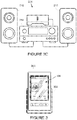
- Figure 9A shows a first example playback device 902 with proximity sensing abilities 904 for pre-caching audio content based on proximity detection.
- the playback device 902 may be a system similar to any of the playback systems previously discussed in connection to Figure 1 , Figures 2A-C , or Figure 4 .
- the playback device 902 may be a stand-alone zone player in a network of zone players.
- the playback device 902 may be a part of a bonded zone, such as a consolidated player or a stereo pair, for example.
- the playback device 902 may be either a primary (or "main") zone player or a secondary (or "satellite”) zone player of the bonded zone.
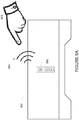
- the playback device 902 includes an example control panel 906, with a "play” button, a "volume up” button, and a “volume down” button. Other variations of the control panel 906, with other functional buttons are also possible. Also shown in Figure 9A is an example user 908 approaching the playback device 902. The approach of the user 908 may be detected by the proximity sensing abilities 904 of the playback device 902. In one example, as indicated previously, the playback device 902 may include one or more sensors implemented and configured to detect movement relative to the playback device 902. For instance, the one or more sensors may be configured to detect an approach of the user 908 toward the playback device 902.
- the one or more sensors may be configured to specifically detect movements in relation to a particular part of the playback device 902, such as the control panel 906.
- the proximity sensing abilities 904 of the play back device 902 may detect an approach of the user 908 toward the control panel 906.
- the one or more sensors may be implemented and configured to specifically detect movements in relation to more than one particular part of the playback device.
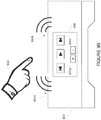
- Figure 9B shows a second example playback device 952 with proximity sensing abilities 954a and 954b for pre-caching audio content based on proximity detection.
- the playback device 952 includes a control panel 956 with a "play" button, "volume up” button, “volume down” button, "back” button 970a, and "forward” button 970b.
- sensors of the playback device 952 may be configured such that sensing abilities 954a detect movements in relation to a first side of the control panel 956, and sensing abilities 954b detect movements in relation to a second side of the control panel 956.
- the first side of the control panel 956 may be the side of the control panel 956 that the back button 970a is located
- the second side of the control panel 956 may be the side of the control panel 956 that the forward button 970b is located.
- the sensors of a playback device may further be configured to determine movement in relation to the playback device at different distance ranges.
- the playback device may include a control interface provided on a touch-sensitive graphical display. The controls available through the control interface may be similar to those shown on the control panels 906 and 956 of the playback devices 902 and 952, respectively.
- the playback device may be configured to only display control options on the graphical display if the playback device, based on proximity detection, determines that a user is within a general vicinity of the playback device, from which the user may view the graphical display and see the control options.
- buttons of the control panel may be back-lit buttons that are configured to only light up if the playback device determines that the user is within the general vicinity of the playback device.
- the playback device may then detect movement in relation to the playback device to determine if the user is further approaching, or reaching toward the playback device, specifically the control interface of the playback device, or even more specifically, a particular control option button displayed on the interface.
- the playback device determines, based on detected movements of the user, that the user may be approaching the playback device to enter a playback related command (such as play, forward, or backward, for example), the playback device may begin to pre-cache, audio content that the user may wish to cause the playback device to render via an anticipated command input.
- the method 800 involves retrieving audio content by the playback device in response to the detected approach of the user and prior to receiving a command from the user to play the audio content.
- the audio content may be retrieved from a local audio source, such as a local storage memory of the playback device.
- the audio content may be retrieved from a networked audio source.
- the networked audio sources may be a storage memory accessible over a local network, such as a network drive, or a storage memory of another playback device accessible by the playback device over the local network.
- the networked audio source may also be part of a cloud network, such as the cloud 710 as described above in connection to Figure 7 . In such a case, retrieving the audio content may involve accessing the audio content over the network.
- Retrieving audio content by the playback device may also involve determining the audio content to be retrieved.
- the audio content to be retrieved is determined based on a current playback mode of the playback device.
- retrieving audio content also involves determining the current playback mode of the playback device, and responsively determining the audio content to retrieve based on the current playback mode of the playback device.
- the playback device may not currently be rendering any audio content.
- the playback mode of the playback device may be that of a paused playback in which audio content that was previously being rendered has been paused.
- potential inputs from the user 908 that may affect the playback mode of the playback device may include "play" (or "resume,” in the case playback has been paused).
- the playback device 902 may determine that the audio content to retrieve for pre-caching may be the audio content that was previously being rendered.
- the audio content that was previously being rendered may be a music track, and retrieval of the audio content may begin at the point in the audio content where the audio content was previously paused.
- the audio content that was previously being rendered may be a live radio stream accessed over the network. In this case, retrieval of the audio content for pre-caching may involve re-establishing an access to the live radio stream.
- the playback device 902 may not be rendering any audio content because a previously rendered audio track ended, or a playlist or playback queue has concluded (and a "repeat" option, if available, for rendering the playlist or playback queue is not active).
- the audio content to retrieve for pre-caching may simply be the playlist or playback queue of which rendering had previously concluded.
- a favorite playlist, favorite song, or favorite live radio stream may be retrieved for pre-caching. In this case, the favorite playlist, song, or live radio stream may be one that has been rendered the most time by the playback device.
- the playback device may record audio content rendering patterns of the playback device and retrieve audio content according to the recorded patterns. For example, if the user regularly uses the playback device to enjoy classical music accessed through a particular classical music radio stream on Sunday evenings, then on Sunday evenings, the playback device may establish access to the particular classical music radio stream in response to the detected approach of the user. Other implementations of varying complexities and sophistication may also be possible for determining audio content to be retrieved.
- the current playback mode of the playback device may be a rendering of a song in a playlist or a queue.
- potential inputs from the user may include inputs to pause or stop the rendering of the song in the playlist, skip forward to the next song in the play list, restart the song currently being rendered, or return to the previous song being rendered.
- the next song and the previous song may be candidates for pre-caching. In one instance, the previous song and the next song may both be retrieved for pre-caching.
- the playback device 952 may include sensors configured to detect movements in relation to different locations on the control panel 956. As shown in Figure 9B , the sensing abilities 954a may detect movement in relation to the back button 970a, and the sensing abilities 954b may detect movement in relation to the forward button 970b. Accordingly, the playback device 952 may determine whether a user 958 is reaching toward the back button 970a or the forward button 970b. If the user 958 is determined as reaching toward the back button 970a, the previous song may be retrieved. Analogously, if the user 958 is determined as reaching toward the forward button, the next song may be retrieved. If the sensing abilities 954a and 954b are unable to determine with a level of confidence, which button the user is reaching toward, the previous song and the next song may both be retrieved for pre-caching, as suggested above.
- the playback device may then pre-cache the retrieved audio content.
- the method 800 involves storing the audio content in memory on the playback device.
- the memory on the playback device may include a cache for temporary storage of data such that a future request for the data may be served faster.
- the audio content in this case may accordingly be "cached" in the memory of the playback device such that the audio content will be readily available if requested, thereby responding to a user command for the playback device to render the audio content faster.
- up to 128 kilo-bytes of the memory may be used to cache the audio content. In some cases, 128 kilo-bytes may store three or more seconds of audio content, depending on the sampling characteristics of the audio content.
- a portion (e.g. the first 128 kilo-bytes, or first three seconds or so) of the audio content may accordingly be pre-cached in anticipation of a user command to cause the music track to be rendered.
- the portion of the music track may be stored until a user command is received by the playback device to render either the pre-cached music track or different audio content. If the received user command causes the playback device to render the pre-cached music track, then the music track may be rendered as will be discussed later in connection to blocks 808 and 810. If the user commanded causes the playback device to render different audio content, then the pre-cached music track may be discarded, and the different audio content may be retrieved for rendering.
- the portion of the music track may be stored until any user command is received, whether or not the user command causes any changes in the playback mode of the playback device. For instance, in the case that the playback device is already rendering audio content, the approach of the user towards the playback device may be to adjust a playback volume of the audio content. As such, the pre-cached music track may no longer be applicable to why the user approached the playback device once the user command has been received.
- the portion of the music track may be stored until the playback device, using the one or more sensors, determines that the user is no longer within a vicinity of the playback device.
- the portion of the music track may be stored indefinitely, or for a predetermined duration of time if no user command is received.
- the above discussed example storage durations may also be implemented for other determined and retrieved audio content such as live radio streams, as previously discussed.
- the pre-cached portion of the live radio stream may no longer be current to the live content of the live radio stream if a user command to cause the live radio stream to be rendered is not received shortly after the portion of the live radio stream is stored.
- the playback device may be configured to retrieve new portions of the live radio stream to be stored periodically at a specific time interval.
- the periodic pre-caching of the live radio stream may be performed until a user command is received, until the predetermined duration of time has expired, or until the playback device determines that the user is no longer within the vicinity of the playback device.
- pre-cached audio content includes portions of audio content that the playback device determined as what the user approaching and/or reaching for the playback device may plan to cause the playback device to render.
- the method 800 involves receiving a user command to render the pre-cached audio content, and at block 810, the method 800 involves rendering the audio content.
- the user may press a button as anticipated by the playback device, whether it be the play button, back button, or forward button as discussed above.
- the playback device may then render the pre-cached audio content accordingly, in response to the user command.
- rendering of the audio content may begin sooner than if the playback device began retrieval of the audio content after receiving the user command.
- the pre-caching of the audio content may provide a smoother, more immediate response to a user command to cause the audio content to be rendered, thereby enhancing the user experience.
- the playback device may be part of a bonded zone or zone group.
- the pre-caching of the audio content for smoother playback may be performed by each playback device in the bonded zone or zone group when an approach or presence of a user toward any of the playback devices (or control panels of any of the playback devices) in the bonded zone or zone group is detected, such that rendering of the audio content may occur immediately in a synchronized manner.
- the pre-caching of the audio content may be performed by a single playback device and distributed to the playback devices of the bonded zone or zone group when an approach or presence of a user toward any of the playback devices or control panels of any of the playback devices in the bonded zone or zone group is detected.
- a first method involves detecting, by a proximity sensor on a playback device, movement in relation to the playback device, responsively retrieving audio content by the playback device from a networked audio source, prior to receiving a user command to play the audio content, and storing the audio content in memory on the playback device.
- the audio content may be stored in memory in preparation for playback.
- a device in another aspect, includes a proximity sensor, a processor, a storage memory, and a computer readable medium having stored thereon instructions executable by the processor to perform function.
- the functions include detecting, by the proximity sensor, movement in relation to the device, responsively retrieving audio content from a networked audio source prior to receiving a user command to play the audio content, and storing the audio content in the storage memory.
- the audio content may be stored in memory in preparation for playback.
- a non-transitory computer readable memory has stored thereon instructions executable by a processor to cause the processor to execute functions.
- the functions include detecting, by a proximity sensor on a playback device, movement in relation to the playback device, responsively retrieving audio content by the playback device from a networked audio source prior to receiving a user command to play the audio content, and storing the audio content in memory on the playback device.
- the audio content may be stored in memory in preparation for playback.
- references herein to "embodiment” means that a particular feature, structure, or characteristic described in connection with the embodiment can be included in at least one example embodiment of the invention.
- the appearances of this phrase in various places in the specification are not necessarily all referring to the same embodiment, nor are separate or alternative embodiments mutually exclusive of other embodiments.
- the embodiments described herein, explicitly and implicitly understood by one skilled in the art can be combined with other embodiments.
- At least one of the elements in at least one example is hereby expressly defined to include a tangible medium such as a memory, DVD, CD, Blu-ray, and so on, storing the software and/or firmware.
Landscapes
- Engineering & Computer Science (AREA)
- Theoretical Computer Science (AREA)
- Multimedia (AREA)
- Physics & Mathematics (AREA)
- General Engineering & Computer Science (AREA)
- General Physics & Mathematics (AREA)
- Health & Medical Sciences (AREA)
- General Health & Medical Sciences (AREA)
- Signal Processing (AREA)
- Social Psychology (AREA)
- Databases & Information Systems (AREA)
- Audiology, Speech & Language Pathology (AREA)
- Human Computer Interaction (AREA)
- Computer Networks & Wireless Communication (AREA)
- Data Mining & Analysis (AREA)
- Automation & Control Theory (AREA)
- Circuit For Audible Band Transducer (AREA)
- Information Transfer Between Computers (AREA)
- Two-Way Televisions, Distribution Of Moving Picture Or The Like (AREA)
- Signal Processing For Digital Recording And Reproducing (AREA)
- Reverberation, Karaoke And Other Acoustics (AREA)
Claims (15)
- Verfahren, umfassend:Erfassen, mittels eines Näherungssensors an einem Abspielgerät (400), einer Bewegung in Bezug auf das Abspielgerät (400),wobei das Verfahren dadurch gekennzeichnet ist, dass es ferner umfasst:Feststellen eines derzeitigen Abspielmodus des Abspielgeräts in Reaktion auf ein Erfassen der Bewegung,wenn festgestellt wird, dass das Abspielgerät derzeit kein Audio abspielt und vor Empfangen eines Benutzerbefehls zum Abspielen des Audioinhalts:Abrufen von Audioinhalt von einer vernetzten Audioquelle (710, 720, 730, 740, 750) durch das Abspielgerät (400), wobei der abzurufende Audioinhalt auf dem festgestellten derzeitigen Abspielmodus basiert, undSpeichern des Audioinhalts in einem Speicher (410) in dem Abspielgerät (400).
- Verfahren nach Anspruch 1, bei dem der ermittelte Audioinhalt Audioinhalt ist, der früher ausgeführt wurde.
- Verfahren nach Anspruch 1 oder 2, bei dem der Näherungssensor ein kapazitiver Sensor ist.
- Verfahren nach einem der Ansprüche 1 bis 3, bei dem der in dem Speicher (410) gespeicherte Audioinhalt zumindest 128K Bytes an Speicher verwendet.
- Verfahren nach einem der Ansprüche 1 bis 4, ferner umfassend ein Speichern des Audioinhalts im Speicher (410) auf unbestimmte Zeit oder bis ein Benutzerbefehl erhalten wird.
- Verfahren nach einem der Ansprüche 1 bis 5, bei dem der Audioinhalt basierend auf einem Zeitintervall periodisch abgerufen wird, bis ein Benutzerbefehl erhalten wird.
- Verfahren nach Anspruch 6, bei dem der Audioinhalt ein Live-Radiodatenstrom ist.
- Verfahren nach einem der Ansprüche 1 bis 6, ferner umfassend:Empfangen eines Benutzerbefehls zum Abspielen des Audioinhalts, unddaraufhin Abspielen des Audioinhalts.
- Verfahren nach einem der Ansprüche 1 bis 8, ferner umfassend:Ermitteln der Nähe der Bewegung in Bezug auf eine Abspielsteuerung an einer Abspielsteuerungsschnittstelle (906, 956) des Abspielgeräts (400), unddaraufhin ferner Ermitteln des abzurufenden Audioinhalts basierend auf der Abspielsteuerung.
- Verfahren nach Anspruch 9, bei dem die Abspielsteuerung ein Abspielknopf ist.
- Abspielgerät (400), welches dazu konfiguriert ist, das Verfahren nach jedem vorhergehenden Anspruch auszuführen, aufweisend:einen Näherungssensor,einen Prozessor (408), undeinen Aufbewahrungsspeicher (410).
- Gerät nach Anspruch 11, bei dem der Näherungssensor ein kapazitiver Sensor ist.
- Gerät nach einem der Ansprüche 11 oder 12, bei dem das Abspielgerät dazu konfiguriert ist, den Audioinhalt abzuspielen.
- Computerlesbarer Speicher, auf dem durch einen Prozessor ausführbare Anweisungen gespeichert sind, um den Prozessor zu veranlassen, die Verfahren nach einem der Ansprüche 1 bis 10 auszuführen.
- Speicher nach Anspruch 14, wobei der Näherungssensor ein kapazitiver Sensor ist.
Priority Applications (3)
| Application Number | Priority Date | Filing Date | Title |
|---|---|---|---|
| EP17000797.5A EP3220283B1 (de) | 2013-02-26 | 2014-02-25 | Vorab-zwischenspeicherung von audioinhalten |
| EP24161591.3A EP4358525B1 (de) | 2013-02-26 | 2014-02-25 | Vorzwischenspeicherung von audioinhalt |
| EP19201852.1A EP3623958B1 (de) | 2013-02-26 | 2014-02-25 | Vorab-zwischenspeicherung von audioinhalten |
Applications Claiming Priority (2)
| Application Number | Priority Date | Filing Date | Title |
|---|---|---|---|
| US13/777,780 US9195432B2 (en) | 2013-02-26 | 2013-02-26 | Pre-caching of audio content |
| PCT/US2014/018170 WO2014133994A1 (en) | 2013-02-26 | 2014-02-25 | Pre-caching of audio content |
Related Child Applications (3)
| Application Number | Title | Priority Date | Filing Date |
|---|---|---|---|
| EP17000797.5A Division EP3220283B1 (de) | 2013-02-26 | 2014-02-25 | Vorab-zwischenspeicherung von audioinhalten |
| EP19201852.1A Division EP3623958B1 (de) | 2013-02-26 | 2014-02-25 | Vorab-zwischenspeicherung von audioinhalten |
| EP24161591.3A Division EP4358525B1 (de) | 2013-02-26 | 2014-02-25 | Vorzwischenspeicherung von audioinhalt |
Publications (3)
| Publication Number | Publication Date |
|---|---|
| EP2962214A1 EP2962214A1 (de) | 2016-01-06 |
| EP2962214A4 EP2962214A4 (de) | 2016-04-06 |
| EP2962214B1 true EP2962214B1 (de) | 2017-06-14 |
Family
ID=51388947
Family Applications (4)
| Application Number | Title | Priority Date | Filing Date |
|---|---|---|---|
| EP19201852.1A Active EP3623958B1 (de) | 2013-02-26 | 2014-02-25 | Vorab-zwischenspeicherung von audioinhalten |
| EP14757255.6A Active EP2962214B1 (de) | 2013-02-26 | 2014-02-25 | Vorab-zwischenspeicherung von audioinhalten |
| EP17000797.5A Active EP3220283B1 (de) | 2013-02-26 | 2014-02-25 | Vorab-zwischenspeicherung von audioinhalten |
| EP24161591.3A Active EP4358525B1 (de) | 2013-02-26 | 2014-02-25 | Vorzwischenspeicherung von audioinhalt |
Family Applications Before (1)
| Application Number | Title | Priority Date | Filing Date |
|---|---|---|---|
| EP19201852.1A Active EP3623958B1 (de) | 2013-02-26 | 2014-02-25 | Vorab-zwischenspeicherung von audioinhalten |
Family Applications After (2)
| Application Number | Title | Priority Date | Filing Date |
|---|---|---|---|
| EP17000797.5A Active EP3220283B1 (de) | 2013-02-26 | 2014-02-25 | Vorab-zwischenspeicherung von audioinhalten |
| EP24161591.3A Active EP4358525B1 (de) | 2013-02-26 | 2014-02-25 | Vorzwischenspeicherung von audioinhalt |
Country Status (5)
| Country | Link |
|---|---|
| US (7) | US9195432B2 (de) |
| EP (4) | EP3623958B1 (de) |
| JP (1) | JP6290265B2 (de) |
| CN (2) | CN105144143B (de) |
| WO (1) | WO2014133994A1 (de) |
Families Citing this family (109)
| Publication number | Priority date | Publication date | Assignee | Title |
|---|---|---|---|---|
| USD721352S1 (en) | 2012-06-19 | 2015-01-20 | Sonos, Inc. | Playback device |
| USD721061S1 (en) | 2013-02-25 | 2015-01-13 | Sonos, Inc. | Playback device |
| US9237216B2 (en) * | 2013-03-11 | 2016-01-12 | Intel Corporation | Techniques for wirelessly docking to a device |
| US9307508B2 (en) | 2013-04-29 | 2016-04-05 | Google Technology Holdings LLC | Systems and methods for syncronizing multiple electronic devices |
| US9798510B2 (en) * | 2013-05-29 | 2017-10-24 | Sonos, Inc. | Connected state indicator |
| US9282403B1 (en) * | 2013-05-31 | 2016-03-08 | Amazon Technologies, Inc | User perceived gapless playback |
| US9323404B2 (en) | 2013-09-30 | 2016-04-26 | Sonos, Inc. | Capacitive proximity sensor configuration including an antenna ground plane |
| US9223353B2 (en) | 2013-09-30 | 2015-12-29 | Sonos, Inc. | Ambient light proximity sensing configuration |
| US9122451B2 (en) | 2013-09-30 | 2015-09-01 | Sonos, Inc. | Capacitive proximity sensor configuration including a speaker grille |
| USD755201S1 (en) * | 2013-12-30 | 2016-05-03 | Samsung Electronics Co., Ltd. | Display screen or portion thereof with icon |
| TWD165580S (zh) * | 2014-03-07 | 2015-01-21 | 金寶電子工業股份有限公司 | 具變化外觀之顯示螢幕的圖形化使用者介面 |
| USD883956S1 (en) | 2014-08-13 | 2020-05-12 | Sonos, Inc. | Playback device |
| USD789991S1 (en) | 2014-08-13 | 2017-06-20 | Sonos, Inc. | Playback device |
| USD789990S1 (en) | 2014-08-13 | 2017-06-20 | Sonos, Inc. | Playback device |
| US9671780B2 (en) | 2014-09-29 | 2017-06-06 | Sonos, Inc. | Playback device control |
| USD920278S1 (en) | 2017-03-13 | 2021-05-25 | Sonos, Inc. | Media playback device with lights |
| USD886765S1 (en) | 2017-03-13 | 2020-06-09 | Sonos, Inc. | Media playback device |
| USD906278S1 (en) | 2015-04-25 | 2020-12-29 | Sonos, Inc. | Media player device |
| US20170085972A1 (en) | 2015-09-17 | 2017-03-23 | Sonos, Inc. | Media Player and Media Player Design |
| USD768602S1 (en) | 2015-04-25 | 2016-10-11 | Sonos, Inc. | Playback device |
| US11749249B2 (en) | 2015-05-29 | 2023-09-05 | Sound United, Llc. | System and method for integrating a home media system and other home systems |
| US9706320B2 (en) | 2015-05-29 | 2017-07-11 | Sound United, LLC | System and method for providing user location-based multi-zone media |
| US10657949B2 (en) * | 2015-05-29 | 2020-05-19 | Sound United, LLC | System and method for integrating a home media system and other home systems |
| USD1043613S1 (en) | 2015-09-17 | 2024-09-24 | Sonos, Inc. | Media player |
| US10264030B2 (en) | 2016-02-22 | 2019-04-16 | Sonos, Inc. | Networked microphone device control |
| US10095470B2 (en) | 2016-02-22 | 2018-10-09 | Sonos, Inc. | Audio response playback |
| US9772817B2 (en) | 2016-02-22 | 2017-09-26 | Sonos, Inc. | Room-corrected voice detection |
| US10142754B2 (en) | 2016-02-22 | 2018-11-27 | Sonos, Inc. | Sensor on moving component of transducer |
| US9947316B2 (en) | 2016-02-22 | 2018-04-17 | Sonos, Inc. | Voice control of a media playback system |
| US9965247B2 (en) | 2016-02-22 | 2018-05-08 | Sonos, Inc. | Voice controlled media playback system based on user profile |
| US9811314B2 (en) | 2016-02-22 | 2017-11-07 | Sonos, Inc. | Metadata exchange involving a networked playback system and a networked microphone system |
| US10397358B2 (en) * | 2016-02-24 | 2019-08-27 | Lenovo (Singapore) Pte. Ltd. | Apparatus, method, and program product for pre-caching streaming content |
| US10318236B1 (en) * | 2016-05-05 | 2019-06-11 | Amazon Technologies, Inc. | Refining media playback |
| US10685550B2 (en) | 2016-05-19 | 2020-06-16 | Harman International Industries, Incorporated | Gesture-enabled audio device with visible feedback |
| US9978390B2 (en) | 2016-06-09 | 2018-05-22 | Sonos, Inc. | Dynamic player selection for audio signal processing |
| US10134399B2 (en) * | 2016-07-15 | 2018-11-20 | Sonos, Inc. | Contextualization of voice inputs |
| US10152969B2 (en) | 2016-07-15 | 2018-12-11 | Sonos, Inc. | Voice detection by multiple devices |
| US10115400B2 (en) | 2016-08-05 | 2018-10-30 | Sonos, Inc. | Multiple voice services |
| CN108140013B (zh) * | 2016-09-05 | 2020-07-24 | 华为技术有限公司 | 音频处理方法及设备 |
| US9794720B1 (en) | 2016-09-22 | 2017-10-17 | Sonos, Inc. | Acoustic position measurement |
| US9942678B1 (en) | 2016-09-27 | 2018-04-10 | Sonos, Inc. | Audio playback settings for voice interaction |
| USD851057S1 (en) | 2016-09-30 | 2019-06-11 | Sonos, Inc. | Speaker grill with graduated hole sizing over a transition area for a media device |
| US9743204B1 (en) | 2016-09-30 | 2017-08-22 | Sonos, Inc. | Multi-orientation playback device microphones |
| USD827671S1 (en) | 2016-09-30 | 2018-09-04 | Sonos, Inc. | Media playback device |
| US10412473B2 (en) | 2016-09-30 | 2019-09-10 | Sonos, Inc. | Speaker grill with graduated hole sizing over a transition area for a media device |
| US10181323B2 (en) | 2016-10-19 | 2019-01-15 | Sonos, Inc. | Arbitration-based voice recognition |
| US10341792B1 (en) * | 2016-11-21 | 2019-07-02 | Amazon Technologies, Inc. | System for distributing audio output using multiple devices |
| US11183181B2 (en) | 2017-03-27 | 2021-11-23 | Sonos, Inc. | Systems and methods of multiple voice services |
| US10475449B2 (en) | 2017-08-07 | 2019-11-12 | Sonos, Inc. | Wake-word detection suppression |
| US10048930B1 (en) | 2017-09-08 | 2018-08-14 | Sonos, Inc. | Dynamic computation of system response volume |
| US10446165B2 (en) | 2017-09-27 | 2019-10-15 | Sonos, Inc. | Robust short-time fourier transform acoustic echo cancellation during audio playback |
| US10482868B2 (en) | 2017-09-28 | 2019-11-19 | Sonos, Inc. | Multi-channel acoustic echo cancellation |
| US10051366B1 (en) | 2017-09-28 | 2018-08-14 | Sonos, Inc. | Three-dimensional beam forming with a microphone array |
| US10621981B2 (en) | 2017-09-28 | 2020-04-14 | Sonos, Inc. | Tone interference cancellation |
| US10466962B2 (en) | 2017-09-29 | 2019-11-05 | Sonos, Inc. | Media playback system with voice assistance |
| US10748533B2 (en) | 2017-11-08 | 2020-08-18 | Harman International Industries, Incorporated | Proximity aware voice agent |
| US10880650B2 (en) | 2017-12-10 | 2020-12-29 | Sonos, Inc. | Network microphone devices with automatic do not disturb actuation capabilities |
| US10818290B2 (en) | 2017-12-11 | 2020-10-27 | Sonos, Inc. | Home graph |
| US11343614B2 (en) | 2018-01-31 | 2022-05-24 | Sonos, Inc. | Device designation of playback and network microphone device arrangements |
| US11308947B2 (en) | 2018-05-07 | 2022-04-19 | Spotify Ab | Voice recognition system for use with a personal media streaming appliance |
| US10803864B2 (en) | 2018-05-07 | 2020-10-13 | Spotify Ab | Voice recognition system for use with a personal media streaming appliance |
| US11175880B2 (en) | 2018-05-10 | 2021-11-16 | Sonos, Inc. | Systems and methods for voice-assisted media content selection |
| US10847178B2 (en) | 2018-05-18 | 2020-11-24 | Sonos, Inc. | Linear filtering for noise-suppressed speech detection |
| US10959029B2 (en) | 2018-05-25 | 2021-03-23 | Sonos, Inc. | Determining and adapting to changes in microphone performance of playback devices |
| US10681460B2 (en) | 2018-06-28 | 2020-06-09 | Sonos, Inc. | Systems and methods for associating playback devices with voice assistant services |
| US11076035B2 (en) | 2018-08-28 | 2021-07-27 | Sonos, Inc. | Do not disturb feature for audio notifications |
| US10461710B1 (en) | 2018-08-28 | 2019-10-29 | Sonos, Inc. | Media playback system with maximum volume setting |
| US10587430B1 (en) | 2018-09-14 | 2020-03-10 | Sonos, Inc. | Networked devices, systems, and methods for associating playback devices based on sound codes |
| US10878811B2 (en) | 2018-09-14 | 2020-12-29 | Sonos, Inc. | Networked devices, systems, and methods for intelligently deactivating wake-word engines |
| US11024331B2 (en) | 2018-09-21 | 2021-06-01 | Sonos, Inc. | Voice detection optimization using sound metadata |
| US10811015B2 (en) | 2018-09-25 | 2020-10-20 | Sonos, Inc. | Voice detection optimization based on selected voice assistant service |
| US11100923B2 (en) | 2018-09-28 | 2021-08-24 | Sonos, Inc. | Systems and methods for selective wake word detection using neural network models |
| US10692518B2 (en) | 2018-09-29 | 2020-06-23 | Sonos, Inc. | Linear filtering for noise-suppressed speech detection via multiple network microphone devices |
| GB2577879B (en) | 2018-10-08 | 2022-08-24 | B & W Group Ltd | Content playback system |
| US11899519B2 (en) | 2018-10-23 | 2024-02-13 | Sonos, Inc. | Multiple stage network microphone device with reduced power consumption and processing load |
| EP3654249A1 (de) | 2018-11-15 | 2020-05-20 | Snips | Erweiterte konvolutionen und takt zur effizienten schlüsselwortauffindung |
| US11183183B2 (en) | 2018-12-07 | 2021-11-23 | Sonos, Inc. | Systems and methods of operating media playback systems having multiple voice assistant services |
| US11132989B2 (en) | 2018-12-13 | 2021-09-28 | Sonos, Inc. | Networked microphone devices, systems, and methods of localized arbitration |
| US10602268B1 (en) | 2018-12-20 | 2020-03-24 | Sonos, Inc. | Optimization of network microphone devices using noise classification |
| US10867604B2 (en) | 2019-02-08 | 2020-12-15 | Sonos, Inc. | Devices, systems, and methods for distributed voice processing |
| US11315556B2 (en) | 2019-02-08 | 2022-04-26 | Sonos, Inc. | Devices, systems, and methods for distributed voice processing by transmitting sound data associated with a wake word to an appropriate device for identification |
| US11120794B2 (en) | 2019-05-03 | 2021-09-14 | Sonos, Inc. | Voice assistant persistence across multiple network microphone devices |
| US11200894B2 (en) | 2019-06-12 | 2021-12-14 | Sonos, Inc. | Network microphone device with command keyword eventing |
| US10586540B1 (en) | 2019-06-12 | 2020-03-10 | Sonos, Inc. | Network microphone device with command keyword conditioning |
| US11361756B2 (en) | 2019-06-12 | 2022-06-14 | Sonos, Inc. | Conditional wake word eventing based on environment |
| US10871943B1 (en) | 2019-07-31 | 2020-12-22 | Sonos, Inc. | Noise classification for event detection |
| US11138975B2 (en) | 2019-07-31 | 2021-10-05 | Sonos, Inc. | Locally distributed keyword detection |
| US11138969B2 (en) | 2019-07-31 | 2021-10-05 | Sonos, Inc. | Locally distributed keyword detection |
| US11223665B2 (en) * | 2019-09-25 | 2022-01-11 | Disney Enterprises, Inc. | Media content system for transferring a playback marker between network-connected playback devices |
| US11189286B2 (en) | 2019-10-22 | 2021-11-30 | Sonos, Inc. | VAS toggle based on device orientation |
| CN110971760B (zh) * | 2019-12-04 | 2021-02-26 | Tcl移动通信科技(宁波)有限公司 | 网络通讯内容输出控制方法及装置、存储介质及终端设备 |
| US11200900B2 (en) | 2019-12-20 | 2021-12-14 | Sonos, Inc. | Offline voice control |
| US11562740B2 (en) | 2020-01-07 | 2023-01-24 | Sonos, Inc. | Voice verification for media playback |
| US11556307B2 (en) | 2020-01-31 | 2023-01-17 | Sonos, Inc. | Local voice data processing |
| US11308958B2 (en) | 2020-02-07 | 2022-04-19 | Sonos, Inc. | Localized wakeword verification |
| US11482224B2 (en) | 2020-05-20 | 2022-10-25 | Sonos, Inc. | Command keywords with input detection windowing |
| US11308962B2 (en) | 2020-05-20 | 2022-04-19 | Sonos, Inc. | Input detection windowing |
| US11727919B2 (en) | 2020-05-20 | 2023-08-15 | Sonos, Inc. | Memory allocation for keyword spotting engines |
| US12387716B2 (en) | 2020-06-08 | 2025-08-12 | Sonos, Inc. | Wakewordless voice quickstarts |
| US11698771B2 (en) | 2020-08-25 | 2023-07-11 | Sonos, Inc. | Vocal guidance engines for playback devices |
| US12283269B2 (en) | 2020-10-16 | 2025-04-22 | Sonos, Inc. | Intent inference in audiovisual communication sessions |
| US11984123B2 (en) | 2020-11-12 | 2024-05-14 | Sonos, Inc. | Network device interaction by range |
| US11551700B2 (en) | 2021-01-25 | 2023-01-10 | Sonos, Inc. | Systems and methods for power-efficient keyword detection |
| US12327556B2 (en) | 2021-09-30 | 2025-06-10 | Sonos, Inc. | Enabling and disabling microphones and voice assistants |
| US12327549B2 (en) | 2022-02-09 | 2025-06-10 | Sonos, Inc. | Gatekeeping for voice intent processing |
| USD1099081S1 (en) | 2022-02-25 | 2025-10-21 | Sonos, Inc. | Media player device |
| USD1101721S1 (en) | 2022-02-25 | 2025-11-11 | Sonos, Inc. | Media player device |
| US20240272762A1 (en) * | 2023-02-10 | 2024-08-15 | Google Llc | Predictive retrieval of content based on cursor trajectory |
| US20240388645A1 (en) * | 2023-05-18 | 2024-11-21 | T-Mobile Innovations Llc | Preemptive caching action based on end-user cues |
Family Cites Families (96)
| Publication number | Priority date | Publication date | Assignee | Title |
|---|---|---|---|---|
| US5440644A (en) | 1991-01-09 | 1995-08-08 | Square D Company | Audio distribution system having programmable zoning features |
| JP3094900B2 (ja) | 1996-02-20 | 2000-10-03 | ヤマハ株式会社 | ネットワーク機器およびデータ送受信方法 |
| US6404811B1 (en) | 1996-05-13 | 2002-06-11 | Tektronix, Inc. | Interactive multimedia system |
| US6469633B1 (en) | 1997-01-06 | 2002-10-22 | Openglobe Inc. | Remote control of electronic devices |
| US6611537B1 (en) | 1997-05-30 | 2003-08-26 | Centillium Communications, Inc. | Synchronous network for digital media streams |
| US6032202A (en) | 1998-01-06 | 2000-02-29 | Sony Corporation Of Japan | Home audio/video network with two level device control |
| US20020002039A1 (en) | 1998-06-12 | 2002-01-03 | Safi Qureshey | Network-enabled audio device |
| ATE225587T1 (de) * | 1998-06-11 | 2002-10-15 | United Video Properties Inc | Interaktive elektronische fernsehzeitschrift mit datenübermittlung auf anfrage |
| US7130616B2 (en) | 2000-04-25 | 2006-10-31 | Simple Devices | System and method for providing content, management, and interactivity for client devices |
| US6256554B1 (en) | 1999-04-14 | 2001-07-03 | Dilorenzo Mark | Multi-room entertainment system with in-room media player/dispenser |
| US6763040B1 (en) | 1999-04-29 | 2004-07-13 | Amx Corporation | Internet control system communication protocol and method |
| US6920479B2 (en) | 1999-06-16 | 2005-07-19 | Im Networks, Inc. | Internet radio receiver with linear tuning interface |
| US7657910B1 (en) | 1999-07-26 | 2010-02-02 | E-Cast Inc. | Distributed electronic entertainment method and apparatus |
| US6522886B1 (en) | 1999-11-22 | 2003-02-18 | Qwest Communications International Inc. | Method and system for simultaneously sharing wireless communications among multiple wireless handsets |
| US7065287B1 (en) | 1999-12-02 | 2006-06-20 | Digital Networks North America, Inc. | Apparatus, method and database for control of audio/video equipment |
| EP1104968B1 (de) | 1999-12-03 | 2007-02-14 | Telefonaktiebolaget LM Ericsson (publ) | Verfahren zur gleichzeitigen Wiedergabe von Audio Signalen in zwei Telefonen |
| US20010042107A1 (en) | 2000-01-06 | 2001-11-15 | Palm Stephen R. | Networked audio player transport protocol and architecture |
| US20010048676A1 (en) | 2000-01-07 | 2001-12-06 | Ray Jimenez | Methods and apparatus for executing an audio attachment using an audio web retrieval telephone system |
| JP2004500651A (ja) | 2000-01-24 | 2004-01-08 | フリスキット インコーポレイテッド | ストリーミングメディアの検索および再生システム |
| US20020026442A1 (en) | 2000-01-24 | 2002-02-28 | Lipscomb Kenneth O. | System and method for the distribution and sharing of media assets between media players devices |
| ATE372625T1 (de) | 2000-02-18 | 2007-09-15 | Bridgeco Ag | Mehrtor-brücke zur lieferung von netzwerkverbindungen |
| US6631410B1 (en) | 2000-03-16 | 2003-10-07 | Sharp Laboratories Of America, Inc. | Multimedia wired/wireless content synchronization system and method |
| AU4219601A (en) | 2000-03-31 | 2001-10-15 | Classwave Wireless Inc. | Dynamic protocol selection and routing of content to mobile devices |
| GB2363036B (en) | 2000-05-31 | 2004-05-12 | Nokia Mobile Phones Ltd | Conference call method and apparatus therefor |
| US6643744B1 (en) | 2000-08-23 | 2003-11-04 | Nintendo Co., Ltd. | Method and apparatus for pre-fetching audio data |
| US6778869B2 (en) | 2000-12-11 | 2004-08-17 | Sony Corporation | System and method for request, delivery and use of multimedia files for audiovisual entertainment in the home environment |
| US7143939B2 (en) | 2000-12-19 | 2006-12-05 | Intel Corporation | Wireless music device and method therefor |
| US20020124097A1 (en) | 2000-12-29 | 2002-09-05 | Isely Larson J. | Methods, systems and computer program products for zone based distribution of audio signals |
| US6757517B2 (en) | 2001-05-10 | 2004-06-29 | Chin-Chi Chang | Apparatus and method for coordinated music playback in wireless ad-hoc networks |
| US6618329B2 (en) * | 2001-08-28 | 2003-09-09 | Hanpin Electron Co., Ltd. | Digital audio signal player having a simulated analogue record |
| US7391791B2 (en) | 2001-12-17 | 2008-06-24 | Implicit Networks, Inc. | Method and system for synchronization of content rendering |
| US7853341B2 (en) | 2002-01-25 | 2010-12-14 | Ksc Industries, Inc. | Wired, wireless, infrared, and powerline audio entertainment systems |
| US8103009B2 (en) | 2002-01-25 | 2012-01-24 | Ksc Industries, Inc. | Wired, wireless, infrared, and powerline audio entertainment systems |
| US6915176B2 (en) | 2002-01-31 | 2005-07-05 | Sony Corporation | Music marking system |
| AU2003216319A1 (en) | 2002-02-20 | 2003-09-09 | Meshnetworks, Inc. | A system and method for routing 802.11 data traffic across channels to increase ad-hoc network capacity |
| US7657224B2 (en) | 2002-05-06 | 2010-02-02 | Syncronation, Inc. | Localized audio networks and associated digital accessories |
| US7643894B2 (en) | 2002-05-09 | 2010-01-05 | Netstreams Llc | Audio network distribution system |
| US8060225B2 (en) | 2002-07-31 | 2011-11-15 | Hewlett-Packard Development Company, L. P. | Digital audio device |
| EP1389853B1 (de) | 2002-08-14 | 2006-03-29 | Sony Deutschland GmbH | Bandbreitenorientierte Neukonfigurierung von drahtlosen Ad-Hoc-Netzen |
| US8272020B2 (en) * | 2002-08-17 | 2012-09-18 | Disney Enterprises, Inc. | System for the delivery and dynamic presentation of large media assets over bandwidth constrained networks |
| US7295548B2 (en) | 2002-11-27 | 2007-11-13 | Microsoft Corporation | Method and system for disaggregating audio/visual components |
| US7797064B2 (en) * | 2002-12-13 | 2010-09-14 | Stephen Loomis | Apparatus and method for skipping songs without delay |
| US8234395B2 (en) | 2003-07-28 | 2012-07-31 | Sonos, Inc. | System and method for synchronizing operations among a plurality of independently clocked digital data processing devices |
| US7571014B1 (en) | 2004-04-01 | 2009-08-04 | Sonos, Inc. | Method and apparatus for controlling multimedia players in a multi-zone system |
| US8290603B1 (en) * | 2004-06-05 | 2012-10-16 | Sonos, Inc. | User interfaces for controlling and manipulating groupings in a multi-zone media system |
| US20050138138A1 (en) | 2003-12-22 | 2005-06-23 | Jelinek Lenka M. | Content provisioning for mobile devices using proximity awareness to a computer |
| JP2005227837A (ja) * | 2004-02-10 | 2005-08-25 | Toshiba Corp | 情報表示装置及び情報表示方法 |
| US7483538B2 (en) | 2004-03-02 | 2009-01-27 | Ksc Industries, Inc. | Wireless and wired speaker hub for a home theater system |
| US7797471B2 (en) | 2004-04-27 | 2010-09-14 | Apple Inc. | Method and system for transferring album artwork between a media player and an accessory |
| US7630501B2 (en) | 2004-05-14 | 2009-12-08 | Microsoft Corporation | System and method for calibration of an acoustic system |
| JP2005352860A (ja) * | 2004-06-11 | 2005-12-22 | Yoshihiro Kagawa | 電子情報検索の効率化 |
| US7558822B2 (en) | 2004-06-30 | 2009-07-07 | Google Inc. | Accelerating user interfaces by predicting user actions |
| JP2006126034A (ja) * | 2004-10-29 | 2006-05-18 | Casio Hitachi Mobile Communications Co Ltd | 電子機器、報知方法および報知プログラム |
| US8335760B1 (en) * | 2005-02-07 | 2012-12-18 | Hewlett-Packard Development, L. P. | Grid computing system to manage utility service content |
| US8086332B2 (en) | 2006-02-27 | 2011-12-27 | Apple Inc. | Media delivery system with improved interaction |
| US7747749B1 (en) * | 2006-05-05 | 2010-06-29 | Google Inc. | Systems and methods of efficiently preloading documents to client devices |
| US8626136B2 (en) | 2006-06-29 | 2014-01-07 | Microsoft Corporation | Architecture for user- and context-specific prefetching and caching of information on portable devices |
| US20080077261A1 (en) * | 2006-08-29 | 2008-03-27 | Motorola, Inc. | Method and system for sharing an audio experience |
| US8483853B1 (en) | 2006-09-12 | 2013-07-09 | Sonos, Inc. | Controlling and manipulating groupings in a multi-zone media system |
| AU2007312942A1 (en) | 2006-10-17 | 2008-04-24 | Altec Lansing Australia Pty Ltd | Unification of multimedia devices |
| US8184943B2 (en) * | 2007-01-08 | 2012-05-22 | Apple Inc. | Transport controls for a media device |
| WO2009032708A2 (en) | 2007-09-04 | 2009-03-12 | Apple Inc. | Protocol for remote user interface for portable media device |
| GB2459707B (en) * | 2008-05-01 | 2010-08-11 | Sony Computer Entertainment Inc | Media recorder, audio visual entertainment system and method |
| US9870130B2 (en) | 2008-05-13 | 2018-01-16 | Apple Inc. | Pushing a user interface to a remote device |
| US8332414B2 (en) | 2008-07-01 | 2012-12-11 | Samsung Electronics Co., Ltd. | Method and system for prefetching internet content for video recorders |
| US8516397B2 (en) * | 2008-10-27 | 2013-08-20 | Verizon Patent And Licensing Inc. | Proximity interface apparatuses, systems, and methods |
| TR200809433A2 (tr) | 2008-12-05 | 2010-06-21 | Vestel Elektroni̇k Sanayi̇ Ve Ti̇caret A.Ş. | Üstveri için dinamik ön belleğe alma yöntemi ve sistemi |
| US8595793B2 (en) | 2009-02-13 | 2013-11-26 | Samsung Electronics Co., Ltd. | System and method for user login to a multimedia system using a remote control |
| CN101854425A (zh) * | 2009-04-02 | 2010-10-06 | 深圳富泰宏精密工业有限公司 | 移动装置及其声音模式切换方法 |
| CN201540535U (zh) * | 2009-08-20 | 2010-08-04 | 上海艾硕软件科技有限公司 | 一种基于蓝色点识别的非接触式人机交互系统 |
| JP2011066501A (ja) * | 2009-09-15 | 2011-03-31 | Sharp Corp | ネットワークシステム、通信方法、通信機器、および通信プログラム |
| JP2011070583A (ja) * | 2009-09-28 | 2011-04-07 | Ntt Docomo Inc | コンテンツ取得制御装置及びコンテンツ取得制御方法 |
| US8539161B2 (en) | 2009-10-12 | 2013-09-17 | Microsoft Corporation | Pre-fetching content items based on social distance |
| JP4878642B2 (ja) | 2009-12-15 | 2012-02-15 | シャープ株式会社 | コンテンツ配信システム、コンテンツ配信装置、コンテンツ再生端末およびコンテンツ配信方法 |
| US8874129B2 (en) * | 2010-06-10 | 2014-10-28 | Qualcomm Incorporated | Pre-fetching information based on gesture and/or location |
| JP2012200953A (ja) | 2011-03-24 | 2012-10-22 | Japan Steel Works Ltd:The | 射出成形機のユーザインタフェース設定切換方法および射出成形機 |
| CN102739844A (zh) * | 2011-04-12 | 2012-10-17 | 上海三旗通信科技股份有限公司 | 一种检测移动终端设备的运动轨迹演奏音乐的实现方法 |
| US8938312B2 (en) * | 2011-04-18 | 2015-01-20 | Sonos, Inc. | Smart line-in processing |
| US8786295B2 (en) | 2011-04-20 | 2014-07-22 | Cypress Semiconductor Corporation | Current sensing apparatus and method for a capacitance-sensing device |
| CN102339629B (zh) * | 2011-05-26 | 2014-07-16 | 上海德理孚自动化系统有限公司 | 一种沉浸式隧道型多媒体交互展示系统及方法 |
| US8769073B2 (en) | 2011-06-29 | 2014-07-01 | International Business Machines Corporation | Intelligent offline caching of non-navigated content based on usage metrics |
| KR20140053036A (ko) * | 2011-06-29 | 2014-05-07 | 록스타 컨소시엄 유에스 엘피 | 통신 네트워크를 통해 정보를 프리-로딩하기 위한 방법 및 장치 |
| US9042556B2 (en) * | 2011-07-19 | 2015-05-26 | Sonos, Inc | Shaping sound responsive to speaker orientation |
| CN102395085A (zh) * | 2011-09-13 | 2012-03-28 | 苏州美娱网络科技有限公司 | 三维动作捕捉的扬声器系统 |
| KR102020473B1 (ko) | 2011-11-29 | 2019-09-10 | 스포티파이 에이비 | 멀티 디바이스의 보안 애플리케이션 통합을 갖춘 컨텐츠 공급자 |
| JP2013197659A (ja) * | 2012-03-16 | 2013-09-30 | Sharp Corp | 携帯情報端末 |
| US20130275353A1 (en) * | 2012-04-16 | 2013-10-17 | Apple Inc. | Systems and methods for selecting media items |
| EP2654315A1 (de) | 2012-04-18 | 2013-10-23 | Harman International Industries, Incorporated | Multimedia-System und Verfahren zur Durchführung einer Wiedergabe mit einem Multimedia-System |
| US9225307B2 (en) | 2012-06-28 | 2015-12-29 | Sonos, Inc. | Modification of audio responsive to proximity detection |
| CN102843464A (zh) * | 2012-08-03 | 2012-12-26 | 深圳市金立通信设备有限公司 | 一种通过距离感应器调整通话音频输出方式的系统及方法 |
| CN102842321A (zh) * | 2012-10-03 | 2012-12-26 | 南京大五教育科技有限公司 | 家居音乐系统 |
| US8990203B2 (en) * | 2012-10-10 | 2015-03-24 | Google Inc. | Methods and systems for prefetching music for devices |
| US20140123006A1 (en) | 2012-10-25 | 2014-05-01 | Apple Inc. | User interface for streaming media stations with flexible station creation |
| US9494683B1 (en) | 2013-06-18 | 2016-11-15 | Amazon Technologies, Inc. | Audio-based gesture detection |
| US9633669B2 (en) | 2013-09-03 | 2017-04-25 | Amazon Technologies, Inc. | Smart circular audio buffer |
| US20150334204A1 (en) | 2014-05-15 | 2015-11-19 | Google Inc. | Intelligent auto-caching of media |
-
2013
- 2013-02-26 US US13/777,780 patent/US9195432B2/en active Active
-
2014
- 2014-02-25 CN CN201480023649.3A patent/CN105144143B/zh active Active
- 2014-02-25 EP EP19201852.1A patent/EP3623958B1/de active Active
- 2014-02-25 EP EP14757255.6A patent/EP2962214B1/de active Active
- 2014-02-25 CN CN201810358208.9A patent/CN108628767B/zh active Active
- 2014-02-25 EP EP17000797.5A patent/EP3220283B1/de active Active
- 2014-02-25 JP JP2015559054A patent/JP6290265B2/ja active Active
- 2014-02-25 WO PCT/US2014/018170 patent/WO2014133994A1/en not_active Ceased
- 2014-02-25 EP EP24161591.3A patent/EP4358525B1/de active Active
-
2015
- 2015-09-10 US US14/850,778 patent/US9940092B2/en active Active
-
2018
- 2018-04-05 US US15/946,515 patent/US10127010B1/en active Active
- 2018-11-12 US US16/188,257 patent/US10572218B2/en active Active
-
2020
- 2020-02-20 US US16/796,153 patent/US11175884B2/en active Active
-
2021
- 2021-11-12 US US17/525,646 patent/US12141497B2/en active Active
-
2024
- 2024-11-12 US US18/945,129 patent/US20250181307A1/en active Pending
Also Published As
| Publication number | Publication date |
|---|---|
| US20190079723A1 (en) | 2019-03-14 |
| US20150378670A1 (en) | 2015-12-31 |
| US9195432B2 (en) | 2015-11-24 |
| US9940092B2 (en) | 2018-04-10 |
| US20250181307A1 (en) | 2025-06-05 |
| US20200364024A1 (en) | 2020-11-19 |
| CN108628767B (zh) | 2022-06-03 |
| US12141497B2 (en) | 2024-11-12 |
| EP4358525A2 (de) | 2024-04-24 |
| EP4358525A3 (de) | 2024-05-15 |
| EP3623958A1 (de) | 2020-03-18 |
| CN105144143B (zh) | 2018-05-18 |
| US20140244013A1 (en) | 2014-08-28 |
| EP2962214A4 (de) | 2016-04-06 |
| US20220179614A1 (en) | 2022-06-09 |
| EP3220283A1 (de) | 2017-09-20 |
| US20180329673A1 (en) | 2018-11-15 |
| US10127010B1 (en) | 2018-11-13 |
| JP6290265B2 (ja) | 2018-03-07 |
| EP4358525B1 (de) | 2026-04-22 |
| CN108628767A (zh) | 2018-10-09 |
| EP2962214A1 (de) | 2016-01-06 |
| US10572218B2 (en) | 2020-02-25 |
| US11175884B2 (en) | 2021-11-16 |
| WO2014133994A1 (en) | 2014-09-04 |
| JP2016513289A (ja) | 2016-05-12 |
| EP3220283B1 (de) | 2019-10-09 |
| EP3623958B1 (de) | 2024-04-03 |
| CN105144143A (zh) | 2015-12-09 |
Similar Documents
| Publication | Publication Date | Title |
|---|---|---|
| US20250181307A1 (en) | Pre-Caching of Media | |
| US11863944B2 (en) | Intelligent amplifier activation | |
| US11797262B2 (en) | Command dial in a media playback system | |
| US10425789B2 (en) | Proximity-based media system disconnect | |
| US20260129387A1 (en) | Intelligent amplifier activation |
Legal Events
| Date | Code | Title | Description |
|---|---|---|---|
| PUAI | Public reference made under article 153(3) epc to a published international application that has entered the european phase |
Free format text: ORIGINAL CODE: 0009012 |
|
| 17P | Request for examination filed |
Effective date: 20150908 |
|
| AK | Designated contracting states |
Kind code of ref document: A1 Designated state(s): AL AT BE BG CH CY CZ DE DK EE ES FI FR GB GR HR HU IE IS IT LI LT LU LV MC MK MT NL NO PL PT RO RS SE SI SK SM TR |
|
| AX | Request for extension of the european patent |
Extension state: BA ME |
|
| A4 | Supplementary search report drawn up and despatched |
Effective date: 20160307 |
|
| RIC1 | Information provided on ipc code assigned before grant |
Ipc: G06F 17/00 20060101AFI20160301BHEP Ipc: G06F 3/01 20060101ALI20160301BHEP Ipc: G06F 12/08 20060101ALI20160301BHEP Ipc: G06F 17/30 20060101ALI20160301BHEP |
|
| DAX | Request for extension of the european patent (deleted) | ||
| GRAP | Despatch of communication of intention to grant a patent |
Free format text: ORIGINAL CODE: EPIDOSNIGR1 |
|
| STAA | Information on the status of an ep patent application or granted ep patent |
Free format text: STATUS: GRANT OF PATENT IS INTENDED |
|
| INTG | Intention to grant announced |
Effective date: 20170105 |
|
| GRAS | Grant fee paid |
Free format text: ORIGINAL CODE: EPIDOSNIGR3 |
|
| GRAA | (expected) grant |
Free format text: ORIGINAL CODE: 0009210 |
|
| STAA | Information on the status of an ep patent application or granted ep patent |
Free format text: STATUS: THE PATENT HAS BEEN GRANTED |
|
| AK | Designated contracting states |
Kind code of ref document: B1 Designated state(s): AL AT BE BG CH CY CZ DE DK EE ES FI FR GB GR HR HU IE IS IT LI LT LU LV MC MK MT NL NO PL PT RO RS SE SI SK SM TR |
|
| REG | Reference to a national code |
Ref country code: GB Ref legal event code: FG4D |
|
| REG | Reference to a national code |
Ref country code: CH Ref legal event code: EP Ref country code: AT Ref legal event code: REF Ref document number: 901599 Country of ref document: AT Kind code of ref document: T Effective date: 20170615 |
|
| REG | Reference to a national code |
Ref country code: IE Ref legal event code: FG4D |
|
| REG | Reference to a national code |
Ref country code: DE Ref legal event code: R096 Ref document number: 602014010824 Country of ref document: DE |
|
| REG | Reference to a national code |
Ref country code: NL Ref legal event code: MP Effective date: 20170614 |
|
| REG | Reference to a national code |
Ref country code: LT Ref legal event code: MG4D |
|
| PG25 | Lapsed in a contracting state [announced via postgrant information from national office to epo] |
Ref country code: GR Free format text: LAPSE BECAUSE OF FAILURE TO SUBMIT A TRANSLATION OF THE DESCRIPTION OR TO PAY THE FEE WITHIN THE PRESCRIBED TIME-LIMIT Effective date: 20170915 Ref country code: FI Free format text: LAPSE BECAUSE OF FAILURE TO SUBMIT A TRANSLATION OF THE DESCRIPTION OR TO PAY THE FEE WITHIN THE PRESCRIBED TIME-LIMIT Effective date: 20170614 Ref country code: HR Free format text: LAPSE BECAUSE OF FAILURE TO SUBMIT A TRANSLATION OF THE DESCRIPTION OR TO PAY THE FEE WITHIN THE PRESCRIBED TIME-LIMIT Effective date: 20170614 Ref country code: NO Free format text: LAPSE BECAUSE OF FAILURE TO SUBMIT A TRANSLATION OF THE DESCRIPTION OR TO PAY THE FEE WITHIN THE PRESCRIBED TIME-LIMIT Effective date: 20170914 Ref country code: LT Free format text: LAPSE BECAUSE OF FAILURE TO SUBMIT A TRANSLATION OF THE DESCRIPTION OR TO PAY THE FEE WITHIN THE PRESCRIBED TIME-LIMIT Effective date: 20170614 |
|
| REG | Reference to a national code |
Ref country code: AT Ref legal event code: MK05 Ref document number: 901599 Country of ref document: AT Kind code of ref document: T Effective date: 20170614 |
|
| PG25 | Lapsed in a contracting state [announced via postgrant information from national office to epo] |
Ref country code: BG Free format text: LAPSE BECAUSE OF FAILURE TO SUBMIT A TRANSLATION OF THE DESCRIPTION OR TO PAY THE FEE WITHIN THE PRESCRIBED TIME-LIMIT Effective date: 20170914 Ref country code: SE Free format text: LAPSE BECAUSE OF FAILURE TO SUBMIT A TRANSLATION OF THE DESCRIPTION OR TO PAY THE FEE WITHIN THE PRESCRIBED TIME-LIMIT Effective date: 20170614 Ref country code: NL Free format text: LAPSE BECAUSE OF FAILURE TO SUBMIT A TRANSLATION OF THE DESCRIPTION OR TO PAY THE FEE WITHIN THE PRESCRIBED TIME-LIMIT Effective date: 20170614 Ref country code: LV Free format text: LAPSE BECAUSE OF FAILURE TO SUBMIT A TRANSLATION OF THE DESCRIPTION OR TO PAY THE FEE WITHIN THE PRESCRIBED TIME-LIMIT Effective date: 20170614 Ref country code: RS Free format text: LAPSE BECAUSE OF FAILURE TO SUBMIT A TRANSLATION OF THE DESCRIPTION OR TO PAY THE FEE WITHIN THE PRESCRIBED TIME-LIMIT Effective date: 20170614 |
|
| PG25 | Lapsed in a contracting state [announced via postgrant information from national office to epo] |
Ref country code: EE Free format text: LAPSE BECAUSE OF FAILURE TO SUBMIT A TRANSLATION OF THE DESCRIPTION OR TO PAY THE FEE WITHIN THE PRESCRIBED TIME-LIMIT Effective date: 20170614 Ref country code: RO Free format text: LAPSE BECAUSE OF FAILURE TO SUBMIT A TRANSLATION OF THE DESCRIPTION OR TO PAY THE FEE WITHIN THE PRESCRIBED TIME-LIMIT Effective date: 20170614 Ref country code: CZ Free format text: LAPSE BECAUSE OF FAILURE TO SUBMIT A TRANSLATION OF THE DESCRIPTION OR TO PAY THE FEE WITHIN THE PRESCRIBED TIME-LIMIT Effective date: 20170614 Ref country code: SK Free format text: LAPSE BECAUSE OF FAILURE TO SUBMIT A TRANSLATION OF THE DESCRIPTION OR TO PAY THE FEE WITHIN THE PRESCRIBED TIME-LIMIT Effective date: 20170614 Ref country code: AT Free format text: LAPSE BECAUSE OF FAILURE TO SUBMIT A TRANSLATION OF THE DESCRIPTION OR TO PAY THE FEE WITHIN THE PRESCRIBED TIME-LIMIT Effective date: 20170614 |
|
| PG25 | Lapsed in a contracting state [announced via postgrant information from national office to epo] |
Ref country code: SM Free format text: LAPSE BECAUSE OF FAILURE TO SUBMIT A TRANSLATION OF THE DESCRIPTION OR TO PAY THE FEE WITHIN THE PRESCRIBED TIME-LIMIT Effective date: 20170614 Ref country code: IS Free format text: LAPSE BECAUSE OF FAILURE TO SUBMIT A TRANSLATION OF THE DESCRIPTION OR TO PAY THE FEE WITHIN THE PRESCRIBED TIME-LIMIT Effective date: 20171014 Ref country code: PL Free format text: LAPSE BECAUSE OF FAILURE TO SUBMIT A TRANSLATION OF THE DESCRIPTION OR TO PAY THE FEE WITHIN THE PRESCRIBED TIME-LIMIT Effective date: 20170614 Ref country code: ES Free format text: LAPSE BECAUSE OF FAILURE TO SUBMIT A TRANSLATION OF THE DESCRIPTION OR TO PAY THE FEE WITHIN THE PRESCRIBED TIME-LIMIT Effective date: 20170614 Ref country code: IT Free format text: LAPSE BECAUSE OF FAILURE TO SUBMIT A TRANSLATION OF THE DESCRIPTION OR TO PAY THE FEE WITHIN THE PRESCRIBED TIME-LIMIT Effective date: 20170614 |
|
| REG | Reference to a national code |
Ref country code: DE Ref legal event code: R097 Ref document number: 602014010824 Country of ref document: DE |
|
| PLBE | No opposition filed within time limit |
Free format text: ORIGINAL CODE: 0009261 |
|
| STAA | Information on the status of an ep patent application or granted ep patent |
Free format text: STATUS: NO OPPOSITION FILED WITHIN TIME LIMIT |
|
| PG25 | Lapsed in a contracting state [announced via postgrant information from national office to epo] |
Ref country code: DK Free format text: LAPSE BECAUSE OF FAILURE TO SUBMIT A TRANSLATION OF THE DESCRIPTION OR TO PAY THE FEE WITHIN THE PRESCRIBED TIME-LIMIT Effective date: 20170614 |
|
| 26N | No opposition filed |
Effective date: 20180315 |
|
| REG | Reference to a national code |
Ref country code: FR Ref legal event code: PLFP Year of fee payment: 5 |
|
| PG25 | Lapsed in a contracting state [announced via postgrant information from national office to epo] |
Ref country code: SI Free format text: LAPSE BECAUSE OF FAILURE TO SUBMIT A TRANSLATION OF THE DESCRIPTION OR TO PAY THE FEE WITHIN THE PRESCRIBED TIME-LIMIT Effective date: 20170614 |
|
| REG | Reference to a national code |
Ref country code: CH Ref legal event code: PL |
|
| PG25 | Lapsed in a contracting state [announced via postgrant information from national office to epo] |
Ref country code: MC Free format text: LAPSE BECAUSE OF FAILURE TO SUBMIT A TRANSLATION OF THE DESCRIPTION OR TO PAY THE FEE WITHIN THE PRESCRIBED TIME-LIMIT Effective date: 20170614 |
|
| REG | Reference to a national code |
Ref country code: IE Ref legal event code: MM4A |
|
| REG | Reference to a national code |
Ref country code: BE Ref legal event code: MM Effective date: 20180228 |
|
| PG25 | Lapsed in a contracting state [announced via postgrant information from national office to epo] |
Ref country code: LU Free format text: LAPSE BECAUSE OF NON-PAYMENT OF DUE FEES Effective date: 20180225 Ref country code: LI Free format text: LAPSE BECAUSE OF NON-PAYMENT OF DUE FEES Effective date: 20180228 Ref country code: CH Free format text: LAPSE BECAUSE OF NON-PAYMENT OF DUE FEES Effective date: 20180228 |
|
| PG25 | Lapsed in a contracting state [announced via postgrant information from national office to epo] |
Ref country code: IE Free format text: LAPSE BECAUSE OF NON-PAYMENT OF DUE FEES Effective date: 20180225 |
|
| PG25 | Lapsed in a contracting state [announced via postgrant information from national office to epo] |
Ref country code: BE Free format text: LAPSE BECAUSE OF NON-PAYMENT OF DUE FEES Effective date: 20180228 |
|
| PG25 | Lapsed in a contracting state [announced via postgrant information from national office to epo] |
Ref country code: MT Free format text: LAPSE BECAUSE OF NON-PAYMENT OF DUE FEES Effective date: 20180225 |
|
| PG25 | Lapsed in a contracting state [announced via postgrant information from national office to epo] |
Ref country code: TR Free format text: LAPSE BECAUSE OF FAILURE TO SUBMIT A TRANSLATION OF THE DESCRIPTION OR TO PAY THE FEE WITHIN THE PRESCRIBED TIME-LIMIT Effective date: 20170614 |
|
| PG25 | Lapsed in a contracting state [announced via postgrant information from national office to epo] |
Ref country code: PT Free format text: LAPSE BECAUSE OF FAILURE TO SUBMIT A TRANSLATION OF THE DESCRIPTION OR TO PAY THE FEE WITHIN THE PRESCRIBED TIME-LIMIT Effective date: 20170614 |
|
| PG25 | Lapsed in a contracting state [announced via postgrant information from national office to epo] |
Ref country code: MK Free format text: LAPSE BECAUSE OF NON-PAYMENT OF DUE FEES Effective date: 20170614 Ref country code: HU Free format text: LAPSE BECAUSE OF FAILURE TO SUBMIT A TRANSLATION OF THE DESCRIPTION OR TO PAY THE FEE WITHIN THE PRESCRIBED TIME-LIMIT; INVALID AB INITIO Effective date: 20140225 Ref country code: CY Free format text: LAPSE BECAUSE OF FAILURE TO SUBMIT A TRANSLATION OF THE DESCRIPTION OR TO PAY THE FEE WITHIN THE PRESCRIBED TIME-LIMIT Effective date: 20170614 |
|
| PG25 | Lapsed in a contracting state [announced via postgrant information from national office to epo] |
Ref country code: AL Free format text: LAPSE BECAUSE OF FAILURE TO SUBMIT A TRANSLATION OF THE DESCRIPTION OR TO PAY THE FEE WITHIN THE PRESCRIBED TIME-LIMIT Effective date: 20170614 |
|
| P01 | Opt-out of the competence of the unified patent court (upc) registered |
Effective date: 20230523 |
|
| PGFP | Annual fee paid to national office [announced via postgrant information from national office to epo] |
Ref country code: GB Payment date: 20260223 Year of fee payment: 13 |
|
| PGFP | Annual fee paid to national office [announced via postgrant information from national office to epo] |
Ref country code: DE Payment date: 20260220 Year of fee payment: 13 |
|
| PGFP | Annual fee paid to national office [announced via postgrant information from national office to epo] |
Ref country code: FR Payment date: 20260227 Year of fee payment: 13 |