EP2955871A1 - Kryptographisches Verfahren zum sicheren Austauschen von Nachrichten und Vorrichtung und System zur Durchführung dieses Verfahrens - Google Patents
Kryptographisches Verfahren zum sicheren Austauschen von Nachrichten und Vorrichtung und System zur Durchführung dieses Verfahrens Download PDFInfo
- Publication number
- EP2955871A1 EP2955871A1 EP14172225.6A EP14172225A EP2955871A1 EP 2955871 A1 EP2955871 A1 EP 2955871A1 EP 14172225 A EP14172225 A EP 14172225A EP 2955871 A1 EP2955871 A1 EP 2955871A1
- Authority
- EP
- European Patent Office
- Prior art keywords
- key
- cryptographic
- operands
- bit length
- message
- Prior art date
- Legal status (The legal status is an assumption and is not a legal conclusion. Google has not performed a legal analysis and makes no representation as to the accuracy of the status listed.)
- Granted
Links
Images


Classifications
-
- H—ELECTRICITY
- H04—ELECTRIC COMMUNICATION TECHNIQUE
- H04L—TRANSMISSION OF DIGITAL INFORMATION, e.g. TELEGRAPHIC COMMUNICATION
- H04L9/00—Cryptographic mechanisms or cryptographic arrangements for secret or secure communications; Network security protocols
-
- H—ELECTRICITY
- H04—ELECTRIC COMMUNICATION TECHNIQUE
- H04L—TRANSMISSION OF DIGITAL INFORMATION, e.g. TELEGRAPHIC COMMUNICATION
- H04L63/00—Network architectures or network communication protocols for network security
- H04L63/12—Applying verification of the received information
- H04L63/123—Applying verification of the received information received data contents, e.g. message integrity
-
- H—ELECTRICITY
- H04—ELECTRIC COMMUNICATION TECHNIQUE
- H04L—TRANSMISSION OF DIGITAL INFORMATION, e.g. TELEGRAPHIC COMMUNICATION
- H04L9/00—Cryptographic mechanisms or cryptographic arrangements for secret or secure communications; Network security protocols
- H04L9/002—Countermeasures against attacks on cryptographic mechanisms
- H04L9/004—Countermeasures against attacks on cryptographic mechanisms for fault attacks
-
- G—PHYSICS
- G09—EDUCATION; CRYPTOGRAPHY; DISPLAY; ADVERTISING; SEALS
- G09C—CIPHERING OR DECIPHERING APPARATUS FOR CRYPTOGRAPHIC OR OTHER PURPOSES INVOLVING THE NEED FOR SECRECY
- G09C1/00—Apparatus or methods whereby a given sequence of signs, e.g. an intelligible text, is transformed into an unintelligible sequence of signs by transposing the signs or groups of signs or by replacing them by others according to a predetermined system
-
- H—ELECTRICITY
- H04—ELECTRIC COMMUNICATION TECHNIQUE
- H04L—TRANSMISSION OF DIGITAL INFORMATION, e.g. TELEGRAPHIC COMMUNICATION
- H04L63/00—Network architectures or network communication protocols for network security
- H04L63/06—Network architectures or network communication protocols for network security for supporting key management in a packet data network
- H04L63/061—Network architectures or network communication protocols for network security for supporting key management in a packet data network for key exchange, e.g. in peer-to-peer networks
-
- H—ELECTRICITY
- H04—ELECTRIC COMMUNICATION TECHNIQUE
- H04L—TRANSMISSION OF DIGITAL INFORMATION, e.g. TELEGRAPHIC COMMUNICATION
- H04L63/00—Network architectures or network communication protocols for network security
- H04L63/08—Network architectures or network communication protocols for network security for authentication of entities
- H04L63/0869—Network architectures or network communication protocols for network security for authentication of entities for achieving mutual authentication
-
- H—ELECTRICITY
- H04—ELECTRIC COMMUNICATION TECHNIQUE
- H04L—TRANSMISSION OF DIGITAL INFORMATION, e.g. TELEGRAPHIC COMMUNICATION
- H04L9/00—Cryptographic mechanisms or cryptographic arrangements for secret or secure communications; Network security protocols
- H04L9/06—Cryptographic mechanisms or cryptographic arrangements for secret or secure communications; Network security protocols the encryption apparatus using shift registers or memories for block-wise or stream coding, e.g. DES systems or RC4; Hash functions; Pseudorandom sequence generators
- H04L9/0618—Block ciphers, i.e. encrypting groups of characters of a plain text message using fixed encryption transformation
- H04L9/0625—Block ciphers, i.e. encrypting groups of characters of a plain text message using fixed encryption transformation with splitting of the data block into left and right halves, e.g. Feistel based algorithms, DES, FEAL, IDEA or KASUMI
-
- H—ELECTRICITY
- H04—ELECTRIC COMMUNICATION TECHNIQUE
- H04L—TRANSMISSION OF DIGITAL INFORMATION, e.g. TELEGRAPHIC COMMUNICATION
- H04L9/00—Cryptographic mechanisms or cryptographic arrangements for secret or secure communications; Network security protocols
- H04L9/06—Cryptographic mechanisms or cryptographic arrangements for secret or secure communications; Network security protocols the encryption apparatus using shift registers or memories for block-wise or stream coding, e.g. DES systems or RC4; Hash functions; Pseudorandom sequence generators
- H04L9/0618—Block ciphers, i.e. encrypting groups of characters of a plain text message using fixed encryption transformation
- H04L9/0631—Substitution permutation network [SPN], i.e. cipher composed of a number of stages or rounds each involving linear and nonlinear transformations, e.g. AES algorithms
-
- H—ELECTRICITY
- H04—ELECTRIC COMMUNICATION TECHNIQUE
- H04L—TRANSMISSION OF DIGITAL INFORMATION, e.g. TELEGRAPHIC COMMUNICATION
- H04L2209/00—Additional information or applications relating to cryptographic mechanisms or cryptographic arrangements for secret or secure communication H04L9/00
- H04L2209/12—Details relating to cryptographic hardware or logic circuitry
Definitions
- the present invention relates to the field of data transfers between devices connected together, involving cryptographic operations for securely sending and receiving any kind of messages that have to be exchanged between these devices.
- CMOS Complementary Metal Oxide Semiconductor technology
- Cryptographic algorithms implemented in such components are generally safe enough from a mathematical point of view. However, the fact that such an algorithm is physically implemented by integrated circuits built with interconnected transistors for producing the logical functions of this algorithm, generates observable physical quantities.
- DFA Differential Fault Analysis
- One of these states corresponds to the normal operation of the circuit, whereas the other is obtained by voluntarily injecting a fault aiming to alter one or several bits by switching from 0 to 1 or vice versa.
- Such a physical bit inversion can be carried out e.g. by sweeping the surface of the integrated circuit with a laser beam.
- laser shots allow disrupting the behavior of the circuit in an accurate and easy manner, since they can be implemented under the control of a computer, while acting with a very good spatial and temporal resolution.
- the analysis of erroneous outputs allow to guess the secret key by observing fault propagations within the algorithm.
- the present invention suggests a cryptographic method and a device for securely exchanging data between at least two devices, involving the implementation of a cryptographic process which is particularly complex.
- the secret key which is shared by all of the devices of the same system as a symmetrical key, is never directly used as encryption/decryption key of the exchanged messages.
- the key that is used to encrypt/decrypt the messages exchanged between the devices of a same system always depend on a plurality of random numbers, in particular. More specifically, each device generates at least one random number which is taken into account for determining the key that is used for encrypting/decrypting the exchanged messages. Accordingly, if the system comprises three devices, the aforementioned key will depend on at least three random numbers.
- an additional key level is determined before encrypting/decrypting the message to be exchanged. Accordingly, the present method involves three key levels for encrypting/decrypting the messages.
- the message to exchange is never directly used as input data of the algorithm for generating the cryptogram that has to be sent, but it is always used with each of the random numbers to first generate a pseudo message that will be then encrypted by the aforementioned cryptographic algorithm.
- the random numbers are renewed each time a message has to be exchanged. Accordingly, the present invention prevents any malicious person to guess the shared secret key through any attack involving a differential fault analysis. Furthermore, thanks to the complexity provided both by the pseudo message and the derived key used for the encryption, the cryptographic method of the present invention reaches a particularly high level of security.
- Fig. 1 the latter schematically shows an overview of a system embodiment in which the method and a plurality of devices of the present can be implemented.
- the communication system shown in this Figure shows three devices D1, D2, D3 connected together through any manner. It should be noted that the number of devices D1, D2, D3, etc... is unlimited and the system illustrated in this Figure is taken as one example among many other possibilities, both in terms of connection or of number of devices.
- Such a system could include two devices only, connected together either via a network, such as the Internet, or through any other kind of connection (wired or wireless), in particular an unsecured connection.
- Each device D1, D2, D3 can exchange messages M with at least one other device, preferably with any other device in the system. As these messages M are securely exchanged, they have been illustrated in this Figure by envelopes, each stamped with a padlock. To encrypt or decrypt secured messages M, each device D1, D2, D3 must handle at least three cryptographic keys K, K1, K2. One of these keys is a shared secret key K common to all of the devices D1, D2, D3 of the system. This secret key K can be implemented during the manufacturing of the device D1, D2, D3 or its related chipset, or afterwards during their personalization stage or during an initialization phase.
- each device sends and receives other data denoted R1, R2, R3.
- data refer to random numbers.
- Each device e.g. D1 generates one random number (R1) which is sent to the other devices (D2, D3) and receives the random number (R2, R3) generated by each of the other devices (D2, D3).
- R1, R2, R3 random number
- Fig. 1 the method for securely exchanging messages M between at least two devices will be described in detail with reference to Fig. 2 .
- Fig. 2 discloses, step by step, the method of the present invention while referring to a system comprising two devices only, D1 and D2, respectively identified by the reference numerals 10, 20.
- the steps performed by each of these devices are shown in several columns and follow one another from top to bottom.
- the common steps which are performed both by each of the devices are represented in a central column. It should be noted that these common steps are carried out by each device in an individual manner. There is no requirement to process the common steps simultaneously within each involved device for exchanging messages.
- each device D1, D2 comprises a shared secret key K common to all the devices wanting to mutually exchange messages.
- This secret key K is shown in box 31 of Fig. 2 .
- the device D1 is intended to send a message M to the device D2.
- the first device D1 corresponds to the sending device and the second device D2 corresponds to the receiving device.
- the sending device D1 has to prepare or retrieve the message M that has to be sent.
- Such a message M can refer to any kind of data, but usually it will refers to sensitive data, whose nature mainly depends on the type of devices involved in the communication system in question.
- Each device D1, D2 generates a random number before to send it to the other device, in particular to a plurality of selected devices or to all of the other devices in case the system comprises more than two devices.
- This step is shown at boxes 12, 21, where the sending device D1 generates a first random number R1, which is sent to the receiving device D2, and the latter generates a second random number R2 which is sent to the sending device D1.
- Performing a mutual exchange of the random numbers with each devices can be achieved even if these devices did not beforehand agreed to exchange an upcoming message, for instance by means of a specific signal recognized by these devices during a prior step. In this case, one could be expected that the mere fact of receiving a random number R1 (i.e.
- each device becomes fully able to run the required steps of the present method in due time.
- ID identifier
- each device D1, D2 determines a first key K1 by calculating a first operation OP1 which uses both the shared secret key K and each random number R1, R2 as operands.
- this first operation OP1 refers to an exclusive OR operation, as a non-limitative example.
- the result of the first operation OP1 is directly used as first key K1.
- each device D1, D2 subsequently calculates a second operation OP2 that uses at least each random number R1, R2 as operands. Then, on the basis of the result of this second operation OP2, each device D1, D2 further determines a second key K2. In accordance with the example of box 35, this is carried out by encrypting the result of the second operation OP2 by means of a first algorithm, denoted A1, which uses the first key K1 as encryption key. Accordingly, the second operation, or directly its result, is input into the first algorithm A1 together with the required first cryptographic key K1. In response, this first algorithm provides the second cryptographic key K2 as output.
- A1 a first algorithm
- the device acting as sending device D1 calculates a third operation OP3 which uses both the message M and each random number R1, R2 as operands.
- the sending device D1 determines a so-called pseudo message M' given that it is based onto the message M, but it looks different from the initial message M, although the latter has still not being encrypted.
- the sending device D1 calculates a cryptogram C which results from the encryption of the pseudo message M'. To this end, it uses the pseudo message M' as input of a second algorithm A2 together with the second key K2 as encryption key.
- the cryptogram C is transmitted by the sending device to at least one other device acting as receiving device.
- the receiving device D2 When the receiving device D2 obtains the cryptogram C, it is able to decrypt it by means of the same algorithm A2 and the same key K2, as shown at box 23.
- the second algorithm A2 will be, or will include, a two-way function that can be reverted (see the notation A2 -1 on Fig. 2 ).
- the same algorithm has to be used both by the sending and the receiving devices.
- the second key K2 is used as direct or indirect decryption key of the second algorithm.
- the use of second key K2 as indirect key will be described with reference to Fig. 3 .
- the decryption of the cryptogram C allows to retrieve the pseudo message M' as a result of the second algorithm A2.
- each receiving device D2 retrieves the message M in its initial plaintext form, from the pseudo message M' by reversing the third operation OP3 (see the notation OP3 -1 on Fig. 2 ).
- the first algorithm A1 can be different or identical to the second algorithm A2.
- the first algorithm can use a one-way function (or it may be itself such a function) that provides the second key K2.
- a second key K2 could be the digest of a hash function or could be derived from such a function, for instance.
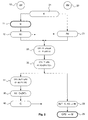
- FIG. 3 this Figure shows the last steps of the method illustrated in Fig. 2 , where the box 37 represents an additional step as an alternative of the previous flowchart.
- This variant corresponds to the case where the second key K2 is used as indirect encryption/decryption key within the second algorithm A2.
- a third key K3 is determined, at each device D1, D2, by a fourth operation OP4 which uses both the second key K2 and the shared secret key K as operands.
- the result of this fourth operation OP4 provides the third cryptographic key K3.
- all of the operations OP1, OP2, OP3, OP4, or some of them can be implemented within each device during the manufacturing of the devices, during their personalization or during an initialization phase.
- the step shown at box 37 is carried out between the steps of boxes 35 and 16, since it needs the second key K2 (determined by the step of box 35) and the result of this additional step will be used with the second algorithm A2 (during the step shown at box 16).
- this additional step is carried out between the steps of boxes 35 and 23 for the same reasons.
- At least part of at least any of the operations OP1, OP2, OP3, OP4 involves a logical operation (Boolean algebra). More particularly, this logical operation is an exclusive OR operation (see the symbolic notation ⁇ in Fig. 2 and 3 ). It should be noted that other logical functions (i.e. basic and/or derived operations) could be used instead of the XOR operator or with the XOR operator.
- At least a part of at least any of the operations OP1, OP2, OP3, OP4 involves a number raised to a power.
- any of the operands of the relevant operation is used as an exponent of this number which is chosen among the other operands of this operation.
- both the bit length of the random numbers R1, R2 and the bit length of the shared secret key K should be the same.
- the random numbers R1, R2 must have the same bit length.
- the same principle applies to the third and fourth operations regarding both the random numbers R1, R2 and the message M, on the one hand, and the cryptographic keys K2, K, on the other hand.
- the present method can further comprise a step aiming to restore the same bit length for each of these operands.
- restoring the same bit length can be achieved by several different manners.
- a "balancing step” aiming to supplement the operand having the smallest bit length until its bit length is equal to the bit length of any of the other operands of the relevant operation. Then, this balancing step can be repeated until all the operands of the relevant operation have the same bit length.
- the step aiming to supplement the operand can be achieved by a succession of bits 0, by a succession of bits 1, even by a succession of a specific combination of these two bits 0 and 1.
- the selected bit succession must be known both by the sending device and the receiving device(s), through any process mentioned before, for instance during the personalization of the devices or their chipsets.
- this balancing step could be achieved by supplementing the operand having the smallest bit length until the bit length of the other operand (i.e. preferably the operand having the longest bit length) is equal to a multiple of the bit length of the supplemented operand.
- the so-called balancing step can be first performed by concatenating the operand having the smallest bit length with itself, until reaching the same bit length as the other operand.
- This approach implies that the operand which has the longest bit length is a multiple of the other operand (i.e. the concatenated operand).
- the aforementioned concatenation can be performed until reaching a bit length reduced by a residual value less than the bit length of the concatenated operand.
- This residual bit length corresponds to the remainder of the Euclidean division where the operand having the longest bit length is the dividend and the operand to concatenate is the divisor.
- the residual bit length i.e. the residual value
- the residual bit length can be supplemented by any succession of bits, as explained above.
- restoring the same bit length can be achieved for each of said random numbers R1, R2 by concatenating said random number with itself, until reaching the same bit length as that of the message M.
- This embodiment involves that the random numbers R1, R2 have the same bit length and that the bit length of the message M is a multiple of that of one of the random number. If this latter condition is not fulfilled, then the residual bit length can be supplemented as already explained.
- restoring the same bit length could be achieved first by supplementing the message M until its bit length is equal to a multiple of the bit length of any of the random number R1, R2, then by slicing the supplemented message M into blocks having the same bit length as the bit length of the random number before using each of these blocks as a new message (M) to be processed by the steps of the present cryptographic method.
- the cryptographic keys used in the present method preferably at least the second key K2 and the shared secret key K, have the same bit length.
- all the random numbers R1, R2 have also the same bit length.
- the subject-matter of the present invention significantly increases the security applied to the exchanged messages M.
- the shared secret key K is never directly used as cryptographic key in any one of the cryptographic algorithms A1, A2 implemented in the present method.
- the shared secret key K is only used within mathematical operations (OP1, OP4) whose results are subsequently used as keys into these algorithms. Accordingly, the shared secret key K is never directly exposed at the first plan, within a cryptographic algorithm.
- the steps of the present method are undertaken each time a message M has to be exchanged.
- This can be applied whatever the embodiment of the method.
- the random numbers generated by each device have a single use, given that a new random number is generated, by each device, each time a new message has to be sent. Therefore, the shared secret key K is advantageously different whenever a message M is exchanged. This provides a strong method for securely exchanging messages and in particular a method for preventing any DFA attacks.
- the message M can comprise any type of data, in particular sensitive data such as passwords, control words, cryptographic key or any other confidential information.
- the present invention also refers to a device or to a system suitable for implementing any of the embodiments of the above-described method.
- FIG. 4 the latter schematically shows in more detail one of the devices 10, 20 depicted in the system of Fig. 1 .
- This device can be indifferently used as a sending device D1 or as a receiving device D2, and preferably even both as sending and receiving device. To this end, it comprises several components including at least:
- the device 10, 20 can be used in all cases where sensitive data must be securely exchanged.
- a device can take the form of an electronic circuit (integrated circuit, preferably a monolithic circuit), such as a smartcard or a chipset suitable to be inserted into another device.
- the latter could be a set-top-box (within the pay-TV field), a smart phone or any other communication device.
- a smartcard could be also used as a standalone device, e.g. as access card, as bank card (credit card or payment card) for communicating with a control terminal.
- each operation OP1, OP2, OP3, OP4 can be performed by using a single calculation unit 7 configured to perform different operations, or several calculation units 7, each dedicated to one of these operations.
- the same principle applies to the cryptographic unit 8 regarding the algorithms A1, A2.
- the invention also refers to a system as shown in Fig. 1 .
- a system comprises at least two cryptographic devices 10, 20, connected together, for implementing any embodiment of the above-described method.
- Each device 10, 20 of this system comprises at least the components which were listed above during the detailed description of the device presented as a further subject-matter of the present invention.
- any of the devices of the system may include at least one of the above-mentioned related optional features.
Landscapes
- Engineering & Computer Science (AREA)
- Computer Security & Cryptography (AREA)
- Computer Networks & Wireless Communication (AREA)
- Signal Processing (AREA)
- Computer Hardware Design (AREA)
- Computing Systems (AREA)
- General Engineering & Computer Science (AREA)
- Physics & Mathematics (AREA)
- General Physics & Mathematics (AREA)
- Theoretical Computer Science (AREA)
- Storage Device Security (AREA)
Priority Applications (12)
| Application Number | Priority Date | Filing Date | Title |
|---|---|---|---|
| EP14172225.6A EP2955871B1 (de) | 2014-06-12 | 2014-06-12 | Kryptographisches Verfahren zum sicheren Austauschen von Nachrichten und Vorrichtung und System zur Durchführung dieses Verfahrens |
| ES14172225.6T ES2619613T3 (es) | 2014-06-12 | 2014-06-12 | Método criptográfico para intercambiar mensajes de forma segura y dispositivo y sistema para implementar este método |
| DK14172225.6T DK2955871T3 (en) | 2014-06-12 | 2014-06-12 | Cryptographic method for securely exchanging messages and apparatus and system for performing this method |
| CA2893067A CA2893067C (en) | 2014-06-12 | 2015-05-26 | Cryptographic method for securely exchanging messages and device and system for implementing this method |
| SG10201504276RA SG10201504276RA (en) | 2014-06-12 | 2015-05-29 | Cryptographic method for securely exchanging messages and device and system for implementing this method |
| NZ708697A NZ708697A (en) | 2014-06-12 | 2015-06-02 | Cryptographic method for securely exchanging messages and device and system for implementing this method |
| AU2015202994A AU2015202994A1 (en) | 2014-06-12 | 2015-06-03 | Cryptographic method for securely exchanging messages and device and system for implementing this method |
| JP2015113668A JP6499519B2 (ja) | 2014-06-12 | 2015-06-04 | メッセージを安全に交換する暗号方式並びにこの方式を実施する装置及びシステム |
| US14/731,596 US9648026B2 (en) | 2014-06-12 | 2015-06-05 | Cryptographic method for securely exchanging messages and device and system for implementing this method |
| BR102015013579-3A BR102015013579B1 (pt) | 2014-06-12 | 2015-06-10 | Método criptográfico para troca segura de mensagens entre pelo menos dois dispositivos, dispositivo criptográfico e sistema |
| KR1020150081868A KR102383829B1 (ko) | 2014-06-12 | 2015-06-10 | 안전하게 메시지를 교환하기 위한 방법, 이 방법을 구현하기위한 장치 및 시스템 |
| CN201510317381.0A CN105207772B (zh) | 2014-06-12 | 2015-06-11 | 安全地交换消息的加密方法及实现该方法的设备和系统 |
Applications Claiming Priority (1)
| Application Number | Priority Date | Filing Date | Title |
|---|---|---|---|
| EP14172225.6A EP2955871B1 (de) | 2014-06-12 | 2014-06-12 | Kryptographisches Verfahren zum sicheren Austauschen von Nachrichten und Vorrichtung und System zur Durchführung dieses Verfahrens |
Publications (2)
| Publication Number | Publication Date |
|---|---|
| EP2955871A1 true EP2955871A1 (de) | 2015-12-16 |
| EP2955871B1 EP2955871B1 (de) | 2017-01-11 |
Family
ID=50933051
Family Applications (1)
| Application Number | Title | Priority Date | Filing Date |
|---|---|---|---|
| EP14172225.6A Active EP2955871B1 (de) | 2014-06-12 | 2014-06-12 | Kryptographisches Verfahren zum sicheren Austauschen von Nachrichten und Vorrichtung und System zur Durchführung dieses Verfahrens |
Country Status (11)
| Country | Link |
|---|---|
| US (1) | US9648026B2 (de) |
| EP (1) | EP2955871B1 (de) |
| JP (1) | JP6499519B2 (de) |
| KR (1) | KR102383829B1 (de) |
| CN (1) | CN105207772B (de) |
| AU (1) | AU2015202994A1 (de) |
| CA (1) | CA2893067C (de) |
| DK (1) | DK2955871T3 (de) |
| ES (1) | ES2619613T3 (de) |
| NZ (1) | NZ708697A (de) |
| SG (1) | SG10201504276RA (de) |
Families Citing this family (14)
| Publication number | Priority date | Publication date | Assignee | Title |
|---|---|---|---|---|
| DE102015225651A1 (de) * | 2015-12-17 | 2017-06-22 | Robert Bosch Gmbh | Verfahren und Vorrichtung zum Übertragen einer Software |
| SG10201609247YA (en) * | 2016-11-04 | 2018-06-28 | Huawei Int Pte Ltd | System and method for configuring a wireless device for wireless network access |
| US9741671B1 (en) * | 2016-11-10 | 2017-08-22 | Nxp B.V. | Semiconductor die with backside protection |
| US10742408B2 (en) * | 2017-02-27 | 2020-08-11 | Cord3 Innovation Inc. | Many-to-many symmetric cryptographic system and method |
| CA3056814A1 (en) * | 2017-02-27 | 2018-08-30 | Cord3 Innovation Inc. | Symmetric cryptographic method and system and applications thereof |
| CN108199832B (zh) * | 2017-12-28 | 2021-02-26 | 东华大学 | 一种cloc认证加密算法抵御差分故障攻击的检测方法 |
| US11343672B2 (en) | 2019-02-20 | 2022-05-24 | Coretigo Ltd. | Secure communication encryption and decryption mechanism in a wireless communication system |
| KR102080438B1 (ko) | 2019-05-21 | 2020-02-21 | 오세정 | 마시는 모링가 수의 제조방법, 이에 의해 제조된 모링가 수, 그리고 모링가 원액 추출 장치, 그리고 모링가 원액 추출 장치 |
| EP3761556A1 (de) * | 2019-07-04 | 2021-01-06 | Basf Se | Neues verfahren für pseudozufallszahlenerzeugung zur informationsverschlüsselung |
| KR102775668B1 (ko) | 2020-04-23 | 2025-03-05 | 한국전자통신연구원 | 신경망 동기화에 기반한 비밀키 생성 방법 및 장치 |
| KR102648499B1 (ko) | 2021-03-11 | 2024-03-19 | 한국전자통신연구원 | 기계 학습 기반 키 생성 장치 및 방법 |
| US11924339B2 (en) | 2021-04-15 | 2024-03-05 | Real Random IP, LLC | System and method for secure end-to-end electronic communication using a privately shared table of entropy |
| US12407502B2 (en) | 2021-04-15 | 2025-09-02 | Real Random IP, LLC | System and method for secure end-to-end electronic communication using a mutating table of entropy |
| KR20250045818A (ko) | 2023-09-26 | 2025-04-02 | 삼성에스디에스 주식회사 | 메시징 암호화 방법 및 그 시스템 |
Citations (2)
| Publication number | Priority date | Publication date | Assignee | Title |
|---|---|---|---|---|
| US20040071291A1 (en) * | 2001-02-08 | 2004-04-15 | Fabrice Romain | Secure method for secret key cryptographic calculation and component using said method |
| US20070177720A1 (en) * | 2004-03-11 | 2007-08-02 | Oberthur Card Systems Sa | Secure data processing method based particularly on a cryptographic algorithm |
Family Cites Families (14)
| Publication number | Priority date | Publication date | Assignee | Title |
|---|---|---|---|---|
| JPH01122227A (ja) * | 1987-11-06 | 1989-05-15 | Konica Corp | 伝送装置 |
| US5602917A (en) * | 1994-12-30 | 1997-02-11 | Lucent Technologies Inc. | Method for secure session key generation |
| FR2745924B1 (fr) * | 1996-03-07 | 1998-12-11 | Bull Cp8 | Circuit integre perfectionne et procede d'utilisation d'un tel circuit integre |
| AUPO323496A0 (en) * | 1996-10-25 | 1996-11-21 | Monash University | Digital message encryption and authentication |
| US7436966B2 (en) * | 2002-08-21 | 2008-10-14 | International Business Machines Corporation | Secure approach to send data from one system to another |
| CN1692598A (zh) * | 2002-12-03 | 2005-11-02 | 松下电器产业株式会社 | 密钥共享系统、共享密钥生成装置及共享密钥复原装置 |
| CN1323523C (zh) * | 2003-04-02 | 2007-06-27 | 华为技术有限公司 | 一种在无线局域网中生成动态密钥的方法 |
| CN100421372C (zh) * | 2003-11-18 | 2008-09-24 | 华为技术有限公司 | 一种安全发送传输密钥的方法 |
| JP4611642B2 (ja) * | 2004-01-16 | 2011-01-12 | 三菱電機株式会社 | 認証システム |
| KR100809393B1 (ko) * | 2005-11-01 | 2008-03-05 | 한국전자통신연구원 | Epon에서의 키 분배 방법 |
| JP2007189659A (ja) * | 2005-12-15 | 2007-07-26 | Toshiba Corp | 暗号化装置、暗号化方法及び暗号化プログラム |
| JP4613969B2 (ja) * | 2008-03-03 | 2011-01-19 | ソニー株式会社 | 通信装置、及び通信方法 |
| JP5845393B2 (ja) * | 2011-04-28 | 2016-01-20 | パナソニックIpマネジメント株式会社 | 暗号通信装置および暗号通信システム |
| WO2013014778A1 (ja) * | 2011-07-27 | 2013-01-31 | 富士通株式会社 | 暗号化処理装置および認証方法 |
-
2014
- 2014-06-12 ES ES14172225.6T patent/ES2619613T3/es active Active
- 2014-06-12 DK DK14172225.6T patent/DK2955871T3/en active
- 2014-06-12 EP EP14172225.6A patent/EP2955871B1/de active Active
-
2015
- 2015-05-26 CA CA2893067A patent/CA2893067C/en active Active
- 2015-05-29 SG SG10201504276RA patent/SG10201504276RA/en unknown
- 2015-06-02 NZ NZ708697A patent/NZ708697A/en not_active IP Right Cessation
- 2015-06-03 AU AU2015202994A patent/AU2015202994A1/en not_active Abandoned
- 2015-06-04 JP JP2015113668A patent/JP6499519B2/ja active Active
- 2015-06-05 US US14/731,596 patent/US9648026B2/en active Active
- 2015-06-10 KR KR1020150081868A patent/KR102383829B1/ko active Active
- 2015-06-11 CN CN201510317381.0A patent/CN105207772B/zh active Active
Patent Citations (2)
| Publication number | Priority date | Publication date | Assignee | Title |
|---|---|---|---|---|
| US20040071291A1 (en) * | 2001-02-08 | 2004-04-15 | Fabrice Romain | Secure method for secret key cryptographic calculation and component using said method |
| US20070177720A1 (en) * | 2004-03-11 | 2007-08-02 | Oberthur Card Systems Sa | Secure data processing method based particularly on a cryptographic algorithm |
Also Published As
| Publication number | Publication date |
|---|---|
| DK2955871T3 (en) | 2017-05-01 |
| BR102015013579A2 (pt) | 2018-05-29 |
| ES2619613T3 (es) | 2017-06-26 |
| KR102383829B1 (ko) | 2022-04-06 |
| NZ708697A (en) | 2018-01-26 |
| CN105207772B (zh) | 2018-08-10 |
| KR20150142623A (ko) | 2015-12-22 |
| CA2893067C (en) | 2022-11-01 |
| AU2015202994A1 (en) | 2016-01-07 |
| CN105207772A (zh) | 2015-12-30 |
| CA2893067A1 (en) | 2015-12-12 |
| JP6499519B2 (ja) | 2019-04-10 |
| SG10201504276RA (en) | 2016-01-28 |
| EP2955871B1 (de) | 2017-01-11 |
| JP2016005273A (ja) | 2016-01-12 |
| US20150365424A1 (en) | 2015-12-17 |
| US9648026B2 (en) | 2017-05-09 |
Similar Documents
| Publication | Publication Date | Title |
|---|---|---|
| EP2955871B1 (de) | Kryptographisches Verfahren zum sicheren Austauschen von Nachrichten und Vorrichtung und System zur Durchführung dieses Verfahrens | |
| US20250132899A1 (en) | Secret material exchange and authentication cryptography operations | |
| US10187200B1 (en) | System and method for generating a multi-stage key for use in cryptographic operations | |
| US11336425B1 (en) | Cryptographic machines characterized by a Finite Lab-Transform (FLT) | |
| US9544132B2 (en) | Cryptographic method for protecting a key hardware register against fault attacks | |
| EP3228044A1 (de) | Kryptografisches blockverfahren zur verschlüsselung/entschlüsselung von nachrichten und kryptografievorrichtungen zur durchführung dieses verfahrens | |
| US20140037089A1 (en) | Encryption processing device and method | |
| EP3089398B1 (de) | Sicherung einer kryptographischen vorrichtung | |
| CN103404073B (zh) | 针对无源监听的保护 | |
| WO2022237440A1 (en) | Authenticated encryption apparatus with initialization-vector misuse resistance and method therefor | |
| US7779272B2 (en) | Hardware cryptographic engine and encryption method | |
| Saha et al. | White-box cryptography based data encryption-decryption scheme for iot environment | |
| US8958556B2 (en) | Method of secure cryptographic calculation, in particular, against attacks of the DFA and unidirectional type, and corresponding component | |
| EP4307155A1 (de) | Verfahren und schaltung zum schutz einer elektronischen vorrichtung vor einem seitenkanalangriff | |
| JP5945525B2 (ja) | 鍵交換システム、鍵交換装置、その方法、及びプログラム | |
| CN109936448A (zh) | 一种数据传输方法及装置 | |
| US20200220708A1 (en) | United countermeasure against side-channel attacks | |
| Sisodia et al. | A Survey on Network Security and Security Authentication using Biometrics | |
| BR102015013579B1 (pt) | Método criptográfico para troca segura de mensagens entre pelo menos dois dispositivos, dispositivo criptográfico e sistema |
Legal Events
| Date | Code | Title | Description |
|---|---|---|---|
| PUAI | Public reference made under article 153(3) epc to a published international application that has entered the european phase |
Free format text: ORIGINAL CODE: 0009012 |
|
| AK | Designated contracting states |
Kind code of ref document: A1 Designated state(s): AL AT BE BG CH CY CZ DE DK EE ES FI FR GB GR HR HU IE IS IT LI LT LU LV MC MK MT NL NO PL PT RO RS SE SI SK SM TR |
|
| AX | Request for extension of the european patent |
Extension state: BA ME |
|
| 17P | Request for examination filed |
Effective date: 20160518 |
|
| RBV | Designated contracting states (corrected) |
Designated state(s): AL AT BE BG CH CY CZ DE DK EE ES FI FR GB GR HR HU IE IS IT LI LT LU LV MC MK MT NL NO PL PT RO RS SE SI SK SM TR |
|
| RIC1 | Information provided on ipc code assigned before grant |
Ipc: H04L 9/00 20060101AFI20160914BHEP |
|
| GRAP | Despatch of communication of intention to grant a patent |
Free format text: ORIGINAL CODE: EPIDOSNIGR1 |
|
| INTG | Intention to grant announced |
Effective date: 20161024 |
|
| GRAS | Grant fee paid |
Free format text: ORIGINAL CODE: EPIDOSNIGR3 |
|
| GRAA | (expected) grant |
Free format text: ORIGINAL CODE: 0009210 |
|
| AK | Designated contracting states |
Kind code of ref document: B1 Designated state(s): AL AT BE BG CH CY CZ DE DK EE ES FI FR GB GR HR HU IE IS IT LI LT LU LV MC MK MT NL NO PL PT RO RS SE SI SK SM TR |
|
| REG | Reference to a national code |
Ref country code: GB Ref legal event code: FG4D |
|
| REG | Reference to a national code |
Ref country code: CH Ref legal event code: EP |
|
| REG | Reference to a national code |
Ref country code: AT Ref legal event code: REF Ref document number: 862154 Country of ref document: AT Kind code of ref document: T Effective date: 20170115 |
|
| REG | Reference to a national code |
Ref country code: IE Ref legal event code: FG4D |
|
| REG | Reference to a national code |
Ref country code: DE Ref legal event code: R096 Ref document number: 602014006139 Country of ref document: DE |
|
| REG | Reference to a national code |
Ref country code: CH Ref legal event code: NV Representative=s name: LEMAN CONSULTING S.A., CH |
|
| REG | Reference to a national code |
Ref country code: DK Ref legal event code: T3 Effective date: 20170425 |
|
| REG | Reference to a national code |
Ref country code: SE Ref legal event code: TRGR |
|
| REG | Reference to a national code |
Ref country code: NO Ref legal event code: T2 Effective date: 20170111 |
|
| REG | Reference to a national code |
Ref country code: LT Ref legal event code: MG4D |
|
| REG | Reference to a national code |
Ref country code: NL Ref legal event code: MP Effective date: 20170111 |
|
| REG | Reference to a national code |
Ref country code: AT Ref legal event code: MK05 Ref document number: 862154 Country of ref document: AT Kind code of ref document: T Effective date: 20170111 |
|
| REG | Reference to a national code |
Ref country code: FR Ref legal event code: PLFP Year of fee payment: 4 |
|
| REG | Reference to a national code |
Ref country code: ES Ref legal event code: FG2A Ref document number: 2619613 Country of ref document: ES Kind code of ref document: T3 Effective date: 20170626 |
|
| PG25 | Lapsed in a contracting state [announced via postgrant information from national office to epo] |
Ref country code: NL Free format text: LAPSE BECAUSE OF FAILURE TO SUBMIT A TRANSLATION OF THE DESCRIPTION OR TO PAY THE FEE WITHIN THE PRESCRIBED TIME-LIMIT Effective date: 20170111 |
|
| PG25 | Lapsed in a contracting state [announced via postgrant information from national office to epo] |
Ref country code: HR Free format text: LAPSE BECAUSE OF FAILURE TO SUBMIT A TRANSLATION OF THE DESCRIPTION OR TO PAY THE FEE WITHIN THE PRESCRIBED TIME-LIMIT Effective date: 20170111 Ref country code: LT Free format text: LAPSE BECAUSE OF FAILURE TO SUBMIT A TRANSLATION OF THE DESCRIPTION OR TO PAY THE FEE WITHIN THE PRESCRIBED TIME-LIMIT Effective date: 20170111 Ref country code: IS Free format text: LAPSE BECAUSE OF FAILURE TO SUBMIT A TRANSLATION OF THE DESCRIPTION OR TO PAY THE FEE WITHIN THE PRESCRIBED TIME-LIMIT Effective date: 20170511 Ref country code: GR Free format text: LAPSE BECAUSE OF FAILURE TO SUBMIT A TRANSLATION OF THE DESCRIPTION OR TO PAY THE FEE WITHIN THE PRESCRIBED TIME-LIMIT Effective date: 20170412 |
|
| PG25 | Lapsed in a contracting state [announced via postgrant information from national office to epo] |
Ref country code: RS Free format text: LAPSE BECAUSE OF FAILURE TO SUBMIT A TRANSLATION OF THE DESCRIPTION OR TO PAY THE FEE WITHIN THE PRESCRIBED TIME-LIMIT Effective date: 20170111 Ref country code: PT Free format text: LAPSE BECAUSE OF FAILURE TO SUBMIT A TRANSLATION OF THE DESCRIPTION OR TO PAY THE FEE WITHIN THE PRESCRIBED TIME-LIMIT Effective date: 20170511 Ref country code: BG Free format text: LAPSE BECAUSE OF FAILURE TO SUBMIT A TRANSLATION OF THE DESCRIPTION OR TO PAY THE FEE WITHIN THE PRESCRIBED TIME-LIMIT Effective date: 20170411 Ref country code: PL Free format text: LAPSE BECAUSE OF FAILURE TO SUBMIT A TRANSLATION OF THE DESCRIPTION OR TO PAY THE FEE WITHIN THE PRESCRIBED TIME-LIMIT Effective date: 20170111 Ref country code: LV Free format text: LAPSE BECAUSE OF FAILURE TO SUBMIT A TRANSLATION OF THE DESCRIPTION OR TO PAY THE FEE WITHIN THE PRESCRIBED TIME-LIMIT Effective date: 20170111 Ref country code: AT Free format text: LAPSE BECAUSE OF FAILURE TO SUBMIT A TRANSLATION OF THE DESCRIPTION OR TO PAY THE FEE WITHIN THE PRESCRIBED TIME-LIMIT Effective date: 20170111 |
|
| REG | Reference to a national code |
Ref country code: DE Ref legal event code: R097 Ref document number: 602014006139 Country of ref document: DE |
|
| PG25 | Lapsed in a contracting state [announced via postgrant information from national office to epo] |
Ref country code: EE Free format text: LAPSE BECAUSE OF FAILURE TO SUBMIT A TRANSLATION OF THE DESCRIPTION OR TO PAY THE FEE WITHIN THE PRESCRIBED TIME-LIMIT Effective date: 20170111 Ref country code: CZ Free format text: LAPSE BECAUSE OF FAILURE TO SUBMIT A TRANSLATION OF THE DESCRIPTION OR TO PAY THE FEE WITHIN THE PRESCRIBED TIME-LIMIT Effective date: 20170111 Ref country code: RO Free format text: LAPSE BECAUSE OF FAILURE TO SUBMIT A TRANSLATION OF THE DESCRIPTION OR TO PAY THE FEE WITHIN THE PRESCRIBED TIME-LIMIT Effective date: 20170111 Ref country code: SK Free format text: LAPSE BECAUSE OF FAILURE TO SUBMIT A TRANSLATION OF THE DESCRIPTION OR TO PAY THE FEE WITHIN THE PRESCRIBED TIME-LIMIT Effective date: 20170111 |
|
| PLBE | No opposition filed within time limit |
Free format text: ORIGINAL CODE: 0009261 |
|
| STAA | Information on the status of an ep patent application or granted ep patent |
Free format text: STATUS: NO OPPOSITION FILED WITHIN TIME LIMIT |
|
| PG25 | Lapsed in a contracting state [announced via postgrant information from national office to epo] |
Ref country code: SM Free format text: LAPSE BECAUSE OF FAILURE TO SUBMIT A TRANSLATION OF THE DESCRIPTION OR TO PAY THE FEE WITHIN THE PRESCRIBED TIME-LIMIT Effective date: 20170111 |
|
| 26N | No opposition filed |
Effective date: 20171012 |
|
| PG25 | Lapsed in a contracting state [announced via postgrant information from national office to epo] |
Ref country code: MC Free format text: LAPSE BECAUSE OF FAILURE TO SUBMIT A TRANSLATION OF THE DESCRIPTION OR TO PAY THE FEE WITHIN THE PRESCRIBED TIME-LIMIT Effective date: 20170111 |
|
| PG25 | Lapsed in a contracting state [announced via postgrant information from national office to epo] |
Ref country code: SI Free format text: LAPSE BECAUSE OF FAILURE TO SUBMIT A TRANSLATION OF THE DESCRIPTION OR TO PAY THE FEE WITHIN THE PRESCRIBED TIME-LIMIT Effective date: 20170111 |
|
| REG | Reference to a national code |
Ref country code: IE Ref legal event code: MM4A |
|
| PG25 | Lapsed in a contracting state [announced via postgrant information from national office to epo] |
Ref country code: LU Free format text: LAPSE BECAUSE OF NON-PAYMENT OF DUE FEES Effective date: 20170612 Ref country code: IE Free format text: LAPSE BECAUSE OF NON-PAYMENT OF DUE FEES Effective date: 20170612 |
|
| REG | Reference to a national code |
Ref country code: BE Ref legal event code: MM Effective date: 20170630 |
|
| REG | Reference to a national code |
Ref country code: FR Ref legal event code: PLFP Year of fee payment: 5 |
|
| PG25 | Lapsed in a contracting state [announced via postgrant information from national office to epo] |
Ref country code: BE Free format text: LAPSE BECAUSE OF NON-PAYMENT OF DUE FEES Effective date: 20170630 |
|
| PG25 | Lapsed in a contracting state [announced via postgrant information from national office to epo] |
Ref country code: MT Free format text: LAPSE BECAUSE OF NON-PAYMENT OF DUE FEES Effective date: 20170612 |
|
| PG25 | Lapsed in a contracting state [announced via postgrant information from national office to epo] |
Ref country code: HU Free format text: LAPSE BECAUSE OF FAILURE TO SUBMIT A TRANSLATION OF THE DESCRIPTION OR TO PAY THE FEE WITHIN THE PRESCRIBED TIME-LIMIT; INVALID AB INITIO Effective date: 20140612 |
|
| PGFP | Annual fee paid to national office [announced via postgrant information from national office to epo] |
Ref country code: DK Payment date: 20190627 Year of fee payment: 6 |
|
| PG25 | Lapsed in a contracting state [announced via postgrant information from national office to epo] |
Ref country code: CY Free format text: LAPSE BECAUSE OF FAILURE TO SUBMIT A TRANSLATION OF THE DESCRIPTION OR TO PAY THE FEE WITHIN THE PRESCRIBED TIME-LIMIT Effective date: 20170111 |
|
| PG25 | Lapsed in a contracting state [announced via postgrant information from national office to epo] |
Ref country code: MK Free format text: LAPSE BECAUSE OF FAILURE TO SUBMIT A TRANSLATION OF THE DESCRIPTION OR TO PAY THE FEE WITHIN THE PRESCRIBED TIME-LIMIT Effective date: 20170111 |
|
| PG25 | Lapsed in a contracting state [announced via postgrant information from national office to epo] |
Ref country code: TR Free format text: LAPSE BECAUSE OF FAILURE TO SUBMIT A TRANSLATION OF THE DESCRIPTION OR TO PAY THE FEE WITHIN THE PRESCRIBED TIME-LIMIT Effective date: 20170111 |
|
| PG25 | Lapsed in a contracting state [announced via postgrant information from national office to epo] |
Ref country code: AL Free format text: LAPSE BECAUSE OF FAILURE TO SUBMIT A TRANSLATION OF THE DESCRIPTION OR TO PAY THE FEE WITHIN THE PRESCRIBED TIME-LIMIT Effective date: 20170111 |
|
| REG | Reference to a national code |
Ref country code: DK Ref legal event code: EBP Effective date: 20200630 |
|
| PG25 | Lapsed in a contracting state [announced via postgrant information from national office to epo] |
Ref country code: DK Free format text: LAPSE BECAUSE OF NON-PAYMENT OF DUE FEES Effective date: 20200630 |
|
| PGFP | Annual fee paid to national office [announced via postgrant information from national office to epo] |
Ref country code: FI Payment date: 20250520 Year of fee payment: 12 |
|
| PGFP | Annual fee paid to national office [announced via postgrant information from national office to epo] |
Ref country code: DE Payment date: 20250520 Year of fee payment: 12 |
|
| PGFP | Annual fee paid to national office [announced via postgrant information from national office to epo] |
Ref country code: GB Payment date: 20250520 Year of fee payment: 12 |
|
| PGFP | Annual fee paid to national office [announced via postgrant information from national office to epo] |
Ref country code: NO Payment date: 20250522 Year of fee payment: 12 |
|
| PGFP | Annual fee paid to national office [announced via postgrant information from national office to epo] |
Ref country code: IT Payment date: 20250520 Year of fee payment: 12 |
|
| PGFP | Annual fee paid to national office [announced via postgrant information from national office to epo] |
Ref country code: FR Payment date: 20250520 Year of fee payment: 12 |
|
| PGFP | Annual fee paid to national office [announced via postgrant information from national office to epo] |
Ref country code: SE Payment date: 20250520 Year of fee payment: 12 |
|
| PGFP | Annual fee paid to national office [announced via postgrant information from national office to epo] |
Ref country code: ES Payment date: 20250701 Year of fee payment: 12 |
|
| PGFP | Annual fee paid to national office [announced via postgrant information from national office to epo] |
Ref country code: CH Payment date: 20250701 Year of fee payment: 12 |