EP2955190B1 - Chemical compounds - Google Patents
Chemical compounds Download PDFInfo
- Publication number
- EP2955190B1 EP2955190B1 EP15154759.3A EP15154759A EP2955190B1 EP 2955190 B1 EP2955190 B1 EP 2955190B1 EP 15154759 A EP15154759 A EP 15154759A EP 2955190 B1 EP2955190 B1 EP 2955190B1
- Authority
- EP
- European Patent Office
- Prior art keywords
- mhz
- mmol
- nmr
- cdcl
- ipso
- Prior art date
- Legal status (The legal status is an assumption and is not a legal conclusion. Google has not performed a legal analysis and makes no representation as to the accuracy of the status listed.)
- Revoked
Links
- 150000001875 compounds Chemical class 0.000 title claims description 62
- 125000003118 aryl group Chemical group 0.000 claims description 36
- 125000001797 benzyl group Chemical group [H]C1=C([H])C([H])=C(C([H])=C1[H])C([H])([H])* 0.000 claims description 33
- 206010028980 Neoplasm Diseases 0.000 claims description 20
- 125000000217 alkyl group Chemical group 0.000 claims description 20
- 125000002496 methyl group Chemical group [H]C([H])([H])* 0.000 claims description 17
- 125000001997 phenyl group Chemical group [H]C1=C([H])C([H])=C(*)C([H])=C1[H] 0.000 claims description 17
- 150000001413 amino acids Chemical class 0.000 claims description 14
- 201000011510 cancer Diseases 0.000 claims description 12
- 125000004432 carbon atom Chemical group C* 0.000 claims description 10
- 229910052731 fluorine Inorganic materials 0.000 claims description 10
- 150000002148 esters Chemical class 0.000 claims description 9
- 238000000034 method Methods 0.000 claims description 9
- 229910052801 chlorine Inorganic materials 0.000 claims description 8
- 229910052736 halogen Inorganic materials 0.000 claims description 8
- 150000002367 halogens Chemical class 0.000 claims description 8
- 150000003839 salts Chemical class 0.000 claims description 7
- 238000011282 treatment Methods 0.000 claims description 7
- 125000003342 alkenyl group Chemical group 0.000 claims description 6
- 229910052794 bromium Inorganic materials 0.000 claims description 6
- 229910052739 hydrogen Inorganic materials 0.000 claims description 6
- 125000004169 (C1-C6) alkyl group Chemical group 0.000 claims description 5
- 125000002947 alkylene group Chemical group 0.000 claims description 5
- 125000002837 carbocyclic group Chemical group 0.000 claims description 5
- 125000004122 cyclic group Chemical group 0.000 claims description 5
- 239000003085 diluting agent Substances 0.000 claims description 5
- 125000000623 heterocyclic group Chemical group 0.000 claims description 5
- 229910052740 iodine Inorganic materials 0.000 claims description 5
- 239000008194 pharmaceutical composition Substances 0.000 claims description 5
- 239000000546 pharmaceutical excipient Substances 0.000 claims description 5
- 125000002877 alkyl aryl group Chemical group 0.000 claims description 4
- 239000003937 drug carrier Substances 0.000 claims description 4
- 125000001495 ethyl group Chemical group [H]C([H])([H])C([H])([H])* 0.000 claims description 4
- 125000002950 monocyclic group Chemical group 0.000 claims description 4
- 125000002619 bicyclic group Chemical group 0.000 claims description 2
- 125000001147 pentyl group Chemical group C(CCCC)* 0.000 claims description 2
- 238000011321 prophylaxis Methods 0.000 claims description 2
- HEDRZPFGACZZDS-MICDWDOJSA-N Trichloro(2H)methane Chemical compound [2H]C(Cl)(Cl)Cl HEDRZPFGACZZDS-MICDWDOJSA-N 0.000 description 554
- YMWUJEATGCHHMB-UHFFFAOYSA-N Dichloromethane Chemical compound ClCCl YMWUJEATGCHHMB-UHFFFAOYSA-N 0.000 description 255
- RGSFGYAAUTVSQA-UHFFFAOYSA-N Cyclopentane Chemical compound C1CCCC1 RGSFGYAAUTVSQA-UHFFFAOYSA-N 0.000 description 202
- OKKJLVBELUTLKV-UHFFFAOYSA-N Methanol Chemical compound OC OKKJLVBELUTLKV-UHFFFAOYSA-N 0.000 description 168
- ZMANZCXQSJIPKH-UHFFFAOYSA-N Triethylamine Chemical compound CCN(CC)CC ZMANZCXQSJIPKH-UHFFFAOYSA-N 0.000 description 110
- 230000015572 biosynthetic process Effects 0.000 description 110
- 238000010561 standard procedure Methods 0.000 description 110
- 238000003786 synthesis reaction Methods 0.000 description 109
- 238000001644 13C nuclear magnetic resonance spectroscopy Methods 0.000 description 108
- 238000005160 1H NMR spectroscopy Methods 0.000 description 101
- DMEGYFMYUHOHGS-UHFFFAOYSA-N heptamethylene Natural products C1CCCCCC1 DMEGYFMYUHOHGS-UHFFFAOYSA-N 0.000 description 101
- 238000004679 31P NMR spectroscopy Methods 0.000 description 99
- 239000012043 crude product Substances 0.000 description 86
- LMKPHJYTFHAGHK-UHFFFAOYSA-N cyclodrine Chemical compound C1CCCC1(O)C(C(=O)OCCN(CC)CC)C1=CC=CC=C1 LMKPHJYTFHAGHK-UHFFFAOYSA-N 0.000 description 66
- 239000007787 solid Substances 0.000 description 64
- 239000000047 product Substances 0.000 description 57
- 229910019142 PO4 Inorganic materials 0.000 description 54
- 239000010452 phosphate Substances 0.000 description 53
- MCTWTZJPVLRJOU-UHFFFAOYSA-N 1-methyl-1H-imidazole Chemical compound CN1C=CN=C1 MCTWTZJPVLRJOU-UHFFFAOYSA-N 0.000 description 51
- 238000004440 column chromatography Methods 0.000 description 49
- WYURNTSHIVDZCO-UHFFFAOYSA-N tetrahydrofuran Substances C1CCOC1 WYURNTSHIVDZCO-UHFFFAOYSA-N 0.000 description 48
- 238000000746 purification Methods 0.000 description 38
- RTZKZFJDLAIYFH-UHFFFAOYSA-N Diethyl ether Chemical compound CCOCC RTZKZFJDLAIYFH-UHFFFAOYSA-N 0.000 description 36
- -1 hydrocarbyl radical Chemical class 0.000 description 35
- XEKOWRVHYACXOJ-UHFFFAOYSA-N Ethyl acetate Chemical compound CCOC(C)=O XEKOWRVHYACXOJ-UHFFFAOYSA-N 0.000 description 24
- 239000000460 chlorine Substances 0.000 description 24
- 229910001868 water Inorganic materials 0.000 description 23
- SDUQYLNIPVEERB-QPPQHZFASA-N gemcitabine Chemical compound O=C1N=C(N)C=CN1[C@H]1C(F)(F)[C@H](O)[C@@H](CO)O1 SDUQYLNIPVEERB-QPPQHZFASA-N 0.000 description 20
- XLYOFNOQVPJJNP-UHFFFAOYSA-N water Substances O XLYOFNOQVPJJNP-UHFFFAOYSA-N 0.000 description 20
- 125000003412 L-alanyl group Chemical group [H]N([H])[C@@](C([H])([H])[H])(C(=O)[*])[H] 0.000 description 19
- OKKJLVBELUTLKV-VMNATFBRSA-N methanol-d1 Chemical compound [2H]OC OKKJLVBELUTLKV-VMNATFBRSA-N 0.000 description 19
- 125000001449 isopropyl group Chemical group [H]C([H])([H])C([H])(*)C([H])([H])[H] 0.000 description 18
- 229910052799 carbon Inorganic materials 0.000 description 17
- IIIWWCQEMJIECV-RFXRWSEHSA-N [amino(phenoxy)phosphoryl] (2s)-2-(methoxyamino)propanoate Chemical compound CON[C@@H](C)C(=O)OP(N)(=O)OC1=CC=CC=C1 IIIWWCQEMJIECV-RFXRWSEHSA-N 0.000 description 16
- 239000003921 oil Substances 0.000 description 16
- 235000019198 oils Nutrition 0.000 description 16
- IAZDPXIOMUYVGZ-UHFFFAOYSA-N Dimethylsulphoxide Chemical compound CS(C)=O IAZDPXIOMUYVGZ-UHFFFAOYSA-N 0.000 description 15
- HEDRZPFGACZZDS-UHFFFAOYSA-N Chloroform Chemical compound ClC(Cl)Cl HEDRZPFGACZZDS-UHFFFAOYSA-N 0.000 description 14
- 210000004027 cell Anatomy 0.000 description 14
- NHTKGYOMICWFQZ-BBOXMAMFSA-N fosgemcitabine palabenamide Chemical compound C[C@H](N[P@](=O)(OC[C@H]1O[C@@H](N2C=CC(N)=NC2=O)C(F)(F)[C@@H]1O)OC1=CC=CC=C1)C(=O)OCC1=CC=CC=C1 NHTKGYOMICWFQZ-BBOXMAMFSA-N 0.000 description 14
- 125000001424 substituent group Chemical group 0.000 description 14
- 125000002023 trifluoromethyl group Chemical group FC(F)(F)* 0.000 description 14
- 229940024606 amino acid Drugs 0.000 description 13
- 235000001014 amino acid Nutrition 0.000 description 13
- 229960005277 gemcitabine Drugs 0.000 description 13
- TXFOLHZMICYNRM-UHFFFAOYSA-N dichlorophosphoryloxybenzene Chemical compound ClP(Cl)(=O)OC1=CC=CC=C1 TXFOLHZMICYNRM-UHFFFAOYSA-N 0.000 description 12
- GRVDJDISBSALJP-UHFFFAOYSA-N methyloxidanyl Chemical compound [O]C GRVDJDISBSALJP-UHFFFAOYSA-N 0.000 description 12
- 239000000203 mixture Substances 0.000 description 12
- ZMXDDKWLCZADIW-UHFFFAOYSA-N N,N-Dimethylformamide Chemical compound CN(C)C=O ZMXDDKWLCZADIW-UHFFFAOYSA-N 0.000 description 10
- FYSNRJHAOHDILO-UHFFFAOYSA-N thionyl chloride Chemical compound ClS(Cl)=O FYSNRJHAOHDILO-UHFFFAOYSA-N 0.000 description 10
- JOXIMZWYDAKGHI-UHFFFAOYSA-N toluene-4-sulfonic acid Chemical compound CC1=CC=C(S(O)(=O)=O)C=C1 JOXIMZWYDAKGHI-UHFFFAOYSA-N 0.000 description 10
- YXFVVABEGXRONW-UHFFFAOYSA-N Toluene Chemical compound CC1=CC=CC=C1 YXFVVABEGXRONW-UHFFFAOYSA-N 0.000 description 9
- 238000003818 flash chromatography Methods 0.000 description 9
- 229910020323 ClF3 Inorganic materials 0.000 description 8
- WSFSSNUMVMOOMR-UHFFFAOYSA-N Formaldehyde Chemical compound O=C WSFSSNUMVMOOMR-UHFFFAOYSA-N 0.000 description 8
- 239000003208 petroleum Substances 0.000 description 8
- XHXFXVLFKHQFAL-UHFFFAOYSA-N phosphoryl trichloride Chemical compound ClP(Cl)(Cl)=O XHXFXVLFKHQFAL-UHFFFAOYSA-N 0.000 description 8
- WVDDGKGOMKODPV-UHFFFAOYSA-N Benzyl alcohol Chemical compound OCC1=CC=CC=C1 WVDDGKGOMKODPV-UHFFFAOYSA-N 0.000 description 7
- 229910014263 BrF3 Inorganic materials 0.000 description 7
- QNAYBMKLOCPYGJ-REOHCLBHSA-N L-alanine Chemical compound C[C@H](N)C(O)=O QNAYBMKLOCPYGJ-REOHCLBHSA-N 0.000 description 7
- 210000001072 colon Anatomy 0.000 description 7
- 229910052760 oxygen Inorganic materials 0.000 description 7
- 230000003389 potentiating effect Effects 0.000 description 7
- 239000000243 solution Substances 0.000 description 7
- CSCPPACGZOOCGX-UHFFFAOYSA-N Acetone Chemical compound CC(C)=O CSCPPACGZOOCGX-UHFFFAOYSA-N 0.000 description 6
- 206010009944 Colon cancer Diseases 0.000 description 6
- JUJWROOIHBZHMG-UHFFFAOYSA-N Pyridine Chemical compound C1=CC=NC=C1 JUJWROOIHBZHMG-UHFFFAOYSA-N 0.000 description 6
- 229960003767 alanine Drugs 0.000 description 6
- 235000004279 alanine Nutrition 0.000 description 6
- 125000000304 alkynyl group Chemical group 0.000 description 6
- DSHSXZLLJVYAJH-UHFFFAOYSA-N benzyl 1-aminocyclopentane-1-carboxylate;hydrochloride Chemical compound Cl.C=1C=CC=CC=1COC(=O)C1(N)CCCC1 DSHSXZLLJVYAJH-UHFFFAOYSA-N 0.000 description 6
- 230000037396 body weight Effects 0.000 description 6
- 208000029742 colonic neoplasm Diseases 0.000 description 6
- 230000000694 effects Effects 0.000 description 6
- ADFASIQRQWKXSJ-UHFFFAOYSA-N ethyl 1-aminocyclopentane-1-carboxylate;hydrochloride Chemical compound Cl.CCOC(=O)C1(N)CCCC1 ADFASIQRQWKXSJ-UHFFFAOYSA-N 0.000 description 6
- OPUJUITUYWGUEP-UHFFFAOYSA-N methyl 1-aminocyclopentane-1-carboxylate;hydrochloride Chemical compound Cl.COC(=O)C1(N)CCCC1 OPUJUITUYWGUEP-UHFFFAOYSA-N 0.000 description 6
- 229910052757 nitrogen Inorganic materials 0.000 description 6
- PTMHPRAIXMAOOB-UHFFFAOYSA-L phosphoramidate Chemical compound NP([O-])([O-])=O PTMHPRAIXMAOOB-UHFFFAOYSA-L 0.000 description 6
- 210000002307 prostate Anatomy 0.000 description 6
- GVNVAWHJIKLAGL-UHFFFAOYSA-N 2-(cyclohexen-1-yl)cyclohexan-1-one Chemical compound O=C1CCCCC1C1=CCCCC1 GVNVAWHJIKLAGL-UHFFFAOYSA-N 0.000 description 5
- 101150065749 Churc1 gene Proteins 0.000 description 5
- UHDGCWIWMRVCDJ-CCXZUQQUSA-N Cytarabine Chemical compound O=C1N=C(N)C=CN1[C@H]1[C@@H](O)[C@H](O)[C@@H](CO)O1 UHDGCWIWMRVCDJ-CCXZUQQUSA-N 0.000 description 5
- COLNVLDHVKWLRT-QMMMGPOBSA-N L-phenylalanine Chemical compound OC(=O)[C@@H](N)CC1=CC=CC=C1 COLNVLDHVKWLRT-QMMMGPOBSA-N 0.000 description 5
- 102100038239 Protein Churchill Human genes 0.000 description 5
- 239000004480 active ingredient Substances 0.000 description 5
- 230000000840 anti-viral effect Effects 0.000 description 5
- RLMHWGDKMJIEHH-QRPNPIFTSA-N benzyl (2s)-2-aminopropanoate;hydrochloride Chemical compound Cl.C[C@H](N)C(=O)OCC1=CC=CC=C1 RLMHWGDKMJIEHH-QRPNPIFTSA-N 0.000 description 5
- OXUUEIDXKLFLER-UHFFFAOYSA-N benzyl 2-amino-2-methylpropanoate;hydron;chloride Chemical compound Cl.CC(C)(N)C(=O)OCC1=CC=CC=C1 OXUUEIDXKLFLER-UHFFFAOYSA-N 0.000 description 5
- JCXLZWMDXJFOOI-WCCKRBBISA-N ethyl (2s)-2-aminopropanoate;hydrochloride Chemical compound Cl.CCOC(=O)[C@H](C)N JCXLZWMDXJFOOI-WCCKRBBISA-N 0.000 description 5
- 239000000706 filtrate Substances 0.000 description 5
- 125000005842 heteroatom Chemical group 0.000 description 5
- IYUKFAFDFHZKPI-DFWYDOINSA-N methyl (2s)-2-aminopropanoate;hydrochloride Chemical compound Cl.COC(=O)[C@H](C)N IYUKFAFDFHZKPI-DFWYDOINSA-N 0.000 description 5
- NVWZNEDLYYLQJC-UHFFFAOYSA-N methyl 2-amino-2-methylpropanoate;hydrochloride Chemical compound Cl.COC(=O)C(C)(C)N NVWZNEDLYYLQJC-UHFFFAOYSA-N 0.000 description 5
- 239000002777 nucleoside Substances 0.000 description 5
- 125000003835 nucleoside group Chemical group 0.000 description 5
- 235000021317 phosphate Nutrition 0.000 description 5
- 239000002904 solvent Substances 0.000 description 5
- 229910052717 sulfur Inorganic materials 0.000 description 5
- 206010006187 Breast cancer Diseases 0.000 description 4
- 208000026310 Breast neoplasm Diseases 0.000 description 4
- CSNNHWWHGAXBCP-UHFFFAOYSA-L Magnesium sulfate Chemical compound [Mg+2].[O-][S+2]([O-])([O-])[O-] CSNNHWWHGAXBCP-UHFFFAOYSA-L 0.000 description 4
- 206010060862 Prostate cancer Diseases 0.000 description 4
- 208000000236 Prostatic Neoplasms Diseases 0.000 description 4
- 239000007900 aqueous suspension Substances 0.000 description 4
- 230000000975 bioactive effect Effects 0.000 description 4
- 238000006243 chemical reaction Methods 0.000 description 4
- YREPHXXOTHNLEV-UHFFFAOYSA-N ethyl 2-amino-2-methylpropanoate;hydrochloride Chemical compound Cl.CCOC(=O)C(C)(C)N YREPHXXOTHNLEV-UHFFFAOYSA-N 0.000 description 4
- 238000002474 experimental method Methods 0.000 description 4
- 238000009472 formulation Methods 0.000 description 4
- 229940020967 gemzar Drugs 0.000 description 4
- 238000012986 modification Methods 0.000 description 4
- 230000004048 modification Effects 0.000 description 4
- KJIFKLIQANRMOU-UHFFFAOYSA-N oxidanium;4-methylbenzenesulfonate Chemical compound O.CC1=CC=C(S(O)(=O)=O)C=C1 KJIFKLIQANRMOU-UHFFFAOYSA-N 0.000 description 4
- BWHMMNNQKKPAPP-UHFFFAOYSA-L potassium carbonate Chemical compound [K+].[K+].[O-]C([O-])=O BWHMMNNQKKPAPP-UHFFFAOYSA-L 0.000 description 4
- 230000004083 survival effect Effects 0.000 description 4
- 125000002348 vinylic group Chemical group 0.000 description 4
- 0 *CC*C=CC(C(I1)=O)=CC([C@@](C2)O[C@@](CC3CC3)C2O)C1=O Chemical compound *CC*C=CC(C(I1)=O)=CC([C@@](C2)O[C@@](CC3CC3)C2O)C1=O 0.000 description 3
- RYHBNJHYFVUHQT-UHFFFAOYSA-N 1,4-Dioxane Chemical compound C1COCCO1 RYHBNJHYFVUHQT-UHFFFAOYSA-N 0.000 description 3
- NILQLFBWTXNUOE-UHFFFAOYSA-N 1-aminocyclopentanecarboxylic acid Chemical compound OC(=O)C1(N)CCCC1 NILQLFBWTXNUOE-UHFFFAOYSA-N 0.000 description 3
- FUOOLUPWFVMBKG-UHFFFAOYSA-N 2-Aminoisobutyric acid Chemical compound CC(C)(N)C(O)=O FUOOLUPWFVMBKG-UHFFFAOYSA-N 0.000 description 3
- QBLSFLDPZMQYNZ-UHFFFAOYSA-N 2-amino-2-methyl-3-(4-nitrophenyl)-4-phenylbutanoic acid;chlorophosphonic acid Chemical compound OP(O)(Cl)=O.C=1C=C([N+]([O-])=O)C=CC=1C(C(N)(C)C(O)=O)CC1=CC=CC=C1 QBLSFLDPZMQYNZ-UHFFFAOYSA-N 0.000 description 3
- BSOFMLVRNFZPSM-UHFFFAOYSA-N 2-amino-3-(4-chlorophenyl)-2-methylbutanoic acid;chlorophosphonic acid Chemical compound OP(O)(Cl)=O.OC(=O)C(C)(N)C(C)C1=CC=C(Cl)C=C1 BSOFMLVRNFZPSM-UHFFFAOYSA-N 0.000 description 3
- ODZBBRURCPAEIQ-DJLDLDEBSA-N Brivudine Chemical compound C1[C@H](O)[C@@H](CO)O[C@H]1N1C(=O)NC(=O)C(C=CBr)=C1 ODZBBRURCPAEIQ-DJLDLDEBSA-N 0.000 description 3
- QNAYBMKLOCPYGJ-UWTATZPHSA-N D-alanine Chemical compound C[C@@H](N)C(O)=O QNAYBMKLOCPYGJ-UWTATZPHSA-N 0.000 description 3
- LFQSCWFLJHTTHZ-UHFFFAOYSA-N Ethanol Chemical compound CCO LFQSCWFLJHTTHZ-UHFFFAOYSA-N 0.000 description 3
- QIVBCDIJIAJPQS-VIFPVBQESA-N L-tryptophane Chemical compound C1=CC=C2C(C[C@H](N)C(O)=O)=CNC2=C1 QIVBCDIJIAJPQS-VIFPVBQESA-N 0.000 description 3
- 241000699666 Mus <mouse, genus> Species 0.000 description 3
- VYPSYNLAJGMNEJ-UHFFFAOYSA-N Silicium dioxide Chemical compound O=[Si]=O VYPSYNLAJGMNEJ-UHFFFAOYSA-N 0.000 description 3
- HEMHJVSKTPXQMS-UHFFFAOYSA-M Sodium hydroxide Chemical compound [OH-].[Na+] HEMHJVSKTPXQMS-UHFFFAOYSA-M 0.000 description 3
- HCYLOEGSAOVRIT-YDALLXLXSA-N benzyl (2s)-2-amino-4-methylpentanoate;hydrochloride Chemical compound Cl.CC(C)C[C@H](N)C(=O)OCC1=CC=CC=C1 HCYLOEGSAOVRIT-YDALLXLXSA-N 0.000 description 3
- 210000000481 breast Anatomy 0.000 description 3
- 239000003795 chemical substances by application Substances 0.000 description 3
- 125000001309 chloro group Chemical group Cl* 0.000 description 3
- 229940035423 ethyl ether Drugs 0.000 description 3
- 125000001072 heteroaryl group Chemical group 0.000 description 3
- 150000004702 methyl esters Chemical class 0.000 description 3
- 125000000449 nitro group Chemical group [O-][N+](*)=O 0.000 description 3
- 229940127073 nucleoside analogue Drugs 0.000 description 3
- NBIIXXVUZAFLBC-UHFFFAOYSA-K phosphate Chemical compound [O-]P([O-])([O-])=O NBIIXXVUZAFLBC-UHFFFAOYSA-K 0.000 description 3
- 125000002467 phosphate group Chemical group [H]OP(=O)(O[H])O[*] 0.000 description 3
- 238000002360 preparation method Methods 0.000 description 3
- 239000000651 prodrug Substances 0.000 description 3
- 229940002612 prodrug Drugs 0.000 description 3
- UMJSCPRVCHMLSP-UHFFFAOYSA-N pyridine Natural products COC1=CC=CN=C1 UMJSCPRVCHMLSP-UHFFFAOYSA-N 0.000 description 3
- 125000004076 pyridyl group Chemical group 0.000 description 3
- 239000000725 suspension Substances 0.000 description 3
- 238000004809 thin layer chromatography Methods 0.000 description 3
- VBICKXHEKHSIBG-UHFFFAOYSA-N 1-monostearoylglycerol Chemical compound CCCCCCCCCCCCCCCCCC(=O)OCC(O)CO VBICKXHEKHSIBG-UHFFFAOYSA-N 0.000 description 2
- YGXSNJZNCFSUBD-UHFFFAOYSA-N 2-amino-2-methyl-3-(4-nitrophenyl)butanoic acid;chlorophosphonic acid Chemical compound OP(O)(Cl)=O.OC(=O)C(C)(N)C(C)C1=CC=C([N+]([O-])=O)C=C1 YGXSNJZNCFSUBD-UHFFFAOYSA-N 0.000 description 2
- SCZKBSVOLZQVKJ-UHFFFAOYSA-N 2-amino-2-methyl-3-(4-nitrophenyl)pentanoic acid;chlorophosphonic acid Chemical compound OP(O)(Cl)=O.OC(=O)C(C)(N)C(CC)C1=CC=C([N+]([O-])=O)C=C1 SCZKBSVOLZQVKJ-UHFFFAOYSA-N 0.000 description 2
- YGBQGOZMQUXAHU-UHFFFAOYSA-N 2-amino-2-methyl-4-phenyl-3-[4-(trifluoromethyl)phenyl]butanoic acid;chlorophosphonic acid Chemical compound OP(O)(Cl)=O.C=1C=C(C(F)(F)F)C=CC=1C(C(N)(C)C(O)=O)CC1=CC=CC=C1 YGBQGOZMQUXAHU-UHFFFAOYSA-N 0.000 description 2
- ASMUBICWZGYMDP-UHFFFAOYSA-N 2-amino-3-(4-chlorophenyl)-2-methyl-4-phenylbutanoic acid;chlorophosphonic acid Chemical compound OP(O)(Cl)=O.C=1C=C(Cl)C=CC=1C(C(N)(C)C(O)=O)CC1=CC=CC=C1 ASMUBICWZGYMDP-UHFFFAOYSA-N 0.000 description 2
- NJKUNRZVMFHCHM-UHFFFAOYSA-N 2-amino-3-(4-chlorophenyl)-2-methylpentanoic acid;chlorophosphonic acid Chemical compound OP(O)(Cl)=O.OC(=O)C(C)(N)C(CC)C1=CC=C(Cl)C=C1 NJKUNRZVMFHCHM-UHFFFAOYSA-N 0.000 description 2
- IZHVBANLECCAGF-UHFFFAOYSA-N 2-hydroxy-3-(octadecanoyloxy)propyl octadecanoate Chemical compound CCCCCCCCCCCCCCCCCC(=O)OCC(O)COC(=O)CCCCCCCCCCCCCCCCC IZHVBANLECCAGF-UHFFFAOYSA-N 0.000 description 2
- QCQCHGYLTSGIGX-GHXANHINSA-N 4-[[(3ar,5ar,5br,7ar,9s,11ar,11br,13as)-5a,5b,8,8,11a-pentamethyl-3a-[(5-methylpyridine-3-carbonyl)amino]-2-oxo-1-propan-2-yl-4,5,6,7,7a,9,10,11,11b,12,13,13a-dodecahydro-3h-cyclopenta[a]chrysen-9-yl]oxy]-2,2-dimethyl-4-oxobutanoic acid Chemical compound N([C@@]12CC[C@@]3(C)[C@]4(C)CC[C@H]5C(C)(C)[C@@H](OC(=O)CC(C)(C)C(O)=O)CC[C@]5(C)[C@H]4CC[C@@H]3C1=C(C(C2)=O)C(C)C)C(=O)C1=CN=CC(C)=C1 QCQCHGYLTSGIGX-GHXANHINSA-N 0.000 description 2
- WXNZTHHGJRFXKQ-UHFFFAOYSA-N 4-chlorophenol Chemical compound OC1=CC=C(Cl)C=C1 WXNZTHHGJRFXKQ-UHFFFAOYSA-N 0.000 description 2
- NNEIGZASRVFLRS-UHFFFAOYSA-N CCC(C)(C(OC1=CC=CC=C1)=O)N.OP(O)(Cl)=O Chemical compound CCC(C)(C(OC1=CC=CC=C1)=O)N.OP(O)(Cl)=O NNEIGZASRVFLRS-UHFFFAOYSA-N 0.000 description 2
- VTYYLEPIZMXCLO-UHFFFAOYSA-L Calcium carbonate Chemical compound [Ca+2].[O-]C([O-])=O VTYYLEPIZMXCLO-UHFFFAOYSA-L 0.000 description 2
- 150000008574 D-amino acids Chemical class 0.000 description 2
- DHMQDGOQFOQNFH-UHFFFAOYSA-N Glycine Chemical compound NCC(O)=O DHMQDGOQFOQNFH-UHFFFAOYSA-N 0.000 description 2
- DGAQECJNVWCQMB-PUAWFVPOSA-M Ilexoside XXIX Chemical compound C[C@@H]1CC[C@@]2(CC[C@@]3(C(=CC[C@H]4[C@]3(CC[C@@H]5[C@@]4(CC[C@@H](C5(C)C)OS(=O)(=O)[O-])C)C)[C@@H]2[C@]1(C)O)C)C(=O)O[C@H]6[C@@H]([C@H]([C@@H]([C@H](O6)CO)O)O)O.[Na+] DGAQECJNVWCQMB-PUAWFVPOSA-M 0.000 description 2
- 150000008575 L-amino acids Chemical class 0.000 description 2
- ROHFNLRQFUQHCH-YFKPBYRVSA-N L-leucine Chemical compound CC(C)C[C@H](N)C(O)=O ROHFNLRQFUQHCH-YFKPBYRVSA-N 0.000 description 2
- 241001465754 Metazoa Species 0.000 description 2
- PCLIMKBDDGJMGD-UHFFFAOYSA-N N-bromosuccinimide Chemical compound BrN1C(=O)CCC1=O PCLIMKBDDGJMGD-UHFFFAOYSA-N 0.000 description 2
- 238000005481 NMR spectroscopy Methods 0.000 description 2
- MDPZQQPLRNEGIN-UHFFFAOYSA-N P(O)(O)(=O)Cl.C1(=CC=CC=C1)OC(C(CCC)(C)N)=O Chemical compound P(O)(O)(=O)Cl.C1(=CC=CC=C1)OC(C(CCC)(C)N)=O MDPZQQPLRNEGIN-UHFFFAOYSA-N 0.000 description 2
- PIULEDANROFCBL-UHFFFAOYSA-N P(O)(O)(=O)Cl.C1(=CC=CC=C1)OC(C(CCC1=CC=CC=C1)(C)N)=O Chemical compound P(O)(O)(=O)Cl.C1(=CC=CC=C1)OC(C(CCC1=CC=CC=C1)(C)N)=O PIULEDANROFCBL-UHFFFAOYSA-N 0.000 description 2
- NBIIXXVUZAFLBC-UHFFFAOYSA-N Phosphoric acid Chemical compound OP(O)(O)=O NBIIXXVUZAFLBC-UHFFFAOYSA-N 0.000 description 2
- FAPWRFPIFSIZLT-UHFFFAOYSA-M Sodium chloride Chemical compound [Na+].[Cl-] FAPWRFPIFSIZLT-UHFFFAOYSA-M 0.000 description 2
- QIVBCDIJIAJPQS-UHFFFAOYSA-N Tryptophan Natural products C1=CC=C2C(CC(N)C(O)=O)=CNC2=C1 QIVBCDIJIAJPQS-UHFFFAOYSA-N 0.000 description 2
- 125000002015 acyclic group Chemical group 0.000 description 2
- 125000003545 alkoxy group Chemical group 0.000 description 2
- 230000001093 anti-cancer Effects 0.000 description 2
- 238000013459 approach Methods 0.000 description 2
- 239000007864 aqueous solution Substances 0.000 description 2
- 125000004104 aryloxy group Chemical group 0.000 description 2
- 239000011230 binding agent Substances 0.000 description 2
- 125000001246 bromo group Chemical group Br* 0.000 description 2
- 239000002775 capsule Substances 0.000 description 2
- 238000001816 cooling Methods 0.000 description 2
- 125000004093 cyano group Chemical group *C#N 0.000 description 2
- 229960004132 diethyl ether Drugs 0.000 description 2
- YCWCGQPKVXYDDX-UHFFFAOYSA-N dihydroxy-imino-phenylmethoxy-$l^{5}-phosphane Chemical group NP(O)(=O)OCC1=CC=CC=C1 YCWCGQPKVXYDDX-UHFFFAOYSA-N 0.000 description 2
- 239000002552 dosage form Substances 0.000 description 2
- 239000003814 drug Substances 0.000 description 2
- 239000007903 gelatin capsule Substances 0.000 description 2
- 239000003701 inert diluent Substances 0.000 description 2
- 230000003834 intracellular effect Effects 0.000 description 2
- 238000007918 intramuscular administration Methods 0.000 description 2
- 238000007912 intraperitoneal administration Methods 0.000 description 2
- 238000001990 intravenous administration Methods 0.000 description 2
- 231100001231 less toxic Toxicity 0.000 description 2
- 239000000314 lubricant Substances 0.000 description 2
- HQKMJHAJHXVSDF-UHFFFAOYSA-L magnesium stearate Chemical compound [Mg+2].CCCCCCCCCCCCCCCCCC([O-])=O.CCCCCCCCCCCCCCCCCC([O-])=O HQKMJHAJHXVSDF-UHFFFAOYSA-L 0.000 description 2
- 229910052943 magnesium sulfate Inorganic materials 0.000 description 2
- 239000001788 mono and diglycerides of fatty acids Substances 0.000 description 2
- 150000003833 nucleoside derivatives Chemical class 0.000 description 2
- 125000003729 nucleotide group Chemical group 0.000 description 2
- 239000012044 organic layer Substances 0.000 description 2
- 229960005190 phenylalanine Drugs 0.000 description 2
- COLNVLDHVKWLRT-UHFFFAOYSA-N phenylalanine Natural products OC(=O)C(N)CC1=CC=CC=C1 COLNVLDHVKWLRT-UHFFFAOYSA-N 0.000 description 2
- 150000008298 phosphoramidates Chemical class 0.000 description 2
- 229910000027 potassium carbonate Inorganic materials 0.000 description 2
- 239000000843 powder Substances 0.000 description 2
- 239000002244 precipitate Substances 0.000 description 2
- 239000003755 preservative agent Substances 0.000 description 2
- 230000008569 process Effects 0.000 description 2
- QELSKZZBTMNZEB-UHFFFAOYSA-N propylparaben Chemical compound CCCOC(=O)C1=CC=C(O)C=C1 QELSKZZBTMNZEB-UHFFFAOYSA-N 0.000 description 2
- 125000000168 pyrrolyl group Chemical group 0.000 description 2
- 238000010992 reflux Methods 0.000 description 2
- 239000000741 silica gel Substances 0.000 description 2
- 229910002027 silica gel Inorganic materials 0.000 description 2
- 241000894007 species Species 0.000 description 2
- 238000003756 stirring Methods 0.000 description 2
- 238000007920 subcutaneous administration Methods 0.000 description 2
- 231100000419 toxicity Toxicity 0.000 description 2
- 230000001988 toxicity Effects 0.000 description 2
- RIOQSEWOXXDEQQ-UHFFFAOYSA-N triphenylphosphine Chemical compound C1=CC=CC=C1P(C=1C=CC=CC=1)C1=CC=CC=C1 RIOQSEWOXXDEQQ-UHFFFAOYSA-N 0.000 description 2
- 229960004799 tryptophan Drugs 0.000 description 2
- 208000016261 weight loss Diseases 0.000 description 2
- 230000004580 weight loss Effects 0.000 description 2
- CJDRUOGAGYHKKD-XMTJACRCSA-N (+)-Ajmaline Natural products O[C@H]1[C@@H](CC)[C@@H]2[C@@H]3[C@H](O)[C@@]45[C@@H](N(C)c6c4cccc6)[C@@H](N1[C@H]3C5)C2 CJDRUOGAGYHKKD-XMTJACRCSA-N 0.000 description 1
- MTCFGRXMJLQNBG-REOHCLBHSA-N (2S)-2-Amino-3-hydroxypropansäure Chemical compound OC[C@H](N)C(O)=O MTCFGRXMJLQNBG-REOHCLBHSA-N 0.000 description 1
- QFLWZFQWSBQYPS-AWRAUJHKSA-N (3S)-3-[[(2S)-2-[[(2S)-2-[5-[(3aS,6aR)-2-oxo-1,3,3a,4,6,6a-hexahydrothieno[3,4-d]imidazol-4-yl]pentanoylamino]-3-methylbutanoyl]amino]-3-(4-hydroxyphenyl)propanoyl]amino]-4-[1-bis(4-chlorophenoxy)phosphorylbutylamino]-4-oxobutanoic acid Chemical compound CCCC(NC(=O)[C@H](CC(O)=O)NC(=O)[C@H](Cc1ccc(O)cc1)NC(=O)[C@@H](NC(=O)CCCCC1SC[C@@H]2NC(=O)N[C@H]12)C(C)C)P(=O)(Oc1ccc(Cl)cc1)Oc1ccc(Cl)cc1 QFLWZFQWSBQYPS-AWRAUJHKSA-N 0.000 description 1
- ANKBLDRZORUBIK-RIHPBJNCSA-N (3r,5s)-5-(hydroxymethyl)-1-methylpyrrolidin-3-ol;hydrochloride Chemical compound Cl.CN1C[C@H](O)C[C@H]1CO ANKBLDRZORUBIK-RIHPBJNCSA-N 0.000 description 1
- 125000000008 (C1-C10) alkyl group Chemical group 0.000 description 1
- 125000004890 (C1-C6) alkylamino group Chemical group 0.000 description 1
- YWQZUENVQOQEHJ-PIXDULNESA-N (e)-3-[1-[(2r,4s,5r)-4-hydroxy-5-(hydroxymethyl)oxolan-2-yl]-2,4-dioxopyrimidin-5-yl]prop-2-enoic acid Chemical compound C1[C@H](O)[C@@H](CO)O[C@H]1N1C(=O)NC(=O)C(\C=C\C(O)=O)=C1 YWQZUENVQOQEHJ-PIXDULNESA-N 0.000 description 1
- VZASVMSVZAJSKG-VAOFZXAKSA-N 1-[(2S,4S,5R)-2-(2-bromoethenyl)-4-hydroxy-5-(hydroxymethyl)oxolan-2-yl]pyrimidine-2,4-dione Chemical compound C1[C@H](O)[C@@H](CO)O[C@@]1(C=CBr)N1C(=O)NC(=O)C=C1 VZASVMSVZAJSKG-VAOFZXAKSA-N 0.000 description 1
- OUMCGVSMAJLFJD-OERIEOFYSA-N 1-[(2r,4s,5r)-4-hydroxy-5-(hydroxymethyl)oxolan-2-yl]pyrimidine-2,4-dione;methyl prop-2-enoate Chemical compound COC(=O)C=C.C1[C@H](O)[C@@H](CO)O[C@H]1N1C(=O)NC(=O)C=C1 OUMCGVSMAJLFJD-OERIEOFYSA-N 0.000 description 1
- RXTZSKKCZGCVEJ-OERIEOFYSA-N 1-[(2r,4s,5r)-4-hydroxy-5-(hydroxymethyl)oxolan-2-yl]pyrimidine-2,4-dione;prop-2-enoic acid Chemical compound OC(=O)C=C.C1[C@H](O)[C@@H](CO)O[C@H]1N1C(=O)NC(=O)C=C1 RXTZSKKCZGCVEJ-OERIEOFYSA-N 0.000 description 1
- CCZMQYGSXWZFKI-UHFFFAOYSA-N 1-chloro-4-dichlorophosphoryloxybenzene Chemical compound ClC1=CC=C(OP(Cl)(Cl)=O)C=C1 CCZMQYGSXWZFKI-UHFFFAOYSA-N 0.000 description 1
- IXPNQXFRVYWDDI-UHFFFAOYSA-N 1-methyl-2,4-dioxo-1,3-diazinane-5-carboximidamide Chemical compound CN1CC(C(N)=N)C(=O)NC1=O IXPNQXFRVYWDDI-UHFFFAOYSA-N 0.000 description 1
- UUFQTNFCRMXOAE-UHFFFAOYSA-N 1-methylmethylene Chemical compound C[CH] UUFQTNFCRMXOAE-UHFFFAOYSA-N 0.000 description 1
- IIZPXYDJLKNOIY-JXPKJXOSSA-N 1-palmitoyl-2-arachidonoyl-sn-glycero-3-phosphocholine Chemical compound CCCCCCCCCCCCCCCC(=O)OC[C@H](COP([O-])(=O)OCC[N+](C)(C)C)OC(=O)CCC\C=C/C\C=C/C\C=C/C\C=C/CCCCC IIZPXYDJLKNOIY-JXPKJXOSSA-N 0.000 description 1
- BAYGVMXZJBFEMB-UHFFFAOYSA-N 4-(trifluoromethyl)phenol Chemical compound OC1=CC=C(C(F)(F)F)C=C1 BAYGVMXZJBFEMB-UHFFFAOYSA-N 0.000 description 1
- GUBGYTABKSRVRQ-XLOQQCSPSA-N Alpha-Lactose Chemical compound O[C@@H]1[C@@H](O)[C@@H](O)[C@@H](CO)O[C@H]1O[C@@H]1[C@@H](CO)O[C@H](O)[C@H](O)[C@H]1O GUBGYTABKSRVRQ-XLOQQCSPSA-N 0.000 description 1
- 239000004475 Arginine Substances 0.000 description 1
- DCXYFEDJOCDNAF-UHFFFAOYSA-N Asparagine Natural products OC(=O)C(N)CC(N)=O DCXYFEDJOCDNAF-UHFFFAOYSA-N 0.000 description 1
- 241000416162 Astragalus gummifer Species 0.000 description 1
- 208000023275 Autoimmune disease Diseases 0.000 description 1
- CQBICVKXULZHTE-XZCKRAGKSA-N C1[C@H](O)[C@@H](CO)O[C@H]1N1C(=O)NC(=O)C(\C=C\Br)=C1.O=C1NC(=O)C(/C=C/C(=O)OC)=CN1[C@@H]1O[C@H](CO)[C@@H](O)C1 Chemical compound C1[C@H](O)[C@@H](CO)O[C@H]1N1C(=O)NC(=O)C(\C=C\Br)=C1.O=C1NC(=O)C(/C=C/C(=O)OC)=CN1[C@@H]1O[C@H](CO)[C@@H](O)C1 CQBICVKXULZHTE-XZCKRAGKSA-N 0.000 description 1
- LYTCPFOHUFMUAU-UHFFFAOYSA-N CCOC(C(C)(C)NP(Oc1ccccc1)(Cl)=O)=O Chemical compound CCOC(C(C)(C)NP(Oc1ccccc1)(Cl)=O)=O LYTCPFOHUFMUAU-UHFFFAOYSA-N 0.000 description 1
- ZQKOQWUGSWHMAG-CBPHCGDMSA-N CCOC([C@H](C)NP(Oc(cc1)ccc1[N+]([O-])=O)(Cl)=O)=O Chemical compound CCOC([C@H](C)NP(Oc(cc1)ccc1[N+]([O-])=O)(Cl)=O)=O ZQKOQWUGSWHMAG-CBPHCGDMSA-N 0.000 description 1
- JLEAOCQYESTORV-SNVBAGLBSA-N C[C@H](CCC[O](Oc(cc1)ccc1Cl)(Cl)=O)C(OC)=O Chemical compound C[C@H](CCC[O](Oc(cc1)ccc1Cl)(Cl)=O)C(OC)=O JLEAOCQYESTORV-SNVBAGLBSA-N 0.000 description 1
- ZAMOUSCENKQFHK-UHFFFAOYSA-N Chlorine atom Chemical compound [Cl] ZAMOUSCENKQFHK-UHFFFAOYSA-N 0.000 description 1
- 208000035473 Communicable disease Diseases 0.000 description 1
- 229920002261 Corn starch Polymers 0.000 description 1
- LEVWYRKDKASIDU-QWWZWVQMSA-N D-cystine Chemical compound OC(=O)[C@H](N)CSSC[C@@H](N)C(O)=O LEVWYRKDKASIDU-QWWZWVQMSA-N 0.000 description 1
- 230000006820 DNA synthesis Effects 0.000 description 1
- 239000004150 EU approved colour Substances 0.000 description 1
- PXGOKWXKJXAPGV-UHFFFAOYSA-N Fluorine Chemical compound FF PXGOKWXKJXAPGV-UHFFFAOYSA-N 0.000 description 1
- 230000005526 G1 to G0 transition Effects 0.000 description 1
- 108010010803 Gelatin Proteins 0.000 description 1
- WHUUTDBJXJRKMK-UHFFFAOYSA-N Glutamic acid Natural products OC(=O)C(N)CCC(O)=O WHUUTDBJXJRKMK-UHFFFAOYSA-N 0.000 description 1
- 239000004471 Glycine Substances 0.000 description 1
- 241000713772 Human immunodeficiency virus 1 Species 0.000 description 1
- LCWXJXMHJVIJFK-UHFFFAOYSA-N Hydroxylysine Natural products NCC(O)CC(N)CC(O)=O LCWXJXMHJVIJFK-UHFFFAOYSA-N 0.000 description 1
- PMMYEEVYMWASQN-DMTCNVIQSA-N Hydroxyproline Chemical compound O[C@H]1CN[C@H](C(O)=O)C1 PMMYEEVYMWASQN-DMTCNVIQSA-N 0.000 description 1
- XQFRJNBWHJMXHO-RRKCRQDMSA-N IDUR Chemical class C1[C@H](O)[C@@H](CO)O[C@H]1N1C(=O)NC(=O)C(I)=C1 XQFRJNBWHJMXHO-RRKCRQDMSA-N 0.000 description 1
- XUJNEKJLAYXESH-REOHCLBHSA-N L-Cysteine Chemical compound SC[C@H](N)C(O)=O XUJNEKJLAYXESH-REOHCLBHSA-N 0.000 description 1
- ONIBWKKTOPOVIA-BYPYZUCNSA-N L-Proline Chemical compound OC(=O)[C@@H]1CCCN1 ONIBWKKTOPOVIA-BYPYZUCNSA-N 0.000 description 1
- ODKSFYDXXFIFQN-BYPYZUCNSA-P L-argininium(2+) Chemical compound NC(=[NH2+])NCCC[C@H]([NH3+])C(O)=O ODKSFYDXXFIFQN-BYPYZUCNSA-P 0.000 description 1
- DCXYFEDJOCDNAF-REOHCLBHSA-N L-asparagine Chemical compound OC(=O)[C@@H](N)CC(N)=O DCXYFEDJOCDNAF-REOHCLBHSA-N 0.000 description 1
- CKLJMWTZIZZHCS-REOHCLBHSA-N L-aspartic acid Chemical compound OC(=O)[C@@H](N)CC(O)=O CKLJMWTZIZZHCS-REOHCLBHSA-N 0.000 description 1
- WHUUTDBJXJRKMK-VKHMYHEASA-N L-glutamic acid Chemical compound OC(=O)[C@@H](N)CCC(O)=O WHUUTDBJXJRKMK-VKHMYHEASA-N 0.000 description 1
- ZDXPYRJPNDTMRX-VKHMYHEASA-N L-glutamine Chemical compound OC(=O)[C@@H](N)CCC(N)=O ZDXPYRJPNDTMRX-VKHMYHEASA-N 0.000 description 1
- HNDVDQJCIGZPNO-YFKPBYRVSA-N L-histidine Chemical compound OC(=O)[C@@H](N)CC1=CN=CN1 HNDVDQJCIGZPNO-YFKPBYRVSA-N 0.000 description 1
- AGPKZVBTJJNPAG-WHFBIAKZSA-N L-isoleucine Chemical compound CC[C@H](C)[C@H](N)C(O)=O AGPKZVBTJJNPAG-WHFBIAKZSA-N 0.000 description 1
- KDXKERNSBIXSRK-YFKPBYRVSA-N L-lysine Chemical compound NCCCC[C@H](N)C(O)=O KDXKERNSBIXSRK-YFKPBYRVSA-N 0.000 description 1
- FFEARJCKVFRZRR-BYPYZUCNSA-N L-methionine Chemical compound CSCC[C@H](N)C(O)=O FFEARJCKVFRZRR-BYPYZUCNSA-N 0.000 description 1
- AYFVYJQAPQTCCC-GBXIJSLDSA-N L-threonine Chemical compound C[C@@H](O)[C@H](N)C(O)=O AYFVYJQAPQTCCC-GBXIJSLDSA-N 0.000 description 1
- OUYCCCASQSFEME-QMMMGPOBSA-N L-tyrosine Chemical compound OC(=O)[C@@H](N)CC1=CC=C(O)C=C1 OUYCCCASQSFEME-QMMMGPOBSA-N 0.000 description 1
- KZSNJWFQEVHDMF-BYPYZUCNSA-N L-valine Chemical compound CC(C)[C@H](N)C(O)=O KZSNJWFQEVHDMF-BYPYZUCNSA-N 0.000 description 1
- GUBGYTABKSRVRQ-QKKXKWKRSA-N Lactose Natural products OC[C@H]1O[C@@H](O[C@H]2[C@H](O)[C@@H](O)C(O)O[C@@H]2CO)[C@H](O)[C@@H](O)[C@H]1O GUBGYTABKSRVRQ-QKKXKWKRSA-N 0.000 description 1
- ROHFNLRQFUQHCH-UHFFFAOYSA-N Leucine Natural products CC(C)CC(N)C(O)=O ROHFNLRQFUQHCH-UHFFFAOYSA-N 0.000 description 1
- KDXKERNSBIXSRK-UHFFFAOYSA-N Lysine Natural products NCCCCC(N)C(O)=O KDXKERNSBIXSRK-UHFFFAOYSA-N 0.000 description 1
- 239000004472 Lysine Substances 0.000 description 1
- 238000000134 MTT assay Methods 0.000 description 1
- 231100000002 MTT assay Toxicity 0.000 description 1
- BAPJBEWLBFYGME-UHFFFAOYSA-N Methyl acrylate Chemical compound COC(=O)C=C BAPJBEWLBFYGME-UHFFFAOYSA-N 0.000 description 1
- 241000699670 Mus sp. Species 0.000 description 1
- FFDGPVCHZBVARC-UHFFFAOYSA-N N,N-dimethylglycine Chemical compound CN(C)CC(O)=O FFDGPVCHZBVARC-UHFFFAOYSA-N 0.000 description 1
- 235000019483 Peanut oil Nutrition 0.000 description 1
- ATTZFSUZZUNHBP-UHFFFAOYSA-N Piperonyl sulfoxide Chemical group CCCCCCCCS(=O)C(C)CC1=CC=C2OCOC2=C1 ATTZFSUZZUNHBP-UHFFFAOYSA-N 0.000 description 1
- ONIBWKKTOPOVIA-UHFFFAOYSA-N Proline Natural products OC(=O)C1CCCN1 ONIBWKKTOPOVIA-UHFFFAOYSA-N 0.000 description 1
- MTCFGRXMJLQNBG-UHFFFAOYSA-N Serine Natural products OCC(N)C(O)=O MTCFGRXMJLQNBG-UHFFFAOYSA-N 0.000 description 1
- 229920002472 Starch Polymers 0.000 description 1
- 235000021355 Stearic acid Nutrition 0.000 description 1
- NINIDFKCEFEMDL-UHFFFAOYSA-N Sulfur Chemical compound [S] NINIDFKCEFEMDL-UHFFFAOYSA-N 0.000 description 1
- 239000005864 Sulphur Substances 0.000 description 1
- RAHZWNYVWXNFOC-UHFFFAOYSA-N Sulphur dioxide Chemical group O=S=O RAHZWNYVWXNFOC-UHFFFAOYSA-N 0.000 description 1
- AYFVYJQAPQTCCC-UHFFFAOYSA-N Threonine Natural products CC(O)C(N)C(O)=O AYFVYJQAPQTCCC-UHFFFAOYSA-N 0.000 description 1
- 239000004473 Threonine Substances 0.000 description 1
- 229920001615 Tragacanth Polymers 0.000 description 1
- DRTQHJPVMGBUCF-XVFCMESISA-N Uridine Natural products O[C@@H]1[C@H](O)[C@@H](CO)O[C@H]1N1C(=O)NC(=O)C=C1 DRTQHJPVMGBUCF-XVFCMESISA-N 0.000 description 1
- KZSNJWFQEVHDMF-UHFFFAOYSA-N Valine Natural products CC(C)C(N)C(O)=O KZSNJWFQEVHDMF-UHFFFAOYSA-N 0.000 description 1
- 238000010521 absorption reaction Methods 0.000 description 1
- 230000004913 activation Effects 0.000 description 1
- 239000000443 aerosol Substances 0.000 description 1
- 235000010443 alginic acid Nutrition 0.000 description 1
- 239000000783 alginic acid Substances 0.000 description 1
- 229920000615 alginic acid Polymers 0.000 description 1
- 229960001126 alginic acid Drugs 0.000 description 1
- 150000004781 alginic acids Chemical class 0.000 description 1
- 150000001370 alpha-amino acid derivatives Chemical class 0.000 description 1
- 235000008206 alpha-amino acids Nutrition 0.000 description 1
- 229910000147 aluminium phosphate Inorganic materials 0.000 description 1
- 238000004458 analytical method Methods 0.000 description 1
- 230000003466 anti-cipated effect Effects 0.000 description 1
- 230000003602 anti-herpes Effects 0.000 description 1
- 230000036436 anti-hiv Effects 0.000 description 1
- 239000002246 antineoplastic agent Substances 0.000 description 1
- 239000008135 aqueous vehicle Substances 0.000 description 1
- 229960003121 arginine Drugs 0.000 description 1
- ODKSFYDXXFIFQN-UHFFFAOYSA-N arginine Natural products OC(=O)C(N)CCCNC(N)=N ODKSFYDXXFIFQN-UHFFFAOYSA-N 0.000 description 1
- 235000009697 arginine Nutrition 0.000 description 1
- 229960001230 asparagine Drugs 0.000 description 1
- 235000009582 asparagine Nutrition 0.000 description 1
- 229960005261 aspartic acid Drugs 0.000 description 1
- 235000003704 aspartic acid Nutrition 0.000 description 1
- 238000003556 assay Methods 0.000 description 1
- QVGXLLKOCUKJST-UHFFFAOYSA-N atomic oxygen Chemical compound [O] QVGXLLKOCUKJST-UHFFFAOYSA-N 0.000 description 1
- 125000000499 benzofuranyl group Chemical group O1C(=CC2=C1C=CC=C2)* 0.000 description 1
- 125000004622 benzoxazinyl group Chemical group O1NC(=CC2=C1C=CC=C2)* 0.000 description 1
- 235000019445 benzyl alcohol Nutrition 0.000 description 1
- DRTQHJPVMGBUCF-PSQAKQOGSA-N beta-L-uridine Natural products O[C@H]1[C@@H](O)[C@H](CO)O[C@@H]1N1C(=O)NC(=O)C=C1 DRTQHJPVMGBUCF-PSQAKQOGSA-N 0.000 description 1
- OQFSQFPPLPISGP-UHFFFAOYSA-N beta-carboxyaspartic acid Natural products OC(=O)C(N)C(C(O)=O)C(O)=O OQFSQFPPLPISGP-UHFFFAOYSA-N 0.000 description 1
- 230000004071 biological effect Effects 0.000 description 1
- 125000000484 butyl group Chemical group [H]C([*])([H])C([H])([H])C([H])([H])C([H])([H])[H] 0.000 description 1
- 229910000019 calcium carbonate Inorganic materials 0.000 description 1
- 239000001506 calcium phosphate Substances 0.000 description 1
- 229910000389 calcium phosphate Inorganic materials 0.000 description 1
- 235000011010 calcium phosphates Nutrition 0.000 description 1
- 125000004623 carbolinyl group Chemical group 0.000 description 1
- KWEDUNSJJZVRKR-UHFFFAOYSA-N carbononitridic azide Chemical compound [N-]=[N+]=NC#N KWEDUNSJJZVRKR-UHFFFAOYSA-N 0.000 description 1
- 125000003178 carboxy group Chemical group [H]OC(*)=O 0.000 description 1
- 239000000969 carrier Substances 0.000 description 1
- 239000001913 cellulose Substances 0.000 description 1
- 229920002678 cellulose Polymers 0.000 description 1
- 239000003153 chemical reaction reagent Substances 0.000 description 1
- 238000000546 chi-square test Methods 0.000 description 1
- 125000003016 chromanyl group Chemical group O1C(CCC2=CC=CC=C12)* 0.000 description 1
- 125000004230 chromenyl group Chemical group O1C(C=CC2=CC=CC=C12)* 0.000 description 1
- 125000000259 cinnolinyl group Chemical group N1=NC(=CC2=CC=CC=C12)* 0.000 description 1
- 229940110456 cocoa butter Drugs 0.000 description 1
- 235000019868 cocoa butter Nutrition 0.000 description 1
- 230000000052 comparative effect Effects 0.000 description 1
- 239000008120 corn starch Substances 0.000 description 1
- 229940099112 cornstarch Drugs 0.000 description 1
- 125000000332 coumarinyl group Chemical group O1C(=O)C(=CC2=CC=CC=C12)* 0.000 description 1
- 239000006071 cream Substances 0.000 description 1
- 239000010779 crude oil Substances 0.000 description 1
- 238000002425 crystallisation Methods 0.000 description 1
- 229960002433 cysteine Drugs 0.000 description 1
- 235000018417 cysteine Nutrition 0.000 description 1
- XUJNEKJLAYXESH-UHFFFAOYSA-N cysteine Natural products SCC(N)C(O)=O XUJNEKJLAYXESH-UHFFFAOYSA-N 0.000 description 1
- 229960003067 cystine Drugs 0.000 description 1
- 229960000684 cytarabine Drugs 0.000 description 1
- YSMODUONRAFBET-UHFFFAOYSA-N delta-DL-hydroxylysine Natural products NCC(O)CCC(N)C(O)=O YSMODUONRAFBET-UHFFFAOYSA-N 0.000 description 1
- MXHRCPNRJAMMIM-UHFFFAOYSA-N desoxyuridine Natural products C1C(O)C(CO)OC1N1C(=O)NC(=O)C=C1 MXHRCPNRJAMMIM-UHFFFAOYSA-N 0.000 description 1
- WVPKAWVFTPWPDB-UHFFFAOYSA-M dichlorophosphinate Chemical compound [O-]P(Cl)(Cl)=O WVPKAWVFTPWPDB-UHFFFAOYSA-M 0.000 description 1
- 108700003601 dimethylglycine Proteins 0.000 description 1
- PMMYEEVYMWASQN-UHFFFAOYSA-N dl-hydroxyproline Natural products OC1C[NH2+]C(C([O-])=O)C1 PMMYEEVYMWASQN-UHFFFAOYSA-N 0.000 description 1
- 229940079593 drug Drugs 0.000 description 1
- 125000006575 electron-withdrawing group Chemical group 0.000 description 1
- 239000003480 eluent Substances 0.000 description 1
- 210000002889 endothelial cell Anatomy 0.000 description 1
- YSMODUONRAFBET-UHNVWZDZSA-N erythro-5-hydroxy-L-lysine Chemical compound NC[C@H](O)CC[C@H](N)C(O)=O YSMODUONRAFBET-UHNVWZDZSA-N 0.000 description 1
- KGAWPIXNSIYQPC-UHFFFAOYSA-N ethyl piperidine-2-carboxylate;hydrochloride Chemical compound Cl.CCOC(=O)C1CCCCN1 KGAWPIXNSIYQPC-UHFFFAOYSA-N 0.000 description 1
- 239000000796 flavoring agent Substances 0.000 description 1
- ODKNJVUHOIMIIZ-RRKCRQDMSA-N floxuridine Chemical compound C1[C@H](O)[C@@H](CO)O[C@H]1N1C(=O)NC(=O)C(F)=C1 ODKNJVUHOIMIIZ-RRKCRQDMSA-N 0.000 description 1
- 239000011737 fluorine Substances 0.000 description 1
- 125000001153 fluoro group Chemical group F* 0.000 description 1
- 239000006260 foam Substances 0.000 description 1
- 235000013355 food flavoring agent Nutrition 0.000 description 1
- 235000003599 food sweetener Nutrition 0.000 description 1
- 125000002541 furyl group Chemical group 0.000 description 1
- 210000001035 gastrointestinal tract Anatomy 0.000 description 1
- 239000000499 gel Substances 0.000 description 1
- 229920000159 gelatin Polymers 0.000 description 1
- 239000008273 gelatin Substances 0.000 description 1
- 235000019322 gelatine Nutrition 0.000 description 1
- 235000011852 gelatine desserts Nutrition 0.000 description 1
- 238000007429 general method Methods 0.000 description 1
- 229960002989 glutamic acid Drugs 0.000 description 1
- 235000013922 glutamic acid Nutrition 0.000 description 1
- 239000004220 glutamic acid Substances 0.000 description 1
- ZDXPYRJPNDTMRX-UHFFFAOYSA-N glutamine Natural products OC(=O)C(N)CCC(N)=O ZDXPYRJPNDTMRX-UHFFFAOYSA-N 0.000 description 1
- 229960002743 glutamine Drugs 0.000 description 1
- 229940074045 glyceryl distearate Drugs 0.000 description 1
- 229940075507 glyceryl monostearate Drugs 0.000 description 1
- 229960002449 glycine Drugs 0.000 description 1
- 239000008187 granular material Substances 0.000 description 1
- 125000005843 halogen group Chemical group 0.000 description 1
- 125000004970 halomethyl group Chemical group 0.000 description 1
- 229960002885 histidine Drugs 0.000 description 1
- HNDVDQJCIGZPNO-UHFFFAOYSA-N histidine Natural products OC(=O)C(N)CC1=CN=CN1 HNDVDQJCIGZPNO-UHFFFAOYSA-N 0.000 description 1
- QJHBJHUKURJDLG-UHFFFAOYSA-N hydroxy-L-lysine Natural products NCCCCC(NO)C(O)=O QJHBJHUKURJDLG-UHFFFAOYSA-N 0.000 description 1
- 229960002591 hydroxyproline Drugs 0.000 description 1
- 125000002632 imidazolidinyl group Chemical group 0.000 description 1
- 125000002636 imidazolinyl group Chemical group 0.000 description 1
- 125000002883 imidazolyl group Chemical group 0.000 description 1
- 238000000338 in vitro Methods 0.000 description 1
- 238000001727 in vivo Methods 0.000 description 1
- 125000003453 indazolyl group Chemical group N1N=C(C2=C1C=CC=C2)* 0.000 description 1
- 125000003387 indolinyl group Chemical group N1(CCC2=CC=CC=C12)* 0.000 description 1
- 125000001041 indolyl group Chemical group 0.000 description 1
- 208000015181 infectious disease Diseases 0.000 description 1
- 230000004968 inflammatory condition Effects 0.000 description 1
- 239000003112 inhibitor Substances 0.000 description 1
- 125000002346 iodo group Chemical group I* 0.000 description 1
- 125000003384 isochromanyl group Chemical group C1(OCCC2=CC=CC=C12)* 0.000 description 1
- 125000003151 isocoumarinyl group Chemical group C1(=O)OC(=CC2=CC=CC=C12)* 0.000 description 1
- 125000005438 isoindazolyl group Chemical group 0.000 description 1
- 125000000904 isoindolyl group Chemical group C=1(NC=C2C=CC=CC12)* 0.000 description 1
- 229960000310 isoleucine Drugs 0.000 description 1
- AGPKZVBTJJNPAG-UHFFFAOYSA-N isoleucine Natural products CCC(C)C(N)C(O)=O AGPKZVBTJJNPAG-UHFFFAOYSA-N 0.000 description 1
- 125000005956 isoquinolyl group Chemical group 0.000 description 1
- 125000001786 isothiazolyl group Chemical group 0.000 description 1
- 239000008101 lactose Substances 0.000 description 1
- 239000000787 lecithin Substances 0.000 description 1
- 235000010445 lecithin Nutrition 0.000 description 1
- 229940067606 lecithin Drugs 0.000 description 1
- 229960003136 leucine Drugs 0.000 description 1
- 239000002502 liposome Substances 0.000 description 1
- 239000007788 liquid Substances 0.000 description 1
- 229940057995 liquid paraffin Drugs 0.000 description 1
- 229960003646 lysine Drugs 0.000 description 1
- 235000019359 magnesium stearate Nutrition 0.000 description 1
- 239000000463 material Substances 0.000 description 1
- 239000012528 membrane Substances 0.000 description 1
- 229930182817 methionine Natural products 0.000 description 1
- 229960004452 methionine Drugs 0.000 description 1
- 125000000956 methoxy group Chemical group [H]C([H])([H])O* 0.000 description 1
- SWVMLNPDTIFDDY-FVGYRXGTSA-N methyl (2s)-2-amino-3-phenylpropanoate;hydrochloride Chemical compound Cl.COC(=O)[C@@H](N)CC1=CC=CC=C1 SWVMLNPDTIFDDY-FVGYRXGTSA-N 0.000 description 1
- DODCBMODXGJOKD-RGMNGODLSA-N methyl (2s)-2-amino-4-methylpentanoate;hydrochloride Chemical compound Cl.COC(=O)[C@@H](N)CC(C)C DODCBMODXGJOKD-RGMNGODLSA-N 0.000 description 1
- RKTRMSPWWLPPAY-YJCWOPNRSA-N methyl (e)-3-[1-[(2r,4s,5r)-4-hydroxy-5-(hydroxymethyl)oxolan-2-yl]-2,4-dioxopyrimidin-5-yl]prop-2-enoate Chemical compound O=C1NC(=O)C(/C=C/C(=O)OC)=CN1[C@@H]1O[C@H](CO)[C@@H](O)C1 RKTRMSPWWLPPAY-YJCWOPNRSA-N 0.000 description 1
- 239000002808 molecular sieve Substances 0.000 description 1
- 125000002757 morpholinyl group Chemical group 0.000 description 1
- 238000010172 mouse model Methods 0.000 description 1
- 125000001624 naphthyl group Chemical group 0.000 description 1
- JCXJVPUVTGWSNB-UHFFFAOYSA-N nitrogen dioxide Inorganic materials O=[N]=O JCXJVPUVTGWSNB-UHFFFAOYSA-N 0.000 description 1
- QJGQUHMNIGDVPM-UHFFFAOYSA-N nitrogen group Chemical group [N] QJGQUHMNIGDVPM-UHFFFAOYSA-N 0.000 description 1
- 231100000028 nontoxic concentration Toxicity 0.000 description 1
- 150000007523 nucleic acids Chemical class 0.000 description 1
- 102000039446 nucleic acids Human genes 0.000 description 1
- 108020004707 nucleic acids Proteins 0.000 description 1
- 239000002773 nucleotide Substances 0.000 description 1
- GYCKQBWUSACYIF-UHFFFAOYSA-N o-hydroxybenzoic acid ethyl ester Natural products CCOC(=O)C1=CC=CC=C1O GYCKQBWUSACYIF-UHFFFAOYSA-N 0.000 description 1
- QIQXTHQIDYTFRH-UHFFFAOYSA-N octadecanoic acid Chemical compound CCCCCCCCCCCCCCCCCC(O)=O QIQXTHQIDYTFRH-UHFFFAOYSA-N 0.000 description 1
- OQCDKBAXFALNLD-UHFFFAOYSA-N octadecanoic acid Natural products CCCCCCCC(C)CCCCCCCCC(O)=O OQCDKBAXFALNLD-UHFFFAOYSA-N 0.000 description 1
- 239000004006 olive oil Substances 0.000 description 1
- 235000008390 olive oil Nutrition 0.000 description 1
- 229940006093 opthalmologic coloring agent diagnostic Drugs 0.000 description 1
- 125000002971 oxazolyl group Chemical group 0.000 description 1
- 125000004043 oxo group Chemical group O=* 0.000 description 1
- 239000001301 oxygen Substances 0.000 description 1
- 125000000636 p-nitrophenyl group Chemical group [H]C1=C([H])C(=C([H])C([H])=C1*)[N+]([O-])=O 0.000 description 1
- YJVFFLUZDVXJQI-UHFFFAOYSA-L palladium(ii) acetate Chemical compound [Pd+2].CC([O-])=O.CC([O-])=O YJVFFLUZDVXJQI-UHFFFAOYSA-L 0.000 description 1
- 239000006072 paste Substances 0.000 description 1
- 239000000312 peanut oil Substances 0.000 description 1
- 150000002989 phenols Chemical class 0.000 description 1
- PTMHPRAIXMAOOB-UHFFFAOYSA-N phosphoramidic acid Chemical class NP(O)(O)=O PTMHPRAIXMAOOB-UHFFFAOYSA-N 0.000 description 1
- 150000003013 phosphoric acid derivatives Chemical class 0.000 description 1
- 238000001394 phosphorus-31 nuclear magnetic resonance spectrum Methods 0.000 description 1
- 125000004193 piperazinyl group Chemical group 0.000 description 1
- 125000005936 piperidyl group Chemical group 0.000 description 1
- 239000001267 polyvinylpyrrolidone Substances 0.000 description 1
- 235000013855 polyvinylpyrrolidone Nutrition 0.000 description 1
- 229920000036 polyvinylpyrrolidone Polymers 0.000 description 1
- 125000002924 primary amino group Chemical group [H]N([H])* 0.000 description 1
- 229960002429 proline Drugs 0.000 description 1
- 125000004309 pyranyl group Chemical group O1C(C=CC=C1)* 0.000 description 1
- 125000003373 pyrazinyl group Chemical group 0.000 description 1
- 125000003072 pyrazolidinyl group Chemical group 0.000 description 1
- 125000002098 pyridazinyl group Chemical group 0.000 description 1
- 125000004590 pyridopyridyl group Chemical group N1=C(C=CC2=C1C=CC=N2)* 0.000 description 1
- 125000000719 pyrrolidinyl group Chemical group 0.000 description 1
- 125000001422 pyrrolinyl group Chemical group 0.000 description 1
- 125000002294 quinazolinyl group Chemical group N1=C(N=CC2=CC=CC=C12)* 0.000 description 1
- 125000005493 quinolyl group Chemical group 0.000 description 1
- 238000001953 recrystallisation Methods 0.000 description 1
- 125000006413 ring segment Chemical group 0.000 description 1
- YGSDEFSMJLZEOE-UHFFFAOYSA-M salicylate Chemical compound OC1=CC=CC=C1C([O-])=O YGSDEFSMJLZEOE-UHFFFAOYSA-M 0.000 description 1
- 229960001860 salicylate Drugs 0.000 description 1
- 229920006395 saturated elastomer Polymers 0.000 description 1
- 229960001153 serine Drugs 0.000 description 1
- 235000010413 sodium alginate Nutrition 0.000 description 1
- 239000000661 sodium alginate Substances 0.000 description 1
- 229940005550 sodium alginate Drugs 0.000 description 1
- URGAHOPLAPQHLN-UHFFFAOYSA-N sodium aluminosilicate Chemical compound [Na+].[Al+3].[O-][Si]([O-])=O.[O-][Si]([O-])=O URGAHOPLAPQHLN-UHFFFAOYSA-N 0.000 description 1
- CDBYLPFSWZWCQE-UHFFFAOYSA-L sodium carbonate Substances [Na+].[Na+].[O-]C([O-])=O CDBYLPFSWZWCQE-UHFFFAOYSA-L 0.000 description 1
- 229910000029 sodium carbonate Inorganic materials 0.000 description 1
- 239000011780 sodium chloride Substances 0.000 description 1
- 239000001488 sodium phosphate Substances 0.000 description 1
- 229910000162 sodium phosphate Inorganic materials 0.000 description 1
- 239000007921 spray Substances 0.000 description 1
- 235000019698 starch Nutrition 0.000 description 1
- 239000008107 starch Substances 0.000 description 1
- 239000008117 stearic acid Substances 0.000 description 1
- 125000005017 substituted alkenyl group Chemical group 0.000 description 1
- 238000006467 substitution reaction Methods 0.000 description 1
- 239000000829 suppository Substances 0.000 description 1
- 239000000375 suspending agent Substances 0.000 description 1
- 239000003765 sweetening agent Substances 0.000 description 1
- 239000000454 talc Substances 0.000 description 1
- 235000012222 talc Nutrition 0.000 description 1
- 229910052623 talc Inorganic materials 0.000 description 1
- 238000012360 testing method Methods 0.000 description 1
- WHRNULOCNSKMGB-UHFFFAOYSA-N tetrahydrofuran thf Chemical compound C1CCOC1.C1CCOC1 WHRNULOCNSKMGB-UHFFFAOYSA-N 0.000 description 1
- 125000003718 tetrahydrofuranyl group Chemical group 0.000 description 1
- 230000001225 therapeutic effect Effects 0.000 description 1
- 125000000335 thiazolyl group Chemical group 0.000 description 1
- 125000001544 thienyl group Chemical group 0.000 description 1
- 150000003573 thiols Chemical group 0.000 description 1
- 229960002898 threonine Drugs 0.000 description 1
- 230000000699 topical effect Effects 0.000 description 1
- 231100000331 toxic Toxicity 0.000 description 1
- 230000002588 toxic effect Effects 0.000 description 1
- FGMPLJWBKKVCDB-UHFFFAOYSA-N trans-L-hydroxy-proline Natural products ON1CCCC1C(O)=O FGMPLJWBKKVCDB-UHFFFAOYSA-N 0.000 description 1
- QORWJWZARLRLPR-UHFFFAOYSA-H tricalcium bis(phosphate) Chemical compound [Ca+2].[Ca+2].[Ca+2].[O-]P([O-])([O-])=O.[O-]P([O-])([O-])=O QORWJWZARLRLPR-UHFFFAOYSA-H 0.000 description 1
- ZBZJXHCVGLJWFG-UHFFFAOYSA-N trichloromethyl(.) Chemical compound Cl[C](Cl)Cl ZBZJXHCVGLJWFG-UHFFFAOYSA-N 0.000 description 1
- ILWRPSCZWQJDMK-UHFFFAOYSA-N triethylazanium;chloride Chemical compound Cl.CCN(CC)CC ILWRPSCZWQJDMK-UHFFFAOYSA-N 0.000 description 1
- 125000004953 trihalomethyl group Chemical group 0.000 description 1
- 210000004881 tumor cell Anatomy 0.000 description 1
- 229960004441 tyrosine Drugs 0.000 description 1
- OUYCCCASQSFEME-UHFFFAOYSA-N tyrosine Natural products OC(=O)C(N)CC1=CC=C(O)C=C1 OUYCCCASQSFEME-UHFFFAOYSA-N 0.000 description 1
- 210000003606 umbilical vein Anatomy 0.000 description 1
- DRTQHJPVMGBUCF-UHFFFAOYSA-N uracil arabinoside Natural products OC1C(O)C(CO)OC1N1C(=O)NC(=O)C=C1 DRTQHJPVMGBUCF-UHFFFAOYSA-N 0.000 description 1
- 229940045145 uridine Drugs 0.000 description 1
- 229960004295 valine Drugs 0.000 description 1
- 239000004474 valine Substances 0.000 description 1
- 238000010792 warming Methods 0.000 description 1
- 238000005406 washing Methods 0.000 description 1
- 239000000080 wetting agent Substances 0.000 description 1
Images


Classifications
-
- C—CHEMISTRY; METALLURGY
- C07—ORGANIC CHEMISTRY
- C07H—SUGARS; DERIVATIVES THEREOF; NUCLEOSIDES; NUCLEOTIDES; NUCLEIC ACIDS
- C07H19/00—Compounds containing a hetero ring sharing one ring hetero atom with a saccharide radical; Nucleosides; Mononucleotides; Anhydro-derivatives thereof
- C07H19/02—Compounds containing a hetero ring sharing one ring hetero atom with a saccharide radical; Nucleosides; Mononucleotides; Anhydro-derivatives thereof sharing nitrogen
- C07H19/04—Heterocyclic radicals containing only nitrogen atoms as ring hetero atom
- C07H19/06—Pyrimidine radicals
- C07H19/10—Pyrimidine radicals with the saccharide radical esterified by phosphoric or polyphosphoric acids
-
- A—HUMAN NECESSITIES
- A61—MEDICAL OR VETERINARY SCIENCE; HYGIENE
- A61P—SPECIFIC THERAPEUTIC ACTIVITY OF CHEMICAL COMPOUNDS OR MEDICINAL PREPARATIONS
- A61P35/00—Antineoplastic agents
-
- A—HUMAN NECESSITIES
- A61—MEDICAL OR VETERINARY SCIENCE; HYGIENE
- A61P—SPECIFIC THERAPEUTIC ACTIVITY OF CHEMICAL COMPOUNDS OR MEDICINAL PREPARATIONS
- A61P43/00—Drugs for specific purposes, not provided for in groups A61P1/00-A61P41/00
Definitions
- the present invention relates to nucleotide derivatives and their use in the treatment of cancer.
- Nucleoside analogues such as fluorodeoxyuridine (1), cytarabine (2) and gemcitabine (3) are well established as anticancer agents. They function as inhibitors of DNA synthesis after activation to their 5'-phosphate form.
- the phosphate prodrugs have biological properties and therapeutic activities that are similar to, or somewhat lower than, the parent nucleoside analogue.
- Lackey et al [Biochem Pharmacol., 2001, 61, 179-89 ] have reported the application of our phosphoramidate pro-drug method for antiviral nucleosides to the anti-herpetic agent bromovinyl-2'-deoxyuridine (BVDU) (6).
- BVDU bromovinyl-2'-deoxyuridine
- phenyl methoxyalaninyl phosphoramidate (7) has significant anti-cancer activity. This is in marked contrast to the parent (antiviral) nucleoside (6).
- US2003109697 discloses compounds, compositions and methods for treating cancer, infectious disease, an autoimmune disorder or an inflammatory condition
- a pharmaceutically acceptable derivative is meant any pharmaceutically acceptable salt, ester or salt of such ester or any other compound which upon administration to a recipient is capable of providing (directly or indirectly) a compound of formula (I).
- an alkyl group means a branched or unbranched, cyclic or acyclic, saturated or unsaturated (e.g. alkenyl or alkynyl) hydrocarbyl radical.
- the alkylene group is preferably C 3 to C 12 , more preferably C 5 to C 10 , more preferably C 5 to C 7 .
- the alkyl group is preferably C 1 to C 16 , more preferably C 1 to C 6 .
- an aryl group means an aromatic group containing 5 to 14 ring atoms, for example phenyl or naphthyl.
- the aromatic group may be a heteroaromatic group containing one, two, three or four, preferably one, heteroatoms selected, independently, from the group consisting of O, N and S.
- heteroaromatic groups include pyridyl, pyrrolyl, furanyl and thiophenyl.
- the aryl group comprises phenyl or substituted phenyl.
- alkyl and aryl groups may be substituted or unsubstituted. Where substituted, there will generally be one to three substituents present, preferably one substituent.
- Substituents may include halogen atoms, by which is meant F, Cl, Br and I atoms, and halomethyl groups such as CF 3 and CCl 3 ; oxygen containing groups such as oxo, hydroxy, carboxy, carboxyC 1-16 alkyl, alkoxy, alkoyl, alkoyloxy, aryloxy, aryloyl and aryloyloxy; nitrogen containing groups such as amino, C 1-6 alkylamino, diC 1-6 alkylamino, cyano, azide and nitro; sulphur containing groups such as thiol, C 1-6 alkylthiol, sulphonyl and sulphoxide; heterocyclic groups which may themselves be substituted; alkyl groups as defined above, which may themselves be substituted
- alkoxy and aryloxy groups means, respectively, alkyl-O- (for example where alkyl is C 1 to C 16 , preferably C 1 to C 6 ) and aryl-O- (for example where aryl is a 5 to 14 membered aromatic mono- or bifused ring moiety, optionally containing 1, 2, 3 or 4 heteroatoms selected, independently, from O, S and N, preferably aryl is phenyl).
- alkoyl and aryloyl groups means, respectively, alkyl-CO- (for example where alkyl is C 1 to C 16 , preferably C 1 to C 6 ) and aryl-CO- (for example where aryl is a 5 to 14 membered aromatic mono or bifused ring moiety, optionally containing 1, 2, 3 or 4 heteroatoms selected, independently, from O, S and N, preferably aryl is phenyl).
- alkoyloxy and aryloyloxy means, respectively, alkyl-CO-O (for example where alkyl is C 1 to C 16 , preferably C 1 to C 6 ) and aryl-CO-O (for example where aryl is a 5 to 14 membered mono- or bifused aromatic ring system, optionally containing 1, 2, 3 or 4 heteroatoms selected, independently, from O, S and N, preferably aryl is phenyl).
- heterocyclic groups means groups containing one or more, pyrrolyl, imidazolyl, pyraziolyl, thiazolyl, isothiazolyl, oxazolyl, pyrrolidinyl, pyrrolinyl, imidazolidinyl, imidazolinyl, pyrazolidinyl, tetrahydrofuranyl, pyranyl, pyronly, pyridyl, pyrazinyl, pyridazinyl, piperidyl, piperazinyl, morpholinyl, thionaphthyl, benzofuranyl, isobenzofuryl, indolyl, oxyindolyl, isoindolyl, indazolyl, indolinyl, 7-azaindolyl, isoindazolyl, henzopyranyl, coumarinyl, isocoumarinyl, quinolyl,
- the group Ar comprises a substituted or unsubstituted aryl group, wherein the term "aryl group” and the possible substitution of said group is as defined herein.
- Ar is a substituted or unsubstituted phenyl group.
- Particularly preferred substituents arc electron withdrawing groups such as halogen (preferably chlorine or fluorine), trihalomethyl (preferably trifluoromethyl), cyano and nitro groups.
- Ar can be phenyl, 3,5-dichloro-phenyl, p -trifluoromethyl-phenyl, p -cyano-phenyl, or p -nitro-phenyl.
- Ar is a heteroaromatic group, preferably it is optionally substituted pyridyl.
- R is a C 1-16 primary or secondary alkyl group, a C 5-7 carbocyclic aryl group or a C 1-6 alkylC 5-11 aryl group. More suitably, R is a C 1-10 alkyl group, a phenyl group or C 1-3 alkylC 5-7 aryl group. Preferably R is unsubstituted.
- R is methyl (-CH 3 ), ethyl (-C 2 H 5 ), n- or i - propyl (-C 3 H 7 ), n - or i - butyl (-C 4 H 9 ) or benzyl (-CH 2 C 6 H 5 ).
- R is benzyl.
- R is preferably benzyl when one of R' and R" is H and one of R' and R" is methyl (-CH 3 ), especially when Ar is unsubstituted phenyl, n is 0 and each of X and Y is F.
- R' and R" are each independently selected from the group comprising H, C 1-6 primary, secondary or tertiary alkyl, C 1-3 alkylC 5-7 aryl, or, when together they form an alkylene chain, they provide, together the C atom to which they arc attached, a C 3-8 carbocyclic aliphatic ring.
- R' and R" are the same and are alkyl, more prefearbly they are both methyl, ethyl or n - or i - propyl.
- R' and R" are, independently, H, methyl (-CH 3 ), secondary butyl (-CH 2 -CH-(CH 3 ) 2 ), benzyl (-CH 2 C 6 H 5 ), or, together with the C atom to which they are attached, provide a C 5-6 ring.
- Preferred compounds include those where R' and R" are both methyl, one of R' and R" is H and one of R' and R" is methyl, and R' and R", together with the C atom to which they are attached, provide a pentyl ring.
- R and R" arc different, the C atom to which they are attached is chiral.
- the present compounds can be L or D or a mixture of stereoisomers. Preferably they arc L.
- R' and R" when one of R' and R" is II and one of R' and R" is Me or PhCH 2 , the moiety corresponds to alanine or phenylalanine, respectively,
- the stereochemistry at the asymmetric centre -CR'R" corresponds to an L- amino acid.
- the stereochemistry at the asymmetric centre -CR'R" can, however, correspond to a D -amino acid.
- mixtures of of compounds can be employed having asymmetric centres corresponding to L and D amino acids.
- naturally occurring amino acid we mean Alanine, Arginine, Asparagine, Aspartic Acid, Cysteine, Cystine, Glycine, Glutamic Acid, Glutamine, Histidine, Hydroxylysine, Hydroxyproline, Isoleucine, Leucine, Lysine, Methionine, Phenylalanine, Proline, Serine, Threonine, Tryptophan, Tyrosine and Valine.
- the present invention is not, however, limited to compounds having a moiety corresponding to a naturally occurring amino acid.
- the moiety ROCOCR'R"NH- corresponds to or is derived from a non-naturally occurring amino acid.
- ROCOCR'R"NH preferably neither corresponds to nor is derived from alanine, more preferably neither corresponds to nor is derived from either of alanine or tryptophan, even more preferably neither corresponds to nor is derived from any naturally occurring amino acid.
- ROCOCR'R"NH preferably neither corresponds to nor is derived from alanine, more preferably neither corresponds to nor is derived from either of alanine or trytophan, even more preferably neither corresponds to nor is derived from any naturally occurring amino acid.
- Q is O.
- X is independently, selected from the group comprising F, H and OH.
- each of X and Y is F.
- Ar is a 5 to 14 membered aromatic ring moiety.
- the one or two rings may include 1, 2, 3 or 4 heteroatoms, preferably 1, selected, independently, from O, S and N.
- Ar is a carbomonocyclic aromatic ring moiety. More preferably, Ar is a C 6 monocyclic aromatic ring moiety, ie is optionally substituted phenyl.
- One, two, three or four substituents which may be the same or different, may be present on Ar and are selected from the group comprising halogen, which may -F, -Cl, -Br or -I;-NO 2 ; -NH 2 ; optionally substituted -C 1-3 alkyl; optionally substituted -C 1-3 alkoxy, preferably methoxy (-OCH 3 ); optionally substituted -SC 1-3 alkyl; -CN; optionally substituted -COC 1-3 alkyl; and optionally substituted -CO 2 C 1-3 alkyl.
- the optional substitutents are one or more up to six, preferably three, members selected from the group comprising halogen which may be F, Cl, Br and I and NO 2 .
- Preferred substituents on Ar include F, Cl, CF 3 , and NO 2 .
- the substituents may be at any position on the ring moiety. Where the ring moiety is C 6 ie phenyl, a single substituent at the 2 ( ortho ) or 4 ( para ) position is preferred. Where Ar is phenyl, a single substituent at the 4 position is more preferred.
- Ar is an optionally substituted phenyl moiety. More preferably, Ar is selected form the group comprising: Ph-, p CF 3 C 6 H 4 -, p FC 6 H 4 -, p NO 2 C 6 H 4 -, p ClC 6 H 4 - and o ClC 6 H 4 -.
- Z is selected from the group comprising H, C 1-6 alkyl, substituted C 1-6 alkyl, C 1-6 alkenyl, substituted C 1-6 alkenyl, C 1-6 alkynyl, substituted C 1-6 alkynyl and halogen, where halogen is F, Cl, Br or I.
- Substituents that may be present on the alkenyl or alkynyl moiety are selected from the group comprising F, Cl, Br, I, and -CO 2 Me. One, two or three substituents may be present.
- the alkenyl and alkynyl groups may contain one or more sites of unsaturation.
- Z is substituted alkenyl or alkynyl
- the substituent is preferably on the terminal C atom.
- Z is selected from the group comprising H, F, optionally substituted C 1-6 alkyl particularly Me (-CH 3 ), optionally substituted C 1-6 alkenyl and optionally substituted C 1-6 alkynyl, the optional substituents being as recited immediately above.
- a compound is the benzyl ester (8). It has surprisingly been found that the benzyl ester (8) is very significantly more potent against several cancer cell lines than the methyl ester (7):
- Compound (8) inhibits the growth of colon cancer cell line HT115 by 50% at 1.4 ⁇ M, whilst (7) requires a concentration of 244 ⁇ M; (8) is thus 174 times more potent. Compound (8) is also 8 times more potent than (7) versus prostate cancer cell line PC-3 (19 ⁇ M vs. 155 ⁇ M).
- compound (11) has simultaneous modification in these two regions, being the p-trifluoromethylphenyl benzyl [ ⁇ , ⁇ -dimethylglycinyl]phosphoramidate.
- Compound 11 shows high potency against a range of cancer cell types and is significantly and surprisingly more potent than (7).
- breast cancer (11) is 60-fold more active (1.3 ⁇ M vs 79 ⁇ M)
- prostate cancer (11) is 254-fold more potent (0.61 ⁇ M vs. 155 ⁇ M).
- colon cancer (11) is 35-fold more potent (7 ⁇ M vs 244 ⁇ M).
- the degree of enhancement of the analogue (11) vs. (7) is surprising based on prior art.
- comparing (12) [dimethyl glycine modification] and (13) [p-CF 3 phenyl modification] to (9) shows no significant difference in potency.
- compounds embodying the present invention and having variations in one or more of the ester (R), amino acid (R', R") and aryl (Ar) region of the phosphoramidate structure compared to phenyl methoxyalaninyl phosphoramidate can give surprising and substantial potency boosts of pro-tides derived from BVDU against a range of cancer cell types.
- a compound having formula I according to the present invention for use in a method of treatment, preferably in the prophylaxis or treatment of cancer.
- a pharmaceutical composition comprising a compound having formula I of the present invention in combination with a pharmaceutically acceptable excipient, carrier or diluent.
- a method of preparing a pharmaceutical composition comprising the step of combining a compound having formula I of the present invention with a pharmaceutically acceptable excipient, carrier or diluent.
- the present invention is particularly applicable for the treatment of a patient having breast cancer, colon cancer or prostate cancer,
- cancers include breast MDA MB231, colon HT115 and prostate PC-3.
- the compound having formula I or pharmaceutical composition according to the present invention can be administered to a patient, which may be human or animal, by any suitable means.
- the medicaments employed in the present invention can be administered by oral or parenteral routes, including intravenous, intramuscular, intraperitoneal, subcutaneous, transdermal, airway (aerosol), rectal, vaginal and topical (including buccal and sublingual) administration.
- oral or parenteral routes including intravenous, intramuscular, intraperitoneal, subcutaneous, transdermal, airway (aerosol), rectal, vaginal and topical (including buccal and sublingual) administration.
- the compounds of the invention will generally be provided in the form of tablets or capsules, as a powder or granules, or as an aqueous solution or suspension.
- Tablets for oral use may include the active ingredient mixed with pharmaceutically acceptable excipients such as inert diluents, disintegrating agents, binding agents, lubricating agents, sweetening agents, flavouring agents, colouring agents and preservatives.
- suitable inert diluents include sodium and calcium carbonate, sodium and calcium phosphate, and lactose, while cornstarch and alginic acid are suitable disintegrating agents.
- Binding agents may include starch and gelatin, while the lubricating agent, if present, will generally be magnesium stearate, stearic acid or talc.
- the tablets may be coated with a material such as glyceryl monostearate or glyceryl distearate, to delay absorption in the gastrointestinal tract.
- Capsules for oral use include hard gelatin capsules in which the active ingredient is mixed with a solid diluent, and soft gelatin capsules wherein the active ingredient is mixed with water or an oil such as peanut oil, liquid paraffin or olive oil.
- Formulations for rectal administration may be presented as a suppository with a suitable base comprising for example cocoa butter or a salicylate.
- Formulations suitable for vaginal administration may be presented as pessaries, tampons, creams, gels, pastes, foams or spray formulations containing in addition to the active ingredient such carriers as are known in the art to be appropriate.
- the compounds of the invention will generally be provided in sterile aqueous solutions or suspensions, buffered to an appropriate pH and isotonicity.
- Suitable aqueous vehicles include Ringer's solution and isotonic sodium chloride.
- Aqueous suspensions according to the invention may include suspending agents such as cellulose derivatives, sodium alginate, polyvinylpyrrolidone and gum tragacanth, and a wetting agent such as lecithin.
- Suitable preservatives for aqueous suspensions include ethyl and n-propyl p-hydroxybenzoate.
- the compounds of the invention may also be presented as liposome formulations.
- a suitable dose will be in the range of 0.1 to 300 mg per kilogram body weight of the recipient per day.
- a preferred lower dose is 0.5 mg per kilogrm body weight of recpient per day, a more preferred lower dose is 6 mg per kilogram body weight of recipient per day, an even more preferred lower dose is 10 mg per kilogram body weight per recipient per day.
- a suitable dose is preferably in the range of 6 to 150 mg per kilogram body weight per day, and most preferably in the range of 15 to 100 mg per kilogram body weight per day.
- the desired dose is preferably presented as two, three, four, five or six or more sub-doses administered at appropriate intervals throughout the day. These sub-doses may be administered in unit dosage forms, for example, containing 10 to 1500 mg, preferably 20 to 1000 mg, and most preferably 50 to 700 mg of active ingredient per unit dosage form.
- TLC Thin layer chromatography
- Phosphorus oxychloride (1.0 mol eq.) and the appropriate substituted phenol (1.0 mol) were stirred with anhydrous diethylether (31 mol eq.). To this was added anhydrous triethylamine (1.0 mol eq) at -80 °C and left to rise to room temperature over 16 hrs. the triethylamine hydrochloride salt was filtered off, and the filtrate reduced to dryness to give the crude product as a clear liquid.
- the experimental procedures used human colon cancer cell line (HT115), human prostate cancer cell line (PC-3), human breast cancer cell line (MDA MB 231) and normal human umbilical vein endothelial cell (HUVEC). Compounds were diluted over a range of concentrations and added to cells over 1 to 3 days. The cytotoxity was determined using a MTT assay at the end of each experiment.
- Gemcitabine (Example G in the Table) and compound CPF31 (Example 31 in the Table: gemcitabine-[phenyl-(benzoxy-L-alaninyl)]-phosphate) were compared in a mouse model with xenografts of human cancer (colon HT115 and prostrate PC3).
- mice were dosed daily at a range of concentrations (0.01-10 ⁇ M) and tumour volume assessed versus control.
- CPF31 can be seen to be significantly less toxic than gemcitabine.
- CPF31 was significantly effective at reducing prostate and colon tumour volume relative to control at daily dosing of 5 and 10 ⁇ M (3 and 6 ⁇ g/ml). Gemcitabine was not effective at the highest non-toxic concentration.
- Gemzar is seen from Figure 1 to be toxic above 1 ⁇ M.
- CPF31 is seen from Figure 2 to have substantially lower toxicity.
- Figure 3 shows the Kaplan-Meier survival curve, incidence free survival: based on the loss according to weight loss.
- CPF31 was found to be active at 5 ⁇ M in vitro, whereas Gemzar was found to be active at 600 ⁇ M, with respect to the same colon cell line.
- Figure 4 shows the results of testing both in vivo at 5 ⁇ M. The greater activity of CPF31 in reducing tumour volume is shown in Figure 4 .
Landscapes
- Chemical & Material Sciences (AREA)
- Organic Chemistry (AREA)
- Health & Medical Sciences (AREA)
- General Health & Medical Sciences (AREA)
- Life Sciences & Earth Sciences (AREA)
- Engineering & Computer Science (AREA)
- Biochemistry (AREA)
- Biotechnology (AREA)
- Molecular Biology (AREA)
- Genetics & Genomics (AREA)
- General Chemical & Material Sciences (AREA)
- Animal Behavior & Ethology (AREA)
- Chemical Kinetics & Catalysis (AREA)
- Public Health (AREA)
- Veterinary Medicine (AREA)
- Nuclear Medicine, Radiotherapy & Molecular Imaging (AREA)
- Pharmacology & Pharmacy (AREA)
- Medicinal Chemistry (AREA)
- Bioinformatics & Cheminformatics (AREA)
- Pharmaceuticals Containing Other Organic And Inorganic Compounds (AREA)
- Saccharide Compounds (AREA)
- Acyclic And Carbocyclic Compounds In Medicinal Compositions (AREA)
Description
- The present invention relates to nucleotide derivatives and their use in the treatment of cancer.
- Nucleoside analogues such as fluorodeoxyuridine (1), cytarabine (2) and gemcitabine (3) are well established as anticancer agents. They function as inhibitors of DNA synthesis after activation to their 5'-phosphate form.

- The free bioactive phosphate forms do not in general represent useful drugs due to their poor membrane permeation. In an effort to circumvent this a number of phosphate pro-drug approaches have been reported [Rosowsky et al, J. Med. Chem., 1982, 25, 171-8; Hong et al, J. Med. Chem., 1985, 28, 171-8; Kodama et al, Jpn. J. Cancer Res., 1989, 80, 679-85; Hong et al, 1979, 22, 1428-32; Ji et al, J. Med. Chem., 1990, 33, 2264-70; Jones et al, Nucleic Acids Res., 1989, 17, 7195-7201; Hunston et al, J. Med. Chem., 1984, 27, 440-4; Lorey et al, Nucleosides Nucleotides, 1997, 16, 1307-10; Farquhar et al, J. Med. Chem., 1983, 26, 1153-8; Shuto et al, Nucleosides Nucleotides, 1992, 11, 437-46; Le Bec et al, Tet. Letts., 1991, 32, 6553-6; Phelps et al, J. Med. Chem., 1980, 23, 1229-32].
- In general the phosphate prodrugs have biological properties and therapeutic activities that are similar to, or somewhat lower than, the parent nucleoside analogue.
- We have carried out extensive work in this area from an antiviral perspective, largely on dideoxy nucleosides, and have reported a phosphoramidate approach which has been widely adopted for the delivery of bio-active phosphates of antiviral nucleosides.
- An example is the phosphoramidate (4) derived from anti-HIV d4T (5).

- We observed the effect of variations in the ester [McGuigan et al, AVCC, 1998, 9, 473-9], amino acid [McGuigan et al, Antiviral Res., 1997, 35, 195-204; AVCC, 2000, 11, 111-6], and aryl [Siddiqui et al, J. Med. Chem., 1999, 42, 393-9] regions of the phosphoramidate, as well as the effect of amino acid stereochemistry [McGuigan et al, AVCC, 1996, 7, 184-8], phosphate stereochemistry [Allender et al, Analytica Chim. Acta, 2001, 435, 107-13] and nucleoside [Balzarini et al, BBRC, 1996, 225, 363-9; McGuigan et al, BioOrg. Med, Chem. Lett., 1996, 6, 2369-62; McGuigan et al, Bioorg. Med. Chem. Lett., 2000, 10, 645-7].
- This work has lead to the optimal description of phenyl methoxyalaninyl phosphoramidate as the prototype pro-moiety for the intracellular delivery of bioactive nucleotides [Balzarini et al, PNAS, 1996, 93, 7295-9; McGuigan et al, J. Med. Chem., 1996, 39, 1748-53].
- Lackey et al [Biochem Pharmacol., 2001, 61, 179-89] have reported the application of our phosphoramidate pro-drug method for antiviral nucleosides to the anti-herpetic agent bromovinyl-2'-deoxyuridine (BVDU) (6). In particular, they have found that the phenyl methoxyalaninyl phosphoramidate (7) has significant anti-cancer activity. This is in marked contrast to the parent (antiviral) nucleoside (6).

- Limited SAR has been presented by this group, although in their patent applications [
WO0239952 EP1200455 ,CA2317505 ,US6339151 ,EP116797 AU2451601 - Surprisingly, it has now been found that other derivatives of oxyamino acid-phosphoramidate nucleoside analogues are significantly more potent in the treatment of cancer than the phenyl methoxyalaninyl phosphoramidate (7).
-
US2003109697 discloses compounds, compositions and methods for treating cancer, infectious disease, an autoimmune disorder or an inflammatory condition - According to a first aspect of the present invention there is provided a compound of formula I:

- R is selected from the group alkyl, aryl and alkylaryl;
- R' and R" are, independently, selected from the group H, alkyl and alkylaryl, or R' and R" together form an alkylene chain so as to provide, together with the C atom to which they are attached, a cyclic system;
- Q is selected from the group -O- and -CH2-;
- X is independently selected from the group H, F, Cl, Br, I, OH and methyl (-CH3);
- Y is F;
- Ar is a monocyclic aromatic ring moiety or a fused bicyclic aromatic ring moiety, either of which ring moieties is carbocyclic or heterocyclic and is optionally substituted;
- Z is selected from the group H, alkyl and halogen; and
- n is 0 or 1,
- when n is 0, Z' is -NH2 and a double bond exists between position 3 and position 4, and
- when n is 1, Z' is ≡O;
- By "a pharmaceutically acceptable derivative" is meant any pharmaceutically acceptable salt, ester or salt of such ester or any other compound which upon administration to a recipient is capable of providing (directly or indirectly) a compound of formula (I).
- Reference in the present specification to an alkyl group means a branched or unbranched, cyclic or acyclic, saturated or unsaturated (e.g. alkenyl or alkynyl) hydrocarbyl radical. Where cyclic, the alkylene group is preferably C3 to C12, more preferably C5 to C10, more preferably C5 to C7. Where acyclic, the alkyl group is preferably C1 to C16, more preferably C1 to C6.
- Reference in the present specification to an aryl group means an aromatic group containing 5 to 14 ring atoms, for example phenyl or naphthyl. The aromatic group may be a heteroaromatic group containing one, two, three or four, preferably one, heteroatoms selected, independently, from the group consisting of O, N and S. Examples of such heteroaromatic groups include pyridyl, pyrrolyl, furanyl and thiophenyl. Preferably, the aryl group comprises phenyl or substituted phenyl.
- The alkyl and aryl groups may be substituted or unsubstituted. Where substituted, there will generally be one to three substituents present, preferably one substituent. Substituents may include halogen atoms, by which is meant F, Cl, Br and I atoms, and halomethyl groups such as CF3 and CCl3; oxygen containing groups such as oxo, hydroxy, carboxy, carboxyC1-16alkyl, alkoxy, alkoyl, alkoyloxy, aryloxy, aryloyl and aryloyloxy; nitrogen containing groups such as amino, C1-6alkylamino, diC1-6alkylamino, cyano, azide and nitro; sulphur containing groups such as thiol, C1-6alkylthiol, sulphonyl and sulphoxide; heterocyclic groups which may themselves be substituted; alkyl groups as defined above, which may themselves be substituted; and aryl groups as defined above, which may themselves be substituted, such as phenyl and substituted phenyl. Substituents on said heterocyclic, alkyl and aryl groups are as defined immediately above.
- Reference in the present specification to alkoxy and aryloxy groups means, respectively, alkyl-O- (for example where alkyl is C1 to C16, preferably C1 to C6) and aryl-O- (for example where aryl is a 5 to 14 membered aromatic mono- or bifused ring moiety, optionally containing 1, 2, 3 or 4 heteroatoms selected, independently, from O, S and N, preferably aryl is phenyl).
- Reference in the present specification to alkoyl and aryloyl groups means, respectively, alkyl-CO- (for example where alkyl is C1 to C16, preferably C1 to C6) and aryl-CO- (for example where aryl is a 5 to 14 membered aromatic mono or bifused ring moiety, optionally containing 1, 2, 3 or 4 heteroatoms selected, independently, from O, S and N, preferably aryl is phenyl).
- Reference in the present specification to alkoyloxy and aryloyloxy means, respectively, alkyl-CO-O (for example where alkyl is C1 to C16, preferably C1 to C6) and aryl-CO-O (for example where aryl is a 5 to 14 membered mono- or bifused aromatic ring system, optionally containing 1, 2, 3 or 4 heteroatoms selected, independently, from O, S and N, preferably aryl is phenyl).
- Reference in the present specification to heterocyclic groups means groups containing one or more, pyrrolyl, imidazolyl, pyraziolyl, thiazolyl, isothiazolyl, oxazolyl, pyrrolidinyl, pyrrolinyl, imidazolidinyl, imidazolinyl, pyrazolidinyl, tetrahydrofuranyl, pyranyl, pyronly, pyridyl, pyrazinyl, pyridazinyl, piperidyl, piperazinyl, morpholinyl, thionaphthyl, benzofuranyl, isobenzofuryl, indolyl, oxyindolyl, isoindolyl, indazolyl, indolinyl, 7-azaindolyl, isoindazolyl, henzopyranyl, coumarinyl, isocoumarinyl, quinolyl, isoquinolyl, naphthridinyl, cinnolinyl, quinazolinyl, pyridopyridyl, benzoxazinyl, quinoxadinyl, chromenyl, chromanyl, isochromanyl and carbolinyl.
- The group Ar comprises a substituted or unsubstituted aryl group, wherein the term "aryl group" and the possible substitution of said group is as defined herein. Preferably, Ar is a substituted or unsubstituted phenyl group. Particularly preferred substituents arc electron withdrawing groups such as halogen (preferably chlorine or fluorine), trihalomethyl (preferably trifluoromethyl), cyano and nitro groups. For example, Ar can be phenyl, 3,5-dichloro-phenyl, p-trifluoromethyl-phenyl, p-cyano-phenyl, or p-nitro-phenyl. When Ar is a heteroaromatic group, preferably it is optionally substituted pyridyl.
- Suitably, R is a C1-16 primary or secondary alkyl group, a C5-7 carbocyclic aryl group or a C1-6alkylC5-11aryl group. More suitably, R is a C1-10 alkyl group, a phenyl group or C1-3 alkylC5-7 aryl group. Preferably R is unsubstituted.
- Preferably, R is methyl (-CH3), ethyl (-C2H5), n- or i- propyl (-C3H7), n- or i- butyl (-C4H9) or benzyl (-CH2C6H5). Most preferably, R is benzyl. Particularly, R is preferably benzyl when one of R' and R" is H and one of R' and R" is methyl (-CH3), especially when Ar is unsubstituted phenyl, n is 0 and each of X and Y is F.
- Suitably, R' and R" are each independently selected from the group comprising H, C1-6 primary, secondary or tertiary alkyl, C1-3alkylC5-7aryl, or, when together they form an alkylene chain, they provide, together the C atom to which they arc attached, a C3-8 carbocyclic aliphatic ring.
- Preferably, R' and R" are the same and are alkyl, more prefearbly they are both methyl, ethyl or n- or i- propyl.
- Alternatively, preferably, R' and R" are, independently, H, methyl (-CH3), secondary butyl (-CH2-CH-(CH3)2), benzyl (-CH2C6H5), or, together with the C atom to which they are attached, provide a C5-6 ring.
- Preferred compounds include those where R' and R" are both methyl, one of R' and R" is H and one of R' and R" is methyl, and R' and R", together with the C atom to which they are attached, provide a pentyl ring.
- When R and R" arc different, the C atom to which they are attached is chiral. The present compounds can be L or D or a mixture of stereoisomers. Preferably they arc L.
- It will be appreciated that the moiety -OC(O)-CR'R"-NH- corresponds to a carboxy-protected α-amino acid. R' and R" can thus correspond to the side chains of a naturally occurring amino acid.
- For example, when one of R' and R" is II and one of R' and R" is Me or PhCH2, the moiety corresponds to alanine or phenylalanine, respectively,
- Preferably, the stereochemistry at the asymmetric centre -CR'R" corresponds to an L-amino acid. The stereochemistry at the asymmetric centre -CR'R" can, however, correspond to a D-amino acid. Alternatively, mixtures of of compounds can be employed having asymmetric centres corresponding to L and D amino acids.
- In the present specification by "naturally occurring amino acid" we mean Alanine, Arginine, Asparagine, Aspartic Acid, Cysteine, Cystine, Glycine, Glutamic Acid, Glutamine, Histidine, Hydroxylysine, Hydroxyproline, Isoleucine, Leucine, Lysine, Methionine, Phenylalanine, Proline, Serine, Threonine, Tryptophan, Tyrosine and Valine.
- The present invention is not, however, limited to compounds having a moiety corresponding to a naturally occurring amino acid. The present invention specifically includes compounds having a moiety which corresponds to a non-naturally occurring amino acid, such as, for example, those where R'=R"=alkyl, or, where together with the C atom to which they are attached, R' and R" provide a cyclic moiety. Preferably with respect to the compound of formula I, the moiety ROCOCR'R"NH- corresponds to or is derived from a non-naturally occurring amino acid.
- With respect to compounds of formula I when n is 1, the moiety ROCOCR'R"NH-preferably neither corresponds to nor is derived from alanine, more preferably neither corresponds to nor is derived from either of alanine or tryptophan, even more preferably neither corresponds to nor is derived from any naturally occurring amino acid.
- With respect to compounds of formula I when n is 0, the moiety ROCOCR'R"NH-preferably neither corresponds to nor is derived from alanine, more preferably neither corresponds to nor is derived from either of alanine or trytophan, even more preferably neither corresponds to nor is derived from any naturally occurring amino acid.
- Preferably Q is O.
- Preferably, X is independently, selected from the group comprising F, H and OH.
- When n is 0, preferably each of X and Y is F.
- When Z is H, Q is O, n is 0 and X and Y are each F, the base moiety of the compound of formula I corresponds to that of gemcitabine i.e. compound (3) above.
- Compounds of formula I wherein n is 0 and X and Y are F are preferred. Particularly preferred are compounds of formula I wherein n is 0, X and Y are F, Q is O and Z is H, corresponding to phosphoramidated gemcitabine.
- Suitably, Ar is a 5 to 14 membered aromatic ring moiety. The one or two rings may include 1, 2, 3 or 4 heteroatoms, preferably 1, selected, independently, from O, S and N.
- Preferably, Ar is a carbomonocyclic aromatic ring moiety. More preferably, Ar is a C6 monocyclic aromatic ring moiety, ie is optionally substituted phenyl.
- One, two, three or four substituents, which may be the same or different, may be present on Ar and are selected from the group comprising halogen, which may -F, -Cl, -Br or -I;-NO2; -NH2; optionally substituted -C1-3alkyl; optionally substituted -C1-3alkoxy, preferably methoxy (-OCH3); optionally substituted -SC1-3alkyl; -CN; optionally substituted -COC1-3alkyl; and optionally substituted -CO2C1-3alkyl. The optional substitutents are one or more up to six, preferably three, members selected from the group comprising halogen which may be F, Cl, Br and I and NO2. Preferred substituents on Ar include F, Cl, CF3, and NO2.
- The substituents may be at any position on the ring moiety. Where the ring moiety is C6 ie phenyl, a single substituent at the 2 (ortho) or 4 (para) position is preferred. Where Ar is phenyl, a single substituent at the 4 position is more preferred.
- Preferably, Ar is an optionally substituted phenyl moiety. More preferably, Ar is selected form the group comprising: Ph-, pCF3C6H4-, pFC6H4-, pNO2C6H4-, pClC6H4- and oClC6H4-.
- Suitably, Z is selected from the group comprising H, C1-6 alkyl, substituted C1-6 alkyl, C1-6 alkenyl, substituted C1-6 alkenyl, C1-6 alkynyl, substituted C1-6 alkynyl and halogen, where halogen is F, Cl, Br or I. Substituents that may be present on the alkenyl or alkynyl moiety are selected from the group comprising F, Cl, Br, I, and -CO2Me. One, two or three substituents may be present. The alkenyl and alkynyl groups may contain one or more sites of unsaturation.
- Where Z is substituted alkenyl or alkynyl, the substituent is preferably on the terminal C atom.
- Preferably Z is selected from the group comprising H, F, optionally substituted C1-6alkyl particularly Me (-CH3), optionally substituted C1-6alkenyl and optionally substituted C1-6alkynyl, the optional substituents being as recited immediately above.
- Surprisingly, modifying the ester moiety in compound (7) has been found to show a marked increase in potency with respect to cancer cell lines. A compound is the benzyl ester (8). It has surprisingly been found that the benzyl ester (8) is very significantly more potent against several cancer cell lines than the methyl ester (7):

- Compound (8) inhibits the growth of colon cancer cell line HT115 by 50% at 1.4 µM, whilst (7) requires a concentration of 244 µM; (8) is thus 174 times more potent. Compound (8) is also 8 times more potent than (7) versus prostate cancer cell line PC-3 (19 µM vs. 155 µM).
- The degree of potency enhancement for (8) vs. (7) is surprising based on the prior art. Thus, comparing the equivalent phosphoramidates of d4T reveals a ca 4-fold potency boost of (10) over (9) [McGuigan et al, AVCC, 1998,9,473-9].

- This would imply that the benzyl phosphoramidate motif in (10) is ca 4-fold more efficient at the intracellular delivery of the bio-active free phosphate forms of d4T than is the methyl ester (9). A person skilled in the art would anticipate a similar degree of enhancement for the benzyl phosphoramidate of BVDU (8) over the methyl ester (7) whilst we observed an almost 200-fold enhancement for colon cancer as noted above.
- Surprising efficacy of modifications in the amino acid and aryl moieties of the BVDU phosporamidate has also been found in compounds.
- Thus, compound (11) has simultaneous modification in these two regions, being the p-trifluoromethylphenyl benzyl [α,α-dimethylglycinyl]phosphoramidate.

- Compound 11 shows high potency against a range of cancer cell types and is significantly and surprisingly more potent than (7). Thus, for breast cancer (11) is 60-fold more active (1.3µM vs 79 µM), and for prostate cancer (11) is 254-fold more potent (0.61 µM vs. 155 µM). Against colon cancer, (11) is 35-fold more potent (7 µM vs 244 µM). Again, the degree of enhancement of the analogue (11) vs. (7) is surprising based on prior art. Thus, comparing (12) [dimethyl glycine modification] and (13) [p-CF3phenyl modification] to (9) shows no significant difference in potency.

- Thus 50% effective doses vs HIV-1 for (9), (12) and (13) are: 0.075, 0.29, and 0.01 µM respectively; within experimental error, (12) and (13) are identical in potency to (9). Thus a person skilled in the art would have predicted that (11) would show little enhancement over (7) as opposed to the 35 to 254-fold enhancements noted above.
- Thus, compounds embodying the present invention and having variations in one or more of the ester (R), amino acid (R', R") and aryl (Ar) region of the phosphoramidate structure compared to phenyl methoxyalaninyl phosphoramidate can give surprising and substantial potency boosts of pro-tides derived from BVDU against a range of cancer cell types.
- According to a further aspect of the present invention there is provided a compound having formula I according to the present invention for use in a method of treatment, preferably in the prophylaxis or treatment of cancer.
- According to a further aspect of the present invention there is provided a pharmaceutical composition comprising a compound having formula I of the present invention in combination with a pharmaceutically acceptable excipient, carrier or diluent.
- According to a further aspect of the present invention there is provided a method of preparing a pharmaceutical composition comprising the step of combining a compound having formula I of the present invention with a pharmaceutically acceptable excipient, carrier or diluent.
- The present invention is particularly applicable for the treatment of a patient having breast cancer, colon cancer or prostate cancer, Examples of such cancers include breast MDA MB231, colon HT115 and prostate PC-3.
- The compound having formula I or pharmaceutical composition according to the present invention can be administered to a patient, which may be human or animal, by any suitable means.
- The medicaments employed in the present invention can be administered by oral or parenteral routes, including intravenous, intramuscular, intraperitoneal, subcutaneous, transdermal, airway (aerosol), rectal, vaginal and topical (including buccal and sublingual) administration.
- For oral administration, the compounds of the invention will generally be provided in the form of tablets or capsules, as a powder or granules, or as an aqueous solution or suspension.
- Tablets for oral use may include the active ingredient mixed with pharmaceutically acceptable excipients such as inert diluents, disintegrating agents, binding agents, lubricating agents, sweetening agents, flavouring agents, colouring agents and preservatives. Suitable inert diluents include sodium and calcium carbonate, sodium and calcium phosphate, and lactose, while cornstarch and alginic acid are suitable disintegrating agents. Binding agents may include starch and gelatin, while the lubricating agent, if present, will generally be magnesium stearate, stearic acid or talc. If desired, the tablets may be coated with a material such as glyceryl monostearate or glyceryl distearate, to delay absorption in the gastrointestinal tract.
- Capsules for oral use include hard gelatin capsules in which the active ingredient is mixed with a solid diluent, and soft gelatin capsules wherein the active ingredient is mixed with water or an oil such as peanut oil, liquid paraffin or olive oil.
- Formulations for rectal administration may be presented as a suppository with a suitable base comprising for example cocoa butter or a salicylate.
- Formulations suitable for vaginal administration may be presented as pessaries, tampons, creams, gels, pastes, foams or spray formulations containing in addition to the active ingredient such carriers as are known in the art to be appropriate.
- For intramuscular, intraperitoneal, subcutaneous and intravenous use, the compounds of the invention will generally be provided in sterile aqueous solutions or suspensions, buffered to an appropriate pH and isotonicity. Suitable aqueous vehicles include Ringer's solution and isotonic sodium chloride. Aqueous suspensions according to the invention may include suspending agents such as cellulose derivatives, sodium alginate, polyvinylpyrrolidone and gum tragacanth, and a wetting agent such as lecithin. Suitable preservatives for aqueous suspensions include ethyl and n-propyl p-hydroxybenzoate.
- The compounds of the invention may also be presented as liposome formulations.
- In general a suitable dose will be in the range of 0.1 to 300 mg per kilogram body weight of the recipient per day. A preferred lower dose is 0.5 mg per kilogrm body weight of recpient per day, a more preferred lower dose is 6 mg per kilogram body weight of recipient per day, an even more preferred lower dose is 10 mg per kilogram body weight per recipient per day. A suitable dose is preferably in the range of 6 to 150 mg per kilogram body weight per day, and most preferably in the range of 15 to 100 mg per kilogram body weight per day. The desired dose is preferably presented as two, three, four, five or six or more sub-doses administered at appropriate intervals throughout the day. These sub-doses may be administered in unit dosage forms, for example, containing 10 to 1500 mg, preferably 20 to 1000 mg, and most preferably 50 to 700 mg of active ingredient per unit dosage form.
- Also disclosed, but not forming part of the present invention, there is provided a process for the preparation of a compound having formula I according to the present invention, the process comprising reacting of a compound of formula (III):

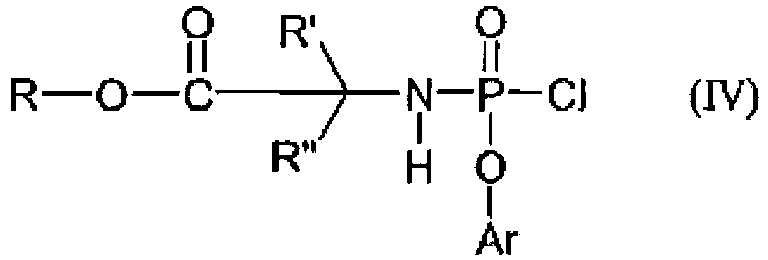
- Embodiments of the present invention will now be described, by way of example only, with reference to the following examples, experimental procedures and experimental data. Data are presented for a range of structures against tumour cell types representing a range of common cancers in man with un-met clinical need: breast MDA MB231, colon HT115, prostate PC-3. Data from these assays are presented as Table I.
- For the absence of doubt, compounds below labelled as "Illustrative Examples" do not form part of the invention.
- The following anhydrous solvents and reagents were bought from Aldrich with sure stopper: dichloromethane (DCM), diethyl ether (Et2O), tetrahydrofuran THF), N-methylimidazole (NMI), methanol (McOH), dimethylformamide (DMF), 1,4-dioxane. triethylamine was dried on molecular sieves of 4 Angstrom.
- Thin layer chromatography (TLC) was performed on commercially available Merck Kiesclgel 60 F254 plates and separated components were visualized using ultraviolet light (254 nm and 366 nm).
- Columns were performed using (Kieselgel 60, 35-70µm, Fluka) as the stationary phase. Samples were applied as a concentrated solution in the same eluent, or pre-adsorbed onto silica gel.
- 1H, 13C and 31P-NMR were recorded on a Bruker Avance DPX300 spectrometer with operating frequencies of 300MHz, 75MHz and 121MHz respectively. 31P-NMR spectra are reported in units of δ relative to 85% phosphoric acid as external standard, positive shifts are downfield. The following abbreviations are used in the assignment of NMR signals: s (singlet), d (doublet), t (triplet), q (quartet), m (multiplet), bs (broad signal), dd (doublet of doublet), dt (doublet of triplet). Starred signal signal are splitted due to stereoisomeric mixtures.
- For practical purposes, standard procedures are given where applicable.
- To a stirring solution of anhydrous alcohol (10 mol eq.) was added thionyl chloride (2 mol eq.) at 0° C, and the resulting solution stirred for 1 hr. After warming to room temperature, the appropriate amino acid (1 mol cq) was added and the reaction heated at reflux for 6-16 hrs. Removal of solvent and recrystallisation from methanol/ether gave the amino ester hydrochloride salts.
- The appropriate amino acid (1.0 mol eq.), p-toluene sulfonic acid (1.0 mol eq.) and anhydrous benzyl alcohol (4.1 mol eq.) were heated at reflux in toluene (10 mol eq.) with Dean-Stark trap for 24 hrs. On cooling to room temperature, Et2O was added and the mixture was left in ice bath for 1hr then filtrated and washed with Et2O. The solid was dissolved in DCM and washed with 10% K2CO3 and water. The organic layer was dried over MgSO4, filtered and the solvent removed under reduced pressure to give an oil. This was solubilized in acetone and neutralized with 1 M HCl. Et2O was added and the solid was filtered and washed with Et2O to give a white solid.
- Phosphorus oxychloride (1.0 mol eq.) and the appropriate substituted phenol (1.0 mol) were stirred with anhydrous diethylether (31 mol eq.). To this was added anhydrous triethylamine (1.0 mol eq) at -80 °C and left to rise to room temperature over 16 hrs. the triethylamine hydrochloride salt was filtered off, and the filtrate reduced to dryness to give the crude product as a clear liquid.
- Phosphodichloridate (1.0 mol eq.) and the appropriate amino ester hydrochloric salt (1.0 mol eq.) were suspended in anhydrous DCM. Anhydrous triethylamine was added dropwise at -80 °C and after 1hr the reaction was left to rise to room temperature. The formation of phosphochloridate was monitored by 31P-NMR. After 2-5 hrs the solvent was removed under reduced pressure and the solid obtained washed with anhydrous ether (2x20 ml), filtered, and the filtrate reduced to dryness to give the products as crude oil. These oils were usually used without further purification.
- To a stirring solution of (E)-5-(2-bromovinyl)-2'-deoxyuridine (1.0 mol cq.) and the appropriate phosphochloridate (2.0- 3.0 mol eq) in anhydrous THF at -80°C was added dropwise over 1 min NMI (5.0 mol eq.). After 15 mins the reaction was left to rise to room temperature and stirred at room temperature for 2-19 hrs. The solvent was removed under reduced pressure and the yellow oil obtained was dissolved in DCM, washed with 0.5 M HCl, and water. The organic layer is dried over MgSO4, filtered, reduced to dryness and purified by flash chromatography (Chloroform/Methanol 97/3, Dichloromethane/Methanol 97/3).
-

- This was synthesised according to Standard Procedure 1, using 1-amino-1-cyclopentanecarboxylic acid (3.876 g, 30 mmol) with thionyl chloride (4.44 mL, 45 mmol,) and anhydrous methanol (15.5 mL). The product was isolated as a white solid (4.81 g, yield 89%).
1H-NMR (CDCl3; 300 MHz): δ 9.1 (3H, bs, N H 3 +Cl-), 3.85 (3H, s, OC H 3 ), 2.3-2.2 (4H, m, 4H cyclopentane), 2.15 (2H, 2H cyclopentane), 1.95 (2H, m, 2H cyclopentane). 13C-NMR (CDCl3; 75 MHz): δ 26.6 (2CH2 cyclopent), 38.1 (2CH2 cyclopent), 54.8 ( C H3O), 66.6 ( Cq cyclopentane), 174.1 ( C OOMe). -

- This was synthesised according to Standard Procedure 1, using 1-amino-1-cyclopentanecarboxylic acid (5.0 g, 38.6 mmol) with thionyl chloride (5.72 mL, 58 mmol) and anhydrous ethanol (29 mL). The product was isolated as a white solid (6.98 g, yield 93%).
1H-NMR (CDCl3; 300 MHz): δ 9.0 (3H, bs, N H 3 +Cl-), 4.3 (2H, q, 3 J=8, OC H 2 CH3), 2.3-2.2 (4H, m, 4H cyclopentane), 2.15 (2H, 2H cyclopentane), 1.95 (2H, m, 2H cyclopentane), 1.4 (3H, t, 3 J=8, OCH2C H 3 ).
13C-NMR (CDCl3; 75 MHz): δ 14.5 ( C H3CH2), 25.8 (2CH2 cyclopent), 37.4 (2CH2 cyclopent), 63.0 (CH3 C H2), 66.2 ( Cq cyclopentane), 172.1 ( C OOEt). -

- This was synthesised according to Standard Procedure 2, using 1-amino-1-cyclopentanecarboxylic acid (3.682 g, 28.5 mmol) with p-toluene sulfonic acid monohydrate (5.625 g, 29.55 mmol) and anhydrous benzylic alcohol (12 mL, 116 mmol), in Toluene (20 mL). The product was isolated as a white solid (6.441 g, yield 88.5%) Hydrochloride salt. 1H-NMR (CDCl3; 300 MHz): δ 9.05 (3H, bs, N H 3 +Cl-), 7.4-7.25 (5H, m, Ph), 5.15 (2H, s, CH 2 Ph ), 2.3 (4H, m, 4H cyclopentane), 2.15 (2H, 2H cyclopentane), 1.95 (2H, m, 2H cyclopentane).
13C-NMR (CDCl3; 75 MHz): δ 25.9 (2CH2 cyclopent), 37.3 (2CH2 cyclopent), 66.3 ( Cq cyclopentane), 68.3 ( C H2Ph), 129.2, 129.0, 128.8 ('o', 'm', CH 2 Ph ), 135.5 ('p', CH 2 Ph ), 172.1 ( C OOBn). -
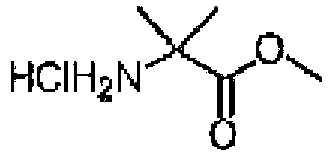
- This was synthesised according to Standard Procedure 1, using 2-amino-isobutyric acid (5.102 g, 48.49 mmol) with thionyl chloride (11.538 g, 96.98 mmol, 7.04 mL) and anhydrous methanol (19.6 mL). The product was isolated as a white solid (6.636 g, yield 89.2%).
1H-NMR (CDCl3; 300 MHz): δ 8.81 (3H, bs, N H 3 Cl), 3.83 (3H, s, OC H 3 ), 1.74 (6H, s, [C H 3 ]2C).
13C-NMR (CDCl3; 75 MHz): δ 24.1, 24.3 ([ C H3]2C), 57.9 ( C [CH2]2), 172.4 ( C OOCH3). -

- This was synthesised according to Standard Procedure 1, using 2-amino-isobutyric acid (5.102 g, 48.49 mmol) with thionyl chloride (11.772 g, 98.95 mmol, 7.2 mL) and anhydrous ethanol (29 mL). The product was isolated as a white solid (7.159 g, yield 86.3%).
1H-NMR (CDCl3; 300 MHz): δ 8.93 (3H, bs, N H 3 Cl), 4.3 (2II, q, 3 J=7.1 Hz, OC H 2 CH3), 1.75 (6H, s, [C H 3 ]2C), 1.33 (3H, 1, 3 J=7.1 Hz, OCH2C H 1 ).
13C-NMR (CDCl3; 75 MHz): δ 14.4 ( C H3CH2O), 24.3 ([ C H3]2C), 57.9 ( C [CH3]2), 63.1 (O C H2CH3), 171.6 ( C OOCH2CH3). -

- This was synthesised according to Standard Procedure 2, using 2-amino-isobutyric acid (1.960 g, 19.00 mmol) with p-toluene sulfonic acid monohydrate (3.750g, 19.7 mmol) and benzylic alcohol (8.360 g, 77.30 mmol, 8 mL), in toluene (20 mL). The product was isolated as a white solid (2.556 g, yield 87.4%)
p-toluenesulfonate salt: 1H-NMR (CDCl3, 300 MHz): δ 8.40 (3H, bs, N H 3 Cl), 7.79 (2H, d, 3 J=8.0 Hz, 'm' p-TSA), 7.34 (5H, m, CH2 Ph ), 7.14 (2H, d, 3 J=8.0 Hz, 'o' p-TSA), 5.16 (2H, s, C H 2 Ph), 2.38 (3H, s, C H 3 p-TSA), 1.57 (6H, s, [C H 3 ]2C)
13C-NMR (CDCl3; 75 MHz): δ 21.8 ( C H3, p-TSA), 23.9 ([ C H3]2C), 57.8 ( C [CH3]2), 68.3 ( C H2Ph), 126.55, 128.5, 128.8, 129.0, 129.3 (CH2 Ph +p-TSA), 135.4 ('ipso', CH2 Ph ), 140.8 ('p', p-TSA), 141.9 ('ipso', p-TSA), 171.9 ( C OOCH2Ph).
Hydrochloride salt: 1H-NMR (CDCl3; 300 MHz): δ 9.10 (3H, bs, N H 3 Cl), 7.41-7.31 (5H, m, CH2 Ph ), 5.27 (2H, s, CH2 Ph ), 1.77 ([C H 3 ]2C). 13C-NMR (CDCl3; 75 MHz): δ 24.2 ([ C H3]2C), 58.0 ( C [CH3]2), 68.5 ( C H2Ph), 128.62, 129.0, 129.1 ('o', 'm', 'p', CH2 Ph ), 135.2 ('ipso', CH2 Ph ), 171.8 ( C OOCH2Ph). -

- A mixture of Pd(OAc)2 (0.316 g, 1.41 mmol), PPh3 (0.741 g, 2.82 mmol), and triethylamine (4.9 mL) in 1,4-dioxane (50 mL) was stirred at 70°C until an intense red colour had developed. To this 5-iodo-2'-deoxyuridine (10 g, 28.24 mmol) and methylacrilate (4.862 g, 56.48 mmol, 5.1 mL) in 1,4-dioxane (20 mL) were added and the mixture stirred at refluxed for 30 mins. The reaction was filtered while still hot and the filtrate cooled over night at 4°C. The resulting pale yellow precipitate was filtered, washed with DCM and dried in vacuo to give the product as white solid (6.2 g, yield 70.7%).
1H-NMR (DMSO-d 6; 300 MHz) δ 11.64 (1H, bs, N H -3), 8.42 (1H, s, H-6), 7.37 (1H, d, 3 J=15.8 Hz, H vinylic), 6.86 (1H, d, 3 J=15.8 Hz, H vinylic), 6.13 (1H, t, 3 J=6.5 Hz, H-1'), 5.27-5.20 (2H, 2bs, OH-3', OH-5'), 4.27 (1H, m, H-3'), 3.81 (1H, m, H-4'), 3.68 (3H, s, C H 3 ), 3.60 (2H, m, H-5'), 2.18 (2H, m, H-2').
13C-NMR (DMSO-d 6; 75 MHz): δ 40.4 (C-2'), 51.6 (CH3), 66,7 (C-5'), 70.0 (C-3'), 85.2 (C-4'), 88.0 (C-1'), 108.5 (C-5), 116-5 (C-5b), 138.5 (C-5a), 144.4 (C-6), 149.6, 162.1 (C-2, C-4), 167.6 (COO). -

- (E)-5-(2-carbomethoxyvinyl)-2'-deoxyuridine (6.0 g, 19.33 mmol) was dissolved in 300 mL of 1 M NaOH and the mixture stirred at room temperature for 3 hrs, filtered and the filtrate adjusted to pH 2 with 1M HCl. On cooling at 4°C a white precipitate formed. This was filtered oil and washed with cold water (2x 20 ml) and acetone (2x20 mL) and dred to give a while solid (4.441 g, yield 77.1%).
1H-NMR (DMSO-d 6; 300 MHz): δ 12.18 (1H, bs, CO2 H ), 11.64 (1H, s, N H -3), 8.40 (1H, s, H-6), 7.30 (1H, d, 3 J=15.6 Hz, H vinylic), 6.78 (1H, d, 3 J=15.8 Hz, H vinylic), 6.14 (1H, t, 3 J=6.4 Hz, H-1'). 5.38 -5.08 (2H, bs, OH-3', OH-5'), 4.26 (1H, m, H-3'), 3.80 (1H, m, H-4'), 3.64 (2H, m, H-5'), 2.18 (2H, m, H-2').
13C-NMR (DMSO-d 6; 75 MHz): δ 40.1 (C-2'), 61.2 (C-5'), 70.1 (C-3'), 85.1 (C-4'), 88.0 (C-1'), 108.7 (C-5), 118.0 (C-5b), 137.9 (C-5a), 143.9 (C-6), 149.6, 162.1 (C-2, C-4), 168.4 (COOH). -

- To a solution of (E)-5-(2-carboxyvinyl)-2'-(deoxyuridine (5.777 g, 19.37 mmol) in dimethylforamide (29 mL) was added K2CO3 (5.890 g, 42.61 mmol) and the suspension stirred at room temperature for 15 mins. A solution of N-bromosuccinimide (3.655 g, 20.53 mmol) was added dropwise over 30 mins at 20°C. The resulting suspension was filtered and the solid washed with DMF. The combined filtrate and washings were evaporated to dryness in vacuo and the residue dissolved in MeOH. To this silica gel was added and the suspension evaporated to dryness and the solid applied to the top of chromatographic column. The column was eluted with chloroform/methanol 92/8 to give a white solid (5787g, 71.9%). Crystallisation from water gave a white powder.
1H-NMR (DMSO-d 6; 300 MHz) δ 11.59 (1H, bs, NH-3), 8.08 (1H, s, H-6), 7.25 (1H, d, 3 J=13.6 Hz, H-5b), 6.85 (1H, d, 3 J=13.6 Hz, H-5a), 6.13 (III, t, 3 J=6.5 Hz, H-1'), 5.29 (1H, bs, OH-3'), 5.13 (1H, bs, OH-5'), 4.24 (H1, m, H-3'), 3.79 (1H, m, H-4'), 3.66 (2H, m, H-5'), 2.51 (1H, m, H-2'), 2.14 (1H, m, H-2').
13C-NMR (DMSO-d 6; 75 MHz): δ 40.2 (C-2'), 61.3 (C-5), 70.3 (C-4'), 84.8 (C-3'), 87.8 (C-1'), 108,9 (C-5b), 110.0 (C-5), 130.3 (C-5a), 149.6, 162.1 (C-2, C4). -

- This was synthesised according to
Standard procedure 5, using BVdU (300 mg, 0.90 mmol), Phenyl-(methoxy-L-alaninyl)-phosphorochloridate (472 mg, 1.7 mmol). NMI (4.5 mmol, 378 µL) in THF (9 mL) for 2 hrs. The crude product was purified by column chromatography, eluting with CH2Cl2/Methanol 97:3 to give the pure product as a white foamy solid (356 mg, yield 69%).
31P-NMR (CDCl3, 121 MHz): δ 4.72, 4.40.
1H-NMR (CDCl3; 300 MHz): δ 9.9 (1H, bs, H-3), 7.64 (1H, 2xs, H-6), 7.44-7.39 (1H, 2d, 3 J=14 Hz, H-5b), 7.37-7.15 (5H, m, O Ph ), 6.75-6.67 (1H, 2d, 3 J=14 Hz, H-5a), 6.30-6.21 (1H, 2t, 3 J=6 Hz, H1'), 4.57-4.29 (3H, m, H-5'+H-3'), 4.2-3.96 (3H, H-4', NH, CHala), 3.72 (3H, s, CH3O), 2.49-2.40 (1H, m, one of H-2'), 2.12-2.01 (1H, m, one of H-2'), 1.38 (3H, d, 3 J=7 Hz, CH3 ala).
13C-NMR (DMSO; 75 MHz): 5 22.4 (CH3 ala), 41.9, 41.8 (C-2'), 51.9 ( CH [CH3]), 54.3 ( C H3O), 67.5 (C-5'), 72.3, 71.9 (C-3'), 87.3, 87.2, 86.9, 86.8 (C-1', C-4'), 110.6 (C-5b), 113.1 (C-5), 121.7 ('o', O Ph ), 127.0 ('p', O Ph ), 130.1 (C-5a), 131.5 ('m', OPh), 139.2 (C-6), 150.9 ('ipso', O Ph ) 151.9 (C-4), 163.2(C-2), 175.7 ( C OOCH3). -

- This was synthesized according to
Standard procedure 5, using BVdU (150 mg, 0.45 mmol), Phenyl-(ethoxy-L-alaninyl)-phosphorochloridate (249 mg, 0,9 mmol), NMI (2.8 mmol, 190 µL) in THF (4mL) for 2 hrs. The crude product was purified by column chromatography, eluting with CH2Cl2/Methanol 97:3 to give the pure product as a white foamy solid (145 mg, yield 55%).
31P-NMR (CDCl3, 121 MHz): δ 4.48, 4.86.
1H-NMR (CDCl3, 300 MHz): δ 7.65 (1H, 2xs, H-6), 7.44-7.39 (1H, 2d, 3 J=13 Hz, H-5b), 7.35-7.10 (5H, m, O Ph ), 6.78-6.65 (1H, 2d, 3 J=13 Hz, H-5a), 6.35-6.25 (1H, 2t, 3 J=6 Hz, H1'), 4.62-3.95 (8H, m, H-5', H-3', H-4', CHala, NH, CH3C H 2 O), 2.49-2.40 (1H, m, one of H-2'), 2.10-2.00 (1H, m, one of H-2'), 1.40 (3H, d, 3 J=7 Hz, CH 3 ala), 1.25 (3H, 2t, 3 J=7 Hz, C H 3 CH3O).
13C-NMR (CDCl3, 75 MHz): δ 14.5 ( C H3CH2O) 21.2, 21.1 (CH3ala), 40.9,40.7 (C-2'), 50.8, 50.7 (CHala), 62.2, 62.1 (CH3 C H2O), 66.5, 66.3 (C-5'), 70.9, 70.6 (C-3'), 86.0, 85.6 (C-1', C-4'), 110.1 (C-5b), 111.8 (C-5), 120.6 ('o', O Ph ), 125.0 ('p', O Ph ), 129.0 (C-5a), 130.2 ('m', OPh), 138.2 (C-6), 149.9 (C-4), 150.7 ('ipso', O Ph ), 162.3 (C-2), 174.2,174.1 ( C OOCH2CH3). -

- This was synthesised according to
Standard procedure 5, using BVdU (150 mg, 0.45 mmol), Phenyl-(benzyloxy-L-alaninyl)-phosphorochloridate (249 mg, 0.9 mmol), NMI (2.8 mmol, 190 µL) in THF (5 mL) for 2 hrs. The crude product was purified by column chromatography, eluting with CH2Cl2/Methanol 97:3 to give the pure product as a white foamy solid (228 mg, yield 78%).
31P-NMR (CDCl3, 121 MHz): δ 4.74, 4.44.
1H-NMR (CDCl3, 300 MHz): δ 10.31 (1H, bs, H-3), 7-63 (1H, 2xs, H-6), 7.45-7.14 (11H. m, O Ph +CH2 Ph , H-5b), 6.75-6.66 (1H, 2d, 3 J=14 Hz, H-5a), 6.30-6.25 (1H, m, H-1'), 5.18-50.9 (1H, s, C H 2 Ph), 4.70-4.04 (6H, m, H-3', H-5',H-4', N H , CHala), 2.42 (1H, m, one of 11-2'), 2.02 (1H, m, one of H-2'), 1.40 (3H, d, 3 J=7 Hz, CH3ala).
13C-NMR (CDCl3, 75 MHz): δ 20.7, 20.8 (CH3ala), 40.4 (C-2'), 50.4 ( C Hala), 66.0 (C-5'), 67.4 ( C H2Ph), 70.6 (C-3'), 85.4, 85.5, 85.6, 85.8 (C-1', C-4'), 109.9 (C-5b), 111.5 (C-5b), 120.2 ('o', O Ph ), 125.4 ('p', O Ph ), 128.5, 128.6, 129.9 ('m' OPh, Bn, C-5a), 135.1('ipso', CH2 Ph ) 137.8 (C-6), 149.8 (C-4) 150.2 ('ipso', O Ph ), 161.8 (C-2), 173.6 ( C OOBn). -

- This was synthesised according to
Standard procedure 5, using BVdU (200 mg, 0.60 mmol), para-fluorophenyl-(methoxy-L-alaninyl)-phosphorochloridate (442 mg, 1.5 mmol), NMI (4.98 mmol, 332 µL) in THF (5 mL) for 2 hrs. The crude product was purified by column chromatography, eluting with CH2Cl2/Methanol 97;3 to give the pure product as a white foamy solid (177 mg, yield 50%).
31P-NMR (CDCl3, 121 MHz): δ 5.10, 4.81.
1H-NMR (CDCl3; 300 MHz): δ 10.1 (1H, bs, H-3), 7.60 (1H, 2xs, H-6), 7.39-7.32 (1H, 2d, 3 J=14 Hz, H-5b), 7.20-6.95 (4H, m, O Ph ), 6.70-6.60 (1H, 2d, 3 J=14 Hz, H-5a), 6.30-6.15 (1H, 2t, 3 J=6 Hz, H1'), 4.55-4.29 (3H, m, H-5'+H-3'), 4.15 (1H, NH), 4.05-3.85 (2H, H-4', CHala), 3.72 (3H, 2s, CH3O), 2.49-2.32 (1H, m, one of H-2'), 2.15-2.05 (1H, m, one of H-2'), 1.35 (3H, 2d, 3 J=6 Hz, CH 3 ala).
13C-NMR (DMSO; 75 MHz): δ 21.2 (CH3 ala), 40.8 (C-2'), 50.8, 50.6 ( CH [CH3]), 53.2 ( C H3O), 66.7, 66.3 (C-5'), 71.9, 71.8 (C-3'), 86.1, 85.7, 85.8 (C-1', C-4'), 110.3 (C-5b), 111.9 (C-5), 117.0, 116.7 ('o', O Ph ), 122.0 ('m', O Ph ), 128.2 (C-5a), 138.2 (C-6), 149,0 ('ipso', O Ph ) 149.9 (C-4), 158.5 ('p', OPh), 163.2(C-2), 175.1 ( C OOCH3). -

- This was synthesised according to
Standard procedure 5, using BVdU (200 mg, 0.60 mmol), para-fluorophenyl-(ethoxy-L-alaninyl)-phosphorochloridate (464 mg, 1.5 mmol), NMI (4.98 mmol, 332 µL) in THF (5 mL) for 2 hrs. The crude product was purified by column chromatography, eluting with CH2Cl2/Methanol 97:3 to give the pure product as a white foamy solid (240 mg, yield 66%).
31P-NMR (CDCl3, 121 MHz): δ 5.14, 4.88.
1H-NMR (CDCl3, 300 MHz): δ 10.25 (1H, bs, H-3), 7.85 (1H, 2xs, H-6), 7.44-7.39 (1H, 2d, 3 J=14 Hz, H-5b), 7.3-7.0 (4H, m, O Ph ), 6.8-6.65 (1H, 2d, 3 J=14 Hz, H-5a), 6.35-6.25 (1H, 2t, 3 J=6 Hz, H1'), 4.6-4.1 (6H, m, H-5', H-3', CHala, NH, CH3C H 2 O), 4.02 (1H, m, H-4'), 2.55-2.45 (1H, m, one of H-2'), 2.20-2.10 (1H, m, one of H-2'), 1.40 (3H, d, 3 J=8 Hz, CH 3 ala), 1.25 (3H, 2t, 3 J=7 Hz, C H 3 CH2O).
13C-NMR (CDCl3, 75 MHz): δ 14.5 ( C H3CH2O) 21.3 (CH3ala), 40.8,40.7 (C-2'), 50.8, 50.7 (CHala), 62.3 (CH3 C H2O), 66.7, 66.3 (C-5'), 71.1, 70.7 (C-3'), 86.1, 85.8, 85.6, 85.4 (C'-1', C-4'), 110.4 (C-5b), 111.9 (C-5), 117.0 ('o', O Ph ), 122.2 ('m', OPh), 128.9 (C-5a), 138.2 (C-6), 146.4 ('ipso', O Ph ), 149.9 (C-4), 158.5 ('p', O Ph ), 162.2, 161.8 (C-2), 174.2 ( C OOCH2CH3). -

- This was synthesised according to
Standard procedure 5 , using BVdU (200 mg, 0.60 mmol), para-fluorophenyl-(benzyloxy-L-alaninyl)-phosphorochloridate (556 mg, 1.5 mmol), NMI (4.98 mmol, 332 µL) in THF (5 mL) for 2 hrs. The crude product was purified by column chromatography, eluting with CH2Cl2/Methanol 97:3 to give the pure product as a white foamy solid (256 mg, yield 64%).
31P-NMR (CDCl3, 121 MHz): δ 4.74,4.44.
1H-NMR (CDCl3, 300 MHz): δ 7.69 (1H, 2xs, H-6), 7.45-7.39 (1H, 2d, 3 J-14 Hz, H-5b), 7.37-7.00 (9H. m, O Ph +CH2 Ph ), 6.75-6.65 (1H, 2d, 3 J=14 Hz, H-5a), 6,30-6,2 (1H, 2t, 3 J=6Hz, H-1'), 5.2 (1H, 2s, C H 2 Ph), 4.85-4.00 (6H, m, H-3',H-5',H-4', N H, CHala), 2.47 (1H, m, one of H-2'), 2,0-2.15 (1H, m, one of H-2'), 1.38 (3H, d, 3 J=7 Hz, CH3ala).
13C-NMR (CDCl3, 75 MHz): δ 21.2, 21.1 (CH3ala), 40.7 (C-2'), 50.4 ( C Hala), 66.7, 66.4 (C-5'), 67.8 ( C H2Ph), 71.1, 70.7 (C-3'), 86.0, 85.7, 85.4, 85.3 (C-1', C-4'), 110.4 (C-5b), 111.9 (C-5), 117.0 ('o', O Ph ), 122.0 ('m', O Ph ), 128.7, 128.6 (Bn, C-5a), 135,4('ipso', CH2 Ph ) 138.2 (C-6), 146.5 ('ipso', O Ph ), 149.9 (C-4), 158.5 ('p' OPh), 162.2 (C-2), 173.9 ( C OOBn). -

- This was synthesised according to
Standard procedure 5 , using BVdU (200 mg, 0.60 mmol), para-nitrophenyl-(methoxy-L-alaninyl)-phosphorochloridate (483 mg, 1,5 mmol), NMI (4,98 mmol, 332 µL) in THF (5 mL) for 2 hrs. The crude product was purified by column chromatography, eluting with CH2Cl2/Methanol 97:3 to give the pure product as a white foamy solid (211 mg, yield 57%).
31P-NMR (CDCl3, 121 MHz): δ 4.95.
1H-NMR (MeOD; 300 MHz): δ 8.3-8.2 (2H, m, O Ph ) 7.8-7.75 (1H, 2xs, H-6), 7.35-7.30, 7.55-7.4 (2H, m, O Ph ), 7.35-7.30 (1H, 2d, 3 J=14 Hz, H-5b), 6.80-6.70 (1H, 2d, 3 J=14 Hz, H-5a), 6.30-6.2 (1H, 2t, 3 J=6 Hz, H1'), 4.5-4.3 (3H, m, H-5',H-3'), 4.2-4.0 (2H, m, H-4', CHala), 3.72 (3H, 2s, CH3O), 2.35-2.15 (2H, m, 2 H-2'), 1.35 (3H, 2d, 3 J=7Hz, CH 3 ala). 13C-NMR (DMSO, 75 MHz): δ 20.9 (CH3 ala), 41,6, 41.5 (C-2'), 52.0, 51.9 ( CH [CH3]), 53.4 ( C H3O), 68.5 (C-5), 72.4, 72.3 (C-3'), 87.7, 87.4, 87.0, 86.9 (C-1', C-4'), 109.8 (C-5b), 112.8 (C-5), 122.6 ('o', O Ph ), 127.1 ('m', O Ph ), 130.8 (C-5a), 140.3 (C-6), 146.5 ('ipso', O Ph ), 151.4 (C-4), 157.2 ('p', OPh), 163.9 (C-2), 175.8,175.5 ( C OOCH3). -

- This was synthesised according to
Standard procedure 5 , using BVdU (200 mg, 0.60 mmol), para-nitrophenyl-(ethoxy-L-alaninyl)-phosphorochloridate (504 mg, 1.5 mmol), NMI (4.98 mmol, 332 µL) in TIIF (5 mL) for 1 br, The crude product was purified by column chromatography, eluting with CH2Cl2/Methanol 97:3 to give the pure product as a white foamy solid (232 mg, yield: 61%).
31P-NMR (CDCl3, 121 MHz): δ 4.28.
1H-NMR (CDCl3, 300 MHz): δ 10.25 (1H, bs, II-3), 8.25-8.2 (2H, 2d, 3 J=9Hz O Ph ), 7.7 (1H, 2xs, H-6), 7.5-7.45 (2H, 2d , 3 J=9Hz, O Ph ), 7.4-7.35 (1H, 2d, 3 J=14 Hz, H-5b), 6.7-6,65 (1H, 2d, 3 J=14 Hz, H-5a), 6.3-6.2 (1H, 2t, 3 J=6 Hz, H1'), 4.8-4.1 (7H, m, H-5', H-4' H-3', CHala, NH, CH3C H 2 O), 2.45-2.4 (1H, m, one of H-2'), 2.20-2.10 (1H, m, one of H-2'), 1.40 (3H, d, 3 J=8 Hz, CH 3 ala), 1.3 (3H, 2t, 3 J=7 Hz, C H 3 CH2O).
13C-NMR (CDCl3, 75 MHz): δ 14.5 ( C H3CH2O) 21.1 (CH3ala), 40.6 (C-2'), 50.8, 50.7 (CHala), 62.5 (CH3 C H2O), 66.9, 66.8 (C-5'), 71.2, 70.9 (C-3'), 86.3, 85.9, 85.4, 85.3 (C-1', C-4'), 110.3 (C-5b), 111.8 (C-5), 121.3 ('o', O Ph ), 126.1 ('m', OPh), 128.8 (C-5a), 138.4 (C-6), 145.1 ('ipso', O Ph ), 149.9 (C-4), 155.5 ('p', O Ph ), 162.3 (C-2), 174.0, 173.9 ( C OOCH2CH3). -

- This was synthesised according to
Standard procedure 5 , using BVdU (200 mg, 0.60 mmol), para-nitrophenyl-(benzyloxy-L-alaninyl)-phosphorochloridate (597 mg, 1.5 mmol), NMI (4.98 mmol, 332 µL) in THF (5 mL) for 2 hrs. The crude product was purified by column chromatography, eluting with CH2Cl2/Methanol 97:3 to give the pure product as a white foamy solid (228 mg, yield 55%).
31P-NMR (CDCl3, 121 MHz): δ 4.74, 4.44.
1H-NMR (CDCl3, 300 MHz): δ 10.4-10.3 (1H, bs, H-3), 8.2-8.1 (2H, m, O Ph ), 7.69 (1H, 2xs, H-6), 7.4-7.2 (1H, 2d, 3 J=14 Hz, H-5b), 7.37-7.00 (7H. m, O Ph CH 2 Ph ), 6.75-6.65 (1H, 2d, 3 J=14 Hz, H-5a), 6.25-6.15 (1H, 2t, 3 J=6Hz, H-1'), 5.2 (1H, d, C H 2 Ph), 4,87 (1H, m, H-3'), 4.6-4.2 (3H, m, H-5', CHala) 4.2-4.00 (2H, m, H-4', N H ,), 2.55-2.45 (1H, m, one of H-2'), 2.2-2.05 (1H, m, one of H-2'), 1.38 (3H, d, 3 J=7 Hz, CH3ala).
13C-NMR (CDCl3, 75 MHz): δ 21.2, 21.1 (CH3ala), 40.6 (C-2'), 50.9 ( C Hala), 67.1, 67.0 (C-5'), 68.0 ( C H2Ph), 71.3, 70.9 (C-3'), 86.3, 86.0, 85.3, 85.2 (C-1', C-4'), 110.4 (C-5b), 111,9, 111,8 (C-5), 121.3 ('o', O Ph ), 126.2-126.1 ('m', O Ph ), 129.1, 128.7, 128.6 (Bn, C-5a), 135.4 ('ipso', CH2 Ph ), 138.3 (C-6), 145.1 ('ipso', O Ph ), 149.9 (C-4), 155.6 ('p' OPh), 162.2 (C-2), 173.8,173.7 ( C OOBn). -

- This was synthesised according to
Standard procedure 5 , using BVdU (200 mg, 0.60 mmol), phenyl-(methoxy-L-alaninyl)-phosphorochloridate (518.8 mg, 1.5 mmol), NMI (246.3 mg, 3.0 mmol, 239 µL) in THF (5 mL) for 4 hrs. The crude product was purified by column chromatography, eluting with chloroform/methanol 97:3 to give the pure product as a white foamy solid (211.1 mg,yield 54,7%).
31P-NMR (MeOD, 121 MHz):δ 5,23, 5.07.
1H-NMR (MeOD, 300 MHz): δ 7.80 (1H, s, H-6), 7.70 (2H, d, 3 J=8.7 Hz, O Ph ), 7.47-7.42 (2H, m, O Ph ), 7.37 (1H, d, 3 J=13.6 Hz, H-5b), 6.82-6.78 (1H, d, 3 J=13.6 Hz, H-5a), 6.30-6.23 (1H, m, H-1'), 4.52-4.29 (3H, m, H-3'+H-5'), 4.17-4.13 (1H, m, H-4'), 4.05-3.91 (1H, m, C H CH3), 3.67 (3H, s, OC H 3 ), 2.35-2.32 (1H, m, one of H-2'), 2.23-2.16 (1H, m, one of H-2'), 1.37-1.34 (3H, d, 3 J=7.1 Hz, CH CH 3 ).
13C-NMR (MeOD, 75 MHz): δ 20.6, 20.7, 20.8, 20,9 (CH C H3), 41.5, 41,7 (C-2'), 51.9, 52.0 ( C HCH3), 68.2, 68.3 (C-5'), 72.4, 72.5 (C-3'), 87.1, 87.2, 87.4, 87.6 (C-1', C-4'), 109.7 (C-5b), 112.6 (C-5), 122.5, 122.7 ('o', O Ph ), 125.8 ( C F3, J=269 Hz), 128.7 ('m', O Ph ), 128.8 ('p', J=33 Hz, O Ph ), 130.9 (C-5a), 140.3 (C-6), 151.4, 151.5 ('ipso', O Ph ), 155.1, 155.2 (C-4), 164.0 (C-2), 175.6, 175.9, ( C OOCH3). -

- This was synthesised according to
Standard procedure 5 , using BVdU (200 mg, 0.60 mmol), phenyl-(ethoxy-L-alaninyl)-phosphorochloridate (539.5 mg, 1.5 mmol), NMI (246.3 mg, 3.0 mmol, 239 µL) in THF (5 mL) for 20 hrs. The crude product was purified by column chromatography, eluting with dichloromethane/methanol 95:5 to give the pure product as a white foamy solid (172.6 mg, yield 43.8%).
31P-NMR (CDCl3, 121 MHz): δ 4.65, 4.35.
1H-NMR (CDCl3, 300 MHz): δ 10.05 (1H, s, H-3), 7.69-7.64 (3H, m, H-6+O Ph ), 7.46-7.39 (3H, m, O Ph +H-5b), 6.76-6.68 (1H, 2d, 3 J=13.6 Hz, H-5a), 6.34-6,25 (1H, m, H-1'), 4.57-4.35 (4H, m, H-3'+H-5'+N H ), 4.27-4.13 (4H, m, H-4'+OC H 2 CH3+OH-3'), 4.12-3.98 (1H, m, C H CH3), 2.53-2.47 (1H, m, one of H-2'), 2.21-2.12 (1H, m, one of H-2'), 1.43-1.40 (3H, d, 3 J=7.0 Hz, CH CH 3 ), 1.28, 1.27 (3H, 2t, 3 J=7.0 Hz, OCH2C H 3 )
13C-NMR (CDCl3, 75 MHz): δ 14.5 ( C H3CH2O), 21.2, 21.3 (CH C H3), 40.7 (C-2'), 50.8, 50.9 ( C HCH3), 62.4 (CH3 C H2O), 66.3, 66.7 (C-5'), 70.7, 71.1 (C-3'), 85.3, 85.4, 85.8, 86.1 (C-1', C-4'), 110.5 (C-5b), 112.0 (C-5), 122.0 ('o', O Ph ), 124.2 ( C F3, J=271 Hz), 127.7, 127.8, 128.7 ('m', 'p', O Ph ), 128.8 (C-5a), 138.0 (C6), 149.7 ('ipso', OPh), 153.2 (C-4), 161.9 (C-2), 174.0, 174.1 ( C OOCH2CH3). -
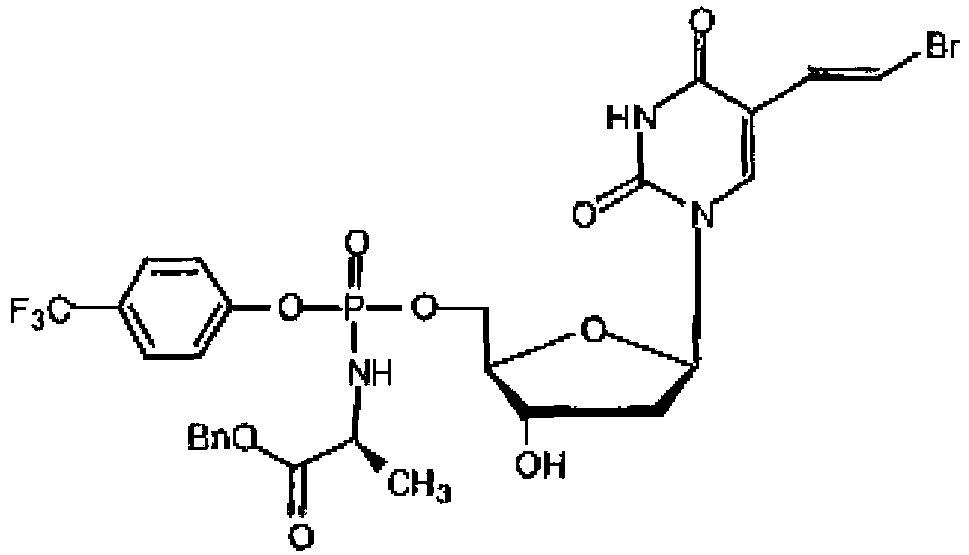
- This was synthesised according to
Standard procedure 5 , using BVdU (200 mg, 0.60 mmol), para-trifluorophenyl-(benzyloxy-L-alaninyl)-phosphorochloridate (632 mg, 1.5 mmol), NMI (4.98 mmol, 332 µL) in THF (6 mL) for 2 hrs. The crude product was purified by column chromatography, eluting with CH2Cl2/Methanol 97:3 to give the pure product as a white foamy solid (308 mg, yield 71%).
31P-NMR (CDCl3, 121 MHz): δ 5.31, 4.87.
1H-NMR (CDCl3, 300 MHz): δ 10.05 (1H, bs, H-3), 7.7, 7.25 (11H. m, H-5b, H-6 O Ph +CH2 Ph ), 6.75-6.65 (1H, 2d, 3 J=14 Hz, H-5a), 6.35-6.2 (1H, 2t, 3 J=6Hz, H-1'), 5,15 (1H, 2s, C H 2 Ph), 4.6-4.25 (4H, m, H-5', H-3', CHala) 4.2-4.00 (2H, m, H-4', N H ,), 2.55-2.4 (1H, m, one of H-2'), 2.2-2.05 (1H, m, one ofH-2'), 1.38 (3H, d, 3 J=7 Hz, CH3ala).
13C-NMR (CDCl3, 75 MHz): δ 21.2, 21.1 (CH3ala), 40.7 (C-2'), 50.9, 50.8 ( C Hala), 67.1, 67.0 (C-5'), 68.0 ( C H2Ph), 71.2, 70.9 (C-3'), 86.1, 85.8, 85.5, 85.4 (C-1', C-4'), 110.2 (C-5b), 111.9, 111.8 (C-5), 121.1 ('o', O Ph ), 125.1 (d, J=270Hz, CH3), 127.6 ('m', O Ph ), 129.1, 128.7, 128.6 (Bn, C-5a), 130.1 ('p',q, J=32Hz, O Ph ) 135.4 ('ipso', CH2 Ph ) 138.2 (C-6), 150.2,150.1 (C-4), 153.6 ('ipso' OPh), 162.7 (C-2), 173.9,173.6 ( C OOBn). -
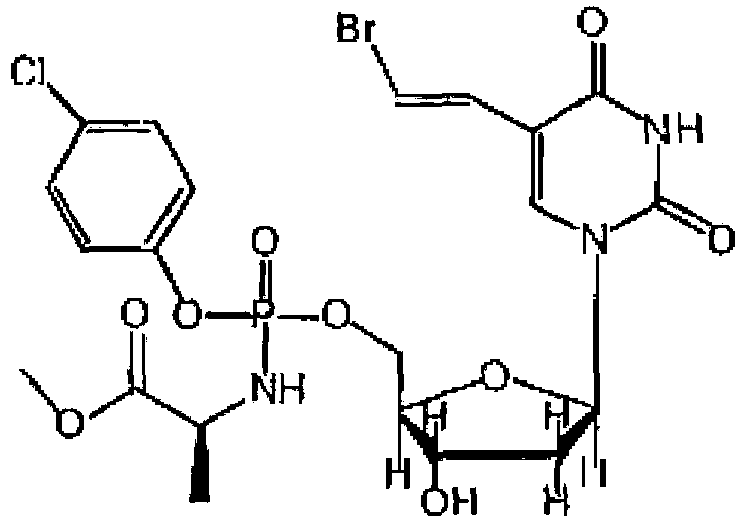
- This was synthesised according to
Standard procedure 5, using BVdU (200 mg, 0.60 mmol), 4-chlorophenyl-(methoxy-L-alaninyl)-phosphorochloridate (374.5 mg, 1.2 mmol), NMI (246.3 mg, 3.0 mmol, 239 µL) in THF (8 mL) for 5 hrs. The crude product was purified by column chromatography, eluting with Chloroform/Methanol 97:3 to give the pure product as a white foamy solid (139.0 mg, yield 38.0%).
31P-NMR (CDCl3, 121 MHz): δ 4.81, 4.54.
1H-NMR (CDCl3, 300 MHz): δ 10.11 (1H, bs, H-3), 7.68 (1H, s, H-6), 7.46-7.40 (1H, d, 3 J=13.6 Hz, H-5b), 7.35-7.20 (4H, m, O Ph ), 6,76-6,67 (1H, 2d, 3 J=13.6 Hz, H-5a), 6.34-6.24 (1H, m, H-1'), 4.58-4.40 (5H, m, H-3'+H-5'+N H ), 4.36-4.19 (1H, m, H-4'), 4.07-3.99 (1H, m, C H CH3), 3.75 (3H, s, OC H 3 ), 2.49-2.48 (1H, m, one of H-2'), 2.17-2.15 (1H, m, one of H-2'), 1.42-1.39 (3H, d, 3 J=7.0 Hz, CH CH 3 ).
13C-NMR (CDCl3, 75 MHz): S 21.2 (CH C H3), 40.7, 40.8 (C-2'), 50.6, 50.8 ( C HCH3), 53.2, 53.3 (OCH3), 66.4, 66.7 (C-5'), 70.8, 71.2 (C-3'), 85.4, 85.5, 85.8, 86.2 (C-1', C-4'), 110.5 (C-5b), 111.9, 112.0 (C-5), 122.0 ('o', O Ph ), 128.9 (C-5a), 130.3 ('m', O Ph ), 131.1 ('p', O Ph ), 138.2 (C-6), 149.1, 149.2 ('ipso', O Ph ), 149.8 (C-4), 162.1, 162.2 (C-2), 174.5, 174.6 ( C OOCH3). -
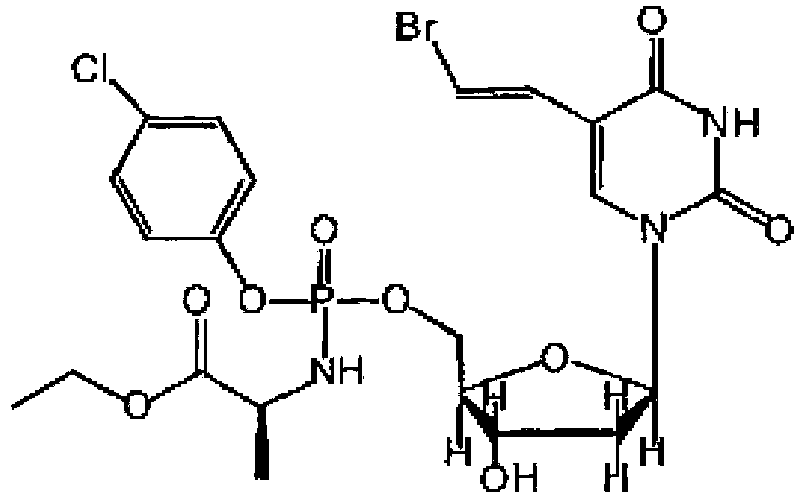
- This was synthesised according to
Standard procedure 5 , using BVdU (300 mg, 0.90 mmol), 4-chlorophenyl-(ethoxy-L-alaninyl)-phosphorochloridate (557,7 mg, 1.71 mmol), NMI (221.7 mg, 2.7 mmol, 215 µL) in THF (10 mL) for 16 hrs. The crude product was purified by column chromatography, eluting with dichloromethane/methanol 97:3 to give the pure product as a white foamy solid (163.4 mg, yield 30.0%).
31P-NMR (CDCl3, 121 MHz): δ 4.88, 4.65.
1H-MMR (CDCl3, 300 MHz): δ 9.51 (1H, bs, H-3), 7.69-7.68 (1H, 2s, H-6), 7.49-7.43 (1H, 2d, 3 J=13.6 Hz, H-5h), 7.37-7.22 (4H, m, O Ph ), 6.79-6.71 (1H, 2d, 3 J=13.6 Hz, H-5a), 6.33-6.24 (1H, m, H-1'), 4.62-4.34 (3H, m, H-3'+H-5'), 4.28-3.89 (5H, m, H-4'+OC H 2 CH3+C H CH3+N H ), 2.59-2.45 (1H, m, one of H-2'), 2.22-2.14 (1H, m, one of H-2'), 1.43-1.41 (3H, d, 3 J=7.0 Hz, CH CH 3 ), 1.33-1.28 (3H, 2t, 3 J=7.2 Hz, OCH2C H 3 )
13C-NMR (CDCl3, 75 MHz): δ 14.5 ( C H3CH2O), 21.2, 21.3 (CH C H3), 40.7 (C-2'), 50.7, 50.8 ( C HCH3), 62.4 (CH3 C H2O), 66.7 (C-5'), 70.8, 71.2 (C-3'), 85.4, 85.8, 86.1 (C-1', C-4'), 110.4 (C-5b), 112.0 (C-5), 122.0, 122.1 ('o', O Ph ), 128.9 (C-5a), 130.3 ('m', O Ph ), 131.1 ('p', O Ph ), 138.2 (C-6), 149.2 ('ipso', O Ph ), 150.0 (C-4), 162.2 (C-2), 174,1, 174.2 ( C OOCH2CH3). -

- This was synthesised according to
Standard procedure 5, using BVdU (300 mg, 0.90 mmol), 4-chlorophenyl-(benzoxy-L-alaninyl)-phosphorochloridate (698.7 mg, 1.80 mmol), NMI (369.5 mg, 4.5 mmol, 358.7 µL) in THF (10 mL) for 2 hrs. The crude product was purified by column chromatography, cluting with dichloromethane/methanol 95:5 to give the pure product as a white foamy solid (310.0 mg, yield 50.3%).
31P-NMR (CDCl3, 121 MHz): δ 4.81, 4.53,
1H-NMR (CDCl3, 300 MHz): δ 10.10 (1H, bs, H-3), 7.65-7.63 (1H, 2s, H-6), 7.69-7.68 (1H, 2s, H-6), 7.46, 7.41 (1H, 2d, 3 J=13.6 Hz, H-5b), 7.40-7.17 (9H, m, O Ph ), 6.75-6.66 (1H, 2d, 3 J=13.6 Hz, H-5a), 6.33-6.23 (1H, 2t, 3 J=6.0 Hz, H-1'), 5.17 (2H, s, C H 2 Ph), 4.60-4.23 (4H, m, H-3'+H-5'+N H ), 4.20-3.97 (2H, m, H-4'+ C H CH3), 2.48-2.44 (1H, m, one of H-2'), 2.15-2.05 (1H, m, one of H-2'), 1.43-1.40 (3H, d, 3 J=7.0 Hz, CHC H 3 ).
13C-NMR (CDCl3, 75 MHz): δ 21.2 (CH C H3), 40.7 (C-2'), 50.8, 50.9 ( C HCH3), 66.6 (C-5'), 67.9 ( C H2Ph), 70.7, 71.1 (C-3'), 85.4, 85.5, 85.8, 86.1 (C-1', C-4'), 110.5 (C-5b), 111.9, 112.0 (C-5), 122.0, ('o', O Ph ), 128.7, 129.0, 129.1, 130.3 ('m', O Ph +C-5a), 131.1 ('ipso', CH2 Ph ), 135.4 ('p', O Ph ), 138.2 (C-6), 149.1 ('ipso', O Ph ), 150.0 (C-4), 162.1 (C-2), 173.9, 174.0 ( C OOCH2Ph). -
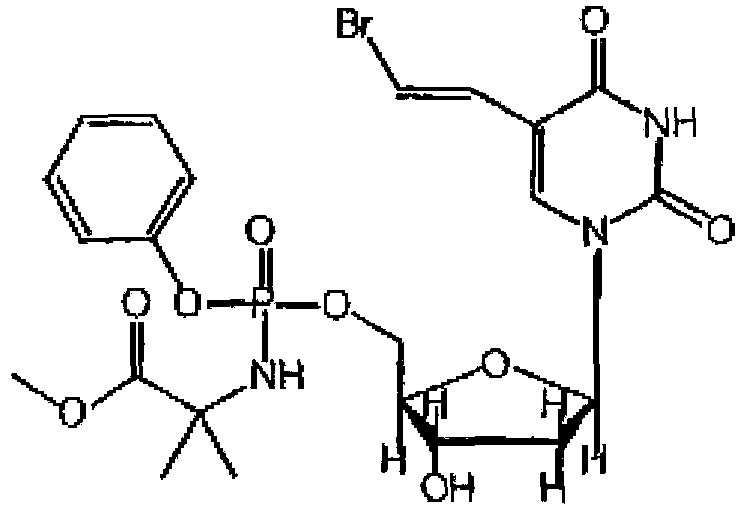
- This was synthesised according to
Standard procedure 5, using BVdU (200 mg, 0.60 mmol), phenyl-(methyl-2-amino-2-methylpropanoate)-phosphorochloridate (437.5 mg, 1.5 mmol), NMI (246.3 mg, 3,0 mmol, 239.1 µL) in THF (5 mL) for 4 hrs. The crude product was purified by column chromatography, eluting with chloroform/methanol 97:3 to give the pure product as a white foamy solid (117 mg, yield 33.1%).
31P-NMR (CDCl3, 121 MHz): δ 3.36, 3.14
1H-NMR (CDCl3; 300 MHz): δ 9.91 (1H, bs, H-3), 7.73,7.65 (1H, 2s, H-6), 7.50-7.43 (1H, 2d, 3 J=13.6 Hz, H-5b), 7.41-7.02 (5H, m, O Ph ), 6.81-6.71 (1H, 2d, 3 J=13.6 Hz, H-5a), 6.34-6.28 (1H, m, H1'), 4.55-4.17 (6H, m, H-5'+H-4'+H-3', NH, OH-3'), 3.78 (3H, s, C H 3 O), 2.53-2.39 (1H, m, one of H-2'), 2.25-1.99 (1H, m, one of H-2'), 1.60 (6H, s, [C H 3 ]2C).
13C-NMR (CDCl3; 75 MHz): δ 27.5, 27.4, 27.2 ([ C H3]2C), 40.7, 40.6 (C-2'), 53.5 ( C H3O), 57.6 ( C [CH3]2), 66.5, 66.2 (C-5'), 70.7, 71.1 (C-3'), 85.4, 85.6, 85.5, 85.9 (C-1', C-4'), 110.4 (C-5b), 111.9 (C-5), 120.5, 120.6 ('o', O Ph ), 125.7 ('p', O Ph ), 128.9 (C-5a), 130,3 ('m', O Ph ), 138.0, 138.3 (C-6), 149.8 ('ipso', O Ph ) 150.9, 150.8 (C-4), 162.0, 162.1 (C-2), 176.4, 176.2 ( C OOCH3). -

- This was synthesised according to
Standard procedure 5, using BVdU (200 mg, 0.60 mmol), phenyl-(ethyl-2-amino-2-methylpropanoate)-phosphorochloridate (458.0 mg, 1.5 mmol), NMI (246.3 mg, 3.0 mmol, 239.1 µL) in THF (5 mL) for 5 hrs. The crude product was purified by column chromatography, eluting with chloroform/methanol 97:3 to give the pure product as a white foamy solid (106 mg, yield 29.3%).
31P-NMR (McOD, 121 MHz): δ 3.91, 3.85
1H-NMR (McOD, 300 MHz): δ 7.84, 7.81 (1H, 2s, H-6), 7.44-7.20 (6H, m, O Ph +H-5b), 6.88-6.81 (1H, 2d, 3 J=13.6 Hz, H-5a), 6.34-6.28 (1H, m, H-1'), 4.50-4.34 (3H, m, H-5'+H-3'), 4.23-4.15 (3H, m, H-4'+CH3C H 2 O), 2.38-2.28 (1H, m, one of H-2'), 2.22-2.09 (1H, m, one of H-2'), 1.51 (6H, s, [C H 3 ]2C), 1.29 (3H, t, 3 J=7 Hz, C H 3 CH2O)
13C-NMR (MeOD, 75 MHz): δ 14.9 ( C H3CH2O) 27.9, 28.3 ([ C H3]2C), 41.5 (C-2'), 58.51 ( C [CH3]2), 63.1 (CH3 C H2O), 68.2 (C-5'), 72.6 (C-3'), 87.1, 87.4 (C-1', C-4'), 109.6 (C-5b), 112.7 (C-5b), 122.0, 122.1, 122.2, ('o', O Ph ), 126.7 ('p', O Ph ), 131.0, 131.2 (C-5a, 'm' OPh), 140.4 (C-6), 151.4 ('ipso', O Ph ) 152.5 (C-4), 164.0 (C-2), 177.2 ( C OOCH2CH3). -

- This was synthesised according to
Standard procedure 5, using BVdU (242 mg, 0.73 mmol), phenyl-(benzyl-2-amino-2-methylpropanoate)-phosphorochloridate (533.0 mg, 2.0 mmol), NMI (298.0 mg, 3.63 mmol, 289 µL) in THF (5 mL) for 4 hrs. The crude product was purified by column chromatography, eluting with chloroform/methanol 97:3 to give the pure product as a white foamy solid (129.0 mg, yield 26.7%).
31P-NMR (CDCl3, 121 MHz): δ 3.39, 3.12.
1H-NMR (CDCl3, 300 MHz): δ 9.92 (1H, bs, H-3), 7.67-7.60 (1H, 2s, H-6), 7.48-7.41 (1H, 2d, 3 J=13.6 Hz, H-5b), 7.40-7.16 (10H. m, O Ph +CH2 Ph ), 6.78-6.67 (1H, 2d, 3 J=13.6 Hz, H-5a), 6.31-6.25 (1H, m, H-1'), 5.18 (1H, s, C H 2 Ph), 4.50-4.09 (6H, m, H-3'+H-5'+H-4', N H, OH-3'), 2.48-2.25 (1H, m, one of H-2'), 2.16-1.82 (1H, m, one of H-2'), 1.60 (6H, s, [C H 3 ]2C).
13C-NMR (CDCl3, 75 MHz); δ 27.3, 27.4, 28.5 ([ C H3]2C), 40.6, 40.7 (C-2'), 57.6, 57.6 ( C [CH3]2), 66.2, 66.5 (C-5'), 68.1 ( C H2Ph), 70.6, 71.1 (C-3'), 85.4, 85.5, 85.6, 85.8 (C-1', C-4'), 110.4 (C-5b), 112.0 (C-5), 120.4, 120.5, 120.6, 125.7, 128.4, 128.5, 128.8, 128.9, 130.3 (O Ph , C-5a), 135.7('ipso', CH2 Ph ) 138.1, 138.3 (C-6), 149.8, 150.8, 150.9 ('ipso' O Ph , C-4), 162.1 (C-2), 177.5, 175.7 ( C OOCH2Ph). -

- This was synthesized according to
Standard procedure 5, using BVdU (150 mg, 0.45 mmοl), 4-nitrophenyl-(methyl-2-amino-2-methylpropanoate)-phosphorochloridate (378.8 mg, 1.13 mmol), NMI (184.7 mg, 2.25 mmol, 179.4 µL) in THF (5 mL) for 3 hrs. The crude product was purified by column chromatography, cluting with dichloromethane/methanol 97:3 to give the pure product as a white foamy solid (145.7 mg, yield 50.9 %).
31P-NMR (MeOD, 121 MHz): δ 3.61, 3.56.
1H-NMR (MeOD, 300 MHz): δ 8.30-8.25 (2H, 2d, 3J=9.0 Hz, O Ph ), 7.79-7.78 (1H, 2s, H-6), 7.49-7.46 (2H, d, 3J=9.0 Hz, O Ph ), 7.37-7.32 (1H, 2d, 3 J=13.6 Hz, H-5b), 6.79-6.72 (1H, 2d, 3 J=13.6 Hz, H-5a), 6.32-6.25 (1H, m, H-1'), 4.48-4.35 (3H, m, H-3'+H-5'), 4,15-4.14 (1H, m, H-4'), 3.71 (3H, s, C H 3 O), 2.41-2.17 (2H, m, H-2'), 1.51 (6H, s, [C H 3 ]2C).
3C-NMR (CDCl3, 75 MHz): δ 28.0, 28.1, 28.2, 28.3 ([ C H3]2C), 41.4, 41.5 (C-2'), 53.6 ( C H3O), 58.7 ( C [CH3]2), 68.5 (C-5'), 72.3, 72.4 (C-3'), 86.9, 87.0, 87.4, 87.5 (C-1', C-4'), 109.7 (C-5b), 112.6 (C-5), 122.8, 122.9 ('o', O Ph ), 127.0 ('m', O Ph ), 130.9 (C-5a), 140.5 (C-6), 146.5 ('p', O Ph ), 151.5 ('ipso', O Ph ), 157.3 (C-4), 164.0 (C-2), 177.5 ( C OOCH3). -

- This was synthesised according to
Standard procedure 5, using BVdU (150 mg, 0.45 mmol), 4-nitrophenyl-(ethyl-2-amino-2-methylpropanoate)-phosphorochloridate (442.1 mg, 1.26 mmol), NMI (184.7 mg, 2.25 mmol, 179.4 µL) in THF (5 mL) for 4 hrs. The crude product was purified by column chromatography, eluting with dichloromethane/methanol 97:3 to give the pure product as a white foamy solid (152.9 mg, yield 52.5 %).
31P-NMR (CDCl3, 121 MHz): δ 3.00, 2.96.
1H-NMR (CDCl3, 300 MHz): δ 10.28 (1H, bs, H-3), 8.25.-8.12 (2H, 2d, 3J=9.0 Hz, O Ph ), 7.68-7.67 (1H, 2s, H-6), 7.46-7.32 (3H, m, O Ph +H-5b), 6.69-6.67 (1H, 2d, 3 J=13.5 Hz, H-5a), 6.32-6.26 (1H, m, H-1'), 4.75-4.36 (5H, m, H-3'+H-5'+OH-3'+N H ), 4.25-4.17 (3H, m, OC H 2 CH3, H-4'), 2.60-2.98 (1H, m, one of H-2'), 2.31-2.10 (1H, m, one of H-2'), 1.58 (6H, s, [C H 3 ]2C), 1,30-1.28 (3H, 2t, 3J=7.1 Hz, OCH2C H 3 ).
13C-NMR (CDCl3, 75 MHz): δ 14.5 ( C H3CH2O), 27.1, 27.2, 27.3, 27.4 ([ C H3]2C), 40.6 (C-2'), 57.7 ( C [CH3]2), 62.7 (CH3 C H2O), 67.0 (C-5'), 71.0, 71.2 (C-3'), 85.4, 85.9, 86.1 (C-1', C-4'), 110.3 (C-5b), 111.9 (C-5), 121.2, 121.3 ('o', O Ph ), 126.2 ('m', O Ph ), 128.8 (C-5a), 138.4 (C-6), 145.0 ('p', O Ph), 150.0 (C-4), 155.7-155.9 ('ipso', O Ph ), 162.2 (C-2), 175.0-175.1 ( C DOCH2CH3). -

- This was synthesised according to
Standard procedure 5, using BVdU (100 mg, 0.30 mmol), 4-nitrophenyl-(benzyl-2-amino-2-methylpropanoate)-phosphorochloridate (309.6 mg, 1.07 mmol), NMI (123.7 mg, 1.5 mmol, 120,1 µL) in THF (5 mL) for 5 hrs. The crude product was purified by column chromatography, cluting with dichloromethane/methanol 97:3 to give the pure product as a white foamy solid (160.2 mg, yield 50.2 %).
31P-NMR (CDCl3, 121 MHz): δ 2.95, 2.89.
1H-NMR (CDCl3, 300 MHz): δ 10.16 (1H, bs, H-3), 8.26-8.24 (2H, 2d, 3J=9.1 Hz, O Ph ), 7.71-7.69 (1H, 2s, H-6), 7.48-7.37 (8H, m, O Ph +CH2 Ph , H-5b), 6.75-6.72 (1H, 2d, 3 J=13.5 Hz, H-5a), 6.36-6.29 (1H, m, H-1'), 5.24 (2H, s, C H 2Ph), 4.81-4.40 (5H, m, H-3'+H-5'+OH-3', N H ), 4.22-4.21 (1H, m, H-4'), 2.57-2.36 (1H, m, one of H-2'), 2.27-2.22 (1H, m, one of H-2'), 1.64 (6H, s, [C H 3 ]2C).
13C-NMR (CDCl3, 75 MHz): δ 27.4 ([ C H3]2C), 40.6 (C-2'), 57.8 ( C [CH3]2), 67.0 (C-5'), 68.2 ( CH 2 Ph), 71.1, 71.2 (C-3'), 85.3, 86.2 (C-1', C-4'), 110.5 (C-5b), 111.9 (C-5), 121.2, 126.2, 128.5, 128.8, 129.0, 129.1 ('ο', 'm', 'p', CH2 Ph +O Ph +C-5a), 135.5 ('ipso', CH2 Ph ), (C-5a), 138.4 (C-6), 145.0 ('p', O Ph ), 150.0 (C-4), 155.7 ('ipso', O Ph ), 162.2 (C-2), 175.4-175.5 ( C OOCH2Ph). -

- This was synthesised according to
Standard procedure 5, using BVdU (150 mg, 0.45 mmol), 4-chlorophenyl-(methyl-2-amino-2-methylpropanoate)-phosphorochloridate (440.2 mg, 1.35 mmol), NMI (184.7 mg, 2.25 mmol, 179.4 µL) in THF (5 mL) for 6 hrs. The crude product was purified by column chromatography, eluting with dichloromethane/methanol 97:3 to give the pure product as a white foamy solid (146.7 mg, yield 56.5 %).
31P-NMR (McOD, 121 MHz): δ 3.98 (s).
1H-NMR (McOD, 300 MHz): δ), 7.71-7.69 (III, 2s, H-6), 7.31-7.13 (5H, m, O Ph +H-5b), 6.73-6.66 (1H, 2d, 3 J=13.6 Hz, H-5a), 6.23-6.16 (1H, m, H-1'), 4.39-4.22 (3H, m, H-3'+H-5'), 4.05-4.03 (1H, m, H-4'), 3.61 (3H, s, C H 3 O), 2.29-2.19 (1H, m, one of H-2'), 2.15-2.05 (III, m, one of H-2'), 1.38 (6H, s, [C H 3 ]2C).
13C-NMR (CDCl3; 75 MHz): δ 28.0, 28.2, 28.3, 28.4 ([ C H3]2C), 41,5, 41.6 (C-2'), 53.5, 53.6 ( C H3O), 58.6 ( C [CH3]2), 68.2 (C-5'), 72.4, 72.5 (C-3'), 87.1, 87.2, 87.3, 87.4 (C-1', C-4'), 109.7 (C-5b), 112.7 (C-5), 123.7, 123.8 ('o', O Ph ), 130.9, 131.1 ('m', OPh+C-5a), 131.9 ('p', O Ph ), 140.4 (C-6), 151.1, 151.2, 151.4 ('ipso', O Ph +C-4), 164.0 (C-2), 177.6, 177.7 ( C OOCH3). -

- This was synthesised according to
Standard procedure 5, using DVdU (150 mg, 0.45 mmol), 4-chlorophenyl-(ethyl-2-amino-2-methylpropanoate)-phosphorochloridate (413.3 mg, 1.22 mmol), NMI (184.7 mg, 2.25 mmol, 179.3 µL) in THF (5 mL) for 16 hrs. The crude product was purified by column chromatography, eluting with dichloromethane/methanol 97:3 to give the pure product as a white foamy solid (74 mg, yield 25.8 %).
31P-NMR (CDCl3, 121 MHz): δ 3.47, 3.33.
1H-NMR (CDCl3, 300 MHz): δ 10.03-9.99 (1H, 2bs, H-3), 7.70-7.67 (1H, 2s, H-6), 7.47-7.43 (1H, 2d, 3 J=13.6 Hz, H-5b), 7.35-7.20 (4H, m, O Ph ), 6.77-6.68 (1H, 2d, 3 J=13.6 Hz, H-5a), 6.33-6.27 (1H, m, H-1'), 4.55-4.29 (5H, m, H-3'+11-5'+ OH-3'+N H ), 4.22-4.17 (2H, q, 3 J=7.1 Hz, OC H 2 CH3+H-4'), 2.53-2,42 (1H, m, one of H-2'), 2.22-2.08 (1H, m, one of H-2'), 1.57-1.54 (6H,2s, [C H 3 ]2C), 1.31-1.30 (3H, 2t, 3J=7.1 Hz, OCH2C H 3 ).
13C-NMR (CDCl3, 75 MHz): δ 14.5 ( C H3CH2O), 27.2, 27.3, 27.4 ([ C H3]2C), 40.7 (C-2'), 57.6 ( C [CH3]2), 62.6 (CH3 C H2O), 66.5, 66.6 (C-5'), 70.8, 71.1 (C-3'), 85.5, 85.74, 86.0 (C-1', C-4'), 110.4 (C-5b), 112.0 (C-5), 121.9, 122.0, 122.1 ('o', O Ph ), 128.9, 130.2 ('m', O Ph + C-5a), 130.9 ('p', O Ph ), 138.3 (C-6), 149.4 ('ipso', O Ph ), 149.9 (C-4), 162.1, 162.2 (C-2), 175.7-175.9 ( C OOCH2CH3). -

- This was synthesised according to
Standard procedure 5 , using BVdU (150 mg, 0.45 mmol), 4-chlorophenyl-(benzyl-2-amino-2-methylpropanoate)-phosphorochloridate (505.0 mg, 1.25 mmol), NMI (184.7 mg, 2.25 mmol, 179.3 µL) in THF (5 mL) for 16 hrs. The crude product was purified by column chromatography, eluting with dichloromethane/methanol 97:3 to give the pure product as a white foamy solid (134.8 mg, yield 42.9%).
31P-NMR (CDCl3, 121 MHz): δ 3.44, 3.26.
1H-NMR (CDCl3, 300 MHz): δ 9.96-9.93 (1H, 2bs, H-3), 7.66-7.65 (1H, 2s, H-6), 7.47-7.41 (1H, 2d, 3 J=13.5, H-5b), 7.39-7.18 (9H), m, OPh +CH2 Ph ) 6.74-6.69 (1H, 2d, 3 J=13.5 Hz, H-5a), 6.31-6.25 (1H, m, H-1'), 5.19 (2H, C H 2 Ph), 4.51-4.29 (4H, m, H-3'+H-5'+N H ), 4.15-4.12 (2H, m, H-4'+OH-3'), 2.48-2.40 (1H, m, one of H-2'), 2.18-2.05 (1H, m, one of H-2'), 1.60-1.59 (6H, 2s, [C H 3 ]2C).
13C-NMR (CDCl3, 75 MHz): δ 27.1, 27.5 ([ C H3]2C), 40.7 (C-2'), 57.7 ( C [CH3]2), 66.4, 66.6 (C-5'), 68.2 (C H 2 Ph), 70.7, 71.I (C-3'), 85.4, 85.5, 85.7, 86.0 (C-1', C-4'), 110.5 (C-5b), 112.0 (C-5), 121.9, 122.0, 128.4, 128.5, 128.9, 129.1 ('o, 'm', 'p', CH2 Ph +O Ph +C-5a), 131.0 ('ipso', CH2 Ph ), 135.6 ('p', O Ph ), 138.1 (C-6), 149.3 ('ipso', O Ph ), 149.8 (C-4), 162.1 (C-2), 175.6 ( C OOCH2Ph). -

- This was synthesised according to
Standard procedure 5, using BVdU (150 mg, 0.45 mmol), 4-(trifluoromethyl)-phenyl-(benzyl-2-amino-2-methylpropanoate)-phosphorochloridate (529.4.5 mg, 1.22 mmol), NMI (184.7 mg, 2.25 mmol, 179.4 µL) in THF (5 mL) for 4 hrs. The crude product was purified by column chromatography, eluting with dichloromethane/methanol 97:3 to give the pure product as a white foamy solid (142.1 mg, yield 43.1%).
31P-NMR (CDCl3, 121 MHz): δ 3.16,3.01.
1H-NMR (CDCl3, 300 MHz): δ 10.06-10.02 (1H, 2bs, H-3), 7.67-7.66 (1H, s, H-6), 7.64-7.60 (2H, 2d, 3 J=8.8 Hz, O Ph ), 7.46-7.32 (8H, m, O Ph + CH 2 Ph +H-5b), 6.77-6.68 (1H, 2d, 3 J=13.6 Hz, H-5a), 6.31-6.26 (1H, m, H-1'), 5.18 (2H, s, C H 2 Ph), 4.61-4.32 (4H, m, H-3'+H-5'+N H ), 4.16-4.15 (2H, m, H-4'+OH-3'), 2.48-2.41 (1H, m, one of H-2'), 2.23-2.09 (1H, m, one of H-2'), 1.60-1.58 (6H, 2s, C[C H 3 ]2)
13C-NMR (CDCl3, 75 MHz): δ 27.0, 27.4, 27.5 (C[ C H3]2), 40.6 (C-2'), 57.7, 57.8 ( C [CH3]2), 66.8, 66.5 (C-5'), 68.2 ( C H2Ph), 70.8, 71.1 (C-3'), 85.4, 85.7, 86.0 (C-1', C-4'), 110.4 (C-5b), 111.9 (C-5), 120.8, 120.9, 121.0, 127.6, 127.7, 128.0, 128.5, 128.8, 129.0 ('o', 'm', 'p', O Ph +CH2 Ph +C-5a), 124.2 ( C H3, J=267 Hz), 135.6 ('ipso', CH2 Ph ), 138.2 (C-6), 149.9 (C-4), 153.3 ('ipso', O Ph ), 162.1 (C-2), 175.4 ( C OOCH2Ph). -

- This was synthesised according to
Standard procedure 5 , using BVdU (250 mg, 0,75 mmol), Phenyl-(methoxy-α,α-cycloleucinyl)-phosphorochloridate (589 mg, 1.87 mmol), NMI (6.2 mmol, 415 µL) in THF (7 mL) for 3 hrs. The crude product was purified by column chromatography, eluting with CH2Cl2/Methanol 97:3 to give the pure product as a white foamy solid (234 mg, yield 51%).
31P-NMR (CDCl3, 121 MHz): δ 3.87, 3.82.
1H-NMR (CDCl3; 300 MHz): δ 10.35-10.2 (1H, bs, H-3), 7.65 (1H, 2xs, H-6), 7.44-7.39 (1H, 2d, 3 J=13 Hz, H-5b), 7.37-7.15 (5H, m, O Ph ), 6.8 (1H, 2d, 3 J=13 Hz, H-5a), 6.30 (1H, 2t, 3 J=6 Hz, H1'), 4.4-4.2 (4H, m, H-5', H-3', NH), 4.1 (1H, H-4'), 3.72 (3H, 2s, CH3O), 2.49-2.40 (1H, m, one of H-2'), 2.35-2.01 (5H, m, one of H-2'+4H cyclopentane), 1.8-1.6 (4H, m, 4H cyclopentane).
13C-NMR (DMSO; 75 MHz): δ 24.4, 24,3, 24.2 (2CH2 cyclopent), 39.2, 38.6, 38.5 (2CH2 cyclopent), 40.0 (C-2'), 53.2 ( C H3O), 66.4 ( Cq cyclopentane), 66.6 (C-5'), 70.9 (C-3'), 85.8, 85.6, 85.4, 85.3 (C-1', C-4'), 110.2 (C-5b), 111.9 (C-5), 120.7-120.6 ('o', O Ph ), 125.7 ('p', O Ph ), 129.0 (C-5a), 130.2 ('m', OPh), 138.5 (C-6), 149.9 (C-4), 150.9, 150.8 ('ipso', O Ph ), 162.3(C-2), 176.3, 176.2 ( C OOCH3). -

- This was synthesised according to
Standard procedure 5 , using BVdU (250 mg, 0.75 mmol), Phenyl-(ethoxy-α,α-cycloleucinyl)-phosphorochloridate (642 mg, 1.87 mmol), NMI (6.2 mmol, 415 µL) in THF (7 mL) for 2 hrs. The crude product was purified by column chromatography, eluting with CH2Cl2/Methanol 97:3 to give the pure product as a white foamy solid (258 mg, yield 55%).
31P-NMR (CDCl3, 121 MHz): δ 4.23, 4.1.
1H-NMR (CDCl3, 300 MHz): δ 10.3-10.1 (1H, bs, H-3), 7.8-7.75 (1H, 2xs, H-6), 7.51 (1H, 2d, 3 J=14 Hz, H-5b), 7.45-7.10 (5H, m, O Ph ), 6.8 (1H, 2d, 3 J=14 Hz, H-5a), 6.22 (1H, 2t, 3 J=4 Hz, II1'), 4.55-4.05 (7H, m, H-5', H-3', H-4', NH, CH3C H 2 O), 2.50-2.40 (1H, m, one of H-2'), 2.35-1.95 (5H, m, one of H-2'+4H cyclopentane), 1.95-1.75 (4H, m, 4H cyclopentane), 1.25 (3H, 2t, 3 J=7 Hz, C H 3 CH2O).
13C-NMR (CDCl3, 75 MHz): δ 14.5 ( C H3CH2O), 24.5, 24,4 (2CH2 cyclopent), 39.2, 38.9 38.8, 38.4 (2CH2 cyclopent), 40.6 (C-2'), 62.2, 62.1 (CH3 C H2O), 66.2 ( Cq cyclopentane), 66.6 (C-5'), 70.8 (C-3'), 85.7, 85.5 (C-1', C-4'), 110.2 (C-5b), 111.5 (C-5), 120.7, 120.6 ('o', O Ph ), 125.6 ('p', O Ph ), 129.7 (C-5a), 130.2 ('m', OPh), 138.5, 138.3 (C-6), 149.7 (C-4), 150.9, 150.8 ('ipso', O Ph ), 162.3 (C-2), 176.3 ( C OOCH2CH3). -
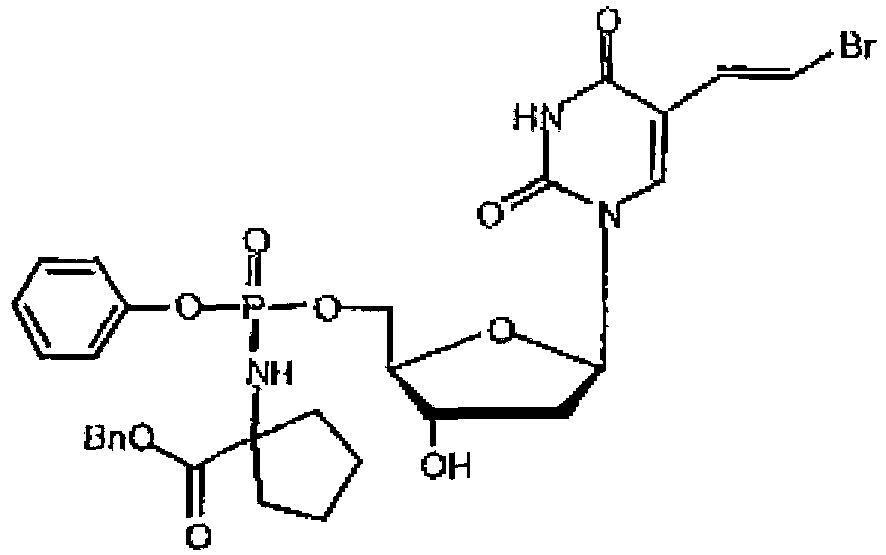
- This was synthesised according to
Standard procedure 5 , using BVdU (200 mg, 0.6 mmol), Phenyl-(benzyloxy-α,α-cycloleucinyl)-phosphorochloridate (589 mg, 1.5 mmol), NMI (4.98 mmol, 332 µL) in THF (5 mL) for 10 hrs, The crude product was purified by column chromatography, eluting with CH2Cl2/Methanol 97:3 to give the pure product as a white foamy solid (127 mg, yield 31%).
31P-NMR (CDCl3, 121 MHz): δ 4.11, 4.01.
1H-NMR (CDCl3, 300 MHz): δ 10.2 (1H, bs, H-3), 7.8-7.6 (1H, 2xs, H-6), 7.45-7.4 (1H, 2d, 3 J=14 Hz, H-5b), 7.40-7.10 (10H. m, O Ph +CH2E Ph ), 6.85 (1H, 2d, 3 J=14 Hz, H-5a), 6.20 (1H, m, H-1'), 5.15 (1H, s, C H 2 Ph), 4.4-4.2 (3H, m, H-3',H-4', N H ), 4.1 (2H, m, H-5'), 2.45-2.35 (1H, m, one of H-2'), 2.35-1.95 (5H, m, one of H-2'+4H cyclopentane), 1.95-1.75 (4H, m, 4H cyclopentane).
13C-NMR (CDCl3, 75 MHz): δ 24.4, 24.3, 24.2 (2CH2 cyclopent), 39.9, 39-7 38.6, 38.5 (2CH2 cyclopent), 40.5 (C-2'), 66.2 ( Cq cyclopentane), 66.5 (C-5'), 67.8 ( C H2Ph), 70.8, 70.7 (C-3'), 85.7, 85.6, 85.5, 85.4 (C-1', C-4'), 110.2 (C-5b), 111.8, 118.7 (C-5b), 120.7, 120.5 ('o', O Ph) 125.7 ('p', O Ph), 130.2, 129.0, 128.8, 128.7, 128.5 ('m'OPh, Bn, C-5a), 135-8('ipso', CH2 Ph ) 138.4, 138:2 (C-6), 149.8 (C-4), 150.9, 150.8 ('ipso', O Ph ), 162.2 (C-2), 175.7, 175.5 ( C OOBn). -

- This was synthesised according to
Standard procedure 5, using BVdU (200 mg, 0.60 mmol), para-nitrophenyl-(methoxy-α,α-cycloleucinyl)-phosphorochloridate (543 mg, 1.5 mmol), NMI (4.98 mmol, 332 µL) in THF (5 mL) for 2 hrs. The crude product was purified by column chromatography, eluting with CH2Cl2/Methanol 97:3 to give the pure product as a white foamy solid (239 mg, yield 60%).
31P-NMR (CDCl3, 121 MHz): δ 3.73.
1H-NMR (CDCl3; 300 MHz): δ 10.5-10.2 (1H, bs, H-3), 8.35-8.25 (2H, 2d, 3 J=6 Hz O Ph ) 7.8-7.75 (1H, 2xs, H-6), 7.47 (2H ,2d,3 J=6 Hz, O Ph ), 7.45-7.35 (1H, 2d, 3 J=14 Hz, H-5b), 6.75-6.67 (1H, 2d, 3 J=14 Hz, H-5a), 6.30 (1H, 21, 3 J=6 Hz, H1'), 4.65-4.4 (3H, m, H-5',H-3'), 4.25-4.20 (1H, m, H-4'), 3.79 (3H, s, CH3O), 2.6-2.4 (1H, m, one of H-2'), 2.3-1.98 (5H, m, one of H-2'+4H cyclopentane), 1.9-1.76 (4H, m, 4H cyclopentane).
13C-NMR (CDCl3; 75 MHz): δ 24.4, 24,3, 24.2 (2CH2 cyclopent), 39.2, 39.1 (2CH2 cyclopent), 40.5 (C-2'), 53.4, 53.3 ( C H3O), 66.8 ( Cq cyclopentane), 67.1 (C-5'), 70.9 (C-3'), 86.1, 86.0, 85.5, 85.4 (C-1', C-4'), 110.2 (C-5b), 111.8 (C-5), 121.3, 121.2 ('o', O Ph ), 126.2 ('m', O Ph ), 128.9 (C-5a), 138.6 (C-6), 144.9 ('ipso', O Ph ) 149.9 (C-4), 155.9, 155.8 ('p')', O Ph ), 162.3 (C-2), 176.3 ( C OOCH3). -

- This was synthesised according to
Standard procedure 5 , using BVdU (200 mg, 0.60 mmol), para-nitrophenyl-(ethoxy-α,α-cycloleucinyl)-phosphorochloridate (563 mg, 1.5 mmol), NMI (4.98 mmol, 332 µL) in THF (5 mL) for 1 hr. The crude product was purified by column chromatography, eluting with CH2Cl2/Methanol 97:3 to give the pure product as a white foamy solid (240 mg, yield: 59%).
31P-NMR (CDCl3, 121 MHz): δ 3.83, 3.79.
1H-NMR (CDCl3, 300 MHz): δ 8.25-8.2 (2H, 2d, 3 J=9Hz O Ph ), 7.66 (1H, s, H-6), 7.4 (2H ,2d, 3J=9Hz, O Ph ), 7.3 (1H, 2d, 3 J=14 Hz, H-5b), 6.85 (1H, 2d, 3 J=14 Hz, H-5a), 6.3-6.2 (1H, m, H1'), 4.7-4.45 (4H, m, H-5', H-3', NH), 4.2-4.05 (3H, m, H-4', CH3C H 2 O), 2.55-2.4 (1H, m, one of H-2'), 2.2-1.95 (5H, m, one of H-2'+4H oyclopentane), 1.95-1.8 (4H, m, 4H cyclopentane), 1.2 (3H, 2t, 3 J=8 Hz, C H 3 CH2O).
13C-NMR (CDCl3, 75 MHz): δ 14.9 ( C H3CH2O), 24.5, 24,4 (2CH2 cyclopent), 39.1, 39.0, 38.8 (2CH2 cyclopent), 40.7 (C-2'), 62.4 (CH3 C H2O), 66.5 ( Cq cyclopentane), 67.0 (C-5'), 70.9 (C-3'), 85.9, 85.4 (C-1', C-4'), 110.2 (C-5b), 111.8 (C-5), 121.3 ('o', O Ph ), 126.2 ('m', OPh), 128.8 (C-5a), 138.5 (C-6), 144.9 ('ipso', O Ph ), 149.9 (C-4), 155.5 ('p', O Ph ), 162.3 (C-2), 175.8, 175.7 ( C OOCH2CH3). -

- This was synthesised according to
Standard procedure 5 , using BVdU (200 mg, 0.60 mmol), para-nitrophenyl-(benzyloxy-α,α-cycloleucinyl)-phosphorochloridate (656 mg, 1.5 mmol), NMI (4.98 mmol, 332 µL) in THF (5 mL) for 3 hrs. The crude product was purified by column chromatography, eluting with CH2Cl2/Methanol 97:3 to give the pure product as a white foamy solid (269 mg, yield 61%).
31P-NMR (CDCl3, 121 MHz): δ 3.72.
1H-NMR (CDCl3), 300 MHz): δ 10.3 (1H, bs, H-3), 8.22-8.12 (2H, 2d, 3 J=7 Hz, O Ph ), 7.65 (1H, 2xs, H-6), 7.45-7.30 (8H, m, H-5b+O Ph +CH2 Ph ), 6.72-6.65 (1H, 2d, 3 J=14 Hz, H-5a), 6.28 (1H, 2l, 3 J=6Hz, H-1'), 5.15 (1H, d, C H 2 Ph), 4.6-4.35 (4H, m, H-3', H-5', H-4', N H,), 2.55-2.4 (1H, m, one of H-2'), 2.3-1.92 (5H, m, one of H-2'+4H cyclopentane), 1.85-1.6 (4H, m, 4H cyclopentane).
13C-NMR (CDCl3, 75 MHz): δ 24.4, 24,3, 24.2 (2CH2 cyclopent), 39.1, 38.9, 38.7 (2CH2 cyclopent), 40.5 (C-2'), 66.9 ( Cq cyclopentane), 67.1 (C-5'), 68.0 ( C H2Ph), 70.9 (C-3'), 85.3, 85.0 (C-1', C-4'), 110.3 (C-5b), 111.8 (C-5), 121.2 ('o', O Ph ), 126.1 ('m', O Ph ), 129.0, 128.8 (Bn, C-5a), 135.7 ('ipso', CH2 Ph ), 138.5 (C-6), 144.9 ('ipso', O Ph ), 149.9 (C-4), 155.8 ('p' OPh), 162.3 (C-2), 175.6 ( C OOBn). -

- This was synthesised according to
Standard procedure 5 , using BVdU (200 mg, 0.60 mmol), para-fluorophenyl-(methoxy-α,α-cycloleucinyl)-phosphorochloridate (503 mg, 1,5 mmol), NMI (4.98 mmol, 332 µL) in THF (5 mL) for 2 hrs. The crude product was purified by column chromatography, eluting with CH2Cl2/Methanol 97:3 to give the pure product as a white foamy solid (251 mg, yield 66%).
31P-NMR (CDCl3, 121 MHz): δ 4.22.
1H-NMR (CDCl3; 300 MHz): δ 10.3 (1H, bs, H-3), 7.70 (1H, 2xs, H-6), 7.4 (1H, 2d, 3 J=14 Hz, H-5b), 7.25-7.15 (2H, m, O Ph ), 7.1-6.95 (2H, m, O Ph ), 6.70 (1H, 2d, 3 J=14 Hz, H-5a), 6.30-6.15 (1H, 2t, 3 J=5 Hz, H1'), 4.55-4.05 (5H, m, H-5'+H-3' NH, H-4'), 3.72 (3H, 2s, CH3O), 2.55-2.35 (1H, m, one of H-2'), 2.25-1.92 (5H, m, one of H-2'+4H cyclopentane), 1.85-1.6 (4H, m, 4H cyclopentane).
13C-NMR (DMSO; 75 MHz): δ 24.4, 24,3, 24.2 (2CH2 cyclopent), 39.3, 39.2, 38.9, 38.5 (2CH2 cyclopent), 40.6 (C-2'), 53.3, 53.2 ( C H3O), 66.5 ( Cq cyclopentane), 66.7 (C-5'), 70.9 (C-3'), 85.8, 85.7, 85.4 (C-1', C-4'), 110.2 (C-5b), 111.9 (C-5), 116.9, 116.6 ('o', OPh ), 122,2, 122.0 ('m',O Ph ), 128.5 (C-5a), 138.5 (C-6), 146.7 ('ipso', O Ph ) 149.9 (C-4), 158.5 ('p', OPh), 162.3(C-2), 176.4, 176.3 ( C OOCH3). -

- This was synthesised according to
Standard procedure 5, using BVdU (200 mg, 0.60 mmol), para-fluorophenyl-(ethoxy-α,α-cycloleucinyl)-phosphorochloridate (524 mg, 1.5 mmol), NMI (4.98 mmol, 332 µL) in THF (5 mL) for 2 hrs. The crude product was purified by column chromatography, eluting with CH2Cl2/Methanol 97:3 to give the pure product as a white foamy solid (274 mg, yield 71%).
31P-NMR (CDCl3, 121 MHz): δ 5.30.
1H-NMR (CDCl3, 300 MHz): δ 10.35 (1H, bs, H-3), 7.7 (1H, 2xs, H-6), 7.44 (1H, 2d, 3 J=14 Hz, H-5b), 7.25-7.15 (2H, m, O Ph ), 7.1-6.95 (2H, m, O Ph ), 6.7 (1H, 2d, 3 J=14 Hz, H-5a), 6.30 (1H, 2t, 3 J=6 Hz, H1'), 4.55,4.3 (3H, m, H-5', H-3'), 4.2-4.1 (4H, m, NH, H-4', CH3C H 2 O), 2.55-2.4 (1H, m, one of H-2'), 2.22-1.90 (511, m, one of H-2'+4H cyclopentane), 1.8-1.6 (4H, m, 4H cyclopentane), 1.3-1.2 (3H, 2t, 3 J=7 Hz, C H 3 CH2O).
13C-NMR (CDCl3, 75 MHz): δ 14.5 ( C H3CH2O), 24.6, 24,4, 24.3 (2CH2 cyclopent), 39.3, 39.2, 38.9, 38.6 (2CH2 cyclopent), 40.6 (C-2'), 62.2 (CH3 C H2O), 66.5 ( Cq cyclopentane), 66.7 (C-5'), 71.0 (C-3'), 85.8, 85.7, 85.5, 85.4 (C-1', C-4'), 110.2 (C-5b), 111.9 (C-5), 116.9, 116.5 ('o', O Ph ), 122.2, 122.1 ('m', OPh), 129.0 (C-5a), 138.5 (C-6), 146.8,146.7 ('ipso', O Ph ), 149.9 (C-4), 158.5 ('p', O Ph ), 162.3 (C-2), 175.9, 175.8 ( C OOCH2CH3). -

Standard procedure 5 , using BVdU (200 mg, 0.60 mmol), para-fluorophenyl-(benzyloxy-α,α-cycloleucinyl)-phosphorochloridate (616 mg, 1.5 mmol), NMI (4.98 mmol, 332 µL) in THF (5 mL) for 2 hrs. The crude product was purified by column chromatography, eluting with CH2Cl2/Methanol 97:3 to give the pure product as a white foamy solid (283 mg, yield 67%).
31P-NMR (CDCl3, 121 MHz): δ 4.27.
1H-NMR (CDCl3, 300 MHz): δ 10.3-9.85 (1H, bs, H-3), 7.65 (1H, 2xs, H-6), 7.45-7.35 (1H, 2d, 3 J=14 Hz, H-5b), 7.40-7.30 (5H. m, CH2 Ph ), 7.25-7.15 (2H, m, O Ph ), 7.05-6.95 (2H, m, OPh ), 6.71 (1H, 2d, 3 J=14 Hz, H-5a), 6.27 (1H, 2t, 3 J=6Hz, H-1'), 5.15 (1H, s, C H 2 Ph), 4.45 (1H, m, H-3'), 4.40-4.30 (2H, m, H-5') 4.20-4.05 (2H, m, H-4', N H ), 2.5-2.4 (1H, m, one of H-2'), 2.25-1.9 (5H, m, one of H-2'+4H cyclopentane), 1.8-1.6 (4H, m, 4H cyclopentane).
13C-NMR (CDCl3, 75 MHz): δ 24.5, 24,3, 24.2 (2CH2 cyclopent), 39.7, 39.6, 39.3, 39.2 (2CH2 cyclopent), 40.5, 40.0 (C-2'), 66.6 ( Cq cyclopentane), 67.2, 66.7 (C-5'), 67.9 ( C H2Ph), 70.8, 70.7 (C-3'), 85.8, 85.7, 85.4, 85.3 (C-1', C-4'), 110.3 (C-5b), 111.8 (C-5), 116.9, 116.6 ('ο', O Ph ), 122.2, 122.1 ('m', O Ph ), 129.0, 128.9, 128.6, 128.5 (Bn, C-5a), 135.8('ipso', CH2 Ph ) 138.5 (C-6), 146.8, 146.7 ('ipso', O Ph ), 149.9 (C-4), 158.5 ('p' OPh), 162.2 (C-2), 175.7, 175.0 ( C OOBn). -

- This was synthesised according to
Standard procedure 5, using BVdU (150 mg, 0.45 mmol), para-chlorophenyl-(methoxy-α,α-cycloleucinyl)-phosphorochloridate (475 mg, 1.35 mmol), NMI (4.5 mmol, 300 µL) in THF (5 mL) for 2 hrs. The crude product was purified by column chromatography, eluting with CH2Cl2/Methanol 97:3 to give the pure product as a white foamy solid (187 mg, yield 64%).
31P-NMR (MeOD, 121 MHz): δ 4.64.
1H-NMR (MeOD; 300 MHz): δ 7.75 (1H, 2xs, H-6), 7.32 (1H, 2d, 3 J=14 Hz, H-5b), 7.32-7.27 (2H, m, O Ph ), 7.20-711 (2H, m, O Ph ), 6.72 (1H, 2d, 3 J=14 Hz, H-5a), 6.27-6.20 (1H, 2t, 3 J=6 Hz, H1'), 4.35 (1H, m, H-3'), 4.30 (2H, m, H-5') 4.1 (2H, m, H-4'), 3.72 (3H, 2s, CH3O), 2.32-2.20 (1H, m, one of H-2'), 2.20-1.92 (5H, m, one of H-2'+4H cyclopentane), 1.8-1.6 (4H, m, 4H cyclopentane).
13C-NMR (MeOD; 75 MHz): δ 25.7, 25.6 (2CH2 cyclopent), 41.7, 41.6, 41.4, 41.3 (2CH2 cyclopent), 42.7 (C-2'), 54.1, 53.9 ( C H3O), 67.8 ( Cq cyclopentane), 69.1, 69.0 (C-5'), 73.8 (C-3'), 88.4, 88.3, 88.2 (C-1', C-4'), 110.2 (C-5b), 111.8 (C-5), 122.1, 121.9 ('o', O Ph ), 128.9 (C-5a), 130.6 ('m', O Ph ), 130.8 ('p', OPh), 138.5 (C-6), 149.5, 149.4 ('ipso', O Ph ), 149.9 (C-4), 162.2(C-2), 175.6 ( C OOCH3). -

- This was synthesised according to
Standard procedure 5, using BVdU (150 mg, 0.45 mmol), para-chlorophenyl-(ethoxy-α,α-cycloleucinyl)-phosphorochloridate (495 mg, 1.35 mmol), NMI (4.5 mmol, 300 µL) in THF (5 mL) for 2 hrs. The crude product was purified by column chromatography, eluting with CH2Cl2/Methanol 97:3 to give the pure product as a white foamy solid (240 mg, yield 66%).
31P-NMR (CDCl3, 121 MHz): δ 4.15.
1H-NMR (CDCl3, 300 MHz); δ 10.25-10.1 (1H, bs, H-3), 7.65 (1H, 2xs, H-6), 7.4-7.3 (1H, 2d, 3 J=14 Hz, H-5b), 7.25-7.20 (2H, m, O Ph ), 7.20-7.10 (2H, m, O Ph ), 6.75 (1H, 2d, 3 J=14 Hz, H-5a), 6.20 (1H, m, H1'), 4.35 (3H, m, H-3', H-5'), 4.2-4.0 (4H, m, H-4', NH, CH3C H 2 O), 2.45-2.25 (1H, m, one of H-2'), 2.25-1.85 (5H, m, one of H-2'+4H cyclopentane), 1.75-1.55 (4H, m, 4H cyclopentane), 1.2 (3H, 2t, 3 J=7 Hz, C H 3 CH2O).
13C-NMR (CDCl3, 75 MHz): δ 14.5 ( C H3CH2O), 24.5, 24,4 (2CH2 cyclopent), 39.3, 39.2, 38.8, 38.6 (2CH2 cyclopent), 40.5 (C-2'), 62.3 (CH3 C H2O), 66.1 ( Cq cyclopentane), 66.7 (C-5'), 70.8 (C-3'), 85.8, 85.4 (C-1', C-4'), 110.3 (C-5b), 111.9 (C-5), 122.1, 121.9 ('o', O Ph ), 129.0 (C-5a), 130.2 ('m', OPh), 130.8 ('p', O Ph ), 138.5 (C-6), 149.5, 149.4 ('ipso', O Ph ), 149.9 (C-4), 162.3 (C-2), 175.9 ( C OOCH2CH3). -

- This was synthesised according to
Standard procedure 5, using BVdU (150 mg, 0.45 mmol), para-chlorophenyl-(benzyloxy-α,α-cycloleucinyl)-phosphorochloridate (578 mg, 1.35 mmol), NMI (4.5 mmol, 300 µL) in THF (5 mL) for 2 hrs. The crude product was purified by column chromatography, eluting with CH2Cl2/Methanol 97:3 to give the pure product as a white foamy solid (222 mg, yield 68%).
31P-NMR (CDCl3, 121 MHz), δ 4.11, 4.05.
1H-NMR (CDCl3, 300 MHz): δ 7.65 (1H, 2xs, H-6), 7.45-7.29 (10H, m, H-5b, 2H O Ph +CH2 Ph ), 7.20-7.15 (2H, m, OPh ), 6.75-6.67 (1H, 2d, 3 J=14 Hz, H-5a), 6.28 (1H, 2t, 3 J=6Hz, H-1'), 5.15 (1H, 2s, C H 2 Ph), 4.5 (1H, m, H-3'), 4.35 (2H, m, H-5') 4.1 (H, m, H-4'), 4.00 (1H, m, N H ), 2.48-2.35 (1H, m, one of H-2'), 2.3-1.92 (5H, m, one of H-2'+4H cyclopentane), 1.8-1.6 (4H, m, 4H cyclopentane).
13C-NMR (CDCl3, 75 MHz): δ 24.5, 24.4, 24,3, 24.2 (2CH2 cyclopent), 39.3, 38.8, 38.6 (2CH2, cyclopent), 40.5 (C-2'), 66.7 ( Cq cyclopentane), 67.9 ( C H2Ph), 68.4 (C-5'), 70.7 (C-3'), 85.7 , 85.7, 85.4, 85.3 (C-1', C-4'), 110.3 (C-5b), 111.8 (C-5), 122.0, 121.9 ('ο', O Ph ), 129.1, 128.3, 128.2 (Bn, 'm', O Ph ), 130.2 (C-5a), 135.8 ('ipso', CH2 Ph ), 136.3 ('p' OPh), 138.2 (C-6), 149.5, 149.3 ('ipso', O Ph ), 149.9 (C-4), 162.2 (C-2), 175.7, 175.5 ( C OOBn). -

- This was synthesised according to
Standard procedure 5, using BVdU (150 mg, 0.45 mmol), para-trifluorophenyl-(methoxy-α,α-cycloleucinyl)-phosphorochloridate (521 mg, 1.35 mmol), NMI (4.5 mmol, 300 µL) in THF (5 mL) for 2 hrs. The crude product was purified by column chromatography, eluting with CH2Cl2/Methanol 97:3 to give the pure product as a white foamy solid (199 mg, yield 65%).
31P-NMR (CDCl3, 121 MHz): δ 3.80.
1H-NMR (CDCl3; 300 MHz): δ 7.70 (1H, 2s, H-6), 7.55 (1H, 2d, 3 J=14 Hz, H-5b), 7.45-7.32 (4H, m, O Ph ), 6.72 (1H, 2d, 3 J=14 Hz, H-5a), 6.28 (1H, 2t, 3 J=6 Hz, H1'), 4.55 (1H, m, H-3'), 4.45 (2H, m, H-5'), 4.25 (1H, H-4'), 4.15 (1H, NH), 3.71 (3H, 2s, CH3O), 2.6-2.4 (1H, m, one of H-2'), 2.3-1.9 (5H, m, one of H-2'+4H cyclopentane), 1.85-1.6 (4H, m, 4H cyclopentane).
13C-NMR (CDCl3; 75 MHz): δ 24.4, 24,3, 24.2 (2CH2 cyclopent), 39.2, 39.1, 38.8, 38.6 (2CH2 cyclopent), 40.5 (C-2'), 53.9 ( C H3O), 66.3 ( Cq cyclopentane), 66.8 (C-5'), 70.9 (C-3'), 85.8, 85.4 (C-1', C-4'), 110.3 (C-5b), 111.9 (C-5), 125.1 (d, J=270Hz, CF3), 127.1, 127.0 ('o', O Ph ), 127.8 ('m', O Ph ), 128.9 (C-5a), 129.0 ('p', q, J=32Hz, O Ph ), 138.5 (C-6), 149.9 (C-4), 153.5 ('ipso', OPh), 162.2 (C-2), 176.3, 176.2 ( C OOCH3). -

- This was synthesised according to
Standard procedure 5 , using BVdU (150 mg, 0.45 mmol), para-trifluorophenyl-(ethoxy-α,α-cycloleucinyl)-phosphorochloridate (540 mg, 1.35 mmol), NMI (4.50 mmol, 300 µL) in THF (5 mL) for 2 hrs. The crude product was purified by column chromatography, eluting with CH2Cl2/Methanol 97:3 to give the pure product as a white foamy solid (185 mg, yield 59%).
31P-NMR (CDCl3, 121 MHz): δ 4.30. 1H-NMR (CDCl3, 300 MHz): δ 10.35 (1H, bs, H-3), 7.70 (1H, 2xs, H-6), 7.40 (1H, 2d, 3 J=14 Hz, H-5b), 7.28-7.14 (2H, m, O Ph ), 7.05-6.95 (2H, m, O Ph ), 6.70 (1H, 2d, 3 J=14 Hz, H-5a), 6.3 (1H, m, H1'), 4.55-4.3 (3H, m, H-5', H-3'), 4.2-4.1 (3H, m, H-4', CH3C H 2 O), 2.5-2.35 (1H, m, one of H-2'), 2.20-1.9 (5H, m, one of H-2'+4H cyclopentane), 1.85-1.6 (4H, m, 4H cyclopentane), 1.25 (3H, 2t, 3 J=7 Hz, C- H 3 CH2O).
13C-NMR (CDCl3, 75 MHz): δ 14.5 ( C H3CH2O), 24.5, 24,4 (2CH2 cyclopent), 39.3, 39.2, 38.9, 38.5 (2CH2 cyclopent), 40.6 (C-2'), 62.2 (CH3 C H2O), 66.7 ( Cq cyclopentane), 67.4, 67.3 (C-5'), 70.9 (C-3'), 85.8, 85.7 (C-1', C-4'), 110.2 (C-5b), 111.9 (C-5), 116.8, 116.5 ('o', O Ph ), 122.2, 122.1 ('m', OPh), 125.1 (d, J=270Hz, CF3), 129.0 (C-5a), 131.1 ('p', q, J=32Hz, O Ph ), 138.5 (C-6), 146.8, 146.7 ('ipso', OPh), 149.9 (C-4), 162.3 (C-2), 175.9,175.8 ( C OOCH2CH3). -

- This was synthesised according to
Standard procedure 5, using BVdU (150 mg, 0.45 mmol), para-trifluorophenyl-(benzyloxy-α,α-cycloleucinyl)-phosphorochloridate (623 mg, 1.35 mmol), NMI (4.5 mmol, 300 µL) in THF (5 mL) for 2 hrs. The crude product was purified by column chromatography, eluting with CH2Cl2/Methanol 97:3 to give the pure product as a white foamy solid (218 mg, yield 64%).
31P-NMR (CDCl3, 121 MHz): δ 4.30.
1H-NMR (CDCl3, 300 MHz): δ 10.35 (1H, bs, H-3), 7.65 (1H, 2xs, H-6), 7.55 (2H, m, 2H O Ph ), 7.45-7.25 (8H. m, 2H O Ph +CH2 Ph +H-5b), 6.7 (1H, 2d, 3 J=14 Hz, H-5a), 6.30 (1H, 2t, 3 J=6Hz, H-1'), 5.15 (1H, 2s, C H 2 Ph), 4.55-4.35 (3H, m, H-3'+ H-5'), 4.25 (1H, H-4'), 4.10 (1H, NH), 2.55-2.35 (1H, m, one of H-2'), 2.30-1.92 (5H, m, one of H-2'+4H cyclopentane), 1.8-1.6 (4H, m, 4H cyclopentane).
13C-NMR (CDCl3, 75 MHz): δ 25.5, 24.4, 24,3, 24.2 (2CH2 cyclopent), 39.2,39.1, 38.7, 38.6 (2CH2 cyclopent), 40.5, 40.0 (C-2'), 66.4 ( Cq cyclopentane), 66.8 (C-5'), 68.0 ( C H2Ph), 70.9 (C-3'), 86.0, 85.8, 85.4, 85.3 (C-1', C-4'), 110.3 (C-5b), 111.9 (C-5), 121.8, 120.8 ('o, m', O Ph ), 125.2 (d, J=270Hz, CF3), 128.5, 127.7, 127.5 (Bn, C-5a), 129,2 ('p',q , J=32Hz, O Ph ), 135.4 ('ipso', CH2 Ph ), 138.5 (C-6), 149.9 (C-4), 153.5 ('ipso' OPh), 162.2 (C-2), 175.6,175.5 ( C OOBn). -

- This was synthesised according to
Standard procedure 5, using BVdU (150 mg, 0.45 mmol), Phenyl-(methoxy-L-phenylalaninyl)-phosphorochloridate (477 mg, 1.35 mmol), NMI (4.42 mmol, 190 µL) in THF (5 mL) for 2 hrs. The crude product was purified by column chromatography, eluting with CH2Cl2/Methanol 97:3 to give the pure product as a white foamy solid (169 mg, yield 58%).
31P-NMR (CDCl3, 121 MHz): δ 4.79, 4.71.
1H-NMR (CDCl3; 300 MHz): δ 9.95 (1H, bs, H-3), 7.60-7.55 (1H, 2xs, H-6), 7.48-7.4 (1H, 2d, 3 J=14 Hz, H-5b), 7.3-7.1 (10H, m, CH2Ph+ O Ph ), 6.75-6.65 (1H, 2d, 3J=14 Hz, H-5a), 6.27-6.18 (1H, m, H1'), 4.57-4.29 (6H, m, H-5',H-3',H-4', NH, CHphenylala), 3-70 (3H, 2s, CH3O), 3.01 (2H, m, CH2Ph), 2.35-2.20 (1H, m, one of H-2'), 2.07-1.95 (1H, m, one of H-2').
13C-NMR (CDCl3; 75 MHz): δ 36.3 (CH2phenylalanine), 41.9, 41.8 (C-2'), 53.0 ( C H3O), 56.6, 56.1 (CHphenylala), 67.1 (C-5'), 71.3, 70.7 (C-3'), 85.7, 85.6, 85.5, 85.4 (C-1', C-4'), 110.4 (C-5b), 111.9 (C-5), 120.6,120.5 ('o', O Ph ), 127.8 ('p', O Ph ), 130.1, 129.9, 129.8, 129.1 (CH2Ph, C-5a,'m' OPh), 138.0, 137.9 (C-6), 149.8 (C-4), 150.7,150.6 ('ipso', O Ph ), 162.1, 162.0 (C-2), 173.5 ( C OOCH3). -

- This was synthesised according to
Standard procedure 5 , using BVdU (150 mg, 0.45 mmol), Phenyl-(methoxy-L-leucinyl)-phosphorochloridate (432 mg, 1.35 mmol), NMI (4.42 mmol, 190 µL) in THF (5 mL) for 2 hrs. The crude product was purified by column chromatography, eluting with CH2Cl2/Methanol 97:3 to give the pure product as a white foamy solid (167 mg, yield 60%).
31P-NMR (CDCl3, 121 MHz): δ 5.14, 4.60.
1H-NMR (CDCl3; 300 MHz): δ 10.1 (1H, bs, II-3), 7.75 (1H, 2xs, H-6), 7.45 (1H, 2d, 3 J=14 Hz, H-5b), 7.4-7.2 (5H, m, OPh ), 6.85 (1H, 2d, 3 J=14 Hz, H-5a), 6.27-6.18 (1H, 2t, 3 J=6 Hz, H1'), 4.5-4.2 (4H, m, H-5', H-3', NH), 4.1 (1H, m, H-4'), 3.95 (1H, m, CHCH2CH(CH3)2), 3.70 (3H, 2s, CH3O), 2.40-2.20 (1H, m, one of H-2'), 2.05-1.95 (1H, m, one of H-2'), 1.8 (1H, m, CHCH2CH(CH3)2), 1.8-1.5 (2H, m, CHCH 2CH(CH3)2), 1.0-0.9 (6H, m, CHCH2CH(CH3)2 ).
13C-NMR (CDCl3; 75 MHz): δ 23.7, 23.1, 22.0, 21.9 (2C, CHCH2CH(CH3)2 ), 24.9, 24.7 (CHCH2CH(CH3) 2), 40.6 (C-2'), 43.7, 43.6 (CHCH 2CH(CH3)2), 53.0 ( C H3O), 53.7, 53.6 (CHCH2 CH(CH3)2), 66.6, 66.3 (C-5'), 71.1, 70.8 (C-3'), 86.0, 85.7, 85.6, 85.5 (C-1', C-4'), 110.4 (C-5b), 111.9 (C-5), 120.6, 120.5, 120.4 ('o', OPh ), 125.8, 125.7 ('p', O Ph ), 128.9 (C-5a), 130.2 ('m' OPh), 138.1 (C-6), 149.9 (C-4), 150.8, 150.7 ('ipso', OPh ), 162.2 (C-2), 175.1, 174.9 ( C OOCH3). -

- This was synthesised according to
Standard procedure 5 , using BVdU (150 mg, 0.45 mmol), Phenyl-(benzoxy-L-leucinyl)-phosphorochloridate (534 mg, 1.35 mmol), NMI (4,42 mmol, 190 µL) in THF (5 mL) for 2 hrs. The crude product was purified by column chromatography, eluting with CH2Cl2/Methanol 97:3 to give the pure product as a white foamy solid (199 mg, yield 64%).
31P-NMR (CDCl3, 121 MHz): δ 5.18, 4.54. 1H-NMR (CDCl3; 300 MHz): δ 9.95-9.85 (1H, bs, H-3), 7.55 (1H, 2xs, H-6), 7.38 (1H, 2d, 3 J=14 Hz, H-5b), 7.3-7.1 (5H, m, CH2Ph+ O Ph ), 6.65 (1H, 2d, 3 J=14 Hz, H-5a), 6.26-6.14 (1H, 2t, 3 J=6 Hz, H1'), 5.1 (2H, 2s, CH2Ph) 4.4-3.8 (6H, m, H-5',H-3', NH, H-4', CHCH2CH(CH3)2), 2.35-2.25 (1H, m, one of H-2'), 1.95-1.85 (1H, m, one of H-2'), 1.6-1.4 (3H, m, CHCH 2CH(CH3)2), 0.8 (6H, m, CHCH2CH(CH3) 2).
13C-NMR (CDCl3; 75 MHz): δ 23.2, 23.1, 22.0, 21.9 (2C, CHCH2CH(CH3) 2), 24.9, 24.7 (CHCH2 CH(CH3)2), 40.7 (C-2'), 43.9, 43.8 (CHCH2CH(CH3)2), 53.9, 53.7 (CHCH2CH(CH3)2), 66.4, 66.2 (C-5'), 67.8, 67.7 (CH 2Ph), 71.1, 70.7 (C-3'), 85.9, 85.6, 85.4, 85.3 (C-1', C-4'), 110.4 (C-5b), 111.9 (C-5), 120.6, 120.5 ('o', OPh ), 125.8, 125.7 ('p', O Ph ), 130.2, 129.1, 128.9 (C-5a, CH 2Ph, 'm' OPh), 135.4 ('ipso', CH2 Ph ), 138.1 (C-6), 149.8 (C-4), 150.2 ('ipso', OPh ), 162.1 (C-2), 175.7, 174.6 ( C OOBn). -

- This was synthesised according to
Standard procedure 5 , using BVdU (150 mg, 0.45 mmol), para-nitrophenyl-(benzoxy-L-leucinyl)-phosphorochloridate (595 mg, 1.35 mmol), NMI (4.42 mmol, 190 µL) in THF (5 mL) for 2 hrs. The crude product was purified by column chromatography, eluting with CH2Cl2/Methanol 97:3 to give the pure product as a white foamy solid (176 mg, yield 53%).
31P-NMR (CDCl3, 121 MHz): δ 5.72, 4.35. 1H-NMR (CDCl3; 300 MHz): δ 10.2 (1H, bs, H-3), 8.1(2H, m, 2H O Ph ), 7.65 (1H, 2xs, H-6), 7.45-7.2 (8H, m, H-5b, CH2Ph+ 2H O Ph ), 6.65 (1H, 2d, 3 J=14 Hz, H-5a), 6.35-6.2 (1H, 2t, 3 J=6 Hz, H1'), 5.15 (2H, 2s, CH2Ph) 4.7-3.9 (6H, m, H-5', H-3', NH, H-4', CHCH2CH(CH3)2), 2.55-2,4 (1H, m, one of H-2'), 2.15-2.05 (1H, m, one of H-2'), 1.7-1.5 (3H, m, CHCH2 CH(CH3)2), 0.95-0.8 (6H, m, CHCH3CH(CH3 )2).
13C-NMR (CDCl3; 75 MHz): δ 23.2, 23.1, 22.0, 21.9 (2C, CHCH2CH(CH3) 2), 24.9, 24.8 CHCH2 CH(CH3) 2), 40.6 (C-2), 43.7, 43.6 (CHCH2 CH(CH3)2), 53.9, 53.7 (CHCH2CH(CH3)2), 66.9 (C-5'), 67.9 (CH 2Ph), 71.2, 70.8 (C-3'), 85.8, 85.3, 85.2 (C-1', C-4'), 110.6 (C-5b), 111.9 (C-5), 121.3 ('o', O Ph ), 129.2, 129.1, 128.8, 126.2 (C-5a, CH 2Ph, 'm' OPh), 135.4, 135.3 ('ipso', CH2 Ph ), 138.2 (C-6), 145.2, 145.1 ('ipso', O Ph ), 149.9 (C-4), 155.5 ('p', OPh ), 162.1 (C-2), 174.2 ( C OOBn). -

- This was synthesised according to
Standard procedure 5 , using BVdU (150 mg, 0.45 mmol), para-chlorophenyl-(benzoxy-L-leucinyl)-phosphorochloridate (581 mg, 1.35 mmol), NMI (4.42 mmol, 190 µL) in THF (5 mL) for 2 hrs. The crude product was purified by column chromatography, eluting with CH2Cl2/Methanol 97:3 to give the pure product as a white foamy solid (221 mg, yield 68%).
31P-NMR (CDCl3, 121 MHz): δ 5.27, 4.76.
1H-MNR (CDCl3; 300 MHz): δ 10.25-10.15 (1H, hs, H-3), 7.65 (1H, 2xs, H-6), 7.45 (1H, 2d, 3 J=14 Hz, H-5b), 7.4-7.15 (9H, m, CH2Ph+ O Ph ), 6.7 (1H, 2d, 3 J=14 Hz, H-5a), 6.35-6.2 (1H, 21, 3 J=6 Hz, H1'), 5.15 (2H, 2s, CH2Ph) 4.55-3.9 (6H, m, H-5', H-3', NH, H-4', CHCH2CH(CH3)2), 2.5-2.4 (1H, m, one of H-2'), 2.15-2.0 (1H, m, one of H-2'), 1.7-1.45 (3H, m, CHCH2 CH(CH3)2), 0.94-0.82 (6H, m, CHCH2CH(CH3) 2).
13C-NMR (CDCl3; 75 MHz): δ 23.1, 23.0, 22.2, 22.0 (2C, CHCH2CH(CH3) 2), 24.9, 24.7 (CHCH2 CH(CH3) 2), 40.7 (C-2'), 43.9, 43.8 (CHCH 2CH(CH3)2), 53.9, 53.7 (CHCH2CH(CH3)2), 66.7, 66.3 (C-5'), 67.8 (CH 2Ph), 71.1, 70.7 (C-3'), 85.8, 85.7, 85.4 (C-1', C-4'), 110.5 (C-5b), 111.9 (C-5), 122.1, 122.0 ('o', O Ph ), 130.2, 129.1, 129.0 (C-5a, CH2 Ph, 'm' OPh), 131.1, 130.9 ('p', O Ph ), 135.5, 135.4 ('ipso', CH2 Ph ), 138.2 (C-6), 149.2, 149.1 ('ipso', OPh ), 149.2, 149.1 (C-4), 162.2 (C-2), 174.2, 174.2 ( C OOBn). -

- This was synthesised according to
Standard procedure 5 , using gemcitabine (131 mg, 0.5 mmol), Phenyl-(benzoxy-L-alaninyl)-phosphorochloridate (529 mg, 1.5 mmol), NMI (4.42 mmol, 300 µL) in THF/pyridine (4/2 mL) for 2 hrs. The crude product was purified by column chromatography, eluting with CH2Cl2/Methanol 95:5 to give the pure product as a white foamy solid (46 mg, yield 16%).
31P-NMR (MeOD, 121 MHz): δ 5.05, 4.94.
1H-NMR (MeOD, 300 MHz): δ 7.6-7.5 (1H, 2d, 3 J=7Hz H-6), 7.4-7.2 (10H. m, O Ph +CH2 Ph ), 6.25 (1H, m, H-1'), 5.95 (1H, 2d, 3 J=7Hz, H-5), 5.19 (1H, 2s, C H 2 Ph), 4.55-4.1(3H, m, H-3', H-4', CHala), 4.05 (2H, m, H-5'), 1.20 (3H, 2t, 3 J=6 Hz, CH3ala).
13C-NMR (MeOD, 75 MHz): δ 20.8, 20.7 (CH3ala), 52.2, 52.0 ( C Hala), 66.1 (C-5'), 68.4 ( C H2Ph), 71.9, 71.3 (C-3'), 80.6 (C-4'), 85.9 (C-1'), 97.1 (C-5), 121.8, 121.6 ('o', OPh), 123 (C-2'), 126.2 ('p', OPh ), 131.8, 130.0, 129.7 ('m' OPh, Bn), 137.9('ipso', CH2 Ph ), 142.7, 142.6 (C-6), 152.5, 152.4 ('ipso', OPh ), 158.2 (C-2), 168.0 (C-4), 175.3, 174.9 ( C OOBn). -

- This was synthesised according to
Standard procedure 5 , using gemcitabine (131 mg, 0.5 mmol), para-chlorophenyl-(benzoxy-L-alaninyl)-phosphorochloridate (582 mg, 1.5 mmol), NMI (4.42 mmol, 300 µL) in THF/pyridine (4/2 mL) for 2 hrs. The crude product was purified by column chromatography, eluting with CH2Cl2/Methanol 95:5 to give the pure product as a white foamy solid (76 mg, yield 25%).
31P-NMR (MeOD, 121 MHz): δ 5.08.
1H-MNR (MeOD, 300 MHz): δ 7.65 (1H, 2d, 3 J=7Hz H-6), 7.5-7.2 (9H. m, O Ph +CH 2 Ph ), 6.2 (1H, m, H-1'), 5.9 (1H, 2d, 3 J=7Hz, H-5), 5.12 (1H, 2s, C H 2 Ph), 4.6-4.1 (3H, m, H-3', H-4', CHala), 4.05 (2H, m, H-5'), 1.45-1.35 (3H, 2t, 3 J=6 Hz, CH3ala).
13C-NMR (MeOD, 75 MHz): δ 20.9, 20.7 (CH3ala), 52.2, 52.0 ( C Hala), 66.4, 66.2 (C-5'), 68.5 ( C H2Ph), 71.5 (C-3'), 80.7 (C-4'), 86.4 (C-1'), 97.2 (C-5), 123.5 ('o', OPh ), 126.9 (C-2'), 131.2, 130.6, 130.3 ('m' OPh, Bn), 131.9 ('p', O Ph ) 137.5 ('ipso', CH2 Ph ), 142.8, 142.7 (C-6), 151.4, 151.0 ('ipso', OPh ), 158.2 (C-2), 166.9 (C-4), 175.1, 174.9 ( C OOBn). -

- This was synthesised according to
Standard procedure 5 , using gemcitabine (131 mg, 0.5 mmol), para-chlorophenyl-(benzoxy-α,α-dimethylglycinyl)-phosphorochloridate (603 mg, 1.5 mmol), NMI (4.42 mmol, 300 µL) in THF/pyridine (4/3 mL) for 2 hrs. The crude product was purified by column chromatography, eluting with CH2Cl2/Methanol 95:5 to give the pure product as a white foamy solid (163 mg, yield 52%).
31P-NMR (MeOD, 121 MHz): δ 3.56, 3.52.
1H-NMR (MeOD, 300 MHz): δ 7.55 (1H, 2d, 3 J=7Hz, H-6), 7.4-7.15 (9H. m, O Ph +CH2 Ph ), 6.25 (1H, m, H-1'), 5.85 (1H, 2d, 3 J=7Hz, H-5), 5.15 (1H, 2s, C H 2 Ph), 4.55-4.1(3H, m, H-3', H-4'), 4.05 (2H, m, H-5'), 1.50 (6H, m, 3 J=6 Hz, 2CH3dimethygly). 13C-NMR (MeOD, 75 MHz): δ 28.2, 28.0 (CH3 dimethygly), 58.6 ( C q dimethygly), 66.2, 66.1 (C-5'), 66.7 ( C H2Ph), 71.5 (C-3'), 80.6 (C-4'), 86.4 (C-1'), 97.0 (C-5), 123.9, 123.6 ('o', OPh ), 127.3 (C-2'), 130.0, 129.7 ('m' OPh, Bn), 131.8 ('p', OPh ), 137.6 ('ipso', CH 2 Ph ), 142.8, 142.7 (C-6), 151.2, 151.1 ('ipso', OPh ), 158.1 (C-2), 167.9 (C-4), 176.8, 176.7 ( C OOBn). -

- This is synthesised according to Standard procedure 4 , using L-alanine methyl ester hydrochloride (2 g, 14.3 mmol), phenyldichlorophosphate (3.02 g, 2.14 ml, 14.3 mmol), and TEA (2.9 g, 4.0 ml, 28.7 mmol) in DCM (60 mL), to yield 3.91 g (98%) of crude product used without further purification.
31P-NMR (CDCl3, 121 MHz): δ 9.28, 8.97. 1H-MNR (CDCl3; 300 MHz): δ 7.39-7.34 (2H, m, 'o' O Ph ), 7.29-7.20 (2H, m, 'm+p' OPh ), 4.98 (1H, bs, N H ), 4.27-4.09 (1H, m, CHala), 3.78 (3H, s, OC H 3 ), 1.52-1.49 (3H, 2xd, 3 J=7Hz, C H 3 ala).
13C-NMR (CDCl3; 75 MHz): δ 20.9 ( C H3ala), 51.0 ( C Hala), 53.6 (O C H3), 120.9 ('o' OPh), 126.4 ('p', OPh), 130.2 ('m', OPh), 150.1 ('ipso', OPh), 173.6( C OOCH3). -

- This is synthesised according to Standard procedure 4 , using L-alanine ethyl ester hydrochloride (770 mg, 5.01 mmol), phenyldichlorophosphate (1.12g, 5.01 mmol, 749 µL), and TEA (1.4 mL, 10.02 mmol) in DCM (40 mL). The crude was purified by flash chromatography (ethyl acetate/petroleum ether 7:3) affording 1.02 (69%) of oil. 31P-NMR (CDCl3, 121 MHz): δ 9.49, 9.07.
1H-NMR (CDCl3; 300 MHz): δ 7.39-7.34 (2H, m, 'o' O Ph ), 7.29-7.20 (2H, m, 'm+p' O Ph ), 4.95 (1H, bs, N H ), 4.3-4.1 (3H, m, OC H 2 CH3, CHala), 1.50 (3H, 2xd, 3 J=7Hz, C H 3 ala), 1.30 (3H, t, 3 J=7.1 Hz, OCH2CH3).
13C-NMR (CDCl3; 75 MHz): δ 14.5 ( C H3CH2), 20.9 ( C H3ala), 51.0 ( C Hala), 62.6 CH3 C H2), 120.9 ('o' OPh), 126.5 ('p', OPh), 130.1 ('m', OPh), 150.1 ('ipso', OPh), 175.1 ( C OOCH2CH3). -

- This is synthesised according to Standard procedure 4 , using L-alanine benzyl ester hydrochloride (1.0 g, 4.64 mmol), phenyl-dichlorophosphate (980 mg, 0.69 ml, 4.64 mmol), and TEA (0.94 g, 1290 µL, 9.27 mmol) in DCM (40 mL). The crude was purified by flash chromatography (ethyl acetate/petroleum ether 6:4) affording 1.61 (98%) of oil.
31P-NMR (CDCl3, 121 MHz): δ 9.41, 9.23.
1H-NMR (CDCl3; 300 MHz): δ 7.41-7.21 (10H, m, O Ph +CH2 Ph ), 5.24 (2H, s, CH 2 Ph), 4.95-4.88 (1H, bs, N H ), 4.36-4.15 (1H, m, CHala), 1.52-1.49 (3H, 2xd, 3 J=7Hz, C H 3 ala). 13C-NMR (CDCl3; 75 MHz): δ 20.8 ( C H3ala), 51.1 ( C Hala), 68.0 ( C H2Ph), 121.0 ('o' OPh), 126.4 ('p', OPh), 130.3, 129,0, 128.7 ('m'OPh, CH2 Ph ), 135.5 ('ipso', CH2Ph), 150.2 ('ipso', OPh), 172.9 ( C OOCH2Ph). -

- This is synthesised according to Standard procedure 4 , using L-alanine methyl ester hydrochloride (0.70 g, 5.01 mmol), p-nitrophenyldichlorophosphate (1.362 g, 5.01 mmol), and TEA (1.4 ml, 10 mmol) in DCM (40 mL), to yield 1.60 g (99%) of crude product used without further purification.
31P-NMR (CDCl3, 121 MHz): δ 9.13, 9.03.
1H-NMR (CDCl3; 300 MHz): δ 8.1 (2H, 2d, 3 J=8Hz, OPh ), 7.3 (2H, 2d, 3 J=8Hz, O Ph ), 5.0 (1H, bs, N H ), 4.1 (1H, m, CHala), 3.75 (3H, s, OC H 3 ), 1.5-1.45 (3H, m, C H 3 ala). 13C-NMR (CDCl3; 75 MHz): δ 20.8, 20.7 ( C H3ala), 51.1, 50.9 ( C Hala), 53.2, 53.2 (O C H3), 121.8, 121.6 ('o' OPh), 126.5 ('m', OPh), 145.7 ('ipso', OPh), 154.7, 154.6 ('p', OPh), 173.4, 173.2 ( C OOCH3). -

- This is synthesised according to Standard procedure 4 , using L-alanine ethyl ester hydrochloride (770 mg, 5.01 mmol), p-nitrophenyldichlorophosphate (1.362g, 5.01 mmol), and TEA (1.4 mL, 10.02 mmol) in DCM (40 mL), to yield 1.64 g (98%) of crude product used without further purification.
31P-NMR (CDCl3, 121 MHz): δ 9.06, 8.81.
1H-MNR (CDCl3; 300 MHz): δ 8.1 (2H, m, OPh ), 7.4 (2H, m, OPh ), 4.9-4.7 (1H, bs, N H ), 4.3-4.1 (3H, m, OC H 2 CH3, CHala), 1.55-1.45 (3H, 2xd, 3 J=7Hz, C H 3 ala), 1.40 (3H, t, 3 J=7Hz, OCH2C H 3 ).
13C-NMR (CDCl3; 75 MHz): δ 14.5 ( C H3CH2), 21.1, 20.9 ( C H3ala), 51.2, 51.0 ( C Hala), 62.6_CH3 C H2), 121.7, 121.3 ('o' OPh), 126.2, 126.0 ('m', OPh), 145.7 ('ipso', OPh), 154.5 ('p', OPh), 173.4, 173.3 ( C OOCH2CH3). -

- This is synthesised according to Standard procedure 4 , using L-alanine benzyl ester hydrochloride (1.08 g, 5.01 mmol), para-nitrophenyl-dichloro phosphate (1.362 g, 5.01 mmol), and TEA (1.4 mL, 1.4 mmol) in DCM (40 mL), to yield 1.85 g (93%) of crude product used without further purification.
31P-NMR (CDCl3, 121 MHz): δ 9.15, 9.06.
1H-NMR (CDCl3; 300 MHz): δ 8.15 (2H, m, O Ph ), 7.45 (2H, m, O Ph ), 7.35-7.25 (5H, m, CH2 Ph ), 5.2 (2H, 2s, CH 2 Ph), 5.00 (1H, bs, N H ), 4.2 (1H, m, CHala), 1.64 (3H, 2xd, 3 J=7Hz, C H 3 ala).
13C-NMR (CDCl3; 75 MHz): δ 20.8 ( C H3ala), 51.1 ( C Hala), 68.0 ( C H2Ph), 121.4 ('o' OPh), 126.1 ('m'OPh), 130.3, 129.0 (CH2 Ph ), 145.7 ('ipso', CH2Ph), 150.2 ('ipso', OPh), 154.6 ('p', OPh), 172.9 ( C OOCH2Ph). -

- This is synthesised according to Standard procedure 4 , using L-alanine methyl ester hydrochloride (0.70 g, 5.01 mmol), p-fluorophenyldichlorophosphate (1.210 g, 5.01 mmol), and TEA (1.4 ml, 10 mmol) in DCM (40 mL). The crude was purified by flash chromatography (ethyl acetate/petroleum ether 7:3) affording 1.11 g (75%) of oil.
31P-NMR (CDCl3, 121 MHz): δ 9.98, 9.96.
1H-MNR (CDCl3; 300 MHz): δ 7.1 (2H, m, O Ph ), 6.95 (2H, m, O Ph ), 5.0 (1H, bs, N H ), 4.25-4.1 (1H, m, CHala), 3.78 (3H, 2s, OC H 3 ), 1.55 (3H, m, C H 3 ala).
13C-NMR (CDCl3; 75 MHz): δ 20.8 ( C H3ala), 51.1, 50.9 ( C Hala), 53.3 (O C H3), 117.1, 117.0 ('o' OPh), 122.6, 122.5 ('m', OPh), 146.0 ('ipso', OPh), 159.1, 159.0 ('p', OPh), 173.4, 173.2 ( C OOCH3). -

- This is synthesised according to Standard procedure 4 , using L-alanine ethyl ester hydrochloride (770 mg, 5.01 mmol), p-fluorophenyldichlorophosphate (1.210g, 5.01 mmol), and TEA (1.4 mL, 10.02 mmol) in DCM (40 mL). The crude was purified by flash chromatography (ethyl acetate/petroleum ether 7:3) affording 1.07 (69%) of oil.
31P-NMR (CDCl3, 121 MHz): δ 10.04, 9.95.
1H-NMR (CDCl3; 300 MHz): δ 7.1 (2H, m, O Ph ), 6.95 (2H , m, O Ph ), 5.0 (1H, bs, N H ), 4.25-4.1 (3H, m, OC H 2 CH3, CHala), 1.55 (3H, m, C H 3 ala), 1.40 (3H, t, 3 J=7Hz, OCH2C H 3 ).
13C-NMR (CDCl3; 75 MHz): δ 14.5 ( C H3CH2), 21.1, 21.0 ( C H3ala), 51.2, 51.1 ( C Hala), 62.6_CH3 C H2), 117.3 ('o' OPh), 122.2, 122.0 ('m', OPh), 145.9, 145.8 ('ipso', OPh), 159.0 ('p', OPh), 173.6, 173.5 ( C OOCH2CH3). -

- This is synthesised according to Standard procedure 4 , using L-alanine benzyl ester hydrochloride (1.08 g, 5.01 mmol), para-fluorophenyl-dichloro phosphate (1.210 mg, 5.01 mmol), and TEA (1.4mL, 1.4 mmol) in DCM (40 mL). The crude was purified by flash chromatography (ethyl acetate/petroleum ether 7:3) affording 1.599 (86%) of oil.
31P-NMR (CDCl3, 121 MHz): δ 9.15, 9.06.
1H-MNR (CDCl3; 300 MHz): δ 7.35-7.25 (5H, m, CH2 Ph ), 7.1 (2H, m, O Ph ), 6.95 (2H ,m , O Ph ), 5.2 (2H, 2s, CH 2 Ph), 5.00 (1H, bs, N H ), 4.25-4.1 (1H, m, CHala), 1.55 (3H, m, C H 3 ala).
13C-NMR (CDCl3; 75 MHz): δ 20.8 ( C H3ala), 51.1, 51.0 ( C Hala), 68.1 ( C H2Ph), 117.0, 116.9 ('o' OPh), 122.6 ('m'OPh), 130.3, 129.0 (CH2 Ph ), 135.7 ('ipso', CH2Ph), 146.1, 146.0('ipso', OPh), 158.9 ('p', OPh), 173.1 ( C OOCH2Ph). -

- This is synthesised according to Standard procedure 4, using L-alanine methyl ester hydrochloride (1.0 g, 7.16 mmol), 4-(trifluoromethyl)-phenyl-phosphodichloridate (1.998 g, 7.16 mmol), and TEA (1.449 g, 14.32 mmol, 1916 µL) in DCM (30 mL), to yield 2.202 g (89.0%) of crude product used without further purification.
31P-NMR (CDCl3, 121 MHz): δ 9.36, 9.22.
1H-NMR (CDCl3; 300 MHz): δ 7.66 (2H, d, 3 J=8.1 Hz, O Ph ), 7.44-7.33 (2H, m, O Ph ), 5.10 (1H, bs, N H ), 3.81-3.78 (3H, 2s, C H 3 O), 3.77-3.68 (1H, m, CH3C H ), 1.56-1.52 (3H, m, CHC H 3 ).
13C-NMR (CDCl3; 75 MHz): δ 20.6, 20.7 ( C H3CH), 50.9, 51.1 ( C HCH3), 53.2 ( C H3O), 121.4 ('o', O Ph ), 124.1 ( CF 3 , J=270 Hz), 128.0 ('m', O Ph ), 128.6 ('p', J=34 Hz), 152.4, 152.6 ('ipso', O Ph ), 173.4, 173.5 ( C OOCH3). -

- This is synthesised according to Standard procedure 4, using L-alanine ethyl ester hydrochloride (1.0 g, 6.50 mmol), 4-(trifluoromethyl)-phenyl-phosphodichloridate (1.813 g, 6.50 mmol), and TEA (1.316 g, 13.00 mmol, 1740 µL) in DCM (30 mL), to yield 2.150 g (92.2%) of crude product used without further purification.
31P-NMR (CDCl3, 121 MHz): δ 9.33, 9.28.
1H-NMR (CDCl3; 300 MHz): δ 7.70 (2H, d, 3 J=8.2 Hz, O Ph ), 7.46-7.39 (2H, m, O Ph ), 4.78 (1H, bs, N H ), 4.33-4.17 (3H, m, CH3C H 2 O+ C H CH3), 1.59-1.55 (1H, m, CHC H 3 ), 1.56-1.52 (3H, m, CH2C H 3 ).
13C-NMR (CDCl3; 75 MHz): δ 14.5 ( C H3CH2O), 20.8, 20.9 ( C H3CH), 50.3, 50.9 ( CH CH3), 62.3, 62.5 (CH3 C H2O), 121.4 ('ο', O Ph ), 124.1 ( CF 3 , J=270 Hz), 127.7 ('m', O Ph ), 128.7 ('p', J=33 Hz), 152.4 ('ipso', O Ph ), 172.9 ( C OOCH2CH3). -

- This is synthesised according to Standard procedure 4 , using L-alanine benzyl ester hydrochloride (1.08 g, 5.01 mmol), para-trifluorophenyl-dichloro phosphate (1.490 mg, 5.01 mmol), and TEA (1.4 mL, 1.4 mmol) in DCM (40 mL). The crude was purified by flash chromatography (ethyl acetate/petroleum ether 6:4) affording 1.80 (85%) of oil.
31P-NMR (CDCl3, 121 MHz): δ 9.11, 8.84.
1H-NMR (CDCl3; 300 MHz): δ 7.65 (2H, m, O Ph ), 7.4-7.2 (7H, m, CH2 Ph + 2H O Ph ), 5.25 (2H, 2s, CH 2 Ph), 4.75-4.55 (1H, bs, N H ), 4.25-4.1 (1H, m, CHala), 1.60-1.55 (3H, 2d, 3 J=7Hz, CH 3 ala).
13C-NMR (CDCl3; 75 MHz): δ 20.9 ( C H3ala), 51.3, 51.0 ( C Hala), 68.2, 68.1 ( C H2Ph), 121.4, 120.9 ('o', O Ph ), 125.2 (d, J=270Hz, CF3), 126.6 ('m', O Ph ), 129.1, 128.8, 127.8 (Bn), 130.0 ('p',q, J=32Hz, O Ph ), 135.4 ('ipso', CH2Ph), 153.0 ('ipso', OPh), 172.8 ( C OOCH2Ph). -

- This is synthesised according to Standard procedure 4, using L-alanine methyl ester hydrochloride (1.0 g, 7.16 mmol), 4-chlorophenylphosphorodichloridate (1.757 g, 7.16 mmol), and TEA (1.449 g, 14.32 mmol, 1995 µL) in DCM (30 mL), to yield 1.621 g (72.5%) of crude product used without further purification.
31P-NMR (CDCl3, 121 MHz): δ 9.36, 9.07.
1H-NMR (CDCl3; 300 MHz): δ 7.35-7.15 (4H, m, O Ph ), 4.48-4.36 (1H, bs, N H ), 4.22-4.04 (1H, m, C H CH3), 3.76-3.74 (3H, 2s, C H 3 O), 1.49-1.46 (3H, m, CHC H 3 .)
13C-NMR (CDCl3; 75 MHz): δ 21.0 ( C H3CH), 50.8, 51.1 ( C HCH3), 53.4 ( C H3O), 121.9, 122.1, 122.3, 122.4 ('o', O Ph ), 130.6, 130.4, 130.2 ('m', O Ph ), 132.0 ('p', OPh), 148.6 ('ipso', O Ph ), 173.5 ( C OOCH3). -

- This is synthesised according to Standard procedure 4, using L-alanine ethyl ester hydrochloride (1.000 g, 6.50 mmol), 4-chlorophenylphosphorodichloride (1.595 g, 6.50 mmol), and TEA (1.315 g, 13.00 mmol, 1810 µL) in DCM (20 mL), to yield 1.794 mg (yield 84.7%) of product.
31P-NMR (CDCl3, 121 MHz): δ 9.54, 9.25.
1H-NMR (CDCl3; 300 MHz): δ 7.44-7.21 (4H, m, O Ph ), 4.59 (1H, bs, N H ), 4.33-4.13 (3H, m, OC H 2 CH3+ C H CH3), 1.57-1.56 (3H, m, C H 3 CH), 1.43-1.21 (3H, m, OCH2C H 3 ).
13C-NMR (CDCl3; 75 MHz): δ 14.5, 14.6 (OCH2 C H3), 21.0, 21.5 ( C H3CH), 50.9, 51.2 ( C HCH3), 62.4, 62.5 (O C H2CH3), 122.04, 122.3, 122.4 ('o', O Ph ), 130.4 ('m', O Ph ), 131.9 ('p', O Ph ), 148.5, 148.6 ('ipso', O Ph ), 173.0,173.1 ( C OOCH2CH3). -

- This is synthesised according to Standard procedure 4, using L-alanine benzyl ester hydrochloride (1.000 g, 4.63 mmol), 4-chlorophenylphosphodichloride (1.136 g, 4.63 mmol), and TEA (937.0 mg, 9.26 mmol, 1290 µL) in DCM (40 mL), to yield 1534 mg (yield 86.5%) of crude product used without further purification.
31P-NMR (CDCl3, 121 MHz): δ 9.43, 9.16.
1H-NMR (CDCl3; 300 MHz): δ 7.42-7.08 (9H, m, O Ph + CH2Ph), 5.19 (2H, s, C H 2 Ph), 4.61-4.54 (1H, bs, N H ), 4.26-4.10 (1H, m, C H CH3), 1.42-1.38 (3H, m, C H 3 CH). 13C-NMR (CDCl3; 75 MHz): δ 20.9, 21.0 (CH3CH), 51.0, 51.2 ( C HCH3), 68.1, 68.2 (O C H2Ph), 122,3, 122.4 ('o', O Ph ), 128.8, 129.1, 130.4 ('o', 'm', 'p', CH2 Ph +O Ph ), 131.9 ('ipso', CH2 Ph ), 135.3 ('p', O Ph ), 148.5 ('ipso', O Ph ), 172.7,172.8 ( C OOCH2Ph). -

- This is synthesised according to Standard procedure 4, using 2-aminoisobutyrate methyl ester hydrochloride (583.5 mg, 3.75 mmol), phenyl dichlorophosphate (791.1 mg, 3.75, 560 µL), and TEA (758.9 mg, 7.5 mmol, 1045 µL) in DCM (20 mL), to yield 1.041 g (95.2%) of crude product used without further purification.
31P-NMR (CDCl3, 121 MHz): δ 6.99 (s).
1H-NMR (CDCl3; 300 MHz): δ 7.41-7.17 (5H, m, O Ph ), 4.98 (1H, bs, N H ), 3.80 (3H, s, OC H 3 ), 1.71-1.69 (6H, 2s, [C H 3 ]2C).
13C-NMR (CDCl3; 75 MHz): δ 27.3, 27.2, 27.0 ([ C H3]2C), 53.6 (O C H3), 58.8 ( C [CH3]2), 120.0, 121.1 ('o'O Ph ), 126.2 ('p', O Ph ), 130.3 ('m', O Ph ) 145.7 ('p', O Ph ), 150.2, 150.3 ('ipso', O Ph ), 175.6, 175.7 ( C OOCH3). -

- This is synthesised according to Standard procedure 4, using 2-aminoisobutyrate ethyl ester hydrochloride (628.6 mg, 3.75 mmol), phenyl dichlorophosphate (791.1 mg, 3.75, 560 µL), and TEA (758.9 mg, 7.5 mmol, 1045 µL) in DCM (20 mL), to yield 1.018 g (88.8%) of crude product used without further purification.
31P-NMR (CDCl3, 121 MHz): δ 7.02 (s)
1H-NMR (CDCl3; 300 MHz): δ 7.23-7.37 (5H, m, O Ph ), 4.98 (1H, bs, N H ), 4.24 (2H, q, 3 J=7.1 Hz, OC H 2 CH3), 1.70, 1.68 (6H, 2s, [C H 3 ]2C), 1.30 (3H, t, 3 J=7.1 Hz, OCH2C H 3 ).
13C-NMR (CDCl3; 75 MHz): δ 14.5 ( C H3CH2O), 27.3, 26.9 ([ C H3]2C), 58.7 ( C [CH3]2), 62.7 (O C H2CH3), 121.1, 121.0 ('o', OPh), 127.6 ('p', OPh), 130.7 ('m', OPh), 150.4 ('ipso', O Ph ), 175.2, 175.1 ( C OOCH2CH3). -

- This is synthesised according to Standard procedure 4, using 2-aminoisobutyrate benzyl ester hydrochloride (861.4 mg, 3.75 mmol), phenyl dichlorophosphate (791.1 mg, 3.75, 560 µL), and TEA (758.9 mg, 7.5 mmol, 1045 µL) in DCM (30 mL). The crude was purified by flash chromatography (ethyl acetate/petroleum ether 6:4) affording 580 mg (42.2%) of oil.
31P-NMR (CDCl3, 121 MHz): δ 6.79 (s) 1H-NMR (CDCl3; 300 MHz): δ 7.45-7.27 (10H, m, O Ph +CH2 Ph , 5.28 (2H, s, CH 2 Ph), 4.81, 4.78 (1H, 2bs, N H ), 1.78, 1.75 (6H, 2s, [C H 3 ]C).
13C-NMR (CDCl3; 75 MHz): δ 27.3, 26.9 ([ C H3]C), 53.9 ( C [CH3]2), 60.9 ( C H2Ph), 121.0, 126.3, 128.6, 129.0, 129.1, 130.3, 135.5 (O Ph , CH2 Ph ), 135.5 ('ipso', CH2Ph), 150.3, 150.2 ('ipso', OPh), 175.0, 175.2 ( C OOCH2Ph). -

- This is synthesised according to Standard procedure 4, using 2-aminoisobutyrate methyl ester hydrochloride (290.0mg, 1.89 mmol), 4-nitrophenylphosphodichloride (483.3 mg, 1.89 mmol), and TEA (382.5 mg, 3.78 mmol, 526.9 µL) in DCM (15 mL), to yield 486 mg (yield 76.4%) of crude product used without further purification.
31P-NMR (CDCl3, 121 MHz): δ 6.61 (s)
1H-NMR (CDCl3; 300 MHz): δ 8.25 (2H, d , 3 J=9.0 Hz, O Ph ), 7.43 (2H, d, 3 J=9.0 Hz, O Ph ), 4.91-4.87 (1H, 2bs, N H ), 3.79 (3H, s, OC H 3 ), 1.69-1.66 (6H, 2s, [C H 3 ]2C). 13C-NMR (CDCl3; 75 MHz): δ 27.0, 27.1, 27.3 ([ C H3]2C), 53.8 (O C H3), 59.2 ( C [CH3]2), 121.7, 121.8 ('o' O Ph ), 126.2 ('m', O Ph ), 145.7 ('p', O Ph ), 154.8, 154.7 ('ipso', O Ph ), 175.4, 175.6 ( C OOCH3). -

- This is synthesised according to Standard procedure 4, using 2-aminoisobutyrate ethyl ester hydrochloride (270.0 mg, 1.61 mmol), 4-nitrophenylphodichloride (412.3 mg, 1.61 mmol), and TEA (325.8 mg, 3.22 mmol, 448.8 µL) in DCM (15 mL), to yield 500 mg (yield 88.5%) of crude product used without further purification.
31P-NMR (CDCl3, 121 MHz): δ 6.64 (s)
1H-NMR (CDCl3; 300 MHz): δ 8.35 (2H, d, 3 J=9.0 Hz, O Ph ), 7.53 (2H, d, 3 J=9.0 Hz, OPh ), 4.99-4.96 (1H, 2bs, N H ), 4.34 (2H, q, 3 J=7.1 Hz, OC H 2 CH3), 1.79-1.76 (6H, 2s, [C H 3 ]2C), 1.40 (3H, t, 3 J=7.1 Hz, OCH2C H 3 ).
13C-NMR (CDCl3; 75 MHz): δ 14.5 (OCH2 C H3), 27.0, 27.3 ([ C H3]2C), 59.1, 59.2 ( C [CH3]2), 62.9, 63.0 (O C H2CH3), 121.7, 121.8 ('o' O Ph ), 126.2 ('m', O Ph ), 145.7 ('p', O Ph ), 154.7, 154.8 ('ipso', O Ph ), 175.4, 175.6 ( C OOCH2CH3). -

- This is synthesised according to Standard procedure 4, using 2-aminoisobutyrate benzyl ester hydrochloride (578 mg, 2.52 mmol), 4-nitrophenylphosphodichloride (645 mg, 2.52 mmol), and TEA (510 mg, 5.04 mmol, 702.5 µL) in DCM (20 mL), to yield 936 mg (yield 90.0%) of crude product used without further purification.
31P-NMR (CDCl3, 121 MHz): δ 6.56 (s)
1H-NMR (CDCl3; 300 MHz): δ 8.29 (2H, d, 3 J=9.0 Hz, O Ph ), 7.47 (2H, d , 3 J=9.0 Hz, O Ph ), 7.40-7.37 (5H, m, CH2 Ph ), 5.27 (2H, s, C H 2 Ph), 5.04-5.01 (1H, 2bs, N H ), 1.77-1.74 (6H, 2s, [C H 3 ]2C).
13C-NMR (CDCl3; 75 MHz): δ 27.0, 27.3, ([ C H3]2C), 59.2 ( C [CH3]2), 68.5 (O C H2Ph), 121.6, 121.7, 126.2, 128.6, 129.1, ('o', 'm', 'p', CH2 Ph + OPh), 135.7 ('ipso', C H2Ph), 145.7 ('p', O Ph ), 154.7, 154.8 ('ipso', O Ph ), 175.8, 175.9 ( C OOCH2Ph). -

- This is synthesised according to Standard procedure 4, using 2-aminoisobutyrate methyl ester hydrochloride (280.0 mg, 1.82 mmol), 4-chlorophenylphosphodichloride (447.4 mg, 1.82 mmol), and TEA (368.3 mg, 3.64 mmol, 507.3 µL) in DCM (20 mL), to yield 554 mg (yield 91.1%) of crude product used without further purification.
31P-NMR (CDCl3, 121 MHz): δ 7.05 (s)
1H-NMR (CDCl3; 300 MHz): δ 7.38 (2H, d, 3 J=9.0 Hz, O Ph ), 7.28-7.24 (2H, 2d, 3 J=9.0 Hz, O Ph ), 4.87-4.83 (1H, 2bs, N H ), 3.84 (3H, s, OC H 3 ), 1.73-1.71 (6H, 2s, [C H 3 ]2C). 13C-NMR (CDCl3; 75 MHz): δ 27.0, 27.3, ([ C H3]2C), 53.7 (O C H3), 58,9 ( C [CH3]2), 122.5 ('o', O Ph ), 129.7 ('m', O Ph ), 131.8 ('p', O Ph ) 148.7, 148.9 ('ipso', O Ph ), 175.5, 175.7 ( C OOCH3). -

- This is synthesised according to Standard procedure 4, using 2-aminoisobutyrate ethyl ester hydrochloride (293.4 mg, 1.75 mmol), 4-chlorophenylphosphodichloride (430.0 mg, 1.75 mmol), and TEA (354.2 mg, 3.50 mmol, 488.0 µL) in DCM (15 mL), to yield 571.7 mg (yield 96.1%) of crude product used without further purification.
31P-NMR (CDCl3, 121 MHz): δ 7.09 (s)
1H-NMR (CDCl3; 300 MHz): δ 7.38 (2H, d, 3 J=9.1 Hz, O Ph ), 7.26 (2H, d, 3 J=9.1 Hz, O Ph ), 4.88-4.84 (1H, 2bs, N H ), 4.29 (2H, q, 3 J=7.1 Hz, OC H 2 CH3), 1.74-1.70 (6H, 2s, [C H 3 ]C), 1.35 (3H, t, 3 J=7.1 Hz, OCH2C H 3 ).
13C-NMR (CDCl3; 75 MHz): δ 14.5 (OCH2 C H3), 27.0, 27.3 ([ C H3]2C), 58.9 ( C [CH3]2), 62.8 (O C H2CH3), 122.5 ('o', O Ph ), 130.4 ('m', O Ph ), 131.8 ('p', OPh), 148.7, 148.8 ('ipso', O Ph ), 175.1, 175.3 ( C OOCH2CH3). -

- This is synthesised according to Standard procedure 4, using 2-aminoisobutyrate benzyl ester hydrochloride (402.0 mg, 1.75 mmol), 4-chlorophenylphosphodichloride (430 mg, 1.75 mmol), and TEA (354.2 mg, 3.50 mmol, 488.0 µL) in DCM (15 mL), to yield 657.9 mg (yield 93.5%) of crude product used without further purification.
31P-NMR (CDCl3, 121 MHz): δ 7.00 (s)
1H-NMR (CDCl3; 300 MHz): δ 7.39-7.12 (9H, m, CH2 Ph + O Ph ), 5.18 (2H, s, C H 2 Ph), 4.75-4.72 (1H, 2bs, N H ), 1.68-1.65 (6H, 2s, [C H 3 ]2C).
13C-NMR (CDCl3; 75 MHz): δ 27.0, 27.3, ([ C H3]2C), 59.0 ( C [CH3]2), 68.4 (O C H2Ph), 122.5, 128.6, 129.1, 130.7 ('o', 'm', 'p', CH2 Ph + O Ph ), 131.8 ('p', C H2Ph), 135.4 ('p', O Ph ), 148.6, 148.7 ('ipso', O Ph ), 174.9, 175.1 ( C OOCH2Ph). -

- This is synthesised according to Standard procedure 4, using 2-aminoisobutyrate benzyl ester hydrochloride (341.0 mg, 1.49 mmol), 4-(trifluoromethyl)-phenyl-phosphodichloridate (414.3 mg, 1.49 mmol), and TEA (300.5 mg, 2.97 mmol, 413.9 µL) in DCM (15 mL), to yield 623.9 mg (96.4%) of crude product used without further purification.
31P-NMR (CDCl3, 121 MHz): δ 6.74 (s)
1H-NMR (CDCl3; 300 MHz): δ 7.66 (2H, d, 3 J=8.8 Hz, O Ph ), 7.42-7.30 (7H, m, O Ph +CH2 Ph ), 5.25 (2H, s, C H 2 Ph), 4.95-4.91 (1H, 2bs, N H ), 1.75-1.72 (6H, 2s, [C H 3 ]2C). 13C-NMR (CDCl3; 75 MHz): δ 26.9, 27.0, 27.3 ([ C H3]2C), 59.1 ( C [CH3]2), 68.4 ( C H2Ph), 121.1, 121.4, 127.7, 128.4, 128.5, 128.6, 128.9 ('o', 'm', 'p', O Ph +CH2 Ph ), 124.2 (CF3, J=265 Hz), 135.4 ('ipso', CH2 Ph ), 152.6, 152.7 ('ipso', O Ph ), 174.9, 175.0 ( C OOCH2Ph). -

- This is synthesised according to Standard procedure 4, using methyl-1-amino-1-cyclopentanoate hydrochloride salt (0.885 g, 5.01 mmol), phenyldichlorophosphate (1.12 g, 0.749 ml, 5.01 mmol), and TEA (1.4 ml, 10 mmol) in DCM (40 mL), to yield 1.266 g (81%) of crude product used without further purification.
31P-NMR (CDCl3, 121 MHz): δ 7.90.
1H-NMR (CDCl3; 300 MHz): δ 7.4-7.2 (5H, m ,O Ph ), 4.3 (1H, bs, N H ), 3.75 (3H, 2s, OC H 3 ), 2.15 (4H, m, 4H cyclopentane), 1.9-1.7 (4H, m, 4H cyclopentane)..
13C-NMR (CDCl3; 75 MHz): δ 24.4 (2CH2 cyclopent), 38.8, 38.7, 38.6 (2CH2 cyclopent), 53.3, 53.2 ( C H3O), 66.6 ( Cq cyclopentane), 121.1, 121.0 ('o' OPh), 126.3 ('p', OPh), 130.3, 130.2 ('m', OPh), 150.2 ('ipso', OPh), 174.8 ( C OOCH3). -

- This is synthesised according to Standard procedure 4, using ethyl-1-amino-1-cyclopentanoate hydrochloride salt (955 mg, 5.01 mmol), phenyldichlorophosphate (1.12g, 5.01 mmol, 749 µL), and TEA (1.4 mL, 10.02 mmol) in DCM (40 mL). The crude was purified by flash chromatography (ethyl acetate/petroleum ether 7:3) affording 1.457 g (89%) of oil.
31P-NMR (CDCl3, 121 MHz): δ 8.04, 7.97.
1H-NMR (CDCl3; 300 MHz): δ 7.4-7.1 (5H, m, O Ph ), 4.7 (1H, bs, N H ), 4.2 (2H, 2q, 3 J=7.1 Hz, O CH 2 CH3), 2.15 (4H, m, 4H cyclopentane), 1.9-1.7 (4H, m, 4H cyclopentane), 1.30 (3H, t, 3 J=7.1 Hz, OCH2 CH 3 ).
13C-NMR (CDCl3; 75 MHz): δ 14.5 ( C H3CH2), 24.5 (2CH2 cyclopent), 38.8, 38.7, 38.6, 38.5 (2CH2 cyclopent), 62.0_CH3 C H2), 68.3 ( Cq cyclopentane), 120.9 ('o' OPh), 126.3 ('p', OPh), 130.3 ('m', OPh), 150.3-150.2 ('ipso', OPh), 174.9-174.8 ( C OOCH2CH3). -

- This is synthesised according to Standard procedure 4, using benzyl-1-amino-1-cyclopentanoate hydrochloride salt (0.984 g, 3.84 mmol), phenyl-dichlorophosphate (0.577 ml, 3.84 mmol), and TEA (1.08 mL, 7.69 mmol) in DCM (30 mL), to yield 1.485 g (98%) of crude product used without further purification.
31P-NMR (CDCl3, 121 MHz): δ 7.85.
1H-NMR (CDCl3; 300 MHz): δ 7.3-7.0 (10H, m, O Ph +CH2 Ph ), 5.2 (2H, s, CH 2 Ph), 4.95-4.65 (1H, bs, N H ), 2.25-2.1 (4H, m, 4H cyclopentane), 1.9-1.7 (4H, m, 4H cyclopentane). 13C-NMR (CDCl3; 75 MHz): δ 24.4, 24,3 (2CH2 cyclopent), 38.8, 38.7, 38.5 (2CH2 cyclopent), 67.3 ( Cq cyclopentane), 68.0 ( C H2Ph), 121.0 ('o' OPh), 126.4 ('p', OPh), 130.1, 129.0, 128.8 ('m'OPh, CH2 Ph ), 135.4 ('ipso', CH2Ph), 150.1 ('ipso', OPh), 173.4 ( C OOCH2Ph). -

- This is synthesised according to Standard procedure 4, using methyl-1-amino-1-cyclopentanoate hydrochloride salt (0.885 g, 5.01 mmol), para-fluorophenyldichlorophosphate (1.21 g, 5.01 mmol), and TEA (1.4 ml, 10 mmol) in DCM (40 mL), to yield 1.65 g (99%) of crude product used without further purification. 31P-NMR (CDCl3, 121 MHz): δ 8.61.
1H-NMR (CDCl3; 300 MHz): δ 7.3-7.2 (2H, m, O Ph ), 7.1-7.0 (2H, m, O Ph ), 4.7 (1H, bs, N H ), 3.78 (3H, 2s, OC H 3 ), 2.25-2.15 (4H, m, 4H cyclopentane), 2.0-1.8 (4H, m, 4H cyclopentane)..
13C-NMR (CDCl3; 75 MHz): δ 24.4 (2CH2 cyclopent), 38.7, 38.6, 38.5 (2CH2 cyclopent), 53.3 ( C H3O), 66.3-66.2 ( Cq cyclopentane), 117.1-116.8 ('o' OPh), 122.6-122.5 ('m', OPh), 146.1-145.9 ('ipso', OPh), 159.0 ('p', OPh), 175.3-175.2 ( C OOCH3). -

- This is synthesised according to Standard procedure 4, using ethyl-1-amino-1-cyclopentanoate hydrochloride salt (955 mg, 5.01 mmol), para-fluorophenyldichlorophosphate (1.21g, 5.01 mmol), and TEA (1.4 mL, 10.02 mmol) in DCM (40 mL), to yield 1.64 g (94%) of crude product used without further purification.
31P-NMR (CDCl3, 121 MHz): δ 8.70.
1H-NMR (CDCl3; 300 MHz): δ 7.3-7.2 (2H, m, O Ph ), 7.1-7.0 (2H, m, O Ph ), 4.8 (1H, bs, N H ), 4.2 (2H, 2q, 3 J=7.1 Hz, O CH 2 CH3), 2.25-2.1 (4H, m, 4H cyclopentane), 2.0-1.8 (4H, m, 4H cyclopentane), 1.4 (3H, t, 3 J=7.1 Hz, OCH2 CH 3 ).
13C-NMR (CDCl3; 75 MHz): δ 14.4 ( C H3CH2), 24.4 (2CH2 cyclopent), 38.8, 38.7, 38.6, 38.5 (2CH2 cyclopent), 62.3_CH3 C H2), 68.3 ( Cq cyclopentane). 117.4, 117.0 ('o' OPh), 122.7, 122.6 ('m', OPh), 146.1, 146.0 ('ipso', OPh), 159.0 ('p', OPh), 174.9 ( C OOCH2CH3). -

- This is synthesised according to Standard procedure 4, using benzyl-1-amino-1-cyclopentanoate hydrochloride salt (1.281 g, 5.01 mmol), para-fluorophenyl-dichlorophosphate (1.21 g, 5.01 mmol), and TEA (1.4 mL, 10 mmol) in DCM (40 mL), to yield 1.85 g (90%) of crude product used without further purification.
31P-NMR (CDCl3, 121 MHz): δ 7.85.
1H-NMR (CDCl3; 300 MHz): δ 7.65-7.4 (5H, m, CH2 Ph ), 7.3-7.2 (2H, m, O Ph ), 7.1-7.0 (2H, m , O Ph ), 5.2 (2H, s, CH 2 Ph), 4.6 (1H, bs, N H ), 2.2-2.1 (4H, m, 4H cyclopentane), 2.0-1.8 (4H, m, 4H cyclopentane).
13C-NMR (CDCl3; 75 MHz): δ 24.5 (2CH2 cyclopent), 38.9, 38.8, 38.6, 38.5 (2CH2 cyclopent), 68.1 ( Cq cyclopentane), 68.4 ( C H2Ph), 117.0, 116.8 ('o' OPh), 122.6, 122.5 ('m'OPh) 129.1, 129.0, 128.8, 128.7 (CH2 Ph ), 135.7 ('ipso', CH2Ph), 146.1, 145.9 ('ipso', OPh), 159.0 ('p', OPh), 174.6 ( C OOCH2Ph). -

- This is synthesised according to Standard procedure 4, using methyl-1-amino-1-cyclopentanoate hydrochloride salt (0.885 g, 5.01 mmol), para-nitrophenyldichlorophosphate (1.632 g, 5.01 mmol), and TEA (1.4 ml, 10 mmol) in DCM (40 mL), to yield 1.601 g (90%) of crude product used without further purification. 31P-NMR (CDCl3, 121 MHz): δ 8.02.
1H-NMR (CDCl3; 300 MHz): δ 8.2 (2H, 2d, 3 J=8 Hz, O Ph ), 7.32 (2H, 2d, 3 J =8 Hz O Ph ), 4.9 (1H, bs, N H ), 3.71 (3H, s, OC H 3 ), 2.25-2.00 (4H, m, 4H cyclopentane), 1.95-1.7 (4H, m, 4H cyclopentane)..
13C-NMR (CDCl3; 75 MHz): δ 24.3 (2CH2 cyclopent), 38.7, 38.6 (2CH2 cyclopent), 53.3 ( C H3O), 68.6 ( Cq cyclopentane), 121.8, 121.7 ('o' OPh), 126.0 ('m', OPh), 145.6 ('ipso', OPh), 154.8, 154.7 ('p', OPh), 175.1-175.0 ( C OOCH3). -

- This is synthesised according to Standard procedure 4, using ethyl-1-amino-1-cyclopentanoate hydrochloride salt (955 mg, 5.01 mmol), para-nitrophenyldichlorophosphate (1.362 g, 5.01 mmol), and TEA (1.4 mL, 10.02 mmol) in DCM (40 mL), to yield 1.669 g (90%) of crude product used without further purification.
31P-NMR (CDCl3, 121 MHz): δ 7.95.
1H-NMR (CDCl3; 300 MHz): δ 8.1 (2H, 2d, 3 J=8 Hz, O Ph ), 7.28 (2H, 2d, 3 J=8 Hz O Ph ), 4.8 (1H, bs, N H ), 4.2 (2H, 2q, 3 J=7.1 Hz, O CH 2 CH3), 2.2-2.0 (4H, m, 4H cyclopentane), 1.95-1.7 (4H, m, 4H cyclopentane), 1.27 (3H, t, 3 J=7.1 Hz, OCH2 CH 3 ).
13C-NMR (CDCl3; 75 MHz): δ 14.4 ( C H3CH2), 24.4 (2CH2 cyclopent), 38.8, 38.7 (2CH2 cyclopent), 62.4_CH3 C H2), 68.5 ( Cq cyclopentane). 121.8, 121.1 ('o' OPh), 126.1, 125.9 ('m', OPh), 145.6 ('ipso', OPh), 154.8 ('p', OPh), 174.9 ( C OOCH2CH3). -

- This is synthesised according to Standard procedure 4, using benzyl-1-amino-1-cyclopentanoate hydrochloride salt (0.835 g, 3.25 mmol), para-nitrophenyl-dichlorophosphate (0.85 g, 3.25 mmol), and TEA (0.91 mL, 6.7 mmol) in DCM (30 mL), to yield 1.215 g (85%) of crude product used without further purification.
31P-NMR (CDCl3, 121 MHz): δ 7.99, 7.90.
1H-NMR (CDCl3; 300 MHz): δ 8.1 (2H, 2d, 3 J=8 Hz, O Ph ), 7.4-7.2 (7H, m, O Ph + CH2 Ph ), 5.18 (2H, s, CH 2 Ph), 5.0 (1H, bs, N H ), 2.2-2.0 (4H, m, 4H cyclopentane), 1.95-1.75 (4H, m, 4H cyclopentane).
13C-NMR (CDCl3; 75 MHz): δ 24.4 (2CH2 cyclopent), 38.8, 38.7, 38.6, 38.5 (2CH2 cyclopent), 68.0 ( C H2Ph), 68.6 ( Cq cyclopentane), 121.8, 121.7 ('o' OPh), 126.1, 125.9 ('m'OPh) 129.1, 129.0, 128.8, 128.6 (CH2 Ph ), 135.7 ('ipso', CH2Ph), 145.6 ('ipso', OPh), 154.8, 154.7 ('p', OPh), 174.5, 174.4 ( C OOCH2Ph). -

- This is synthesised according to Standard procedure 4, using methyl-1-amino-1-cyclopentanoate hydrochloride salt (0.443 g, 2.5 mmol), para-chlorophenyldichlorophosphate (0.613 g, 2.5 mmol), and TEA (0.7 ml, 5 mmol) in DCM (20 mL), to yield 0.852 g (98%) of crude product used without further purification. 31P-NMR (CDCl3, 121 MHz): δ 9.55, 9.5.
1H-NMR (CDCl3; 300 MHz): δ 7.35-7.15 (4H, m, O Ph ), 4.95 (1H, bs, N H ), 3.78 (3H, s, OC H 3 ), 2.2-2.00 (4H, m, 4H cyclopentane), 1.95-1.7 (4H, m, 4H cyclopentane). 13C-NMR (CDCl3; 75 MHz): δ 24.3 (2CH2 cyclopent), 38.7 (2CH2 cyclopent), 53.3 ( C H3O), 68.6 ( Cq cyclopentane), 122.0 ('o' OPh), 130.1 ('m', OPh), 133.2 ('p', OPh), 149.9 ('ipso', OPh), 175.1-175.0 ( C OOCH3). -
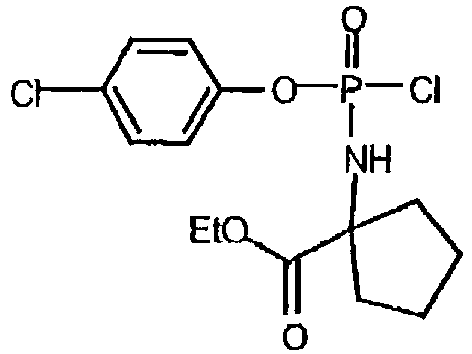
- This is synthesised according to Standard procedure 4, using ethyl-1-amino-1-cyclopentanoate hydrochloride salt (0.477 g, 2.5 mmol), para-chlorophenyldichlorophosphate (0.613 g, 2.5 mmol), and TEA (0.7 mL, 5 mmol) in DCM (20 mL), to yield 0.880 g (97%) of crude product used without further purification.
31P-NMR (CDCl3, 121 MHz): δ 9.85, 9.70.
1H-NMR (CDCl3; 300 MHz): δ 7.35-7.15 (4H, m, O Ph ), 4.9 (1H, bs, N H ), 4.22 (2H, 2q, 3 J=7.1 Hz, O CH 2 CH3), 2.2-2.0 (4H, m, 4H cyclopentane), 1.95-1.7 (4H, m, 4H cyclopentane), 1.27 (3H, t, 3 J=7 Hz, OCH2 CH 3 ).
13C-NMR (CDCl3; 75 MHz): δ 14.4 ( C H3CH2), 24.4 (2CH2 cyclopent), 38.8, 38.7 (2CH2 cyclopent), 62.5, 62.4 CH3 C H2), 68.1 ( Cq cyclopentane), 122.2, 122.1 ('o' OPh), 130.1 ('m', OPh), 133.2 ('p', OPh), 149.8 ('ipso', OPh), 174.8 ( C OOCH2CH3). -

- This is synthesised according to Standard procedure 4, using benzyl-1-amino-1-cyclopentanoate hydrochloride salt (0.640 g, 2.5 mmol), para-chlorophenyl-dichlorophosphate (0.613 g, 2.5 mmol), and TEA (0.7 mL, 5 mmol) in DCM (20 mL), to yield 1.041 g (97%) of crude product used without further purification.
31P-NMR (CDCl3, 121 MHz): δ 9.39, 8.95.
1H-NMR (CDCl3; 300 MHz): δ 7.4-7.15 (9H, m, OPh + CH2 Ph ), 5.20 (2H, s, CH 2 Ph), 5.0 (1H, bs, N H ), 2.2-2.0 (4H, m, 4H cyclopentane), 1.95-1.75 (4H, m, 4H cyclopentane).
13C-NMR (CDCl3; 75 MHz): δ 24.4 (2CH2 cyclopent), 38.8, 38.7, 38.6 (2CH2 cyclopent), 68.1, 68.0 ( C H2Ph), 68.2 ( Cq cyclopentane), 121.9, 121.8 ('o' OPh), 130.5, 130.4, 129.3, 129.2 ('m'OPh), CH2 Ph ), 133.2 ('p', OPh), 135.7 ('ipso', CH2Ph), 149.9 ('ipso', OPh), 174.3, 174.2 ( C OOCH2Ph). -

- This is synthesised according to Standard procedure 4, using methyl-1-amino-1-cyclopentanoate hydrochloride salt (0.443 g, 2.5 mmol), para-trifluorophenyldichlorophosphate (0.700 g, 2.5 mmol), and TEA (0.7 ml, 5 mmol) in DCM (20 mL), to yield 0.931 g (97%) of crude product used without further purification.
31P-NMR (CDCl3, 121 MHz): δ 8.80, 8.62.
1H-NMR (CDCl3; 300 MHz): δ 7.65 (2H, 2d, 3 J=8 Hz, OPh ), 7.35 (2H, 2d, 3 J=8 Hz OPh ), 5.02 (1H, bs, N H ), 3.78 (3H, s, OC H 3 ), 2.25-2.05 (4H, m, 4H cyclopentane), 1.95-1.7 (4H, m, 4H cyclopentane)..
13C-NMR (CDCl3; 75 MHz): δ 22.8 (2CH2 cyclopent), 37.5, 37.2 (2CH2 cyclopent), 51.5 ( C H3O), 68.4 ( Cq cyclopentane), 120.0 ('o', O Ph ), 124.8 (d, J=270Hz, CF3), 126.6 ('m', OPh ), 129.5 ('p',q, J=32Hz, O Ph ), 152.8 ('ipso', OPh), 175.2 ( C OOCH3). -

- This is synthesised according to Standard procedure 4, using ethyl-1-amino-1-cyclopentanoate hydrochloride salt (0.477 g, 2.5 mmol), para-trifluorophenyldichlorophosphate (0.700 g, 2.5 mmol), and TEA (0.7 mL, 5 mmol) in DCM (20 mL), to yield 0.950 g (89%) of crude product used without further purification.
31P-NMR (CDCl3, 121 MHz): δ 8.49.
1H-NMR (CDCl3; 300 MHz): δ 7.45 (2H, m, O Ph ), 7.2 (2H, m, O Ph ), 5.12 (1H, bs, N H ), 4.05 (2H, m, O CH 2 CH3), 2.15-2.0 (4H, m, 4H cyclopentane), 1.9-1.65 (4H, m, 4H cyclopentane), 1.2 (3H, 2t, 3 J=7 Hz, OCH2 CH 3 ).
13C-NMR (CDCl3; 75 MHz): δ 14.3 ( C H3CH2), 24.2, 24.1 (2CH2 cyclopent), 38.6, 38.5, 38.4 (2CH2 cyclopent), 62.0 CH3 C H2), 68.4 ( Cq cyclopentane), 121.5 ('o', O Ph ), 125.0 (d, J=270Hz, CF3), 127.5 ('m', O Ph ), 129.9 ('p',q, J=32Hz, OPh ), 152.8, 152.7 ('ipso', OPh), 174.9, 174.6 ( C OOCH2CH3). -
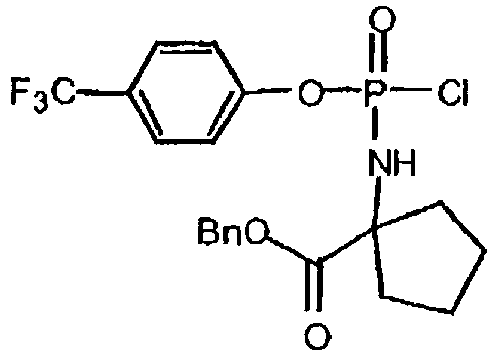
- This is synthesised according to Standard procedure 4, using benzyl-1-amino-1-cyclopentanoate hydrochloride salt (0.700 g, 2.73 mmol), para-trifluorophenyl-dichlorophosphate (0.75 g, 2.73 mmol), and TEA (0.75 mL, 5.47 mmol) in DCM (25 mL), to yield 1.089 g (86%) of crude product used without further purification.
31P-NMR (CDCl3, 121 MHz): δ 9.39, 8.95.
1H-NMR (CDCl3; 300 MHz): δ 7.50 (2H, m, OPh ), 7.4-7.15 (7H, m, O Ph + CH2 Ph ), 5.20 (2H, s, CH 2 Ph), 4.95 (1H, bs, N H ), 2.2-2.0 (4H, m, 4H cyclopentane), 1.95-1.75 (4H, m, 4H cyclopentane).
13C-NMR (CDCl3; 75 MHz): δ 24.3 (2CH2 cyclopent), 38.8, 38.7, 38.6 (2CH2 cyclopent), 68.1, 68.0 ( C H2Ph), 68.2 ( Cq cyclopentane), 121.4, 121.3 ('o', OPh ), 125.1 (d, J=270Hz, CF3), 126.6 ('m', O Ph ) 129.2, 128.8, 127.8 (Bn), 129.8 ('p',q, J=32Hz, OPh ), 135.7 ('ipso', CH2Ph), 153.5 ('ipso', OPh), 174.5, 174.4 ( C OOCH2Ph). -

- This is synthesised according to Standard procedure 4, using L-phenylalanine methyl ester hydrochloride (1.08 g, 5 mmol), phenyldichlorophosphate (1.12 g, 0.75 ml, 5 mmol), and TEA (1.4ml, 10 mmol) in DCM (40 mL), to yield 1.626 g (92%) of crude product used without further purification.
31P-NMR (CDCl3, 121 MHz): δ 9.1, 8.95.
1H-NMR (CDCl3; 300 MHz): δ 7.3-7.1 (10H, m, CH2Ph+ OPh ), 5.00 (1H, bs, N H ), 4.35 (1H, m, CHphenylala), 3.79 (3H, 2s, CH3O), 3.00 (2H, m, CH2Ph)
13C-NMR (CDCl3; 75 MHz): δ 36.3 (CH2phenylalanine), 53.0 ( C H3O), 56.6, 56.5 (CHphenylala), 121.0 ('o' OPh), 126.4 ('p', OPh), 130.2 ('m', OPh), 150.2 ('ipso', OPh), 174.1 ( C OOCH3). -
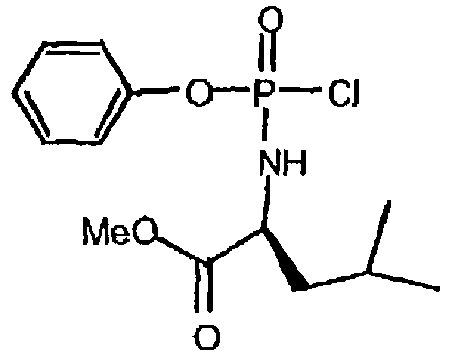
- This is synthesised according to Standard procedure 4, using L-leucine methyl ester hydrochloride (0.91 g, 5 mmol), phenyldichlorophosphate (1.12 g, 0.75 ml, 5 mmol), and TEA (1.4 ml, 10 mmol) in DCM (40 mL), to yield 1.58 g (99%) of crude product used without further purification.
31P-NMR (CDCl3, 121 MHz): δ 9.45. 9.35.
1H-NMR (CDCl3; 300 MHz): δ 7.4-7.2 (5H, m, OPh ), 4.90 (1H, bs, N H ), 3.95 (1H, m, CHCH2CH(CH3)2), 3.78 (3H, s, OCH 3 ), 1.8 (1H, m, CHCH2CH(CH3)2), 1.8-1.5 (2H, m, CHCH2 CH(CH3)2), 1.0-0.9 (6H, m, CHCH2CH(CH3)2 ).
13C-NMR (CDCl3; 75 MHz): δ 23.2, 23.1, 22.4, 22.3 (2C, CHCH2CH(CH3)2 ), 24.9, 24.8 (CHCH2 CH(CH3 ) 2 ), 43.6 (CHCH2 CH(CH3)2), 53.2 ( C H3O), 53.7, 53.6 (CHCH2 CH(CH3)2), 120.9 ('o' OPh), 126.4 ('p', OPh), 130.2 ('m', OPh), 150.1 ('ipso', OPh), 173.6 ( C OOCH3). -

- This is synthesised according to Standard procedure 4, using L-leucine benzyl ester hydrochloride (1.29 g, 5.0 mmol), phenyl-dichlorophosphate (1.12 g, 0,75 ml, 5.0 mmol), and TEA (1.4 mL, 10.0 mmol) in DCM (40 mL), to yield 1.88 g (95%) of crude product used without further purification.
31P-NMR (CDCl3, 121 MHz): δ 9.93, 9.57.
1H-NMR (CDCl3; 300 MHz): δ 7.5-7.2 (10H, m, O Ph +CH2 Ph ), 5.2 (2H, 2s, CH 2 Ph), 4.95 (1H, bs, N H ), 4.2-4.1 (1H, m, CHCH2CH(CH3)2), 1.95-1.80 (1H, m, CHCH2CH(CH3)2), 1.7 (2H, m, CHCH 2CH(CH3)2), 1.0-0.9 (6H, m, CHCH2CH(CH3)2 ).
13C-NMR (CDCl3; 75 MHz): δ 23.2, 23.1, 22.4, 22.3 (2C, CHCH2CH(CH3)2 ), 24.9 (CHCH2 CH(CH3)2 ), 43.5 (CHCH2 CH(CH3)2), 53.8, 53.3 (CHCH2 CH(CH3)2), 67.8, 67.7 ( C H2Ph), 120.7 ('o' OPh), 126.4 ('p', OPh), 130.2, 129,1, 128.8, 128.7 ('m'OPh, CH2 Ph ), 135.8 ('ipso', CH2Ph), 150.2 ('ipso', OPh), 174.1 ( C OOCH2Ph). -
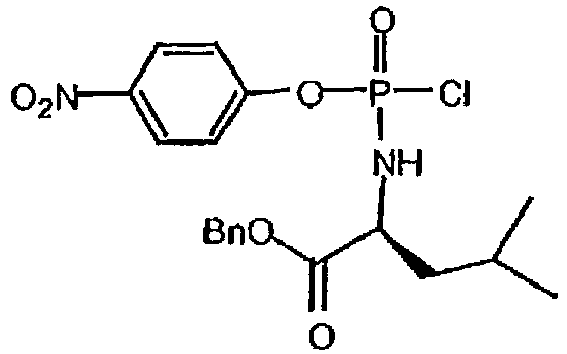
- This is synthesised according to Standard procedure 4, using L-leucine benzyl ester hydrochloride (1.08 g, 5.01 mmol), para-nitrophenyl-dichloro phosphate (1.362 g, 5.01 mmol), and TEA (1.4 mL, 1.4 mmol) in DCM (40 mL), to yield 2.08g (95%) of crude product used without further purification.
31P-NMR (CDCl3, 121 MHz): δ 9.87, 9.38.
1H-NMR (CDCl3; 300 MHz): δ 8.25-8.10 (2H, m , OPh ), 7.35-7.25 (7H, m, OPh + CH2 Ph ), 5.15 (2H, 2s, CH 2 Ph), 4.95 (1H, bs, N H ), 4.15 (1H, m, CHCH2CH(CH3)2), 1.95 (1H, m, CHCH2CH(CH3)2), 1.7 (2H, m, CHCH2 CH(CH3)2), 1.0-0.9 (6H, m, CHCH2CH(CH3)2 ).
13C-NMR (CDCl3; 75 MHz): δ 23.2, 23.1, 22.1, 22.0 (2C, CHCH2CH(CH3)2 ), 24.8 (CHCH2 CH(CH3) 2), 43.4, 43.3 (CHCH2 CH(CH3)2), 54.2, 53.9 (CHCH2 CH(CH3)2), 68.0, 67.9 ( C H2Ph), 121.6 ('o' OPh), 126.2, 126.1 ('m'OPh), 129.2, 129.0 (CH2 Ph ), 135.4, 135.3 ('ipso', CH2Ph), 145.8, 145.7 ('ipso', OPh), 154.7, 154.5 ('p', OPh), 173.0, 172.8 ( C OOCH2Ph). -

- This is synthesised according to Standard procedure 4, using L-leucine benzyl ester hydrochloride (0.644 g, 2.5 mmol), para-chlorophenyl-dichlorophosphate (0.613 g, 2.5 mmol), and TEA (0.7 mL, 5 mmol) in DCM (20 mL), to yield 0.968 g (90%) of crude product used without further purification.
31P-NMR (CDCl3, 121 MHz): δ 9.71, 9.55.
1H-NMR (CDCl3; 300 MHz): δ 7.4-7.0 (9H, m, O Ph + CH2 Ph ), 5.15 (2H, s, CH 2 Ph), 4.5 (1H, d, 3 J=7Hz, N H ), 4.0 (1H, m, CHCH2CH(CH3)2), 1.9-1.8 (1H, m, CHCH2CH(CH3)2), 1.7 (2H, m, CHCH2 CH(CH3)2), 0.85 (6H, m, CHCH2CH(CH3)2 ).
13C-NMR (CDCl3; 75 MHz): δ 23.4, 23.3, 22.5, 22.4 (2C, CHCH2CH(CH3)2 ), 25.0 (CHCH2 CH(CH3)2 ), 43.8, 43.7 (CHCH2 CH(CH3)2), 54.0, 53.8 (CHCH2 CH(CH3)2), 68.2 ( C H2Ph), 122.5 ('o' OPh), 130.5, 130.4, 129.3, 129.2 ('m' OPh, CH2 Ph ), 133.2 ('p', OPh), 135.7 ('ipso', CH2Ph), 149.9, 149.8 ('ipso', OPh), 173.4, 173.2 ( C OOCH2Ph). -

- This is synthesised according to Standard procedure 4, using 2-aminoisobutyrate methyl ester hydrochloride (280.0mg, 1.82 mmol), 4-chlorophenylphosphodichloride (447.4 mg, 1.82 mmol), and TEA (368.3 mg, 3.64 mmol, 507.3 µL) in DCM (20 mL), to yield 554 mg (yield 91.1%) of crude product used without further purification.
31P-NMR (CDCl3, 121 MHz): δ 7.05 (s)
1H-NMR (CDCl3; 300 MHz): δ 7.38 (2H, d, 3 J=9.0 Hz, OPh ), 7.29-7.24 (2H, 2d, 3 J=9.0 Hz, OPh ), 4.87-4.83 (1H, 2bs, N H ), 3.84 (3H, s, OCH 3 ), 1.73-1.71 (6H, 2s, [C H 3 ]2C). 13C-NMR (CDCl3; 75 MHz): δ 27.0, 27.3, ([ C H3]2C), 53.7 (O C H3), 58.9 ( C [CH3]2), 122.5 ('o', OPh ), 129.7 ('m', OPh ), 131.8 ('p', O Ph ) 148.7, 148.9 ('ipso', OPh ), 175.5, 175.7 ( C OOCH3). -

- This was synthesised according to Standard procedure 3, using phosphorus-oxychloride (1533 mg, 10.00 mmol, 932 µL), 4-chlorophenol (1.285 g, 10.00 mmol) and TEA (1.011 g, 10.00 mmol, 1394 µL) in ethylether (100 mL) to give an oil (1.897 g, 77.3 % yield).
31P-NMR (CDCl3, 121 MHz): δ 5.18.
1H-NMR (CDCl3; 300 MHz): δ 7.45 (2H, d, 3 J=9.0 Hz, OPh ), 7.30 (2H, d, 3 J=9.0 Hz, O Ph ).
13C-NMR (CDCl3; 75 MHz): δ 122.5 ('o', OPh ), 130.6 ('m', OPh), 133.2 ('p', OPh ), 148.5 ('ipso', O Ph ). -

- This was synthesised according to Standard procedure 3, using phosphorus-oxychloride (1.570 mg, 10.24 mmol, 954.5 µL), 4-trifluoromethylphenol (1660 g, 10.24 mmol) and TEA (1.036 g, 10.24 mmol, 1427 µL) in ethylether (100 mL) to give an oil (2.521 g, 88.2% yield).
31P-NMR (CDCl3, 121 MHz): δ 4.75.
1H-NMR (CDCl3; 300 MHz): δ 7.77 (2H, d, 3 J=8.4 Hz, OPh), 7.49 (2H, d, 3 J=8.4 Hz, OPh ).
13C-NMR (CDCl3; 75 MHz): δ 121.6 ('o', O Ph ), 123.6 ( C F3, J=271 Hz, O Ph ), 128.2 ('m', OPh), 129.7 ('p', J=33 Hz), 152.7 ('ipso', O Ph ). -

- This was synthesised according to Standard procedure 3, using phosphorus-oxychloride (1.395 mL, 15.00 mmol), 4-chlorophenol (1.68 g, 15.00 mmol) and TEA (2.1 mL, 15.00 mmol) in ethylether (140 mL) to give an oil (3.96 g, 96 % yield).
31P-NMR (CDCl3, 121 MHz): δ 5.52.
1H-NMR (CDCl3; 300 MHz): δ 7.15 (2H, d, 3 J=8.0 Hz, OPh ), 7.05 (2H, d, 3 J=8.0 Hz, O Ph ).
13C-NMR (CDCl3; 75 MHz): δ 116.8 ('o', O Ph ), 122.1 ('m', OPh), 146.7 ('p', OPh), 158.7 ('ipso', OPh ). - Experimental data are given in Table I illustrating the activity of compounds embodying the present invention, and of some comparaive compounds, with respect to human breast cancer cell line MDA MB231, human colon cancer cell line HT115 and human prostrate cancer cell line PC-3. The compounds include those whose preparations are described above and compounds made by preparative methods corresponding to the methods described above.
- The experimental procedures used human colon cancer cell line (HT115), human prostate cancer cell line (PC-3), human breast cancer cell line (MDA MB 231) and normal human umbilical vein endothelial cell (HUVEC). Compounds were diluted over a range of concentrations and added to cells over 1 to 3 days. The cytotoxity was determined using a MTT assay at the end of each experiment.
- In the Table:
- ArO refers to Ar as defined above with respect to formula I;
- J refers to the moiety of the present compounds represented by, respectively, ROCOCR'R"NH-, as defined above with respect to formula I, or, with respect to Examples 51, 52 and 53, HOCOCR'R"NH-,
and - B refers to the base moiety of the present compounds as defined above with respect to formula I.
- BVU stands for 2-bromovinyl uridine.
- 5-(C=CC[O]O)MeU stands for methyl propenoate-2'-deoxyuridine.
- GemCyt stands for Gemcitabine.
- Examples A, 1 to 95 and G are comparative Examples.
- Example A is 5-(2-Bromovinyl)-2'-deoxyuridine.
- Example 1 is Example 1 above corresponding to compound (7) above.
- Example 67 is propenate-2'-deoxyuridine.
- Example G is gemcitabine.
- Gemcitabine (Example G in the Table) and compound CPF31 (Example 31 in the Table: gemcitabine-[phenyl-(benzoxy-L-alaninyl)]-phosphate) were compared in a mouse model with xenografts of human cancer (colon HT115 and prostrate PC3).
- Mice were dosed daily at a range of concentrations (0.01-10µM) and tumour volume assessed versus control.
- Kaplan-Meier statistics were computed regarding incident-free survival.
- In the attached drawings:
-
Figure 1 shows for the mouse xenograft the tumour volume for prostate data at day 13 using Gemzar™ (gemcitabine available ex. Lilly); -
Figure 2 shows for the mouse xenograft the tumour volume for prostate data at day 13 using CPF31; -
Figure 3 shows the incident free survival functions v. day for each of CPF31 and gemcitabine; and -
Figure 4 shows for the mouse xenograft the tumour volume for colon data atday 24 using, respectively, Gemzar and compound CPF31. - Referring to the drawings, CPF31 can be seen to be significantly less toxic than gemcitabine.
- CPF31 was significantly effective at reducing prostate and colon tumour volume relative to control at daily dosing of 5 and 10 µM (3 and 6 µg/ml). Gemcitabine was not effective at the highest non-toxic concentration.
- Gemzar is seen from
Figure 1 to be toxic above 1µM. In contrast, CPF31 is seen fromFigure 2 to have substantially lower toxicity. -
Figure 3 shows that CPF31 has significantly lower side effects on a comparable basis: 3 animals show serious toxicity (10% body mass loss) in GMZ and in CPF31 on day 10, collectively 4 in GMZ and 1 in CPF31 onday 11 and 5 in GMZ and 1 in CPF on day 13. Using Chi square analysis by combining 5 and 10µM groups, the significance is p=0.193, 0,078 and 0.0289 on day 10, 11 and 13. It is clear that by day 13, CPF31 displayed signficantly less side effects, and the anti-cancer effects continue to exceed that of Gemzar. -
Figure 3 shows the Kaplan-Meier survival curve, incidence free survival: based on the loss according to weight loss. A Cox proportion analysis shows that CPF31 is far less toxic than GMZ based on the weight-loss calculated loss (p=0.043). - CPF31 was found to be active at 5µM in vitro, whereas Gemzar was found to be active at 600µM, with respect to the same colon cell line.
Figure 4 shows the results of testing both in vivo at 5µM. The greater activity of CPF31 in reducing tumour volume is shown inFigure 4 .
| Ex | ArO | J | B | EC50/µM | EC50/µM | EC50/µM |
| Breast | Colon | Prostate | ||||
| MDA MB231 | HT115 | PC-3 | ||||
| A | - | - | BVU | 125 | 78.7 | 120 |
| 1 | PhO | MeAlaNH | BVU | 79 | 244.5 | 155 |
| 2 | PhO | DnAlaNH | BVU | 34 | 1.4 | 19 |
| 3 | PhO | EtAlaNH | BVU | 56 | 52 | 36 |
| 4 | p-CF3PhO | BnAlaNH | BVU | 31 | 7.4 | 9.3 |
| 5 | p-FPhO | MeAlaNH | BVU | 159 | 17 | 58 |
| 6 | p-FPhO | EtAlaNH | BVU | 46 | 11 | 42 |
| 7 | p-FPhO | BnAlaNH | BVU | 17 | 3.5 | 16 |
| 8 | p-NO2PhO | BnAlaNH | BVU | 28 | - | 9 |
| 9 | p-NO2PhO | EtAlaNH | BVU | 177 | 118.7 | 365 |
| 10 | p-NO2PhO | MeAlaNH | BVU | 105 | 96.7 | 10.4 |
| 11 | p-CIPhO | EtAlaNH | BVU | 28.7 | 14.9 | 3.4 |
| 12 | p-CIPhO | BnAlaNH | BVU | 6.2 | 3.4 | 2.4 |
| 13 | p-CIPhO | MeAlaNH | BVU | 61 | 70.2 | 13 |
| 14 | PhO | Bn(Me2Gly)NH | BVU | 19 | 14.5 | 5.1 |
| 15 | p-CF3PhO | MeAlaNH | BVU | 47 | 79.2 | 15 |
| 16 | PhO | Me(cPntGly)NH | BVU | 79 | 77 | 16 |
| 17 | PhO | Et(cPntGly)NH | BVU | 44 | 81.3 | 41 |
| 18 | PhO | Bn(cPntGly)NH | BVU | 78 | 9.7 | 33 |
| 19 | p-NO2PhO | Me[cPntGly]NH | BVU | 56 | 38.2 | 88 |
| 20 | p-NO2PhO | Et[cPntGly)NH | BVU | 13 | 57.3 | 15 |
| 21 | p-NO2PhO | Bn[cPntGly]NH | BVU | 8.4 | 17.2 | 2.2 |
| 22 | PFPhO | Me[cPntGly]NH | BVU | 57 | 59.7 | 51 |
| 23 | PFPhO | Et[cPntGly]NH | BVU | 9.9 | 18.1 | 2.7 |
| 24 | PFPhO | Bn[cPntGly]NH | BVU | 9.4 | 17 | 3.7 |
| 25 | p-CF3PhO | EtAlaNH | BVU | 33.8 | 4.6 | |
| 26 | PhO | Me(Me2Gly)NH | BVU | 41.1 | 77.9 | 1.5 |
| 27 | PhO | Et(Me2Gly)NH | BVU | 217.9 | 39.7 | 76.1 |
| 28 | p-CF3PhO | Me(cPntGly)NH | BVU | 28.8 | 21.2 | - |
| 29 | p-CF3PhO | Et(cPntGly)NH | BVU | 45.6 | 15.1 | 4.3 |
| 30 | p-CF3PhO | Bn(cPntGly)NH | BVU | 6.9 | 6.4 | - |
| 32 | p-CIPhO | Me[cPntGly]NH | BVU | 2.6 | 99.3 | 52.2 |
| 33 | p-CIPhO | Et[cPntGly]NH | BVU | 12 | 97.9 | 83.2 |
| 34 | p-CIPhO | Bn[cPntGly]NH | BVU | 3.9 | 8.9 | 6.3 |
| 35 | PhO | MeLeuNH | BVU | 18.5 | 7.7 | 75.7 |
| 36 | PhO | Me[Phe]NH | BVU | 19.8 | 32.1 | 86.9 |
| 37 | PhO | BnLeuNH | BVU | 2.8 | 7 | 7.16 |
| 38 | p-NO2PhO | BnLeuNH | BVU | 6.3 | 10.7 | 7.2 |
| 39 | p-CIPhO | BnLeuNH | BVU | 4.3 | 288.5 | 193.1 |
| 42 | p-CIPhO | Me(Me2Gly)NH | BVU | 8.7 | 183.4 | 441.6 |
| 43 | p-CIPhO | Et(Me2Gly)NH | BVU | 5.9 | 174.3 | 1.15 |
| 44 | p-CIPhO | Bn(Me2Gly)NH | BVU | 2.3 | 4.5 | 9.12 |
| 45 | p-NO2PhO | Me(Me2Gly)NH | BVU | 9.4 | 24.7 | 222.8 |
| 46 | p-NO2PhO | Et(Me2Gly)NH | BVU | 2 | 224 | 82.4 |
| 47 | p-NO2PhO | Bn(Me2Gly)NH | BVU | 4.5 | 16.7 | 27.2 |
| 48 | p-CF3PhO | Bn(Me2Gly)NH | BVU | 1.3 | 7 | 0.61 |
| 49 | o-CIPhO | BnAlaNH | BVU | 5.4 | 16.2 | 5.4 |
| 50 | o-CIPhO | Bn(Me2Gly)NH | BVU | 5.7 | 3.9 | 6.59 |
| 51 | - | L-AlaNH | BVU | 295.4 | ||
| 52 | - | LeuNH | BVU | 438.1 | ||
| 53 | - | PhAlaNH | BVU | 66 | ||
| 54 | PhO | Bn[PhAla]NH | BVU | 5.1 | ||
| 55 | PhO | Me[D-Ala]NH | BVU | 392.7 | ||
| 56 | PhO | Bn[D-Ala]NH | BVU | 20.8 | ||
| 57 | p-NO2PhO | Bn[D-Ala]NH | BVU | 20.2 | ||
| 58 | p-CF3 | Me[Me2Gly]NH | BVU | 83.6 | ||
| 59 | p-CF3 | Et[Me2Gly]NH | BVU | 24.7 | ||
| 60 | p-FPhO | Et[Me2Gly]NH | BVU | 86.8 | ||
| 61 | p-CF3PhO | Bn[L-PhAla]NH | BVU | 6.3 | ||
| 62 | p-CF3PhO | Bn[L-Leu]NH | BVU | 1.9 | ||
| 63 | PhO | tBu[L-Ala]NH | BVU | 31.5 | ||
| 64 | p-NO2PhO | Bn[L-PhAla]NH | BVU | 16.6 | ||
| 65 | p-FPhO | Me{Me2Gly)NH | BVU | |||
| 66 | p-NO2PhO | Me(Me2Gly)NH | 5-(C=CC[O]O Me)U | 20.7 | ||
| 67 | - | - | 5-(C=CC[O]O Me)U | 93.7 | ||
| 69 | PhO | MeMetNH | BVU | - | - | 6.3 |
| 70 | PhO | MeTrpNH | BVU | - | - | 16 |
| 71 | PhO | BnMetNH | BVU | - | - | 6.3 |
| 72 | PhO | BnIleNH | BVU | - | - | 1.6 |
| 73 | PhO | EtIleNH | BVU | - | - | 30.6 |
| 74 | PhO | MeGlyNH | BVU | - | - | 31 |
| 75 | PhO | BnGlyNH | BVU | - | - | 29 |
| 77 | p-Cl PhO | BnGlyNH | BVU | - | - | 150 |
| 78 | p-CF3 PhO | BnValNH | BVU | - | - | 1,6 |
| 80 | PhO | Me2AspNH | BVU | - | - | 158 |
| 81 | PhO | Et2GluNH | BVU | - | - | 31 |
| 82 | m-ClPhO | BnAlaNH | BVU | - | - | 21 |
| 83 | m-ClPhO | BnMe2GlyNH | BVU | - | - | 6.3 |
| 84 | p-FphO | BnMe2GlyNH | BVU | - | - | 4.5 |
| 85 | PhO | BnValNH | BVU | - | - | 31.2 |
| 86 | p-ClPho | BnValNH | BVU | - | - | 0.9 |
| 87 | p-FphO | BnValNH | BVU | - | - | 1.6 |
| 88 | PhO | BnPhGlyNH | BVU | - | - | 0.75 |
| 89 | p-ClPhO | BnPhGlyNH | BVU | - | - | 6.5 |
| 91 | p-CF3PhO | BnPhGlyNH | BVU | - | - | 0.7 |
| 94 | PhO | i-BuAlaNH | BVU | - | - | 51 |
| 95 | PhO | 2-BuAlaNH | BVU | - | - | 6.8 |
| G | - | - | GemCyt | 2.8 | 606.1 | 3.12 |
| 31 | PhO | BnAlaNH | GemCyt | 42.6 | 5.7 | 0.22 |
| 40 | p-ClPhO | BnAlaNH | GemCyt | 9.2 | 16.1 | 15.4 |
| 41 | p-ClPhO | Bn[Me2Gly]NH | GemCyt | 3.1 | 317.1 | 68.8 |
Claims (15)
- A chemical compound having formula I:
 R is selected from the group alkyl, aryl and alkylaryl;R' and R" are independently selected from the group H, alkyl and alkylaryl, or R' and R" together form an alkylene chain so as to provide, together with the C atom to which they are attached, a cyclic system;Q is selected from the group -O- and -CH2-;X is independently selected from the group H, F, Cl, Br, I, OH and methyl (-CH3);Y is F;Ar is a monocyclic aromatic ring moiety or a fused bicyclic aromatic ring moiety, either of which said ring moieties is carbocyclic or heterocyclic and is optionally substituted;Z is selected from the group H, alkyl and halogen; andn is 0 or 1 ,wherein when n is 0, Z' is -NH2 and a double bond exists between position 3 and position 4, andwhen n is 1, Z' is =O;or a pharmaceutically acceptable salt, ester or salt of such ester of a compound of formula I.
 - A compound according to claim 1 wherein R is selected from the group a C1-6 primary or secondary alkyl group, a C5-7 carbocyclic aryl group or a C1-6alkylC5-7 aryl group; optionally wherein R is selected from the group methyl (-CH3), ethyl (-C2H5) and benzyl (-CH2C6H5); further optionally wherein R is benzyl.
- A compound according to claim 1 or claim 2 wherein Ar is an optionally substituted C6 monocyclic aromatic ring moiety, ie is optionally substituted phenyl; optionally wherein Ar is selected from the group -C6H5, pCF3C6H4-, pFC6H4-, pNO2C6H4-, pClC6H4- and oClC6H4-.
- A compound according to any one of the preceding claims wherein R' and R" are, independently, selected from the group H, C1-6 primary, secondary and tertiary alkyl, C1-3alkylC5-7 aryl, or, when together they form an alkylene chain, they provide, together with the C atom to which they are attached, a C3-8 carbocyclic aliphatic ring.
- A compound according to claim 4 wherein R' and R" are, independently, selected from the group H, methyl, benzyl and -CH2CH(CH3)2, or, R' and R" together with the C atom to which they are attached, provide a C5-6 ring.
- A compound according to claim 5 wherein R' and R" are each methyl.
- A compound according to claim 5 wherein one of R' and R" is H and one of R' and R" is methyl.
- A compound according to claim 5 wherein the carbocyclic ring is a pentyl ring.
- A compound according to any one of the preceding claims wherein R' and R" correspond to the side chains of a naturally occurring amino acid.
- A compound according to any one of the preceding claims wherein Z is selected from the group H, C1-6alkyl, substituted C1-6alkyl, C1-6alkenyl, substituted C1-6 alkenyl, C1-6alkynyl, and halogen.
- A compound according to any one of the preceding claims wherein Q is O.
- A compound according to any one of claims 1 to 11 wherein when n is 0, each of X and Y is F.
- A compound according to any one of claims 1 to 12, for use in a method of treatment, preferably in the prophylaxis or treatment of cancer.
- A pharmaceutical composition comprising a compound according to any one of claims 1 to 12, in combination with a pharmaceutically acceptable carrier, diluent or excipient.
- A method of preparing a pharmaceutical composition comprising the step of combining a compound according to any one of claims 1 to 12, with a pharmaceutically acceptable excipient, carrier or diluent.
Priority Applications (2)
| Application Number | Priority Date | Filing Date | Title |
|---|---|---|---|
| SI200432439T SI2955190T1 (en) | 2003-07-21 | 2004-07-20 | Chemical compounds |
| PL15154759T PL2955190T3 (en) | 2003-07-21 | 2004-07-20 | Chemical compounds |
Applications Claiming Priority (2)
| Application Number | Priority Date | Filing Date | Title |
|---|---|---|---|
| GBGB0317009.9A GB0317009D0 (en) | 2003-07-21 | 2003-07-21 | Chemical compounds |
| EP04743483.2A EP1646639B8 (en) | 2003-07-21 | 2004-07-20 | Nucleotide phosphoramidates as anticancer agents |
Related Parent Applications (2)
| Application Number | Title | Priority Date | Filing Date |
|---|---|---|---|
| EP04743483.2A Division EP1646639B8 (en) | 2003-07-21 | 2004-07-20 | Nucleotide phosphoramidates as anticancer agents |
| EP04743483.2A Division-Into EP1646639B8 (en) | 2003-07-21 | 2004-07-20 | Nucleotide phosphoramidates as anticancer agents |
Publications (3)
| Publication Number | Publication Date |
|---|---|
| EP2955190A2 EP2955190A2 (en) | 2015-12-16 |
| EP2955190A3 EP2955190A3 (en) | 2016-03-16 |
| EP2955190B1 true EP2955190B1 (en) | 2018-03-28 |
Family
ID=27772362
Family Applications (5)
| Application Number | Title | Priority Date | Filing Date |
|---|---|---|---|
| EP21180706.0A Expired - Lifetime EP3904365B1 (en) | 2003-07-21 | 2004-07-20 | Chemical compounds |
| EP15154759.3A Revoked EP2955190B1 (en) | 2003-07-21 | 2004-07-20 | Chemical compounds |
| EP04743483.2A Expired - Lifetime EP1646639B8 (en) | 2003-07-21 | 2004-07-20 | Nucleotide phosphoramidates as anticancer agents |
| EP18201295.5A Withdrawn EP3486251A1 (en) | 2003-07-21 | 2004-07-20 | Chemical compounds |
| EP16155811.9A Expired - Lifetime EP3040340B1 (en) | 2003-07-21 | 2004-07-20 | Chemical compounds |
Family Applications Before (1)
| Application Number | Title | Priority Date | Filing Date |
|---|---|---|---|
| EP21180706.0A Expired - Lifetime EP3904365B1 (en) | 2003-07-21 | 2004-07-20 | Chemical compounds |
Family Applications After (3)
| Application Number | Title | Priority Date | Filing Date |
|---|---|---|---|
| EP04743483.2A Expired - Lifetime EP1646639B8 (en) | 2003-07-21 | 2004-07-20 | Nucleotide phosphoramidates as anticancer agents |
| EP18201295.5A Withdrawn EP3486251A1 (en) | 2003-07-21 | 2004-07-20 | Chemical compounds |
| EP16155811.9A Expired - Lifetime EP3040340B1 (en) | 2003-07-21 | 2004-07-20 | Chemical compounds |
Country Status (20)
| Country | Link |
|---|---|
| US (2) | USRE47589E1 (en) |
| EP (5) | EP3904365B1 (en) |
| JP (1) | JP4923216B2 (en) |
| AU (1) | AU2004261455B2 (en) |
| CA (1) | CA2518115C (en) |
| CY (5) | CY1117960T1 (en) |
| DK (4) | DK3040340T3 (en) |
| ES (4) | ES2928202T3 (en) |
| FI (1) | FIC20230013I1 (en) |
| FR (1) | FR23C1014I2 (en) |
| GB (1) | GB0317009D0 (en) |
| HU (4) | HUE059970T2 (en) |
| MX (1) | MXPA05012606A (en) |
| NO (1) | NO333603B1 (en) |
| NZ (1) | NZ541974A (en) |
| PL (4) | PL2955190T3 (en) |
| PT (4) | PT3904365T (en) |
| SI (2) | SI3040340T1 (en) |
| TR (1) | TR201901246T4 (en) |
| WO (1) | WO2005012327A2 (en) |
Families Citing this family (141)
| Publication number | Priority date | Publication date | Assignee | Title |
|---|---|---|---|---|
| US7462605B2 (en) | 1998-01-23 | 2008-12-09 | Celmed Oncology (Usa), Inc. | Phosphoramidate compounds and methods of use |
| MY164523A (en) | 2000-05-23 | 2017-12-29 | Univ Degli Studi Cagliari | Methods and compositions for treating hepatitis c virus |
| IL153020A0 (en) | 2000-05-26 | 2003-06-24 | Idenix Cayman Ltd | Methods and compositions for treating flaviviruses and pestiviruses |
| BR0312278A (en) | 2002-06-28 | 2007-06-19 | Idenix Cayman Ltd | 2'-c-methyl-3'-o-1-valine ribofuranosyl cytidine ester for treatment of flaviviridae infections |
| NZ537662A (en) | 2002-06-28 | 2007-10-26 | Idenix Cayman Ltd | 2'-C-methyl-3'-O-L-valine ester ribofuranosyl cytidine for treatment of flaviviridae infections |
| BR0316363A (en) | 2002-11-15 | 2005-10-04 | Idenix Cayman Ltd | 2'-branched nucleosides and flaviviridae mutation |
| EP2319853B1 (en) | 2002-12-12 | 2014-03-12 | IDENIX Pharmaceuticals, Inc. | Process for the production of 2'-branched nucleosides |
| PL3521297T3 (en) * | 2003-05-30 | 2022-04-04 | Gilead Pharmasset Llc | Modified fluorinated nucleoside analogues |
| CN101023094B (en) * | 2004-07-21 | 2011-05-18 | 法莫赛特股份有限公司 | Preparation of alkyl-substituted 2-deoxy-2-fluoro-d-ribofuranosyl pyrimidines and purines and their derivatives |
| PT3109244T (en) * | 2004-09-14 | 2019-06-04 | Gilead Pharmasset Llc | Preparation of 2'fluoro-2'-alkyl-substituted or other optionally substituted ribofuranosyl pyrimidines and purines and their derivatives |
| CA2589935A1 (en) | 2004-12-09 | 2006-06-15 | Regents Of The University Of Minnesota | Nucleosides with antiviral and anticancer activity |
| GB0505781D0 (en) | 2005-03-21 | 2005-04-27 | Univ Cardiff | Chemical compounds |
| DE102006037786A1 (en) * | 2006-08-11 | 2008-03-20 | Resprotect Gmbh | Nucleosides, pharmaceuticals containing them and their use |
| WO2007054100A2 (en) * | 2006-11-13 | 2007-05-18 | Santaris Pharma A/S | Lna nucleoside phosphoramidates |
| GB0623493D0 (en) | 2006-11-24 | 2007-01-03 | Univ Cardiff | Chemical compounds |
| US7964580B2 (en) * | 2007-03-30 | 2011-06-21 | Pharmasset, Inc. | Nucleoside phosphoramidate prodrugs |
| AU2014233579B2 (en) * | 2007-03-30 | 2016-06-23 | Gilead Sciences, Inc. | Nucleoside phosphoramidate prodrugs |
| GB0709791D0 (en) * | 2007-05-22 | 2007-06-27 | Angeletti P Ist Richerche Bio | Antiviral agents |
| FR2922551B1 (en) * | 2007-10-17 | 2009-12-25 | Univ Claude Bernard Lyon | PRODRUGS PHOSPHOESTERS OF GEMCITABINE AS ANTICANCER AGENTS |
| US8173621B2 (en) | 2008-06-11 | 2012-05-08 | Gilead Pharmasset Llc | Nucleoside cyclicphosphates |
| NZ593648A (en) | 2008-12-23 | 2013-09-27 | Gilead Pharmasset Llc | Nucleoside phosphoramidates |
| NZ617066A (en) | 2008-12-23 | 2015-02-27 | Gilead Pharmasset Llc | Nucleoside analogs |
| AU2009329872B2 (en) | 2008-12-23 | 2016-07-07 | Gilead Pharmasset Llc | Synthesis of purine nucleosides |
| US8618076B2 (en) | 2009-05-20 | 2013-12-31 | Gilead Pharmasset Llc | Nucleoside phosphoramidates |
| TWI576352B (en) | 2009-05-20 | 2017-04-01 | 基利法瑪席特有限責任公司 | Nucleoside phosphoramidates |
| WO2011035250A1 (en) | 2009-09-21 | 2011-03-24 | Gilead Sciences, Inc. | Processes and intermediates for the preparation of 1'-substituted carba-nucleoside analogs |
| PL3290428T3 (en) | 2010-03-31 | 2022-02-07 | Gilead Pharmasset Llc | Tablet comprising crystalline (s)-isopropyl 2-(((s)-(((2r,3r,4r,5r)-5-(2,4-dioxo-3,4-dihydropyrimidin-1 (2h)-yl)-4-fluoro-3-hydroxy-4-methyltetrahydrofuran-2-yl)methoxy)(phenoxy)phosphoryl)amino)propanoate |
| ES2644990T3 (en) | 2010-03-31 | 2017-12-01 | Gilead Pharmasset Llc | Stereoselective synthesis of active ingredients that contain phosphorus |
| JP5969471B2 (en) | 2010-07-22 | 2016-08-17 | ギリード・サイエンシズ・インコーポレーテッド | Methods and compounds for treating Paramyxoviridae viral infections |
| SG188497A1 (en) | 2010-09-22 | 2013-05-31 | Alios Biopharma Inc | Substituted nucleotide analogs |
| GB201016855D0 (en) * | 2010-10-06 | 2010-11-17 | Nucana Biomed Ltd | Chemical compounds |
| PT3042910T (en) | 2010-11-30 | 2019-04-16 | Gilead Pharmasset Llc | 2'-spiro-nucleosides for use in the therapy of hepatitis c |
| US9156874B2 (en) | 2011-01-03 | 2015-10-13 | Nanjing Molecular Research, Inc. | Double-liver-targeting phosphoramidate and phosphonoamidate prodrugs |
| CN103403014B (en) | 2011-01-03 | 2016-07-06 | 河南美泰宝生物制药有限公司 | O-(benzyl being substituted) phosphoramidate compounds and therapeutic use thereof |
| MX339822B (en) | 2011-03-01 | 2016-06-13 | Nucana Biomed Ltd | Phosphoramidate derivatives of 5 - fluoro - 2 ' - deoxyuridine for use in the treatment of cancer. |
| EP2691409B1 (en) | 2011-03-31 | 2018-02-21 | Idenix Pharmaceuticals LLC. | Compounds and pharmaceutical compositions for the treatment of viral infections |
| US9403863B2 (en) | 2011-09-12 | 2016-08-02 | Idenix Pharmaceuticals Llc | Substituted carbonyloxymethylphosphoramidate compounds and pharmaceutical compositions for the treatment of viral infections |
| WO2013040492A2 (en) | 2011-09-16 | 2013-03-21 | Gilead Sciences, Inc. | Methods for treating hcv |
| WO2013056046A1 (en) | 2011-10-14 | 2013-04-18 | Idenix Pharmaceuticals, Inc. | Substituted 3',5'-cyclic phosphates of purine nucleotide compounds and pharmaceutical compositions for the treatment of viral infections |
| AR088463A1 (en) | 2011-10-21 | 2014-06-11 | Abbvie Inc | METHODS FOR HCV TREATMENT |
| CN104436197A (en) | 2011-10-21 | 2015-03-25 | 艾伯维公司 | Combined product of at least two direct acting antiviral agents |
| US8492386B2 (en) | 2011-10-21 | 2013-07-23 | Abbvie Inc. | Methods for treating HCV |
| US8466159B2 (en) | 2011-10-21 | 2013-06-18 | Abbvie Inc. | Methods for treating HCV |
| US8889159B2 (en) | 2011-11-29 | 2014-11-18 | Gilead Pharmasset Llc | Compositions and methods for treating hepatitis C virus |
| SG11201403364PA (en) | 2011-12-20 | 2014-07-30 | Hoffmann La Roche | 2',4'-difluoro-2'-methyl substituted nucleoside derivatives as inhibitors of hcv rna replication |
| AU2012357986B2 (en) | 2011-12-20 | 2017-02-02 | Riboscience Llc | 4'-Azido, 3'-fluoro substituted nucleoside derivatives as inhibitors of HCV RNA replication |
| AU2012358804B2 (en) | 2011-12-22 | 2018-04-19 | Alios Biopharma, Inc. | Substituted phosphorothioate nucleotide analogs |
| EP2828277A1 (en) | 2012-03-21 | 2015-01-28 | Vertex Pharmaceuticals Incorporated | Solid forms of a thiophosphoramidate nucleotide prodrug |
| EP2827876A4 (en) | 2012-03-22 | 2015-10-28 | Alios Biopharma Inc | Pharmaceutical combinations comprising a thionucleotide analog |
| PL2832740T3 (en) | 2012-03-28 | 2019-09-30 | Fujifilm Corporation | SALT OF 1-(2-DEOXY-2-FLUORO-4-THIO-beta-D-ARABINOFURANOSYL)CYTOSINE |
| EP2852605B1 (en) | 2012-05-22 | 2018-01-31 | Idenix Pharmaceuticals LLC | 3',5'-cyclic phosphate prodrugs for hcv infection |
| EP2852604B1 (en) | 2012-05-22 | 2017-04-12 | Idenix Pharmaceuticals LLC | 3',5'-cyclic phosphoramidate prodrugs for hcv infection |
| EP2852603B1 (en) | 2012-05-22 | 2021-05-12 | Idenix Pharmaceuticals LLC | D-amino acid compounds for liver disease |
| SG11201407336PA (en) | 2012-05-25 | 2015-03-30 | Janssen Sciences Ireland Uc | Uracyl spirooxetane nucleosides |
| WO2013187978A1 (en) * | 2012-06-16 | 2013-12-19 | Nanjing Molecular Research, Inc. | Double-liver-targeting phosphoramidate and phosphonoamidate prodrugs |
| TWI603966B (en) | 2012-08-13 | 2017-11-01 | 富士軟片股份有限公司 | Synthesis intermediate of 1-(2-deoxy-2-fluoro-4-thio-β-D-arabinofuranosyl) cytosine, synthesis intermediate of thionucleoside and manufacturing method thereof |
| CN107312039B (en) | 2012-08-30 | 2019-06-25 | 江苏豪森药业集团有限公司 | A kind of preparation method of tenofovir prodrug |
| EP2900682A1 (en) | 2012-09-27 | 2015-08-05 | IDENIX Pharmaceuticals, Inc. | Esters and malonates of sate prodrugs |
| AU2013329521B2 (en) | 2012-10-08 | 2018-04-19 | Centre National De La Recherche Scientifique | 2'-chloro nucleoside analogs for HCV infection |
| US10723754B2 (en) | 2012-10-22 | 2020-07-28 | Idenix Pharmaceuticals Llc | 2′,4′-bridged nucleosides for HCV infection |
| PT3235824T (en) * | 2012-11-16 | 2019-05-30 | NuCana plc | Mixture of rp/sp gemcitabine-[phenyl-(benzyloxy-l-alaninyl)]-phosphate |
| US9211300B2 (en) | 2012-12-19 | 2015-12-15 | Idenix Pharmaceuticals Llc | 4′-fluoro nucleosides for the treatment of HCV |
| EP2950786B1 (en) | 2013-01-31 | 2019-11-27 | Gilead Pharmasset LLC | Combination formulation of two antiviral compounds |
| US10034893B2 (en) | 2013-02-01 | 2018-07-31 | Enanta Pharmaceuticals, Inc. | 5, 6-D2 uridine nucleoside/tide derivatives |
| WO2014137930A1 (en) | 2013-03-04 | 2014-09-12 | Idenix Pharmaceuticals, Inc. | Thiophosphate nucleosides for the treatment of hcv |
| US9309275B2 (en) | 2013-03-04 | 2016-04-12 | Idenix Pharmaceuticals Llc | 3′-deoxy nucleosides for the treatment of HCV |
| US20140271547A1 (en) | 2013-03-13 | 2014-09-18 | Idenix Pharmaceuticals, Inc. | Amino acid phosphoramidate pronucleotides of 2'-cyano, azido and amino nucleosides for the treatment of hcv |
| US9187515B2 (en) | 2013-04-01 | 2015-11-17 | Idenix Pharmaceuticals Llc | 2′,4′-fluoro nucleosides for the treatment of HCV |
| JP2016522172A (en) | 2013-04-12 | 2016-07-28 | アキリオン ファーマシューティカルズ,インコーポレーテッド | Deuterated nucleoside prodrugs useful for treating HCV |
| BR112015028764B1 (en) | 2013-05-16 | 2022-09-27 | Riboscience Llc | SUBSTITUTED 4-FLUORO-2-METHYL NUCLEOSIDE DERIVATIVES AS INHIBITORS OF HCV RNA REPLICATION |
| SG11201509427RA (en) | 2013-05-16 | 2015-12-30 | Riboscience Llc | 4'-azido, 3'-deoxy-3'-fluoro substituted nucleoside derivatives |
| US20180200280A1 (en) | 2013-05-16 | 2018-07-19 | Riboscience Llc | 4'-Fluoro-2'-Methyl Substituted Nucleoside Derivatives as Inhibitors of HCV RNA Replication |
| EP3004130B1 (en) | 2013-06-05 | 2019-08-07 | Idenix Pharmaceuticals LLC. | 1',4'-thio nucleosides for the treatment of hcv |
| WO2015017713A1 (en) | 2013-08-01 | 2015-02-05 | Idenix Pharmaceuticals, Inc. | D-amino acid phosphoramidate pronucleotides of halogeno pyrimidine compounds for liver disease |
| NZ716840A (en) | 2013-08-27 | 2017-06-30 | Gilead Pharmasset Llc | Combination formulation of two antiviral compounds |
| WO2015056213A1 (en) * | 2013-10-17 | 2015-04-23 | Medivir Ab | Hcv polymerase inhibitors |
| MX2016006919A (en) * | 2013-11-27 | 2016-08-17 | Idenix Pharmaceuticals Llc | Nucleotides for the treatment of liver cancer. |
| EP3109245B1 (en) | 2014-02-18 | 2018-01-03 | FUJIFILM Corporation | Method for producting thiolane skeleton-type glycoconjugate, and thiolane skeleton-type glycoconjugate |
| JP6204223B2 (en) | 2014-02-19 | 2017-09-27 | 富士フイルム株式会社 | Method for producing thiopyranose compound, etc. |
| CN103804446A (en) * | 2014-02-27 | 2014-05-21 | 苏州东南药业股份有限公司 | Preparation method of 3,5-dibenzoyl-2-deoxy-2-fluoro-2-methyl-D-ribo-gamma-lactone |
| WO2015161137A1 (en) | 2014-04-16 | 2015-10-22 | Idenix Pharmaceuticals, Inc. | 3'-substituted methyl or alkynyl nucleosides for the treatment of hcv |
| AU2015278900B2 (en) * | 2014-06-25 | 2019-04-04 | NuCana plc | Formulation comprising a gemcitabine-prodrug |
| EP3757112B1 (en) * | 2014-06-25 | 2023-06-07 | Nucana PLC | Gemcitabine prodrugs |
| EP3172218B1 (en) * | 2014-07-22 | 2020-10-21 | NuCana plc | Process for the preparation of gemcitabine-[phenyl(benzoxy-l-alaninyl)] phosphate |
| PT3186244T (en) * | 2014-08-25 | 2020-05-29 | Medivir Ab | Dioxolane analogues of uridine for the treatment of cancer |
| US9675632B2 (en) | 2014-08-26 | 2017-06-13 | Enanta Pharmaceuticals, Inc. | Nucleoside and nucleotide derivatives |
| GB201417644D0 (en) * | 2014-10-06 | 2014-11-19 | Nucana Biomed Ltd | Method of separating phosphate diastereoisomers |
| TWI740546B (en) | 2014-10-29 | 2021-09-21 | 美商基利科學股份有限公司 | Methods for the preparation of ribosides |
| CN107108683A (en) * | 2014-10-31 | 2017-08-29 | 共晶制药股份有限公司 | 2 ' for treating flaviviridae and cancer, 2 ' dihalo nucleoside analogs |
| TWI678373B (en) * | 2014-10-31 | 2019-12-01 | 日商富士軟片股份有限公司 | Thionucleoside derivative or its salt and pharmaceutical composition |
| US9718851B2 (en) | 2014-11-06 | 2017-08-01 | Enanta Pharmaceuticals, Inc. | Deuterated nucleoside/tide derivatives |
| SMT201900489T1 (en) | 2014-11-28 | 2019-11-13 | NuCana plc | New 2' and/or 5' amino-acid ester phosphoramidate 3'-deoxy adenosine derivatives as anti-cancer compounds |
| US9732110B2 (en) | 2014-12-05 | 2017-08-15 | Enanta Pharmaceuticals, Inc. | Nucleoside and nucleotide derivatives |
| JP6735751B2 (en) | 2014-12-15 | 2020-08-05 | エモリー ユニバーシティー | Phosphoramidate for the treatment of hepatitis B virus |
| WO2016134058A1 (en) | 2015-02-18 | 2016-08-25 | Abbvie Inc. | Combinations useful to treat hepatitis c virus |
| AU2016229966B2 (en) | 2015-03-06 | 2018-09-27 | Atea Pharmaceuticals, Inc. | Beta-D-2'-deoxy-2'alpha-fluoro-2'-beta-C-substituted-2-modified-N6-substituted purine nucleotides for HCV treatment |
| US10662214B2 (en) | 2015-04-03 | 2020-05-26 | Sichuan Keiun-Biotech Biopharmaceutical Co., Ltd. | Compound of 4′-thionucleoside, as well as preparation method therefor, pharmaceutical composition thereof and application thereof |
| WO2016181093A1 (en) * | 2015-05-14 | 2016-11-17 | Nucana Biomed Limited | Cancer treatments |
| TWI695841B (en) * | 2015-06-22 | 2020-06-11 | 瑞典商米迪維艾克提伯拉公司 | Prodrugs for the treatment of cancer |
| CA2997170A1 (en) * | 2015-09-02 | 2017-03-09 | Abbvie Inc. | Anti-viral tetrahydrofurane derivatives |
| CN106478753A (en) * | 2015-09-16 | 2017-03-08 | 博瑞生物医药(苏州)股份有限公司 | A kind of preparation method of NUC 1031 individual isomer and purposes |
| CN114366745A (en) | 2015-09-16 | 2022-04-19 | 吉利德科学公司 | Methods of treating arenaviridae and coronaviridae virus infections |
| CN106543252A (en) * | 2015-09-16 | 2017-03-29 | 博瑞生物医药(苏州)股份有限公司 | The Preparation Method And Their Intermediate of nucleoside phosphoramidate class prodrug |
| CN106543220A (en) * | 2015-09-16 | 2017-03-29 | 博瑞生物医药(苏州)股份有限公司 | Phosphoramidate compounds and preparation method thereof and crystal |
| WO2017060661A1 (en) * | 2015-10-05 | 2017-04-13 | Nucana Biomed Limited | Combination therapy |
| CN108431016A (en) * | 2015-11-16 | 2018-08-21 | 艾可瑞恩治疗公司 | nucleic acid prodrug |
| HRP20211812T1 (en) * | 2015-12-11 | 2022-03-04 | NuCana plc | Diastereoselective synthesis of phosphate derivatives and of the gemcitabine prodrug nuc-1031 |
| GB201522771D0 (en) | 2015-12-23 | 2016-02-03 | Nucana Biomed Ltd | Crystalline form of a phosphate derivative |
| CA3008769A1 (en) | 2015-12-23 | 2017-06-29 | NuCana plc | Combination therapy comprising nuc-1031 and cisplatin |
| DK3393478T3 (en) | 2015-12-23 | 2020-03-23 | NuCana plc | combination therapy |
| US11192914B2 (en) | 2016-04-28 | 2021-12-07 | Emory University | Alkyne containing nucleotide and nucleoside therapeutic compositions and uses related thereto |
| GB201609600D0 (en) * | 2016-06-01 | 2016-07-13 | Nucuna Biomed Ltd | Cancer treatments |
| WO2017223421A1 (en) | 2016-06-24 | 2017-12-28 | Emory University | Phosphoramidates for the treatment of hepatitis b virus |
| WO2018013937A1 (en) | 2016-07-14 | 2018-01-18 | Atea Pharmaceuticals, Inc. | Beta-d-2'-deoxy-2'-alpha-fluoro-2'-beta-c-substituted-4'-fluoro-n6-substituted-6-amino-2-substituted purine nucleotides for the treatment of hepatitis c virus infection |
| IL265044B2 (en) | 2016-08-31 | 2025-02-01 | Fujifilm Corp | An anti-tumor composition comprising the compounds nab-paclitaxel and 1-(2-deoxy-2-fluoro-4-thio-beta-D-arabinofuranosyl)cytosine, a kit comprising these compounds and uses thereof |
| ES2907874T3 (en) | 2016-09-07 | 2022-04-26 | Atea Pharmaceuticals Inc | 2'-substituted-N6-substituted purine nucleotides for the treatment of RNA viruses |
| KR102460968B1 (en) | 2017-03-14 | 2022-11-01 | 길리애드 사이언시즈, 인코포레이티드 | Methods of treating feline coronavirus infections |
| CN110636884B (en) * | 2017-05-01 | 2022-10-04 | 吉利德科学公司 | Novel crystalline forms |
| GB201709471D0 (en) | 2017-06-14 | 2017-07-26 | Nucana Biomed Ltd | Diastereoselective synthesis of hosphate derivatives |
| CN109134568B (en) * | 2017-06-15 | 2022-11-22 | 北京美倍他药物研究有限公司 | Nucleoside phosphate/amide derivatives and medicinal use thereof |
| TW201919648A (en) | 2017-07-11 | 2019-06-01 | 美商基利科學股份有限公司 | Composition containing RNA polymerase inhibitor and cyclodextrin for treating viral infection |
| WO2019042226A1 (en) * | 2017-09-01 | 2019-03-07 | 四川科伦博泰生物医药股份有限公司 | Pharmaceutical composition for tumor treatment or prevention, method, and use thereof |
| GB201715011D0 (en) | 2017-09-18 | 2017-11-01 | Nucana Biomed Ltd | Floxuridine synthesis |
| CA3075645A1 (en) | 2017-09-21 | 2019-03-28 | Riboscience Llc | 4'-fluoro-2'-methyl substituted nucleoside derivatives as inhibitors of hcv rna replication |
| GB201720279D0 (en) | 2017-12-05 | 2018-01-17 | Nucana Biomed Ltd | Anticancer compounds |
| WO2019146130A1 (en) | 2018-01-29 | 2019-08-01 | 富士フイルム株式会社 | Antitumor agent for biliary cancer and treatment method of biliary cancer |
| EA202091857A1 (en) * | 2018-02-02 | 2020-12-04 | Маверикс Онколоджи, Инк. | NEW LOW-MOLECULAR DRUG CONJUGATES OF HEMCITABIN DERIVATIVES |
| MX2020008188A (en) | 2018-02-02 | 2020-11-18 | Maverix Oncology Inc | GEMCITABINE MONOPHOSPHATE SMALL MOLECULE DRUG CONJUGATES. |
| JP6810763B2 (en) * | 2019-03-06 | 2021-01-06 | ニューカナ パブリック リミテッド カンパニー | Cancer treatment |
| GB201904544D0 (en) | 2019-04-01 | 2019-05-15 | NuCana plc | Anticancer compounds |
| TWI789695B (en) | 2020-01-27 | 2023-01-11 | 美商基利科學股份有限公司 | Methods for treating sars cov-2 infections |
| US10874687B1 (en) | 2020-02-27 | 2020-12-29 | Atea Pharmaceuticals, Inc. | Highly active compounds against COVID-19 |
| WO2021173713A1 (en) | 2020-02-27 | 2021-09-02 | Atea Pharmaceuticals, Inc. | Highly active compounds against covid-19 |
| JP7554841B2 (en) | 2020-03-12 | 2024-09-20 | ギリアード サイエンシーズ, インコーポレイテッド | Methods for preparing 1'-cyanonucleosides |
| KR102906891B1 (en) | 2020-04-06 | 2026-01-05 | 길리애드 사이언시즈, 인코포레이티드 | Inhalation formulations of 1'-cyano substituted carbanucleoside analogues |
| KR20230018473A (en) | 2020-05-29 | 2023-02-07 | 길리애드 사이언시즈, 인코포레이티드 | How to treat remdesivir |
| JP2023531524A (en) | 2020-06-24 | 2023-07-24 | ギリアード サイエンシーズ, インコーポレイテッド | 1'-Cyanonucleoside analogues and uses thereof |
| WO2022031150A1 (en) * | 2020-08-07 | 2022-02-10 | 주식회사 피노바이오 | Conjugate including deoxycytidine-based anticancer agent and silyl ether-containing linker |
| AU2021331214B2 (en) | 2020-08-27 | 2024-01-04 | Gilead Sciences, Inc. | Compounds and methods for treatment of viral infections |
| KR20240154647A (en) | 2022-03-02 | 2024-10-25 | 길리애드 사이언시즈, 인코포레이티드 | Compounds and methods for treating viral infections |
| US12357577B1 (en) | 2024-02-02 | 2025-07-15 | Gilead Sciences, Inc. | Pharmaceutical formulations and uses thereof |
Citations (4)
| Publication number | Priority date | Publication date | Assignee | Title |
|---|---|---|---|---|
| WO1996029336A1 (en) | 1995-03-13 | 1996-09-26 | Medical Research Council | Chemical compounds |
| US20030109697A1 (en) | 1998-01-23 | 2003-06-12 | Shepard H. Michael | Novel phosphoramidate compounds and methods of use |
| WO2005003147A2 (en) | 2003-05-30 | 2005-01-13 | Pharmasset, Inc. | Modified fluorinated nucleoside analogues |
| EP1523489B1 (en) | 2002-06-28 | 2014-03-12 | IDENIX Pharmaceuticals, Inc. | Modified 2' and 3' -nucleoside produgs for treating flaviridae infections |
Family Cites Families (28)
| Publication number | Priority date | Publication date | Assignee | Title |
|---|---|---|---|---|
| US2802005A (en) | 1957-08-06 | S-eluorourace | ||
| US2945038A (en) | 1956-09-26 | 1960-07-12 | Hoffmann La Roche | 5-fluorocytosine and preparation thereof |
| US3201387A (en) | 1963-09-18 | 1965-08-17 | Heidelberger Charles | 5-trifluoromethyluracil, derivatives thereof, and processes for preparing the same |
| US4357324A (en) | 1981-02-24 | 1982-11-02 | The United States Of America As Represented By The Department Of Health And Human Services | Prodrug derivatives of 9β-D-arabinofuranosyl-2-fluoroadenine |
| FR2538397A1 (en) | 1982-12-24 | 1984-06-29 | Charbonnages Ste Chimique | CONTINUOUS PROCESS FOR THE PRODUCTION OF HOMOPOLYMERS OR COPOLYMERS OF ETHYLENE |
| US6346627B1 (en) | 1990-02-01 | 2002-02-12 | Emory University | Intermediates in the synthesis of 1,3-oxathiolane nucleoside enantiomers |
| US6703396B1 (en) | 1990-02-01 | 2004-03-09 | Emory University | Method of resolution and antiviral activity of 1,3-oxathiolane nuclesoside enantiomers |
| US5204466A (en) | 1990-02-01 | 1993-04-20 | Emory University | Method and compositions for the synthesis of bch-189 and related compounds |
| US5914331A (en) | 1990-02-01 | 1999-06-22 | Emory University | Antiviral activity and resolution of 2-hydroxymethyl-5-(5-fluorocytosin-1-yl)-1,3-oxathiolane |
| GB9009861D0 (en) | 1990-05-02 | 1990-06-27 | Glaxo Group Ltd | Chemical compounds |
| JP2002500880A (en) | 1998-01-23 | 2002-01-15 | ニューバイオティックス インコーポレイテッド | Therapeutic agents catalyzed by enzymes |
| AU3363499A (en) | 1998-03-27 | 1999-10-18 | George W. Griesgraber | Nucleosides with antiviral and anticancer activity |
| KR20020092896A (en) | 1999-07-22 | 2002-12-12 | 뉴바이오틱스 인코퍼레이티드 | Enzyme catalyzed therapeutic activation |
| WO2001045690A2 (en) | 1999-12-23 | 2001-06-28 | Newbiotics, Inc. | Use of bvdu for inhibiting the growth of hyperproliferative cells |
| US20020147175A1 (en) | 2000-11-16 | 2002-10-10 | Shepard H. Michael | Synergistic ECTA compositions |
| EP1404694A1 (en) | 2001-06-21 | 2004-04-07 | Glaxo Group Limited | Nucleoside compounds in hcv |
| GB0129945D0 (en) * | 2001-12-13 | 2002-02-06 | Mrc Technology Ltd | Chemical compounds |
| JP2005522443A (en) | 2002-02-14 | 2005-07-28 | フアーマセツト・リミテツド | Modified fluorinated nucleoside analogues |
| AU2003291726A1 (en) | 2002-11-04 | 2004-06-07 | Xenoport, Inc. | Gemcitabine prodrugs, pharmaceutical compositions and uses thereof |
| CN1777432B (en) * | 2003-02-19 | 2011-06-08 | 耶鲁大学 | Antiviral nucleoside analogues for HIV infection |
| PT3235824T (en) | 2012-11-16 | 2019-05-30 | NuCana plc | Mixture of rp/sp gemcitabine-[phenyl-(benzyloxy-l-alaninyl)]-phosphate |
| AU2015278900B2 (en) | 2014-06-25 | 2019-04-04 | NuCana plc | Formulation comprising a gemcitabine-prodrug |
| EP3172218B1 (en) | 2014-07-22 | 2020-10-21 | NuCana plc | Process for the preparation of gemcitabine-[phenyl(benzoxy-l-alaninyl)] phosphate |
| GB201417644D0 (en) * | 2014-10-06 | 2014-11-19 | Nucana Biomed Ltd | Method of separating phosphate diastereoisomers |
| WO2016181093A1 (en) | 2015-05-14 | 2016-11-17 | Nucana Biomed Limited | Cancer treatments |
| WO2017060661A1 (en) | 2015-10-05 | 2017-04-13 | Nucana Biomed Limited | Combination therapy |
| HRP20211812T1 (en) | 2015-12-11 | 2022-03-04 | NuCana plc | Diastereoselective synthesis of phosphate derivatives and of the gemcitabine prodrug nuc-1031 |
| GB201522764D0 (en) | 2015-12-23 | 2016-02-03 | Nucana Biomed Ltd | Formulations of phosphate derivatives |
-
2003
- 2003-07-21 GB GBGB0317009.9A patent/GB0317009D0/en not_active Ceased
-
2004
- 2004-07-20 ES ES21180706T patent/ES2928202T3/en not_active Expired - Lifetime
- 2004-07-20 EP EP21180706.0A patent/EP3904365B1/en not_active Expired - Lifetime
- 2004-07-20 JP JP2006520890A patent/JP4923216B2/en not_active Expired - Fee Related
- 2004-07-20 ES ES04743483.2T patent/ES2589738T3/en not_active Expired - Lifetime
- 2004-07-20 EP EP15154759.3A patent/EP2955190B1/en not_active Revoked
- 2004-07-20 PL PL15154759T patent/PL2955190T3/en unknown
- 2004-07-20 EP EP04743483.2A patent/EP1646639B8/en not_active Expired - Lifetime
- 2004-07-20 PT PT211807060T patent/PT3904365T/en unknown
- 2004-07-20 EP EP18201295.5A patent/EP3486251A1/en not_active Withdrawn
- 2004-07-20 DK DK16155811.9T patent/DK3040340T3/en active
- 2004-07-20 PL PL21180706.0T patent/PL3904365T3/en unknown
- 2004-07-20 DK DK15154759.3T patent/DK2955190T3/en active
- 2004-07-20 PL PL04743483.2T patent/PL1646639T3/en unknown
- 2004-07-20 HU HUE21180706A patent/HUE059970T2/en unknown
- 2004-07-20 US US15/279,611 patent/USRE47589E1/en active Active
- 2004-07-20 CA CA2518115A patent/CA2518115C/en not_active Expired - Lifetime
- 2004-07-20 MX MXPA05012606A patent/MXPA05012606A/en active IP Right Grant
- 2004-07-20 PT PT151547593T patent/PT2955190T/en unknown
- 2004-07-20 PT PT16155811T patent/PT3040340T/en unknown
- 2004-07-20 SI SI200432460T patent/SI3040340T1/en unknown
- 2004-07-20 DK DK21180706.0T patent/DK3904365T3/en active
- 2004-07-20 EP EP16155811.9A patent/EP3040340B1/en not_active Expired - Lifetime
- 2004-07-20 ES ES15154759.3T patent/ES2667698T3/en not_active Expired - Lifetime
- 2004-07-20 NZ NZ541974A patent/NZ541974A/en not_active IP Right Cessation
- 2004-07-20 SI SI200432439T patent/SI2955190T1/en unknown
- 2004-07-20 HU HUE16155811A patent/HUE042282T2/en unknown
- 2004-07-20 TR TR2019/01246T patent/TR201901246T4/en unknown
- 2004-07-20 WO PCT/GB2004/003148 patent/WO2005012327A2/en not_active Ceased
- 2004-07-20 ES ES16155811T patent/ES2708570T3/en not_active Expired - Lifetime
- 2004-07-20 AU AU2004261455A patent/AU2004261455B2/en not_active Ceased
- 2004-07-20 PL PL16155811T patent/PL3040340T3/en unknown
- 2004-07-20 US US10/560,887 patent/US7951787B2/en not_active Ceased
- 2004-07-20 PT PT47434832T patent/PT1646639T/en unknown
- 2004-07-20 HU HUE04743483A patent/HUE030374T2/en unknown
- 2004-07-20 DK DK04743483.2T patent/DK1646639T3/en active
-
2005
- 2005-08-26 NO NO20053993A patent/NO333603B1/en not_active IP Right Cessation
-
2016
- 2016-09-05 CY CY20161100875T patent/CY1117960T1/en unknown
-
2018
- 2018-05-03 CY CY20181100460T patent/CY1120202T1/en unknown
-
2019
- 2019-01-30 CY CY20191100124T patent/CY1121218T1/en unknown
-
2022
- 2022-10-07 CY CY20221100667T patent/CY1125603T1/en unknown
-
2023
- 2023-02-28 FR FR23C1014C patent/FR23C1014I2/en active Active
- 2023-02-28 CY CY2023008C patent/CY2023008I2/en unknown
- 2023-02-28 HU HUS2300012C patent/HUS2300012I1/en unknown
- 2023-03-01 FI FIC20230013C patent/FIC20230013I1/en unknown
Patent Citations (5)
| Publication number | Priority date | Publication date | Assignee | Title |
|---|---|---|---|---|
| WO1996029336A1 (en) | 1995-03-13 | 1996-09-26 | Medical Research Council | Chemical compounds |
| US20030109697A1 (en) | 1998-01-23 | 2003-06-12 | Shepard H. Michael | Novel phosphoramidate compounds and methods of use |
| EP1523489B1 (en) | 2002-06-28 | 2014-03-12 | IDENIX Pharmaceuticals, Inc. | Modified 2' and 3' -nucleoside produgs for treating flaviridae infections |
| EP2332952B1 (en) | 2002-06-28 | 2015-04-29 | IDENIX Pharmaceuticals, Inc. | Modified 2' and 3'-nucleoside prodrugs for treating flaviridae infections |
| WO2005003147A2 (en) | 2003-05-30 | 2005-01-13 | Pharmasset, Inc. | Modified fluorinated nucleoside analogues |
Non-Patent Citations (11)
| Title |
|---|
| "Organic Synthesis with Carbohydrates", 1 January 2000, article GEERT-JAN BOONS, ET AL: "Functionalised Saccharides", pages: 59 - 60, XP055761291 |
| ANONYMOUS: "Sugar Modification in B position of NM 107", REPORT OF MEETING, 2 December 2002 (2002-12-02) |
| CLARK ET AL.: "Design Synthesis and Antiviral Activity of 2'-Deoxy-2'-f luoro-2'- C-methylcytidine, a Potent Inhibitor of Hepatitis C Virus Replication", J. MED. CHEM., vol. 48, 2005, pages 5504 - 5508, XP0002415215 |
| CLARK ET AL.: "Synthesis and antiviral activity of 2'-deoxy-2'-fluoro-2'-C- methyl purine nucleosides as inhibitors of hepatitis C virus RNA replication", BIOORG. MED. CHEM. LETT., vol. 16, 2006, pages 1712 - 1715, XP028755023 |
| CLARK ET AL.: "Synthesis of 2-Deoxy-2-Fluoro-2-C-methyl-D-Ribofuranoses", J. CARBOHYDRATE CHEM., vol. 25, 2006, pages 461 - 470, XP055541463 |
| DR J-F GRIFFON ET AL.: "A. Synthesis of the 2'-fluoro-2'-methyl-cytosine. Progress Report no. 24", IDENTIX, December 2002 (2002-12-01), XP055541481 |
| FENG J.Y. ET AL.: "Role of Mitochondrial RNA Polymerase in the Toxicity of Nucleotide Inhibitors of Hepatitis C Virus", ANTIMICROBIAL AGENTS AND CHEMOTHERAPY, vol. 60, no. 2, 2016, pages 806 - 817, XP055314248 |
| LAL ET AL.: "Electrophilic NF Fluorinating Agents", CHEM. REV., vol. 96, 1996, pages 1737 - 1755, XP055277022 |
| MAGDALENA SLUSARCZYK ET AL: "Application of ProTide Technology to Gemcitabine: A Successful Approach to Overcome the Key Cancer Resistance Mechanisms Leads to a New Agent (NUC-1031) in Clinical Development", JOURNAL OF MEDICINAL CHEMISTRY, vol. 57, no. 4, 27 February 2014 (2014-02-27), pages 1531 - 1542, XP055205033, ISSN: 0022-2623, DOI: 10.1021/jm401853a * |
| SHAOMAN ZHOU ET AL: "2′-Chloro,2′-fluoro Ribonucleotide Prodrugs with Potent Pan-genotypic Activity against Hepatitis C Virus Replication in Culture", JOURNAL OF MEDICINAL CHEMISTRY, AMERICAN CHEMICAL SOCIETY, vol. 60, no. 13, 13 July 2017 (2017-07-13), pages 5424 - 5437, XP055489870, ISSN: 0022-2623, DOI: 10.1021/acs.jmedchem.7b00067 |
| SINGH ET AL.: "Recent Advances in Nucleophilic Fluorination Reactions of Organic Compounds Using Deoxofluor and DAST", SYNTHESIS, vol. 17, 2002, pages 2561 - 2578, XP001143690 |
Also Published As
Similar Documents
| Publication | Publication Date | Title |
|---|---|---|
| EP2955190B1 (en) | Chemical compounds | |
| AU2012223012C1 (en) | Phosphoramidate derivatives of 5 - fluoro - 2 ' - deoxyuridine for use in the treatment of cancer | |
| Dyson et al. | The synthesis and antiviral activity of some 4'-thio-2'-deoxy nucleoside analogs | |
| EP2625187B1 (en) | Phosphoramidite derivatives of gemcitabine for use in the treatment cancer | |
| JP6889180B2 (en) | Diastereoselective synthesis of phosphate derivatives and gemcitabine prodrug NUC-1031 | |
| EP3172218B1 (en) | Process for the preparation of gemcitabine-[phenyl(benzoxy-l-alaninyl)] phosphate | |
| EP3684780B1 (en) | Floxuridine synthesis | |
| HK40002589A (en) | Chemical compounds | |
| US6750335B2 (en) | Nucleoside derivatives with photolabile protective groups | |
| HK40059112A (en) | Chemical compounds | |
| HK40059112B (en) | Chemical compounds | |
| JPWO2008010571A1 (en) | 2'-cyanopyrimidine nucleoside compounds | |
| Meier et al. | Stereoselective synthesis of 3-methyl-cycloSal-nucleotides | |
| HK1232546B (en) | Process for the preparation of gemcitabine-[phenyl(benzoxy-l-alaninyl)] phosphate | |
| HK1232546A1 (en) | Process for the preparation of gemcitabine-[phenyl(benzoxy-l-alaninyl)] phosphate |
Legal Events
| Date | Code | Title | Description |
|---|---|---|---|
| PUAI | Public reference made under article 153(3) epc to a published international application that has entered the european phase |
Free format text: ORIGINAL CODE: 0009012 |
|
| AC | Divisional application: reference to earlier application |
Ref document number: 1646639 Country of ref document: EP Kind code of ref document: P |
|
| AK | Designated contracting states |
Kind code of ref document: A2 Designated state(s): AT BE BG CH CY CZ DE DK EE ES FI FR GB GR HU IE IT LI LU MC NL PL PT RO SE SI SK TR |
|
| PUAL | Search report despatched |
Free format text: ORIGINAL CODE: 0009013 |
|
| AK | Designated contracting states |
Kind code of ref document: A3 Designated state(s): AT BE BG CH CY CZ DE DK EE ES FI FR GB GR HU IE IT LI LU MC NL PL PT RO SE SI SK TR |
|
| RIC1 | Information provided on ipc code assigned before grant |
Ipc: C07H 19/10 20060101AFI20160211BHEP Ipc: A61K 31/7072 20060101ALI20160211BHEP Ipc: A61K 31/7068 20060101ALI20160211BHEP Ipc: A61P 35/00 20060101ALI20160211BHEP |
|
| 17P | Request for examination filed |
Effective date: 20160229 |
|
| RBV | Designated contracting states (corrected) |
Designated state(s): AT BE BG CH CY CZ DE DK EE ES FI FR GB GR HU IE IT LI LU MC NL PL PT RO SE SI SK TR |
|
| RAP1 | Party data changed (applicant data changed or rights of an application transferred) |
Owner name: NUCANA BIOMED LIMITED |
|
| STAA | Information on the status of an ep patent application or granted ep patent |
Free format text: STATUS: EXAMINATION IS IN PROGRESS |
|
| 17Q | First examination report despatched |
Effective date: 20170620 |
|
| GRAP | Despatch of communication of intention to grant a patent |
Free format text: ORIGINAL CODE: EPIDOSNIGR1 |
|
| STAA | Information on the status of an ep patent application or granted ep patent |
Free format text: STATUS: GRANT OF PATENT IS INTENDED |
|
| GRAJ | Information related to disapproval of communication of intention to grant by the applicant or resumption of examination proceedings by the epo deleted |
Free format text: ORIGINAL CODE: EPIDOSDIGR1 |
|
| STAA | Information on the status of an ep patent application or granted ep patent |
Free format text: STATUS: EXAMINATION IS IN PROGRESS |
|
| INTG | Intention to grant announced |
Effective date: 20171220 |
|
| RAP1 | Party data changed (applicant data changed or rights of an application transferred) |
Owner name: NUCANA PLC |
|
| GRAR | Information related to intention to grant a patent recorded |
Free format text: ORIGINAL CODE: EPIDOSNIGR71 |
|
| GRAS | Grant fee paid |
Free format text: ORIGINAL CODE: EPIDOSNIGR3 |
|
| STAA | Information on the status of an ep patent application or granted ep patent |
Free format text: STATUS: GRANT OF PATENT IS INTENDED |
|
| INTC | Intention to grant announced (deleted) | ||
| GRAA | (expected) grant |
Free format text: ORIGINAL CODE: 0009210 |
|
| STAA | Information on the status of an ep patent application or granted ep patent |
Free format text: STATUS: THE PATENT HAS BEEN GRANTED |
|
| INTG | Intention to grant announced |
Effective date: 20180215 |
|
| AC | Divisional application: reference to earlier application |
Ref document number: 1646639 Country of ref document: EP Kind code of ref document: P |
|
| AK | Designated contracting states |
Kind code of ref document: B1 Designated state(s): AT BE BG CH CY CZ DE DK EE ES FI FR GB GR HU IE IT LI LU MC NL PL PT RO SE SI SK TR |
|
| RAP1 | Party data changed (applicant data changed or rights of an application transferred) |
Owner name: NUCANA PLC |
|
| REG | Reference to a national code |
Ref country code: GB Ref legal event code: FG4D |
|
| REG | Reference to a national code |
Ref country code: CH Ref legal event code: EP |
|
| REG | Reference to a national code |
Ref country code: AT Ref legal event code: REF Ref document number: 983321 Country of ref document: AT Kind code of ref document: T Effective date: 20180415 |
|
| REG | Reference to a national code |
Ref country code: IE Ref legal event code: FG4D |
|
| REG | Reference to a national code |
Ref country code: DE Ref legal event code: R096 Ref document number: 602004052535 Country of ref document: DE |
|
| REG | Reference to a national code |
Ref country code: RO Ref legal event code: EPE |
|
| REG | Reference to a national code |
Ref country code: PT Ref legal event code: SC4A Ref document number: 2955190 Country of ref document: PT Date of ref document: 20180507 Kind code of ref document: T Free format text: AVAILABILITY OF NATIONAL TRANSLATION Effective date: 20180426 |
|
| REG | Reference to a national code |
Ref country code: ES Ref legal event code: FG2A Ref document number: 2667698 Country of ref document: ES Kind code of ref document: T3 Effective date: 20180514 |
|
| REG | Reference to a national code |
Ref country code: NL Ref legal event code: FP |
|
| REG | Reference to a national code |
Ref country code: SE Ref legal event code: TRGR Ref country code: DK Ref legal event code: T3 Effective date: 20180517 |
|
| REG | Reference to a national code |
Ref country code: CH Ref legal event code: NV Representative=s name: MICHELI AND CIE SA, CH |
|
| REG | Reference to a national code |
Ref country code: FR Ref legal event code: PLFP Year of fee payment: 15 |
|
| REG | Reference to a national code |
Ref country code: SK Ref legal event code: T3 Ref document number: E 27159 Country of ref document: SK |
|
| REG | Reference to a national code |
Ref country code: EE Ref legal event code: FG4A Ref document number: E015662 Country of ref document: EE Effective date: 20180430 |
|
| REG | Reference to a national code |
Ref country code: DE Ref legal event code: R026 Ref document number: 602004052535 Country of ref document: DE |
|
| PLBI | Opposition filed |
Free format text: ORIGINAL CODE: 0009260 |
|
| PLAX | Notice of opposition and request to file observation + time limit sent |
Free format text: ORIGINAL CODE: EPIDOSNOBS2 |
|
| 26 | Opposition filed |
Opponent name: GILEAD SCIENCES, INC. Effective date: 20181217 |
|
| REG | Reference to a national code |
Ref country code: GR Ref legal event code: EP Ref document number: 20180401656 Country of ref document: GR Effective date: 20190109 |
|
| PLAF | Information modified related to communication of a notice of opposition and request to file observations + time limit |
Free format text: ORIGINAL CODE: EPIDOSCOBS2 |
|
| PLBB | Reply of patent proprietor to notice(s) of opposition received |
Free format text: ORIGINAL CODE: EPIDOSNOBS3 |
|
| REG | Reference to a national code |
Ref country code: AT Ref legal event code: UEP Ref document number: 983321 Country of ref document: AT Kind code of ref document: T Effective date: 20180328 |
|
| REG | Reference to a national code |
Ref country code: CH Ref legal event code: PK Free format text: BERICHTIGUNGEN |
|
| RIC2 | Information provided on ipc code assigned after grant |
Ipc: C07H 19/10 20060101ALI20210223BHEP Ipc: A61P 43/00 20060101AFI20210223BHEP Ipc: A61P 35/00 20060101ALI20210223BHEP |
|
| APBM | Appeal reference recorded |
Free format text: ORIGINAL CODE: EPIDOSNREFNO |
|
| APBP | Date of receipt of notice of appeal recorded |
Free format text: ORIGINAL CODE: EPIDOSNNOA2O |
|
| APAH | Appeal reference modified |
Free format text: ORIGINAL CODE: EPIDOSCREFNO |
|
| REG | Reference to a national code |
Ref country code: GB Ref legal event code: S72Z Free format text: COUNTERCLAIM LODGED; COUNTERCLAIM FOR REVOCATION LODGED AT THE PATENTS COURT ON 15 FEBRUARY 2021 (HP-2021-000007) |
|
| APBM | Appeal reference recorded |
Free format text: ORIGINAL CODE: EPIDOSNREFNO |
|
| APBP | Date of receipt of notice of appeal recorded |
Free format text: ORIGINAL CODE: EPIDOSNNOA2O |
|
| APBQ | Date of receipt of statement of grounds of appeal recorded |
Free format text: ORIGINAL CODE: EPIDOSNNOA3O |
|
| REG | Reference to a national code |
Ref country code: GB Ref legal event code: S75Z Free format text: APPLICATION OPEN FOR OPPOSITION; PATENT NUMBER: EP2955190PATENT COURT ACTION NUMBER: HP-2021-000007TITLE OF PATENT: CHEMICAL COMPOUNDSINTERNATIONAL CLASSIFICATION: A61PNAME OF PROPRIETOR: NUCANA PLCPROPRIETOR'S ADDRESS FOR SERVICE: POWELL GILBERT LLP85 FLEET STREET LONDONEC4Y 1AE THESE AMENDMENTS MAY BE VIEWED ON OUR WEBSITE AND HAVE BEEN OFFERED ON AN CONDITIONAL BASIS. |
|
| REG | Reference to a national code |
Ref country code: DE Ref legal event code: R082 Ref document number: 602004052535 Country of ref document: DE Representative=s name: HOFFMANN - EITLE PATENT- UND RECHTSANWAELTE PA, DE |
|
| APAH | Appeal reference modified |
Free format text: ORIGINAL CODE: EPIDOSCREFNO |
|
| REG | Reference to a national code |
Ref country code: FR Ref legal event code: PLFP Year of fee payment: 19 |
|
| PGFP | Annual fee paid to national office [announced via postgrant information from national office to epo] |
Ref country code: SK Payment date: 20220621 Year of fee payment: 19 Ref country code: RO Payment date: 20220620 Year of fee payment: 19 Ref country code: PT Payment date: 20220620 Year of fee payment: 19 Ref country code: GB Payment date: 20220628 Year of fee payment: 19 Ref country code: CZ Payment date: 20220623 Year of fee payment: 19 |
|
| PGFP | Annual fee paid to national office [announced via postgrant information from national office to epo] |
Ref country code: TR Payment date: 20220620 Year of fee payment: 19 Ref country code: PL Payment date: 20220624 Year of fee payment: 19 |
|
| PGFP | Annual fee paid to national office [announced via postgrant information from national office to epo] |
Ref country code: NL Payment date: 20220711 Year of fee payment: 19 |
|
| REG | Reference to a national code |
Ref country code: GB Ref legal event code: S75Z Free format text: APPLICATION OPEN FOR OPPOSITION; PATENT NUMBER: EP2955190 PATENT COURT ACTION NUMBER: HP-2021-000007 TITLE OF PATENT: CHEMICAL COMPOUNDS INTERNATIONAL CLASSIFICATION: C07H NAME OF PROPRIETOR: NUCANA PLC PROPRIETOR'S ADDRESS FOR SERVICE: POWELL GILBERT LLP 85 FLEET STREET LONDON EC4Y 1AE UNITED KINGDOM THESE AMENDMENTS MAY BE VIEWED ON OUR WEBSITE. ANNEX A HAVE BEEN OFFERED ON AN UNCONDITIONAL BASIS, AND ANNEX B HAVE BEEN OFFERED ON CONDITIONAL BASIS. |
|
| PGFP | Annual fee paid to national office [announced via postgrant information from national office to epo] |
Ref country code: SE Payment date: 20220705 Year of fee payment: 19 Ref country code: LU Payment date: 20220704 Year of fee payment: 19 Ref country code: IT Payment date: 20220704 Year of fee payment: 19 Ref country code: IE Payment date: 20220712 Year of fee payment: 19 Ref country code: FI Payment date: 20220707 Year of fee payment: 19 Ref country code: ES Payment date: 20220801 Year of fee payment: 19 Ref country code: EE Payment date: 20220701 Year of fee payment: 19 Ref country code: DK Payment date: 20220711 Year of fee payment: 19 Ref country code: DE Payment date: 20220722 Year of fee payment: 19 Ref country code: CY Payment date: 20220623 Year of fee payment: 19 Ref country code: BG Payment date: 20220704 Year of fee payment: 19 Ref country code: AT Payment date: 20220719 Year of fee payment: 19 |
|
| PGFP | Annual fee paid to national office [announced via postgrant information from national office to epo] |
Ref country code: SI Payment date: 20220620 Year of fee payment: 19 Ref country code: MC Payment date: 20220707 Year of fee payment: 19 Ref country code: HU Payment date: 20220625 Year of fee payment: 19 Ref country code: GR Payment date: 20220704 Year of fee payment: 19 Ref country code: FR Payment date: 20220706 Year of fee payment: 19 Ref country code: BE Payment date: 20220704 Year of fee payment: 19 |
|
| PGFP | Annual fee paid to national office [announced via postgrant information from national office to epo] |
Ref country code: CH Payment date: 20220803 Year of fee payment: 19 |
|
| REG | Reference to a national code |
Ref country code: DE Ref legal event code: R103 Ref document number: 602004052535 Country of ref document: DE Ref country code: DE Ref legal event code: R064 Ref document number: 602004052535 Country of ref document: DE |
|
| APBU | Appeal procedure closed |
Free format text: ORIGINAL CODE: EPIDOSNNOA9O |
|
| RDAF | Communication despatched that patent is revoked |
Free format text: ORIGINAL CODE: EPIDOSNREV1 |
|
| STAA | Information on the status of an ep patent application or granted ep patent |
Free format text: STATUS: PATENT REVOKED |
|
| RDAG | Patent revoked |
Free format text: ORIGINAL CODE: 0009271 |
|
| REG | Reference to a national code |
Ref country code: CH Ref legal event code: PL |
|
| 27W | Patent revoked |
Effective date: 20230324 |
|
| GBPR | Gb: patent revoked under art. 102 of the ep convention designating the uk as contracting state |
Effective date: 20230324 |
|
| REG | Reference to a national code |
Ref country code: SK Ref legal event code: MC4A Ref document number: E 27159 Country of ref document: SK Effective date: 20230324 |
|
| REG | Reference to a national code |
Ref country code: EE Ref legal event code: MF4A Ref document number: E015662 Country of ref document: EE Effective date: 20230627 |
|
| REG | Reference to a national code |
Ref country code: GR Ref legal event code: NF Ref document number: 20180401656 Country of ref document: GR Effective date: 20230710 |
|
| REG | Reference to a national code |
Ref country code: GB Ref legal event code: S75Z Free format text: CLAIM FOR REVOCATION LODGED AT THE PATENTS COURT ON 15 FEBRUARY 2021 (HP-2021-000007). PATENT REVOKED BY THE TOMLIN ORDER OF COURT DATED 8 JUNE 2023 AND THE AMENDMENTS UNDER SECTION 75 FILED ON 16 SEPTEMBER 2022 (HP-2021-000007) FAILED FOR ADDED MATTER. THE COUNTERCLAIM FOR INFRINGEMENT IS DISMISSED AND ALL FURTHER PROCEEDINGS IN THIS CLAIM AND COUNTERCLAIM ARE STAYED. Ref country code: GB Ref legal event code: S72Z Free format text: CLAIM FOR REVOCATION LODGED AT THE PATENTS COURT ON 15 FEBRUARY 2021 (HP-2021-000007). PATENT REVOKED BY THE TOMLIN ORDER OF COURT DATED 8 JUNE 2023. THE COUNTERCLAIM FOR INFRINGEMENT IS DISMISSED AND ALL FURTHER PROCEEDINGS IN THIS CLAIM AND COUNTERCLAIM ARE STAYED. |
|
| REG | Reference to a national code |
Ref country code: AT Ref legal event code: MA03 Ref document number: 983321 Country of ref document: AT Kind code of ref document: T Effective date: 20230324 |
|
| REG | Reference to a national code |
Ref country code: SE Ref legal event code: ECNC |
|
| REG | Reference to a national code |
Ref country code: SI Ref legal event code: NC00 Effective date: 20231006 |