EP2954465B1 - Topological qubit fusion - Google Patents
Topological qubit fusion Download PDFInfo
- Publication number
- EP2954465B1 EP2954465B1 EP14708151.7A EP14708151A EP2954465B1 EP 2954465 B1 EP2954465 B1 EP 2954465B1 EP 14708151 A EP14708151 A EP 14708151A EP 2954465 B1 EP2954465 B1 EP 2954465B1
- Authority
- EP
- European Patent Office
- Prior art keywords
- quasiparticle
- topological
- segment
- fusion
- quasiparticles
- Prior art date
- Legal status (The legal status is an assumption and is not a legal conclusion. Google has not performed a legal analysis and makes no representation as to the accuracy of the status listed.)
- Active
Links
Images



Classifications
-
- B—PERFORMING OPERATIONS; TRANSPORTING
- B82—NANOTECHNOLOGY
- B82Y—SPECIFIC USES OR APPLICATIONS OF NANOSTRUCTURES; MEASUREMENT OR ANALYSIS OF NANOSTRUCTURES; MANUFACTURE OR TREATMENT OF NANOSTRUCTURES
- B82Y10/00—Nanotechnology for information processing, storage or transmission, e.g. quantum computing or single electron logic
-
- G—PHYSICS
- G06—COMPUTING OR CALCULATING; COUNTING
- G06N—COMPUTING ARRANGEMENTS BASED ON SPECIFIC COMPUTATIONAL MODELS
- G06N10/00—Quantum computing, i.e. information processing based on quantum-mechanical phenomena
- G06N10/20—Models of quantum computing, e.g. quantum circuits or universal quantum computers
-
- G—PHYSICS
- G06—COMPUTING OR CALCULATING; COUNTING
- G06N—COMPUTING ARRANGEMENTS BASED ON SPECIFIC COMPUTATIONAL MODELS
- G06N10/00—Quantum computing, i.e. information processing based on quantum-mechanical phenomena
- G06N10/40—Physical realisations or architectures of quantum processors or components for manipulating qubits, e.g. qubit coupling or qubit control
-
- H—ELECTRICITY
- H04—ELECTRIC COMMUNICATION TECHNIQUE
- H04W—WIRELESS COMMUNICATION NETWORKS
- H04W99/00—Subject matter not provided for in other groups of this subclass
-
- H—ELECTRICITY
- H10—SEMICONDUCTOR DEVICES; ELECTRIC SOLID-STATE DEVICES NOT OTHERWISE PROVIDED FOR
- H10N—ELECTRIC SOLID-STATE DEVICES NOT OTHERWISE PROVIDED FOR
- H10N60/00—Superconducting devices
- H10N60/10—Junction-based devices
- H10N60/128—Junction-based devices having three or more electrodes, e.g. transistor-like structures
Definitions
- MZMs Majorana fermion zero modes
- Non-Abelian anyonic quasiparticles may be used to provide topologically protected qubits and quantum information processing. Schemes for implementing fusion, (braiding) exchange operations, and topological charge measurements of non-Abelian quasiparticles have previously been disclosed.
- T R( ⁇ /4), which can be generated if one has a supply of prepared or "magic states,” such as
- B ⁇ 4 ⁇ cos ⁇ 8
- This is an advantageous choice because it is known how to "distill" magic states, i.e. produce a higher fidelity state from several noisy copies of the state, using only Clifford operations, for a remarkably high error threshold of approximately 0.14 for the noisy states.
- J Alicea et al. “Non-abelian statistics and topological quantum information processing in 1D wire networks" Nature Physics vol 7, no5, May 2011 pages 412 to 417 describes implementing braiding of non-Abelian anyons using one-dimensional semiconducting wires.
- J Alicea et al describes that the synthesis of a quantum computer remains an ongoing challenge in modern physics. Whereas decoherence stymies most approaches, topological quantum computation schemes evade decoherence at the hardware level by storing quantum information non-locally.
- the authors establish that a key operation-braiding of non-Abelian anyons-can be implemented using one-dimensional semiconducting wires.
- Such wires can be driven into a topological phase supporting long-sought particles known as Majorana fermions that can encode topological qubits.
- Majorana fermions can be meaningfully braided by simply adjusting gate voltages, and that they exhibit non-Abelian statistics like vortices in a p+i p superconductor.
- the authors propose experimental set-ups that enable probing of the Majorana fusion rules and the efficient exchange of arbitrary numbers of Majorana fermions.
- Topological qubit fusion is an operation acting on two (or more) topological qubits that results in one fewer topological qubit and a new state for the remaining qubit(s). This operation is performed by fusing a number of the anyonic quasiparticles which comprise these qubits, measuring the resulting fusion outcomes, and fusing these resulting fusion outcomes with other quasiparticles that comprised the qubits. (This will be explained in more detail.) Quasiparticle fusion operations and measurement operations have not been previously utilized to produce the topological qubit fusion operation discussed herein. It is important to be able to measure the anyonic fusion outcomes in order to avoid producing mixed states, i.e. introducing decoherence in the resulting states, when performing this operation.
- topological qubit fusion for implementing a ⁇ / 2 -phase gate, R( ⁇ ), on a topological qubit comprised of MZMs/Ising ⁇ quasiparticles, given an ancillary topological qubit in the state
- B ⁇ ⁇ cos( ⁇ /2)
- B ⁇ ⁇ states into ⁇ /2 -phase gates using topological qubit fusion has the advantage that it is natural in the anyonic context and does not require performing any entangling gate operations nor non-demolitional entangling two-qubit measurements, which require more difficult interferometric measurements of the collective topological charge of four (or more) quasiparticles, which may be difficult operations to produce (with error protection).
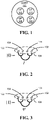
- a topological qubit 100 in the "standard encoding" is comprised of four MZMs/Ising ⁇ quasiparticles 102-108, whose collective topological charge is trivial (i.e., even fermion parity/vacuum topological charge I ), as shown in FIG. 1 .
- FIGS. 2 and 3 A fusion tree for the
- 0 ⁇ basis state is given by the state in which quasiparticles 102 and 104 are in the I fusion channel and quasiparticles 106 and 108 are also in the I fusion channel.
- 1 ⁇ basis state of the qubit 100 is given by the state in which quasiparticles 102 and 104 are in the ⁇ fusion channel and quasiparticles 106 and 108 are also in the ⁇ fusion channel.
- a superconductor 112 such as an s-wave superconductor, has a plurality of nanowires 114 disposed thereon.
- the heterostructure system i.e., the combined nanowires 114 and the superconductor 112, are tuned (using for example, electrostatic gates or local magnetic fields) so that the nanowires 114 (or segments thereof) are driven into the topological (p-wave superconducting) phase.
- a segment of nanowire in the topological phase is referred to as a "Majorana wire".
- ⁇ quasiparticles represent the MZMs localized at the endpoints of topological regions of wire and a topological qubit (in the standard encoding) is comprised of two segments of Majorana wire, as indicated schematically in FIG. 4 .
- 1 ⁇ of the qubit are given by the states in which each of the wire segments has even and odd fermion parity, respectively.
- the topological system 110 also includes an array of gates 116.
- the array of gates 116 may provide, among other things, electrical potential or a magnetic field. In this manner, the array of gates 116 induce the nanowires 114 to change between topological phase and nontopological, normal or "trivial" phase, and vice-versa.
- the topological system 110 also includes a measuring device 118 such as an interferometer that measures quasiparticles.
- the measuring device 118 measure fusion outcomes to determine whether the fusion outcomes are I or ⁇ fusion outcomes.
- Topological Qubit Fusion may be generally described to be an operation acting on two (or more) topological qubits that results in one fewer topological qubit and a new state for the remaining qubit(s). This operation is performed by fusing a number of the anyonic quasiparticles which comprise these qubits, measuring the resulting fusion outcomes, and fusing these resulting fusion outcomes with other quasiparticles that comprised the qubits.
- the resulting operation i.e., the map from the initial state to the final state, will generally depend on the type of anyonic quasiparticles being used and the choice of which quasiparticles are fused.
- Ising-type anyons or MZMs.
- qubit A is comprised of quasiparticles A1, A2, A3, and A4
- qubit B is comprised of quasiparticles B1, B2, B3, and B4.
- quasiparticles A1 and B1 are fused, resulting in the quasiparticle x (which can be either I or ⁇ ), and quasiparticles A2 and B4 are fused, resulting in quasiparticle y (which can be either I or ⁇ ).
- the topological charge values I or ⁇ of quasiparticles x and y are measured.
- quasiparticle x is fused with quasiparticle B2, which results in a ⁇ quasiparticle and is the new quasiparticle 1 of the final topological qubit
- quasiparticle y is fused with quasiparticle B3, which results in a ⁇ quasiparticle and is the new quasiparticle 2 of the final topological qubit.
- ⁇ ⁇ ⁇ 0 ⁇ 0 + ⁇ 1 N xy ⁇ 1
- ⁇ ′ ⁇ ⁇ 0 ⁇ 0 + ⁇ 1 N xy ⁇ 1 ⁇ 1
- Majorana wires are regions within semiconductor wires with strong spin-orbit coupling in which proximity to an s-wave superconductor has induced an effective p-wave pairing of electrons with gap ⁇ 0 .
- two segments of a wire in the topological regime may be extended until they join into a single segment.
- ⁇ I ⁇ ⁇
- I the trivial/vacuum quasiparticle
- ⁇ a fermion.
- a ⁇ outcome will be trapped by a potential well, which is created, for example, by a kink in the chemical potential ⁇ .
- ⁇ is an excitation above the ground state and, for typical system parameters, will have an additional energy of order of 10 meV.
- control gate potentials required to fuse two topological segments of a given wire will be bimodal and can be used to read out the fusion outcome: I (lower energy) or ⁇ (higher energy).
- the topological segments are fused as a result of changing parameters V x , ⁇ , and/or ⁇ 0 . It is possible to control these parameters in such a way that a spatially localized potential well is formed at and shortly after the moment of fusion. This well will trap the fusion outcome (which is only relevant if the outcome happens to be ⁇ ). This is particularly obvious if fusion occurs via gating which increases ⁇ while leaving the other parameters substantially constant; ⁇ will be lower, initially in the region where fusion is incipient.
- Item (1) of the Overview section amounts to controlling gating to maintain this well and hence the localization of any fusion outcome ⁇ .
- the well may be migrated adiabatically to either the left or the right end of the newly formed, unified topological segment of wire.
- the gates along the wire may be adjusted to adiabatically translate one of the endpoints of the wire to the well.
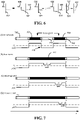
- FIG. 7 illustrates a topological fusion process.
- a nanowire 700 has topological regions 702 and 704 and non-topological region 706 interposing regions 702 and 704.
- ⁇ quasiparticles 708 are located at the ends of the topological regions 702 and 704.
- a potential well 710 is formed from the non-topological region 706.
- the nanowire 700 is tuned such that proximal ends of the topological regions 702 and 704 extend towards each other to form a single topological region 712.
- the potential well 710 traps the fusion outcome ⁇ (or I ).
- the nanowire 700 is further tuned such that the potential well 710 is adiabatically moved toward an end of the topological region 712, where a ⁇ particle is localized. As the potential well 710 is brought into proximity of the end of the topological region 712, the fusion outcome ⁇ tunnels through the potential barrier and the fusion outcome ⁇ fuses with the ⁇ quasiparticle.
- topological segments may be effectively described in terms of the Majorana operators located near the ends of each topological segment. (See, FIG. 8 .)
- the fermion ⁇ (x) ⁇ 3 (x) + i ⁇ 4 (x) is not spatially localized and has an interaction with ⁇ 1 and ⁇ 2 of the form ⁇ ⁇ 1 + i ⁇ ⁇ 2 .
- topological qubit fusion protocol shown in FIG. 5 , which may be used to convert states
- FIG. 9A shows a computational qubit comprised of quasiparticles 102, 104, 106 and 108 in state
- the quasiparticles 102, 104 and 902-908 are localized at ends of Majorana wires (or topological regions) of a nanowire 910. Portions of the nanowire 910 shown in a thick line (between 102 and 104, between 902 and 904, and between 906 and 908) are in topological phase, and portions of the nanowire 910 shown in a narrow line (between 102 and 902 and between 104 and 908) are in normal, nontopological or "trivial" phase.
- FIG. 9B shows potential wells 912 and 914 are formed in the nanowire 910 between quasiparticles 102 and 902 and quasiparticles 104 and 908, respectively.
- the potential wells 912 and 914 are formed from the nontopological or normal phase of the nanowire 910.
- the nanowire 910 is tuned such that segments of the nanowire 910 between the quasiparticles 102 and 902 and the quasiparticles 104 and 908 enter topological phase, thereby moving quasiparticles 102 and 902 towards each other and quasiparticles 104 and 908 towards each other, and forming the respective potential wells 912 and 914.
- FIG. 9C shows the nanowire 910 being in topological phase and having the potential wells 912 and 914 formed therein.
- the potential wells 912 and 914 have trapped fusion outcomes 916 and 918, respectively.
- the fusion outcomes ( I or ⁇ ) trapped in the resulting potential wells 916 and 918 are detected using local energy measurements. The fusion outcomes are recorded.
- FIG. 9D shows the potential wells 912 and 914 with trapped fusion outcomes 916 and 918, respectively, which are adiabatically slid (this may done by "playing the scale” on the control gates) towards specified wire endpoints where the quasiparticles 904, 906 are localized.
- quantum tunneling occurs if one or both of the trapped fusion outcomes 916 and 918 are ⁇ quasiparticles.
- the quasiparticles 904 and 906 are ⁇ quasiparticles (MZMs).
- FIG. 9E shows the nanowire 910 in topological phase after the trapped fusion outcomes 916 and 918 have fused with quasiparticles 904 and 906, respectively, to yield quasiparticles 920 and 922, respectively.
- the quasiparticles 106, 108, 920 and 922 comprise a new topological qubit.
Landscapes
- Engineering & Computer Science (AREA)
- Theoretical Computer Science (AREA)
- Physics & Mathematics (AREA)
- General Physics & Mathematics (AREA)
- Mathematical Physics (AREA)
- Nanotechnology (AREA)
- Chemical & Material Sciences (AREA)
- Evolutionary Computation (AREA)
- Computational Mathematics (AREA)
- Mathematical Optimization (AREA)
- Pure & Applied Mathematics (AREA)
- Computing Systems (AREA)
- General Engineering & Computer Science (AREA)
- Data Mining & Analysis (AREA)
- Software Systems (AREA)
- Condensed Matter Physics & Semiconductors (AREA)
- Mathematical Analysis (AREA)
- Artificial Intelligence (AREA)
- Crystallography & Structural Chemistry (AREA)
- Computer Networks & Wireless Communication (AREA)
- Signal Processing (AREA)
- Superconductor Devices And Manufacturing Methods Thereof (AREA)
- Mram Or Spin Memory Techniques (AREA)
- Management, Administration, Business Operations System, And Electronic Commerce (AREA)
Description
- A number of experiments provide evidence supporting the existence of topological phases of matter with non-Abelian anyonic quasiparticles. Ising-type σ nonAbelian anyons occur as quasiparticles in a number of quantum Hall states that are strong candidates for describing experimentally observed quantum Hall plateaus in the second Landau level, most notably for the v= 5/2 plateau, which has experimental evidence favoring a non-Abelian state. Ising anyons also describe the Majorana fermion zero modes (MZMs) which exist in vortex cores of two-dimensional (2D) chiral p-wave superfluids and superconductors, at the ends of Majorana nanowires (one-dimensional spinless, p-wave superconductors), and quasiparticles in various proposed superconductor heterostructures. Recent experiments in superconductor/semiconductor nanowire heterostructure systems have found evidence of MZMs and hence realization of Majorana.
- Non-Abelian anyonic quasiparticles may be used to provide topologically protected qubits and quantum information processing. Schemes for implementing fusion, (braiding) exchange operations, and topological charge measurements of non-Abelian quasiparticles have previously been disclosed.
- In systems with Ising-type anyons/MZMs, quasiparticle exchange and topological charge measurement allow these systems to be used for topological quantum information processing. Braiding and measurement in these systems allow the topologically protected generation of the Clifford gates, which is not a computationally universal gate set. To make these systems universal quantum computers, it is sufficient to supplement the gate set with a "θ/2-phase gate", R(θ) = diag[1, eiθ] (where diag[1, eiθ] represents a 2x2 matrix in which off diagonal elements are zero (r12= r21=0) and elements r11=1 and r22= eiθ) (in some instances, R(θ) may be written as R(θ)), withθ ≠ nπ/2(for n an integer). A particularly propitious choice for this is to use the π/8-phase gate, T = R(π/4), which can be generated if one has a supply of prepared or "magic states," such as

- J Alicea et al. "Non-abelian statistics and topological quantum information processing in 1D wire networks" Nature Physics vol 7, no5, May 2011 pages 412 to 417 describes implementing braiding of non-Abelian anyons using one-dimensional semiconducting wires. In particular, J Alicea et al describes that the synthesis of a quantum computer remains an ongoing challenge in modern physics. Whereas decoherence stymies most approaches, topological quantum computation schemes evade decoherence at the hardware level by storing quantum information non-locally. In the paper, the authors establish that a key operation-braiding of non-Abelian anyons-can be implemented using one-dimensional semiconducting wires. Such wires can be driven into a topological phase supporting long-sought particles known as Majorana fermions that can encode topological qubits. The authors show that in wire networks, Majorana fermions can be meaningfully braided by simply adjusting gate voltages, and that they exhibit non-Abelian statistics like vortices in a p+i p superconductor. The authors propose experimental set-ups that enable probing of the Majorana fusion rules and the efficient exchange of arbitrary numbers of Majorana fermions.
- The invention is set out in the appended set of claims.
- The detailed description is described with reference to the accompanying figures. In the figures, the left-most digit(s) of a reference number identifies the figure in which the reference number first appears. The same reference numbers in different figures indicate similar or identical items.
-
FIG. 1 is a schematic diagram of an illustrative qubit encoded with four quasiparticles. -
FIG. 2 is a schematic diagram of an illustrative fusion tree of a |0〉 basis state. -
FIG. 3 is a schematic diagram of an illustrative fusion tree of a |1〉 basis state. -
FIG. 4 is a schematic diagram of an illustrative topological system. -
FIG. 5 is an illustrative fusion tree diagram representing a qubit fusion. -
FIG. 6 shows illustrative diagrammetric rules (fusion "F-moves") for quasiparticles. -
FIG. 7 is a flow diagram of an illustrative topological fusion process showing wire segments (in topological and non-topological phases) with their corresponding chemical potential profiles. -
FIG. 8 is a schematic representation of illustrative topological segments of nanowire in the context of Majorana operators. -
FIGS. 9A-9E are schematic illustrations of an exemplary phase gate. - A useful, but, thus far, overlooked topologically protected computational operation (which is disclosed herein) is the fusion of two (or more) topological qubits. "Topological qubit fusion" is an operation acting on two (or more) topological qubits that results in one fewer topological qubit and a new state for the remaining qubit(s). This operation is performed by fusing a number of the anyonic quasiparticles which comprise these qubits, measuring the resulting fusion outcomes, and fusing these resulting fusion outcomes with other quasiparticles that comprised the qubits. (This will be explained in more detail.) Quasiparticle fusion operations and measurement operations have not been previously utilized to produce the topological qubit fusion operation discussed herein. It is important to be able to measure the anyonic fusion outcomes in order to avoid producing mixed states, i.e. introducing decoherence in the resulting states, when performing this operation.
- While fusion of MZMs has been discussed in the context of Majorana wires, a method of trapping and measuring the fusion outcome (I or ψ) when fusing two segments of Majorana wires into one segment has not previously been proposed. Also described herein is a proposal for doing so by: (1) trapping the fusion outcome in a "wire well;" (2) observing whether or not the well is occupied (by a ψ excitation) through local measurements; and (3) fusing any resulting trapped ψ excitation with a MZM by either (a) adiabatically moving the well to a prescribed end of the resulting wire segment or (b) adiabatically moving a prescribed end of the wire to the well.
- As an illustration of the utility of the topological qubit fusion operation, a novel protocol is described using topological qubit fusion for implementing a θ/2-phase gate, R(θ), on a topological qubit comprised of MZMs/Ising σ quasiparticles, given an ancillary topological qubit in the state |Bθ 〉 = cos(θ/2) |0〉 - i sin(θ/2) |1〉.
- Previously disclosed proposals for generating a π/8-phase gate from a magic state (or, more generally, a θ/2-phase gate from a state such as |Bθ 〉) employed the use of entangling gates (such as CNOT gates) and/or non-demolitional entangling two qubit measurements (such as parity measurements). The protocol discussed herein for converting | Bθ〉 states into θ/2 -phase gates using topological qubit fusion has the advantage that it is natural in the anyonic context and does not require performing any entangling gate operations nor non-demolitional entangling two-qubit measurements, which require more difficult interferometric measurements of the collective topological charge of four (or more) quasiparticles, which may be difficult operations to produce (with error protection).
- Using MZMs/Ising-type quasiparticles, as one non-limiting example, a
topological qubit 100 in the "standard encoding" is comprised of four MZMs/Ising σ quasiparticles 102-108, whose collective topological charge is trivial (i.e., even fermion parity/vacuum topological charge I), as shown inFIG. 1 . - A fusion tree for the |0〉 basis state and the |1〉 state of the
qubit 100 is illustrated inFIGS. 2 and 3 , respectively. The |0〉 basis state is given by the state in whichquasiparticles quasiparticles qubit 100 is given by the state in whichquasiparticles quasiparticles - Referring to
FIG. 4 , atopological system 110 for σ quasiparticles is illustrated. Asuperconductor 112, such as an s-wave superconductor, has a plurality ofnanowires 114 disposed thereon. The heterostructure system, i.e., the combinednanowires 114 and thesuperconductor 112, are tuned (using for example, electrostatic gates or local magnetic fields) so that the nanowires 114 (or segments thereof) are driven into the topological (p-wave superconducting) phase. A segment of nanowire in the topological phase is referred to as a "Majorana wire". In Majorana wires the σ quasiparticles represent the MZMs localized at the endpoints of topological regions of wire and a topological qubit (in the standard encoding) is comprised of two segments of Majorana wire, as indicated schematically inFIG. 4 . The basis states |0〉 and |1〉 of the qubit are given by the states in which each of the wire segments has even and odd fermion parity, respectively. - The
topological system 110 also includes an array ofgates 116. The array ofgates 116 may provide, among other things, electrical potential or a magnetic field. In this manner, the array ofgates 116 induce thenanowires 114 to change between topological phase and nontopological, normal or "trivial" phase, and vice-versa. - The
topological system 110 also includes ameasuring device 118 such as an interferometer that measures quasiparticles. Themeasuring device 118 measure fusion outcomes to determine whether the fusion outcomes are I or ψ fusion outcomes. - The processes and systems described herein may be implemented in a number of ways. Example implementations are provided below with reference to the following figures.
- Topological Qubit Fusion may be generally described to be an operation acting on two (or more) topological qubits that results in one fewer topological qubit and a new state for the remaining qubit(s). This operation is performed by fusing a number of the anyonic quasiparticles which comprise these qubits, measuring the resulting fusion outcomes, and fusing these resulting fusion outcomes with other quasiparticles that comprised the qubits.
- The resulting operation, i.e., the map from the initial state to the final state, will generally depend on the type of anyonic quasiparticles being used and the choice of which quasiparticles are fused. To describe this in more detail, consider, as one concrete but non-limiting example, Ising-type anyons (or MZMs). Start with two topological qubits (in the standard encoding): |ΨA 〉 = α0|0〉 + α1|1〉 and |ψB〉 = β 0|0〉 + β 1|1〉, and perform the topological qubit fusion operation shown in
FIG. 5 . - At time t0, qubit A is comprised of quasiparticles A1, A2, A3, and A4, and qubit B is comprised of quasiparticles B1, B2, B3, and B4.
- At time t1, quasiparticles A1 and B1 are fused, resulting in the quasiparticle x (which can be either I or ψ ), and quasiparticles A2 and B4 are fused, resulting in quasiparticle y (which can be either I or ψ ). The topological charge values I or ψ of quasiparticles x and y are measured. Then at time t2, quasiparticle x is fused with quasiparticle B2, which results in a σ quasiparticle and is the
new quasiparticle 1 of the final topological qubit, and quasiparticle y is fused with quasiparticle B3, which results in a σ quasiparticle and is the new quasiparticle 2 of the final topological qubit. Nxy is defined to equal 0 when x ⊗ y = I and equal 1 when x ⊗ y = ψ) (i.e. it is the fermion parity of the fusion outcomes). Then this topological qubit fusion operation is given by
- This result was obtained using the F-moves and bubble contractions depicted in
FIG. 6 , where a dottedline 602, asolid line 604, and asquiggly line 606 represent world lines for I , σ, and ψ, respectively. - One can fuse the quasiparticles in a different manner to produce different topological qubit fusion operations. For example, if one were to fuse quasiparticle A2 of qubit A with quasiparticle B1 of qubit B to give x which is subsequently fused with quasiparticle B2 of qubit B, and also fuse quasiparticle A3 of qubit A with quasiparticle B4 of qubit B to give y which is subsequently fused with quasiparticle B3 of qubit B, the operation would be

- It is straightforward to check that the topological qubit fusion operations for Ising-type quasiparticles described in the previous section can be used to generate unitary operator acting on one of the qubits through a judicious choice of the other qubit. In particular, assume |ΨB 〉 = |Bθ 〉 (as previously defined), then the first topological qubit fusion procedure (shown in
FIG. 5 ) results in the operation |ΨA 〉 ⊗| Bθ 〉 ↦ |Ψ〉 = α0exp
- Majorana wires are regions within semiconductor wires with strong spin-orbit coupling in which proximity to an s-wave superconductor has induced an effective p-wave pairing of electrons with gap Δ0. The fundamental inequality that dictates which regions of the wire are in the topological (Majorana) phase states:
-

-

- All quantities in the above formula can be spatially adjusted with local electric or magnetic fields and are therefore amenable to (time-dependent) gating and control.
- Using either electrical or magnetic gating or both, two segments of a wire in the topological regime may be extended until they join into a single segment. As the segments join, the fusion rules of the Ising tensor category governing the long-range physics allow two distinct fusion outcomes: σ⊗σ = I ⊕ψ, where I is the trivial/vacuum quasiparticle and ψ is a fermion. To avoid decoherence, it is necessary to measure which outcome occurs upon fusion and, if the outcome is ψ, to control (or at least know) what happens to the resulting ψ quasiparticle. A ψ outcome will be trapped by a potential well, which is created, for example, by a kink in the chemical potential µ.
- Fortunately, ψ is an excitation above the ground state and, for typical system parameters, will have an additional energy of order of 10 meV. With careful calibration the control gate potentials required to fuse two topological segments of a given wire will be bimodal and can be used to read out the fusion outcome: I (lower energy) or ψ (higher energy).
- The topological segments are fused as a result of changing parameters V x, µ, and/or Δ0. It is possible to control these parameters in such a way that a spatially localized potential well is formed at and shortly after the moment of fusion. This well will trap the fusion outcome (which is only relevant if the outcome happens to be ψ). This is particularly obvious if fusion occurs via gating which increases µ while leaving the other parameters substantially constant; µ will be lower, initially in the region where fusion is incipient. Item (1) of the Overview section amounts to controlling gating to maintain this well and hence the localization of any fusion outcome ψ.
- Finally, by sequentially adjusting gates along the wire, as in playing a scale on the piano, the well may be migrated adiabatically to either the left or the right end of the newly formed, unified topological segment of wire. Alternatively, the gates along the wire may be adjusted to adiabatically translate one of the endpoints of the wire to the well. When the well and desired endpoint become close to each other (i.e., within a few coherence lengths), the ψ quasiparticle, if present, will fuse with the σ quasiparticle localized at the Majorana wire endpoint (lowering the system energy back to the ground state).
-
FIG. 7 illustrates a topological fusion process. Ananowire 700 hastopological regions non-topological region 706 interposingregions σ quasiparticles 708 are located at the ends of thetopological regions potential well 710 is formed from thenon-topological region 706. - The
nanowire 700 is tuned such that proximal ends of thetopological regions topological region 712. Thepotential well 710 traps the fusion outcome ψ (or I). - The
nanowire 700 is further tuned such that thepotential well 710 is adiabatically moved toward an end of thetopological region 712, where a σ particle is localized. As thepotential well 710 is brought into proximity of the end of thetopological region 712, the fusion outcome ψ tunnels through the potential barrier and the fusion outcome ψ fuses with the σ quasiparticle. - The fusion of topological segments may be effectively described in terms of the Majorana operators located near the ends of each topological segment. (See,
FIG. 8 .) - The fermion ψ(x) = γ3(x) + iγ4(x) is not spatially localized and has an interaction with γ1 and γ2 of the form ψγ1 + iψγ2. ψ will be concentrated near the (normal state) Fermi surface and may be written as ψ = ψkF.
- After fusion the system Hamiltonian will take an effective form H = itγ3γ3 + it42γ4γ2 + it34γ3γ4 where all tij are real.
- An implementation of the topological qubit fusion protocol shown in
FIG. 5 , which may be used to convert states | Bθ 〉 into θ/2-phase gates, R(θ), for Majorana wires is discussed below with respect toFIGS. 9A-9E . -
FIG. 9A shows a computational qubit comprised ofquasiparticles quasiparticles quasiparticles nanowire 910. Portions of thenanowire 910 shown in a thick line (between 102 and 104, between 902 and 904, and between 906 and 908) are in topological phase, and portions of thenanowire 910 shown in a narrow line (between 102 and 902 and between 104 and 908) are in normal, nontopological or "trivial" phase. -
FIG. 9B showspotential wells nanowire 910 betweenquasiparticles quasiparticles potential wells nanowire 910. Thenanowire 910 is tuned such that segments of thenanowire 910 between thequasiparticles quasiparticles quasiparticles quasiparticles potential wells -
FIG. 9C shows thenanowire 910 being in topological phase and having thepotential wells potential wells fusion outcomes potential wells -
FIG. 9D shows thepotential wells fusion outcomes quasiparticles potential wells quasiparticles fusion outcomes quasiparticles -
FIG. 9E shows thenanowire 910 in topological phase after the trappedfusion outcomes quasiparticles quasiparticles quasiparticles - This achieves the θ /2 -phase gate R(θ) if Nxy = 0 or the conjugate -θ/2 phase gate R(-θ) if Nxy = 1. If using θ = π/4, a subsequent braiding operation can be applied to convert R(-π/4) to R(π/4), if necessary.
- The various embodiments described above can be combined to provide further embodiments.
Claims (9)
- A method of providing a topological quantum computing operation, comprising:providing a first quasiparticle (904) and a second quasiparticle (902) respectively localized at second and first ends of a first topological wire (114) segment of a nanowire (114) wherein the first topological wire (114) segment is defined by a first chemical potential;providing a third quasiparticle (102) and a fourth quasiparticle (104) respectively localized at first and second ends of a second topological wire (114) segment of the nanowire (114) wherein the second topological wire (114) segment is defined by a second chemical potential;forming a potential well in a nontopological phase region of the nanowire (114) that extends between the first topological wire (114) segment and the second topological wire (114) segment;turning the nontopological phase region that extends between the second (902) and the third quasiparticles (102) into a topological phase region that extends between the second (902) and the third quasiparticles (102) while maintaining the potential well wherein forming the potential well in the nontopological phase region that extends between the second and the third quasiparticles and turning the nontopological phase region that extends between the second and the third quasiparticles into the topological phase region that extends between the second and the third quasiparticles comprises adjusting an array of gates (116) to drive phase changes in the nanowire that comprises the nontopological phase regions and the first and second topological wire segments;fusing, in the potential well, the second (902) and the third quasiparticles (102) together in a manner that traps a fusion outcome quasiparticle (916) resulting from the fusion of the second (902) and the third quasiparticles (102) in the potential well wherein the fusion outcome quasiparticle is a first fusion outcome quasiparticle (916);using a measuring device (118) measuring the first fusion outcome quasiparticle (916); andusing the array of gates (116):bringing the potential well having the first fusion outcome quasiparticle trapped therein and the second end of the first topological wire segment toward each other; andfusing the first quasiparticle (904) and the first fusion outcome quasiparticle (916) together to yield a second fusion outcome quasiparticle (920).
- The method of claim 1 further comprising:providing a first qubit comprising:the first quasiparticle wherein the first quasiparticle comprises quasiparticle B2 (904),the second quasiparticle wherein the second quasiparticle comprises quasiparticle B1 (902),a quasiparticle B3 (906) and a quasiparticle B4 (908) wherein the quasiparticle B4 (908) and the quasiparticle B3 (906) are respectively localized at first and second ends of a third topological wire (114) segment defined by a third chemical potential;providing a second qubit comprising:the third quasiparticle wherein the third quasiparticle comprises quasiparticle A1 (102),the fourth quasiparticle wherein the fourth quasiparticle comprises quasiparticle A2 (104),a quasiparticle A3 (106) and a quasiparticle A4 (108);forming a second potential well in a nontopological phase region that extends between the third topological wire (114) segment and the second topological wire (114) segment;turning the nontopological phase region that extends between the quasiparticle B4 (908) and the quasiparticle A2 (104) into a topological phase region that extends between the quasiparticle B4 (908) and the quasiparticle A2 (104) while maintaining the second potential well;fusing, in the second potential well, the quasiparticle B4 (908) and the quasiparticle A2 (104) together in a manner that traps a fusion outcome quasiparticle (918) resulting from the fusion of the quasiparticle B4 (908) and the quasiparticle A2 (104) in the second potential well wherein the fusion outcome quasiparticle is a third fusion outcome quasiparticle (918);measuring the third fusion outcome quasiparticle (918); andfusing the quasiparticle B3 (906) and the third fusion outcome quasiparticle (918) together to yield a fourth fusion outcome quasiparticle (922).
- The method of claim 2, wherein:the topological quantum computing operation comprises a θ/2-phase gate on the second qubit;providing the first qubit comprises providing the first qubit in the state |ψb 〉 =

- The method of claim 3 further comprising:calculating the fermion parity of the first fusion outcome quasiparticle (916) and the third fusion outcome quasiparticle (918); andif the fermion parity equals 0 then obtaining the θ/2-phase gate; andif the fermion parity equals 1 then obtaining a conjugate - θ/2-phase gate and correcting for the difference to obtain a θ/2-phase gate.
- The method of claim 3 or claim 4 wherein:
the θ/2-phase gate is a π/8 phase gate. - The method of claim 1, wherein the first topological wire segment is a Majorana wire.
- A quantum computing device, comprising:a nanowire (114) configurable to have a first topological segment and a second topological segment and a nontopological segment, each topological segment having first and second ends and having a respective quasiparticle localized thereat, the nontopological segment extending between the first ends of the first and second topological segments;an array of gates (116) configured to selectively induce changes of phase, from topological to nontopological and vice-versa, in the nanowire and configured to turn the nontopological segment into a topological phase wire segment such that at least one of the quasiparticles localized at the first ends of the first and second topological segments move toward the other and induce a potential well in the nanowire (114) at the nontopological segment that traps a fusion outcome quasiparticle therein, the fusion outcome quasiparticle being the product of fusion of quasiparticles localized at the first ends of the first and the second topological segments and wherein the array of gates is further configured to cause relative motion of the potential well such that the potential well and the second end of the first topological segment are brought towards each other to fuse the fusion outcome quasiparticle with the quasiparticle localized at the second end of the first topological segment; anda measuring device (118) configured to measure the fusion outcome quasiparticle.
- The quantum computing device of claim 7, wherein:the nanowire (114) is further configurable to have a third topological segment having first and second ends and having a respective quasiparticle localized thereat, and a second nontopological segment extending between the second end of the second topological segment and the first end of the third topological segment;the array of gates being further configured to turn the second nontopological segment into a topological phase wire segment such that at least one of the quasiparticles localized at the second end of the second topological segment or the first end of the third topological segment move towards the other and induce a second potential well in the nanowire (114) at the second nontopological segment that traps a second fusion outcome quasiparticle therein, the second fusion outcome quasiparticle being the product of fusion of quasiparticles localized at the second end of the second topological segment and the first end of the third topological segment and wherein the array of gates is further configured to cause motion of the second potential well such that the second potential well and the second end of the third topological segment are brought towards each other to fuse the second fusion outcome quasiparticle with the quasiparticle localized at the second end of the third topological segment; andthe measuring device is further configured to measure the second fusion outcome quasiparticle.
- The quantum computing device of claim 7 or claim 8, wherein the nanowire comprises a Majorana wire.
Applications Claiming Priority (3)
| Application Number | Priority Date | Filing Date | Title |
|---|---|---|---|
| US201361761125P | 2013-02-05 | 2013-02-05 | |
| US13/957,268 US9713199B2 (en) | 2013-02-05 | 2013-08-01 | Topological qubit fusion |
| PCT/US2014/014748 WO2014123932A1 (en) | 2013-02-05 | 2014-02-05 | Topological qubit fusion |
Publications (2)
| Publication Number | Publication Date |
|---|---|
| EP2954465A1 EP2954465A1 (en) | 2015-12-16 |
| EP2954465B1 true EP2954465B1 (en) | 2023-01-11 |
Family
ID=51259653
Family Applications (1)
| Application Number | Title | Priority Date | Filing Date |
|---|---|---|---|
| EP14708151.7A Active EP2954465B1 (en) | 2013-02-05 | 2014-02-05 | Topological qubit fusion |
Country Status (4)
| Country | Link |
|---|---|
| US (2) | US9713199B2 (en) |
| EP (1) | EP2954465B1 (en) |
| CN (1) | CN105164704B (en) |
| WO (1) | WO2014123932A1 (en) |
Families Citing this family (35)
| Publication number | Priority date | Publication date | Assignee | Title |
|---|---|---|---|---|
| US9721209B2 (en) * | 2013-10-14 | 2017-08-01 | Microsoft Technology Licensing, Llc | Method and system for efficient decomposition of single-qubit quantum gates into Fibonacci anyon braid circuits |
| JP2015154416A (en) * | 2014-02-18 | 2015-08-24 | 株式会社東芝 | Magic state generation device, magic state generation method and quantum gate operation method |
| WO2016161220A1 (en) | 2015-04-01 | 2016-10-06 | Microsoft Technology Licensing, Llc | Efficient topological compilation for metaplectic anyon model |
| US10333048B2 (en) * | 2015-09-20 | 2019-06-25 | Microsoft Technology Licensing, Llc | Universal topological quantum computers based on majorana nanowire networks |
| US10133984B2 (en) * | 2015-09-30 | 2018-11-20 | Microsoft Technology Licensing, Llc | Adiabatic phase gates in parity-based quantum computers |
| US10635988B2 (en) * | 2016-08-17 | 2020-04-28 | Microsoft Technology Licensing, Llc | Measuring and manipulating states of non-abelian quasiparticles via quantum dot hybridization energy shifts |
| EP3500984B1 (en) * | 2016-08-17 | 2026-04-08 | Microsoft Technology Licensing, LLC | Quantum computing methods and devices for majorana qubits |
| US10490600B2 (en) * | 2016-08-17 | 2019-11-26 | Microsoft Technology Licensing, Llc | Quantum computing devices with majorana hexon qubits |
| US10346348B2 (en) * | 2016-08-17 | 2019-07-09 | Microsoft Technology Licensing, Llc | Quantum computing methods and devices for Majorana Tetron qubits |
| US10574268B2 (en) * | 2017-02-28 | 2020-02-25 | Microsoft Technology Licensing, Llc | Small Majorana fermion codes |
| DE102017002616A1 (en) * | 2017-03-20 | 2018-09-20 | Forschungszentrum Jülich GmbH | Process for the in-situ production of "Majorana materials - superconductor" hybrid networks, as well as a hybrid structure produced by the process |
| EP3695351B1 (en) | 2017-11-19 | 2024-07-24 | Microsoft Technology Licensing, LLC | Quantum spin hall-based charging energy-protected quantum computation |
| US11121302B2 (en) | 2018-10-11 | 2021-09-14 | SeeQC, Inc. | System and method for superconducting multi-chip module |
| US11144334B2 (en) | 2018-12-20 | 2021-10-12 | Red Hat, Inc. | Quantum computer task manager |
| CN110174193A (en) * | 2019-05-23 | 2019-08-27 | 南京邮电大学 | A kind of field-effect tube strain transducer |
| FI3751472T3 (en) * | 2019-06-13 | 2023-11-23 | Univ Mainz Johannes Gutenberg | Method and apparatus for obtaining anyons, use of the apparatus |
| KR20220044944A (en) | 2019-06-21 | 2022-04-12 | 사이퀀텀, 코퍼레이션 | Photon quantum computer architecture |
| US11474867B2 (en) * | 2019-07-11 | 2022-10-18 | Microsoft Technology Licensing, Llc | Measurement sequence determination for quantum computing device |
| US20210126181A1 (en) * | 2019-10-24 | 2021-04-29 | Microsoft Technology Licensing, Llc | Semiconductor-superconductor hybrid device, its manufacture and uses |
| US12082512B2 (en) * | 2019-10-24 | 2024-09-03 | Microsoft Technology Licensing, Llc | Semiconductor-superconductor hybrid device |
| CN110880039B (en) * | 2019-11-19 | 2020-09-01 | 上海交通大学 | Method for controlling movement of Macarana zero-energy mode by electric field |
| US11515461B2 (en) | 2019-12-27 | 2022-11-29 | International Business Machines Corporation | Superconductor devices having buried quasiparticle traps |
| KR20220143858A (en) * | 2020-01-29 | 2022-10-25 | 사이퀀텀, 코퍼레이션 | Fusion-based quantum computing |
| WO2021202409A1 (en) | 2020-03-30 | 2021-10-07 | Psiquantum, Corp. | Encoded fusion measurements with local adaptivity |
| US11886380B2 (en) | 2020-04-27 | 2024-01-30 | Red Hat, Inc. | Quantum file management system |
| US11416221B2 (en) | 2020-05-12 | 2022-08-16 | Red Hat, Inc. | Quantum entanglement protection |
| US12293259B2 (en) | 2020-05-27 | 2025-05-06 | Red Hat, Inc. | Qubit allocation service |
| US11676059B2 (en) | 2020-06-23 | 2023-06-13 | Red Hat, Inc. | Performing quantum file pattern searching |
| US11556833B2 (en) | 2020-06-25 | 2023-01-17 | Red Hat, Inc. | Performing quantum file concatenation |
| US11580247B2 (en) | 2020-06-25 | 2023-02-14 | Red Hat, Inc. | Systems and methods for quantum file permissions |
| US11562283B2 (en) | 2020-06-25 | 2023-01-24 | Red Hat, Inc. | Performing quantum file copying |
| US12317759B2 (en) * | 2021-02-16 | 2025-05-27 | The Hong Kong University Of Science And Technology | Creating majorana zero modes in quantum anomalous hall insulator/superconductor heterostructures |
| US12333384B1 (en) | 2021-04-16 | 2025-06-17 | Ut-Battelle, Llc | Electro-optical circuit for performing topological quantum computation |
| US12488268B1 (en) | 2021-10-26 | 2025-12-02 | Psiquantum, Corp. | Resource efficient logical quantum gates |
| JP7774738B2 (en) * | 2022-02-10 | 2025-11-21 | プサイクォンタム,コーポレーション | Systems and methods for fault-tolerant quantum computing with reduced idle volume |
Family Cites Families (4)
| Publication number | Priority date | Publication date | Assignee | Title |
|---|---|---|---|---|
| US7250624B1 (en) | 2005-09-23 | 2007-07-31 | Microsoft Corporation | Quasi-particle interferometry for logical gates |
| US8209279B2 (en) | 2007-09-07 | 2012-06-26 | Microsoft Corporation | Measurement-only topological quantum computation |
| US8275428B2 (en) | 2010-05-21 | 2012-09-25 | Microsoft Corporation | Method for planar implementation of π/8 gate in chiral topological superconductors |
| US8648331B2 (en) | 2010-11-10 | 2014-02-11 | Microsoft Corporation | Coherent quantum information transfer between topological and conventional qubits |
-
2013
- 2013-08-01 US US13/957,268 patent/US9713199B2/en active Active
-
2014
- 2014-02-05 CN CN201480007403.7A patent/CN105164704B/en active Active
- 2014-02-05 WO PCT/US2014/014748 patent/WO2014123932A1/en not_active Ceased
- 2014-02-05 EP EP14708151.7A patent/EP2954465B1/en active Active
-
2017
- 2017-06-23 US US15/632,109 patent/US10679138B2/en active Active
Also Published As
| Publication number | Publication date |
|---|---|
| US9713199B2 (en) | 2017-07-18 |
| WO2014123932A1 (en) | 2014-08-14 |
| US20170293854A1 (en) | 2017-10-12 |
| CN105164704B (en) | 2018-07-03 |
| US20140221059A1 (en) | 2014-08-07 |
| CN105164704A (en) | 2015-12-16 |
| EP2954465A1 (en) | 2015-12-16 |
| US10679138B2 (en) | 2020-06-09 |
Similar Documents
| Publication | Publication Date | Title |
|---|---|---|
| US10679138B2 (en) | Topological qubit fusion | |
| US9489634B2 (en) | Topological quantum computation via tunable interactions | |
| EP3500982B1 (en) | Measuring and manipulating states of non-abelian quasiparticles via quantum dot hybridization energy shifts | |
| US20140354326A1 (en) | Quantum Computers Having Partial Interferometric Quantum Gates | |
| Higginbotham et al. | Parity lifetime of bound states in a proximitized semiconductor nanowire | |
| EP3500983B1 (en) | Quantum computing devices with majorana qubits | |
| Bonderson et al. | Topological Quantum Buses: Coherent Quantum Information Transfer between<? format?> Topological and Conventional Qubits | |
| US9152924B2 (en) | Coherent quantum information transfer between conventional qubits | |
| US7364923B2 (en) | Dressed qubits | |
| Zhang et al. | Qubits based on semiconductor quantum dots | |
| US7781754B2 (en) | Fermionic bell-state analyzer and quantum computer using same | |
| EP3500984B1 (en) | Quantum computing methods and devices for majorana qubits | |
| Hussein et al. | Double quantum dot Cooper-pair splitter at finite couplings | |
| Kotetes et al. | Engineering and manipulating topological qubits in 1D quantum wires | |
| Zhang et al. | Cluster-state preparation and multipartite entanglement analyzer with fermions | |
| Otten et al. | Dynamical structure factor in the non-Abelian phase of the Kitaev honeycomb model in the presence of quenched disorder | |
| Ozfidan et al. | Geometry, chirality, topology and electron–electron interactions in the quadruple quantum dot molecule | |
| Del Pozo et al. | A Model for Topological p-wave Superconducting Wires with Disorder and Interactions | |
| Hiltscher et al. | Adiabatic pumping in a double-dot Cooper-pair beam splitter | |
| US20230376816A1 (en) | Method and device for quantum computing with majorana modes | |
| Volmer et al. | Mapping g-factors and complex intervalley coupling in Si/SiGe by conveyor-mode shuttling | |
| Tang et al. | Majorana zero modes in a double-stranded DNA with s-wave superconductor | |
| Tsintzis | Electronic structure and transport in exotic nanostructures | |
| Wong et al. | Properties of topological insulators and superconductors under relativistic gravity | |
| Lv et al. | Detection of topological quantum phases using dynamical methods |
Legal Events
| Date | Code | Title | Description |
|---|---|---|---|
| PUAI | Public reference made under article 153(3) epc to a published international application that has entered the european phase |
Free format text: ORIGINAL CODE: 0009012 |
|
| 17P | Request for examination filed |
Effective date: 20150713 |
|
| AK | Designated contracting states |
Kind code of ref document: A1 Designated state(s): AL AT BE BG CH CY CZ DE DK EE ES FI FR GB GR HR HU IE IS IT LI LT LU LV MC MK MT NL NO PL PT RO RS SE SI SK SM TR |
|
| AX | Request for extension of the european patent |
Extension state: BA ME |
|
| DAX | Request for extension of the european patent (deleted) | ||
| STAA | Information on the status of an ep patent application or granted ep patent |
Free format text: STATUS: EXAMINATION IS IN PROGRESS |
|
| 17Q | First examination report despatched |
Effective date: 20180705 |
|
| RAP3 | Party data changed (applicant data changed or rights of an application transferred) |
Owner name: MICROSOFT TECHNOLOGY LICENSING, LLC |
|
| REG | Reference to a national code |
Ref country code: DE Ref legal event code: R079 Ref document number: 602014086061 Country of ref document: DE Free format text: PREVIOUS MAIN CLASS: G06N0099000000 Ipc: G06N0010400000 |
|
| GRAP | Despatch of communication of intention to grant a patent |
Free format text: ORIGINAL CODE: EPIDOSNIGR1 |
|
| STAA | Information on the status of an ep patent application or granted ep patent |
Free format text: STATUS: GRANT OF PATENT IS INTENDED |
|
| GRAJ | Information related to disapproval of communication of intention to grant by the applicant or resumption of examination proceedings by the epo deleted |
Free format text: ORIGINAL CODE: EPIDOSDIGR1 |
|
| STAA | Information on the status of an ep patent application or granted ep patent |
Free format text: STATUS: EXAMINATION IS IN PROGRESS |
|
| RIC1 | Information provided on ipc code assigned before grant |
Ipc: G06N 10/00 20220101ALI20220830BHEP Ipc: B82Y 10/00 20110101AFI20220830BHEP |
|
| GRAP | Despatch of communication of intention to grant a patent |
Free format text: ORIGINAL CODE: EPIDOSNIGR1 |
|
| STAA | Information on the status of an ep patent application or granted ep patent |
Free format text: STATUS: GRANT OF PATENT IS INTENDED |
|
| RIC1 | Information provided on ipc code assigned before grant |
Ipc: B82Y 10/00 20110101ALI20220907BHEP Ipc: G06N 10/40 20220101AFI20220907BHEP |
|
| INTG | Intention to grant announced |
Effective date: 20220920 |
|
| INTC | Intention to grant announced (deleted) | ||
| INTG | Intention to grant announced |
Effective date: 20221012 |
|
| GRAS | Grant fee paid |
Free format text: ORIGINAL CODE: EPIDOSNIGR3 |
|
| GRAA | (expected) grant |
Free format text: ORIGINAL CODE: 0009210 |
|
| STAA | Information on the status of an ep patent application or granted ep patent |
Free format text: STATUS: THE PATENT HAS BEEN GRANTED |
|
| AK | Designated contracting states |
Kind code of ref document: B1 Designated state(s): AL AT BE BG CH CY CZ DE DK EE ES FI FR GB GR HR HU IE IS IT LI LT LU LV MC MK MT NL NO PL PT RO RS SE SI SK SM TR |
|
| REG | Reference to a national code |
Ref country code: GB Ref legal event code: FG4D |
|
| REG | Reference to a national code |
Ref country code: CH Ref legal event code: EP |
|
| REG | Reference to a national code |
Ref country code: DE Ref legal event code: R096 Ref document number: 602014086061 Country of ref document: DE |
|
| REG | Reference to a national code |
Ref country code: IE Ref legal event code: FG4D |
|
| REG | Reference to a national code |
Ref country code: NL Ref legal event code: FP Ref country code: AT Ref legal event code: REF Ref document number: 1543865 Country of ref document: AT Kind code of ref document: T Effective date: 20230215 |
|
| REG | Reference to a national code |
Ref country code: LT Ref legal event code: MG9D |
|
| P01 | Opt-out of the competence of the unified patent court (upc) registered |
Effective date: 20230501 |
|
| REG | Reference to a national code |
Ref country code: AT Ref legal event code: MK05 Ref document number: 1543865 Country of ref document: AT Kind code of ref document: T Effective date: 20230111 |
|
| PG25 | Lapsed in a contracting state [announced via postgrant information from national office to epo] |
Ref country code: RS Free format text: LAPSE BECAUSE OF FAILURE TO SUBMIT A TRANSLATION OF THE DESCRIPTION OR TO PAY THE FEE WITHIN THE PRESCRIBED TIME-LIMIT Effective date: 20230111 Ref country code: PT Free format text: LAPSE BECAUSE OF FAILURE TO SUBMIT A TRANSLATION OF THE DESCRIPTION OR TO PAY THE FEE WITHIN THE PRESCRIBED TIME-LIMIT Effective date: 20230511 Ref country code: NO Free format text: LAPSE BECAUSE OF FAILURE TO SUBMIT A TRANSLATION OF THE DESCRIPTION OR TO PAY THE FEE WITHIN THE PRESCRIBED TIME-LIMIT Effective date: 20230411 Ref country code: LV Free format text: LAPSE BECAUSE OF FAILURE TO SUBMIT A TRANSLATION OF THE DESCRIPTION OR TO PAY THE FEE WITHIN THE PRESCRIBED TIME-LIMIT Effective date: 20230111 Ref country code: LT Free format text: LAPSE BECAUSE OF FAILURE TO SUBMIT A TRANSLATION OF THE DESCRIPTION OR TO PAY THE FEE WITHIN THE PRESCRIBED TIME-LIMIT Effective date: 20230111 Ref country code: HR Free format text: LAPSE BECAUSE OF FAILURE TO SUBMIT A TRANSLATION OF THE DESCRIPTION OR TO PAY THE FEE WITHIN THE PRESCRIBED TIME-LIMIT Effective date: 20230111 Ref country code: ES Free format text: LAPSE BECAUSE OF FAILURE TO SUBMIT A TRANSLATION OF THE DESCRIPTION OR TO PAY THE FEE WITHIN THE PRESCRIBED TIME-LIMIT Effective date: 20230111 Ref country code: AT Free format text: LAPSE BECAUSE OF FAILURE TO SUBMIT A TRANSLATION OF THE DESCRIPTION OR TO PAY THE FEE WITHIN THE PRESCRIBED TIME-LIMIT Effective date: 20230111 |
|
| PG25 | Lapsed in a contracting state [announced via postgrant information from national office to epo] |
Ref country code: SE Free format text: LAPSE BECAUSE OF FAILURE TO SUBMIT A TRANSLATION OF THE DESCRIPTION OR TO PAY THE FEE WITHIN THE PRESCRIBED TIME-LIMIT Effective date: 20230111 Ref country code: PL Free format text: LAPSE BECAUSE OF FAILURE TO SUBMIT A TRANSLATION OF THE DESCRIPTION OR TO PAY THE FEE WITHIN THE PRESCRIBED TIME-LIMIT Effective date: 20230111 Ref country code: IS Free format text: LAPSE BECAUSE OF FAILURE TO SUBMIT A TRANSLATION OF THE DESCRIPTION OR TO PAY THE FEE WITHIN THE PRESCRIBED TIME-LIMIT Effective date: 20230511 Ref country code: GR Free format text: LAPSE BECAUSE OF FAILURE TO SUBMIT A TRANSLATION OF THE DESCRIPTION OR TO PAY THE FEE WITHIN THE PRESCRIBED TIME-LIMIT Effective date: 20230412 Ref country code: FI Free format text: LAPSE BECAUSE OF FAILURE TO SUBMIT A TRANSLATION OF THE DESCRIPTION OR TO PAY THE FEE WITHIN THE PRESCRIBED TIME-LIMIT Effective date: 20230111 |
|
| REG | Reference to a national code |
Ref country code: CH Ref legal event code: PL |
|
| REG | Reference to a national code |
Ref country code: DE Ref legal event code: R097 Ref document number: 602014086061 Country of ref document: DE |
|
| REG | Reference to a national code |
Ref country code: BE Ref legal event code: MM Effective date: 20230228 |
|
| PG25 | Lapsed in a contracting state [announced via postgrant information from national office to epo] |
Ref country code: SM Free format text: LAPSE BECAUSE OF FAILURE TO SUBMIT A TRANSLATION OF THE DESCRIPTION OR TO PAY THE FEE WITHIN THE PRESCRIBED TIME-LIMIT Effective date: 20230111 Ref country code: RO Free format text: LAPSE BECAUSE OF FAILURE TO SUBMIT A TRANSLATION OF THE DESCRIPTION OR TO PAY THE FEE WITHIN THE PRESCRIBED TIME-LIMIT Effective date: 20230111 Ref country code: MC Free format text: LAPSE BECAUSE OF FAILURE TO SUBMIT A TRANSLATION OF THE DESCRIPTION OR TO PAY THE FEE WITHIN THE PRESCRIBED TIME-LIMIT Effective date: 20230111 Ref country code: LU Free format text: LAPSE BECAUSE OF NON-PAYMENT OF DUE FEES Effective date: 20230205 Ref country code: LI Free format text: LAPSE BECAUSE OF NON-PAYMENT OF DUE FEES Effective date: 20230228 Ref country code: EE Free format text: LAPSE BECAUSE OF FAILURE TO SUBMIT A TRANSLATION OF THE DESCRIPTION OR TO PAY THE FEE WITHIN THE PRESCRIBED TIME-LIMIT Effective date: 20230111 Ref country code: DK Free format text: LAPSE BECAUSE OF FAILURE TO SUBMIT A TRANSLATION OF THE DESCRIPTION OR TO PAY THE FEE WITHIN THE PRESCRIBED TIME-LIMIT Effective date: 20230111 Ref country code: CZ Free format text: LAPSE BECAUSE OF FAILURE TO SUBMIT A TRANSLATION OF THE DESCRIPTION OR TO PAY THE FEE WITHIN THE PRESCRIBED TIME-LIMIT Effective date: 20230111 Ref country code: CH Free format text: LAPSE BECAUSE OF NON-PAYMENT OF DUE FEES Effective date: 20230228 |
|
| PLBE | No opposition filed within time limit |
Free format text: ORIGINAL CODE: 0009261 |
|
| STAA | Information on the status of an ep patent application or granted ep patent |
Free format text: STATUS: NO OPPOSITION FILED WITHIN TIME LIMIT |
|
| PG25 | Lapsed in a contracting state [announced via postgrant information from national office to epo] |
Ref country code: SK Free format text: LAPSE BECAUSE OF FAILURE TO SUBMIT A TRANSLATION OF THE DESCRIPTION OR TO PAY THE FEE WITHIN THE PRESCRIBED TIME-LIMIT Effective date: 20230111 |
|
| 26N | No opposition filed |
Effective date: 20231012 |
|
| REG | Reference to a national code |
Ref country code: IE Ref legal event code: MM4A |
|
| PG25 | Lapsed in a contracting state [announced via postgrant information from national office to epo] |
Ref country code: SI Free format text: LAPSE BECAUSE OF FAILURE TO SUBMIT A TRANSLATION OF THE DESCRIPTION OR TO PAY THE FEE WITHIN THE PRESCRIBED TIME-LIMIT Effective date: 20230111 Ref country code: IE Free format text: LAPSE BECAUSE OF NON-PAYMENT OF DUE FEES Effective date: 20230205 |
|
| PG25 | Lapsed in a contracting state [announced via postgrant information from national office to epo] |
Ref country code: BE Free format text: LAPSE BECAUSE OF NON-PAYMENT OF DUE FEES Effective date: 20230228 |
|
| PG25 | Lapsed in a contracting state [announced via postgrant information from national office to epo] |
Ref country code: IT Free format text: LAPSE BECAUSE OF FAILURE TO SUBMIT A TRANSLATION OF THE DESCRIPTION OR TO PAY THE FEE WITHIN THE PRESCRIBED TIME-LIMIT Effective date: 20230111 |
|
| PG25 | Lapsed in a contracting state [announced via postgrant information from national office to epo] |
Ref country code: BG Free format text: LAPSE BECAUSE OF FAILURE TO SUBMIT A TRANSLATION OF THE DESCRIPTION OR TO PAY THE FEE WITHIN THE PRESCRIBED TIME-LIMIT Effective date: 20230111 |
|
| PG25 | Lapsed in a contracting state [announced via postgrant information from national office to epo] |
Ref country code: BG Free format text: LAPSE BECAUSE OF FAILURE TO SUBMIT A TRANSLATION OF THE DESCRIPTION OR TO PAY THE FEE WITHIN THE PRESCRIBED TIME-LIMIT Effective date: 20230111 |
|
| PG25 | Lapsed in a contracting state [announced via postgrant information from national office to epo] |
Ref country code: CY Free format text: LAPSE BECAUSE OF FAILURE TO SUBMIT A TRANSLATION OF THE DESCRIPTION OR TO PAY THE FEE WITHIN THE PRESCRIBED TIME-LIMIT; INVALID AB INITIO Effective date: 20140205 |
|
| PG25 | Lapsed in a contracting state [announced via postgrant information from national office to epo] |
Ref country code: HU Free format text: LAPSE BECAUSE OF FAILURE TO SUBMIT A TRANSLATION OF THE DESCRIPTION OR TO PAY THE FEE WITHIN THE PRESCRIBED TIME-LIMIT; INVALID AB INITIO Effective date: 20140205 |
|
| PG25 | Lapsed in a contracting state [announced via postgrant information from national office to epo] |
Ref country code: TR Free format text: LAPSE BECAUSE OF FAILURE TO SUBMIT A TRANSLATION OF THE DESCRIPTION OR TO PAY THE FEE WITHIN THE PRESCRIBED TIME-LIMIT Effective date: 20230111 |
|
| PGFP | Annual fee paid to national office [announced via postgrant information from national office to epo] |
Ref country code: NL Payment date: 20260121 Year of fee payment: 13 |
|
| PGFP | Annual fee paid to national office [announced via postgrant information from national office to epo] |
Ref country code: GB Payment date: 20260122 Year of fee payment: 13 |
|
| PGFP | Annual fee paid to national office [announced via postgrant information from national office to epo] |
Ref country code: DE Payment date: 20260121 Year of fee payment: 13 |
|
| PGFP | Annual fee paid to national office [announced via postgrant information from national office to epo] |
Ref country code: FR Payment date: 20260121 Year of fee payment: 13 |