EP2953463B1 - 3-alkyl-5-fluoro-4-substituted-imino-3,4-dihydropyrimidin-2(1h)-one derivatives as fungicides - Google Patents
3-alkyl-5-fluoro-4-substituted-imino-3,4-dihydropyrimidin-2(1h)-one derivatives as fungicides Download PDFInfo
- Publication number
- EP2953463B1 EP2953463B1 EP13869177.9A EP13869177A EP2953463B1 EP 2953463 B1 EP2953463 B1 EP 2953463B1 EP 13869177 A EP13869177 A EP 13869177A EP 2953463 B1 EP2953463 B1 EP 2953463B1
- Authority
- EP
- European Patent Office
- Prior art keywords
- alkyl
- optionally substituted
- phenyl
- compound
- methyl
- Prior art date
- Legal status (The legal status is an assumption and is not a legal conclusion. Google has not performed a legal analysis and makes no representation as to the accuracy of the status listed.)
- Active
Links
- 0 Cc(cc1)ccc1S(N(C[C@](C(N1**)=NC)F)C1=O)(=O)=O Chemical compound Cc(cc1)ccc1S(N(C[C@](C(N1**)=NC)F)C1=O)(=O)=O 0.000 description 4
- LWWIETMMIDEPTH-NBVRZTHBSA-N CC(/N=C(\C(F)=CN1S(c(cc2C)c(C)cc2Cl)(=O)=O)/N(C)C1=O)=O Chemical compound CC(/N=C(\C(F)=CN1S(c(cc2C)c(C)cc2Cl)(=O)=O)/N(C)C1=O)=O LWWIETMMIDEPTH-NBVRZTHBSA-N 0.000 description 1
- AOJPICJJHQPUIB-GHRIWEEISA-N CCc(cc1)ccc1S(N(C=C(/C(/N1C)=N\C(OC)=O)F)C1=O)(=O)=O Chemical compound CCc(cc1)ccc1S(N(C=C(/C(/N1C)=N\C(OC)=O)F)C1=O)(=O)=O AOJPICJJHQPUIB-GHRIWEEISA-N 0.000 description 1
- DOYCTDGDMJEPAY-RVDMUPIBSA-N CN(/C(/C(F)=CN1S(c(cc2)ccc2Cl)(=O)=O)=N/C)C1=O Chemical compound CN(/C(/C(F)=CN1S(c(cc2)ccc2Cl)(=O)=O)=N/C)C1=O DOYCTDGDMJEPAY-RVDMUPIBSA-N 0.000 description 1
- XHHASQMIGMMWDC-FOWTUZBSSA-N CN(/C(/C(F)=CN1S(c(cc2)ccc2OC)(=O)=O)=N/C(OC)=O)C1=O Chemical compound CN(/C(/C(F)=CN1S(c(cc2)ccc2OC)(=O)=O)=N/C(OC)=O)C1=O XHHASQMIGMMWDC-FOWTUZBSSA-N 0.000 description 1
- JWPVDHSIWPWKNH-LFIBNONCSA-N CN(/C(/C(F)=CN1S(c(ccc(F)c2)c2Cl)(=O)=O)=N/C)C1=O Chemical compound CN(/C(/C(F)=CN1S(c(ccc(F)c2)c2Cl)(=O)=O)=N/C)C1=O JWPVDHSIWPWKNH-LFIBNONCSA-N 0.000 description 1
- IDLRBCQFBIUUCO-FMIVXFBMSA-N CN(/C(/C(F)=CN1S(c2c[s]cc2)(=O)=O)=N/C)C1=O Chemical compound CN(/C(/C(F)=CN1S(c2c[s]cc2)(=O)=O)=N/C)C1=O IDLRBCQFBIUUCO-FMIVXFBMSA-N 0.000 description 1
- KAJVIZDFWHFYQN-FOWTUZBSSA-N CN(/C(/C(F)=CN1S(c2cc(C#N)ccc2)(=O)=O)=N/C)C1=O Chemical compound CN(/C(/C(F)=CN1S(c2cc(C#N)ccc2)(=O)=O)=N/C)C1=O KAJVIZDFWHFYQN-FOWTUZBSSA-N 0.000 description 1
- FAWMSDGCOUZABC-FMIVXFBMSA-N CN(/C(/C(F)=CN1S(c2ccc[s]2)(=O)=O)=N/C)C1=O Chemical compound CN(/C(/C(F)=CN1S(c2ccc[s]2)(=O)=O)=N/C)C1=O FAWMSDGCOUZABC-FMIVXFBMSA-N 0.000 description 1
- QJQFJNIESLHHKY-RVDMUPIBSA-N CN(/C(/C(F)=CN1S(c2cccc(F)c2)(=O)=O)=N/C)C1=O Chemical compound CN(/C(/C(F)=CN1S(c2cccc(F)c2)(=O)=O)=N/C)C1=O QJQFJNIESLHHKY-RVDMUPIBSA-N 0.000 description 1
- YMEOHQDBHNWZMU-HEHNFIMWSA-N CN(/C(/C(F)=CN1S(c2ccccc2)(=O)=O)=N/Cc2ccccc2F)C1=O Chemical compound CN(/C(/C(F)=CN1S(c2ccccc2)(=O)=O)=N/Cc2ccccc2F)C1=O YMEOHQDBHNWZMU-HEHNFIMWSA-N 0.000 description 1
- OZEDKLONGLDVHD-FOWTUZBSSA-N Cc(c(Cl)c1)ccc1S(N(C=C(/C(/N1C)=N\C)F)C1=O)(=O)=O Chemical compound Cc(c(Cl)c1)ccc1S(N(C=C(/C(/N1C)=N\C)F)C1=O)(=O)=O OZEDKLONGLDVHD-FOWTUZBSSA-N 0.000 description 1
- QRYOXTDXLRBXNJ-QGOAFFKASA-N Cc(cc(c(C)c1)Cl)c1S(N(C=C(/C(/N1C)=N\C(OC)=O)F)C1=O)(=O)=O Chemical compound Cc(cc(c(C)c1)Cl)c1S(N(C=C(/C(/N1C)=N\C(OC)=O)F)C1=O)(=O)=O QRYOXTDXLRBXNJ-QGOAFFKASA-N 0.000 description 1
- QNEHQTMKCLHOBC-LYBHJNIJSA-N Cc(cc(c(C)c1)Cl)c1S(N(C=C(/C(/N1C)=N\Cc2ccccc2F)F)C1=O)(=O)=O Chemical compound Cc(cc(c(C)c1)Cl)c1S(N(C=C(/C(/N1C)=N\Cc2ccccc2F)F)C1=O)(=O)=O QNEHQTMKCLHOBC-LYBHJNIJSA-N 0.000 description 1
- KDWPHYOSVVMQFP-UKTHLTGXSA-N Cc(nc(C)[s]1)c1S(N(C=C(/C(/N1C)=N\C)F)C1=O)(=O)=O Chemical compound Cc(nc(C)[s]1)c1S(N(C=C(/C(/N1C)=N\C)F)C1=O)(=O)=O KDWPHYOSVVMQFP-UKTHLTGXSA-N 0.000 description 1
- QDNHFFKVSCGRNZ-JLHYYAGUSA-N Cc1n[o]c(C)c1S(N(C=C(/C(/N1C)=N\C)F)C1=O)(=O)=O Chemical compound Cc1n[o]c(C)c1S(N(C=C(/C(/N1C)=N\C)F)C1=O)(=O)=O QDNHFFKVSCGRNZ-JLHYYAGUSA-N 0.000 description 1
Classifications
-
- A—HUMAN NECESSITIES
- A01—AGRICULTURE; FORESTRY; ANIMAL HUSBANDRY; HUNTING; TRAPPING; FISHING
- A01N—PRESERVATION OF BODIES OF HUMANS OR ANIMALS OR PLANTS OR PARTS THEREOF; BIOCIDES, e.g. AS DISINFECTANTS, AS PESTICIDES OR AS HERBICIDES; PEST REPELLANTS OR ATTRACTANTS; PLANT GROWTH REGULATORS
- A01N47/00—Biocides, pest repellants or attractants, or plant growth regulators containing organic compounds containing a carbon atom not being member of a ring and having no bond to a carbon or hydrogen atom, e.g. derivatives of carbonic acid
- A01N47/40—Biocides, pest repellants or attractants, or plant growth regulators containing organic compounds containing a carbon atom not being member of a ring and having no bond to a carbon or hydrogen atom, e.g. derivatives of carbonic acid the carbon atom having a double or triple bond to nitrogen, e.g. cyanates, cyanamides
-
- A—HUMAN NECESSITIES
- A01—AGRICULTURE; FORESTRY; ANIMAL HUSBANDRY; HUNTING; TRAPPING; FISHING
- A01N—PRESERVATION OF BODIES OF HUMANS OR ANIMALS OR PLANTS OR PARTS THEREOF; BIOCIDES, e.g. AS DISINFECTANTS, AS PESTICIDES OR AS HERBICIDES; PEST REPELLANTS OR ATTRACTANTS; PLANT GROWTH REGULATORS
- A01N43/00—Biocides, pest repellants or attractants, or plant growth regulators containing heterocyclic compounds
- A01N43/48—Biocides, pest repellants or attractants, or plant growth regulators containing heterocyclic compounds having rings with two nitrogen atoms as the only ring hetero atoms
- A01N43/54—1,3-Diazines; Hydrogenated 1,3-diazines
-
- A—HUMAN NECESSITIES
- A01—AGRICULTURE; FORESTRY; ANIMAL HUSBANDRY; HUNTING; TRAPPING; FISHING
- A01N—PRESERVATION OF BODIES OF HUMANS OR ANIMALS OR PLANTS OR PARTS THEREOF; BIOCIDES, e.g. AS DISINFECTANTS, AS PESTICIDES OR AS HERBICIDES; PEST REPELLANTS OR ATTRACTANTS; PLANT GROWTH REGULATORS
- A01N43/00—Biocides, pest repellants or attractants, or plant growth regulators containing heterocyclic compounds
- A01N43/48—Biocides, pest repellants or attractants, or plant growth regulators containing heterocyclic compounds having rings with two nitrogen atoms as the only ring hetero atoms
- A01N43/56—1,2-Diazoles; Hydrogenated 1,2-diazoles
-
- A—HUMAN NECESSITIES
- A01—AGRICULTURE; FORESTRY; ANIMAL HUSBANDRY; HUNTING; TRAPPING; FISHING
- A01N—PRESERVATION OF BODIES OF HUMANS OR ANIMALS OR PLANTS OR PARTS THEREOF; BIOCIDES, e.g. AS DISINFECTANTS, AS PESTICIDES OR AS HERBICIDES; PEST REPELLANTS OR ATTRACTANTS; PLANT GROWTH REGULATORS
- A01N43/00—Biocides, pest repellants or attractants, or plant growth regulators containing heterocyclic compounds
- A01N43/72—Biocides, pest repellants or attractants, or plant growth regulators containing heterocyclic compounds having rings with nitrogen atoms and oxygen or sulfur atoms as ring hetero atoms
- A01N43/74—Biocides, pest repellants or attractants, or plant growth regulators containing heterocyclic compounds having rings with nitrogen atoms and oxygen or sulfur atoms as ring hetero atoms five-membered rings with one nitrogen atom and either one oxygen atom or one sulfur atom in positions 1,3
- A01N43/78—1,3-Thiazoles; Hydrogenated 1,3-thiazoles
-
- A—HUMAN NECESSITIES
- A01—AGRICULTURE; FORESTRY; ANIMAL HUSBANDRY; HUNTING; TRAPPING; FISHING
- A01N—PRESERVATION OF BODIES OF HUMANS OR ANIMALS OR PLANTS OR PARTS THEREOF; BIOCIDES, e.g. AS DISINFECTANTS, AS PESTICIDES OR AS HERBICIDES; PEST REPELLANTS OR ATTRACTANTS; PLANT GROWTH REGULATORS
- A01N43/00—Biocides, pest repellants or attractants, or plant growth regulators containing heterocyclic compounds
- A01N43/72—Biocides, pest repellants or attractants, or plant growth regulators containing heterocyclic compounds having rings with nitrogen atoms and oxygen or sulfur atoms as ring hetero atoms
- A01N43/80—Biocides, pest repellants or attractants, or plant growth regulators containing heterocyclic compounds having rings with nitrogen atoms and oxygen or sulfur atoms as ring hetero atoms five-membered rings with one nitrogen atom and either one oxygen atom or one sulfur atom in positions 1,2
-
- A—HUMAN NECESSITIES
- A01—AGRICULTURE; FORESTRY; ANIMAL HUSBANDRY; HUNTING; TRAPPING; FISHING
- A01N—PRESERVATION OF BODIES OF HUMANS OR ANIMALS OR PLANTS OR PARTS THEREOF; BIOCIDES, e.g. AS DISINFECTANTS, AS PESTICIDES OR AS HERBICIDES; PEST REPELLANTS OR ATTRACTANTS; PLANT GROWTH REGULATORS
- A01N47/00—Biocides, pest repellants or attractants, or plant growth regulators containing organic compounds containing a carbon atom not being member of a ring and having no bond to a carbon or hydrogen atom, e.g. derivatives of carbonic acid
- A01N47/02—Biocides, pest repellants or attractants, or plant growth regulators containing organic compounds containing a carbon atom not being member of a ring and having no bond to a carbon or hydrogen atom, e.g. derivatives of carbonic acid the carbon atom having no bond to a nitrogen atom
-
- A—HUMAN NECESSITIES
- A01—AGRICULTURE; FORESTRY; ANIMAL HUSBANDRY; HUNTING; TRAPPING; FISHING
- A01N—PRESERVATION OF BODIES OF HUMANS OR ANIMALS OR PLANTS OR PARTS THEREOF; BIOCIDES, e.g. AS DISINFECTANTS, AS PESTICIDES OR AS HERBICIDES; PEST REPELLANTS OR ATTRACTANTS; PLANT GROWTH REGULATORS
- A01N47/00—Biocides, pest repellants or attractants, or plant growth regulators containing organic compounds containing a carbon atom not being member of a ring and having no bond to a carbon or hydrogen atom, e.g. derivatives of carbonic acid
- A01N47/08—Biocides, pest repellants or attractants, or plant growth regulators containing organic compounds containing a carbon atom not being member of a ring and having no bond to a carbon or hydrogen atom, e.g. derivatives of carbonic acid the carbon atom having one or more single bonds to nitrogen atoms
- A01N47/10—Carbamic acid derivatives, i.e. containing the group —O—CO—N<; Thio analogues thereof
- A01N47/12—Carbamic acid derivatives, i.e. containing the group —O—CO—N<; Thio analogues thereof containing a —O—CO—N< group, or a thio analogue thereof, neither directly attached to a ring nor the nitrogen atom being a member of a heterocyclic ring
-
- A—HUMAN NECESSITIES
- A01—AGRICULTURE; FORESTRY; ANIMAL HUSBANDRY; HUNTING; TRAPPING; FISHING
- A01N—PRESERVATION OF BODIES OF HUMANS OR ANIMALS OR PLANTS OR PARTS THEREOF; BIOCIDES, e.g. AS DISINFECTANTS, AS PESTICIDES OR AS HERBICIDES; PEST REPELLANTS OR ATTRACTANTS; PLANT GROWTH REGULATORS
- A01N47/00—Biocides, pest repellants or attractants, or plant growth regulators containing organic compounds containing a carbon atom not being member of a ring and having no bond to a carbon or hydrogen atom, e.g. derivatives of carbonic acid
- A01N47/08—Biocides, pest repellants or attractants, or plant growth regulators containing organic compounds containing a carbon atom not being member of a ring and having no bond to a carbon or hydrogen atom, e.g. derivatives of carbonic acid the carbon atom having one or more single bonds to nitrogen atoms
- A01N47/10—Carbamic acid derivatives, i.e. containing the group —O—CO—N<; Thio analogues thereof
- A01N47/18—Carbamic acid derivatives, i.e. containing the group —O—CO—N<; Thio analogues thereof containing a —O—CO—N< group, or a thio analogue thereof, directly attached to a heterocyclic or cycloaliphatic ring
-
- A—HUMAN NECESSITIES
- A01—AGRICULTURE; FORESTRY; ANIMAL HUSBANDRY; HUNTING; TRAPPING; FISHING
- A01N—PRESERVATION OF BODIES OF HUMANS OR ANIMALS OR PLANTS OR PARTS THEREOF; BIOCIDES, e.g. AS DISINFECTANTS, AS PESTICIDES OR AS HERBICIDES; PEST REPELLANTS OR ATTRACTANTS; PLANT GROWTH REGULATORS
- A01N47/00—Biocides, pest repellants or attractants, or plant growth regulators containing organic compounds containing a carbon atom not being member of a ring and having no bond to a carbon or hydrogen atom, e.g. derivatives of carbonic acid
- A01N47/08—Biocides, pest repellants or attractants, or plant growth regulators containing organic compounds containing a carbon atom not being member of a ring and having no bond to a carbon or hydrogen atom, e.g. derivatives of carbonic acid the carbon atom having one or more single bonds to nitrogen atoms
- A01N47/10—Carbamic acid derivatives, i.e. containing the group —O—CO—N<; Thio analogues thereof
- A01N47/22—O-Aryl or S-Aryl esters thereof
-
- A—HUMAN NECESSITIES
- A61—MEDICAL OR VETERINARY SCIENCE; HYGIENE
- A61K—PREPARATIONS FOR MEDICAL, DENTAL OR TOILETRY PURPOSES
- A61K31/00—Medicinal preparations containing organic active ingredients
- A61K31/33—Heterocyclic compounds
- A61K31/395—Heterocyclic compounds having nitrogen as a ring hetero atom, e.g. guanethidine or rifamycins
- A61K31/495—Heterocyclic compounds having nitrogen as a ring hetero atom, e.g. guanethidine or rifamycins having six-membered rings with two or more nitrogen atoms as the only ring heteroatoms, e.g. piperazine or tetrazines
- A61K31/505—Pyrimidines; Hydrogenated pyrimidines, e.g. trimethoprim
- A61K31/513—Pyrimidines; Hydrogenated pyrimidines, e.g. trimethoprim having oxo groups directly attached to the heterocyclic ring, e.g. cytosine
-
- C—CHEMISTRY; METALLURGY
- C07—ORGANIC CHEMISTRY
- C07B—GENERAL METHODS OF ORGANIC CHEMISTRY; APPARATUS THEREFOR
- C07B59/00—Introduction of isotopes of elements into organic compounds ; Labelled organic compounds per se
- C07B59/002—Heterocyclic compounds
-
- C—CHEMISTRY; METALLURGY
- C07—ORGANIC CHEMISTRY
- C07D—HETEROCYCLIC COMPOUNDS
- C07D239/00—Heterocyclic compounds containing 1,3-diazine or hydrogenated 1,3-diazine rings
- C07D239/02—Heterocyclic compounds containing 1,3-diazine or hydrogenated 1,3-diazine rings not condensed with other rings
- C07D239/24—Heterocyclic compounds containing 1,3-diazine or hydrogenated 1,3-diazine rings not condensed with other rings having three or more double bonds between ring members or between ring members and non-ring members
- C07D239/28—Heterocyclic compounds containing 1,3-diazine or hydrogenated 1,3-diazine rings not condensed with other rings having three or more double bonds between ring members or between ring members and non-ring members with hetero atoms or with carbon atoms having three bonds to hetero atoms with at the most one bond to halogen, directly attached to ring carbon atoms
- C07D239/46—Two or more oxygen, sulphur or nitrogen atoms
- C07D239/47—One nitrogen atom and one oxygen or sulfur atom, e.g. cytosine
-
- C—CHEMISTRY; METALLURGY
- C07—ORGANIC CHEMISTRY
- C07D—HETEROCYCLIC COMPOUNDS
- C07D403/00—Heterocyclic compounds containing two or more hetero rings, having nitrogen atoms as the only ring hetero atoms, not provided for by group C07D401/00
- C07D403/02—Heterocyclic compounds containing two or more hetero rings, having nitrogen atoms as the only ring hetero atoms, not provided for by group C07D401/00 containing two hetero rings
- C07D403/12—Heterocyclic compounds containing two or more hetero rings, having nitrogen atoms as the only ring hetero atoms, not provided for by group C07D401/00 containing two hetero rings linked by a chain containing hetero atoms as chain links
-
- C—CHEMISTRY; METALLURGY
- C07—ORGANIC CHEMISTRY
- C07D—HETEROCYCLIC COMPOUNDS
- C07D409/00—Heterocyclic compounds containing two or more hetero rings, at least one ring having sulfur atoms as the only ring hetero atoms
- C07D409/02—Heterocyclic compounds containing two or more hetero rings, at least one ring having sulfur atoms as the only ring hetero atoms containing two hetero rings
- C07D409/12—Heterocyclic compounds containing two or more hetero rings, at least one ring having sulfur atoms as the only ring hetero atoms containing two hetero rings linked by a chain containing hetero atoms as chain links
-
- C—CHEMISTRY; METALLURGY
- C07—ORGANIC CHEMISTRY
- C07D—HETEROCYCLIC COMPOUNDS
- C07D413/00—Heterocyclic compounds containing two or more hetero rings, at least one ring having nitrogen and oxygen atoms as the only ring hetero atoms
- C07D413/02—Heterocyclic compounds containing two or more hetero rings, at least one ring having nitrogen and oxygen atoms as the only ring hetero atoms containing two hetero rings
- C07D413/12—Heterocyclic compounds containing two or more hetero rings, at least one ring having nitrogen and oxygen atoms as the only ring hetero atoms containing two hetero rings linked by a chain containing hetero atoms as chain links
-
- C—CHEMISTRY; METALLURGY
- C07—ORGANIC CHEMISTRY
- C07D—HETEROCYCLIC COMPOUNDS
- C07D417/00—Heterocyclic compounds containing two or more hetero rings, at least one ring having nitrogen and sulfur atoms as the only ring hetero atoms, not provided for by group C07D415/00
- C07D417/02—Heterocyclic compounds containing two or more hetero rings, at least one ring having nitrogen and sulfur atoms as the only ring hetero atoms, not provided for by group C07D415/00 containing two hetero rings
- C07D417/12—Heterocyclic compounds containing two or more hetero rings, at least one ring having nitrogen and sulfur atoms as the only ring hetero atoms, not provided for by group C07D415/00 containing two hetero rings linked by a chain containing hetero atoms as chain links
-
- C—CHEMISTRY; METALLURGY
- C07—ORGANIC CHEMISTRY
- C07B—GENERAL METHODS OF ORGANIC CHEMISTRY; APPARATUS THEREFOR
- C07B2200/00—Indexing scheme relating to specific properties of organic compounds
- C07B2200/05—Isotopically modified compounds, e.g. labelled
Definitions
- Fungicides are compounds, of natural or synthetic origin, which act to protect and/or cure plants against damage caused by agriculturally relevant fungi. Generally, no single fungicide is useful in all situations. Consequently, research is ongoing to produce fungicides that may have better performance, are easier to use, and cost less.
- US 2011/263627 A1 (Boebel et al.), published October 27, 2011 , discloses N3-substituted-Nl-sulfonyl-5-fluoropyrimidinones and their use as fungicides.
- WO 2011/017547 A1 (Boebel et al.), published February 10, 2011 , discloses N1-sulfonyl-5-fluoropyrimidinones and their use as fungicides.
- US 6,617,330 B2 (Walter), issued September 9, 2003 , discloses pyrimidin-4-enamines that have plant-protective properties and are suitable for protecting plants against infestations by phytopathogenic microorganisms and insecticidal attack.
- the present disclosure relates to 3-alkyl-5-fluoro-4-imino-3,4-dihydropyrimidin-2(1 H )one compounds and their use as fungicides.
- the compounds of the present disclosure may offer protection against ascomycetes, basidiomycetes, deuteromycetes and oomycetes.
- R 4 is independently C 1 -C 6 alkyl, C 1 -C 4 alkoxy, C 1 -C 4 alkylthio, hydroxyl, or deuterium.
- R 5 is C 1 -C 6 alkyl, C 1 -C 6 haloalkyl, phenyl or benzyl wherein each of the phenyl or the benzyl may be optionally substituted with 1-3 R 10 .
- R 6 is independently halogen, C 1 -C 6 alkyl, C 1 -C 4 haloalkyl, C 1 -C 4 alkoxy, C 1 -C 4 alkylthio, or deuterium.
- R 7 is C 1 -C 6 alkyl, C 1 -C 6 haloalkyl, phenyl or benzyl wherein each of the phenyl or the benzyl may be optionally substituted with 1-3 R 10 .
- R 10 is independently halogen, C 1 -C 6 alkyl, C 1 -C 4 haloalkyl, C 1 -C 4 alkoxy, C 1 -C 4 haloalkoxy, C 1 -C 4 alkylthio, cyano, or nitro.
- R 9 is phenyl optionally substituted with 1-3 R 10 , or a 5- or 6-membered saturated or unsaturated ring containing 1-3 heteroatoms optionally substituted with 1-3 R 10 .
- R 10 is independently halogen, C 1 -C 6 alkyl, C 1 -C 4 alkoxy, C 1 -C 4 haloalkoxy.
- R 1 is C 1 -C 3 alkyl.
- R 5 is C 1 -C 3 alkyl or phenyl.
- R 1 is C 1 -C 3 alkyl.
- R 9 is selected from the group consisting of:
- R 5 is C 1 -C 3 alkyl or phenyl.
- R 1 is C 1 -C 3 alkyl.
- compositions for the control of a fungal pathogen including; at least one compound of Formula I; and a phytologically acceptable carrier material, wherein said compositon is effective for the control of at least one pathogenic fungus or pathogenic fungus like organism.
- the pathogenic fungus or fungus like pathogen is Septoria tritici.
- a method for treating a plant comprising the steps of: applying a fungicidally effective amount of at least one of the compounds of Formula 1 to at least one surface, selected from the group of surfaces consisting of: at least one portion of a plant, an area adjacent to a plant, soil in contact with a plant, solid adjacent to a plant, a seed, and agricultural equipment.
- the fungicidally effective amount Formula I is applied to a surface in the range of about 0.01g/m 2 to about 0.45 g/m 2 of Formula I.
- Another embodiment of the present disclosure may include a fungicidal composition for the control or prevention of fungal attack comprising the compounds described below and a phytologically acceptable carrier material.
- Yet another embodiment of the present disclosure may include a method for the control or prevention of fungal attack on a plant, the method including the steps of applying a fungicidally effective amount of one or more of the compounds described below to at least one of the fungus, the plant, an area adjacent to the plant, and the seed adapted to produce the plant.
- alkyl refers to a branched, unbranched, or cyclic carbon chain, including methyl, ethyl, propyl, butyl, isopropyl, isobutyl, tertiary butyl, pentyl, hexyl, cyclopropyl, cyclobutyl, cyclopentyl and cyclohexyl.
- alkenyl refers to a branched, unbranched or cyclic carbon chain containing one or more double bonds including ethenyl, propenyl, butenyl, isopropenyl, isobutenyl and cyclohexenyl.
- alkynyl refers to a branched or unbranched carbon chain containing one or more triple bonds including propynyl and butynyl.
- 'R' refers to the group consisting of C 1-8 alkyl, C 3-8 alkenyl or C 3-8 alkynyl, unless stated otherwise.
- alkoxy refers to an -OR substituent.
- alkoxycarbonyl refers to a -C(O)-OR substituent.
- alkylcarbonyl refers to a -C(O)-R substituent.
- alkylsulfonyl refers to an -SO 2 -R substituent.
- alkylthio refers to an -S-R substituent.
- halothio refers to a sulfur substituted with three or five F substituents.
- haloalkylthio refers to an alkylthio, which is substituted with Cl, F, I, or Br or any combination thereof.
- alkylaminocarbonyl refers to a -C(O)-N(H)-R substituent.
- cyano refers to a -C ⁇ N substituent.
- hydroxyl refers to an -OH substituent.
- amino refers to a -NH 2 substituent.
- alkylamino refers to a -N(H)-R substituent.
- dialkylamino refers to a -NR 2 substituent.
- alkoxyalkyl refers to an alkoxy substitution on an alkyl.
- halogen refers to one or more halogen atoms, defined as F, Cl, Br, and I.
- nitro refers to a -NO 2 substituent.
- references to the compounds of Formula I is read as also including optical isomers and salts of Formula I, and hydrates thereof. Specifically, when Formula I contains a branched chain alkyl group, it is understood that such compounds include optical isomers and racemates thereof. Exemplary salts include: hydrochloride, hydrobromide and hydroiodide. Additionally, the compounds of Formula I may include tautomeric forms.
- Fungicidally effective amount of the compounds include amounts sufficient to kill or control true fungi, pseudo-fungi, and related organisms including water moulds.
- Another embodiment of the present disclosure is a use of a compound of Formula I, for protection of a plant against attack by a phytopathogenic organism or the treatment of a plant infested by a phytopathogenic organism, comprising the application of a compound of Formula I, or a composition comprising the compound to soil, a plant, a part of a plant, foliage, and/or seeds.
- composition useful for protecting a plant against attack by a phytopathogenic organism and/or treatment of a plant infested by a phytopathogenic organism comprising a compound of Formula I and a phytologically acceptable carrier material.
- the compounds of the present disclosure may be applied by any of a variety of known techniques, either as the compounds or as formulations comprising the compounds.
- the compounds may be applied to the roots, seeds or foliage of plants for the control of various fungi, without damaging the commercial value of the plants.
- the materials may be applied in the form of any of the generally used formulation types, for example, as solutions, dusts, wettable powders, flowable concentrates, or emulsifiable concentrates.
- the compounds of the present disclosure are applied in the form of a formulation, comprising one or more of the compounds of Formula I with a phytologically acceptable carrier.
- Concentrated formulations may be dispersed in water, or other liquids, for application, or formulations may be dust-like or granular, which may then be applied without further treatment.
- the formulations can be prepared according to procedures that are conventional in the agricultural chemical art.
- the present disclosure contemplates all vehicles by which one or more of the compounds may be formulated for delivery and use as a fungicide.
- formulations are applied as aqueous suspensions or emulsions.
- Such suspensions or emulsions may be produced from water-soluble, water suspendible, or emulsifiable formulations which are solids, usually known as wettable powders; or liquids, usually known as emulsifiable concentrates, aqueous suspensions, or suspension concentrates.
- any material to which these compounds may be added may be used, provided it yields the desired utility without significant interference with the activity of these compounds as antifungal agents.
- Wettable powders which may be compacted to form water dispersible granules, comprise an intimate mixture of one or more of the compounds of Formula I, an inert carrier and surfactants.
- concentration of the compound in the wettable powder may be from about 10 percent to about 90 percent by weight based on the total weight of the wettable powder, more preferably about 25 weight percent to about 75 weight percent.
- the compounds may be compounded with any finely divided solid, such as prophyllite, talc, chalk, gypsum, Fuller's earth, bentonite, attapulgite, starch, casein, gluten, montmorillonite clays, diatomaceous earths or purified silicates.
- the finely divided carrier and surfactants are typically blended with the compound(s) and milled.
- Emulsifiable concentrates of the compounds of Formula I may comprise a convenient concentration, such as from about 10 weight percent to about 50 weight percent of the compound, in a suitable liquid, based on the total weight of the concentrate.
- the compounds may be dissolved in an inert carrier, which is either a water-miscible solvent or a mixture of water-immiscible organic solvents, and emulsifiers.
- the concentrates may be diluted with water and oil to form spray mixtures in the form of oil-in-water emulsions.
- Useful organic solvents include aromatics, especially the high-boiling naphthalenic and olefinic portions of petroleum such as heavy aromatic naphtha. Other organic solvents may also be used, for example, terpenic solvents, including rosin derivatives, aliphatic ketones, such as cyclohexanone, and complex alcohols, such as 2-ethoxyethanol.
- Emulsifiers which may be advantageously employed herein may be readily determined by those skilled in the art and include various nonionic, anionic, cationic and amphoteric emulsifiers, or a blend of two or more emulsifiers.
- nonionic emulsifiers useful in preparing the emulsifiable concentrates include the polyalkylene glycol ethers and condensation products of alkyl and aryl phenols, aliphatic alcohols, aliphatic amines or fatty acids with ethylene oxide, propylene oxides such as the ethoxylated alkyl phenols and carboxylic esters solubilized with the polyol or polyoxyalkylene.
- Cationic emulsifiers include quaternary ammonium compounds and fatty amine salts.
- Anionic emulsifiers include the oil-soluble salts (e.g., calcium) of alkylaryl sulfonic acids, oil-soluble salts or sulfated polyglycol ethers and appropriate salts of phosphated polyglycol ether.
- organic liquids which may be employed in preparing the emulsifiable concentrates of the compounds of the present invention are the aromatic liquids such as xylene, propyl benzene fractions; or mixed naphthalene fractions, mineral oils, substituted aromatic organic liquids such as dioctyl phthalate; kerosene; dialkyl amides of various fatty acids, particularly the dimethyl amides of fatty glycols and glycol derivatives such as the n -butyl ether, ethyl ether or methyl ether of diethylene glycol, the methyl ether of triethylene glycol, petroleum fractions or hydrocarbons such as mineral oil, aromatic solvents and paraffinic oils; vegetable oils such as soybean oil, rapeseed oil, olive oil, castor oil, sunflower seed oil, coconut oil, corn oil, cottonseed oil, linseed oil, palm oil, peanut oil, safflower oil, sesame oil and tung oil; esters of the above vegetable oils.
- Organic liquids include xylene, and propyl benzene fractions, with xylene being most preferred in some cases.
- Surface-active dispersing agents are typically employed in liquid formulations and in an amount of from 0.1 to 20 percent by weight based on the combined weight of the dispersing agent with one or more of the compounds.
- the formulations can also contain other compatible additives, for example, plant growth regulators and other biologically active compounds used in agriculture.
- Aqueous suspensions comprise suspensions of one or more water-insoluble compounds of Formula I, dispersed in an aqueous vehicle at a concentration in the range from about 5 to about 50 weight percent, based on the total weight of the aqueous suspension.
- Suspensions are prepared by finely grinding one or more of the compounds, and vigorously mixing the ground material into a vehicle comprised of water and surfactants chosen from the same types discussed above.
- Other components such as inorganic salts and synthetic or natural gums, may also be added to increase the density and viscosity of the aqueous vehicle. It is often most effective to grind and mix at the same time by preparing the aqueous mixture and homogenizing it in an implement such as a sand mill, ball mill, or piston-type homogenizer.
- Aqueous emulsions comprise emulsions of one or more water-insoluble pesticidally active ingredients emulsified in an aqueous vehicle at a concentration typically in the range from about 5 to about 50 weight percent, based on the total weight of the aqueous emulsion. If the pesticidally active ingredient is a solid it must be dissolved in a suitable water-immiscible solvent prior to the preparation of the aqueous emulsion.
- Emulsions are prepared by emulsifying the liquid pesticidally active ingredient or water-immiscible solution thereof into an aqueous medium typically with inclusion of surfactants that aid in the formation and stabilization of the emulsion as described above. This is often accomplished with the aid of vigorous mixing provided by high shear mixers or homogenizers.
- the compounds of Formula I can also be applied as granular formulations, which are particularly useful for applications to the soil.
- Granular formulations generally contain from about 0.5 to about 10 weight percent, based on the total weight of the granular formulation of the compound(s), dispersed in an inert carrier which consists entirely or in large part of coarsely divided inert material such as attapulgite, bentonite, diatomite, clay or a similar inexpensive substance.
- Such formulations are usually prepared by dissolving the compounds in a suitable solvent and applying it to a granular carrier which has been preformed to the appropriate particle size, in the range of from about 0.5 to about 3 mm.
- a suitable solvent is a solvent in which the compound is substantially or completely soluble.
- Such formulations may also be prepared by making a dough or paste of the carrier and the compound and solvent, and crushing and drying to obtain the desired granular particle.
- Dusts containing the compounds of Formula I may be prepared by intimately mixing one or more of the compounds in powdered form with a suitable dusty agricultural carrier, such as, for example, kaolin clay and ground volcanic rock. Dusts can suitably contain from about 1 to about 10 weight percent of the compounds, based on the total weight of the dust.
- a suitable dusty agricultural carrier such as, for example, kaolin clay and ground volcanic rock. Dusts can suitably contain from about 1 to about 10 weight percent of the compounds, based on the total weight of the dust.
- the formulations may additionally contain adjuvant surfactants to enhance deposition, wetting and penetration of the compounds onto the target crop and organism.
- adjuvant surfactants may optionally be employed as a component of the formulation or as a tank mix.
- the amount of adjuvant surfactant will typically vary from 0.01 to 1.0 percent by volume, based on a spray-volume of water, preferably 0.05 to 0.5 volume percent.
- Suitable adjuvant surfactants include, but are not limited to ethoxylated nonyl phenols, ethoxylated synthetic or natural alcohols, salts of the esters or sulfosuccinic acids, ethoxylated organosilicones, ethoxylated fatty amines, blends of surfactants with mineral or vegetable oils, crop oil concentrate (mineral oil (85%) + emulsifiers (15%)); nonylphenol ethoxylate; benzylcocoalkyldimethyl quaternary ammonium salt; blend of petroleum hydrocarbon, alkyl esters, organic acid, and anionic surfactant; C 9 -C 11 alkylpolyglycoside; phosphated alcohol ethoxylate; natural primary alcohol(C 12 -C 16 ) ethoxylate; di- sec -butylphenol EO-PO block copolymer; polysiloxane-methyl cap; nonylphenol ethoxylate + ure
- the formulations may optionally include combinations that contain other pesticidal compounds.
- additional pesticidal compounds may be fungicides, insecticides, herbicides, nematocides, miticides, arthropodicides, bactericides or combinations thereof that are compatible with the compounds of the present invention in the medium selected for application, and not antagonistic to the activity of the present compounds.
- the other pesticidal compound is employed as a supplemental toxicant for the same or for a different pesticidal use.
- the compounds of Formula I and the pesticidal compound in the combination can generally be present in a weight ratio of from 1:100 to 100:1.
- the compounds of the present disclosure may also be combined with other fungicides to form fungicidal mixtures and synergistic mixtures thereof.
- the fungicidal compounds of the present disclosure are often applied in conjunction with one or more other fungicides to control a wider variety of undesirable diseases.
- the presently claimed compounds may be formulated with the other fungicide(s), tank mixed with the other fungicide(s) or applied sequentially with the other fungicide(s).
- Such other fungicides may include (RS)- N -(3,5-dichlorophenyl)-2-(methoxymethyl)-succinimide, 1,2-dichloropropane, 1,3-dichloro-1,1,3,3-tetrafluoroacetone hydrate, 1-chloro-2,4-dinitronaphthalene, 1-chloro-2-nitropropane, 2-(2-beptadecyl-2-imidazolin-1-yl)ethanol, 2,3-dihydro-5-phenyl-1,4-dithi-ine 1,1,4,4-tetraoxide, 2-methoxyethylmercury acetate, 2-methoxyethylmercury chloride, 2-methoxyethylmercury silicate, 3-(4-chlorophenyl)-5-methylrhodanine, 4-(2-nitroprop-1-enyl)phenyl thiocyanateme, N -3,5-dichlorophen
- the compounds of the present invention may be combined with other pesticides, including insecticides, nematocides, miticides, arthropodicides, bactericides or combinations thereof that are compatible with the compounds of the present invention in the medium selected for application, and not antagonistic to the activity of the present compounds to form pesticidal mixtures and synergistic mixtures thereof.
- the fungicidal compounds of the present disclosure may be applied in conjunction with one or more other pesticides to control a wider variety of undesirable pests.
- the presently claimed compounds may be formulated with the other pesticide(s), tank mixed with the other pesticide(s) or applied sequentially with the other pesticide(s).
- Typical insecticides include, but are not limited to: 1,2-dichloropropane, abamectin, acephate, acetamiprid, acethion, acetoprole, acrinathrin, acrylonitrile, alanycarb, aldicarb, aldoxycarb, aldrin, allethrin, allosamidin, allyxycarb, alpha-cypermethrin, alpha-ecdysone, alpha-endosulfan, amidithion, aminocarb, amiton, amiton oxalate, amitraz, anabasine, athidathion, azadirachtin, azamethiphos, azinphos-ethyl, azinphos-methyl, azothoate, barium hexafluorosilicate, barthrin, bendiocarb, benfuracarb, bensultap, beta-cyfluthr
- the compounds of the present invention may be combined with herbicides that are compatible with the compounds of the present invention in the medium selected for application, and not antagonistic to the activity of the present compounds to form pesticidal mixtures and synergistic mixtures thereof.
- the fungicidal compounds of the present disclosure may be applied in conjunction with one or more herbicides to control a wide variety of undesirable plants.
- the presently claimed compounds may be formulated with the herbicide(s), tank mixed with the herbicide(s) or applied sequentially with the herbicide(s).
- Typical herbicides include, but are not limited to: 4-CPA, 4-CPA-potassium, 4-CPA-sodium; 4-CPB; 4-CPP; 2,4-D, 2,4-D-ethyl, 2,4-D-heptylammonium, 2,4-D-isobutyl, 2,4-D-isoctyl, 2,4-D-isopropyl, 2,4-D-isopropylammonium, 2,4-D-lithium, 2,4-D-meptyl, 2,4-D-methyl, 2,4-D-octyl, 2,4-D-pentyl, 2,4-D-potassium, 2,4-D-propyl, 2,4-D-sodium, 2,4-D-tefuryl, 2,4-D-tetradecylammonium, 2,4-D-triethylammonium, 2,4-D-tris(2-hydroxypropyl)ammonium, 2,4-D-t
- Another embodiment of the present disclosure is a method for the control or prevention of fungal attack.
- This method comprises applying to the soil, plant, roots, foliage, seed or locus of the fungus, or to a locus in which the infestation is to be prevented (for example applying to cereal plants), a fungicidally effective amount of one or more of the compounds of Formula I.
- the compounds are suitable for treatment of various plants at fungicidal levels, while exhibiting low phytotoxicity.
- the compounds may be useful both in a protectant and/or an eradicant fashion.
- the compounds have been found to have significant fungicidal effect particularly for agricultural use. Many of the compounds are particularly effective for use with agricultural crops and horticultural plants. Additional benefits may include, but are not limited to, improving the health of a plant; improving the yield of a plant (e.g. increased biomass and/or increased content of valuable ingredients); improving the vigor of a plant (e.g. improved plant growth and/or greener leaves); improving the quality of a plant (e.g. improved content or composition of certain ingredients); and improving the tolerance to abiotic and/or biotic stress of the plant.
- the compounds have broad ranges of activity against fungal pathogens.
- exemplary pathogens may include, but are not limited to, wheat leaf blotch ( Septoria tritici, also known as Mycosphaerella graminicola ), apple scab ( Venturia inaequalis ) , and Cercospora leaf spots of sugar beets ( Cercospora beticola ), leaf spots of peanut ( Cercospora arachidicola and Cercosporidium personatum ) and other crops, and black sigatoka of bananas ( Mycosphaerella fujiensis ) .
- the exact amount of the active material to be applied is dependent not only on the specific active material being applied, but also on the particular action desired, the fungal species to be controlled, and the stage of growth thereof, as well as the part of the plant or other product to be contacted with the compound. Thus, all the compounds, and formulations containing the same, may not be equally effective at similar concentrations or against the same fungal species.
- the compounds are effective in use with plants in a disease-inhibiting and phytologically acceptable amount.
- disease-inhibiting and phytologically acceptable amount refers to an amount of a compound that kills or inhibits the plant disease for which control is desired, but is not significantly toxic to the plant. This amount will generally be from about 0.1 to about 1000 ppm (parts per million), with 1 to 500 ppm being preferred.
- the exact amount of a compound required varies with the fungal disease to be controlled, the type of formulation employed, the method of application, the particular plant species and climate conditions.
- a suitable application rate is typically in the range from about 0.10 to about 4 pounds/acre (about 0.01 to 0.45 grams per square meter, g/m 2 ).
- the compounds of Formula I may be made using well-known chemical procedures. Intermediates not specifically mentioned in this disclosure are either commercially available, may be made by routes disclosed in the chemical literature, or may be readily synthesized from commercial starting materials utilizing standard procedures.
- Example 16 Evaluation of Fungicidal Activity: Leaf Blotch of Wheat ( Mycosphaerella graminicola; anamorph: Septoria tritici; Bayer code SEPTTR)
- Wheat plants (variety Yuma) were grown from seed in a greenhouse in 50% mineral soil/50% soil-less Metro mix until the first leaf was fully emerged, with 7-10 seedlings per pot. These plants were inoculated with an aqueous spore suspension of Septoria tritici either prior to or after fungicide treatments. After inoculation the plants were kept in 100% relative humidity (one day in a dark dew chamber followed by two to three days in a lighted dew chamber) to permit spores to germinate and infect the leaf. The plants were then transferred to a greenhouse for disease to develop.
- the following table presents the activity of typical compounds of the present disclosure when evaluated in these experiments.
- the effectiveness of the test compounds in controlling disease was determined by assessing the severity of disease on treated plants, then converting the severity to percent control based on the level of disease on untreated, inoculated plants.
Landscapes
- Life Sciences & Earth Sciences (AREA)
- Chemical & Material Sciences (AREA)
- Organic Chemistry (AREA)
- Health & Medical Sciences (AREA)
- General Health & Medical Sciences (AREA)
- Wood Science & Technology (AREA)
- Environmental Sciences (AREA)
- Engineering & Computer Science (AREA)
- Dentistry (AREA)
- Pest Control & Pesticides (AREA)
- Agronomy & Crop Science (AREA)
- Zoology (AREA)
- Plant Pathology (AREA)
- Medicinal Chemistry (AREA)
- Pharmacology & Pharmacy (AREA)
- Epidemiology (AREA)
- Animal Behavior & Ethology (AREA)
- Public Health (AREA)
- Veterinary Medicine (AREA)
- Agricultural Chemicals And Associated Chemicals (AREA)
- Plural Heterocyclic Compounds (AREA)
Description
- Fungicides are compounds, of natural or synthetic origin, which act to protect and/or cure plants against damage caused by agriculturally relevant fungi. Generally, no single fungicide is useful in all situations. Consequently, research is ongoing to produce fungicides that may have better performance, are easier to use, and cost less.
US 2011/263627 A1 (Boebel et al.), published October 27, 2011 , discloses N3-substituted-Nl-sulfonyl-5-fluoropyrimidinones and their use as fungicides.WO 2011/017547 A1 (Boebel et al.), published February 10, 2011 , discloses N1-sulfonyl-5-fluoropyrimidinones and their use as fungicides.US 6,617,330 B2 (Walter), issued September 9, 2003 , discloses pyrimidin-4-enamines that have plant-protective properties and are suitable for protecting plants against infestations by phytopathogenic microorganisms and insecticidal attack. - The present disclosure relates to 3-alkyl-5-fluoro-4-imino-3,4-dihydropyrimidin-2(1H)one compounds and their use as fungicides. The compounds of the present disclosure may offer protection against ascomycetes, basidiomycetes, deuteromycetes and oomycetes.
- In a first aspect there is provided a compound of Formula I:

- wherein R1 is:
- C1-C6alkyl optionally substituted with 1-3 R4;
- -C(=O)R5; or
- -CH2OC(=O)R5
- R2 is:
- C1-C6 alkyl optionally substituted with 1-3 R6;
- -C(=O)R7;
- -C(=O)OR7; or
- -(CHR8)nR7;
- wherein n is an integer from 1-3;
- R3 is -S(O)2R9;
- R4 is independently C1-C6 alkyl, C1-C4 alkoxy, C1-C4 haloalkoxy, C1-C4 alkylthio, C1-C4 haloalkylthio, amino, C1-C3 alkylamino, C2-C6 alkoxycarbonyl, C2-C6 alkylcarbonyl, C2-C6 alkylaminocarbonyl, hydroxyl, deuterium, or C3-C6 trialkylsilyl;
- R5 is H, C1-C6 alkyl, C2-C6 alkenyl, C3-C6 alkynyl, C1-C6 haloalkyl, C1-C6 alkoxyalkyl, phenyl or benzyl wherein each of the phenyl or the benzyl may be optionally substituted with 1-3 R10, or with a 5- or 6-membered saturated or unsaturated ring system, or with a 5-6 fused ring system, or with a 6-6 fused ring system each containing 1-3 heteroatoms wherein each ring may be optionally substituted with 1-3 R10, biphenyl or naphthyl optionally substituted with 1-3 R10;
- R6 is independently halogen, C1-C6 alkyl, C1-C4 haloalkyl, C1-C4 alkoxy, C1-C4 haloalkoxy, C1-C4 alkylthio, C1-C4 haloalkylthio, amino, C1-C3 alkylamino, C2-C6 alkoxycarbonyl, C2-C6 alkylcarbonyl, C2-C6 alkylaminocarbonyl, hydroxyl, deuterium, or C3-C6 trialkylsilyl;
- R7 is H, C1-C6 alkyl, C2-C6 alkenyl, C3-C6 alkynyl, C1-C6 haloalkyl, C1-C6 alkoxyalkyl, phenyl or benzyl wherein each of the phenyl or the benzyl may be optionally substituted with 1-3 R10, or with a 5- or 6-membered saturated or unsaturated ring system, or with a 5-6 fused ring system, or with a 6-6 fused ring system each containing 1-3 heteroatoms wherein each ring may be optionally substituted with 1-3 R10, biphenyl or naphthyl optionally substituted with 1-3 R10;
- R8 is H, C1-C6 alkyl, or C1-C6 haloalkyl;
- R9 is phenyl optionally substituted with 1-3 R10, or a 5- or 6-membered saturated or unsaturated ring containing 1-3 heteroatoms wherein each ring may be optionally substituted with 1-3 R10; and
- R10 is independently halogen, C1-C6 alkyl, C1-C4 haloalkyl, C1-C4 alkoxy, C1-C4 haloalkoxy, C1-C4 alkylthio, C1-C4 haloalkylthio, amino, C1-C6 alkylamino, C2-C6 alkoxycarbonyl, C2-C6 alkylcarbonyl, C2-C6 alkylaminocarbonyl, C2-C6 dialkylamino, hydroxy, cyano, or nitro,
- In a further embodiment, R4 is independently C1-C6 alkyl, C1-C4 alkoxy, C1-C4 alkylthio, hydroxyl, or deuterium.
- In still another embodiment, R5 is C1-C6 alkyl, C1-C6 haloalkyl, phenyl or benzyl wherein each of the phenyl or the benzyl may be optionally substituted with 1-3 R10.
- In yet another embodiment, R6 is independently halogen, C1-C6 alkyl, C1-C4 haloalkyl, C1-C4 alkoxy, C1-C4 alkylthio, or deuterium.
- In another embodiment, R7 is C1-C6 alkyl, C1-C6 haloalkyl, phenyl or benzyl wherein each of the phenyl or the benzyl may be optionally substituted with 1-3 R10.
- Still, in another embodiment, R10 is independently halogen, C1-C6 alkyl, C1-C4 haloalkyl, C1-C4 alkoxy, C1-C4 haloalkoxy, C1-C4 alkylthio, cyano, or nitro.
- In yet another embodiment, R9 is phenyl optionally substituted with 1-3 R10, or a 5- or 6-membered saturated or unsaturated ring containing 1-3 heteroatoms optionally substituted with 1-3 R10. In a further embodiment, R10 is independently halogen, C1-C6 alkyl, C1-C4 alkoxy, C1-C4 haloalkoxy.
- In one embodiment, R1 is C1-C3 alkyl. In another embodiment, R2 is C1-C3 alkyl, -C(=O)R5, or -C(=O)OR5. In a further embodiment, R5 is C1-C3 alkyl or phenyl. In another embodiment R1 is C1-C3 alkyl.
- In another embodiment, R9 is selected from the group consisting of:

- In a further embodiment, R2 is C1-C3 alkyl, -C(=O)R5, or -C(=O)OR5. In another further embodiment, R5 is C1-C3 alkyl or phenyl. In still another further embodiment, R1 is C1-C3 alkyl.
- Also proposed is a compound according to Formula I, wherein R1 is: C1-C6 alkyl optionally substituted with 1-3 R4;
-C(=O)R5;
or
-CH2OC(=O)R5;
- R2 is: C1-C6 alkyl optionally substituted with 1-3 R6; -C(=O)R7; -C(=O)OR7; or - (CHR8)nR7;
- R3 is -S(O)2R;
- R4 is hydroxyl, or deuterium;
- R5 is C1-C6 alkyl, or phenyl;
- R6 is deuterium;
- R7 is C1-C6 alkyl, or phenyl optionally substituted with 1-3 R10;
- R8 is H; n is 1
- R9 is a phenyl optionally substituted with 1-3 R10, or a 5- or 6-membered saturated or unsaturated ring containing 1-3 heteroatoms wherein each ring may be optionally substituted with 1-3 R10; and
- R10 is independently halogen, C1-C6 alkyl, C1-C4 alkoxy, C1-C4 haloalkoxy, or cyano.
- Also proposed is a composition for the control of a fungal pathogen, including; at least one compound of Formula I; and a phytologically acceptable carrier material, wherein said compositon is effective for the control of at least one pathogenic fungus or pathogenic fungus like organism.
- In a further embodiment, the pathogenic fungus or fungus like pathogen is Septoria tritici.
- In another aspect there is provided a method for treating a plant, comprising the steps of: applying a fungicidally effective amount of at least one of the compounds of Formula 1 to at least one surface, selected from the group of surfaces consisting of: at least one portion of a plant, an area adjacent to a plant, soil in contact with a plant, solid adjacent to a plant, a seed, and agricultural equipment.
In another aspect, there is provided a compound which is
- In a further embodiment, the fungicidally effective amount Formula I is applied to a surface in the range of about 0.01g/m2 to about 0.45 g/m2 of Formula I.
- Another embodiment of the present disclosure may include a fungicidal composition for the control or prevention of fungal attack comprising the compounds described below and a phytologically acceptable carrier material.
- Yet another embodiment of the present disclosure may include a method for the control or prevention of fungal attack on a plant, the method including the steps of applying a fungicidally effective amount of one or more of the compounds described below to at least one of the fungus, the plant, an area adjacent to the plant, and the seed adapted to produce the plant.
- The term "alkyl" refers to a branched, unbranched, or cyclic carbon chain, including methyl, ethyl, propyl, butyl, isopropyl, isobutyl, tertiary butyl, pentyl, hexyl, cyclopropyl, cyclobutyl, cyclopentyl and cyclohexyl.
- The term "alkenyl" refers to a branched, unbranched or cyclic carbon chain containing one or more double bonds including ethenyl, propenyl, butenyl, isopropenyl, isobutenyl and cyclohexenyl.
- The term "alkynyl" refers to a branched or unbranched carbon chain containing one or more triple bonds including propynyl and butynyl.
- As used throughout this specification, the term 'R' refers to the group consisting of C1-8 alkyl, C3-8alkenyl or C3-8alkynyl, unless stated otherwise.
- The term "alkoxy" refers to an -OR substituent.
- The term "alkoxycarbonyl" refers to a -C(O)-OR substituent.
- The term "alkylcarbonyl" refers to a -C(O)-R substituent.
- The term "alkylsulfonyl" refers to an -SO2-R substituent.
- The term "alkylthio" refers to an -S-R substituent.
- The term "halothio" refers to a sulfur substituted with three or five F substituents.
- The term "haloalkylthio" refers to an alkylthio, which is substituted with Cl, F, I, or Br or any combination thereof.
- The term "alkylaminocarbonyl" refers to a -C(O)-N(H)-R substituent.
- The term "trialkylsilyl" refers to -SiR3.
- The term "cyano" refers to a -C≡N substituent.
- The term "hydroxyl" refers to an -OH substituent.
- The term "amino" refers to a -NH2 substituent.
- The term "alkylamino" refers to a -N(H)-R substituent.
- The term "dialkylamino" refers to a -NR2 substituent.
- The term "alkoxyalkyl" refers to an alkoxy substitution on an alkyl.
- The term "halogen" or "halo" refers to one or more halogen atoms, defined as F, Cl, Br, and I.
- The term "nitro" refers to a -NO2 substituent.
- Unless specifically noted or clearly implied otherwise the term "about" refers to a range of values of plus or minus 10 percent, e.g. about 1 refers to the range 0.9 to 1.1.
- Throughout the disclosure, reference to the compounds of Formula I is read as also including optical isomers and salts of Formula I, and hydrates thereof. Specifically, when Formula I contains a branched chain alkyl group, it is understood that such compounds include optical isomers and racemates thereof. Exemplary salts include: hydrochloride, hydrobromide and hydroiodide. Additionally, the compounds of Formula I may include tautomeric forms.
- Certain compounds disclosed in this document can exist as one or more isomers. It will be appreciated by those skilled in the art that one isomer may be more active than the others. The structures disclosed in the present disclosure are drawn in only one geometric form for clarity, but are intended to represent all geometric and tautomeric forms of the molecule.
- It is also understood by those skilled in the art that additional substitution is allowable, unless otherwise noted, as long as the rules of chemical bonding and strain energy are satisfied and the product still exhibits fungicidal activity. The scope of the invention nevertheless does not go beyond the subject-matter as defined by the claims as such.
- Fungicidally effective amount of the compounds include amounts sufficient to kill or control true fungi, pseudo-fungi, and related organisms including water moulds.
- Another embodiment of the present disclosure is a use of a compound of Formula I, for protection of a plant against attack by a phytopathogenic organism or the treatment of a plant infested by a phytopathogenic organism, comprising the application of a compound of Formula I, or a composition comprising the compound to soil, a plant, a part of a plant, foliage, and/or seeds.
- Additionally, another embodiment of the present disclosure is a composition useful for protecting a plant against attack by a phytopathogenic organism and/or treatment of a plant infested by a phytopathogenic organism comprising a compound of Formula I and a phytologically acceptable carrier material.
- Additional features and advantages of the present invention will become apparent to those skilled in the art upon consideration of the following detailed description of the illustrative embodiments exemplifying the best mode of carrying out the invention as presently perceived.
- The compounds of the present disclosure may be applied by any of a variety of known techniques, either as the compounds or as formulations comprising the compounds. For example, the compounds may be applied to the roots, seeds or foliage of plants for the control of various fungi, without damaging the commercial value of the plants. The materials may be applied in the form of any of the generally used formulation types, for example, as solutions, dusts, wettable powders, flowable concentrates, or emulsifiable concentrates.
- Preferably, the compounds of the present disclosure are applied in the form of a formulation, comprising one or more of the compounds of Formula I with a phytologically acceptable carrier. Concentrated formulations may be dispersed in water, or other liquids, for application, or formulations may be dust-like or granular, which may then be applied without further treatment. The formulations can be prepared according to procedures that are conventional in the agricultural chemical art.
- The present disclosure contemplates all vehicles by which one or more of the compounds may be formulated for delivery and use as a fungicide. Typically, formulations are applied as aqueous suspensions or emulsions. Such suspensions or emulsions may be produced from water-soluble, water suspendible, or emulsifiable formulations which are solids, usually known as wettable powders; or liquids, usually known as emulsifiable concentrates, aqueous suspensions, or suspension concentrates. As will be readily appreciated, any material to which these compounds may be added may be used, provided it yields the desired utility without significant interference with the activity of these compounds as antifungal agents.
- Wettable powders, which may be compacted to form water dispersible granules, comprise an intimate mixture of one or more of the compounds of Formula I, an inert carrier and surfactants. The concentration of the compound in the wettable powder may be from about 10 percent to about 90 percent by weight based on the total weight of the wettable powder, more preferably about 25 weight percent to about 75 weight percent. In the preparation of wettable powder formulations, the compounds may be compounded with any finely divided solid, such as prophyllite, talc, chalk, gypsum, Fuller's earth, bentonite, attapulgite, starch, casein, gluten, montmorillonite clays, diatomaceous earths or purified silicates. In such operations, the finely divided carrier and surfactants are typically blended with the compound(s) and milled.
- Emulsifiable concentrates of the compounds of Formula I may comprise a convenient concentration, such as from about 10 weight percent to about 50 weight percent of the compound, in a suitable liquid, based on the total weight of the concentrate. The compounds may be dissolved in an inert carrier, which is either a water-miscible solvent or a mixture of water-immiscible organic solvents, and emulsifiers. The concentrates may be diluted with water and oil to form spray mixtures in the form of oil-in-water emulsions. Useful organic solvents include aromatics, especially the high-boiling naphthalenic and olefinic portions of petroleum such as heavy aromatic naphtha. Other organic solvents may also be used, for example, terpenic solvents, including rosin derivatives, aliphatic ketones, such as cyclohexanone, and complex alcohols, such as 2-ethoxyethanol.
- Emulsifiers which may be advantageously employed herein may be readily determined by those skilled in the art and include various nonionic, anionic, cationic and amphoteric emulsifiers, or a blend of two or more emulsifiers. Examples of nonionic emulsifiers useful in preparing the emulsifiable concentrates include the polyalkylene glycol ethers and condensation products of alkyl and aryl phenols, aliphatic alcohols, aliphatic amines or fatty acids with ethylene oxide, propylene oxides such as the ethoxylated alkyl phenols and carboxylic esters solubilized with the polyol or polyoxyalkylene. Cationic emulsifiers include quaternary ammonium compounds and fatty amine salts. Anionic emulsifiers include the oil-soluble salts (e.g., calcium) of alkylaryl sulfonic acids, oil-soluble salts or sulfated polyglycol ethers and appropriate salts of phosphated polyglycol ether.
- Representative organic liquids which may be employed in preparing the emulsifiable concentrates of the compounds of the present invention are the aromatic liquids such as xylene, propyl benzene fractions; or mixed naphthalene fractions, mineral oils, substituted aromatic organic liquids such as dioctyl phthalate; kerosene; dialkyl amides of various fatty acids, particularly the dimethyl amides of fatty glycols and glycol derivatives such as the n-butyl ether, ethyl ether or methyl ether of diethylene glycol, the methyl ether of triethylene glycol, petroleum fractions or hydrocarbons such as mineral oil, aromatic solvents and paraffinic oils; vegetable oils such as soybean oil, rapeseed oil, olive oil, castor oil, sunflower seed oil, coconut oil, corn oil, cottonseed oil, linseed oil, palm oil, peanut oil, safflower oil, sesame oil and tung oil; esters of the above vegetable oils. Mixtures of two or more organic liquids may also be employed in the preparation of the emulsifiable concentrate. Organic liquids include xylene, and propyl benzene fractions, with xylene being most preferred in some cases. Surface-active dispersing agents are typically employed in liquid formulations and in an amount of from 0.1 to 20 percent by weight based on the combined weight of the dispersing agent with one or more of the compounds. The formulations can also contain other compatible additives, for example, plant growth regulators and other biologically active compounds used in agriculture.
- Aqueous suspensions comprise suspensions of one or more water-insoluble compounds of Formula I, dispersed in an aqueous vehicle at a concentration in the range from about 5 to about 50 weight percent, based on the total weight of the aqueous suspension. Suspensions are prepared by finely grinding one or more of the compounds, and vigorously mixing the ground material into a vehicle comprised of water and surfactants chosen from the same types discussed above. Other components, such as inorganic salts and synthetic or natural gums, may also be added to increase the density and viscosity of the aqueous vehicle. It is often most effective to grind and mix at the same time by preparing the aqueous mixture and homogenizing it in an implement such as a sand mill, ball mill, or piston-type homogenizer.
- Aqueous emulsions comprise emulsions of one or more water-insoluble pesticidally active ingredients emulsified in an aqueous vehicle at a concentration typically in the range from about 5 to about 50 weight percent, based on the total weight of the aqueous emulsion. If the pesticidally active ingredient is a solid it must be dissolved in a suitable water-immiscible solvent prior to the preparation of the aqueous emulsion. Emulsions are prepared by emulsifying the liquid pesticidally active ingredient or water-immiscible solution thereof into an aqueous medium typically with inclusion of surfactants that aid in the formation and stabilization of the emulsion as described above. This is often accomplished with the aid of vigorous mixing provided by high shear mixers or homogenizers.
- The compounds of Formula I can also be applied as granular formulations, which are particularly useful for applications to the soil. Granular formulations generally contain from about 0.5 to about 10 weight percent, based on the total weight of the granular formulation of the compound(s), dispersed in an inert carrier which consists entirely or in large part of coarsely divided inert material such as attapulgite, bentonite, diatomite, clay or a similar inexpensive substance. Such formulations are usually prepared by dissolving the compounds in a suitable solvent and applying it to a granular carrier which has been preformed to the appropriate particle size, in the range of from about 0.5 to about 3 mm. A suitable solvent is a solvent in which the compound is substantially or completely soluble. Such formulations may also be prepared by making a dough or paste of the carrier and the compound and solvent, and crushing and drying to obtain the desired granular particle.
- Dusts containing the compounds of Formula I may be prepared by intimately mixing one or more of the compounds in powdered form with a suitable dusty agricultural carrier, such as, for example, kaolin clay and ground volcanic rock. Dusts can suitably contain from about 1 to about 10 weight percent of the compounds, based on the total weight of the dust.
- The formulations may additionally contain adjuvant surfactants to enhance deposition, wetting and penetration of the compounds onto the target crop and organism. These adjuvant surfactants may optionally be employed as a component of the formulation or as a tank mix. The amount of adjuvant surfactant will typically vary from 0.01 to 1.0 percent by volume, based on a spray-volume of water, preferably 0.05 to 0.5 volume percent. Suitable adjuvant surfactants include, but are not limited to ethoxylated nonyl phenols, ethoxylated synthetic or natural alcohols, salts of the esters or sulfosuccinic acids, ethoxylated organosilicones, ethoxylated fatty amines, blends of surfactants with mineral or vegetable oils, crop oil concentrate (mineral oil (85%) + emulsifiers (15%)); nonylphenol ethoxylate; benzylcocoalkyldimethyl quaternary ammonium salt; blend of petroleum hydrocarbon, alkyl esters, organic acid, and anionic surfactant; C9-C11 alkylpolyglycoside; phosphated alcohol ethoxylate; natural primary alcohol(C12-C16) ethoxylate; di-sec-butylphenol EO-PO block copolymer; polysiloxane-methyl cap; nonylphenol ethoxylate + urea ammonium nitrrate; emulsified methylated seed oil; tridecyl alcohol (synthetic) ethoxylate (8EO); tallow amine ethoxylate (15 EO); PEG(400) dioleate-99. The formulations may also include oil-in-water emulsions such as those disclosed in
U.S. Patent Application Serial No. 11/495,228 . - The formulations may optionally include combinations that contain other pesticidal compounds. Such additional pesticidal compounds may be fungicides, insecticides, herbicides, nematocides, miticides, arthropodicides, bactericides or combinations thereof that are compatible with the compounds of the present invention in the medium selected for application, and not antagonistic to the activity of the present compounds. Accordingly, in such embodiments, the other pesticidal compound is employed as a supplemental toxicant for the same or for a different pesticidal use. The compounds of Formula I and the pesticidal compound in the combination can generally be present in a weight ratio of from 1:100 to 100:1.
The compounds of the present disclosure may also be combined with other fungicides to form fungicidal mixtures and synergistic mixtures thereof. The fungicidal compounds of the present disclosure are often applied in conjunction with one or more other fungicides to control a wider variety of undesirable diseases. When used in conjunction with other fungicide(s), the presently claimed compounds may be formulated with the other fungicide(s), tank mixed with the other fungicide(s) or applied sequentially with the other fungicide(s). Such other fungicides may include (RS)-N-(3,5-dichlorophenyl)-2-(methoxymethyl)-succinimide, 1,2-dichloropropane, 1,3-dichloro-1,1,3,3-tetrafluoroacetone hydrate, 1-chloro-2,4-dinitronaphthalene, 1-chloro-2-nitropropane, 2-(2-beptadecyl-2-imidazolin-1-yl)ethanol, 2,3-dihydro-5-phenyl-1,4-dithi-ine 1,1,4,4-tetraoxide, 2-methoxyethylmercury acetate, 2-methoxyethylmercury chloride, 2-methoxyethylmercury silicate, 3-(4-chlorophenyl)-5-methylrhodanine, 4-(2-nitroprop-1-enyl)phenyl thiocyanateme, N-3,5-dichlorophenyl-succinimide, N-3-nitrophenylitaconimide, 2-(thiocyanatomethylthio)-benzothiazole, (3-ethoxypropyl)mercury bromide, 2-methoxyethylmercury chloride, 2-phenylphenol, 8-hydroxyquinoline sulfate, 8-phenylmercurioxyquinoline, acibenzolar, acibenzolar-S-methyl, acypetacs, acypetacs-copper, acypetacs-zinc, albendazole, aldimorph, allicin, allyl alcohol, ametoctradin, amisulbrom, amobam, Ampelomyces quisqualis, ampropylfos, anilazine, antimycin, asomate, aureofungin, azaconazole, azithiram, azoxystrobin, Bacillus subtilis, Bacillus subtilis strain QST713, barium polysulfide, Bayer 32394, benalaxyl, benalaxyl-M, benquinox, benodanil, benomyl, bentaluron, benthiavalicarb, benthiavalicarb-isopropyl, benthiazole, benzamacril, benzamacril-isobutyl, benzamorf, benzohydroxamic acid, benzovindiflupyr, benzylaminobenzene-sulfonate (BABS) salt, berberine, berberine chloride, bethoxazin, bicarbonates, bifujunzhi, binapacryl, biphenyl, bismerthiazol, bis(methylmercury) sulfate, bis(tributyltin) oxide, bitertanol, bithionol, bixafen, blasticidin-S, borax, Bordeaux mixture, boscalid, bromothalonil, bromuconazole, bupirimate, Burgundy mixture, buthiobate, butylamine, cadmium calcium copper zinc chromate sulfate, calcium polysulfide, Candida oleophila, captafol, captan, carbamorph, carbendazim, carbendazim benzenesulfonate, carbendazim sulfite, carboxin, carpropamid, carvacrol, carvone, CECA, Cheshunt mixture, chinomethionat, chitosan, chlazafenone, chlobenthiazone, chloraniformethan, chloranil, chlorfenazole, chlorodinitronaphthalenes, chlorquinox, chloroneb, chloropicrin, chlorothalonil, chlozolinate, climbazole, clotrimazole, Coniothyrium minitans, copper acetate, copper bis(3-phenylsalicylate), copper carbonate, basic, copper hydroxide, copper naphthenate, copper octanoate, copper oleate, copper oxychloride, copper silicate, copper sulfate, copper sulfate (tribasic), copper zinc chromate, coumoxystrobin, cresol, cufraneb, cupric hydrazinium sulfate, cuprobam, cuprous oxide, cyazofamid, cyclafuramid, cycloheximide, cyflufenamid, cymoxanil, cypendazole, cyproconazole, cyprodinil, cyprofuram, dazomet, dazomet-sodium, DBCP, debacarb, decafentin, dehydroacetic acid, diammonium ethylenebis-(dithiocarbamate), dichlofluanid, dichlone, dichloran, dichlorophen, dichlozoline, diclobutrazol, diclocymet, diclomezine, diclomezine-sodium, diethofencarb, diethyl pyrocarbonate, difenoconazole, difenzoquat ion, diflumetorim, dimetachlone, dimethirimol, dimethomorph, dimoxystrobin, dingjunezuo, diniconazole, diniconazole-M, dinobuton, dinocap, dinocap-4, dinocap-6, dinocton, dinopenton, dinosulfon, dinoterbon, diphenylamine, dipyrithione, disulfiram, ditalimfos, dithianon, dithioether, DNOC, DNOC-ammonium, DNOC-potassium, DNOC-sodium, dodemorph, dodemorph acetate, dodicin, dodicin hydrochloride, dodicin-sodium, dodine, dodine free base, drazoxolon, EBP, edifenphos, enestrobin, enestroburin, enoxastrobin, epoxiconazole, ESBP, etaconazole, etem, ethaboxam, ethirim, ethirimol, ethoxyquin, ethirimol, ethylmercury 2,3-dihydroxypropyl mercaptide, ethylmercury acetate, ethylmercury bromide, ethylmercury chloride, ethylmercury phosphate, etridiazole, famoxadone, fenamidone, fenaminosulf, fenaminstrobin, fenapanil, fenarimol, fenbuconazole, fenfuram, fenhexamid, fenitropan, fenjuntong, fenoxanil, fenpiclonil, fenpropidin, fenpropimorph, fenpyrazamine, fentin, fentin acetate, fentin chloride, fentin hydroxide, ferbam, ferimzone, fluazinam, fludioxonil, flufenoxystrobin, flumetover, flumorph, fluopicolide, fluopyram, fluoroimide, fluotrimazole, fluoxastrobin, fluquinconazole, flusilazole, flusulfamide, fluthiacet-methyl, flutianil, flutolanil, flutriafol, fluxapyroxad, folpet, formaldehyde, fosetyl, fosetyl-aluminium, fuberidazole, furalaxyl, furametpyr, furcarbanil, furconazole, furconazole-cis, furfural, furmecyclox, furophanate, Fusarium oxysporum, Gliocladium spp., glyodine, griseofulvin, guazatine, guazatine acetates, GY-81, halacrinate, Hercules 3944, hexachlorobenzene, hexachlorobutadiene, hexachlorophene, hexaconazole, hexylthiofos, huanjunzuo, hydrargaphen, hymexazol, ICIA0858, imazalil, imazalil nitrate, imazalil sulfate, imibenconazole, iminoctadine, iminoctadine triacetate, iminoctadine tris(albesilate), inezin, iodocarb, iodomethane, ipconazole, ipfenpyrazolone, iprobenfos, iprodione, iprovalicarb, isopamphos, isoprothiolane, isopyrazam, isotianil, isovaledione, jiaxiangjunzhi, kasugamycin, kasugamycin hydrochloride hydrate, kejunlin, kresoxim-methyl, laminarin, lvdingjunzhi, mancopper, mancozeb, mandipropamid, maneb, mebenil, mecarbinzid, mefenoxam, mepanipyrim, mepronil, meptyl-dinocap, mercuric chloride, mercuric oxide, mercurous chloride, metalaxyl, metalaxyl-M, metam, metam-ammonium, metam-potassium, metam-sodium, metazoxolon, metconazole, methasulfocarb, methfuroxam, methyl bromide, methyl iodide, methyl isothiocyanate, methylmercury benzoate, methylmercury dicyandiamide, methylmercury pentachlorophenoxide, metiram, metominostrobin, metrafenone, metsulfovax, mildiomycin, milneb, moroxydine, moroxydine hydrochloride, mucochloric anhydride, myclobutanil, myclozolin, N-ethylmercurio-4-toluenesulfonanilide, N-(ethylmercury)-p-toluenesulphonanilide, nabam, natamycin, nickel bis(dimethyldithiocarbamate), nitrostyrene, nitrothal-isopropyl, nuarimol, OCH, octhilinone, ofurace, oleic acid (fatty acids), orysastrobin, osthol, oxadixyl, oxathiapiprolin, oxine-copper, oxpoconazole fumarate, oxycarboxin, parinol, pefurazoate, penconazole, pencycuron, penflufen, pentachlorophenol, pentachlorophenyl laurate, penthiopyrad, phenamacril, phenylmercuriurea, phenylmercury acetate, phenylmercury chloride, phenylmercury derivative of pyrocatechol, phenylmercury dimethyldithiocarbamate, phenylmercury nitrate, phenylmercury salicylate, Phlebiopsis gigantea, phosdiphen, phosphonic acid, phthalide, picoxystrobin, piperalin, polycarbamate, polyoxin B, polyoxins, polyoxorim, polyoxorim-zinc, potassium azide, potassium bicarbonate, potassium hydroxyquinoline sulfate, potassium polysulfide, potassium thiocyanate, probenazole, prochloraz, prochloraz-manganese, procymidone, propamidine, propamidine dihydrochloride, propamocarb, propamocarb hydrochloride, propiconazole, propineb, proquinazid, prothiocarb, prothiocarb hydrochloride, prothioconazole, pyracarbolid, pyraclostrobin, pyrametostrobin, pyraoxystrobin, pyrazophos, pyribencarb, pyributicarb, pyridinitril, pyrifenox, pyrimethanil, pyriofenone, pyrisoxazole, pyroquilon, pyroxychlor, pyroxyfur, quinacetol, quinacetol sulfate, quinazamid, quinoclamine, quinconazole, quinoxyfen, quintozene, rabenzazole, Reynoutria sachalinensis extract, saisentong, salicylanilide, santonin, sedaxane, silthiofam, simeconazole, sodium 2-phenylphenoxide, sodium azide, sodium bicarbonate, sodium orthophenylphenoxide, sodium pentachlorophenoxide, sodium polysulfide, spiroxamine, Streptomyces griseoviridis, streptomycin, streptomycin sesquisulfate, SSF-109, sulfur, sultropen, SYP-Z048, tar oils, tebuconazole, tebufloquin, tecloftalam, tecnazene, tecoram, tetraconazole, thiabendazole, thiadifluor, thicyofen, thifluzamide, thiochlorfenphim, thiodiazole-copper, thiomersal, thiophanate, thiophanate-methyl, thioquinox, thiram, tiadinil, tioxymid, tolclofos-methyl, tolylfluanid, tolylmercury acetate, triadimefon, triadimenol, triamiphos, triarimol, triazbutil, triazoxide, tributyltin oxide, trichlamide, triclopyricarb, Trichoderma spp., tricyclazole, tridemorph, trifloxystrobin, triflumizole, triforine, triticonazole, uniconazole, uniconazole-P, urbacid, validamycin, valifenalate, valiphenal, vangard, vinclozolin, xiwojunan, zarilamid, zineb, zinc naphthenate, zinc thiazole, ziram, and zoxamide, and any combinations thereof. - Additionally, the compounds of the present invention may be combined with other pesticides, including insecticides, nematocides, miticides, arthropodicides, bactericides or combinations thereof that are compatible with the compounds of the present invention in the medium selected for application, and not antagonistic to the activity of the present compounds to form pesticidal mixtures and synergistic mixtures thereof. The fungicidal compounds of the present disclosure may be applied in conjunction with one or more other pesticides to control a wider variety of undesirable pests. When used in conjunction with other pesticides, the presently claimed compounds may be formulated with the other pesticide(s), tank mixed with the other pesticide(s) or applied sequentially with the other pesticide(s). Typical insecticides include, but are not limited to: 1,2-dichloropropane, abamectin, acephate, acetamiprid, acethion, acetoprole, acrinathrin, acrylonitrile, alanycarb, aldicarb, aldoxycarb, aldrin, allethrin, allosamidin, allyxycarb, alpha-cypermethrin, alpha-ecdysone, alpha-endosulfan, amidithion, aminocarb, amiton, amiton oxalate, amitraz, anabasine, athidathion, azadirachtin, azamethiphos, azinphos-ethyl, azinphos-methyl, azothoate, barium hexafluorosilicate, barthrin, bendiocarb, benfuracarb, bensultap, beta-cyfluthrin, beta-cypermethrin, bifenthrin, bioallethrin, bioethanomethrin, biopermethrin, bistrifluron, borax, boric acid, bromfenvinfos, bromocyclen, bromo-DDT, bromophos, bromophos-ethyl, bufencarb, buprofezin, butacarb, butathiofos, butocarboxim, butonate, butoxycarboxim, cadusafos, calcium arsenate, calcium polysulfide, camphechlor, carbanolate, carbaryl, carbofuran, carbon disulfide, carbon tetrachloride, carbophenothion, carbosulfan, cartap, cartap hydrochloride, chlorantraniliprole, chlorbicyclen, chlordane, chlordecone, chlordimeform, chlordimeform hydrochloride, chlorethoxyfos, chlorfenapyr, chlorfenvinphos, chlorfluazuron, chlormephos, chloroform, chloropicrin, chlorphoxim, chlorprazophos, chlorpyrifos, chlorpyrifos-methyl, chlorthiophos, chromafenozide, cinerin I, cinerin II, cinerins, cismethrin, cloethocarb, closantel, clothianidin, copper acetoarsenite, copper arsenate, copper naphthenate, copper oleate, coumaphos, coumithoate, crotamiton, crotoxyphos, crufomate, cryolite, cyanofenphos, cyanophos, cyanthoate, cyantraniliprole, cyclethrin, cycloprothrin, cyfluthrin, cyhalothrin, cypermethrin, cyphenothrin, cyromazine, cythioate, DDT, decarbofuran, deltamethrin, demephion, demephion-O, demephion-S, demeton, demeton-methyl, demeton-O, demeton-O-methyl, demeton-S, demeton-S-methyl, demeton-S-methylsulphon, diafenthiuron, dialifos, diatomaceous earth, diazinon, dicapthon, dichlofenthion, dichlorvos, dicresyl, dicrotophos, dicyclanil, dieldrin, diflubenzuron, dilor, dimefluthrin, dimefox, dimetan, dimethoate, dimethrin, dimethylvinphos, dimetilan, dinex, dinex-diclexine, dinoprop, dinosam, dinotefuran, diofenolan, dioxabenzofos, dioxacarb, dioxathion, disulfoton, dithicrofos, d-limonene, DNOC, DNOC-ammonium, DNOC-potassium, DNOC-sodium, doramectin, ecdysterone, emamectin, emamectin benzoate, EMPC, empenthrin, endosulfan, endothion, endrin, EPN, epofenonane, eprinomectin, esdepalléthrine, esfenvalerate, etaphos, ethiofencarb, ethion, ethiprole, ethoate-methyl, ethoprophos, ethyl formate, ethyl-DDD, ethylene dibromide, ethylene dichloride, ethylene oxide, etofenprox, etrimfos, EXD, famphur, fenamiphos, fenazaflor, fenchlorphos, fenethacarb, fenfluthrin, fenitrothion, fenobucarb, fenoxacrim, fenoxycarb, fenpirithrin, fenpropathrin, fensulfothion, fenthion, fenthion-ethyl, fenvalerate, fipronil, flonicamid, flubendiamide, flucofuron, flucycloxuron, flucythrinate, flufenerim, flufenoxuron, flufenprox, flufiprole, fluvalinate, fonofos, formetanate, formetanate hydrochloride, formothion, formparanate, formparanate hydrochloride, fosmethilan, fospirate, fosthietan, furathiocarb, furethrin, gamma-cyhalothrin, gamma-HCH, halfenprox, halofenozide, HCH, HEOD, heptachlor, heptenophos, heterophos, hexaflumuron, HHDN, hydramethylnon, hydrogen cyanide, hydroprene, hyquincarb, imidacloprid, imiprothrin, indoxacarb, iodomethane, IPSP, isazofos, isobenzan, isocarbophos, isodrin, isofenphos, isofenphos-methyl, isoprocarb, isoprothiolane, isothioate, isoxathion, ivermectin, jasmolin I, jasmolin II, jodfenphos, juvenile hormone I, juvenile hormone II, juvenile hormone III, kelevan, kinoprene, lambda-cyhalothrin, lead arsenate, lepimectin, leptophos, lindane, lirimfos, lufenuron, lythidathion, malathion, malonoben, mazidox, mecarbam, mecarphon, menazon, meperfluthrin, mephosfolan, mercurous chloride, mesulfenfos, metaflumizone, methacrifos, methamidophos, methidathion, methiocarb, methocrotophos, methomyl, methoprene, methoxychlor, methoxyfenozide, methyl bromide, methyl isothiocyanate, methylchloroform, methylene chloride, metofluthrin, metolcarb, metoxadiazone, mevinphos, mexacarbate, milbemectin, milbemycin oxime, mipafox, mirex, molosultap, monocrotophos, monomehypo, monosultap, morphothion, moxidectin, naftalofos, naled, naphthalene, nicotine, nifluridide, nitenpyram, nithiazine, nitrilacarb, novaluron, noviflumuron, omethoate, oxamyl, oxydemeton-methyl, oxydeprofos, oxydisulfoton, para-dichlorobenzene, parathion, parathion-methyl, penfluron, pentachlorophenol, permethrin, phenkapton, phenothrin, phenthoate, phorate, phosalone, phosfolan, phosmet, phosnichlor, phosphamidon, phosphine, phoxim, phoxim-methyl, pirimetaphos, pirimicarb, pirimiphos-ethyl, pirimiphos-methyl, potassium arsenite, potassium thiocyanate, pp'-DDT, prallethrin, precocene I, precocene II, precocene III, primidophos, profenofos, profluralin, promacyl, promecarb, propaphos, propetamphos, propoxur, prothidathion, prothiofos, prothoate, protrifenbute, pyraclofos, pyrafluprole, pyrazophos, pyresmethrin, pyrethrin I, pyrethrin II, pyrethrins, pyridaben, pyridalyl, pyridaphenthion, pyrifluquinazon, pyrimidifen, pyrimitate, pyriprole, pyriproxyfen, quassia, quinalphos, quinalphos-methyl, quinothion, rafoxanide, resmethrin, rotenone, ryania, sabadilla, schradan, selamectin, silafluofen, silica gel, sodium arsenite, sodium fluoride, sodium hexafluorosilicate, sodium thiocyanate, sophamide, spinetoram, spinosad, spiromesifen, spirotetramat, sulcofuron, sulcofuron-sodium, sulfluramid, sulfotep, sulfoxaflor, sulfuryl fluoride, sulprofos, tau-fluvalinate, tazimcarb, TDE, tebufenozide, tebufenpyrad, tebupirimfos, teflubenzuron, tefluthrin, temephos, TEPP, terallethrin, terbufos, tetrachloroethane, tetrachlorvinphos, tetramethrin, tetramethylfluthrin, theta-cypermethrin, thiacloprid, thiamethoxam, thicrofos, thiocarboxime, thiocyclam, thiocyclam oxalate, thiodicarb, thiofanox, thiometon, thiosultap, thiosultap-disodium, thiosultap-monosodium, thuringiensin, tolfenpyrad, tralomethrin, transfluthrin, transpermethrin, triarathene, triazamate, triazophos, trichlorfon, trichlormetaphos-3, trichloronat, trifenofos, triflumuron, trimethacarb, triprene, vamidothion, vaniliprole, XMC, xylylcarb, zeta-cypermethrin, zolaprofos, and any combinations thereof.
- Additionally, the compounds of the present invention may be combined with herbicides that are compatible with the compounds of the present invention in the medium selected for application, and not antagonistic to the activity of the present compounds to form pesticidal mixtures and synergistic mixtures thereof. The fungicidal compounds of the present disclosure may be applied in conjunction with one or more herbicides to control a wide variety of undesirable plants. When used in conjunction with herbicides, the presently claimed compounds may be formulated with the herbicide(s), tank mixed with the herbicide(s) or applied sequentially with the herbicide(s). Typical herbicides include, but are not limited to: 4-CPA, 4-CPA-potassium, 4-CPA-sodium; 4-CPB; 4-CPP; 2,4-D, 2,4-D-ethyl, 2,4-D-heptylammonium, 2,4-D-isobutyl, 2,4-D-isoctyl, 2,4-D-isopropyl, 2,4-D-isopropylammonium, 2,4-D-lithium, 2,4-D-meptyl, 2,4-D-methyl, 2,4-D-octyl, 2,4-D-pentyl, 2,4-D-potassium, 2,4-D-propyl, 2,4-D-sodium, 2,4-D-tefuryl, 2,4-D-tetradecylammonium, 2,4-D-triethylammonium, 2,4-D-tris(2-hydroxypropyl)ammonium, 2,4-D-trolamine; 2,4-D-2-butoxypropyl, 2,4-D choline salt, 2,4-D esters and amines; 2,4-D-2-ethylhexyl, 2,4-D-3-butoxypropyl, 2,4-D-ammonium; 2,4-DB, 2,4-DB-butyl, 2,4-DB-dimethylammonium, 2,4-DB-isoctyl, 2,4-DB-potassium, 2,4-DB-sodium, 2,4-D-butotyl, 2,4-D-butyl, 2,4-D-diethylammonium, 2,4-D-dimethylammonium, 2,4-D-diolamine, 2,4-D-dodecylammonium; 3,4-DA; 3,4-DB; 2,4-DEB; 2,4-DEP; 3,4-DP; 2,3,6-TBA; 2,3,6-TBA-dimethylammonium, 2,3,6-TBA-lithium, 2,3,6-TBA-potassium, 2,3,6-TBA-sodium, 2,4,5-T; 2,4,5-T-2-butoxypropyl, 2,4,5-T-2-ethylhexyl, 2,4,5-T-3-butoxypropyl; 2,4,5-TB, 2,4,5-T-butometyl, 2,4,5-T-butotyl, 2,4,5-T-butyl, 2,4,5-T-isobutyl, 2,4,5-T-isoctyl, 2,4,5-T-isopropyl, 2,4,5-T-methyl, 2,4,5-T-pentyl, 2,4,5-T-sodium, 2,4,5-T-triethylammonium, 2,4,5-T-trolamine; acetochlor, acifluorfen, aclonifen, acrolein, alachlor, allidochlor, alloxydim, alloxydim-sodium, allyl alcohol, alorac, ametridione, ametryn, amibuzin, amicarbazone, amidosulfuron, aminocyclopyrachlor, aminocyclopyrachlor-methyl, aminocyclopyrachlor-potassium,aminopyralid, aminopyralid-potassium, aminopyralid-tris(2-hydroxypropyl)ammonium, amiprofos-methyl, amiprophos, amitrole, ammonium sulfamate, anilofos, anisuron, asulam, asulam-potassium, asulam-sodium, atraton, atrazine, azafenidin, azimsulfuron, aziprotryne, barban, BCPC, beflubutamid, benazolin, benazolin-dimethylammonium, benazolin-ethyl, benazolin-potassium, bencarbazone, benfluralin, benfuresate, bensulfuron, bensulfuron-methyl, bensulide, benthiocarb, bentazone, bentazone-sodium, bentranil, benzadox, benzadox-ammonium, benzfendizone, benzipram, benzobicyclon, benzofenap, benzofluor, benzoylprop, benzoylprop-ethyl, benzthiazuron, bicyclopyrone, bifenox, bilanafos, bispyribac, bispyribac-sodium, borax, bromacil, bromacil-lithium, bromacil-sodium, bromobonil, bromobutide, bromofenoxim, bromoxynil, bromoxynil butyrate, bromoxynil heptanoate, bromoxynil octanoate, bromoxynil-potassium, brompyrazon, butachlor, butafenacil, butamifos, butenachlor, buthidazole, buthiuron, butralin, butroxydim, buturon, butylate, cacodylic acid, cafenstrole, calcium chlorate, calcium cyanamide, cambendichlor, carbasulam, carbetamide, carboxazole chlorprocarb, carboxazole, carfentrazone, carfentrazone-ethyl, CDEA, CEPC, chlomethoxyfen, chloramben, chloramben-ammonium, chloramben-diolamine, chloramben-methyl, chloramben-methylammonium, chloramben-sodium, chloranocryl, chlorazifop, chlorazifop-propargyl, chlorazine, chlorbromuron, chlorbufam, chloreturon, chlorfenac, chlorfenac-ammonium, chlorfenac-sodium, chlorfenprop, chlorflurazole, chlorflurenol, chlorflurenol-methyl, chloridazon, chlorimuron, chlorimuron-ethyl, chlornidine, chlornitrofen, chloropon, chlorotoluron, chloroxuron, chloroxynil, chlorprocarb, chlorpropham, chlorsulfuron, chlorthal, chlorthal-dimethyl, chlorthal-monomethyl, chlorthiamid, cinidon-ethyl, cinmethylin, cinosulfuron, cisanilide, clacyfos, clethodim, cliodinate, clodinafop, clodinafop-propargyl, clofop, clofop-isobutyl,clomazone, clomeprop, cloprop, cloproxydim, clopyralid, clopyralid-methyl, clopyralid-olamine, clopyralid-potassium, clopyralid-tris(2-hydroxypropyl)ammonium, cloransulam, cloransulam-methyl, CMA, copper sulfate, CPMF, CPPC, credazine, cresol, cumyluron, cyanamide, cyanatryn, cyanazine, cycloate, cyclosulfamuron, cycloxydim, cycluron, cyhalofop, cyhalofop-butyl, cyperquat, cyperquat chloride, cyprazine, cyprazole, cypromid, daimuron, dalapon, dalapon-calcium, dalapon-magnesium, dalapon-sodium, dazomet, dazomet-sodium, delachlor, desmedipham, desmetryn, di-allate, dicamba, dicamba-diglycolamine, dicamba-dimethylammonium, dicamba-diolamine, dicamba-isopropylammonium, dicamba-methyl, dicamba-olamine, dicamba-potassium, dicamba-sodium, dicamba-trolamine, dichlobenil, dichloralurea, dichlormate, dichlorprop, dichlorprop-2-ethylhexyl, dichlorprop-butotyl, dichlorprop-dimethylammonium, dichlorprop-ethylammonium, dichlorprop-isoctyl, dichlorprop-methyl, dichlorprop-P, dichlorprop-P-2-ethylhexyl, dichlorprop-P-dimethylammonium, dichlorprop-potassium, dichlorprop-sodium, diclofop, diclofop-methyl, diclosulam, diethamquat, diethamquat dichloride, diethatyl, difenopenten, difenopenten-ethyl, difenoxuron, difenzoquat, difenzoquat metilsulfate, diflufenican, diflufenzopyr, diflufenzopyr-sodium, dimefuron, dimepiperate, dimethachlor, dimethametryn, dimethenamid, dimethenamid-P, dimexano, dimidazon, dinitramine, dinofenate, dinoprop, dinosam, dinoseb, dinoseb acetate, dinoseb-ammonium, dinoseb-diolamine, dinoseb-sodium, dinoseb-trolamine, dinoterb, dinoterb acetate, diphenamid, dipropetryn, diquat, diquat dibromide, disul, disul-sodium, dithioether, dithiopyr, diuron, DMPA, DNOC, DNOC-ammonium, DNOC-potassium, DNOC-sodium, DSMA, EBEP, eglinazine, eglinazine-ethyl, endothal, endothal-diammonium, endothal-dipotassium, endothal-disodium, epronaz, EPTC, erbon, erlujixiancaoan, esprocarb, ethachlor, ethalfluralin, ethbenzamide, ethametsulfuron, ethametsulfuron-methyl, ethaprochlor, ethidimuron, ethiolate, ethion, ethiozin, ethobenzamid, etobenzamid, ethofumesate, ethoxyfen, ethoxysulfuron, etinofen, etnipromid, etobenzanid, EXD, fenasulam, fenoprop, fenoprop-3-butoxypropyl, fenoprop-butometyl, fenoprop-butotyl, fenoprop-butyl, fenoprop-isoctyl, fenoprop-methyl, fenoprop-potassium, fenoxaprop, fenoxaprop-ethyl, fenoxaprop-P, fenoxaprop-P-ethyl, fenoxaprop-P-ethyl + isoxadifen-ethyl, fenoxasulfone, fenteracol, fenthiaprop, fentrazamide, fenuron, fenuron TCA, ferrous sulfate, flamprop, flamprop-isopropyl, fenthiaprop-ethyl, flamprop-M, flamprop-methyl, flamprop-M-isopropyl, flamprop-M-methyl, flazasulfuron, florasulam, fluazifop, fluazifop-butyl, fluazifop-methyl, fluazifop-P, fluazifop-P-butyl, fluazolate, flucarbazone, flucarbazone-sodium, flucetosulfuron, fluchloralin, flufenacet, flufenican, flufenpyr, flufenpyr-ethyl, flumetsulam, flumezin, flumiclorac, flumiclorac-pentyl, flumioxazin, flumipropyn, fluometuron, fluorodifen, fluoroglycofen, fluoroglycofen-ethyl,fluoromidine, fluoronitrofen, fluothiuron, flupoxam, flupropacil, flupropanate, flupropanate-sodium, flupyrsulfuron, flupyrsulfuron-methyl, flupyrsulfuron-methyl-sodium, fluridone, flurochloridone, fluroxypyr, fluroxypyr-butometyl, fluroxypyr-meptyl, flurtamone, fluthiacet, fomesafen, fomesafen-sodium,foramsulfuron, fosamine, fosamine-ammonium, fucaojing, fucaomi, funaihecaoling, furyloxyfen, glufosinate, glufosinate-ammonium, glufosinate-P, glufosinate-ammonium, glufosinate-P-sodium, glyphosate, glyphosate-diammonium, glyphosate-dimethylammonium, glyphosate-isopropylammonium, glyphosate-monoammonium, glyphosate-potassium, glyphosate-sesquisodium, glyphosate-trimesium, halosafen, halosulfuron, halosulfuron-methyl, haloxydine, haloxyfop, haloxyfop-etotyl, haloxyfop-methyl, haloxyfop-P, haloxyfop-P-etotyl, haloxyfop-P-methyl, haloxyfop-sodium, herbimycin, hexachloroacetone, hexaflurate, hexazinone, huancaiwo, huangcaoling, imazamethabenz, imazamethabenz-methyl, imazamox, imazamox-ammonium, imazapic, imazapic-ammonium,imazapyr, imazapyr-isopropylammonium, imazaquin, imazaquin-ammonium, imazaquin-methyl, imazaquin-sodium, imazethapyr, imazethapyr-ammonium, imazosulfuron, indanofan, indaziflam, iodobonil, iodomethane, iodosulfuron, iodosulfuron-methyl, iodosulfuron-methyl-sodium, iofensulfuron, iofensulfuron-sodium, ioxynil, ioxynil octanoate, ioxynil-lithium, ioxynil-sodium, ipazine, ipfencarbazone, iprymidam, isocarbamid, isocil, isomethiozin, isonoruron, isopolinate, isopropalin, isoproturon, isouron, isoxaben, isoxachlortole, isoxaflutole, isoxapyrifop, karbutilate, ketospiradox, ketospiradox-potassium, kuicaoxi, lactofen, lenacil, linuron, lvxiancaolin, MAA, MAMA, MCPA, esters and amines, MCPA-2-ethylhexyl, MCPA-butotyl, MCPA-butyl, MCPA-dimethylammonium, MCPA-diolamine, MCPA-ethyl, MCPA-isobutyl, MCPA-isoctyl, MCPA-isopropyl, MCPA-methyl, MCPA-olamine, MCPA-potassium, MCPA-sodium, MCPA-thioethyl, MCPA-trolamine, MCPB, MCPB-ethyl, MCPB-methyl, MCPB-sodium, mecoprop, mecoprop-2-ethylhexyl, mecoprop-dimethylammonium, mecoprop-diolamine, mecoprop-ethadyl, mecoprop-isoctyl, mecoprop-methyl, mecoprop-P, mecoprop-P-2-ethylhexyl, mecoprop-P-dimethylammonium, mecoprop-P-isobutyl, mecoprop-potassium, mecoprop-P-potassium, mecoprop-sodium, mecoprop-trolamine, medinoterb, medinoterb acetate, mefenacet, mefluidide, mefluidide-diolamine, mefluidide-potassium, mesoprazine, mesosulfuron, mesosulfuron-methyl, mesotrione, metam, metam-ammonium, metam-potassium, metam-sodium, metamifop, metamitron, metazachlor, metazosulfuron, metsulfuron-methyl, metflurazon, methabenzthiazuron, methalpropalin, methazole, methiobencarb, methiopyrisulfuron,methiozolin, methiuron, methometon, methoprotryne, methoxyphenone, methyl bromide, methyl iodide, methyl isothiocyanate, methyldymron, metobenzuron, metobromuron, metolachlor, metosulam, metoxuron, metribuzin, metsulfuron, molinate, monalide, monisouron, monochloroacetic acid, monolinuron, monosulfuron, monosulfuron-ester, monuron, monuron TCA, morfamquat, morfamquat dichloride, MSMA, naproanilide, napropamide, naptalam, naptalam-sodium, neburon, nicosulfuron, nipyraclofen, nitralin, nitrofen, nitrofluorfen, norflurazon, noruron, OCH, orbencarb, ortho-dichlorobenzene, orthosulfamuron, oryzalin, oxadiargyl, oxadiazon, oxapyrazon, oxapyrazon-dimolamine, oxapyrazon-sodium, oxasulfuron, oxaziclomefone, oxyfluorfen, paraflufen-ethyl, parafluron, paraquat, paraquat dichloride, paraquat dimetilsulfate, pebulate, pelargonic acid, pendimethalin, penoxsulam, pentachlorophenol, pentanochlor, pentoxazone, perfluidone, pethoxamid, phenisopham, phenmedipham, phenmedipham-ethyl, phenobenzuron, phenylmercury acetate, picloram, picloram-2-ethylhexyl, picloram-isoctyl, picloram-methyl, picloram-olamine, picloram-potassium, picloram-triethylammonium, picloram-tris(2-hydroxypropyl)ammonium, picolinafen, pinoxaden, piperophos, potassium arsenite, potassium azide, potassium cyanate, pretilachlor, primisulfuron, primisulfuron-methyl, procyazine, prodiamine, profluazol, profluralin, profoxydim, proglinazine, proglinazine-ethyl, prohexadione-calcium, prometon, prometryn, propachlor, propanil, propaquizafop, propazine, propham, propisochlor, propoxycarbazone, propoxycarbazone-sodium, propyrisulfuron, propyzamide, prosulfalin, prosulfocarb, prosulfuron, proxan, proxan-sodium, prynachlor, pydanon, pyraclonil, pyraflufen, pyrasulfotole, pyrazogyl, pyrazolynate, pyrazosulfuron, pyrazosulfuron-ethyl, pyrazoxyfen, pyribambenz-isopropyl, pyribambenz-propyl, pyribenzoxim, pyributicarb, pyriclor, pyridafol, pyridate, pyriftalid, pyriminobac, pyrimisulfan, pyrithiobac, pyrithiobac-sodium, pyrithiobac-methyl, pyroxasulfone, pyroxsulam, quinclorac, quinmerac, quinoclamine, quinonamid, quizalofop-ethyl, quizalofop, quizalofop-P, quizalofop-P-ethyl, quizalofop-P-tefuryl, rhodethanil, rimsulfuron, saflufenacil, S-metolachlor, sebuthylazine, secbumeton, sethoxydim, shuangjiaancaolin, siduron, simazine, simeton, simetryn, SMA, S-metolachlor, sodium arsenite, sodium azide, sodium chlorate, sulcotrione, sulfallate, sulfentrazone, sulfometuron, sulfometuron-methyl, sulfosate, sulfosulfuron, sulfuric acid, sulglycapin, swep, tavron, TCA, TCA-ammonium, TCA-calcium, TCA-ethadyl, TCA-magnesium, TCA-sodium, tebutam, tebuthiuron, tefuryltrione, tembotrione, tepraloxydim, terbacil, terbucarb, terbuchlor, terbumeton, terbuthylazine, terbutryn, tetrafluron, thenylchlor, thiazafluron, thiazopyr, thidiazimin, thidiazuron, thiencarbazone, thiencarbazone-methyl, thifensulfuron, thifensulfuron-methyl, thiobencarb, tiocarbazil, tioclorim, topramezone, tralkoxydim, triafamone, tri-allate, triasulfuron, triaziflam, tribenuron, tribenuron-methyl, tricamba, triclopyr esters and amines, triclopyr-butotyl, triclopyr-ethyl, triclopyr-triethylammonium, tridiphane, trietazine, trifloxysulfuron, trifloxysulfuron-sodium, trifluralin, triflusulfuron, triflusulfuron-methyl, trifop, trifop-methyl, trifopsime, trihydroxytriazine, trimeturon, tripropindan, tritac, tritosulfuron, vernolate, xylachlor and zuomihuanglong.
- Another embodiment of the present disclosure is a method for the control or prevention of fungal attack. This method comprises applying to the soil, plant, roots, foliage, seed or locus of the fungus, or to a locus in which the infestation is to be prevented (for example applying to cereal plants), a fungicidally effective amount of one or more of the compounds of Formula I. The compounds are suitable for treatment of various plants at fungicidal levels, while exhibiting low phytotoxicity. The compounds may be useful both in a protectant and/or an eradicant fashion.
- The compounds have been found to have significant fungicidal effect particularly for agricultural use. Many of the compounds are particularly effective for use with agricultural crops and horticultural plants. Additional benefits may include, but are not limited to, improving the health of a plant; improving the yield of a plant (e.g. increased biomass and/or increased content of valuable ingredients); improving the vigor of a plant (e.g. improved plant growth and/or greener leaves); improving the quality of a plant (e.g. improved content or composition of certain ingredients); and improving the tolerance to abiotic and/or biotic stress of the plant.
- It will be understood by those in the art that the efficacy of the compound for the foregoing fungi establishes the general utility of the compounds as fungicides.
- The compounds have broad ranges of activity against fungal pathogens. Exemplary pathogens may include, but are not limited to, wheat leaf blotch (Septoria tritici, also known as Mycosphaerella graminicola), apple scab (Venturia inaequalis), and Cercospora leaf spots of sugar beets (Cercospora beticola), leaf spots of peanut (Cercospora arachidicola and Cercosporidium personatum) and other crops, and black sigatoka of bananas (Mycosphaerella fujiensis). The exact amount of the active material to be applied is dependent not only on the specific active material being applied, but also on the particular action desired, the fungal species to be controlled, and the stage of growth thereof, as well as the part of the plant or other product to be contacted with the compound. Thus, all the compounds, and formulations containing the same, may not be equally effective at similar concentrations or against the same fungal species.
- The compounds are effective in use with plants in a disease-inhibiting and phytologically acceptable amount. The term "disease-inhibiting and phytologically acceptable amount" refers to an amount of a compound that kills or inhibits the plant disease for which control is desired, but is not significantly toxic to the plant. This amount will generally be from about 0.1 to about 1000 ppm (parts per million), with 1 to 500 ppm being preferred. The exact amount of a compound required varies with the fungal disease to be controlled, the type of formulation employed, the method of application, the particular plant species and climate conditions. A suitable application rate is typically in the range from about 0.10 to about 4 pounds/acre (about 0.01 to 0.45 grams per square meter, g/m2).
- Any range or desired value given herein may be extended or altered without losing the effects sought, as is apparent to the skilled person for an understanding of the teachings herein.
- The compounds of Formula I may be made using well-known chemical procedures. Intermediates not specifically mentioned in this disclosure are either commercially available, may be made by routes disclosed in the chemical literature, or may be readily synthesized from commercial starting materials utilizing standard procedures.
- The following examples are presented to illustrate the various aspects of the compounds of the present disclosure and should not be construed as limitations to the claims.
-

- 5-fluoro-4-imino-1-((4-methoxyphenyl)sulfonyl)-3,4-dihydropyrimidin-2(1H)-one (1.8 g, 6.01 mmol, prepared as described in
WO 2011/017547 ) was stirred at room temperature in dimethylformamide (DMF, 10 mL) under a blanket of nitrogen. Anhydrous potassium carbonate (K2CO3, 1.662 g, 12.03 mmol), and iodomethane (0.562 mL, 9.02 mmol) were added. The reaction mixture was stirred at ambient temperature for 3 days (d), poured onto ice water, and extracted with ethyl acetate (EtOAc, 4 x 50 mL). The combined organic fractions were washed with saturated NaCl solution (100 mL), dried over anhydrous magnesium sulfate (MgSO4), filtered and evaporated to yield the crude product mixture as a yellow solid (2 g). The crude mixture was purified by silica gel chromatography using a 0-100% EtOAc/hexanes gradient to provide the title compound as a white solid (0.16 g, 8.1%). Characterization data for this compound is listed in Table 2. -

- A dry 100 mL round bottom flask equipped with magnetic stirrer and nitrogen inlet was charged with 4-amino-5-fluoro-1-((4-methoxyphenyl)sulfonyl)pyrimidin-2(1H)-one (1.0 g, 3.34 mmol) and 50 mL of anhydrous acetonitrile (CH3CN). To this solution was added anhydrous pyridine (0.27 mL, 3.34 mmol) followed by acetic anhydride (0.35 mL, 3.68 mmol). The reaction was stirred at ambient temperature for 17 hours (h). The reaction mixture was concentrated and the residue was chromatographed by silica gel flash chromatography eluting with a gradient of 100% hexane to 100% ethyl acetate (EtOAc). The pure fractions were combined and concentrated under vacuum on a rotary evaporator to afford N-(5-fluoro-1-((4-methoxyphenyl)sulfonyl)-2-oxo-2,3-dihydropyrimidin-4(1H)-ylidene)acetamide as a white solid (770 mg, 67.5%): 1H NMR (400 MHz, DMSO-d 6) δ 10.82 (s, 1H), 8.61 (d, J = 6.1 Hz, 1H), 8.09 - 7.98 (m, 2H), 7.31 - 7.17 (m, 2H), 3.88 (s, 3H), 2.27 (s, 3H).
-

- A dry 50 mL round bottom flask equipped with magnetic stirrer and nitrogen inlet was charged with N-(5-fluoro-1-((4-methoxyphenyl)sulfonyl)-2-oxo-2,3-dihydropyrimidin-4(1H)-ylidene)acetamide (0.5 g, 1.465 mmol) and 10 mL of anhydrous N,N-dimethyl formamide (DMF). To this solution was added powdered lithium carbonate (216 mg, 2.93 mmol) followed by iodomethane (182 µL, 2.93 mmol). The reaction was stirred at ambient temperature for 12 hours. Additional lithium carbonate (108 mg, 1.465 mmoles) and iodomethane (91 µL, 1.465 mmoles) were added, and the reaction was stirred at ambient temperature for another two hours. The reaction mixture was poured into 50 mL of dichloromethane (CH2Cl2,DCM), and washed with 20 mL of water and 20 mL of saturated aqueous sodium chloride solution. The organic extract was dried over anhydrous magnesium sulfate (MgSO4), filtered, and concentrated under vacuum on a rotary evaporator. The resulting crude product was purified by silica gel flash chromatography eluting with a gradient of 100% hexane to 100% ethyl acetate. The pure fractions were combined and concentrated under vacuum on a rotary evaporator to afford the title compound as a white solid (298 mg, 57.2%). Characterization data for this compound is listed in Table 2.
- The following compounds were prepared as described in
US 2011/0263627 A1 , and were used to make the compounds prepared as in Examples 4, 5 and 6:
- 5-fluoro-4-imino-3-methyl-1-tosyl-3,4-dihydropyrimidin-2(1H)-one (119 mg, 56%): mp 148.9-150.2 °C; 1H NMR (300 MHz, DMSO-d 6) δ 8.54 (br s, 1H), 7.99 (d, J = 6.0 Hz, 1H), 7.93 (d, J = 8.2 Hz, 2H), 7.49 (d, J = 8.6 Hz, 2H), 3.12 (s, 3H), 2.43 (s, 3H); ESIMS m/z 297.1 ([M]+).

- 5-fluoro-4-imino-3-methyl-1-(m-tolylsulfonyl)-3,4-dihydropyrimidin-2(1H)-one (60 mg, 30%): mp 198.6-199.9 °C; 1H NMR (300 MHz, DMSO-d 6) δ 2.42 (s, 3H), 3.13 (s, 3H), 7.54-7.61 (m, 2H), 7.83-7.86 (m, 2H), 7.99 (d, J = 5.9 Hz, 1H), 8.56 (br s, 1H); ESIMS m/z 297.1 ([M]+).

- 1-(4-chloro-2,5-dimethylphenylsulfonyl)-5-fluoro-4-imino-3-methyl-3,4-dihydropyrimidin-2(1H)-one (53 mg, 26%): mp 145.0-147.0 °C; 1H NMR (300 MHz, DMSO-d6 ) δ 8.60 (br s, 1H), 8.04 (d, J = 6.2 Hz, 1H), 8.03 (s, 1H), 7.61 (s, 1H), 3.12 (s, 3H), 2.45 (s, 3H), 2.40 (s, 3H); ESIMS m/z 345.0 ([M]+).

- 1-(2,5-dichlorothiophen-3-ylsulfonyl)-5-fluoro-4-imino-3-methyl-3,4-dihydropyrimidin-2(1H)-one (22 mg, 11%): mp 261.1-263.4 °C; 1H NMR (300 MHz, DMSO-d6 ) δ 8.70 (br s, 1H), 7.94 (d, J = 5.8 Hz, 1H), 7.63 (s, 1H), 3.18 (s, 3H); ESIMS m/z 356.9 ([M]+).
-

- To a solution of 5-fluoro-4-imino-1-((4-methoxyphenyl)sulfonyl)-3-methyl-3,4-dihydropyrimidin-2(1H)-one (0.100 g, 0.319 mmol, prepared as described in
US 2011/0263627 A1 ) in CH2Cl2 (5 ml) at 0 °C was added pyridine (0.03 mL, 0.383 mmol) followed by acetyl chloride (0.025 mL, 0.351 mmol). The reaction mixture was warmed to room temperature and stirred for 16 h. The solvent was evaporated under reduced pressure and the residue was purified by means of column chromatography on silica gel (hexanes/EtOAc, 7/3) in order to obtain the title compound as a white solid (0.077 g, 68%). Characterization data for this compound is listed in Table 2. -

- To a solution of 5-fluoro-4-imino-1-((4-methoxyphenyl)sulfonyl)-3-methyl-3,4-dihydropyrimidin-2(1H)-one (0.170 g, 0.530 mmol) in DCM (12 mL) at -10 °C was added pyridine (0.340 mL, 4.240 mmol) followed by methyl chloroformate (0.330 mL, 4.240 mmol). The reaction mixture was stirred at -10 °C for 48 h. The solvent was evaporated under reduced pressure and the residue was purified by means of column chromatography on silica gel (hexanes/EtOAc, 7/3) in order to obtain the title compound as white solid (0.080 g, 40%). Characterization data for this compound is listed in Table 2.
-

- To a solution of 5-fluoro-4-imino-1-((4-methoxyphenyl)sulfonyl)-3-methyl-3,4-dihydropyrimidin-2(1H)-one (0.110 g, 0.350 mmol) in DCM (8 mL) at 0 °C was added pyridine (0.034 mL, 0.420 mmol) followed by phenyl chloroformate (0.05 mL, 0.385 mmol). The reaction mixture was warmed to room temperature and stirred for 16 h. The solvent was evaporated under reduced pressure and the residue was purified by means of column chromatography on silica gel (hexanes/EtOAc, 7/3) in order to obtain the title compound as a white solid (0.110 g, 72%). Characterization data for this compound is listed in Table 2.
-

- A solution of 5-fluoro-4-imino-1-((4-methoxyphenyl)sulfonyl)-3-methyl-3,4-dihydropyrimidin-2(1H)-one (0.219 g, 0.700 mmol) and potassium carbonate (0.290 g, 2.100 mmol) in 2-fluorobenzylbromide (2.5 mL, 21.0 mmol) in a sealed vial was placed in a Biotage Initiator microwave reactor for 16 h at 100 °C, with external IR-sensor temperature monitoring from the side of the vessel. The reaction mixture was concentrated under vacuum and the residue was purified by means of column chromatography on silica gel (hexanes/EtOAc, 6/4) in order to obtain the title compound as an off-white solid (0.058 g, 22%). Characterization data for this compound is listed in Table 2.
-
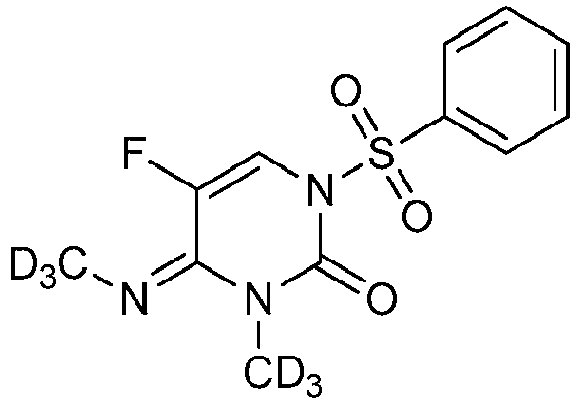
- To a dry suspension of 4-amino-5-fluoro-1-(phenylsulfonyl)pyrimidin-2(1H)-one (600 mg, 2.29 mmol) and lithium carbonate (333 mg, 4.51 mmol) in DMF (7 mL), was added trideuteriomethyl iodide (807 mg, 5.64 mmol). The reaction mixture was heated at 45 °C for 3.5 h. The reaction mixture was cooled to room temperature and partitioned between EtOAc (10 mL) and saturated aqueous sodium chloride solution (10 mL). The layers were separated and the aqueous fraction re-extracted with EtOAc (10 mL). The organic layers were combined, washed with brine (4 × 10 mL), dried (Na2SO4), concentrated, and the residue was purified by silica gel flash chromatography eluting with a gradient of 100% hexane to 80% ethyl acetate. The pure fractions were combined and concentrated under vacuum on a rotary evaporator to afford the title compound as a white solid (23 mg, 3.6%). Characterization data for this compound is listed in Table 2.
-

- To a dry suspension of 4-amino-5-fluoro-1-((4-methoxyphenyl)sulfonyl)pyrimidin-2(1H)-one (1.11 g, 3.70 mmol) and lithium carbonate (410 mg, 5.55 mmol) in DMF (7 mL), was added trideuteriomethyl iodide (1.36 g, 9.40 mmol). The reaction mixture was heated at 50 °C for 2 h. The reaction mixture was cooled to room temperature and partitioned between EtOAc (10 mL) and saturated aqueous sodium chloride solution (10 mL). The layers were separated and the aqueous fraction re-extracted with EtOAc (10 mL). The organic layers were combined, washed with brine (4 × 10 mL), dried (Na2SO4), concentrated, and the residue was purified by silica gel flash chromatography eluting with a gradient of 100% hexane to 80% ethyl acetate. The pure fractions were combined and concentrated under vacuum on a rotary evaporator to afford the title comopund as a white solid (15 mg, 2.5%). Characterization data for this compound is listed in Table 2.
-

- To a dry suspension of 4-amino-5-fluoro-1-((4-methylphenyl)sulfonyl)pyrimidin-2(1H)-one (322 mg, 2.22 mmol) and lithium carbonate (333 mg, 4.51 mmol) in DMF (7 mL), was added trideuteriomethyl iodide (5.64 mmol, 807 mg). The reaction mixture was heated at 50 °C for 4 h. The reaction mixture was cooled to room temperature and partitioned between EtOAc (10 mL) and saturated aqueous sodium chloride solution (10 mL). The layers were separated and the aqueous fraction re-extracted with EtOAc (10 mL). The organic layers were combined, washed with brine (4 × 10 mL), dried (Na2SO4), concentrated, and the residue was purified by silica gel flash chromatography eluting with a gradient of 100% hexane to 80% ethyl acetate. The pure fractions were combined and concentrated under vacuum on a rotary evaporator to afford the title compound as a white solid (10 mg, 1.5% yield). Characterization data for this compound is listed in Table 2.
-

- A suspension of 4-amino-5-fluoro-1-tosylpyrimidin-2(1H)-one (500 mg, 1.77 mmol), triethylamine (714 mg, 7.06 mmol) and dioxane (2.5 ml) was stirred at room temperature. Benzoyl chloride (0.40 ml, 3.4 mmol) was added dropwise, giving the mixture a light reddish cast. The reaction was stirred overnight at room temperature. The dark brown mixture was diluted with water and extracted with dichloromethane. The combined organic layers were dried over sodium sulfate, and concentrated. The residue was purified by normal phase chromatography (gradient, 10 to 60% EtOAC/hexane) and triturated in ethyl acetate to provide the title compound as an off white solid (278 mg, 32%). Characterization data for this compound is listed in Table 2.
-

- A 500 mL round-bottomed flask equipped with a magnetic stir bar was charged with 33% aqueous formaldehyde (20 g, 246 mmol), 4-amino-5-fluoro-1-tosylpyrimidin-2(1H)-one (10 g, 35.3 mmol) and distilled water (200 mL) to give a white suspension. The mixture was stirred under nitrogen at reflux for 3 hours. The mixture was cooled and filtered. The filter cake was washed with 25 mL of water and air dried for five minutes to yield the title compound as a white solid (2.2 g, 22%): 1H NMR (400 MHz, DMSO-d 6) δ 9.28 (t, J = 6.1 Hz, 1H), 8.35 (d, J = 6.6 Hz, 1H), 7.95 - 7.84 (m, 2H), 7.50 - 7.41 (m, 2H), 5.95 (t, J = 6.9 Hz, 1H), 4.72 (t, J = 6.4 Hz, 2H), 2.41 (s, 3H); 13C NMR (101 MHz, DMSO-d 6) δ 156.16 (d, J = 15.1 Hz), 149.21, 145.64, 137.99, 135.51, 133.56, 129.24 (d, J = 63.5 Hz), 123.83 (d, J = 35.3 Hz), 63.32, 21.13; 19F NMR (376 MHz, DMSO-d 6) δ -164.79.
-

- In a 4 mL vial equipped with a magnetic stir bar charged with Deoxyfluor ® (50% in THF, 900 mg, 2.0 mmol) was added 5-fluoro-3-(hydroxymethyl)-4-imino-1-tosyl-3,4-dihydropyrimidin-2(1H)-one (140 mg, 0.45 mmol). After stirring for two minutes the suspension transformed into an orange solution, which was stirred for an additional 30 minutes. The solution was cooled to 0 °C and was quenched by careful addition of methanol (1 mL). The solution was concentrated under a stream of nitrogen gas and the resulting residue was purified by silica gel chromatography, eluting with a solvent gradient of 0 to 100% EtOAc in hexanes to furnish the title compound as a colorless oil (14 mg, 9%): 1H NMR (400 MHz, acetone-d 6) δ 8.37 (s, 1H), 8.26 (d, J = 6.5 Hz, 1H), 8.02 - 7.95 (m, 2H), 7.50 - 7.41 (m, 2H), 4.90 - 4.82 (m, 2H), 3.29 (s, 3H), 2.45 (s, 3H); 13C NMR (101 MHz, acetone-d 6) δ 158.52 (d, J = 14.7 Hz), 150.26, 146.86, 139.16 (d, J = 3.7 Hz), 136.71, 134.98, 130.38 (d, J = 17.5 Hz), 124.79 (d, J = 35.6 Hz), 72.49 (d, J = 12.2 Hz), 56.45, 21.60; ESIMS m/z 328 ([M+H]+), 326 ([M-H]-).
-

- A solution of the mixture containing 5-fluoro-3-(hydroxymethyl)-4-imino-1-tosyl-3,4-dihydropyrimidin-2(1H)-one (250 mg of mixture, 0.23 mmol), N,N-diisopropylethylamine (307 mg, 2.37 mmol) and 4-dimethylaminopyridine (48 mg, 0.40 mmol) in dichloromethane (6 ml) was stirred at room temperature. Isobutyryl chloride (91 µL, 0.87 mmol) was added and the solution was stirred overnight at room temperature. The reaction mixture was concentrated and purification of the residue by normal phase chromatography (gradient, 0 to 60% EtOAc/hexane) provided the title compound as an off-white foam (74 mg, 70%). Characterization data for this compound is listed in Table 2.
- Wheat plants (variety Yuma) were grown from seed in a greenhouse in 50% mineral soil/50% soil-less Metro mix until the first leaf was fully emerged, with 7-10 seedlings per pot. These plants were inoculated with an aqueous spore suspension of Septoria tritici either prior to or after fungicide treatments. After inoculation the plants were kept in 100% relative humidity (one day in a dark dew chamber followed by two to three days in a lighted dew chamber) to permit spores to germinate and infect the leaf. The plants were then transferred to a greenhouse for disease to develop.
- The following tables present the activity of typical compounds of the present disclosure when evaluated in these experiments. The effectiveness of the test compounds in controlling disease was determined by assessing the severity of disease on treated plants, then converting the severity to percent control based on the level of disease on untreated, inoculated plants.
Table 1. Compound Structures and Preparation No. Structure Appearance Prepared as in Example: F1 
Off white solid 1 F2 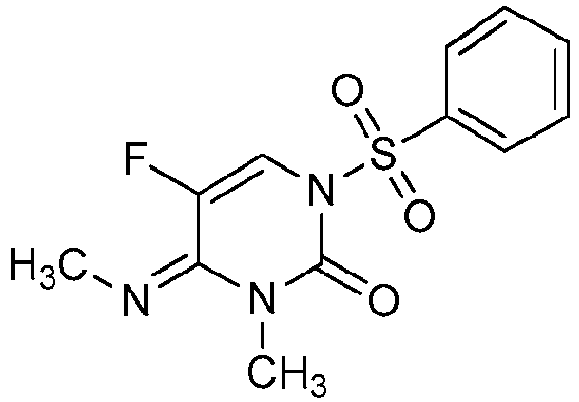
White crystalline solid 1 F3 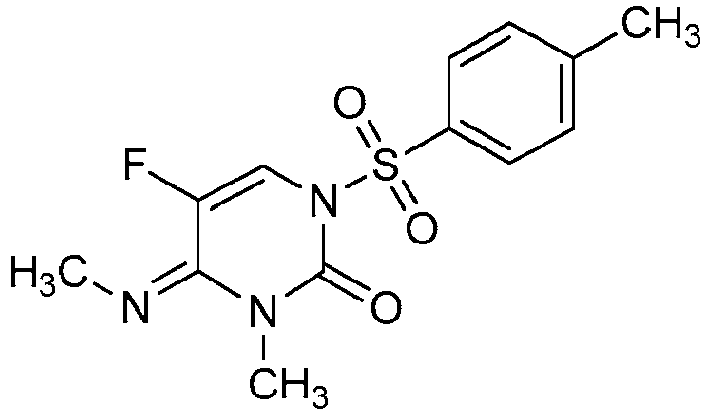
White solid 1 F4 
White solid 1 F5 
White solid 1 F6 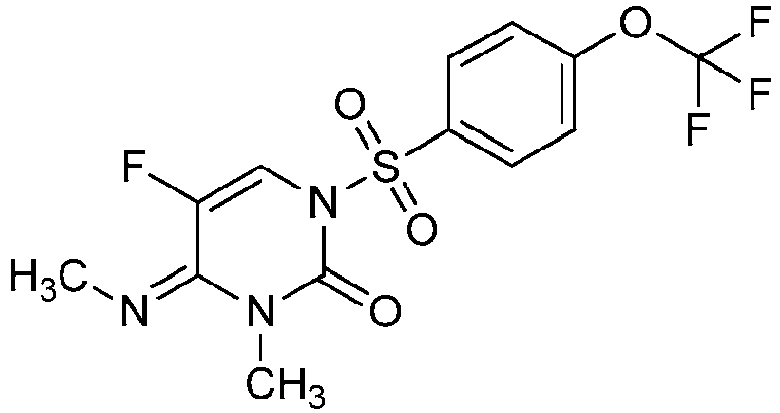
White solid 1 F7 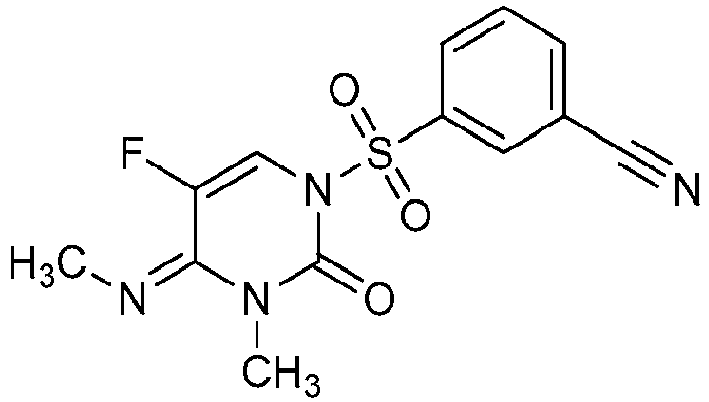
White solid 1 F8 
White solid 1 F9 
White solid 1 F10 
White solid 1 F11 
White solid 1 F12 
White solid 1 F13 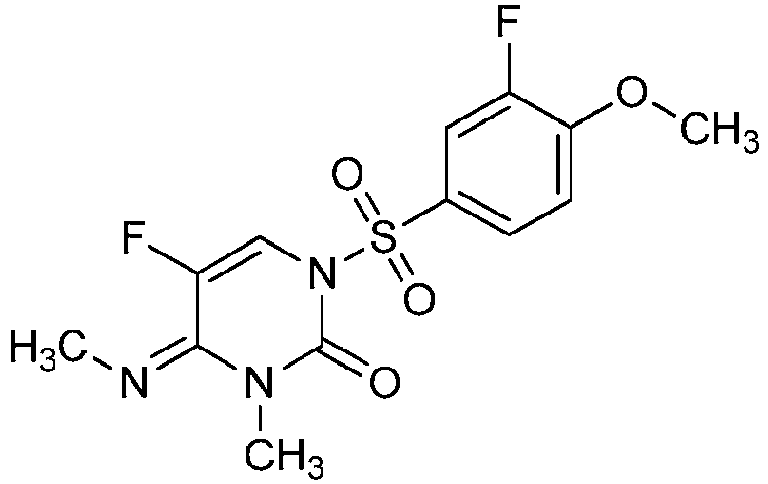
White solid 1 F14 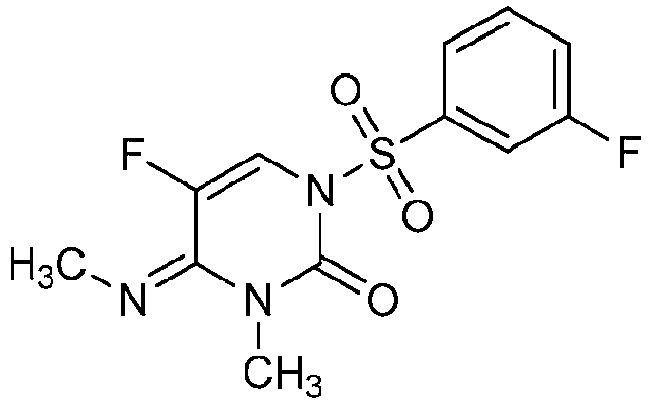
White solid 1 F15 
White solid 1 F16 
White solid 1 F17 
White solid 1 F18 
White solid 1 F19 
White solid 1 F20 
White solid 1 F21 
White solid 1 F22 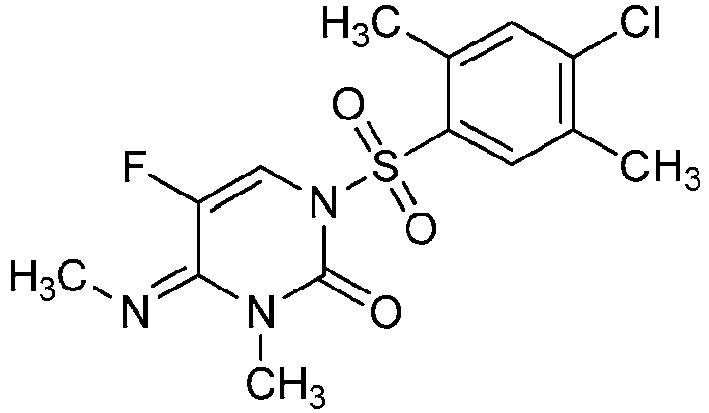
White solid 1 F23 
Yellow, gummy oil 1 F24 
White solid 6 F25 
Off-white foam 15 F26 
White solid 3 and 4 F27 
White solid 5 F28 
White solid 1 F29 
White solid 3 and 4 F30 
White solid 3 and 4 F31 
White solid 3 and 4 F32 
White solid 3 and 4 F33 
Off-white solid 3 and 4 F34 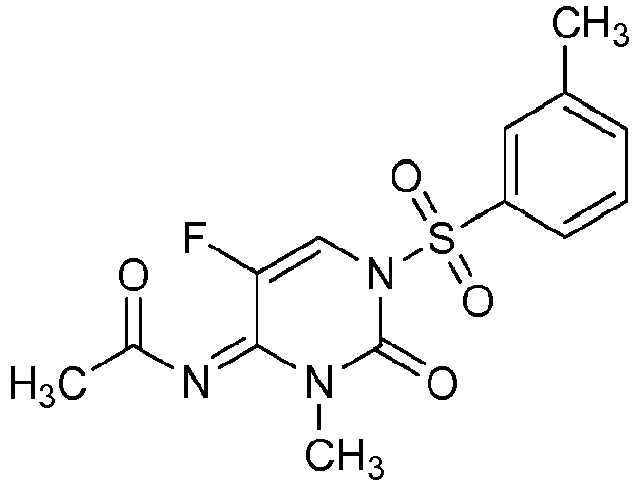
White solid 3 and 4 F35 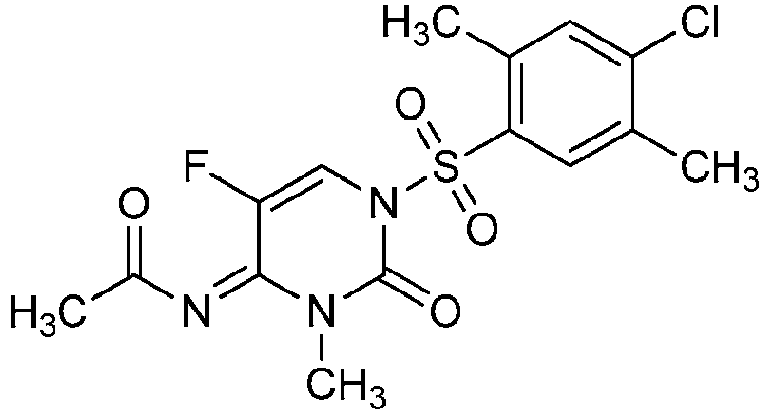
White solid 3 and 4 F36 
Off-white solid 3 and 4 F37 
Off-white solid 12 F38 
White solid 6 F39 
White solid 6 F40 
White solid 6 F41 
White solid 6 F42 
White solid 6 F43 
White solid 6 F44 
White solid 6 F45 
Whtie solid 5 F46 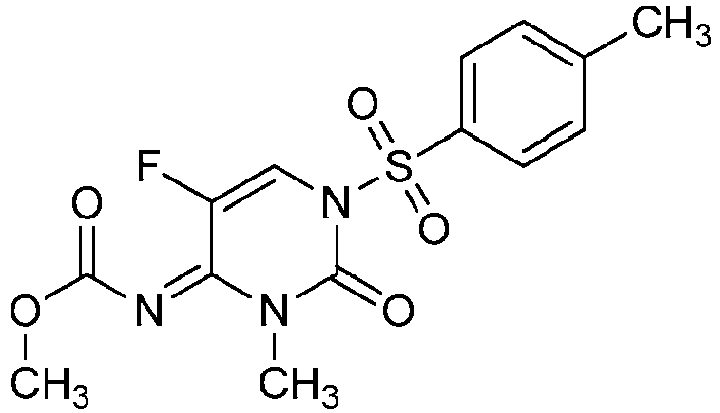
White solid 5 F47 
White solid 5 F48 
White solid 5 F49 
White solid 5 F50 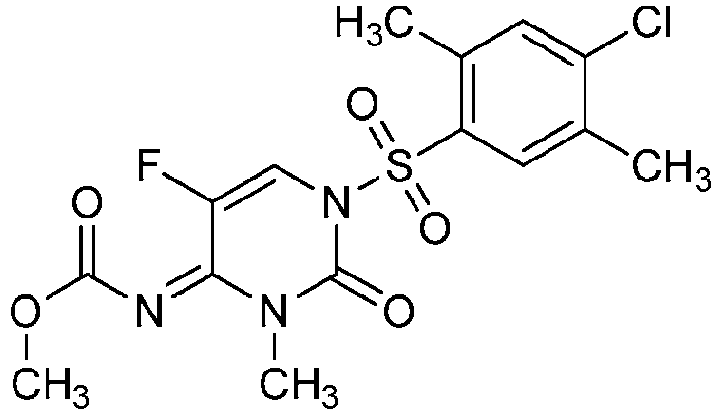
White solid 5 F51 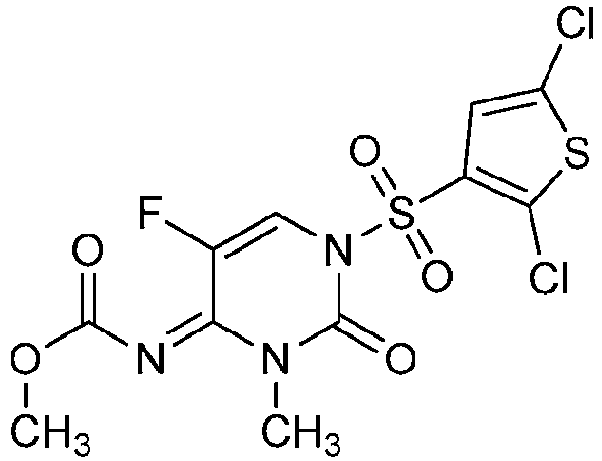
White solid 5 F52 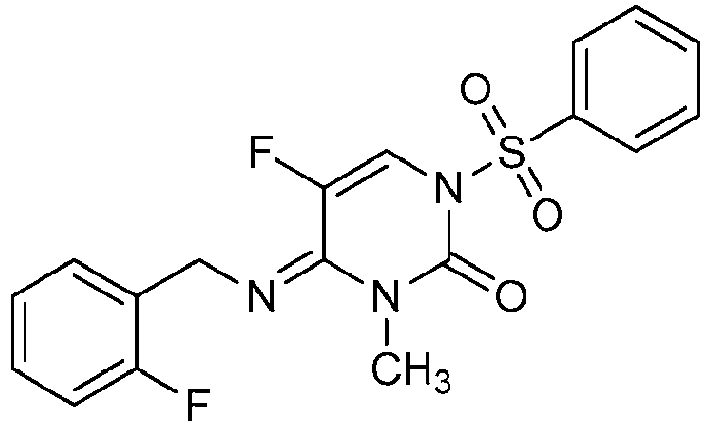
White solid 7 F53 
Off-white solid 7 F54 
Off-white solid 7 F55 
White solid 7 F56 
White solid 7 F57 
White solid 7 F58 
White solid 7 F59 
Off-white solid 7 F61 
White solid 9 F62 
White solid 11 F63 
White solid 10 Table 2. Analytical Data for Compounds in Table 1 No. Mp (°C) ESIMS m/z 1H NMR (δ)a 13C NMR or 19F NMR (δ) F1 97-105 328 ([M+H]+) 1H NMR (300 MHz, CDCl3) δ 8.02 - 7.95 (m, 2H), 7.64 (d, J = 9.2 Hz, 1H), 7.05 - 6.97 (m, 2H), 3.89 (s, 3H), 3.43 (d, J = 5.8 Hz, 3H), 3.17 (s, 3H) 19 F NMR (376 MHz, CDCl3) δ -155.06 (dq, J = 5.830, 9.35) F2 142-144 --- 8.16 - 7.92 (m, 2H), 7.81 - 7.42 (m, 4H), 3.45 (d, J = 5.8 Hz, 3H), 3.17 (s, 3H) 19F NMR (376 MHz, CDCl3) δ -154.56; 13C NMR (101 MHz, CDCl3) δ 146.89, 142.52, 141.62, 141.38, 140.08, 136.94, 134.76, 129.15, 115.21, 114.79, 36.31, 30.05 F3 117-123 --- 8.07 - 7.79 (m, 2H), 7.65 (d, J= 9.2 Hz, 1H), 7.45 - 7.30 (m, 2H), 3.44 (d, J = 5.8 Hz, 3H), 3.16 (s, 3H), 2.46 (s, 3H) 13C NMR (101 MHz, CDCl3) δ 146.95, 146.17, 142.43, 141.73, 141.49, 139.99, 133.89, 129.72, 129.27, 115.32, 114.90, 77.34, 77.23, 77.02, 76.71, 36.35, 36.23, 30.04, 21.80; 19F NMR (376 MHz, CDCl3) δ -154.83, - 154.84 F4 136-138 HRMS-FAB (m/z) [M+]+ calcd for C10H10FN3 O3S2 303.1, found, 304 7.99 (dd, J = 3.9, 1.4 Hz, 1H), 7.78 (dd, J = 5.0, 1.4 Hz, 1H), 7.60 (d, J = 9.1 Hz, 1H), 7.16 (dd, J = 5.0, 3.9 Hz, 1H), 3.45 (d, J = 5.8 Hz, 3H), 3.23 (s, 3H) 13C NMR (101 MHz, CDCl3) δ 137.18, 136.17, 135.77,127.53,115.14, 114.72, 36.27, 30.12 F5 130-134 332 ([M+H]+) (DMSO-d 6) δ 8.11 - 8.02 (m, 2H), 7.96 (d, J = 9.6 Hz, 1H), 7.80 - 7.72 (m, 2H), 3.36 (s, 3H), 3.30 (s, 3H) 13C NMR ( DMSO-d 6) δ 146.24, 142.16, 141.48, 141.21, 140.10, 135.33, 130.73, 129.50, 115.88, 115.46, 35.86, 29.68 F6 139.2-140.0 382 ([M+H]+) 8.25 - 8.02 (m, 2H), 7.62 (d, J = 9.1 Hz, 1H), 7.38 (dd, J = 8.9, 0.8 Hz, 2H), 3.45 (d, J= 5.8 Hz, 3H), 3.18 (s, 3H) 13C NMR (CDCl3) δ 153.68, 146.87, 141.37, 140.20, 134.80, 131.78, 121.44, 120.53, 118.85, 114.91, 114.49, 36.40, 30.10; 19F NMR (CDCl3) δ - 57.60, -154.56 F7 148.6-150.6 323 ([M+H]+) 8.36 - 8.28 (m, 2H), 8.00 - 7.93 (m, 1H), 7.74 (dd, J = 8.7, 7.9 Hz, 1H), 7.61 (d, J = 8.9 Hz, 1H), 3.46 (d, J = 5.7 Hz, 3H), 3.17 (s, 3H) 13C NMR (CDCl3) δ 146.76, 142.82, 141.05,138.61, 137.62, 133.43, 132.78, 130.08, 116.62, 114.58, 37.82, 36.43, 30.13 19F NMR (CDCl3) δ - 153.18 F8 204.0-205.4 328 ([M+H]+) 8.14 (dd, J = 8.0, 1.7 Hz, 1H), 7.70 - 7.60 (m, 2H), 7.19 - 7.11 (m, 1H), 7.05 - 6.98 (m, 1H), 3.93 (s, 3H), 3.45 (d, J = 13.2 Hz, 3H), 3.17 (s, 3H) 13C NMR (CDCl3) δ 156.79, 147.00, 141.98, 141.76, 139.34, 136.62, 132.70, 124.80, 120.83, 116.87, 116.45, 112.30, 56.47, 36.38, 36.26, 29.96 F9 157.1 - 158.0 373 ([M+H]+) 7.60 (d, J = 8.9 Hz, 1H), 7.36 (s, 1H), 3.48 (d, J = 5.7 Hz, 3H), 3.23 (s, 3H) 13C NMR (CDCl3) δ 146.92, 142.31, 141.17, 139.86, 133.28, 132.81, 127.88, 115.28, 36.44, 30.13; 19F NMR (CDCl3) δ - 153.97 F10 149.4-151.0 346 ([M+H]+) 7.98 (d, J = 2.0 Hz, 1H), 7.87 (dd, J = 8.1, 2.0 Hz, 1H), 7.62 (d, J = 9.1 Hz, 1H), 7.44 (d, J = 8.1 Hz, 1H), 3.45 (d, J = 5.8 Hz, 3H), 3.38 (s, 3H), 3.18 (s, 3H), 2.46 (s, 3H) 13C NMR (CDCl3) δ 146.84, 144.20, 142.57, 141.48, 135.59, 131.34, 129.34, 128.56, 127.59, 126.35, 115.04, 36.38, 30.09; 19F NMR (CDCl3) δ-154.16 F11 115.0-117.8 358 ([M+H]+) 7.64 (t, J = 6.9 Hz, 1H), 7.61 (d, J = 3.1 Hz, 1H), 7.17 (dd, J = 9.1, 3.2 Hz, 1H), 6.94 (dd, J = 9.1, 4.4 Hz, 1H), 3.92 - 3.86 (m, 3H), 3.85 - 3.81 (m, 3H), 3.47 (d, J = 5.8 Hz, 3H), 3.18 (s, 3H) 19F NMR (CDCl3) δ-154.19; 13C NMR (CDCl3) δ 153.17, 150.89, 147.05, 141.96, 139.34, 125.18, 123.36, 121.77, 116.93, 113.83, 56.92, 56.09, 36.38, 29.98 F12 111.4-112.0 328 ([M+H]+) 7.64 (d, J = 9.2 Hz, 1H), 7.62 - 7.58 (m, 1H), 7.56-7.52 (m, 1H), 7.47 (t, J = 8.1 Hz, 1H), 7.22 (dd, J = 2.6, 0.9 Hz, 1H), 3.89 (s, 3H), 3.45 (d, J = 5.8 Hz, 3H), 3.18 (s, 3H) 13C NMR (CDCl3) δ 159.69, 146.85, 142.52, 141.64, 140.07, 137.97, 130.08, 121.24, 115.25, 113.76, 55.83, 36.37, 30.08; 19F NMR (CDCl3) δ-154.50 F13 138.9-140.3 346 ([M+H]+) 7.88 (ddd, J = 8.8, 2.2, 1.4 Hz, 1H), 7.73 (dd, J = 10.2, 2.3 Hz, 1H), 7.62 (d, J = 9.2 Hz, 1H), 7.13 - 7.04 (m, 1H), 3.98 (d, J = 4.2 Hz, 3H), 3.45 (d, J = 5.8 Hz, 3H), 3.18 (s, 3H) 13C NMR (CDCl3) δ 153.36, 152.50, 149.99, 146.90, 142.48, 140.04, 127.46, 117.22, 115.15, 112.58, 56.57, 36.37, 30.06; 19F NMR (CDCl3) δ-131.07, -154.43 F14 137.3-138.9 316 ([M+H]+) 7.86 (d, J = 8.0 Hz, 1H), 7.80 - 7.72 (m, 1H), 7.62 (d, J = 9.0 Hz, 1H), 7.60 - 7.53 (m, 1H), 7.40 (td, J = 8.2, 2.2 Hz, 1H), 3.46 (d, J = 5.8 Hz, 3H), 3.18 (s, 3H) 13C NMR (101 MHz, CDCl3) δ 163.25, 160.74, 146.78, 142.66, 141.37, 140.21, 138.73, 130.87, 125.08, 122.24, 116.76, 114.94, 36.40, 30.10; 19F NMR (CDCl3) δ-108.66, -153.91 F15 175.7-177.6 340 ([M+H]+) 7.68 (d, J = 9.2 Hz, 1H), 6.99 (s, 2H), 3.46 (d, J = 5.9 Hz, 3H), 3.17 (s, 3H), 2.62 (s, 6H), 2.31 (s, 3H) 13C NMR (CDCl3) δ 147.47, 144.64, 141.84, 141.80, 141.56, 140.88, 139.40, 132.27, 131.68, 115.43, 115.03, 36.36, 29.99, 22.75, 21.17; 19F NMR (CDCl3) δ-155.15 F16 123.7-125.8 312 ([M+H]+) 7.90 - 7.79 (m, 2H), 7.66 (d, J = 9.2 Hz, 1H), 7.47 (dt, J = 15.1, 7.7 Hz, 2H), 3.45 (d, J = 5.8 Hz, 3H), 3.17 (s, 3H), 2.46 (s, 3H) 13C NMR (CDCl3) δ 146.89, 142.49, 141.70, 140.04, 139.46, 136.80, 135.61, 129.21, 126.39, 115.29, 36.36, 30.06, 21.37. 19F NMR (CDCl3) δ-154.67 F17 121.1-122.6 304 ([M+H]+) 8.36 (dd, J = 3.1, 1.3 Hz, 1H), 7.61 (d, J = 9.2 Hz, 1H), 7.55 (dd, J = 5.2, 1.3 Hz, 1H), 7.44 (dd, J = 5.2, 3.2 Hz, 1H), 3.45 (d, J = 5.8 Hz, 3H), 3.21 (s, 3H) 13C NMR (CDCl3) δ 146.95, 142.47, 141.62, 140.02, 135.89, 127.48, 115.14, 114.73, 36.37, 30.08; 19F NMR (CDCl3) δ-154.45 F18 147.0-149.0 316 ([M+H]+) 8.09 (s, 1H), 7.63 (d, J = 9.2 Hz, 1H), 3.88 (s, 3H), 3.45 (d, J = 5.8 Hz, 3H), 3.21 (s, 3H), 2.40 (s, 3H) 13C NMR (CDCl3) δ 149.13, 147.05, 142.18, 139.74, 137.54, 115.41, 114.89, 39.57, 36.35, 29.98, 12.73; 19F NMR (CDCl3) δ-155.09 F19 130.1-131.1 317 ([M+H]+) 7.59 (d, J = 9.0 Hz, 1H), 3.47 (d, J = 5.8 Hz, 3H), 3.21 (s, 3H), 2.77 (s, 3H), 2.40 (s, 3H) 13C NMR (CDCl3) δ 178.15, 157.54, 147.06, 142.41, 141.15, 139.95, 114.64, 114.22, 113.44, 36.42, 30.06, 13.43, 10.99; 19F NMR (CDCl3) δ-153.89 F20 135.0-136.9 366 ([M+H]+) 7.92 (d, J = 1.9 Hz, 2H), 7.66 (t, J = 1.8 Hz, 1H), 7.58 (d, J = 8.9 Hz, 1H), 3.47 (d, J = 5.7 Hz, 3H), 3.19 (s, 3H) 13C NMR (CDCl3) δ 146.69, 142.80, 141.13, 140.89,139.57, 135.98, 134.74, 127.51, 114.66, 36.43, 30.17; 19F NMR (CDCl3) δ-153.26 F21 109.0-112.0 350 ([M+H]+) 8.37 (dd, J = 9.0, 5.7 Hz, 1H), 7.66 (d, J = 9.0 Hz, 1H), 7.32 - 7.18 (m, 3H), 3.48 (d, J = 5.8 Hz, 3H), 3.17 (s, 3H) 13C NMR (CDCl3) δ 166.97, 164.37, 146.78, 142.21, 141.30, 139.76, 135.40, 131.26, 119.54, 115.78, 36.43, 30.03; 19F NMR (CDCl3) δ-99.64, -154.17 F22 --- --- 8.05 (s, 1H), 7.66 (d, J = 9.1 Hz, 1H), 7.28 (d, J = 15.3 Hz, 1H), 3.47 (d, J = 5.8 Hz, 3H), 3.17 (s, 3H), 2.45 (d, J = 17.2 Hz, 2H) 13C NMR (CDCl3) δ 146.93, 142.28, 141.44, 139.83, 136.48, 134.97, 134.27, 133.72, 132.82, 115.08, 114.67, 36.40, 30.05, 19.87; 19F NMR (CDCl3) δ-154.09 F23 --- 333 ([M+H]+) 7.61 (d, J = 9.1 Hz, 1H), 3.47 (d, J = 5.8 Hz, 3H), 3.22 (s, 3H), 2.69 (d, J = 17.5 Hz, 6H) 13C NMR (CDCl3) δ 172.37, 160.92, 139.92, 125.88, 115.07, 114.65, 36.41, 30.12, 29.71, 19.70, 17.16; 19F NMR (CDCl3) δ-154.08 F24 190-193 434 ([M+H]+) 8.13 - 7.94 (m, 3H), 7.50-7.35 (m, 2H), 7.34 - 7.13 (m, 4H), 7.13 - 6.99 (m, 2H), 3.92 (s, 3H), 3.35 (s, 3H) 19F NMR (376 MHz, CDCl3) δ -155.78,-155.79 F25 - 454.5 ([M+H]+) 8.29 (d, J = 5.4 Hz, 1H), 8.04 (d, J = 8.4 Hz, 2H), 7.39 (d, J = 8.3 Hz, 2H), 5.71 (s, 2H), 3.03 - 2.88 (m, 1H), 2.62 - 2.49 (m, 1H), 2.47 (s, 3H), 1.21 (d, J = 6.7 Hz, 6H), 1.13 (d, J = 7.0 Hz, 6H) 13C NMR (CDCl3) δ 178.45, 176.44, 160.96, 160.82, 149.46, 147.31, 141.06, 138.55, 131.61, 130.46, 129.81, 127.60, 127.23, 69.50, 33.72, 33.34, 21.88, 19.39, 18.67 F26 - 356.4 ([M+H]+) 8.04 - 7.94 (m, 2H), 7.90 (d, J = 6.7 Hz, 1H), 7.08-6.99 (m, 2H), 3.91 (s, 3H), 3.23 (s, 3H), 2.23 (d, J = 1.0 Hz, 3H) 19F NMR (376 MHz, CDCl3) δ -153.50; 13C NMR (101 MHz, CDCl3) δ 181.27, 165.11, 146.27, 138.98, 136.59, 132.12, 126.77, 118.04, 117.65, 114.49, 104.07, 55.92, 30.26, 25.92 F27 124-125 372 ([M+H]+) 8.07 - 7.97 (m, 2H), 7.91 (d, J = 6.8 Hz, 1H), 7.14-6.95 (m, 2H), 3.91 (s, 3H), 3.80 (s, 3H), 3.27 (s, 3H) 15C NMR (101 MHz, CDCl3) δ 165.17, 160.30, 146.05, 144.60, 139.08, 132.17, 126.63, 118.32, 117.93, 114.51, 77.32, 77.21, 77.01, 76.69, 55.92, 53.62, 30.42; 19F NMR (376 MHz, CDCl3) δ -156.51,-156.51 F28 102.2-104.0 262 ([M+H]+) 1H NMR (DMSO-d6 ) δ 7.63 (d, J = 9.6 Hz, 1H), 3.47-3.39 (m, 1H), 3.37 (d, J = 5.9 Hz, 3H), 3.18 (s, 3H), 1.32-1.19(m,4H) 13C NMR (DMSO-d6 ) δ 147.10, 141.64, 139.23, 116.09, 115.68,35.70, 31.60, 29.77, 6.68 F29 134.6-136.2 340 ([M+H]+) 7.92 (dd, J = 11.9, 7.5 Hz, 3H), 7.40 (d, J = 8.1 Hz, 2H), 3.22 (s, 3H), 2.48 (s, 3H), 2.23 (d, J = 0.9 Hz, 3H) 13C NMR (CDCl3) δ 181.20, 146.95, 132.91, 129.92, 129.54, 117.93, 117.54, 30.28, 25.93, 25.89,21.87 F30 Dec 174 326 ([M+H]+) 1H NMR (DMSO-d6 ) δ 8.30 (d, J = 7.3 Hz, 1H), 8.08 (d, J = 7.4 Hz, 2H), 7.85 (t, J = 7.5 Hz, 1H), 7.71 (t, J = 7.9 Hz, 2H), 3.07 (s, 3H), 2.13 (s, 3H) --- F31 Dec 156 326 ([M+H]+) 1H NMR (DMSO-d6 ) δ 8.26 (d, J = 7.4 Hz, 1H), 8.00 (d, J = 9.1 Hz, 2H), 7.20 (d, J = 9.1 Hz, 2H), 3.88 (s, 3H), 3.06 (s, 3H), 2.1 1 (s, 3H) --- F32 Dec 158 354 ([M+H]+) 1H NMR (DMSO-d6 ) δ 8.27 (d, J = 7.3 Hz, 1H), 7.97 (d, J = 8.4 Hz, 2H), 7.53 (d, J = 8.4 Hz, 2H), 3.05 (s, 3H), 2.72 (t, J = 11.4 Hz, 2H), 2.10 (s, 3H), 1.20 (t, J = 7.6 Hz, 3H) --- F33 Dec 165 368 ([M+H]+) 1H NMR (DMSO-d6 ) δ 8.28 (d, J = 7.3 Hz, 1H), 7.99 (d, J = 8.5 Hz, 2H), 7.58 (d, J = 8.5 Hz, 2H), 3.09 - 2.82 (m, 4H), 2.12 (s, 3H), 1.23 (d, J = 6.9 Hz, 6H) --- F34 Dec 164 340 ([M+H]+) 1H NMR (DMSO-d6 ) δ 8.28 (d, J = 7.3 Hz, 1H), 7.94-7.81 (m, 2H), 7.70 - 7.54 (m, 2H), 3.07 (s, 3H), 2.43 (s, 3H), 2.13 (s, 3H) --- F35 Dec 173 388 ([M+H]+) 1H NMR (DMSO-d6 ) δ 8.33 (d, J = 7.2 Hz, 1H), 8.03 (s, 1H), 7.61 (s, 1H), 3.04 (s, 3H), 2.46 (s, 3H), 2.39 (s, 3H), 2.12 (s, 3H) --- F36 Dec 154 401 ([M+H]+) 1H NMR (DMSO-d6 ) δ 8.24 (d, J = 7.2 Hz, 1H), 7.65 (s, 1H), 3.12 (s, 3H), 2.15 (s, 3H) --- F37 180.8-182.2 492 ([M+H]+) 8.03 - 7.88 (m, 5H), 7.77-7.65 (m, 3H), 7.52 (dd, J = 14.1, 6.2 Hz, 3H), 7.43-7.30 (m, 4H), 2.47 (s, 3H) 13C NMR (CDCl3) δ 174.91, 170.80, 166.51, 147.41, 146.77, 144.69, 135.72, 133.99, 133.25, 132.54, 130.76, 130.54, 130.43, 130.12, 129.99, 129.86, 129.72, 129.69, 129.47, 125.97, 120.01, 119.63, 50.14 21.88, 21.8 F38 170-171 426 ([M+Na]+) 8.09 (d, J = 8.6 Hz, 2H), 8.01 (d, J = 6.6 Hz, 2H), 7.77 (t, J = 7.5 Hz, 1H), 7.64 (t, J = 7.9 Hz, 2H), 7.41 (t, J = 7.9 Hz, 2H), 7.19 (d, J = 8.1 Hz, 2H), 3.35 (s, 3H) --- F39 200-202 440 ([M+Na]+) 7.99 (dd, J = 18.1, 7.5 Hz, 2H), 7.41 (t, J = 7.8 Hz, 3H), 7.29 - 7.16 (m, 5H), 3.35 (s, 3H), 2.49 (s, 3H) --- F40 188-190 454 ([M+Na]+) 8.05 - 7.96 (m, 3H), 7.47-7.38 (m, 5H), 7.19 (d, J = 8.1 Hz, 2H), 3.35 (s, 3H), 2.78 (q, J = 7.6 Hz, 2H), 1.30 (t, J= 7.6 Hz, 3H) --- F41 180-181 468 ([M+Na]+) 8.01 (dd, J = 7.6, 4.6 Hz, 3H), 7.50 - 7.37 (m, 3H), 7.27 - 7.16 (m, 4H), 3.36 (s, 3H), 3.04 (dt, J = 13.6, 6.9 Hz, 1H), 1.30 (d, J = 6.9 Hz, 6H) --- F42 187-188 440 ([M+Na]+) 8.01 (d, J = 6.6 Hz, 1H), 7.89 (d, J = 7.7 Hz, 1H), 7.84 (s, 1H), 7.52 (dt, J = 15.4, 7.7 Hz, 2H), 7.40 (t, J = 7.9 Hz, 2H), 7.30 - 7.15 (m, 3H), 3.34 (s, 3H), 2.49 (s, 3H) --- F43 209-211 488 ([M+Na]+) 1H NMR (DMSO-d6 ) δ 8.52 (d, J = 7.3 Hz, 1H), 8.06 (s, 1H), 7.63 (s, 1H), 7.45 (t, J = 7.9 Hz, 2H), 7.28 (t, J = 7.4 Hz, 1H), 7.16 (d, J = 8.0 Hz, 2H), 3.15 (s, 3H), 2.41 (s, 6H) --- F44 158-159 499 ([M+Na]+) 7.96 (d, J = 6.5 Hz, 1H), 7.48-7.37 (m, 3H), 7.31-7.23 (m, 2H), 7.20 (d, J = 7.6 Hz, 1H), 3.41 (s, 3H) --- F45 185-186 364 ([M+Na]+) 8.04 (d, J = 8.2 Hz, 2H), 7.89 (d, J = 6.7 Hz, 1H), 7.73 (t, J = 7.5 Hz, 1H), 7.59 (t, J = 7.9 Hz, 2H), 3.78 (s, 3H), 3.24 (s, 3H) --- F46 145-146 378 ([M+Na]+) 7.92 (t, J = 7.8 Hz, 3H), 7.40 (d, J = 8.1 Hz, 2H), 3.80 (s, 3H), 3.26 (s, 3H), 2.48 (s, 3H) --- F47 125-126 392 ([M+Na]+) 7.94 (dd, J = 17.7, 7.6 Hz, 3H), 7.42 (d, J = 8.3 Hz, 2H), 3.80 (s, 3H), 3.27 (s, 3H), 2.83 - 2.66 (m, 2H), 1.28 (t, J = 7.6 Hz, 3H) --- F48 116-117 406 ([M+Na]+) 7.94 (dd, J = 21.7, 7.6 Hz, 3H), 7.44 (d, J = 8.5 Hz, 2H), 3.80 (s, 3H), 3.27 (s, 3H), 3.02 (dt, J = 13.8, 6.9 Hz, 1H), 1.29 (d, J = 6.9 Hz, 6H) --- F49 200-201 378 ([M+Na]+) 7.97-7.77 (m, 3H), 7.51 (dt, J = 15.3, 7.7 Hz, 2H), 3.80 (s, 3H), 3.27 (s, 3H), 2.48 (s, 3H) --- F50 178-179 426 ([M+Na]+) 8.04 (s, 1H), 7.92 (d, J = 6.6 Hz, 1H), 7.34 (s, 1H), 3.82 (s, 3H), 3.27 (s, 3H), 2.46 (d, J = 10.6 Hz, 6H) --- F51 148-149 437 ([M+Na]+) 7.96 (d, J = 6.5 Hz, 1H), 7.20 (d, J = 7.6 Hz, 1H), 3.80 (s, 3H), 3.27 (s, 3H) --- F52 189-192 414 ([M+Na]+) 8.06 (d, J = 7.4 Hz, 2H), 7.71 (dd, J = 16.7, 8.3 Hz, 2H), 7.58 (t, J = 7.8 Hz, 2H), 7.46 (t, J = 7.9 Hz, 1H), 7.30 -7.16 (m, 1H), 7.11 (t, J = 7.5 Hz, 1H), 7.07-6.97 (m, 1H), 4.97 (s, 2H), 3.26 (s, 3H) --- F53 188-191 444 ([M+Na]+) 8.01 (d, J = 9.0 Hz, 2H), 7.73 (d, J = 9.1 Hz, 1H), 7.47 (t, J = 7.8 Hz, 1H), 7.28-7.17 (m, 1H), 7.12 (t, J = 7.5 Hz, 1H), 7.07-6.97 (m, 3H), 4.98 (s, 2H), 3.90 (s, 3H), 3.28 (s, 3H) --- F54 184-187 428 ([M+Na]+) 7.95 (d, J = 8.4 Hz, 2H), 7.74 (d, J = 9.0 Hz, 1H), 7.47 (t, J = 7.6 Hz, 1H), 7.37 (d, J = 8.1 Hz, 2H), 7.24-7.19 (m, 1H), 7.12 (t, J= 7.5 Hz, 1H), 7.08-6.95 (m, 1H), 4.98 (s, 2H), 3.27 (s, 3H), 2.46 (s, 3H) --- F55 140-141 442 ([M+Na]+) 7.97 (d, J = 8.4 Hz, 2H), 7.74 (d, J = 9.0 Hz, 1H), 7.47 (t, J = 7.4 Hz, 1H), 7.40 (d, J = 8.4 Hz, 2H), 7.25 - 7.17 (m, 1H), 7.12 (t, J = 7.4 Hz, 1H), 7.08 - 6.96 (m, 1H), 4.98 (s, 2H), 3.27 (s, 3H), 2.75 (q, J = 7.6 Hz, 2H), 1.27 (t, J = 7.6 Hz, 3H) --- F56 140-143 456 ([M+Na]+) 7.97 (d, J = 8.5 Hz, 2H), 7.73 (d, J = 9.1 Hz, 1H), 7.46 (t, J = 7.6 Hz, 1H), 7.41 (d, J = 8.4 Hz, 2H), 7.25 -7.15 (m, 1H), 7.11 (t, J = 7.4 Hz, 1H), 7.06 - 6.96 (m, 1H), 4.97 (s, 2H), 3.27 (s, 3H), 3.10 - 2.95 (m, 1H), 1.27 (d, J = 6.9 Hz, 6H) --- F57 177-180 428 ([M+Na]+) 7.94 - 7.82 (m, 2H), 7.77 (d, J = 9.0 Hz, 1H), 7.56-7.45 (m, 3H), 7.29-7.19 (m, 1H), 7.15 (t, J = 7.4 Hz, 1H), 7.11 - 6.95 (m, 1H), 5.01 (s, 2H), 3.30 (s, 3H), 2.49 (s, 3H) --- F58 208-210 476 ([M+Na]+) 8.03 (s, 1H), 7.71 (d, J = 8.9 Hz, 1H), 7.46 (t, J = 7.6 Hz, 1H), 7.29 (s, 1H), 7.23-7.18 (m, 1H), 7.11 (t, J = 7.2 Hz, 1H), 7.06-6.96 (m, 1H), 4.98 (s, 2H), 3.25 (s, 3H), 2.47 (s, 3H), 2.42 (s, 3H) --- F59 108-111 - 7.69 (d, J = 8.8 Hz, 1H), 7.49 (t, J = 7.5 Hz, 1H), 7.37 (s, 1H), 7.25 - 7.20 (m, 1H), 7.14 (t, J = 7.4 Hz, 1H), 7.09 - 6.98 (m, 1H), 5.01 (s, 2H), 3.33 (s, 3H) --- F61 - 304.1 ([M+H]+) 8.07-8.04 (d, J = 8.8 Hz, 2H), 7.73-7.64 (m, 3H), 7.60 - 7.54 (m, 2H) 19F NMR (376 MHz, CDCl3) δ -154.6 F62 - 333.8 ([M+H]+) 7.99 (d, J = 9.2 Hz, 2H), 7.72 (m, 1H), 7.65 (d, J = 9.2 Hz, 2H), 7.05-6.97 (m, 2H), 3.89 (s, 3H) 19F NMR (376 MHz, CDCl3) δ-155.2 F63 - 318.0 ([M+H]+) 7.93 (d, J = 8.8 Hz, 2H), 7.65 (d, J = 8.8 Hz, 2H), 7.38 - 7.35 (m, 1H), 2.46 (s, 3H) 19F NMR (376 MHz, CDCl3) δ -154.9 All 1H NMR data measured in CDCl3 at 400 MHz unless otherwise noted. - The following table presents the activity of typical compounds of the present disclosure when evaluated in these experiments. The effectiveness of the test compounds in controlling disease was determined by assessing the severity of disease on treated plants, then converting the severity to percent control based on the level of disease on untreated, inoculated plants.
- In each case of Table I the rating scale is as follows:
% Disease Control Rating 76-100 A 51-75 B 26-50 C 0-25 D Not Tested E Table 3. One-Day Protectant (1DP) and Three-Day Curative (3DC) Activity of Compounds on SEPTTR at 100 ppm Cmpd SEPTTR 100 PPM 1DP SEPTTR 100 PPM 3DC F1 A B F2 A B F3 A B F4 A A F5 A A F6 A A F7 C B F8 A A F9 A A F10 A B F11 A A F12 A A F13 A A F14 A B F15 C C F16 C D F17 A A F18 C A F19 D B F20 C D F21 E E F22 A A F23 C A F24 D D F25 D A F26 A A F27 D D F28 D B F29 A A F30 A A F31 A A F32 A A F33 A C F34 A D F35 A C F36 A B F37 D D F38 A A F39 C C F40 D D F41 D D F42 A D F43 D D F44 A A F45 D D F46 D D F47 D D F48 D D F49 D D F50 D D F51 D D F52 D D F53 D D F54 D D F55 D D F56 D D F57 D D F58 D D F59 D D F61 D D F62 D D F63 D D
Claims (16)
- A compound of Formula I:
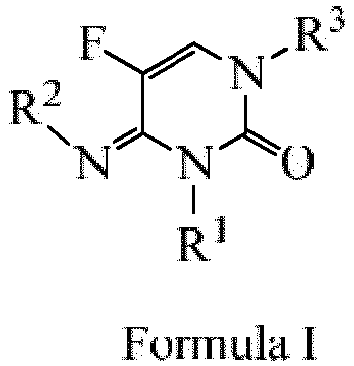 wherein R1 is:C1-C6 alkyl optionally substituted with 1-3 R4;-C(=O)R5; or-CH2OC(=O)R5;R2 is:C1-C6 alkyl optionally substituted with 1-3 R6;-C(=O)R7;-C(=O)OR7; or-(CHR8)nR7;wherein n is an integer from 1-3;R3 is -S(O)2R9;R4 is independently C1-C6 alkyl, C1-C4 alkoxy, C1-C4 haloalkoxy, C1-C4 alkylthio, C1-C4 haloalkylthio, amino, C1-C3 alkylamino, C2-C6 alkoxycarbonyl, C2-C6 alkylcarbonyl, C2-C6 alkylaminocarbonyl, hydroxyl, deuterium, or C3-C6 trialkylsilyl;R5 is H, C1-C6 alkyl, C2-C6 alkenyl, C3-C6 alkynyl, C1-C6 haloalkyl, C1-C6 alkoxyalkyl, phenyl or benzyl wherein each of the phenyl or the benzyl may be optionally substituted with 1-3 R10, or with a 5- or 6-membered saturated or unsaturated ring system, or with a 5-6 fused ring system, or with a 6-6 fused ring system each containing 1-3 heteroatoms wherein each ring may be optionally substituted with 1-3 R10, biphenyl or naphthyl optionally substituted with 1-3 R10;R6 is independently halogen, C1-C6 alkyl, C1-C4 haloalkyl, C1-C4 alkoxy, C1-C4 haloalkoxy, C1-C4 alkylthio, C1-C4 haloalkylthio, amino, C1-C3 alkylamino, C2-C6 alkoxycarbonyl, C2-C6 alkylcarbonyl, C2-C6 alkylaminocarbonyl, hydroxyl, deuterium, or C3-C6 trialkylsilyl;R7 is H, C1-C6 alkyl, C2-C6 alkenyl, C3-C6 alkynyl, C1-C6 haloalkyl, C1-C6 alkoxyalkyl, phenyl or benzyl wherein each of the phenyl or the benzyl may be optionally substituted with 1-3 R10, or with a 5- or 6-membered saturated or unsaturated ring system, or with a 5-6 fused ring system, or with a 6-6 fused ring system each containing 1-3 heteroatoms wherein each ring may be optionally substituted with 1-3 R10, biphenyl or naphthyl optionally substituted with 1-3 R10;R8 is H, C1-C6 alkyl, or C1-C6 haloalkyl;R9 is phenyl optionally substituted with 1-3 R10, or a 5- or 6-membered saturated or unsaturated ring containing 1-3 heteroatoms wherein each ring may be optionally substituted with 1-3 R10; andR10 is independently halogen, C1-C6 alkyl, C1-C4 haloalkyl, C1-C4 alkoxy, C1-C4 haloalkoxy, C1-C4 alkylthio, C1-C4 haloalkylthio, amino, C1-C6 alkylamino, C2-C6 alkoxycarbonyl, C2-C6 alkylcarbonyl, C2-C6 alkylaminocarbonyl, C2-C6 dialkylamino, hydroxy, cyano, or nitro,or an optical isomer, salt or hydrate thereof.
 - A compound according to claim 1, wherein R4 is independently C1-C6 alkyl, C1-C4 alkoxy, C1-C4 alkylthio, hydroxyl, or deuterium.
- A compound according to claim 1 or 2, wherein R5 is C1-C6 alkyl, C1-C6 haloalkyl, phenyl or benzyl wherein each of the phenyl or the benzyl may be optionally substituted with 1-3 R10.
- A compound according to any one of claims 1-3, wherein R6 is independently halogen, C1-C6 alkyl, C1-C4 haloalkyl, C1-C4 alkoxy, C1-C4 alkylthio, or deuterium.
- A compound according to any one of claims 1-4, wherein R7 is C1-C6 alkyl, C1-C6 haloalkyl, phenyl or benzyl wherein each of the phenyl or the benzyl may be optionally substituted with 1-3 R10.
- A compound according to any one of claims 1-5, wherein R10 is independently halogen, Ci-C6 alkyl, C1-C4 haloalkyl, C1-C4 alkoxy, C1-C4 haloalkoxy, C1-C4 alkylthio, cyano, or nitro.
- A compound according to any one of claims 1-6, wherein R1 is C1-C3 alkyl.
- A compound according to any one of claims 1-7, wherein R2 is C1-C3 alkyl, -C(=O)R5, or -C(=O)OR5, and preferably wherein R5 is C1-C3 alkyl or phenyl, preferably wherein R1 is C1-C3 alkyl.
- A compound according to any one of claims 1-8 wherein R9 is selected from the group consisting of:

- A compound according to claim 1, wherein
R1 is: C1-C6 alkyl optionally substituted with 1-3 R4; -C(=O)R5; or -CH2OC(=O)R5;
R2 is: C1-C6 alkyl optionally substituted with 1-3 R6; -C(=O)R7; -C(=O)OR7; or-(CHR8)nR7;
R3 is -S(O)2R9;
R4 is hydroxyl, or deuterium;
R5 is C1-C6 alkyl, or phenyl;
R6 is deuterium;
R7 is C1-C6 alkyl, or phenyl optionally substituted with 1-3 R10;
R8 is H; n is 1;
R9 is phenyl optionally substituted with 1-3 R10, or a 5- or 6-membered saturated or unsaturated ring containing 1-3 heteroatoms wherein each ring may be optionally substituted with 1-3 R10; and
R10 is independently halogen, C1-C6 alkyl, C1-C4 alkoxy, C1-C4 haloalkoxy, or cyano. - The compound of claim 1, wherein the compound is selected from a group consisting of:


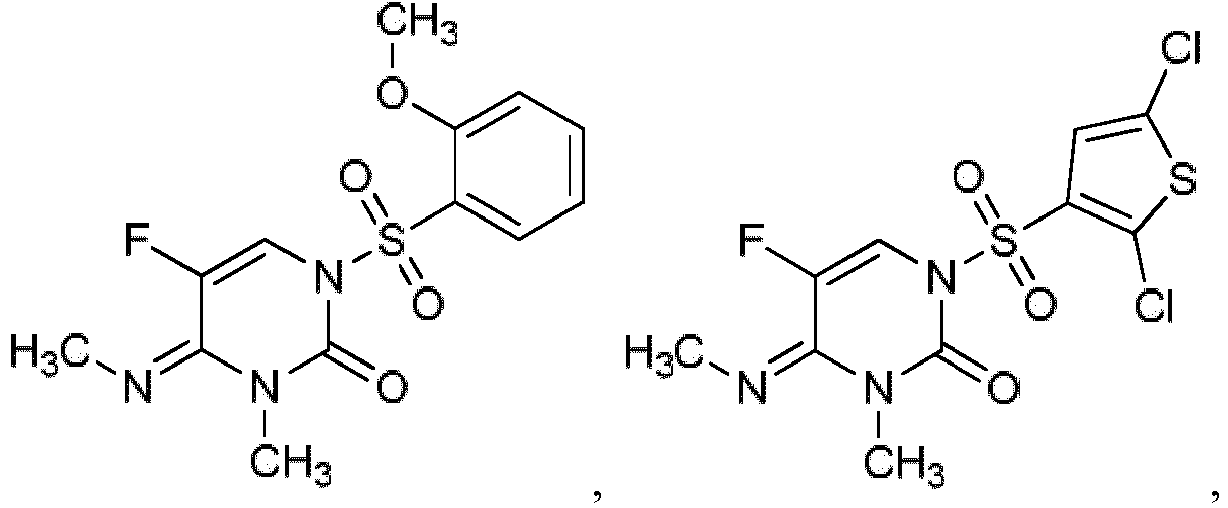

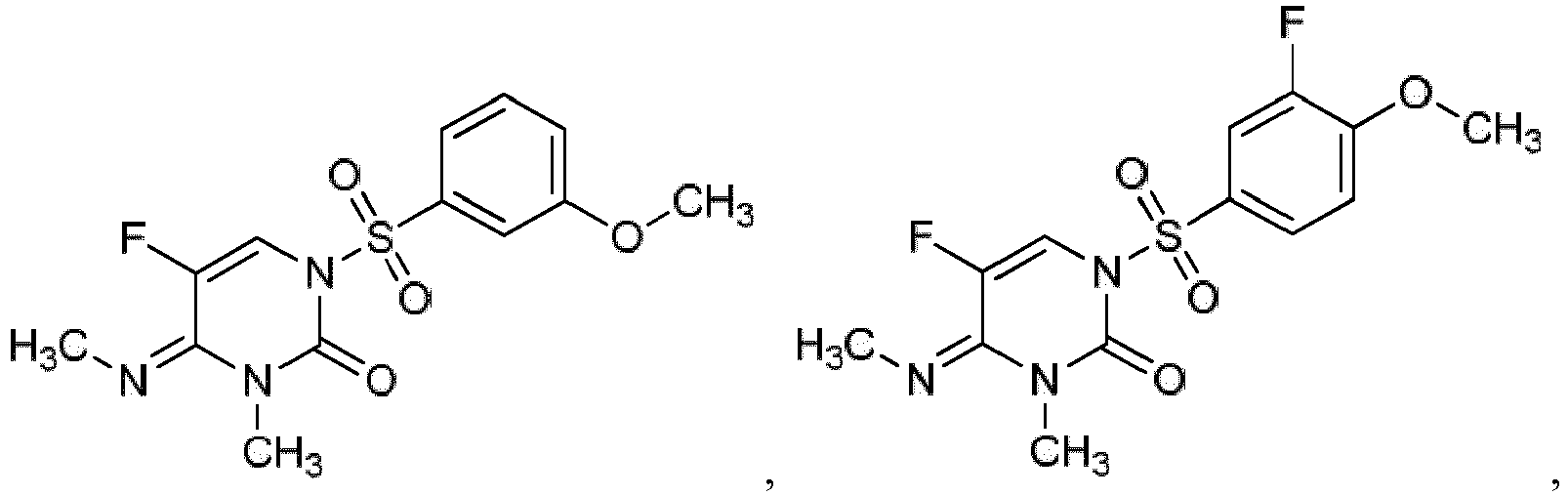

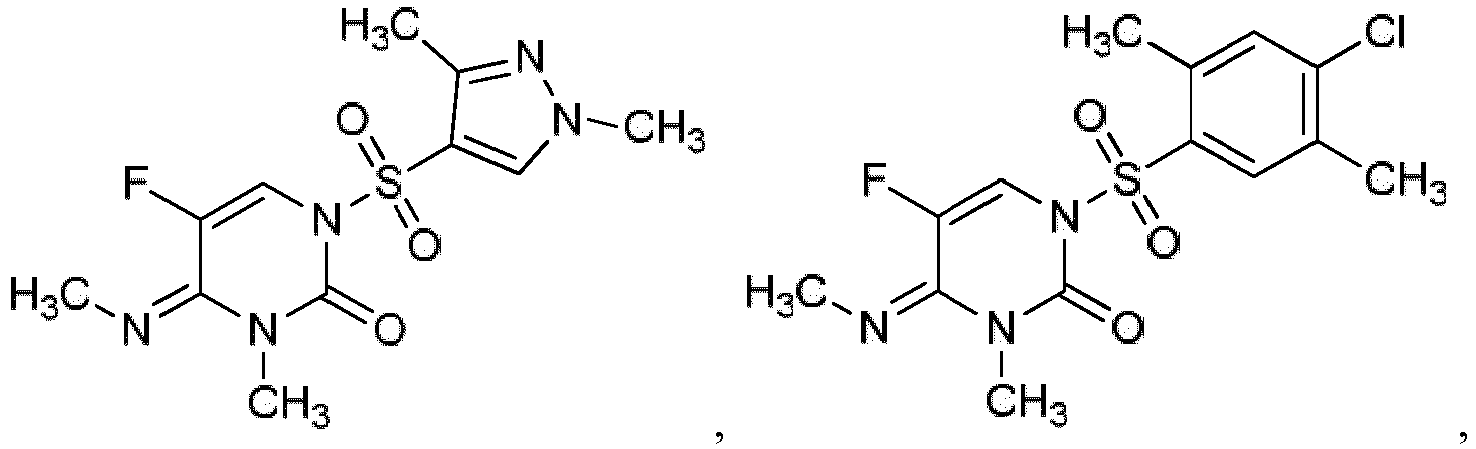


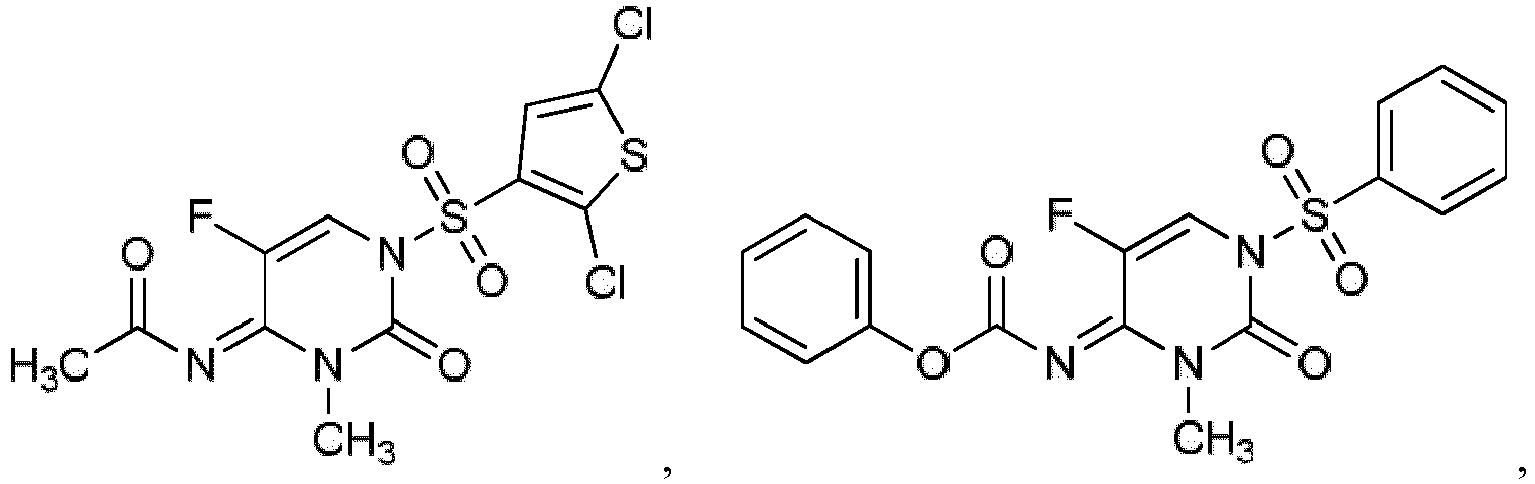

- A compound according to any one of claims 1-11, wherein the salt is a hydrochloride, hydrobromide, or hydroiodide.
- A composition for the control or prevention of a fungal pathogen, comprising;
at least one compound of any one of claims 1-12; and
a phytologically acceptable carrier material. - A method for treating a plant, comprising the steps of:
applying a fungicidally effective amount of at least one of the compounds of any one of claims 1-12 to at least one surface, selected from the group of surfaces consisting of: at least one portion of a plant, an area adjacent to a plant, soil in contact with a plant, solid adjacent to a plant, a seed, and agricultural equipment. - The method of claim 14, wherein the fungicidally effective amount of the compound is applied to a surface in the range of 0.01g/m2 to 0.45 g/m2 of the compound.
- A compound which is

Priority Applications (1)
| Application Number | Priority Date | Filing Date | Title |
|---|---|---|---|
| PL13869177T PL2953463T3 (en) | 2012-12-31 | 2013-12-23 | 3-alkyl-5-fluoro-4-substituted-imino-3,4-dihydropyrimidin-2(1h)-one derivatives as fungicides |
Applications Claiming Priority (2)
| Application Number | Priority Date | Filing Date | Title |
|---|---|---|---|
| US201261747683P | 2012-12-31 | 2012-12-31 | |
| PCT/US2013/077542 WO2014105845A1 (en) | 2012-12-31 | 2013-12-23 | 3-alkyl-5-fluoro-4-substituted-imino-3,4-dihydropyrimidin-2(1h)-one derivatives as fungicides |
Publications (3)
| Publication Number | Publication Date |
|---|---|
| EP2953463A1 EP2953463A1 (en) | 2015-12-16 |
| EP2953463A4 EP2953463A4 (en) | 2016-08-31 |
| EP2953463B1 true EP2953463B1 (en) | 2021-03-17 |
Family
ID=51022034
Family Applications (1)
| Application Number | Title | Priority Date | Filing Date |
|---|---|---|---|
| EP13869177.9A Active EP2953463B1 (en) | 2012-12-31 | 2013-12-23 | 3-alkyl-5-fluoro-4-substituted-imino-3,4-dihydropyrimidin-2(1h)-one derivatives as fungicides |
Country Status (15)
| Country | Link |
|---|---|
| US (2) | US9642368B2 (en) |
| EP (1) | EP2953463B1 (en) |
| JP (3) | JP2016503816A (en) |
| KR (1) | KR102309245B1 (en) |
| CN (2) | CN105007737A (en) |
| AU (1) | AU2013370494B2 (en) |
| BR (1) | BR102013033812B1 (en) |
| CA (1) | CA2894553C (en) |
| ES (1) | ES2874475T3 (en) |
| IL (2) | IL239597B (en) |
| MX (1) | MX381341B (en) |
| NZ (2) | NZ749557A (en) |
| PL (1) | PL2953463T3 (en) |
| RU (1) | RU2644014C2 (en) |
| WO (1) | WO2014105845A1 (en) |
Families Citing this family (20)
| Publication number | Priority date | Publication date | Assignee | Title |
|---|---|---|---|---|
| KR20150100869A (en) | 2012-12-28 | 2015-09-02 | 다우 아그로사이언시즈 엘엘씨 | N-(substituted)-5-fluoro-4-imino-3-methyl-2-oxo-3,4-dihydropyrimidine-1 (2h)-carboxamides derivatives |
| JP6324994B2 (en) | 2012-12-28 | 2018-05-16 | アダマ・マクテシム・リミテッド | N- (substituted) -5-fluoro-4-imino-3-methyl-2-oxo-3,4-dihydropyrimidine-1 (2H) -carboxylate derivative |
| CN105007737A (en) | 2012-12-31 | 2015-10-28 | 美国陶氏益农公司 | 3-Alkyl-5-fluoro-4-substituted-imino-3,4-dihydropyrimidin-2(1H)-one derivatives as fungicides |
| JP6585057B2 (en) | 2013-12-31 | 2019-10-02 | アダマ・マクテシム・リミテッド | 5-Fluoro-4-imino-3- (alkyl / substituted alkyl) -1- (arylsulfonyl) -3,4-dihydropyrimidin-2 (1H) -ones and methods for their preparation |
| CN114794123B (en) * | 2013-12-31 | 2024-11-12 | 阿达玛马克西姆股份有限公司 | Synergistic fungicidal mixtures for controlling fungi in cereals |
| MA41272A (en) * | 2014-12-23 | 2017-10-31 | Adama Makhteshim Ltd | 5-FLUORO-4-IMINO-3- (ALKYL / ALKYL SUBSTITUTED) -1- (ARYLSULFONYL) -3,4-DIHYDROPYRIMIDIN-2 (1H) -ONE AS SEED TREATMENT |
| JP6922272B2 (en) | 2016-03-11 | 2021-08-18 | 住友化学株式会社 | Plant disease control composition and plant disease control method |
| JP6862939B2 (en) * | 2016-03-11 | 2021-04-21 | 住友化学株式会社 | Plant disease control composition and plant disease control method |
| JP6922271B2 (en) * | 2016-03-11 | 2021-08-18 | 住友化学株式会社 | Plant disease control composition and plant disease control method |
| MA49639A (en) * | 2017-07-17 | 2020-05-27 | Adama Makhteshim Ltd | 5-FLUORO-4-IMINO-3-METHYL-1-TOSYL-3,4-DIHYDROPYRIMIDIN-2-ONE POLYMORPHS |
| PE20212103A1 (en) * | 2018-11-05 | 2021-11-04 | Adama Makhteshim Ltd | MIXTURES AND COMPOSITIONS COMPRISING 5-FLUORO-4-IMINO-3-METHYL-1-TOSYL-3,4-DIHYDROPYRIMIDIN-2-ONE, AND METHODS OF USE THEREOF |
| PY2057637A (en) | 2019-09-23 | 2021-10-05 | Adama Makhteshim Ltd | PROCESS FOR PREPARING 5-(FLUORO-4-IMINO-3-METHYL)-1-TOSYL-3,4-DIHYDROPYRIMIDINE-(1H)-ONE AND DERIVATIVES OF THE COMPOUND |
| IL296178A (en) * | 2020-03-09 | 2022-11-01 | Adama Makhteshim Ltd | Process for preparing 5-fluoro-4-imino-3-methyl-1-(toluene-4-sulfonyl)-3,4-dihydro-1h-pyrimidin-2-one |
| IL297864A (en) * | 2020-05-04 | 2023-01-01 | Adama Makhteshim Ltd | Mixtures and preparations containing 5-fluoro-4-imino-3-methyl-1-tosyl-4,3-dihydropyrimidin-2-one and methods of using them |
| CN117119889A (en) * | 2021-01-27 | 2023-11-24 | 安道麦马克西姆有限公司 | 5-Fluoro-4-imino-3-methyl-1-toluenesulfonyl-3,4-dihydropyrimidine-2(1H)-one for plant disease control |
| CA3206570A1 (en) * | 2021-01-27 | 2022-08-04 | Alexandra ROSENMUND | 5-fluoro-4-imino-3-methyl-1-tosyl-3,4-dihydropyrimidin-2(1 h)-one for controlling plant diseases |
| EP4683910A1 (en) * | 2023-03-23 | 2026-01-28 | Adama Makhteshim Ltd. | Process for preparing 5-fluoro-4-imino-3-methyl-1-(toluene-4-sulfonyl)-3,4-dihydro-1h-pyrimidin-2-one |
| WO2025031849A1 (en) | 2023-08-09 | 2025-02-13 | Basf Se | Fungicidal compositions comprising azoles |
| CN121646405A (en) | 2023-08-09 | 2026-03-10 | 巴斯夫欧洲公司 | Fungicidal ternary mixtures comprising 5-fluoro-4-imino-3-methyl-1- (p-toluenesulfonyl) pyrimidin-2-one |
| CN121646407A (en) | 2023-08-09 | 2026-03-10 | 巴斯夫欧洲公司 | Fungicidal compositions comprising 5-fluoro-4-imino-3-methyl-1- (p-toluenesulfonyl) pyrimidin-2-one |
Family Cites Families (62)
| Publication number | Priority date | Publication date | Assignee | Title |
|---|---|---|---|---|
| CH421973A (en) | 1962-05-01 | 1966-10-15 | Hoffmann La Roche | Process for the production of a cytosine derivative |
| US3309359A (en) | 1965-10-22 | 1967-03-14 | Hoffmann La Roche | N-mono-acyl-5-fluorocytosine derivatives and process |
| US3368938A (en) | 1966-01-13 | 1968-02-13 | Hoffmann La Roche | Controlling fungi with 5-fluorocytosine |
| US3635977A (en) * | 1969-11-03 | 1972-01-18 | American Cyanamid Co | Certain 6-trifluoromethylcytosines and thiocytosines their synthesis and their use in the synthesis of uracisls and thiouracil |
| US3868373A (en) | 1970-01-27 | 1975-02-25 | Hoffmann La Roche | 4-Amino-5-fluoro-2-tri(lower alkyl) silyloxypyrimidines |
| US4009272A (en) | 1971-10-23 | 1977-02-22 | Bayer Aktiengesellschaft | Penicillins |
| CH579057A5 (en) | 1973-09-07 | 1976-08-31 | Hoffmann La Roche | |
| FR2530636A1 (en) | 1982-07-23 | 1984-01-27 | Rhone Poulenc Agrochimie | NOVEL DERIVATIVES OF 2,3,6,7-TETRAHYDRO 5H-THIAZOLO (3,2-A) PYRIMIDINE, THEIR PREPARATION AND THEIR USE AS HERBICIDES |
| GR80171B (en) | 1983-08-29 | 1985-01-02 | Ciba Geigy Ag | N-(2-nitrophenyl)-4-aminopyrimidine derivatives process for the preparation thereof and use |
| JPS60123486A (en) | 1983-12-09 | 1985-07-02 | Asahi Glass Co Ltd | Fluoroblasticidin s and its preparation |
| US4845081A (en) | 1984-10-18 | 1989-07-04 | University Of Florida | Aminomethyl derivatives of biologically active substances, and enhanced delivery thereof across topical membranes |
| ATE109776T1 (en) | 1988-03-09 | 1994-08-15 | Ciba Geigy Ag | MEANS OF PROTECTING PLANTS AGAINST DISEASES. |
| DE3821711A1 (en) | 1988-06-28 | 1990-02-08 | Bayer Ag | THIAZOLOPYRIMIDINE DERIVATIVES, METHOD FOR THE PRODUCTION THEREOF AND THEIR USE AS A SCHAEDLINGSBEKAEMPFUNGSMITTEL |
| JP3109012B2 (en) | 1992-06-18 | 2000-11-13 | クミアイ化学工業株式会社 | Thiazolo [5,4-d] pyrimidine derivatives and fungicides for agricultural and horticultural use |
| JP3217191B2 (en) | 1992-07-16 | 2001-10-09 | ビーエーエスエフ アクチェンゲゼルシャフト | Heteroaromatic compounds and plant protective agents containing the same |
| JP4010563B2 (en) | 1995-07-05 | 2007-11-21 | イー・アイ・デユポン・ドウ・ヌムール・アンド・カンパニー | Bactericidal and fungicidal pyrimidinones |
| JPH11514642A (en) | 1995-11-02 | 1999-12-14 | チョング クン ダング シーオーアールピー. | Novel nucleoside derivative and method for producing the same |
| PT888359E (en) | 1996-03-11 | 2002-10-31 | Syngenta Participations Ag | DERIVATIVES OF PYRIMIDIN-4-ONA AS PESTICIDE |
| HRP970239B1 (en) | 1997-05-09 | 2004-04-30 | Inst Ru Er Bouekovic | Process for the preparation of sulfonyl-pyrimidine derivatives with antitumor activity |
| GT199900185A (en) * | 1998-11-06 | 2001-04-18 | NOVEDOSA PIRIMIDIN-4-ENAMINE AS A FUNGICIDE. | |
| AU2002212015B2 (en) | 2000-10-13 | 2007-01-25 | Shire Canada Inc. | Dioxolane analogs for improved inter-cellular delivery |
| WO2003018051A1 (en) | 2001-08-27 | 2003-03-06 | Vic Jira | Anti-fungal composition |
| WO2004037159A2 (en) | 2002-10-23 | 2004-05-06 | Obetherapy Biotechnology | Compounds, compositions and methods for modulating fat metabolism |
| EA009517B1 (en) * | 2003-06-27 | 2008-02-28 | Байер Кропсайенс Аг | Pyrazolopyrimidines |
| JPWO2005095419A1 (en) | 2004-04-01 | 2008-02-21 | 武田薬品工業株式会社 | Thiazolopyrimidine derivatives |
| JP4887500B2 (en) | 2004-09-16 | 2012-02-29 | 国立大学法人岐阜大学 | Nucleoside analogue or salt thereof |
| CN100499327C (en) | 2004-09-17 | 2009-06-10 | 株式会社安川电机 | Motor control device and method for assembling motor control device |
| TWI402034B (en) | 2005-07-28 | 2013-07-21 | Dow Agrosciences Llc | Agricultural compositions comprising an oil-in-water emulsion based on oily globules coated with a lamellar liquid crystal coating |
| KR20080070676A (en) | 2005-11-22 | 2008-07-30 | 이시하라 산교 가부시끼가이샤 | Agrohorticultural Fungicide Compositions and Plant Disease Control Methods |
| EP1798255A1 (en) | 2005-12-14 | 2007-06-20 | de Schrijver, Aster | Reactive diluent for one or two component PU foams |
| US20080004253A1 (en) | 2006-06-30 | 2008-01-03 | Bryan James Branstetter | Thiazolopyrimidine modulators of TRPV1 |
| US20100029483A1 (en) | 2006-10-16 | 2010-02-04 | Rhodia Inc. | Agricultural adjuvant compositions, pesticide compositions, and methods for using such compositions |
| US8093245B2 (en) | 2006-12-14 | 2012-01-10 | Lexicon Pharmaceuticals, Inc. | 4-amino-1H-pyrimidin-2-one based compounds, compositions comprising them and methods of their use |
| WO2008083465A1 (en) | 2007-01-08 | 2008-07-17 | University Health Network | Pyrimidine derivatives as anticancer agents |
| MX2009008531A (en) | 2007-02-16 | 2009-08-26 | Amgen Inc | Nitrogen-containing heterocyclyl ketones and methods of use. |
| US8592435B2 (en) | 2007-04-27 | 2013-11-26 | Daiichi Sankyo Company, Limited | Nitrogen-containing six-membered aromatic ring derivatives and pharmaceutical products containing the same |
| US8697610B2 (en) | 2007-05-11 | 2014-04-15 | Schlumberger Technology Corporation | Well treatment with complexed metal crosslinkers |
| EP2562163A1 (en) * | 2008-01-22 | 2013-02-27 | Dow AgroSciences LLC | 5-fluoro pyrimidine derivatives as fungicides |
| US20100284959A1 (en) | 2008-01-23 | 2010-11-11 | Gene Arrest Ltd. | Sequence specific double-stranded dna/rna binding compounds and uses thereof |
| KR20110042204A (en) | 2008-08-01 | 2011-04-25 | 다우 아그로사이언시즈 엘엘씨 | Use of 5-fluorocytosine as a fungicide |
| WO2010033198A2 (en) | 2008-09-17 | 2010-03-25 | Sri International | Analogs of indole-3-carbinol and their use as agents against infection |
| HRP20150778T1 (en) | 2009-01-23 | 2015-08-28 | Euro-Celtique S.A. | DERIVATIVES OF HYDROXAMIC ACIDS |
| UA107671C2 (en) | 2009-08-07 | 2015-02-10 | Dow Agrosciences Llc | N1-substityted-5-fluoro-2-oxopyrimidinone-1(2h)-carboxamide derivatives |
| BR112012002807B1 (en) | 2009-08-07 | 2018-07-10 | Adama Makhteshim Ltd. | 5-FLUOR-2-OXYPYRIMIDINE-1 (2H) DERIVATIVES, CABOXYLATE, COMPOSITION AND PROCESS FOR CONTROL AND PREVENTION OF FUNGAL ATTACK ON A FUNGAL ATTACK PLANT IN A PLANT |
| UA112284C2 (en) | 2009-08-07 | 2016-08-25 | ДАУ АГРОСАЙЄНСІЗ ЕлЕлСі | 5-fluoro-pyrimidinone derivatives |
| UA106889C2 (en) * | 2009-08-07 | 2014-10-27 | ДАУ АГРОСАЙЄНСІЗ ЕлЕлСі | N1-ACYL-5-FLORPYRIMIDINONE DERIVATIVES |
| DK2462134T3 (en) * | 2009-08-07 | 2014-08-11 | Dow Agrosciences Llc | N 1-sulfonyl-5-fluorpyrimidinonderivater |
| WO2011043876A1 (en) | 2009-10-07 | 2011-04-14 | Dow Agrosciences Llc | Synergistic fungicidal composition containing 5-fluorocytosine for fungal control in cereals |
| PL2563129T3 (en) * | 2010-04-26 | 2017-08-31 | Adama Makhteshim Ltd | N3-substituted-n1-sulfonyl-5-fluoropyrimidinone derivatives |
| BR112013014997A2 (en) * | 2010-12-16 | 2016-07-12 | Dow Agrosciences Llc | synergistic fungicidal interactions of 5-fluorocytosine and other fungicides |
| US20120208700A1 (en) | 2011-02-11 | 2012-08-16 | Dow Agrosciences Llc | Stable agrochemical oil dispersions |
| NZ613876A (en) | 2011-02-11 | 2015-03-27 | Dow Agrosciences Llc | Stable agrochemical oil dispersions |
| SI2775842T1 (en) | 2011-08-17 | 2018-01-31 | Adama Makhteshim Ltd. | 1-substituted-5-fluoro-3,6-dihydro-6-imino-2(1H)-pyrimidinone derivatives as fungicidal agents for use in plant protection |
| WO2013113781A1 (en) | 2012-02-03 | 2013-08-08 | Basf Se | Fungicidal pyrimidine compounds i |
| WO2014073114A1 (en) | 2012-11-07 | 2014-05-15 | Toyota Jidosha Kabushiki Kaisha | Method for producing a catalyst for fuel cells |
| JP6324994B2 (en) | 2012-12-28 | 2018-05-16 | アダマ・マクテシム・リミテッド | N- (substituted) -5-fluoro-4-imino-3-methyl-2-oxo-3,4-dihydropyrimidine-1 (2H) -carboxylate derivative |
| RU2018118951A (en) | 2012-12-28 | 2018-11-02 | Адама Мактешим Лтд. | 1- (SUBSTITUTED BENZOYL) -5-fluoro-4-imino-3-methyl-3,4-dihydro-pyrimidine-2 (1H) -one derivatives |
| KR20150100869A (en) | 2012-12-28 | 2015-09-02 | 다우 아그로사이언시즈 엘엘씨 | N-(substituted)-5-fluoro-4-imino-3-methyl-2-oxo-3,4-dihydropyrimidine-1 (2h)-carboxamides derivatives |
| CN105007737A (en) * | 2012-12-31 | 2015-10-28 | 美国陶氏益农公司 | 3-Alkyl-5-fluoro-4-substituted-imino-3,4-dihydropyrimidin-2(1H)-one derivatives as fungicides |
| JP6585057B2 (en) | 2013-12-31 | 2019-10-02 | アダマ・マクテシム・リミテッド | 5-Fluoro-4-imino-3- (alkyl / substituted alkyl) -1- (arylsulfonyl) -3,4-dihydropyrimidin-2 (1H) -ones and methods for their preparation |
| CN114794123B (en) | 2013-12-31 | 2024-11-12 | 阿达玛马克西姆股份有限公司 | Synergistic fungicidal mixtures for controlling fungi in cereals |
| MA41272A (en) | 2014-12-23 | 2017-10-31 | Adama Makhteshim Ltd | 5-FLUORO-4-IMINO-3- (ALKYL / ALKYL SUBSTITUTED) -1- (ARYLSULFONYL) -3,4-DIHYDROPYRIMIDIN-2 (1H) -ONE AS SEED TREATMENT |
-
2013
- 2013-12-23 CN CN201380073784.4A patent/CN105007737A/en active Pending
- 2013-12-23 CN CN202010265684.3A patent/CN112094262A/en active Pending
- 2013-12-23 RU RU2015131832A patent/RU2644014C2/en active
- 2013-12-23 AU AU2013370494A patent/AU2013370494B2/en active Active
- 2013-12-23 JP JP2015550744A patent/JP2016503816A/en not_active Withdrawn
- 2013-12-23 US US14/655,570 patent/US9642368B2/en active Active
- 2013-12-23 NZ NZ749557A patent/NZ749557A/en unknown
- 2013-12-23 EP EP13869177.9A patent/EP2953463B1/en active Active
- 2013-12-23 ES ES13869177T patent/ES2874475T3/en active Active
- 2013-12-23 NZ NZ708981A patent/NZ708981A/en unknown
- 2013-12-23 CA CA2894553A patent/CA2894553C/en active Active
- 2013-12-23 PL PL13869177T patent/PL2953463T3/en unknown
- 2013-12-23 MX MX2015008565A patent/MX381341B/en unknown
- 2013-12-23 WO PCT/US2013/077542 patent/WO2014105845A1/en not_active Ceased
- 2013-12-23 KR KR1020157020513A patent/KR102309245B1/en active Active
- 2013-12-27 BR BR102013033812-5A patent/BR102013033812B1/en active IP Right Grant
-
2015
- 2015-06-23 IL IL239597A patent/IL239597B/en active IP Right Grant
-
2017
- 2017-05-08 US US15/589,733 patent/US10059703B2/en active Active
-
2018
- 2018-03-07 IL IL257964A patent/IL257964B/en active IP Right Grant
- 2018-11-05 JP JP2018207827A patent/JP7241509B2/en active Active
-
2021
- 2021-01-08 JP JP2021001863A patent/JP2021073208A/en not_active Withdrawn
Non-Patent Citations (1)
| Title |
|---|
| None * |
Also Published As
Similar Documents
| Publication | Publication Date | Title |
|---|---|---|
| US10059703B2 (en) | 3-alkyl-5-fluoro-4-substituted-imino-3,4-dihydropyrimidin-2(1H)-one derivatives as fungicides | |
| US9840475B2 (en) | N-(substituted)-5-fluoro-4-imino-3-methyl-2-oxo-3,4-dihydropyrimidine-1(2H)-carboxamide derivatives | |
| AU2013370470B2 (en) | 1-(substituted-benzoyl)-5-fluoro-4-imino-3-methyl-3,4-dihydropyrimidin-2(1H)-one derivatives | |
| US9908855B2 (en) | N-(substituted)-5-fluoro-4-imino-3-methyl-2-oxo-3,4-dihydropyrimidine-1(2H)-carboxylate derivatives | |
| HK1215357B (en) | 3-alkyl-5-fluoro-4-substituted-imino-3,4-dihydropyrimidin-2(1h)-one derivatives as fungicides | |
| HK40034526A (en) | 1-(substituted-benzoyl)-5-fluoro-4-imino-3-methyl-3,4-dihydropyrimidin-2(1h)-one derivatives | |
| HK1214475B (en) | N-(substituted)-5-fluoro-4-imino-3-methyl-2-oxo-3,4-dihydropyrimidine-1 (2h)-carboxylate derivatives | |
| HK1216147B (en) | 1-(substituted-benzoyl)-5-fluoro-4-imino-3-methyl-3,4-dihydropyrimidin-2(1h)-one derivatives | |
| CN103987259A (en) | N-(5-fluoro-2((4-methylbenzyl)oxy)pyrimidin-4-yl) benzamide derivatives |
Legal Events
| Date | Code | Title | Description |
|---|---|---|---|
| PUAI | Public reference made under article 153(3) epc to a published international application that has entered the european phase |
Free format text: ORIGINAL CODE: 0009012 |
|
| 17P | Request for examination filed |
Effective date: 20150717 |
|
| AK | Designated contracting states |
Kind code of ref document: A1 Designated state(s): AL AT BE BG CH CY CZ DE DK EE ES FI FR GB GR HR HU IE IS IT LI LT LU LV MC MK MT NL NO PL PT RO RS SE SI SK SM TR |
|
| AX | Request for extension of the european patent |
Extension state: BA ME |
|
| RIN1 | Information on inventor provided before grant (corrected) |
Inventor name: STELZER, LINDSAY Inventor name: WEBSTER, JEFFERY, D. Inventor name: LEPLAE, PAUL Inventor name: OWEN, W., JOHN Inventor name: GALLIFORD, CHRISTOPHER Inventor name: YAO, CHENGLIN Inventor name: ROSS, RONALD Inventor name: LORSBACH, BETH |
|
| DAX | Request for extension of the european patent (deleted) | ||
| REG | Reference to a national code |
Ref country code: HK Ref legal event code: DE Ref document number: 1215357 Country of ref document: HK |
|
| A4 | Supplementary search report drawn up and despatched |
Effective date: 20160803 |
|
| RIC1 | Information provided on ipc code assigned before grant |
Ipc: A01P 3/00 20060101ALI20160728BHEP Ipc: A61K 31/513 20060101ALI20160728BHEP Ipc: A01N 43/54 20060101AFI20160728BHEP |
|
| RAP1 | Party data changed (applicant data changed or rights of an application transferred) |
Owner name: ADAMA MAKHTESHIM LTD. |
|
| STAA | Information on the status of an ep patent application or granted ep patent |
Free format text: STATUS: EXAMINATION IS IN PROGRESS |
|
| 17Q | First examination report despatched |
Effective date: 20171102 |
|
| GRAP | Despatch of communication of intention to grant a patent |
Free format text: ORIGINAL CODE: EPIDOSNIGR1 |
|
| STAA | Information on the status of an ep patent application or granted ep patent |
Free format text: STATUS: GRANT OF PATENT IS INTENDED |
|
| INTG | Intention to grant announced |
Effective date: 20201002 |
|
| GRAS | Grant fee paid |
Free format text: ORIGINAL CODE: EPIDOSNIGR3 |
|
| GRAA | (expected) grant |
Free format text: ORIGINAL CODE: 0009210 |
|
| STAA | Information on the status of an ep patent application or granted ep patent |
Free format text: STATUS: THE PATENT HAS BEEN GRANTED |
|
| AK | Designated contracting states |
Kind code of ref document: B1 Designated state(s): AL AT BE BG CH CY CZ DE DK EE ES FI FR GB GR HR HU IE IS IT LI LT LU LV MC MK MT NL NO PL PT RO RS SE SI SK SM TR |
|
| REG | Reference to a national code |
Ref country code: GB Ref legal event code: FG4D |
|
| REG | Reference to a national code |
Ref country code: CH Ref legal event code: EP |
|
| REG | Reference to a national code |
Ref country code: DE Ref legal event code: R096 Ref document number: 602013076368 Country of ref document: DE |
|
| REG | Reference to a national code |
Ref country code: IE Ref legal event code: FG4D |
|
| REG | Reference to a national code |
Ref country code: AT Ref legal event code: REF Ref document number: 1371347 Country of ref document: AT Kind code of ref document: T Effective date: 20210415 |
|
| RAP4 | Party data changed (patent owner data changed or rights of a patent transferred) |
Owner name: ADAMA MAKHTESHIM LTD. |
|
| REG | Reference to a national code |
Ref country code: LT Ref legal event code: MG9D |
|
| PG25 | Lapsed in a contracting state [announced via postgrant information from national office to epo] |
Ref country code: FI Free format text: LAPSE BECAUSE OF FAILURE TO SUBMIT A TRANSLATION OF THE DESCRIPTION OR TO PAY THE FEE WITHIN THE PRESCRIBED TIME-LIMIT Effective date: 20210317 Ref country code: HR Free format text: LAPSE BECAUSE OF FAILURE TO SUBMIT A TRANSLATION OF THE DESCRIPTION OR TO PAY THE FEE WITHIN THE PRESCRIBED TIME-LIMIT Effective date: 20210317 Ref country code: GR Free format text: LAPSE BECAUSE OF FAILURE TO SUBMIT A TRANSLATION OF THE DESCRIPTION OR TO PAY THE FEE WITHIN THE PRESCRIBED TIME-LIMIT Effective date: 20210618 Ref country code: BG Free format text: LAPSE BECAUSE OF FAILURE TO SUBMIT A TRANSLATION OF THE DESCRIPTION OR TO PAY THE FEE WITHIN THE PRESCRIBED TIME-LIMIT Effective date: 20210617 Ref country code: NO Free format text: LAPSE BECAUSE OF FAILURE TO SUBMIT A TRANSLATION OF THE DESCRIPTION OR TO PAY THE FEE WITHIN THE PRESCRIBED TIME-LIMIT Effective date: 20210617 |
|
| REG | Reference to a national code |
Ref country code: AT Ref legal event code: MK05 Ref document number: 1371347 Country of ref document: AT Kind code of ref document: T Effective date: 20210317 |
|
| REG | Reference to a national code |
Ref country code: NL Ref legal event code: MP Effective date: 20210317 |
|
| PG25 | Lapsed in a contracting state [announced via postgrant information from national office to epo] |
Ref country code: SE Free format text: LAPSE BECAUSE OF FAILURE TO SUBMIT A TRANSLATION OF THE DESCRIPTION OR TO PAY THE FEE WITHIN THE PRESCRIBED TIME-LIMIT Effective date: 20210317 Ref country code: LV Free format text: LAPSE BECAUSE OF FAILURE TO SUBMIT A TRANSLATION OF THE DESCRIPTION OR TO PAY THE FEE WITHIN THE PRESCRIBED TIME-LIMIT Effective date: 20210317 Ref country code: RS Free format text: LAPSE BECAUSE OF FAILURE TO SUBMIT A TRANSLATION OF THE DESCRIPTION OR TO PAY THE FEE WITHIN THE PRESCRIBED TIME-LIMIT Effective date: 20210317 |
|
| PG25 | Lapsed in a contracting state [announced via postgrant information from national office to epo] |
Ref country code: NL Free format text: LAPSE BECAUSE OF FAILURE TO SUBMIT A TRANSLATION OF THE DESCRIPTION OR TO PAY THE FEE WITHIN THE PRESCRIBED TIME-LIMIT Effective date: 20210317 |
|
| PG25 | Lapsed in a contracting state [announced via postgrant information from national office to epo] |
Ref country code: AT Free format text: LAPSE BECAUSE OF FAILURE TO SUBMIT A TRANSLATION OF THE DESCRIPTION OR TO PAY THE FEE WITHIN THE PRESCRIBED TIME-LIMIT Effective date: 20210317 Ref country code: EE Free format text: LAPSE BECAUSE OF FAILURE TO SUBMIT A TRANSLATION OF THE DESCRIPTION OR TO PAY THE FEE WITHIN THE PRESCRIBED TIME-LIMIT Effective date: 20210317 Ref country code: CZ Free format text: LAPSE BECAUSE OF FAILURE TO SUBMIT A TRANSLATION OF THE DESCRIPTION OR TO PAY THE FEE WITHIN THE PRESCRIBED TIME-LIMIT Effective date: 20210317 Ref country code: LT Free format text: LAPSE BECAUSE OF FAILURE TO SUBMIT A TRANSLATION OF THE DESCRIPTION OR TO PAY THE FEE WITHIN THE PRESCRIBED TIME-LIMIT Effective date: 20210317 Ref country code: SM Free format text: LAPSE BECAUSE OF FAILURE TO SUBMIT A TRANSLATION OF THE DESCRIPTION OR TO PAY THE FEE WITHIN THE PRESCRIBED TIME-LIMIT Effective date: 20210317 |
|
| REG | Reference to a national code |
Ref country code: ES Ref legal event code: FG2A Ref document number: 2874475 Country of ref document: ES Kind code of ref document: T3 Effective date: 20211105 |
|
| PG25 | Lapsed in a contracting state [announced via postgrant information from national office to epo] |
Ref country code: SK Free format text: LAPSE BECAUSE OF FAILURE TO SUBMIT A TRANSLATION OF THE DESCRIPTION OR TO PAY THE FEE WITHIN THE PRESCRIBED TIME-LIMIT Effective date: 20210317 Ref country code: RO Free format text: LAPSE BECAUSE OF FAILURE TO SUBMIT A TRANSLATION OF THE DESCRIPTION OR TO PAY THE FEE WITHIN THE PRESCRIBED TIME-LIMIT Effective date: 20210317 Ref country code: PT Free format text: LAPSE BECAUSE OF FAILURE TO SUBMIT A TRANSLATION OF THE DESCRIPTION OR TO PAY THE FEE WITHIN THE PRESCRIBED TIME-LIMIT Effective date: 20210719 Ref country code: IS Free format text: LAPSE BECAUSE OF FAILURE TO SUBMIT A TRANSLATION OF THE DESCRIPTION OR TO PAY THE FEE WITHIN THE PRESCRIBED TIME-LIMIT Effective date: 20210717 |
|
| REG | Reference to a national code |
Ref country code: DE Ref legal event code: R097 Ref document number: 602013076368 Country of ref document: DE |
|
| PLBE | No opposition filed within time limit |
Free format text: ORIGINAL CODE: 0009261 |
|
| STAA | Information on the status of an ep patent application or granted ep patent |
Free format text: STATUS: NO OPPOSITION FILED WITHIN TIME LIMIT |
|
| PG25 | Lapsed in a contracting state [announced via postgrant information from national office to epo] |
Ref country code: AL Free format text: LAPSE BECAUSE OF FAILURE TO SUBMIT A TRANSLATION OF THE DESCRIPTION OR TO PAY THE FEE WITHIN THE PRESCRIBED TIME-LIMIT Effective date: 20210317 Ref country code: DK Free format text: LAPSE BECAUSE OF FAILURE TO SUBMIT A TRANSLATION OF THE DESCRIPTION OR TO PAY THE FEE WITHIN THE PRESCRIBED TIME-LIMIT Effective date: 20210317 |
|
| 26N | No opposition filed |
Effective date: 20211220 |
|
| PG25 | Lapsed in a contracting state [announced via postgrant information from national office to epo] |
Ref country code: SI Free format text: LAPSE BECAUSE OF FAILURE TO SUBMIT A TRANSLATION OF THE DESCRIPTION OR TO PAY THE FEE WITHIN THE PRESCRIBED TIME-LIMIT Effective date: 20210317 |
|
| PG25 | Lapsed in a contracting state [announced via postgrant information from national office to epo] |
Ref country code: IS Free format text: LAPSE BECAUSE OF FAILURE TO SUBMIT A TRANSLATION OF THE DESCRIPTION OR TO PAY THE FEE WITHIN THE PRESCRIBED TIME-LIMIT Effective date: 20210717 |
|
| PG25 | Lapsed in a contracting state [announced via postgrant information from national office to epo] |
Ref country code: MC Free format text: LAPSE BECAUSE OF FAILURE TO SUBMIT A TRANSLATION OF THE DESCRIPTION OR TO PAY THE FEE WITHIN THE PRESCRIBED TIME-LIMIT Effective date: 20210317 |
|
| REG | Reference to a national code |
Ref country code: CH Ref legal event code: PL |
|
| REG | Reference to a national code |
Ref country code: BE Ref legal event code: MM Effective date: 20211231 |
|
| PG25 | Lapsed in a contracting state [announced via postgrant information from national office to epo] |
Ref country code: LU Free format text: LAPSE BECAUSE OF NON-PAYMENT OF DUE FEES Effective date: 20211223 Ref country code: IE Free format text: LAPSE BECAUSE OF NON-PAYMENT OF DUE FEES Effective date: 20211223 |
|
| PG25 | Lapsed in a contracting state [announced via postgrant information from national office to epo] |
Ref country code: BE Free format text: LAPSE BECAUSE OF NON-PAYMENT OF DUE FEES Effective date: 20211231 |
|
| PG25 | Lapsed in a contracting state [announced via postgrant information from national office to epo] |
Ref country code: LI Free format text: LAPSE BECAUSE OF NON-PAYMENT OF DUE FEES Effective date: 20211231 Ref country code: CH Free format text: LAPSE BECAUSE OF NON-PAYMENT OF DUE FEES Effective date: 20211231 |
|
| PG25 | Lapsed in a contracting state [announced via postgrant information from national office to epo] |
Ref country code: HU Free format text: LAPSE BECAUSE OF FAILURE TO SUBMIT A TRANSLATION OF THE DESCRIPTION OR TO PAY THE FEE WITHIN THE PRESCRIBED TIME-LIMIT; INVALID AB INITIO Effective date: 20131223 |
|
| PG25 | Lapsed in a contracting state [announced via postgrant information from national office to epo] |
Ref country code: CY Free format text: LAPSE BECAUSE OF FAILURE TO SUBMIT A TRANSLATION OF THE DESCRIPTION OR TO PAY THE FEE WITHIN THE PRESCRIBED TIME-LIMIT Effective date: 20210317 |
|
| P01 | Opt-out of the competence of the unified patent court (upc) registered |
Effective date: 20230601 |
|
| PG25 | Lapsed in a contracting state [announced via postgrant information from national office to epo] |
Ref country code: MK Free format text: LAPSE BECAUSE OF FAILURE TO SUBMIT A TRANSLATION OF THE DESCRIPTION OR TO PAY THE FEE WITHIN THE PRESCRIBED TIME-LIMIT Effective date: 20210317 |
|
| PG25 | Lapsed in a contracting state [announced via postgrant information from national office to epo] |
Ref country code: MT Free format text: LAPSE BECAUSE OF FAILURE TO SUBMIT A TRANSLATION OF THE DESCRIPTION OR TO PAY THE FEE WITHIN THE PRESCRIBED TIME-LIMIT Effective date: 20210317 |
|
| PG25 | Lapsed in a contracting state [announced via postgrant information from national office to epo] |
Ref country code: TR Free format text: LAPSE BECAUSE OF FAILURE TO SUBMIT A TRANSLATION OF THE DESCRIPTION OR TO PAY THE FEE WITHIN THE PRESCRIBED TIME-LIMIT Effective date: 20210317 |
|
| PGFP | Annual fee paid to national office [announced via postgrant information from national office to epo] |
Ref country code: GB Payment date: 20251223 Year of fee payment: 13 |
|
| PGFP | Annual fee paid to national office [announced via postgrant information from national office to epo] |
Ref country code: IT Payment date: 20251218 Year of fee payment: 13 |
|
| PGFP | Annual fee paid to national office [announced via postgrant information from national office to epo] |
Ref country code: FR Payment date: 20251223 Year of fee payment: 13 |
|
| PGFP | Annual fee paid to national office [announced via postgrant information from national office to epo] |
Ref country code: PL Payment date: 20251128 Year of fee payment: 13 |
|
| PGFP | Annual fee paid to national office [announced via postgrant information from national office to epo] |
Ref country code: ES Payment date: 20260122 Year of fee payment: 13 |
|
| PGFP | Annual fee paid to national office [announced via postgrant information from national office to epo] |
Ref country code: DE Payment date: 20251229 Year of fee payment: 13 |