EP2945949B1 - Method for preparing a pyripyropene compound - Google Patents
Method for preparing a pyripyropene compound Download PDFInfo
- Publication number
- EP2945949B1 EP2945949B1 EP14700640.7A EP14700640A EP2945949B1 EP 2945949 B1 EP2945949 B1 EP 2945949B1 EP 14700640 A EP14700640 A EP 14700640A EP 2945949 B1 EP2945949 B1 EP 2945949B1
- Authority
- EP
- European Patent Office
- Prior art keywords
- compound
- formula
- pyripyropene
- solvent
- mother liquor
- Prior art date
- Legal status (The legal status is an assumption and is not a legal conclusion. Google has not performed a legal analysis and makes no representation as to the accuracy of the status listed.)
- Active
Links
- BBHVDXFBOISWPF-HKTFABHRSA-N C[C@](COC(C1CC1)O)(C(C[C@@H]1O)[C@](C)(CC2)C([C@H]3O)[C@]1(C)OC(C=C(c1cccnc1)O1)=C3C1=O)[C@H]2OC(C1=CC1)=O Chemical compound C[C@](COC(C1CC1)O)(C(C[C@@H]1O)[C@](C)(CC2)C([C@H]3O)[C@]1(C)OC(C=C(c1cccnc1)O1)=C3C1=O)[C@H]2OC(C1=CC1)=O BBHVDXFBOISWPF-HKTFABHRSA-N 0.000 description 1
Classifications
-
- C—CHEMISTRY; METALLURGY
- C07—ORGANIC CHEMISTRY
- C07D—HETEROCYCLIC COMPOUNDS
- C07D493/00—Heterocyclic compounds containing oxygen atoms as the only ring hetero atoms in the condensed system
- C07D493/02—Heterocyclic compounds containing oxygen atoms as the only ring hetero atoms in the condensed system in which the condensed system contains two hetero rings
- C07D493/04—Ortho-condensed systems
-
- A—HUMAN NECESSITIES
- A01—AGRICULTURE; FORESTRY; ANIMAL HUSBANDRY; HUNTING; TRAPPING; FISHING
- A01N—PRESERVATION OF BODIES OF HUMANS OR ANIMALS OR PLANTS OR PARTS THEREOF; BIOCIDES, e.g. AS DISINFECTANTS, AS PESTICIDES OR AS HERBICIDES; PEST REPELLANTS OR ATTRACTANTS; PLANT GROWTH REGULATORS
- A01N43/00—Biocides, pest repellants or attractants, or plant growth regulators containing heterocyclic compounds
- A01N43/90—Biocides, pest repellants or attractants, or plant growth regulators containing heterocyclic compounds having two or more relevant hetero rings, condensed among themselves or with a common carbocyclic ring system
-
- A—HUMAN NECESSITIES
- A01—AGRICULTURE; FORESTRY; ANIMAL HUSBANDRY; HUNTING; TRAPPING; FISHING
- A01N—PRESERVATION OF BODIES OF HUMANS OR ANIMALS OR PLANTS OR PARTS THEREOF; BIOCIDES, e.g. AS DISINFECTANTS, AS PESTICIDES OR AS HERBICIDES; PEST REPELLANTS OR ATTRACTANTS; PLANT GROWTH REGULATORS
- A01N53/00—Biocides, pest repellants or attractants, or plant growth regulators containing cyclopropane carboxylic acids or derivatives thereof
Definitions
- the present invention relates to a method for preparing the pyripyropene compound of the formula I
- the pyripyropene compound of formula I also termed 1,11-di-O-cyclopropanecarbonyl-1,7,11-triedeacetylpyripyropene A, is a new pesticide compound having promising insecticidal activities (see e.g. EP 1889540 , EP 2119361 and EP 2223599 ).
- EP 2186815 discloses a process for preparing the compound of formula I, which comprises hydrolyzing the acetyl moiety at the 7-position of the compound of formula II with a base, protecting the thus formed hydroxyl group at the 7-position, then hydrolyzing the acetyl groups at the 1- and 11-position, acylating the 1- and 11-position with cyclopropane carbonyl chloride, and then removing the protective group. Due to the large number of reaction steps, the process is tedious and the deacetylation at the 7-position has to performed carefully to achieve the required selectivity.
- EP 2426124 discloses a process for preparing the compound of formula I, which comprises direct acylation of the compound of formula III at the 1-position and the 11-position.
- the four hydroxyl groups in the compound of formula III show significantly different reactivity, the acylation is not very selective with regard to the compound of formula I and both incomplete acylation, acylation of the wrong OH groups and side reactions such as elimination of water may occur.
- the starting compound of formula III may also contain impurities that may react in the acylation reaction. Therefore, the obtained raw product contains significant amounts of by-products from which the compound of formula I has to be separated.
- WO 2011/108155 discloses a process for preparing compounds of formula I by selectively acylating hydroxyl at the 1- and 11-position of compounds of formula III using an acylating agent.
- the mother liquor of a crystallization of the raw-product obtained from the acylation reaction of the compound of formula III with cyclopropane carbonyl chloride contains significant amounts of pyripyropene compounds, which can be saponified to the compound of formula III.
- the fraction of pyripyropene compounds contained in the mother liquor can be used as a further starting material in addition to the compound of formula II for the production of the compound of formula I by recycling this fraction of pyripyropene compounds to the saponification of the compound of formula II and using the thus obtained mixture in the subsequent acylation reaction with cyclopropane carbonyl chloride.
- the recycling of the fraction of pyripyropene compounds contained in the mother liquor is not detrimental with regard to purity and yields of the obtained pyripyropene compound of formula I. Rather, the recycling allows for higher concentrations and shorter reaction times in the acylation reaction of the compound of formula III. Moreover, the recycling reduces yield losses as by-products from the acylation reaction are recovered.
- the present invention relates to a method for preparing pyripyropene compound of the formula I, which method comprises the following steps:
- the process of the invention starts from the 1,7,11-tri-O-acetyl compound of the formula II, which is a naturally occurring substance, namely pyripyropene A, and which can be prepared by analogy to the methods described in WO 94/09147 , EP 1889540 , WO 2004/060065 , EP 2186815 and the prior art cited therein.
- step i) the 1,7,11-tri-O-acetyl compound of the formula II is saponified/hydrolyzed to obtain the 1,7,11-trideacyl compound of the formula III.
- the mother liquor of a previous run or a pyripyropene compound containing fraction thereof is recycled into the saponification reaction of said step i) to obtain further amounts of the 1,7,11-trideacyl compound of the formula III by saponification/hydrolysis of the pyripyropene compounds contained in the mother liquor.
- the relative amounts of the fresh pyripyropene compound of formula II and mother liquor or pyripyropene compound containing fraction recycled into the alkaline hydrolysis of step i) is chosen such that molar ratio of the recycled pyripyropene compounds, contained in the mother liquor or in the fraction thereof, and fresh pyripyropene of formula II is in the range from 1 : 5 to 5 : 1 and in particular from 1 : 3 to 3 : 1.
- the pyripyropene compounds contained in the mother liquor usually comprise at least one compound of the formula IV, where at least one, in particular 1, 2 or 3 of the radicals R a , R b , R c and R d is cyclopropylcarbonyl, while the others of R a , R b , R c and R d are hydrogen.
- the pyripyropene compound contained in the mother liquor comprises two or more compounds of the formula IV, selected from
- the pyripyropene compounds contained in the mother liquor frequently comprise at least the compound of formula II and at least one further compound of the formula IV, where at least one, in particular 1, 2 or 3 of the radicals R a , R b , R c and R d is cyclopropylcarbonyl, while the others of R a , R b , R c and R d are hydrogen.
- the pyripyropene compounds contained in the mother liquor usually comprise at least the compound of formula II and at least one further compound of the formula IV, selected from the compounds IVa, IVb and IVc.
- the saponification or hydrolysis of the 1,7,11-tri-O-acetyl compound of the formula II and the fraction of pyripyropene compounds contained in the mother liquor can be achieved according to standard methods as described e.g. in EP 1889540 .
- the saponification in step i) is usually achieved by reacting the compound of formula II or the fraction of pyripyropene compounds contained in the recycled mother liquor or the mixture thereof with a base selected from alkali metal hydroxide, earth alkaline metal hydroxides, alkali metal C 1 -C 4 -alkoxides and earth alkaline metal C 1 -C 4 -alkoxides.
- a base selected from alkali metal hydroxide, earth alkaline metal hydroxides, alkali metal C 1 -C 4 -alkoxides and earth alkaline metal C 1 -C 4 -alkoxides.
- Preferred bases are alkalimetal hydroxides and alkalimetal methoxides, in particular sodium hydroxide and sodium methoxide.
- the amount of base is generally from 0.2 to 2 equivalents, in particular from 0.2 to 1.5 equivalents, based on the total amount of ester groups present in the compound of formula II and the pyripyropene compounds recycled into the step i).
- the amount of base is chosen such that the pH-value of the resulting reaction mixture at 20 to 50°C, e.g. at 20°C, does not exceed pH 13 and in particular is in the range of pH 10 to pH 13.
- the saponification reaction may be performed in water, in an organic solvent or in a mixture of an organic solvent with water.
- the saponification is performed in an organic solvent or in a mixture of an organic solvent with water.
- the solvent used for saponification comprises at least 90% by weight, based on the total amount of solvent, of an organic solvent.
- the concentration of pyripyropene compounds during saponification is generally from 1 to 50% by weight, in particular from 5 to 40% by weight, based on the total weight of the reaction mixture.
- Suitable organic solvents for saponification are any organic solvents, which are inert under the reaction conditions.
- Suitable organic solvents for saponification include C 1 -C 4 -alkanols such as methanol, ethanol, isopropanol, n-butanol, aliphatic or alicyclic ethers such as diethyl ether, di-n-propyl ether, diisopropyl ether, methyl tert.-butyl ether, ethyl tert.-butyl ether, tetrahydrofurane, methyltetrahydrofurane and dioxane, aromatic hydrocarbons such as toluene or ethyl benzene and mixtures thereof.
- the organic solvent for saponification comprises at least one C 1 -C 4 -alkanol, especially methanol.
- the organic solvents for saponification comprises at least one C 1 -C 4 -alkanol, especially methanol, and at least one aromatic hydrocarbon, especially toluene and/or ethyl benzene.
- the organic solvents for saponification is a mixture of at least one C 1 -C 4 -alkanol, especially methanol, and at least one aromatic hydrocarbon, especially toluene and/or ethyl benzene.
- the saponification is performed in solvent, comprising at least 90%, based on the total amount of solvent, of a mixture of at least one C 1 -C 4 -alkanol, especially methanol, and at least one aromatic hydrocarbon, especially toluene and/or ethyl benzene.
- the saponification is performed in mixture of water and an organic solvent, which is a mixture of at least one C 1 -C 4 -alkanol, especially methanol, and at least one aromatic hydrocarbon, especially toluene and/or ethyl benzene.
- the saponification is performed in mixture of water and at least one C 1 -C 4 -alkanol, especially methanol.
- step i) is generally performed at a temperature in the range from 10 to 100°C, in particular from 15 to 60°C, especially from 20 to 50°C.
- step ii) of the process of the present invention the pyripyropene compound of formula III, which is obtained in step i), is reacted with cyclopropane carbonyl chloride to yield a raw product containing the pyripyropene compound of formula I.
- step ii) is usually performed in a solution or suspension of the compound of formula III in a polar aprotic solvent.
- Suitable polar aprotic solvents are in particular polar aprotic amides, e.g. N-C 1 -C 3 -alkyl lactams such as N-methyl pyrrolidone or N-ethyl pyrrolidone, N,N-di-C 1 -C 3 -alkyl amides of C 1 -C 4 alkanoic acids such as N,N-dimethyl formamide or N,N-dimethyl acetamide, N,N'-di-C 1 -C 3 -alkyl imidazolin-2-ones such as N,N-dimethyl imidazolin-2-on, and N,N,N',N'-tetra-C 1 -C 3 -alkyl ureas such as N,N,N',N'-tetramethyl -
- the polar aprotic solvents is selected from N-methyl pyrrolidone and N,N-dimethyl acetamide.
- the polar aprotic solvent is N,N-dimethyl acetamide.
- the relative amounts of the compound of formula III and the polar aprotic solvent are chosen such that the weight ratio of polar aprotic solvent to compound III is from 6 : 1 to 1 : 1 and in particular from 4 : 1 to 2 : 1 and especially from 3 : 1 to 2.2 : 1.
- the amount of cyclopropyl carbonyl chloride in step ii) is from 2 mol to 5 mol, in particular from 2.5 to 4 mol, especially from 2.8 to 3.2 mol, per mol of the compound of formula III.
- the cyclopropyl carbonyl chloride is added to a solution or suspension of the compound of the formula I in the aprotic polar solvent.
- the addition is performed in a controlled manner such that the temperature in the reaction vessel does not exceed 15°C, in particular 10°C.
- the reaction of step ii) is generally performed at a temperature in the range from -15 to +15°C, in particular from -10 to +10°C, especially from -5 to +5°C.
- the reaction time is generally from 10 to 80 h, in particular from 15 to 48 h, especially from 20 to 45 h.
- the reaction of step ii) is preferably stopped (i.e. quenched) by addition of water or by addition of an aqueous base.
- Suitable bases include in particular inorganic bases, e.g. alkalimetal hydrogen carbonates, such as sodium or potassium hydrogen carbonate, alkalimetal carbonates, such as sodium or potassium carbonate, and alkalimetal hydroxides, such as sodium or potassium hydroxide.
- Preferred bases are alkalimetal hydrogen carbonates and alkalimetal carbonates, in particular sodium hydrogen carbonate and sodium carbonate, especially sodium carbonate.
- the amount of base is generally chosen such that the resulting pH of the reaction mixture is in the range from pH 1 to pH 8, in particular from pH 2 to pH 7.
- the thus obtained, optionally quenched reaction mixture of step ii) is subjected to an aqueous work-up.
- the optionally quenched reaction mixture of step ii) is usually partitioned between an organic solvent of limited solubility in water and an aqueous phase.
- the aqueous phase serves as an extractant for polar by-products of the reaction mixtures such as salts and the polar aprotic solvent.
- Suitable organic solvents for aqueous work-up include generally those having a solubility in water of not more than 100 g/l at 20°C, in particular C 1 -C 4 -alkyl esters of C 1 -C 4 -alkanoic acids, especially C 1 -C 4 -alkyl esters of acetic acid or propionic acid, such as ethyl acetate, butyl acetate, or ethyl propionate, and C 1 -C 4 -alkyl benzenes such as toluene and ethyl benzene, as well as mixtures thereof.
- the aqueous work up comprises an aqueous extraction of the optionally quenched reaction mixture of step ii) with an acidic aqueous extractant.
- Suitable aqueous extractants are aqueous solutions of organic or inorganic acids, such as phosphoric acid, sulfuric acid, hydrochloric acid, formic acid or acetic acid.
- Preferred acidic aqueous extractants contain phosphoric acid.
- Particularly preferred acidic extractants are aqueous solutions of phosphoric acid.
- the concentration of the acid in the acidic aqueous extractant is from 0.01 to 1 mol/l, in particular from 0.02 to 0.5 mol/l.
- the acidic extraction is usually performed as follows:
- the optionally quenched reaction mixture is diluted with an organic solvent of limited solubility in water, generally those having a solubility in water of not more than 100 g/l at 20°C, in particular C 1 -C 4 -alkyl esters of C 1 -C 4 -alkanoic acids, especially C 1 -C 4 -alkyl esters of acetic acid or propionic acid, such as ethyl acetate, butyl acetate, or ethyl propionate, and C 1 -C 4 -alkyl benzenes such as toluene and ethyl benzene, as well as mixtures thereof.
- an organic solvent of limited solubility in water generally those having a solubility in water of not more than 100 g/l at 20°C, in particular C 1 -C 4 -alkyl esters of C 1 -C 4 -alkanoic acids, especially C 1
- the thus obtained dilution is then extracted with the acidic extractant.
- the acidic extraction may be followed by extraction of the organic dilution with water and/or extraction with an aqueous solution of a base, such as an aqueous solution of alkalimetal carbonate or alkalimetal hydrogen carbonate.
- the aqueous phase optionally after neutralization to pH > 6, in particular to a pH in the range of pH 6.5 to pH 9, may be re-extracted with an organic solvent or solvent mixture having a solubility in water of not more than 100 g/l at 20°C as described above.
- the re-extracted organic phase may be combined with the mother liquor of the subsequent crystallization.
- the acidic extraction and optionally further extractions are generally performed at a temperature between the freezing point and the boiling point of the solvent/water mixture. Frequently, the acidic extraction and optionally further extractions are generally performed at a temperature in the range from 5 to 90°C, in particular from 10 to 70°C and especially from 15 to 55°C.
- the compound of formula I is obtained by subjecting the raw product of step ii) to a crystallization in order to yield pyripyropene compound of formula I in crystalline form. Additionally, a mother liquor is obtained which contains the aforementioned pyripyropene compounds of formula IV and optionally unreacted compound of formula III.
- the crystallization of the raw product may comprise a single crystallization step or two or more crystallization steps.
- the crystallization of the raw product may usually be effected from a solution of the raw product in a suitable organic solvent.
- suitable organic solvents for crystallization include e.g. C 1 -C 4 -alkyl esters of C 1 -C 4 -alkanoic acids, especially C 1 -C 4 -alkyl esters of acetic acid or propionic acid, such as ethyl acetate, butyl acetate, or ethyl propionate, and C 1 -C 4 -alkyl benzenes such as toluene and ethyl benzene, as well as mixtures thereof and mixtures thereof with one or more co-solvents such as C 5 -C 10 -aliphatic or C 5 -C 10 -cycloaliphatic hydrocarbons, e.g.
- the solvent comprises at least 45% by weight, in particular at least 55% by weight, e.g. 45 to 80% by weight, in particular 55 to 80% by weight, based on the total amount of solvent, of at least one aprotic solvent selected from aromatic hydrocarbon solvent, C 1 -C 4 -alkyl acetates and mixtures thereof.
- Particular preferred solvents for crystallization are selected from ethyl acetate, toluene, ethylbenzene and mixtures thereof and mixtures thereof with one or more co-solvents such as cyclohexane.
- the solvent comprises at least 45% by weight, in particular at least 55% by weight, e.g. 45 to 80% by weight, in particular 55 to 80% by weight, based on the total amount of solvent, of a solvent selected from ethyl acetate, toluene, ethylbenzene and mixtures thereof.
- the solution of the raw product may be the solution obtained after aqueous work-up of the reaction mixture of step ii).
- the solution of the raw product may be obtained by dissolving a concentrated or dried raw product of the aqueous work-up in a suitable organic solvent as described above.
- the concentration of the raw product in the solution prior to crystallization is generally from 10 to 40% by weight, in particular from 12 to 35% by weight, especially from 15 to 30% by weight, based on the total amount of solvent and raw product.
- Crystallization of the compound of formula I is generally achieved by cooling a solution of the raw product or by concentrating a solution of the raw product or by combined measures.
- the crystallization is effected from the solution having a first temperature by cooling the solution to a second temperature which is at least 10 K, in particular at least 20 K, e.g. from 10 to 80 K, in particular from 20 to 60 K, below the first temperature.
- the first temperature is preferably in the range from 40 to 90°C, in particular from 45 to 80°C, especially from 50 to 70°C
- the second temperature is preferably in the range from -15 to 50°C, in particular from 0 to 40°C, especially from 5 to 35°C.
- the cooling rate does not exceed 20 K/h and is in particular in the range from 1 to 20 K/h, especially from 2 to 15 K/h.
- Crystallization may be promoted by adding seed crystals of the compound of formula I to the solution for crystallization.
- seed crystals are added at a temperature in the range from 30 to 70°C, especially in the range from 40 to 60°C.
- the amount of seed crystals added is generally from 0.1 to 10 % by weight, in particular from 0.2 to 5 % by weight, based on the amount of solid raw product contained in the solution for crystallization.
- the obtained crystalline compound of the formula I is then separated from its mother liquor. Separation can be achieved by suitable techniques for separating liquids from solids, e.g. by filtration or centrifugation.
- the thus obtained crystalline material may be washed with a suitable organic solvent in order to remove residues of the mother liquor adhering to the crystalline material.
- the solvent used for washing may be combined with the mother liquor of the crystallization, as it contains a certain amount of the compound of formula I.
- Suitable solvents for washing include the solvents mentioned as suitable solvents for crystallization.
- the solvent for washing comprises at least 50% by weight, in particular at least 80% by weight, based on the total amount of solvent, of at least one aprotic solvent selected from aromatic hydrocarbon solvent, C 1 -C 4 -alkyl acetates and mixtures thereof.
- Particular preferred solvents for washing are selected from ethyl acetate, toluene, ethylbenzene and mixtures thereof and mixtures thereof with one or more co-solvents such as cyclohexane.
- the solvent for washing comprises at least 50% by weight, in particular at least 80% by weight, based on the total amount of solvent, of a solvent selected from ethyl acetate, toluene, ethylbenzene and mixtures thereof.
- washing is performed at a temperature of not more than 40°C, in particular not more than 30°C, e.g. at a temperature in the range from -15 to 40°C in particular from 0 to 30°C.
- the crystallization can be repeated one or more times, in particular once or twice, i.e. the obtained crystalline material can be crystallized again, in order to further increase the purity of the compound of formula I.
- the recrystallization can be performed in the same way as described for the crystallization of the raw product.
- the thereby obtained mother liquors and washings are preferably combined with the mother liquor and the washings obtained in the crystallization of the raw product and together recycled back into step i) of the inventive process.
- the compound of formula I is obtained in high yields and high purities of generally > 90%, in particular > 95%.
- the vessel was purged with 50 g of a 1 : 1-mixture (v/v) of DMAC : toluene.
- the organic phase was successively washed twice with aqueous phosphoric acid (0.2 M, 750 mL, pH 2.3-2), once with aqueous phosphoric acid (0.035 M, 760 mL, pH 2.2), once with aqueous sodium carbonate (1% by weight, 745 mL, pH 7.3) and once with water (250 mL).
- Concentration of the organic phase in vacuo 70°C, 100 mbar) yielded 666 g of a 25.2% b.w. solution of the compound of formula I (0.28 mol, 54% yield), which can be subjected to crystallization.
- the vessel was purged with 50 g of a 1 : 1-mixture (v/v) of DMAC : toluene.
- the organic phase was successively washed twice with aqueous phosphoric acid (0.2 M, 750 mL, pH 2.1-1.8), once with aqueous phosphoric acid (0.035 M, 760 mL, pH 2.7), once with aqueous sodium carbonate (1% b.w., 745 mL, pH 7.2) and once with water (250 mL).
- Concentration of the organic phase in vacuo 70°C, 100 mbar) gave 666 g of a 25% b.w. solution of the compound of formula I.
- the vessel was purged with 50 g of a 1 : 1-mixture (v/v) of DMAC: toluene.
- the organic phase was successively washed twice with aqueous phosphoric acid (0.2 M, 750 mL, pH 2.1-2.0), once with aqueous phosphoric acid (0.035 M, 760 mL, pH 2.4), once with aqueous sodium carbonate (1% b.w., 745 mL, pH 7.3) and once with water (250 mL).
- Concentration of the organic phase in vacuo 70°C, 100 mbar) gave 666 g of a 25.4% b.w. solution of the compound of formula I.
- the crystals were filtered off, washed with 140 mL of ethyl acetate and dried in vacuo, thereby yielding 123 g of the compound of formula I (purity 98%, 0.21 mol, 40% yield) and 399 g of mother liquor 2.
- the combined aqueous phase and three acid phases (3951 g) were neutralized to pH 7.3 with 53 g of sodium carbonate (100%, 0.5 mol) and re-extracted three times with 400 g toluene at 70°C yielding 1082 g of mother liquor 3.
- Example 2 The mother liquor 2 of Example 1 was evaporated at 60°C and 100 mbar to dryness. Then mother liquors 1 and 3 of Example 1 were successively continuously evaporated until 358 g of a solution were obtained.
- the solution was diluted with MeOH (357 g) and 118 g of the resulting MeOH/toluene mixture containing 0.043 mol of the compound of formula I and derivatives IV were taken for the following saponification. 470 g MeOH was added to the mixture and the mixture was warmed to 30°C. 7.5 g sodium hydroxide (50%, 0.094 mol) were added and the reaction mixture stirred for 10 h (pH 12.9).
Landscapes
- Life Sciences & Earth Sciences (AREA)
- Chemical & Material Sciences (AREA)
- Organic Chemistry (AREA)
- Health & Medical Sciences (AREA)
- Pest Control & Pesticides (AREA)
- Plant Pathology (AREA)
- Agronomy & Crop Science (AREA)
- Engineering & Computer Science (AREA)
- Dentistry (AREA)
- General Health & Medical Sciences (AREA)
- Wood Science & Technology (AREA)
- Zoology (AREA)
- Environmental Sciences (AREA)
- Organic Low-Molecular-Weight Compounds And Preparation Thereof (AREA)
- Heterocyclic Carbon Compounds Containing A Hetero Ring Having Oxygen Or Sulfur (AREA)
Description
- The present invention relates to a method for preparing the pyripyropene compound of the formula I

- The pyripyropene compound of formula I, also termed 1,11-di-O-cyclopropanecarbonyl-1,7,11-triedeacetylpyripyropene A, is a new pesticide compound having promising insecticidal activities (see e.g.
EP 1889540 ,EP 2119361 andEP 2223599 ). - The synthesis of the pyripyropene compound of formula I, as described in
EP 1889540 , includes the hydrolysis of a 1,7,11-tri-O-acetyl compound of the formula II to obtain the 1,7,11-trideacyl compound of the formula III, followed by reaction of the compound of formula III with cyclopropane carboxylic acid to afford 1,7,11-tri-O-cyclopropyl carbonyl compound of the formula IVa (= compound of the formula IV, where Ra = H, Rb = Rc = Rd = cyclopropylcarbonyl), which is subsequently subjected to a partial hydrolysis to afford the compound of the formula I together with other by-products.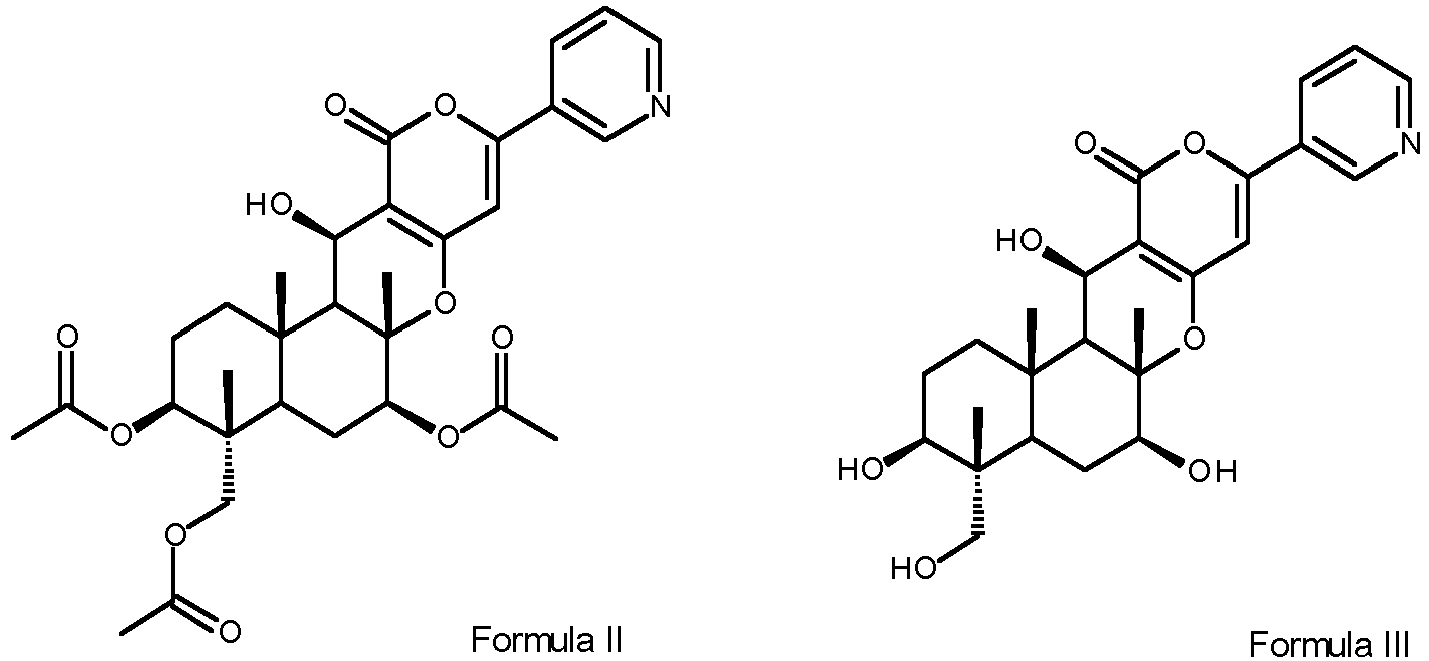

-
EP 2186815 discloses a process for preparing the compound of formula I, which comprises hydrolyzing the acetyl moiety at the 7-position of the compound of formula II with a base, protecting the thus formed hydroxyl group at the 7-position, then hydrolyzing the acetyl groups at the 1- and 11-position, acylating the 1- and 11-position with cyclopropane carbonyl chloride, and then removing the protective group. Due to the large number of reaction steps, the process is tedious and the deacetylation at the 7-position has to performed carefully to achieve the required selectivity. -
EP 2426124 discloses a process for preparing the compound of formula I, which comprises direct acylation of the compound of formula III at the 1-position and the 11-position. Although, the four hydroxyl groups in the compound of formula III show significantly different reactivity, the acylation is not very selective with regard to the compound of formula I and both incomplete acylation, acylation of the wrong OH groups and side reactions such as elimination of water may occur. Moreover, the starting compound of formula III may also contain impurities that may react in the acylation reaction. Therefore, the obtained raw product contains significant amounts of by-products from which the compound of formula I has to be separated. Thus, it is necessary to purify the obtained acylation product by chromatography or crystallization resulting in a considerable loss of product and the obtained yields are low, i.e. below 45%. Moreover, the obtained purities are only moderate and further crystallization is required resulting in further loss of valuable products. -
WO 2011/108155 discloses a process for preparing compounds of formula I by selectively acylating hydroxyl at the 1- and 11-position of compounds of formula III using an acylating agent. - It is therefore an object of the present invention to provide a process for the preparation of the compound of formula I, which provides the compound of formula I with good yields and also high purity. Moreover, the process should allow for reducing the reaction time and it should be workable on industrial scale.
- It was surprisingly found that these and further objectives are solved by the process as described hereinafter. In particular, it was found that the mother liquor of a crystallization of the raw-product obtained from the acylation reaction of the compound of formula III with cyclopropane carbonyl chloride contains significant amounts of pyripyropene compounds, which can be saponified to the compound of formula III. Thus, the fraction of pyripyropene compounds contained in the mother liquor can be used as a further starting material in addition to the compound of formula II for the production of the compound of formula I by recycling this fraction of pyripyropene compounds to the saponification of the compound of formula II and using the thus obtained mixture in the subsequent acylation reaction with cyclopropane carbonyl chloride. Surprisingly, the recycling of the fraction of pyripyropene compounds contained in the mother liquor is not detrimental with regard to purity and yields of the obtained pyripyropene compound of formula I. Rather, the recycling allows for higher concentrations and shorter reaction times in the acylation reaction of the compound of formula III. Moreover, the recycling reduces yield losses as by-products from the acylation reaction are recovered.
- Thus, the present invention relates to a method for preparing pyripyropene compound of the formula I, which method comprises the following steps:
- i) subjecting a pyripyropene compound of formula II (pyripyropene A) to an alkaline hydrolysis to yield a pyripyropene compound of the formula III,
- ii) reacting the pyripyropene compound of formula III obtained in step i) with cyclopropane carbonyl chloride to yield a raw product containing the pyripyropene compound of formula I;
- iii) subjecting the raw product of step ii) to crystallization to yield a crystalline pyripyropene compound of formula I and a mother liquor; and
- iv) recycling the mother liquor or a pyripyropene compound containing fraction thereof to the alkaline hydrolysis of step i).
- The process of the invention starts from the 1,7,11-tri-O-acetyl compound of the formula II, which is a naturally occurring substance, namely pyripyropene A, and which can be prepared by analogy to the methods described in
WO 94/09147 EP 1889540 ,WO 2004/060065 ,EP 2186815 and the prior art cited therein. - In step i) the 1,7,11-tri-O-acetyl compound of the formula II is saponified/hydrolyzed to obtain the 1,7,11-trideacyl compound of the formula III. According to the present invention, the mother liquor of a previous run or a pyripyropene compound containing fraction thereof is recycled into the saponification reaction of said step i) to obtain further amounts of the 1,7,11-trideacyl compound of the formula III by saponification/hydrolysis of the pyripyropene compounds contained in the mother liquor.
- Recycling of the mother liquor or a pyripyropene compound containing fraction thereof into the saponification of step i) may be achieved by combining the mother liquor or a pyripyropene compound containing fraction thereof with fresh compound of the formula II and subjecting the thus obtained mixture to saponification conditions. Recycling of the mother liquor or of a pyripyropene compound containing fraction thereof is preferably achieved by first subjecting the pyripyropene compounds contained in the mother liquor to a saponification/hydrolysis reaction to achieve an at least partial hydrolysis of the ester groups present in the pyripyropene compounds contained in the mother liquor, adding to the thus obtained mixture fresh compound of formula II and continuing the saponification/hydrolysis to yield the compound of formula III. It is of course also possible to first subject fresh compound of formula II to a saponification/hydrolysis reaction to achieve an at least partial hydrolysis of the ester groups present therein, adding to the thus obtained mixture the pyripyropene compounds contained in the mother liquor and continuing the saponification/hydrolysis to yield the compound of formula III.
- In particular the relative amounts of the fresh pyripyropene compound of formula II and mother liquor or pyripyropene compound containing fraction recycled into the alkaline hydrolysis of step i) is chosen such that molar ratio of the recycled pyripyropene compounds, contained in the mother liquor or in the fraction thereof, and fresh pyripyropene of formula II is in the range from 1 : 5 to 5 : 1 and in particular from 1 : 3 to 3 : 1.
- The pyripyropene compounds contained in the mother liquor usually comprise at least one compound of the formula IV, where at least one, in particular 1, 2 or 3 of the radicals Ra, Rb, Rc and Rd is cyclopropylcarbonyl, while the others of Ra, Rb, Rc and Rd are hydrogen. In particular, the pyripyropene compound contained in the mother liquor comprises two or more compounds of the formula IV, selected from
- a) the 1,7,11-tri-O-cyclopropylcarbonyl compound of the formula IVa, i.e. of the formula IV, where Ra = H and where Rb = Rc = Rd = cyclopropylcarbonyl;
- b) the 1-, 7- and 11-mono-O-cyclopropylcarbonyl compounds of the formula IVb, i.e. of the formula IV, where Ra = H and where one of Rb, Rc and Rd is cyclopropylcarbonyl, while the other two of of Rb, Rc and Rd are hydrogen;
- c) the 1,7-, 1,11- and 7,11-di-O-cyclopropylcarbonyl compounds of the formula IVc, i.e. of the formula IV, where Ra = H and where two of Rb, Rc and Rd are cyclopropylcarbonyl, while the others one of Rb, Rc and Rd is hydrogen.
- The pyripyropene compounds contained in the mother liquor frequently comprise at least the compound of formula II and at least one further compound of the formula IV, where at least one, in particular 1, 2 or 3 of the radicals Ra, Rb, Rc and Rd is cyclopropylcarbonyl, while the others of Ra, Rb, Rc and Rd are hydrogen. The pyripyropene compounds contained in the mother liquor usually comprise at least the compound of formula II and at least one further compound of the formula IV, selected from the compounds IVa, IVb and IVc.
- The saponification or hydrolysis of the 1,7,11-tri-O-acetyl compound of the formula II and the fraction of pyripyropene compounds contained in the mother liquor can be achieved according to standard methods as described e.g. in
EP 1889540 . - The saponification in step i) is usually achieved by reacting the compound of formula II or the fraction of pyripyropene compounds contained in the recycled mother liquor or the mixture thereof with a base selected from alkali metal hydroxide, earth alkaline metal hydroxides, alkali metal C1-C4-alkoxides and earth alkaline metal C1-C4-alkoxides. Preferred bases are alkalimetal hydroxides and alkalimetal methoxides, in particular sodium hydroxide and sodium methoxide. The amount of base is generally from 0.2 to 2 equivalents, in particular from 0.2 to 1.5 equivalents, based on the total amount of ester groups present in the compound of formula II and the pyripyropene compounds recycled into the step i). Preferably, the amount of base is chosen such that the pH-value of the resulting reaction mixture at 20 to 50°C, e.g. at 20°C, does not exceed pH 13 and in particular is in the range of pH 10 to pH 13.
- The saponification reaction may be performed in water, in an organic solvent or in a mixture of an organic solvent with water. Preferably, the saponification is performed in an organic solvent or in a mixture of an organic solvent with water. In particular, the solvent used for saponification comprises at least 90% by weight, based on the total amount of solvent, of an organic solvent.
- The concentration of pyripyropene compounds during saponification is generally from 1 to 50% by weight, in particular from 5 to 40% by weight, based on the total weight of the reaction mixture.
- Suitable organic solvents for saponification are any organic solvents, which are inert under the reaction conditions. Suitable organic solvents for saponification include C1-C4-alkanols such as methanol, ethanol, isopropanol, n-butanol, aliphatic or alicyclic ethers such as diethyl ether, di-n-propyl ether, diisopropyl ether, methyl tert.-butyl ether, ethyl tert.-butyl ether, tetrahydrofurane, methyltetrahydrofurane and dioxane, aromatic hydrocarbons such as toluene or ethyl benzene and mixtures thereof. Preferably, the organic solvent for saponification comprises at least one C1-C4-alkanol, especially methanol. In particular, the organic solvents for saponification comprises at least one C1-C4-alkanol, especially methanol, and at least one aromatic hydrocarbon, especially toluene and/or ethyl benzene. More preferably, the organic solvents for saponification is a mixture of at least one C1-C4-alkanol, especially methanol, and at least one aromatic hydrocarbon, especially toluene and/or ethyl benzene. Especially, the saponification is performed in solvent, comprising at least 90%, based on the total amount of solvent, of a mixture of at least one C1-C4-alkanol, especially methanol, and at least one aromatic hydrocarbon, especially toluene and/or ethyl benzene. In another special embodiment, the saponification is performed in mixture of water and an organic solvent, which is a mixture of at least one C1-C4-alkanol, especially methanol, and at least one aromatic hydrocarbon, especially toluene and/or ethyl benzene. In a further special embodiment, the saponification is performed in mixture of water and at least one C1-C4-alkanol, especially methanol.
- The saponification of step i) is generally performed at a temperature in the range from 10 to 100°C, in particular from 15 to 60°C, especially from 20 to 50°C.
- In step ii) of the process of the present invention the pyripyropene compound of formula III, which is obtained in step i), is reacted with cyclopropane carbonyl chloride to yield a raw product containing the pyripyropene compound of formula I.
- The reaction of step ii) is usually performed in a solution or suspension of the compound of formula III in a polar aprotic solvent. Suitable polar aprotic solvents are in particular polar aprotic amides, e.g. N-C1-C3-alkyl lactams such as N-methyl pyrrolidone or N-ethyl pyrrolidone, N,N-di-C1-C3-alkyl amides of C1-C4 alkanoic acids such as N,N-dimethyl formamide or N,N-dimethyl acetamide, N,N'-di-C1-C3-alkyl imidazolin-2-ones such as N,N-dimethyl imidazolin-2-on, and N,N,N',N'-tetra-C1-C3-alkyl ureas such as N,N,N',N'-tetramethyl urea and mixtures thereof. In particular, the polar aprotic solvents is selected from N-methyl pyrrolidone and N,N-dimethyl acetamide. Especially, the polar aprotic solvent is N,N-dimethyl acetamide. Frequently, the relative amounts of the compound of formula III and the polar aprotic solvent, are chosen such that the weight ratio of polar aprotic solvent to compound III is from 6 : 1 to 1 : 1 and in particular from 4 : 1 to 2 : 1 and especially from 3 : 1 to 2.2 : 1.
- Frequently, the amount of cyclopropyl carbonyl chloride in step ii) is from 2 mol to 5 mol, in particular from 2.5 to 4 mol, especially from 2.8 to 3.2 mol, per mol of the compound of formula III. Preferably, the cyclopropyl carbonyl chloride is added to a solution or suspension of the compound of the formula I in the aprotic polar solvent. Preferably, the addition is performed in a controlled manner such that the temperature in the reaction vessel does not exceed 15°C, in particular 10°C.
- The reaction of step ii) is generally performed at a temperature in the range from -15 to +15°C, in particular from -10 to +10°C, especially from -5 to +5°C. The reaction time is generally from 10 to 80 h, in particular from 15 to 48 h, especially from 20 to 45 h.
- The reaction of step ii) is preferably stopped (i.e. quenched) by addition of water or by addition of an aqueous base. Suitable bases include in particular inorganic bases, e.g. alkalimetal hydrogen carbonates, such as sodium or potassium hydrogen carbonate, alkalimetal carbonates, such as sodium or potassium carbonate, and alkalimetal hydroxides, such as sodium or potassium hydroxide. Preferred bases are alkalimetal hydrogen carbonates and alkalimetal carbonates, in particular sodium hydrogen carbonate and sodium carbonate, especially sodium carbonate. The amount of base is generally chosen such that the resulting pH of the reaction mixture is in the range from pH 1 to pH 8, in particular from pH 2 to pH 7.
- Generally, the thus obtained, optionally quenched reaction mixture of step ii) is subjected to an aqueous work-up. For the aqueous work-up, the optionally quenched reaction mixture of step ii) is usually partitioned between an organic solvent of limited solubility in water and an aqueous phase. The aqueous phase serves as an extractant for polar by-products of the reaction mixtures such as salts and the polar aprotic solvent. Suitable organic solvents for aqueous work-up include generally those having a solubility in water of not more than 100 g/l at 20°C, in particular C1-C4-alkyl esters of C1-C4-alkanoic acids, especially C1-C4-alkyl esters of acetic acid or propionic acid, such as ethyl acetate, butyl acetate, or ethyl propionate, and C1-C4-alkyl benzenes such as toluene and ethyl benzene, as well as mixtures thereof.
- Preferably, the aqueous work up comprises an aqueous extraction of the optionally quenched reaction mixture of step ii) with an acidic aqueous extractant. Suitable aqueous extractants are aqueous solutions of organic or inorganic acids, such as phosphoric acid, sulfuric acid, hydrochloric acid, formic acid or acetic acid. Preferred acidic aqueous extractants contain phosphoric acid. Particularly preferred acidic extractants are aqueous solutions of phosphoric acid. Preferably, the concentration of the acid in the acidic aqueous extractant is from 0.01 to 1 mol/l, in particular from 0.02 to 0.5 mol/l.
- The acidic extraction is usually performed as follows: The optionally quenched reaction mixture is diluted with an organic solvent of limited solubility in water, generally those having a solubility in water of not more than 100 g/l at 20°C, in particular C1-C4-alkyl esters of C1-C4-alkanoic acids, especially C1-C4-alkyl esters of acetic acid or propionic acid, such as ethyl acetate, butyl acetate, or ethyl propionate, and C1-C4-alkyl benzenes such as toluene and ethyl benzene, as well as mixtures thereof. The thus obtained dilution is then extracted with the acidic extractant. The acidic extraction may be followed by extraction of the organic dilution with water and/or extraction with an aqueous solution of a base, such as an aqueous solution of alkalimetal carbonate or alkalimetal hydrogen carbonate. The aqueous phase, optionally after neutralization to pH > 6, in particular to a pH in the range of pH 6.5 to pH 9, may be re-extracted with an organic solvent or solvent mixture having a solubility in water of not more than 100 g/l at 20°C as described above. The re-extracted organic phase may be combined with the mother liquor of the subsequent crystallization.
- The acidic extraction and optionally further extractions are generally performed at a temperature between the freezing point and the boiling point of the solvent/water mixture. Frequently, the acidic extraction and optionally further extractions are generally performed at a temperature in the range from 5 to 90°C, in particular from 10 to 70°C and especially from 15 to 55°C.
- According to the invention, the compound of formula I is obtained by subjecting the raw product of step ii) to a crystallization in order to yield pyripyropene compound of formula I in crystalline form. Additionally, a mother liquor is obtained which contains the aforementioned pyripyropene compounds of formula IV and optionally unreacted compound of formula III.
- The crystallization of the raw product may comprise a single crystallization step or two or more crystallization steps.
- The crystallization of the raw product may usually be effected from a solution of the raw product in a suitable organic solvent. Suitable organic solvents for crystallization include e.g. C1-C4-alkyl esters of C1-C4-alkanoic acids, especially C1-C4-alkyl esters of acetic acid or propionic acid, such as ethyl acetate, butyl acetate, or ethyl propionate, and C1-C4-alkyl benzenes such as toluene and ethyl benzene, as well as mixtures thereof and mixtures thereof with one or more co-solvents such as C5-C10-aliphatic or C5-C10-cycloaliphatic hydrocarbons, e.g. hexanes, heptanes, cyclohexane, methylcyclohexane etc. Preferably, the solvent comprises at least 45% by weight, in particular at least 55% by weight, e.g. 45 to 80% by weight, in particular 55 to 80% by weight, based on the total amount of solvent, of at least one aprotic solvent selected from aromatic hydrocarbon solvent, C1-C4-alkyl acetates and mixtures thereof. Particular preferred solvents for crystallization are selected from ethyl acetate, toluene, ethylbenzene and mixtures thereof and mixtures thereof with one or more co-solvents such as cyclohexane. Especially, the solvent comprises at least 45% by weight, in particular at least 55% by weight, e.g. 45 to 80% by weight, in particular 55 to 80% by weight, based on the total amount of solvent, of a solvent selected from ethyl acetate, toluene, ethylbenzene and mixtures thereof. The solution of the raw product may be the solution obtained after aqueous work-up of the reaction mixture of step ii). The solution of the raw product may be obtained by dissolving a concentrated or dried raw product of the aqueous work-up in a suitable organic solvent as described above.
- The concentration of the raw product in the solution prior to crystallization is generally from 10 to 40% by weight, in particular from 12 to 35% by weight, especially from 15 to 30% by weight, based on the total amount of solvent and raw product.
- Crystallization of the compound of formula I is generally achieved by cooling a solution of the raw product or by concentrating a solution of the raw product or by combined measures. Preferably, the crystallization is effected from the solution having a first temperature by cooling the solution to a second temperature which is at least 10 K, in particular at least 20 K, e.g. from 10 to 80 K, in particular from 20 to 60 K, below the first temperature. The first temperature is preferably in the range from 40 to 90°C, in particular from 45 to 80°C, especially from 50 to 70°C, while the second temperature is preferably in the range from -15 to 50°C, in particular from 0 to 40°C, especially from 5 to 35°C. Preferably, the cooling rate does not exceed 20 K/h and is in particular in the range from 1 to 20 K/h, especially from 2 to 15 K/h.
- Crystallization may be promoted by adding seed crystals of the compound of formula I to the solution for crystallization. Preferably, seed crystals are added at a temperature in the range from 30 to 70°C, especially in the range from 40 to 60°C. The amount of seed crystals added is generally from 0.1 to 10 % by weight, in particular from 0.2 to 5 % by weight, based on the amount of solid raw product contained in the solution for crystallization.
- The obtained crystalline compound of the formula I is then separated from its mother liquor. Separation can be achieved by suitable techniques for separating liquids from solids, e.g. by filtration or centrifugation.
- The thus obtained crystalline material may be washed with a suitable organic solvent in order to remove residues of the mother liquor adhering to the crystalline material. The solvent used for washing may be combined with the mother liquor of the crystallization, as it contains a certain amount of the compound of formula I. Suitable solvents for washing include the solvents mentioned as suitable solvents for crystallization. Preferably, the solvent for washing comprises at least 50% by weight, in particular at least 80% by weight, based on the total amount of solvent, of at least one aprotic solvent selected from aromatic hydrocarbon solvent, C1-C4-alkyl acetates and mixtures thereof. Particular preferred solvents for washing are selected from ethyl acetate, toluene, ethylbenzene and mixtures thereof and mixtures thereof with one or more co-solvents such as cyclohexane. Especially, the solvent for washing comprises at least 50% by weight, in particular at least 80% by weight, based on the total amount of solvent, of a solvent selected from ethyl acetate, toluene, ethylbenzene and mixtures thereof. Preferably, washing is performed at a temperature of not more than 40°C, in particular not more than 30°C, e.g. at a temperature in the range from -15 to 40°C in particular from 0 to 30°C.
- The crystallization can be repeated one or more times, in particular once or twice, i.e. the obtained crystalline material can be crystallized again, in order to further increase the purity of the compound of formula I. The recrystallization can be performed in the same way as described for the crystallization of the raw product. The thereby obtained mother liquors and washings are preferably combined with the mother liquor and the washings obtained in the crystallization of the raw product and together recycled back into step i) of the inventive process.
- By the process of the present invention, the compound of formula I is obtained in high yields and high purities of generally > 90%, in particular > 95%.
- The following examples further illustrate the present invention.
- The following abbreviations and terms are used in the following examples:
- DMAC:
- N,N-dimethyl acetamide
- MeOH
- Methanol
- % b.w.:
- % by weight
- v/v
- volume per volume
- 250 g of the compound of formula III (purity 95%, 0.52 mol) were suspended in 625 g DMAC (purity 100%, 7.17 mol) and the solution was cooled to -3°C. 166 g cyclopropane carbonyl chloride (purity 98%, 1.56 mol) were added in 20 min, keeping the temperature below 0°C. The reaction was stirred for 33 h at 0°C and then the reaction mixture was added to a mixture of 962 g sodium carbonate (10% b.w. in water, 0.91 mol) and 2110 g toluene (22.91 mol) at 20°C (pH 7). The vessel was purged with 50 g of a 1 : 1-mixture (v/v) of DMAC : toluene. After phase separation at 23°C, the organic phase was successively washed twice with aqueous phosphoric acid (0.2 M, 750 mL, pH 2.3-2), once with aqueous phosphoric acid (0.035 M, 760 mL, pH 2.2), once with aqueous sodium carbonate (1% by weight, 745 mL, pH 7.3) and once with water (250 mL). Concentration of the organic phase in vacuo (70°C, 100 mbar) yielded 666 g of a 25.2% b.w. solution of the compound of formula I (0.28 mol, 54% yield), which can be subjected to crystallization.
- 250 g of the compound of formula III (purity 95%, 0.52 mol) were suspended in 625 g DMAC (purity 100%, 7.17 mol) and the solution was cooled to -3°C. 166 g cyclopropane carbonyl chloride (purity 98%, 1.56 mol) were added in 20 min, keeping the temperature below 0°C. The reaction was stirred for 32 h at 0°C and then the reaction mixture was added to a mixture of 957 g sodium carbonate (10% in water, 0.91 mol) and 2110 g toluene (100%, 22.91 mol) at 20°C (pH 6.3). The vessel was purged with 50 g of a 1 : 1-mixture (v/v) of DMAC : toluene. After phase separation at 23°C, the organic phase was successively washed twice with aqueous phosphoric acid (0.2 M, 750 mL, pH 2.1-1.8), once with aqueous phosphoric acid (0.035 M, 760 mL, pH 2.7), once with aqueous sodium carbonate (1% b.w., 745 mL, pH 7.2) and once with water (250 mL). Concentration of the organic phase in vacuo (70°C, 100 mbar) gave 666 g of a 25% b.w. solution of the compound of formula I. 630 g of said solution were heated to 55°C, seeded with 0.80 g of the compound of formula I and cooled down to 0°C with 5 K/h and stirred for further 12 h. The obtained solid (162 g, toluene-wet) was filtered and washed with toluene (360 mL) at 0°C, yielding 726 g mother liquor 1. 159 g of the toluene-wet solid were suspended in 356 mL ethyl acetate, heated for 2 h to 70 °C to obtain a suspension which was afterwards cooled down to 20°C with 10 K/h.
- Thereby the compound of formula I crystallized. The crystals were filtered off, washed with ethyl acetate (341 g mother liquor 2) and dried in vacuo, thereby yielding 126 g of the compound of formula I (purity 98%, 0.21 mol, yield 40%).
- 250 g of the compound of formula III (purity 95%, 0.52 mol) were suspended in 625 g DMAC (purity 100%, 7.17 mol) and the solution was cooled to -3°C. 166 g cyclopropane carbonyl chloride (purity 98%, 1.56 mol) were added within 20 min, keeping the temperature below 0°C. The reaction was stirred for 43 h at 0°C and then the reaction mixture was added to a mixture of 962 g sodium carbonate (10% b.w. in water, 0.91 mol) and 2110 g toluene (22.91 mol) at 15°C (pH 7.1). The vessel was purged with 50 g of a 1 : 1-mixture (v/v) of DMAC: toluene. After phase separation at 15°C, the organic phase was successively washed twice with aqueous phosphoric acid (0.2 M, 750 mL, pH 2.1-2.0), once with aqueous phosphoric acid (0.035 M, 760 mL, pH 2.4), once with aqueous sodium carbonate (1% b.w., 745 mL, pH 7.3) and once with water (250 mL). Concentration of the organic phase in vacuo (70°C, 100 mbar) gave 666 g of a 25.4% b.w. solution of the compound of formula I. 640 g of said solution were heated to 55°C, seeded with 0.84 g of the compound of formula I and cooled down to 0°C with 5 K/h and stirred for further 12 h. The obtained solid was filtered off, washed with toluene (280 mL and 80 mL), yielding 729 g mother liquor 1 and 187 g of the compound of formula I (toluene-wet). 175 g of the toluene-wet solid were suspended in 350 mL of ethyl acetate, heated for 2 h to 70°C to obtain a suspension which was afterwards cooled down to 20°C with 10 K/h. Thereby the compound of formula I crystallized. The crystals were filtered off, washed with 140 mL of ethyl acetate and dried in vacuo, thereby yielding 123 g of the compound of formula I (purity 98%, 0.21 mol, 40% yield) and 399 g of mother liquor 2. The combined aqueous phase and three acid phases (3951 g) were neutralized to pH 7.3 with 53 g of sodium carbonate (100%, 0.5 mol) and re-extracted three times with 400 g toluene at 70°C yielding 1082 g of mother liquor 3.
- The mother liquor 2 of Example 1 was evaporated at 60°C and 100 mbar to dryness. Then mother liquors 1 and 3 of Example 1 were successively continuously evaporated until 358 g of a solution were obtained. The solution was diluted with MeOH (357 g) and 118 g of the resulting MeOH/toluene mixture containing 0.043 mol of the compound of formula I and derivatives IV were taken for the following saponification. 470 g MeOH was added to the mixture and the mixture was warmed to 30°C. 7.5 g sodium hydroxide (50%, 0.094 mol) were added and the reaction mixture stirred for 10 h (pH 12.9). Then 170 g of a solution of the compound of formula II in toluene (17.5% b.w., 0.051 mol) were added and stirring was continued for 4 h. After cooling to 22°C, the mixture was filtered and washed 2 times with MeOH (30 mL each) at 0°C. After drying at 100°C in vacuo, 41.8 g of the compound of formula III (purity 91.8%, 0.084 mol, 89% yield) were obtained.
- 60 g of the compound of formula III (purity 95%, 0.12 mol) were suspended in 150 g DMAC (purity 100%, 1.72 mol) and the solution was cooled to -3°C. 40 g cyclopropane carbonyl chloride (purity 98%, 0.37 mol) were added within 20 min, keeping the temperature below 0°C. The reaction mixture was stirred for 43 h at 0°C and then added to a mixture of 232 g aqueous sodium carbonate (10% b.w. in water, 0.03 mol) and 850 g ethyl benzene (8.02 mol) at 15°C (pH 7). The reaction vessel was purged with 15 g of DMAC. After phase separation at 70°C, the organic phase was successively washed three times with diluted aqueous phosphoric acid (0.1 M, 180 mL, pH 3.2-2.3) and once with water (180 mL, pH 2.8). Concentration of the organic phase in vacuo (70°C, 90 mbar) gave a 18% b.w. solution of the compound of formula I. The solution was heated to 55°C, seeded with the compound of formula I and cooled down to 0°C with 5 K/h. The obtained solid was filtered off and washed with ethyl benzene (50 mL), yielding 205 g mother liquor 1 and 44 g of ethyl benzene-wet solid. 44 g of the ethyl benzene-wet solid were suspended in 88 mL ethyl acetate, heated to 70°C for 2 h and afterwards cooled down to 20°C with 10 K/h. Thereby the compound of formula I crystallized. The crystals were filtered off, washed with 50 mL ethyl acetate (82 g mother liquor 2) and dried in vacuo, thereby yielding 31.5 g of the compound of formula I (97% purity, 0.05 mol, 41% yield).
- 82 g of the mother liquor 2 of example 3 were evaporated to dryness at 80°C (200 → 20 mbar). To the obtained residue 205 g of mother liquor 1 were added and the obtained mixture was concentrated to 80 g at 40 mbar and 65°C. The thus obtained solution was diluted with 720 g MeOH to yield a solution containing 55 mmol of the compound of formula I and derivatives. The solution was warmed to 30°C and 5 g sodium hydroxide (50%, 62.5 mmol) were added (pH 12.2) and the resulting mixture was stirred for 24 h. Then 300 g a solution of the compound of formula II in ethyl benzene (22.4% b.w., 115 mmol) and 6 g of aqueous sodium hydroxide (50% b.w., 75.0 mmol) were successively added. After 3 h, the reaction mixture was cooled to 22°C. The precipitate was filtered off and washed twice with MeOH (60 mL each). Drying of the solids at 25 mbar and 100°C yielded 73 g of the compound of formula III (94.4% purity, 151 mmol, 88% yield).
- 60 g of the compound of formula III obtained in example 4 (purity 94.4%, 0.12 mol) were suspended in 150 g DMAC (purity 100%, 1.72 mol) and the suspension was cooled to -3°C. 40 g cyclopropane carbonyl chloride (purity 98%, 0.37 mol) were added within 20 min, keeping the temperature below 0°C. The reaction mixture was stirred for 41 h at 0°C and then added to a mixture of 232 g sodium carbonate (10% b.w. in water, 0.03 mol) and 852 g ethyl benzene (100%, 8.02 mol) at 15°C (pH 7). The vessel was purged with 15 g of DMAC. After phase separation at 70°C, the organic phase was successively washed three times with diluted aqueous phosphoric acid (0.1 M, 180 mL, pH 2.8-2.3) and once with water (180 mL, pH 2.9). Concentration of the organic phase in vacuo (70°C, 90 mbar) gave a 18% b.w. solution of the compound of formula I. The solution was heated to 55°C, seeded with the compound of formula I and cooled down to 0°C with 5 K/h. The obtained solid was filtered off and washed with ethyl benzene (50 mL), yielding 211 g mother liquor 1 and 44 g of an ethyl benzene-wet solid. 44 g of the ethyl benzene-wet solid were suspended in 88 mL ethyl acetate, heated to 70°C for 2 h and afterwards cooled down to 20°C with 10 K/h. Thereby the compound of formula I crystallized. The crystals were filtered off, washed with 50 mL ethyl acetate (82 g mother liquor 2) and dried in vacuo, thereby yielding 29.5 g of the compound of formula I (98% purity, 0.05 mol, 41% yield).
Claims (11)
- A method for preparing the pyripyropene compound of the formula I
 i) subjecting a pyripyropene compound of formula II to an alkaline hydrolysis to yield a pyripyropene compound of the formula III,
 ii) reacting the pyripyropene compound of formula III obtained in step i) with cyclopropane carbonyl chloride to yield a raw product containing the pyripyropene compound of formula I;iii) subjecting the raw product of step ii) to crystallization to yield a crystalline pyripyropene compound of formula I and a mother liquor; andiv) recycling the mother liquor or a pyripyropene compound containing fraction thereof to the alkaline hydrolysis of step i).
 - The method of claim 1, wherein step ii) is performed in a solution or suspension of the compound of formula III in a polar aprotic solvent, which is selected from N-methyl pyrrolidone and dimethyl acetamide.
- The method of claim 2, where the weight ratio of polar aprotic solvent to compound III is from 6 : 1 to 1 : 1.
- The method of any of the preceding claims, where the reaction mixture of step ii) is subjected to an aqueous extraction with an acidic aqueous extractant.
- The method of any of the preceding claims, where the reaction mixture of step ii) is subjected to a workup comprising a neutralization of the reaction mixture and a subsequent aqueous extraction with an acidic aqueous extractant.
- The method of claim 4, where the acidic aqueous extractant contains phosphoric acid.
- The method of any of the preceding claims, where the crystallization of the raw product is achieved from a solution of the raw product in at least one organic solvent, which solvent comprises at least 50%, based on the total amount of solvent, of at least one aprotic solvent selected from aromatic hydrocarbon solvent, C1-C4-alkyl acetates and mixtures thereof.
- The method of any of the preceding claims, where the relative amount of the pyripyropene compound of formula II and mother liquor or pyripyropene compound containing fraction recycled into the alkaline hydrolysis of step i) is such that molar ratio of the recycled pyripyropene compound and fresh pyripyropene of formula II is in the range from 1 : 5 to 5 : 1.
- The method of any of the preceding claims, where hydrolysis in step i) is achieved by reacting the compound of formula II with a base selected from alkali metal hydroxide, earth alkaline metal hydroxides, alkali metal C1-C4-alkoxides and earth alkaline metal C1-C4-alkoxides in an organic solvent or in a mixture of an organic solvent with water.
- The method of claim 9, where the organic solvent comprises at least one C1-C4-alkanol, especially methanol.
- The method of any of claims 9 or 11, where the organic solvent comprises at least 90%, based on the total amount of organic solvent, of a mixture of at least one alkyl aromatic hydrocarbon solvent, especially toluene and/or ethyl benzene, and at least one C1-C4-alkanol, especially methanol.
Priority Applications (1)
| Application Number | Priority Date | Filing Date | Title |
|---|---|---|---|
| EP14700640.7A EP2945949B1 (en) | 2013-01-16 | 2014-01-15 | Method for preparing a pyripyropene compound |
Applications Claiming Priority (4)
| Application Number | Priority Date | Filing Date | Title |
|---|---|---|---|
| US201361753023P | 2013-01-16 | 2013-01-16 | |
| EP13151492 | 2013-01-16 | ||
| PCT/EP2014/050654 WO2014111398A1 (en) | 2013-01-16 | 2014-01-15 | Method for preparing a pyripyropene compound |
| EP14700640.7A EP2945949B1 (en) | 2013-01-16 | 2014-01-15 | Method for preparing a pyripyropene compound |
Publications (2)
| Publication Number | Publication Date |
|---|---|
| EP2945949A1 EP2945949A1 (en) | 2015-11-25 |
| EP2945949B1 true EP2945949B1 (en) | 2019-05-15 |
Family
ID=47559317
Family Applications (1)
| Application Number | Title | Priority Date | Filing Date |
|---|---|---|---|
| EP14700640.7A Active EP2945949B1 (en) | 2013-01-16 | 2014-01-15 | Method for preparing a pyripyropene compound |
Country Status (13)
| Country | Link |
|---|---|
| US (1) | US9598428B2 (en) |
| EP (1) | EP2945949B1 (en) |
| JP (2) | JP6328661B2 (en) |
| KR (1) | KR102139923B1 (en) |
| CN (1) | CN105452256B (en) |
| AR (1) | AR095297A1 (en) |
| AU (1) | AU2014206958B2 (en) |
| BR (1) | BR112015016924B1 (en) |
| CA (1) | CA2898115C (en) |
| IL (1) | IL239866A (en) |
| MX (1) | MX368666B (en) |
| TW (1) | TWI633109B (en) |
| WO (1) | WO2014111398A1 (en) |
Families Citing this family (8)
| Publication number | Priority date | Publication date | Assignee | Title |
|---|---|---|---|---|
| WO2014111398A1 (en) * | 2013-01-16 | 2014-07-24 | Basf Se | Method for preparing a pyripyropene compound |
| CN105102625A (en) | 2013-03-28 | 2015-11-25 | 巴斯夫欧洲公司 | Preparation of pyripyroprine from dried biomass |
| KR20210133323A (en) | 2013-12-13 | 2021-11-05 | 바스프 에스이 | Recombinant microorganism for improved production of fine chemicals |
| US10053436B2 (en) | 2014-07-08 | 2018-08-21 | BASF Agro B.V. | Process for the preparation of substituted oxiranes and triazoles |
| WO2016180642A1 (en) | 2015-05-08 | 2016-11-17 | BASF Agro B.V. | A process for the preparation of terpinolene epoxide |
| WO2016180614A1 (en) | 2015-05-08 | 2016-11-17 | Basf Se | A process for the preparation of limonene-4-ol |
| KR20190017924A (en) | 2016-06-15 | 2019-02-20 | 바스프 아그로 비.브이. | Epoxidation method of tetra-substituted alkene |
| ES2877169T3 (en) | 2016-06-15 | 2021-11-16 | Basf Agro Bv | Procedure for the epoxidation of a tetra-substituted alkene |
Family Cites Families (11)
| Publication number | Priority date | Publication date | Assignee | Title |
|---|---|---|---|---|
| JP3725198B2 (en) * | 1995-03-27 | 2005-12-07 | 社団法人北里研究所 | Pyripyropene derivative |
| TWI388282B (en) | 2005-06-01 | 2013-03-11 | Meiji Seika Pharma Co Ltd | Pest control agents |
| KR100943983B1 (en) * | 2006-07-27 | 2010-02-26 | 한국생명공학연구원 | Pyripyrophene Derivatives and Insecticide Compositions Comprising the Same |
| ES2379928T3 (en) * | 2006-11-30 | 2012-05-07 | Meiji Seika Kaisha Ltd. | Pest Control Agent |
| AU2008221838B2 (en) | 2007-03-08 | 2013-09-12 | Basf Se | Pest control composition |
| KR101570887B1 (en) * | 2007-08-13 | 2015-11-20 | 바스프 에스이 | Process for producing pyripyropene derivatives and intermediates for the production thereof |
| CA2709466A1 (en) | 2007-12-21 | 2009-07-02 | Meiji Seika Kaisha, Ltd. | Agricultural and horticultural compositions comprising systemic pyripyropene derivatives |
| PL2426124T3 (en) * | 2009-05-13 | 2013-12-31 | Meiji Seika Pharma Co Ltd | Process for producing pyripyropene derivative |
| UA111151C2 (en) * | 2010-03-01 | 2016-04-11 | Мейдзі Сейка Фарма Ко., Лтд. | METHOD OF PREPARATION OF PYRIPYROPENE DERIVATIVES |
| BR112012028760A2 (en) * | 2010-05-24 | 2018-02-06 | Meiji Seika Pharma Co Ltd | harmful organism control agent |
| WO2014111398A1 (en) * | 2013-01-16 | 2014-07-24 | Basf Se | Method for preparing a pyripyropene compound |
-
2014
- 2014-01-15 WO PCT/EP2014/050654 patent/WO2014111398A1/en not_active Ceased
- 2014-01-15 CA CA2898115A patent/CA2898115C/en active Active
- 2014-01-15 JP JP2015552098A patent/JP6328661B2/en active Active
- 2014-01-15 AU AU2014206958A patent/AU2014206958B2/en active Active
- 2014-01-15 CN CN201480012962.7A patent/CN105452256B/en active Active
- 2014-01-15 KR KR1020157022062A patent/KR102139923B1/en active Active
- 2014-01-15 BR BR112015016924-4A patent/BR112015016924B1/en active IP Right Grant
- 2014-01-15 EP EP14700640.7A patent/EP2945949B1/en active Active
- 2014-01-15 US US14/760,302 patent/US9598428B2/en active Active
- 2014-01-15 MX MX2015009223A patent/MX368666B/en active IP Right Grant
- 2014-01-16 AR ARP140100157A patent/AR095297A1/en active IP Right Grant
- 2014-01-16 TW TW103101657A patent/TWI633109B/en active
-
2015
- 2015-07-09 IL IL239866A patent/IL239866A/en active IP Right Grant
-
2018
- 2018-04-18 JP JP2018080051A patent/JP2018138579A/en not_active Withdrawn
Non-Patent Citations (1)
| Title |
|---|
| None * |
Also Published As
| Publication number | Publication date |
|---|---|
| BR112015016924B1 (en) | 2020-05-12 |
| EP2945949A1 (en) | 2015-11-25 |
| AU2014206958B2 (en) | 2017-08-10 |
| US9598428B2 (en) | 2017-03-21 |
| BR112015016924A2 (en) | 2017-07-11 |
| JP2018138579A (en) | 2018-09-06 |
| MX368666B (en) | 2019-10-10 |
| KR20150105474A (en) | 2015-09-16 |
| WO2014111398A1 (en) | 2014-07-24 |
| TWI633109B (en) | 2018-08-21 |
| CA2898115C (en) | 2021-03-02 |
| IL239866A (en) | 2017-11-30 |
| US20160046644A1 (en) | 2016-02-18 |
| TW201429977A (en) | 2014-08-01 |
| JP6328661B2 (en) | 2018-05-23 |
| AR095297A1 (en) | 2015-10-07 |
| CN105452256B (en) | 2017-07-25 |
| IL239866A0 (en) | 2015-08-31 |
| CA2898115A1 (en) | 2014-07-24 |
| KR102139923B1 (en) | 2020-07-31 |
| JP2016504404A (en) | 2016-02-12 |
| MX2015009223A (en) | 2015-10-15 |
| CN105452256A (en) | 2016-03-30 |
| AU2014206958A1 (en) | 2015-08-06 |
Similar Documents
| Publication | Publication Date | Title |
|---|---|---|
| AU2014206958B2 (en) | Method for preparing a pyripyropene compound | |
| US11168060B2 (en) | Method for producing 2-[4-(4-chlorophenoxy)-2-(trifluoromethyl)phenyl]-1-(1,2,4-triazol-1-yl)propan-2-ol | |
| CN110785402A (en) | A process for separating long-chain amino acids and dibasic acids | |
| CN110770205A (en) | Production process of long-chain amino acid and dibasic acid | |
| CN113956312A (en) | Preparation method of mopilavir | |
| US6495685B1 (en) | Process for preparing piperazine derivatives | |
| WO2018141642A1 (en) | Process for the preparation of 2-chloro-4-fluoro-5-nitrobenzotrichloride | |
| US7115786B2 (en) | Method for production of β-cryptoxanthin and α-cryptoxanthin from commercially available lutein | |
| EP3645499B1 (en) | Process for the separation of long chain amino acids and dibasic acids | |
| KR20010005573A (en) | Method for debenzylation of dibenzyl biotin | |
| CN101812108B (en) | Synthesis of hydrocortisone butyrate | |
| KR100371241B1 (en) | Method for Purifying O, S-Dimethyl N-acetylphosphoramidothioate | |
| JP2020097610A (en) | Process for producing pyripyropene compound | |
| EP3312174B1 (en) | Method for preparing trityl candesartan | |
| US20100190976A1 (en) | Novel process for the recovery of beta acetylfuranoside | |
| US5659081A (en) | Process for the preparation of cyclopropanecarboxamide | |
| EP3771480A1 (en) | Continuous process for preparing the crystalline form ii of sotagliflozin | |
| CN105384660B (en) | A kind of preparation method of a-amino acid | |
| AU776674B2 (en) | Method for preparing and isolating 9-deoxo-9(Z)-hydroxyiminoerythromycin | |
| US20060030730A1 (en) | Purification and production methods of 1-aminocyclopropanecarboxylic acid | |
| US6906039B2 (en) | Process for preparation of erythromycin compounds | |
| CN107207435B (en) | Method for preparing 4-cyanopiperidine hydrochloride | |
| CN115677619A (en) | Method for preparing sulfonate by oxidizing imidosulfonate with sodium hypochlorite | |
| WO2023247239A1 (en) | Method for producing 2-[4-(4-chlorophenoxy)-2-(trifluoromethyl)phenyl]-1-(1,2,4-triazol-1-yl)propan-2-ol | |
| HK1228403A1 (en) | Process for the recovery of beta-acetylfuranoside |
Legal Events
| Date | Code | Title | Description |
|---|---|---|---|
| PUAI | Public reference made under article 153(3) epc to a published international application that has entered the european phase |
Free format text: ORIGINAL CODE: 0009012 |
|
| 17P | Request for examination filed |
Effective date: 20150817 |
|
| AK | Designated contracting states |
Kind code of ref document: A1 Designated state(s): AL AT BE BG CH CY CZ DE DK EE ES FI FR GB GR HR HU IE IS IT LI LT LU LV MC MK MT NL NO PL PT RO RS SE SI SK SM TR |
|
| AX | Request for extension of the european patent |
Extension state: BA ME |
|
| DAX | Request for extension of the european patent (deleted) | ||
| 17Q | First examination report despatched |
Effective date: 20160502 |
|
| GRAP | Despatch of communication of intention to grant a patent |
Free format text: ORIGINAL CODE: EPIDOSNIGR1 |
|
| STAA | Information on the status of an ep patent application or granted ep patent |
Free format text: STATUS: GRANT OF PATENT IS INTENDED |
|
| INTG | Intention to grant announced |
Effective date: 20190102 |
|
| GRAS | Grant fee paid |
Free format text: ORIGINAL CODE: EPIDOSNIGR3 |
|
| GRAA | (expected) grant |
Free format text: ORIGINAL CODE: 0009210 |
|
| STAA | Information on the status of an ep patent application or granted ep patent |
Free format text: STATUS: THE PATENT HAS BEEN GRANTED |
|
| AK | Designated contracting states |
Kind code of ref document: B1 Designated state(s): AL AT BE BG CH CY CZ DE DK EE ES FI FR GB GR HR HU IE IS IT LI LT LU LV MC MK MT NL NO PL PT RO RS SE SI SK SM TR |
|
| REG | Reference to a national code |
Ref country code: CH Ref legal event code: EP |
|
| REG | Reference to a national code |
Ref country code: DE Ref legal event code: R096 Ref document number: 602014046747 Country of ref document: DE |
|
| REG | Reference to a national code |
Ref country code: IE Ref legal event code: FG4D |
|
| REG | Reference to a national code |
Ref country code: DK Ref legal event code: T3 Effective date: 20190802 |
|
| REG | Reference to a national code |
Ref country code: NL Ref legal event code: MP Effective date: 20190515 |
|
| REG | Reference to a national code |
Ref country code: LT Ref legal event code: MG4D |
|
| REG | Reference to a national code |
Ref country code: GR Ref legal event code: EP Ref document number: 20190402163 Country of ref document: GR Effective date: 20191016 |
|
| PG25 | Lapsed in a contracting state [announced via postgrant information from national office to epo] |
Ref country code: NL Free format text: LAPSE BECAUSE OF FAILURE TO SUBMIT A TRANSLATION OF THE DESCRIPTION OR TO PAY THE FEE WITHIN THE PRESCRIBED TIME-LIMIT Effective date: 20190515 Ref country code: HR Free format text: LAPSE BECAUSE OF FAILURE TO SUBMIT A TRANSLATION OF THE DESCRIPTION OR TO PAY THE FEE WITHIN THE PRESCRIBED TIME-LIMIT Effective date: 20190515 Ref country code: LT Free format text: LAPSE BECAUSE OF FAILURE TO SUBMIT A TRANSLATION OF THE DESCRIPTION OR TO PAY THE FEE WITHIN THE PRESCRIBED TIME-LIMIT Effective date: 20190515 Ref country code: PT Free format text: LAPSE BECAUSE OF FAILURE TO SUBMIT A TRANSLATION OF THE DESCRIPTION OR TO PAY THE FEE WITHIN THE PRESCRIBED TIME-LIMIT Effective date: 20190915 Ref country code: AL Free format text: LAPSE BECAUSE OF FAILURE TO SUBMIT A TRANSLATION OF THE DESCRIPTION OR TO PAY THE FEE WITHIN THE PRESCRIBED TIME-LIMIT Effective date: 20190515 Ref country code: SE Free format text: LAPSE BECAUSE OF FAILURE TO SUBMIT A TRANSLATION OF THE DESCRIPTION OR TO PAY THE FEE WITHIN THE PRESCRIBED TIME-LIMIT Effective date: 20190515 Ref country code: NO Free format text: LAPSE BECAUSE OF FAILURE TO SUBMIT A TRANSLATION OF THE DESCRIPTION OR TO PAY THE FEE WITHIN THE PRESCRIBED TIME-LIMIT Effective date: 20190815 |
|
| PG25 | Lapsed in a contracting state [announced via postgrant information from national office to epo] |
Ref country code: LV Free format text: LAPSE BECAUSE OF FAILURE TO SUBMIT A TRANSLATION OF THE DESCRIPTION OR TO PAY THE FEE WITHIN THE PRESCRIBED TIME-LIMIT Effective date: 20190515 Ref country code: BG Free format text: LAPSE BECAUSE OF FAILURE TO SUBMIT A TRANSLATION OF THE DESCRIPTION OR TO PAY THE FEE WITHIN THE PRESCRIBED TIME-LIMIT Effective date: 20190815 Ref country code: RS Free format text: LAPSE BECAUSE OF FAILURE TO SUBMIT A TRANSLATION OF THE DESCRIPTION OR TO PAY THE FEE WITHIN THE PRESCRIBED TIME-LIMIT Effective date: 20190515 |
|
| REG | Reference to a national code |
Ref country code: AT Ref legal event code: MK05 Ref document number: 1133295 Country of ref document: AT Kind code of ref document: T Effective date: 20190515 |
|
| PG25 | Lapsed in a contracting state [announced via postgrant information from national office to epo] |
Ref country code: RO Free format text: LAPSE BECAUSE OF FAILURE TO SUBMIT A TRANSLATION OF THE DESCRIPTION OR TO PAY THE FEE WITHIN THE PRESCRIBED TIME-LIMIT Effective date: 20190515 Ref country code: CZ Free format text: LAPSE BECAUSE OF FAILURE TO SUBMIT A TRANSLATION OF THE DESCRIPTION OR TO PAY THE FEE WITHIN THE PRESCRIBED TIME-LIMIT Effective date: 20190515 Ref country code: EE Free format text: LAPSE BECAUSE OF FAILURE TO SUBMIT A TRANSLATION OF THE DESCRIPTION OR TO PAY THE FEE WITHIN THE PRESCRIBED TIME-LIMIT Effective date: 20190515 Ref country code: AT Free format text: LAPSE BECAUSE OF FAILURE TO SUBMIT A TRANSLATION OF THE DESCRIPTION OR TO PAY THE FEE WITHIN THE PRESCRIBED TIME-LIMIT Effective date: 20190515 Ref country code: SK Free format text: LAPSE BECAUSE OF FAILURE TO SUBMIT A TRANSLATION OF THE DESCRIPTION OR TO PAY THE FEE WITHIN THE PRESCRIBED TIME-LIMIT Effective date: 20190515 |
|
| REG | Reference to a national code |
Ref country code: ES Ref legal event code: FG2A Ref document number: 2742301 Country of ref document: ES Kind code of ref document: T3 Effective date: 20200213 |
|
| REG | Reference to a national code |
Ref country code: DE Ref legal event code: R097 Ref document number: 602014046747 Country of ref document: DE |
|
| PG25 | Lapsed in a contracting state [announced via postgrant information from national office to epo] |
Ref country code: SM Free format text: LAPSE BECAUSE OF FAILURE TO SUBMIT A TRANSLATION OF THE DESCRIPTION OR TO PAY THE FEE WITHIN THE PRESCRIBED TIME-LIMIT Effective date: 20190515 |
|
| PLBE | No opposition filed within time limit |
Free format text: ORIGINAL CODE: 0009261 |
|
| STAA | Information on the status of an ep patent application or granted ep patent |
Free format text: STATUS: NO OPPOSITION FILED WITHIN TIME LIMIT |
|
| 26N | No opposition filed |
Effective date: 20200218 |
|
| PG25 | Lapsed in a contracting state [announced via postgrant information from national office to epo] |
Ref country code: PL Free format text: LAPSE BECAUSE OF FAILURE TO SUBMIT A TRANSLATION OF THE DESCRIPTION OR TO PAY THE FEE WITHIN THE PRESCRIBED TIME-LIMIT Effective date: 20190515 |
|
| PG25 | Lapsed in a contracting state [announced via postgrant information from national office to epo] |
Ref country code: SI Free format text: LAPSE BECAUSE OF FAILURE TO SUBMIT A TRANSLATION OF THE DESCRIPTION OR TO PAY THE FEE WITHIN THE PRESCRIBED TIME-LIMIT Effective date: 20190515 |
|
| PG25 | Lapsed in a contracting state [announced via postgrant information from national office to epo] |
Ref country code: MC Free format text: LAPSE BECAUSE OF FAILURE TO SUBMIT A TRANSLATION OF THE DESCRIPTION OR TO PAY THE FEE WITHIN THE PRESCRIBED TIME-LIMIT Effective date: 20190515 |
|
| PG25 | Lapsed in a contracting state [announced via postgrant information from national office to epo] |
Ref country code: LU Free format text: LAPSE BECAUSE OF NON-PAYMENT OF DUE FEES Effective date: 20200115 |
|
| PG25 | Lapsed in a contracting state [announced via postgrant information from national office to epo] |
Ref country code: IE Free format text: LAPSE BECAUSE OF NON-PAYMENT OF DUE FEES Effective date: 20200115 |
|
| PG25 | Lapsed in a contracting state [announced via postgrant information from national office to epo] |
Ref country code: MT Free format text: LAPSE BECAUSE OF FAILURE TO SUBMIT A TRANSLATION OF THE DESCRIPTION OR TO PAY THE FEE WITHIN THE PRESCRIBED TIME-LIMIT Effective date: 20190515 Ref country code: CY Free format text: LAPSE BECAUSE OF FAILURE TO SUBMIT A TRANSLATION OF THE DESCRIPTION OR TO PAY THE FEE WITHIN THE PRESCRIBED TIME-LIMIT Effective date: 20190515 |
|
| PG25 | Lapsed in a contracting state [announced via postgrant information from national office to epo] |
Ref country code: MK Free format text: LAPSE BECAUSE OF FAILURE TO SUBMIT A TRANSLATION OF THE DESCRIPTION OR TO PAY THE FEE WITHIN THE PRESCRIBED TIME-LIMIT Effective date: 20190515 Ref country code: IS Free format text: LAPSE BECAUSE OF FAILURE TO SUBMIT A TRANSLATION OF THE DESCRIPTION OR TO PAY THE FEE WITHIN THE PRESCRIBED TIME-LIMIT Effective date: 20190915 |
|
| P01 | Opt-out of the competence of the unified patent court (upc) registered |
Effective date: 20230404 |
|
| REG | Reference to a national code |
Ref country code: CH Ref legal event code: U11 Free format text: ST27 STATUS EVENT CODE: U-0-0-U10-U11 (AS PROVIDED BY THE NATIONAL OFFICE) Effective date: 20260201 |
|
| PGFP | Annual fee paid to national office [announced via postgrant information from national office to epo] |
Ref country code: GB Payment date: 20260126 Year of fee payment: 13 |
|
| PGFP | Annual fee paid to national office [announced via postgrant information from national office to epo] |
Ref country code: ES Payment date: 20260210 Year of fee payment: 13 |
|
| PGFP | Annual fee paid to national office [announced via postgrant information from national office to epo] |
Ref country code: DK Payment date: 20260123 Year of fee payment: 13 Ref country code: DE Payment date: 20260127 Year of fee payment: 13 |
|
| PGFP | Annual fee paid to national office [announced via postgrant information from national office to epo] |
Ref country code: FI Payment date: 20260122 Year of fee payment: 13 Ref country code: BE Payment date: 20260123 Year of fee payment: 13 Ref country code: IT Payment date: 20260123 Year of fee payment: 13 |
|
| PGFP | Annual fee paid to national office [announced via postgrant information from national office to epo] |
Ref country code: FR Payment date: 20260126 Year of fee payment: 13 |
|
| PGFP | Annual fee paid to national office [announced via postgrant information from national office to epo] |
Ref country code: TR Payment date: 20260107 Year of fee payment: 13 |
|
| PGFP | Annual fee paid to national office [announced via postgrant information from national office to epo] |
Ref country code: CH Payment date: 20260201 Year of fee payment: 13 |
|
| PGFP | Annual fee paid to national office [announced via postgrant information from national office to epo] |
Ref country code: GR Payment date: 20260120 Year of fee payment: 13 |