EP1889540A1 - Pest control agent - Google Patents
Pest control agent Download PDFInfo
- Publication number
- EP1889540A1 EP1889540A1 EP06756816A EP06756816A EP1889540A1 EP 1889540 A1 EP1889540 A1 EP 1889540A1 EP 06756816 A EP06756816 A EP 06756816A EP 06756816 A EP06756816 A EP 06756816A EP 1889540 A1 EP1889540 A1 EP 1889540A1
- Authority
- EP
- European Patent Office
- Prior art keywords
- optionally substituted
- pyridyl
- alkylcarbonyloxy
- ococh
- unsaturated
- Prior art date
- Legal status (The legal status is an assumption and is not a legal conclusion. Google has not performed a legal analysis and makes no representation as to the accuracy of the status listed.)
- Granted
Links
Classifications
-
- C—CHEMISTRY; METALLURGY
- C07—ORGANIC CHEMISTRY
- C07D—HETEROCYCLIC COMPOUNDS
- C07D493/00—Heterocyclic compounds containing oxygen atoms as the only ring hetero atoms in the condensed system
- C07D493/02—Heterocyclic compounds containing oxygen atoms as the only ring hetero atoms in the condensed system in which the condensed system contains two hetero rings
- C07D493/04—Ortho-condensed systems
-
- A—HUMAN NECESSITIES
- A01—AGRICULTURE; FORESTRY; ANIMAL HUSBANDRY; HUNTING; TRAPPING; FISHING
- A01N—PRESERVATION OF BODIES OF HUMANS OR ANIMALS OR PLANTS OR PARTS THEREOF; BIOCIDES, e.g. AS DISINFECTANTS, AS PESTICIDES OR AS HERBICIDES; PEST REPELLANTS OR ATTRACTANTS; PLANT GROWTH REGULATORS
- A01N43/00—Biocides, pest repellants or attractants, or plant growth regulators containing heterocyclic compounds
- A01N43/90—Biocides, pest repellants or attractants, or plant growth regulators containing heterocyclic compounds having two or more relevant hetero rings, condensed among themselves or with a common carbocyclic ring system
Definitions
- the present invention relates to a composition for use as a pest control agent comprising a pyripyropene derivative as active ingredient.
- Pyripyropene A has inhibitory activity against ACAT (acyl-CoA: cholesterol acyltransferase) and is expected to be applied, for example, to the treatment of diseases induced by cholesterol accumulation, as described in Japanese Patent No. 2993767 ( Japanese Patent Laid-Open Publication No. 360895/1992 ) and Journal of Antibiotics (1993), 46(7), 1168-9 .
- ACAT acyl-CoA: cholesterol acyltransferase
- pyripyropene analogues and derivatives and ACAT inhibitory activity thereof are described in Journal of Society of Synthetic Organic Chemistry, Japan (1998), Vol. 56, No. 6, pp. 478-488 , WO 94/09417 , Japanese Patent Laid-Open Publication No. 184158/1994 , Japanese Patent Laid-Open Publication No. 239385/1996 , Japanese Patent Laid-Open Publication No. 259569/1996 , Japanese Patent Laid-Open Publication No. 269062/1996 , Japanese Patent Laid-Open Publication No. 269063/1996 , Japanese Patent Laid-Open Publication No. 269064/1996 , Japanese Patent Laid-Open Publication No. 269065/1996 , Japanese Patent Laid-Open Publication No. 269066/1996 , Japanese Patent Laid-Open Publication No. 291164/1996 , and Journal of Antibiotics (1997), 50(3), 229-36 .
- pyripyropene A has insecticidal activity against larvae of Helicoverpa zea.
- WO 2004/060065 describes that pyripyropene A has insecticidal activity against Plutella xylostella L larvae and Tenebrio molitor L.
- insecticidal activity of pyripyropene A against other pests there is no specific description on insecticidal activity of pyripyropene A against other pests.
- none of the above documents describes insecticidal activity of pyripyropene analogues and derivatives.
- an object of the present invention is to provide a composition useful as a pest control agent, that comprises a pyripyropene derivative having significant insecticidal activity as active ingredient and can reliably exhibit the contemplated effect and can be used safely.
- Another object of the present invention is to provide a hemipteran pest control agent that comprises pyripyropene A and its derivative as active ingredient and can reliably exhibit the contemplated effect and can be used safely.
- a further object of the present invention is to provide a novel pyripyropene derivative having significant insecticidal activity.
- composition for use as a pest control agent comprising a compound represented by formula (I) or an agriculturally and horticulturally acceptable salt thereof as active ingredient and an agriculturally and horticulturally acceptable carrier: wherein
- composition for use as a a hemipteran pest control agent comprising a compound represented by formula (Ia) or an agriculturally and horticulturally acceptable salt thereof as active ingredient and an agriculturally and horticulturally acceptable carrier: wherein
- the pyripyropene derivative according to the present invention comprises a compound represented by formula (Ib) or an agriculturally and horticulturally acceptable salt thereof: wherein
- the pyripyropene derivatives reprsented by formula (I) or formula (Ib) according to the present invention have excellent control effect against agricultural and horiticultural pests, sanitary pests, parasites of animals, stored grain pests, clothing pests, and house pests and a compositions comprising the pyripyropene derivatives as active ingredient can be advantageously utilized as a novel pest control agent. Further, it is surprising that, among the compounds represented by formula (Ia), pyripyropene A has excellent control effect against hemipteran pests. Accordingly, a composition according to the present invention comprising the compounds represented by formula (Ia) including pyripyropene A, can be advantageously utilized particularly a hemipteran pest control agent.
- halogen means fluorine, chlorine, bromine, or iodine, preferably fluorine, chlorine, or bromine.
- alkyl alkenyl
- alkynyl alkynyl as used herein as a group or a part of a group respectively mean alkyl, alkenyl, and alkynyl that the group is of a straight chain, branched chain, or cyclic type or a type of a combination thereof unless otherwise specified.
- C 1-6 in "C 1-6 alkyl” as used herein as a group or a part of a group means that the number of carbon atoms in the alkyl group is 1 to 6.
- heterocyclic ring as used herein means a heterocyclic ring containing one or more, preferably one to four, heteroatoms, which may be the same or different, selected from the group consisting of nitrogen, oxygen, and sulfur atoms.
- optionally substituted alkyl means that one or more hydrogen atoms on the alkyl group may be substituted by one or more substituents which may be the same or different. It will be apparent to a person having ordinary skill in the art that the maximum number of substituents may be determined depending upon the number of substitutable hydrogen atoms on the alkyl group. This is true of functional groups other than the alkyl group.
- 3-Pyridyl represented by Het 1 and Het 2 is optionally substituted, and substituents include halogen atoms, C 1-4 alkyl, C 1-4 alkyloxy, nitro, cyano, formyl, trifluoromethyl, trifluoromethoxy, trifluoromethylthio, trifluoromethylsulfinyl, trifluoromethylsulfonyl, acetyl, and acetyloxy.
- C 1-6 alkylcarbonyloxy represented by R 1 and R 11 is optionally substituted, and substituents include halogen atoms, cyano, phenyl, trifluoromethoxy, and trifluoromethylthio.
- C 1-18 alkylcarbonyloxy represented by R 2 , R 3 and R 4 , and R 12 , R 13 and R 14 is preferably C 1-6 alkylcarbonyloxy, more preferably propionyloxy or cyclic C 3-6 alkylcarbonyloxy.
- the C 1-18 alkylcarbonyloxy group is optionally substituted, and substituents include halogen atoms, cyano, cyclic C 3-6 alkyl, phenyl, trifluoromethoxy, trifluoromethylthio, pyridyl, and pyridylthio. More preferred are halogen atoms, cyclic C 3-6 alkyl, and pyridyl.
- C 2-6 alkenylcarbonyloxy represented by R 1 , R 2 , R 3 and R 4 , and R 11 , R 12 , R 13 and R 14 is optionally substituted, and substituents include halogen atoms, cyano, phenyl, trifluoromethoxy, and trifluoromethylthio.
- C 2-6 alkynylcarbonyloxy represented by R 1 , R 2 , R 3 and R 4 , and R 11 , R 12 , R 13 and R 14 is optionally substituted, and substituents include halogen atoms, cyano, phenyl, trifluoromethoxy, and trifluoromethylthio.
- C 1-6 alkyloxy represented by R 1 and R 4 , and R 11 and R 14 is optionally substituted, and substituents include halogen atoms; cyano; phenyl; trifluoromethoxy; trifluoromethylthio; C 1-6 alkylcarbonyl optionally substituted by a halogen atom; and C 1-6 alkylcarbonyloxy optionally substituted by a halogen atom.
- C 2-6 alkenyloxy represented by R 1 and R 4 , and R 11 and R 14 is optionally substituted, and substituents include halogen atoms; cyano; phenyl; trifluoromethoxy; trifluoromethylthio; C 1-6 alkylcarbonyl optionally substituted by a halogen atom; and C 1-6 alkylcarbonyloxy optionally substituted by a halogen atom.
- C 2-6 alkynyloxy represented by R 1 and R 4 , and R 11 and R 14 is optionally substituted, and substituents include halogen atoms; cyano; phenyl; trifluoromethoxy; trifluoromethylthio; C 1-6 alkylcarbonyl optionally substituted by a halogen atom; and C 1-6 alkylcarbonyloxy optionally substituted by a halogen atom.
- Phenyl in "benzyloxy" represented by R 1 and R 4 , and R 11 and R 14 is optionally substituted, and substituents include halogen atoms; C 1-6 alkyloxy optionally substituted by a halogen atom; C 1-6 alkyl optionally substituted by a halogen atom; C 1-6 alkylcarbonyl optionally substituted by a halogen atom; C 1-6 alkylcarbonyloxy optionally substituted by a halogen atom; C 1-6 alkylcarbonylamino optionally substituted by a halogen atom; C 1-6 alkylaminocarbonyloxy optionally substituted by a halogen atom; C 1-6 alkylaminocarbonyl optionally substituted by a halogen atom; C 1-6 alkylaminocarbonyl optionally substituted by a halogen atom; C 1-6 alkylaminocarbonyl optionally substituted by a halogen atom; C 1-6 alky
- Phenyl in "benzoyloxy" represented by R 2 , R 3 and R 4 , and R 12 , R 13 and R 14 is optionally substituted, and substituents include halogen atoms; C 1-6 alkyloxy optionally substituted by a halogen atom; C 1-6 alkyl optionally substituted by a halogen atom; C 1-6 alkylcarbonyl optionally substituted by a halogen atom; C 1-6 alkylcarbonylamino optionally substituted by a halogen atom; C 1-6 alkylaminocarbonyloxy optionally substituted by a halogen atom; C 1-6 alkylaminocarbonyloxy optionally substituted by a halogen atom; C 1-6 alkylaminocarbonyl optionally substituted by a halogen atom; C 1-6 alkylaminocarbonyl optionally substituted by a halogen atom; C 1-6 alkylaminocarbonyl optionally substituted by a
- Phenyl in "benzenesulfonyloxy" represented by R 3 and R 4 , and R 13 and R 14 is optionally substituted, and substituents include halogen atoms; C 1-6 alkyloxy optionally substituted by a halogen atom; C 1-6 alkyl optionally substituted by a halogen atom; C 1-6 alkylcarbonyl optionally substituted by a halogen atom; C 1-6 alkylcarbonylamino optionally substituted by a halogen atom; C 1-6 alkylaminocarbonyloxy optionally substituted by a halogen atom; C 1-6 alkylaminocarbonyloxy optionally substituted by a halogen atom; C 1-6 alkylaminocarbonyl optionally substituted by a halogen atom; C 1-6 alkylaminocarbonyl optionally substituted by a halogen atom; C 1-6 alkylaminocarbonyl optionally substituted by a halogen
- C 1-6 alkylsulfonyloxy represented by R 2 , R 3 and R 4 , and R 12 , R 13 and R 14 is optionally substituted, and substituents include halogen atoms, cyano, phenyl, trifluoromethoxy, and trifluoromethylthio.
- C 1-6 alkyloxycarbonyloxy represented by R 4 and R 14 is optionally substituted, and substituents include halogen atoms, cyano, phenyl, trifluoromethoxy, and trifluoromethylthio.
- C 1-6 alkylaminocarbonyloxy represented by R 4 and R 14 is optionally substituted, and substituents include halogen atoms, cyano, phenyl, trifluoromethoxy, and trifluoromethylthio.
- examples of the "saturated or unsaturated five- or six-membered heterocyclic ring” include thienyl, furyl, pyrrolyl, imidazolyl, pyrazolyl, isothiazoyl, isoxazolyl, thiazolyl, oxazolyl, pyridyl, pyrimidinyl, pyrazinyl, pyridazinyl, tetrahydropyranyl, piperidinyl, piperazinyl, morpholinyl, and mannosyl.
- Preferred are pyridyl, furanyl, thiazolyl, imidazolyl, tetrahydropyranyl, and mannosyl.
- More speciific examples thereof include (2- or 3-)thienyl, (2- or 3-)furyl, (1-, 2- or 3-)pyrrolyl, (1-, 2-, 4- or 5-)imidazolyl, (1-, 3-, 4- or 5-)pyrazolyl, (3-, 4- or 5-)isothiazoyl, (3-, 4- or 5-)isoxazolyl, (2-, 4- or 5-)thiazolyl, (2-, 4- or 5-)oxazolyl, (2-, 3- or 4-)pyridyl or, (2-, 4-, 5- or 6-)pyrimidinyl, (2- or 3-)pyrazinyl, (3- or 4-)pyridazinyl, (2-, 3- or 4-)tetrahydropyranyl, (1-, 2-, 3- or 4-)piperidinyl, (1-, 2- or 3-)piperazinyl, and (2-, 3- or 4-)morpholinyl, preferably 3-pyridyl, 2-franyl, 5-thiazolyl, 1-imidazoly
- the heterocyclic ring in the "saturated or unsaturated five- or six-membered heterocyclic carbonyloxy" and “saturated or unsaturated five- or six-membered heterocyclic thiocarbonyloxy” and "thieno[3,2-b]pyridylcarbonyloxy” and "1H-indolylcarbonyloxy” represented by R 4 and R 14 are optionally substituted, and substituents include halogen atoms, C 1-4 alkyl, C 1-4 alkyloxy, C 1-4 alkylthio, nitro, cyano, formyl, trifluoromethoxy, trifluoromethyl, trifluoromethylthio, trifluoromethylsulfinyl, trifluoromethylsulfonyl, acetyl, acetyloxy, benzoyl, and C 1-4 alkyloxycarbonyl.
- Preferred are halogen atoms, C 1-4 alkyl, C 1-4 alky
- the heterocyclic ring in the "saturated or unsaturated five- or six-membered heterocyclic oxy" is optionally substituted, and substituents include hydroxyl, benzyloxy, a halogen atom, C 1-4 alkyl, C 1-4 alkyloxy, nitro, cyano, formyl, trifluoromethoxy, trifluoromethyl, trifluoromethylthio, trifluoromethylsulfinyl, trifluoromethylsulfonyl, acetyl, and acetyloxy.
- substituents include hydroxyl, benzyloxy, a halogen atom, C 1-4 alkyl, C 1-4 alkyloxy, nitro, cyano, formyl, trifluoromethoxy, trifluoromethyl, trifluoromethylthio, trifluoromethylsulfinyl, trifluoromethylsulfonyl, acetyl, and acetyloxy.
- composition for use as a pest control agent comprising a compound represented by formula (I)
- Het 1 represents 3-pyridyl.
- R 1 represents hydroxyl, C 1-6 alkylcarbonyloxy, C 1-3 alkyloxy, or benzyloxy, or oxo in the absence of a hydrogen atom at the 13-position, or the bond between 5-position and 13-position represents a double bond in the absence of R 1 and a hydrogen atom at the 5-position.
- R 1 represents hydroxyl or C 1-6 alkylcarbonyloxy, or the bond between 5-position and 13-position represents a double bond in the absence of R 1 and a hydrogen atom at the 5-position, still more preferably R 1 represents hydroxyl.
- R 2 represents hydroxyl, optionally substituted C 1-18 alkylcarbonyloxy, optionally substituted benzoyloxy, or C 1-3 alkylsulfonyloxy, more preferably optionally substituted C 1-18 alkylcarbonyloxy, still more preferably optionally substituted C 1-6 alkylcarbonyloxy, still more preferably straight chain or branched chain C 1-6 alkylcarbonyloxy (particularly propionyloxy) or optionally substituted cyclic C 3-6 alkylcarbonyloxy.
- R 3 represents a hydrogen atom, hydroxyl, optionally substituted C 1-18 alkylcarbonyloxy, optionally substituted benzoyloxy, C 1-6 alkylsulfonyloxy, optionally substituted benzenesulfonyloxy, or saturated or unsaturated five- or six-membered heterocyclic thiocarbonyloxy, more preferably optionally substituted C 1-6 alkylcarbonyloxy or C 1-6 alkylsulfonyloxy, still more preferably optionally substituted C 1-6 alkylcarbonyloxy, still more preferably straight chain or branched chain C 2-4 alkylcarbonyloxy (particularly propionyloxy) or optionally substituted cyclic C 3-6 alkylcarbonyloxy.
- R 2 and R 3 together represent -O-CR 2 'R 3 '-O-, wherein R 2 ' and R 3 ', which may be the same or different, represent a hydrogen atom, C 1-6 alkyl, C 1-3 alkyloxy, C 2-3 alkenyl, benzyl, or optionally substituted phenyl, or R 2 ' and R 3 ' together represent oxo or C 2-6 alkylene.
- R 2 and R 3 together represent -O-CR 2 'R 3 '-O-, wherein R 2 ' and R 3 ', which may be the same or different, represent a hydrogen atom, C 1-6 alkyl, or optionally substituted phenyl, or R 2 ' and R 3 ' together represent oxo or C 2-6 alkylene.
- R 4 represents a hydrogen atom, hydroxyl, optionally substituted C 1-18 alkylcarbonyloxy, C 2-6 alkenylcarbonyloxy, C 2-6 alkynyl carbonyloxy, C 1-6 alkylsulfonyloxy, benzenesulfonyloxy, benzyloxy, C 1-3 alkyloxy, C 1-3 alkyloxy-C 1-3 alkyloxy, C 1-3 alkylthio-C 1-3 alkyloxy, C 1-3 alkyloxy-C 1-3 alkyloxy-C 1-3 alkyloxy, optionally substituted C 1-3 alkyloxycarbonyloxy, optionally substituted C 1-6 alkylaminocarbonyloxy, optionally substituted benzoyloxy, saturated or unsaturated five- or six-membered heterocyclic oxy, optionally substituted saturated or unsaturated five- or six-membered heterocyclic carbonyl
- R 4 represents hydroxyl, optionally substituted C 1-6 alkylcarbonyloxy, saturated or unsaturated five- or six-membered heterocyclic oxy, optionally substituted benzoyloxy, C 1-3 alkyloxy-C 1-3 alkyloxy, optionally substituted C 1-6 alkylaminocarbonyloxy, optionally substituted saturated or unsaturated five- or six-membered heterocyclic carbonyloxy, optionally substituted thieno[3,2-b]pyridylcarbonyloxy, optionally substituted 1H-indolylcarbonyloxy, or saturated or unsaturated five- or six-membered heterocyclic thiocarbonyloxy, or oxo in the absence of a hydrogen atom at the 7-position.
- R 4 represents hydroxyl, optionally substituted C 1-6 alkylcarbonyloxy, saturated or unsaturated five-or six-membered heterocyclic oxy, optionally substituted benzoyloxy, optionally substituted saturated or unsaturated five- or six-membered heterocyclic carbonyloxy, or saturated or unsaturated five- or six-membered heterocyclic thiocarbonyloxy. Still more preferably, R 4 represents hydroxyl, straight chain or branched chain C 2-4 alkylcarbonyloxy (particularly propionyloxy), optionally substituted cyclic C 3-6 alkylcarbonyloxy, or optionally substituted saturated or unsaturated five- or six-membered heterocyclic carbonyloxy.
- Het 1 represents 3-pyridyl
- R 1 represents hydroxyl or C 1-6 alkylcarbonyloxy
- the bond between 5-position and 13-position represents a double bond in the absence of R 1 and a hydrogen atom at the 5-position
- R 2 represents optionally substituted C 1-6 alkylcarbonyloxy
- R 3 represents optionally substituted C 1-6 alkylcarbonyloxy or C 1-6 alkylsulfonyloxy
- R 2 and R 3 together represent -O-CR 2 'R 3 '-O- wherein R 2 ' and R 3 ', which may be the same or different, represent a hydrogen atom, C 1-6 alkyl, or optionally substituted phenyl, or R 2 ' and R 3 ' together represent oxo or C 2-6 alkylene
- R 4 represents hydroxyl, optionally substituted C 1-6 alkylcarbonyloxy, saturated or unsaturated five- or six-member
- Het 1 represents 3-pyridyl
- R 1 represents hydroxyl
- R 2 represents optionally substituted C 1-6 alkylcarbonyloxy
- R 3 represents optionally substituted C 1-6 alkylcarbonyloxy or C 1-6 alkylsulfonyloxy
- R 4 represents hydroxyl, optionally substituted C 1-6 alkylcarbonyloxy, saturated or unsaturated five-or six-membered heterocyclic oxy, optionally substituted benzoyloxy, C 1-3 alkyloxy-C 1-3 alkyloxy, optionally substituted C 1-6 alkylaminocarbonyloxy, optionally substituted saturated or unsaturated five- or six- membered heterocyclic carbonyloxy, optionally substituted thieno[3,2-b]pyridylcarbonyloxy, optionally substituted 1H-indolylcarbonyloxy, saturated or unsaturated five- or six-membered heterocyclic
- Het 1 represents 3-pyridyl
- R 1 represents hydroxyl
- R 2 represents optionally substituted C 1-6 alkylcarbonyloxy
- R 3 represents optionally substituted C 1-6 alkylcarbonyloxy or C 1-6 alkylsulfonyloxy
- R 4 represents hydroxyl, optionally substituted C 1-6 alkylcarbonyloxy, optionally substituted benzoyloxy, saturated or unsaturated five- or six-membered heterocyclic oxy, optionally substituted saturated or unsaturated five- or six-membered heterocyclic carbonyloxy, or saturated or unsaturated five- or six-membered heterocyclic thiocarbonyloxy.
- Het 1 represents 3-pyridyl
- R 1 represents hydroxyl
- R 2 and R 3 represent optionally substituted cyclic C 3-6 alkylcarbonyloxy.
- Het 1 represents 3-pyridyl
- R 1 represents hydroxyl
- R 2 represents C 1-6 alkylcarbonyloxy
- R 3 and/or R 4 represent C 2-4 alkylcarbonyloxy.
- an agriculturally and horticulturally acceptable salt of the compound represented by formula (I) include the same as that of the compound represented by formula (Ib) described below.
- composition for use as a hemipteran pest control agent comprising a compound represented by formula (Ia)
- Het 2 represents 3-pyridyl.
- R 11 represents hydroxyl, C 1-6 alkylcarbonyloxy, C 1-3 alkyloxy, or benzyloxy, or oxo in the absence of a hydrogen atom at the 13-position, or the bond between 5-position and 13-position represents a double bond in the absence of R 11 and a hydrogen atom at the 5-position.
- R 11 represents hydroxyl or C 1-6 alkylcarbonyloxy, or the bond between 5-position and 13-position represents a double bond in the absence of R 11 and a hydrogen atom at the 5-position, still more preferably R 11 represents hydroxyl.
- R 12 represents hydroxyl, optionally substituted C 1-18 alkylcarbonyloxy, optionally substituted benzoyloxy, or C 1-3 alkylsulfonyloxy, more preferably optionally substituted C 1-18 alkylcarbonyloxy, still more preferably optionally substituted C 1-6 alkylcarbonyloxy, still more preferably straight chain or branched chain C 1-6 alkylcarbonyloxy (particularly propionyloxy) or optionally substituted cyclic C 3-6 alkylcarbonyloxy.
- R 13 represents a hydrogen atom, hydroxyl, optionally substituted C 1-18 alkylcarbonyloxy, optionally substituted benzoyloxy, C 1-6 alkylsulfonyloxy, optionally substituted benzenesulfonyloxy, or saturated or unsaturated five- or six-membered heterocyclic thiocarbonyloxy, more preferably optionally substituted C 1-6 alkylcarbonyloxy or C 1-6 alkylsulfonyloxy, still more preferably optionally substituted C 1-6 alkylcarbonyloxy, still more preferably straight chain or branched chain C 2-4 alkylcarbonyloxy (particularly propionyloxy) or optionally substituted cyclic C 3-6 alkylcarbonyloxy.
- R 12 and R 13 together represent -O-CR 12 'R 13 '-O-, wherein R 12 ' and R 13 ', which may be the same or different, represent a hydrogen atom, C 1-6 alkyl, C 1-3 alkyloxy, C 2-3 alkenyl, benzyl, or optionally substituted phenyl, or R 12 ' and R 13 ' together represent oxo or C 2-6 alkylene.
- R 12 and R 13 together represent -O-CR 12 'R 13 '-O-, wherein R 12 ' and R 13 ', which may be the same or different, represent a hydrogen atom, C 1-6 alkyl, or optionally substituted phenyl, or R 12 ' and R 13 ' together represent oxo or C 2-6 alkylene.
- R 14 represents a hydrogen atom, hydroxyl, optionally substituted C 1-18 alkylcarbonyloxy, C 2-6 alkenylcarbonyloxy, C 2-6 alkynyl carbonyloxy, C 1-6 alkylsulfonyloxy, benzenesulfonyloxy, benzyloxy, C 1-3 alkyloxy, C 1-3 alkyloxy-C 1-3 alkyloxy, C l - 3 alkylthio-C 1-3 alkyloxy, C 1-3 alkyloxy-C 1-3 alkyloxy-C 1-3 alkyloxy, optionally substituted C 1-3 alkyloxycarbonyloxy, optionally substituted C 1-6 alkylaminocarbonyloxy, optionally substituted benzoyloxy, saturated or unsaturated five- or six-membered heterocyclic oxy, optionally substituted saturated or unsaturated five- or six-membered heterocycl
- R 14 represents hydroxyl, optionally substituted C 1-6 alkylcarbonyloxy, optionally substituted benzoyloxy, saturated or unsaturated five- or six-membered heterocyclic oxy, C 1-3 alkyloxy-C 1-3 alkyloxy, optionally substituted C 1-6 alkylaminocarbonyloxy, optionally substituted saturated or unsaturated five- or six-membered heterocyclic carbonyloxy, optionally substituted thieno[3,2-b]pyridylcarbonyloxy, optionally substituted 1H-indolylcarbonyloxy, or saturated or unsaturated five- or six-membered heterocyclic thiocarbonyloxy, or oxo in the absence of a hydrogen atom at the 7-position.
- R 14 represents hydroxyl, optionally substituted C 1-6 alkylcarbonyloxy, saturated or unsaturated five- or six-membered heterocyclic oxy, optionally substituted benzoyloxy, optionally substituted saturated or unsaturated five- or six-membered heterocyclic carbonyloxy, or saturated or unsaturated five- or six-membered heterocyclic thiocarbonyloxy. Still more preferably, R 14 represents straight chain or branched chain C 2-4 alkylcarbonyloxy (particularly propionyloxy), optionally substituted cyclic C 3-6 alkylcarbonyloxy, or optionally substituted saturated or unsaturated five- or six-membered heterocyclic carbonyloxy.
- Het 2 represents 3-pyridyl
- R 11 represents hydroxyl or C 1-6 alkylcarbonyloxy
- the bond between 5-position and 13-position represents a double bond in the absence of R 11 and a hydrogen atom at the 5-position
- R 12 represents optionally substituted C 1-6 alkylcarbonyloxy
- R 13 represents optionally substituted C 1-6 alkylcarbonyloxy or C 1-6 alkylsulfonyloxy
- R 12 and R 13 together represent -O-CR 12 'R 13 '-O- wherein R 12 ' and R 13 ', which may be the same or different, represent a hydrogen atom, C 1-6 alkyl, or optionally substituted phenyl, or R 12 ' and R 13 ' together represent oxo or C 2-6 alkylene
- R 14 represents hydroxyl, optionally substituted C 1-6 alkylcarbonyloxy, saturated or unsaturated five- or six-
- Het 2 represents 3-pyridyl
- R 11 represents hydroxyl
- R 12 represents optionally substituted C 1-6 alkylcarbonyloxy
- R 13 represents optionally substituted C 1-6 alkylcarbonyloxy or C 1-6 alkylsulfonyloxy
- R 14 represents hydroxyl, optionally substituted C 1-6 alkylcarbonyloxy, saturated or unsaturated five-or six-membered heterocyclic oxy, optionally substituted benzoyloxy, C 1-3 alkyloxy-C 1-3 alkyloxy, optionally substituted C 1-6 alkylaminocarbonyloxy, optionally substituted saturated or unsaturated five- or six- membered heterocyclic carbonyloxy, optionally substituted thieno[3,2-b]pyridylcarbonyloxy, optionally substituted 1H-indolylcarbonyloxy, saturated or unsaturated five- or six-membered heterocyclic
- Het 2 represents 3-pyridyl
- R 11 represents hydroxyl
- R 12 represents optionally substituted C 1-6 alkylcarbonyloxy
- R 13 represents optionally substituted C 1-6 alkylcarbonyloxy or C 1-6 alkylsulfonyloxy
- R 14 represents hydroxyl, optionally substituted C 1-6 alkylcarbonyloxy, optionally substituted benzoyloxy, saturated or unsaturated five- or six-membered heterocyclic oxy, optionally substituted saturated or unsaturated five- or six-membered heterocyclic carbonyloxy, or saturated or unsaturated five- or six-membered heterocyclic thiocarbonyloxy.
- Het 2 represents 3-pyridyl
- R 11 represents hydroxyl
- R 12 and R 13 represent optionally substituted cyclic C 3-6 alkylcarbonyloxy.
- Het 2 represents 3-pyridyl
- R 11 represents hydroxyl
- R 12 represents C 1-6 alkylcarbonyloxy
- R 13 and/or R 14 represent C 2-4 alkylcarbonyloxy.
- an agriculturally and horticulturally acceptable salt of the compound represented by formula (Ia) include the same as that of the compound represented by formula (Ib) described below.
- Compounds of formula (Ib) are novel pyripyropene derivatives that are comprised as a part in the compound represented by formula (I). In particular, they have significant insecticidal activity.
- R 2 and R 3 represent optionally substituted cyclic C 3-6 alkylcarbonyloxy
- R 4 represents hydroxyl, optionally substituted cyclic C 3-6 alkylcarbonyloxy, or optionally substituted benzoyloxy.
- R 2 and R 3 represent propionyloxy
- R 4 represents optionally substituted cyclic C 3-6 alkylcarbonyloxy, or optionally substituted saturated or unsaturated five- or six-membered heterocyclic carbonyloxy.
- R 2 and R 3 represent optionally substituted cyclic C 3-6 alkylcarbonyloxy
- R 4 represents hydroxyl, optionally substituted cyclic C 3-6 alkylcarbonyloxy, or optionally substituted benzoyloxy.
- R 2 and R 3 represent propionyloxy
- R 4 represents optionally substituted cyclic C 3-6 alkylcarbonyloxy or optionally substituted saturated or unsaturated five- or six-membered heterocyclic carbonyloxy.
- composition for use as a pest control agent comprising a compound represented by formula (Ib) or an agriculturally and horticulturally acceptable salt thereof as an active ingredient and an agriculturally and horticulturally acceptable carrier.
- Agriculturally and horticulturally acceptable salts in the compounds of formula (Ib) include, for example, acid addition salts such as hydrochlorides, nitrates, sulfates, phosphates, or acetates.
- the compositon according to the present invention can be prepared by mixing the compound represented by formula (I), (Ia), or (Ib) as active ingredient with an agriculturally and horticulturally acceptable carrier.
- the compound represented by formula (I), (Ia), or (Ib) according to the present invention can be produced according to the following procedure.
- the compounds represented by formula (II) can be synthesized by the method described in Japanese Patent Laid-Open Publication No. 259569/1996 , Japanese Patent Laid-Open Publication No. 269062/1996 , Japanese Patent Laid-Open Publication No. 269065/1996 , or Journal of Antibiotics (1997), 50(3), pp. 229-36 .
- pyripyropene A is used as a starting material
- pyripyropene A produced by the method described in Journal of Society of Synthetic Organic Chemistry, Japan (1998), Vol. 56, No. 6, pp. 478-488 or WO 94/09417 , may be used as the starting material.
- the compounds represented by formula (III) can be synthesized by the method described in Japanese Patent Laid-Open Publication No. 269063/1996 , or Japanese Patent Laid-Open Publication No. 269066/1996 .
- R 2 , R 3 and R 4 are as defined in formula (I).
- Insect species against which pyripyropene derivatives of formula (I) or (Ib) according to the present invention have control effect include: lepidopteran pests, for example, Spodoptera litura, Mamestra brassicae, Pseudaletia separata, green caterpillar, Plutella xylostella, Spodoptera exigua, Chilo suppressalis, Cnaphalocrocis medinalis, Tortricidae, Carposinidae, Lyonetiidae, Lymantriidae, pests belonging to the genus Agrotis spp., pests belonging to the genus Helicoverpa spp., and pests belonging to the genus Heliothis spp.; hemipteran pests, for example, Aphidoidea including Aphididae, Adelgidae and Phylloxeridae such as Myzus persicae, Aphis gossypii, Aphi
- the compound represented by formula (Ia) accordingly to the present invention has significant control effect against hemipteran pests.
- Preferred hemipteran pests are selected from Aphidoidea such as Aphididae, Adelgidae, and Phylloxeridae, particularly preferably Aphididae; Coccoidea such as Diaspididae, Margarodidae, Ortheziidae, Aclerdiae, Dactylopiidae, Kerridae, Pseudococcidae, Coccidae, Eriococcidae, Asterolecaniidae, Beesonidae, Lecanodiaspididae, and Cerococcidae; and Aleyrodidae.
- Aphidoidea such as Aphididae, Adelgidae, and Phylloxeridae, particularly preferably Aphididae
- Coccoidea such as Diaspidida
- Myzus persicae More preferred are Myzus persicae, Aphis gossypii, Aphis fabae, Aphis maidis (corn-leaf aphid), Acyrthosiphon pisum, Aulacorthum solani, Aphis craccivora, Macrosiphum euphorbiae, Macrosiphum avenae, Metopolophium dirhodum, Rhopalosiphum padi, Schizaphis graminum, Brevicoryne brassicae, Lipaphis erysimi, Aphis citricola, Rosy apple aphid, Eriosoma lanigerum, Toxoptera aurantii, Toxoptera citricidus, and Pseudococcus comstocki.
- composition according to the present invention can be prescribed in any suitable formulation, such as emulsifiable concentrates, liquid formulations, suspension, wettable powder, flowables, dust, granules, tablets, oil solutions, aerosols, or smoking agents by using suitable agriculturally and horticulturally acceptable carriers.
- the carrier include solid carriers, liquid carriers, gaseous carriers, surfactants, dispersants and/or other adjuvants for formulations, and the like.
- Solid carriers usable herein include, for example, talc, bentonite, clay, kaolin, diatomaceous earth, vermiculite, white carbon, and calcium carbonate.
- liquid carriers include: alcohols, such as methanol, n-hexanol, and ethylene glycol; ketones, such as acetone, methyl ethyl ketone, and cyclohexanone; aliphatic hydrocarbons, such as n-hexane, kerosine, and kerosene; aromatic hydrocarbons, such as toluene, xylene, and methylnaphthalene; ethers, such as diethyl ether, dioxane, and tetrahydrofuran; esters, such as ethyl acetate; nitriles, such as acetonitrile and isobutyronitrile; acid amides, such as dimethylformamide and dimethylacetamide; vegetable oils, such as soy bean oil and cotton seed oil; dimethylsulfoxide; and water.
- alcohols such as methanol, n-hexanol, and ethylene glycol
- ketones such as ace
- Gaseous carriers include, for example, LPG, air, nitrogen, carbon dioxide, and dimethyl ether.
- Surfactants or dispersants usable, for example, for emulsifying, dispersing, or spreading include, for example, alkylsulfonic esters, alkyl(aryl)sulfonic acid salts, polyoxyalkylene alkyl(aryl) ethers, polyhydric alcohol esters, and lignin sulfonic acid salts.
- Adjuvants usable for improving the properties of formulations include, for example, carboxymethylcellulose, gum arabic, polyethylene glycol, and calcium stearate.
- the above carriers, surfactants, dispersants, and adjuvant may be used either solely or in combination according to need.
- the content of the active ingredient in the formulation is not particularly limited. In general, however, the content of the active ingredient is 1 to 75% by weight for emulsifiable concentrates, 0.3 to 25% by weight for dust, 1 to 90% by weight for wettable powder, and 0.5 to 10% by weight for granules.
- the compound represented by formula (I), (Ia), (Ib), or an agriculturally and horticulturally acceptable salt thereof and the above formualtions comprising the same may be applied as such or after dilution to plants or soil. Therefore, according to another aspect of the present invention, there is provided a method for controlling a pest, comprising applying an effective amount of a compound represented by formula (I) or an agriculturally and horticulturally acceptable salt thereof to a plant or soil. According to still another aspect of the present invention, there is provided a method for controlling a hemipteran pest, comprising applying an effective amount of a compound represented by formula (Ia) or an agriculturally and horticulturally acceptable salt thereof to a plant or soil.
- a method for controlling a pest comprising applying an effective amount of a compound represented by formula (Ib) or an agriculturally and horticulturally acceptable salt thereof to a plant or soil.
- Preferred methods usable for applying the compound or formulation to plants or soil include spreading treatment, soil treatment, surface treatment, and fumigation treatment.
- Spreading treatments include, for example, spreading, spraying, misting, atomizing, granule application, and submerged application.
- Soil treatments include, for example, soil affusion and soil mixing.
- surface treatments include, for example, coating, dust coating, and covering.
- Fumigation treatments include, for example, covering of soil with a polyethylene film after soil injection. Accordingly, the control method according to the present invention comprises a method in which the compound represented by formula (I), (Ia), or (Ib) or a formulation comprising the same is applied by fumigation in a sealed space.
- composition according to the present invention may be used as a mixture or in a combination with, for example, other insecticides, fungicides, miticides, herbicides, plant growth-regulating agents, or fertilizers.
- Agents which may be mixed or used in combination include those described, for example, in The Pesticide Manual, 13th edition, published by The British Crop Protection Council ; and SHIBUYA INDEX, the 10th edition, 2005, published by SHIBUYA INDEX RESEARCH GROUP .
- insecticides usable herein include, for example, organophosphate ester compounds such as acephate, dichlorvos, EPN, fenitrothion, fenamifos, prothiofos, profenofos, pyraclofos, chlorpyrifos-methyl, and diazinon; carbamate compounds such as methomyl, thiodicarb, aldicarb, oxamyl, propoxur, carbaryl, fenobucarb, ethiofencarb, fenothiocarb, pirimicarb, carbofuran, and benfuracarb; nereistoxin derivatives such as cartap and thiocyclam; organochlorine compounds such as dicofol and tetradifon; pyrethroid compounds such as permethrin, tefluthrin, cypermethrin, deltamethrin, cyhalothrin,
- Other compounds usable herein include buprofezin, hexythiazox, amitraz, chlordimeform, pyridaben, fenpyroxymate, pyrimidifen, tebufenpyrad, fluacrypyrim, acequinocyl, cyflumetofen, flubendiamide, ethiprole, fipronil, ethoxazole, imidacloprid, chlothianidin, pymetrozine, bifenazate, spirodiclofen, spiromesifen, flonicamid, chlorfenapyr, pyriproxyfene, indoxacarb, pyridalyl, or spinosad, avermectin, milbemycin, organometallic compounds, dinitro compounds, organosulfur compounds, urea compounds, triazine compounds, hydrazine compounds.
- composition according to the present invention may also be used as a mixture or in a combination with microbial pesticides such as BT formulations and entomopathogenic viral agents.
- Fungicides usable herein include, for example, strobilurin compounds such as azoxystrobin, kresoxym-methyl, and trifloxystrobin; anilinopyrimidine compounds such as mepanipyrim, pyrimethanil, and cyprodinil; azole compounds such as triadimefon, bitertanol, triflumizole, etaconazole, propiconazole, penconazole, flusilazole, myclobutanil, cyproconazole, tebuconazole, hexaconazole, prochloraz, and simeconazole; quinoxaline compounds such as quinomethionate; dithiocarbamate compounds such as maneb, zineb, mancozeb, polycarbamate, and propineb; phenylcarbamate compounds such as diethofencarb; organochlorine compounds such as chlorothalonil and quintozene; benz
- fthalide fluazinam, cymoxanil, triforine, pyrifenox, fenarimol, fenpropidin, pencycuron, cyazofamid, iprovalicarb, and benthiavalicarb-isopropyl and the like.
- a compound represented by formula (I) or an agriculturally and horticulturally acceptable salt thereof as a pest control agent.
- a compound represented by formula (Ia) or an agriculturally and horticulturally acceptable salt thereof as a hemipteran pest control agent.
- a compound represented by formula (Ib) or an agriculturally and horticulturally acceptable salt thereof as a pest control agent.
- the present invention is further illustrated by the following Examples that are not intended as a limitation of the invention.
- the compound Nos. correspond to the compound Nos. in Tables 1 to 14.
- Compound 76 (890 mg) synthesized by the method described in Japanese Patent Laid-Open Publication No. 259569/1996 was dissolved in an 80% aqueous methanol solution. Next, 1,8-diazabicyclo[5.4.0]-undeca-7-ene (216 mg) was added to the solution, and the mixture was stirred at room temperature for 1.5 hr. The reaction mixture was added with acetic acid to quench the reaction, and the solvent was removed by evaporation under the reduced pressure. Water was added to the precipitated crystal, followed by extraction with chloroform.
- 1,7,11-Trideacetyl-13-oxo-6"-chloropyripyropene A (10 mg) described in Journal of Antibiotics (1997), 50 (3), 229-36 was dissolved in anhydrous N,N-dimethylformamide (1 ml). Triethylamine (24 mg) and 4-(dimethylamino)pyridine (0.5 mg) were added to the solution, and the mixture was stirred at room temperature for 30 min. Thereafter, propionic acid anhydride (8 mg) was added. The reaction solution was stirred at the same temperature for 4 hr. The reaction solution was added to water, and the mixture was extracted with ethyl acetate.
- 1,7,11-Trideacetyl-1,11-o-p-methoxybenzylidene pyripyro-pene A (10 mg) described in Japanese Patent Laid-Open Publication No. 269065/1996 was dissolved in anhydrous dichloromethane (0.5 ml), and pyridinium dichromate (PDC) (39 mg) was added to the solution. The reaction solution was stirred at room temperature for 4 hr, and the reaction solution was added to water. The dichloromethane layer was washed with saturated brine, and was dried over anhydrous sodium sulfate, and the solvent was then removed by evaporation under the reduced pressure to give a crude product of compound 273.
- PDC pyridinium dichromate
- 1,11-o-Cyclic carbonate1,7,11-trideacetyl-pyripyropene A (4 mg) described in Japanese Patent Laid-Open Publication No. 269065/1996 was dissolved in anhydrous dichloromethane (1 ml). Triethylamine (5 ⁇ l) and 4-(dimethylamino)pyridine (1 mg) were added to the solution. The reaction solution was stirred at room temperature for 30 min, and valeric acid anhydride (5 ⁇ l) was added thereto. Next, the reaction solution was stirred at room temperature for 3 hr. The reaction solution was added to water, and the dichloromethane layer was washed with saturated brine and was dried over anhydrous sodium sulfate.
- Compound according to the present invention (Compound No. 82) 30 wt% Clay 30 wt% Diatomaceous earth 35 wt% Calcium lignin sulfonate 4 wt% Sodium laurylsulfate 1 wt% The above ingredients were homogeneously mixed together, and the mixture was ground to prepare wettable powder.
- Compound according to the present invention (Compound No. 82) 2 wt% Clay 60 wt% Talc 37 wt% Calcium stearate 1 wt% The above ingredients were homogeneously mixed together to prepare dust.
- Compound according to the present invention (Compound No. 82) 20 wt% N,N-Dimethylformamide 20 wt% Solvesso 150 (Exxon Mobil Corporation) 50 wt% Polyoxyethylene alkylaryl ether 10 wt% The above ingredients were homogeneously mixed and dissolved to prepare emulsifiable concentrate.
- Compound according to the present invention (Compound No. 28) 5 wt% Bentonite 40 wt% Talc 10 wt% Clay 43 wt% Calcium lignin sulfonate 2 wt%
- the above ingredients were homogeneously ground and homogeneously mixed together. Water was added to the mixture, followed by thorough kneading. Thereafter, the kneaded product was granulated and dried to prepare granules.
- Compound according to the present invention (Compound No. 28) 25 wt% POE polystyrylphenyl ether sulfate 5 wt% Propylene glycol 6 wt% Bentonite 1 wt% 1% aqueous xanthan gum solution 3 wt% PRONAL EX-300 (Toho Chemical Industry Co., Ltd.) 0.05 wt% ADDAC 827 (K.I. Chemical Industry Co., Ltd.) 0.02 wt% Water To 100 wt% All the above ingredients except for the 1% aqueous xanthan gum solution and a suitable amount of water were premixed together, and the mixture was then ground by a wet grinding mill. Thereafter, the 1% aqueous xanthan gum solution and the remaining water were added to the ground product to prepare 100 wt% floables.
- the number of larvae at the first instar born in the leaf disk was adjusted to 10, and a test solution, which had been adjusted to a concentration of 20 ppm by the addition of a 50% aqueous acetone solution (0.05% Tween 20 added) was spread over the cabbage leaf disk. The cabbage leaf disk was then air dried. Thereafter, the Schale was lidded and was allowed to stand in a temperature-controlled room (light period 16 hr - dark period 8 hr) (25°C). Three days after the initiation of standing of the Schale, the larvae were observed for survival or death, and the death rate of larvae was calculated by the following equation.
- Death rate (%) ⁇ number of dead larvae/(number of survived larvae + number of dead larvae) ⁇ x 100 As result, it was found that the death rate was not less than 80% for compounds of Nos. 1, 6, 8, 9, 10, 12, 14, 16, 18, 20, 23, 25, 28, 34, 35, 36, 37, 38, 39, 40, 44, 45, 49, 54, 56, 57, 61, 69, 76, 82, 85, 86, 88, 90, 91, 98, 103, 106, 107, 108, 109, 111, 125, 128, 133, 135, 137, 139, 142, 153, 160, 161, 162, 164, 167, 169, 170, 171, 172, 176, 180, 182, 183, 186, 187, 190, 196, 201, 205, 206, 207, 208, 209, 210, 211, 212, 213, 214, 215, 216, 217, 218, 219, 220,
- the number of larvae at the first instar born in the leaf disk was adjusted to 10, and a test solution, which had been adjusted to a concentration of 0.156 ppm by the addition of a 50% aqueous acetone solution (0.05% Tween 20 added) was spread over the cabbage leaf disk. The cabbage leaf disk was then air dried. Thereafter, the Schale was lidded and was allowed to stand in a temperature-controlled room (light period 16 hr - dark period 8 hr) (25°C). Three days after the initiation of standing, the larvae were observed for survival or death, and the death rate of larvae was calculated in the same manner as in Test Example 1. As result, it was found that the death rate was not less than 80% for compounds of Nos.
- a cabbage leaf disk having a diameter of 5 cm was placed in a plastic cup.
- Test compounds which had been diluted to a predetermined concentration by the addition of a 50 % aqueous acetone solution(Tween 20, 0.05% added), were spreaded over the cabbage leaf disk by means of a spray gun, and the cabbage leaf disk was then air dried.
- Five larvae at the second instar of Plutella xylostella were released in the cup.
- the cup was then lidded, and the larvae were reared in the temperature-controlled room(25°C).
- Three days after the treatment the larvae were observed for survival or death, and the death rate of the larvae was calculated in the same manner as in Test Example 1. As a results, it was found that the death rate was not less than 80% for compounds of Nos. 76, 213, 218, 237 and 250 at a concentration of 500 ppm.
- a cabbage leaf disk having a diameter of 2.8 cm was placed in a plastic cup.
- Test compounds which had been diluted to a predetermined concentration by the addition of a 50 % aqueous acetone solution(Tween 20, 0.05% added), were spreaded over the cabbage leaf disk by means of a spray gun, and the cabbage leaf disk was then air dried.
- a larva at the third instar of Helicoverpa armigera was released in the cup.
- the cup was then lidded, and the larva was reared in the temperature-controlled room(25°C). Three days after the treatment, the larva was observed for survival or death. The test was repeated 5 times. Further, the death rate of the larvae were calculated in the same manner as in Test Example 1. As a result, it was found that the death rate was not less than 80% for the compound of No. 219 at a concentration of 100 ppm.
- a wheat seedling was immersed for 30 seconds in a solution, in which each test compound had been diluted to a predetermined concentration by the addition of a 50 % aqueous acetone solution(Tween 20, 0.05% added).
- the wheat seedling was air dried, and then placed in a glass cylinder. Further, two larvae at the second instar of Trigonotylus caelestialium were released in the glass cylinder. The glass cylinder was then lidded, and the larvae were reared in the temperature-controlled room(25°C). During the test, the wheat seedling was supplid with water from the bottom of the glass cylinder.
- the larvae were observed for survival or death, and the death rate of the larvae were calculated in the same manner as in Test Example 1. As a result, it was found that the death rate was not less than 80% for compound of Nos. 218 and 261 at a concentration of 100 ppm.
Landscapes
- Chemical & Material Sciences (AREA)
- Organic Chemistry (AREA)
- Life Sciences & Earth Sciences (AREA)
- Dentistry (AREA)
- Pest Control & Pesticides (AREA)
- Plant Pathology (AREA)
- Health & Medical Sciences (AREA)
- Engineering & Computer Science (AREA)
- Agronomy & Crop Science (AREA)
- General Health & Medical Sciences (AREA)
- Wood Science & Technology (AREA)
- Zoology (AREA)
- Environmental Sciences (AREA)
- Agricultural Chemicals And Associated Chemicals (AREA)
- Heterocyclic Carbon Compounds Containing A Hetero Ring Having Oxygen Or Sulfur (AREA)
- Plural Heterocyclic Compounds (AREA)
Abstract
Description
- The present invention relates to a composition for use as a pest control agent comprising a pyripyropene derivative as active ingredient.
- Pyripyropene A has inhibitory activity against ACAT (acyl-CoA: cholesterol acyltransferase) and is expected to be applied, for example, to the treatment of diseases induced by cholesterol accumulation, as described in
Japanese Patent No. 2993767 Japanese Patent Laid-Open Publication No. 360895/1992 - Further, pyripyropene analogues and derivatives and ACAT inhibitory activity thereof are described in Journal of Society of Synthetic Organic Chemistry, Japan (1998), Vol. 56, No. 6, pp. 478-488,
WO 94/09417 Japanese Patent Laid-Open Publication No. 184158/1994 Japanese Patent Laid-Open Publication No. 239385/1996 Japanese Patent Laid-Open Publication No. 259569/1996 Japanese Patent Laid-Open Publication No. 269062/1996 Japanese Patent Laid-Open Publication No. 269063/1996 Japanese Patent Laid-Open Publication No. 269064/1996 Japanese Patent Laid-Open Publication No. 269065/1996 Japanese Patent Laid-Open Publication No. 269066/1996 Japanese Patent Laid-Open Publication No. 291164/1996 - Furthermore, Applied and Environmental Microbiology (1995), 61(12), 4429-35 describes that pyripyropene A has insecticidal activity against larvae of Helicoverpa zea. Furthermore,
WO 2004/060065 describes that pyripyropene A has insecticidal activity against Plutella xylostella L larvae and Tenebrio molitor L. In these documents, however, there is no specific description on insecticidal activity of pyripyropene A against other pests.
Further, none of the above documents describes insecticidal activity of pyripyropene analogues and derivatives. - Up to now, many compounds having insecticidal activity have been reported and have been used as pest control agents. However, the presence of insect species, which are resistant to or can be hardly controlled by these compounds, has posed a problem. Accordingly, the development of a novel pest control agent having excellent insectidal activity has still been desired.
- The present inventors have now found that pyripyropene derivatives represented by formula (I) have significant insecticidal activity.
The present inventors further found that pyripyropene A and its derivatives represented by formula (Ia) have significant insecticidal activity against hemipteran pests.
Furthermore, the present inventors have found novel pyripyropene derivatives represented by formula (Ib) having significant insecticidal activity.
The present invention has been made based on such finding.
Accordingly, an object of the present invention is to provide a composition useful as a pest control agent, that comprises a pyripyropene derivative having significant insecticidal activity as active ingredient and can reliably exhibit the contemplated effect and can be used safely. Another object of the present invention is to provide a hemipteran pest control agent that comprises pyripyropene A and its derivative as active ingredient and can reliably exhibit the contemplated effect and can be used safely. A further object of the present invention is to provide a novel pyripyropene derivative having significant insecticidal activity. - According to one aspect of the present invention, there is provided a composition for use as a pest control agent, comprising a compound represented by formula (I) or an agriculturally and horticulturally acceptable salt thereof as active ingredient and an agriculturally and horticulturally acceptable carrier:

- Het1 represents optionally substituted 3-pyridyl,
- R1 represents hydroxyl,
- optionally substituted C1-6 alkylcarbonyloxy,
- optionally substituted C2-6 alkenylcarbonyloxy,
- optionally substituted C2-6 alkynylcarbonyloxy,
- optionally substituted C1-6 alkyloxy,
- optionally substituted C2-6 alkenyloxy,
- optionally substituted C2-6 alkynyloxy,
- optionally substituted benzyloxy, or
- oxo in the absence of a hydrogen atom at the 13-position, or
- the bond between 5-position and 13-position represents a double bond in the absence of R1 and a hydrogen atom at the 5-position,
- R2 represents hydroxyl,
- optionally substituted C1-18 alkylcarbonyloxy,
- optionally substituted C2-6 alkenylcarbonyloxy,
- optionally substituted C2-6 alkynylcarbonyloxy,
- optionally substituted benzoyloxy, or
- optionally substituted C1-6 alkylsulfonyloxy,
- R3 represents a hydrogen atom,
- hydroxyl,
- optionally substituted C1-18 alkylcarbonyloxy,
- optionally substituted C2-6 alkenylcarbonyloxy,
- optionally substituted C2-6 alkynylcarbonyloxy,
- optionally substituted benzoyloxy,
- optionally substituted C1-6 alkylsulfonyloxy,
- optionally substituted benzenesulfonyloxy, or
- optionally substituted five- or six-membered
- heterocyclic thiocarbonyloxy, or
- R2 and R3 together represent -O-CR2'R3'-O- wherein R2' and R3', which may be the same or different, represent a hydrogen atom, C1-6 alkyl, C1-6 alkyloxy, C2-6 alkenyl, optionally substituted phenyl, or optionally substituted benzyl, or R2' and R3' together represent oxo or C2-6 alkylene, and
- R4 represents a hydrogen atom,
- hyd roxyl,
- optionally substituted C1-18 alkylcarbonyloxy,
- optionally substituted C2-6 alkenylcarbonyloxy,
- optionally substituted C2-6 alkynylcarbonyloxy,
- optionally substituted benzoyloxy,
- optionally substituted C1-6 alkylsulfonyloxy,
- optionally substituted benzenesulfonyloxy,
- optionally substituted benzyloxy,
- optionally substituted C1-6 alkyloxy,
- optionally substituted C2-6 alkenyloxy,
- optionally substituted C2-6 alkynyloxy,
- C1-6 alkyloxy-C1-6 alkyloxy,
- C1-6 alkylthio-C1-6 alkyloxy,
- C1-6 alkyloxy-C1-6 alkyloxy-C1-6 alkyloxy,
- optionally substituted C1-6 alkyloxycarbonyloxy,
- optionally substituted C1-6 alkylaminocarbonyloxy,
- optionally substituted saturated or unsaturated five- or six-membered heterocyclic oxy,
- optionally substituted saturated or unsaturated five- or six-membered heterocyclic carbonyloxy, optionally substituted
- thieno[3,2-b]pyridylcarbonyloxy,
- optionally substituted 1H-indolylcarbonyloxy,
- optionally substituted saturated or unsaturated five- or six-membered heterocyclic thiocarbonyloxy, or
- oxo in the absence of a hydrogen atom at the
- 7-position, provided that
- a compound wherein
- Het1 represents 3-pyridyl,
- R1 represents hydroxyl, and
- all of R2, R3, and R4 represent acetyloxy,
- Further, according to another aspect of the present invention, there is provided a composition for use as a a hemipteran pest control agent, comprising a compound represented by formula (Ia) or an agriculturally and horticulturally acceptable salt thereof as active ingredient and an agriculturally and horticulturally acceptable carrier:

- Het2 represents optionally substituted 3-pyridyl,
- R11 represents hydroxyl,
- optionally substituted C1-6 alkylcarbonyloxy,
- optionally substituted C2-6 alkenylcarbonyloxy,
- optionally substituted C2-6 alkynylcarbonyloxy,
- optionally substituted C1-6 alkyloxy,
- optionally substituted C2-6 alkenyloxy,
- optionally substituted C2-6 alkynyloxy,
- optionally substituted benzyloxy, or
- oxo in the absence of a hydrogen atom at the 13-position, or
- the bond between 5-position and 13-position represents a double bond in the absence of R11 and a hydrogen atom at the 5-position,
- R12 represents hydroxyl,
- optionally substituted C1-18 alkylcarbonyloxy,
- optionally substituted C2-6 alkenylcarbonyloxy,
- optionally substituted C2-6 alkynylcarbonyloxy,
- optionally substituted benzoyloxy, or
- optionally substituted C1-6 alkylsulfonyloxy,
- R13 represents a hydrogen atom,
- hyd roxyl,
- optionally substituted C1-18 alkylcarbonyloxy,
- optionally substituted C2-6 alkenylcarbonyloxy,
- optionally substituted C2-6 alkynylcarbonyloxy,
- optionally substituted benzoyloxy,
- optionally substituted C1-6 alkylsulfonyloxy,
- optionally substituted benzenesulfonyloxy, or
- optionally substituted five- or six-membered heterocyclic thiocarbonyloxy, or
- R12 and R13 together represent -O-CR12'R13 '-O- wherein R12 ' and R13 ', which may be the same or different, represent a hydrogen atom, C1-6 alkyl, C1-6 alkyloxy, C2-6 alkenyl, optionally substituted phenyl, or optionally substituted benzyl, or R12' and R13' together represent oxo or C2-6 alkylene, and
- R14 represents a hydrogen atom,
- hyd roxyl,
- optionally substituted C1-18 alkylcarbonyloxy,
- optionally substituted C2-6 alkenylcarbonyloxy,
- optionally substituted C2-6 alkynylcarbonyloxy,
- optionally substituted benzoyloxy,
- optionally substituted C1-6 alkylsulfonyloxy,
- optionally substituted benzenesulfonyloxy,
- optionally substituted benzyloxy,
- optionally substituted C1-6 alkyloxy,
- optionally substituted C2-6 alkenyloxy,
- optionally substituted C2-6 alkynyloxy,
- C1-6 alkyloxy-C1-6 alkyloxy,
- C1-6 alkylthio-C1-6 alkyloxy,
- C1-6 alkyloxy-C1-6 alkyloxy-C1-6 alkyloxy,
- optionally substituted C1-6 alkyloxycarbonyloxy,
- optionally substituted C1-6 alkylaminocarbonyloxy,
- optionally substituted saturated or unsaturated five- or six-membered heterocyclic oxy,
- optionally substituted saturated or unsaturated five- or six-membered heterocyclic carbonyloxy,
- optionally substituted thieno[3,2-b]pyridylcarbonyloxy,
- optionally substituted 1H-indolylcarbonyloxy,
- optionally substituted saturated or unsaturated five- or six-membered heterocyclic thiocarbonyloxy, or
- oxo in the absence of a hydrogen atom at the 7 -position.
- Further, the pyripyropene derivative according to the present invention comprises a compound represented by formula (Ib) or an agriculturally and horticulturally acceptable salt thereof:


- Het1 represents 3-pyridyl,
- R1 represents hydroxyl,
- R2 and R3 represent propionyloxy or optionally substituted cyclic C3-6 alkylcarbonyloxy, and
- R4 represents hydroxyl,
- optionally substituted cyclic C3-6 alkylcarbonyloxy,
- optionally substituted benzoyloxy, or
- optionally substituted saturated or unsaturated five- or six-membered heterocyclic carbonyloxy.
- The pyripyropene derivatives reprsented by formula (I) or formula (Ib) according to the present invention have excellent control effect against agricultural and horiticultural pests, sanitary pests, parasites of animals, stored grain pests, clothing pests, and house pests and a compositions comprising the pyripyropene derivatives as active ingredient can be advantageously utilized as a novel pest control agent.
Further, it is surprising that, among the compounds represented by formula (Ia), pyripyropene A has excellent control effect against hemipteran pests. Accordingly, a composition according to the present invention comprising the compounds represented by formula (Ia) including pyripyropene A, can be advantageously utilized particularly a hemipteran pest control agent. - The term "halogen" as used herein means fluorine, chlorine, bromine, or iodine, preferably fluorine, chlorine, or bromine.
The terms "alkyl," "alkenyl," and "alkynyl" as used herein as a group or a part of a group respectively mean alkyl, alkenyl, and alkynyl that the group is of a straight chain, branched chain, or cyclic type or a type of a combination thereof unless otherwise specified. Further, for example, "C1-6" in "C1-6 alkyl" as used herein as a group or a part of a group means that the number of carbon atoms in the alkyl group is 1 to 6. Further, in the case of cyclic alkyl, the number of carbon atoms is at least three.
The term "heterocyclic ring" as used herein means a heterocyclic ring containing one or more, preferably one to four, heteroatoms, which may be the same or different, selected from the group consisting of nitrogen, oxygen, and sulfur atoms. Further, the expression "optionally substituted" alkyl as used herein means that one or more hydrogen atoms on the alkyl group may be substituted by one or more substituents which may be the same or different. It will be apparent to a person having ordinary skill in the art that the maximum number of substituents may be determined depending upon the number of substitutable hydrogen atoms on the alkyl group. This is true of functional groups other than the alkyl group. - 3-Pyridyl represented by Het1 and Het2 is optionally substituted, and substituents include halogen atoms, C1-4 alkyl, C1-4 alkyloxy, nitro, cyano, formyl, trifluoromethyl, trifluoromethoxy, trifluoromethylthio, trifluoromethylsulfinyl, trifluoromethylsulfonyl, acetyl, and acetyloxy. Preferred are halogen atoms and trifluoromethyl. A chlorine atom and trifluoromethyl are more preferred.
- "C1-6 alkylcarbonyloxy" represented by R1 and R11 is optionally substituted, and substituents include halogen atoms, cyano, phenyl, trifluoromethoxy, and trifluoromethylthio.
- "C1-18 alkylcarbonyloxy" represented by R2, R3 and R4, and R12, R13 and R14 is preferably C1-6 alkylcarbonyloxy, more preferably propionyloxy or cyclic C3-6 alkylcarbonyloxy. The C1-18 alkylcarbonyloxy group is optionally substituted, and substituents include halogen atoms, cyano, cyclic C3-6alkyl, phenyl, trifluoromethoxy, trifluoromethylthio, pyridyl, and pyridylthio. More preferred are halogen atoms, cyclic C3-6 alkyl, and pyridyl.
- "C2-6 alkenylcarbonyloxy" represented by R1, R2, R3 and R4, and R11, R12, R13 and R14 is optionally substituted, and substituents include halogen atoms, cyano, phenyl, trifluoromethoxy, and trifluoromethylthio.
- "C2-6 alkynylcarbonyloxy" represented by R1, R2, R3 and R4, and R11, R12, R13 and R14 is optionally substituted, and substituents include halogen atoms, cyano, phenyl, trifluoromethoxy, and trifluoromethylthio.
- "C1-6 alkyloxy" represented by R1 and R4, and R11 and R14 is optionally substituted, and substituents include halogen atoms; cyano; phenyl; trifluoromethoxy; trifluoromethylthio; C1-6 alkylcarbonyl optionally substituted by a halogen atom; and C1-6 alkylcarbonyloxy optionally substituted by a halogen atom.
- "C2-6 alkenyloxy" represented by R1 and R4, and R11 and R14 is optionally substituted, and substituents include halogen atoms; cyano; phenyl; trifluoromethoxy; trifluoromethylthio; C1-6 alkylcarbonyl optionally substituted by a halogen atom; and C1-6 alkylcarbonyloxy optionally substituted by a halogen atom.
- "C2-6 alkynyloxy" represented by R1 and R4, and R11 and R14 is optionally substituted, and substituents include halogen atoms; cyano; phenyl; trifluoromethoxy; trifluoromethylthio; C1-6 alkylcarbonyl optionally substituted by a halogen atom; and C1-6 alkylcarbonyloxy optionally substituted by a halogen atom.
- Phenyl in "benzyloxy" represented by R1 and R4, and R11 and R14 is optionally substituted, and substituents include halogen atoms; C1-6 alkyloxy optionally substituted by a halogen atom; C1-6 alkyl optionally substituted by a halogen atom; C1-6 alkylcarbonyl optionally substituted by a halogen atom; C1-6 alkylcarbonyloxy optionally substituted by a halogen atom; C1-6 alkylcarbonylamino optionally substituted by a halogen atom; C1-6 alkylaminocarbonyloxy optionally substituted by a halogen atom; C1-6 alkylaminocarbonyl optionally substituted by a halogen atom; C1-6 alkylsulfonyloxy optionally substituted by a halogen atom; C1-6 alkylthio optionally substituted by a halogen atom; C1-6 alkylsulfinyl optionally substituted by a halogen atom; C1-6 alkylsulfonyl optionally substituted by a halogen atom; cyano; formyl; azide; guanidyl; group -C(=NH)-NH2; and group -CH=N-O-CH3.
- Phenyl in "benzoyloxy" represented by R2, R3 and R4, and R12, R13 and R14 is optionally substituted, and substituents include halogen atoms; C1-6 alkyloxy optionally substituted by a halogen atom; C1-6 alkyl optionally substituted by a halogen atom; C1-6 alkylcarbonyl optionally substituted by a halogen atom; C1-6 alkylcarbonyloxy optionally substituted by a halogen atom; C1-6 alkylcarbonylamino optionally substituted by a halogen atom; C1-6 alkylaminocarbonyloxy optionally substituted by a halogen atom; C1-6 alkylaminocarbonyl optionally substituted by a halogen atom; C1-6 alkylsulfonyloxy optionally substituted by a halogen atom; C1-6 alkylthio optionally substituted by a halogen atom; C1-6 alkylsulfinyl optionally substituted by a halogen atom; C1-6 alkylsulfonyl optionally substituted by a halogen atom; cyano; nitro; formyl; azide; guanidyl; group -C(=NH)-NH2; and group -CH=N-O-CH3. Preferred are halogen atoms, C1-6 alkyl substituted by a halogen atom, cyano, and nitro.
- Phenyl in "benzenesulfonyloxy" represented by R3 and R4, and R13 and R14 is optionally substituted, and substituents include halogen atoms; C1-6 alkyloxy optionally substituted by a halogen atom; C1-6 alkyl optionally substituted by a halogen atom; C1-6 alkylcarbonyl optionally substituted by a halogen atom; C1-6 alkylcarbonyloxy optionally substituted by a halogen atom; C1-6 alkylcarbonylamino optionally substituted by a halogen atom; C1-6 alkylaminocarbonyloxy optionally substituted by a halogen atom; C1-6 alkylaminocarbonyl optionally substituted by a halogen atom; C1-6 alkylsulfonyloxy optionally substituted by a halogen atom; C1-6 alkylthio optionally substituted by a halogen atom; C1-6 alkylsulfinyl optionally substituted by a halogen atom; C1-6 alkylsulfonyl optionally substituted by a halogen atom; cyano; formyl; azide; guanidyl; group -C(=NH)-NH2; and group -CH=N-O-CH3.
- "C1-6 alkylsulfonyloxy" represented by R2, R3 and R4, and R12, R13 and R14 is optionally substituted, and substituents include halogen atoms, cyano, phenyl, trifluoromethoxy, and trifluoromethylthio.
- "C1-6 alkyloxycarbonyloxy" represented by R4 and R14 is optionally substituted, and substituents include halogen atoms, cyano, phenyl, trifluoromethoxy, and trifluoromethylthio.
- "C1-6 alkylaminocarbonyloxy" represented by R4 and R14 is optionally substituted, and substituents include halogen atoms, cyano, phenyl, trifluoromethoxy, and trifluoromethylthio.
- "Phenyl" represented by R2' and R3', and R12' and R13' and phenyl in "benzyl" represented by R2' and R3', and R12' and R13' is optionally substituted, and substituents include halogen atoms, C1-4 alkyl, C1-4 alkyloxy, nitro, cyano, formyl, trifluoromethoxy, acetyl, and acetyloxy.
- "Saturated or unsaturated five- or six-membered heterocyclic ring" in "saturated or unsaturated five- or six-membered heterocyclic thiocarbonyloxy" represented by R3 and R13, and "saturated or unsaturated five- or six-membered heterocyclic oxy," "saturated or unsaturated five- or six-membered heterocyclic carbonyloxy," and "saturated or unsaturated five- or six-membered heterocyclic thiocarbonyloxy" represented by R4 and R14, is preferably, saturated or unsaturated five- or six-membered heterocyclic ring containing one to three heteroatoms selected from the group consisting of nitrogen, oxygen, and sulfur atoms, more preferably, saturated or unsaturated five- or six-membered heterocyclic ring containing one or two heteroatoms selected from the group consisting of nitrogen, oxygen, and sulfur atoms, more preferably, saturated or unsaturated five- or six-membered heterocyclic ring containing one or two nitrogen atoms, saturated or unsaturated five- or six-membered heterocyclic ring containing one or two oxygen atoms, saturated or unsaturated five- or six-membered heterocyclic ring containing one or two sulfur atoms, saturated or unsaturated five- or six-membered heterocyclic ring containing one nitrogen atom and one oxigen atom, or saturated or unsaturated five- or six-membered heterocyclic ring containing one nitrogen atom and one sulfur atom.
More specifically, examples of the "saturated or unsaturated five- or six-membered heterocyclic ring" include thienyl, furyl, pyrrolyl, imidazolyl, pyrazolyl, isothiazoyl, isoxazolyl, thiazolyl, oxazolyl, pyridyl, pyrimidinyl, pyrazinyl, pyridazinyl, tetrahydropyranyl, piperidinyl, piperazinyl, morpholinyl, and mannosyl. Preferred are pyridyl, furanyl, thiazolyl, imidazolyl, tetrahydropyranyl, and mannosyl. More speciific examples thereof include (2- or 3-)thienyl, (2- or 3-)furyl, (1-, 2- or 3-)pyrrolyl, (1-, 2-, 4- or 5-)imidazolyl, (1-, 3-, 4- or 5-)pyrazolyl, (3-, 4- or 5-)isothiazoyl, (3-, 4- or 5-)isoxazolyl, (2-, 4- or 5-)thiazolyl, (2-, 4- or 5-)oxazolyl, (2-, 3- or 4-)pyridyl or, (2-, 4-, 5- or 6-)pyrimidinyl, (2- or 3-)pyrazinyl, (3- or 4-)pyridazinyl, (2-, 3- or 4-)tetrahydropyranyl, (1-, 2-, 3- or 4-)piperidinyl, (1-, 2- or 3-)piperazinyl, and (2-, 3- or 4-)morpholinyl, preferably 3-pyridyl, 2-franyl, 5-thiazolyl, 1-imidazolyl, 5-imidazolyl, and 2-tetrahydropyranyl, more preferably 2-tetrahydropyranyl, 2-pyrazinyl, and 3-pyridyl, particularly preferably 3-pyridyl. - The heterocyclic ring in the "saturated or unsaturated five- or six-membered heterocyclic carbonyloxy" and "saturated or unsaturated five- or six-membered heterocyclic thiocarbonyloxy" and "thieno[3,2-b]pyridylcarbonyloxy" and "1H-indolylcarbonyloxy" represented by R4 and R14 are optionally substituted, and substituents include halogen atoms, C1-4 alkyl, C1-4 alkyloxy, C1-4 alkylthio, nitro, cyano, formyl, trifluoromethoxy, trifluoromethyl, trifluoromethylthio, trifluoromethylsulfinyl, trifluoromethylsulfonyl, acetyl, acetyloxy, benzoyl, and C1-4 alkyloxycarbonyl. Preferred are halogen atoms, C1-4 alkyl, C1-4 alkyloxy, and trifluoromethyl.
- The heterocyclic ring in the "saturated or unsaturated five- or six-membered heterocyclic oxy" is optionally substituted, and substituents include hydroxyl, benzyloxy, a halogen atom, C1-4 alkyl, C1-4 alkyloxy, nitro, cyano, formyl, trifluoromethoxy, trifluoromethyl, trifluoromethylthio, trifluoromethylsulfinyl, trifluoromethylsulfonyl, acetyl, and acetyloxy. Preferred are hydroxyl and benzyloxy.
- According to a preferred embodiment of the present invention, in the compound represented by formula (I), preferably, Het1 represents 3-pyridyl.
Further, according to a preferred embodiment of the present invention, in the compound represented by formula (I), R1 represents hydroxyl, C1-6 alkylcarbonyloxy, C1-3 alkyloxy, or benzyloxy, or oxo in the absence of a hydrogen atom at the 13-position, or the bond between 5-position and 13-position represents a double bond in the absence of R1 and a hydrogen atom at the 5-position. More preferably, R1 represents hydroxyl or C1-6 alkylcarbonyloxy, or the bond between 5-position and 13-position represents a double bond in the absence of R1 and a hydrogen atom at the 5-position, still more preferably R1 represents hydroxyl. - According to a preferred embodiment of the present invention, in the compound represented by formula (I), R2 represents hydroxyl, optionally substituted C1-18 alkylcarbonyloxy, optionally substituted benzoyloxy, or C1-3 alkylsulfonyloxy, more preferably optionally substituted C1-18 alkylcarbonyloxy, still more preferably optionally substituted C1-6 alkylcarbonyloxy, still more preferably straight chain or branched chain C1-6 alkylcarbonyloxy (particularly propionyloxy) or optionally substituted cyclic C3-6 alkylcarbonyloxy.
- In a preferred embodiment of the present invention, in the compound represented by formula (I), R3 represents a hydrogen atom, hydroxyl, optionally substituted C1-18 alkylcarbonyloxy, optionally substituted benzoyloxy, C1-6 alkylsulfonyloxy, optionally substituted benzenesulfonyloxy, or saturated or unsaturated five- or six-membered heterocyclic thiocarbonyloxy, more preferably optionally substituted C1-6 alkylcarbonyloxy or C1-6 alkylsulfonyloxy, still more preferably optionally substituted C1-6 alkylcarbonyloxy, still more preferably straight chain or branched chain C2-4 alkylcarbonyloxy (particularly propionyloxy) or optionally substituted cyclic C3-6 alkylcarbonyloxy.
- According to a preferred embodiment of the present invention, in the compound represented by formula (I), R2 and R3 together represent -O-CR2'R3'-O-, wherein R2' and R3', which may be the same or different, represent a hydrogen atom, C1-6 alkyl, C1-3 alkyloxy, C2-3 alkenyl, benzyl, or optionally substituted phenyl, or R2' and R3' together represent oxo or C2-6 alkylene. More preferably, R2 and R3 together represent -O-CR2'R3'-O-, wherein R2' and R3', which may be the same or different, represent a hydrogen atom, C1-6 alkyl, or optionally substituted phenyl, or R2' and R3' together represent oxo or C2-6 alkylene.
- According to a preferred embodiment of the present invention, in the compound represented by formula (I), R4 represents a hydrogen atom, hydroxyl, optionally substituted C1-18 alkylcarbonyloxy, C2-6 alkenylcarbonyloxy, C2-6 alkynyl carbonyloxy, C1-6 alkylsulfonyloxy, benzenesulfonyloxy, benzyloxy, C1-3 alkyloxy, C1-3 alkyloxy-C1-3 alkyloxy, C1-3 alkylthio-C1-3 alkyloxy, C1-3 alkyloxy-C1-3 alkyloxy-C1-3 alkyloxy, optionally substituted C1-3 alkyloxycarbonyloxy, optionally substituted C1-6 alkylaminocarbonyloxy, optionally substituted benzoyloxy, saturated or unsaturated five- or six-membered heterocyclic oxy, optionally substituted saturated or unsaturated five- or six-membered heterocyclic carbonyloxy, optionally substituted thieno[3,2-b]pyridylcarbonyloxy, optionally substituted 1H-indolylcarbonyloxy, or saturated or unsaturated five- or six-membered heterocyclic thiocarbonyloxy, or oxo in the absence of a hydrogen atom at the 7-position. More preferably, R4 represents hydroxyl, optionally substituted C1-6 alkylcarbonyloxy, saturated or unsaturated five- or six-membered heterocyclic oxy, optionally substituted benzoyloxy, C1-3 alkyloxy-C1-3 alkyloxy, optionally substituted C1-6 alkylaminocarbonyloxy, optionally substituted saturated or unsaturated five- or six-membered heterocyclic carbonyloxy, optionally substituted thieno[3,2-b]pyridylcarbonyloxy, optionally substituted 1H-indolylcarbonyloxy, or saturated or unsaturated five- or six-membered heterocyclic thiocarbonyloxy, or oxo in the absence of a hydrogen atom at the 7-position. Still more preferably, R4 represents hydroxyl, optionally substituted C1-6 alkylcarbonyloxy, saturated or unsaturated five-or six-membered heterocyclic oxy, optionally substituted benzoyloxy, optionally substituted saturated or unsaturated five- or six-membered heterocyclic carbonyloxy, or saturated or unsaturated five- or six-membered heterocyclic thiocarbonyloxy. Still more preferably, R4 represents hydroxyl, straight chain or branched chain C2-4 alkylcarbonyloxy (particularly propionyloxy), optionally substituted cyclic C3-6 alkylcarbonyloxy, or optionally substituted saturated or unsaturated five- or six-membered heterocyclic carbonyloxy.
- According to another preferred embodiment of the present invention, in the compound represented by formula (I), Het1 represents 3-pyridyl, R1 represents hydroxyl or C1-6 alkylcarbonyloxy, or the bond between 5-position and 13-position represents a double bond in the absence of R1 and a hydrogen atom at the 5-position, R2 represents optionally substituted C1-6 alkylcarbonyloxy, R3 represents optionally substituted C1-6 alkylcarbonyloxy or C1-6 alkylsulfonyloxy, or R2 and R3 together represent -O-CR2'R3'-O- wherein R2' and R3', which may be the same or different, represent a hydrogen atom, C1-6 alkyl, or optionally substituted phenyl, or R2' and R3' together represent oxo or C2-6 alkylene, and R4 represents hydroxyl, optionally substituted C1-6 alkylcarbonyloxy, saturated or unsaturated five- or six-membered heterocyclic oxy, optionally substituted benzoyloxy, C1-3 alkyloxy-C1-3 alkyloxy, optionally substituted C1-6 alkylaminocarbonyloxy, optionally substituted saturated or unsaturated five- or six-membered heterocyclic carbonyloxy, optionally substituted thieno[3,2-b]pyridylcarbonyloxy, optionally substituted 1H-indolylcarbonyloxy, saturated or unsaturated five- or six-membered heterocyclic thiocarbonyloxy, or oxo in the absence of a hydrogen atom at the 7-position.
- According to another preferred embodiment of the present invention, in the compound represented by formula (I), Het1 represents 3-pyridyl, R1 represents hydroxyl, R2 represents optionally substituted C1-6 alkylcarbonyloxy, and R3 represents optionally substituted C1-6 alkylcarbonyloxy or C1-6 alkylsulfonyloxy, and R4 represents hydroxyl, optionally substituted C1-6 alkylcarbonyloxy, saturated or unsaturated five-or six-membered heterocyclic oxy, optionally substituted benzoyloxy, C1-3 alkyloxy-C1-3 alkyloxy, optionally substituted C1-6 alkylaminocarbonyloxy, optionally substituted saturated or unsaturated five- or six- membered heterocyclic carbonyloxy, optionally substituted thieno[3,2-b]pyridylcarbonyloxy, optionally substituted 1H-indolylcarbonyloxy, saturated or unsaturated five- or six-membered heterocyclic thiocarbonyloxy, or oxo in the absence of a hydrogen atom at the 7-position.
- According to another preferred embodiment of the present invention, in the compound represented by formula (I), Het1 represents 3-pyridyl, R1 represents hydroxyl, R2 represents optionally substituted C1-6 alkylcarbonyloxy, R3 represents optionally substituted C1-6 alkylcarbonyloxy or C1-6 alkylsulfonyloxy, and R4 represents hydroxyl, optionally substituted C1-6 alkylcarbonyloxy, optionally substituted benzoyloxy, saturated or unsaturated five- or six-membered heterocyclic oxy, optionally substituted saturated or unsaturated five- or six-membered heterocyclic carbonyloxy, or saturated or unsaturated five- or six-membered heterocyclic thiocarbonyloxy.
- According to another preferred embodiment of the present invention, in the compound represented by formula (I), Het1 represents 3-pyridyl, R1 represents hydroxyl, and R2 and R3 represent optionally substituted cyclic C3-6 alkylcarbonyloxy.
- According to another preferred embodiment of the present invention, in the compound represented by formula (I),
- Het1 represents 3-pyridyl,
- R1 represents hydroxyl or
- optionally substituted C1-6 alkylcarbonyloxy or the bond between 5-position and 13-position represents
- R2 represents optionally substituted C1-18 alkylcarbonyloxy or optionally substituted benzoyloxy,
- R3 represents optionally substituted C1-18 alkylcarbonyloxy or
- optionally substituted C1-6 alkylsulfonyloxy, and
- R4 represents hydroxyl,
- optionally substituted C1-18 alkylcarbonyloxy,
- optionally substituted C2-6 alkenylcarbonyloxy,
- optionally substituted benzoyloxy,
- optionally substituted C1-6 alkylaminocarbonyloxy,
- optionally substituted saturated or unsaturated five- or six-membered heterocyclic oxy,
- optionally substituted saturated or unsaturated five- or six-membered heterocyclic carbonyloxy,
- optionally substituted thieno[3,2-b]pyridylcarbonyloxy
- optionally substituted 1H-indolylcarbonyloxy, or oxo in the absence of a hydrogen atom at the 7-position.
- According to another preferred embodiment of the present invention, in the compound represented by formula (I),
- Het1 represents 3-pyridyl,
- R1 represents hydroxyl or
- optionally substituted C1-6 alkylcarbonyloxy, or the bond between 5-position and 13-position represents
- R2 represents optionally substituted c1-18 alkylcarbonyloxy,
- R3 represents optionally substituted C1-18 alkylcarbonyloxy or
- optionally substituted C1-6 alkylsulfonyloxy, and
- R4 represents hydroxyl,
- optionally substituted C1-18 alkylcarbonyloxy,
- optionally substituted C2-6 alkenylcarbonyloxy,
- optionally substituted benzoyloxy,
- optionally substituted C1-6 alkylaminocarbonyloxy,
- optionally substituted saturated or unsaturated five- or six-membered heterocyclic oxy,
- optionally substituted saturated or unsaturated five- or six-membered heterocyclic carbonyloxy, or
- oxo in the absence of a hydrogen atom at the 7-position.
- According to another preferred embodiment of the present invention, in the compound represented by formula (I),
- Het1 represents 3-pyridyl,
- R1 represents hydroxyl or
- optionally substituted C1-6 alkylcarbonyloxy, or the bond between 5-position and 13-position represents
- R2 represents optionally substituted C1-18 alkylcarbonyloxy,
- R3 represents optionally substituted C1-18 alkylcarbonyloxy,
- R4 represents hydroxyl,
- optionally substituted C1-18 alkylcarbonyloxy,
- optionally substituted benzoyloxy,
- optionally substituted saturated or unsaturated five- or six-membered heterocyclic oxy, or
- optionally substituted saturated or unsaturated five- or six-membered heterocyclic carbonyloxy.
- According to another preferred embodiment of the present invention, in the compound represented by formula (I), Het1 represents 3-pyridyl, R1 represents hydroxyl, R2 represents C1-6 alkylcarbonyloxy, and R3 and/or R4 represent C2-4 alkylcarbonyloxy.
- Further, an agriculturally and horticulturally acceptable salt of the compound represented by formula (I) include the same as that of the compound represented by formula (Ib) described below.
- According to a preferred embodiment of the present invention, in the compound represented by formula (Ia), preferably, Het2 represents 3-pyridyl.
Further, according to a preferred embodiment of the present invention, in the compound represented by formula (Ia), R11 represents hydroxyl, C1-6 alkylcarbonyloxy, C1-3 alkyloxy, or benzyloxy, or oxo in the absence of a hydrogen atom at the 13-position, or the bond between 5-position and 13-position represents a double bond in the absence of R11 and a hydrogen atom at the 5-position. More preferably, R11 represents hydroxyl or C1-6 alkylcarbonyloxy, or the bond between 5-position and 13-position represents a double bond in the absence of R11 and a hydrogen atom at the 5-position, still more preferably R11 represents hydroxyl. - According to a preferred embodiment of the present invention, in the compound represented by formula (Ia), R12 represents hydroxyl, optionally substituted C1-18 alkylcarbonyloxy, optionally substituted benzoyloxy, or C1-3 alkylsulfonyloxy, more preferably optionally substituted C1-18 alkylcarbonyloxy, still more preferably optionally substituted C1-6 alkylcarbonyloxy, still more preferably straight chain or branched chain C1-6 alkylcarbonyloxy (particularly propionyloxy) or optionally substituted cyclic C3-6 alkylcarbonyloxy.
- In a preferred embodiment of the present invention, in the compound represented by formula (Ia), R13 represents a hydrogen atom, hydroxyl, optionally substituted C1-18 alkylcarbonyloxy, optionally substituted benzoyloxy, C1-6 alkylsulfonyloxy, optionally substituted benzenesulfonyloxy, or saturated or unsaturated five- or six-membered heterocyclic thiocarbonyloxy, more preferably optionally substituted C1-6 alkylcarbonyloxy or C1-6 alkylsulfonyloxy, still more preferably optionally substituted C1-6 alkylcarbonyloxy, still more preferably straight chain or branched chain C2-4 alkylcarbonyloxy (particularly propionyloxy) or optionally substituted cyclic C3-6 alkylcarbonyloxy.
- According to a preferred embodiment of the present invention, in the compound represented by formula (Ia), R12 and R13 together represent -O-CR12'R13'-O-, wherein R12' and R13', which may be the same or different, represent a hydrogen atom, C1-6 alkyl, C1-3 alkyloxy, C2-3 alkenyl, benzyl, or optionally substituted phenyl, or R12' and R13' together represent oxo or C2-6 alkylene. More preferably, R12 and R13 together represent -O-CR12'R13'-O-, wherein R12' and R13', which may be the same or different, represent a hydrogen atom, C1-6 alkyl, or optionally substituted phenyl, or R12' and R13' together represent oxo or C2-6 alkylene.
- According to a preferred embodiment of the present invention, in the compound represented by formula (Ia), R14 represents a hydrogen atom, hydroxyl, optionally substituted C1-18 alkylcarbonyloxy, C2-6 alkenylcarbonyloxy, C2-6 alkynyl carbonyloxy, C1-6 alkylsulfonyloxy, benzenesulfonyloxy, benzyloxy, C1-3 alkyloxy, C1-3 alkyloxy-C1-3 alkyloxy, Cl-3 alkylthio-C1-3 alkyloxy, C1-3 alkyloxy-C1-3 alkyloxy-C1-3 alkyloxy, optionally substituted C1-3 alkyloxycarbonyloxy, optionally substituted C1-6 alkylaminocarbonyloxy, optionally substituted benzoyloxy, saturated or unsaturated five- or six-membered heterocyclic oxy, optionally substituted saturated or unsaturated five- or six-membered heterocyclic carbonyloxy, optionally substituted thieno[3,2-b]pyridylcarbonyloxy, optionally substituted 1H-indolylcarbonyloxy, or saturated or unsaturated five- or six-membered heterocyclic thiocarbonyloxy, or oxo in the absence of a hydrogen atom at the 7-position. More preferably, R14 represents hydroxyl, optionally substituted C1-6 alkylcarbonyloxy, optionally substituted benzoyloxy, saturated or unsaturated five- or six-membered heterocyclic oxy, C1-3 alkyloxy-C1-3 alkyloxy, optionally substituted C1-6 alkylaminocarbonyloxy, optionally substituted saturated or unsaturated five- or six-membered heterocyclic carbonyloxy, optionally substituted thieno[3,2-b]pyridylcarbonyloxy, optionally substituted 1H-indolylcarbonyloxy, or saturated or unsaturated five- or six-membered heterocyclic thiocarbonyloxy, or oxo in the absence of a hydrogen atom at the 7-position. Still more preferably, R14 represents hydroxyl, optionally substituted C1-6 alkylcarbonyloxy, saturated or unsaturated five- or six-membered heterocyclic oxy, optionally substituted benzoyloxy, optionally substituted saturated or unsaturated five- or six-membered heterocyclic carbonyloxy, or saturated or unsaturated five- or six-membered heterocyclic thiocarbonyloxy. Still more preferably, R14 represents straight chain or branched chain C2-4 alkylcarbonyloxy (particularly propionyloxy), optionally substituted cyclic C3-6 alkylcarbonyloxy, or optionally substituted saturated or unsaturated five- or six-membered heterocyclic carbonyloxy.
- According to another preferred embodiment of the present invention, in the compound represented by formula (Ia), Het2 represents 3-pyridyl, R11 represents hydroxyl or C1-6 alkylcarbonyloxy, or the bond between 5-position and 13-position represents a double bond in the absence of R11 and a hydrogen atom at the 5-position, R12 represents optionally substituted C1-6 alkylcarbonyloxy, R13 represents optionally substituted C1-6 alkylcarbonyloxy or C1-6 alkylsulfonyloxy, or R12 and R13 together represent -O-CR12'R13'-O- wherein R12' and R13', which may be the same or different, represent a hydrogen atom, C1-6 alkyl, or optionally substituted phenyl, or R12' and R13' together represent oxo or C2-6 alkylene, and R14 represents hydroxyl, optionally substituted C1-6 alkylcarbonyloxy, saturated or unsaturated five- or six-membered heterocyclic oxy, optionally substituted benzoyloxy, C1-3 alkyloxy-C1-3 alkyloxy, optionally substituted C1-6 alkylaminocarbonyloxy, optionally substituted saturated or unsaturated five- or six-membered heterocyclic carbonyloxy, optionally substituted thieno[3,2-b]pyridylcarbonyloxy, optionally substituted 1H-indolylcarbonyloxy, saturated or unsaturated five- or six-membered heterocyclic thiocarbonyloxy, or oxo in the absence of a hydrogen atom at the 7-position.
- According to another preferred embodiment of the present invention, in the compound represented by formula (Ia), Het2 represents 3-pyridyl, R11 represents hydroxyl, R12 represents optionally substituted C1-6 alkylcarbonyloxy, and R13 represents optionally substituted C1-6 alkylcarbonyloxy or C1-6 alkylsulfonyloxy, and R14 represents hydroxyl, optionally substituted C1-6 alkylcarbonyloxy, saturated or unsaturated five-or six-membered heterocyclic oxy, optionally substituted benzoyloxy, C1-3 alkyloxy-C1-3 alkyloxy, optionally substituted C1-6 alkylaminocarbonyloxy, optionally substituted saturated or unsaturated five- or six- membered heterocyclic carbonyloxy, optionally substituted thieno[3,2-b]pyridylcarbonyloxy, optionally substituted 1H-indolylcarbonyloxy, saturated or unsaturated five- or six-membered heterocyclic thiocarbonyloxy, or oxo in the absence of a hydrogen atom at the 7-position.
- According to another preferred embodiment of the present invention, in the compound represented by formula (Ia), Het2 represents 3-pyridyl, R11 represents hydroxyl, R12 represents optionally substituted C1-6 alkylcarbonyloxy, R13 represents optionally substituted C1-6 alkylcarbonyloxy or C1-6 alkylsulfonyloxy, and R14 represents hydroxyl, optionally substituted C1-6 alkylcarbonyloxy, optionally substituted benzoyloxy, saturated or unsaturated five- or six-membered heterocyclic oxy, optionally substituted saturated or unsaturated five- or six-membered heterocyclic carbonyloxy, or saturated or unsaturated five- or six-membered heterocyclic thiocarbonyloxy.
- According to another preferred embodiment of the present invention, in the compound represented by formula (Ia), Het2 represents 3-pyridyl, R11 represents hydroxyl, and R12 and R13 represent optionally substituted cyclic C3-6 alkylcarbonyloxy.
- According to another preferred embodiment of the present invention, in the compound represented by formula (Ia),
- Het2 represents 3-pyridyl,
- R11 represents hydroxyl or
- optionally substituted C1-6 alkylcarbonyloxy, or the bond between 5-position and 13-position represents
- R12 represents optionally substituted C1-18 alkylcarbonyloxy or
- optionally substituted benzoyloxy,
- R13 represents optionally substituted C1-18 alkylcarbonyloxy or
optionally substituted C1-6 alkylsulfonyloxy, and - R14 represents hydroxyl,
- optionally substituted C1-18 alkylcarbonyloxy,
- optionally substituted C2-6 alkenylcarbonyloxy,
- optionally substituted benzoyloxy,
- optionally substituted C1-6 alkylaminocarbonyloxy,
- optionally substituted saturated or unsaturated five- or six-membered heterocyclic oxy,
- optionally substituted saturated or unsaturated five- or six-membered heterocyclic carbonyloxy,
- optionally substituted thieno[3,2-b]pyridylcarbonyloxy,
- optionally substituted 1H-indolylcarbonyloxy, or oxo in the absence of a hydrogen atom at the 7-position.
- According to another preferred embodiment of the present invention, in the compound represented by formula (Ia),
- Het2 represents 3-pyridyl,
- R11 represents hydroxyl or
- optionally substituted C1-6 alkylcarbonyloxy, or the bond between 5-position and 13-position represents
- R12 represents optionally substituted C1-18 alkylcarbonyloxy,
- R13 represents optionally substituted C1-18 alkylcarbonyloxy or
- optionally substituted C1-6 alkylsulfonyloxy, and
- R14 represents hydroxyl,
- optionally substituted C1-18 alkylcarbonyloxy,
- optionally substituted C2-6 alkenylcarbonyloxy,
- optionally substituted benzoyloxy,
- optionally substituted C1-6 alkylaminocarbonyloxy,
- optionally substituted saturated or unsaturated five- or six-membered heterocyclic oxy,
- optionally substituted saturated or unsaturated five- or six-membered heterocyclic carbonyloxy, or
- oxo in the absence of a hydrogen atom at the 7-position.
- According to another preferred embodiment of the present invention, in the compound represented by formula (Ia),
- Het2 represents 3-pyridyl,
- R11 represents hydroxyl or
- optionally substituted C1-6 alkylcarbonyloxy, or the bond between 5-position and 13-position represents a double bond in the absence of R11 and a hydrogen atom at the 5-position,
- R12 represents optionally substituted C1-18 alkylcarbonyloxy,
- R13 represents optionally substituted C1-18 alkylcarbonyloxy,
- R14 represents hydroxyl,
- optionally substituted C1-18 alkylcarbonyloxy,
- optionally substituted benzoyloxy,
- optionally substituted saturated or unsaturated five- or six-membered heterocyclic oxy, or
- optionally substituted saturated or unsaturated five- or six-membered heterocyclic carbonyloxy.
- R11 represents hydroxyl or
- According to another preferred embodiment of the present invention, in the compound represented by formula (Ia), Het2 represents 3-pyridyl, R11 represents hydroxyl, R12 represents C1-6 alkylcarbonyloxy, and R13 and/or R14 represent C2-4 alkylcarbonyloxy.
- Further, an agriculturally and horticulturally acceptable salt of the compound represented by formula (Ia) include the same as that of the compound represented by formula (Ib) described below.
- Compounds of formula (Ib) are novel pyripyropene derivatives that are comprised as a part in the compound represented by formula (I). In particular, they have significant insecticidal activity.
- According to an embodiment of the present invention, there is provided the compounds of formula (Ib), excluding a compound wherein Het1 represents 3-pyridyl, R1 represents hydroxyl, and R2 and R3 represent propionyloxy, and R4 represents hydroxyl.
- According to another preferred embodiment of the present invention, in the compound represented by formula (Ib), R2 and R3 represent optionally substituted cyclic C3-6 alkylcarbonyloxy, R4 represents hydroxyl, optionally substituted cyclic C3-6 alkylcarbonyloxy, or optionally substituted benzoyloxy. Alternatively, R2 and R3 represent propionyloxy, R4 represents optionally substituted cyclic C3-6 alkylcarbonyloxy, or optionally substituted saturated or unsaturated five- or six-membered heterocyclic carbonyloxy.
- According to another preferred embodiment of the present invention, in the compounds represented by formula (Ib), R2 and R3 represent optionally substituted cyclic C3-6 alkylcarbonyloxy, R4 represents hydroxyl, optionally substituted cyclic C3-6 alkylcarbonyloxy, or optionally substituted benzoyloxy.
- According to another preferred embodiment of the present invention, in the compounds represented by formula (Ib), R2 and R3 represent propionyloxy, R4 represents optionally substituted cyclic C3-6 alkylcarbonyloxy or optionally substituted saturated or unsaturated five- or six-membered heterocyclic carbonyloxy.
- According to still another preferred embodiment of the present invention, there is provided a composition for use as a pest control agent comprising a compound represented by formula (Ib) or an agriculturally and horticulturally acceptable salt thereof as an active ingredient and an agriculturally and horticulturally acceptable carrier.
- Agriculturally and horticulturally acceptable salts in the compounds of formula (Ib) include, for example, acid addition salts such as hydrochlorides, nitrates, sulfates, phosphates, or acetates.
- Specific examples of the compounds represented by formula (I), (Ia), or (Ib) include compounds shown in Tables 1 to 14 below. In the following tables, H(=) means that the bond between 5-position and 13-position represents a double bond in the absence of R1 and a hydrogen atom at the 5-position .
- [Table 1]
Table 1 Compound No. R1 R2 R3 R4 Het1 1 OH OCOCH3 OCOCH3 OCOCH2CH3 3-pyridyl 2 OH OCOCH3 OCOCH3 OCOCH2CF3 3-pyridyl 3 OH OCOCH3 OCOCH3 OCOCH2OCH3 3-pyridyl 4 OH OCOCH3 OCOCH3 OCOCH2OCOCH3 3-pyridyl 5 OH OCOCH3 OCOCH3 OCOCH2CH2CN 3-pyridyl 6 OH OCOCH3 OCOCH3 OCO(CH2)2CH3 3-pyridyl 7 OH OCOCH3 OCOCH3 OCO(CH2)3CH3 3-pyridyl 8 OH OCOCH3 OCOCH3 OCO(CH2)4CH3 3-pyridyl 9 OH OCOCH3 OCOCH3 OCO(CH2)5CH3 3-pyridyl 10 OH OCOCH3 OCOCH3 OCO(CH2)6CH3 3-pyridyl 11 OH OCOCH3 OCOCH3 OCO(CH2)16CH3 3-pyridyl 12 OH OCOCH3 OCOCH3 OCOCH(CH3)2 3-pyridyl 13 OH OCOCH3 OCOCH3 OCOC(CH3)3 3-pyridyl 14 OH OCOCH3 OCOCH3 OCOCH2CH(CH3)2 3-pyridyl 15 OH OCOCH3 OCOCH3 OCO(CH2)2CH(CH3)2 3-pyridyl 16 OH OCOCH3 OCOCH3 OCO-trans-CH=CHCH2CH3 3-pyridyl 17 OH OCOCH3 OCOCH3 OCOCH2C≡CCH3 3-pyridyl 18 OH OCOCH3 OCOCH3 OCOC≡CCH2CH3 3-pyridyl 19 OH OCOCH3 OCOCH3 OCO(CH2)2C≡CH 3-pyridyl 20 OH OCOCH3 OCOCH3 OCO(CH2)2CH=CH2 3-pyridyl - [Table 2]
Table 2 Compound No. R1 R2 R3 R4 Het1 21 OH OCOCH3 OCOCH3 OCOCH2C6H5 3-pyridyl 22 OH OCOCH3 OCOCH3 OCO(CH2)2C6H5 3-pyridyl 23 OH OCOCH3 OCOCH3 OCOC6H5 3-pyridyl 24 OH OCOCH3 OCOCH3 OCO-(4-Br-C6H4) 3-pyridyl 25 OH OCOCH3 OCOCH3 OCO-(4-N3-C6H4) 3-pyridyl 26 OH OCOCH3 OCOCH3 OCO-(4-OCF3-C6H4) 3-pyridyl 27 OH OCOCH3 OCOCH3 OCO-(4-SO2CF3-C6H4) 3-pyridyl 28 OH OCOCH3 OCOCH3 OCO-(3-pyridyl) 3-pyridyl 29 OH OCOCH3 OCOCH3 OCO-(2-Cl-3-pyridyl) 3-pyridyl 30 OH OCOCH3 OCOCH3 OCO-(2-franyl) 3-pyridyl 31 OH OCOCH3 OCOCH3 OCO-(2-thiazolyl) 3-pyridyl 32 OH OCOCH3 OCOCH3 OCO-(2-Cl-5-thiazolyl) 3-pyridyl 33 OH OCOCH3 OCOCH3 OCO-(5-imidazolyl) 3-pyridyl 34 OH OCOCH3 OCOCH3 OCS-(1-imidazolyl) 3-pyridyl 35 OH OCOCH3 OCOCH3 OCOOCH2C6H5 3-pyridyl 36 OH OCOCH3 OCOCH3 OSO2CH3 3-pyridyl 37 OH OCOCH3 OCOCH3 OSO2C6H5 3-pyridyl 38 OH OCOCH3 OCOCH3 OCONHCH2CH3 3-pyridyl 39 OH OCOCH3 OCOCH3 OCONH(CH2)2CH3 3-pyridyl 40 OH OCOCH3 OCOCH3 OCONHCH2C6H5 3-pyridyl - [Table 3]
Table 3 Compound No. R1 R2 R3 R4 Het1 41 OH OCOCH3 OCOCH3 OCH2C6H5 3-pyridyl 42 OH OCOCH3 OCOCH3 OCH2SCH3 3-pyridyl 43 OH OCOCH3 OCOCH3 OCH2OCH3 3-pyridyl 44 OH OCOCH3 OCOCH3 OCH2OCH2CH2OCH3 3-pyridyl 45 OH OCOCH3 OCOCH3 O-(2-tetrahydropyranyl) 3-pyridyl 46 OH OCOCH3 OCOCH3 O-(tetra-O-benzyl-mannosyl) 3-pyridyl 47 OH OCOCH3 OCOCH3 H 3-pyridyl 48 OH OCOCH3 OCOCH3 OCO-c-C3H5 3-pyridyl 49 OH OCOCH3 OCOCH3 OH 3-pyridyl 50 OH OCOCH3 OCOCH3 =O 3-pyridyl 51 OH OCOCH3 OCOCH2CH3 OCOCH3 3-pyridyl 52 OH OCOCH3 OCOCH2CH3 OCOCH2CH3 3-pyridyl 53 OH OCOCH3 OCOCH2CH3 H 3-pyridyl 54 OH OCOCH3 OCO(CH2)2CH OCOCH3 3-pyridyl 55 OH OCOCH3 OCO(CH2)2CH OH 3-pyridyl 56 OH OCOCH3 OCO(CH2)3CH OCOCH3 3-pyridyl 57 OH OCOCH3 OCOCH(CH3)2 OCOCH3 3-pyridyl 58 OH OCOCH3 OCOC6H5 OCOCH3 3-pyridyl 59 OH OCOCH3 OCOC6H5 OH 3-pyridyl 60 OH OCOCH3 OCS-(1-imidazolyl) OCOCH3 3-pyridyl - [Table 4]
Table 4 Compound No. R1 R2 R3 R4 Het1 61 OH OCOCH3 OSO2CH3 OCOCH3 3-pyridyl 62 OH OCOCH3 OSO2CH3 OCO(CH2)3CH3 3-pyridyl 63 OH OCOCH3 OSO2C6H5 OCOCH3 3-pyridyl 64 OH OCOCH3 OSO2CH2CH3 OCOCH3 3-pyridyl 65 OH OCOCH3 OSO2CH2CH2CH3 OCOCH3 3-pyridyl 66 OH OCOCH3 OSO2CH2CH3 OH 3-pyridyl 67 OH OCOCH3 OSO2CH2CH2CH3 OH 3-pyridyl 68 OH OCOCH3 OH OH 3-pyridyl 69 OH OCOCH3 OH OCOCH3 3-pyridyl 70 OH OCOCH3 H H 3-pyridyl 71 OH OCOCH3 H OCOCH2CH3 3-pyridyl 72 OH OCOCH2CH3 OCOCH3 OCOCH3 3-pyridyl 73 OH OCOCH2CH3 OCOCH2CH3 OH 3-pyridyl 74 OH OCOCH2CH3 OCOCH2CH3 OCOCH3 3-pyridyl 75 OH OCOCH2CH3 OCOCH3 OCOCH2CH3 3-pyridyl 76 OH OCOCH2CH3 OCOCH2CH3 OCOCH2CH3 3-pyridyl 77 OH OCOCH2CH3 OCOCH2CH3 OCOC6H5 3-pyridyl 78 OH OCOCH2CH3 OCOCH2CH3 H 3-pyridyl 79 OH OCOCH2CH3 H H 3-pyridyl 80 OH OCO(CH2)2CH3 OCOCH3 OCOCH3 3-pyridyl - [Table 5]
Table 5 Compound No. R1 R2 R3 R4 Het1 81 OH OCO(CH2)2CH3 OCO(CH2)2CH3 OH 3-pyridyl 82 OH OCO(CH2)2CH3 OCO(CH2)2CH3 OCO(CH2)2CH3 3-pyridyl 83 OH OCO(CH2)2CH3 OCO(CH2)2CH3 OCOCH3 3-pyridyl 84 OH OCO(CH2)3CH3 OCOCH3 OCOCH3 3-pyridyl 85 OH OCO(CH2)3CH3 OCO(CH2)3CH3 OCO(CH2)3CH3 3-pyridyl 86 OH OCO(CH2)3CH3 OSO2CH3 OCO(CH2)3CH3 3-pyridyl 87 OH OCO(CH2)3CH3 OSO2CH3 OH 3-pyridyl 88 OH OCO(CH2)16CH3 OCO(CH2)16CH3 OCO(CH2)16CH3 3-pyridyl 89 OH OCOCH(CH3)2 OCOCH3 OCOCH3 3-pyridyl 90 OH OCOCH(CH3)2 OCOCH(CH3)2 OCOCH(CH3)2 3-pyridyl 91 OH OCOC(CH3)3 OCOC(CH3)3 OCOC(CH3)3 3-pyridyl 92 OH OCOC6H5 OCOCH3 OCOCH3 3-pyridyl 93 OH OCOC6H5 OSO2CH3 OH 3-pyridyl 94 OH OCOC6H5 OSO2CH3 OCOCH3 3-pyridyl 95 OH OCOC6H5 OSO2CH3 OCO(CH2)3CH3 3-pyridyl 96 OH OCO-(4-Br-C6H4) OCO-(4-Br-C6H4) OCO-(4-Br-C6H4) 3-pyridyl 97 OH OCO-(4-N3-C6H4) OSO2CH3 OCOCH3 3-pyridyl 98 OH OSO2CH3 OSO2CH3 OH 3-pyridyl 99 OH OSO2CH3 OSO2CH3 OSO2CH3 3-pyridyl 100 OH OSO2CH3 OSO2CH3 OCOCH3 3-pyridyl - [Table 6]
Table 6 Compound No. R1 R2 R3 R4 Het1 101 OH OSO2CH3 OH OH 3-pyridyl 102 OH OH OH OH 3-pyridyl 103 OH OH OH OCOCH3 3-pyridyl 104 OH OH OH OCO(CH2)3CH3 3-pyridyl 105 OH OH OH OCH2OCH2CH2OCH3 3-pyridyl 106 OH OH OCOCH3 OH 3-pyridyl 107 OH OH OCOCH2CH3 OH 3-pyridyl 108 OH OH OCO(CH2)2CH3 OH 3-pyridyl 109 OH OH OCO(CH2)3CH3 OH 3-pyridyl 110 OH OH OCOCH(CH3)2 OH 3-pyridyl 111 OH OH OSO2CH3 OH 3-pyridyl 112 OH OH OSO2CH2CH3 OH 3-pyridyl 113 OH OH OSO2CH2CH2CH3 OH 3-pyridyl 114 OH OH OSO2CH(CH3)2 OH 3-pyridyl 115 OH OH OSO2C6H5 OH 3-pyridyl 116 OH OH OSO2-(4-CH3-C6H4) OH 3-pyridyl 117 OH OH OCO-(4-Br-C6H4) OH 3-pyridyl 118 OH OH OCO(CH2)3CH3 OCO(CH2)3CH3 3-pyridyl 119 OH OH OSO2CH3 OSO2CH3 3-pyridyl 120 OH OH OSO2CH3 OCOCH3 3-pyridyl - [Table 7]
Table 7 Compound No. R1 R2 R3 R4 Het1 121 OH OH OSO2CH3 OCOCH3 3-pyridyl 122 OH OH OSO2CH3 OCO(CH2)3CH3 3-pyridyl 123 OH OH OSO2C6H5 OCOCH3 3-pyridyl 124 OH OH OSO2C6H5 OSO2C6H5 3-pyridyl 125 OH -O-CH(CH3)-O- OCO(CH2)3CH3 3-pyridyl 126 OH -O-CH(C2H5)-O- OH 3-pyridyl 127 OH -O-CH(C2H5)-O- OCO(CH2)3CH3 3-pyridyl 128 OH -O-CH(CH=CH2)-O- OH 3-pyridyl 129 OH -O-CH(CH=CH2)-O- OCO(CH2)3CH3 3-pyridyl 130 OH -O-CH(CH(CH3)2)-O- OH 3-pyridyl 131 OH -O-CH(CH(CH3)2)-O- OCO(CH2)3CH3 3-pyridyl 132 OH -O-CH(OCH3)-O- OH 3-pyridyl 133 OH -O-CH(C(CH3)3)-O- OCO(CH2)3CH3 3-pyridyl 134 OH -O-CH(CH2C6H5)-O- OH 3-pyridyl 135 OH -O-C(CH3)2-O- OH 3-pyridyl 136 OH -O-C(CH3)2-O- OCOCH3 3-pyridyl 137 OH -O-C(CH3)2-O- OCO(CH2)3CH3 3-pyridyl 138 OH -O-C(CH3)(C6H5)-O- OH 3-pyridyl 139 OH -O-C(CH3)(C6H5)-O- OCO(CH2)3CH3 3-pyridyl 140 OH -O-CH(C6H5)-O- OH 3-pyridyl - [Table 8]
Table 8 Compound No. R1 R2 R3 R4 Het1 141 OH -O-CH(C6H5)-O- OCOCH3 3-pyridyl 142 OH -O-CH(OCH3)-O- OCO(CH2)3CH3 3-pyridyl 143 OH -O-CH(C6H5)-O- OCO(CH2)3CH3 3-pyridyl 144 OH -O-CH(3-CH3-C6H4)-O- OH 3-pyridyl 145 OH -O-CH(3-CH3-C6H4)-O- OCO(CH2)3CH3 3-pyridyl 146 OH -O-CH(2-CH3-C6H4)-O- OH 3-pyridyl 147 OH -O-CH(4-CH3-C6H4)-O- OCO(CH2)3CH3 3-pyridyl 148 OH -O-CH(3-F-C6H4)-O- OH 3-pyridyl 149 OH -O-CH(2-F-C6H4)-O- OCO(CH2)3CH3 3-pyridyl 150 OH -O-CH(4-F-C6H4)-O- OCO(CH2)3CH3 3-pyridyl 151 OH -O-CH(4-NO2-C6H4)-O- OH 3-pyridyl 152 OH -O-CH(4-NO2-C6H4)-O- OCO(CH2)3CH3 3-pyridyl 153 OH -0-CH(4-OCH3-C6H4)-O- OH 3-pyridyl 154 OH -O-CH(4-OCH3-C6H4)-O- OCO(CH2)3CH3 3-pyridyl 155 OH -O-C(spiro-c-C5H8)-O- OH 3-pyridyl 156 OH -O-C(spiro-c-C5H8)-O- OCO(CH2)3CH3 3-pyridyl 157 OH -O-C(spiro-c-C6H10)-O- OH 3-pyridyl 158 OH -O-C(spiro-c-C6H10)-O- OCO(CH2)3CH3 3-pyridyl 159 OH -O-CO-O- OH 3-pyridyl 160 OH -O-CO-O- OCO-1-imidazolyl 3-pyridyl - [Table 9]
Table 9 Compound No. R1 R2 R3 R4 Het1 161 OH -O-CO-O- OCO(CH2)3CH3 3-pyridyl 162 OCOCH3 OCOCH3 OCOCH3 OCOCH3 3-pyridyl 163 OCOCH3 OCOCH3 OCOCH3 OH 3-pyridyl 164 OCOCH3 OCOCH3 OCO(CH2)2CH3 OCOCH3 3-pyridyl 165 OCOCH3 OH OH OCOCH3 3-pyridyl 166 OCOCH3 OCOCH2CH3 OCOCH2CH3 OCOCH2CH3 3-pyridyl 167 OCOCH2CH3 OCOCH2CH3 OCOCH2CH3 OCOCH2CH3 3-pyridyl 168 OCOCH2CH3 OCOCH3 OCOCH3 OCOCH3 3-pyridyl 169 OCO(CH2)3CH3 OCOCH3 OCOCH3 OCOCH3 3-pyridyl 170 OCO(CH2)3CH3 OCOCH3 OCOCH3 OCO(CH2)3CH3 3-pyridyl 171 OCO(CH2)2CH3 OCOCH3 OCOCH3 OCOCH3 3-pyridyl 172 OCH3 OCOCH3 OCOCH3 OCOCH3 3-pyridyl 173 H(=) OSO2CH3 OSO2CH3 OH 3-pyridyl 174 H(=) OCOC6H5 OSO2CH3 OCOCH3 3-pyridyl 175 H(=) OH OH OCOCH3 3-pyridyl 176 H(=) OCOCH3 OCOCH3 =O 3-pyridyl 177 H(=) -O-CH(C6H5)-O- OCOCH3 3-pyridyl 178 H(=) -O-CH(CH(CH3)2)-O- OH 3-pyridyl 179 H(=) -O-CH(4-NO2-C6H4)-O- OH 3-pyridyl 180 H(=) OCOCH3 OCOCH3 OCOCH3 3-pyridyl - [Table 10]
Table 10 Compound No. R1 R2 R3 R4 Het1 181 H(=) OH OH OH 3-pyridyl 182 H(=) OCOCH3 OCOCH3 OH 3-pyridyl 183 H(=) OCOCH3 OCOCH3 OCH2SCH3 3-pyridyl 184 H(=) OCOCH3 OCOCH3 OCH2OCH3 3-pyridyl 185 H(=) OCOCH3 OCOCH3 OCO(CH2)3CH3 3-pyridyl 186 H(=) OCOCH3 OCOCH3 OCO(CH2)2Ph 3-pyridyl 187 H(=) OCOCH3 OSO2CH3 OCOCH3 3-pyridyl 188 H(=) OCOCH2CH3 OCOCH2CH3 OCOCH2CH3 3-pyridyl 189 H(=) OCOCH2CH3 OCOCH2CH3 OH 3-pyridyl 190 H(=) OH OSO2CH3 OH 3-pyridyl 191 H(=) OH OH OCO(CH2)3CH3 3-pyridyl 192 H(=) -O-C(CH3)2-O- OH 3-pyridyl 193 H(=) -O-C(CH3)2-O- OCO(CH2)3CH3 3-pyridyl 194 H(=) -O-CH(C6H5)-O- OH 3-pyridyl 195 H(=) -O-CH(C6H5)-O- OCO(CH2)3CH3 3-pyridyl 196 H(=) -O-CH(4-OCH3-C6H4)-O- OH 3-pyridyl 197 H(=) -O-CH(C2H5)-O- OH 3-pyridyl 198 H(=) -O-CH(C(CH3)2)-O- OH 3-pyridyl 199 H(=) -O-CH(CH2C6H5)-O- OH 3-pyridyl 200 =O OH OH OH 3-pyridyl - [Table 11]
Table 11 Compound No. R1 R2 R3 R4 Het1 201 =O OCOCH3 OCOCH3 =O 3-pyridyl 202 =O OCOCH3 OCOCH3 OH 3-pyridyl 203 =O OCOCH3 OCOCH3 OCOCH3 3-pyridyl 204 =O OCOCH2CH3 OCOCH2CH3 OCOCH2CH3 3-pyridyl 205 OH OCOCH2CH3 OCOCH2CH3 OCO-(3-Pyridyl) 3-pyridyl 206 OH OCOCH2CH3 OCOCH2CH3 OCOCH(CH3)2 3-pyridyl 207 OH OCOCH2CH3 OCOCH2CH3 OCOC(CH3)3 3-pyridyl 208 OH OCOCH2CH3 OCOCH2CH3 OCO-(4-CF3-C6H4) 3-pyridyl 209 OH OCOCH2CH3 OCOCH2CH3 OCO-(1-imidazolyl) 3-pyridyl 210 OH OCOCH2CH3 OCOCH2CH3 OCONH(CH2)2CH3 3-pyridyl 211 OH OCOCH2CH3 OCOCH2CH3 O-(2-tetrahydropyranyl) 3-pyridyl 212 OH OCOCH2CH3 OCOCH2CH3 OCO-(6-Cl-3-pyridyl) 3-pyridyl 213 OH OCOCH2CH3 OCOCH2CH3 OCO-c-C3H5 3-pyridyl 214 OH OCOCH2CH3 OCOCH2CH3 OCO-c-C4H7 3-pyridyl 215 OH OCOCH2CH3 OCOCH2CH3 OCOCH=CH 3-pyridyl 216 OH OCOCH2CH3 OCOCH2CH3 OCO-(4-pyridyl) 3-pyridyl 217 OH OCOCH2CH3 OCOCH2CH3 OCO-(2-pyridyl) 3-pyridyl 218 OH OCO-c-C3H5 OCO-c-C3H5 OCO-c-C3H5 3-pyridyl 219 OH OCO-c-C4H7 OCO-c-C4H7 OCO-c-C4H7 3-pyridyl 220 OH OCOC6H5 OCOC6H5 OCOC6H5 3-pyridyl - [Table 12]
Table 12 Compound No. R1 R2 R3 R4 Het1 221 OH OCOCH2CH3 OCOCH2CH3 OCO-(6-CF3-3-pyridyl) 3-pyridyl 222 OH OCOCH2CH3 OCOCH2CH3 OCO-(4-CF3-3-pyridyl) 3-pyridyl 223 OH OCOCH2CF3 OCOCH2CF3 OCOCH2CF3 3-pyridyl 224 OH OCOCH2CH3 OCOCH2CH3 OCOCH2CF3 3-pyridyl 225 =O OCOCH2CH3 OCOCH2CH3 OCOCH2CH3 6-Cl-3-pyridyl 226 OH OCOCH2CH3 OCOCH2CH3 OCOCH2CH3 6-Cl-3-pyridyl 227 OH OCOCH2CH3 OCOCH2CH3 OCO-(3-F-4-pyridyl) 3-pyridyl 228 OH OCOCH2CH3 OCOCH2CH3 OCO-(3-Cl-4-pyridyl) 3-pyridyl 229 OH OCOCH2CH3 OCOCH2CH3 OCO-(3-CH3-2-pyridyl) 3-pyridyl 230 OH OCOCH2CH3 OCOCH2CH3 OCO-(3-COC6H5-2-pyridyl) 3-pyridyl 231 OH OCOCH2CH3 OCOCH2CH3 OCO-(3-OCH2CH2CH3 -2-pyridyl) 3-pyridyl 232 OH OCOCH2CH3 OCOCH2CH3 OCO-(6-F-3-pyridyl) 3-pyridyl 233 OH OCO-c-C5H9 OCO-c-C5H9 OCO-c-C5H9 3-pyridyl 234 OH OCO-c-C6H11 OCO-c-C6H11 OCO-c-C6H11 3-pyridyl 235 OH OCOCH2CN OCOCH2CN OCOCH2CN 3-pyridyl 236 OCOCH2-c-C3H5 OCOCH2-c-C3H5 OCOCH2-c-C3H5 OCOCH2-c-C3H5 3-pyridyl 237 OH OCOCH2-c-C3H5 OCOCH2-c-C3H5 OCOCH2-c-C3H5 3-pyridyl 238 OH OCO-(1-CH3-2,2-di OCO-(1-CH3-2,2-di OCO-(1-CH3-2,2-diF-F-c-C3H2) F-c-C3H2) c-C3H2) 3-pyridyl 239 OH OCOCH2CH3 OCOCH2CH3 OCO-(4-CH3-3-pyridyl) 3-pyridyl 240 OH OCOCH2CH3 OCOCH2CH3 OCO-(4-Cl-3-pyridyl) 3-pyridyl - [Table 13]
Table 13 Compo und No. R1 R2 R3 R4 Het1 241 OH OCOCH2CH3 OCOCH2CH3 OCO-(4-COOCH3-3-pyridyl) 3-Pyridyl 242 OH OCOCH2 CH3 OCOCH2 CH3 OCO-[5-(CF3)-thieno[3,2-b]pyridin-6-yl] 3-pyridyl 243 OH OCOCH2CH3 OCOCH2CH3 OCO-(2-CN-C6H4) 3-pyridyl 244 OH OCOCH2CH3 OCOCH2CH3 OCO-(2-CF3-C6H4) 3-pyridyl 245 OH OCOCH2CH3 OCOCH2CH3 OCO-(2-F-C6H4) 3-pyridyl 246 OH OCOCH2CH3 OCOCH2CH3 OCO-(2-NO2-C6H4) 3-pyridyl 247 OH OCOCH2CH3 OCOCH2CH3 OCO-(2-Cl-3-pyridyl) 3-pyridyl 248 OH OCOCH2CH3 OCOCH2CH3 OCO(2-Cl-6-CH3-3-pyridyl) 3-pyridyl 249 OH OCOCH2CH3 OCOCH2CH3 OCH2OCH3 3-pyridyl 250 OH OCO-(2,2-diF-c- C3H3) OCO-(2,2-diF-c-C3H3) OCO(2,2-diF-c-C3H3) 3-pyridyl 251 OH OCOCH2CH3 OCOCH2CH3 OCO-(3-SC(CH3)3-2-pyridyl) 3-Pyridyl 252 OH OCOCH2CH3 OCOCH2CH3 OCO-(3,5-diF-2-pyridyl) 3-pyridyl 253 OH OCOCH2CH3 OCOCH2CH3 OCO-2-pyrazinyl 3-pyridyl 254 OH OCOCH2CH3 OCOCH2CH3 OCO-4-thiazolyl 3-pyridyl 255 OH OCOCH2CH3 OCOCH2CH3 OCO-(3-Cl-2-thienyl) 3-pyridyl 256 OH OCOCH2CH3 OCOCH2CH3 OCO-(6-CH3-3-pyridyl) 3-pyridyl 257 OH OCOCH2CH3 OCOCH2CH3 OCO-(6-Cl-2-pyridyl) 3-pyridyl 258 OH OCOCH2CH3 OCOCH2CH3 OCO-(6-F-2-pyridyl) 3- pyridyl 259 OH OCOCH2CH3 OCOCH2CH3 OCO-(1-CH3-1H-indolyl) 3-pyridyl 260 OH OCOCH2CH3 OCOCH2CH3 OCO-(3-Cl-2-pyridyl) 3-pyridyl - [Table 14]
Table 14 Compound No. R1 R2 R3 R4 Het1 261 OH OCO-c-C3H5 OCO-c-C3H5 OH 3-pyridyl 262 OH OCOCH2CH3 OCOCH2CH3 OCOCH2CH3 OCOCH2CH3 OCO-(2-F-3-pyridyl ) 3-pyridyl 263 OH OCOCH2CH3 OCOCH2CH3 OCO-(4-CN-C6H4) 3-pyridyl 264 OH OCOCH2CH3 OCOCH2CH3 OCO-(3-CN-C6H4) 3-pyridyl 265 OH OCOCH2CH3 OCOCH2CH3 OCO-(3-CF3-C6H4) 3-pyridyl 266 OH OCOCH2CH3 OCOCH2CH3 OCOCH2(2-pyridyl) 3-Pyridyl 267 OH OCOCH2CH3 OCOCH2H3 OCOCH2(3-pyridyl) 3-Pyridyl 268 OH OCOCH2CH3 OCOCH2CH3 OCOCH2S(4-pyridyl ) 3-pyridyl 269 OH OCO-c-C3H5 OCO-c-C3H5 OCO-(2-CN-C6H4) 3-pyridyl 270 OH OCO-c-C3H5 OCO-c-C3H5 OCO(4-CF3-3-pyrid 3-pyridyl 271 OH OCO-c-C3H5 OCO-c-C3H5 OCO(3-Cl-2-pyridyl) 3-pyridyl 272 OH -O-CH(C6H5)-O- =O 3-pyridyl 273 OH -O-CH(4-OCH3-C6H4)-O- =O 3-pyridyl 274 OCO(CH2)3CH3 -O-CO-O- OCO(CH2)3CH3 3-pyridyl 275 OCOCH3 -O-CH(C6H5)-O- OCOCH3 3-pyridyl 276 =O -O-CH(4-OCH3-C6H4)-O- OH 3-pyridyl - The compositon according to the present invention can be prepared by mixing the compound represented by formula (I), (Ia), or (Ib) as active ingredient with an agriculturally and horticulturally acceptable carrier. The compound represented by formula (I), (Ia), or (Ib) according to the present invention can be produced according to the following procedure.
- Among the compounds according to the present invention, the compounds represented by formula (II) can be synthesized by the method described in
Japanese Patent Laid-Open Publication No. 259569/1996 Japanese Patent Laid-Open Publication No. 269062/1996 Japanese Patent Laid-Open Publication No. 269065/1996 WO 94/09417 -

- R1 represents hydroxyl, optionally substituted C1-6 alkylcarbonyloxy, optionally substituted C2-6 alkenylcarbonyloxy, optionally substituted C2-6 alkynyl carbonyloxy, optionally substituted C1-6 alkyloxy, optionally substituted C2-6 alkenyloxy, optionally substituted C2-6 alkynyloxy, optionally substituted benzyloxy, or oxo in the absence of a hydrogen atom at the 13-position, and
- R2, R3 and R4 are as defined in formula (I).
- Further, among the compounds according to the present invention, the compounds represented by formula (III) can be synthesized by the method described in
Japanese Patent Laid-Open Publication No. 269063/1996 Japanese Patent Laid-Open Publication No. 269066/1996 -

- Insect species against which pyripyropene derivatives of formula (I) or (Ib) according to the present invention have control effect include: lepidopteran pests, for example, Spodoptera litura, Mamestra brassicae, Pseudaletia separata, green caterpillar, Plutella xylostella, Spodoptera exigua, Chilo suppressalis, Cnaphalocrocis medinalis, Tortricidae, Carposinidae, Lyonetiidae, Lymantriidae, pests belonging to the genus Agrotis spp., pests belonging to the genus Helicoverpa spp., and pests belonging to the genus Heliothis spp.; hemipteran pests, for example, Aphidoidea including Aphididae, Adelgidae and Phylloxeridae such as Myzus persicae, Aphis gossypii, Aphis fabae, Aphis maidis (corn-leaf aphid), Acyrthosiphon pisum, Aulacorthum solani, Aphis craccivora, Macrosiphum euphorbiae, Macrosiphum avenae, Metopolophium dirhodum, Rhopalosiphum padi, Schizaphis graminum, Brevicoryne brassicae, Lipaphis erysimi, Aphis citricola, Rosy apple aphid, Eriosoma lanigerum, Toxoptera aurantii, and Toxoptera citricidus; Deltocephalidae such as Nephotettix cincticeps, Delphacidae such as Laodelphax striatellus, Nilaparvata lugens, and Sogatella furcifera; Pentatomidae such as Eysarcoris ventralis, Nezara viridula, and Trigonotylus coelestialium; Aleyrodidae such as Bemisia argentifolii, Bemisia tabaci, and Trialeurodes vaporariorum; Diaspididae, Margarodidae, Ortheziidae, Aclerdiae, Dactylopiidae, Kerridae, Pseudococcidae, Coccidae, Eriococcidae, Asterolecaniidae, Beesonidae, Lecanodiaspididae, or Cerococcidae, such as Pseudococcus comstocki and Planococcus citri Risso; Coleoptera pests, for example, Lissorhoptrus oryzophilus, Callosobruchuys chienensis, Tenebrio molitor, Diabrotica virgifera virgifera, Diabrotica undecimpunctata howardi, Anomala cuprea, Anomala rufocuprea, Phyllotreta striolata, Aulacophora femoralis, Leptinotarsa decemlineata, Oulema oryzae, Carposinidae, and Cerambycidae; Acari, for example, Tetranychus urticae, Tetranychus kanzawai, and Panonychus citri; Hymenopteran pests, for example, Tenthredinidae; Orthopteran pests, for example, Acrididae; Dipteran pests, for example, Muscidae and Agromyzidae; Thysanopteran pests, for example, Thrips palmi and Frankliniella occidentalis; Plant Parasitic Nematodes, for example, Meloidogyne hapla, Pratylenchus spp., Aphelenchoides besseyi and Bursaphelenchus xylophilus; and parasites of animals, for example, Siphonaptera, Anoplura, mites such as Boophilus microplus, Haemaphysalis longicornis, Rhipicephalus sanguineus, and Scarcoptes scabiei. Preferred are hemipteran pests.
- The compound represented by formula (Ia) accordingly to the present invention has significant control effect against hemipteran pests. Preferred hemipteran pests are selected from Aphidoidea such as Aphididae, Adelgidae, and Phylloxeridae, particularly preferably Aphididae; Coccoidea such as Diaspididae, Margarodidae, Ortheziidae, Aclerdiae, Dactylopiidae, Kerridae, Pseudococcidae, Coccidae, Eriococcidae, Asterolecaniidae, Beesonidae, Lecanodiaspididae, and Cerococcidae; and Aleyrodidae. More preferred are Myzus persicae, Aphis gossypii, Aphis fabae, Aphis maidis (corn-leaf aphid), Acyrthosiphon pisum, Aulacorthum solani, Aphis craccivora, Macrosiphum euphorbiae, Macrosiphum avenae, Metopolophium dirhodum, Rhopalosiphum padi, Schizaphis graminum, Brevicoryne brassicae, Lipaphis erysimi, Aphis citricola, Rosy apple aphid, Eriosoma lanigerum, Toxoptera aurantii, Toxoptera citricidus, and Pseudococcus comstocki.
- The composition according to the present invention can be prescribed in any suitable formulation, such as emulsifiable concentrates, liquid formulations, suspension, wettable powder, flowables, dust, granules, tablets, oil solutions, aerosols, or smoking agents by using suitable agriculturally and horticulturally acceptable carriers. Accordingly, the carrier include solid carriers, liquid carriers, gaseous carriers, surfactants, dispersants and/or other adjuvants for formulations, and the like.
- Solid carriers usable herein include, for example, talc, bentonite, clay, kaolin, diatomaceous earth, vermiculite, white carbon, and calcium carbonate.
- Examples of liquid carriers include: alcohols, such as methanol, n-hexanol, and ethylene glycol; ketones, such as acetone, methyl ethyl ketone, and cyclohexanone; aliphatic hydrocarbons, such as n-hexane, kerosine, and kerosene; aromatic hydrocarbons, such as toluene, xylene, and methylnaphthalene; ethers, such as diethyl ether, dioxane, and tetrahydrofuran; esters, such as ethyl acetate; nitriles, such as acetonitrile and isobutyronitrile; acid amides, such as dimethylformamide and dimethylacetamide; vegetable oils, such as soy bean oil and cotton seed oil; dimethylsulfoxide; and water.
- Gaseous carriers include, for example, LPG, air, nitrogen, carbon dioxide, and dimethyl ether.
- Surfactants or dispersants usable, for example, for emulsifying, dispersing, or spreading include, for example, alkylsulfonic esters, alkyl(aryl)sulfonic acid salts, polyoxyalkylene alkyl(aryl) ethers, polyhydric alcohol esters, and lignin sulfonic acid salts.
- Adjuvants usable for improving the properties of formulations include, for example, carboxymethylcellulose, gum arabic, polyethylene glycol, and calcium stearate.
The above carriers, surfactants, dispersants, and adjuvant may be used either solely or in combination according to need. - The content of the active ingredient in the formulation is not particularly limited. In general, however, the content of the active ingredient is 1 to 75% by weight for emulsifiable concentrates, 0.3 to 25% by weight for dust, 1 to 90% by weight for wettable powder, and 0.5 to 10% by weight for granules.
- The compound represented by formula (I), (Ia), (Ib), or an agriculturally and horticulturally acceptable salt thereof and the above formualtions comprising the same may be applied as such or after dilution to plants or soil. Therefore, according to another aspect of the present invention, there is provided a method for controlling a pest, comprising applying an effective amount of a compound represented by formula (I) or an agriculturally and horticulturally acceptable salt thereof to a plant or soil. According to still another aspect of the present invention, there is provided a method for controlling a hemipteran pest, comprising applying an effective amount of a compound represented by formula (Ia) or an agriculturally and horticulturally acceptable salt thereof to a plant or soil. According to a further aspect of the present invention, there is provided a method for controlling a pest, comprising applying an effective amount of a compound represented by formula (Ib) or an agriculturally and horticulturally acceptable salt thereof to a plant or soil. Preferred methods usable for applying the compound or formulation to plants or soil include spreading treatment, soil treatment, surface treatment, and fumigation treatment.
- Spreading treatments include, for example, spreading, spraying, misting, atomizing, granule application, and submerged application. Soil treatments include, for example, soil affusion and soil mixing. Examples of surface treatments include, for example, coating, dust coating, and covering. Fumigation treatments include, for example, covering of soil with a polyethylene film after soil injection. Accordingly, the control method according to the present invention comprises a method in which the compound represented by formula (I), (Ia), or (Ib) or a formulation comprising the same is applied by fumigation in a sealed space.
- The composition according to the present invention may be used as a mixture or in a combination with, for example, other insecticides, fungicides, miticides, herbicides, plant growth-regulating agents, or fertilizers. Agents which may be mixed or used in combination include those described, for example, in The Pesticide Manual, 13th edition, published by The British Crop Protection Council; and SHIBUYA INDEX, the 10th edition, 2005, published by SHIBUYA INDEX RESEARCH GROUP. More specifically, insecticides usable herein include, for example, organophosphate ester compounds such as acephate, dichlorvos, EPN, fenitrothion, fenamifos, prothiofos, profenofos, pyraclofos, chlorpyrifos-methyl, and diazinon; carbamate compounds such as methomyl, thiodicarb, aldicarb, oxamyl, propoxur, carbaryl, fenobucarb, ethiofencarb, fenothiocarb, pirimicarb, carbofuran, and benfuracarb; nereistoxin derivatives such as cartap and thiocyclam; organochlorine compounds such as dicofol and tetradifon; pyrethroid compounds such as permethrin, tefluthrin, cypermethrin, deltamethrin, cyhalothrin, fenvalerate, fluvalinate, ethofenprox, and silafluofen; benzoylurea compounds such as diflubenzuron, teflubenzuron, flufenoxuron, and chlorfluazuron; juvenile hormone-like compounds such as methoprene; and molting hormone-like compounds such as chromafenozide. Other compounds usable herein include buprofezin, hexythiazox, amitraz, chlordimeform, pyridaben, fenpyroxymate, pyrimidifen, tebufenpyrad, fluacrypyrim, acequinocyl, cyflumetofen, flubendiamide, ethiprole, fipronil, ethoxazole, imidacloprid, chlothianidin, pymetrozine, bifenazate, spirodiclofen, spiromesifen, flonicamid, chlorfenapyr, pyriproxyfene, indoxacarb, pyridalyl, or spinosad, avermectin, milbemycin, organometallic compounds, dinitro compounds, organosulfur compounds, urea compounds, triazine compounds, hydrazine compounds.
- The composition according to the present invention may also be used as a mixture or in a combination with microbial pesticides such as BT formulations and entomopathogenic viral agents.
- Fungicides usable herein include, for example, strobilurin compounds such as azoxystrobin, kresoxym-methyl, and trifloxystrobin; anilinopyrimidine compounds such as mepanipyrim, pyrimethanil, and cyprodinil; azole compounds such as triadimefon, bitertanol, triflumizole, etaconazole, propiconazole, penconazole, flusilazole, myclobutanil, cyproconazole, tebuconazole, hexaconazole, prochloraz, and simeconazole; quinoxaline compounds such as quinomethionate; dithiocarbamate compounds such as maneb, zineb, mancozeb, polycarbamate, and propineb; phenylcarbamate compounds such as diethofencarb; organochlorine compounds such as chlorothalonil and quintozene; benzimidazole compounds such as benomyl, thiophanate-methyl, and carbendazole; phenylamide compounds such as metalaxyl, oxadixyl, ofurace, benalaxyl, furalaxyl, and cyprofuram; sulfenic acid compounds such as dichlofluanid; copper compounds such as copper hydroxide and oxine-copper; isoxazole compounds such as hydroxyisoxazole; organophosphorus compounds such as fosetyl-aluminium and tolclofos-methyl; N-halogenothioalkyl compounds such as captan, captafol, and folpet; dicarboxyimide compounds such as procymidone, iprodione, and vinchlozolin; benzanilide compounds such as flutolanil and mepronil; morpholine comopounds such as fenpropimorph and dimethomorph; organotin compounds such as fenthin hydroxide, and fenthin acetate; and cyanopyrrole compounds such as fludioxonil and fenpiclonil. Other compounds usable herein include fthalide, fluazinam, cymoxanil, triforine, pyrifenox, fenarimol, fenpropidin, pencycuron, cyazofamid, iprovalicarb, and benthiavalicarb-isopropyl and the like.
- According to another aspect of the present invention, there is provided use of a compound represented by formula (I) or an agriculturally and horticulturally acceptable salt thereof as a pest control agent. According to still another aspect of the present invention, there is provided use of a compound represented by formula (Ia) or an agriculturally and horticulturally acceptable salt thereof as a hemipteran pest control agent. According to still another aspect of the present invention, there is provided use of a compound represented by formula (Ib) or an agriculturally and horticulturally acceptable salt thereof as a pest control agent.
- The present invention is further illustrated by the following Examples that are not intended as a limitation of the invention. The compound Nos. correspond to the compound Nos. in Tables 1 to 14.
- Compound 76 (890 mg) synthesized by the method described in
Japanese Patent Laid-Open Publication No. 259569/1996
Mass spectrometric data (FAB+): 570(M+H)+ - Compound 102 (30 mg) synthesized by the method described in
Japanese Patent Laid-Open Publication No. 259569/1996
Mass spectrometric data (FAB+): 662(M+H)+ - Compound 218 (1.07 g) prepared in Example 2 was dissolved in an 80% aqueous methanol solution. 1,8-Diazabicyclo[5.4.0]-undeca-7-ene (271 mg) was added to the solution, and the mixture was stirred at room temperature for 24.5 hr. The reaction mixture was added with acetic acid to quench the reaction, and the solvent was removed by evaporation under the reduced pressure. Water was added to the precipitated crystal, followed by extraction with chloroform. The chloroform layer was washed with saturated brine and was dried over anhydrous magnesium sulfate, and the solvent was removed by evaporation under the reduced pressure to give a crude product of compound 261. The crude product was purified by chromatography on silica gel (Mega Bond Elut (Varian), acetone : hexane = 1 : 1) to give compound 261 (233 mg).
Mass spectrometric data (ESI+): 594(M+H)+ - Compound 73 (30 mg) prepared in Example 1 and 4-(trifluoromethyl)nicotinic acid (30 mg) was dissolved in anhydrous N,N-dimethylformamide (3 ml). Next, 1-ethyl-3-(3-dimethylaminopropyl)-carbodiimide hydrochloride (15 mg) and 4-(dimethylamino)pyridine (4 mg) were added to the solution, and the reaction solution was stirred at room temperature for 15 hr and was then poured into water, followed by extraction with ethyl acetate. The ethyl acetate layer was washed with saturated brine and was dried over anhydrous magnesium sulfate, and the solvent was removed by evaporation under the reduced pressure to give a crude produce of compound 222. The crude product was purified by preparative thin-layer chromatography (Merck Silica Gel 60 F254 0.5mm, acetone : hexane = 1 : 1) to give compound 222 (19 mg).
Mass spectrometric data (FAB+): 743(M+H)+ - Compound 261 (20 mg) prepared in Example 3 and 2-cyanobenzoic acid (30 mg) were dissolved in anhydrous N,N-dimethylformamide (1 ml), and 1-ethyl-3-(3-dimethylaminopropyl)-carbodiimide hydrochloride (26 mg) and 4-(dimethylamino)pyridine (4 mg) were added to the solution. The reaction solution was stirred at room temperature for 12 hr, and the reaction solution was added to water, followed by extraction with ethyl acetate. The ethyl acetate layer was washed with saturated brine and was dried over anhydrous magnesium sulfate. The solvent was removed by evaporation under the reduced pressure to give a crude product of compound 269. The crude product was purified by preparative thin-layer chromatography (Merck Silica Gel 60 F254 0.5mm, acetone : hexane = 1 : 1) to give compound 269 (18 mg).
Mass spectrometric data (ESI+): 723 (M+H)+ - 1,7,11-Trideacetyl-13-oxo-6"-chloropyripyropene A (10 mg) described in Journal of Antibiotics (1997), 50 (3), 229-36 was dissolved in anhydrous N,N-dimethylformamide (1 ml). Triethylamine (24 mg) and 4-(dimethylamino)pyridine (0.5 mg) were added to the solution, and the mixture was stirred at room temperature for 30 min. Thereafter, propionic acid anhydride (8 mg) was added. The reaction solution was stirred at the same temperature for 4 hr. The reaction solution was added to water, and the mixture was extracted with ethyl acetate. The ethyl acetate layer was washed with saturated brine and was dried over anhydrous magnesium sulfate, and the solvent was then removed by evaporation under the reduced pressure to give a crude product of compound 225. The crude product was purified by preparative thin-layer chromatography (Merck Silica Gel 60 F254 0.5mm, acetone : hexane = 1 : 1) to give compound 225 (5.6 mg).
Mass spectrometric data (ESI+): 658 (M+H)+ - Compound 225 (10 mg) prepared in Example 6 was dissolved in methanol (1 ml). Cerium(III) chloride heptahydrate (57 mg) and sodium borohydride (6 mg) were added to the solution. The mixture was stirred at 0°C for 7 hr, and water was added to the reaction solution, followed by extraction with ethyl acetate. The ethyl acetate layer was washed with saturated brine and was dried over anhydrous magnesium sulfate, and the solvent was removed by evaporation under the reduced pressure to give a crude product of compound 226. The crude product was purified by preparative thin-layer chromatography (Merck Silica Gel 60 F254 0.5mm, acetone : hexane = 1 : 1) to give compound 226 (8.5 mg).
Mass spectrometric data (ESI+): 660 (M+H)+ - 1,7,11-Trideacetyl-1,11-o-p-methoxybenzylidene pyripyro-pene A (10 mg) described in
Japanese Patent Laid-Open Publication No. 269065/1996
Mass spectrometric data (ESI+): 574 (M+H)+ - 1,11-o-Cyclic carbonate1,7,11-trideacetyl-pyripyropene A (4 mg) described in
Japanese Patent Laid-Open Publication No. 269065/1996
Mass spectrometric data (ESI+): 652 (M+H)+ - Compounds shown in Tables 15 to 17 were synthesized using starting materials, reaction reagents 1 and 2 and solvents described in these tables. Further, the 1H-NMR data about some of the compounds in Tables 15 to 17 was described in Tables 18 to 29. In addition, CDCl3 was used as the solvent for the 1H-NMR measurement. Tetramethylsilane was used as a standard substance for the 1H-NMR measurement.
- [Table 15]
Table 15 Compound No. Starting material (Compound No.) Amount Reaction reagent 1 Amount Reaction reagent 2 Solvent Yield Mass spectrometric data Measuring Method Data 74 73 30 mg acetic anhydride 32.7 mg Et3N 64.0 mg, DMAP 12.8 mg DMF 13.6 mg FAB 612(M+H)+ 77 73 30 mg benzoic acid 84.8 mg EDCI 49.2 mg, DMAP 46.4 mg DMF 36.4 mg FAB 674 (M+H)+ 91 102 30 mg pivalic anhydride 220 mg Et3N 60.0 mg, DMAP 8.0 mg DMF 27.7 mg FAB 710 (M+H)+ 205 73 30 mg nicotinic acid 12.9 mg EDCI 15.1 mg, DMAP 6.4 mg DMF 27.1 mg FAB 675 (M+H)+ 206 73 30 mg isobutyric anhydride 50.0 mg Et3N 64.0 mg, DMAP 12.8 mg DMF 11.4 mg FAB 640 (M+H)+ 207 73 30 mg pivalic anhydride 58.9 mg Et3N 64.0 mg, DMAP 12.8 mg DMF 23.4 mg FAB 654 (M+H)+ 208 73 30 mg 4-(trifluoromethyl)benzoic anhydride 114 mg Et3N 64.0 mg, DMAP 12.8 mg DMF 32.2 mg FAB 742 (M+H)+ 209 73 40 mg 1,1-carbonyl diimidazole 34.0 mg ---------- toluene 5.1 mg FAB 664 (M+H)+ 210 73 30 mg propyl isocyanate 26.9 mg Et3N 64.0 mg, DMAP 12.8 mg DMF 3.2 mg FAB 655 (M+H)+ 211 73 30 mg 3,4-dihydro-2H-pyran 155 mg pyridine hydrochloride CH2Cl2 22.7 mg FAB 654 (M+H)+ 212 73 30 mg 6-chloro nicotinic acid 16.5 mg EDCI 15.2 mg, DMAP 6.4 mg DMF 39.8 mg FAB 709 (M+H)+ 213 73 30 mg cyclopropane carboxylic acid 27 mg EDCI 15.2 mg, DMAP 6.4 mg DMF 18.2 mg FAB 638 (M+H)+ 214 73 30 mg cyclobutane carboxylic acid 31 mg EDCI 15.2 mg, DMAP 6.4 mg DMF 14.9 mg FAB 652 (M+H)+ 215 73 30 mg acrylic acid 22.5 mg EDCI 15.2 mg, DMAP 6.4 mg DMF 5.6 mg FAB 624 (M+H)+ 216 73 30 mg isonicotinic acid 12.9 mg EDCI 15.2 mg, DMAP 6.4 mg DMF 8.2 mg FAB 675 (M+H)+ 217 73 30 mg picolinic acid 12.9 mg EDCI 15.2 mg, DMAP 6.4 mg DMF 40.6 mg FAB 675 (M+H)+ 219 102 30 mg cyclobutane carboxylic acid 131 mg EDCI 76 mg, DMAP 32 mg DMF 38.9 mg FAB 704 (M+H)+ 220 102 30 mg benzoic acid 160 mg EDCI 126 mg, DMAP 80 mg DMF 37.9 mg FAB 770 (M+H)+ 221 73 30 mg 6-(trifluoromethyl)nicotinic acid 30 mg EDCI 15.2 mg, DMAP 6.4 mg DMF 35.4 mg FAB 743 (M+H)+ 223 102 30 mg 3,3,3-trifluoropropionic acid 168 mg EDCI 126 mg, DMAP 80 mg DMF 10.4 mg FAB 788 (M+H)+ 224 73 30 mg 3,3,3-trifluoropropionic acid 20 mg EDCI 15.2 mg, DMAP 6.4 mg DMF 8.0 mg FAB 680 (M+H)+ - [Table 16]
Table 16 Compound No. Starting material (Compound No.) Amount Reaction reagent 1 Amount Reaction reagent 2 Solvent Yield Mass spectrometric data Measuring Data 227 73 20 mg 3-fluoro-isonicotinic acid 15 mg EDCI 14 mg, DMAP 4 mg DMF 5.4 mg FAB 693 (M+H)+ 228 73 20 mg 3-chloro-isonicotinic acid 17 mg EDCI 14 mg, DMAP 4 mg DMF 7.8 mg FAB 709 (M+H)+ 229 73 20 mg 3-methyl picolinic acid 14 mg EDCI 28 mg, DMAP 8 mg DMF 16.7 mg FAB 689 (M+H)+ 230 73 20 mg 3-benzoyl-2-pyridine carboxylic acid 48 mg EDCI 28 mg, DMAP 8 mg DMF 16.4 mg FAB 779 (M+H)+ 231 73 20 mg 3-n-propoxy picolinic acid 38 mg EDCI 28 mg, DMAP 8 mg DMF 17.3 mg FAB 733 (M+H)+ 232 73 20 mg 6-fluoro nicotinic acid 30 mg EDCI 28 mg, DMAP 8 mg DMF 5.3 mg FAB 693 (M+H)+ 233 102 20 mg cyclopentane carboxylic acid 99 mg EDCI 84 mg, DMAP 5 mg DMF 28.3 mg FAB 746 (M+H)+ 234 102 20 mg cyclohexane carboxylic acid 112 mg EDCI 84 mg, DMAP 5 mg DMF 21.5 mg FAB 788 (M+H)+ 235 102 20 mg cyano acetic acid 74 mg EDCI 84 mg, DMAP 5 mg DMF 3.3 mg FAB 659 (M+H)+ 236 102 20 mg cyclopropyl acetic acid 87 mg EDCI 84 mg, DMAP 5 mg DMF 16.7 mg FAB 786 (M+H)+ 237 102 20 mg cyclopropyl acetic acid 87 mg EDCI 84 mg, DMAP 5 mg DMF 8.2 mg FAB 704 (M+H)+ 238 102 20 mg 2,2-difluoro-1-methylcyclopropanecarboxylic acid 118 mg EDCI 84 mg, DMAP 5 mg DMF 6.1 mg FAB 812 (M+H)+ 239 73 20 mg 4-methyl nicotinic acid 36 mg EDCI 28 mg, DMAP 8 mg DMF 16.1 mg FAB 689 (M+H)+ 240 73 20 mg 4-chloro nicotinic acid 33 mg EDCI 28 mg, DMAP 8 mg DMF 13.8 mg FAB 709 (M+H)+ 241 73 20 mg (4-methoxy carbonyl) nicotinic acid 38 mg EDCI 28 mg, DMAP 8 mg DMF 18.8 mg FAB 733 (M+H)+ 242 73 20 mg 5-(trifluoromethyl)thieno[3,2-b]pyridine-6-carboxylic acid 38 mg EDCI 28 mg, DMAP 8 mg DMF 20.3 mg FAB 799 (M+H)+ 243 73 20 mg 2-cyano benzoic acid 31 mg EDCI 28 mg, DMAP 8 mg DMF 6.6 mg FAB 699 (M+H)+ 244 73 20 mg 2-(trifluoromethyl)benzoic acid 40 mg EDCI 28 mg, DMAP 8 mg DMF 10.2 mg FAB 742 (M+H)+ 245 73 20 mg 2-fluoro benzoic acid 29 mg EDCI 28 mg, DMAP 8 mg DMF 16.1 mg FAB 692 (M+H)+ 246 73 20 mg 2-nitro benzoic acid 35 mg EDCI 28 mg, DMAP 8 mg DMF 9.8 mg FAB 719 (M+H)+ 247 73 20 mg 2-chloro nicotinic acid 33 mg EDCI 28 mg, DMAP 8 mg DMF 13.1 mg FAB 709 (M+H)+ - [Table 17]
Table 17 Compound No. Starting material (Compound No.) Amount Reaction reagent 1 Amount Reaction reagent 2 Solvent Yield Mass spectrometric data Measuring Method Data 248 73 20 mg 2-chloro-6-methyl nicotinic acid 36 mg EDCI 28 mg, DMAP 8 mg DMF 17.2 mg FAB 723 (M+H)+ 249 73 20 mg methoxymethyl bromide 31 mg [(CH3)2CH]2NEt 18 mg DMF 1.2 mg ESI 614 (M+H)+ 250 102 20 mg 2,2-difluorocyclopropane carboxylic acid 106 mg EDCI 84 mg, DMAP 5 mg DMF 23.2 mg ESI 770 (M+H)+ 251 73 20 mg 3-tert-buthylthio-2-carboxy piridine 44 mg EDCI 28 mg, DMAP 8 mg DMF 7.6 mg ESI 763 (M+H)+ 252 73 20 mg 3,5-difluoropyridine-2-carboxylic acid 33 mg EDCI 28 mg, DMAP 8 mg DMF 10.9 mg ESI 711 (M+H)+ 253 73 20 mg pyrazine carboxylic acid 26 mg EDCI 28 mg, DMAP 8 mg DMF 10.9 mg ESI 676 (M+H)+ 254 73 20 mg 4-thiazole carboxylic acid 27 mg EDCI 28 mg, DMAP 8 mg DMF 18.5 mg ESI 681 (M+H)+ 255 73 20 mg 3-chloro thiophene-2-carboxylic acid 34 mg EDCI 28 mg, DMAP 8 mg DMF 15.8 mg ESI 714 (M+H)+ 256 73 20 mg 6-methyl nicotinic acid 29 mg EDCI 28 mg, DMAP 8 mg DMF 15.1 mg ESI 689 (M+H)+ 257 73 20 mg 6-chloro pyridine-2-carboxylic acid 33 mg EDCI 28 mg, DMAP 8 mg DMF 12.7 mg ESI 709 (M+H)+ 258 73 20 mg 6-fluoro pyridine-2-carboxylic acid 30 mg EDCI 28 mg, DMAP 8 mg DMF 14.4 mg ESI 693 (M+H)+ 259 73 20 mg 1-methyl indole-2-carboxylic acid 37 mg EDCI 28 mg, DMAP 8 mg DMF 18.8 mg ESI 727 (M+H)+ 260 73 20 mg 3-chloropyridine-2-carboxylic acid 33 mg EDCI 28 mg, DMAP 8 mg DMF 14.6 mg ESI 709 (M+H)+ 262 73 20 mg 2-fluoro nicotinic acid 30 mg EDCI 28 mg, DMAP 8 mg DMF 9.9 mg ESI 693 (M+H)+ 263 73 20 mg 4-cyano benzoic acid 31 mg EDCI 28 mg, DMAP 8 mg DMF 14.0 mg ESI 699 (M+H)+ 264 73 20 mg 3-cyano benzoic acid 31 mg EDCI 28 mg, DMAP 8 mg DMF 16.9 mg ESI 699 (M+H+ 265 73 20 mg 3-(trifluoromethyl)benzoic acid 40 mg EDCI 28 mg, DMAP 8 mg DMF 14.3 mg ESI 742 (M+H)+ 266 73 20 mg 2-pyridyl acetic acid 36 mg EDCI 28 mg, DMAP 8 mg DMF 11.7 mg ESI 689 (M+H)+ 267 73 20 mg 3-pyridyl acetic acid 36 mg EDCI 28 mg, DMAP 8 mg DMF 8.6 mg ESI 689 (M+H)+ 268 73 20 mg (4-pyridylthio) acetic acid 36 mg EDCI 28 mg, DMAP 4 mg DMF 16.5 mg ESI 721 (M+H)+ 270 261 20 mg 4-(trifluoromethyl)nicotinic acid 39 mg EDCI 26 mg, DMAP 4 mg DMF 8.3 mg ESI 767 (M+H)+ 271 261 20 mg 3-chloropyridine-2-carboxylic acid 32 mg EDCI 26 mg, DMAP 4 mg DMF 14.5 mg ESI 733 (M+H)+ - [Table 18]
Table 18 Compound No. 1H-NMR δ (ppm) 73 0.91 (3H, s), 1.13 (3H, t, J = 5.1 Hz), 1.14 (3H, t, J = 5.1 Hz), 1.26 (1H, s), 1.32-1.40 (1H, m), 1.42 (3H, s), 1.45 (1H, d, J = 2.7 Hz), 1.49-1.51 (2H, m), 1.66 (3H, s), 1.81-1.91 (2H, m), 2.13-2.18 (1H, m), 2.24-2.37 (4H, m), 2.90 (1 H, m), 3.79 (3H, m), 4.80 (1 H, dd, J = 3.5, 7.6 Hz), 4.99-5.00 (1 H, m), 6.52 (1H, s), 7.42 (1 H, dd, J = 3.5, 5.4 Hz), 8.11 (1 H, dt, J = 1.4, 5.4 Hz), 8.70 (1H, d, J = 2.4 Hz), 9.00 (1H, s) 77 0.92 (3H, s), 1.14 (3H, t, J = 7.6 Hz), 1.20 (3H, t, J = 7.6 Hz), 1.26 (1H, s), 1.37-1.46 (1 H, m), 1.51 (3H, s), 1.62 (1H, d, J = 3.8 Hz), 1.68-1.82 (2H, m), 1.87 (3H, s), 1.91-2.00 (2H, m), 2.18-2.23 (1H, m), 2.33 (2H, q, J = 7.6 Hz), 2.43 (2H, dq, J = 1.4, 7.6 Hz), 2.97 (1 H, s), 3.70 (1 H, d, J = 11.9 Hz), 3.84 (1 H, d, J = 11.9 Hz), 4.83 (1 H, dd, J = 5.1, 11.1 Hz), 5.05 (1 H, d, J = 4.3 Hz), 5.27 (1 H, dd, J = 4.6, 11.1 Hz), 6.45 (1H, s), 7.39-7.66 (4H, m), 8.05-8.13 (3H, m), 8.70 (1 H, d, J = 4.6 Hz), 9.00 (1H, s) 74 0.90 (3H, s), 1.12 (3H, t, J = 7.8 Hz), 1.13 (3H, t, J = 7.8 Hz), 1.19 (1 H, s), 1.25-1.34 (1 H, m), 1.44 (3H, s), 1.53-1.63 (3H, m), 1.69 (3H,s), 1.73-1.90 (2H, m), 2.10 (1 H, m), 2.16 (3H, s), 2.33 (2H, dq, J = 2.4, 7.6 Hz), 2.36 (2H, dq, J = 3.2, 7.6 Hz), 2.87 (1 H, m), 3.72 (2H, m), 4.81 (1 H, dd, J = 4.6, 11.6 Hz), 4.97-5.00 (2H, m), 6.46 (1H, s), 7.40 (1H, dd, J = 4.6, 8.1 Hz), 8.10 (1 H, m), 8.69 (1 H, d, J = 4.9 Hz), 9.00 (1H, s) 205 0.92 (3H, s), 1.14 (3H, t, J = 7.6 Hz), 1.20 (3H, t, J = 7.6 Hz), 1.26 (1 H, s), 1.42-1.50 (1 H, m), 1.59 (3H, s), 1.61-1.83 (3H, m), 1.85 (3H, s), 1.83-2.00 (2H, m), 2.18-2.23 (1 H, m), 2.33 (2H, q, J = 7.6 Hz), 2.43 (2H, q, J = 7.6 Hz), 2.94 (1 H, m), 3.72 (1 H, d, J = 11.9 Hz), 3.82 (1 H, d, J = 12.7 Hz), 4.83 (1 H, dd, J = 4.9, 11.3 Hz), 5.03-5.06 (1 H, m), 5.27 (1 H, dd, J = 4.9, 11.3 Hz), 6.42 (1 H, s), 7.38 (1 H, dd, J = 4.9, 8.1 Hz), 7.45 (1 H, dd, J = 4.9, 8.1 Hz), 8.07 (1 H, dt, J = 2.2, 8.1 Hz), 8.36 (1H, dt, J = 1.9, 8.1 Hz), 8.67 (1H, dd, J = 1.9, 5.1 Hz), 8.83 (1H, dd, J = 1.9, 4.9 Hz), 8.97 (1H, d, J = 1.9 Hz), 9.30 (1 H, d, J = 1.9 Hz) 206 0.90 (3H, s), 1.13 (6H, t, J = 7.6 Hz), 1.19 (1H, s), 1.24 (3H, d, J = 4.6 Hz), 1.26 (3H, d, J = 4.6 Hz), 1.33-1.38 (1H, m), 1.45 (3H, s), 1.54 (1 H, d, J = 3.8 Hz), 1.60-1.64 (2H, m), 1.67 (3H,s), 1.75-1.90 (2H, m), 2.15-2.19 (1H, m), 2.32 (2H, q, J = 7.6 Hz), 2.38 (2H, q, J = 7.6 Hz), 2.65 (1H, quint., J = 7.6 Hz), 2.88 (1 H, d, J = 1.6 Hz), 3.68 (1 H, d, J = 12.4 Hz), 3.83 (1 H, d, J = 11.9 Hz), 4.80 (1H, dd, J = 4.9, 11.3 Hz), 5.00 (2H, m), 6.38 (1H, s), 7.40 (1 H, dd, J = 4.6, 8.1 Hz), 8.09 (1 H, dt, J = 1.9, 8.1 Hz), 8.69 (1 H, dd, J = 1.6, 4.6 Hz), 9.00 (1H, d, J = 1.6 Hz) - [Table 19]
Table 19 Compound No. 1H-NMR δ (ppm) 208 0.92 (3H, s), 1.14 (3H, t, J = 7.6 Hz), 1.21 (3H, t, J = 7.6 Hz), 1.28 (1H, s), 1.39-1.47 (1H, m), 1.50 (3H, s), 1.61 (1 H, m), 1.68-1.83 (2H, m), 1.86 (3H,s), 1.91-2.05 (2H, m), 2.18-2.23 (1H, m), 2.33 (2H, q, J = 7.6 Hz), 2.43 (2H, dq, J = 1.4, 7.6 Hz), 2.95 (1H, d, J = 2.4 Hz), 3.72 (1H, d, J = 11.9 Hz), 3.82 (1 H, d, J = 11.9 Hz), 4.83 (1 H, dd, J = 5.1, 11.1 Hz), 5.03-5.06 (1H, m), 5.26 (1H, dd, J = 4.9, 11.1 Hz), 6.40 (1H, s), 7.38 (1 H, dd, J = 4.9, 8.4 Hz), 7.76 (2H, d, J = 8.4 Hz), 8.06 (1H, dt, J = 2.2, 8.1 Hz), 8.22 (2H, d, J = 8.4 Hz), 8.66 (1H, dd, J = 1.6, 4.9 Hz), 8.96 (1H, d, J = 2.2 Hz) 211 0.90 (3H, s), 1.14 (3H, t, J = 7.6 Hz), 1.15 (3H, t, J = 7.6 Hz), 1.26 (1H, s), 1.29-1.38 (1H, m), 1.41 (3H, s), 1.43-1.71 (5H, m), 1.59 (3H, s), 1.75-1.89 (6H, m), 2.12-2.17 (1H, m), 2.26-2.38 (4H, m), 2.86 (1H, m), 3.45-4.00 (5H, m), 4.82 (1 H, dd, J = 5.4, 10.8 Hz), 4.97-5.03 (2H, m), 6.41 (1H, s), 7.40 (1H, dd, J = 4.9, 7.8 Hz), 8.07-8.13 (1H, m), 8.67-8.70 (1H, m), 9.01 (1H, d, J = 2.4 Hz) 212 0.92 (3H, s), 1.14 (3H, t, J = 7.6 Hz), 1.20 (3H, t, J = 7.6 Hz), 1.26 (1 H, s), 1.38-1.46 (1 H, m), 1.50 (3H, s), 1.61 (1H, m), 1.66-1.78 (2H, m), 1.84 (3H, s), 1.87-1.99 (2H, m), 2.12-2.23 (1H, m), 2.31 (2H, q, J = 7.6 Hz), 2.41 (2H, q, J = 7.6 Hz), 2.95 (1H, m), 3.73 (1H, d, J = 11.9 Hz), 3.81 (1H, d, J = 11.9 Hz), 4.83 (1 H, dd, J = 4.9, 11.3 Hz), 5.04 (1H, m), 5.25 (1 H, dd, J = 4.9, 11.3 Hz), 6.40 (1H, s), 7.38 (1H, dd, J = 4.6, 7.8 Hz), 7.47 (1H, d, J = 8.1 Hz), 8.06 (1H, dt, J = 1.6, 7.8 Hz), 8.30 (1H, dd, J = 2.4, 8.1 Hz), 8.67 (1H, dd, J = 1.4, 4.6 Hz), 8.97 (1H, d, J = 2.4 Hz), 9.06 (1H, d, J = 2.7 Hz) 213 0.90 (3H, s), 0.93 (2H, d, J = 2.7 Hz), 0.96 (2H, d, J = 2.7 Hz), 1.03-1.19 (6H, m), 1.26 (1H, s), 1.32-1.39 (1 H, m), 1.45 (3H, s), 1.52 (1 H, d, J = 3.8 Hz), 1.61-1.69 (3H, m), 1.71 (3H,s), 1.73-1.94 (2H, m), 2.14-2.19 (1H, m), 2.24-2.40 (4H, m), 2.95 (1 H, m), 3.68 (1 H, d, J = 11.9 Hz), 3.81 (1H, d, J = 11.9 Hz), 4.79 (1H, dd, J = 5.4, 11.3 Hz), 4.96-5.00 (2H, m), 6.45 (1H, s), 7.40 (1H, dd, J = 4.6, 8.1 Hz), 8.10 (1H, dt, J = 1.9, 8.1 Hz), 8.68 (1H, m), 9.01 (1H, m) 214 0.90 (3H, s), 1.13 (3H, t, J = 7.6 Hz), 1.17 (3H, t, J = 7.6 Hz), 1.26 (1H, s), 1.34-1.40 (1H, m), 1.44 (3H, s), 1.54 (1H, d, J = 4.3 Hz), 1.61-1.67 (2H, m), 1.69 (3H,s), 1.72-2.42 (13H, m), 2.91 (1H, m), 3.23 (1H, quint., J = 8.1 Hz), 3.69 (1H, d, J = 11.9 Hz), 3.81 (1H, d, J = 11.9 Hz), 4.80 (1H, dd, J = 4.9, 11.3 Hz), 4.99-5.04 (2H, m), 6.40 (1H, s), 7.39 (1 H, dd, J = 4.9, 8.1 Hz), 8.09 (1H, dt, J = 1.6, 8.1 Hz), 8.69 (1 H, dd, J = 1.6, 4.6 Hz), 9.01 (1 H, d, J =1.6 Hz) 215 0.90 (3H, s), 1.13 (3H, t, J = 7.6 Hz), 1.17 (3H, t, J = 7.6 Hz), 1.26 (1H, s), 1.41-1.48 (1H. m), 1.59 (3H, s), 1.65-1.68 (3H, m), 1.73 (3H, s), 1.84-1.90 (2H, m), 2.18 (1H, m), 2.31 (2H, q, J = 7.6 Hz), 2.38 (2H, q, J = 7.6 Hz), 2.93 (1H, m), 3.69 (1H, d, J = 11.9 Hz), 3.81 (1H, d, J = 11.9 Hz), 4.80(1H, m), 5.01-5.09 (2H, m), 5.92 (1 H, dd, J = 1.6, 10.5 Hz), 6.15-6.24 (1H, m), 6.45 (1H, s), 6.45-6.53 (1H, m), 7.40 (1H, dd, J = 4.6, 7.8 Hz), 8.07-8.11 (1H, m), 8.68 (1H, dd, J = 1.9, 4.9 Hz), 9.00 (1H, d, J = 2.2 Hz) - [Table 20]
Table 20 Compound No. 1H-NMR δ (ppm) 216 0.92 (3H, s), 1.14 (3H, t, J = 7.6 Hz), 1.20 (3H, t, J = 7.6 Hz), 1.26 (1H, s), 1.38-1.42 (1H. m), 1.50 (3H, s), 1.64-1.78 (3H, m), 1.85 (3H,s), 1.88-2.05 (2H, m), 2.17-2.23 (1H, m), 2.33 (2H, q, J = 7.6 Hz), 2.42 (2H, dq, J = 1.1, 7.6 Hz), 2.99 (1H, m), 3.72 (1H. d, J = 12.4 Hz), 3.81 (1H. d, J = 11.5 Hz), 4.83 (1H, dd, J = 4.9, 11.5 Hz), 5.03-5.05 (1H, m), 5.25 (1H, dd, J = 5.4, 11.5 Hz), 6.41 (1H. s), 7.37 (1H, dd, J = 5.2. 8.1 Hz), 7.91 (2H, dd, J = 1.6, 4.6 Hz), 8.07 (1H. dt, J = 1.6, 8.1 Hz), 8.67 (1H, dd, J = 1.9, 4.9 Hz), 8.83 (2H, dd, J = 1.6, 4.3 Hz), 8.97 (1 H, d, J = 1.6 Hz) 217 0.91 (3H, s), 1.13 (3H, t, J = 7.6 Hz). 1.20 (3H, t, J = 7.6 Hz), 1.26 (1H, s), 1.37-1.46 (1H, m), 1.50 (3H, s), 1.63-1.75 (3H, m), 1.87 (3H, s), 1.83-1.96 (2H, m), 2.13-2.23 (1H, m), 2.32 (2H, q, J = 7.6 Hz), 2.41 (2H, dq, J = 1.4, 7.6 Hz), 2.99 (1H, m), 3.67 (1H, d, J = 11.9 Hz), 3.83 (1H, d, J = 11.9 Hz), 4.83 (1H, dd, J = 5.4, 11,3 Hz), 4.98-5.06 (1H, m), 5.38 (1H, dd, J = 5.4, 10.8 Hz), 6.43 (1H, s), 7.35-7.44 (1H, m), 7.50-7.55 (1H, m), 7.89 (1H, dt, J = 1.6, 7.6 Hz), 8.07 (1H, dt, J = 1.6, 8.1 Hz), 8.18 (1H, d, J = 7.6 Hz), 8.67 (1H, dd, J = 1.6, 4.9 Hz), 8.82-8.84 (1H, m), 8.97 (1H, d, J = 2.4 Hz) 218 0.83-1.12 (12H, m), 0.91 (3H, s), 1.26 (1H, s), 1.33-1.41 (1H, m), 1.45 (3H, s), 1.52-1.69 (6H, m), 1.71 (3H, s), 1.81-1.93 (2H, m), 2.14-2.18 (1H, m), 2.92 (1H, m), 3.72 (1H, d, J = 11.9 Hz), 3.82 (1H, d, J = 11.9 Hz), 4.80 (1 H, dd, J = 4.9, 11.4 Hz), 4.99-5.04 (2H, m), 6.46 (1 H, s), 7.41 (1 H, dd, J = 4.9, 8.3 Hz), 8.10 (1H, dt, J = 1.7, 8.3 Hz), 8.69 (1H, dd, J = 1.5, 4.9 Hz), 9.01 (1H, d, J = 1.4Hz) 219 0.90 (3H, s), 1.26 (1H, s), 1.32-1.41 (1H, m), 1.44 (3H, s), 1.51-1.63 (3H, m), 1.69 (3H, s), 1.79-2.04 (8H, m), 2.17-2.40 (14H, m), 2.89 (1H, m), 3.08-3.26 (3H, m), 3.67 (1H, d, J = 11.9 Hz), 3.78 (1H, d, J = 11.9 Hz), 4.79 (1H, dd, J = 5.4, 11.1 Hz), 4.97-5.00 (2H, m), 6.41 (1H, s), 7.41 (1 H, dd, J = 4.9, 8.1 Hz), 8.09 (1H, dt, J = 1.9, 8.4 Hz), 8.68 (1H, m), 9.00(1H, m) 220 1.17 (3H, s), 1.26 (1H, s), 1.57 (3H, s), 1.65 (1H, m), 1.77-1.82 (2H, m), 1.88 (3H, s), 1.94-2.05 (3H, m), 2.13-2.31 (1H, m), 2.95 (1 H, m), 4.16 (2H, s), 5.06 (1H, dd, J = 2.4, 6.5 Hz), 5.17-5.32 (2H, m), 6.42 (1H, s), 7.34-7.64 (10H, m), 8.01-8.12 (7H, m), 8.66 (1H, dd, J = 1.6, 5.1 Hz), 8.97 (1H, d, J = 1.9 Hz) 221 0.92 (3H, s), 1.14 (3H, t, J = 7.6 Hz), 1.21 (3H, t, J = 7.6 Hz), 1.26 (1H, s), 1.44 (1H, m), 1.50 (3H, s), 1.57-1.62 (1H, m), 1.67-1.80 (2H, m), 1.85 (3H, s), 1.91-1.95 (2H, m), 2.17-2.24 (1H, m), 2.33 (2H, q, J = 7.6 Hz), 2.42 (2H, q, J = 7.6 Hz), 2.92 (1 H, m), 3.74 (1 H, d, J = 11.9 Hz), 3.81 (1 H, d, J = 11.9 Hz), 4.84 (1H, dd, J = 4.9, 11.1 Hz), 5.04 (1H, m), 5.27 (1H, dd, J = 4.9, 11.1 Hz), 6.40 (1H, s), 7.38 (1H, dd, J = 4.9, 8.1 Hz), 7.84 (1H, d, J = 8.4 Hz), 8.05-8.08(1H, m), 8.54 (1H, d, J = 8.1 Hz), 8.67 (1H, d, J = 4.6 Hz), 8.96 (1H, d, J = 2.2 Hz), 9.38 (1H, s) - [Table 21]
Table 21 Compound No. 1H-NMR δ (ppm) 222 0.94 (3H, s), 1.14 (3H, t, J = 7.6 Hz), 1.19 (3H, t, J = 7.6 Hz), 1.26 (1H, s), 1.38-1.47 (1H, m), 1.48 (3H, s), 1.57-1.71 (3H, m), 1.75 (3H, s), 1.83-1.97 (2H, m), 2.10-2.22 (1H, m), 2.33 (2H, q, J = 7.6 Hz), 2.41 (2H, dq, J = 1.6. 7.6 Hz), 2.96 (1H, m), 3.74-3.80 (2H, m), 4.83 (1H, dd, J = 5.7, 11.6 Hz), 5.02-5.03 (1H, m), 5.28 (1H, dd, J = 5.4, 11,6 Hz), 6.41 (1H, s), 7.40 (1H, dd, J = 5.4, 7.6 Hz), 7.69 (1H, d, J = 5.4 Hz), 8.08 (1H, dt, J = 2.2, 8.1 Hz), 8.69 (1H, dd, J = 1.6, 4.9 Hz), 8.97 (1H, d, J = 4.6 Hz), 9.00 (1H, d, J = 2.4 Hz), 9.16 (1H, s) 223 0.94 (3H, s), 1.26 (1H, s), 1.37 (1H, m), 1.47 (3H, s), 1.48-1.6fi (3H, m), 1.71 (3H, s), 1.75-1.96 (2H, m), 2.17-2.24 (1H, m), 2.96 (1H, m), 3.14-3.35 (6H, m), 3.85 (1H, d, J = 12.2 Hz), 3.93 (1H, d, J = 12.2 Hz), 4.87 (1H, dd, J = 5.7, 10.8 Hz), 4.99-5.08 (2H, m), 6.41 (1H, s), 7.41 (1H, dd, J = 4.6, 8.1 Hz), 8.09 (1H, m), 8.69 (1H, m), 9.02 (1H, m) 224 0.91 (3H, s), 1.13 (3H, t, J = 7.3 Hz), 1.17 (3H, t, J = 7.3 Hz), 1.26 (1H, s), 1.40 (1H, m), 1.45 (3H, s), 1.58-1,63 (3H, m), 1.70 (3H, s), 1.73-1.89 (2H, m), 2.10-2.18 (1H, m), 2.32 (2H, q, J = 7.6 Hz), 2.36 (2H, q, J = 7.6 Hz), 2.96 (1H, m), 3.25 (1H, d, J = 9.7 Hz), 3.32 (1H, d, J = 9.7 Hz), 3.69-3.81 (2H, m), 4.80 (1H, dd, J = 5.4. 11.3 Hz), 5.00-5.08 (2H, m), 6.40 (1H, s), 7.41 (1H, dd, J = 4.9, 8.1 Hz), 8.09 (1H, m), 8.69 (1H, dd, J = 1.4, 5.1 Hz), 9.01 (1H, d, J = 2.4Hz) 225 0.88 (3H, s), 1.13 (3H, t, J = 7.6 Hz), 1.19 (3H, t, J = 7.5 Hz), 1.22 (3H, t, J = 7.6 Hz), 1.24 (3H, s), 1.26 (1H, m), 1.50-1.55 (1H, m), 1.56 (3H, s), 1.55-1.64 (3H, m), 1.70-1.84 (2H, m), 2.31 (2H, dq, J = 1.2, 7.8 Hz), 2.42 (2H, dq, J = 3.4, 13.6 Hz), 2.44 (2H, dq, J = 2.0, 7.5 Hz), 2.79 (1 H, dt, J = 1.4, 5.1 Hz), 3.69 (1H, d, J = 11.9 Hz), 3.79 (1H, d, J = 11.9 Hz), 4.79 (1H, dd, J = 4.9, 11.4 Hz), 5.24 (1H, dd, J = 4.9, 11.4 Hz), 6.45 (1H, s), 7.47 (1H, d, J = 8.5 Hz), 8.12 (1H, dd, J = 2.7, 8.5 Hz), 8.83 (1H, d, J = 2.7 Hz) 226 0.89 (3H, s), 1.13 (3H, t, J = 7.6 Hz), 1.19 (3H, t, J = 7.6 Hz), 1.10-1.24 (3H, m), 1.26 (1H, s), 1.31-1.39 (1H, m), 1.44 (3H, s), 1.53 (1H, d, J = 3.8 Hz), 1.61-1.67 (2H, m), 1.69 (3H, s), 1.72-1.92 (2H, m), 2.08-2.18 (1H, m), 2.31 (2H, dq, J = 2.7, 7.6 Hz), 2.44 (2H, dq, J = 1.6, 7.6 Hz), 2.26-2.64 (2H, m), 2.85 (1H, s), 3.69 (1H, d, J = 11.9 Hz), 3.80 (1H, d, J =11.9 Hz), 4.80 (1H, dd, J = 5.4, 11.3 Hz), 4.92-5.10 (2H, m), 6.41 (1H,s), 7.44 (1H, d,J = 8.4 Hz), 8.05 (1H, dd, J = 2.4, 8.4 Hz), 8.78 (1H,d, J = 2.4 Hz) 227 0.88 (3H, s), 1.14 (3H, t, J = 7.6 Hz), 1.20 (3H, t, J = 7.6 Hz), 1.23-1.33 (1H, m), 1.43 (1H, m), 1.49 (3H, s), 1.61-1.74 (3H, m), 1.82 (3H, s), 1.87-2.23 (3H, m), 2.33 (2H, q, J = 7.6 Hz), 2.42 (2H, q, J = 7.6 Hz), 2.96 (1H, m), 3.73 (1H, d, J = 12.4 Hz), 3.82 (1H, d,J = 12.4 Hz), 4.83 (1H, dd,J = 5.4, 11.3 Hz), 5.03 (1H,m), 5.26 (1H,dd, J = 5.4, 11.3 Hz), 6.43 (1H,s), 7.39 (1H, dd, J = 4.9, 8.1 Hz), 7.86 (1H. t, J = 5.4 Hz), 8.08 (1H, dt, J = 1.9, 7.8 Hz), 8.60 (1 H, d, J = 2.2 Hz), 8.66-8.68 (2H, m), 8.98 (1H, d, J = 2.2 Hz) - [Table 22]
Table 22 Compound No. 1H-NMR δ (ppm) 228 0.93 (3H, s), 1.14 (3H, t, J = 7.6 Hz), 1.20 (3H, t, J = 7.6 Hz), 1.26 (1H, s), 1.32-1,44 (1H. m), 1.49 (3H, s), 1.61 (1H. d, J = 4.1 Hz), 1.67-1.75 (2H, m), 1.81 (3H,s), 1.79-2.05 (2H, m), 2.13-2.22 (1H, m), 2.33 (2H, q, J = 7.6 Hz), 2.42 (2H, dq, J = 1.4, 7.6 Hz), 2.92 (1H, m), 3.74 (1H, d, J = 11.9 Hz), 3.82 (1 H, d, J = 11.9 Hz), 4.84 (1 H, dd, J = 5.4, 10.8 Hz), 5.04 (1H, m), 5.27 (1H. dd, J = 5.4, 10.8 Hz), 6.43 (1H, s), 7.40 (1H, dd, J = 4.9, 8.1 Hz), 7.74 (1H, d, J = 5.1 Hz), 8.08 (1H, dt, J = 2.2, 8.1 Hz), 8.65 (1H. d, J = 4.9 Hz), 8.69 (1H, dd, J = 4.1, 7.6 Hz), 8.78 (1H. s), 8.99 (1H, d, J = 1.9 Hz) 229 0.92 (3H, s), 1.14 (3H, t, J = 7.6 Hz), 1.19 (3H, t, J = 6.5 Hz), 1.26 (1H, s), 1.34-1.45 (1H, m), 1.49 (3H, s), 1.62 (1H, m), 1.71-1.77 (2H, m), 1.83 (3H, s), 1.88-2.01 (2H, m), 2.14-2.22 (1 H, m), 2.33 (2H, q, J = 7.6 Hz), 2.42 (2H, dq, J = 2.2, 7.6 Hz), 2.64 (3H, s), 2.96 (1 H, m), 3.72 (1 H, d, J = 11.9Hz), 3.84 (1 H, d, J = 11.9 Hz), 4.84 (1 H, dd, J = 5.4, 11.3 Hz), 5.04 (1 H, m), 5.36 (1H, dd, J = 5.4, 10.8 Hz), 6.42 (1H, s). 7.35-7.42 (2H, m), 7.66 (1H, d, J = 7.8 Hz), 8.08 (1H, dt, J = 1.9, 7.8 Hz), 8.60 (1 H, d, J = 4.1 Hz), 8.68 (1H, dd, J = 1.6, 4.9 Hz), 8.98 (1H, d, J = 2.4 Hz), 230 0.78 (3H, s), 1.09 (3H, t, J = 7.8 Hz), 1.12 (3H, t, J = 7.8 Hz), 1.26 (1H, s), 1.33 (3H, s), 1.36-1.38 (1H, m), 1.40-1.48 (2H. m), 1.55 (3H, s), 1.59-1.85 (2H, m), 2.09-2.18 (1H, m), 2.32 (4H, q, J = 7.6 Hz), 2.96 (1H, m), 3.40 (1H, d, J = 11.9 Hz), 3.75 (1H, d, J = 11.9 Hz), 4.72 (1H, dd, J = 4.9, 11.3 Hz), 4.95 (1H, m), 5.17 (1 H, dd, J = 5.4, 11.9 Hz), 6.45 (1H, s), 7.40 (1H, dd, J = 4.9, 8.1 Hz), 7.49-7.67 (3H, m), 7.83-7.88 (4H, m), 8.02 (1H, s), 8.07 (1H, dt, J = 2.2, 8.1 Hz), 8.68 (1H, dd, J = 1.4, 4.6 Hz), 8.95 (1H, dd, J = 1.6, 4.6 Hz), 8.99 (1H, d, J = 1.9 Hz) 231 0.91 (3H, s), 1.09 (3H, t, J = 7.6 Hz), 1.14 (3H, t, J = 7.6 Hz), 1.18 (3H, t, J = 7.6 Hz), 1.26 (1H, s), 1.34-1.43 (1H, m), 1.48 (3H, s), 1.63 (1H, m), 1.67-1.75 (2H, m), 1.80 (3H, s), 1.83-2.08 (4H, m), 2.17-2.25 (1H, m), 2.32 (2H, q, J = 7.6 Hz), 2.40 (2H, dq, J = 7.6, 1.9 Hz), 2.96 (1H, m), 3.64 (1H, d, J = 11.9 Hz), 3.87 (1 H, d, J = 11.9 Hz), 4.05 (2H, t, J = 6.2 Hz), 4.82 (1 H, dd, J = 5.4, 10.8 Hz), 5.04 (1H, m), 5.40 (1H, dd, J = 5.4, 10.8 Hz), 6.47 (1H, s), 7.19-7.44 (3H, m), 8.08 (1 H, dt, J = 1.9, 8.1 Hz), 8.32 (1H, dd, J = 1.6, 4.3 Hz), 8.68 (1H, dd, J = 4.6, 1.6 Hz), 8.98 (1 H, d, J = 1.6 Hz) 232 0.92 (3H, s), 1.14 (3H, t, J = 7.6 Hz), 1.20 (3H, t, J = 7.6 Hz), 1.26 (1H, s), 1.34-1.43 (1H, m), 1.50 (3H, s), 1.61 (1H, m), 1.67-1.78 (2H, m), 1.84 (3H, s), 1.87-1.97 (2H, m), 2.13-2.23 (1H, m), 2.18 (1H,s), 2.32 (2H, q, J = 7.6 Hz), 2.42 (2H, dq, J = 1.4, 7.6 Hz), 3.73 (1 H, d, J = 11.9 Hz), 3.80 (1 H, d, J = 11.9 Hz), 4.83 (1 H, dd, J. = 5,4, 11.1 Hz), 5.04 (1H, d, J = 3.8 Hz). 5.25 (1 H, dd, J = 5.1, 11.1 Hz), 6.41 (1H, s), 7.06 (1H, dd, J = 3.0, 8.6 Hz), 7.38 (1H, dd, J = 4.9, 8.1 Hz), 8.08 (1H, dt, J = 1.9, 8.1 Hz), 8.43-8.50 (1H, m), 8.67 (1H, dd, J = 1.6, 4.6 Hz), 8.95-8.98 (2H, m) - [Table 23]
Table 23 Compound No. 1H-NMR δ (ppm) 233 0.91 (3H, s), 1.26 (1H, s), 1.45 (3H, s), 1.70 (3H, s), 1.32-1.97 (29H, m), 2.14-2.19 (1H, m), 2.66-2.90 (3H, m), 3.06 (1H, s), 3.67 (1H, d, J = 11.9 Hz), 3.78 (1 H, d, J = 11.9 Hz), 4.78 (1H, dd, J = 5.4, 10.8 Hz), 4.98-5.01 (2H, m), 6.40 (1H, s), 7.42 (1H, dd, J = 4.9. 8.1 Hz), 8.11 (1H, dt, J = 1.6. 8.1 Hz), 8.69 (1H, d, J = 4.6 Hz), 9.01 (1H, s) 234 0.91 (3H, s), 1.45 (3H, s), 1.70 (3H, s), 1.10-2.05 (37H, m), 2.14-2.49 (3H, m), 3.04 (1H, s), 3.65 (1H, d, J = 11.3 Hz), 3.77 (1H, d, J = 11.9 Hz), 4.78 (1H, dd, J = 5.4, 10.8 Hz), 4.97-5.01 (2H, m), 6.41 (1H, s), 7.42 (1H, dd, J = 4.9, 8.1 Hz), 8.11 (1H, dd, J = 1.9, 8.1 Hz), 8.69 (1H, d, J = 4.3 Hz), 9.01 (1H,s) 235 1.00 (3H, s), 1.25-1.33 (3H, m), 1.48 (3H, s), 1.55 (1H, m), 1,71 (1H, m), 1.75 (3H, s), 1.79-1.98 (2H, m), 2.11-2.21 (1H, m), 3.48 (2H, s), 3.54 (2H, s), 3.60 (2H, s), 3.90 (1H, d, J = 11.9 Hz), 3.99 (1H, d, J = 11.9 Hz), 4.86 (1H, m), 4.98 (1H, m), 5.07-5.12 (1H, m), 6.53 (1H, s), 7.53 (1H, dd, J = 4.9, 8.1 Hz), 8.23 (1H, m), 8.30 (1H, m), 8.70 (1H, m), 9.05 (1H, m) 236 0.11-0.27 (8H, m), 0.52-0.65 (8H, m), 0.88 (3H, s), 0.99-1.14 (5H, m), 1.15 (3H, s), 1.25-1.43 (2H, m), 1.61-1.76 (4H, m), 1.72 (3H, s), 2.18-2.54 (9H, m), 3.74 (1 H, d, J = 11.9 Hz), 3.83 (1 H, d, J = 11.9 Hz), 4.86 (1 H, dd, J = 4.6, 11.6 Hz), 5.01-5.12 (2H, m), 6.41 (1H, s), 7.45 (1H, dd, J =4.9. 7.8 Hz), 8.16 (1H, m), 8.71 (1H, m), 9.02 (1H, s) 237 0.14-0.26 (6H, m), 0.52-0.64 (6H, m), 0.92 (3H, s), 0.97-1.16 (4H, m), 1.26-1.38 (1H, m), 1.45 (3H, s), 1.52 (1H, m), 1.63-1.70 (2H, m), 1.70 (3H, s), 1.82-1.91 (2H, m), 2.12-2.41 (7H, m), 2.96 (1H, m), 3.74 (1H, d, J = 11.9 Hz), 3.86 (1H, d, J = 11.9 Hz), 4.84 (1H, dd, J = 4.9, 11.3 Hz), 5.00-5.03 (2H, m), 6.43 (1H, s), 7.42 (1H, dd, J = 4.6, 7.8 Hz), 8.11 (1H, m), 8.70 (1 H, d, J = 4.3 Hz), 9.01 (1 H, s) 238 0.91 (3H, s), 1.26 (1H, s), 1.44 (3H, s), 1.45 (3H, s), 1.46 (3H, s), 1.34-1.53 (7H, m), 1.52 (3H, s), 1.70 (3H, s), 1.81-2.02 (2H, m), 2.15-2.31 (3H, m), 2.96 (1H, s), 3.67 (1H, m), 4.00 (1H, m), 4.85-5.00 (3H, m), 6.46 (1H, s), 7.45 (1H, dd, J = 4.9, 8.1 Hz), 8.13 (1H, m), 8.70 (1H, m), 9.02 (1H, s) 239 0.93 (3H, s), 1.14 (3H, t. J = 7.6 Hz), 1.20 (3H, t, J = 7.6 Hz), 1.26 (1H, s), 1.33-1.44 (1H, m), 1.50 (3H, s), 1.61 (1H, m), 1.68-1.77 (2H, m), 1.84 (3H, s), 1.91-1.99 (2H, m), 2.17-2.23 (1H, m), 2.32 (2H, q, J = 7.6 Hz), 2.43 (2H, dq, J = 3.0, 7.6 Hz), 2.69 (3H, s), 2.96 (1 H, m), 3.75 (1H, d, J = 12.2 Hz). 3.80 (1H, d, J = 12.2 Hz), 4.48 (1H, dd. J = 5.1, 11.1 Hz). 5.04 (1H, d. J = 4.1 Hz), 5.23 (1H, d, J = 5.4, 10.8 Hz), 6.42 (1 H, s), 7.24 (1 H, d, J = 5.9 Hz), 7.39 (1H, dd, J = 4.9, 8.1 Hz), 8.08 (1H, d, J = 8.4 Hz). 8.61 (1 H, d, J = 5.1 Hz), 8.67 (1H, d, J = 3.5 Hz), 8.98 (1H, s), 9.17 (1H, s) - [Table 24]
Table 24 Compound No. 1H-NMR δ (ppm) 240 0.93 (3H, s), 1.13 (3H, t, J = 7.9 Hz), 1.19 (3H, t, J = 7.9 Hz), 1.26 (1H, s), 1.39-1.43 (1H, m), 1.49 (3H, s), 1.61 (1H, m), 1.68-1.79 (2H, m), 1.82 (3H, s), 1.88-2.04 (2H, m), 2.17-2.23 (1H, m), 2.32 (2H, q, J = 7.6 Hz), 2.42 (2H, dq, J = 1.9, 7.6 Hz), 2.96 (1 H, s), 3.74 (1 H, d, J = 11.9 Hz), 3.83 (1H, d, J = 11.9 Hz), 4.83 (1 H, dd, J = 1.6, 5.4 Hz), 5.04 (1H, d, J = 4.1 Hz), 5.27 (1H, dd, J = 5.4, 11.6 Hz), 6.43 (1H, s), 7.39 (1H, dd, J = 4.9, 8.1 Hz), 7.47 (1H, d, J = 5.1 Hz), 8.08 (1H, dt, J = 1.9, 8.1 Hz), 8.68 (1H, dd, J = 1.4, 4.6 Hz), 8.64 (1H, d, J = 5.1 Hz), 8.99 (1H, d, J = 1.9 Hz), 9.14 (1H, s) 241 0.93 (3H, s), 1.14 (3H, t, J = 7.6 Hz), 1.19 (3H, t, J = 7.6 Hz), 1.26 (1H, s), 1.38-1.43 (1 H, m), 1.49 (3H, s), 1.59 (1H, d, J = 4.4 Hz), 1.66-1.73 (2H, m), 1.78 (3H, s), 1.82-2.05 (2H, m), 2.18-2.23 (1H, m), 2.31 (2H, q, J = 7.6 Hz), 2.41 (2H, dq, J = 1.4, 7.6 Hz), 2.96 (1H, s), 3.72 (1H, d, J = 7.6 Hz), 3.81 (1H, d, J = 7.6 Hz), 3.98 (3H, s), 4.84 (1H, dd, J = 5.4, 11.3 Hz), 5.04 (1H, m), 5.24 (1H, dd, J = 4.9, 10.8 Hz), 6.54 (1H, s), 7.39 (1H, dd, J = 4.9, 8.1 Hz), 7.53 (1H, d, J = 4.9 Hz), 8.08 (1H, dt, J = 1.9, 8.1 Hz), 8.68 (1H, d, J = 4.1 Hz), 8.88 (1H, d, J = 4.9 Hz), 9.00 (1H, s), 9.17 (1H, s) 242 0.95 (3H, s), 1.15 (3H, t, J = 7.6 Hz), 1.20 (3H, t, J = 7.6 Hz), 1.26 (1H, s), 1.38-1.44 (1H, m), 1.49 (3H, s), 1.61 (1H, d, J = 4.1 Hz), 1.68-1.72 (2H, m), 1.76 (3H, s), 1.82-2.06 (2H, m), 2.18-2.23 (1 H, m), 2.34 (2H, q, J = 7.6 Hz), 2.43 (2H, dq, J = 2.2, 7.6 Hz), 2.96 (1H, s), 3.78 (1 H, d, J = 12.2 Hz), 3.83 (1H, d, J = 12.2 Hz), 4.84 (1H, dd, J = 5.4, 11.3 Hz), 5.04 (H, d, J = 4.1 Hz), 5.2-5.34 (1 H, m), 6.40 (1 H, s), 7.40 (1H, dd, J = 4.9, 8.1 Hz), 7.76 (1H, d, J = 5.4 Hz), 8.02-8.11 (2H, m), 8.69 (1H, d, J = 4.3 Hz), 8.74 (1H, s), 9.00 (1H, s) 243 0.93 (3H, s), 1.14 (3H, t, J = 7.6 Hz), 1.20 (3H, t, J = 7.6 Hz), 1.26 (1H, s), 1.39-1.44 (1H, m), 1.50 (3H, s), 1.62 (1H, m), 1.68-1.75 (2H, m), 1.84 (3H, s), 1.93-1.96 (2H, m), 2.14-2.23 (1H, m), 2.33 (2H, q, J = 7.6 Hz), 2.42 (2H, dq, J = 2.4, 7.6 Hz), 2.96 (1H, s), 3.72 (1H, d, J = 11.9 Hz), 3.83 (1H, d, J = 11.9 Hz), 4.83 (1H, dd, J = 1.6, 5.4 Hz), 5.04 (1H, m), 5.36 (1H, dd, J = 4.9, 11.3 Hz), 6.46 (1 H, s), 7.38 (1H, dd, J = 5.4, 7.6 Hz), 7.68-7.78 (2H, m), 7.83-7.88 (1H, m), 8.07 (1H, dt, J = 1.9, 8.1 Hz), 8.19-8.23 (1H, m), 8.67 (1H, dd, J = 1.6, 4.9 Hz), 8.98 (1 H, d, J = 2.2 Hz) 244 0.93 (3H, s), 1.14 (3H, t, J = 7.6 Hz), 1.19 (3H, t, J = 7.6 Hz), 1.26 (1H, s), 1.34-1.43 (1H, m), 1.48 (3H, s), 1.60 (1H, d, J = 4.1 Hz), 1.66-2.02 (4H, m), 1.73 (3H, s), 2.11-2.23 (1H, m), 2.33 (2H, q, J = 7.6 Hz), 2.41 (2H, dq, J = 2.2, 7.6 Hz), 2.90 (1H, s), 3.74 (1H, d, J = 11.9 Hz), 5.83 (1H, d, J = 11.9 Hz), 4.82 (1H, dd, J = 4.9, 11.1 Hz), 5.03 (1H, m), 5.27 (1H, dd, J = 5.1, 11.6 Hz), 6.43 (1H, s), 7.41 (1H, dd, J = 4.9, 8.1 Hz), 7.65-7.70 (2H, m), 7.78-7.86 (2H, m), 8.09 (1 H, dt, J = 1.9, 8.1 Hz), 8.69 (1H, d, J = 3.8 Hz), 9.00 (1 H, s) - [Table 25]
Table 25 Compound No. 1H-NMR δ (ppm) 245 0.92 (3H, s), 1.14 (3H, t, J = 7.5 Hz), 1.20 (3H, t, J = 7.5 Hz), 1.26 (1H, s), 1.39-1.46 (1H, m), 1.49 (3H, s), 1.62 (1H, d, J= 4.1 Hz), 1.83 (3H, s), 1.66-2.02 (4H, m), 2.11-2.23 (1H, m), 2.33 (2H, dq, J = 1.2, 7.6 Hz), 2.42 (2H, dq, J = 3.2, 7.6 Hz), 2.96 (1 H, m), 3.70 (1 H, d, J = 12.0 Hz), 3.85 (1 H, d, J = 12.0 Hz), 4.83 (1H, dd, J = 4.9, 11.7 Hz), 5.04 (1 H, m), 5.27 (1 H, dd, J = 5.1, 11.9 Hz), 6.45 (1H, s), 7.18 (1H, dd, J = 8.5, 10.9 Hz), 7.27 (1H, m), 7.38 (1H, dd, J = 4.8, 8.1 Hz), 7.55-7.61 (1H, m), 8.03 (1H, dt, J = 1.7, 7.3 Hz), 8.08 (1H, dt, J = 1.7, 8.3 Hz), 8.67 (1H, d, J = 3.9 Hz), 8.98 (1H, s) 246 0.93 (3H, s), 1.14 (3H, t, J = 7.5 Hz), 1.19 (3H, t, J = 7.5 Hz), 1.26 (1H, s), 1.32-1.42 (1H, m), 1.45 (3H, s), 1.59 (1H, d, J = 3.0 Hz), 1.66 (3H, s), 1.69-1.92 (4H, m), 2.02-2.21 (1H, m), 2.33 (2H, dq, J = 1.1, 5.1 Hz), 2.42 (2H, dq, J = 2.2, 5.1 Hz), 2.96 (1H, m), 3.76 (1 H, d, J = 11.9 Hz), 3.84 (1H, d, J = 12.0 Hz), 4.83 (1 H, dd, J = 4.9, 11.7 Hz), 5.03 (1 H, d, J = 4.2 Hz), 5.19 (1H, dd, J = 5.4, 11.7 Hz), 6.60 (1H, s), 7.42 (1H, dd, J = 4.6, 8.1 Hz), 7.66-7.76 (2H, m), 7.84 (1H, dd, J = 1.5, 7.5 Hz), 7.93 (1H, dd, J = 1.5, 7.8 Hz), 8.11 (1H, dt, J = 2.1, 8.1 Hz), 8.69 (1H, d, J = 4.6 Hz), 9.03 (1H, s) 247 0.93 (3H, s), 1.14 (3H, t, J = 7.6 Hz), 1.20 (3H, t, J = 7.6 Hz), 1.26 (1H, s), 1.42-1.46 (1H, m), 1.49 (3H, s), 1.61 (1H, d, J = 3.0 Hz), 1.68-1.79 (2H, m), 1.82 (3H, s), 1.86-2.02 (2H, m), 2.16-2.22 (1H, m), 2.33 (2H, dq, J = 1.1, 5.1 Hz), 2.42 (2H, dq, J = 2.4, 5.1 Hz), 2.96 (1H, m), 3.74 (1H, d, J = 12.0 Hz), 3.82 (1H, d, J = 12.0 Hz), 4.83 (1H, dd, J = 4.9, 11.7 Hz), 5.04 (1H, m), 5.27 (1H, dd, J = 5.1, 11.7 Hz), 6.44 (1H, s), 7.40 (1H, dd, J = 4.6, 7.8 Hz), 7.72 (1H, dd, J = 1.7. 8.3 Hz), 8.08 (1H, dt, J = 2.2, 8.5 Hz), 8.26 (1H, dd, J = 1.9, 7.8 Hz), 8.58 (1H, dd, J = 1.9, 4.9 Hz), 8.68 (1H, d, J = 3.6 Hz), 9.03 (1H, d, J = 1.7 Hz) 248 0.93 (3H, s), 1.16 (3H, t, J = 7.6 Hz), 1.22 (3H, t, J = 7.6 Hz), 1.26 (1H, s), 1.42-1.46 (1H, m), 1.49 (3H, s), 1.61 (1H, d, J = 3.0 Hz), 1.68-1.78 (2H, m), 1.82 (3H, s), 1.86-2.01 (2H, m), 2.17-2.22 (1 H, m), 2.33 (2H, dq, J = 1.1, 5.1 Hz), 2.42 (2H, dq, J = 2.4, 5.1 Hz), 2.62 (3H, s), 2.98 (1 H, m), 3.73 (1H. d, J = 12.0 Hz), 3.84 (1H, d, J = 11.9 Hz), 4.83 (1H, dd, J = 4.8. 11.5 Hz), 5.04 (1H, d, J = 3.4 Hz), 5.25 (1H, dd, J = 5.1, 11.4 Hz), 6.44 (1 H, s), 7.22 (1H, d, J = 7.8 Hz), 7.40 (1H, dd, J = 4.9, 8.0 Hz), 8.08 (1H, dt, J = 2.2, 8.0 Hz), 8.18 (1H, d, J = 7.8 Hz), 8.69 (1H, d, J = 3.7 Hz), 8.99 (1H, d, J = 1.7 Hz) 249 0.91 (3H, s), 1.14 (3H, t, J = 7.8 Hz), 1.15 (3H, t, J = 7.8 Hz), 1.26 (1H, s), 1.29-1.39 (1H, m), 1.42 (3H, s), 1.45 (1H, m), 1.57-1.64 (2H, m), 1.66 (3H, s), 1.81-1.88 (2H, m), 2.14-2.18 (1H, m), 2.33 (2H, q, J = 7.8 Hz), 2.35 (2H, q, J = 7.8 Hz), 2.84 (1H, m), 3.46 (3H, s), 3.68 (1H, d, J = 11.7 Hz), 3.93 (1H, d, J = 11.9 Hz), 4.73-4.87 (4H, m), 4.95-5.00 (1H, m), 6.43 (1H, s), 7.42 (1H, dd, J = 4.8, 8.0 Hz), 8.12 (1H, m), 8.69 (1H, m), 9.01 (1H, d, J = 2.2Hz) 250 0.92 (3H, s),1.26 (1H, s), 1.34-1.55 (3H, m), 1.46 (3H, s), 1.71 (3H, s), 1.66-1.92 (6H, m), 2.01-2.18 (4H, m), 2.38-2.57 (3H, m), 3.66-3.78 (1 H, m), 3.95-4.13 (1H, m), 4.73-4.84 (1H, m), 4.89-4.95 (1H, m), 4.99-5.10 (1H, m), 6,45 (1H, s), 7.43 (1H, dd, J = 4.9, 8.3 Hz), 8.11 (1H, m), 8.70 (1H, d, J = 4.9 Hz), 9.02 (1H, s) - [Table 26]
Table 26 Compound No. 1H-NMR δ (ppm) 251 0.93 (3H, s), 1.14 (3H, t, J = 7.5 Hz), 1.17 (3H, t, J = 7.5 Hz), 1.26 (1H, s), 1.36 (9H, s), 1,42 (1H, m), 1.47 (3H, s), 1.62-1.70 (3H, m), 1.75 (3H, s), 1.80-1.95 (2H, m), 2.07-2.21 (1H, m), 2.32 (2H, dq, J = 1.5, 7.5 Hz), 2.40 (2H, dq, J = 3.9, 7.6 Hz), 2.96 (1 H, m), 3.69 (1H, d, J = 11.9 Hz), 3.87 (1H, d, J = 11.9 Hz), 4.83 (1H, dd, J = 4.9, 11.7 Hz), 5.04 (1H, m), 5.36 (1H, dd, J = 5.1, 11.7 Hz), 6.53 (1H, s), 7.39-7.43 (1H, m), 7.98 (1H, dd, J = 1.7, 8.0 Hz), 8.02 (1 H, s), 8.10 (1H, dt, J = 1.7, 8.0 Hz), 8.65 (1H, dd, J = 1.5, 4.7 Hz), 8.69 (1H, d, J = 3.7 Hz), 8.99 (1H, s) 252 0.92 (3H, s), 1.14 (3H, t, J = 7.5 Hz), 1.19 (3H, t, J = 7.5 Hz), 1.26 (1H, s), 1.42-1.45 (1H, m), 1.49 (3H, s), 1.62-1.73 (3H, m), 1.82 (3H, s), 1.84-2.00 (2H, m), 2.18-2.22 (1H, m), 2.32 (2H, dq, J = 1.5, 7.5 Hz), 2.41 (2H, dq, J = 2.5, 7.5 Hz), 2.96 (1H, m), 3.68 (1H, d, J = 11.9 Hz), 3.85 (1H, d, J = 11.9 Hz), 4.82 (1H, dd, J = 4.9, 11.7 Hz), 5.04 (1H, m), 5.37 (1 H, dd, J = 4.8, 11.7 Hz), 6.44 (1H, s), 7.36-7.41 (2H, m), 8.08 (1H, dt, J = 1.7, 8.0 Hz), 8.53 (1H. d, J = 2.0 Hz), 8.68 (1H, dd, J = 0.7, 4.9 Hz), 8.98 (1 H, d, J = 2.6 Hz) 253 0.92 (3H, s), 1.14 (3H, t, J = 7.5 Hz), 1.20 (3H, t, J = 7.5 Hz), 1.26 (1H, s), 1.40-1.47 (1H, m), 1.51 (3H, s), 1.64 (1H, d, J = 2.4 Hz), 1.73 (2H, m), 1.87 (3H, s), 1.85-2.00 (2H, m), 2,18-2.23 (1H, m), 2.32 (2H, q, J = 7.6 Hz), 2.42 (2H, dq, J = 1.5, 7.6 Hz), 2.96 (1H, m), 3.71 (1H, d, J = 12.0 Hz), 3.83 (1 H, d, J = 11.9 Hz), 4.84 (1 H, dd, J = 4.9, 11.7 Hz), 5.05 (1 H, m), 5.39 (1 H, dd, J = 5.2, 11.6 Hz), 6.42 (1H, s), 7.39 (1 H, dd, J = 4.9, 8.1 Hz), 8.02 (1H, s), 8.07 (1 H, m), 8.68 (1H, d, J = 4.4 Hz), 8.80-8.83 (1H, m), 8.97 (1H, m), 9.38 (1 H, m) 254 0.91 (3H, s), 1.14 (3H, t, J = 7.6 Hz). 1.19 (3H, t, J = 7.6 Hz), 1.26 (1H, s), 1.39-1.46 (1H, m), 1.49 (3H, s), 1.63 (1H, d, J = 2.7 Hz), 1.70-1.73 (2H, m), 1.85 (3H, s), 1.88-2.01 (2H, m), 2.18-2.22 (1H, m), 2.32 (2H, q, J = 7.5 Hz), 2.41 (2H, dq, J = 2.2, 7.6 Hz), 2.97 (1H, m), 3.68 (1H, d, J = 11.7 Hz), 3.83 (1H, d, J = 11.9 Hz), 4.83 (1H, dd, J = 4.9, 11.7 Hz), 5.04 (1H, m), 5.34 (1H. dd, J = 5.4, 11,5 Hz), 6.44 (1H, s), 7.39 (1H, dd, J = 4.9, 8.0 Hz), 8.07 (1H, dt, J = 1.9, 6.3 Hz), 8.32 (1H, d, J = 2.0 Hz), 8.67 (1H, d. J = 4.1 Hz), 8.92 (1H, d, J = 2.0 Hz), 8.98 (1H, s) 255 0.92 (3H, s), 1.14 (3H, t, J = 7.5 Hz), 1.19 (3H, t, J = 7.5 Hz), 1.26 (1H, s), 1.38-1.45 (1H, m), 1.49 (3H, s), 1.60 (1H, d, J = 3.0 Hz), 1.68-1.70 (2H, m), 1.83 (3H, s), 1.75-1.98 (2H, m), 2.17-2.21 (1H, m), 2.33 (2H, dq, J = 1.7, 7.5 Hz), 2.41 (2H, dq, J = 2.2, 7.5 Hz), 2.97 (1H, m), 3.67 (1H, d, J = 12.0 Hz), 3.87 (1H, d, J = 11.9 Hz), 4.81 (1H, dd, J = 4.9, 11.7 Hz), 5.03 (1H, m), 5.23 (1 H, dd, J = 5.1, 11.5 Hz), 6.46 (1H, s), 7.07 (1 H, d, J = 5.2 Hz), 7.39 (1H, dd, J = 4.9, 8.1 Hz), 7.54 (1H, d, J = 5.3 Hz), 8.08 (1 H, dt, J = 2.2, 8.1 Hz), 8.67 (1H, dd, J = 1.4, 4.9 Hz), 8.99 (1 H, d, J = 2.2 Hz) - [Table 27]
Table 27 Compound No. 1H-NMR δ (ppm) 256 0.92 (3H, s), 1.12 (3H, t, J = 7.8 Hz), 1.15 (3H, t, J = 7.7 Hz), 1.26 (1H, s). 1.39-1.47 (1H, m), 1.50 (3H, s), 1.61 (1H, d, J = 2.4 Hz), 1.69-1.81 (2H, m), 1.85 (3H, s), 1.90-1.99 (2H, m), 2.18-2.21 (1H, m), 2.33 (2H, dq, J = 1.2, 7.7 Hz). 2.41 (2H, dq, J = 2.7, 7.6 Hz), 2.66 (3H, s), 2.96 (1H, m), 3.72 (1H, d, J = 11.7 Hz), 3.83 (1 H, d, J = 12.0 Hz), 4.83 (1 H, dd, J = 4.9, 11.4 Hz), 5.04 (1H, m), 5.25 (1H, dd, J = 5.3, 11.7 Hz), 6.41 (1H, s), 7.30 (1H, d, J = 8.0 Hz), 7.38 (1H, dd, J = 4.9, 8.1 Hz), 8.07 (1H, dt, J = 2.2, 8.1 Hz), 8.24 (1H, dd, J = 2.2, 8.0 Hz), 8.67 (1H, dd, J = 1.5, 4.9 Hz), 8.97 (1H, d, J = 2.2Hz), 9.18 (1H, d, J = 2.2 Hz) 257 0.91 (3H, s), 1.14 (3H, t, J = 7.5 Hz), 1.19 (3H, t, J = 7.5 Hz), 1.26 (1H, s), 1.38-1.46 (1H, m), 1.50 (3H, s), 1.63 (1H, d, J = 2.4 Hz), 1.70-1.73 (2H, m), 1.86 (3H, s), 1.83-1.98 (2H, m), 2.18-2.22 (1H, m), 2.32 (2H, dq, J = 1.5, 7.7 Hz), 2.41 (2H, dq, J = 2.2, 7.7 Hz), 2.96 (1H, d, J = 1.9 Hz), 3.68 (1H, d, J = 11.9 Hz), 3.84 (1 H, d, J = 12.0 Hz). 4.83 (1 H, dd, J = 4.9, 11.7 Hz), 5.05 (1H, m), 5.32 (1H, dd, J = 5.3, 11.7 Hz), 6.43 (1H, s), 7.39 (1H, dd, J = 4.9, 8.0 Hz), 7.56 (1H, d, J = 8.1 Hz), 7.85 (1H, t, J = 7.8 Hz). 8.07 (2H. m), 8.67 (1 H, dd, J = 1.7, 4.9 Hz), 8.98 (1 H, d. J = 2.0 Hz) 258 0.91 (3H, s), 1.14 (3H, t, J = 7.5 Hz), 1.19 (3H, t, J = 7.5 Hz), 1,26 (1H, s), 1.38-1.46 (1H, m), 1.50 (3H, s), 1.62 (1H, d, J = 2.4 Hz), 1.69-1.72 (2H, m). 1.86 (3H, s), 1,80-1.96 (2H, m), 2.18-2.22 (1H, m), 2.32 (2H, q, J = 7.5 Hz), 2.41 (2H, dq, J = 2.2, 7.5 Hz), 2.93 (1 H, d, J = 1.9 Hz), 3.68 (1 H, d, J = 11.9 Hz), 3.83 (1 H, d, J = 12.0 Hz), 4.83 (1 H, dd, J = 4.9, 11.4 Hz), 5.04 (1H, m), 5.33 (1H, dd, J = 5.3, 11.5 Hz), 6.42 (1H, s), 7.20 (1H, dd, J = 2.9, 8.0 Hz), 7.38 (1H, dd, J = 4.9, 8.3 Hz), 8.00 (1H, q, J = 7.8 Hz), 8.08 (2H, m), 8.67 (1H, dd, J = 1.4, 4.6 Hz), 8.97 (1H, d, J = 2.2 Hz) 259 0.93 (3H, s), 1.14 (3H, t, J = 7.5 Hz), 1.21 (3H, t, J = 7.5 Hz), 1.26 (1H, s), 1.40-1.47 (1H, m), 1.51 (3H, s), 1.61 (1H, d, J = 3.0 Hz), 1.70-1.83 (2H, m), 1.86 (3H, s), 1.92-1.98 (2H, m), 2.17-2.22 (1 H, m), 2.32 (2H, q, J = 7.3 Hz), 2.43 (2H, dq, J = 1.4, 5.3 Hz), 2.97 (1H, d, J = 2.0 Hz), 3.74 (1H, d, J = 11.7 Hz), 3.83 (1H. d, J = 11.7 Hz), 4.13 (3H, s), 4.84 (1H, dd, J = 4.9, 11.4 Hz), 5.05 (1H, m), 5.24 (1H, dd, J = 5.3. 11.7 Hz), 6.43 (1H, s), 7.16-7.20 (1H, m), 7.35-7.44 (4H, m), 7.70 (1H, d, J = 8.1 Hz), 8.05 (1H, dt, J = 1.7, 8.3 Hz), 8.66 (1H, dd, J = 1.5, 4.9 Hz), 8.96 (1H, d, J = 2.2 Hz) 260 0.93 (3H, s), 1.14 (3H, t, J = 7.5 Hz), 1.19 (3H, t, J = 7.5 Hz), 1.26 (1H, s), 1.40-1.46 (1H, m), 1.48 (3H, s), 1.63 (1H, d, J = 3.0 Hz), 1.71-1.74 (2H, m), 1.80 (3H, s), 1.83-1.95 (1H, m), 2.02-2.06 (1H, m), 2.18-2.22 (1H, m), 2.32 (2H, dq, J = 1.7, 7.6 Hz), 2.41 (2H, dq, J = 3.4, 7.5 Hz), 2.96 (1 H, m), 3.70 (1H, d, J = 12.0 Hz), 3.87 (1 H, d, J = 11.9 Hz), 4.83 (1H, dd, J = 4.8, 11.5 Hz), 5.05 (1H, m), 5.37 (1H, dd, J = 4.9, 11.7 Hz), 6.46(1H, s), 7.39-7.45 (2H, m), 7.87 (1 H, dd, J = 1.5, 8.3 Hz), 8.08 (1H, dt, J = 1.5, 8.3 Hz), 8.64 (1H, dd, J = 1.2, 4.6 Hz), 8.69 (1H, d, J = 4.9 Hz), 8.97 (1H, d, J = 2.2 Hz) 261 0.85-1.06 (8H, m), 0.92 (3H, s), 1.26 (1H, s), 1.30-1.40 (1H, m), 1.42 (3H, s), 1.45-1.63 (5H, m), 1.67 (3H, s), 1.81-1.92 (2H, m), 2.14-2.25 (2H, m), 2.88 (1H, d, J = 1.4 Hz), 3.75 (1H, d, J = 11.9 Hz), 3.86 (1H, d, J = 11.6 Hz), 3.78-3.82 (1H, m), 4.82 (1H, dd, J = 5.1, 11.4 Hz), 5.00 (1H, m), 6.52 (1H, s), 7.42 (1H, dd, J = 4.9, 8.0 Hz), 8.11 (1H, dt, J = 1.7, 8.0 Hz), 8.69 (1H, dd, J = 1.5, 4.9 Hz), 9.01 (1H, d, J = 1.9 Hz) - [Table 28]
Table 28 Compound No. 1H-NMR δ (ppm) 262 0.92 (3H, s), 1.14 (3H, t, J = 7.5 Hz). 1.20 (3H, t, J = 7.5 Hz), 1.26 (1H, s), 1.39-1.47 (1H, m), 1.49 (3H, s), 1.61 (1H, d, J = 2.7 Hz), 1.66-1.71 (2H, m), 1.84 (3H, s), 1.76-1.99 (2H, m), 2.18-2.22 (1H, m), 2.32 (2H, dq, J = 1.0, 7.5 Hz), 2.42 (2H, dq, J = 2.7, 7.5 Hz), 2.96 (1 H, m), 3.73 (1H, d, J =11.9 Hz), 3.82 (1H, d, J = 11.9 Hz), 4.83 (1H, dd, J = 4.9, 11.7 Hz), 5.04 (1H, m), 5.26 (1H. dd, J = 5.1, 11.7 Hz), 6.44 (1H, s), 7.35-7.41 (2H, m), 8.07 (1H, dt, J = 1.7, 8.0 Hz), 8.44-8.50 (2H, m), 8.67 (1H, d, J = 4.9 Hz), 8.98 (1H, d, J = 1.7 Hz) 263 0.92 (3H, s), 1.12 (3H, t, J = 7.5 Hz), 1.20 (3H, t, J = 7.5 Hz), 1.26 (1H, s), 1.30-1.47 (1H, m), 1.50 (3H, s), 1.62 (1H, d, J = 2.4 Hz), 1.69-1.71 (2H, m), 1.85 (3H, s), 1.75-1.97 (2H, m), 2.18-2.22 (1 H, m), 2.33 (2H, dq, J = 0.9, 7.6 Hz), 2.42 (2H, dq, J = 2.4, 7.6 Hz), 2.98 (1H, m), 3.73 (1H, d, J = 11.6 Hz), 3.81 (1H, d, J = 11.9 Hz), 4.84 (1 H, dd, J = 4.9, 11.7 Hz), 5.05 (1 H, m), 5.26 (1H, dd, J = 5.1,11.5 Hz), 6.40 (1H, s), 7.38 (1H, dd, J = 4.9, 8.0 Hz), 7.80 (2H, d, J = 8.8 Hz), 8.06 (1H, dt, J = 1.7, 8.0 Hz), 8.21 (2H, d, J = 8.8 Hz), 8.67 (1H, dd, J = 1.5, 4.9 Hz), 8.96 (1H, d, J = 1.7 Hz) 264 0.92 (3H, s), 1.14 (3H, t, J = 7.5 Hz), 1.20 (3H, t, J = 7.5 Hz), 1.26 (1H, s), 1.39-1.47 (1H, m), 1.51 (3H, s), 1.62 (1H, d, J = 2.4 Hz), 1.68-1.82 (2H, m), 1.86 (3H, s), 1.93-2.01 (2H, m), 2.19-2.23 (1 H, m), 2.32 (2H, dq, J = 1.0, 7.6 Hz), 2.42 (2H, dq, J = 2.4, 7.5 Hz), 2.97 (1 H, m), 3.73 (1 H, d, J = 11.9 Hz), 3.80 (1H, d, J = 11.9 Hz), 4.84 (1H, dd, J = 4.9, 11.7 Hz), 5.05 (1H, m), 5.26 (1 H, dd, J = 5.1, 11.5 Hz), 6.41 (1H, s), 7.38 (1 H, dd, J = 4.1, 8.0 Hz), 7.65 (1 H, m), 7.90 (1H, dt, J = 1.5, 7.8 Hz), 8.07 (1H, dt, J = 2.2, 8.0 Hz), 8.34 (1H, dt, J = 1.5, 7.8 Hz), 8.38 (1H, t, J = 1.5 Hz), 8.67 (1H, dd, J = 1.5, 4.9 Hz), 8.96 (1H, d, J = 2.4 Hz) 265 0.92 (3H, s), 1.14 (3H, t, J = 7.5 Hz), 1.21 (3H, t, J = 7.5 Hz), 1.26 (1H, s), 1.39-1.48 (1H, m), 1.51 (3H, s), 1.63 (1H, d, J = 2.7 Hz), 1.63-1.83 (2H, m), 1.86 (3H, s), 1.90-1.98 (2H, m), 2.18-2.23 (1H, m), 2.33 (2H, q, J = 7.5 Hz), 2.43 (2H, dq, J = 2.5, 7.6 Hz), 2.97 (1H, m), 3.72 (1H, d, J = 11.9 Hz), 3.82 (1H, d, J = 12.0 Hz), 4.84 (1H, dd, J = 4.9, 11.4 Hz), 5.05 (1H, d, J = 4.1 Hz), 5.28 (1H, dd, J = 5.1, 11.5 Hz), 6.42 (1H, s), 7.38 (1H, dd, J = 4.9, 8.0 Hz), 7.65 (1H, t, J = 7.8 Hz), 7.88 (1H, d, J = 7.8 Hz), 8.06 (1H, dt, J = 1.8, 8.0 Hz), 8.30 (1H, d, J = 8.1 Hz), 8.36 (1 H, s), 8.67 (1H, dd, J = 1.5, 4.9 Hz), 8.97 (1 H, d, J = 2.2 Hz) 266 0,89 (3H, s), 1.13 (3H, t, J = 7.6 Hz), 1.14 (3H, t, J = 7.6 Hz), 1.26 (1H, s), 1.33-1.37 (1H, m), 1.42 (3H, s), 1.46-1.55 (1H, m), 1.58 (3H, s), 1.60-1.70 (2H, m), 1.78-1.91 (2H, m), 2.13-2.17 (1H, m), 2.32 (2H, dq, J = 1.7. 7.3 Hz), 2.35 (2H, q, J = 7.3 Hz), 2.89 (1H, m), 3.66 (1H, d, J = 11.4 Hz), 3.81 (1H, d, J = 12.0 Hz), 3.96 (2H, s), 4.76-4.82 (1H, m), 4.98-5.06 (2H, m), 6.38 (1H, s), 7.17-7.25 (1H, m), 7.36-7.46 (2H, m), 7.69-7.73 (1H, m), 8.08-8.12 (1 H, m), 8.60 (1H, dt, J = 1.0, 4.9 Hz), 8.70 (1H, dd, J = 1.7. 4.9 Hz), 9.00 (1H, d, J = 1.4 Hz) - [Table 29]
Table 29 Compound No. 1H-NMR δ (ppm) 267 0.89 (3H, s), 1.13 (3H, t, J = 7.6 Hz), 1.15 (3H, t, J = 7.6 Hz), 1.26 (1H, s), 1.43 (3H, s), 1.50 (3H, d, J = 3.0 Hz), 1.61 (3H, s), 1.58-1.70 (2H, m), 1.75-1.93 (2H, m), 2.14-2.18 (1H, m), 2.32 (2H, q, J = 7.6 Hz), 2.36 (2H, q, J =7.6 Hz), 2.90 (1 H, d, J = 1.9 Hz), 3.70 (1H, d, J = 12.0 Hz), 3.74 (2H, s). 3.77 (1H, d, J = 11.9 Hz), 4.79 (1H, dd, J = 4.9, 11.4 Hz), 4.96-5.00 (2H, m), 6.37 (1 H, s), 7.32 (1H, dd, J = 4.8, 7.6 Hz), 7.42 (1H, dd, J = 4.9, 8.1 Hz), 7.71 (1H, d, J = 7.8 Hz), 8.12 (1H, dt, J = 1.9, 8.1 Hz), 8.57 (1H, dd, J = 1.6, 4.8 Hz), 8.65 (1H, d, J = 1.9 Hz). 8.70 (1H, dd, J = 1.6, 4.7 Hz), 9.04 (1H, d, J = 4.2 Hz) 269 0,85-1.11 (8H, m), 0.93 (3H, s), 1.26 (1H, s), 1.39-1.47 (1H, m), 1.50 (3H, s), 1.55-1.68 (5H, m), 1.87 (3H, s), 1.83-2.02 (2H, m), 2.17-2.22 (1 H, m), 2.96 (1H, s), 3.79 (1H, d, J = 12.2 Hz), 3.83 (1H, d, J = 12.1 Hz), 4.85 (1H, dd, J = 4.9, 11.5 Hz), 5.04 (1H, m), 5.38 (1H, dd, J = 5.12, 11.6 Hz), 6.46 (1H, s). 7.38 (1H, dd, J = 4.8, 8.2 Hz), 7.69-7.80 (2H, m), 7.87 (1H, m), 8.08 (1H, dt, J = 2.2, 8.0 Hz), 8.22 (1H, dd, J = 1.7, 7.5 Hz), 8.67 (1H, dd, J = 1.5, 4.9 Hz), 8.98 (1H, d, J = 2.4 Hz) 270 0.86-1.10 (8H, m), 0.94 (3H, s), 1.26 (1H, s), 1.38-1.46 (1H, m), 1.49 (3H, s), 1.57-1.69 (5H, m), 1.75 (3H, s), 1.78-2.05 (2H, m), 2.18-2.21 (1H, m), 2.93 (1 H, m), 3.80 (1H, d, J = 11.9 Hz), 3.84 (1H, d, J = 11.9 Hz), 4.84 (1 H, dd, J = 5.0, 11.6 Hz), 5.04 (1H, m), 5.31 (1H, dd, J = 5.0, 11.8 Hz), 6.42 (1H, s), 7.40 (1H, dd, J = 4.9, 8.3 Hz), 7.70 (1H, d, J = 5.3 Hz), 8.09 (1 H, dt, J = 1.7, 8.1 Hz), 8.69 (1 H, dd, J = 1.6, 4.7 Hz), 8.97 (1H, d, J = 5.1 Hz), 9.00 (1H, d, J = 2.2 Hz), 9.17 (1H, s) 271 0.85-1.08 (8H, m), 0.92 (3H, s), 1.26 (1H, s), 1.38-1.46 (1H, m), 1.48 (3H, s), 1.56-1.68 (5H, m), 1.79 (3H, s), 1.83-2.08 (2H, m), 2.18-2.21 (1H, m), 2.95 (1 H, m), 3.76 (1H, d, J = 11.9 Hz), 3.86 (1H, d, J = 11.9 Hz), 4.83 (1H, dd, J = 4.9, 11.5 Hz), 5.04 (1H, m), 5.39 (1H, dd, J = 5.1, 11.9 Hz), 646 (1H, s), 7.34-7.45 (2H, m), 7.86 (1H, dd, J = 1.3, 8.0 Hz), 8.08 (1H, dt, J = 2.0, 8.0 Hz), 8.64 (1H, dd, J = 1.2, 4.7 Hz), 8.68 (1H, dd, J = 1.5, 4.9 Hz), 9.00 (1H, d, J = 2.2 Hz) - Compound according to the present invention
(Compound No. 82) 30 wt% Clay 30 wt% Diatomaceous earth 35 wt% Calcium lignin sulfonate 4 wt% Sodium laurylsulfate 1 wt% - Compound according to the present invention
(Compound No. 82) 2 wt% Clay 60 wt% Talc 37 wt% Calcium stearate 1 wt% - Compound according to the present invention
(Compound No. 82) 20 wt% N,N-Dimethylformamide 20 wt% Solvesso 150 (Exxon Mobil Corporation) 50 wt% Polyoxyethylene alkylaryl ether 10 wt% - Compound according to the present invention
(Compound No. 28) 5 wt% Bentonite 40 wt% Talc 10 wt% Clay 43 wt% Calcium lignin sulfonate 2 wt% - Compound according to the present invention
(Compound No. 28) 25 wt% POE polystyrylphenyl ether sulfate 5 wt% Propylene glycol 6 wt% Bentonite 1 wt% 1% aqueous xanthan gum solution 3 wt% PRONAL EX-300 (Toho Chemical Industry Co., Ltd.) 0.05 wt% ADDAC 827 (K.I. Chemical Industry Co., Ltd.) 0.02 wt% Water To 100 wt% - Among the compounds of formula (I) produced by the conventional method described above, the compounds shown in Tables 1 to 14 and pyripyropene A were tested for pesticidal effect.
A leaf disk having a diameter of 2.8 cmφ was cut out from a cabbage grown in a pot and was placed in a 5.0 cm-Schale. Four adult aphids of Myzus persicae were released in the Schale. One day after the release of the adult aphids, the adult aphids were removed. The number of larvae at the first instar born in the leaf disk was adjusted to 10, and a test solution, which had been adjusted to a concentration of 20 ppm by the addition of a 50% aqueous acetone solution (0.05% Tween 20 added) was spread over the cabbage leaf disk. The cabbage leaf disk was then air dried. Thereafter, the Schale was lidded and was allowed to stand in a temperature-controlled room (light period 16 hr - dark period 8 hr) (25°C). Three days after the initiation of standing of the Schale, the larvae were observed for survival or death, and the death rate of larvae was calculated by the following equation. Death rate (%) = {number of dead larvae/(number of survived larvae + number of dead larvae)} x 100
As result, it was found that the death rate was not less than 80% for compounds of Nos. 1, 6, 8, 9, 10, 12, 14, 16, 18, 20, 23, 25, 28, 34, 35, 36, 37, 38, 39, 40, 44, 45, 49, 54, 56, 57, 61, 69, 76, 82, 85, 86, 88, 90, 91, 98, 103, 106, 107, 108, 109, 111, 125, 128, 133, 135, 137, 139, 142, 153, 160, 161, 162, 164, 167, 169, 170, 171, 172, 176, 180, 182, 183, 186, 187, 190, 196, 201, 205, 206, 207, 208, 209, 210, 211, 212, 213, 214, 215, 216, 217, 218, 219, 220, 221, 222, 223, 226, 227, 228, 229, 230, 231, 232, 233, 236, 237, 239, 240, 241, 242, 243, 244, 245, 246, 247, 248, 249, 250, 251, 252, 253, 254, 255, 256, 257, 258, 259, 260, 261, 262, 263, 264, 265, 266, 267, 268, 269, 270, 271, 272, 273, and 274 and pyripyropene A. - Among the compounds of formula (I) produced by the conventional method described above, the compounds shown in Tables 1 to 14 and pyripyropene A were tested for pesticidal effect.
A leaf disk having a diameter of 2.8 cmφ was cut out from a cabbage grown in a pot and was placed in a 5.0 cm-Schale. Four adult aphids of Myzus persicae were released in the Schale. One day after the release of the adult aphids, the adult aphids were removed. The number of larvae at the first instar born in the leaf disk was adjusted to 10, and a test solution, which had been adjusted to a concentration of 0.156 ppm by the addition of a 50% aqueous acetone solution (0.05% Tween 20 added) was spread over the cabbage leaf disk. The cabbage leaf disk was then air dried. Thereafter, the Schale was lidded and was allowed to stand in a temperature-controlled room (light period 16 hr - dark period 8 hr) (25°C). Three days after the initiation of standing, the larvae were observed for survival or death, and the death rate of larvae was calculated in the same manner as in Test Example 1.
As result, it was found that the death rate was not less than 80% for compounds of Nos. 12, 23, 28, 45, 54, 56, 76, 82, 85, 86, 90, 164, 201, 205, 206, 207, 212, 213, 217, 218, 219, 222, 227, 228, 229, 231, 232, 233, 237, 239, 240, 242, 246, 247, 249, 250, 252, 253, 256, 258, 261, 262, 264, 265, 266, 267, 269, 270, and 271. - A cabbage leaf disk having a diameter of 5 cm was placed in a plastic cup. Test compounds, which had been diluted to a predetermined concentration by the addition of a 50 % aqueous acetone solution(Tween 20, 0.05% added), were spreaded over the cabbage leaf disk by means of a spray gun, and the cabbage leaf disk was then air dried. Five larvae at the second instar of Plutella xylostella were released in the cup. The cup was then lidded, and the larvae were reared in the temperature-controlled room(25°C). Three days after the treatment, the larvae were observed for survival or death, and the death rate of the larvae was calculated in the same manner as in Test Example 1.
As a results, it was found that the death rate was not less than 80% for compounds of Nos. 76, 213, 218, 237 and 250 at a concentration of 500 ppm. - A cabbage leaf disk having a diameter of 2.8 cm was placed in a plastic cup. Test compounds, which had been diluted to a predetermined concentration by the addition of a 50 % aqueous acetone solution(Tween 20, 0.05% added), were spreaded over the cabbage leaf disk by means of a spray gun, and the cabbage leaf disk was then air dried. A larva at the third instar of Helicoverpa armigera was released in the cup. The cup was then lidded, and the larva was reared in the temperature-controlled room(25°C). Three days after the treatment, the larva was observed for survival or death. The test was repeated 5 times. Further, the death rate of the larvae were calculated in the same manner as in Test Example 1.
As a result, it was found that the death rate was not less than 80% for the compound of No. 219 at a concentration of 100 ppm. - A wheat seedling was immersed for 30 seconds in a solution, in which each test compound had been diluted to a predetermined concentration by the addition of a 50 % aqueous acetone solution(Tween 20, 0.05% added). The wheat seedling was air dried, and then placed in a glass cylinder. Further, two larvae at the second instar of Trigonotylus caelestialium were released in the glass cylinder. The glass cylinder was then lidded, and the larvae were reared in the temperature-controlled room(25°C). During the test, the wheat seedling was supplid with water from the bottom of the glass cylinder. Three days after the treatment, the larvae were observed for survival or death, and the death rate of the larvae were calculated in the same manner as in Test Example 1.
As a result, it was found that the death rate was not less than 80% for compound of Nos. 218 and 261 at a concentration of 100 ppm.
Claims (22)
- A composition for use as a pest control agent, comprising a compound represented by formula (I) or an agriculturally and horticulturally acceptable salt thereof as active ingredient and an agriculturally and horticulturally acceptable carreir:
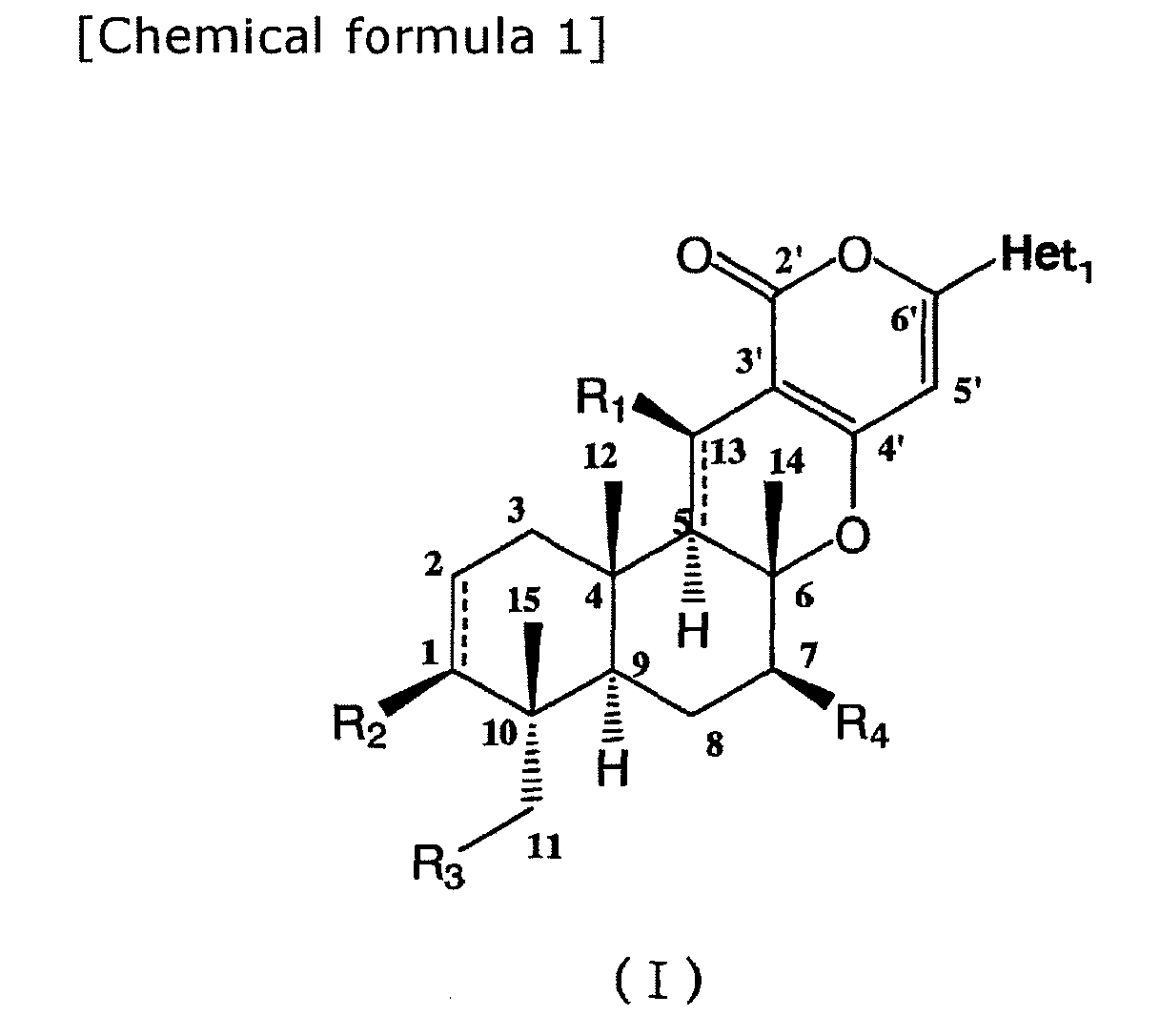 Het1 represents optionally substituted 3-pyridyl,R1 represents hydroxyl,optionally substituted C1-6 alkylcarbonyloxy,optionally substituted C2-6 alkenylcarbonyloxy,optionally substituted C2-6 alkynylcarbonyloxy,optionally substituted C1-6 alkyloxy,optionally substituted C2-6 alkenyloxy,optionally substituted C2-6 alkynyloxy,optionally substituted benzyloxy, oroxo in the absence of a hydrogen atom at the 13-position, orthe bond between 5-position and 13-position represents a double bond in the absence of R1 and a hydrogen atom at the 5-position,R2 represents hydroxyl,optionally substituted C1-18 alkylcarbonyloxy,optionally substituted C2-6 alkenylcarbonyloxy,optionally substituted C2-6 alkynylcarbonyloxy,optionally substituted benzoyloxy, oroptionally substituted C1-6 alkylsulfonyloxy,R3 represents a hydrogen atom,hydroxyl,optionally substituted C1-18 alkylcarbonyloxy,optionally substituted C2-6 alkenylcarbonyloxy,optionally substituted C2-6 alkynylcarbonyloxy,optionally substituted benzoyloxy,optionally substituted C1-6 alkylsulfonyloxy,optionally substituted benzenesulfonyloxy, oroptionally substituted five- or six-membered heterocyclic thiocarbonyloxy, orR2 and R3 together represent -O-CR2'R3'-O- wherein R2' and R3', which may be the same or different, represent a hydrogen atom, C1-6 alkyl, C1-6 alkyloxy, C2-6 alkenyl, optionally substituted phenyl, or optionally substituted benzyl, or R2' and R3' together represent oxo or C2-6 alkylene, andR4 represents a hydrogen atom,hyd roxyl,optionally substituted C1-18 alkylcarbonyloxy,optionally substituted C2-6 alkenylcarbonyloxy,optionally substituted C2-6 alkynylcarbonyloxy,optionally substituted benzoyloxy,optionally substituted C1-6 alkylsulfonyloxy,optionally substituted benzenesulfonyloxy,optionally substituted benzyloxy,optionally substituted C1-6 alkyloxy,optionally substituted C2-6 alkenyloxy,optionally substituted C2-6 alkynyloxy,C1-6 alkyloxy-C1-6 alkyloxy,C1-6 alkylthio-C1-6 alkyloxy,C1-6 alkyloxy-C1-6 alkyloxy-C1-6 alkyloxy,optionally substituted C1-6 alkyloxycarbonyloxy,optionally substituted C1-6 alkylaminocarbonyloxy,optionally substituted saturated or unsaturated five- or six-membered heterocyclic oxy,optionally substituted saturated or unsaturated five- or six-membered heterocyclic carbonyloxy,optionally substituted thieno[3,2-b]pyridylcarbonyloxy,optionally substituted 1H-indolylcarbonyloxy,optionally substituted saturated or unsaturated five- or six-membered heterocyclic thiocarbonyloxy, oroxo in the absence of a hydrogen atom at the 7-position, provided thata compound whereinHet1 represents 3-pyridyl,R1 represents hydroxyl, andall of R2, R3, and R4 represent acetyloxy, is excluded.
 - The composition according to claim 1,
whereinHet1 represents 3-pyridyl,R1 represents hydroxyl or C1-6 alkylcarbonyloxy, or the bond between 5-position and 13-position represents a double bond in the absence of R1 and a hydrogen atom at the 5-position,R2 represents optionally substituted C1-6 alkylcarbonyloxy,R3 represents optionally substituted C1-6 alkylcarbonyloxy or C1-6 alkylsulfonyloxy, orR2 and R3 together represent -O-CR2'R3'-O- wherein R2' and R3', which may be the same or different, represent a hydrogen atom, C1-6 alkyl, or optionally substituted phenyl, or R2' and R3' together represent oxo or C2-6 alkylene, andR4 represents hydroxyl,optionally substituted C1-6 alkylcarbonyloxy,saturated or unsaturated five- or six-membered heterocyclic oxy,optionally substituted benzoyloxy,C1-3 alkyloxy-C1-3 alkyloxy,optionally substituted C1-6 alkylaminocarbonyloxy,optionally substituted saturated or unsaturated five- or six-membered heterocyclic carbonyloxy,optionally substituted thieno[3,2-b]pyridylcarbonyloxy,optionally substituted 1H-indolylcarbonyloxy,saturated or unsaturated five- or six-membered heterocyclic thiocarbonyloxy, oroxo in the absence of a hydrogen atom at the 7-position. - The compositon according to claim 1,
whereinHet1 represents 3-pyridyl,R1 represents hydroxyl,R2 represents optionally substituted C1-6 alkylcarbonyloxy, andR3 represents optionally substituted C1-6 alkylcarbonyloxy or C1-6 alkylsulfonyloxy, andR4 represents hydroxyl,optionally substituted C1-6 alkylcarbonyloxy,saturated or unsaturated five- or six-membered heterocyclic oxy,optionally substituted benzoyloxy,C1-3 alkyloxy-C1-3 alkyloxy,optionally substituted C1-6 alkylaminocarbonyloxy,optionally substituted saturated or unsaturated five-or six- membered heterocyclic carbonyloxy,optionally substituted thieno[3,2-b]pyridylcarbonyloxy,optionally substituted 1H-indolylcarbonyloxy,saturated or unsaturated five- or six-membered heterocyclic thiocarbonyloxy, oroxo in the absence of a hydrogen atom at the 7-position. - The compositon according to claim 1,
whereinHet1 represents 3-pyridyl,R1 represents hydroxyl,R2 represents optionally substituted C1-6 alkylcarbonyloxy,R3 represents optionally substituted C1-6 alkylcarbonyloxy or C1-6 alkylsulfonyloxy, andR4 represents hydroxyl,optionally substituted C1-6 alkylcarbonyloxy,saturated or unsaturated five- or six-membered heterocyclic oxy,optionally substituted benzoyloxy,optionally substituted saturated or unsaturated five- or six-membered heterocyclic carbonyloxy, orsaturated or unsaturated five- or six-membered heterocyclic thiocarbonyloxy. - The compositon according to claim 1,
whereinHet1 represents 3-pyridyl,R1 represents hydroxyl, andR2 and R3 represent optionally substituted cyclic C3-6 alkylcarbonyloxy. - A composition for use as a pest control agent, comprising a compound represented by formula (Ia) or an agriculturally and horticulturally acceptable salt thereof as active ingredient and an agriculturally and horticulturally acceptable carrier:
 Het2 represents optionally substituted 3-pyridyl,R11 represents hydroxyl,optionally substituted C1-6 alkylcarbonyloxy,optionally substituted C2-6 alkenylcarbonyloxy,optionally substituted C2-6 alkynylcarbonyloxy,optionally substituted C1-6 alkyloxy,optionally substituted C2-6 alkenyloxy,optionally substituted C2-6 alkynyloxy,optionally substituted benzyloxy, oroxo in the absence of a hydrogen atom at the 13-position, orthe bond between 5-position and 13-position represents a double bond in the absence of R11 and a hydrogen atom at the 5-position,R12 represents hydroxyl,optionally substituted C1-18 alkylcarbonyloxy,optionally substituted C2-6 alkenylcarbonyloxy,optionally substituted C2-6 alkynylcarbonyloxy,optionally substituted benzoyloxy, oroptionally substituted C1-6 alkylsulfonyloxy,R13 represents a hydrogen atom,hyd roxyl,optionally substituted C1-18 alkylcarbonyloxy,optionally substituted C2-6 alkenylcarbonyloxy,optionally substituted C2-6 alkynylcarbonyloxy,optionally substituted benzoyloxy,optionally substituted C1-6 alkylsulfonyloxy,optionally substituted benzenesulfonyloxy, oroptionally substituted five- or six-membered heterocyclic thiocarbonyloxy, orR12 and R13 together represent -O-CR12'R13'-O-wherein R12' and R13', which may be the same or different, represent a hydrogen atom, C1-6 alkyl, C1-6 alkyloxy, C2-6 alkenyl, optionally substituted phenyl, or optionally substituted benzyl, or R12' and R13' together represent oxo or C2-6 alkylene, andR14 represents a hydrogen atom,hyd roxyl,optionally substituted C1-18 alkylcarbonyloxy,optionally substituted C2-6 alkenylcarbonyloxy,optionally substituted C2-6 alkynylcarbonyloxy,optionally substituted benzoyloxy,optionally substituted C1-6 alkylsulfonyloxy,optionally substituted benzenesulfonyloxy,optionally substituted benzyloxy,optionally substituted C1-6 alkyloxy,optionally substituted C2-6 alkenyloxy,optionally substituted C2-6 alkynyloxy,C1-6 alkyloxy-C1-6 alkyloxy,C1-6 alkylthio-C1-6 alkyloxy,C1-6 alkyloxy-C1-6 alkyloxy-C1-6 alkyloxy,optionally substituted C1-6 alkyloxycarbonyloxy,optionally substituted C1-6 alkylaminocarbonyloxy,optionally substituted saturated or unsaturated five- or six-membered heterocyclic oxy,optionally substituted saturated or unsaturated five- or six-membered heterocyclic carbonyloxy,optionally substituted thieno[3,2-b]pyridylcarbonyloxy,optionally substituted 1H-indolylcarbonyloxy,optionally substituted saturated or unsaturated five- or six-membered heterocyclic thiocarbonyloxy, oroxo in the absence of a hydrogen atom at the 7-position.
 - The composition according to claim 6,
whereinHet2 represents 3-pyridyl,R11 represents hydroxyl or C1-6 alkylcarbonyloxy, or the bond between 5-position and 13-position represents a double bond in the absence of R11 and a hydrogen atom at the 5-position,R12 represents optionally substituted C1-6 alkylcarbonyloxy,R13 represents optionally substituted C1-6 alkylcarbonyloxy or C1-6 alkylsulfonyloxy, orR12 and R13 together represent -O-CR12'R13'-O-wherein R12' and R13', which may be the same or different, represent a hydrogen atom, C1-6 alkyl, or optionally substituted phenyl, or R12' and R13' together represent oxo or C2-6 alkylene, andR14 represents hydroxyl,optionally substituted C1-6 alkylcarbonyloxy,saturated or unsaturated five- or six-membered heterocyclic oxy,optionally substituted benzoyloxy,C1-3 alkyloxy-C1-3 alkyloxy,optionally substituted C1-6 alkylaminocarbonyloxy,optionally substituted saturated or unsaturated five- or six-membered heterocyclic carbonyloxy,optionally substituted thieno[3,2-b]pyridylcarbonyloxy,optionally substituted 1H-indolylcarbonyloxy,saturated or unsaturated five- or six-membered heterocyclic thiocarbonyloxy, oroxo in the absence of a hydrogen atom at the 7-position. - The composition according to claim 6,
whereinHet2 represents 3-pyridyl,R11 represents hydroxyl,R12 represents optionally substituted C1-6 alkylcarbonyloxy, andR13 represents optionally substituted C1-6 alkylcarbonyloxy or C1-6 alkylsulfonyloxy, andR14 represents hydroxyl,optionally substituted C1-6 alkylcarbonyloxy,saturated or unsaturated five- or six-membered heterocyclic oxy,optionally substituted benzoyloxy,C1-3 alkyloxy-C1-3 alkyloxy,optionally substituted C1-6 alkylaminocarbonyloxy,optionally substituted saturated or unsaturated five- or six- membered heterocyclic carbonyloxy,optionally substituted thieno[3,2-b]pyridylcarbonyloxy,optionally substituted 1H-indolylcarbonyloxy,saturated or unsaturated five- or six-membered heterocyclic thiocarbonyloxy, oroxo in the absence of a hydrogen atom at the 7-position. - The composition according to claim 6,
whereinHet2 represents 3-pyridyl,R11 represents hydroxyl,R12 represents optionally substituted C1-6 alkylcarbonyloxy,R13 represents optionally substituted C1-6 alkylcarbonyloxy or C1-6 alkylsulfonyloxy, andR14 represents hydroxyl,optionally substituted C1-6 alkylcarbonyloxy,saturated or unsaturated five- or six-membered heterocyclic oxy,optionally substituted benzoyloxy,optionally substituted saturated or unsaturated five- or six-membered heterocyclic carbonyloxy, orsaturated or unsaturated five- or six-membered heterocyclic thiocarbonyloxy. - The composition according to claim 6,
whereinHet2 represents 3-pyridyl,R11 represents hydroxyl, andR12 and R13 represent optionally substituted cyclic C3-6 alkylcarbonyloxy. - The composition according to claim 6, wherein said hemipteran pest is selected from Aphidoidea, Coccoidea, or Aleyrodidae.
- The composition according to claim 6, wherein said hemipteran pest is at least one pest selected from the group consisting of Myzus persicae, Aphis gossypii, Aphis fabae, Aphis maidis (corn-leaf aphid), Acyrthosiphon pisum, Aulacorthum solani, Aphis craccivora, Macrosiphum euphorbiae, Macrosiphum avenae, Metopolophium dirhodum, Rhopalosiphum padi, Schizaphis graminum, Brevicoryne brassicae, Lipaphis erysimi, Aphis citricola, Rosy apple aphid, Eriosoma lanigerum, Toxoptera aurantii, Toxoptera citricidus, and Pseudococcus comstocki.
- A compound represented by formula (Ib) or an agriculturally and horticulturally acceptable salt thereof:
 Het1 represents 3-pyridyl,R1 represents hydroxyl,R2 and R3 represent propionyloxy or optionally substituted cyclic C3-6 alkylcarbonyloxy, andR4 represents hydroxyl,optionally substituted cyclic C3-6 alkylcarbonyloxy,optionally substituted benzoyloxy, or optionally substituted saturated or unsaturated five- or six-membered heterocyclic carbonyloxy, provided thata compound whereinHet1 represents 3-pyridyl,R1 represents hydroxyl,R2 and R3 represent propionyloxy, andR4 represents hydroxyl, is excluded.
 - The compound according to claim 13 or an agriculturally and horticulturally acceptable salt thereof,
whereinR2 and R3 represent optionally substituted cyclic C3-6 alkylcarbonyloxy, andR4 represents hydroxyl, optionally substituted cyclic C3-6 alkylcarbonyloxy, or optionally substituted benzoyloxy. - The compound according to claim - 13 or an agriculturally and horticulturally acceptable salt thereof,
whereinR2 and R3 represent propionyloxy, andR4 represents optionally substituted cyclic C3-6 alkylcarbonyloxy or optionally substituted saturated or unsaturated five- or six-membered heterocyclic carbonyloxy. - A composition for use as a pest control agent comprising the compound accoridng to claim 13 or an agriculturally and horticulturally acceptable salt thereof as active ingredient and an agriculturally and horticulturally acceptable carrier.
- A method for controlling a pest, comprising applying an effective amount of a compound represented by formula (I) accoding to claim 1 or an agriculturally and horticulturally acceptable salt thereof to a plant or soil.
- A method for controlling a hemipteran pest, comprising applying an effective amount of a compound represented by formula (Ia) accoding to claim 6 or an agriculturally and horticulturally acceptable salt thereof to a plant or soil.
- A method for controlling an pest, comprising applying an effective amount of a compound represented by formula (Ib) according to claim 13 or an agriculturally and horticulturally acceptable salt thereof to a plant or soil.
- Use of a compound represented by formula (I) according to claim 1 or an agriculturally and horticulturally acceptable salt thereof as a pest control agent.
- Use of a compound represented by formula (Ia) according to claim 6 or an agriculturally and horticulturally acceptable salt thereof as a hemipteran pest control agent.
- Use of a compound represented by formula (Ib) according to claim 13 or an agriculturally and horticulturally acceptable salt thereof as a pest control agent.
Priority Applications (2)
| Application Number | Priority Date | Filing Date | Title |
|---|---|---|---|
| PL06756816T PL1889540T3 (en) | 2005-06-01 | 2006-05-31 | Pest control agent |
| EP09164961.6A EP2111756B8 (en) | 2005-06-01 | 2006-05-31 | Pest control agents |
Applications Claiming Priority (2)
| Application Number | Priority Date | Filing Date | Title |
|---|---|---|---|
| JP2005161019 | 2005-06-01 | ||
| PCT/JP2006/310883 WO2006129714A1 (en) | 2005-06-01 | 2006-05-31 | Pest control agent |
Related Child Applications (3)
| Application Number | Title | Priority Date | Filing Date |
|---|---|---|---|
| EP09164961.6A Division EP2111756B8 (en) | 2005-06-01 | 2006-05-31 | Pest control agents |
| EP09164961.6A Division-Into EP2111756B8 (en) | 2005-06-01 | 2006-05-31 | Pest control agents |
| EP09164961.6 Division-Into | 2009-07-08 |
Publications (4)
| Publication Number | Publication Date |
|---|---|
| EP1889540A1 true EP1889540A1 (en) | 2008-02-20 |
| EP1889540A4 EP1889540A4 (en) | 2009-10-28 |
| EP1889540B1 EP1889540B1 (en) | 2011-11-02 |
| EP1889540B9 EP1889540B9 (en) | 2012-09-26 |
Family
ID=37481643
Family Applications (2)
| Application Number | Title | Priority Date | Filing Date |
|---|---|---|---|
| EP06756816A Active EP1889540B9 (en) | 2005-06-01 | 2006-05-31 | Pest control agent |
| EP09164961.6A Active EP2111756B8 (en) | 2005-06-01 | 2006-05-31 | Pest control agents |
Family Applications After (1)
| Application Number | Title | Priority Date | Filing Date |
|---|---|---|---|
| EP09164961.6A Active EP2111756B8 (en) | 2005-06-01 | 2006-05-31 | Pest control agents |
Country Status (21)
| Country | Link |
|---|---|
| EP (2) | EP1889540B9 (en) |
| JP (2) | JP4015182B2 (en) |
| KR (2) | KR20140140110A (en) |
| CN (1) | CN101188937B (en) |
| AR (1) | AR053882A1 (en) |
| AU (1) | AU2006253364B2 (en) |
| BR (2) | BR122015004951B8 (en) |
| CA (1) | CA2609527C (en) |
| DK (1) | DK1889540T3 (en) |
| ES (2) | ES2375305T3 (en) |
| HR (1) | HRP20120111T1 (en) |
| IL (1) | IL187411A (en) |
| NZ (1) | NZ563781A (en) |
| PL (1) | PL1889540T3 (en) |
| PT (1) | PT1889540E (en) |
| RS (1) | RS52184B (en) |
| RU (1) | RU2405310C2 (en) |
| SI (1) | SI1889540T1 (en) |
| TW (1) | TWI388282B (en) |
| WO (1) | WO2006129714A1 (en) |
| ZA (1) | ZA200710207B (en) |
Cited By (13)
| Publication number | Priority date | Publication date | Assignee | Title |
|---|---|---|---|---|
| US20100113525A1 (en) * | 2007-03-08 | 2010-05-06 | Meiji Seika Kaisha, Ltd. | Pest control composition |
| EP2186815A4 (en) * | 2007-08-13 | 2012-01-25 | Meiji Seika Kaisha | PROCESS FOR PRODUCING PYRIPYROPENE DERIVATIVES AND INTERMEDIATE PRODUCTION PRODUCTS THEREOF |
| WO2012035010A1 (en) | 2010-09-14 | 2012-03-22 | Basf Se | Composition containing a pyripyropene insecticide and a base |
| WO2012035015A2 (en) | 2010-09-14 | 2012-03-22 | Basf Se | Composition containing a pyripyropene insecticide and an adjuvant |
| WO2013135610A1 (en) | 2012-03-13 | 2013-09-19 | Basf Se | Liquid concentrate formulation containing a pyripyropene insecticide iii |
| WO2013135605A1 (en) | 2012-03-12 | 2013-09-19 | Basf Se | Liquid concentrate formulation containing a pyripyropene insecticide ii |
| WO2013135604A1 (en) | 2012-03-12 | 2013-09-19 | Basf Se | Liquid concentrate formulation containing a pyripyropene insecticide i |
| EP2530165A4 (en) * | 2010-01-26 | 2013-12-25 | Meiji Seika Pharma Co Ltd | PROCESS FOR PRODUCING A PYRIPYROPENE DERIVATIVE BY AN ENZYMATIC PROCESS |
| WO2014111398A1 (en) * | 2013-01-16 | 2014-07-24 | Basf Se | Method for preparing a pyripyropene compound |
| WO2014111395A1 (en) | 2013-01-16 | 2014-07-24 | Basf Se | Method for producing a liquid emulsifiable formulation comprising a pyripyropene pesticide |
| WO2014155214A1 (en) | 2013-03-28 | 2014-10-02 | Basf Se | Production of pyripyropenes from dry biomass |
| US9861104B2 (en) | 2012-03-12 | 2018-01-09 | Basf Se | Method for producing an aqueous suspension concentrate formulation of a pyripyropene insecticide |
| WO2018055478A1 (en) * | 2016-09-26 | 2018-03-29 | Basf Se | Method of controlling insecticide resistant insects |
Families Citing this family (137)
| Publication number | Priority date | Publication date | Assignee | Title |
|---|---|---|---|---|
| TWI388282B (en) * | 2005-06-01 | 2013-03-11 | Meiji Seika Pharma Co Ltd | Pest control agents |
| ES2379928T3 (en) * | 2006-11-30 | 2012-05-07 | Meiji Seika Kaisha Ltd. | Pest Control Agent |
| CA2709466A1 (en) | 2007-12-21 | 2009-07-02 | Meiji Seika Kaisha, Ltd. | Agricultural and horticultural compositions comprising systemic pyripyropene derivatives |
| US8519128B2 (en) * | 2007-12-25 | 2013-08-27 | The Kitasato Institute | Pyripyropene derivatives having an ACAT2-inhibiting activity |
| BRPI0916355B8 (en) | 2008-07-24 | 2022-12-13 | Meiji Seika Kaisha | Recombinant vector comprising an isolated polynucleotide, and method of producing a pyripyropene precursor at |
| PL2426124T3 (en) * | 2009-05-13 | 2013-12-31 | Meiji Seika Pharma Co Ltd | Process for producing pyripyropene derivative |
| WO2010146032A2 (en) | 2009-06-16 | 2010-12-23 | Basf Se | Fungicidal mixtures |
| EP2442653A2 (en) | 2009-06-18 | 2012-04-25 | Basf Se | Fungicidal mixtures |
| WO2010150739A1 (en) * | 2009-06-23 | 2010-12-29 | 学校法人北里研究所 | Hydroxyl-containing pyripyropene derivatives exhibiting acat2-inhibitory activity |
| BR112012003870B1 (en) | 2009-08-20 | 2018-11-21 | Bayer Intellectual Property Gmbh | 3-triazolylphenyl substituted sulfide derivatives, their use, their preparation process and their intermediates, agrochemical compositions, their preparation process, and the process for fighting animal parasites |
| MX2012001969A (en) | 2009-08-20 | 2012-03-29 | Bayer Cropscience Ag | 3-[1-(3-haloalkyl)-triazolyl]-phenyl-sulfide derivatives for use as acaricides and insecticides. |
| BR112012006239A2 (en) | 2009-10-12 | 2015-09-08 | Bayer Cropscience Ag | amides and thioamides as pesticidal agents |
| UY32940A (en) | 2009-10-27 | 2011-05-31 | Bayer Cropscience Ag | AMIDAS REPLACED WITH HALOGENO RENT AS INSECTICIDES AND ACARICIDES |
| WO2011080044A2 (en) | 2009-12-16 | 2011-07-07 | Bayer Cropscience Ag | Active compound combinations |
| AU2011210967B2 (en) | 2010-01-26 | 2016-06-23 | Mitsui Chemicals Crop & Life Solutions, Inc. | Method for manufacturing a pyripyropene |
| CA2788080C (en) | 2010-01-26 | 2018-04-17 | Meiji Seika Pharma Co., Ltd. | Nucleic acid construct comprising pyripyropene biosynthetic gene cluster and marker gene |
| CN103068825A (en) | 2010-02-10 | 2013-04-24 | 拜耳知识产权有限责任公司 | Spiroheterocyclical substituted tetramic acid derivatives |
| WO2011098440A2 (en) | 2010-02-10 | 2011-08-18 | Bayer Cropscience Ag | Biphenyl substituted cyclical keto-enols |
| UA111151C2 (en) * | 2010-03-01 | 2016-04-11 | Мейдзі Сейка Фарма Ко., Лтд. | METHOD OF PREPARATION OF PYRIPYROPENE DERIVATIVES |
| JP2013521255A (en) | 2010-03-04 | 2013-06-10 | バイエル・インテレクチュアル・プロパティ・ゲゼルシャフト・ミット・ベシュレンクテル・ハフツング | Fluoroalkyl-substituted 2-amidobenzimidazoles and their use to enhance stress tolerance in plants |
| WO2011110583A2 (en) | 2010-03-10 | 2011-09-15 | Basf Se | Fungicidal mixtures comprising triazole derivatives |
| BR112012028760A2 (en) * | 2010-05-24 | 2018-02-06 | Meiji Seika Pharma Co Ltd | harmful organism control agent |
| CN102905528B (en) * | 2010-05-28 | 2015-07-22 | 巴斯夫欧洲公司 | Pesticidal mixtures |
| KR101861868B1 (en) * | 2010-05-28 | 2018-05-28 | 바스프 에스이 | Pesticidal mixtures |
| JP2013166704A (en) * | 2010-06-16 | 2013-08-29 | Meiji Seikaファルマ株式会社 | Novel insecticide |
| WO2011161132A1 (en) | 2010-06-25 | 2011-12-29 | Basf Se | Pesticidal mixtures |
| WO2011161131A1 (en) | 2010-06-25 | 2011-12-29 | Basf Se | Herbicidal mixtures |
| MX2013000193A (en) | 2010-06-29 | 2013-01-28 | Bayer Ip Gmbh | Improved insecticidal compositions comprising cyclic carbonylamidines. |
| WO2012001068A2 (en) | 2010-07-02 | 2012-01-05 | Bayer Cropscience Ag | Insecticidal or acaricidal formulations with improved availability on plant surfaces |
| WO2012004293A2 (en) | 2010-07-08 | 2012-01-12 | Bayer Cropscience Ag | Insecticide and fungicide active ingredient combinations |
| KR20130093086A (en) | 2010-07-09 | 2013-08-21 | 바이엘 인텔렉쳐 프로퍼티 게엠베하 | Anthranilic acid diamide derivative as a pesticide |
| BR112013000925A2 (en) | 2010-07-15 | 2020-12-01 | Bayer Intellectual Property Gmbh | heterocyclic compounds as pesticides |
| WO2012028583A1 (en) | 2010-09-03 | 2012-03-08 | Bayer Cropscience Ag | Formulations comprising deltamethrin |
| WO2012052412A1 (en) | 2010-10-22 | 2012-04-26 | Bayer Cropscience Ag | Novel heterocyclic compounds as pesticides |
| EP2446742A1 (en) | 2010-10-28 | 2012-05-02 | Bayer CropScience AG | Insecticide or acaricide compositions containing mono- or disaccharides as activity enhancers |
| EP2648514A1 (en) | 2010-12-09 | 2013-10-16 | Bayer Intellectual Property GmbH | Insecticidal mixtures with improved properties |
| US20130317067A1 (en) | 2010-12-09 | 2013-11-28 | Bayer Intellectual Property Gmbh | Pesticidal mixtures with improved properties |
| EP2465350A1 (en) | 2010-12-15 | 2012-06-20 | Basf Se | Pesticidal mixtures |
| DE102010063691A1 (en) | 2010-12-21 | 2012-06-21 | Bayer Animal Health Gmbh | Ectoparasiticidal drug combinations |
| EP2471363A1 (en) | 2010-12-30 | 2012-07-04 | Bayer CropScience AG | Use of aryl-, heteroaryl- and benzylsulfonamide carboxylic acids, -carboxylic acid esters, -carboxylic acid amides and -carbonitriles and/or its salts for increasing stress tolerance in plants |
| UY33887A (en) | 2011-02-03 | 2012-09-28 | Syngenta Ltd | PEST CONTROL METHODS IN SOYA |
| AR085872A1 (en) | 2011-04-08 | 2013-10-30 | Basf Se | HETEROBICICLIC DERIVATIVES N-SUBSTITUTES USEFUL TO COMBAT PARASITES IN PLANTS AND / OR ANIMALS, COMPOSITIONS THAT CONTAIN THEM AND METHODS TO COMBAT SUCH PESTS |
| AR085585A1 (en) | 2011-04-15 | 2013-10-09 | Bayer Cropscience Ag | VINIL- AND ALQUINILCICLOHEXANOLES SUBSTITUTED AS ACTIVE PRINCIPLES AGAINST STRIPS ABIOTIQUE OF PLANTS |
| AR090010A1 (en) | 2011-04-15 | 2014-10-15 | Bayer Cropscience Ag | 5- (CICLOHEX-2-EN-1-IL) -PENTA-2,4-DIENOS AND 5- (CICLOHEX-2-EN-1-IL) -PENT-2-EN-4-INOS REPLACED AS ACTIVE PRINCIPLES AGAINST THE ABIOTIC STRESS OF PLANTS, USES AND TREATMENT METHODS |
| AR085568A1 (en) | 2011-04-15 | 2013-10-09 | Bayer Cropscience Ag | 5- (BICYCLE [4.1.0] HEPT-3-EN-2-IL) -PENTA-2,4-DIENOS AND 5- (BICYCLE [4.1.0] HEPT-3-EN-2-IL) -PENT- 2-IN-4-INOS REPLACED AS ACTIVE PRINCIPLES AGAINST ABIOTIC STRESS OF PLANTS |
| JP6030640B2 (en) | 2011-05-18 | 2016-11-24 | シンジェンタ パーティシペーションズ アーゲー | Insecticidal compounds based on arylthioacetamide derivatives |
| UY34104A (en) | 2011-05-31 | 2013-01-03 | Syngenta Participations Ag | ? HETEROCYCLIC BENZAMID DERIVATIVE COMPOUNDS, PROCESSES AND INTERMEDIATES FOR PREPARATION, COMPOSITIONS AND METHODS FOR USE. |
| US9173395B2 (en) | 2011-07-04 | 2015-11-03 | Bayer Intellectual Property Gmbh | Use of substituted isoquinolinones, isoquinolindiones, isoquinolintriones and dihydroisoquinolinones or in each case salts thereof as active agents against abiotic stress in plants |
| KR20140048257A (en) | 2011-07-15 | 2014-04-23 | 바스프 에스이 | Pesticidal methods using substituted 3-pyridyl thiazole compounds and derivatives for combating animal pests i |
| IN2014CN01136A (en) | 2011-08-12 | 2015-04-10 | Basf Se | |
| WO2013026724A1 (en) | 2011-08-22 | 2013-02-28 | Syngenta Participations Ag | Dihydrofuran derivatives as insecticidal compounds |
| BR112014003846A2 (en) | 2011-08-22 | 2017-03-14 | Syngenta Participations Ag | dihydrofuran derivatives as insecticide compounds |
| US9307766B2 (en) | 2011-08-25 | 2016-04-12 | Syngenta Participations Ag | Isoxazoline derivatives as insecticidal compounds |
| CN103764644A (en) | 2011-08-25 | 2014-04-30 | 先正达参股股份有限公司 | Isoxazoline derivatives as insecticidal compounds |
| WO2013026695A1 (en) | 2011-08-25 | 2013-02-28 | Syngenta Participations Ag | Isoxazoline derivatives as insecticidal compounds |
| WO2013026929A1 (en) | 2011-08-25 | 2013-02-28 | Syngenta Participations Ag | Dihydropyrrole derivatives as insecticidal compounds |
| EP2561759A1 (en) | 2011-08-26 | 2013-02-27 | Bayer Cropscience AG | Fluoroalkyl-substituted 2-amidobenzimidazoles and their effect on plant growth |
| EP2750503A1 (en) | 2011-09-02 | 2014-07-09 | Basf Se | Insecticidal active mixtures comprising arylquinazolinone compounds |
| WO2013037626A1 (en) | 2011-09-13 | 2013-03-21 | Syngenta Participations Ag | Isothiazoline derivatives as insecticidal compounds |
| MX362112B (en) | 2011-09-16 | 2019-01-07 | Bayer Ip Gmbh | Use of phenylpyrazolin-3-carboxylates for improving plant yield. |
| CN103929956B (en) | 2011-09-16 | 2017-02-22 | 拜耳知识产权有限责任公司 | Use of acylsulfonamides for improving plant yield |
| EP2755484A1 (en) | 2011-09-16 | 2014-07-23 | Bayer Intellectual Property GmbH | Use of 5-phenyl- or 5-benzyl-2 isoxazoline-3 carboxylates for improving plant yield |
| US20140243375A1 (en) | 2011-10-03 | 2014-08-28 | Syngenta Participations Ag | Isoxazoline derivatives as insecticidal compounds |
| WO2013079600A1 (en) | 2011-12-02 | 2013-06-06 | Basf Se | Method and system for monitoring crops during storage |
| WO2013079601A1 (en) | 2011-12-02 | 2013-06-06 | Basf Se | Method and system for monitoring crops and/or infestation of crops with harmful organismus during storage |
| US20140309109A1 (en) | 2011-12-21 | 2014-10-16 | Basf Se | N-Thio-anthranilamide compounds and their use as pesticides |
| BR112014015553B1 (en) | 2011-12-23 | 2020-02-27 | Basf Se | ISOTIAZOLINE COMPOUNDS, COMPOUND PREPARATION METHOD, AGRICULTURAL OR VETERINARY COMPOSITION, USES OF A COMPOUND AND METHOD TO PROTECT PLANTS |
| WO2013113789A1 (en) | 2012-02-02 | 2013-08-08 | Basf Se | N-thio-anthranilamide compounds and their use as pesticides |
| WO2013135674A1 (en) | 2012-03-12 | 2013-09-19 | Syngenta Participations Ag | Insecticidal 2-aryl-acetamide compounds |
| WO2013144228A1 (en) | 2012-03-29 | 2013-10-03 | Basf Se | Pesticidal methods using heterocyclic compounds and derivatives for combating animal pests |
| WO2013144223A1 (en) | 2012-03-30 | 2013-10-03 | Basf Se | N-substituted pyrimidinylidene compounds and derivatives for combating animal pests |
| ES2626360T3 (en) | 2012-03-30 | 2017-07-24 | Basf Se | N-substituted thiocarbonyl pyridinylidene compounds and their use to combat animal pests |
| WO2013149940A1 (en) | 2012-04-02 | 2013-10-10 | Basf Se | Acrylamide compounds for combating invertebrate pests |
| US20150065501A1 (en) | 2012-04-03 | 2015-03-05 | Basf Se | N-substituted hetero-bicyclic furanone derivatives for combating animal |
| WO2013150115A1 (en) | 2012-04-05 | 2013-10-10 | Basf Se | N- substituted hetero - bicyclic compounds and derivatives for combating animal pests |
| WO2013164295A1 (en) | 2012-05-04 | 2013-11-07 | Basf Se | Substituted pyrazole-containing compounds and their use as pesticides |
| BR112014027133A2 (en) | 2012-05-09 | 2017-06-27 | Basf Se | compound, agricultural or veterinary composition, method for controlling invertebrate pests, plant propagating material and method for treating or protecting an animal. |
| CN104487439B (en) | 2012-05-24 | 2017-06-09 | 巴斯夫欧洲公司 | N-thioanthranilamide compounds and their use as pesticides |
| MX2014015265A (en) | 2012-06-14 | 2015-08-12 | Basf Se | Pesticidal methods using substituted 3-pyridyl thiazole compounds and derivatives for combating animal pests. |
| WO2014001121A1 (en) | 2012-06-25 | 2014-01-03 | Syngenta Participations Ag | Isothiazole derivatives as insecticidal compounds |
| WO2014001120A1 (en) | 2012-06-25 | 2014-01-03 | Syngenta Participations Ag | Isothiazole derivatives as insecticidal compounds |
| JP2015522297A (en) | 2012-07-26 | 2015-08-06 | ネステク ソシエテ アノニム | Reducing antinutritional factors in edible kernels |
| WO2014019609A1 (en) | 2012-07-31 | 2014-02-06 | Syngenta Participations Ag | Methods of pest control in soybean |
| CN104520287A (en) | 2012-08-03 | 2015-04-15 | 先正达参股股份有限公司 | Methods of controlling insects |
| WO2014019950A1 (en) | 2012-08-03 | 2014-02-06 | Syngenta Participations Ag | Methods of pest control in soybean |
| WO2014019957A2 (en) | 2012-08-03 | 2014-02-06 | Syngenta Participations Ag | Methods of pest control in soybean |
| WO2014029640A1 (en) | 2012-08-24 | 2014-02-27 | Syngenta Participations Ag | Methods of controlling insects |
| WO2014029639A1 (en) | 2012-08-24 | 2014-02-27 | Syngenta Participations Ag | Methods of soil pest control |
| WO2014029709A1 (en) | 2012-08-24 | 2014-02-27 | Syngenta Participations Ag | Methods of controlling insects |
| CN104780764A (en) | 2012-09-05 | 2015-07-15 | 拜尔农作物科学股份公司 | Use of substituted 2-amidobenzimidazoles, 2-amidobenzoxazoles and 2-amidobenzothiazoles or salts thereof as active substances against abiotic plant stress |
| AR093828A1 (en) | 2012-10-01 | 2015-06-24 | Basf Se | ACTIVE MIXTURES AS PESTICIDES, WHICH INCLUDE ANTRANILAMIDE COMPOUNDS |
| AR093771A1 (en) | 2012-10-01 | 2015-06-24 | Basf Se | METHOD TO CONTROL INSECTICIDE RESISTANT INSECTS |
| WO2014053401A2 (en) | 2012-10-01 | 2014-04-10 | Basf Se | Method of improving plant health |
| EP2903437A1 (en) | 2012-10-01 | 2015-08-12 | Basf Se | Use of n-thio-anthranilamide compounds on cultivated plants |
| AR093772A1 (en) | 2012-10-01 | 2015-06-24 | Basf Se | METHOD FOR CONTROLLING INSECTICIDES INSECTICIDES MODULADORES DE RIANODINA |
| KR20150067270A (en) | 2012-10-01 | 2015-06-17 | 바스프 에스이 | Pesticidally active mixtures comprising anthranilamide compounds |
| WO2014053407A1 (en) | 2012-10-01 | 2014-04-10 | Basf Se | N-thio-anthranilamide compounds and their use as pesticides |
| WO2014079935A1 (en) | 2012-11-21 | 2014-05-30 | Syngenta Participations Ag | Insecticidal compounds based on arylthioacetamide derivatives |
| WO2014079820A1 (en) | 2012-11-22 | 2014-05-30 | Basf Se | Use of anthranilamide compounds for reducing insect-vectored viral infections |
| WO2014086751A1 (en) | 2012-12-05 | 2014-06-12 | Bayer Cropscience Ag | Use of substituted 1-(aryl ethynyl)-, 1-(heteroaryl ethynyl)-, 1-(heterocyclyl ethynyl)- and 1-(cyloalkenyl ethynyl)-cyclohexanols as active agents against abiotic plant stress |
| EP2984074A1 (en) | 2012-12-14 | 2016-02-17 | Basf Se | Malononitrile compounds for controlling animal pests |
| BR112015014753B8 (en) | 2012-12-20 | 2020-03-03 | Basf Agro Bv | compositions, use of a composition, method for combating phytopathogenic fungi and use of the components |
| MX2015008110A (en) | 2012-12-21 | 2015-11-06 | Basf Se | Cycloclavine and derivatives thereof for controlling invertebrate pests. |
| CN105189489A (en) | 2012-12-27 | 2015-12-23 | 巴斯夫欧洲公司 | 2-(pyridin-3-yl)-5-hetaryl-thiazole compounds carrying an imine or imine-derived substituent for combating invertebrate pests |
| WO2014128136A1 (en) | 2013-02-20 | 2014-08-28 | Basf Se | Anthranilamide compounds and their use as pesticides |
| WO2014131837A1 (en) | 2013-02-28 | 2014-09-04 | Syngenta Participations Ag | Isoxaline derivatives for use in cotton plants |
| ES2655200T3 (en) | 2013-03-13 | 2018-02-19 | Bayer Cropscience Ag | Agent that favors the growth of grass and its use procedure |
| EA201500984A1 (en) | 2013-03-28 | 2016-04-29 | Зингента Партисипейшнс Аг | METHODS OF CONTROLLING SUSTAINABLE NEONICOTINOIDES OF PESTS |
| EP2783569A1 (en) | 2013-03-28 | 2014-10-01 | Basf Se | Compositions comprising a triazole compound |
| WO2014170300A1 (en) | 2013-04-19 | 2014-10-23 | Basf Se | N-substituted acyl-imino-pyridine compounds and derivatives for combating animal pests |
| US20160145222A1 (en) | 2013-06-21 | 2016-05-26 | Basf Se | Methods for Controlling Pests in Soybean |
| AU2014292164C1 (en) | 2013-07-15 | 2018-09-27 | Basf Se | Pesticide compounds |
| US10206397B2 (en) | 2013-09-19 | 2019-02-19 | Basf Se | N-acylimino heterocyclic compounds |
| WO2015055497A1 (en) | 2013-10-16 | 2015-04-23 | Basf Se | Substituted pesticidal pyrazole compounds |
| MX386864B (en) | 2013-10-18 | 2025-03-19 | Basf Agrochemical Products Bv | USE OF ACTIVE CARBOXAMIDE DERIVATIVE AS A PESTICIDE IN SOIL AND SEED APPLICATION AND TREATMENT METHODS. |
| WO2015091649A1 (en) | 2013-12-18 | 2015-06-25 | Basf Se | N-substituted imino heterocyclic compounds |
| CN105829296A (en) | 2013-12-18 | 2016-08-03 | 巴斯夫欧洲公司 | Azole compounds with imine-derived substituents |
| KR20160104065A (en) | 2014-01-03 | 2016-09-02 | 바이엘 애니멀 헬스 게엠베하 | Novel pyrazolyl-heteroarylamides as pesticides |
| WO2015104422A1 (en) | 2014-01-13 | 2015-07-16 | Basf Se | Dihydrothiophene compounds for controlling invertebrate pests |
| WO2016001129A1 (en) | 2014-07-01 | 2016-01-07 | Bayer Cropscience Aktiengesellschaft | Improved insecticidal compositions |
| JP2017521441A (en) | 2014-07-15 | 2017-08-03 | バイエル・アニマル・ヘルス・ゲゼルシャフト・ミット・ベシュレンクテル・ハフツングBayer Animal Health Gmbh | Aryl-triazolylpyridines as pest control agents |
| MY187947A (en) | 2015-04-17 | 2021-10-31 | Basf Agrochemical Products Bv | Method for controlling non-crop pests |
| WO2016181339A1 (en) * | 2015-05-13 | 2016-11-17 | Basf Se | Molluscicide and bait composition comprising a molluscicide |
| CN106561689A (en) * | 2016-11-15 | 2017-04-19 | 佛山市盈辉作物科学有限公司 | Pesticide composition containing afidopyropen and cyclaniliprole |
| AR113761A1 (en) | 2017-10-18 | 2020-06-10 | Syngenta Participations Ag | PEST CONTROL OF HEMIPTERS USING RNA MOLECULES |
| CN115956570B (en) * | 2019-06-25 | 2025-03-11 | 江苏龙灯化学有限公司 | An insecticide composition |
| CN110574763A (en) * | 2019-10-10 | 2019-12-17 | 河北军星生物化工有限公司 | Insecticidal composition |
| WO2022200364A1 (en) | 2021-03-25 | 2022-09-29 | Syngenta Crop Protection Ag | Insect, acarina and nematode pest control |
| BR112023023856A2 (en) | 2021-05-14 | 2024-01-30 | Syngenta Crop Protection Ag | CONTROL OF INSECT PESTS, MITE AND NEMATODES |
| WO2022268815A1 (en) | 2021-06-24 | 2022-12-29 | Syngenta Crop Protection Ag | Insect, acarina and nematode pest control |
| WO2022268813A1 (en) | 2021-06-24 | 2022-12-29 | Syngenta Crop Protection Ag | Insect, acarina and nematode pest control |
| WO2023105064A1 (en) | 2021-12-10 | 2023-06-15 | Syngenta Crop Protection Ag | Insect, acarina and nematode pest control |
| WO2023203038A1 (en) | 2022-04-19 | 2023-10-26 | Syngenta Crop Protection Ag | Insect, acarina and nematode pest control |
| CN115769821B (en) * | 2022-11-21 | 2024-02-06 | 南阳市农业科学院 | A kind of pesticide composition for controlling mugwort aphids |
| CN116584497B (en) * | 2023-03-12 | 2025-05-09 | 青岛农业大学 | Aphis pomonensis control method based on transporter ABCG2 gene |
| CN119613426B (en) * | 2023-09-14 | 2025-12-09 | 青岛清原化合物有限公司 | Pyripyropene derivative, composition and application thereof |
| CN119504775B (en) * | 2024-11-15 | 2025-10-21 | 中国科学院南海海洋研究所 | Extraction method and application of a class of nitrogen-isosesquiterpenoid compounds |
Family Cites Families (16)
| Publication number | Priority date | Publication date | Assignee | Title |
|---|---|---|---|---|
| JPH0651685B2 (en) * | 1986-03-14 | 1994-07-06 | 三共株式会社 | Phenoxyalkylamine derivatives and insecticides and acaricides |
| JP2993767B2 (en) | 1991-06-06 | 1999-12-27 | 社団法人北里研究所 | FO-1289A substance and method for producing the same |
| US5268624A (en) | 1992-10-14 | 1993-12-07 | Allergan, Inc. | Foot pedal control with user-selectable operational ranges |
| JP3233476B2 (en) | 1992-10-22 | 2001-11-26 | 社団法人北里研究所 | FO-1289 substance and method for producing the same |
| JPH07126113A (en) * | 1993-11-04 | 1995-05-16 | Nippon Soda Co Ltd | Insecticidal composition |
| JPH08239385A (en) | 1995-03-03 | 1996-09-17 | Kitasato Inst:The | FO-1289 substance and its production method |
| JP3725198B2 (en) | 1995-03-27 | 2005-12-07 | 社団法人北里研究所 | Pyripyropene derivative |
| JPH08269063A (en) | 1995-03-28 | 1996-10-15 | Kitasato Inst:The | Pyripyropene derivative |
| JPH08269062A (en) | 1995-03-30 | 1996-10-15 | Kitasato Inst:The | Pyripyropene derivative |
| JPH08269064A (en) | 1995-04-03 | 1996-10-15 | Kitasato Inst:The | Pyripyropene derivative |
| JPH08269066A (en) | 1995-04-03 | 1996-10-15 | Kitasato Inst:The | Pyripyropene derivative |
| JPH08269065A (en) | 1995-04-03 | 1996-10-15 | Kitasato Inst:The | Pyripyropene derivative |
| JP3688337B2 (en) | 1995-04-18 | 2005-08-24 | 社団法人北里研究所 | Pyripyropene derivative |
| KR100522446B1 (en) * | 2003-01-07 | 2005-10-18 | 한국생명공학연구원 | AGENT FOR KILLING INSECTS COMPRISING COMPOUNDS HAVING ACYL CoA:CHOLESTEROL ACYLTRANSFERASE INHIBITORY OR SALT THEREOF |
| TWI388282B (en) * | 2005-06-01 | 2013-03-11 | Meiji Seika Pharma Co Ltd | Pest control agents |
| JP5037164B2 (en) * | 2005-06-01 | 2012-09-26 | Meiji Seikaファルマ株式会社 | Pest control agent |
-
2006
- 2006-05-26 TW TW095118886A patent/TWI388282B/en active
- 2006-05-31 CN CN2006800197494A patent/CN101188937B/en active Active
- 2006-05-31 WO PCT/JP2006/310883 patent/WO2006129714A1/en not_active Ceased
- 2006-05-31 RS RS20120030A patent/RS52184B/en unknown
- 2006-05-31 PL PL06756816T patent/PL1889540T3/en unknown
- 2006-05-31 JP JP2007513576A patent/JP4015182B2/en active Active
- 2006-05-31 PT PT06756816T patent/PT1889540E/en unknown
- 2006-05-31 EP EP06756816A patent/EP1889540B9/en active Active
- 2006-05-31 KR KR1020147030416A patent/KR20140140110A/en not_active Ceased
- 2006-05-31 RU RU2007144700/04A patent/RU2405310C2/en active
- 2006-05-31 EP EP09164961.6A patent/EP2111756B8/en active Active
- 2006-05-31 BR BR122015004951A patent/BR122015004951B8/en active IP Right Grant
- 2006-05-31 ES ES06756816T patent/ES2375305T3/en active Active
- 2006-05-31 HR HR20120111T patent/HRP20120111T1/en unknown
- 2006-05-31 ZA ZA200710207A patent/ZA200710207B/en unknown
- 2006-05-31 NZ NZ563781A patent/NZ563781A/en unknown
- 2006-05-31 BR BRPI0610967-5 patent/BRPI0610967B1/en active IP Right Grant
- 2006-05-31 CA CA2609527A patent/CA2609527C/en active Active
- 2006-05-31 AU AU2006253364A patent/AU2006253364B2/en active Active
- 2006-05-31 ES ES09164961.6T patent/ES2645373T3/en active Active
- 2006-05-31 KR KR1020077029157A patent/KR101498282B1/en active Active
- 2006-05-31 SI SI200631166T patent/SI1889540T1/en unknown
- 2006-05-31 DK DK06756816.2T patent/DK1889540T3/en active
- 2006-06-01 AR ARP060102300A patent/AR053882A1/en active IP Right Grant
-
2007
- 2007-11-15 IL IL187411A patent/IL187411A/en active IP Right Grant
-
2012
- 2012-05-21 JP JP2012115932A patent/JP5575831B2/en not_active Expired - Fee Related
Cited By (30)
| Publication number | Priority date | Publication date | Assignee | Title |
|---|---|---|---|---|
| US20100113525A1 (en) * | 2007-03-08 | 2010-05-06 | Meiji Seika Kaisha, Ltd. | Pest control composition |
| EP2119361A4 (en) * | 2007-03-08 | 2011-10-26 | Meiji Seika Kaisha | COMPOSITION FOR CONTROLLING PESTS |
| US9675075B2 (en) | 2007-03-08 | 2017-06-13 | Basf Se | Pest control composition |
| US8859462B2 (en) | 2007-03-08 | 2014-10-14 | Meiji Seika Pharma Co., Ltd. | Pest control composition |
| US8263778B2 (en) | 2007-08-13 | 2012-09-11 | Meiji Seika Pharma Co., Ltd. | Process for producing pyripyropene derivatives and intermediates for the production thereof |
| EP2592084A1 (en) * | 2007-08-13 | 2013-05-15 | Meiji Seika Pharma Co., Ltd. | Process for producing pyripyropene derivatives and intermediates for the production thereof. |
| EP2186815A4 (en) * | 2007-08-13 | 2012-01-25 | Meiji Seika Kaisha | PROCESS FOR PRODUCING PYRIPYROPENE DERIVATIVES AND INTERMEDIATE PRODUCTION PRODUCTS THEREOF |
| US8759529B2 (en) | 2007-08-13 | 2014-06-24 | Basf Se | Process for producing pyripyropene derivatives and intermediates for the production thereof |
| EP2530165A4 (en) * | 2010-01-26 | 2013-12-25 | Meiji Seika Pharma Co Ltd | PROCESS FOR PRODUCING A PYRIPYROPENE DERIVATIVE BY AN ENZYMATIC PROCESS |
| WO2012035010A1 (en) | 2010-09-14 | 2012-03-22 | Basf Se | Composition containing a pyripyropene insecticide and a base |
| WO2012035015A2 (en) | 2010-09-14 | 2012-03-22 | Basf Se | Composition containing a pyripyropene insecticide and an adjuvant |
| US9723834B2 (en) | 2010-09-14 | 2017-08-08 | Basf Se | Composition containing a pyripyropene insecticide and a base |
| AU2011303970B2 (en) * | 2010-09-14 | 2015-08-13 | Basf Se | Composition containing a pyripyropene insecticide and an adjuvant |
| US9888689B2 (en) | 2010-09-14 | 2018-02-13 | Basf Se | Compositions containing a pyripyropene insecticide and an adjuvant |
| WO2013135605A1 (en) | 2012-03-12 | 2013-09-19 | Basf Se | Liquid concentrate formulation containing a pyripyropene insecticide ii |
| US9861104B2 (en) | 2012-03-12 | 2018-01-09 | Basf Se | Method for producing an aqueous suspension concentrate formulation of a pyripyropene insecticide |
| US9924712B2 (en) | 2012-03-12 | 2018-03-27 | Basf Se | Liquid concentrate formulation containing a pyripyropene insecticide II |
| WO2013135604A1 (en) | 2012-03-12 | 2013-09-19 | Basf Se | Liquid concentrate formulation containing a pyripyropene insecticide i |
| US9596843B2 (en) | 2012-03-12 | 2017-03-21 | Basf Se | Liquid concentrate formulation containing a pyripyropene insecticide I |
| WO2013135610A1 (en) | 2012-03-13 | 2013-09-19 | Basf Se | Liquid concentrate formulation containing a pyripyropene insecticide iii |
| US9668470B2 (en) | 2013-01-16 | 2017-06-06 | Basf Se | Method for producing a liquid emulsifiable formulation comprising a pyripyropene pesticide |
| US9598428B2 (en) | 2013-01-16 | 2017-03-21 | Basf Se | Method for preparing a pyripyropene compound |
| JP2016504404A (en) * | 2013-01-16 | 2016-02-12 | ビーエーエスエフ ソシエタス・ヨーロピアBasf Se | Method for producing pyripyropene compound |
| WO2014111395A1 (en) | 2013-01-16 | 2014-07-24 | Basf Se | Method for producing a liquid emulsifiable formulation comprising a pyripyropene pesticide |
| WO2014111398A1 (en) * | 2013-01-16 | 2014-07-24 | Basf Se | Method for preparing a pyripyropene compound |
| KR20150135391A (en) * | 2013-03-28 | 2015-12-02 | 바스프 에스이 | Production of pyripyropenes from dry biomass |
| WO2014155214A1 (en) | 2013-03-28 | 2014-10-02 | Basf Se | Production of pyripyropenes from dry biomass |
| US10150777B2 (en) | 2013-03-28 | 2018-12-11 | Basf Se | Production of pyripyropenes from dry biomass |
| TWI663170B (en) * | 2013-03-28 | 2019-06-21 | 巴地斯顏料化工廠 | Production of pyripyropenes from dry biomass |
| WO2018055478A1 (en) * | 2016-09-26 | 2018-03-29 | Basf Se | Method of controlling insecticide resistant insects |
Also Published As
Similar Documents
| Publication | Publication Date | Title |
|---|---|---|
| EP2111756B1 (en) | Pest control agents | |
| US8822501B2 (en) | Pest control agents | |
| US8859462B2 (en) | Pest control composition | |
| EP2107060B1 (en) | Pest control agent | |
| JP5037164B2 (en) | Pest control agent |
Legal Events
| Date | Code | Title | Description |
|---|---|---|---|
| PUAI | Public reference made under article 153(3) epc to a published international application that has entered the european phase |
Free format text: ORIGINAL CODE: 0009012 |
|
| 17P | Request for examination filed |
Effective date: 20071221 |
|
| AK | Designated contracting states |
Kind code of ref document: A1 Designated state(s): AT BE BG CH CY CZ DE DK EE ES FI FR GB GR HU IE IS IT LI LT LU LV MC NL PL PT RO SE SI SK TR |
|
| AX | Request for extension of the european patent |
Extension state: AL BA HR MK YU |
|
| RAP1 | Party data changed (applicant data changed or rights of an application transferred) |
Owner name: THE KITASATO INSTITUTE Owner name: MEIJI SEIKA KAISHA LTD. |
|
| A4 | Supplementary search report drawn up and despatched |
Effective date: 20090925 |
|
| 17Q | First examination report despatched |
Effective date: 20100120 |
|
| GRAP | Despatch of communication of intention to grant a patent |
Free format text: ORIGINAL CODE: EPIDOSNIGR1 |
|
| RAP1 | Party data changed (applicant data changed or rights of an application transferred) |
Owner name: MEIJI SEIKA PHARMA CO., LTD. Owner name: THE KITASATO INSTITUTE |
|
| GRAS | Grant fee paid |
Free format text: ORIGINAL CODE: EPIDOSNIGR3 |
|
| GRAA | (expected) grant |
Free format text: ORIGINAL CODE: 0009210 |
|
| AK | Designated contracting states |
Kind code of ref document: B1 Designated state(s): AT BE BG CH CY CZ DE DK EE ES FI FR GB GR HU IE IS IT LI LT LU LV MC NL PL PT RO SE SI SK TR |
|
| AX | Request for extension of the european patent |
Extension state: AL BA HR MK YU |
|
| REG | Reference to a national code |
Ref country code: GB Ref legal event code: FG4D |
|
| REG | Reference to a national code |
Ref country code: CH Ref legal event code: EP |
|
| REG | Reference to a national code |
Ref country code: IE Ref legal event code: FG4D |
|
| REG | Reference to a national code |
Ref country code: PT Ref legal event code: SC4A Free format text: AVAILABILITY OF NATIONAL TRANSLATION Effective date: 20111110 |
|
| REG | Reference to a national code |
Ref country code: SE Ref legal event code: TRGR |
|
| REG | Reference to a national code |
Ref country code: DE Ref legal event code: R096 Ref document number: 602006025574 Country of ref document: DE Effective date: 20120112 |
|
| REG | Reference to a national code |
Ref country code: DK Ref legal event code: T3 |
|
| REG | Reference to a national code |
Ref country code: RO Ref legal event code: EPE |
|
| REG | Reference to a national code |
Ref country code: NL Ref legal event code: T3 |
|
| REG | Reference to a national code |
Ref country code: HR Ref legal event code: TUEP Ref document number: P20120111 Country of ref document: HR |
|
| REG | Reference to a national code |
Ref country code: CH Ref legal event code: NV Representative=s name: SCHNEIDER FELDMANN AG PATENT- UND MARKENANWAELTE |
|
| REG | Reference to a national code |
Ref country code: ES Ref legal event code: FG2A Ref document number: 2375305 Country of ref document: ES Kind code of ref document: T3 Effective date: 20120228 |
|
| REG | Reference to a national code |
Ref country code: HR Ref legal event code: T1PR Ref document number: P20120111 Country of ref document: HR |
|
| REG | Reference to a national code |
Ref country code: SK Ref legal event code: T3 Ref document number: E 10996 Country of ref document: SK |
|
| REG | Reference to a national code |
Ref country code: GR Ref legal event code: EP Ref document number: 20120400262 Country of ref document: GR Effective date: 20120322 |
|
| PG25 | Lapsed in a contracting state [announced via postgrant information from national office to epo] |
Ref country code: IS Free format text: LAPSE BECAUSE OF FAILURE TO SUBMIT A TRANSLATION OF THE DESCRIPTION OR TO PAY THE FEE WITHIN THE PRESCRIBED TIME-LIMIT Effective date: 20120302 Ref country code: LT Free format text: LAPSE BECAUSE OF FAILURE TO SUBMIT A TRANSLATION OF THE DESCRIPTION OR TO PAY THE FEE WITHIN THE PRESCRIBED TIME-LIMIT Effective date: 20111102 |
|
| LTIE | Lt: invalidation of european patent or patent extension |
Effective date: 20111102 |
|
| PG25 | Lapsed in a contracting state [announced via postgrant information from national office to epo] |
Ref country code: LV Free format text: LAPSE BECAUSE OF FAILURE TO SUBMIT A TRANSLATION OF THE DESCRIPTION OR TO PAY THE FEE WITHIN THE PRESCRIBED TIME-LIMIT Effective date: 20111102 |
|
| PG25 | Lapsed in a contracting state [announced via postgrant information from national office to epo] |
Ref country code: CY Free format text: LAPSE BECAUSE OF FAILURE TO SUBMIT A TRANSLATION OF THE DESCRIPTION OR TO PAY THE FEE WITHIN THE PRESCRIBED TIME-LIMIT Effective date: 20111102 |
|
| PG25 | Lapsed in a contracting state [announced via postgrant information from national office to epo] |
Ref country code: EE Free format text: LAPSE BECAUSE OF FAILURE TO SUBMIT A TRANSLATION OF THE DESCRIPTION OR TO PAY THE FEE WITHIN THE PRESCRIBED TIME-LIMIT Effective date: 20111102 Ref country code: BG Free format text: LAPSE BECAUSE OF FAILURE TO SUBMIT A TRANSLATION OF THE DESCRIPTION OR TO PAY THE FEE WITHIN THE PRESCRIBED TIME-LIMIT Effective date: 20120202 |
|
| PLBE | No opposition filed within time limit |
Free format text: ORIGINAL CODE: 0009261 |
|
| STAA | Information on the status of an ep patent application or granted ep patent |
Free format text: STATUS: NO OPPOSITION FILED WITHIN TIME LIMIT |
|
| REG | Reference to a national code |
Ref country code: PL Ref legal event code: T3 |
|
| 26N | No opposition filed |
Effective date: 20120803 |
|
| REG | Reference to a national code |
Ref country code: DE Ref legal event code: R097 Ref document number: 602006025574 Country of ref document: DE Effective date: 20120803 |
|
| PG25 | Lapsed in a contracting state [announced via postgrant information from national office to epo] |
Ref country code: MC Free format text: LAPSE BECAUSE OF NON-PAYMENT OF DUE FEES Effective date: 20120531 |
|
| REG | Reference to a national code |
Ref country code: HU Ref legal event code: AG4A Ref document number: E014617 Country of ref document: HU |
|
| REG | Reference to a national code |
Ref country code: PL Ref legal event code: RECP |
|
| PG25 | Lapsed in a contracting state [announced via postgrant information from national office to epo] |
Ref country code: FI Free format text: LAPSE BECAUSE OF FAILURE TO SUBMIT A TRANSLATION OF THE DESCRIPTION OR TO PAY THE FEE WITHIN THE PRESCRIBED TIME-LIMIT Effective date: 20111102 |
|
| PG25 | Lapsed in a contracting state [announced via postgrant information from national office to epo] |
Ref country code: LU Free format text: LAPSE BECAUSE OF NON-PAYMENT OF DUE FEES Effective date: 20120531 |
|
| REG | Reference to a national code |
Ref country code: FR Ref legal event code: PLFP Year of fee payment: 11 |
|
| REG | Reference to a national code |
Ref country code: FR Ref legal event code: PLFP Year of fee payment: 12 |
|
| REG | Reference to a national code |
Ref country code: FR Ref legal event code: PLFP Year of fee payment: 13 |
|
| REG | Reference to a national code |
Ref country code: HR Ref legal event code: ODRP Ref document number: P20120111 Country of ref document: HR Payment date: 20190417 Year of fee payment: 14 |
|
| REG | Reference to a national code |
Ref country code: HR Ref legal event code: ODRP Ref document number: P20120111 Country of ref document: HR Payment date: 20200427 Year of fee payment: 15 |
|
| REG | Reference to a national code |
Ref country code: CH Ref legal event code: PFA Owner name: THE KITASATO INSTITUTE, JP Free format text: FORMER OWNER: THE KITASATO INSTITUTE, JP |
|
| REG | Reference to a national code |
Ref country code: HR Ref legal event code: ODRP Ref document number: P20120111 Country of ref document: HR Payment date: 20210528 Year of fee payment: 16 |
|
| REG | Reference to a national code |
Ref country code: DE Ref legal event code: R081 Ref document number: 602006025574 Country of ref document: DE Owner name: THE KITASATO INSTITUTE, JP Free format text: FORMER OWNERS: MEIJI SEIKA PHARMA CO., LTD., TOKYO, JP; THE KITASATO INSTITUTE, TOKIO/TOKYO, JP Ref country code: DE Ref legal event code: R081 Ref document number: 602006025574 Country of ref document: DE Owner name: MMAG CO., LTD., JP Free format text: FORMER OWNERS: MEIJI SEIKA PHARMA CO., LTD., TOKYO, JP; THE KITASATO INSTITUTE, TOKIO/TOKYO, JP Ref country code: DE Ref legal event code: R081 Ref document number: 602006025574 Country of ref document: DE Owner name: MITSUI CHEMICALS CROP & LIFE SOLUTIONS, INC., JP Free format text: FORMER OWNERS: MEIJI SEIKA PHARMA CO., LTD., TOKYO, JP; THE KITASATO INSTITUTE, TOKIO/TOKYO, JP Ref country code: DE Ref legal event code: R081 Ref document number: 602006025574 Country of ref document: DE Owner name: MITSUI CHEMICALS CROP & LIFE SOLUTIONS, INC., JP Free format text: FORMER OWNERS: MEIJI SEIKA PHARMA CO., LTD., TOKYO, JP; THE KITASATO INSTITUTE, TOKYO, JP Ref country code: DE Ref legal event code: R081 Ref document number: 602006025574 Country of ref document: DE Owner name: THE KITASATO INSTITUTE, JP Free format text: FORMER OWNERS: MEIJI SEIKA PHARMA CO., LTD., TOKYO, JP; THE KITASATO INSTITUTE, TOKYO, JP |
|
| REG | Reference to a national code |
Ref country code: NL Ref legal event code: PD Owner name: MMAG CO., LTD.; JP Free format text: DETAILS ASSIGNMENT: CHANGE OF OWNER(S), ASSIGNMENT; FORMER OWNER NAME: THE KITASATO INSTITUTE Effective date: 20220614 |
|
| REG | Reference to a national code |
Ref country code: ES Ref legal event code: PC2A Owner name: MMAG CO., LTD. Effective date: 20220623 |
|
| REG | Reference to a national code |
Ref country code: HR Ref legal event code: ODRP Ref document number: P20120111 Country of ref document: HR Payment date: 20220527 Year of fee payment: 17 |
|
| REG | Reference to a national code |
Ref country code: BE Ref legal event code: PD Owner name: MMAG CO., LTD.; JP Free format text: DETAILS ASSIGNMENT: CHANGE OF OWNER(S), ASSIGNMENT; FORMER OWNER NAME: MEIJI SEIKA PHARMA CO., LTD. Effective date: 20220607 |
|
| REG | Reference to a national code |
Ref country code: GB Ref legal event code: 732E Free format text: REGISTERED BETWEEN 20220707 AND 20220713 |
|
| REG | Reference to a national code |
Ref country code: AT Ref legal event code: PC Ref document number: 531262 Country of ref document: AT Kind code of ref document: T Owner name: THE KITASATO INSTITUTE, JP Effective date: 20220711 Ref country code: AT Ref legal event code: PC Ref document number: 531262 Country of ref document: AT Kind code of ref document: T Owner name: MMAG CO., LTD., JP Effective date: 20220711 |
|
| REG | Reference to a national code |
Ref country code: HU Ref legal event code: GB9C Owner name: MMAG CO., LTD., JP Free format text: FORMER OWNER(S): MEIJI SEIKA PHARMA CO., LTD., JP Ref country code: HU Ref legal event code: GB9C Owner name: THE KITASATO INSTITUTE, JP Free format text: FORMER OWNER(S): MEIJI SEIKA PHARMA CO., LTD., JP Ref country code: HU Ref legal event code: FH1C Free format text: FORMER REPRESENTATIVE(S): DR. FEHERVARI FLORA, DANUBIA SZABADALMI ES JOGI IRODA KFT., HU Representative=s name: DR. FEHERVARI FLORA, DANUBIA SZABADALMI ES JOG, HU |
|
| REG | Reference to a national code |
Ref country code: SK Ref legal event code: TE4A Ref document number: E 10996 Country of ref document: SK Owner name: MMAG CO., LTD., TOKYO, JP Effective date: 20220818 Ref country code: SK Ref legal event code: PC4A Ref document number: E 10996 Country of ref document: SK Owner name: THE KITASATO INSTITUTE, TOKYO, JP Free format text: FORMER OWNER: MEIJI SEIKA PHARMA CO., LTD., TOKYO, JP; THE KITASATO INSTITUTE, TOKYO, JP Effective date: 20220818 Ref country code: SK Ref legal event code: PC4A Ref document number: E 10996 Country of ref document: SK Owner name: MMAG CO., LTD., TOKYO, JP Free format text: FORMER OWNER: MEIJI SEIKA PHARMA CO., LTD., TOKYO, JP; THE KITASATO INSTITUTE, TOKYO, JP Effective date: 20220818 |
|
| REG | Reference to a national code |
Ref country code: SI Ref legal event code: SP73 Owner name: MMAG CO., LTD.; JP Effective date: 20220930 |
|
| REG | Reference to a national code |
Ref country code: HR Ref legal event code: PPPP Ref document number: P20120111 Country of ref document: HR Owner name: MMAG CO., LTD., JP Ref country code: HR Ref legal event code: PNAN Ref document number: P20120111 Country of ref document: HR Owner name: MMAG CO., LTD., JP |
|
| REG | Reference to a national code |
Ref country code: FR Ref legal event code: PLFP Year of fee payment: 18 |
|
| REG | Reference to a national code |
Ref country code: HR Ref legal event code: ODRP Ref document number: P20120111 Country of ref document: HR Payment date: 20230511 Year of fee payment: 18 |
|
| REG | Reference to a national code |
Ref country code: CH Ref legal event code: PK Free format text: BERICHTIGUNGEN |
|
| REG | Reference to a national code |
Ref country code: NL Ref legal event code: PD Owner name: MMAG CO., LTD.; JP Free format text: DETAILS ASSIGNMENT: CHANGE OF OWNER(S), MERGE; FORMER OWNER NAME: THE KITASATO INSTITUTE Effective date: 20240124 Ref country code: NL Ref legal event code: HC Owner name: MITSUI CHEMICALS CROP & LIFE SOLUTIONS, INC.; JP Free format text: DETAILS ASSIGNMENT: CHANGE OF OWNER(S), CHANGE OF OWNER(S) NAME; FORMER OWNER NAME: THE KITASATO INSTITUTE Effective date: 20240124 |
|
| REG | Reference to a national code |
Ref country code: SK Ref legal event code: TC4A Ref document number: E 10996 Country of ref document: SK Owner name: MITSUI CHEMICALS CROP & LIFE SOLUTIONS, INC., , JP Effective date: 20240209 Ref country code: SK Ref legal event code: PC4A Ref document number: E 10996 Country of ref document: SK Owner name: THE KITASATO INSTITUTE, TOKYO, JP Free format text: FORMER OWNER: MMAG CO., LTD., TOKYO, JP; THE KITASATO INSTITUTE, TOKYO, JP Effective date: 20240209 Ref country code: SK Ref legal event code: PC4A Ref document number: E 10996 Country of ref document: SK Owner name: MITSUI CHEMICALS AGRO, INC., TOKYO, JP Free format text: FORMER OWNER: MMAG CO., LTD., TOKYO, JP; THE KITASATO INSTITUTE, TOKYO, JP Effective date: 20240209 |
|
| REG | Reference to a national code |
Ref country code: HU Ref legal event code: GB9C Owner name: MITSUI CHEMICALS CROP & LIFE SOLUTIONS, INC., JP Free format text: FORMER OWNER(S): MEIJI SEIKA PHARMA CO., LTD., JP; MMAG CO., LTD., JP Ref country code: HU Ref legal event code: GB9C Owner name: THE KITASATO INSTITUTE, JP Free format text: FORMER OWNER(S): MEIJI SEIKA PHARMA CO., LTD., JP; MMAG CO., LTD., JP Ref country code: HU Ref legal event code: FH1C Free format text: FORMER REPRESENTATIVE(S): DR. FEHERVARI FLORA, DANUBIA SZABADALMI ES JOGI IRODA KFT., HU Representative=s name: DANUBIA SZABADALMI ES JOGI IRODA KFT., HU |
|
| REG | Reference to a national code |
Ref country code: SI Ref legal event code: SP73 Owner name: MITSUI CHEMICALS CROP & LIFE SOLUTIONS, INC.; JP Effective date: 20240304 |
|
| REG | Reference to a national code |
Ref country code: GB Ref legal event code: 732E Free format text: REGISTERED BETWEEN 20240404 AND 20240410 |
|
| REG | Reference to a national code |
Ref country code: HR Ref legal event code: PPPP Ref document number: P20120111 Country of ref document: HR Owner name: MITSUI CHEMICALS AGRO, INC., JP Ref country code: HR Ref legal event code: PNAN Ref document number: P20120111 Country of ref document: HR Owner name: MITSUI CHEMICALS CROP & LIFE SOLUTIONS, INC., JP |
|
| REG | Reference to a national code |
Ref country code: HR Ref legal event code: ODRP Ref document number: P20120111 Country of ref document: HR Payment date: 20240415 Year of fee payment: 19 |
|
| REG | Reference to a national code |
Ref country code: DE Ref legal event code: R081 Ref document number: 602006025574 Country of ref document: DE Owner name: THE KITASATO INSTITUTE, JP Free format text: FORMER OWNERS: MMAG CO., LTD., TOKYO, JP; THE KITASATO INSTITUTE, TOKIO/TOKYO, JP Ref country code: DE Ref legal event code: R081 Ref document number: 602006025574 Country of ref document: DE Owner name: MITSUI CHEMICALS CROP & LIFE SOLUTIONS, INC., JP Free format text: FORMER OWNERS: MMAG CO., LTD., TOKYO, JP; THE KITASATO INSTITUTE, TOKIO/TOKYO, JP Ref country code: DE Ref legal event code: R081 Ref document number: 602006025574 Country of ref document: DE Owner name: MITSUI CHEMICALS CROP & LIFE SOLUTIONS, INC., JP Free format text: FORMER OWNERS: MMAG CO., LTD., TOKYO, JP; THE KITASATO INSTITUTE, TOKYO, JP Ref country code: DE Ref legal event code: R081 Ref document number: 602006025574 Country of ref document: DE Owner name: THE KITASATO INSTITUTE, JP Free format text: FORMER OWNERS: MMAG CO., LTD., TOKYO, JP; THE KITASATO INSTITUTE, TOKYO, JP |
|
| REG | Reference to a national code |
Ref country code: AT Ref legal event code: PC Ref document number: 531262 Country of ref document: AT Kind code of ref document: T Owner name: THE KITASATO INSTITUTE, JP Effective date: 20240709 Ref country code: AT Ref legal event code: PC Ref document number: 531262 Country of ref document: AT Kind code of ref document: T Owner name: MITSUI CHEMICALS CROP & LIFE SOLUTIONS, INC., JP Effective date: 20240709 |
|
| REG | Reference to a national code |
Ref country code: ES Ref legal event code: PC2A Owner name: MITSUI CHEMICALS CROP & LIFE SOLUTIONS, INC. Effective date: 20241024 |
|
| REG | Reference to a national code |
Ref country code: BE Ref legal event code: PD Owner name: MITSUI CHEMICALS AGRO, INC.; JP Free format text: DETAILS ASSIGNMENT: CHANGE OF OWNER(S), MERGE; FORMER OWNER NAME: VAN VARENBERG PATRICK Effective date: 20241002 Ref country code: BE Ref legal event code: HC Owner name: MITSUI CHEMICALS CROP & LIFE SOLUTIONS, INC.; JP Free format text: DETAILS ASSIGNMENT: CHANGE OF OWNER(S), CHANGE OF OWNER(S) NAME; FORMER OWNER NAME: MITSUI CHEMICALS AGRO, INC. Effective date: 20241002 |
|
| PGFP | Annual fee paid to national office [announced via postgrant information from national office to epo] |
Ref country code: NL Payment date: 20250409 Year of fee payment: 20 |
|
| REG | Reference to a national code |
Ref country code: HR Ref legal event code: ODRP Ref document number: P20120111 Country of ref document: HR Payment date: 20250414 Year of fee payment: 20 |
|
| PGFP | Annual fee paid to national office [announced via postgrant information from national office to epo] |
Ref country code: DE Payment date: 20250402 Year of fee payment: 20 |
|
| PGFP | Annual fee paid to national office [announced via postgrant information from national office to epo] |
Ref country code: GB Payment date: 20250401 Year of fee payment: 20 Ref country code: DK Payment date: 20250516 Year of fee payment: 20 Ref country code: ES Payment date: 20250602 Year of fee payment: 20 |
|
| PGFP | Annual fee paid to national office [announced via postgrant information from national office to epo] |
Ref country code: HU Payment date: 20250429 Year of fee payment: 20 |
|
| PGFP | Annual fee paid to national office [announced via postgrant information from national office to epo] |
Ref country code: BE Payment date: 20250410 Year of fee payment: 20 Ref country code: IT Payment date: 20250422 Year of fee payment: 20 |
|
| PGFP | Annual fee paid to national office [announced via postgrant information from national office to epo] |
Ref country code: PT Payment date: 20250529 Year of fee payment: 20 |
|
| PGFP | Annual fee paid to national office [announced via postgrant information from national office to epo] |
Ref country code: FR Payment date: 20250401 Year of fee payment: 20 |
|
| PGFP | Annual fee paid to national office [announced via postgrant information from national office to epo] |
Ref country code: GR Payment date: 20250416 Year of fee payment: 20 |
|
| PGFP | Annual fee paid to national office [announced via postgrant information from national office to epo] |
Ref country code: CH Payment date: 20250601 Year of fee payment: 20 |
|
| PGFP | Annual fee paid to national office [announced via postgrant information from national office to epo] |
Ref country code: RO Payment date: 20250415 Year of fee payment: 20 Ref country code: AT Payment date: 20250425 Year of fee payment: 20 |
|
| PGFP | Annual fee paid to national office [announced via postgrant information from national office to epo] |
Ref country code: TR Payment date: 20250529 Year of fee payment: 20 Ref country code: SK Payment date: 20250423 Year of fee payment: 20 |
|
| PGFP | Annual fee paid to national office [announced via postgrant information from national office to epo] |
Ref country code: CZ Payment date: 20250521 Year of fee payment: 20 |
|
| PGFP | Annual fee paid to national office [announced via postgrant information from national office to epo] |
Ref country code: IE Payment date: 20250402 Year of fee payment: 20 |
|
| PGFP | Annual fee paid to national office [announced via postgrant information from national office to epo] |
Ref country code: SE Payment date: 20250411 Year of fee payment: 20 Ref country code: SI Payment date: 20250415 Year of fee payment: 20 |
|
| PGFP | Annual fee paid to national office [announced via postgrant information from national office to epo] |
Ref country code: PL Payment date: 20250414 Year of fee payment: 20 |