EP2119361A1 - Pest control composition - Google Patents
Pest control compositionInfo
- Publication number
- EP2119361A1 EP2119361A1 EP08721732A EP08721732A EP2119361A1 EP 2119361 A1 EP2119361 A1 EP 2119361A1 EP 08721732 A EP08721732 A EP 08721732A EP 08721732 A EP08721732 A EP 08721732A EP 2119361 A1 EP2119361 A1 EP 2119361A1
- Authority
- EP
- European Patent Office
- Prior art keywords
- optionally substituted
- ococh
- pyridyl
- weight
- alkyloxy
- Prior art date
- Legal status (The legal status is an assumption and is not a legal conclusion. Google has not performed a legal analysis and makes no representation as to the accuracy of the status listed.)
- Granted
Links
Classifications
-
- A—HUMAN NECESSITIES
- A01—AGRICULTURE; FORESTRY; ANIMAL HUSBANDRY; HUNTING; TRAPPING; FISHING
- A01N—PRESERVATION OF BODIES OF HUMANS OR ANIMALS OR PLANTS OR PARTS THEREOF; BIOCIDES, e.g. AS DISINFECTANTS, AS PESTICIDES OR AS HERBICIDES; PEST REPELLANTS OR ATTRACTANTS; PLANT GROWTH REGULATORS
- A01N47/00—Biocides, pest repellants or attractants, or plant growth regulators containing organic compounds containing a carbon atom not being member of a ring and having no bond to a carbon or hydrogen atom, e.g. derivatives of carbonic acid
- A01N47/40—Biocides, pest repellants or attractants, or plant growth regulators containing organic compounds containing a carbon atom not being member of a ring and having no bond to a carbon or hydrogen atom, e.g. derivatives of carbonic acid the carbon atom having a double or triple bond to nitrogen, e.g. cyanates, cyanamides
-
- A—HUMAN NECESSITIES
- A01—AGRICULTURE; FORESTRY; ANIMAL HUSBANDRY; HUNTING; TRAPPING; FISHING
- A01N—PRESERVATION OF BODIES OF HUMANS OR ANIMALS OR PLANTS OR PARTS THEREOF; BIOCIDES, e.g. AS DISINFECTANTS, AS PESTICIDES OR AS HERBICIDES; PEST REPELLANTS OR ATTRACTANTS; PLANT GROWTH REGULATORS
- A01N25/00—Biocides, pest repellants or attractants, or plant growth regulators, characterised by their forms, or by their non-active ingredients or by their methods of application, e.g. seed treatment or sequential application; Substances for reducing the noxious effect of the active ingredients to organisms other than pests
- A01N25/02—Biocides, pest repellants or attractants, or plant growth regulators, characterised by their forms, or by their non-active ingredients or by their methods of application, e.g. seed treatment or sequential application; Substances for reducing the noxious effect of the active ingredients to organisms other than pests containing liquids as carriers, diluents or solvents
- A01N25/04—Dispersions, emulsions, suspoemulsions, suspension concentrates or gels
-
- A—HUMAN NECESSITIES
- A01—AGRICULTURE; FORESTRY; ANIMAL HUSBANDRY; HUNTING; TRAPPING; FISHING
- A01N—PRESERVATION OF BODIES OF HUMANS OR ANIMALS OR PLANTS OR PARTS THEREOF; BIOCIDES, e.g. AS DISINFECTANTS, AS PESTICIDES OR AS HERBICIDES; PEST REPELLANTS OR ATTRACTANTS; PLANT GROWTH REGULATORS
- A01N43/00—Biocides, pest repellants or attractants, or plant growth regulators containing heterocyclic compounds
- A01N43/02—Biocides, pest repellants or attractants, or plant growth regulators containing heterocyclic compounds having rings with one or more oxygen or sulfur atoms as the only ring hetero atoms
- A01N43/04—Biocides, pest repellants or attractants, or plant growth regulators containing heterocyclic compounds having rings with one or more oxygen or sulfur atoms as the only ring hetero atoms with one hetero atom
- A01N43/06—Biocides, pest repellants or attractants, or plant growth regulators containing heterocyclic compounds having rings with one or more oxygen or sulfur atoms as the only ring hetero atoms with one hetero atom five-membered rings
- A01N43/08—Biocides, pest repellants or attractants, or plant growth regulators containing heterocyclic compounds having rings with one or more oxygen or sulfur atoms as the only ring hetero atoms with one hetero atom five-membered rings with oxygen as the ring hetero atom
-
- A—HUMAN NECESSITIES
- A01—AGRICULTURE; FORESTRY; ANIMAL HUSBANDRY; HUNTING; TRAPPING; FISHING
- A01N—PRESERVATION OF BODIES OF HUMANS OR ANIMALS OR PLANTS OR PARTS THEREOF; BIOCIDES, e.g. AS DISINFECTANTS, AS PESTICIDES OR AS HERBICIDES; PEST REPELLANTS OR ATTRACTANTS; PLANT GROWTH REGULATORS
- A01N43/00—Biocides, pest repellants or attractants, or plant growth regulators containing heterocyclic compounds
- A01N43/34—Biocides, pest repellants or attractants, or plant growth regulators containing heterocyclic compounds having rings with one nitrogen atom as the only ring hetero atom
- A01N43/36—Biocides, pest repellants or attractants, or plant growth regulators containing heterocyclic compounds having rings with one nitrogen atom as the only ring hetero atom five-membered rings
-
- A—HUMAN NECESSITIES
- A01—AGRICULTURE; FORESTRY; ANIMAL HUSBANDRY; HUNTING; TRAPPING; FISHING
- A01N—PRESERVATION OF BODIES OF HUMANS OR ANIMALS OR PLANTS OR PARTS THEREOF; BIOCIDES, e.g. AS DISINFECTANTS, AS PESTICIDES OR AS HERBICIDES; PEST REPELLANTS OR ATTRACTANTS; PLANT GROWTH REGULATORS
- A01N43/00—Biocides, pest repellants or attractants, or plant growth regulators containing heterocyclic compounds
- A01N43/34—Biocides, pest repellants or attractants, or plant growth regulators containing heterocyclic compounds having rings with one nitrogen atom as the only ring hetero atom
- A01N43/40—Biocides, pest repellants or attractants, or plant growth regulators containing heterocyclic compounds having rings with one nitrogen atom as the only ring hetero atom six-membered rings
-
- A—HUMAN NECESSITIES
- A01—AGRICULTURE; FORESTRY; ANIMAL HUSBANDRY; HUNTING; TRAPPING; FISHING
- A01N—PRESERVATION OF BODIES OF HUMANS OR ANIMALS OR PLANTS OR PARTS THEREOF; BIOCIDES, e.g. AS DISINFECTANTS, AS PESTICIDES OR AS HERBICIDES; PEST REPELLANTS OR ATTRACTANTS; PLANT GROWTH REGULATORS
- A01N43/00—Biocides, pest repellants or attractants, or plant growth regulators containing heterocyclic compounds
- A01N43/48—Biocides, pest repellants or attractants, or plant growth regulators containing heterocyclic compounds having rings with two nitrogen atoms as the only ring hetero atoms
- A01N43/56—1,2-Diazoles; Hydrogenated 1,2-diazoles
-
- A—HUMAN NECESSITIES
- A01—AGRICULTURE; FORESTRY; ANIMAL HUSBANDRY; HUNTING; TRAPPING; FISHING
- A01N—PRESERVATION OF BODIES OF HUMANS OR ANIMALS OR PLANTS OR PARTS THEREOF; BIOCIDES, e.g. AS DISINFECTANTS, AS PESTICIDES OR AS HERBICIDES; PEST REPELLANTS OR ATTRACTANTS; PLANT GROWTH REGULATORS
- A01N43/00—Biocides, pest repellants or attractants, or plant growth regulators containing heterocyclic compounds
- A01N43/64—Biocides, pest repellants or attractants, or plant growth regulators containing heterocyclic compounds having rings with three nitrogen atoms as the only ring hetero atoms
- A01N43/66—1,3,5-Triazines, not hydrogenated and not substituted at the ring nitrogen atoms
-
- A—HUMAN NECESSITIES
- A01—AGRICULTURE; FORESTRY; ANIMAL HUSBANDRY; HUNTING; TRAPPING; FISHING
- A01N—PRESERVATION OF BODIES OF HUMANS OR ANIMALS OR PLANTS OR PARTS THEREOF; BIOCIDES, e.g. AS DISINFECTANTS, AS PESTICIDES OR AS HERBICIDES; PEST REPELLANTS OR ATTRACTANTS; PLANT GROWTH REGULATORS
- A01N43/00—Biocides, pest repellants or attractants, or plant growth regulators containing heterocyclic compounds
- A01N43/72—Biocides, pest repellants or attractants, or plant growth regulators containing heterocyclic compounds having rings with nitrogen atoms and oxygen or sulfur atoms as ring hetero atoms
- A01N43/88—Biocides, pest repellants or attractants, or plant growth regulators containing heterocyclic compounds having rings with nitrogen atoms and oxygen or sulfur atoms as ring hetero atoms six-membered rings with three ring hetero atoms
-
- A—HUMAN NECESSITIES
- A01—AGRICULTURE; FORESTRY; ANIMAL HUSBANDRY; HUNTING; TRAPPING; FISHING
- A01N—PRESERVATION OF BODIES OF HUMANS OR ANIMALS OR PLANTS OR PARTS THEREOF; BIOCIDES, e.g. AS DISINFECTANTS, AS PESTICIDES OR AS HERBICIDES; PEST REPELLANTS OR ATTRACTANTS; PLANT GROWTH REGULATORS
- A01N43/00—Biocides, pest repellants or attractants, or plant growth regulators containing heterocyclic compounds
- A01N43/90—Biocides, pest repellants or attractants, or plant growth regulators containing heterocyclic compounds having two or more relevant hetero rings, condensed among themselves or with a common carbocyclic ring system
-
- A—HUMAN NECESSITIES
- A01—AGRICULTURE; FORESTRY; ANIMAL HUSBANDRY; HUNTING; TRAPPING; FISHING
- A01N—PRESERVATION OF BODIES OF HUMANS OR ANIMALS OR PLANTS OR PARTS THEREOF; BIOCIDES, e.g. AS DISINFECTANTS, AS PESTICIDES OR AS HERBICIDES; PEST REPELLANTS OR ATTRACTANTS; PLANT GROWTH REGULATORS
- A01N47/00—Biocides, pest repellants or attractants, or plant growth regulators containing organic compounds containing a carbon atom not being member of a ring and having no bond to a carbon or hydrogen atom, e.g. derivatives of carbonic acid
- A01N47/02—Biocides, pest repellants or attractants, or plant growth regulators containing organic compounds containing a carbon atom not being member of a ring and having no bond to a carbon or hydrogen atom, e.g. derivatives of carbonic acid the carbon atom having no bond to a nitrogen atom
-
- A—HUMAN NECESSITIES
- A01—AGRICULTURE; FORESTRY; ANIMAL HUSBANDRY; HUNTING; TRAPPING; FISHING
- A01N—PRESERVATION OF BODIES OF HUMANS OR ANIMALS OR PLANTS OR PARTS THEREOF; BIOCIDES, e.g. AS DISINFECTANTS, AS PESTICIDES OR AS HERBICIDES; PEST REPELLANTS OR ATTRACTANTS; PLANT GROWTH REGULATORS
- A01N51/00—Biocides, pest repellants or attractants, or plant growth regulators containing organic compounds having the sequences of atoms O—N—S, X—O—S, N—N—S, O—N—N or O-halogen, regardless of the number of bonds each atom has and with no atom of these sequences forming part of a heterocyclic ring
-
- A—HUMAN NECESSITIES
- A01—AGRICULTURE; FORESTRY; ANIMAL HUSBANDRY; HUNTING; TRAPPING; FISHING
- A01N—PRESERVATION OF BODIES OF HUMANS OR ANIMALS OR PLANTS OR PARTS THEREOF; BIOCIDES, e.g. AS DISINFECTANTS, AS PESTICIDES OR AS HERBICIDES; PEST REPELLANTS OR ATTRACTANTS; PLANT GROWTH REGULATORS
- A01N53/00—Biocides, pest repellants or attractants, or plant growth regulators containing cyclopropane carboxylic acids or derivatives thereof
Definitions
- the present invention relates to a pest control composition that comprises a pyripyropene derivative or an agriculturally and horticulturally acceptable salt thereof and other pest control agent and that is agriculturally and horticulturally useful.
- WO 2006/129714 describes pyripyropene A derivatives and the insecticidal activity of the pyripyropene A derivatives.
- the Pesticide Manual, the 13th edition, published by The British Crop Protection Council and SHIBUYA INDEX, the 10th edition, 2005 , published by SHIBUYA INDEX RESEARCH GROUP describe many pest control agents that have hitherto been developed and used. Up to now, however, there is no document describing the effect of a mixture of the pyripyropene derivative with other pest control agent(s).
- control at a low dose is desired from the viewpoints of environmental consideration and influence on organisms that are not target.
- the present inventors have now found a composition that comprises a pyripyropene derivative or an agriculturally and horticulturally acceptable salts thereof and other pest control agent and possesses an excellent control effect, and use of the composition.
- the present invention has been made based on such finding.
- an object of the present invention is to provide a composition that comprises a pyripyropene derivative or an agriculturally and horticulturally acceptable salts thereof and other pest control agent and possesses an excellent control effect, and use of the composition.
- a pest control composition comprising at least one pyripyropene derivative of formula (I) or agriculturally and horticulturally acceptable salt thereof and at least one other pest control agent as active ingredients:
- Het 1 represents optionally substituted 3-pyridyl
- R 1 represents hydroxyl, optionally substituted C 1-6 alkylcarbonyloxy, optionally substituted C 2-6 alkenylcarbonyloxy, optionally substituted C 2-6 alkynylcarbonyloxy, optionally substituted C 1-6 alkyloxy, optionally substituted C 2-6 alkenyloxy, optionally substituted C 2-6 alkynyloxy, optionally substituted benzyloxy, or oxo in the absence of a hydrogen atom at the 13- position or the bond between 5-position and 13-position represents a double bond in the absence of R 1 and a hydrogen atom at the 5-position
- R 2 represents hydroxyl, optionally substituted C 1-18 alkylcarbonyloxy, optionally substituted C 2-6 alkenylcarbonyloxy, optionally substituted C 2-6 alkynylcarbonyloxy, optionally substituted benzoyloxy, or optionally substituted C 1-6 alkylsulfonyl
- a method for protecting useful plants from pests comprising treating an object pest, an object useful plant, or a seed, a soil, or a cultivation carrier of the object useful plant with the pest control composition.
- halogen as used herein means fluorine, chlorine, bromine, or iodine, preferably fluorine, chlorine, or bromine.
- alkyl alkenyl
- alkynyl alkynyl as used herein as a group or a part of a group respectively mean alkyl, alkenyl, and alkynyl that the group is of a straight chain, branched chain, or cyclic type or a type of a combination thereof unless otherwise specified.
- C 1-6 in "C 1-6 alkyl,” as a group or a part of a group means that the number of carbon atoms in the alkyl group is 1 to 6. Further, in the case of cyclic alkyl, the number of carbon atoms is at least three.
- heterocyclic ring as used herein means a heterocyclic ring containing one or more, preferably one to four, heteroatoms, which may be the same or different, selected from the group consisting of nitrogen, oxygen, and sulfur atoms.
- optionally substituted alkyl as used herein means that one or more hydrogen atoms on the alkyl group may be substituted by one or more substituents which may be the same or different. It will be apparent to a person having ordinary skill in the art that the maximum number of substituents may be determined depending upon the number of substitutable hydrogen atoms on the alkyl group. This is true of functional groups other than the alkyl group.
- 3-Pyridyl represented by Het 1 is optionally substituted, and substituents include halogen atoms, C 1-4 alkyl, C 1-4 alkyloxy, nitro, cyano, formyl, trifluoromethyl, trifluoromethyloxy, trifluoromethylthio, trifluorvmethylsulfinyl, trifluoromethylsulfonyl, acetyl, or acetyloxy.
- C 1-6 alkylcarbonyloxy represented by R 1 is optionally substituted, and substituents include halogen atoms, cyano, phenyl, trifluoromethyloxy, or trifluoromethylthio.
- C 1-18 alkylcarbonyloxy represented by R 2 , R 3 and R 4 is preferably C 1-6 alkylcarbonyloxy, more preferably ethylcarbonyloxy or C 3-6 cyclic alkylcarbonyloxy.
- the C 1-18 alkylcarbonyloxy group is optionally substituted, and substituents include halogen atoms, cyano, C 3-6 cycloalkyl, phenyl, trifluoromethyloxy, trifluoromethylthio, pyridyl, or pyridylthio. More preferred are halogen atoms, C 3-6 cycloalkyl, and pyridyl.
- C 2-6 alkenylcarbonyloxy represented by R 1 , R 2 , R 3 and R 4 is optionally substituted, and substituents include halogen atoms, cyano, phenyl, trifluoromethyloxy, or trifluoromethylthio.
- C 2-6 alkynylcarbonyloxy represented by R 1 , R 2 , R 3 and R 4 is optionally substituted, and substituents include halogen atoms, cyano, phenyl, trifluoromethyloxy, or trifluoromethylthio.
- C 1-6 alkyloxy represented by R 1 and R 4 is optionally substituted, and substituents include halogen atoms; cyano; phenyl; trifluoromethyloxy; trifluoromethylthio; C 1-6 alkylcarbonyl optionally substituted by a halogen atom; or C 1-6 alkylcarbonyloxy optionally substituted by a halogen atom.
- C 2-6 alkenyloxy represented by R 1 and R 4 is optionally substituted, and substituents include halogen atoms; cyano; phenyl; trifluoromethyloxy; trifluoromethylthio; C 1-6 alkylcarbonyl optionally substituted by a halogen atom; or C 1-6 alkylcarbonyloxy optionally substituted by a halogen atom.
- C 2-6 alkynyloxy represented by R 1 and R 4 is optionally substituted, and substituents include halogen atoms; cyano; phenyl; trifluoromethyloxy; trifluoromethylthio; C 1-6 alkylcarbonyl optionally substituted by a halogen atom; or C 1-6 alkylcarbonyloxy optionally substituted by a halogen atom.
- Phenyl in "benzyloxy" represented by R 1 and R 4 is optionally substituted, and substituents include halogen atoms; C 1-6 alkyloxy optionally substituted by a halogen atom; C 1-6 alkyl optionally substituted by a halogen atom; C 1-6 alkylcarbonyl optionally substituted by a halogen atom; C 1-6 alkylcarbonyloxy optionally substituted by a halogen atom; C 1-6 alkylcarbonylamino optionally substituted by a halogen atom; C 1-6 alkylaminocarbonyloxy optionally substituted by a halogen atom; C 1-6 alkylaminocarbonyl optionally substituted by a halogen atom; C 1-6 alkylaminocarbonyl optionally substituted by a halogen atom; C 1-6 alkylaminocarbonyl optionally substituted by a halogen atom; C 1-6 alkylaminocarbonyl optionally
- Phenyl in "benzoyloxy" represented by R 2 , R 3 and R 4 is optionally substituted, and substituents include halogen atoms; C 1-6 alkyloxy optionally substituted by a halogen atom; C 1-6 alkyl optionally substituted by a halogen atom; C 1-6 alkylcarbonyl optionally substituted by a halogen atom; C 1-6 alkylcarbonyloxy optionally substituted by a halogen atom; C 1-6 alkylcarbonylamino optionally substituted by a halogen atom; C 1-6 alkylaminocarbonyloxy optionally substituted by a halogen atom; C 1-6 alkylaminocarbonyl optionally substituted by a halogen atom; C 1-6 alkylaminocarbonyl optionally substituted by a halogen atom; C 1-6 alkylaminocarbonyl optionally substituted by a halogen atom; C 1-6 alkylamino
- Phenyl in "benzenesulfonyloxy" represented by R 3 and R 4 is optionally substituted, and substituents include halogen atoms; C 1-6 alkyloxy optionally substituted by a halogen atom; C 1-6 alkyl optionally substituted by a halogen atom; C 1-6 alkylcarbonyl optionally substituted by a halogen atom; C 1-6 alkylcarbonyloxy optionally substituted by a halogen atom; C 1-6 alkylcarbonylamino optionally substituted by a halogen atom; C 1-6 alkylaminocarbonyloxy optionally substituted by a halogen atom; C 1-6 alkylaminocarbonyl optionally substituted by a halogen atom; C 1-6 alkylaminocarbonyl optionally substituted by a halogen atom; C 1-6 alkylaminocarbonyl optionally substituted by a halogen atom; C 1-6 alkylamin
- C 1-6 alkylsulfonyloxy represented by R 2 , R 3 and R 4 is optionally substituted, and substituents include halogen atoms, cyano, phenyl, trifluoromethyloxy, or trifluoromethylthio.
- C 1-6 alkyloxycarbonyloxy represented by R 4 is optionally substituted, and substituents include halogen atoms, cyano, phenyl, trifluoromethyloxy, or trifluoromethylthio.
- C 1-6 alkylaminocarbonyloxy represented by R 4 is optionally substituted, and substituents include halogen atoms, cyano, phenyl, trifluoromethyloxy, or trifluoromethylthio.
- Phenyl represented by R 2 ' and R 3 ' and phenyl in “benzyl” represented by R 2 ' and R 3 ' are optionally substituted, and substituents include halogen atoms, C 1-4 alkyl, C 1-4 alkyloxy, nitro, cyano, formyl, trifluoromethyloxy, acetyl, or acetyloxy.
- saturated or unsaturated five- or six-membered heterocyclic ring in saturated or unsaturated five- or six-membered heterocyclic thiocarbonyloxy represented by R 3 and saturated or unsaturated five- or six-membered heterocyclic oxy, saturated or unsaturated five- or six-membered heterocyclic carbonyloxy, and saturated or unsaturated five- or six-membered heterocyclic thiocarbonyloxy represented by R 4 include thienyl, furyl, pyrrolyl, imidazolyl, pyrazolyl, isothiazoyl, isoxazolyl, thiazolyl, oxazolyl, pyridyl, pyrimidinyl, pyrazinyl, pyridazinyl, tetrahydropyranyl, piperidinyl, piperazinyl, morpholinyl, tetrahydropyranyl, pyrazinyl, thieny
- pyridyl furanyl, thiazolyl, imidazolyl, tetrahydropyranyl, and mannosyl. More speciific examples thereof include (2- or 3-)thienyl, (2- or 3-)furyl, (1-, 2- or 3-)pyrrolyl, (1-, 2-, 4- or 5-)imidazolyl, (1-, 3-, 4- or 5-)pyrazolyl, (3-, 4- or 5-)isothiazoyl, (3-, 4- or 5-)isoxazolyl, (2-, 4- or 5-)thiazolyl, (2-, 4- or 5-)oxazolyl, (2-, 3- or 4-)pyridyl or , (2-, 4-, 5- or 6-)pyrimidinyl, (2- or 3-)pyrazinyl, (3- or 4-)pyridazinyl, (2-, 3- or 4-)tetrahydropyranyl, (1-, 2-, 3- or 4-)piperidinyl, (1-, 2- or 3-)piperaz
- the heterocyclic ring in the saturated or unsaturated five- or six-membered heterocyclic carbonyloxy and saturated or unsaturated five- or six-membered heterocyclic thiocarbonyloxy and thieno[3,2-b]pyridylcarbonyloxy and 1H-indolylcarbonyloxy represented by R 4 are optionally substituted, and substituents include halogen atoms, C 1-4 alkyl, C 1-4 alkyloxy, C 1-4 alkylthio, nitro, cyano, formyl, trifluoromethyloxy, trifluoromethyl, trifluoromethylthio, trifluoromethylsulfinyl, trifluoromethylsulfonyl, acetyl, acetyloxy, benzoyl, or C 1-4 alkyloxycarbonyl.
- Preferred are halogen atoms, C 1-4 alkyl, C 1-4 alkyloxy, and trifluoromethyl.
- the heterocyclic ring in the saturated or unsaturated five- or six-membered heterocyclic oxy is optionally substituted, and substituents include hydroxyl, benzyloxy, a halogen atom, C 1-4 alkyl, C 1-4 alkyloxy, vitro, cyano, formyl, trifluoromethyloxy, trifluoromethyl, trifluoromethylthio, trifluoromethylsulfinyl, trifluoromethylsulfonyl, acetyl, or acetyloxy.
- substituents include hydroxyl, benzyloxy, a halogen atom, C 1-4 alkyl, C 1-4 alkyloxy, vitro, cyano, formyl, trifluoromethyloxy, trifluoromethyl, trifluoromethylthio, trifluoromethylsulfinyl, trifluoromethylsulfonyl, acetyl, or acetyloxy.
- Preferred are
- Het 1 represents 3-pyridyl.
- R 1 represents hydroxyl, C 1-6 alkylcarbonyloxy, C 1-3 alkyloxy, or benzyloxy, or oxo in the absence of a hydrogen atom at the 13-position or the bond between 5-position and 13-position represents a double bond in the absence of R 1 and a hydrogen atom at the 5-position. More preferably, R 1 represents hydroxyl or C 1-6 alkylcarbonyloxy, or the bond between 5-position and 13-position represents a double bond in the absence of R 1 and a hydrogen atom at the 5-position. Still more preferably, R 1 represents hydroxyl.
- R 2 represents hydroxyl, optionally substituted C 1-18 alkylcarbonyloxy, optionally substituted benzoyloxy, or C 1-3 alkylsulfonyloxy, more preferably optionally substituted C 1-18 alkylcarbonyloxy, still more preferably optionally substituted C 1-6 alkylcarbonyloxy, still more preferably optionally substituted cyclic C 3-6 alkylcarbonyloxy, particularly preferably cyclopropylcarbonyloxy.
- R 3 represents a hydrogen atom, hydroxyl, optionally substituted C 1-18 alkylcarbonyloxy, optionally substituted benzoyloxy, C 1-6 alkylsulfonyloxy, optionally substituted benzenesulfonyloxy or saturated or unsaturated five- or six-membered heterocyclic thiocarbonyloxy, more preferably optionally substituted C 1-6 alkylcarbonyloxy or C 1-6 alkylsulfonyloxy, still more preferably optionally substituted C 1-6 alkylcarbonyloxy, still more preferably optionally substituted cyclic C 3-6 alkylcarbonyloxy, particularly preferably yclopropylcarbonyloxy.
- R 2 and R 3 together represent -O-CR 2 'R 3 '-O- wherein R 2 ' and R 3 ', which may be the same or different, represent a hydrogen atom, C 1-6 alkyl, C 1-3 alkyloxy, C 2-3 alkenyl, benzyl, or optionally substituted phenyl, or R 2 ' and R 3 ' together represent oxo or C 2-6 alkylene.
- R 2 and R 3 together represent -O-CR 2 'R 3 '-O- wherein R 2 ' and R 3 ', which may be the same or different, represent a hydrogen atom, C 1-6 alkyl, or optionally substituted phenyl, or R 2 ' and R 3 ' together represent oxo or C 2-6 alkylene.
- R 4 represents a hydrogen atom, hydroxyl, optionally substituted C 1-18 alkykarbonyloxy, C 2-6 alkenylcarbonyloxy, C 2-6 alkynyl carbonyloxy, C 1-6 alkylsulfonyloxy, benzenesulfonyloxy, benzyloxy, C 1-3 alkyloxy, C 1-3 alkyloxy-C 1-3 alkyloxy, C 1-3 alkylthio-C 1-3 alkyloxy, C 1-3 alkyloxy-C 1-3 alkyloxy-C 1-3 alkyloxy, optionally substituted C 1-3 alkyloxycarbonyloxy, optionally substituted C 1-6 alkylaminocarbonyloxy, optionally substituted benzoyloxy, saturated or unsaturated five- or six-membered heterocyclic oxy, optionally substituted saturated or unsaturated five- or six-membered heterocyclic carbonyloxy,
- R 4 represents a hydrogen atom, hydroxyl, optionally substituted C 1-6 alkylcarbonyloxy, saturated or unsaturated five-or six-membered heterocyclic oxy, optionally substituted benzoyloxy, C 1-3 alkyloxy-C 1-3 alkyloxy, optionally substituted C 1-6 alkylaminocarbonyloxy, optionally substituted saturated or unsaturated five- or six-membered heterocyclic carbonyloxy, optionally substituted thieno[3,2-b]pyridylcarbonyloxy, optionally substituted 1H-indolylcarbonyloxy, or saturated or unsaturated five- or six-membered heterocyclic thiocarbonyloxy, or oxo in the absence of a hydrogen atom at the 7-position.
- R 4 represents a hydrogen atom, hydroxyl, optionally substituted C 1-6 alkylcarbonyloxy, saturated or unsaturated five- or six-membered heterocyclic oxy, optionally substituted benzoyloxy, optionally substituted saturated or unsaturated five- or six-membered heterocyclic carbonyloxy, or saturated or unsaturated five- or six-membered heterocyclic thiocarbonyloxy. Still more preferably, R 4 represents a hydrogen atom, hydroxyl, optionally substituted cyclic C 3-6 alkylcarbonyloxy, or optionally substituted benzoyloxy, or oxo in the absence of a hydrogen atom at the 7-position.
- Het 1 represents 3-pyridyl
- R 1 represents hydroxyl or C 1-6 alkylcarbonyloxy
- the bond between 5-position and 13-position represents a double bond in the absence of R 1 and a hydrogen atom at the 5-position
- R 2 represents optionally substituted C 1-6 alkylcarbonyloxy
- R 3 represents optionally substituted C 1-6 alkylcarbonyloxy or C 1-6 alkylsulfonyloxy
- R 2 and R 3 together represent -O-CR 2 'R 3 '-O- wherein R 2 ' and R 3 ', which may be the same or different, represent a hydrogen atom, C 1-6 alkyl, or optionally substituted phenyl, or R 2 ' and R 3 ' together represent oxo or C 2-6 alkylene
- R 4 represents a hydrogen atom, hydroxyl, optionally substituted C 1-6 alkylcarbonyloxy, saturated or unsaturated five-
- Het 1 represents 3-pyridyl
- R 1 represents hydroxyl
- R 2 represents optionally substituted C 1-6 alkylcarbonyloxy
- R 3 represents optionally substituted C 1-6 alkylcarbonyloxy or C 1-6 alkylsulfonyloxy
- R 4 represents a hydrogen atom, hydroxyl, optionally substituted C 1-6 alkylcarbonyloxy, saturated or unsaturated five- or six-membered heterocyclic oxy, optionally substituted benzoyloxy, C 1-3 alkyloxy-C 1-3 alkyloxy, optionally substituted C 1-6 alkylaminocarbonyloxy, optionally substituted saturated or unsaturated five- or six-membered heterocyclic carbonyloxy, optionally substituted thieno[3,2-b]pyridylcarbonyloxy, optionally substituted 1H-indolylcarbonyloxy, saturated or unsaturated five- or six-membere
- Het 1 represents 3-pyridyl
- R 1 represents hydroxyl
- R 2 represents optionally substituted C 1-6 alkylcarbonyloxy
- R 3 represents optionally substituted C 1-6 alkylcarbonyloxy or C 1-6 alkylsulfonyloxy
- R 4 represents a hydrogen atom, hydroxyl, optionally substituted C 1-6 alkylcarbonyloxy, optionally substituted benzoyloxy, saturated or unsaturated five- or six-membered heterocyclic oxy, optionally substituted saturated or unsaturated five- or six-membered heterocyclic carbonyloxy, or saturated or unsaturated five- or six-membered heterocyclic thiocarbonyloxy.
- Het 1 represents 3-pyridyl
- R 1 represents hydroxyl
- R 2 and R 3 represent optionally substituted cyclic C 3-6 alkylcarbonyloxy
- R 4 represents a hydrogen atom, hydroxyl, optionally substituted cyclic C 3-6 alkylcarbonyloxy, optionally substituted benzoyloxy, or oxo in the absence of a hydrogen atom at the 7-position.
- Het 1 represents 3-pyridyl
- R 1 represents hydroxyl
- R 2 and R 3 represent cyclopropylcarbonyloxy
- R 4 preferably represents hydroxyl
- Agriculturally and horticulturally acceptable salts in the compounds of formula (1) include, for example, acid addition salts such as hydrochlorides, nitrates, sulfates, phosphates, or acetates.
- pyripyropene derivatives of formula (I) or salts thereof preferable as the active ingredient of the composition according to the present invention include compounds shown in Tables 1 to 14 below.
- the pyripyropene derivatives shown in Tables 1 to 14 can be produced as described in Japanese Patent No. 2993767 (Japanese Patent Application Laid-Open No. 360895/1992 ) and WO 2006/129714 .
- pest control agents mixable into the pyripyropene derivatives in the present invention include, for example, fungicides, miticides, herbicides, or plant growth-regulating agents. Specific examples of such agents are described, for example, in The Pesticide Manual, the 13th edition, published by The British Crop Protection Council; and SHIBUYA INDEX, the 10th edition, 2005 , published by SHIBUYA INDEX RESEARCH GROUP.
- Preferred other pest control agents mixable into the pyripyropene derivatives include insecticide, for example, acephate, dichlorvos, EPN, fenitrothion, fenamifos, prothiofos, profenofos, pyraclofos, chlorpyrifos-methyl, chlorfenvinphos, demeton, ethion, malathion, coumaphos, isoxathion, fenthion, diazinon, thiodicarb, aldicarb, oxamyl, propoxur, carbaryl, fenobucarb, ethiofencarb, fenothiocarb, pirimicarb, carbofuran, carbosulfan, furathiocarb, hyquincarb, alanycarb, methomyl, benfuracarb, cartap, thiocyclam, bensultap, dicofol, tetrad
- Examples of further preferred other pest control agents mixable into the pyripyropene derivatives include flonicamid, acetamiprid, fipronil, imidacloprid, chlorfenapyr, clothianidin, thiamethoxam, dinotefuran, and compounds of compound Nos.
- Fungicides mixable into the pyripyropene derivatives include, for example, strobilrin compounds such as azoxystrobin, kresoxym-methyl, trifioxystrobin, orysastrobin, picoxystrobin, and fuoxastrobin; anilinopyrimidine compounds such as mepanipyrim, pyrimethanil, and cyprodinil; azole compounds such as triadimefon, bitertanol, triflumizole, etaconazole, propiconazole, penconazole, flusilazole, myclobutanil, cyproconazole, tebuconazole, hexaconazole, prochloraz, and simeconazole; quinoxaline compounds such as quinomethionate; dithiocarbamate compounds such as maneb, zineb, mancozeb, polycarbamate, and propineb; phenylcarbamate compounds such as die
- fungicides include fthalide, probenazole, acibenzolar-S-methyl, tiadinil, isotianil, carpropamid, diclocymet, fenoxanil, tricyclazole, pyroquilon, ferimzone, fluazinam, cymoxanif, triforine, pyrifenox, fenarimol, fenpropidin, pencycuron, cyazofamid, cyflufenamid, boscalid, penthiopyrad, proquinazid, quinoxyfen, famoxadone, fenamidone, iprovalicarb, benthiavalicarb-isopropyl, fluopicolide, pyribencarb, kasugamycin, and validamycin.
- the pest control composition comprises, as active ingredients, a pyripyropene derivative of formula (I), wherein Het 1 represents 3-pyridyl, R 1 represents hydroxyl, R 2 and R 3 represents cyclopropylcarbonyloxy, R 4 represents hydroxyl, or an agriculturally and horticulturally acceptable salt thereof and an insecticide as other pest control agent, the insecticide being a compound selected from the group consisting of flonicamid, acetamiprid, fipronil, imidacloprid, chlorfenapyr, clothianidin, thiamethoxam, and dinotefuran and compounds of formula (II) wherein R 101 represents methoxycarbonyl, R 102 represents methyl, R 103 represents ethyl, X 101 , Y 104 , and Y 105 represent a hydrogen atom, X 102 represents methyl, and Y 101 , Y 102 , and Y 103 represent a group shown in Table 16
- a pest control composition that, in addition to the above ingredients, comprises a suitable agriculturally and horticulturally acceptable carrier.
- the pest control composition may be formulated into any suitable dosage forms, for example, emulsifiable concentrates, liquid formulations, suspensions, wettable powders, water dispersible granules, floables, dusts, DL dusts, granules, micro granule fines, tablets, oils, aerosols, smoking agents, or microcapsules.
- dosage forms may be produced as described, for example, in “ Noyaku Seizai Gaido (Guide for Pesticide Formulation)” edited by “Seyoho Kenkyukai (Special Committee on Agricultural Formulation and Application)", Japan Plant Protection Association, 1997 .
- Carriers usable herein include solid carriers, liquid carriers, gaseous carriers, surfactants, dispersants, and other adjuvants for formulations.
- Solid carriers include, for example, talc, bentonite, clay, kaolin, diatomaceous earth, vermiculite, white carbon, and calcium carbonate.
- Liquid carriers include, for example, alcohols such as methanol, n-hexanol, and ethylene glycol; ketones such as acetone, methyl ethyl ketone, and cyclohexanone; aliphatic hydrocarbons such as n-hexane, kerosine, and kerosene; aromatic hydrocarbons such as toluene, xylene, and methylnaphthalene; ethers such as diethyl ether, dioxane, and tetrahydrofuran; esters such as ethyl acetate; nitriles such as acetonitrile and isobutyronitrile; acid amides such as dimethylformamide and dimethylacetamide; vegetable oils such as soy bean oil and cotton seed oil; dimethylsulfoxide; and water.
- alcohols such as methanol, n-hexanol, and ethylene glycol
- ketones such as acetone, methyl
- Gaseous carriers include, for example, LPG, air, nitrogen, carbon dioxide, and dimethyl ether.
- Surfactants or dispersants usable, for example, for emulsifying, dispersing, or spreading include, for example, alkylsulfuric esters, alkyl(aryl)sulfonic acid salts, polyoxyalkylene alkyl(aryl) ethers, polyhydric alcohol esters, and lignin sulfonic acid salts.
- Adjuvants usable for improving the properties of formulations include, for example, carboxymethylceflulose, gum arabic, polyethylene glycol, and calcium stearate.
- the above carriers, surfactants, dispersants, and adjuvants may be used either solely or in combination according to need.
- the total content of the active ingredients in the composition according to the present invention is 0.1 to 99.9% by weight, preferably 0.2 to 80% by weight.
- the mixing ratio between the pyripyropene derivative of formula (I) and the other pest control agent(s) may vary in a wide range.
- the composition according to the present invention contains 0.1 to 80% by weight of the pyripyropene derivative.
- Pest control compositions which further comprise agriculturally and horticulturally acceptable carriers, in a preferred embodiment include:
- a method may be adopted in which a first composition containing, as active ingredient, only a first active ingredient of the pest control composition according to the present invention, i.e., at least one pyripyropene derivative of formula (I) or agriculturally and horticulturally acceptable salt thereof, and a second composition containing, as active ingredient, only a second active ingredient of the pest control composition according to the present invention, i.e., at least one other pest control agent, are prepared and, in use, these two compositions are mixed together on site.
- a first composition containing, as active ingredient, only a first active ingredient of the pest control composition according to the present invention i.e., at least one pyripyropene derivative of formula (I) or agriculturally and horticulturally acceptable salt thereof
- a second composition containing, as active ingredient, only a second active ingredient of the pest control composition according to the present invention, i.e., at least one other pest control agent
- a combination comprising at least one pyripyropene derivative of formula (I) or agriculturally and horticulturally acceptable salt thereof and at least one other pest control agent.
- the at least one pyripyropene derivative of formula (I) or agriculturally and horticulturally acceptable salt thereof is provided as a first composition containing the at least one pyripyropene derivative of formula (I) or agriculturally and horticulturally acceptable salt thereof as active ingredient
- at least one other pest control agent is provided as a second composition containing the at least one other pest control agent as active ingredient.
- the first and second compositions may be in any desired dosage form using a suitable carrier or adjuvant.
- the combination may also be provided in a form like a drug set.
- a method protecting useful plants from pests comprising applying at least one pyripyropene derivative of formula (I) or agriculturally and horticulturally acceptable salt thereof and at least one other pest control agent simultaneously or separately from each other to an area to be treated.
- applying "simultaneously” embraces a case where at least one pyripyropene derivative of formula (I) or agriculturally and horticulturally acceptable salt thereof and at least one other pest control agent are mixed together before application to an area to be treated and the mixture is applied to the object area.
- applying "separately” embraces a case where, without previously mixing at least one pyripyropene derivative of formula (I) or agriculturally and horticulturally acceptable salt thereof and at least one other pest control agent together, at least one pyripyropene derivative of formula (I) or agriculturally and horticulturally acceptable salt thereof is applied before the application of at least one other pest control agent, and a case where, without previously mixing at least one pyripyropene derivative of formula (I) or agriculturally and horticulturally acceptable salt thereof and at least one other pest control agent together, at least one pyripyropene derivative of formula (I) or agriculturally and horticulturally acceptable salt thereof is applied after the application of at least one other pest control agent.
- a method for protecting useful plants from pests comprising treating an object pest, an object useful plant, or a seed, a soil, or a cultivation carrier of the object useful plant with the pest control composition or the combination according to the present invention as such or after dilution.
- Methods for treating the object pest, the object useful plant, or the seed, soil, or cultivation carrier of the object useful plant with the pest control composition according to the present invention include, for example, spreading treatment, soil treatment, surface treatment, and fumigation.
- Spreading treatments include, for example, spreading, spraying, misting, atomizing, granule, application, and application to water surface.
- Soil treatments include, for example, soil drenching and soil admixing.
- Surface treatments include, for example, coating, dressing, and covering.
- Fumigation treatments include, for example, covering of soil with a polyethylene film after soil injection. Accordingly, the use of the pest control composition according to the present invention includes the application of the pest control composition according to the present invention by fumigation in a sealed space.
- Insect pest species against which the composition according to the present invention exhibits control effect include: lepidopteran insect pests, for example, Spodoptera litura, Mamestra brassicae, Pseudaletia separata, green caterpillar, Plutella xylostella, Spodoptera exigua, Chilo suppressalis, Cnaphalocrocis medinalis, Tortricidae, Carposinidae, Lyonetiidae, Lymantriidae, insect pests belonging to the genus Agrotis spp., insect pests belonging to the genus Helicoverpa spp., and insect pests belonging to the genus Heliothis spp.; hemipteran insect pests, for example, Aphididae, Adelgidae or Phylloxeridae such as Myzus persicae, Aphis gossypii, Aphis fabae, Aphis maidis (corn-
- Preferred hemipteran insect pests are selected from Aphididae, Adelgidae, and Phylloxeridae, particularly preferably Aphididae; Diaspididae, Margarodidae, Ortheziidae, Aclerdiae, Dactylopiidae, Kerridae, Pseudococcidae, Coccidae, Eriococcidae, Asterolecaniidae, Beesonidae, Lecanodiaspididae, and Cerococcidae; or Aleyrodidae.
- Myzus persicae Aphis gossypii, Aphis fabae, Aphis maidis (corn-leaf aphid), Acyrthosiphon pisum, Aulacorthum solani, Aphis craccivora, Macrosiphum euphorbiae, Macrosiphum avenae, Metopolophium dirhodum, Rhopalosiphum padi, Schizaphis graminum, Brevicoryne brassicae, Lipaphis erysimi, Aphis citricola, Rosy apple aphid, Eriosoma lanigerum, Toxoptera aurantii, Toxoptera citricidus, Pseudococcus comstocki, or Trialeurodes vaporariorum (Greenhouse whitefly).
- Pyripyropene derivative (compound 261) 10 wt% Imidacloprid 20 wt% Clay 50 wt% White carbon 2 wt% Diatomaceous earth 13 wt% Calcium lignin sulfonate 4 wt% Sodium lauryl sulfate 1 wt%
- the above ingredients were intimately mixed together, and the mixture was ground to prepare wettable powder.
- Pyripyropene derivative (compound 237) 10 wt% Imidacloprid 20 wt% Clay 60 wt% Dextrin 5 wt% Alkylmaleic acid copolymer 4 wt% Sodium lauryl sulfate 1 wt%
- the above ingredients were homogeneously ground and intimately mixed together. Water was added to the mixture, followed by thorough kneading. Thereafter, the kneaded product was granulated and dried to prepare a water dispersible granule.
- Pyripyropene derivative (compound 261) 5 wt% Flonicamid 20 wt% POE polystyryl phenyl ether sulfate 5 wt% Propylene glycol 6 wt% Bentonite 1 wt% 1% aqueous xanthan gum solution 3 wt% PRONAL EX-300 (Toho Chemical Industry Co., Ltd.) 0.05 wt% ADDAC 827 (K.I. Chemical Industry Co., Ltd.) 0.02 wt% Water To 100 wt% All the above ingredients except for the 1% aqueous xanthan gum solution and a suitable amount of water were premixed together, and the mixture was then ground by a wet grinding mill. Thereafter, the 1% aqueous xanthan gum solution and the remaining water were added to the ground product to prepare 100 wt% floables.
- Pyripyropene derivative (compound 237) 2 wt% Acetamiprid 13 wt% N,N-dimethylformamide 20 wt% Solvesso 150 (Exxon Mobil Corporation) 55 wt% Polyoxyethylene alkyl aryl ether 10 wt% The above ingredients were intimately mixed together and dissolved to prepare an emulsifiable concentrate.
- Pyripyropene derivative (compound 277) 0.5 wt% Acetamiprid 1.5 wt% Clay 60 wt% Talc 37 wt% Calcium stearate 1 wt% The above ingredients were intimately mixed together to prepare dust.
- Pyripyropene derivative (compound 277) 1 wt% Fipronil 1 wt% DL clay 94.5 wt% White carbon 2 wt% Calcium stearate 1 wt% Light liquid paraffin 0.5 wt% The above ingredients were intimately mixed together to prepare DL dust.
- Pyripyropene derivative (compound 261) 1 wt% Flonicamid 1 wt% Carrier 94 wt% White carbon 2 wt% Hisol SAS-296 2 wt% The above ingredients were intimately mixed together to prepare micro granule fine.
- Pyripyropene derivative (compound 237) 2 wt% Imidacloprid 3 wt% Urethane resin 25 wt% Emulsifying dispersant 5 wt% Antiseptic 0.2 wt% Water 64.8 wt%
- the above ingredients were polymerized by interfacial polymerization to form a urethane resin film on the surface of pyripyropene derivative particles and imidacloprid particles and thus prepare microcapsules.
- a leaf disk having a diameter of 2.0 cm ⁇ was cut out from a cucumber grown in a pot and was placed in a 5.0 cm-Schale.
- Test admixture solutions prepared by diluting the composition of the present invention with a 50% aqueous acetone solution (0.05% Tween 20 added) to predetermined concentrations specified in Table 18, test single active ingredient solutions in which only compound 261 had been dissolved without mixing other insecticides, or test single active ingredient solutions in which only other insecticides had been dissolved without mixing any pyripyropene derivative were spread over the cucumber leaf disk.
- the leaf disk was then air dried. Ten larvae at the first instar born of Aphis gossypii were released in the Schale.
- a leaf disk having a diameter of 5.0 cm ⁇ was cut out from a cabbage grown in a pot and was placed in a plastic cup.
- Test admixture solutions prepared by diluting the composition of the present invention with a 50% aqueous acetone solution (0.05% Tween 20 added) to predetermined concentrations specified in Table 22, test single active ingredient solutions in which only compound 261 had been dissolved without mixing other insecticides, or test single active ingredient solutions in which only other insecticides had been dissolved without mixing any pyripyropene derivative were spread over the cabbage leaf disk.
- the leaf disk was then air dried. Five larvae at the second instar born of Plutella xylostella were released in the cup.
Landscapes
- Life Sciences & Earth Sciences (AREA)
- Health & Medical Sciences (AREA)
- General Health & Medical Sciences (AREA)
- Wood Science & Technology (AREA)
- Environmental Sciences (AREA)
- Engineering & Computer Science (AREA)
- Dentistry (AREA)
- Pest Control & Pesticides (AREA)
- Agronomy & Crop Science (AREA)
- Zoology (AREA)
- Plant Pathology (AREA)
- Chemical & Material Sciences (AREA)
- Dispersion Chemistry (AREA)
- Toxicology (AREA)
- Agricultural Chemicals And Associated Chemicals (AREA)
- Heterocyclic Carbon Compounds Containing A Hetero Ring Having Oxygen Or Sulfur (AREA)
- Plural Heterocyclic Compounds (AREA)
Abstract
Description
- The application is based upon and claims the benefit of priority from the prior Japanese Patent Application No.
58540/2007, filed on March 8, 2007 - The present invention relates to a pest control composition that comprises a pyripyropene derivative or an agriculturally and horticulturally acceptable salt thereof and other pest control agent and that is agriculturally and horticulturally useful.
- Applied and Environmental Microbiology (1995), 61(12), 4429-35 and
WO 2004/060065 describe insecticidal activity of pyripyropene A, andWO 2006/129714 describes pyripyropene A derivatives and the insecticidal activity of the pyripyropene A derivatives. The Pesticide Manual, the 13th edition, published by The British Crop Protection Council and SHIBUYA INDEX, the 10th edition, 2005, published by SHIBUYA INDEX RESEARCH GROUP describe many pest control agents that have hitherto been developed and used. Up to now, however, there is no document describing the effect of a mixture of the pyripyropene derivative with other pest control agent(s). - On the other hand, control at a low dose is desired from the viewpoints of environmental consideration and influence on organisms that are not target.
- The present inventors have now found a composition that comprises a pyripyropene derivative or an agriculturally and horticulturally acceptable salts thereof and other pest control agent and possesses an excellent control effect, and use of the composition. The present invention has been made based on such finding.
- Accordingly, an object of the present invention is to provide a composition that comprises a pyripyropene derivative or an agriculturally and horticulturally acceptable salts thereof and other pest control agent and possesses an excellent control effect, and use of the composition.
- According to one aspect of the present invention, there is provided a pest control composition comprising at least one pyripyropene derivative of formula (I) or agriculturally and horticulturally acceptable salt thereof and at least one other pest control agent as active ingredients:
-

- wherein
Het1 represents optionally substituted 3-pyridyl,
R1 represents hydroxyl,
optionally substituted C1-6 alkylcarbonyloxy,
optionally substituted C2-6 alkenylcarbonyloxy,
optionally substituted C2-6 alkynylcarbonyloxy,
optionally substituted C1-6 alkyloxy,
optionally substituted C2-6 alkenyloxy,
optionally substituted C2-6 alkynyloxy,
optionally substituted benzyloxy, or
oxo in the absence of a hydrogen atom at the 13- position or
the bond between 5-position and 13-position represents a double bond in the absence of R1 and a hydrogen atom at the 5-position,
R2 represents hydroxyl,
optionally substituted C1-18 alkylcarbonyloxy,
optionally substituted C2-6 alkenylcarbonyloxy,
optionally substituted C2-6 alkynylcarbonyloxy,
optionally substituted benzoyloxy, or
optionally substituted C1-6 alkylsulfonyloxy,
R3 represents a hydrogen atom,
hyd roxyl,
optionally substituted C1-18 alkylcarbonyloxy,
optionally substituted C2-6 alkenylcarbonyloxy,
optionally substituted C2-6 alkynylcarbonyloxy,
optionally substituted benzoyloxy,
optionally substituted C1-6 alkylsulfonyloxy,
optionally substituted benzenesulfonyloxy, or
optionally substituted five- or six-membered
heterocyclic thiocarbonyloxy, or
R2 and R3 together represent -O-CR2'R3'-O- wherein
R2' and R3', which may be the same or different, represent a hydrogen atom, C1-6 alkyl, C1-6 alkyloxy,
C2-6 alkenyl, optionally substituted phenyl, or optionally substituted benzyl, or R2' and R3' together represent oxo or C2-6 alkylene, and
R4 represents a hydrogen atom,
hydroxyl,
optionally substituted C1-18 alkylcarbonyloxy,
optionally substituted C2-6 alkenylcarbonyloxy,
optionally substituted C2-6 alkynylcarbonyloxy,
optionally substituted benzoyloxy,
optionally substituted C1-6 alkylsulfonyloxy,
optionally substituted benzenesulfonyloxy,
optionally substituted benzyloxy,
optionally substituted C1-6 alkyloxy,
optionally substituted C2-6 alkenyloxy,
optionally substituted C2-6 alkynyloxy,
C1-6 alkyloxy-C1-6 alkyloxy,
C1-6 alkylthio-C1-6 alkyloxy,
C1-6 alkyloxy-C1-6 alkyloxy-C1-6 alkyloxy,
optionally substituted C1-6 alkyloxycarbonyloxy,
optionally substituted C1-6 alkylaminocarbonyloxy,
optionally substituted saturated or unsaturated five- or six-membered heterocyclic oxy,
optionally substituted saturated or unsaturated five- or six-membered heterocyclic carbonyloxy,
optionally substituted thieno[3,2-b]pyridylcarbonyloxy,
optionally substituted 1H-indolylcarbonyloxy,
optionally substituted saturated or unsaturated five- or six-membered heterocyclic thiocarbonyloxy, or
oxo in the absence of a hydrogen atom at the 7-position. - According to a second aspect of the present invention, there is provided a method for protecting useful plants from pests, comprising treating an object pest, an object useful plant, or a seed, a soil, or a cultivation carrier of the object useful plant with the pest control composition.
- There is also provided use of the above pest control composition for the protection of useful plants from pests.
- The term "halogen" as used herein means fluorine, chlorine, bromine, or iodine, preferably fluorine, chlorine, or bromine.
- The terms "alkyl," "alkenyl," and "alkynyl" as used herein as a group or a part of a group respectively mean alkyl, alkenyl, and alkynyl that the group is of a straight chain, branched chain, or cyclic type or a type of a combination thereof unless otherwise specified. Further, for example, "C1-6" in "C1-6 alkyl," as a group or a part of a group means that the number of carbon atoms in the alkyl group is 1 to 6. Further, in the case of cyclic alkyl, the number of carbon atoms is at least three.
- The term "heterocyclic ring" as used herein means a heterocyclic ring containing one or more, preferably one to four, heteroatoms, which may be the same or different, selected from the group consisting of nitrogen, oxygen, and sulfur atoms. Further, the expression "optionally substituted" alkyl as used herein means that one or more hydrogen atoms on the alkyl group may be substituted by one or more substituents which may be the same or different. It will be apparent to a person having ordinary skill in the art that the maximum number of substituents may be determined depending upon the number of substitutable hydrogen atoms on the alkyl group. This is true of functional groups other than the alkyl group.
- 3-Pyridyl represented by Het1 is optionally substituted, and substituents include halogen atoms, C1-4 alkyl, C1-4 alkyloxy, nitro, cyano, formyl, trifluoromethyl, trifluoromethyloxy, trifluoromethylthio, trifluorvmethylsulfinyl, trifluoromethylsulfonyl, acetyl, or acetyloxy. Preferred are halogen atoms and trifluoromethyl. A chlorine atom and trifluoromethyl are more preferred.
- "C1-6 alkylcarbonyloxy" represented by R1 is optionally substituted, and substituents include halogen atoms, cyano, phenyl, trifluoromethyloxy, or trifluoromethylthio.
- "C1-18 alkylcarbonyloxy" represented by R2, R3 and R4 is preferably C1-6 alkylcarbonyloxy, more preferably ethylcarbonyloxy or C3-6 cyclic alkylcarbonyloxy. The C1-18 alkylcarbonyloxy group is optionally substituted, and substituents include halogen atoms, cyano, C3-6 cycloalkyl, phenyl, trifluoromethyloxy, trifluoromethylthio, pyridyl, or pyridylthio. More preferred are halogen atoms, C3-6 cycloalkyl, and pyridyl.
- "C2-6 alkenylcarbonyloxy" represented by R1, R2, R3 and R4 is optionally substituted, and substituents include halogen atoms, cyano, phenyl, trifluoromethyloxy, or trifluoromethylthio.
- "C2-6 alkynylcarbonyloxy" represented by R1, R2, R3 and R4 is optionally substituted, and substituents include halogen atoms, cyano, phenyl, trifluoromethyloxy, or trifluoromethylthio.
- "C1-6 alkyloxy" represented by R1 and R4 is optionally substituted, and substituents include halogen atoms; cyano; phenyl; trifluoromethyloxy; trifluoromethylthio; C1-6 alkylcarbonyl optionally substituted by a halogen atom; or C1-6 alkylcarbonyloxy optionally substituted by a halogen atom.
- "C2-6 alkenyloxy" represented by R1 and R4 is optionally substituted, and substituents include halogen atoms; cyano; phenyl; trifluoromethyloxy; trifluoromethylthio; C1-6 alkylcarbonyl optionally substituted by a halogen atom; or C1-6 alkylcarbonyloxy optionally substituted by a halogen atom.
- "C2-6 alkynyloxy" represented by R1 and R4 is optionally substituted, and substituents include halogen atoms; cyano; phenyl; trifluoromethyloxy; trifluoromethylthio; C1-6 alkylcarbonyl optionally substituted by a halogen atom; or C1-6 alkylcarbonyloxy optionally substituted by a halogen atom.
- Phenyl in "benzyloxy" represented by R1 and R4 is optionally substituted, and substituents include halogen atoms; C1-6 alkyloxy optionally substituted by a halogen atom; C1-6 alkyl optionally substituted by a halogen atom; C1-6 alkylcarbonyl optionally substituted by a halogen atom; C1-6 alkylcarbonyloxy optionally substituted by a halogen atom; C1-6 alkylcarbonylamino optionally substituted by a halogen atom; C1-6 alkylaminocarbonyloxy optionally substituted by a halogen atom; C1-6 alkylaminocarbonyl optionally substituted by a halogen atom; C1-6 alkylsulfonyloxy optionally substituted by a halogen atom; C1-6 alkylthio optionally substituted by a halogen atom; C1-6 alkylsulfinyl optionally substituted by a halogen atom; C1-6 alkylsulfonyl optionally substituted by a halogen atom; cyano; formyl; azide; guanidyl; group -C(=NH)-NH2; or group -CH=N-O-CH3.
- Phenyl in "benzoyloxy" represented by R2, R3 and R4 is optionally substituted, and substituents include halogen atoms; C1-6 alkyloxy optionally substituted by a halogen atom; C1-6 alkyl optionally substituted by a halogen atom; C1-6 alkylcarbonyl optionally substituted by a halogen atom; C1-6 alkylcarbonyloxy optionally substituted by a halogen atom; C1-6 alkylcarbonylamino optionally substituted by a halogen atom; C1-6 alkylaminocarbonyloxy optionally substituted by a halogen atom; C1-6 alkylaminocarbonyl optionally substituted by a halogen atom; C1-6 alkylsulfonyloxy optionally substituted by a halogen atom; C1-6 alkylthio optionally substituted by a halogen atom; C1-6 alkylsulfinyl optionally substituted by a halogen atom; C1-6 alkylsulfonyl optionally substituted by a halogen atom; cyano; nitro; formyl; azide; guanidyl; group -C(=NH)-NH2; or group -CH=N-O-CH3. Preferred are halogen atoms, halogenated C1-6 alkyl, cyano, and nitro.
- Phenyl in "benzenesulfonyloxy" represented by R3 and R4 is optionally substituted, and substituents include halogen atoms; C1-6 alkyloxy optionally substituted by a halogen atom; C1-6 alkyl optionally substituted by a halogen atom; C1-6 alkylcarbonyl optionally substituted by a halogen atom; C1-6 alkylcarbonyloxy optionally substituted by a halogen atom; C1-6 alkylcarbonylamino optionally substituted by a halogen atom; C1-6 alkylaminocarbonyloxy optionally substituted by a halogen atom; C1-6 alkylaminocarbonyl optionally substituted by a halogen atom; C1-6 alkylsulfonyloxy optionally substituted by a halogen atom; C1-6 alkylthio optionally substituted by a halogen atom; C1-6 alkylsulfinyl optionally substituted by a halogen atom; C1-6 alkylsulfonyl optionally substituted by a halogen atom; cyano; formyl; azide; guanidyl; group -C(=NH)-NH2; or group -CH=N-O-CH3.
- "C1-6 alkylsulfonyloxy" represented by R2, R3 and R4 is optionally substituted, and substituents include halogen atoms, cyano, phenyl, trifluoromethyloxy, or trifluoromethylthio.
- "C1-6 alkyloxycarbonyloxy" represented by R4 is optionally substituted, and substituents include halogen atoms, cyano, phenyl, trifluoromethyloxy, or trifluoromethylthio.
- "C1-6 alkylaminocarbonyloxy" represented by R4 is optionally substituted, and substituents include halogen atoms, cyano, phenyl, trifluoromethyloxy, or trifluoromethylthio.
- "Phenyl" represented by R2' and R3' and phenyl in "benzyl" represented by R2' and R3' are optionally substituted, and substituents include halogen atoms, C1-4 alkyl, C1-4 alkyloxy, nitro, cyano, formyl, trifluoromethyloxy, acetyl, or acetyloxy.
- Examples of "saturated or unsaturated five- or six-membered heterocyclic ring" in saturated or unsaturated five- or six-membered heterocyclic thiocarbonyloxy represented by R3 and saturated or unsaturated five- or six-membered heterocyclic oxy, saturated or unsaturated five- or six-membered heterocyclic carbonyloxy, and saturated or unsaturated five- or six-membered heterocyclic thiocarbonyloxy represented by R4 include thienyl, furyl, pyrrolyl, imidazolyl, pyrazolyl, isothiazoyl, isoxazolyl, thiazolyl, oxazolyl, pyridyl, pyrimidinyl, pyrazinyl, pyridazinyl, tetrahydropyranyl, piperidinyl, piperazinyl, morpholinyl, tetrahydropyranyl, pyrazinyl, thienyl, or mannosyl. Preferred are pyridyl, furanyl, thiazolyl, imidazolyl, tetrahydropyranyl, and mannosyl. More speciific examples thereof include (2- or 3-)thienyl, (2- or 3-)furyl, (1-, 2- or 3-)pyrrolyl, (1-, 2-, 4- or 5-)imidazolyl, (1-, 3-, 4- or 5-)pyrazolyl, (3-, 4- or 5-)isothiazoyl, (3-, 4- or 5-)isoxazolyl, (2-, 4- or 5-)thiazolyl, (2-, 4- or 5-)oxazolyl, (2-, 3- or 4-)pyridyl or , (2-, 4-, 5- or 6-)pyrimidinyl, (2- or 3-)pyrazinyl, (3- or 4-)pyridazinyl, (2-, 3- or 4-)tetrahydropyranyl, (1-, 2-, 3- or 4-)piperidinyl, (1-, 2- or 3-)piperazinyl, and (2-, 3- or 4-)morpholinyl, preferably 3-pyridyl, 2-franyl, 5-thiazolyl, 1-imidazolyl, 5-imidazolyl, or 2-tetrahydropyranyl, more preferably 2-tetrahydropyranyl, 2-pyrazinyl, or 3-pyridyl, particularly preferably 3-pyridyl.
- The heterocyclic ring in the saturated or unsaturated five- or six-membered heterocyclic carbonyloxy and saturated or unsaturated five- or six-membered heterocyclic thiocarbonyloxy and thieno[3,2-b]pyridylcarbonyloxy and 1H-indolylcarbonyloxy represented by R4 are optionally substituted, and substituents include halogen atoms, C1-4 alkyl, C1-4 alkyloxy, C1-4 alkylthio, nitro, cyano, formyl, trifluoromethyloxy, trifluoromethyl, trifluoromethylthio, trifluoromethylsulfinyl, trifluoromethylsulfonyl, acetyl, acetyloxy, benzoyl, or C1-4 alkyloxycarbonyl. Preferred are halogen atoms, C1-4 alkyl, C1-4 alkyloxy, and trifluoromethyl.
- The heterocyclic ring in the saturated or unsaturated five- or six-membered heterocyclic oxy is optionally substituted, and substituents include hydroxyl, benzyloxy, a halogen atom, C1-4 alkyl, C1-4 alkyloxy, vitro, cyano, formyl, trifluoromethyloxy, trifluoromethyl, trifluoromethylthio, trifluoromethylsulfinyl, trifluoromethylsulfonyl, acetyl, or acetyloxy. Preferred are hydroxyl and benzyloxy.
- In a preferred embodiment of the present invention, in compounds of formula (I), preferably, Het1 represents 3-pyridyl.
Further, in a preferred embodiment of the present invention, in compounds of formula (I), R1 represents hydroxyl, C1-6 alkylcarbonyloxy, C1-3 alkyloxy, or benzyloxy, or oxo in the absence of a hydrogen atom at the 13-position or the bond between 5-position and 13-position represents a double bond in the absence of R1 and a hydrogen atom at the 5-position. More preferably, R1 represents hydroxyl or C1-6 alkylcarbonyloxy, or the bond between 5-position and 13-position represents a double bond in the absence of R1 and a hydrogen atom at the 5-position. Still more preferably, R1 represents hydroxyl. - In a preferred embodiment of the present invention, in the compounds of formula (I), R2 represents hydroxyl, optionally substituted C1-18 alkylcarbonyloxy, optionally substituted benzoyloxy, or C1-3 alkylsulfonyloxy, more preferably optionally substituted C1-18 alkylcarbonyloxy, still more preferably optionally substituted C1-6 alkylcarbonyloxy, still more preferably optionally substituted cyclic C3-6 alkylcarbonyloxy, particularly preferably cyclopropylcarbonyloxy.
- In a preferred embodiment of the present invention, in the compounds of formula (I), R3 represents a hydrogen atom, hydroxyl, optionally substituted C1-18 alkylcarbonyloxy, optionally substituted benzoyloxy, C1-6 alkylsulfonyloxy, optionally substituted benzenesulfonyloxy or saturated or unsaturated five- or six-membered heterocyclic thiocarbonyloxy, more preferably optionally substituted C1-6 alkylcarbonyloxy or C1-6 alkylsulfonyloxy, still more preferably optionally substituted C1-6 alkylcarbonyloxy, still more preferably optionally substituted cyclic C3-6 alkylcarbonyloxy, particularly preferably yclopropylcarbonyloxy.
- In a preferred embodiment of the present invention, in the compounds of formula (I), R2 and R3 together represent -O-CR2'R3'-O- wherein R2' and R3', which may be the same or different, represent a hydrogen atom, C1-6 alkyl, C1-3 alkyloxy, C2-3 alkenyl, benzyl, or optionally substituted phenyl, or R2' and R3' together represent oxo or C2-6 alkylene. More preferably, R2 and R3 together represent -O-CR2'R3'-O- wherein R2' and R3', which may be the same or different, represent a hydrogen atom, C1-6 alkyl, or optionally substituted phenyl, or R2' and R3' together represent oxo or C2-6 alkylene.
- In a preferred embodiment of the present invention, in the compounds of formula (I), R4 represents a hydrogen atom, hydroxyl, optionally substituted C1-18 alkykarbonyloxy, C2-6 alkenylcarbonyloxy, C2-6 alkynyl carbonyloxy, C1-6 alkylsulfonyloxy, benzenesulfonyloxy, benzyloxy, C1-3 alkyloxy, C1-3 alkyloxy-C1-3 alkyloxy, C1-3 alkylthio-C1-3 alkyloxy, C1-3 alkyloxy-C1-3 alkyloxy-C1-3 alkyloxy, optionally substituted C1-3 alkyloxycarbonyloxy, optionally substituted C1-6 alkylaminocarbonyloxy, optionally substituted benzoyloxy, saturated or unsaturated five- or six-membered heterocyclic oxy, optionally substituted saturated or unsaturated five- or six-membered heterocyclic carbonyloxy, optionally substituted thieno[3,2-b]pyridylcarbonyloxy, optionally substituted 1H-indolylcarbonyloxy, or saturated or unsaturated five- or six-membered heterocyclic thiocarbonyloxy, or oxo in the absence of a hydrogen atom at the 7-position. More preferably, R4 represents a hydrogen atom, hydroxyl, optionally substituted C1-6 alkylcarbonyloxy, saturated or unsaturated five-or six-membered heterocyclic oxy, optionally substituted benzoyloxy, C1-3 alkyloxy-C1-3 alkyloxy, optionally substituted C1-6 alkylaminocarbonyloxy, optionally substituted saturated or unsaturated five- or six-membered heterocyclic carbonyloxy, optionally substituted thieno[3,2-b]pyridylcarbonyloxy, optionally substituted 1H-indolylcarbonyloxy, or saturated or unsaturated five- or six-membered heterocyclic thiocarbonyloxy, or oxo in the absence of a hydrogen atom at the 7-position. Still more preferably, R4 represents a hydrogen atom, hydroxyl, optionally substituted C1-6 alkylcarbonyloxy, saturated or unsaturated five- or six-membered heterocyclic oxy, optionally substituted benzoyloxy, optionally substituted saturated or unsaturated five- or six-membered heterocyclic carbonyloxy, or saturated or unsaturated five- or six-membered heterocyclic thiocarbonyloxy. Still more preferably, R4 represents a hydrogen atom, hydroxyl, optionally substituted cyclic C3-6 alkylcarbonyloxy, or optionally substituted benzoyloxy, or oxo in the absence of a hydrogen atom at the 7-position.
- In another preferred embodiment of the present invention, in the compounds of formula (I), Het1 represents 3-pyridyl, R1 represents hydroxyl or C1-6 alkylcarbonyloxy, or the bond between 5-position and 13-position represents a double bond in the absence of R1 and a hydrogen atom at the 5-position, R2 represents optionally substituted C1-6 alkylcarbonyloxy, R3 represents optionally substituted C1-6 alkylcarbonyloxy or C1-6 alkylsulfonyloxy, or R2 and R3 together represent -O-CR2'R3'-O- wherein R2' and R3', which may be the same or different, represent a hydrogen atom, C1-6 alkyl, or optionally substituted phenyl, or R2' and R3' together represent oxo or C2-6 alkylene, and R4 represents a hydrogen atom, hydroxyl, optionally substituted C1-6 alkylcarbonyloxy, saturated or unsaturated five- or six-membered heterocyclic oxy, optionally substituted benzoyloxy, C1-3 alkyloxy-C1-3 alkyloxy, optionally substituted C1-6 alkylaminocarbonyloxy, optionally substituted saturated or unsaturated five- or six-membered heterocyclic carbonyloxy, optionally substituted thieno[3,2-b]pyridylcarbonyloxy, optionally substituted 1H-indolylcarbonyloxy, saturated or unsaturated five- or six-membered heterocyclic thiocarbonyloxy, or oxo in the absence of a hydrogen atom at the 7-position.
- In still another preferred embodiment of the present invention, in the compounds of formula (I), Het1 represents 3-pyridyl, R1 represents hydroxyl, R2 represents optionally substituted C1-6 alkylcarbonyloxy, and R3 represents optionally substituted C1-6 alkylcarbonyloxy or C1-6 alkylsulfonyloxy, and R4 represents a hydrogen atom, hydroxyl, optionally substituted C1-6 alkylcarbonyloxy, saturated or unsaturated five- or six-membered heterocyclic oxy, optionally substituted benzoyloxy, C1-3 alkyloxy-C1-3 alkyloxy, optionally substituted C1-6 alkylaminocarbonyloxy, optionally substituted saturated or unsaturated five- or six-membered heterocyclic carbonyloxy, optionally substituted thieno[3,2-b]pyridylcarbonyloxy, optionally substituted 1H-indolylcarbonyloxy, saturated or unsaturated five- or six-membered heterocyclic thiocarbonyloxy, or oxo in the absence of a hydrogen atom at the 7-position,
- In a further preferred embodiment of the present invention, in the compounds of formula (I), Het1 represents 3-pyridyl, R1 represents hydroxyl, R2 represents optionally substituted C1-6 alkylcarbonyloxy, R3 represents optionally substituted C1-6 alkylcarbonyloxy or C1-6 alkylsulfonyloxy, and R4 represents a hydrogen atom, hydroxyl, optionally substituted C1-6 alkylcarbonyloxy, optionally substituted benzoyloxy, saturated or unsaturated five- or six-membered heterocyclic oxy, optionally substituted saturated or unsaturated five- or six-membered heterocyclic carbonyloxy, or saturated or unsaturated five- or six-membered heterocyclic thiocarbonyloxy.
- In another preferred embodiment of the present invention, in the compounds of formula (I), Het1 represents 3-pyridyl, R1 represents hydroxyl, and R2 and R3 represent optionally substituted cyclic C3-6 alkylcarbonyloxy, R4 represents a hydrogen atom, hydroxyl, optionally substituted cyclic C3-6 alkylcarbonyloxy, optionally substituted benzoyloxy, or oxo in the absence of a hydrogen atom at the 7-position.
- In still another preferred embodiment of the present invention, in the compounds of formula (I), Het1 represents 3-pyridyl, R1 represents hydroxyl, R2 and R3 represent cyclopropylcarbonyloxy, and R4 preferably represents hydroxyl.
- Agriculturally and horticulturally acceptable salts in the compounds of formula (1) include, for example, acid addition salts such as hydrochlorides, nitrates, sulfates, phosphates, or acetates.
- Specific examples of pyripyropene derivatives of formula (I) or salts thereof preferable as the active ingredient of the composition according to the present invention include compounds shown in Tables 1 to 14 below. The pyripyropene derivatives shown in Tables 1 to 14 can be produced as described in Japanese Patent No.
2993767 360895/1992 WO 2006/129714 . In the following tables, H(=) means that the bond between 5-position and 13-position represents a double bond in the absence of R1 and a hydrogen atom at the 5-position. - [Table 1]
Table 1 Compound No. R1 R2 R3 R4 Het1 1 OH OCOCH3 OCOCH3 OCOCH2CH3 3-pyridyl 2 OH OCOCH3 OCOCH3 OCOCH2CF3 3-pyridyl 3 OH OCOCH3 OCOCH3 OCOCH2OCH3 3-pyridyl 4 OH OCOCH3 OCOCH3 OCOCH2OCOCH3 3-pyridyl 5 OH OCOCH3 OCOCH3 OCOCH2CH2CN 3-pyridyl 6 OH OCOCH3 OCOCH3 OCO(CH2)2CH3 3-pyridyl 7 OH OCOCH3 OCOCH3 OCO(CH2)3CH3 3-pyridyl 8 OH OCOCH3 OCOCH3 OCO(CH2)4CH3 3-pyridyl 9 OH OCOCH1 OCOCH, OCO(CH2)5CH3 3-pyridyl 10 OH OCOCH3 OCOCH3 OCO(CH2)6CH3 3-pyridyl 11 OH OCOCH3 OCOCH3 OCO(CH2)16CH3 3-pyridyl 12 OH OCOCH3 OCOCH3 OCOCH(CH3)2 3-pyridyl 13 OH OCOCH3 OCOCH3 OCOC(CH-3)3 3-pyridyl 14 OH OCOCH3 OCOCH3 OCOCH2CH(CH3)2 3-pyridyl 15 OH OCOCH3 OCOCH3 OCO(CH2)2CH(CH3)2 3-pvridyl 16 OH OCOCH3 OCOCH3 OCO-trans-CH=CHCH2CH3 3-pyridyl 17 OH OCOCH3 OCOCH3 OCOCH7C≡CCH3 3-pyridyl 18 OH OCOCH3 OCOCH3 OCOC≡CCH2CH3 3-pyridyl 19 OH OCOCH3 OCOCH3 OCO(CH2)2C≡CH 3-pyridyl 20 OH OCOCH3 OCOCH3 OCO(CH7)2CH=CH2 3-pyridyl - [Table 2]
Table 2 Compound No. R1 R2 R3 R4 Het1 21 OH OCOCH3 OCOCH3 OCOCH2C6H5 3-pyridyl 22 OH OCOCH1 OCOCH3 OCO(CH2)2CC6H5 3-pyridyl 23 OH OCOCH3 OCOCH3 OCOC6H5 3-pyridyl 24 OH OCOCH3 OCOCH3 OCO-(4-Br-C6H4) 3-pyridyl 25 OH OCOCH3 OCOCH3 OCO-(4-N3-C6H4) 3-pyridyl 26 OH OCOCH1 OCOCH3 OCO-(4-OCF3-C6H4) 3-pyridyl 27 OH OCOCH3 OCOCH3 OCO-(4-SO2CF3-C6H4) 3-pyridyl 28 OH OCOCH3 OCOCH3 OCO-(3-pyridyl) 3-pyridyl 29 OH OCOCH3 OCOCH3 OCO-(2-Cl-3-pyridyl) 3-pyridyl 30 OH OCOCH3 OCOCH3 OCO-(2-franyl) 3-pyridyl 31 OH OCOCH9 OCOCH3 OCO-(2-thiazolyl) 3-pyridyl 32 OH OCOCH3 OCOCH3 OCO-(2-Cl-5-thiazolyl) 3-pyridyl 33 OH OCOCH3 OCOCH3 OCO-(5-imidazolyl) 3-pyridyl 34 OH OCOCH3 OCOCH3 OCS-(1-imidazolyl) 3-pyridyl 35 OH OCOCH3 OCOCH3 OCOOCH2C6H5 3-pyridyl 36 OH OCOCH3 OCOCH3 OSO2CH3 3-pyridyl 37 OH OCOCH3 OCOCH3 OSO2C6H5 3-pyridyl 38 OH OCOCH3 OCOCH3 OCONHCH2CH3 3-pyridyl 39 OH OCOCH3 OCOCH3 OCONH(CH2)2CH3 3-pyridyl 40 OH OCOCH3 OCOCH3 OCONHCH2C6H5 3-pyridyl - [Table 3]
Table 3 Compound No. R1 R2 R3 R4 Her1 41 OH OCOCH3 OCOCH3 OCH2C6H5 3-pyridyl 42 OH OCOCH3 OCOCH3 OCH7SCH3 3-pyridyl 43 OH OCOCH3 OCOCH3 OCH2OCH3 3-pyridyl 44 OH OCOCH3 OCOCH3 OCH2OCH2CH2OCH3 3-pyridyl 45 OH OCOCH3 OCOCH3 O-(2-tetrahydropyranyl) 3-pyridyl 46 OH OCOCH3 OCOCH3 O-(tetra-O-benzyl-mannosyl) 3-pyridyl 47 OH OCOCH3 OCOCH3 H 3-pyridyl 48 OH OCOCH3 OCOCH3 OCO-c-C3H5 3-pyridvl 49 OH OCOCH3 OCOCH3 OH 3-pyridyl 50 OH OCOCH3 OCOCH3 =O 3-pyridyl 51 OH OCOCH3 OCOCH2CH3 OCOCH3 3-pyridyl 52 OH OCOCH3 OCOCH2CH3 OCOCH2CH3 3-pyridyl 53 OH OCOCH3 OCOCH2CH3 H 3-pyridyl 54 OH OCOCH3 OCO(CH2)2CH3 OCOCH3 3-pyridyl 55 OH OCOCH3 OCO(CH2)2CH3 OH 3-pyridyl 56 OH OCOCH3 OCO(CH2)3CH3 OCOCH3 3-pyridyl 57 OH OCOCH3 OCOCH(CH3)2 OCOCH3 3-pyridyl 58 OH OCOCH3 OCOC6H5 OCOCH3 3-pyridyl 59 OH OCOCH3 OCOC6H5 OH 3-pyridyl 60 OH OCOCH3 (1-imidazolyl) OCOCH3 3-pyridyl - [Table 4]
Table 4 Compound No. R1 R2 R3 R4 Het1 61 OH OCOCH3 OSO2CH3 OCOCH3 3-pyridyl 62 OH OCOCH3 OSO2CH3 OCO(CH2)3CH3 3-pyridyl 63 OH OCOCH3 OSO2C6H5 OCOCH3 3-pyridyl 64 OH OCOCH3 OSO2CH2CH3 OCOCH3 3-pyridyl 65 OH OCOCH3 OSO2CH2CH2CH3 OCOCH3 3-pyridyl 66 OH OCOCH3 OSO2CH2CH3 OH 3-pyridyl 67 OH OCOCH3 OSO2CH2CH2CH3 OH 3-pyridyl 68 OH OCOCH3 OH OH 3-pyridyl 69 OH OCOCH3 OH OCOCH3 3-pyridyl 70 OH OCOCH3 H H 3-pyridyl 71 OH OCOCH3 H OCOCH2CH3 3-pyridyl 72 OH OCOCH2CH3 OCOCH3 OCOCH3 3-pyridyl 73 OH OCOCH2CH3 OCOCH2CH3 OH 3-pyridyl 74 OH OCOCH2CH3 OCOCH2CH3 OCOCH3 3-pyridyl 75 OH OCOCH2CH3 OCOCH3 OCOCH2CH3 3-pyridvl 76 OH OCOCH2CH3 OCOCH2CH3 OCOCH2CH3 3-pyridyl 77 OH OCOCH2CH3 OCOCH2CH3 OCOC6H5 3-pyridyl 78 OH OCOCH2CH3 OCOCH2CH3 H 3-pyridyl 79 OH OCOCH2CH3 H H 3-pyridyl 80 OH OCO(CH2)2CH3 OCOCH3 OCOCH3 3-pyridyl - [Table 5]
Table 5 Compound No. R1 R2 R3 R4 Het1 81 OH OCO(CH2)2CH3 OCO(CH2)2CH3 OH 3-pyridyl 82 OH OCO(CH2)2CH3 OCO(CH2)2CH3 OCO(CH2)2CH3 3-pyridyl 83 OH OCO(CH2)2CH3 OCO(CH2)2CH3 OCOCH3 3-pyridyl 84 OH OCO(CH2)3CH3 OCOCH3 OCOCH3 3-pyridyl 85 OH OCO(CH2)3CH3 OCO(CH2)3CH3 OCO(CH2)3CH3 3-pyridyl 86 OH OCO(CH2)3CH3 OSO2CH3 OCO(CH2)3CH3 3-pyridyl 87 OH OCO(CH2)3CH3 OSO2CH3 OH 3-pyridyl 88 OH OCO(CH2)16CH3 OCO(CH2)16CH3 OCO(CH2)16CH3 3-pyridyl 89 OH OCOCH(CH3)2 OCOCH3 OCOCH3 3-pvridyl 90 OH OCOCH(CH3)2 OCOCH(CH3)7 OCOCH(CH3)2 3-pyridyl 91 OH OCOC(CH3)3 OCOC(CH3)3 OCOC(CH3)3 3-pyridyl 92 OH OCOC6H5 OCOCH3 OCOCH3 3-pyridyl 93 OH OCOC6H5 OSO2CH3 OH 3-pyridyl 94 OH OCOC6H5 OSO2CH3 OCOCH3 3-pyridyl 95 OH OCOC6H5 OSO7CH3 OCO(CH2)3CH 3-pyridyl 96 OH OCO-(4-Br-C6H4) OCO-(4-Br-C6H4) OCO-(4-Br-C6H4) 3-pyridyl 97 OH OCO-(4-N3-C6H4) OSO2CH3 OCOCH3 3-pyridyl 98 OH OSO2CH3 OSO2CH3 OH 3-pyridyl 99 OH OSO2CH3 OSO2CH3 OSO2CH3 3-pyridyl 100 OH OSO7CH3 OSO2CH3 OCOCH3 3-pyridyl - [Table 6]
Table 6 Compound No. R1 R2 R3 R4 Het1 101 OH OSO2CH3 OH OH 3-pyridyl 102 OH OH OH OH 3-pyridyl 103 OH OH OH OCOCH3 3-pyridyl 104 OH OH OH OCO(CH2)3CH3 3-pyridyl 105 OH OH OH OCH2OCH2CH2OCH3 3-pyridyl 106 OH OH OCOCH3 OH 3-pyridyl 107 OH OH OCOCH2CH3 OH 3-pyridyl 108 OH OH OCO(CH2)2CH3 OH 3-pyridyl 109 OH OH OCO(CH2)3CH3 OH 3-pyridyl 110 OH OH OCOCH(CH3)2 OH 3-pyridyl 111 OH OH OSO2CH3 OH 3-pyridyl 112 OH OH OSO2CH2CH3 OH 3-pyridyl 13 OH OH OSO7CH7CH7CH3 OH 3-pyridyl 114 OH OH OSO2CH(CH3)2 OH 3-pyridyl 115 OH OH OSO2C6H5 OH 3-pyridyl 116 OH OH OSO2-(4-CH3-C6H4) OH 3-pyridyl 117 OH OH OCO-(4-Br-C6H4) OH 3-pyridyl 118 OH OH OCO(CH2)3CH3 OCO(CH2)3CH3 3-pyridyl 119 OH OH OSO2CH3 OSO2CH3 3-pyridyl 120 OH OH OSO2CH3 OCOCH3 3-pyridyl - [Table 7]
Table 7 Compound No. R1 R2 R3 R4 Het1 121 OH OH OSO2CH3 OCOCH3 3-pyridyl 122 OH OH OSO2CH3 OCO(CH2)3CH3 3-pyridyl 123 OH OH OSO2C6H5 OCOCH3 3-pyridyl 124 OH OH OSO2C6H5 OSO2C6H5 3-pyridyl 125 OH -O-CH(CH3)-O- OCO(CH2)3CH3 3-pyridyl 126 OH -O-CH(C2H5)-O- OH 3-pyridyl 127 OH -O-CH(C2H5)-O- OCO(CH2)3CH3 3-pyridyl 128 OH -O-CH(CH=CH2)-O- OH 3-pyridyl 129 OH -O-CH(CH=CH2)-O- OCO(CH2)3CH3 3-pyridyl 130 OH -O-CH(CH(CH3)2)-O- OH 3-pyridyl 131 OH -O-CH(CH(CH3)2)-O- OCO(CH2)3CH3 3-pyridyl 132 OH -O-CH(OCH3)-O- OH 3-pyridyl 142 OH -O-CH(OCH-3)-O- OCO(CH2)3CH3 3-pyridyl 133 OH -O-CH(C(CH3)3)-O- OCO(CH2)3CH3 3-pyridyl 134 OH -O-CH(CH2C6H5)-O- OH 3-pyridyl 135 OH -O-C(CH3)2-O- OH 3-pyridyl 136 OH -O-C(CH3)2-O- OCOCH3 3-pyridyl 137 OH -O-C(CH3)2-O- OCO(CH2)3CH3 3-pyridyl 138 OH -O-C(CH3)(C6H5)-O- OH 3-pyridyl 139 OH -O-C(CH3)(C6H5)-O- OCO(CH2)3-CH3 3-pyridyl 140 OH -O-CH(C9H5)-O- OH 3-pyridyl - [Table 8]
Table 8 Compound No. R1 R2 R3 R4 Het1 141 OH -O-CH(C6H5)-O- OCOCH3 3-pyridyl 143 OH -O-CH(C6H5)-O- OCO(CH2)3CH3 3-pyridyl 144 OH -O-CH(3-CH3-C6H4)-O- OH 3-pyridyl 145 OH -O-CH(3-CH3-C6H4)-O- OCO(CH2)3CH3 3-pyridyl 146 OH -O-CH(2-CH3-C6H4)-O- OH 3-pyridyl 147 OH -O-CH(4-CH3-C6H4)-O- OCO(CH2)3CH3 3-pyridyl 148 OH -O-CH(3-F-C6H4)-O- OH 3-pyridyl 149 OH -O-CH(2-F-C6H4)-O- OCO(CH2)3CH3 3-pyridyl 150 OH -O-CH(4-F-C6H4)-O- OCO(CH2)3CH3 3-pyridyl 151 OH -O-CH(4-NO2-C6H4)-O- OH 3-pyridyl 152 OH -O-CH(4-NO2-C6H4)-O- OCO(CH2)3CH3 3-pyridyl 153 OH -O-CH(4-OCH3-C6H4)-O- OH 3-pyridyl 154 OH -O-CH(4-OCH3-C6H4)-O- OCO(CH2)3CH3 3-pyridyl 155 OH -O-C(spiro-c-C5H8)-O- OH 3-pyridyl 156 OH -O-C(spiro-c-C5H8)-O- OCO(CH2)3CH3 3-pyridyl 157 OH -O-C(spiro-c-C6H10)-O- OH 3-pyridyl 158 OH -O-C(spiro-c-C6H10)-O- OCO(CH2)3CH3 3-pyridyl 159 OH -O-CO-O- OH 3-pyridyl 160 OH -O-CO-O- OCO-1-imidazolyl 3-pyridyl - [ Table 9]
Table 9 Compound No. R1 R2 R3 R4 Het1 161 OH -O-CO-O- OCO(CH2)3CH3 3-pyridyl 162 OCOCH3 OCOCH3 OCOCH3 OCOCH3 3-pyridyl 163 OCOCH3 OCOCH3 OCOCH3 OH 3-pyridyl 164 OCOCH3 OCOCH3 OCO(CH2)2CH3 OCOCH3 3-pyridyl 165 OCOCH3 OH OH OCOCH3 3-pyridyl 166 OCOCH3 OCOCH2CH3 OCOCH2CH3 OCOCH2CH3 3-pyridyl 167 OCOCH2CH3 OCOCH2CH3 OCOCH2CH3 OCOCH2CH3 3-pyridyl 168 OCOCH2CH3 OCOCH3 OCOCH3 OCOCH3 3-pyridyl 169 OCO(CH2)3CH3 OCOCH3 OCOCH3 OCOCH3 3-pyridyl 170 OCO(CH2)3CH3 OCOCH3 OCOCH3 OCO(CH2)3CH3 3-pyridyl 171 OCO(CH2)2CH3 OCOCH3 OCOCH3 OCOCH3 3-pyridyl 172 OCH3 OCOCH3 OCOCH3 OCOCH3 3-pyridyl 173 H(=) OSO2CH3 OSO2CH3 OH 3-pyridyl 174 H(=) OCOC6H5 OSO2CH3 OCOCH3 3-pyridyl 175 H(=) OH OH OCOCH3 3-pyridyl 176 H(=) OCOCH3 OCOCH3 =O 3-pyridyl 177 H(=) -O-CH(C6H5)-O- OCOCH3 3-pyridyl 178 H(=) -O-CH(CH(CH3)2)-O- OH 3-pyridyl 179 H(=) -O-CH(4-NO2-C6H4)-O- OH 3-pyridyl 180 H(=) OCOCH3 OCOCH3 OCOCH3 3-pyridyl - [ Table 10]
Table 10 Compound No. R1 R2 R3 R4 Hot1 181 H(=) OH OH OH 3-pyridyl 182 H(=) OCOCH3 OCOCH3 OH 3-pyridyl 183 H(=) OCOCH3 OCOCH3 OCH2SCH3 3-pyridyl 184 H(=) OCOCH3 OCOCH3 OCH2OCH3 3-pyridyl 185 H(=) OCOCH3 OCOCH3 OCO(CH2)3CH3 3-pyridyl 186 H(=) OCOCH3 OCOCH3 OCO(CH2)2Ph 3-pyridyl 187 H(=) OCOCH3 OSO2CH3 OCOCH3 3-pyridyl 188 H(=) OCOCH2CH3 OCOCH2CH3 OCOCH2CH3 3-pyridyl 189 H(=) OCOCH2CH3 OCOCH2CH3 OH 3-pyridyl 190 H(=) OH OSO2CH3 OH 3-pyridyl 191 H(=) OH OH OCO(CH2)3CH3 3-pyridyl 192 H(=) -O-C(CH3)2-O- OH 3-pyridyl 193 H(=) -O-C(CH3)2-O- OCO(CH2)3CH3 3-pyridyl 194 H(=) -O-CH(C6H5)-O- OH 3-pyridyl 195 H(=) -O-CH(C6H5)-O- OCO(CH2)3CH3 3-pyridyl 196 H(=) -O-CH(4-OCH3-C6H4)-O- OH 3-pyridyl 197 H(=) -O-CH(C2H5)-O- OH 3-pyridyl 198 H(=) -O-CH(C(CH3)2)-O- OH 3-pyridyl 199 H(=) -O-CH(CH2C6H5)-O- OH 3-pyridyl 200 =O OH OH OH 3-pyridyl - [Table 11]
Table 11 Compound No. R1 R2 R3 R4 Het1 201 =O OCOCH3 OCOCH3 =O 3-pyridyl 202 =O OCOCH3 OCOCH3 OH 3-pyridyl 203 =O OCOCH3 OCOCH3 OCOCH3 3-pyridyl 204 =O OCOCH2CH3 OCOCH2CH3 OCOCH2CH3 3-pyridyl 205 OH OCOCH2CH3 OCOCH2CH3 OCO-(3-pyridyl) 3-pyridyl 206 OH OCOCH2CH3 OCOCH2CH3 OCOCH(CH3)2 3-pyridyl 207 OH OCOCH2CH3 OCOCH2CH3 OCOC(CH3)3 3-pyridyl 208 OH OCOCH2CH3 OCOCH2CH3 OCO-(4-CF3-C6H4) 3-pyridyl 209 OH OCOCH2CH3 OCOCH2CH3 OCO-(1-imidazolyl) 3-pyridyl 210 OH OCOCH2CH3 OCOCH2CH3 OCONH(CH2)2CH3 3-pyridyl 211 OH OCOCH2CH3 OCOCH2CH3 O-(2-tetrahydropyranyl) 3-pyridyl 212 OH OCOCH2CH3 OCOCH2CH3 OCO-(6-Cl-3-pyridyl) 3-pyridyl 213 OH OCOCH2CH3 OCOCH2CH3 OCO-c-C3H5 3-pyridyl 214 OH OCOCH2CH3 OCOCH2CH3 OCO-c-C4H7 3-pyridyl 215 OH OCOCH2CH3 OCOCH2CH3 OCOCH=CH 3-pyridyl 216 OH OCOCH2CH3 OCOCH2CH3 OCO-(4-pyridyl) 3-pyridyl 217 OH OCOCH2CH3 OCOCH2CH3 OCO-(2-pyridyl) 3-pyridyl 218 OH OCO-c-C3H5 OCO-c-C3H5 OCO-c-C3H5 3-pyridyl 219 OH OCO-c-C4H7 OCO-C-C4H7 OCO-c-C4H7 3-pyridyl 220 OH OCOC6H5 OCOC6H5 OCOC6H5 3-pyridyl - [Table 12]
Table 12 Compound No. R1 R2 R3 R4 Het1 221 OH OCOCH2CH3 OCOCH2CH3 OCO-(6-CF3-3-pyridyl) 3-pyridyl 222 OH OCOCH2CH3 OCOCH2CH3 OCO-(4-CF3-3-pyridyl) 3-pyridyl 223 OH OCOCH2CF3 OCOCH2CF3 OCOCH2CF3 3-pyridyl 224 OH OCOCH2CH3 OCOCH2CH3 OCOCH2CF3 3-pyridyl 225 =O OCOCH2CH3 OCOCH2CH3 OCOCH2CH3 6-Cl-3-pyridyl 226 OH OCOCH2CH3 OCOCH2CH3 OCOCH2CH3 5-Cl-3-pyridyl 227 OH OCOCH2CH3 OCOCH2CH3 OCO-(3-F-4-pyridyl) 3-pyridyl 228 OH OCOCH2CH3 OCOCH2CH3 OCO-(3-Cl-4-pyridyl) 3-pyridyl 229 OH OCOCH2CH3 OCOCH2CH3 OCO-(3-CH3-2-pyridyl) 3-pyridyl 230 OH OCOCH2CH3 OCOCH2CH3 OCO-(3-COC6H5-2-pyridyl) 3-pyridyl 231 OH OCOCH2CH3 OCOCH2CH3 OCO-(3-OCH2CH2CH3-2-pyridyl) 3-pyridyl 232 OH OCOCH2CH3 OCOCH2CH3 OCO-(6-F-3-pyridyl) 3-pyridyl 233 OH OCO-c-C5H9 OCO-c-C5H9 OCO-c-C5H9 3-pyridyl 234 OH OCO-c-C6H11 OCO-c-C6H11 OCO-c-C6H11 3-pyridyl 235 OH OCOCH2CN OCOCH2CN OCOCH2CN 3-pyridyl 236 OCOCH2-c-C3H5 OCOCH2-c-C3H5 OCOCH2-C-C3H5 OCOCH2-c-C3H5 3-pyridyl 237 OH OCOCH2-c-C3H5 OCOCH2-c-C3H5 OCOCH2-c-C3H5 3-pyridyl 238 OH OCO-(1-CH3-2,2-F2-c-C3H2) OCO-(1-CH3-2, OCO-(1-CH3-2,2-F2-C-C3H2) 3-pyridyl 239 OH OCOCH2CH3 OCOCH2CH3 OCO-(4-CH3-3-pyridyl) 3-pyridyl 240 OH OCOCH2CH3 OCOCH2CH3 OCO-(4-Cl-3-pyridyl) 3-pyridyl - [ Table 13]
Table 13 Compound No. R1 R2 R3 R4 Het1 241 OH OCOCH2CH3 OCOCH2CH3 OCO-(4-COOCH3-3-pyridyl) 3-pyridyl 242 OH OCOCH2CH3 OCOCH2CH3 OCO-[5-(CF3)-thieno[3,2-b]-pyridin-6-yl] 3-pyridyl 243 OH OCOCH2CH3 OCOCH2CH3 OCO-(2-CN-C6H4) 3-pyridyl 244 OH OCOCH2CH3 OCOCH2CH3 OCO-(2-CF3-C6H4) 3-pyridyl 245 OH OCOCH2CH3 OCOCH2CH3 OCO-(2-F-C6H4) 3-pyridyl 246 OH OCOCH2CH3 OCOCH2CH3 OCO-(2-NO2-C6H4) 3-pyridyl 247 OH OCOCH2CH3 OCOCH2CH3 OCO-(2-Cl-3-pyridyl) 3-pyridyl 248 OH OCOCH2CH3 OCOCH2CH3 OCO(2-Cl-6-CH3-3-pyridyl) 3-pyridyl 249 OH OCOCH2CH3 OCOCH2CH3 OCH2OCH3 3-pyridyl 250 OH OCO-(2,2-F2-c-C3H3 OCO-(2,2-F2-c-C3H3) OCO-(2,2-F2-c-C2H3) 3-pyridyl 251 OH OCOCH2CH3 OCOCH2CH3 OCO-(3-SC(CH3)3-2-pyridyl) 3-pyridyl 252 OH OCOCH2CH3 OCOCH2CH3 OCO-(3,5-2F-2-pyridyl) 3-pyridyl 253 OH OCOCH2CH3 OCOCH2CH3 OCO-2-pyrazinyl 3-pyridyl 254 OH OCOCH2CH3 OCOCH2CH3 OCO-4-thiazolyl 3-pyridyl 255 OH OCOCH2CH3 OCOCH2CH3 OCO-(3-Cl-2-thienyl) 3-pyridyl 256 OH OCOCH2CH3 OCOCH2CH3 OCO-(6-CH3-3-pyridyl) 3-pyridyl 257 OH OCOCH2CH3 OCOCH2CH3 OCO-(6-Cl-2-pyridyl) 3-pyridyl 258 OH OCOCH2CH3 OCOCH2CH3 OCO-(6-F-2-pyridyl) 3-pyridyl 259 OH OCOCH2CH3 OCOCH2CH3 OCO-(1-CH3-1H-indolyl) 3-pyridyl 260 OH OCOCH2CH3 OCOCH2CH3 OCO-(3-Cl-2-pyridyl) 3-pyridyl - [Table 14]
Table 14 Compound No. R1 R2 R3 R4 Het1 261 OH OCO-c-C3H5 OCO-c-C3H5 OH 3-pyridyl 262 OH OCOCH2CH3 OCOCH2CH3 OCO-(2-F-3-pyridyl) 3-pyridyl 263 OH OCOCH2CH3 OCOCH2CH3 OCO-(4-CN-C6H4) 3-pyridyl 264 OH OCOCH2CH3 OCOCH2CH3 OCO-(3-CN-C6H4) 3-pyridyl 265 OH OCOCH2CH3 OCOCH2CH3 OCO-(3-CF3-C6H4) 3-pyridyl 266 OH OCOCH2CH3 OCOCH2CH3 OCOCH2(2-pyridyl) 3-pyridyl 267 OH OCOCH2CH3 OCOCH2CH3 OCOCH2(3-pyridyl) 3-pyridyl 268 OH OCOCH2CH3 OCOCH2CH3 OCOCH2S(4-pyridyl) 3-pyridyl 269 OH OCO-c-C3H5 OCO-c-C3H5 OCO-(2-CN-C6H4) 3-pyridyl 270 OH OCO-c-C3H5 OCO-c-C3H5 OCO(4-CF3-3-pyridyl) 3-pyridyl 271 OH OCO-c-C3H5 OCO-c-C3H5 OCO(3-Cl-2-pyridyl) 3-pyridyl 272 OH -O-CH(C6H5)-O- =O 3-pyridyl 273 OH -O-CH(4-OCH3-C6H4)-O- =O 3-pyridyl 274 OCO(CH2)3CH3 -O-CO-O- OCO(CH2)3CH3 3-pyridyl 275 OCOCH3 -O-CH(C6H5)-O- OCOCH3 3-pyridyl 276 =O -O-CH(4-OCH3-C6H4)-O- OH 3-pyridyl 277 OH OCO-c-C3H5 OCO-c-C3H5 =O 3-pyridyl 278 OH OCO-c-C3H5 OCO-c-C3H5 H 3-pyridyl 279 OH OCOCH3 OCOCH3 OCOCH3 3-pyridyl - Other pest control agents mixable into the pyripyropene derivatives in the present invention include, for example, fungicides, miticides, herbicides, or plant growth-regulating agents. Specific examples of such agents are described, for example, in The Pesticide Manual, the 13th edition, published by The British Crop Protection Council; and SHIBUYA INDEX, the 10th edition, 2005, published by SHIBUYA INDEX RESEARCH GROUP.
- Preferred other pest control agents mixable into the pyripyropene derivatives include insecticide, for example, acephate, dichlorvos, EPN, fenitrothion, fenamifos, prothiofos, profenofos, pyraclofos, chlorpyrifos-methyl, chlorfenvinphos, demeton, ethion, malathion, coumaphos, isoxathion, fenthion, diazinon, thiodicarb, aldicarb, oxamyl, propoxur, carbaryl, fenobucarb, ethiofencarb, fenothiocarb, pirimicarb, carbofuran, carbosulfan, furathiocarb, hyquincarb, alanycarb, methomyl, benfuracarb, cartap, thiocyclam, bensultap, dicofol, tetradifon, acrinathrin, bifenthrin, cycloprothrin, cyfluthrin, dimefluthrin, empenthrin, fenfluthrin, fenpropathrin, imiprothrin, metofluthrin, permethrin, phenothrin, resmethrin, tefluthrin, tetramethrin, tralomethrin, transfluthrin, cypermethrin, deitamethrin, cyhalothrin, fenvalerate, fluvalinate, ethofenprox, flufenprox, halfenprox, silafluofen, cyromazine, diflubenzuron, teflubenzuron, flucycloxuron, flufenoxuron, hexaflumuron, lufenuron, novaluron, penfluron, triflumuron, chlorfluazuron, diafenthiuron, methoprene, fenoxycarb, pyriproxyfen, halofenozide, tebufenozide, methoxyfenozide, chromafenozide, dicyclanil, buprofezin, hexythiazox, amitraz, chlordimeform, pyridaben, fenpyroxymate, flufene-rim, pyrimidifen, tebufenpyrad, tolfenpyrad, fluacrypyrim, acequinocyl, cyflumetofen, flubendiamide, ethiprole, fipronil, ethoxazole, imidacloprid, nitenpyram, clothianidin, acetamiprid, dinotefuran, thiacloprid, thiamethoxam, pymetrozine, bifenazate, spirodiclofen, spiromesifen, flonicamid, chlorfenapyr, pyriproxyfene, indoxacarb, pyridalyl, spinosad, avermectin, milbemycin, azadirachtin, nicotine, rotenone, BT formulations, insect pathological viral agents, emamectinbenzoate, spinetoram, pyrifluquinazon, chlorantraniliprole, cyenopyrafen, spirotetramat, lepimectin, metaflumizone, pyrafluprole, pyriprole, dimefluthrin, fenazaflor, hydramethylnon, triazamate, and compounds of formula (II) described in
WO 2006/013896 :
R102 represents C1-4 alkyl,
R103 represents C1-4 alkyl,
X101 and X102 each independently represent a hydrogen atom or C1-4 alkyl optionally substituted by a halogen atom, preferably X101 represents a hydrogen atom while X102 represents C1-4 alkyl,
provided that X101 and X102 do not simultaneously represent a hydrogen atom, and
Y101, Y102, Y103, Y104, and Y105 each independently represent a hydrogen atom, C1-8 alkyloxy, wherein the C1-8 alkyloxy group is substituted by one or more halogen atoms, which may be the same or different, and/or C1-4 alkyloxy substituted by one or more halogen atoms, which may be the same or different, or a halogen atom, preferably Y101 represents a hydrogen atom or a halogen atom, Y102 and Y103 represent C1-4 alkyloxy substituted by a halogen atom, and Y104 and Y105 represent a hydrogen atom,
provided that at least one of Y101, Y102, Y103, Y104, and Y105 represents C1-8 alkyloxy, wherein the C1-8 alkyloxy group is substituted by one or more halogen atoms, which may be the same or different, and/or C1-4 alkyloxy substituted by one or more halogen atoms which may be the same or different,
or two adjacent groups of Y101, Y102, Y103, Y104, and Y105 together may represent -O-(CH2)n-O-, wherein n is 1 or 2, substituted by one or more halogen atoms. - Examples of further preferred other pest control agents mixable into the pyripyropene derivatives include flonicamid, acetamiprid, fipronil, imidacloprid, chlorfenapyr, clothianidin, thiamethoxam, dinotefuran, and compounds of compound Nos. A120, A190, A257, and A648 included in the compounds of formula (II) wherein R101 represents methoxycarbonyl, R102 represents methyl, R103 represents ethyl, X101, Y104, and Y105 represent a hydrogen atom, X102 represents methyl, and Y101, Y102, and Y103 represent a group shown in Table 15 below:
[Table 15] Compound No. Y101 Y102 Y103 A120 H H OCF3 A190 H H OCF2CHF2 A257 Cl H OCF3 A648 H -OCF2CF2O- - Fungicides mixable into the pyripyropene derivatives include, for example, strobilrin compounds such as azoxystrobin, kresoxym-methyl, trifioxystrobin, orysastrobin, picoxystrobin, and fuoxastrobin; anilinopyrimidine compounds such as mepanipyrim, pyrimethanil, and cyprodinil; azole compounds such as triadimefon, bitertanol, triflumizole, etaconazole, propiconazole, penconazole, flusilazole, myclobutanil, cyproconazole, tebuconazole, hexaconazole, prochloraz, and simeconazole; quinoxaline compounds such as quinomethionate; dithiocarbamate compounds such as maneb, zineb, mancozeb, polycarbamate, and propineb; phenylcarbamate compounds such as diethofencarb; organochlorine compounds such as chlorothalonil and quintozene; benzimidazole compounds such as benomyl, thiophanate-methyl, and carbendazole; phenylamide compounds such as metalaxyl, oxadixyl, ofurase, benalaxyl, furalaxyl, and cyprofuram; sulfenic acid compounds such as dichlofluanid; copper compounds such as copper hydroxide and oxine-copper; isoxazole compounds such as hydroxyisoxazole; organophosphorus compounds such as fosetyl-aluminium and tolclofos-methyl; N-halogenothioalkyl compounds such as captan, captafol, and folpet; dicarboxyimide compounds such as procymidone, iprodione, and vinchlozolin; benzanilide compounds such as flutolanil and mepronil; morpholine comopounds such as fenpropimorph and dimethomorph; organotin compounds such as fenthin hydroxide, and fenthin acetate; and cyanopyrrole compounds such as fludioxonil and fenpiclonil. Other fungicides include fthalide, probenazole, acibenzolar-S-methyl, tiadinil, isotianil, carpropamid, diclocymet, fenoxanil, tricyclazole, pyroquilon, ferimzone, fluazinam, cymoxanif, triforine, pyrifenox, fenarimol, fenpropidin, pencycuron, cyazofamid, cyflufenamid, boscalid, penthiopyrad, proquinazid, quinoxyfen, famoxadone, fenamidone, iprovalicarb, benthiavalicarb-isopropyl, fluopicolide, pyribencarb, kasugamycin, and validamycin.
- In another preferred embodiment of the present invention, the pest control composition comprises, as active ingredients, a pyripyropene derivative of formula (I), wherein Het1 represents 3-pyridyl, R1 represents hydroxyl, R2 and R3 represents cyclopropylcarbonyloxy, R4 represents hydroxyl, or an agriculturally and horticulturally acceptable salt thereof and
an insecticide as other pest control agent, the insecticide being a compound selected from the group consisting of flonicamid, acetamiprid, fipronil, imidacloprid, chlorfenapyr, clothianidin, thiamethoxam, and dinotefuran and compounds of formula (II) wherein R101 represents methoxycarbonyl, R102 represents methyl, R103 represents ethyl, X101, Y104, and Y105 represent a hydrogen atom, X102 represents methyl, and Y101, Y102, and Y103 represent a group shown in Table 16 below:[Table 16] Compound No. Y101 Y102 Y103 A120 H H OCF3 A190 H H OCF2CHF2 A257 Cl H OCF3 A648 H -OCF2CF2O- - According to another aspect of the present invention, there is provided a pest control composition that, in addition to the above ingredients, comprises a suitable agriculturally and horticulturally acceptable carrier. The pest control composition may be formulated into any suitable dosage forms, for example, emulsifiable concentrates, liquid formulations, suspensions, wettable powders, water dispersible granules, floables, dusts, DL dusts, granules, micro granule fines, tablets, oils, aerosols, smoking agents, or microcapsules. These dosage forms may be produced as described, for example, in "Noyaku Seizai Gaido (Guide for Pesticide Formulation)" edited by "Seyoho Kenkyukai (Special Committee on Agricultural Formulation and Application)", Japan Plant Protection Association, 1997.
- Carriers usable herein include solid carriers, liquid carriers, gaseous carriers, surfactants, dispersants, and other adjuvants for formulations.
- Solid carriers include, for example, talc, bentonite, clay, kaolin, diatomaceous earth, vermiculite, white carbon, and calcium carbonate.
- Liquid carriers include, for example, alcohols such as methanol, n-hexanol, and ethylene glycol; ketones such as acetone, methyl ethyl ketone, and cyclohexanone; aliphatic hydrocarbons such as n-hexane, kerosine, and kerosene; aromatic hydrocarbons such as toluene, xylene, and methylnaphthalene; ethers such as diethyl ether, dioxane, and tetrahydrofuran; esters such as ethyl acetate; nitriles such as acetonitrile and isobutyronitrile; acid amides such as dimethylformamide and dimethylacetamide; vegetable oils such as soy bean oil and cotton seed oil; dimethylsulfoxide; and water.
- Gaseous carriers include, for example, LPG, air, nitrogen, carbon dioxide, and dimethyl ether.
- Surfactants or dispersants usable, for example, for emulsifying, dispersing, or spreading include, for example, alkylsulfuric esters, alkyl(aryl)sulfonic acid salts, polyoxyalkylene alkyl(aryl) ethers, polyhydric alcohol esters, and lignin sulfonic acid salts.
- Adjuvants usable for improving the properties of formulations include, for example, carboxymethylceflulose, gum arabic, polyethylene glycol, and calcium stearate.
- The above carriers, surfactants, dispersants, and adjuvants may be used either solely or in combination according to need.
- The total content of the active ingredients in the composition according to the present invention is 0.1 to 99.9% by weight, preferably 0.2 to 80% by weight. The mixing ratio between the pyripyropene derivative of formula (I) and the other pest control agent(s) may vary in a wide range. In general, the composition according to the present invention contains 0.1 to 80% by weight of the pyripyropene derivative.
- Pest control compositions, which further comprise agriculturally and horticulturally acceptable carriers, in a preferred embodiment include:
- (1) a composition in a wettable powder form comprising 0.1 to 80% by weight of the pyripyropene derivative of formula (I), 0.1 to 80% by weight of an insecticide as the other pest control agent, 0.6 to 30% by weight of a wetting agent and a dispersant, and 20 to 95% by weight of an extender,
- (2) a composition in a water dispersible granule form comprising 0.1 to 80% by weight of the pyripyropene derivative of formula (I), 0.1 to 80% by weight of an insecticide as the other pest control agent, 0.6 to 30% by weight of a wetting agent, a dispersant, and a binder, and 20 to 95% by weight of an extender,
- (3) a composition in a floable form comprising 0.1 to 80% by weight of the pyripyropene derivative of formula (I), 0.1 to 80% by weight of an insecticide as the other pest control agent, 5 to 40% by weight of a dispersant, a thickening agent, an antifreezing agent, an antiseptic, and an antifoaming agent, and 20 to 94% by weight of water,
- (4) a composition in an emulsifiable concentrate comprising 0.1 to 80% by weight of the pyripyropene derivative of formula (I), 0.1 to 80% by weight of an insecticide as the other pest control agent, 1 to 30% by weight of an emulsifier and an emulsion stabilizer, and 20 to 97% by weight of an organic solvent,
- (5) a composition in a dust form comprising 0.1 to 80% by weight of the pyripyropene derivative of formula (I), 0.1 to 80% by weight of an insecticide as the other pest control agent, and 70 to 99.8% by weight of an extender,
- (6) a composition in a DL dust (low drift dust) form comprising 0.1 to 80% by weight of the pyripyropene derivative of formula (1), 0.1 to 80% by weight of an insecticide as the other pest control agent, and 70 to 99.8% by weight of an extender,
- (7) a composition in a micro granule fine form comprising 0.1 to 80% by weight of the pyripyropene derivative of formula (I), 0.1 to 80% by weight of an insecticide as the other pest control agent, 0.2 to 10% by weight of a solvent or a binder, and 70 to 99.6% by weight of an extender,
- (8) a composition in a granule form comprising 0.1 to 80% by weight of the pyripyropene derivative of formula (I), 0.1 to 80% by weight of an insecticide as the other pest control agent, 0.5 to 30% by weight of a granulation assistant (a surfactant) and a binder, and 20 to 98% by weight of an extender, and
- (9) a composition in a microcapsule form comprising 0.1 to 80% by weight of the pyripyropene derivative of formula (1), 0.1 to 80% by weight of an insecticide as the other pest control agent, 1 to 50% by weight of a coating agent, an emulsifier, a dispersant, and an antiseptic, and 20 to 98% by weight of water. Among them, the composition (1), (2), (3), (4), (7), or (8) is preferred, and the composition (2), (3), (4), or (8) is more preferred.
- In the pest control composition according to the present invention, a method may be adopted in which a first composition containing, as active ingredient, only a first active ingredient of the pest control composition according to the present invention, i.e., at least one pyripyropene derivative of formula (I) or agriculturally and horticulturally acceptable salt thereof, and a second composition containing, as active ingredient, only a second active ingredient of the pest control composition according to the present invention, i.e., at least one other pest control agent, are prepared and, in use, these two compositions are mixed together on site.
- Thus, according to still another aspect of the present invention, there is provided a combination comprising at least one pyripyropene derivative of formula (I) or agriculturally and horticulturally acceptable salt thereof and at least one other pest control agent.
- In another preferred embodiment of the present invention, in the combination, the at least one pyripyropene derivative of formula (I) or agriculturally and horticulturally acceptable salt thereof is provided as a first composition containing the at least one pyripyropene derivative of formula (I) or agriculturally and horticulturally acceptable salt thereof as active ingredient, and at least one other pest control agent is provided as a second composition containing the at least one other pest control agent as active ingredient. In this case, as with the above pest control composition, the first and second compositions may be in any desired dosage form using a suitable carrier or adjuvant. The combination may also be provided in a form like a drug set.
- According to a further aspect of the present invention, there is provided a method protecting useful plants from pests, comprising applying at least one pyripyropene derivative of formula (I) or agriculturally and horticulturally acceptable salt thereof and at least one other pest control agent simultaneously or separately from each other to an area to be treated.
- In this method, applying "simultaneously" embraces a case where at least one pyripyropene derivative of formula (I) or agriculturally and horticulturally acceptable salt thereof and at least one other pest control agent are mixed together before application to an area to be treated and the mixture is applied to the object area. On the other hand, applying "separately" embraces a case where, without previously mixing at least one pyripyropene derivative of formula (I) or agriculturally and horticulturally acceptable salt thereof and at least one other pest control agent together, at least one pyripyropene derivative of formula (I) or agriculturally and horticulturally acceptable salt thereof is applied before the application of at least one other pest control agent, and a case where, without previously mixing at least one pyripyropene derivative of formula (I) or agriculturally and horticulturally acceptable salt thereof and at least one other pest control agent together, at least one pyripyropene derivative of formula (I) or agriculturally and horticulturally acceptable salt thereof is applied after the application of at least one other pest control agent.
- According to another aspect of the present invention, there is provided a method for protecting useful plants from pests, comprising applying
- (1) a first composition comprising at least one pyripyropene derivative of formula (I) or agriculturally and horticulturally acceptable salt thereof as active ingredient and
- (2) a second composition comprising at least one other pest control agent as active ingredient
to an area to be treated. - According to still another aspect of the present invention, there is provided a method for protecting useful plants from pests, comprising treating an object pest, an object useful plant, or a seed, a soil, or a cultivation carrier of the object useful plant with the pest control composition or the combination according to the present invention as such or after dilution.
- According to a further aspect of the present invention, there is provided use of the pest control composition or the combination according to the present invention for the protection of useful plants from pests.
- Methods for treating the object pest, the object useful plant, or the seed, soil, or cultivation carrier of the object useful plant with the pest control composition according to the present invention include, for example, spreading treatment, soil treatment, surface treatment, and fumigation. Spreading treatments include, for example, spreading, spraying, misting, atomizing, granule, application, and application to water surface. Soil treatments include, for example, soil drenching and soil admixing. Surface treatments include, for example, coating, dressing, and covering. Fumigation treatments include, for example, covering of soil with a polyethylene film after soil injection. Accordingly, the use of the pest control composition according to the present invention includes the application of the pest control composition according to the present invention by fumigation in a sealed space.
- Insect pest species against which the composition according to the present invention exhibits control effect include: lepidopteran insect pests, for example, Spodoptera litura, Mamestra brassicae, Pseudaletia separata, green caterpillar, Plutella xylostella, Spodoptera exigua, Chilo suppressalis, Cnaphalocrocis medinalis, Tortricidae, Carposinidae, Lyonetiidae, Lymantriidae, insect pests belonging to the genus Agrotis spp., insect pests belonging to the genus Helicoverpa spp., and insect pests belonging to the genus Heliothis spp.; hemipteran insect pests, for example, Aphididae, Adelgidae or Phylloxeridae such as Myzus persicae, Aphis gossypii, Aphis fabae, Aphis maidis (corn-leaf aphid), Acyrthosiphon pisum, Aulacorthum solani, Aphis craccivora, Macrosiphum euphorbiae, Macrosiphum avenae, Methopolophium dirhodum, Rhopalosiphum padi, Schizaphis graminum, Brevicoryne brassicae, Lipaphis erysimi, Aphis citricola, Rosy apple aphid, Eriosoma lanigerum, Toxoptera aurantii, and Toxoptera citricidus, Deltocephalidae such as Nephotettix cincticeps, Delphacidae such as Laodelphax striatellus, Nilaparvata lugens, and Sogatella furcifera, Pentatomidae such as Eysarcoris ventralis, Nezara viridula, and Trigonotylus ruficornis, Aleyrodidae such as Bemisia tabaci Genn., Bemisia tabaci, and Trialeurodes vaporariorum, and Diaspididae, Margarodidae, Ortheziidae, Aclerdiae, Dactylopiidae, Kerridae, Pseudococcidae, Coccidae, Eriococcidae, Asterolecaniidae, Beesonidae, Lecanodiaspididae, or Cerococcidae, such as Pseudococcus comstocki and Planococcus citri Risso; Coleoptera insect pests, for example, Lissorhoptrus oryzophilus, Callosobruchuys chienensis, Tenebrio molitor, Diabrotica virgifera virgifera, Diabrotica undecimpunctata howardi, Anomala cuprea, Anomala rufocuprea, Phyllotreta striolata, Aulacophora femoralis, Leptinotarsa decemlineata, Oulema oryzae, Bostrychidae, and Cerambycidae; Acari, for example, Tetranychus urticae, Tetranychus kanzawai, and Panonychus citri; Hymenopteran insect pests, for example, Tenthredinidae; Orthopteran insect pests, for example, Acrididae; Dipteran insect pests, for example, Muscidae and Agromyzidae; Thysanopteran insect pests, for example, Thrips palmi and Frankliniella occidentalis; Plant Parasitic Nematodes, for example, Meloidogyne hapla, Pratylenchus, Aphelenchoides besseyi, and Bursaphelenchus xylophilus; and zooparasite, for example, Aphaniptera, Anoplura, mites such as Boophilus spp., Haemaphysalis longicornis, Rhipicephalus sanguineus, and Sarcoptes spp. Preferred are hemipteran insect pests and lepidopteran insect pests.
- Preferred hemipteran insect pests are selected from Aphididae, Adelgidae, and Phylloxeridae, particularly preferably Aphididae; Diaspididae, Margarodidae, Ortheziidae, Aclerdiae, Dactylopiidae, Kerridae, Pseudococcidae, Coccidae, Eriococcidae, Asterolecaniidae, Beesonidae, Lecanodiaspididae, and Cerococcidae; or Aleyrodidae. More preferred are Myzus persicae, Aphis gossypii, Aphis fabae, Aphis maidis (corn-leaf aphid), Acyrthosiphon pisum, Aulacorthum solani, Aphis craccivora, Macrosiphum euphorbiae, Macrosiphum avenae, Metopolophium dirhodum, Rhopalosiphum padi, Schizaphis graminum, Brevicoryne brassicae, Lipaphis erysimi, Aphis citricola, Rosy apple aphid, Eriosoma lanigerum, Toxoptera aurantii, Toxoptera citricidus, Pseudococcus comstocki, or Trialeurodes vaporariorum (Greenhouse whitefly).
- The present invention is further illustrated by the following Examples that are not intended as a limitation of the invention. In the Examples, compounds 261 and 237 were synthesized as described in
WO 2006/129714 , and compounds A120, A190, A257, and A648 were synthesized as described inWO 2006/013896 . - Compound 261 (20 mg) was dissolved in dichloromethane (1 ml). Dess-Martin periodinane (21 mg) was added to the solution at 0°C, and, in this state, the mixture was stirred for 2 hr 40 min. A saturated aqueous sodium thiosulfate solution was added to the reaction solution, and the mixture was extracted with chloroform. The chloroform layer was washed with saturated brine and was dried over anhydrous magnesium sulfate. The solvent was then removed by evaporation under the reduced pressure, and the crude product thus obtained was purified by preparative thin-layer chromatography (Merck silica gel 60 F (0.5 mm), acetone : hexane = 1 : 1) to give compound 277 (5.4 mg).
- Compound 261 (50 mg) was dissolved in toluene (3 ml). 1,1'-Thiocarbonyldiimidazole (90 mg) was added to the solution at room temperature, and the mixture was heated under reflux for 2.5 hr. The reaction solution was cooled to room temperature. Water was added to the reaction solution, and the mixture was extracted with ethyl acetate. The ethyl acetate layer was washed with saturated brine and was dried over anhydrous magnesium sulfate, and the solvent was then removed by evaporation under the reduced pressure. The crude product thus obtained was purified by preparative thin-layer chromatography (Merck silica gel 60 F (0.5 mm), acetone : hexane = 1 : 1). The product (41 mg) thus obtained was dissolved in toluene (2 ml), tri-n-butyltin hydride (20 mg) was added to the solution at room temperature, and the mixture was heated under reflux for 2.5 hr. The reaction solution was cooled to room temperature, water was added to the cooled reaction solution, and the mixture was extracted with ethyl acetate. The ethyl acetate layer was washed with saturated brine and was dried over anhydrous magnesium sulfate, and the solvent was then removed by evaporation under the reduced pressure. The crude product thus obtained was purified by preparative thin-layer chromatography (Merck silica gel 60 F (0.5 mm), acetone : hexane = 1 : 1) to give compound 278 (3.5 mg).
- For compounds 227 and 278 produced in Synthetic Examples 1 and 2, 1H-NMR data and mass spectrometric data are shown in Table 17.
- [Table 17]
Table 17 Compound NMR data Mass spectrometric data Solvent 1H-NMR δ (ppm) Measuring method Data 277 CDCl3 0.83-1.00 (8H, m), 0.96 (3H, s), 1.44 (1H, m), 1.53-1.61 (2H, m), 1.63 (3H, s), 1.76 (1H, d, J = 3.7 Hz), 1.81 (3H, s), 1.87 (2H, m), 1.94-1.97 (1H, m), 2.21 (1H, m), 2.53 (1H, dd, J = 2.6, 14.9 Hz), 2.78 (1H, t, J = 14.9 Hz), 2.91 (1H, d, J =1.5 Hz), 3.66 (1H, d, J =12.0 Hz), 3.84 (1H, d, J = 12.0 Hz), 4.82 (1H, dd, J = 4.8, 11.7 Hz), 5.06 (1H, m), 6.71 (1H, s), 7.41 (1H, dd, J = 4.8, 8.0 Hz), 8.09 (1H, dt, J = 1.7, 8.0 Hz), 8.70 (1H, dd, J = 1.7, 4.8 Hz), 9.02 (1H, d, J = 1.7 Hz) ESI 592 (M+H)+ 278 CDCl3 0.84-1.00 (8H, m), 0.90 (3H, s), 1.12-1.16 (1H, m), 1.25 (1H, s), 1.35-1.46 (1H, m), 1.41 (3H, s), 1.56-1.70 (5H, m), 1.66 (3H, s), 1.78-1.89 (2H, m), 2.12-2.17 (2H, m), 2.82, (1H, d, J = 1.4 Hz), 3.69 (1H, d, J = 11.9 Hz), 3.91 (1H, d, J =11.9 Hz), 4.83 (1H, dd, J = 5.1, 11.5 Hz), 4.99 (1H, m), 6.46 (1H, s), 7.42 (1H, m), 8.11 (1H, dt, J = 1.7, 8.0 Hz), 8.69 (1H, m), 9.01 (1H, m) ESI 578 (M+H)+ -
Pyripyropene derivative (compound 261) 10 wt% Imidacloprid 20 wt% Clay 50 wt% White carbon 2 wt% Diatomaceous earth 13 wt% Calcium lignin sulfonate 4 wt% Sodium lauryl sulfate 1 wt% -
Pyripyropene derivative (compound 237) 10 wt% Imidacloprid 20 wt% Clay 60 wt% Dextrin 5 wt% Alkylmaleic acid copolymer 4 wt% Sodium lauryl sulfate 1 wt% -
Pyripyropene derivative (compound 261) 5 wt% Flonicamid 20 wt% POE polystyryl phenyl ether sulfate 5 wt% Propylene glycol 6 wt% Bentonite 1 wt% 1% aqueous xanthan gum solution 3 wt% PRONAL EX-300 (Toho Chemical Industry Co., Ltd.) 0.05 wt% ADDAC 827 (K.I. Chemical Industry Co., Ltd.) 0.02 wt% Water To 100 wt% -
Pyripyropene derivative (compound 237) 2 wt% Acetamiprid 13 wt% N,N-dimethylformamide 20 wt% Solvesso 150 (Exxon Mobil Corporation) 55 wt% Polyoxyethylene alkyl aryl ether 10 wt% -
Pyripyropene derivative (compound 277) 0.5 wt% Acetamiprid 1.5 wt% Clay 60 wt% Talc 37 wt% Calcium stearate 1 wt% -
Pyripyropene derivative (compound 277) 1 wt% Fipronil 1 wt% DL clay 94.5 wt% White carbon 2 wt% Calcium stearate 1 wt% Light liquid paraffin 0.5 wt% -
Pyripyropene derivative (compound 261) 1 wt% Flonicamid 1 wt% Carrier 94 wt% White carbon 2 wt% Hisol SAS-296 2 wt% -
Pyripyropene derivative (compound 278) 2 wt% Flonicamid 3 wt% Bentonite 40 wt% Talc 10 wt% Clay 43 wt% Calcium lignin sulfonate 2 wt% -
Pyripyropene derivative (compound 237) 2 wt% Imidacloprid 3 wt% Urethane resin 25 wt% Emulsifying dispersant 5 wt% Antiseptic 0.2 wt% Water 64.8 wt% - A leaf disk having a diameter of 2.0 cmφ was cut out from a cucumber grown in a pot and was placed in a 5.0 cm-Schale. Test admixture solutions, prepared by diluting the composition of the present invention with a 50% aqueous acetone solution (0.05% Tween 20 added) to predetermined concentrations specified in Table 18, test single active ingredient solutions in which only compound 261 had been dissolved without mixing other insecticides, or test single active ingredient solutions in which only other insecticides had been dissolved without mixing any pyripyropene derivative were spread over the cucumber leaf disk. The leaf disk was then air dried. Ten larvae at the first instar born of Aphis gossypii were released in the Schale. Thereafter, the Schale was lidded and was allowed to stand in a humidistat chamber (light period 16 hr - dark period 8 hr) (25°C). Three days after the initiation of standing of the Schale, the larvae were observed for survival or death, and the death rate of larvae was calculated by the following equation. The results are shown in Table 18.
-

-

wherein - A: 100 - (death rate when treatment was performed only with compound 261); and
- B: 100 - (death rate when treatment was performed only with each of flonicamid, acetamiprid, fipronil, imidacloprid)
- When the pesticidal effect (Table18) of the composition of the present invention in an admixture form against Aphis gossypii exceeded the theoretical value calculated by the Colby's formula shown in Table 19, the admixture was determined to have a synergistic effect.
- All the tested admixtures had the death rate beyond the theoretical values, demonstrating that they had a synergistic effect.
-

-

- The same test as in Test Example 1 was performed, except that the other insecticides were changed to those specified in Table 20. The pesticidal effect and theoretical values were calculated, and the results are shown in Tables 20 and 21.
- All the tested admixtures had the death rate beyond the theoretical values, demonstrating that they had a synergistic effect.
- [Table 20]
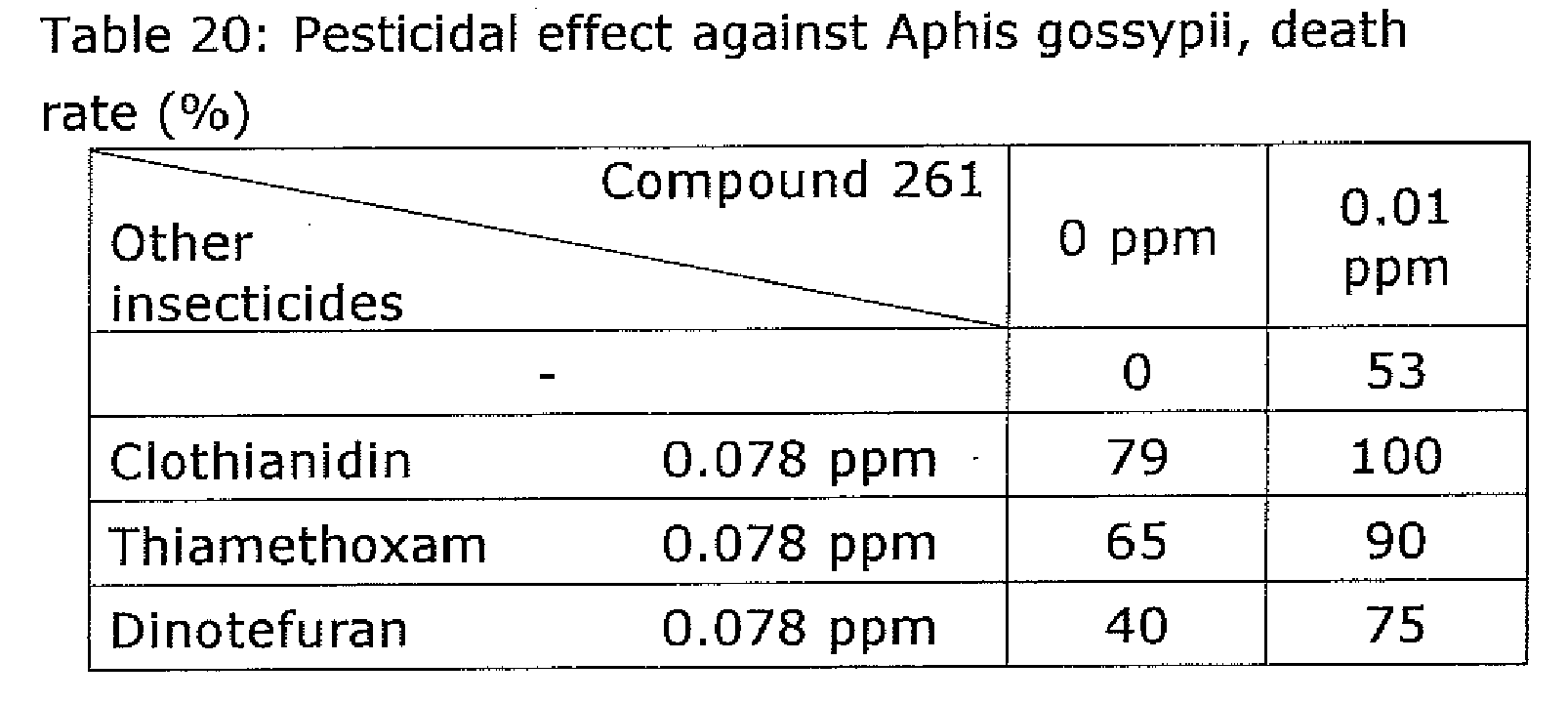
- [Table 21]

- A leaf disk having a diameter of 5.0 cmφ was cut out from a cabbage grown in a pot and was placed in a plastic cup. Test admixture solutions, prepared by diluting the composition of the present invention with a 50% aqueous acetone solution (0.05% Tween 20 added) to predetermined concentrations specified in Table 22, test single active ingredient solutions in which only compound 261 had been dissolved without mixing other insecticides, or test single active ingredient solutions in which only other insecticides had been dissolved without mixing any pyripyropene derivative were spread over the cabbage leaf disk. The leaf disk was then air dried. Five larvae at the second instar born of Plutella xylostella were released in the cup. Thereafter, the cup was lidded and was allowed to stand in a humidistat chamber (light period 16 hr - dark period 8 hr) (25°C). Three days after the initiation of standing of the cup, the larvae were observed for survival or death, and the death rate of larvae was calculated by the following equation. The results are shown in Table 22.

The death rates are shown below. - Further, theoretical values, which do not exhibit a synergistic effect, were calculated by the following Colby's formula, and the results are shown in Table 23.

wherein A: 100 - (death rate when treatment was performed only with compound 261); and
B: 100 - (death rate when treatment was performed only with each compound, i.e., A120, A190, or chlorfenapyr) - When the pesticidal effect (Table 22) of the composition of the present invention in an admixture form against Plutella xylostella exceeded the theoretical value calculated by the Colby's formula shown in Table 23, the admixture was determined to have a synergistic effect.
- All the tested admixtures had the death rate beyond the theoretical values, demonstrating that they had a synergistic effect.
-

-
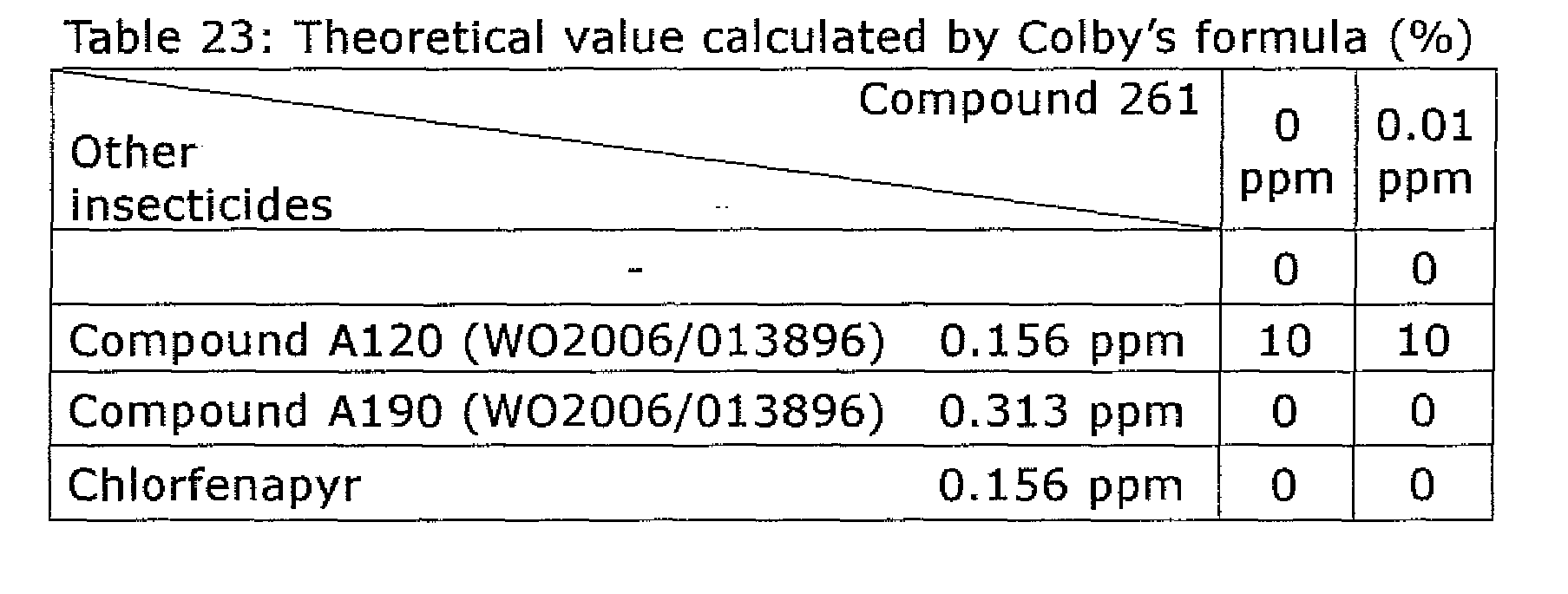
Claims (25)
- A pest control composition comprising at least one pyripyropene derivative of formula (I) or agriculturally and horticulturally acceptable salt thereof and at least one other pest control agent as active ingredients:

Het1 represents optionally substituted 3-pyridyl,
R1 represents hydroxyl,
optionally substituted C1-6 alkylcarbonyloxy,
optionally substituted C2-6 alkenylcarbonyloxy,
optionally substituted C2-6 alkynylcarbonyloxy,
optionally substituted C1-6 alkyloxy,
optionally substituted C2-6 alkenyloxy,
optionally substituted C2-6 alkynyloxy,
optionally substituted benzyloxy, or
oxo in the absence of a hydrogen atom at the 13-position, or
the bond between 5-position and 13-position represents a double bond in the absence of R1 and a hydrogen atom at the 5-position,
R2 represents hydroxyl,
optionally substituted C1-18 alkylcarbonyloxy,
optionally substituted C2-6 alkenylcarbonyloxy,
optionally substituted C2-6 alkynylcarbonyloxy,
optionally substituted benzoyloxy, or
optionally substituted C1-6 alkylsulfonyloxy,
R3 represents a hydrogen atom,
hydroxyl,
optionally substituted C1-18 alkylcarbonyloxy,
optionally substituted C2-6 alkenylcarbonyloxy,
optionally substituted C2-6 alkynylcarbonyloxy,
optionally substituted benzoyloxy,
optionally substituted C1-6 alkylsulfonyloxy,
optionally substituted benzenesulfonyloxy, or
optionally substituted saturated or unsaturated
five- or six-membered heterocyclic thiocarbonyloxy, or R2 and R3 together represent -O-CR2'R3'-O- wherein R2' and R3', which may be the same or different, represent a hydrogen atom, C1-6 alkyl, C1-6 alkyloxy, C2-6 alkenyl, optionally substituted phenyl, or optionally substituted benzyl, or R2' and R3' together represent oxo or C2-6 alkylene, and
R4 represents a hydrogen atom,
hydroxyl,
optionally substituted C1-18 alkylcarbonyloxy,
optionally substituted C2-6 alkenylcarbonyloxy,
optionally substituted C2-6 alkynylcarbonyloxy,
optionally substituted benzoyloxy,
optionally substituted C1-6 alkylsulfonyloxy,
optionally substituted benzenesulfonyloxy,
optionally substituted benzyloxy,
optionally substituted C1-6 alkyloxy,
optionally substituted C2-6 alkenyloxy,
optionally substituted C2-6 alkynyloxy,
C1-6 alkyloxy-C1-6 alkyloxy,
C1-6 alkylthio-C1-6 alkyloxy,
C1-6 alkyloxy-C1-6 alkyloxy-C1-6 alkyloxy,
optionally substituted C1-6 alkyloxycarbonyloxy,
optionally substituted C1-6 alkylaminocarbonyloxy,
optionally substituted saturated or unsaturated five-or six-membered heterocyclic oxy,
optionally substituted saturated or unsaturated five- or six-membered heterocyclic carbonyloxy,
optionally substituted thieno[3,2-b]pyridylcarbonyloxy,
optionally substituted 1H-indolylcarbonyloxy,
optionally substituted saturated or unsaturated five- or six-membered heterocyclic thiocarbonyloxy, or
oxo in the absence of a hydrogen atom at the 7-position. - The composition according to claim 1,
wherein
Het1 represents 3-pyridyl,
R1 represents hydroxyl or C1-6 alkylcarbonyloxy, or
the bond between 5-position and 13-position represents a double bond in the absence of R1 and a hydrogen atom at the 5-position,
R2 represents optionally substituted C1-6 alkylcarbonyloxy,
R3 represents optionally substituted C1-6 alkylcarbonyloxy or C1-6 alkylsulfonyloxy, or
R2 and R3 together represent -O-CR2'R3'-O- wherein R2' and R3', which may be the same or different, represent a hydrogen atom, C1-6 alkyl, or optionally substituted phenyl, or R2' and R3' together represent oxo or C2-6 alkylene, and
R4 represents hydrogen atom
hydroxyl,
optionally substituted C1-6 alkylcarbonyloxy,
saturated or unsaturated five- or six-membered heterocyclic oxy,
optionally substituted benzoyloxy,
C1-3 alkyloxy-C1-3 alkyloxy,
optionally substituted C1-6 alkylaminocarbonyloxy,
optionally substituted saturated or unsaturated five- or six-membered heterocyclic carbonyloxy,
optionally substituted thieno[3,2-b]pyridylcarbonyloxy,
optionally substituted 1H-indolylcarbonyloxy,
saturated or unsaturated five- or six-membered heterocyclic thiocarbonyloxy, or
oxo in the absence of a hydrogen atom at the 7-position. - The composition according to claim 1,
wherein
Het1 represents 3-pyridyl,
R1 represents hydroxyl,
R2 represents optionally substituted C1-6 alkylcarbonyloxy,
R3 represents optionally substituted C1-6 alkylcarbonyloxy or C1-6 alkylsulfonyloxy, and
R4 represents a hydrogen atom,
hyd roxyl,
optionally substituted C1-6 alkylcarbonyloxy,
saturated or unsaturated five- or six-membered heterocyclic oxy,
optionally substituted benzoyloxy,
C1-3 alkyloxy-C1-3 alkyloxy,
optionally substituted C1-6 alkylaminocarbonyloxy,
optionally substituted saturated or unsaturated five- or six-membered heterocyclic carbonyloxy,
optionally substituted thieno[3,2-b]pyridylcarbonyloxy,
optionally substituted 1H-indolylcarbonyloxy,
saturated or unsaturated five- or six-membered heterocyclic thiocarbonyloxy, or
oxo in the absence of a hydrogen atom at the 7-position. - The composition according to claim 1,
wherein
Het1 represents 3-pyridyl,
R1 represents hydroxyl,
R2 represents optionally substituted C1-6 alkylcarbonyloxy,
R3 represents optionally substituted C1-6 alkylcarbonyloxy or C1-6 alkylsulfonyloxy, and
R4 represents hydrogen atom
hyd roxyl,
optionally substituted C1-6 alkylcarbonyloxy,
saturated or unsaturated five- or six-membered heterocyclic oxy,
optionally substituted benzoyloxy,
optionally substituted saturated or unsaturated five- or six-membered heterocyclic carbonyloxy, or
saturated or unsaturated five- or six-membered heterocyclic thiocarbonyloxy. - The composition according to claim 1, wherein Het1 represents 3-pyridyl, R1 represents hydroxyl, R2 and R3 represent optionally substituted cyclic C3-6 alkylcarbonyloxy, and R4 represents a hydrogen atom, hydroxyl, optionally substituted cyclic C3-6 alkylcarbonyloxy, optionally substituted benzoyloxy, or oxo in the absence of a hydrogen atom at the 7-position.
- The composition according to claim 1, wherein Het1 represents 3-pyridyl, R1 represents hydroxyl, R2 and R3 represent cyclopropylcarbonyloxy, and R4 represents hydroxyl.
- The composition according to claim 1, which further comprises an agriculturally and horticulturally acceptable carrier.
- The composition according to claim 1, wherein the other pest control agent is an insecticide and/or a fungicide.
- The composition according to claim 1, wherein the other pest control agent is an insecticide.
- The composition according to claim 1, wherein the other pest control agent is an insecticide and is selected from the group consisting of acephate, dichlorvos, EPN, fenitrothion, fenamifos, prothiofos, profenofos, pyraclofos, chlorpyrifos-methyl, chlorfenvinphos, demeton, ethion, malathion, coumaphos, isoxathion, fenthion, diazinon, thiodicarb, aldicarb, oxamyl, propoxur, carbaryl, fenobucarb, ethiofencarb, fenothiocarb, pirimicarb, carbofuran, carbosulfan, furathiocarb, hyquincarb, alanycarb, methomyl, benfuracarb, cartap, thiocyclam, bensultap, dicofol, tetradifon, acrinathrin, bifenthrin, cycloprothrin, cyfluthrin, dimefluthrin, empenthrin, fenfluthrin, fenpropathrin, imiprothrin, metofluthrin, permethrin, phenothrin, resmethrin, tefluthrin, tetramethrin, tralomethrin, transfluthrin, cypermethrin, deltamethrin, cyhalothrin, fenvalerate, fluvalinate, ethofenprox, flufenprox, halfenprox, silafluofen, cyromazine, diflubenzuron, teflubenzuron, flucycloxuron, flufenoxuron, hexaflumuron, lufenuron, novaluron, penfluron, triflumuron, chlorfluazuron, diafenthiuron, methoprene, fenoxycarb, pyriproxyfen, halofenozide, tebufenozide, methoxyfenozide, chromafenozide, dicyclanil, buprofezin, hexythiazox, amitraz, chlordimeform, pyridaben, fenpyroxymate, flufenerim, pyrimidifen, tebufenpyrad, tolfenpyrad, fluacrypyrim, acequinocyl, cyflumetofen, flubendiamide, ethiprole, fipronil, ethoxazole, imidacloprid, nitenpyram, clothianidin, acetamiprid, dinotefuran, thiacloprid, thiamethoxam, pymetrozine, bifenazate, spirodiclofen, spiromesifen, flonicamid, chlorfenapyr, pyriproxyfene, indoxacarb, pyridalyl, spinosad, avermectin, milbemycin, azadirachtin, nicotine, rotenone, BT formulations, insect pathological viral agents, emamectinbenzoate, spinetoram, pyrifluquinazon, chlorantraniliprole, cyenopyrafen, spirotetramat, lepimectin, metaflumizone, pyrafluprole, pyriprole, dimefluthrin, fenazaflor, hydramethylnon, and triazamate and compounds of formula (II):

R102 represents C1-4 alkyl,
R103 represents C1-4 alkyl,
X101 and X102 each independently represent a hydrogen atom or C1-4 alkyl optionally substituted by a halogen atom,
provided that X101 and X102 do not simultaneously represent a hydrogen atom, and
Y101, Y102, Y103, Y104, and Y105 each independently represent a hydrogen atom, C1-8 alkyloxy, wherein the C1-8 alkyloxy group is substituted by one or more halogen atoms, which may be the same or different, and/or C1-4 alkyloxy substituted by one or more halogen atoms, which may be the same or different, or a halogen atom,
provided that at least one of Y101, Y102, Y103, Y104, and Y105 represents C1-8 alkyloxy, wherein the C1-8 alkyloxy group is substituted by one or more halogen atoms, which may be the same or different, and/or C1-4 alkyloxy substituted by one or more halogen atoms which may be the same or different,
or two adjacent groups of Y101, Y102, Y103, Y104, and Y105 together may represent -O-(CH2)n-O-, wherein n is 1 or 2, substituted by one or more halogen atoms. - The composition according to claim 1, wherein the other pest control agent is an insecticide and is selected from the group consisting of flonicamid, acetamiprid, fipronil, imidacloprid, chlorfenapyr, clothianidin, thiamethoxam, and dinotefuran and compounds of formula (II) wherein R101 represents methoxycarbonyl, R102 represents methyl, R103 represents ethyl, X101, Y104, and Y105 represent a hydrogen atom, X102 represents methyl, and Y101, Y102, and Y103 represent H, H, and OCF3, respectively, H, H, and OCF2CHF2, respectively, or Cl, H, and OCF3, respectively, or Y101 represents H and Y102 and Y103 together represent -OCF2CF2O-.
- The composition according to claim 11, comprising a pyripyropene derivative of formula (I) or an agriculturally and horticulturally acceptable salt thereof wherein Het1 represents 3-pyridyl, R1 represents hydroxyl, R2 and R3 represent cyclopropylcarbonyloxy, and R4 represents hydroxyl.
- The composition according to claim 1, which is a wettable powder comprising 0.1 to 80% by weight of the pyripyropene derivative of formula (I), 0.1 to 80% by weight of an insecticide as the other pest control agent, 0.6 to 30% by weight of a wetting agent and a dispersant, and 20 to 95% by weight of an extender.
- The composition according to claim 1, which is a water dispersible granule comprising 0.1 to 80% by weight of the pyripyropene derivative of formula (1), 0.1 to 80% by weight of an insecticide as the other pest control agent, 0.6 to 30% by weight of a wetting agent, a dispersant, and a binder, and 20 to 95% by weight of an extender.
- The composition according to claim 1, which is a floable preparation comprising 0.1 to 80% by weight of the pyripyropene derivative of formula (I), 0.1 to 80% by weight of an insecticide as the other pest control agent, 5 to 40% by weight of a dispersant, a thickening agent, an antifreezing agent, an antiseptic, and an antifoaming agent, and 20 to 94% by weight of water.
- The composition according to claim 1, which is an emulsifiable concentrate comprising 0.1 to 80% by weight of the pyripyropene derivative of formula (I), 0.1 to 80% by weight of an insecticide as the other pest control agent, 1 to 30% by weight of an emulsifier and an emulsion stabilizer, and 20 to 97% by weight of an organic solvent.
- The composition according to claim 1, which is a micro granule fine comprising 0.1 to 80% by weight of the pyripyropene derivative of formula (I), 0.1 to 80% by weight of an insecticide as the other pest control agent, 0.2 to 10% by weight of a solvent or a binder, and 70 to 99.6% by weight of an extender.
- The composition according to claim 1, which is a granule comprising 0.1 to 80% by weight of the pyripyropene derivative of formula (I), 0.1 to 80% by weight of an insecticide as the other pest control agent, 0.5 to 30% by weight of a granulation assistant (a surfactant) and a binder, and 20 to 98% by weight of an extender.
- A combination comprising at least one pyripyropene derivative of formula (I) or agriculturally and horticulturally acceptable salt thereof defined in claim 1 and at least one other pest control agent as active ingredients.
- A method for protecting useful plants from pests, comprising applying at least one pyripyropene derivative of formula (I) or agriculturally and horticulturally acceptable salt thereof defined in claim 1 and at least one other pest control agent as active ingredients simultaneously or separately from each other to an area to be treated.
- The method according to claim 20, wherein the ingredients are simultaneously applied to the area to be treated.
- A method for protecting useful plants from pests, comprising treating an object pest, an object useful plant, or a seed, a soil, or a cultivation carrier of the object useful plant with a pest control composition according to any one of claims 1 to 18.
- A method for protecting useful plants from pests, comprising treating an object pest, an object useful plant, or a seed, a soil, or a cultivation carrier of the object useful plant with a combination according to claim 19.
- Use of a pest control composition according to any one of claims 1 to 18 for the protection of useful plants from pests.
- Use of a combination according to claim 19 for the protection of useful plants from pests.
Priority Applications (1)
| Application Number | Priority Date | Filing Date | Title |
|---|---|---|---|
| PL08721732T PL2119361T3 (en) | 2007-03-08 | 2008-03-10 | Pest control composition |
Applications Claiming Priority (2)
| Application Number | Priority Date | Filing Date | Title |
|---|---|---|---|
| JP2007058540 | 2007-03-08 | ||
| PCT/JP2008/054316 WO2008108491A1 (en) | 2007-03-08 | 2008-03-10 | Pest control composition |
Publications (3)
| Publication Number | Publication Date |
|---|---|
| EP2119361A1 true EP2119361A1 (en) | 2009-11-18 |
| EP2119361A4 EP2119361A4 (en) | 2011-10-26 |
| EP2119361B1 EP2119361B1 (en) | 2013-10-09 |
Family
ID=39738353
Family Applications (1)
| Application Number | Title | Priority Date | Filing Date |
|---|---|---|---|
| EP08721732.9A Active EP2119361B1 (en) | 2007-03-08 | 2008-03-10 | Pest control composition |
Country Status (12)
| Country | Link |
|---|---|
| US (2) | US8859462B2 (en) |
| EP (1) | EP2119361B1 (en) |
| JP (1) | JP5313869B2 (en) |
| KR (1) | KR101486094B1 (en) |
| CN (2) | CN103535360B (en) |
| AU (1) | AU2008221838B2 (en) |
| BR (1) | BRPI0808366B1 (en) |
| CA (1) | CA2678542C (en) |
| ES (1) | ES2441417T3 (en) |
| IL (1) | IL200477A (en) |
| PL (1) | PL2119361T3 (en) |
| WO (1) | WO2008108491A1 (en) |
Cited By (15)
| Publication number | Priority date | Publication date | Assignee | Title |
|---|---|---|---|---|
| WO2011147952A1 (en) | 2010-05-28 | 2011-12-01 | Basf Se | Pesticidal mixtures |
| WO2011147953A1 (en) | 2010-05-28 | 2011-12-01 | Basf Se | Pesticidal mixtures |
| EP2223599A4 (en) * | 2007-12-21 | 2012-01-11 | Meiji Seika Kaisha | NEW SYSTEMIC PESTICIDE |
| WO2012035010A1 (en) | 2010-09-14 | 2012-03-22 | Basf Se | Composition containing a pyripyropene insecticide and a base |
| WO2012035015A2 (en) | 2010-09-14 | 2012-03-22 | Basf Se | Composition containing a pyripyropene insecticide and an adjuvant |
| WO2013135604A1 (en) | 2012-03-12 | 2013-09-19 | Basf Se | Liquid concentrate formulation containing a pyripyropene insecticide i |
| WO2013135605A1 (en) | 2012-03-12 | 2013-09-19 | Basf Se | Liquid concentrate formulation containing a pyripyropene insecticide ii |
| WO2013135610A1 (en) | 2012-03-13 | 2013-09-19 | Basf Se | Liquid concentrate formulation containing a pyripyropene insecticide iii |
| WO2014111395A1 (en) | 2013-01-16 | 2014-07-24 | Basf Se | Method for producing a liquid emulsifiable formulation comprising a pyripyropene pesticide |
| WO2014155214A1 (en) | 2013-03-28 | 2014-10-02 | Basf Se | Production of pyripyropenes from dry biomass |
| AU2014227475B2 (en) * | 2010-05-28 | 2015-12-17 | Basf Se | Pesticidal mixtures |
| WO2016038067A1 (en) * | 2014-09-10 | 2016-03-17 | Basf Se | Use of afidopyropene in genetically modified plants |
| US9598428B2 (en) | 2013-01-16 | 2017-03-21 | Basf Se | Method for preparing a pyripyropene compound |
| US9861104B2 (en) | 2012-03-12 | 2018-01-09 | Basf Se | Method for producing an aqueous suspension concentrate formulation of a pyripyropene insecticide |
| WO2024260413A1 (en) * | 2023-06-21 | 2024-12-26 | Basf Agrochemical Products B.V. | An insecticidal microemulsion containing afidopyropen and dinotefuran, application and preparation method thereof |
Families Citing this family (88)
| Publication number | Priority date | Publication date | Assignee | Title |
|---|---|---|---|---|
| PT1380209E (en) * | 2001-04-17 | 2012-09-27 | Nihon Nohyaku Co Ltd | Pest control agent composition and method of using the same |
| ES2524819T3 (en) | 2009-01-27 | 2014-12-12 | Basf Se | Seed Treatment Procedure |
| WO2010089244A1 (en) | 2009-02-03 | 2010-08-12 | Basf Se | Method for dressing seeds |
| CN102341376A (en) | 2009-03-04 | 2012-02-01 | 巴斯夫欧洲公司 | 3-arylquinazolin-4-one compounds for controlling invertebrate pests |
| CN102369199A (en) | 2009-04-01 | 2012-03-07 | 巴斯夫欧洲公司 | Isoxazoline compounds for controlling invertebrate pests |
| EP2424370A2 (en) | 2009-04-28 | 2012-03-07 | BASF Corporation | Foamable pesticide compositions |
| ES2472918T3 (en) | 2009-07-06 | 2014-07-03 | Basf Se | Pyridazine compounds to control invertebrate pests |
| BR112012001597A2 (en) | 2009-07-24 | 2015-09-01 | Basf Se | Method for controlling and / or combating invertebrate pests, method for protecting plant propagating material and / or growing plants, plant propagating material and method for treating or protecting an animal from infestation or parasite infection. |
| ES2545738T3 (en) | 2009-07-30 | 2015-09-15 | Merial, Inc. | Insecticidal compounds based on 4-amino-thieno [2,3-d] -pyrimidine and procedures for its use |
| US9339030B2 (en) | 2009-08-28 | 2016-05-17 | Basf Corporation | Foamable pesticide compositions and methods of application |
| JP2013505909A (en) | 2009-09-24 | 2013-02-21 | ビーエーエスエフ ソシエタス・ヨーロピア | Aminoquinazoline compounds for combating invertebrate pests |
| WO2011057942A1 (en) | 2009-11-12 | 2011-05-19 | Basf Se | Insecticidal methods using pyridine compounds |
| BR112012011808B1 (en) | 2009-11-17 | 2020-02-04 | Merial Ltd | fluorinated heteroarylalkylsulfide oxo derivatives to combat invertebrate pests. |
| WO2011064188A1 (en) | 2009-11-27 | 2011-06-03 | Basf Se | Insecticidal methods using nitrogen-containing heteroaromatic compounds |
| WO2011069143A1 (en) | 2009-12-04 | 2011-06-09 | Merial Limited | Pesticidal bis-organosulfur compounds |
| WO2011069955A1 (en) | 2009-12-07 | 2011-06-16 | Basf Se | Sulfonimidamide compounds for combating animal pests |
| WO2011073444A2 (en) | 2009-12-18 | 2011-06-23 | Basf Se | Azoline compounds for combating invertebrate pests |
| EP2531493B1 (en) | 2010-02-01 | 2015-07-22 | Basf Se | Substituted ketonic isoxazoline compounds and derivatives for combating animal pests |
| EP2550261B1 (en) | 2010-03-23 | 2016-03-16 | Basf Se | Pyridazine compounds for controlling invertebrate pests |
| EP2550265B1 (en) | 2010-03-23 | 2016-12-07 | Basf Se | Pyridazine compounds for controlling invertebrate pests |
| ES2589792T3 (en) | 2010-03-23 | 2016-11-16 | Basf Se | Pyridazine compounds for the control of invertebrate pests |
| BR112012028760A2 (en) | 2010-05-24 | 2018-02-06 | Meiji Seika Pharma Co Ltd | harmful organism control agent |
| WO2011161131A1 (en) | 2010-06-25 | 2011-12-29 | Basf Se | Herbicidal mixtures |
| WO2011161132A1 (en) | 2010-06-25 | 2011-12-29 | Basf Se | Pesticidal mixtures |
| WO2012007426A1 (en) | 2010-07-13 | 2012-01-19 | Basf Se | Azoline substituted isoxazoline benzamide compounds for combating animal pests |
| ES2531448T3 (en) | 2010-07-22 | 2015-03-16 | Basf Se | New compounds of hetaryl (thio) carboxamide to control invertebrate pests |
| US20130203821A1 (en) | 2010-09-13 | 2013-08-08 | Basf Se | Pyridine Compounds for Controlling Invertebrate Pests II |
| EP2615917A2 (en) | 2010-09-13 | 2013-07-24 | Basf Se | Pyridine compounds for controlling invertebrate pests iii |
| US8609700B2 (en) | 2010-09-13 | 2013-12-17 | Basf Se | Pyridine compounds for controlling invertebrate pests I |
| KR101234794B1 (en) | 2010-09-29 | 2013-02-20 | 주식회사 거영 | Method for Formulating Indoxacarb into Emulsifiable concentrate |
| AR083646A1 (en) | 2010-10-01 | 2013-03-13 | Basf Se | IMINA COMPOUNDS, VETERINARY AND AGRICULTURAL COMPOSITIONS THAT CONTAIN THEM AND THEIR USE IN THE CONTROL OF INVERTEBRATE PESTS |
| US20130184320A1 (en) | 2010-10-01 | 2013-07-18 | Basf Se | Imine Compounds |
| EP2648518A2 (en) | 2010-12-10 | 2013-10-16 | Basf Se | Pyrazole compounds for controlling invertebrate pests |
| US20130267476A1 (en) | 2010-12-20 | 2013-10-10 | Basf Se | Pesticidal Active Mixtures Comprising Pyrazole Compounds |
| WO2012085081A1 (en) | 2010-12-22 | 2012-06-28 | Basf Se | Sulfoximinamide compounds for combating invertebrate pests ii |
| CN102177910A (en) * | 2011-03-16 | 2011-09-14 | 青岛凯源祥化工有限公司 | Environment-friendly pesticide composition |
| CN102204555B (en) * | 2011-03-29 | 2013-06-12 | 海利尔药业集团股份有限公司 | Insecticidal and acaricidal composition containing biopesticide and bifenazate |
| KR20140025429A (en) | 2011-04-06 | 2014-03-04 | 바스프 에스이 | Substituted pyrimidinium compounds for combating animal pests |
| CN103492378B (en) | 2011-04-21 | 2016-09-28 | 巴斯夫欧洲公司 | Parasite killing pyrazole compound |
| IN2014CN01024A (en) | 2011-08-12 | 2015-04-10 | Basf Se | |
| WO2013024003A1 (en) | 2011-08-12 | 2013-02-21 | Basf Se | N-thio-anthranilamide compounds and their use as pesticides |
| CN103827103A (en) | 2011-08-12 | 2014-05-28 | 巴斯夫欧洲公司 | N-thio-anthranilamide compounds and their use as pesticides |
| AR088786A1 (en) | 2011-08-12 | 2014-07-10 | Basf Se | ANTRANILAMIDE COMPOUNDS AND THEIR USES AS PESTICIDES |
| JP2014522873A (en) | 2011-08-12 | 2014-09-08 | ビーエーエスエフ ソシエタス・ヨーロピア | Anthranilamido compounds and their use as insecticides |
| ES2558166T3 (en) | 2011-08-12 | 2016-02-02 | Basf Se | N-thio-anthranilamide compounds and their use as pesticides |
| CN103889960A (en) | 2011-08-18 | 2014-06-25 | 巴斯夫欧洲公司 | Carbamoylmethoxy- and carbamoylmethylthio- and carbamoylmethylamino benzamides for combating invertebrate pests |
| US20140243196A1 (en) | 2011-08-18 | 2014-08-28 | Basf Se | Carbamoylmethoxy- and Carbamoylmethylthio- and Carbamoylmethylamino Benzamides for Combating Invertebrate Pests |
| EP2744785A1 (en) | 2011-08-18 | 2014-06-25 | Basf Se | Carbamoylmethoxy- and carbamoylmethylthio- and carbamoylmethylamino benzamides for combating invertebrate pests |
| MX2014001608A (en) | 2011-09-02 | 2014-04-25 | Basf Se | Use of pesticidal active 3-arylquinazolin-4-one derivatives in soil application methods. |
| EP2750503A1 (en) | 2011-09-02 | 2014-07-09 | Basf Se | Insecticidal active mixtures comprising arylquinazolinone compounds |
| US9487523B2 (en) | 2012-03-14 | 2016-11-08 | Merck Sharp & Dohme Corp. | Process for making CGRP receptor antagonists |
| WO2013189801A1 (en) | 2012-06-20 | 2013-12-27 | Basf Se | Pyrazole compound and pesticidal mixtures comprising a pyrazole compound |
| EP2684879A1 (en) | 2012-07-09 | 2014-01-15 | Basf Se | Substituted mesoionic compounds for combating animal pests |
| BR112015006299A2 (en) | 2012-09-21 | 2017-07-04 | Basf Se | '' compost, agricultural composition, method for the protection of crop plants, method for the protection of plant propagating material and propagating material '' |
| CN103355279B (en) * | 2013-07-19 | 2014-11-26 | 江苏省农业科学院 | Aphid extinguishing liquor and electrothermal aphid extinguishing method employing same for preventing and controlling aphid of facility crops |
| AR100304A1 (en) | 2014-02-05 | 2016-09-28 | Basf Corp | SEED COATING FORMULATION |
| CN103814937B (en) * | 2014-02-11 | 2015-10-07 | 深圳诺普信农化股份有限公司 | A kind of Pesticidal combination |
| CN103858922B (en) * | 2014-02-14 | 2015-10-07 | 暨南大学 | A kind of Multifunctional environment friendly Diacloden aqua and preparation method thereof |
| CN105794811B (en) * | 2014-12-30 | 2019-01-29 | 江苏龙灯化学有限公司 | A kind of Pesticidal combination and its method for controlling agricultural pests |
| CN105432653A (en) * | 2015-12-18 | 2016-03-30 | 广东中迅农科股份有限公司 | Insecticidal composition |
| CN105532713A (en) * | 2015-12-18 | 2016-05-04 | 广东中迅农科股份有限公司 | Insecticidal composition comprising afidopyropen and flonicamid |
| UY37137A (en) | 2016-02-24 | 2017-09-29 | Merial Inc | ANTIPARASITARY COMPOUNDS OF ISOXAZOLINE, INJECTABLE FORMULATIONS OF PROLONGED ACTION THAT INCLUDE THEM, METHODS AND USES OF THE SAME |
| CN105918341A (en) * | 2016-04-25 | 2016-09-07 | 广东中迅农科股份有限公司 | Insecticidal composition containing chlorfenaypr and afidopyropen |
| CN106417348A (en) * | 2016-10-10 | 2017-02-22 | 深圳诺普信农化股份有限公司 | Afidopyropen-containing synergistic pesticidal composition |
| CN106561689A (en) * | 2016-11-15 | 2017-04-19 | 佛山市盈辉作物科学有限公司 | Pesticide composition containing afidopyropen and cyclaniliprole |
| CN106538587A (en) * | 2016-11-26 | 2017-03-29 | 佛山市普尔玛农化有限公司 | Composition pesticide containing double third ring worm esters and Nylar |
| CN106857620A (en) * | 2017-02-26 | 2017-06-20 | 佛山市瑞生通科技有限公司 | Composition pesticide containing double third ring worm esters and indoxacarb |
| CN107118016A (en) * | 2017-05-08 | 2017-09-01 | 安徽新荣久农业科技有限公司 | A kind of tea seed breed breeding soak |
| CN107027784A (en) * | 2017-05-27 | 2017-08-11 | 山东省烟台市农业科学研究院 | A kind of compounded pesticides and its application containing nimbin and double third ring worm esters |
| CN107484643A (en) * | 2017-08-03 | 2017-12-19 | 安徽省雷氏农业科技有限公司 | A kind of peony seeds breed breeding culture medium |
| CN110452167B (en) * | 2018-04-16 | 2020-08-21 | 东莞市东阳光农药研发有限公司 | Quinoline derivatives and preparation method and use thereof |
| CN108967437A (en) * | 2018-08-22 | 2018-12-11 | 中国农业大学 | A kind of pair of the third ring worm ester and Acetamiprid compound synergic insecticide and its application |
| CN109221190A (en) * | 2018-10-11 | 2019-01-18 | 中国农业大学 | A kind of compounded pesticides effectively preventing cotten aphid |
| CN109221191A (en) * | 2018-10-11 | 2019-01-18 | 泰安市农业科学研究院 | Pesticidal combination and its application containing double third ring worm esters and pymetrozine |
| CN109392945B (en) * | 2018-11-05 | 2020-11-20 | 中国农业大学 | A kind of compound insecticide for effective control of cotton aphid and its application |
| CN111374144A (en) * | 2018-12-27 | 2020-07-07 | 燕化永乐(乐亭)生物科技有限公司 | Insecticidal composition |
| CN111406756A (en) * | 2019-01-04 | 2020-07-14 | 燕化永乐(乐亭)生物科技有限公司 | Compound insecticide |
| CN115956570B (en) * | 2019-06-25 | 2025-03-11 | 江苏龙灯化学有限公司 | An insecticide composition |
| CN110495470A (en) * | 2019-08-29 | 2019-11-26 | 上海明德立达生物科技有限公司 | A kind of insecticide composition and its application |
| CN110637823A (en) * | 2019-09-20 | 2020-01-03 | 上海明德立达生物科技有限公司 | Pesticide composition and application thereof |
| IN202011023685A (en) * | 2020-06-05 | 2021-01-08 | Best Agrolife Ltd | |
| CN113875766B (en) * | 2020-07-02 | 2023-09-15 | 江苏龙灯化学有限公司 | Insecticidal composition |
| CN113068698B (en) * | 2021-04-12 | 2021-12-24 | 广西壮族自治区亚热带作物研究所(广西亚热带农产品加工研究所) | A kind of insecticidal composition for controlling macadamia nut aphids |
| CN113287625A (en) * | 2021-06-02 | 2021-08-24 | 河北威远生物化工有限公司 | Synergistic insecticidal composition |
| CN115251079B (en) * | 2022-08-25 | 2024-01-26 | 广西壮族自治区农业科学院 | A kind of composition for controlling taro field aphids |
| CN115886007B (en) * | 2022-11-02 | 2024-05-28 | 上海沪联生物药业(夏邑)股份有限公司 | Pesticide composition, application thereof and pesticide preparation containing pesticide composition |
| CN115769821B (en) * | 2022-11-21 | 2024-02-06 | 南阳市农业科学院 | A kind of pesticide composition for controlling mugwort aphids |
| CN117256614B (en) * | 2023-09-21 | 2025-07-11 | 陕西康禾立丰生物科技药业有限公司 | A pharmaceutical composition containing dipropyl Cyclothianidin and its preparation method insecticidal composition of fluoroureide |
Family Cites Families (8)
| Publication number | Priority date | Publication date | Assignee | Title |
|---|---|---|---|---|
| JP2993767B2 (en) | 1991-06-06 | 1999-12-27 | 社団法人北里研究所 | FO-1289A substance and method for producing the same |
| JP3233476B2 (en) | 1992-10-22 | 2001-11-26 | 社団法人北里研究所 | FO-1289 substance and method for producing the same |
| JP4328989B2 (en) | 1999-11-24 | 2009-09-09 | ソニー株式会社 | REPRODUCTION DEVICE, REPRODUCTION METHOD, AND RECORDING MEDIUM |
| KR100522446B1 (en) * | 2003-01-07 | 2005-10-18 | 한국생명공학연구원 | AGENT FOR KILLING INSECTS COMPRISING COMPOUNDS HAVING ACYL CoA:CHOLESTEROL ACYLTRANSFERASE INHIBITORY OR SALT THEREOF |
| AU2005268166B2 (en) | 2004-08-04 | 2011-10-20 | Meiji Seika Pharma Co., Ltd. | Quinoline derivative and insecticide containing same as active constituent |
| TWI388282B (en) * | 2005-06-01 | 2013-03-11 | Meiji Seika Pharma Co Ltd | Pest control agents |
| US7491738B2 (en) | 2005-06-01 | 2009-02-17 | Meiji Seika Kaisha, Ltd. | Pest control agents |
| JP4273103B2 (en) | 2005-08-24 | 2009-06-03 | Necインフロンティア株式会社 | Access authentication system, mouse device, and access authentication method |
-
2008
- 2008-03-10 AU AU2008221838A patent/AU2008221838B2/en active Active
- 2008-03-10 KR KR1020097019899A patent/KR101486094B1/en active Active
- 2008-03-10 CN CN201310469645.5A patent/CN103535360B/en active Active
- 2008-03-10 JP JP2009502640A patent/JP5313869B2/en active Active
- 2008-03-10 BR BRPI0808366-5A patent/BRPI0808366B1/en active IP Right Grant
- 2008-03-10 ES ES08721732.9T patent/ES2441417T3/en active Active
- 2008-03-10 US US12/450,018 patent/US8859462B2/en active Active
- 2008-03-10 PL PL08721732T patent/PL2119361T3/en unknown
- 2008-03-10 EP EP08721732.9A patent/EP2119361B1/en active Active
- 2008-03-10 WO PCT/JP2008/054316 patent/WO2008108491A1/en not_active Ceased
- 2008-03-10 CA CA2678542A patent/CA2678542C/en active Active
- 2008-03-10 CN CN200880007525.0A patent/CN101626687B/en active Active
-
2009
- 2009-08-18 IL IL200477A patent/IL200477A/en active IP Right Grant
-
2014
- 2014-08-28 US US14/471,393 patent/US9675075B2/en active Active
Cited By (30)
| Publication number | Priority date | Publication date | Assignee | Title |
|---|---|---|---|---|
| EP2223599A4 (en) * | 2007-12-21 | 2012-01-11 | Meiji Seika Kaisha | NEW SYSTEMIC PESTICIDE |
| US9434739B2 (en) | 2007-12-21 | 2016-09-06 | Meiji Seika Pharma Co., Ltd. | Systemic insecticide |
| US9907309B2 (en) | 2010-05-28 | 2018-03-06 | Basf Se | Pesticidal mixtures |
| WO2011147953A1 (en) | 2010-05-28 | 2011-12-01 | Basf Se | Pesticidal mixtures |
| WO2011147952A1 (en) | 2010-05-28 | 2011-12-01 | Basf Se | Pesticidal mixtures |
| AU2014227476B2 (en) * | 2010-05-28 | 2016-07-21 | Basf Se | Pesticidal mixtures |
| AU2014227475C1 (en) * | 2010-05-28 | 2016-05-05 | Basf Se | Pesticidal mixtures |
| AU2014227475B2 (en) * | 2010-05-28 | 2015-12-17 | Basf Se | Pesticidal mixtures |
| US9125416B2 (en) | 2010-05-28 | 2015-09-08 | Basf Se | Pesticidal mixtures |
| AU2011257163B2 (en) * | 2010-05-28 | 2014-07-24 | Basf Se | Pesticidal mixtures |
| US8962524B2 (en) | 2010-05-28 | 2015-02-24 | Basf Se | Pesticidal mixtures |
| AU2011303965B2 (en) * | 2010-09-14 | 2014-08-07 | Basf Se | Composition containing a pyripyropene insecticide and a base |
| US9723834B2 (en) | 2010-09-14 | 2017-08-08 | Basf Se | Composition containing a pyripyropene insecticide and a base |
| US9888689B2 (en) | 2010-09-14 | 2018-02-13 | Basf Se | Compositions containing a pyripyropene insecticide and an adjuvant |
| WO2012035015A2 (en) | 2010-09-14 | 2012-03-22 | Basf Se | Composition containing a pyripyropene insecticide and an adjuvant |
| WO2012035010A1 (en) | 2010-09-14 | 2012-03-22 | Basf Se | Composition containing a pyripyropene insecticide and a base |
| US9924712B2 (en) | 2012-03-12 | 2018-03-27 | Basf Se | Liquid concentrate formulation containing a pyripyropene insecticide II |
| US9861104B2 (en) | 2012-03-12 | 2018-01-09 | Basf Se | Method for producing an aqueous suspension concentrate formulation of a pyripyropene insecticide |
| WO2013135605A1 (en) | 2012-03-12 | 2013-09-19 | Basf Se | Liquid concentrate formulation containing a pyripyropene insecticide ii |
| WO2013135604A1 (en) | 2012-03-12 | 2013-09-19 | Basf Se | Liquid concentrate formulation containing a pyripyropene insecticide i |
| US9596843B2 (en) | 2012-03-12 | 2017-03-21 | Basf Se | Liquid concentrate formulation containing a pyripyropene insecticide I |
| WO2013135610A1 (en) | 2012-03-13 | 2013-09-19 | Basf Se | Liquid concentrate formulation containing a pyripyropene insecticide iii |
| US9598428B2 (en) | 2013-01-16 | 2017-03-21 | Basf Se | Method for preparing a pyripyropene compound |
| US9668470B2 (en) | 2013-01-16 | 2017-06-06 | Basf Se | Method for producing a liquid emulsifiable formulation comprising a pyripyropene pesticide |
| WO2014111395A1 (en) | 2013-01-16 | 2014-07-24 | Basf Se | Method for producing a liquid emulsifiable formulation comprising a pyripyropene pesticide |
| KR20150135391A (en) * | 2013-03-28 | 2015-12-02 | 바스프 에스이 | Production of pyripyropenes from dry biomass |
| WO2014155214A1 (en) | 2013-03-28 | 2014-10-02 | Basf Se | Production of pyripyropenes from dry biomass |
| US10150777B2 (en) | 2013-03-28 | 2018-12-11 | Basf Se | Production of pyripyropenes from dry biomass |
| WO2016038067A1 (en) * | 2014-09-10 | 2016-03-17 | Basf Se | Use of afidopyropene in genetically modified plants |
| WO2024260413A1 (en) * | 2023-06-21 | 2024-12-26 | Basf Agrochemical Products B.V. | An insecticidal microemulsion containing afidopyropen and dinotefuran, application and preparation method thereof |
Also Published As
| Publication number | Publication date |
|---|---|
| JP5313869B2 (en) | 2013-10-09 |
| US8859462B2 (en) | 2014-10-14 |
| WO2008108491A1 (en) | 2008-09-12 |
| CA2678542C (en) | 2016-06-07 |
| US20140371178A1 (en) | 2014-12-18 |
| PL2119361T3 (en) | 2014-03-31 |
| US9675075B2 (en) | 2017-06-13 |
| CA2678542A1 (en) | 2008-09-12 |
| US20100113525A1 (en) | 2010-05-06 |
| BRPI0808366A2 (en) | 2014-07-08 |
| CN103535360A (en) | 2014-01-29 |
| AU2008221838A1 (en) | 2008-09-12 |
| EP2119361A4 (en) | 2011-10-26 |
| IL200477A0 (en) | 2010-04-29 |
| ES2441417T3 (en) | 2014-02-04 |
| AU2008221838B2 (en) | 2013-09-12 |
| CN101626687A (en) | 2010-01-13 |
| KR101486094B1 (en) | 2015-01-28 |
| JPWO2008108491A1 (en) | 2010-06-17 |
| IL200477A (en) | 2015-10-29 |
| CN103535360B (en) | 2016-06-22 |
| EP2119361B1 (en) | 2013-10-09 |
| BRPI0808366B1 (en) | 2021-07-20 |
| CN101626687B (en) | 2014-07-02 |
| KR20090119915A (en) | 2009-11-20 |
Similar Documents
| Publication | Publication Date | Title |
|---|---|---|
| US9675075B2 (en) | Pest control composition | |
| EP2111756B1 (en) | Pest control agents | |
| US8822501B2 (en) | Pest control agents | |
| EP2107060B1 (en) | Pest control agent | |
| JP5037164B2 (en) | Pest control agent |
Legal Events
| Date | Code | Title | Description |
|---|---|---|---|
| PUAI | Public reference made under article 153(3) epc to a published international application that has entered the european phase |
Free format text: ORIGINAL CODE: 0009012 |
|
| 17P | Request for examination filed |
Effective date: 20090914 |
|
| AK | Designated contracting states |
Kind code of ref document: A1 Designated state(s): AT BE BG CH CY CZ DE DK EE ES FI FR GB GR HR HU IE IS IT LI LT LU LV MC MT NL NO PL PT RO SE SI SK TR |
|
| AX | Request for extension of the european patent |
Extension state: AL BA MK RS |
|
| A4 | Supplementary search report drawn up and despatched |
Effective date: 20110927 |
|
| RIC1 | Information provided on ipc code assigned before grant |
Ipc: A01N 43/40 20060101ALI20110921BHEP Ipc: A01N 47/02 20060101ALI20110921BHEP Ipc: A01N 53/00 20060101ALI20110921BHEP Ipc: A01P 7/04 20060101ALI20110921BHEP Ipc: A01N 51/00 20060101ALI20110921BHEP Ipc: A01N 47/40 20060101ALI20110921BHEP Ipc: A01N 25/28 20060101ALI20110921BHEP Ipc: A01N 25/12 20060101ALI20110921BHEP Ipc: A01N 43/90 20060101AFI20110921BHEP Ipc: A01N 25/14 20060101ALI20110921BHEP Ipc: A01N 25/04 20060101ALI20110921BHEP |
|
| RAP1 | Party data changed (applicant data changed or rights of an application transferred) |
Owner name: MEIJI SEIKA PHARMA CO., LTD. |
|
| 17Q | First examination report despatched |
Effective date: 20120619 |
|
| GRAP | Despatch of communication of intention to grant a patent |
Free format text: ORIGINAL CODE: EPIDOSNIGR1 |
|
| INTG | Intention to grant announced |
Effective date: 20130510 |
|
| GRAS | Grant fee paid |
Free format text: ORIGINAL CODE: EPIDOSNIGR3 |
|
| GRAA | (expected) grant |
Free format text: ORIGINAL CODE: 0009210 |
|
| AK | Designated contracting states |
Kind code of ref document: B1 Designated state(s): AT BE BG CH CY CZ DE DK EE ES FI FR GB GR HR HU IE IS IT LI LT LU LV MC MT NL NO PL PT RO SE SI SK TR |
|
| AX | Request for extension of the european patent |
Extension state: AL BA MK RS |
|
| REG | Reference to a national code |
Ref country code: GB Ref legal event code: FG4D |
|
| REG | Reference to a national code |
Ref country code: AT Ref legal event code: REF Ref document number: 635169 Country of ref document: AT Kind code of ref document: T Effective date: 20131015 Ref country code: CH Ref legal event code: EP |
|
| REG | Reference to a national code |
Ref country code: IE Ref legal event code: FG4D |
|
| REG | Reference to a national code |
Ref country code: CH Ref legal event code: NV Representative=s name: SCHNEIDER FELDMANN AG PATENT- UND MARKENANWAEL, CH |
|
| REG | Reference to a national code |
Ref country code: DE Ref legal event code: R096 Ref document number: 602008027990 Country of ref document: DE Effective date: 20131205 |
|
| REG | Reference to a national code |
Ref country code: NL Ref legal event code: T3 |
|
| REG | Reference to a national code |
Ref country code: ES Ref legal event code: FG2A Ref document number: 2441417 Country of ref document: ES Kind code of ref document: T3 Effective date: 20140204 |
|
| REG | Reference to a national code |
Ref country code: AT Ref legal event code: MK05 Ref document number: 635169 Country of ref document: AT Kind code of ref document: T Effective date: 20131009 |
|
| PG25 | Lapsed in a contracting state [announced via postgrant information from national office to epo] |
Ref country code: SI Free format text: LAPSE BECAUSE OF FAILURE TO SUBMIT A TRANSLATION OF THE DESCRIPTION OR TO PAY THE FEE WITHIN THE PRESCRIBED TIME-LIMIT Effective date: 20131009 |
|
| REG | Reference to a national code |
Ref country code: LT Ref legal event code: MG4D |
|
| REG | Reference to a national code |
Ref country code: GR Ref legal event code: EP Ref document number: 20140400025 Country of ref document: GR Effective date: 20140224 |
|
| PG25 | Lapsed in a contracting state [announced via postgrant information from national office to epo] |
Ref country code: BE Free format text: LAPSE BECAUSE OF FAILURE TO SUBMIT A TRANSLATION OF THE DESCRIPTION OR TO PAY THE FEE WITHIN THE PRESCRIBED TIME-LIMIT Effective date: 20131009 Ref country code: SE Free format text: LAPSE BECAUSE OF FAILURE TO SUBMIT A TRANSLATION OF THE DESCRIPTION OR TO PAY THE FEE WITHIN THE PRESCRIBED TIME-LIMIT Effective date: 20131009 Ref country code: LT Free format text: LAPSE BECAUSE OF FAILURE TO SUBMIT A TRANSLATION OF THE DESCRIPTION OR TO PAY THE FEE WITHIN THE PRESCRIBED TIME-LIMIT Effective date: 20131009 Ref country code: FI Free format text: LAPSE BECAUSE OF FAILURE TO SUBMIT A TRANSLATION OF THE DESCRIPTION OR TO PAY THE FEE WITHIN THE PRESCRIBED TIME-LIMIT Effective date: 20131009 Ref country code: NO Free format text: LAPSE BECAUSE OF FAILURE TO SUBMIT A TRANSLATION OF THE DESCRIPTION OR TO PAY THE FEE WITHIN THE PRESCRIBED TIME-LIMIT Effective date: 20140109 Ref country code: IS Free format text: LAPSE BECAUSE OF FAILURE TO SUBMIT A TRANSLATION OF THE DESCRIPTION OR TO PAY THE FEE WITHIN THE PRESCRIBED TIME-LIMIT Effective date: 20140209 Ref country code: HR Free format text: LAPSE BECAUSE OF FAILURE TO SUBMIT A TRANSLATION OF THE DESCRIPTION OR TO PAY THE FEE WITHIN THE PRESCRIBED TIME-LIMIT Effective date: 20131009 |
|
| PG25 | Lapsed in a contracting state [announced via postgrant information from national office to epo] |
Ref country code: AT Free format text: LAPSE BECAUSE OF FAILURE TO SUBMIT A TRANSLATION OF THE DESCRIPTION OR TO PAY THE FEE WITHIN THE PRESCRIBED TIME-LIMIT Effective date: 20131009 Ref country code: CY Free format text: LAPSE BECAUSE OF FAILURE TO SUBMIT A TRANSLATION OF THE DESCRIPTION OR TO PAY THE FEE WITHIN THE PRESCRIBED TIME-LIMIT Effective date: 20131009 Ref country code: LV Free format text: LAPSE BECAUSE OF FAILURE TO SUBMIT A TRANSLATION OF THE DESCRIPTION OR TO PAY THE FEE WITHIN THE PRESCRIBED TIME-LIMIT Effective date: 20131009 |
|
| PG25 | Lapsed in a contracting state [announced via postgrant information from national office to epo] |
Ref country code: PT Free format text: LAPSE BECAUSE OF FAILURE TO SUBMIT A TRANSLATION OF THE DESCRIPTION OR TO PAY THE FEE WITHIN THE PRESCRIBED TIME-LIMIT Effective date: 20140210 |
|
| REG | Reference to a national code |
Ref country code: DE Ref legal event code: R097 Ref document number: 602008027990 Country of ref document: DE |
|
| PG25 | Lapsed in a contracting state [announced via postgrant information from national office to epo] |
Ref country code: EE Free format text: LAPSE BECAUSE OF FAILURE TO SUBMIT A TRANSLATION OF THE DESCRIPTION OR TO PAY THE FEE WITHIN THE PRESCRIBED TIME-LIMIT Effective date: 20131009 |
|
| PLBE | No opposition filed within time limit |
Free format text: ORIGINAL CODE: 0009261 |
|
| STAA | Information on the status of an ep patent application or granted ep patent |
Free format text: STATUS: NO OPPOSITION FILED WITHIN TIME LIMIT |
|
| PG25 | Lapsed in a contracting state [announced via postgrant information from national office to epo] |
Ref country code: SK Free format text: LAPSE BECAUSE OF FAILURE TO SUBMIT A TRANSLATION OF THE DESCRIPTION OR TO PAY THE FEE WITHIN THE PRESCRIBED TIME-LIMIT Effective date: 20131009 Ref country code: RO Free format text: LAPSE BECAUSE OF FAILURE TO SUBMIT A TRANSLATION OF THE DESCRIPTION OR TO PAY THE FEE WITHIN THE PRESCRIBED TIME-LIMIT Effective date: 20131009 Ref country code: CZ Free format text: LAPSE BECAUSE OF FAILURE TO SUBMIT A TRANSLATION OF THE DESCRIPTION OR TO PAY THE FEE WITHIN THE PRESCRIBED TIME-LIMIT Effective date: 20131009 |
|
| 26N | No opposition filed |
Effective date: 20140710 |
|
| PG25 | Lapsed in a contracting state [announced via postgrant information from national office to epo] |
Ref country code: DK Free format text: LAPSE BECAUSE OF FAILURE TO SUBMIT A TRANSLATION OF THE DESCRIPTION OR TO PAY THE FEE WITHIN THE PRESCRIBED TIME-LIMIT Effective date: 20131009 |
|
| REG | Reference to a national code |
Ref country code: DE Ref legal event code: R097 Ref document number: 602008027990 Country of ref document: DE Effective date: 20140710 |
|
| PG25 | Lapsed in a contracting state [announced via postgrant information from national office to epo] |
Ref country code: LU Free format text: LAPSE BECAUSE OF FAILURE TO SUBMIT A TRANSLATION OF THE DESCRIPTION OR TO PAY THE FEE WITHIN THE PRESCRIBED TIME-LIMIT Effective date: 20140310 |
|
| REG | Reference to a national code |
Ref country code: IE Ref legal event code: MM4A |
|
| PG25 | Lapsed in a contracting state [announced via postgrant information from national office to epo] |
Ref country code: IE Free format text: LAPSE BECAUSE OF NON-PAYMENT OF DUE FEES Effective date: 20140310 |
|
| PG25 | Lapsed in a contracting state [announced via postgrant information from national office to epo] |
Ref country code: MT Free format text: LAPSE BECAUSE OF FAILURE TO SUBMIT A TRANSLATION OF THE DESCRIPTION OR TO PAY THE FEE WITHIN THE PRESCRIBED TIME-LIMIT Effective date: 20131009 |
|
| REG | Reference to a national code |
Ref country code: FR Ref legal event code: PLFP Year of fee payment: 9 |
|
| PG25 | Lapsed in a contracting state [announced via postgrant information from national office to epo] |
Ref country code: MC Free format text: LAPSE BECAUSE OF FAILURE TO SUBMIT A TRANSLATION OF THE DESCRIPTION OR TO PAY THE FEE WITHIN THE PRESCRIBED TIME-LIMIT Effective date: 20131009 Ref country code: BG Free format text: LAPSE BECAUSE OF FAILURE TO SUBMIT A TRANSLATION OF THE DESCRIPTION OR TO PAY THE FEE WITHIN THE PRESCRIBED TIME-LIMIT Effective date: 20131009 |
|
| PG25 | Lapsed in a contracting state [announced via postgrant information from national office to epo] |
Ref country code: HU Free format text: LAPSE BECAUSE OF FAILURE TO SUBMIT A TRANSLATION OF THE DESCRIPTION OR TO PAY THE FEE WITHIN THE PRESCRIBED TIME-LIMIT; INVALID AB INITIO Effective date: 20080310 |
|
| REG | Reference to a national code |
Ref country code: FR Ref legal event code: PLFP Year of fee payment: 10 |
|
| REG | Reference to a national code |
Ref country code: ES Ref legal event code: PC2A Owner name: BASF SE Effective date: 20170922 |
|
| REG | Reference to a national code |
Ref country code: FR Ref legal event code: TP Owner name: BASF SE, DE Effective date: 20170918 |
|
| REG | Reference to a national code |
Ref country code: FR Ref legal event code: PLFP Year of fee payment: 11 |
|
| PGFP | Annual fee paid to national office [announced via postgrant information from national office to epo] |
Ref country code: GB Payment date: 20190327 Year of fee payment: 12 |
|
| PGFP | Annual fee paid to national office [announced via postgrant information from national office to epo] |
Ref country code: MC Payment date: 20190130 Year of fee payment: 19 |
|
| REG | Reference to a national code |
Ref country code: DE Ref legal event code: R119 Ref document number: 602008027990 Country of ref document: DE |
|
| REG | Reference to a national code |
Ref country code: CH Ref legal event code: PFA Owner name: MEIJI SEIKA PHARMA CO., LTD., JP Free format text: FORMER OWNER: MEIJI SEIKA PHARMA CO., LTD., JP |
|
| REG | Reference to a national code |
Ref country code: CH Ref legal event code: PL |
|
| REG | Reference to a national code |
Ref country code: NL Ref legal event code: MM Effective date: 20200401 |
|
| PG25 | Lapsed in a contracting state [announced via postgrant information from national office to epo] |
Ref country code: NL Free format text: LAPSE BECAUSE OF NON-PAYMENT OF DUE FEES Effective date: 20200401 |
|
| PG25 | Lapsed in a contracting state [announced via postgrant information from national office to epo] |
Ref country code: DE Free format text: LAPSE BECAUSE OF NON-PAYMENT OF DUE FEES Effective date: 20201001 Ref country code: CH Free format text: LAPSE BECAUSE OF NON-PAYMENT OF DUE FEES Effective date: 20200331 Ref country code: LI Free format text: LAPSE BECAUSE OF NON-PAYMENT OF DUE FEES Effective date: 20200331 |
|
| PGFP | Annual fee paid to national office [announced via postgrant information from national office to epo] |
Ref country code: PL Payment date: 20201103 Year of fee payment: 13 |
|
| GBPC | Gb: european patent ceased through non-payment of renewal fee |
Effective date: 20200310 |
|
| PG25 | Lapsed in a contracting state [announced via postgrant information from national office to epo] |
Ref country code: GB Free format text: LAPSE BECAUSE OF NON-PAYMENT OF DUE FEES Effective date: 20200310 |
|
| PG25 | Lapsed in a contracting state [announced via postgrant information from national office to epo] |
Ref country code: PL Free format text: LAPSE BECAUSE OF NON-PAYMENT OF DUE FEES Effective date: 20210310 |
|
| PGFP | Annual fee paid to national office [announced via postgrant information from national office to epo] |
Ref country code: ES Payment date: 20250415 Year of fee payment: 18 |
|
| PGFP | Annual fee paid to national office [announced via postgrant information from national office to epo] |
Ref country code: IT Payment date: 20260320 Year of fee payment: 19 |
|
| PGFP | Annual fee paid to national office [announced via postgrant information from national office to epo] |
Ref country code: FR Payment date: 20260323 Year of fee payment: 19 |
|
| PGFP | Annual fee paid to national office [announced via postgrant information from national office to epo] |
Ref country code: TR Payment date: 20260219 Year of fee payment: 19 |
|
| PGFP | Annual fee paid to national office [announced via postgrant information from national office to epo] |
Ref country code: GR Payment date: 20260320 Year of fee payment: 19 |