EP2940552B1 - Adjustable display device - Google Patents
Adjustable display device Download PDFInfo
- Publication number
- EP2940552B1 EP2940552B1 EP14197145.7A EP14197145A EP2940552B1 EP 2940552 B1 EP2940552 B1 EP 2940552B1 EP 14197145 A EP14197145 A EP 14197145A EP 2940552 B1 EP2940552 B1 EP 2940552B1
- Authority
- EP
- European Patent Office
- Prior art keywords
- display device
- links
- angle
- angle block
- driving system
- Prior art date
- Legal status (The legal status is an assumption and is not a legal conclusion. Google has not performed a legal analysis and makes no representation as to the accuracy of the status listed.)
- Active
Links
Images





Classifications
-
- G—PHYSICS
- G09—EDUCATION; CRYPTOGRAPHY; DISPLAY; ADVERTISING; SEALS
- G09G—ARRANGEMENTS OR CIRCUITS FOR CONTROL OF INDICATING DEVICES USING STATIC MEANS TO PRESENT VARIABLE INFORMATION
- G09G3/00—Control arrangements or circuits, of interest only in connection with visual indicators other than cathode-ray tubes
- G09G3/03—Control arrangements or circuits, of interest only in connection with visual indicators other than cathode-ray tubes specially adapted for displays having non-planar surfaces, e.g. curved displays
-
- G—PHYSICS
- G02—OPTICS
- G02F—OPTICAL DEVICES OR ARRANGEMENTS FOR THE CONTROL OF LIGHT BY MODIFICATION OF THE OPTICAL PROPERTIES OF THE MEDIA OF THE ELEMENTS INVOLVED THEREIN; NON-LINEAR OPTICS; FREQUENCY-CHANGING OF LIGHT; OPTICAL LOGIC ELEMENTS; OPTICAL ANALOGUE/DIGITAL CONVERTERS
- G02F1/00—Devices or arrangements for the control of the intensity, colour, phase, polarisation or direction of light arriving from an independent light source, e.g. switching, gating or modulating; Non-linear optics
- G02F1/01—Devices or arrangements for the control of the intensity, colour, phase, polarisation or direction of light arriving from an independent light source, e.g. switching, gating or modulating; Non-linear optics for the control of the intensity, phase, polarisation or colour
- G02F1/13—Devices or arrangements for the control of the intensity, colour, phase, polarisation or direction of light arriving from an independent light source, e.g. switching, gating or modulating; Non-linear optics for the control of the intensity, phase, polarisation or colour based on liquid crystals, e.g. single liquid crystal display cells
- G02F1/133—Constructional arrangements; Operation of liquid crystal cells; Circuit arrangements
- G02F1/1333—Constructional arrangements; Manufacturing methods
- G02F1/133305—Flexible substrates, e.g. plastics, organic film
-
- G—PHYSICS
- G02—OPTICS
- G02F—OPTICAL DEVICES OR ARRANGEMENTS FOR THE CONTROL OF LIGHT BY MODIFICATION OF THE OPTICAL PROPERTIES OF THE MEDIA OF THE ELEMENTS INVOLVED THEREIN; NON-LINEAR OPTICS; FREQUENCY-CHANGING OF LIGHT; OPTICAL LOGIC ELEMENTS; OPTICAL ANALOGUE/DIGITAL CONVERTERS
- G02F1/00—Devices or arrangements for the control of the intensity, colour, phase, polarisation or direction of light arriving from an independent light source, e.g. switching, gating or modulating; Non-linear optics
- G02F1/01—Devices or arrangements for the control of the intensity, colour, phase, polarisation or direction of light arriving from an independent light source, e.g. switching, gating or modulating; Non-linear optics for the control of the intensity, phase, polarisation or colour
- G02F1/13—Devices or arrangements for the control of the intensity, colour, phase, polarisation or direction of light arriving from an independent light source, e.g. switching, gating or modulating; Non-linear optics for the control of the intensity, phase, polarisation or colour based on liquid crystals, e.g. single liquid crystal display cells
- G02F1/133—Constructional arrangements; Operation of liquid crystal cells; Circuit arrangements
- G02F1/1333—Constructional arrangements; Manufacturing methods
- G02F1/133308—Support structures for LCD panels, e.g. frames or bezels
-
- G—PHYSICS
- G06—COMPUTING OR CALCULATING; COUNTING
- G06F—ELECTRIC DIGITAL DATA PROCESSING
- G06F1/00—Details not covered by groups G06F3/00 - G06F13/00 and G06F21/00
- G06F1/16—Constructional details or arrangements
- G06F1/1601—Constructional details related to the housing of computer displays, e.g. of CRT monitors, of flat displays
-
- G—PHYSICS
- G06—COMPUTING OR CALCULATING; COUNTING
- G06F—ELECTRIC DIGITAL DATA PROCESSING
- G06F1/00—Details not covered by groups G06F3/00 - G06F13/00 and G06F21/00
- G06F1/16—Constructional details or arrangements
- G06F1/1613—Constructional details or arrangements for portable computers
-
- G—PHYSICS
- G06—COMPUTING OR CALCULATING; COUNTING
- G06F—ELECTRIC DIGITAL DATA PROCESSING
- G06F1/00—Details not covered by groups G06F3/00 - G06F13/00 and G06F21/00
- G06F1/16—Constructional details or arrangements
- G06F1/1613—Constructional details or arrangements for portable computers
- G06F1/1626—Constructional details or arrangements for portable computers with a single-body enclosure integrating a flat display, e.g. Personal Digital Assistants [PDAs]
-
- G—PHYSICS
- G06—COMPUTING OR CALCULATING; COUNTING
- G06F—ELECTRIC DIGITAL DATA PROCESSING
- G06F1/00—Details not covered by groups G06F3/00 - G06F13/00 and G06F21/00
- G06F1/16—Constructional details or arrangements
- G06F1/1613—Constructional details or arrangements for portable computers
- G06F1/1633—Constructional details or arrangements of portable computers not specific to the type of enclosures covered by groups G06F1/1615 - G06F1/1626
- G06F1/1637—Details related to the display arrangement, including those related to the mounting of the display in the housing
- G06F1/1652—Details related to the display arrangement, including those related to the mounting of the display in the housing the display being flexible, e.g. mimicking a sheet of paper, or rollable
-
- G—PHYSICS
- G09—EDUCATION; CRYPTOGRAPHY; DISPLAY; ADVERTISING; SEALS
- G09F—DISPLAYING; ADVERTISING; SIGNS; LABELS OR NAME-PLATES; SEALS
- G09F9/00—Indicating arrangements for variable information in which the information is built-up on a support by selection or combination of individual elements
- G09F9/30—Indicating arrangements for variable information in which the information is built-up on a support by selection or combination of individual elements in which the desired character or characters are formed by combining individual elements
- G09F9/301—Indicating arrangements for variable information in which the information is built-up on a support by selection or combination of individual elements in which the desired character or characters are formed by combining individual elements flexible foldable or roll-able electronic displays, e.g. thin LCD, OLED
-
- G—PHYSICS
- G09—EDUCATION; CRYPTOGRAPHY; DISPLAY; ADVERTISING; SEALS
- G09G—ARRANGEMENTS OR CIRCUITS FOR CONTROL OF INDICATING DEVICES USING STATIC MEANS TO PRESENT VARIABLE INFORMATION
- G09G3/00—Control arrangements or circuits, of interest only in connection with visual indicators other than cathode-ray tubes
- G09G3/20—Control arrangements or circuits, of interest only in connection with visual indicators other than cathode-ray tubes for presentation of an assembly of a number of characters, e.g. a page, by composing the assembly by combination of individual elements arranged in a matrix no fixed position being assigned to or needed to be assigned to the individual characters or partial characters
- G09G3/22—Control arrangements or circuits, of interest only in connection with visual indicators other than cathode-ray tubes for presentation of an assembly of a number of characters, e.g. a page, by composing the assembly by combination of individual elements arranged in a matrix no fixed position being assigned to or needed to be assigned to the individual characters or partial characters using controlled light sources
- G09G3/30—Control arrangements or circuits, of interest only in connection with visual indicators other than cathode-ray tubes for presentation of an assembly of a number of characters, e.g. a page, by composing the assembly by combination of individual elements arranged in a matrix no fixed position being assigned to or needed to be assigned to the individual characters or partial characters using controlled light sources using electroluminescent panels
- G09G3/32—Control arrangements or circuits, of interest only in connection with visual indicators other than cathode-ray tubes for presentation of an assembly of a number of characters, e.g. a page, by composing the assembly by combination of individual elements arranged in a matrix no fixed position being assigned to or needed to be assigned to the individual characters or partial characters using controlled light sources using electroluminescent panels semiconductive, e.g. using light-emitting diodes [LED]
- G09G3/3208—Control arrangements or circuits, of interest only in connection with visual indicators other than cathode-ray tubes for presentation of an assembly of a number of characters, e.g. a page, by composing the assembly by combination of individual elements arranged in a matrix no fixed position being assigned to or needed to be assigned to the individual characters or partial characters using controlled light sources using electroluminescent panels semiconductive, e.g. using light-emitting diodes [LED] organic, e.g. using organic light-emitting diodes [OLED]
-
- H—ELECTRICITY
- H04—ELECTRIC COMMUNICATION TECHNIQUE
- H04N—PICTORIAL COMMUNICATION, e.g. TELEVISION
- H04N5/00—Details of television systems
- H04N5/64—Constructional details of receivers, e.g. cabinets or dust covers
-
- G—PHYSICS
- G02—OPTICS
- G02F—OPTICAL DEVICES OR ARRANGEMENTS FOR THE CONTROL OF LIGHT BY MODIFICATION OF THE OPTICAL PROPERTIES OF THE MEDIA OF THE ELEMENTS INVOLVED THEREIN; NON-LINEAR OPTICS; FREQUENCY-CHANGING OF LIGHT; OPTICAL LOGIC ELEMENTS; OPTICAL ANALOGUE/DIGITAL CONVERTERS
- G02F1/00—Devices or arrangements for the control of the intensity, colour, phase, polarisation or direction of light arriving from an independent light source, e.g. switching, gating or modulating; Non-linear optics
- G02F1/01—Devices or arrangements for the control of the intensity, colour, phase, polarisation or direction of light arriving from an independent light source, e.g. switching, gating or modulating; Non-linear optics for the control of the intensity, phase, polarisation or colour
- G02F1/13—Devices or arrangements for the control of the intensity, colour, phase, polarisation or direction of light arriving from an independent light source, e.g. switching, gating or modulating; Non-linear optics for the control of the intensity, phase, polarisation or colour based on liquid crystals, e.g. single liquid crystal display cells
- G02F1/133—Constructional arrangements; Operation of liquid crystal cells; Circuit arrangements
- G02F1/1333—Constructional arrangements; Manufacturing methods
- G02F1/133308—Support structures for LCD panels, e.g. frames or bezels
- G02F1/133322—Mechanical guidance or alignment of LCD panel support components
Definitions
- the present disclosure relates to an adjustable or variable display device that is able to be used in a flat mode and a curved mode, and more particularly, to an adjustable or variable display device with improved flatness.
- FPD flat panel display
- the flat panel display devices include, for example, liquid crystal display (LCD) devices, plasma display panel (PDP) devices, field emission display (FED) devices, electroluminescence display (ELD) devices, and organic electroluminescent display (OLED) devices.
- LCD liquid crystal display
- PDP plasma display panel
- FED field emission display
- ELD electroluminescence display
- OLED organic electroluminescent display
- the flat panel display devices generally have a thin profile, light weight, and low power consumption; and have been rapidly replacing cathode ray tubes (CRT).
- CTR cathode ray tubes
- curved display devices have emerged as a new generation display device because the curved display devices enable a user to be further immersed in the content, to watch realistic images, and to feel more comfortable.
- variable display devices having the advantages of the flat panel display devices with wide viewing angles and curved display devices with increased immersion and comfort properties have been pursued and researched.
- variable display devices are implemented in both a flat mode to provide wide viewing area, and in a curved mode to improve immersion while watching.
- Patent document JP 2006 023676 A discloses a device comprising curving means 532 for biasing both the end edges of right and left directions of a display panel 300 forward on a rear face side of the display panel 300.
- Patent document US 2013/083496 A1 discloses a flexible electronic device which may include a flexible display, a flexible housing and one or more flexible internal components configured to allow the flexible electronic device to be deformed.
- Patent document EP2 592 614 A1 discloses a flexible display apparatus including a flexible display panel; a panel deformation member that is disposed on a rear surface of the flexible display panel and deforms the flexible display panel; a panel rotation unit that supports and rotates the flexible display panel; a control unit that controls the panel rotation unit to adjust a position of the flexible display panel and controls the panel deformation member to deform the flexible display panel; and a command input device that is formed separately from the flexible display panel and inputs a rotation position command and a curvature change command for the flexible display panel to the control unit.
- Patent document US 2014/036162 A1 discloses a television receiver including a bendable display, a housing, and a puller.
- the bendable display includes a front surface at which an image can be viewed and a rear surface opposite the front surface.
- Patent document EP 2 793 210 A1 discloses a display apparatus includes a display module (10), and a varying member (20) for varying a shape of the display module (10).
- the varying member (20) includes a variable portion (22) including at least one composite material layer made of a composite material.
- Patent document EP 2 765 622 A1 discloses a display apparatus including a display module including a flexible display panel for displaying an image, and a variable member for varying a shape of the flexible display panel.
- the present invention is directed to a variable display device that substantially obviates one or more of the problems due to limitations and disadvantages of the related art.
- An advantage of the present invention is to provide a variable display device that is able to be implemented in both a flat mode and a curved mode.
- Another advantage of the present invention is to provide a variable display device that has an accurate curvature when it is implemented in a curved mode, minimizes vibrations and noises when it is changed between the flat mode and the curved mode, and has a relatively light weight and thin profile.
- Another advantage of the present invention is to provide a variable display device that improves flatness when it is implemented in the flat mode.
- variable display device and a method of adjusting a variable display device according to the independent claims. Further embodiments are described in the dependent claims.
- FIG. 1A and FIG. 1B are perspective views schematically illustrating a variable display device according to an exemplary embodiment of the present invention
- FIG. 2 is a perspective view schematically illustrating a rear side of a variable display device according to an exemplary embodiment of the present invention.
- the variable display device 100 includes a display panel module 110, an external case 120, and a support 130.
- the display panel module 110 displays images
- the external case 120 accommodates the display panel module 110.
- the support 130 is connected to a lower part or a rear part of the external case 120 for mounting the variable display device, and is rested on a desk, fixed to a surface of a wall, or mounted by any other of many techniques and positioned for viewing.
- the display panel module 110 may include a display panel, which may be one of a liquid crystal display (LCD) device, a plasma display panel (PDP) device, a field emission display (FED) device, an electroluminescence display (ELD) device, and an organic light emitting diode (OLED) device.
- a display panel which may be one of a liquid crystal display (LCD) device, a plasma display panel (PDP) device, a field emission display (FED) device, an electroluminescence display (ELD) device, and an organic light emitting diode (OLED) device.
- the display panel module 110 may include an OLED device, which is flexible and displays images without a problem even when it is curved.
- OLED devices are self-luminescent, the OLED devices do not require a backlight unit and have a thin profile and light weight as compared with LCD devices, which are non-emissive.
- the OLED devices have better viewing angles and contrast ratio than comparable LCD devices and have lower power consumption.
- the OLED devices are driven by low voltage of direct current (DC), and have relatively fast response time. Since the OLED devices include solid components, the OLED devices are resistant to outer impacts and are stable under temperatures within a wide range.
- the display panel which is an OLED device, includes a first substrate and a second substrate facing each other.
- the first and second substrates are spaced apart from and attached to each other by a protection layer having an adhesive property.
- a driving thin film transistor is formed in each pixel region on the first substrate, and a first electrode, an organic light-emitting layer, and a second electrode are sequentially formed on the first substrate.
- the first electrode is formed in each pixel region and connected to the driving thin film transistor. With applied voltage, the organic light-emitting layer emits light.
- the organic light-emitting layer may be formed in each pixel region.
- the second electrode may be formed all over the first substrate and covers the organic light-emitting layer.
- the organic light-emitting layer may emit red, green, or blue light and may be generally formed by patterning an organic material emitting red, green, or blue light in each pixel region. Thus, red, green, and blue pixel regions are sequentially arranged.
- the first and second electrodes and the organic light-emitting layer constitute a light-emitting diode.
- the display panel module 110 may include the first electrode as an anode and the second electrode as a cathode.
- the display panel is modularized with a backcover and may include a protective cover window to form the display panel module 110.
- the backcover covers a rear surface and part of side surfaces of the display panel, and the front side of the backcover is opened such that an image displayed by the display panel is shown to the outside.
- the cover window may be assembled at the front side of the backcover to protect the display panel.
- variable display device 100 including the display panel module 110 has relatively wide viewing area and provides many viewers with the images displayed by the display panel module 110.
- variable display device 100 when the display panel module 110 is driven in a curved mode, the variable display device 100 enables a viewer to be further immersed in watching, to watch realistic images and to feel more comfortable.
- variable display device 100 is variably driven in the flat mode and the curved mode, a user can selectively use the variable display device 100 in the flat mode or curved mode as occasion demands.
- variable display device 100 is variably oriented in the flat mode or the curved mode by a backcover system 200, which is installed at a rear surface of the display panel module 110, as illustrated in FIG. 2 . This will be described in more detail with reference to accompanying drawings.
- FIG. 3 is a view schematically illustrating a backcover system according to an exemplary embodiment of the present invention.
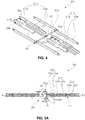
- FIG. 4 is an exploded perspective view schematically illustrating an angle block module according to an exemplary embodiment of the present invention.
- the backcover system 200 is installed at a rear surface of the backcover of the display panel module 110 of FIG. 2 , and the backcover system 200 includes an angle block module 210, a driving system 220, and a flatness controlling unit 300.
- the driving system 220 supplies power to the angle block module 210.
- An angle block module is a mechanical structure attached to the display device and capable of being moved to adjust the curvature of the display device.
- a plurality of block units 211 are arranged in a row in the angle block module 210.
- Each block unit 211 includes an angle block 213 and links 215.
- the links 215 convert rotary motion delivered by the driving system 220 into rectilinear motion.
- a shaft bearing 217 of FIG. 4 is disposed between adjacent block units 211.
- the shaft bearing 217 connects the links 215 of each block unit 211 and also connects the links 215 of adjacent block units 211.
- the shaft bearing 217 raises and lowers edges of the angle blocks 213 contacting each other.
- the driving system 220 includes a motor 221 as a driver generating rotatory power and a gear 223 as a driver component delivering rotary motion of the motor 221 into the links 215.
- the driving system may include other drivers or systems that may generate movement or power such as those using hydraulic, pneumatic, piston, actuator, servos, electromagnetic, and the like.
- the angle block module 210 is disposed at each of both left and right sides with the driving system 220 at the center of a width of the display module 110 of FIG. 2 .
- the plurality of block units 211a and 211b are arranged in a row in the angle block module 210, and each block unit 211a and 211b includes the angle block 213a and 213b and the links 215a and 215b, which are disposed at both sides of the angle block 213a and 213b.
- the first angle block 213a is disposed between the first links 215a.
- the second block unit 211b is disposed next to the first block unit 211a, and in the second block unit 211b, the second angle block 213b is disposed between the couple of second links 215b, which are connected to the first links 215a.
- the shaft bearing 217 is disposed between the first and second block units 211a and 211b, i.e., between the first and second angle blocks 213a and 213b and is perpendicular to a length direction of the first and second links 215a and 215b. Ends of the first and second links 215a and 215b are connected to each other through the shaft bearing 217.
- each of the first links 215a has a first end and a second end
- each of the second links 215b has a third end and a fourth end.
- the bearing holes 219 are formed at the first and second ends of the first links 215a and the third and fourth ends of the second links 215b, respectively.
- the shaft bearing 217 is inserted into the bearing holes 219 at the first ends of the first links 215a and the third ends of the second links 215b corresponding to each other, and the first ends of the first links 215a and the third ends of the second links 215b are connected to each other through the shaft bearing 217.
- each first link 215a has an outer surface on the same plane as an outer surface of a portion of the first link 215a excluding the first and second ends and has a thinner thickness than the portion of the first link 215a.
- the third end of each second link 215b has an inner surface on the same plane as an inner surface of a portion of the second link 215b excluding the third and fourth ends and has a thinner thickness than the portion of the second link 215b.
- the first end of the first link 215a and the third end of the second link 215b, which contact each other, have a structure of engaging each other.
- first end of the first link 215a extends from an outer side of the portion of the first link 215a
- third end of the second link 215b extends from an inner side of the portion of the second link 215b.
- the first end of the first link 215a and the third end of the second link 215b engage each other, and the first and second link 215a and 215b are installed in a line with each other, so that the angle block module 210 may be prevented from increasing in volume.
- each first link 215a has an inner surface on the same plane as an inner surface of the portion of the first link 215a excluding the first and second ends and has a thinner thickness than the portion of the first link 215a.
- the fourth end of each second link 215b has an outer surface on the same plane as an outer surface of the portion of the second link 215b excluding the third and fourth ends and has a thinner thickness than the portion of the second link 215b.
- Each of the first and second angle blocks 213a and 213b has a substantially rectangular shape with two long sides and two short sides.
- the long sides have a length corresponding to the length of the first and second links 215a and 215b.
- the short sides are perpendicular to the long sides and are shorter than the long sides.
- a protrusion 212 is formed at one of the short sides of each angle block 213a and 213b.
- the protrusion 212 is thinner and narrower than each angle block 213a and 213b.
- the protrusion 212 is formed to be inclined toward the backcover of the display panel module 110 of FIG. 2 with a predetermined angle from one end of the protrusion 212 at the first short side to the other end of the protrusion 212.
- first short sides the short sides of the angle blocks 213a and 213b, where the protrusions 212 are formed
- second short sides the short sides of the angle blocks 213a and 213b opposite to the first short sides
- a raised part 214 is formed at the second side of each angle block 213a and 213b.
- the protrusion 212 of the first angle block 213a is put on and is combined with the raised part 214 of the second angle block 213b.
- the raised part 214 has a stepped shape corresponding to the width and thickness of the protrusion 212.
- Raised part sides 214a are formed at both sides of the raised part 214.
- a plurality of holes may be formed in each of the angle blocks 213a and 213b to decrease the weight of the angle block module 210.
- the variable display device 100 of FIG. 2 it is possible to provide the variable display device 100 of FIG. 2 with a lighter weight.
- the shaft bearing 217 between the first and second block units 211a and 211b adjacent to each other connects the first ends of the first links 215a and the third ends of the second links 215b.
- the shaft bearing 217 is disposed over the raised part 214, and more particularly, over the raised part 214 of the second angle block 213b, and both ends of the shaft bearing 217 are inserted into and guided by holes 214b, which are formed at the raised part sides 214a along a length direction of the raised part sides 214a, respectively.
- both ends of the shaft bearing 217 are inserted into the holes 214b formed at the raised part sides 214a and inserted into the bearing holes 219 of the first and second links 215a and 215b, respectively.
- a roller 217a is installed to the shaft bearing 217.
- the shaft bearing 217 guides the protrusion 212 of the first angle block 213a such that the protrusion 212 of the first angle block 213a may be inserted into the raised part 214 of the second angle block 213b adjacent to the protrusion 212 of the first angle block 213a. Additionally, the shaft bearing 217 receives driving power due to the rectilinear motion transferred to the first and second links 215a and 215b and vertically lifts the edges of the first and second angle blocks 213a and 213b which are adjacent to each other and in which the protrusion 212 is inserted into the raised part 214.
- a groove 214c may be further formed in the raised part 214 to guide the roller 217a.
- a stopping part 214d may be formed at an edge of the raised part 214, and the shaft bearing 217 and the roller 217a may be prevented from getting out of the raised part 214.
- the backcover system 200 may have a curved shape or a flat shape overall as the angle block module 210 may be driven such that the edges of the first and second angle blocks 213a and 213b may be raised or lowered with the driving system 220 at the center.
- variable display device 100 of FIG. 2 may be selectively varied and used in the flat mode and the curved mode by the backcover system 200, which is installed at the rear surface of the backcover of the display panel module 110 of FIG. 2 .
- the flatness controlling unit 300 is installed at each angle block module 210, which is disposed at each of both sides of the driving system 220.
- the flatness controlling unit 300 improves the flatness of the variable display device 100 of FIG. 2 when the variable display device 100 of FIG. 2 is driven in the flat mode.
- the flatness controlling unit 300 includes a wire 310.
- the wire 310 is guided by and disposed in a flatness controlling groove 320 shown in FIG. 5F , which is formed at a side or at each of both sides of the angle blocks 213 of the angle block module 210 along a length direction of the angle blocks 213.
- the flatness controlling unit 300 includes a tension adjusting part A, which is composed of a portion of the wire 310 and a spring 330 that is connected to the portion of the wire 310, as illustrated in FIGs. 3 and 5G .
- one end of the spring 330 is connected to a first side of the portion of the wire 310 and the other end of the spring 330 is connected to a second side of the portion of the wire 310.
- a length of the spring 330 is shorter than a length of the portion of the wire 310.
- the wire 310 installed in the angle block module 210 is disposed at each of both sides of the driving system 220 and has a length corresponding to a length of the rear surface of the display panel module 110 of FIG. 2 in a curved mode.
- variable display device 100 of FIG. 2 when it is driven as the flat mode, the flatness of the variable display device 100 of FIG. 2 is further improved by the flatness controlling unit 300.
- variable display device 100 of FIG. 2 a process of changing the variable display device 100 of FIG. 2 from the flat mode to the curved mode using the backcover system 200 will be described in detail with reference to drawings.
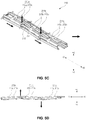
- FIGs. 5A to 5G are views schematically illustrating a process of changing a variable display device according to an exemplary embodiment from a flat mode into a curved mode.
- the angle block module will be mainly described.
- the backcover system 200 is installed at the rear surface of the backcover of the display panel module 110 of FIG. 2 along a width of the backcover.
- the angle block module 210 of the backcover system 200 of FIG. 4 is disposed at each of both sides of the display panel module 110 with the driving system 220 in the center.
- the block units 211a, 211b, and 211c of the angle block module 210 are fixed to the backcover of the display panel module 110 of FIG. 2 .
- the gear 223 rotates clockwise, and the rotatory power of the gear 223 is delivered to the first links 215a of the angle block module 210.
- Guide grooves 223a are formed in the gear 223 and correspond to the rotatory power.
- the first links 215a are connected to the guide grooves 223a.
- the gear 223 rotates, the first links 215a move from first ends of the guide grooves 223a to second ends of the guide grooves 223a, whereby the rotatory power of the gear 223 is delivered to the first links 215a.
- angle block module 210 is installed at each of both sides of the driving system 220, two guide grooves 223a are formed in the gear and face each other, and each of the guide grooves 223a is connected to the first links 215a of the angle block module 210 at both sides of the driving system 220.
- the rotatory power delivered to the first links 215a is changed into rectilinear motion, and as shown in FIG. 5B .
- the first links 215a move away from the driving system 220, i.e., toward +X-axis direction defined in FIGs. 5B-D .
- the force generated by movement of the first links 215a contradicts the stationary force of the first and second angle blocks 213a and 213b fixed to the backcover of the display panel module 110 of FIG. 2 , and the first ends of the first links 215a and the third ends of the second links 215b connected to each other are lifted toward a direction perpendicular to the moving direction of the first links 215a, i.e., toward +Z-axis direction defined in FIGs. 5B-D .
- the shaft bearing 217 which connects the first ends of the first links 215a and the third ends of the second links 215b, is also lifted in the +Z-axis direction.
- the second short side of the second angle block 213b is lifted in the +Z-axis direction, and thus, the first short side of the second angle block 213b is lowered in -Z-axis direction due to counteraction.
- the protrusion 212 is formed to be inclined toward the backcover of the display panel module 110 of FIG. 2 , i.e., in the -Z-axis direction defined in the FIGs. 5B-D , with a predetermined angle from one end of the protrusion 212 at the first short side to the other end of the protrusion 212.
- the protrusion 212 is inserted into the raised part 214, the second short side of the second angle block 213b is pressed by the protrusion 212.
- the first short side of the second angle block 213b is further lowered in the -Z-axis direction.
- the second short side of the third angle block 213c is also moved in the -Z-axis direction.
- the second short side of the third angle block 213c is adjacent to the second angle block 213b and the raised part 214 is formed at the second short side of the third angle block 213c, whereby the protrusion 212 formed at the first short side of the second angle block 213b is inserted into the raised part 214 of the third angle block 213c.
- the first short side of the third angle block 213c is similarly moved in the +Z-axis direction due to counteraction, and thus, the angle blocks 213a, 213b, and 213c are linked and driven together.
- the first and second short sides of the angle blocks 213a, 213b, and 213c are lifted or lowered, and an angle of the display panel module 110 at which the angle blocks 213a, 213b, and 213c are fixed is controlled by a lifted angle or a lowered angle of the angle blocks 213a, 213b, and 213c.
- the angle block module 210 which is installed at the other side of the driving system 220, is also driven as described above.
- the display panel module 110 with the backcover system 200 installed as shown in FIG. 5E , has a curved shape with respect to a normal direction. Accordingly, the curved mode is implemented.
- the angle block module 210 is composed of the block units 211a, 211b, and 211c, which includes angle blocks 213a, 213b, and 213c, respectively.
- each of the block units 211a, 211b, and 211c functions as a joint, and the backcover system 200 of the present invention can have an accurate curvature in the curved mode.
- angle block modules 210 can vary depending on the size of the display panel module and the amount of curvature desired.
- the flatness controlling unit 300 is installed at each angle block module 210 disposed at each of both sides of the driving system 220, and the flatness controlling unit 300 includes the wire 310 having one end connected to the motor 221 of the driving system 220 and the other end connected to the end of the angle block module 210.
- the spring 330 is lengthened due to elasticity, and at the same time, the wire 310 of the flatness controlling unit 300 is pulled and tightened along the rear surface of the display panel module 110 having the curved shape.
- variable display device 100 when the variable display device 100 is implemented in the curved mode, the flatness of a central portion of the curved display panel module 110 may be improved.
- the tension of the wire 310 applied through the flatness controlling unit 300 is smaller than the force applied through the angle block module 210 such that the display panel module 110 is curved.
- the central portion of the variable display device 100 may have improved flatness when it is implemented in the curved mode.
- variable display device 100 When the variable display device 100 is changed from the curved mode into the flat mode, the motor 221 of the driving system 220 is driven counterclockwise.
- the gear 223 rotates counterclockwise, and the first links 215a disposed at the second ends of the guide grooves 223a move to the first ends of the guide grooves 223a, whereby the rotatory power of the gear 223 is delivered to the first links 215a.
- the rotatory power delivered to the first links 215a is changed into the rectilinear motion, and the first links 215a move toward the driving system 220, i.e., toward the -X-axis direction defined in the FIGs. 5B-D .
- the first links 215a move backwards, and the shaft bearing 217 lifted in the +Z-axis direction is lowered. Simultaneously, the protrusion 212 of the first angle block 213a is separated from the raised part 214 of the second angle block 213b adjacent to the first angle block 213a, and the first short side of the first angle block 213a and the second short side of the second angle block 213b are also lowered.
- the second short side of the second angle block 213b is lowered, and thus, the first short side of the second angle block 213b is lifted in the +Z-axis direction due to counteraction.
- angle blocks 213a, 213b, and 213c are linked and driven together, and the angle block module 210 is oriented on a straight line.
- the display panel module 110 is implemented in the flat mode.
- the lengthened spring 330 of the flatness controlling unit 300 is restored to its original condition, and the wire 310 of the flatness controlling unit 300, which was pulled and tightened along the rear surface of the curved display panel module 110, is relieved of tension and sags.
- the sagging only occurs in the tension adjusting part A of FIG. 3 because of the spring 330.
- the wire 310 sags, the wire 310 is prevented from being drawn into the motor 221.
- a length of the wire 310 excluding the portion of the wire 310 connected to the spring 330, and a length of the wire 330 to which the tension is not given and which is not lengthened, correspond to the length of the rear surface of the display panel module 110 in the flat mode.
- the flatness controlling unit 300 applies pulling force from both ends of the display panel module 110 along the length direction to the display panel module 110 implemented in the flat mode. Therefore, the display panel module 110 has improved flatness due to the pulling force from both ends of the length direction when it is implemented in the flat mode.
- variable display device 100 when the variable display device 100 is repeatedly changed between the flat mode and the curved mode, repeated stress is concentrated at the central portion of the variable display device 100 at which the driving system 220 is installed with the angle block module 210 at both sides thereof.
- variable display device 100 with concentrated stress is continuously changed between the flat mode and the curved mode, rigidity of the central portion of the variable display device 100 with concentrated stress is degraded, and there occurs plastic deformation such as bending of the variable display device 100.
- variable display device 100 when the variable display device 100 is changed from the curved mode into the flat mode, the flatness of the central portion of the variable display device 100 is reduced because of the plastic deformation of the central portion of the variable display device 100.
- variable display device 100 includes the backcover system 200 with the flatness controlling unit 300. Since the pulling force from both ends of the length direction of the display panel module 110 is applied to the display panel module 110 by the wire 310 of the flatness controlling unit 300, the flatness can be improved even if the plastic deformation occurs at the central portion of the variable display device 100.
- the wire 310 of the flatness controlling unit 30 may be equipped with a tightening apparatus for adjusting the tension of the wire 310, such as a turnbuckle 340.
- the turnbuckle 340 may include screw rods at both ends of its length direction.
- a male screw of one end may be a right-handed screw
- a male screw of the other end may be a left-handed screw. If a component having a female screw, that is, an adjusting nut rotates, the two male screws approach each other. If the adjusting nut rotates oppositely, the two male screws go far away from each other and adjusting tension in the wire.
- the tension of the wire 310 can be adjusted by the turnbuckle 340.
- variable display device 100 of the present disclosure can be selectively varied and used as the flat mode or the curved mode by the backcover system 200, which is installed at the rear surface of the display panel module 110.
- variable display device of the present disclosure can be implemented in the flat mode such that the variable display device has wide viewing angles and news or advertisements from images displayed by the display panel are provided to many viewers.
- the variable display device of the present disclosure can be implemented in the curved mode such that the viewer is further immersed in watching, watches more realistic images, and feels comfortable.
- variable display device 100 of the present invention can selectively use in the flat mode or the curved mode for the convenience of the user as occasion demands.
- variable display device 100 of the present disclosure when the variable display device 100 of the present disclosure is changed between the flat mode and the curved mode, vibrations and noises hardly occur. Since the backcover system 200 is composed of the driving system 220 and the angle block module 210 and the angle block module 210 is directly installed at the rear surface of the backcover of the display panel module 110, the volume and weight of the backcover system 200 are minimized in the variable display device 100, and the variable display device 100 has a relatively light weight and thin profile.
- the backcover system 200 is installed at both sides of the display panel module 110 along the length direction of the display panel module 110.
- the backcover system 200 may include the flatness controlling unit 300.
- the pulling force from both ends of the length direction of the display panel module 110 is applied to the display panel module 110 by the wire 310 of the flatness controlling unit 300, and thus the flatness can be improved even if the plastic deformation occurs at the central portion of the variable display device 100.
Landscapes
- Engineering & Computer Science (AREA)
- Physics & Mathematics (AREA)
- Theoretical Computer Science (AREA)
- General Physics & Mathematics (AREA)
- Computer Hardware Design (AREA)
- Nonlinear Science (AREA)
- General Engineering & Computer Science (AREA)
- Human Computer Interaction (AREA)
- Optics & Photonics (AREA)
- Crystallography & Structural Chemistry (AREA)
- Chemical & Material Sciences (AREA)
- Mathematical Physics (AREA)
- Multimedia (AREA)
- Signal Processing (AREA)
- Devices For Indicating Variable Information By Combining Individual Elements (AREA)
- Electroluminescent Light Sources (AREA)
Description
- The present disclosure relates to an adjustable or variable display device that is able to be used in a flat mode and a curved mode, and more particularly, to an adjustable or variable display device with improved flatness.
- With rapid development of information technologies, display devices for displaying a large amount of information have been recently developed. More particularly, various flat panel display (FPD) devices have been introduced.
- The flat panel display devices include, for example, liquid crystal display (LCD) devices, plasma display panel (PDP) devices, field emission display (FED) devices, electroluminescence display (ELD) devices, and organic electroluminescent display (OLED) devices. The flat panel display devices generally have a thin profile, light weight, and low power consumption; and have been rapidly replacing cathode ray tubes (CRT).
- Recently, curved display devices have emerged as a new generation display device because the curved display devices enable a user to be further immersed in the content, to watch realistic images, and to feel more comfortable.
- In curved display devices, because a distance from the eyes of the user to a center of the screen is equal to a distance from the eyes of the user to sides of the screen, distortion of an image at the sides of the screen is minimized.
- Meanwhile, variable display devices having the advantages of the flat panel display devices with wide viewing angles and curved display devices with increased immersion and comfort properties have been pursued and researched.
- For the convenience of the user, the variable display devices are implemented in both a flat mode to provide wide viewing area, and in a curved mode to improve immersion while watching.
- Patent document
JP 2006 023676 A display panel 300 forward on a rear face side of thedisplay panel 300. - Patent document
US 2013/083496 A1 discloses a flexible electronic device which may include a flexible display, a flexible housing and one or more flexible internal components configured to allow the flexible electronic device to be deformed. - Patent document
EP2 592 614 A1 discloses a flexible display apparatus including a flexible display panel; a panel deformation member that is disposed on a rear surface of the flexible display panel and deforms the flexible display panel; a panel rotation unit that supports and rotates the flexible display panel; a control unit that controls the panel rotation unit to adjust a position of the flexible display panel and controls the panel deformation member to deform the flexible display panel; and a command input device that is formed separately from the flexible display panel and inputs a rotation position command and a curvature change command for the flexible display panel to the control unit. - Patent document
US 2014/036162 A1 discloses a television receiver including a bendable display, a housing, and a puller. The bendable display includes a front surface at which an image can be viewed and a rear surface opposite the front surface. - Patent document
EP 2 793 210 A1 discloses a display apparatus includes a display module (10), and a varying member (20) for varying a shape of the display module (10). The varying member (20) includes a variable portion (22) including at least one composite material layer made of a composite material. - Patent document
EP 2 765 622 A1 discloses a display apparatus including a display module including a flexible display panel for displaying an image, and a variable member for varying a shape of the flexible display panel. - Accordingly, the present invention is directed to a variable display device that substantially obviates one or more of the problems due to limitations and disadvantages of the related art.
- An advantage of the present invention is to provide a variable display device that is able to be implemented in both a flat mode and a curved mode.
- Another advantage of the present invention is to provide a variable display device that has an accurate curvature when it is implemented in a curved mode, minimizes vibrations and noises when it is changed between the flat mode and the curved mode, and has a relatively light weight and thin profile.
- Another advantage of the present invention is to provide a variable display device that improves flatness when it is implemented in the flat mode.
- To achieve these and other advantages and in accordance with the purpose of embodiments of the invention, as embodied and broadly described, it is provided a variable display device and a method of adjusting a variable display device according to the independent claims. Further embodiments are described in the dependent claims.
- The accompanying drawings, which are included to provide a further understanding of the disclosure and are incorporated in and constitute a part of this specification, illustrate embodiments of the invention and together with the description serve to explain the principles of the invention. In the drawings:
-
FIG. 1A and FIG. 1B are perspective views schematically illustrating a variable display device according to an exemplary embodiment of the present invention; -
FIG. 2 is a perspective view schematically illustrating a rear side of a variable display device according to an exemplary embodiment of the present invention; -
FIG. 3 is a view schematically illustrating a backcover system according to an exemplary embodiment of the present invention; -
FIG. 4 is an exploded perspective view schematically illustrating an angle block module according to an exemplary embodiment of the present invention; and -
FIGs. 5A to 5G are views schematically illustrating a process of changing a variable display device according to an exemplary embodiment of the present invention from a flat mode into a curved mode. - Reference will now be made in detail to embodiments of the present invention, examples of which are illustrated in the accompanying drawings. The same reference numbers may be used throughout the drawings to refer to the same or like parts.
-
FIG. 1A and FIG. 1B are perspective views schematically illustrating a variable display device according to an exemplary embodiment of the present invention, andFIG. 2 is a perspective view schematically illustrating a rear side of a variable display device according to an exemplary embodiment of the present invention. - In
FIGs. 1A and andFIG. 2 , thevariable display device 100 according to the exemplary embodiment of the present invention includes adisplay panel module 110, anexternal case 120, and asupport 130. Thedisplay panel module 110 displays images, and theexternal case 120 accommodates thedisplay panel module 110. Thesupport 130 is connected to a lower part or a rear part of theexternal case 120 for mounting the variable display device, and is rested on a desk, fixed to a surface of a wall, or mounted by any other of many techniques and positioned for viewing. - Here, the
display panel module 110 may include a display panel, which may be one of a liquid crystal display (LCD) device, a plasma display panel (PDP) device, a field emission display (FED) device, an electroluminescence display (ELD) device, and an organic light emitting diode (OLED) device. Beneficially, thedisplay panel module 110 may include an OLED device, which is flexible and displays images without a problem even when it is curved. - Because OLED devices are self-luminescent, the OLED devices do not require a backlight unit and have a thin profile and light weight as compared with LCD devices, which are non-emissive.
- In addition, the OLED devices have better viewing angles and contrast ratio than comparable LCD devices and have lower power consumption. The OLED devices are driven by low voltage of direct current (DC), and have relatively fast response time. Since the OLED devices include solid components, the OLED devices are resistant to outer impacts and are stable under temperatures within a wide range.
- Also, because manufacturing processes of the OLED devices are simpler, manufacturing costs of the OLED device are further reduced as compared with an LCD device.
- Here, the display panel, which is an OLED device, includes a first substrate and a second substrate facing each other. The first and second substrates are spaced apart from and attached to each other by a protection layer having an adhesive property.
- More particularly, although not shown in the figures, a driving thin film transistor is formed in each pixel region on the first substrate, and a first electrode, an organic light-emitting layer, and a second electrode are sequentially formed on the first substrate. The first electrode is formed in each pixel region and connected to the driving thin film transistor. With applied voltage, the organic light-emitting layer emits light. The organic light-emitting layer may be formed in each pixel region. The second electrode may be formed all over the first substrate and covers the organic light-emitting layer.
- The organic light-emitting layer may emit red, green, or blue light and may be generally formed by patterning an organic material emitting red, green, or blue light in each pixel region. Thus, red, green, and blue pixel regions are sequentially arranged.
- The first and second electrodes and the organic light-emitting layer constitute a light-emitting diode. Here, the
display panel module 110 may include the first electrode as an anode and the second electrode as a cathode. - The display panel is modularized with a backcover and may include a protective cover window to form the
display panel module 110. The backcover covers a rear surface and part of side surfaces of the display panel, and the front side of the backcover is opened such that an image displayed by the display panel is shown to the outside. - The cover window may be assembled at the front side of the backcover to protect the display panel.
- As illustrated in
FIG. 1A , when thedisplay panel module 110 displaying images is driven in a flat mode, thevariable display device 100 including thedisplay panel module 110 has relatively wide viewing area and provides many viewers with the images displayed by thedisplay panel module 110. - On the other hand, as illustrated in
FIG. 1B , when thedisplay panel module 110 is driven in a curved mode, thevariable display device 100 enables a viewer to be further immersed in watching, to watch realistic images and to feel more comfortable. - Namely, because the
variable display device 100 is variably driven in the flat mode and the curved mode, a user can selectively use thevariable display device 100 in the flat mode or curved mode as occasion demands. - The
variable display device 100 is variably oriented in the flat mode or the curved mode by abackcover system 200, which is installed at a rear surface of thedisplay panel module 110, as illustrated inFIG. 2 . This will be described in more detail with reference to accompanying drawings. -
FIG. 3 is a view schematically illustrating a backcover system according to an exemplary embodiment of the present invention.FIG. 4 is an exploded perspective view schematically illustrating an angle block module according to an exemplary embodiment of the present invention. - In
FIG. 3 andFIG. 4 , thebackcover system 200 is installed at a rear surface of the backcover of thedisplay panel module 110 ofFIG. 2 , and thebackcover system 200 includes anangle block module 210, adriving system 220, and aflatness controlling unit 300. Thedriving system 220 supplies power to theangle block module 210. An angle block module is a mechanical structure attached to the display device and capable of being moved to adjust the curvature of the display device. - Here, a plurality of
block units 211 are arranged in a row in theangle block module 210. Eachblock unit 211 includes anangle block 213 and links 215. Thelinks 215 convert rotary motion delivered by thedriving system 220 into rectilinear motion. A shaft bearing 217 ofFIG. 4 is disposed betweenadjacent block units 211. Theshaft bearing 217 connects thelinks 215 of eachblock unit 211 and also connects thelinks 215 ofadjacent block units 211. Theshaft bearing 217 raises and lowers edges of the angle blocks 213 contacting each other. - For example, the
driving system 220 includes amotor 221 as a driver generating rotatory power and agear 223 as a driver component delivering rotary motion of themotor 221 into thelinks 215. However, the driving system may include other drivers or systems that may generate movement or power such as those using hydraulic, pneumatic, piston, actuator, servos, electromagnetic, and the like. - The
angle block module 210 is disposed at each of both left and right sides with thedriving system 220 at the center of a width of thedisplay module 110 ofFIG. 2 . Here, viewing theangle block module 210 in detail with reference toFIG. 4 , the plurality ofblock units angle block module 210, and eachblock unit angle block links angle block - That is, in the
first block unit 211a, thefirst angle block 213a is disposed between thefirst links 215a. Thesecond block unit 211b is disposed next to thefirst block unit 211a, and in thesecond block unit 211b, thesecond angle block 213b is disposed between the couple ofsecond links 215b, which are connected to thefirst links 215a. - In addition, the shaft bearing 217 is disposed between the first and
second block units second links second links shaft bearing 217. - More particularly, each of the
first links 215a has a first end and a second end, and each of thesecond links 215b has a third end and a fourth end. The bearing holes 219 are formed at the first and second ends of thefirst links 215a and the third and fourth ends of thesecond links 215b, respectively. Theshaft bearing 217 is inserted into the bearing holes 219 at the first ends of thefirst links 215a and the third ends of thesecond links 215b corresponding to each other, and the first ends of thefirst links 215a and the third ends of thesecond links 215b are connected to each other through theshaft bearing 217. - Here, the first end of each
first link 215a has an outer surface on the same plane as an outer surface of a portion of thefirst link 215a excluding the first and second ends and has a thinner thickness than the portion of thefirst link 215a. The third end of eachsecond link 215b has an inner surface on the same plane as an inner surface of a portion of thesecond link 215b excluding the third and fourth ends and has a thinner thickness than the portion of thesecond link 215b. The first end of thefirst link 215a and the third end of thesecond link 215b, which contact each other, have a structure of engaging each other. - That is, the first end of the
first link 215a extends from an outer side of the portion of thefirst link 215a, and the third end of thesecond link 215b extends from an inner side of the portion of thesecond link 215b. - Accordingly, the first end of the
first link 215a and the third end of thesecond link 215b engage each other, and the first andsecond link angle block module 210 may be prevented from increasing in volume. - Meanwhile, the second end of each
first link 215a has an inner surface on the same plane as an inner surface of the portion of thefirst link 215a excluding the first and second ends and has a thinner thickness than the portion of thefirst link 215a. The fourth end of eachsecond link 215b has an outer surface on the same plane as an outer surface of the portion of thesecond link 215b excluding the third and fourth ends and has a thinner thickness than the portion of thesecond link 215b. - Each of the first and second angle blocks 213a and 213b has a substantially rectangular shape with two long sides and two short sides. The long sides have a length corresponding to the length of the first and
second links protrusion 212 is formed at one of the short sides of eachangle block - The
protrusion 212 is thinner and narrower than eachangle block protrusion 212 is formed to be inclined toward the backcover of thedisplay panel module 110 ofFIG. 2 with a predetermined angle from one end of theprotrusion 212 at the first short side to the other end of theprotrusion 212. - Here, the short sides of the angle blocks 213a and 213b, where the
protrusions 212 are formed, may be referred to as first short sides, and the short sides of the angle blocks 213a and 213b opposite to the first short sides may be referred to as second short sides. A raisedpart 214 is formed at the second side of eachangle block protrusion 212 of thefirst angle block 213a is put on and is combined with the raisedpart 214 of thesecond angle block 213b. - The raised
part 214 has a stepped shape corresponding to the width and thickness of theprotrusion 212. Raisedpart sides 214a are formed at both sides of the raisedpart 214. - A plurality of holes may be formed in each of the angle blocks 213a and 213b to decrease the weight of the
angle block module 210. Thus, it is possible to provide thevariable display device 100 ofFIG. 2 with a lighter weight. - As stated above, the shaft bearing 217 between the first and
second block units first links 215a and the third ends of thesecond links 215b. - Here, the shaft bearing 217 is disposed over the raised
part 214, and more particularly, over the raisedpart 214 of thesecond angle block 213b, and both ends of the shaft bearing 217 are inserted into and guided byholes 214b, which are formed at the raisedpart sides 214a along a length direction of the raisedpart sides 214a, respectively. - Namely, the both ends of the shaft bearing 217 are inserted into the
holes 214b formed at the raisedpart sides 214a and inserted into the bearing holes 219 of the first andsecond links - A
roller 217a is installed to theshaft bearing 217. Theshaft bearing 217 guides theprotrusion 212 of thefirst angle block 213a such that theprotrusion 212 of thefirst angle block 213a may be inserted into the raisedpart 214 of thesecond angle block 213b adjacent to theprotrusion 212 of thefirst angle block 213a. Additionally, the shaft bearing 217 receives driving power due to the rectilinear motion transferred to the first andsecond links protrusion 212 is inserted into the raisedpart 214. - Also, a
groove 214c may be further formed in the raisedpart 214 to guide theroller 217a. A stoppingpart 214d may be formed at an edge of the raisedpart 214, and theshaft bearing 217 and theroller 217a may be prevented from getting out of the raisedpart 214. - The
backcover system 200 may have a curved shape or a flat shape overall as theangle block module 210 may be driven such that the edges of the first and second angle blocks 213a and 213b may be raised or lowered with thedriving system 220 at the center. - Accordingly, the
variable display device 100 ofFIG. 2 according to the exemplary embodiment may be selectively varied and used in the flat mode and the curved mode by thebackcover system 200, which is installed at the rear surface of the backcover of thedisplay panel module 110 ofFIG. 2 . - Here, the
flatness controlling unit 300 is installed at eachangle block module 210, which is disposed at each of both sides of thedriving system 220. Theflatness controlling unit 300 improves the flatness of thevariable display device 100 ofFIG. 2 when thevariable display device 100 ofFIG. 2 is driven in the flat mode. - The
flatness controlling unit 300 includes awire 310. Thewire 310 is guided by and disposed in aflatness controlling groove 320 shown inFIG. 5F , which is formed at a side or at each of both sides of the angle blocks 213 of theangle block module 210 along a length direction of the angle blocks 213. - One end of the
wire 310 is connected to themotor 221 and the other end of thewire 310 is connected to an end of theangle block module 210 disposed at each of both sides of thedriving system 220. Theflatness controlling unit 300 includes a tension adjusting part A, which is composed of a portion of thewire 310 and aspring 330 that is connected to the portion of thewire 310, as illustrated inFIGs. 3 and5G . - That is, in the
flatness controlling unit 300 guided by theflatness controlling groove 320 ofFIG. 5F , which is formed along the length direction of theangle block module 210, one end of thespring 330 is connected to a first side of the portion of thewire 310 and the other end of thespring 330 is connected to a second side of the portion of thewire 310. A length of thespring 330 is shorter than a length of the portion of thewire 310. - The
wire 310 installed in theangle block module 210 is disposed at each of both sides of thedriving system 220 and has a length corresponding to a length of the rear surface of thedisplay panel module 110 ofFIG. 2 in a curved mode. - In the
variable display device 100 ofFIG. 2 according to the exemplary embodiment, when it is driven as the flat mode, the flatness of thevariable display device 100 ofFIG. 2 is further improved by theflatness controlling unit 300. - Here, a process of changing the
variable display device 100 ofFIG. 2 from the flat mode to the curved mode using thebackcover system 200 will be described in detail with reference to drawings. -
FIGs. 5A to 5G are views schematically illustrating a process of changing a variable display device according to an exemplary embodiment from a flat mode into a curved mode. For convenience of explanation, the angle block module will be mainly described. - In
FIG. 5A , thebackcover system 200 is installed at the rear surface of the backcover of thedisplay panel module 110 ofFIG. 2 along a width of the backcover. Theangle block module 210 of thebackcover system 200 ofFIG. 4 is disposed at each of both sides of thedisplay panel module 110 with thedriving system 220 in the center. - The
block units angle block module 210 are fixed to the backcover of thedisplay panel module 110 ofFIG. 2 . - Here, if the
motor 221 is driven clockwise, thegear 223 rotates clockwise, and the rotatory power of thegear 223 is delivered to thefirst links 215a of theangle block module 210. -
Guide grooves 223a are formed in thegear 223 and correspond to the rotatory power. Thefirst links 215a are connected to theguide grooves 223a. Thus, when thegear 223 rotates, thefirst links 215a move from first ends of theguide grooves 223a to second ends of theguide grooves 223a, whereby the rotatory power of thegear 223 is delivered to thefirst links 215a. - Because the
angle block module 210 is installed at each of both sides of thedriving system 220, twoguide grooves 223a are formed in the gear and face each other, and each of theguide grooves 223a is connected to thefirst links 215a of theangle block module 210 at both sides of thedriving system 220. - The rotatory power delivered to the
first links 215a is changed into rectilinear motion, and as shown inFIG. 5B . Thefirst links 215a move away from thedriving system 220, i.e., toward +X-axis direction defined inFIGs. 5B-D . The force generated by movement of thefirst links 215a contradicts the stationary force of the first and second angle blocks 213a and 213b fixed to the backcover of thedisplay panel module 110 ofFIG. 2 , and the first ends of thefirst links 215a and the third ends of thesecond links 215b connected to each other are lifted toward a direction perpendicular to the moving direction of thefirst links 215a, i.e., toward +Z-axis direction defined inFIGs. 5B-D . - Because the first ends of the
first links 215a and the third ends of thesecond links 215b are lifted toward the direction perpendicular to the moving direction of thefirst links 215a, theshaft bearing 217, which connects the first ends of thefirst links 215a and the third ends of thesecond links 215b, is also lifted in the +Z-axis direction. - In this action, the shaft bearing 217 is lifted, and thus, the
protrusion 212 of thefirst angle block 213a is inserted into the raisedpart 214 of thesecond angle block 213b adjacent to thefirst angle block 213a by theshaft bearing 217. - In addition, when the
protrusion 212 of thefirst angle block 213a is inserted into the raisedpart 214 of thesecond angle block 213b adjacent to thefirst angle block 213a, the shaft bearing 217 is lifted in succession toward the +Z-axis direction. Therefore, as shown inFIGs. 5C and 5D , the first short side of thefirst angle block 213a where theprotrusion 212 is formed and the second short side of thesecond angle block 213b where the raisedpart 214 is formed are lifted together in the +Z-axis direction. - The second short side of the
second angle block 213b is lifted in the +Z-axis direction, and thus, the first short side of thesecond angle block 213b is lowered in -Z-axis direction due to counteraction. - The
protrusion 212 is formed to be inclined toward the backcover of thedisplay panel module 110 ofFIG. 2 , i.e., in the -Z-axis direction defined in theFIGs. 5B-D , with a predetermined angle from one end of theprotrusion 212 at the first short side to the other end of theprotrusion 212. When theprotrusion 212 is inserted into the raisedpart 214, the second short side of thesecond angle block 213b is pressed by theprotrusion 212. - Accordingly, the first short side of the
second angle block 213b is further lowered in the -Z-axis direction. - While the first short side of the
second angle block 213b is moved in the -Z-axis direction, the second short side of thethird angle block 213c is also moved in the -Z-axis direction. Here, the second short side of thethird angle block 213c is adjacent to thesecond angle block 213b and the raisedpart 214 is formed at the second short side of thethird angle block 213c, whereby theprotrusion 212 formed at the first short side of thesecond angle block 213b is inserted into the raisedpart 214 of thethird angle block 213c. - Moreover, although not shown in the figures, the first short side of the
third angle block 213c is similarly moved in the +Z-axis direction due to counteraction, and thus, the angle blocks 213a, 213b, and 213c are linked and driven together. - The first and second short sides of the angle blocks 213a, 213b, and 213c are lifted or lowered, and an angle of the
display panel module 110 at which the angle blocks 213a, 213b, and 213c are fixed is controlled by a lifted angle or a lowered angle of the angle blocks 213a, 213b, and 213c. - In addition, the
angle block module 210, which is installed at the other side of thedriving system 220, is also driven as described above. As a result of these movements, thedisplay panel module 110 with thebackcover system 200 installed, as shown inFIG. 5E , has a curved shape with respect to a normal direction.
Accordingly, the curved mode is implemented. - Here, the
angle block module 210 is composed of theblock units angle blocks block units backcover system 200 of the present invention can have an accurate curvature in the curved mode. - Namely, since the lifted angle or the lowered angle of each of the angle blocks 213a, 213b, and 213c can be controlled, an expected curvature can be obtained. The number and size of the
angle block modules 210 used can vary depending on the size of the display panel module and the amount of curvature desired. - As illustrated in
FIGs. 5F-G , theflatness controlling unit 300 is installed at eachangle block module 210 disposed at each of both sides of thedriving system 220, and theflatness controlling unit 300 includes thewire 310 having one end connected to themotor 221 of thedriving system 220 and the other end connected to the end of theangle block module 210. When thedisplay panel module 110 has a curved shape in the curved mode, as shown inFIG. 5F , thespring 330 is lengthened due to elasticity, and at the same time, thewire 310 of theflatness controlling unit 300 is pulled and tightened along the rear surface of thedisplay panel module 110 having the curved shape. - Therefore, tension is given to the
wire 310 of theflatness controlling unit 300, and theflatness controlling unit 300 applies pulling force from both ends of thedisplay panel module 110 along the length direction to thedisplay panel module 110 implemented in the curved mode. - From this, when the
variable display device 100 is implemented in the curved mode, the flatness of a central portion of the curveddisplay panel module 110 may be improved. - Here, the tension of the
wire 310 applied through theflatness controlling unit 300 is smaller than the force applied through theangle block module 210 such that thedisplay panel module 110 is curved. Thus, only the central portion of thevariable display device 100 may have improved flatness when it is implemented in the curved mode. - When the
variable display device 100 is changed from the curved mode into the flat mode, themotor 221 of thedriving system 220 is driven counterclockwise. Thegear 223 rotates counterclockwise, and thefirst links 215a disposed at the second ends of theguide grooves 223a move to the first ends of theguide grooves 223a, whereby the rotatory power of thegear 223 is delivered to thefirst links 215a. - The rotatory power delivered to the
first links 215a is changed into the rectilinear motion, and thefirst links 215a move toward thedriving system 220, i.e., toward the -X-axis direction defined in theFIGs. 5B-D . - The
first links 215a move backwards, and the shaft bearing 217 lifted in the +Z-axis direction is lowered. Simultaneously, theprotrusion 212 of thefirst angle block 213a is separated from the raisedpart 214 of thesecond angle block 213b adjacent to thefirst angle block 213a, and the first short side of thefirst angle block 213a and the second short side of thesecond angle block 213b are also lowered. - The second short side of the
second angle block 213b is lowered, and thus, the first short side of thesecond angle block 213b is lifted in the +Z-axis direction due to counteraction. - From this, the angle blocks 213a, 213b, and 213c are linked and driven together, and the
angle block module 210 is oriented on a straight line. - Accordingly, the
display panel module 110 is implemented in the flat mode. - Also, when the
display panel module 110 is flat in the flat mode, as shown inFIG. 5G , the lengthenedspring 330 of theflatness controlling unit 300 is restored to its original condition, and thewire 310 of theflatness controlling unit 300, which was pulled and tightened along the rear surface of the curveddisplay panel module 110, is relieved of tension and sags. - The sagging only occurs in the tension adjusting part A of
FIG. 3 because of thespring 330. When thewire 310 sags, thewire 310 is prevented from being drawn into themotor 221. - Here, a length of the
wire 310, excluding the portion of thewire 310 connected to thespring 330, and a length of thewire 330 to which the tension is not given and which is not lengthened, correspond to the length of the rear surface of thedisplay panel module 110 in the flat mode. - If the
motor 221 is further driven counterclockwise, the tension is applied to thespring 330, which is not lengthened, and thewire 310 of theflatness controlling unit 300. - From this, the
flatness controlling unit 300 applies pulling force from both ends of thedisplay panel module 110 along the length direction to thedisplay panel module 110 implemented in the flat mode. Therefore, thedisplay panel module 110 has improved flatness due to the pulling force from both ends of the length direction when it is implemented in the flat mode. - More particularly, in general, when the
variable display device 100 is repeatedly changed between the flat mode and the curved mode, repeated stress is concentrated at the central portion of thevariable display device 100 at which thedriving system 220 is installed with theangle block module 210 at both sides thereof. - Accordingly, if the
variable display device 100 with concentrated stress is continuously changed between the flat mode and the curved mode, rigidity of the central portion of thevariable display device 100 with concentrated stress is degraded, and there occurs plastic deformation such as bending of thevariable display device 100. - Then, when the
variable display device 100 is changed from the curved mode into the flat mode, the flatness of the central portion of thevariable display device 100 is reduced because of the plastic deformation of the central portion of thevariable display device 100. - Therefore, the
variable display device 100 according to the exemplary embodiment of the present invention includes thebackcover system 200 with theflatness controlling unit 300. Since the pulling force from both ends of the length direction of thedisplay panel module 110 is applied to thedisplay panel module 110 by thewire 310 of theflatness controlling unit 300, the flatness can be improved even if the plastic deformation occurs at the central portion of thevariable display device 100. - In the meantime, the
wire 310 of the flatness controlling unit 30 may be equipped with a tightening apparatus for adjusting the tension of thewire 310, such as aturnbuckle 340. The turnbuckle 340 may include screw rods at both ends of its length direction. For example, a male screw of one end may be a right-handed screw, and a male screw of the other end may be a left-handed screw. If a component having a female screw, that is, an adjusting nut rotates, the two male screws approach each other. If the adjusting nut rotates oppositely, the two male screws go far away from each other and adjusting tension in the wire. - When the tension is weakened by long-term use of the
wire 310 of theflatness controlling unit 300, or other adjustment is needed, the tension of thewire 310 can be adjusted by theturnbuckle 340. - As mentioned above, the
variable display device 100 of the present disclosure can be selectively varied and used as the flat mode or the curved mode by thebackcover system 200, which is installed at the rear surface of thedisplay panel module 110. - Namely, in an open space such as an outdoor square or in an indoor square such as airports or terminals, for example, the variable display device of the present disclosure can be implemented in the flat mode such that the variable display device has wide viewing angles and news or advertisements from images displayed by the display panel are provided to many viewers. Alternatively, the variable display device of the present disclosure can be implemented in the curved mode such that the viewer is further immersed in watching, watches more realistic images, and feels comfortable.
- Accordingly, the user or provider can selectively use the
variable display device 100 of the present invention in the flat mode or the curved mode for the convenience of the user as occasion demands. - Here, when the
variable display device 100 of the present disclosure is changed between the flat mode and the curved mode, vibrations and noises hardly occur. Since thebackcover system 200 is composed of thedriving system 220 and theangle block module 210 and theangle block module 210 is directly installed at the rear surface of the backcover of thedisplay panel module 110, the volume and weight of thebackcover system 200 are minimized in thevariable display device 100, and thevariable display device 100 has a relatively light weight and thin profile. - It is desirable that the
backcover system 200 is installed at both sides of thedisplay panel module 110 along the length direction of thedisplay panel module 110. - Specially, in the
variable display device 100 according to the exemplary embodiment of the present disclosure, thebackcover system 200 may include theflatness controlling unit 300. The pulling force from both ends of the length direction of thedisplay panel module 110 is applied to thedisplay panel module 110 by thewire 310 of theflatness controlling unit 300, and thus the flatness can be improved even if the plastic deformation occurs at the central portion of thevariable display device 100. - It will be apparent to those skilled in the art that various modifications and variation can be made in the present invention without departing from the scope of the invention. Thus, it is intended that the present disclosure cover the modifications and variations of this disclosure provided they come within the scope of the appended claims and their equivalents.
Claims (11)
- A display device (100) capable of being adjusted between flat and curved comprising:a display panel module (110) which is flexible; anda backcover system (200) comprising at least one angle block module (210); anda driving system (220);wherein the angle block module (210) comprises a plurality of links (215) including first links (215a) connected to the driving system (220),wherein the display device (100) is configured such that moving the first links (215a) away from the driving system (220) increases the curvature of the display device (100) and moving the first links (215a) closer to the driving system (220) decreases the curvature of the display device (100),whereinthe driving system (220) comprises a gear (223) as a driver component delivering rotary motion into the links (215), wherein the gear (223) comprises guide grooves (223a) which are connected to the first links (215a),the angle block module (210) further comprises:multiple block units (211) arranged in a row, each block unit (211) having an angle block (213);a link (215) of the plurality of links (215) at both long sides of the angle block (213); anda shaft bearing (217) connecting the links (215) of each block unit (211) to links (215) of an adjacent block unit (211),wherein the angle block module (210) is disposed at each of both left and right sides with the driving system (220) at the centre of a width of a display panel module (110), andwherein the block units (211a, 211b, and 211c) of the angle block module (210)
are fixed to a backcover of the display panel module (110). - The display device (100) of claim 1, wherein the angle blocks (213) of the multiple block units (211) have a rectangular shape with two long sides and two short sides, the long sides have a length corresponding to the length of the links (215), the short sides are perpendicular to the long sides and are shorter than the long sides,wherein the angle blocks (213) have a protrusion (212) at one of the short sides, and a raised part (214) at the other short side of, andwherein a protrusion (212) of one angle block (213) is oriented in a raised part (214) of an adjacent angle block(213).
- The display device (100) of claim 1, wherein the driving system (220) further includes a motor (221).
- The display device (100) of claim 1, wherein the backcover system (200) includes first and second angle block modules (210), one in each half of the rear of the display device (100), and wherein the first and the second angle block modules (210) each comprise the plurality of links (215) including the first links (215a) connected to the driving system (220).
- The display device (100) of claim 4, wherein the display panel module (110) comprises a display panel, wherein changing the curvature of the display device (100) changes a curvature of the display panel.
- The display device (100) of claim 5, wherein the display panel includes an organic light emitting diode (OLED) device.
- The display device (100) of claim 1, further comprising a shaft bearing (217) connecting links (215) of the plurality of links (215) of adjacent angle blocks (213).
- The display device (100) of claim 4, further comprising a flatness controlling unit (300) connected to the first and the second sections of the angle block modules (210) to flatten the display device (100).
- The display device (100) of claim 4, wherein each half of the rear of the display device (100) is a top portion or a bottom portion.
- A method of adjusting a display device (100) according to claim 1 between flat and curved, the method comprising the steps of:activating the driving system (220) and adjusting a curvature of the display device (100),wherein the angle block module (210) includes first links (215a) connected to the driving system (220),wherein moving the first links (215a) away from the driving system (220) increases the curvature of the display device (100) and moving the first links (215a) closer to the driving system (220) decreases the curvature of the display device (100),whereinadjusting the curvature of the display device (100) comprises:driving a driver in the driving system (220) to create motion, the motion moving the first links (215a) relative to the driver;by movement of the first links (215a), contradicting a stationary force of angle blocks (213) that are fixed to the rear of the display device (100) and connected to the first links (215a); andmoving a shaft bearing (217) connecting the first links (215a) to second links (215b) in a direction normal to the rear of the display device (100) to move short sides of the angle blocks (213) at an angle relative to the rear of the display device (100) to move the display device (100) with respect to the normal direction.
- The method of claim 10, wherein a portion of the display device (100) is configured to move in a direction normal to a center of the display device (100).
Applications Claiming Priority (2)
| Application Number | Priority Date | Filing Date | Title |
|---|---|---|---|
| KR1020140051848A KR102209411B1 (en) | 2014-04-29 | 2014-04-29 | Variable display device and method for driving a flat mode and curved mode the same |
| KR1020140089831A KR102246666B1 (en) | 2014-07-16 | 2014-07-16 | Variable display device |
Publications (2)
| Publication Number | Publication Date |
|---|---|
| EP2940552A1 EP2940552A1 (en) | 2015-11-04 |
| EP2940552B1 true EP2940552B1 (en) | 2020-04-22 |
Family
ID=52102516
Family Applications (1)
| Application Number | Title | Priority Date | Filing Date |
|---|---|---|---|
| EP14197145.7A Active EP2940552B1 (en) | 2014-04-29 | 2014-12-10 | Adjustable display device |
Country Status (5)
| Country | Link |
|---|---|
| US (1) | US9123290B1 (en) |
| EP (1) | EP2940552B1 (en) |
| JP (1) | JP5947366B2 (en) |
| CN (1) | CN105047090B (en) |
| TW (1) | TWI555943B (en) |
Families Citing this family (56)
| Publication number | Priority date | Publication date | Assignee | Title |
|---|---|---|---|---|
| USD778249S1 (en) * | 2013-04-08 | 2017-02-07 | Lg Electronics Inc. | Television receiver |
| USD778248S1 (en) * | 2013-04-08 | 2017-02-07 | Lg Electronics Inc. | Television receiver |
| KR102023015B1 (en) * | 2013-06-04 | 2019-09-19 | 엘지전자 주식회사 | Wall mounting type flexible display |
| KR20150012982A (en) * | 2013-07-25 | 2015-02-04 | 삼성전자주식회사 | Display apparatus and control method for the same |
| CN104050882B (en) * | 2014-05-30 | 2016-07-20 | 京东方科技集团股份有限公司 | A kind of display device |
| KR20160016333A (en) * | 2014-08-05 | 2016-02-15 | 삼성전자주식회사 | Display apparatus |
| CN104217650B (en) * | 2014-09-18 | 2019-09-27 | 青岛海信电器股份有限公司 | TV set with adjustable rear shell and curvature |
| CN104318869B (en) * | 2014-10-31 | 2017-01-18 | 京东方科技集团股份有限公司 | Flexible display device |
| KR102224632B1 (en) * | 2014-11-07 | 2021-03-08 | 엘지전자 주식회사 | Display apparatus |
| CN104464530B (en) * | 2014-11-18 | 2017-08-25 | 深圳市华星光电技术有限公司 | Curved face type display device |
| CN104537950B (en) * | 2014-11-28 | 2017-01-18 | 深圳市华星光电技术有限公司 | Display device with adjustable curvature |
| JP6467599B2 (en) * | 2015-08-31 | 2019-02-13 | 株式会社Nsc | Display device |
| CN105044957B (en) * | 2015-09-10 | 2018-11-23 | 京东方科技集团股份有限公司 | A kind of display device |
| CN105206181B (en) * | 2015-10-09 | 2018-02-16 | 武汉华星光电技术有限公司 | The long-range adjustable curved-surface display device of curvature |
| CN105160999B (en) * | 2015-10-12 | 2016-08-31 | 京东方科技集团股份有限公司 | The bogey of flexible display panels and display device |
| CN106775513A (en) * | 2015-11-20 | 2017-05-31 | 宏碁股份有限公司 | Display device and display method |
| USD825490S1 (en) * | 2015-12-16 | 2018-08-14 | Shenzhen Royole Technologies Co., Ltd. | Switch |
| KR102483559B1 (en) * | 2015-12-28 | 2023-01-02 | 엘지디스플레이 주식회사 | Display device |
| KR102429119B1 (en) * | 2015-12-30 | 2022-08-05 | 엘지디스플레이 주식회사 | Display device |
| US10488886B2 (en) * | 2016-01-11 | 2019-11-26 | Lenovo Enterprise Solutions (Singapore) Pte. Ltd. | Flexible display systems and methods for controlling and operating the same |
| KR102511590B1 (en) * | 2016-05-02 | 2023-03-20 | 삼성디스플레이 주식회사 | Display device |
| CN106061154B (en) * | 2016-05-27 | 2019-01-29 | 京东方科技集团股份有限公司 | Display device casing and display device |
| CN108885846B (en) * | 2016-06-01 | 2022-04-19 | 惠普发展公司,有限责任合伙企业 | Electronic device with flexible display |
| CN107424512A (en) * | 2017-04-13 | 2017-12-01 | 深圳市华星光电技术有限公司 | Curved surface back board module and flexible displays |
| TW201918817A (en) * | 2017-11-02 | 2019-05-16 | 宏碁股份有限公司 | Electronic device |
| KR102490314B1 (en) * | 2017-11-13 | 2023-01-20 | 엘지전자 주식회사 | Display device |
| US11547002B2 (en) | 2017-11-13 | 2023-01-03 | Lg Electronics Inc. | Display device |
| CN108302290B (en) * | 2018-01-12 | 2019-07-26 | 惠州市华星光电技术有限公司 | Variable curve supporting structure |
| TWI721369B (en) * | 2018-01-30 | 2021-03-11 | 仁寶電腦工業股份有限公司 | Electronic device |
| KR102476295B1 (en) * | 2018-01-31 | 2022-12-09 | 엘지전자 주식회사 | Display device |
| US10607438B2 (en) * | 2018-07-26 | 2020-03-31 | Igt | Electronic gaming machine with movable display device |
| KR102593717B1 (en) * | 2018-08-31 | 2023-10-24 | 엘지디스플레이 주식회사 | Display device |
| CN208967363U (en) * | 2018-09-19 | 2019-06-11 | 云谷(固安)科技有限公司 | A kind of device of auto-folder flexible display screen |
| CN114898685A (en) * | 2018-12-31 | 2022-08-12 | 乐金显示有限公司 | Display device |
| JP7243565B2 (en) * | 2019-10-17 | 2023-03-22 | 株式会社デンソー | Flexible display device |
| KR102937612B1 (en) * | 2019-11-08 | 2026-03-10 | 엘지디스플레이 주식회사 | Display apparatus |
| KR20220090974A (en) * | 2020-12-23 | 2022-06-30 | 엘지디스플레이 주식회사 | Variable curvature display device |
| CN114694492B (en) * | 2020-12-31 | 2024-11-15 | 美的集团(上海)有限公司 | Hinge structure and bracket mechanism |
| KR102970422B1 (en) * | 2021-03-24 | 2026-05-28 | 삼성디스플레이 주식회사 | Display device and method for controlling the display device |
| KR20220148997A (en) * | 2021-04-29 | 2022-11-08 | 삼성디스플레이 주식회사 | Display device |
| KR20230018178A (en) * | 2021-07-29 | 2023-02-07 | 엘지전자 주식회사 | Display device |
| US11994913B2 (en) * | 2021-08-03 | 2024-05-28 | Samsung Display Co., Ltd. | Display device |
| KR102809094B1 (en) * | 2021-08-09 | 2025-05-20 | 삼성디스플레이 주식회사 | Panel flattening assembly and display module including the same |
| CN113823189A (en) * | 2021-09-16 | 2021-12-21 | 惠州视维新技术有限公司 | Display device and control method |
| KR102531119B1 (en) * | 2021-12-23 | 2023-05-10 | 엘지디스플레이 주식회사 | Flexible display device |
| KR102909822B1 (en) * | 2021-12-24 | 2026-01-07 | 엘지디스플레이 주식회사 | Curved display apparatus |
| KR20230098967A (en) * | 2021-12-27 | 2023-07-04 | 엘지디스플레이 주식회사 | Display device |
| WO2023136370A1 (en) * | 2022-01-12 | 2023-07-20 | 엘지전자 주식회사 | Display device |
| KR102736745B1 (en) * | 2022-05-18 | 2024-11-29 | 엘지디스플레이 주식회사 | Display apparatus |
| US12676532B2 (en) | 2022-05-27 | 2026-07-07 | Lg Electronics Inc. | Display device |
| KR102754594B1 (en) | 2022-06-03 | 2025-01-21 | 엘지전자 주식회사 | Display device |
| KR20240008556A (en) * | 2022-07-12 | 2024-01-19 | 엘지디스플레이 주식회사 | Bendable Display Device |
| CN115899485B (en) * | 2022-12-22 | 2024-11-15 | 京东方科技集团股份有限公司 | Display device |
| KR20240104909A (en) * | 2022-12-28 | 2024-07-05 | 엘지디스플레이 주식회사 | Display device |
| KR102900543B1 (en) * | 2023-02-20 | 2025-12-15 | 엘지전자 주식회사 | Display device |
| KR20250102762A (en) * | 2023-12-28 | 2025-07-07 | 엘지디스플레이 주식회사 | Flexible display device |
Family Cites Families (19)
| Publication number | Priority date | Publication date | Assignee | Title |
|---|---|---|---|---|
| JP2002006797A (en) * | 2000-06-26 | 2002-01-11 | Minolta Co Ltd | Display method, display device, and display system |
| US7050835B2 (en) * | 2001-12-12 | 2006-05-23 | Universal Display Corporation | Intelligent multi-media display communication system |
| GB2420905B (en) * | 2003-06-23 | 2006-12-27 | Simon Richard Daniel | Display device having an extendible screen |
| JP2005024879A (en) * | 2003-07-02 | 2005-01-27 | Fuji Xerox Co Ltd | Image display device and manufacturing method thereof |
| JP4885430B2 (en) * | 2004-05-21 | 2012-02-29 | 株式会社Nsc | Display device |
| JP2006023676A (en) * | 2004-07-09 | 2006-01-26 | Pioneer Electronic Corp | Display-adjusting device and display device |
| JP2008197446A (en) * | 2007-02-14 | 2008-08-28 | Toshiba Transport Eng Inc | Display device |
| TWI441115B (en) * | 2007-11-21 | 2014-06-11 | Creator Technology Bv | An electronic device with a flexible display |
| JP5125640B2 (en) * | 2008-03-14 | 2013-01-23 | 富士通株式会社 | Display device |
| JP2011027921A (en) * | 2009-07-23 | 2011-02-10 | Videocon Global Ltd | Movable focus type concave surface television |
| US8929085B2 (en) * | 2011-09-30 | 2015-01-06 | Apple Inc. | Flexible electronic devices |
| KR101649117B1 (en) * | 2011-11-08 | 2016-08-22 | 삼성전자주식회사 | Flexible display apparatus |
| US9711752B2 (en) * | 2011-12-19 | 2017-07-18 | Lg Electronics Inc. | Display apparatus |
| KR101420329B1 (en) * | 2012-06-11 | 2014-07-16 | 삼성디스플레이 주식회사 | A display apparatus |
| JP2014029426A (en) * | 2012-07-31 | 2014-02-13 | Toshiba Corp | Television receiver and electronic equipment |
| KR101986796B1 (en) * | 2013-01-14 | 2019-06-10 | 삼성디스플레이 주식회사 | Display device |
| KR20140101166A (en) * | 2013-02-08 | 2014-08-19 | 엘지전자 주식회사 | Display apparatus |
| KR102046927B1 (en) * | 2013-04-18 | 2019-12-04 | 엘지전자 주식회사 | Display apparatus |
| KR102081112B1 (en) * | 2013-07-31 | 2020-02-25 | 엘지디스플레이 주식회사 | Curved display device and method of controlling curvature thereof |
-
2014
- 2014-12-10 EP EP14197145.7A patent/EP2940552B1/en active Active
- 2014-12-17 TW TW103144150A patent/TWI555943B/en active
- 2014-12-19 US US14/577,516 patent/US9123290B1/en active Active
- 2014-12-19 JP JP2014257138A patent/JP5947366B2/en active Active
- 2014-12-24 CN CN201410817866.1A patent/CN105047090B/en active Active
Non-Patent Citations (1)
| Title |
|---|
| None * |
Also Published As
| Publication number | Publication date |
|---|---|
| EP2940552A1 (en) | 2015-11-04 |
| JP5947366B2 (en) | 2016-07-06 |
| TWI555943B (en) | 2016-11-01 |
| TW201541001A (en) | 2015-11-01 |
| US9123290B1 (en) | 2015-09-01 |
| CN105047090A (en) | 2015-11-11 |
| CN105047090B (en) | 2017-04-12 |
| JP2015210522A (en) | 2015-11-24 |
Similar Documents
| Publication | Publication Date | Title |
|---|---|---|
| US9123290B1 (en) | Adjustable display device | |
| KR102068769B1 (en) | Variable display device and method for driving a flat mode and curved mode the same | |
| KR102246666B1 (en) | Variable display device | |
| KR102273718B1 (en) | Variable display device and method for driving a flat mode and curved mode the same | |
| KR101989989B1 (en) | Display apparatus | |
| KR102082779B1 (en) | Flexible display apparatus and method of operating the same | |
| US10025347B2 (en) | Display apparatus | |
| EP3316072B1 (en) | Rollable display device | |
| US20150043136A1 (en) | Display apparatus | |
| CN103985314B (en) | Display device | |
| US9280010B2 (en) | Curvature-adjustable backplane and liquid crystal display device having same | |
| KR20140117182A (en) | Display apparatus | |
| KR102292955B1 (en) | Display apparatus | |
| US9661790B2 (en) | Backplane with adjustable curvature and application thereof | |
| KR102209411B1 (en) | Variable display device and method for driving a flat mode and curved mode the same | |
| US20070139872A1 (en) | Display device assembly | |
| US9013712B2 (en) | Display apparatus | |
| KR20230089174A (en) | Variable display device | |
| KR20160029944A (en) | Variable display device | |
| KR20230098966A (en) | Display device | |
| KR20160059836A (en) | Display apparatus | |
| KR20160033846A (en) | Variable display device |
Legal Events
| Date | Code | Title | Description |
|---|---|---|---|
| PUAI | Public reference made under article 153(3) epc to a published international application that has entered the european phase |
Free format text: ORIGINAL CODE: 0009012 |
|
| 17P | Request for examination filed |
Effective date: 20141210 |
|
| AK | Designated contracting states |
Kind code of ref document: A1 Designated state(s): AL AT BE BG CH CY CZ DE DK EE ES FI FR GB GR HR HU IE IS IT LI LT LU LV MC MK MT NL NO PL PT RO RS SE SI SK SM TR |
|
| AX | Request for extension of the european patent |
Extension state: BA ME |
|
| RBV | Designated contracting states (corrected) |
Designated state(s): AL AT BE BG CH CY CZ DE DK EE ES FI FR GB GR HR HU IE IS IT LI LT LU LV MC MK MT NL NO PL PT RO RS SE SI SK SM TR |
|
| 17Q | First examination report despatched |
Effective date: 20160413 |
|
| STAA | Information on the status of an ep patent application or granted ep patent |
Free format text: STATUS: EXAMINATION IS IN PROGRESS |
|
| GRAP | Despatch of communication of intention to grant a patent |
Free format text: ORIGINAL CODE: EPIDOSNIGR1 |
|
| STAA | Information on the status of an ep patent application or granted ep patent |
Free format text: STATUS: GRANT OF PATENT IS INTENDED |
|
| INTG | Intention to grant announced |
Effective date: 20191028 |
|
| GRAJ | Information related to disapproval of communication of intention to grant by the applicant or resumption of examination proceedings by the epo deleted |
Free format text: ORIGINAL CODE: EPIDOSDIGR1 |
|
| STAA | Information on the status of an ep patent application or granted ep patent |
Free format text: STATUS: EXAMINATION IS IN PROGRESS |
|
| GRAR | Information related to intention to grant a patent recorded |
Free format text: ORIGINAL CODE: EPIDOSNIGR71 |
|
| GRAS | Grant fee paid |
Free format text: ORIGINAL CODE: EPIDOSNIGR3 |
|
| STAA | Information on the status of an ep patent application or granted ep patent |
Free format text: STATUS: GRANT OF PATENT IS INTENDED |
|
| GRAA | (expected) grant |
Free format text: ORIGINAL CODE: 0009210 |
|
| STAA | Information on the status of an ep patent application or granted ep patent |
Free format text: STATUS: THE PATENT HAS BEEN GRANTED |
|
| INTC | Intention to grant announced (deleted) | ||
| AK | Designated contracting states |
Kind code of ref document: B1 Designated state(s): AL AT BE BG CH CY CZ DE DK EE ES FI FR GB GR HR HU IE IS IT LI LT LU LV MC MK MT NL NO PL PT RO RS SE SI SK SM TR |
|
| INTG | Intention to grant announced |
Effective date: 20200313 |
|
| REG | Reference to a national code |
Ref country code: GB Ref legal event code: FG4D |
|
| REG | Reference to a national code |
Ref country code: CH Ref legal event code: EP |
|
| REG | Reference to a national code |
Ref country code: IE Ref legal event code: FG4D |
|
| REG | Reference to a national code |
Ref country code: DE Ref legal event code: R096 Ref document number: 602014064048 Country of ref document: DE |
|
| REG | Reference to a national code |
Ref country code: AT Ref legal event code: REF Ref document number: 1260969 Country of ref document: AT Kind code of ref document: T Effective date: 20200515 |
|
| REG | Reference to a national code |
Ref country code: LT Ref legal event code: MG4D |
|
| REG | Reference to a national code |
Ref country code: NL Ref legal event code: MP Effective date: 20200422 |
|
| PG25 | Lapsed in a contracting state [announced via postgrant information from national office to epo] |
Ref country code: GR Free format text: LAPSE BECAUSE OF FAILURE TO SUBMIT A TRANSLATION OF THE DESCRIPTION OR TO PAY THE FEE WITHIN THE PRESCRIBED TIME-LIMIT Effective date: 20200723 Ref country code: NO Free format text: LAPSE BECAUSE OF FAILURE TO SUBMIT A TRANSLATION OF THE DESCRIPTION OR TO PAY THE FEE WITHIN THE PRESCRIBED TIME-LIMIT Effective date: 20200722 Ref country code: IS Free format text: LAPSE BECAUSE OF FAILURE TO SUBMIT A TRANSLATION OF THE DESCRIPTION OR TO PAY THE FEE WITHIN THE PRESCRIBED TIME-LIMIT Effective date: 20200822 Ref country code: SE Free format text: LAPSE BECAUSE OF FAILURE TO SUBMIT A TRANSLATION OF THE DESCRIPTION OR TO PAY THE FEE WITHIN THE PRESCRIBED TIME-LIMIT Effective date: 20200422 Ref country code: NL Free format text: LAPSE BECAUSE OF FAILURE TO SUBMIT A TRANSLATION OF THE DESCRIPTION OR TO PAY THE FEE WITHIN THE PRESCRIBED TIME-LIMIT Effective date: 20200422 Ref country code: FI Free format text: LAPSE BECAUSE OF FAILURE TO SUBMIT A TRANSLATION OF THE DESCRIPTION OR TO PAY THE FEE WITHIN THE PRESCRIBED TIME-LIMIT Effective date: 20200422 Ref country code: PT Free format text: LAPSE BECAUSE OF FAILURE TO SUBMIT A TRANSLATION OF THE DESCRIPTION OR TO PAY THE FEE WITHIN THE PRESCRIBED TIME-LIMIT Effective date: 20200824 Ref country code: LT Free format text: LAPSE BECAUSE OF FAILURE TO SUBMIT A TRANSLATION OF THE DESCRIPTION OR TO PAY THE FEE WITHIN THE PRESCRIBED TIME-LIMIT Effective date: 20200422 |
|
| REG | Reference to a national code |
Ref country code: AT Ref legal event code: MK05 Ref document number: 1260969 Country of ref document: AT Kind code of ref document: T Effective date: 20200422 |
|
| PG25 | Lapsed in a contracting state [announced via postgrant information from national office to epo] |
Ref country code: BG Free format text: LAPSE BECAUSE OF FAILURE TO SUBMIT A TRANSLATION OF THE DESCRIPTION OR TO PAY THE FEE WITHIN THE PRESCRIBED TIME-LIMIT Effective date: 20200722 Ref country code: HR Free format text: LAPSE BECAUSE OF FAILURE TO SUBMIT A TRANSLATION OF THE DESCRIPTION OR TO PAY THE FEE WITHIN THE PRESCRIBED TIME-LIMIT Effective date: 20200422 Ref country code: LV Free format text: LAPSE BECAUSE OF FAILURE TO SUBMIT A TRANSLATION OF THE DESCRIPTION OR TO PAY THE FEE WITHIN THE PRESCRIBED TIME-LIMIT Effective date: 20200422 Ref country code: RS Free format text: LAPSE BECAUSE OF FAILURE TO SUBMIT A TRANSLATION OF THE DESCRIPTION OR TO PAY THE FEE WITHIN THE PRESCRIBED TIME-LIMIT Effective date: 20200422 |
|
| PG25 | Lapsed in a contracting state [announced via postgrant information from national office to epo] |
Ref country code: AL Free format text: LAPSE BECAUSE OF FAILURE TO SUBMIT A TRANSLATION OF THE DESCRIPTION OR TO PAY THE FEE WITHIN THE PRESCRIBED TIME-LIMIT Effective date: 20200422 |
|
| REG | Reference to a national code |
Ref country code: DE Ref legal event code: R097 Ref document number: 602014064048 Country of ref document: DE |
|
| PG25 | Lapsed in a contracting state [announced via postgrant information from national office to epo] |
Ref country code: AT Free format text: LAPSE BECAUSE OF FAILURE TO SUBMIT A TRANSLATION OF THE DESCRIPTION OR TO PAY THE FEE WITHIN THE PRESCRIBED TIME-LIMIT Effective date: 20200422 Ref country code: RO Free format text: LAPSE BECAUSE OF FAILURE TO SUBMIT A TRANSLATION OF THE DESCRIPTION OR TO PAY THE FEE WITHIN THE PRESCRIBED TIME-LIMIT Effective date: 20200422 Ref country code: IT Free format text: LAPSE BECAUSE OF FAILURE TO SUBMIT A TRANSLATION OF THE DESCRIPTION OR TO PAY THE FEE WITHIN THE PRESCRIBED TIME-LIMIT Effective date: 20200422 Ref country code: DK Free format text: LAPSE BECAUSE OF FAILURE TO SUBMIT A TRANSLATION OF THE DESCRIPTION OR TO PAY THE FEE WITHIN THE PRESCRIBED TIME-LIMIT Effective date: 20200422 Ref country code: EE Free format text: LAPSE BECAUSE OF FAILURE TO SUBMIT A TRANSLATION OF THE DESCRIPTION OR TO PAY THE FEE WITHIN THE PRESCRIBED TIME-LIMIT Effective date: 20200422 Ref country code: SM Free format text: LAPSE BECAUSE OF FAILURE TO SUBMIT A TRANSLATION OF THE DESCRIPTION OR TO PAY THE FEE WITHIN THE PRESCRIBED TIME-LIMIT Effective date: 20200422 Ref country code: ES Free format text: LAPSE BECAUSE OF FAILURE TO SUBMIT A TRANSLATION OF THE DESCRIPTION OR TO PAY THE FEE WITHIN THE PRESCRIBED TIME-LIMIT Effective date: 20200422 Ref country code: CZ Free format text: LAPSE BECAUSE OF FAILURE TO SUBMIT A TRANSLATION OF THE DESCRIPTION OR TO PAY THE FEE WITHIN THE PRESCRIBED TIME-LIMIT Effective date: 20200422 |
|
| PG25 | Lapsed in a contracting state [announced via postgrant information from national office to epo] |
Ref country code: SK Free format text: LAPSE BECAUSE OF FAILURE TO SUBMIT A TRANSLATION OF THE DESCRIPTION OR TO PAY THE FEE WITHIN THE PRESCRIBED TIME-LIMIT Effective date: 20200422 Ref country code: PL Free format text: LAPSE BECAUSE OF FAILURE TO SUBMIT A TRANSLATION OF THE DESCRIPTION OR TO PAY THE FEE WITHIN THE PRESCRIBED TIME-LIMIT Effective date: 20200422 |
|
| PLBE | No opposition filed within time limit |
Free format text: ORIGINAL CODE: 0009261 |
|
| STAA | Information on the status of an ep patent application or granted ep patent |
Free format text: STATUS: NO OPPOSITION FILED WITHIN TIME LIMIT |
|
| 26N | No opposition filed |
Effective date: 20210125 |
|
| PG25 | Lapsed in a contracting state [announced via postgrant information from national office to epo] |
Ref country code: SI Free format text: LAPSE BECAUSE OF FAILURE TO SUBMIT A TRANSLATION OF THE DESCRIPTION OR TO PAY THE FEE WITHIN THE PRESCRIBED TIME-LIMIT Effective date: 20200422 |
|
| REG | Reference to a national code |
Ref country code: CH Ref legal event code: PL |
|
| PG25 | Lapsed in a contracting state [announced via postgrant information from national office to epo] |
Ref country code: MC Free format text: LAPSE BECAUSE OF FAILURE TO SUBMIT A TRANSLATION OF THE DESCRIPTION OR TO PAY THE FEE WITHIN THE PRESCRIBED TIME-LIMIT Effective date: 20200422 |
|
| REG | Reference to a national code |
Ref country code: BE Ref legal event code: MM Effective date: 20201231 |
|
| PG25 | Lapsed in a contracting state [announced via postgrant information from national office to epo] |
Ref country code: IE Free format text: LAPSE BECAUSE OF NON-PAYMENT OF DUE FEES Effective date: 20201210 Ref country code: LU Free format text: LAPSE BECAUSE OF NON-PAYMENT OF DUE FEES Effective date: 20201210 |
|
| PG25 | Lapsed in a contracting state [announced via postgrant information from national office to epo] |
Ref country code: LI Free format text: LAPSE BECAUSE OF NON-PAYMENT OF DUE FEES Effective date: 20201231 Ref country code: CH Free format text: LAPSE BECAUSE OF NON-PAYMENT OF DUE FEES Effective date: 20201231 |
|
| PG25 | Lapsed in a contracting state [announced via postgrant information from national office to epo] |
Ref country code: TR Free format text: LAPSE BECAUSE OF FAILURE TO SUBMIT A TRANSLATION OF THE DESCRIPTION OR TO PAY THE FEE WITHIN THE PRESCRIBED TIME-LIMIT Effective date: 20200422 Ref country code: MT Free format text: LAPSE BECAUSE OF FAILURE TO SUBMIT A TRANSLATION OF THE DESCRIPTION OR TO PAY THE FEE WITHIN THE PRESCRIBED TIME-LIMIT Effective date: 20200422 Ref country code: CY Free format text: LAPSE BECAUSE OF FAILURE TO SUBMIT A TRANSLATION OF THE DESCRIPTION OR TO PAY THE FEE WITHIN THE PRESCRIBED TIME-LIMIT Effective date: 20200422 |
|
| PG25 | Lapsed in a contracting state [announced via postgrant information from national office to epo] |
Ref country code: MK Free format text: LAPSE BECAUSE OF FAILURE TO SUBMIT A TRANSLATION OF THE DESCRIPTION OR TO PAY THE FEE WITHIN THE PRESCRIBED TIME-LIMIT Effective date: 20200422 |
|
| PG25 | Lapsed in a contracting state [announced via postgrant information from national office to epo] |
Ref country code: BE Free format text: LAPSE BECAUSE OF NON-PAYMENT OF DUE FEES Effective date: 20201231 |
|
| PGFP | Annual fee paid to national office [announced via postgrant information from national office to epo] |
Ref country code: DE Payment date: 20251020 Year of fee payment: 12 |
|
| PGFP | Annual fee paid to national office [announced via postgrant information from national office to epo] |
Ref country code: GB Payment date: 20251023 Year of fee payment: 12 |
|
| PGFP | Annual fee paid to national office [announced via postgrant information from national office to epo] |
Ref country code: FR Payment date: 20251021 Year of fee payment: 12 |