EP2932909A1 - Specimen retrieval pouch having a lubricious coating - Google Patents
Specimen retrieval pouch having a lubricious coating Download PDFInfo
- Publication number
- EP2932909A1 EP2932909A1 EP14199674.4A EP14199674A EP2932909A1 EP 2932909 A1 EP2932909 A1 EP 2932909A1 EP 14199674 A EP14199674 A EP 14199674A EP 2932909 A1 EP2932909 A1 EP 2932909A1
- Authority
- EP
- European Patent Office
- Prior art keywords
- pouch
- specimen retrieval
- lubricious material
- retrieval pouch
- specimen
- Prior art date
- Legal status (The legal status is an assumption and is not a legal conclusion. Google has not performed a legal analysis and makes no representation as to the accuracy of the status listed.)
- Withdrawn
Links
- 238000000576 coating method Methods 0.000 title description 32
- 239000011248 coating agent Substances 0.000 title description 25
- 239000000463 material Substances 0.000 claims abstract description 161
- 238000000034 method Methods 0.000 claims description 21
- 230000002209 hydrophobic effect Effects 0.000 claims description 16
- 238000005530 etching Methods 0.000 claims description 15
- -1 siloxanes Chemical class 0.000 claims description 14
- 239000000126 substance Chemical class 0.000 claims description 13
- 239000002202 Polyethylene glycol Substances 0.000 claims description 8
- 229920001223 polyethylene glycol Polymers 0.000 claims description 8
- 229920003171 Poly (ethylene oxide) Polymers 0.000 claims description 7
- 229920002125 Sokalan® Polymers 0.000 claims description 7
- 230000008021 deposition Effects 0.000 claims description 7
- 229920000052 poly(p-xylylene) Polymers 0.000 claims description 7
- 239000004584 polyacrylic acid Substances 0.000 claims description 7
- 238000006116 polymerization reaction Methods 0.000 claims description 7
- 150000003839 salts Chemical class 0.000 claims description 7
- 230000000845 anti-microbial effect Effects 0.000 claims description 6
- 239000004599 antimicrobial Substances 0.000 claims description 5
- 229920002401 polyacrylamide Polymers 0.000 claims description 5
- 229920001651 Cyanoacrylate Polymers 0.000 claims description 4
- 239000004593 Epoxy Substances 0.000 claims description 4
- 239000004372 Polyvinyl alcohol Substances 0.000 claims description 4
- 239000000654 additive Substances 0.000 claims description 4
- 239000001913 cellulose Substances 0.000 claims description 4
- 229920002678 cellulose Polymers 0.000 claims description 4
- NLCKLZIHJQEMCU-UHFFFAOYSA-N cyano prop-2-enoate Chemical class C=CC(=O)OC#N NLCKLZIHJQEMCU-UHFFFAOYSA-N 0.000 claims description 4
- 125000003700 epoxy group Chemical group 0.000 claims description 4
- 229920000233 poly(alkylene oxides) Polymers 0.000 claims description 4
- 229920002432 poly(vinyl methyl ether) polymer Polymers 0.000 claims description 4
- 229920000647 polyepoxide Polymers 0.000 claims description 4
- 229920002451 polyvinyl alcohol Polymers 0.000 claims description 4
- 229920000036 polyvinylpyrrolidone Polymers 0.000 claims description 4
- 239000001267 polyvinylpyrrolidone Substances 0.000 claims description 4
- 235000013855 polyvinylpyrrolidone Nutrition 0.000 claims description 4
- 150000003673 urethanes Chemical class 0.000 claims description 4
- 230000000996 additive effect Effects 0.000 claims description 2
- QGZKDVFQNNGYKY-UHFFFAOYSA-N Ammonia Chemical compound N QGZKDVFQNNGYKY-UHFFFAOYSA-N 0.000 description 9
- 239000002904 solvent Substances 0.000 description 9
- 239000007789 gas Substances 0.000 description 8
- 238000000151 deposition Methods 0.000 description 7
- 210000000115 thoracic cavity Anatomy 0.000 description 7
- 229920000191 poly(N-vinyl pyrrolidone) Polymers 0.000 description 4
- 108090000623 proteins and genes Proteins 0.000 description 4
- 102000004169 proteins and genes Human genes 0.000 description 4
- XLYOFNOQVPJJNP-UHFFFAOYSA-N water Substances O XLYOFNOQVPJJNP-UHFFFAOYSA-N 0.000 description 4
- YMWUJEATGCHHMB-UHFFFAOYSA-N Dichloromethane Chemical compound ClCCl YMWUJEATGCHHMB-UHFFFAOYSA-N 0.000 description 3
- XEKOWRVHYACXOJ-UHFFFAOYSA-N Ethyl acetate Chemical compound CCOC(C)=O XEKOWRVHYACXOJ-UHFFFAOYSA-N 0.000 description 3
- LYCAIKOWRPUZTN-UHFFFAOYSA-N Ethylene glycol Chemical compound OCCO LYCAIKOWRPUZTN-UHFFFAOYSA-N 0.000 description 3
- KFZMGEQAYNKOFK-UHFFFAOYSA-N Isopropanol Chemical compound CC(C)O KFZMGEQAYNKOFK-UHFFFAOYSA-N 0.000 description 3
- OKKJLVBELUTLKV-UHFFFAOYSA-N Methanol Chemical compound OC OKKJLVBELUTLKV-UHFFFAOYSA-N 0.000 description 3
- WHNWPMSKXPGLAX-UHFFFAOYSA-N N-Vinyl-2-pyrrolidone Chemical compound C=CN1CCCC1=O WHNWPMSKXPGLAX-UHFFFAOYSA-N 0.000 description 3
- 206010028980 Neoplasm Diseases 0.000 description 3
- 238000005299 abrasion Methods 0.000 description 3
- 229910021529 ammonia Inorganic materials 0.000 description 3
- 230000015572 biosynthetic process Effects 0.000 description 3
- 150000002596 lactones Chemical class 0.000 description 3
- 230000004048 modification Effects 0.000 description 3
- 238000012986 modification Methods 0.000 description 3
- VLKZOEOYAKHREP-UHFFFAOYSA-N n-Hexane Chemical compound CCCCCC VLKZOEOYAKHREP-UHFFFAOYSA-N 0.000 description 3
- 210000000056 organ Anatomy 0.000 description 3
- 229920000642 polymer Polymers 0.000 description 3
- 229920001451 polypropylene glycol Polymers 0.000 description 3
- 238000001356 surgical procedure Methods 0.000 description 3
- 229920002994 synthetic fiber Polymers 0.000 description 3
- RKDVKSZUMVYZHH-UHFFFAOYSA-N 1,4-dioxane-2,5-dione Chemical compound O=C1COC(=O)CO1 RKDVKSZUMVYZHH-UHFFFAOYSA-N 0.000 description 2
- XKRFYHLGVUSROY-UHFFFAOYSA-N Argon Chemical compound [Ar] XKRFYHLGVUSROY-UHFFFAOYSA-N 0.000 description 2
- 241000894006 Bacteria Species 0.000 description 2
- 229920002134 Carboxymethyl cellulose Polymers 0.000 description 2
- GHXZTYHSJHQHIJ-UHFFFAOYSA-N Chlorhexidine Chemical compound C=1C=C(Cl)C=CC=1NC(N)=NC(N)=NCCCCCCN=C(N)N=C(N)NC1=CC=C(Cl)C=C1 GHXZTYHSJHQHIJ-UHFFFAOYSA-N 0.000 description 2
- HEDRZPFGACZZDS-UHFFFAOYSA-N Chloroform Chemical compound ClC(Cl)Cl HEDRZPFGACZZDS-UHFFFAOYSA-N 0.000 description 2
- LFQSCWFLJHTTHZ-UHFFFAOYSA-N Ethanol Chemical compound CCO LFQSCWFLJHTTHZ-UHFFFAOYSA-N 0.000 description 2
- PEDCQBHIVMGVHV-UHFFFAOYSA-N Glycerine Chemical class OCC(O)CO PEDCQBHIVMGVHV-UHFFFAOYSA-N 0.000 description 2
- WYURNTSHIVDZCO-UHFFFAOYSA-N Tetrahydrofuran Chemical compound C1CCOC1 WYURNTSHIVDZCO-UHFFFAOYSA-N 0.000 description 2
- 208000007536 Thrombosis Diseases 0.000 description 2
- 238000010521 absorption reaction Methods 0.000 description 2
- 230000001154 acute effect Effects 0.000 description 2
- 201000011510 cancer Diseases 0.000 description 2
- 239000001768 carboxy methyl cellulose Substances 0.000 description 2
- 235000010948 carboxy methyl cellulose Nutrition 0.000 description 2
- 239000008112 carboxymethyl-cellulose Substances 0.000 description 2
- 229960003260 chlorhexidine Drugs 0.000 description 2
- MYSWGUAQZAJSOK-UHFFFAOYSA-N ciprofloxacin Chemical compound C12=CC(N3CCNCC3)=C(F)C=C2C(=O)C(C(=O)O)=CN1C1CC1 MYSWGUAQZAJSOK-UHFFFAOYSA-N 0.000 description 2
- 230000001427 coherent effect Effects 0.000 description 2
- 150000002009 diols Chemical class 0.000 description 2
- 238000007598 dipping method Methods 0.000 description 2
- 238000004090 dissolution Methods 0.000 description 2
- 229920000295 expanded polytetrafluoroethylene Polymers 0.000 description 2
- 239000000017 hydrogel Substances 0.000 description 2
- 208000014674 injury Diseases 0.000 description 2
- 238000003780 insertion Methods 0.000 description 2
- 230000037431 insertion Effects 0.000 description 2
- 239000007788 liquid Substances 0.000 description 2
- 230000000873 masking effect Effects 0.000 description 2
- ZGEGCLOFRBLKSE-UHFFFAOYSA-N methylene hexane Natural products CCCCCC=C ZGEGCLOFRBLKSE-UHFFFAOYSA-N 0.000 description 2
- 244000005700 microbiome Species 0.000 description 2
- 238000002324 minimally invasive surgery Methods 0.000 description 2
- 239000000178 monomer Substances 0.000 description 2
- 230000001453 nonthrombogenic effect Effects 0.000 description 2
- 230000035515 penetration Effects 0.000 description 2
- 238000009832 plasma treatment Methods 0.000 description 2
- 229920000728 polyester Polymers 0.000 description 2
- 229920000151 polyglycol Polymers 0.000 description 2
- 239000010695 polyglycol Substances 0.000 description 2
- 229920001296 polysiloxane Polymers 0.000 description 2
- 229920002635 polyurethane Polymers 0.000 description 2
- 239000004814 polyurethane Substances 0.000 description 2
- 239000000843 powder Substances 0.000 description 2
- 238000007639 printing Methods 0.000 description 2
- 230000008569 process Effects 0.000 description 2
- 238000010791 quenching Methods 0.000 description 2
- 238000009877 rendering Methods 0.000 description 2
- NDVLTYZPCACLMA-UHFFFAOYSA-N silver oxide Chemical compound [O-2].[Ag+].[Ag+] NDVLTYZPCACLMA-UHFFFAOYSA-N 0.000 description 2
- SQGYOTSLMSWVJD-UHFFFAOYSA-N silver(1+) nitrate Chemical compound [Ag+].[O-]N(=O)=O SQGYOTSLMSWVJD-UHFFFAOYSA-N 0.000 description 2
- 239000000758 substrate Substances 0.000 description 2
- 230000008733 trauma Effects 0.000 description 2
- WSLDOOZREJYCGB-UHFFFAOYSA-N 1,2-Dichloroethane Chemical compound ClCCCl WSLDOOZREJYCGB-UHFFFAOYSA-N 0.000 description 1
- ZXSQEZNORDWBGZ-UHFFFAOYSA-N 1,3-dihydropyrrolo[2,3-b]pyridin-2-one Chemical compound C1=CN=C2NC(=O)CC2=C1 ZXSQEZNORDWBGZ-UHFFFAOYSA-N 0.000 description 1
- VPVXHAANQNHFSF-UHFFFAOYSA-N 1,4-dioxan-2-one Chemical compound O=C1COCCO1 VPVXHAANQNHFSF-UHFFFAOYSA-N 0.000 description 1
- SMZOUWXMTYCWNB-UHFFFAOYSA-N 2-(2-methoxy-5-methylphenyl)ethanamine Chemical compound COC1=CC=C(C)C=C1CCN SMZOUWXMTYCWNB-UHFFFAOYSA-N 0.000 description 1
- NIXOWILDQLNWCW-UHFFFAOYSA-N 2-Propenoic acid Natural products OC(=O)C=C NIXOWILDQLNWCW-UHFFFAOYSA-N 0.000 description 1
- JKFYKCYQEWQPTM-UHFFFAOYSA-N 2-azaniumyl-2-(4-fluorophenyl)acetate Chemical compound OC(=O)C(N)C1=CC=C(F)C=C1 JKFYKCYQEWQPTM-UHFFFAOYSA-N 0.000 description 1
- VRBFTYUMFJWSJY-UHFFFAOYSA-N 28804-46-8 Chemical compound ClC1CC(C=C2)=CC=C2C(Cl)CC2=CC=C1C=C2 VRBFTYUMFJWSJY-UHFFFAOYSA-N 0.000 description 1
- NIXOWILDQLNWCW-UHFFFAOYSA-M Acrylate Chemical compound [O-]C(=O)C=C NIXOWILDQLNWCW-UHFFFAOYSA-M 0.000 description 1
- 108010001478 Bacitracin Proteins 0.000 description 1
- 229940123208 Biguanide Drugs 0.000 description 1
- 229930186147 Cephalosporin Natural products 0.000 description 1
- WJLVQTJZDCGNJN-UHFFFAOYSA-N Chlorhexidine hydrochloride Chemical compound Cl.Cl.C=1C=C(Cl)C=CC=1NC(N)=NC(N)=NCCCCCCN=C(N)N=C(N)NC1=CC=C(Cl)C=C1 WJLVQTJZDCGNJN-UHFFFAOYSA-N 0.000 description 1
- 206010011732 Cyst Diseases 0.000 description 1
- 241000196324 Embryophyta Species 0.000 description 1
- CEAZRRDELHUEMR-URQXQFDESA-N Gentamicin Chemical compound O1[C@H](C(C)NC)CC[C@@H](N)[C@H]1O[C@H]1[C@H](O)[C@@H](O[C@@H]2[C@@H]([C@@H](NC)[C@@](C)(O)CO2)O)[C@H](N)C[C@@H]1N CEAZRRDELHUEMR-URQXQFDESA-N 0.000 description 1
- 229930182566 Gentamicin Natural products 0.000 description 1
- BYBLEWFAAKGYCD-UHFFFAOYSA-N Miconazole Chemical compound ClC1=CC(Cl)=CC=C1COC(C=1C(=CC(Cl)=CC=1)Cl)CN1C=NC=C1 BYBLEWFAAKGYCD-UHFFFAOYSA-N 0.000 description 1
- 240000005125 Myrtus communis Species 0.000 description 1
- 235000013418 Myrtus communis Nutrition 0.000 description 1
- 229930193140 Neomycin Natural products 0.000 description 1
- KYGZCKSPAKDVKC-UHFFFAOYSA-N Oxolinic acid Chemical compound C1=C2N(CC)C=C(C(O)=O)C(=O)C2=CC2=C1OCO2 KYGZCKSPAKDVKC-UHFFFAOYSA-N 0.000 description 1
- 229930182555 Penicillin Natural products 0.000 description 1
- 108010040201 Polymyxins Proteins 0.000 description 1
- 208000004550 Postoperative Pain Diseases 0.000 description 1
- BQCADISMDOOEFD-UHFFFAOYSA-N Silver Chemical compound [Ag] BQCADISMDOOEFD-UHFFFAOYSA-N 0.000 description 1
- 108010082714 Silver Proteins Proteins 0.000 description 1
- 229910021612 Silver iodide Inorganic materials 0.000 description 1
- QAOWNCQODCNURD-UHFFFAOYSA-L Sulfate Chemical compound [O-]S([O-])(=O)=O QAOWNCQODCNURD-UHFFFAOYSA-L 0.000 description 1
- 239000004098 Tetracycline Substances 0.000 description 1
- 108010059993 Vancomycin Proteins 0.000 description 1
- 239000002253 acid Substances 0.000 description 1
- 239000000853 adhesive Substances 0.000 description 1
- 230000001070 adhesive effect Effects 0.000 description 1
- 150000001298 alcohols Chemical class 0.000 description 1
- 150000001338 aliphatic hydrocarbons Chemical class 0.000 description 1
- 150000001412 amines Chemical group 0.000 description 1
- 229940126575 aminoglycoside Drugs 0.000 description 1
- 229960003022 amoxicillin Drugs 0.000 description 1
- LSQZJLSUYDQPKJ-NJBDSQKTSA-N amoxicillin Chemical compound C1([C@@H](N)C(=O)N[C@H]2[C@H]3SC([C@@H](N3C2=O)C(O)=O)(C)C)=CC=C(O)C=C1 LSQZJLSUYDQPKJ-NJBDSQKTSA-N 0.000 description 1
- 229960000723 ampicillin Drugs 0.000 description 1
- AVKUERGKIZMTKX-NJBDSQKTSA-N ampicillin Chemical compound C1([C@@H](N)C(=O)N[C@H]2[C@H]3SC([C@@H](N3C2=O)C(O)=O)(C)C)=CC=CC=C1 AVKUERGKIZMTKX-NJBDSQKTSA-N 0.000 description 1
- 239000003242 anti bacterial agent Substances 0.000 description 1
- 239000002260 anti-inflammatory agent Substances 0.000 description 1
- 229940121363 anti-inflammatory agent Drugs 0.000 description 1
- 230000002421 anti-septic effect Effects 0.000 description 1
- 230000002965 anti-thrombogenic effect Effects 0.000 description 1
- 229940088710 antibiotic agent Drugs 0.000 description 1
- 229940064004 antiseptic throat preparations Drugs 0.000 description 1
- 229910052786 argon Inorganic materials 0.000 description 1
- 229960003071 bacitracin Drugs 0.000 description 1
- 229930184125 bacitracin Natural products 0.000 description 1
- CLKOFPXJLQSYAH-ABRJDSQDSA-N bacitracin A Chemical compound C1SC([C@@H](N)[C@@H](C)CC)=N[C@@H]1C(=O)N[C@@H](CC(C)C)C(=O)N[C@H](CCC(O)=O)C(=O)N[C@@H]([C@@H](C)CC)C(=O)N[C@@H]1C(=O)N[C@H](CCCN)C(=O)N[C@@H]([C@@H](C)CC)C(=O)N[C@H](CC=2C=CC=CC=2)C(=O)N[C@@H](CC=2N=CNC=2)C(=O)N[C@H](CC(O)=O)C(=O)N[C@@H](CC(N)=O)C(=O)NCCCC1 CLKOFPXJLQSYAH-ABRJDSQDSA-N 0.000 description 1
- 230000008901 benefit Effects 0.000 description 1
- 150000004283 biguanides Chemical class 0.000 description 1
- 239000000560 biocompatible material Substances 0.000 description 1
- 238000007664 blowing Methods 0.000 description 1
- CJZGTCYPCWQAJB-UHFFFAOYSA-L calcium stearate Chemical compound [Ca+2].CCCCCCCCCCCCCCCCCC([O-])=O.CCCCCCCCCCCCCCCCCC([O-])=O CJZGTCYPCWQAJB-UHFFFAOYSA-L 0.000 description 1
- 235000013539 calcium stearate Nutrition 0.000 description 1
- 239000008116 calcium stearate Substances 0.000 description 1
- 150000007942 carboxylates Chemical class 0.000 description 1
- 229940124587 cephalosporin Drugs 0.000 description 1
- 150000001780 cephalosporins Chemical class 0.000 description 1
- 238000006243 chemical reaction Methods 0.000 description 1
- 229960002152 chlorhexidine acetate Drugs 0.000 description 1
- 229960003333 chlorhexidine gluconate Drugs 0.000 description 1
- YZIYKJHYYHPJIB-UUPCJSQJSA-N chlorhexidine gluconate Chemical compound OC[C@@H](O)[C@@H](O)[C@H](O)[C@@H](O)C(O)=O.OC[C@@H](O)[C@@H](O)[C@H](O)[C@@H](O)C(O)=O.C1=CC(Cl)=CC=C1NC(=N)NC(=N)NCCCCCCNC(=N)NC(=N)NC1=CC=C(Cl)C=C1 YZIYKJHYYHPJIB-UUPCJSQJSA-N 0.000 description 1
- 229960004504 chlorhexidine hydrochloride Drugs 0.000 description 1
- 150000008280 chlorinated hydrocarbons Chemical class 0.000 description 1
- 238000002192 cholecystectomy Methods 0.000 description 1
- 229960003405 ciprofloxacin Drugs 0.000 description 1
- 238000004140 cleaning Methods 0.000 description 1
- 238000010276 construction Methods 0.000 description 1
- 238000007334 copolymerization reaction Methods 0.000 description 1
- 238000010168 coupling process Methods 0.000 description 1
- 238000005520 cutting process Methods 0.000 description 1
- 208000031513 cyst Diseases 0.000 description 1
- 230000032798 delamination Effects 0.000 description 1
- 235000014113 dietary fatty acids Nutrition 0.000 description 1
- 235000013870 dimethyl polysiloxane Nutrition 0.000 description 1
- 239000000975 dye Substances 0.000 description 1
- 229960002549 enoxacin Drugs 0.000 description 1
- IDYZIJYBMGIQMJ-UHFFFAOYSA-N enoxacin Chemical compound N1=C2N(CC)C=C(C(O)=O)C(=O)C2=CC(F)=C1N1CCNCC1 IDYZIJYBMGIQMJ-UHFFFAOYSA-N 0.000 description 1
- 239000000284 extract Substances 0.000 description 1
- 239000000194 fatty acid Substances 0.000 description 1
- 229930195729 fatty acid Natural products 0.000 description 1
- 150000004665 fatty acids Chemical class 0.000 description 1
- 229920002313 fluoropolymer Chemical class 0.000 description 1
- 239000004811 fluoropolymer Chemical class 0.000 description 1
- 229960002518 gentamicin Drugs 0.000 description 1
- 235000011187 glycerol Nutrition 0.000 description 1
- 229940107702 grapefruit seed extract Drugs 0.000 description 1
- 238000007756 gravure coating Methods 0.000 description 1
- 239000003102 growth factor Substances 0.000 description 1
- 230000012447 hatching Effects 0.000 description 1
- 238000010438 heat treatment Methods 0.000 description 1
- 235000008216 herbs Nutrition 0.000 description 1
- 229920002674 hyaluronan Chemical class 0.000 description 1
- KIUKXJAPPMFGSW-MNSSHETKSA-N hyaluronan Chemical class CC(=O)N[C@H]1[C@H](O)O[C@H](CO)[C@@H](O)C1O[C@H]1[C@H](O)[C@@H](O)[C@H](O[C@H]2[C@@H](C(O[C@H]3[C@@H]([C@@H](O)[C@H](O)[C@H](O3)C(O)=O)O)[C@H](O)[C@@H](CO)O2)NC(C)=O)[C@@H](C(O)=O)O1 KIUKXJAPPMFGSW-MNSSHETKSA-N 0.000 description 1
- 229940099552 hyaluronan Drugs 0.000 description 1
- 229920001477 hydrophilic polymer Polymers 0.000 description 1
- JJTUDXZGHPGLLC-UHFFFAOYSA-N lactide Chemical compound CC1OC(=O)C(C)OC1=O JJTUDXZGHPGLLC-UHFFFAOYSA-N 0.000 description 1
- 210000004072 lung Anatomy 0.000 description 1
- 229960002509 miconazole Drugs 0.000 description 1
- 229960004927 neomycin Drugs 0.000 description 1
- 238000013059 nephrectomy Methods 0.000 description 1
- 229960001180 norfloxacin Drugs 0.000 description 1
- OGJPXUAPXNRGGI-UHFFFAOYSA-N norfloxacin Chemical compound C1=C2N(CC)C=C(C(O)=O)C(=O)C2=CC(F)=C1N1CCNCC1 OGJPXUAPXNRGGI-UHFFFAOYSA-N 0.000 description 1
- 238000010899 nucleation Methods 0.000 description 1
- 239000003921 oil Substances 0.000 description 1
- 235000019198 oils Nutrition 0.000 description 1
- 239000004006 olive oil Chemical class 0.000 description 1
- 235000008390 olive oil Nutrition 0.000 description 1
- 229960000321 oxolinic acid Drugs 0.000 description 1
- LSQZJLSUYDQPKJ-UHFFFAOYSA-N p-Hydroxyampicillin Natural products O=C1N2C(C(O)=O)C(C)(C)SC2C1NC(=O)C(N)C1=CC=C(O)C=C1 LSQZJLSUYDQPKJ-UHFFFAOYSA-N 0.000 description 1
- 230000007170 pathology Effects 0.000 description 1
- 229960004236 pefloxacin Drugs 0.000 description 1
- FHFYDNQZQSQIAI-UHFFFAOYSA-N pefloxacin Chemical compound C1=C2N(CC)C=C(C(O)=O)C(=O)C2=CC(F)=C1N1CCN(C)CC1 FHFYDNQZQSQIAI-UHFFFAOYSA-N 0.000 description 1
- 150000002960 penicillins Chemical class 0.000 description 1
- 235000017807 phytochemicals Nutrition 0.000 description 1
- 229930000223 plant secondary metabolite Natural products 0.000 description 1
- 238000001020 plasma etching Methods 0.000 description 1
- 229920000435 poly(dimethylsiloxane) Polymers 0.000 description 1
- 238000006068 polycondensation reaction Methods 0.000 description 1
- 229920006294 polydialkylsiloxane Polymers 0.000 description 1
- 239000011148 porous material Substances 0.000 description 1
- BDERNNFJNOPAEC-UHFFFAOYSA-N propan-1-ol Chemical compound CCCO BDERNNFJNOPAEC-UHFFFAOYSA-N 0.000 description 1
- MCSINKKTEDDPNK-UHFFFAOYSA-N propyl propionate Chemical compound CCCOC(=O)CC MCSINKKTEDDPNK-UHFFFAOYSA-N 0.000 description 1
- 230000000171 quenching effect Effects 0.000 description 1
- 150000007660 quinolones Chemical class 0.000 description 1
- 229920005989 resin Polymers 0.000 description 1
- 239000011347 resin Substances 0.000 description 1
- 238000007142 ring opening reaction Methods 0.000 description 1
- 238000007650 screen-printing Methods 0.000 description 1
- 238000000926 separation method Methods 0.000 description 1
- 229920002545 silicone oil Chemical class 0.000 description 1
- 239000004332 silver Substances 0.000 description 1
- 229910052709 silver Inorganic materials 0.000 description 1
- CQLFBEKRDQMJLZ-UHFFFAOYSA-M silver acetate Chemical compound [Ag+].CC([O-])=O CQLFBEKRDQMJLZ-UHFFFAOYSA-M 0.000 description 1
- 229940071536 silver acetate Drugs 0.000 description 1
- LKZMBDSASOBTPN-UHFFFAOYSA-L silver carbonate Substances [Ag].[O-]C([O-])=O LKZMBDSASOBTPN-UHFFFAOYSA-L 0.000 description 1
- 229910001958 silver carbonate Inorganic materials 0.000 description 1
- YSVXTGDPTJIEIX-UHFFFAOYSA-M silver iodate Chemical compound [Ag+].[O-]I(=O)=O YSVXTGDPTJIEIX-UHFFFAOYSA-M 0.000 description 1
- 229940045105 silver iodide Drugs 0.000 description 1
- 229910001961 silver nitrate Inorganic materials 0.000 description 1
- 229910001923 silver oxide Inorganic materials 0.000 description 1
- 229960003600 silver sulfadiazine Drugs 0.000 description 1
- UEJSSZHHYBHCEL-UHFFFAOYSA-N silver(1+) sulfadiazinate Chemical compound [Ag+].C1=CC(N)=CC=C1S(=O)(=O)[N-]C1=NC=CC=N1 UEJSSZHHYBHCEL-UHFFFAOYSA-N 0.000 description 1
- LMEWRZSPCQHBOB-UHFFFAOYSA-M silver;2-hydroxypropanoate Chemical compound [Ag+].CC(O)C([O-])=O LMEWRZSPCQHBOB-UHFFFAOYSA-M 0.000 description 1
- CLDWGXZGFUNWKB-UHFFFAOYSA-M silver;benzoate Chemical compound [Ag+].[O-]C(=O)C1=CC=CC=C1 CLDWGXZGFUNWKB-UHFFFAOYSA-M 0.000 description 1
- MNMYRUHURLPFQW-UHFFFAOYSA-M silver;dodecanoate Chemical compound [Ag+].CCCCCCCCCCCC([O-])=O MNMYRUHURLPFQW-UHFFFAOYSA-M 0.000 description 1
- LTYHQUJGIQUHMS-UHFFFAOYSA-M silver;hexadecanoate Chemical compound [Ag+].CCCCCCCCCCCCCCCC([O-])=O LTYHQUJGIQUHMS-UHFFFAOYSA-M 0.000 description 1
- WEGDVNIPLOLRJC-UHFFFAOYSA-M sodium;naphthalene-1-carboxylate Chemical compound [Na+].C1=CC=C2C(C(=O)[O-])=CC=CC2=C1 WEGDVNIPLOLRJC-UHFFFAOYSA-M 0.000 description 1
- 239000007921 spray Substances 0.000 description 1
- 238000005507 spraying Methods 0.000 description 1
- 238000003860 storage Methods 0.000 description 1
- 229940111630 tea tree oil Drugs 0.000 description 1
- 239000010677 tea tree oil Substances 0.000 description 1
- 229960002180 tetracycline Drugs 0.000 description 1
- 229930101283 tetracycline Natural products 0.000 description 1
- 235000019364 tetracycline Nutrition 0.000 description 1
- 150000003522 tetracyclines Chemical class 0.000 description 1
- YLQBMQCUIZJEEH-UHFFFAOYSA-N tetrahydrofuran Natural products C=1C=COC=1 YLQBMQCUIZJEEH-UHFFFAOYSA-N 0.000 description 1
- 229960000707 tobramycin Drugs 0.000 description 1
- NLVFBUXFDBBNBW-PBSUHMDJSA-N tobramycin Chemical compound N[C@@H]1C[C@H](O)[C@@H](CN)O[C@@H]1O[C@H]1[C@H](O)[C@@H](O[C@@H]2[C@@H]([C@@H](N)[C@H](O)[C@@H](CO)O2)O)[C@H](N)C[C@@H]1N NLVFBUXFDBBNBW-PBSUHMDJSA-N 0.000 description 1
- FUSNMLFNXJSCDI-UHFFFAOYSA-N tolnaftate Chemical compound C=1C=C2C=CC=CC2=CC=1OC(=S)N(C)C1=CC=CC(C)=C1 FUSNMLFNXJSCDI-UHFFFAOYSA-N 0.000 description 1
- 229960004880 tolnaftate Drugs 0.000 description 1
- 238000012546 transfer Methods 0.000 description 1
- YFHICDDUDORKJB-UHFFFAOYSA-N trimethylene carbonate Chemical compound O=C1OCCCO1 YFHICDDUDORKJB-UHFFFAOYSA-N 0.000 description 1
- MYPYJXKWCTUITO-LYRMYLQWSA-N vancomycin Chemical compound O([C@@H]1[C@@H](O)[C@H](O)[C@@H](CO)O[C@H]1OC1=C2C=C3C=C1OC1=CC=C(C=C1Cl)[C@@H](O)[C@H](C(N[C@@H](CC(N)=O)C(=O)N[C@H]3C(=O)N[C@H]1C(=O)N[C@H](C(N[C@@H](C3=CC(O)=CC(O)=C3C=3C(O)=CC=C1C=3)C(O)=O)=O)[C@H](O)C1=CC=C(C(=C1)Cl)O2)=O)NC(=O)[C@@H](CC(C)C)NC)[C@H]1C[C@](C)(N)[C@H](O)[C@H](C)O1 MYPYJXKWCTUITO-LYRMYLQWSA-N 0.000 description 1
- 229960003165 vancomycin Drugs 0.000 description 1
- MYPYJXKWCTUITO-UHFFFAOYSA-N vancomycin Natural products O1C(C(=C2)Cl)=CC=C2C(O)C(C(NC(C2=CC(O)=CC(O)=C2C=2C(O)=CC=C3C=2)C(O)=O)=O)NC(=O)C3NC(=O)C2NC(=O)C(CC(N)=O)NC(=O)C(NC(=O)C(CC(C)C)NC)C(O)C(C=C3Cl)=CC=C3OC3=CC2=CC1=C3OC1OC(CO)C(O)C(O)C1OC1CC(C)(N)C(O)C(C)O1 MYPYJXKWCTUITO-UHFFFAOYSA-N 0.000 description 1
- 238000007740 vapor deposition Methods 0.000 description 1
- 229920003169 water-soluble polymer Polymers 0.000 description 1
- 229920003170 water-soluble synthetic polymer Polymers 0.000 description 1
- PAPBSGBWRJIAAV-UHFFFAOYSA-N ε-Caprolactone Chemical compound O=C1CCCCCO1 PAPBSGBWRJIAAV-UHFFFAOYSA-N 0.000 description 1
Images


Classifications
-
- A—HUMAN NECESSITIES
- A61—MEDICAL OR VETERINARY SCIENCE; HYGIENE
- A61B—DIAGNOSIS; SURGERY; IDENTIFICATION
- A61B17/00—Surgical instruments, devices or methods
- A61B17/00234—Surgical instruments, devices or methods for minimally invasive surgery
-
- A—HUMAN NECESSITIES
- A61—MEDICAL OR VETERINARY SCIENCE; HYGIENE
- A61B—DIAGNOSIS; SURGERY; IDENTIFICATION
- A61B17/00—Surgical instruments, devices or methods
- A61B17/00234—Surgical instruments, devices or methods for minimally invasive surgery
- A61B2017/00287—Bags for minimally invasive surgery
-
- A—HUMAN NECESSITIES
- A61—MEDICAL OR VETERINARY SCIENCE; HYGIENE
- A61B—DIAGNOSIS; SURGERY; IDENTIFICATION
- A61B17/00—Surgical instruments, devices or methods
- A61B2017/00526—Methods of manufacturing
-
- A—HUMAN NECESSITIES
- A61—MEDICAL OR VETERINARY SCIENCE; HYGIENE
- A61B—DIAGNOSIS; SURGERY; IDENTIFICATION
- A61B17/00—Surgical instruments, devices or methods
- A61B2017/00831—Material properties
- A61B2017/0084—Material properties low friction
-
- A—HUMAN NECESSITIES
- A61—MEDICAL OR VETERINARY SCIENCE; HYGIENE
- A61B—DIAGNOSIS; SURGERY; IDENTIFICATION
- A61B17/00—Surgical instruments, devices or methods
- A61B2017/00831—Material properties
- A61B2017/0084—Material properties low friction
- A61B2017/00849—Material properties low friction with respect to tissue, e.g. hollow organs
-
- A—HUMAN NECESSITIES
- A61—MEDICAL OR VETERINARY SCIENCE; HYGIENE
- A61B—DIAGNOSIS; SURGERY; IDENTIFICATION
- A61B17/00—Surgical instruments, devices or methods
- A61B2017/00831—Material properties
- A61B2017/00889—Material properties antimicrobial, disinfectant
-
- A—HUMAN NECESSITIES
- A61—MEDICAL OR VETERINARY SCIENCE; HYGIENE
- A61B—DIAGNOSIS; SURGERY; IDENTIFICATION
- A61B17/00—Surgical instruments, devices or methods
- A61B2017/00831—Material properties
- A61B2017/00942—Material properties hydrophilic
Definitions
- the present disclosure relates to a specimen retrieval pouch. More particularly, the present disclosure relates to a specimen retrieval pouch having a lubricious coating on at least a portion of the outer surface thereof.
- Minimally invasive procedures may be used for partial or total removal of body tissue or organs from the interior of the body, e.g. nephrectomy, cholecystectomy, lobectomy and other procedures including thoracic, laparoscopic and endoscopic procedures.
- a tissue specimen e.g., cyst, cancerous tissue, or other affected tissue or organ
- an access port e.g., a cannula
- Devices for removing a tissue specimen from the patient's body typically include a pouch (or other suitable flexible container) releasably supported at a distal end of the device.
- a pouch or other suitable flexible container
- Manipulating the pouch having a tissue specimen therein can sometimes prove difficult within the confined space of a body cavity.
- removing the pouch through an access opening in the skin or access port that is smaller than the tissue specimen contained within the pouch can also prove difficult.
- VATS minimally invasive video-assisted thoracic surgery
- an access opening or port
- the restricted space between the patient's ribs may make it may difficult for a surgeon to pull the pouch and tissue specimen contained therein through the access opening.
- the restricted space between the patient's ribs may make it difficult for a surgeon to maintain the tissue specimen relatively intact (e.g., for pathology).
- Specimen retrieval devices in accordance with the present disclosure include a pouch having a lubricious coating on at least a portion of the outer surface thereof.
- the lubricious coating on at least a portion of the outer surface of the pouch facilitates manipulation of the pouch within a surgical site and/or removal of the pouch from a body cavity of a patient.
- An aspect of the present disclosure provides a specimen retrieval pouch which is couplable to an applicator of a specimen retrieval device for removing a tissue specimen from a body cavity of a patient.
- the specimen retrieval pouch includes a closed bottom portion and an open upper portion configured to receive the tissue specimen.
- a lubricious material is present on at least a portion of the outer surface of the specimen retrieval pouch.
- the lubricious material present on at least a portion of the outer surface of the specimen retrieval pouch may be a hydrophilic material or a hydrophobic material. In embodiments, at least a portion of the outer surface of the specimen retrieval pouch is coated with the lubricious material. In embodiments, at least a portion of the pouch is formed from the lubricious material, thus providing a lubricious surface on at least a portion of the outer surface of the specimen retrieval pouch.
- the exterior surface of the pouch may be evenly coated with the lubricious material, which may include antithrombogenic properties.
- the upper portion of the pouch may be coated with a more lubricious material than the closed bottom portion.
- at least a portion of the interior surface of the pouch is coated with a lubricious material.
- the pouch may be formed from the hydrophobic material and at least a portion of the outer surface of the pouch may be coated with the hydrophilic material.
- the lubricious material may include synthetic and/or natural materials, e.g., hydrogels.
- the lubricous material may include one or more of the following: glycerine, silicone oil, olive oil, fluoropolymers, hyaluronan, cyanoacrylates, epoxies, polyalkylene oxides, urethanes, siloxanes, parylenes, polyacrylamides, poly-N-vinyl pyrrolidone (PVP), polyvinyl alcohol, polyvinyl methyl ether, polyethylene oxide (PEO), polyethylene glycol (PEG), polyacrylic acid and polyacrylic acid salts, chemical derivatives of cellulose, such as carboxymethylcellulose. It is also contemplated that other lubricious coatings and materials known to those of skill in the art may be incorporated.
- the specimen retrieval pouch is formed from a porous polymeric material.
- the lubricious material may impregnate the porous material, rendering the pouch impermeable.
- the exterior surface of the specimen retrieval pouch is modified by chemical solution etching, plasma gas etching, or plasma polymerization deposition.
- the lubricious material may be non-thrombogenic. Moreover, the lubricious material may prevent adhesion of platelets, proteins, microorganisms, adsorbed platelets, proteins, bacteria, and/or prevent acute thrombus formation.
- distal as is conventional, will refer to that portion of the instrument, apparatus, device or component thereof which is farther from the user while, the term “proximal,” will refer to that portion of the instrument, apparatus, device or component thereof which is closer to the user.
- proximal will refer to that portion of the instrument, apparatus, device or component thereof which is closer to the user.
- laparoscopic and endoscopic are interchangeable and refer to instruments having a relatively narrow operating portion for insertion into a cannula or a small incision in the skin.
- minimally invasive should be understood to encompass both endoscopic and laparoscopic procedures. It is believed that the devices of the present disclosure may find use in any procedure where access to the interior of the body is limited to a relatively small incision, with or without the use of a cannula, as in minimally invasive procedures.
- a pouch in accordance with the instant disclosure resists tearing or rupture while providing sufficient rigidity and/or maneuverability. Additionally, the pouch reduces collateral damage to tissue during manipulation of the pouch within and/or removal of the pouch from a body cavity of a patient. Further, the pouch is capable of removing large tissue specimens through small access incisions or ports while minimizing the risk of contaminating the body cavity with the cells from the tissue sample being removed (e.g., seeding of cancer cells when a tumor is being removed).
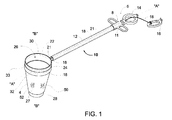
- specimen retrieval device 10 including a specimen retrieval pouch 4 having a lubricious material on at least a portion of the outer surface thereof according to an embodiment of the present disclosure is illustrated.
- specimen retrieval device 10 includes a handle assembly 6 that includes handle portions 8 and 11 that are fixedly joined together.
- An elongated tube or shaft 12 extends from handle assembly 6 and is dimensioned for insertion through a trocar cannula (not explicitly shown) or access opening in a patient for endoscopic or laparoscopic procedures.
- a longitudinal axis "A-A" is defined through shaft 12 and is oriented in a substantially perpendicular or orthogonal direction with respect to a longitudinal axis "B-B" that is defined through pouch 4 when pouch 4 is in the deployed state.
- a drive rod 21 is positioned within shaft 12 and is movable relative to shaft 12 to move pouch 4 between deployed and retracted positions ( FIGS. 1-2 ).
- Drive rod 21 includes a proximal end that operably couples to an actuator that is in the form of a finger loop 14.
- Finger loop 14 is configured for engagement by a user's fingers to translate or move drive rod 21 within shaft 12 between the deployed and retracted configurations.
- a pull ring 16 releasably couples, via one or more suitable coupling methods, e.g., a press or friction fit, to finger loop 14 and is coupled (e.g., tied, adhesive, etc.) to a proximal end of a drawstring 18 to facilitate pulling the drawstring 18.
- a distal end of drawstring 18 is operably coupled to open upper portion 26 of pouch 4.
- Drive rod 21 includes a distal end which supports a resilient, deformable spring 20 including two generally flexible or resilient strips 22 and 24 ( FIG. 2 ).
- Resilient strips 22, 24 of spring 20 extend from the distal end of drive rod 21 and operably couple to pouch 4.
- Resilient strips 22, 24 move from a stressed or non-expanded state to an unstressed or freely expanded state when pouch 4 is moved from the retracted position ( FIG. 2 ) to the deployed position ( FIG. 1 ).
- pouch 4 In the stressed or non-expanded state, pouch 4 is wound or wrapped around resilient strips 22 and 24. Wrapping pouch 4 around resilient strips 22 and 24 facilitates deploying pouch 4 from the relatively small area within shaft 12.
- resilient strips 22 and 24 collectively form a generally circular or "hoop-like" configuration for supporting a periphery of open upper portion 26 of pouch 4 (see FIG. 1 ).
- specimen retrieval device 10 For a more detailed description of specimen retrieval device 10 and operative components associated therewith, reference is made to U.S. Patent No. 5,647,372 , the disclosure of which is incorporated herein in its entirety by this reference.
- pouch 4 includes a generally tubular or elongated configuration that is defined by open upper portion 26 and closed lower portion 28 and has a lubricious material on at least a portion of the outer surface thereof.
- Open upper portion 26 includes a proximal (or upper) circumferential tubular portion or sleeve 30 and a distal (or lower) circumferential tubular portion or sleeve 32, which are spaced apart from each other.
- Proximal and distal sleeves 30 and 32 are configured to receive spring 20 and drawstring 18 as seen in FIG. 1 .
- a linear portion 33 weakened by perforation, scoring, or the like, extends circumferentially around open upper portion 26 and is operably disposed between the proximal and lower sleeves 30 and 32.
- Linear portion 33 is adapted to tear when drawstring 18 is pulled proximally with sufficient force to close open upper portion 26 of pouch 4 distal to linear portion 33, thereby providing fast detachment of pouch 4 from spring 20 simultaneously with closure of open upper portion 26 of pouch 4.
- open upper portion 26 of pouch 4 is openable by spring 20 upon deployment and closable by drawstring 18 upon separation from spring 20.
- alternative methods also can be utilized to detach pouch 4 from spring 20, such as by pulling with a grasper or by cutting with a scissors.
- Pouch 4 is configured for the purpose of tissue entrapment and/or removal.
- pouch 4 may have a diameter that ranges from about 1.5 inches to about 3.0 inches and a changeable or variable depth that ranges from about 2 inches to about 8 inches.
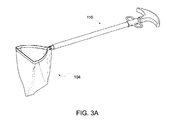
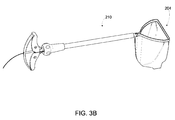
- FIGS. 3A and 3B illustrate specimen retrieval devices 110, 210, respectively, that may be configured for use with pouches 104, 204.
- pouches 104 and 204 are configured to function in a manner substantially similar to that of pouch 4.
- Other shapes for pouches 4, 104, 204 are also contemplated including square, rectangular, oval, etc.
- Pouch 4 may be made from any suitable flexible, substantially impervious biocompatible material (e.g., impervious to penetration by cells, such as cancer cells).
- pouch 4 may be formed from a flexible film or sheet formed from a substantially transparent polymeric material.
- the polymeric material may be a polyurethane sheet having a thickness ranging from about 0.001 inches to about 0.005 inches.
- pouch 4 is made from a material that includes interstices, and application of a lubricious material penetrates and seals the interstices, rendering pouch 4 impervious to penetration by cells, etc.
- a lubricious material is present on at least a portion of the outer surface of pouch 4.
- at least a portion of the outer surface of pouch 4 is coated with a lubricious material.
- pouch 4 is made at least in part from a lubricious material.
- any suitable lubricious material may be present on at least a portion of outer surface of the pouch.
- Such materials include, for example, cyanoacrylates; epoxies; hydrophilic polymers including hydrogels; polyalkylene oxides including polyethylene oxide, polypropylene oxide, polyethylene oxide/polypropylene oxide copolymers, polyethylene glycol, polypropylene glycol; urethanes such as polyurethane; siloxanes, including cyclosiloxanes, polyalkylsiloxanes, and polydialkylsiloxanes such as polydimethylsiloxanes, polydiethylsiloxanes, polydipropylsiloxanes, polydibutylsiloxanes; parylenes including parylene N, parylene C, parylene D, and parylene HT; combinations thereof, and the like.
- One suitable lubricious material is disclosed in United States Patent 7,141,246 .
- suitable methods which may be utilized to apply the lubricious material include gravure coating, spray coating, melt blowing, thermal/heat transfer, vapor deposition, deposition by nozzle, flexographic printing techniques, such as offset flexographic printing, screen printing, laserjet or inkjet, combinations thereof, and the like.
- Relevant parameters related to application include, but are not limited to, nozzle geometry of a spray device, time necessary for application, pressure, temperature, humidity, curing time and temperature, wavelength where curing includes the application of light, the state of the substrate, including its natural or elongated state, the coating thickness, as well as geometry, size and spacing of any pattern employed, and the like.
- the materials utilized to form the lubricious coatings of the present disclosure may be applied in powder form. In other embodiments, the materials utilized to form the lubricious coatings of the present disclosure may be applied in liquid form. Where the materials are applied as liquids, it may be desirable to form a solution by placing the materials utilized to form the lubricious coatings of the present disclosure in a suitable solvent. Any solvent within the purview of those skilled in the art may be utilized; however, as would be apparent to one skilled in the art, the solvent should be compatible with both the lubricious coating materials and the material from which the pouch is made and should not degrade either during application of the lubricious material.
- suitable solvents include tetrahydrofuran, chlorinated hydrocarbons such as methylene chloride, alcohols such as methanol, ethanol, and propanol, chloroform, 1,2-dichloro-ethane, aliphatic hydrocarbons such as hexane, heptene, and ethyl acetate, combinations thereof, and the like.
- the coating solution may contain from about 30 to about 70 weight percent solvent, in embodiments from about 45 to about 55 weight percent solvent. If desired, the coating solution can optionally contain additional components such as dyes, antibiotics, antiseptics, growth factors, anti-inflammatory agents, combinations thereof, and the like.
- anti-microbial additives may be provided within the lubricious material and released during use of the pouch.
- Suitable anti-microbial additives include, but are not limited to, the biguanides (such as chlorhexidine and its salts, including chlorhexidine acetate, chlorhexidine gluconate, chlorhexidine hydrochloride, and chlorhexidine sulfate), silver and its salts (such as silver acetate, silver benzoate, silver carbonate, silver iodate, silver iodide, silver lactate, silver laurate, silver nitrate, silver oxide, silver palmitate, silver protein, and silver sulfadiazine), polymyxin, tetracycline, aminoglycosides (such as tobramycin and gentamicin), rifampician, bacitracin, neomycin, chloramphenical, miconazole, tolnaftate, quinolones (such as oxolinic acid, norfloxaci
- the materials utilized to provide a lubricious material on at least a portion of the outer surface of the pouch in accordance with the present disclosure may be further treated to further enhance formation of the coating.
- Methods for treating the materials utilized to form lubricious coatings of the present disclosure are within the purview of those skilled in the art.
- Such methods for curing may include heating to suitable temperatures, which will depend upon the materials utilized to form the coatings herein. This may be desirable where the coating materials are applied in powder form, or where the coating materials are applied in solution and it is desired to remove the solvent utilized to form the solution.
- the coating material and the now-coated pouch may be heated to a temperature of from about 80° F to about 350° F, in embodiments from about 120° F to about 250° F.
- a vacuum may be applied in embodiments to accelerate curing.
- solvents utilized to apply the coatings may simply evaporate upon application, leaving the lubricious material upon the outer surface of the pouch.
- curing may occur by the application of a light source including ultraviolet light or light from a coherent light source such as a laser source.
- a light source including ultraviolet light or light from a coherent light source such as a laser source.
- Suitable UV light sources may be at a wavelength of from about 80 nm to about 400 nm, in embodiments from about 290 nm to about 380 nm.
- Suitable coherent light sources such as a laser may be applied at a wavelength of from about 80 nm to about 1540 nm, in embodiments from about 290 nm to about 400 nm.
- the lubricious material may be applied over the entire outer surface of the pouch or, alternatively, on only a portion of outer surface of pouch.
- the lubricious material may be applied in any suitable pattern, including dots, stripes, spirals, combinations thereof, and the like.
- the spacing, pattern, and geometry utilized in applying the lubricious material may vary to accommodate the geometry of the pouch.
- a mask material may be applied to the pouch, wherein the mask has a configuration of the pattern of lubricious material to be applied to the outer surface of the pouch.
- the masking material is first applied to the outer surface of the pouch, having openings therein corresponding to the pattern to be applied to the outer surface of the pouch.
- the coating materials may then be applied utilizing any method within the purview of those skilled in the art, including those noted above, as well as dipping, the pouch into the coating material.
- the coating materials may then be allowed to cure, if necessary, after which time the masking material may be removed, leaving the pattern of lubricious material on the outer surface of the pouch.
- lubricious material may be present on an outer surface of the pouch in a pattern that may have a coating-free surface area of more than about 25% of the surface, in embodiments a coating-free surface area of from about 50% to about 75% of the surface, in other embodiments a coating-free surface area of from about 75% to about 90%.
- the presence of the lubricious material on at least a portion of the surface of the pouch may be utilized to transform the surface of a pouch having a surface with a higher coefficient of friction into a pouch with a surface having a lower coefficient of friction.
- the lubricious material itself may be rigid, pouches made of flexible substrates possessing a coating of the lubricious material may remain flexible without substantial fracturing of the coating or delamination of the coating from the pouch.
- an external surface 27 of pouch 4 is coated with a biocompatible hydrophilic material 50 (represented by hatching in FIGS. 1 , 5A and 5B ) that becomes lubricious when wet.
- a biocompatible hydrophilic material 50 represented by hatching in FIGS. 1 , 5A and 5B
- the lubricity of hydrophilic material 50 facilitates manipulation of pouch 4 within a body cavity and/or facilitates removal of pouch 4 through an access opening in the skin ( FIG. 4B ), or through a cannula, which, in turn, may prevent or reduce trauma to tissue and/or tissue abrasion.
- the thickness of the coating of lubricious material may be from about 1 ⁇ m to about 20 ⁇ m for a pouch having a wall thickness of from about 0.001 inches to about 0.005 inches.
- Hydrophilic material 50 may be water-soluble or non-water soluble. Additionally, hydrophilic material 50 may be synthetic or natural. In embodiments, hydrophilic material 50 is a water-soluble synthetic polymer. Such water-soluble polymers include polyacrylamides, polyvinyl pyrrolidone (PVP), polyvinyl alcohol, polyvinyl methyl ether, polyethylene oxide, polyethylene glycol, polyacrylic acid and their salts, and various chemical derivatives of cellulose, such as carboxymethylcellulose.
- PVP polyvinyl pyrrolidone
- PVP polyvinyl alcohol
- polyvinyl methyl ether polyethylene oxide
- polyethylene glycol polyacrylic acid and their salts
- various chemical derivatives of cellulose such as carboxymethylcellulose.
- hydrophilic material 50 may be synthetic absorbable polymers that are water-soluble; that is, the polymers migrate from the site by a combination of absorption and water dissolution.
- polyoxaester coating family based on polyglycol diacid, and polyethylene glycol diols, provide such features.
- the polyoxaester can be prepared by polycondensation using polyethylene glycol diol with a molecular weight of 200 Daltons, and a small amount of ethylene glycol and polyglycol diacid having a molecular weight of about 600 Daltons. The resulting polyester is both absorbable and water-soluble.
- the molecular weight of the polyester can be controlled by conventional means.
- the polyoxaester can be further modified by polymerization with lactone monomers using ring-opening techniques.
- lactone monomers include glycolide, lactide, p-dioxanone, trimethylene carbonate and ⁇ -caprolactone.
- glycolide a polymer of polyethylene glycolide
- lactide p-dioxanone
- trimethylene carbonate trimethylene carbonate
- ⁇ -caprolactone ⁇ -caprolactone
- copolymerization with glycolide Copolymerizing with lactone will alter water solubility and dissolution rates, as well as absorption rates.
- the lubricious material may be a hydrophobic material 52 ( FIG. 1 ).
- Hydrophobic material 52 may include, but is not limited to, silicones and salts of fatty acids, such as calcium stearate.
- the lubricous material may be a combination of hydrophilic material 50 and hydrophobic material 52, e.g., amphiphilic material.
- exterior surface 27 of pouch 4 may be evenly coated with the hydrophilic material 50.
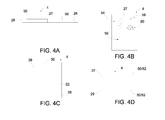
- other coating configurations may also be utilized to coat exterior surface 27 of pouch 4; such as alternating patterns 54, stripes 56, dots 58, random patterns 60, etc. (see FIG. 4B for example).
- exterior surface 27 with a hydrophilic material 50 (or hydrophobic material 50) at open upper portion 26 (e.g., adjacent perforation 33) that is more lubricious than a hydrophilic material 50 (or hydrophobic material 50) that coats closed bottom portion 28 of pouch 4.
- open upper portion 26 of pouch 4 may be coated with a lubricious material and closed bottom portion 28 of pouch 4 may be uncoated.
- hydrophilic and hydrophobic material 50 may be present on exterior surface 27 of pouch 4.
- a top half of exterior portion 27 of pouch 4 may be coated with hydrophilic material 50 and a bottom half of exterior portion 27 of pouch 4 may be coated with hydrophobic material 50 (or vice versa) (see FIG. 4C ).
- the thickness, wettability, lubricity, flexibility, abrasion resistance, and/or storage stability of the hydrophilic material 50 may be varied to meet the specific requirements of a manufacturer and/or specific medical procedure.
- the pouch can be made from a porous polymeric material, such as ePTFE, and the outer surface of the porous polymeric material forming the pouch is impregnated with a lubricious material of the type described above in connection with previous embodiments.
- a porous polymeric material such as ePTFE
- the outer surface of the porous polymeric material forming the pouch may be impregnated by applying a solution of the lubricious material
- a pouch made of a porous polymeric material e.g., ePTFE
- a solution of the lubricious material is applied to the outer surface of the cleaned porous polymeric pouch, in one or more applications.
- enough solution to flood and saturate the surface of the cleaned porous polymeric pouch is applied.
- the pouch, wet with the solution is then dried to evaporate the solution solvent, leaving the lubricious material impregnated in the porous polymeric pouch and on at least a portion of the exterior surface of the pouch.
- the outer surface of the porous polymeric pouch is modified by depositing a functionality on the porous polymeric material, for example by treating the outer surface with a treatment selected from the group consisting of chemical solution etching, plasma gas etching, and plasma polymerization deposition.
- chemical solution etching process typically involves dipping into, or otherwise exposing the outer surface of the porous polymeric pouch to, a chemical etch solution (such as, for example, a sodium-naphthalate chemical etch solution).
- a chemical etch solution such as, for example, a sodium-naphthalate chemical etch solution.
- the porous polymeric pouch is typically dipped or otherwise rinsed in a solution such as isopropyl alcohol to quench/deactivate any remaining etching solution thereon.
- the quenching solution is then rinsed away using warm water and the resulting etched pouch is dried.
- a lubricious material may then be applied to the resulting etched pouch as set forth above.
- the outer surface of the pouch is prepared using a gas plasma etch/treatment, such as an ammonia gas plasma treatment.
- a gas plasma etch/treatment such as an ammonia gas plasma treatment.
- the surface is treated with ammonia anions by reaction in an ammonia gas filled plasma chamber, to deposit an amine functionality on the surface of the porous polymeric pouch.
- Alternative gases may be used in the gas plasma etching in addition to or instead of the ammonia gas.
- the porous polymeric pouch is gas plasma etched by placing it in a plasma chamber and exposing it to the ammonia plasma for about 1 to about 5 minutes with the ammonia plasma generated at a power of about 450 watts. A lubricious material may then be applied to the resulting plasma treated pouch as set forth above.
- the outer surface of the pouch is prepared by depositing a plasma polymerized functionality.
- the modified outer surface is a plasma polymerized carboxylate film including an acrylate or acrylate-like polymer layer deposited onto the porous polymeric pouch by exposing the porous polymeric pouch to a plasma, such as, for example, an acrylic acid plasma. A lubricious material may then be applied to the resulting modified outer surface as set forth above.
- specimen retrieval device including pouch 4 may utilized in various surgical procedures.
- specimen retrieval device 10 including pouch 4 may be utilized in conjunction with video assisted thorascopic surgery (VATS).
- VATS video assisted thorascopic surgery
- an incision may, initially, be made in tissue "T” of a patient to access the thoracic cavity "TC” ( FIG. 5A ).
- Shaft 12 of specimen retrieval device 10 may be inserted through the incision in the patient and between ribs "R” of the patient to access and position the pouch within the thoracic cavity "TC.”
- Graspers may be utilized to position one or more tissue specimens "TS,” which were previously excised from a lung of the patient, within pouch 4. Thereafter, drawstring 18 may be pulled proximally to cinch and secure tissue specimen "TS" within pouch 4. Once cinched, pouch 4, including tissue specimen "TS” therein, may be pulled between ribs "R” and through the incision in a patient ( FIG. 5B ).
- Lubricious hydrophilic material 50 (or hydrophobic material 52) provided on exterior surface 27 of pouch 4 allows for easy maneuverability of the pouch 4 within the thoracic cavity "TC” and removal of pouch 4 from between the ribs "R” and through the incision in the patient. As can be appreciated, this, in turn, may result in less patient trauma and/or less postoperative pain to a patient.
- pouch 4 may prove advantageous for form pouch 4 from a hydrophobic material 52 (e.g., silicone) and coat exterior surface 27 of pouch 4 with one of the aforementioned hydrophilic materials 50 (e.g., polyacrylamides).
- a hydrophobic material 52 e.g., silicone
- one of the aforementioned hydrophilic materials 50 e.g., polyacrylamides
- pouch 4 may be dimensioned and fabricated of a suitable material to allow treatment, e.g. morcellation or division, of the organ tissue, for example to reduce its bulk to facilitate withdrawal from the body cavity.
- hydrophilic material 50 may be abrasion resistant or non-thrombogenic. In embodiments, hydrophilic material 50 may be configured to prevent adhesion of platelets, proteins, microorganisms, adsorbed platelets, proteins, bacteria, and/ or acute thrombus formation.
Landscapes
- Health & Medical Sciences (AREA)
- Life Sciences & Earth Sciences (AREA)
- Surgery (AREA)
- Molecular Biology (AREA)
- Engineering & Computer Science (AREA)
- Biomedical Technology (AREA)
- Heart & Thoracic Surgery (AREA)
- Medical Informatics (AREA)
- Nuclear Medicine, Radiotherapy & Molecular Imaging (AREA)
- Animal Behavior & Ethology (AREA)
- General Health & Medical Sciences (AREA)
- Public Health (AREA)
- Veterinary Medicine (AREA)
- Materials For Medical Uses (AREA)
- Surgical Instruments (AREA)
- Prostheses (AREA)
Abstract
Description
- This application claims the benefit of and priority to
U.S. Provisional Patent Application No. 61/980,214, filed April 16, 2014 - The present disclosure relates to a specimen retrieval pouch. More particularly, the present disclosure relates to a specimen retrieval pouch having a lubricious coating on at least a portion of the outer surface thereof.
- Minimally invasive procedures may be used for partial or total removal of body tissue or organs from the interior of the body, e.g. nephrectomy, cholecystectomy, lobectomy and other procedures including thoracic, laparoscopic and endoscopic procedures. During such procedures, it is common that a tissue specimen (e.g., cyst, cancerous tissue, or other affected tissue or organ) be removed from the patient's body via an access opening in the skin, or through an access port, e.g., a cannula.
- Devices for removing a tissue specimen from the patient's body typically include a pouch (or other suitable flexible container) releasably supported at a distal end of the device. Manipulating the pouch having a tissue specimen therein can sometimes prove difficult within the confined space of a body cavity. Similarly, removing the pouch through an access opening in the skin or access port that is smaller than the tissue specimen contained within the pouch can also prove difficult.
- In minimally invasive video-assisted thoracic surgery (VATS), for example, it is sometimes necessary to remove a pouch and tissue specimen contained therein through an access opening (or port) that has been positioned between a patient's ribs to provide access to a thoracic cavity of the patient. However, the restricted space between the patient's ribs may make it may difficult for a surgeon to pull the pouch and tissue specimen contained therein through the access opening. Likewise, the restricted space between the patient's ribs may make it difficult for a surgeon to maintain the tissue specimen relatively intact (e.g., for pathology).
- Specimen retrieval devices in accordance with the present disclosure include a pouch having a lubricious coating on at least a portion of the outer surface thereof. The lubricious coating on at least a portion of the outer surface of the pouch facilitates manipulation of the pouch within a surgical site and/or removal of the pouch from a body cavity of a patient.
- An aspect of the present disclosure provides a specimen retrieval pouch which is couplable to an applicator of a specimen retrieval device for removing a tissue specimen from a body cavity of a patient. The specimen retrieval pouch includes a closed bottom portion and an open upper portion configured to receive the tissue specimen. A lubricious material is present on at least a portion of the outer surface of the specimen retrieval pouch.
- The lubricious material present on at least a portion of the outer surface of the specimen retrieval pouch may be a hydrophilic material or a hydrophobic material. In embodiments, at least a portion of the outer surface of the specimen retrieval pouch is coated with the lubricious material. In embodiments, at least a portion of the pouch is formed from the lubricious material, thus providing a lubricious surface on at least a portion of the outer surface of the specimen retrieval pouch.
- In embodiments, the exterior surface of the pouch may be evenly coated with the lubricious material, which may include antithrombogenic properties. In embodiments, the upper portion of the pouch may be coated with a more lubricious material than the closed bottom portion. In addition to lubricious material being present on at least a portion of the outer surface of the specimen retrieval pouch, in embodiments, at least a portion of the interior surface of the pouch is coated with a lubricious material. In embodiments, the pouch may be formed from the hydrophobic material and at least a portion of the outer surface of the pouch may be coated with the hydrophilic material. In embodiments, the lubricious material may include synthetic and/or natural materials, e.g., hydrogels. For example, the lubricous material may include one or more of the following: glycerine, silicone oil, olive oil, fluoropolymers, hyaluronan, cyanoacrylates, epoxies, polyalkylene oxides, urethanes, siloxanes, parylenes, polyacrylamides, poly-N-vinyl pyrrolidone (PVP), polyvinyl alcohol, polyvinyl methyl ether, polyethylene oxide (PEO), polyethylene glycol (PEG), polyacrylic acid and polyacrylic acid salts, chemical derivatives of cellulose, such as carboxymethylcellulose. It is also contemplated that other lubricious coatings and materials known to those of skill in the art may be incorporated.
- In embodiments, the specimen retrieval pouch is formed from a porous polymeric material. In such embodiments, the lubricious material may impregnate the porous material, rendering the pouch impermeable.
- In embodiments, the exterior surface of the specimen retrieval pouch is modified by chemical solution etching, plasma gas etching, or plasma polymerization deposition.
- The lubricious material may be non-thrombogenic. Moreover, the lubricious material may prevent adhesion of platelets, proteins, microorganisms, adsorbed platelets, proteins, bacteria, and/or prevent acute thrombus formation.
- Embodiments of the presently disclosed specimen retrieval device are described hereinbelow with reference to the drawings wherein:
-
FIG. 1 is a perspective view of a specimen retrieval device and a specimen retrieval pouch in accordance with an embodiment of the present disclosure; -
FIG. 2 is a perspective view of the specimen retrieval device shown inFIG. 1 with a portion cut away to show the specimen retrieval pouch in a retracted configuration; -
FIGS. 3A and3B are perspective views of specimen retrieval devices including specimen retrieval pouches according to alternate embodiments of the present disclosure; -
FIGS. 4A-4D are schematic views of specimen retrieval pouches according to alternate embodiments of the present disclosure; -
FIG. 5A is a perspective view of a specimen retrieval device inserted into a thoracic cavity of a patient with the specimen retrieval pouch having tissue positioned therein and in a cinched configuration; and -
FIG. 5B is a perspective view of the cinched pouch shown inFIG. 4A being pulled through an incision in the patient. - Embodiments of the present disclosure will now be described in detail with reference to the drawings, in which like reference numerals designate identical or corresponding elements in each of the several views. As used herein, the term "distal," as is conventional, will refer to that portion of the instrument, apparatus, device or component thereof which is farther from the user while, the term "proximal," will refer to that portion of the instrument, apparatus, device or component thereof which is closer to the user. In the following description, well-known functions or constructions are not described in detail to avoid obscuring the present disclosure in unnecessary detail.
- As used herein with reference to the present disclosure, the terms laparoscopic and endoscopic are interchangeable and refer to instruments having a relatively narrow operating portion for insertion into a cannula or a small incision in the skin. Throughout the present disclosure, the term "minimally invasive" should be understood to encompass both endoscopic and laparoscopic procedures. It is believed that the devices of the present disclosure may find use in any procedure where access to the interior of the body is limited to a relatively small incision, with or without the use of a cannula, as in minimally invasive procedures.
- A pouch in accordance with the instant disclosure resists tearing or rupture while providing sufficient rigidity and/or maneuverability. Additionally, the pouch reduces collateral damage to tissue during manipulation of the pouch within and/or removal of the pouch from a body cavity of a patient. Further, the pouch is capable of removing large tissue specimens through small access incisions or ports while minimizing the risk of contaminating the body cavity with the cells from the tissue sample being removed (e.g., seeding of cancer cells when a tumor is being removed).
- With reference to
FIGS. 1 and2 , aspecimen retrieval device 10 including aspecimen retrieval pouch 4 having a lubricious material on at least a portion of the outer surface thereof according to an embodiment of the present disclosure is illustrated. Briefly,specimen retrieval device 10 includes ahandle assembly 6 that includes handleportions 8 and 11 that are fixedly joined together. An elongated tube orshaft 12 extends fromhandle assembly 6 and is dimensioned for insertion through a trocar cannula (not explicitly shown) or access opening in a patient for endoscopic or laparoscopic procedures. A longitudinal axis "A-A" is defined throughshaft 12 and is oriented in a substantially perpendicular or orthogonal direction with respect to a longitudinal axis "B-B" that is defined throughpouch 4 whenpouch 4 is in the deployed state. - A
drive rod 21 is positioned withinshaft 12 and is movable relative toshaft 12 to movepouch 4 between deployed and retracted positions (FIGS. 1-2 ).Drive rod 21 includes a proximal end that operably couples to an actuator that is in the form of afinger loop 14.Finger loop 14 is configured for engagement by a user's fingers to translate or movedrive rod 21 withinshaft 12 between the deployed and retracted configurations. Apull ring 16 releasably couples, via one or more suitable coupling methods, e.g., a press or friction fit, tofinger loop 14 and is coupled (e.g., tied, adhesive, etc.) to a proximal end of adrawstring 18 to facilitate pulling thedrawstring 18. A distal end ofdrawstring 18 is operably coupled to openupper portion 26 ofpouch 4. - Drive
rod 21 includes a distal end which supports a resilient,deformable spring 20 including two generally flexible orresilient strips 22 and 24 (FIG. 2 ).Resilient strips spring 20 extend from the distal end ofdrive rod 21 and operably couple topouch 4.Resilient strips pouch 4 is moved from the retracted position (FIG. 2 ) to the deployed position (FIG. 1 ). In the stressed or non-expanded state,pouch 4 is wound or wrapped aroundresilient strips pouch 4 aroundresilient strips pouch 4 from the relatively small area withinshaft 12. In an unstressed or freely expanded condition,resilient strips upper portion 26 of pouch 4 (seeFIG. 1 ). - For a more detailed description of
specimen retrieval device 10 and operative components associated therewith, reference is made toU.S. Patent No. 5,647,372 , the disclosure of which is incorporated herein in its entirety by this reference. - With reference again to
FIG. 1 ,pouch 4 includes a generally tubular or elongated configuration that is defined by openupper portion 26 and closedlower portion 28 and has a lubricious material on at least a portion of the outer surface thereof. Openupper portion 26 includes a proximal (or upper) circumferential tubular portion orsleeve 30 and a distal (or lower) circumferential tubular portion orsleeve 32, which are spaced apart from each other. Proximal anddistal sleeves spring 20 anddrawstring 18 as seen inFIG. 1 . Alinear portion 33 weakened by perforation, scoring, or the like, extends circumferentially around openupper portion 26 and is operably disposed between the proximal andlower sleeves Linear portion 33 is adapted to tear whendrawstring 18 is pulled proximally with sufficient force to close openupper portion 26 ofpouch 4 distal tolinear portion 33, thereby providing fast detachment ofpouch 4 fromspring 20 simultaneously with closure of openupper portion 26 ofpouch 4. Thus, openupper portion 26 ofpouch 4 is openable byspring 20 upon deployment and closable bydrawstring 18 upon separation fromspring 20. Those skilled in the art reading this disclosure will appreciate that alternative methods also can be utilized to detachpouch 4 fromspring 20, such as by pulling with a grasper or by cutting with a scissors. -
Pouch 4 is configured for the purpose of tissue entrapment and/or removal. In embodiments,pouch 4 may have a diameter that ranges from about 1.5 inches to about 3.0 inches and a changeable or variable depth that ranges from about 2 inches to about 8 inches. -
FIGS. 3A and3B illustratespecimen retrieval devices pouches pouches pouches specimen retrieval devices pouches pouch 4. Other shapes forpouches -
Pouch 4 may be made from any suitable flexible, substantially impervious biocompatible material (e.g., impervious to penetration by cells, such as cancer cells). In embodiments, for example,pouch 4 may be formed from a flexible film or sheet formed from a substantially transparent polymeric material. In embodiments, the polymeric material may be a polyurethane sheet having a thickness ranging from about 0.001 inches to about 0.005 inches. In other embodiments,pouch 4 is made from a material that includes interstices, and application of a lubricious material penetrates and seals the interstices,rendering pouch 4 impervious to penetration by cells, etc. - In accordance with the present disclosure, a lubricious material is present on at least a portion of the outer surface of
pouch 4. In embodiments, at least a portion of the outer surface ofpouch 4 is coated with a lubricious material. In other embodiments,pouch 4 is made at least in part from a lubricious material. - Any suitable lubricious material may be present on at least a portion of outer surface of the pouch. Such materials include, for example, cyanoacrylates; epoxies; hydrophilic polymers including hydrogels; polyalkylene oxides including polyethylene oxide, polypropylene oxide, polyethylene oxide/polypropylene oxide copolymers, polyethylene glycol, polypropylene glycol; urethanes such as polyurethane; siloxanes, including cyclosiloxanes, polyalkylsiloxanes, and polydialkylsiloxanes such as polydimethylsiloxanes, polydiethylsiloxanes, polydipropylsiloxanes, polydibutylsiloxanes; parylenes including parylene N, parylene C, parylene D, and parylene HT; combinations thereof, and the like. One suitable lubricious material is disclosed in United States Patent
7,141,246 . - Any means within the purview of those skilled in the art may be utilized to apply the lubricious material to the pouch. In some embodiments, suitable methods which may be utilized to apply the lubricious material include gravure coating, spray coating, melt blowing, thermal/heat transfer, vapor deposition, deposition by nozzle, flexographic printing techniques, such as offset flexographic printing, screen printing, laserjet or inkjet, combinations thereof, and the like. Relevant parameters related to application include, but are not limited to, nozzle geometry of a spray device, time necessary for application, pressure, temperature, humidity, curing time and temperature, wavelength where curing includes the application of light, the state of the substrate, including its natural or elongated state, the coating thickness, as well as geometry, size and spacing of any pattern employed, and the like.
- In embodiments, the materials utilized to form the lubricious coatings of the present disclosure may be applied in powder form. In other embodiments, the materials utilized to form the lubricious coatings of the present disclosure may be applied in liquid form. Where the materials are applied as liquids, it may be desirable to form a solution by placing the materials utilized to form the lubricious coatings of the present disclosure in a suitable solvent. Any solvent within the purview of those skilled in the art may be utilized; however, as would be apparent to one skilled in the art, the solvent should be compatible with both the lubricious coating materials and the material from which the pouch is made and should not degrade either during application of the lubricious material. Examples of suitable solvents include tetrahydrofuran, chlorinated hydrocarbons such as methylene chloride, alcohols such as methanol, ethanol, and propanol, chloroform, 1,2-dichloro-ethane, aliphatic hydrocarbons such as hexane, heptene, and ethyl acetate, combinations thereof, and the like.
- Where the lubricious material is applied as part of a solution, the coating solution may contain from about 30 to about 70 weight percent solvent, in embodiments from about 45 to about 55 weight percent solvent. If desired, the coating solution can optionally contain additional components such as dyes, antibiotics, antiseptics, growth factors, anti-inflammatory agents, combinations thereof, and the like.
- In embodiments, anti-microbial additives may be provided within the lubricious material and released during use of the pouch. Suitable anti-microbial additives include, but are not limited to, the biguanides (such as chlorhexidine and its salts, including chlorhexidine acetate, chlorhexidine gluconate, chlorhexidine hydrochloride, and chlorhexidine sulfate), silver and its salts (such as silver acetate, silver benzoate, silver carbonate, silver iodate, silver iodide, silver lactate, silver laurate, silver nitrate, silver oxide, silver palmitate, silver protein, and silver sulfadiazine), polymyxin, tetracycline, aminoglycosides (such as tobramycin and gentamicin), rifampician, bacitracin, neomycin, chloramphenical, miconazole, tolnaftate, quinolones (such as oxolinic acid, norfloxacin, nalidix acid, pefloxacin, enoxacin and ciprofloxacin), penicillins (such as ampicillin, amoxicillin and piracil), cephalosporins, vancomycin, extracts of plants and herbs known to possess anti-microbial activity (e.g., phytochemicals, such as grapefruit seed extract, Tea Tree Oil and Myrtle Oil) and combinations of any of the above anti-microbials.
- Once applied, in some embodiments the materials utilized to provide a lubricious material on at least a portion of the outer surface of the pouch in accordance with the present disclosure may be further treated to further enhance formation of the coating. Methods for treating the materials utilized to form lubricious coatings of the present disclosure are within the purview of those skilled in the art. For example, in some embodiments it may be desirable to cure the coating materials to enhance their lubricity. Such methods for curing may include heating to suitable temperatures, which will depend upon the materials utilized to form the coatings herein. This may be desirable where the coating materials are applied in powder form, or where the coating materials are applied in solution and it is desired to remove the solvent utilized to form the solution. For example, once applied, the coating material and the now-coated pouch may be heated to a temperature of from about 80° F to about 350° F, in embodiments from about 120° F to about 250° F. A vacuum may be applied in embodiments to accelerate curing. In other embodiments, solvents utilized to apply the coatings may simply evaporate upon application, leaving the lubricious material upon the outer surface of the pouch.
- In other embodiments, curing may occur by the application of a light source including ultraviolet light or light from a coherent light source such as a laser source. Suitable UV light sources may be at a wavelength of from about 80 nm to about 400 nm, in embodiments from about 290 nm to about 380 nm. Suitable coherent light sources such as a laser may be applied at a wavelength of from about 80 nm to about 1540 nm, in embodiments from about 290 nm to about 400 nm.
- The lubricious material may be applied over the entire outer surface of the pouch or, alternatively, on only a portion of outer surface of pouch. When applied to only a portion of outer surface of the pouch, the lubricious material may be applied in any suitable pattern, including dots, stripes, spirals, combinations thereof, and the like. The spacing, pattern, and geometry utilized in applying the lubricious material may vary to accommodate the geometry of the pouch.
- In embodiments where the lubricious material is present on only a portion of the outer surface of the pouch, a mask material may be applied to the pouch, wherein the mask has a configuration of the pattern of lubricious material to be applied to the outer surface of the pouch. The masking material is first applied to the outer surface of the pouch, having openings therein corresponding to the pattern to be applied to the outer surface of the pouch. The coating materials may then be applied utilizing any method within the purview of those skilled in the art, including those noted above, as well as dipping, the pouch into the coating material. The coating materials may then be allowed to cure, if necessary, after which time the masking material may be removed, leaving the pattern of lubricious material on the outer surface of the pouch.
- In embodiments, lubricious material may be present on an outer surface of the pouch in a pattern that may have a coating-free surface area of more than about 25% of the surface, in embodiments a coating-free surface area of from about 50% to about 75% of the surface, in other embodiments a coating-free surface area of from about 75% to about 90%.
- Thus, the presence of the lubricious material on at least a portion of the surface of the pouch may be utilized to transform the surface of a pouch having a surface with a higher coefficient of friction into a pouch with a surface having a lower coefficient of friction. While the lubricious material itself may be rigid, pouches made of flexible substrates possessing a coating of the lubricious material may remain flexible without substantial fracturing of the coating or delamination of the coating from the pouch.
- In embodiments, an
external surface 27 ofpouch 4 is coated with a biocompatible hydrophilic material 50 (represented by hatching inFIGS. 1 ,5A and 5B ) that becomes lubricious when wet. When wet, the lubricity ofhydrophilic material 50 facilitates manipulation ofpouch 4 within a body cavity and/or facilitates removal ofpouch 4 through an access opening in the skin (FIG. 4B ), or through a cannula, which, in turn, may prevent or reduce trauma to tissue and/or tissue abrasion. The thickness of the coating of lubricious material may be from about 1 µm to about 20 µm for a pouch having a wall thickness of from about 0.001 inches to about 0.005 inches. -
Hydrophilic material 50 may be water-soluble or non-water soluble. Additionally,hydrophilic material 50 may be synthetic or natural. In embodiments,hydrophilic material 50 is a water-soluble synthetic polymer. Such water-soluble polymers include polyacrylamides, polyvinyl pyrrolidone (PVP), polyvinyl alcohol, polyvinyl methyl ether, polyethylene oxide, polyethylene glycol, polyacrylic acid and their salts, and various chemical derivatives of cellulose, such as carboxymethylcellulose. - In embodiments,
hydrophilic material 50 may be synthetic absorbable polymers that are water-soluble; that is, the polymers migrate from the site by a combination of absorption and water dissolution. Members of the polyoxaester coating family, based on polyglycol diacid, and polyethylene glycol diols, provide such features. In one particular embodiment, the polyoxaester can be prepared by polycondensation using polyethylene glycol diol with a molecular weight of 200 Daltons, and a small amount of ethylene glycol and polyglycol diacid having a molecular weight of about 600 Daltons. The resulting polyester is both absorbable and water-soluble. The molecular weight of the polyester can be controlled by conventional means. Higher molecular weight resin will remain for a longer period of time on thepouch 4. Alternately, the polyoxaester can be further modified by polymerization with lactone monomers using ring-opening techniques. Useful lactone monomers include glycolide, lactide, p-dioxanone, trimethylene carbonate and ε-caprolactone. Of particular utility is copolymerization with glycolide. Copolymerizing with lactone will alter water solubility and dissolution rates, as well as absorption rates. - In embodiments, the lubricious material may be a hydrophobic material 52 (
FIG. 1 ).Hydrophobic material 52 may include, but is not limited to, silicones and salts of fatty acids, such as calcium stearate. Alternatively, in embodiments, the lubricous material may be a combination ofhydrophilic material 50 andhydrophobic material 52, e.g., amphiphilic material. - Other natural and synthetic materials not described herein could advantageously be employed according to the present disclosure. The above lists of natural and synthetic materials are not exhaustive and are intended for illustrative purposes only. There are an endless variety of natural and synthetic materials which may be utilized for the lubricious material on
pouch 4. - In embodiments,
exterior surface 27 ofpouch 4 may be evenly coated with thehydrophilic material 50. Alternatively, it may prove advantageous tocoat exterior surface 27 with morehydrophilic material 50 at open upper portion 26 (e.g., adjacent perforation 33) than atclosed bottom portion 28 of pouch 4 (shown schematically inFIG. 4A ). As can be appreciated, other coating configurations may also be utilized tocoat exterior surface 27 ofpouch 4; such as alternatingpatterns 54,stripes 56,dots 58,random patterns 60, etc. (seeFIG. 4B for example). - In embodiments, it may prove advantageous to
coat exterior surface 27 with a hydrophilic material 50 (or hydrophobic material 50) at open upper portion 26 (e.g., adjacent perforation 33) that is more lubricious than a hydrophilic material 50 (or hydrophobic material 50) that coats closedbottom portion 28 ofpouch 4. Alternatively, openupper portion 26 ofpouch 4 may be coated with a lubricious material and closedbottom portion 28 ofpouch 4 may be uncoated. - In embodiments, it may prove advantageous for both hydrophilic and
hydrophobic material 50 to be present onexterior surface 27 ofpouch 4. In this particular embodiment, a top half ofexterior portion 27 ofpouch 4 may be coated withhydrophilic material 50 and a bottom half ofexterior portion 27 ofpouch 4 may be coated with hydrophobic material 50 (or vice versa) (seeFIG. 4C ). - In embodiments, the thickness, wettability, lubricity, flexibility, abrasion resistance, and/or storage stability of the
hydrophilic material 50 may be varied to meet the specific requirements of a manufacturer and/or specific medical procedure. - In embodiments, the pouch can be made from a porous polymeric material, such as ePTFE, and the outer surface of the porous polymeric material forming the pouch is impregnated with a lubricious material of the type described above in connection with previous embodiments.
- The outer surface of the porous polymeric material forming the pouch may be impregnated by applying a solution of the lubricious materialIn an exemplary process, a pouch made of a porous polymeric material (e.g., ePTFE) is cleaned, for example by argon plasma cleaning (e.g., by subjecting the pouch to the plasma at about 200 watts for about 5 minutes). A solution of the lubricious material is applied to the outer surface of the cleaned porous polymeric pouch, in one or more applications. In embodiments, enough solution to flood and saturate the surface of the cleaned porous polymeric pouch is applied. The pouch, wet with the solution, is then dried to evaporate the solution solvent, leaving the lubricious material impregnated in the porous polymeric pouch and on at least a portion of the exterior surface of the pouch.
- In an alternative embodiment, the outer surface of the porous polymeric pouch is modified by depositing a functionality on the porous polymeric material, for example by treating the outer surface with a treatment selected from the group consisting of chemical solution etching, plasma gas etching, and plasma polymerization deposition.
- As those skilled in the art reading this disclosure will appreciate, chemical solution etching process typically involves dipping into, or otherwise exposing the outer surface of the porous polymeric pouch to, a chemical etch solution (such as, for example, a sodium-naphthalate chemical etch solution). After removal from the etching solution, the porous polymeric pouch is typically dipped or otherwise rinsed in a solution such as isopropyl alcohol to quench/deactivate any remaining etching solution thereon. The quenching solution is then rinsed away using warm water and the resulting etched pouch is dried. A lubricious material may then be applied to the resulting etched pouch as set forth above.
- In an alternative embodiment, the outer surface of the pouch is prepared using a gas plasma etch/treatment, such as an ammonia gas plasma treatment. In the ammonia gas plasma treatment, the surface is treated with ammonia anions by reaction in an ammonia gas filled plasma chamber, to deposit an amine functionality on the surface of the porous polymeric pouch. Alternative gases may be used in the gas plasma etching in addition to or instead of the ammonia gas. In one embodiment, the porous polymeric pouch is gas plasma etched by placing it in a plasma chamber and exposing it to the ammonia plasma for about 1 to about 5 minutes with the ammonia plasma generated at a power of about 450 watts. A lubricious material may then be applied to the resulting plasma treated pouch as set forth above.
- In an alternative embodiment, the outer surface of the pouch is prepared by depositing a plasma polymerized functionality. In embodiments, the modified outer surface is a plasma polymerized carboxylate film including an acrylate or acrylate-like polymer layer deposited onto the porous polymeric pouch by exposing the porous polymeric pouch to a plasma, such as, for example, an acrylic acid plasma. A lubricious material may then be applied to the resulting modified outer surface as set forth above.
- It should, of course, be understood that the foregoing surface modification techniques may also be applied to non-porous pouch prior to application of a lubricious material.
- The specimen retrieval
device including pouch 4 may utilized in various surgical procedures. In embodiments, for example,specimen retrieval device 10 includingpouch 4 may be utilized in conjunction with video assisted thorascopic surgery (VATS). - In such embodiments, an incision may, initially, be made in tissue "T" of a patient to access the thoracic cavity "TC" (
FIG. 5A ).Shaft 12 ofspecimen retrieval device 10 may be inserted through the incision in the patient and between ribs "R" of the patient to access and position the pouch within the thoracic cavity "TC." - Graspers (not shown) may be utilized to position one or more tissue specimens "TS," which were previously excised from a lung of the patient, within
pouch 4. Thereafter,drawstring 18 may be pulled proximally to cinch and secure tissue specimen "TS" withinpouch 4. Once cinched,pouch 4, including tissue specimen "TS" therein, may be pulled between ribs "R" and through the incision in a patient (FIG. 5B ). - Lubricious hydrophilic material 50 (or hydrophobic material 52) provided on
exterior surface 27 ofpouch 4 allows for easy maneuverability of thepouch 4 within the thoracic cavity "TC" and removal ofpouch 4 from between the ribs "R" and through the incision in the patient. As can be appreciated, this, in turn, may result in less patient trauma and/or less postoperative pain to a patient. - From the foregoing and with reference to the various figure drawings, those skilled in the art will appreciate that certain modifications can also be made to the
pouch 4 of the present disclosure without departing from the scope of the same. For example, it may prove advantageous to coat aninterior surface 29 ofpouch 4 with hydrophilic coating 50 (or hydrophobic material 52) in addition to coatingexterior surface 27 ofpouch 4 with hydrophilic coating 50 (or hydrophobic material 52) (seeFIG. 4D for example). - In embodiments, it may prove advantageous for
form pouch 4 from a hydrophobic material 52 (e.g., silicone) andcoat exterior surface 27 ofpouch 4 with one of the aforementioned hydrophilic materials 50 (e.g., polyacrylamides). - In embodiments,
pouch 4 may be dimensioned and fabricated of a suitable material to allow treatment, e.g. morcellation or division, of the organ tissue, for example to reduce its bulk to facilitate withdrawal from the body cavity. - In embodiments,
hydrophilic material 50 may be abrasion resistant or non-thrombogenic. In embodiments,hydrophilic material 50 may be configured to prevent adhesion of platelets, proteins, microorganisms, adsorbed platelets, proteins, bacteria, and/ or acute thrombus formation. - While several embodiments of the disclosure have been shown in the drawings, it is not intended that the disclosure be limited thereto, as it is intended that the disclosure be as broad in scope as the art will allow and that the specification be read likewise. Therefore, the above description should not be construed as limiting, but merely as exemplifications of particular embodiments. Those skilled in the art will envision other modifications within the scope and spirit of the claims appended hereto.
- The invention may be described by reference to the following numbered paragraphs:-
- 1. A specimen retrieval pouch, comprising:
- a closed bottom portion and an open upper portion configured to receive a tissue specimen, at least a portion of an exterior surface of the specimen retrieval pouch including a lubricious material.
- 2. A specimen retrieval pouch according to paragraph 1, wherein at least a portion of the exterior surface of the specimen retrieval pouch is coated with the lubricious material.
- 3. A specimen retrieval pouch according to paragraph 1, wherein at least a portion of the specimen retrieval pouch is formed from the lubricious material to provide lubricious material on at least a portion of an exterior surface of the specimen retrieval pouch.
- 4. A specimen retrieval pouch according to paragraph 1, wherein the lubricious material is a hydrophilic material.
- 5. A specimen retrieval pouch according to paragraph 1, wherein the lubricious material is selected from the group consisting of polyacrylamides, polyvinyl pyrrolidone (PVP), polyvinyl alcohol, polyvinyl methyl ether, polyethylene oxide, polyethylene glycol, polyacrylic acid, polyacrylic acid salts, and chemical derivatives of cellulose.
- 6. A specimen retrieval pouch according to paragraph 1, wherein the lubricious material is uniformly present on the exterior surface of the specimen retrieval pouch.
- 7. A specimen retrieval pouch according to paragraph 1, wherein the open upper portion of the specimen retrieval pouch is coated with a lubricious material and the closed bottom portion of the specimen retrieval pouch is uncoated.
- 8. A specimen retrieval pouch according to paragraph 1, wherein at least a portion of an interior surface of the specimen retrieval pouch is coated with a lubricious material.
- 9. A specimen retrieval pouch according to paragraph 1, wherein the pouch is formed from a hydrophobic material.
- 10. A specimen retrieval pouch according to
paragraph 4, wherein the pouch is formed from a hydrophobic material. - 11. A specimen retrieval pouch according to paragraph 1, wherein the pouch is formed from a porous polymeric material.
- 12. A specimen retrieval pouch according to
paragraph 10, wherein the exterior surface of the specimen retrieval pouch is modified by chemical solution etching, plasma gas etching, or plasma polymerization deposition. - 13. A specimen retrieval pouch according to paragraph 1, wherein the lubricious material is selected from the group consisting of cyanoacrylates, epoxies, polyalkylene oxides, urethanes, siloxanes, and parylenes.
- 14. A specimen retrieval pouch according to paragraph 1, wherein the lubricious material includes an anti-microbial additive.
- 15. A specimen retrieval device, comprising
an applicator; and
a specimen retrieval pouch operably couplable to the applicator, the specimen retrieval pouch including a closed bottom portion and an open upper portion configured to receive a tissue specimen, at least a portion of an exterior surface of the specimen retrieval pouch including a lubricious material. - 16. A specimen retrieval device according to paragraph 15, wherein at least a portion of the exterior surface of the specimen retrieval pouch is coated with the lubricious material.
- 17. A specimen retrieval device according to paragraph 15, wherein at least a portion of the pouch is formed from the lubricious material to provide lubricious material on at least a portion of an exterior surface of the specimen retrieval pouch.
- 18. A specimen retrieval device according to paragraph 15, wherein the lubricious material is a hydrophilic material.
- 19. A method comprising:
- providing a specimen retrieval pouch including a closed bottom portion and an open upper portion configured to receive a tissue specimen; and
- applying a lubricious material to at least a portion of an exterior surface of the open upper portion of the specimen retrieval pouch.
- 20. A method according to paragraph 19, wherein the exterior surface of the specimen retrieval pouch is modified by chemical solution etching, plasma gas etching, or plasma polymerization deposition prior to applying the lubricious material.
Claims (14)
- A specimen retrieval pouch, comprising:a closed bottom portion and an open upper portion configured to receive a tissue specimen, at least a portion of an exterior surface of the specimen retrieval pouch including a lubricious material.
- A specimen retrieval pouch according to claim 1, wherein at least a portion of the exterior surface of the specimen retrieval pouch is coated with the lubricious material; or wherein at least a portion of the specimen retrieval pouch is formed from the lubricious material to provide lubricious material on at least a portion of an exterior surface of the specimen retrieval pouch; preferably wherein the lubricious material is a hydrophilic material.
- A specimen retrieval pouch according to claim 1 or claim 2, wherein the lubricious material is selected from the group consisting of polyacrylamides, polyvinyl pyrrolidone (PVP), polyvinyl alcohol, polyvinyl methyl ether, polyethylene oxide, polyethylene glycol, polyacrylic acid, polyacrylic acid salts, and chemical derivatives of cellulose.
- A specimen retrieval pouch according to any preceding claim, wherein the lubricious material is uniformly present on the exterior surface of the specimen retrieval pouch.
- A specimen retrieval pouch according to any of claims 1 to 4, wherein the open upper portion of the specimen retrieval pouch is coated with a lubricious material and the closed bottom portion of the specimen retrieval pouch is uncoated; and/or wherein at least a portion of an interior surface of the specimen retrieval pouch is coated with a lubricious material.
- A specimen retrieval pouch according to any preceding claim, wherein the pouch is formed from a hydrophobic material; or wherein the pouch is formed from a porous polymeric material.
- A specimen retrieval pouch according to claim 6, wherein the exterior surface of the specimen retrieval pouch is modified by chemical solution etching, plasma gas etching, or plasma polymerization deposition.
- A specimen retrieval pouch according to any preceding claim, wherein the lubricious material is selected from the group consisting of cyanoacrylates, epoxies, polyalkylene oxides, urethanes, siloxanes, and parylenes; preferably wherein the lubricious material includes an anti-microbial additive.
- A specimen retrieval device, comprising
an applicator; and
a specimen retrieval pouch operably couplable to the applicator, the specimen retrieval pouch including a closed bottom portion and an open upper portion configured to receive a tissue specimen, at least a portion of an exterior surface of the specimen retrieval pouch including a lubricious material. - A specimen retrieval device according to claim 9, wherein at least a portion of the exterior surface of the specimen retrieval pouch is coated with the lubricious material.
- A specimen retrieval device according to claim 9, wherein at least a portion of the pouch is formed from the lubricious material to provide lubricious material on at least a portion of an exterior surface of the specimen retrieval pouch.
- A specimen retrieval device according to any of claims 9 to 11, wherein the lubricious material is a hydrophilic material.
- A method comprising:providing a specimen retrieval pouch including a closed bottom portion and an open upper portion configured to receive a tissue specimen; andapplying a lubricious material to at least a portion of an exterior surface of the open upper portion of the specimen retrieval pouch.
- A method according to claim 13, wherein the exterior surface of the specimen retrieval pouch is modified by chemical solution etching, plasma gas etching, or plasma polymerization deposition prior to applying the lubricious material.
Applications Claiming Priority (2)
| Application Number | Priority Date | Filing Date | Title |
|---|---|---|---|
| US201461980214P | 2014-04-16 | 2014-04-16 | |
| US14/507,871 US20150297204A1 (en) | 2014-04-16 | 2014-10-07 | Specimen Retrieval Pouch Having a Lubricious Coating |
Publications (1)
| Publication Number | Publication Date |
|---|---|
| EP2932909A1 true EP2932909A1 (en) | 2015-10-21 |
Family
ID=52144522
Family Applications (1)
| Application Number | Title | Priority Date | Filing Date |
|---|---|---|---|
| EP14199674.4A Withdrawn EP2932909A1 (en) | 2014-04-16 | 2014-12-22 | Specimen retrieval pouch having a lubricious coating |
Country Status (5)
| Country | Link |
|---|---|
| US (1) | US20150297204A1 (en) |
| EP (1) | EP2932909A1 (en) |
| JP (1) | JP2015202398A (en) |
| CN (1) | CN105011972A (en) |
| CA (1) | CA2875291A1 (en) |
Cited By (2)
| Publication number | Priority date | Publication date | Assignee | Title |
|---|---|---|---|---|
| EP3620115A3 (en) * | 2018-08-13 | 2020-07-22 | Covidien LP | Specimen retrieval device |
| US11446015B2 (en) | 2019-10-30 | 2022-09-20 | Covidien Lp | Specimen retrieval bag |
Families Citing this family (6)
| Publication number | Priority date | Publication date | Assignee | Title |
|---|---|---|---|---|
| CN107047543A (en) * | 2017-01-23 | 2017-08-18 | 四川大学 | A kind of preparation method of resin embedding meat herbaceous plant sample |
| GB2570329B (en) * | 2018-01-22 | 2022-11-30 | Gyrus Medical Ltd | Surgical devices |
| CN110080524B (en) * | 2018-01-26 | 2022-03-29 | 李文忠 | Building formwork release agent and its building formwork |
| WO2019157178A1 (en) * | 2018-02-09 | 2019-08-15 | A & M Medical, Inc. | Specimen collection bag deployment device |
| CN112914627A (en) * | 2021-04-13 | 2021-06-08 | 赵群 | Isolated object taking device and method |
| WO2025263506A1 (en) * | 2024-06-18 | 2025-12-26 | Cilag Gmbh International | Specimen retrieval bag and specimen retrieval device |
Citations (7)
| Publication number | Priority date | Publication date | Assignee | Title |
|---|---|---|---|---|
| US5312416A (en) * | 1991-10-18 | 1994-05-17 | Endomedix Corporation | Method and system for enclosing, manipulating, debulking and removing tissue through minimal access incisions |
| US5647372A (en) | 1992-06-30 | 1997-07-15 | United States Surgical Corporation | Specimen retrieval pouch and method for use |
| WO2004074174A2 (en) * | 2003-02-20 | 2004-09-02 | Wilson-Cook Medical, Inc. | Medical device with adherent coating and method for preparing same |
| US7141246B2 (en) | 1998-10-07 | 2006-11-28 | Sherwood Services Ag | Lubricious coating |
| EP2436315A2 (en) * | 2010-10-04 | 2012-04-04 | Tyco Healthcare Group LP | Specimen retrieval device |
| US20120158010A1 (en) * | 2010-12-17 | 2012-06-21 | Dmitri Menn | Specimen Retrieval Device |
| EP2497429A1 (en) * | 2011-03-11 | 2012-09-12 | Tyco Healthcare Group LP | Speciman removal device with gas venting |
Family Cites Families (2)
| Publication number | Priority date | Publication date | Assignee | Title |
|---|---|---|---|---|
| JPS54148186A (en) * | 1978-05-13 | 1979-11-20 | Yasumasa Shigetomi | Complex adsorbent for anion |
| US8591531B2 (en) * | 2006-02-08 | 2013-11-26 | Tyrx, Inc. | Mesh pouches for implantable medical devices |
-
2014
- 2014-10-07 US US14/507,871 patent/US20150297204A1/en not_active Abandoned
- 2014-12-18 CA CA2875291A patent/CA2875291A1/en not_active Abandoned
- 2014-12-22 EP EP14199674.4A patent/EP2932909A1/en not_active Withdrawn
- 2014-12-26 JP JP2014264812A patent/JP2015202398A/en active Pending
- 2014-12-30 CN CN201410858206.8A patent/CN105011972A/en active Pending
Patent Citations (7)
| Publication number | Priority date | Publication date | Assignee | Title |
|---|---|---|---|---|
| US5312416A (en) * | 1991-10-18 | 1994-05-17 | Endomedix Corporation | Method and system for enclosing, manipulating, debulking and removing tissue through minimal access incisions |
| US5647372A (en) | 1992-06-30 | 1997-07-15 | United States Surgical Corporation | Specimen retrieval pouch and method for use |
| US7141246B2 (en) | 1998-10-07 | 2006-11-28 | Sherwood Services Ag | Lubricious coating |
| WO2004074174A2 (en) * | 2003-02-20 | 2004-09-02 | Wilson-Cook Medical, Inc. | Medical device with adherent coating and method for preparing same |
| EP2436315A2 (en) * | 2010-10-04 | 2012-04-04 | Tyco Healthcare Group LP | Specimen retrieval device |
| US20120158010A1 (en) * | 2010-12-17 | 2012-06-21 | Dmitri Menn | Specimen Retrieval Device |
| EP2497429A1 (en) * | 2011-03-11 | 2012-09-12 | Tyco Healthcare Group LP | Speciman removal device with gas venting |
Cited By (4)
| Publication number | Priority date | Publication date | Assignee | Title |
|---|---|---|---|---|
| EP3620115A3 (en) * | 2018-08-13 | 2020-07-22 | Covidien LP | Specimen retrieval device |
| US11134932B2 (en) | 2018-08-13 | 2021-10-05 | Covidien Lp | Specimen retrieval device |
| US11805999B2 (en) | 2018-08-13 | 2023-11-07 | Covidien Lp | Specimen retrieval device |
| US11446015B2 (en) | 2019-10-30 | 2022-09-20 | Covidien Lp | Specimen retrieval bag |
Also Published As
| Publication number | Publication date |
|---|---|
| US20150297204A1 (en) | 2015-10-22 |
| CA2875291A1 (en) | 2015-10-16 |
| CN105011972A (en) | 2015-11-04 |
| JP2015202398A (en) | 2015-11-16 |
Similar Documents
| Publication | Publication Date | Title |
|---|---|---|
| US20150297204A1 (en) | Specimen Retrieval Pouch Having a Lubricious Coating | |
| JP5654011B2 (en) | Packaged antibacterial medical device with improved shelf life and method for its preparation | |
| BR112014024904B1 (en) | method for producing a packaged antimicrobial suture and packaged antimicrobial suture | |
| CA2444844C (en) | Medical devices having durable and lubricious polymeric coating | |
| CA3010824C (en) | Porous composites with paclitaxel crystals | |
| JP2020536606A (en) | Urinary catheter | |
| US9474524B2 (en) | Packaged antimicrobial medical device having improved shelf life and method of preparing same | |
| EP2314328A2 (en) | Reactive surgical implant | |
| EP2016972A2 (en) | Lubricious coatings | |
| WO2009035779A1 (en) | Fistula plugs including a hydration resistant component | |
| US20120232423A1 (en) | Specimen Removal Device with Gas Venting | |
| EP3324858B1 (en) | Devices for applying hemostatic or tissue healing agent to wet surfaces | |
| JP6471874B2 (en) | Intraabdominal insertion member and its container | |
| KR20240004930A (en) | Negative pressure wound therapy device with spiral elements | |
| TWI336236B (en) | Packaged antimicrobial medical device and method of preparing same | |
| ITRM20090685A1 (en) | BIOCOMPATIBLE ADHESIVE MATERIAL, ADHESIVE SURGICAL PROSTHESIS, AND RELATIVE KIT. |
Legal Events
| Date | Code | Title | Description |
|---|---|---|---|
| PUAI | Public reference made under article 153(3) epc to a published international application that has entered the european phase |
Free format text: ORIGINAL CODE: 0009012 |
|
| AK | Designated contracting states |
Kind code of ref document: A1 Designated state(s): AL AT BE BG CH CY CZ DE DK EE ES FI FR GB GR HR HU IE IS IT LI LT LU LV MC MK MT NL NO PL PT RO RS SE SI SK SM TR |
|
| AX | Request for extension of the european patent |
Extension state: BA ME |
|
| 17P | Request for examination filed |
Effective date: 20160420 |
|
| RBV | Designated contracting states (corrected) |
Designated state(s): AL AT BE BG CH CY CZ DE DK EE ES FI FR GB GR HR HU IE IS IT LI LT LU LV MC MK MT NL NO PL PT RO RS SE SI SK SM TR |
|
| STAA | Information on the status of an ep patent application or granted ep patent |
Free format text: STATUS: THE APPLICATION HAS BEEN WITHDRAWN |
|
| 18W | Application withdrawn |
Effective date: 20161007 |