EP2932739B1 - Nutzung eines in einem zentralen speicher gespeicherten warenbestands - Google Patents
Nutzung eines in einem zentralen speicher gespeicherten warenbestands Download PDFInfo
- Publication number
- EP2932739B1 EP2932739B1 EP13814856.4A EP13814856A EP2932739B1 EP 2932739 B1 EP2932739 B1 EP 2932739B1 EP 13814856 A EP13814856 A EP 13814856A EP 2932739 B1 EP2932739 B1 EP 2932739B1
- Authority
- EP
- European Patent Office
- Prior art keywords
- inventory
- communication terminal
- mobile communication
- central memory
- stored
- Prior art date
- Legal status (The legal status is an assumption and is not a legal conclusion. Google has not performed a legal analysis and makes no representation as to the accuracy of the status listed.)
- Active
Links
Images
Classifications
-
- G—PHYSICS
- G06—COMPUTING OR CALCULATING; COUNTING
- G06Q—INFORMATION AND COMMUNICATION TECHNOLOGY [ICT] SPECIALLY ADAPTED FOR ADMINISTRATIVE, COMMERCIAL, FINANCIAL, MANAGERIAL OR SUPERVISORY PURPOSES; SYSTEMS OR METHODS SPECIALLY ADAPTED FOR ADMINISTRATIVE, COMMERCIAL, FINANCIAL, MANAGERIAL OR SUPERVISORY PURPOSES, NOT OTHERWISE PROVIDED FOR
- G06Q30/00—Commerce
- G06Q30/06—Buying, selling or leasing transactions
- G06Q30/0601—Electronic shopping [e-shopping]
- G06Q30/0639—Locating goods or services, e.g. based on physical position of the goods or services within a shopping facility
-
- H—ELECTRICITY
- H04—ELECTRIC COMMUNICATION TECHNIQUE
- H04W—WIRELESS COMMUNICATION NETWORKS
- H04W4/00—Services specially adapted for wireless communication networks; Facilities therefor
- H04W4/02—Services making use of location information
- H04W4/021—Services related to particular areas, e.g. point of interest [POI] services, venue services or geofences
Definitions
- the invention relates to a method for using a household-related inventory stored in a central memory.
- the invention further relates to a device for performing the method.
- the invention also relates to an associated program product.
- Refrigerators are known which monitor their goods content and can display stock shortages, e.g. by querying food containers using RFID technology. It is generally known that today's mobile communication terminals, which are sometimes also referred to as smartphones, have an ability to determine position.
- the position can be determined, for example, by GPS (GPS: global position system) if the mobile communication terminal is equipped with a GPS receiver, alternatively by triangulation with mobile radio base stations.
- GPS global position system
- the position determination can be used for route planning, for example, e.g. from a place of residence to a place of purchase intended for shopping, or for location-dependent display of services, so-called 'location-based services'.
- the object is achieved by a method according to claim 1.
- the mobile communication terminal can independently show the user location-related information about the inventory. This makes it easier for the user to carry out a purchase, for example in the event that he is not aware that a trading location is nearby. Spontaneous purchases are also easier to carry out. In addition, it may not be necessary to call up and, if necessary, update an inventory (e.g. in the form of a shopping list previously entered manually on the mobile communication terminal and stored there) for many users.
- an inventory e.g. in the form of a shopping list previously entered manually on the mobile communication terminal and stored there
- a “household-related inventory” can in particular be understood as an inventory of goods that a user uses in his household.
- the household-related inventory may in particular be a household appliance-related inventory.
- the household appliance-related inventory may include, in particular, goods that are or are to be managed or handled by at least one household appliance (for example, food to be stored in a refrigerator or other storage, for example food to be treated by a cooking appliance or small household appliance such as a coffee machine or a toaster) or to operate a household appliance (e.g. detergent, detergent, fabric softener, descaler, etc.).
- the mobile communication terminal may include, for example, a cell phone, smartphone, tablet PC, 'e-reader', etc.
- the automatic execution includes an independent execution by the mobile communication terminal.
- the position determination is carried out in a generally known manner by the mobile communication terminal, e.g. using GPS or triangulation.
- the location relevant for the inventory or at least part of its goods may be, for example, a trading location, e.g. a supermarket, drugstore, shopping mall, outlet center, etc.
- the action includes retrieving the stored inventory from the central store.
- the inventory can be made available to the user in a particularly simple manner. Fetching from the central memory is advantageous because the user always has an up-to-date inventory or need for goods available via his communication terminal.
- the inventory can also be accessed by multiple users or mobile communication devices.
- the retrieval can be connected with a simple display of the inventory on the communication terminal and / or with storage in a memory integrated in the communication terminal.
- An automatic retrieval of the inventory from the central memory is particularly advantageous if the user may have no knowledge of an updated merchandise requirement and happens to arrive or pass by at a suitable trading location and, if necessary, can in particular be automatically reminded by his communication terminal.
- the inventory is automatically retrieved from the central memory by the mobile communication terminal. If the mobile communication terminal is in the area of a location relevant to the inventory, the inventory is automatically retrieved and displayed if necessary. This further reduces the need for the user to take action and improves the user-friendliness. Calling up can be done with at least one note, e.g. an acoustic signal.
- the action comprises outputting at least one indication, for example an acoustic signal, an optical signal and / or one Text hint.
- the user is thus advised of a possible need for goods or purchases when he approaches the relevant location or enters such a location.
- the method may be implemented, for example, as an application program (“app”) in the mobile communication terminal.
- the reference includes an acoustic signal and an optical highlighting of a symbol for the application program, possibly with additional text, which allows the relevant location to be identified.
- the application program may be automatically reset.
- a shopping list stored in the central memory is called up, ie a "negative list" of missing goods.
- Target values of a desired inventory can be used for this.
- the inventory in the household (as a positive list) may also be displayed.
- a shopping list is formed by means of the goods stored in the central memory.
- the shopping list can be formed in particular in the central memory or in the mobile communication terminal, e.g. with the target values specified by a user.
- the user gets an overview of his or her near, when reaching or entering the location relevant to the inventory current inventory and / or current inventory.
- the user can thus query the mobile communication device in various ways, in particular if necessary, in particular read off whether and, if so, which household-related goods are to be bought there in order to at least partially cover his current goods requirements.
- an inventory management system is used to determine which quantities of goods should always be available, especially at home (target values). If a certain quantity of goods is undershot, a note is automatically added to the corresponding goods or their data in the central memory that the corresponding target value has been undershot. If there is such a shortfall, the associated goods can be specifically displayed to a user and / or these goods can be automatically added to a shopping list or marked as to be added. It is also a further development that the communication terminal carries out a comparison between the inventory in the household as the current situation and the missing products as the target situation if the user e.g. enters a supermarket as a suitable trading place for its goods needs. Such an inventory management system can also provide information about a specific need for goods in the central memory for individual goods.
- goods acquired at the relevant location are detected by the communication terminal and compared with the goods in the central store.
- This enables the inventory in the central memory to be updated, in particular practically in real time.
- the inventory displayed on the mobile communication terminal (as a positive list or shopping list, etc.) can then be automatically adapted or updated. For example, double purchases can be avoided.
- the entry is carried out manually by the user, for example by removing or changing goods from the shopping list.
- the recording is an electronic or data-technical recording, that is to say it is not or not exclusively done manually, but at least partly by automated data recording.
- the detection can thus include reading a mark (“tag”) by the mobile communication terminal, in particular a so-called QR mark.
- the QR mark can, for example, be printed on a shopping list and, in particular, have the number and type of goods purchased and possibly other data, such as a weight, an expiry date, etc., in coded form.
- the QR code may, for example, be read by the communication terminal, e.g. using an integrated camera.
- the detection may include receiving a wirelessly transmitted data message, which includes in particular the number and type of goods purchased and possibly other data, such as a weight, an expiration date, etc., by the communication terminal.
- the data message may, for example, be generated by a cash register at the retail location.
- the action comprises sending a message to at least one selected other mobile communication terminal.
- another person in the household who owns the other mobile communication terminal, can be informed about the entry, the place of purchase, purchase / purchase there and / or another change in the inventory. For example, Duplicate purchases are avoided.
- the other person informed in this way can even promptly update a goods requirement not previously recorded in the central memory (e.g. before paying) or place an additional order directly from the communication terminal to the communication terminal to the purchasing person.
- At least one cooling device is automatically set to a predetermined operating state (if it is not already in it) if at least one item is added to the inventory for which the predetermined operating state is relevant.
- the predetermined operating state is a super cooling or rapid freezing mode.
- a freezer can be set to a freezing state with a very low temperature in order to facilitate proper storage.
- the setting of the cooling device into the predetermined operating state is carried out, in particular its beginning, from a distance or distance from the relevant location or trading location at which the goods were purchased to the installation location of the cooling device.
- an earlier or later activation of the desired predetermined operating state of the cooling device can be switched depending on the travel time.
- the route or duration can be determined, for example, by route planning or navigation software installed on the mobile communication terminal.
- the cooling device automatically goes into a super cooling or rapid freezing mode.
- the central memory is located in a so-called “cloud”, that is to say as cloud storage or network storage.
- the network memory can typically be accessed from any authorized device that can be connected to the network. Appropriate communication connections allow access to the central memory from a wide variety of locations, even simultaneously.
- the cloud can be formed, for example, by a local network at the user's place of residence or work, which the user can access with his communication terminal via, for example, a mobile radio network.
- a further development is particularly advantageous in which the cloud is accessible via a network such as the Internet or is part of such a network. This means that existing resources can be used and the user can maintain the household-related inventory in the central store with little expense of equipment and equipment.
- the central memory may be located on a particular device, e.g. in the mobile communication terminal, a server, a PC, etc.
- the object is also achieved according to claim 9 by a device or system which is designed to carry out such a method.
- the device has the same advantages on how the process and can be trained analogously.
- the use of position data in the communication terminal for determining a location relevant to the inventory is implemented.
- the device comprises a cooling device, which is designed at least to receive data on goods in the inventory via a household appliance communication link, at least from the central memory, wherein a function of the cooling device can be controlled depending on the data.
- the exchange can include receiving data from the central memory and / or the mobile communication terminal, but also bidirectional data transmission with the central memory and / or the mobile communication terminal.
- the cooling device for example a refrigerator
- sends a goods request to the central store or its inventory is updated accordingly.
- a corresponding demand for the goods required for the cooling device is transmitted to the communication terminal.
- a dishwasher, washing machine or coffee machine, as other exemplary household appliances can also determine that descaling is required and request a descaler as a product.
- the device comprises a mobile communication terminal - in particular a smartphone - which is equipped with software for performing such methods.
- One embodiment consists in a system of such a central memory, in which the household-related inventory can be stored and / or at least one mobile communication terminal set up to carry out the method.
- a system can also include a controllable cooling device.
- One embodiment consists in the program product as software, which can also be offered as a so-called 'app', the program product in the communication terminal, in the cooling device or in a network-based device is installed or can be installed to carry out such processes.
- software in particular an application software also called an “app”, can be provided on a data carrier or downloaded from a remote data carrier via a communication link in order to be transferred to a device memory and loaded into a processor of the device for use.
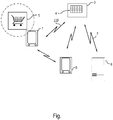
- a mobile communication terminal determining a trading location on the basis of its position data and outputting a stock to the user.
- the figure shows a mobile communication terminal 1, which is, for example, a smartphone with a GPS receiver for receiving GPS data.
- the communication terminal 1 can determine its current position by means of the GPS data.
- the communication terminal 1 also has components and functions for operating a mobile communication link 2.
- the communication terminal 1 can communicate with a central memory 3 via the mobile communication link 2 in order to exchange data D, in particular goods-related data.
- a household-related inventory 4 or corresponding data on goods are stored.
- the inventory 4 can in particular include their target values and / or actual values.
- the central memory 3 is located in particular in a cloud or in a network environment, which may also be referred to as a "computer cloud".
- Also shown in the vicinity of the mobile communication terminal 1 is a commercial location 5 (shop, drugstore, supermarket, etc.) as a household-relevant location that triggers an action.
- a software in particular a so-called 'app.' is installed in the mobile communication terminal 1.
- the app compares a current position of the mobile communication terminal 1 and compares this with available information about trading locations 5 located at or near the current position 5. If a distance between the mobile communication terminal 1 and the trading location 5 falls below a predetermined value (which is shown as a dash-dotted circle) , Several actions are triggered by the mobile communication terminal 1, namely an acoustic signal (for example a beep or a melody) is triggered and a message is displayed on the mobile communication terminal 1, which for example shows the type and name of the trading location 5 and possibly its direction and / or distance.
- an acoustic signal for example a beep or a melody
- the shopping list can generally be matched to the type of trading location 5, for example its range of goods, and may only display goods available at this trading location. The user of the communication terminal 1 is thus informed about both the possibility of shopping at the trading location 5 and about the inventory and thus about a specific purchase requirement.
- the user of the mobile communication terminal 1 purchases goods in the trading location 5, this can be communicated to the mobile communication terminal 1, e.g. by manual editing, by reading one on an invoice, etc. of the trading location 5 existing QR codes, by transmitting such information containing data message to the mobile communication terminal 1 etc.
- This or data derived therefrom can be transmitted by the mobile communication terminal 1 to the central memory 3, whereby the inventory 4 is updated.
- An update of the stock of goods 4 or of a need for goods can also be carried out by communication with a household appliance outlined by way of example, here: a refrigerator 6.
- a household appliance outlined by way of example, here: a refrigerator 6.
- the refrigerator 6 can recognize that a certain product, for example milk, has been removed and make a corresponding entry in the central store 3.
- a household appliance communication link 7 is used, for example, to transmit such data to goods.
- This can also be configured as a mobile communication link, but can also be configured, for example, as a wired or radio-based network and possibly with access to the central memory 3 via the Internet.
- the refrigerator 6, etc. may also communicate directly with the mobile communication terminal 1.
- a user may use a particular input device, for example on the mobile communication terminal 1, on a PC, etc., to manually enter, for example, that he has consumed a certain type of food or consumable in order to reduce the associated inventory 4 in the central memory 3 accordingly.
- a particular input device for example on the mobile communication terminal 1, on a PC, etc.
- the refrigerator 6 (or generally another household appliance) can be set to a predetermined operating state if at least one item is added to the inventory 4 for which the predetermined operating state is relevant.
- the refrigerator 6 or a part thereof e.g. a freezer compartment
- the activation of this cooling state may also be delayed as a function of a distance from the retail location 5 to the installation location of the refrigerator 6 if the path length is longer than the time required to provide the cooling state.
- a message is sent from the central memory 3 or the mobile communication terminal 1 to at least one selected other mobile communication terminal 8, which informs about the purchase or the procurement.
- the central memory 3 may also be located in a data processing device, e.g. in the mobile communication terminal 1, in a server, a PC, etc.
- a number can also include the specified number as well as a usual tolerance range, as long as this is not explicitly excluded.
Landscapes
- Business, Economics & Management (AREA)
- Accounting & Taxation (AREA)
- Finance (AREA)
- Development Economics (AREA)
- Economics (AREA)
- Marketing (AREA)
- Strategic Management (AREA)
- Physics & Mathematics (AREA)
- General Business, Economics & Management (AREA)
- General Physics & Mathematics (AREA)
- Engineering & Computer Science (AREA)
- Theoretical Computer Science (AREA)
- Management, Administration, Business Operations System, And Electronic Commerce (AREA)
Description
- Die Erfindung betrifft ein Verfahren zur Nutzung eines in einem zentralen Speicher gespeicherten haushaltsbezogenen Warenbestands. Die Erfindung betrifft ferner eine Vorrichtung zum Durchführen des Verfahrens. Die Erfindung betrifft auch ein zugehöriges Programmprodukt.
- Wenn ein Einkauf zu tätigen ist, ist hilfreich, den Warenbestand im Haushalt zu kennen, um alle fehlende Waren besorgen zu können. Andernfalls besteht Gefahr, dass Waren vergessen werden und ein erneuter Einkauf vorzunehmen ist. Daher wird oftmals eine Einkaufsliste mit einem Bedarf an Waren geschrieben.
- Es sind Kühlschränke bekannt, welche ihren Wareninhalt überwachen und Fehlbestände anzeigen können, z.B. mittels Abfrage von Speisebehältern durch eine RFID-Technologie. Allgemein bekannt ist, dass heutige mobile Kommunikationsendgeräte, welche teilweise auch als Smartphone bezeichnet werden, eine Fähigkeit zur Positionsbestimmung aufweisen. Die Positionsbestimmung kann beispielsweise durch GPS (GPS: Globales Positions-System) durchgeführt werden, falls das mobile Kommunikationsendgerät mit einem GPS-Empfänger ausgestattet ist, alternativ durch Triangulation mit Mobilfunk-Basisstationen. Die Positionsbestimmung kann beispielsweise zur Routenplanung verwendet werden, z.B. von einem Wohnort zu einem für einen Einkauf vorgesehenen Handelsort, oder für ortsabhängige Anzeige von Dienstleistungen, sog. 'Location Based Services'.
- Verwandte Verfahren sind auch bekannt aus
US 2010/0262554 A1 ,US 2012/0179547 A1 ,DE 10 2008 037 021 A1 ,DE 101 22 677 A1 ,US 2012/0278190 A1 undUS 2003/0043070 A1 . - Es ist die Aufgabe der vorliegenden Erfindung, die Nachteile des Standes der Technik zumindest teilweise zu überwinden und insbesondere einen möglichst zügigen und vollständigen Einkauf zu ermöglichen.
- Diese Aufgabe wird gemäß den Merkmalen der unabhängigen Ansprüche gelöst. Bevorzugte Ausführungsformen sind insbesondere den abhängigen Ansprüchen entnehmbar.
- Die Aufgabe wird gelöst durch ein Verfahren gemäß Anspruch 1.
- Dadurch ergibt sich der Vorteil, dass das mobile Kommunikationsendgerät dem Nutzer eigenständig ortsbezogene Information zum Warenbestand anzeigen kann. So wird dem Nutzer eine Durchführung eines Einkaufs erleichtert, beispielsweise für den Fall, dass er sich nicht bewusst ist, dass sich ein Handelsort in der Nähe befindet. Auch sind spontane Einkäufe einfacher durchführbar. Darüber hinaus mag ein für viele Nutzer aufwändiges, nutzerseitig aktives Abrufen und ggf. Aktualisieren eines Warenbestands (z.B. in Form einer auf dem mobilen Kommunikationsendgerät zuvor manuell eingegebenen und dort gespeicherten Einkaufsliste) entfallen.
- Unter einem 'haushaltsbezogenen Warenbestand' kann insbesondere ein Bestand von Waren verstanden werden, welche ein Nutzer in seinem Haushalt verwendet. Der haushaltsbezogene Warenbestand mag insbesondere ein haushaltsgerätebezogener Warenbestand sein. Der haushaltsgerätebezogene Warenbestand mag insbesondere Waren umfassen, die durch mindestens ein Haushaltsgerät verwaltet oder behandelt werden oder werden sollen (z.B. in einem Kühlschrank zu lagernde Lebensmittel oder andere lagernde, z.B. durch ein Gargerät oder Haushaltskleingerät wie eine Kaffeemaschine oder einen Toaster zu behandelnde, Lebensmittel) oder zum Betrieb eines Haushaltsgeräts benötigt werden (z.B. Spülmittel, Waschmittel, Weichspüler, Entkalker usw.).
- Das mobile Kommunikationsendgerät mag beispielsweise ein Mobiltelefon, Smartphone, Tablet-PC, 'E-Reader' usw. umfassen. Das automatische Ausführen umfasst ein selbstständiges Ausführen durch das mobile Kommunikationsendgerät.
- Die Positionsbestimmung wird auf grundsätzlich bekannte Weise durch das mobile Kommunikationsendgerät durchgeführt, z.B. mittels GPS oder Triangulation.
- Der für den Warenbestand bzw. zumindest einen Teil seiner Waren relevante Ort mag beispielsweise ein Handelsort sein, z.B. ein Supermarkt, eine Drogerie, ein Einkaufszentrum, ein Outlet-Center usw.
- Es ist eine Ausgestaltung, dass die Aktion ein Abrufen des gespeicherten Warenbestands aus dem zentralen Speicher umfasst. Dadurch kann dem Nutzer der Warenbestand auf besonders einfache Weise bereitgestellt werden. Das Abrufen aus dem zentralen Speicher ist vorteilhaft, da dem Nutzer über sein Kommunikationsendgerät stets ein aktueller Warenbestand bzw. Bedarf an Waren zur Verfügung steht. Der Warenbestand kann so auch von mehreren Nutzern bzw. mobilen Kommunikationsendgerät abgerufen werden. Das Abrufen kann mit einem einfachen Anzeigen des Warenbestands auf dem Kommunikationsendgerät und/oder mit einem Abspeichern in einem im Kommunikationsendgerät integrierten Speicher verbunden sein.
- Ein automatisches Abrufen des Warenbestands aus dem zentralen Speicher ist insbesondere vorteilhaft, wenn der Nutzer möglicherweise keine Kenntnis über einen aktualisierten Warenbedarf hat und zufällig an einem dafür geeigneten Handelsort ankommt oder vorbeigeht und bei Bedarf durch sein Kommunikationsendgerät insbesondere automatisch erinnert werden kann.
- Es ist noch eine Ausgestaltung, dass der Warenbestand automatisch durch das mobile Kommunikationsendgerät aus dem zentralen Speicher abgerufen wird. Befindet sich also das mobile Kommunikationsendgerät im Bereich eines für den Warenbestand relevanten Orts, wird automatisch der Warenbestand abgerufen und ggf. angezeigt. So werden eine Notwendigkeit, dass der Nutzer tätig werden muss, weiter verringert und eine Nutzerfreundlichkeit verbessert. Das Abrufen kann mit mindestens einem Hinweis, z.B. einem akustischen Hinweis, verbunden sein.
- Es ist zudem eine Ausgestaltung, dass die Aktion ein Ausgeben mindestens eines Hinweises umfasst, z.B. eines akustischen Signal, eines optischen Signals und/oder eines Texthinweises. Der Nutzer wird so an einen möglichen Warenbedarf bzw. Einkauf daran hingewiesen, wenn er sich dem relevanten Ort nähert oder einen solchen Ort betritt.
- Durch eine Ausgabe des mindestens einen Hinweises insbesondere zunächst ohne Abruf und/oder Anzeige des Warenbestands o.ä. bekommt ein Nutzer insbesondere die Gelegenheit, selbst zu entscheiden, ob er den Warenbestand aus dem zentralen Speicher abruft oder einen bereits aus dem zentralen Speicher abgerufenen, aber noch nicht angezeigten Warenbestand anzeigen lässt. Das folgende Abrufen kann insbesondere durch eine Bestätigungseingabe erfolgen. Diese Weiterbildung ist für das Kommunikationsendgerät insbesondere dann Ressourcen schonend, wenn der Warenbestand erst nach Bestätigung von dem zentralen Speicher auf das Kommunikationsendgerät übertragen wird. Es ist also eine Weiterbildung, dass das Abrufen des Warenbestands erst nach einer nutzerseitigen Bestätigung erfolgt.
- Das Verfahren mag beispielsweise als Anwendungsprogramm ("App") in dem mobilen Kommunikationsendgerät implementiert sein. Dann mag z.B. der Hinweis ein akustisches Signal und eine optische Hervorhebung eines Symbols für das Anwendungsprogramm umfassen, ggf. mit einem Zusatztext, welcher eine Identifizierung des relevanten orts zulässt. Mit Betätigen des Symbols durch den Nutzer (im Sinne einer Bestätigungeingabe) kann der Warenbestand angezeigt werden. Verlässt ein Nutzer den relevanten Ort, mag das Anwendungsprogramm automatisch wieder zurückgesetzt werden.
- Es ist auch eine Ausgestaltung, dass eine in dem zentralen Speicher gespeicherte Einkaufsliste abgerufen wird, also eine "Negativliste" fehlender Waren. Dazu mögen Sollwerte eines gewünschten Warenbestands verwendet werden. Alternativ oder zusätzlich mag auch der im Haushalt vorliegende Warenbestand (als Positivliste) angezeigt werden.
- Es ist ferner eine Ausgestaltung, dass mittels der in dem zentralen Speicher hinterlegten Waren eine Einkaufsliste gebildet wird. Das Bilden der Einkaufsliste kann insbesondere in dem zentralen Speicher oder in dem mobilen Kommunikationsendgerät durchgeführt werden, z.B. mit den durch einen Nutzer vorgegebenen Sollwerten.
- Durch die oben beschriebenen Methoden erhält der Nutzer in der Nähe, beim Erreichen oder beim Betreten des für den Warenbestand relevanten Orts eine Übersicht über seinen aktuellen Warenbestand und/oder seinen momentanen Warenbedarf. Der Nutzer kann also auf, ggf. verschiedene, Weise von dem mobilen Kommunikationsgerät abfragen, insbesondere ablesen, ob und gegebenenfalls welche haushaltsbezogenen Waren dort zu kaufen sind, um seinen momentanen Warenbedarf zumindest teilweise zu decken. Insbesondere braucht kein Einkaufszettel im Vorfeld vor einem Einkauf geschrieben und mitgeführt zu werden.
- Es ist eine Weiterbildung, dass mittels eines Bestandsmanagementsystems festgelegt wird oder ist, welche Warenmengen insbesondere zu Hause stets verfügbar sein sollen (Sollwerte). Wird eine bestimmte Warenmenge unterschritten, wird im zentralen Speicher zu der entsprechenden Ware bzw. deren Daten automatisch ein Hinweis auf ein Unterschreiten des zugehörigen Sollwerts hinzugefügt. Bei Vorliegen eines solchen Unterschreitens kann einem Nutzer die zugehörige Ware speziell angezeigt werden und/oder diese Ware automatisch zu einer Einkaufliste hinzugefügt oder als hinzuzufügen markiert werden. Auch ist es eine Weiterbildung, dass durch das Kommunikationsendgerät ein Abgleich zwischen dem Warenbestand im Haushalt als Ist-Situation und der fehlenden Produkte als Soll-Situation durchgeführt wird, wenn der Nutzer z.B. einen Supermarkt als für seinen Warenbedarf geeigneten Handelsort betritt. Ein solches Bestandsmanagementsystem kann im zentralen Speicher zu einzelnen Waren aber auch direkt eine Angabe über einen jeweils konkreten Warenbedarf bereitstellen.
- Auch ist es eine Ausgestaltung, dass durch das Kommunikationsendgerät an dem relevanten Ort erworbene Ware erfasst wird und mit dem Warenbestand des zentralen Speichers abgeglichen wird. Dadurch kann der Warenbestand in dem zentralen Speicher aktualisiert werden, insbesondere praktisch in Echtzeit. In einer Weiterbildung kann dann auch der auf dem mobilen Kommunikationsendgerät angezeigte Warenbestand (als Positivliste oder Einkaufsliste usw.) automatisch angepasst bzw. aktualisiert werden. So können beispielsweise Doppelkäufe vermieden werden.
- Es ist eine Weiterbildung, dass das Erfassen händisch durch den Nutzer erfolgt, z.B. durch Austragen oder Ändern von Waren aus der Einkaufsliste.
- Es ist eine besonders nutzerfreundliche Weiterbildung, dass das Erfassen ein elektronisches oder datentechnisches Erfassen ist, also nicht oder nicht ausschließlich händisch erfolgt, sondern zumindest teilweise durch automatisierte Datenerfassung.
- So kann das Erfassen ein Ablesen einer Marke ("Tag") durch das mobile Kommunikationsendgerät umfassen, insbesondere einer sog. QR-Marke. Die QR-Marke kann beispielsweise auf einem Einkaufszettel aufgedruckt sein und insbesondere die Zahl und Art der erworbenen Waren und ggf. andere Daten, wie ein Gewicht, ein Haltbarkeitsdatum usw. in kodierter Form aufweisen. Der QR-Code mag beispielsweise durch das Kommunikationsendgerät abgelesen werden, z.B. mittels einer integrierten Kamera.
- Alternativ mag das Erfassen ein Empfangen einer drahtlos übermittelten Datennachricht umfassen, welche insbesondere die Zahl und Art der erworbenen Waren und ggf. andere Daten, wie ein Gewicht, ein Haltbarkeitsdatum usw. durch das Kommunikationsendgerät umfasst. Die Datennachricht mag beispielsweise von einer Kasse des Handelsorts erzeugt werden.
- Noch eine Ausgestaltung ist, dass die Aktion ein Versenden einer Nachricht an mindestens ein ausgewähltes anderes mobiles Kommunikationsendgerät umfasst. Dadurch kann eine andere Person des Haushalts, welcher das andere mobile Kommunikationsendgerät gehört, über das Betreten, des Handelsorts einen dortigen Einkauf / Erwerb und/oder eine andere Änderung des Warenbestands informiert werden. So können z.B. Doppelkäufe vermieden werden. Die so informierte andere Person kann sogar einen im zentralen Speicher bislang nicht erfassten Warenbedarf zeitnah (z.B. vor einem Bezahlen) aktualisieren oder direkt von Kommunikationsendgerät zu Kommunikationsendgerät eine Zusatzbestellung an die einkaufende Person abgeben.
- Es ist erfindungsgemäß, dass mindestens ein Kühlgerät automatisch in einen vorbestimmten Betriebszustand gesetzt wird (wenn es sich nicht schon darin befindet), falls mindestens eine Ware dem Warenbestand hinzugefügt wird, für die der vorbestimmte Betriebszustand relevant ist. Der vorbestimmte Betriebszustand ist dabei ein Superkühl- oder Schnellgefriermodus. Beispielsweise kann auf Grundlage bestimmter Einkäufe wie Gefrier- oder Kühlgut, z.B. frischem Hackfleisch, ein Gefrierschrank in einen Einfrierzustand mit sehr niedriger Temperatur eingestellt werden, um eine sachgerechte Lagerung zu erleichtern. Ein vorteilhafter Einsatz ist insbesondere möglich in Verbindung mit einem Bestandsmanagement über Daten aus elektronisch erfassten Einkaufsvorgängen, z.B. wie oben beschrieben, welches erweitert wird um die Nutzung von Positionsdaten im Smartphone zur Interaktion mit insbesondere entfernt aufgestellten Hausgeräten.
- Erfindungsgemäß wird das Versetzen des Kühlgeräts in den vorbestimmten Betriebszustand abhängig, insbesondere dessen Beginn, von einer Wegstrecke bzw. Wegdauer vom relevanten Ort bzw. Handelsort, an welchem die Ware erworben wurde, zum Aufstellort des Kühlgeräts durchgeführt. Beispielsweise kann abhängig von der Wegdauer ein früheres oder späteres Aktivieren des gewünschten vorbestimmten Betriebszustands des Kühlgeräts geschaltet werden. So mag z.B. bei einem langen Weg ein Gefrierschrank oder Kühlschrank erst gezielt kurz vor dem Eintreffen heruntergekühlt werden. Die Wegstrecke oder Wegdauer kann beispielsweise durch eine auf dem mobilen Kommunikationsendgerät installierte Routenplanung oder Navigationssoftware bestimmt werden. Wie beschrieben, geht erfindungsgemäß das Kühlgerät automatisch in einen Superkühl- oder SchnellGefriermodus über.
- Eine andere Ausgestaltung ist, dass sich der zentrale Speicher in einer sog. "Cloud" befindet, also als ein Cloud-Speicher oder Netzspeicher vorliegt. Auf den Netzspeicher kann typischerweise von jedem mit dem Netz(werk) verbindbaren, autorisierten Gerät aus zugegriffen werden. So ist über geeignete Kommunikationsverbindungen ein Zugriff auf den zentralen Speicher von verschiedensten Orten, auch gleichzeitig, möglich. Die Cloud kann dabei beispielsweise durch ein lokales Netz am Wohnort oder Arbeitsort des Nutzers ausgebildet sein, auf welches der Nutzer mit seinem Kommunikationsendgerät über beispielsweise ein Mobilfunknetz zugreifen kann. Besonders vorteilhaft ist eine Weiterbildung, bei der die Cloud über ein Netzwerk wie das Internet zugreifbar ist oder Bestandteil eines solchen Netzwerkes ist. Dadurch können bestehende Ressourcen ausgenutzt werden und der Nutzer kann mit geringen eigenen Kosten- und Geräteaufwand den haushaltsbezogenem Warenbestand im zentralen Speicher pflegen. Alternativ mag der zentrale Speicher an einem bestimmten Gerät verortet sein, z.B. in dem mobilen Kommunikationsendgerät, einem Server, einem PC usw.
- Die Aufgabe wird gemäß Anspruch 9 auch gelöst durch eine Vorrichtung oder System, welche zum Durchführen eines solchen Verfahrens ausgebildet ist. Die Vorrichtung weist die gleichen Vorteile auf wie das Verfahren und kann analog ausgebildet werden. Umgesetzt wird dabei insbesondere die Nutzung von Positionsdaten im Kommunikationsendgerät zur Bestimmung eines für den Warenbestand relevanten Orts.
- Eine Ausgestaltung davon ist, dass die Vorrichtung ein Kühlgerät umfasst, welches ausgebildet ist zumindest zum Empfangen von Daten zu Waren des Warenbestands über eine Haushaltsgeräte-Kommunikationsverbindung zumindest von dem zentralen Speicher, wobei eine Funktion des Kühlgeräts abhängig von den Daten ansteuerbar ist. Das Austauschen kann ein Empfangen von Daten von dem zentralen Speicher und/oder dem mobilen Kommunikationsendgerät, aber auch eine bidirektionale Datenübertragung mit dem zentralen Speicher und/oder dem mobilen Kommunikationsendgerät, umfassen.
- Gemäß einer weiteren Weiterbildung ist vorgesehen, dass von dem Kühlgerät (z.B. einem Kühlschrank) eine Warenanforderung an den zentralen Speicher gesendet wird bzw. dessen Warenbestand entsprechend aktualisiert wird. Dadurch wird an das Kommunikationsendgerät ein entsprechender Bedarf an dieser für das Kühlgerät erforderlichen Ware übermittelt. Beispielsweise können weiterhin eine Spülmaschine, Waschmaschine oder Kaffeemaschine als andere beispielhafte Haushaltsgeräte feststellen, dass ein Entkalken in erforderlich ist und als Ware einen Entkalker anfordern.
- Auch ist es eine Ausgestaltung, dass die Vorrichtung ein mobiles Kommunikationsendgerät - insbesondere ein Smartphone - umfasst, das ausgestattet ist mit einer Software zum Durchführen solcher Verfahren.
- Eine Ausgestaltung besteht in einem System aus einem derartigen zentralen Speicher, in dem der haushaltsbezogene Warenbestand abspeicherbar ist und/oder mindestens einem zur Durchführung des Verfahrens eingerichteten mobilen Kommunikationsendgerät. Ein solches System kann auch ein ansteuerbares Kühlgerät umfassen.
- Die Aufgabe wird auch gelöst durch ein Programmprodukt gemäß Anspruch 12. Eine Ausgestaltung besteht in dem Programmprodukt als Software, welche auch als sogenannte 'App' angeboten sein kann, wobei das Programmprodukt im Kommunikationsendgerät, im Kühlgerät oder in einer netzwerkbasierten Vorrichtung zum Durchführen solcher Verfahren installiert oder installierbar ist.
- Software, insbesondere eine auch als "App" genannte Anwendungssoftware, kann dazu auf einem Datenträger bereitgestellt oder von einem entfernten Datenträger über eine Kommunikationsverbindung heruntergeladen werden, um in einen Gerätespeicher übertragen und zum Anwenden in einen Prozessor des Geräts geladen zu werden.
- In der Figur wird die Erfindung anhand eines Ausführungsbeispiels schematisch genauer beschrieben, wobei ein mobiles Kommunikationsendgerät anhand seiner Positionsdaten einen Handelsort ermittelt und dem Nutzer einen Warenbestand ausgibt.
- Die Fig. zeigt ein mobiles Kommunikationsendgerät 1, welches beispielsweise ein Smartphone mit einem GPS-Empfänger zum Empfang von GPS-Daten ist. Mittels der GPS-Daten kann das Kommunikationsendgerät 1 seine momentane Position bestimmen. Das Kommunikationsendgerät 1 weist ferner Komponenten und Funktionen zum Betreiben einer Mobil-Kommunikationsverbindung 2. Über die Mobil-Kommunikationsverbindung 2 kann das Kommunikationsendgerät 1 mit einem zentralen Speicher 3 kommunizieren, um auf insbesondere warenbezogene Daten D auszutauschen. In dem zentralen Speicher 3 sind ein haushaltsbezogener Warenbestand 4 bzw. entsprechende Daten zu Waren gespeichert. Der Warenbestand 4 kann neben Bezeichnungen einzelner Waren insbesondere deren Sollwerte und/oder Istwerte umfassen. Der zentrale Speicher 3 befindet sich insbesondere in einer Cloud bzw. in einer Netzumgebung, welche gegebenenfalls auch als "Rechnerwolke" bezeichnet werden kann. Dargestellt ist in der Nähe des mobilen Kommunikationsendgeräts 1 außerdem ein Handelsort 5 (Geschäft, Drogerie, Supermarkt usw.) als ein haushaltsrelevanter, eine Aktion auslösender Ort.
- Eine Software, insbesondere eine sog. 'App.' ist in dem mobilen Kommunikationsendgerät 1 installiert. Die App vergleicht eine momentane Position des mobilen Kommunikationsendgeräts 1 und vergleicht diese mit verfügbaren Informationen über an oder nahe der momentanen Position befindlichen Handelsorten 5. Unterschreitet eine Entfernung zwischen dem mobilen Kommunikationsendgerät 1 und dem Handelsort 5 einen vorbestimmten Wert (welcher als gestrichpunkteter Kreis eingezeichnet ist), werden durch das mobilen Kommunikationsendgerät 1 mehrere Aktionen ausgelöst, nämlich hier ein akustisches Signal (z.B. ein Piepton oder eine Melodie) ausgelöst und auf dem mobilen Kommunikationsendgerät 1 eine Nachricht dargestellt, welche z.B. die Art und den Namen des Handelsorts 5 und ggf. seine Richtung und/oder Entfernung anzeigt. Betätigt ein Nutzer eine Schaltfläche des mobilen Kommunikationsendgeräts 1 zur Bestätigung (Bestätigungseingabe), wird aus dem zentralen Speicher 3 der haushaltsbezogene Warenbestand 4 abgerufen, bevorzugt in Form oder mit einer Einkaufsliste. Die Einkaufsliste kann allgemein auf die Art des Handelsorts 5 abgestimmt sein, z.B. auf dessen Warenangebot, und mag nur an diesem Handelsort verfügbare Waren anzeigen. Der Nutzer des Kommunikationsendgeräts 1 ist somit über sowohl die Einkaufsmöglichkeit am Handelsort 5 als auch über den Warenbestand und somit über einen konkreten Einkaufsbedarf informiert.
- Erwirbt der Nutzer des mobilen Kommunikationsendgeräts 1 in dem Handelsort 5 Waren, kann dies dem mobilen Kommunikationsendgerät 1 mitgeteilt werden, z.B. durch manuelles Editieren, durch Auslesen eines auf einer Rechnung o.ä. des Handelsorts 5 vorhandenen QR-Codes, durch Übermitteln einer solche Information enthaltenen Datennachricht an das mobile Kommunikationsendgerät 1 usw.. Diese oder daraus abgeleitete Daten können durch das mobile Kommunikationsendgerät 1 an den zentralen Speicher 3 übermittelt werden, wodurch der Warenbestand 4 aktualisiert wird.
- Eine Aktualisierung des Warenbestands 4 bzw. eines Warenbedarfs kann auch durch eine Kommunikation mit einem beispielhaft skizzierten Haushaltsgeräts, hier: eines Kühlschranks 6, durchgeführt werden. Beispielsweise kann der Kühlschrank 6 erkennen, dass eine bestimmte Ware, beispielsweise Milch, entnommen wurde und einen entsprechenden Eintrag im zentralen Speicher 3 vornehmen. Zur Übertragung solcher Daten zu Waren dient beispielsweise eine Haushaltsgeräte-Kommunikationsverbindung 7. Diese kann ebenfalls als eine Mobil-Kommunikationsverbindung ausgestaltet sein, kann aber beispielsweise auch als verkabeltes oder funkgestütztes Netzwerk und gegebenenfalls mit Zugriff über das Internet auf den zentralen Speicher 3 ausgestaltet sein. Jedoch mag der Kühlschrank 6 usw. auch direkt mit dem mobilen Kommunikationsendgerät 1 kommunizieren.
- Zusätzlich mag ein Nutzer über eine insbesondere Eingabeeinrichtung, z.B. an dem mobilen Kommunikationsendgerät 1, an einem PC usw., zum Beispiel manuell eingeben, dass er ein bestimmtes Lebensmittel oder Gebrauchsmittel verbraucht hat, um den zugehörigen Warenbestand 4 im zentralen Speicher 3 entsprechend zu reduzieren.
- Insbesondere kann der Kühlschrank 6 (oder allgemein ein anderes Haushaltsgerät) in einen vorbestimmten Betriebszustand gesetzt werden, falls mindestens eine Ware dem Warenbestands 4 hinzugefügt wird, für die der vorbestimmte Betriebszustand relevant ist. So mag der Kühlschrank 6 oder ein Teil davon (z.B. ein Gefrierfach) in einen vorbestimmten Kühlzustand versetzt werden, wenn eine Ware in den Warenbestand 4 aufgenommen wird, für welche dieser Kühlzustand vorteilhaft ist. Die Aktivierung dieses Kühlzustands mag auch abhängig von einer Wegstrecke vom Handelsort 5 zum Aufstellort des Kühlschranks 6 verzögert werden, falls die Wegdauer länger ist als die Dauer, welche zur Bereitstellung des Kühlzustands benötigt wird.
- Es ist noch eine Weiterbildung, dass, z.B. von dem zentralen Speicher 3 oder dem mobile Kommunikationsendgerät 1 eine Nachricht an mindestens ein ausgewähltes anderes mobiles Kommunikationsendgerät 8 gesendet wird, welches über den Einkauf bzw. die Besorgung informiert.
- Obwohl die Erfindung im Detail durch das gezeigte Ausführungsbeispiel näher illustriert und beschrieben wurde, so ist die Erfindung nicht darauf eingeschränkt und andere Variationen können vom Fachmann hieraus abgeleitet werden, ohne den Schutzumfang der Erfindung zu verlassen.
- So mag der zentrale Speicher3 auch in einem Datenverarbeitungsgerät verortet sein, z.B. in dem mobilen Kommunikationsendgerät 1, in einem Server, einem PC, usw.
- Allgemein kann unter "ein", "eine" usw. eine Einzahl oder eine Mehrzahl verstanden werden, insbesondere im Sinne von "mindestens ein" oder "ein oder mehrere" usw., solange dies nicht explizit ausgeschlossen ist, z.B. durch den Ausdruck "genau ein" usw.
- Auch kann eine Zahlenangabe genau die angegebene Zahl als auch einen üblichen Toleranzbereich umfassen, solange dies nicht explizit ausgeschlossen ist.
-
- 1
- mobiles Kommunikationsendgerät
- 2
- Mobil-Kommunikationsverbindung
- 3
- zentraler Speicher
- 4
- haushaltsbezogenem Warenbestand
- 5
- Handelsort
- 6
- Haushaltsgerät oder Speicher-Eingabeeinrichtung
- 7
- Haushaltsgeräte-Kommunikationsverbindung
- 8
- weiteres mobiles Kommunikationsendgerät
- D
- Daten zu Waren eines Warenbestands
Claims (12)
- Verfahren zur Nutzung eines in einem zentralen Speicher (3) gespeicherten haushaltsbezogenen Warenbestands (4), wobei das Verfahren mindestens folgende Schritte aufweist:- Bestimmen einer Position eines mobilen Kommunikationsendgeräts (1) und- automatisches Ausführen mindestens einer Aktion durch das mobile Kommunikations-endgerät (1), falls durch das Bestimmen der Position festgestellt wurde, dass sich das mobile Kommunikationsendgerät (1) im Bereich eines für den Warenbestand (4) relevanten Orts (5) befindet,dadurch gekennzeichnet, dass
mindestens ein Kühlgerät (6) abhängig von einer Wegstrecke vom relevanten Ort (5) zum Aufstellort des Kühlgeräts (6) automatisch in einen Superkühl- oder Schnellgefriermodus versetzt wird, falls mindestens ein Gefriergut dem gespeicherten haushaltsbezogenen Warenbestand (4) hinzugefügt wird. - Verfahren nach Anspruch 1, dadurch gekennzeichnet, dass die Aktion ein Abrufen des gespeicherten haushaltsbezogenen Warenbestands (4) aus dem zentralen Speicher (3) umfasst.
- Verfahren nach einem der vorhergehenden Ansprüche, dadurch gekennzeichnet, dass der gespeicherte haushaltsbezogene Warenbestand (4) automatisch durch das mobile Kommunikationsendge-rät (1) aus dem zentralen Speicher (3) abgerufen wird.
- Verfahren nach einem der vorhergehenden Ansprüche, dadurch gekennzeichnet, dass die Aktion ein Ausgeben mindestens eines Hinweises umfasst.
- Verfahren nach einem der vorherigen Ansprüche, dadurch gekennzeichnet, dass- eine in dem zentralen Speicher (3) gespeicherte Einkaufsliste abgerufen wird oder- mittels des in dem zentralen Speicher (3) gespeicherten haushaltsbezogenen Warenbestands (4) eine Einkaufsliste gebildet wird.
- Verfahren nach einem der vorherigen Ansprüche, dadurch gekennzeichnet, dass durch das mobile Kommunikationsendgerät (1) an dem relevanten Ort (5) eine durch den Nutzer erworbene Ware erfasst wird und mit dem gespeicherten haushaltsbezogenen Warenbestand (4) abgeglichen wird.
- Verfahren nach einem der vorherigen Ansprüche, dadurch gekennzeichnet, dass die mindestens eine Aktion ein Versenden einer Nachricht an mindestens ein ausgewähltes anderes mobiles Kommunikationsendgerät (8) umfasst.
- Verfahren nach einem der vorherigen Ansprüche, dadurch gekennzeichnet, dass sich der zentrale Speicher (3) in einer Cloud (18) befindet.
- Vorrichtung (1, 3, 6), dadurch gekennzeichnet, dass die Vorrichtung zum Durchführen eines Verfahrens nach einem der vorherigen Ansprüche ausgebildet ist.
- Vorrichtung (1, 3, 6) nach Anspruch 9, dadurch gekennzeichnet, dass die Vorrichtung (1, 3, 6) das Kühlgerät (6) umfasst, welches ausgebildet ist zumindest zum Empfangen von Daten (D) zu Waren des gespeicherten haushaltsbezogenen Warenbestands (4) über eine Haushaltsgeräte-Kommunikationsverbindung (7) zumindest von dem zentralen Speicher (3), wobei das Kühlgerät ausgebildet ist, eine Funktion des Kühlgeräts (6) abhängig von den Daten (D) anzusteuern.
- Vorrichtung (1, 3, 6) nach Anspruch 9, dadurch gekennzeichnet, dass die Vorrichtung (1, 3, 6) das mobile Kommunikationsendgerät (1) umfasst, das ausgestattet ist mit einer Software zum Durchführen des Verfahrens nach einem der Ansprüche 1 bis 8.
- Programmprodukt, insbesondere Software, zum Durchführen des Verfahrens nach einem der Ansprüche 1 bis 8.
Applications Claiming Priority (2)
| Application Number | Priority Date | Filing Date | Title |
|---|---|---|---|
| DE102012222703.2A DE102012222703A1 (de) | 2012-12-11 | 2012-12-11 | Nutzung eines in einem zentralen Speicher gespeicherten Warenbestands |
| PCT/EP2013/075770 WO2014090695A1 (de) | 2012-12-11 | 2013-12-06 | Nutzung eines in einem zentralen speicher gespeicherten warenbestands |
Publications (2)
| Publication Number | Publication Date |
|---|---|
| EP2932739A1 EP2932739A1 (de) | 2015-10-21 |
| EP2932739B1 true EP2932739B1 (de) | 2020-04-15 |
Family
ID=49886881
Family Applications (1)
| Application Number | Title | Priority Date | Filing Date |
|---|---|---|---|
| EP13814856.4A Active EP2932739B1 (de) | 2012-12-11 | 2013-12-06 | Nutzung eines in einem zentralen speicher gespeicherten warenbestands |
Country Status (3)
| Country | Link |
|---|---|
| EP (1) | EP2932739B1 (de) |
| DE (1) | DE102012222703A1 (de) |
| WO (1) | WO2014090695A1 (de) |
Families Citing this family (3)
| Publication number | Priority date | Publication date | Assignee | Title |
|---|---|---|---|---|
| DE102016110145A1 (de) | 2016-06-01 | 2017-12-07 | Adolf Würth GmbH & Co. KG | Warenbestandsverwaltungssystem |
| DE102023106158A1 (de) | 2023-02-17 | 2024-08-22 | Liebherr-Hausgeräte Ochsenhausen GmbH | Kühl- und/oder Gefriergerät |
| EP4417914A1 (de) * | 2023-02-17 | 2024-08-21 | Liebherr-Hausgeräte Ochsenhausen GmbH | Kühl- und/oder gefriergerät |
Citations (1)
| Publication number | Priority date | Publication date | Assignee | Title |
|---|---|---|---|---|
| US20030043070A1 (en) * | 2001-08-30 | 2003-03-06 | Soliman Samir S. | Wireless coordination and management system |
Family Cites Families (5)
| Publication number | Priority date | Publication date | Assignee | Title |
|---|---|---|---|---|
| DE10144677A1 (de) * | 2001-09-11 | 2003-04-03 | Siemens Ag | Vorrichtung und Verfahren zur Ausgabe von Informationen |
| DE102008037021A1 (de) * | 2008-08-08 | 2010-02-11 | Siemens Aktiengesellschaft | Benachrichtigungssystem und -verfahren |
| US8412590B2 (en) * | 2009-04-13 | 2013-04-02 | Nintendo Co., Ltd. | In-store wireless shopping network using hand-held devices |
| US8798804B2 (en) * | 2011-01-06 | 2014-08-05 | General Electric Company | Added features of HEM/HEG using GPS technology |
| US9208520B2 (en) * | 2011-04-28 | 2015-12-08 | International Business Machines Corporation | Shelf life expiration date management |
-
2012
- 2012-12-11 DE DE102012222703.2A patent/DE102012222703A1/de not_active Withdrawn
-
2013
- 2013-12-06 WO PCT/EP2013/075770 patent/WO2014090695A1/de not_active Ceased
- 2013-12-06 EP EP13814856.4A patent/EP2932739B1/de active Active
Patent Citations (1)
| Publication number | Priority date | Publication date | Assignee | Title |
|---|---|---|---|---|
| US20030043070A1 (en) * | 2001-08-30 | 2003-03-06 | Soliman Samir S. | Wireless coordination and management system |
Also Published As
| Publication number | Publication date |
|---|---|
| DE102012222703A1 (de) | 2014-06-12 |
| EP2932739A1 (de) | 2015-10-21 |
| WO2014090695A1 (de) | 2014-06-19 |
Similar Documents
| Publication | Publication Date | Title |
|---|---|---|
| US12008631B2 (en) | In-store item alert architecture | |
| JP5163643B2 (ja) | 農作業管理システム、農作業管理装置及び農作業管理方法 | |
| DE60214991T2 (de) | Maschinenlesbares etikettensystem mit offline-erfassung und -verarbeitung | |
| EP2932739B1 (de) | Nutzung eines in einem zentralen speicher gespeicherten warenbestands | |
| WO2017207241A1 (de) | Verfahren und vorrichtung zur inhaltserfassung eines lagerraums | |
| US10659926B1 (en) | Sensor platform for geometric physical area | |
| WO2019175443A1 (de) | Computerimplementiertes verfahren zum erzeugen einer vorschlagsliste und anlage zum erzeugen einer bestellliste | |
| Jabraeil Jamali et al. | Some cases of smart use of the IoT | |
| KR101707979B1 (ko) | 근거리 무선 통신 장치를 이용한 통합 플랫폼 시스템 | |
| CN106657342B (zh) | 农产品溯源方法、移动终端和服务器 | |
| JP2022140656A (ja) | 情報提供システム、情報処理装置、情報提供方法、及び情報提供プログラム | |
| WO2018153860A1 (de) | System und verfahren zum kommissionieren und einkaufen von waren | |
| WO2013029964A1 (de) | Verfahren zum betrieb zumindest eines verpflegungsautomaten | |
| DE102012101655A1 (de) | Verkaufsautomat mit Fernwartungsfunktion | |
| DE102016116367A1 (de) | Verfahren zur Objekterfassung | |
| CN111105298B (zh) | 一种基于物联网智能场景的购买推荐方法及系统 | |
| WO2002015644A1 (de) | Gerät zum abwickeln einzelner vorgänge | |
| JP5840097B2 (ja) | 農作業管理装置、農作業管理方法及びコンピュータプログラム | |
| WO2018153854A1 (de) | Warenautomat und verfahren zur ausgabe von waren | |
| DE102013100616A1 (de) | Haushaltsgerät und Verfahren zum automatischen Erhalt von Geräteinformationen zu einem Haushaltsgerät | |
| Vasanth et al. | Blockchain‐based smart agriculture with the internet of things: A revolutionary approach in agriculture and food supply chain | |
| CN111028063A (zh) | 跳蚤市场在线交易管理方法和系统 | |
| DE102018205843A1 (de) | Haushalts-Kühlgerät mit Identifizierungseinrichtung für Transponder | |
| DE102018116061A1 (de) | Bestellsystem zur Warenbestellung | |
| JP2021026520A (ja) | サーバ |
Legal Events
| Date | Code | Title | Description |
|---|---|---|---|
| PUAI | Public reference made under article 153(3) epc to a published international application that has entered the european phase |
Free format text: ORIGINAL CODE: 0009012 |
|
| 17P | Request for examination filed |
Effective date: 20150713 |
|
| AK | Designated contracting states |
Kind code of ref document: A1 Designated state(s): AL AT BE BG CH CY CZ DE DK EE ES FI FR GB GR HR HU IE IS IT LI LT LU LV MC MK MT NL NO PL PT RO RS SE SI SK SM TR |
|
| AX | Request for extension of the european patent |
Extension state: BA ME |
|
| DAX | Request for extension of the european patent (deleted) | ||
| STAA | Information on the status of an ep patent application or granted ep patent |
Free format text: STATUS: EXAMINATION IS IN PROGRESS |
|
| 17Q | First examination report despatched |
Effective date: 20180703 |
|
| GRAP | Despatch of communication of intention to grant a patent |
Free format text: ORIGINAL CODE: EPIDOSNIGR1 |
|
| STAA | Information on the status of an ep patent application or granted ep patent |
Free format text: STATUS: GRANT OF PATENT IS INTENDED |
|
| INTG | Intention to grant announced |
Effective date: 20191209 |
|
| GRAS | Grant fee paid |
Free format text: ORIGINAL CODE: EPIDOSNIGR3 |
|
| GRAA | (expected) grant |
Free format text: ORIGINAL CODE: 0009210 |
|
| STAA | Information on the status of an ep patent application or granted ep patent |
Free format text: STATUS: THE PATENT HAS BEEN GRANTED |
|
| AK | Designated contracting states |
Kind code of ref document: B1 Designated state(s): AL AT BE BG CH CY CZ DE DK EE ES FI FR GB GR HR HU IE IS IT LI LT LU LV MC MK MT NL NO PL PT RO RS SE SI SK SM TR |
|
| REG | Reference to a national code |
Ref country code: CH Ref legal event code: EP |
|
| REG | Reference to a national code |
Ref country code: DE Ref legal event code: R096 Ref document number: 502013014597 Country of ref document: DE |
|
| REG | Reference to a national code |
Ref country code: IE Ref legal event code: FG4D Free format text: LANGUAGE OF EP DOCUMENT: GERMAN |
|
| REG | Reference to a national code |
Ref country code: AT Ref legal event code: REF Ref document number: 1258710 Country of ref document: AT Kind code of ref document: T Effective date: 20200515 |
|
| REG | Reference to a national code |
Ref country code: NL Ref legal event code: MP Effective date: 20200415 |
|
| REG | Reference to a national code |
Ref country code: LT Ref legal event code: MG4D |
|
| PG25 | Lapsed in a contracting state [announced via postgrant information from national office to epo] |
Ref country code: FI Free format text: LAPSE BECAUSE OF FAILURE TO SUBMIT A TRANSLATION OF THE DESCRIPTION OR TO PAY THE FEE WITHIN THE PRESCRIBED TIME-LIMIT Effective date: 20200415 Ref country code: IS Free format text: LAPSE BECAUSE OF FAILURE TO SUBMIT A TRANSLATION OF THE DESCRIPTION OR TO PAY THE FEE WITHIN THE PRESCRIBED TIME-LIMIT Effective date: 20200815 Ref country code: NO Free format text: LAPSE BECAUSE OF FAILURE TO SUBMIT A TRANSLATION OF THE DESCRIPTION OR TO PAY THE FEE WITHIN THE PRESCRIBED TIME-LIMIT Effective date: 20200715 Ref country code: GR Free format text: LAPSE BECAUSE OF FAILURE TO SUBMIT A TRANSLATION OF THE DESCRIPTION OR TO PAY THE FEE WITHIN THE PRESCRIBED TIME-LIMIT Effective date: 20200716 Ref country code: SE Free format text: LAPSE BECAUSE OF FAILURE TO SUBMIT A TRANSLATION OF THE DESCRIPTION OR TO PAY THE FEE WITHIN THE PRESCRIBED TIME-LIMIT Effective date: 20200415 Ref country code: PT Free format text: LAPSE BECAUSE OF FAILURE TO SUBMIT A TRANSLATION OF THE DESCRIPTION OR TO PAY THE FEE WITHIN THE PRESCRIBED TIME-LIMIT Effective date: 20200817 Ref country code: LT Free format text: LAPSE BECAUSE OF FAILURE TO SUBMIT A TRANSLATION OF THE DESCRIPTION OR TO PAY THE FEE WITHIN THE PRESCRIBED TIME-LIMIT Effective date: 20200415 Ref country code: NL Free format text: LAPSE BECAUSE OF FAILURE TO SUBMIT A TRANSLATION OF THE DESCRIPTION OR TO PAY THE FEE WITHIN THE PRESCRIBED TIME-LIMIT Effective date: 20200415 |
|
| PG25 | Lapsed in a contracting state [announced via postgrant information from national office to epo] |
Ref country code: BG Free format text: LAPSE BECAUSE OF FAILURE TO SUBMIT A TRANSLATION OF THE DESCRIPTION OR TO PAY THE FEE WITHIN THE PRESCRIBED TIME-LIMIT Effective date: 20200715 Ref country code: RS Free format text: LAPSE BECAUSE OF FAILURE TO SUBMIT A TRANSLATION OF THE DESCRIPTION OR TO PAY THE FEE WITHIN THE PRESCRIBED TIME-LIMIT Effective date: 20200415 Ref country code: HR Free format text: LAPSE BECAUSE OF FAILURE TO SUBMIT A TRANSLATION OF THE DESCRIPTION OR TO PAY THE FEE WITHIN THE PRESCRIBED TIME-LIMIT Effective date: 20200415 Ref country code: LV Free format text: LAPSE BECAUSE OF FAILURE TO SUBMIT A TRANSLATION OF THE DESCRIPTION OR TO PAY THE FEE WITHIN THE PRESCRIBED TIME-LIMIT Effective date: 20200415 |
|
| PG25 | Lapsed in a contracting state [announced via postgrant information from national office to epo] |
Ref country code: AL Free format text: LAPSE BECAUSE OF FAILURE TO SUBMIT A TRANSLATION OF THE DESCRIPTION OR TO PAY THE FEE WITHIN THE PRESCRIBED TIME-LIMIT Effective date: 20200415 |
|
| REG | Reference to a national code |
Ref country code: DE Ref legal event code: R097 Ref document number: 502013014597 Country of ref document: DE |
|
| PG25 | Lapsed in a contracting state [announced via postgrant information from national office to epo] |
Ref country code: SM Free format text: LAPSE BECAUSE OF FAILURE TO SUBMIT A TRANSLATION OF THE DESCRIPTION OR TO PAY THE FEE WITHIN THE PRESCRIBED TIME-LIMIT Effective date: 20200415 Ref country code: IT Free format text: LAPSE BECAUSE OF FAILURE TO SUBMIT A TRANSLATION OF THE DESCRIPTION OR TO PAY THE FEE WITHIN THE PRESCRIBED TIME-LIMIT Effective date: 20200415 Ref country code: EE Free format text: LAPSE BECAUSE OF FAILURE TO SUBMIT A TRANSLATION OF THE DESCRIPTION OR TO PAY THE FEE WITHIN THE PRESCRIBED TIME-LIMIT Effective date: 20200415 Ref country code: DK Free format text: LAPSE BECAUSE OF FAILURE TO SUBMIT A TRANSLATION OF THE DESCRIPTION OR TO PAY THE FEE WITHIN THE PRESCRIBED TIME-LIMIT Effective date: 20200415 Ref country code: ES Free format text: LAPSE BECAUSE OF FAILURE TO SUBMIT A TRANSLATION OF THE DESCRIPTION OR TO PAY THE FEE WITHIN THE PRESCRIBED TIME-LIMIT Effective date: 20200415 Ref country code: RO Free format text: LAPSE BECAUSE OF FAILURE TO SUBMIT A TRANSLATION OF THE DESCRIPTION OR TO PAY THE FEE WITHIN THE PRESCRIBED TIME-LIMIT Effective date: 20200415 Ref country code: CZ Free format text: LAPSE BECAUSE OF FAILURE TO SUBMIT A TRANSLATION OF THE DESCRIPTION OR TO PAY THE FEE WITHIN THE PRESCRIBED TIME-LIMIT Effective date: 20200415 |
|
| PLBE | No opposition filed within time limit |
Free format text: ORIGINAL CODE: 0009261 |
|
| STAA | Information on the status of an ep patent application or granted ep patent |
Free format text: STATUS: NO OPPOSITION FILED WITHIN TIME LIMIT |
|
| PG25 | Lapsed in a contracting state [announced via postgrant information from national office to epo] |
Ref country code: SK Free format text: LAPSE BECAUSE OF FAILURE TO SUBMIT A TRANSLATION OF THE DESCRIPTION OR TO PAY THE FEE WITHIN THE PRESCRIBED TIME-LIMIT Effective date: 20200415 Ref country code: PL Free format text: LAPSE BECAUSE OF FAILURE TO SUBMIT A TRANSLATION OF THE DESCRIPTION OR TO PAY THE FEE WITHIN THE PRESCRIBED TIME-LIMIT Effective date: 20200415 |
|
| 26N | No opposition filed |
Effective date: 20210118 |
|
| PG25 | Lapsed in a contracting state [announced via postgrant information from national office to epo] |
Ref country code: SI Free format text: LAPSE BECAUSE OF FAILURE TO SUBMIT A TRANSLATION OF THE DESCRIPTION OR TO PAY THE FEE WITHIN THE PRESCRIBED TIME-LIMIT Effective date: 20200415 |
|
| REG | Reference to a national code |
Ref country code: CH Ref legal event code: PL |
|
| PG25 | Lapsed in a contracting state [announced via postgrant information from national office to epo] |
Ref country code: MC Free format text: LAPSE BECAUSE OF FAILURE TO SUBMIT A TRANSLATION OF THE DESCRIPTION OR TO PAY THE FEE WITHIN THE PRESCRIBED TIME-LIMIT Effective date: 20200415 |
|
| REG | Reference to a national code |
Ref country code: BE Ref legal event code: MM Effective date: 20201231 |
|
| PG25 | Lapsed in a contracting state [announced via postgrant information from national office to epo] |
Ref country code: LU Free format text: LAPSE BECAUSE OF NON-PAYMENT OF DUE FEES Effective date: 20201206 Ref country code: IE Free format text: LAPSE BECAUSE OF NON-PAYMENT OF DUE FEES Effective date: 20201206 |
|
| PG25 | Lapsed in a contracting state [announced via postgrant information from national office to epo] |
Ref country code: LI Free format text: LAPSE BECAUSE OF NON-PAYMENT OF DUE FEES Effective date: 20201231 Ref country code: CH Free format text: LAPSE BECAUSE OF NON-PAYMENT OF DUE FEES Effective date: 20201231 |
|
| REG | Reference to a national code |
Ref country code: AT Ref legal event code: MM01 Ref document number: 1258710 Country of ref document: AT Kind code of ref document: T Effective date: 20201206 |
|
| PG25 | Lapsed in a contracting state [announced via postgrant information from national office to epo] |
Ref country code: AT Free format text: LAPSE BECAUSE OF NON-PAYMENT OF DUE FEES Effective date: 20201206 |
|
| PG25 | Lapsed in a contracting state [announced via postgrant information from national office to epo] |
Ref country code: TR Free format text: LAPSE BECAUSE OF FAILURE TO SUBMIT A TRANSLATION OF THE DESCRIPTION OR TO PAY THE FEE WITHIN THE PRESCRIBED TIME-LIMIT Effective date: 20200415 Ref country code: MT Free format text: LAPSE BECAUSE OF FAILURE TO SUBMIT A TRANSLATION OF THE DESCRIPTION OR TO PAY THE FEE WITHIN THE PRESCRIBED TIME-LIMIT Effective date: 20200415 Ref country code: CY Free format text: LAPSE BECAUSE OF FAILURE TO SUBMIT A TRANSLATION OF THE DESCRIPTION OR TO PAY THE FEE WITHIN THE PRESCRIBED TIME-LIMIT Effective date: 20200415 |
|
| PG25 | Lapsed in a contracting state [announced via postgrant information from national office to epo] |
Ref country code: MK Free format text: LAPSE BECAUSE OF FAILURE TO SUBMIT A TRANSLATION OF THE DESCRIPTION OR TO PAY THE FEE WITHIN THE PRESCRIBED TIME-LIMIT Effective date: 20200415 |
|
| PG25 | Lapsed in a contracting state [announced via postgrant information from national office to epo] |
Ref country code: BE Free format text: LAPSE BECAUSE OF NON-PAYMENT OF DUE FEES Effective date: 20201231 |
|
| PGFP | Annual fee paid to national office [announced via postgrant information from national office to epo] |
Ref country code: GB Payment date: 20221222 Year of fee payment: 10 Ref country code: FR Payment date: 20221220 Year of fee payment: 10 Ref country code: DE Payment date: 20221231 Year of fee payment: 10 |
|
| REG | Reference to a national code |
Ref country code: DE Ref legal event code: R119 Ref document number: 502013014597 Country of ref document: DE |
|
| GBPC | Gb: european patent ceased through non-payment of renewal fee |
Effective date: 20231206 |
|
| PG25 | Lapsed in a contracting state [announced via postgrant information from national office to epo] |
Ref country code: DE Free format text: LAPSE BECAUSE OF NON-PAYMENT OF DUE FEES Effective date: 20240702 |
|
| PG25 | Lapsed in a contracting state [announced via postgrant information from national office to epo] |
Ref country code: GB Free format text: LAPSE BECAUSE OF NON-PAYMENT OF DUE FEES Effective date: 20231206 |
|
| PG25 | Lapsed in a contracting state [announced via postgrant information from national office to epo] |
Ref country code: FR Free format text: LAPSE BECAUSE OF NON-PAYMENT OF DUE FEES Effective date: 20231231 |
|
| PG25 | Lapsed in a contracting state [announced via postgrant information from national office to epo] |
Ref country code: GB Free format text: LAPSE BECAUSE OF NON-PAYMENT OF DUE FEES Effective date: 20231206 Ref country code: FR Free format text: LAPSE BECAUSE OF NON-PAYMENT OF DUE FEES Effective date: 20231231 Ref country code: DE Free format text: LAPSE BECAUSE OF NON-PAYMENT OF DUE FEES Effective date: 20240702 |