EP2930229A1 - Boron-free corrosion inhibitors for metalworking fluids - Google Patents
Boron-free corrosion inhibitors for metalworking fluids Download PDFInfo
- Publication number
- EP2930229A1 EP2930229A1 EP14164110.0A EP14164110A EP2930229A1 EP 2930229 A1 EP2930229 A1 EP 2930229A1 EP 14164110 A EP14164110 A EP 14164110A EP 2930229 A1 EP2930229 A1 EP 2930229A1
- Authority
- EP
- European Patent Office
- Prior art keywords
- formula
- phosphate
- composition
- amine
- bis
- Prior art date
- Legal status (The legal status is an assumption and is not a legal conclusion. Google has not performed a legal analysis and makes no representation as to the accuracy of the status listed.)
- Granted
Links
- GTEXIOINCJRBIO-UHFFFAOYSA-N CN(C)CCOCCN(C)C Chemical compound CN(C)CCOCCN(C)C GTEXIOINCJRBIO-UHFFFAOYSA-N 0.000 description 1
Images

Classifications
-
- C—CHEMISTRY; METALLURGY
- C10—PETROLEUM, GAS OR COKE INDUSTRIES; TECHNICAL GASES CONTAINING CARBON MONOXIDE; FUELS; LUBRICANTS; PEAT
- C10M—LUBRICATING COMPOSITIONS; USE OF CHEMICAL SUBSTANCES EITHER ALONE OR AS LUBRICATING INGREDIENTS IN A LUBRICATING COMPOSITION
- C10M137/00—Lubricating compositions characterised by the additive being an organic non-macromolecular compound containing phosphorus
- C10M137/02—Lubricating compositions characterised by the additive being an organic non-macromolecular compound containing phosphorus having no phosphorus-to-carbon bond
- C10M137/04—Phosphate esters
- C10M137/08—Ammonium or amine salts
-
- C—CHEMISTRY; METALLURGY
- C07—ORGANIC CHEMISTRY
- C07F—ACYCLIC, CARBOCYCLIC OR HETEROCYCLIC COMPOUNDS CONTAINING ELEMENTS OTHER THAN CARBON, HYDROGEN, HALOGEN, OXYGEN, NITROGEN, SULFUR, SELENIUM OR TELLURIUM
- C07F9/00—Compounds containing elements of Groups 5 or 15 of the Periodic Table
- C07F9/02—Phosphorus compounds
- C07F9/06—Phosphorus compounds without P—C bonds
- C07F9/08—Esters of oxyacids of phosphorus
- C07F9/09—Esters of phosphoric acids
- C07F9/091—Esters of phosphoric acids with hydroxyalkyl compounds with further substituents on alkyl
-
- C—CHEMISTRY; METALLURGY
- C07—ORGANIC CHEMISTRY
- C07F—ACYCLIC, CARBOCYCLIC OR HETEROCYCLIC COMPOUNDS CONTAINING ELEMENTS OTHER THAN CARBON, HYDROGEN, HALOGEN, OXYGEN, NITROGEN, SULFUR, SELENIUM OR TELLURIUM
- C07F9/00—Compounds containing elements of Groups 5 or 15 of the Periodic Table
- C07F9/02—Phosphorus compounds
- C07F9/06—Phosphorus compounds without P—C bonds
- C07F9/08—Esters of oxyacids of phosphorus
- C07F9/09—Esters of phosphoric acids
- C07F9/11—Esters of phosphoric acids with hydroxyalkyl compounds without further substituents on alkyl
-
- C—CHEMISTRY; METALLURGY
- C10—PETROLEUM, GAS OR COKE INDUSTRIES; TECHNICAL GASES CONTAINING CARBON MONOXIDE; FUELS; LUBRICANTS; PEAT
- C10M—LUBRICATING COMPOSITIONS; USE OF CHEMICAL SUBSTANCES EITHER ALONE OR AS LUBRICATING INGREDIENTS IN A LUBRICATING COMPOSITION
- C10M133/00—Lubricating compositions characterised by the additive being an organic non-macromolecular compound containing nitrogen
- C10M133/02—Lubricating compositions characterised by the additive being an organic non-macromolecular compound containing nitrogen having a carbon chain of less than 30 atoms
- C10M133/04—Amines, e.g. polyalkylene polyamines; Quaternary amines
-
- C—CHEMISTRY; METALLURGY
- C10—PETROLEUM, GAS OR COKE INDUSTRIES; TECHNICAL GASES CONTAINING CARBON MONOXIDE; FUELS; LUBRICANTS; PEAT
- C10M—LUBRICATING COMPOSITIONS; USE OF CHEMICAL SUBSTANCES EITHER ALONE OR AS LUBRICATING INGREDIENTS IN A LUBRICATING COMPOSITION
- C10M133/00—Lubricating compositions characterised by the additive being an organic non-macromolecular compound containing nitrogen
- C10M133/02—Lubricating compositions characterised by the additive being an organic non-macromolecular compound containing nitrogen having a carbon chain of less than 30 atoms
- C10M133/04—Amines, e.g. polyalkylene polyamines; Quaternary amines
- C10M133/06—Amines, e.g. polyalkylene polyamines; Quaternary amines having amino groups bound to acyclic or cycloaliphatic carbon atoms
- C10M133/08—Amines, e.g. polyalkylene polyamines; Quaternary amines having amino groups bound to acyclic or cycloaliphatic carbon atoms containing hydroxy groups
-
- C—CHEMISTRY; METALLURGY
- C10—PETROLEUM, GAS OR COKE INDUSTRIES; TECHNICAL GASES CONTAINING CARBON MONOXIDE; FUELS; LUBRICANTS; PEAT
- C10M—LUBRICATING COMPOSITIONS; USE OF CHEMICAL SUBSTANCES EITHER ALONE OR AS LUBRICATING INGREDIENTS IN A LUBRICATING COMPOSITION
- C10M133/00—Lubricating compositions characterised by the additive being an organic non-macromolecular compound containing nitrogen
- C10M133/02—Lubricating compositions characterised by the additive being an organic non-macromolecular compound containing nitrogen having a carbon chain of less than 30 atoms
- C10M133/38—Heterocyclic nitrogen compounds
- C10M133/48—Heterocyclic nitrogen compounds the ring containing both nitrogen and oxygen
- C10M133/50—Morpholines
-
- C—CHEMISTRY; METALLURGY
- C10—PETROLEUM, GAS OR COKE INDUSTRIES; TECHNICAL GASES CONTAINING CARBON MONOXIDE; FUELS; LUBRICANTS; PEAT
- C10M—LUBRICATING COMPOSITIONS; USE OF CHEMICAL SUBSTANCES EITHER ALONE OR AS LUBRICATING INGREDIENTS IN A LUBRICATING COMPOSITION
- C10M173/00—Lubricating compositions containing more than 10% water
-
- C—CHEMISTRY; METALLURGY
- C10—PETROLEUM, GAS OR COKE INDUSTRIES; TECHNICAL GASES CONTAINING CARBON MONOXIDE; FUELS; LUBRICANTS; PEAT
- C10M—LUBRICATING COMPOSITIONS; USE OF CHEMICAL SUBSTANCES EITHER ALONE OR AS LUBRICATING INGREDIENTS IN A LUBRICATING COMPOSITION
- C10M2215/00—Organic non-macromolecular compounds containing nitrogen as ingredients in lubricant Compositions
- C10M2215/02—Amines, e.g. polyalkylene polyamines; Quaternary amines
-
- C—CHEMISTRY; METALLURGY
- C10—PETROLEUM, GAS OR COKE INDUSTRIES; TECHNICAL GASES CONTAINING CARBON MONOXIDE; FUELS; LUBRICANTS; PEAT
- C10M—LUBRICATING COMPOSITIONS; USE OF CHEMICAL SUBSTANCES EITHER ALONE OR AS LUBRICATING INGREDIENTS IN A LUBRICATING COMPOSITION
- C10M2215/00—Organic non-macromolecular compounds containing nitrogen as ingredients in lubricant Compositions
- C10M2215/02—Amines, e.g. polyalkylene polyamines; Quaternary amines
- C10M2215/04—Amines, e.g. polyalkylene polyamines; Quaternary amines having amino groups bound to acyclic or cycloaliphatic carbon atoms
- C10M2215/042—Amines, e.g. polyalkylene polyamines; Quaternary amines having amino groups bound to acyclic or cycloaliphatic carbon atoms containing hydroxy groups; Alkoxylated derivatives thereof
-
- C—CHEMISTRY; METALLURGY
- C10—PETROLEUM, GAS OR COKE INDUSTRIES; TECHNICAL GASES CONTAINING CARBON MONOXIDE; FUELS; LUBRICANTS; PEAT
- C10M—LUBRICATING COMPOSITIONS; USE OF CHEMICAL SUBSTANCES EITHER ALONE OR AS LUBRICATING INGREDIENTS IN A LUBRICATING COMPOSITION
- C10M2215/00—Organic non-macromolecular compounds containing nitrogen as ingredients in lubricant Compositions
- C10M2215/22—Heterocyclic nitrogen compounds
- C10M2215/225—Heterocyclic nitrogen compounds the rings containing both nitrogen and oxygen
- C10M2215/226—Morpholines
-
- C—CHEMISTRY; METALLURGY
- C10—PETROLEUM, GAS OR COKE INDUSTRIES; TECHNICAL GASES CONTAINING CARBON MONOXIDE; FUELS; LUBRICANTS; PEAT
- C10M—LUBRICATING COMPOSITIONS; USE OF CHEMICAL SUBSTANCES EITHER ALONE OR AS LUBRICATING INGREDIENTS IN A LUBRICATING COMPOSITION
- C10M2223/00—Organic non-macromolecular compounds containing phosphorus as ingredients in lubricant compositions
- C10M2223/02—Organic non-macromolecular compounds containing phosphorus as ingredients in lubricant compositions having no phosphorus-to-carbon bonds
- C10M2223/04—Phosphate esters
-
- C—CHEMISTRY; METALLURGY
- C10—PETROLEUM, GAS OR COKE INDUSTRIES; TECHNICAL GASES CONTAINING CARBON MONOXIDE; FUELS; LUBRICANTS; PEAT
- C10M—LUBRICATING COMPOSITIONS; USE OF CHEMICAL SUBSTANCES EITHER ALONE OR AS LUBRICATING INGREDIENTS IN A LUBRICATING COMPOSITION
- C10M2223/00—Organic non-macromolecular compounds containing phosphorus as ingredients in lubricant compositions
- C10M2223/02—Organic non-macromolecular compounds containing phosphorus as ingredients in lubricant compositions having no phosphorus-to-carbon bonds
- C10M2223/04—Phosphate esters
- C10M2223/043—Ammonium or amine salts thereof
-
- C—CHEMISTRY; METALLURGY
- C10—PETROLEUM, GAS OR COKE INDUSTRIES; TECHNICAL GASES CONTAINING CARBON MONOXIDE; FUELS; LUBRICANTS; PEAT
- C10N—INDEXING SCHEME ASSOCIATED WITH SUBCLASS C10M RELATING TO LUBRICATING COMPOSITIONS
- C10N2030/00—Specified physical or chemical properties which is improved by the additive characterising the lubricating composition, e.g. multifunctional additives
- C10N2030/06—Oiliness; Film-strength; Anti-wear; Resistance to extreme pressure
-
- C—CHEMISTRY; METALLURGY
- C10—PETROLEUM, GAS OR COKE INDUSTRIES; TECHNICAL GASES CONTAINING CARBON MONOXIDE; FUELS; LUBRICANTS; PEAT
- C10N—INDEXING SCHEME ASSOCIATED WITH SUBCLASS C10M RELATING TO LUBRICATING COMPOSITIONS
- C10N2030/00—Specified physical or chemical properties which is improved by the additive characterising the lubricating composition, e.g. multifunctional additives
- C10N2030/12—Inhibition of corrosion, e.g. anti-rust agents or anti-corrosives
-
- C—CHEMISTRY; METALLURGY
- C10—PETROLEUM, GAS OR COKE INDUSTRIES; TECHNICAL GASES CONTAINING CARBON MONOXIDE; FUELS; LUBRICANTS; PEAT
- C10N—INDEXING SCHEME ASSOCIATED WITH SUBCLASS C10M RELATING TO LUBRICATING COMPOSITIONS
- C10N2030/00—Specified physical or chemical properties which is improved by the additive characterising the lubricating composition, e.g. multifunctional additives
- C10N2030/16—Antiseptic; (micro) biocidal or bactericidal
-
- C—CHEMISTRY; METALLURGY
- C10—PETROLEUM, GAS OR COKE INDUSTRIES; TECHNICAL GASES CONTAINING CARBON MONOXIDE; FUELS; LUBRICANTS; PEAT
- C10N—INDEXING SCHEME ASSOCIATED WITH SUBCLASS C10M RELATING TO LUBRICATING COMPOSITIONS
- C10N2030/00—Specified physical or chemical properties which is improved by the additive characterising the lubricating composition, e.g. multifunctional additives
- C10N2030/18—Anti-foaming property
-
- C—CHEMISTRY; METALLURGY
- C10—PETROLEUM, GAS OR COKE INDUSTRIES; TECHNICAL GASES CONTAINING CARBON MONOXIDE; FUELS; LUBRICANTS; PEAT
- C10N—INDEXING SCHEME ASSOCIATED WITH SUBCLASS C10M RELATING TO LUBRICATING COMPOSITIONS
- C10N2040/00—Specified use or application for which the lubricating composition is intended
- C10N2040/20—Metal working
Definitions
- the present invention relates to a corrosion inhibiting composition useful for metalworking fluids, as well as concentrates, additives and metalworking fluids containing the composition of the invention.
- the invention furthermore relates to the use of the composition for providing to a metalworking fluid one or more of anticorrosion performance, antifoam performance, antiwear performance, load carrying capacity, long fluid life, biological stability, lubricity, hard water tolerance, formulation stability.
- Metalworking conditions promote corrosion of the metal surfaces involved. This is particularly relevant for ferrous metal, but not restricted thereto, e.g. copper may suffer from serious corrosion damage upon metalworking without adequate corrosion protection. Therefore, metalworking fluids usually contain corrosion inhibitors to protect the metal surfaces from corrosion.
- Metalworking fluids for machining ferrous and non-ferrous metals such as copper or aluminum and their alloys, are generally water-based soluble oils, that upon dispersion in water, form transparent, translucent, semi-translucent or milky emulsions.
- the oil employed is usually mineral oil based and often contains such additives as natural fatty oils, synthetic esters or naturally sourced fatty acids, e.g. those that are biodegradeable.
- Said emulsions are susceptible to biological attack and are therefore generally treated with anti-microbial additives (biocides).
- Mineral oil containing water miscible products generally contain emulsifier additives and hence can suffer from biological attack and have poor longevity because the emulsified phase containing the mineral oil tends to separate out.
- Metalworking fluids often make use of amine borate containing corrosion inhibitors.
- Amine borate containing corrosion inhibitors are known to provide very good corrosion inhibition and, in addition have biocidal activity. Such activity is in principle desirable as metalworking fluids contain contain water and oil - and thus, are prone to biological growth.
- Microbiological contamination within a metalworking fluid has detrimental effect on the life of the fluid as it degrades certain components of the fluid (such as sodium petroleum sulphonates). The use of amine borate corrosion inhibitors therefore reduces the biocide requirements for the metalworking fluid.
- amine borates are known to have a negative environmental impact, cause health hazards and are generally undesirable in industrial applications. Consequently, there is a need for the reduction or elimination of the use of amine borates.
- amine corrosion inhibitors have been suggested to replace amine borates.
- dicyclohexylamine, 3-amino-4-octanol, monoethanolamine and triethanolamine have seen commercial application.
- corrosion inhibition of these inhibitors is generally attributed merely to their basic nature.
- dicyclohexylamine faces a decline in acceptance due to it being a secondary amine, which in the presence of nitrites form nitrosamines which are known to be toxic.
- a compound that works as a boron-free corrosion inhibitor and provides corrosion inhibition, biostability, hard water tolerance, low foam, formulation stabilization and lubricity.
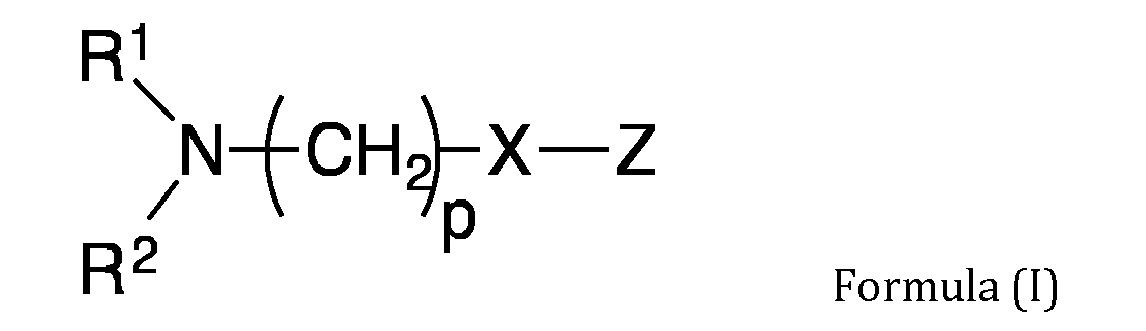
- the present invention discloses a composition comprising one or more amines according to Formula (I): and one or more acid phosphates capable of forming a salt with an amine according to formula (I), wherein X is selected from O and NR 3 , Z is hydrogen, R 4 or -(CH 2 ) q -N(R 5 )R 6 , p is an integer from 1 to 5, q is an integer from 1 to 5, R 1 , R 2 , R 3 , R 4 , R 5 , R 6 are independently selected from hydrogen, linear, or branched C1-4 alkyl, hydroxyalkyl or alkoxyalkyl, or R 1 and R 2 and/or R 5 and R 6 together form a cyclic morpholino group; provided that the amines according to Formula (I) do not comprise a terminal secondary amino group.
- compositions according to the present invention may comprise one or more amines according to Formula (II) and one or more acid phosphates capable of forming a salt with an amine according to formula (II), wherein X is selected from O and NR 3 , p is an integer from 1 to 5, R 1 and R 3 are indepentently selected from hydrogen, linear or branched C1-4 alkyl, hydroxyalkyl or alkoxyalkyl, or two R 1 moieties together form a cyclic morpholino group. In particular R 1 and/or R 3 may be methyl.
- the composition is generally made by combining both components and any eventual additives or adding both components and any eventual additives to a liquid.
- a portion or all of the amine will react with a portion or all of the acid phosphate forming a phosphate amine salt, also known as ammonium phosphate salt.
- the acid phosphate capable of forming a salt with an amine according to Formula (I) or Formula (II) is and one or more acid phosphates according to Formula (III): wherein R 7 is linear or branched (poly)oxyalkylene having a molecular weight in the range from 45 to 800, n being 1 or 2, m being 1 or 2, and n+m being 3.
- the phosphate amine salt may be described by Formula (IV), obtainable by combining one or more acid phosphates according to Formula (III) and one or more amines according to formula (I), wherein R 1 , R 2 , R 7 , X, Z and p are as defined above, and x is 0 or 1, y is 1 or 2, z is 1 or 2 and x+y+z is 3. It is to be understood that formula (IV) does not restrict the presence of the quaternary nitrogen atom to one of an outer (terminal) amine function. In case X is NR 3 , the central nitrogen may as well be the position of protonation upon salting, as well as the group -(CH 2 )q-N(R 5 )R 6 .
- composition of the invention is described by Formula (V): obtainable by combining one or more acid phosphates according to formula (III) and one or more amines according to formula (II), wherein R 1 , R 7 , X and p are as defined above, and x is 0 or 1, y is 1 or 2, z is 1 or 2 and x+y+z is 3.
- R 7 is represented by the following Formula (VI):
- R 8 and R 9 are independently hydrogen or C1-4 alkyl, in particular hydrogen or methyl
- R 10 is C1-36 linear, or branched alkyl, cycloalkyl, alkenyl, cycloalkenyl, aryl or aralkyl, in particular linear or branched C1-C18 alkyl, very preferably C8-10 alkyl
- r is an integer from 1 to 10, preferably from 2 to 8, in particular from 3 to 5.
- composition of the invention comprising a phosphate amine salt or mixture of phosphate amine salts, in particular of phosphate amine salts according to Formula (IV) or Formula (V), obtainable by combining one or more acid phosphates, preferably according to Formula (III) and one or more amines according to Formula (I) or Formula (II).
- the relative amounts of acid phosphate, preferably according to Formula (III), and amine according to Formula (I) or (II) may vary in the range of 0.6:1 to 1.4:1 (wt/wt) phosphate to amine, preferably 0.8:1 to 1.2:1(wt/wt) phosphate to amine, more preferably 0.9:1 to 1.1:1. Particularly preferred is a ratio of 1:1(wt/wt) phosphate to amine.
- the acid phosphate will be employed as a mixture of mono- and divalent acid.
- the molar ratio of monovalent to divalent is preferably in the range of 1:0.1 up to 1:1.5, in particular 1:0.2 up to 1:1 and particularly preferred 1:0.4 up to 1:0.8.
- salting The addition of amine to the acid phosphate (or vice versa) is referred to as "salting" in the art.
- the degree of salting determines whether the resulting compound is oversalted, undersalted or "neutral", i.e. resulting in equimolar amounts of ammonium ion derived from the amine of Formula (I) or Formula (II) and phosphate acid/deprotonated phosphate acid equivalents.
- salting of the acid phosphate or mixture of acid phosphates with said one or more amine(s) of Formula (I) or Formula (II) results in a mixture comprising, on a relative weight basis, 50 to 90%, preferably 60 to 80%, more preferred 65 to 72%, e.g. about 70% or 63 to 69%, of the amine salt(s) and 50 to 10%, preferably 40 to 20%, more preferred 38 to 25%, e.g. about 30% or 31 to 37%, of unreacted free amine.
- the salted phosphate amine of the invention is a gel, often of high viscosity.
- the salted phosphate amine may be obtained as a crystalline or amorphous solid or as a liquid at normal conditions.
- Very preferred acid phosphates to be employed in the present invention include those wherein R 7 has a molecular weight of 200 to 400, such as between 300 and 350.
- the alkoxylated phosphate of Formula (II) may be prepared by reaction of phophorus pentoxide with a polyoxyalcohol R 7 OH, yielding a mixture of phosphate monoesters and diesters, reflected by indices n and m in Formula (II).
- Useful phosphates include, but are not limited to:
- the "alcohol”/"phenol” portion of the name reflects that the "alcohol ethoxylate” or "phenol ethoxylate” is the reaction product of an alcohol/phenol and ethylene oxide. Therefore, e.g. "decyl ethoxylate (4EO) phosphate” or “decyl alcohol ethoxylate (4EO) phosphate” or “decanol ethoxylate (4EO) phosphate” mean the same compound: C 10 H 21 O(C 2 H 4 O) r phosphate, wherein r is approximately 4.
- the naming convenion reflects the average number of repeating units, -OCH 2 CH 2 -, in the alcohol/phenol and ethylene oxide reaction product, R 11- (OCH 2 CH 2 ) b -OH, where R 11 is the alkyl portion of the initial alcohol/phenol. Small variations from the integer are meant to be covered. Therefore as an example, “4EO” comprises a sample having between “3.5” and “4.4” -OCH 2 CH 2 - repeating units, such as, in particular, 3.9 to 4.0" -OCH 2 CH 2 - repeating units.
- the amine according to Formula (I) or Formula (II) employed preferably has no terminal secondary nitrogen atom, as secondary amines may be a health hazard.
- residues R 1 and R 2 may be the same or different and independently are each a linear or branched C1 to C5 alkyl or C1 to C5 hydroxyalkyl, n is preferably 2-5.
- Particularly suitable amines include:
- Preferred amines include:
- very preferable phosphate amine salts include:
- the amine is bis(N-dimethylaminopropyl)methylamine and the phosphate is obtained by the reaction of phosphorus pentoxide with octyl/decyl ethoxylate (4EO).
- the octyl/decyl ethoxylate (4EO) is obtained by the reaction of 4 moles of ethylene oxide for every 1 mole of C 8 and C 10 alcohol.
- composition of the present invention may be advantageously used in a metalworking fluid.
- the composition provides good anticorrosion performance, comparable or better than that observed with conventional amine borate corrosion inhibitors.
- the compound of the invention provided good life to the metalworking fluid, comparable to that obtained with conventional amine borate based corrosion inhibitors - without the environmental concerns and health hazard associated with amine borates.
- the composition of the present invention was shown to inhibit or slow bacterial growth over extended periods of time.
- the long life functionality action of the composition of the present invention is considered a significant improvement compared to the environmental impact inherent to conventional bacteriocidal amine borate based corrosion inhibitors.
- Use of the composition of the present invention may in addition reduce the need to apply conventional biocides in metalworking.
- the buffering properties of the composition of the present invention are equal or superior to conventional corrosion inhibitors used in metalworking fluids and add to the anticorrosive properties.
- the compositions of the present invention provide very good antiwear performance to a metalworking fluid combined with high load carrying capacity, comparable or superior to corrosion inhibitors conventionally used in metalworking fluids.
- compositions of the present invention ideal corrosion inhibitors for metalworking fluids. They can be employed as an additive package, or as a component of an additive package for metalworking fluids. In this case the additive package is diluted to make the finished metalworking fluid.
- the present invention also relates to an additive package comprising 1 to 50, preferably 5 to 40, in particular 10 to 40, most preferably 25 to 30 wt% of a composition of a total of compounds of formulae (I), (III) and (IV). It is to be understood that the additive package may essentially consist of a composition of formulae (I) and (III) or (I), (III) and (IV), or (IV) alone.
- the additive package may essentially consist of a composition of formulae (II) and (III) or (II), (III) and (V), or (V) alone.
- the additive package may comprise 1 to 50, preferably 5 to 40, in particular 10 to 40, most preferably 25to 30 wt% of a composition of formula (IV).
- the additive package may further comprise 0-90, preferably 10-80 wt % of an oil, preferably a mineral oil such as API Group I (including naphthenic and paraffinic), API Group II (including paraffinic), with a viscosity grade from 10-50 cSt, preferably 20-40 cSt.
- the additive package may further comprise 0 to 50, and preferably 5 to less than 30 wt%, in particular less than 15 wt% of water.
- the additive package for metalworking fluid according to the present invention may further include one or more of additional conventional components such as additional corrosion inhibitor, biocides, fungicides, emulsifier, lubrication additives, couplers, solution stabilizers, antifoaming agents.
- a typical additive package, or concentrate, of the present invention may be composed as follows (Table 1): Table 1 Component/Function % by weight Diluents ⁇ 10-12 Lubricants ⁇ 40-50 Corrosion Inhibitors ⁇ 27-29 Emulsifiers ⁇ 8-9 Alcohols ⁇ 5-6
- An example of a suitable diluent is water.
- Suitable lubricants are, independently or a mixture of, polyricinoleic acid ester, fatty acid ester, triglycerides, EP/PO block copolymers, and polymeric esters available under the trade name Ketjenlube 135.
- Suitable corrosion inhibitors are octyl decyl 4EO phosphate salted with bis(N-diemethylaminopropyl)methylamine, alone or in combination, with other corrosion inhibitors such as amine carboxylates, tolytriazoles, benzotriazoles, thiadiazoles, calcium alkylbenzene sulfonates available under the trade name HiTEC ® 614, and fatty acid alkanolamine available under the trade name Polartech Amide MA 460 TM.
- emulsifers are, independently or a mixture of two or more of, sulfonates, fatty acid amides, alcohol ether carboxylates available under the trade name Akypo RO 50 VG, alkyl ether carboxylates available as the trade name Akpo Tec AMVG, and ethoxylates, such as fatty acid ester alkoxylate available under the trade name Surfonic MW 100.
- suitable alcohols are, independently or a mixture of two or more of, oelyl cetyl alchohol available under the trade name Synative AL 90/95 V and C 12 -C 14 linear alcohol available under the trade name Synative AL S.
- a specific non-limiting example of a typical additive package, or concentrate, of the present invention may be composed as follows (Table 2): Table 2 Component Function % (by weight) Water Diluent 11.5 Polartech LA 8005, polyricoleic acid ester Lubricant 45.7 Octyl/decyl 4EO Phosphate ester salted with - Bis(N-dimethylaminopropyl)methylamine Corrosion Inhibitor 28.5 Akypo RO 50 VG, alcohol ether carboxylate Emulsifier 8.6 Synative AL S, C12-C14 linear alcohol Alcohol 5.7
- the present invention also relates to the finished metalworking fluid comprising the composition of the present invention.
- the metalworking fluid may be manufactured by adding the composition or the additive packge of the present invention to a fluid.
- the finished metalworking fluid of the present invention comprises from1 to 20, preferably 2 to 8, most preferably 4-6 wt% or about 5 wt% of a composition of a total of compounds of formulae (I), (III) and (IV), preferably (II), (III) and (V).
- the finished metalworking fluid may comprise 1 to 20, preferably 2 to 10, in particular 2 to 8, most preferably 4 to 6 wt% or about 5 wt% of a composition of formula (IV) or (V).
- the finished metalworking fluid may further comprise 0 to 90, preferably 1 to 80 wt%, of an oil, preferably a mineral oil such as API Group I (including naphethenic and/or paraffinic), API Group II (including paraffenic), with a vicosity grade from 10-50 cSt, preferably 20-40 cSt.
- the finished metalworking fluid of the present invention may further comprise 0 to 60, and preferably 5 to less than 30 wt% water.
- a finished metalworking fluid containing a typical additive package, or concentrate, of the present invention may have the following physical parameters: density @ 15.6°C of 0.9-1.2, total alkalinity between 10-15% as KOH, water content between 5-15%.
- a finished metalworking fluid according to the invention may further include one or more of additional conventional components such as additional corrosion inhibitor, biocides, fungicides, emulsifier, lubrication additives, couplers, solution stabilizers, antifoaming agents.
- a typical metalworking fluid of the present invention may e.g. be composed as follows (Table 3): Table 3 Component/Function % by weight Base Oil ⁇ 30-50 Sulphonates ⁇ 3-5 Fatty acids ⁇ 7-10 Alcohols ⁇ 4-6 pH neutralizers ⁇ 7-10 Metal passivators ⁇ 0-1 Lubricants ⁇ 8-10 Corrosion Inhibitor (invention) ⁇ 4-6 Other corrosion inhibitors ⁇ 0-7 Emulsifiers ⁇ .1-1 Fungicides ⁇ .1-1 Diluents ⁇ 20-25 Antifoams ⁇ .1-.5
- a suitable base oils is a naphthenic mineral oil available under the trade name Nynas T22.
- sulphonate sodium petroleum sulphonate available under the trade name Petronate HL.
- Suitable fatty acids are, independently or a mixture of two or more of, tall oil fatty acid available under the trade name Sylfat 2 and monocarboxylic C 10 acid available under the trade name of Versatic 10, oleic acid.
- suitable alcohols are, independently or a mixture of two or more of, oelyl cetyl alchohol available under the trade name Synative AL 90/95 V, and C 12 -C 14 linear alcohol available under the trade name Synative AL S.
- Suitable amines are, independently or a mixture of two or more of, monoisopropanolamine, diethanolamine, and triethanolamine.
- suitable metal passivators are, independently or a mixture of two or more of, tolytriazole available under the trade anme Polartech Multitech Cu and benzotriazole available under the trade name Irgamet 42.
- Suitable lubricants are, independently or a mixture of, polyricinoleic and polymeric ester available under the trade name Ketjenlube 135 .
- Suitable corrosion inhibitors are octyl decyl 4EO phosphate salted with bis(N-diemethylaminopropyl)methylamine, alone or in combination with other corrosion inhibitors, such as amine carboxylates, tolytriazoles, benzotriazoles, thiadiazoles, calcium alkylbenzene sulfonates available under the trade name HiTEC ® 614, and fatty acid alkanolamine available under the trade name Polartech Amide MA 460 TM.
- corrosion inhibitors such as amine carboxylates, tolytriazoles, benzotriazoles, thiadiazoles, calcium alkylbenzene sulfonates available under the trade name HiTEC ® 614, and fatty acid alkanolamine available under the trade name Polartech Amide MA 460 TM.
- emulsifers are, independently or a mixture of two or more of, sulfonates, fatty acid amides, alcohol ether carboxylates available under the trade name Akypo RO 50 VG, alkyl ether carboxylates available as the trade name Akpo Tec AMVG, and ethoxylates, such as fatty acid ester alkoxylate available under the trade name Surfonic MW 100.
- fungicides may be independently or a mixture of two or more of triazine, nitromorpholine, bromonitriles.
- An example of a suitable diluent may be water.
- Suitable antifoams are, independently or a mixture of two or more of, silicone antifoams available under the trade names Foamban MS525 and Tego MR2124.
- a specific non-limiting example of a typical metalworking fluid of the present invention may e.g. be composed as follows (Table 4): Table 4 Component Function % (by weight) Nynas T22, Napthenic base oil Mineral Oil 31.80 Petronate HL, Sodium petroleum sulphonate Sulphonate 4.00 Polartech Amide MA 460 TM, Fatty acid alkanolamine Amide 4.00 Sylfat 2, Tall oil fatty acid Fatty Acid 4.00 Synative AL 90/95 V, Oleyl cetyl alcohol Alcohol 5.00 Monoisopropanolamine Amine 6.00 Versatic 10, Monocarboxylic C10 acid Fatty Acid 4.00 Triethanolamine, 99% Amine 2.80 Polartech Multitect Cu, Tolytriazole Metal passivator 0.50 Polartech LA 8005, polyricinoleic acid Ester, Lubricant 6.00 X 18805, Octyl/decyl 4EO Phosphate ester salted with - Corrosion Inhibitor 5.00 Bis
- the second digit - here it is 3 - is the % of the area stained.
- the last digit - here it is 3- is the intensity of the staining. Again, the lower the number, the better.
- IP 125 (reference standard: Institute of Petroleum Test Method IP 125/82) Key is as follows:-The first digit is the number of pits, the second, the area of staining, and the third the maximum intensity of staining e.g. 0/1-1 (Table 6). Table 6 Proportion of test area stained Intensity of staining 0 Nil 0 Nil 1 Less than 10% 1 Hardly perceptible 2 Between 10 and 25% 2 Slight staining 3 Between 25 and 50% 3 Heavy staining 4 Between 50 and 75% 4 Surface damage (not including pits 5 Over 75%
- samples according to the invention show at least the corrosion inhibition of conventional corrosion inhibitors on the basis of amine borates.
- the samples of the present invention show corrosion inhibition that is superior to that of conventional amine corrosion inhibitors.
- Amine buffering is the amount of a standardized acid (such as 0.5M HCl) required to reduce the pH of a fixed volume of solution from its starting pH to a pH of 4).
- a standardized acid such as 0.5M HCl
- the results below reflect testing conditions carried out at approximately 20°C.
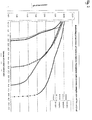
- Fig.1 shows the results of the amine buffering properties test for the samples a-d, the samples containing boron free corrosion inhibitors.
- the amine corrosion is to evaluate the potential for machine tools and components to rust during manufacturing operations where dilutions of the metalworking fluid are used. It involves using a cast iron plate to which approximately 2 g of steel millings are added to the plate before being covered with approximately 2 ml of test fluid and left in a humidity cabinet for a fixed period of time.
- Table 7 shows the results of the amine corrosion test according to IP287 at 0.5 wt%, 1.0 wt%, and 1.5 wt% (vol/vol) for a period of 16 hours.
- Fig. 5 shows the results of IP125 at 0.5 wt%, 1.0 wt%, and 1.5 wt% (vol/vol) for a period of 16 hours.
- the Reichert Friction Wear Test is a method designed to evaluate, in terms of lubrication, a metal working fluid.
- the test apparatus consists of an electrical motor, a double armed lever system, to apply a load (typically 1500g) to a stationary test pin, which is kept in sliding contact with a revolving steel ring that is partially immersed in the test lubricant.
- the volume of the sample is 25 ml.
- a thin film of the lubricant adheres to the surface of the ring to help reduce the friction.
- the test runs for 100 m. Due to the initial friction an elliptical shape is produced on the test pin.
- the area of the scar produced by the wear increases until it is wide enough to allow the fluid to produce a stable, lubricating film between the ring and the test pin; at this point a drop off in noise can be heard and the distance recorded.
- the width and the length of the scar on the test pin is measured to calculate the area of the scar (Area of ellipse (A), mm 2 Length x Width x 0.785); the relationship between the load applied and the area of the scar gives the load carrying capacity (effectively pressure carried by the film of lubricant). The larger the load carrying capacity, the better the lubricant.
- Samples a, b, c, d were the same as in Example 1, except that samples c and d did not contain the acid phosphate.
- This test method covers the determination of the load carrying properties of lubricating fluids. In this particular case it was used to evaluate the antiwear properties of the test fluids.
- the method was modified for testing solutions diluted in water as follows. The 4 ball test using 40kg fixed load for a fixed time of 60 secs, and a rotational speed of 1760rpm, were carried out at 0.5% concentration in DIW, which equates to an additive level of 10% in a formulation which has then been diluted to 5%. Two runs were carried out for each fluid and the average measurement of the scars on the surface of the three bottom balls taken, which was then approximated as a circular (assuming symmetry) area. The results are reported in Table 9.
Landscapes
- Chemical & Material Sciences (AREA)
- Organic Chemistry (AREA)
- Chemical Kinetics & Catalysis (AREA)
- General Chemical & Material Sciences (AREA)
- Oil, Petroleum & Natural Gas (AREA)
- Health & Medical Sciences (AREA)
- Life Sciences & Earth Sciences (AREA)
- Biochemistry (AREA)
- General Health & Medical Sciences (AREA)
- Molecular Biology (AREA)
- Lubricants (AREA)
Abstract
provided that the amines according to Formula (I) do not comprise a terminal secondary amino group.
Description
- The present invention relates to a corrosion inhibiting composition useful for metalworking fluids, as well as concentrates, additives and metalworking fluids containing the composition of the invention. The invention furthermore relates to the use of the composition for providing to a metalworking fluid one or more of anticorrosion performance, antifoam performance, antiwear performance, load carrying capacity, long fluid life, biological stability, lubricity, hard water tolerance, formulation stability.
- Metalworking conditions promote corrosion of the metal surfaces involved. This is particularly relevant for ferrous metal, but not restricted thereto, e.g. copper may suffer from serious corrosion damage upon metalworking without adequate corrosion protection. Therefore, metalworking fluids usually contain corrosion inhibitors to protect the metal surfaces from corrosion. Metalworking fluids for machining ferrous and non-ferrous metals such as copper or aluminum and their alloys, are generally water-based soluble oils, that upon dispersion in water, form transparent, translucent, semi-translucent or milky emulsions. The oil employed is usually mineral oil based and often contains such additives as natural fatty oils, synthetic esters or naturally sourced fatty acids, e.g. those that are biodegradeable. Said emulsions are susceptible to biological attack and are therefore generally treated with anti-microbial additives (biocides). Mineral oil containing water miscible products generally contain emulsifier additives and hence can suffer from biological attack and have poor longevity because the emulsified phase containing the mineral oil tends to separate out. Metalworking fluids often make use of amine borate containing corrosion inhibitors. Amine borate containing corrosion inhibitors are known to provide very good corrosion inhibition and, in addition have biocidal activity. Such activity is in principle desirable as metalworking fluids contain contain water and oil - and thus, are prone to biological growth. Microbiological contamination within a metalworking fluid has detrimental effect on the life of the fluid as it degrades certain components of the fluid (such as sodium petroleum sulphonates). The use of amine borate corrosion inhibitors therefore reduces the biocide requirements for the metalworking fluid.
- However, amine borates are known to have a negative environmental impact, cause health hazards and are generally undesirable in industrial applications. Consequently, there is a need for the reduction or elimination of the use of amine borates. In the past, several amine corrosion inhibitors have been suggested to replace amine borates. Among these amines, dicyclohexylamine, 3-amino-4-octanol, monoethanolamine and triethanolamine have seen commercial application. However, corrosion inhibition of these inhibitors is generally attributed merely to their basic nature. Especially dicyclohexylamine faces a decline in acceptance due to it being a secondary amine, which in the presence of nitrites form nitrosamines which are known to be toxic. In addition, corrosion inhibition provided by these amine subsitutes generally did not live up to the performance shown by conventional amine borates. Thus, whereas there are a number of additives available that can provide some of the attributes of amine borates, there are to date no readily available alternatives that can be used in place of the amine borate derivatives to match all the attributes required and at the same time meet future environmental and health safety standards.
- To address this, a compound is needed that works as a boron-free corrosion inhibitor and provides corrosion inhibition, biostability, hard water tolerance, low foam, formulation stabilization and lubricity.
- As a solution to one or more of the above mentioned objects, the present invention discloses a composition comprising one or more amines according to Formula (I):

provided that the amines according to Formula (I) do not comprise a terminal secondary amino group. - Preferred compositions according to the present invention may comprise one or more amines according to Formula (II)

- It is to be understood that a portion or all of the amine will react with a portion or all of the acid phosphate forming a phosphate amine salt, also known as ammonium phosphate salt.
- In a preferred embodiment the acid phosphate capable of forming a salt with an amine according to Formula (I) or Formula (II) is and one or more acid phosphates according to Formula (III):

R7 is linear or branched (poly)oxyalkylene having a molecular weight in the range from 45 to 800, n being 1 or 2, m being 1 or 2, and n+m being 3. - The phosphate amine salt may be described by Formula (IV),

- Accordingly, a preferred embodiment of the composition of the invention is described by Formula (V):

- In a particularly preferred embodiment, R7 is represented by the following Formula (VI):

- Wherein R8 and R9 are independently hydrogen or C1-4 alkyl, in particular hydrogen or methyl, R10 is C1-36 linear, or branched alkyl, cycloalkyl, alkenyl, cycloalkenyl, aryl or aralkyl, in particular linear or branched C1-C18 alkyl, very preferably C8-10 alkyl, r is an integer from 1 to 10, preferably from 2 to 8, in particular from 3 to 5.
- Within the meaning of the composition of the invention is therefore a composition comprising a phosphate amine salt or mixture of phosphate amine salts, in particular of phosphate amine salts according to Formula (IV) or Formula (V), obtainable by combining one or more acid phosphates, preferably according to Formula (III) and one or more amines according to Formula (I) or Formula (II).
- The relative amounts of acid phosphate, preferably according to Formula (III), and amine according to Formula (I) or (II) may vary in the range of 0.6:1 to 1.4:1 (wt/wt) phosphate to amine, preferably 0.8:1 to 1.2:1(wt/wt) phosphate to amine, more preferably 0.9:1 to 1.1:1. Particularly preferred is a ratio of 1:1(wt/wt) phosphate to amine. Often the acid phosphate will be employed as a mixture of mono- and divalent acid. The molar ratio of monovalent to divalent is preferably in the range of 1:0.1 up to 1:1.5, in particular 1:0.2 up to 1:1 and particularly preferred 1:0.4 up to 1:0.8. The addition of amine to the acid phosphate (or vice versa) is referred to as "salting" in the art. The degree of salting determines whether the resulting compound is oversalted, undersalted or "neutral", i.e. resulting in equimolar amounts of ammonium ion derived from the amine of Formula (I) or Formula (II) and phosphate acid/deprotonated phosphate acid equivalents.
- In a preferred embodiment, salting of the acid phosphate or mixture of acid phosphates with said one or more amine(s) of Formula (I) or Formula (II) results in a mixture comprising, on a relative weight basis, 50 to 90%, preferably 60 to 80%, more preferred 65 to 72%, e.g. about 70% or 63 to 69%, of the amine salt(s) and 50 to 10%, preferably 40 to 20%, more preferred 38 to 25%, e.g. about 30% or 31 to 37%, of unreacted free amine. Usually, the salted phosphate amine of the invention is a gel, often of high viscosity. However, the salted phosphate amine may be obtained as a crystalline or amorphous solid or as a liquid at normal conditions.
- Very preferred acid phosphates to be employed in the present invention include those wherein R7 has a molecular weight of 200 to 400, such as between 300 and 350. The alkoxylated phosphate of Formula (II) may be prepared by reaction of phophorus pentoxide with a polyoxyalcohol R7OH, yielding a mixture of phosphate monoesters and diesters, reflected by indices n and m in Formula (II).
- Useful phosphates include, but are not limited to:
- 2-Ethylhexyl phosphate
- iso-nonanol phosphate
- Octyl/decyl ethoxylate phosphate
- Octyl/decyl ethoxylate (4EO) phosphate
- 2-Ethylhexyl ethoxylate (3EO) phosphate
- 2-Ethylhexyl ethoxylate (2EO) phosphate
- 2-Ethylhexyl ethoxylate (4EO) phosphate
- Decyl alcohol ethoxylate (4EO) phosphate
- Decyl alcohol ethoxylate (6EO) phosphate
- Isotridecanol ethoxylate (3EO) phosphate
- Isotridecanol ethoxylate (6EO) phosphate
- Isotridecanol ethoxylate (5EO) phosphate
- Isotridecanol ethoxylate (10EO) phosphate
- Isotridecanol ethoxylate (20EO) phosphate
- Tergitol 15-S-9 phosphate
- C10-14 alcohol ethoxylate (3EO) phosphate
- C12 alcohol ethoxylate (4EO) phosphate
- C12-14 alcohol ethoxylate (4EO) phosphate
- C12-15 alcohol ethoxylate (5EO) phosphate
- Cetyl/stearyl alcohol ethoxylates (2EO) phosphate
- Cetyl/oleyl alcohol ethoxylate (5EO) phosphate
- Oleyl alcohol ethoxylate (4EO) phosphate
- Alkyl phenol ethoxylate phosphate
- Phenol ethoxylate (3EO) phosphate
- Phenol ethoxylate (6EO) phosphate
- Expressions such as "Octyl/decyl ethoxylate" used herein describe mixtures of octyl ethoxylate and decyl ethoxylate.
- Amongst the most preferred phosphates are:
- Octyl/decyl ethoxylate (4EO) phosphate
- Decyl alcohol ethoxylate (4EO) phosphate
- C12 alcohol ethoxylate (4EO) phosphate
- C12-14 alcohol ethoxylate (4EO) phosphate
- According to naming conventions in the art, the "alcohol"/"phenol" portion of the name reflects that the "alcohol ethoxylate" or "phenol ethoxylate" is the reaction product of an alcohol/phenol and ethylene oxide. Therefore, e.g. "decyl ethoxylate (4EO) phosphate" or "decyl alcohol ethoxylate (4EO) phosphate" or "decanol ethoxylate (4EO) phosphate" mean the same compound: C10H21O(C2H4O)r phosphate, wherein r is approximately 4. The naming convenion reflects the average number of repeating units, -OCH2CH2-, in the alcohol/phenol and ethylene oxide reaction product, R11-(OCH2CH2)b-OH, where R11 is the alkyl portion of the initial alcohol/phenol. Small variations from the integer are meant to be covered. Therefore as an example, "4EO" comprises a sample having between "3.5" and "4.4" -OCH2CH2- repeating units, such as, in particular, 3.9 to 4.0" -OCH2CH2- repeating units.
- The amine according to Formula (I) or Formula (II) employed preferably has no terminal secondary nitrogen atom, as secondary amines may be a health hazard. Preferably, residues R1 and R2, may be the same or different and independently are each a linear or branched C1 to C5 alkyl or C1 to C5 hydroxyalkyl, n is preferably 2-5. Particularly suitable amines include:
- Bis(N-dimethylaminopropyl)methylamine

- Bis(N-aminopropyl)methylamine


- Bis(N-aminoethyl)methylamine

- Bis(dimethylaminoethyl) ether

- Bis(dimethylaminopropyl)ether

- Bis(aminoethyl)ether

- Bis(aminopropyl) ether

- Bis(3-dimethylaminopropyl)isopropanolamine

- 3-dimethylaminopropyldiisopropanolamine

- 2-((2-dimethylaminoethoxy)ethanol

- 2-((2-dimethylaminoethoxyethyl)-methylamino-ethanol

- 2,2-dimorpholinoethylether

- 2-((2-dimethylaminoethyl)-methylamino-ethanol

- Bis(N-dimethylaminopropyl)amine

- Preferred amines include:
- Bis(N-dimethylaminopropyl)methylamine,
- Bis(N-dimethylaminoethyl)methylamine,
- Bis(dimethylaminoethyl) ether,
- Bis(3-dimethylaminopropyl)isopropanolamine,
- 3-dimethylaminopropyldiisopropanolamine,
- 2-((2-dimethylaminoethoxy) ethanol
- In compliance with the aforementioned phosphates and amines, very preferable phosphate amine salts include:
- Octyl/decyl 4EO phosphate salted with
- Bis(N-dimethylaminopropyl)methylamine, or
- Bis(N-dimethylaminopropyl)methylamine, or
- Bis(N-dimethylaminoethyl)methylamine, or
- Bis(dimethylaminoethyl)ether, or
- Bis(3-dimethylaminopropyl)isopropanolamine, or
- 3-dimethylaminopropyldiisopropanolamine, or
- 2-((2-dimethylaminoethoxy)ethanol.
- Thus, in a particularly preferred amine phosphate salt according to the present invention, the amine is bis(N-dimethylaminopropyl)methylamine and the phosphate is obtained by the reaction of phosphorus pentoxide with octyl/decyl ethoxylate (4EO). The octyl/decyl ethoxylate (4EO) is obtained by the reaction of 4 moles of ethylene oxide for every 1 mole of C8 and C10 alcohol.
- The inventors of the present invention have found that the composition of the present invention may be advantageously used in a metalworking fluid. The composition provides good anticorrosion performance, comparable or better than that observed with conventional amine borate corrosion inhibitors. In addition, it was surprisingly found that the compound of the invention provided good life to the metalworking fluid, comparable to that obtained with conventional amine borate based corrosion inhibitors - without the environmental concerns and health hazard associated with amine borates. The composition of the present invention was shown to inhibit or slow bacterial growth over extended periods of time. The long life functionality action of the composition of the present invention is considered a significant improvement compared to the environmental impact inherent to conventional bacteriocidal amine borate based corrosion inhibitors. Use of the composition of the present invention may in addition reduce the need to apply conventional biocides in metalworking.
- The buffering properties of the composition of the present invention are equal or superior to conventional corrosion inhibitors used in metalworking fluids and add to the anticorrosive properties. The compositions of the present invention provide very good antiwear performance to a metalworking fluid combined with high load carrying capacity, comparable or superior to corrosion inhibitors conventionally used in metalworking fluids.
- These properties make the compositions of the present invention ideal corrosion inhibitors for metalworking fluids. They can be employed as an additive package, or as a component of an additive package for metalworking fluids. In this case the additive package is diluted to make the finished metalworking fluid. Thus, the present invention also relates to an additive package comprising 1 to 50, preferably 5 to 40, in particular 10 to 40, most preferably 25 to 30 wt% of a composition of a total of compounds of formulae (I), (III) and (IV). It is to be understood that the additive package may essentially consist of a composition of formulae (I) and (III) or (I), (III) and (IV), or (IV) alone. In preferred embodiments, accordingly, the additive package may essentially consist of a composition of formulae (II) and (III) or (II), (III) and (V), or (V) alone. In some embodiments, the additive package may comprise 1 to 50, preferably 5 to 40, in particular 10 to 40, most preferably 25to 30 wt% of a composition of formula (IV).
- The additive package may further comprise 0-90, preferably 10-80 wt % of an oil, preferably a mineral oil such as API Group I (including naphthenic and paraffinic), API Group II (including paraffinic), with a viscosity grade from 10-50 cSt, preferably 20-40 cSt. The additive package may further comprise 0 to 50, and preferably 5 to less than 30 wt%, in particular less than 15 wt% of water. The additive package for metalworking fluid according to the present invention may further include one or more of additional conventional components such as additional corrosion inhibitor, biocides, fungicides, emulsifier, lubrication additives, couplers, solution stabilizers, antifoaming agents.
- A typical additive package, or concentrate, of the present invention may be composed as follows (Table 1):
Table 1 Component/Function % by weight Diluents ∼10-12 Lubricants ∼40-50 Corrosion Inhibitors ∼27-29 Emulsifiers ∼8-9 Alcohols ∼5-6 - An example of a suitable diluent is water.
- Examples of suitable lubricants are, independently or a mixture of, polyricinoleic acid ester, fatty acid ester, triglycerides, EP/PO block copolymers, and polymeric esters available under the trade name Ketjenlube 135.
- Examples of suitable corrosion inhibitors are octyl decyl 4EO phosphate salted with bis(N-diemethylaminopropyl)methylamine, alone or in combination, with other corrosion inhibitors such as amine carboxylates, tolytriazoles, benzotriazoles, thiadiazoles, calcium alkylbenzene sulfonates available under the trade name HiTEC® 614, and fatty acid alkanolamine available under the trade name Polartech Amide MA 460 TM.
- Examples of suitable emulsifers are, independently or a mixture of two or more of, sulfonates, fatty acid amides, alcohol ether carboxylates available under the trade name Akypo RO 50 VG, alkyl ether carboxylates available as the trade name Akpo Tec AMVG, and ethoxylates, such as fatty acid ester alkoxylate available under the trade name Surfonic MW 100.
- Examples of suitable alcohols are, independently or a mixture of two or more of, oelyl cetyl alchohol available under the trade name Synative AL 90/95 V and C12-C14 linear alcohol available under the trade name Synative AL S.
- Accordingly, a specific non-limiting example of a typical additive package, or concentrate, of the present invention may be composed as follows (Table 2):
Table 2 Component Function % (by weight) Water Diluent 11.5 Polartech LA 8005, polyricoleic acid ester Lubricant 45.7 Octyl/decyl 4EO Phosphate ester salted with - Bis(N-dimethylaminopropyl)methylamine Corrosion Inhibitor 28.5 Akypo RO 50 VG, alcohol ether carboxylate Emulsifier 8.6 Synative AL S, C12-C14 linear alcohol Alcohol 5.7 - The present invention also relates to the finished metalworking fluid comprising the composition of the present invention. The metalworking fluid may be manufactured by adding the composition or the additive packge of the present invention to a fluid. The finished metalworking fluid of the present invention comprises from1 to 20, preferably 2 to 8, most preferably 4-6 wt% or about 5 wt% of a composition of a total of compounds of formulae (I), (III) and (IV), preferably (II), (III) and (V). In some embodiments, the finished metalworking fluid may comprise 1 to 20, preferably 2 to 10, in particular 2 to 8, most preferably 4 to 6 wt% or about 5 wt% of a composition of formula (IV) or (V). The finished metalworking fluid may further comprise 0 to 90, preferably 1 to 80 wt%, of an oil, preferably a mineral oil such as API Group I (including naphethenic and/or paraffinic), API Group II (including paraffenic), with a vicosity grade from 10-50 cSt, preferably 20-40 cSt. Alternatively, or in addition, the finished metalworking fluid of the present invention may further comprise 0 to 60, and preferably 5 to less than 30 wt% water. A finished metalworking fluid containing a typical additive package, or concentrate, of the present invention may have the following physical parameters: density @ 15.6°C of 0.9-1.2, total alkalinity between 10-15% as KOH, water content between 5-15%.
- A finished metalworking fluid according to the invention may further include one or more of additional conventional components such as additional corrosion inhibitor, biocides, fungicides, emulsifier, lubrication additives, couplers, solution stabilizers, antifoaming agents.
- A typical metalworking fluid of the present invention may e.g. be composed as follows (Table 3):
Table 3 Component/Function % by weight Base Oil ∼30-50 Sulphonates ∼3-5 Fatty acids ∼7-10 Alcohols ∼4-6 pH neutralizers ∼7-10 Metal passivators ∼0-1 Lubricants ∼8-10 Corrosion Inhibitor (invention) ∼4-6 Other corrosion inhibitors ∼0-7 Emulsifiers ∼.1-1 Fungicides ∼.1-1 Diluents ∼20-25 Antifoams ∼.1-.5 - An example of a suitable base oils is a naphthenic mineral oil available under the trade name Nynas T22.
- An example of a suitable sulphonate is sodium petroleum sulphonate available under the trade name Petronate HL.
- Examples of suitable fatty acids are, independently or a mixture of two or more of, tall oil fatty acid available under the trade name Sylfat 2 and monocarboxylic C10 acid available under the trade name of Versatic 10, oleic acid.
- Examples of suitable alcohols are, independently or a mixture of two or more of, oelyl cetyl alchohol available under the trade name Synative AL 90/95 V, and C12-C14 linear alcohol available under the trade name Synative AL S.
- Examples of suitable amines are, independently or a mixture of two or more of, monoisopropanolamine, diethanolamine, and triethanolamine.
- Examples of suitable metal passivators are, independently or a mixture of two or more of, tolytriazole available under the trade anme Polartech Multitech Cu and benzotriazole available under the trade name Irgamet 42.
- Examples of suitable lubricants are, independently or a mixture of, polyricinoleic and polymeric ester available under the trade name Ketjenlube 135.
- Examples of suitable corrosion inhibitors are octyl decyl 4EO phosphate salted with bis(N-diemethylaminopropyl)methylamine, alone or in combination with other corrosion inhibitors, such as amine carboxylates, tolytriazoles, benzotriazoles, thiadiazoles, calcium alkylbenzene sulfonates available under the trade name HiTEC® 614, and fatty acid alkanolamine available under the trade name Polartech Amide MA 460 TM.
- Examples of suitable emulsifers are, independently or a mixture of two or more of, sulfonates, fatty acid amides, alcohol ether carboxylates available under the trade name Akypo RO 50 VG, alkyl ether carboxylates available as the trade name Akpo Tec AMVG, and ethoxylates, such as fatty acid ester alkoxylate available under the trade name Surfonic MW 100.
- An example of suitable fungicides may be independently or a mixture of two or more of triazine, nitromorpholine, bromonitriles.
- An example of a suitable diluent may be water.
- Examples of suitable antifoams are, independently or a mixture of two or more of, silicone antifoams available under the trade names Foamban MS525 and Tego MR2124.
- Accordingly, a specific non-limiting example of a typical metalworking fluid of the present invention may e.g. be composed as follows (Table 4):
Table 4 Component Function % (by weight) Nynas T22, Napthenic base oil Mineral Oil 31.80 Petronate HL, Sodium petroleum sulphonate Sulphonate 4.00 Polartech Amide MA 460 TM, Fatty acid alkanolamine Amide 4.00 Sylfat 2, Tall oil fatty acid Fatty Acid 4.00 Synative AL 90/95 V, Oleyl cetyl alcohol Alcohol 5.00 Monoisopropanolamine Amine 6.00 Versatic 10, Monocarboxylic C10 acid Fatty Acid 4.00 Triethanolamine, 99% Amine 2.80 Polartech Multitect Cu, Tolytriazole Metal passivator 0.50 Polartech LA 8005, polyricinoleic acid Ester, Lubricant 6.00 X 18805, Octyl/decyl 4EO Phosphate ester salted with - Corrosion Inhibitor 5.00 Bis(N-dimethylaminopropyl)methylamine Hitec 614, low base calcium alkylbenzene sulfonate Corrosion Inhibitor 1.00 Ketjenlube 135, Polymeric ester Lubricant 3.50 Akypo Tec AMVG, Alkyl Ether carboxylate Emulsifier 0.50 IPBC 30% Fungicide 0.50 Water Diluent 21.00 Foamban MS525, Silicone antifoam Antifoam 0.20 Tego MR2124, Silicone antifoam Antifoam 0.20 - The following metalworking fluids,
samples 1 to 6, were formulated to comparable pH (Table 5).Table 5 Sample a inventive Sample b inventive Sample c reference Sample d reference Sample e reference Sample f reference Amine Borates 0% 0% 0% 0% 100 wt% 100 wt% Amines 50 wt% 50 wt% 50 wt% 50 wt% 0% 0% Ethoxylated phosphate ester 50 wt% 50 wt% 50 wt% 50 wt% 0% 0% pH at 5% in DI water 9.95 9.84 9.71 9.97 Free amine 36.36 wt% 33.65 wt% 20.87 wt% 13.66 wt% IP125 at 0.5% (vol/vol) 0/3-3 0/3-3 0/3-3 0/5-3 0/1-4 0/2-4 IP125 at 1.0% (vol/vol) 0/1-3 0/1-2 0/2-3 0/4-3 0/1-1 0/1-4 IP125 at 1.5% (vol/vol) 0/1-2 0/1-2 0/1-3 0/1-3 0/1-1 0/1-4 Sample a contains bis(N-dimethylaminopropyl)methylamine;
Sample b contains bis(dimethylaminoethyl)ether;
Sample c contains 3-aminooctan-4-ol;
Sample d contains dicyclohexylamine;
Sample e contains BA70 M, an amine borate having a boron content of approximately 7%
Sample f contains BA60 MX, an amine borate having a boron content of approximately 6% - Corrosion was tested according to IP287, published January 2008, ref. IP287-2934869, at 0.5 wt%, 1.0 wt%, and 1.5 wt% in 200 ppm (water as CaCO3) as well as according to IP125, published January 2008, ref. IP125-2935231, at 0.5 wt%, 1.0 wt%, and 1.5 wt% in 200 ppm (water as CaCO3). The IP287 results are shown in
Fig. 1 .Fig. 2 shows the IP125 results. IP125 results were rated by a trained technican, and reported in table 3. The results are provided in the following form (0/3-3). The first digit - here it is 0 - is the number of pits. The lower the number, the better. The second digit - here it is 3 - is the % of the area stained. The lower the number, the better. The last digit - here it is 3- is the intensity of the staining. Again, the lower the number, the better. - IP 125 (reference standard: Institute of Petroleum Test Method IP 125/82) Key is as follows:-The first digit is the number of pits, the second, the area of staining, and the third the maximum intensity of staining e.g. 0/1-1 (Table 6).
Table 6 Proportion of test area stained Intensity of staining 0 Nil 0 Nil 1 Less than 10% 1 Hardly perceptible 2 Between 10 and 25% 2 Slight staining 3 Between 25 and 50% 3 Heavy staining 4 Between 50 and 75% 4 Surface damage (not including pits 5 Over 75% - It follows that the samples according to the invention show at least the corrosion inhibition of conventional corrosion inhibitors on the basis of amine borates. The samples of the present invention show corrosion inhibition that is superior to that of conventional amine corrosion inhibitors.
- Amine buffering is the amount of a standardized acid (such as 0.5M HCl) required to reduce the pH of a fixed volume of solution from its starting pH to a pH of 4). The results below reflect testing conditions carried out at approximately 20°C.
Fig.1 shows the results of the amine buffering properties test for the samples a-d, the samples containing boron free corrosion inhibitors. -
Table 7 Sample a inventive Sample b inventive Sample c reference Sample d reference Amine 50 wt% 50 wt% 50 wt% 50 wt% pH at 0.1M 11.5 11.3 11.4 - IP125 at 0.5% (vol/vol) 0/3-4 0/2-4 0/4-4 - IP125 at 1.0% (vol/vol) 0/2-4 0/2-4 0/2-4 - IP125 at 1.5% (vol/vol) 0/2-4 0/2-4 0/1-4 - - The amine corrosion is to evaluate the potential for machine tools and components to rust during manufacturing operations where dilutions of the metalworking fluid are used. It involves using a cast iron plate to which approximately 2 g of steel millings are added to the plate before being covered with approximately 2 ml of test fluid and left in a humidity cabinet for a fixed period of time. Table 7 shows the results of the amine corrosion test according to IP287 at 0.5 wt%, 1.0 wt%, and 1.5 wt% (vol/vol) for a period of 16 hours. Fig. 5 shows the results of IP125 at 0.5 wt%, 1.0 wt%, and 1.5 wt% (vol/vol) for a period of 16 hours.
- The results are shown in
Fig. 2 . - The Reichert Friction Wear Test is a method designed to evaluate, in terms of lubrication, a metal working fluid. The test apparatus, consists of an electrical motor, a double armed lever system, to apply a load (typically 1500g) to a stationary test pin, which is kept in sliding contact with a revolving steel ring that is partially immersed in the test lubricant. The volume of the sample is 25 ml. When the device is operated at a speed of 1.7 m/sec, a thin film of the lubricant adheres to the surface of the ring to help reduce the friction. The test runs for 100 m. Due to the initial friction an elliptical shape is produced on the test pin. The area of the scar produced by the wear increases until it is wide enough to allow the fluid to produce a stable, lubricating film between the ring and the test pin; at this point a drop off in noise can be heard and the distance recorded. When the test is over, the width and the length of the scar on the test pin is measured to calculate the area of the scar (Area of ellipse (A), mm2 Length x Width x 0.785); the relationship between the load applied and the area of the scar gives the load carrying capacity (effectively pressure carried by the film of lubricant). The larger the load carrying capacity, the better the lubricant.
- The results show that sample a has the best load carrying capacity and sample c the worst.
- Reichert testings, using steel test pins on a steel ring with an applied load of 1500g were carried out at 0.5% concentration in deionised water, which equates to an additive level of 10% in a formulation which has then been diluted to 5%. The results are reported in Table 8.
Table 8 Corrosion Inhibitor Load Carrying Capacity g/mm2 Wear Ratio % Noise Dropoff m Average Scar Area mm2 BA70M 92.74 84.9 100 32.3 a 99.87 72.4 100 30.0 b 91.53 68.9 100 32.8 c 88.44 95.25 100 33.9 d 93.03 89.78 100 32.3 - Samples a, b, c, d were the same as in Example 1, except that samples c and d did not contain the acid phosphate.
- This test method, ASTM D4172-94, covers the determination of the load carrying properties of lubricating fluids. In this particular case it was used to evaluate the antiwear properties of the test fluids. The method was modified for testing solutions diluted in water as follows. The 4 ball test using 40kg fixed load for a fixed time of 60 secs, and a rotational speed of 1760rpm, were carried out at 0.5% concentration in DIW, which equates to an additive level of 10% in a formulation which has then been diluted to 5%. Two runs were carried out for each fluid and the average measurement of the scars on the surface of the three bottom balls taken, which was then approximated as a circular (assuming symmetry) area. The results are reported in Table 9.
Table 9 Corrosion Inhibitor Average Scar measurement (mm) Approx. Scar Area (mm2) BA70M 1.65 x 1.71 2.22 a 0.36 x 0.39 0.11 b 0.36 x 0.40 0.11 c 1.87 x 1.75 2.57 d 1.80 x 1.70 2.41 - Samples a, b, c, d were the same as in Example 5.
Claims (17)
- A composition comprising one or more amines according to Formula (I)
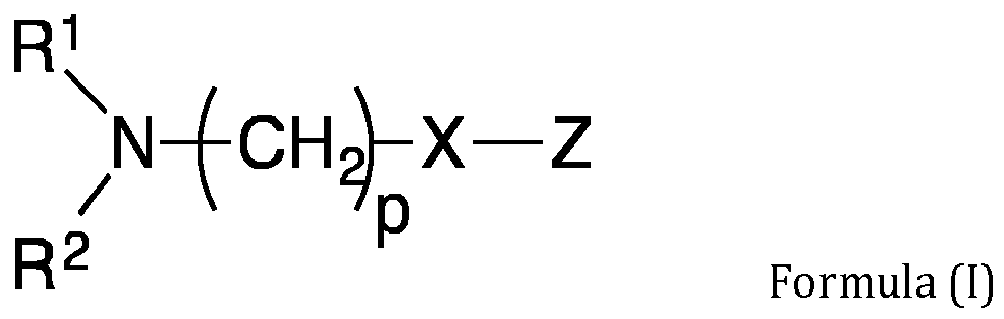
provided that the amines according to Formula (I) do not comprise a terminal secondary amino group. - The composition according to claim 1 comprising one or more amines according to Formula (II)

- The composition according to claim 1 or 2, comprising one or more amines according to Formula (I)


R7 is linear or branched (poly)oxyalkylene having a molecular weight in the range from 45 to 800, n being 1 or 2, m being 1 or 2, and n+m being 3, X, Z, R1, R2 and p are as defined in claim 1. - The composition according to claim 2 or 3, comprising one or more amines according to Formula (II)


R7 is linear or branched (poly)oxyalkylene having a molecular weight in the range from 45 to 800, n being 1 or 2, m being 1 or 2, and n+m being 3, X is selected from O and NR3, p is an integer from 1 to 5, R1 and R3 are indepentently selected from hydrogen, linear or branched C1-4 alkyl or alkoxyalkyl, or two R1 moieties together form a cyclic morpholino group. - The composition of claim 3 wherein the composition comprises a phosphate amine salt or mixture of phosphate amine salts according to Formula (IV),

- The composition of claim 4 wherein the composition comprises a phosphate amine salt or mixture of phosphate amine salts according to Formula (V),

- The composition according to any one of claims 3 to 6, wherein in the phosphate of Formula (III), R7 is represented by the following Formula (VI):

- The composition according to any one of claims 3 to 7, wherein R7 has a molecular weight of 200 to 400, preferably between 300 and 350.
- The composition according any one of claims 1 to 8, wherein p is an integer of from 2-4, in particular 2 or 3, and/ or R1 and/or R3 are methyl.
- The composition according to any one of claims 1 to 9 wherein the phosphate is octyl decyl 4EO phosphate.
- The composition according to any one of claims 1 to 10, wherein the amine is selected from:Bis(N-dimethylaminopropyl)methylamineBis(N-aminopropyl)methylamineBis(N-dimethylaminoethyl)methylamineBis(N-aminoethyl)methylamineBis(dimethylaminoethyl) etherBis(dimethylaminopropyl) etherBis(aminoethyl)etherBis(aminopropyl) etherBis(3-dimethylaminopropyl)isopropanolamine3-dimethylaminopropyldiisopropanolamine2-((2-dimethylaminoethoxy)ethanolN,N,N'-trimethyl-N'-hydroxyethyl-bisaminoethylether2,2'-dimorpholinodiethyletherN,N,N'-trimethylaminoethyl-ethanolamine1,3-propane diamine, N'(3-(dimethylamino)propyl)-N,N-dimethyl
- The composition according to any one of claims 1 to 11, wherein the amine is bis(N-dimethylaminopropyl)methylamine and the phosphate is obtained by the reaction of phosphorus pentoxide with octyl/decyl ethoxylate (4EO), and wherein the octyl/decyl ethoxylate (4EO) is obtianed by the reaction of 4 moles of ethylene oxide for every 1 mole of C8 and C10 alcohol.
- The composition according to any one of claims 1 to 12, wherein the phosphate has been salted with the amine and salting results in a mixture comprising, on a relative weight basis, 50 to 90%, preferably 60 to 80%, more preferred 65 to 75% of the amine salt(s) and 50 to 10%, preferably 40 to 20%, more preferred 35 to 25% of unreacted free amine.
- Composition according to any one of claims 1 to 13, comprising a total of 1 to 50, preferably 5 to 40, in particular 25 to 30 wt% of a composition of compounds of formulae (I), (III), and (IV), in particular of formulae (II), (III), and (V), further comprising 0 to 90, and preferably 10-80 wt% of an oil, preferably mineral oil, and/or 0 to 50, preferably 5 to less than 30 wt% of water.
- Composition accordingto any one of claims 1 to 13, comprising 1 to 20, preferably 4 to 6, in particular about 5wt% of a composition of compounds of formulae (I), (III) and (IV), in particular of formluae (II), (III), and (V), further comprising 0 to 90, preferably 1 to 80 wt% of an oil, preferably mineral oil, and/or 0 to 60, preferably 5 to less than 30 wt% of water.
- Use of a composition of any one of claims 1 to 15 for metalworking.
- Use of a composition of any one of claims 1 to 15 for providing to a metalworking fluid one or more of anticorrosion performance, antifoam performance, antiwear performance, load carrying capacity, bacteriostatic performance, biological stability, lubricity, hard water tolerance, formulation stability.
Priority Applications (3)
| Application Number | Priority Date | Filing Date | Title |
|---|---|---|---|
| EP14164110.0A EP2930229B1 (en) | 2014-04-09 | 2014-04-09 | Boron-free corrosion inhibitors for metalworking fluids |
| PL14164110T PL2930229T3 (en) | 2014-04-09 | 2014-04-09 | Boron-free corrosion inhibitors for metalworking fluids |
| ES14164110T ES2856373T3 (en) | 2014-04-09 | 2014-04-09 | Boron-free corrosion inhibitors for metalworking fluids |
Applications Claiming Priority (1)
| Application Number | Priority Date | Filing Date | Title |
|---|---|---|---|
| EP14164110.0A EP2930229B1 (en) | 2014-04-09 | 2014-04-09 | Boron-free corrosion inhibitors for metalworking fluids |
Publications (2)
| Publication Number | Publication Date |
|---|---|
| EP2930229A1 true EP2930229A1 (en) | 2015-10-14 |
| EP2930229B1 EP2930229B1 (en) | 2020-12-23 |
Family
ID=50639260
Family Applications (1)
| Application Number | Title | Priority Date | Filing Date |
|---|---|---|---|
| EP14164110.0A Active EP2930229B1 (en) | 2014-04-09 | 2014-04-09 | Boron-free corrosion inhibitors for metalworking fluids |
Country Status (3)
| Country | Link |
|---|---|
| EP (1) | EP2930229B1 (en) |
| ES (1) | ES2856373T3 (en) |
| PL (1) | PL2930229T3 (en) |
Cited By (5)
| Publication number | Priority date | Publication date | Assignee | Title |
|---|---|---|---|---|
| WO2019068831A1 (en) | 2017-10-06 | 2019-04-11 | Castrol Limited | Metal working fluid additive composition |
| EP3511397A1 (en) | 2018-01-12 | 2019-07-17 | Afton Chemical Corporation | Emulsifier for use in lubricating oil |
| EP3515978A4 (en) * | 2016-09-20 | 2020-01-22 | Ethox Chemicals, LLC | Non-chlorinated alkoxylated alcohol phosphate for metal working |
| WO2020076678A1 (en) | 2018-10-11 | 2020-04-16 | Master Chemical Corporation | Water soluble metalworking concentrate |
| CN116143828A (en) * | 2023-04-23 | 2023-05-23 | 四川科宏达集团有限责任公司 | Synthetic method of phosphate surfactant with high diester content |
Citations (15)
| Publication number | Priority date | Publication date | Assignee | Title |
|---|---|---|---|---|
| US2420328A (en) * | 1945-05-26 | 1947-05-13 | Du Pont | Lubricant for processing metals |
| US2728647A (en) * | 1952-04-01 | 1955-12-27 | Tide Water Associated Oil Comp | Gasoline with corrosion inhibitor |
| US3035905A (en) * | 1958-02-04 | 1962-05-22 | Union Oil Co | Internal combustion engine fuel |
| US3203895A (en) * | 1962-03-22 | 1965-08-31 | Universal Oil Prod Co | Lubricating oils containing amine salts of phosphates |
| US3324182A (en) * | 1962-12-26 | 1967-06-06 | Monsanto Res Corp | Penta-alkyldialkylenetriamines |
| US3361668A (en) * | 1965-10-19 | 1968-01-02 | Lubrizol Corp | Lubricating compositions containing light-colored and improved group ii metal phosphorodithioates |
| GB1319121A (en) * | 1970-05-26 | 1973-06-06 | Witco Chemical Corp | Aqueous lubricant compositions containing phosphate ester salts |
| US3933658A (en) * | 1970-09-16 | 1976-01-20 | Gaf Corporation | Metalworking additive and composition |
| US4774351A (en) * | 1983-01-07 | 1988-09-27 | The Lubrizol Corporation | Aqueous fluids compositions containing dithiophosphorus/amine salts |
| US5039713A (en) * | 1991-02-07 | 1991-08-13 | Air Products And Chemicals, Inc. | Blowing reaction catalyst composition that provides cell opening of the resulting polyurethane foam |
| US5650097A (en) * | 1994-06-13 | 1997-07-22 | E. I. Du Pont De Nemours And Company | Corrosion inhibitor composition for steel |
| US6103675A (en) * | 1997-03-12 | 2000-08-15 | Clariant Gmbh | Phosphoric esters as extreme pressure additives |
| US6111054A (en) * | 1997-07-26 | 2000-08-29 | Byk-Chemie Gmbh | Products obtainable by salt formation from polyamines and the use thereof as dispersing agents for pigments and extenders |
| USH2233H1 (en) * | 2000-08-07 | 2009-11-03 | Air Products And Chemicals, Inc. | Catalysts which stabilize hydrofluorocarbon blowing agents in polyurethane foam compositions |
| WO2010004118A1 (en) * | 2008-06-27 | 2010-01-14 | Ifp | Absorbent solution containing a degradation inhibitor of the family of dithiophosphates and method for limiting the degradation of an absorbent solution |
-
2014
- 2014-04-09 ES ES14164110T patent/ES2856373T3/en active Active
- 2014-04-09 PL PL14164110T patent/PL2930229T3/en unknown
- 2014-04-09 EP EP14164110.0A patent/EP2930229B1/en active Active
Patent Citations (15)
| Publication number | Priority date | Publication date | Assignee | Title |
|---|---|---|---|---|
| US2420328A (en) * | 1945-05-26 | 1947-05-13 | Du Pont | Lubricant for processing metals |
| US2728647A (en) * | 1952-04-01 | 1955-12-27 | Tide Water Associated Oil Comp | Gasoline with corrosion inhibitor |
| US3035905A (en) * | 1958-02-04 | 1962-05-22 | Union Oil Co | Internal combustion engine fuel |
| US3203895A (en) * | 1962-03-22 | 1965-08-31 | Universal Oil Prod Co | Lubricating oils containing amine salts of phosphates |
| US3324182A (en) * | 1962-12-26 | 1967-06-06 | Monsanto Res Corp | Penta-alkyldialkylenetriamines |
| US3361668A (en) * | 1965-10-19 | 1968-01-02 | Lubrizol Corp | Lubricating compositions containing light-colored and improved group ii metal phosphorodithioates |
| GB1319121A (en) * | 1970-05-26 | 1973-06-06 | Witco Chemical Corp | Aqueous lubricant compositions containing phosphate ester salts |
| US3933658A (en) * | 1970-09-16 | 1976-01-20 | Gaf Corporation | Metalworking additive and composition |
| US4774351A (en) * | 1983-01-07 | 1988-09-27 | The Lubrizol Corporation | Aqueous fluids compositions containing dithiophosphorus/amine salts |
| US5039713A (en) * | 1991-02-07 | 1991-08-13 | Air Products And Chemicals, Inc. | Blowing reaction catalyst composition that provides cell opening of the resulting polyurethane foam |
| US5650097A (en) * | 1994-06-13 | 1997-07-22 | E. I. Du Pont De Nemours And Company | Corrosion inhibitor composition for steel |
| US6103675A (en) * | 1997-03-12 | 2000-08-15 | Clariant Gmbh | Phosphoric esters as extreme pressure additives |
| US6111054A (en) * | 1997-07-26 | 2000-08-29 | Byk-Chemie Gmbh | Products obtainable by salt formation from polyamines and the use thereof as dispersing agents for pigments and extenders |
| USH2233H1 (en) * | 2000-08-07 | 2009-11-03 | Air Products And Chemicals, Inc. | Catalysts which stabilize hydrofluorocarbon blowing agents in polyurethane foam compositions |
| WO2010004118A1 (en) * | 2008-06-27 | 2010-01-14 | Ifp | Absorbent solution containing a degradation inhibitor of the family of dithiophosphates and method for limiting the degradation of an absorbent solution |
Cited By (8)
| Publication number | Priority date | Publication date | Assignee | Title |
|---|---|---|---|---|
| EP3515978A4 (en) * | 2016-09-20 | 2020-01-22 | Ethox Chemicals, LLC | Non-chlorinated alkoxylated alcohol phosphate for metal working |
| WO2019068831A1 (en) | 2017-10-06 | 2019-04-11 | Castrol Limited | Metal working fluid additive composition |
| US11499118B2 (en) | 2017-10-06 | 2022-11-15 | Castrol Limited | Metal working fluid additive composition |
| US11952552B2 (en) | 2017-10-06 | 2024-04-09 | Castrol Limited | Metal working fluid additive composition |
| EP3511397A1 (en) | 2018-01-12 | 2019-07-17 | Afton Chemical Corporation | Emulsifier for use in lubricating oil |
| WO2020076678A1 (en) | 2018-10-11 | 2020-04-16 | Master Chemical Corporation | Water soluble metalworking concentrate |
| EP3864116A4 (en) * | 2018-10-11 | 2022-08-31 | Master Chemical Corporation | Water soluble metalworking concentrate |
| CN116143828A (en) * | 2023-04-23 | 2023-05-23 | 四川科宏达集团有限责任公司 | Synthetic method of phosphate surfactant with high diester content |
Also Published As
| Publication number | Publication date |
|---|---|
| EP2930229B1 (en) | 2020-12-23 |
| ES2856373T3 (en) | 2021-09-27 |
| PL2930229T3 (en) | 2021-05-04 |
Similar Documents
| Publication | Publication Date | Title |
|---|---|---|
| JP6283552B2 (en) | Water-soluble metalworking oil and coolant for metalworking | |
| JP5394691B2 (en) | Water-soluble metalworking fluid and metalworking coolant | |
| KR101622083B1 (en) | Additive compositions and industrial process fluids | |
| EP2930229B1 (en) | Boron-free corrosion inhibitors for metalworking fluids | |
| JP5487516B2 (en) | Water-soluble metalworking fluid | |
| US11034913B2 (en) | Metal working fluid | |
| US9828566B2 (en) | Boron free corrosion inhibitors for metalworking fluids | |
| JP6009378B2 (en) | Water-soluble metalworking fluid and metalworking coolant | |
| EP2110426B1 (en) | Metalworking fluid and metalworking method | |
| JPWO2009016954A1 (en) | Aqueous metalworking fluid | |
| JP6445247B2 (en) | Water-soluble metalworking oil and coolant for metalworking | |
| JP2017014611A5 (en) | ||
| CN105073964A (en) | Water-based metalworking oil | |
| CN105733744B (en) | Additive, preparation method thereof, and polyether lubricating oil composition | |
| CA2867413C (en) | Corrosion-protection system for treating metal surfaces | |
| EP1739155A1 (en) | An alkali metal sulfonate mixture for metalworking | |
| WO2026060357A1 (en) | Metalworking fluid compositions including amino alcohols and uses thereof | |
| US20140274847A1 (en) | Corrosion inhibitors and methods of using same |
Legal Events
| Date | Code | Title | Description |
|---|---|---|---|
| PUAI | Public reference made under article 153(3) epc to a published international application that has entered the european phase |
Free format text: ORIGINAL CODE: 0009012 |
|
| 17P | Request for examination filed |
Effective date: 20140409 |
|
| AK | Designated contracting states |
Kind code of ref document: A1 Designated state(s): AL AT BE BG CH CY CZ DE DK EE ES FI FR GB GR HR HU IE IS IT LI LT LU LV MC MK MT NL NO PL PT RO RS SE SI SK SM TR |
|
| AX | Request for extension of the european patent |
Extension state: BA ME |
|
| RBV | Designated contracting states (corrected) |
Designated state(s): AL AT BE BG CH CY CZ DE DK EE ES FI FR GB GR HR HU IE IS IT LI LT LU LV MC MK MT NL NO PL PT RO RS SE SI SK SM TR |
|
| STAA | Information on the status of an ep patent application or granted ep patent |
Free format text: STATUS: EXAMINATION IS IN PROGRESS |
|
| 17Q | First examination report despatched |
Effective date: 20180406 |
|
| RAP1 | Party data changed (applicant data changed or rights of an application transferred) |
Owner name: ITALMATCH SC, LLC |
|
| GRAP | Despatch of communication of intention to grant a patent |
Free format text: ORIGINAL CODE: EPIDOSNIGR1 |
|
| STAA | Information on the status of an ep patent application or granted ep patent |
Free format text: STATUS: GRANT OF PATENT IS INTENDED |
|
| RIC1 | Information provided on ipc code assigned before grant |
Ipc: C10M 137/08 20060101AFI20200716BHEP Ipc: C10M 173/00 20060101ALI20200716BHEP Ipc: C10N 40/20 20060101ALI20200716BHEP Ipc: C10M 133/50 20060101ALI20200716BHEP Ipc: C07F 9/11 20060101ALI20200716BHEP Ipc: C10N 30/12 20060101ALI20200716BHEP Ipc: C10N 30/16 20060101ALI20200716BHEP Ipc: C10M 133/04 20060101ALI20200716BHEP Ipc: C10N 30/18 20060101ALI20200716BHEP Ipc: C10M 133/08 20060101ALI20200716BHEP Ipc: C10N 30/06 20060101ALI20200716BHEP Ipc: C07F 9/09 20060101ALI20200716BHEP |
|
| INTG | Intention to grant announced |
Effective date: 20200812 |
|
| GRAS | Grant fee paid |
Free format text: ORIGINAL CODE: EPIDOSNIGR3 |
|
| GRAA | (expected) grant |
Free format text: ORIGINAL CODE: 0009210 |
|
| STAA | Information on the status of an ep patent application or granted ep patent |
Free format text: STATUS: THE PATENT HAS BEEN GRANTED |
|
| AK | Designated contracting states |
Kind code of ref document: B1 Designated state(s): AL AT BE BG CH CY CZ DE DK EE ES FI FR GB GR HR HU IE IS IT LI LT LU LV MC MK MT NL NO PL PT RO RS SE SI SK SM TR |
|
| REG | Reference to a national code |
Ref country code: GB Ref legal event code: FG4D |
|
| REG | Reference to a national code |
Ref country code: DE Ref legal event code: R096 Ref document number: 602014073521 Country of ref document: DE |
|
| REG | Reference to a national code |
Ref country code: AT Ref legal event code: REF Ref document number: 1347733 Country of ref document: AT Kind code of ref document: T Effective date: 20210115 |
|
| REG | Reference to a national code |
Ref country code: NL Ref legal event code: FP Ref country code: IE Ref legal event code: FG4D |
|
| REG | Reference to a national code |
Ref country code: CH Ref legal event code: NV Representative=s name: RIEDERER HASLER AND PARTNER PATENTANWAELTE AG, LI |
|
| PG25 | Lapsed in a contracting state [announced via postgrant information from national office to epo] |
Ref country code: NO Free format text: LAPSE BECAUSE OF FAILURE TO SUBMIT A TRANSLATION OF THE DESCRIPTION OR TO PAY THE FEE WITHIN THE PRESCRIBED TIME-LIMIT Effective date: 20210323 Ref country code: FI Free format text: LAPSE BECAUSE OF FAILURE TO SUBMIT A TRANSLATION OF THE DESCRIPTION OR TO PAY THE FEE WITHIN THE PRESCRIBED TIME-LIMIT Effective date: 20201223 Ref country code: RS Free format text: LAPSE BECAUSE OF FAILURE TO SUBMIT A TRANSLATION OF THE DESCRIPTION OR TO PAY THE FEE WITHIN THE PRESCRIBED TIME-LIMIT Effective date: 20201223 Ref country code: GR Free format text: LAPSE BECAUSE OF FAILURE TO SUBMIT A TRANSLATION OF THE DESCRIPTION OR TO PAY THE FEE WITHIN THE PRESCRIBED TIME-LIMIT Effective date: 20210324 |
|
| REG | Reference to a national code |
Ref country code: AT Ref legal event code: MK05 Ref document number: 1347733 Country of ref document: AT Kind code of ref document: T Effective date: 20201223 |
|
| PG25 | Lapsed in a contracting state [announced via postgrant information from national office to epo] |
Ref country code: BG Free format text: LAPSE BECAUSE OF FAILURE TO SUBMIT A TRANSLATION OF THE DESCRIPTION OR TO PAY THE FEE WITHIN THE PRESCRIBED TIME-LIMIT Effective date: 20210323 Ref country code: LV Free format text: LAPSE BECAUSE OF FAILURE TO SUBMIT A TRANSLATION OF THE DESCRIPTION OR TO PAY THE FEE WITHIN THE PRESCRIBED TIME-LIMIT Effective date: 20201223 Ref country code: SE Free format text: LAPSE BECAUSE OF FAILURE TO SUBMIT A TRANSLATION OF THE DESCRIPTION OR TO PAY THE FEE WITHIN THE PRESCRIBED TIME-LIMIT Effective date: 20201223 |
|
| PG25 | Lapsed in a contracting state [announced via postgrant information from national office to epo] |
Ref country code: HR Free format text: LAPSE BECAUSE OF FAILURE TO SUBMIT A TRANSLATION OF THE DESCRIPTION OR TO PAY THE FEE WITHIN THE PRESCRIBED TIME-LIMIT Effective date: 20201223 |
|
| REG | Reference to a national code |
Ref country code: LT Ref legal event code: MG9D |
|
| PG25 | Lapsed in a contracting state [announced via postgrant information from national office to epo] |
Ref country code: RO Free format text: LAPSE BECAUSE OF FAILURE TO SUBMIT A TRANSLATION OF THE DESCRIPTION OR TO PAY THE FEE WITHIN THE PRESCRIBED TIME-LIMIT Effective date: 20201223 Ref country code: SK Free format text: LAPSE BECAUSE OF FAILURE TO SUBMIT A TRANSLATION OF THE DESCRIPTION OR TO PAY THE FEE WITHIN THE PRESCRIBED TIME-LIMIT Effective date: 20201223 Ref country code: PT Free format text: LAPSE BECAUSE OF FAILURE TO SUBMIT A TRANSLATION OF THE DESCRIPTION OR TO PAY THE FEE WITHIN THE PRESCRIBED TIME-LIMIT Effective date: 20210423 Ref country code: LT Free format text: LAPSE BECAUSE OF FAILURE TO SUBMIT A TRANSLATION OF THE DESCRIPTION OR TO PAY THE FEE WITHIN THE PRESCRIBED TIME-LIMIT Effective date: 20201223 Ref country code: EE Free format text: LAPSE BECAUSE OF FAILURE TO SUBMIT A TRANSLATION OF THE DESCRIPTION OR TO PAY THE FEE WITHIN THE PRESCRIBED TIME-LIMIT Effective date: 20201223 Ref country code: SM Free format text: LAPSE BECAUSE OF FAILURE TO SUBMIT A TRANSLATION OF THE DESCRIPTION OR TO PAY THE FEE WITHIN THE PRESCRIBED TIME-LIMIT Effective date: 20201223 |
|
| PG25 | Lapsed in a contracting state [announced via postgrant information from national office to epo] |
Ref country code: AT Free format text: LAPSE BECAUSE OF FAILURE TO SUBMIT A TRANSLATION OF THE DESCRIPTION OR TO PAY THE FEE WITHIN THE PRESCRIBED TIME-LIMIT Effective date: 20201223 |
|
| REG | Reference to a national code |
Ref country code: DE Ref legal event code: R097 Ref document number: 602014073521 Country of ref document: DE |
|
| REG | Reference to a national code |
Ref country code: ES Ref legal event code: FG2A Ref document number: 2856373 Country of ref document: ES Kind code of ref document: T3 Effective date: 20210927 |
|
| PG25 | Lapsed in a contracting state [announced via postgrant information from national office to epo] |
Ref country code: IS Free format text: LAPSE BECAUSE OF FAILURE TO SUBMIT A TRANSLATION OF THE DESCRIPTION OR TO PAY THE FEE WITHIN THE PRESCRIBED TIME-LIMIT Effective date: 20210423 |
|
| PG25 | Lapsed in a contracting state [announced via postgrant information from national office to epo] |
Ref country code: AL Free format text: LAPSE BECAUSE OF FAILURE TO SUBMIT A TRANSLATION OF THE DESCRIPTION OR TO PAY THE FEE WITHIN THE PRESCRIBED TIME-LIMIT Effective date: 20201223 |
|
| PLBE | No opposition filed within time limit |
Free format text: ORIGINAL CODE: 0009261 |
|
| STAA | Information on the status of an ep patent application or granted ep patent |
Free format text: STATUS: NO OPPOSITION FILED WITHIN TIME LIMIT |
|
| PG25 | Lapsed in a contracting state [announced via postgrant information from national office to epo] |
Ref country code: DK Free format text: LAPSE BECAUSE OF FAILURE TO SUBMIT A TRANSLATION OF THE DESCRIPTION OR TO PAY THE FEE WITHIN THE PRESCRIBED TIME-LIMIT Effective date: 20201223 Ref country code: MC Free format text: LAPSE BECAUSE OF FAILURE TO SUBMIT A TRANSLATION OF THE DESCRIPTION OR TO PAY THE FEE WITHIN THE PRESCRIBED TIME-LIMIT Effective date: 20201223 |
|
| 26N | No opposition filed |
Effective date: 20210924 |
|
| PG25 | Lapsed in a contracting state [announced via postgrant information from national office to epo] |
Ref country code: LU Free format text: LAPSE BECAUSE OF NON-PAYMENT OF DUE FEES Effective date: 20210409 |
|
| REG | Reference to a national code |
Ref country code: BE Ref legal event code: MM Effective date: 20210430 |
|
| PG25 | Lapsed in a contracting state [announced via postgrant information from national office to epo] |
Ref country code: SI Free format text: LAPSE BECAUSE OF FAILURE TO SUBMIT A TRANSLATION OF THE DESCRIPTION OR TO PAY THE FEE WITHIN THE PRESCRIBED TIME-LIMIT Effective date: 20201223 |
|
| PG25 | Lapsed in a contracting state [announced via postgrant information from national office to epo] |
Ref country code: IE Free format text: LAPSE BECAUSE OF NON-PAYMENT OF DUE FEES Effective date: 20210409 |
|
| PG25 | Lapsed in a contracting state [announced via postgrant information from national office to epo] |
Ref country code: IS Free format text: LAPSE BECAUSE OF FAILURE TO SUBMIT A TRANSLATION OF THE DESCRIPTION OR TO PAY THE FEE WITHIN THE PRESCRIBED TIME-LIMIT Effective date: 20210423 |
|
| PG25 | Lapsed in a contracting state [announced via postgrant information from national office to epo] |
Ref country code: BE Free format text: LAPSE BECAUSE OF NON-PAYMENT OF DUE FEES Effective date: 20210430 |
|
| PG25 | Lapsed in a contracting state [announced via postgrant information from national office to epo] |
Ref country code: HU Free format text: LAPSE BECAUSE OF FAILURE TO SUBMIT A TRANSLATION OF THE DESCRIPTION OR TO PAY THE FEE WITHIN THE PRESCRIBED TIME-LIMIT; INVALID AB INITIO Effective date: 20140409 |
|
| PG25 | Lapsed in a contracting state [announced via postgrant information from national office to epo] |
Ref country code: CY Free format text: LAPSE BECAUSE OF FAILURE TO SUBMIT A TRANSLATION OF THE DESCRIPTION OR TO PAY THE FEE WITHIN THE PRESCRIBED TIME-LIMIT Effective date: 20201223 |
|
| PG25 | Lapsed in a contracting state [announced via postgrant information from national office to epo] |
Ref country code: MK Free format text: LAPSE BECAUSE OF FAILURE TO SUBMIT A TRANSLATION OF THE DESCRIPTION OR TO PAY THE FEE WITHIN THE PRESCRIBED TIME-LIMIT Effective date: 20201223 |
|
| PG25 | Lapsed in a contracting state [announced via postgrant information from national office to epo] |
Ref country code: MT Free format text: LAPSE BECAUSE OF FAILURE TO SUBMIT A TRANSLATION OF THE DESCRIPTION OR TO PAY THE FEE WITHIN THE PRESCRIBED TIME-LIMIT Effective date: 20201223 |
|
| PGFP | Annual fee paid to national office [announced via postgrant information from national office to epo] |
Ref country code: NL Payment date: 20250427 Year of fee payment: 12 |
|
| PGFP | Annual fee paid to national office [announced via postgrant information from national office to epo] |
Ref country code: DE Payment date: 20250429 Year of fee payment: 12 |
|
| PGFP | Annual fee paid to national office [announced via postgrant information from national office to epo] |
Ref country code: GB Payment date: 20250428 Year of fee payment: 12 Ref country code: ES Payment date: 20250505 Year of fee payment: 12 |
|
| PGFP | Annual fee paid to national office [announced via postgrant information from national office to epo] |
Ref country code: IT Payment date: 20250422 Year of fee payment: 12 |
|
| PGFP | Annual fee paid to national office [announced via postgrant information from national office to epo] |
Ref country code: FR Payment date: 20250425 Year of fee payment: 12 |
|
| PGFP | Annual fee paid to national office [announced via postgrant information from national office to epo] |
Ref country code: CH Payment date: 20250501 Year of fee payment: 12 |
|
| PG25 | Lapsed in a contracting state [announced via postgrant information from national office to epo] |
Ref country code: TR Free format text: LAPSE BECAUSE OF FAILURE TO SUBMIT A TRANSLATION OF THE DESCRIPTION OR TO PAY THE FEE WITHIN THE PRESCRIBED TIME-LIMIT Effective date: 20201223 |
|
| PGFP | Annual fee paid to national office [announced via postgrant information from national office to epo] |
Ref country code: CZ Payment date: 20260325 Year of fee payment: 13 |
|
| PGFP | Annual fee paid to national office [announced via postgrant information from national office to epo] |
Ref country code: PL Payment date: 20260318 Year of fee payment: 13 |
|
| REG | Reference to a national code |
Ref country code: CH Ref legal event code: U11 Free format text: ST27 STATUS EVENT CODE: U-0-0-U10-U11 (AS PROVIDED BY THE NATIONAL OFFICE) Effective date: 20260501 |