EP2930196A1 - Copolymerized polyurethane resin and aqueous emulsion - Google Patents
Copolymerized polyurethane resin and aqueous emulsion Download PDFInfo
- Publication number
- EP2930196A1 EP2930196A1 EP13860360.0A EP13860360A EP2930196A1 EP 2930196 A1 EP2930196 A1 EP 2930196A1 EP 13860360 A EP13860360 A EP 13860360A EP 2930196 A1 EP2930196 A1 EP 2930196A1
- Authority
- EP
- European Patent Office
- Prior art keywords
- polyurethane resin
- component
- organic solvent
- copolymerized polyurethane
- parts
- Prior art date
- Legal status (The legal status is an assumption and is not a legal conclusion. Google has not performed a legal analysis and makes no representation as to the accuracy of the status listed.)
- Withdrawn
Links
- 229920005749 polyurethane resin Polymers 0.000 title claims abstract description 150
- 239000000839 emulsion Substances 0.000 title claims description 66
- 239000003960 organic solvent Substances 0.000 claims abstract description 70
- XLYOFNOQVPJJNP-UHFFFAOYSA-N water Substances O XLYOFNOQVPJJNP-UHFFFAOYSA-N 0.000 claims abstract description 46
- 229920000570 polyether Polymers 0.000 claims abstract description 16
- 239000004721 Polyphenylene oxide Substances 0.000 claims abstract description 14
- 238000004519 manufacturing process Methods 0.000 claims abstract description 13
- 239000000203 mixture Substances 0.000 claims description 49
- 229920005862 polyol Polymers 0.000 claims description 40
- 125000000542 sulfonic acid group Chemical group 0.000 claims description 39
- 150000003077 polyols Chemical class 0.000 claims description 32
- -1 diisocyanate compound Chemical class 0.000 claims description 30
- 239000002253 acid Substances 0.000 claims description 22
- 238000006243 chemical reaction Methods 0.000 claims description 17
- 229920005989 resin Polymers 0.000 claims description 16
- 239000011347 resin Substances 0.000 claims description 16
- 150000002009 diols Chemical class 0.000 claims description 14
- JVTAAEKCZFNVCJ-REOHCLBHSA-N L-lactic acid Chemical compound C[C@H](O)C(O)=O JVTAAEKCZFNVCJ-REOHCLBHSA-N 0.000 claims description 12
- 239000000853 adhesive Substances 0.000 claims description 12
- 230000001070 adhesive effect Effects 0.000 claims description 12
- UFHFLCQGNIYNRP-UHFFFAOYSA-N Hydrogen Chemical compound [H][H] UFHFLCQGNIYNRP-UHFFFAOYSA-N 0.000 claims description 10
- 125000001931 aliphatic group Chemical group 0.000 claims description 10
- 239000003795 chemical substances by application Substances 0.000 claims description 10
- 239000001257 hydrogen Substances 0.000 claims description 10
- 229910052739 hydrogen Inorganic materials 0.000 claims description 10
- BVKZGUZCCUSVTD-UHFFFAOYSA-N carbonic acid Chemical compound OC(O)=O BVKZGUZCCUSVTD-UHFFFAOYSA-N 0.000 claims description 9
- 125000003178 carboxy group Chemical group [H]OC(*)=O 0.000 claims description 9
- 230000009257 reactivity Effects 0.000 claims description 9
- 125000002843 carboxylic acid group Chemical group 0.000 claims description 7
- 238000002156 mixing Methods 0.000 claims description 6
- PAPBSGBWRJIAAV-UHFFFAOYSA-N ε-Caprolactone Chemical group O=C1CCCCCO1 PAPBSGBWRJIAAV-UHFFFAOYSA-N 0.000 claims description 6
- IQPQWNKOIGAROB-UHFFFAOYSA-N isocyanate group Chemical group [N-]=C=O IQPQWNKOIGAROB-UHFFFAOYSA-N 0.000 claims description 5
- 239000004094 surface-active agent Substances 0.000 claims description 5
- JVTAAEKCZFNVCJ-UWTATZPHSA-N D-lactic acid Chemical group C[C@@H](O)C(O)=O JVTAAEKCZFNVCJ-UWTATZPHSA-N 0.000 claims description 3
- JVTAAEKCZFNVCJ-UHFFFAOYSA-N lactic acid Chemical group CC(O)C(O)=O JVTAAEKCZFNVCJ-UHFFFAOYSA-N 0.000 claims description 3
- 229920003232 aliphatic polyester Polymers 0.000 claims description 2
- 150000007514 bases Chemical class 0.000 claims description 2
- 230000000379 polymerizing effect Effects 0.000 claims description 2
- 239000006185 dispersion Substances 0.000 abstract description 25
- 238000000034 method Methods 0.000 abstract description 20
- CSCPPACGZOOCGX-UHFFFAOYSA-N Acetone Chemical compound CC(C)=O CSCPPACGZOOCGX-UHFFFAOYSA-N 0.000 abstract description 13
- 229920002635 polyurethane Polymers 0.000 abstract description 13
- 239000004814 polyurethane Substances 0.000 abstract description 13
- 239000012071 phase Substances 0.000 abstract description 9
- 230000007613 environmental effect Effects 0.000 abstract description 8
- 230000009467 reduction Effects 0.000 abstract description 8
- 239000008346 aqueous phase Substances 0.000 abstract description 7
- 238000004945 emulsification Methods 0.000 abstract description 6
- 229920000642 polymer Polymers 0.000 abstract description 5
- 230000008569 process Effects 0.000 abstract description 5
- RTZKZFJDLAIYFH-UHFFFAOYSA-N Diethyl ether Chemical compound CCOCC RTZKZFJDLAIYFH-UHFFFAOYSA-N 0.000 abstract description 4
- 239000002699 waste material Substances 0.000 abstract description 3
- 238000004904 shortening Methods 0.000 abstract 1
- 239000000243 solution Substances 0.000 description 68
- YXFVVABEGXRONW-UHFFFAOYSA-N Toluene Chemical compound CC1=CC=CC=C1 YXFVVABEGXRONW-UHFFFAOYSA-N 0.000 description 63
- 230000015572 biosynthetic process Effects 0.000 description 59
- 238000003786 synthesis reaction Methods 0.000 description 58
- ZWEHNKRNPOVVGH-UHFFFAOYSA-N 2-Butanone Chemical compound CCC(C)=O ZWEHNKRNPOVVGH-UHFFFAOYSA-N 0.000 description 37
- 230000000052 comparative effect Effects 0.000 description 31
- 238000003756 stirring Methods 0.000 description 31
- 239000002245 particle Substances 0.000 description 30
- 239000007787 solid Substances 0.000 description 25
- 229920001223 polyethylene glycol Polymers 0.000 description 22
- 239000002028 Biomass Substances 0.000 description 17
- LYCAIKOWRPUZTN-UHFFFAOYSA-N Ethylene glycol Chemical compound OCCO LYCAIKOWRPUZTN-UHFFFAOYSA-N 0.000 description 17
- 239000005057 Hexamethylene diisocyanate Substances 0.000 description 15
- 239000011521 glass Substances 0.000 description 14
- KFZMGEQAYNKOFK-UHFFFAOYSA-N Isopropanol Chemical compound CC(C)O KFZMGEQAYNKOFK-UHFFFAOYSA-N 0.000 description 13
- 239000011342 resin composition Substances 0.000 description 13
- OKKJLVBELUTLKV-UHFFFAOYSA-N Methanol Chemical compound OC OKKJLVBELUTLKV-UHFFFAOYSA-N 0.000 description 12
- 239000002202 Polyethylene glycol Substances 0.000 description 12
- ZJCCRDAZUWHFQH-UHFFFAOYSA-N Trimethylolpropane Chemical compound CCC(CO)(CO)CO ZJCCRDAZUWHFQH-UHFFFAOYSA-N 0.000 description 11
- 239000002994 raw material Substances 0.000 description 11
- WYURNTSHIVDZCO-UHFFFAOYSA-N Tetrahydrofuran Chemical compound C1CCOC1 WYURNTSHIVDZCO-UHFFFAOYSA-N 0.000 description 10
- 239000011248 coating agent Substances 0.000 description 10
- UKLDJPRMSDWDSL-UHFFFAOYSA-L [dibutyl(dodecanoyloxy)stannyl] dodecanoate Chemical compound CCCCCCCCCCCC(=O)O[Sn](CCCC)(CCCC)OC(=O)CCCCCCCCCCC UKLDJPRMSDWDSL-UHFFFAOYSA-L 0.000 description 9
- 239000007809 chemical reaction catalyst Substances 0.000 description 9
- 238000007334 copolymerization reaction Methods 0.000 description 9
- 239000012975 dibutyltin dilaurate Substances 0.000 description 9
- 230000000694 effects Effects 0.000 description 9
- PTBDIHRZYDMNKB-UHFFFAOYSA-N 2,2-Bis(hydroxymethyl)propionic acid Chemical compound OCC(C)(CO)C(O)=O PTBDIHRZYDMNKB-UHFFFAOYSA-N 0.000 description 8
- LSNNMFCWUKXFEE-UHFFFAOYSA-M Bisulfite Chemical compound OS([O-])=O LSNNMFCWUKXFEE-UHFFFAOYSA-M 0.000 description 8
- 238000000576 coating method Methods 0.000 description 8
- 229920000747 poly(lactic acid) Polymers 0.000 description 8
- 239000004626 polylactic acid Substances 0.000 description 8
- 150000003839 salts Chemical class 0.000 description 8
- 150000001875 compounds Chemical class 0.000 description 7
- 125000002887 hydroxy group Chemical group [H]O* 0.000 description 7
- 238000005259 measurement Methods 0.000 description 7
- 229910052751 metal Inorganic materials 0.000 description 7
- 239000002184 metal Substances 0.000 description 7
- 239000002904 solvent Substances 0.000 description 7
- LFQSCWFLJHTTHZ-UHFFFAOYSA-N Ethanol Chemical compound CCO LFQSCWFLJHTTHZ-UHFFFAOYSA-N 0.000 description 6
- 239000005058 Isophorone diisocyanate Substances 0.000 description 6
- DNIAPMSPPWPWGF-UHFFFAOYSA-N Propylene glycol Chemical compound CC(O)CO DNIAPMSPPWPWGF-UHFFFAOYSA-N 0.000 description 6
- 150000007513 acids Chemical class 0.000 description 6
- 239000003995 emulsifying agent Substances 0.000 description 6
- NIMLQBUJDJZYEJ-UHFFFAOYSA-N isophorone diisocyanate Chemical compound CC1(C)CC(N=C=O)CC(C)(CN=C=O)C1 NIMLQBUJDJZYEJ-UHFFFAOYSA-N 0.000 description 6
- 239000000126 substance Substances 0.000 description 6
- 239000003054 catalyst Substances 0.000 description 5
- RRAMGCGOFNQTLD-UHFFFAOYSA-N hexamethylene diisocyanate Chemical compound O=C=NCCCCCCN=C=O RRAMGCGOFNQTLD-UHFFFAOYSA-N 0.000 description 5
- 239000000178 monomer Substances 0.000 description 5
- 239000000047 product Substances 0.000 description 5
- 229910052708 sodium Inorganic materials 0.000 description 5
- 239000011734 sodium Substances 0.000 description 5
- 238000003860 storage Methods 0.000 description 5
- YLQBMQCUIZJEEH-UHFFFAOYSA-N tetrahydrofuran Natural products C=1C=COC=1 YLQBMQCUIZJEEH-UHFFFAOYSA-N 0.000 description 5
- QIVUCLWGARAQIO-OLIXTKCUSA-N (3s)-n-[(3s,5s,6r)-6-methyl-2-oxo-1-(2,2,2-trifluoroethyl)-5-(2,3,6-trifluorophenyl)piperidin-3-yl]-2-oxospiro[1h-pyrrolo[2,3-b]pyridine-3,6'-5,7-dihydrocyclopenta[b]pyridine]-3'-carboxamide Chemical compound C1([C@H]2[C@H](N(C(=O)[C@@H](NC(=O)C=3C=C4C[C@]5(CC4=NC=3)C3=CC=CN=C3NC5=O)C2)CC(F)(F)F)C)=C(F)C=CC(F)=C1F QIVUCLWGARAQIO-OLIXTKCUSA-N 0.000 description 4
- JVYDLYGCSIHCMR-UHFFFAOYSA-N 2,2-bis(hydroxymethyl)butanoic acid Chemical compound CCC(CO)(CO)C(O)=O JVYDLYGCSIHCMR-UHFFFAOYSA-N 0.000 description 4
- IJGRMHOSHXDMSA-UHFFFAOYSA-N Atomic nitrogen Chemical compound N#N IJGRMHOSHXDMSA-UHFFFAOYSA-N 0.000 description 4
- PEDCQBHIVMGVHV-UHFFFAOYSA-N Glycerine Chemical compound OCC(O)CO PEDCQBHIVMGVHV-UHFFFAOYSA-N 0.000 description 4
- DGAQECJNVWCQMB-PUAWFVPOSA-M Ilexoside XXIX Chemical compound C[C@@H]1CC[C@@]2(CC[C@@]3(C(=CC[C@H]4[C@]3(CC[C@@H]5[C@@]4(CC[C@@H](C5(C)C)OS(=O)(=O)[O-])C)C)[C@@H]2[C@]1(C)O)C)C(=O)O[C@H]6[C@@H]([C@H]([C@@H]([C@H](O6)CO)O)O)O.[Na+] DGAQECJNVWCQMB-PUAWFVPOSA-M 0.000 description 4
- 229920001577 copolymer Polymers 0.000 description 4
- 239000008367 deionised water Substances 0.000 description 4
- 229910021641 deionized water Inorganic materials 0.000 description 4
- 229910001873 dinitrogen Inorganic materials 0.000 description 4
- 239000010408 film Substances 0.000 description 4
- WGCNASOHLSPBMP-UHFFFAOYSA-N hydroxyacetaldehyde Natural products OCC=O WGCNASOHLSPBMP-UHFFFAOYSA-N 0.000 description 4
- XULSCZPZVQIMFM-IPZQJPLYSA-N odevixibat Chemical compound C12=CC(SC)=C(OCC(=O)N[C@@H](C(=O)N[C@@H](CC)C(O)=O)C=3C=CC(O)=CC=3)C=C2S(=O)(=O)NC(CCCC)(CCCC)CN1C1=CC=CC=C1 XULSCZPZVQIMFM-IPZQJPLYSA-N 0.000 description 4
- WXZMFSXDPGVJKK-UHFFFAOYSA-N pentaerythritol Chemical compound OCC(CO)(CO)CO WXZMFSXDPGVJKK-UHFFFAOYSA-N 0.000 description 4
- 239000005056 polyisocyanate Substances 0.000 description 4
- 229920001228 polyisocyanate Polymers 0.000 description 4
- YPFDHNVEDLHUCE-UHFFFAOYSA-N propane-1,3-diol Chemical compound OCCCO YPFDHNVEDLHUCE-UHFFFAOYSA-N 0.000 description 4
- UPMLOUAZCHDJJD-UHFFFAOYSA-N 4,4'-Diphenylmethane Diisocyanate Chemical compound C1=CC(N=C=O)=CC=C1CC1=CC=C(N=C=O)C=C1 UPMLOUAZCHDJJD-UHFFFAOYSA-N 0.000 description 3
- SJVGFKBLUYAEOK-SFHVURJKSA-N 6-[4-[(3S)-3-(3,5-difluorophenyl)-3,4-dihydropyrazole-2-carbonyl]piperidin-1-yl]pyrimidine-4-carbonitrile Chemical compound FC=1C=C(C=C(C=1)F)[C@@H]1CC=NN1C(=O)C1CCN(CC1)C1=CC(=NC=N1)C#N SJVGFKBLUYAEOK-SFHVURJKSA-N 0.000 description 3
- XEKOWRVHYACXOJ-UHFFFAOYSA-N Ethyl acetate Chemical compound CCOC(C)=O XEKOWRVHYACXOJ-UHFFFAOYSA-N 0.000 description 3
- ZMXDDKWLCZADIW-UHFFFAOYSA-N N,N-Dimethylformamide Chemical compound CN(C)C=O ZMXDDKWLCZADIW-UHFFFAOYSA-N 0.000 description 3
- 238000005481 NMR spectroscopy Methods 0.000 description 3
- 125000004432 carbon atom Chemical group C* 0.000 description 3
- 239000011247 coating layer Substances 0.000 description 3
- 230000007423 decrease Effects 0.000 description 3
- 125000005442 diisocyanate group Chemical group 0.000 description 3
- 239000012895 dilution Substances 0.000 description 3
- 238000010790 dilution Methods 0.000 description 3
- 230000009477 glass transition Effects 0.000 description 3
- 238000006116 polymerization reaction Methods 0.000 description 3
- 150000003330 sebacic acids Chemical class 0.000 description 3
- 235000011044 succinic acid Nutrition 0.000 description 3
- 150000003444 succinic acids Chemical class 0.000 description 3
- DVKJHBMWWAPEIU-UHFFFAOYSA-N toluene 2,4-diisocyanate Chemical compound CC1=CC=C(N=C=O)C=C1N=C=O DVKJHBMWWAPEIU-UHFFFAOYSA-N 0.000 description 3
- PUPZLCDOIYMWBV-UHFFFAOYSA-N (+/-)-1,3-Butanediol Chemical compound CC(O)CCO PUPZLCDOIYMWBV-UHFFFAOYSA-N 0.000 description 2
- RTTZISZSHSCFRH-UHFFFAOYSA-N 1,3-bis(isocyanatomethyl)benzene Chemical compound O=C=NCC1=CC=CC(CN=C=O)=C1 RTTZISZSHSCFRH-UHFFFAOYSA-N 0.000 description 2
- YEJRWHAVMIAJKC-UHFFFAOYSA-N 4-Butyrolactone Chemical compound O=C1CCCO1 YEJRWHAVMIAJKC-UHFFFAOYSA-N 0.000 description 2
- HFGHRUCCKVYFKL-UHFFFAOYSA-N 4-ethoxy-2-piperazin-1-yl-7-pyridin-4-yl-5h-pyrimido[5,4-b]indole Chemical compound C1=C2NC=3C(OCC)=NC(N4CCNCC4)=NC=3C2=CC=C1C1=CC=NC=C1 HFGHRUCCKVYFKL-UHFFFAOYSA-N 0.000 description 2
- JJTUDXZGHPGLLC-IMJSIDKUSA-N 4511-42-6 Chemical compound C[C@@H]1OC(=O)[C@H](C)OC1=O JJTUDXZGHPGLLC-IMJSIDKUSA-N 0.000 description 2
- OZJPLYNZGCXSJM-UHFFFAOYSA-N 5-valerolactone Chemical compound O=C1CCCCO1 OZJPLYNZGCXSJM-UHFFFAOYSA-N 0.000 description 2
- ARSRBNBHOADGJU-UHFFFAOYSA-N 7,12-dimethyltetraphene Chemical compound C1=CC2=CC=CC=C2C2=C1C(C)=C(C=CC=C1)C1=C2C ARSRBNBHOADGJU-UHFFFAOYSA-N 0.000 description 2
- VFZRZRDOXPRTSC-UHFFFAOYSA-N DMBA Natural products COC1=CC(OC)=CC(C=O)=C1 VFZRZRDOXPRTSC-UHFFFAOYSA-N 0.000 description 2
- IAZDPXIOMUYVGZ-WFGJKAKNSA-N Dimethyl sulfoxide Chemical compound [2H]C([2H])([2H])S(=O)C([2H])([2H])[2H] IAZDPXIOMUYVGZ-WFGJKAKNSA-N 0.000 description 2
- AEMRFAOFKBGASW-UHFFFAOYSA-N Glycolic acid Chemical compound OCC(O)=O AEMRFAOFKBGASW-UHFFFAOYSA-N 0.000 description 2
- VEXZGXHMUGYJMC-UHFFFAOYSA-N Hydrochloric acid Chemical compound Cl VEXZGXHMUGYJMC-UHFFFAOYSA-N 0.000 description 2
- ATJFFYVFTNAWJD-UHFFFAOYSA-N Tin Chemical compound [Sn] ATJFFYVFTNAWJD-UHFFFAOYSA-N 0.000 description 2
- 235000011037 adipic acid Nutrition 0.000 description 2
- 150000001279 adipic acids Chemical class 0.000 description 2
- 230000001476 alcoholic effect Effects 0.000 description 2
- 150000001412 amines Chemical class 0.000 description 2
- 239000002956 ash Substances 0.000 description 2
- 150000001536 azelaic acids Chemical class 0.000 description 2
- YHWCPXVTRSHPNY-UHFFFAOYSA-N butan-1-olate;titanium(4+) Chemical compound [Ti+4].CCCC[O-].CCCC[O-].CCCC[O-].CCCC[O-] YHWCPXVTRSHPNY-UHFFFAOYSA-N 0.000 description 2
- 150000001718 carbodiimides Chemical class 0.000 description 2
- 230000006837 decompression Effects 0.000 description 2
- 230000018044 dehydration Effects 0.000 description 2
- 238000006297 dehydration reaction Methods 0.000 description 2
- 230000006866 deterioration Effects 0.000 description 2
- USIUVYZYUHIAEV-UHFFFAOYSA-N diphenyl ether Chemical compound C=1C=CC=CC=1OC1=CC=CC=C1 USIUVYZYUHIAEV-UHFFFAOYSA-N 0.000 description 2
- 238000009826 distribution Methods 0.000 description 2
- POULHZVOKOAJMA-UHFFFAOYSA-N dodecanoic acid Chemical class CCCCCCCCCCCC(O)=O POULHZVOKOAJMA-UHFFFAOYSA-N 0.000 description 2
- 230000001804 emulsifying effect Effects 0.000 description 2
- 238000003912 environmental pollution Methods 0.000 description 2
- 150000002311 glutaric acids Chemical class 0.000 description 2
- 235000011187 glycerol Nutrition 0.000 description 2
- 150000002430 hydrocarbons Chemical group 0.000 description 2
- 238000006460 hydrolysis reaction Methods 0.000 description 2
- 239000000976 ink Substances 0.000 description 2
- 239000000463 material Substances 0.000 description 2
- PSGAAPLEWMOORI-PEINSRQWSA-N medroxyprogesterone acetate Chemical compound C([C@@]12C)CC(=O)C=C1[C@@H](C)C[C@@H]1[C@@H]2CC[C@]2(C)[C@@](OC(C)=O)(C(C)=O)CC[C@H]21 PSGAAPLEWMOORI-PEINSRQWSA-N 0.000 description 2
- HRRDCWDFRIJIQZ-UHFFFAOYSA-N naphthalene-1,8-dicarboxylic acid Chemical compound C1=CC(C(O)=O)=C2C(C(=O)O)=CC=CC2=C1 HRRDCWDFRIJIQZ-UHFFFAOYSA-N 0.000 description 2
- WWZKQHOCKIZLMA-UHFFFAOYSA-N octanoic acid Chemical compound CCCCCCCC(O)=O WWZKQHOCKIZLMA-UHFFFAOYSA-N 0.000 description 2
- KJFMBFZCATUALV-UHFFFAOYSA-N phenolphthalein Chemical compound C1=CC(O)=CC=C1C1(C=2C=CC(O)=CC=2)C2=CC=CC=C2C(=O)O1 KJFMBFZCATUALV-UHFFFAOYSA-N 0.000 description 2
- 125000005496 phosphonium group Chemical group 0.000 description 2
- 229920001610 polycaprolactone Polymers 0.000 description 2
- 230000002265 prevention Effects 0.000 description 2
- 239000002987 primer (paints) Substances 0.000 description 2
- BDERNNFJNOPAEC-UHFFFAOYSA-N propan-1-ol Chemical compound CCCO BDERNNFJNOPAEC-UHFFFAOYSA-N 0.000 description 2
- 125000001453 quaternary ammonium group Chemical group 0.000 description 2
- 230000007704 transition Effects 0.000 description 2
- GGUBFICZYGKNTD-UHFFFAOYSA-N triethyl phosphonoacetate Chemical compound CCOC(=O)CP(=O)(OCC)OCC GGUBFICZYGKNTD-UHFFFAOYSA-N 0.000 description 2
- GETQZCLCWQTVFV-UHFFFAOYSA-N trimethylamine Chemical compound CN(C)C GETQZCLCWQTVFV-UHFFFAOYSA-N 0.000 description 2
- BJZYYSAMLOBSDY-QMMMGPOBSA-N (2s)-2-butoxybutan-1-ol Chemical compound CCCCO[C@@H](CC)CO BJZYYSAMLOBSDY-QMMMGPOBSA-N 0.000 description 1
- RBNPOMFGQQGHHO-UHFFFAOYSA-N -2,3-Dihydroxypropanoic acid Natural products OCC(O)C(O)=O RBNPOMFGQQGHHO-UHFFFAOYSA-N 0.000 description 1
- 229940058015 1,3-butylene glycol Drugs 0.000 description 1
- VGHSXKTVMPXHNG-UHFFFAOYSA-N 1,3-diisocyanatobenzene Chemical compound O=C=NC1=CC=CC(N=C=O)=C1 VGHSXKTVMPXHNG-UHFFFAOYSA-N 0.000 description 1
- PXGZQGDTEZPERC-UHFFFAOYSA-N 1,4-cyclohexanedicarboxylic acid Chemical class OC(=O)C1CCC(C(O)=O)CC1 PXGZQGDTEZPERC-UHFFFAOYSA-N 0.000 description 1
- ALQLPWJFHRMHIU-UHFFFAOYSA-N 1,4-diisocyanatobenzene Chemical compound O=C=NC1=CC=C(N=C=O)C=C1 ALQLPWJFHRMHIU-UHFFFAOYSA-N 0.000 description 1
- SBJCUZQNHOLYMD-UHFFFAOYSA-N 1,5-Naphthalene diisocyanate Chemical compound C1=CC=C2C(N=C=O)=CC=CC2=C1N=C=O SBJCUZQNHOLYMD-UHFFFAOYSA-N 0.000 description 1
- VXNZUUAINFGPBY-UHFFFAOYSA-N 1-Butene Chemical group CCC=C VXNZUUAINFGPBY-UHFFFAOYSA-N 0.000 description 1
- ICLCCFKUSALICQ-UHFFFAOYSA-N 1-isocyanato-4-(4-isocyanato-3-methylphenyl)-2-methylbenzene Chemical compound C1=C(N=C=O)C(C)=CC(C=2C=C(C)C(N=C=O)=CC=2)=C1 ICLCCFKUSALICQ-UHFFFAOYSA-N 0.000 description 1
- 238000005160 1H NMR spectroscopy Methods 0.000 description 1
- JCTXKRPTIMZBJT-UHFFFAOYSA-N 2,2,4-trimethylpentane-1,3-diol Chemical compound CC(C)C(O)C(C)(C)CO JCTXKRPTIMZBJT-UHFFFAOYSA-N 0.000 description 1
- OJRJDENLRJHEJO-UHFFFAOYSA-N 2,4-diethylpentane-1,5-diol Chemical compound CCC(CO)CC(CC)CO OJRJDENLRJHEJO-UHFFFAOYSA-N 0.000 description 1
- RWLALWYNXFYRGW-UHFFFAOYSA-N 2-Ethyl-1,3-hexanediol Chemical compound CCCC(O)C(CC)CO RWLALWYNXFYRGW-UHFFFAOYSA-N 0.000 description 1
- IMSODMZESSGVBE-UHFFFAOYSA-N 2-Oxazoline Chemical compound C1CN=CO1 IMSODMZESSGVBE-UHFFFAOYSA-N 0.000 description 1
- LBTDHCQNAQRHCE-UHFFFAOYSA-N 2-[4-(2-hydroxyethoxy)cyclohexyl]oxyethanol Chemical compound OCCOC1CCC(OCCO)CC1 LBTDHCQNAQRHCE-UHFFFAOYSA-N 0.000 description 1
- JVGDVPVEKJSWIO-UHFFFAOYSA-N 2-[4-(2-hydroxyethyl)cyclohexyl]ethanol Chemical compound OCCC1CCC(CCO)CC1 JVGDVPVEKJSWIO-UHFFFAOYSA-N 0.000 description 1
- MUHNBZQOTATUGE-UHFFFAOYSA-N 2-[4-[2-[4-(2-hydroxyethoxy)cyclohexyl]propan-2-yl]cyclohexyl]oxyethanol Chemical compound C1CC(OCCO)CCC1C(C)(C)C1CCC(OCCO)CC1 MUHNBZQOTATUGE-UHFFFAOYSA-N 0.000 description 1
- DSKYSDCYIODJPC-UHFFFAOYSA-N 2-butyl-2-ethylpropane-1,3-diol Chemical compound CCCCC(CC)(CO)CO DSKYSDCYIODJPC-UHFFFAOYSA-N 0.000 description 1
- QWGRWMMWNDWRQN-UHFFFAOYSA-N 2-methylpropane-1,3-diol Chemical compound OCC(C)CO QWGRWMMWNDWRQN-UHFFFAOYSA-N 0.000 description 1
- QZWKEPYTBWZJJA-UHFFFAOYSA-N 3,3'-Dimethoxybenzidine-4,4'-diisocyanate Chemical compound C1=C(N=C=O)C(OC)=CC(C=2C=C(OC)C(N=C=O)=CC=2)=C1 QZWKEPYTBWZJJA-UHFFFAOYSA-N 0.000 description 1
- NILOCPBMTIJETB-UHFFFAOYSA-N 3-[4-(3-hydroxypropyl)cyclohexyl]propan-1-ol Chemical compound OCCCC1CCC(CCCO)CC1 NILOCPBMTIJETB-UHFFFAOYSA-N 0.000 description 1
- FDSDHQKRZOBZLX-UHFFFAOYSA-N 3-ethylpentane-1,5-diol Chemical compound OCCC(CC)CCO FDSDHQKRZOBZLX-UHFFFAOYSA-N 0.000 description 1
- WBJFJKPHFOAHPA-UHFFFAOYSA-N 3-propylpentane-1,5-diol Chemical compound CCCC(CCO)CCO WBJFJKPHFOAHPA-UHFFFAOYSA-N 0.000 description 1
- WXQZLPFNTPKVJM-UHFFFAOYSA-N 4-[(4-hydroxycyclohexyl)methyl]cyclohexan-1-ol Chemical compound C1CC(O)CCC1CC1CCC(O)CC1 WXQZLPFNTPKVJM-UHFFFAOYSA-N 0.000 description 1
- CDBAMNGURPMUTG-UHFFFAOYSA-N 4-[2-(4-hydroxycyclohexyl)propan-2-yl]cyclohexan-1-ol Chemical compound C1CC(O)CCC1C(C)(C)C1CCC(O)CC1 CDBAMNGURPMUTG-UHFFFAOYSA-N 0.000 description 1
- QTBSBXVTEAMEQO-UHFFFAOYSA-M Acetate Chemical compound CC([O-])=O QTBSBXVTEAMEQO-UHFFFAOYSA-M 0.000 description 1
- DKPFZGUDAPQIHT-UHFFFAOYSA-N Butyl acetate Natural products CCCCOC(C)=O DKPFZGUDAPQIHT-UHFFFAOYSA-N 0.000 description 1
- 229930182843 D-Lactic acid Natural products 0.000 description 1
- RBNPOMFGQQGHHO-UWTATZPHSA-N D-glyceric acid Chemical compound OC[C@@H](O)C(O)=O RBNPOMFGQQGHHO-UWTATZPHSA-N 0.000 description 1
- 239000004593 Epoxy Substances 0.000 description 1
- IAYPIBMASNFSPL-UHFFFAOYSA-N Ethylene oxide Chemical class C1CO1 IAYPIBMASNFSPL-UHFFFAOYSA-N 0.000 description 1
- PIICEJLVQHRZGT-UHFFFAOYSA-N Ethylenediamine Chemical compound NCCN PIICEJLVQHRZGT-UHFFFAOYSA-N 0.000 description 1
- 235000002918 Fraxinus excelsior Nutrition 0.000 description 1
- FXHOOIRPVKKKFG-UHFFFAOYSA-N N,N-Dimethylacetamide Chemical compound CN(C)C(C)=O FXHOOIRPVKKKFG-UHFFFAOYSA-N 0.000 description 1
- OPKOKAMJFNKNAS-UHFFFAOYSA-N N-methylethanolamine Chemical compound CNCCO OPKOKAMJFNKNAS-UHFFFAOYSA-N 0.000 description 1
- 239000004793 Polystyrene Substances 0.000 description 1
- 239000004820 Pressure-sensitive adhesive Substances 0.000 description 1
- HEDRZPFGACZZDS-MICDWDOJSA-N Trichloro(2H)methane Chemical compound [2H]C(Cl)(Cl)Cl HEDRZPFGACZZDS-MICDWDOJSA-N 0.000 description 1
- LUSFFPXRDZKBMF-UHFFFAOYSA-N [3-(hydroxymethyl)cyclohexyl]methanol Chemical compound OCC1CCCC(CO)C1 LUSFFPXRDZKBMF-UHFFFAOYSA-N 0.000 description 1
- MQEJZVCGHIZWAB-UHFFFAOYSA-N [4-(hydroxymethoxy)cyclohexyl]oxymethanol Chemical compound OCOC1CCC(OCO)CC1 MQEJZVCGHIZWAB-UHFFFAOYSA-N 0.000 description 1
- YIMQCDZDWXUDCA-UHFFFAOYSA-N [4-(hydroxymethyl)cyclohexyl]methanol Chemical compound OCC1CCC(CO)CC1 YIMQCDZDWXUDCA-UHFFFAOYSA-N 0.000 description 1
- YSJLUXHGNVDCMD-UHFFFAOYSA-N [4-[2-[4-(hydroxymethoxy)cyclohexyl]propan-2-yl]cyclohexyl]oxymethanol Chemical compound C1CC(OCO)CCC1C(C)(C)C1CCC(OCO)CC1 YSJLUXHGNVDCMD-UHFFFAOYSA-N 0.000 description 1
- 238000010521 absorption reaction Methods 0.000 description 1
- 239000003929 acidic solution Substances 0.000 description 1
- 150000001298 alcohols Chemical class 0.000 description 1
- 125000002723 alicyclic group Chemical group 0.000 description 1
- 229910052782 aluminium Inorganic materials 0.000 description 1
- XAGFODPZIPBFFR-UHFFFAOYSA-N aluminium Chemical compound [Al] XAGFODPZIPBFFR-UHFFFAOYSA-N 0.000 description 1
- 150000001408 amides Chemical class 0.000 description 1
- 125000003277 amino group Chemical group 0.000 description 1
- 238000004458 analytical method Methods 0.000 description 1
- 239000012736 aqueous medium Substances 0.000 description 1
- 125000003118 aryl group Chemical group 0.000 description 1
- 230000008901 benefit Effects 0.000 description 1
- IISBACLAFKSPIT-UHFFFAOYSA-N bisphenol A Chemical compound C=1C=C(O)C=CC=1C(C)(C)C1=CC=C(O)C=C1 IISBACLAFKSPIT-UHFFFAOYSA-N 0.000 description 1
- 238000009835 boiling Methods 0.000 description 1
- BMRWNKZVCUKKSR-UHFFFAOYSA-N butane-1,2-diol Chemical compound CCC(O)CO BMRWNKZVCUKKSR-UHFFFAOYSA-N 0.000 description 1
- 235000019437 butane-1,3-diol Nutrition 0.000 description 1
- WERYXYBDKMZEQL-UHFFFAOYSA-N butane-1,4-diol Chemical compound OCCCCO WERYXYBDKMZEQL-UHFFFAOYSA-N 0.000 description 1
- OWBTYPJTUOEWEK-UHFFFAOYSA-N butane-2,3-diol Chemical compound CC(O)C(C)O OWBTYPJTUOEWEK-UHFFFAOYSA-N 0.000 description 1
- 239000007795 chemical reaction product Substances 0.000 description 1
- 238000006482 condensation reaction Methods 0.000 description 1
- 238000007796 conventional method Methods 0.000 description 1
- 239000006184 cosolvent Substances 0.000 description 1
- QSAWQNUELGIYBC-UHFFFAOYSA-N cyclohexane-1,2-dicarboxylic acid Chemical class OC(=O)C1CCCCC1C(O)=O QSAWQNUELGIYBC-UHFFFAOYSA-N 0.000 description 1
- XBZSBBLNHFMTEB-UHFFFAOYSA-N cyclohexane-1,3-dicarboxylic acid Chemical class OC(=O)C1CCCC(C(O)=O)C1 XBZSBBLNHFMTEB-UHFFFAOYSA-N 0.000 description 1
- 229940022769 d- lactic acid Drugs 0.000 description 1
- 230000003247 decreasing effect Effects 0.000 description 1
- 238000007865 diluting Methods 0.000 description 1
- 125000000118 dimethyl group Chemical group [H]C([H])([H])* 0.000 description 1
- 238000011156 evaluation Methods 0.000 description 1
- 239000000706 filtrate Substances 0.000 description 1
- 125000000524 functional group Chemical group 0.000 description 1
- 238000001879 gelation Methods 0.000 description 1
- 238000007429 general method Methods 0.000 description 1
- 150000002334 glycols Chemical class 0.000 description 1
- FUZZWVXGSFPDMH-UHFFFAOYSA-N hexanoic acid Chemical compound CCCCCC(O)=O FUZZWVXGSFPDMH-UHFFFAOYSA-N 0.000 description 1
- 238000000265 homogenisation Methods 0.000 description 1
- 230000007062 hydrolysis Effects 0.000 description 1
- 230000006872 improvement Effects 0.000 description 1
- 239000012948 isocyanate Substances 0.000 description 1
- 150000002513 isocyanates Chemical class 0.000 description 1
- ZFSLODLOARCGLH-UHFFFAOYSA-N isocyanuric acid Chemical group OC1=NC(O)=NC(O)=N1 ZFSLODLOARCGLH-UHFFFAOYSA-N 0.000 description 1
- 150000002531 isophthalic acids Chemical class 0.000 description 1
- 239000007788 liquid Substances 0.000 description 1
- 239000008268 mayonnaise Substances 0.000 description 1
- 235000010746 mayonnaise Nutrition 0.000 description 1
- 238000000691 measurement method Methods 0.000 description 1
- 239000002609 medium Substances 0.000 description 1
- 239000012528 membrane Substances 0.000 description 1
- 239000012046 mixed solvent Substances 0.000 description 1
- 230000004048 modification Effects 0.000 description 1
- 238000012986 modification Methods 0.000 description 1
- SKEAGJWUKCNICJ-LSDHHAIUSA-N n-[(4-fluoro-3-methoxyphenyl)methyl]-6-[2-[[(2s,5r)-5-(hydroxymethyl)-1,4-dioxan-2-yl]methyl]tetrazol-5-yl]-2-methylpyrimidine-4-carboxamide Chemical group C1=C(F)C(OC)=CC(CNC(=O)C=2N=C(C)N=C(C=2)C2=NN(C[C@@H]3OC[C@@H](CO)OC3)N=N2)=C1 SKEAGJWUKCNICJ-LSDHHAIUSA-N 0.000 description 1
- SLCVBVWXLSEKPL-UHFFFAOYSA-N neopentyl glycol Chemical compound OCC(C)(C)CO SLCVBVWXLSEKPL-UHFFFAOYSA-N 0.000 description 1
- 239000003973 paint Substances 0.000 description 1
- ISWSIDIOOBJBQZ-UHFFFAOYSA-N phenol group Chemical group C1(=CC=CC=C1)O ISWSIDIOOBJBQZ-UHFFFAOYSA-N 0.000 description 1
- 229920000233 poly(alkylene oxides) Polymers 0.000 description 1
- 239000004632 polycaprolactone Substances 0.000 description 1
- 238000006068 polycondensation reaction Methods 0.000 description 1
- 229920000728 polyester Polymers 0.000 description 1
- 229920002523 polyethylene Glycol 1000 Polymers 0.000 description 1
- 229920001451 polypropylene glycol Polymers 0.000 description 1
- 229920002223 polystyrene Polymers 0.000 description 1
- 229920001343 polytetrafluoroethylene Polymers 0.000 description 1
- 239000004810 polytetrafluoroethylene Substances 0.000 description 1
- 239000011148 porous material Substances 0.000 description 1
- 239000000843 powder Substances 0.000 description 1
- XRVCFZPJAHWYTB-UHFFFAOYSA-N prenderol Chemical compound CCC(CC)(CO)CO XRVCFZPJAHWYTB-UHFFFAOYSA-N 0.000 description 1
- 229950006800 prenderol Drugs 0.000 description 1
- 238000002360 preparation method Methods 0.000 description 1
- 239000013615 primer Substances 0.000 description 1
- 230000000717 retained effect Effects 0.000 description 1
- 238000007789 sealing Methods 0.000 description 1
- LLHSEQCZSNZLRI-UHFFFAOYSA-M sodium;3,5-bis(methoxycarbonyl)benzenesulfonate Chemical compound [Na+].COC(=O)C1=CC(C(=O)OC)=CC(S([O-])(=O)=O)=C1 LLHSEQCZSNZLRI-UHFFFAOYSA-M 0.000 description 1
- 229920003002 synthetic resin Polymers 0.000 description 1
- 239000000057 synthetic resin Substances 0.000 description 1
- 150000003504 terephthalic acids Chemical class 0.000 description 1
- 239000004753 textile Substances 0.000 description 1
- 229920002803 thermoplastic polyurethane Polymers 0.000 description 1
- 239000010409 thin film Substances 0.000 description 1
- 125000003396 thiol group Chemical group [H]S* 0.000 description 1
- RUELTTOHQODFPA-UHFFFAOYSA-N toluene 2,6-diisocyanate Chemical compound CC1=C(N=C=O)C=CC=C1N=C=O RUELTTOHQODFPA-UHFFFAOYSA-N 0.000 description 1
- 239000010887 waste solvent Substances 0.000 description 1
- 239000003643 water by type Substances 0.000 description 1
Classifications
-
- C—CHEMISTRY; METALLURGY
- C08—ORGANIC MACROMOLECULAR COMPOUNDS; THEIR PREPARATION OR CHEMICAL WORKING-UP; COMPOSITIONS BASED THEREON
- C08G—MACROMOLECULAR COMPOUNDS OBTAINED OTHERWISE THAN BY REACTIONS ONLY INVOLVING UNSATURATED CARBON-TO-CARBON BONDS
- C08G18/00—Polymeric products of isocyanates or isothiocyanates
- C08G18/06—Polymeric products of isocyanates or isothiocyanates with compounds having active hydrogen
- C08G18/08—Processes
- C08G18/0804—Manufacture of polymers containing ionic or ionogenic groups
- C08G18/0819—Manufacture of polymers containing ionic or ionogenic groups containing anionic or anionogenic groups
- C08G18/0828—Manufacture of polymers containing ionic or ionogenic groups containing anionic or anionogenic groups containing sulfonate groups or groups forming them
-
- C—CHEMISTRY; METALLURGY
- C08—ORGANIC MACROMOLECULAR COMPOUNDS; THEIR PREPARATION OR CHEMICAL WORKING-UP; COMPOSITIONS BASED THEREON
- C08G—MACROMOLECULAR COMPOUNDS OBTAINED OTHERWISE THAN BY REACTIONS ONLY INVOLVING UNSATURATED CARBON-TO-CARBON BONDS
- C08G18/00—Polymeric products of isocyanates or isothiocyanates
- C08G18/06—Polymeric products of isocyanates or isothiocyanates with compounds having active hydrogen
- C08G18/08—Processes
- C08G18/0838—Manufacture of polymers in the presence of non-reactive compounds
-
- C—CHEMISTRY; METALLURGY
- C08—ORGANIC MACROMOLECULAR COMPOUNDS; THEIR PREPARATION OR CHEMICAL WORKING-UP; COMPOSITIONS BASED THEREON
- C08G—MACROMOLECULAR COMPOUNDS OBTAINED OTHERWISE THAN BY REACTIONS ONLY INVOLVING UNSATURATED CARBON-TO-CARBON BONDS
- C08G18/00—Polymeric products of isocyanates or isothiocyanates
- C08G18/06—Polymeric products of isocyanates or isothiocyanates with compounds having active hydrogen
- C08G18/08—Processes
- C08G18/10—Prepolymer processes involving reaction of isocyanates or isothiocyanates with compounds having active hydrogen in a first reaction step
-
- C—CHEMISTRY; METALLURGY
- C08—ORGANIC MACROMOLECULAR COMPOUNDS; THEIR PREPARATION OR CHEMICAL WORKING-UP; COMPOSITIONS BASED THEREON
- C08G—MACROMOLECULAR COMPOUNDS OBTAINED OTHERWISE THAN BY REACTIONS ONLY INVOLVING UNSATURATED CARBON-TO-CARBON BONDS
- C08G18/00—Polymeric products of isocyanates or isothiocyanates
- C08G18/06—Polymeric products of isocyanates or isothiocyanates with compounds having active hydrogen
- C08G18/28—Polymeric products of isocyanates or isothiocyanates with compounds having active hydrogen characterised by the compounds used containing active hydrogen
- C08G18/2805—Compounds having only one group containing active hydrogen
- C08G18/2815—Monohydroxy compounds
- C08G18/283—Compounds containing ether groups, e.g. oxyalkylated monohydroxy compounds
-
- C—CHEMISTRY; METALLURGY
- C08—ORGANIC MACROMOLECULAR COMPOUNDS; THEIR PREPARATION OR CHEMICAL WORKING-UP; COMPOSITIONS BASED THEREON
- C08G—MACROMOLECULAR COMPOUNDS OBTAINED OTHERWISE THAN BY REACTIONS ONLY INVOLVING UNSATURATED CARBON-TO-CARBON BONDS
- C08G18/00—Polymeric products of isocyanates or isothiocyanates
- C08G18/06—Polymeric products of isocyanates or isothiocyanates with compounds having active hydrogen
- C08G18/28—Polymeric products of isocyanates or isothiocyanates with compounds having active hydrogen characterised by the compounds used containing active hydrogen
- C08G18/30—Low-molecular-weight compounds
- C08G18/32—Polyhydroxy compounds; Polyamines; Hydroxyamines
- C08G18/3203—Polyhydroxy compounds
- C08G18/3206—Polyhydroxy compounds aliphatic
-
- C—CHEMISTRY; METALLURGY
- C08—ORGANIC MACROMOLECULAR COMPOUNDS; THEIR PREPARATION OR CHEMICAL WORKING-UP; COMPOSITIONS BASED THEREON
- C08G—MACROMOLECULAR COMPOUNDS OBTAINED OTHERWISE THAN BY REACTIONS ONLY INVOLVING UNSATURATED CARBON-TO-CARBON BONDS
- C08G18/00—Polymeric products of isocyanates or isothiocyanates
- C08G18/06—Polymeric products of isocyanates or isothiocyanates with compounds having active hydrogen
- C08G18/28—Polymeric products of isocyanates or isothiocyanates with compounds having active hydrogen characterised by the compounds used containing active hydrogen
- C08G18/30—Low-molecular-weight compounds
- C08G18/34—Carboxylic acids; Esters thereof with monohydroxyl compounds
- C08G18/348—Hydroxycarboxylic acids
-
- C—CHEMISTRY; METALLURGY
- C08—ORGANIC MACROMOLECULAR COMPOUNDS; THEIR PREPARATION OR CHEMICAL WORKING-UP; COMPOSITIONS BASED THEREON
- C08G—MACROMOLECULAR COMPOUNDS OBTAINED OTHERWISE THAN BY REACTIONS ONLY INVOLVING UNSATURATED CARBON-TO-CARBON BONDS
- C08G18/00—Polymeric products of isocyanates or isothiocyanates
- C08G18/06—Polymeric products of isocyanates or isothiocyanates with compounds having active hydrogen
- C08G18/28—Polymeric products of isocyanates or isothiocyanates with compounds having active hydrogen characterised by the compounds used containing active hydrogen
- C08G18/30—Low-molecular-weight compounds
- C08G18/38—Low-molecular-weight compounds having heteroatoms other than oxygen
- C08G18/3855—Low-molecular-weight compounds having heteroatoms other than oxygen having sulfur
-
- C—CHEMISTRY; METALLURGY
- C08—ORGANIC MACROMOLECULAR COMPOUNDS; THEIR PREPARATION OR CHEMICAL WORKING-UP; COMPOSITIONS BASED THEREON
- C08G—MACROMOLECULAR COMPOUNDS OBTAINED OTHERWISE THAN BY REACTIONS ONLY INVOLVING UNSATURATED CARBON-TO-CARBON BONDS
- C08G18/00—Polymeric products of isocyanates or isothiocyanates
- C08G18/06—Polymeric products of isocyanates or isothiocyanates with compounds having active hydrogen
- C08G18/28—Polymeric products of isocyanates or isothiocyanates with compounds having active hydrogen characterised by the compounds used containing active hydrogen
- C08G18/40—High-molecular-weight compounds
- C08G18/42—Polycondensates having carboxylic or carbonic ester groups in the main chain
- C08G18/46—Polycondensates having carboxylic or carbonic ester groups in the main chain having heteroatoms other than oxygen
- C08G18/4676—Polycondensates having carboxylic or carbonic ester groups in the main chain having heteroatoms other than oxygen containing sulfur
-
- C—CHEMISTRY; METALLURGY
- C08—ORGANIC MACROMOLECULAR COMPOUNDS; THEIR PREPARATION OR CHEMICAL WORKING-UP; COMPOSITIONS BASED THEREON
- C08G—MACROMOLECULAR COMPOUNDS OBTAINED OTHERWISE THAN BY REACTIONS ONLY INVOLVING UNSATURATED CARBON-TO-CARBON BONDS
- C08G18/00—Polymeric products of isocyanates or isothiocyanates
- C08G18/06—Polymeric products of isocyanates or isothiocyanates with compounds having active hydrogen
- C08G18/28—Polymeric products of isocyanates or isothiocyanates with compounds having active hydrogen characterised by the compounds used containing active hydrogen
- C08G18/40—High-molecular-weight compounds
- C08G18/48—Polyethers
- C08G18/4833—Polyethers containing oxyethylene units
-
- C—CHEMISTRY; METALLURGY
- C08—ORGANIC MACROMOLECULAR COMPOUNDS; THEIR PREPARATION OR CHEMICAL WORKING-UP; COMPOSITIONS BASED THEREON
- C08G—MACROMOLECULAR COMPOUNDS OBTAINED OTHERWISE THAN BY REACTIONS ONLY INVOLVING UNSATURATED CARBON-TO-CARBON BONDS
- C08G18/00—Polymeric products of isocyanates or isothiocyanates
- C08G18/06—Polymeric products of isocyanates or isothiocyanates with compounds having active hydrogen
- C08G18/70—Polymeric products of isocyanates or isothiocyanates with compounds having active hydrogen characterised by the isocyanates or isothiocyanates used
- C08G18/72—Polyisocyanates or polyisothiocyanates
- C08G18/73—Polyisocyanates or polyisothiocyanates acyclic
-
- C—CHEMISTRY; METALLURGY
- C08—ORGANIC MACROMOLECULAR COMPOUNDS; THEIR PREPARATION OR CHEMICAL WORKING-UP; COMPOSITIONS BASED THEREON
- C08G—MACROMOLECULAR COMPOUNDS OBTAINED OTHERWISE THAN BY REACTIONS ONLY INVOLVING UNSATURATED CARBON-TO-CARBON BONDS
- C08G18/00—Polymeric products of isocyanates or isothiocyanates
- C08G18/06—Polymeric products of isocyanates or isothiocyanates with compounds having active hydrogen
- C08G18/70—Polymeric products of isocyanates or isothiocyanates with compounds having active hydrogen characterised by the isocyanates or isothiocyanates used
- C08G18/72—Polyisocyanates or polyisothiocyanates
- C08G18/74—Polyisocyanates or polyisothiocyanates cyclic
- C08G18/75—Polyisocyanates or polyisothiocyanates cyclic cycloaliphatic
- C08G18/751—Polyisocyanates or polyisothiocyanates cyclic cycloaliphatic containing only one cycloaliphatic ring
- C08G18/752—Polyisocyanates or polyisothiocyanates cyclic cycloaliphatic containing only one cycloaliphatic ring containing at least one isocyanate or isothiocyanate group linked to the cycloaliphatic ring by means of an aliphatic group
- C08G18/753—Polyisocyanates or polyisothiocyanates cyclic cycloaliphatic containing only one cycloaliphatic ring containing at least one isocyanate or isothiocyanate group linked to the cycloaliphatic ring by means of an aliphatic group containing one isocyanate or isothiocyanate group linked to the cycloaliphatic ring by means of an aliphatic group having a primary carbon atom next to the isocyanate or isothiocyanate group
- C08G18/755—Polyisocyanates or polyisothiocyanates cyclic cycloaliphatic containing only one cycloaliphatic ring containing at least one isocyanate or isothiocyanate group linked to the cycloaliphatic ring by means of an aliphatic group containing one isocyanate or isothiocyanate group linked to the cycloaliphatic ring by means of an aliphatic group having a primary carbon atom next to the isocyanate or isothiocyanate group and at least one isocyanate or isothiocyanate group linked to a secondary carbon atom of the cycloaliphatic ring, e.g. isophorone diisocyanate
-
- C—CHEMISTRY; METALLURGY
- C09—DYES; PAINTS; POLISHES; NATURAL RESINS; ADHESIVES; COMPOSITIONS NOT OTHERWISE PROVIDED FOR; APPLICATIONS OF MATERIALS NOT OTHERWISE PROVIDED FOR
- C09D—COATING COMPOSITIONS, e.g. PAINTS, VARNISHES OR LACQUERS; FILLING PASTES; CHEMICAL PAINT OR INK REMOVERS; INKS; CORRECTING FLUIDS; WOODSTAINS; PASTES OR SOLIDS FOR COLOURING OR PRINTING; USE OF MATERIALS THEREFOR
- C09D175/00—Coating compositions based on polyureas or polyurethanes; Coating compositions based on derivatives of such polymers
- C09D175/04—Polyurethanes
-
- C—CHEMISTRY; METALLURGY
- C09—DYES; PAINTS; POLISHES; NATURAL RESINS; ADHESIVES; COMPOSITIONS NOT OTHERWISE PROVIDED FOR; APPLICATIONS OF MATERIALS NOT OTHERWISE PROVIDED FOR
- C09J—ADHESIVES; NON-MECHANICAL ASPECTS OF ADHESIVE PROCESSES IN GENERAL; ADHESIVE PROCESSES NOT PROVIDED FOR ELSEWHERE; USE OF MATERIALS AS ADHESIVES
- C09J175/00—Adhesives based on polyureas or polyurethanes; Adhesives based on derivatives of such polymers
- C09J175/04—Polyurethanes
-
- C—CHEMISTRY; METALLURGY
- C08—ORGANIC MACROMOLECULAR COMPOUNDS; THEIR PREPARATION OR CHEMICAL WORKING-UP; COMPOSITIONS BASED THEREON
- C08G—MACROMOLECULAR COMPOUNDS OBTAINED OTHERWISE THAN BY REACTIONS ONLY INVOLVING UNSATURATED CARBON-TO-CARBON BONDS
- C08G2170/00—Compositions for adhesives
- C08G2170/80—Compositions for aqueous adhesives
-
- C—CHEMISTRY; METALLURGY
- C08—ORGANIC MACROMOLECULAR COMPOUNDS; THEIR PREPARATION OR CHEMICAL WORKING-UP; COMPOSITIONS BASED THEREON
- C08G—MACROMOLECULAR COMPOUNDS OBTAINED OTHERWISE THAN BY REACTIONS ONLY INVOLVING UNSATURATED CARBON-TO-CARBON BONDS
- C08G2190/00—Compositions for sealing or packing joints
Definitions
- the present invention relates to a hydrophilic polyurethane resin having a sulfonic acid salt group and/or carboxyl salt group in the molecule and which is dispersible in water without the presence of an emulsifier.
- the present invention relates to a copolymerized polyurethane resin, in which the polyurethane resin has a polyether chain at the molecular end and on the side chain, so that the solution viscosity of an organic solvent solution significantly decreases, the amount of organic solvent waste can be reduced in a water dispersion step, and obtained emulsion particles are made more particulate and stabilized.
- the present invention relates to an aqueous emulsion and an adhesive composition including the copolymerized polyurethane resin.
- Patent Document 3 As a method for preparing a water dispersion for the self-dispersion type aqueous polyurethane, a very common method called “the acetone method” is described in Patent Document 3 and also in Non-Patent Document 1.
- a copolymerized polyurethane resin is allowed to have a high molecular weight by chain-extending in an inert hydrophilic organic solvent having a relatively low boiling point such as acetone, methyl ethyl ketone and tetrahydrofuran before being dispersed in water.
- deionized water is stirred and blended, the mixture is homogeneously mixed, and the organic solvent is then distilled off.
- the process time is shortened, thereby improving the production efficiency, or decreasing the amount of a waste solvent, and hence, it can be said to be in accordance with environmental harmony.
- a synthetic resin itself that forms a water dispersion be also biodegradable or composed primarily of a plant-derived raw material from the viewpoint of prevention of environmental pollution after dumping.
- Polylactic acid resins and polylactic acid-based resins having a polylactic acid segment are considered as preferred materials from the viewpoint of prevention of environmental pollution because they can be produced from plant-derived raw materials and are biodegradable.
- a water dispersion element of the polylactic acid-based resin there has been proposed a self-emulsifying dispersion element which does not require an emulsifier for dispersing in water because the polylactic acid-based resin itself has an emulsifying function as described in Patent Document 1.
- Non Patent Document 1 Progress in Organic Coatings, 9 (1981)281-340 ) Description part about the acetone method
- the above polylactic acid-based resins have an advantage of excellent biodegradability, a finely particulate and stable water dispersion element cannot be obtained due to the following reason.
- the polylactic acid-based resin is disadvantageously easily decomposed by hydrolysis during the production process of water dispersion element.
- the steps from a step of stirring and blending deionized water in a polyurethane resin solution polymerized in the organic solvent to a step of successively distilling off an organic solvent component after homogenization are needed to be carried out under especially low temperature conditions, for example, at a temperature of 50°C or lower.
- the solution viscosity of an organic solvent solution is high under such low temperature conditions, a stirring blade dose not rotate or a sufficient rotation speed of the stirring blade cannot be obtained, and hence, an organic solvent phase and an aqueous phase are not homogeneously stirred.
- the polyurethane resin produced in the organic solvent cannot be phase-transitioned smoothly into an aqueous phase, and a finely particulate and stable emulsion having a narrow particle size distribution cannot be obtained.
- an object to be achieved by the present invention is to provide a copolymerized polyurethane resin capable of forming a stable water dispersion element, and more preferably, by reducing the amount of organic solvent to be distilled off during a water dispersion element production process, to provide a polyurethane resin having a low viscosity even under low temperature conditions that allow improvement in production efficiency of water dispersion element and reduction in environmental loads, transitioning smoothly from an organic solvent solution having a high dilution concentration into water, and forming a finely particulate and stable emulsion having a narrow particle size distribution.
- the present inventors have conducted extensive studies, and resultantly found that the solution viscosity of an organic solvent solution of a polyurethane resin can be effectively reduced by introducing a polyether segment to the molecular end of polyurethane, and the polyurethane resin produced in the organic solvent during a water dispersion element production process is allowed to be phase-transitioned smoothly to an aqueous phase, leading to the present invention. That is, the present invention has the following constitutions.
- a polyurethane resin of the present invention has a polyether segment copolymerized in the molecule, the solution viscosity of an organic solvent solution is reduced effectively. Further, since the ether segment exists at the molecular end, the polyurethane resin produced in an organic solvent phase during a water dispersion element production process is phase-transitioned smoothly from a high-concentration organic solvent solution phase to an aqueous phase. As a result, provided is the polyurethane resin in which the amount of an organic solvent to be distilled off can be reduced, and thus, the efficiency of production can be improved as a result of reduction in process time, environmental loads can be reduced as a result of reduction in the amount of organic solvent waste, and a stable water dispersion element can be formed.
- a copolymerized polyurethane resin of the present invention is obtained by extending a chain length of a prepolymer with a carboxylic acid group-containing diol (component D) and/or a tri- or higher functional polyol (component E).
- the prepolymer is obtained by a reaction of a hydrophilic polyol (component A) containing a sulfonic acid salt group, a polyether (component B) having an active hydrogen only at one end, and an organic diisocyanate compound (component C), and has at least one isocyanate group in the molecule.
- the hydrophilic polyol containing a sulfonic acid group, which is the component A, is obtained by the following method.
- hydrophilic polyol containing a sulfonic acid group is prepared by a polycondensation of 5-sodium sulfoisophthalic acid or its dimethyl ester compound and various dibasic acid compounds with various polyol compounds.
- Examples of the various dibasic acid components may include aromatic dibasic acids such as terephthalic acids, isophthalic acids, and orthophthalic acids; aliphatic dibasic acids such as succinic acids, glutaric acids, adipic acids, azelaic acids, sebacic acids, and dodecanoic acids; and alicyclic dibasic acids such as 1,2-cyclohexanedicarboxylic acids, 1,3-cyclohexanedicarboxylic acids and 1,4-cyclohexanedicarboxylic acids.
- aromatic dibasic acids such as terephthalic acids, isophthalic acids, and orthophthalic acids
- aliphatic dibasic acids such as succinic acids, glutaric acids, adipic acids, azelaic acids, sebacic acids, and dodecanoic acids
- alicyclic dibasic acids such as 1,2-cyclohexanedicarboxylic acids, 1,3-cyclohexanedicarbox
- dibasic acids aliphatic dibasic acids such as succinic acids, glutaric acids, adipic acids, azelaic acids, sebacic acids and dodecanoic acids are preferred from the viewpoint of reduction in environmental loads because biodegradability function is easily developed. Furthermore, succinic acids and sebacic acids are more preferred since these are plant-derived raw materials.
- Examples of the various polyol compounds may include aliphatic diols such as ethylene glycol, 1,2-propylene glycol, 1,3-propylene glycol, 1,2-butylene glycol, 1,3-butylene glycol, 2,3-butylene glycol, 1,4-butylene glycol, 2-methyl-1,3-propylene glycol, neopentyl glycol, 3-methyl-1,5-pent,anediol, 2,2,4-trimethyl-1,3-pentanediol, 2,4-diethyl-1,5-pentanediol, 2-ethyl-1,3-hexanediol, 2,2-dimethyl-3-hydroxypropyl-2',2'-dimethyl-3-hydroxypropanate, 2-n-butyl-2-ethyl-1,3-propanediol, 3-ethyl-1,5-pentanediol, 3-propyl-1,5-pentaned
- the hydrophilic polyol containing a sulfonic acid group which is the component A
- the hydrophilic polyol containing a sulfonic acid group is obtained by adding an aliphatic hydroxycarboxylic acid to a polyol compound (component A) containing a sulfonic acid residue.
- aliphatic hydroxycarboxylic acids may include L-lactic acid, D-lactic acid, ⁇ -butyrolactone, ⁇ -valerolactone, ⁇ -caprolactone, glycolic acid, and a copolymer composition of two or more of these.
- a copolymer composition of L-lactic acid and ⁇ -caprolactone is preferred in respect of versatility of a raw material and the properties of a polymeric polyol to be produced.
- the polyol compound (component A) having a sulfonic acid salt group residue is preferably a polyester diol compound having a chemical structure obtained by a condensation reaction of a dibasic acid having a sulfonic acid salt group and/or a glycol component having a sulfonic acid salt group and another dibasic acid and/or another glycol from the viewpoint of solubility in a general solvent.
- dibasic acid having a sulfonic acid salt group may include isophthalic acid-5-sulfonic acid salts, terephthalic acid-3-sulfonic acid salts and 1,8-naphthalenedicarboxylic anhydride-4-sulfonic acid salts, and one or more selected from those salts are preferred.
- a diester compound of the above-mentioned dibasic acid may be used, and a diester compound of at least one dibasic acid selected from isophthalic acid-5-sulfonic acid salts, terephthalic acid-3-sulfonic acid salts and 1,8-naphthalenedicarboxylic anhydride-4-sulfonic acid salts is preferred.
- a diester compound of the above-mentioned dibasic acid and a diol such as ethylene glycol or propylene glycol can be used as a glycol component having a sulfonic acid salt group.
- a compound represented by the following general formula (1) is especially preferred from the viewpoint of availability of a raw material and solubility in a general solvent.
- R represents a divalent saturated aliphatic hydrocarbon group having 2 to 5 carbon atoms
- M represents Li, Na, K, quaternary ammonium or quaternary phosphonium
- m represents a positive integer
- n represents a positive integer
- m + n represents an integer of 2 to 10.
- the quaternary ammonium is preferably one represented by the following general formula (2)
- the quaternary phosphonium is preferably one represented by the following general formula (3).
- R1, R2, R3 and R4 may be the same or different, and each represent a hydrocarbon group having 1 to 18 carbon atoms.
- R5, R6, R7 and R8 may be the same or different, and each represent a hydrocarbon group having 1 to 18 carbon atoms.
- the number average molecular weight of the hydrophilic polyol containing a sulfonic acid salt group used in the copolymerized polyurethane resin of the present invention is preferably 500 to 6000. When it is 500 or less, solubility in a general solvent is insufficient, and when it is 6000 or more, reactivity with an organic diisocyanate component (component C) decreases.
- polyether (component B) having an active hydrogen only at one end may include a general-purpose polyalkylene oxide such as polyethylene glycol (PEG), poly-1,2-propylene glycol (PPG), and poly-n-butylene glycol (PTMG).
- PEG polyethylene glycol
- PPG poly-1,2-propylene glycol
- PTMG poly-n-butylene glycol
- the active hydrogen means a functional group having reaction activity with an isocyanate group, and specific examples thereof include an alcoholic or phenolic hydroxyl group, an amino group, a mercapto group, and a carboxyl group.
- an alcoholic hydroxyl group is most preferable.
- the phrase "having an active hydrogen only at one end” specifically means having a hydroxyl group only at one end of a molecular chain.
- the molecular weight of these polyethers having an active hydrogen only at one end is 300 to 4000, preferably 500 to 2000, and further preferably 500 to 1000.
- Polyethers having a molecular weight of 300 or less are not preferred since versatility of a raw material cannot be obtained, and the molar number of molecules per given weight increases, so that the molecular weight of polyurethane resin becomes hard to increase.
- the copolymer weight ratio of the component B in the copolymerized polyurethane resin of the present invention is 2 to 10 wt%, preferably 2 to 7 wt%, and most preferably 2 to 5 wt%.
- it exceeds 10 wt% the number of molecules of monofunctional polyether increases, and the molecular weight of the copolymerized polyurethane becomes hard to increase.
- the effects of the present invention that is, the solution viscosity of a high-concentration organic solvent solution of the copolymerized polyurethane resin is effectively reduced, and a smooth phase transition from a high-concentration organic solvent solution phase to an aqueous phase hardly occurs during a water dispersion step. As a result, a stable emulsion is not formed.
- the diisocyanate compound (component C) is an essential component of the copolymerized polyurethane resin of the present invention.
- the diisocyanate compound include aromatic diisocyanates such as 2,4-tolylene diisocyanate, 2,6-tolylene diisocyanate, p-phenylene diisocyanate, 4,4'-diphenylmethane diisocyanate, m-phenylene diisocyanate, 3,3'-dimethoxy-4,4'-biphenylene diisocyanate, 2,6-naphthalene diisocyanate, 3,3'-dimethyl-4,4'-biphenylene diisocyanate, 4,4'-diphenylene diisocyanate, 4,4'-diisocyanate diphenyl ether, 1,5-naphthalene diisocyanate and m-xylene diisocyanate; and aliphatic diisocyanates and cycloaliphatic diisocyan
- the carboxylic acid group-containing diol (component D) is an essential copolymerization component of the copolymerized polyurethane resin of the present invention.
- the diol compound (component D) has at least one carboxyl group per molecule. Specific examples thereof may include dimethylol propionic acid, dimethylol butanoic acid and glyceric acid. Of these, dimethylol propionic acid is most preferable from the viewpoint of versatility of a raw material.
- a pendant carboxyl group is introduced into the copolymerized polyurethane resin of the present invention, and hence, an effect of improving water dispersibility and an effect of improving reactivity with a curing agent are exhibited.
- the pendant carboxyl group refers to a carboxyl group present at a site other than the end of a polymer main chain.
- the copolymerization ratio of the diol compound (component D) is preferably 1 to 6%, more preferably 1 to 5% in terms of the weight fraction of the (B) residue where the weight fraction of the (A) residue is 100%.
- the copolymerization ratio of the component D is excessively high, stability of particles of the obtained emulsion tends to be deteriorated, and when the copolymerization ratio of the component D is excessively low, reactivity with a curing agent is deteriorated, so that sufficient bonding strength tends not to be obtained.
- a branched structure can be formed in the copolymerized polyurethane resin of the present invention, so that an effect of easily increasing the molecular weight is exhibited.
- the polyol having three or more hydroxyl groups per molecule may include aliphatic polyol compounds such as trimethylolpropane, glycerin and pentaerythritol.
- the copolymerization ratio of the polyol compound is preferably not less than 0.1 mol% and not more than 5 mol%, further preferably not less than 0.5 mol% and not more than 3 mol% based on the total amount of the hydrophilic polymeric polyol (component A) containing a sulfonic acid group and having the number average molecular weight of 500 to 6000, the polyether (component B) having an active hydrogen only at one end, the organic diisocyanate compound (component C), and the carboxylic acid group-containing diol (component D), which form the copolymerized polyurethane resin of the present invention.
- the number average molecular weight of the copolymerized polyurethane resin of the present invention is not particularly limited, but is preferably not less than 5,000 and less than 80,000. It is more preferably not less than 10,000 and less than 50,000, further preferably not less than 15,000 and less than 40,000.
- the number average molecular weight is excessively low, the number of sulfonic acid metal salt groups per molecule of the copolymerized polyurethane resin decreases, so that it tends to become difficult to form stable emulsion particles, and the resin tends to become fragile when molded into a thin film.
- the number average molecular weight is excessively high, it is difficult to obtain a homogeneous emulsion.
- the copolymerized polyurethane resin of the present invention has an acid value, and the acid value is more preferably not less than 50 eq/ton and not more than 500 eq/ton, further preferably not less than 80 eq/ton and not more than 300 eq/ton, still further preferably not less than 90 eq/ton and not more than 150 eq/ton.
- a copolymerized polyurethane resin having an acid value in the above-mentioned range is excellent in water dispersibility, and has a good balance between curability and water resistance when used as an adhesive.
- the copolymerized polyurethane resin of the present invention does not need to have a sulfonic acid salt group, but exhibits an effect of improving water dispersibility in particular when having a sulfonic acid salt group in a concentration of not less than 50 eq/ton and not more than 500 eq/ton.
- the concentration of the sulfonic acid salt group is more preferably not less than 80 eq/ton and not more than 300 eq/ton, further preferably not less than 100 eq/ton and not more than 200 eq/ton.
- the coating suitability mentioned here refers to such a property that when an emulsion solution is applied onto a base and subsequently dried, a smooth coating layer excellent in transparency is obtained.
- the coating suitability is poor, the surface of the dried coating film is roughened, leading to deterioration of transparency, or a film formation property itself is not obtained, and hence, a coating layer is not formed but tattered film chips are formed.
- the diisocyanate compound to be used for the copolymerized polyurethane resin of the present invention is partially replaced with a tri- or higher functional polyisocyanate, the molecular weight of the copolymerized polyurethane resin can be easily increased, and reactivity with a curing agent can be improved.
- the ratio of replacement with a trifunctional polyisocyanate is excessively low, the above-described effects are not exhibited, and when the ratio of replacement is excessively high, gelation of the copolymerized polyurethane resin occurs.
- the ratio of replacement with a tri- or higher functional polyisocyanate is preferably not less than 0.1 mol% and not more than 5 mol%, further preferably not less than 0.5 mol% and not more than 3 mol%.
- the preferred tri- or higher functional polyisocyanate may include adducts of three molecules of tolylene diisocyanate or three molecules of 1,6-hexane diisocyanate with respect to one molecule of trimethylolpropane or glycerin, and compounds having an isocyanurate ring formed of three molecules of 1,6-hexane diisocyanate.
- the aqueous emulsion of the present invention is an aqueous emulsion composed primarily of the copolymerized polyurethane resin of the present invention and water.
- the phrase "composed primarily of” means that 50% by weight or more of a solid that forms the emulsion is composed of the copolymerized polyurethane resin of the present invention, and 50% by weight or more of a medium that forms the emulsion is composed of water.
- the aqueous emulsion of the present invention may contain an organic solvent, but in a particularly preferred embodiment of the present invention, an aqueous emulsion that does not contain an organic solvent can be formed.
- the aqueous emulsion of the present invention may contain a surfactant, but in a particularly preferred embodiment of the present invention, an aqueous emulsion that does not contain a surfactant can be formed. Further, in a particularly preferred embodiment of the present invention, an aqueous emulsion that does not contain both of an organic solvent and a surfactant can be formed.
- the average particle size of the emulsion of the present invention is not particularly limited, but is preferably not more than 200 nm.
- the average particle size is large, storage stability of the emulsion is poor, so that the resin tends to be easily precipitated during storage. Further, the coating suitability is deteriorated, so that a transparent and smooth coating layer tends to be hardly formed.
- the aqueous emulsion of the present invention can be prepared by a method in which first a copolymerized polyurethane resin is polymerized in a hydrophilic organic solvent such as methyl ethyl ketone (hereinafter, abbreviated as MEK in some cases), acetone or tetrahydrofuran, a basic substance such as an amine is then added to and mixed with the resulting hydrophilic organic solvent solution of resin, water is then mixed, and the hydrophilic organic solvent is distilled off from the system.
- a hydrophilic organic solvent such as methyl ethyl ketone (hereinafter, abbreviated as MEK in some cases), acetone or tetrahydrofuran
- MEK methyl ethyl ketone
- MEK methyl ethyl ketone
- acetone or tetrahydrofuran acetone or tetrahydrofuran
- a basic substance such as an amine
- water is
- the copolymerized polyurethane resin of the present invention can be stably stored as a dispersion liquid with polymer particles dispersed in an aqueous medium that does not contain an organic solvent, and can be applied to a base.
- coating suitability to a specific base may be improved by blending a lower monoalcohol such as methanol, ethanol, n-propanol or isopropanol, an acetate such as ethyl acetate or butyl acetate, or an amide-based solvent such as dimethylformamide or dimethylacetamide in any concentration as a cosolvent.
- the emulsion of the present invention itself can be used as an adhesive and a coating agent.
- a curing agent is further blended, bonding strength, solvent resistance and water resistance are improved.
- the curing agent polyfunctional compounds having reactivity to a carboxyl group are preferred, and specifically polyfunctional carbodiimide, polyfunctional isocyanate, polyfunctional epoxy, polyfunctional oxazoline, or the like are particularly effective.
- polyfunctional carbodiimide is preferred.
- a sodium concentration was quantitatively determined as a measure for estimating the concentration of sulfonic acid metal salt groups in a sulfonic acid sodium-containing diol raw material and a copolymerized polyurethane resin.
- Sodium was quantitatively determined in the following manner: a sample was heated to be carbonized and converted into ashes, and residual ash components were formed into a hydrochloric acid acidic solution, followed by performing quantitative determination using an atomic absorption method.
- the sulfonic acid metal salt group concentration was calculated based on the assumption that all the detected sodium would be derived from sulfonic acid sodium salt groups contained in the sample.
- the unit of concentration was the number of equivalents (eq/ton) per 10 6 g (i.e. 1 ton) of the resin sample.
- a sample was dissolved in tetrahydrofuran so as to achieve a sample concentration of about 0.5% by weight, the solution was filtered through a membrane filter made of polytetrafluoroethylene having a pore size of 0.5 ⁇ m, and the filtrate was used as a sample for measurement.
- a gel permeation chromatograph (GPC) 150C manufactured by Waters Corporation, measurement was performed at a flow rate of 1 ml/minute using an RI detector with tetrahydrofuran as a carrier solvent.
- GPC gel permeation chromatograph
- As a column three columns: Shodex KF-802, KF-804 and KF-806 manufactured by Showa Denko K.K. were coupled to one another, and the column temperature was set to 30°C.
- a polystyrene standard substance was used as a molecular weight standard sample.
- a copolymerization ratio of a lactic acid unit in the copolymerized polyurethane resin was calculated from the NMR analysis value of the polymer composition described above, and the obtained value was defined as a biomass degree (%).
- an average diameter from an arithmetic average based on a volume statistic from 0.040 ⁇ m to 2000 ⁇ m was measured, and the measured value was employed as an average particle size of emulsion particles. Measurements of the average particle size were performed after one day than a day that the emulsion was prepared (in the early stage) and after the emulsion was statically stored in a sealed state in a constant-temperature chamber at room temperature (23°C) for 30 days.
- a resin solid concentration 50 wt% solution of the obtained copolymerized polyurethane was placed in a mayonnaise bottle of 225 ml, was left to stand in a constant-temperature water phase of 25°C for 1 hour or longer, and measurement was then performed using a Brookfield viscometer.
- the sulfonic acid metal salt group concentration and the acid value of the obtained 80 wt% toluene solution were as follows. Sulfonic acid metal salt group concentration: 948 eq/ton solution Acid value: 23 eq/ton solution
- the system was decompressed to distill off an unreacted residual monomer. About 20 minutes later, decompression was released after the unreacted monomer stopped to be distilled, and the system was cooled to 120°C or lower under a nitrogen gas stream and dissolved in toluene to obtain a 82 wt% toluene solution.
- the number average molecular weight of the obtained poly (hydroxycarboxylic acid) diol-A-1 was 2800.
- the mixture was reacted at 70°C for 2 hours, followed by adding 1.6 parts of trimethylolpropane, and the mixture was further reacted for 3 hours and then diluted with 55 parts of MEK to terminate the reaction.
- the resin composition, the number average molecular weight and the biomass degree were measured, and the results are shown in Table 1.
- the solution viscosity was measured, and the result is shown in Table 2.
- MEK was further added to the MEK solutions having a resin solid concentration of 50% obtained in Comparative Synthesis Examples 1 to 5 to dilute the solid concentration to 40%.
- the solution viscosities of the obtained 40% MEK solutions were measured, and the results are shown in Table 2.
- Example 2 PLU-1-2 41 Emulsion having average particle size :146nm was obtained. About 100 About 30 Example 3 PLU-2 42 Emulsion having average particle size :149nm was obtained. About 100 About 30 Example 4 PLU-3 386 Emulsion having average particle size :110nm was obtained. About 100 About 30 Example 5 PLU-4 248 Emulsion having average particle size :84nm was obtained. About 100 About 30 Example 6 PLU-5 84 Emulsion having average particle size :56nm was obtained. About 100 About 30 Example 7 PLU-6 122 Emulsion having average particle size :65nm was obtained. About 100 About 30 Comparative Example 1 PLU-5-1 491 Organic solvent component cannot be distilled off efficiency.
- Comparative Example 2 PLU-5-2 67 Organic solvent component cannot be distilled off efficiency. Comparative Example 3 PLU-6-1 > 1000 Emulsion cannot be prepared because of stirring failure. Comparative Example 4 PLU-6-2 > 1000 Emulsion cannot be prepared because of stirring failure. Comparative Example 5 PLU-7 > 1000 Emulsion cannot be prepared because of stirring failure.
- the copolymerized polyurethane resin of the present invention can form an aqueous emulsion excellent in storage stability, and may be used in industrial products such as inks, coating agents, adhesives and primers.
- an aqueous emulsion containing the copolymerized polyurethane resin of the present invention or an adhesive having the aqueous emulsion as a principal component is used as a heat-seal adhesive, it is expected to contribute to industries as an environmentally friendly adhesive which exhibits excellent heat-seal bonding strength and which can be used for a long period of time with bonding strength retained even after elapse of time.
Landscapes
- Chemical & Material Sciences (AREA)
- Organic Chemistry (AREA)
- Polymers & Plastics (AREA)
- Health & Medical Sciences (AREA)
- Chemical Kinetics & Catalysis (AREA)
- Medicinal Chemistry (AREA)
- Engineering & Computer Science (AREA)
- Manufacturing & Machinery (AREA)
- Life Sciences & Earth Sciences (AREA)
- Materials Engineering (AREA)
- Wood Science & Technology (AREA)
- Polyurethanes Or Polyureas (AREA)
- Adhesives Or Adhesive Processes (AREA)
- Processes Of Treating Macromolecular Substances (AREA)
Abstract
Description
- The present invention relates to a hydrophilic polyurethane resin having a sulfonic acid salt group and/or carboxyl salt group in the molecule and which is dispersible in water without the presence of an emulsifier. In particular, the present invention relates to a copolymerized polyurethane resin, in which the polyurethane resin has a polyether chain at the molecular end and on the side chain, so that the solution viscosity of an organic solvent solution significantly decreases, the amount of organic solvent waste can be reduced in a water dispersion step, and obtained emulsion particles are made more particulate and stabilized. Furthermore, the present invention relates to an aqueous emulsion and an adhesive composition including the copolymerized polyurethane resin.
- In recent years, paints, inks, coating agents, adhesives, pressure-sensitive adhesives, sealing agents, primers, and various kinds of treatment agents for textile products and paper products have been shifting from previous organic solvent systems to aqueous systems, high-solid systems and powder systems in view of the environmental issue. Above all, aqueous systems with water dispersions are most versatile and promising from the viewpoint of good workability and protection of working environments.
- The most general methods for emulsifying a polyurethane resin have been conventionally published in Scientific Literature-1. The methods are roughly classified into a case using an emulsifier when being emulsified or suspended in water and a case where a hydrophilic monomer raw material is self-dispersed by incorporating into a polyurethane molecular chain. In recent years, from the viewpoint of being more environment-friendly, a self-dispersion type aqueous polyurethane resin that does not contain an emulsifier tends to be preferred. As a method for preparing a water dispersion for the self-dispersion type aqueous polyurethane, a very common method called "the acetone method" is described in Patent Document 3 and also in Non-Patent Document 1. A copolymerized polyurethane resin is allowed to have a high molecular weight by chain-extending in an inert hydrophilic organic solvent having a relatively low boiling point such as acetone, methyl ethyl ketone and tetrahydrofuran before being dispersed in water. Subsequently, deionized water is stirred and blended, the mixture is homogeneously mixed, and the organic solvent is then distilled off. In this process, the smaller the amount of organic solvent is distilled off, the process time is shortened, thereby improving the production efficiency, or decreasing the amount of a waste solvent, and hence, it can be said to be in accordance with environmental harmony.
- In addition, it is preferred that a synthetic resin itself that forms a water dispersion be also biodegradable or composed primarily of a plant-derived raw material from the viewpoint of prevention of environmental pollution after dumping.
- Polylactic acid resins and polylactic acid-based resins having a polylactic acid segment are considered as preferred materials from the viewpoint of prevention of environmental pollution because they can be produced from plant-derived raw materials and are biodegradable. As a water dispersion element of the polylactic acid-based resin, there has been proposed a self-emulsifying dispersion element which does not require an emulsifier for dispersing in water because the polylactic acid-based resin itself has an emulsifying function as described in Patent Document 1. By introducing a sulfonic acid salt group by copolymerization with a polylactic acid segment, a water dispersion having a smaller emulsion particle size and having better storage stability is obtained as compared to a conventional forcibly emulsified dispersion element using an emulsifier. It has also been proposed that an adhesive excellent in adhesion can be provided by using no emulsifier as described in Patent Document 2.
-
- Patent Document 1:
WO-A-2010-053065 - Patent Document 2:
JP-A-2010-275441 - Patent Document 3:
JP-B-hei-7-53788 - Non Patent Document 1: Progress in Organic Coatings, 9 (1981)281-340
 ) Description part about the acetone method
 - However, while the above polylactic acid-based resins have an advantage of excellent biodegradability, a finely particulate and stable water dispersion element cannot be obtained due to the following reason. The polylactic acid-based resin is disadvantageously easily decomposed by hydrolysis during the production process of water dispersion element. In order to suppress this hydrolysis reaction, in "the acetone method" described above, the steps from a step of stirring and blending deionized water in a polyurethane resin solution polymerized in the organic solvent to a step of successively distilling off an organic solvent component after homogenization are needed to be carried out under especially low temperature conditions, for example, at a temperature of 50°C or lower. However, the solution viscosity of an organic solvent solution is high under such low temperature conditions, a stirring blade dose not rotate or a sufficient rotation speed of the stirring blade cannot be obtained, and hence, an organic solvent phase and an aqueous phase are not homogeneously stirred. As a result, the polyurethane resin produced in the organic solvent cannot be phase-transitioned smoothly into an aqueous phase, and a finely particulate and stable emulsion having a narrow particle size distribution cannot be obtained. In order to solve this problem, it has heretofore been addressed by simply lowering the dilution concentration of a polyurethane organic solvent solution, and as a result, the amount of organic solvent solution to be distilled off during the water dispersion production process increases, leading to reduction in production efficiency and increase in environmental loads. Here, water is mixed in the organic solvent component that is distilled off at a high concentration, and hence the organic solvent cannot be reused as a urethane resin reaction solution. Although it is possible to reuse it as a diluting solvent after completion of the polymerization reaction of polyurethane resin, all the organic solvent that is distilled off and recovered cannot be reused in this method, and only a limited part thereof is reused.
- The present invention has been made in view of circumstances of the conventional techniques described above. That is, an object to be achieved by the present invention is to provide a copolymerized polyurethane resin capable of forming a stable water dispersion element, and more preferably, by reducing the amount of organic solvent to be distilled off during a water dispersion element production process, to provide a polyurethane resin having a low viscosity even under low temperature conditions that allow improvement in production efficiency of water dispersion element and reduction in environmental loads, transitioning smoothly from an organic solvent solution having a high dilution concentration into water, and forming a finely particulate and stable emulsion having a narrow particle size distribution.
- The present inventors have conducted extensive studies, and resultantly found that the solution viscosity of an organic solvent solution of a polyurethane resin can be effectively reduced by introducing a polyether segment to the molecular end of polyurethane, and the polyurethane resin produced in the organic solvent during a water dispersion element production process is allowed to be phase-transitioned smoothly to an aqueous phase, leading to the present invention. That is, the present invention has the following constitutions.
-
- (1) A copolymerized polyurethane resin which is obtained by extending a chain length of a prepolymer with a carboxylic acid group-containing diol (component D) and/or a tri- or higher functional polyol (component E), wherein the prepolymer is obtained by a reaction of a hydrophilic polyol (component A) containing a sulfonic acid salt group, a polyether (component B) having an active hydrogen only at one end, and an organic diisocyanate compound (component C), and has at least one isocyanate group in a molecule.
- (2) The copolymerized polyurethane resin according to (1), wherein the component A is an aliphatic polyester polyol obtained by adding an aliphatic hydroxycarboxylic acid composed primarily of an L-lactic acid to a sulfonic acid salt group-containing polyol.
- (3) The copolymerized polyurethane resin according to (1) or (2), which comprises an aliphatic hydroxycarboxylic acid component other than the aliphatic hydroxycarboxylic acid composed primarily of an L-lactic acid, the component being an ε-caprolactone residue or a D-lactic acid residue.
- (4) The copolymerized polyurethane resin according to any one of (1) to (3), which comprises a sulfonic acid salt group having an acid value of not less than 50 eq/ton and not more than 500 eq/ton.
- (5) The copolymerized polyurethane resin according to any one of (1) to (4), wherein a weight fraction of a lactic acid residue in the component A according to 1 is not less than 50% and not more than 90%.
- (6) The copolymerized polyurethane resin according to any one of (1) to (5), which has a number average molecular weight of not less than 5000.
- (7) An aqueous emulsion which is composed primarily of the copolymerized polyurethane resin according to any one of (1) to (6) and water.
- (8) The aqueous emulsion according to (7), which does not contain a surfactant.
- (9) The aqueous emulsion according to (7) or (8), which does not contain an organic solvent.
- (10) An adhesive composition, wherein a curing agent having reactivity to a carboxyl group is blended in the aqueous emulsion according to any one of (7) to (9).
- (11) A method for producing the aqueous emulsion according to any one of (7) to (9), comprising the following steps (A) to (C):
- (A) polymerizing a copolymerized polyurethane resin in a hydrophilic organic solvent;
- (B) adding a basic compound to a hydrophilic organic solvent solution of the obtained resin, followed by mixing; and
- (C) distilling off the hydrophilic organic solvent from a system after mixing of water.
- Since a polyurethane resin of the present invention has a polyether segment copolymerized in the molecule, the solution viscosity of an organic solvent solution is reduced effectively. Further, since the ether segment exists at the molecular end, the polyurethane resin produced in an organic solvent phase during a water dispersion element production process is phase-transitioned smoothly from a high-concentration organic solvent solution phase to an aqueous phase. As a result, provided is the polyurethane resin in which the amount of an organic solvent to be distilled off can be reduced, and thus, the efficiency of production can be improved as a result of reduction in process time, environmental loads can be reduced as a result of reduction in the amount of organic solvent waste, and a stable water dispersion element can be formed.
- A copolymerized polyurethane resin of the present invention is obtained by extending a chain length of a prepolymer with a carboxylic acid group-containing diol (component D) and/or a tri- or higher functional polyol (component E). The prepolymer is obtained by a reaction of a hydrophilic polyol (component A) containing a sulfonic acid salt group, a polyether (component B) having an active hydrogen only at one end, and an organic diisocyanate compound (component C), and has at least one isocyanate group in the molecule.
- The hydrophilic polyol containing a sulfonic acid group, which is the component A, is obtained by the following method.
- That is, the hydrophilic polyol containing a sulfonic acid group is prepared by a polycondensation of 5-sodium sulfoisophthalic acid or its dimethyl ester compound and various dibasic acid compounds with various polyol compounds. Examples of the various dibasic acid components may include aromatic dibasic acids such as terephthalic acids, isophthalic acids, and orthophthalic acids; aliphatic dibasic acids such as succinic acids, glutaric acids, adipic acids, azelaic acids, sebacic acids, and dodecanoic acids; and alicyclic dibasic acids such as 1,2-cyclohexanedicarboxylic acids, 1,3-cyclohexanedicarboxylic acids and 1,4-cyclohexanedicarboxylic acids. Among these dibasic acids, aliphatic dibasic acids such as succinic acids, glutaric acids, adipic acids, azelaic acids, sebacic acids and dodecanoic acids are preferred from the viewpoint of reduction in environmental loads because biodegradability function is easily developed. Furthermore, succinic acids and sebacic acids are more preferred since these are plant-derived raw materials. Examples of the various polyol compounds may include aliphatic diols such as ethylene glycol, 1,2-propylene glycol, 1,3-propylene glycol, 1,2-butylene glycol, 1,3-butylene glycol, 2,3-butylene glycol, 1,4-butylene glycol, 2-methyl-1,3-propylene glycol, neopentyl glycol, 3-methyl-1,5-pent,anediol, 2,2,4-trimethyl-1,3-pentanediol, 2,4-diethyl-1,5-pentanediol, 2-ethyl-1,3-hexanediol, 2,2-dimethyl-3-hydroxypropyl-2',2'-dimethyl-3-hydroxypropanate, 2-n-butyl-2-ethyl-1,3-propanediol, 3-ethyl-1,5-pentanediol, 3-propyl-1,5-pentanediol, 2,2-diethyl-1,3-propanediol, 3-octyl-1, and 5-pentanediol; alicyclic glycols such as 1,3-bis (hydroxymethyl) cyclohexane, 1,4-bis (hydroxymethyl) cyclohexane, 1,4-bis (hydroxyethyl) cyclohexane, 1,4-bis (hydroxypropyl) cyclohexane, 1,4-bis (hydroxymethoxy) cyclohexane, 1,4-bis (hydroxyethoxy) cyclohexane, 2,2-bis (4-hydroxymethoxy cyclohexyl) propane, 2,2-bis (4 hydroxyethoxy cyclohexyl) propane, bis (4-hydroxycyclohexyl) methane, 2,2-bis (4-hydroxycyclohexyl) propane, and 3(4),8(9)-tricyclo [5.2.1.02.6] decanedimethanol; and aromatic diols such as ethylene oxide adducts to bisphenol A. Among these glycol compounds, 1,3-propylene glycol is a plant-derived material and preferable from the viewpoint of reduction in environmental loads.
- Alternatively, the hydrophilic polyol containing a sulfonic acid group, which is the component A, can be also obtained by the following method. That is, the hydrophilic polyol containing a sulfonic acid group is obtained by adding an aliphatic hydroxycarboxylic acid to a polyol compound (component A) containing a sulfonic acid residue. Examples of aliphatic hydroxycarboxylic acids may include L-lactic acid, D-lactic acid, γ-butyrolactone, δ-valerolactone, ε-caprolactone, glycolic acid, and a copolymer composition of two or more of these. A copolymer composition of L-lactic acid and ε-caprolactone is preferred in respect of versatility of a raw material and the properties of a polymeric polyol to be produced.
- The polyol compound (component A) having a sulfonic acid salt group residue is preferably a polyester diol compound having a chemical structure obtained by a condensation reaction of a dibasic acid having a sulfonic acid salt group and/or a glycol component having a sulfonic acid salt group and another dibasic acid and/or another glycol from the viewpoint of solubility in a general solvent. Examples of the dibasic acid having a sulfonic acid salt group may include isophthalic acid-5-sulfonic acid salts, terephthalic acid-3-sulfonic acid salts and 1,8-naphthalenedicarboxylic anhydride-4-sulfonic acid salts, and one or more selected from those salts are preferred. A diester compound of the above-mentioned dibasic acid may be used, and a diester compound of at least one dibasic acid selected from isophthalic acid-5-sulfonic acid salts, terephthalic acid-3-sulfonic acid salts and 1,8-naphthalenedicarboxylic anhydride-4-sulfonic acid salts is preferred. A diester compound of the above-mentioned dibasic acid and a diol such as ethylene glycol or propylene glycol can be used as a glycol component having a sulfonic acid salt group. In particular, a compound represented by the following general formula (1) is especially preferred from the viewpoint of availability of a raw material and solubility in a general solvent.
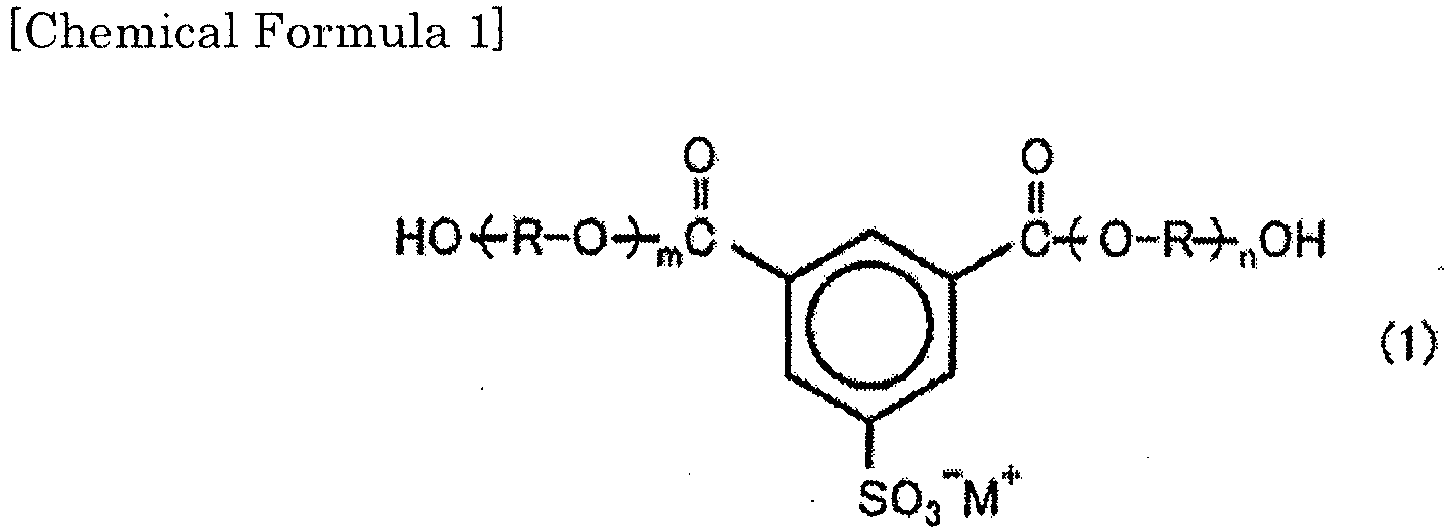
- In the general formula (1), the quaternary ammonium is preferably one represented by the following general formula (2), and the quaternary phosphonium is preferably one represented by the following general formula (3).


- The number average molecular weight of the hydrophilic polyol containing a sulfonic acid salt group used in the copolymerized polyurethane resin of the present invention is preferably 500 to 6000. When it is 500 or less, solubility in a general solvent is insufficient, and when it is 6000 or more, reactivity with an organic diisocyanate component (component C) decreases.
- Examples of the polyether (component B) having an active hydrogen only at one end may include a general-purpose polyalkylene oxide such as polyethylene glycol (PEG), poly-1,2-propylene glycol (PPG), and poly-n-butylene glycol (PTMG). Of those, polyethylene glycol is preferable in respect of versatility of a raw material and capability of forming more homogeneous and finely particulate emulsion particles. The active hydrogen means a functional group having reaction activity with an isocyanate group, and specific examples thereof include an alcoholic or phenolic hydroxyl group, an amino group, a mercapto group, and a carboxyl group. Taking both of versatility of a raw material and reaction activity with an isocyanate group in consideration, an alcoholic hydroxyl group is most preferable. The phrase "having an active hydrogen only at one end" specifically means having a hydroxyl group only at one end of a molecular chain. The molecular weight of these polyethers having an active hydrogen only at one end is 300 to 4000, preferably 500 to 2000, and further preferably 500 to 1000. Polyethers having a molecular weight of 300 or less are not preferred since versatility of a raw material cannot be obtained, and the molar number of molecules per given weight increases, so that the molecular weight of polyurethane resin becomes hard to increase. On the other hand, when the molecular weight exceeds 4000, the reactivity of a hydroxyl group at the molecular end becomes poor so that unreacted remaining polyether components increase, and as a result, a stable emulsion cannot be formed at the time of dispersion in water. The copolymer weight ratio of the component B in the copolymerized polyurethane resin of the present invention is 2 to 10 wt%, preferably 2 to 7 wt%, and most preferably 2 to 5 wt%. When it exceeds 10 wt%, the number of molecules of monofunctional polyether increases, and the molecular weight of the copolymerized polyurethane becomes hard to increase. On the other hand, when it is less than 2 wt%, the effects of the present invention, that is, the solution viscosity of a high-concentration organic solvent solution of the copolymerized polyurethane resin is effectively reduced, and a smooth phase transition from a high-concentration organic solvent solution phase to an aqueous phase hardly occurs during a water dispersion step. As a result, a stable emulsion is not formed. Alternatively, in order to obtain a stable emulsion, it is necessary to raise the dilution ratio of the copolymerized polyurethane organic solvent solution, and the use amount of an organic solvent is thus increased.
- The diisocyanate compound (component C) is an essential component of the copolymerized polyurethane resin of the present invention. Examples of the diisocyanate compound include aromatic diisocyanates such as 2,4-tolylene diisocyanate, 2,6-tolylene diisocyanate, p-phenylene diisocyanate, 4,4'-diphenylmethane diisocyanate, m-phenylene diisocyanate, 3,3'-dimethoxy-4,4'-biphenylene diisocyanate, 2,6-naphthalene diisocyanate, 3,3'-dimethyl-4,4'-biphenylene diisocyanate, 4,4'-diphenylene diisocyanate, 4,4'-diisocyanate diphenyl ether, 1,5-naphthalene diisocyanate and m-xylene diisocyanate; and aliphatic diisocyanates and cycloaliphatic diisocyanates such as hexamethylene diisocyanate, isophorone diisocyanate, hydrogenated products of 4,4'-diphenylmethane diisocyanate and hydrogenated products of m-xylene diisocyanate. Among them, 2,4-tolylene diisocyanate, 4,4'-diphenylmethane diisocyanate and hexamethylene diisocyanate are preferred from the viewpoint of versatility.
- The carboxylic acid group-containing diol (component D) is an essential copolymerization component of the copolymerized polyurethane resin of the present invention. The diol compound (component D) has at least one carboxyl group per molecule. Specific examples thereof may include dimethylol propionic acid, dimethylol butanoic acid and glyceric acid. Of these, dimethylol propionic acid is most preferable from the viewpoint of versatility of a raw material. By using the component D as a copolymerization component, a pendant carboxyl group is introduced into the copolymerized polyurethane resin of the present invention, and hence, an effect of improving water dispersibility and an effect of improving reactivity with a curing agent are exhibited. In the present invention, the pendant carboxyl group refers to a carboxyl group present at a site other than the end of a polymer main chain.
- The copolymerization ratio of the diol compound (component D) is preferably 1 to 6%, more preferably 1 to 5% in terms of the weight fraction of the (B) residue where the weight fraction of the (A) residue is 100%. When the copolymerization ratio of the component D is excessively high, stability of particles of the obtained emulsion tends to be deteriorated, and when the copolymerization ratio of the component D is excessively low, reactivity with a curing agent is deteriorated, so that sufficient bonding strength tends not to be obtained.
- When a polyol (component E) having three or more per molecule is used, a branched structure can be formed in the copolymerized polyurethane resin of the present invention, so that an effect of easily increasing the molecular weight is exhibited. Examples of the polyol having three or more hydroxyl groups per molecule may include aliphatic polyol compounds such as trimethylolpropane, glycerin and pentaerythritol. When the polyol compound is copolymerized within the bounds of not causing the obtained copolymerized polyurethane resin to gel, the molecular weight of the copolymerized polyurethane resin is easily increased, and reactivity with a curing agent can be improved. Among those polyols, trimethylolpropane, which has a small molecular weight, is preferred because it can keep the biomass degree relatively high. The copolymerization ratio of the polyol compound is preferably not less than 0.1 mol% and not more than 5 mol%, further preferably not less than 0.5 mol% and not more than 3 mol% based on the total amount of the hydrophilic polymeric polyol (component A) containing a sulfonic acid group and having the number average molecular weight of 500 to 6000, the polyether (component B) having an active hydrogen only at one end, the organic diisocyanate compound (component C), and the carboxylic acid group-containing diol (component D), which form the copolymerized polyurethane resin of the present invention.
- The number average molecular weight of the copolymerized polyurethane resin of the present invention is not particularly limited, but is preferably not less than 5,000 and less than 80,000. It is more preferably not less than 10,000 and less than 50,000, further preferably not less than 15,000 and less than 40,000. When the number average molecular weight is excessively low, the number of sulfonic acid metal salt groups per molecule of the copolymerized polyurethane resin decreases, so that it tends to become difficult to form stable emulsion particles, and the resin tends to become fragile when molded into a thin film. On the other hand, when the number average molecular weight is excessively high, it is difficult to obtain a homogeneous emulsion.
- The copolymerized polyurethane resin of the present invention has an acid value, and the acid value is more preferably not less than 50 eq/ton and not more than 500 eq/ton, further preferably not less than 80 eq/ton and not more than 300 eq/ton, still further preferably not less than 90 eq/ton and not more than 150 eq/ton. A copolymerized polyurethane resin having an acid value in the above-mentioned range is excellent in water dispersibility, and has a good balance between curability and water resistance when used as an adhesive.
- The copolymerized polyurethane resin of the present invention does not need to have a sulfonic acid salt group, but exhibits an effect of improving water dispersibility in particular when having a sulfonic acid salt group in a concentration of not less than 50 eq/ton and not more than 500 eq/ton. The concentration of the sulfonic acid salt group is more preferably not less than 80 eq/ton and not more than 300 eq/ton, further preferably not less than 100 eq/ton and not more than 200 eq/ton. When the sulfonic acid metal salt group concentration is excessively low, the particle size of water dispersion particles formed increases, leading to deterioration of storage stability and coating suitability. When the sulfonic acid metal salt group concentration is excessively high, the solution viscosity of a polyurethane solution increases, so that it becomes difficult for the polymerization reaction to proceed. The coating suitability mentioned here refers to such a property that when an emulsion solution is applied onto a base and subsequently dried, a smooth coating layer excellent in transparency is obtained. When the coating suitability is poor, the surface of the dried coating film is roughened, leading to deterioration of transparency, or a film formation property itself is not obtained, and hence, a coating layer is not formed but tattered film chips are formed.
- When the diisocyanate compound to be used for the copolymerized polyurethane resin of the present invention is partially replaced with a tri- or higher functional polyisocyanate, the molecular weight of the copolymerized polyurethane resin can be easily increased, and reactivity with a curing agent can be improved. However, when the ratio of replacement with a trifunctional polyisocyanate is excessively low, the above-described effects are not exhibited, and when the ratio of replacement is excessively high, gelation of the copolymerized polyurethane resin occurs. Therefore, the ratio of replacement with a tri- or higher functional polyisocyanate is preferably not less than 0.1 mol% and not more than 5 mol%, further preferably not less than 0.5 mol% and not more than 3 mol%. Examples of the preferred tri- or higher functional polyisocyanate may include adducts of three molecules of tolylene diisocyanate or three molecules of 1,6-hexane diisocyanate with respect to one molecule of trimethylolpropane or glycerin, and compounds having an isocyanurate ring formed of three molecules of 1,6-hexane diisocyanate.
- It may be possible to improve toughness of a coating film by copolymerizing a small amount of an aminoalcohol compound or a diamine compound with the copolymerized polyurethane resin of the present invention. Compounds having a relatively low molecular weight, such as N-methylmonoethanolamine and ethylenediamine, are preferred because they can keep the biomass degree relatively high.
- The aqueous emulsion of the present invention is an aqueous emulsion composed primarily of the copolymerized polyurethane resin of the present invention and water. Here, the phrase "composed primarily of" means that 50% by weight or more of a solid that forms the emulsion is composed of the copolymerized polyurethane resin of the present invention, and 50% by weight or more of a medium that forms the emulsion is composed of water.
- The aqueous emulsion of the present invention may contain an organic solvent, but in a particularly preferred embodiment of the present invention, an aqueous emulsion that does not contain an organic solvent can be formed. The aqueous emulsion of the present invention may contain a surfactant, but in a particularly preferred embodiment of the present invention, an aqueous emulsion that does not contain a surfactant can be formed. Further, in a particularly preferred embodiment of the present invention, an aqueous emulsion that does not contain both of an organic solvent and a surfactant can be formed.
- The average particle size of the emulsion of the present invention is not particularly limited, but is preferably not more than 200 nm. When the average particle size is large, storage stability of the emulsion is poor, so that the resin tends to be easily precipitated during storage. Further, the coating suitability is deteriorated, so that a transparent and smooth coating layer tends to be hardly formed.
- The aqueous emulsion of the present invention can be prepared by a method in which first a copolymerized polyurethane resin is polymerized in a hydrophilic organic solvent such as methyl ethyl ketone (hereinafter, abbreviated as MEK in some cases), acetone or tetrahydrofuran, a basic substance such as an amine is then added to and mixed with the resulting hydrophilic organic solvent solution of resin, water is then mixed, and the hydrophilic organic solvent is distilled off from the system. However, the method for preparing the emulsion is not limited to this method. The basic substance such as an amine may be added and stored immediately after polymerization, or may be added immediately before preparation of the emulsion. Other hydrophilic organic solvents such as lower alcohols such as methanol, ethanol or isopropanol may be mixed before water is mixed with the resulting hydrophilic organic solvent solution of resin.
- In a particularly preferred embodiment of the present invention, the copolymerized polyurethane resin of the present invention can be stably stored as a dispersion liquid with polymer particles dispersed in an aqueous medium that does not contain an organic solvent, and can be applied to a base. On the other hand, coating suitability to a specific base may be improved by blending a lower monoalcohol such as methanol, ethanol, n-propanol or isopropanol, an acetate such as ethyl acetate or butyl acetate, or an amide-based solvent such as dimethylformamide or dimethylacetamide in any concentration as a cosolvent.
- The emulsion of the present invention itself can be used as an adhesive and a coating agent. When a curing agent is further blended, bonding strength, solvent resistance and water resistance are improved. As the curing agent, polyfunctional compounds having reactivity to a carboxyl group are preferred, and specifically polyfunctional carbodiimide, polyfunctional isocyanate, polyfunctional epoxy, polyfunctional oxazoline, or the like are particularly effective. When instantaneous curability is particularly required, polyfunctional carbodiimide is preferred.
- Below, by way of examples, the present invention will be more specifically described. However, the present invention is not limited by the following examples. It is naturally understood that modifications may be properly made and practiced within the scope adaptable to the meaning described above and below. All of these are included in the technical scope of the present invention.
- Measurement and evaluation methods employed in this specification are as follows.
- A sodium concentration was quantitatively determined as a measure for estimating the concentration of sulfonic acid metal salt groups in a sulfonic acid sodium-containing diol raw material and a copolymerized polyurethane resin. Sodium was quantitatively determined in the following manner: a sample was heated to be carbonized and converted into ashes, and residual ash components were formed into a hydrochloric acid acidic solution, followed by performing quantitative determination using an atomic absorption method. The sulfonic acid metal salt group concentration was calculated based on the assumption that all the detected sodium would be derived from sulfonic acid sodium salt groups contained in the sample. The unit of concentration was the number of equivalents (eq/ton) per 106 g (i.e. 1 ton) of the resin sample.
- In 20 ml of tetrahydrofuran was dissolved 0.2 g of a sample (80% toluene solution), followed by performing measurement with a 0.1 N-NaOH ethanol solution using phenolphthalein as an indicator. The measured value is shown as the number of equivalents (eq/ton) in 106 g of resin solid components.
- A sample was dissolved in a mixed solvent of chloroform-d/DMSO-d6 = 1/1, and a resin composition ratio was determined by 1H-NMR analysis using a nuclear magnetic resonance analyzer (NMR) "GEMINI 400-MR" manufactured by Varian, Inc.
- A sample was dissolved in tetrahydrofuran so as to achieve a sample concentration of about 0.5% by weight, the solution was filtered through a membrane filter made of polytetrafluoroethylene having a pore size of 0.5 µm, and the filtrate was used as a sample for measurement. Using a gel permeation chromatograph (GPC) 150C manufactured by Waters Corporation, measurement was performed at a flow rate of 1 ml/minute using an RI detector with tetrahydrofuran as a carrier solvent. As a column, three columns: Shodex KF-802, KF-804 and KF-806 manufactured by Showa Denko K.K. were coupled to one another, and the column temperature was set to 30°C. A polystyrene standard substance was used as a molecular weight standard sample.
- 5 mg of a sample was put in a sample pan made of aluminum and was sealed, and measurement was performed while the temperature was elevated to 200°C at a temperature elevation rate of 20°C/minute using a differential scanning calorimeter DSC-220 manufactured by Seiko Instruments Inc. The temperature at an intersection of an extended line of the baseline below the glass transition temperature and a tangential line showing the maximum gradient in the transition part was defined as a glass transition temperature.
- A copolymerization ratio of a lactic acid unit in the copolymerized polyurethane resin was calculated from the NMR analysis value of the polymer composition described above, and the obtained value was defined as a biomass degree (%).
- Using Beckman Coulter LS 13 320, an average diameter from an arithmetic average based on a volume statistic from 0.040 µm to 2000 µm was measured, and the measured value was employed as an average particle size of emulsion particles. Measurements of the average particle size were performed after one day than a day that the emulsion was prepared (in the early stage) and after the emulsion was statically stored in a sealed state in a constant-temperature chamber at room temperature (23°C) for 30 days.
- A resin solid concentration 50 wt% solution of the obtained copolymerized polyurethane was placed in a mayonnaise bottle of 225 ml, was left to stand in a constant-temperature water phase of 25°C for 1 hour or longer, and measurement was then performed using a Brookfield viscometer.
- The abbreviations of compounds shown in the text and the tables in Examples below represent the following compounds.
HDI: hexamethylene diisocyanate
IPDI: isophorone diisocyanate
DMPA: dimethylol propionic acid
DMBA: dimethylol butanoic acid
MH-PEG#500: polyethylene glycol methoxy-blocked at one end, number average molecular weight: 500
MH-PEG#1000: polyethylene glycol methoxy-blocked at one end, number average molecular weight: 1000
PEG#1000: typical PEG#1000 (typical polyethylene glycol having hydroxyl groups at both ends, number average molecular weight: 1000)
TMP: trimethylolpropane
PETOL: pentaerythritol
PCL: polycaprolactone diol, number average molecular weight: 2000
TEA: trimethylamine
MEK: methyl ethyl ketone
IPA: isopropyl alcohol - In a 1 L glass flask equipped with a thermometer, a stirring rod and a Liebig condenser tube were added 408 parts of 2,2-dimethyl-3-hydroxypropyl-2',2'-dimethyl-3'-hydroxypropanate, 197 parts of dimethyl 5-sodiumsulfoisophthalate and 0.1 parts of a tetrabutyl titanate (TBT) catalyst. The mixture was stirred/reacted for 1 hour at 190°C while methanol was distilled off, and thereafter the temperature was elevated at a rate of 10°C per hour to reach 230°C. After it was confirmed that methanol was completely distilled at 230°C, the temperature was elevated to 250°C, the mixture was stirred under reduced pressure for 10 minutes, and the reaction product was cooled to 100°C. Then, 141 parts of toluene was mixed, and the mixture was homogeneously dissolved. The sulfonic acid metal salt group concentration and the acid value of the obtained 80 wt% toluene solution were as follows.
Sulfonic acid metal salt group concentration: 948 eq/ton solution
Acid value: 23 eq/ton solution - In a 1 L glass flask equipped with a thermometer, a stirring rod and a Liebig condenser tube were added 100 parts of the sulfonic acid sodium salt group-containing diol mixture-X (80 wt% toluene solution), 285 parts of L-lactide, 166 parts of ε-caprolactone, 190 parts of toluene, 0.10 parts of tin octylate as a catalyst and 0.25 parts of ethyl diethyl phosphonoacetate as a catalyst deactivator, and the reaction system was heated to 180°C while being subjected to toluene azeotropic dehydration under a nitrogen gas stream, and was stirred for 3 hours. Thereafter, the system was decompressed to distill off an unreacted residual monomer. About 20 minutes later, decompression was released after the unreacted monomer stopped to be distilled, and the system was cooled to 120°C or lower under a nitrogen gas stream and dissolved in toluene to obtain a 82 wt% toluene solution. The number average molecular weight of the obtained poly (hydroxycarboxylic acid) diol-A-1 was 2800.
- In a 1 L glass flask equipped with a thermometer, a stirring rod and a condenser, 122 parts of a 82 wt% toluene solution of the hydrophilic polymeric polyol-A-1 containing a sulfonic acid group and 40 parts of MEK were added and homogeneously mixed. Then, 11.4 parts of HDI was added and homogeneously mixed, and the system was heated to 70°C. 0.02 parts of dibutyltin dilaurate was added as a reaction catalyst, and the mixture was reacted at 70°C for 2 hours. Next, 1.7 parts of dimethylol propionic acid was added, and the mixture was further reacted while stirring for 3 hours, followed by adding 6 parts of MH-PEG#1000 (UNIOX M-1000 manufactured by NOF Corporation). The mixture was reacted at 70°C for 2 hours, followed by adding 1.7 parts of trimethylolpropane, and the mixture was further reacted for 3 hours and then diluted with 60 parts of MEK to terminate the reaction. For the obtained copolymerized polyurethane resin having a solid concentration of 50 wt%, the resin composition, the number average molecular weight and the biomass degree were measured, and the results are shown in Table 1. Moreover, the solution viscosity was measured, and the result is shown in Table 2.
- Synthesis was conducted in the same manner as in the above synthesis of PLU-1-1 except that the amount of HDI was changed to 9.4 parts when producing the copolymerized polyurethane resin in 3). For the obtained copolymerized polyurethane resin having a solid concentration of 50 wt%, the resin composition, the number average molecular weight and the biomass degree were measured, and the results are shown in Table 1. Moreover, the solution viscosity was measured, and the result is shown in Table 2.
- In a 1 L glass flask equipped with a thermometer, a stirring rod and a condenser, 122 parts of a 82 wt% toluene solution of the hydrophilic polymeric polyol A-1 (component A) containing a sulfonic acid group obtained in Example-1 and 40 parts of MEK were added and homogeneously mixed. Then, 11.8 parts of HDI was added and homogeneously mixed, and the system was heated to 70°C. 0.02 parts of dibutyltin dilaurate was added as a reaction catalyst, and the mixture was reacted at 70°C for 2 hours. Next, 1.7 parts of dimethylol propionic acid was added, and the mixture was further reacted while stirring for 3 hours, followed by adding 9 parts of MH-PEG#1000 (UNIOX M-1000 manufactured by NOF Corporation). The mixture was reacted at 70°C for 2 hours, followed by adding 1.7 parts of trimethylolpropane, and the mixture was further reacted for 3 hours and then diluted with 62 parts of MEK to terminate the reaction. For the obtained copolymerized polyurethane resin having a solid concentration of 50 wt%, the resin composition, the number average molecular weight and the biomass degree were measured, and the results are shown in Table 1. Moreover, the solution viscosity was measured, and the result is shown in Table 2.
- In a 1 L glass flask equipped with a thermometer, a stirring rod and a condenser, 122 parts of a 82 wt% toluene solution of the hydrophilic polymeric polyol A-1 (component A) containing a sulfonic acid group obtained in Example-1 and 40 parts of MEK were added and homogeneously mixed. Then, 11.8 parts of HDI was added and homogeneously mixed, and the system was heated to 70°C. 0.02 parts of dibutyltin dilaurate was added as a reaction catalyst, and the mixture was reacted at 70°C for 2 hours. Next, 1.7 parts of dimethylol propionic acid was added, and the mixture was further reacted while stirring for 3 hours, followed by adding 3.3 parts of MH-PEG#500 (UNIOX M-550 manufactured by NOF Corporation). The mixture was reacted at 70°C for 2 hours, followed by adding 1.7 parts of trimethylolpropane, and the mixture was further reacted for 3 hours and then diluted with 56 parts of MEK to terminate the reaction. For the obtained copolymerized polyurethane resin having a solid concentration of 50 wt%, the resin composition, the number average molecular weight and the biomass degree were measured, and the results are shown in Table 1. Moreover, the solution viscosity was measured, and the result is shown in Table 2.
- In a 1 L glass flask equipped with a thermometer, a stirring rod and a condenser, 122 parts of a 82 wt% toluene solution of the hydrophilic polymeric polyol A-1 (component A) containing a sulfonic acid group obtained in Example-1 and 40 parts of MEK were added and homogeneously mixed. Then, 8.9 parts of HDI was added and homogeneously mixed, and the system was heated to 70°C. 0.02 parts of dibutyltin dilaurate was added as a reaction catalyst, and the mixture was reacted at 70°C for 2 hours. Next, 6 parts of MH-PEG#1000 (UNIOX M-1000 manufactured by NOF Corporation) was added. The mixture was reacted at 70°C for 2 hours, followed by adding 1.6 parts of trimethylolpropane, and the mixture was further reacted for 3 hours and then diluted with 55 parts of MEK to terminate the reaction. For the obtained copolymerized polyurethane resin having a solid concentration of 50 wt%, the resin composition, the number average molecular weight and the biomass degree were measured, and the results are shown in Table 1. Moreover, the solution viscosity was measured, and the result is shown in Table 2.
- In a 1 L glass flask equipped with a thermometer, a stirring rod and a Liebig condenser tube were added 59 parts of DEIS* manufactured by Taoka Chemical Company, Limited as a sulfonic acid sodium salt group-containing diol mixture, 288 parts of L-lactide, 152 parts of ε-caprolactone, 200 parts of toluene, 0.10 parts of tin octylate as a catalyst and 0.25 parts of ethyl diethyl phosphonoacetate as a catalyst deactivator, and the reaction system was heated to 180°C while being subjected to toluene azeotropic dehydration under a nitrogen gas stream, and was stirred for 3 hours. Thereafter, the system was decompressed to distill off an unreacted residual monomer. About 20 minutes later, decompression was released after the unreacted monomer stopped to be distilled, and the system was cooled to 120°C or lower under a nitrogen gas stream and dissolved in toluene to obtain a 85 wt% toluene solution. The number average molecular weight of the obtained poly (hydroxycarboxylic acid) diol-A-2 was 3000.
(*DEIS: a condensate of sodium dimethyl 5-sulfonatoisophthalate and 2 mol times ethylene glycol) - In a 1 L glass flask equipped with a thermometer, a stirring rod and a condenser, 118 parts of a 85 wt% toluene solution of the hydrophilic polymeric polyol-A-2 containing a sulfonic acid group and 64 parts of MEK were added and homogeneously mixed. Then, 23.2 parts of IPDI was added and homogeneously mixed, and the system was heated to 70°C. 0.02 parts of dibutyltin dilaurate was added as a reaction catalyst, and the mixture was reacted at 70°C for 2 hours. Next, 1.9 parts of dimethylol butanoic acid was added, and the mixture was further reacted while stirring for 3 hours, followed by adding 6 parts of MH-PEG#1000 (UNIOX M-1000 manufactured by NOF Corporation). The mixture was reacted at 70°C for 2 hours, followed by adding 2.4 parts of pentaerythritol, and the mixture was further reacted for 3 hours and then diluted with 51 parts of MEK to terminate the reaction. For the obtained copolymerized polyurethane resin having a solid concentration of 50 wt%, the resin composition, the number average molecular weight and the biomass degree were measured, and the results are shown in Table 1. Moreover, the solution viscosity was measured, and the result is shown in Table 2.
- In a 1 L glass flask equipped with a thermometer, a stirring rod and a condenser, 118 parts of a 85 wt% toluene solution of the hydrophilic polymeric polyol A-2 (component A) containing a sulfonic acid group obtained in Synthesis Example-6 and 64 parts of MEK were added and homogeneously mixed. Then, 24.0 parts of IPDI was added and homogeneously mixed, and the system was heated to 70°C. 0.02 parts of dibutyltin dilaurate was added as a reaction catalyst, and the mixture was reacted at 70°C for 2 hours. Next, 1.9 parts of dimethylol butanoic acid was added, and the mixture was further reacted while stirring for 3 hours, followed by adding 4.0 parts of MH-PEG#500 (UNIOX M-550 manufactured by NOF Corporation). The mixture was reacted at 70°C for 2 hours, followed by adding 2.4 parts of pentaerythritol, and the mixture was further reacted for 3 hours and then diluted with 50 parts of MEK to terminate the reaction. For the obtained copolymerized polyurethane resin having a solid concentration of 50 wt%, the resin composition, the number average molecular weight and the biomass degree were measured, and the results are shown in Table 1. Moreover, the solution viscosity was measured, and the result is shown in Table 2.
- In a 1 L glass flask equipped with a thermometer, a stirring rod and a condenser, 122 parts of a 82 wt% toluene solution of the hydrophilic polymeric polyol (component A) containing a sulfonic acid group obtained in Example-1 and 40 parts of MEK were added and homogeneously mixed. Then, 11.4 parts of HDI was added and homogeneously mixed, and the system was heated to 70°C. 0.02 parts of dibutyltin dilaurate was added as a reaction catalyst, and the mixture was reacted at 70°C for 2 hours. Next, 1.7 parts of dimethylol propionic acid was added, and the mixture was further reacted while stirring for 3 hours, followed by adding 6 parts of PEG#1000 (UPOL PEG1000 manufactured by Sanyo Chemical Industries, Ltd.). The mixture was reacted at 70°C for 2 hours, followed by adding 1.7 parts of trimethylolpropane, and the mixture was further reacted for 3 hours and then diluted with 59 parts of MEK to terminate the reaction. For the obtained copolymerized polyurethane resin having a solid concentration of 50 wt%, the resin composition, the number average molecular weight and the biomass degree were measured, and the results are shown in Table 1. Moreover, the solution viscosity was measured, and the result is shown in Table 2.
- Synthesis was conducted in the same manner as in the above synthesis of PLU-5-1 except that the amount of HDI was changed to 9.4 parts. For the obtained copolymerized polyurethane resin having a solid concentration of 50 wt%, the resin composition, the number average molecular weight and the biomass degree were measured, and the results are shown in Table 1. Moreover, the solution viscosity was measured, and the result is shown in Table 2.
- In a 1 L glass flask equipped with a thermometer, a stirring rod and a condenser, 122 parts of a 82 wt% toluene solution of the hydrophilic polymeric polyol (component A) containing a sulfonic acid group obtained in Example-1 and 40 parts of MEK were added and homogeneously mixed. Then, 11.0 parts of HDI was added and homogeneously mixed, and the system was heated to 70°C. 0.02 parts of dibutyltin dilaurate was added as a reaction catalyst, and the mixture was reacted at 70°C for 2 hours. Next, 1.7 parts of dimethylol propionic acid was added, the mixture was further reacted while stirring for 3 hours, followed by adding 1.7 parts of trimethylolpropane, and the mixture was further reacted for 3 hours and then diluted with 52 parts of MEK to terminate the reaction. For the obtained copolymerized polyurethane resin having a solid concentration of 50 wt%, the resin composition, the number average molecular weight and the biomass degree were measured, and the results are shown in Table 1. Moreover, the solution viscosity was measured, and the result is shown in Table 2.
- Synthesis was conducted in the same manner as in the above synthesis of PLU-6-1 except that the amount of HDI was changed to 9.0 parts. For the obtained copolymerized polyurethane resin having a solid concentration of 50 wt%, the resin composition, the number average molecular weight and the biomass degree were measured, and the results are shown in Table 1. Moreover, the solution viscosity was measured, and the result is shown in Table 2.
- In a 1 L glass flask equipped with a thermometer, a stirring rod and a condenser, 122 parts of a 82 wt% toluene solution of the hydrophilic polymeric polyol (component A) containing a sulfonic acid group obtained in Example-1 and 40 parts of MEK were added and homogeneously mixed. Then, 8.2 parts of HDI was added and homogeneously mixed, and the system was heated to 70°C. 0.02 parts of dibutyltin dilaurate was added as a reaction catalyst, and the mixture was reacted at 70°C for 2 hours. Next, 1.7 parts of trimethylolpropane was added, and the mixture was further reacted for 3 hours and then diluted with 48 parts of MEK to terminate the reaction. For the obtained copolymerized polyurethane resin having a solid concentration of 50 wt%, the resin composition, the number average molecular weight and the biomass degree were measured, and the results are shown in Table 1. Moreover, the solution viscosity was measured, and the result is shown in Table 2.
- In a 1 L four-necked glass flask equipped with a thermometer, a stirring rod and a Liebig condenser tube was placed 200 parts of a 50 wt% MEK solution of the copolymer polyurethane PLU-1-1 obtained in Synthesis Example-1 described above, 25 parts of isopropyl alcohol was added with stirring at 40°C, and the mixture was homogeneously mixed. Thereafter, 200 parts of deionized water was gradually added with stirring while the system was kept at 40°C, and after the total amount was added, the mixture was stirred at the same temperature for 30 minutes, thereby making the system homogeneous. The organic solvent component was then distilled off under reduced pressure while the system was kept at 40°C. The weight of the organic solvent component that was distilled off, the time required for the operation and the average particle size of the obtained emulsion were measured, and the results are shown in Table 2.
- The copolymerized polyurethane resins obtained in Synthesis Examples 2 to 7 were emulsified in the same manner as in Example 1, and the results are summarized in Table 2.
- An attempt was made to emulsify the copolymerized polyurethane resins obtained in Comparative Synthesis Examples 1 and 2 in the same manner as in Example 1. Although the organic solvent component was tried to be distilled off under reduced pressure, it was difficult to separate the organic solvent from water, and a large amount of the organic solvent component remained in the flask. As a result, it was impossible to obtain a desired emulsion that does not contain an organic solvent.
- An attempt was made to emulsify the copolymerized polyurethane resins obtained in Comparative Synthesis Examples 3 to 5 in the same manner as in Example 1. However, the MEK solutions having a solid concentration of 50% had a high viscosity and could not be stirred, so that it was impossible to handle them.
- MEK was further added to the MEK solutions having a resin solid concentration of 50% obtained in Comparative Synthesis Examples 1 to 5 to dilute the solid concentration to 40%. The solution viscosities of the obtained 40% MEK solutions were measured, and the results are shown in Table 2.
- In a 1 L four-necked glass flask equipped with a thermometer, a stirring rod and a Liebig condenser tube was placed 200 parts of each of the above 40 wt% MEK solutions, 30 parts of isopropyl alcohol was added with stirring at 40°C, and the mixture was homogeneously mixed. Thereafter, 164 parts of deionized water was gradually added with stirring while the system was kept at 40°C, and after the total amount was added, the mixture was stirred at the same temperature for 30 minutes, thereby making the system homogeneous. The organic solvent component was then distilled off under reduced pressure while the system was kept at 40°C. The weight of the organic solvent component that was distilled off, the time required for the operation and the average particle size of the obtained emulsion were measured, and the results are shown in Table 2. As for each of the copolymerized polyurethanes obtained in Comparative Synthesis Examples 1 to 4, while a desired emulsion was obtained from the MEK solution having a solid concentration of 40 wt%, a long time was required for removal of the organic solvent component. Furthermore, the amount of the removed water-containing organic solvent component was 1.5 times larger than those of Synthesis Examples, and such removed component is merely disposed, which is wasteful. As for the copolymerized polyurethane PLU-7 obtained in Comparative Synthesis Example 5, it was impossible to obtain a desired emulsion also from the MEK solution having a solid concentration of 40 wt %.
[Table 1] Synthesis Example / Comparative Synthesis Example Copolymerized Polyurethane Resin Component A Component B Other components Component C Component D Component E Biomass degree (%) Achieved number average molecular weight Hydrophilic polymeric polyol containing a sulfonic acid group Polyether having an active hydrogen only at one end Typical PEG (Type of PEG having hydroxyl groups at both ends) Organic diisocyanate Carboxylic acid group-containing diol Tri- or higher functional polyol A-1 A-2 MH-PEG #1000 MH-PEG # 500 PEG # 1000 HDI IPDI DMPA DMBA TMP PETOL Synthesis Example-1 PLU-1-1 100 - 6 - - 11.4 - 1.7 - 1.7 - 44.5 38000 Synthesis Example-2 PLU-1-2 100 - 6 - - 9.4 - 1.7 - 1.7 - 45.2 19000 Synthesis Example-3 PLU-2 100 - 9 - - 11.8 - 1.7 - 1.7 - 43.1 22000 Synthesis Example-4 PLU-3 100 - - 3.3 - 11.4 - 1.7 - 1.7 - 43.2 24000 Synthesis Example-5 PLU-4 100 - 6 - - 8.9 - - - 1.6 - 46.1 25000 Synthesis Example-6 PLU-5 - 100 6 - - - 23.2 - 1.9 - 2.4 42.8 20000 Synthesis Example-7 PLU-6 - 100 - 4 - - 24.0 - 1.9 - 2.4 43.1 22000 Comparative Synthesis Example-1 PLU-5-1 100 - - - 6 11.4 - 1.7 - 1.7 - 45.5 42000 Comparative Synthesis Example-2 PLU-5-2 100 - - - 6 9.4 - 1.7 - L7 - 44.5 20000 Comparative Synthesis Example-3 PLU-6-1 100 - - - - 11.0 - 1.7 - 1.1 - 47.1 26000 Comparative Synthesis Example-4 PLU-6-2 100 - - - - 9 - 1.7 - 1.1 - 42.3 21000 Comparative Synthesis Example-5 PLU-7 100 - - - - 8.2 - - - 1.7 - 48.9 29000 [Table 2] Example / Comparative Example Copolymerized Polyurethane Resin Solution viscosity (Solid concentration: 50%, 25°C) (dPas.) Result of emulsification step from solution having a solid concentration of 50% Parts by weight of the distilled off organic solvent component in the emulsification step Time(minute) required distilling off the organic solvent component Example 1 PLU-1-1 230 Emulsion having average particle size :124nm was obtained. About 100 About 30 Example 2 PLU-1-2 41 Emulsion having average particle size :146nm was obtained. About 100 About 30 Example 3 PLU-2 42 Emulsion having average particle size :149nm was obtained. About 100 About 30 Example 4 PLU-3 386 Emulsion having average particle size :110nm was obtained. About 100 About 30 Example 5 PLU-4 248 Emulsion having average particle size :84nm was obtained. About 100 About 30 Example 6 PLU-5 84 Emulsion having average particle size :56nm was obtained. About 100 About 30 Example 7 PLU-6 122 Emulsion having average particle size :65nm was obtained. About 100 About 30 Comparative Example 1 PLU-5-1 491 Organic solvent component cannot be distilled off efficiency. Comparative Example 2 PLU-5-2 67 Organic solvent component cannot be distilled off efficiency. Comparative Example 3 PLU-6-1 > 1000 Emulsion cannot be prepared because of stirring failure. Comparative Example 4 PLU-6-2 > 1000 Emulsion cannot be prepared because of stirring failure. Comparative Example 5 PLU-7 > 1000 Emulsion cannot be prepared because of stirring failure. Example / Comparative Example Copolymerized Polyurethane Resin Solution viscosity (Solid concentration: 40% ,25°C) (dPas.) Result of emulsification step from solution having a solid concentration of 40% Parts by weight of the distilled off organic solvent component in the emulsification step Time(minute) required distilling off the organic solvent component Comparative Example 6 PLU-5-1 102 Emulsion having average particle size :144nm was obtained. About 150 About 50 Comparative Example 7 PLU-5-2 12 Emulsion having average particle size :152nm was obtained. About 150 About 50 Comparative Example 8 PLU-6-1 196 Emulsion having average particle size :174nm was obtained. About 150 About 50 Comparative Example 9 PLU-6-2 89 Emulsion having average particle size :171nm was obtained. About 150 About 50 Comparative Example 10 PLU-7 890 Organic solvent component cannot be distilled off efficiency. - The copolymerized polyurethane resin of the present invention can form an aqueous emulsion excellent in storage stability, and may be used in industrial products such as inks, coating agents, adhesives and primers. When an aqueous emulsion containing the copolymerized polyurethane resin of the present invention or an adhesive having the aqueous emulsion as a principal component is used as a heat-seal adhesive, it is expected to contribute to industries as an environmentally friendly adhesive which exhibits excellent heat-seal bonding strength and which can be used for a long period of time with bonding strength retained even after elapse of time.
Claims (11)
- A copolymerized polyurethane resin which is obtained by extending a chain length of a prepolymer with a carboxylic acid group-containing diol (component D) and/or a tri- or higher functional polyol (component E), wherein the prepolymer is obtained by a reaction of a hydrophilic polyol (component A) containing a sulfonic acid salt group, a polyether (component B) having an active hydrogen only at one end, and an organic diisocyanate compound (component C), and has at least one isocyanate group in a molecule.
- The copolymerized polyurethane resin according to claim 1, wherein the component A is an aliphatic polyester polyol obtained by adding an aliphatic hydroxycarboxylic acid composed primarily of an L-lactic acid to a sulfonic acid salt group-containing polyol.
- The copolymerized polyurethane resin according to claim 1 or 2, which comprises an aliphatic hydroxycarboxylic acid component other than the aliphatic hydroxycarboxylic acid composed primarily of an L-lactic acid, the component being an ε-caprolactone residue or a D-lactic acid residue.
- The copolymerized polyurethane resin according to any one of claims 1 to 3, which comprises a sulfonic acid salt group having an acid value of not less than 50 eq/ton and not more than 500 eq/ton.
- The copolymerized polyurethane resin according to any one of claims 1 to 4, wherein a weight fraction of a lactic acid residue in the component A according to claim 1 is not less than 50% and not more than 90%.
- The copolymerized polyurethane resin according to any one of claims 1 to 5, which has a number average molecular weight of not less than 5000.
- An aqueous emulsion which is composed primarily of the copolymerized polyurethane resin according to any one of claims 1 to 6 and water.
- The aqueous emulsion according to claim 7, which does not contain a surfactant.
- The aqueous emulsion according to claim 7 or 8, which does not contain an organic solvent.
- An adhesive composition, wherein a curing agent having reactivity to a carboxyl group is blended in the aqueous emulsion according to any one of claims 7 to 9.
- A method for producing the aqueous emulsion according to any one of claims 7 to 9, comprising the following steps (A) to (C):(A) polymerizing a copolymerized polyurethane resin in a hydrophilic organic solvent;(B) adding a basic compound to a hydrophilic organic solvent solution of the obtained resin, followed by mixing; and(C) distilling off the hydrophilic organic solvent from a system after mixing of water.
Applications Claiming Priority (2)
| Application Number | Priority Date | Filing Date | Title |
|---|---|---|---|
| JP2012266242 | 2012-12-05 | ||
| PCT/JP2013/082550 WO2014088023A1 (en) | 2012-12-05 | 2013-12-04 | Copolymerized polyurethane resin and aqueous emulsion |
Publications (2)
| Publication Number | Publication Date |
|---|---|
| EP2930196A1 true EP2930196A1 (en) | 2015-10-14 |
| EP2930196A4 EP2930196A4 (en) | 2016-08-17 |
Family
ID=50883441
Family Applications (1)
| Application Number | Title | Priority Date | Filing Date |
|---|---|---|---|
| EP13860360.0A Withdrawn EP2930196A4 (en) | 2012-12-05 | 2013-12-04 | Copolymerized polyurethane resin and aqueous emulsion |
Country Status (3)
| Country | Link |
|---|---|
| EP (1) | EP2930196A4 (en) |
| JP (1) | JPWO2014088023A1 (en) |
| WO (1) | WO2014088023A1 (en) |
Cited By (5)
| Publication number | Priority date | Publication date | Assignee | Title |
|---|---|---|---|---|
| CN107446105A (en) * | 2017-07-28 | 2017-12-08 | 高鼎精细化工(昆山)有限公司 | A kind of sulfonic waterborne polyurethane emulsion, its product and preparation method thereof |
| EP3140357A4 (en) * | 2015-04-20 | 2017-12-13 | Tronox LLC | Polymer, polymer modified titanium dioxide pigment, and method of forming a pigmented paint formulation |
| WO2019080700A1 (en) * | 2017-10-24 | 2019-05-02 | 佛山市精信汇明科技有限公司 | Environment-friendly polyurethane curing agent, preparation method therefor and uses thereof |
| CN109762501A (en) * | 2018-12-29 | 2019-05-17 | 北京东方雨虹防水技术股份有限公司 | A kind of bi-component polyamides urea groups building sealant and preparation method thereof |
| EP4137550A4 (en) * | 2020-04-17 | 2024-05-22 | artience Co., Ltd. | ADHESIVE AGENT COMPOSITION AND ADHESIVE SHEET |
Families Citing this family (4)
| Publication number | Priority date | Publication date | Assignee | Title |
|---|---|---|---|---|
| ES2716126T3 (en) * | 2015-03-06 | 2019-06-10 | Covestro Deutschland Ag | Aqueous polyurethane urea dispersion containing free acid groups |
| CN109897160B (en) * | 2019-01-10 | 2021-02-26 | 襄阳精信汇明科技股份有限公司 | Blocked polyurethane curing agent emulsion and preparation method and application thereof |
| JP2024081814A (en) * | 2021-04-14 | 2024-06-19 | artience株式会社 | Adhesive composition and adhesive sheet |
| JP2024077449A (en) * | 2022-11-28 | 2024-06-07 | artience株式会社 | Biodegradable adhesive, cured product, laminate, package, and method for producing biodegradable adhesive |
Family Cites Families (14)
| Publication number | Priority date | Publication date | Assignee | Title |
|---|---|---|---|---|
| DE3603996A1 (en) | 1986-02-08 | 1987-08-13 | Bayer Ag | METHOD FOR THE CONTINUOUS PRODUCTION OF AQUEOUS POLYURETHANE DISPERSIONS AND THEIR USE AS A COATING AGENT OR AS AN ADHESIVE |
| JPS63168421A (en) * | 1986-12-27 | 1988-07-12 | Sumitomo Bakelite Co Ltd | Polyurethane resin |
| JP2579501B2 (en) * | 1987-10-29 | 1997-02-05 | 三菱化学株式会社 | Polyurethane resin for magnetic recording media |
| GB8809754D0 (en) * | 1988-04-25 | 1988-06-02 | Ici Plc | Polyurethane foams |
| US5608000A (en) * | 1993-09-24 | 1997-03-04 | H. B. Fuller Licensing & Financing, Inc. | Aqueous polyurethane dispersion adhesive compositions with improved heat resistance |
| JP4067148B2 (en) * | 1997-06-02 | 2008-03-26 | 旭化成ケミカルズ株式会社 | Block polyisocyanate composition and aqueous one-component thermosetting urethane resin composition |
| JP2007308588A (en) * | 2006-05-18 | 2007-11-29 | Dainippon Ink & Chem Inc | Water-based adhesive for plastic substrate, laminate and polarizing plate using the same |
| JP5202068B2 (en) * | 2008-03-27 | 2013-06-05 | 日華化学株式会社 | Aqueous polyurethane resin composition, one-component adhesive and laminate using the same, and method for producing aqueous polyurethane resin composition |
| WO2010053065A1 (en) | 2008-11-04 | 2010-05-14 | 東洋紡績株式会社 | Copolyurethane resin having polylactic acid segment, and aqueous emulsion and coating fluid composition, containing same |
| JP5581609B2 (en) | 2009-05-29 | 2014-09-03 | 東洋紡株式会社 | Adhesive for polylactic acid-based aqueous laminate, emulsion, and laminate using them |
| JP5197499B2 (en) * | 2009-06-05 | 2013-05-15 | 三井化学株式会社 | Aqueous polyurethane resin, hydrophilic resin and film |
| US9617453B2 (en) * | 2009-12-14 | 2017-04-11 | Air Products And Chemicals, Inc. | Solvent free aqueous polyurethane dispersions and methods of making and using the same |
| EP2377895A1 (en) * | 2010-04-14 | 2011-10-19 | Bayer MaterialScience AG | Aqueous polyurethane polyuric dispersions |
| EP2770004A4 (en) * | 2011-10-20 | 2015-07-22 | Toyo Boseki | Copolymer polyurethane resin having poly(hydroxycarboxylic acid) segment and pendant carboxyl group, and emulsion and adhesive composition including same |
-
2013
- 2013-12-04 WO PCT/JP2013/082550 patent/WO2014088023A1/en not_active Ceased
- 2013-12-04 EP EP13860360.0A patent/EP2930196A4/en not_active Withdrawn
- 2013-12-04 JP JP2014526288A patent/JPWO2014088023A1/en active Pending
Cited By (7)
| Publication number | Priority date | Publication date | Assignee | Title |
|---|---|---|---|---|
| EP3140357A4 (en) * | 2015-04-20 | 2017-12-13 | Tronox LLC | Polymer, polymer modified titanium dioxide pigment, and method of forming a pigmented paint formulation |
| US9902800B2 (en) | 2015-04-20 | 2018-02-27 | Tronox Llc | Polymer, polymer modified titanium dioxide pigment, and method of forming a pigmented paint formulation |
| CN107446105A (en) * | 2017-07-28 | 2017-12-08 | 高鼎精细化工(昆山)有限公司 | A kind of sulfonic waterborne polyurethane emulsion, its product and preparation method thereof |
| CN107446105B (en) * | 2017-07-28 | 2020-06-19 | 高鼎精细化工(昆山)有限公司 | Sulfonic acid type waterborne polyurethane emulsion, product and preparation method thereof |
| WO2019080700A1 (en) * | 2017-10-24 | 2019-05-02 | 佛山市精信汇明科技有限公司 | Environment-friendly polyurethane curing agent, preparation method therefor and uses thereof |
| CN109762501A (en) * | 2018-12-29 | 2019-05-17 | 北京东方雨虹防水技术股份有限公司 | A kind of bi-component polyamides urea groups building sealant and preparation method thereof |
| EP4137550A4 (en) * | 2020-04-17 | 2024-05-22 | artience Co., Ltd. | ADHESIVE AGENT COMPOSITION AND ADHESIVE SHEET |
Also Published As
| Publication number | Publication date |
|---|---|
| JPWO2014088023A1 (en) | 2017-01-05 |
| EP2930196A4 (en) | 2016-08-17 |
| WO2014088023A1 (en) | 2014-06-12 |
Similar Documents
| Publication | Publication Date | Title |
|---|---|---|
| WO2014088023A1 (en) | Copolymerized polyurethane resin and aqueous emulsion | |
| CN111423343B (en) | Hydrophilic diisocyanate and preparation method and application thereof | |
| JP5310565B2 (en) | Copolyurethane resin containing polylactic acid segment, aqueous emulsion containing the same, and coating liquid composition | |
| Rahman et al. | Properties of waterborne polyurethane adhesives: effect of chain extender and polyol content | |
| EP3590986B1 (en) | Polyurethane resin for synthetic leather | |
| JP2009544834A (en) | Polytrimethylene ether polyurethane ionomer | |
| JPWO2009060838A1 (en) | Polyurethane for printing ink binder, its production method and printing ink | |
| JP5998937B2 (en) | Copolyurethane resin having poly (hydroxycarboxylic acid) segment and pendant carboxyl group, emulsion and adhesive composition containing the same | |
| CA1038518A (en) | Highly cross-linked polyurethane dispersions stable to light and to storage | |
| AU2007201578A1 (en) | Aqueous polyurethane dispersions with improved storage stability | |
| WO2019010018A1 (en) | Low viscosity polyols for polyurethane applications | |
| BRPI0601434B1 (en) | Aqueous coating agent, its preparation process and its applications | |
| JP2018141119A (en) | Polyurethane resin aqueous dispersion body | |
| JP5581609B2 (en) | Adhesive for polylactic acid-based aqueous laminate, emulsion, and laminate using them | |
| JP5918323B2 (en) | Binder for printing ink and printing ink using the same | |
| JP2013147614A (en) | Polyurethane resin | |
| EP3875539B1 (en) | Modified copolymerized polyester resin and water dispersion thereof | |
| JP2010174170A (en) | Binder for polylactic acid-based aqueous ink, aqueous emulsion, and aqueous ink | |
| JP2012233023A (en) | Sustained-release biodegradable coating agent and body with sustained-release biodegradable coat | |
| US20240026062A1 (en) | Water-based polyurethane dispersions and their preparation | |
| Patel et al. | Biodegradable waterborne polyurethane‐urea dispersion adhesives with high biocontent | |
| JP2010229224A (en) | Water-based polyurethane dispersion and water-based paint using the same | |
| EP3546493A1 (en) | Aqueous dispersion | |
| JP5177798B2 (en) | Self-emulsifying isocyanate compound and process for producing the same | |
| US20120077929A1 (en) | Polytrimethylene ether-based polyurethane ionomers |
Legal Events
| Date | Code | Title | Description |
|---|---|---|---|
| PUAI | Public reference made under article 153(3) epc to a published international application that has entered the european phase |
Free format text: ORIGINAL CODE: 0009012 |
|
| 17P | Request for examination filed |
Effective date: 20150702 |
|
| AK | Designated contracting states |
Kind code of ref document: A1 Designated state(s): AL AT BE BG CH CY CZ DE DK EE ES FI FR GB GR HR HU IE IS IT LI LT LU LV MC MK MT NL NO PL PT RO RS SE SI SK SM TR |
|
| AX | Request for extension of the european patent |
Extension state: BA ME |
|
| DAX | Request for extension of the european patent (deleted) | ||
| RA4 | Supplementary search report drawn up and despatched (corrected) |
Effective date: 20160715 |
|
| RIC1 | Information provided on ipc code assigned before grant |
Ipc: C08G 18/34 20060101ALI20160712BHEP Ipc: C08G 18/28 20060101ALI20160712BHEP Ipc: C08G 18/73 20060101ALI20160712BHEP Ipc: C08G 18/50 20060101ALI20160712BHEP Ipc: C08G 18/10 20060101AFI20160712BHEP Ipc: C08G 18/75 20060101ALI20160712BHEP Ipc: C08G 18/46 20060101ALI20160712BHEP Ipc: C08G 18/08 20060101ALI20160712BHEP Ipc: C09D 175/04 20060101ALI20160712BHEP Ipc: C08G 18/48 20060101ALI20160712BHEP Ipc: C09K 3/00 20060101ALI20160712BHEP Ipc: C09J 175/04 20060101ALI20160712BHEP Ipc: C08G 18/32 20060101ALI20160712BHEP Ipc: C08G 18/38 20060101ALI20160712BHEP |
|
| STAA | Information on the status of an ep patent application or granted ep patent |
Free format text: STATUS: REQUEST FOR EXAMINATION WAS MADE |
|
| STAA | Information on the status of an ep patent application or granted ep patent |
Free format text: STATUS: THE APPLICATION IS DEEMED TO BE WITHDRAWN |
|
| 18D | Application deemed to be withdrawn |
Effective date: 20170214 |