EP2928126A1 - Subnetzroutenverarbeitungsverfahren und nachrichtenweiterleitungsvorrichtung - Google Patents
Subnetzroutenverarbeitungsverfahren und nachrichtenweiterleitungsvorrichtung Download PDFInfo
- Publication number
- EP2928126A1 EP2928126A1 EP13859584.8A EP13859584A EP2928126A1 EP 2928126 A1 EP2928126 A1 EP 2928126A1 EP 13859584 A EP13859584 A EP 13859584A EP 2928126 A1 EP2928126 A1 EP 2928126A1
- Authority
- EP
- European Patent Office
- Prior art keywords
- route
- instruction
- hop
- host route
- hop host
- Prior art date
- Legal status (The legal status is an assumption and is not a legal conclusion. Google has not performed a legal analysis and makes no representation as to the accuracy of the status listed.)
- Withdrawn
Links
Images

Classifications
-
- H—ELECTRICITY
- H04—ELECTRIC COMMUNICATION TECHNIQUE
- H04L—TRANSMISSION OF DIGITAL INFORMATION, e.g. TELEGRAPHIC COMMUNICATION
- H04L45/00—Routing or path finding of packets in data switching networks
- H04L45/28—Routing or path finding of packets in data switching networks using route fault recovery
-
- H—ELECTRICITY
- H04—ELECTRIC COMMUNICATION TECHNIQUE
- H04L—TRANSMISSION OF DIGITAL INFORMATION, e.g. TELEGRAPHIC COMMUNICATION
- H04L12/00—Data switching networks
- H04L12/64—Hybrid switching systems
- H04L12/6418—Hybrid transport
-
- H—ELECTRICITY
- H04—ELECTRIC COMMUNICATION TECHNIQUE
- H04L—TRANSMISSION OF DIGITAL INFORMATION, e.g. TELEGRAPHIC COMMUNICATION
- H04L45/00—Routing or path finding of packets in data switching networks
- H04L45/02—Topology update or discovery
-
- H—ELECTRICITY
- H04—ELECTRIC COMMUNICATION TECHNIQUE
- H04L—TRANSMISSION OF DIGITAL INFORMATION, e.g. TELEGRAPHIC COMMUNICATION
- H04L45/00—Routing or path finding of packets in data switching networks
- H04L45/12—Shortest path evaluation
- H04L45/122—Shortest path evaluation by minimising distances, e.g. by selecting a route with minimum of number of hops
-
- H—ELECTRICITY
- H04—ELECTRIC COMMUNICATION TECHNIQUE
- H04L—TRANSMISSION OF DIGITAL INFORMATION, e.g. TELEGRAPHIC COMMUNICATION
- H04L45/00—Routing or path finding of packets in data switching networks
- H04L45/22—Alternate routing
-
- H—ELECTRICITY
- H04—ELECTRIC COMMUNICATION TECHNIQUE
- H04L—TRANSMISSION OF DIGITAL INFORMATION, e.g. TELEGRAPHIC COMMUNICATION
- H04L61/00—Network arrangements, protocols or services for addressing or naming
- H04L61/09—Mapping addresses
- H04L61/10—Mapping addresses of different types
- H04L61/103—Mapping addresses of different types across network layers, e.g. resolution of network layer into physical layer addresses or address resolution protocol [ARP]
-
- H—ELECTRICITY
- H04—ELECTRIC COMMUNICATION TECHNIQUE
- H04L—TRANSMISSION OF DIGITAL INFORMATION, e.g. TELEGRAPHIC COMMUNICATION
- H04L12/00—Data switching networks
Definitions
- the present invention relates to the field of switch and router products, including e.g., a method for processing a subnet route and message forwarding equipment.
- An invalid subnet route refers to that the next-hop failure of the subnet route is invalid.
- Such condition of invalid subnet route usually appears when the subnet route exists but the next-hop host route of the subnet has been deleted. Specifically, it may appear when an Address Resolution Protocol (ARP) table item of the next-hop host route has been aged but the subnet route which is dynamically generated has not yet been deleted or when the subnet route is statically configured but the ARP table item of the next-hop host route is deleted or aged.
- ARP Address Resolution Protocol
- a commonly used method for managing an invalid subnet route in an existing technology is usually to make that the next-hop egress of the subnet route is directed to a Central Processing Unit (CPU), so that a subsequent data message can be sent to the CPU, and then the CPU triggers ARP relearning.
- CPU Central Processing Unit
- these subnet routes are simultaneously directed to the same next-hop host route, and when the host route is invalid, the egresses of all the subnet routes may be modified into CPUs, which may cause multiple modification operations of the subnet routes in hardware.
- the next-hop host route is restored, all the subnet routes are restored into the egresses to which the host route is directed, and then multiple restoration operations are required. Therefore, the route management may become relatively complicated, and efficiency of switching between invalidity and validity of the next hop is relatively low.
- a method for processing a subnet route and message forwarding equipment are provided, which simplify management over the subnet route and improve switching efficiency of the subnet route.
- a method for processing a subnet route, applied to message forwarding equipment comprising: detecting that a next-hop host route to which the subnet route is directed becomes invalid; when the next-hop host route becomes invalid, generating and issuing a deletion instruction for deleting the next-hop host route; intercepting the deletion instruction, and converting the deletion instruction into a first updating instruction for modifying the next-hop host route; and updating a next-hop egress of the next-hop host route into a Central Processing Unit, CPU, of the message forwarding equipment according to the first updating instruction.
- CPU Central Processing Unit
- the deletion instruction when the deletion instruction is intercepted, whether the next-hop host route is referenced by other subnet route or not is further judged; when the next-hop host route is referenced by said other subnet route, a step of converting the deletion instruction into the first updating instruction for modifying the next-hop host route is executed; and when the next-hop host route is not referenced by other subnet route, the next-hop host route is deleted according to the deletion instruction.
- next-hop host route after updating the next-hop egress of the next-hop host route into the CPU of the message forwarding equipment, further comprising: for a received Internet Protocol, IP, message matching with the subnet route, forwarding the IP message to the CPU of the message forwarding equipment according to the next-hop host route corresponding to the subnet route, to enable the CPU to trigger Address Resolution Protocol, ARP, learning for the next-hop host route.
- IP Internet Protocol
- ARP Address Resolution Protocol
- next-hop host route further comprising: detecting that the next-hop host route is restored to be valid; when the next-hop host route is restored to be valid, generating and issuing an addition instruction for adding the next-hop host route; intercepting the addition instruction, and converting the addition instruction into a second updating instruction for modifying the next-hop host route; and updating the next-hop egress of the next-hop host route into a currently valid next-hop egress according to the second updating instruction.
- the addition instruction when the addition instruction is intercepted, whether the next-hop host route is referenced by other subnet route or not is further judged; when the next-hop host route is referenced by said other subnet route, a step of converting the addition instruction into the second updating instruction for modifying the next-hop host route is executed; and when the next-hop host route is not referenced by said other subnet route, the next-hop host route is added according to the addition instruction.
- a message forwarding equipment comprising: a detecting element, configured to detect that a next-hop host route to which a subnet route is directed becomes invalid; an instruction generating element, configured to, when the detecting element detects that the next-hop host route becomes invalid, generate and issue a deletion instruction for deleting the next-hop host route; an instruction intercepting element, configured to intercept the deletion instruction; an instruction converting element, configured to convert the deletion instruction intercepted by the instruction intercepting element into a first updating instruction for modifying the next-hop host route; and an updating element, configured to update a next-hop egress of the next-hop host route into a Central Processing Unit, CPU, of the message forwarding equipment according to the first updating instruction.
- a detecting element configured to detect that a next-hop host route to which a subnet route is directed becomes invalid
- an instruction generating element configured to, when the detecting element detects that the next-hop host route becomes invalid, generate and issue a deletion instruction for deleting the next-hop host route
- the instruction intercepting element is further configured to, when the deletion instruction is intercepted, further judge whether the next-hop host route is referenced by other subnet route or not; based on that a judgement result is that the next-hop host route is referenced by said other subnet route, trigger the instruction converting element; and based on that the judgement result is that the next-hop host route is referenced by said other subnet route, issue the deletion instruction; and the message forwarding equipment further comprises a deleting element, configured to delete the next-hop host route according to the deletion instruction issued by the instruction intercepting element.
- a message forwarding element configured to, for a received Internet Protocol, IP, message matching with the subnet route, forward the IP message to the CPU of the message forwarding equipment according to the next-hop host route corresponding to the subnet route, to enable the CPU to trigger Address Resolution Protocol, ARP, learning for the next-hop host route.
- IP Internet Protocol
- ARP Address Resolution Protocol
- the instruction generating element is further configured to, when the detecting element detects that the next-hop host route is restored to be valid, generate and issue an addition instruction for adding the next-hop host route;
- the instruction intercepting element is further configured to intercept the addition instruction;
- the instruction converting element is further configured to convert the addition instruction intercepted by the instruction intercepting element into a second updating instruction for modifying the next-hop host route;
- the updating element is further configured to update the next-hop egress of the next-hop host route into a currently valid next-hop egress according to the second updating instruction.
- the instruction intercepting element is further configured to, when the addition instruction is intercepted, further judge whether the next-hop host route is referenced by other subnet route or not; when a judgement result is that the next-hop host route is referenced by said other subnet route, trigger the instruction converting element; and when the judgement result is that the next-hop host route is referenced by said other subnet route, issue the addition instruction; and the message forwarding equipment further comprises an adding element, configured to add the next-hop host route according to the addition instruction issued by the instruction intercepting element.
- a failing subnet route is managed by virtue of writing of host route hardware which should not exist, so that management and switching operation over the subnet route is greatly simplified, a switching speed of the failing subnet route which becomes valid again is increased, and moreover, a hardware resource of a system can be saved.
- a method for processing a subnet route is provided in the embodiment of the present invention.
- an invalid subnet route can be conveniently managed.
- the subnet routes are not required to be switched one by one, and switching operation over all the subnet routes can be finished by once switching.
- the method for processing a subnet route provided in the embodiment of the present invention is applied to message forwarding equipment, wherein the message forwarding equipment may be a router or a switch supporting three-layer forwarding.
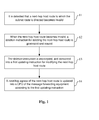
- the method includes the following steps:
- a normal subnet route is directed to a valid next-hop host route, and the host route is directed to a valid egress port.
- the next-hop host route is determined to become invalid; and when the ARP table item of the egress port to which the next-hop host route is directed is relearned, the next-hop host route is determined to be recovered to be valid.
- Step 12 When the next-hop host route becomes invalid, a deletion instruction for deleting the next-hop host route is generated and issued.
- the deletion instruction is usually triggered to be generated by a routing protocol when the next-hop host route becomes invalid, and is issued to bottom-layer hardware.
- Step 13 The deletion instruction is intercepted and converted into a first updating instruction for modifying the next-hop host route.
- the deletion instruction issued by the protocol may be intercepted at the bottom-layer hardware, and is correspondingly converted to perform special processing according to the embodiment of the present invention, so that the host route in the hardware is not really deleted.
- Step 14 A next-hop egress of the next-hop host route is updated into a CPU of the message forwarding equipment according to the first updating instruction.
- Step 14 the embodiment of the present invention may further include the following step:
- a normal subnet route is directed to a valid next-hop host route, and the host route is directed to a valid egress port.
- the subnet route may become an invalid subnet route.
- the deletion operation over the next-hop host route is not really performed, but the host route is reserved in the hardware, and only the egress of the host route is updated into the CPU.
- the subnet route is directed to the host route, and the egress of the host route is the CPU, so that the operation of directing the subnet route to the CPU is finished.
- the subnet route at this time is directed to the CPU, so that the influence on an effect of the routing protocol is eliminated, a subsequent message may still be sent to the CPU, and new ARP learning may be triggered.
- the host route existing in the hardware is not deleted, the host route is directed to the CPU, so as not to cause any other influence on the protocol.
- the method when the next-hop host route invalid, the subnet routes related to the next-hop host route are not required to be operated one by one. Due to the fact that only the egress direction of the host route is operated but a corresponding relationship between the host route and the subnet routes is not modified, the invalid subnet route can be managed without performing any operation on the subnet route through the method in the embodiment of the present invention.
- Step 13 in the embodiment may include the following specific steps:
- the redirecting operation for all the subnet routes can be finished only by redirecting the host route to a valid egress without performing any operation on the subnet routes.
- the method according to the present invention may further include the following steps:
- the addition instruction is usually triggered to be generated by the routing protocol when the next-hop host route is restored to be valid, and is issued to the bottom-layer hardware.
- Step 18 The addition instruction is intercepted and converted into a second updating instruction for modifying the next-hop host route.
- the addition instruction issued by the protocol may be intercepted at the bottom-layer hardware, and is correspondingly converted for special processing according to the embodiment of the present invention.
- Step 19 The next-hop egress of the next-hop host route is updated into a currently valid next-hop egress according to the second updating instruction.
- Step 18 may specifically include the following steps:
- the host route when the invalid host route is required to be deleted by the system, the host route is not really deleted rather than being directed to the CPU. By such as a little change, all the invalid subnet routes can be controlled and managed in a unified way. When the host route is restored to be valid, all the subnet routes related to the host route can be rapidly and effectively switched back together. Compared with a conventional method for managing the invalid subnet route, it does not need to perform any operation over the subnet route in the embodiment of the present invention, and the host route is also not really deleted, so that the management and switching operation over the subset route can be simplified, the switching speed of the invalid subnet route which becomes valid again is increased, and moreover, the hardware resource of the system can be saved.
- the next-hop host route of the multiple subnet routes is 11.11.11.11
- the egress port of the next-hop host route is Port1/Mac1.
- an instruction for deleting the host route may be issued by the routing protocol.
- the instruction for adding the host route may be issued by the routing protocol
- the method provided by the embodiment of the present invention has the advantages that an expectation and requirement of the routing protocol on a subnet route behaviour are met, and the management on the invalid subnet route and rapid switching of the subnet route which becomes valid again can be rapidly and conveniently realized; and moreover, in the aspect of the management flow, the management mechanism of directing the subnet route to the next-hop host route and directing the host route to an actual egress port is also followed without any additional management mechanism, so that the method can be well compatible with an existing protocol. From the above, the switching efficiency and the management convenience of the method according to the embodiment of the present invention are greatly improved compared with those of a related art.
- a message forwarding equipment further is provided in the embodiment of the present invention, which may be equipment such as a router or a switch supporting three-layer routing. As shown in Fig. 3 , the equipment includes:
- the equipment may further include:
- the instruction intercepting element is further configured to, when the deletion instruction is intercepted, further judge whether the next-hop host route is referenced by other subnet route or not; based on that a judgement result is that the next-hop host route is referenced by other subnet route, trigger the instruction converting element, otherwise, the deletion instruction is issued; and at this time, the message forwarding equipment further includes an deleting element, configured to delete the next-hop host route according to the deletion instruction issued by the instruction intercepting element.
- the equipment may rapidly execute route switching when the host route is restored, and at this time:
- the instruction intercepting element is further configured to, when the addition instruction is intercepted, further judge whether the next-hop host route is referenced by other subnet route or not; when a judgement result is that the next-hop host route is referenced by other subnet route, trigger the instruction converting element; otherwise, issue the addition instruction; and the message forwarding equipment further includes an adding element, configured to add the next-hop host route according to the addition instruction issued by the instruction intercepting element.
- an identified executable code element may include one or more physical or logic blocks of a computer instruction, and can be, for example, structured into an object, a process or a function.
- executable codes of the identified element are not required to be physically located together, and may include different instructions stored at different physical locations, and when these instructions are logically combined, they form the element and achieve a specified purpose of the element.
- the executable code element may be a single instruction or multiple instructions, and even may be distributed on multiple different code segments, in different programs and across multiple pieces of memory equipment.
- operating data may be identified in the element, and may be implemented in any proper form and organized in a data structure of any proper type. The operating data may be collected as a single dataset, or may be distributed at different locations (including different memory equipment), and may at least partially exist in a system or a network as an electrical signal.
- the elements can be implemented by virtue of software, in consideration of the level of an existing hardware process, those skilled in the art can realize corresponding functions of the elements which can be implemented by software by constructing corresponding hardware circuits regardless of cost, and the hardware circuits include conventional Ultra Large Scale Integration (ULSI) circuits or gate arrays and existing semiconductors such as logic chips and transistors or other discrete elements.
- ULSI Ultra Large Scale Integration
- the elements may also be implemented by programmable hardware equipment, such as a field programmable gate array, a programmable array logic and programmable logic equipment.
- the method for processing the subnet route and the message forwarding equipment provided in the embodiment of the present invention bring the beneficial effects as follows: the management on the subnet route is simplified, and the switching efficiency of the subnet route is improved.
Landscapes
- Engineering & Computer Science (AREA)
- Computer Networks & Wireless Communication (AREA)
- Signal Processing (AREA)
- Data Exchanges In Wide-Area Networks (AREA)
Applications Claiming Priority (2)
| Application Number | Priority Date | Filing Date | Title |
|---|---|---|---|
| CN201210497238.0A CN102984062B (zh) | 2012-11-29 | 2012-11-29 | 一种子网路由的处理方法及报文转发设备 |
| PCT/CN2013/087796 WO2014082556A1 (zh) | 2012-11-29 | 2013-11-25 | 一种子网路由的处理方法及报文转发设备 |
Publications (2)
| Publication Number | Publication Date |
|---|---|
| EP2928126A1 true EP2928126A1 (de) | 2015-10-07 |
| EP2928126A4 EP2928126A4 (de) | 2015-11-18 |
Family
ID=47857821
Family Applications (1)
| Application Number | Title | Priority Date | Filing Date |
|---|---|---|---|
| EP13859584.8A Withdrawn EP2928126A4 (de) | 2012-11-29 | 2013-11-25 | Subnetzroutenverarbeitungsverfahren und nachrichtenweiterleitungsvorrichtung |
Country Status (5)
| Country | Link |
|---|---|
| US (1) | US9509595B2 (de) |
| EP (1) | EP2928126A4 (de) |
| CN (1) | CN102984062B (de) |
| RU (1) | RU2635217C2 (de) |
| WO (1) | WO2014082556A1 (de) |
Families Citing this family (3)
| Publication number | Priority date | Publication date | Assignee | Title |
|---|---|---|---|---|
| CN102984062B (zh) | 2012-11-29 | 2016-06-15 | 中兴通讯股份有限公司 | 一种子网路由的处理方法及报文转发设备 |
| US9485115B2 (en) * | 2014-04-23 | 2016-11-01 | Cisco Technology, Inc. | System and method for enabling conversational learning in a network environment |
| CN111835643B (zh) | 2019-04-22 | 2021-10-19 | 华为技术有限公司 | 管理mac表的方法、网络设备、存储介质和程序产品 |
Family Cites Families (16)
| Publication number | Priority date | Publication date | Assignee | Title |
|---|---|---|---|---|
| FI100443B (fi) * | 1995-04-10 | 1997-11-28 | Nokia Telecommunications Oy | Liikenteen väylöitys tietoliikenneverkon solmussa |
| US7007101B1 (en) * | 2001-11-09 | 2006-02-28 | Radisys Microware Communications Software Division, Inc. | Routing and forwarding table management for network processor architectures |
| US7058725B2 (en) * | 2002-06-13 | 2006-06-06 | Intel Corporation | Method and apparatus to perform network routing using multiple length trie blocks |
| US7698738B2 (en) * | 2003-05-14 | 2010-04-13 | Northrop Grumman Systems Corporation | System and method for real-time network-based recovery following an information warfare attack |
| CN1330139C (zh) * | 2003-07-31 | 2007-08-01 | 华为技术有限公司 | 多协议标签交换(mpls)支持多端口虚拟局域网(vlan)的方法 |
| US7817539B2 (en) * | 2005-05-17 | 2010-10-19 | Resiliens As | Resilient routing systems and methods |
| US7505402B2 (en) * | 2005-06-23 | 2009-03-17 | Cisco Technology, Inc. | Method and apparatus for providing faster convergence for redundant sites |
| US7647426B2 (en) * | 2006-01-12 | 2010-01-12 | Cisco Technology, Inc. | Method and apparatus for achieving Border Gateway Protocol convergence using alternate route information |
| JP4773981B2 (ja) * | 2007-01-12 | 2011-09-14 | 富士通株式会社 | 通信制御プログラム |
| CN100588179C (zh) * | 2007-05-10 | 2010-02-03 | 杭州华三通信技术有限公司 | 一种快速路由收敛方法及相关装置 |
| CN101442494B (zh) * | 2008-12-16 | 2011-06-22 | 中兴通讯股份有限公司 | 一种实现快速重路由的方法 |
| CN101483548B (zh) | 2009-02-26 | 2011-01-19 | 中国人民解放军信息工程大学 | 一种距离向量路由协议自愈的方法和系统 |
| CN101931590A (zh) * | 2010-08-27 | 2010-12-29 | 中兴通讯股份有限公司 | 一种路由整合方法和装置 |
| CN102111342B (zh) * | 2011-04-07 | 2014-09-10 | 杭州华三通信技术有限公司 | 一种链路保护方法及其设备 |
| CN102263693B (zh) * | 2011-07-20 | 2017-10-10 | 中兴通讯股份有限公司 | 一种路由表管理方法及系统 |
| CN102984062B (zh) | 2012-11-29 | 2016-06-15 | 中兴通讯股份有限公司 | 一种子网路由的处理方法及报文转发设备 |
-
2012
- 2012-11-29 CN CN201210497238.0A patent/CN102984062B/zh active Active
-
2013
- 2013-11-25 US US14/648,111 patent/US9509595B2/en active Active
- 2013-11-25 RU RU2015125376A patent/RU2635217C2/ru active
- 2013-11-25 EP EP13859584.8A patent/EP2928126A4/de not_active Withdrawn
- 2013-11-25 WO PCT/CN2013/087796 patent/WO2014082556A1/zh not_active Ceased
Also Published As
| Publication number | Publication date |
|---|---|
| CN102984062B (zh) | 2016-06-15 |
| US9509595B2 (en) | 2016-11-29 |
| RU2015125376A (ru) | 2017-01-10 |
| RU2635217C2 (ru) | 2017-11-09 |
| US20150304210A1 (en) | 2015-10-22 |
| WO2014082556A1 (zh) | 2014-06-05 |
| EP2928126A4 (de) | 2015-11-18 |
| CN102984062A (zh) | 2013-03-20 |
Similar Documents
| Publication | Publication Date | Title |
|---|---|---|
| US9843535B2 (en) | Low-cost flow matching in software defined networks without TCAMS | |
| US20210266259A1 (en) | Extensible Control Plane for Network Management in a Virtual Infrastructure Environment | |
| US7876710B2 (en) | Layer two MAC flushing/re-routing | |
| US9001644B2 (en) | Ethernet virtual private network system for providing fast protection for access rings | |
| US9521070B2 (en) | Apparatus, information processing method and information processing system | |
| US9594612B2 (en) | System and method of a hardware shadow for a network element | |
| JP6079426B2 (ja) | 情報処理システム、方法、装置及びプログラム | |
| US20140325637A1 (en) | Supporting IP Address Overlapping Among Different Virtual Networks | |
| US9716687B2 (en) | Distributed gateways for overlay networks | |
| CN107645402B (zh) | 一种路由管理方法和装置 | |
| US11438193B2 (en) | EVPN multihoming optimizations for ethernet segment connection interruptions | |
| CN101232444A (zh) | 哈希冲突解决方法、装置及具有该装置的交换设备 | |
| WO2019201209A1 (zh) | 报文转发 | |
| US9509595B2 (en) | Method for processing subnet route and message forwarding equipment | |
| JP6299745B2 (ja) | 通信システム、制御装置、通信方法及びプログラム | |
| EP3198808B1 (de) | Lokale paketvermittlung in einer satellitenvorrichtung | |
| EP1455510A2 (de) | Verfahren und Vorrichtung zum Aktualisieren der Anbieterdomäne durch Änderungsmitteillungen der Kundentopologie | |
| US20200304368A1 (en) | Accessing processing devices of a network device | |
| US20230055402A1 (en) | Communication apparatus, switching control method and program | |
| US20240364625A1 (en) | Efficient virtual address learning in overlay network | |
| US20160142224A1 (en) | Apparatus and method for reducing the number of ports on which flooding is executed | |
| WO2016173196A1 (zh) | 地址映射关系的学习方法及装置 | |
| KR101356152B1 (ko) | 네트워크 주소 변환 장치 | |
| US12519725B2 (en) | VTEP multipath data traffic forwarding system | |
| US20240396843A1 (en) | System and Apparatus to Synchronize Entries Between Redundant Centralized Gateways in Overlay Networks |
Legal Events
| Date | Code | Title | Description |
|---|---|---|---|
| PUAI | Public reference made under article 153(3) epc to a published international application that has entered the european phase |
Free format text: ORIGINAL CODE: 0009012 |
|
| 17P | Request for examination filed |
Effective date: 20150611 |
|
| AK | Designated contracting states |
Kind code of ref document: A1 Designated state(s): AL AT BE BG CH CY CZ DE DK EE ES FI FR GB GR HR HU IE IS IT LI LT LU LV MC MK MT NL NO PL PT RO RS SE SI SK SM TR |
|
| AX | Request for extension of the european patent |
Extension state: BA ME |
|
| RA4 | Supplementary search report drawn up and despatched (corrected) |
Effective date: 20151016 |
|
| RIC1 | Information provided on ipc code assigned before grant |
Ipc: H04L 12/703 20130101ALI20151012BHEP Ipc: H04L 12/751 20130101ALI20151012BHEP Ipc: H04L 12/721 20130101AFI20151012BHEP |
|
| DAX | Request for extension of the european patent (deleted) | ||
| STAA | Information on the status of an ep patent application or granted ep patent |
Free format text: STATUS: EXAMINATION IS IN PROGRESS |
|
| 17Q | First examination report despatched |
Effective date: 20180302 |
|
| STAA | Information on the status of an ep patent application or granted ep patent |
Free format text: STATUS: THE APPLICATION HAS BEEN WITHDRAWN |
|
| 18W | Application withdrawn |
Effective date: 20180712 |