EP2928124A1 - Verfahren zur erstellung einer nachricht durch ein endgerät - Google Patents
Verfahren zur erstellung einer nachricht durch ein endgerät Download PDFInfo
- Publication number
- EP2928124A1 EP2928124A1 EP15160223.2A EP15160223A EP2928124A1 EP 2928124 A1 EP2928124 A1 EP 2928124A1 EP 15160223 A EP15160223 A EP 15160223A EP 2928124 A1 EP2928124 A1 EP 2928124A1
- Authority
- EP
- European Patent Office
- Prior art keywords
- challenge
- user
- terminal
- message
- metadata
- Prior art date
- Legal status (The legal status is an assumption and is not a legal conclusion. Google has not performed a legal analysis and makes no representation as to the accuracy of the status listed.)
- Granted
Links
Images

Classifications
-
- H—ELECTRICITY
- H04—ELECTRIC COMMUNICATION TECHNIQUE
- H04L—TRANSMISSION OF DIGITAL INFORMATION, e.g. TELEGRAPHIC COMMUNICATION
- H04L51/00—User-to-user messaging in packet-switching networks, transmitted according to store-and-forward or real-time protocols, e.g. e-mail
- H04L51/07—User-to-user messaging in packet-switching networks, transmitted according to store-and-forward or real-time protocols, e.g. e-mail characterised by the inclusion of specific contents
- H04L51/10—Multimedia information
-
- G—PHYSICS
- G06—COMPUTING OR CALCULATING; COUNTING
- G06F—ELECTRIC DIGITAL DATA PROCESSING
- G06F3/00—Input arrangements for transferring data to be processed into a form capable of being handled by the computer; Output arrangements for transferring data from processing unit to output unit, e.g. interface arrangements
- G06F3/01—Input arrangements or combined input and output arrangements for interaction between user and computer
- G06F3/048—Interaction techniques based on graphical user interfaces [GUI]
- G06F3/0484—Interaction techniques based on graphical user interfaces [GUI] for the control of specific functions or operations, e.g. selecting or manipulating an object, an image or a displayed text element, setting a parameter value or selecting a range
- G06F3/04842—Selection of displayed objects or displayed text elements
-
- G—PHYSICS
- G06—COMPUTING OR CALCULATING; COUNTING
- G06F—ELECTRIC DIGITAL DATA PROCESSING
- G06F3/00—Input arrangements for transferring data to be processed into a form capable of being handled by the computer; Output arrangements for transferring data from processing unit to output unit, e.g. interface arrangements
- G06F3/01—Input arrangements or combined input and output arrangements for interaction between user and computer
- G06F3/048—Interaction techniques based on graphical user interfaces [GUI]
- G06F3/0484—Interaction techniques based on graphical user interfaces [GUI] for the control of specific functions or operations, e.g. selecting or manipulating an object, an image or a displayed text element, setting a parameter value or selecting a range
- G06F3/04847—Interaction techniques to control parameter settings, e.g. interaction with sliders or dials
-
- H—ELECTRICITY
- H04—ELECTRIC COMMUNICATION TECHNIQUE
- H04L—TRANSMISSION OF DIGITAL INFORMATION, e.g. TELEGRAPHIC COMMUNICATION
- H04L51/00—User-to-user messaging in packet-switching networks, transmitted according to store-and-forward or real-time protocols, e.g. e-mail
- H04L51/07—User-to-user messaging in packet-switching networks, transmitted according to store-and-forward or real-time protocols, e.g. e-mail characterised by the inclusion of specific contents
- H04L51/18—Commands or executable codes
-
- H—ELECTRICITY
- H04—ELECTRIC COMMUNICATION TECHNIQUE
- H04L—TRANSMISSION OF DIGITAL INFORMATION, e.g. TELEGRAPHIC COMMUNICATION
- H04L67/00—Network arrangements or protocols for supporting network services or applications
- H04L67/01—Protocols
- H04L67/131—Protocols for games, networked simulations or virtual reality
Definitions
- the invention relates to the general field of software applications.
- It relates more particularly to a mechanism for enriching the functionality of a fun software application installed on a user's terminal, and in particular on a mobile terminal such as for example a smartphone or "smartphone" in English, a tablet. digital, etc.
- Some games have a feature that allows them to publish user scores to a web server or social network server so that they share that score with other users.
- interactions between users remain limited.
- the inventors have therefore found that there is no current state of the art method for associating on terminals, and in particular on mobile terminals, a game offering a challenge (ie - say a program or a software application of a fun nature) and a software or a communication service allowing users to communicate with other users, for example by message.
- a challenge ie - say a program or a software application of a fun nature
- a software or a communication service allowing users to communicate with other users, for example by message.
- the invention proposes a mechanism which, by relying on the technical principles of a game (via the production of a challenge and the presentation of this challenge to a recipient user), offers a new mode of interaction between two users. or more for the implementation of such games, taking advantage of the existence of message communication services available in a telecommunications network, such as in particular in a mobile telecommunications network.
- This mechanism relies on three distinct entities as well as on the processes implemented by these entities, namely a terminal of a user issuing a message into which data of definition of a challenge (ie a challenge), and by means of which the sending user can share multimedia content with another user called recipient, the terminal of the recipient user who is able to present (that is to say to execute) the proposed challenge by the sending user to the recipient user, and a server placed in a flow cutoff between the terminal of the sending user and the terminal of the recipient user and who is able to supply the multimedia content to the user's terminal. recipient.
- a terminal of a user issuing a message into which data of definition of a challenge (ie a challenge), and by means of which the sending user can share multimedia content with another user called recipient
- the terminal of the recipient user who is able to present (that is to say to execute) the proposed challenge by the sending user to the recipient user
- Multimedia content here means any type of digital content such as audio or video content, text or an image.
- Multimedia content access data here means either the multimedia content itself, or data such as for example an address or a URL (Uniform Resource Locator) for accessing multimedia content on a local or remote entity.
- URL Uniform Resource Locator
- the invention aims to enrich the possibilities of interactions between several users through games in the form of challenges.
- the implementation of the invention makes use of a challenge definition module on the terminal transmitting the message, this challenge definition module being capable of generating metadata defining a challenge and of transmitting these metadata to a user. recipient, for processing and decoding of challenge metadata by a corresponding module - said challenge presentation module - executed on the terminal of the recipient user.
- the challenge thus created is intended to accompany a multimedia content selected by the sender user for the recipient user making playful access to this content by the recipient user.
- the user may in particular choose multimedia contents that are not of an emergency or importance nature.
- Metadata defining in relation to multimedia content a challenge to be presented to a recipient user it is meant here that the metadata define a challenge intended to frame the delivery of the multimedia content to the recipient user.
- This challenge can thus, for example, condition the actual reproduction (ie presentation) of the multimedia content to the recipient user, or offer a partial reproduction of this multimedia content or a reproduction of a transformed version of the multimedia content (eg resulting from truncation, scrambling or masking of certain parts of the content), the multimedia content in its entirety being provided to the recipient user in the event of successful resolution of the challenge by the latter.
- the challenge defined by the metadata can be independent of the multimedia content (eg any question, a riddle) or be defined from it (eg a puzzle built from the multimedia content to be reconstituted, a truncated image of the content multimedia to guess, etc.).
- the metadata of a challenge is a definition of this challenge that defines (ie describes) explicitly or in a codified way at least one challenge and the expected answer to that challenge.
- This is alphanumeric data (ie of the text type), preferentially conforming to a coding logic common to the challenge definition module and to the challenge presentation module installed on the terminal of said at least one recipient user, in order to limit the amount of information to be transmitted to the terminal of the recipient user to enable the execution of the challenge.
- the metadata includes the information required for the execution of the challenge by the challenge presentation module installed on the terminal of said at least one user of the message recipient.
- This metadata can include the type of challenge proposed by the sending user, the parameters of this challenge such as questions asked during the presentation (that is to say during the execution) challenge for a challenge quiz or quiz type, the expected answer to the challenge, the position of the puzzle pieces for a puzzle-type challenge, etc.
- They may also include a maximum duration to provide a response to the challenge following a presentation of the challenge to a said recipient user. This feature makes it possible to add an additional playful dimension to the challenge proposed by the sending user to the user receiving the message.
- the metadata can also be used to identify at least one operation to be performed following the presentation of the challenge by the challenge presentation module installed on the site. terminal of the recipient user, depending on whether or not a response provided by said at least one recipient user corresponds to the expected response.
- They may furthermore comprise, depending on the type of challenge envisaged, information representative of the nature of said at least one multimedia content, thus enabling the challenge presentation module installed on the terminal of the recipient user to use an appropriate rendering module.
- multimedia content may furthermore comprise, depending on the type of challenge envisaged, information representative of the nature of said at least one multimedia content, thus enabling the challenge presentation module installed on the terminal of the recipient user to use an appropriate rendering module.
- the invention thus proposes a playful alternative to current communication services, such as SMS communication services (Short Messaging Service) or MMS (Multimedia Messaging Service). It advantageously extends the capabilities of services currently available on mobile communications networks by providing a new user experience, while remaining compatible with these services.
- SMS communication services Short Messaging Service
- MMS Multimedia Messaging Service
- the invention makes it possible for a user of a terminal to create his own challenges through his terminal, for example by means of a user interface provided for this purpose.
- the challenge may be to hide multimedia content from the challenge and create a challenge and multimedia content hidden in the challenge for a chosen audience of choice.
- the successful resolution of the challenge (in other words the provision of the expected answer to the challenge, also included in the challenge metadata) allows the recipient of the message to access the multimedia content that the user has sent him. transmitter.
- the user experience in communications is thus enriched, interactions between users becoming fun thanks to the invention.
- these challenges are chosen so as to be simple and quick to execute by the recipient user of the message.
- the challenge can be selected by the transmitting user from a catalog of predetermined challenges adapted to the at least one user of the message recipient.
- This challenge catalog can be updated with at least one new challenge chosen for said at least one recipient user after receiving a message from the server.
- This message For example, it informs the sending user of the successes or failures of the recipient user in solving the challenges he proposes.
- the sender user can thus customize his message.
- a succession of user interface pages is presented to the recipient user.
- the layout of one of these user interface pages used for the presentation of a challenge is preferably predefined from a model of user interface or pattern (in English "template").
- Each user interface page comprises a plurality of elements participating in presenting the challenge to the recipient user (for example, for a quiz challenge, a list offering different choices of answers, among which is the expected answer to the challenge, etc.).
- the layout and size of these elements appearing on each user interface page as well as the succession of the different pages are predefined for a given type of challenge, so that only the element to be presented at the chosen location on a page for this element needs to be specified by the sender user so that the challenge can be presented to the recipient user in an understandable and usable form.
- only a few parameters of the challenge including the elements to be displayed on the user interface pages
- one or more multimedia contents must be transmitted by message from one terminal to another for the implementation of a challenge, and no full user interface pages.
- the type of challenge and the aforementioned challenge parameters are advantageously described in the metadata of a challenge that are transmitted from one terminal to another. Since complete pages of user interface do not need to be transmitted, the amount of information to be transmitted from the terminal of the sending user to the terminal of the destination user is reduced.
- the one or more UI page patterns associated with the challenge type identified in the metadata are then used by the challenge presentation module of the recipient user's terminal, modified from the challenge metadata to generate one or more user interface pages to present when presenting the challenge.
- the challenge metadata are alphanumeric data conforming to a coding logic common to the terminal user's challenge definition module and to the terminal's challenge presentation module. recipient user.
- one or two byte alphanumeric code may be used to code the type of challenge and a flow associated with this type of challenge, i.e., a succession of associated user interface pages. In this way, the amount of information to be transmitted from one terminal from one user to another is reduced.
- the server according to the invention thus acts as a proxy between the terminal of the user sending the message and the terminal of the recipient user. It advantageously stores the multimedia content (s) selected by the sending user for the recipient user so as to limit the amount of data sent to the terminal of the recipient user.
- the multimedia content (s) can thus be downloaded by the recipient user's terminal only when the recipient user plans to execute the challenge that is proposed to him, in advance of this execution.
- the presence of the server is transparent.
- the sending user continues to select the recipient of his message as he does for any message sent from his terminal (such as for example a message meeting the mobile telephony standard).
- said at least one multimedia content is transmitted to the server in the message containing the metadata.
- This message is, for example, an HTTP (HyperText Transfer Protocol) request of the POST type, known per se.
- HTTP HyperText Transfer Protocol
- This "grouped" transmission facilitates the processing of the data sent by the sending terminal (metadata and multimedia content (s)) by the server.
- the at least one multimedia content is transmitted to the server in a separate message from the message containing the metadata.
- the metadata are for example transmitted in an HTTP request of type GET while the multimedia content (s) are transmitted in a HTTP request of POST type using as parameter a identifier provided by the server allowing it to associate the metadata received in the GET request to the multimedia content (s) received in the POST request.
- the metadata and / or the multimedia contents may be sent according to another message format, such as in particular an SMS message, an MMS message, an accepted message format in a communication sequence, such as for example a communication sequence.
- a communication sequence such as for example a communication sequence.
- enriched RICH or "Joyn ®” a message format accepted by a social network, such as "Facebook ®”, etc.
- This embodiment advantageously accommodates the fact that not all terminals are necessarily equipped to interpret and process the metadata transmitted by the transmitting terminal, and execute the challenge defined in these metadata. It proposes for this purpose to implement at the level of the server placed in a power cut between the terminals of the sending and receiving users, a check to ensure that the terminal of the recipient user is able to present to the recipient user the challenge built by the sending user, and if not, send a message to the receiving terminal allowing it to install a challenge presentation module capable of interpreting the metadata sent per message by the terminal of the sending user.
- the construction method comprises a step of pre-registering the terminal of the sender user with the server as a user of a challenge definition module and / or a presentation module. of challenge.
- This pre-registration step facilitates the processing of the message sent by the terminal of the sending user to the server. It allows the server to identify faster the terminals compatible with the invention, that is to say those who have a definition module and challenge presentation in accordance with the invention. Thus, for example, the verification step can then be limited to verifying that the said at least one recipient user of the multimedia content sent by the terminal of the sending user is registered with the server.
- this allows the server to anticipate the verification of the terminals compatible with the invention, as soon as the terminal is registered.
- the recording step may comprise providing the server with a list of contacts of the sender user stored on the terminal in which is associated with the identifier of the recipient user an identifier of terminal.
- the sender user is thus not forced to specify a terminal identifier when composing his message to designate the recipient user but can use any type of identifier when it is associated in his contact list to a terminal identifier. This makes the composition of the message more user-friendly.
- the invitation message is sent to the second terminal via a mobile telecommunications network.
- a mobile telecommunications network This is for example a short message type SMS.
- the invention thus has a preferred but nonlimiting application when the terminals are mobile terminals.
- it relies advantageously on communication media already existing on these terminals, in this case an SMS.
- the processing method implemented by the server comprises a step of receiving a message from the terminal of a said recipient user reporting a failure or success of said recipient user in providing the expected response to the challenge when the terminal presents the challenge.
- This message can advantageously allow the server to maintain scores for the users so as to value them and encourage them to elucidate the challenges sent to them.
- the processing method implemented by the server may comprise a step of updating a score associated with said at least one recipient user as a function of the failure or success reported in the message received from the terminal. this recipient user.
- the scores kept up to date by the server can be used to propose new challenges to users or to adapt the challenges that are proposed to them, as mentioned above.
- a score can also be assigned to each user of a message built in accordance with the invention to value the most active users.
- the message sent by the terminal of the recipient user may allow the server to unblock the multimedia content present in the message built according to the invention in the event of failure reported by this terminal and following the agreement of the sending user.
- the various steps of the method of constructing a message and / or the processing method and / or the reception method according to the invention are determined by instructions of computer programs.
- the invention also relates to a computer program on an information carrier, this program being capable of being implemented in a terminal or more generally in a computer, this program comprising instructions adapted to the implementation of implement steps of a method of constructing a message as described above.
- the invention also relates to a computer program on an information carrier, this program being capable of being implemented in a server or more generally in a computer, this program comprising instructions adapted to the implementation of the steps of a treatment method as described above.
- the invention also relates to a computer program on an information medium, this program being capable of being implemented in a terminal or more generally in a computer, this program comprising instructions adapted to the implementation of the steps a reception method as described above.
- Each of these programs can use any programming language, and be in the form of source code, object code, or intermediate code between source code and object code, such as in a partially compiled form, or in any form what other form is desirable.
- the invention also relates to a computer-readable information medium, comprising instructions of a computer program as mentioned above.
- the information carrier may be any entity or device capable of storing the program.
- the medium may comprise storage means, such as a ROM, for example a CD ROM or a microelectronic circuit ROM, or a magnetic recording medium, for example a diskette (floppy disc) or a disk hard.
- the information medium may be a transmissible medium such as an electrical or optical signal, which may be conveyed via an electrical or optical cable, by radio or by other means.
- the program according to the invention can be downloaded in particular on an Internet type network.
- the information carrier may be an integrated circuit in which the program is incorporated, the circuit being adapted to execute or to be used in the execution of the method in question.
- the system has the same advantages as those mentioned above for the terminals and the server according to the invention.
- the invention therefore proposes a new service offering a use of a telecommunications network fun, spontaneous, easy and user-friendly, and a new way of communicating between users.
- construction method, the processing method, the receiving method, the terminals, the server and the system according to the invention present in combination all or some of the aforementioned characteristics. .
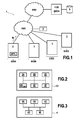
- the figure 1 represents, in its environment, a system 1 according to the invention in a particular embodiment.
- This system offers a service S for exchanging "playful" messages between a first user A equipped with a terminal 2 according to the invention (a user's terminal transmitter within the meaning of the invention), and a second user B equipped with a terminal 3 (terminal of a recipient user within the meaning of the invention), based on the production and presentation of challenges accompanying multimedia content.
- multimedia content is meant any type of digital content and more specifically audio and / or video content and images.
- Terminals 2 and 3 are smartphones, also known as “smartphones", capable of communicating over an NW1 mobile telecommunications network such as for example a third generation network (eg UMTS network) or fourth generation network.
- NW1 mobile telecommunications network such as for example a third generation network (eg UMTS network) or fourth generation network.
- IDA ID respectively IDB
- the identifiers IDA and IDB are for example here telephone numbers.
- Terminals 2 and 3 can alternatively be equipped with other communication interfaces, such as for example an interface type WiFI (Wireless FIdelity), or be able to communicate on separate mobile telecommunications networks.
- WiFI Wireless FIdelity
- the terminal 2 is equipped with an application software APPL that allows the user A to benefit from the service S, and more specifically, to send and receive multimedia contents (eg photography, text file, text message, audio and / or video files, etc.) accompanied by challenges whose resolution triggers the reproduction of these multimedia contents.
- multimedia contents eg photography, text file, text message, audio and / or video files, etc.
- challenges whose resolution triggers the reproduction of these multimedia contents.
- the user who receives such multimedia content can only access it in its entirety if it successfully resolves the challenge attached to it.
- This challenge is produced (ie defined or constructed) by the user A using a challenge definition module implemented by the APPL application, which relies here on a graphical user interface UI implemented by the user.
- APPL application and through which user A can interact with the challenge definition module.
- This UI user interface offers a tool for editing a message containing a challenge to the user that is both simple and easy to use.
- the challenge produced by the user A is, for example, a quiz, a puzzle to be reconstructed, a truncated audio file or a hidden or partially hidden image that must be identified, a multiple-choice question, etc. No limitation is attached to the type of challenge envisaged during the implementation of the invention.
- the application APPL here also allows the user A to access multimedia content transmitted by other terminals through the APPL application, in other words, with challenges to be solved. It therefore also implements a challenge presentation module defined in the context of the service S within the meaning of the invention.
- the system 1 comprises not only the terminals 2 and 3 but also a server 4 for processing the messages transmitted by the terminal 2, according to the invention.
- This server 4 is in flux cutoff of all the messages sent by the terminal 2 and constructed via the APPL application. It is accessible here via a NW2 public network, typically the public Internet network.
- NW2 public network
- the contact address of the server 4 on this network NW2 i.e. the address with which it can communicate and is accessible
- oC4 is configured in the application APPL.
- the @ oC4 address is entered in a list of contacts (directory) stored on the terminal 2 and accessible by the APPL application.
- the terminal 2 has the hardware architecture of a computer, as illustrated in FIG. figure 2 . It comprises in particular a processor 2A, a read-only memory 2B, a random access memory 2C, a nonvolatile memory 2D in which the application APPL is stored here, 2E communication means on the mobile telecommunication network NW1 enabling it in particular to communicate with the server 4, and input / output means 2F allowing it to interact with the user A.
- These input / output means comprise in particular here a touch screen, a virtual keyboard, and various means of restitution of multimedia contents, such as, for example, speakers, a video player, etc.
- the UI graphical user interface implemented by the application APPL advantageously relies on the input / output means 2F.
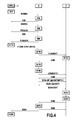
- the read-only memory 2B of the terminal 2 constitutes a recording medium readable by the processor 2A and on which is recorded a computer program according to the invention, comprising instructions for the execution of the steps of a method of construction of the a message according to the invention, the steps of this method being described later with reference to the figures 4 , 5 and 6A-6H in a particular embodiment.
- This computer program equivalently defines functional modules of the terminal 2 (software modules here) and more particularly of the software application APPL, such as a module for selecting a multimedia content and a recipient of the message, a module for defining a challenge (based notably on the user interface UI and on the input / output means 2F of the terminal 2) and a module for sending this message to the server 4 via the network NW1 ( relying notably on the communication means 2E of the terminal 2).
- the functions of these various functional modules are described in more detail with reference to the steps of the construction process.
- the read-only memory 2B is also a recording medium readable by the processor 2A and on which is recorded a computer program according to the invention, comprising instructions for carrying out the steps of a method of receiving a message. message according to the invention, the steps of this method being described later with reference to the figures 4 , 5 and 6A-6I in a particular embodiment.
- This computer program equivalently defines functional modules of the terminal 2 (software modules here) and more particularly of the software application APPL, such as a module for receiving a message and downloading a multimedia content ( relying in particular on the communication means 2E of the terminal 2), and a presentation module of a challenge (based in particular on the user interface UI and on the input / output means 2F of the terminal 2).
- functional modules of the terminal 2 software modules here
- the software application APPL such as a module for receiving a message and downloading a multimedia content ( relying in particular on the communication means 2E of the terminal 2), and a presentation module of a challenge (based in particular on the user interface UI and on the input / output means 2F of the terminal 2).
- Terminal 3 has a hardware and functional architecture identical to that of terminal 2.
- server 4 also has, in the embodiment described here, the hardware architecture of a computer as illustrated in FIG. figure 3 . It comprises in particular a processor 4A, a hard disk (or a read only memory) 4B, a random access memory 4C, a non-volatile memory 4D, communication means 4E on the public network NW2 and on the mobile telecommunications network NW1.
- the communication means 4E allow the server 4 to communicate in particular with the terminals 2 and 3 as well as with other entities such as, for example, a database 5A, in which are stored various information such as the users registered with the server 4 subscribed to the S service, their telephone numbers on the NW1 mobile telecommunications network (or on another mobile telecommunications network), etc.
- the non-volatile memory 4D is here the recording medium of a database in which the challenge definition metadata for users registered with the server 4, as well as a directory in which the multimedia contents associated with these files are stored. challenges.
- the server 4 assigns each multimedia content stored in this directory a unique identifier associated in the database to the corresponding challenge, that is to say the challenge to be provided to the user of the multimedia content recipient.
- Each multimedia content stored in the directory is accessible via a URL.
- the hard disk 4B of the server 4 constitutes a recording medium readable by the processor 4A and on which is recorded a computer program according to the invention, comprising instructions for carrying out the steps of a processing method of the present invention. a message according to the invention, the steps of this method being described later with reference to the figures 4 , 5 and 6A-6H in a particular embodiment.
- This computer program equivalently defines functional modules of the server 4 (software modules here), such as a module for receiving a message composed with the application APPL containing a challenge and data for access to a content multimedia from the terminal 2, a module here verification that the terminal of the user of the multimedia content recipient is equipped with a challenge presentation module (for example the application APPL here) allowing it to read and process the metadata (in other words, to propose the challenge defined by these metadata to the recipient user), a module for sending an invitation message to install this challenge presentation module if the recipient terminal is not equipped, a storage module capable of storing the multimedia content in the server directory 4 and the challenge metadata in the database of the server 4, and a module for sending a message to the terminal of the server.
- a module for receiving a message composed with the application APPL containing a challenge and data for access to a content multimedia from the terminal 2 a module here verification that the terminal of the user of the multimedia content recipient is equipped with a challenge presentation module (for example the application APPL here) allowing it to read and
- the reception, invitation and sending modules rely in particular on the communication means 4E of the server. The functions of these various functional modules are described in more detail with reference to the steps of the processing method.
- the user A sending user wishes to share multimedia content with the user B (recipient user), and decides to send a message constructed (ie composed) with the APPL application for this purpose.
- the application APPL installed on its terminal 2, which connects to the server 4 whose contact address or reachability address @ oC4 it knows as mentioned above (step E10).
- the launch of the APPL application results in the display of a succession of user interface pages (or composition windows) used for the construction of a message and the definition of a challenge for the user B
- the terms user interface page, composition window or window are used interchangeably.
- the application APPL authenticates and registers where appropriate with the server 4 to allow the user A to benefit from the service S.
- the application APPL installed on the terminal 2 sends to the server 4, an authentication request according to the HTTP protocol and containing the IDA telephone number of the user A on the mobile telecommunications network NW1 (step E20).
- This authentication request is sent here via the telecommunications network NW1 and passes to the server 4 via the public network NW2 Internet.
- the server 4 Upon receipt of the authentication request from the terminal 2, the server 4 checks, by querying the database 5 with the IDA identifier contained in the authentication request, if the user A is registered and has subscribed to the service S (step E30).
- the server 4 requests the terminal 2 to subscribe (ie to register) to the service S (step E40). This request is displayed on a page of the APPL application UI on the terminal screen 2.
- the user A responds to this request by entering via the input / output means 2F of the terminal 2 his IDA telephone number on the network NW1 and his name A. This information is transmitted by the terminal 2, through the telephone.
- the server 4 On receipt of the subscription request of the terminal 2, the server 4 stores in the database 5 the telephone number IDA in association with the name A of the user A (step E60). The user A is thus registered with the server 4. An acknowledgment containing a code is sent by the server 4 to the terminal 2 so that the user A enters this code from a the UI interface page of the APPL application; the code entered by the user A is sent back to the server 4 for verification and activation if necessary of the service S (step E70). User A can therefore benefit from the service S.
- the application APPL also transmits the list of the contacts of the user A (ie his directory) stored on the terminal 2, by example in its SIM card (Subscriber Identity Module) or in another memory of the terminal, such as non-volatile memory 2D (step E80).
- This list of contacts includes a list of telephone numbers and / or identifiers on various fixed or mobile telecommunications networks for identifying terminals, as well as the names of the persons (ie user identifiers) with which they are associated. numbers or identifiers. In the example envisaged here, it notably comprises the telephone number of the user B on the network NW1 and his name (identifiers making it possible to identify a terminal of the user B within the meaning of the invention).
- This list of contacts is received by the server 4 and saved in the database 5, in association with the name of the user A (step E90). An acknowledgment is then sent to the terminal 2 (step E100).
- the user A can build (ie compose) an M message by using the pages of the user interface UI provided for this purpose by the application APPL (step E110 ).
- the graphical user interface UI offers the possibility for the application APPL to interact with the user A to construct the message M.
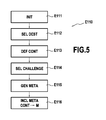
- the step of constructing the message M is represented in detail at the figure 5 .
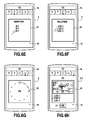
- examples of pages of the graphical user interface UI making it possible to guide the user A throughout this step of constructing the message M in its interactions with the application APPL are represented on the Figures 6A-6H .
- the user interface UI displays on the screen of the terminal 2 a home page 6 offering the possibility to the user A to compose a new message.
- User A accesses this possibility by designating the element "MESS" displayed on the home page, for example by pressing this element with his finger for a touch screen or with a stylus provided for this purpose (step E111) .
- the user interface UI then opens on the screen of the terminal 2 a new user interface page comprising a window 7 for composing a new message as shown in FIG. Figure 6B .
- This window comprises a frame 8 in which the user A is invited to enter the recipient user of the multimedia content that the user A wishes to share, in other words, the user receiving the message.
- the user A can use the virtual keyboard of the terminal 2 or, as in the example envisaged here, select the recipient user of the message from the list of his contacts (ie his directory) stored on his mobile terminal 2 .
- a new window 9 is thus first displayed by the user interface UI on the screen of the terminal 2 proposing to the user A different categories of challenges (or challenges, or games).
- four categories of predetermined challenges C1, C2, C3 and C4 are proposed to the user A on the display window 9.
- C1 is a category of challenges of the type "blind tests”
- C2 is a category of challenges
- C3 is a category of challenges of the "puzzles” type
- C4 is a category of challenges of the "quiz” type.
- These four categories of challenges C1, C2, C3, C4 constitute a catalog of predetermined challenges provided by the application APPL via the UI interface to the user A to construct his message within the meaning of the invention.
- these examples are for illustrative purposes only and other types of challenges may be considered.
- the user A selects the challenge category C2 on the touch screen of the terminal 2.
- a new window is displayed on the user interface page so that to allow the user A to enter if he wishes, via the keyboard of his terminal 2, a dedication intended for the user B (eg "Have fun solving this new challenge", etc.) for accompany the challenge.
- the graphical user interface UI of the application APPL installed on the terminal 2 proposes to the user A, by means of a new user interface page 10 defining a message composition window, to build properly. speak this last.
- This construction step is broken down here into several sub-steps.
- the user A is invited through a window 11 opening in the composition window 10, to define or more generally to select one (or more) multimedia content (s) CONT that he wishes to address to the user B.
- This multimedia content may be of different natures: it may be a photograph, an audio file, a text, a video file, etc., in other words any multimedia content produced by the user A (eg text entered by user A, photograph taken by user A), stored previously on his terminal 2 or on any other storage medium (eg on a remote server).
- the multimedia content selected by the user A is a photograph.
- the UI interface to the user A to choose this photograph as illustrated in the Figure 6D ie for example, the user A can decide to take a new photograph (by selecting here the CAM tab), to select a photograph already memorized in the terminal 2 (by selecting here the tab GAL) or to provide a link to a photograph stored on a remote server (by selecting the LINK tab here).
- the user interface UI proposes to the user A to produce (ie build) the challenge and the expected answer to this challenge used to condition access to the multimedia content (step E114).
- a new display window 13 is provided by the UI user interface on which are listed several questions that can be associated with the photograph selected by the user A in the context of the challenge "mystery photography".
- Questions Q1, Q2, Q3 are a catalog of predetermined elements provided by the APPL application via the UI interface to user A to build his challenge.
- the user A can enter these questions via the keyboard of the terminal 2.
- the questions may be predetermined and stored in the terminal's non-volatile memory 2D. More generally, the user A can produce a challenge for the user B from preconceived challenges stored in a non-volatile memory of the terminal, which he is then invited to customize via the editing tool and the interface pages (composition windows) offered by the UI user interface.
- the user interface UI presents a display window 14 to the user A on the screen of the terminal 2 so that it captures multiple responses to be presented to the user B and including the expected answer to the challenge, ie Q3.
- user A also has the possibility, through the UI GUI, to set a maximum duration to provide the expected answer to the challenge.
- This duration can be entered by the user using the keypad of terminal 2, or as illustrated in FIG. figure 6G , by sliding his finger on a clock represented on the display window 15 provided by the user interface for this purpose until reaching the desired time (eg 15 minutes in the illustrated example).
- the expected answer to the challenge may implicitly depend on the nature of the challenge selected by the user. So, when the challenge is a puzzle, the expected answer to the challenge is the correct reconstruction of the puzzle.
- Meta metadata are, within the meaning of the invention, metadata defining with respect to the multimedia CONT content selected by the user A, the challenge and the expected response to the challenge built by the user A via the UI interface.
- This META metadata is alphanumeric (i.e. text) data describing explicitly or in a codified way the challenge and the expected response to the challenge defined by the user A via the UI user interface.
- the parameters of this challenge eg the elements constituting the challenge, ie the question asked, and the expected answer. challenge
- information representative of the nature of the CONT multimedia content may also be included in the metadata so as to allow the presentation module the challenge installed on the terminal of the recipient user B (from the APPL application here) to select the right module for rendering multimedia content when reading the metadata.
- the challenge definition module and the challenge presentation module are implemented by the APPL application, so that the metadata used by one are understandable and interpretable by the other. In general, it is ensured that the metadata used to define the challenge and the expected answer to the challenge are in accordance with a coding logic common to the challenge definition module installed on the terminal 2 of the user A and the module of the user. challenge presentation installed on User B's Terminal 3.
- Meta metadata includes all the information required for the presentation of the challenge defined by the user A by the challenge presentation module of the APPL application installed if necessary on the terminal of the user B.
- the challenge definition module of the application APPL provides to the user A, through the interface user UI, an overview of the challenge that has just been produced and is intended to be presented to user B.
- the Figure 6H illustrates the challenge corresponding to the choices of the user represented on the Figures 6A-6G in other words, a mystery photograph (ie partially masked) whose access is conditioned by a multiple-choice question.
- the masking elements of the mystery photograph are randomly defined by a predefined algorithm implemented by the challenge definition module.
- the challenge thus produced is presented in a display window 16 of the UI user interface.
- the application challenge definition module APPL Upon receipt of the validation of the user A, the application challenge definition module APPL inserts the meta metadata defining with respect to the CONT multimedia content the challenge, the expected response to the challenge, the maximum duration set to meet the challenge, and the name or any other identifier for identifying a recipient's terminal B (eg phone number present in the contact list or entered by the user A) in a message M (step E116).
- a recipient's terminal B eg phone number present in the contact list or entered by the user A
- the message M is a HTTP request of the POST type intended for the server 4.
- the challenge definition module also inserts here the CONT multimedia content selected by the user A in the message M if it is stored on the terminal 2 to transmit it simultaneously to the metadata. It should be noted that the multimedia content is inserted in the POST request, if necessary in binary form.
- the challenge definition module inserts access data to the multimedia content CONT in the message M (here, for example, the url selected by the user A in step E113 ).
- access data means here either the multimedia content itself, or data such as for example an address a URL to access the multimedia content on a local or remote entity.
- the message M is a HTTP request of type GET in which the metadata are inserted.
- the multimedia content or more generally the access data to the multimedia content is (are) sent to the server 4 in a POST-type HTTP request after the server sends an identifier to the terminal 2. allowing him to associate the metadata with the multimedia content transmitted by the terminal 2 and that the terminal 2 passes as a parameter of the HTTP POST request in which is sent (es) the multimedia content or access data to this content .
- the metadata and / or the multimedia content access data may be sent in messages conforming to other types of format, for example in an SMS or MMS message, etc.
- the message M is then sent by the application APPL to the server 4, via the telecommunications network NW1, using the contact address @ oC4 configured in the application APPL (step E120).
- the server 4 extracts from the message M the identifier (eg name) of the recipient B. It verifies by means of this identifier whether the user B is registered and subscribed to the service S by interrogating the database 5 (step E130).
- the identifier eg name
- the user B is registered, this means that his terminal is equipped with a challenge presentation module issued as part of the service S (that is to say here the application APPL). It is assumed here that the user B is not registered in the database 5, ie that he did not subscribe to the server 4 to the service S, and therefore that he is not equipped with a challenge presentation module issued in the context of the service S (capable of interpreting in particular the metadata contained in the message M).
- the server 4 stores in its volatile memory 4D the message M.
- This INVIT message is an invitation message to download the APPL application from a link (eg a URL (Uniform Resource Locator)) specified in the message.
- the invitation message INVIT is sent by the server 4 to the terminal 3 via an SMS server 6, able to manage the sending and receiving of SMS messages on the mobile telecommunications network NW1.
- the telephone number of the recipient B of the message M is provided in the message M by the application APPL from the list of contacts stored on the terminal 2.
- the server 4 identifies the contacts of the user A who are not registered in the database 5 and have not subscribed to the service S (and therefore who are not equipped with the application APPL) from the transmission during the step E80 of the list of contacts from the user A to the server 4 by the terminal 2. It is the same for sending the invitation message to download the application APPL to unregistered contacts so identified.
- step E150 On receipt of the INVIT invitation message, user B downloads the APPL application into a memory of his terminal 3, from the URL specified in the INVIT message (step E150). Once installed, the application APPL of the terminal 3 sends a message to the server 4 to signal the success of the installation and proceed to the registration of the user B (step E160). This recording is performed as previously described for the user A (see steps E10 to E100).
- the server 4 has saved in the database 5 the name of the user B in association with his telephone number on the network NW1 and his contact list (step E170).
- the server 4 erases the message M after a predetermined delay triggered following the sending of the message invitation.
- a message may also be sent to the terminal 2 of the user A to warn him that the user or users to whom he wanted to address the multimedia content did not perform the challenge accompanying this multimedia content and did not have access to it (or did not want to join the service S or install the APPL application).
- the server 4 extracts from the message M the multimedia content CONT or, where appropriate, the access data to the multimedia content, assigns it a unique identifier ID-CONT and stores the CONT content in a directory of its non-volatile memory (storage space of the server in the sense of the invention) (step E180).
- This storage step optionally includes obtaining (eg downloading) the CONT content from the access data specified in the message M.
- the server 4 furthermore extracts the metadata META contained in the message M and stores them in association with the unique identifier ID-CONT assigned to the multimedia content CONT and the identifier IDB of the recipient user B, in a database of its non-volatile memory (step E180).
- the server 4 Upon receipt of this request, the server 4 sends a message M 'to the terminal 3 comprising the meta-metadata stored in its database meta-data eventually supplemented by other metadata (thus forming META' metadata), as well as the @CONT address to access the CONT multimedia content stored in the server directory.
- the @CONT address can be inserted in META 'metadata.
- the message M ' comprises the multimedia content CONT.
- the message M ' is here a request conforming to the JSON (JavaScript Object Notation) format, which in a manner known per se, is a generic text data format derived from the notation of the objects of the JavaScript language.
- JSON JavaScript Object Notation
- the server then sends the message M ', via the network NW1, to the terminal 3 (step E210).
- the application APPL of the terminal 3 On receipt of the message M ', the application APPL of the terminal 3 extracts the meta-data META' included in the message M 'and downloads the multimedia content CONT from the URL @CONT specified in these metadata META' (steps E220 / E230).
- the CONT multimedia content is stored by the application APPL in the non-volatile memory of the terminal 3.
- the APPL application challenge presentation module analyzes and interprets the META 'metadata contained in the message M' to present (i.e. to execute) the challenge defined by the user A to the user B on his terminal 3.
- the challenge presentation module presents a succession of user interface pages (i.e. of the UI interface of the APPL application in the example envisaged here).
- the layout of one of these user interface pages used for the presentation of the challenge is preferably predefined from a user interface template or pattern (in English "template").
- the layout and size of the elements are predefined for a given type of challenge, so that only the element to be presented at the chosen location on a page for that element needs to be specified so that the challenge can be presented by the challenge presentation module to user B in an understandable and usable form.
- This element is identified according to a coding common to the coding used in the meta metadata defining the challenge. In other words, each element to be presented on each user interface page when the challenge is presented is extracted by the Meta Metadata Challenge Presentation module.
- the user interface page template (s) associated with the game type identified in these metadata are thus used by the challenge presentation module of the APPL application, and modified from the META' metadata. so as to generate one or more user interface pages for presenting to the user B the challenge to which he must respond on his terminal 3 (step E240).
- the Figure 6H illustrates an example of a user interface page that can be presented by the APPL application challenge presentation module to user B when presenting the challenge, via the UI GUI.
- the challenge here consists of a masked photograph associated with question Q2 and three possible answers LOC1, LOC2 and LOC3, the expected response defined in META 'metadata being the response LOC2.
- the masked photograph is generated by the challenge presentation module from the CONT multimedia content by applying the same masking algorithm as that implemented by the challenge definition module.
- the presentation module refuses to return the multimedia content CONT in its entirety to the user B (ie to display it) and erases the multimedia content CONT stored in the non-volatile memory of the terminal 3. It can also display a user interface page telling user B that he failed to provide a good answer to the user A challenge.
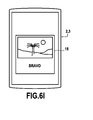
- the challenge presentation module of the application APPL renders on the screen of its terminal 3, in an interface page.
- the multimedia content CONT selected by the user A step E250, as illustrated for example in FIG. figure 6I .
- the challenge presentation module of the application APPL installed on the terminal 3 is configured to report, in a message sent to the server 4, the failure or otherwise the success of the user B to provide the expected answer to the challenge (step E260).
- the message may also contain a score obtained by the user B when he provided his answer to the challenge.
- the server 4 On receiving the report message from the terminal 3, the server 4 updates a score assigned to the user B and stored in the database 5. This score is updated here each time a challenge is sent to the user. user B (step E270). For example, it is incremented each time user B successfully answers the challenge proposed by user A.
- This score makes it possible, in the embodiment described here, to establish a ranking between the users registered with the server. 4 and subscribed to the service S, or alternatively between the users present in the contact list of the user A.
- This classification is sent to the user B by the server 4 on his terminal 3 (step E280). It should be noted that the current rank or score of the user B maintained by the server 4 may furthermore be transmitted in the meta-metadata 'when the server 4 has a new challenge for the user B.
- the latter can unlock, with the agreement of the user A, the return of the content CONT multimedia to user B on his terminal 3.
- such an unlocking is followed by a decrementation of the score of the user B maintained by the server 4.
- a score is also maintained at server 4 for user A as a challenge producer: each challenge produced by user A results in an incrementation of his score.
- the server 4 sends in in addition to a message to the application APPL installed on the terminal 2 for an update of the catalog of items proposed to the user A to produce the challenges for the user B is performed (step E290).
- This update may include, for example, the unblocking of new elements (eg new challenges or categories of challenges, or elements making the challenges proposed to the user B more complex, etc.).
- the catalog of elements proposed to the user A is thus advantageously adapted to the user B.
- a similar adaptation is carried out on the terminal 3.
- the "playful" message exchange service S which has just been described can be used autonomously or be integrated into another service, such as for example a communication suite, such as RCS or "Joyn®". or an online social network such as Facebook ®.
- a communication suite such as RCS or "Joyn®”.
- an online social network such as Facebook ®.
- the graphical user interface of the challenge definition module and the challenge presentation module implemented by the application APPL can also be integrated in the graphical interface of the enriched communication suite or the online social network and the messages M, INVIT and M 'exchanged between the different entities of the system 1 may be according to a message format accepted by the enriched communication suite or by the online social network.
Landscapes
- Engineering & Computer Science (AREA)
- Computer Networks & Wireless Communication (AREA)
- Signal Processing (AREA)
- General Engineering & Computer Science (AREA)
- Theoretical Computer Science (AREA)
- Human Computer Interaction (AREA)
- Physics & Mathematics (AREA)
- General Physics & Mathematics (AREA)
- Multimedia (AREA)
- Information Transfer Between Computers (AREA)
- Telephonic Communication Services (AREA)
Applications Claiming Priority (1)
| Application Number | Priority Date | Filing Date | Title |
|---|---|---|---|
| FR1452846A FR3019424A1 (fr) | 2014-03-31 | 2014-03-31 | Procede de construction d'un message par un terminal |
Publications (2)
| Publication Number | Publication Date |
|---|---|
| EP2928124A1 true EP2928124A1 (de) | 2015-10-07 |
| EP2928124B1 EP2928124B1 (de) | 2021-04-28 |
Family
ID=50933376
Family Applications (1)
| Application Number | Title | Priority Date | Filing Date |
|---|---|---|---|
| EP15160223.2A Active EP2928124B1 (de) | 2014-03-31 | 2015-03-23 | Verfahren zur erstellung einer nachricht durch ein endgerät |
Country Status (4)
| Country | Link |
|---|---|
| US (1) | US10447629B2 (de) |
| EP (1) | EP2928124B1 (de) |
| ES (1) | ES2881253T3 (de) |
| FR (1) | FR3019424A1 (de) |
Families Citing this family (5)
| Publication number | Priority date | Publication date | Assignee | Title |
|---|---|---|---|---|
| CN103941982B (zh) * | 2014-05-12 | 2016-08-24 | 腾讯科技(深圳)有限公司 | 一种分享界面处理的方法及终端 |
| WO2016043530A1 (en) * | 2014-09-18 | 2016-03-24 | Samsung Electronics Co., Ltd. | System and method for providing service via application |
| IN2015CH02514A (de) * | 2015-05-19 | 2015-07-10 | Wipro Ltd | |
| JP6575547B2 (ja) * | 2017-03-17 | 2019-09-18 | 富士ゼロックス株式会社 | ドキュメント管理システム |
| US11604866B2 (en) * | 2021-03-02 | 2023-03-14 | At&T Intellectual Property I, L.P. | Emotion-based authentication service |
Citations (2)
| Publication number | Priority date | Publication date | Assignee | Title |
|---|---|---|---|---|
| GB2359640A (en) * | 2000-02-23 | 2001-08-29 | Battlemail Com Ltd | A game using electronic mail |
| WO2002087267A1 (en) * | 2001-04-25 | 2002-10-31 | Celltick Technologies Ltd | Mobile cellular telecommunications infrastructure based multi-user applications |
Family Cites Families (60)
| Publication number | Priority date | Publication date | Assignee | Title |
|---|---|---|---|---|
| US20040002382A1 (en) * | 2002-06-27 | 2004-01-01 | Inventec Appliances Corp. | Method enabling mobile telephone game playing capability on wireless networks |
| US7320733B2 (en) * | 2003-05-09 | 2008-01-22 | Sukegawa Electric Co., Ltd. | Electron bombardment heating apparatus and temperature controlling apparatus and control method thereof |
| US7089594B2 (en) * | 2003-07-21 | 2006-08-08 | July Systems, Inc. | Application rights management in a mobile environment |
| US8549651B2 (en) * | 2007-02-02 | 2013-10-01 | Facebook, Inc. | Determining a trust level in a social network environment |
| BRPI0807415A2 (pt) * | 2007-01-23 | 2014-05-27 | Univ Carnegie Mellon | Controlar o acesso a sistemas de computador e anotar arquivos de mídia. |
| US8495727B2 (en) * | 2007-08-07 | 2013-07-23 | Microsoft Corporation | Spam reduction in real time communications by human interaction proof |
| US8510795B1 (en) * | 2007-09-04 | 2013-08-13 | Google Inc. | Video-based CAPTCHA |
| US20090083826A1 (en) * | 2007-09-21 | 2009-03-26 | Microsoft Corporation | Unsolicited communication management via mobile device |
| US20140304654A1 (en) * | 2007-12-14 | 2014-10-09 | The John Nicholas and Kristin Gross Trust U/A/D April 13, 2010 | Wine Rating Tool, Simulator & Game For Portable Computing Device |
| US20090163272A1 (en) * | 2007-12-21 | 2009-06-25 | Microsoft Corporation | Connected gaming |
| US7689700B2 (en) * | 2008-01-08 | 2010-03-30 | Microsoft Corporation | Configuration of a peer group |
| US8239967B2 (en) * | 2008-01-15 | 2012-08-07 | Microsoft Corporation | Simultaneous tamper-proofing and anti-piracy protection of software |
| US20090204819A1 (en) * | 2008-02-07 | 2009-08-13 | Microsoft Corporation | Advertisement-based human interactive proof |
| US20090217368A1 (en) * | 2008-02-27 | 2009-08-27 | Novell, Inc. | System and method for secure account reset utilizing information cards |
| US8315882B2 (en) * | 2008-04-14 | 2012-11-20 | International Business Machines Corporation | Efficient, peer-to-peer CAPTCHA-based verification and demand management for online services |
| US8387122B2 (en) * | 2008-05-16 | 2013-02-26 | University Of Washington | Access control by testing for shared knowledge |
| US8726355B2 (en) * | 2008-06-24 | 2014-05-13 | Gary Stephen Shuster | Identity verification via selection of sensible output from recorded digital data |
| US8752141B2 (en) * | 2008-06-27 | 2014-06-10 | John Nicholas | Methods for presenting and determining the efficacy of progressive pictorial and motion-based CAPTCHAs |
| US8499244B2 (en) * | 2008-07-31 | 2013-07-30 | Microsoft Corporation | Automation-resistant, advertising-merged interactive services |
| US9641537B2 (en) * | 2008-08-14 | 2017-05-02 | Invention Science Fund I, Llc | Conditionally releasing a communiqué determined to be affiliated with a particular source entity in response to detecting occurrence of one or more environmental aspects |
| US8561097B2 (en) * | 2008-09-04 | 2013-10-15 | Beezag Inc. | Multimedia content viewing confirmation |
| US9028260B2 (en) * | 2008-09-29 | 2015-05-12 | Cisco Technology, Inc. | Automated quiz generation system |
| US9498711B2 (en) * | 2008-11-04 | 2016-11-22 | Quado Media Inc. | Multi-player, multi-screens, electronic gaming platform and system |
| US8196198B1 (en) * | 2008-12-29 | 2012-06-05 | Google Inc. | Access using images |
| US8255987B2 (en) * | 2009-01-15 | 2012-08-28 | Microsoft Corporation | Communication abuse prevention |
| US8925057B1 (en) * | 2009-02-06 | 2014-12-30 | New Jersey Institute Of Technology | Automated tests to distinguish computers from humans |
| US8239465B2 (en) * | 2009-02-19 | 2012-08-07 | Microsoft Corporation | Generating human interactive proofs |
| US8910251B2 (en) * | 2009-03-06 | 2014-12-09 | Facebook, Inc. | Using social information for authenticating a user session |
| JP5378597B2 (ja) * | 2009-05-20 | 2013-12-25 | テレフオンアクチーボラゲット エル エム エリクソン(パブル) | 第2の端末と通信しようとする第1の端末へのチャレンジング |
| US8315595B2 (en) * | 2009-06-10 | 2012-11-20 | International Business Machines Corporation | Providing trusted communication |
| US8495518B2 (en) * | 2009-11-09 | 2013-07-23 | International Business Machines Corporation | Contextual abnormality CAPTCHAs |
| US8707453B2 (en) * | 2010-01-29 | 2014-04-22 | Christopher Liam Ivey | System and method for restricting access to a computer system to live persons by means of semantic association of images |
| US9682324B2 (en) * | 2010-05-12 | 2017-06-20 | Activision Publishing, Inc. | System and method for enabling players to participate in asynchronous, competitive challenges |
| US8745729B2 (en) * | 2010-06-22 | 2014-06-03 | Microsoft Corporation | Preventing abuse of services through infrastructure incompatibility |
| US8984292B2 (en) * | 2010-06-24 | 2015-03-17 | Microsoft Corporation | Keyed human interactive proof players |
| US8402548B1 (en) * | 2010-09-03 | 2013-03-19 | Facebook, Inc. | Providing user confidence information to third-party systems |
| US8839357B2 (en) * | 2010-12-22 | 2014-09-16 | Canon U.S.A., Inc. | Method, system, and computer-readable storage medium for authenticating a computing device |
| WO2012128916A2 (en) * | 2011-03-24 | 2012-09-27 | AYaH, LLC | Method for generating a human likeness score |
| US9146917B2 (en) * | 2011-07-15 | 2015-09-29 | International Business Machines Corporation | Validating that a user is human |
| US9621528B2 (en) * | 2011-08-05 | 2017-04-11 | 24/7 Customer, Inc. | Creating and implementing scalable and effective multimedia objects with human interaction proof (HIP) capabilities, with challenges comprising secret question and answer created by user, and advertisement corresponding to the secret question |
| US10558789B2 (en) * | 2011-08-05 | 2020-02-11 | [24]7.ai, Inc. | Creating and implementing scalable and effective multimedia objects with human interaction proof (HIP) capabilities, with challenges comprising different levels of difficulty based on the degree on suspiciousness |
| WO2013040095A1 (en) * | 2011-09-13 | 2013-03-21 | Monk Akarshala Design Private Limited | Learning application template management in a modular learning system |
| US20130160095A1 (en) * | 2011-12-14 | 2013-06-20 | Nokia Corporation | Method and apparatus for presenting a challenge response input mechanism |
| KR101277204B1 (ko) * | 2011-12-21 | 2013-07-22 | 엔에이치엔(주) | 사용자 동작에 기반한 게임 도전 상대 검색 방법, 시스템 및 컴퓨터 판독 가능한 기록 매체 |
| CN104025106B (zh) * | 2012-01-06 | 2017-05-10 | 卡皮公司 | 验证码提供方法 |
| US20130217501A1 (en) * | 2012-02-16 | 2013-08-22 | Microsoft Corporation | Presenting application challenges outside an application execution context |
| US9131374B1 (en) * | 2012-02-24 | 2015-09-08 | Emc Corporation | Knowledge-based authentication for restricting access to mobile devices |
| US20130263230A1 (en) * | 2012-03-30 | 2013-10-03 | Anchorfree Inc. | Method and system for statistical access control with data aggregation |
| US9258306B2 (en) * | 2012-05-11 | 2016-02-09 | Infosys Limited | Methods for confirming user interaction in response to a request for a computer provided service and devices thereof |
| US8654329B2 (en) * | 2012-06-19 | 2014-02-18 | The United States Of America, As Represented By The Secretary Of The Navy | Parallel multisensor optical particle sensors for flowing fluid systems |
| US20140012652A1 (en) * | 2012-07-06 | 2014-01-09 | Igt | System and method for reducing loyalty point liability through gaming |
| WO2014014963A1 (en) * | 2012-07-16 | 2014-01-23 | Questionmine, LLC | Apparatus and method for synchronizing interactive content with multimedia |
| US9390245B2 (en) * | 2012-08-02 | 2016-07-12 | Microsoft Technology Licensing, Llc | Using the ability to speak as a human interactive proof |
| US8935769B2 (en) * | 2012-09-28 | 2015-01-13 | Liveensure, Inc. | Method for mobile security via multi-factor context authentication |
| US8834277B2 (en) * | 2012-12-27 | 2014-09-16 | Sony Computer Entertainment America Llc | Systems and methods for sharing cloud-executed mini-games, challenging friends and enabling crowd source rating |
| US10165066B2 (en) * | 2013-03-15 | 2018-12-25 | Facebook, Inc. | Systems, methods, and apparatuses for implementing an interface to populate and update an entity graph through socially relevant user challenges |
| US9563763B1 (en) * | 2013-05-21 | 2017-02-07 | Amazon Technologies, Inc. | Enhanced captchas |
| US9286767B2 (en) * | 2013-08-09 | 2016-03-15 | Zynga Inc. | Challenging players in online game to compete in modular game |
| US20160048662A1 (en) * | 2013-11-01 | 2016-02-18 | Google Inc. | Computerized CAPTCHA Systems Using A Direct Connection With User Computing Device |
| US9614837B2 (en) * | 2014-08-27 | 2017-04-04 | Verizon Patent And Licensing Inc. | Systems and methods for verifying human interaction with a computer interface |
-
2014
- 2014-03-31 FR FR1452846A patent/FR3019424A1/fr active Pending
-
2015
- 2015-03-23 EP EP15160223.2A patent/EP2928124B1/de active Active
- 2015-03-23 ES ES15160223T patent/ES2881253T3/es active Active
- 2015-03-30 US US14/673,661 patent/US10447629B2/en active Active
Patent Citations (2)
| Publication number | Priority date | Publication date | Assignee | Title |
|---|---|---|---|---|
| GB2359640A (en) * | 2000-02-23 | 2001-08-29 | Battlemail Com Ltd | A game using electronic mail |
| WO2002087267A1 (en) * | 2001-04-25 | 2002-10-31 | Celltick Technologies Ltd | Mobile cellular telecommunications infrastructure based multi-user applications |
Also Published As
| Publication number | Publication date |
|---|---|
| US20150281152A1 (en) | 2015-10-01 |
| EP2928124B1 (de) | 2021-04-28 |
| FR3019424A1 (fr) | 2015-10-02 |
| US10447629B2 (en) | 2019-10-15 |
| ES2881253T3 (es) | 2021-11-29 |
Similar Documents
| Publication | Publication Date | Title |
|---|---|---|
| AU2022206740A1 (en) | Authentication of service requests initiated from a social networking site | |
| EP2171951B1 (de) | System und verfahren zur sofortigen kommunikation | |
| EP2928124B1 (de) | Verfahren zur erstellung einer nachricht durch ein endgerät | |
| US20160142889A1 (en) | Methods and systems relating to visual communications | |
| US20170031550A1 (en) | Enhanced Messaging Stickers | |
| CN106096927A (zh) | 信息更新的方法、装置以及服务器 | |
| Aal et al. | WhatsApp, Skype, Wickr, Viber, Twitter and Blog are ready to asymptote globally from all corners during communications in latest fast life | |
| WO2015097367A1 (fr) | Procédé et système de communication entre navigateurs web, utilisant un environnement de communication unifiée | |
| FR3039030A1 (fr) | Procede et dispositif d'etablissement de communications webrtc | |
| EP2795870A1 (de) | Verfahren zur ermöglichung des zugriffs eines telekommunikationsendgeräts auf eine von einer über ein telekommunikationsnetz zugängliche dienstplattform gehostete datenbank | |
| Nikou et al. | Mobile converged rich communication services: A conjoint analysis | |
| US20150156618A1 (en) | Delivery of content over a network | |
| EP1862959A1 (de) | Kommunikationssystem zur gemeinschaftlichen Fernerzeugung von Multimediainhalten | |
| FR3005541A1 (fr) | Procede de gestion d'un service de messagerie | |
| WO2017103480A1 (fr) | Système et procédé de réalisation d'un tour de table lors d'une réunion à distance | |
| WO2020128204A1 (fr) | Processus de déclaration de non-exploitabilité de données échangées | |
| WO2015128561A1 (fr) | Procede et dispositif de decouverte des capacites de communication relatives a un utilisateur d'un terminal | |
| FR3025625A1 (fr) | Generation et partage d'applications personnalisees de communication | |
| EP2360890A1 (de) | Erstellung und Nutzung eines gemeinsamen Raums basierend auf zumindest einem, einem Quellenbenutzer zugeordnete Inhalts bestimmt für mehrere Zielbenutzer | |
| FR2988965A1 (fr) | Partage de contenu lors d'une session de communication | |
| FR3004048A1 (fr) | Procede de notification d'un lien d'acces a un message et systeme de messagerie | |
| FR2875093A1 (fr) | Procede et systeme de prediction de la qualite de messages multimedias(mms) | |
| FR2875094A1 (fr) | Procede et systeme d'enquete par fichiers electroniques de fichiers questionnaires transitant par des reseaux de communication | |
| EP3021552A1 (de) | Verfahren und vorrichtung zur kommunikation über einen geteilten interaktionsraum | |
| FR2845856A1 (fr) | Dispositif permettant d'offrir des services aux utilisateurs de telephones mobiles par reception et envoi de messages electroniques ainsi qu'un procede de mise en oeuvre de ce dispositif |
Legal Events
| Date | Code | Title | Description |
|---|---|---|---|
| PUAI | Public reference made under article 153(3) epc to a published international application that has entered the european phase |
Free format text: ORIGINAL CODE: 0009012 |
|
| AK | Designated contracting states |
Kind code of ref document: A1 Designated state(s): AL AT BE BG CH CY CZ DE DK EE ES FI FR GB GR HR HU IE IS IT LI LT LU LV MC MK MT NL NO PL PT RO RS SE SI SK SM TR |
|
| AX | Request for extension of the european patent |
Extension state: BA ME |
|
| 17P | Request for examination filed |
Effective date: 20160330 |
|
| RBV | Designated contracting states (corrected) |
Designated state(s): AL AT BE BG CH CY CZ DE DK EE ES FI FR GB GR HR HU IE IS IT LI LT LU LV MC MK MT NL NO PL PT RO RS SE SI SK SM TR |
|
| STAA | Information on the status of an ep patent application or granted ep patent |
Free format text: STATUS: EXAMINATION IS IN PROGRESS |
|
| 17Q | First examination report despatched |
Effective date: 20181120 |
|
| RAP1 | Party data changed (applicant data changed or rights of an application transferred) |
Owner name: ORANGE |
|
| GRAP | Despatch of communication of intention to grant a patent |
Free format text: ORIGINAL CODE: EPIDOSNIGR1 |
|
| STAA | Information on the status of an ep patent application or granted ep patent |
Free format text: STATUS: GRANT OF PATENT IS INTENDED |
|
| INTG | Intention to grant announced |
Effective date: 20201217 |
|
| GRAS | Grant fee paid |
Free format text: ORIGINAL CODE: EPIDOSNIGR3 |
|
| GRAA | (expected) grant |
Free format text: ORIGINAL CODE: 0009210 |
|
| STAA | Information on the status of an ep patent application or granted ep patent |
Free format text: STATUS: THE PATENT HAS BEEN GRANTED |
|
| AK | Designated contracting states |
Kind code of ref document: B1 Designated state(s): AL AT BE BG CH CY CZ DE DK EE ES FI FR GB GR HR HU IE IS IT LI LT LU LV MC MK MT NL NO PL PT RO RS SE SI SK SM TR |
|
| REG | Reference to a national code |
Ref country code: GB Ref legal event code: FG4D Free format text: NOT ENGLISH |
|
| REG | Reference to a national code |
Ref country code: CH Ref legal event code: EP |
|
| REG | Reference to a national code |
Ref country code: AT Ref legal event code: REF Ref document number: 1388392 Country of ref document: AT Kind code of ref document: T Effective date: 20210515 |
|
| REG | Reference to a national code |
Ref country code: DE Ref legal event code: R096 Ref document number: 602015068562 Country of ref document: DE |
|
| REG | Reference to a national code |
Ref country code: IE Ref legal event code: FG4D Free format text: LANGUAGE OF EP DOCUMENT: FRENCH |
|
| RAP4 | Party data changed (patent owner data changed or rights of a patent transferred) |
Owner name: ORANGE |
|
| REG | Reference to a national code |
Ref country code: LT Ref legal event code: MG9D |
|
| REG | Reference to a national code |
Ref country code: AT Ref legal event code: MK05 Ref document number: 1388392 Country of ref document: AT Kind code of ref document: T Effective date: 20210428 |
|
| PG25 | Lapsed in a contracting state [announced via postgrant information from national office to epo] |
Ref country code: FI Free format text: LAPSE BECAUSE OF FAILURE TO SUBMIT A TRANSLATION OF THE DESCRIPTION OR TO PAY THE FEE WITHIN THE PRESCRIBED TIME-LIMIT Effective date: 20210428 Ref country code: LT Free format text: LAPSE BECAUSE OF FAILURE TO SUBMIT A TRANSLATION OF THE DESCRIPTION OR TO PAY THE FEE WITHIN THE PRESCRIBED TIME-LIMIT Effective date: 20210428 Ref country code: NL Free format text: LAPSE BECAUSE OF FAILURE TO SUBMIT A TRANSLATION OF THE DESCRIPTION OR TO PAY THE FEE WITHIN THE PRESCRIBED TIME-LIMIT Effective date: 20210428 Ref country code: AT Free format text: LAPSE BECAUSE OF FAILURE TO SUBMIT A TRANSLATION OF THE DESCRIPTION OR TO PAY THE FEE WITHIN THE PRESCRIBED TIME-LIMIT Effective date: 20210428 Ref country code: BG Free format text: LAPSE BECAUSE OF FAILURE TO SUBMIT A TRANSLATION OF THE DESCRIPTION OR TO PAY THE FEE WITHIN THE PRESCRIBED TIME-LIMIT Effective date: 20210728 Ref country code: HR Free format text: LAPSE BECAUSE OF FAILURE TO SUBMIT A TRANSLATION OF THE DESCRIPTION OR TO PAY THE FEE WITHIN THE PRESCRIBED TIME-LIMIT Effective date: 20210428 |
|
| REG | Reference to a national code |
Ref country code: DE Ref legal event code: R079 Ref document number: 602015068562 Country of ref document: DE Free format text: PREVIOUS MAIN CLASS: H04L0012580000 Ipc: H04L0051000000 |
|
| REG | Reference to a national code |
Ref country code: ES Ref legal event code: FG2A Ref document number: 2881253 Country of ref document: ES Kind code of ref document: T3 Effective date: 20211129 |
|
| PG25 | Lapsed in a contracting state [announced via postgrant information from national office to epo] |
Ref country code: LV Free format text: LAPSE BECAUSE OF FAILURE TO SUBMIT A TRANSLATION OF THE DESCRIPTION OR TO PAY THE FEE WITHIN THE PRESCRIBED TIME-LIMIT Effective date: 20210428 Ref country code: IS Free format text: LAPSE BECAUSE OF FAILURE TO SUBMIT A TRANSLATION OF THE DESCRIPTION OR TO PAY THE FEE WITHIN THE PRESCRIBED TIME-LIMIT Effective date: 20210828 Ref country code: GR Free format text: LAPSE BECAUSE OF FAILURE TO SUBMIT A TRANSLATION OF THE DESCRIPTION OR TO PAY THE FEE WITHIN THE PRESCRIBED TIME-LIMIT Effective date: 20210729 Ref country code: SE Free format text: LAPSE BECAUSE OF FAILURE TO SUBMIT A TRANSLATION OF THE DESCRIPTION OR TO PAY THE FEE WITHIN THE PRESCRIBED TIME-LIMIT Effective date: 20210428 Ref country code: RS Free format text: LAPSE BECAUSE OF FAILURE TO SUBMIT A TRANSLATION OF THE DESCRIPTION OR TO PAY THE FEE WITHIN THE PRESCRIBED TIME-LIMIT Effective date: 20210428 Ref country code: PT Free format text: LAPSE BECAUSE OF FAILURE TO SUBMIT A TRANSLATION OF THE DESCRIPTION OR TO PAY THE FEE WITHIN THE PRESCRIBED TIME-LIMIT Effective date: 20210830 Ref country code: NO Free format text: LAPSE BECAUSE OF FAILURE TO SUBMIT A TRANSLATION OF THE DESCRIPTION OR TO PAY THE FEE WITHIN THE PRESCRIBED TIME-LIMIT Effective date: 20210728 Ref country code: PL Free format text: LAPSE BECAUSE OF FAILURE TO SUBMIT A TRANSLATION OF THE DESCRIPTION OR TO PAY THE FEE WITHIN THE PRESCRIBED TIME-LIMIT Effective date: 20210428 |
|
| REG | Reference to a national code |
Ref country code: NL Ref legal event code: MP Effective date: 20210428 |
|
| PG25 | Lapsed in a contracting state [announced via postgrant information from national office to epo] |
Ref country code: RO Free format text: LAPSE BECAUSE OF FAILURE TO SUBMIT A TRANSLATION OF THE DESCRIPTION OR TO PAY THE FEE WITHIN THE PRESCRIBED TIME-LIMIT Effective date: 20210428 Ref country code: DK Free format text: LAPSE BECAUSE OF FAILURE TO SUBMIT A TRANSLATION OF THE DESCRIPTION OR TO PAY THE FEE WITHIN THE PRESCRIBED TIME-LIMIT Effective date: 20210428 Ref country code: EE Free format text: LAPSE BECAUSE OF FAILURE TO SUBMIT A TRANSLATION OF THE DESCRIPTION OR TO PAY THE FEE WITHIN THE PRESCRIBED TIME-LIMIT Effective date: 20210428 Ref country code: CZ Free format text: LAPSE BECAUSE OF FAILURE TO SUBMIT A TRANSLATION OF THE DESCRIPTION OR TO PAY THE FEE WITHIN THE PRESCRIBED TIME-LIMIT Effective date: 20210428 Ref country code: SM Free format text: LAPSE BECAUSE OF FAILURE TO SUBMIT A TRANSLATION OF THE DESCRIPTION OR TO PAY THE FEE WITHIN THE PRESCRIBED TIME-LIMIT Effective date: 20210428 Ref country code: SK Free format text: LAPSE BECAUSE OF FAILURE TO SUBMIT A TRANSLATION OF THE DESCRIPTION OR TO PAY THE FEE WITHIN THE PRESCRIBED TIME-LIMIT Effective date: 20210428 |
|
| REG | Reference to a national code |
Ref country code: DE Ref legal event code: R097 Ref document number: 602015068562 Country of ref document: DE |
|
| PLBE | No opposition filed within time limit |
Free format text: ORIGINAL CODE: 0009261 |
|
| STAA | Information on the status of an ep patent application or granted ep patent |
Free format text: STATUS: NO OPPOSITION FILED WITHIN TIME LIMIT |
|
| 26N | No opposition filed |
Effective date: 20220131 |
|
| PG25 | Lapsed in a contracting state [announced via postgrant information from national office to epo] |
Ref country code: IS Free format text: LAPSE BECAUSE OF FAILURE TO SUBMIT A TRANSLATION OF THE DESCRIPTION OR TO PAY THE FEE WITHIN THE PRESCRIBED TIME-LIMIT Effective date: 20210828 Ref country code: AL Free format text: LAPSE BECAUSE OF FAILURE TO SUBMIT A TRANSLATION OF THE DESCRIPTION OR TO PAY THE FEE WITHIN THE PRESCRIBED TIME-LIMIT Effective date: 20210428 |
|
| PG25 | Lapsed in a contracting state [announced via postgrant information from national office to epo] |
Ref country code: MC Free format text: LAPSE BECAUSE OF FAILURE TO SUBMIT A TRANSLATION OF THE DESCRIPTION OR TO PAY THE FEE WITHIN THE PRESCRIBED TIME-LIMIT Effective date: 20210428 |
|
| REG | Reference to a national code |
Ref country code: CH Ref legal event code: PL |
|
| REG | Reference to a national code |
Ref country code: BE Ref legal event code: MM Effective date: 20220331 |
|
| PG25 | Lapsed in a contracting state [announced via postgrant information from national office to epo] |
Ref country code: LU Free format text: LAPSE BECAUSE OF NON-PAYMENT OF DUE FEES Effective date: 20220323 Ref country code: LI Free format text: LAPSE BECAUSE OF NON-PAYMENT OF DUE FEES Effective date: 20220331 Ref country code: IE Free format text: LAPSE BECAUSE OF NON-PAYMENT OF DUE FEES Effective date: 20220323 Ref country code: CH Free format text: LAPSE BECAUSE OF NON-PAYMENT OF DUE FEES Effective date: 20220331 |
|
| PG25 | Lapsed in a contracting state [announced via postgrant information from national office to epo] |
Ref country code: BE Free format text: LAPSE BECAUSE OF NON-PAYMENT OF DUE FEES Effective date: 20220331 |
|
| PG25 | Lapsed in a contracting state [announced via postgrant information from national office to epo] |
Ref country code: HU Free format text: LAPSE BECAUSE OF FAILURE TO SUBMIT A TRANSLATION OF THE DESCRIPTION OR TO PAY THE FEE WITHIN THE PRESCRIBED TIME-LIMIT; INVALID AB INITIO Effective date: 20150323 |
|
| PG25 | Lapsed in a contracting state [announced via postgrant information from national office to epo] |
Ref country code: MK Free format text: LAPSE BECAUSE OF FAILURE TO SUBMIT A TRANSLATION OF THE DESCRIPTION OR TO PAY THE FEE WITHIN THE PRESCRIBED TIME-LIMIT Effective date: 20210428 Ref country code: CY Free format text: LAPSE BECAUSE OF FAILURE TO SUBMIT A TRANSLATION OF THE DESCRIPTION OR TO PAY THE FEE WITHIN THE PRESCRIBED TIME-LIMIT Effective date: 20210428 |
|
| PG25 | Lapsed in a contracting state [announced via postgrant information from national office to epo] |
Ref country code: TR Free format text: LAPSE BECAUSE OF FAILURE TO SUBMIT A TRANSLATION OF THE DESCRIPTION OR TO PAY THE FEE WITHIN THE PRESCRIBED TIME-LIMIT Effective date: 20210428 |
|
| PG25 | Lapsed in a contracting state [announced via postgrant information from national office to epo] |
Ref country code: MT Free format text: LAPSE BECAUSE OF FAILURE TO SUBMIT A TRANSLATION OF THE DESCRIPTION OR TO PAY THE FEE WITHIN THE PRESCRIBED TIME-LIMIT Effective date: 20210428 |
|
| PGFP | Annual fee paid to national office [announced via postgrant information from national office to epo] |
Ref country code: DE Payment date: 20250218 Year of fee payment: 11 |
|
| PGFP | Annual fee paid to national office [announced via postgrant information from national office to epo] |
Ref country code: FR Payment date: 20250219 Year of fee payment: 11 |
|
| PGFP | Annual fee paid to national office [announced via postgrant information from national office to epo] |
Ref country code: IT Payment date: 20250218 Year of fee payment: 11 Ref country code: GB Payment date: 20250221 Year of fee payment: 11 |
|
| PGFP | Annual fee paid to national office [announced via postgrant information from national office to epo] |
Ref country code: ES Payment date: 20250401 Year of fee payment: 11 |