EP2921648B1 - Gas turbine blade comprising bended leading and trailing edges - Google Patents
Gas turbine blade comprising bended leading and trailing edges Download PDFInfo
- Publication number
- EP2921648B1 EP2921648B1 EP15156480.4A EP15156480A EP2921648B1 EP 2921648 B1 EP2921648 B1 EP 2921648B1 EP 15156480 A EP15156480 A EP 15156480A EP 2921648 B1 EP2921648 B1 EP 2921648B1
- Authority
- EP
- European Patent Office
- Prior art keywords
- span
- gas turbine
- turbine blade
- airfoil
- blade
- Prior art date
- Legal status (The legal status is an assumption and is not a legal conclusion. Google has not performed a legal analysis and makes no representation as to the accuracy of the status listed.)
- Revoked
Links
Images



Classifications
-
- F—MECHANICAL ENGINEERING; LIGHTING; HEATING; WEAPONS; BLASTING
- F01—MACHINES OR ENGINES IN GENERAL; ENGINE PLANTS IN GENERAL; STEAM ENGINES
- F01D—NON-POSITIVE DISPLACEMENT MACHINES OR ENGINES, e.g. STEAM TURBINES
- F01D5/00—Blades; Blade-carrying members; Heating, heat-insulating, cooling or antivibration means on the blades or the members
- F01D5/12—Blades
- F01D5/14—Form or construction
- F01D5/141—Shape, i.e. outer, aerodynamic form
-
- F—MECHANICAL ENGINEERING; LIGHTING; HEATING; WEAPONS; BLASTING
- F01—MACHINES OR ENGINES IN GENERAL; ENGINE PLANTS IN GENERAL; STEAM ENGINES
- F01D—NON-POSITIVE DISPLACEMENT MACHINES OR ENGINES, e.g. STEAM TURBINES
- F01D5/00—Blades; Blade-carrying members; Heating, heat-insulating, cooling or antivibration means on the blades or the members
- F01D5/12—Blades
- F01D5/14—Form or construction
-
- F—MECHANICAL ENGINEERING; LIGHTING; HEATING; WEAPONS; BLASTING
- F01—MACHINES OR ENGINES IN GENERAL; ENGINE PLANTS IN GENERAL; STEAM ENGINES
- F01D—NON-POSITIVE DISPLACEMENT MACHINES OR ENGINES, e.g. STEAM TURBINES
- F01D5/00—Blades; Blade-carrying members; Heating, heat-insulating, cooling or antivibration means on the blades or the members
- F01D5/12—Blades
- F01D5/14—Form or construction
- F01D5/148—Blades with variable camber, e.g. by ejection of fluid
-
- F—MECHANICAL ENGINEERING; LIGHTING; HEATING; WEAPONS; BLASTING
- F01—MACHINES OR ENGINES IN GENERAL; ENGINE PLANTS IN GENERAL; STEAM ENGINES
- F01D—NON-POSITIVE DISPLACEMENT MACHINES OR ENGINES, e.g. STEAM TURBINES
- F01D5/00—Blades; Blade-carrying members; Heating, heat-insulating, cooling or antivibration means on the blades or the members
- F01D5/12—Blades
- F01D5/14—Form or construction
- F01D5/16—Form or construction for counteracting blade vibration
-
- F—MECHANICAL ENGINEERING; LIGHTING; HEATING; WEAPONS; BLASTING
- F01—MACHINES OR ENGINES IN GENERAL; ENGINE PLANTS IN GENERAL; STEAM ENGINES
- F01D—NON-POSITIVE DISPLACEMENT MACHINES OR ENGINES, e.g. STEAM TURBINES
- F01D5/00—Blades; Blade-carrying members; Heating, heat-insulating, cooling or antivibration means on the blades or the members
- F01D5/12—Blades
- F01D5/14—Form or construction
- F01D5/18—Hollow blades, i.e. blades with cooling or heating channels or cavities; Heating, heat-insulating or cooling means on blades
-
- F—MECHANICAL ENGINEERING; LIGHTING; HEATING; WEAPONS; BLASTING
- F01—MACHINES OR ENGINES IN GENERAL; ENGINE PLANTS IN GENERAL; STEAM ENGINES
- F01D—NON-POSITIVE DISPLACEMENT MACHINES OR ENGINES, e.g. STEAM TURBINES
- F01D5/00—Blades; Blade-carrying members; Heating, heat-insulating, cooling or antivibration means on the blades or the members
- F01D5/12—Blades
- F01D5/14—Form or construction
- F01D5/18—Hollow blades, i.e. blades with cooling or heating channels or cavities; Heating, heat-insulating or cooling means on blades
- F01D5/186—Film cooling
-
- F—MECHANICAL ENGINEERING; LIGHTING; HEATING; WEAPONS; BLASTING
- F01—MACHINES OR ENGINES IN GENERAL; ENGINE PLANTS IN GENERAL; STEAM ENGINES
- F01D—NON-POSITIVE DISPLACEMENT MACHINES OR ENGINES, e.g. STEAM TURBINES
- F01D5/00—Blades; Blade-carrying members; Heating, heat-insulating, cooling or antivibration means on the blades or the members
- F01D5/12—Blades
- F01D5/14—Form or construction
- F01D5/18—Hollow blades, i.e. blades with cooling or heating channels or cavities; Heating, heat-insulating or cooling means on blades
- F01D5/187—Convection cooling
-
- F—MECHANICAL ENGINEERING; LIGHTING; HEATING; WEAPONS; BLASTING
- F01—MACHINES OR ENGINES IN GENERAL; ENGINE PLANTS IN GENERAL; STEAM ENGINES
- F01D—NON-POSITIVE DISPLACEMENT MACHINES OR ENGINES, e.g. STEAM TURBINES
- F01D9/00—Stators
- F01D9/02—Nozzles; Nozzle boxes; Stator blades; Guide conduits, e.g. individual nozzles
-
- F—MECHANICAL ENGINEERING; LIGHTING; HEATING; WEAPONS; BLASTING
- F04—POSITIVE - DISPLACEMENT MACHINES FOR LIQUIDS; PUMPS FOR LIQUIDS OR ELASTIC FLUIDS
- F04D—NON-POSITIVE-DISPLACEMENT PUMPS
- F04D29/00—Details, component parts, or accessories
- F04D29/26—Rotors specially for elastic fluids
- F04D29/32—Rotors specially for elastic fluids for axial flow pumps
- F04D29/38—Blades
-
- F—MECHANICAL ENGINEERING; LIGHTING; HEATING; WEAPONS; BLASTING
- F05—INDEXING SCHEMES RELATING TO ENGINES OR PUMPS IN VARIOUS SUBCLASSES OF CLASSES F01-F04
- F05D—INDEXING SCHEME FOR ASPECTS RELATING TO NON-POSITIVE-DISPLACEMENT MACHINES OR ENGINES, GAS-TURBINES OR JET-PROPULSION PLANTS
- F05D2220/00—Application
- F05D2220/30—Application in turbines
- F05D2220/32—Application in turbines in gas turbines
-
- F—MECHANICAL ENGINEERING; LIGHTING; HEATING; WEAPONS; BLASTING
- F05—INDEXING SCHEMES RELATING TO ENGINES OR PUMPS IN VARIOUS SUBCLASSES OF CLASSES F01-F04
- F05D—INDEXING SCHEME FOR ASPECTS RELATING TO NON-POSITIVE-DISPLACEMENT MACHINES OR ENGINES, GAS-TURBINES OR JET-PROPULSION PLANTS
- F05D2240/00—Components
- F05D2240/20—Rotors
- F05D2240/30—Characteristics of rotor blades, i.e. of any element transforming dynamic fluid energy to or from rotational energy and being attached to a rotor
-
- F—MECHANICAL ENGINEERING; LIGHTING; HEATING; WEAPONS; BLASTING
- F05—INDEXING SCHEMES RELATING TO ENGINES OR PUMPS IN VARIOUS SUBCLASSES OF CLASSES F01-F04
- F05D—INDEXING SCHEME FOR ASPECTS RELATING TO NON-POSITIVE-DISPLACEMENT MACHINES OR ENGINES, GAS-TURBINES OR JET-PROPULSION PLANTS
- F05D2240/00—Components
- F05D2240/20—Rotors
- F05D2240/30—Characteristics of rotor blades, i.e. of any element transforming dynamic fluid energy to or from rotational energy and being attached to a rotor
- F05D2240/301—Cross-sectional characteristics
-
- F—MECHANICAL ENGINEERING; LIGHTING; HEATING; WEAPONS; BLASTING
- F05—INDEXING SCHEMES RELATING TO ENGINES OR PUMPS IN VARIOUS SUBCLASSES OF CLASSES F01-F04
- F05D—INDEXING SCHEME FOR ASPECTS RELATING TO NON-POSITIVE-DISPLACEMENT MACHINES OR ENGINES, GAS-TURBINES OR JET-PROPULSION PLANTS
- F05D2250/00—Geometry
- F05D2250/70—Shape
Definitions
- the invention relates to a gas turbine blade comprising an airfoil extending in radial direction from a blade root to a blade tip, defining a span ranging from 0% at the blade root to 100% at the blade tip, and extending in axial direction from a leading edge to a trailing edge, which limit a chord with an axial chord length defined by an axial length of a straight line connecting the leading edge and trailing edge of the airfoil depending on the span.
- the gas turbine blade according to the present invention is not restricted to a gas turbine: rotor blades or guide vanes of a turbo-machinery fall legally under the present invention.
- the design of rotor blades in a gas turbine engine is of vital importance in terms of efficiency with which the gas flow passing through the gas turbine engine interacts with the blades especially of the at least one turbine of the gas turbine arrangement.
- Rotating gas turbine blades must fulfill a multitude of material- and design criteria which consider high mechanical and thermal stresses acting onto the rotating blades during operation. Due to enormous centrifugal forces acting onto rotating blades and an enormous thermal load that must withstand the blades, the main task in the design work of blades is to combine a high degree on stiffness which shall avoid blade vibrations during operation and the possibility of active cooling to enhance load capacity, by providing cooling channels inside the airfoil of a rotating blade. In view of the before requirements an optimized airfoil shape is always sought to improve turbine aerodynamic efficiency.
- Rotating blades are arranged in rows which alternate in axial direction with rows of stationary vanes. Every pair a rows including one row of stationary vanes and one row of rotating blades which follows in downstream direction directly forms a so called stage. All stages of the turbine are numbered in sequence beginning with the first stage at the inlet opening of the turbine comprising the first row of stationary vanes followed by the first row of rotating blades.
- the profile cross-sections along the span of the airfoil of the rotor blade do not vary significantly, at least the axial chord length of the airfoil along the whole span of the rotor blade remains unchanged.
- Other examples are disclosed in documents US2010/054946 , EP2022988 , EP1754859 , US2013/017094 .
- the axial chord length is defined as the length of the projection of the blade, as set in the turbine, onto a line parallel to the turbine axis. This can be seen in for example David Gordon Wilson's "The Design of High-Efficiency Turbomachinery and Gas Turbines", pp 487-492, published by the MIT Press, Cambridge, Massachusetts, 1984, 5th printing 1991 . Particular reference is made to the second figure on page 487.
- It is an object of the invention to provide a gas turbine engine rotor blade comprising an airfoil extending in radial direction from a blade root to a blade tip, defining a span ranging from 0% at the blade root to 100% at the blade tip, and extending in axial direction from a leading edge to a trailing edge, which limit a chord with an axial chord length defined by an axial length of a straight line connecting the leading edge and trailing edge of the airfoil depending on the span which provides an enhanced vibration behavior such that resonance excitation does not occur at the rotating blades of the first and following stages.
- the axial chord length of the airfoil of the gas turbine blade increases continuously at least from 70% span to 100% span.
- the increase of the axial chord length with increasing span is more or less symmetrical relative to a so called stacking line which is a line on the surface at the pressure side of the airfoil extending from 0% to 100% span at an axial position of 50% ⁇ 5% of axial chord length.
- the inventive gas turbine blade provides in view of its axial chord length a minimum at least in the range between 50% ⁇ 10% span and 70% ⁇ 10% span, i.e. the airfoil of the gas turbine blade between 0% span and 50% ⁇ 10% span is formed with a conventional shape which provides a decreasing axial chord length from 0% span to 50% ⁇ 10% span. Towards the tip the chord length is increasing again.
- An optimized embodiment of an inventive gas turbine blade provides an axial chord length which increases from 50% span to 100% span and provides a minimal axial chord length at 50% span.
- the axial increase of the axial chord length in the range between the tailored mid region of the airfoil to the airfoil tip, i.e. 100% span ranges between 5% ⁇ 5% und 15% ⁇ 10% of the axial chord length in the tailored mid region of the airfoil.
- the leading and trailing edge in the radial upper region of the airfoil additionally.
- the bending of the leading and trailing edge depend on a curvature of a stacking line which was already explained before, which is a line on the surface at the pressure side of the airfoil extending from 0% to 100% span at an axial position of 50% ⁇ 5% of axial chord length.
- the stacking line is bended in the span region between 50% ⁇ 10% span and 100% span such that the stacking line encircles at 100% span an angle ⁇ with a virtual plane oriented orthogonal to the radial direction and wherein the angle ⁇ lies within a plane defined by the stacking line and the radial direction such that for the angle ⁇ applies: 12,5° ⁇ 2,5° ⁇ ⁇ ⁇ 25° + 5°.
- the stacking line can be kept straight between 5% ⁇ 5% span and 50% ⁇ 10% span.
- the stacking line provides a curvature within the span region between 50% ⁇ 10% span and 100% span which is defined by one single radius.
- the rotating blade provides an aspect ratio concerning span to axial chord length at 5% ⁇ 5% span ranging from 1,6 to 2,1.
- aspect ratio concerns the span dimension along the trailing edge.
- Fig. 1 shows on the left hand side a diagram which illustrates resonance frequency behavior of vanes and blades in the first stage of a gas turbine.
- abscissa of the diagram values are indicated representing the engine speed.
- the dashed line box B indicates the source of excitation depending on the engine speed, in which resonance excitation of the blades of the gas turbine can occur.
- FIG. 1 On the right hand side of figure 1 three different embodiments a), b) c) of rotor blades of a gas turbine are illustrates.
- the upper view in each case shows a side view of a rotor blade and the corresponding lower view shows the blade in a perspective front view.
- Case a) shows a rotor blade commonly used in gas turbines and represents the state of the art.
- the common rotor blade provides an airfoil 1 which extends radially from a blade root 2 to the blade tip 3.
- the blade root 2 comprises a shroud 4 and a fire tree shaped blade foot 5 for fixing purpose inside the rotor arrangement.
- the commonly known rotor blade provides an airfoil 1 providing a axial chord length 6 which decreases along the whole span from 0% span to 100% span.
- the rotor blade illustrated in case a) comprises an eigenfrequency which overlaps with the excitation frequency represented by the dashed line box B in the diagram shown in figures 1 left hand side. This leads to a reduced life time due to a high amount of vibrational impact.
- an inventive improved rotor blade is illustrated having an airfoil 1 which provides an axial chord length 6 which increases in a span region s from 50% span to 100% span.
- the airfoil 1 has a minimum axial chord length 6 in the range of 50% span.
- the increase of the axial chord length 6 can also be derived from the front view sketch in the lower part of case b).
- the inventive action contributes that the eigenfrequency of the improved airfoil is dropped in comparison to the commonly known blade of case a). Due to the increase of mass in the tip range of the airfoil in case b) the eigenfrequency drops below which means in case of the situation illustrated in the diagram of figure 1 left hand side there is nearly no overlap between the resonance frequency of the blade of case b) and the excitation frequency range indicated by the dashed line box B. Therefore the improved blade illustrated in case b) provides a significant enhanced vibrational behavior which is clearly robust against vibrational excitation. This leads to an effective enhancement of the aerodynamic behavior and prolongs lifetime of the blade clearly.
- Case c) which is illustrated at the right side of figure 1 shows a rotor blade which provides an axial chord length increase as explained in case b), which can be derived from the upper view in case c) but additionally provides a bending of the airfoil 1 in circumferential direction towards the suction side 7 of the airfoil 1. Bending of the airfoil 1 is limited in a span region preferably between 50% span and 100% span which can be derived from the lower sketch of case c). The additional bending of the airfoil 1 as described before and as will be discussed in more detail below leads to an enhanced frequency behavior of the rotor blade which is illustrated in the diagram of figure 1 left hand side.
- the eigenfrequency of a rotor blade as disclosed in case c) provides a significant lower eigenfrequency which is clearly below the airfoil illustrated in case b). This leads to a significant frequency separation relative to the excitation frequency characterized by the dashed line box B of figure 1 .
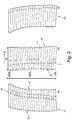
- Fig. 2a, b, c show a three side view presentation of an inventive rotor blade as introduced shortly in case c) of figure 1 .
- the figure 2a shows a front view
- Fig. 2b shows the side view
- figure 2c shows the rear view of an inventively formed rotor blade.
- the flow direction 8 of the gas flow in a turbine is directed from the left hand side to the right hand side, so that the left edge of the illustration represents the leading edge 9 and the right edge represents the rear edge 10 of the airfoil 1.
- the suction side 7 of the airfoil 1 in figure 2b faces towards the observer.
- the blade has an radially extension which is called span s which extends from 0% span at the blade root (not shown) to 100% span which corresponds to the blade tip 3.
- the axial chord length 6 varies along the whole span s but increases inventively from a mid range span preferably from 50% span to 100% span. The increase of axial chord length 6 leads automatically to an increase of mass in the blade tip region which influences the resonance frequency of the rotor blade significantly.
- the amount of increase of the axial chord length 6 from the mid-range span region to 100% span is about 5 % ⁇ 5 % to 15% ⁇ 10 % related to the axial chord length 6 of 50% span of the airfoil 1. This increase is illustrated in figure 2b by the vertical dashed lines.
- the leading edge 9 is bended as well the rear edge 10 which cannot be seen on the front view in a span range between 50% span and 100% span.
- the bending is oriented towards the suction side 7 of the airfoil 1 of the rotor blade.
- Bending of the leading edge 9 as well of the rear edge 10 is defined by a curvature of a so called stacking line which is a line on the surface at the pressure side 11 of the airfoil 1 extending from 0% to 100% span at an axial position of 50 ⁇ 5% of axial chord length 6.
- the curvature of the stacking line within the span region between 50% and 100% span is defined by one single radius r preferably which can be seen more clearly in figure 3a .
- Figure 3a shows a perspective view onto the pressure side 11 of an inventive airfoil 1 providing both, an increase of axial chord length 6 in the span range between 50% and 100% span and bending of the leading edge 9 and rear edge 10 within the span region between 50% and 100% span.
- the bending of the leading 9 and trailing edge 10 depend on the curvature of the stacking line 12 which can be seen in figure 3a which is the line on the surface of the pressure side 11 extending from 0% to 100% span at an axial position of 50% ⁇ 5% of axial chord length 6.
- the stacking line 12 is almost straight between 0% span and 50% ⁇ 10% span and is bended in the span region between 50% ⁇ 10% span and 100% span such that the stacking line 12 encircles at 100% span an angle ⁇ with the virtual plane 13 orientated orthogonal to the radial direction and wherein the angle ⁇ lies within a plane defined by the stacking line and the radial direction such that the angle ⁇ is between 12,5° ⁇ 2,5° and 25° + 5°.
- the curvature of the stacking line within the upper span region is defined by on single radius preferably. In other preferred embodiments the stacking line additionally can provide at least one straight section along the upper span region.
- Figure 3b shows a vertical projection of different profile cross-sections through the airfoil 1 at different span regions which are indicated in figure 3a by roman numerals I to VIII.
- the profile cross section I corresponds to the profile cross-section at 0% span and the profile cross section VIII corresponds to the profile cross-section at 100% span.
- the vertical projection in radial direction shows a significant geometrical offset of the profile cross section within the span region 50% span to 100% i.e. the profile cross sections V to VIII.
- the geometrical offset is caused both by an offset in circumferential direction towards the suction side 7 of the airfoil 1 and further by an increase of axial chord length 6 from 50% span to 100% span.
Landscapes
- Engineering & Computer Science (AREA)
- Mechanical Engineering (AREA)
- General Engineering & Computer Science (AREA)
- Physics & Mathematics (AREA)
- Fluid Mechanics (AREA)
- Turbine Rotor Nozzle Sealing (AREA)
- Structures Of Non-Positive Displacement Pumps (AREA)
Description
- The invention relates to a gas turbine blade comprising an airfoil extending in radial direction from a blade root to a blade tip, defining a span ranging from 0% at the blade root to 100% at the blade tip, and extending in axial direction from a leading edge to a trailing edge, which limit a chord with an axial chord length defined by an axial length of a straight line connecting the leading edge and trailing edge of the airfoil depending on the span. Generally, the gas turbine blade according to the present invention is not restricted to a gas turbine: rotor blades or guide vanes of a turbo-machinery fall legally under the present invention.
- The design of rotor blades in a gas turbine engine is of vital importance in terms of efficiency with which the gas flow passing through the gas turbine engine interacts with the blades especially of the at least one turbine of the gas turbine arrangement.
- Rotating gas turbine blades must fulfill a multitude of material- and design criteria which consider high mechanical and thermal stresses acting onto the rotating blades during operation. Due to enormous centrifugal forces acting onto rotating blades and an enormous thermal load that must withstand the blades, the main task in the design work of blades is to combine a high degree on stiffness which shall avoid blade vibrations during operation and the possibility of active cooling to enhance load capacity, by providing cooling channels inside the airfoil of a rotating blade. In view of the before requirements an optimized airfoil shape is always sought to improve turbine aerodynamic efficiency.
- Rotating blades are arranged in rows which alternate in axial direction with rows of stationary vanes. Every pair a rows including one row of stationary vanes and one row of rotating blades which follows in downstream direction directly forms a so called stage. All stages of the turbine are numbered in sequence beginning with the first stage at the inlet opening of the turbine comprising the first row of stationary vanes followed by the first row of rotating blades.
- Normal operation of a gas turbine shows that the stationary vanes, e.g. of the first stage, are excitation sources for vibrations acting onto the following rotating blades in downstream direction in disadvantage manner. It is therefore an object of turbine development to reduce such excitation sources and/or to enhance possibilities of decoupling mechanism to reduce and/or to avoid vibration transmission and excitation onto rotating blades arranged downstream of vanes in the first stage.
- An obvious intervention would mean to change the excitation sources itself, but a change of the vanes in the first stage is considered to be expensive and would raise a lot of development work. Proposals to vary the radial length of the blades, i.e. the span of the airfoil which extends from the blade root to the blade tip, would have an impact onto the annulus of the flow path through the turbine which would lead to a major impact on a developments schedule which in view of that is not favorable. Another approach of reducing the tip mass of the rotating blade by reducing the axial chord length of the tip chord, which concerns a straight line connecting the leading edge and trailing edge of the airfoil in the region of the blade tip, resulted in aerodynamic penalty and furthermore a desired frequency shift of the resonant vibration behavior of the rotating blade was not achieved. Finally it was thought about to change the blade material in view of a possible change of Young's modulus, but this idea was dropped because of low cycle fatigue limitations associated with conventionally cast and directionally solidified materials.
- All approaches of a desired influence on the vibration behavior of the rotating blades especially arranged within the first stage of a turbine and the turbine aerodynamic efficiency show the complexity of the problem. Major mass redistribution in designing an enhanced shape of the airfoil of a rotating blade is also considered to be difficult because especially rotating blades of the front stages are actively cooled components which are hollow bodies containing a multitude of cooling channel for cooling purpose. The thin metal walls of the rotating blades have to be cooled intensively to fulfill target life. Also the aspect of increasing the shank length of a rotating blade was considered to influence the vibration behavior of the rotating blade itself but was not deemed to be favorable due to the fact that this approach would result in rotor limits at the fire tree region in which cooling air supply via rotor bores is provided so that the rotor outline would also have to be adjusted.
The documentUS 5,525,038 and the correspondingEP 1524405 discloses a rotor blade for a gas turbine engine which is optimized to reduce tip leakage through a tip clearance. The rotor blade provides a significantly bowed surface formed at the tip region extending from the leading edge to the trailing edge of the suction side of the rotor blade. The profile cross-sections along the span of the airfoil of the rotor blade do not vary significantly, at least the axial chord length of the airfoil along the whole span of the rotor blade remains unchanged. Other examples are disclosed in documentsUS2010/054946 ,EP2022988 ,EP1754859 ,US2013/017094 . - The axial chord length is defined as the length of the projection of the blade, as set in the turbine, onto a line parallel to the turbine axis. This can be seen in for example David Gordon Wilson's "The Design of High-Efficiency Turbomachinery and Gas Turbines", pp 487-492, published by the MIT Press, Cambridge, Massachusetts, 1984, 5th printing 1991. Particular reference is made to the second figure on page 487.
- It is an object of the invention to provide a gas turbine engine rotor blade comprising an airfoil extending in radial direction from a blade root to a blade tip, defining a span ranging from 0% at the blade root to 100% at the blade tip, and extending in axial direction from a leading edge to a trailing edge, which limit a chord with an axial chord length defined by an axial length of a straight line connecting the leading edge and trailing edge of the airfoil depending on the span which provides an enhanced vibration behavior such that resonance excitation does not occur at the rotating blades of the first and following stages.
- The object is achieved by the features in the
independent claim 1. The invention can be modified advantageously by the features disclosed in the dependent claims as well in the following description especially referring to preferred embodiments. - It has been recognized according to the invention that by increasing the axial chord length at least in a span region from 80% span to 100% span, a significant influence on the resonant vibration behavior of the rotating blade can be exerted without a deterioration of the aerodynamic properties of the airfoil of the rotating blade. The increase of axial chord length is directly combined with an increase of mass in the region of the airfoil tip which influences the mechanical properties, in particular the Eigenfrequencies of the rotating blade.
- In a preferred embodiment of the invention the axial chord length of the airfoil of the gas turbine blade increases continuously at least from 70% span to 100% span. advantageously the increase of the axial chord length with increasing span is more or less symmetrical relative to a so called stacking line which is a line on the surface at the pressure side of the airfoil extending from 0% to 100% span at an axial position of 50% ± 5% of axial chord length.
- The inventive gas turbine blade provides in view of its axial chord length a minimum at least in the range between 50% ± 10% span and 70% ± 10% span, i.e. the airfoil of the gas turbine blade between 0% span and 50% ± 10% span is formed with a conventional shape which provides a decreasing axial chord length from 0% span to 50% ± 10% span. Towards the tip the chord length is increasing again.
- An optimized embodiment of an inventive gas turbine blade provides an axial chord length which increases from 50% span to 100% span and provides a minimal axial chord length at 50% span.
- The axial increase of the axial chord length in the range between the tailored mid region of the airfoil to the airfoil tip, i.e. 100% span ranges between 5% ± 5% und 15% ± 10% of the axial chord length in the tailored mid region of the airfoil.
- As a result of the increase of axial chord length along the radial upper part of the airfoil of the turbine blade influence on the eigenfrequency of the turbine blade can be exerted such that the eigenfrequency can be modified in an amount so that resonant excitation can be minimized or even excluded.
- To increase the difference between the eigenfrequency of the gas turbine blade to the excitation frequency caused by stationary vanes in the first stage even more it is further proposed to bend the leading and trailing edge in the radial upper region of the airfoil additionally. Preferably the bending of the leading and trailing edge depend on a curvature of a stacking line which was already explained before, which is a line on the surface at the pressure side of the airfoil extending from 0% to 100% span at an axial position of 50% ± 5% of axial chord length. The stacking line is bended in the span region between 50% ± 10% span and 100% span such that the stacking line encircles at 100% span an angle α with a virtual plane oriented orthogonal to the radial direction and wherein the angle α lies within a plane defined by the stacking line and the radial direction such that for the angle α applies: 12,5° ± 2,5° ≤ α ≤ 25° + 5°.
- For the sake of completeness it should be mentioned that the stacking line can be kept straight between 5% ± 5% span and 50% ± 10% span.
- Preferably the stacking line provides a curvature within the span region between 50% ± 10% span and 100% span which is defined by one single radius.
- In a further preferred embodiment the rotating blade provides an aspect ratio concerning span to axial chord length at 5% ± 5% span ranging from 1,6 to 2,1. In case of blades having different span dimensions along the leading and trailing edge the before aspect ratio concerns the span dimension along the trailing edge.
- The invention shall subsequently be explained in more detail based on exemplary embodiments in conjunction with the drawings. In the drawings
- Fig. 1
- shows on the left hand side a diagram which illustrates resonance frequency behavior, e.g. of vanes and blades in the front stage of a gas turbine,
- Fig. 2a, b, c
- three side view presentation of an enhanced embodiment of the inventive turbine blade and
- Fig. 3a, b
- perspective view on the inventive turbine blade and a top view of vertical stacked airfoil cross sections.
-
Fig. 1 shows on the left hand side a diagram which illustrates resonance frequency behavior of vanes and blades in the first stage of a gas turbine. Along the abscissa of the diagram values are indicated representing the engine speed. Along the ordinate of the diagram vibrating frequency are indicated. The dashed line box B indicates the source of excitation depending on the engine speed, in which resonance excitation of the blades of the gas turbine can occur. - On the right hand side of
figure 1 three different embodiments a), b) c) of rotor blades of a gas turbine are illustrates. The upper view in each case shows a side view of a rotor blade and the corresponding lower view shows the blade in a perspective front view. - Case a) shows a rotor blade commonly used in gas turbines and represents the state of the art. The common rotor blade provides an
airfoil 1 which extends radially from ablade root 2 to theblade tip 3. Theblade root 2 comprises a shroud 4 and a fire tree shapedblade foot 5 for fixing purpose inside the rotor arrangement. As can be seen from the upper sketch in case a) the commonly known rotor blade provides anairfoil 1 providing aaxial chord length 6 which decreases along the whole span from 0% span to 100% span. The rotor blade illustrated in case a) comprises an eigenfrequency which overlaps with the excitation frequency represented by the dashed line box B in the diagram shown infigures 1 left hand side. This leads to a reduced life time due to a high amount of vibrational impact. - In case b) an inventive improved rotor blade is illustrated having an
airfoil 1 which provides anaxial chord length 6 which increases in a span region s from 50% span to 100% span. As can be seen from the side view in the upper sketch in case b) theairfoil 1 has a minimumaxial chord length 6 in the range of 50% span. The increase of theaxial chord length 6 can also be derived from the front view sketch in the lower part of case b). - The inventive action contributes that the eigenfrequency of the improved airfoil is dropped in comparison to the commonly known blade of case a). Due to the increase of mass in the tip range of the airfoil in case b) the eigenfrequency drops below which means in case of the situation illustrated in the diagram of
figure 1 left hand side there is nearly no overlap between the resonance frequency of the blade of case b) and the excitation frequency range indicated by the dashed line box B. Therefore the improved blade illustrated in case b) provides a significant enhanced vibrational behavior which is clearly robust against vibrational excitation. This leads to an effective enhancement of the aerodynamic behavior and prolongs lifetime of the blade clearly. - Case c) which is illustrated at the right side of
figure 1 shows a rotor blade which provides an axial chord length increase as explained in case b), which can be derived from the upper view in case c) but additionally provides a bending of theairfoil 1 in circumferential direction towards thesuction side 7 of theairfoil 1. Bending of theairfoil 1 is limited in a span region preferably between 50% span and 100% span which can be derived from the lower sketch of case c). The additional bending of theairfoil 1 as described before and as will be discussed in more detail below leads to an enhanced frequency behavior of the rotor blade which is illustrated in the diagram offigure 1 left hand side. The eigenfrequency of a rotor blade as disclosed in case c) provides a significant lower eigenfrequency which is clearly below the airfoil illustrated in case b). This leads to a significant frequency separation relative to the excitation frequency characterized by the dashed line box B offigure 1 . -
Fig. 2a, b, c show a three side view presentation of an inventive rotor blade as introduced shortly in case c) offigure 1 . Thefigure 2a shows a front view,Fig. 2b shows the side view andfigure 2c shows the rear view of an inventively formed rotor blade. - In
figure 2b it is assumed that theflow direction 8 of the gas flow in a turbine is directed from the left hand side to the right hand side, so that the left edge of the illustration represents theleading edge 9 and the right edge represents therear edge 10 of theairfoil 1. Thesuction side 7 of theairfoil 1 infigure 2b faces towards the observer. The blade has an radially extension which is called span s which extends from 0% span at the blade root (not shown) to 100% span which corresponds to theblade tip 3. Theaxial chord length 6 varies along the whole span s but increases inventively from a mid range span preferably from 50% span to 100% span. The increase ofaxial chord length 6 leads automatically to an increase of mass in the blade tip region which influences the resonance frequency of the rotor blade significantly. - The amount of increase of the
axial chord length 6 from the mid-range span region to 100% span is about 5 % ± 5 % to 15% ± 10 % related to theaxial chord length 6 of 50% span of theairfoil 1. This increase is illustrated infigure 2b by the vertical dashed lines. - As can be seen from the front view of
figure 2a theleading edge 9 is bended as well therear edge 10 which cannot be seen on the front view in a span range between 50% span and 100% span. The bending is oriented towards thesuction side 7 of theairfoil 1 of the rotor blade. Bending of theleading edge 9 as well of therear edge 10 is defined by a curvature of a so called stacking line which is a line on the surface at thepressure side 11 of theairfoil 1 extending from 0% to 100% span at an axial position of 50 ± 5% ofaxial chord length 6. The curvature of the stacking line within the span region between 50% and 100% span is defined by one single radius r preferably which can be seen more clearly infigure 3a . -
Figure 3a shows a perspective view onto thepressure side 11 of aninventive airfoil 1 providing both, an increase ofaxial chord length 6 in the span range between 50% and 100% span and bending of theleading edge 9 andrear edge 10 within the span region between 50% and 100% span. The bending of the leading 9 and trailingedge 10 depend on the curvature of the stackingline 12 which can be seen infigure 3a which is the line on the surface of thepressure side 11 extending from 0% to 100% span at an axial position of 50% ± 5% ofaxial chord length 6. The stackingline 12 is almost straight between 0% span and 50% ± 10% span and is bended in the span region between 50% ± 10% span and 100% span such that the stackingline 12 encircles at 100% span an angle α with thevirtual plane 13 orientated orthogonal to the radial direction and wherein the angle α lies within a plane defined by the stacking line and the radial direction such that the angle α is between 12,5° ± 2,5° and 25° + 5°. The curvature of the stacking line within the upper span region is defined by on single radius preferably. In other preferred embodiments the stacking line additionally can provide at least one straight section along the upper span region. -
Figure 3b shows a vertical projection of different profile cross-sections through theairfoil 1 at different span regions which are indicated infigure 3a by roman numerals I to VIII. The profile cross section I corresponds to the profile cross-section at 0% span and the profile cross section VIII corresponds to the profile cross-section at 100% span. The vertical projection in radial direction shows a significant geometrical offset of the profile cross section within thespan region 50% span to 100% i.e. the profile cross sections V to VIII. The geometrical offset is caused both by an offset in circumferential direction towards thesuction side 7 of theairfoil 1 and further by an increase ofaxial chord length 6 from 50% span to 100% span. -
- 1
- Airfoil
- 2
- Blade root
- 3
- Blade tip
- 4
- Shroud
- 5
- Blade foot
- 6
- Axial chord length
- 7
- Suction side
- 8
- Flow direction
- 9
- Leading edge
- 10
- Rear edge
- 11
- Pressure side
- 12
- Stacking line
- 13
- Plane
- s
- Span
- B
- Resonance excitation range
Claims (13)
- A gas turbine blade comprising an airfoil (1) extending in radial direction from a blade root (2) to a blade tip (3), defining a span (s) ranging from 0% at the blade root (2) to 100% at the blade tip (3), and extending in axial direction from a leading edge (9) to a trailing edge (10), which limit a chord with an axial chord length (6) defined by an axial length of a straight line connecting the leading edge (9) and trailing edge (10) of the airfoil (1) depending on the span (s), characterized in that the axial chord length (6) increases at least from 80% span to 100% span.
- The gas turbine blade according to claim 1, characterized in that the axial chord length (6) increases at least from 70% span to 100% span.
- The gas turbine blade according to claim 1 or 2, characterized in that the axial chord length (6) provides a minimum at least in the range between 50% ± 10% span and 70% ± 10 % span.
- The gas turbine blade according to claim 1, characterized in that the axial chord length (6) increases from 50% span to 100% span and provides a minimum at 50% span.
- The gas turbine blade according to one of the claims 1 to 4, characterized in that the leading edge (9) and the trailing edge (10) separate a suction (7) and a pressure surface (11) of the airfoil (1), both surfaces extending radially between the blade root (2) and the blade tip (3) and axially between the leading (9) and trailing edge (10) and being mutually opposed surfaces of the airfoil (1) along a circumferential direction which is orthogonal to the axial and radial direction, and that the leading and trailing edge (9, 10) are bended within at least one span region.
- The gas turbine blade according to claim 5, characterized in that the leading and trailing edge (9, 10) are bended in a circumferential direction towards the suction surface (7) side of the airfoil (1).
- The gas turbine blade according to claim 5 or 6, characterized in that the at least one span region is between 50% ± 10% span and 100% span.
- The gas turbine blade according to one of the claims 5 to 7, characterized in that bending of the leading (9) and trailing edge (10) depend on a curvature of a stacking line (12) which is a line on the surface at the pressure side (7) of the airfoil (1) extending from 0% to 100 % span at an axial position of 50% ± 5% of axial chord length (6), and that said stacking line (12) is bended in the span region between 50% ± 10% span and 100% span such that the stacking line (12) encircles at 100 % span an angle α with a virtual plane (13) oriented orthogonal to the radial direction, wherein the angle α is in a plane defined by the stacking line and the radial direction, for the angle α applies:

- The gas turbine blade according to claim 8, characterized in that the stacking line (12) is straight between 0% span and 50% ± 10% span.
- The gas turbine blade according to claim 8 or 9, characterized in that stacking line (12) provides a curvature within the span region which is defined by one single radius.
- A gas turbine blade according to one of the claims 1 to 10, characterized in that the blade is an actively-cooled rotating turbine blade having cooling channels inside the airfoil (1).
- A gas turbine blade according to one of the claims 1 to 11, characterized in that the blade provides an aspect ratio span/axial chord length at 5% ± 5% span ranging from 1,6 to 2,1.
- The gas turbine blade according to one of claims 1 to 12, characterized in that the blade is suitable for use as rotor blade or guide vane of a turbo-machinery.
Priority Applications (1)
| Application Number | Priority Date | Filing Date | Title |
|---|---|---|---|
| EP15156480.4A EP2921648B1 (en) | 2014-03-20 | 2015-02-25 | Gas turbine blade comprising bended leading and trailing edges |
Applications Claiming Priority (2)
| Application Number | Priority Date | Filing Date | Title |
|---|---|---|---|
| EP14160866.1A EP2921647A1 (en) | 2014-03-20 | 2014-03-20 | Gas turbine blade comprising bended leading and trailing edges |
| EP15156480.4A EP2921648B1 (en) | 2014-03-20 | 2015-02-25 | Gas turbine blade comprising bended leading and trailing edges |
Publications (2)
| Publication Number | Publication Date |
|---|---|
| EP2921648A1 EP2921648A1 (en) | 2015-09-23 |
| EP2921648B1 true EP2921648B1 (en) | 2018-12-26 |
Family
ID=50289585
Family Applications (2)
| Application Number | Title | Priority Date | Filing Date |
|---|---|---|---|
| EP14160866.1A Withdrawn EP2921647A1 (en) | 2014-03-20 | 2014-03-20 | Gas turbine blade comprising bended leading and trailing edges |
| EP15156480.4A Revoked EP2921648B1 (en) | 2014-03-20 | 2015-02-25 | Gas turbine blade comprising bended leading and trailing edges |
Family Applications Before (1)
| Application Number | Title | Priority Date | Filing Date |
|---|---|---|---|
| EP14160866.1A Withdrawn EP2921647A1 (en) | 2014-03-20 | 2014-03-20 | Gas turbine blade comprising bended leading and trailing edges |
Country Status (6)
| Country | Link |
|---|---|
| US (1) | US9765626B2 (en) |
| EP (2) | EP2921647A1 (en) |
| JP (1) | JP2015183691A (en) |
| KR (1) | KR20150110355A (en) |
| CN (1) | CN104929696B (en) |
| RU (1) | RU2723658C2 (en) |
Families Citing this family (28)
| Publication number | Priority date | Publication date | Assignee | Title |
|---|---|---|---|---|
| US10982551B1 (en) | 2012-09-14 | 2021-04-20 | Raytheon Technologies Corporation | Turbomachine blade |
| US20170138202A1 (en) * | 2015-11-16 | 2017-05-18 | General Electric Company | Optimal lift designs for gas turbine engines |
| GB2544735B (en) * | 2015-11-23 | 2018-02-07 | Rolls Royce Plc | Vanes of a gas turbine engine |
| CN105673251A (en) * | 2016-01-13 | 2016-06-15 | 中国航空动力机械研究所 | Fan pressure boosting stage and turbofan engine |
| US9995144B2 (en) | 2016-02-18 | 2018-06-12 | General Electric Company | Turbine blade centroid shifting method and system |
| US10683761B1 (en) * | 2017-01-17 | 2020-06-16 | Raytheon Technologies Corporation | Gas turbine engine airfoil frequency design |
| US10774651B1 (en) * | 2017-01-17 | 2020-09-15 | Raytheon Technologies Corporation | Gas turbine engine airfoil frequency design |
| US11261737B1 (en) | 2017-01-17 | 2022-03-01 | Raytheon Technologies Corporation | Turbomachine blade |
| US10677266B1 (en) * | 2017-01-17 | 2020-06-09 | Raytheon Technologies Corporation | Gas turbine engine airfoil frequency design |
| US11199096B1 (en) | 2017-01-17 | 2021-12-14 | Raytheon Technologies Corporation | Turbomachine blade |
| EP3364039A1 (en) | 2017-02-21 | 2018-08-22 | Siemens Aktiengesellschaft | Recirculation stage |
| KR101901682B1 (en) * | 2017-06-20 | 2018-09-27 | 두산중공업 주식회사 | J Type Cantilevered Vane And Gas Turbine Having The Same |
| US20190106989A1 (en) * | 2017-10-09 | 2019-04-11 | United Technologies Corporation | Gas turbine engine airfoil |
| GB201719538D0 (en) * | 2017-11-24 | 2018-01-10 | Rolls Royce Plc | Gas turbine engine |
| EP3511522A1 (en) * | 2018-01-11 | 2019-07-17 | Siemens Aktiengesellschaft | Gas turbine blade and method for producing such blade |
| CN108980106A (en) * | 2018-07-25 | 2018-12-11 | 清华大学 | Compressor blades and compressors |
| EP3879072B1 (en) * | 2018-11-05 | 2024-07-17 | IHI Corporation | Rotor blade of axial-flow fluid machine |
| US10920594B2 (en) * | 2018-12-12 | 2021-02-16 | Solar Turbines Incorporated | Modal response tuned turbine blade |
| US11473434B2 (en) * | 2019-10-16 | 2022-10-18 | Raytheon Technologies Corporation | Gas turbine engine airfoil |
| IT202000005146A1 (en) * | 2020-03-11 | 2021-09-11 | Ge Avio Srl | TURBINE ENGINE WITH AERODYNAMIC PROFILE HAVING HIGH ACCELERATION AND LOW VANE CURVE |
| US11286779B2 (en) * | 2020-06-03 | 2022-03-29 | Honeywell International Inc. | Characteristic distribution for rotor blade of booster rotor |
| US11808168B2 (en) * | 2020-10-09 | 2023-11-07 | General Electric Company | Turbine bucket with dual part span shrouds and aerodynamic features |
| US11795824B2 (en) * | 2021-11-30 | 2023-10-24 | General Electric Company | Airfoil profile for a blade in a turbine engine |
| FR3131754B1 (en) * | 2022-01-13 | 2024-05-24 | Safran Aircraft Engines | BLADE FOR AIRCRAFT TURBOMACHINE |
| US11713679B1 (en) * | 2022-01-27 | 2023-08-01 | Raytheon Technologies Corporation | Tangentially bowed airfoil |
| CN116361934B (en) * | 2023-02-09 | 2024-11-22 | 中国航发湖南动力机械研究所 | Optimization design method for ultra-high rim linear speed gas turbine rotor, turbine rotor |
| KR20240132872A (en) * | 2023-02-27 | 2024-09-04 | 엘지전자 주식회사 | Centrifugal fan |
| US12509988B2 (en) | 2024-06-14 | 2025-12-30 | Pratt & Whitney Canada Corp. | Turbine engine airfoil |
Citations (18)
| Publication number | Priority date | Publication date | Assignee | Title |
|---|---|---|---|---|
| WO1996014494A2 (en) | 1994-11-04 | 1996-05-17 | United Technologies Corporation | Rotor airfoils to control tip leakage flows |
| US6079948A (en) | 1996-09-30 | 2000-06-27 | Kabushiki Kaisha Toshiba | Blade for axial fluid machine having projecting portion at the tip and root of the blade |
| EP1106835A2 (en) | 1999-12-06 | 2001-06-13 | General Electric Company | Bowed compressor airfoil |
| EP1524405A2 (en) | 2003-10-15 | 2005-04-20 | Alstom Technology Ltd | Turbine rotor blade for gas turbine engine |
| WO2007042522A1 (en) | 2005-10-11 | 2007-04-19 | Alstom Technology Ltd | Turbo-machine blade |
| EP1927724A2 (en) | 2006-11-23 | 2008-06-04 | Rolls-Royce Deutschland Ltd & Co KG | Turbomachine blade |
| EP2022988A1 (en) | 2006-05-26 | 2009-02-11 | IHI Corporation | Moving blade of turbofan engine |
| US20090317227A1 (en) | 2005-12-16 | 2009-12-24 | United Technologies Corporation | Airfoil embodying mixed loading conventions |
| US20100054946A1 (en) | 2008-09-04 | 2010-03-04 | John Orosa | Compressor blade with forward sweep and dihedral |
| EP2199543A2 (en) | 2008-12-17 | 2010-06-23 | United Technologies Corporation | Gas turbine engine airfoil |
| EP2333242A2 (en) | 2009-12-04 | 2011-06-15 | United Technologies Corporation | Tip vortex control on a rotor blade for a gas turbine engine |
| EP2412926A2 (en) | 2010-07-26 | 2012-02-01 | United Technologies Corporation | Hollow blade for a gas turbine |
| US20120183411A1 (en) | 2011-01-13 | 2012-07-19 | Alstom Technology Ltd | Aerofoil blade for an axial flow turbomachine |
| US8240975B1 (en) | 2007-11-29 | 2012-08-14 | Florida Turbine Technologies, Inc. | Multiple staged compressor with last stage airfoil cooling |
| US20120210715A1 (en) | 2011-02-22 | 2012-08-23 | Hitachi, Ltd. | Turbine Nozzle Blade and Steam Turbine Equipment Using Same |
| WO2012134833A2 (en) | 2011-03-25 | 2012-10-04 | General Electric Company | High camber compressor rotor blade |
| WO2013165527A2 (en) | 2012-02-29 | 2013-11-07 | United Technologies Corporation | High order shaped curve region for an airfoil |
| WO2014011276A2 (en) | 2012-05-08 | 2014-01-16 | General Electric Company | Turbine airfoil trailing edge bifurcated cooling holes |
Family Cites Families (12)
| Publication number | Priority date | Publication date | Assignee | Title |
|---|---|---|---|---|
| GB9417406D0 (en) | 1994-08-30 | 1994-10-19 | Gec Alsthom Ltd | Turbine blade |
| FR2797658B1 (en) | 1999-08-18 | 2002-08-23 | Snecma | IMPROVED TURBINE DAWN |
| US6312219B1 (en) * | 1999-11-05 | 2001-11-06 | General Electric Company | Narrow waist vane |
| GB0503185D0 (en) | 2005-02-16 | 2005-03-23 | Rolls Royce Plc | A turbine blade |
| US7497664B2 (en) * | 2005-08-16 | 2009-03-03 | General Electric Company | Methods and apparatus for reducing vibrations induced to airfoils |
| CH705206B1 (en) | 2006-06-23 | 2012-11-30 | Prospective Concepts Ag | Pneumatic support structure. |
| US8632311B2 (en) | 2006-08-21 | 2014-01-21 | General Electric Company | Flared tip turbine blade |
| EP1953344B1 (en) | 2007-02-05 | 2012-04-11 | Siemens Aktiengesellschaft | Turbine blade |
| US8485787B2 (en) * | 2009-09-08 | 2013-07-16 | Siemens Energy, Inc. | Turbine airfoil fabricated from tapered extrusions |
| US8414265B2 (en) | 2009-10-21 | 2013-04-09 | General Electric Company | Turbines and turbine blade winglets |
| FR2955609B1 (en) * | 2010-01-26 | 2012-04-27 | Snecma | AUBE COMPOSITE WITH INTERNAL CHANNELS |
| GB2490127A (en) * | 2011-04-19 | 2012-10-24 | Rolls Royce Plc | Aerofoil assembly |
-
2014
- 2014-03-20 EP EP14160866.1A patent/EP2921647A1/en not_active Withdrawn
-
2015
- 2015-02-25 EP EP15156480.4A patent/EP2921648B1/en not_active Revoked
- 2015-03-18 KR KR1020150037329A patent/KR20150110355A/en not_active Withdrawn
- 2015-03-18 US US14/661,661 patent/US9765626B2/en not_active Expired - Fee Related
- 2015-03-19 RU RU2015109774A patent/RU2723658C2/en active
- 2015-03-20 JP JP2015057531A patent/JP2015183691A/en active Pending
- 2015-03-20 CN CN201510123425.6A patent/CN104929696B/en active Active
Patent Citations (18)
| Publication number | Priority date | Publication date | Assignee | Title |
|---|---|---|---|---|
| WO1996014494A2 (en) | 1994-11-04 | 1996-05-17 | United Technologies Corporation | Rotor airfoils to control tip leakage flows |
| US6079948A (en) | 1996-09-30 | 2000-06-27 | Kabushiki Kaisha Toshiba | Blade for axial fluid machine having projecting portion at the tip and root of the blade |
| EP1106835A2 (en) | 1999-12-06 | 2001-06-13 | General Electric Company | Bowed compressor airfoil |
| EP1524405A2 (en) | 2003-10-15 | 2005-04-20 | Alstom Technology Ltd | Turbine rotor blade for gas turbine engine |
| WO2007042522A1 (en) | 2005-10-11 | 2007-04-19 | Alstom Technology Ltd | Turbo-machine blade |
| US20090317227A1 (en) | 2005-12-16 | 2009-12-24 | United Technologies Corporation | Airfoil embodying mixed loading conventions |
| EP2022988A1 (en) | 2006-05-26 | 2009-02-11 | IHI Corporation | Moving blade of turbofan engine |
| EP1927724A2 (en) | 2006-11-23 | 2008-06-04 | Rolls-Royce Deutschland Ltd & Co KG | Turbomachine blade |
| US8240975B1 (en) | 2007-11-29 | 2012-08-14 | Florida Turbine Technologies, Inc. | Multiple staged compressor with last stage airfoil cooling |
| US20100054946A1 (en) | 2008-09-04 | 2010-03-04 | John Orosa | Compressor blade with forward sweep and dihedral |
| EP2199543A2 (en) | 2008-12-17 | 2010-06-23 | United Technologies Corporation | Gas turbine engine airfoil |
| EP2333242A2 (en) | 2009-12-04 | 2011-06-15 | United Technologies Corporation | Tip vortex control on a rotor blade for a gas turbine engine |
| EP2412926A2 (en) | 2010-07-26 | 2012-02-01 | United Technologies Corporation | Hollow blade for a gas turbine |
| US20120183411A1 (en) | 2011-01-13 | 2012-07-19 | Alstom Technology Ltd | Aerofoil blade for an axial flow turbomachine |
| US20120210715A1 (en) | 2011-02-22 | 2012-08-23 | Hitachi, Ltd. | Turbine Nozzle Blade and Steam Turbine Equipment Using Same |
| WO2012134833A2 (en) | 2011-03-25 | 2012-10-04 | General Electric Company | High camber compressor rotor blade |
| WO2013165527A2 (en) | 2012-02-29 | 2013-11-07 | United Technologies Corporation | High order shaped curve region for an airfoil |
| WO2014011276A2 (en) | 2012-05-08 | 2014-01-16 | General Electric Company | Turbine airfoil trailing edge bifurcated cooling holes |
Non-Patent Citations (1)
| Title |
|---|
| BAGSHAW, D. ET AL.: "An experimental study of reverse compound lean in a linear turbine cascade", PROCEEDINGS OF THE I MECH E PART A: JOURNAL OF POWER AND ENERGY, vol. 219, no. 6, 2005, pages 443 - 449, XP055257574, doi:10.1243/095765005X31199 |
Also Published As
| Publication number | Publication date |
|---|---|
| RU2015109774A (en) | 2016-10-10 |
| CN104929696B (en) | 2019-07-05 |
| US9765626B2 (en) | 2017-09-19 |
| US20150345297A1 (en) | 2015-12-03 |
| RU2015109774A3 (en) | 2018-11-06 |
| EP2921648A1 (en) | 2015-09-23 |
| RU2723658C2 (en) | 2020-06-17 |
| KR20150110355A (en) | 2015-10-02 |
| CN104929696A (en) | 2015-09-23 |
| JP2015183691A (en) | 2015-10-22 |
| EP2921647A1 (en) | 2015-09-23 |
Similar Documents
| Publication | Publication Date | Title |
|---|---|---|
| US9765626B2 (en) | Gas turbine blade | |
| US10865807B2 (en) | Mistuned fan | |
| EP1250516B1 (en) | Turbine engine damper | |
| EP2372165B1 (en) | Stator blade structure and gas turbine | |
| CN103119248B (en) | Impeller assembly and affiliated gas turbine | |
| US11578603B2 (en) | Turbine blade, turbine, and method of tuning natural frequency of turbine blade | |
| US20150204237A1 (en) | Turbine blade and method for enhancing life of the turbine blade | |
| US10119406B2 (en) | Blade with stress-reducing bulbous projection at turn opening of coolant passages | |
| EP3456920B1 (en) | Mistuned rotor for gas turbine engine | |
| US10605090B2 (en) | Intermediate central passage spanning outer walls aft of airfoil leading edge passage | |
| EP3211178B1 (en) | Turbine blade | |
| US11421534B2 (en) | Damping device | |
| EP3081751B1 (en) | Cooled airfoil and method for manufacturing said airfoil | |
| EP2803821A1 (en) | Blade device, blade system, and corresponding method of manufacturing a blade system | |
| US9506372B2 (en) | Damping means for damping a blade movement of a turbomachine | |
| US10544687B2 (en) | Shrouded blade of a gas turbine engine | |
| JP2017145829A (en) | Turbine blade centroid shifting method and system | |
| EP2634375B1 (en) | Method of producing a seal between stationary and rotating components of a turbine engine | |
| US11466571B1 (en) | Damping device | |
| KR20160074423A (en) | Gas turbine vane | |
| US9482099B2 (en) | Rotor blade for a turbomachine and turbomachine |
Legal Events
| Date | Code | Title | Description |
|---|---|---|---|
| PUAI | Public reference made under article 153(3) epc to a published international application that has entered the european phase |
Free format text: ORIGINAL CODE: 0009012 |
|
| AK | Designated contracting states |
Kind code of ref document: A1 Designated state(s): AL AT BE BG CH CY CZ DE DK EE ES FI FR GB GR HR HU IE IS IT LI LT LU LV MC MK MT NL NO PL PT RO RS SE SI SK SM TR |
|
| AX | Request for extension of the european patent |
Extension state: BA ME |
|
| 17P | Request for examination filed |
Effective date: 20160322 |
|
| RBV | Designated contracting states (corrected) |
Designated state(s): AL AT BE BG CH CY CZ DE DK EE ES FI FR GB GR HR HU IE IS IT LI LT LU LV MC MK MT NL NO PL PT RO RS SE SI SK SM TR |
|
| RAP1 | Party data changed (applicant data changed or rights of an application transferred) |
Owner name: GENERAL ELECTRIC TECHNOLOGY GMBH |
|
| RAP1 | Party data changed (applicant data changed or rights of an application transferred) |
Owner name: ANSALDO ENERGIA SWITZERLAND AG |
|
| GRAP | Despatch of communication of intention to grant a patent |
Free format text: ORIGINAL CODE: EPIDOSNIGR1 |
|
| RIC1 | Information provided on ipc code assigned before grant |
Ipc: F01D 5/14 20060101AFI20180606BHEP Ipc: F01D 5/16 20060101ALI20180606BHEP Ipc: F01D 9/02 20060101ALI20180606BHEP Ipc: F01D 5/18 20060101ALI20180606BHEP |
|
| STAA | Information on the status of an ep patent application or granted ep patent |
Free format text: STATUS: GRANT OF PATENT IS INTENDED |
|
| INTG | Intention to grant announced |
Effective date: 20180712 |
|
| GRAS | Grant fee paid |
Free format text: ORIGINAL CODE: EPIDOSNIGR3 |
|
| GRAA | (expected) grant |
Free format text: ORIGINAL CODE: 0009210 |
|
| STAA | Information on the status of an ep patent application or granted ep patent |
Free format text: STATUS: THE PATENT HAS BEEN GRANTED |
|
| AK | Designated contracting states |
Kind code of ref document: B1 Designated state(s): AL AT BE BG CH CY CZ DE DK EE ES FI FR GB GR HR HU IE IS IT LI LT LU LV MC MK MT NL NO PL PT RO RS SE SI SK SM TR |
|
| REG | Reference to a national code |
Ref country code: GB Ref legal event code: FG4D |
|
| REG | Reference to a national code |
Ref country code: CH Ref legal event code: EP |
|
| REG | Reference to a national code |
Ref country code: AT Ref legal event code: REF Ref document number: 1081695 Country of ref document: AT Kind code of ref document: T Effective date: 20190115 |
|
| REG | Reference to a national code |
Ref country code: DE Ref legal event code: R096 Ref document number: 602015022106 Country of ref document: DE |
|
| REG | Reference to a national code |
Ref country code: IE Ref legal event code: FG4D |
|
| PG25 | Lapsed in a contracting state [announced via postgrant information from national office to epo] |
Ref country code: FI Free format text: LAPSE BECAUSE OF FAILURE TO SUBMIT A TRANSLATION OF THE DESCRIPTION OR TO PAY THE FEE WITHIN THE PRESCRIBED TIME-LIMIT Effective date: 20181226 Ref country code: NO Free format text: LAPSE BECAUSE OF FAILURE TO SUBMIT A TRANSLATION OF THE DESCRIPTION OR TO PAY THE FEE WITHIN THE PRESCRIBED TIME-LIMIT Effective date: 20190326 Ref country code: LV Free format text: LAPSE BECAUSE OF FAILURE TO SUBMIT A TRANSLATION OF THE DESCRIPTION OR TO PAY THE FEE WITHIN THE PRESCRIBED TIME-LIMIT Effective date: 20181226 Ref country code: LT Free format text: LAPSE BECAUSE OF FAILURE TO SUBMIT A TRANSLATION OF THE DESCRIPTION OR TO PAY THE FEE WITHIN THE PRESCRIBED TIME-LIMIT Effective date: 20181226 Ref country code: HR Free format text: LAPSE BECAUSE OF FAILURE TO SUBMIT A TRANSLATION OF THE DESCRIPTION OR TO PAY THE FEE WITHIN THE PRESCRIBED TIME-LIMIT Effective date: 20181226 Ref country code: BG Free format text: LAPSE BECAUSE OF FAILURE TO SUBMIT A TRANSLATION OF THE DESCRIPTION OR TO PAY THE FEE WITHIN THE PRESCRIBED TIME-LIMIT Effective date: 20190326 |
|
| REG | Reference to a national code |
Ref country code: NL Ref legal event code: MP Effective date: 20181226 |
|
| REG | Reference to a national code |
Ref country code: LT Ref legal event code: MG4D |
|
| PG25 | Lapsed in a contracting state [announced via postgrant information from national office to epo] |
Ref country code: AL Free format text: LAPSE BECAUSE OF FAILURE TO SUBMIT A TRANSLATION OF THE DESCRIPTION OR TO PAY THE FEE WITHIN THE PRESCRIBED TIME-LIMIT Effective date: 20181226 Ref country code: SE Free format text: LAPSE BECAUSE OF FAILURE TO SUBMIT A TRANSLATION OF THE DESCRIPTION OR TO PAY THE FEE WITHIN THE PRESCRIBED TIME-LIMIT Effective date: 20181226 Ref country code: GR Free format text: LAPSE BECAUSE OF FAILURE TO SUBMIT A TRANSLATION OF THE DESCRIPTION OR TO PAY THE FEE WITHIN THE PRESCRIBED TIME-LIMIT Effective date: 20190327 Ref country code: RS Free format text: LAPSE BECAUSE OF FAILURE TO SUBMIT A TRANSLATION OF THE DESCRIPTION OR TO PAY THE FEE WITHIN THE PRESCRIBED TIME-LIMIT Effective date: 20181226 |
|
| REG | Reference to a national code |
Ref country code: AT Ref legal event code: MK05 Ref document number: 1081695 Country of ref document: AT Kind code of ref document: T Effective date: 20181226 |
|
| PG25 | Lapsed in a contracting state [announced via postgrant information from national office to epo] |
Ref country code: NL Free format text: LAPSE BECAUSE OF FAILURE TO SUBMIT A TRANSLATION OF THE DESCRIPTION OR TO PAY THE FEE WITHIN THE PRESCRIBED TIME-LIMIT Effective date: 20181226 |
|
| PG25 | Lapsed in a contracting state [announced via postgrant information from national office to epo] |
Ref country code: IT Free format text: LAPSE BECAUSE OF FAILURE TO SUBMIT A TRANSLATION OF THE DESCRIPTION OR TO PAY THE FEE WITHIN THE PRESCRIBED TIME-LIMIT Effective date: 20181226 Ref country code: CZ Free format text: LAPSE BECAUSE OF FAILURE TO SUBMIT A TRANSLATION OF THE DESCRIPTION OR TO PAY THE FEE WITHIN THE PRESCRIBED TIME-LIMIT Effective date: 20181226 Ref country code: PL Free format text: LAPSE BECAUSE OF FAILURE TO SUBMIT A TRANSLATION OF THE DESCRIPTION OR TO PAY THE FEE WITHIN THE PRESCRIBED TIME-LIMIT Effective date: 20181226 Ref country code: ES Free format text: LAPSE BECAUSE OF FAILURE TO SUBMIT A TRANSLATION OF THE DESCRIPTION OR TO PAY THE FEE WITHIN THE PRESCRIBED TIME-LIMIT Effective date: 20181226 Ref country code: PT Free format text: LAPSE BECAUSE OF FAILURE TO SUBMIT A TRANSLATION OF THE DESCRIPTION OR TO PAY THE FEE WITHIN THE PRESCRIBED TIME-LIMIT Effective date: 20190426 |
|
| PG25 | Lapsed in a contracting state [announced via postgrant information from national office to epo] |
Ref country code: SM Free format text: LAPSE BECAUSE OF FAILURE TO SUBMIT A TRANSLATION OF THE DESCRIPTION OR TO PAY THE FEE WITHIN THE PRESCRIBED TIME-LIMIT Effective date: 20181226 Ref country code: EE Free format text: LAPSE BECAUSE OF FAILURE TO SUBMIT A TRANSLATION OF THE DESCRIPTION OR TO PAY THE FEE WITHIN THE PRESCRIBED TIME-LIMIT Effective date: 20181226 Ref country code: IS Free format text: LAPSE BECAUSE OF FAILURE TO SUBMIT A TRANSLATION OF THE DESCRIPTION OR TO PAY THE FEE WITHIN THE PRESCRIBED TIME-LIMIT Effective date: 20190426 Ref country code: RO Free format text: LAPSE BECAUSE OF FAILURE TO SUBMIT A TRANSLATION OF THE DESCRIPTION OR TO PAY THE FEE WITHIN THE PRESCRIBED TIME-LIMIT Effective date: 20181226 Ref country code: SK Free format text: LAPSE BECAUSE OF FAILURE TO SUBMIT A TRANSLATION OF THE DESCRIPTION OR TO PAY THE FEE WITHIN THE PRESCRIBED TIME-LIMIT Effective date: 20181226 |
|
| REG | Reference to a national code |
Ref country code: DE Ref legal event code: R026 Ref document number: 602015022106 Country of ref document: DE |
|
| PLBI | Opposition filed |
Free format text: ORIGINAL CODE: 0009260 |
|
| REG | Reference to a national code |
Ref country code: CH Ref legal event code: PL |
|
| PLAX | Notice of opposition and request to file observation + time limit sent |
Free format text: ORIGINAL CODE: EPIDOSNOBS2 |
|
| 26 | Opposition filed |
Opponent name: SIEMENS AKTIENGESELLSCHAFT Effective date: 20190925 |
|
| PG25 | Lapsed in a contracting state [announced via postgrant information from national office to epo] |
Ref country code: AT Free format text: LAPSE BECAUSE OF FAILURE TO SUBMIT A TRANSLATION OF THE DESCRIPTION OR TO PAY THE FEE WITHIN THE PRESCRIBED TIME-LIMIT Effective date: 20181226 Ref country code: LU Free format text: LAPSE BECAUSE OF NON-PAYMENT OF DUE FEES Effective date: 20190225 Ref country code: DK Free format text: LAPSE BECAUSE OF FAILURE TO SUBMIT A TRANSLATION OF THE DESCRIPTION OR TO PAY THE FEE WITHIN THE PRESCRIBED TIME-LIMIT Effective date: 20181226 Ref country code: MC Free format text: LAPSE BECAUSE OF FAILURE TO SUBMIT A TRANSLATION OF THE DESCRIPTION OR TO PAY THE FEE WITHIN THE PRESCRIBED TIME-LIMIT Effective date: 20181226 |
|
| REG | Reference to a national code |
Ref country code: BE Ref legal event code: MM Effective date: 20190228 |
|
| GBPC | Gb: european patent ceased through non-payment of renewal fee |
Effective date: 20190326 |
|
| REG | Reference to a national code |
Ref country code: IE Ref legal event code: MM4A |
|
| PG25 | Lapsed in a contracting state [announced via postgrant information from national office to epo] |
Ref country code: CH Free format text: LAPSE BECAUSE OF NON-PAYMENT OF DUE FEES Effective date: 20190228 Ref country code: LI Free format text: LAPSE BECAUSE OF NON-PAYMENT OF DUE FEES Effective date: 20190228 |
|
| PG25 | Lapsed in a contracting state [announced via postgrant information from national office to epo] |
Ref country code: GB Free format text: LAPSE BECAUSE OF NON-PAYMENT OF DUE FEES Effective date: 20190326 Ref country code: IE Free format text: LAPSE BECAUSE OF NON-PAYMENT OF DUE FEES Effective date: 20190225 |
|
| PLBB | Reply of patent proprietor to notice(s) of opposition received |
Free format text: ORIGINAL CODE: EPIDOSNOBS3 |
|
| PG25 | Lapsed in a contracting state [announced via postgrant information from national office to epo] |
Ref country code: FR Free format text: LAPSE BECAUSE OF NON-PAYMENT OF DUE FEES Effective date: 20190226 Ref country code: BE Free format text: LAPSE BECAUSE OF NON-PAYMENT OF DUE FEES Effective date: 20190228 Ref country code: SI Free format text: LAPSE BECAUSE OF FAILURE TO SUBMIT A TRANSLATION OF THE DESCRIPTION OR TO PAY THE FEE WITHIN THE PRESCRIBED TIME-LIMIT Effective date: 20181226 |
|
| PG25 | Lapsed in a contracting state [announced via postgrant information from national office to epo] |
Ref country code: TR Free format text: LAPSE BECAUSE OF FAILURE TO SUBMIT A TRANSLATION OF THE DESCRIPTION OR TO PAY THE FEE WITHIN THE PRESCRIBED TIME-LIMIT Effective date: 20181226 |
|
| PG25 | Lapsed in a contracting state [announced via postgrant information from national office to epo] |
Ref country code: MT Free format text: LAPSE BECAUSE OF NON-PAYMENT OF DUE FEES Effective date: 20190225 |
|
| PG25 | Lapsed in a contracting state [announced via postgrant information from national office to epo] |
Ref country code: CY Free format text: LAPSE BECAUSE OF FAILURE TO SUBMIT A TRANSLATION OF THE DESCRIPTION OR TO PAY THE FEE WITHIN THE PRESCRIBED TIME-LIMIT Effective date: 20181226 |
|
| APBM | Appeal reference recorded |
Free format text: ORIGINAL CODE: EPIDOSNREFNO |
|
| APBP | Date of receipt of notice of appeal recorded |
Free format text: ORIGINAL CODE: EPIDOSNNOA2O |
|
| PG25 | Lapsed in a contracting state [announced via postgrant information from national office to epo] |
Ref country code: HU Free format text: LAPSE BECAUSE OF FAILURE TO SUBMIT A TRANSLATION OF THE DESCRIPTION OR TO PAY THE FEE WITHIN THE PRESCRIBED TIME-LIMIT; INVALID AB INITIO Effective date: 20150225 |
|
| APAH | Appeal reference modified |
Free format text: ORIGINAL CODE: EPIDOSCREFNO |
|
| APBM | Appeal reference recorded |
Free format text: ORIGINAL CODE: EPIDOSNREFNO |
|
| APBP | Date of receipt of notice of appeal recorded |
Free format text: ORIGINAL CODE: EPIDOSNNOA2O |
|
| APBQ | Date of receipt of statement of grounds of appeal recorded |
Free format text: ORIGINAL CODE: EPIDOSNNOA3O |
|
| PG25 | Lapsed in a contracting state [announced via postgrant information from national office to epo] |
Ref country code: MK Free format text: LAPSE BECAUSE OF FAILURE TO SUBMIT A TRANSLATION OF THE DESCRIPTION OR TO PAY THE FEE WITHIN THE PRESCRIBED TIME-LIMIT Effective date: 20181226 |
|
| RAP4 | Party data changed (patent owner data changed or rights of a patent transferred) |
Owner name: ANSALDO ENERGIA SWITZERLAND AG |
|
| APBY | Invitation to file observations in appeal sent |
Free format text: ORIGINAL CODE: EPIDOSNOBA2O |
|
| APCA | Receipt of observations in appeal recorded |
Free format text: ORIGINAL CODE: EPIDOSNOBA4O |
|
| PLAB | Opposition data, opponent's data or that of the opponent's representative modified |
Free format text: ORIGINAL CODE: 0009299OPPO |
|
| REG | Reference to a national code |
Ref country code: DE Ref legal event code: R103 Ref document number: 602015022106 Country of ref document: DE Ref country code: DE Ref legal event code: R064 Ref document number: 602015022106 Country of ref document: DE |
|
| APBU | Appeal procedure closed |
Free format text: ORIGINAL CODE: EPIDOSNNOA9O |
|
| R26 | Opposition filed (corrected) |
Opponent name: SIEMENS ENERGY GLOBAL GMBH & CO. KG Effective date: 20190925 |
|
| PGFP | Annual fee paid to national office [announced via postgrant information from national office to epo] |
Ref country code: DE Payment date: 20240216 Year of fee payment: 10 |
|
| REG | Reference to a national code |
Ref country code: CH Ref legal event code: PK Free format text: DIE PUBLIKATION VOM 27.03.2024 WURDE AM 24.04.2024 IRRTUEMLICHERWEISE ERNEUT PUBLIZIERT. LA PUBLICATION DU 27.03.2024 A ETE REPUBLIEE PAR ERREUR LE 24.04.2024. LA PUBBLICAZIONE DEL 27.03.2024 E STATA ERRONEAMENTE RIPUBBLICATA IL 24.04.2024. |
|
| RDAF | Communication despatched that patent is revoked |
Free format text: ORIGINAL CODE: EPIDOSNREV1 |
|
| STAA | Information on the status of an ep patent application or granted ep patent |
Free format text: STATUS: PATENT REVOKED |
|
| P01 | Opt-out of the competence of the unified patent court (upc) registered |
Effective date: 20240430 |
|
| RDAG | Patent revoked |
Free format text: ORIGINAL CODE: 0009271 |
|
| REG | Reference to a national code |
Ref country code: CH Ref legal event code: PL |
|
| 27W | Patent revoked |
Effective date: 20240409 |