EP2916278A1 - Processing method for failing to read data from non-contact ic card and device for implementing the method - Google Patents
Processing method for failing to read data from non-contact ic card and device for implementing the method Download PDFInfo
- Publication number
- EP2916278A1 EP2916278A1 EP13851429.4A EP13851429A EP2916278A1 EP 2916278 A1 EP2916278 A1 EP 2916278A1 EP 13851429 A EP13851429 A EP 13851429A EP 2916278 A1 EP2916278 A1 EP 2916278A1
- Authority
- EP
- European Patent Office
- Prior art keywords
- transaction
- card
- contact
- current
- read
- Prior art date
- Legal status (The legal status is an assumption and is not a legal conclusion. Google has not performed a legal analysis and makes no representation as to the accuracy of the status listed.)
- Ceased
Links
Images



Classifications
-
- G—PHYSICS
- G06—COMPUTING OR CALCULATING; COUNTING
- G06Q—INFORMATION AND COMMUNICATION TECHNOLOGY [ICT] SPECIALLY ADAPTED FOR ADMINISTRATIVE, COMMERCIAL, FINANCIAL, MANAGERIAL OR SUPERVISORY PURPOSES; SYSTEMS OR METHODS SPECIALLY ADAPTED FOR ADMINISTRATIVE, COMMERCIAL, FINANCIAL, MANAGERIAL OR SUPERVISORY PURPOSES, NOT OTHERWISE PROVIDED FOR
- G06Q20/00—Payment architectures, schemes or protocols
- G06Q20/30—Payment architectures, schemes or protocols characterised by the use of specific devices or networks
- G06Q20/34—Payment architectures, schemes or protocols characterised by the use of specific devices or networks using cards, e.g. integrated circuit [IC] cards or magnetic cards
- G06Q20/352—Contactless payments by cards
-
- G—PHYSICS
- G06—COMPUTING OR CALCULATING; COUNTING
- G06Q—INFORMATION AND COMMUNICATION TECHNOLOGY [ICT] SPECIALLY ADAPTED FOR ADMINISTRATIVE, COMMERCIAL, FINANCIAL, MANAGERIAL OR SUPERVISORY PURPOSES; SYSTEMS OR METHODS SPECIALLY ADAPTED FOR ADMINISTRATIVE, COMMERCIAL, FINANCIAL, MANAGERIAL OR SUPERVISORY PURPOSES, NOT OTHERWISE PROVIDED FOR
- G06Q20/00—Payment architectures, schemes or protocols
- G06Q20/08—Payment architectures
- G06Q20/20—Point-of-sale [POS] network systems
- G06Q20/204—Point-of-sale [POS] network systems comprising interface for record bearing medium or carrier for electronic funds transfer or payment credit
-
- G—PHYSICS
- G06—COMPUTING OR CALCULATING; COUNTING
- G06Q—INFORMATION AND COMMUNICATION TECHNOLOGY [ICT] SPECIALLY ADAPTED FOR ADMINISTRATIVE, COMMERCIAL, FINANCIAL, MANAGERIAL OR SUPERVISORY PURPOSES; SYSTEMS OR METHODS SPECIALLY ADAPTED FOR ADMINISTRATIVE, COMMERCIAL, FINANCIAL, MANAGERIAL OR SUPERVISORY PURPOSES, NOT OTHERWISE PROVIDED FOR
- G06Q20/00—Payment architectures, schemes or protocols
- G06Q20/30—Payment architectures, schemes or protocols characterised by the use of specific devices or networks
- G06Q20/32—Payment architectures, schemes or protocols characterised by the use of specific devices or networks using wireless devices
- G06Q20/327—Short range or proximity payments by means of M-devices
- G06Q20/3278—RFID or NFC payments by means of M-devices
-
- G—PHYSICS
- G06—COMPUTING OR CALCULATING; COUNTING
- G06Q—INFORMATION AND COMMUNICATION TECHNOLOGY [ICT] SPECIALLY ADAPTED FOR ADMINISTRATIVE, COMMERCIAL, FINANCIAL, MANAGERIAL OR SUPERVISORY PURPOSES; SYSTEMS OR METHODS SPECIALLY ADAPTED FOR ADMINISTRATIVE, COMMERCIAL, FINANCIAL, MANAGERIAL OR SUPERVISORY PURPOSES, NOT OTHERWISE PROVIDED FOR
- G06Q20/00—Payment architectures, schemes or protocols
- G06Q20/30—Payment architectures, schemes or protocols characterised by the use of specific devices or networks
- G06Q20/34—Payment architectures, schemes or protocols characterised by the use of specific devices or networks using cards, e.g. integrated circuit [IC] cards or magnetic cards
-
- G—PHYSICS
- G06—COMPUTING OR CALCULATING; COUNTING
- G06Q—INFORMATION AND COMMUNICATION TECHNOLOGY [ICT] SPECIALLY ADAPTED FOR ADMINISTRATIVE, COMMERCIAL, FINANCIAL, MANAGERIAL OR SUPERVISORY PURPOSES; SYSTEMS OR METHODS SPECIALLY ADAPTED FOR ADMINISTRATIVE, COMMERCIAL, FINANCIAL, MANAGERIAL OR SUPERVISORY PURPOSES, NOT OTHERWISE PROVIDED FOR
- G06Q20/00—Payment architectures, schemes or protocols
- G06Q20/30—Payment architectures, schemes or protocols characterised by the use of specific devices or networks
- G06Q20/34—Payment architectures, schemes or protocols characterised by the use of specific devices or networks using cards, e.g. integrated circuit [IC] cards or magnetic cards
- G06Q20/341—Active cards, i.e. cards including their own processing means, e.g. including an IC or chip
-
- G—PHYSICS
- G07—CHECKING-DEVICES
- G07F—COIN-FREED OR LIKE APPARATUS
- G07F7/00—Mechanisms actuated by objects other than coins to free or to actuate vending, hiring, coin or paper currency dispensing or refunding apparatus
- G07F7/08—Mechanisms actuated by objects other than coins to free or to actuate vending, hiring, coin or paper currency dispensing or refunding apparatus by coded identity card or credit card or other personal identification means
- G07F7/0873—Details of the card reader
- G07F7/0893—Details of the card reader the card reader reading the card in a contactless manner
Definitions
- the invention relates to the data processing technology, and in particular, to a method for processing failure to read non-contact IC card data by a transaction terminal and an apparatus for implementing the same.
- An off-line consumption transaction of non-contact electronic cash is sensitive to the retention time of card swiping. If the time of card swiping of non-contact IC card is too short, a transaction failure is likely to happen; and if the time of card swiping is required to be too long, it will impair client's experience.
- the following situation might occur during a certain time window: when a non-contact IC card leaves a transaction terminal or machine, a success of transaction is shown on the card side (e.g., money is successfully deducted from the non-contact IC card), but the transaction terminal never receives a recent transaction record returned from the card and thus makes a determination that this transaction fails.
- Such a situation is often called "card flashing". In case of card flashing, since the balance in the card is decreased while the transaction terminal determines that the transaction is not successful, the card holder has to request return of deducted money with card issuer, resulting in an unpopular experience of the client.
- the ways of solving the "card flashing" problem generally aim to narrow the time window in which the card flashing situation occurs as much as possible.
- the following technical measures are taken: (1) when the non-contact IC card is personalized, the length of the last record is adjusted to be as short as possible; (2) the private key length of IC card is reduced so as to shorten time of transaction; (3) a prompt device (e.g., an indicator light or a voice device) is provided on the transaction terminal, which informs the card holder to take the card with him/her when the transaction terminal receives the last record returned from the card; (4) the operational speed of the chip inside the non-contact IC card is increased.
- a prompt device e.g., an indicator light or a voice device
- An object of the invention is to provide a method for processing failure to read data from a non-contact IC card by a transaction terminal, which can eliminate the adverse effects caused by the "card flashing" problem at a low cost of implementation.
- the transaction terminal performs the following steps in the above processing method:
- the information on the current transaction comprises card number, transaction certificate (TC), application transaction counter (ATC), random number, dynamic signature data and card record.
- the re-read non-contact IC card is consistent with the non-contact IC that is not successfully read based on the card number.
- the re-read latest transaction record has the same count value as the application transaction counter in the information on the current transaction, it is determined that the re-read latest transaction record corresponds to the information on the current transaction.
- a method for processing failure to read data from a non-contact IC card by a transaction terminal wherein the transaction terminal performs the following steps:
- the above embodiment is particularly applicable to the following situation: after a certain card has the "card flashing" problem, other cards are swiped at the same transaction terminal. Specifically, according to the above embodiment, other cards can be also successfully swiped in such a situation, and the card that has the "card flashing" problem can be also swiped again at the same transaction terminal so as to determine whether the transaction record is updated. In addition, in the above embodiment, the safety of transaction is improved by increasing constraints on the time of re-swiping card after the "card flashing" has happened.
- Another object of the invention is to provide a transaction terminal which can eliminate the adverse effects caused by the "card flashing" problem at a low cost of implementation.
- a transaction terminal comprises:
- the above transaction terminal can be a swipe machine or a ticket checking gate machine.
- a transaction terminal comprising:
- a transaction terminal e.g., a swipe machine or a ticket checking gate machine
- a non-contact IC card to update a transaction record thereof.
- the card will perform an update operation (e.g., deducting the amount of current transaction from the balance of card).
- an update operation e.g., deducting the amount of current transaction from the balance of card.
- the transaction terminal will store transaction information associated with the current transaction, and inform the card holder to re-swipe the card to obtain the latest transaction record stored at the card. Then, the transaction terminal determines whether the card has performed the update operation while only failure to successfully return the updated transaction record. If it is determined that the update operation has been correctly performed, a subsequent normal routine will be continued; otherwise, the card holder is informed to re-swipe the card.
- whether the update operation has been correctly performed can be determined based on a self-consistency between the current balance in the latest transaction record and transaction information stored at the transaction terminal. That is, if the current balance is equal to a difference between the balance in the last transaction and the amount of the current transaction, it can be determined that the update operation is correct.
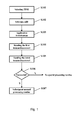
- Fig. 1 is a flowchart of a method for processing failure to read data from a non-contact IC card according to an embodiment of the invention.
- the transaction terminal initiates a normal processing routine at step S101 by selecting a proximity payment system environment (PPSE). Then, at step 102, an application identifier (AID) is selected, and at step S103, an application initialization operation is performed (e.g., instructing the non-contact IC card to deduct the amount of the current transaction from the balance). Next, the transaction terminal performs an operation of reading the first transaction record from the non-contact IC and the operation of reading the last transaction record from the non-contact IC at steps S104 and S105 respectively.
- PPSE proximity payment system environment
- AID application identifier
- an application initialization operation e.g., instructing the non-contact IC card to deduct the amount of the current transaction from the balance.
- the transaction terminal performs an operation of reading the first transaction record from the non-contact IC and the operation of reading the last transaction record from the non-contact IC at steps S104 and S105 respectively.
- step S106 the transaction terminal determines whether the last transaction record has been successfully read. If it is successfully read, step S107 is executed and a subsequent normal processing routine is continued; otherwise, it is determined that there is an abnormal transaction and the process proceeds to a special processing routine that will be described below in detail with reference to Fig. 2 .
- Fig. 2 is a flowchart of the special processing routine in the embodiment shown in Fig. 1 .
- the transaction terminal when the process turns to the special processing routine from the step S106 in Fig. 1 , the transaction terminal firstly stores the transaction information associated with the current abnormal transaction at step S201.
- the transaction information can be card number, transaction certificate (TC), application transaction counter (ATC), random number, dynamic signature data and card record of the non-contact IC card, etc.
- the transaction terminal prompts the card holder to re-swipe the card on a display screen.
- the transaction terminal when the transaction terminal detects the card, the card will be powered on again and a proximity payment system environment (PPSE) is selected; and at step S204, an application identifier (AID) is selected.
- PPSE proximity payment system environment
- AID application identifier
- step S205 the transaction terminal reads the card number from the card and step S206 is executed, in which the read card number is compared with the card number in the transaction information stored at step S201.
- step S206 if the two card numbers match with each other, it means that the card that is currently swiped is the card to which the abnormal transaction happens, and step S207 is executed. Otherwise, it means that the card that is currently being swiped is a new card, and step S103 in Fig. 1 is executed so as to perform the application initialization operation.
- the transaction terminal determines whether the last transaction record in the card corresponds to the transaction information stored at step S201.
- the transaction terminal reads the count value of the application transaction counter (ATC) in the card (e.g., by a GetData command) and compares it with the ATC value in the transaction information. If they match, step S208 is executed; otherwise, step S103 in Fig. 1 is executed so as to perform the application initialization operation.
- ATC application transaction counter
- the transaction terminal reads the current balance, and at step S209, the transaction terminal determines whether the amount of transaction has been deducted from the card when the present abnormal transaction occurs. If it is determined at step S209 that the amount is deducted, the process proceeds to step S210; otherwise, the process proceeds to step S103 in Fig. 1 .
- the transaction terminal reads the current balance in the last transaction record in the card by a Get Data command, for example, and determines whether current balance is equal to the difference between the balance of the last transaction in the transaction information stored at step S201 and the amount of the current transaction; if equal, the process proceeds to step S210; otherwise, the process proceeds to step S103.
- step S210 the transaction terminal will read the last transaction record or the latest transaction record in the card. Then, at step S211, it is determined whether the last transaction record or the latest transaction record is successfully read; if it is successfully read, the process proceeds to step S107 in Fig. 1 , and a subsequent normal processing routine is then performed; otherwise, the process proceeds to step S212, in which it is determined whether the number of times of re-swiping the card exceeds a predetermined number of times (e.g., 3 times). If the predetermined number of times is exceeded, the entire transaction processing routine is closed; otherwise, the process turns to step S202 to inform the card holder to re-swipe the card.
- a predetermined number of times e.g., 3 times
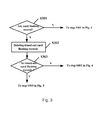
- Fig. 3 is a flowchart of a method for processing failure to read data from a non-contact IC card according to another embodiment of the invention.
- step S301 when the transaction terminal detects the non-contact IC card, it firstly checks whether there is a record of "card flashing" without successfully re-swiping the card at the transaction terminal.
- the traction information of these cards to which abnormal transactions have happened can be stored in the storage of the transaction terminal in the form of list (referred to as list of failure to read data or list of card flashing record).
- Each card flashing record in the list corresponds to one of the cards to which "card flashing" has happened, and contains the transaction information of card at the time of abnormal transaction.
- the transaction information for example comprises but not limited to card number, transaction certificate (TC), application transaction counter (ATC), random number, dynamic signature data and card record of the non-contact IC card, etc. If a card flashing record is discovered at step S301, the process proceeds to step S302; otherwise, the process proceeds to a first processing routine which will be described below with reference to Fig. 4 .
- step S302 the transaction terminal deletes all the timed-out card flashing records in the list of failure to read data.
- timed-out card flashing record it means such cards which records that the time period from the time when the "card flashing" happens to the present time point has exceeds a predetermined time period. Then, the process proceeds to step S303, at which the transaction terminal determines whether there is non-timed-out card flashing record in the list of failure to read data. If not, the process proceeds to a first processing routine; otherwise, the second processing routine which will be described below with reference to Fig. 5 is performed.
- Fig. 4 is a flowchart of the first processing routine in the embodiment shown in Fig. 3 .
- the first processing routine is started by selecting a proximity payment system environment (PPSE). Then, at step S402, an application identifier (AID) is selected, and at step S403, an application initialization operation is performed (e.g., instructing the non-contact IC card to deduct the amount of the current transaction from the balance).
- the transaction terminal performs an operation of reading the first transaction record from the non-contact IC and the operation of reading the last transaction record from the non-contact IC at steps S404 and S405 respectively.
- step S406 the transaction terminal determines whether the last transaction record or the latest transaction record is successfully read; if it is successfully read, the process proceeds to step S407, and a subsequent normal processing routine is then performed; otherwise, it is determined that the transaction is abnormal and the second processing routine which will be described below in detail with reference to Fig. 5 is performed.
- Fig. 5 is a flowchart of the second processing routine in the embodiment shown in Fig. 3 .
- the transaction terminal when the process turns to the second processing routine from the step S406 in Fig. 4 , the transaction terminal firstly stores the transaction information associated with the current abnormal transaction at step S501. As described above, the transaction information can be stored in the transaction terminal in the form of list. Then, at step S502, the transaction terminal prompts the card holder to re-swipe the card on a display screen. At step S503, when the transaction terminal detects the card, the card will be powered on again and a proximity payment system environment (PPSE) is selected; and at step S504, an application identifier (AID) is selected.
- PPSE proximity payment system environment
- AID application identifier
- step S303 of Fig. 3 determines that there is a non-timed-out card flashing record. It is noted that when it is determined at step S303 of Fig. 3 that there is a non-timed-out card flashing record, the processing routine turns to step S503 in the second processing routine rather than step S501.
- step S504 the process proceeds to step S505 in which the transaction terminal reads card number from the card, and step S506 is executed, in which a search is made in the card flashing record list in the transaction terminal so as to determine whether this is a record corresponding to the read card number.
- step S506 if there is matching card flashing record in the card flashing record list, it means that the card that is currently being swiped is the card to which the abnormal transaction happens, and step S207 is executed. Otherwise, it means that the card that is currently swiped is a new card, and step S703 in Fig. 4 is executed so as to perform the application initialization operation.
- the transaction terminal checks whether the matching card flashing record is timed-out, i.e., whether the time period from the time when the "card flashing" happens to the present time point has exceeds a predetermined time period. If the card flashing record is timed-out, the process proceeds to step S508; otherwise, the process proceeds to step S509. It is noted that the predetermined time period mentioned herein can be set at the same vale as the time period mentioned at step S302.
- step S508 the transaction terminal deletes the matching card flashing records from the list of failure to read data, and then step S403 in Fig. 4 is executed so as to perform an application initialization operation.
- the transaction terminal determines whether the last transaction record in the card corresponds to the matching card flashing record. Preferably, it can be realized in the following way: the transaction terminal reads the count value of the application transaction counter (ATC) in the card (e.g., by a GetData command) and compares it with the ATC value in the matching card flashing record. If they match, step S510 is executed; otherwise, step S508 is executed.
- ATC application transaction counter
- the transaction terminal reads the current balance from the card, and at step S511, the transaction terminal determines whether the amount of transaction has been deducted from the card when the present abnormal transaction occurs. If it is determined at step S511 that the amount is deducted, the process proceeds to step S512; otherwise, the process proceeds to step S508.
- the transaction terminal reads the current balance in the last transaction record in the card by a Get Data command, for example, and determines whether current balance is equal to the difference between the balance of the last transaction stored in the matching card flashing record and the amount of the current transaction; if equal, the process proceeds to step S512; otherwise, the process proceeds to step S508.
- step S512 the transaction terminal will read the last transaction record or the latest transaction record in the card. Then, at step S513, it is determined whether the last transaction record or the latest transaction record is successfully read; if it is successfully read, the process proceeds to step S514; otherwise, the process proceeds to step S515, in which it is determined whether the number of times of re-swiping the card exceeds a predetermined number of times. If it determined at step S515 that the predetermined number of times is exceeded, the entire transaction processing routine is closed; otherwise, the process turns to step S502 to inform the card holder to re-swipe the card.
- step S514 the transaction terminal deletes the corresponding card flashing records from the list of failure to read data, and then step S407 in Fig. 4 is executed so as to perform a subsequent normal processing routine.
- the measures of limiting the storing time of card flashing records within a certain time period is optional.
- the above measures can be omitted.
- the number of card flashing records stored at the transaction terminal can be also limited (e.g., storing the card flashing records in a First In First Out manner (FIFO)).
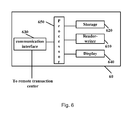
- the transaction terminal mentioned herein comprises a reader-writer 610, a storage 620, a communication interface 630, a display 640 and a processor 650 that is coupled with the above units.
- the reader-writer 610 which serves as an interface between the transaction terminal and the non-contact IC card, is responsible for reading data from the non-contact IC card (e.g., executing the above described steps of reading transaction records S104, S105, S210, S404, S405 and S512, steps of reading card number S206, S505, steps of reading the balance S208, S510, etc.) and writing data in the non-contact IC card (e.g., instructing the non-contact IC card to deduct the amount of transaction from the current balance).
- the non-contact IC card e.g., executing the above described steps of reading transaction records S104, S105, S210, S404, S405 and S512, steps of reading card number S206, S505, steps of reading the balance S208, S510, etc.
- the storage 620 stores application programs that are required for operation of the processor 650 and data associated withtransactions (e.g., the above described transaction information and card flashing records, etc.).
- data associated withtransactions e.g., the above described transaction information and card flashing records, etc.
- the processor 650 reads the application programs in the storage 620 to the memory and starts operations.
- the processor 650 stores relevant transaction information or card flashing records in the storage 620 (e.g., executing steps S201 and S501, etc.); when performing application programs, transaction information or card flashing records are read from the storage 620 according to a command (e.g., executing steps S206, S207, S209, S301, S506, S507, S509, S511, etc.); and modifying the data stored in the storage 620 (e.g., executing steps S302, S508, S513. etc.).
- a command e.g., executing steps S206, S207, S209, S301, S506, S507, S509, S511, etc.
- modifying the data stored in the storage 620 e.g., executing steps S302, S508, S513. etc.
- the communication interface 630 communicates with a remote transaction center so as to achieve receipt and transmission of transaction data as well as such operations of update and service of transaction terminal application programs.
- the display 640 displays corresponding transaction information to the user (e.g., executing step S202 of informing the card holder to enter transaction password and step S502 of informing the card holder to re-swipe the card, etc.).
- the processor 650 can be configured to have the following processing ability: when the reader-writer 610 does not successfully read the last record, the processor 650 stores transaction information associated with the current transaction in the storage 620 and generates an instruction to re-swipe the card; when executing the special processing routine shown in Fig.
- the processor 650 determines whether the non-contact IC card re-read by the reader-writer 610 and the non-contact IC card that is not successfully read have the same card number and whether the re-read latest transaction record corresponds to the information on the current transaction stored in the storage 620; if they correspond to each other, it will be determined whether to continue a subsequent normal processing routine or to inform the card holder to re-swipe the card, based on the current balance in the latest transaction record and the information on the current transaction.
- the processor 650 can be further configured to have the following processing ability: when the reader-writer receives an indication that there is non-contact IC card, the processor 650 executes the method shown in Figs. 3-5 . Briefly, the processor 650 is configured to determine the following conditions:
- the processor 650 will determine whether to continue a subsequent normal processing routine or to inform the card holder to re-swipe the card, based on the balance in the latest transaction record and the corresponding transaction information.
Landscapes
- Engineering & Computer Science (AREA)
- Business, Economics & Management (AREA)
- Accounting & Taxation (AREA)
- Physics & Mathematics (AREA)
- General Physics & Mathematics (AREA)
- Theoretical Computer Science (AREA)
- General Business, Economics & Management (AREA)
- Strategic Management (AREA)
- Computer Networks & Wireless Communication (AREA)
- Microelectronics & Electronic Packaging (AREA)
- Finance (AREA)
- Development Economics (AREA)
- Economics (AREA)
- Control Of Vending Devices And Auxiliary Devices For Vending Devices (AREA)
- Financial Or Insurance-Related Operations Such As Payment And Settlement (AREA)
- Credit Cards Or The Like (AREA)
- Devices For Checking Fares Or Tickets At Control Points (AREA)
- Computer Security & Cryptography (AREA)
Abstract
Description
- This application is a translation of the international application
PCT/CN2013/085961 filed on October 25, 2013 201210426067, filed on October 31, 2012 - The invention relates to the data processing technology, and in particular, to a method for processing failure to read non-contact IC card data by a transaction terminal and an apparatus for implementing the same.
- An off-line consumption transaction of non-contact electronic cash is sensitive to the retention time of card swiping. If the time of card swiping of non-contact IC card is too short, a transaction failure is likely to happen; and if the time of card swiping is required to be too long, it will impair client's experience. The following situation might occur during a certain time window: when a non-contact IC card leaves a transaction terminal or machine, a success of transaction is shown on the card side (e.g., money is successfully deducted from the non-contact IC card), but the transaction terminal never receives a recent transaction record returned from the card and thus makes a determination that this transaction fails. Such a situation is often called "card flashing". In case of card flashing, since the balance in the card is decreased while the transaction terminal determines that the transaction is not successful, the card holder has to request return of deducted money with card issuer, resulting in an unpopular experience of the client.
- Currently, the ways of solving the "card flashing" problem generally aim to narrow the time window in which the card flashing situation occurs as much as possible. For this purpose, the following technical measures are taken: (1) when the non-contact IC card is personalized, the length of the last record is adjusted to be as short as possible; (2) the private key length of IC card is reduced so as to shorten time of transaction; (3) a prompt device (e.g., an indicator light or a voice device) is provided on the transaction terminal, which informs the card holder to take the card with him/her when the transaction terminal receives the last record returned from the card; (4) the operational speed of the chip inside the non-contact IC card is increased.
- Although these approaches can greatly reduce the probability of "card flashing", the problem cannot be completely eradicated.
- In addition, another possible way of solving this problem is to modify the specification of not-contact IC card, and improve robustness of data processing system by specifying that more detailed transaction information be stored in the card. However, this solution does not apply to existing cards that have already been issued, especially given the fact that there is a tremendous amount of existing cards, which means a huge cost of retrofit.
- An object of the invention is to provide a method for processing failure to read data from a non-contact IC card by a transaction terminal, which can eliminate the adverse effects caused by the "card flashing" problem at a low cost of implementation.
- In order to achieve the above object, the transaction terminal performs the following steps in the above processing method:
- instructing the non-contact IC to update a transaction record associated with a current transaction;
- reading the latest transaction record from the non-contact IC, and if the latest transaction record is not successfully read, storing information on the current transaction and generating an instruction that it is required to re-read the latest transaction record; and
- if a re-read non-contact IC card is consistent with the non-contact IC that is not successfully read and the re-read latest transaction record corresponds to the information on the current transaction that is stored in the transaction terminal, it is determined whether the non-contact IC should be instructed to update the transaction record associated with the current transaction again, based on the current balance in the latest transaction record and the information on the current transaction.
- Preferably, in the above processing method, the information on the current transaction comprises card number, transaction certificate (TC), application transaction counter (ATC), random number, dynamic signature data and card record.
- Preferably, in the above processing method, it is determined whether the re-read non-contact IC card is consistent with the non-contact IC that is not successfully read based on the card number.
- Preferably, in the above processing method, if the re-read latest transaction record has the same count value as the application transaction counter in the information on the current transaction, it is determined that the re-read latest transaction record corresponds to the information on the current transaction.
- Preferably, in the above processing method, it is determined whether the latest transaction record should be updated again based on the current balance in the latest transaction record and the information on the current transaction in the following manner:
- if the current balance is not equal to a different between the balance of last transaction and the amount of the current transaction, the non-contact IC card is instructed again to update the transaction record associated with the current transaction.
- The above object can be also achieved by the following embodiment.
- A method for processing failure to read data from a non-contact IC card by a transaction terminal, wherein the transaction terminal performs the following steps:
- when the non-contact IC card is detected, it is determined whether the non-contact IC card is in a list of failure to read data stored by the transaction terminal;
- if the non-contact IC card is in the list of failure to read data stored by the transaction terminal, it is determined whether the latest transaction record read from the non-contact IC has corresponding transaction information in the transaction terminal, and whether a time period for the corresponding transaction information, from a time point at which the failure to read data from the non-contact card is recorded to the current time point, is not timed-out; and
- if it is determined that there is a corresponding transaction information which is not timed-out, it is determined whether the non-contact IC should be instructed to again update the transaction record associated with the corresponding transaction information, based on the balance in the latest transaction record and the corresponding transaction information.
- The above embodiment is particularly applicable to the following situation: after a certain card has the "card flashing" problem, other cards are swiped at the same transaction terminal. Specifically, according to the above embodiment, other cards can be also successfully swiped in such a situation, and the card that has the "card flashing" problem can be also swiped again at the same transaction terminal so as to determine whether the transaction record is updated. In addition, in the above embodiment, the safety of transaction is improved by increasing constraints on the time of re-swiping card after the "card flashing" has happened.
- Another object of the invention is to provide a transaction terminal which can eliminate the adverse effects caused by the "card flashing" problem at a low cost of implementation.
- In order to achieve the above object, a transaction terminal according to an embodiment of the invention comprises:
- a reader-writer that is adapted to be in communication with a non-contact IC card;
- a storage; and
- a processor coupled to the reader-writer and the storage, wherein the processor is configured to: when the reader-writer does not successfully read a transaction record associated with a current transaction, store information on the current transaction in the storage and generate an instruction that it is required to re-read the transaction record; and the processor is further configured to: if a re-read non-contact IC read by the reader-writer is consistent with the non-contact IC that is not successfully read and the re-read latest transaction record corresponds to the information on the current transaction that is stored in the transaction terminal, determine whether to generate an instruction to update the transaction record associated with the current transaction, based on the current balance in the latest transaction record and the information on the current transaction. The above transaction terminal can be a swipe machine or a ticket checking gate machine.
- The above transaction terminal can be a swipe machine or a ticket checking gate machine.
- The above object of the invention can be also achieved through the following embodiment.
- A transaction terminal, comprising:
- a reader-writer that is adapted to be in communication with a non-contact IC card;
- a storage; and
- a processor coupled to the reader-writer and the storage, wherein the processor is configured to determine whether the following conditions are satisfied when the reader-writer detects the non-contact IC card:
- the non-contact IC card is in a list of failure to read data stored by the transaction terminal;
- the latest transaction record read from the non-contact IC has corresponding transaction information in the transaction terminal; and
- a time period for the corresponding transaction information, from a time point at which the failure to read data from the non-contact card is recorded to the current time point, is not timed-out,
- wherein the processor is further configured to determine whether to generate an instruction to update the transaction record associated with the corresponding transaction information based on the balance in the latest transaction record and the corresponding transaction information, if the conditions are all satisfied.
- The above and other objects and advantages of the invention will be more fully understood from a detailed description given below with reference to the accompanying drawings.
-
Fig. 1 is a flowchart of a method for processing failure to read data from a non-contact IC card according to an embodiment of the invention. -
Fig. 2 is a flowchart of a special processing routine in the embodiment shown inFig. 1 . -
Fig. 3 is a flowchart of a method for processing failure to read data from a non-contact IC card according to another embodiment of the invention. -
Fig. 4 is a flowchart of a first processing routine in the embodiment shown inFig. 3 . -
Fig. 5 is a flowchart of a second processing routine in the embodiment shown inFig. 3 . -
Fig. 6 is a schematic view of a transaction terminal according to another embodiment of the invention. - In a typical transaction process, a transaction terminal (e.g., a swipe machine or a ticket checking gate machine) instructs a non-contact IC card to update a transaction record thereof. As a response, the card will perform an update operation (e.g., deducting the amount of current transaction from the balance of card). According to an embodiment of the invention, if the transaction terminal does not successfully read the updated transaction record, a special processing routine will be initiated; otherwise, a subsequent normal routine will be continued, and the whole transaction process will be completed.
- According to the embodiment of the invention, in the above special processing routine, the transaction terminal will store transaction information associated with the current transaction, and inform the card holder to re-swipe the card to obtain the latest transaction record stored at the card. Then, the transaction terminal determines whether the card has performed the update operation while only failure to successfully return the updated transaction record. If it is determined that the update operation has been correctly performed, a subsequent normal routine will be continued; otherwise, the card holder is informed to re-swipe the card.
- According to the embodiment of the invention, whether the update operation has been correctly performed can be determined based on a self-consistency between the current balance in the latest transaction record and transaction information stored at the transaction terminal. That is, if the current balance is equal to a difference between the balance in the last transaction and the amount of the current transaction, it can be determined that the update operation is correct.
- The embodiment of the invention will be described below with reference to the accompanying drawings.
-
Fig. 1 is a flowchart of a method for processing failure to read data from a non-contact IC card according to an embodiment of the invention. - As shown in
Fig. 1 , at the initial stage of operation, the transaction terminal initiates a normal processing routine at step S101 by selecting a proximity payment system environment (PPSE). Then, at step 102, an application identifier (AID) is selected, and at step S103, an application initialization operation is performed (e.g., instructing the non-contact IC card to deduct the amount of the current transaction from the balance). Next, the transaction terminal performs an operation of reading the first transaction record from the non-contact IC and the operation of reading the last transaction record from the non-contact IC at steps S104 and S105 respectively. - At step S106, the transaction terminal determines whether the last transaction record has been successfully read. If it is successfully read, step S107 is executed and a subsequent normal processing routine is continued; otherwise, it is determined that there is an abnormal transaction and the process proceeds to a special processing routine that will be described below in detail with reference to
Fig. 2 . -
Fig. 2 is a flowchart of the special processing routine in the embodiment shown inFig. 1 . - With reference to
Fig. 2 , when the process turns to the special processing routine from the step S106 inFig. 1 , the transaction terminal firstly stores the transaction information associated with the current abnormal transaction at step S201. For example, the transaction information can be card number, transaction certificate (TC), application transaction counter (ATC), random number, dynamic signature data and card record of the non-contact IC card, etc. Then, at step S202, the transaction terminal prompts the card holder to re-swipe the card on a display screen. At step S203, when the transaction terminal detects the card, the card will be powered on again and a proximity payment system environment (PPSE) is selected; and at step S204, an application identifier (AID) is selected. - Then, at step S205, the transaction terminal reads the card number from the card and step S206 is executed, in which the read card number is compared with the card number in the transaction information stored at step S201. At
step 206, if the two card numbers match with each other, it means that the card that is currently swiped is the card to which the abnormal transaction happens, and step S207 is executed. Otherwise, it means that the card that is currently being swiped is a new card, and step S103 inFig. 1 is executed so as to perform the application initialization operation. - At step S207, the transaction terminal determines whether the last transaction record in the card corresponds to the transaction information stored at step S201. Preferably, the following way can be used to realize such a determination: the transaction terminal reads the count value of the application transaction counter (ATC) in the card (e.g., by a GetData command) and compares it with the ATC value in the transaction information. If they match, step S208 is executed; otherwise, step S103 in
Fig. 1 is executed so as to perform the application initialization operation. - At step S208, the transaction terminal reads the current balance, and at step S209, the transaction terminal determines whether the amount of transaction has been deducted from the card when the present abnormal transaction occurs. If it is determined at step S209 that the amount is deducted, the process proceeds to step S210; otherwise, the process proceeds to step S103 in
Fig. 1 . Preferably, the transaction terminal reads the current balance in the last transaction record in the card by a Get Data command, for example, and determines whether current balance is equal to the difference between the balance of the last transaction in the transaction information stored at step S201 and the amount of the current transaction; if equal, the process proceeds to step S210; otherwise, the process proceeds to step S103. - At step S210, the transaction terminal will read the last transaction record or the latest transaction record in the card. Then, at step S211, it is determined whether the last transaction record or the latest transaction record is successfully read; if it is successfully read, the process proceeds to step S107 in
Fig. 1 , and a subsequent normal processing routine is then performed; otherwise, the process proceeds to step S212, in which it is determined whether the number of times of re-swiping the card exceeds a predetermined number of times (e.g., 3 times). If the predetermined number of times is exceeded, the entire transaction processing routine is closed; otherwise, the process turns to step S202 to inform the card holder to re-swipe the card. - When swiping a card in unattended buses, subways or the like where there is a large passenger flow, a situation which often occurs is that: a "card flashing" problem occurs to the card of a previous card holder and he does not re-swipe his card immediately, and the next card holder swipes his card again at this transaction terminal. The following embodiment of the invention can be well applied to the above situation and will be further described below.
-
Fig. 3 is a flowchart of a method for processing failure to read data from a non-contact IC card according to another embodiment of the invention. - As shown in
Fig. 3 , at step S301, when the transaction terminal detects the non-contact IC card, it firstly checks whether there is a record of "card flashing" without successfully re-swiping the card at the transaction terminal. Preferably, the traction information of these cards to which abnormal transactions have happened can be stored in the storage of the transaction terminal in the form of list (referred to as list of failure to read data or list of card flashing record). Each card flashing record in the list corresponds to one of the cards to which "card flashing" has happened, and contains the transaction information of card at the time of abnormal transaction. The transaction information for example comprises but not limited to card number, transaction certificate (TC), application transaction counter (ATC), random number, dynamic signature data and card record of the non-contact IC card, etc. If a card flashing record is discovered at step S301, the process proceeds to step S302; otherwise, the process proceeds to a first processing routine which will be described below with reference toFig. 4 . - At step S302, the transaction terminal deletes all the timed-out card flashing records in the list of failure to read data. As to "timed-out" card flashing record, it means such cards which records that the time period from the time when the "card flashing" happens to the present time point has exceeds a predetermined time period. Then, the process proceeds to step S303, at which the transaction terminal determines whether there is non-timed-out card flashing record in the list of failure to read data. If not, the process proceeds to a first processing routine; otherwise, the second processing routine which will be described below with reference to
Fig. 5 is performed. -
Fig. 4 is a flowchart of the first processing routine in the embodiment shown inFig. 3 . - As shown in
Fig. 4 , at step S401, the first processing routine is started by selecting a proximity payment system environment (PPSE). Then, at step S402, an application identifier (AID) is selected, and at step S403, an application initialization operation is performed (e.g., instructing the non-contact IC card to deduct the amount of the current transaction from the balance). Next, the transaction terminal performs an operation of reading the first transaction record from the non-contact IC and the operation of reading the last transaction record from the non-contact IC at steps S404 and S405 respectively. - At step S406, the transaction terminal determines whether the last transaction record or the latest transaction record is successfully read; if it is successfully read, the process proceeds to step S407, and a subsequent normal processing routine is then performed; otherwise, it is determined that the transaction is abnormal and the second processing routine which will be described below in detail with reference to
Fig. 5 is performed. -
Fig. 5 is a flowchart of the second processing routine in the embodiment shown inFig. 3 . - With reference to
Fig. 5 , when the process turns to the second processing routine from the step S406 inFig. 4 , the transaction terminal firstly stores the transaction information associated with the current abnormal transaction at step S501. As described above, the transaction information can be stored in the transaction terminal in the form of list. Then, at step S502, the transaction terminal prompts the card holder to re-swipe the card on a display screen. At step S503, when the transaction terminal detects the card, the card will be powered on again and a proximity payment system environment (PPSE) is selected; and at step S504, an application identifier (AID) is selected. - It is noted that when it is determined at step S303 of
Fig. 3 that there is a non-timed-out card flashing record, the processing routine turns to step S503 in the second processing routine rather than step S501. - After step S504, the process proceeds to step S505 in which the transaction terminal reads card number from the card, and step S506 is executed, in which a search is made in the card flashing record list in the transaction terminal so as to determine whether this is a record corresponding to the read card number. At step S506, if there is matching card flashing record in the card flashing record list, it means that the card that is currently being swiped is the card to which the abnormal transaction happens, and step S207 is executed. Otherwise, it means that the card that is currently swiped is a new card, and step S703 in
Fig. 4 is executed so as to perform the application initialization operation. - At step S507, the transaction terminal checks whether the matching card flashing record is timed-out, i.e., whether the time period from the time when the "card flashing" happens to the present time point has exceeds a predetermined time period. If the card flashing record is timed-out, the process proceeds to step S508; otherwise, the process proceeds to step S509. It is noted that the predetermined time period mentioned herein can be set at the same vale as the time period mentioned at step S302.
- At step S508, the transaction terminal deletes the matching card flashing records from the list of failure to read data, and then step S403 in
Fig. 4 is executed so as to perform an application initialization operation. - At step S509, the transaction terminal determines whether the last transaction record in the card corresponds to the matching card flashing record. Preferably, it can be realized in the following way: the transaction terminal reads the count value of the application transaction counter (ATC) in the card (e.g., by a GetData command) and compares it with the ATC value in the matching card flashing record. If they match, step S510 is executed; otherwise, step S508 is executed.
- At step S510, the transaction terminal reads the current balance from the card, and at step S511, the transaction terminal determines whether the amount of transaction has been deducted from the card when the present abnormal transaction occurs. If it is determined at step S511 that the amount is deducted, the process proceeds to step S512; otherwise, the process proceeds to step S508. Preferably, the transaction terminal reads the current balance in the last transaction record in the card by a Get Data command, for example, and determines whether current balance is equal to the difference between the balance of the last transaction stored in the matching card flashing record and the amount of the current transaction; if equal, the process proceeds to step S512; otherwise, the process proceeds to step S508.
- At step S512, the transaction terminal will read the last transaction record or the latest transaction record in the card. Then, at step S513, it is determined whether the last transaction record or the latest transaction record is successfully read; if it is successfully read, the process proceeds to step S514; otherwise, the process proceeds to step S515, in which it is determined whether the number of times of re-swiping the card exceeds a predetermined number of times. If it determined at step S515 that the predetermined number of times is exceeded, the entire transaction processing routine is closed; otherwise, the process turns to step S502 to inform the card holder to re-swipe the card.
- At step S514, the transaction terminal deletes the corresponding card flashing records from the list of failure to read data, and then step S407 in
Fig. 4 is executed so as to perform a subsequent normal processing routine. - It is noted that in this embodiment, the measures of limiting the storing time of card flashing records within a certain time period (e.g., the execution of steps S302, S303 and S507) is optional. When there is no limit on the time of re-swiping the card after "card flash-ing" happens, the above measures can be omitted. In addition, optionally, the number of card flashing records stored at the transaction terminal can be also limited (e.g., storing the card flashing records in a First In First Out manner (FIFO)).
- The transaction terminal adapted to implement the method described above with reference to the embodiments of
Figs. 1-5 will be described below. - As shown in
Fig. 6 , the transaction terminal mentioned herein comprises a reader-writer 610, astorage 620, acommunication interface 630, adisplay 640 and aprocessor 650 that is coupled with the above units. - Under the control of the
processor 650, the reader-writer 610, which serves as an interface between the transaction terminal and the non-contact IC card, is responsible for reading data from the non-contact IC card (e.g., executing the above described steps of reading transaction records S104, S105, S210, S404, S405 and S512, steps of reading card number S206, S505, steps of reading the balance S208, S510, etc.) and writing data in the non-contact IC card (e.g., instructing the non-contact IC card to deduct the amount of transaction from the current balance). - The
storage 620 stores application programs that are required for operation of theprocessor 650 and data associated withtransactions (e.g., the above described transaction information and card flashing records, etc.). When the power is on so as to start operation, theprocessor 650 reads the application programs in thestorage 620 to the memory and starts operations. For example, when "card flashing" happens, theprocessor 650 stores relevant transaction information or card flashing records in the storage 620 (e.g., executing steps S201 and S501, etc.); when performing application programs, transaction information or card flashing records are read from thestorage 620 according to a command (e.g., executing steps S206, S207, S209, S301, S506, S507, S509, S511, etc.); and modifying the data stored in the storage 620 (e.g., executing steps S302, S508, S513. etc.). - Under the control of the
processor 650, thecommunication interface 630 communicates with a remote transaction center so as to achieve receipt and transmission of transaction data as well as such operations of update and service of transaction terminal application programs. - Under the control of the
processor 650, thedisplay 640 displays corresponding transaction information to the user (e.g., executing step S202 of informing the card holder to enter transaction password and step S502 of informing the card holder to re-swipe the card, etc.). - By loading an appropriate application program, the
processor 650 can be configured to have the following processing ability: when the reader-writer 610 does not successfully read the last record, theprocessor 650 stores transaction information associated with the current transaction in thestorage 620 and generates an instruction to re-swipe the card; when executing the special processing routine shown inFig. 2 , theprocessor 650 determines whether the non-contact IC card re-read by the reader-writer 610 and the non-contact IC card that is not successfully read have the same card number and whether the re-read latest transaction record corresponds to the information on the current transaction stored in thestorage 620; if they correspond to each other, it will be determined whether to continue a subsequent normal processing routine or to inform the card holder to re-swipe the card, based on the current balance in the latest transaction record and the information on the current transaction. - In addition, by loading an appropriate application program, the
processor 650 can be further configured to have the following processing ability: when the reader-writer receives an indication that there is non-contact IC card, theprocessor 650 executes the method shown inFigs. 3-5 . Briefly, theprocessor 650 is configured to determine the following conditions: - (1) whether the non-contact IC card is in a card flashing record or a list of failure to read data stored in the
storage 620; - (2) whether the latest transaction record read by the non-contact IC card has a corresponding transaction information in the card flashing record stored in the storage; and
- (3) whether the time period experienced by the corresponding transaction information from the time point when the non-contact IC card was recorded as failed in reading data to the current time point is timed-out.
- When the above three conditions are determined to be satisfied at the same time, the
processor 650 will determine whether to continue a subsequent normal processing routine or to inform the card holder to re-swipe the card, based on the balance in the latest transaction record and the corresponding transaction information. - Since the invention can be carried out in various ways without departing from a basic spirit of the invention, the specific embodiments as described above are merely illustrative rather than limiting. The scope of the invention is defined by the appended claims, and various changes or modifications to the above described embodiments will fall within the scope of protection defined by the appended claims.
Claims (13)
- A method for processing failure to read data from a non-contact IC card by a transaction terminal, characterized in that the transaction terminal performs the following steps:instructing the non-contact IC to update a transaction record associated with a current transaction;reading the latest transaction record from the non-contact IC, and if the latest transaction record is not successfully read, storing information on the current transaction and generating an instruction that it is required to re-read the latest transaction record; andif a re-read non-contact IC card is consistent with the non-contact IC that is not successfully read and the re-read latest transaction record corresponds to the information on the current transaction that is stored in the transaction terminal, it is determined whether the non-contact IC should be instructed to update the transaction record associated with the current transaction again, based on the current balance in the latest transaction record and the information on the current transaction.
- The method according to claim 1, wherein the information on the current transaction comprises card number, transaction certificate (TC), application transaction counter (ATC), random number, dynamic signature data and card record.
- The method according to claim 2, wherein it is determined whether the re-read non-contact IC card is consistent with the non-contact IC that is not successfully read based on the card number.
- The method according to claim 1, wherein if the re-read latest transaction record has the same count value as the application transaction counter in the information on the current transaction, it is determined that the re-read latest transaction record corresponds to the information on the current transaction.
- The method according to claim 1, wherein it is determined whether the latest transaction record should be updated again based on the current balance in the latest transaction record and the information on the current transaction in the following manner:if the current balance is not equal to a different between the balance of last transaction and the amount of the current transaction, the non-contact IC card is instructed to update the transaction record associated with the current transaction again.
- A transaction terminal, characterized in that comprising:a reader-writer that is adapted to be in communication with a non-contact IC card;a storage; anda processor coupled to the reader-writer and the storage, wherein the processor is configured to: when the reader-writer does not successfully read a transaction record associated with a current transaction, store information on the current transaction in the storage and generate an instruction that it is required to re-read the transaction record; and the processor is further configured to: if a re-read non-contact IC read by the reader-writer is consistent with the non-contact IC that is not successfully read and the re-read latest transaction record corresponds to the information on the current transaction that is stored in the transaction terminal, determine whether to generate an instruction to update the transaction record associated with the current transaction, based on the current balance in the latest transaction record and the information on the current transaction.
- The transaction terminal according to claim 6, wherein the transaction terminal is a swipe machine or a ticket checking gate machine.
- The transaction terminal according to claim 6, wherein the information on the current transaction comprises card number, transaction certificate (TC), application transaction counter (ATC), random number, dynamic signature data and card record.
- The transaction terminal according to claim 7, wherein the processor determines whether the re-read non-contact IC card is consistent with the non-contact IC that is not successfully read based on the card number.
- The transaction terminal according to claim 6, wherein if the re-read latest transaction record has the same count value as the application transaction counter in the information on the current transaction, it is determined that the re-read latest transaction record corresponds to the information on the current transaction.
- The transaction terminal according to claim 6, wherein the processor is further configured to determine whether to generate an instruction to update the latest transaction record again based on the current balance in the latest transaction record and the information on the current transaction in the following manner:if the current balance is not equal to a different between the balance of last transaction and the amount of the current transaction, the non-contact IC card is instructed to update the transaction record associated with the current transaction again.
- A method for processing failure to read data from a non-contact IC card by a transaction terminal, characterized in that the transaction terminal performs the following steps:when the non-contact IC card is detected, it is determined whether the non-contact IC card is in a list of failure to read data stored by the transaction terminal;if the non-contact IC card is in the list of failure to read data stored by the transaction terminal, it is determined whether the latest transaction record read from the non-contact IC has corresponding transaction information in the transaction terminal, and whether a time period for the corresponding transaction information, from a time point at which the failure to read data from the non-contact card is recorded to the current time point, is not timed-out; andif it is determined that there is a corresponding transaction information which is not timed-out, it is determined whether the non-contact IC should be instructed to again update the transaction record associated with the corresponding transaction information, based on the balance in the latest transaction record and the corresponding transaction information.
- A transaction terminal, characterized by comprising:a reader-writer that is adapted to be in communication with a non-contact IC card;a storage; anda processor coupled to the reader-writer and the storage, wherein the processor is configured to determine whether the following conditions are satisfied when the reader-writer detects the non-contact IC card:the non-contact IC card is in a list of failure to read data stored by the transaction terminal;the latest transaction record read from the non-contact IC has corresponding transaction information in the transaction terminal; anda time period for the corresponding transaction information, from a time point at which the failure to read data from the non-contact card is recorded to the current time point, is not timed-out,wherein the processor is further configured to determine whether to generate an instruction to update the transaction record associated with the corresponding transaction information based on the balance in the latest transaction record and the corresponding transaction information, if the conditions are all satisfied.
Applications Claiming Priority (2)
| Application Number | Priority Date | Filing Date | Title |
|---|---|---|---|
| CN201210426067.2A CN103794000B (en) | 2012-10-31 | 2012-10-31 | Method for processing in case of non-contact IC card data reading failure and device for implementing method |
| PCT/CN2013/085961 WO2014067425A1 (en) | 2012-10-31 | 2013-10-25 | Processing method for failing to read data from non-contact ic card and device for implementing the method |
Publications (2)
| Publication Number | Publication Date |
|---|---|
| EP2916278A1 true EP2916278A1 (en) | 2015-09-09 |
| EP2916278A4 EP2916278A4 (en) | 2016-07-06 |
Family
ID=50626477
Family Applications (1)
| Application Number | Title | Priority Date | Filing Date |
|---|---|---|---|
| EP13851429.4A Ceased EP2916278A4 (en) | 2012-10-31 | 2013-10-25 | METHOD OF PROCESSING IN THE EVENT OF FAILURE TO READ DATA FROM A NON-CONTACT INTEGRATED CIRCUIT BOARD (IC) AND DEVICE FOR PERFORMING THE METHOD |
Country Status (7)
| Country | Link |
|---|---|
| US (1) | US20150287024A1 (en) |
| EP (1) | EP2916278A4 (en) |
| JP (1) | JP6062057B2 (en) |
| KR (1) | KR20150110467A (en) |
| CN (1) | CN103794000B (en) |
| TW (1) | TWI557663B (en) |
| WO (1) | WO2014067425A1 (en) |
Cited By (2)
| Publication number | Priority date | Publication date | Assignee | Title |
|---|---|---|---|---|
| WO2018023612A1 (en) * | 2016-08-04 | 2018-02-08 | 汤隆初 | Direction change technology usage data collection method and subway ticket gate |
| WO2018023611A1 (en) * | 2016-08-04 | 2018-02-08 | 汤隆初 | Method for pushing information during passageway direction change, and subway ticket gate |
Families Citing this family (9)
| Publication number | Priority date | Publication date | Assignee | Title |
|---|---|---|---|---|
| CN105590367B (en) * | 2015-05-11 | 2019-12-24 | 中国银联股份有限公司 | IC card transaction exception processing method and acceptance terminal realizing the processing method |
| CN106257493B (en) * | 2016-08-30 | 2024-03-19 | 重庆市城投金卡信息产业(集团)股份有限公司 | Identification method and identification system for traffic preference card |
| KR102403640B1 (en) * | 2016-09-06 | 2022-05-30 | 코나아이(주) | Content information recording apparatus, Content execution system and method using the same |
| EP3451262A1 (en) * | 2017-08-29 | 2019-03-06 | Mastercard International Incorporated | A system for verifying a user of a payment device |
| CN109753837B (en) * | 2018-12-27 | 2022-02-25 | 广东伟邦科技股份有限公司 | Anti-copying and anti-tampering method for IC card |
| CN110414971B (en) * | 2019-08-02 | 2023-07-04 | 广州羊城通有限公司 | Control method and device for balance transfer of entity IC card |
| CN112185031A (en) * | 2020-09-18 | 2021-01-05 | 广州市贺氏办公设备有限公司 | Method, system, device and medium for processing abnormal data of consumer machine |
| CN112488249B (en) * | 2020-10-21 | 2024-07-23 | 深圳市华信智能科技股份有限公司 | Method for intelligent reading application record of IC card |
| CN112990402B (en) * | 2021-04-29 | 2021-08-31 | 飞天诚信科技股份有限公司 | Vehicle-mounted terminal exception handling method and vehicle-mounted terminal |
Family Cites Families (16)
| Publication number | Priority date | Publication date | Assignee | Title |
|---|---|---|---|---|
| US5384449A (en) * | 1992-04-28 | 1995-01-24 | Visa International Service Association | Authorization matching system |
| JP3897950B2 (en) * | 2000-05-12 | 2007-03-28 | 日本信号株式会社 | Contactless ticket processing equipment |
| JP5158928B2 (en) * | 2004-04-27 | 2013-03-06 | 楽天株式会社 | Server apparatus, server apparatus control method, and program |
| JP4337051B2 (en) * | 2005-01-31 | 2009-09-30 | ソニー株式会社 | COMMUNICATION DEVICE, COMMUNICATION METHOD, AND PROGRAM |
| JP2007052657A (en) * | 2005-08-18 | 2007-03-01 | Fuji Electric Retail Systems Co Ltd | Automatic vending machine |
| JP4779653B2 (en) * | 2006-01-06 | 2011-09-28 | ソニー株式会社 | Information communication system, information communication apparatus, information communication method, and computer program |
| CN2898953Y (en) * | 2006-04-13 | 2007-05-09 | 上海复旦微电子股份有限公司 | Contactless card reading and writing device with integrated security encryption authentication function |
| US20080203170A1 (en) * | 2007-02-28 | 2008-08-28 | Visa U.S.A. Inc. | Fraud prevention for transit fare collection |
| JP2008176410A (en) * | 2007-01-16 | 2008-07-31 | Omron Corp | Transaction processing apparatus, transaction processing program, and transaction processing method |
| US8113435B2 (en) * | 2009-01-28 | 2012-02-14 | Cubic Corporation | Card reader |
| CN101894426A (en) * | 2009-05-18 | 2010-11-24 | 北京银融科技有限责任公司 | Transaction method and transaction system |
| CN102081820A (en) * | 2009-11-27 | 2011-06-01 | 中国移动通信集团湖南有限公司 | Pull-up preventing processing method for non-contact IC (Integrated Circuit) card and IC card terminal |
| US9508068B2 (en) * | 2009-12-31 | 2016-11-29 | First Data Corporation | Systems and methods for processing a contactless transaction card |
| US8616441B2 (en) * | 2009-12-31 | 2013-12-31 | First Data Corporation | Systems and methods for processing a transaction associated with a contactless transaction card |
| TW201227579A (en) * | 2010-12-30 | 2012-07-01 | Ping-Chien Chen | Financial trade method and trade system using mobile device for the same |
| CN102436692A (en) * | 2011-10-11 | 2012-05-02 | 上海公共交通卡股份有限公司 | Transaction terminal device |
-
2012
- 2012-10-31 CN CN201210426067.2A patent/CN103794000B/en active Active
-
2013
- 2013-10-25 US US14/439,222 patent/US20150287024A1/en not_active Abandoned
- 2013-10-25 JP JP2015538275A patent/JP6062057B2/en active Active
- 2013-10-25 EP EP13851429.4A patent/EP2916278A4/en not_active Ceased
- 2013-10-25 WO PCT/CN2013/085961 patent/WO2014067425A1/en not_active Ceased
- 2013-10-25 KR KR1020157013165A patent/KR20150110467A/en not_active Ceased
- 2013-10-28 TW TW102138894A patent/TWI557663B/en active
Cited By (2)
| Publication number | Priority date | Publication date | Assignee | Title |
|---|---|---|---|---|
| WO2018023612A1 (en) * | 2016-08-04 | 2018-02-08 | 汤隆初 | Direction change technology usage data collection method and subway ticket gate |
| WO2018023611A1 (en) * | 2016-08-04 | 2018-02-08 | 汤隆初 | Method for pushing information during passageway direction change, and subway ticket gate |
Also Published As
| Publication number | Publication date |
|---|---|
| CN103794000A (en) | 2014-05-14 |
| WO2014067425A1 (en) | 2014-05-08 |
| JP6062057B2 (en) | 2017-01-18 |
| JP2015535380A (en) | 2015-12-10 |
| CN103794000B (en) | 2017-04-19 |
| EP2916278A4 (en) | 2016-07-06 |
| TW201423624A (en) | 2014-06-16 |
| KR20150110467A (en) | 2015-10-02 |
| US20150287024A1 (en) | 2015-10-08 |
| TWI557663B (en) | 2016-11-11 |
Similar Documents
| Publication | Publication Date | Title |
|---|---|---|
| EP2916278A1 (en) | Processing method for failing to read data from non-contact ic card and device for implementing the method | |
| US10733597B2 (en) | Smart card and method for controlling the same | |
| US10366582B2 (en) | Devices and systems for detecting unauthorized communication of data from a magnetic stripe device or embedded smart chip device | |
| JP6292703B1 (en) | IC card magnetic data automatic restoration method and automatic transaction apparatus | |
| EP3365833B1 (en) | A method performed by an electronic device capable of communicating with a reader with improved self-testing | |
| EP3411826B1 (en) | Method for managing a real-time clock in a portable tamper-resistant device | |
| KR101208831B1 (en) | IC card and method and apparatus for handling the same | |
| JP5076820B2 (en) | Application processing apparatus, application processing method, program thereof, and embedded device | |
| JP2008305426A (en) | Automatic teller machine and automatic teller machine | |
| EP4087148B1 (en) | Transaction device capable of managing and routing power from an external power source | |
| JP2018010417A (en) | Remittance system and remittance method | |
| CN103105783A (en) | Embedded device and control method thereof | |
| JP7748285B2 (en) | Systems and methods for improved efficiency and reliability of contactless card transactions | |
| KR20240162231A (en) | Method and apparatus for preventing voice phishing using virtual account | |
| HK1197846A (en) | Method for processing in case of non-contact ic card data reading failure and device for implementing method | |
| HK1197846B (en) | Method for processing in case of non-contact ic card data reading failure and device for implementing method | |
| JP5131378B2 (en) | Portable security device | |
| JP6752161B2 (en) | ATMs, card readers and methods | |
| CN115022886B (en) | NFC card reading and writing method, mobile terminal and computer storage medium | |
| CN112036891B (en) | Transaction control method and device, computer equipment and computer readable storage medium | |
| JP2014203248A (en) | Ic card, status word output method, and status word output processing program | |
| JP6585135B2 (en) | Automatic transaction equipment | |
| JP6353128B1 (en) | Automatic transaction equipment | |
| CN108022098A (en) | A kind of method of commerce, traction equipment and computer-readable recording medium | |
| JP2013114409A (en) | Transaction system, transaction device and transaction program |
Legal Events
| Date | Code | Title | Description |
|---|---|---|---|
| PUAI | Public reference made under article 153(3) epc to a published international application that has entered the european phase |
Free format text: ORIGINAL CODE: 0009012 |
|
| 17P | Request for examination filed |
Effective date: 20150424 |
|
| AK | Designated contracting states |
Kind code of ref document: A1 Designated state(s): AL AT BE BG CH CY CZ DE DK EE ES FI FR GB GR HR HU IE IS IT LI LT LU LV MC MK MT NL NO PL PT RO RS SE SI SK SM TR |
|
| AX | Request for extension of the european patent |
Extension state: BA ME |
|
| RIN1 | Information on inventor provided before grant (corrected) |
Inventor name: DING, LINRUN Inventor name: ZHAN, CHENGCHU Inventor name: XIAO, BO Inventor name: WANG, FENG Inventor name: HUI, CHUNYE Inventor name: WANG, HONGJIAN Inventor name: LI, CHUNHUAN |
|
| DAX | Request for extension of the european patent (deleted) | ||
| RA4 | Supplementary search report drawn up and despatched (corrected) |
Effective date: 20160607 |
|
| RIC1 | Information provided on ipc code assigned before grant |
Ipc: G06Q 20/32 20120101ALI20160601BHEP Ipc: G06Q 20/00 20120101AFI20160601BHEP Ipc: G06Q 20/34 20120101ALI20160601BHEP Ipc: G07F 7/10 20060101ALI20160601BHEP |
|
| STAA | Information on the status of an ep patent application or granted ep patent |
Free format text: STATUS: EXAMINATION IS IN PROGRESS |
|
| 17Q | First examination report despatched |
Effective date: 20180907 |
|
| REG | Reference to a national code |
Ref country code: DE Ref legal event code: R003 |
|
| STAA | Information on the status of an ep patent application or granted ep patent |
Free format text: STATUS: THE APPLICATION HAS BEEN REFUSED |
|
| 18R | Application refused |
Effective date: 20210513 |