EP2915801A1 - Production method for racemate of compound - Google Patents
Production method for racemate of compound Download PDFInfo
- Publication number
- EP2915801A1 EP2915801A1 EP13851011.0A EP13851011A EP2915801A1 EP 2915801 A1 EP2915801 A1 EP 2915801A1 EP 13851011 A EP13851011 A EP 13851011A EP 2915801 A1 EP2915801 A1 EP 2915801A1
- Authority
- EP
- European Patent Office
- Prior art keywords
- group
- hydrogen
- methyl group
- formula
- alkyl group
- Prior art date
- Legal status (The legal status is an assumption and is not a legal conclusion. Google has not performed a legal analysis and makes no representation as to the accuracy of the status listed.)
- Granted
Links
- 0 C1C=C*2ccccc2*1 Chemical compound C1C=C*2ccccc2*1 0.000 description 23
Classifications
-
- C—CHEMISTRY; METALLURGY
- C07—ORGANIC CHEMISTRY
- C07C—ACYCLIC OR CARBOCYCLIC COMPOUNDS
- C07C209/00—Preparation of compounds containing amino groups bound to a carbon skeleton
- C07C209/68—Preparation of compounds containing amino groups bound to a carbon skeleton from amines, by reactions not involving amino groups, e.g. reduction of unsaturated amines, aromatisation, or substitution of the carbon skeleton
-
- C—CHEMISTRY; METALLURGY
- C07—ORGANIC CHEMISTRY
- C07B—GENERAL METHODS OF ORGANIC CHEMISTRY; APPARATUS THEREFOR
- C07B55/00—Racemisation; Complete or partial inversion
-
- C—CHEMISTRY; METALLURGY
- C07—ORGANIC CHEMISTRY
- C07C—ACYCLIC OR CARBOCYCLIC COMPOUNDS
- C07C209/00—Preparation of compounds containing amino groups bound to a carbon skeleton
- C07C209/82—Purification; Separation; Stabilisation; Use of additives
-
- C—CHEMISTRY; METALLURGY
- C07—ORGANIC CHEMISTRY
- C07B—GENERAL METHODS OF ORGANIC CHEMISTRY; APPARATUS THEREFOR
- C07B2200/00—Indexing scheme relating to specific properties of organic compounds
- C07B2200/07—Optical isomers
-
- C—CHEMISTRY; METALLURGY
- C07—ORGANIC CHEMISTRY
- C07C—ACYCLIC OR CARBOCYCLIC COMPOUNDS
- C07C2602/00—Systems containing two condensed rings
- C07C2602/02—Systems containing two condensed rings the rings having only two atoms in common
- C07C2602/04—One of the condensed rings being a six-membered aromatic ring
- C07C2602/08—One of the condensed rings being a six-membered aromatic ring the other ring being five-membered, e.g. indane
Definitions
- the present invention relates to a method for producing a racemate from an optically active form of a compounds.
- Patent Literature 1 describes (3R)-1,1,3-trimethyl-4-aminoindane as an intermediate for use in producing agricultural chemicals, etc.
- Non-Patent Literature 1 describes a method for racemizing an optically active form of 2-phenylbutane by bringing an optically active form of 2-phenylbutane into contact with aluminum chloride.
- Patent Literature 1 Japanese Unexamined Patent Application Publication No. 1-211568
- Non-Patent Literature 1 R. L. Burwell, JR; J. Am. Chem. Soc., 77, 2766 (1955 ), E. L. Eliel; J. Org. Chem., 22, 231 (1957 )
- the present invention includes the following aspects of the invention.
- a racemate can be efficiently produced from an optically active form of the compound represented by Formula (1).
- the C 1-6 alkyl group represents an alkyl group having 1 to 6 carbon atoms and includes linear and branched chain alkyl groups.
- Examples of the C 1-4 alkyl group include a methyl group, an ethyl group, a propyl group, an isopropyl group, a butyl group, an isobutyl group, a sec-butyl group, a tert-butyl group, a pentyl group, a sec-pentyl group, an isopentyl group, and a neopentyl group, and preferred are a methyl group, an ethyl group, a propyl group, and an isopropyl-group.
- the C 3-8 cycloalkyl group represents a cyclic alkyl group having 3 to 8 carbon atoms
- examples of the C 3-8 cycloalkyl group include a cyclopropyl group, a 2,2-dimethylcyclopropyl group, a cyclobutyl group, a Cyclopentyl group, a Cyclohexyl groups, a cycloheptyl group, and a cyclooctyl group, and preferred are a cyclopropyl group, a cyclopentyl group, and a cyclohexyl group.
- the C 1-6 halo-alkyl group represents an alkyl group having 1 to 6 carbon atoms in which at least one of the hydrogen atom(s) is replaced with a halogen atom
- examples of the C 1-6 halo-alkyl group include a fluoromethyl group, a difluoromethyl group, a trifluoromethyl group, a chloromethyl group, a dichloromethyl group, a trichloromethyl group, a bromomethyl group, a dibromomethyl group, a tribromomethyl group, an iadomethyl group, a diiodomethyl group, a triiodomethyl group, a chlorofluoromethyl group, a dichlorofluoromethyl group, a fluoroethyl group, a chloroethyl group, a 1-chloro-1-fluoroethyl group, and a 1-chloro-2-fluaroethyl group, and preferred are a
- the C 1-6 alkoxy group represents an alkoxy group having 1 to 6 carbon atoms, and examples of the C 1-6 alkoxy group include a methoxy group, an ethoxy group, a propoxy group, an isopropoxy group, a butoxy group, an isobutoxy group, a sec-butoxy group, and a tert-butoxy group, and preferably a methoxy group.
- halogen atom examples include a fluorine atom, a chlorine atom, a bromine atom, and an iodine atom.
- the aromatic ring includes a homacycle and a heterocycle, and examples thereof include the following rings, and preferred are 5- and 6-membered rings.
- Examples of the ring formed by the mutual bonding of R 2 and the ring X 1 include the following rings, and preferred are 5- and 6-menbered rings.
- a compound represented by Formula (1a) and a compound represented by Formula (1b) are preferred.
- Examples of the C 1-6 alkyl group, the C 3-6 cycloalkyl group, the C 1-6 halo-alkyl groups, the C 1-6 alkoxy group, and the halogen atom in the compound represented by Formula (1a) include the same groups as in the compound represented by Formula (1), respectively.
- Examples of the divalent hydrocarbon group formed by the mutual bonding of R 4 and R a include alkanediyl groups having 2 to 9 carbon atoms, such as an ethylene group, a propanediyl group, a 2-methyl-propane-1,2-diyl group, a butane-1,2-diyl group, a butanediyl group, a hexanediyl group, a heptanediyl group, an octanediyl group, and a nonanediyl group.
- alkanediyl groups having 2 to 9 carbon atoms such as an ethylene group, a propanediyl group, a 2-methyl-propane-1,2-diyl group, a butane-1,2-diyl group, a butanediyl group, a hexanediyl group, a heptanediyl group, an oc
- divalent hydrocarbon group formed by the mutual bonding of R 4 and R a and having -O- groups in place of its - CH2- group include -CH 2 -O-CH 2 - and -CH 2 -CH 2 -O-.
- Examples of the C 1-6 alkyl group, the C 1-6 halo-alkyl group, or the halogen atom in the compound represented by Formula (2) include the same groups as in the compound represented by Formula (1) and the compound represented by Formula (1a).
- Examples of the C 1-6 alkyl group, the C 3-8 cycloalkyl group, the C 1-6 halo-alkyl group, the C 1-6 alkoxy group, and the halogen atom in the compound represented by Formula (1b) include the same groups as in the compound represented by Formula (1).
- Examples of the divalent hydrocarbon group formed by the mutual bonding of R 6 and either R b or R c in the compound represented by Formula (1b) include the same groups as in the compound represented by Formula (1a).
- R 1 and R 2 in the compounds represented by Formulae (1-1) to (1-381) include the groups described in Tables below.
- the compounds represented by Formula (A-1) refer to the compounds represented by Formulae (1-1) to (1-381), in which R 1 is a methyl group and R 2 is an ethyl group.
- R 1 , R 2 , R 7 , R 8 , R 9 , R 10 , R 11 , and R 12 in the compounds represented by Formulae (2-1) to (2-42) include the groups shown in Tables below.
- the compounds represented by Formula (B-1) refer to the compounds represented by Formulae (2-1) to (2-42), in which R 1 is a methyl group, R 7 is a hydrogen atom, R 8 is a hydrogen atom, R 9 is a methyl group, R 10 is a hydrogen atom, R 11 is a hydrogen atom, and R 12 is a hydrogen atom.
- R 1 , R 7 , R 8 , R 9 , and R 10 in the compounds represented by Formulae (3-1) to (3-42) include the groups shown in Tables below.
- the compounds represented by Formula (C-1) refer to the compounds represented by Formulae (3-1) to (3-42), in which R 1 is a methyl group, R 7 is a hydrogen atom, R 8 is a hydrogen atom, R 9 is a hydrogen atom, and R 10 is a hydrogen atoms.
- R 1 , R 7 , R 8 , R 9 , and R 10 in the compounds represented by Formulae (4-1) to (4-42) include the groups shown in Tables below.
- the compounds represented by Formula (D-1) refer to the compounds represented by Formulae (4-1) to (4-42), in which R 1 is a methyl group, R 7 is a hydrogen atom, R 8 is a hydrogen atom, R 9 is a hydrogen atom, and R 10 is a hydrogen atom.
- R 1 , R 7 , R 8 , R 9 , and R 10 in the compounds represented by Formulae (5-1) to (5-42) include the groups shown in Tables below.
- the compounds represented by Formula (E-1) refer to the compounds represented by Formulae (5-1) to (5-42), in which R 1 is a methyl group, R 7 is a hydrogen atom, R 8 is a hydrogen atom, R 9 is a hydrogen atom, and R 10 is a hydrogen atom.
- R 1 , R 9 , R 10 , R 11 , and R 12 in the compounds represented by Formulae (6-1) to (6-42) include the groups shown in Tables below.
- the compounds represented by Formula (F 1) refer to the compounds represented by Formulae (6-1) to (6-42), in which R 1 is a methyl group, R 9 is a hydrogen atom, R 10 is a hydrogen atom, R 11 is a hydrogen atom, and R 12 is a hydrogen atom.
- R 1 , R 11 , and R 12 in the compounds represented by Formulae (7-1) to (7-42) include the groups shown in Tables below.
- the compounds represented by Formula (G-1) refer to the compounds represented by Formulae (7-1) to (7-42), in which R 1 is a methyl group, R 11 is a hydrogen atom, and R 12 is a hydrogen atom.
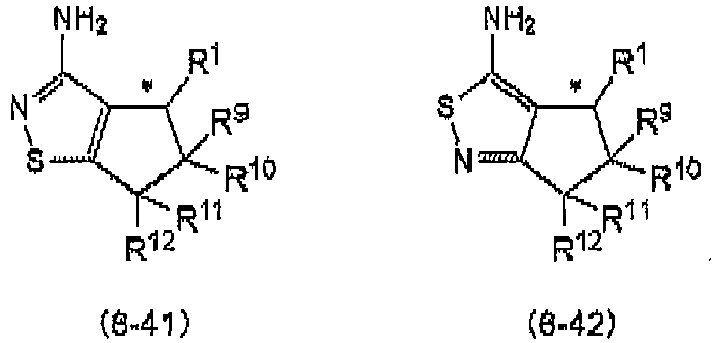
- R 1 , R 9 , R 10 , R 11 , and R 12 in the compounds represented by Formulae (8-1) to (8-42) include the groups shown in Tables below.
- the compounds represented by Formula (H-1) refer to the compounds represented by Formulae (8-1) to (8-42), in which R 1 is a methyl group, R 9 is a hydrogen atom, and R 10 is a hydrogen atom.
- the compound represented by Formula (3) is particularly preferred.
- optically active form of the compound represented by Formula (1) can be produced according to a known synthesis method or is commercially available.
- the optical purity of the optically active form is usually from 20%ee to 100%ee, and preferably from 20%ee to 99%ee.
- the racemate of the compound represented by Formula (1) produced by bringing a transition metal catalyst into contact with an optically active form of the compound represented by Formula (1) has an optical purity of 0%ee to 5%ee.
- transition metal catalyst examples include platinum catalysts such as platinum black, colloidal platinum, platinum oxide, and platinum-barium sulfate; nickel catalysts such as reduced nickel, Urushibara nickel, nickel formate, Raney nickel, and nickel-diatomaceous earth; palladium catalysts such as palladium-carbon, palladium-calcium carbonate, palladium-alumina, and palladium-platinum-carbon; cobalt catalysts such as Raney cobalt; iron catalysts such as Raney iron; and copper catalysts such as copper chromite, and two or more kinds of the transition metal catalysts may be used together.
- Preferred transition metal catalyst is a palladium catalyst, and more preferred are palladium-carbon, palladium-alumina, or palladium-platinum-carbon.
- the transition metal catalyst may be supported on a carrier.
- the carrier include activated carbon, silica, zeolite, and Celite (registered trademark).
- the transition metal catalyst may be used after hydrogen is absorbed in the transition metal catalyst in the coexistence of the transition metal catalyst and hydrogen, and the hydrogen absorbing transition metal catalyst is preferred.
- the amount of the transition metal catalyst to be used is usually from 0.001 part by weight to 1 part by weight, and preferably from 0.005 part by weight to 0.5 part by weight, per part by weight of the optically active form of the compound represented by Formula (1).
- the contact between the transition metal catalyst and the optically active form of the compound represented by Formula (1) may be carried out in the presence of a solvent or in the absence of a solvent.
- the solvent examples include aromatic solvents such as benzene, chlorobenzene, toluene, xylene, and pyridine; halogenated hydrocarbon solvents such as chloroform and dichloromethane; ester solvents such as ethyl acetate; ketone solvent such as acetone, methyl ethyl ketone, and methyl isobutyl ketone; ether solvents such as 1,2-dimethoxy ethane, diethylene glycol dimethyl ether, polyethylene glycol, tetrahydrofuran, and dioxane; nitrile solvents such as acetonitrile and propionitrile; sulfoxide solvents such as dimethyl sulfoxide; amide solvents such as dimethylacetamide and N-methyl pyrrolidone; alcohol solvents such as methanol, ethanol, and 2-propanol; aqueous solvents such as water, an aqueous sodium hydroxide solution, and aque
- the amount of the solvent to be used is usually 100 parts by weight or less, and preferably 5 parts by weight or less, per part by weight of the optically active form of the compound represented by Formula (1).
- the contact between the transition metal catalyst and the optically active form of the compound represented by Formula (1) may be carried out in the presence of an additive which will become a hydrogen source.
- the additive examples include formic acid; formates such as ammonium formate and sodium formate; cyclohexene; cyclohexene compounds such as 3-methyl-1-cyclohexene and 4-methyl-1-cyclohexene; 1,3-cyclohexadiene; 1,4-cyclohexadiene; octalin such as 1,2,3,4,4a ⁇ ,5,8,8a ⁇ -octahydronaphthalene, 1,2,3,4,5,6,7,8-octahydronaphthalene, 1-methyl-octalin, and trans-2-methyloctalin; tetralin; 1,6-dimethyl tetralin; 6-methyl tetralin; limonene; pinene; 3-carene; phellandrene; terpinolene; 1-p-menthene; cadalene; pulegone; selinene; alcohol compounds such as methanol, ethanol, 2-propanol, and cyclohex
- the amount of the additive to be used is usually from 10 parts by weight or less, preferably 5 parts by weight or less, and more preferably 2 parts by weight or less, per part by weight of the optically active form of the compound represented by Formula (1).
- a compound serving as an additive which will become a hydrogen source as well as a solvent may be used.
- the compound serving as an additive which will become a hydrogen source as well as a solvent additive which will become a hydrogen source an alcohol compound is preferred, and 2-propanol is more preferred.
- the production method of the present invention is carried out by bringing a transition metal catalyst into contact with an optically active form of the compound represented by Formula (1), and it is preferable that the transition metal catalyst and the optically active form of the compound represented by Formula (1) are mixed in the presence of hydrogen, and the obtained mixture is heated.
- the contact between the transition metal catalyst and the optically active form of the compound represented by Formula (1) may be carried out in a sealed container such as an autoclave or in an open container such as a flask.
- the contact between the transition metal catalyst and the optically active form of the compound represented by Formula (1) may be carried out in air or in a nitrogen or hydrogen atmosphere, and preferably in a nitrogen or hydrogen atmosphere.
- the temperature for the contact between the transition metal catalyst and the optically active form of the compound represented by Formula (1) is usually 20°C or higher, preferably 80°C or higher, and more preferably 100°C or higher. Further, the contact temperature is usually 250°C or lower, preferably 200°C or lower, more preferably 190°C or lower, and particularly preferably 170°C or lower.
- the contact between the transition metal catalyst and the optically active form of the compound represented by Formula (1) is preferably carried out by mixing them at 50°C to 80°C, heating the mixture to 100°C to 200°C, and preferably 150°C to 200°C in a hydrogen atmosphere, and more preferably carried out by mixing them at 50°C to 80°C in a hydrogen atmosphere, replacing hydrogen with nitrogen, and then heating the mixture to 100°C to 200°C, and preferably 150°C to 200°C.
- the contact time between the transition, metal catalyst and the optically active form of the compound represented by Formula (1) is usually from 0.1 hours to 100 hours, and preferably from 0.1 hours to 24 hours.
- a mixture that contains a racemate of the compound represented by Formula (1) can be obtained.
- a racemate of the compound represented by Formula (1) can be collected.
- the obtained racemate of the compound represented by Formula (1) can also be purified according to a known method such as concentration, extraction, transfer dissolution, recrystallization, and chromatography.
- the catalyst removed by filtration, etc. can be recovered and used again for production of a racemate of the compound represented by Formula (1).
- Examples of the recovery method include a method in which the catalyst is supported on a carrier.
- the recovered catalyst is preferably washed with a solvent.
- the solvent include alcohol compounds such as methanol; aqueous alkali solutions such as an aqueous sodium hydroxide solution; water; and a solution of mixture thereof.
- the room temperature in Examples indicates 10°C to 35°C.
- reaction vessel Into a reaction, vessel were charged 6.00 parts by weight of (3R)-1,1,3-trimethyl-4-aminoindane (optical purity of 96.5%ee), 0.81 parts by weight of 5% palladium-carbon (STD-type, manufactured by N. E. Chemcat Corporation), and 12 parts by weight of 2-propanol, thereby obtaining a mixture.
- the reaction vessel was sealed and the gas inside the reaction vessel was replaced with nitrogen. While stirring the mixture at room temperature, to the reaction vessel was charged hydrogen until the internal pressure of hydrogen in the reaction vessel reached 0.5 MPa. After 15 minutes, the gas in the reaction vessel was replaced with nitrogen, and the mixture was stirred at an internal temperature of 150°C and an internal pressure of 0.8 MPa for 7 hours to obtain a reaction mixture.
- the obtained reaction mixture was cooled and filtered.
- the obtained solid was washed with 20 parts by weight of 2-propanol.
- the washing liquid recovered after washing and the filtrate obtained by filtration were combined.
- the combined mixture was concentrated under reduced pressure to obtain 5.82 parts by weight of 1,1,3-trimethyl-4-aminoindane.
- the obtained 1,1,3-trimethyl-4-aminoindane had an optical purity of 1.2%ee and a recovery rate of 97.0%.
- reaction vessel Into a reaction vessel were charged 6.00 parts by weight of (3R)-1,1,3-trimethyl-4-aminoindane (optical purity of 96.5%ee) and 1.60 parts by weight of 5% palladium-carbon (STD-type, manufactured by N. E. Chemcat Corporation), thereby obtaining a mixture.
- the reaction vessel was sealed, the gas in the reaction vessel was replaced with nitrogen, and then the mixture was stirred at 150°C to obtain a reaction mixture. While stirring the obtained reaction mixture, 1.40 parts by weight of cyclohexene was added dropwise thereto over 5 hours, Thereafter, the reaction mixture was cooled and filtered. The obtained solid was washed with 20 parts by weight of 2-propanol.
- the washing liquid recovered after washing and the filtrate obtained by filtration were combined.
- the combined mixture was concentrated under reduced pressure to obtain 5.63 parts by weight of 1,1,3-trimethyl-4-aminoindane,
- the obtained 1,1,3-trimethyl-4-aminoindane had an optical purity of 0.29%ee and a recovery rate of 93.8%.
- reaction vessel Into a reaction vessel were charged 6.00 parts by weight of (3R)-1,1,3-trimethyl-4-aminoindane (optical purity of 96,5%ee) and 1.62 parts by weight of 5% palladium-carbon (STD-type, manufactured by N. E. Chemcat Corporation), thereby obtaining a mixture.
- the reaction vessel was sealed, the gas in the reaction vessel was replaced with nitrogen, and then the mixture was stirred at 200°C for 7.5 hours to obtain a reaction mixture. Thereafter, the obtained reaction mixture was cooled and filtered. The obtained solid was washed with 20 parts by weight of 2-propanol. The washing liquid recovered after washing and the filtrate obtained by filtration were combined.
- the combined mixture was concentrated under reduced pressure to obtain 5.06 parts by weight of 1,1,3-trimethyl-4-aminoindane.
- the obtained 1,1,3-trimethyl-4-aminoindane had an optical purity of 3.3%ee and a recovery rate of 84.3%.
- reaction vessel Into a reaction vessel were charged 6.00 parts by weight of (3R)-1,1,3-trimethyl-4-aminoindane (optical purity of 96.5%ee), 0.81 part by weight of 5% palladium-carbon (STD-type, manufactured by N. E. Chemcat Corporation), and 12 parts by weight of 2-propanol, thereby obtaining a mixture.
- the reaction vessel was sealed and the gas in the reaction vessel was replaced with nitrogen. While stirring the mixture at room temperature, into the reaction vessel was charged hydrogen until the internal pressure of hydrogen in the reaction vessel reached 0.5 MPa.
- reaction vessel Into a reaction vessel were charged 31.7 parts by weight of (3R)-1,1,3-trimethyl-4-aminoindane (optical purity of 67.0%ee) and 0,36 parts by weight of 5% palladium-alumina, thereby obtaining a mixture.
- the reaction vessel was sealed and the gas in the reaction vessel was replaced with nitrogen. While the mixture was stirred, into the reaction vessel was charged hydrogen until the internal pressure of hydrogen in the reaction vessel reached 0.5 MPa, and the mixture was stirred at an internal temperature of 60°C. After 1 hour, the gas in the reaction vessel was replaced with nitrogen, and the mixture was stirred at an internal temperature of 155°C and an internal pressure of 0.1 MPa for 7 hours, thereby obtaining a reaction mixture.
- the obtained reaction mixture was cooled and filtered.
- the obtained solid was washed with 45 parts by weight of toluene.
- the washing liquid recovered after washing and the filtrate obtained by filtration were combined to obtain a solution of 73.4 parts by weight of 1,1,3-trimethyl-4-aminoindane in toluene.
- the obtained 1,1,3-trimethyl-4-aminoindane had an optical purity of 4.5%ee and a recovery rate of 98,7%.
- the gas in the reaction vessel was replaced with nitrogen, and the mixture was stirred at an internal temperature of 145°C and an internal pressure of 0,15 MPa for 14 hours, thereby obtaining a reaction mixture.
- the obtained reaction mixture was cooled and filtered.
- the obtained solid was washed with 45 parts by weight of toluene.
- the washing liquid recovered after washing and the filtrate obtained by filtration were combined to obtain a solution of 73.0 parts by weight of 1,1,3-trimethyl-4-aminoindane in toluene.
- the combined 1,1,3-trimethyl-4-aminoindane had an optical purity of 0.7%ee and a recovery rate of 97.7%.
- the gas in the reaction vessel was replaced with nitrogen, and the mixture was stirred at an internal temperature of 180°C and an internal pressure of 0.3 MPa for 12.5 hours, thereby obtaining a reaction mixture,
- the obtained reaction mixture was cooled and filtered.
- the obtained solid was washed with 45 parts by weight of toluene.
- the washing liquid recovered after washing and the filtrate obtained by filtration were combined to obtain a solution of 77,5 parts by weight of 1,1,3-trimethyl-4-aminoindane in toluene.
- the combined 1,1,3-trimethyl-4-aminoindane had an optical purity of 0.29%ee and a recovery rate of 97.7%.
- the gas in the reaction vessel was replaced with nitrogen, and the mixture was stirred at an internal temperature of 150°C and an internal pressure of 0,1 MPa for 14 hours, thereby obtaining, a reaction mixture.
- the obtained reaction mixture was cooled and filtered using Celite.
- the obtained solid was washed with 150 parts by weight of toluene.
- the washing liquid recovered after washing and the filtrate obtained by filtration were combined to obtain a solution of 244.6 parts by weight of 1,1,3-trimethyl-4-aminoindane in toluene.
- the combined 1,1,3-trimethyl-4-aminoindane had an optical purity of 0.35%ee and a recovery rate of 98.9%.
- the filtered catalyst was washed twice with 30 parts by weight of methanol, 30 parts by weight of 10% caustic water, and 30 parts by weight of water twice, thereby recovering 3.84 parts by weight of palladium-carbon, including Celite.
- the gas in the reaction vessel was replaced with nitrogen, and the mixture was stirred at an internal temperature of 150°C and an internal pressure of 0.1 MPa for 14 hours, thereby obtaining a reaction mixture.
- the obtained reaction mixture was cooled and filtered using Celite.
- the obtained solid was washed with 150 parts by weight of toluene.
- the washing liquid recovered after washing and the filtrate obtained by filtration were combined to obtain a solution of 244.6 parts by weight of 1,1,3-trimethyl-4-aminoindane in toluene.
- the combined 1,1,3-trimethyl-4-aminoindane had an optical purity of 0.11%ee and a recovery rate of 98.5%.
- a racemate can be efficiently produced from an optically active form of the compound represented by Formula (1).
Landscapes
- Chemical & Material Sciences (AREA)
- Organic Chemistry (AREA)
- Chemical Kinetics & Catalysis (AREA)
- Organic Low-Molecular-Weight Compounds And Preparation Thereof (AREA)
- Low-Molecular Organic Synthesis Reactions Using Catalysts (AREA)
- Catalysts (AREA)
Abstract
Description
- The present invention relates to a method for producing a racemate from an optically active form of a compounds.
- Patent Literature 1 describes (3R)-1,1,3-trimethyl-4-aminoindane as an intermediate for use in producing agricultural chemicals, etc.
- Non-Patent Literature 1 describes a method for racemizing an optically active form of 2-phenylbutane by bringing an optically active form of 2-phenylbutane into contact with aluminum chloride.
- However, a method for racemizing an optically active form of (3R)-1,1,3-trimethyl-4-aminoindane, etc is not known.
- [Patent Literature 1] Japanese Unexamined Patent Application Publication No.
1-211568 - [Non-Patent Literature 1] R. L. Burwell, JR; J. Am. Chem. Soc., 77, 2766 (1955), E. L. Eliel; J. Org. Chem., 22, 231 (1957)
- There is a demand for a method for efficiently producing a racemate from an optically active form of a compound of (3R)-1,1,3-trimethyl-4-aminoindane, etc. Solution to Problem
- The present invention includes the following aspects of the invention.
- [1] A method for producing a racemate of a compound represented by Formula (1), comprising bringing a transition metal catalyst into contact with an optically active form of the-compound represented by Formula (1);

- a ring X1 represents an aromatic ring;
- R1 represents a C1-6 alkyl group, a C3-8 cycloalkyl group, or a C1-6 halo-alkyl group;
- R2 is a group different from R1 and represents a C1-5 alkyl group, a C3-8 cycloalkyl group, or a C1-6 halo-alkyl group, or R2 and the ring X1 are bonded to each other to form a ring;
- a hydrogen atom of the ring X1 is optionally replaced with a C1-6 alkyl group, a C1-6 halo-alkyl group, a cyano group, a nitro group, a C1-6 alkoxy group, or a halogen atom; and
- * represents an asymmetric carbon atom].
- [2] The production method as described in [1], in which the compound represented by Formula (1) is a compound represented by Formula (1a) :

- A1, A2, A3, and A4 each independently represent -N= or -C(Ra)=, and Ra represents a hydrogen atom, a C1-6 alkyl group, a C1-6 halo-alkyl group, a cyano group, a nitro group, a C1-6 alkoxy group, or a halogen atom;
- Ra represents a C1-6 alkyl group, a C3-9 cycloalkyl group, or a C1-6 halo-alkyl groups;
- R4 is a group different from R3 and represents a C1-6 alkyl group, a C3-9 cycloalkyl group, or a C1-6 halo-alkyl group, or when A1 represents -C(Ra)=, R4 and Ra are optionally bonded to each other to form a divalent hydrocarbon group, a hydrogen atom(s) of the hydrocarbon group is optionally replaced with a halogen atom, and -CH2- of the hydrocarbon group is optionally replaced with -O-;
- two Ra'sof the adjacent -C(Ra) ='s are optionally bonded to each other to form a benzene ring with a carbon atom to which each of them is bonded, and a hydrogen atom(s) of the benzene ring is optionally replaced with a C1-6 alkyl group or a halogen atom; and
- * represents an asymmetric carbon atom].
- [3] The production method as described in [21, in which A1, A2, A3, and A4 are -C(Ra) =.
- [4] The production method as described in [2] or [3], in which A1 is -C(Ra) =, and Ra and R2 are bonded to each other to form a divalent hydrocarbon group.
- [5] The production method as described in any one of [2] to [4], in which the compound represented by Formula (1a) is a compound represented by Formula (2) ;

- A2, A3, and A4 each independently represent -N= or - C(Ra) =, Ra represents a hydrogen atom, a C1-6 alkyl group, a C1-6 halo-alkyl group, or a halogen atom, and R3 represents a C1-6 alkyl group;
- Rd represents a C1-6 alkyl group, or a C1-6 halo-alkyl group, r represents an integer of 0 to 4, and when r is an integer of 2 or more, a plurality of Rd's are optionally the same or different; and
- represent an asymmetric carbon atom].
- [6] The production method as described in any one of [2] to [5], in which R3 is a C1-6 alkyl group.
- [7] The production method as described in any one of [1] to [6], in which the compound represented by Formula (1) is a compound represented by Formula (3):

- [8] The production method as described in any one of [1] to [7], in which the transition metal catalyst is a hydrogen absorbing transition metal catalyst having absorbed hydrogen therein.
- [9] The production method as described in any one of [1] to [8], in which the transition metal catalyst is a palladium catalyst.
- [10] The production method as described in [9], in which the palladium catalyst is a palladium-carbon catalyst.
- [11] A method for racemizing a compound represented by Formula (1), including bringing a transition metal catalyst into contact with an optically active form of the compound represented by Formula (1):

- a ring X1 represents an aromatic ring;
- R1 represents a C1-6 alkyl group, a C3-6 cycloalkyl. group, or a C1-6 halo-alkyl group;
- R2 is a group different from R1 and represents a C1-6 alkyl group, a C3-8 cycloalkyl group, or a C1-6 halo-alkyl group, or R2 and the ring X1 are bonded to each other to form a ring;
- a hydrogen atom(s) of the ring X1 is optionally replaced with a C1-6 alkyl group, a C1-6 halo-alkyl group, a cyano group, a nitro group, a C1-6 alkoxy group, or a halogen atom; and
- * represents an asymmetric carbon atom].
- According to the present invention, a racemate can be efficiently produced from an optically active form of the compound represented by Formula (1).
- First, the compound represented by Formula (1) will be described.
- The C1-6 alkyl group represents an alkyl group having 1 to 6 carbon atoms and includes linear and branched chain alkyl groups. Examples of the C1-4 alkyl group include a methyl group, an ethyl group, a propyl group, an isopropyl group, a butyl group, an isobutyl group, a sec-butyl group, a tert-butyl group, a pentyl group, a sec-pentyl group, an isopentyl group, and a neopentyl group, and preferred are a methyl group, an ethyl group, a propyl group, and an isopropyl-group.
- The C3-8 cycloalkyl group represents a cyclic alkyl group having 3 to 8 carbon atoms, and examples of the C3-8 cycloalkyl group include a cyclopropyl group, a 2,2-dimethylcyclopropyl group, a cyclobutyl group, a Cyclopentyl group, a Cyclohexyl groups, a cycloheptyl group, and a cyclooctyl group, and preferred are a cyclopropyl group, a cyclopentyl group, and a cyclohexyl group.
- The C1-6 halo-alkyl group represents an alkyl group having 1 to 6 carbon atoms in which at least one of the hydrogen atom(s) is replaced with a halogen atom, and examples of the C1-6 halo-alkyl group include a fluoromethyl group, a difluoromethyl group, a trifluoromethyl group, a chloromethyl group, a dichloromethyl group, a trichloromethyl group, a bromomethyl group, a dibromomethyl group, a tribromomethyl group, an iadomethyl group, a diiodomethyl group, a triiodomethyl group, a chlorofluoromethyl group, a dichlorofluoromethyl group, a fluoroethyl group, a chloroethyl group, a 1-chloro-1-fluoroethyl group, and a 1-chloro-2-fluaroethyl group, and preferred are a trifluoromethyl group and a difluoromethyl group.
- The C1-6 alkoxy group represents an alkoxy group having 1 to 6 carbon atoms, and examples of the C1-6 alkoxy group include a methoxy group, an ethoxy group, a propoxy group, an isopropoxy group, a butoxy group, an isobutoxy group, a sec-butoxy group, and a tert-butoxy group, and preferably a methoxy group.
- Examples of the halogen atom include a fluorine atom, a chlorine atom, a bromine atom, and an iodine atom.
- The aromatic ring includes a homacycle and a heterocycle, and examples thereof include the following rings, and preferred are 5- and 6-membered rings.


- Examples of the ring formed by the mutual bonding of R2 and the ring X1 include the following rings, and preferred are 5- and 6-menbered rings.


- Among the compounds represented by Formula (1), a compound represented by Formula (1a) and a compound represented by Formula (1b) are preferred.
- First, explanation will be made to Formula (1a).
- Examples of the C1-6 alkyl group, the C3-6 cycloalkyl group, the C1-6 halo-alkyl groups, the C1-6 alkoxy group, and the halogen atom in the compound represented by Formula (1a) include the same groups as in the compound represented by Formula (1), respectively.
- Examples of the divalent hydrocarbon group formed by the mutual bonding of R4 and Ra include alkanediyl groups having 2 to 9 carbon atoms, such as an ethylene group, a propanediyl group, a 2-methyl-propane-1,2-diyl group, a butane-1,2-diyl group, a butanediyl group, a hexanediyl group, a heptanediyl group, an octanediyl group, and a nonanediyl group.
- As the divalent hydrocarbon group formed by the mutual bonding of R4 and Ra and having -O- groups in place of its - CH2- group include -CH2-O-CH2- and -CH2-CH2-O-.
- Among the compounds represented by Formula (1a) in which R3 is a methyl group; a compound in which A1, A2, A3, and A4 are -C(Ra) =; and a compound in which A1 is -C(Ra)=, and a compound in which R4 and Ra may be bonded to each other to form a divalent hydrocarbon group are preferred, and the compound represented by Formula (2) is more preferred.
- Examples of the C1-6 alkyl group, the C1-6 halo-alkyl group, or the halogen atom in the compound represented by Formula (2) include the same groups as in the compound represented by Formula (1) and the compound represented by Formula (1a).
- Next, explanation will be made to Formula (1b).
- Examples of the C1-6 alkyl group, the C3-8 cycloalkyl group, the C1-6 halo-alkyl group, the C1-6 alkoxy group, and the halogen atom in the compound represented by Formula (1b) include the same groups as in the compound represented by Formula (1).
- Examples of the divalent hydrocarbon group formed by the mutual bonding of R6 and either Rb or Rc in the compound represented by Formula (1b) include the same groups as in the compound represented by Formula (1a).
- Hereinafter, examples of the compounds represented by Formula (1) are specifically illustrated.
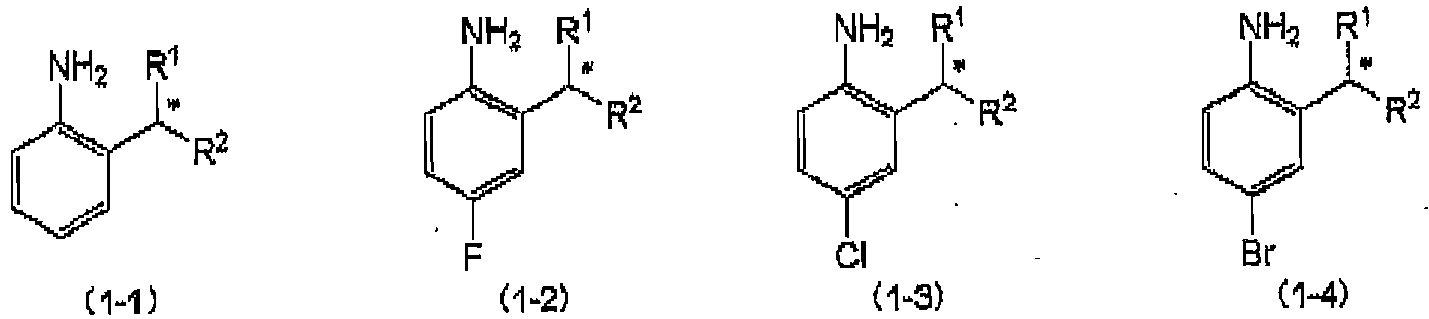


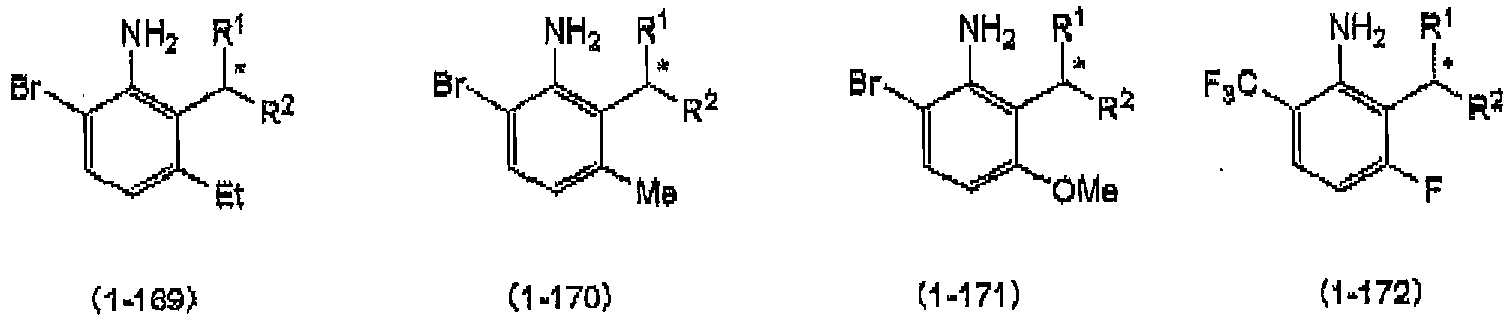

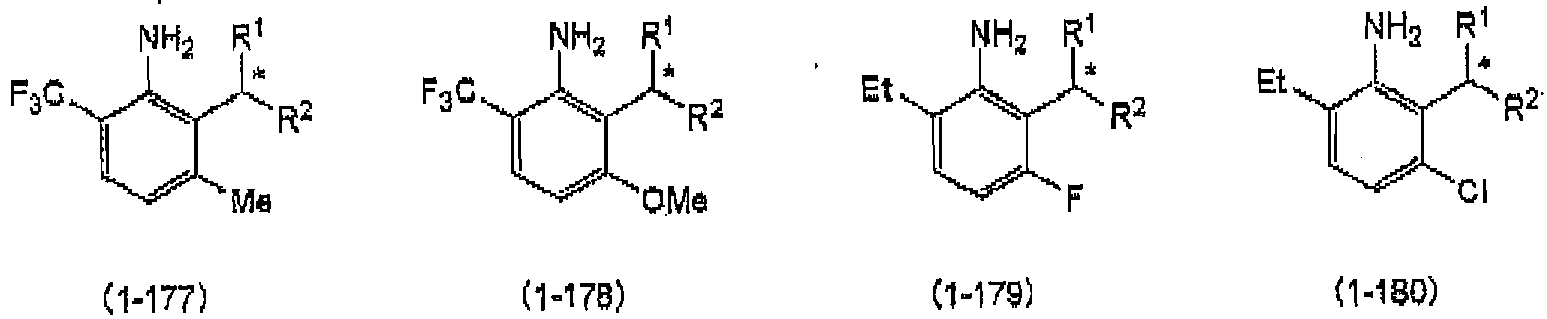
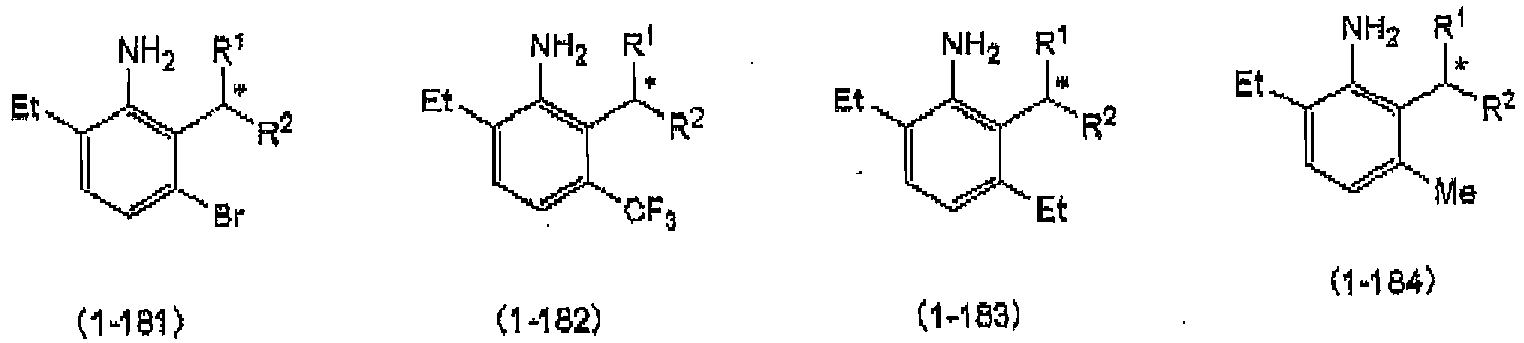


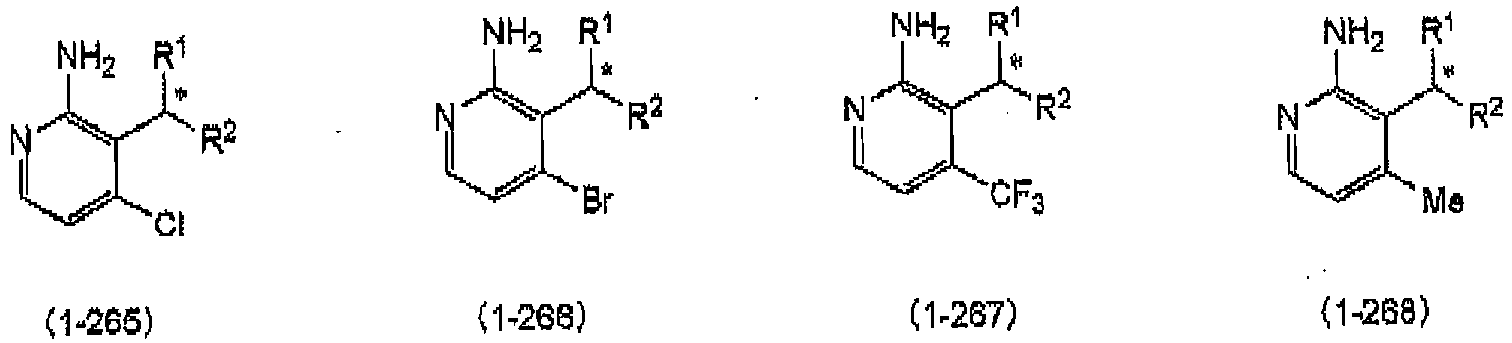





- Examples of R1 and R2 in the compounds represented by Formulae (1-1) to (1-381) include the groups described in Tables below. For example, the compounds represented by Formula (A-1) refer to the compounds represented by Formulae (1-1) to (1-381), in which R1 is a methyl group and R2 is an ethyl group.
[Table 1] Formula R1 R2 A-1 Methyl group Ethyl group A-2 Methyl group Propyl group A-3 Methyl group Isopropyl group A-4 Methyl group Butyl group A-5 Methyl group Isobutyl group A-6 Methyl group sec-Isobutyl group A-7 Methyl group tert-Isobutyl group A-8 Ethyl group Propyl group A-9 Ethyl group Isopropyl group A-10 Ethyl group Butyl group A-11 Ethyl group Isobutyl group A-12 Ethyl group sec-Isobutyl group A-13 Ethyl group tert-Isobutyl group A-14 Propyl group Isopropyl group A-15 Propyl group Butyl group A-16 Propyl group Isobutyl group A-17 Propyl group sec-Isobutyl group A-18 Propyl group tert-Isobutyl group A-19 Isopropyl group Butyl group A-20 Isopropyl group Isobutyl group [Table 2] Formula R1 R2 A-21 Isopropyl group sec-Isobutyl group A-22 isopropyl group tert-Isobutyl group A-23 Butyl groups isobutyl group A-24 Butyl group sec-Isobutyl group A-25 Butyl group tert-Isobutyl group A-26 Isobutyl group sec-Isobutyl group A-27 Isobutyl group tert-isobutyl group A-28 sec-isobutyl group tert-Isobutyl group A-29 Methyl group Cyclopropyl group A-30 Methyl group Cyclopentyl group A-31 Methyl group Cyclohexyl group A-32 Methyl group Difluoromethyl group A-33 Methyl group Trifluoromethyl group A-34 Ethyl group Cyclopropyl group A-35 Ethyl group Cyclopentyl group A-36 Ethyl group Cyclohexyl group A-37 Ethyl group Difluoromethyl group A-38 Ethyl group Trifluoromethyl group A-39 Propyl group Cyclopropyl group A-40 Propyl group Cyclopentyl group [Table 3] Formula R1 R2 A-41 Propyl group Cyclohexyl group A-42 Propyl group Difluoromethyl group A-43 Propyl group Trifluoromethyl group A-44 Isopropyl group Cyclopropyl group A-45 Isopropyl group Cyclopentyl group A-46 Isopropyl group Cyclohexyl group A-47 Isopropyl group Difluoromethyl group A-48 Isopropyl group Trifluoromethyl group A-49 Butyl group Cyclopropyl group A-50 Butyl group Cyclopentyl group A-51 Butyl group Cyclohexyl group A-52 Butyl group Difluoromethyl group A-53 Butyl group Trifluoromethyl group A-54 isobutyl group, Cyclopropyl group A-55 isobutyl group Cyclopentyl group A-56 Isobutyl group Cyclohexyl group A-57 Isobutyl group Difluoromethyl group A-58 Isobutyl group Trifluoromethyl group A-59 sec-Isobutyl group Cyclopropyl group A-60 sec-Isobutyl group Cyclopentyl group [Table 4] Formula R1 R2 A-61 sec-Isobutyl group Cyclohexyl group A-62 sec-Isobutyl group Difluoromethyl group A-63 see-Isobutyl group Trifluoromethyl group A-64 tert-Isobutyl group Cyclopropyl group A-65 tert-Isobutyl group Cyclopentyl group A-66 tert-Isobutyl group Cyclohexyl group A-67 tert-Isobutyl group Difluoromethyl group A-68 tert-Isobutyl group Trifluoromethyl group A-69 Cyclopropyl group Cyclopentyl group A-70 Cyclopropyl group Cyclohexyl group A-71 Cyclopropyl group Difluoromethyl group A-72 Cyclopropyl group trifluoromethyl group A-73 Cyclopentyl group Cyclohexyl group A-74 Cyclopentyl group Difluoromethyl group A-75 Cyclopentyl group Trifluoromethyl group A-76 Cyclohexyl group Difluoromethyl group A-77 Cyclohexyl group Trifluoromethyl group A-78 Difluoromethyl group Trifluoromethyl group - Next, the compounds (1) formed by the mutual bonding of R2 and the ring X1 are specifically illustrated below.




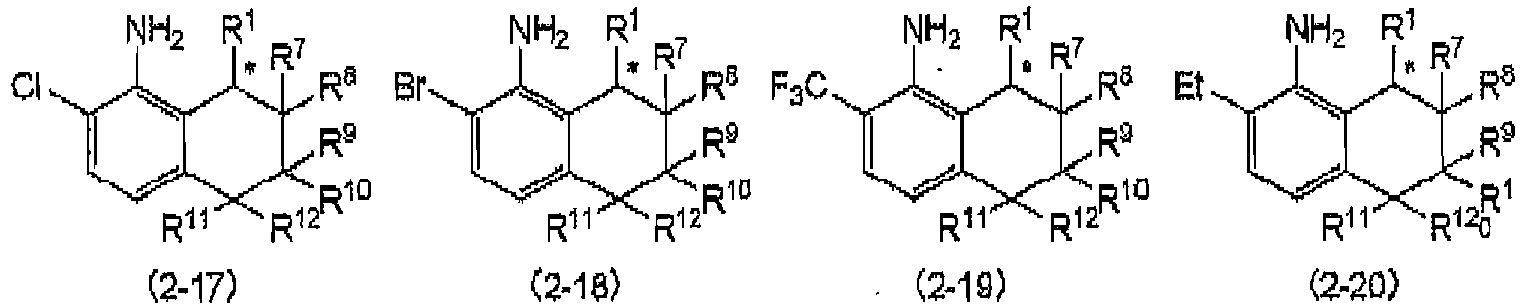


- Examples of R1, R2, R7, R8, R9, R10, R11, and R12 in the compounds represented by Formulae (2-1) to (2-42) include the groups shown in Tables below. For example, the compounds represented by Formula (B-1) refer to the compounds represented by Formulae (2-1) to (2-42), in which R1 is a methyl group, R7 is a hydrogen atom, R8 is a hydrogen atom, R9 is a methyl group, R10 is a hydrogen atom, R11 is a hydrogen atom, and R12 is a hydrogen atom.
[Table 5] Formula R1 R7 R8 R9 R10 R11 R12 B-1 Methyl group Hydrogen Hydrogen Hydrogen Hydrogen Hydrogen Hydrogen B-2 Methyl group Methyl group Methyl group Hydrogen Hydrogen Hydrogen Hydrogen B-3 methyl group Hydrogen Hydrogen Methyl group Methyl group Hydrogen Hydrogen B-4 Methyl group Hydrogen Hydrogen Hydrogen Hydrogen Methyl group Methyl group B-5 Methyl group Methyl group Hydrogen Hydrogen Hydrogen Hydrogen Hydrogen B-6 Methyl group Hydrogen Hydrogen Methyl group Hydrogen Hydrogen Hydrogen B-7 Methyl group Hydrogen Hydrogen Hydrogen Hydrogen Methyl group Hydrogen B-8 Methyl group Methyl group Methyl group methyl group Methyl group Hydrogen Hydrogen B-9 Methyl group Methyl group Methyl group Hydrogen Hydrogen Methyl group Methyl group B-10 Methyl group Hydrogen Hydrogen Methyl group Methyl group Methyl group Methyl group B-11 Methyl group Methyl group Methyl group Methyl groupe Methyl group Methyl group Methyl group B-12 Ethyl group Hydrogen Hydrogen Hydrogen Hydrogen Hydrogen Hydrogen B-13 Ethyl group Methyl group Methyl group Hydrogen Hydrogen Hydrogen Hydrogen B-14 Ethyl group Hydrogen Hydrogen Methyl group Methyl group Hydrogen Hydrogen B-15 Ethyl group Hydrogen Hydrogen Hydrogen Hydrogen Methyl group Methyl group [Table 6] Formula R1 R7 R8 R9 R10 R11 R12 B-16 Ethyl group Methyl group Hydrogen Hydrogen Hydrogen Hydrogen Hydrogen B-17 Ethyl group Hydrogen Hydrogen Methyl group Hydrogen Hydrogen Hydrogen B-18 Ethyl group Hydrogen Hydrogen Hydrogen Hydrogen Methyl group Hydrogen B-19 Ethyl group Methyl group Methyl group Methyl group Methyl group Hydrogen Hydrogen B-20 Ethyl group Methyl group Methyl group Hydrogen Hydrogen Methyl group Methyl group B-21 Ethyl group Hydrogen Hydrogen Methyl group Methyl group Methyl group Methyl group B-22 Ethyl group Methyl Methyl group Methyl group Methyl group Methyl group Methyl group B-23 Propyl group Hydrogen Hydrogen Hydrogen Hydrogen Hydrogen Hydrogen B-24 Propyl group Methyl group Methyl group Hydrogen Hydrogen Hydrogen Hydrogen B-25 Propyl group Hydrogen Hydrogen Methyl group Methyl group Hydrogen Hydrogen B-26 Propyl group Hydrogen Hydrogen Hydrogen Hydrogen Methyl group Methyl group B-27 Propyl group Methyl group Hydrogen Hydrogen Hydrogen Hydrogen Hydrogen B-28 Propyl group Hydrogen Hydrogen Methyl group Hydrogen Hydrogen Hydrogen B-29 Propyl group Hydrogen Hydrogen Hydrogen Hydrogen Methyl group Hydrogen B-30 Propyl group Methyl group Methyl group Methyl group Methyl group Hydrogen Hydrogen [Table 7] Formula R1 R7 R8 R9 R10 R11 R12 B-31 Propyl group Methyl group Methyl group Hydrogen Hydrogen Methyl group Methyl group B-32 Propyl group Hydrogen Hydrogen Methyl group Methyl group Methyl group Methyl group B-33 Propyl group Methyl group Methyl group Methyl group Methyl group Methyl group Methyl group B-34 Isopropyl group Hydrogen Hydrogen Hydrogen Hydrogen Hydrogen Hydrogen B-35 Isopropyl group Methyl group Methyl group Hydrogen Hydrogen Hydrogen Hydrogen B-36 Isopropyl group Hydrogen Hydrogen Methyl group Methyl group Hydrogen Hydrogen B-37 Isopropyl group Hydrogen Hydrogen Hydrogen Hydrogen Methyl group Methyl group B-38 Isopropyl group Methyl group Hydrogen Hydrogen Hydrogen Hydrogen Hydrogen B-39 Isopropyl group Hydrogen Hydrogen Methyl group Hydrogen Hydrogen Hydrogen B-40 Isopropyl group Hydrogen Hydrogen Hydrogen Hydrogen Methyl group Hydrogen B-41 Isopropyl group Methyl group Methyl group Methyl group Methyl group Hydrogen Hydrogen B-42 Isopropyl group Methyl group Methyl group Hydrogen Hydrogen Methyl group Methyl group B-43 Isopropyl group Hydrogen Hydrogen Methyl group Methyl group Methyl group Methyl group B-44 Isopropyl group Methyl group Methyl group Methyl group Methyl group Methyl group Methyl group 


- Examples of R1, R7, R8, R9, and R10 in the compounds represented by Formulae (3-1) to (3-42) include the groups shown in Tables below. For example, the compounds represented by Formula (C-1) refer to the compounds represented by Formulae (3-1) to (3-42), in which R1 is a methyl group, R7 is a hydrogen atom, R8 is a hydrogen atom, R9 is a hydrogen atom, and R10 is a hydrogen atoms.
[Table 8] Formula R1 R7 R8 R9 R10 C-1 Methyl group Hydrogen Hydrogen Hydrogen Hydrogen C-2 Methyl group Methyl group Methyl group Hydrogen Hydrogen C-3 Methyl group Hydrogen Hydrogen Methyl group Methyl group C-4 Methyl group Methyl group Hydrogen Hydrogen Hydrogen C-5 Methyl group Hydrogen Hydrogen Methyl group Hydrogen C-6 Methyl group Methyl group Methyl group Methyl group Methyl group C-7 Ethyl group Hydrogen Hydrogen Hydrogen Hydrogen C-8 Ethyl group Methyl group Methyl group Hydrogen Hydrogen C-9 Ethyl group Hydrogen Hydrogen Methyl group Methyl group C-10 Ethyl group Methyl group Hydrogen Hydrogen Hydrogen C-11 Ethyl qroup Hydrogen Hydrogen Methyl group Hydrogen C-12 Ethyl group Methyl group Methyl group Methyl group Methyl group C-13 Propyl group Hydrogen Hydrogen Hydrogen Hydrogen C-14 Propyl group Methyl group Methyl group Hydrogen Hydrogen C-15 Propyl group Hydrogen Hydrogen Methyl group Methyl group C-16 Propyl group Methyl group Hydrogen Hydrogen Hydrogen C-17 Propyl group Hydrogen Hydrogen Methyl group Hydrogen C-18 Propyl group Methyl group Methyl group Methyl group Methyl group C-19 Isopropyl group Hydrogen Hydrogen Hydrogen Hydrogen C-20 Isopropyl group Methyl group Methyl group Hydrogen Hydrogen C-21 Isopropyl group Hydrogen Hydrogen Methyl group Methyl group C-22 Isopropyl group Methyl group Hydrogen Hydrogen Hydrogen C-23 Isopropyl group Hydrogen Hydrogen Methyl group Hydrogen C-24 Isopropyl group Methyl group Methyl group Methyl group Methyl group 


- Examples of R1, R7, R8, R9, and R10 in the compounds represented by Formulae (4-1) to (4-42) include the groups shown in Tables below. For example, the compounds represented by Formula (D-1) refer to the compounds represented by Formulae (4-1) to (4-42), in which R1 is a methyl group, R7 is a hydrogen atom, R8 is a hydrogen atom, R9 is a hydrogen atom, and R10 is a hydrogen atom.
[Table 9] Formula R1 R7 R8 R9 R10 D-1 Methyl group Hydrogen Hydrogen Hydrogen Hydrogen D-2 Methyl group Methyl group Methyl group Hydrogen Hydrogen D-3 Methyl group Hydrogen Hydrogen Methyl group Methyl group D-4 Methyl group Methyl group Hydrogen Hydrogen Hydrogen D-5 Methyl group Hydrogen Hydrogen Methyl group Hydrogen D-6 Methyl group Methyl group Methyl group Methyl group Methyl group D-7 Ethyl group Hydrogen Hydrogen Hydrogen Hydrogen D-8 Ethyl group Methyl group Methyl group Hydrogen Hydrogen D-9 Ethyl group Hydrogen Hydrogen Methyl group Methyl group D-10 Ethyl group Methyl group Hydrogen Hydrogen Hydrogen D-11 Ethyl group Hydrogen Hydrogen Methyl group Hydrogen D-12 Ethyl group Methyl group Methyl group Methyl group Methyl group D-13 Propyl group Hydrogen Hydrogen Hydrogen Hydrogen D-14 Propyl group Methyl group Methyl group Hydrogen Hydrogen D-15 Propyl group Hydrogen Hydrogen Methyl group Methyl group D-16 Propyl group Methyl group Hydrogen Hydrogen Hydrogen D-17 Propyl group Hydrogen Hydrogen Methyl group Hydrogen D-18 Propyl group Methyl group Methyl group Methyl group Methyl group D-19 Isopropyl group Hydrogen Hydrogen Hydrogen Hydrogen D-20 Isopropyl group Methyl group Methyl group Hydrogen Hydrogen D-21 Isopropyl group Hydrogen Hydrogen Methyl group Methyl group D-22 Isopropyl group Methyl group Hydrogen Hydrogen Hydrogen D-23 Isopropyl group Hydrogen Hydrogen Methyl group Hydrogen D-24 Isopropyl group Methyl group Methyl group Methyl group Methyl group 


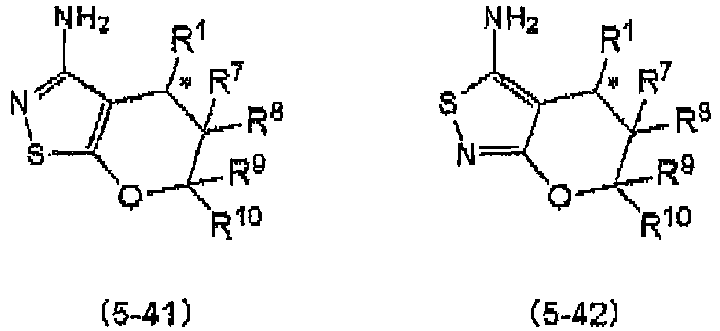
- Examples of R1, R7, R8, R9, and R10 in the compounds represented by Formulae (5-1) to (5-42) include the groups shown in Tables below. For example, the compounds represented by Formula (E-1) refer to the compounds represented by Formulae (5-1) to (5-42), in which R1 is a methyl group, R7 is a hydrogen atom, R8 is a hydrogen atom, R9 is a hydrogen atom, and R10 is a hydrogen atom.
[Table 10] Formula R1 R7 R8 R9 R10 E-1 Methyl group Hydrogen Hydrogen Hydrogen Hydrogen E-2 Methyl group Methyl group Methyl group Hydrogen Hydrogen E-3 Methyl group Hydrogen Hydrogen Methyl group Methyl group E-4 Methyl group Methyl group Hydrogen Hydrogen Hydrogen E-5 Methyl group Hydrogen Hydrogen Methyl group Hydrogen E-6 Methyl group Methyl group Methyl group Methyl group Methyl group E-7 Ethyl group Hydrogen Hydrogen Hydrogen Hydrogen E-8 Ethyl group Methyl group Methyl group Hydrogen Hydrogen E-9 Ethyl group Hydrogen Hydrogen Methyl group Methyl group E-10 Ethyl group Methyl group Hydrogen Hydrogen Hydrogen E-11 Ethyl group Hydrogen Hydrogen Methyl group Hydrogen E-12 Ethyl group Methyl group Methyl group Methyl group Methyl group E-13 Propyl group Hydrogen Hydrogen Hydrogen Hydrogen E-14 Propyl group Methyl group Methyl group Hydrogen Hydrogen E-15 Propyl group Hydrogen Hydrogen Methyl group Methyl group E-16 Propyl group Methyl group Hydrogen Hydrogen Hydrogen E-17 Propyl group Hydrogen Hydrogen Methyl group Hydrogen E-18 Propyl group Methyl group Methyl group Methyl group Methyl group E-19 Isopropyl group Hydrogen Hydrogen Hydrogen Hydrogen E-20 Isopropyl group Methyl group Methyl group Hydrogen Hydrogen E-21 Isopropyl group Hydrogen Hydrogen Methyl group Methyl group E-22 Isopropyl group Methyl group Hydrogen Hydrogen Hydrogen E-23 Isopropyl group Hydrogen Hydrogen Methyl group Hydrogen E-24 Isopropyl group Methyl group Methyl group Methyl group Methyl group 


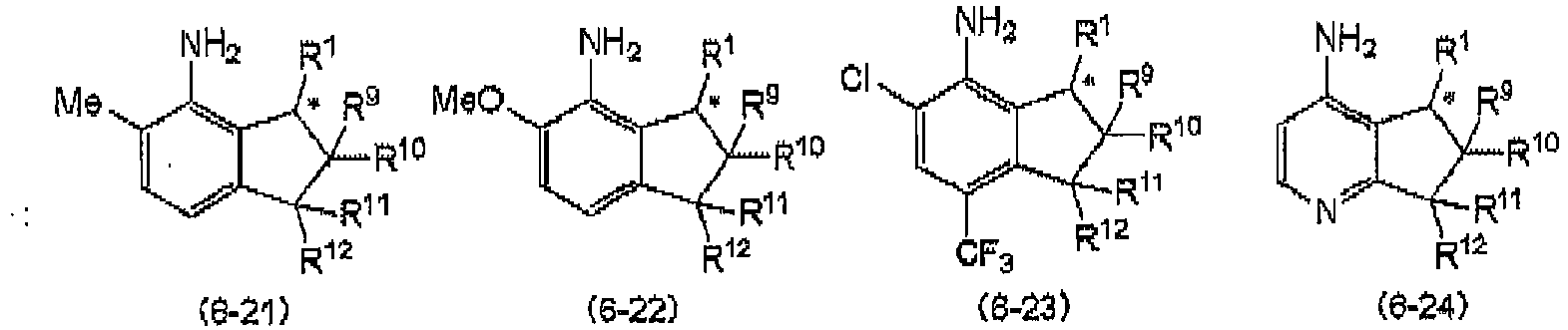

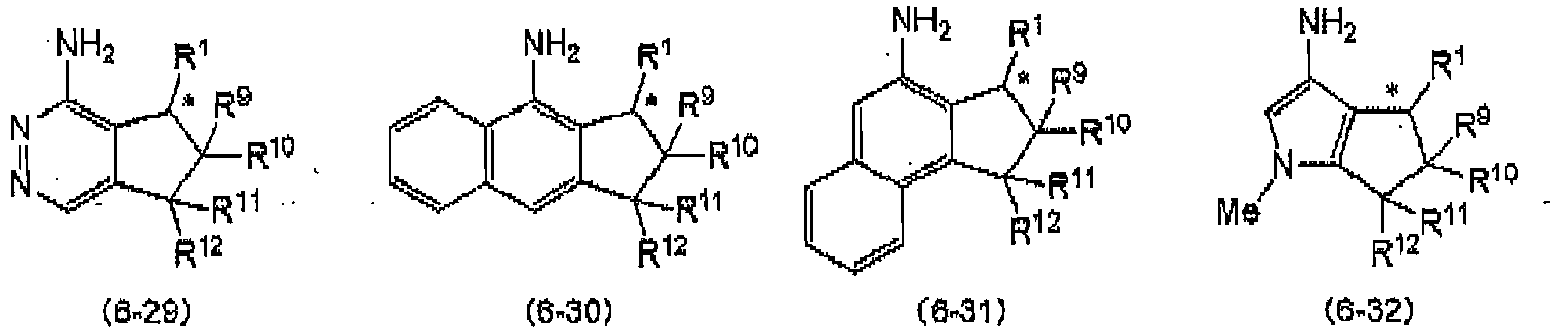


- Examples of R1, R9, R10, R11, and R12 in the compounds represented by Formulae (6-1) to (6-42) include the groups shown in Tables below. For example, the compounds represented by Formula (F 1) refer to the compounds represented by Formulae (6-1) to (6-42), in which R1 is a methyl group, R9 is a hydrogen atom, R10 is a hydrogen atom, R11 is a hydrogen atom, and R12 is a hydrogen atom.
[Table 11] Formula R1 R9 R10 R11 R12 F-1 Methyl group Hydrogen Hydrogen Hydrogen Hydrogen F-2 Methyl group Methyl group Methyl group Hydrogen Hydrogen F-3 Methyl group Hydrogen Hydrogen Methyl group Methyl group F-4 Methyl group Methyl group Hydrogen Hydrogen Hydrogen F-5 Methyl group Hydrogen Hydrogen Methyl group Hydrogen F-6 Methyl group Methyl group Methyl group Methyl group Methyl group F-7 Ethyl group Hydrogen Hydrogen Hydrogen Hydrogen F-8 Ethyl group Methyl group Methyl group Hydrogen Hydrogen F-9 Ethyl group Hydrogen Hydrogen Methyl group Methyl group F-10 Ethyl group Methyl group Hydrogen Hydrogen Hydrogen F-11 Ethyl group Hydrogen Hydrogen Methyl group Hydrogen F-12 Ethyl group Methyl group Methyl group Methyl group Methyl group F-13 Propyl group Hydrogen Hydrogen Hydrogen Hydrogen F-14 Propyl group Methyl group Methyl group Hydrogen Hydrogen F-15 Propyl group Hydrogen Hydrogen Methyl group Methyl group F-16 Propyl group Methyl group Hydrogen Hydrogen Hydrogen F-17 Propyl group Hydrogen Hydrogen Methyl group Hydrogen F-18 Propyl group Methyl group Methyl group Methyl group Methyl group F-19 Isopropyl group Hydrogen Hydrogen Hydrogen Hydrogen F-20 Isopropyl group Methyl group Methyl group Hydrogen Hydrogen F-21 Isopropyl group Hydrogen Hydrogen Methyl group Methyl group F-22 Isopropyl group Methyl group Hydrogen Hydrogen Hydrogen F-23 Isopropyl group Hydrogen Hydrogen Methyl group Hydrogen F-24 Isopropyl group Methyl group Methyl group Methyl group Methyl group 


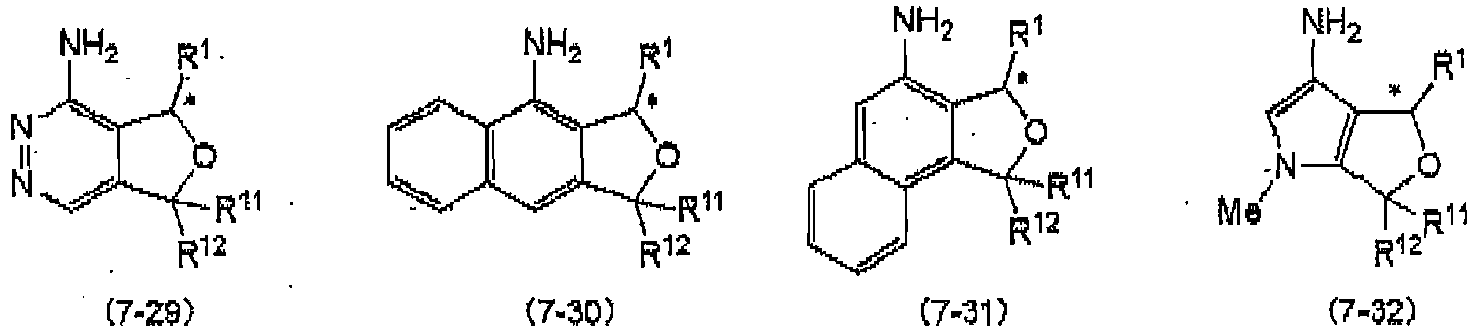


- Examples of R1, R11, and R12 in the compounds represented by Formulae (7-1) to (7-42) include the groups shown in Tables below. For example, the compounds represented by Formula (G-1) refer to the compounds represented by Formulae (7-1) to (7-42), in which R1 is a methyl group, R11 is a hydrogen atom, and R12 is a hydrogen atom.
[Table 12] Formula R1 R11 R12 G-1 Methyl group Hydrogen Hydrogen G-2 Methyl group Methyl group Hydrogen G-3 Methyl group Methyl group Methyl group G-4 Ethyl group Hydrogen Hydrogen G-5 Ethyl group Hydrogen Hydrogen G-6 Ethyl group Methyl group Methyl group G-7 Propyl group Hydrogen Hydrogen G-8 Propyl group Hydrogen Hydrogen G-9 Propyl group Methyl group Methyl group G-10 Isopropyl group Hydrogen Hydrogen G-11 Isopropyl group Hydrogen Hydrogen G-12 Isopropyl group Methyl group Methyl group 


- Examples of R1, R9, R10, R11, and R12 in the compounds represented by Formulae (8-1) to (8-42) include the groups shown in Tables below. For example, the compounds represented by Formula (H-1) refer to the compounds represented by Formulae (8-1) to (8-42), in which R1 is a methyl group, R9 is a hydrogen atom, and R10 is a hydrogen atom.
[Table 13] Formula R1 R9 R10 H-1 Methyl group Hydrogen Hydrogen H-2 Methyl group Methyl group Hydrogen H-3 Methyl group Methyl group Methyl group H-4 Ethyl group Hydrogen Hydrogen H-5 Ethyl group Hydrogen Hydrogen H-6 Ethyl group Methyl group Methyl group H-7 Propyl group Hydrogen Hydrogen H-8 Propyl group Hydrogen Hydrogen H-9 Propyl group Methyl group Methyl group H-10 Isopropyl group Hydrogen Hydrogen H-11 Isopropyl group Hydrogen Hydrogen H-12 Isopropyl group Methyl group Methyl group - Among the compounds represented by Formulae (1-1) to (1 ∼ 199), preferred are the compounds represented by Formulae (A-1) to (A-28).
- Among the compounds represented by Formulae (2-1) to (2 ∼ 23), preferred are the compounds represented by Formulae (B-1) to (B-44).
- Among the compounds represented by Formulae (6-1) to (6 ∼ 23), preferred are the compounds represented by Formulae (F-1) to (F-24).
- Among the compounds represented by Formulae (6-1) to (6 ∼ 23), more preferred are the compounds represented by Formulae (F-3), (F-9), (F-15), and (F-21).
- Among the compounds represented by Formula (1), the compound represented by Formula (3) is particularly preferred.

- An optically active form of the compound represented by Formula (1) can be produced according to a known synthesis method or is commercially available. The optical purity of the optically active form is usually from 20%ee to 100%ee, and preferably from 20%ee to 99%ee.
- The racemate of the compound represented by Formula (1) produced by bringing a transition metal catalyst into contact with an optically active form of the compound represented by Formula (1) has an optical purity of 0%ee to 5%ee.
- Examples of the transition metal catalyst include platinum catalysts such as platinum black, colloidal platinum, platinum oxide, and platinum-barium sulfate; nickel catalysts such as reduced nickel, Urushibara nickel, nickel formate, Raney nickel, and nickel-diatomaceous earth; palladium catalysts such as palladium-carbon, palladium-calcium carbonate, palladium-alumina, and palladium-platinum-carbon; cobalt catalysts such as Raney cobalt; iron catalysts such as Raney iron; and copper catalysts such as copper chromite, and two or more kinds of the transition metal catalysts may be used together. Preferred transition metal catalyst is a palladium catalyst, and more preferred are palladium-carbon, palladium-alumina, or palladium-platinum-carbon.
- The transition metal catalyst may be supported on a carrier. Examples of the carrier include activated carbon, silica, zeolite, and Celite (registered trademark).
- The transition metal catalyst may be used after hydrogen is absorbed in the transition metal catalyst in the coexistence of the transition metal catalyst and hydrogen, and the hydrogen absorbing transition metal catalyst is preferred.
- The amount of the transition metal catalyst to be used is usually from 0.001 part by weight to 1 part by weight, and preferably from 0.005 part by weight to 0.5 part by weight, per part by weight of the optically active form of the compound represented by Formula (1).
- The contact between the transition metal catalyst and the optically active form of the compound represented by Formula (1) may be carried out in the presence of a solvent or in the absence of a solvent.
- Examples of the solvent include aromatic solvents such as benzene, chlorobenzene, toluene, xylene, and pyridine; halogenated hydrocarbon solvents such as chloroform and dichloromethane; ester solvents such as ethyl acetate; ketone solvent such as acetone, methyl ethyl ketone, and methyl isobutyl ketone; ether solvents such as 1,2-dimethoxy ethane, diethylene glycol dimethyl ether, polyethylene glycol, tetrahydrofuran, and dioxane; nitrile solvents such as acetonitrile and propionitrile; sulfoxide solvents such as dimethyl sulfoxide; amide solvents such as dimethylacetamide and N-methyl pyrrolidone; alcohol solvents such as methanol, ethanol, and 2-propanol; aqueous solvents such as water, an aqueous sodium hydroxide solution, and aqueous ammonia; and a mixture of solvents. Preferred solvent is the alcohol solvent, and more preferred is 2-propanol.
- The amount of the solvent to be used is usually 100 parts by weight or less, and preferably 5 parts by weight or less, per part by weight of the optically active form of the compound represented by Formula (1).
- The contact between the transition metal catalyst and the optically active form of the compound represented by Formula (1) may be carried out in the presence of an additive which will become a hydrogen source.
- Examples of the additive include formic acid; formates such as ammonium formate and sodium formate; cyclohexene; cyclohexene compounds such as 3-methyl-1-cyclohexene and 4-methyl-1-cyclohexene; 1,3-cyclohexadiene; 1,4-cyclohexadiene; octalin such as 1,2,3,4,4aα,5,8,8aβ-octahydronaphthalene, 1,2,3,4,5,6,7,8-octahydronaphthalene, 1-methyl-octalin, and trans-2-methyloctalin; tetralin; 1,6-dimethyl tetralin; 6-methyl tetralin; limonene; pinene; 3-carene; phellandrene; terpinolene; 1-p-menthene; cadalene; pulegone; selinene; alcohol compounds such as methanol, ethanol, 2-propanol, and cyclohexanol; or a mixture thereof, and preferred are cyclohexene compounds, and more preferred is cyclohexene.
- The amount of the additive to be used is usually from 10 parts by weight or less, preferably 5 parts by weight or less, and more preferably 2 parts by weight or less, per part by weight of the optically active form of the compound represented by Formula (1).
- A compound serving as an additive which will become a hydrogen source as well as a solvent may be used. As the compound serving as an additive which will become a hydrogen source as well as a solvent additive which will become a hydrogen source, an alcohol compound is preferred, and 2-propanol is more preferred.
- The production method of the present invention is carried out by bringing a transition metal catalyst into contact with an optically active form of the compound represented by Formula (1), and it is preferable that the transition metal catalyst and the optically active form of the compound represented by Formula (1) are mixed in the presence of hydrogen, and the obtained mixture is heated.
- The contact between the transition metal catalyst and the optically active form of the compound represented by Formula (1) may be carried out in a sealed container such as an autoclave or in an open container such as a flask. The contact between the transition metal catalyst and the optically active form of the compound represented by Formula (1) may be carried out in air or in a nitrogen or hydrogen atmosphere, and preferably in a nitrogen or hydrogen atmosphere.
- The temperature for the contact between the transition metal catalyst and the optically active form of the compound represented by Formula (1) is usually 20°C or higher, preferably 80°C or higher, and more preferably 100°C or higher. Further, the contact temperature is usually 250°C or lower, preferably 200°C or lower, more preferably 190°C or lower, and particularly preferably 170°C or lower.
- The contact between the transition metal catalyst and the optically active form of the compound represented by Formula (1) is preferably carried out by mixing them at 50°C to 80°C, heating the mixture to 100°C to 200°C, and preferably 150°C to 200°C in a hydrogen atmosphere, and more preferably carried out by mixing them at 50°C to 80°C in a hydrogen atmosphere, replacing hydrogen with nitrogen, and then heating the mixture to 100°C to 200°C, and preferably 150°C to 200°C.
- The contact time between the transition, metal catalyst and the optically active form of the compound represented by Formula (1) is usually from 0.1 hours to 100 hours, and preferably from 0.1 hours to 24 hours.
- By bringing the transition metal catalyst into contact with the optically active form of the compound represented by Formula (1), a mixture that contains a racemate of the compound represented by Formula (1) can be obtained. For example, by.removing the catalyst from the mixture by filtration, etc., a racemate of the compound represented by Formula (1) can be collected. The obtained racemate of the compound represented by Formula (1) can also be purified according to a known method such as concentration, extraction, transfer dissolution, recrystallization, and chromatography.
- The catalyst removed by filtration, etc. can be recovered and used again for production of a racemate of the compound represented by Formula (1). Examples of the recovery method include a method in which the catalyst is supported on a carrier.
- The recovered catalyst is preferably washed with a solvent. Examples of the solvent include alcohol compounds such as methanol; aqueous alkali solutions such as an aqueous sodium hydroxide solution; water; and a solution of mixture thereof.
- Hereinafter, the room temperature in Examples indicates 10°C to 35°C. The optical purity in Examples was determined by means of high performance liquid chromatography analysis under the following conditions.
Columns: Daicel CHIRALCEL OD-H (4.6 mmϕ x 250 mm)
Eluent: hexane/2-propanol = 99/1 (v/v)
Flow rate: 0.5 mL/min
Temperature: 40°C
Detector: UV 254 nm
The recovery rate was determined by means of high performance liquid chromatography analysis under the following conditions.
Columns: Equipment for Evaluation and Study of Chemical Materials, L-Column ODS (4.6 mmϕ x 150 mm)
Eluent: acetonitrile/0.1% aqueous phosphoric acid solution = 30/70 (v/v) to 90/10 (v/v)
Flow rate: 1,0 mL/min
Temperature: 40°C
Detector: UV 254 nm - Into a reaction, vessel were charged 6.00 parts by weight of (3R)-1,1,3-trimethyl-4-aminoindane (optical purity of 96.5%ee), 0.81 parts by weight of 5% palladium-carbon (STD-type, manufactured by N. E. Chemcat Corporation), and 12 parts by weight of 2-propanol, thereby obtaining a mixture. The reaction vessel was sealed and the gas inside the reaction vessel was replaced with nitrogen. While stirring the mixture at room temperature, to the reaction vessel was charged hydrogen until the internal pressure of hydrogen in the reaction vessel reached 0.5 MPa. After 15 minutes, the gas in the reaction vessel was replaced with nitrogen, and the mixture was stirred at an internal temperature of 150°C and an internal pressure of 0.8 MPa for 7 hours to obtain a reaction mixture. The obtained reaction mixture was cooled and filtered. The obtained solid was washed with 20 parts by weight of 2-propanol. The washing liquid recovered after washing and the filtrate obtained by filtration were combined. The combined mixture was concentrated under reduced pressure to obtain 5.82 parts by weight of 1,1,3-trimethyl-4-aminoindane. The obtained 1,1,3-trimethyl-4-aminoindane had an optical purity of 1.2%ee and a recovery rate of 97.0%.
- Into a reaction vessel were charged 6.00 parts by weight of (3R)-1,1,3-trimethyl-4-aminoindane (optical purity of 96.5%ee) and 1.60 parts by weight of 5% palladium-carbon (STD-type, manufactured by N. E. Chemcat Corporation), thereby obtaining a mixture. The reaction vessel was sealed, the gas in the reaction vessel was replaced with nitrogen, and then the mixture was stirred at 150°C to obtain a reaction mixture. While stirring the obtained reaction mixture, 1.40 parts by weight of cyclohexene was added dropwise thereto over 5 hours, Thereafter, the reaction mixture was cooled and filtered. The obtained solid was washed with 20 parts by weight of 2-propanol. The washing liquid recovered after washing and the filtrate obtained by filtration were combined. The combined mixture was concentrated under reduced pressure to obtain 5.63 parts by weight of 1,1,3-trimethyl-4-aminoindane, The obtained 1,1,3-trimethyl-4-aminoindane had an optical purity of 0.29%ee and a recovery rate of 93.8%.
- Into a reaction vessel were charged 6.00 parts by weight of (3R)-1,1,3-trimethyl-4-aminoindane (optical purity of 96,5%ee) and 1.62 parts by weight of 5% palladium-carbon (STD-type, manufactured by N. E. Chemcat Corporation), thereby obtaining a mixture. The reaction vessel was sealed, the gas in the reaction vessel was replaced with nitrogen, and then the mixture was stirred at 200°C for 7.5 hours to obtain a reaction mixture. Thereafter, the obtained reaction mixture was cooled and filtered. The obtained solid was washed with 20 parts by weight of 2-propanol. The washing liquid recovered after washing and the filtrate obtained by filtration were combined. The combined mixture was concentrated under reduced pressure to obtain 5.06 parts by weight of 1,1,3-trimethyl-4-aminoindane. The obtained 1,1,3-trimethyl-4-aminoindane had an optical purity of 3.3%ee and a recovery rate of 84.3%.
- Into a reaction vessel were charged 6.00 parts by weight of (3R)-1,1,3-trimethyl-4-aminoindane (optical purity of 96.5%ee), 0.81 part by weight of 5% palladium-carbon (STD-type, manufactured by N. E. Chemcat Corporation), and 12 parts by weight of 2-propanol, thereby obtaining a mixture. The reaction vessel was sealed and the gas in the reaction vessel was replaced with nitrogen. While stirring the mixture at room temperature, into the reaction vessel was charged hydrogen until the internal pressure of hydrogen in the reaction vessel reached 0.5 MPa. After 15 minutes, hydrogen was removed to normal pressure, and the mixture was stirred at an internal temperature of 130°C and an internal pressure of 0.45 MPa for 7 hours while the inside of the reaction vessel was replaced with hydrogen, thereby obtaining a reaction mixture. The obtained reaction mixture was cooled and filtered. The obtained solid was washed with 20 parts by weight of 2-propanol. The washing liquid recovered after washing and the filtrate obtained by filtration were combined. The ocombined mixture was concentrated under reduced pressure to obtain 5.55 parts by weight of 1,1,3-trimethyl-4-aminoindane. The obtained 1,1,3-trimethyl-4-aminoindane had an optical purity of 1.2%ee and a recovery rate of 92.5%.
- Into a reaction vessel were charged 31.7 parts by weight of (3R)-1,1,3-trimethyl-4-aminoindane (optical purity of 67.0%ee) and 0,36 parts by weight of 5% palladium-alumina, thereby obtaining a mixture. The reaction vessel was sealed and the gas in the reaction vessel was replaced with nitrogen. While the mixture was stirred, into the reaction vessel was charged hydrogen until the internal pressure of hydrogen in the reaction vessel reached 0.5 MPa, and the mixture was stirred at an internal temperature of 60°C. After 1 hour, the gas in the reaction vessel was replaced with nitrogen, and the mixture was stirred at an internal temperature of 155°C and an internal pressure of 0.1 MPa for 7 hours, thereby obtaining a reaction mixture. The obtained reaction mixture was cooled and filtered. The obtained solid was washed with 45 parts by weight of toluene. The washing liquid recovered after washing and the filtrate obtained by filtration were combined to obtain a solution of 73.4 parts by weight of 1,1,3-trimethyl-4-aminoindane in toluene. The obtained 1,1,3-trimethyl-4-aminoindane had an optical purity of 4.5%ee and a recovery rate of 98,7%.
- Into a reaction vessel were charged 31.7 parts by weight of (3R)-1,1,3-trimethyl-4-aminoindane (optical purity of 67.0%ee) and 0.76 parts by weight of 5% palladium-carbon (E-type, manufactured by N. E. Chemcat Corporation), thereby obtaining a mixture. The reaction vessel was sealed and the gas in the reaction vessel was replaced with nitrogen. While the mixture was stirred, into the reaction vessel was charged hydrogen until the internal pressure of hydrogen in the reaction vessel reached 0.5 MPa, and the mixture was stirred at an internal temperature of 60°C. After 1 hour, the gas in the reaction vessel was replaced with nitrogen, and the mixture was stirred at an internal temperature of 145°C and an internal pressure of 0,15 MPa for 14 hours, thereby obtaining a reaction mixture. The obtained reaction mixture was cooled and filtered. The obtained solid was washed with 45 parts by weight of toluene. The washing liquid recovered after washing and the filtrate obtained by filtration were combined to obtain a solution of 73.0 parts by weight of 1,1,3-trimethyl-4-aminoindane in toluene. The combined 1,1,3-trimethyl-4-aminoindane had an optical purity of 0.7%ee and a recovery rate of 97.7%.
- Into a reaction vessel were charged 31.2 parts by weight of (3R)-1,1,3-trimethyl-4-aminoindane (optical purity of 67.0%ee) and 0.83 part by weight of 4.5% palladium.-0.5% platinum-carbon (ASCA-2, manufactured by N. E. Chemcat Corporation), thereby obtaining a mixture. The reaction vessel was sealed and the gas in the reaction vessel was replaced with nitrogen. While the mixture was stirred, into the reaction vessel was charged hydrogen until the internal pressure of Hydrogen in the reaction vessel reached 0.5 MPa, and the mixture was stirred at an internal temperature of 60°C. After 1 hour, the gas in the reaction vessel was replaced with nitrogen, and the mixture was stirred at an internal temperature of 180°C and an internal pressure of 0.3 MPa for 12.5 hours, thereby obtaining a reaction mixture, The obtained reaction mixture was cooled and filtered. The obtained solid was washed with 45 parts by weight of toluene. The washing liquid recovered after washing and the filtrate obtained by filtration were combined to obtain a solution of 77,5 parts by weight of 1,1,3-trimethyl-4-aminoindane in toluene. The combined 1,1,3-trimethyl-4-aminoindane had an optical purity of 0.29%ee and a recovery rate of 97.7%.
- Into an autoclave reaction vessel were charged 104.0 parts by weight of (3R)-1,1,3-trimethyl-4-aminoindane (optical purity of 67,0%ee), 2,55 parts by weight of 5% palladium-carbon (E-type, manufactured by N. E. Chemcat Corporation), and 1.5 parts by weight of toluene, thereby obtaining a mixture. The reaction vessel was sealed and the gas in the reaction vessel was replaced with nitrogen. While the mixture was stirred, into the reaction vessel was charged hydrogen until the internal pressure of hydrogen in the reaction vessel reached 0.5 MPa, and the mixture was stirred at an internal temperature of 60°C. After 1 hour, the gas in the reaction vessel was replaced with nitrogen, and the mixture was stirred at an internal temperature of 150°C and an internal pressure of 0,1 MPa for 14 hours, thereby obtaining, a reaction mixture. The obtained reaction mixture was cooled and filtered using Celite. The obtained solid was washed with 150 parts by weight of toluene. The washing liquid recovered after washing and the filtrate obtained by filtration were combined to obtain a solution of 244.6 parts by weight of 1,1,3-trimethyl-4-aminoindane in toluene. The combined 1,1,3-trimethyl-4-aminoindane had an optical purity of 0.35%ee and a recovery rate of 98.9%. At this time, the filtered catalyst was washed twice with 30 parts by weight of methanol, 30 parts by weight of 10% caustic water, and 30 parts by weight of water twice, thereby recovering 3.84 parts by weight of palladium-carbon, including Celite.
- 2.88 parts by weight of the recovered palladium-carbon and 0.64 part by weight of fresh 5% palladium-carbon (E-type, manufactured by N. E. Chemcat Corporation) were charged into an autoclave reaction vessel, and 104.0 parts by weight of (3R)-1,1,3-trimethyl-4-aminoindane (optical purity of 67,0%ee) and 1.5 parts by weight of toluene were added thereto, thereby obtaining a mixture. The reaction vessel was sealed and the gas in the reaction vessel was replaced with nitrogen. While the mixture was stirred, into the reaction vessel was charged hydrogen until the internal pressure of hydrogen in the reaction vessel reached 0.5 MPa, and the mixture was stirred at an internal temperature of 60°C. After 1 hour, the gas in the reaction vessel was replaced with nitrogen, and the mixture was stirred at an internal temperature of 150°C and an internal pressure of 0.1 MPa for 14 hours, thereby obtaining a reaction mixture. The obtained reaction mixture was cooled and filtered using Celite. The obtained solid was washed with 150 parts by weight of toluene. The washing liquid recovered after washing and the filtrate obtained by filtration were combined to obtain a solution of 244.6 parts by weight of 1,1,3-trimethyl-4-aminoindane in toluene. The combined 1,1,3-trimethyl-4-aminoindane had an optical purity of 0.11%ee and a recovery rate of 98.5%.
- According to the present invention, a racemate can be efficiently produced from an optically active form of the compound represented by Formula (1).
Claims (11)
- A method for producing a racemate of a compound represented by Formula (1), comprising bringing a transition metal catalyst into contact with an optically active form of the compound represented by Formula (1) :
 a ring X1 represents an aromatic ring;R1 represents a C1-6 alkyl group, a C3-8 cycloalkyl group, or a C1-6 halo-alkyl group;R2 is a group different from R1 and represents a C1-6 alkyl group, a C3-8 cycloalkyl group, or a C1-6 halo-alkyl group, or R2 and the ring X1 are bonded to each other to form a ring;a hydrogen atom(s) of the ring X1 is optionally replaced with a C1-6 alkyl group, a C1-6 halo-alkyl group, a cyano group, a nitro group, a C1-6 alkoxy group, or a halogen atom; and* represents an asymmetric carbon atom].
 - The production method according to claim 1, wherein the compound represented by Formula (1) is a compound represented by Formula (1a) :
 A1, A2 , A3, and A4 each independently represent -N= or -C(Ra) =, and Ra represents a hydrogen atom, a C1-6 alkyl group, a C1-6 halo-alkyl group, a cyano group, a nitro group, a C1-6 alkoxy group, or a halogen atom;R3 represents a C1-5 alkyl group, a C3-8 cycloalkyl group, or a C1-6 halo-alkyl group;R4 is a group different from R3 and represents a C1-6 alkyl group, a C3-8 cycloalkyl group, or a C1-6 halo-alkyl group, or when A1 represents -C(Ra)=, R4 and Ra are optionally bonded to each other form a divalent hydrocarbon group, and hydrogen atoms of the hydrocarbon group are optionally replaced with a halogen atom, and -CH2- of the hydrocarbon group is optionally replaced with -O-;two Ra' s of the adjacent -C(Ra) = 's are optionally bonded to each other to form a benzene ring together with a carbon atom to which each of them is bonded, and a hydrogen atom(s) of the benzene ring are optionally replaced with a C1-6 alkyl group or a halogen atom; and* represents an asymmetric carbon atoms].
 - The production method according to claim 2, wherein A1, A2 , A3, and A4 are -C(Ra) =.
- The production method according to claim 2 or 3, wherein A1 is -C(Ra) =, and Ra and R2 are bonded to each other to form a divalent hydrocarbon group.
- The production method according to any one of claims 2 to 4, wherein the compound represented by Formula (1a) is a compound represented by Formula (2) :
 A2 , A3, and A4 each independently represent -N= or-C(Ra)=, Ra represents a hydrogen atom, a C1-6 alkyl group, a C1-6 halo-alkyl group, or a halogen atom, and R3 represents a C1-6 alkyl group;Rd represents a C1-6 alkyl group, or a C1-6 halo-alkyl group, r represents an integer of 0 to 4, and when r is an integer of 2 or more, a plurality of Rd's are optionally the same or different; and* represents an asymmetric carbon atom].
 - The production method according to any one of claims 2 to 5, wherein R3 is a C1-6 alkyl group.
- The production method according to any one of claims 1 to 6, wherein the compound represented by Formula (1) is 1,1,3-trimethyl-4-aminoindane represented by Formula (3) :

- The production method According to any one of claims 1 to 7, wherein the transition metal catalyst is a hydrogen-absorbing transition metal catalyst having absorbed hydrogen therein.
- The production method according to any one of claims 1 to 8, wherein the transition metal catalyst is a palladium catalyst.
- The production method according to claim 9, wherein the palladium catalyst is a palladium-carbon catalyst.
- A method for racemizing a compound represented by Formula (1), comprising bringing a transition metal catalyst into contact with an optically active form of the compound represented by Formula (1):
 a ring X1 represents an aromatic ring;R1 represents a C1-6 alkyl group, a C3-8 cycloalkyl group, or a C1-6 halo-alkyl group;R2 is a group different from R1 and represents a C1-6 alkyl group, a C3-8 cycloalkyl group, or a C1-6 halo-alkyl group, or R2 and the ring X1 are bonded to each other to form a ring;a hydrogen atom(s) of the ring X1 is optionally replaced with a C1-6 alkyl group, a C1-6 halo-alkyl group, a cyano group, a nitro group, a C1-6 alkoxy group, or a halogen atom; andrepresents an asymmetric carbon atom].
Applications Claiming Priority (2)
| Application Number | Priority Date | Filing Date | Title |
|---|---|---|---|
| JP2012242487 | 2012-11-02 | ||
| PCT/JP2013/079655 WO2014069611A1 (en) | 2012-11-02 | 2013-10-28 | Production method for racemate of compound |
Publications (3)
| Publication Number | Publication Date |
|---|---|
| EP2915801A1 true EP2915801A1 (en) | 2015-09-09 |
| EP2915801A4 EP2915801A4 (en) | 2016-06-29 |
| EP2915801B1 EP2915801B1 (en) | 2018-07-04 |
Family
ID=50627506
Family Applications (1)
| Application Number | Title | Priority Date | Filing Date |
|---|---|---|---|
| EP13851011.0A Active EP2915801B1 (en) | 2012-11-02 | 2013-10-28 | Production method for racemate of compound |
Country Status (7)
| Country | Link |
|---|---|
| US (1) | US9284260B2 (en) |
| EP (1) | EP2915801B1 (en) |
| JP (1) | JP6269499B2 (en) |
| CN (1) | CN104768918B (en) |
| BR (1) | BR112015009202B1 (en) |
| TW (1) | TW201434800A (en) |
| WO (1) | WO2014069611A1 (en) |
Families Citing this family (2)
| Publication number | Priority date | Publication date | Assignee | Title |
|---|---|---|---|---|
| WO2014103811A1 (en) * | 2012-12-27 | 2014-07-03 | 住友化学株式会社 | Method for producing purified form of amine compound |
| US9765032B2 (en) * | 2014-02-07 | 2017-09-19 | Sumitomo Chemical Company, Limited | Method for producing (R)-1,1,3-trimethyl-4-aminoindane |
Family Cites Families (10)
| Publication number | Priority date | Publication date | Assignee | Title |
|---|---|---|---|---|
| GB1471389A (en) * | 1973-08-31 | 1977-04-27 | Sumitomo Chemical Co | Method for racemization of optically active amines |
| JPH01211568A (en) | 1988-02-18 | 1989-08-24 | Sumitomo Chem Co Ltd | N-((3r)-1,1,3-trimethyl-4-indanyl)-2-methylnicotinic acid amide and production thereof |
| US5521317A (en) * | 1993-10-22 | 1996-05-28 | American Cyanamid Co. | Processes for the preparation of pesticides and intermediates |
| JP3892503B2 (en) * | 1996-09-02 | 2007-03-14 | 長瀬産業株式会社 | Racemization of optically active amines using catalytic reduction catalysts |
| DE19905838A1 (en) * | 1999-02-12 | 2000-08-17 | Basf Ag | Process for the racemization of optically active amines |
| GB0424002D0 (en) * | 2004-10-29 | 2004-12-01 | Avecia Ltd | Process |
| BRPI0517248A (en) | 2004-10-29 | 2008-10-07 | Avecia Pharmaceuticals Ltd | catalyst compositions and their use in the enrichment of enanciomerically enriched substrates |
| MY147215A (en) * | 2007-05-09 | 2012-11-14 | Pharmacofore Inc | Therapeutic compunds |
| BR112015003520B1 (en) | 2012-08-31 | 2020-10-13 | Sumitomo Chemical Company, Limited | method for the production of (r) -1,1,3-trimethyl-4-aminoindane |
| WO2014103811A1 (en) | 2012-12-27 | 2014-07-03 | 住友化学株式会社 | Method for producing purified form of amine compound |
-
2013
- 2013-10-28 BR BR112015009202-0A patent/BR112015009202B1/en active IP Right Grant
- 2013-10-28 EP EP13851011.0A patent/EP2915801B1/en active Active
- 2013-10-28 CN CN201380056175.8A patent/CN104768918B/en active Active
- 2013-10-28 WO PCT/JP2013/079655 patent/WO2014069611A1/en not_active Ceased
- 2013-10-28 US US14/439,597 patent/US9284260B2/en active Active
- 2013-10-28 JP JP2014544601A patent/JP6269499B2/en active Active
- 2013-10-30 TW TW102139277A patent/TW201434800A/en unknown
Also Published As
| Publication number | Publication date |
|---|---|
| BR112015009202A2 (en) | 2017-07-04 |
| WO2014069611A1 (en) | 2014-05-08 |
| BR112015009202B1 (en) | 2021-01-19 |
| CN104768918B (en) | 2017-03-08 |
| US20150266805A1 (en) | 2015-09-24 |
| JP6269499B2 (en) | 2018-01-31 |
| TW201434800A (en) | 2014-09-16 |
| JPWO2014069611A1 (en) | 2016-09-08 |
| EP2915801A4 (en) | 2016-06-29 |
| US9284260B2 (en) | 2016-03-15 |
| CN104768918A (en) | 2015-07-08 |
| EP2915801B1 (en) | 2018-07-04 |
Similar Documents
| Publication | Publication Date | Title |
|---|---|---|
| EP2915801B1 (en) | Production method for racemate of compound | |
| EP1655359A1 (en) | Organic electroluminescent device | |
| EP4737454A1 (en) | Glp-1 receptor agonist, and preparation method therefor and use thereof | |
| FR2595356A1 (en) | NITRO OR AMINOBENZYLTETRAHYDROISOQUINOLINE DERIVATIVES, PROCESSES FOR OBTAINING THEM, PHARMACEUTICAL COMPOSITIONS CONTAINING SAME, PHARMACOLOGICAL PROPERTIES AND APPLICATIONS | |
| CN106365949A (en) | Chiral spirodihydroindene skeleton compound and preparation method thereof | |
| CN113501748A (en) | Method for separating m-cresol and p-cresol | |
| CA1095533A (en) | Compositions containing polyamines carrying ether groups | |
| EP3749668B1 (en) | Continuous process for the preparation of trazodone | |
| DK1697313T3 (en) | Methods for preparing aminoalkylphenylcarbamates | |
| JP7116060B2 (en) | R-6-hydroxy-8-[1-hydroxy-2-[2-(4-methoxyphenyl)-1,1-dimethylethylaminoethyl]-2H-1,4-benzoxazin-3(4H)-one Improved method for producing hydrochloride | |
| CA1228359A (en) | Process for preparing new quinoline derivatives | |
| CN107445921B (en) | A kind of preparation method, product and application of product of high-purity eugenol epoxy | |
| US7781427B2 (en) | Process for preparing quinoline compounds and products obtained therefrom | |
| JP6850394B2 (en) | Hydrogen remover, its manufacturing method, and electrolytic solution for aluminum electrolytic capacitors | |
| US3138639A (en) | Tertiary amines and a process for producing same | |
| JP2702262B2 (en) | Method for producing bis (3-aminophenoxy) compound | |
| FR2797442A1 (en) | ACETAMIDO DERIVATIVES OF CALIXARENES, THEIR PREPARATION AND THEIR USE FOR THE EXTRACTION OF STRONTIUM | |
| JP2010150166A (en) | Method for producing azacalix [3] pyridine compounds | |
| IT201800009690A1 (en) | PROCESS FOR THE PRODUCTION OF PIMAVANSERINA | |
| JPH02502187A (en) | Novel substituted derivatives of 20,21-dinoleburnamenine, processes for their preparation and novel intermediates obtained, their use as medicaments and pharmaceutical compositions containing them | |
| US2537994A (en) | Quaternary ammonium compound | |
| CN116023342B (en) | Preparation method of high-purity clonazepam | |
| US3179691A (en) | Method of producing dichloro-benzonitriles | |
| HUE034071T2 (en) | Process for preparing a pyrimidine intermediate | |
| TW201930308A (en) | Manufacturing method for diol |
Legal Events
| Date | Code | Title | Description |
|---|---|---|---|
| PUAI | Public reference made under article 153(3) epc to a published international application that has entered the european phase |
Free format text: ORIGINAL CODE: 0009012 |
|
| 17P | Request for examination filed |
Effective date: 20150520 |
|
| AK | Designated contracting states |
Kind code of ref document: A1 Designated state(s): AL AT BE BG CH CY CZ DE DK EE ES FI FR GB GR HR HU IE IS IT LI LT LU LV MC MK MT NL NO PL PT RO RS SE SI SK SM TR |
|
| AX | Request for extension of the european patent |
Extension state: BA ME |
|
| DAX | Request for extension of the european patent (deleted) | ||
| RA4 | Supplementary search report drawn up and despatched (corrected) |
Effective date: 20160601 |
|
| RIC1 | Information provided on ipc code assigned before grant |
Ipc: C07C 211/60 20060101ALI20160525BHEP Ipc: C07B 55/00 20060101AFI20160525BHEP Ipc: C07C 209/82 20060101ALI20160525BHEP |
|
| REG | Reference to a national code |
Ref country code: DE Ref legal event code: R079 Ref document number: 602013039870 Country of ref document: DE Free format text: PREVIOUS MAIN CLASS: C07C0209680000 Ipc: C07B0055000000 |
|
| RIC1 | Information provided on ipc code assigned before grant |
Ipc: C07C 209/82 20060101ALI20171201BHEP Ipc: C07C 211/60 20060101ALI20171201BHEP Ipc: C07B 55/00 20060101AFI20171201BHEP |
|
| GRAP | Despatch of communication of intention to grant a patent |
Free format text: ORIGINAL CODE: EPIDOSNIGR1 |
|
| STAA | Information on the status of an ep patent application or granted ep patent |
Free format text: STATUS: GRANT OF PATENT IS INTENDED |
|
| INTG | Intention to grant announced |
Effective date: 20180123 |
|
| GRAS | Grant fee paid |
Free format text: ORIGINAL CODE: EPIDOSNIGR3 |
|
| GRAA | (expected) grant |
Free format text: ORIGINAL CODE: 0009210 |
|
| STAA | Information on the status of an ep patent application or granted ep patent |
Free format text: STATUS: THE PATENT HAS BEEN GRANTED |
|
| AK | Designated contracting states |
Kind code of ref document: B1 Designated state(s): AL AT BE BG CH CY CZ DE DK EE ES FI FR GB GR HR HU IE IS IT LI LT LU LV MC MK MT NL NO PL PT RO RS SE SI SK SM TR |
|
| REG | Reference to a national code |
Ref country code: GB Ref legal event code: FG4D |
|
| REG | Reference to a national code |
Ref country code: CH Ref legal event code: EP |
|
| REG | Reference to a national code |
Ref country code: AT Ref legal event code: REF Ref document number: 1014331 Country of ref document: AT Kind code of ref document: T Effective date: 20180715 |
|
| REG | Reference to a national code |
Ref country code: IE Ref legal event code: FG4D |
|
| REG | Reference to a national code |
Ref country code: DE Ref legal event code: R096 Ref document number: 602013039870 Country of ref document: DE |
|
| REG | Reference to a national code |
Ref country code: NL Ref legal event code: MP Effective date: 20180704 |
|
| REG | Reference to a national code |
Ref country code: LT Ref legal event code: MG4D |
|
| REG | Reference to a national code |
Ref country code: AT Ref legal event code: MK05 Ref document number: 1014331 Country of ref document: AT Kind code of ref document: T Effective date: 20180704 |
|
| PG25 | Lapsed in a contracting state [announced via postgrant information from national office to epo] |
Ref country code: NL Free format text: LAPSE BECAUSE OF FAILURE TO SUBMIT A TRANSLATION OF THE DESCRIPTION OR TO PAY THE FEE WITHIN THE PRESCRIBED TIME-LIMIT Effective date: 20180704 |
|
| PG25 | Lapsed in a contracting state [announced via postgrant information from national office to epo] |
Ref country code: LT Free format text: LAPSE BECAUSE OF FAILURE TO SUBMIT A TRANSLATION OF THE DESCRIPTION OR TO PAY THE FEE WITHIN THE PRESCRIBED TIME-LIMIT Effective date: 20180704 Ref country code: BG Free format text: LAPSE BECAUSE OF FAILURE TO SUBMIT A TRANSLATION OF THE DESCRIPTION OR TO PAY THE FEE WITHIN THE PRESCRIBED TIME-LIMIT Effective date: 20181004 Ref country code: CZ Free format text: LAPSE BECAUSE OF FAILURE TO SUBMIT A TRANSLATION OF THE DESCRIPTION OR TO PAY THE FEE WITHIN THE PRESCRIBED TIME-LIMIT Effective date: 20180704 Ref country code: PL Free format text: LAPSE BECAUSE OF FAILURE TO SUBMIT A TRANSLATION OF THE DESCRIPTION OR TO PAY THE FEE WITHIN THE PRESCRIBED TIME-LIMIT Effective date: 20180704 Ref country code: FI Free format text: LAPSE BECAUSE OF FAILURE TO SUBMIT A TRANSLATION OF THE DESCRIPTION OR TO PAY THE FEE WITHIN THE PRESCRIBED TIME-LIMIT Effective date: 20180704 Ref country code: RS Free format text: LAPSE BECAUSE OF FAILURE TO SUBMIT A TRANSLATION OF THE DESCRIPTION OR TO PAY THE FEE WITHIN THE PRESCRIBED TIME-LIMIT Effective date: 20180704 Ref country code: GR Free format text: LAPSE BECAUSE OF FAILURE TO SUBMIT A TRANSLATION OF THE DESCRIPTION OR TO PAY THE FEE WITHIN THE PRESCRIBED TIME-LIMIT Effective date: 20181005 Ref country code: NO Free format text: LAPSE BECAUSE OF FAILURE TO SUBMIT A TRANSLATION OF THE DESCRIPTION OR TO PAY THE FEE WITHIN THE PRESCRIBED TIME-LIMIT Effective date: 20181004 Ref country code: IS Free format text: LAPSE BECAUSE OF FAILURE TO SUBMIT A TRANSLATION OF THE DESCRIPTION OR TO PAY THE FEE WITHIN THE PRESCRIBED TIME-LIMIT Effective date: 20181104 Ref country code: SE Free format text: LAPSE BECAUSE OF FAILURE TO SUBMIT A TRANSLATION OF THE DESCRIPTION OR TO PAY THE FEE WITHIN THE PRESCRIBED TIME-LIMIT Effective date: 20180704 Ref country code: AT Free format text: LAPSE BECAUSE OF FAILURE TO SUBMIT A TRANSLATION OF THE DESCRIPTION OR TO PAY THE FEE WITHIN THE PRESCRIBED TIME-LIMIT Effective date: 20180704 |
|
| PG25 | Lapsed in a contracting state [announced via postgrant information from national office to epo] |
Ref country code: LV Free format text: LAPSE BECAUSE OF FAILURE TO SUBMIT A TRANSLATION OF THE DESCRIPTION OR TO PAY THE FEE WITHIN THE PRESCRIBED TIME-LIMIT Effective date: 20180704 Ref country code: HR Free format text: LAPSE BECAUSE OF FAILURE TO SUBMIT A TRANSLATION OF THE DESCRIPTION OR TO PAY THE FEE WITHIN THE PRESCRIBED TIME-LIMIT Effective date: 20180704 Ref country code: ES Free format text: LAPSE BECAUSE OF FAILURE TO SUBMIT A TRANSLATION OF THE DESCRIPTION OR TO PAY THE FEE WITHIN THE PRESCRIBED TIME-LIMIT Effective date: 20180704 Ref country code: AL Free format text: LAPSE BECAUSE OF FAILURE TO SUBMIT A TRANSLATION OF THE DESCRIPTION OR TO PAY THE FEE WITHIN THE PRESCRIBED TIME-LIMIT Effective date: 20180704 |
|
| REG | Reference to a national code |
Ref country code: DE Ref legal event code: R097 Ref document number: 602013039870 Country of ref document: DE |
|
| PG25 | Lapsed in a contracting state [announced via postgrant information from national office to epo] |
Ref country code: IT Free format text: LAPSE BECAUSE OF FAILURE TO SUBMIT A TRANSLATION OF THE DESCRIPTION OR TO PAY THE FEE WITHIN THE PRESCRIBED TIME-LIMIT Effective date: 20180704 Ref country code: RO Free format text: LAPSE BECAUSE OF FAILURE TO SUBMIT A TRANSLATION OF THE DESCRIPTION OR TO PAY THE FEE WITHIN THE PRESCRIBED TIME-LIMIT Effective date: 20180704 Ref country code: EE Free format text: LAPSE BECAUSE OF FAILURE TO SUBMIT A TRANSLATION OF THE DESCRIPTION OR TO PAY THE FEE WITHIN THE PRESCRIBED TIME-LIMIT Effective date: 20180704 |
|
| PLBE | No opposition filed within time limit |
Free format text: ORIGINAL CODE: 0009261 |
|
| STAA | Information on the status of an ep patent application or granted ep patent |
Free format text: STATUS: NO OPPOSITION FILED WITHIN TIME LIMIT |
|
| PG25 | Lapsed in a contracting state [announced via postgrant information from national office to epo] |
Ref country code: DK Free format text: LAPSE BECAUSE OF FAILURE TO SUBMIT A TRANSLATION OF THE DESCRIPTION OR TO PAY THE FEE WITHIN THE PRESCRIBED TIME-LIMIT Effective date: 20180704 Ref country code: SM Free format text: LAPSE BECAUSE OF FAILURE TO SUBMIT A TRANSLATION OF THE DESCRIPTION OR TO PAY THE FEE WITHIN THE PRESCRIBED TIME-LIMIT Effective date: 20180704 Ref country code: SK Free format text: LAPSE BECAUSE OF FAILURE TO SUBMIT A TRANSLATION OF THE DESCRIPTION OR TO PAY THE FEE WITHIN THE PRESCRIBED TIME-LIMIT Effective date: 20180704 |
|
| REG | Reference to a national code |
Ref country code: CH Ref legal event code: PL |
|
| 26N | No opposition filed |
Effective date: 20190405 |
|
| GBPC | Gb: european patent ceased through non-payment of renewal fee |
Effective date: 20181028 |
|
| REG | Reference to a national code |
Ref country code: BE Ref legal event code: MM Effective date: 20181031 |
|
| PG25 | Lapsed in a contracting state [announced via postgrant information from national office to epo] |
Ref country code: MC Free format text: LAPSE BECAUSE OF FAILURE TO SUBMIT A TRANSLATION OF THE DESCRIPTION OR TO PAY THE FEE WITHIN THE PRESCRIBED TIME-LIMIT Effective date: 20180704 Ref country code: LU Free format text: LAPSE BECAUSE OF NON-PAYMENT OF DUE FEES Effective date: 20181028 |
|
| REG | Reference to a national code |
Ref country code: IE Ref legal event code: MM4A |
|
| PG25 | Lapsed in a contracting state [announced via postgrant information from national office to epo] |
Ref country code: BE Free format text: LAPSE BECAUSE OF NON-PAYMENT OF DUE FEES Effective date: 20181031 Ref country code: LI Free format text: LAPSE BECAUSE OF NON-PAYMENT OF DUE FEES Effective date: 20181031 Ref country code: CH Free format text: LAPSE BECAUSE OF NON-PAYMENT OF DUE FEES Effective date: 20181031 Ref country code: SI Free format text: LAPSE BECAUSE OF FAILURE TO SUBMIT A TRANSLATION OF THE DESCRIPTION OR TO PAY THE FEE WITHIN THE PRESCRIBED TIME-LIMIT Effective date: 20180704 Ref country code: FR Free format text: LAPSE BECAUSE OF NON-PAYMENT OF DUE FEES Effective date: 20181031 |
|
| PG25 | Lapsed in a contracting state [announced via postgrant information from national office to epo] |
Ref country code: GB Free format text: LAPSE BECAUSE OF NON-PAYMENT OF DUE FEES Effective date: 20181028 Ref country code: IE Free format text: LAPSE BECAUSE OF NON-PAYMENT OF DUE FEES Effective date: 20181028 |
|
| PG25 | Lapsed in a contracting state [announced via postgrant information from national office to epo] |
Ref country code: MT Free format text: LAPSE BECAUSE OF NON-PAYMENT OF DUE FEES Effective date: 20181028 |
|
| PG25 | Lapsed in a contracting state [announced via postgrant information from national office to epo] |
Ref country code: TR Free format text: LAPSE BECAUSE OF FAILURE TO SUBMIT A TRANSLATION OF THE DESCRIPTION OR TO PAY THE FEE WITHIN THE PRESCRIBED TIME-LIMIT Effective date: 20180704 |
|
| PG25 | Lapsed in a contracting state [announced via postgrant information from national office to epo] |
Ref country code: PT Free format text: LAPSE BECAUSE OF FAILURE TO SUBMIT A TRANSLATION OF THE DESCRIPTION OR TO PAY THE FEE WITHIN THE PRESCRIBED TIME-LIMIT Effective date: 20180704 |
|
| PG25 | Lapsed in a contracting state [announced via postgrant information from national office to epo] |
Ref country code: MK Free format text: LAPSE BECAUSE OF NON-PAYMENT OF DUE FEES Effective date: 20180704 Ref country code: HU Free format text: LAPSE BECAUSE OF FAILURE TO SUBMIT A TRANSLATION OF THE DESCRIPTION OR TO PAY THE FEE WITHIN THE PRESCRIBED TIME-LIMIT; INVALID AB INITIO Effective date: 20131028 Ref country code: CY Free format text: LAPSE BECAUSE OF FAILURE TO SUBMIT A TRANSLATION OF THE DESCRIPTION OR TO PAY THE FEE WITHIN THE PRESCRIBED TIME-LIMIT Effective date: 20180704 |
|
| P01 | Opt-out of the competence of the unified patent court (upc) registered |
Effective date: 20230516 |
|
| PGFP | Annual fee paid to national office [announced via postgrant information from national office to epo] |
Ref country code: DE Payment date: 20250923 Year of fee payment: 13 |