EP2912940B1 - Zusammensetzungen und verfahren für peronsporenresistenz in spinat - Google Patents
Zusammensetzungen und verfahren für peronsporenresistenz in spinat Download PDFInfo
- Publication number
- EP2912940B1 EP2912940B1 EP15156928.2A EP15156928A EP2912940B1 EP 2912940 B1 EP2912940 B1 EP 2912940B1 EP 15156928 A EP15156928 A EP 15156928A EP 2912940 B1 EP2912940 B1 EP 2912940B1
- Authority
- EP
- European Patent Office
- Prior art keywords
- seq
- allele
- plant
- resistance
- spinach
- Prior art date
- Legal status (The legal status is an assumption and is not a legal conclusion. Google has not performed a legal analysis and makes no representation as to the accuracy of the status listed.)
- Active
Links
Images


Classifications
-
- C—CHEMISTRY; METALLURGY
- C12—BIOCHEMISTRY; BEER; SPIRITS; WINE; VINEGAR; MICROBIOLOGY; ENZYMOLOGY; MUTATION OR GENETIC ENGINEERING
- C12N—MICROORGANISMS OR ENZYMES; COMPOSITIONS THEREOF; PROPAGATING, PRESERVING, OR MAINTAINING MICROORGANISMS; MUTATION OR GENETIC ENGINEERING; CULTURE MEDIA
- C12N15/00—Mutation or genetic engineering; DNA or RNA concerning genetic engineering, vectors, e.g. plasmids, or their isolation, preparation or purification; Use of hosts therefor
- C12N15/09—Recombinant DNA-technology
- C12N15/63—Introduction of foreign genetic material using vectors; Vectors; Use of hosts therefor; Regulation of expression
- C12N15/79—Vectors or expression systems specially adapted for eukaryotic hosts
- C12N15/82—Vectors or expression systems specially adapted for eukaryotic hosts for plant cells, e.g. plant artificial chromosomes (PACs)
- C12N15/8241—Phenotypically and genetically modified plants via recombinant DNA technology
- C12N15/8261—Phenotypically and genetically modified plants via recombinant DNA technology with agronomic (input) traits, e.g. crop yield
- C12N15/8271—Phenotypically and genetically modified plants via recombinant DNA technology with agronomic (input) traits, e.g. crop yield for stress resistance, e.g. heavy metal resistance
- C12N15/8279—Phenotypically and genetically modified plants via recombinant DNA technology with agronomic (input) traits, e.g. crop yield for stress resistance, e.g. heavy metal resistance for biotic stress resistance, pathogen resistance, disease resistance
-
- C—CHEMISTRY; METALLURGY
- C12—BIOCHEMISTRY; BEER; SPIRITS; WINE; VINEGAR; MICROBIOLOGY; ENZYMOLOGY; MUTATION OR GENETIC ENGINEERING
- C12Q—MEASURING OR TESTING PROCESSES INVOLVING ENZYMES, NUCLEIC ACIDS OR MICROORGANISMS; COMPOSITIONS OR TEST PAPERS THEREFOR; PROCESSES OF PREPARING SUCH COMPOSITIONS; CONDITION-RESPONSIVE CONTROL IN MICROBIOLOGICAL OR ENZYMOLOGICAL PROCESSES
- C12Q1/00—Measuring or testing processes involving enzymes, nucleic acids or microorganisms; Compositions therefor; Processes of preparing such compositions
- C12Q1/68—Measuring or testing processes involving enzymes, nucleic acids or microorganisms; Compositions therefor; Processes of preparing such compositions involving nucleic acids
- C12Q1/6876—Nucleic acid products used in the analysis of nucleic acids, e.g. primers or probes
- C12Q1/6888—Nucleic acid products used in the analysis of nucleic acids, e.g. primers or probes for detection or identification of organisms
- C12Q1/6895—Nucleic acid products used in the analysis of nucleic acids, e.g. primers or probes for detection or identification of organisms for plants, fungi or algae
-
- A—HUMAN NECESSITIES
- A01—AGRICULTURE; FORESTRY; ANIMAL HUSBANDRY; HUNTING; TRAPPING; FISHING
- A01H—NEW PLANTS OR NON-TRANSGENIC PROCESSES FOR OBTAINING THEM; PLANT REPRODUCTION BY TISSUE CULTURE TECHNIQUES
- A01H1/00—Processes for modifying genotypes ; Plants characterised by associated natural traits
- A01H1/04—Processes of selection involving genotypic or phenotypic markers; Methods of using phenotypic markers for selection
- A01H1/045—Processes of selection involving genotypic or phenotypic markers; Methods of using phenotypic markers for selection using molecular markers
-
- A—HUMAN NECESSITIES
- A01—AGRICULTURE; FORESTRY; ANIMAL HUSBANDRY; HUNTING; TRAPPING; FISHING
- A01H—NEW PLANTS OR NON-TRANSGENIC PROCESSES FOR OBTAINING THEM; PLANT REPRODUCTION BY TISSUE CULTURE TECHNIQUES
- A01H5/00—Angiosperms, i.e. flowering plants, characterised by their plant parts; Angiosperms characterised otherwise than by their botanic taxonomy
- A01H5/12—Leaves
-
- A—HUMAN NECESSITIES
- A01—AGRICULTURE; FORESTRY; ANIMAL HUSBANDRY; HUNTING; TRAPPING; FISHING
- A01H—NEW PLANTS OR NON-TRANSGENIC PROCESSES FOR OBTAINING THEM; PLANT REPRODUCTION BY TISSUE CULTURE TECHNIQUES
- A01H6/00—Angiosperms, i.e. flowering plants, characterised by their botanic taxonomy
- A01H6/02—Amaranthaceae or Chenopodiaceae, e.g. beet or spinach
- A01H6/028—Spinacia oleracea [spinach]
-
- C—CHEMISTRY; METALLURGY
- C12—BIOCHEMISTRY; BEER; SPIRITS; WINE; VINEGAR; MICROBIOLOGY; ENZYMOLOGY; MUTATION OR GENETIC ENGINEERING
- C12Q—MEASURING OR TESTING PROCESSES INVOLVING ENZYMES, NUCLEIC ACIDS OR MICROORGANISMS; COMPOSITIONS OR TEST PAPERS THEREFOR; PROCESSES OF PREPARING SUCH COMPOSITIONS; CONDITION-RESPONSIVE CONTROL IN MICROBIOLOGICAL OR ENZYMOLOGICAL PROCESSES
- C12Q2600/00—Oligonucleotides characterized by their use
- C12Q2600/13—Plant traits
-
- C—CHEMISTRY; METALLURGY
- C12—BIOCHEMISTRY; BEER; SPIRITS; WINE; VINEGAR; MICROBIOLOGY; ENZYMOLOGY; MUTATION OR GENETIC ENGINEERING
- C12Q—MEASURING OR TESTING PROCESSES INVOLVING ENZYMES, NUCLEIC ACIDS OR MICROORGANISMS; COMPOSITIONS OR TEST PAPERS THEREFOR; PROCESSES OF PREPARING SUCH COMPOSITIONS; CONDITION-RESPONSIVE CONTROL IN MICROBIOLOGICAL OR ENZYMOLOGICAL PROCESSES
- C12Q2600/00—Oligonucleotides characterized by their use
- C12Q2600/156—Polymorphic or mutational markers
Definitions
- the invention relates to the field of plant breeding and, more specifically, to methods and compositions for producing spinach plants with resistance to downy mildew.
- Downy mildew caused by the plant pathogen Peronospora farinosa f. sp. Spinaciae (Pfs), is an economically important disease of spinach worldwide, particularly for Spinacia oleracea, the most commonly cultivated spinach species.
- DM downy mildew
- the invention provides a Spinacia oleracea spinach plant, or a seed that produces the plant, or a plant part of the plant, said plant, seed or plant part comprising in its genome a heterozygous combination of alleles that confers broad-spectrum resistance to Peronospora farinosa f. sp. Spinaciae and that is selected from allele A, allele Vt, and allele C, wherein said allele A confers resistance to Peronospora farinosa f. sp.
- a plant of the invention comprises an allele A, allele C, and/or allele Vt.
- a plant of the invention may be an inbred or a hybrid.
- the invention provides a seed that produces such a plant, or a plant part of such a plant.
- the plant part is selected from the group consisting of an embryo, meristem, cotyledon, pollen, leaf, anther, root, pistil, flower, cell, and stalk.
- the invention provides a food product comprising the harvested leaves of such a spinach plant.
- the invention provides a seed of a spinach plant with broad spectrum resistance to Peronospora farinosa f. sp. Spinaciae obtainable by a method comprising:
- the invention provides a spinach plant having resistance to Peronospora farinosa f. sp. Spinaciae, said spinach plant being obtainable by a method comprising: (a) crossing a first spinach plant comprising in its genome a first allele selected from A, Vt, and C, with a second spinach plant comprising in its genome a second, distinct allele wherein said allele A is characterized by the presence of one or more of SEQ ID NO:2, SEQ ID NO:5, SEQ ID NO:7, SEQ ID NO:10, SEQ ID NO: 13, SEQ ID NO:16, SEQ ID NO:19, or SEQ ID NO:22 in the genome of said plant, wherein said allele Vt is characterized by the presence of one or more of SEQ ID NO:3, SEQ ID NO:6, SEQ ID NO:8, SEQ ID NO:11, SEQ ID NO:14, SEQ ID NO: 17, SEQ ID NO:20, or SEQ ID NO:23 in the genome of said plant, and wherein said
- the method comprises detecting in the genome of said plant at least two polymorphic nucleic acid sequences selected from SEQ ID NOs:1-23, wherein the presence of the polymorphic nucleic acid sequences is indicative of the presence in the plant of at least two alleles conferring resistance to Peronospora farinosa f. sp. Spinaciae selected from of alleles A, Vt, and C.
- the invention provides a method of identifying a plant comprising a desired allele conferring resistance to Peronospora farinosa f. sp. Spinaciae, the method comprising detecting in the genome of said plant at least a first polymorphic nucleic acid sequence selected from SEQ ID NOs:1-23, wherein the desired allele is selected from alleles A, Vt, and C, wherein said allele A confers resistance to Peronospora farinosa f. sp.
- the method is further defined as comprising detecting in the genome of said plant at least two polymorphic nucleic acid sequences selected from SEQ ID NOs:1-23, wherein the presence of the polymorphic nucleic acid sequences are indicative of the presence in the plant of at least two alleles conferring resistance to Peronospora farinosa f. sp.
- the plants of the first aspect of the invention are obtainable by the preferred embodiment of said method of the fourth embodiment of the invention.
- the invention also provides a DNA sequence selected from SEQ ID NOs:1-23, wherein said DNA sequence is from Spinacia oleracea and wherein said DNA sequence is associated with resistance to Peronosporafarinosa f. sp. Spinaciae.
- the present invention provides methods for development of spinach varieties with resistance to downy mildew (DM).
- DM downy mildew
- the invention provides the identification of three distinct alleles from Spinacia oleracea, which have been named A, Vt, and C. These alleles can be used in various combinations to obtain spinach plants with a unique broad-spectrum resistance to DM.
- the three alleles designated A from spinach line SMBS011-1162M, C from SMB-66-1143M, and Vt from SSB-66-1131M, were identified in Spinacia oleracea and found to provide resistance to existing and emerging DM strains. Each allele was found to have resistance to a specific set of races and/or isolates. The alleles can be used in various combinations to make hybrids with desired DM resistance.
- allele C was found to confer resistance to races 1, 2, 3, 4, 5, 6, 7, 8, 10 and newly occurring Pfs isolate UA4712, which is the candidate strain for race 15.
- Allele A was found to confer resistance to Peronospora farinosa (Pfs) races 1, 3, 5, 7, 8, 11, 12, 13 and 14.
- the resistance to races 7 and 13, unlike most DM races, is inherited in a recessive manner.
- Allele Vt was found to confer resistance to races 1, 2, 3, 4, 5, 6, 7, 8, 10, 11, 12 and 13.
- alleles C and Vt can be present in a spinach plant (i.e., a heterozygous spinach plant) and provide resistance to Pfs races 1 - 8, 10 - 13, and to newly occurring Pfs isolate UA4712.
- alleles A and Vt can be present in a spinach plant and provide resistance to Pfs races 1 - 8 and 10 - 14.
- Allele Vt complements the recessive resistances from allele A.
- the plant is resistant to Pfs races 1 - 8, 10 - 12, 14 and UA4712.
- the alleles can be utilized in any combination to provide desired resistance for a particular market or region.
- a hybrid with alleles C and Vt exhibits resistance to all Pfs races except Pfs 14. Since Pfs race 14 does not occur in Europe, this hybrid would be fully resistant in that geography.
- a hybrid with alleles A and Vt exhibits resistance to all Pfs races except isolate UA4712. New isolate UA4712 is found in limited locations, so this hybrid would be fully resistant in many areas.
- a three-way hybrid is contemplated that is resistant to all described DM races and isolate UA4712.
- a spinach plant comprising one or two alleles described herein, including A, C, and Vt, can be crossed with a second, distinct spinach plant comprising a second or third allele including A, C, and Vt to produce a hybrid spinach plant comprising a beneficial set of alleles as described herein.
- alleles can be introgressed into selected spinach varieties in any combination to provide a desired resistance to DM.
- such alleles conferring resistance to DM may be introgressed into any desired genomic background of a specific spinach variety or cultivar.
- a starting spinach plant containing a given DM resistance allele in accordance with the invention can be self-fertilized a sufficient number of generations to produce an inbred spinach variety that is homozygous for the allele conferring resistance to DM.
- Such an inbred plant may then be crossed with another spinach plant that comprises a distinct DM resistance allele to consistently produce spinach inbreds and/or hybrids that comprise a combination of alleles conferring a desirable resistance to DM as described herein.
- a spinach plant exhibiting resistance to DM according to the invention may further be crossed to other spinach plants and selections carried out according to the invention to obtain new DM-resistant spinach inbreds and hybrids with any desired combination of alleles described herein.
- Non-host resistance to DM may also be found in wild relatives of spinach, such as Spinacia turkestanica and Spinacia tetrandra.
- genes from wild relatives often result in negative drag for commercial characteristics including yield and quality.
- the unfavorable alleles found in the wild relatives are often introduced into the elite germplasm together with DM resistance alleles.
- the present invention describes novel S. oleracea resistance sources, alleles, and markers that provide race-specific and broad-spectrum DM resistance.
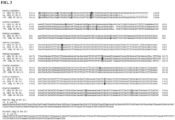
- Alleles A, C, and Vt, conferring resistance to DM may be defined as being on spinach linkage group 6 by common markers in sequence scaffolds SF34732 and SF63815 on the distal position and SFSF59002, SF95487, and SF90906 on the proximal position. Nucleotide sequences associated with and diagnostic for the resistance alleles are provided in SEQ ID - 25. Polymorphisms between alleles A, C, and Vt are shown in FIG. 3 .
- Aalleles providing broad-spectrum resistance to DM may be defined as from, or sharing, a genetic source selected from accessions SMBS011-1162M, SMB-66-1143M, and SSB-66-1131M, representative deposits of seed of which were made with the ATCC under accession numbers PTA-120472, PTA-12486, and PTA-12041, respectively.
- Described herein are methods of producing spinach plants with broad-spectrum resistance to DM, as well as spinach plants and parts thereof made by such methods.
- Nucleic acid sequences or genomic markers may be used to identify the alleles. These nucleic acid sequences may be used in the identification of polymorphisms or markers genetically linked in a spinach genome to the DM-resistance conferring alleles.
- food products derived from such plants and their method of production are also described herein.
- Genetic markers in linkage disequilibrium with DM-resistance alleles may permit efficient introduction of DM-resistance into essentially any spinach genome. This also results in significant economization by permitting substitution of costly, time-intensive, and potentially unreliable phenotypic assays. Further, breeding programs can be designed to explicitly drive the frequency of specific favorable phenotypes by targeting particular genotypes. Fidelity of these associations may be monitored continuously to ensure maintained predictive ability and, therefore, informed breeding decisions.
- DM-resistant phenotype such as from an accession described herein.
- the materials and methods described herein may be used to obtain an allele conferring broad-spectrum resistance to DM from any additional spinach accessions.
- DM resistance can be introgressed into any other spinach varieties.
- inbred lines derived from hybrids can be developed using plant breeding techniques as described above. New inbred lines can be crossed with other inbred lines and the hybrids from these crosses are evaluated to determine which of those have commercial potential.
- the techniques described herein may be used to identify desirable disease-resistant phenotypes by identifying genetic markers genetically linked to an allele or locus conferring such a phenotype.
- One of skill in the art may develop molecular marker assays based on, for example, SNPs and/or Indels in the spinach genome.
- Molecular marker assays useful to identify DM-resistant spinach plants described herein may be designed based on a sequence scaffold from spinach chromosome 6. Such techniques may also involve phenotypic assays to identify desired plants either alone or in combination with genetic assays, thereby also identifying a marker genotype associated with the trait that may be used for production of new varieties with the methods described herein.
- Transplanting can result in an earlier crop compared to a crop produced from direct seeding. Transplanting helps achieve complete plant stands rapidly, especially where higher seed costs, as with triploid seeds, make direct-seeding risky.
- Described herein is the identification of alleles from cultivated spinach and combinations thereof conferring broad-spectrum resistance to DM, as well as sequence scaffolds from spinach chromosome 6 that can be used for the tracking and introgression of the loci into desirable germplasm, such as by marker-assisted selection and/or marker-assisted backcrossing.
- resistance to DM conferred by alleles described herein may be introgressed from one genotype to another via marker-assisted selection. Accordingly, a germplasm source can be selected that has resistance to DM. Using these alleles, a breeder may select a spinach plant with resistance to DM, or track such a phenotype during breeding using marker-assisted selection for the region described herein. Screens with flanking markers may be sufficient to select progeny carrying desired DM resistance in pedigrees that segregate for a single resistance allele.
- markers can be complemented by phenotypic screens, for example with differential races showing a compatible interaction with one allele and an incompatible interaction with another, to select for individuals with desired resistance in populations segregating for two or more haplotypes.
- spinach plants described herein may comprise any heterozygous combinations of allele C, allele A, and allele Vt to confer broad DM resistance.
- alleles C and Vt can be present in a heterozygous spinach plant and confer resistance to Pfs races 1 - 8, 10 - 13, and to newly occurring Pfs isolate UA4712.
- alleles A and Vt can be present in a spinach plant and confer resistance to Pfs races 1 - 8 and 10 - 14, or alleles A and C can be present together in a spinach plant and confer resistance to Pfs races 1 - 8, 10 - 12, 14 and UA4712.
- Also described herein is a three-way hybrid that is resistant to all described DM races and isolate UA4712.
- Such a spinach plant comprising one or two alleles as described herein may be crossed with a second, distinct spinach plant comprising a second or third allele as described herein to produce a hybrid spinach plant comprising a beneficial set of alleles as described herein.
- the process of introgressing a novel resistance gene into acceptable commercial types can be a difficult process and may be complicated by factors such as linkage drag, epistasis, and low heritability.
- the heritability of a trait is the proportion of the phenotypic variation attributed to the genetic variance, which varies between 0 and 1.0. Thus, a trait with heritability near 1.0 is not greatly affected by the environment.
- Those skilled in the art recognize the importance of creating commercial lines with horticultural traits having high heritability because these cultivars will allow growers to produce a crop with uniform market specifications.
- the resistance alleles provided herein can be combined for improved resistance, particularly in fields where mixed populations of DM races may occur.
- the alleles described herein may be introgressed into parents of a hybrid via marker-assisted and/or phenotypic selection. Breeders may select alleles that mutually complement race-specificity to achieve broad resistance to DM.
- the described resistance donors are crossed to inbreds with demonstrated combining ability.
- the F1 resulting from each initial cross is then backcrossed with the recipient genotype, i.e. with the recurrent parent. Individuals carrying the resistance in the heterozygous phase are selected using marker-assisted and/or phenotypic selection. This backcross and selection step is repeated, for example, three times.
- a breeder may recover inbred spinach plants carrying the desired resistance allele from the progeny of each pedigree, introduced into the same genetic background as respective recurrent parents, preferably at least 95%, 96%, 97%, 98%, or 99% identical.
- Commercial, resistant cultivars are generated by crossing parental lines, each with a complementary resistance allele, thereby creating hybrids with superior resistance.
- an inbred spinach plant carrying a distinct resistance allele may be obtained that has been introduced into the same genetic background as the recurrent parent, preferably at least 95%, 96%, 97%, 98%, or 99% identical.
- different resistance alleles may be maintained in the same, fixed genetic background, i.e. in near-isogenic lines.
- the steps to create inbreds that are near-isogenic for resistance alleles can be applied to both inbred parents of any hybrid. Breeders may create three-way hybrids by crossing two near-isogenic lines derived from one parental line to generate an F1 seed parent.
- the F1 seed parent is crossed with the third parent carrying the complementary resistance allele.
- the resulting three-way hybrid is uniform, except for a complementary combination of DM resistance alleles.
- Hybrid plants consistently share the same genetic background as the recurrent parent, preferably at least 95%, 96%, 97%, 98%, or 99% identical, and carry various combinations of resistance alleles.
- the alleles provided herein allow for the consistent production of commercial varieties with broad DM resistance.
- described herein are alleles that can be used in different combinations to provide spinach plants for each area and/or region with distinct DM populations.
- a single variety can be obtained with a mix of resistance alleles to reduce pathogen pressure when resistance-breaking races or newly emerging isolates exist.
- Applicants have discovered three alleles from cultivated spinach, S . oleracea, that when present together in particular combinations in a hybrid (heterozygous) spinach plant, confer broad-spectrum resistance to DM.
- these alleles were found to be located on spinach chromosome 6 in a locus that may be defined by sequence scaffolds SF34732 and SF63815 on the distal position and SF59002, SF95487, and SF90906 on the proximal position, or sequences at least 95% identical thereto, including sequences at least 96%, 97%, 98%, 99%, or 100% identical thereto, as one of skill in the art would understand that polymorphisms may exist in such regions in different populations.
- Polymorphisms that may be used to identify or diagnose the presence of resistance alleles C, A, and/or Vt are shown in FIG. 3 .
- Examples of such nucleotide sequences are provided in SEQ ID NOs:1 - 25. These sequences may be used to identify or diagnose the presence or identity of a particular allele in a plant and thus identify plants that carry resistance to DM.
- One of skill in the art will further appreciate that many genetic markers can be located throughout the S. oleracea genome, and markers may be developed from SNPs and/or Indels in flanking sequences of the sequences described herein and in other fragments located throughout the S. oleracea genome. Such markers are useful in identifying the presence or absence of a resistance allele described herein.
- markers in the spinach genome are described in, for example, Khattak et al. (Euphytica 148:311-318, 2006 ).
- the identification of alleles and DM-resistance conferring alleles as set forth herein, allows the use of any other such markers in the same region and genetically linked (in linkage disequilibrium) therewith.
- genomic region, alleles, and polymorphic markers identified herein can be mapped relative to any publicly available physical or genetic map to place the region described herein on such map.
- additional polymorphic nucleic acids as described herein that are genetically linked to an allele associated with resistance to DM in spinach and that map within about 40 cM, 20 cM, 10 cM, 5 cM, or 1 cM of an allele or a marker associated with resistance to DM in spinach may also be used.
- markers and allelic states are therefore exemplary.
- One of skill in the art would recognize how to identify spinach plants with other polymorphic nucleic acid markers and allelic states thereof related to resistance to DM in spinach consistent with the present disclosure.
- One of skill the art would also know how to identify the allelic state of other polymorphic nucleic acid markers located in the genomic region(s) or linked to an allele or other markers identified herein, to determine their association with resistance to DM in spinach.
- markers for use in identifying the presence or absence of a resistance allele are markers for use in identifying the presence or absence of a resistance allele. Markers in the spinach genome that are not associated with or lack significant genetic linkage to the resistance locus allow the selection of genetic background.
- One example of background selection is recovery of the genome of a recipient parent in a recurring backcross scheme, an example of which is provided herein. In recurrent selection, multiple rounds of mating between sibs carrying favorable characteristics are carried out and selections made of progeny, allowing introduction of DM resistance-conferring alleles along with genetic diversity into a pedigree while maintaining favorable attributes of one or more elite parent. Examples of markers for spinach distributed genome-wide and that may be used in production of plants according to the methods described herein are known, for example, from Khattak et al. (Euphytica 148:311-318, 2006 ). The identification of DM resistance-conferring alleles set forth herein, concurrent with background selection, allows the use of any marker in the same genetic interval and
- spinach plants S . oleracea
- Marker-assisted introgression involves the transfer of a chromosomal region, defined by one or more markers, from one germplasm to a second germplasm.
- Offspring of a cross that contain an introgressed genomic region can be identified by the combination of markers characteristic of the desired introgressed genomic region from a first germplasm (e.g., germplasm with resistance to DM) and both linked and unlinked markers characteristic of the desired genetic background of a second germplasm.
- telomere proximal or centromere proximal markers that are immediately adjacent to a larger genomic region comprising the allele or locus can be used to introgress that smaller genomic region.
- Polymorphisms comprising as little as a single nucleotide change can be assayed in a number of ways. For example, detection can be made by electrophoretic techniques including a single-strand conformational polymorphism ( Orita et al. Genomics, 8(2):271-278, 1989 ), denaturing gradient gel electrophoresis (Myers EPO 0273085, 1985), or cleavage fragment length polymorphisms (Life Technologies, Inc., Gathersberg, MD 20877), although the widespread availability of DNA sequencing machines often makes it easier to just sequence amplified products directly.
- electrophoretic techniques including a single-strand conformational polymorphism ( Orita et al. Genomics, 8(2):271-278, 1989 ), denaturing gradient gel electrophoresis (Myers EPO 0273085, 1985), or cleavage fragment length polymorphisms (Life Technologies, Inc., Gathersberg, MD 20877), although the widespread availability of DNA sequencing machines often makes it easier to just sequence amplified products
- rapid assays can be designed for progeny testing, typically involving some version of PCR amplification of specific alleles (PASA, Sommer et al., Biotechniques 12(1):82-87, 1992 ), or PCR amplification of multiple specific alleles (PAMSA, Dutton et al., Biotechniques 11(6):700-702, 1991 ).
- polymorphic markers serve as a useful tool for fingerprinting plants to inform the degree of identity of lines or varieties ( U.S. Patent No. 6,207,367 ). These markers form the basis for determining associations with phenotypes and can be used to drive genetic gain.
- polymorphic nucleic acids can be used to detect in a spinach plant a genotype associated with resistance to DM, identify a spinach plant with a genotype associated with resistance to DM, and to select a spinach plant with a genotype associated with resistance to DM.
- polymorphic nucleic acids can be used to produce a spinach plant that comprises in its genome a combination of alleles associated with resistance to DM.
- polymorphic nucleic acids can be used to breed progeny spinach plants comprising a combination of alleles associated with resistance to DM.
- Certain genetic markers may include "dominant” or “codominant” markers.
- "Codominant” markers reveal the presence of two or more alleles (two per diploid individual).
- "Dominant” markers reveal the presence of only a single allele. Markers are preferably inherited in a codominant fashion so that the presence of both alleles at a diploid locus, or multiple alleles in triploid or tetraploid loci, are readily detectable, and they are free of environmental variation, i.e., their heritability is 1.
- a marker genotype typically comprises two marker alleles at each locus in a diploid organism.
- the marker allelic composition of each locus can be either homozygous or heterozygous.
- Homozygosity is a condition where both alleles at a locus are characterized by the same nucleotide sequence. Heterozygosity refers to different conditions of the allele at a locus.
- Nucleic acid-based analyses for determining the presence or absence of the genetic polymorphism can be used in breeding programs for identification, selection, introgression, and the like.
- a wide variety of genetic markers for the analysis of genetic polymorphisms are available and known to those of skill in the art. The analysis may be used to select for genes, portions of genes, QTL, alleles, or genomic regions that comprise or are linked to a genetic marker that is linked to or associated with a DM resistance phenotype.
- nucleic acid analysis methods include PCR-based detection methods (e.g., TaqMan assays), microarray methods, mass spectrometry-based methods and/or nucleic acid sequencing methods, including whole-genome sequencing.
- detection of polymorphic sites in a sample of DNA, RNA, or cDNA may be facilitated through the use of nucleic acid amplification methods.
- Such methods specifically increase the concentration of polynucleotides that span the polymorphic site, or include that site and sequences located either distal or proximal to it.
- Such amplified molecules can be readily detected by gel electrophoresis, or fluorescence detection methods.
- PCR polymerase chain reaction
- Polymorphisms in DNA sequences can be detected or typed by a variety of effective methods well known in the art including, but not limited to, those disclosed in U.S. Patent Nos. 5,468,613 ; 5,217,863 ; 5,210,015 ; 5,876,930 ; 6,030,787 ; 6,004,744 ; 6,013,431 ; 5,595,890 ; 5,762,876 ; 5,945,283 ; 5,468,613 ; 6,090,558 ; 5,800,944 ; 5,616,464 ; 7,312,039 ; 7,238,476 ; 7,297,485 ; 7,282,355 ; 7,270,981 ; and 7,250,252 .
- the methods of the present invention can be used in conjunction with any polymorphism typing method to type polymorphisms in genomic DNA samples. These genomic DNA samples used include genomic DNA isolated directly from a plant, cloned genomic DNA, or amplified genomic DNA.
- polymorphisms in DNA sequences can be detected by hybridization to allele-specific oligonucleotide (ASO) probes as disclosed in U.S. Patent Nos. 5,468,613 and 5,217,863 .
- ASO allele-specific oligonucleotide
- U.S. Patent No. 5,468,613 discloses allele specific oligonucleotide hybridizations where single or multiple nucleotide variations in nucleic acid sequence can be detected in nucleic acids by a process in which the sequence containing the nucleotide variation is amplified, spotted on a membrane and treated with a labeled sequence-specific oligonucleotide probe.
- Target nucleic acid sequence can also be detected by probe ligation methods as disclosed in U.S. Patent No. 5,800,944 , where a sequence of interest is amplified and hybridized to probes, followed by ligation to detect a labeled part of the probe.
- Microarrays can also be used for polymorphism detection, wherein oligonucleotide probe sets are assembled in an overlapping fashion to represent a single sequence such that a difference in the target sequence at one point would result in partial probe hybridization ( Borevitz et al., Genome Res. 13:513-523, 2003 ; Cui et al., Bioinformatics 21:3852-3858, 2005 ).
- target sequences which may represent genes and/or noncoding regions wherein each target sequence is represented by a series of overlapping oligonucleotides, rather than by a single probe. This platform provides for high throughput screening of a plurality of polymorphisms.
- Target nucleic acid sequence can also be detected by probe linking methods as disclosed in U.S. Patent No. 5,616,464 , employing at least one pair of probes having sequences homologous to adjacent portions of the target nucleic acid sequence and having side chains which non-covalently bind to form a stem upon base pairing of the probes to the target nucleic acid sequence. At least one of the side chains has a photoactivatable group that can form a covalent cross-link with the other side chain member of the stem.
- SBE methods include single base extension (SBE) methods.
- SBE methods include those disclosed in U.S. Patent Nos. 6,004,744 ; 6,013,431 ; 5,595,890 ; 5,762,876 ; and 5,945,283 .
- SBE methods are based on extension of a nucleotide primer that is adjacent to a polymorphism to incorporate a detectable nucleotide residue upon extension of the primer.
- the SBE method uses three synthetic oligonucleotides. Two of the oligonucleotides serve as PCR primers and are complementary to the sequence of the locus of genomic DNA which flanks a region containing the polymorphism to be assayed.
- the PCR product is mixed with the third oligonucleotide (called an extension primer), which is designed to hybridize to the amplified DNA adjacent to the polymorphism in the presence of DNA polymerase and two differentially labeled dideoxynucleoside triphosphates. If the polymorphism is present on the template, one of the labeled dideoxynucleoside triphosphates can be added to the primer in a single base chain extension. The allele present is then inferred by determining which of the two differential labels was added to the extension primer. Homozygous samples will result in only one of the two labeled bases being incorporated, and only one of the two labels will be detected. Heterozygous samples have both alleles present and will direct incorporation of both labels (into different molecules of the extension primer), and thus both labels will be detected.
- an extension primer the third oligonucleotide
- SNPs and Indels can be detected by methods disclosed in U.S. Patent Nos. 5,210,015 ; 5,876,930 ; and 6,030,787 , in which an oligonucleotide probe having a 5' fluorescent reporter dye and a 3' quencher dye covalently linked to the 5' and 3' ends of the probe.
- an oligonucleotide probe having a 5' fluorescent reporter dye and a 3' quencher dye covalently linked to the 5' and 3' ends of the probe.
- the proximity of the reporter dye to the quencher dye results in the suppression of the reporter dye fluorescence, e.g. by Forster-type energy transfer.
- forward and reverse primers hybridize to a specific sequence of the target DNA flanking a polymorphism, while the hybridization probe hybridizes to polymorphism-containing sequence within the amplified PCR product.
- a DNA polymerase with 5' ⁇ 3' exonuclease activity cleaves the probe and separates the reporter dye from the quencher dye resulting in increased fluorescence of the reporter.
- nucleic acid sequencing technologies An allele or locus of interest can be directly sequenced using nucleic acid sequencing technologies.
- Methods for nucleic acid sequencing are known in the art and include technologies provided by 454 Life Sciences (Branford, CT), Agencourt Bioscience (Beverly, MA), Applied Biosystems (Foster City, CA), LI-COR Biosciences (Lincoln, NE), NimbleGen Systems (Madison, WI), Illumina (San Diego, CA), and VisiGen Biotechnologies (Houston, TX).
- nucleic acid sequencing technologies comprise formats such as parallel bead arrays, sequencing by ligation, capillary electrophoresis, electronic microchips, "biochips,” microarrays, parallel microchips, and single-molecule arrays, as reviewed by R.F. Service Science 311:1544-1546, 2006 .
- Markers used in accordance with the present invention should preferably be diagnostic of origin in order for inferences to be made about subsequent populations.
- SNP markers may be ideal for mapping because the likelihood that a particular SNP allele is derived from independent origins in the extant populations of a particular species is very low. As such, SNP markers appear to be useful for tracking and assisting introgression of alleles or loci.
- plant includes plant cells, plant protoplasts, plant cells of tissue culture from which spinach plants can be regenerated, plant calli, plant clumps and plant cells that are intact in plants or parts of plants such as pollen, flowers, seeds, leaves, and stems.
- DM Downy mildew
- DM Downy mildew
- DM refers to a disease of plants, such as spinach, caused by a pathogen from the genus Peronospora, in particular Peronospora farinosa f. sp. Spinaciae (Pfs) .
- race refers to an officially designated strain of Peronospora farinosa f. sp. spinaciae (Pfs) that can cause DM.
- isolated refers to a newly occurring strain of Peronospora farinosa f. sp. spinaciae (Pfs) that can cause DM, and has not yet been officially named.
- a spinach plant with resistance to DM according to the present invention carries a combination of alleles selected from A, C, and Vt.
- the DM resistance may be to one or more known races of Peronospora farinosa f. sp.
- spinaciae or may be to one or more isolates of Peronospora farinosa f. sp. spinaciae.
- a plant of the invention may be defined as resistant to at least Peronospora farinosa f. sp. spinaciae Pfs 7, 8, 10, 11, 12, 13, and/or 14.
- the terms “pedigree,” “population,” and “progeny” mean a collection of plants that share a common parental derivation.
- variable means a group of similar plants that by their genetic pedigrees and performance can be identified from other varieties within the same species.
- an "allele” refers to one of two or more alternative forms of a genomic sequence at a given locus on a chromosome.
- QTL Quality of Trait Locus
- a "marker” means a detectable characteristic that can be used to discriminate between organisms. Examples of such characteristics include genetic markers, biochemical markers, metabolites, morphological characteristics, and agronomic characteristics.
- phenotype means the detectable characteristics of a cell or organism that can be influenced by gene expression.
- the term "resistance” means evasion and/or reduction of pathogen infection by plant innate immunity, which can be shown by the absence and/or reduction of disease symptoms when compared to a susceptible plant.
- the term "susceptible" means the infection of a plant by a pathogen, resulting in disease symptoms.
- compatible interaction means the infection of a susceptible plant by a pathogen, resulting in disease symptoms.
- the term "incompatible interaction” means the evasion and/or reduction of infection of a resistant plant by a pathogen, which can be shown by the absence and/or a reduction of disease symptoms.
- the term "genotype" means the specific allelic makeup of a plant.
- heterozygous phase means a diploid plant, such as spinach, that carries two distinct copies of an allele.
- homozygous phase means a diploid plant, such as spinach, that carries two identical copies of an allele.
- Introgressed when used in reference to a genetic locus, refers to a genetic locus that has been introduced into a new genetic background, such as through backcrossing. Introgression of a genetic locus can therefore be achieved through plant breeding methods and/or by molecular genetic methods.
- molecular genetic methods include various plant transformation techniques and/or methods that provide for homologous recombination, non-homologous recombination, site-specific recombination, and/or genomic modifications that provide for locus substitution or locus conversion.
- the term "linked,” when used in the context of nucleic acid markers and/or genomic regions, means that the markers and/or genomic regions are located on the same linkage group or chromosome such that they tend to segregate together at meiosis.
- the term "denoting" when used in reference to a plant genotype refers to any method whereby a plant is indicated to have a certain genotype. This includes any means of identification of a plant having a certain genotype. Indication of a certain genotype may include any entry into any type of written or electronic medium or database whereby the plant's genotype is provided. Indications of a certain genotype may also include any method where a plant is physically marked or tagged. Illustrative examples of physical marking or tags useful in the invention include, but are not limited to, a barcode, a radio-frequency identification (RFID), or a label.
- RFID radio-frequency identification
- a deposit was made of at least 2500 seeds of Spinacia oleracea accessions designated SMBS011-1162M, SMB-66-1143M, and SSB-66-1131M.
- the deposits were made with the American Type Culture Collection (ATCC), 10801 University Boulevard, Manassas, Va. 20110-2209 USA.
- ATCC American Type Culture Collection
- the deposits were assigned ATCC Accession Nos. PTA-120472, PTA-12486, and PTA-12041, respectively.
- the dates of deposit of these accessions were July 17, 2013, February 2, 2012, and August 19, 2011, respectively. Access to the deposits will be available during the pendency of the application to persons entitled thereto upon request.
- the deposits will be maintained in the ATCC Depository, which is a public depository, for a period of 30 years, or 5 years after the most recent request, or for the enforceable life of the patent, whichever is longer, and will be replaced if nonviable during that period..
- Example 1 Identification of novel resistance to DM races in Spinacia oleracea
- S. oleracea accessions in an internal genebank were screened.
- publicly available spinach hybrids that were either fully susceptible, or carried a combination of resistance specificities were included in the trial as susceptible and resistance checks.
- Infection was performed with Peronospora farinosa f. sp. spinaciae (Pfs) races 7, 8, and 10-14 to complement historic data on races 1-6. Race 9 is no longer present in the field.
- Pfs Peronospora farinosa f. sp. spinaciae
- a resistance-breaking isolate, collected in California (US) in the spring of 2013 was included. This isolate is currently referred to as UA4712 by the International Working Group on Peronospora and is a probable candidate for race Pfs 15.
- Inbred line SMBS011-1162M carrying an allele identified as allele A
- SMB-66-1143M included an allele designated Vt
- SMB-66-1143M was shown to be resistant to new isolate UA4712, in addition to races 1-10.
- Each of the identified alleles were found to confer DM resistance to different combinations of races.
- Example 2 Mapping resistance to DM
- the disease assay included 74 F3 families segregating for allele A, which were infected with Pfs race 8; 107 F3 families segregating for allele Vt challenged with races 7, 10, and 12; and 40 F3 families segregating for allele C, which were inoculated with race 10. Interestingly, when Vt-derived families demonstrated resistance to one race, immunity to the other two races was also observed.
- sequence scaffolds Based on public information, the likely position of sequence scaffolds designated SF34732, SF59002, SF62749, SF63815, SF90906, SF95487, and SF178637 co-located with DM resistance. Examples of nucleotide sequences corresponding to alleles C, A, and Vt conferring resistance to DM are provided as SEQ ID - 25. Additionally, polymorphisms between individual alleles of scaffolds are shown in FIG. 3 . Single nucleotide polymorphisms (SNPs) derived from these scaffolds were selected based on being polymorphic in one or more mapping populations.
- SNPs Single nucleotide polymorphisms
- the SNPs were converted to TaqMan (TM) assays and used for genotyping F2 individuals of the respective F3 families of each population. Linkage disequilibrium was tested, and the genetic distances among SNPs and phenotypes were estimated using Joinmap ( Stam, Plant J 3:739-744, 1993 ). Association analysis confirmed linkage of sequence scaffolds and resistance by assembly of single groups. This result was found to be independent of the source or race used for mapping ( FIG. 1 ). Observed recombination frequencies and derived genetic distances varied due to the distinct sample size of each population. Scaffolds SF59002 and SF95487 appeared to co-segregate in every population.
- Example 2 The genotype and phenotypes collected in Example 2 were used in a quantitative analysis with mapQTL, applying standard interval mapping settings (Van Ooijen, 1996).
- DM resistance mapped to Chromosome 6 independent of the source or isolate used.
- the resistance loci were delineated by common markers, on the distal position typically sequence scaffolds SF34732 and SF63815 and on the proximal position typically sequence scaffolds SF59002, SF95487 and SF90906.
- Example 4 Deployment of resistance alleles A, Vt, and C in hybrids.
- the resistance alleles A, C and Vt were introduced into a susceptible hybrid.
- the inbred SMBS011-1162M was used as a donors for allele A, the line SSB-66-1131M for Vt, and for allele C, SMB-66-1143M was used as a source.
- Each of the alleles was introgressed separately into both inbred parents of the susceptible hybrid, following breeding methods known in the art.
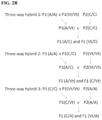
- a first spinach plant which is homozygous for allele A (A/A) was crossed to a second spinach plant (C/C) to generate a hybrid F1 which was heterozygous for alleles A and C ( FIG. 2A ).
- This hybrid was referred to as Single Hybrid A, or as F1(A/C).
- F1(A/C) was screened with known races and isolate UA4712 of Peronospora farinosa f. sp. spinaciae, as described in Example 5.
- the hybrid was found to be resistant to all Pfs races, with the exception of race 13 (Table 7).
- Hybrid A is also resistant to the newly emerging isolate UA4712.
- Hybrid B carrying alleles C and Vt ( FIG. 2B ) was screened as described and found to be resistant to all Pfs races except Pfs 14 (Table 7). This is important, as Pfs race 14 does not occur in Europe.
- a combination of alleles C and Vt in a spinach plant provides a fully resistant variety for the European market.
- Hybrid C with alleles A and Vt was resistant to all Pfs races except isolate UA4712 (Table 7). This is also significant, since the distribution of a new isolate is initially limited to few locations. F 1 (A/Vt) is resistant to all currently named Pfs races.
- Three-way hybrids were generated. Three-way hybrids are produced by crossing an F1 seed parent to an inbred parent P2. The F1 seed parent results from a cross between two near-isogenic lines of P1, each carrying a distinct resistance allele. The inbred parent P2 carries a third, complementary allele.
- a three-way hybrid allows the deployment of all three identified alleles in a mixed population of diploid hybrid plants. Three versions of the 3-way hybrid are possible ( FIG. 2B ). Each cross results in a population of hybrid plants with resistance to all known Pfs races and isolate UA4712. However, the frequency of each allele will depend on how the three-way cross is structured.
- Novel resistance originating from the genetic variety contained within cultivated spinach Spinacia oleracea was identified. This resistance is surprising because genetic diversity in cultivated crops is typically narrow ( Fernie et al., Curr. Opinion Pl. Biol. 9:196-202, 2006 ).
- the identification of the three unique resistance alleles, A, Vt, and/or C, in the three spinach lines provides for race-specific DM resistance breeding, with only intra-specific S. oleracea crosses. Additionally, these alleles allow stacking of resistance in single hybrid combinations that are unsurpassed in combining novel attributes, including resistance to all known Pfs races, to the new isolate UA4712, or resistance to all described European DM populations.
- Example 5 Assays for screening spinach accessions for resistance to DM
- Method of inoculation Sporulating leaves, taken from host plants that were infected seven days before, are thoroughly rinsed with sterile tap water (maximum 150 ml water per 224 plants). The spore suspension is filtered through cheesecloth and sprayed on test plants until the inoculum covers the leaves but does not run off. 150 ml of suspension is enough for up to 3 ⁇ 224 plants. Spore density should be 20,000 to 100,000 conidia/ml water. The spore suspension should be used fresh. As spinach downy mildew is wind-borne, sporulating plants should be kept in closed containers or isolated chambers to prevent any cross-contamination.
- Resistant controls are needed in each multiplication and in each test to ensure the race identity. Light and humidity conditions during seedling development and incubation are critical. Optimal humidity of approximately 80-90% RH allows plant growth and fungal growth; strong light inhibits spore germination and infection.
- the test should be carried out in wintertime with protection against direct sunshine. After inoculation, the plants should remain under plastic for three days. After this time, the plastic should be slightly raised during the daytime.
- Races Pfs: 1-8 and 10-13 of Peronospora farinosa f. sp. spinaciae are defined with a standard set of "differential varieties" according to Table 8. Table 8. Differential varieties to identify races: Races Pfs: 1-8 and 10-13 of Peronospora farinosa f. sp. spinaciae.
Landscapes
- Life Sciences & Earth Sciences (AREA)
- Health & Medical Sciences (AREA)
- Chemical & Material Sciences (AREA)
- Genetics & Genomics (AREA)
- Engineering & Computer Science (AREA)
- Organic Chemistry (AREA)
- Botany (AREA)
- Wood Science & Technology (AREA)
- Zoology (AREA)
- Biotechnology (AREA)
- Proteomics, Peptides & Aminoacids (AREA)
- Analytical Chemistry (AREA)
- General Health & Medical Sciences (AREA)
- Physics & Mathematics (AREA)
- Developmental Biology & Embryology (AREA)
- Environmental Sciences (AREA)
- Bioinformatics & Cheminformatics (AREA)
- General Engineering & Computer Science (AREA)
- Molecular Biology (AREA)
- Microbiology (AREA)
- Biophysics (AREA)
- Biochemistry (AREA)
- Physiology (AREA)
- Biomedical Technology (AREA)
- Mycology (AREA)
- Immunology (AREA)
- Spectroscopy & Molecular Physics (AREA)
- Plant Pathology (AREA)
- Cell Biology (AREA)
- Natural Medicines & Medicinal Plants (AREA)
- Measuring Or Testing Involving Enzymes Or Micro-Organisms (AREA)
- Breeding Of Plants And Reproduction By Means Of Culturing (AREA)
- Micro-Organisms Or Cultivation Processes Thereof (AREA)
Claims (14)
- Spinacia oleracea Spinatpflanze oder ein Samen, der die Pflanze erzeugt, oder ein Pflanzenteil der Pflanze, wobei die Pflanze, der Samen oder der Pflanzenteil in ihrem Genom eine heterozygote Allelkombination umfasst, die eine BreitspektrumResistenz gegen Peronospora farinosa f. sp. Spinaciae verleihen und die ausgewählt sind aus Allel A, Allel Vt und Allel C , wobei das Allel A eine Resistenz gegen Peronospora farinosa f. sp. Spinaciae Rassen 1, 3, 5, 7, 8, 11, 12, 13 und 14 verleiht und durch das Vorhandensein einer oder mehrerer von SEQ ID NO:2, SEQ ID NO:5, SEQ ID NO:7, SEQ ID NO:10, SEQ ID NO:13, SEQ ID NO:16, SEQ ID NO:19 oder SEQ ID NO:22 im Genom der Pflanze gekennzeichnet ist, wobei das Allel Vt eine Resistenz gegen Peronospora farinosa f. sp. Spinaciae Rassen 1, 2, 3, 4, 5, 6, 7, 8, 10, 11, 12 und 13 verleiht und durch das Vorhandensein einer oder mehrerer von SEQ ID NO:3, SEQ ID NO:6, SEQ ID NO:8, SEQ ID NO:11, SEQ ID NO:14, SEQ ID NO:17, SEQ ID NO:20 oder SEQ ID NO:23 im Genom der Pflanze gekennzeichnet ist, und wobei das Allel C eine Resistenz gegen Peronospora farinosa f. sp. Spinaciae Rassen 1, 2, 3, 4, 5, 6, 7, 8, 10 und Isolat UA4712 verleiht und durch das Vorhandensein einer oder mehrerer von SEQ ID NO:1, SEQ ID NO:4, SEQ ID NO:9, SEQ ID NO:12, SEQ ID NO:15, SEQ ID NO:18 oder SEQ ID NO:21 im Genom der Pflanze gekennzeichnet ist, und wobei eine Saatgutprobe, die das Allel A, Allel C oder Allel Vt umfasst, unter der ATCC-Zugangsnummer PTA-120472, ATCC-Zugangsnummer PTA-12486 bzw. ATCC-Zugangsnummer PTA-12041 hinterlegt ist.
- Spinatpflanze, Samen oder der Pflanzenteil nach Anspruch 1, wobei(a) die Allelkombination die Allele A und C umfasst, oder(b) die Allelkombination die Allele A und Vt umfasst, oder(c) die Allelkombination die Allele C und Vt umfasst.
- Spinatpflanze, Samen oder Pflanzenteil nach Anspruch 1, wobei(i) die Pflanze ein Inbred ist; oder(ii) die Pflanze ein Hybrid ist; oder(iii) die Spinatpflanze eine rezessive Resistenz gegen Peronospora farinosa f. sp. Spinaciae Rassen 7 und 13 aufweist.
- Pflanzenteil der Pflanze nach Anspruch 1, wobei der Pflanzenteil ein Blatt, ein Stängel, eine Wurzel, eine Blüte oder eine Zelle ist.
- Saatgut einer Spinatpflanze mit Breitspektrumresistenz gegen Peronospora farinosa f. sp. Spinaciae, erhältlich durch ein Verfahren, das Folgendes umfasst:(a) Kreuzen einer ersten Spinatpflanze und einer zweiten Spinatpflanze, wobei die erste und die zweite Spinatpflanze zusammen mindestens zwei Allele umfassen, die aus Allel A, Allel Vt und Allel C ausgewählt sind, wobei das Allel A durch das Vorhandensein einer oder mehrerer von SEQ ID NO:2, SEQ ID NO:5, SEQ ID NO:7, SEQ ID NO:10, SEQ ID NO:13, SEQ ID NO:16, SEQ ID NO:19 oder SEQ ID NO:22 im Genom der Pflanze gekennzeichnet ist, wobei das Allel Vt durch das Vorhandensein einer oder mehrerer von SEQ ID NO:3, SEQ ID NO:6, SEQ ID NO:8, SEQ ID NO:11, SEQ ID NO:14, SEQ ID NO:17, SEQ ID NO:20 oder SEQ ID NO:23 im Genom der Pflanze gekennzeichnet ist, und wobei das Allel C durch das Vorhandensein einer oder mehrerer von SEQ ID NO:1, SEQ ID NO:4, SEQ ID NO:9, SEQ ID NO:12, SEQ ID NO:15, SEQ ID NO:18 oder SEQ ID NO:21 im Genom der Pflanze gekennzeichnet ist, und wobei eine Saatgutprobe, die das Allel A, das Allel C oder das Allel Vt umfasst, unter der ATCC-Zugangsnummer PTA-120472, ATCC-Zugangsnummer PTA-12486 bzw. ATCC-Zugangsnummer PTA-12041 hinterlegt ist.(b) Gewinnung mindestens eines ersten Saatguts aus der Kreuzung, das eine heterozygote Kombination der Allele enthält, die eine Breitspektrumresistenz gegen Peronospora farinosa f. sp. Spinaciae verleiht.
- Saatgut nach Anspruch 5, wobei das Verfahren ferner die Gewinnung einer aus der Kreuzung resultierenden Saatgutpopulation umfasst, die eine heterozygote Kombination der Allele umfasst, die eine Breitspektrumresistenz gegen Peronospora farinosa f. sp. Spinaciae verleiht.
- Saatgut nach Anspruch 5, wobei(i) die erste Spinatpflanze das Allel A und die zweite Spinatpflanze das Allel C umfasst; oder(ii) die erste Spinatpflanze das Allel A und die zweite Spinatpflanze das Allel Vt umfasst; oder(iii) die erste Spinatpflanze das Allel C und die zweite Spinatpflanze das Allel Vt umfasst; oder(iv) die erste Spinatpflanze oder die zweite Spinatpflanze homozygot für das Allel A, das Allel Vt oder das Allel C ist; oder(v) die erste Spinatpflanze und die zweite Spinatpflanze homozygot für die beiden Allele sind, die aus Allel A, Allel Vt und Allel C ausgewählt sind.
- Das Saatgut nach Anspruch 5, wobei(i) das erste Allel das Allel A und das zweite Allel das Allel C ist; oder(ii) das erste Allel das Allel A und das zweite Allel ist das Allel Vt ist; oder(iii) das erste Allel das Allel C und das zweite Allel das Allel Vt ist.
- Spinatpflanze mit Resistenz gegen Peronospora farinosa f. sp. Spinaciae, wobei die Spinatpflanze durch ein Verfahren erhältlich ist, das Folgendes umfasst:(a) Kreuzen einer ersten Spinatpflanze, die in ihrem Genom ein erstes Allel aufweist, das aus A, Vt und C ausgewählt ist, wobei das Allel A durch das Vorhandensein einer oder mehrerer von SEQ ID NO:2, SEQ ID NO:5, SEQ ID NO:7, SEQ ID NO:10, SEQ ID NO:13, SEQ ID NO:16, SEQ ID NO:19 oder SEQ ID NO:22 im Genom der Pflanze gekennzeichnet ist, wobei das Allel Vt durch das Vorhandensein einer oder mehrerer von SEQ ID NO:3, SEQ ID NO:6, SEQ ID NO:8, SEQ ID NO:11, SEQ ID NO:14, SEQ ID NO:17, SEQ ID NO:20 oder SEQ ID NO:23 im Genom der Pflanze gekennzeichnet ist, und wobei das Allel C durch das Vorhandensein einer oder mehrerer von SEQ ID NO:1, SEQ ID NO:4, SEQ ID NO:9, SEQ ID NO:12, SEQ ID NO:15, SEQ ID NO:18 oder SEQ ID NO:21 im Genom der Pflanze gekennzeichnet ist, mit einer zweiten Spinatpflanze, die in ihrem Genom ein zweites unterschiedliches Allel aufweist, das aus den Allelen A, Vt und C ausgewählt ist, und wobei eine Saatgutprobe, die das Allel A, das Allel C oder das Allel Vt aufweist, unter den ATCC-Zugangsnummer PTA-120472, ATCC-Zugangsnummer PTA-12486 bzw. ATCC-Zugangsnummer PTA-12041 hinterlegt wurde;(b) Selektieren mindestens einer Nachkommenschaft, die das erste Allel für die Resistenz gegen Peronospora farinosa f. sp. Spinaciae umfasst, durch Nachweisen des Vorhandenseins einer Nukleinsäuresequenz im Genom der Nachkommenschaft, die aus SEQ ID NOs:1-23 ausgewählt ist.
- Spinatpflanze nach Anspruch 9, wobei die Kreuzung die Erzeugung einer Population von Nachkommenschaftspflanzen umfasst, wobei das Verfahren vorzugsweise das Screening der Nachkommenschaftspflanzen auf das Vorhandensein von mindestens zwei Nukleinsäuresequenzen, die ausgewählt sind aus SEQ ID NOs: 1-23, umfasst.
- Verfahren zur Identifizierung einer Pflanze, die ein gewünschtes Allel umfasst, das Resistenz gegen Peronospora farinosa f. sp. Spinaciae verleiht, wobei das Verfahren den Nachweis mindestens einer ersten polymorphen Nukleinsäuresequenz im Genom der Pflanze umfasst, die aus SEQ ID NOs:1-23 ausgewählt ist, wobei das gewünschte Allel aus den Allelen A, Vt und C ausgewählt ist, wobei das Allel A Resistenz gegen Peronospora farinosa f. sp. Spinaciae Rassen 1, 3, 5, 7, 8, 11, 12, 13 und 14 verleiht und durch das Vorhandensein einer oder mehrerer von SEQ ID NO:2, SEQ ID NO:5, SEQ ID NO:7, SEQ ID NO:10, SEQ ID NO:13, SEQ ID NÖ:16, SEQ ID NO:19 oder SEQ ID NO:22 im Genom der Pflanze gekennzeichnet ist, wobei das Allel Vt eine Resistenz gegen Peronospora farinosa f. sp. Spinaciae Rassen 1, 2, 3, 4, 5, 6, 7, 8, 10, 11, 12 und 13 verleiht und durch das Vorhandensein einer oder mehrerer von SEQ ID NO:3, SEQ ID NO:6, SEQ ID NO:8, SEQ ID NO:11, SEQ ID NO:14, SEQ ID NO:17, SEQ ID NO:20 oder SEQ ID NO:23 im Genom der Pflanze gekennzeichnet ist, und wobei das Allel C eine Resistenz gegen Peronospora farinosa f. sp. Spinaciae Rassen 1, 2, 3, 4, 5, 6, 7, 8, 10 und Isolat UA4712 verleiht und durch das Vorhandensein einer oder mehreren von SEQ ID NO:1, SEQ ID NO:4, SEQ ID NO:9, SEQ ID NO:12, SEQ ID NO:15, SEQ ID NO:18 oder SEQ ID NO:21 im Genom der Pflanze gekennzeichnet ist.
- Verfahren nach Anspruch 11, das ferner dadurch definiert ist, dass es den Nachweis von mindestens zwei polymorphen Nukleinsäuresequenzen im Genom der Pflanze umfasst, die aus SEQ ID NOs:1-23 ausgewählt sind, wobei das Vorhandensein der polymorphen Nukleinsäuresequenzen das Vorhandensein von mindestens zwei Allelen in der Pflanze anzeigt, die Resistenz gegen Peronospora farinosa f. sp. Spinaciae verleihen, ausgewählt aus den Allelen A, Vt und C, wobei das Allel A durch das Vorhandensein einer oder mehrerer von SEQ ID NO:2, SEQ ID NO:5, SEQ ID NO:7, SEQ ID NO:10, SEQ ID NO:13, SEQ ID NO:16, SEQ ID NO:19 oder SEQ ID NO:22 im Genom der Pflanze gekennzeichnet ist, wobei das Allel Vt durch das Vorhandensein einer oder mehrerer von SEQ ID NO:3, SEQ ID NO:6, SEQ ID NO:8, SEQ ID NO:11, SEQ ID NO:14, SEQ ID NO:17, SEQ ID NO:20 oder SEQ ID NO:23 im Genom der Pflanze gekennzeichnet ist, und wobei das Allel C durch das Vorhandensein einer oder mehrerer von SEQ ID NO:1, SEQ ID NO:4, SEQ ID NO:9, SEQ ID NO:12, SEQ ID NO:15, SEQ ID NO:18, oder SEQ ID NO:21 im Genom der Pflanze gekennzeichnet ist.
- Pflanze nach Anspruch 1, die nach dem Verfahren des Anspruchs 11 erhältlich ist.
- DNA-Sequenz, ausgewählt aus SEQ ID NOs: 1-23, wobei die DNA-Sequenz aus Spinacia oleracea stammt und wobei die DNA-Sequenz mit Resistenz gegen Peronospora farinosa f. sp. Spinaciae assoziiert ist.
Priority Applications (1)
| Application Number | Priority Date | Filing Date | Title |
|---|---|---|---|
| EP23207158.9A EP4324930A3 (de) | 2014-02-27 | 2015-02-27 | Zusammensetzungen und verfahren für peronsporaresistenz in spinat |
Applications Claiming Priority (1)
| Application Number | Priority Date | Filing Date | Title |
|---|---|---|---|
| US201461945675P | 2014-02-27 | 2014-02-27 |
Related Child Applications (1)
| Application Number | Title | Priority Date | Filing Date |
|---|---|---|---|
| EP23207158.9A Division EP4324930A3 (de) | 2014-02-27 | 2015-02-27 | Zusammensetzungen und verfahren für peronsporaresistenz in spinat |
Publications (2)
| Publication Number | Publication Date |
|---|---|
| EP2912940A1 EP2912940A1 (de) | 2015-09-02 |
| EP2912940B1 true EP2912940B1 (de) | 2023-11-01 |
Family
ID=52686095
Family Applications (2)
| Application Number | Title | Priority Date | Filing Date |
|---|---|---|---|
| EP23207158.9A Pending EP4324930A3 (de) | 2014-02-27 | 2015-02-27 | Zusammensetzungen und verfahren für peronsporaresistenz in spinat |
| EP15156928.2A Active EP2912940B1 (de) | 2014-02-27 | 2015-02-27 | Zusammensetzungen und verfahren für peronsporenresistenz in spinat |
Family Applications Before (1)
| Application Number | Title | Priority Date | Filing Date |
|---|---|---|---|
| EP23207158.9A Pending EP4324930A3 (de) | 2014-02-27 | 2015-02-27 | Zusammensetzungen und verfahren für peronsporaresistenz in spinat |
Country Status (8)
| Country | Link |
|---|---|
| US (2) | US10927386B2 (de) |
| EP (2) | EP4324930A3 (de) |
| JP (2) | JP6872307B2 (de) |
| AU (3) | AU2015200964A1 (de) |
| DK (1) | DK2912940T3 (de) |
| ES (1) | ES2971826T3 (de) |
| NZ (1) | NZ630710A (de) |
| PL (1) | PL2912940T3 (de) |
Families Citing this family (24)
| Publication number | Priority date | Publication date | Assignee | Title |
|---|---|---|---|---|
| NZ630628A (en) | 2013-10-08 | 2015-04-24 | Seminis Vegetable Seeds Inc | Methods and compositions for peronospora resistance in spinach |
| NZ630710A (en) * | 2014-02-27 | 2016-03-31 | Seminis Vegetable Seeds Inc | Compositions and methods for peronospora resistance in spinach |
| US11277983B2 (en) | 2015-11-10 | 2022-03-22 | Pop Vriend Seeds Bv | Peronospora resistance in spinacia sp |
| US10226014B2 (en) | 2015-11-10 | 2019-03-12 | Pop Vriend Research B.V. | Peronospora resistance in spinacia sp |
| US10226015B2 (en) | 2015-11-10 | 2019-03-12 | Pop Vriend Research B.V. | Peronospora resistance in Spinacia sp |
| EP4538387A3 (de) * | 2015-11-20 | 2025-06-18 | Rijk Zwaan Zaadteelt en Zaadhandel B.V. | Peronsporaresistenz in spinacia oleracea |
| WO2018059653A1 (en) | 2016-09-30 | 2018-04-05 | Rijk Zwaan Zaadteelt En Zaadhandel B.V. | Peronospora resistance in spinacia oleracea |
| US9402363B1 (en) | 2015-11-20 | 2016-08-02 | Rijk Zwaan Zaadteelt En Zaadhandel B.V. | Peronospora resistance in spinacia oleracea |
| EP3454645B1 (de) * | 2016-05-13 | 2024-08-21 | Rijk Zwaan Zaadteelt en Zaadhandel B.V. | Nicht-r-gen-vermittelte resistenz in spinat |
| EP3410845A1 (de) * | 2016-09-30 | 2018-12-12 | Rijk Zwaan Zaadteelt en Zaadhandel B.V. | Verfahren zur modifizierung des resistenzprofils von spinacia oleracea gegen falschen mehltau |
| WO2018059718A1 (en) | 2016-09-30 | 2018-04-05 | Rijk Zwaan Zaadteelt En Zaadhandel B.V. | Peronospora resistance in spinacia oleracea |
| US10633670B2 (en) | 2017-09-29 | 2020-04-28 | Rijk Zwaan Zaadteelt En Zaadhandel B.V. | Method for modifying the resistance profile of spinacia oleracea to downy mildew |
| US10674688B2 (en) | 2017-09-29 | 2020-06-09 | Rijk Zwaan Zaadteelt En Zaadhandel B.V. | Peronospora resistance in spinacia oleracea |
| KR102828592B1 (ko) * | 2018-01-26 | 2025-07-02 | 넌헴스 비.브이. | 적어도 페로노스포라 파리노사 레이스 8, 9, 11, 13 및 16에 대해 저항성인 시금치 식물 |
| US20200367460A1 (en) | 2018-01-26 | 2020-11-26 | Nunhems B.V. | Spinach plants resistant to at least peronospora farinosa races 8 and 10 to 16 |
| CN113573576B (zh) | 2018-12-21 | 2023-11-21 | 瑞克斯旺种苗集团公司 | 菠菜中的霜霉病抗性 |
| WO2021180949A1 (en) | 2020-03-12 | 2021-09-16 | Rijk Zwaan Zaadteelt En Zaadhandel B.V. | Peronospora resistance in spinacia oleracea |
| US11134630B1 (en) | 2020-03-31 | 2021-10-05 | Seminis Vegetable Seeds, Inc. | Spinach hybrid SVVB5873 and parents thereof |
| US11473102B2 (en) | 2020-10-30 | 2022-10-18 | Rijk Zwaan Zaadteelt En Zaadhandel B.V. | Peronospora resistance in Spinacia oleracea |
| EP4236681A1 (de) * | 2020-10-30 | 2023-09-06 | Rijk Zwaan Zaadteelt en Zaadhandel B.V. | Peronsporaresistenz in spinacia oleracea |
| CN116744787B (zh) * | 2020-10-30 | 2025-12-23 | 瑞克斯旺种苗集团公司 | 菠菜中的霜霉病抗性 |
| US11820993B2 (en) * | 2020-10-30 | 2023-11-21 | Rijk Zwaan Zaadteelt En Zaadhandel B.V. | Peronospora resistance in Spinacia oleracea |
| CN115896320B (zh) * | 2021-08-13 | 2024-10-18 | 中国农业科学院蔬菜花卉研究所 | 与菠菜抗霜霉病基因rpf2紧密连锁的snp分子标记及其应用 |
| TW202334411A (zh) * | 2021-11-01 | 2023-09-01 | 日商莎卡達種子股份有限公司 | 具有新穎露菌病抗性基因之菠菜植物及其植物體的一部分、葉、種子、以及該菠菜植物之露菌病抗性之預測方法、露菌病抗性菠菜植物之篩選方法及製造方法、以及此等方法所使用之套組 |
Citations (9)
| Publication number | Priority date | Publication date | Assignee | Title |
|---|---|---|---|---|
| US20120222147A1 (en) | 2011-02-25 | 2012-08-30 | Jan Dijkstra | Hybrid Spinach Variety Andromeda |
| US20130055456A1 (en) | 2011-08-30 | 2013-02-28 | Jan Hugo Den Braber | Spinach hybrid 51-330 |
| US20130055454A1 (en) | 2011-08-30 | 2013-02-28 | Jan Hugo Den Braber | Spinach hybrid 51-324 |
| US20130055455A1 (en) | 2011-08-30 | 2013-02-28 | Jan Hugo Den Braber | Spinach hybrid 51-326 |
| US20130055422A1 (en) | 2011-08-26 | 2013-02-28 | Bernardus Baerends | Spinach hybrid rx 06681616 and parents thereof |
| US20130198884A1 (en) | 2012-07-27 | 2013-08-01 | Jane Ane Dijkstra | Spinach hybrid variety nun 01084 |
| US20130198882A1 (en) | 2012-02-01 | 2013-08-01 | Bernardus Baerends | Spinach hybrid rx 06691714 and parents thereof |
| US20150020231A1 (en) | 2013-07-11 | 2015-01-15 | Seminis Vegetable Seeds, Inc. | Spinach hybrid sv1820vc and parents thereof |
| US20150036378A1 (en) | 2007-05-09 | 2015-02-05 | School Specialty Co. Of Oregon, Inc. | Pompon having elongate light-emitting objects |
Family Cites Families (76)
| Publication number | Priority date | Publication date | Assignee | Title |
|---|---|---|---|---|
| JPS56106567A (en) | 1980-01-23 | 1981-08-24 | Toshihiro Suzuki | Preparation of rice cake mixed with spinach |
| IL63907A0 (en) | 1980-09-24 | 1981-12-31 | Cetus Corp | Diagnostic method and antibody probe for use therein |
| ATE53862T1 (de) | 1982-01-22 | 1990-06-15 | Cetus Corp | Verfahren zur charakterisierung von hla und die darin benutzten cdns-testmittel. |
| US4582788A (en) | 1982-01-22 | 1986-04-15 | Cetus Corporation | HLA typing method and cDNA probes used therein |
| WO1984004758A1 (en) | 1983-05-26 | 1984-12-06 | Plant Resources Inst | Process for genetic mapping and cross-breeding thereon for plants |
| US4683194A (en) | 1984-05-29 | 1987-07-28 | Cetus Corporation | Method for detection of polymorphic restriction sites and nucleic acid sequences |
| US4683202A (en) | 1985-03-28 | 1987-07-28 | Cetus Corporation | Process for amplifying nucleic acid sequences |
| US4900659A (en) * | 1986-01-30 | 1990-02-13 | Enzo Biochem, Inc. | Nucleotide sequence composition and method for detection of Neisseria gonorrhoeae and method for screening for a nucleotide sequence that is specific for a genetically distinct group |
| JPS62179357A (ja) | 1986-01-31 | 1987-08-06 | Donarudo Cook:Kk | ほうれん草入り中華麺の製造法 |
| CA1284931C (en) | 1986-03-13 | 1991-06-18 | Henry A. Erlich | Process for detecting specific nucleotide variations and genetic polymorphisms present in nucleic acids |
| CA1338457C (en) | 1986-08-22 | 1996-07-16 | Henry A. Erlich | Purified thermostable enzyme |
| EP0273085A1 (de) | 1986-12-29 | 1988-07-06 | IntraCel Corporation | Verfahren zur Einführung fremder Nukleinsäuren in eukaryotische Zellen |
| US5217863A (en) | 1988-02-04 | 1993-06-08 | Medical Research Council | Detection of mutations in nucleic acids |
| IE61148B1 (en) | 1988-03-10 | 1994-10-05 | Ici Plc | Method of detecting nucleotide sequences |
| US6013431A (en) | 1990-02-16 | 2000-01-11 | Molecular Tool, Inc. | Method for determining specific nucleotide variations by primer extension in the presence of mixture of labeled nucleotides and terminators |
| US5210015A (en) | 1990-08-06 | 1993-05-11 | Hoffman-La Roche Inc. | Homogeneous assay system using the nuclease activity of a nucleic acid polymerase |
| US6004744A (en) | 1991-03-05 | 1999-12-21 | Molecular Tool, Inc. | Method for determining nucleotide identity through extension of immobilized primer |
| US5762876A (en) | 1991-03-05 | 1998-06-09 | Molecular Tool, Inc. | Automatic genotype determination |
| US5616464A (en) | 1994-12-27 | 1997-04-01 | Naxcor | Nucleic acid sequence detection employing amplification probes |
| US5538848A (en) | 1994-11-16 | 1996-07-23 | Applied Biosystems Division, Perkin-Elmer Corp. | Method for detecting nucleic acid amplification using self-quenching fluorescence probe |
| US5547781A (en) | 1994-03-02 | 1996-08-20 | Micron Communications, Inc. | Button-type battery with improved separator and gasket construction |
| CA2240667A1 (en) | 1995-12-18 | 1997-06-26 | Washington University | Method for nucleic acid analysis using fluorescence resonance energy transfer |
| EP2369007B1 (de) | 1996-05-29 | 2015-07-29 | Cornell Research Foundation, Inc. | Erkennung von Nukleinsäuresequenz-Unterschieden mittels der gleichzeitigen Ligaseerkennungs- und Polymerasekettenreaktion |
| AU9400398A (en) | 1997-09-19 | 1999-04-05 | Genetrace Systems, Inc. | Dna typing by mass spectrometry with polymorphic dna repeat markers |
| DE19824280B4 (de) | 1998-05-29 | 2004-08-19 | Bruker Daltonik Gmbh | Mutationsanalyse mittels Massenspektrometrie |
| US6613509B1 (en) | 1999-03-22 | 2003-09-02 | Regents Of The University Of California | Determination of base (nucleotide) composition in DNA oligomers by mass spectrometry |
| US7250252B2 (en) | 1999-12-30 | 2007-07-31 | David Aaron Katz | Amplification based polymorphism detection |
| US20070016976A1 (en) | 2000-06-23 | 2007-01-18 | Fumiaki Katagiri | Plant genes involved in defense against pathogens |
| US6913879B1 (en) | 2000-07-10 | 2005-07-05 | Telechem International Inc. | Microarray method of genotyping multiple samples at multiple LOCI |
| US6799122B2 (en) | 2001-08-31 | 2004-09-28 | Conagra Grocery Products Company | Method for identifying polymorphic markers in a population |
| US7297485B2 (en) | 2001-10-15 | 2007-11-20 | Qiagen Gmbh | Method for nucleic acid amplification that results in low amplification bias |
| ES2310237T3 (es) | 2002-02-21 | 2009-01-01 | Asm Scientific, Inc. | Amplificacion por recombinasa polimerasa. |
| AU2003220254B2 (en) | 2002-03-13 | 2008-09-18 | Syngenta Participations, Ag. | Nucleic acid detection method |
| US20050204780A1 (en) | 2002-05-09 | 2005-09-22 | The Furukawa Electric Co., Ltd. | Method for manufacturing optical fiber |
| AU2003258012A1 (en) | 2002-08-02 | 2004-02-23 | Orchid Cellmark Inc. | Methods and compositions for genotyping |
| JP3961530B2 (ja) | 2003-05-23 | 2007-08-22 | 富士通株式会社 | 光学素子、光伝送ユニット及び光伝送システム |
| US6996476B2 (en) | 2003-11-07 | 2006-02-07 | University Of North Carolina At Charlotte | Methods and systems for gene expression array analysis |
| US7328230B2 (en) | 2004-03-26 | 2008-02-05 | Intel Corporation | SIMD four-data element average instruction |
| EP1781793A2 (de) | 2004-06-16 | 2007-05-09 | Rijk Zwaan Zaadteelt en Zaadhandel B.V. | Reduzierte anfälligkeit gegenüber krankheitserregern, insbesondere comyzeten, wie falschem mehltau bei salat und spinat |
| US7480587B2 (en) | 2004-06-30 | 2009-01-20 | Intel Corporation | Method for adaptive performance margining with thermal feedback |
| US20060134663A1 (en) | 2004-11-03 | 2006-06-22 | Paul Harkin | Transcriptome microarray technology and methods of using the same |
| WO2007051483A1 (en) | 2005-11-01 | 2007-05-10 | Universiteit Utrecht Holding B.V. | Disease resistant plants |
| JP2008141994A (ja) | 2006-12-08 | 2008-06-26 | Nippon Suisan Kaisha Ltd | 咀嚼困難者用の冷凍成型惣菜 |
| WO2008092505A1 (en) | 2007-02-01 | 2008-08-07 | Enza Zaden Beheer B.V. | Disease resistant plants |
| US7939717B2 (en) | 2008-05-30 | 2011-05-10 | Seminis Vegetable Seeds, Inc. | Spinach line SSB66-1083F |
| US7935865B2 (en) | 2008-05-30 | 2011-05-03 | Seminis Vegetable Seeds, Inc. | Spinach line SMB66-1082F |
| US7935864B2 (en) | 2008-05-30 | 2011-05-03 | Seminis Vegetable Seeds, Inc. | Spinach line SMB66-1100M |
| US7939718B2 (en) * | 2008-05-30 | 2011-05-10 | Seminis Vegetable Seeds, Inc. | Spinach line OMB66-1101M |
| US7935866B2 (en) | 2008-07-29 | 2011-05-03 | Seminis Vegetable Seeds, Inc. | Spinach line SMB66-1086M |
| US7935868B2 (en) | 2008-07-29 | 2011-05-03 | Seminis Vegetable Seeds, Inc. | Spinach line MSA66-1119M |
| US7939719B2 (en) | 2008-07-29 | 2011-05-10 | Seminis Vegetable Seeds, Inc. | Spinach line SSB66-1092M |
| US7939720B2 (en) | 2008-07-29 | 2011-05-10 | Seminis Vegetable Seeds, Inc. | Spinach line SMB66-1114F |
| US7935867B2 (en) | 2008-07-29 | 2011-05-03 | Seminis Vegetable Seeds, Inc. | Spinach line SSB66-1087F |
| EA201290930A1 (ru) | 2010-03-18 | 2013-04-30 | Басф Плант Сайенс Компани Гмбх | Растения с улучшенными характеристиками урожайности и способ их получения |
| US9332724B2 (en) | 2010-10-27 | 2016-05-10 | Rijk Zwaan Zaadteelt En Zaadhandel B.V. | Spinach line SP6111 |
| US9265275B2 (en) | 2010-11-11 | 2016-02-23 | Rijk Zwaan Zaadteelt En Zaadhandel B.V. | Spinach line SP6504 |
| US20130243931A1 (en) | 2011-08-26 | 2013-09-19 | Seminis Vegetable Seeds, Inc. | Multileaf spinach |
| EP2586294A1 (de) | 2011-10-31 | 2013-05-01 | Rijk Zwaan Zaadteelt en Zaadhandel B.V. | Peronsporen-Widerstand in Spinacia Oleracea |
| US9615532B2 (en) | 2011-10-31 | 2017-04-11 | Rijk Zwaan Zaadteelt En Zaadhandel B.V. | Peronospora resistance in Sinacia oleracea |
| US20140006527A1 (en) * | 2011-12-19 | 2014-01-02 | Sara Winter | Method, system, and computer program for providing an intelligent collaborative content infrastructure |
| US8772573B2 (en) | 2012-02-08 | 2014-07-08 | Seminis Vegetable Seeds, Inc. | Spinach hybrid RX 06682141 |
| US8791331B2 (en) * | 2012-02-10 | 2014-07-29 | Seminis Vegetable Seeds, Inc. | Spinach hybrid RX 06692157 |
| US9307739B2 (en) * | 2012-08-29 | 2016-04-12 | Rijk Zwaan Zaadteelt En Zaadhandel B.V. | Hybrid spinach variety 51-335 RZ |
| US9295219B2 (en) | 2012-08-29 | 2016-03-29 | Rijk Zwaan Zaadteelt En Zaadhandel B.V. | Hybrid spinach variety 51-706 RZ |
| WO2015036378A1 (en) * | 2013-09-13 | 2015-03-19 | Nunhems B.V. | Spinach plants that are resistant to downy mildew |
| AU2014320398B2 (en) * | 2013-09-13 | 2020-09-10 | Nunhems B.V. | Spinach plants that are resistant to downy mildew |
| AU2014221305B2 (en) | 2013-09-13 | 2019-09-19 | Nunhems B.V. | Spinach plants that are resistant to downy mildew |
| US10258001B2 (en) * | 2013-09-13 | 2019-04-16 | Nunhems B.V. | Spinach plants that are resistant to downy mildew |
| US10258002B2 (en) * | 2013-09-13 | 2019-04-16 | Nunhems B.V. | Spinach plants that are resistant to downy mildew |
| US9593702B2 (en) * | 2013-09-20 | 2017-03-14 | Arconic Inc. | Manufacture and method for forming structures and the structures resulting therefrom |
| NZ630628A (en) | 2013-10-08 | 2015-04-24 | Seminis Vegetable Seeds Inc | Methods and compositions for peronospora resistance in spinach |
| NZ630710A (en) * | 2014-02-27 | 2016-03-31 | Seminis Vegetable Seeds Inc | Compositions and methods for peronospora resistance in spinach |
| US9402363B1 (en) * | 2015-11-20 | 2016-08-02 | Rijk Zwaan Zaadteelt En Zaadhandel B.V. | Peronospora resistance in spinacia oleracea |
| US10226016B2 (en) | 2016-05-13 | 2019-03-12 | Rijk Zwaan Zaadteelt En Zaadhandel B.V. | Non R-gene mediated resistance |
| EP3410845A1 (de) * | 2016-09-30 | 2018-12-12 | Rijk Zwaan Zaadteelt en Zaadhandel B.V. | Verfahren zur modifizierung des resistenzprofils von spinacia oleracea gegen falschen mehltau |
| US10633670B2 (en) | 2017-09-29 | 2020-04-28 | Rijk Zwaan Zaadteelt En Zaadhandel B.V. | Method for modifying the resistance profile of spinacia oleracea to downy mildew |
-
2014
- 2014-09-09 NZ NZ630710A patent/NZ630710A/en unknown
-
2015
- 2015-02-25 AU AU2015200964A patent/AU2015200964A1/en not_active Abandoned
- 2015-02-26 JP JP2015036977A patent/JP6872307B2/ja active Active
- 2015-02-26 US US14/632,871 patent/US10927386B2/en active Active
- 2015-02-27 PL PL15156928.2T patent/PL2912940T3/pl unknown
- 2015-02-27 ES ES15156928T patent/ES2971826T3/es active Active
- 2015-02-27 EP EP23207158.9A patent/EP4324930A3/de active Pending
- 2015-02-27 EP EP15156928.2A patent/EP2912940B1/de active Active
- 2015-02-27 DK DK15156928.2T patent/DK2912940T3/da active
-
2020
- 2020-10-22 JP JP2020177569A patent/JP7279004B2/ja active Active
-
2021
- 2021-01-14 US US17/149,521 patent/US20210214742A1/en not_active Abandoned
- 2021-05-14 AU AU2021203092A patent/AU2021203092A1/en not_active Abandoned
-
2024
- 2024-04-30 AU AU2024202808A patent/AU2024202808A1/en active Pending
Patent Citations (9)
| Publication number | Priority date | Publication date | Assignee | Title |
|---|---|---|---|---|
| US20150036378A1 (en) | 2007-05-09 | 2015-02-05 | School Specialty Co. Of Oregon, Inc. | Pompon having elongate light-emitting objects |
| US20120222147A1 (en) | 2011-02-25 | 2012-08-30 | Jan Dijkstra | Hybrid Spinach Variety Andromeda |
| US20130055422A1 (en) | 2011-08-26 | 2013-02-28 | Bernardus Baerends | Spinach hybrid rx 06681616 and parents thereof |
| US20130055456A1 (en) | 2011-08-30 | 2013-02-28 | Jan Hugo Den Braber | Spinach hybrid 51-330 |
| US20130055454A1 (en) | 2011-08-30 | 2013-02-28 | Jan Hugo Den Braber | Spinach hybrid 51-324 |
| US20130055455A1 (en) | 2011-08-30 | 2013-02-28 | Jan Hugo Den Braber | Spinach hybrid 51-326 |
| US20130198882A1 (en) | 2012-02-01 | 2013-08-01 | Bernardus Baerends | Spinach hybrid rx 06691714 and parents thereof |
| US20130198884A1 (en) | 2012-07-27 | 2013-08-01 | Jane Ane Dijkstra | Spinach hybrid variety nun 01084 |
| US20150020231A1 (en) | 2013-07-11 | 2015-01-15 | Seminis Vegetable Seeds, Inc. | Spinach hybrid sv1820vc and parents thereof |
Non-Patent Citations (13)
| Title |
|---|
| "Principles of plant genetics and breeding", 1 November 2006, BLACKWELL, ISBN: 978-1-4051-3646-4, article GEORGE ACQUAAH: "Chapter 20: Breeding for resistance to disease and insect pests.", pages: 279 - 384, XP009556932 |
| ANONYMOUS RIJK: "PIGEON RZ F1 (51-313)", RIJK ZWAAN PRODUCTS & SERVICES PRODUCTS > CROPS > SPINACH, RIJK ZWAAN USA, 20 May 2016 (2016-05-20), pages 1 - 1, XP093202908, Retrieved from the Internet <URL:http://www.rijkzwaanusa.com/wps/wcm/connect/RZ%2BUSA/Rijk%2BZwaan/Products_and_Services/Products/Crops/Spinach?pcpage=3&frm=1&varname=PIGEON%20RZ%20F1%20(51-313)&his=c293LCwwO2hhcnYsLDA7cGxhbnQsLDA7cmFkaW9zY2hlZCxoYXJ2LDA7> |
| ANONYMOUS: "ANTELOPE RZ F1 (51-324)", RIJK ZWAAN PRODUCTS & SERVICES PRODUCTS > CROPS > SPINACH, RIJK ZWAAN USA, 20 May 2016 (2016-05-20), pages 1 - 1, XP093202903, Retrieved from the Internet <URL:http://www.rijkzwaanusa.com/wps/wcm/connect/RZ%2BUSA/Rijk%2BZwaan/Products_and_Services/Products/Crops/Spinach?pcpage=3&frm=1&varname=ANTELOPE%20RZ%20F1%20(51-324)&his=c293LCwwO2hhcnYsLDA7cGxhbnQsLDA7cmFkaW9zY2hlZCxoYXJ2LDA7> |
| ANONYMOUS: "Caladonia - Leaflet", LEAFLET SPINACH CALADONIA, SEMINIS, 1 September 2012 (2012-09-01), pages 1 - 2, XP093202940, Retrieved from the Internet <URL:http://www.seminis.com/global/uk/products/Documents/ProductLeaflets/Spinach/UK_Caladonia_def%20LR.pdf> |
| ANONYMOUS: "Convenience Catalogue", RIJK ZWAAN CONVENIENCE CATALOGUE, RIJK ZWAAN DISTRIBUTION B.V., 14 November 2013 (2013-11-14), pages 1 - 46, XP093202869, Retrieved from the Internet <URL:https://issuu.com/rijkzwaanint/docs/rijk_zwaan_convenience_catalogus_20> |
| ANONYMOUS: "DROMEDARY RZ F1 (51-330)", RIJK ZWAAN PRODUCTS & SERVICES PRODUCTS > CROPS > SPINACH, RIJK ZWAAN USA, 20 May 2016 (2016-05-20), pages 1 - 1, XP093202911, Retrieved from the Internet <URL:http://www.rijkzwaanusa.com/wps/wcm/connect/RZ%2BUSA/Rijk%2BZwaan/Products_and_Services/Products/Crops/Spinach?pcpage=3&frm=1&varname=DROMEDARY%20RZ%20F1%20(51-330)&his=c293LCwwO2hhcnYsLDA7cGxhbnQsLDA7cmFkaW9zY2hlZCxoYXJ2LDA7> |
| ANONYMOUS: "GAZELLE RZ F1 (51-326)", RIJK ZWAAN PRODUCTS & SERVICES PRODUCTS > CROPS > SPINACH, RIJK ZWAAN USA, 20 May 2016 (2016-05-20), pages 1 - 1, XP093202914, Retrieved from the Internet <URL:http://www.rijkzwaanusa.com/wps/wcm/connect/RZ%2BUSA/Rijk%2BZwaan/Products_and_Services/Products/Crops/Spinach?pcpage=3&frm=1&varname=GAZELLE%20RZ%20F1%20(51-326)&his=c293LCwwO2hhcnYsLDA7cGxhbnQsLDA7cmFkaW9zY2hlZCxoYXJ2LDA7> |
| ANONYMOUS: "Spinach Fresh Market", NUNHEMS USA AND CANADA - CROPS, NUNHEMS USA AND CANADA, 21 September 2013 (2013-09-21), pages 1 - 1, XP093202862, Retrieved from the Internet <URL:https://web.archive.org/web/20130921081655/http://nunhems.com/www/NunhemsInternet.nsf/id/US_EN_Spinach_Fresh_Market> |
| ANONYMOUS: "Spinacia oleracea L. - Scorpius", NEDERLANDS RASSENREGISTER, RAAD VOOR PLANTENRASSEN, 9 September 2024 (2024-09-09), pages 1 - 1, XP093203014, Retrieved from the Internet <URL:https://nederlandsrassenregister.nl/rasdetail.aspx> |
| CHUNDA FENG, JAMES C. CORRELL, KATHERINE E. KAMMEIJER, STEVEN T. KOIKE: "Identification of New Races and Deviating Strains of the Spinach Downy Mildew Pathogen Peronospora farinosa f. sp. spinaciae", PLANT DISEASE, THE AMERICAN PHYTOPATHOLOGICAL SOCIETY, US, vol. 98, no. 1, 1 January 2014 (2014-01-01), US , pages 145 - 152, XP055257572, ISSN: 0191-2917, DOI: 10.1094/PDIS-04-13-0435-RE |
| CORRELL JIM, STEVE KOIKE, DIEDERIK SMILDE, JAN DE VISSER: "Denomination of Pfs: 15, a new race of downy mildew in spinach", PLANTUM PRESS RELEASE, PLANTUM, 2 September 2014 (2014-09-02), pages 1 - 2, XP093203002, Retrieved from the Internet <URL:https://web.archive.org/web/20150220151955/http://plantum.nl/Pers> |
| DATABASE CGN Germplasm 9 September 2024 (2024-09-09), ANONYMOUS: "Scorpius; Nun 01084 SPS spinach (Spinacia oleracea)", XP093203010, Database accession no. CGN25553 |
| JIM CORRELL, KOIKE STEVEN: "Project Title: Race diversity and the biology of the spinach downy mildew pathogen CLGRB Annual Report Project Investigators", 1 April 2013 (2013-04-01), XP055153926, Retrieved from the Internet <URL:http://calgreens.org/wp-content/uploads/2014/07/Correll-and-Koike-Race-diversity-and-the-biology-of-the-spinach-downy-mildew-pathogen.pdf> [retrieved on 20141119] |
Also Published As
| Publication number | Publication date |
|---|---|
| AU2024202808A1 (en) | 2024-06-27 |
| DK2912940T3 (da) | 2024-02-05 |
| JP2015231359A (ja) | 2015-12-24 |
| EP4324930A2 (de) | 2024-02-21 |
| PL2912940T3 (pl) | 2024-04-15 |
| EP2912940A1 (de) | 2015-09-02 |
| NZ630710A (en) | 2016-03-31 |
| AU2015200964A1 (en) | 2015-09-10 |
| US20210214742A1 (en) | 2021-07-15 |
| EP4324930A3 (de) | 2024-05-29 |
| AU2021203092A1 (en) | 2021-06-10 |
| US20150240256A1 (en) | 2015-08-27 |
| JP6872307B2 (ja) | 2021-05-19 |
| US10927386B2 (en) | 2021-02-23 |
| ES2971826T3 (es) | 2024-06-07 |
| JP7279004B2 (ja) | 2023-05-22 |
| JP2021019623A (ja) | 2021-02-18 |
Similar Documents
| Publication | Publication Date | Title |
|---|---|---|
| US20210214742A1 (en) | Compositions and methods for peronospora resistance in spinach | |
| AU2020223625B2 (en) | Methods and compositions for peronospora resistance in spinach | |
| US10316328B2 (en) | Melon plants with improved traits | |
| US20220330509A1 (en) | Xanthomonas resistant brassica oleracea plants | |
| US11319554B2 (en) | Cucumber mosaic virus resistant pepper plants | |
| WO2014169004A2 (en) | Methods for producing soybean plants with improved fungi resistance and compositions thereof |
Legal Events
| Date | Code | Title | Description |
|---|---|---|---|
| PUAI | Public reference made under article 153(3) epc to a published international application that has entered the european phase |
Free format text: ORIGINAL CODE: 0009012 |
|
| AK | Designated contracting states |
Kind code of ref document: A1 Designated state(s): AL AT BE BG CH CY CZ DE DK EE ES FI FR GB GR HR HU IE IS IT LI LT LU LV MC MK MT NL NO PL PT RO RS SE SI SK SM TR |
|
| AX | Request for extension of the european patent |
Extension state: BA ME |
|
| 17P | Request for examination filed |
Effective date: 20160302 |
|
| RBV | Designated contracting states (corrected) |
Designated state(s): AL AT BE BG CH CY CZ DE DK EE ES FI FR GB GR HR HU IE IS IT LI LT LU LV MC MK MT NL NO PL PT RO RS SE SI SK SM TR |
|
| 17Q | First examination report despatched |
Effective date: 20160804 |
|
| STAA | Information on the status of an ep patent application or granted ep patent |
Free format text: STATUS: EXAMINATION IS IN PROGRESS |
|
| GRAP | Despatch of communication of intention to grant a patent |
Free format text: ORIGINAL CODE: EPIDOSNIGR1 |
|
| STAA | Information on the status of an ep patent application or granted ep patent |
Free format text: STATUS: GRANT OF PATENT IS INTENDED |
|
| INTG | Intention to grant announced |
Effective date: 20230511 |
|
| GRAS | Grant fee paid |
Free format text: ORIGINAL CODE: EPIDOSNIGR3 |
|
| GRAA | (expected) grant |
Free format text: ORIGINAL CODE: 0009210 |
|
| STAA | Information on the status of an ep patent application or granted ep patent |
Free format text: STATUS: THE PATENT HAS BEEN GRANTED |
|
| AK | Designated contracting states |
Kind code of ref document: B1 Designated state(s): AL AT BE BG CH CY CZ DE DK EE ES FI FR GB GR HR HU IE IS IT LI LT LU LV MC MK MT NL NO PL PT RO RS SE SI SK SM TR |
|
| REG | Reference to a national code |
Ref country code: GB Ref legal event code: FG4D |
|
| REG | Reference to a national code |
Ref country code: CH Ref legal event code: EP |
|
| REG | Reference to a national code |
Ref country code: DE Ref legal event code: R096 Ref document number: 602015086306 Country of ref document: DE |
|
| REG | Reference to a national code |
Ref country code: IE Ref legal event code: FG4D |
|
| P01 | Opt-out of the competence of the unified patent court (upc) registered |
Effective date: 20231123 |
|
| REG | Reference to a national code |
Ref country code: DK Ref legal event code: T3 Effective date: 20240201 |
|
| REG | Reference to a national code |
Ref country code: NL Ref legal event code: FP |
|
| REG | Reference to a national code |
Ref country code: SE Ref legal event code: TRGR |
|
| REG | Reference to a national code |
Ref country code: LT Ref legal event code: MG9D |
|
| PG25 | Lapsed in a contracting state [announced via postgrant information from national office to epo] |
Ref country code: GR Free format text: LAPSE BECAUSE OF FAILURE TO SUBMIT A TRANSLATION OF THE DESCRIPTION OR TO PAY THE FEE WITHIN THE PRESCRIBED TIME-LIMIT Effective date: 20240202 |
|
| PG25 | Lapsed in a contracting state [announced via postgrant information from national office to epo] |
Ref country code: IS Free format text: LAPSE BECAUSE OF FAILURE TO SUBMIT A TRANSLATION OF THE DESCRIPTION OR TO PAY THE FEE WITHIN THE PRESCRIBED TIME-LIMIT Effective date: 20240301 |
|
| PG25 | Lapsed in a contracting state [announced via postgrant information from national office to epo] |
Ref country code: LT Free format text: LAPSE BECAUSE OF FAILURE TO SUBMIT A TRANSLATION OF THE DESCRIPTION OR TO PAY THE FEE WITHIN THE PRESCRIBED TIME-LIMIT Effective date: 20231101 |
|
| REG | Reference to a national code |
Ref country code: AT Ref legal event code: MK05 Ref document number: 1626100 Country of ref document: AT Kind code of ref document: T Effective date: 20231101 |
|
| PG25 | Lapsed in a contracting state [announced via postgrant information from national office to epo] |
Ref country code: AT Free format text: LAPSE BECAUSE OF FAILURE TO SUBMIT A TRANSLATION OF THE DESCRIPTION OR TO PAY THE FEE WITHIN THE PRESCRIBED TIME-LIMIT Effective date: 20231101 |
|
| PG25 | Lapsed in a contracting state [announced via postgrant information from national office to epo] |
Ref country code: LT Free format text: LAPSE BECAUSE OF FAILURE TO SUBMIT A TRANSLATION OF THE DESCRIPTION OR TO PAY THE FEE WITHIN THE PRESCRIBED TIME-LIMIT Effective date: 20231101 Ref country code: IS Free format text: LAPSE BECAUSE OF FAILURE TO SUBMIT A TRANSLATION OF THE DESCRIPTION OR TO PAY THE FEE WITHIN THE PRESCRIBED TIME-LIMIT Effective date: 20240301 Ref country code: GR Free format text: LAPSE BECAUSE OF FAILURE TO SUBMIT A TRANSLATION OF THE DESCRIPTION OR TO PAY THE FEE WITHIN THE PRESCRIBED TIME-LIMIT Effective date: 20240202 Ref country code: BG Free format text: LAPSE BECAUSE OF FAILURE TO SUBMIT A TRANSLATION OF THE DESCRIPTION OR TO PAY THE FEE WITHIN THE PRESCRIBED TIME-LIMIT Effective date: 20240201 Ref country code: AT Free format text: LAPSE BECAUSE OF FAILURE TO SUBMIT A TRANSLATION OF THE DESCRIPTION OR TO PAY THE FEE WITHIN THE PRESCRIBED TIME-LIMIT Effective date: 20231101 Ref country code: PT Free format text: LAPSE BECAUSE OF FAILURE TO SUBMIT A TRANSLATION OF THE DESCRIPTION OR TO PAY THE FEE WITHIN THE PRESCRIBED TIME-LIMIT Effective date: 20240301 |
|
| PG25 | Lapsed in a contracting state [announced via postgrant information from national office to epo] |
Ref country code: RS Free format text: LAPSE BECAUSE OF FAILURE TO SUBMIT A TRANSLATION OF THE DESCRIPTION OR TO PAY THE FEE WITHIN THE PRESCRIBED TIME-LIMIT Effective date: 20231101 Ref country code: NO Free format text: LAPSE BECAUSE OF FAILURE TO SUBMIT A TRANSLATION OF THE DESCRIPTION OR TO PAY THE FEE WITHIN THE PRESCRIBED TIME-LIMIT Effective date: 20240201 Ref country code: LV Free format text: LAPSE BECAUSE OF FAILURE TO SUBMIT A TRANSLATION OF THE DESCRIPTION OR TO PAY THE FEE WITHIN THE PRESCRIBED TIME-LIMIT Effective date: 20231101 Ref country code: HR Free format text: LAPSE BECAUSE OF FAILURE TO SUBMIT A TRANSLATION OF THE DESCRIPTION OR TO PAY THE FEE WITHIN THE PRESCRIBED TIME-LIMIT Effective date: 20231101 |
|
| REG | Reference to a national code |
Ref country code: ES Ref legal event code: FG2A Ref document number: 2971826 Country of ref document: ES Kind code of ref document: T3 Effective date: 20240607 |
|
| PG25 | Lapsed in a contracting state [announced via postgrant information from national office to epo] |
Ref country code: CZ Free format text: LAPSE BECAUSE OF FAILURE TO SUBMIT A TRANSLATION OF THE DESCRIPTION OR TO PAY THE FEE WITHIN THE PRESCRIBED TIME-LIMIT Effective date: 20231101 |
|
| PG25 | Lapsed in a contracting state [announced via postgrant information from national office to epo] |
Ref country code: SK Free format text: LAPSE BECAUSE OF FAILURE TO SUBMIT A TRANSLATION OF THE DESCRIPTION OR TO PAY THE FEE WITHIN THE PRESCRIBED TIME-LIMIT Effective date: 20231101 |
|
| PG25 | Lapsed in a contracting state [announced via postgrant information from national office to epo] |
Ref country code: SM Free format text: LAPSE BECAUSE OF FAILURE TO SUBMIT A TRANSLATION OF THE DESCRIPTION OR TO PAY THE FEE WITHIN THE PRESCRIBED TIME-LIMIT Effective date: 20231101 Ref country code: SK Free format text: LAPSE BECAUSE OF FAILURE TO SUBMIT A TRANSLATION OF THE DESCRIPTION OR TO PAY THE FEE WITHIN THE PRESCRIBED TIME-LIMIT Effective date: 20231101 Ref country code: RO Free format text: LAPSE BECAUSE OF FAILURE TO SUBMIT A TRANSLATION OF THE DESCRIPTION OR TO PAY THE FEE WITHIN THE PRESCRIBED TIME-LIMIT Effective date: 20231101 Ref country code: EE Free format text: LAPSE BECAUSE OF FAILURE TO SUBMIT A TRANSLATION OF THE DESCRIPTION OR TO PAY THE FEE WITHIN THE PRESCRIBED TIME-LIMIT Effective date: 20231101 Ref country code: CZ Free format text: LAPSE BECAUSE OF FAILURE TO SUBMIT A TRANSLATION OF THE DESCRIPTION OR TO PAY THE FEE WITHIN THE PRESCRIBED TIME-LIMIT Effective date: 20231101 |
|
| REG | Reference to a national code |
Ref country code: DE Ref legal event code: R026 Ref document number: 602015086306 Country of ref document: DE |
|
| PLBI | Opposition filed |
Free format text: ORIGINAL CODE: 0009260 |
|
| PLAX | Notice of opposition and request to file observation + time limit sent |
Free format text: ORIGINAL CODE: EPIDOSNOBS2 |
|
| 26 | Opposition filed |
Opponent name: RIJK ZWAAN ZAADTEELT EN ZAADHANDEL B.V. Effective date: 20240801 |
|
| PG25 | Lapsed in a contracting state [announced via postgrant information from national office to epo] |
Ref country code: MC Free format text: LAPSE BECAUSE OF FAILURE TO SUBMIT A TRANSLATION OF THE DESCRIPTION OR TO PAY THE FEE WITHIN THE PRESCRIBED TIME-LIMIT Effective date: 20231101 |
|
| REG | Reference to a national code |
Ref country code: CH Ref legal event code: PL |
|
| PG25 | Lapsed in a contracting state [announced via postgrant information from national office to epo] |
Ref country code: LU Free format text: LAPSE BECAUSE OF NON-PAYMENT OF DUE FEES Effective date: 20240227 |
|
| PG25 | Lapsed in a contracting state [announced via postgrant information from national office to epo] |
Ref country code: CH Free format text: LAPSE BECAUSE OF NON-PAYMENT OF DUE FEES Effective date: 20240229 |
|
| PG25 | Lapsed in a contracting state [announced via postgrant information from national office to epo] |
Ref country code: SI Free format text: LAPSE BECAUSE OF FAILURE TO SUBMIT A TRANSLATION OF THE DESCRIPTION OR TO PAY THE FEE WITHIN THE PRESCRIBED TIME-LIMIT Effective date: 20231101 |
|
| PG25 | Lapsed in a contracting state [announced via postgrant information from national office to epo] |
Ref country code: SI Free format text: LAPSE BECAUSE OF FAILURE TO SUBMIT A TRANSLATION OF THE DESCRIPTION OR TO PAY THE FEE WITHIN THE PRESCRIBED TIME-LIMIT Effective date: 20231101 Ref country code: LU Free format text: LAPSE BECAUSE OF NON-PAYMENT OF DUE FEES Effective date: 20240227 Ref country code: CH Free format text: LAPSE BECAUSE OF NON-PAYMENT OF DUE FEES Effective date: 20240229 |
|
| PLBB | Reply of patent proprietor to notice(s) of opposition received |
Free format text: ORIGINAL CODE: EPIDOSNOBS3 |
|
| PG25 | Lapsed in a contracting state [announced via postgrant information from national office to epo] |
Ref country code: IE Free format text: LAPSE BECAUSE OF NON-PAYMENT OF DUE FEES Effective date: 20240227 |
|
| PG25 | Lapsed in a contracting state [announced via postgrant information from national office to epo] |
Ref country code: IE Free format text: LAPSE BECAUSE OF NON-PAYMENT OF DUE FEES Effective date: 20240227 |
|
| PGFP | Annual fee paid to national office [announced via postgrant information from national office to epo] |
Ref country code: NL Payment date: 20250127 Year of fee payment: 11 |
|
| PGFP | Annual fee paid to national office [announced via postgrant information from national office to epo] |
Ref country code: DE Payment date: 20250121 Year of fee payment: 11 |
|
| PGFP | Annual fee paid to national office [announced via postgrant information from national office to epo] |
Ref country code: DK Payment date: 20250214 Year of fee payment: 11 |
|
| PGFP | Annual fee paid to national office [announced via postgrant information from national office to epo] |
Ref country code: ES Payment date: 20250306 Year of fee payment: 11 |
|
| PGFP | Annual fee paid to national office [announced via postgrant information from national office to epo] |
Ref country code: SE Payment date: 20250128 Year of fee payment: 11 |
|
| PGFP | Annual fee paid to national office [announced via postgrant information from national office to epo] |
Ref country code: BE Payment date: 20250123 Year of fee payment: 11 |
|
| PGFP | Annual fee paid to national office [announced via postgrant information from national office to epo] |
Ref country code: PL Payment date: 20250129 Year of fee payment: 11 Ref country code: FR Payment date: 20250121 Year of fee payment: 11 |
|
| PGFP | Annual fee paid to national office [announced via postgrant information from national office to epo] |
Ref country code: GB Payment date: 20250116 Year of fee payment: 11 Ref country code: IT Payment date: 20250129 Year of fee payment: 11 |
|
| PGFP | Annual fee paid to national office [announced via postgrant information from national office to epo] |
Ref country code: TR Payment date: 20250211 Year of fee payment: 11 |
|
| PLAB | Opposition data, opponent's data or that of the opponent's representative modified |
Free format text: ORIGINAL CODE: 0009299OPPO |
|
| PG25 | Lapsed in a contracting state [announced via postgrant information from national office to epo] |
Ref country code: CY Free format text: LAPSE BECAUSE OF FAILURE TO SUBMIT A TRANSLATION OF THE DESCRIPTION OR TO PAY THE FEE WITHIN THE PRESCRIBED TIME-LIMIT; INVALID AB INITIO Effective date: 20150227 |
|
| R26 | Opposition filed (corrected) |
Opponent name: RIJK ZWAAN ZAADTEELT EN ZAADHANDEL B.V. Effective date: 20240801 |
|
| PG25 | Lapsed in a contracting state [announced via postgrant information from national office to epo] |
Ref country code: HU Free format text: LAPSE BECAUSE OF FAILURE TO SUBMIT A TRANSLATION OF THE DESCRIPTION OR TO PAY THE FEE WITHIN THE PRESCRIBED TIME-LIMIT; INVALID AB INITIO Effective date: 20150227 |
|
| PG25 | Lapsed in a contracting state [announced via postgrant information from national office to epo] |
Ref country code: FI Free format text: LAPSE BECAUSE OF FAILURE TO SUBMIT A TRANSLATION OF THE DESCRIPTION OR TO PAY THE FEE WITHIN THE PRESCRIBED TIME-LIMIT Effective date: 20231101 |