EP2912079B1 - Beschichtungsmittel für mattierbare beschichtungen - Google Patents
Beschichtungsmittel für mattierbare beschichtungen Download PDFInfo
- Publication number
- EP2912079B1 EP2912079B1 EP13789221.2A EP13789221A EP2912079B1 EP 2912079 B1 EP2912079 B1 EP 2912079B1 EP 13789221 A EP13789221 A EP 13789221A EP 2912079 B1 EP2912079 B1 EP 2912079B1
- Authority
- EP
- European Patent Office
- Prior art keywords
- acid
- coating composition
- composition according
- groups
- dioxide
- Prior art date
- Legal status (The legal status is an assumption and is not a legal conclusion. Google has not performed a legal analysis and makes no representation as to the accuracy of the status listed.)
- Active
Links
Classifications
-
- C—CHEMISTRY; METALLURGY
- C08—ORGANIC MACROMOLECULAR COMPOUNDS; THEIR PREPARATION OR CHEMICAL WORKING-UP; COMPOSITIONS BASED THEREON
- C08G—MACROMOLECULAR COMPOUNDS OBTAINED OTHERWISE THAN BY REACTIONS ONLY INVOLVING UNSATURATED CARBON-TO-CARBON BONDS
- C08G18/00—Polymeric products of isocyanates or isothiocyanates
- C08G18/06—Polymeric products of isocyanates or isothiocyanates with compounds having active hydrogen
- C08G18/28—Polymeric products of isocyanates or isothiocyanates with compounds having active hydrogen characterised by the compounds used containing active hydrogen
- C08G18/40—High-molecular-weight compounds
- C08G18/42—Polycondensates having carboxylic or carbonic ester groups in the main chain
- C08G18/4205—Polycondensates having carboxylic or carbonic ester groups in the main chain containing cyclic groups
- C08G18/4208—Polycondensates having carboxylic or carbonic ester groups in the main chain containing cyclic groups containing aromatic groups
- C08G18/4211—Polycondensates having carboxylic or carbonic ester groups in the main chain containing cyclic groups containing aromatic groups derived from aromatic dicarboxylic acids and dialcohols
- C08G18/4216—Polycondensates having carboxylic or carbonic ester groups in the main chain containing cyclic groups containing aromatic groups derived from aromatic dicarboxylic acids and dialcohols from mixtures or combinations of aromatic dicarboxylic acids and aliphatic dicarboxylic acids and dialcohols
-
- B—PERFORMING OPERATIONS; TRANSPORTING
- B82—NANOTECHNOLOGY
- B82Y—SPECIFIC USES OR APPLICATIONS OF NANOSTRUCTURES; MEASUREMENT OR ANALYSIS OF NANOSTRUCTURES; MANUFACTURE OR TREATMENT OF NANOSTRUCTURES
- B82Y30/00—Nanotechnology for materials or surface science, e.g. nanocomposites
-
- C—CHEMISTRY; METALLURGY
- C08—ORGANIC MACROMOLECULAR COMPOUNDS; THEIR PREPARATION OR CHEMICAL WORKING-UP; COMPOSITIONS BASED THEREON
- C08G—MACROMOLECULAR COMPOUNDS OBTAINED OTHERWISE THAN BY REACTIONS ONLY INVOLVING UNSATURATED CARBON-TO-CARBON BONDS
- C08G18/00—Polymeric products of isocyanates or isothiocyanates
- C08G18/06—Polymeric products of isocyanates or isothiocyanates with compounds having active hydrogen
- C08G18/08—Processes
- C08G18/0804—Manufacture of polymers containing ionic or ionogenic groups
- C08G18/0819—Manufacture of polymers containing ionic or ionogenic groups containing anionic or anionogenic groups
- C08G18/0823—Manufacture of polymers containing ionic or ionogenic groups containing anionic or anionogenic groups containing carboxylate salt groups or groups forming them
-
- C—CHEMISTRY; METALLURGY
- C08—ORGANIC MACROMOLECULAR COMPOUNDS; THEIR PREPARATION OR CHEMICAL WORKING-UP; COMPOSITIONS BASED THEREON
- C08G—MACROMOLECULAR COMPOUNDS OBTAINED OTHERWISE THAN BY REACTIONS ONLY INVOLVING UNSATURATED CARBON-TO-CARBON BONDS
- C08G18/00—Polymeric products of isocyanates or isothiocyanates
- C08G18/06—Polymeric products of isocyanates or isothiocyanates with compounds having active hydrogen
- C08G18/08—Processes
- C08G18/10—Prepolymer processes involving reaction of isocyanates or isothiocyanates with compounds having active hydrogen in a first reaction step
- C08G18/12—Prepolymer processes involving reaction of isocyanates or isothiocyanates with compounds having active hydrogen in a first reaction step using two or more compounds having active hydrogen in the first polymerisation step
-
- C—CHEMISTRY; METALLURGY
- C08—ORGANIC MACROMOLECULAR COMPOUNDS; THEIR PREPARATION OR CHEMICAL WORKING-UP; COMPOSITIONS BASED THEREON
- C08G—MACROMOLECULAR COMPOUNDS OBTAINED OTHERWISE THAN BY REACTIONS ONLY INVOLVING UNSATURATED CARBON-TO-CARBON BONDS
- C08G18/00—Polymeric products of isocyanates or isothiocyanates
- C08G18/06—Polymeric products of isocyanates or isothiocyanates with compounds having active hydrogen
- C08G18/28—Polymeric products of isocyanates or isothiocyanates with compounds having active hydrogen characterised by the compounds used containing active hydrogen
- C08G18/30—Low-molecular-weight compounds
- C08G18/32—Polyhydroxy compounds; Polyamines; Hydroxyamines
- C08G18/3203—Polyhydroxy compounds
- C08G18/3206—Polyhydroxy compounds aliphatic
-
- C—CHEMISTRY; METALLURGY
- C08—ORGANIC MACROMOLECULAR COMPOUNDS; THEIR PREPARATION OR CHEMICAL WORKING-UP; COMPOSITIONS BASED THEREON
- C08G—MACROMOLECULAR COMPOUNDS OBTAINED OTHERWISE THAN BY REACTIONS ONLY INVOLVING UNSATURATED CARBON-TO-CARBON BONDS
- C08G18/00—Polymeric products of isocyanates or isothiocyanates
- C08G18/06—Polymeric products of isocyanates or isothiocyanates with compounds having active hydrogen
- C08G18/28—Polymeric products of isocyanates or isothiocyanates with compounds having active hydrogen characterised by the compounds used containing active hydrogen
- C08G18/30—Low-molecular-weight compounds
- C08G18/34—Carboxylic acids; Esters thereof with monohydroxyl compounds
- C08G18/348—Hydroxycarboxylic acids
-
- C—CHEMISTRY; METALLURGY
- C08—ORGANIC MACROMOLECULAR COMPOUNDS; THEIR PREPARATION OR CHEMICAL WORKING-UP; COMPOSITIONS BASED THEREON
- C08G—MACROMOLECULAR COMPOUNDS OBTAINED OTHERWISE THAN BY REACTIONS ONLY INVOLVING UNSATURATED CARBON-TO-CARBON BONDS
- C08G18/00—Polymeric products of isocyanates or isothiocyanates
- C08G18/06—Polymeric products of isocyanates or isothiocyanates with compounds having active hydrogen
- C08G18/28—Polymeric products of isocyanates or isothiocyanates with compounds having active hydrogen characterised by the compounds used containing active hydrogen
- C08G18/40—High-molecular-weight compounds
- C08G18/4009—Two or more macromolecular compounds not provided for in one single group of groups C08G18/42 - C08G18/64
-
- C—CHEMISTRY; METALLURGY
- C08—ORGANIC MACROMOLECULAR COMPOUNDS; THEIR PREPARATION OR CHEMICAL WORKING-UP; COMPOSITIONS BASED THEREON
- C08G—MACROMOLECULAR COMPOUNDS OBTAINED OTHERWISE THAN BY REACTIONS ONLY INVOLVING UNSATURATED CARBON-TO-CARBON BONDS
- C08G18/00—Polymeric products of isocyanates or isothiocyanates
- C08G18/06—Polymeric products of isocyanates or isothiocyanates with compounds having active hydrogen
- C08G18/28—Polymeric products of isocyanates or isothiocyanates with compounds having active hydrogen characterised by the compounds used containing active hydrogen
- C08G18/40—High-molecular-weight compounds
- C08G18/42—Polycondensates having carboxylic or carbonic ester groups in the main chain
- C08G18/44—Polycarbonates
-
- C—CHEMISTRY; METALLURGY
- C08—ORGANIC MACROMOLECULAR COMPOUNDS; THEIR PREPARATION OR CHEMICAL WORKING-UP; COMPOSITIONS BASED THEREON
- C08G—MACROMOLECULAR COMPOUNDS OBTAINED OTHERWISE THAN BY REACTIONS ONLY INVOLVING UNSATURATED CARBON-TO-CARBON BONDS
- C08G18/00—Polymeric products of isocyanates or isothiocyanates
- C08G18/06—Polymeric products of isocyanates or isothiocyanates with compounds having active hydrogen
- C08G18/28—Polymeric products of isocyanates or isothiocyanates with compounds having active hydrogen characterised by the compounds used containing active hydrogen
- C08G18/65—Low-molecular-weight compounds having active hydrogen with high-molecular-weight compounds having active hydrogen
- C08G18/6505—Low-molecular-weight compounds having active hydrogen with high-molecular-weight compounds having active hydrogen the low-molecular compounds being compounds of group C08G18/32 or polyamines of C08G18/38
- C08G18/6511—Low-molecular-weight compounds having active hydrogen with high-molecular-weight compounds having active hydrogen the low-molecular compounds being compounds of group C08G18/32 or polyamines of C08G18/38 compounds of group C08G18/3203
- C08G18/6517—Low-molecular-weight compounds having active hydrogen with high-molecular-weight compounds having active hydrogen the low-molecular compounds being compounds of group C08G18/32 or polyamines of C08G18/38 compounds of group C08G18/3203 having at least three hydroxy groups
-
- C—CHEMISTRY; METALLURGY
- C08—ORGANIC MACROMOLECULAR COMPOUNDS; THEIR PREPARATION OR CHEMICAL WORKING-UP; COMPOSITIONS BASED THEREON
- C08G—MACROMOLECULAR COMPOUNDS OBTAINED OTHERWISE THAN BY REACTIONS ONLY INVOLVING UNSATURATED CARBON-TO-CARBON BONDS
- C08G18/00—Polymeric products of isocyanates or isothiocyanates
- C08G18/06—Polymeric products of isocyanates or isothiocyanates with compounds having active hydrogen
- C08G18/28—Polymeric products of isocyanates or isothiocyanates with compounds having active hydrogen characterised by the compounds used containing active hydrogen
- C08G18/65—Low-molecular-weight compounds having active hydrogen with high-molecular-weight compounds having active hydrogen
- C08G18/6541—Low-molecular-weight compounds having active hydrogen with high-molecular-weight compounds having active hydrogen the low-molecular compounds being compounds of group C08G18/34
-
- C—CHEMISTRY; METALLURGY
- C08—ORGANIC MACROMOLECULAR COMPOUNDS; THEIR PREPARATION OR CHEMICAL WORKING-UP; COMPOSITIONS BASED THEREON
- C08G—MACROMOLECULAR COMPOUNDS OBTAINED OTHERWISE THAN BY REACTIONS ONLY INVOLVING UNSATURATED CARBON-TO-CARBON BONDS
- C08G18/00—Polymeric products of isocyanates or isothiocyanates
- C08G18/06—Polymeric products of isocyanates or isothiocyanates with compounds having active hydrogen
- C08G18/28—Polymeric products of isocyanates or isothiocyanates with compounds having active hydrogen characterised by the compounds used containing active hydrogen
- C08G18/65—Low-molecular-weight compounds having active hydrogen with high-molecular-weight compounds having active hydrogen
- C08G18/66—Compounds of groups C08G18/42, C08G18/48, or C08G18/52
- C08G18/6633—Compounds of group C08G18/42
- C08G18/6637—Compounds of group C08G18/42 with compounds of group C08G18/32 or polyamines of C08G18/38
- C08G18/664—Compounds of group C08G18/42 with compounds of group C08G18/32 or polyamines of C08G18/38 with compounds of group C08G18/3203
- C08G18/6644—Compounds of group C08G18/42 with compounds of group C08G18/32 or polyamines of C08G18/38 with compounds of group C08G18/3203 having at least three hydroxy groups
-
- C—CHEMISTRY; METALLURGY
- C08—ORGANIC MACROMOLECULAR COMPOUNDS; THEIR PREPARATION OR CHEMICAL WORKING-UP; COMPOSITIONS BASED THEREON
- C08G—MACROMOLECULAR COMPOUNDS OBTAINED OTHERWISE THAN BY REACTIONS ONLY INVOLVING UNSATURATED CARBON-TO-CARBON BONDS
- C08G18/00—Polymeric products of isocyanates or isothiocyanates
- C08G18/06—Polymeric products of isocyanates or isothiocyanates with compounds having active hydrogen
- C08G18/28—Polymeric products of isocyanates or isothiocyanates with compounds having active hydrogen characterised by the compounds used containing active hydrogen
- C08G18/65—Low-molecular-weight compounds having active hydrogen with high-molecular-weight compounds having active hydrogen
- C08G18/66—Compounds of groups C08G18/42, C08G18/48, or C08G18/52
- C08G18/6633—Compounds of group C08G18/42
- C08G18/6659—Compounds of group C08G18/42 with compounds of group C08G18/34
-
- C—CHEMISTRY; METALLURGY
- C08—ORGANIC MACROMOLECULAR COMPOUNDS; THEIR PREPARATION OR CHEMICAL WORKING-UP; COMPOSITIONS BASED THEREON
- C08G—MACROMOLECULAR COMPOUNDS OBTAINED OTHERWISE THAN BY REACTIONS ONLY INVOLVING UNSATURATED CARBON-TO-CARBON BONDS
- C08G18/00—Polymeric products of isocyanates or isothiocyanates
- C08G18/06—Polymeric products of isocyanates or isothiocyanates with compounds having active hydrogen
- C08G18/70—Polymeric products of isocyanates or isothiocyanates with compounds having active hydrogen characterised by the isocyanates or isothiocyanates used
- C08G18/72—Polyisocyanates or polyisothiocyanates
- C08G18/721—Two or more polyisocyanates not provided for in one single group C08G18/73 - C08G18/80
- C08G18/725—Combination of polyisocyanates of C08G18/78 with other polyisocyanates
-
- C—CHEMISTRY; METALLURGY
- C08—ORGANIC MACROMOLECULAR COMPOUNDS; THEIR PREPARATION OR CHEMICAL WORKING-UP; COMPOSITIONS BASED THEREON
- C08G—MACROMOLECULAR COMPOUNDS OBTAINED OTHERWISE THAN BY REACTIONS ONLY INVOLVING UNSATURATED CARBON-TO-CARBON BONDS
- C08G18/00—Polymeric products of isocyanates or isothiocyanates
- C08G18/06—Polymeric products of isocyanates or isothiocyanates with compounds having active hydrogen
- C08G18/70—Polymeric products of isocyanates or isothiocyanates with compounds having active hydrogen characterised by the isocyanates or isothiocyanates used
- C08G18/72—Polyisocyanates or polyisothiocyanates
- C08G18/73—Polyisocyanates or polyisothiocyanates acyclic
-
- C—CHEMISTRY; METALLURGY
- C08—ORGANIC MACROMOLECULAR COMPOUNDS; THEIR PREPARATION OR CHEMICAL WORKING-UP; COMPOSITIONS BASED THEREON
- C08G—MACROMOLECULAR COMPOUNDS OBTAINED OTHERWISE THAN BY REACTIONS ONLY INVOLVING UNSATURATED CARBON-TO-CARBON BONDS
- C08G18/00—Polymeric products of isocyanates or isothiocyanates
- C08G18/06—Polymeric products of isocyanates or isothiocyanates with compounds having active hydrogen
- C08G18/70—Polymeric products of isocyanates or isothiocyanates with compounds having active hydrogen characterised by the isocyanates or isothiocyanates used
- C08G18/72—Polyisocyanates or polyisothiocyanates
- C08G18/77—Polyisocyanates or polyisothiocyanates having heteroatoms in addition to the isocyanate or isothiocyanate nitrogen and oxygen or sulfur
- C08G18/78—Nitrogen
- C08G18/79—Nitrogen characterised by the polyisocyanates used, these having groups formed by oligomerisation of isocyanates or isothiocyanates
- C08G18/791—Nitrogen characterised by the polyisocyanates used, these having groups formed by oligomerisation of isocyanates or isothiocyanates containing isocyanurate groups
- C08G18/792—Nitrogen characterised by the polyisocyanates used, these having groups formed by oligomerisation of isocyanates or isothiocyanates containing isocyanurate groups formed by oligomerisation of aliphatic and/or cycloaliphatic isocyanates or isothiocyanates
-
- C—CHEMISTRY; METALLURGY
- C08—ORGANIC MACROMOLECULAR COMPOUNDS; THEIR PREPARATION OR CHEMICAL WORKING-UP; COMPOSITIONS BASED THEREON
- C08K—Use of inorganic or non-macromolecular organic substances as compounding ingredients
- C08K3/00—Use of inorganic substances as compounding ingredients
- C08K3/34—Silicon-containing compounds
- C08K3/346—Clay
-
- C—CHEMISTRY; METALLURGY
- C08—ORGANIC MACROMOLECULAR COMPOUNDS; THEIR PREPARATION OR CHEMICAL WORKING-UP; COMPOSITIONS BASED THEREON
- C08K—Use of inorganic or non-macromolecular organic substances as compounding ingredients
- C08K3/00—Use of inorganic substances as compounding ingredients
- C08K3/34—Silicon-containing compounds
- C08K3/36—Silica
-
- C—CHEMISTRY; METALLURGY
- C09—DYES; PAINTS; POLISHES; NATURAL RESINS; ADHESIVES; COMPOSITIONS NOT OTHERWISE PROVIDED FOR; APPLICATIONS OF MATERIALS NOT OTHERWISE PROVIDED FOR
- C09D—COATING COMPOSITIONS, e.g. PAINTS, VARNISHES OR LACQUERS; FILLING PASTES; CHEMICAL PAINT OR INK REMOVERS; INKS; CORRECTING FLUIDS; WOODSTAINS; PASTES OR SOLIDS FOR COLOURING OR PRINTING; USE OF MATERIALS THEREFOR
- C09D175/00—Coating compositions based on polyureas or polyurethanes; Coating compositions based on derivatives of such polymers
- C09D175/04—Polyurethanes
- C09D175/06—Polyurethanes from polyesters
-
- C—CHEMISTRY; METALLURGY
- C08—ORGANIC MACROMOLECULAR COMPOUNDS; THEIR PREPARATION OR CHEMICAL WORKING-UP; COMPOSITIONS BASED THEREON
- C08K—Use of inorganic or non-macromolecular organic substances as compounding ingredients
- C08K2201/00—Specific properties of additives
- C08K2201/011—Nanostructured additives
Definitions
- the present invention relates to a coating agent which is particularly suitable for the production of matt, elastic coatings. Further objects of the invention are a method for producing the coating composition, the use of the coating composition for producing a coating on a substrate, and a coating obtainable by application of the coating agent to a substrate.
- Polymer systems are described in the prior art which can be used to produce coatings on substrates which have high mechanical and chemical resistance. Such systems are for example in the EP 1 418 192 A1 described.
- the coating compositions of this prior art are based on aqueous polyurethane resins which are obtainable by reacting polycarbonate polyols, polyisocyanates and compounds capable of forming anions with at least two isocyanate-reactive groups.
- a particular problem is the provision of matt and especially deep matt coatings with high flexibility or deformability, because to produce very low gloss values correspondingly high levels of matting agent must be used.
- High concentrations of matting agents in the cured coatings affect their properties, such as flexibility and deformability in a negative way (for example, cracking occurs).
- coatings are desired that can be well matted, i. when matting to very low gloss values as little as possible lose their mechanical properties.
- Coatings made with the help of the EP 1 418 192 A1 known coating compositions are prepared, do not have sufficient elasticity in deep matte formulations,; their mattability is also too low.
- coatings which are applied to substrates with the aid of the coating compositions according to the invention have a high degree of elasticity at a very low degree of gloss. Therefore, these coatings survive mechanical deformation even at high strains without damage.
- an isocyanate-reactive group is understood to mean a group which can react with an isocyanate group to form a covalent bond.
- isocyanate-reactive groups are hydroxyl and amine groups.
- a group capable of forming anions is understood here to mean a group which can change from the molecular state into the anionic state.
- dicarboxylic acids, hydroxymonocarboxylic acid or dihydroxymonocarboxylic acid are suitable for this purpose.
- dicarboxylic acids examples include phthalic acid, isophthalic acid, terephthalic acid, tetrahydrophthalic acid, hexahydrophthalic acid, cyclohexanedicarboxylic acid, adipic acid, azelaic acid, sebacic acid, glutaric acid, tetrachlorophthalic acid, maleic acid, fumaric acid, itaconic acid, malonic acid, suberic acid, 2-methylsuccinic acid, 3,3-diethylglutaric acid, 2 , 2-dimethyl succinate.
- the corresponding anhydrides of these acids may also be suitable.
- monocarboxylic acids such as benzoic acid and hexanecarboxylic acid.
- functionality of the polyol is greater than 2.
- Saturated aliphatic or aromatic acids are preferred. These are, for example, adipic acid or isophthalic acid. If you like, it is also possible to use small amounts of polycarboxylic acid, such as trimellitic acid.
- Hydroxycarboxylic acids which serve as reactants in the preparation of the polyester polyols bear terminal hydroxyl groups. These are, for example, hydroxycaproic acid, hydroxybutyric acid, hydroxydecanoic acid, hydroxystearic acid and others thereof. Suitable lactones are, for example, caprolactones or butyrolactones.
- the nanoparticles may have a number-average particle size of 5 to 100 nm.
- the number-average particle size of the nanoparticles can be determined by transmission electron microscopy, light scattering, analytical ultracentrifuge or photon correlation spectroscopy.
- the nanoparticles have a specific surface area of from 100 m 2 / g to 1000 m 2 / g, preferably from 200 to 500 m 2 / g and particularly preferably from 250 to 400 m 2 / g.
- the determination of the specific surface of the nanoparticles can be carried out according to the BET method (DIN ISO 9277: 2003-05).
- the nanoparticles are inorganic nanoparticles.
- the nanoparticles may in particular comprise or consist of silica, titania, alumina, alumina, manganese dioxide, manganese oxide, zinc oxide, zinc dioxide, cerium oxide, cerium dioxide, iron oxide, iron dioxide and / or calcium carbonate. It is furthermore preferred here for the nanoparticles to be silica, titania, alumina, alumina, manganese dioxide, manganese oxide, zinc oxide, zinc dioxide, cerium oxide, cerium dioxide and / or include or consist of calcium carbonate. Particularly preferably, they can consist of silicon dioxide.
- the coating agent additionally comprises at least one matting agent d).
- suitable matting agents are Evonik's Acematt 3300, 3200, as well as Evonik's TS 100 and OK 412.
- the hydroxyl-containing component i) may be, for example, ethylene glycol, 1,2- and 1,3-propylene glycol, 1,3-, 1,4- and 2,3-butanediol, 1,6-hexanediol, 2, 5-hexanediol, trimethylhexanediol, diethylene glycol, triethylene glycol, hydrogenated bisphenol, 1,4-cyclohexanediol, 1,4-cyclohexanedimethanol, neopentyl glycol and / or trimethylpentanediol, trimethylolpropane and / or glycerol.
- component i) having hydroxyl groups is different from component ii).
- “different from” is to be understood as meaning that components i) and ii) have different chemical structures.
- the hydroxy-containing component i) comprises or consists of a polycarbonate polyol.
- Suitable polycarbonates are obtainable, for example, by reacting diphenyl carbonate, dimethyl carbonate or phosgene with polyols, preferably diols.
- diols there may e.g. Ethylene glycol, 1,2- and 1,3-propanediol, 1,3- and 1,4-butanediol, 1,6-hexanediol, 1,8-octanediol, neopentyl glycol, 1,4-bis-hydroxymethyl-cyclohexane, 2-methyl- 1,3-propanediol, 2,2,4-trimethylpentanediol-1,3, dipropylene glycol, polypropylene glycols, dibutylene glycol, polybutylene glycols, bisphenol A, tetrabromobisphenol A but also lactone-modified diols can be used.
- the diol 40 to 100 wt .-% of hexanediol, preferably 1,6-hexanediol and / or hexanediol derivatives, particularly preferably those which in addition to terminal OH groups ether or ester groups, e.g. Products obtained by reacting 1 mole of hexanediol with at least 1 mole, preferably 1 to 2 moles of caprolactone or by etherification of hexanediol with itself to di- or trihexylene glycol contains.
- the polycarbonate polyols are linear. However, if desired, they can be obtained by incorporating polyfunctional components, in particular low molecular weight polyols, be easily branched. For example, glycerol, trimethylolpropane, hexanetriol-1,2,6, butanetriol-1,2,4, trimethylolethane, pentaerythritol, quinitol, mannitol, and sorbitol, methyl glycoside or 1,3: 4,6-dianhydrohexitols are suitable for this purpose.
- polyfunctional components in particular low molecular weight polyols
- the polycarbonate polyol has a weight-average molecular weight of 500 to 3000 g / mol, preferably 650 to 2500 g / mol and particularly preferably 1000 to 2200 g / mol.
- the weight-average molecular weight of the polycarbonate polyol can be determined by GPC (gel permeation chromatography).
- the hydroxyl-containing polyesterpolyol ii) may, in particular, be compounds which have a number-average molecular weight M n of from 400 to 6,000 Da and preferably from 600 to 3,000 Da. Their hydroxyl number may be 22 to 400, preferably 50 to 300 and particularly preferably 80 to 200 mg KOH / g.
- the OH functionality may range from 1.5 to 6, preferably from 1.8 to 3, and more preferably from 1.9 to 2.5.
- Highly suitable hydroxy polyesters ii) are the known polycondensates of di- and optionally poly (tri, tetra) ols and di- and optionally poly (tri, tetra) carboxylic acids or hydroxycarboxylic acids or lactones.
- free polycarboxylic acids it is also possible to use the corresponding polycarboxylic acid anhydrides or corresponding polycarboxylic acid esters of lower alcohols for the preparation of the polyesters.
- diols examples include ethylene glycol, butylene glycol, diethylene glycol, triethylene glycol, polyalkylene glycols such as polyethylene glycol, furthermore propanediol or butanediol (1,4), preferred are hexanediol (1,6), neopentyl glycol or neopentyl glycol hydroxypivalate.
- polyols for example trimethylolpropane, glycerol, erythritol, pentaerythritol, trimethylolbenzene or trishydroxyethyl isocyanurate.
- Suitable dicarboxylic acids are, for example, phthalic acid, isophthalic acid, terephthalic acid, tetrahydrophthalic acid, hexahydrophthalic acid, cyclohexanedicarboxylic acid, adipic acid, azelaic acid, sebacic acid, glutaric acid, tetrachlorophthalic acid, maleic acid, fumaric acid, itaconic acid, malonic acid, suberic acid, 2-methylsuccinic acid, 3,3-diethylglutaric acid, 2,2- dimethylsuccinic.
- the possible anhydrides of these acids are also suitable.
- the anhydrides are always encompassed by the term "acid".
- Monocarboxylic acids such as benzoic acid and hexanecarboxylic acid can also be used, provided that the average functionality of the polyol is higher than 2.
- Saturated aliphatic or aromatic acids such as adipic acid or isophthalic acid are preferred.
- polycarboxylic acid such as trimellitic acid miteinafter.
- Hydroxycarboxylic acids which can be used as reactants in the preparation of a hydroxyl-terminated polyester polyol include hydroxycaproic acid, hydroxybutyric acid, hydroxydecanoic acid, hydroxystearic acid and the like.
- Suitable lactones are e.g. Caprolactone or butyrolactone.
- Suitable polyisocyanates iii) are e.g. Diisocyanates of the molecular weight range 140 to 400 having aliphatically, cycloaliphatically, araliphatically and / or aromatically bonded isocyanate groups, such as e.g.
- polyisocyanates or polyisocyanate mixtures of the type mentioned with exclusively aliphatically and / or cycloaliphatically bonded isocyanate groups.
- Particularly preferred are polyisocyanates or polyisocyanate mixtures based on HDI, IPDI and / or 4,4'-diisocyanatodicyclohexylmethane.
- those polyisocyanates which contain heteroatoms in the group linking the isocyanate groups and / or have a functionality of more than 2 isocyanate groups per molecule are also suitable.
- the former are prepared, for example, by modifying simple aliphatic, cycloaliphatic, araliphatic and / or aromatic diisocyanates prepared from at least two diisocyanates polyisocyanates with uretdione, isocyanurate, urethane, allophanate, biuret, carbodiimide, Iminooxadiazindion- and / or Oxadiazintrion Quilt ;
- a non-modified polyisocyanate having more than 2 isocyanate groups per molecule there may be mentioned, for example, 4-isocyanatomethyl-1,8-octane diisocyanate (nonane triisocyanate).
- the polyisocyanate iii) may in particular comprise an aliphatic isocyanate, preferably an aliphatic diisocyanate and more preferably at least one compound selected from the group of hexamethylene diisocyanate, isophorone diisocyanate, 1-isocyanato-4 - [(4-isocyanatocyclohexyl) methyl] cyclohexane.
- the compound iv) may be ionic or potentially ionic compounds.
- Examples are mono- and dihydroxycarboxylic acids, mono- and diaminocarboxylic acids, mono- and dihydroxysulfonic acids, mono- and diaminosulfonic acids and their salts, such as dihydroxycarboxylic acids, hydroxypivalic acid, N- (2-aminoethyl) - ⁇ , ⁇ -alanine, 2- (2-aminoethyl) ethylamino) -ethanesulfonic acid, ethylenediaminepropyl- or butylsulfonic acid, 1,2- or 1,3-propylenediamine- ⁇ -ethylsulfonic acid, lysine, 3,5-diaminobenzoic acid, the hydrophilizing agent according to Example 1 from the EP-A 0 916 647 and their alkali and / or ammonium salts; the adduct of sodium bisulfite with butene-2
- Preferred ionic or potential ionic compounds are those which have carboxy and / or carboxylate groups.
- Particularly preferred ionic compounds are dihydroxycarboxylic acids, in particular ⁇ , ⁇ -dimethylolalkanoic acids, such as 2,2-dimethylolacetic acid, 2,2-dimethylolpropionic acid, 2,2-dimethylolbutyric acid, 2,2-dimethylolpentanoic acid or dihydroxysuccinic acid.
- low molecular weight chain extenders having a molecular weight in the range from 60 to 400 Da and preferably from 62 to 200 Da and at least two isocyanate-reactive groups may also be reacted in the preparation of the hydroxy-functional prepolymer a).
- the chain extenders may be, for example, polyols or polyamines.
- Polyols suitable as chain extenders may be compounds having up to 20 carbon atoms per molecule, e.g. Ethylene glycol, diethylene glycol, triethylene glycol, 1,2-propanediol, 1,3-propanediol, 1,4-butanediol, 1,3-butylene glycol, cyclohexanediol, 1,4-cyclohexanedimethanol, 1,6-hexanediol, hydroquinone dihydroxyethyl ether, bisphenol A [2 , 2-bis (4-hydroxyphenyl) propane], hydrogenated bisphenol A (2,2-bis (4-hydroxycyclohexyl) propane) and mixtures thereof, as well as trimethylolpropane, glycerol or pentaerythritol.
- Ethylene glycol diethylene glycol, triethylene glycol, 1,2-propanediol, 1,3-propanediol, 1,4-butaned
- ester diols such as e.g. ⁇ -Hydroxybutyl- ⁇ -hydroxycaproic acid esters, ⁇ -hydroxy-hexyl- ⁇ -hydroxybutyric acid esters, adipic acid ( ⁇ -hydroxyethyl) esters or terephthalic acid bis ( ⁇ -hydroxyethyl) esters can be used.
- Suitable polyamines for chain extension are, for example, ethylenediamine, 1,2- and 1,3-diaminopropane, 1,4-diaminobutane, 1,6-diaminohexane, isophoronediamine, the mixture of isomers of 2,2,4- and 2,4,4-trimethylhexamethylenediamine, 2-methylpentamethylenediamine, diethylenetriamine, 1,3- and 1,4-xylylenediamine, ⁇ , ⁇ , ⁇ ', ⁇ '-tetramethyl-1,3- and 1,4-diaminodicyclohexylmethane, dimethylethylenediamine, hydrazine or adipic dihydrazide.
- hydroxy-functional prepolymer a) can also be reacted with a chain terminator.
- These building blocks are derived, for example, from monofunctional compounds reactive with isocyanate groups, such as monoamines, in particular mono-secondary amines or monoalcohols.
- polyurethane resin For the polyurethane resin also units can be used, which are located at the chain ends and covers this. These units are derived on the one hand from monofunctional, isocyanate-reactive components, in particular mono-secondary amines or monoalcohols. Some of these substances are exemplified below: methylamine, ethylamine, propylamine, butylamine, octylamine, laurylamine, stearylamine, isononyloxypropylamine, dimethylamine, diethylamine, dipropylamine, dibutylamine, N-methylaminopropylamine, diethyl (methyl) aminopropylamine, morpholine, piperidine, or substituted derivatives said compounds.
- monofunctional, isocyanate-reactive components in particular mono-secondary amines or monoalcohols.
- suitable compounds are substances containing active hydrogen atoms which can distinguish in reactivity between the isocyanate groups.
- These are, for example, molecules which in addition to a primary amino group also contain a secondary amino group or in addition to an OH group also a COOH group or in addition to an amino group (primary or secondary) also OH groups. Preference is given to components which, in addition to an amino group (primary or secondary), also contain OH groups.
- Examples of such primary / secondary amines are: 3-amino-1-methylaminopropane, 3-amino-1-ethylaminopropane, 3-amino-1-cyclohexylaminopropane, 3-amino-1-methylaminobutane; Mono-hydroxy-carboxylic acids, such as, for example, hydroxyacetic acid, lactic acid or maleic acid, and also alkanolamines, for example N-aminoethylethanolamine, ethanolamine, 3-aminopropanol, neopentanolamine, and, with appropriate preference, diethanolamine, methyldiethanolamine. In this way it is possible to introduce additional funtkionelle groups in the polymer.
- Mono-hydroxy-carboxylic acids such as, for example, hydroxyacetic acid, lactic acid or maleic acid
- alkanolamines for example N-aminoethylethanolamine, ethanolamine, 3-aminopropanol, n
- chain terminator compounds containing active hydrogen atoms with opposite to isocyanate groups of different reactivity are e.g. Compounds which, in addition to a primary amino group, also have secondary amino groups or in addition to an OH group also COOH groups or in addition to an amino group (primary or secondary) also OH groups. Preference is given to compounds which, in addition to an amino group (primary or secondary), also have OH groups.
- Examples of these are primary / secondary amines, such as 3-amino-1-methylaminopropane, 3-amino-1-ethylaminopropane, 3-amino-1-cyclohexylaminopropane, 3-amino-1-methylaminobutane; Monohydroxycarboxylic acids, such as hydroxyacetic acid, lactic acid or malic acid, furthermore alkanolamines, such as N-aminoethylethanolamine, ethanolamine, 3-aminopropanol, neopentanolamine and particularly preferably diethanolamine. In this way, additional functional groups can be introduced into the polymeric end product.
- primary / secondary amines such as 3-amino-1-methylaminopropane, 3-amino-1-ethylaminopropane, 3-amino-1-cyclohexylaminopropane, 3-amino-1-methylaminobutane
- Monohydroxycarboxylic acids such as
- the urethanization reaction in the prepolymer preparation can be carried out at temperatures of 0 ° to 140 ° C, depending on the reactivity of the polyisocyanate used.
- suitable catalysts such as those described in U.S. Pat Acceleration of the NCO-OH reaction are known in the art, can be used. Examples are tertiary amines such as triethylamine, organotin compounds such as dibutyltin oxide, dibutyltin dilaurate or tin bis (2-ethylhexanoate) or other organometallic compounds.
- Suitable crosslinkers are melamine formaldehyde or urea formaldehyde condensates, as described, for example, in US Pat DH Solomon, The Chemistry of Organic Filmformers, pages 235 et seq., John Wiley & Sons, Inc., New York, 1967 are described. But the melamine resins can also completely or partially against other amine resins such as those in Methods of Organic Chemistry (Houben-Weyl), Vol. 14/2, Part 2, 4th Edition, Georg Thieme Verlag, Stuttgart 1963, pages 319 ff , are replaced.
- crosslinking resins are blocked polyisocyanates based, for example, on isophorone diisocyanate, hexamethylene diisocyanate, 1,4-diisocyanatocyclohexane, bis (4-isocyanatocyclohexyl) methane, 1,3-diisocyanatobenzene, 1,4-diisocyanatobenzene, 2,4-diisocyanate-1 methyl-benzene, 1,3-diisocyanato-2-methylbenzene, 1,3-bisisocyanato-methylbenzene, 2,4-bis-isocyanato-methyl-1,5-dimethylbenzene, bis (4-isocyanato-phenyl) -propane, tris (4-isocyanato-phenyl ) methane and / or trimethyl-1,6-diisocyanatehexane.
- blocked isocyanate adducts such as biuret polyisocyanates based on 1,6-diisocyanatehexane; Isocyanurate polyisocyanates based on 1,6-diisocyanatehexane; or urethane-modified polyisocyanate adducts prepared from 2,4- and / or 2,6-diisocyanatotoluene or isophorone diisocyanate and low molecular weight polyhydroxyl components (such as trimethylolpropane, the isomeric propanediol or butanediol or mixtures of such polyhydroxyl component) wherein the isocyanate group of the polyisocyanate adduct is blocked.
- low molecular weight polyhydroxyl components such as trimethylolpropane, the isomeric propanediol or butanediol or mixtures of such polyhydroxyl component
- Suitable blocking agents for these polyisocyanates are monofunctional alcohols, such as methanol, ethanol, butanol, hexanol and benzyl alcohol; Oximes such as acetoxime and methyl ethyl ketoxime; Lactams such as epsiloncaprolactam; Phenol; and CH-acidic components such as diethyl malonate.
- crosslinkers are polyisocyanate crosslinkers, amide and amine-formaldehyde resins, phenolic resins, aldehyde resins and ketone resins such as phenol-formaldehyde resin, resoles, furan resins, urea resins, carbamic ester resins, triazine resins, melamine resins, benzoguanamine resins, cyanamide resins, aniline resins, as described in U.S. Pat 'Lackharze', D. Stoye, W.Freitag, Carl Hanser Verlag, Kunststoff, 1996 , is described.
- the crosslinker c) may have at least two isocyanate groups as hydroxy-reactive groups.
- Suitable isocyanate-functionalized crosslinking agents are, for example, low-viscosity, hydrophobic or hydrophilicized polyisocyanates with free isocyanate groups, based on aliphatic, cycloaliphatic, araliphatic and / or aromatic isocyanates, particularly preferably based on aliphatic or cycloaliphatic isocyanates, since this makes possible a particularly high level to adjust resistance in the paint film.
- the advantage of the binder dispersion in this invention is especially given in combination with these crosslinkers.
- the polyisocyanates can also be used as a mixture of the polyisocyanate and small amounts of inert solvents or inert solvent mixtures - to reduce the viscosity level.
- Triisocyanatnonans can also be used alone or in admixture with others as a crosslinking component.
- crosslinker c) has a viscosity at 23 ° C. of from 10 to 10 000 mPas.
- the viscosity of the crosslinker can be determined according to DIN 53019 at a shear rate of 40 s -1 .
- the coating composition according to the invention has a high storage stability.
- Another object of the present invention is a process for the preparation of the coating composition according to the invention, wherein in a first step, the aqueous dispersion prepared a), in a second step, a mixture of the aqueous dispersion a) and the nanoparticles b) and in a third Step the crosslinker is added to the mixture.
- the coating composition according to the invention for producing a coating on a substrate, in particular on a plastic substrate.
- Yet another object of the invention is a coating which is obtainable by application of the coating composition according to the invention to a substrate, in particular to a plastic substrate.
- Viscosity measurements were carried out in a cone-plate viscometer according to DIN 53019 at a shear rate of 40 s -1 .
- the acid number was determined according to DIN 53402 (mg KOH / g sample, titration with 0.1 mol / l NaOH solution).
- the solids content was determined according to DIN EN ISO 3251 (thick-film method: lid, 1 g sample, 1 h 125 ° C., convection oven).
- the OH number was determined in accordance with DIN 53240 (mg KOH / g sample, acetylation, hydrolysis, titration with 0.1 mol / l NaOH).
- the pH was measured according to International Standard ISO 976.
- Mn, Mw The molecular weight (Mn, Mw) was determined by GPC (gel permeation chromatography). The samples were analyzed using the eluent tetrahydrofuran according to DIN 55672-1.
- the mean particle size was measured by laser correlation spectroscopy.
- the polyurethane thus obtained was cooled to 90.degree. C.-100.degree. C., 102 g of dimethylethanolamine (degree of neutralization 70%) were added, and the mixture was homogenized. This was followed by the further processing of the resin to a dispersion at a temperature of 70 ° C - 80 ° C using demineralized water with vigorous stirring.
- silica nanoparticle dispersion was added to the resulting dispersion.
- the mixture was then homogenized at 40 ° C within one hour.
- the dispersion thus obtained showed a solids content of 48.6% by weight, an acid number of 15.3, a viscosity of 1040 mPas, a pH of 7.7 and an average particle size of 166 nm.
- the polyester resin thus obtained had a viscosity (determined as the flow time of an 80% strength solution of the polyester in methoxypropyl acetate in a DIN 4 cup at 23 ° C.) of 54 seconds and an OH number of 157 mg KOH / g.
- the polyurethane thus obtained was cooled to 90.degree. C.-100.degree. C., 93 g of dimethylethanolamine (degree of neutralization 70%) were added and the mixture was homogenized. This was followed by the further processing of the resin to a dispersion at a temperature of 70 ° C - 80 ° C using demineralized water with vigorous stirring.
- silica nanoparticle dispersion was added to the resulting dispersion.
- the mixture was then homogenized at 40 ° C within one hour.
- the dispersion thus obtained showed a solids content of 47.1% by weight, an acid value of 14.9, a viscosity of 1006 mPas, a pH of 7.6 and an average particle size of 158 nm.
- the polyester resin thus obtained had a viscosity (determined as the flow time of an 80% strength solution of the polyester in methoxypropyl acetate in a DIN 4 cup at 23 ° C.) of 54 seconds and an OH number of 166 mg KOH / g.
- the polyurethane thus obtained was cooled to 90.degree. C.-100.degree. C., 117 g of dimethylethanolamine (degree of neutralization 70%) were added and the mixture was homogenized. This was followed by the further processing of the resin to a dispersion at a temperature of 70 ° C - 80 ° C using demineralized water with vigorous stirring.
- silica nanoparticle dispersion was added to the resulting dispersion.
- the mixture was then homogenized at 40 ° C within one hour.
- the dispersion thus obtained showed a solids content of 49.8% by weight, an acid value of 15.9, a viscosity of 1106 mPas, a pH of 7.9 and an average particle size of 173 nm.
- the polyurethane thus obtained was cooled to 90.degree. C.-100.degree. C., 102 g of dimethylethanolamine (degree of neutralization 70%) were added and the mixture was homogenized. This was followed by the further processing of the resin to a dispersion at a temperature of 70 ° C - 80 ° C using demineralized water with vigorous stirring.
- the dispersion thus obtained showed a solids content of 53.6% by weight, an acid number of 18.3, a viscosity of 2360 mPas, a pH of 7.5 and an average particle size of 104 nm.
- the polyurethane thus obtained was cooled to 90.degree. C.-100.degree. C., 68 g of dimethylethanolamine (degree of neutralization 70%) were added and the mixture was homogenized. This was followed by the further processing of the resin to a dispersion at a temperature of 70 ° C - 80 ° C using demineralized water with vigorous stirring.
- silica nanoparticle dispersion was added to the resulting dispersion.
- the mixture was then homogenized at 40 ° C within one hour.
- the dispersion thus obtained showed a solids content of 47.1% by weight, an acid value of 19.9, a viscosity of 1610 mPas, a pH of 7.8 and an average particle size of 115 nm.
- aqueous 2K lacquers (Examples A and B) were applied by spraying on Makrofol sheets. The dry paint film was then examined for gloss values and haptics / elasticity.
- Example A the coatings based on Example A can be produced much duller films. Furthermore, it is also shown that A also gives significantly more elastic coatings.
Landscapes
- Chemical & Material Sciences (AREA)
- Organic Chemistry (AREA)
- Chemical Kinetics & Catalysis (AREA)
- Medicinal Chemistry (AREA)
- Polymers & Plastics (AREA)
- Health & Medical Sciences (AREA)
- Engineering & Computer Science (AREA)
- Materials Engineering (AREA)
- Nanotechnology (AREA)
- Life Sciences & Earth Sciences (AREA)
- Wood Science & Technology (AREA)
- Manufacturing & Machinery (AREA)
- Dispersion Chemistry (AREA)
- Composite Materials (AREA)
- Condensed Matter Physics & Semiconductors (AREA)
- General Physics & Mathematics (AREA)
- Crystallography & Structural Chemistry (AREA)
- Physics & Mathematics (AREA)
- Polyurethanes Or Polyureas (AREA)
- Paints Or Removers (AREA)
Description
- Die vorliegende Erfindung betrifft ein Beschichtungsmittel, das insbesondere zur Herstellung von matten, elastischen Beschichtungen geeignet ist. Weitere Gegenstände der Erfindung sind ein Verfahren zur Herstellung des Beschichtungsmittels, die Verwendung des Beschichtungsmittels zur Herstellung einer Beschichtung auf einem Substrat sowie eine Beschichtung, die durch Applikation des Beschichtungsmittels auf ein Substrat erhältlich ist.
- Im Stand der Technik sind Polymersysteme beschrieben, mit deren Hilfe Beschichtungen auf Substraten hergestellt werden können, die eine hohe mechanische und chemische Beständigkeit aufweisen. Derartige Systeme sind beispielweise in der
EP 1 418 192 A1 beschrieben. Die Beschichtungsmittel dieses Standes der Technik basieren auf wässrigen Polyurethanharzen, die durch Umsetzung von Polycarbonatpolyolen, Polyisocyanaten und zur Anionenbildung befähigten Verbindungen mit mindestens zwei gegenüber Isocyanatgruppen reaktive Gruppen erhältlich sind. - Ein besonderes Problem stellt die Bereitstellung matter und insbesondere tiefmatter Beschichtungen mit hoher Flexibilität oder Verformbarkeit dar, weil zur Erzeugung sehr niedriger Glanzwerte entsprechend hohe Mengen an Mattierungsmittel eingesetzt werden müssen. Hohe Konzentrationen von Mattierungsmitteln in den ausgehärteten Beschichtungen beeinflussen aber deren Eigenschaften, beispielsweise die Flexibilität und die Verformbarkeit in negativer Weise (so tritt beispielsweise Rissbildung auf). Für viele Anwendungen sind daher Beschichtungen gewünscht, die gut mattiert werden können, d.h. die bei Mattierung auf sehr niedrige Glanzwerte möglichst wenig ihrer mechanischen Eigenschaften einbüßen.
- Beschichtungen, die mit Hilfe der aus der
EP 1 418 192 A1 bekannten Beschichtungsmittel hergestellt werden, weisen in tiefmatten Formulierungen keine ausreichende Elastizität auf, ; ihre Mattierbarkeit ist darüber hinaus zu gering. - Es war daher die Aufgabe der vorliegenden Erfindung ein Beschichtungsmittel bereit zu stellen, mit dem matte und zugleich hochelastische Beschichtungen hergestellt werden können. Die zugrundeliegenden Bindemittel müssen eine sehr gute Mattierbarkeit aufweisen.
- Diese Aufgabe ist durch ein Beschichtungsmittel gelöst, dass
- a) eine wässrige Dispersion eines Hydroxy-funktionellen Prepolymers, erhältlich durch Umsetzung wenigstens der folgenden Komponenten:
- i) einer Hydroxy Gruppen aufweisenden Komponente, die ein Polycarbonatpolyol umfasst oder daraus besteht,
- ii) einem Hydroxy Gruppen aufweisenden Polyesterpolyol,
- iii) einem Isocyanat Gruppen aufweisendem Polyisocyanat,
- iv) einer Verbindung, die wenigstens zwei gegenüber Isocyanatgruppen reaktive Gruppen und wenigstens eine zur Anionenbildung befähigte Gruppe aufweist,
- v) Wasser,
- b) Nanopartikel mit einer zahlenmittleren Partikelgröße von 5 bis 100 nm und
- c) einen Vernetzer, der wenigstens zwei gegenüber Hydroxygruppen reaktive Gruppen aufweist.
- Es wurde überraschenderweise gefunden, dass Beschichtungen, die mit Hilfe der erfindungsgemäßen Beschichtungsmittel auf Substrate aufgebracht werden, bei sehr niedrigem Glanzgrad eine hohe Elastizität aufweisen. Daher überstehen diese Beschichtungen die mechanische Verformung auch bei hohen Dehnungen ohne Beschädigung.
- Vorliegend wird unter einer gegenüber Isocyanatgruppen reaktive Gruppe ein Gruppe verstanden, die mit einer Isocyanat Gruppe unter Ausbildung einer kovalenten Bindung reagieren kann. Beispiele für gegenüber Isocyanatgruppen reaktive Gruppen sind Hydroxyl- und Amingruppen.
- Unter einer zur Anionenbildung befähigten Gruppe wird vorliegend eine Gruppe verstanden, die vom molekularen Zustand in den anionischen Zustand übergehen kann. Hierzu eignen sich beispielsweise Dicarbonsäuren, Hydoxymonocarbonsäure oder Dihydroxymonocarbonsäure.
- Beispiele für geeignete Dicarbonsäuren sind Phthalsäure, Isophthalsäure, Terephthalsäure, Tetrahydrophthalsäure, Hexahydrophthalsäure, Cyclohexandicarbonsäure, Adipinsäure, Azelainsäure, Sebacinsäure, Glutarsäure, Tetrachlorphthalsäure, Maleinsäure, Fumarsäure, Itakonische Säure, Malonsäure, Suberische Säure, 2-Methylbernsteinsäure, 3,3-Diethylglutarsäure, 2,2-Dimethylbernsteinsäure. Die entspechenden Anhydride dieser Säuren können sich ebenfalls eignen.
- Es ist auch möglich Monocarbonsäuren, wie beispielsweise Benzoesäure und Hexancarbonsäure einzusetzen. Vorausgesetzt, die Funktionalität des Polyols ist größer 2. Gesättigte aliphatische oder aromatische Säuren sind bevorzugt. Dies sind beispielsweise Adipinsäure oder Isophthalsäure. Wenn man möchte, ist es ebenso möglich geringe Mengen an Polycarbonsäure einzusetzen, wie beispielsweise Trimellitsäure.
- Hydroxycarbonsäuren, die als Reaktionspartner bei der Herstellung der Polyesterpolyole dienen tragen endständige Hydroxylgruppen. Dies sind beispielsweise Hydroxycapronsäure, Hydroxybuttersäure, Hydroxydecansäure, Hydroxystearinsäure und andere entsprechende. Geeignete Laktone sind beispielsweise Caprolactone oder Butyrolactone.
- Gemäß einer ersten bevorzugten Ausführungsform der Erfindung können die Nanopartikel eine zahlenmittlere Partikelgröße von 5 bis 100 nm aufweisen.
- Die zahlenmittlere Partikelgröße der Nanopartikel kann gemäß Transmissionselektronenmikroskopie, Lichtstreuung, analytischer Ultrazentrifuge oder Photonenkorrelationsspektroskopie bestimmt werden.
- Ebenfalls bevorzugt ist, wenn die Nanopartikel eine spezifische Oberfläche von 100 m2/g bis 1000 m2/g, bevorzugt von 200 bis 500 m2/g und besonders bevorzugt von 250 bis 400 m2/g aufweisen.
- Die Bestimmung der spezifische Oberfläche der Nanopartikel kann gemäß BET-Methode (DIN ISO 9277:2003-05) erfolgen.
- Bevorzugt ist weiterhin, dass es sich bei den Nanopartikeln um anorganische Nanopartikel handelt.
- Die Nanopartikel können insbesondere Siliziumdioxid, Titandioxid, Aluminiumoxid, Aluminiumdioxid, Mangandioxid, Manganoxid, Zinkoxid, Zinkdioxid, Ceroxid, Cerdioxid, Eisenoxid, Eisendioxid und / oder Calciumcarbonat umfassen oder daraus bestehen. Bevorzugt ist hierbei weiterhin, dass die Nanopartikel Siliziumdioxid, Titandioxid, Aluminiumoxid, Aluminiumdioxid, Mangandioxid, Manganoxid, Zinkoxid, Zinkdioxid, Ceroxid, Cerdioxid und / oder Calciumcarbonat umfassen oder daraus bestehen. Besonders bevorzugt können sie aus Siliziumdioxid bestehen.
- In Weiterbildung der Erfindung ist vorgesehen, dass das Beschichtungsmittel zusätzlich wenigstens ein Mattierungsmittel d) umfasst.
- Bespiele für geeignete Mattierungsmittel sind Acematt 3300, 3200 von Evonik, als auch TS 100 und OK 412 von Evonik.
- Bei der Hydroxy Gruppen aufweisenden Komponente i) kann es sich beispielsweise um Ethylenglykol, 1,2- und 1,3-Propylenglykol, 1,3-, 1,4- und 2,3-Butandiol, 1,6-Hexandiol, 2,5-Hexandiol, Trimethylhexandiol, Diethylenglykol, Triethylenglykol, hydriertes Bisphenol, 1,4-Cyclohexandiol, 1,4-Cyclohexandimethanol, Neopentylglykol und/oder Trimethylpentandiol, Trimethylolpropan und/oder Glycerin handeln.
- Bevorzugt ist weiterhin, dass die Hydroxy Gruppen aufweisende Komponente i) verschieden von der Komponente ii) ist. Vorliegend ist unter "verschieden von" bevorzugt zu verstehen, dass die Komponenten i) und ii) unterschiedliche chemische Strukturen aufweisen.
- Die Hydroxy Gruppen aufweisende Komponente i) umfasst ein Polycarbonatpolyol oder besteht daraus.
- Geeignete Polycarbonate sind beispielsweise durch Umsetzung von Diphenylcarbonat, Dimethylcarbonat oder Phosgen mit Polyolen, bevorzugt Diolen erhältlich. Als Diole können dabei z.B. Ethylenglykol, 1,2- und 1,3-Propandiol, 1,3- und 1,4-Butandiol, 1,6-Hexandiol, 1,8-Octandiol, Neopentylglykol, 1,4-Bishydroxymethyl-cyclohexan, 2-Methyl-1,3-propandiol, 2,2,4-Trimethylpentandiol-1,3, Dipropylen-glykol, Polypropylenglykole, Dibutylenglykol, Polybutylenglykole, Bisphenol A, Tetrabrombisphenol A aber auch Lactonmodifizierte Diole verwendet werden. Bevorzugt ist, wenn das Diol 40 bis 100 Gew.-% Hexandiol, bevorzugt 1,6-Hexandiol und / oder Hexandiol-Derivate, besonders bevorzugt solche, die neben endständigen OH-Gruppen Ether- oder Estergruppen aufweisen, z.B. Produkte, die durch Umsetzung von 1 Mol Hexandiol mit mindestens 1 Mol, bevorzugt 1 bis 2 Mol Caprolacton oder durch Veretherung von Hexandiol mit sich selbst zum Di- oder Trihexylenglykol erhalten wurden, enthält.
- Auch die in der
DE-A 37 17 060 beschriebenen Polyether-Polycarbonatdiole können eingesetzt werden. - Bevorzugt sind die Polycarbonatpolyole linear aufgebaut. Sie können jedoch gegebenenfalls durch den Einbau polyfunktioneller Komponenten, insbesondere niedermolekularer Polyole, leicht verzweigt werden. Hierzu eignen sich beispielsweise Glycerin, Trimethylolpropan, Hexantriol-1,2,6, Butantriol-1,2,4, Trimethylolethan, Pentaerythrit, Chinit, Mannit, und Sorbit, Methylglykosid oder 1,3:4,6-Dianhydrohexite.
- Bevorzugt ist auch, wenn das Polycarbonatpolyol ein gewichtsmittleres Molekulargewicht von 500 bis 3000 g/mol, bevorzugt 650 bis 2500 g/mol und besonders bevorzugt 1000 bis 2200 g/mol aufweist.
- Das gewichtsmittlere Molekulargewicht des Polycarbonatpolyols kann mittels GPC (Gelpermeationschromatographie) bestimmt werden.
- Bei dem Hydroxy Gruppen aufweisenden Polyesterpolyol ii) kann es sich insbesondere um Verbindungen handeln, die ein zahlenmittleres Molekulargewicht Mn von 400 bis 6000 Da und bevorzugt von 600 bis 3000 Da aufweisen. Ihre Hydroxylzahl kann 22 bis 400, bevorzugt 50 bis 300 und besonders bevorzugt 80 bis 200 mg KOH/g betragen. Die OH-Funktionalität kann im Bereich von 1,5 bis 6, bevorzugt von 1,8 bis 3 und besonders bevorzugt von 1,9 bis 2,5 liegen.
- Gut geeignete Hydroxy Gruppen aufweisende Polyesterpolyole ii) sind die an sich bekannten Polykondensate aus Di- sowie gegebenenfalls Poly(Tri,Tetra)olen und Di- sowie gegebenenfalls Poly(Tri,-Tetra)carbonsäuren oder Hydroxycarbonsäuren oder Lactonen. Anstelle der freien Polycarbonsäuren können auch die entsprechenden Polycarbonsäureanhydride oder entsprechende Polycarbonsäureester von niederen Alkoholen zur Herstellung der Polyester verwendet werden. Beispiele für geeignete Diole sind Ethylenglykol, Butylenglykol, Diethylenglykol, Triethylenglykol, Polyalkylenglykole wie Polyethylenglykol, weiterhin Propandiol oder Butandiol(1,4), bevorzugt sind Hexandiol(1,6), Neopentylglykol oder Hydroxypivalinsäureneopentylglykolester. Gegebenenfalls können auch Polyole wie beispielsweise Trimethylolpropan, Glycerin, Erythrit, Pentaerythrit, Trimethylolbenzol oder Trishydroxyethylisocyanurat mitverwendet werden.
- Geeignete Dicarbonsäuren sind beispielsweise Phthalsäure, Isophthalsäure, Terephthalsäure, Tetrahydrophthalsäure, Hexahydrophthalsäure, Cyclohexandicarbonsäure, Adipinsäure, Azelainsäure, Sebacinsäure, Glutarsäure, Tetrachlorphthalsäure, Maleinsäure, Fumarsäure, Itaconsäure, Malonsäure, Korksäure, 2-Methylbernsteinsäure, 3,3-Diethylglutarsäure, 2,2-Dimethylbernsteinsäure. Die möglichen Anhydride dieser Säuren sind ebenfalls geeignet. Im Sinne der vorliegenden Erfindung werden die Anhydride immer durch den Ausdruck "Säure" mitumfasst.
- Es können auch Monocarbonsäuren, wie Benzoesäure und Hexancarbonsäure verwendet werden, vorausgesetzt, dass die mittlere Funktionalität des Polyols höher als 2 ist. Gesättigte aliphatische oder aromatische Säuren wie Adipinsäure oder Isophthalsäure sind bevorzugt. Gegebenenfalls können auch kleinere Mengen Polycarbonsäure, wie Trimellitsäure miteingesetzt werden.
- Hydroxycarbonsäuren, die als Reaktionsteilnehmer bei der Herstellung eines Polyesterpolyols mit endständigen Hydroxylgruppen verwendet werden können, sind beispielsweise Hydroxycapronsäure, Hydroxybuttersäure, Hydroxydecansäure, Hydroxystearinsäure und dergleichen. Geeignete Lactone sind z.B. Caprolacton oder Butyrolacton.
- Geeignete Polyisocyanate iii) sind z.B. Diisocyanate des Molekulargewichtsbereichs 140 bis 400 mit aliphatisch, cycloaliphatisch, araliphatisch und / oder aromatisch gebundenen Isocyanatgruppen, wie z.B. 1,4-Diisocyanatobutan, 1,6-Diisocyanatohexan (HDI), 2-Methyl-1,5-diisocyanatopentan, 1,5-Diisocyanato-2,2-dimethylpentan, 2,2,4- bzw. 2,4,4-Trimethyl-1,6-diisocyanatohexan, 1,10-Diisocyanatodecan, 1,3- und 1,4-Diisocyanatocyclohexan, 1,3- und 1,4-Bis-(isocyanatomethyl)-cyclohexan, 1-Isocyanato-3,3,5-trimethyl-5-isocyanatomethylcyclohexan (Isophorondiisocyanat, IPDI), 4,4'-Diisocyanatodicyclohexylmethan, 1-Isocyanato-1-methyl-4(3)isocyanatomethylcyclohexan, Bis-(isocyanatomethyl)-norbornan, 1,3- und 1,4-Bis-(2-isocyanato-prop-2-yl)-benzol (TMXDI), 2,4- und 2,6-Diisocyanatotoluol (TDI), 2,4'- und 4,4'-Diisocyanatodiphenylmethan, 1,5-Diisocyanatonaphthalin oder beliebige Gemische solcher Diisocyanate. Bevorzugt handelt es sich um Polyisocyanate oder Polyisocyanatgemische der genannten Art mit ausschließlich aliphatisch und / oder cycloaliphatisch gebundenen Isocyanatgruppen. Besonders bevorzugte sind Polyisocyanate oder Polyisocyanatgemische auf Basis von HDI, IPDI und / oder 4,4'-Diisocyanatodicyclohexylmethan.
- Neben diesen einfachen Diisocyanaten sind auch solche Polyisocyanate geeignet, die Heteroatome in dem die Isocyanatgruppen verknüpfenden Rest enthalten und / oder eine Funktionalität von mehr als 2 Isocyanat-Gruppen pro Molekül besitzen. Die erstgenannten sind z.B. durch Modifizierung einfacher aliphatischer, cycloaliphatischer, araliphatischer und / oder aromatischer Diisocyanate hergestellte, aus mindestens zwei Diisocyanaten aufgebaute Polyisocyanate mit Uretdion-, Isocyanurat-, Urethan-, Allophanat-, Biuret-, Carbodiimid-, Iminooxadiazindion- und / oder Oxadiazintrionstruktur; als Beispiel für ein nicht-modifiziertes Polyisocyanat mit mehr als 2 Isocyanat-Gruppen pro Molekül sei z.B. 4-Isocyanatomethyl-1,8-octandiisocyanat (Nonantriisocyanat) genannt.
- Das Polyisocyanat iii) kann insbesondere ein aliphatisches Isocyanat, bevorzugt ein aliphatisches Diisocyanat und besonders bevorzugt wenigstens eine Verbindung ausgewählt aus der Gruppe von Hexamethylendiisocyanat, Isophorondiisocyanat, 1-Isocyanato-4-[(4-isocyanatocyclohexyl) methyl]cyclohexan umfassen.
- Bei der Verbindung iv) kann es sich um ionische oder potentiell ionische Verbindungen handeln. Beispiele sind Mono- und Dihydroxycarbonsäuren, Mono- und Diaminocarbonsäuren, Mono- und Dihydroxysulfonsäuren, Mono- und Diaminosulfonsäuren und ihre Salze wie Dihydroxycarbonsäuren, Hydroxypivalinsäure, N-(2-Aminoethyl)-β,β-alanin, 2-(2-Amino-ethylamino)-ethansulfonsäure, Ethylendiaminpropyl- oder Butylsulfonsäure, 1,2- oder 1,3-Propylendiamin-β-ethylsulfonsäure, Lysin, 3,5-Diaminobenzoesäure, das Hydrophilierungsmittel gemäß Beispiel 1 aus der
EP-A 0 916 647 und deren Alkali- und / oder Ammoniumsalze; das Addukt von Natriumbisulfit an Buten-2-diol-1,4-Polyethersulfonat oder das propoxylierte Addukt aus 2-Butendiol und NaHSO3 (z.B. in derDE-A 2 446 440 , Seite 5-9, Formel I-III). Bevorzugte ionische oder potentielle ionische Verbindungen sind solche, die über Carboxy- und / oder Carboxylatgruppen verfügen. Besonders bevorzugte ionische Verbindungen sind Dihydroxycarbonsäuren, insbesondere α,α-Dimethylolalkansäuren, wie 2,2-Dimethylolessigsäure, 2,2-Dimethylolpropionsäure, 2,2-Dimethylolbuttersäure, 2,2-Dimethylolpentansäure oder Dihydroxybernsteinsäure. - Zusätzlich können bei der Herstellung des Hydroxy-funktionellen Prepolymers a) auch noch niedermolekulare Kettenverlängerer mit einem Molekulargewicht im Bereich von 60 bis 400 Da und bevorzugt von 62 bis 200 Da und wenigstens zwei Isocyanat reaktiven Gruppen mit umgesetzt werden. Bei den Kettenverlängerern kann es sich beispielsweise um Polyole oder Polyamine handeln.
- Als Kettenverlängerer geeignete Polyole können Verbindungen mit bis zu 20 Kohlenstoffatomen je Molekül, wie z.B. Ethylenglykol, Diethylenglykol, Triethylenglykol, 1,2-Propandiol, 1,3-Propandiol, 1,4-Butandiol, 1,3-Butylenglykol, Cyclohexandiol, 1,4-Cyclohexandimethanol, 1,6-Hexandiol, Hydrochinondihydroxyethylether, Bisphenol A [2,2-Bis(4-hydroxyphenyl)propan], hydriertes Bisphenol A (2,2-Bis(4-hydroxycyclohexyl)propan) sowie deren Mischungen, sowie Trimethylolpropan, Glycerin oder Pentaerythrit verwendet werden. Auch Esterdiole wie z.B. δ-Hydroxybutyl-ε-hydroxycapronsäureester, ω-Hydroxy-hexyl-γ-hydroxybuttersäureester, Adipinsäure-(β-hydroxyethyl)ester oder Terephthalsäurebis(β-hydroxyethyl)ester können eingesetzt werden.
- Geeignete Polyamine zur Kettenverlängerung sind z.B. Ethylendiamin, 1,2- und 1,3-Diaminopropan, 1,4-Diaminobutan, 1,6-Diaminohexan, Isophorondiamin, das Isomerengemisch von 2,2,4- und 2,4,4-Trimethylhexamethylendiamin, 2-Methylpentamethylendiamin, Diethylentriamin, 1,3- und 1,4-Xylylendiamin, α,α,α',α'-Tetramethyl-1,3- und -1,4-xylylendiamin und 4,4-Diaminodicyclohexylmethan, Dimethylethylendiamin, Hydrazin oder Adipinsäuredihydrazid.
- Bei der Herstellung des Hydroxy-funktionellen Prepolymers a) kann auch noch ein Kettenabbrecher mit umgesetzt werden. Diese Bausteine leiten sich beispielsweise von monofunktionellen, mit Isocyanat Gruppen reaktiven Verbindungen, wie Monoaminen, insbesondere mono-sekundären Aminen oder Monoalkoholen ab. Genannt seien hier insbesondere Methylamin, Ethylamin, Propylamin, Butylamin, Octylamin, Laurylamin, Stearylamin, Isononyloxypropylamin, Dimethylamin, Diethylamin, Dipropylamin, Dibutylamin, N-Methylaminopropylamin, Diethyl(methyl)aminopropylamin, Morpholin, Piperidin oder deren substituierte Derivate, Amidoamine aus diprimären Aminen und Monocarbonsäuren, Monoketimine von diprimären Aminen, primär / tertiäre Amine, wie z.B. N,N-Dimethylaminopropylamin.
- Für das Polyurethanharz können auch Einheiten Verwendung finden, die an den Kettenenden lokalisiert sind und dieses abdeckt. Diese Einheiten stammen einerseits von monofunktionellen, isocyanat-reaktiven Komponenten, insbesondere mono-sekundäre Amine oder Monoalkohole. Im Folgenden werden einige dieser Substanzen beispielhaft erläutert: Methylamin, Ethylamin, Propylamin, Butylamin, Octylamin, Laurylamin, Stearylamin, Isononyloxypropylamin, Dimethylamin, Diethylamin, Dipropylamin, Dibutylamin, N-methylaminopropylamin, Diethyl(methyl)aminopropylamin, Morpholin, Piperidin, oder substituierte Derivate der genannten Verbindungen. Amidoamine von diprimären Aminen und Mono, Monocarbonsäuren, Monoketimine der Diprimären Amine, primäre/sekundäre/tertiäre Amine - wie beispielsweise - N,N-Dimethylaminopropylamin, Methyldimethylamin.
- Ebenso geeignete Verbindungen, sind Substanzen, die aktive Wasserstoffatome enthalten, die in der Reaktivität zwischen den Isocyanatgruppen unterscheiden können. Dies sind beispielsweise Moleküle die neben einer primären Aminogruppe auch eine sekundäre Aminogruppe oder neben einer OH Gruppe auch eine COOH Gruppe oder neben einer Aminogruppe (primär oder sekundär) auch OH Gruppen enthalten. Bevorzugt sind Komponenten, die neben einer Aminogruppe (primär oder sekundär) auch OH Gruppen enthalten. Beispiele für solche primären / sekundären Amine sind: 3-Amino-1-methylaminopropan, 3-Amino-1-ethylaminopropan, 3-Amino-1-cyclohexylaminopropan, 3-Amino-1-methylaminobutan; Mono-hydroxy-carboxylsäuren, wie beispielsweise Hydroxyessigsäure, Milchsäure oder Maleinsäure, und auch Alkanolamine wie beispielsweise N-Aminoethylethanolamin, Ethanolamin, 3-Aminopropanol, Neopentanolamin, und, mit entsprechender Bevorzugung, Diethanolamin, Methyldiethanolamin. Auf diese Weise ist es möglich in das Polymer zusätzliche funtkionelle Gruppen einzuführen.
- Ebenfalls sind als Kettenabbrecherverbindungen geeignet, die aktive Wasserstoff-Atome mit gegenüber Isocyanat-Gruppen unterschiedlicher Reaktivität enthalten. Dies sind z.B. Verbindungen, die neben einer primären Aminogruppe auch sekundäre Aminogruppen oder neben einer OH-Gruppe auch COOH-Gruppen oder neben einer Aminogruppe (primär oder sekundär) auch OH-Gruppen aufweisen. Bevorzugt sind Verbindungen, die neben einer Aminogruppe (primär oder sekundär) auch OH-Gruppen aufweisen. Beispiele hierfür sind primäre / sekundäre Amine, wie 3-Amino-1-Methylaminopropan, 3-Amino-1-Ethylaminopropan, 3-Amino-1-cyclohexylaminopropan, 3-Amino-1-Methylaminobutan; Mono-Hydroxycarbonsäuren, wie Hydroxyessigsäure, Milchsäure oder Äpfelsäure, weiterhin Alkanolamine wie N-Aminoethylethanolamin, Ethanolamin, 3-Aminopropanol, Neopentanolamin und besonders bevorzugt Diethanolamin. Auf diese Weise können zusätzlich funktionelle Gruppen in das polymere Endprodukt eingebracht werden.
- Es ist ebenfalls möglich, dass bei der Herstellung des Hydroxy-funktionellen Prepolymers a) auch noch nichtionisch hydrophilierend wirkende Verbindungen, z.B. Polyoxyalkylenether mit mindestens einer Hydroxy- oder Aminogruppe, mit umgesetzt werden. Diese Polyether enthalten einen Anteil von 30 Gew.-% bis 100 Gew.-% an Bausteinen, die vom Ethylenoxid abgeleitet sind. In Frage kommen linear aufgebaute Polyether mit einer Funktionalität zwischen 1 und 3, aber auch Verbindungen der allgemeinen Formel (I),

- R1 und Runabhängig voneinander jeweils einen zweiwertigen aliphatischen, cycloaliphatischen oder aromatischen Rest mit 1 bis 18 C-Atomen, die durch Sauerstoff und / oder Stickstoffatome unterbrochen sein können, bedeuten und
- R3 für einen nicht-hydroxyterminierten Polyester oder bevorzugt Polyether, insbesondere für einen alkoxyterminierten Polyethylenoxidrest steht.
- Die Urethanisierungsreaktion bei der Prepolymer-Herstellung kann bei Temperaturen von 0° bis 140°C, je nach Reaktivität des eingesetzten Polyisocyanats, durchgeführt werden. Zur Beschleunigung der Urethanisierungsreaktion können geeignete Katalysatoren, wie sie zur Beschleunigung der NCO-OH-Reaktion dem Fachmann bekannt sind, eingesetzt werden. Beispiele sind tertiäre Amine wie z.B. Triethylamin, Organozinnverbindungen wie z.B. Dibutylzinnoxid, Dibutylzinndilaurat oder Zinn-bis(2-ethylhexanoat) oder andere metallorganische Verbindungen.
- Als Vernetzer geeignete Verbindungen sind Melamin Formaledehyd oder Urea Formaldehyd Kondensate, wie sie beispielsweise in D.H. Solomon, The Chemistry of Organic Filmformers, Seiten 235 ff., John Wiley & Sons, Inc., New York, 1967 beschrieben sind. Die Melaminharze können aber auch vollständig oder teilweise gegen andere Aminharze wie sie beispielsweise in Methoden der organischen Chemie (Houben-Weyl), Vol. 14/2, Teil2, 4th Edition, Georg Thieme Verlag, Stuttgart 1963, Seiten 319 ff. beschrieben sind, ersetzt werden.
- Andere geeignete Vernetzungsharze sind blockierte Polyisocyanate, basierend beispielsweise auf Isophorondiisocyanat, Hexametzhylendiisocyanat, 1,4-Diisocyanatcyclohexan, Bis-(4-Isocyanatcyclohexyl)-methan, 1,3-Diisocyanatbenzol, 1,4-Diisocyanatbenzol, 2,4-Diisocyanat-1-methyl-benzol, 1,3-Diisocyanat-2-methylbenzol, 1,3-Bisisocyanatmethylbenzol, 2,4-bis-Isocyanatmethyl-1,5-dimethylbenzol, Bis-(4-isocyanatphenyl)-propan, Tris-(4-Isocyanatphenyl)methan und / oder Trimethyl-1,6-diisocyanathexan.
- Des Weiteren sind ebenfalls blockierte Isocyanataddukte wie beispielsweise Biuretpolyisocyanate basierend auf 1,6-Diisocyanathexan; Isocyanurat Polyisocyanate basierend auf 1,6-Diisocyanathexan; oder Urethanmodifizierte Polyisocyanataddukte hergestellt aus 2,4-und / oder 2,6-Diisocyanatotoluol oder Isophorondiisocyanat und niedrig molekulargewichtige Polyhydroxyl Komponenten (wie beispielsweise Trimethylolpropan, die isomeren Propandiol oder Butandiol oder Mischungen solcher Polyhydroxylkomponenenten), wobei die Isocyanatgruppe des Polyisocyanatadduktes blockiert ist, geeignet.
- Geeignete Blockierungsmittel für diese Polyisocyanate sind monofunktionelle Alkohole, wie Methanol, Ethanol, Butanol, Hexanol und Benzylalkohol; Oxime wie Acetoxime und Methylethylketoxim; Laktame wie Epsiloncaprolactam; Phenol; und CH-acide Komponenten wie beispielsweise Diethylmalonat.
- Ebenfalls geeignete Vernetzer sind Polyisocyanatvernetzer, Amid- und Aminformaldehydharze, Phenolharze, Aldehydharze und Ketonharze, wie beispielsweise Phenolformaldehydharz, Resole, Furanharze, Ureaharze, Carbaminesterharze, Triazinharze, Melaminharze, Benzoguanaminharze, Cyanamidharze, Anilinharze, wie dies in 'Lackharze', D. Stoye, W.Freitag, Carl Hanser Verlag, München, 1996, beschrieben ist.
- Bei einer bevorzugten Ausführungsform kann der Vernetzer c) als gegenüber Hydroxy reaktive Gruppen wenigstens zwei Isocyanat Gruppen aufweisen.
- Geeignete Isocyanat funktionalisierte Vernetzer sind beispielsweise niedrig viskose, hydrophobe oder hydrophilisierte Polyisocyanate mit freien Isocyanatgruppen, basierend auf aliphatischen, cycloaliphatischen, araliphatischen und / oder aromatischen Isocyanaten, besonders bevorzugt basierend auf aliphatischen oder cycloaliphatischen Isocyanaten, da es auf diesem Wege möglich ist ein besonders hohes Niveau an Widerstandsfähigkeit im Lackfilm einzustellen. Der Vorteil der Bindemitteldispersion in dieser Erfindung ist insbesondere in Kombination mit diesen Vernetzern gegeben. Wenn notwendig können die Polyisocyanate auch als Mischung des Polyisocyanates und kleiner Mengen von inerten Lösungsmitteln oder inerten Lösungsmittelgemischen - zur Reduktion des Viskositätsniveau - eingesetzt werden. Triisocyanatnonane können ebenso alleine oder in Mischung mit anderen als Vernetzungskomponente eingesetzt werden.
- Vorteilhaft ist auch, wenn der Vernetzer c) eine Viskosität bei 23° C von 10 bis 10000 mPas aufweist.
- Die Viskosität des Vernetzers kann dabei gemäß DIN 53019 bei einem Schergefälle von 40 s-1 bestimmt werden.
- Neben den bereits genannten Effekten zeigte sich, dass das erfindungsgemäße Beschichtungsmittel eine hohe Lagerstabilität aufweist.
- Ein weiterer Gegenstand der vorliegenden Erfindung ist ein Verfahren zur Herstellung des erfindungsgemäßen Beschichtungsmittels, bei dem in einem ersten Schritt die wässrige Dispersion a) hergestellt, in einem zweiten Schritt ein Gemisch aus der wässrigen Dispersion a) und den Nanopartikeln b) hergestellt und in einem dritten Schritt der Vernetzer zu dem Gemisch hinzugefügt wird.
- Ebenfalls Gegenstand der Erfindung ist die Verwendung des erfindungsgemäßen Beschichtungsmittels zur Herstellung einer Beschichtung auf einem Substrat, insbesondere auf einem Kunststoffsubstrat.
- Noch ein weiterer Gegenstand der Erfindung ist eine Beschichtung, die durch Applikation des erfindungsgemäßen Beschichtungsmittels auf ein Substrat, insbesondere auf ein Kunststoffsubstrat, erhältlich ist.
- Die Erfindung wird im Folgenden anhand von Beispielen näher erläutert.
- Alle Angaben in % beziehen sich - soweit nicht anders vermerkt - auf das Gewicht.
- Viskositätsmessungen wurden in einem Kegel-Platte-Viskosimeter nach DIN 53019 bei einem Schergefälle von 40s-1 durchgeführt.
- Die Säurezahl wurde gemäß DIN 53402 (mg KOH/g Probe, Titration mit 0.1 mol/l NaOH Lösung) bestimmt.
- Der Festkörpergehalt wurde gemäß DIN EN ISO 3251 (Dickschichtmethode: lid, 1 g Probe, 1 h 125°C, Konvektionsofen) bestimmt.
- Die OH Zahl wurde gemäß DIN 53240 (mg KOH/g Probe, Acetylierung, Hydrolyse, Titration mit 0.1 mol/l NaOH) bestimmt.
- Der pH Wert wurde gemäß International Standard ISO 976 gemessen.
- Das Molekulargewicht (Mn, Mw) wurde mittels GPC (Gelpermeationschromatographie) bestimmt. Die Proben wurden mit Hilfe des Eluenten Tetrahydrofuran gemäß DIN 55672-1 untersucht. Mn (UV) = zahlenmittleres Molekulargewicht (GPC, UV Detektion), Ergebnis in g/mol; Mw (UV) = gewichtsmittleres Molekulargewicht (GPC, UV Detektion), Ergebnis in g/mol.
- Die mittlere Partikelgröße wurde mittels Laserkorrelationsspektroskopie gemessen.
-
- Desmorapid SO: Sn(II)-octoat
- Desmodur W: Diisocyanatodicyclohexylmethan (H12-MDI)
- Desmodur H: Hexamethylendiisocyanat (HDI)
- Tanafoam DNE 01: Entschäumer; Mischung von Fettsäureestern und höherwertigen Kohelnwasserstoffcarbonsäuresalzen, Tanatex, DE
- BYK 348: Polyether modifiziertes Siloxan Tensid, BYK, DE
- Aquacer 110 RC 1174: Wachsadditiv, BYK, DE
- Tego Wet KL245: Polyethersiloxan Copolymer, Evonik, DE
- Sillitin Z 86: Tonfüller, Hoffmann Mineral, DE
- Acematt 3300: Modifiziertes pyrogenes Silika, Evonik, DE
- Desmodur® N 3600: HDI Trimer
- Bayhydur® XP 2655: Hydrophiliertes aliphatisches Polyisocyanat basierend auf HDI
- MPA: Methylpropylacetat (1-Methoxy-2-Propanolacetat)
- Makrofol: Thermoplastische Folie aus Polycarbonat, Bayer MaterialScience, DE
- In einem 15 l Reaktionsgefäß mit Rührer, Heizvorrichtung und Wasserabscheider mit Kühlvorrichtung wurden 1281 g Phthalsäureanhydrid, 5058 g Adipinsäure, 6387 g 1,6-Hexandiol und 675 g Neopentylglykol eingewogen und unter Stickstoff in einer Stunden auf 140° C aufgeheizt. In weiteren 9 Stunden heizte man auf 220° C auf und kondensiert bei dieser Temperatur so lange, bis eine Säurezahl kleiner 3 erreicht ist. Das so erhaltene Polyesterharz hatte eine Viskosität (bestimmt als Auslaufzeit einer 80-%igen Lösung des Polyesters in Methoxypropylacetat im DIN 4-Becher bei 23° C) von 54 Sekunden und eine OH-Zahl von 160 mg KOH/g.
- In einem 6 l Reaktionsgefäß mit Kühl-, Heiz- und Rührvorrichtung wurden in einer Stickstoffatmosphäre 2628 g des oben beschriebenen Polyesters vorgelegt und zusammen mit 2557 g eines linearen Polyestercarbonatdiols des zahlenmittleren Molekulargewichts 2000, 280 g Dimethylolpropionsäure, 415 g Trimethylolpropan und 8,8 g Zinn-(II)-octoat auf 130° C aufgeheizt und 30 min homogenisiert. Anschließend kühlte man auf 80° C ab, gab 1120 g Hexamethylendiisocyanat unter kräftigem Rühren zu, heizte (unter Ausnutzung der Exothermie der Reaktion) auf 140° C auf und hielt das Gemisch solange bei dieser Temperatur, bis sich keine NCO-Gruppen mehr feststellen waren.
- Anschließend kühlte man das so erhaltene Polyurethan auf 90° C - 100° C ab, gab 102 g Dimethylethanolamin (Neutralisationsgrad 70 %) zu und homogenisierte das Gemisch. Anschließend folgte die Weiterverarbeitung des Harzes zu einer Dispersion bei einer Temperatur von 70° C - 80° C mittels entmineralisiertem Wasser unter starkem Rühren.
- Innerhalb von 10 min wurde zu der so erhaltenen Dispersion eine ca. 30 Gew.-%ige Siliziumdioxidnanopartikeldispersion zugegeben. Anschließend wurde bei 40° C innerhalb einer Stunde homogenisiert.
- Die so erhaltene Dispersion zeigte einen Festkörper von 48,6 Gew.-%, eine Säurezahl von 15,3, eine Viskosität von 1040 mPas, einen pH-Wert von 7,7 und eine mittlere Teilchengröße von 166 nm.
- In einem 15 l Reaktionsgefäß mit Rührer, Heizvorrichtung und Wasserabscheider mit Kühlvorrichtung wurden 1190 g Phthalsäureanhydrid, 5005 g Adipinsäure, 6337 g 1,6-Hexandiol und 635 g Neopentylglykol eingewogen und unter Stickstoff in einer Stunden auf 140° C aufgeheizt. In weiteren 9 Stunden heizte man auf 220° C auf und kondensiert bei dieser Temperatur so lange, bis eine Säurezahl kleiner 3 erreicht ist. Das so erhaltene Polyesterharz hatte eine Viskosität (bestimmt als Auslaufzeit einer 80-%igen Lösung des Polyesters in Methoxypropylacetat im DIN 4-Becher bei 23° C) von 54 Sekunden und eine OH-Zahl von 157 mg KOH/g.
- In einem 6 l Reaktionsgefäß mit Kühl-, Heiz- und Rührvorrichtung wurden in einer Stickstoffatmosphäre 2565 g des oben beschriebenen Polyesters vorgelegt und zusammen mit 2493 g eines linearen Polyestercarbonatdiols des zahlenmittleren Molekulargewichts 2000, 272 g Dimethylolpropionsäure, 409 g Trimethylolpropan und 8,5 g Zinn-(II)-octoat auf 130° C aufgeheizt und 30 min homogenisiert. Anschließend kühlte man auf 80° C ab, gab 1050 g Hexamethylendiisocyanat unter kräftigem Rühren zu, heizte (unter Ausnutzung der Exothermie der Reaktion) auf 140° C auf und hielt das Gemisch solange bei dieser Temperatur, bis sich keine NCO-Gruppen mehr feststellen waren.
- Anschließend kühlte man das so erhaltene Polyurethan auf 90° C - 100° C ab, gab 93 g Dimethylethanolamin (Neutralisationsgrad 70 %) zu und homogenisierte das Gemisch. Anschließend folgte die Weiterverarbeitung des Harzes zu einer Dispersion bei einer Temperatur von 70° C - 80° C mittels entmineralisiertem Wasser unter starkem Rühren.
- Innerhalb von 10 min wurde zu der so erhaltenen Dispersion eine ca. 30 Gew.-%ige Siliziumdioxidnanopartikeldispersion zugegeben. Anschließend wurde bei 40° C innerhalb einer Stunde homogenisiert.
- Die so erhaltene Dispersion zeigte einen Festkörper von 47,1 Gew.-%, eine Säurezahl von 14,9, eine Viskosität von 1006 mPas, einen pH-Wert von 7,6 und eine mittlere Teilchengröße von 158 nm.
- In einem 15 l Reaktionsgefäß mit Rührer, Heizvorrichtung und Wasserabscheider mit Kühlvorrichtung wurden 1346 g Phthalsäureanhydrid, 5107 g Adipinsäure, 6439 g 1,6-Hexandiol und 706 g Neopentylglykol eingewogen und unter Stickstoff in einer Stunden auf 140° C aufgeheizt. In weiteren 9 Stunden heizte man auf 220° C auf und kondensiert bei dieser Temperatur so lange, bis eine Säurezahl kleiner 3 erreicht ist. Das so erhaltene Polyesterharz hatte eine Viskosität (bestimmt als Auslaufzeit einer 80-%igen Lösung des Polyesters in Methoxypropylacetat im DIN 4-Becher bei 23° C) von 54 Sekunden und eine OH-Zahl von 166 mg KOH/g.
- In einem 6 l Reaktionsgefäß mit Kühl-, Heiz- und Rührvorrichtung wurden in einer Stickstoffatmosphäre 2716 g des oben beschriebenen Polyesters vorgelegt und zusammen mit 2643 g eines linearen Polyestercarbonatdiols des zahlenmittleren Molekulargewichts 2000, 294 g Dimethylolpropionsäure, 457 g Trimethylolpropan und 9,1 g Zinn-(II)-octoat auf 130° C aufgeheizt und 30 min homogenisiert. Anschließend kühlte man auf 80° C ab, gab 1205 g Hexamethylendiisocyanat unter kräftigem Rühren zu, heizte (unter Ausnutzung der Exothermie der Reaktion) auf 140° C auf und hielt das Gemisch solange bei dieser Temperatur, bis sich keine NCO-Gruppen mehr feststellen waren.
- Anschließend kühlte man das so erhaltene Polyurethan auf 90° C - 100° C ab, gab 117 g Dimethylethanolamin (Neutralisationsgrad 70 %) zu und homogenisierte das Gemisch. Anschließend folgte die Weiterverarbeitung des Harzes zu einer Dispersion bei einer Temperatur von 70° C - 80° C mittels entmineralisiertem Wasser unter starkem Rühren.
- Innerhalb von 10 min wurde zu der so erhaltenen Dispersion eine ca. 30 Gew.-%ige Siliziumdioxidnanopartikeldispersion zugegeben. Anschließend wurde bei 40° C innerhalb einer Stunde homogenisiert.
- Die so erhaltene Dispersion zeigte einen Festkörper von 49,8 Gew.-%, eine Säurezahl von 15,9, eine Viskosität von 1106 mPas, einen pH-Wert von 7,9 und eine mittlere Teilchengröße von 173 nm.
- In einem 15 l Reaktionsgefäß mit Rührer, Heizvorrichtung und Wasserabscheider mit Kühlvorrichtung wurden 1281 g Phthalsäureanhydrid, 5058 g Adipinsäure, 6387 g 1,6-Hexandiol und 675 g Neopentylglykol eingewogen und unter Stickstoff in einer Stunden auf 140° C aufgeheizt. In weiteren 9 Stunden heizte man auf 220° C auf und kondensierte bei dieser Temperatur so lange, bis eine Säurezahl kleiner 3 erreicht war. Das so erhaltene Polyesterharz hatte eine Viskosität (bestimmt als Auslaufzeit einer 80-%igen Lösung des Polyesters in Methoxypropylacetat im DIN 4-Becher bei 23° C) von 54 Sekunden und eine OH-Zahl von 160 mg KOH/g.
- In einem 3 l Reaktionsgefäß mit Kühl-, Heiz- und Rührvorrichtung wurden in einer Stickstoffatmosphäre 585 g des oben beschriebenen Polyesters vorgelegt und zusammen mit 570 g eines linearen Polyestercarbonatdiols des zahlenmittleren Molekulargewichts 2000, 60 g Dimethylolpropionsäure, 45 g Trimethylolpropan und 1,9 g Zinn-(II)-octoat auf 130° C aufgeheizt und 30 min homogenisiert. Anschließend kühlte man auf 80° C ab, gab 240 g Hexamethylendiisocyanat unter kräftigem Rühren zu, heizte (unter Ausnutzung der Exothermie der Reaktion) auf 140° C auf und hielt das Gemisch solange bei dieser Temperatur, bis sich keine NCO-Gruppen mehr feststellen ließen.
- Anschließend kühlte man das so erhaltene Polyurethan auf 90° C - 100° C ab, gab 102 g Dimethylethanolamin (Neutralisationsgrad 70 %) zu und homogenisiert das Gemisch. Anschließend folgte die Weiterverarbeitung des Harzes zu einer Dispersion bei einer Temperatur von 70° C - 80° C mittels entmineralisiertem Wasser unter starkem Rühren.
- Die so erhaltene Dispersion zeigte einen Festkörper von 53,6 Gew.-%, eine Säurezahl von 18,3, eine Viskosität von 2360 mPas, einen pH-Wert von 7,5 und eine mittlere Teilchengröße von 104 nm.
- In einem 15 l Reaktionsgefäß mit Rührer, Heizvorrichtung und Wasserabscheider mit Kühlvorrichtung wurden 1281 g Phthalsäureanhydrid, 5058 g Adipinsäure, 6387 g 1,6-Hexandiol und 675 g Neopentylglykol eingewogen und unter Stickstoff in einer Stunden auf 140° C aufgeheizt. In weiteren 9 Stunden heizte man auf 220° C auf und kondensiert bei dieser Temperatur so lange, bis eine Säurezahl kleiner 3 erreicht ist. Das so erhaltene Polyesterharz hatte eine Viskosität (bestimmt als Auslaufzeit einer 80-%igen Lösung des Polyesters in Methoxypropylacetat im DIN 4-Becher bei 23° C) von 54 Sekunden und eine OH-Zahl von 160 mg KOH/g.
- In einem 6 l Reaktionsgefäß mit Kühl-, Heiz- und Rührvorrichtung wurden in einer Stickstoffatmosphäre 2808 g des oben beschriebenen Polyesters vorgelegt und zusammen mit 145 g Dimethylolpropionsäure, 86 g Trimethylolpropan und 4,5 g Zinn-(II)-octoat auf 130° C aufgeheizt und 30 min homogenisiert. Anschließend kühlte man auf 80° C ab, gab 580 g Hexamethylendiisocyanat unter kräftigem Rühren zu, heizte (unter Ausnutzung der Exothermie der Reaktion) auf 140° C auf und hielt das Gemisch solange bei dieser Temperatur, bis sich keine NCO-Gruppen mehr feststellen ließen.
- Anschließend kühlte man das so erhaltene Polyurethan auf 90° C - 100° C ab, gab 68 g Dimethylethanolamin (Neutralisationsgrad 70 %) zu und homogenisierte das Gemisch. Anschließend folgte die Weiterverarbeitung des Harzes zu einer Dispersion bei einer Temperatur von 70° C - 80° C mittels entmineralisiertem Wasser unter starkem Rühren.
- Innerhalb von 10 min wurde zu der so erhaltenen Dispersion eine ca. 30 Gew.-%ige Siliziumdioxidnanopartikeldispersion zugegeben. Anschließend wurde bei 40° C innerhalb einer Stunde homogenisiert.
- Die so erhaltene Dispersion zeigte einen Festkörper von 47,1 Gew.-%, eine Säurezahl von 19,9, eine Viskosität von 1610 mPas, einen pH-Wert von 7,8 und eine mittlere Teilchengröße von 115 nm.
- Es zeigte sich, dass die erhaltene Dispersion nach einem Monat fest geworden war und somit nicht weiter hinsichtlich der mattierenden Eigenschaften des hieraus herzustellenden Beschichtungsmittels untersucht werden konnte.
-
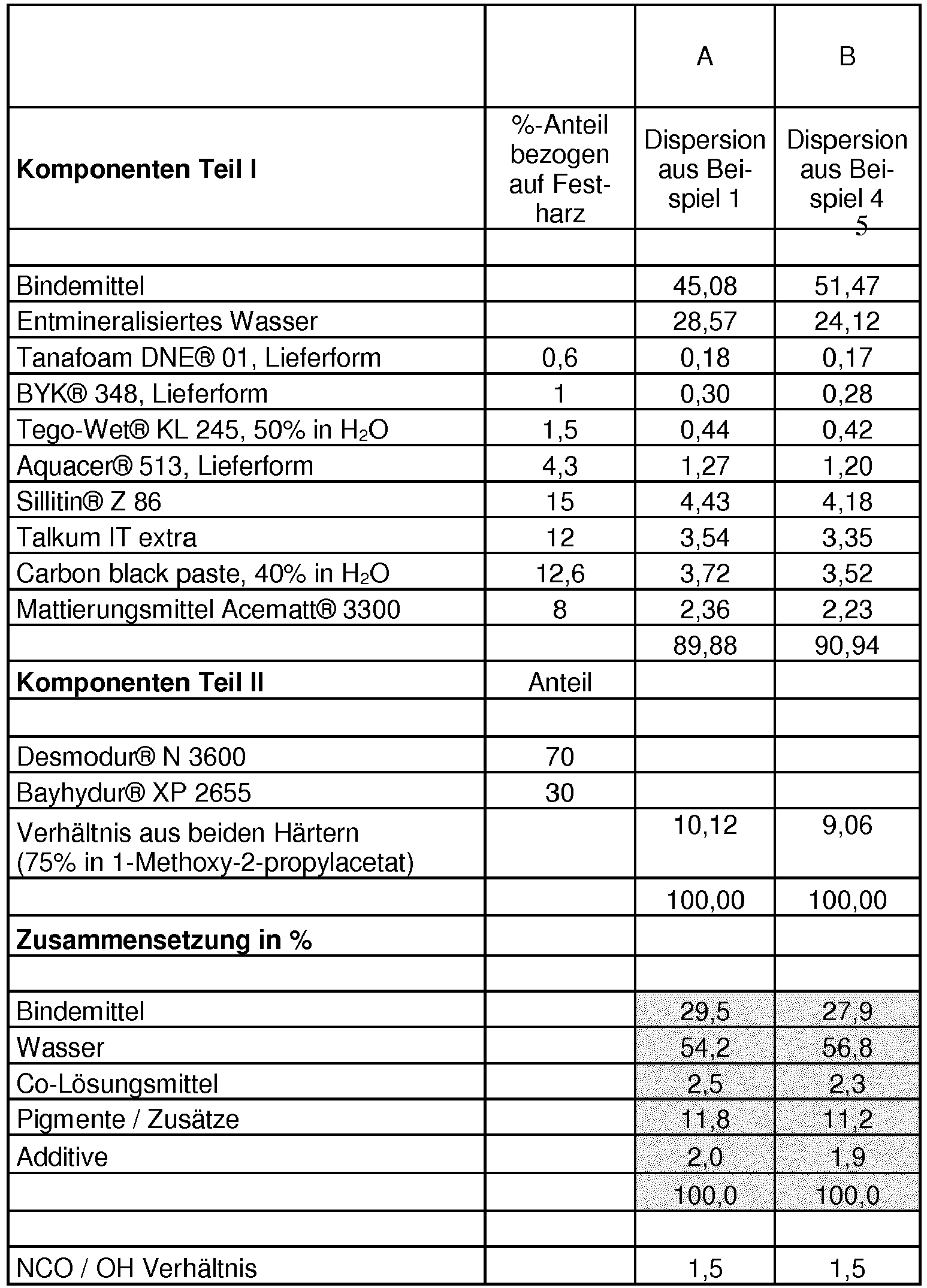
- Zur Untersuchung des lacktechnischen Profils wurden auf Makrofol Platten wässrige 2 K Lacke (Beispiel A und B) jeweils durch Aufspritzen appliziert. Der trockene Lackfilm wurde dann hinsichtlich der Glanzwerte und Haptik/Elastizität untersucht.
Ansatz Glanz* (20° / 60° / 85°) Haptik/Elastizität** Aus Beispiel A 0 / 0,3 / 2,8 3 Aus Beispiel B 0,2 / 2,2 / 3,9 4 *Glanz/Haze-Messung: Reflektometer (Haze/Gloss), Byk-Gardner Typ 2.8
**Skala 1 - 5 (sehr gut - schlecht): Maß für den Softfeel Effekt bzw. Elastizität einer Oberfläche. Je weicher eine Beschichtung desto besser die Bewertung. - Aus diesen Ergebnissen lässt sich erkennen, dass es sich bei den Beschichtungen, die auf Beispiel A basieren deutlich mattere Filme herstellen lassen. Des Weiteren zeigt sich auch, dass auch A deutlich elastischere Beschichtungen ergibt.
Claims (13)
- Beschichtungsmittel umfassenda) eine wässrige Dispersion eines Hydroxy-funktionellen Prepolymers, erhältlich durch Umsetzung wenigstens der folgenden Komponenten:i) einer Hydroxy Gruppen aufweisenden Komponente, die ein Polycarbonatpolyol umfasst oder daraus besteht,ii) einem Hydroxy Gruppen aufweisenden Polyesterpolyol,iii) einem Isocyanat Gruppen aufweisendem Polyisocyanat,iv) einer Verbindung, die wenigstens zwei gegenüber Isocyanatgruppen reaktive Gruppen und wenigstens eine zur Anionenbildung befähigte Gruppe aufweist,v) Wasser,wobei die Komponenten i)-iii) und das Verhältnis der Komponenten i)-iii) so gewählt wird, dass gegenüber den Isocyanat Gruppen ein Überschuss an Hydroxy Gruppen vorhanden ist,b) Anorganische Nanopartikel mit einer zahlenmittleren Partikelgröße von 5 bis 100 nm undc) einen Vernetzer, der wenigstens zwei gegenüber Hydroxygruppen reaktive Gruppen aufweist.
- Beschichtungsmittel nach Anspruch 1, dadurch gekennzeichnet, dass die Nanopartikel eine spezifische Oberfläche von 100 m2/g bis 1000 m2/g, bevorzugt von 200 bis 500 m2/g und besonders bevorzugt von 250 bis 400 m2/g aufweisen.
- Beschichtungsmittel nach einem der Ansprüche 1 oder 2, dadurch gekennzeichnet, dass die Nanopartikel aus Siliziumdioxid, Titandioxid, Aluminiumoxid, Aluminiumdioxid, Mangandioxid, Manganoxid, Zinkoxid, Zinkdioxid, Ceroxid, Cerdioxid, Eisenoxid, Eisendioxid, Calciumcarbonat und besonders bevorzugt aus Siliziumdioxid bestehen.
- Beschichtungsmittel nach einem der Ansprüche 1 bis 3, dadurch gekennzeichnet, dass es zusätzlich wenigstens ein Mattierungsmittel d) umfasst.
- Beschichtungsmittel nach einem der Ansprüche 1 bis 4, dadurch gekennzeichnet, dass das Polycarbonatpolyol ein gewichtsmittleres Molekulargewicht von 500 bis 3000 g/mol, bevorzugt 650 bis 2500 g/mol und besonders bevorzugt 1000 bis 2200 g/mol aufweist.
- Beschichtungsmittel nach einem der Ansprüche 1 bis 5, dadurch gekennzeichnet, dass das Polyisocyanat iii) ein aliphatisches Isocyanat, bevorzugt ein aliphatisches Diisocyanat und besonders bevorzugt wenigstens eine Verbindung ausgewählt aus der Gruppe von Hexamethylendiisocyanat, Isophorondiisocyanat, 1-Isocyanato-4-[(4-isocyanatocyclohexyl) methyl]cyclohexan umfasst.
- Beschichtungsmittel nach einem der Ansprüche 1 bis 6, dadurch gekennzeichnet, dass der Vernetzer c) als gegenüber Hydroxy reaktive Gruppen wenigstens zwei Isocyanat Gruppen aufweist.
- Beschichtungsmittel nach einem der Ansprüche 1 bis 7, dadurch gekennzeichnet, dass der Vernetzer c) eine Viskosität bei 23° C von 10 bis 10000 mPas aufweist.
- Verfahren zur Herstellung eines Beschichtungsmittels nach einem der Ansprüche 1 bis 8, dadurch gekennzeichnet, dass in einem ersten Schritt die wässrige Dispersion a) hergestellt, in einem zweiten Schritt ein Gemisch aus der wässrigen Dispersion a) und den Nanopartikeln b) hergestellt und in einem dritten Schritt der Vernetzer zu dem Gemisch hinzugefügt wird.
- Verwendung eines Beschichtungsmittels nach einem der Ansprüche 1 bis 8 zur Herstellung einer Beschichtung auf einem Substrat.
- Verwendung nach Anspruch 10, dadurch gekennzeichnet, dass das Substrat ein Kunststoffsubstrat ist.
- Beschichtung, erhältlich durch Applikation eines Beschichtungsmittels nach einem der Ansprüche 1 bis 8 auf ein Substrat.
- Beschichtung nach Anspruch 12 dadurch gekennzeichnet, dass das Substrat ein Kunststoffsubstrat ist.
Priority Applications (1)
| Application Number | Priority Date | Filing Date | Title |
|---|---|---|---|
| EP13789221.2A EP2912079B1 (de) | 2012-10-29 | 2013-10-25 | Beschichtungsmittel für mattierbare beschichtungen |
Applications Claiming Priority (3)
| Application Number | Priority Date | Filing Date | Title |
|---|---|---|---|
| EP12190315 | 2012-10-29 | ||
| EP13789221.2A EP2912079B1 (de) | 2012-10-29 | 2013-10-25 | Beschichtungsmittel für mattierbare beschichtungen |
| PCT/EP2013/072400 WO2014067873A1 (de) | 2012-10-29 | 2013-10-25 | Beschichtungsmittel für mattierbare beschichtungen |
Publications (2)
| Publication Number | Publication Date |
|---|---|
| EP2912079A1 EP2912079A1 (de) | 2015-09-02 |
| EP2912079B1 true EP2912079B1 (de) | 2018-08-08 |
Family
ID=47088733
Family Applications (1)
| Application Number | Title | Priority Date | Filing Date |
|---|---|---|---|
| EP13789221.2A Active EP2912079B1 (de) | 2012-10-29 | 2013-10-25 | Beschichtungsmittel für mattierbare beschichtungen |
Country Status (10)
| Country | Link |
|---|---|
| US (1) | US20150291840A1 (de) |
| EP (1) | EP2912079B1 (de) |
| KR (1) | KR102194699B1 (de) |
| CN (1) | CN104736582B (de) |
| BR (1) | BR112015009573B1 (de) |
| CA (1) | CA2889543C (de) |
| ES (1) | ES2691978T3 (de) |
| MX (1) | MX366379B (de) |
| TW (1) | TWI609933B (de) |
| WO (1) | WO2014067873A1 (de) |
Families Citing this family (2)
| Publication number | Priority date | Publication date | Assignee | Title |
|---|---|---|---|---|
| ES2818580T3 (es) * | 2016-09-20 | 2021-04-13 | Covestro Intellectual Property Gmbh & Co Kg | Materiales composites anisotrópicos basados en poliisocianatos |
| CN113801554A (zh) * | 2020-06-16 | 2021-12-17 | 科思创德国股份有限公司 | 一种组合物及其制备方法和应用 |
Family Cites Families (16)
| Publication number | Priority date | Publication date | Assignee | Title |
|---|---|---|---|---|
| DE2446440C3 (de) | 1974-09-28 | 1981-04-30 | Bayer Ag, 5090 Leverkusen | Verfahren zur Herstellung von wäßrigen Dispersionen von Sulfonatgruppen aufweisenden Polyurethanen |
| DE3717060A1 (de) | 1987-05-21 | 1988-12-01 | Bayer Ag | Polyether-polycarbonat-diole, ihre herstellung und verwendung als ausgangsprodukte fuer polyurethankunststoffe |
| US5098938A (en) * | 1989-03-03 | 1992-03-24 | Savin Roland R | Coating composition exhibiting improved resistance to environmental attack |
| DE4218449A1 (de) * | 1992-03-25 | 1993-09-30 | Hoechst Ag | Wasserverdünnbare Zweikomponenten-Überzugsmasse, ein Verfahren zu deren Herstellung und deren Verwendung |
| DE19750186A1 (de) | 1997-11-13 | 1999-05-20 | Bayer Ag | Hydrophilierungsmittel, ein Verfahren zu dessen Herstellung sowie dessen Verwendung als Dispergator für wäßrige Polyurethan-Dispersionen |
| US5880215A (en) * | 1997-12-24 | 1999-03-09 | Bayer Corporation | Coatings with improved resistance to suntan lotion |
| DE10004499A1 (de) * | 2000-02-02 | 2001-08-16 | Basf Coatings Ag | Physikalisch, thermisch oder thermisch und mit aktinischer Strahlung härtbarer wässriger Beschichtungsstoff und seine Verwendung |
| DE10216896A1 (de) * | 2002-04-17 | 2003-11-13 | Goldschmidt Ag Th | Wässrige Polysiloxan-Polyurethan-Dispersion, ihre Herstellung und Verwendung in Beschichtungsmitteln |
| DE10251797A1 (de) * | 2002-11-07 | 2004-05-19 | Bayer Ag | Polyurethanharz mit hohem Carbonatgruppengehalt |
| US7232556B2 (en) * | 2003-09-26 | 2007-06-19 | Nanoproducts Corporation | Titanium comprising nanoparticles and related nanotechnology |
| DE102004049592A1 (de) * | 2004-10-12 | 2006-05-04 | Bayer Materialscience Ag | Mit Soft-Touch-Lack beschichtete, verformbare Kunststoffverbundfolien und Kunststoffverbundelemente sowie deren Herstellung |
| JP2007045024A (ja) * | 2005-08-11 | 2007-02-22 | Mitsubishi Polyester Film Copp | 積層ポリエステルフィルム |
| DE102005061684A1 (de) * | 2005-12-21 | 2007-06-28 | Eckart Gmbh & Co. Kg | Weißes, IR-Strahlung reflektierendes Pigment, dessen Herstellung und Verwendung |
| EP2216353A1 (de) * | 2009-02-10 | 2010-08-11 | Bayer MaterialScience AG | Trägerfolie mit Polyurethan-Beschichtung |
| US9708504B2 (en) * | 2010-04-01 | 2017-07-18 | Ppg Industries Ohio, Inc. | Branched polyester polymers and coatings comprising the same |
| TWI568811B (zh) * | 2011-02-23 | 2017-02-01 | 歐米亞國際公司 | 包含含有次微米碳酸鈣粒子的塗佈組成物、其製備方法,以及含次微米碳酸鈣粒子於塗佈組成物中之用途 |
-
2013
- 2013-10-25 BR BR112015009573-9A patent/BR112015009573B1/pt not_active IP Right Cessation
- 2013-10-25 CN CN201380056478.XA patent/CN104736582B/zh active Active
- 2013-10-25 EP EP13789221.2A patent/EP2912079B1/de active Active
- 2013-10-25 US US14/438,954 patent/US20150291840A1/en not_active Abandoned
- 2013-10-25 ES ES13789221.2T patent/ES2691978T3/es active Active
- 2013-10-25 WO PCT/EP2013/072400 patent/WO2014067873A1/de not_active Ceased
- 2013-10-25 CA CA2889543A patent/CA2889543C/en not_active Expired - Fee Related
- 2013-10-25 KR KR1020157010769A patent/KR102194699B1/ko not_active Expired - Fee Related
- 2013-10-25 MX MX2015005388A patent/MX366379B/es active IP Right Grant
- 2013-10-28 TW TW102138833A patent/TWI609933B/zh not_active IP Right Cessation
Non-Patent Citations (1)
| Title |
|---|
| None * |
Also Published As
| Publication number | Publication date |
|---|---|
| CA2889543C (en) | 2020-09-15 |
| BR112015009573B1 (pt) | 2021-05-11 |
| CA2889543A1 (en) | 2014-05-08 |
| MX2015005388A (es) | 2015-07-21 |
| WO2014067873A1 (de) | 2014-05-08 |
| MX366379B (es) | 2019-07-05 |
| TWI609933B (zh) | 2018-01-01 |
| CN104736582A (zh) | 2015-06-24 |
| US20150291840A1 (en) | 2015-10-15 |
| CN104736582B (zh) | 2018-11-09 |
| TW201431981A (zh) | 2014-08-16 |
| HK1211608A1 (en) | 2016-05-27 |
| EP2912079A1 (de) | 2015-09-02 |
| ES2691978T3 (es) | 2018-11-29 |
| KR20150080499A (ko) | 2015-07-09 |
| BR112015009573A2 (pt) | 2017-07-04 |
| KR102194699B1 (ko) | 2020-12-23 |
Similar Documents
| Publication | Publication Date | Title |
|---|---|---|
| EP1418192B1 (de) | Verfahren zur Herstellung wässriger Beschichtungssysteme auf Basis wasserverdünnbarer Polyurethanharze | |
| EP1905789B1 (de) | Wässrige Beschichtungsmittel auf Basis von Polyurethan-Dispersionen | |
| EP1647562B1 (de) | Wässrige Polyurethanzusammensetzungen für Schaumbeschichtungen mit Softfeel-Effekt | |
| EP2268691B1 (de) | Wässrige polyurethanlösungen für polyurethan-systeme | |
| EP1736490B1 (de) | Polymermischung auf Basis von Polycarbonatpolyolen | |
| EP1711547B1 (de) | Beschichtungsmittelzusammensetzung | |
| EP2398835B1 (de) | Funktionalisierte polyurethanpolyharnstoff-dispersionen | |
| EP3545025B1 (de) | Verfahren zur herstellung eines zumindest teilweise beschichteten gegenstands | |
| EP2216353A1 (de) | Trägerfolie mit Polyurethan-Beschichtung | |
| EP1845120B1 (de) | Wässrige polyurethan-Dispersionen mit verbesserter Lagerstabilität | |
| EP1717284B1 (de) | Polyurethan-Dispersionen mit verbesserten Verfilmungseigenschaften | |
| DE102004045533A1 (de) | Hydrolysestabile Beschichtungsmittelzusammensetzung | |
| EP3109269A1 (de) | Harnstofffreie polyurethan-dispersionen | |
| WO2010054760A1 (de) | Polyurethandispersionen für beschichtungen mit barriereeigenschaften | |
| EP2912079B1 (de) | Beschichtungsmittel für mattierbare beschichtungen | |
| DE19630905A1 (de) | Wäßrige Dispersionen, ihre Herstellung und Verwendung als Lackbindemittel | |
| DE102009049630A1 (de) | NMP-freie Beschichtungen für den Automobilinnenraum | |
| DE102010015246A1 (de) | NMP-freie Beschichtungen für den Automobilinnenraum | |
| DE19843552A1 (de) | Wäßrige Dispersionen mit reduziertem Gehalt an Triethylamin | |
| DE102012110327A1 (de) | Verformbare Folie |
Legal Events
| Date | Code | Title | Description |
|---|---|---|---|
| PUAI | Public reference made under article 153(3) epc to a published international application that has entered the european phase |
Free format text: ORIGINAL CODE: 0009012 |
|
| 17P | Request for examination filed |
Effective date: 20150529 |
|
| AK | Designated contracting states |
Kind code of ref document: A1 Designated state(s): AL AT BE BG CH CY CZ DE DK EE ES FI FR GB GR HR HU IE IS IT LI LT LU LV MC MK MT NL NO PL PT RO RS SE SI SK SM TR |
|
| AX | Request for extension of the european patent |
Extension state: BA ME |
|
| RAP1 | Party data changed (applicant data changed or rights of an application transferred) |
Owner name: COVESTRO DEUTSCHLAND AG |
|
| DAX | Request for extension of the european patent (deleted) | ||
| STAA | Information on the status of an ep patent application or granted ep patent |
Free format text: STATUS: EXAMINATION IS IN PROGRESS |
|
| 17Q | First examination report despatched |
Effective date: 20171019 |
|
| GRAP | Despatch of communication of intention to grant a patent |
Free format text: ORIGINAL CODE: EPIDOSNIGR1 |
|
| STAA | Information on the status of an ep patent application or granted ep patent |
Free format text: STATUS: GRANT OF PATENT IS INTENDED |
|
| INTG | Intention to grant announced |
Effective date: 20180321 |
|
| GRAS | Grant fee paid |
Free format text: ORIGINAL CODE: EPIDOSNIGR3 |
|
| GRAA | (expected) grant |
Free format text: ORIGINAL CODE: 0009210 |
|
| STAA | Information on the status of an ep patent application or granted ep patent |
Free format text: STATUS: THE PATENT HAS BEEN GRANTED |
|
| AK | Designated contracting states |
Kind code of ref document: B1 Designated state(s): AL AT BE BG CH CY CZ DE DK EE ES FI FR GB GR HR HU IE IS IT LI LT LU LV MC MK MT NL NO PL PT RO RS SE SI SK SM TR |
|
| REG | Reference to a national code |
Ref country code: GB Ref legal event code: FG4D Free format text: NOT ENGLISH |
|
| REG | Reference to a national code |
Ref country code: CH Ref legal event code: EP Ref country code: AT Ref legal event code: REF Ref document number: 1026896 Country of ref document: AT Kind code of ref document: T Effective date: 20180815 |
|
| REG | Reference to a national code |
Ref country code: IE Ref legal event code: FG4D Free format text: LANGUAGE OF EP DOCUMENT: GERMAN |
|
| REG | Reference to a national code |
Ref country code: DE Ref legal event code: R096 Ref document number: 502013010817 Country of ref document: DE |
|
| REG | Reference to a national code |
Ref country code: FR Ref legal event code: PLFP Year of fee payment: 6 |
|
| REG | Reference to a national code |
Ref country code: NL Ref legal event code: FP |
|
| REG | Reference to a national code |
Ref country code: ES Ref legal event code: FG2A Ref document number: 2691978 Country of ref document: ES Kind code of ref document: T3 Effective date: 20181129 |
|
| REG | Reference to a national code |
Ref country code: LT Ref legal event code: MG4D |
|
| PG25 | Lapsed in a contracting state [announced via postgrant information from national office to epo] |
Ref country code: NO Free format text: LAPSE BECAUSE OF FAILURE TO SUBMIT A TRANSLATION OF THE DESCRIPTION OR TO PAY THE FEE WITHIN THE PRESCRIBED TIME-LIMIT Effective date: 20181108 Ref country code: FI Free format text: LAPSE BECAUSE OF FAILURE TO SUBMIT A TRANSLATION OF THE DESCRIPTION OR TO PAY THE FEE WITHIN THE PRESCRIBED TIME-LIMIT Effective date: 20180808 Ref country code: GR Free format text: LAPSE BECAUSE OF FAILURE TO SUBMIT A TRANSLATION OF THE DESCRIPTION OR TO PAY THE FEE WITHIN THE PRESCRIBED TIME-LIMIT Effective date: 20181109 Ref country code: IS Free format text: LAPSE BECAUSE OF FAILURE TO SUBMIT A TRANSLATION OF THE DESCRIPTION OR TO PAY THE FEE WITHIN THE PRESCRIBED TIME-LIMIT Effective date: 20181208 Ref country code: PL Free format text: LAPSE BECAUSE OF FAILURE TO SUBMIT A TRANSLATION OF THE DESCRIPTION OR TO PAY THE FEE WITHIN THE PRESCRIBED TIME-LIMIT Effective date: 20180808 Ref country code: LT Free format text: LAPSE BECAUSE OF FAILURE TO SUBMIT A TRANSLATION OF THE DESCRIPTION OR TO PAY THE FEE WITHIN THE PRESCRIBED TIME-LIMIT Effective date: 20180808 Ref country code: RS Free format text: LAPSE BECAUSE OF FAILURE TO SUBMIT A TRANSLATION OF THE DESCRIPTION OR TO PAY THE FEE WITHIN THE PRESCRIBED TIME-LIMIT Effective date: 20180808 Ref country code: SE Free format text: LAPSE BECAUSE OF FAILURE TO SUBMIT A TRANSLATION OF THE DESCRIPTION OR TO PAY THE FEE WITHIN THE PRESCRIBED TIME-LIMIT Effective date: 20180808 Ref country code: BG Free format text: LAPSE BECAUSE OF FAILURE TO SUBMIT A TRANSLATION OF THE DESCRIPTION OR TO PAY THE FEE WITHIN THE PRESCRIBED TIME-LIMIT Effective date: 20181108 |
|
| PG25 | Lapsed in a contracting state [announced via postgrant information from national office to epo] |
Ref country code: AL Free format text: LAPSE BECAUSE OF FAILURE TO SUBMIT A TRANSLATION OF THE DESCRIPTION OR TO PAY THE FEE WITHIN THE PRESCRIBED TIME-LIMIT Effective date: 20180808 Ref country code: HR Free format text: LAPSE BECAUSE OF FAILURE TO SUBMIT A TRANSLATION OF THE DESCRIPTION OR TO PAY THE FEE WITHIN THE PRESCRIBED TIME-LIMIT Effective date: 20180808 Ref country code: LV Free format text: LAPSE BECAUSE OF FAILURE TO SUBMIT A TRANSLATION OF THE DESCRIPTION OR TO PAY THE FEE WITHIN THE PRESCRIBED TIME-LIMIT Effective date: 20180808 |
|
| PG25 | Lapsed in a contracting state [announced via postgrant information from national office to epo] |
Ref country code: CZ Free format text: LAPSE BECAUSE OF FAILURE TO SUBMIT A TRANSLATION OF THE DESCRIPTION OR TO PAY THE FEE WITHIN THE PRESCRIBED TIME-LIMIT Effective date: 20180808 Ref country code: RO Free format text: LAPSE BECAUSE OF FAILURE TO SUBMIT A TRANSLATION OF THE DESCRIPTION OR TO PAY THE FEE WITHIN THE PRESCRIBED TIME-LIMIT Effective date: 20180808 |
|
| REG | Reference to a national code |
Ref country code: DE Ref legal event code: R097 Ref document number: 502013010817 Country of ref document: DE |
|
| PG25 | Lapsed in a contracting state [announced via postgrant information from national office to epo] |
Ref country code: SM Free format text: LAPSE BECAUSE OF FAILURE TO SUBMIT A TRANSLATION OF THE DESCRIPTION OR TO PAY THE FEE WITHIN THE PRESCRIBED TIME-LIMIT Effective date: 20180808 Ref country code: DK Free format text: LAPSE BECAUSE OF FAILURE TO SUBMIT A TRANSLATION OF THE DESCRIPTION OR TO PAY THE FEE WITHIN THE PRESCRIBED TIME-LIMIT Effective date: 20180808 Ref country code: SK Free format text: LAPSE BECAUSE OF FAILURE TO SUBMIT A TRANSLATION OF THE DESCRIPTION OR TO PAY THE FEE WITHIN THE PRESCRIBED TIME-LIMIT Effective date: 20180808 |
|
| REG | Reference to a national code |
Ref country code: CH Ref legal event code: PL |
|
| PLBE | No opposition filed within time limit |
Free format text: ORIGINAL CODE: 0009261 |
|
| STAA | Information on the status of an ep patent application or granted ep patent |
Free format text: STATUS: NO OPPOSITION FILED WITHIN TIME LIMIT |
|
| PG25 | Lapsed in a contracting state [announced via postgrant information from national office to epo] |
Ref country code: MC Free format text: LAPSE BECAUSE OF FAILURE TO SUBMIT A TRANSLATION OF THE DESCRIPTION OR TO PAY THE FEE WITHIN THE PRESCRIBED TIME-LIMIT Effective date: 20180808 Ref country code: LU Free format text: LAPSE BECAUSE OF NON-PAYMENT OF DUE FEES Effective date: 20181025 |
|
| 26N | No opposition filed |
Effective date: 20190509 |
|
| REG | Reference to a national code |
Ref country code: IE Ref legal event code: MM4A |
|
| PG25 | Lapsed in a contracting state [announced via postgrant information from national office to epo] |
Ref country code: SI Free format text: LAPSE BECAUSE OF FAILURE TO SUBMIT A TRANSLATION OF THE DESCRIPTION OR TO PAY THE FEE WITHIN THE PRESCRIBED TIME-LIMIT Effective date: 20180808 Ref country code: CH Free format text: LAPSE BECAUSE OF NON-PAYMENT OF DUE FEES Effective date: 20181031 Ref country code: EE Free format text: LAPSE BECAUSE OF FAILURE TO SUBMIT A TRANSLATION OF THE DESCRIPTION OR TO PAY THE FEE WITHIN THE PRESCRIBED TIME-LIMIT Effective date: 20180808 Ref country code: LI Free format text: LAPSE BECAUSE OF NON-PAYMENT OF DUE FEES Effective date: 20181031 |
|
| PG25 | Lapsed in a contracting state [announced via postgrant information from national office to epo] |
Ref country code: IE Free format text: LAPSE BECAUSE OF NON-PAYMENT OF DUE FEES Effective date: 20181025 |
|
| PG25 | Lapsed in a contracting state [announced via postgrant information from national office to epo] |
Ref country code: MT Free format text: LAPSE BECAUSE OF FAILURE TO SUBMIT A TRANSLATION OF THE DESCRIPTION OR TO PAY THE FEE WITHIN THE PRESCRIBED TIME-LIMIT Effective date: 20180808 |
|
| PG25 | Lapsed in a contracting state [announced via postgrant information from national office to epo] |
Ref country code: TR Free format text: LAPSE BECAUSE OF FAILURE TO SUBMIT A TRANSLATION OF THE DESCRIPTION OR TO PAY THE FEE WITHIN THE PRESCRIBED TIME-LIMIT Effective date: 20180808 |
|
| PG25 | Lapsed in a contracting state [announced via postgrant information from national office to epo] |
Ref country code: PT Free format text: LAPSE BECAUSE OF FAILURE TO SUBMIT A TRANSLATION OF THE DESCRIPTION OR TO PAY THE FEE WITHIN THE PRESCRIBED TIME-LIMIT Effective date: 20180808 |
|
| PG25 | Lapsed in a contracting state [announced via postgrant information from national office to epo] |
Ref country code: MK Free format text: LAPSE BECAUSE OF NON-PAYMENT OF DUE FEES Effective date: 20180808 Ref country code: HU Free format text: LAPSE BECAUSE OF FAILURE TO SUBMIT A TRANSLATION OF THE DESCRIPTION OR TO PAY THE FEE WITHIN THE PRESCRIBED TIME-LIMIT; INVALID AB INITIO Effective date: 20131025 Ref country code: CY Free format text: LAPSE BECAUSE OF FAILURE TO SUBMIT A TRANSLATION OF THE DESCRIPTION OR TO PAY THE FEE WITHIN THE PRESCRIBED TIME-LIMIT Effective date: 20180808 |
|
| PGFP | Annual fee paid to national office [announced via postgrant information from national office to epo] |
Ref country code: GB Payment date: 20220922 Year of fee payment: 10 |
|
| PGFP | Annual fee paid to national office [announced via postgrant information from national office to epo] |
Ref country code: FR Payment date: 20220921 Year of fee payment: 10 |
|
| GBPC | Gb: european patent ceased through non-payment of renewal fee |
Effective date: 20231025 |
|
| PG25 | Lapsed in a contracting state [announced via postgrant information from national office to epo] |
Ref country code: GB Free format text: LAPSE BECAUSE OF NON-PAYMENT OF DUE FEES Effective date: 20231025 |
|
| PG25 | Lapsed in a contracting state [announced via postgrant information from national office to epo] |
Ref country code: GB Free format text: LAPSE BECAUSE OF NON-PAYMENT OF DUE FEES Effective date: 20231025 Ref country code: FR Free format text: LAPSE BECAUSE OF NON-PAYMENT OF DUE FEES Effective date: 20231031 |
|
| PGFP | Annual fee paid to national office [announced via postgrant information from national office to epo] |
Ref country code: DE Payment date: 20240925 Year of fee payment: 12 |
|
| PGFP | Annual fee paid to national office [announced via postgrant information from national office to epo] |
Ref country code: AT Payment date: 20240925 Year of fee payment: 12 |
|
| PGFP | Annual fee paid to national office [announced via postgrant information from national office to epo] |
Ref country code: ES Payment date: 20241105 Year of fee payment: 12 |
|
| PGFP | Annual fee paid to national office [announced via postgrant information from national office to epo] |
Ref country code: NL Payment date: 20250924 Year of fee payment: 13 Ref country code: IT Payment date: 20250926 Year of fee payment: 13 |
|
| PGFP | Annual fee paid to national office [announced via postgrant information from national office to epo] |
Ref country code: BE Payment date: 20250924 Year of fee payment: 13 |