EP2907659A1 - Anti-static film - Google Patents
Anti-static film Download PDFInfo
- Publication number
- EP2907659A1 EP2907659A1 EP13847200.6A EP13847200A EP2907659A1 EP 2907659 A1 EP2907659 A1 EP 2907659A1 EP 13847200 A EP13847200 A EP 13847200A EP 2907659 A1 EP2907659 A1 EP 2907659A1
- Authority
- EP
- European Patent Office
- Prior art keywords
- static
- film
- layer
- compound
- coating liquid
- Prior art date
- Legal status (The legal status is an assumption and is not a legal conclusion. Google has not performed a legal analysis and makes no representation as to the accuracy of the status listed.)
- Withdrawn
Links
- 229920000642 polymer Polymers 0.000 claims abstract description 64
- 229920005989 resin Polymers 0.000 claims abstract description 27
- 239000011347 resin Substances 0.000 claims abstract description 27
- -1 isocyanate compound Chemical class 0.000 claims description 61
- 238000000576 coating method Methods 0.000 claims description 58
- 239000011248 coating agent Substances 0.000 claims description 57
- 239000003795 chemical substances by application Substances 0.000 claims description 47
- 150000001875 compounds Chemical class 0.000 claims description 46
- 239000007788 liquid Substances 0.000 claims description 46
- 125000001453 quaternary ammonium group Chemical group 0.000 claims description 20
- 125000003277 amino group Chemical group 0.000 claims description 17
- 229920001296 polysiloxane Polymers 0.000 claims description 16
- 239000002518 antifoaming agent Substances 0.000 claims description 15
- 239000012948 isocyanate Substances 0.000 claims description 14
- 125000002887 hydroxy group Chemical group [H]O* 0.000 claims description 13
- 239000004593 Epoxy Substances 0.000 claims description 12
- XLYOFNOQVPJJNP-UHFFFAOYSA-N water Substances O XLYOFNOQVPJJNP-UHFFFAOYSA-N 0.000 claims description 12
- 125000003178 carboxy group Chemical group [H]OC(*)=O 0.000 claims description 11
- 238000004519 manufacturing process Methods 0.000 claims description 10
- 238000001035 drying Methods 0.000 claims description 9
- 229920003180 amino resin Polymers 0.000 claims description 7
- 125000000524 functional group Chemical group 0.000 claims description 4
- 239000002904 solvent Substances 0.000 claims description 4
- 239000010410 layer Substances 0.000 description 73
- 239000000178 monomer Substances 0.000 description 38
- 238000000034 method Methods 0.000 description 24
- 239000000463 material Substances 0.000 description 21
- 229920006267 polyester film Polymers 0.000 description 15
- 230000000052 comparative effect Effects 0.000 description 13
- NIXOWILDQLNWCW-UHFFFAOYSA-N 2-Propenoic acid Natural products OC(=O)C=C NIXOWILDQLNWCW-UHFFFAOYSA-N 0.000 description 12
- 239000012793 heat-sealing layer Substances 0.000 description 12
- 239000000203 mixture Substances 0.000 description 11
- 239000000126 substance Substances 0.000 description 11
- 229920002799 BoPET Polymers 0.000 description 10
- 239000002216 antistatic agent Substances 0.000 description 10
- MEMUMYCLWQPAEX-UHFFFAOYSA-N n-octadecylaziridine-1-carboxamide Chemical compound CCCCCCCCCCCCCCCCCCNC(=O)N1CC1 MEMUMYCLWQPAEX-UHFFFAOYSA-N 0.000 description 10
- 238000009736 wetting Methods 0.000 description 10
- 230000000903 blocking effect Effects 0.000 description 9
- 238000007789 sealing Methods 0.000 description 9
- 239000003054 catalyst Substances 0.000 description 7
- 239000000565 sealant Substances 0.000 description 7
- 239000000654 additive Substances 0.000 description 6
- 238000006243 chemical reaction Methods 0.000 description 6
- 229920001577 copolymer Polymers 0.000 description 6
- 238000007334 copolymerization reaction Methods 0.000 description 6
- 238000011156 evaluation Methods 0.000 description 6
- IQPQWNKOIGAROB-UHFFFAOYSA-N isocyanate group Chemical group [N-]=C=O IQPQWNKOIGAROB-UHFFFAOYSA-N 0.000 description 6
- 239000000047 product Substances 0.000 description 6
- UOSHXCPZEJEORE-UHFFFAOYSA-M 2-aminoethyl-dimethyl-prop-2-enoylazanium methanesulfonate Chemical compound CS(=O)(=O)[O-].C(C=C)(=O)[N+](C)(C)CCN UOSHXCPZEJEORE-UHFFFAOYSA-M 0.000 description 5
- CERQOIWHTDAKMF-UHFFFAOYSA-N Methacrylic acid Chemical compound CC(=C)C(O)=O CERQOIWHTDAKMF-UHFFFAOYSA-N 0.000 description 5
- 229920003171 Poly (ethylene oxide) Polymers 0.000 description 5
- 125000000217 alkyl group Chemical group 0.000 description 5
- HSFWRNGVRCDJHI-UHFFFAOYSA-N alpha-acetylene Natural products C#C HSFWRNGVRCDJHI-UHFFFAOYSA-N 0.000 description 5
- LYCAIKOWRPUZTN-UHFFFAOYSA-N ethylene glycol Natural products OCCO LYCAIKOWRPUZTN-UHFFFAOYSA-N 0.000 description 5
- WGCNASOHLSPBMP-UHFFFAOYSA-N hydroxyacetaldehyde Natural products OCC=O WGCNASOHLSPBMP-UHFFFAOYSA-N 0.000 description 5
- 239000003960 organic solvent Substances 0.000 description 5
- 229920000139 polyethylene terephthalate Polymers 0.000 description 5
- 239000005020 polyethylene terephthalate Substances 0.000 description 5
- VZCYOOQTPOCHFL-UHFFFAOYSA-N trans-butenedioic acid Natural products OC(=O)C=CC(O)=O VZCYOOQTPOCHFL-UHFFFAOYSA-N 0.000 description 5
- JOYRKODLDBILNP-UHFFFAOYSA-N Ethyl urethane Chemical compound CCOC(N)=O JOYRKODLDBILNP-UHFFFAOYSA-N 0.000 description 4
- VZCYOOQTPOCHFL-OWOJBTEDSA-N Fumaric acid Chemical compound OC(=O)\C=C\C(O)=O VZCYOOQTPOCHFL-OWOJBTEDSA-N 0.000 description 4
- 239000004698 Polyethylene Substances 0.000 description 4
- XSQUKJJJFZCRTK-UHFFFAOYSA-N Urea Chemical compound NC(N)=O XSQUKJJJFZCRTK-UHFFFAOYSA-N 0.000 description 4
- XXROGKLTLUQVRX-UHFFFAOYSA-N allyl alcohol Chemical compound OCC=C XXROGKLTLUQVRX-UHFFFAOYSA-N 0.000 description 4
- 238000004873 anchoring Methods 0.000 description 4
- 238000010438 heat treatment Methods 0.000 description 4
- 230000006872 improvement Effects 0.000 description 4
- 150000002500 ions Chemical class 0.000 description 4
- 238000002844 melting Methods 0.000 description 4
- 125000005375 organosiloxane group Chemical group 0.000 description 4
- 229920001225 polyester resin Polymers 0.000 description 4
- 239000004645 polyester resin Substances 0.000 description 4
- 229920000573 polyethylene Polymers 0.000 description 4
- SMZOUWXMTYCWNB-UHFFFAOYSA-N 2-(2-methoxy-5-methylphenyl)ethanamine Chemical compound COC1=CC=C(C)C=C1CCN SMZOUWXMTYCWNB-UHFFFAOYSA-N 0.000 description 3
- QTBSBXVTEAMEQO-UHFFFAOYSA-N Acetic acid Chemical compound CC(O)=O QTBSBXVTEAMEQO-UHFFFAOYSA-N 0.000 description 3
- XEKOWRVHYACXOJ-UHFFFAOYSA-N Ethyl acetate Chemical compound CCOC(C)=O XEKOWRVHYACXOJ-UHFFFAOYSA-N 0.000 description 3
- IAYPIBMASNFSPL-UHFFFAOYSA-N Ethylene oxide Chemical class C1CO1 IAYPIBMASNFSPL-UHFFFAOYSA-N 0.000 description 3
- CNCOEDDPFOAUMB-UHFFFAOYSA-N N-Methylolacrylamide Chemical compound OCNC(=O)C=C CNCOEDDPFOAUMB-UHFFFAOYSA-N 0.000 description 3
- 229920002873 Polyethylenimine Polymers 0.000 description 3
- OFOBLEOULBTSOW-UHFFFAOYSA-N Propanedioic acid Natural products OC(=O)CC(O)=O OFOBLEOULBTSOW-UHFFFAOYSA-N 0.000 description 3
- 239000006087 Silane Coupling Agent Substances 0.000 description 3
- XUIMIQQOPSSXEZ-UHFFFAOYSA-N Silicon Chemical group [Si] XUIMIQQOPSSXEZ-UHFFFAOYSA-N 0.000 description 3
- PPBRXRYQALVLMV-UHFFFAOYSA-N Styrene Chemical compound C=CC1=CC=CC=C1 PPBRXRYQALVLMV-UHFFFAOYSA-N 0.000 description 3
- QAOWNCQODCNURD-UHFFFAOYSA-N Sulfuric acid Chemical compound OS(O)(=O)=O QAOWNCQODCNURD-UHFFFAOYSA-N 0.000 description 3
- 230000000996 additive effect Effects 0.000 description 3
- 230000000694 effects Effects 0.000 description 3
- 239000000839 emulsion Substances 0.000 description 3
- RAXXELZNTBOGNW-UHFFFAOYSA-N imidazole Natural products C1=CNC=N1 RAXXELZNTBOGNW-UHFFFAOYSA-N 0.000 description 3
- 230000001965 increasing effect Effects 0.000 description 3
- 150000002513 isocyanates Chemical class 0.000 description 3
- VZCYOOQTPOCHFL-UPHRSURJSA-N maleic acid Chemical compound OC(=O)\C=C/C(O)=O VZCYOOQTPOCHFL-UPHRSURJSA-N 0.000 description 3
- 239000011976 maleic acid Substances 0.000 description 3
- 230000008018 melting Effects 0.000 description 3
- 238000002156 mixing Methods 0.000 description 3
- PNJWIWWMYCMZRO-UHFFFAOYSA-N pent‐4‐en‐2‐one Natural products CC(=O)CC=C PNJWIWWMYCMZRO-UHFFFAOYSA-N 0.000 description 3
- 229920000768 polyamine Polymers 0.000 description 3
- 239000005056 polyisocyanate Substances 0.000 description 3
- 229920001228 polyisocyanate Polymers 0.000 description 3
- 229920005672 polyolefin resin Polymers 0.000 description 3
- 230000001105 regulatory effect Effects 0.000 description 3
- JOXIMZWYDAKGHI-UHFFFAOYSA-N toluene-4-sulfonic acid Chemical class CC1=CC=C(S(O)(=O)=O)C=C1 JOXIMZWYDAKGHI-UHFFFAOYSA-N 0.000 description 3
- 229920002554 vinyl polymer Polymers 0.000 description 3
- 238000004804 winding Methods 0.000 description 3
- QPFMBZIOSGYJDE-UHFFFAOYSA-N 1,1,2,2-tetrachloroethane Chemical compound ClC(Cl)C(Cl)Cl QPFMBZIOSGYJDE-UHFFFAOYSA-N 0.000 description 2
- KTIBRDNFZLYLNA-UHFFFAOYSA-N 2-(2-hydroxyethenoxy)ethenol Chemical compound OC=COC=CO KTIBRDNFZLYLNA-UHFFFAOYSA-N 0.000 description 2
- HZAXFHJVJLSVMW-UHFFFAOYSA-N 2-Aminoethan-1-ol Chemical compound NCCO HZAXFHJVJLSVMW-UHFFFAOYSA-N 0.000 description 2
- UPMLOUAZCHDJJD-UHFFFAOYSA-N 4,4'-Diphenylmethane Diisocyanate Chemical compound C1=CC(N=C=O)=CC=C1CC1=CC=C(N=C=O)C=C1 UPMLOUAZCHDJJD-UHFFFAOYSA-N 0.000 description 2
- GZVHEAJQGPRDLQ-UHFFFAOYSA-N 6-phenyl-1,3,5-triazine-2,4-diamine Chemical compound NC1=NC(N)=NC(C=2C=CC=CC=2)=N1 GZVHEAJQGPRDLQ-UHFFFAOYSA-N 0.000 description 2
- VVJKKWFAADXIJK-UHFFFAOYSA-N Allylamine Chemical compound NCC=C VVJKKWFAADXIJK-UHFFFAOYSA-N 0.000 description 2
- KAKZBPTYRLMSJV-UHFFFAOYSA-N Butadiene Chemical compound C=CC=C KAKZBPTYRLMSJV-UHFFFAOYSA-N 0.000 description 2
- VEXZGXHMUGYJMC-UHFFFAOYSA-M Chloride anion Chemical compound [Cl-] VEXZGXHMUGYJMC-UHFFFAOYSA-M 0.000 description 2
- RTZKZFJDLAIYFH-UHFFFAOYSA-N Diethyl ether Chemical compound CCOCC RTZKZFJDLAIYFH-UHFFFAOYSA-N 0.000 description 2
- VGGSQFUCUMXWEO-UHFFFAOYSA-N Ethene Chemical compound C=C VGGSQFUCUMXWEO-UHFFFAOYSA-N 0.000 description 2
- JIGUQPWFLRLWPJ-UHFFFAOYSA-N Ethyl acrylate Chemical compound CCOC(=O)C=C JIGUQPWFLRLWPJ-UHFFFAOYSA-N 0.000 description 2
- 239000005977 Ethylene Substances 0.000 description 2
- DHMQDGOQFOQNFH-UHFFFAOYSA-N Glycine Chemical compound NCC(O)=O DHMQDGOQFOQNFH-UHFFFAOYSA-N 0.000 description 2
- 239000005057 Hexamethylene diisocyanate Substances 0.000 description 2
- RRHGJUQNOFWUDK-UHFFFAOYSA-N Isoprene Chemical compound CC(=C)C=C RRHGJUQNOFWUDK-UHFFFAOYSA-N 0.000 description 2
- 229920000877 Melamine resin Polymers 0.000 description 2
- ISWSIDIOOBJBQZ-UHFFFAOYSA-N Phenol Chemical compound OC1=CC=CC=C1 ISWSIDIOOBJBQZ-UHFFFAOYSA-N 0.000 description 2
- NBIIXXVUZAFLBC-UHFFFAOYSA-N Phosphoric acid Chemical compound OP(O)(O)=O NBIIXXVUZAFLBC-UHFFFAOYSA-N 0.000 description 2
- GOOHAUXETOMSMM-UHFFFAOYSA-N Propylene oxide Chemical group CC1CO1 GOOHAUXETOMSMM-UHFFFAOYSA-N 0.000 description 2
- VYPSYNLAJGMNEJ-UHFFFAOYSA-N Silicium dioxide Chemical compound O=[Si]=O VYPSYNLAJGMNEJ-UHFFFAOYSA-N 0.000 description 2
- 230000001133 acceleration Effects 0.000 description 2
- 229920006322 acrylamide copolymer Polymers 0.000 description 2
- 150000008051 alkyl sulfates Chemical class 0.000 description 2
- 150000008052 alkyl sulfonates Chemical class 0.000 description 2
- 239000003963 antioxidant agent Substances 0.000 description 2
- 230000003078 antioxidant effect Effects 0.000 description 2
- 239000004566 building material Substances 0.000 description 2
- 239000004202 carbamide Substances 0.000 description 2
- 150000001735 carboxylic acids Chemical class 0.000 description 2
- 238000001816 cooling Methods 0.000 description 2
- 238000003851 corona treatment Methods 0.000 description 2
- 238000010790 dilution Methods 0.000 description 2
- 239000012895 dilution Substances 0.000 description 2
- 239000000428 dust Substances 0.000 description 2
- 239000012776 electronic material Substances 0.000 description 2
- 125000003700 epoxy group Chemical group 0.000 description 2
- 239000010419 fine particle Substances 0.000 description 2
- 239000001530 fumaric acid Substances 0.000 description 2
- LEQAOMBKQFMDFZ-UHFFFAOYSA-N glyoxal Chemical compound O=CC=O LEQAOMBKQFMDFZ-UHFFFAOYSA-N 0.000 description 2
- 229910052736 halogen Inorganic materials 0.000 description 2
- 150000002367 halogens Chemical class 0.000 description 2
- RRAMGCGOFNQTLD-UHFFFAOYSA-N hexamethylene diisocyanate Chemical compound O=C=NCCCCCCN=C=O RRAMGCGOFNQTLD-UHFFFAOYSA-N 0.000 description 2
- NAQMVNRVTILPCV-UHFFFAOYSA-N hexane-1,6-diamine Chemical compound NCCCCCCN NAQMVNRVTILPCV-UHFFFAOYSA-N 0.000 description 2
- 238000003475 lamination Methods 0.000 description 2
- 229920001684 low density polyethylene Polymers 0.000 description 2
- 239000004702 low-density polyethylene Substances 0.000 description 2
- 239000000314 lubricant Substances 0.000 description 2
- 238000005259 measurement Methods 0.000 description 2
- 239000002736 nonionic surfactant Substances 0.000 description 2
- 239000005022 packaging material Substances 0.000 description 2
- XNGIFLGASWRNHJ-UHFFFAOYSA-N phthalic acid Chemical compound OC(=O)C1=CC=CC=C1C(O)=O XNGIFLGASWRNHJ-UHFFFAOYSA-N 0.000 description 2
- 229920000570 polyether Polymers 0.000 description 2
- 229920002503 polyoxyethylene-polyoxypropylene Polymers 0.000 description 2
- 229920001451 polypropylene glycol Polymers 0.000 description 2
- 238000007639 printing Methods 0.000 description 2
- 230000008569 process Effects 0.000 description 2
- 238000012545 processing Methods 0.000 description 2
- 238000010526 radical polymerization reaction Methods 0.000 description 2
- 150000003839 salts Chemical class 0.000 description 2
- 239000007787 solid Substances 0.000 description 2
- 150000003609 titanium compounds Chemical class 0.000 description 2
- DVKJHBMWWAPEIU-UHFFFAOYSA-N toluene 2,4-diisocyanate Chemical compound CC1=CC=C(N=C=O)C=C1N=C=O DVKJHBMWWAPEIU-UHFFFAOYSA-N 0.000 description 2
- BPSIOYPQMFLKFR-UHFFFAOYSA-N trimethoxy-[3-(oxiran-2-ylmethoxy)propyl]silane Chemical compound CO[Si](OC)(OC)CCCOCC1CO1 BPSIOYPQMFLKFR-UHFFFAOYSA-N 0.000 description 2
- 125000000391 vinyl group Chemical group [H]C([*])=C([H])[H] 0.000 description 2
- WRIDQFICGBMAFQ-UHFFFAOYSA-N (E)-8-Octadecenoic acid Natural products CCCCCCCCCC=CCCCCCCC(O)=O WRIDQFICGBMAFQ-UHFFFAOYSA-N 0.000 description 1
- YOBOXHGSEJBUPB-MTOQALJVSA-N (z)-4-hydroxypent-3-en-2-one;zirconium Chemical compound [Zr].C\C(O)=C\C(C)=O.C\C(O)=C\C(C)=O.C\C(O)=C\C(C)=O.C\C(O)=C\C(C)=O YOBOXHGSEJBUPB-MTOQALJVSA-N 0.000 description 1
- FDYWJVHETVDSRA-UHFFFAOYSA-N 1,1-diisocyanatobutane Chemical compound CCCC(N=C=O)N=C=O FDYWJVHETVDSRA-UHFFFAOYSA-N 0.000 description 1
- VZXTWGWHSMCWGA-UHFFFAOYSA-N 1,3,5-triazine-2,4-diamine Chemical compound NC1=NC=NC(N)=N1 VZXTWGWHSMCWGA-UHFFFAOYSA-N 0.000 description 1
- DURPTKYDGMDSBL-UHFFFAOYSA-N 1-butoxybutane Chemical compound CCCCOCCCC DURPTKYDGMDSBL-UHFFFAOYSA-N 0.000 description 1
- QWDQYHPOSSHSAW-UHFFFAOYSA-N 1-isocyanatooctadecane Chemical compound CCCCCCCCCCCCCCCCCCN=C=O QWDQYHPOSSHSAW-UHFFFAOYSA-N 0.000 description 1
- IVIDDMGBRCPGLJ-UHFFFAOYSA-N 2,3-bis(oxiran-2-ylmethoxy)propan-1-ol Chemical compound C1OC1COC(CO)COCC1CO1 IVIDDMGBRCPGLJ-UHFFFAOYSA-N 0.000 description 1
- STMDPCBYJCIZOD-UHFFFAOYSA-N 2-(2,4-dinitroanilino)-4-methylpentanoic acid Chemical compound CC(C)CC(C(O)=O)NC1=CC=C([N+]([O-])=O)C=C1[N+]([O-])=O STMDPCBYJCIZOD-UHFFFAOYSA-N 0.000 description 1
- LQZDDWKUQKQXGC-UHFFFAOYSA-N 2-(2-methylprop-2-enoxymethyl)oxirane Chemical compound CC(=C)COCC1CO1 LQZDDWKUQKQXGC-UHFFFAOYSA-N 0.000 description 1
- IEQWWMKDFZUMMU-UHFFFAOYSA-N 2-(2-prop-2-enoyloxyethyl)butanedioic acid Chemical compound OC(=O)CC(C(O)=O)CCOC(=O)C=C IEQWWMKDFZUMMU-UHFFFAOYSA-N 0.000 description 1
- JAHNSTQSQJOJLO-UHFFFAOYSA-N 2-(3-fluorophenyl)-1h-imidazole Chemical compound FC1=CC=CC(C=2NC=CN=2)=C1 JAHNSTQSQJOJLO-UHFFFAOYSA-N 0.000 description 1
- JKNCOURZONDCGV-UHFFFAOYSA-N 2-(dimethylamino)ethyl 2-methylprop-2-enoate Chemical compound CN(C)CCOC(=O)C(C)=C JKNCOURZONDCGV-UHFFFAOYSA-N 0.000 description 1
- SEFYJVFBMNOLBK-UHFFFAOYSA-N 2-[2-[2-(oxiran-2-ylmethoxy)ethoxy]ethoxymethyl]oxirane Chemical compound C1OC1COCCOCCOCC1CO1 SEFYJVFBMNOLBK-UHFFFAOYSA-N 0.000 description 1
- UBYWYEGPDNYPHZ-NSCUHMNNSA-N 2-hydroxyethyl (e)-but-2-enoate Chemical compound C\C=C\C(=O)OCCO UBYWYEGPDNYPHZ-NSCUHMNNSA-N 0.000 description 1
- OMIGHNLMNHATMP-UHFFFAOYSA-N 2-hydroxyethyl prop-2-enoate Chemical compound OCCOC(=O)C=C OMIGHNLMNHATMP-UHFFFAOYSA-N 0.000 description 1
- LXBGSDVWAMZHDD-UHFFFAOYSA-N 2-methyl-1h-imidazole Chemical compound CC1=NC=CN1 LXBGSDVWAMZHDD-UHFFFAOYSA-N 0.000 description 1
- BNCADMBVWNPPIZ-UHFFFAOYSA-N 2-n,2-n,4-n,4-n,6-n,6-n-hexakis(methoxymethyl)-1,3,5-triazine-2,4,6-triamine Chemical compound COCN(COC)C1=NC(N(COC)COC)=NC(N(COC)COC)=N1 BNCADMBVWNPPIZ-UHFFFAOYSA-N 0.000 description 1
- CTRPRMNBTVRDFH-UHFFFAOYSA-N 2-n-methyl-1,3,5-triazine-2,4,6-triamine Chemical compound CNC1=NC(N)=NC(N)=N1 CTRPRMNBTVRDFH-UHFFFAOYSA-N 0.000 description 1
- LQJBNNIYVWPHFW-UHFFFAOYSA-N 20:1omega9c fatty acid Natural products CCCCCCCCCCC=CCCCCCCCC(O)=O LQJBNNIYVWPHFW-UHFFFAOYSA-N 0.000 description 1
- GNSFRPWPOGYVLO-UHFFFAOYSA-N 3-hydroxypropyl 2-methylprop-2-enoate Chemical compound CC(=C)C(=O)OCCCO GNSFRPWPOGYVLO-UHFFFAOYSA-N 0.000 description 1
- QZPSOSOOLFHYRR-UHFFFAOYSA-N 3-hydroxypropyl prop-2-enoate Chemical compound OCCCOC(=O)C=C QZPSOSOOLFHYRR-UHFFFAOYSA-N 0.000 description 1
- MECNWXGGNCJFQJ-UHFFFAOYSA-N 3-piperidin-1-ylpropane-1,2-diol Chemical compound OCC(O)CN1CCCCC1 MECNWXGGNCJFQJ-UHFFFAOYSA-N 0.000 description 1
- SBVKVAIECGDBTC-UHFFFAOYSA-N 4-hydroxy-2-methylidenebutanamide Chemical compound NC(=O)C(=C)CCO SBVKVAIECGDBTC-UHFFFAOYSA-N 0.000 description 1
- YKXAYLPDMSGWEV-UHFFFAOYSA-N 4-hydroxybutyl 2-methylprop-2-enoate Chemical compound CC(=C)C(=O)OCCCCO YKXAYLPDMSGWEV-UHFFFAOYSA-N 0.000 description 1
- NDWUBGAGUCISDV-UHFFFAOYSA-N 4-hydroxybutyl prop-2-enoate Chemical compound OCCCCOC(=O)C=C NDWUBGAGUCISDV-UHFFFAOYSA-N 0.000 description 1
- YGTVWCBFJAVSMS-UHFFFAOYSA-N 5-hydroxypentyl 2-methylprop-2-enoate Chemical compound CC(=C)C(=O)OCCCCCO YGTVWCBFJAVSMS-UHFFFAOYSA-N 0.000 description 1
- INRQKLGGIVSJRR-UHFFFAOYSA-N 5-hydroxypentyl prop-2-enoate Chemical compound OCCCCCOC(=O)C=C INRQKLGGIVSJRR-UHFFFAOYSA-N 0.000 description 1
- ULKLGIFJWFIQFF-UHFFFAOYSA-N 5K8XI641G3 Chemical compound CCC1=NC=C(C)N1 ULKLGIFJWFIQFF-UHFFFAOYSA-N 0.000 description 1
- XFOFBPRPOAWWPA-UHFFFAOYSA-N 6-hydroxyhexyl 2-methylprop-2-enoate Chemical compound CC(=C)C(=O)OCCCCCCO XFOFBPRPOAWWPA-UHFFFAOYSA-N 0.000 description 1
- OCIFJWVZZUDMRL-UHFFFAOYSA-N 6-hydroxyhexyl prop-2-enoate Chemical compound OCCCCCCOC(=O)C=C OCIFJWVZZUDMRL-UHFFFAOYSA-N 0.000 description 1
- QSBYPNXLFMSGKH-UHFFFAOYSA-N 9-Heptadecensaeure Natural products CCCCCCCC=CCCCCCCCC(O)=O QSBYPNXLFMSGKH-UHFFFAOYSA-N 0.000 description 1
- HRPVXLWXLXDGHG-UHFFFAOYSA-N Acrylamide Chemical compound NC(=O)C=C HRPVXLWXLXDGHG-UHFFFAOYSA-N 0.000 description 1
- NIXOWILDQLNWCW-UHFFFAOYSA-M Acrylate Chemical compound [O-]C(=O)C=C NIXOWILDQLNWCW-UHFFFAOYSA-M 0.000 description 1
- 239000004925 Acrylic resin Substances 0.000 description 1
- 229920000178 Acrylic resin Polymers 0.000 description 1
- LCFVJGUPQDGYKZ-UHFFFAOYSA-N Bisphenol A diglycidyl ether Chemical compound C=1C=C(OCC2OC2)C=CC=1C(C)(C)C(C=C1)=CC=C1OCC1CO1 LCFVJGUPQDGYKZ-UHFFFAOYSA-N 0.000 description 1
- WRAGBEWQGHCDDU-UHFFFAOYSA-M C([O-])([O-])=O.[NH4+].[Zr+] Chemical compound C([O-])([O-])=O.[NH4+].[Zr+] WRAGBEWQGHCDDU-UHFFFAOYSA-M 0.000 description 1
- OKTJSMMVPCPJKN-UHFFFAOYSA-N Carbon Chemical compound [C] OKTJSMMVPCPJKN-UHFFFAOYSA-N 0.000 description 1
- BRLQWZUYTZBJKN-UHFFFAOYSA-N Epichlorohydrin Chemical compound ClCC1CO1 BRLQWZUYTZBJKN-UHFFFAOYSA-N 0.000 description 1
- PIICEJLVQHRZGT-UHFFFAOYSA-N Ethylenediamine Chemical compound NCCN PIICEJLVQHRZGT-UHFFFAOYSA-N 0.000 description 1
- WHUUTDBJXJRKMK-UHFFFAOYSA-N Glutamic acid Natural products OC(=O)C(N)CCC(O)=O WHUUTDBJXJRKMK-UHFFFAOYSA-N 0.000 description 1
- 239000004471 Glycine Substances 0.000 description 1
- VEXZGXHMUGYJMC-UHFFFAOYSA-N Hydrochloric acid Chemical class Cl VEXZGXHMUGYJMC-UHFFFAOYSA-N 0.000 description 1
- CPELXLSAUQHCOX-UHFFFAOYSA-N Hydrogen bromide Chemical class Br CPELXLSAUQHCOX-UHFFFAOYSA-N 0.000 description 1
- WOBHKFSMXKNTIM-UHFFFAOYSA-N Hydroxyethyl methacrylate Chemical compound CC(=C)C(=O)OCCO WOBHKFSMXKNTIM-UHFFFAOYSA-N 0.000 description 1
- 239000005058 Isophorone diisocyanate Substances 0.000 description 1
- WHUUTDBJXJRKMK-VKHMYHEASA-N L-glutamic acid Chemical compound OC(=O)[C@@H](N)CCC(O)=O WHUUTDBJXJRKMK-VKHMYHEASA-N 0.000 description 1
- 239000004640 Melamine resin Substances 0.000 description 1
- AFVFQIVMOAPDHO-UHFFFAOYSA-N Methanesulfonic acid Chemical class CS(O)(=O)=O AFVFQIVMOAPDHO-UHFFFAOYSA-N 0.000 description 1
- VVQNEPGJFQJSBK-UHFFFAOYSA-N Methyl methacrylate Chemical compound COC(=O)C(C)=C VVQNEPGJFQJSBK-UHFFFAOYSA-N 0.000 description 1
- OMRDSWJXRLDPBB-UHFFFAOYSA-N N=C=O.N=C=O.C1CCCCC1 Chemical compound N=C=O.N=C=O.C1CCCCC1 OMRDSWJXRLDPBB-UHFFFAOYSA-N 0.000 description 1
- QORUGOXNWQUALA-UHFFFAOYSA-N N=C=O.N=C=O.N=C=O.C1=CC=C(C(C2=CC=CC=C2)C2=CC=CC=C2)C=C1 Chemical compound N=C=O.N=C=O.N=C=O.C1=CC=C(C(C2=CC=CC=C2)C2=CC=CC=C2)C=C1 QORUGOXNWQUALA-UHFFFAOYSA-N 0.000 description 1
- GRYLNZFGIOXLOG-UHFFFAOYSA-N Nitric acid Chemical compound O[N+]([O-])=O GRYLNZFGIOXLOG-UHFFFAOYSA-N 0.000 description 1
- REYJJPSVUYRZGE-UHFFFAOYSA-N Octadecylamine Chemical compound CCCCCCCCCCCCCCCCCCN REYJJPSVUYRZGE-UHFFFAOYSA-N 0.000 description 1
- 239000005642 Oleic acid Substances 0.000 description 1
- ZQPPMHVWECSIRJ-UHFFFAOYSA-N Oleic acid Natural products CCCCCCCCC=CCCCCCCCC(O)=O ZQPPMHVWECSIRJ-UHFFFAOYSA-N 0.000 description 1
- 239000004952 Polyamide Substances 0.000 description 1
- 239000005062 Polybutadiene Substances 0.000 description 1
- 239000004721 Polyphenylene oxide Substances 0.000 description 1
- 239000004372 Polyvinyl alcohol Substances 0.000 description 1
- RWRDLPDLKQPQOW-UHFFFAOYSA-N Pyrrolidine Chemical group C1CCNC1 RWRDLPDLKQPQOW-UHFFFAOYSA-N 0.000 description 1
- QAOWNCQODCNURD-UHFFFAOYSA-L Sulfate Chemical compound [O-]S([O-])(=O)=O QAOWNCQODCNURD-UHFFFAOYSA-L 0.000 description 1
- LSNNMFCWUKXFEE-UHFFFAOYSA-N Sulfurous acid Chemical class OS(O)=O LSNNMFCWUKXFEE-UHFFFAOYSA-N 0.000 description 1
- DTQVDTLACAAQTR-UHFFFAOYSA-N Trifluoroacetic acid Chemical class OC(=O)C(F)(F)F DTQVDTLACAAQTR-UHFFFAOYSA-N 0.000 description 1
- XTXRWKRVRITETP-UHFFFAOYSA-N Vinyl acetate Chemical compound CC(=O)OC=C XTXRWKRVRITETP-UHFFFAOYSA-N 0.000 description 1
- RUYKUXOULSOEPZ-UHFFFAOYSA-N [2-hydroxy-3-(2-methylprop-2-enoyloxy)propyl]-trimethylazanium Chemical class CC(=C)C(=O)OCC(O)C[N+](C)(C)C RUYKUXOULSOEPZ-UHFFFAOYSA-N 0.000 description 1
- JZWLTKPXXGFDQC-UHFFFAOYSA-M [S-]C#N.C(C=C)(=O)C[N+](C)(C)CCCN Chemical compound [S-]C#N.C(C=C)(=O)C[N+](C)(C)CCCN JZWLTKPXXGFDQC-UHFFFAOYSA-M 0.000 description 1
- USDJGQLNFPZEON-UHFFFAOYSA-N [[4,6-bis(hydroxymethylamino)-1,3,5-triazin-2-yl]amino]methanol Chemical compound OCNC1=NC(NCO)=NC(NCO)=N1 USDJGQLNFPZEON-UHFFFAOYSA-N 0.000 description 1
- YGCOKJWKWLYHTG-UHFFFAOYSA-N [[4,6-bis[bis(hydroxymethyl)amino]-1,3,5-triazin-2-yl]-(hydroxymethyl)amino]methanol Chemical compound OCN(CO)C1=NC(N(CO)CO)=NC(N(CO)CO)=N1 YGCOKJWKWLYHTG-UHFFFAOYSA-N 0.000 description 1
- 150000001242 acetic acid derivatives Chemical class 0.000 description 1
- 239000002253 acid Substances 0.000 description 1
- 150000007513 acids Chemical class 0.000 description 1
- 239000000853 adhesive Substances 0.000 description 1
- 230000001070 adhesive effect Effects 0.000 description 1
- 230000002411 adverse Effects 0.000 description 1
- 238000007754 air knife coating Methods 0.000 description 1
- 150000001298 alcohols Chemical class 0.000 description 1
- 125000001931 aliphatic group Chemical group 0.000 description 1
- 150000003973 alkyl amines Chemical class 0.000 description 1
- 150000005215 alkyl ethers Chemical class 0.000 description 1
- 150000001343 alkyl silanes Chemical class 0.000 description 1
- 229910000147 aluminium phosphate Inorganic materials 0.000 description 1
- 150000001412 amines Chemical class 0.000 description 1
- 125000004103 aminoalkyl group Chemical group 0.000 description 1
- 238000004458 analytical method Methods 0.000 description 1
- 238000010539 anionic addition polymerization reaction Methods 0.000 description 1
- 239000003945 anionic surfactant Substances 0.000 description 1
- 150000001450 anions Chemical class 0.000 description 1
- 239000012736 aqueous medium Substances 0.000 description 1
- 239000007864 aqueous solution Substances 0.000 description 1
- 125000003118 aryl group Chemical group 0.000 description 1
- 150000001541 aziridines Chemical class 0.000 description 1
- 230000008901 benefit Effects 0.000 description 1
- YVEJDOBFMBXLPV-UHFFFAOYSA-N benzyl-dimethyl-prop-2-enylazanium Chemical class C=CC[N+](C)(C)CC1=CC=CC=C1 YVEJDOBFMBXLPV-UHFFFAOYSA-N 0.000 description 1
- 230000001588 bifunctional effect Effects 0.000 description 1
- MTAZNLWOLGHBHU-UHFFFAOYSA-N butadiene-styrene rubber Chemical compound C=CC=C.C=CC1=CC=CC=C1 MTAZNLWOLGHBHU-UHFFFAOYSA-N 0.000 description 1
- 150000001732 carboxylic acid derivatives Chemical class 0.000 description 1
- 238000005266 casting Methods 0.000 description 1
- 239000004359 castor oil Substances 0.000 description 1
- 235000019438 castor oil Nutrition 0.000 description 1
- 230000015556 catabolic process Effects 0.000 description 1
- 125000002091 cationic group Chemical group 0.000 description 1
- 238000010538 cationic polymerization reaction Methods 0.000 description 1
- 239000003093 cationic surfactant Substances 0.000 description 1
- 239000007809 chemical reaction catalyst Substances 0.000 description 1
- 239000007795 chemical reaction product Substances 0.000 description 1
- 229920001940 conductive polymer Polymers 0.000 description 1
- 238000004132 cross linking Methods 0.000 description 1
- 230000003247 decreasing effect Effects 0.000 description 1
- 238000006731 degradation reaction Methods 0.000 description 1
- 238000007607 die coating method Methods 0.000 description 1
- ZBCBWPMODOFKDW-UHFFFAOYSA-N diethanolamine Chemical compound OCCNCCO ZBCBWPMODOFKDW-UHFFFAOYSA-N 0.000 description 1
- 125000005442 diisocyanate group Chemical group 0.000 description 1
- 238000007865 diluting Methods 0.000 description 1
- KOYVXQYZSMJMKX-UHFFFAOYSA-N dimethyl(2-prop-2-enoyloxyethyl)azanium methanesulfonate Chemical compound CS(=O)(=O)[O-].C(C=C)(=O)OCC[NH+](C)C KOYVXQYZSMJMKX-UHFFFAOYSA-N 0.000 description 1
- 208000028659 discharge Diseases 0.000 description 1
- 239000006185 dispersion Substances 0.000 description 1
- 230000005611 electricity Effects 0.000 description 1
- 238000007720 emulsion polymerization reaction Methods 0.000 description 1
- 230000002708 enhancing effect Effects 0.000 description 1
- MEGHWIAOTJPCHQ-UHFFFAOYSA-N ethenyl butanoate Chemical compound CCCC(=O)OC=C MEGHWIAOTJPCHQ-UHFFFAOYSA-N 0.000 description 1
- 239000012467 final product Substances 0.000 description 1
- 238000005187 foaming Methods 0.000 description 1
- 235000013305 food Nutrition 0.000 description 1
- 238000010528 free radical solution polymerization reaction Methods 0.000 description 1
- 238000001879 gelation Methods 0.000 description 1
- 235000013922 glutamic acid Nutrition 0.000 description 1
- 239000004220 glutamic acid Substances 0.000 description 1
- ZEMPKEQAKRGZGQ-XOQCFJPHSA-N glycerol triricinoleate Natural products CCCCCC[C@@H](O)CC=CCCCCCCCC(=O)OC[C@@H](COC(=O)CCCCCCCC=CC[C@@H](O)CCCCCC)OC(=O)CCCCCCCC=CC[C@H](O)CCCCCC ZEMPKEQAKRGZGQ-XOQCFJPHSA-N 0.000 description 1
- 125000003055 glycidyl group Chemical group C(C1CO1)* 0.000 description 1
- 229940015043 glyoxal Drugs 0.000 description 1
- QAJMCZSBYWGAFA-UHFFFAOYSA-N hexadec-1-ene;urea Chemical compound NC(N)=O.CCCCCCCCCCCCCCC=C QAJMCZSBYWGAFA-UHFFFAOYSA-N 0.000 description 1
- 238000007602 hot air drying Methods 0.000 description 1
- 239000012943 hotmelt Substances 0.000 description 1
- 150000002430 hydrocarbons Chemical class 0.000 description 1
- 230000002209 hydrophobic effect Effects 0.000 description 1
- NYMPGSQKHIOWIO-UHFFFAOYSA-N hydroxy(diphenyl)silicon Chemical class C=1C=CC=CC=1[Si](O)C1=CC=CC=C1 NYMPGSQKHIOWIO-UHFFFAOYSA-N 0.000 description 1
- UACSZOWTRIJIFU-UHFFFAOYSA-N hydroxymethyl 2-methylprop-2-enoate Chemical compound CC(=C)C(=O)OCO UACSZOWTRIJIFU-UHFFFAOYSA-N 0.000 description 1
- GJIDOLBZYSCZRX-UHFFFAOYSA-N hydroxymethyl prop-2-enoate Chemical compound OCOC(=O)C=C GJIDOLBZYSCZRX-UHFFFAOYSA-N 0.000 description 1
- KLPMPNUAANVPJX-UHFFFAOYSA-N icos-1-ene;urea Chemical class NC(N)=O.CCCCCCCCCCCCCCCCCCC=C KLPMPNUAANVPJX-UHFFFAOYSA-N 0.000 description 1
- 150000002460 imidazoles Chemical class 0.000 description 1
- 229940079865 intestinal antiinfectives imidazole derivative Drugs 0.000 description 1
- QXJSBBXBKPUZAA-UHFFFAOYSA-N isooleic acid Natural products CCCCCCCC=CCCCCCCCCC(O)=O QXJSBBXBKPUZAA-UHFFFAOYSA-N 0.000 description 1
- NIMLQBUJDJZYEJ-UHFFFAOYSA-N isophorone diisocyanate Chemical compound CC1(C)CC(N=C=O)CC(C)(CN=C=O)C1 NIMLQBUJDJZYEJ-UHFFFAOYSA-N 0.000 description 1
- 238000010030 laminating Methods 0.000 description 1
- 229910052751 metal Inorganic materials 0.000 description 1
- 239000002184 metal Substances 0.000 description 1
- 238000007760 metering rod coating Methods 0.000 description 1
- LVHBHZANLOWSRM-UHFFFAOYSA-N methylenebutanedioic acid Natural products OC(=O)CC(=C)C(O)=O LVHBHZANLOWSRM-UHFFFAOYSA-N 0.000 description 1
- 239000002480 mineral oil Substances 0.000 description 1
- 235000010446 mineral oil Nutrition 0.000 description 1
- PHQOGHDTIVQXHL-UHFFFAOYSA-N n'-(3-trimethoxysilylpropyl)ethane-1,2-diamine Chemical compound CO[Si](OC)(OC)CCCNCCN PHQOGHDTIVQXHL-UHFFFAOYSA-N 0.000 description 1
- LNOPIUAQISRISI-UHFFFAOYSA-N n'-hydroxy-2-propan-2-ylsulfonylethanimidamide Chemical compound CC(C)S(=O)(=O)CC(N)=NO LNOPIUAQISRISI-UHFFFAOYSA-N 0.000 description 1
- DYUWTXWIYMHBQS-UHFFFAOYSA-N n-prop-2-enylprop-2-en-1-amine Chemical compound C=CCNCC=C DYUWTXWIYMHBQS-UHFFFAOYSA-N 0.000 description 1
- 229910017604 nitric acid Inorganic materials 0.000 description 1
- ZIPXNWIGCHZPJG-UHFFFAOYSA-N nonadec-1-ene urea Chemical compound NC(=O)N.C(CCCCCCCCCCCCCCCC)C=C ZIPXNWIGCHZPJG-UHFFFAOYSA-N 0.000 description 1
- 229920006284 nylon film Polymers 0.000 description 1
- ZQPPMHVWECSIRJ-KTKRTIGZSA-N oleic acid Chemical compound CCCCCCCC\C=C/CCCCCCCC(O)=O ZQPPMHVWECSIRJ-KTKRTIGZSA-N 0.000 description 1
- 238000004806 packaging method and process Methods 0.000 description 1
- 239000013500 performance material Substances 0.000 description 1
- 150000003016 phosphoric acids Chemical class 0.000 description 1
- 230000010287 polarization Effects 0.000 description 1
- 229920000371 poly(diallyldimethylammonium chloride) polymer Polymers 0.000 description 1
- 229920002647 polyamide Polymers 0.000 description 1
- 229920002857 polybutadiene Polymers 0.000 description 1
- 229920001707 polybutylene terephthalate Polymers 0.000 description 1
- 229920000728 polyester Polymers 0.000 description 1
- 238000006116 polymerization reaction Methods 0.000 description 1
- 229920002451 polyvinyl alcohol Polymers 0.000 description 1
- 150000003242 quaternary ammonium salts Chemical class 0.000 description 1
- 230000009257 reactivity Effects 0.000 description 1
- 238000007717 redox polymerization reaction Methods 0.000 description 1
- 230000009467 reduction Effects 0.000 description 1
- 238000007763 reverse roll coating Methods 0.000 description 1
- 238000007142 ring opening reaction Methods 0.000 description 1
- 238000007790 scraping Methods 0.000 description 1
- 239000000377 silicon dioxide Substances 0.000 description 1
- 229920002545 silicone oil Polymers 0.000 description 1
- 229920002379 silicone rubber Polymers 0.000 description 1
- 239000004945 silicone rubber Substances 0.000 description 1
- 239000000243 solution Substances 0.000 description 1
- 239000003549 soybean oil Substances 0.000 description 1
- 235000012424 soybean oil Nutrition 0.000 description 1
- 230000006641 stabilisation Effects 0.000 description 1
- 238000011105 stabilization Methods 0.000 description 1
- 239000007858 starting material Substances 0.000 description 1
- 230000003068 static effect Effects 0.000 description 1
- 239000012258 stirred mixture Substances 0.000 description 1
- 238000003756 stirring Methods 0.000 description 1
- 238000003860 storage Methods 0.000 description 1
- 229920003048 styrene butadiene rubber Polymers 0.000 description 1
- 230000001629 suppression Effects 0.000 description 1
- 239000002344 surface layer Substances 0.000 description 1
- 230000003746 surface roughness Effects 0.000 description 1
- 238000004381 surface treatment Methods 0.000 description 1
- 239000004094 surface-active agent Substances 0.000 description 1
- 229920001187 thermosetting polymer Polymers 0.000 description 1
- 125000003396 thiol group Chemical group [H]S* 0.000 description 1
- 238000012546 transfer Methods 0.000 description 1
- 229930195735 unsaturated hydrocarbon Natural products 0.000 description 1
- 229920001567 vinyl ester resin Polymers 0.000 description 1
- 150000003755 zirconium compounds Chemical class 0.000 description 1
Classifications
-
- C—CHEMISTRY; METALLURGY
- C09—DYES; PAINTS; POLISHES; NATURAL RESINS; ADHESIVES; COMPOSITIONS NOT OTHERWISE PROVIDED FOR; APPLICATIONS OF MATERIALS NOT OTHERWISE PROVIDED FOR
- C09D—COATING COMPOSITIONS, e.g. PAINTS, VARNISHES OR LACQUERS; FILLING PASTES; CHEMICAL PAINT OR INK REMOVERS; INKS; CORRECTING FLUIDS; WOODSTAINS; PASTES OR SOLIDS FOR COLOURING OR PRINTING; USE OF MATERIALS THEREFOR
- C09D7/00—Features of coating compositions, not provided for in group C09D5/00; Processes for incorporating ingredients in coating compositions
- C09D7/40—Additives
- C09D7/60—Additives non-macromolecular
- C09D7/63—Additives non-macromolecular organic
-
- B—PERFORMING OPERATIONS; TRANSPORTING
- B05—SPRAYING OR ATOMISING IN GENERAL; APPLYING FLUENT MATERIALS TO SURFACES, IN GENERAL
- B05D—PROCESSES FOR APPLYING FLUENT MATERIALS TO SURFACES, IN GENERAL
- B05D3/00—Pretreatment of surfaces to which liquids or other fluent materials are to be applied; After-treatment of applied coatings, e.g. intermediate treating of an applied coating preparatory to subsequent applications of liquids or other fluent materials
- B05D3/007—After-treatment
-
- B—PERFORMING OPERATIONS; TRANSPORTING
- B32—LAYERED PRODUCTS
- B32B—LAYERED PRODUCTS, i.e. PRODUCTS BUILT-UP OF STRATA OF FLAT OR NON-FLAT, e.g. CELLULAR OR HONEYCOMB, FORM
- B32B27/00—Layered products comprising a layer of synthetic resin
- B32B27/06—Layered products comprising a layer of synthetic resin as the main or only constituent of a layer, which is next to another layer of the same or of a different material
- B32B27/08—Layered products comprising a layer of synthetic resin as the main or only constituent of a layer, which is next to another layer of the same or of a different material of synthetic resin
-
- B—PERFORMING OPERATIONS; TRANSPORTING
- B32—LAYERED PRODUCTS
- B32B—LAYERED PRODUCTS, i.e. PRODUCTS BUILT-UP OF STRATA OF FLAT OR NON-FLAT, e.g. CELLULAR OR HONEYCOMB, FORM
- B32B27/00—Layered products comprising a layer of synthetic resin
- B32B27/18—Layered products comprising a layer of synthetic resin characterised by the use of special additives
-
- B—PERFORMING OPERATIONS; TRANSPORTING
- B32—LAYERED PRODUCTS
- B32B—LAYERED PRODUCTS, i.e. PRODUCTS BUILT-UP OF STRATA OF FLAT OR NON-FLAT, e.g. CELLULAR OR HONEYCOMB, FORM
- B32B27/00—Layered products comprising a layer of synthetic resin
- B32B27/32—Layered products comprising a layer of synthetic resin comprising polyolefins
-
- B—PERFORMING OPERATIONS; TRANSPORTING
- B32—LAYERED PRODUCTS
- B32B—LAYERED PRODUCTS, i.e. PRODUCTS BUILT-UP OF STRATA OF FLAT OR NON-FLAT, e.g. CELLULAR OR HONEYCOMB, FORM
- B32B27/00—Layered products comprising a layer of synthetic resin
- B32B27/36—Layered products comprising a layer of synthetic resin comprising polyesters
-
- C—CHEMISTRY; METALLURGY
- C08—ORGANIC MACROMOLECULAR COMPOUNDS; THEIR PREPARATION OR CHEMICAL WORKING-UP; COMPOSITIONS BASED THEREON
- C08J—WORKING-UP; GENERAL PROCESSES OF COMPOUNDING; AFTER-TREATMENT NOT COVERED BY SUBCLASSES C08B, C08C, C08F, C08G or C08H
- C08J7/00—Chemical treatment or coating of shaped articles made of macromolecular substances
- C08J7/04—Coating
- C08J7/043—Improving the adhesiveness of the coatings per se, e.g. forming primers
-
- C—CHEMISTRY; METALLURGY
- C08—ORGANIC MACROMOLECULAR COMPOUNDS; THEIR PREPARATION OR CHEMICAL WORKING-UP; COMPOSITIONS BASED THEREON
- C08J—WORKING-UP; GENERAL PROCESSES OF COMPOUNDING; AFTER-TREATMENT NOT COVERED BY SUBCLASSES C08B, C08C, C08F, C08G or C08H
- C08J7/00—Chemical treatment or coating of shaped articles made of macromolecular substances
- C08J7/04—Coating
- C08J7/044—Forming conductive coatings; Forming coatings having anti-static properties
-
- C—CHEMISTRY; METALLURGY
- C08—ORGANIC MACROMOLECULAR COMPOUNDS; THEIR PREPARATION OR CHEMICAL WORKING-UP; COMPOSITIONS BASED THEREON
- C08J—WORKING-UP; GENERAL PROCESSES OF COMPOUNDING; AFTER-TREATMENT NOT COVERED BY SUBCLASSES C08B, C08C, C08F, C08G or C08H
- C08J7/00—Chemical treatment or coating of shaped articles made of macromolecular substances
- C08J7/04—Coating
- C08J7/052—Forming heat-sealable coatings
-
- C—CHEMISTRY; METALLURGY
- C08—ORGANIC MACROMOLECULAR COMPOUNDS; THEIR PREPARATION OR CHEMICAL WORKING-UP; COMPOSITIONS BASED THEREON
- C08K—Use of inorganic or non-macromolecular organic substances as compounding ingredients
- C08K5/00—Use of organic ingredients
- C08K5/16—Nitrogen-containing compounds
- C08K5/21—Urea; Derivatives thereof, e.g. biuret
-
- C—CHEMISTRY; METALLURGY
- C09—DYES; PAINTS; POLISHES; NATURAL RESINS; ADHESIVES; COMPOSITIONS NOT OTHERWISE PROVIDED FOR; APPLICATIONS OF MATERIALS NOT OTHERWISE PROVIDED FOR
- C09D—COATING COMPOSITIONS, e.g. PAINTS, VARNISHES OR LACQUERS; FILLING PASTES; CHEMICAL PAINT OR INK REMOVERS; INKS; CORRECTING FLUIDS; WOODSTAINS; PASTES OR SOLIDS FOR COLOURING OR PRINTING; USE OF MATERIALS THEREFOR
- C09D133/00—Coating compositions based on homopolymers or copolymers of compounds having one or more unsaturated aliphatic radicals, each having only one carbon-to-carbon double bond, and at least one being terminated by only one carboxyl radical, or of salts, anhydrides, esters, amides, imides, or nitriles thereof; Coating compositions based on derivatives of such polymers
- C09D133/24—Homopolymers or copolymers of amides or imides
- C09D133/26—Homopolymers or copolymers of acrylamide or methacrylamide
-
- C—CHEMISTRY; METALLURGY
- C09—DYES; PAINTS; POLISHES; NATURAL RESINS; ADHESIVES; COMPOSITIONS NOT OTHERWISE PROVIDED FOR; APPLICATIONS OF MATERIALS NOT OTHERWISE PROVIDED FOR
- C09D—COATING COMPOSITIONS, e.g. PAINTS, VARNISHES OR LACQUERS; FILLING PASTES; CHEMICAL PAINT OR INK REMOVERS; INKS; CORRECTING FLUIDS; WOODSTAINS; PASTES OR SOLIDS FOR COLOURING OR PRINTING; USE OF MATERIALS THEREFOR
- C09D139/00—Coating compositions based on homopolymers or copolymers of compounds having one or more unsaturated aliphatic radicals, each having only one carbon-to-carbon double bond, and at least one being terminated by a single or double bond to nitrogen or by a heterocyclic ring containing nitrogen; Coating compositions based on derivatives of such polymers
- C09D139/04—Homopolymers or copolymers of monomers containing heterocyclic rings having nitrogen as ring member
-
- C—CHEMISTRY; METALLURGY
- C09—DYES; PAINTS; POLISHES; NATURAL RESINS; ADHESIVES; COMPOSITIONS NOT OTHERWISE PROVIDED FOR; APPLICATIONS OF MATERIALS NOT OTHERWISE PROVIDED FOR
- C09D—COATING COMPOSITIONS, e.g. PAINTS, VARNISHES OR LACQUERS; FILLING PASTES; CHEMICAL PAINT OR INK REMOVERS; INKS; CORRECTING FLUIDS; WOODSTAINS; PASTES OR SOLIDS FOR COLOURING OR PRINTING; USE OF MATERIALS THEREFOR
- C09D141/00—Coating compositions based on homopolymers or copolymers of compounds having one or more unsaturated aliphatic radicals, each having only one carbon-to-carbon double bond, and at least one being terminated by a bond to sulfur or by a heterocyclic ring containing sulfur; Coating compositions based on derivatives of such polymers
-
- C—CHEMISTRY; METALLURGY
- C09—DYES; PAINTS; POLISHES; NATURAL RESINS; ADHESIVES; COMPOSITIONS NOT OTHERWISE PROVIDED FOR; APPLICATIONS OF MATERIALS NOT OTHERWISE PROVIDED FOR
- C09D—COATING COMPOSITIONS, e.g. PAINTS, VARNISHES OR LACQUERS; FILLING PASTES; CHEMICAL PAINT OR INK REMOVERS; INKS; CORRECTING FLUIDS; WOODSTAINS; PASTES OR SOLIDS FOR COLOURING OR PRINTING; USE OF MATERIALS THEREFOR
- C09D201/00—Coating compositions based on unspecified macromolecular compounds
- C09D201/02—Coating compositions based on unspecified macromolecular compounds characterised by the presence of specified groups, e.g. terminal or pendant functional groups
-
- C—CHEMISTRY; METALLURGY
- C09—DYES; PAINTS; POLISHES; NATURAL RESINS; ADHESIVES; COMPOSITIONS NOT OTHERWISE PROVIDED FOR; APPLICATIONS OF MATERIALS NOT OTHERWISE PROVIDED FOR
- C09D—COATING COMPOSITIONS, e.g. PAINTS, VARNISHES OR LACQUERS; FILLING PASTES; CHEMICAL PAINT OR INK REMOVERS; INKS; CORRECTING FLUIDS; WOODSTAINS; PASTES OR SOLIDS FOR COLOURING OR PRINTING; USE OF MATERIALS THEREFOR
- C09D5/00—Coating compositions, e.g. paints, varnishes or lacquers, characterised by their physical nature or the effects produced; Filling pastes
-
- C—CHEMISTRY; METALLURGY
- C09—DYES; PAINTS; POLISHES; NATURAL RESINS; ADHESIVES; COMPOSITIONS NOT OTHERWISE PROVIDED FOR; APPLICATIONS OF MATERIALS NOT OTHERWISE PROVIDED FOR
- C09D—COATING COMPOSITIONS, e.g. PAINTS, VARNISHES OR LACQUERS; FILLING PASTES; CHEMICAL PAINT OR INK REMOVERS; INKS; CORRECTING FLUIDS; WOODSTAINS; PASTES OR SOLIDS FOR COLOURING OR PRINTING; USE OF MATERIALS THEREFOR
- C09D5/00—Coating compositions, e.g. paints, varnishes or lacquers, characterised by their physical nature or the effects produced; Filling pastes
- C09D5/24—Electrically-conducting paints
-
- B—PERFORMING OPERATIONS; TRANSPORTING
- B32—LAYERED PRODUCTS
- B32B—LAYERED PRODUCTS, i.e. PRODUCTS BUILT-UP OF STRATA OF FLAT OR NON-FLAT, e.g. CELLULAR OR HONEYCOMB, FORM
- B32B2255/00—Coating on the layer surface
- B32B2255/10—Coating on the layer surface on synthetic resin layer or on natural or synthetic rubber layer
-
- B—PERFORMING OPERATIONS; TRANSPORTING
- B32—LAYERED PRODUCTS
- B32B—LAYERED PRODUCTS, i.e. PRODUCTS BUILT-UP OF STRATA OF FLAT OR NON-FLAT, e.g. CELLULAR OR HONEYCOMB, FORM
- B32B2255/00—Coating on the layer surface
- B32B2255/26—Polymeric coating
-
- B—PERFORMING OPERATIONS; TRANSPORTING
- B32—LAYERED PRODUCTS
- B32B—LAYERED PRODUCTS, i.e. PRODUCTS BUILT-UP OF STRATA OF FLAT OR NON-FLAT, e.g. CELLULAR OR HONEYCOMB, FORM
- B32B2307/00—Properties of the layers or laminate
- B32B2307/20—Properties of the layers or laminate having particular electrical or magnetic properties, e.g. piezoelectric
- B32B2307/21—Anti-static
-
- B—PERFORMING OPERATIONS; TRANSPORTING
- B32—LAYERED PRODUCTS
- B32B—LAYERED PRODUCTS, i.e. PRODUCTS BUILT-UP OF STRATA OF FLAT OR NON-FLAT, e.g. CELLULAR OR HONEYCOMB, FORM
- B32B2307/00—Properties of the layers or laminate
- B32B2307/50—Properties of the layers or laminate having particular mechanical properties
- B32B2307/514—Oriented
- B32B2307/518—Oriented bi-axially
-
- B—PERFORMING OPERATIONS; TRANSPORTING
- B32—LAYERED PRODUCTS
- B32B—LAYERED PRODUCTS, i.e. PRODUCTS BUILT-UP OF STRATA OF FLAT OR NON-FLAT, e.g. CELLULAR OR HONEYCOMB, FORM
- B32B2307/00—Properties of the layers or laminate
- B32B2307/50—Properties of the layers or laminate having particular mechanical properties
- B32B2307/538—Roughness
-
- B—PERFORMING OPERATIONS; TRANSPORTING
- B32—LAYERED PRODUCTS
- B32B—LAYERED PRODUCTS, i.e. PRODUCTS BUILT-UP OF STRATA OF FLAT OR NON-FLAT, e.g. CELLULAR OR HONEYCOMB, FORM
- B32B2307/00—Properties of the layers or laminate
- B32B2307/50—Properties of the layers or laminate having particular mechanical properties
- B32B2307/558—Impact strength, toughness
-
- B—PERFORMING OPERATIONS; TRANSPORTING
- B32—LAYERED PRODUCTS
- B32B—LAYERED PRODUCTS, i.e. PRODUCTS BUILT-UP OF STRATA OF FLAT OR NON-FLAT, e.g. CELLULAR OR HONEYCOMB, FORM
- B32B2419/00—Buildings or parts thereof
-
- C—CHEMISTRY; METALLURGY
- C08—ORGANIC MACROMOLECULAR COMPOUNDS; THEIR PREPARATION OR CHEMICAL WORKING-UP; COMPOSITIONS BASED THEREON
- C08K—Use of inorganic or non-macromolecular organic substances as compounding ingredients
- C08K2201/00—Specific properties of additives
- C08K2201/017—Additives being an antistatic agent
-
- Y—GENERAL TAGGING OF NEW TECHNOLOGICAL DEVELOPMENTS; GENERAL TAGGING OF CROSS-SECTIONAL TECHNOLOGIES SPANNING OVER SEVERAL SECTIONS OF THE IPC; TECHNICAL SUBJECTS COVERED BY FORMER USPC CROSS-REFERENCE ART COLLECTIONS [XRACs] AND DIGESTS
- Y10—TECHNICAL SUBJECTS COVERED BY FORMER USPC
- Y10T—TECHNICAL SUBJECTS COVERED BY FORMER US CLASSIFICATION
- Y10T428/00—Stock material or miscellaneous articles
- Y10T428/31504—Composite [nonstructural laminate]
- Y10T428/31511—Of epoxy ether
-
- Y—GENERAL TAGGING OF NEW TECHNOLOGICAL DEVELOPMENTS; GENERAL TAGGING OF CROSS-SECTIONAL TECHNOLOGIES SPANNING OVER SEVERAL SECTIONS OF THE IPC; TECHNICAL SUBJECTS COVERED BY FORMER USPC CROSS-REFERENCE ART COLLECTIONS [XRACs] AND DIGESTS
- Y10—TECHNICAL SUBJECTS COVERED BY FORMER USPC
- Y10T—TECHNICAL SUBJECTS COVERED BY FORMER US CLASSIFICATION
- Y10T428/00—Stock material or miscellaneous articles
- Y10T428/31504—Composite [nonstructural laminate]
- Y10T428/31551—Of polyamidoester [polyurethane, polyisocyanate, polycarbamate, etc.]
- Y10T428/31565—Next to polyester [polyethylene terephthalate, etc.]
-
- Y—GENERAL TAGGING OF NEW TECHNOLOGICAL DEVELOPMENTS; GENERAL TAGGING OF CROSS-SECTIONAL TECHNOLOGIES SPANNING OVER SEVERAL SECTIONS OF THE IPC; TECHNICAL SUBJECTS COVERED BY FORMER USPC CROSS-REFERENCE ART COLLECTIONS [XRACs] AND DIGESTS
- Y10—TECHNICAL SUBJECTS COVERED BY FORMER USPC
- Y10T—TECHNICAL SUBJECTS COVERED BY FORMER US CLASSIFICATION
- Y10T428/00—Stock material or miscellaneous articles
- Y10T428/31504—Composite [nonstructural laminate]
- Y10T428/31652—Of asbestos
- Y10T428/31663—As siloxane, silicone or silane
-
- Y—GENERAL TAGGING OF NEW TECHNOLOGICAL DEVELOPMENTS; GENERAL TAGGING OF CROSS-SECTIONAL TECHNOLOGIES SPANNING OVER SEVERAL SECTIONS OF THE IPC; TECHNICAL SUBJECTS COVERED BY FORMER USPC CROSS-REFERENCE ART COLLECTIONS [XRACs] AND DIGESTS
- Y10—TECHNICAL SUBJECTS COVERED BY FORMER USPC
- Y10T—TECHNICAL SUBJECTS COVERED BY FORMER US CLASSIFICATION
- Y10T428/00—Stock material or miscellaneous articles
- Y10T428/31504—Composite [nonstructural laminate]
- Y10T428/31786—Of polyester [e.g., alkyd, etc.]
Definitions
- the present invention relates to an anti-static film.
- Polyester film is excellent in mechanical properties, heat resistance and transparency, and hence is widely used as the base material film and process film for, for example, packaging materials for packaging food and the like, data memory materials, building materials, electronic materials and printing materials.
- polyester film tends to cause static electricity due to the friction such as contact, and dust tends to attach to the polyester film, at the time of processing or using products made therefrom. Accordingly, in the application incompatible with dust such as cover tape for carrier tape, films subjected to anti-static treatment are used.
- films having a polymer-type anti-static layer, hardly undergoing anti-static agent transfer and being low in humidity dependence are widely used (for example, JP2006-160883A ).
- the films have been required to have heat resistance and impact resistance (tear resistance).
- the following methods have been proposed: a method in which the thickness of the polyester film used as the base material is made thick; a method in which for example, a nylon film excellent in mechanical properties is laminated (for example, JP2004-231208A ); and a method in which an impact resistance improver is added to the sealant layer (for example, JP2004-244115A ).
- An object of the present invention is to provide an anti-static film not adversely affecting the anti-static property in the case where an anti-static agent is used, and being designed so as for blocking to hardly occur.
- the present inventor has reached the present invention by discovering that the above-described is solved by providing an anti-static layer on at least one surface of a resin film by using a coating liquid including an anti-static agent, an alkylurea derivative and a curing agent.
- the gist of the present invention is as follows.
- the present invention it is possible to provide a film being a film excellent in anti-static property, and hardly undergoing the occurrence of blocking even at high temperatures.
- the film is free from the occurrence of blocking, even when the film is brought into contact with, in particular a layer having weak adhesiveness or heat sealing property in the materials such as packaging materials, data memory materials, building materials, printing materials and electronic materials.
- the surface of the anti-static layer thereof maintains excellent adaptability to lamination even when the antistatic film is stored in a form of a roll.
- the anti-static film of the present invention can be suitably used as cover tapes for carrier tapes and the like.
- the anti-static film of the present invention includes an anti-static layer formed on at least one surface of a resin film by applying and drying a specific coating liquid.
- a resin film polyester film and films using other resins are preferable.
- polyester resin used for the polyester film examples include polyethylene terephthalate, polyethylene-2,6-naphthalate, polybutylene terephthalate and polybutylene terephthalate isophthalate. Polyethylene terephthalate is more preferable from the viewpoint of the balance between the cost and the mechanical properties.
- the melting point of the polyester resin is preferably 246°C or higher; the melting point of the polyester resin falling within the foregoing range can lead to the suppression of the deformation (sealing failure due to elongation or widthwise shrinkage) in rapid and high-temperature sealing.
- the polyester film may also be a film the surface of which is subjected to an in-line or off-line treatment with corona discharge or ion blow, for the purpose of preventing cissing or the like and for the purpose of improving the adhesiveness with the anti-static layer.
- the method for producing a polyester film is not particularly limited.
- a simultaneous biaxial stretching method is quoted in which a polyester resin is melted and mixed in an extruder, the molten resin is extruded through a T-die and cooled rapidly to yield an unstretched film and the resulting unstretched film is preheated and then simultaneously longitudinally and transversely stretched.
- a successive biaxial stretching method is quoted in which an unstretched film obtained by extruding a molten resin through a T-die and by cooling the extruded resin is preheated, then stretched in the lengthwise direction by taking advantage of the speed difference between rolls, and subsequently gripped with clips and stretched in the widthwise direction.
- the successive stretching method is preferable because the stretching magnification can be easily varied.
- the stretching magnification is not particularly limited; however, from the viewpoint of the deformation at the time of sealing at a high speed and a high temperature, the magnification in the longitudinal direction, namely, the lengthwise direction is preferably 3 or more, and the magnification in the transverse direction, namely, the widthwise direction is preferably 3 or more.
- the area magnification is preferably 10 or more, more preferably 11 or more and furthermore preferably 12 or more.
- Additives such as an antioxidant and a lubricant may also be added to the polyester film, within a range not impairing the advantageous effects of the present invention.
- the coating liquid used in the present invention includes an anti-static component-containing polymer (A), an alkylurea derivative (B) and a curing agent (C).
- an anti-static component-containing polymer (A) As the anti-static component-containing polymer (A), a quaternary ammonium base-containing polymer (A1) is preferably used.
- the quaternary ammonium base-containing polymer (A1) may be a polymer having electrostatic polarization relaxation property (ion conductive polymer).
- the quaternary ammonium base in the polymer (A1) may be located either in the main chain of the polymer or in the side chain of the polymer.
- the quaternary ammonium base can develop anti-static property.
- the polymer (A1) for example, acrylic resin, urethane-based resin, polyvinyl-based resin and polyamine-based resin are preferable, and polyvinyl-based resin and polyamine-based resin are more preferable.
- the polymer (A1) preferably contains functional groups such as a hydroxyl group, a carboxyl group and an amino group, and in particular, preferably contains a hydroxyl group or an amino group, in order to suppress the decrease with time of the wetting tension of the surface of the anti-static layer, suppress the blocking, and improve the adhesiveness between the anti-static layer and the base material when the anti-static film of the present invention is stored in a form of a roll.
- the polymer (A1) contains a carboxyl group, the association of the carboxyl group and the quaternary ammonium base sometimes increases in viscosity and leads to the gelation of the polymer (A1).
- Examples of the quaternary ammonium base-containing monomer include a pyrrolidinium ring, a quaternized product of an alkylamine, products obtained by copolymerizing these compounds with acrylic acid or a methacrylic acid, a quaternized product of an N-alkylamino acrylamide, vinylbenzyl trimethylammonium salt, 2-hydroxy-3-methacryloxypropyl trimethylammonium salt and acryloyloxyethyl dimethylammonium methylsulfonate. These monomers may be used each alone or in combinations.
- Examples of the anion to be the counterion of the quaternary ammonium base include: ions of halogen, alkyl sulfate, alkyl sulfonate, nitric acid, sulfuric acid, phosphoric acid, acetic acid and sulfamic acid.
- the counterions other than the halogen counterions and from the viewpoint of the heat resistance, the counterions derived from an alkyl sulfate or an alkyl sulfonate are preferable.
- hydroxyl group-containing monomer examples include: hydroxy vinyl ether, hydroxymethyl acrylate, 2-hydroxyethyl acrylate, 3-hydroxypropyl acrylate, 4-hydroxybutyl acrylate, 5-hydroxypentyl acrylate, 6-hydroxyhexyl acrylate, hydroxymethyl methacrylate, 2-hydroxyethyl methacrylate, 3-hydroxypropyl methacrylate, 4-hydroxybutyl methacrylate, 5-hydroxypentyl methacrylate, 6-hydroxyhexyl methacrylate, hydroxymethyl crotonate, 2-hydroxyethyl crotonate, 3-hydroxypropyl crotonate, 4-hydroxybutyl crotonate, 5-hydroxypentyl crotonate, 6-hydroxyhexyl crotonate, N-methylolacrylamide, allyl alcohol, allyl glycidyl ether, allyl-2,3-epoxybutyl ether, allyl-2,3-epoxy-2-
- carboxyl group-containing monomer examples include: (meth)acrylic acid, itaconic acid, fumaric acid, maleic acid, acryloyloxyethyl succinic acid and phthalic acid.
- amino group-containing monomer examples include: allylamines such as monoallylamine, N,N-dialkylallylamine, N-monoalkylallylamine and diallylamine, and the adduct salts of these; acrylamide; and reaction products between unsaturated carboxylic acids such as acrylic acid, methacrylic acid and maleic acid and aziridine compounds. These monomers may be used each alone or in combinations.
- Examples of the adducts salts of the allylamines include: hydrochloric acid salts, sulfuric acid salts, sulfurous acid salts, hydrobromic acid salts, phosphoric acid salts, acetic acid salts, methanesulfonic acid salts, trifluoroacetic acid salts and p-toluenesulfonic acid salts.
- the polymer (A1) may be further copolymerized another monomer(s), if necessary.
- the another monomer(s) include: (meth)acrylic acid ester; (meth) acrylic acid amide; vinyl esters such as vinyl acetate and vinyl butyrate; unsaturated carboxylic acids such as maleic acid, fumaric acid and oleic acid, and the ester compounds of these acids; and unsaturated hydrocarbon compounds such as styrene, isoprene and butadiene.
- the proportion of the quaternary ammonium base-containing monomer in relation to the whole monomers is preferably 30 to 95 mol% and more preferably 50 to 90 mol%.
- the proportion of the quaternary ammonium base-containing monomer of 30 to 95 mol% in relation to the whole monomers in the polymer (A1) allows the anti-static property and the adhesiveness with the base material to be improved.
- the total proportion of the hydroxyl group-containing monomers or the total proportion of the amino group-containing monomers, in relation to the total amount of the whole monomers in the polymer (A1) is preferably 1 to 50 mol% and more preferably 10 to 30 mol%.
- the total proportion of the hydroxyl group-containing monomers or the total proportion of the amino group-containing monomers of 1 to 50 mol% in relation to the total amount of the whole monomers in the polymer (A1) increases the hardness of the coating film due to the reaction with the curing agent used in combination, and accordingly allows the antiblocking property to be improved without impairing the anti-static performance.
- the proportion thereof in relation to the whole monomers in the polymer (A1) is preferably 1 to 30 mol% and more preferably 5 to 15 mol%.
- the reaction of the carboxyl group-containing monomer with the curing agent (C) increases the hardness of the coating film and accordingly allows the antiblocking property to be improved.
- Examples of the polymerization method of the polymers (A) and (A1) include solution polymerization, emulsion polymerization, radical polymerization, anion polymerization, cation polymerization and redox polymerization. Among these, the radical polymerization in an aqueous medium is more preferable.
- the anti-static layer in the anti-static film of the present invention is required to contain the alkylurea derivative (B).
- the alkylurea derivative (B), as referred to herein, means a compound having an alkyl urea structure (R-NHCONH-, wherein R is an alkyl group).
- R-NHCONH- alkyl urea structure
- the alkylurea derivative (B) is not contained, when the anti-static film is stored in a form of a roll, the wetting tension of the surface of the anti-static layer is sometimes decreased with time, blocking sometimes occurs, or the adhesiveness of the anti-static layer with the resin film as the base material is sometimes degraded.
- the alkylurea derivative (B) can be obtained by allowing a heretofore known isocyanate group-containing compound and a heretofore known amino group-containing compound to react with each other.
- the isocyanate group-containing compound include: octadecyl isocyanate, hexamethylene diisocyanate, isophorone diisocyanate, tolylene diisocyanate, metaxylylene diisocyanate, diphenylmethane diisocyanate, naphthylene diisocyanate and triphenylmethane triisocyanate.
- the amino group-containing compound include monoethanolamine, stearylamine, ethylenediamine, hexamethylenediamine, polyethylene imine, guanamine and benzoguanamine.
- the number of the functional groups in the reaction partner with which the monoisocyanate or monoamine compound is allowed to react is not limited.
- the reaction partner is preferably an amino compound containing two or less amino group in the molecule thereof.
- the reaction partner is preferably an isocyanate compound containing two or less isocyanate group in the molecule thereof.
- the curing proceeds three-dimensionally so as to make it difficult to control the reaction, and consequently the obtained alkylurea derivative (B) is sometimes not dissolved in a solvent, or is sometimes hardly dispersed in water.
- the alkylurea derivative (B) is preferably either a combination of a long chain alkyl group-containing isocyanate and an amine or a combination of an isocyanate and a long chain alkyl group-containing amine compound, from the viewpoint of the antiblocking property.
- a compound containing at least one amino group in the molecule thereof, the amino group of monoethanolamine, diethanolamine, glycine, glutamic acid or the like and isocyanate are preliminarily allowed to react with each other, and then the remaining hydroxyl groups and carboxyl groups may be allowed to react with an epoxy compound, an oxazoline compound, a carbodiimide compound, a carboxylic acid, alcohols and an isocyanate compound to achieve a high molecular weight.
- examples of such a compound include tetradecyl ethylene urea, heptadecyl ethylene urea, octadecyl ethylene urea and the derivatives of these.
- octadecyl ethylene urea derivatives are preferable from the viewpoint of the dispersibility and the antiblocking property.
- the production method of the alkylurea derivative (B) is not particularly limited.
- Examples of the foregoing production method include a method in which an amino compound and an isocyanate compound dissolved or dispersed in water or organic solvents are mixed and stirred to yield an alkylurea derivative.
- a heretofore known nonionic, cationic or anionic surfactant, or an organic solvent may also be used.
- the amino compound and the isocyanate compound are preferably mixed and stirred in water.
- the total amount of these is preferably less than 20 parts by mass, more preferably less than 10 parts by mass, furthermore preferably less than 5 parts by mass and particularly preferably less than 1 part by mass, in relation to 100 parts by mass of the total amount of the amino compound and the isocyanate compound.
- an organic solvent it is preferable to remove the organic solvent as completely as possible after the mixing and stirring by, for example, stripping.
- alkylurea derivative examples include: "Octex EM” manufactured by Hodogaya Chemical Co., Ltd., "Paragium RC” and “Paragium RS” manufactured by Ohara Paragium Chemical Co., Ltd. and “Geranex OM” manufactured by Matsumoto Yushi Co., Ltd.
- the content ratio (mass ratio) A1/B between the quaternary ammonium base-containing polymer (A1) and the alkylurea derivative (B) is preferably 30/70 to 95/5, more preferably 40/60 to 90/10 and furthermore preferably 40/60 to 70/30.
- the content proportion of the polymer (A1) set to be 30 to 95% by mass in relation to the total amount of (A1) and (B) allows the anti-static film of the present invention to develop the required anti-static property such that the surface specific resistivity at 23°C and 50% RH is 1.0 ⁇ 10 11 ⁇ / ⁇ or less, and allows the antiblocking property to be improved.
- the anti-static layer in the anti-static film of the present invention is required to include the curing agent (C).
- the curing agent include an epoxy compound, an amino resin, an isocyanate compound and a silanol compound such as a silane coupling agent, a metal complex salt, polyethylene imine, polyvinyl alcohol and a methylol group-containing compound.
- an epoxy compound, an amino resin, an isocyanate compound, a silanol compound and a metal complex salt are preferable, and from the viewpoint of handleability, an amino resin is more preferable.
- the adhesiveness with the base material may be insufficient, a phenomenon that the substances constituting the anti-static layer may adhere to the seal bar during heat sealing, the rubfastness may be insufficient to result in scraping of the anti-static layer, or exterior appearance failure or adhesion and short circuiting of electronic components may occur.
- the anti-static layer is degraded in the adhesiveness with the resin film as the base material and is at the same time increased in the adhesive strength with the counterpart resin when laminated, and hence the antiblocking property gets worse as compared with the case where the curing agent is included.
- the epoxy compound examples include: bifunctional derivatives such as diethylene glycol diglycidyl ether, glycerin diglycidyl ether and bisphenol A diglycidyl ether; trifunctional derivatives such as trimethylolpropane triglycidyl ether; epoxidized soybean oil; epoxidized castor oil; epoxidized polybutadiene; and a glycidyl (meth)acrylate-containing copolymer.
- the epoxy compound inevitably suffers from the residual chloride ion because of the use of epichlorohydrin as a starting material for the epoxy compound; thus, the epoxy compound is preferably a substance from which chloride ion is removed as completely as possible.
- amino resin examples include: melamine resins such as trimethylolmelamine, hexamethylolmelamine, trismethoxy methyl melamine and hexakismethoxy methyl melamine; glyoxal resin; and benzoguanamine resin.
- isocyanate compound examples include: aromatic polyisocyanates such as toluene diisocyanate and diphenylmethane diisocyanate; aliphatic polyisocyanates such as hexamethylene diisocyanate, cyclohexane diisocyanate and butane diisocyanate; and derivatives of these.
- aromatic polyisocyanates such as toluene diisocyanate and diphenylmethane diisocyanate
- aliphatic polyisocyanates such as hexamethylene diisocyanate, cyclohexane diisocyanate and butane diisocyanate
- derivatives of these include: aromatic polyisocyanates such as toluene diisocyanate and diphenylmethane diisocyanate; aliphatic polyisocyanates such as hexamethylene diisocyanate, cyclohexane diisocyanate and butane diisocyanate; and derivative
- silanol compound examples include: epoxy alkyl silanes and amino alkyl silanes; and ⁇ -glycidoxypropyltrimethoxysilane and ⁇ -(2-aminoethyl)aminopropyltrimethoxysilane.
- Examples of the metal complex salt include zirconium compounds and titanium compounds.
- the content of the curing agent (C) preferably 5 to 43 parts by mass and more preferably 11 to 25 parts by mass, in relation to 100 parts by mass of the anti-static component-containing polymer (A).
- the content of (C) of 5 to 43 parts by mass can actually achieve the improvement of the adhesiveness with the base material and the improvement of the antiblocking property through the improvement of the hardness of the coating film.
- a catalyst may be added if necessary.
- the catalyst for the curing agent include: imidazole derivatives such as 2-methylimidazole and 2-ethyl-4-methylimidazole; epoxy ring-opening reaction catalysts such as polyamine and polyethylene imine derivatives; amino resin curing catalysts such as p-toluenesulfonic acid; and urethane curing catalysts such as imidazole and organotin compounds.
- the content of the catalyst for the curing agent is preferably 5 to 30% by mass and more preferably 5 to 15% by mass in relation to the total amount of the polymer (A), the curing agent (C) and the catalyst.
- the content of the catalyst for the curing agent set to be 5 to 30% by mass reduces the amount of the unreacted curing agent, and accordingly allows the antiblocking property through the improvement of the adhesiveness with the base material and the hardness of the coating film.
- the anti-static film of the present invention can be produced by applying to a resin film such as a polyester film and drying a coating liquid including the anti-static component-containing polymer (A) such as the quaternary ammonium base-containing polymer (A1), the alkylurea derivative (B) and the curing agent (C).
- a resin film such as a polyester film
- a coating liquid including the anti-static component-containing polymer (A) such as the quaternary ammonium base-containing polymer (A1), the alkylurea derivative (B) and the curing agent (C).
- a dispersing antifoaming agent (D) or a modified silicone compound (E) is preferably added to the coating liquid, in addition to the polymer (A), the alkylurea derivative (B) and the curing agent (C).
- Examples of the dispersing antifoaming agent (D) include a nonionic surfactant. Among others, a polyoxyethylene alkyl ether-based compound, an acetylene glycol-based compound, and ethylene oxide adducts of these compounds are preferable, and an acetylene glycol-based compound and the ethylene oxide adduct of the acetylene glycol-based compound are preferable. Specific examples of the dispersing antifoaming agent (D) include 3,6-dimethyl-4-decine-3,6-diol, 2,4,7,9-tetramethyl-5-decine-4,7-diol, and the compounds obtained by adding ethylene oxide to these compounds.
- the addition amount of the dispersing antifoaming agent (D) is preferably 0.01 to 1 part by mass and more preferably 0.02 to 0.5 part by mass in relation to 100 parts by mass of the coating liquid not containing the dispersing antifoaming agent (D).
- the addition of the dispersing antifoaming agent (D) to the coating liquid can facilitate the uniform mixing of the high-polarity polymer (A), the highly hydrophobic alkylurea derivative (B) and the curing agent (C).
- the addition of the dispersing antifoaming agent (D) to the coating liquid can also suppress the foaming during coating, and hence can facilitate the uniform application of the coating liquid to the polyester film.
- Examples of the modified silicone compound (E) include: compounds obtained by substituting, with the groups such as long-chain alkyl groups, hydroxyl groups, amine groups, epoxy groups, carboxyl groups or thiol groups, the side chains and terminals of organosiloxanes such as dimethylsiloxane or diphenylsiloxane; and organosiloxanes obtained by copolymerizing monomers or polymers having no silicon atoms.
- Examples of the monomer having no silicon atoms include (meth)acrylic monomers and vinyl monomers.
- Examples of the polymer having no silicon atoms include polyether.
- paintable type organosiloxanes in which the side chains and terminals are substituted with long chain alkyl groups, and organosiloxanes copolymerized with polyethers are preferable.
- the number of the terminal groups per one molecule is preferably 2 or more.
- an unmodified silicone compound other than the modified silicone compound (E) the compatibility in the anti-static layer is poor, and such an unmodified silicone compound tends to be segregated on the surface layer. Accordingly, the antiblocking property is improved, but the unmodified silicone compound tends to migrate to the opposite surface side, namely, the base material side during the storage of the film in a form of a roll.
- the addition amount of the modified silicone compound (E) is preferably 1 to 20 parts by mass, more preferably 3 to 15 parts by mass and furthermore preferably 5 to 10 parts by mass, in relation to 100 parts by mass of the alkylurea derivative (B).
- the addition of the modified silicone compound (E) allows the coating film to be provided with further slippage and antiblocking property.
- additives such as an antioxidant and a lubricant may be added within ranges not impairing the advantageous effects of the present invention.
- the coating liquid is preferably water-soluble or is an aqueous dispersion, from the viewpoint of the work environment during production.
- the solid content concentration of the coating liquid is preferably 2 to 30% by mass; from the viewpoint of the coating workability, the solid content concentration of the coating liquid is more preferably 3 to 15% by mass.
- Examples of the coating method of the coating liquid include: Meyer bar coating, air knife coating, reverse roll coating, reverse gravure roll coating, gravure roll coating, lip coating and die coating.
- the application amount of the coating liquid is preferably 1 to 10 g/m 2 .
- the coating liquid may be applied to a stretched film, or alternatively, the coating liquid may be applied after stretching in one axial direction and before stretching in the second axial direction, and subsequently the film may be stretched in the second axis direction.
- the drying conditions are preferably such that the drying temperature is 50 to 90°C and the drying time is 10 to 60 seconds.
- the stretching temperature of the film is 110 to 130°C, and the stretching magnification is preferably 3 to 4.
- the heat treatment conditions are preferably such that the heat treatment temperature is 220 to 240°C and the heat treatment time is 5 to 15 seconds.
- the thickness of the anti-static layer in the anti-static film of the present invention is preferably 0.02 to 0.5 ⁇ m. In this way, an anti-static film satisfactory in anti-static property and low in exterior appearance failure can be obtained.
- the surface specific resistivity of the anti-static layer in the anti-static film of the present invention can be 1.0 ⁇ 10 11 ⁇ / ⁇ or less at 23°C and 50% RH because the anti-static layer includes the anti-static component-containing polymer (A), the alkylurea derivative (B) and the curing agent (C).
- the surface on the opposite side to the anti-static layer can maintain the initial wetting tension even when the film is stored in a form of a roll because the anti-static layer includes the anti-static component-containing polymer (A), the alkylurea derivative (B) and the curing agent (C).
- the film when the film can maintain the wetting tension after standing still for 1 month at 40 mN/m or more on the basis of the evaluation method described below, it is possible to determine that the laminate properties of the surface on the opposite side to the anti-static layer are maintained.
- the anti-static film of the present invention can be used as it is, but the surface of the anti-static layer or the uncoated surface of the resin film as the base material may be subjected to a surface treatment such as a corona discharge treatment or an ion blow treatment.
- the anti-static film of the present invention is excellent in anti-static property, antiblocking property and the adhesiveness between the anti-static layer and the base material, and suppresses the degradation with time of the laminate properties of the surface on the opposite side to the anti-static layer in the anti-static film. Accordingly, the anti-static film of the present invention can be suitably used as cover tapes for carrier tapes and the like.
- An anti-static polyester film as a sample film was regulated in moisture by being allowed to stand for 3 hours at a temperature of 23°C and a humidity of 50% RH, and then, the value after 10 seconds from the application of a voltage of 500 V was measured by using a high resistivity meter HT-260 manufactured by Dia Instruments Co., Ltd.
- the anti-static property of a sample film was evaluated on the basis of the surface specific resistivity of the surface of the anti-static layer thereof.
- PET film The wettability of the corona treated surface of a polyester film (PET-12 (12- ⁇ m-thick polyethylene terephthalate film, manufactured by Unitika Ltd.), hereinafter abbreviated as "PET film”) was measured according to JIS K6768.
- a sample film was wound around the outer circumference of a paper pipe of 10.5 cm in outer diameter in such a way that the anti-static layer faced the outside and the length of the wound film was 1 m.
- the PET film was further wound in a length of 2000 m under the conditions that the tension was 10 kg/m, the contact pressure was 10 kg/m and the winding speed of 100 m/min, in such a way that the corona treated surface of the PET film was brought into contact with anti-static layer of the sample film.
- the paper pipe with the films wound therearound was allowed to stand still at room temperature for 1 month, then the surface covering PET film was removed, and the wettability of the corona treated surface, which had been in contact with the antistatic layer, of the PET film was measured according to JIS K6768.
- partner films used for the evaluation of the antiblocking property of a sample film the following two partner films were prepared: a below-described "partner film 1" having a heat sealing layer exposed to the surface thereof, and a below-described “partner film 2” obtained by further laminating an acrylic anti-static agent layer on the heat sealing layer of the partner film 1 and by exposing the acrylic anti-static layer. Then, these partner films were each wound around the outer circumference of a paper pipe of 10.5 cm in outer diameter in such a way that the heat sealing layer or the acrylic anti-static agent layer faced the outside and the length of the wound film was 1 m.
- the sample film cut out to a 10 mm wide X 150 mm long rectangle was bonded in such a way that the lengthwise direction of the cut-out sample film was the circumferential direction, and the heat sealing layer or the acrylic anti-static agent layer of the partner film was brought into contact with the anti-static layer of the cut-out sample film.
- the PET film was further wound in a length of 2000 m under the conditions that the tension was 10 kg/m, the contact pressure was 10 kg/m and the winding speed of 100 m/min.
- the paper pipes each having three films wound therearound were each treated with a hot air dryer under the conditions of 60°C and 3 days (hot air drying treatment).
- each of the specimens used in the peel strength measurement was prepared and subjected to measurement as follows: in a state in which the heat sealing layer or the acrylic anti-static agent layer of the partner film and the anti-static layer of the sample film were superposed on each other, the laminate composed of the partner film and the sample film was cut to a width of 15 mm; then, the anti-static film as the sample film was fixed to the upper chuck and, at the same time, the partner film was fixed to the lower chuck; the peel strength was measured under the conditions that the blocking portion to be measured was bent toward the anti-static film side so as to form a peel angle of 180°, and the peel speed was set at 300 mm/min.
- the antiblocking property was evaluated on the basis of the measured peel strength.
- the peel strength is preferably 0.5 N/m or less.
- a two-layer film in which a heat sealing layer is laminated on a support layer was prepared.
- Tafmer manufactured by Mitsui Chemicals, Inc.
- the support layer was constituted with a resin mixture composed of 60 parts by mass of a polyolefin resin ("Tafmer” manufactured by Mitsui Chemicals, Inc.) and 40 parts by mass of a low density polyethylene (“UBE Polyethylene” manufactured by Ube Industries, Ltd.).
- a resin mixture composed of 60 parts by mass of a polyolefin resin ("Tafmer” manufactured by Mitsui Chemicals, Inc.) and 40 parts by mass of a low density polyethylene (“UBE Polyethylene” manufactured by Ube Industries, Ltd.).
- the film extruded from the T-die was taken out by clamping with a silicone rubber mat roll (support layer side) and a metal cooling roll (heat sealing layer side) for which the average surface roughness was regulated to be 0.8 ⁇ m.
- a coating liquid was obtained by mixing the urethane-based anchoring agents "EL530A” and “EL530B” manufactured by Toyo-Morton, Ltd., and by diluting the resulting mixture to a concentration of 5% by mass with ethyl acetate.
- EL530A urethane-based anchoring agents
- EL530B urethane-based anchoring agents
- Emblet S-16 base material layer
- the polyethylene terephthalate film to the surface of which the anchoring agents had been applied was used as the base film, and the foregoing two-layer film was extrusion-laminated, with the surface on the support layer side of the two-layer film as the lamination surface, on the anchoring agents of the base film, through the intermediary of the low density polyethylene melt extruded at approximately 300°C.
- the partner film 1 in which the heat sealing layer of the two-layer film was exposed to the outside was prepared.
- an acrylic anti-static agent "Bondip PA-100” manufactured by Konishi Co., Ltd. was applied so as for the dried film thickness to be 0.1 ⁇ m, and dried at 80°C for 60 seconds to prepare the partner film 2.
- Octadecyl ethylene urea (“Octex EM” manufactured by Hodogaya Chemical Co., Ltd.)
- Octadecyl ethylene urea (“Paragium RC" manufactured by Ohara Paragium Chemical Co., Ltd.)
- Octadecyl ethylene urea (“Paragium RS” manufactured by Ohara Paragium Chemical Co., Ltd.)
- Acrylic silicone emulsion (“Chaline R-170EM” manufactured by Nissin Chemical Industry Co., Ltd.)
- Polyisocyanate compound (“Desmodule 100” manufactured by Sumitomo Bayer Urethane Co., Ltd.)
- Epoxy group-containing silane coupling agent (“KBM-403” manufactured by Shin-Etsu Chemical Co., Ltd.)
- ZC-150 Zirconium tetraacetylacetonate
- Ammonium zirconium carbonate aqueous solution (“AC-7” manufactured by Daiichi Kigenso Kagaku Kogyo Co., Ltd.)
- Titanium compound (“TC-315" manufactured by Matsumoto Fine Chemical Co., Ltd.)
- Acetylene glycol-based dispersing antifoaming agent (“Olfine E1004" manufactured by Nissin Chemical Industry Co., Ltd.)
- Silica and mineral oil-containing acetylene glycol-based dispersing antifoaming agent (“Olfine AF103" manufactured by Nissin Chemical Industry Co., Ltd.)
- a coating liquid was prepared by dissolving in water the polymer (A11), the alkylurea derivative (B1), the curing agent (C1) and the dispersing antifoaming agent (D1), in amounts of 60, 40, 5 and 1.5 parts by mass, respectively.
- the obtained coating liquid was diluted with water so as for the total concentration of (A) to (D) to be 1.5% by mass.
- the content of (D1) was approximately 0.02 part by mass in relation to 100 parts by mass of the diluted coating liquid.
- the diluted coating liquid was applied to one surface (corona treated surface) of the 25- ⁇ m-thick biaxially stretched polyester film "Emblet S-25" manufactured by Unitika Ltd., with a Meyer bar so as for the thickness after drying to be 0.04 ⁇ m. Subsequently, the applied coating liquid was dried at 180°C for 20 seconds to yield an anti-static film.
- Example 2 In each of Examples 2 to 15 and Comparative Examples 1 to 9, as compared with Example 1, the composition of the coating liquid was altered as shown in Table 1. Otherwise in the same manner as in Example 1, anti-static films were obtained in Examples 2 to 15 and Comparative Examples 1 to 9.
- a diluted coating liquid was prepared in which the coating liquid prepared in Example 1 was diluted so as for the total concentration of (A) to (D) to be 4.8% by mass.
- the diluted coating liquid was applied so as for the application amount to be 4 g/m 2 , the applied coating liquid was dried in an oven heated to 60°C, and then the film was transversely stretched at 120°C at a magnification of 4.8. Subsequently, the biaxially stretched film was heat treated at 230°C for 10 seconds, and then cooled and wound to yield an anti-static film.
- the dry thickness of the coat layer calculated from the application amount was 0.04 ⁇ m.
- Example 17 the composition of the coating liquid was altered as shown in Table 1 as compared with Example 16. Otherwise in the same manner as in Example 16, anti-static films were obtained in Examples 17 to 18.
- HM-310 manufactured by As One Corp.
- 40 parts by mass of the alkylurea derivative (B1) and 1.5 parts by mass of the modified silicone (E1) were placed, and stirred at 6000 rpm for 10 minutes with this homomixer.
- 5 parts by mass of the curing agent (C1), 60 parts by mass of the polymer (A11) and water were added, and the resulting mixture was stirred at 6000 rpm for 20 minutes by using the homomixer to prepare a coating liquid for which the solvent was water.
- the obtained coating liquid was diluted with water so as for the total concentration of (A), (B), (C) and (E) to be 4.8% by mass.
- the content of (E1) was 3.75 parts by mass in relation to 100 parts by mass of (B1).
- the coating liquid was applied and dried in the same manner as in Example 16 to yield an anti-static film.
- Example 20 the composition of the coating liquid was altered as shown in Table 1 as compared with Example 19. Otherwise in the same manner as in Example 19, anti-static films were obtained in Examples 20 to 22.
- Tables 1 and 2 show the constitutions of the coating liquids used in Examples and Comparative Examples, and the values of the properties of the films obtained in Examples and Comparative Examples.
- the films of Examples 1 to 22 were each low in surface specific resistivity, excellent in antiblocking property and adhesiveness, and each maintained excellent wetting tension on the opposite surface to the anti-static layer even when the film was stored in a form of a roll.
- the alkylurea derivatives (B1) to (B3) used were all commercially available products, and the detailed compositions other than the fact that the fundamental structure was octadecyl ethylene urea were not clear. However, these three chemicals commercially available as octadecyl ethylene urea all allow the intended performances to be exhibited. In some Examples other than Example 2, two or more of the chemicals (B1) to (B3) commercially available as octadecyl ethylene urea were used as mixtures; however, intended performances were able to be exhibited without causing any problems.
- Example 5 when one or more of the chemicals (B1) to (B3) commercially available as octadecyl ethylene urea were used as mixed with the chemical (B4) commercially available as an ethylene-based urea, the intended performances were able to be exhibited without causing any problems as shown in Table 1.
- the polymer constituted with the monomers having a quaternary ammonium salt as an anti-static agent is soft and tends to cause blocking; however, as in Examples 1 to 21, the use of an antiblocking agent combined with the further use of a curing agent increased the cross-linking density and created difficulty in the motion of the molecular chain, and consequently was able to more improve the antiblocking property.
- the film of each of Comparative Examples 1, 3, 7 and 8 did not include the alkylurea derivative, and hence was poor in antiblocking property.
- the film of Comparative Example 2 did not contain any curing agent, and hence the antiblocking property and the adhesiveness were poor.
- the film of Comparative Example 4 used a modified polyethylene in place of an alkylurea derivative, and hence the wetting tension of the opposite surface to the anti-static layer was degraded with time, and the antiblocking property and the adhesiveness were poor.
- the films of Comparative Examples 5 and 6 each used an acrylic silicone in place of an alkylurea derivative, and hence the wetting tension of the opposite surface to the anti-static layer was degraded with time although the antiblocking property was good.
Landscapes
- Chemical & Material Sciences (AREA)
- Organic Chemistry (AREA)
- Wood Science & Technology (AREA)
- Life Sciences & Earth Sciences (AREA)
- Engineering & Computer Science (AREA)
- Materials Engineering (AREA)
- Medicinal Chemistry (AREA)
- Polymers & Plastics (AREA)
- Chemical Kinetics & Catalysis (AREA)
- Health & Medical Sciences (AREA)
- Laminated Bodies (AREA)
- Coating Of Shaped Articles Made Of Macromolecular Substances (AREA)
- Paints Or Removers (AREA)
Abstract
Disclosed is an anti-static film including an anti-static layer on at least one surface of a resin film, wherein the anti-static layer includes an anti-static component-containing polymer (A), an alkylurea derivative (B) and a curing agent (C). The surface specific resistivity of the anti-static film at 23°C and 50% RH is 1.0 × 10 11 ©/¡ or less.
Description
- The present invention relates to an anti-static film.
- Polyester film is excellent in mechanical properties, heat resistance and transparency, and hence is widely used as the base material film and process film for, for example, packaging materials for packaging food and the like, data memory materials, building materials, electronic materials and printing materials.
- However, in general, polyester film tends to cause static electricity due to the friction such as contact, and dust tends to attach to the polyester film, at the time of processing or using products made therefrom. Accordingly, in the application incompatible with dust such as cover tape for carrier tape, films subjected to anti-static treatment are used. Among others, films having a polymer-type anti-static layer, hardly undergoing anti-static agent transfer and being low in humidity dependence are widely used (for example,
JP2006-160883A - Recently, for example, in the application to a cover tape for a carrier tape, the acceleration of the filling-mounting process has been promoted, and accordingly, the films have been required to have heat resistance and impact resistance (tear resistance). In order to cope with this requirement, the following methods have been proposed: a method in which the thickness of the polyester film used as the base material is made thick; a method in which for example, a nylon film excellent in mechanical properties is laminated (for example,
JP2004-231208A JP2004-244115A JP2003-192022A JP2004-123112A - As a countermeasure against blocking, the following methods have been proposed: a method in which an additional attachment-preventing layer is provided on the surface opposite to the sealing layer; and a method in which fine particles are added to the sealant layer (for example,
JP2006-168188A - An object of the present invention is to provide an anti-static film not adversely affecting the anti-static property in the case where an anti-static agent is used, and being designed so as for blocking to hardly occur.
- The present inventor has reached the present invention by discovering that the above-described is solved by providing an anti-static layer on at least one surface of a resin film by using a coating liquid including an anti-static agent, an alkylurea derivative and a curing agent.
- Specifically, the gist of the present invention is as follows.
-
- (1) An anti-static film including an anti-static layer on at least one surface of a resin film, wherein the anti-static layer includes an anti-static component-containing polymer (A), an alkylurea derivative (B) and a curing agent (C), and the surface specific resistivity of the anti-static film at 23°C and 50% RH is 1.0 × 10¹¹ Ω/□ or less.
- (2) The anti-static film according to (1), wherein anti-static component-containing polymer (A) is constituted with a quaternary ammonium base-containing polymer (A1), and the content ratio (A1/B) between the quaternary ammonium base-containing polymer (A1) and the alkylurea derivative (B) is 30/70 to 95/5 (mass ratio).
- (3) The anti-static film according to (2), wherein the quaternary ammonium base-containing polymer (A1) has one or more functional groups selected from the group consisting of a carboxyl group, a hydroxyl group and an amino group.
- (4) The anti-static film according to any one of (1) to (3), wherein the curing agent (C) is one or more selected from the group consisting of an epoxy compound, an amino resin, an isocyanate compound, a silanol compound and a metal complex salt.
- (5) A method for producing an anti-static film, including, when the anti-static film according to any one of (1) to (4) is produced, forming an anti-static layer by applying and drying a coating liquid including the anti-static component-containing polymer (A) or the quaternary ammonium base-containing polymer (A1), the alkylurea derivative (B) and the curing agent (C).
- (6) The method for producing an anti-static film, according to (5), wherein the coating liquid further includes a dispersing antifoaming agent (D) and/or a modified silicone compound (E).
- (7) The method for producing an anti-static film, according to (5) or (6), wherein the solvent of the coating liquid is water.
- According to the present invention, it is possible to provide a film being a film excellent in anti-static property, and hardly undergoing the occurrence of blocking even at high temperatures. The film is free from the occurrence of blocking, even when the film is brought into contact with, in particular a layer having weak adhesiveness or heat sealing property in the materials such as packaging materials, data memory materials, building materials, printing materials and electronic materials. In the anti-static film of the present invention, the surface of the anti-static layer thereof maintains excellent adaptability to lamination even when the antistatic film is stored in a form of a roll. The anti-static film of the present invention can be suitably used as cover tapes for carrier tapes and the like.
- The anti-static film of the present invention includes an anti-static layer formed on at least one surface of a resin film by applying and drying a specific coating liquid. As the resin film, polyester film and films using other resins are preferable.
- Examples of the polyester resin used for the polyester film include polyethylene terephthalate, polyethylene-2,6-naphthalate, polybutylene terephthalate and polybutylene terephthalate isophthalate. Polyethylene terephthalate is more preferable from the viewpoint of the balance between the cost and the mechanical properties. The melting point of the polyester resin is preferably 246°C or higher; the melting point of the polyester resin falling within the foregoing range can lead to the suppression of the deformation (sealing failure due to elongation or widthwise shrinkage) in rapid and high-temperature sealing. The polyester film may also be a film the surface of which is subjected to an in-line or off-line treatment with corona discharge or ion blow, for the purpose of preventing cissing or the like and for the purpose of improving the adhesiveness with the anti-static layer.
- The method for producing a polyester film is not particularly limited. For example, a simultaneous biaxial stretching method is quoted in which a polyester resin is melted and mixed in an extruder, the molten resin is extruded through a T-die and cooled rapidly to yield an unstretched film and the resulting unstretched film is preheated and then simultaneously longitudinally and transversely stretched. Alternatively, a successive biaxial stretching method is quoted in which an unstretched film obtained by extruding a molten resin through a T-die and by cooling the extruded resin is preheated, then stretched in the lengthwise direction by taking advantage of the speed difference between rolls, and subsequently gripped with clips and stretched in the widthwise direction. Above all, the successive stretching method is preferable because the stretching magnification can be easily varied. The stretching magnification is not particularly limited; however, from the viewpoint of the deformation at the time of sealing at a high speed and a high temperature, the magnification in the longitudinal direction, namely, the lengthwise direction is preferably 3 or more, and the magnification in the transverse direction, namely, the widthwise direction is preferably 3 or more. The area magnification is preferably 10 or more, more preferably 11 or more and furthermore preferably 12 or more. In order to remove strain, it is preferable to perform thermosetting and thermorelaxation after stretching. Additives such as an antioxidant and a lubricant may also be added to the polyester film, within a range not impairing the advantageous effects of the present invention.
- The coating liquid used in the present invention includes an anti-static component-containing polymer (A), an alkylurea derivative (B) and a curing agent (C). As the anti-static component-containing polymer (A), a quaternary ammonium base-containing polymer (A1) is preferably used.
- The quaternary ammonium base-containing polymer (A1) may be a polymer having electrostatic polarization relaxation property (ion conductive polymer). The quaternary ammonium base in the polymer (A1) may be located either in the main chain of the polymer or in the side chain of the polymer. The quaternary ammonium base can develop anti-static property. As the polymer (A1), for example, acrylic resin, urethane-based resin, polyvinyl-based resin and polyamine-based resin are preferable, and polyvinyl-based resin and polyamine-based resin are more preferable. The polymer (A1) preferably contains functional groups such as a hydroxyl group, a carboxyl group and an amino group, and in particular, preferably contains a hydroxyl group or an amino group, in order to suppress the decrease with time of the wetting tension of the surface of the anti-static layer, suppress the blocking, and improve the adhesiveness between the anti-static layer and the base material when the anti-static film of the present invention is stored in a form of a roll. When the polymer (A1) contains a carboxyl group, the association of the carboxyl group and the quaternary ammonium base sometimes increases in viscosity and leads to the gelation of the polymer (A1).
- Examples of the quaternary ammonium base-containing monomer include a pyrrolidinium ring, a quaternized product of an alkylamine, products obtained by copolymerizing these compounds with acrylic acid or a methacrylic acid, a quaternized product of an N-alkylamino acrylamide, vinylbenzyl trimethylammonium salt, 2-hydroxy-3-methacryloxypropyl trimethylammonium salt and acryloyloxyethyl dimethylammonium methylsulfonate. These monomers may be used each alone or in combinations. Examples of the anion to be the counterion of the quaternary ammonium base include: ions of halogen, alkyl sulfate, alkyl sulfonate, nitric acid, sulfuric acid, phosphoric acid, acetic acid and sulfamic acid. Among these, the counterions other than the halogen counterions, and from the viewpoint of the heat resistance, the counterions derived from an alkyl sulfate or an alkyl sulfonate are preferable.
- Examples of the hydroxyl group-containing monomer include: hydroxy vinyl ether, hydroxymethyl acrylate, 2-hydroxyethyl acrylate, 3-hydroxypropyl acrylate, 4-hydroxybutyl acrylate, 5-hydroxypentyl acrylate, 6-hydroxyhexyl acrylate, hydroxymethyl methacrylate, 2-hydroxyethyl methacrylate, 3-hydroxypropyl methacrylate, 4-hydroxybutyl methacrylate, 5-hydroxypentyl methacrylate, 6-hydroxyhexyl methacrylate, hydroxymethyl crotonate, 2-hydroxyethyl crotonate, 3-hydroxypropyl crotonate, 4-hydroxybutyl crotonate, 5-hydroxypentyl crotonate, 6-hydroxyhexyl crotonate, N-methylolacrylamide, allyl alcohol, allyl glycidyl ether, allyl-2,3-epoxybutyl ether, allyl-2,3-epoxy-2-methyl propyl ether, methallyl glycidyl ether, methallyl-2,3-epoxy butyl ether, methallyl-2,3-epoxy-2-methyl propyl ether, α-allyl-ω-hydroxy(polyoxyethylene), α-allyl-ω-hydroxy(polyoxypropylene), α-allyl-ω-hydroxy(oxyethylene oxypropylene), α-allyl-ω-hydroxy(polyoxyethylene oxypropylene), α-allyl-ω-hydroxy(polyoxyethylene polyoxypropylene), α-methallyl-ω-methallyl-hydroxy(polyoxyethylene), α-methallyl-ω-hydroxy (polyoxypropylene), α-methallyl-ω-hydroxy(oxyethylene oxypropylene), α-methallyl-ω-hydroxy(polyoxyethylene oxypropylene) and α-methallyl-ω-hydroxy(polyoxyethylene polyoxypropylene). Among these, N-methylol acrylamide, allyl alcohol and hydroxy vinyl ether are preferable. These monomers may be used each alone or in combinations.
- Examples of the carboxyl group-containing monomer include: (meth)acrylic acid, itaconic acid, fumaric acid, maleic acid, acryloyloxyethyl succinic acid and phthalic acid.
- These monomers may be used each alone or in combinations.
- Examples of the amino group-containing monomer include: allylamines such as monoallylamine, N,N-dialkylallylamine, N-monoalkylallylamine and diallylamine, and the adduct salts of these; acrylamide; and reaction products between unsaturated carboxylic acids such as acrylic acid, methacrylic acid and maleic acid and aziridine compounds. These monomers may be used each alone or in combinations. Examples of the adducts salts of the allylamines include: hydrochloric acid salts, sulfuric acid salts, sulfurous acid salts, hydrobromic acid salts, phosphoric acid salts, acetic acid salts, methanesulfonic acid salts, trifluoroacetic acid salts and p-toluenesulfonic acid salts.
- The polymer (A1) may be further copolymerized another monomer(s), if necessary. Examples of the another monomer(s) include: (meth)acrylic acid ester; (meth) acrylic acid amide; vinyl esters such as vinyl acetate and vinyl butyrate; unsaturated carboxylic acids such as maleic acid, fumaric acid and oleic acid, and the ester compounds of these acids; and unsaturated hydrocarbon compounds such as styrene, isoprene and butadiene.
- In the anti-static film of the present invention, for the purpose of setting the surface specific resistivity at 23°C and 50% RH to be 1.0 × 10¹¹ Ω/□ or less, the proportion of the quaternary ammonium base-containing monomer in relation to the whole monomers is preferably 30 to 95 mol% and more preferably 50 to 90 mol%. The proportion of the quaternary ammonium base-containing monomer of 30 to 95 mol% in relation to the whole monomers in the polymer (A1) allows the anti-static property and the adhesiveness with the base material to be improved. The total proportion of the hydroxyl group-containing monomers or the total proportion of the amino group-containing monomers, in relation to the total amount of the whole monomers in the polymer (A1) is preferably 1 to 50 mol% and more preferably 10 to 30 mol%. The total proportion of the hydroxyl group-containing monomers or the total proportion of the amino group-containing monomers of 1 to 50 mol% in relation to the total amount of the whole monomers in the polymer (A1) increases the hardness of the coating film due to the reaction with the curing agent used in combination, and accordingly allows the antiblocking property to be improved without impairing the anti-static performance.
- When the carboxyl group-containing monomer is used, the proportion thereof in relation to the whole monomers in the polymer (A1) is preferably 1 to 30 mol% and more preferably 5 to 15 mol%. The reaction of the carboxyl group-containing monomer with the curing agent (C) increases the hardness of the coating film and accordingly allows the antiblocking property to be improved.
- Examples of the polymerization method of the polymers (A) and (A1) include solution polymerization, emulsion polymerization, radical polymerization, anion polymerization, cation polymerization and redox polymerization. Among these, the radical polymerization in an aqueous medium is more preferable.
- The anti-static layer in the anti-static film of the present invention is required to contain the alkylurea derivative (B). The alkylurea derivative (B), as referred to herein, means a compound having an alkyl urea structure (R-NHCONH-, wherein R is an alkyl group). In the case where the alkylurea derivative (B) is not contained, when the anti-static film is stored in a form of a roll, the wetting tension of the surface of the anti-static layer is sometimes decreased with time, blocking sometimes occurs, or the adhesiveness of the anti-static layer with the resin film as the base material is sometimes degraded.
- The alkylurea derivative (B) can be obtained by allowing a heretofore known isocyanate group-containing compound and a heretofore known amino group-containing compound to react with each other. Examples of the isocyanate group-containing compound include: octadecyl isocyanate, hexamethylene diisocyanate, isophorone diisocyanate, tolylene diisocyanate, metaxylylene diisocyanate, diphenylmethane diisocyanate, naphthylene diisocyanate and triphenylmethane triisocyanate. Examples of the amino group-containing compound include monoethanolamine, stearylamine, ethylenediamine, hexamethylenediamine, polyethylene imine, guanamine and benzoguanamine.
- When a monoisocyanate compound or a monoamine compound is used, the number of the functional groups in the reaction partner with which the monoisocyanate or monoamine compound is allowed to react is not limited. However, when a compound containing two or more isocyanate groups, in particular three or more isocyanate groups is used, the reaction partner is preferably an amino compound containing two or less amino group in the molecule thereof. Similarly, when a compound containing two or more amino groups, in particular three or more amino groups is used, the reaction partner is preferably an isocyanate compound containing two or less isocyanate group in the molecule thereof. When the number of the amino groups and the number of the isocyanate groups are both three or more, the curing proceeds three-dimensionally so as to make it difficult to control the reaction, and consequently the obtained alkylurea derivative (B) is sometimes not dissolved in a solvent, or is sometimes hardly dispersed in water.
- The alkylurea derivative (B) is preferably either a combination of a long chain alkyl group-containing isocyanate and an amine or a combination of an isocyanate and a long chain alkyl group-containing amine compound, from the viewpoint of the antiblocking property. Moreover, a compound containing at least one amino group in the molecule thereof, the amino group of monoethanolamine, diethanolamine, glycine, glutamic acid or the like and isocyanate are preliminarily allowed to react with each other, and then the remaining hydroxyl groups and carboxyl groups may be allowed to react with an epoxy compound, an oxazoline compound, a carbodiimide compound, a carboxylic acid, alcohols and an isocyanate compound to achieve a high molecular weight. Examples of such a compound include tetradecyl ethylene urea, heptadecyl ethylene urea, octadecyl ethylene urea and the derivatives of these. Among these, octadecyl ethylene urea derivatives are preferable from the viewpoint of the dispersibility and the antiblocking property.
- The production method of the alkylurea derivative (B) is not particularly limited. Examples of the foregoing production method include a method in which an amino compound and an isocyanate compound dissolved or dispersed in water or organic solvents are mixed and stirred to yield an alkylurea derivative. In this case, a heretofore known nonionic, cationic or anionic surfactant, or an organic solvent may also be used. However, from the viewpoint of the VOC reduction, the amino compound and the isocyanate compound are preferably mixed and stirred in water. When organic solvents and a surfactant are used, the total amount of these is preferably less than 20 parts by mass, more preferably less than 10 parts by mass, furthermore preferably less than 5 parts by mass and particularly preferably less than 1 part by mass, in relation to 100 parts by mass of the total amount of the amino compound and the isocyanate compound. When an organic solvent is used, it is preferable to remove the organic solvent as completely as possible after the mixing and stirring by, for example, stripping.
- Specific examples of the alkylurea derivative include: "Octex EM" manufactured by Hodogaya Chemical Co., Ltd., "Paragium RC" and "Paragium RS" manufactured by Ohara Paragium Chemical Co., Ltd. and "Geranex OM" manufactured by Matsumoto Yushi Co., Ltd.
- The content ratio (mass ratio) A1/B between the quaternary ammonium base-containing polymer (A1) and the alkylurea derivative (B) is preferably 30/70 to 95/5, more preferably 40/60 to 90/10 and furthermore preferably 40/60 to 70/30. The content proportion of the polymer (A1) set to be 30 to 95% by mass in relation to the total amount of (A1) and (B) allows the anti-static film of the present invention to develop the required anti-static property such that the surface specific resistivity at 23°C and 50% RH is 1.0 × 10¹¹ Ω/□ or less, and allows the antiblocking property to be improved.
- The anti-static layer in the anti-static film of the present invention is required to include the curing agent (C). Examples of the curing agent include an epoxy compound, an amino resin, an isocyanate compound and a silanol compound such as a silane coupling agent, a metal complex salt, polyethylene imine, polyvinyl alcohol and a methylol group-containing compound. Among these, an epoxy compound, an amino resin, an isocyanate compound, a silanol compound and a metal complex salt are preferable, and from the viewpoint of handleability, an amino resin is more preferable. When no curing agent is included, the adhesiveness with the base material may be insufficient, a phenomenon that the substances constituting the anti-static layer may adhere to the seal bar during heat sealing, the rubfastness may be insufficient to result in scraping of the anti-static layer, or exterior appearance failure or adhesion and short circuiting of electronic components may occur. When no curing agent is included, the anti-static layer is degraded in the adhesiveness with the resin film as the base material and is at the same time increased in the adhesive strength with the counterpart resin when laminated, and hence the antiblocking property gets worse as compared with the case where the curing agent is included.
- Examples of the epoxy compound include: bifunctional derivatives such as diethylene glycol diglycidyl ether, glycerin diglycidyl ether and bisphenol A diglycidyl ether; trifunctional derivatives such as trimethylolpropane triglycidyl ether; epoxidized soybean oil; epoxidized castor oil; epoxidized polybutadiene; and a glycidyl (meth)acrylate-containing copolymer. The epoxy compound inevitably suffers from the residual chloride ion because of the use of epichlorohydrin as a starting material for the epoxy compound; thus, the epoxy compound is preferably a substance from which chloride ion is removed as completely as possible.
- Examples of the amino resin include: melamine resins such as trimethylolmelamine, hexamethylolmelamine, trismethoxy methyl melamine and hexakismethoxy methyl melamine; glyoxal resin; and benzoguanamine resin.
- Examples of the isocyanate compound include: aromatic polyisocyanates such as toluene diisocyanate and diphenylmethane diisocyanate; aliphatic polyisocyanates such as hexamethylene diisocyanate, cyclohexane diisocyanate and butane diisocyanate; and derivatives of these. Among these, a blocked isocyanate compound is preferable for the purpose of regulating the reactivity and enhancing the stability of the coating liquid.
- Examples of the silanol compound include: epoxy alkyl silanes and amino alkyl silanes; and γ-glycidoxypropyltrimethoxysilane and γ-(2-aminoethyl)aminopropyltrimethoxysilane.
- Examples of the metal complex salt include zirconium compounds and titanium compounds.
- The content of the curing agent (C) preferably 5 to 43 parts by mass and more preferably 11 to 25 parts by mass, in relation to 100 parts by mass of the anti-static component-containing polymer (A). The content of (C) of 5 to 43 parts by mass can actually achieve the improvement of the adhesiveness with the base material and the improvement of the antiblocking property through the improvement of the hardness of the coating film.
- To the curing agent, a catalyst may be added if necessary. Examples of the catalyst for the curing agent include: imidazole derivatives such as 2-methylimidazole and 2-ethyl-4-methylimidazole; epoxy ring-opening reaction catalysts such as polyamine and polyethylene imine derivatives; amino resin curing catalysts such as p-toluenesulfonic acid; and urethane curing catalysts such as imidazole and organotin compounds. The content of the catalyst for the curing agent is preferably 5 to 30% by mass and more preferably 5 to 15% by mass in relation to the total amount of the polymer (A), the curing agent (C) and the catalyst. The content of the catalyst for the curing agent set to be 5 to 30% by mass reduces the amount of the unreacted curing agent, and accordingly allows the antiblocking property through the improvement of the adhesiveness with the base material and the hardness of the coating film.
- The anti-static film of the present invention can be produced by applying to a resin film such as a polyester film and drying a coating liquid including the anti-static component-containing polymer (A) such as the quaternary ammonium base-containing polymer (A1), the alkylurea derivative (B) and the curing agent (C).
- In the present invention, a dispersing antifoaming agent (D) or a modified silicone compound (E) is preferably added to the coating liquid, in addition to the polymer (A), the alkylurea derivative (B) and the curing agent (C).
- Examples of the dispersing antifoaming agent (D) include a nonionic surfactant. Among others, a polyoxyethylene alkyl ether-based compound, an acetylene glycol-based compound, and ethylene oxide adducts of these compounds are preferable, and an acetylene glycol-based compound and the ethylene oxide adduct of the acetylene glycol-based compound are preferable. Specific examples of the dispersing antifoaming agent (D) include 3,6-dimethyl-4-decine-3,6-diol, 2,4,7,9-tetramethyl-5-decine-4,7-diol, and the compounds obtained by adding ethylene oxide to these compounds. The addition amount of the dispersing antifoaming agent (D) is preferably 0.01 to 1 part by mass and more preferably 0.02 to 0.5 part by mass in relation to 100 parts by mass of the coating liquid not containing the dispersing antifoaming agent (D). The addition of the dispersing antifoaming agent (D) to the coating liquid can facilitate the uniform mixing of the high-polarity polymer (A), the highly hydrophobic alkylurea derivative (B) and the curing agent (C). The addition of the dispersing antifoaming agent (D) to the coating liquid can also suppress the foaming during coating, and hence can facilitate the uniform application of the coating liquid to the polyester film.
- Examples of the modified silicone compound (E) include: compounds obtained by substituting, with the groups such as long-chain alkyl groups, hydroxyl groups, amine groups, epoxy groups, carboxyl groups or thiol groups, the side chains and terminals of organosiloxanes such as dimethylsiloxane or diphenylsiloxane; and organosiloxanes obtained by copolymerizing monomers or polymers having no silicon atoms. Examples of the monomer having no silicon atoms include (meth)acrylic monomers and vinyl monomers. Examples of the polymer having no silicon atoms include polyether. Among these, paintable type organosiloxanes in which the side chains and terminals are substituted with long chain alkyl groups, and organosiloxanes copolymerized with polyethers are preferable. The number of the terminal groups per one molecule is preferably 2 or more. In the case of an unmodified silicone compound other than the modified silicone compound (E), the compatibility in the anti-static layer is poor, and such an unmodified silicone compound tends to be segregated on the surface layer. Accordingly, the antiblocking property is improved, but the unmodified silicone compound tends to migrate to the opposite surface side, namely, the base material side during the storage of the film in a form of a roll. Consequently, the corona treatment degree of the base material may be degraded to disturb the adhesiveness of the anti-static layer with the base material, and may unstabilize the sealing strength after the processing into a carrier tape, as a final product form, obtained by slitting in a narrow width. The addition amount of the modified silicone compound (E) is preferably 1 to 20 parts by mass, more preferably 3 to 15 parts by mass and furthermore preferably 5 to 10 parts by mass, in relation to 100 parts by mass of the alkylurea derivative (B). The addition of the modified silicone compound (E) allows the coating film to be provided with further slippage and antiblocking property.
- To the coating liquid, additives such as an antioxidant and a lubricant may be added within ranges not impairing the advantageous effects of the present invention.
- The coating liquid is preferably water-soluble or is an aqueous dispersion, from the viewpoint of the work environment during production. The solid content concentration of the coating liquid is preferably 2 to 30% by mass; from the viewpoint of the coating workability, the solid content concentration of the coating liquid is more preferably 3 to 15% by mass.
- Examples of the coating method of the coating liquid include: Meyer bar coating, air knife coating, reverse roll coating, reverse gravure roll coating, gravure roll coating, lip coating and die coating. The application amount of the coating liquid is preferably 1 to 10 g/m2.
- The coating liquid may be applied to a stretched film, or alternatively, the coating liquid may be applied after stretching in one axial direction and before stretching in the second axial direction, and subsequently the film may be stretched in the second axis direction. When the coating liquid is applied to the stretched film, the drying conditions are preferably such that the drying temperature is 50 to 90°C and the drying time is 10 to 60 seconds. When the coating liquid is applied after stretching in one axial direction and before stretching in the second axial direction, and subsequently the film is stretched, the stretching temperature of the film is 110 to 130°C, and the stretching magnification is preferably 3 to 4. When a heat treatment is performed after stretching, the heat treatment conditions are preferably such that the heat treatment temperature is 220 to 240°C and the heat treatment time is 5 to 15 seconds.
- The thickness of the anti-static layer in the anti-static film of the present invention is preferably 0.02 to 0.5 µm. In this way, an anti-static film satisfactory in anti-static property and low in exterior appearance failure can be obtained.
- The surface specific resistivity of the anti-static layer in the anti-static film of the present invention can be 1.0 × 10¹¹ Ω/□ or less at 23°C and 50% RH because the anti-static layer includes the anti-static component-containing polymer (A), the alkylurea derivative (B) and the curing agent (C).
- As for the wetting tension of the anti-static layer of the anti-static film of the present invention, the surface on the opposite side to the anti-static layer can maintain the initial wetting tension even when the film is stored in a form of a roll because the anti-static layer includes the anti-static component-containing polymer (A), the alkylurea derivative (B) and the curing agent (C). In the present invention, when the film can maintain the wetting tension after standing still for 1 month at 40 mN/m or more on the basis of the evaluation method described below, it is possible to determine that the laminate properties of the surface on the opposite side to the anti-static layer are maintained.
- The anti-static film of the present invention can be used as it is, but the surface of the anti-static layer or the uncoated surface of the resin film as the base material may be subjected to a surface treatment such as a corona discharge treatment or an ion blow treatment.
- The anti-static film of the present invention is excellent in anti-static property, antiblocking property and the adhesiveness between the anti-static layer and the base material, and suppresses the degradation with time of the laminate properties of the surface on the opposite side to the anti-static layer in the anti-static film. Accordingly, the anti-static film of the present invention can be suitably used as cover tapes for carrier tapes and the like.
- Various evaluation methods in Examples and Comparative Examples presented below are as follows.
- An anti-static polyester film as a sample film was regulated in moisture by being allowed to stand for 3 hours at a temperature of 23°C and a humidity of 50% RH, and then, the value after 10 seconds from the application of a voltage of 500 V was measured by using a high resistivity meter HT-260 manufactured by Dia Instruments Co., Ltd. The anti-static property of a sample film was evaluated on the basis of the surface specific resistivity of the surface of the anti-static layer thereof.
- The wettability of the corona treated surface of a polyester film (PET-12 (12-µm-thick polyethylene terephthalate film, manufactured by Unitika Ltd.), hereinafter abbreviated as "PET film") was measured according to JIS K6768.
- A sample film was wound around the outer circumference of a paper pipe of 10.5 cm in outer diameter in such a way that the anti-static layer faced the outside and the length of the wound film was 1 m. Around the outer circumference of the wound sample film, the PET film was further wound in a length of 2000 m under the conditions that the tension was 10 kg/m, the contact pressure was 10 kg/m and the winding speed of 100 m/min, in such a way that the corona treated surface of the PET film was brought into contact with anti-static layer of the sample film. The paper pipe with the films wound therearound was allowed to stand still at room temperature for 1 month, then the surface covering PET film was removed, and the wettability of the corona treated surface, which had been in contact with the antistatic layer, of the PET film was measured according to JIS K6768.
- From the wetting tension difference between the PET film at the initial stage, namely, immediately before the winding and the PET film after the 1-month treatment, the laminate adaptability of the opposite surface to the anti-static layer of the sample film in the case where the PET film was stored in a form of a roll was evaluated.
- As the partner films used for the evaluation of the antiblocking property of a sample film, the following two partner films were prepared: a below-described "partner film 1" having a heat sealing layer exposed to the surface thereof, and a below-described "partner film 2" obtained by further laminating an acrylic anti-static agent layer on the heat sealing layer of the partner film 1 and by exposing the acrylic anti-static layer. Then, these partner films were each wound around the outer circumference of a paper pipe of 10.5 cm in outer diameter in such a way that the heat sealing layer or the acrylic anti-static agent layer faced the outside and the length of the wound film was 1 m. Around the outer circumference of each of the wound partner films, the sample film cut out to a 10 mm wide X 150 mm long rectangle was bonded in such a way that the lengthwise direction of the cut-out sample film was the circumferential direction, and the heat sealing layer or the acrylic anti-static agent layer of the partner film was brought into contact with the anti-static layer of the cut-out sample film. Around each of the bonded sample films, the PET film was further wound in a length of 2000 m under the conditions that the tension was 10 kg/m, the contact pressure was 10 kg/m and the winding speed of 100 m/min. The paper pipes each having three films wound therearound were each treated with a hot air dryer under the conditions of 60°C and 3 days (hot air drying treatment). Subsequently, from each of the paper pipes with three film wound therearound, the PET film as the outermost layer was removed, and then, the peel strength between anti-static film, which is the sample film, and the partner film was measured by using the "Autograph AGS-100B" manufactured by Shimadzu Corp. Each of the specimens used in the peel strength measurement was prepared and subjected to measurement as follows: in a state in which the heat sealing layer or the acrylic anti-static agent layer of the partner film and the anti-static layer of the sample film were superposed on each other, the laminate composed of the partner film and the sample film was cut to a width of 15 mm; then, the anti-static film as the sample film was fixed to the upper chuck and, at the same time, the partner film was fixed to the lower chuck; the peel strength was measured under the conditions that the blocking portion to be measured was bent toward the anti-static film side so as to form a peel angle of 180°, and the peel speed was set at 300 mm/min.
- The antiblocking property was evaluated on the basis of the measured peel strength. The peel strength is preferably 0.5 N/m or less.
- Sellotape (registered trademark) "LP-24" manufactured by Nichiban Co, Ltd. was bonded to the surface of the anti-static layer of a sample film, and then, the LP-24 tape was peeled off perpendicularly to the film surface. The case where the anti-static layer was free from any incomplete portion was evaluated as "good," and the case where the anti-static layer suffered from incomplete portion was evaluated as "poor."
- A two-layer film in which a heat sealing layer is laminated on a support layer was prepared. Specifically, the heat sealing layer was constituted with a resin mixture composed of 45 parts by mass of a styrenebutadiene copolymer ("Clearen" manufactured by Denki Kagaku Kogyo K.K., styrene/butadiene = 30/70 (mass ratio)), 45 parts by mass of a polyolefin resin ("Tafmer" manufactured by Mitsui Chemicals, Inc.) and 10 parts by mass of an impact resistant polyethylene ("HI-E6" manufactured by Toyo Styrene Co., Ltd.). The support layer was constituted with a resin mixture composed of 60 parts by mass of a polyolefin resin ("Tafmer" manufactured by Mitsui Chemicals, Inc.) and 40 parts by mass of a low density polyethylene ("UBE Polyethylene" manufactured by Ube Industries, Ltd.). By using these resin mixtures, with a T-die coextrusion method, a two-layer film, heat sealing layer/polyolefin resin support layer, was prepared wherein the heat sealing layer was 10 µm in thickness and the support layer was 20 µm in thickness, and the total thickness was 30 µm. In this case, the film extruded from the T-die was taken out by clamping with a silicone rubber mat roll (support layer side) and a metal cooling roll (heat sealing layer side) for which the average surface roughness was regulated to be 0.8 µm.
- A coating liquid was obtained by mixing the urethane-based anchoring agents "EL530A" and "EL530B" manufactured by Toyo-Morton, Ltd., and by diluting the resulting mixture to a concentration of 5% by mass with ethyl acetate. To the corona treated surface of a 16-µm-thick biaxially stretched polyethylene terephthalate film "Emblet S-16" (base material layer) manufactured by Unitika Ltd., the coating liquid using the foregoing urethane-based anchoring agents was applied and dried so as for the coating amount after drying to be 0.3 g/m2. The polyethylene terephthalate film to the surface of which the anchoring agents had been applied was used as the base film, and the foregoing two-layer film was extrusion-laminated, with the surface on the support layer side of the two-layer film as the lamination surface, on the anchoring agents of the base film, through the intermediary of the low density polyethylene melt extruded at approximately 300°C. In this way, the partner film 1 in which the heat sealing layer of the two-layer film was exposed to the outside was prepared.
- On the heat sealing layer of the partner film 1, an acrylic anti-static agent "Bondip PA-100" manufactured by Konishi Co., Ltd. was applied so as for the dried film thickness to be 0.1 µm, and dried at 80°C for 60 seconds to prepare the partner film 2.
- Acryloyl aminoethyl dimethylammonium methylsulfonic acid salt/N-methylolacrylamide copolymer, average molecular weight: 40000, copolymerization ratio (molar ratio) between these two components: 90/10, the total amount of the hydroxyl group-containing monomers: 10 mol% in relation to the whole monomers in the polymer (A11)
- Polydiallyl dimethyl ammonium chloride, average molecular weight: 30000
- Acryloyl aminoethyl dimethylammonium methylsulfonic acid salt/allylamine hydrochloride/2-hydroxyethyl vinyl ether copolymer, average molecular weight: 30000, copolymerization ratio (molar ratio) between these three components: 80/5/15, the total amount of the hydroxyl group-containing monomers: 20 mol% in relation to the whole monomers in the polymer (A13)
- Acryloyl aminopropyl trimethylammonium thiocyanate/hydroxyethyl acrylamide copolymer, average molecular weight: 20000, copolymerization ratio (molar ratio) between these two components: 80/20, the total amount of the hydroxyl group-containing monomers: 20 mol% in relation to the whole monomers in the polymer (A14)
- Acryloyl aminoethyl dimethylammonium methylsulfonic acid salt/ethyl acrylate/N-methylol acrylamide copolymer, average molecular weight: 40000, copolymerization ratio (molar ratio) between these three components: 80/10/10, the total amount of the hydroxyl group-containing monomers: 10 mol% in relation to the whole monomers in the polymer (A15)
- Polyamide-polyamine-alkylene oxide adduct sulfate, average molecular weight: 20000
- Methyl methacrylate/ethyl acrylate/acrylic acid/quaternized product of dimethyl aminoethyl methacrylate methylsulfate copolymer, copolymerization ratio (molar ratio) between these four components: 45/5/5/45, the total amount of the carboxyl group-containing monomers: 5 mol% in relation to the whole monomers in the polymer (A17)
- Acryloyl aminoethyl dimethylammonium methylsulfonic acid salt polymer, average molecular weight: 30000
- Acryloyl aminoethyl dimethylammonium methylsulfonic acid salt/ethyl acrylate copolymer, average molecular weight: 20000, copolymerization ratio (molar ratio) between these two components: 80/20
- Octadecyl ethylene urea ("Octex EM" manufactured by Hodogaya Chemical Co., Ltd.)
- Octadecyl ethylene urea ("Paragium RC" manufactured by Ohara Paragium Chemical Co., Ltd.)
- Octadecyl ethylene urea ("Paragium RS" manufactured by Ohara Paragium Chemical Co., Ltd.)
- Ethylene-based urea ("Geranex OM" manufactured by Matsumoto Yushi Co., Ltd.)
- Acrylic silicone emulsion ("Chaline R-170EM" manufactured by Nissin Chemical Industry Co., Ltd.)
- Modified polyethylene emulsion ("Arrowbase CD-1200" manufactured by Unitika Ltd.)
- Polyamide emulsion ("Resem O642" manufactured by Chukyo Yushi Co., Ltd.)
- Melamine resin ("Sumimal M-30WT" manufactured by Chang Chun Chemical Co., Ltd.)
- Polyisocyanate compound ("Desmodule 100" manufactured by Sumitomo Bayer Urethane Co., Ltd.)
- Epoxy group-containing silane coupling agent ("KBM-403" manufactured by Shin-Etsu Chemical Co., Ltd.)
- Amino group-containing silane coupling agent ("KBE-703" manufactured by Shin-Etsu Chemical Co., Ltd.)
- Zirconium tetraacetylacetonate ("ZC-150" manufactured by Matsumoto Fine Chemical Co., Ltd.)
- Ammonium zirconium carbonate aqueous solution ("AC-7" manufactured by Daiichi Kigenso Kagaku Kogyo Co., Ltd.)
- Titanium compound ("TC-315" manufactured by Matsumoto Fine Chemical Co., Ltd.)
- Acetylene glycol-based dispersing antifoaming agent ("Olfine E1004" manufactured by Nissin Chemical Industry Co., Ltd.)
- Silica and mineral oil-containing acetylene glycol-based dispersing antifoaming agent ("Olfine AF103" manufactured by Nissin Chemical Industry Co., Ltd.)
- Polyether-modified siloxane copolymer ("TEGO Glide 410" manufactured by Degussa Japan Co., Ltd.)
- Polyether-modified silicone oil, painatable type ("TSF-4452" manufactured by Momentive Performance Materials Japan LLC)
- A coating liquid was prepared by dissolving in water the polymer (A11), the alkylurea derivative (B1), the curing agent (C1) and the dispersing antifoaming agent (D1), in amounts of 60, 40, 5 and 1.5 parts by mass, respectively.
- The obtained coating liquid was diluted with water so as for the total concentration of (A) to (D) to be 1.5% by mass. In the diluted coating liquid after the dilution with water, the content of (D1) was approximately 0.02 part by mass in relation to 100 parts by mass of the diluted coating liquid. The diluted coating liquid was applied to one surface (corona treated surface) of the 25-µm-thick biaxially stretched polyester film "Emblet S-25" manufactured by Unitika Ltd., with a Meyer bar so as for the thickness after drying to be 0.04 µm. Subsequently, the applied coating liquid was dried at 180°C for 20 seconds to yield an anti-static film.
- In each of Examples 2 to 15 and Comparative Examples 1 to 9, as compared with Example 1, the composition of the coating liquid was altered as shown in Table 1. Otherwise in the same manner as in Example 1, anti-static films were obtained in Examples 2 to 15 and Comparative Examples 1 to 9.
- A diluted coating liquid was prepared in which the coating liquid prepared in Example 1 was diluted so as for the total concentration of (A) to (D) to be 4.8% by mass.
- On the other hand, polyester chips [relative viscosity: 1.38 (20°C, phenol/tetrachloroethane = 50/50, 0.5 g/dL)] were melt extruded at 280°C, and brought into close contact with and rapidly cooled on a casting drum on the basis of the T-die method combined with the electrostatic pinning method, to form a 210-µm-thick unstretched film. Successively, the unstretched film was longitudinally stretched with a longitudinal stretching roll heated to 90°C, at a magnification of 3.8.
- To one surface of the longitudinally stretched film, by using a reverse gravure coater, the diluted coating liquid was applied so as for the application amount to be 4 g/m2, the applied coating liquid was dried in an oven heated to 60°C, and then the film was transversely stretched at 120°C at a magnification of 4.8. Subsequently, the biaxially stretched film was heat treated at 230°C for 10 seconds, and then cooled and wound to yield an anti-static film. The dry thickness of the coat layer calculated from the application amount was 0.04 µm.
- In each of Examples 17 and 18, the composition of the coating liquid was altered as shown in Table 1 as compared with Example 16. Otherwise in the same manner as in Example 16, anti-static films were obtained in Examples 17 to 18.
- In the homomixer "HM-310" manufactured by As One Corp., 40 parts by mass of the alkylurea derivative (B1) and 1.5 parts by mass of the modified silicone (E1) were placed, and stirred at 6000 rpm for 10 minutes with this homomixer. Then, to the stirred mixture, 5 parts by mass of the curing agent (C1), 60 parts by mass of the polymer (A11) and water were added, and the resulting mixture was stirred at 6000 rpm for 20 minutes by using the homomixer to prepare a coating liquid for which the solvent was water.
- The obtained coating liquid was diluted with water so as for the total concentration of (A), (B), (C) and (E) to be 4.8% by mass. In the coating liquid after the dilution with water, the content of (E1) was 3.75 parts by mass in relation to 100 parts by mass of (B1). The coating liquid was applied and dried in the same manner as in Example 16 to yield an anti-static film.
- In each of Examples 20 to 22, the composition of the coating liquid was altered as shown in Table 1 as compared with Example 19. Otherwise in the same manner as in Example 19, anti-static films were obtained in Examples 20 to 22.
- Tables 1 and 2 show the constitutions of the coating liquids used in Examples and Comparative Examples, and the values of the properties of the films obtained in Examples and Comparative Examples.

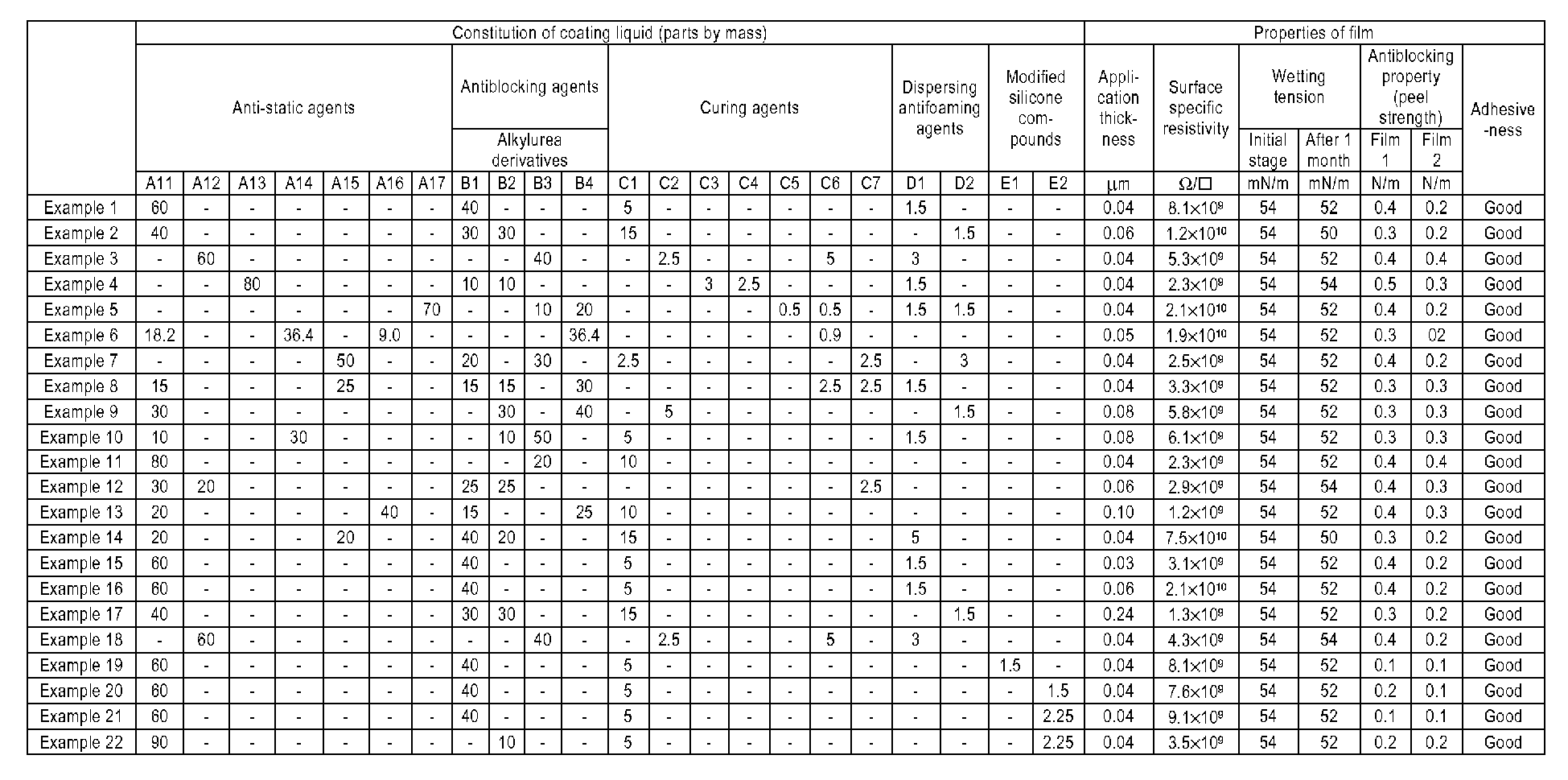


- The films of Examples 1 to 22 were each low in surface specific resistivity, excellent in antiblocking property and adhesiveness, and each maintained excellent wetting tension on the opposite surface to the anti-static layer even when the film was stored in a form of a roll.
- The alkylurea derivatives (B1) to (B3) used were all commercially available products, and the detailed compositions other than the fact that the fundamental structure was octadecyl ethylene urea were not clear. However, these three chemicals commercially available as octadecyl ethylene urea all allow the intended performances to be exhibited. In some Examples other than Example 2, two or more of the chemicals (B1) to (B3) commercially available as octadecyl ethylene urea were used as mixtures; however, intended performances were able to be exhibited without causing any problems. Moreover, as in Example 5 or the like, when one or more of the chemicals (B1) to (B3) commercially available as octadecyl ethylene urea were used as mixed with the chemical (B4) commercially available as an ethylene-based urea, the intended performances were able to be exhibited without causing any problems as shown in Table 1.
- The polymer constituted with the monomers having a quaternary ammonium salt as an anti-static agent is soft and tends to cause blocking; however, as in Examples 1 to 21, the use of an antiblocking agent combined with the further use of a curing agent increased the cross-linking density and created difficulty in the motion of the molecular chain, and consequently was able to more improve the antiblocking property. This fact is quite obvious from a comparison of the evaluation of the antiblocking property in each of Examples 2 and 17 with the evaluation of the antiblocking property in Comparative Example 2, wherein Examples 2 and 17 and Comparative Examples are the same with respect to the compositions of the anti-static agent and the antiblocking agent, and Examples 2 and 17 each include a curing agent, but Comparative Example 2 does not include a curing agent.
- The film of each of Comparative Examples 1, 3, 7 and 8 did not include the alkylurea derivative, and hence was poor in antiblocking property.
- The film of Comparative Example 2 did not contain any curing agent, and hence the antiblocking property and the adhesiveness were poor.
- The film of Comparative Example 4 used a modified polyethylene in place of an alkylurea derivative, and hence the wetting tension of the opposite surface to the anti-static layer was degraded with time, and the antiblocking property and the adhesiveness were poor.
- The films of Comparative Examples 5 and 6 each used an acrylic silicone in place of an alkylurea derivative, and hence the wetting tension of the opposite surface to the anti-static layer was degraded with time although the antiblocking property was good.
Claims (7)
- An anti-static film comprising an anti-static layer on at least one surface of a resin film, wherein the anti-static layer comprises an anti-static component-containing polymer (A), an alkylurea derivative (B) and a curing agent (C), and surface specific resistivity of the anti-static film at 23°C and 50% RH is 1.0 × 10¹¹ Ω/□ or less.
- The anti-static film according to claim 1, wherein the anti-static component-containing polymer (A) is constituted with a quaternary ammonium base-containing polymer (A1), and a content ratio (A1/B) between the quaternary ammonium base-containing polymer (A1) and the alkylurea derivative (B) is 30/70 to 95/5 (mass ratio).
- The anti-static film according to claim 2, wherein the quaternary ammonium base-containing polymer (A1) has one or more functional groups selected from the group consisting of a carboxyl group, a hydroxyl group and an amino group.
- The anti-static film according to claim 1, wherein the curing agent (C) is one or more selected from the group consisting of an epoxy compound, an amino resin, an isocyanate compound, a silanol compound and a metal complex salt.
- A method for producing an anti-static film, comprising, when the anti-static film according to any one of claims 1 to 4 is produced, forming an anti-static layer by applying and drying a coating liquid including the anti-static component-containing polymer (A) or the quaternary ammonium base-containing polymer (A1), the alkylurea derivative (B) and the curing agent (C).
- The method for producing an anti-static film, according to claim 5, wherein the coating liquid further includes a dispersing antifoaming agent (D) and/or a modified silicone compound (E).
- The method for producing an anti-static film, according to claim 5, wherein a solvent of the coating liquid is water.
Applications Claiming Priority (3)
| Application Number | Priority Date | Filing Date | Title |
|---|---|---|---|
| JP2012227971 | 2012-10-15 | ||
| JP2013118919 | 2013-06-05 | ||
| PCT/JP2013/077746 WO2014061581A1 (en) | 2012-10-15 | 2013-10-11 | Anti-static film |
Publications (1)
| Publication Number | Publication Date |
|---|---|
| EP2907659A1 true EP2907659A1 (en) | 2015-08-19 |
Family
ID=50488147
Family Applications (1)
| Application Number | Title | Priority Date | Filing Date |
|---|---|---|---|
| EP13847200.6A Withdrawn EP2907659A1 (en) | 2012-10-15 | 2013-10-11 | Anti-static film |
Country Status (7)
| Country | Link |
|---|---|
| US (1) | US20150259545A1 (en) |
| EP (1) | EP2907659A1 (en) |
| JP (1) | JPWO2014061581A1 (en) |
| KR (1) | KR20150068954A (en) |
| CN (1) | CN104661816A (en) |
| TW (1) | TW201425027A (en) |
| WO (1) | WO2014061581A1 (en) |
Families Citing this family (9)
| Publication number | Priority date | Publication date | Assignee | Title |
|---|---|---|---|---|
| JP6477265B2 (en) * | 2015-06-02 | 2019-03-06 | 三菱ケミカル株式会社 | Laminated polyester film |
| CN106590460A (en) * | 2016-12-30 | 2017-04-26 | 东莞市尼的科技股份有限公司 | Anti-static protective film |
| JP6989272B2 (en) * | 2017-03-17 | 2022-01-05 | 日東電工株式会社 | Molding mat |
| JP7009269B2 (en) * | 2017-04-07 | 2022-01-25 | 三洋化成工業株式会社 | Antistatic coating layer |
| CN110320691B (en) * | 2018-03-28 | 2025-01-24 | 惠州市宝明精工有限公司 | Liquid crystal panel with antistatic film and method for preparing the antistatic film |
| WO2019224921A1 (en) * | 2018-05-22 | 2019-11-28 | 株式会社日立ハイテクノロジーズ | Analysis device |
| TWI893080B (en) * | 2020-03-17 | 2025-08-11 | 日商大日本印刷股份有限公司 | Cover tape for packing electronic component and package |
| CN114479035A (en) * | 2022-02-09 | 2022-05-13 | 苏州梅克兰循环科技有限公司 | A kind of preparation method of nano-particle-enhanced antistatic PET packaging material for recycling |
| CN119021001B (en) * | 2024-10-30 | 2025-04-08 | 浙江恒翔新材料有限公司 | Antistatic agent for FDY oiling agent for crude oil and preparation method thereof |
Family Cites Families (12)
| Publication number | Priority date | Publication date | Assignee | Title |
|---|---|---|---|---|
| JPH10158596A (en) * | 1996-12-04 | 1998-06-16 | Nitto Denko Corp | Adhesive tape |
| JP4828094B2 (en) | 1999-08-31 | 2011-11-30 | 電気化学工業株式会社 | Cover film for carrier tape of electronic parts and manufacturing method thereof |
| JP2003128819A (en) * | 2001-10-29 | 2003-05-08 | Mitsubishi Polyester Film Copp | Antistatic film |
| JP2003155366A (en) * | 2001-11-26 | 2003-05-27 | Mitsubishi Polyester Film Copp | Antistatic film |
| JP2003192022A (en) | 2001-12-26 | 2003-07-09 | Toppan Printing Co Ltd | Cover tape for chip body transport |
| JP2004123112A (en) | 2002-09-30 | 2004-04-22 | Dainippon Ink & Chem Inc | Cover tape for carrier tape |
| JP4222038B2 (en) | 2003-01-28 | 2009-02-12 | 住友ベークライト株式会社 | Cover tape for packaging electronic parts |
| JP2005007640A (en) * | 2003-06-17 | 2005-01-13 | Konica Minolta Photo Imaging Inc | Method for manufacturing porous medium |
| JP4578955B2 (en) | 2004-12-07 | 2010-11-10 | ユニチカ株式会社 | Easy adhesion polyester film |
| JP4615984B2 (en) | 2004-12-16 | 2011-01-19 | 電気化学工業株式会社 | Cover tape |
| JP4695513B2 (en) * | 2006-01-17 | 2011-06-08 | リンテック株式会社 | Process for producing release film |
| JP5271293B2 (en) * | 2010-02-07 | 2013-08-21 | 三菱樹脂株式会社 | Laminated polyester film |
-
2013
- 2013-10-11 WO PCT/JP2013/077746 patent/WO2014061581A1/en not_active Ceased
- 2013-10-11 JP JP2014542106A patent/JPWO2014061581A1/en active Pending
- 2013-10-11 CN CN201380049043.2A patent/CN104661816A/en active Pending
- 2013-10-11 US US14/433,694 patent/US20150259545A1/en not_active Abandoned
- 2013-10-11 EP EP13847200.6A patent/EP2907659A1/en not_active Withdrawn
- 2013-10-11 KR KR1020157009098A patent/KR20150068954A/en not_active Withdrawn
- 2013-10-15 TW TW102137087A patent/TW201425027A/en unknown
Non-Patent Citations (1)
| Title |
|---|
| See references of WO2014061581A1 * |
Also Published As
| Publication number | Publication date |
|---|---|
| TW201425027A (en) | 2014-07-01 |
| JPWO2014061581A1 (en) | 2016-09-05 |
| WO2014061581A1 (en) | 2014-04-24 |
| CN104661816A (en) | 2015-05-27 |
| US20150259545A1 (en) | 2015-09-17 |
| KR20150068954A (en) | 2015-06-22 |
Similar Documents
| Publication | Publication Date | Title |
|---|---|---|
| US20150259545A1 (en) | Anti-static film | |
| JP5645462B2 (en) | Laminated polyester film | |
| EP2561986B1 (en) | Laminated polyester film | |
| AU2018226792B2 (en) | Print receptive topcoat | |
| US20140272408A1 (en) | Water-dispersible acrylic pressure-sensitive adhesive composition, pressure-sensitive adhesive layer, and pressure-sensitive adhesive sheet | |
| ES2256537T3 (en) | POLYMERS STIBILIZED BY POLYMERS WITH AMINO FUNCTION, CATIONICOS, WATER SOLUBLE, AND PLASTIC FILMS COVERED WITH THE SAME. | |
| JP5313455B2 (en) | Surface protection film | |
| JP5778471B2 (en) | Polyester film for surface protective film and surface protective film | |
| JP4578955B2 (en) | Easy adhesion polyester film | |
| JP2013006300A (en) | Antistatic film | |
| KR101769297B1 (en) | Coating film | |
| JP3122001B2 (en) | Laminated film | |
| US20210323334A1 (en) | Print receptive topcoat | |
| JP2013006299A (en) | Antistatic film | |
| KR100728661B1 (en) | Antistatic water dispersion coating solution and antistatic polyester film prepared using the same | |
| US20210324220A1 (en) | Print receptive topcoat | |
| JP2001240689A (en) | Styrene resin film | |
| JP2005145529A (en) | Cover film base material for electronic component carrier tape | |
| JP2001107029A (en) | Antistatic agent for synthetic polymer film, aqueous composition containing the same, and method for preventing static charge of synthetic polymer film using this aqueous composition | |
| JPH11268213A (en) | Easy adhesion film |
Legal Events
| Date | Code | Title | Description |
|---|---|---|---|
| PUAI | Public reference made under article 153(3) epc to a published international application that has entered the european phase |
Free format text: ORIGINAL CODE: 0009012 |
|
| 17P | Request for examination filed |
Effective date: 20150409 |
|
| AK | Designated contracting states |
Kind code of ref document: A1 Designated state(s): AL AT BE BG CH CY CZ DE DK EE ES FI FR GB GR HR HU IE IS IT LI LT LU LV MC MK MT NL NO PL PT RO RS SE SI SK SM TR |
|
| AX | Request for extension of the european patent |
Extension state: BA ME |
|
| STAA | Information on the status of an ep patent application or granted ep patent |
Free format text: STATUS: THE APPLICATION HAS BEEN WITHDRAWN |
|
| 18W | Application withdrawn |
Effective date: 20150820 |