EP2901698B1 - Verfahren zur codierung und decodierung von bildern, codierungs- und decodierungsvorrichtung und damit zusammenhängende computerprogramme - Google Patents
Verfahren zur codierung und decodierung von bildern, codierungs- und decodierungsvorrichtung und damit zusammenhängende computerprogramme Download PDFInfo
- Publication number
- EP2901698B1 EP2901698B1 EP13789595.9A EP13789595A EP2901698B1 EP 2901698 B1 EP2901698 B1 EP 2901698B1 EP 13789595 A EP13789595 A EP 13789595A EP 2901698 B1 EP2901698 B1 EP 2901698B1
- Authority
- EP
- European Patent Office
- Prior art keywords
- reference images
- images
- subset
- image
- coding
- Prior art date
- Legal status (The legal status is an assumption and is not a legal conclusion. Google has not performed a legal analysis and makes no representation as to the accuracy of the status listed.)
- Active
Links
Images



Classifications
-
- H—ELECTRICITY
- H04—ELECTRIC COMMUNICATION TECHNIQUE
- H04N—PICTORIAL COMMUNICATION, e.g. TELEVISION
- H04N19/00—Methods or arrangements for coding, decoding, compressing or decompressing digital video signals
- H04N19/10—Methods or arrangements for coding, decoding, compressing or decompressing digital video signals using adaptive coding
- H04N19/102—Methods or arrangements for coding, decoding, compressing or decompressing digital video signals using adaptive coding characterised by the element, parameter or selection affected or controlled by the adaptive coding
- H04N19/103—Selection of coding mode or of prediction mode
- H04N19/105—Selection of the reference unit for prediction within a chosen coding or prediction mode, e.g. adaptive choice of position and number of pixels used for prediction
-
- H—ELECTRICITY
- H04—ELECTRIC COMMUNICATION TECHNIQUE
- H04N—PICTORIAL COMMUNICATION, e.g. TELEVISION
- H04N19/00—Methods or arrangements for coding, decoding, compressing or decompressing digital video signals
- H04N19/10—Methods or arrangements for coding, decoding, compressing or decompressing digital video signals using adaptive coding
- H04N19/102—Methods or arrangements for coding, decoding, compressing or decompressing digital video signals using adaptive coding characterised by the element, parameter or selection affected or controlled by the adaptive coding
-
- H—ELECTRICITY
- H04—ELECTRIC COMMUNICATION TECHNIQUE
- H04N—PICTORIAL COMMUNICATION, e.g. TELEVISION
- H04N19/00—Methods or arrangements for coding, decoding, compressing or decompressing digital video signals
- H04N19/10—Methods or arrangements for coding, decoding, compressing or decompressing digital video signals using adaptive coding
- H04N19/102—Methods or arrangements for coding, decoding, compressing or decompressing digital video signals using adaptive coding characterised by the element, parameter or selection affected or controlled by the adaptive coding
- H04N19/117—Filters, e.g. for pre-processing or post-processing
-
- H—ELECTRICITY
- H04—ELECTRIC COMMUNICATION TECHNIQUE
- H04N—PICTORIAL COMMUNICATION, e.g. TELEVISION
- H04N19/00—Methods or arrangements for coding, decoding, compressing or decompressing digital video signals
- H04N19/10—Methods or arrangements for coding, decoding, compressing or decompressing digital video signals using adaptive coding
- H04N19/134—Methods or arrangements for coding, decoding, compressing or decompressing digital video signals using adaptive coding characterised by the element, parameter or criterion affecting or controlling the adaptive coding
- H04N19/136—Incoming video signal characteristics or properties
- H04N19/137—Motion inside a coding unit, e.g. average field, frame or block difference
-
- H—ELECTRICITY
- H04—ELECTRIC COMMUNICATION TECHNIQUE
- H04N—PICTORIAL COMMUNICATION, e.g. TELEVISION
- H04N19/00—Methods or arrangements for coding, decoding, compressing or decompressing digital video signals
- H04N19/10—Methods or arrangements for coding, decoding, compressing or decompressing digital video signals using adaptive coding
- H04N19/169—Methods or arrangements for coding, decoding, compressing or decompressing digital video signals using adaptive coding characterised by the coding unit, i.e. the structural portion or semantic portion of the video signal being the object or the subject of the adaptive coding
- H04N19/17—Methods or arrangements for coding, decoding, compressing or decompressing digital video signals using adaptive coding characterised by the coding unit, i.e. the structural portion or semantic portion of the video signal being the object or the subject of the adaptive coding the unit being an image region, e.g. an object
- H04N19/172—Methods or arrangements for coding, decoding, compressing or decompressing digital video signals using adaptive coding characterised by the coding unit, i.e. the structural portion or semantic portion of the video signal being the object or the subject of the adaptive coding the unit being an image region, e.g. an object the region being a picture, frame or field
-
- H—ELECTRICITY
- H04—ELECTRIC COMMUNICATION TECHNIQUE
- H04N—PICTORIAL COMMUNICATION, e.g. TELEVISION
- H04N19/00—Methods or arrangements for coding, decoding, compressing or decompressing digital video signals
- H04N19/10—Methods or arrangements for coding, decoding, compressing or decompressing digital video signals using adaptive coding
- H04N19/169—Methods or arrangements for coding, decoding, compressing or decompressing digital video signals using adaptive coding characterised by the coding unit, i.e. the structural portion or semantic portion of the video signal being the object or the subject of the adaptive coding
- H04N19/17—Methods or arrangements for coding, decoding, compressing or decompressing digital video signals using adaptive coding characterised by the coding unit, i.e. the structural portion or semantic portion of the video signal being the object or the subject of the adaptive coding the unit being an image region, e.g. an object
- H04N19/176—Methods or arrangements for coding, decoding, compressing or decompressing digital video signals using adaptive coding characterised by the coding unit, i.e. the structural portion or semantic portion of the video signal being the object or the subject of the adaptive coding the unit being an image region, e.g. an object the region being a block, e.g. a macroblock
-
- H—ELECTRICITY
- H04—ELECTRIC COMMUNICATION TECHNIQUE
- H04N—PICTORIAL COMMUNICATION, e.g. TELEVISION
- H04N19/00—Methods or arrangements for coding, decoding, compressing or decompressing digital video signals
- H04N19/50—Methods or arrangements for coding, decoding, compressing or decompressing digital video signals using predictive coding
- H04N19/503—Methods or arrangements for coding, decoding, compressing or decompressing digital video signals using predictive coding involving temporal prediction
- H04N19/51—Motion estimation or motion compensation
- H04N19/573—Motion compensation with multiple frame prediction using two or more reference frames in a given prediction direction
-
- H—ELECTRICITY
- H04—ELECTRIC COMMUNICATION TECHNIQUE
- H04N—PICTORIAL COMMUNICATION, e.g. TELEVISION
- H04N19/00—Methods or arrangements for coding, decoding, compressing or decompressing digital video signals
- H04N19/80—Details of filtering operations specially adapted for video compression, e.g. for pixel interpolation
Definitions
- the present invention relates generally to the field of image processing, and more specifically to the coding and decoding of digital images and sequences of digital images.
- the invention can thus in particular be applied to video coding implemented in current video coders (MPEG, H.264, etc.) or future ITU-T / VCEG (HEVC) or ISO / MPEG (HVC).
- MPEG current video coders
- HEVC future ITU-T / VCEG
- HVC ISO / MPEG
- JCT-VC Joint Collaborative Team on Video Coding
- the aforementioned HEVC standard implements a prediction of pixels of a current image with respect to other pixels belonging either to the same image (intra prediction), or to one or more previous images of the sequence (inter prediction) that have already been decoded.
- Such previous images are conventionally called reference images and are stored in memory both in the encoder and in the decoder.
- Inter prediction is commonly called motion compensated prediction.
- the images are cut into macroblocks, which are then subdivided into blocks, made up of pixels.
- Each block or macroblock is coded by intra or inter picture prediction.
- the coding of a current block is carried out using a prediction of the current block, delivering a predicted block, and a prediction residue, corresponding to a difference between the current block and the predicted block.
- This prediction residue also called the residual block, is transmitted to the decoder, which reconstructs the current block by adding this residual block to the prediction.
- the residual block obtained is then transformed, for example by using a transform of DCT type (discrete cosine transform).
- DCT type discrete cosine transform
- the coefficients of the transformed residual block are then quantized, then encoded by entropy coding.
- the decoding is done image by image, and for each image, block by block or macroblock by macroblock.
- For each (macro) block the corresponding elements of the stream are read.
- the inverse quantization and the inverse transformation of the coefficients of the residual block (s) associated with the (macro) block are performed.
- the prediction of the (macro) block is calculated and the (macro) block is reconstructed by adding the prediction to the decoded residual block (s).
- transformed, quantized and then encoded residual blocks are therefore transmitted to the decoder, to enable it to reconstruct the decoded image (s).
- the reference images used to encode or decode the current image are not very similar, in terms of texture and rendering of the movement, to the current image.
- the precision of the Inter prediction of the current image is then of poor quality, which is detrimental to the performance of Inter coding of the current image.
- the document US2010 / 246680 A1 describes a video encoder comprising a reference image predictor.
- the predictor uses an analysis of optical flow between previously decoded images and the previous decoded current image. The determined motion parameters are then applied to the previous decoded current image to determine new reference images.
- One of the aims of the invention is to remedy the drawbacks of the aforementioned state of the art.
- an object of the present invention relates to a method for encoding and decoding at least one current image.
- Such an arrangement has the advantage of encoding the current image from reference images which are more similar to the current image than the reference images available for coding and conventionally used for coding the current image. This results in better precision of the prediction of movement of the current image, and therefore a much finer Inter-coding of the latter.
- reference images which are temporally closest to the current image makes it possible to apply the parametric function to reference images which have the highest probability of being as similar as possible to the current image , in terms of texture and movement. This results in an optimization of the accuracy of the prediction of the current image and better compression performance of the latter.
- the invention also relates to a device for coding at least one current image intended to implement the aforementioned coding method.
- the invention also relates to a device for decoding at least one current image intended to implement the aforementioned decoding method.
- the invention also relates to a computer program comprising instructions for implementing the coding method or the decoding method according to the invention, when it is executed on a computer.
- This program can use any programming language, and be in the form of source code, object code, or intermediate code between source code and object code, such as in a partially compiled form, or in any other. desirable shape.
- the invention also relates to a recording medium readable by a computer on which a computer program is recorded, this program comprising instructions adapted to the implementation of the encoding or decoding method according to the invention, as described. above.
- the recording medium can be any entity or device capable of storing the program.
- the medium can comprise a storage means, such as a ROM, for example a CD ROM or a microelectronic circuit ROM, or else a magnetic recording means, for example a USB key or a hard disk.
- the recording medium can be a transmissible medium such as an electrical or optical signal, which can be conveyed via an electrical or optical cable, by radio or by other means.
- the program according to the invention can in particular be downloaded from an Internet type network.
- the recording medium can be an integrated circuit in which the program is incorporated, the circuit being adapted to execute or to be used in the execution of the aforementioned encoding or decoding method.
- the aforementioned coding device and corresponding computer program have at least the same advantages as those conferred by the coding method according to the present invention.
- the aforementioned decoding device, computer program and corresponding recording medium have at least the same advantages as those conferred by the decoding method according to the present invention.
- the coding method according to the invention is for example implemented in software or hardware by modifications of an encoder initially conforming to the HEVC standard.
- the coding method according to the invention is represented in the form of an algorithm comprising steps C1 to C8 as represented in figure 1 .
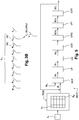
- the coding method according to the invention is implemented in a CO coding device shown in figure 2 .
- such a coding device comprises a MEM_CO memory comprising an MT_CO buffer memory, a UT_CO processing unit equipped for example with a ⁇ P microprocessor and controlled by a computer program PG_CO which implements the coding method according to the invention .
- the code instructions of the computer program PG_CO are for example loaded into a RAM memory before being executed by the processor of the processing unit UT_CO.
- the coding process shown in figure 1 applies to any current image of an SI sequence of images to be encoded.
- a current image I n is considered in the sequence of images SI.
- a set S n of reference images R n-1 , R n-2 , .... R nM is available in the buffer memory MT_CO of the CO encoder, as shown in figure 2 .
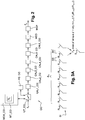
- the figure 3A illustrates the succession of said M reference images with respect to the current image I n to be encoded, where R n-8 is the reference image furthest in time from the current image I n and where R n-1 is l reference image closest in time to the current image.
- reference images are images of the sequence SI which have been encoded beforehand and then decoded.
- the current image I n is encoded from one or more of said reference images.
- one or more of said reference images will be transformed prior to Inter-coding of the current image, with the aim of obtaining respectively one or more reference images. transforms that resemble the current image as closely as possible in terms of texture and movement.
- a first sub-set SS of reference images is determined, as well as a second sub-set SC of reference images.
- the first and second subsets respectively contain a reference image.
- the first and second subsets respectively contain two reference images.
- the number of reference images determined in each of the first and second subsets is specific for each current image to be coded and may be different.
- said step of determining C1 is implemented by a calculation module CAL1_CO of the coder CO, which module is controlled by the microprocessor ⁇ P of the processing unit UT_CO.
- At least one reference image is selected from the first sub-set SS of reference images determined in step C1.
- the reference image R n-2 is selected.
- the reference images R n-3 and R n-4 are selected.
- said selection step C2 is implemented by a calculation module CAL2_CO of the coder CO, which module is controlled by the microprocessor ⁇ P of the processing unit UT_CO.
- At least one reference image is selected from the second sub-set SC of reference images determined in step C1.
- the reference image R n-1 is selected.
- the reference images R n-2 and R n-1 are selected.
- said selection step C3 is implemented by a calculation module CAL3_CO of the coder CO, which module is controlled by the microprocessor ⁇ P of the processing unit UT_CO.
- a predetermined parametric function F P which is adapted to transform a number N S of reference images selected in the first subset SS into an approximation of a number N C of reference images selected from the second subset SC.
- said step of determining C4 is implemented by a calculation module CAL4_CO of the coder CO, which module is controlled by the microprocessor ⁇ P of the processing unit UT_CO.
- Such an approximation is carried out by maximizing a predetermined resemblance criterion between at least one image of the first subset SS of reference images and at least one reference image of the second subset SC of reference images.
- the approximation is performed by maximizing a predetermined resemblance criterion between the selected image R n-2 of the first subset SS of reference images and the selected image R n-1 of the second subset SC of reference images.
- the approximation is performed by maximizing a predetermined resemblance criterion between the two images selected R n-3 and R n-4 from the first sub-set SS of reference images and respectively the two selected images R n-2 and R n-1 from the second sub-set SC of reference images.
- a parameter value p ' is determined so that the image F P' (R n-2 ) is the best possible approximation of the image R n-1 , that is ie by minimizing ⁇ F P (R n-2 ) - R n-1 ⁇ .
- the notation ⁇ F P (R n-2 ) - R n-1 ⁇ represents a standard well known per se, such as the L2, L1 standard, sup standard, examples of which are given below.
- the minimization does not necessarily provide one or more intermediate images.
- the approximation is performed according to a predetermined resemblance criterion which consists for example in minimizing a general function depending on the pixels of each of the images F P (R n-2 ) and R n-1 .
- the parametric function F P can take different forms, non-exhaustive examples of which are given below.
- Parameters A and B are optimized by classical approaches, such as exhaustive search, genetic algorithm, etc.
- the exhaustive search consists in the parameters A and B taking their respective values from a predetermined set.
- the values of the parameter A belong to the predetermined set of values ⁇ 0.98, 0.99, 1.0, 1.01, 1.02 ⁇ and the values of the parameter B belong to the predetermined set of values ⁇ -2, -1, 0, 1, 2 ⁇ . All the possible value combinations are then tested and the one which optimizes the resemblance criterion is kept.
- Discrete optimization methods known per se can also be used to avoid exploring all the combinations, which is costly in terms of calculations.
- the parametric function F P is a movement compensation.
- the image Y is then made up of several blocks which have been encoded using a prediction with motion compensation with blocks resulting from the image X.
- For a considered block of the image Y is associated with a motion vector which describes the motion between a corresponding block in the image X and the block considered in the image Y.
- the set of motion vectors form a plurality of parameters p ′ of the function F P.
- the image Y is the image R n-1 of the second subset SC and that the image X is the image R n-2 of the first subset SS.
- the approximation is performed according to a predetermined resemblance criterion which consists in dividing the image R n-1 into several blocks, then determining for a block considered in the image R n-1 which is, in the image R n -2 , the most similar block in terms of texture and movement.
- the motion vector associated with said most resembling block is then included in the parameters p '.
- the parametric function F P is a Wiener filter which is well known per se and which is for example described at the Internet address http://fr.wikipedia.org/wiki/D%C3%A9convolution of Wiener.
- the approximation is performed according to a predetermined resemblance criterion which consists, for a given filter medium, in determining the Wiener filter which filters the image R n-2 so as to obtain the best possible resemblance with the image R n -1 .
- the coefficients of the determined Wiener filter then form the plurality of parameters p '.
- the parametric function F P can also be a combination of the aforementioned parametric functions.
- the image Y can be cut into a plurality of zones obtained for example using a segmentation which is a function of certain criteria (distortion criterion, criterion of homogeneity of the zone according to certain characteristics such as the local energy of the video signal).
- a segmentation which is a function of certain criteria (distortion criterion, criterion of homogeneity of the zone according to certain characteristics such as the local energy of the video signal).
- Each zone of the image Y can then be approximated according to one of the examples described above.
- a first zone of the image Y is for example approximated using Wiener filtering.
- a second zone of the image Y is for example approximated using a motion compensation.
- a third zone of the image Y if it presents a low contrast, uses for example the identity function, that is to say is not approximated, etc.
- the various parameters p 'of the parametric function F P then consist of the segmentation information and the parameters associated with each segmented zone of the image Y.
- At least one parameter value p "of the parameter T is determined.
- the value p" is the union of two values p1 and p2, where p1 and p2 are respectively the values.
- one or more reference images are selected on the one or more of the function F P to obtain one or more new reference images.
- a selection is implemented in a third subset SD of the set S n of reference images, said third subset SD being different from the first subset SS and containing one or more reference images which are temporally the closest to the current image I n .
- the reference image selected in the SD subset is the image R n-1 .
- the images selected from the SD subset are the images R n-1 and R n-2 .
- the third subset SD contains at least one of the images of the second subset SC.
- the images selected in this third subset are images temporally offset by +1 with respect to the images of the first subset SS.
- the image R n-1 in the third subset SD temporally follows immediately the image R n-2 of the first subset SS.
- the images R n-2 and R n-1 selected in the third subset SD temporally follow immediately the images R n-4 and R n-3 contained in the first subset SS of ' reference images.
- the aforementioned selection step C5 is implemented by a calculation module CAL5_CO of the CO encoder, which module is controlled by the microprocessor ⁇ P of the processing unit UT_CO.
- step C6 the application to the image (s) selected in the third subset SD, of the function F P according to the parameter p ′ determined in step C4 is carried out. At the end of this step C6, one or more new reference images are obtained.
- the application step C6 is implemented by a calculation module CAL6_CO of the coder CO, which module is controlled by the microprocessor ⁇ P of the processing unit UT_CO.
- the current image I n is coded from the new reference image (s) obtained at the end of step C6.
- the coding step C7 is implemented by an MCO coding module of the CO coder, which module is controlled by the microprocessor ⁇ P of the UT_CO processing unit.
- the MCO module will be described later in the description.
- a step C8 is produced, in the course of a step C8, with the production of a bit stream F n representing the current image I n encoded by the aforementioned MCO coding module, as well as a decoded version R n of l current image I n capable of being reused as a reference image in the set S n of reference images in accordance with the coding method according to the invention.
- the production step C8 of a current stream F n is implemented by a stream generation module MGF which is adapted to produce data streams, such as bits for example.
- Said MGF module is controlled by the microprocessor ⁇ P of the processing unit UT_CO.
- the current flow F n is then transmitted by a communication network (not shown), to a remote terminal.
- a communication network not shown
- the parameter p 'determined in the aforementioned step C4 is modified into another parameter p'"to take account of the images to which it applies.
- the parameter p '" is calculated beforehand from of the determined parameter p '.
- Such a step is particularly useful for example in the case where the function F P is a simple reduction in the overall luminance of the image, ie a “fade to black”.
- the parameter value p ' should be adapted so that the value of the shift in luminance is equal to -7, that is to say the offset value between the reference image R n-1 and the current image I n .
- the new reference image V n obtained will have thus a higher probability of resembling the current image I n more in terms of texture and movement.
- the step C6 of applying the parametric function F P is implemented according to said parameter p '''.
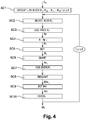
- the first sub-step SC1 is the cutting of the current image I n into a plurality of blocks B 1 , B 2 , ..., B i , ..., B K , with 1 i K.
- K 16.
- a macroblock is conventionally a block having a predetermined maximum size. Such a macroblock can moreover itself be cut into smaller blocks.
- the term “block” will therefore be used interchangeably to designate a block or a macroblock.
- said blocks have a square shape and all have the same size.
- the last blocks on the left and the last blocks at the bottom may not be square.
- the blocks may for example be rectangular in size and / or not aligned with one another.
- Such a division is carried out by a PCO partitioning module shown in figure 5 which uses for example a partitioning algorithm well known as such.
- the MCO coding module selects as the current block the first block to be coded B 1 of the image current I n .
- the selection of the blocks of an image is carried out according to a lexicographic order, that is to say according to a line by line traversal of the blocks, of “raster-scan” type, starting from the block. located at the top left of the image to the block located at the bottom right of the image.
- the current block B 1 is predictively coded by known techniques of intra and / or inter prediction, during which the block B 1 is predicted with respect to at least one block previously coded and then decoded.
- said predictive coding step SC3 is implemented by a predictive coding unit UCP which is able to perform predictive coding of the current block, according to conventional prediction techniques, such as for example in Intra and / or Inter mode.
- the current block B 1 is predicted with respect to a block resulting from a previously coded and decoded image.
- the previously encoded and decoded image is an image which has been obtained following the aforementioned step C6, as shown in figure 1 .
- the optimal prediction is chosen according to a distortion rate criterion well known to those skilled in the art.
- Said aforementioned predictive coding step makes it possible to construct a predicted block Bp 1 which is an approximation of the current block B 1 .
- the information relating to this predictive coding will subsequently be recorded in the stream F n transmitted to the decoder DO.
- Such information includes in particular the type of prediction (inter or intra), and where appropriate, the intra prediction mode, the type of partitioning of a block or macroblock if the latter has been subdivided, the image index of reference and the displacement vector used in the inter prediction mode. This information is compressed by the CO encoder shown in figure 2 .
- the UCP predictive coding unit of the figure 5 subtracts the predicted block Bp 1 from the current block B 1 to produce a residual block Br 1 .
- the residue block Br 1 is transformed according to a conventional transformation operation direct such as for example a transformation into discrete cosines of DCT type, to produce a transformed block Bt 1 .
- Said sub-step SC5 is implemented by a transformation unit UT represented in figure 5 .
- the transformed block Bt 1 is quantized according to a conventional quantization operation, such as for example a scalar quantization.
- a block of quantized coefficients Bq 1 is then obtained.
- Said sub-step SC6 is implemented by a quantization unit UQ represented in figure 5 .
- the entropy coding of the block of quantized coefficients Bq 1 is carried out .
- it is CABAC entropy coding well known to those skilled in the art.
- Said sub-step SC7 is implemented by an entropy coding unit UCE represented in figure 5 .
- the block Bq 1 is dequantized according to a conventional dequantization operation, which is the reverse operation of the quantization carried out in sub-step SC6.
- a block of dequantized coefficients BDq 1 is then obtained.
- Said sub-step SC8 is implemented by a dequantization unit UDQ represented in figure 5 .
- Said sub-step SC9 is implemented by a reverse transformation unit UTI shown in figure 5 .
- the decoded block BD 1 is constructed by adding to the predicted block Bp 1 the decoded residue block BDr 1 . It should be noted that this last block is the same as the decoded block obtained at the end of the process for decoding the image I n which will be described later in the description.
- the decoded block BD 1 is thus made available for use by the encoding module MCO.
- Said sub-step SC10 is implemented by a UCR construction unit shown in figure 5 .
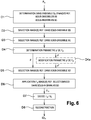
- the decoding method according to the invention is represented in the form of an algorithm comprising steps D1 to D8 represented at figure 6 .
- the decoding method according to the invention is implemented in a decoding device DO shown in figure 7 .
- such a decoding device comprises a MEM_DO memory comprising a MT_DO buffer memory, a UT_DO processing unit equipped for example with a ⁇ P microprocessor and controlled by a computer program PG_DO which implements the decoding method according to the invention .
- the code instructions of the computer program PG_DO are for example loaded into a RAM memory before being executed by the processor of the processing unit UT_DO.
- the decoding process shown in figure 6 applies to any current image of an SI sequence of images to be decoded.
- the figure 3A illustrates the succession of said M reference images with respect to the current image I n to be decoded, where R n-8 is the reference image furthest in time from the current image I n and where R n-1 is l reference image closest in time to the current image.
- reference images are images of the sequence SI which have been encoded beforehand and then decoded.
- the current image I n is decoded from one or more of said reference images.
- one or more of said reference images will be transformed prior to the decoding in Inter of the current image, in order to obtain respectively one or more reference images. transforms that resemble the current image as closely as possible in terms of texture and movement.
- the transformation of said reference images is carried out on decoding in a manner similar to coding, in particular steps C1 to C6 represented in figure 1 .
- a first sub-set SS of reference images is determined, as well as a second sub-set SC of reference images. Since such a step is identical to the aforementioned step C1, it will not be described further.
- said determining step D1 is implemented by a calculation module CAL1_DO of the decoder DO, which module is controlled by the microprocessor ⁇ P of the processing unit UT_DO.
- step D2 at least one reference image is selected from the first subset SS of reference images determined in step D1. Since such a step is identical to the aforementioned step C2, it will not be described further.
- said selection step D2 is implemented by a calculation module CAL2_DO of the decoder DO, which module is controlled by the microprocessor ⁇ P of the processing unit UT_DO.
- At least one reference image is selected from the second sub-set SC of reference images determined in step D1.
- said selection step D3 is implemented by a calculation module CAL3_DO of the decoder DO, which module is controlled by the microprocessor ⁇ P of the processing unit UT_DO.
- a predetermined parametric function F P which is adapted to transform a number N S of reference images selected in the first subset SS into an approximation of a number N C of reference images selected from the second subset SC.
- said determination step D4 is implemented by a calculation module CAL4_DO of the decoder DO, which module is controlled by the microprocessor ⁇ P of the processing unit UT_DO.
- Step D4 being identical to the aforementioned step C4, it will not be described further.
- one or more reference images are selected on the one or more images to apply the function Fp to obtain one or more new reference images.
- Step D5 being identical to the aforementioned step C5, it will not be described further.
- the aforementioned selection step D5 is implemented by a calculation module CAL5_DO of the decoder DO, which module is controlled by the microprocessor ⁇ P of the processing unit UT_DO.
- step D6 the application to the images selected in the third subset SD is applied to the function F P according to the parameter p ′ determined in step D4. At the end of this step D6, one or more new reference images are obtained.
- Step D6 being identical to step C6 above, it will not be described further.
- the application step D6 is implemented by a calculation module CAL6_DO of the decoder DO, which module is controlled by the microprocessor ⁇ P of the processing unit UT_DO.
- step D7 the current image I n is decoded from the new reference image or images obtained at the end of step D6.
- the decoding step D7 is implemented by a decoding module MDO of the decoder DO, which module is controlled by the microprocessor ⁇ P of the processing unit UT_DO.
- the MDO module will be described later in the description.
- a reconstruction of a decoded image ID n is carried out .
- the reconstruction step D8 is implemented by a URI reconstruction unit which writes the decoded blocks in a decoded image as these blocks become available.
- the parameter p 'determined in the aforementioned step D4 is modified into another parameter p'"to take account of the images to which it applies.
- step D4a is identical to the aforementioned step C4a, it will not be described further.
- the MDO decoding module shown in figure 9 selects as the current block in the stream F n the first block to be decoded B 1 .
- CABAC entropy decoding unit UDE As shown in figure 9 .
- Such a unit is well known as such and will not be described further.
- a sub-step SD3 represented in figure 8 Requires the predictive decoding of the current block B 1 by known techniques intra prediction and / or inter, in which the block B 1 is predicted from at least one previously decoded block.
- the predictive decoding is performed using the syntax elements decoded in the previous step and comprising in particular the type of prediction (inter or intra), and where appropriate, the intra prediction mode, the type of partitioning of a block or macroblock if the latter has been subdivided, the reference image index and the displacement vector used in the inter prediction mode.
- a quantized residue block Bq 1 is constructed using the previously decoded syntax elements.
- Such a step is implemented by a UBRQ unit for building a quantified residue block as shown in the figure. figure 9 .
- the quantized residue block Bq 1 is dequantized according to a conventional dequantization operation which is the reverse operation of the quantization carried out in the aforementioned sub-step SC6, to produce a decoded dequantized block BDt 1 .
- Said sub-step SD5 is implemented by a dequantization unit UDQ represented in figure 9 .
- the inverse transformation of the dequantized block BDt 1 is carried out, which is the inverse operation of the direct transformation carried out in the aforementioned sub-step SC5.
- a decoded residue block BDr 1 is then obtained.
- Said sub-step SD6 is implemented by an inverse transformation unit UTI represented in figure 9 .
- the decoded block BD 1 is constructed by adding to the predicted block Bp 1 the decoded residue block BDr 1 .
- the BD 1 decoded block is thus made available for use by the MDO decoding module of the figure 9 .
- Said sub-step SD7 is implemented by a decoded block construction UCBD unit as shown in figure 9 .
- decoding sub-steps which have just been described above are implemented for all the blocks to be decoded of the current image I n considered.
Landscapes
- Engineering & Computer Science (AREA)
- Multimedia (AREA)
- Signal Processing (AREA)
- Compression Or Coding Systems Of Tv Signals (AREA)
Claims (12)
- Verfahren zur Codierung mindestens eines aktuellen Bilds (In), das die folgenden Schritte beinhaltet:- Bestimmen (C4) mindestens eines Parameters (p', p") einer vorgegebenen parametrischen Funktion (FP), wobei die Funktion fähig ist, die Bilder eines ersten Teilsatzes (SS) eines Satzes (Sn) von zuvor decodierten Referenzbildern in eine Approximation der Bilder eines zweiten Teilsatzes (SC) von Bildern des Satzes (Sn) von Referenzbildern zu transformieren,- Anwenden (C6) der Funktion (FP) gemäß dem bestimmten Parameter (p', p") auf einen dritten Teilsatz (SD) des Satzes (Sn) von Referenzbildern, wobei sich der dritte Teilsatz von dem ersten Teilsatz unterscheidet, um einen anderen Satz (SV) von zuvor decodierten Referenzbildern zu erhalten,- Codieren (C7) des aktuellen Bilds (In) anhand des erhaltenen Satzes (SV) von Referenzbildern,wobei für mindestens ein zu codierendes Bild:- der erste und der zweite Teilsatz (SS, SC) jeweils zwei Referenzbilder beinhalten,- der dritte Teilsatz (SD) die zwei Referenzbilder beinhaltet, die dem aktuellen Bild (In) zeitlich am nächsten sind,- und der andere erhaltene Satz (SV) von Referenzbildern zwei Referenzbilder beinhaltet.
- Codierungsverfahren nach Anspruch 1, bei dem der Schritt des Bestimmens mindestens eines Parameters (p', p") durch eine Maximierung eines vorgegebenen Ähnlichkeitskriteriums zwischen der Approximation des zweiten Teilsatzes von Referenzbildern und dem zweiten Teilsatz von Referenzbildern durchgeführt wird.
- Codierungsverfahren nach einem der Ansprüche 1 bis 2, bei dem der Schritt des Anwendens der Funktion (FP) gemäß einem anderen Parameter (p"') als dem bestimmten Parameter (p', p") implementiert wird, wobei der andere Parameter (p"') zuvor anhand des bestimmten Parameters (p', p") berechnet (C4a) wird.
- Vorrichtung zur Codierung (CO) mindestens eines aktuellen Bilds (In), die dazu bestimmt ist, das Codierungsverfahren nach einem der Ansprüche 1 bis 3 zu implementieren, und die Folgendes beinhaltet:- Mittel (CAL4_CO) zum Bestimmen mindestens eines Parameters (p') einer vorgegebenen parametrischen Funktion (FP), wobei die Funktion fähig ist, die Bilder eines ersten Teilsatzes (SS) eines Satzes (Sn) von zuvor decodierten Referenzbildern in eine Approximation der Bilder eines zweiten Teilsatzes (SC) von Bildern des Satzes (Sn) von Referenzbildern zu transformieren,- Mittel (CAL6_CO) zum Anwenden der Funktion (FP) gemäß dem bestimmten Parameter (p') auf einen dritten Teilsatz (SD) des Satzes (Sn) von Referenzbildern, wobei sich der dritte Teilsatz von dem ersten Teilsatz unterscheidet, um einen anderen Satz (SV) von zuvor decodierten Referenzbildern zu erhalten,- Mittel (MCO) zum Codieren des aktuellen Bilds (In) anhand des erhaltenen Satzes (SV) von Referenzbildern,wobei für mindestens ein zu codierendes Bild:- der erste und der zweite Teilsatz (SS, SC) jeweils zwei Referenzbilder beinhalten,- der dritte Teilsatz (SD) die zwei Referenzbilder beinhaltet, die dem aktuellen Bild (In) zeitlich am nächsten sind,- und der andere erhaltene Satz (SV) von Referenzbildern zwei Referenzbilder beinhaltet.
- Computerprogramm, das Anweisungen zum Implementieren des Codierungsverfahrens nach einem der Ansprüche 1 bis 3 umfasst, wenn es auf einem Computer ausgeführt wird.
- Computerlesbares Aufzeichnungsmedium, auf dem ein Computerprogramm aufgezeichnet ist, das Anweisungen zum Ausführen der Schritte des Codierungsverfahrens nach einem der Ansprüche 1 bis 3 beinhaltet, wenn das Programm durch einen Computer ausgeführt wird.
- Verfahren zur Decodierung eines codierten aktuellen Bilds, das die folgenden Schritte beinhaltet:- Bestimmen (D4) mindestens eines Parameters (p', p") einer vorgegebenen parametrischen Funktion (FP), wobei die Funktion fähig ist, die Bilder eines ersten Teilsatzes (SS) eines Satzes (Sn) von zuvor decodierten Referenzbildern in eine Approximation der Bilder eines zweiten Teilsatzes (SC) von Bildern des Satzes (Sn) von Referenzbildern zu transformieren,- Anwenden (D6) der Funktion (FP) gemäß dem bestimmten Parameter (p', p") auf einen dritten Teilsatz (SD) des Satzes (Sn) von Referenzbildern, wobei sich der dritte Teilsatz von dem ersten Teilsatz unterscheidet, um einen anderen Satz (SV) von zuvor decodierten Referenzbildern zu erhalten,- Decodieren (D7) des aktuellen Bilds (In) anhand des erhaltenen Satzes (SV) von Referenzbildern,wobei für mindestens ein zu decodierendes Bild:- der erste und der zweite Teilsatz (SS, SC) jeweils zwei Referenzbilder beinhalten,- der dritte Teilsatz (SD) die zwei Referenzbilder beinhaltet, die dem aktuellen Bild (In) zeitlich am nächsten sind,- und der andere erhaltene Satz (SV) von Referenzbildern zwei Referenzbilder beinhaltet.
- Decodierungsverfahren nach Anspruch 7, bei dem der Schritt des Bestimmens mindestens eines Parameters (p', p") durch eine Maximierung eines vorgegebenen Ähnlichkeitskriteriums zwischen der Approximation des zweiten Teilsatzes von Referenzbildern und dem zweiten Teilsatz von Referenzbildern durchgeführt wird.
- Decodierungsverfahren nach einem der Ansprüche 7 bis 8, bei dem der Schritt des Anwendens der Funktion (FP) gemäß einem anderen Parameter (p"') als dem bestimmten Parameter (p', p") implementiert wird, wobei der andere Parameter (p"') zuvor anhand des bestimmten Parameters (p', p") berechnet wird.
- Vorrichtung (DO) zur Decodierung eines codierten aktuellen Bilds, die dazu bestimmt ist, das Decodierungsverfahren nach einem der Ansprüche 8 bis 11 zu implementieren, und die Folgendes beinhaltet:- Mittel (CAL4_DO) zum Bestimmen mindestens eines Parameters (p') einer vorgegebenen parametrischen Funktion (FP), wobei die Funktion fähig ist, die Bilder eines ersten Teilsatzes (SS) eines Satzes (Sn) von zuvor decodierten Referenzbildern in eine Approximation der Bilder eines zweiten Teilsatzes (SC) von Bildern des Satzes (Sn) von Referenzbildern zu transformieren,- Mittel (CAL6_DO) zum Anwenden der Funktion (FP) gemäß dem bestimmten Parameter (p') auf einen dritten Teilsatz (SD) des Satzes (Sn) von Referenzbildern, wobei sich der dritte Teilsatz von dem ersten Teilsatz unterscheidet, um einen anderen Satz (SV) von zuvor decodierten Referenzbildern zu erhalten,- Mittel (MDO) zum Decodieren des aktuellen Bilds (In) anhand des erhaltenen Satzes (SV) von Referenzbildern,wobei für mindestens ein zu decodierendes Bild:- der erste und der zweite Teilsatz (SS, SC) jeweils zwei Referenzbilder beinhalten,- der dritte Teilsatz (SD) die zwei Referenzbilder beinhaltet, die dem aktuellen Bild (In) zeitlich am nächsten sind,- und der andere erhaltene Satz (SV) von Referenzbildern zwei Referenzbilder beinhaltet.
- Computerprogramm, das Anweisungen zum Implementieren des Decodierungsverfahrens nach einem der Ansprüche 7 bis 9 umfasst, wenn es auf einem Computer ausgeführt wird.
- Computerlesbares Aufzeichnungsmedium, auf dem ein Computerprogramm aufgezeichnet ist, das Anweisungen zum Ausführen der Schritte des Decodierungsverfahrens nach einem der Ansprüche 7 bis 9 beinhaltet, wenn das Programm durch einen Computer ausgeführt wird.
Applications Claiming Priority (2)
| Application Number | Priority Date | Filing Date | Title |
|---|---|---|---|
| FR1259110A FR2996093A1 (fr) | 2012-09-27 | 2012-09-27 | Procede de codage et decodage d'images, dispositifs de codage et decodage et programmes d'ordinateur correspondants |
| PCT/FR2013/052117 WO2014049224A1 (fr) | 2012-09-27 | 2013-09-16 | Procédé de codage et décodage d'images, dispositif de codage et décodage et programmes d'ordinateur correspondants |
Publications (2)
| Publication Number | Publication Date |
|---|---|
| EP2901698A1 EP2901698A1 (de) | 2015-08-05 |
| EP2901698B1 true EP2901698B1 (de) | 2020-12-30 |
Family
ID=47505064
Family Applications (1)
| Application Number | Title | Priority Date | Filing Date |
|---|---|---|---|
| EP13789595.9A Active EP2901698B1 (de) | 2012-09-27 | 2013-09-16 | Verfahren zur codierung und decodierung von bildern, codierungs- und decodierungsvorrichtung und damit zusammenhängende computerprogramme |
Country Status (6)
| Country | Link |
|---|---|
| US (1) | US10869030B2 (de) |
| EP (1) | EP2901698B1 (de) |
| CN (1) | CN104769945B (de) |
| ES (1) | ES2859520T3 (de) |
| FR (1) | FR2996093A1 (de) |
| WO (1) | WO2014049224A1 (de) |
Families Citing this family (3)
| Publication number | Priority date | Publication date | Assignee | Title |
|---|---|---|---|---|
| FR3047379A1 (fr) * | 2016-01-29 | 2017-08-04 | Orange | Procede de codage et decodage de donnees, dispositif de codage et decodage de donnees et programmes d'ordinateur correspondants |
| US11343512B1 (en) * | 2021-01-08 | 2022-05-24 | Samsung Display Co., Ltd. | Systems and methods for compression with constraint on maximum absolute error |
| CN114760473B (zh) * | 2021-01-08 | 2025-05-02 | 三星显示有限公司 | 用于执行速率失真优化的系统和方法 |
Family Cites Families (12)
| Publication number | Priority date | Publication date | Assignee | Title |
|---|---|---|---|---|
| US6754370B1 (en) * | 2000-08-14 | 2004-06-22 | The Board Of Trustees Of The Leland Stanford Junior University | Real-time structured light range scanning of moving scenes |
| US6891889B2 (en) * | 2001-09-05 | 2005-05-10 | Intel Corporation | Signal to noise ratio optimization for video compression bit-rate control |
| CN101112101A (zh) * | 2004-11-29 | 2008-01-23 | 高通股份有限公司 | 使用参数方程式进行视频编码的速率控制技术 |
| US8340172B2 (en) * | 2004-11-29 | 2012-12-25 | Qualcomm Incorporated | Rate control techniques for video encoding using parametric equations |
| CN101263513A (zh) * | 2005-07-15 | 2008-09-10 | 德克萨斯仪器股份有限公司 | 过滤和扭曲的运动补偿 |
| WO2007011851A2 (en) * | 2005-07-15 | 2007-01-25 | Texas Instruments Incorporated | Filtered and warped motion compensation |
| KR100873636B1 (ko) * | 2005-11-14 | 2008-12-12 | 삼성전자주식회사 | 단일 부호화 모드를 이용하는 영상 부호화/복호화 방법 및장치 |
| EP2193661A4 (de) * | 2007-06-27 | 2011-10-19 | Thomson Licensing | Verfahren und vorrichtung zum codieren und/oder decodieren von videodaten unter verwendung von erweiterungsschicht-restprädiktion für bittiefenskalierbarkeit |
| EP2048886A1 (de) * | 2007-10-11 | 2009-04-15 | Panasonic Corporation | Kodierung von adaptiven Interpolationsfilter-Koeffizienten |
| US8363721B2 (en) * | 2009-03-26 | 2013-01-29 | Cisco Technology, Inc. | Reference picture prediction for video coding |
| CN105872541B (zh) * | 2009-06-19 | 2019-05-14 | 三菱电机株式会社 | 图像编码装置、图像编码方法及图像解码装置 |
| JP5927117B2 (ja) * | 2009-07-23 | 2016-05-25 | トムソン ライセンシングThomson Licensing | ビデオ符号化及び復号化のための適応的変換選択のための方法及び装置 |
-
2012
- 2012-09-27 FR FR1259110A patent/FR2996093A1/fr not_active Withdrawn
-
2013
- 2013-09-16 EP EP13789595.9A patent/EP2901698B1/de active Active
- 2013-09-16 US US14/431,202 patent/US10869030B2/en active Active
- 2013-09-16 ES ES13789595T patent/ES2859520T3/es active Active
- 2013-09-16 WO PCT/FR2013/052117 patent/WO2014049224A1/fr not_active Ceased
- 2013-09-16 CN CN201380058292.8A patent/CN104769945B/zh active Active
Non-Patent Citations (1)
| Title |
|---|
| None * |
Also Published As
| Publication number | Publication date |
|---|---|
| US20150281689A1 (en) | 2015-10-01 |
| FR2996093A1 (fr) | 2014-03-28 |
| ES2859520T3 (es) | 2021-10-04 |
| CN104769945B (zh) | 2018-06-22 |
| CN104769945A (zh) | 2015-07-08 |
| US10869030B2 (en) | 2020-12-15 |
| WO2014049224A1 (fr) | 2014-04-03 |
| EP2901698A1 (de) | 2015-08-05 |
Similar Documents
| Publication | Publication Date | Title |
|---|---|---|
| EP2684366A1 (de) | Verfahren zur kodierung und dekodierung von bildern, kodierungs und dekodierungsvorrichtung und computerprogramme dafür | |
| EP3182707A1 (de) | Aufzeichnungsmedium zur speicherung von kodierten bilddaten | |
| EP3694209A1 (de) | Verfahren zur bilddekodierung, vorrichtung zur bilddekodierung, und entsprechendes computerprogramm | |
| EP3058737A1 (de) | Verfahren zur codierung und decodierung von bildern, vorrichtung zur codierung und decodierung von bildern und entsprechende computerprogramme | |
| EP2932714B1 (de) | Verfahren zur codierung und decodierung von bildern, codierungs- und decodierungsvorrichtung und entsprechende computerprogramme | |
| WO2017093653A1 (fr) | Procédé de codage et de décodage d'images, dispositif de codage et de décodage d'images et programmes d'ordinateur correspondants | |
| EP3649778B1 (de) | Verfahren zur kodierung und dekodierung von bildern, kodierungs- und dekodierungsvorrichtung, und korrespondierende computerprogramme | |
| EP2901698B1 (de) | Verfahren zur codierung und decodierung von bildern, codierungs- und decodierungsvorrichtung und damit zusammenhängende computerprogramme | |
| FR3029333A1 (fr) | Procede de codage et decodage d'images, dispositif de codage et decodage et programmes d'ordinateur correspondants | |
| EP3198876B1 (de) | Erzeugung und codierung von integralen restbildern | |
| EP3972246A1 (de) | Verfahren zur kodierung und dekodierung von bildern, vorrichtung zur kodierung und dekodierung von bildern und entsprechende computerprogramme | |
| EP4395316A2 (de) | Bilddecodierungsverfahren, bilddecodierungsvorrichtung und computerprogramm dafür | |
| EP3409016A1 (de) | Verfahren zur codierung und decodierung von daten, vorrichtung zur codierung und decodierung von daten und entsprechende computerprogramme | |
| EP3529987B1 (de) | Methode für die kodierung und dekodierung von bildparametern, vorrichtung für die kodierung und dekodierung von bildparametern und zugehörige computerprogramme | |
| EP3259909B1 (de) | Bildcodierungs- und decodierungsverfahren, codierungs- und decodierungsvorrichtung sowie entsprechende computerprogramme | |
| EP2962459B1 (de) | Dispartitätsbewegungsvektorherleitung und 3d videokodierung und -dekodierung, die eine solche herleitung benutzen | |
| EP2633687B1 (de) | Videokodierung und -dekodierung mit einem epitom | |
| EP3649786A1 (de) | Verfahren zur kodierung und dekodierung von bildern, kodierungs- und dekodierungsvorrichtung, und korrespondierende computerprogramme | |
| EP3272122A1 (de) | Codierung von bildern durch vektorquantisierung |
Legal Events
| Date | Code | Title | Description |
|---|---|---|---|
| PUAI | Public reference made under article 153(3) epc to a published international application that has entered the european phase |
Free format text: ORIGINAL CODE: 0009012 |
|
| 17P | Request for examination filed |
Effective date: 20150417 |
|
| AK | Designated contracting states |
Kind code of ref document: A1 Designated state(s): AL AT BE BG CH CY CZ DE DK EE ES FI FR GB GR HR HU IE IS IT LI LT LU LV MC MK MT NL NO PL PT RO RS SE SI SK SM TR |
|
| AX | Request for extension of the european patent |
Extension state: BA ME |
|
| DAX | Request for extension of the european patent (deleted) | ||
| STAA | Information on the status of an ep patent application or granted ep patent |
Free format text: STATUS: EXAMINATION IS IN PROGRESS |
|
| 17Q | First examination report despatched |
Effective date: 20180628 |
|
| REG | Reference to a national code |
Ref country code: DE Ref legal event code: R079 Ref document number: 602013075028 Country of ref document: DE Free format text: PREVIOUS MAIN CLASS: H04N0019503000 Ipc: H04N0019573000 |
|
| RAP1 | Party data changed (applicant data changed or rights of an application transferred) |
Owner name: ORANGE |
|
| GRAP | Despatch of communication of intention to grant a patent |
Free format text: ORIGINAL CODE: EPIDOSNIGR1 |
|
| STAA | Information on the status of an ep patent application or granted ep patent |
Free format text: STATUS: GRANT OF PATENT IS INTENDED |
|
| RIC1 | Information provided on ipc code assigned before grant |
Ipc: H04N 19/105 20140101ALI20200625BHEP Ipc: H04N 19/573 20140101AFI20200625BHEP Ipc: H04N 19/172 20140101ALI20200625BHEP Ipc: H04N 19/137 20140101ALI20200625BHEP |
|
| INTG | Intention to grant announced |
Effective date: 20200713 |
|
| RIN1 | Information on inventor provided before grant (corrected) |
Inventor name: HENRY, FELIX |
|
| GRAS | Grant fee paid |
Free format text: ORIGINAL CODE: EPIDOSNIGR3 |
|
| GRAA | (expected) grant |
Free format text: ORIGINAL CODE: 0009210 |
|
| STAA | Information on the status of an ep patent application or granted ep patent |
Free format text: STATUS: THE PATENT HAS BEEN GRANTED |
|
| AK | Designated contracting states |
Kind code of ref document: B1 Designated state(s): AL AT BE BG CH CY CZ DE DK EE ES FI FR GB GR HR HU IE IS IT LI LT LU LV MC MK MT NL NO PL PT RO RS SE SI SK SM TR |
|
| REG | Reference to a national code |
Ref country code: GB Ref legal event code: FG4D Free format text: NOT ENGLISH |
|
| REG | Reference to a national code |
Ref country code: DE Ref legal event code: R096 Ref document number: 602013075028 Country of ref document: DE |
|
| REG | Reference to a national code |
Ref country code: AT Ref legal event code: REF Ref document number: 1351134 Country of ref document: AT Kind code of ref document: T Effective date: 20210115 |
|
| REG | Reference to a national code |
Ref country code: IE Ref legal event code: FG4D Free format text: LANGUAGE OF EP DOCUMENT: FRENCH |
|
| PG25 | Lapsed in a contracting state [announced via postgrant information from national office to epo] |
Ref country code: NO Free format text: LAPSE BECAUSE OF FAILURE TO SUBMIT A TRANSLATION OF THE DESCRIPTION OR TO PAY THE FEE WITHIN THE PRESCRIBED TIME-LIMIT Effective date: 20210330 Ref country code: FI Free format text: LAPSE BECAUSE OF FAILURE TO SUBMIT A TRANSLATION OF THE DESCRIPTION OR TO PAY THE FEE WITHIN THE PRESCRIBED TIME-LIMIT Effective date: 20201230 Ref country code: RS Free format text: LAPSE BECAUSE OF FAILURE TO SUBMIT A TRANSLATION OF THE DESCRIPTION OR TO PAY THE FEE WITHIN THE PRESCRIBED TIME-LIMIT Effective date: 20201230 Ref country code: GR Free format text: LAPSE BECAUSE OF FAILURE TO SUBMIT A TRANSLATION OF THE DESCRIPTION OR TO PAY THE FEE WITHIN THE PRESCRIBED TIME-LIMIT Effective date: 20210331 |
|
| REG | Reference to a national code |
Ref country code: AT Ref legal event code: MK05 Ref document number: 1351134 Country of ref document: AT Kind code of ref document: T Effective date: 20201230 |
|
| PG25 | Lapsed in a contracting state [announced via postgrant information from national office to epo] |
Ref country code: BG Free format text: LAPSE BECAUSE OF FAILURE TO SUBMIT A TRANSLATION OF THE DESCRIPTION OR TO PAY THE FEE WITHIN THE PRESCRIBED TIME-LIMIT Effective date: 20210330 Ref country code: SE Free format text: LAPSE BECAUSE OF FAILURE TO SUBMIT A TRANSLATION OF THE DESCRIPTION OR TO PAY THE FEE WITHIN THE PRESCRIBED TIME-LIMIT Effective date: 20201230 Ref country code: LV Free format text: LAPSE BECAUSE OF FAILURE TO SUBMIT A TRANSLATION OF THE DESCRIPTION OR TO PAY THE FEE WITHIN THE PRESCRIBED TIME-LIMIT Effective date: 20201230 |
|
| REG | Reference to a national code |
Ref country code: NL Ref legal event code: MP Effective date: 20201230 |
|
| PG25 | Lapsed in a contracting state [announced via postgrant information from national office to epo] |
Ref country code: HR Free format text: LAPSE BECAUSE OF FAILURE TO SUBMIT A TRANSLATION OF THE DESCRIPTION OR TO PAY THE FEE WITHIN THE PRESCRIBED TIME-LIMIT Effective date: 20201230 |
|
| REG | Reference to a national code |
Ref country code: LT Ref legal event code: MG9D |
|
| RAP4 | Party data changed (patent owner data changed or rights of a patent transferred) |
Owner name: ORANGE |
|
| PG25 | Lapsed in a contracting state [announced via postgrant information from national office to epo] |
Ref country code: EE Free format text: LAPSE BECAUSE OF FAILURE TO SUBMIT A TRANSLATION OF THE DESCRIPTION OR TO PAY THE FEE WITHIN THE PRESCRIBED TIME-LIMIT Effective date: 20201230 Ref country code: CZ Free format text: LAPSE BECAUSE OF FAILURE TO SUBMIT A TRANSLATION OF THE DESCRIPTION OR TO PAY THE FEE WITHIN THE PRESCRIBED TIME-LIMIT Effective date: 20201230 Ref country code: NL Free format text: LAPSE BECAUSE OF FAILURE TO SUBMIT A TRANSLATION OF THE DESCRIPTION OR TO PAY THE FEE WITHIN THE PRESCRIBED TIME-LIMIT Effective date: 20201230 Ref country code: RO Free format text: LAPSE BECAUSE OF FAILURE TO SUBMIT A TRANSLATION OF THE DESCRIPTION OR TO PAY THE FEE WITHIN THE PRESCRIBED TIME-LIMIT Effective date: 20201230 Ref country code: SK Free format text: LAPSE BECAUSE OF FAILURE TO SUBMIT A TRANSLATION OF THE DESCRIPTION OR TO PAY THE FEE WITHIN THE PRESCRIBED TIME-LIMIT Effective date: 20201230 Ref country code: PT Free format text: LAPSE BECAUSE OF FAILURE TO SUBMIT A TRANSLATION OF THE DESCRIPTION OR TO PAY THE FEE WITHIN THE PRESCRIBED TIME-LIMIT Effective date: 20210430 Ref country code: LT Free format text: LAPSE BECAUSE OF FAILURE TO SUBMIT A TRANSLATION OF THE DESCRIPTION OR TO PAY THE FEE WITHIN THE PRESCRIBED TIME-LIMIT Effective date: 20201230 |
|
| PG25 | Lapsed in a contracting state [announced via postgrant information from national office to epo] |
Ref country code: PL Free format text: LAPSE BECAUSE OF FAILURE TO SUBMIT A TRANSLATION OF THE DESCRIPTION OR TO PAY THE FEE WITHIN THE PRESCRIBED TIME-LIMIT Effective date: 20201230 Ref country code: AT Free format text: LAPSE BECAUSE OF FAILURE TO SUBMIT A TRANSLATION OF THE DESCRIPTION OR TO PAY THE FEE WITHIN THE PRESCRIBED TIME-LIMIT Effective date: 20201230 |
|
| PG25 | Lapsed in a contracting state [announced via postgrant information from national office to epo] |
Ref country code: IS Free format text: LAPSE BECAUSE OF FAILURE TO SUBMIT A TRANSLATION OF THE DESCRIPTION OR TO PAY THE FEE WITHIN THE PRESCRIBED TIME-LIMIT Effective date: 20210430 |
|
| REG | Reference to a national code |
Ref country code: DE Ref legal event code: R097 Ref document number: 602013075028 Country of ref document: DE |
|
| REG | Reference to a national code |
Ref country code: ES Ref legal event code: FG2A Ref document number: 2859520 Country of ref document: ES Kind code of ref document: T3 Effective date: 20211004 |
|
| PG25 | Lapsed in a contracting state [announced via postgrant information from national office to epo] |
Ref country code: AL Free format text: LAPSE BECAUSE OF FAILURE TO SUBMIT A TRANSLATION OF THE DESCRIPTION OR TO PAY THE FEE WITHIN THE PRESCRIBED TIME-LIMIT Effective date: 20201230 |
|
| PLBE | No opposition filed within time limit |
Free format text: ORIGINAL CODE: 0009261 |
|
| STAA | Information on the status of an ep patent application or granted ep patent |
Free format text: STATUS: NO OPPOSITION FILED WITHIN TIME LIMIT |
|
| PG25 | Lapsed in a contracting state [announced via postgrant information from national office to epo] |
Ref country code: DK Free format text: LAPSE BECAUSE OF FAILURE TO SUBMIT A TRANSLATION OF THE DESCRIPTION OR TO PAY THE FEE WITHIN THE PRESCRIBED TIME-LIMIT Effective date: 20201230 |
|
| 26N | No opposition filed |
Effective date: 20211001 |
|
| PG25 | Lapsed in a contracting state [announced via postgrant information from national office to epo] |
Ref country code: SI Free format text: LAPSE BECAUSE OF FAILURE TO SUBMIT A TRANSLATION OF THE DESCRIPTION OR TO PAY THE FEE WITHIN THE PRESCRIBED TIME-LIMIT Effective date: 20201230 |
|
| REG | Reference to a national code |
Ref country code: CH Ref legal event code: PL |
|
| REG | Reference to a national code |
Ref country code: BE Ref legal event code: MM Effective date: 20210930 |
|
| PG25 | Lapsed in a contracting state [announced via postgrant information from national office to epo] |
Ref country code: IS Free format text: LAPSE BECAUSE OF FAILURE TO SUBMIT A TRANSLATION OF THE DESCRIPTION OR TO PAY THE FEE WITHIN THE PRESCRIBED TIME-LIMIT Effective date: 20210430 Ref country code: MC Free format text: LAPSE BECAUSE OF FAILURE TO SUBMIT A TRANSLATION OF THE DESCRIPTION OR TO PAY THE FEE WITHIN THE PRESCRIBED TIME-LIMIT Effective date: 20201230 |
|
| PG25 | Lapsed in a contracting state [announced via postgrant information from national office to epo] |
Ref country code: LU Free format text: LAPSE BECAUSE OF NON-PAYMENT OF DUE FEES Effective date: 20210916 Ref country code: IE Free format text: LAPSE BECAUSE OF NON-PAYMENT OF DUE FEES Effective date: 20210916 Ref country code: BE Free format text: LAPSE BECAUSE OF NON-PAYMENT OF DUE FEES Effective date: 20210930 |
|
| PG25 | Lapsed in a contracting state [announced via postgrant information from national office to epo] |
Ref country code: LI Free format text: LAPSE BECAUSE OF NON-PAYMENT OF DUE FEES Effective date: 20210930 Ref country code: CH Free format text: LAPSE BECAUSE OF NON-PAYMENT OF DUE FEES Effective date: 20210930 |
|
| PG25 | Lapsed in a contracting state [announced via postgrant information from national office to epo] |
Ref country code: HU Free format text: LAPSE BECAUSE OF FAILURE TO SUBMIT A TRANSLATION OF THE DESCRIPTION OR TO PAY THE FEE WITHIN THE PRESCRIBED TIME-LIMIT; INVALID AB INITIO Effective date: 20130916 |
|
| PG25 | Lapsed in a contracting state [announced via postgrant information from national office to epo] |
Ref country code: CY Free format text: LAPSE BECAUSE OF FAILURE TO SUBMIT A TRANSLATION OF THE DESCRIPTION OR TO PAY THE FEE WITHIN THE PRESCRIBED TIME-LIMIT Effective date: 20201230 |
|
| PG25 | Lapsed in a contracting state [announced via postgrant information from national office to epo] |
Ref country code: SM Free format text: LAPSE BECAUSE OF FAILURE TO SUBMIT A TRANSLATION OF THE DESCRIPTION OR TO PAY THE FEE WITHIN THE PRESCRIBED TIME-LIMIT Effective date: 20201230 |
|
| PG25 | Lapsed in a contracting state [announced via postgrant information from national office to epo] |
Ref country code: MK Free format text: LAPSE BECAUSE OF FAILURE TO SUBMIT A TRANSLATION OF THE DESCRIPTION OR TO PAY THE FEE WITHIN THE PRESCRIBED TIME-LIMIT Effective date: 20201230 |
|
| PG25 | Lapsed in a contracting state [announced via postgrant information from national office to epo] |
Ref country code: MT Free format text: LAPSE BECAUSE OF FAILURE TO SUBMIT A TRANSLATION OF THE DESCRIPTION OR TO PAY THE FEE WITHIN THE PRESCRIBED TIME-LIMIT Effective date: 20201230 |
|
| PGFP | Annual fee paid to national office [announced via postgrant information from national office to epo] |
Ref country code: DE Payment date: 20250820 Year of fee payment: 13 |
|
| PGFP | Annual fee paid to national office [announced via postgrant information from national office to epo] |
Ref country code: IT Payment date: 20250820 Year of fee payment: 13 |
|
| PGFP | Annual fee paid to national office [announced via postgrant information from national office to epo] |
Ref country code: GB Payment date: 20250820 Year of fee payment: 13 |
|
| PGFP | Annual fee paid to national office [announced via postgrant information from national office to epo] |
Ref country code: FR Payment date: 20250820 Year of fee payment: 13 |
|
| PG25 | Lapsed in a contracting state [announced via postgrant information from national office to epo] |
Ref country code: TR Free format text: LAPSE BECAUSE OF FAILURE TO SUBMIT A TRANSLATION OF THE DESCRIPTION OR TO PAY THE FEE WITHIN THE PRESCRIBED TIME-LIMIT Effective date: 20201230 |
|
| PGFP | Annual fee paid to national office [announced via postgrant information from national office to epo] |
Ref country code: ES Payment date: 20251001 Year of fee payment: 13 |