EP2897016A2 - Reinigungsrobotsystem und Verfahren zum Laden eines Reinigungsroboters - Google Patents
Reinigungsrobotsystem und Verfahren zum Laden eines Reinigungsroboters Download PDFInfo
- Publication number
- EP2897016A2 EP2897016A2 EP15151459.3A EP15151459A EP2897016A2 EP 2897016 A2 EP2897016 A2 EP 2897016A2 EP 15151459 A EP15151459 A EP 15151459A EP 2897016 A2 EP2897016 A2 EP 2897016A2
- Authority
- EP
- European Patent Office
- Prior art keywords
- robot cleaner
- recharging base
- robot
- battery
- signal sound
- Prior art date
- Legal status (The legal status is an assumption and is not a legal conclusion. Google has not performed a legal analysis and makes no representation as to the accuracy of the status listed.)
- Ceased
Links
Images




Classifications
-
- G—PHYSICS
- G05—CONTROLLING; REGULATING
- G05D—SYSTEMS FOR CONTROLLING OR REGULATING NON-ELECTRIC VARIABLES
- G05D1/00—Control of position, course, altitude or attitude of land, water, air or space vehicles, e.g. using automatic pilots
- G05D1/02—Control of position or course in two dimensions
- G05D1/021—Control of position or course in two dimensions specially adapted to land vehicles
- G05D1/0212—Control of position or course in two dimensions specially adapted to land vehicles with means for defining a desired trajectory
- G05D1/0225—Control of position or course in two dimensions specially adapted to land vehicles with means for defining a desired trajectory involving docking at a fixed facility, e.g. base station or loading bay
-
- B—PERFORMING OPERATIONS; TRANSPORTING
- B25—HAND TOOLS; PORTABLE POWER-DRIVEN TOOLS; MANIPULATORS
- B25J—MANIPULATORS; CHAMBERS PROVIDED WITH MANIPULATION DEVICES
- B25J9/00—Program-controlled manipulators
- B25J9/16—Program controls
-
- G—PHYSICS
- G01—MEASURING; TESTING
- G01S—RADIO DIRECTION-FINDING; RADIO NAVIGATION; DETERMINING DISTANCE OR VELOCITY BY USE OF RADIO WAVES; LOCATING OR PRESENCE-DETECTING BY USE OF THE REFLECTION OR RERADIATION OF RADIO WAVES; ANALOGOUS ARRANGEMENTS USING OTHER WAVES
- G01S5/00—Position-fixing by co-ordinating two or more direction or position line determinations; Position-fixing by co-ordinating two or more distance determinations
- G01S5/18—Position-fixing by co-ordinating two or more direction or position line determinations; Position-fixing by co-ordinating two or more distance determinations using ultrasonic, sonic or infrasonic waves
- G01S5/28—Position-fixing by co-ordinating two or more direction or position line determinations; Position-fixing by co-ordinating two or more distance determinations using ultrasonic, sonic or infrasonic waves by co-ordinating position lines of different shape, e.g. hyperbolic, circular, elliptical or radial
-
- G—PHYSICS
- G05—CONTROLLING; REGULATING
- G05D—SYSTEMS FOR CONTROLLING OR REGULATING NON-ELECTRIC VARIABLES
- G05D1/00—Control of position, course, altitude or attitude of land, water, air or space vehicles, e.g. using automatic pilots
- G05D1/02—Control of position or course in two dimensions
- G05D1/021—Control of position or course in two dimensions specially adapted to land vehicles
- G05D1/0255—Control of position or course in two dimensions specially adapted to land vehicles using acoustic signals, e.g. ultra-sonic singals
-
- A—HUMAN NECESSITIES
- A47—FURNITURE; DOMESTIC ARTICLES OR APPLIANCES; COFFEE MILLS; SPICE MILLS; SUCTION CLEANERS IN GENERAL
- A47L—DOMESTIC WASHING OR CLEANING; SUCTION CLEANERS IN GENERAL
- A47L2201/00—Robotic cleaning machines, i.e. with automatic control of the travelling movement or the cleaning operation
- A47L2201/02—Docking stations; Docking operations
-
- A—HUMAN NECESSITIES
- A47—FURNITURE; DOMESTIC ARTICLES OR APPLIANCES; COFFEE MILLS; SPICE MILLS; SUCTION CLEANERS IN GENERAL
- A47L—DOMESTIC WASHING OR CLEANING; SUCTION CLEANERS IN GENERAL
- A47L2201/00—Robotic cleaning machines, i.e. with automatic control of the travelling movement or the cleaning operation
- A47L2201/02—Docking stations; Docking operations
- A47L2201/022—Recharging of batteries
-
- A—HUMAN NECESSITIES
- A47—FURNITURE; DOMESTIC ARTICLES OR APPLIANCES; COFFEE MILLS; SPICE MILLS; SUCTION CLEANERS IN GENERAL
- A47L—DOMESTIC WASHING OR CLEANING; SUCTION CLEANERS IN GENERAL
- A47L2201/00—Robotic cleaning machines, i.e. with automatic control of the travelling movement or the cleaning operation
- A47L2201/04—Automatic control of the travelling movement; Automatic obstacle detection
-
- Y—GENERAL TAGGING OF NEW TECHNOLOGICAL DEVELOPMENTS; GENERAL TAGGING OF CROSS-SECTIONAL TECHNOLOGIES SPANNING OVER SEVERAL SECTIONS OF THE IPC; TECHNICAL SUBJECTS COVERED BY FORMER USPC CROSS-REFERENCE ART COLLECTIONS [XRACs] AND DIGESTS
- Y10—TECHNICAL SUBJECTS COVERED BY FORMER USPC
- Y10S—TECHNICAL SUBJECTS COVERED BY FORMER USPC CROSS-REFERENCE ART COLLECTIONS [XRACs] AND DIGESTS
- Y10S901/00—Robots
- Y10S901/01—Mobile robot
Definitions
- Embodiments of the present disclosure relate to a robot cleaning system and a method for charging the same, and more particularly, to a robot cleaning system which may allow a robot cleaner to dock with a recharging base rapidly to recharge the robot cleaner, and a method for recharging the same.
- a robot cleaner vacuums foreign substances including dust and other debris from a floor, while autonomously driving through a cleaning section.
- the robot cleaner may perform cleaning (along a cleaning path) preset in accordance with an internal stored program or an automatic drive.
- cleaning may be performed (along a cleaning path) preset in accordance with an internal stored program or an automatic drive.
- numerous sensors are used to sense a location of the robot cleaner, the distance traveled of the robot cleaner, and obstacles.
- a battery is provided in a robot cleaner to drive the robot cleaner wirelessly.
- recharging needs and various methods for performing such recharging have been provided.
- a recharging base using an IR (Infrared) beam has a disadvantage of being affected by obstacles placed in front of the beam.
- a sensor provided in a robot cleaner senses the light generated in the recharging base and finds the recharging base along the light.
- the light fails to be sensed by the robot cleaner because of the light beam's directionality.
- it is difficult to search the location of the recharging base.
- the recharging base cannot be searched after a failure to configure SLAM. Additionally, it takes significant time to configure the map and it is less efficient dealing with frequent changes of furniture arrangement and locations of obstacles.
- Embodiments of the present disclosure are directed to solve such disadvantages of a conventional robot cleaning cycle and a method for recharging the same mentioned above.
- Embodiments of the present disclosure provide a robot cleaning system having a robot cleaner which may search a location and direction of a recharging base rapidly.
- Embodiments of the present disclosure provide a robot cleaning system having a robot cleaner which may search a recharging base, regardless of obstacles.
- Embodiments of the present disclosure provide a robot cleaning system which may search a location and a direction of a recharging base, without researching an internal structure of a house or location of furniture, to dock with the recharging base.
- a robot cleaning system includes a robot cleaner comprising a sensor for receiving a specific signal sound, a rechargeable battery, and a control unit.
- the system further includes a recharging base comprising an audio output device for outputting the specific signal sound, the control unit calculates a distance and a direction from the robot cleaner to the recharging base based on the signal sound received by the sensor, and controls the robot cleaner to move based on the calculated distance and direction, when a remaining amount of the battery is less than a preset value, and wherein the robot cleaner docks with the recharging base to recharge the battery of the robot cleaner
- the robot cleaner may further include a first communication unit for communicating with the recharging base, wherein the first communication unit transmits a specific sound generation requesting signal to the recharging base, when the remaining amount of the battery is below the preset value, and the audio output device of the recharging base outputs a specific signal sound, when a second communication unit of the recharging base receives the signal.
- the control unit may turns on the sensor when the remaining amount of the battery falls below the preset value.
- the sensor may be a microphone for receiving the signal sound. At least three microphones may be provided.
- the the audio output device of the recharging base outputs a specific signal sound, when a second communication unit of the recharging base receives the signal.
- the microphone may be provided in a front surface portion or an upper end portion of the robot cleaner.
- the audio output device may be provided in a front surface of the recharging base.
- the signal sound may be an inaudible sound.
- the signal sound may be generated in a preset time period and at preset intervals.
- Embodiments of the present disclosure also provide a method for recharging a robot cleaner including checking a remaining amount of a battery in the robot cleaner; sensing a specific signal sound generated from a recharging base, when the remaining amount of the battery is below a preset value; calculating a direction and a distance from the robot cleaner to the recharging base, based on the received specific signal sound; controlling the robot cleaner to drive based on the calculated direction and distance and to dock with the recharging base; and controlling the recharging base to recharge the battery of the robot cleaner.
- the step of sensing the specific signal sound may include controlling a first communication unit of the robot cleaner to request the recharging base to generate the specific signal sound, when a remaining amount of the battery is below the preset value; and controlling the specific signal sound to be output when the recharging base receives the request.
- the step of sensing the specific signal sound may further include activating the sensor when the remaining amount of the battery is below the preset value.
- Embodiments of the present disclosure provide a robot cleaning system having a robot cleaner which may search a location and direction of a recharging base rapidly.
- Embodiments of the present disclosure provide a robot cleaning system having a robot cleaner which may search a recharging base, regardless of obstacles.
- Embodiments of the present disclosure provide a robot cleaning system which may search a location and a direction of a recharging base, without researching an internal structure of a house or furniture locations, to dock with the recharging base.
- FIGS. 1 through 3 a basic structure of a robot cleaner 100 provided in a robot cleaning system according to one embodiment of the present disclosure will be described.
- FIG. 1 is a perspective diagram of a robot cleaner provided in a robot cleaning system according to embodiments of the present disclosure.
- FIG. 2 is a perspective diagram illustrating an internal structure of a robot cleaner provided in a robot cleaning system according to embodiments of the present disclosure.
- FIG. 3 is a lower perspective diagram of a robot cleaner provided in a robot cleaning system according to embodiments of the present disclosure.
- a case 110 provided in the robot cleaner defines an exterior appearance of the robot cleaner 100 and the case 110 is formed in a cylindrical shape having a height relatively lower than a diameter, in other words, a flat cylindrical shape.
- the case 110 may be provided a suction mechanism 120, a suction nozzle 130, and a dust collection unit 140 in communication with the suction nozzle 130.
- a damper (not shown) for dampening a shock generated by collision with a sensor 190 for sensing a distance between the robot cleaner and a wall or an obstacle indoor.
- Right and left driving wheels 152 and 154 may be provided in both lower portions of the robot cleaner 110 to move the robot cleaner 100, respectively.
- the right and left wheels 154 and 152 are configured to be rotated by a right wheel motor 154a and a left wheel motor 152a controlled by a case control unit 180, respectively.
- the robot cleaner 100 performs cleaning for a room, while automatically changing direction in accordance with driving of the right and left wheel motors 154a and 152a.
- a cleaner control unit 180 is provided in a front portion of the case 110 and diverse electric control parts for controlling the driving of the robot cleaner100 are arranged in the cleaner control unit 180.
- the suction nozzle 130 is provided under the dust collection unit and it vacuums foreign substances from the floor, together with air.
- the suction mechanism 120 is inclinedly provided between the battery (not shown) and the dust collection unit 140.
- the suction mechanism 120 includes a motor (not shown) electrically connected with the battery and a fan (not shown) connected to a shaft of the motor to forcibly blow air.
- the suction nozzle 130 is exposed through a bottom of the robot cleaner 100 via a hole formed in a lower surface of the case 110, only to contact with the floor of the room.
- An audio sensor 190 is provided in the robot cleaner to receive a specific signal sound emitted from the recharging base 200.
- the recharging base is configured to recharge the battery of the robot cleaner, which will be described in detail later.
- the signal sound may be an inaudible sound in a predetermined frequency band which cannot be heard through human ears.
- the audio sensor 190 of the robot cleaner may sense the signal sound.
- control unit may inactivate the audio sensor 190, when a remaining amount of the battery is a preset value or more, and activate the sensor 190, when the remaining amount of the battery is a preset value or less.
- the energy consumed by the operation of the sensor 190, when the remaining amount of the battery is sufficient, may be reduced.
- the senor 190 may include a microphone 191 for receiving the signal sound. It is preferred that at least three microphones 191 may be provided. Using three audio sensors 190, a direction of a sound source may be localized through signal translation.
- a time difference of arrival of each pair of the audio sensors 190 may be localized based on electric signals output from each of the three audio sensors 190 by one sound source.
- a direction of a sound source may be detected, using a time difference of the sound source sensed by each microphone 191.
- a sound input in accordance with a distance between the recharging base and the robot cleaner is differentiated.
- the difference of the sound pressures is analyzed to calculate the distance from the robot cleaner to the recharging base. For instance, as the distance from a sound source increases , the received sound pressure decreases , which is tabalized to be searched and used by the control unit.
- the microphone 191 may be provided in a front portion or an upper end portion of the robot cleaner, to best receive the sound transmitted from the recharging base.
- the control unit 180 of the robot cleaner may calculate the distance and the direction from the robot cleaner to the recharging base based on the sound received by the microphone 191.
- the control unit may stop cleaning, when a remaining amount of the battery is at or below a preset value and then it may move the robot cleaner based on the distance and the direction to the recharging base calculated from the receiving sound.
- a reference numeral 192 refers to a battery cover. The user could couple or decouple a battery to the case 110.
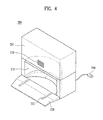
- FIG. 4 a basic structure of the recharging base 200 provided in the robot cleaning system according to one embodiment of the present disclosure will be described.
- FIG. 4 is a perspective of the recharging base according to an embodiment of the present disclosure.
- the recharging base 200 may include a recharging base case 201 having a holding portion 215 for holding the robot cleaner 100, a control unit (not shown) for controlling an operational state of the recharging base 200, a guide plate 220 for guiding the robot cleaner 100 to the holding portion 215, a recharging terminal for recharging the battery of the robot cleaner 100, and a second communication unit (240) having a wireless communication function. Additionally, the recharging base 200 may further include an audio output device 210 for outputting the specific signal sound.
- the recharging base case 201 has a shape corresponding to the exterior appearance of the robot cleaner 100 which includes the holding portion 215 for coupling the robot cleaner 100 to the recharging base 200.
- the holding portion 215 has a recessed shape with a preset curvature.
- the control unit of the recharging base is provided in the recharging base case and electric control parts for controlling the driving of the recharging base 200 are arranged in the recharging base case.
- control signals of the recharging base 200 and the robot cleaner 100 are exchanged by a second communication unit 240 and first communication means 170 which will be described later, such that the driving of the recharging base 200 can be controlled by the robot cleaner control unit 180, without an auxiliary control unit of the recharging base 200.
- the recharging base 200 includes a recharging base control unit 250.
- the guide plate 220 is provided under the holding portion 215, being projected to a front portion of the recharging base 200.
- An inclined surface with a preset slope is formed in the guide plate to guide the robot cleaner 100 to enter into the holding portion 215 smoothly and easily.
- the guide plate may include a supporting portion 222 for supporting the right and left driving wheels 154 and 152 not to move in the holding portion 215 while the robot cleaner 100 is held in the holding portion 215.
- the supporting portion 222 is a recess recessed in an inner portion of the guide plate 220 and it has a corresponding shape to the shape of the right and left driving wheels 154 and 152 of the robot cleaner 100.
- the recess having the shape corresponding to the shape of the right and left driving wheels 154 and 152 of the robot cleaner 100 may prevent the wheels 154 and 152 of the robot cleaner 100 from falling down while the robot cleaner 100 is seated on the recharging base 200. Accordingly, an electric power is supplied to the right and left driving wheels 154 and 152 of the robot cleaner 100 continuously for stable coupling, such that no additional force needs to be supplied along the direction in which the robot cleaner 100 is coupled to the recharging base 200.
- the connector unit 290 is provided in a rear surface of the recharging base case 201 and it supplies electric power to the recharging base 200.
- the connector unit 290 is insertedly kept in the recharging base 200 and the length of the connector unit 290 is adjustable, such that it can be drawn into the recharging base 200 by the user if necessary.
- the recharging base 200 may perform a function as a recharging device of the robot cleaner 100.
- the recharging terminal is further provided in the recharging base 200.
- the recharging terminal is provided in a predetermined portion of the recharging base case 201 to recharge the battery of the robot cleaner 100 and it has a corresponding shape to a shape of the socket provided in a predetermined portion of the robot cleaner 100.
- the rear surface of the robot cleaner 100 has to be inserted in the holding portion 215. Once the insertion in the holding portion 215 is completed, the recharging terminal may contact with the recharging socket simultaneously. The battery of the robot cleaner 100 is then recharged by the recharging base 200.
- the audio output device 210 is provided in the front portion of the recharging base to output a specific signal sound which can be sensed by the microphone 191 of the robot cleaner 100.
- the signal sound may be generated in a preset time period and at intervals.
- the audio output device 210 may continuously output the signal sound in an activated state and also generate the specific signal sound only when receiving the signal transmitted from the robot cleaner.
- control unit of the robot cleaner 100 may transmit a signal for asking the audio output device 210 to output the specific signal sound through the first communication unit and the second communication unit, when the remaining amount of the battery is at or below a preset value.
- the recharging base 200 may output the signal sound only when the remaining amount of the battery is insufficient, only to prevent an unnecessary operation of the sensor 190 and to reduce power consumption.
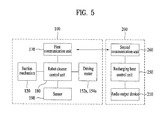
- FIG. 5 is a block diagram illustrating a control system of a robot cleaning system according to embodiments of the present disclosure.
- the transmission of control signals between the robot cleaner and the recharging base will be described.
- the robot cleaner 100 includes the control unit 180 for controlling an operational state of the robot cleaner 100 and the first communication unit 170 connected to the control unit 180, with a wireless communication function.
- the robot cleaner 100 further includes the suction mechanism 120 and the driving motor 152a and 154a.
- the robot cleaner 100 further includes the audio sensor 190 provided in the recharging base to sense a specific signal transmitted from the recharging base.
- the recharging base 200 shown in FIG. 5 includes a recharging base control unit 250 for controlling an operational state thereof and the audio output device 210 for outputting a specific receiving sound sensible by the robot cleaner.
- the recharging base 200 may further include the second communication unit 260 connected with the recharging base control unit 250, with a wireless communication function.
- the robot cleaner 100 and the recharging base 200 requests a specific signal sound and transmits a command signal, in accordance with a remaining amount of the battery provided in the robot cleaner through the first communication unit 170 and the second communication unit 260.
- the first communication unit 170 transmits a specific sound generation requesting signal to the recharging base 200, when the remaining amount of the battery is at or below a preset value. Once the communication unit of the recharging base receives the signal, the audio output device 210 outputs the specific signal sound.
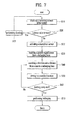
- FIGS. 6 , 7 , and 8 are flow charts illustrating a method for recharging a robot cleaning system according to embodiments of the present disclosure.
- the method for recharging the robot cleaner 100 includes a step of the control unit checking whether a remaining amount of the battery is at or above a preset value (S10). When the remaining amount of the battery is at or above the preset value, the cleaning is performed continuously (S21). When the remaining amount of the battery is below a preset value, the sensor of the robot cleaner senses a specific signal sound generated from the recharging base (S30). The control unit may calculate a direction and a distance from the robot cleaner to the recharging base based on the received specific signal (S40). The method for recharging the robot cleaner may include a step of the robot cleaner driving based on the calculated direction and distance (S50).
- the control unit checks whether the robot cleaner is docked with the recharging base (S60). Once the docking is completed, the battery is recharged (S70). If the docking is not performed properly, the location of the recharging base is searched again.
- the robot cleaner When the remaining amount of the battery is 20% or less of the maximum rechargeable amount of the battery, the robot cleaner is docked with the recharging base. The minimum of the remaining battery amount which triggers docking can be adjusted.
- control unit determines that the remaining amount of the battery is below a preset value in the robot cleaner (S20)
- the control unit may activate the microphone sensor of the robot cleaner (S22).
- the control unit operates the microphone sensor.
- the audio output device of the recharging base is operated only when the remaining amount of the battery provided in the robot cleaner is insufficient.
- control unit checks that the remaining amount of the recharging battery is below the preset value (S20)
- a step of requesting the recharging base to output the specific signal sound through the first communication unit is performed (S23).
- the recharging base receiving the command signal operates the audio output device (S24) and outputs the specific signal.
- a robot cleaning system might comprise: a robot cleaner comprising: a sensor for receiving a specific signal sound, a rechargeable battery, and a control unit; and a recharging base comprising: an audio output device for outputting the specific signal sound, wherein the control unit calculates a distance and a direction from the robot cleaner to the recharging base based on the signal sound received by the sensor, and controls the robot cleaner to move based on the calculated distance and direction, when a remaining amount of the battery is less than a preset value, and wherein the robot cleaner docks with the recharging base to recharge the battery of the robot cleaner.
- the robot cleaner might further comprise: a first communication unit for communicating with the recharging base, wherein the first communication unit transmits a specific sound generation requesting signal to the recharging base, when the remaining amount of the battery is below the preset value, and the audio output device of the recharging base outputs a specific signal sound, when a second communication unit of the recharging base receives the signal.
- a first communication unit for communicating with the recharging base, wherein the first communication unit transmits a specific sound generation requesting signal to the recharging base, when the remaining amount of the battery is below the preset value, and the audio output device of the recharging base outputs a specific signal sound, when a second communication unit of the recharging base receives the signal.
- the control unit might turn on the sensor when the remaining amount of the battery falls below the preset value.
- the sensor might be a microphone for receiving the signal sound.
- At least three microphones might be provided.
- Delay differences in signals of the at least three microphones might be triangulated to determine a location of the recharging base.
- the microphone might be provided in a front surface portion or an upper end portion of the robot cleaner.
- the audio output device might be provided in a front surface of the recharging base.
- the signal sound might be an inaudible sound.
- the signal sound might be generated in a preset time period and at preset intervals.
- a method for recharging a robot cleaner might comprises: checking, by a control unit of a robot cleaner, a remaining amount of a battery in the robot cleaner; sensing, by a sensor of the robot cleaner, a specific signal sound generated by an audio output device of a recharging base, when the remaining amount of the battery is below a preset value; calculating, by the control unit, a direction and a distance from the robot cleaner to the recharging base, based on the received specific signal sound; controlling, by the robot cleaner control unit, the robot cleaner to drive based on the calculated direction and distance and to dock with the recharging base; and controlling, by a control unit of the recharging base, the recharging base to recharge the battery of the robot cleaner.
- the step of sensing the specific signal sound might comprise, controlling, by the robot cleaner control unit, a first communication unit of the robot cleaner to request the recharging base to generate the specific signal sound, when a remaining amount of the battery is below the preset value; and controlling, by the recharging base control unit, the specific signal sound to be output, when the recharging base receives the request.
- the step of sensing the specific signal sound might further comprise, activating, by the robot cleaner control unit, the sensor when the remaining amount of the battery is below the preset value.
- the sensor might be a microphone for receiving the signal sound.
- At least three microphones might be provided.
- Delay differences in signals of the at least three microphones might be triangulated to determine a location of the recharging base.
- the signal sound might be an inaudible sound.
- the signal sound might be generated in a preset time period and at preset intervals.
Landscapes
- Engineering & Computer Science (AREA)
- Physics & Mathematics (AREA)
- Radar, Positioning & Navigation (AREA)
- Remote Sensing (AREA)
- General Physics & Mathematics (AREA)
- Automation & Control Theory (AREA)
- Aviation & Aerospace Engineering (AREA)
- Acoustics & Sound (AREA)
- Mechanical Engineering (AREA)
- Robotics (AREA)
- Electric Vacuum Cleaner (AREA)
- Control Of Position, Course, Altitude, Or Attitude Of Moving Bodies (AREA)
- Manipulator (AREA)
Applications Claiming Priority (1)
| Application Number | Priority Date | Filing Date | Title |
|---|---|---|---|
| KR1020140006235A KR102118051B1 (ko) | 2014-01-17 | 2014-01-17 | 로봇청소기 시스템 및 이의 충전방법 |
Publications (2)
| Publication Number | Publication Date |
|---|---|
| EP2897016A2 true EP2897016A2 (de) | 2015-07-22 |
| EP2897016A3 EP2897016A3 (de) | 2015-11-04 |
Family
ID=52347222
Family Applications (1)
| Application Number | Title | Priority Date | Filing Date |
|---|---|---|---|
| EP15151459.3A Ceased EP2897016A3 (de) | 2014-01-17 | 2015-01-16 | Reinigungsrobotsystem und Verfahren zum Laden eines Reinigungsroboters |
Country Status (4)
| Country | Link |
|---|---|
| US (1) | US9393689B2 (de) |
| EP (1) | EP2897016A3 (de) |
| KR (1) | KR102118051B1 (de) |
| CN (1) | CN104783735B (de) |
Cited By (4)
| Publication number | Priority date | Publication date | Assignee | Title |
|---|---|---|---|---|
| WO2017162535A1 (fr) * | 2016-03-23 | 2017-09-28 | Softbank Robotics Europe | Procede de recharge d'une batterie |
| CN107669216A (zh) * | 2017-11-24 | 2018-02-09 | 珠海市微半导体有限公司 | 智能清洁系统及智能清洁方法 |
| US10022030B2 (en) | 2014-07-07 | 2018-07-17 | Carl Freudenberg Kg | Movable device |
| EP3412193A1 (de) * | 2017-06-08 | 2018-12-12 | Vorwerk & Co. Interholding GmbH | Verfahren zum betrieb eines einen akkumulator aufweisenden haushaltsgerätes |
Families Citing this family (20)
| Publication number | Priority date | Publication date | Assignee | Title |
|---|---|---|---|---|
| DE102015109775B3 (de) | 2015-06-18 | 2016-09-22 | RobArt GmbH | Optischer Triangulationssensor zur Entfernungsmessung |
| DE102015114883A1 (de) | 2015-09-04 | 2017-03-09 | RobArt GmbH | Identifizierung und Lokalisierung einer Basisstation eines autonomen mobilen Roboters |
| DE102015119501A1 (de) | 2015-11-11 | 2017-05-11 | RobArt GmbH | Unterteilung von Karten für die Roboternavigation |
| DE102015119865B4 (de) | 2015-11-17 | 2023-12-21 | RobArt GmbH | Robotergestützte Bearbeitung einer Oberfläche mittels eines Roboters |
| DE102015121666B3 (de) | 2015-12-11 | 2017-05-24 | RobArt GmbH | Fernsteuerung eines mobilen, autonomen Roboters |
| DE102016102644A1 (de) | 2016-02-15 | 2017-08-17 | RobArt GmbH | Verfahren zur Steuerung eines autonomen mobilen Roboters |
| WO2018024897A1 (de) | 2016-08-05 | 2018-02-08 | RobArt GmbH | Verfahren zur steuerung eines autonomen mobilen roboters |
| KR20180079962A (ko) * | 2017-01-03 | 2018-07-11 | 삼성전자주식회사 | 로봇 청소기 및 그 제어 방법 |
| JP2020509500A (ja) | 2017-03-02 | 2020-03-26 | ロブアート ゲーエムベーハーROBART GmbH | 自律移動ロボットの制御方法 |
| DE102017109219A1 (de) | 2017-04-28 | 2018-10-31 | RobArt GmbH | Verfahren für die Roboternavigation |
| KR102378602B1 (ko) * | 2017-06-27 | 2022-03-24 | 엘지전자 주식회사 | 주행면의 특성에 기반하여 주행하는 방법 및 이를 구현하는 로봇 |
| CN109830998A (zh) * | 2017-11-23 | 2019-05-31 | 富泰华工业(深圳)有限公司 | 回充装置 |
| WO2020116412A1 (ja) * | 2018-12-03 | 2020-06-11 | Groove X株式会社 | ロボット用充電ステーション |
| AU2020100041A4 (en) | 2019-01-11 | 2020-02-20 | Bissell Inc. | Artificial barrier for autonomous floor cleaner |
| KR102867406B1 (ko) | 2019-04-02 | 2025-10-01 | 삼성전자주식회사 | 스피커를 이용하여 먼지를 제거하는 방법 및 이를 지원하는 전자 장치 |
| KR102879441B1 (ko) | 2020-10-07 | 2025-11-03 | 삼성전자주식회사 | 로봇, 충전 스테이션 및 이를 포함하는 로봇 충전 시스템 |
| JP1708174S (ja) * | 2021-01-13 | 2022-02-24 | 掃除ロボット用表面フィルム | |
| CN112971648B (zh) * | 2021-03-02 | 2022-08-16 | 广州科语机器人有限公司 | 一种清洁系统、清洁基站及其作业对接方法 |
| KR20230041918A (ko) * | 2021-09-17 | 2023-03-27 | 삼성전자주식회사 | Uwb 통신을 이용하는 로봇 청소기 및 그 제어 방법 |
| DE102023205528B3 (de) * | 2023-06-14 | 2024-05-16 | BSH Hausgeräte GmbH | Verfahren zum Betrieb eines mobilen, selbstfahrenden Geräts an einer Servicestation |
Family Cites Families (12)
| Publication number | Priority date | Publication date | Assignee | Title |
|---|---|---|---|---|
| JP4207336B2 (ja) * | 1999-10-29 | 2009-01-14 | ソニー株式会社 | 移動ロボットのための充電システム、充電ステーションを探索する方法、移動ロボット、コネクタ、及び、電気的接続構造 |
| JP2004237075A (ja) * | 2003-02-06 | 2004-08-26 | Samsung Kwangju Electronics Co Ltd | 外部充電装置を有するロボット掃除機システム及びロボット掃除機の外部充電装置の接続方法。 |
| KR100548272B1 (ko) * | 2003-07-23 | 2006-02-02 | 엘지전자 주식회사 | 이동로봇의 위치검출장치 및 방법 |
| KR20050108894A (ko) * | 2004-05-14 | 2005-11-17 | 삼성광주전자 주식회사 | 로봇 청소기 |
| KR100645379B1 (ko) * | 2004-10-29 | 2006-11-15 | 삼성광주전자 주식회사 | 로봇 제어 시스템 및 로봇 제어방법 |
| KR101297194B1 (ko) * | 2005-03-07 | 2013-08-16 | 삼성전자주식회사 | 외부충전장치를 갖는 로봇청소기 시스템 |
| CN2868164Y (zh) * | 2005-09-22 | 2007-02-14 | 浙江大学 | 自动吸尘器的充电装置 |
| DE102005046813A1 (de) * | 2005-09-30 | 2007-04-05 | Vorwerk & Co. Interholding Gmbh | Verfahren zum Betreiben eines selbsttätig verfahrbaren Haushaltsgerätes sowie Verfahren zum Betreiben einer Basisstation |
| US8961695B2 (en) * | 2008-04-24 | 2015-02-24 | Irobot Corporation | Mobile robot for cleaning |
| KR20120049533A (ko) * | 2010-11-09 | 2012-05-17 | 삼성전자주식회사 | 로봇 시스템 및 그의 제어 방법 |
| US8525688B2 (en) * | 2011-01-10 | 2013-09-03 | Palm, Inc. | Proximity detection alarm for an inductively charged mobile computing device |
| US9480379B2 (en) * | 2011-10-21 | 2016-11-01 | Samsung Electronics Co., Ltd. | Robot cleaner and control method for the same |
-
2014
- 2014-01-17 KR KR1020140006235A patent/KR102118051B1/ko not_active Expired - Fee Related
- 2014-12-23 US US14/581,036 patent/US9393689B2/en active Active
- 2014-12-25 CN CN201410826445.5A patent/CN104783735B/zh active Active
-
2015
- 2015-01-16 EP EP15151459.3A patent/EP2897016A3/de not_active Ceased
Non-Patent Citations (1)
| Title |
|---|
| None |
Cited By (5)
| Publication number | Priority date | Publication date | Assignee | Title |
|---|---|---|---|---|
| US10022030B2 (en) | 2014-07-07 | 2018-07-17 | Carl Freudenberg Kg | Movable device |
| WO2017162535A1 (fr) * | 2016-03-23 | 2017-09-28 | Softbank Robotics Europe | Procede de recharge d'une batterie |
| FR3049359A1 (fr) * | 2016-03-23 | 2017-09-29 | Aldebaran Robotics | Procede de recharge d'une batterie |
| EP3412193A1 (de) * | 2017-06-08 | 2018-12-12 | Vorwerk & Co. Interholding GmbH | Verfahren zum betrieb eines einen akkumulator aufweisenden haushaltsgerätes |
| CN107669216A (zh) * | 2017-11-24 | 2018-02-09 | 珠海市微半导体有限公司 | 智能清洁系统及智能清洁方法 |
Also Published As
| Publication number | Publication date |
|---|---|
| EP2897016A3 (de) | 2015-11-04 |
| US9393689B2 (en) | 2016-07-19 |
| KR20150086075A (ko) | 2015-07-27 |
| KR102118051B1 (ko) | 2020-06-02 |
| CN104783735B (zh) | 2018-01-16 |
| US20150202772A1 (en) | 2015-07-23 |
| CN104783735A (zh) | 2015-07-22 |
Similar Documents
| Publication | Publication Date | Title |
|---|---|---|
| US9393689B2 (en) | Robot cleaning system and method for charging the same | |
| KR100468107B1 (ko) | 외부충전장치를 갖는 로봇청소기 시스템 및 로봇청소기의외부충전장치 접속방법 | |
| US12265393B2 (en) | Celestial navigation system for an autonomous vehicle | |
| US12298777B2 (en) | Celestial navigation system for an autonomous vehicle | |
| AU767561B2 (en) | Robot cleaner, system employing the same and method for reconnecting to external recharging device | |
| EP3928329B1 (de) | Verfahren zur begrenzung von reinigungsoperationen einer robotischen oberflächenreinigungsvorrichtung innerhalb eines interessierenden bereichs | |
| US10188255B2 (en) | Robot cleaner and robot cleaner system including the same | |
| US7352153B2 (en) | Mobile robotic system and battery charging method therefor | |
| US20150151646A1 (en) | Self-propelled electronic device | |
| EP1931010B1 (de) | Verfahren zur Ladung eines Dienstroboters | |
| JP2004237075A (ja) | 外部充電装置を有するロボット掃除機システム及びロボット掃除機の外部充電装置の接続方法。 | |
| WO2015194201A1 (ja) | 自走式電子機器 | |
| WO2014029365A1 (zh) | 智能机器人及其移动至最亮位置的方法 | |
| CN107752907B (zh) | 尤其用于清洁设备的充电站 | |
| US10698411B1 (en) | Recharge station for mobile robot | |
| KR102320560B1 (ko) | 이동 로봇 및 이동 로봇의 제어방법 | |
| JP6382634B2 (ja) | 自律走行体装置 | |
| KR102032618B1 (ko) | 공기청정기 자동이동장치 | |
| JP2006239797A (ja) | ロボット充電誘導システム | |
| CN209948706U (zh) | 一种扫地机器人远距离返程充电装置和系统 | |
| JP2008117185A (ja) | 自走式移動体のシステム | |
| AU2003227231B2 (en) | Robot Cleaner, System Employing the same and Method for Re-Connecting to External Recharging Device | |
| CN116687272A (zh) | 一种清洁机器人及其控制方法 | |
| KR20180078706A (ko) | 장애물탐지가 가능한 시각장애인용 휴대단말기커버 |
Legal Events
| Date | Code | Title | Description |
|---|---|---|---|
| PUAI | Public reference made under article 153(3) epc to a published international application that has entered the european phase |
Free format text: ORIGINAL CODE: 0009012 |
|
| 17P | Request for examination filed |
Effective date: 20150216 |
|
| AK | Designated contracting states |
Kind code of ref document: A2 Designated state(s): AL AT BE BG CH CY CZ DE DK EE ES FI FR GB GR HR HU IE IS IT LI LT LU LV MC MK MT NL NO PL PT RO RS SE SI SK SM TR |
|
| AX | Request for extension of the european patent |
Extension state: BA ME |
|
| PUAL | Search report despatched |
Free format text: ORIGINAL CODE: 0009013 |
|
| AK | Designated contracting states |
Kind code of ref document: A3 Designated state(s): AL AT BE BG CH CY CZ DE DK EE ES FI FR GB GR HR HU IE IS IT LI LT LU LV MC MK MT NL NO PL PT RO RS SE SI SK SM TR |
|
| AX | Request for extension of the european patent |
Extension state: BA ME |
|
| RIC1 | Information provided on ipc code assigned before grant |
Ipc: A47L 9/00 20060101ALN20150930BHEP Ipc: G05D 1/02 20060101AFI20150930BHEP Ipc: G01S 3/808 20060101ALN20150930BHEP |
|
| RBV | Designated contracting states (corrected) |
Designated state(s): AL AT BE BG CH CY CZ DE DK EE ES FI FR GB GR HR HU IE IS IT LI LT LU LV MC MK MT NL NO PL PT RO RS SE SI SK SM TR |
|
| STAA | Information on the status of an ep patent application or granted ep patent |
Free format text: STATUS: EXAMINATION IS IN PROGRESS |
|
| 17Q | First examination report despatched |
Effective date: 20180122 |
|
| APBK | Appeal reference recorded |
Free format text: ORIGINAL CODE: EPIDOSNREFNE |
|
| APBN | Date of receipt of notice of appeal recorded |
Free format text: ORIGINAL CODE: EPIDOSNNOA2E |
|
| APBR | Date of receipt of statement of grounds of appeal recorded |
Free format text: ORIGINAL CODE: EPIDOSNNOA3E |
|
| APAF | Appeal reference modified |
Free format text: ORIGINAL CODE: EPIDOSCREFNE |
|
| APBT | Appeal procedure closed |
Free format text: ORIGINAL CODE: EPIDOSNNOA9E |
|
| STAA | Information on the status of an ep patent application or granted ep patent |
Free format text: STATUS: THE APPLICATION HAS BEEN REFUSED |
|
| 18R | Application refused |
Effective date: 20220505 |