EP2895482B1 - Hiv protease inhibitors - Google Patents
Hiv protease inhibitors Download PDFInfo
- Publication number
- EP2895482B1 EP2895482B1 EP13763164.4A EP13763164A EP2895482B1 EP 2895482 B1 EP2895482 B1 EP 2895482B1 EP 13763164 A EP13763164 A EP 13763164A EP 2895482 B1 EP2895482 B1 EP 2895482B1
- Authority
- EP
- European Patent Office
- Prior art keywords
- ethyl
- methyl
- morpholin
- fluoro
- phenyl
- Prior art date
- Legal status (The legal status is an assumption and is not a legal conclusion. Google has not performed a legal analysis and makes no representation as to the accuracy of the status listed.)
- Active
Links
- 0 COC([C@@](C*)*C#N)=O Chemical compound COC([C@@](C*)*C#N)=O 0.000 description 32
- YNAVUWVOSKDBBP-UHFFFAOYSA-N C1NCCOC1 Chemical compound C1NCCOC1 YNAVUWVOSKDBBP-UHFFFAOYSA-N 0.000 description 2
- SIUSVWWUAHMASH-UHFFFAOYSA-N C#COC(NCC(F)(F)F)=O Chemical compound C#COC(NCC(F)(F)F)=O SIUSVWWUAHMASH-UHFFFAOYSA-N 0.000 description 1
- QPJORFLSOJAUNL-UHFFFAOYSA-N C1c(cccc2)c2C=Cc2c1cccc2 Chemical compound C1c(cccc2)c2C=Cc2c1cccc2 QPJORFLSOJAUNL-UHFFFAOYSA-N 0.000 description 1
- PVUUHYWNLDIUSO-WUFINQPMSA-N CC(C)C(C(C)C)NC(OC[C@H]1NC[C@@H](CCc(c(NC(CC(c(cc2)ccc2F)c(cc2)ccc2F)=O)cnc2)c2F)OC1)=O Chemical compound CC(C)C(C(C)C)NC(OC[C@H]1NC[C@@H](CCc(c(NC(CC(c(cc2)ccc2F)c(cc2)ccc2F)=O)cnc2)c2F)OC1)=O PVUUHYWNLDIUSO-WUFINQPMSA-N 0.000 description 1
- OTGDEPFBBRDDHC-UHFFFAOYSA-O CC(C)COC(NC(C(c(cc1)ccc1F)c(cc1)ccc1F)C(Nc1c(CCC(C2)OCC(C(OC(NCC(F)(F)F)=O)=C)[NH+]2C(O)OC(C)(C)C)c(F)cnc1)=O)=O Chemical compound CC(C)COC(NC(C(c(cc1)ccc1F)c(cc1)ccc1F)C(Nc1c(CCC(C2)OCC(C(OC(NCC(F)(F)F)=O)=C)[NH+]2C(O)OC(C)(C)C)c(F)cnc1)=O)=O OTGDEPFBBRDDHC-UHFFFAOYSA-O 0.000 description 1
- OURNXLHSALGKNE-UHFFFAOYSA-N CC(C)[O-]C(NCC(Nc1cncc2c1CC=[F]2C)=O)=O Chemical compound CC(C)[O-]C(NCC(Nc1cncc2c1CC=[F]2C)=O)=O OURNXLHSALGKNE-UHFFFAOYSA-N 0.000 description 1
- MHLQLGFDKKKNMO-SVGOFTHPSA-N COC(/N=C/C([C@@](C1C2)([C@H]1C=CC1=C2OCO1)c(cc1)ccc1Cl)C(NC(C1CC[C@H]2OC[C@@H](C(OC(NCC(C3CC3)(F)F)=O)=C)NC2)=CN=CC1F)=O)=O Chemical compound COC(/N=C/C([C@@](C1C2)([C@H]1C=CC1=C2OCO1)c(cc1)ccc1Cl)C(NC(C1CC[C@H]2OC[C@@H](C(OC(NCC(C3CC3)(F)F)=O)=C)NC2)=CN=CC1F)=O)=O MHLQLGFDKKKNMO-SVGOFTHPSA-N 0.000 description 1
- TUNLMNKJOYKLSM-NTSMOYRASA-N C[C@@H](CCNC(CO)C#COC(NCC(F)(F)F)=O)Oc(c(NC([C@H](C(c(cc1)ccc1F)c(cc1)ccc1F)N)=O)ccc1)c1F Chemical compound C[C@@H](CCNC(CO)C#COC(NCC(F)(F)F)=O)Oc(c(NC([C@H](C(c(cc1)ccc1F)c(cc1)ccc1F)N)=O)ccc1)c1F TUNLMNKJOYKLSM-NTSMOYRASA-N 0.000 description 1
- WYHYHMCPLHAWOB-HJJBNUNVSA-N Cc1ccc([C@@H](CC(Nc2c(CC[C@H]3OCC(/C=C/OC(NCC(F)(F)F)=O)NC3)c(F)cnc2)=O)c2ccc(C(F)(F)F)cc2)cc1 Chemical compound Cc1ccc([C@@H](CC(Nc2c(CC[C@H]3OCC(/C=C/OC(NCC(F)(F)F)=O)NC3)c(F)cnc2)=O)c2ccc(C(F)(F)F)cc2)cc1 WYHYHMCPLHAWOB-HJJBNUNVSA-N 0.000 description 1
- KNRQNGXKLSFEST-LETIRJCYSA-N Cc1ccc([C@H](C/C(/NC(CC=C2)C3=C2[F+]#CC3)=[O]\C)c2ccccc2)cc1 Chemical compound Cc1ccc([C@H](C/C(/NC(CC=C2)C3=C2[F+]#CC3)=[O]\C)c2ccccc2)cc1 KNRQNGXKLSFEST-LETIRJCYSA-N 0.000 description 1
- XQHSGRFLRDBRCV-HKSITDJSSA-N N[C@@H](C(c(cc1)ccc1F)c(cc1)ccc1F)C(Nc1c(CC[C@H]2OCC(COC(N)=O)NC2)c(F)ccc1)=O Chemical compound N[C@@H](C(c(cc1)ccc1F)c(cc1)ccc1F)C(Nc1c(CC[C@H]2OCC(COC(N)=O)NC2)c(F)ccc1)=O XQHSGRFLRDBRCV-HKSITDJSSA-N 0.000 description 1
- FNMMLSKULKZMRF-ZZMKVXQQSA-N N[C@@H](C(c(cc1)ccc1F)c(cc1)ccc1F)C(Nc1c(CC[C@H]2OC[C@@H](COC(NC3(CCC3)c3ccncc3)=O)NC2)c(F)cnc1)=O Chemical compound N[C@@H](C(c(cc1)ccc1F)c(cc1)ccc1F)C(Nc1c(CC[C@H]2OC[C@@H](COC(NC3(CCC3)c3ccncc3)=O)NC2)c(F)cnc1)=O FNMMLSKULKZMRF-ZZMKVXQQSA-N 0.000 description 1
- ADZXXSSHRXPOKE-JWZKTCGFSA-N N[C@@H](C(c(cc1)ccc1F)c(cc1)ccc1F)C(Nc1cccc(F)c1CC[C@H]1OC[C@@H](COC(NCC(F)(F)F)=O)NC1)=O Chemical compound N[C@@H](C(c(cc1)ccc1F)c(cc1)ccc1F)C(Nc1cccc(F)c1CC[C@H]1OC[C@@H](COC(NCC(F)(F)F)=O)NC1)=O ADZXXSSHRXPOKE-JWZKTCGFSA-N 0.000 description 1
- DMILRCBLCRKYHC-GFCCVEGCSA-N OC(C[C@H](c1cc(F)ccc1)c(cc1F)ccc1Cl)=O Chemical compound OC(C[C@H](c1cc(F)ccc1)c(cc1F)ccc1Cl)=O DMILRCBLCRKYHC-GFCCVEGCSA-N 0.000 description 1
Classifications
-
- C—CHEMISTRY; METALLURGY
- C07—ORGANIC CHEMISTRY
- C07D—HETEROCYCLIC COMPOUNDS
- C07D265/00—Heterocyclic compounds containing six-membered rings having one nitrogen atom and one oxygen atom as the only ring hetero atoms
- C07D265/28—1,4-Oxazines; Hydrogenated 1,4-oxazines
- C07D265/30—1,4-Oxazines; Hydrogenated 1,4-oxazines not condensed with other rings
-
- A—HUMAN NECESSITIES
- A61—MEDICAL OR VETERINARY SCIENCE; HYGIENE
- A61K—PREPARATIONS FOR MEDICAL, DENTAL OR TOILETRY PURPOSES
- A61K31/00—Medicinal preparations containing organic active ingredients
- A61K31/33—Heterocyclic compounds
- A61K31/395—Heterocyclic compounds having nitrogen as a ring hetero atom, e.g. guanethidine or rifamycins
- A61K31/535—Heterocyclic compounds having nitrogen as a ring hetero atom, e.g. guanethidine or rifamycins having six-membered rings with at least one nitrogen and one oxygen as the ring hetero atoms, e.g. 1,2-oxazines
- A61K31/5375—1,4-Oxazines, e.g. morpholine
-
- A—HUMAN NECESSITIES
- A61—MEDICAL OR VETERINARY SCIENCE; HYGIENE
- A61K—PREPARATIONS FOR MEDICAL, DENTAL OR TOILETRY PURPOSES
- A61K31/00—Medicinal preparations containing organic active ingredients
- A61K31/33—Heterocyclic compounds
- A61K31/395—Heterocyclic compounds having nitrogen as a ring hetero atom, e.g. guanethidine or rifamycins
- A61K31/535—Heterocyclic compounds having nitrogen as a ring hetero atom, e.g. guanethidine or rifamycins having six-membered rings with at least one nitrogen and one oxygen as the ring hetero atoms, e.g. 1,2-oxazines
- A61K31/5375—1,4-Oxazines, e.g. morpholine
- A61K31/5377—1,4-Oxazines, e.g. morpholine not condensed and containing further heterocyclic rings, e.g. timolol
-
- A—HUMAN NECESSITIES
- A61—MEDICAL OR VETERINARY SCIENCE; HYGIENE
- A61K—PREPARATIONS FOR MEDICAL, DENTAL OR TOILETRY PURPOSES
- A61K31/00—Medicinal preparations containing organic active ingredients
- A61K31/695—Silicon compounds
-
- A—HUMAN NECESSITIES
- A61—MEDICAL OR VETERINARY SCIENCE; HYGIENE
- A61K—PREPARATIONS FOR MEDICAL, DENTAL OR TOILETRY PURPOSES
- A61K45/00—Medicinal preparations containing active ingredients not provided for in groups A61K31/00 - A61K41/00
- A61K45/06—Mixtures of active ingredients without chemical characterisation, e.g. antiphlogistics and cardiaca
-
- A—HUMAN NECESSITIES
- A61—MEDICAL OR VETERINARY SCIENCE; HYGIENE
- A61P—SPECIFIC THERAPEUTIC ACTIVITY OF CHEMICAL COMPOUNDS OR MEDICINAL PREPARATIONS
- A61P31/00—Antiinfectives, i.e. antibiotics, antiseptics, chemotherapeutics
- A61P31/12—Antivirals
- A61P31/14—Antivirals for RNA viruses
- A61P31/18—Antivirals for RNA viruses for HIV
-
- C—CHEMISTRY; METALLURGY
- C07—ORGANIC CHEMISTRY
- C07D—HETEROCYCLIC COMPOUNDS
- C07D413/00—Heterocyclic compounds containing two or more hetero rings, at least one ring having nitrogen and oxygen atoms as the only ring hetero atoms
- C07D413/02—Heterocyclic compounds containing two or more hetero rings, at least one ring having nitrogen and oxygen atoms as the only ring hetero atoms containing two hetero rings
- C07D413/06—Heterocyclic compounds containing two or more hetero rings, at least one ring having nitrogen and oxygen atoms as the only ring hetero atoms containing two hetero rings linked by a carbon chain containing only aliphatic carbon atoms
-
- C—CHEMISTRY; METALLURGY
- C07—ORGANIC CHEMISTRY
- C07D—HETEROCYCLIC COMPOUNDS
- C07D413/00—Heterocyclic compounds containing two or more hetero rings, at least one ring having nitrogen and oxygen atoms as the only ring hetero atoms
- C07D413/02—Heterocyclic compounds containing two or more hetero rings, at least one ring having nitrogen and oxygen atoms as the only ring hetero atoms containing two hetero rings
- C07D413/12—Heterocyclic compounds containing two or more hetero rings, at least one ring having nitrogen and oxygen atoms as the only ring hetero atoms containing two hetero rings linked by a chain containing hetero atoms as chain links
-
- C—CHEMISTRY; METALLURGY
- C07—ORGANIC CHEMISTRY
- C07D—HETEROCYCLIC COMPOUNDS
- C07D413/00—Heterocyclic compounds containing two or more hetero rings, at least one ring having nitrogen and oxygen atoms as the only ring hetero atoms
- C07D413/14—Heterocyclic compounds containing two or more hetero rings, at least one ring having nitrogen and oxygen atoms as the only ring hetero atoms containing three or more hetero rings
-
- C—CHEMISTRY; METALLURGY
- C07—ORGANIC CHEMISTRY
- C07D—HETEROCYCLIC COMPOUNDS
- C07D417/00—Heterocyclic compounds containing two or more hetero rings, at least one ring having nitrogen and sulfur atoms as the only ring hetero atoms, not provided for by group C07D415/00
- C07D417/02—Heterocyclic compounds containing two or more hetero rings, at least one ring having nitrogen and sulfur atoms as the only ring hetero atoms, not provided for by group C07D415/00 containing two hetero rings
- C07D417/12—Heterocyclic compounds containing two or more hetero rings, at least one ring having nitrogen and sulfur atoms as the only ring hetero atoms, not provided for by group C07D415/00 containing two hetero rings linked by a chain containing hetero atoms as chain links
-
- C—CHEMISTRY; METALLURGY
- C07—ORGANIC CHEMISTRY
- C07D—HETEROCYCLIC COMPOUNDS
- C07D487/00—Heterocyclic compounds containing nitrogen atoms as the only ring hetero atoms in the condensed system, not provided for by groups C07D451/00 - C07D477/00
- C07D487/02—Heterocyclic compounds containing nitrogen atoms as the only ring hetero atoms in the condensed system, not provided for by groups C07D451/00 - C07D477/00 in which the condensed system contains two hetero rings
- C07D487/04—Ortho-condensed systems
-
- C—CHEMISTRY; METALLURGY
- C07—ORGANIC CHEMISTRY
- C07D—HETEROCYCLIC COMPOUNDS
- C07D493/00—Heterocyclic compounds containing oxygen atoms as the only ring hetero atoms in the condensed system
- C07D493/02—Heterocyclic compounds containing oxygen atoms as the only ring hetero atoms in the condensed system in which the condensed system contains two hetero rings
- C07D493/04—Ortho-condensed systems
-
- C—CHEMISTRY; METALLURGY
- C07—ORGANIC CHEMISTRY
- C07F—ACYCLIC, CARBOCYCLIC OR HETEROCYCLIC COMPOUNDS CONTAINING ELEMENTS OTHER THAN CARBON, HYDROGEN, HALOGEN, OXYGEN, NITROGEN, SULFUR, SELENIUM OR TELLURIUM
- C07F7/00—Compounds containing elements of Groups 4 or 14 of the Periodic Table
- C07F7/02—Silicon compounds
- C07F7/08—Compounds having one or more C—Si linkages
- C07F7/0803—Compounds with Si-C or Si-Si linkages
- C07F7/081—Compounds with Si-C or Si-Si linkages comprising at least one atom selected from the elements N, O, halogen, S, Se or Te
- C07F7/0812—Compounds with Si-C or Si-Si linkages comprising at least one atom selected from the elements N, O, halogen, S, Se or Te comprising a heterocyclic ring
- C07F7/0814—Compounds with Si-C or Si-Si linkages comprising at least one atom selected from the elements N, O, halogen, S, Se or Te comprising a heterocyclic ring said ring is substituted at a C ring atom by Si
Definitions
- a retrovirus designated human immunodeficiency virus is the strains known as HIV type-1 (HIV-1) virus and type-2 (HIV-2) virus, is the etiological agent of acquired immunodeficiency syndrome (AIDS), a disease characterized by the destruction of the immune system, particularly of CD4 T-cells, with attendant susceptibility to opportunistic infections, and its precursor AIDS-related complex ("ARC"), a syndrome characterized by symptoms such as persistent generalized lymphadenopathy, fever and weight loss.
- AIDS acquired immunodeficiency syndrome
- ARC AIDS-related complex
- This virus was previously known as LAV, HTLV-III, or ARV.
- a common feature of retrovirus replication is the extensive post-translational processing of precursor polyproteins by a virally encoded protease to generate mature viral proteins required for virus assembly and function.
- Nucleotide sequencing of HIV shows the presence of a pol gene in one open reading frame [ Ratner et al., Nature 1985, 313: 277 ].
- Amino acid sequence homology provides evidence that the pol sequence encodes reverse transcriptase, an endonuclease, HIV protease and gag, which encodes the core proteins of the virion ( Toh et al., EMBO.J. 1985, 4: 1267 ; Power et al., Science 1986, 231: 1567 ; Pearl et al., Nature 1987, 329: 351 ].
- HIV protease inhibitors are presently approved for clinical use in the treatment of AIDS and HIV infection, including indinavir (see US 5413999 ), amprenavir ( US 5585397 ), saquinavir ( US 5196438 ), ritonavir ( US 5484801 ) and nelfinavir ( US 5484926 ).
- Each of these protease inhibitors is a peptide-derived peptidomimetic, competitive inhibitor of the viral protease which prevents cleavage of the HIV gag-pol polyprotein precursor.
- Tipranavir US 5852195
- Tipranavir is a non-peptide peptidomimetic protease inhibitors also approved for use in treating HIV infection.
- the protease inhibitors are administered in combination with at least one and typically at least two other HIV antiviral agents, particularly nucleoside reverse transcriptase inhibitors such as zidovudine (AZT) and lamivudine (3TC) and/or non-nucleoside reverse transcriptase inhibitors such as efavirenz and nevirapine.
- nucleoside reverse transcriptase inhibitors such as zidovudine (AZT) and lamivudine (3TC) and/or non-nucleoside reverse transcriptase inhibitors such as efavirenz and nevirapine.
- Indinavir for example, has been found to be highly effective in reducing HIV viral loads and increasing CD4 cell counts in HIV-infected patients, when used in combination with nucleoside reverse transcriptase inhibitors. See, for. example, Hammer et al., New England J. Med. 1997, 337: 725-733 and Gulick et al., New England J. Med. 1997
- the established therapies employing a protease inhibitor are not suitable for use in all HIV-infected subjects. Some subjects, for example, cannot tolerate these therapies due to adverse effects. Many HIV-infected subjects often develop resistance to particular protease inhibitors. Furthermore, the currently available protease inhibitors are rapidly metabolized and cleared from the bloodstream, requiring frequent dosing and use of a boosting agent. Accordingly, there is a continuing need for new compounds which are capable of inhibiting HIV protease and suitable for use in the treatment or prophylaxis of infection by HIV and/or for the treatment or prophylaxis or delay in the onset or progression of AIDS.
- the present invention is directed to 2,5-morpholine derivatives and their use in the inhibition of HIV protease, the inhibition of HIV replication, the prophylaxis of infection by HIV, the treatment of infection by HIV, and the prophylaxis, treatment, and delay in the onset or progression of AIDS.
- the invention encompasses a genus of compounds of Formula I: or a pharmaceutically acceptable salt thereof, wherein:
- the invention encompasses a first sub-genus of compounds of Formula I wherein R6 is: wherein W 1 to W 5 are independently C or N, with the proviso that no more that three are N, and R6A is H. Altough not explicitly depicted, when any of W 1 to W 5 is C, said carbon is bonded to a hydrogen atom to satisfy the valence, unless said carbon is substituted with X C .
- the invention encompasses a second sub-genus of compounds of Formula I wherein Z is and L is -C(O)-, and all other variables are as provided in the genus or first sub-genus.
- the invention encompasses a third sub-genus of compounds of Formula I wherein Z is and L is -CH 2 -, and all other variables are as provided in the genus or first sub-genus.
- the invention encompasses a fourth sub-genus of compounds of Formula I wherein Z is and L is -CH 2 -, and all other variables are as provided in the genus or first sub-genus.
- the invention encompasses a fifth sub-genus of compounds of Formula I wherein Z is and L is -CH 2 -, and all other variables are as provided in the genus or first sub-genus.
- the invention encompasses a sixth sub-genus of compounds of Formula I wherein Z is and L is -CH 2 -, and all other variables are as provided in the genus or first sub-genus.
- the invention encompasses a seventh sub-genus of compounds of Formula I wherein Z is and L is -CH 2 -, and all other variables are as provided in the genus or first sub-genus.
- the invention encompasses an eighth sub-genus of compounds of Formula I wherein Z is and L is -CH 2 -, and all other variables are as provided in the genus or first sub-genus.
- the invention encompasses a ninth sub-genus of compounds of Formula I wherein Z is and L is and all other variables are as provided in the genus or first sub-genus.
- the invention encompasses a tenth sub-genus of compounds of Formula I of Formula Ia or a pharmaceutically acceptable salt thereof, wherein W 1 is C or N.
- X B and X C may be substituted on any substitutable position including, for X C , W 1 when W 1 is C, and all other variables are as provided in the genus.
- the invention encompasses a class of compounds of Formula Ia wherein:
- the invention encompasses a sub-class of compounds of Formula Ia wherein X is selected from: H, -NH 2 and -N(H)-C(O)-OR 8 , and all other variables are as provided in the tenth sub-genus or class.
- the invention encompasses a group of compounds of Formula Ia wherein W 1 is C, one X B group is present and substituted at the 4-position, one or two X C groups are present and substituted at the 3- or 3,5-positions respectively, and the X B group is a different group with respect to either X C group, and all other variables are as provided in the tenth subgenus, class or sub-class.
- the invention encompasses a group of compounds of Formula Ia whwerein ZA is selected from the group consisting of:
- the invention encompasses a sub-group of compounds of Formula Ia whwerein Z A is C 1-10 alkyl, optionally substituted with 1 to 6 substituents as allowed by valence independently selected from the group consiting of: fluoro and hydroxyl, and all other variables are as provided in the tenth sub-genus, class, sub-class or group as described above.
- the invention encompasses compounds of Formula Ia wherein Z A is -(CH 2 ) 0-4 -CF 3 , and all other variables are as provided in the tenth sub-genus, class, sub-class, group or sub-group as described above.
- the present invention includes compounds of Formula I above and pharmaceutically acceptable salts thereof.
- Another embodiment of the present invention is a compound of Formula I, or a pharmaceutically acceptable salt thereof, as originally defined or as defined in any of the foregoing embodiments, aspects, classes, or subclasses, wherein the compound or its salt is in a substantially pure form.
- substantially pure means suitably at least about 60 wt.%, typically at least about 70 wt.%, preferably at least about 80 wt.%, more preferably at least about 90 wt.% (e.g., from about 90 wt.% to about 99 wt.%), even more preferably at least about 95 wt.% (e.g., from about 95 wt.% to about 99 wt.%, or from about 98 wt.% to 100 wt.%), and most preferably at least about 99 wt.% (e.g., 100 wt.%) of a product containing a compound of Formula I or its salt (e.g., the product isolated from a reaction mixture affording the compound or salt) consists of the compound or salt.
- a product containing a compound of Formula I or its salt e.g., the product isolated from a reaction mixture affording the compound or salt
- the level of purity of the compounds and salts can be determined using a standard method of analysis such as thin layer chromatography, gel electrophoresis, high performance liquid chromatography, and/or mass spectrometry. If more than one method of analysis is employed and the methods provide experimentally significant differences in the level of purity determined, then the method providing the highest level of purity governs.
- a compound or salt of 100% purity is one which is free of detectable impurities as determined by a standard method of analysis.
- the compounds of the invention have two or more asymmetric centers and can occur as mixtures of stereoisomers. It is understood that a substantially pure compound can be either a substantially pure mixture of stereoisomers or a substantially pure individual diastereomer or enantiomer.
- the present invention also includes a compound of Formula I, or a pharmaceutically acceptable salt thereof, (i) for use in, (ii) for use as a medicament for, or (iii) for use in the manufacture/preparation of a medicament for: (a) therapy (e.g., of the human body), (b) medicine, (c) inhibition of HIV protease, (d) treatment or prophylaxis of infection by HIV, or (e) treatment, prophylaxis of, or delay in the onset or progression of AIDS.
- the compounds of the present invention can optionally be employed in combination with one or more other anti-HIV agents selected from HIV antiviral agents, anti-infective agents, and immunomodulators.
- Additional embodiments of the invention include the pharmaceutical compositions, combinations and methods set forth in (a)-(r) above and the uses (i)(a)-(e) through (iii)(a)-(e) set forth in the preceding paragraph, wherein the compound of the present invention employed therein is a compound of one of the embodiments, aspects, classes or subclasses described above. In all of these embodiments etc., the compound can optionally be used in the form of a pharmaceutically acceptable salt.
- Additional embodiments of the present invention include each of the pharmaceutical compositions, combinations, methods and uses set forth in the preceding paragraphs, wherein the compound of the present invention or its salt employed therein is substantially pure.
- a pharmaceutical composition comprising a compound of Formula I or a pharmaceutically acceptable carrier and optionally one or more excipients, it is understood that the term "substantially pure” is in reference to a compound of Formula I or its salt per se.
- alkyl refers to a monovalent straight or branched chain, saturated aliphatic hydrocarbon radical having a number of carbon atoms in the specified range.
- C 1-6 alkyl (or “C 1 -C 6 alkyl”) refers to any of the hexyl alkyl and pentyl alkyl isomers as well as n-, iso-, sec- and t-butyl, n- and iso- propyl, ethyl and methyl.
- C 1-4 alkyl refers to n-, iso-, sec- and t-butyl, n- and isopropyl, ethyl and methyl.
- C 1-3 alkyl refers to n-propyl, isopropyl, ethyl and methyl.
- alkylene refers to any divalent linear or branched chain aliphatic hydrocarbon radical having a number of carbon atoms in the specified range.
- -C 1-6 alkylene- refers to any of the C 1 to C 6 linear or branched alkylenes
- -C 1-4 alkylene- refers to any of the C 1 to C 4 linear or branched alkylenes.
- a class of alkylenes of interest with respect to the invention is -(CH 2 ) 1-6 -, and sub-classes of particular interest include -(CH 2 ) 1-4 -, -(CH 2 ) 2-4 -, -(-CH 2 ) 1-3 -, -(CH 2 ) 2-3 -, -(-CH 2 ) 1-2 -, and -CH 2 -.
- Another sub-class of interest is an alkylene selected from the group consisting of -CH 2 -, -CH(CH 3 )-, and -C(CH 3 ) 2 -.
- cycloalkyl refers to any monocyclic ring of an alkane having a number of carbon atoms in the specified range.
- C 3-6 cycloalkyl (or “C 3 -C 6 cycloalkyl”) refers to cyclopropyl, cyclobutyl, cyclopentyl, and cyclohexyl
- C 3-5 cycloalkyl refers to cyclopropyl, cyclobutyl, and cyclopentyl.
- halogen refers to fluorine, chlorine, bromine and iodine (alternatively referred to as fluoro, chloro, bromo, and iodo).
- haloalkyl refers to an alkyl group as defined above in which one or more of the hydrogen atoms have been replaced with a halogen (i.e., F, Cl, Br and/or I).
- a halogen i.e., F, Cl, Br and/or I.
- C 1-6 haloalkyl or “C 1 -C 6 haloalkyl” refers to a C 1 to C 6 linear or branched alkyl group as defined above with one or more halogen substituents.
- fluoroalkyl has an analogous meaning except that the halogen substituents are restricted to fluoro.
- Suitable fluoroalkyls include the series (CH 2 ) 0-4 CF 3 (i.e., trifluoromethyl, 2,2,2-trifluoroethyl, 3,3,3-trifluoro-n-propyl, etc.).
- a fluoroalkyl of particular interest is CF 3 .
- C(O) refers to carbonyl.
- S(O) 2 and “SO 2 " each refer to sulfonyl.
- S(O) refers to sulfinyl.
- aryl refers to phenyl and naphthyl.
- the aryl of particular interest is phenyl.
- heteroaryl refers to (i) a 5- or 6-membered heteroaromatic ring containing from 1 to 3 heteroatoms independently selected from N, O and S, or (ii) is a heterobicyclic ring selected from quinolinyl, isoquinolinyl, and quinoxalinyl.
- Suitable 5- and 6-membered heteroaromatic rings include, for example, pyridyl (also referred to as pyridinyl), pyrrolyl, pyrazinyl, pyrimidinyl, pyridazinyl, triazinyl, thienyl, furanyl, imidazolyl, pyrazolyl, triazolyl, oxazolyl, isooxazolyl, oxadiazolyl, oxatriazolyl, thiazolyl, isothiazolyl, and thiadiazolyl.
- Heteroaryls of particular interest are pyrrolyl, imidazolyl, pyridyl, pyrazinyl, quinolinyl (or quinolyl), isoquinolinyl (or isoquinolyl), and quinoxalinyl.
- Examples of 4- to 7-membered, saturated heterocyclic rings within the scope of this invention include, for example, azetidinyl, piperidinyl, morpholinyl, thiomorpholinyl, thiazolidinyl, isothiazolidinyl, oxazolidinyl, isoxazolidinyl, pyrrolidinyl, imidazolidinyl, piperazinyl, tetrahydrofuranyl, tetrahydrothienyl, pyrazolidinyl, hexahydropyrimidinyl, thiazinanyl, thiazepanyl, azepanyl, diazepanyl, tetrahydropyranyl, tetrahydrothiopyranyl, and dioxanyl.
- Examples of 4- to 7-membered, unsaturated heterocyclic rings within the scope of this invention include mono-unsaturated heterocyclic rings corresponding to the saturated heterocyclic rings listed in the preceding sentence in which a single bond is replaced with a double bond (e.g., a carbon-carbon single bond is replaced with a carbon-carbon double bond).
- any of the various cyclic rings and ring systems described herein may be attached to the rest of the compound at any ring atom (i.e., any carbon atom or any heteroatom) provided that a stable compound results.
- a heteroaromatic ring described as containing from “1 to 4 heteroatoms” means the ring can contain 1, 2, 3 or 4 heteroatoms. It is also understood that any range cited herein includes within its scope all of the sub-ranges within that range. Thus, for example, a heterocyclic ring described as containing from “1 to 4 heteroatoms” is intended to include as aspects thereof, heterocyclic rings containing 2 to 4 heteroatoms, 3 or 4 heteroatoms, 1 to 3 heteroatoms, 2 or 3 heteroatoms, 1 or 2 heteroatoms, 1 heteroatom, 2 heteroatoms, 3 heteroatoms, and 4 heteroatoms.
- an aryl or heteroaryl described as optionally substituted with "from 1 to 4 substituents” is intended to include as aspects thereof, an aryl or heteroaryl substituted with 1 to 4 substituents, 2 to 4 substituents, 3 to 4 substituents, 4 substituents, 1 to 3 substituents, 2 to 3 substituents, 3 substituents, 1 to 2 substituents, 2 substituents, and 1 substituent.
- any variable e.g., X A or X B
- its definition on each occurrence is independent of its definition at every other occurrence. Also, combinations of substituents and/or variables are permissible only if such combinations result in stable compounds.
- substitution by a named substituent is permitted on any atom in a ring (e.g., cycloalkyl, aryl, or heteroaryl) provided such ring substitution is chemically allowed and results in a stable compound.
- the compounds of the invention contain chiral centers and, as a result of the selection of substituents and substituent patterns, can contain additional chiral centers, and thus can occur as mixtures of stereoisomers, or as individual diastereomers, or enantiomers. All isomeric forms of these compounds, whether individually or in mixtures, are within the scope of the present invention.
- tautomers e.g., keto-enol tautomers
- substituents and substituent patterns provide for the existence of tautomers (e.g., keto-enol tautomers) in the compounds of the invention
- all tautomeric forms of these compounds are within the scope of the present invention.
- Compounds of the present invention having a hydroxy substituent on a carbon atom of a heteroaromatic ring are understood to include compounds in which only the hydroxy is present, compounds in which only the tautomeric keto form (i.e., an oxo substitutent) is present, and compounds in which the keto and enol forms are both present.
- a “stable” compound is a compound which can be prepared and isolated and whose structure and properties remain or can be caused to remain essentially unchanged for a period of time sufficient to allow use of the compound for the purposes described herein (e.g., therapeutic or prophylactic administration to a subject).
- the compounds of the present invention are limited to stable compounds embraced by Formula I.
- the methods of the present invention involve the use of compounds of the present invention in the inhibition of HIV protease (e.g., wild type HIV-1 and/or mutant strains thereof), the prophylaxis or treatment of infection by human immunodeficiency virus (HIV) and the prophylaxis, treatment or delay in the onset or progression of consequent pathological conditions such as AIDS.
- HIV protease e.g., wild type HIV-1 and/or mutant strains thereof
- HIV human immunodeficiency virus
- prophylaxis treatment or delay in the onset or progression of consequent pathological conditions
- Prophylaxis of AIDS, treating AIDS, delaying the onset or progression of AIDS, or treating or prophylaxis of infection by HIV is defined as including, but not limited to, treatment of a wide range of states of HIV infection: AIDS, ARC (AIDS related complex), both symptomatic and asymptomatic, and actual or potential exposure to HIV.
- the present invention can be employed to treat infection by HIV after suspected past exposure to HIV by
- the compounds can be administered in the form of pharmaceutically acceptable salts.
- pharmaceutically acceptable salt refers to a salt which possesses the effectiveness of the parent compound and which is not biologically or otherwise undesirable (e.g., is neither toxic nor otherwise deleterious to the recipient thereof).
- Suitable salts include acid addition salts which may, for example, be formed by mixing a solution of the compound of the present invention with a solution of a pharmaceutically acceptable acid such as hydrochloric acid, sulfuric acid, acetic acid, or benzoic acid.
- suitable pharmaceutically acceptable salts thereof can include alkali metal salts (e.g., sodium or potassium salts), alkaline earth metal salts (e.g., calcium or magnesium salts), and salts formed with suitable organic ligands such as quaternary ammonium salts.
- alkali metal salts e.g., sodium or potassium salts
- alkaline earth metal salts e.g., calcium or magnesium salts
- suitable organic ligands such as quaternary ammonium salts.
- administration and variants thereof (e.g., “administering” a compound) in reference to a compound of Formula I mean providing the compound to the individual in need of treatment or prophylaxis.
- administration and its variants are each understood to include provision of the compound and other agents at the same time or at different times.
- the agents of a combination are administered at the same time, they can be administered together in a single composition or they can be administered separately.
- composition is intended to encompass a product comprising the specified ingredients, as well as any product which results from combining the specified ingredients.
- pharmaceutically acceptable is meant that the ingredients of the pharmaceutical composition must be compatible with each other and not deleterious to the recipient thereof.
- subject refers to an animal, preferably a mammal, most preferably a human, who has been the object of treatment, observation or experiment.
- the term "effective amount” as used herein means that amount of active compound or pharmaceutical agent that elicits the biological or medicinal response in a tissue, system, animal or human that is being sought by a researcher, veterinarian, medical doctor or other clinician.
- the effective amount is a "therapeutically effective amount” for the alleviation of the symptoms of the disease or condition being treated.
- the effective amount is a "prophylactically effective amount” for reduced likelihood of the symptoms of the disease or condition being prevented.
- the term also includes herein the amount of active compound sufficient to inhibit HIV protease (wild type and/or mutant strains thereof) and thereby elicit the response being sought (i.e., an "inhibition effective amount").
- the active compound i.e., active ingredient
- references to the amount of active ingredient are to the free form (i.e., the non-salt form) of the compound.
- the compounds of Formula I can be administered by any means that produces contact of the active agent with the agent's site of action. They can be administered by any conventional means available for use in conjunction with pharmaceuticals, either as individual therapeutic agents or in a combination of therapeutic agents. They can be administered alone, but typically are administered with a pharmaceutical carrier selected on the basis of the chosen route of administration and standard pharmaceutical practice.
- the compounds of the invention can, for example, be administered by one or more of the follwing routes: orally, parenterally (including subcutaneous injections, intravenous, intramuscular, intrasternal injection or infusion techniques), by inhalation spray, or rectally, in the form of a unit dosage of a pharmaceutical composition containing an effective amount of the compound and conventional non-toxic pharmaceutically acceptable carriers, adjuvants and vehicles.
- Liquid preparations suitable for oral administration e.g., suspensions, syrups, elixirs and the like
- Solid preparations suitable for oral administration can be prepared according to techniques known in the art and can employ such solid excipients as starches, sugars, kaolin, lubricants, binders, disintegrating agents and the like.
- Parenteral compositions can be prepared according to techniques known in the art and typically employ sterile water as a carrier and optionally other ingredients, such as a solubility aid.
- injectable solutions can be prepared according to methods known in the art wherein the carrier comprises a saline solution, a glucose solution or a solution containing a mixture of saline and glucose.
- the compounds of Formula I can be administered orally in a dosage range of 0.001 to 1000 mg/kg of mammal (e.g., human) body weight per day in a single dose or in divided doses.
- mammal e.g., human
- One dosage range is 0.01 to 500 mg/kg body weight per day orally in a single dose or in divided doses.
- Another dosage range is 0.1 to 100 mg/kg body weight per day orally in single or divided doses.
- the compositions can be provided in the form of tablets or capsules containing 1.0 to 500 milligrams of the active ingredient, particularly 1, 5, 10, 15, 20, 25, 50, 75, 100, 150, 200, 250, 300, 400, and 500 milligrams of the active ingredient for the symptomatic adjustment of the dosage to the patient to be treated.
- the specific dose level and frequency of dosage for any particular patient may be varied and will depend upon a variety of factors including the activity of the specific compound employed, the metabolic stability and length of action of that compound, the age, body weight, general health, sex, diet, mode and time of administration, rate of excretion, drug combination, the severity of the particular condition, and the host undergoing therapy.
- an anti-HIV agent is any agent which is directly or indirectly effective in the inhibition of HIV reverse transcriptase, protease, or another enzyme required for HIV replication or infection, the inhibition of HIV replication, the treatment or prophylaxis of HIV infection, and/or the treatment, prophylaxis or delay in the onset or progression of AIDS. It is understood that an anti-HIV agent is effective in treating, preventing, or delaying the onset or progression of HIV infection or AIDS and/or diseases or conditions arising therefrom or associated therewith.
- the compounds of this invention may be effectively administered, whether at periods of pre-exposure and/or post-exposure, in combination with effective amounts of one or more anti-HIV agents selected from HIV antiviral agents, imunomodulators, antiinfectives, or vaccines useful for treating HIV infection or AIDS, such as those disclosed in Table 1 of WO 01/38332 or in the Table in WO 02/30930 .
- one or more anti-HIV agents selected from HIV antiviral agents, imunomodulators, antiinfectives, or vaccines useful for treating HIV infection or AIDS, such as those disclosed in Table 1 of WO 01/38332 or in the Table in WO 02/30930 .
- Suitable HIV antivirals for use in combination with the compounds of the present invention include, for example, those listed in Table A as follows: Table A - Antiviral Agents for Treating HIV infection or AIDS Name Type abacavir, ABC, Ziagen® nRTI abacavir +lamivudine, Epzicom® nRTI abacavir + lamivudine + zidovudine, Trizivir® nRTI amprenavir, Agenerase® PI atazanavir, Reyataz® PI AZT, zidovudine, azidothymidine, Retrovir® nRTI capravirine nnRTI darunavir, Prezista® PI ddC, zalcitabine, dideoxycytidine, Hivid® nRTI ddI, didanosine, dideoxyinosine, Videx® nRTI ddI (enteric coated), Videx EC® nRTI de
- drugs listed in the table are used in a salt form; e.g., abacavir sulfate, indinavir sulfate, atazanavir sulfate, nelfinavir mesylate.
- HIV antiviral agents and other agents will typically be employed in these combinations in their conventional dosage ranges and regimens as reported in the art, including, for example, the dosages described in the Physicians' Desk Reference, Thomson PDR, Thomson PDR, 57th edition (2003 ), the 58 th edition (2004), or the 59 th edition (2005).
- the dosage ranges for a compound of the invention in these combinations are the same as those set forth above.
- the compounds of this invention are also useful in the preparation and execution of screening assays for antiviral compounds.
- the compounds of this invention are useful for isolating enzyme mutants, which are excellent screening tools for more powerful antiviral compounds.
- the compounds of this invention are useful in establishing or determining the binding site of other antivirals to HIV protease, e.g., by competitive inhibition.
- the compounds of this invention are commercial products to be used for these purposes.
- the atoms may exhibit their natural isotopic abundances, or one or more of the atoms may be artificially enriched in a particular isotope having the same atomic number, but an atomic mass or mass number different from the atomic mass or mass number predominantly found in nature.
- the present invention is meant to include all suitable isotopic variations of the compounds of generic Formula I.
- different isotopic forms of hydrogen (H) include protium ( 1 H) and deuterium ( 2 H).
- Protium is the predominant hydrogen isotope found in nature. Enriching for deuterium may afford certain therapeutic advantages, such as increasing in vivo half-life or reducing dosage requirements, or may provide a compound useful as a standard for characterization of biological samples.
- Isotopically-enriched compounds within generic Formula I can be prepared without undue experimentation by conventional techniques well known to those skilled in the art or by processes analogous to those described in the Schemes and Examples herein using appropriate isotopically-enriched reagents and/or intermediates.
- the compounds of the present invention can be readily prepared according to the following reaction schemes and examples, or modifications thereof, using readily available starting materials, reagents and conventional synthesis procedures. In these reactions, it is also possible to make use of variants which are themselves known to those of ordinary skill in this art, but are not mentioned in greater detail. Furthermore, other methods for preparing compounds of the invention will be readily apparent to the person of ordinary skill in the art in light of the following reaction schemes and examples. Unless otherwise indicated, all variables are as defined above.
- the term "Ar" appears in several of the schemes and refers to phenyl optionally substituted with one or more XA. In the examples that follow, when a nitrogen atom is depicted without the necessary hydrogen atoms to complete the valence, it is assumed those nitrogen atoms are present unless specifically depicted to the contrary.
- Step 1 Preparation of methyl N -benzyl-D-serinate
- Step 2 Preparation of methyl N -benzyl-O-[ tert -butyl(dimethyl)silyl]-D-serinate
- Step 3 Preparation of (2 S )-2-(benzylamino)-3- ⁇ [ tert -butyl(dimethyl)silyl]oxy ⁇ propan-1-ol
- Step 4 Preparation of [(2 S ,5 S )-4-benzyl-5-( ⁇ [ tert -butyl(dimethyl)silyl]oxy]methyl)momholin-2-yl]methanol
- the reaction mixture was stirred for 48hrs at rt and diluted with saturated aqueous NH 4 Cl.
- the aqueous layer was extracted with EtOAc.
- the combined organic layers were washed with brine, dried over Na 2 SO 4 , filtered and concentrated.
- the crude product was purified by automated SiO 2 flash chromatography system using solvent gradient of 0% EtOAc/Hex to 25% EtOAc/Hex to afford the desired compound.
- Step 5 Preparation of tert -butyl (2S,5S)-5-( ⁇ [ tert -butyl(dimethyl)silyl]oxy ⁇ methyl)-2-(hvdroxymethyl)morpholine-4-carboxylate
- Step 6 Preparation of tert -butyl (2 S ,5 S )-5-( ⁇ [ tert -butyl(dimethyl)silyl]oxy ⁇ methyl)-2-formylmorpholine-4-carboxylate
- Step 7 Preparation of tert-buty (2 R ,5 S )-5-( ⁇ [ tert -butyl(dimethyl)silyl]oxy ⁇ methyl)-2-[( E )-2-(2-nitrophenyl)ethenyl]morpholine-4-carboxylate
- Step 8 Preparation of tert- butyl (2 R ,5 S )-2-[2-(2-aminophenyl)ethyl]-5-( ⁇ tert- butyl(dimethyl)silylloxy ⁇ methyl)morpholine-4-carboxylate
- Step 9 Preparation of tert- butyl (2 R ,5 S )-5-( ⁇ [ tert -butyl(dimethyl)silyl]oxy ⁇ methyl)-2-[2-(2- ⁇ [ N- (methoxycarbonyl)- ⁇ -phenyl-L-phenylalanyl]amino ⁇ phenyl)ethylmorpholine-4-carboxylate
- Step 10 Preparation of tert- butyl (2 R ,5 R )-5-(hydroxymethyl)-2-[2-(2- ⁇ [ N -(methoxycarbonyl- ⁇ -phenyl-L-phenylalanyl]amino ⁇ phenyl)ethyl]morpholine-4-carboxylate
- Step 11 Preparation of (3 S ,6 R )-4-( tert -butoxycarbonyl)-6-[2- ⁇ [ N -(methoxycarbonyl)- ⁇ -phenyl-L-phenylalanyl]amino ⁇ phenyl)ethyl]morpholine-3-carboxylic acid
- Step 12 Preparation of(3 S ,6 R )-6-[2- ⁇ [ N -(methoxycarbonyl)--phenyl-L-phenylalanyl]amino ⁇ phenyl)ethyl]morpholine-3-carboxylic acid
- Step 1 Preparation of ter-t- butyl (2 R,5S )-5-(benzylcarbamoyl)-2-[2-(2- ⁇ [ N -(methoxycarbonyl)- ⁇ -phenyl-L-phenylalanyl]amino ⁇ phenyl)ethyl]morpholine-4-carboxylate
- HATU (1 eq) was added to a stirred mixture a solution of (3 S ,6 R )-4-( tert- butoxycarbonyl)-6-[2-(2- ⁇ [ N -(methoxycarbonyl)- ⁇ -phenyl-L-phenylalanyl]amino ⁇ phenyl)ethyl]morpholine-3-carboxylic acid (Example 1, step 11) (1 eq), benzyl amine(1.2 eq) and 2,6-lutidine (2 eq) in DMF (0.05 M) and the mixture was stirred at room temperature for 16 hrs. The mixture was diluted in EtOAc, The organic layer was washed with aqueous saturated NH 4 Cl and brine. The organic layer was dried over Na 2 SO 4 , filtered and evaporated. The residue was purified by automated silica gel flash chromatography system eluted with a gradient 10% to 100% of EtOAc/Hex to afford title compound.
- Step 2 Preparation of N -(2- ⁇ 2-[(2 R ,5 S )-5-(benzylcarbamoyl)morpholin-2-yl]ethyl ⁇ phenyl)- N ⁇ -(methoxycarbonyl)- ⁇ -phenyl-L-phenylalaninamide
- the TFA salt after concentration, could be neutralized with aqueous saturated NaHCO 3 , extracted with EtOAc, dried over Na 2 SO 4 , filtered and concentrated and then purified by automated SiO 2 flash chromatography system using solvent gradient of 0% to 10% MeOH/CH 2 Cl 2 to afford the desired compound.
- the free base could be purified by filtration on SCX SPE cartridge made of pTSA-SiO 2 eluted first with MeOH to remove non basic impurities and eluted then with 10% NH 4 OH/MeOH to elute the free base and afford the desired compound after concentration under reduced pressure.
- M+1, +ESI 621.2
- Step 1 Preparation of N ⁇ -(methoxycarbonyl)- ⁇ -phenyl-N-[2-(2- ⁇ (2 R ,5 S )-5-[(phenylsulfonyl)carbamoyl]morpholin-2-yl ⁇ ethyl)phenyl]-L-phenylalaninamide
- Step 1 Preparation of methyl [(1 S )-2-[(2- ⁇ 2-[(2 R ,5 S )-5-(aminocarbonyl)morpholin-2-yl]ethyl ⁇ phenyl)amino]-1-(diphenylmethyl)-2-oxoethyl]carbamate
- Methyl [(1 S )-2-[(2- ⁇ 2-[(2 R ,5 S )-5-(aminocarbonyl)morpholin-2-yl]ethyl ⁇ phenyl)amino]-1-(diphenylmethyl)-2-oxoethyl]carbamate was prepared from (3 S ,6 R )-4-( tert -butoxycarbonyl)-6-[2-(2- ⁇ [ N -(methoxycarbonyl)- ⁇ -phenyl-L-phenylalanyl]amino ⁇ phenyl)ethyl]morpholine-3-carboxylic acid by following procedures described in Example 2 and by using the appropriate reagents.
- M+1, +ESI 531.40
- Step 1 Preparation of tert -butyl (2 R ,5 S )-5-( ⁇ [(2-fluorobenzyl)carbamoyl]oxy ⁇ methyl)-2-[2-(2- ⁇ [ N -(methoxycarbonyl)- ⁇ -phenyl-L-phenylalanyl]amino ⁇ phenyl)ethyl]morpholine-4-carboxylate
- Step 2 Preparation of N -(2- ⁇ 2-[(2 R ,5 S )-5-( ⁇ [(2-fluorobenzyl)carbamoyl]oxy ⁇ methyl)moroholin-2-yl]ethyl ⁇ phenyl)- N ⁇ -(methoxycarbonyl)- ⁇ -phenyl-L-phenylalaninamide
- the TFA salt after concentration, could be neutralized with aqueous saturated NaHCO 3 , extracted with EtOAc, dried over Na 2 SO 4 , filtered and concentrated and then purified by automated SiO 2 flash chromatography system using solvent gradient of 0% to 10% MeOH/CH 2 Cl 2 to afford the desired compound.
- the free base could be purified by filtration on SCX SPE cartridge made of pTSA-SiO 2 eluted first with MeOH to remove non basic impurities and eluted then with 10% NH 4 OH/MeOH to elute the free base and afford the desired compound after concentration under reduced pressure.
- M+1, +ESI 669.3
- Step 1 Preparation of tert-butyl (2R,5S)-2-[(2-aminopyridin-3-yl)ethynyl]-5-( ⁇ [tert-butyl(dimethyl)silyl]oxy ⁇ methyl)morpholine-4-carboxylate
- Step 2 Preparation of tert -butyl ( 2R, 5 S )- 2 -[2-(2-aminopyridin-3-yl)ethyl]-5-( ⁇ [ tert- butyl(dimethyl)silyl]oxy ⁇ methyl)morpholine-4-carboxylate
- Step 3 Preparation of tert -butyl (2 R ,5 S )-5-( ⁇ [ tert -butyl(dimethyl)sily]oxy ⁇ methyl)-2-[2-(2- ⁇ [ N- (methoxycarbonyl)- ⁇ -phenyl-L-phenylalanyl]amino ⁇ pyridin-3-yl)ethyl]morpholine-4-carboxylate
- Step 4 Preparation of tert -butyl (2 R ,5 R )-5-(hydroxymethyl)-2-[2-(2- ⁇ [ N -methoxycarbonyl)- ⁇ -phenyl-L-phenylalanyl]amino ⁇ pyridin-3-yl)ethyl]morpholine-4-carboxylate
- Step 5 Preparation of tert -butyl (2 R ,5 S )-5-( ⁇ [(4-fluorobenzyl)carbamoyl]oxy ⁇ methyl)-2-[2-(2- ⁇ [ N -(methoxycarbonyl)- ⁇ -phenyl-L-phenylalanyl]amino ⁇ pyridin-3-yl)ethyl]morpholine-4-carboxylate
- Step 6 Preparation of N -(3 ⁇ 2-[(2R,5S)-5-( ⁇ [(4-fluorobenzyl)carbamoyl]oxy ⁇ methyl)morpholin- 2-yl]ethyl ⁇ pyridin-2-yl)- N ⁇ -(methoxycarbonyl)- ⁇ -phenyl-L-phenylalaninamide
- the TFA salt after concentration, could be neutralized with aqueous saturated NaHCO 3 , extracted with EtOAc, dried over Na 2 SO 4 , filtered and concentrated and then purified by automated SiO 2 flash chromatography system using solvent gradient of 0% to 10% MeOH/CH 2 Cl 2 to afford the desired compound.
- M+1, +ESI 670.1
- Step 1 Preparation of tert -butyl (2 R ,5 S )-5-formyl-2-[2-(2- ⁇ [ N -(methoxycarbonyl)- ⁇ -phenyl-L-phenylalanyl]amino ⁇ phenyl)ethyl]morpholine-4-carboxylate
- Step 2 Preparation of tert -butyl (2 R ,5 R )-5-[(benzylamino)methyl]-2-[2- ⁇ [ N- (methoxycarbonyl)- ⁇ -phenyl-L-phenylalanyl]amino ⁇ phenyl)ethyl]morpholine-4-carboxylate
- reaction mixture was then quenched by the addition of aqueous sodium bicarbonate and the aqueous layer was extracted with ethyl acetate three times. The combined organic layers were washed with water, dried over Na 2 SO 4 , filtered and concentrated. The residue was purified by automated silica gel flash chromatography system eluted with a gradient 30% to 100% of EtOAc/Hex to afford title compound.
- Step 3 Preparation of tert -butyl (2 R ,5 R )-5-(aminomethyl)-2-[2-(2- ⁇ [ N -(methoxycarbonyl)- ⁇ -phenyl-L-phenylalanyl]amino ⁇ phenyl)ethyl]morpholine-4-carboxylate
- Step 4 Preparation of tert -butyl (2 R ,5 R )-2-[2-(2- ⁇ [ N -(methoxycarbonyl)- ⁇ -phenyl-L-phenylalanyl]amino ⁇ phenyl)ethyl]-5- ⁇ [(phenylcarbamoyl)amino]methyl ⁇ morpholine-4-carboxylate
- Step 5 Preparation of N - ⁇ -(methoxycarbonyl)- ⁇ -phenyl- N -(2- ⁇ 2-[(2 R ,5 R )-5- ⁇ [(phenylcarbamoyl)amino]methyl]morpholin-2-yl]ethyl ⁇ phenyl)-L-phenylalaninamide
- the TFA salt after concentration, could be neutralized with aqueous saturated NaHCO 3 , extracted with EtOAc, dried over Na 2 SO 4 , filtered and concentrated and then purified by automated SiO 2 flash chromatography system using solvent gradient of 0% to 10% MeOH/CH 2 Cl 2 to afford the desired compound.
- the free base could be purified by filtration on SCX SPE cartridge made of pTSA-SiO 2 eluted first with MeOH to remove non basic impurities and eluted then with 10% NH 4 OH/MeOH to elute the free base and afford the desired compound after concentration under reduced pressure.
- M+1, +ESI 636.2
- Step 1 Preparation of tert -butyl (2 R ,5 R )-2-[2-(2- ⁇ [ N -(methoxycarbonyl)- ⁇ -phenyl-L-phenylalanyl]amino ⁇ phenyl)ethyl]-5- ⁇ [(phenylsulfonyl)amino]methyl ⁇ morpholine-4-carboxylate
- Step 2 Preparation of N ⁇ -(methoxycarbonyl)- ⁇ -phenyl- N -(2 ⁇ 2-[(2 R ,5 R )-5- ⁇ [(phenylsulfonyl)amino]methyl ⁇ morpholin-2-yl]ethyl ⁇ phenyl)-L-phenylalaninamide
- the TFA salt after concentration, could be neutralized with aqueous saturated NaHCO 3 , extracted with EtOAc, dried over Na 2 SO 4 , filtered and concentrated and then purified by automated SiO 2 flash chromatography system using solvent gradient of 0% to 10% MeOH/CH 2 Cl 2 to afford the desired compound.
- the free base could be purified by filtration on SCX SPE cartridge made of pTSA-SiO 2 eluted first with MeOH to remove non basic impurities and eluted then with 10% NH 4 OH/MeOH to elute the free base and afford the desired compound after concentration under reduced pressure.
- M+1, +ESI 657.4
- Step 1 Preparation of tert -butyl (2 R ,5 R )-2-[2-(2- ⁇ [ N -(methoxycarbonyl)- ⁇ -phenyl-L-phenylalanyl]amino ⁇ phenyl)ethyl]-5- ⁇ [(phenylcarbonyl)amino]methyl ⁇ morpholine-4-carboxylate
- HATU (1 eq) was added to a stirred mixture a solution of tert-butyl (2R,5R)-5- (aminomethyl)-2-[2-(2- ⁇ [ N -(methoxycarbonyl)- ⁇ -phenyl-L-phenylalanyl]amino ⁇ phenyl)ethyl]morpholine-4-carboxylate (1 eq), benzoic acid(1.2 eq) and 2,6-lutidine (2 eq) in DMF (0.05 M) and the mixture was stirred at room temperature for 16 hrs. The mixture was diluted in EtOAc, The organic layer was washed with aqueous saturated NH 4 Cl and brine. The organic layer was dried over Na 2 SO 4 , filtered and evaporated. The residue was purified by automated silica gel flash chromatography system eluted with a gradient 10% to 100% of EtOAc/Hex to afford title compound.
- Step 2 Preparation of tert-butyl (2 R ,5 R )-2-[(2- ⁇ [N-(methoxycarbonyl)- ⁇ -phenyl-L-phenylalanyl]amino ⁇ phenyl)ethyl]-5- ⁇ [(phenylcarbonyl)amino]methyl ⁇ morpholine-4-carboxylate
- the TFA salt after concentration, could be neutralized with aqueous saturated NaHCO 3 , extracted with EtOAc, dried over Na 2 SO 4 , filtered and concentrated and then purified by automated SiO 2 flash chromatography system using solvent gradient of 0% to 10% MeOH/CH 2 Cl 2 to afford the desired compound.
- the free base could be purified by filtration on SCX SPE cartridge made of pTSA-SiO 2 eluted first with MeOH to remove non basic impurities and eluted then with 10% NH 4 OH/MeOH to elute the free base and afford the desired compound after concentration under reduced pressure.
- M+1, +ESI 621.4
- Step 1 Preparation of N- (2- ⁇ 2-[(2 R ,5 R )-5-(hydroxymethyl)morpholin-2-yl]ethyl ⁇ phenyl)- N ⁇ -(methoxycarbonyl)- ⁇ -phenyl-L-phenylalaninamide
- Step 1 Preparation of N ⁇ -(methoxycarbonyl)- ⁇ -phenyl- N -[2-((2 R ,5 S )-5-[(phenylsulfanyl)methyl]morpholin-2-yl ⁇ ethyl)phenyl]-L-phenylalaninamide
- Cyanomethylenetributylphosphorane (2 eq) was added to a stirred mixture of (2R,5R)-5-hydroxymethyl-2- ⁇ 2-[2-((S)-2-methoxycarbonylamino-3,3-diphenyl-propionylamino)-phenyl]-ethyl ⁇ -morpholine-4-carboxylic acid tert -butyl ester (1 eq) and thiophenol (1.5 eq) in toluene (0.04 M). The mixture was stirred at.90 °C for 2 h, cooled to room temperature and evaporated to dryness.
- Step 1 Preparation of N ⁇ -(methoxycarbonyl)- N -(2- ⁇ 2-[(2 R ,5 S )-5-(phenoxymethyl)morpholin-2-yl]ethyl ⁇ phenyl)- ⁇ -phenyl-L-phenylalaninamide
- Step 1 Preparation of tert -butyl (2 R ,5 R )-5-(azidomethyl)-2-[2-(2 ⁇ [ N- methoxycarbonyl)- ⁇ -phenyl-L-phenylalanyl]amino ⁇ phenyl)ethyl]morpholine-4-carboxylate
- Step 2 Preparation of tert -butyl (2 R ,5 R )-2-[2-(2-(2- ⁇ [ N -(methoxycarbonyl)- ⁇ -phenyl-L-phenylalanyl]amino ⁇ phenyl)ethyl]-5-[(4-phenyl-1H-1,2,3-triazol-1-yl)methyl]morpholine-4-carboxylate
- Step 3 Preparation of N ⁇ -(methoxycarbonyl)- ⁇ -phenyl- N -[2-(2- ⁇ (2 R ,5 R )-5-[(4-phenyl-1 H -1,2,3-triazol-1-yl)methyl]morpholin-2-yl ⁇ ethyl)phenyl]-L-phenylalaninamide
- N ⁇ -(methoxycarbonyl)- ⁇ -phenyl- N -[2-(2- ⁇ (2 R ,5 R )-5-[(4-phenyl-1H-1,2,3-triazol-1-yl)methyl]morpholin-2-yl ⁇ ethyl)phenyl]-L-phenylalaninamide was prepared from tert -butyl (2 R, 5 R )-2-[2-(2- ⁇ [ N -(methoxycarbonyl)- ⁇ -phenyl-L-phenylalanyl]amino]phenyl)ethyl]-5-[(4-phenyl-1 H -1,2,3-triazol-1-yl)methyl]morpholine-4-carboxylate following the procedure described in step 2 of Example 2 to afford the title compound.
- M+1, +ESI 645.3
- Step 1 Preparation of N ⁇ -(methoxycarbonyl)- ⁇ - phenyl- N -(2- ⁇ 2-[(2R,5R)-5- ⁇ [4-(trimethylsilyl)-1 H -1,2,3-triazol-1-yl]methyl ⁇ morpholin-2-yl]ethyl ⁇ phenyl)-L-phenylalaninamide
- Step 1 Preparation of N ⁇ -(methoxycarbonyl)- ⁇ -phenyl-N-(2- ⁇ 2-[(2 R, 5 R )-5 - (1 H- 1,2,3-triazol-1-ylmethyl)morpholin-2-yl]ethyl ⁇ phenyl)-L-phenylalaninamide
- Step 1 Preparation of tert -butyl (2 R ,5 R )-2-[2-(2- ⁇ [ N -(methoxycarbonyl)- ⁇ -phenyl-L- phenylalanyl]amino ⁇ phenyl)ethyl]-5-[(1 Z )-3-phenylprop-1-en-1-yl]morpholine-4-carboxylate
- Step 2 Preparation of methyl ⁇ (1 S )-1-(diphenylmethyl)-2-oxo-2-[(2- ⁇ 2-[(2 R ,5 R )-5-(3-phenylpropyl)morpholin-2-yl]ethyl ⁇ phenyl)amino]ethyl ⁇ carbamate
- Methyl ⁇ (1 S )-1-(diphenylmethyl)-2-oxo-2-[(2- ⁇ 2-[(2 R ,5 R )-5-(3-phenylpropyl)morpholin-2-yl]ethyl ⁇ phenyl)amino]ethyl ⁇ carbamate was prepared from tert -butyl (2 R ,5 R )-2-[2-(2- ⁇ [ N -(methoxycarbonyl)- ⁇ -phenyl-L-phenylalanyl]amino ⁇ phenyl)ethyl]-5-[(1 Z )-3-phenylprop-1-en-1-yl]morpholine-4-carboxylate by following procedures described in steps 7 and 12 of Example 1 and by using the appropriate reagents.
- M+1, +ESI 606.3
- Step 1 Preparation of tert-Buyyl(2 R ,5 R )-2- ⁇ 2-[2-( ⁇ (2S)-2-[(methoxycarbonyl)amino]-3,3-diphenylpropanoyl ⁇ amino)phenyl]ethyl ⁇ -5-[2-(2-nitrophenyl)vinyl]morpholine-4-carboxylate
- Step 2 Preparation of tert -Butyl(2 R ,5 R )-5-[2-(2-aminophenyl)ethyl]-2- ⁇ 2-[2-( ⁇ (2 S )-2-[(methoxycarbonyl)amino]-3,3-diphenylpropanoyl ⁇ amino)phenyl]ethyl ⁇ morpholine-4-carboxylate
- Aqueous layer was extracted twice with ethyl acetate and combined organic layers were washed with brine, 10% aqueous lithium chloride, 1N HCl, brine, dried (Na 2 SO 4 ), filtered and concentrated.
- the crude product was purified using automated silica-gel flash chromatography using a solvent gradient of 5% to 60% of ethyl acetate and hexanes.
- Step 4 Preparation of dimethyl [(2 R ,5 R )-morpholine-2,5-diylbis ⁇ ethane-2,1-diylbenzene-2,1-diylimino[(2 S )-1-oxo-3,3-diphenylpropane-1,2-diyl] ⁇ ]biscarbamate
- the TFA salt after concentration, could be neutralized with aqueous saturated NaHCO 3 , extracted with EtOAc, dried over Na 2 SO 4; filtered and concentrated and then purified by automated SiO 2 flash chromatography system using solvent gradient of 0% to 10% MeOH/CH 2 Cl 2 to afford the desired compound.
- the free base could be purified by filtration on SCX SPE cartridge made of pTSA-SiO 2 eluted first with MeOH to remove non basic impurities and eluted then with 10% NH 4 OH/MeOH to elute the free base and afford the desired compound after concentration under reduced pressure.
- M+1, +ESI 888.4
- Step 1 Preparation of N- ( 2- ⁇ 2 - [(2 R, 5 R )-5-(2- ⁇ 2-[(benzylsulfonyl)amino]phenyl ⁇ ethyl)morpholin-2-yl]ethyl ⁇ phenyl)- N ⁇ -(methoxycarbonyl)- ⁇ -phenyl-L-phenylalaninamide
- the yellow foam was dissolved in 2:1 THF:2-Propanol (0.1 M) and treated with sodium borohydride (1.23 eq.); stirred at rt for 60 min, quenched with sat. NaHCO 3 , diluted (DCM) washed with brine, dried over MgSO 4 filtered and concentrated. The residue was purified by automated silicagel flash chromatography system eluted with a gradient 0% to 8% MeOH in DCM, to afford title compound as white foam.
- Step 5 Preparation of N -(2- ⁇ 2-fluoro-2-[(2 S ,5 S )-5-( ⁇ [(4-fluorobenzyl)carbamoyl]oxy ⁇ methyl) morpholin-2-yl]ethyl ⁇ phenyl)- N ⁇ -(methoxycarbonyl)- ⁇ -phenyl-L-phenylalaninamide
- Step 4 tert-butyl (2R,5R)-2-ethynyl-5-( tert -butyldimethylsilyloxy-methyl)morpholine-4-carboxylate
- Step 5 tert -Butyl (2 R ,5 S )-2-[(3-amino-5-fluoropyridin-4-yl)ethynyl]-5-( ⁇ [ tert- butyl(dimethyl)silyl]oxy ⁇ methyl)morpholine-4-carboxylate
- Step 6 tert -Butyl (2 R ,5 S )-2-[2-(3-amino-5-fluoropyridin-4-yl)ethyl]-5-( ⁇ [ tert- butyl(dimethyl)silyl]oxy ⁇ methyl)morpholine-4-carboxylate
- Platinum(IV) oxide (0.536 g, 2.36 mmol) was suspended in nitrogen degassed trifluroroethanol.
- tert -Butyl (2 R ,5 S -2-[(3-amino-5-fluoropyridin-4-yl)ethynyl]-5-( ⁇ [ tert- butyl(dimethyl)silyl]oxy ⁇ methyl)morpholine-4-carboxylate (2.20 g, 4.72 mmol) (68% pure) was dissolved in nitrogen degassed trifluorethanol (94 mL) and added to the suspension of platinum oxide. The reaction was shaken on the Parr at 50 psi hydrogen for 24hr.
- Step 7 tert -Butyl (2 R ,5 R )-2-[2-(3- ⁇ [ N -( tert -butoxycarbonyl)-4-fluoro- ⁇ -(4-fluorophenyl)-L-phenylalanyl]amino ⁇ -5-fluoropyridin-4-yl)ethyl]-5-(hydroxymethyl)morpholine-4-carboxylate
- Step 8 tert -Butyl (2 R ,5 S )-2-[2-(3- ⁇ [ N -(tert-butoxycarbonyl)-4-fluoro- ⁇ -(4-fluorophenyl)-L-phenylalanyl]amino ⁇ -5-fluoropyridin-4-yl)ethyl]-5-( ⁇ [(2,2,2-trifluoroethyl)carbamoyl]oxy ⁇ methyl)morpholine-4-carboxylate
- 2,2,2-Trifluoroethylamine (3.29 mL, 42.0 mmol) was added and the reaction heated at 60 °C for 24 hours, A further aliquot of 2,2,2-Trifluoroethylamine (1.65 mL, 21.0 mmol) was added and the reaction heated at 60°C for a further 24 hours. The reaction was quenched with saturated aqueous KH 2 PO 4 then brine and the mixture was extracted with ethyl acetate (x 3). The combined organic fractions were dried (MgSO 4 ), filtered and the solvent was evaporated under reduced pressure.
- Step 9 4-Fluoro- ⁇ -(4-fluorophenyl)- N -(5-fluoro-4- ⁇ 2-[(2 R ,5 S )-5-( ⁇ [(2,2,2-trifluoroethyl)carbamoyl]oxy ⁇ methyl)morpholin-2-yl]ethyl ⁇ pyridin-3-yl)-L-phenylalaninamide trihydrochloride
- Step 2 tert -Butyl (2 R ,5 S )-5-( ⁇ [ tert -butyl(dimethyl)silyl]oxy ⁇ methyl)-2-[( E / Z )-2-(2-fluoro-6-nitrophenyl)ethenyl]morpholine-4-carboxylate
- Step 3 tert -Butyl (2 R ,5 S )-2-[2-(2-amino-6-fluorophenyl)ethyl]-5-( ⁇ [ tert- butyl(dimethyl)silyl]oxy ⁇ methyl)morpholine-4-carboxylate
- Step 4 4-Morpholinecarboxylic acid, 2-[2-[[(2 S )-2-[[(1,1-dimethylethoxy)carbonyl]amino]-3,3-bis(4-fluorophenyl)-1-oxopropyl]amino]-6-fluorophenyl]ethyl]-5-(hydroxymethyl)-, 1,1-dimethylethyl ester, (2R,5R)-
- the reaction was quenched with saturated aqueous KH 2 PO 4 (saturated) and the mixture was extracted with ethyl acetate (x3).
- the combined organic fractions were dried (MgSO 4 ), filtered and the solvent was evaporated under reduced pressure to afford a viscous brown oil.
- the resulting oil was dissolved in THF (53 mL) and a 1M solution of TBAF (32.0 mL, 32.0 mmol) was added and the reaction stirred at ambient temperature for 4 hours.
- the reaction was quenched with saturated aqueous KH 2 PO 4 and the mixture was extracted with ethyl acetate ⁇ (x 3).
- the combined organic fractions were dried (MgSO 4 ), filtered and the solvent was evaporated under reduced pressure.
- Step 5 tert -Butyl (2 R ,5 S )-2-[2-(2-([ N -( tert -butoxycarbonyl)-4-fluoro- ⁇ -(4-fluorophenyl)-L-phenylalanyl]amino ⁇ -6-fluorophenyl)ethyl]-5-( ⁇ [(2,2,2-trifluoroethyl)carbamoyl]oxy ⁇ methyl)morpholine-4-carboxylate
- Step 6 4-Fluoro- ⁇ -(4-fluorophenyl)- N -(3-fluoro-2- ⁇ 2-[(2 R ,5 S )-5-( ⁇ [(2,2,2-trifluoroethyl)carbamoyl]oxy ⁇ methyl)morpholin-2-yl]ethyl ⁇ phenyl)-L-phenylalaninamide dihydrochloride
- Step 1 tert -butyl (2 S ,5 S )-5-( ⁇ [ tert -butyl(dimethyl)silyl]oxy ⁇ methyl)-2-[(2-fluoro-6-nitrophenoxy)methyl]morpholine-4-carboxylate
- 1,2-difluoro-3-nitrobenzene (0.494 mL, 4.50 mmol) in 0.5 mL of DMF was added dropwise and the final solution was slowly warmed toward room temperature and stirred for 1 hour. Complete by LC/MS at this time. The contents were quenched by adding saturated aqueous sodium bicarbonate and then extracted between water and EtOAc (3x75mL). The organic layer was dried over MgSO 4 , filtered and concentrated.
- Step 2 tert -butyl (2 S ,5 S )-2-[(2-amino-6-fluorophenoxy)methyl]-5-( ⁇ [ tert- butyl(dimethyl)silyl]oxy ⁇ methyl)morpholine-4-carboxylate
- Step 3 tert -butyl (2 S ,5 S )-2-[(2- ⁇ [ N -( ter t-butoxycarbonyl)-4-fluoro-(3-(4-fluorophenyl)-L-phenylalanyl]amino ⁇ -6-fluorophenoxy)methyl]-3-( ⁇ [ tert- butyl(dimethyl)silyl]oxy ⁇ methyl)morpholine-4-carboxylate
- Phosphorus (V) oxychloride (118 ⁇ l, 1.262 mmol) was added to a solution of tert- butyl (2 S ,5 S )-2-[(2-amino-6-fluorophenoxy)methyl]-5-( ⁇ [ tert- butyl(dimethyl)silyl]oxy ⁇ methyl)morpholine-4-carboxylate (540 mg, 1.147 mmol) and N -( tert- butoxycarbonyl)-4-fluoro- ⁇ -(4-fluorophenyl)-L-phenylanine (433 mg, 1.147 mmol) in pyridine (5.74 mL) at -15 °C.
- Step 4 tert -butyl (2 S ,5 R )-2-[(2- ⁇ [ N -(tert-butoxycarbonyl)-4-fluoro- ⁇ -(4-fluorophenyl)-L-phenylalanyl]amino ⁇ -6-fluorophenoxy)methyl]-5-(hydroxymethyl)morpholine-4-carboxylate
- Step 6 tert -butyl (2 S ,5 S )-2-[(2- ⁇ [ N -( tert -butoxycarbonyl)-4-fluoro- ⁇ -(4-fluorophenyl)-L-phenylalanyl]amino ⁇ -6-fluorophenoxy)methyl]-5-[( ⁇ [(2,2,2-trifluoroethyl)amino]carbonyl ⁇ oxy)methyl]morpholine-4-carboxylate
- Step 7 ((3S,6S)-6-((2-((S)-2-amino-3,3-bis(4-fluorophenyl)propanamido)-6-fluorophenoxy)methyl)morpholin-3-yl)methyl (2,2,2-trifluoroethyl)carbamate
- Step 2 (2 S )-tert-butyloxycarbonylamino-3,3-di-(4-fluorophenyl)- N -(5-fluoro-4-(2-((2 R ,5 R )-4-tert-butyloxycarbonyl-5-(benzylaminomethyl)morpholine-2-yl)ethyl)pyridin-3-yl)propanamide
- tert -butyl (2R,5R)-2-ethynyl-5-( tert -butyldimethylsilyloxy-methyl)morpholine-4-carboxylate (Example 79, step 4) (2.0 g, 5.7 mmol) in 20 mL of THF was added tetrabutylammonium fluoride (1.0 M in THF, 15 mL, 15 mmol). The solution was stirred at ambient temperature for 1 h and then diluted with EtOAc, washed with aqueous NH4Cl, and brine. The solution was dried (MgS04), filtered, and the solvent was removed in vacuo. The residue was chromatographed on an 80 g Si02 column using a gradient elution of 0-10% MeOH in CHCl3 to give the product as an oil.
- Step 8 (3S)-3-(4-Fluorophenyl)-3-(3,5-difluorophenyl)- N- (5-fluoro-4-(2-((2 R ,5 R )-4-( tert- butyloxycarbonyl)- 5-(2,2,2-trifluoroethylaminocarbonyloxymethyl)-morpholine-2-yl)ethyl)pyridin-3-yl)propanamide
- the reaction was quenched by the addition of a solution of sodium sulfite (3.4 g, 27 mmol) in 20 mL of water, followed by 67 mL of a 0.5 M solution of aqueous NaHC03 (33 mmol).
- the stirred mixture was warmed to ambient temperature and most of the THF was removed in vacuo.
- the aqueous mixture was extracted with two portions of CH2Cl2 to remove the chiral auxiliary.
- the aqueous phase was then acidified to pH 1 with the addition of 6 N HCl and extracted with two portions of EtOAc.
- the combined EtOAc layers were dried (MgS04), filtered, and the solvent was removed in vacuo to give a gum.
- the stirred mixture was warmed to ambient temperature and most of the THF was removed in vacuo.
- the aqueous mixture was extracted with two portions of dichloromethane to remove the chiral auxiliary.
- the aqueous phase was acidified to pH 1 with the addition of 6 N HCl and extracted with two portions of EtOAc.
- the combined EtOAc layers were dried (MgSO 4 ), filtered, and the solvent was removed in vacuo to give the title compound as a gum.
- the title compound was prepared from 4-chlorocinnamic acid and phenylmagnesium bromide using the procedures given in steps 1-4 of Example 92.
- the title compound was prepared from 3-(2-naphthyl)propenoic acid and 4-fluorophenylmagnesium bromide using the procedures given in steps 1-4 of Example 92.
- the title compound was prepared from 4-chlorocinnamic acid and 3,5-difluorophenylmagnesium bromide using the procedures given in steps 1-4 of Example 92.
- step 1 The product from step 1 (105 mg, 0.31 mmol) and the product from step 4 of Example 89 (150 mg, 0.31 mmol) were dissolved in pyridine (1 mL) and the stirred solution was cooled to -10 °C in an ice/acetone bath. To the cold solution was added POCl 3 dropwise (0.035 mL, 0.38 mmol). The mixture was stirred at -10.°C for 30 min. The reaction was quenched by the addition of saturated aqueous NaHCO 3 solution (1 mL) and the mixture was allowed to warm to ambient temperature. The mixture was diluted with water (10 mL) and extracted with dichloromethane (3 x 10 mL).
- step 3 The product from step 3 (60 mg, 0.078 mmol) was dissolved in a solution of 4M HCl in dioxane (1 mL, 4 mmol) and the solution was stirred at ambient temperature for 1 h. The solvent was removed under reduced pressure and the residue was dried in vacuo for 12 h to give an HCl salt of the title compound as a solid.
- step 1 134 mg, 0.42 mmol
- step 4 200 mg, 0.42 mmol
- pyridine 4 mL
- POCl 3 dropwise (0.04 mL, 0.46 mmol).
- the mixture was stirred at -10 °C for 30 min.
- the reaction was quenched by the addition of saturated aqueous NaHCO 3 solution (5 mL) and the mixture was allowed to warm to ambient temperature.
- the mixture was diluted with water (20 mL) and extracted with dichloromethane (3 x 15 mL).
- Step 5 ⁇ (3S,6R)-6-[2-(2- ⁇ [(3R)-3-(1,3-Benzodioxol-5-yl)-3-(4-chlorophenyl)-L-alanyl]amino ⁇ -6-fluorophenyl)ethyl]morpholin-3-yl ⁇ methyl (2,2,2-trifluoroethyl)carbamate
- the title compound was prepared from the product of step 2 of Example 100, quinoline-4-carbaldehyde, and 4-chlorophenylmagnesium bromide using the procedures given in steps 3 and 4 of Example 100.
- Step 2 ⁇ (3 S ,6 R )-6-[2-(2- ⁇ [((3 S )-4-Chloro-(3-(quinolin-4-yl)-L-phenylalanyl]amino ⁇ -6-fluorophenyl)ethyl]morpholin-3-yl ⁇ methyl (2,2,2-trifluoroethyl)carbamate
- the title compound was prepared from 4-cyanocinammic acid and 3,4-difluorophenylmagnesium bromide using the procedures given in steps 5-7 of Example 89 and steps 1-3 of Example 90.
- step 1 The product from step 1 (55 mg, 0.16 mmol) and the product from step 4 of Example 89 (76 mg, 0.16 mmol) were dissolved in pyridine (2 mL) and the stirred solution was cooled to -10 °C in an ice/acetone bath. To the cold solution was added POCl 3 (0.02 mL, 0.19 mmol). The mixture was stirred at -10 °C for 30 min. The reaction was quenched by the addition of saturated aqueous NaHCO 3 solution (2 mL) and the mixture was allowed to warm to ambient temperature. The mixture was diluted with water (10 mL) and extracted with dichloromethane (3 x 10 mL).
- the title compound was prepared from 4-chlorophenylmagnesium bromide using the procedures (4S)-4-phenyl-1,3-oxazolidin-2-one, 4-chlorobenzaldehyde, and 3-trifluoromethoxyphenylmagnesium bromide using the procedures given in steps 1-3 of Example 100 and steps 2-4 of Example 92.
- Step 2 4-Chloro- ⁇ -(4-chlorophenyl)- N -(3-fluoro-2- ⁇ 2-[(2R,5S)-5-( ⁇ [(2,2,2-trifluoroethyl)carbamoyl]oxy ⁇ methyl)morpholin-2-yl]ethyl ⁇ phenyl)- N ⁇ -(methoxycarbonyl)-L-phenylalaninamide
- the title compound was prepared from 4-methoxy-3-chlorocinammic acid and phenylmagnesium bromide using the procedures given in steps 1-4 of Example 92.
- the title compound was prepared from 4-fluorocinammic acid and 2-trifluoromethoxy-phenylmagnesium bromide using the procedures given in steps 1-4 of Example 92.
- the title compound was prepared from 3-(4-pyridyl)propenoic acid and 4-fluorophenylmagnesium bromide using the procedures given in steps 1-4 of Example 92.
- the title compound was prepared from 4-methylsulfonylcinammic acid and 3-fluorophenylmagnesium bromide using the procedures given in steps 5-7 of Example 89.
- the title compound was prepared from 4-cyanocinammic acid and 3,4-difluorophenylmagnesium bromide using the procedures given in steps 5-7 of Example 89.
- Step 3 ⁇ (3S,6R)-6-[2-(3- ⁇ [(3R)-3-(4-Cyanophenyl)-3-(3,4-difluorophenyl)propanoyl]amino ⁇ -5-fluoropyridin-4-yl)ethyl]morpholin-3-yl ⁇ methyl (2,2,2-trifluoroethyl)carbamate
- the title compound was prepared from 4-fluorocinammic acid and 3-fluorophenylmagnesium bromide using the procedures given in steps 1-4 of Example 92.
- Example 94 The title compound was prepared from (2S,3R)-2-azido-3-(4-chloro-3-fluorophenyl)-3-(3-fluorophenyl)propanoic acid (Example 94, step 1) using the procedures described for Example 150, steps 4 and Example 151 using (R)-tetrahydro-2H-pyran-3-amine and Example 91, step 2.
- MS (ES) m / z 733.5 (M+H) + .
- the title compound was prepared from tetrahydropyran-4-carboxaldehyde and 4-fluorophenylmagnesium bromide using the procedures given in steps 1-3 of Example 100, steps 6 and 7 of Example 89, and steps 1-3 of Example 90.
- the title compound was prepared from tetrahydropyran-4-carboxaldehyde and 4-chloro-3-fluorophenylmagnesium bromide using the procedures given in steps 1-3 of Example 100, steps 6 and 7 of Example 89, and steps 1-3 of Example 90.
- the title compound was prepared from 5-fluoropyridine-3-carboxaldehyde and 4-chloro-3-fluorophenylmagnesium bromide using the procedures given in steps 3 and 4 of Example 100.
- the title compound was prepared from 2-trifluoromethylpyridine-5-carboxaldehyde and 4-fluorophenylmagnesium bromide using the procedures given in step 3 of Example 100 and steps 6 and 7 of Example 89.
- the title compound was prepared from 3-fluoropyridine-4-carboxaldehyde and 4-chlorophenylmagnesium bromide using the procedures given in step 3 and 4 of Example 100.
- the title compound was prepared from 3-fluoropyridine-5-carboxaldehyde and 3,4-difluorophenylmagnesium bromide using the procedures given in step 3 and 4 of Example 100.
- the title compound was prepared from 3-fluoropyridine-5-carboxaldehyde and 4-chlorophenylmagnesium bromide using the procedures given in steps 3 and 4 of Example 100.
- the title compound was prepared from 3-fluoropyridine-4-carboxaldehyde and 4-fluorophenylmagnesium bromide using the procedures given in step 3 of Example 100 and steps 6 and 7 of Example 89.
- the title compound was prepared from 3-trifluoromethylpyridine-5-carboxaldehyde and 4-fluorophenylmagnesium bromide using the procedures using the procedures given in step 3 of Example 100 and steps 6 and 7 of Example 89.
- Step 1 4-Morpholinecarboxylic acid, 2-[2-[3-[[(2 S )-2-amino-3,3-bis(4-fluorophenyl)-1-oxopropyl]amino]-5-fluoro-4-pyridinyl]ethyl]-5-[[[[(2,2,2-trifluoroethyl)amino]carbonyl]oxy]methyl]-, 1,1-dimethylethyl ester, (2 R ,5 S )-
- Boc 2 O (51 ⁇ l, 0.220 mmol) was added to a solution of 4-fluoro- ⁇ -(4-fluorophenyl)- N -(5-fluoro-4- ⁇ 2-[(2 R ,5 S )-5-( ⁇ [(2,2,2-trifluoroethyl)carbamoyl]oxy ⁇ methyl)morpholin-2-yl]ethyl ⁇ pyridin-3-yl)-L-phenylalaninamide trihydrochloride (Example 79) (157 mg, 0.210 mmol) and triethylamine (146 ⁇ L, 1.05 mmol) in dichloromethane (1 mL) and the reaction stirred for 30 min at RT.
- Step 2 tert -Butyl (2 R ,5 S )-2- ⁇ 2-[3-fluoro-5-( ⁇ 4-fluoro- ⁇ -(4-fluorophenyl)- N -[(2-methylpropoxy)carbonyl]-L-phenylalanyl ⁇ amino)pyridin-4-yl]ethyl ⁇ -5-( ⁇ [(2,2,2-trifluoroethyl)carbamoyl]oxy ⁇ methyl)morpholine-4-carboxylate
- Step 3 4-fluoro- ⁇ -(4-fluorophenyl)- N -(5-fluoro-4- ⁇ 2-[(2 R ,5 S )-5-( ⁇ [(2,2,2-trifluoroethyl)carbamoyl]oxy ⁇ methyl)morpholin-2-yl]ethyl ⁇ pyridin-3-yl)- N ⁇ -[(2-methylpropoxy)carbonyl]-L-phenylalaninamide
- nBuLi (5.67 mL, 14.2 mmol) was added to a solution of tert -butyl (2,5-difluorophenyl)carbamate (1.08 g, 4.73 mmol) and TMEDA (2.14 mL, 14.2 mmol) in THF (21.6 mL) at -78 °C over 20 minutes, ensuring the internal temperature remained below -70°C.
- the resulting solution was stirred at -78 °C for 1 h.
- Iodine (3.60 g, 14.2 mmol) in THF (10 mL) was added dropwise over 30 min, also ensuring the internal temperature remained below -70°C.
- the resulting reaction was stirred for 1 h at -78 °C, The reaction was quenched at -78 °C with water and the reaction warmed to room temperature. 10% Sodium thiosulfate was added until the iodine color dissipated and the mixture was then extracted with ethyl acetate (3 x 50mL). The combined organic fractions were dried (MgSO 4 ), filtered and concentrated.
- HIV-1 protease which was expressed in Escherichia coli
- a peptide substrate [Val-Ser-Gln-Asn-( ⁇ naphtyl)Ala-Pro-Ile-Val (SEQ IS NO 1)].
- the inhibitor is first preincubated with the HIV-1 protease (wild type) enzyme in assay buffer (50 mM sodium acetate, pH 5.5, 100 mM NaCl, and 0.1% BSA) for 30 minutes at room temperature.
- Substrate is added to 400 micromolar in a total volume of 20 microliters containing 20 picomolar HIV-1 protease (final) and the reaction is incubated for 1 hour at 30°C.
- the reaction is quenched with the addition of formic acid and indinavir to 0.012% and 150 nM final concentrations, respectively.
- the product formation is determined after separation of product and substrate on a Zorbax Eclipse XDB-C18 column connected to an API 4000 mass spectrometer (Applied Biosystems) with multiple reaction monitoring (transitions were 644.5/428.9 and 615.4/422.2 (M1/M3) for product and indinavir respectively).
- the extent of inhibition of the reaction is determined from the peak area of the products. Analysis of the products, independently synthesized, provided quantitation standards and confirmation of the product composition. Representative compounds of the present invention exhibit inhibition of HIV-1 protease in this assay.
- Acute Infection Assay (“Spread”) data were generated using HIV-1 (H9IIIB strain) infection of MT-4 human T-lymphoid cells in 10% FBS, and according to the methods disclosed by J. P. Vacca et al, "L-735,524: An orally bioavailable human immunodeficiency virus type 1 protease inhibitor," Proc. Natl. Acad. Sci. USA, Vol. 91, pp. 4096-4100 (April 1994 ).
- Data Tables 1 to 5 displays data regarding Pepcleave and Spread data for each of the example compounds. Both columns of data in the table reflect the mean of at least two independent experiments Data Table 1.
- Example Pepcleav (nM) Spread (nM) 1 65 2 1.4 3 15 4 25 5 80 6 9.9 7 0.8 8 41 9 88 10 17 11 80 12 3.6 13 110 14 17 15 4.1 16 5.9 17 27 18 28 19 48 20 78 21 52 22 58 23 80 24 85 25 120 26 210 27 180 28 250 29 18 30 32 31 29 32 21 33 5.7 34 14 35 60 36 24 37 180 38 0.6 39 2.3 40 52 41 2.9 42 17 43 96 44 26 45 21 46 50 47 84 48 91 49 94 50 49 51 38 52 96 53 12 54 26 55 30 56 34 57 50 58 66 59 71 60 72 61 160 62 130 63 49 64 56 65 43 66 100 67 26 68 0.03 69 3.4 70 24 71 1.3 72 14 73 21 74 10 75 4.1 76 52 77 15
Landscapes
- Chemical & Material Sciences (AREA)
- Organic Chemistry (AREA)
- Health & Medical Sciences (AREA)
- Life Sciences & Earth Sciences (AREA)
- Veterinary Medicine (AREA)
- Public Health (AREA)
- General Health & Medical Sciences (AREA)
- Animal Behavior & Ethology (AREA)
- Pharmacology & Pharmacy (AREA)
- Medicinal Chemistry (AREA)
- Epidemiology (AREA)
- Virology (AREA)
- Communicable Diseases (AREA)
- AIDS & HIV (AREA)
- General Chemical & Material Sciences (AREA)
- Chemical Kinetics & Catalysis (AREA)
- Oncology (AREA)
- Molecular Biology (AREA)
- Tropical Medicine & Parasitology (AREA)
- Nuclear Medicine, Radiotherapy & Molecular Imaging (AREA)
- Pharmaceuticals Containing Other Organic And Inorganic Compounds (AREA)
- Plural Heterocyclic Compounds (AREA)
- Medicines That Contain Protein Lipid Enzymes And Other Medicines (AREA)
- Nitrogen Condensed Heterocyclic Rings (AREA)
- Heterocyclic Carbon Compounds Containing A Hetero Ring Having Nitrogen And Oxygen As The Only Ring Hetero Atoms (AREA)
- Heterocyclic Carbon Compounds Containing A Hetero Ring Having Oxygen Or Sulfur (AREA)
- Medicines Containing Antibodies Or Antigens For Use As Internal Diagnostic Agents (AREA)
Description
- A retrovirus designated human immunodeficiency virus (HIV), particularly the strains known as HIV type-1 (HIV-1) virus and type-2 (HIV-2) virus, is the etiological agent of acquired immunodeficiency syndrome (AIDS), a disease characterized by the destruction of the immune system, particularly of CD4 T-cells, with attendant susceptibility to opportunistic infections, and its precursor AIDS-related complex ("ARC"), a syndrome characterized by symptoms such as persistent generalized lymphadenopathy, fever and weight loss. This virus was previously known as LAV, HTLV-III, or ARV. A common feature of retrovirus replication is the extensive post-translational processing of precursor polyproteins by a virally encoded protease to generate mature viral proteins required for virus assembly and function. Inhibition of this processing prevents the production of normally infectious virus. For example, Kohl et al., Pro. Nat'l Acad. Sci. 1988, 85: 4686, demonstrated that genetic inactivation of the HIV encoded protease resulted in the production of immature, non-infectious virus particles. These results indicated that inhibition of the HIV protease represents a viable method for the treatment of AIDS and the prevention or treatment of infection by HIV.
- Nucleotide sequencing of HIV shows the presence of a pol gene in one open reading frame [Ratner et al., Nature 1985, 313: 277]. Amino acid sequence homology provides evidence that the pol sequence encodes reverse transcriptase, an endonuclease, HIV protease and gag, which encodes the core proteins of the virion (Toh et al., EMBO.J. 1985, 4: 1267; Power et al., Science 1986, 231: 1567; Pearl et al., Nature 1987, 329: 351].
- Several HIV protease inhibitors are presently approved for clinical use in the treatment of AIDS and HIV infection, including indinavir (see
US 5413999 ), amprenavir (US 5585397 ), saquinavir (US 5196438 ), ritonavir (US 5484801 ) and nelfinavir (US 5484926 ). Each of these protease inhibitors is a peptide-derived peptidomimetic, competitive inhibitor of the viral protease which prevents cleavage of the HIV gag-pol polyprotein precursor. Tipranavir (US 5852195 ) is a non-peptide peptidomimetic protease inhibitors also approved for use in treating HIV infection. The protease inhibitors are administered in combination with at least one and typically at least two other HIV antiviral agents, particularly nucleoside reverse transcriptase inhibitors such as zidovudine (AZT) and lamivudine (3TC) and/or non-nucleoside reverse transcriptase inhibitors such as efavirenz and nevirapine. Indinavir, for example, has been found to be highly effective in reducing HIV viral loads and increasing CD4 cell counts in HIV-infected patients, when used in combination with nucleoside reverse transcriptase inhibitors. See, for. example, Hammer et al., New England J. Med. 1997, 337: 725-733 and Gulick et al., New England J. Med. 1997, 337: 734-739. - The established therapies employing a protease inhibitor are not suitable for use in all HIV-infected subjects. Some subjects, for example, cannot tolerate these therapies due to adverse effects. Many HIV-infected subjects often develop resistance to particular protease inhibitors. Furthermore, the currently available protease inhibitors are rapidly metabolized and cleared from the bloodstream, requiring frequent dosing and use of a boosting agent. Accordingly, there is a continuing need for new compounds which are capable of inhibiting HIV protease and suitable for use in the treatment or prophylaxis of infection by HIV and/or for the treatment or prophylaxis or delay in the onset or progression of AIDS.
- The present invention is directed to 2,5-morpholine derivatives and their use in the inhibition of HIV protease, the inhibition of HIV replication, the prophylaxis of infection by HIV, the treatment of infection by HIV, and the prophylaxis, treatment, and delay in the onset or progression of AIDS.
- The invention encompasses a genus of compounds of Formula I:

- V is CH2 or O;
- Y 1, Y 2, Y3 and Y4 are independently selected from C(R) and N;
- each X is independently selected from H and NR7R8;
- Z is selected from the group consisting of


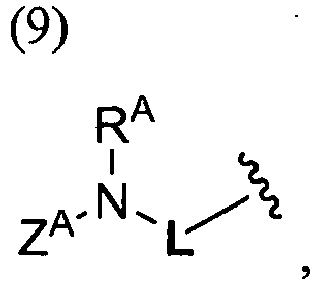


- L is a liner selected from
- (a) a bond,
- (b) -CH2-,
- (c) -C(O)-,
- (d) -CH2-C(O)-** or -C(O)-CH2-**,
- (e) -CH2-CH2-C(O)-** or -C(O)=CH2-CH2-**, and
- (f)


- R is selected from H, halo, hydroxy, C1-4alkyl, C1-4alkoxy, C1-4alkyl-S(O)k-, CF3, CN, benzyl, or two R groups on adjacent atoms may be joined together with the atoms to which they are attached to form a fused phenyl, pyridine, pyridazine, pyrimidine, pyrazine, or triazine, each of which is optionally substituted with 1 to 4 substituents independently selected from the group consisting of: halo, C1-4alkyl, C1-4alkoxy, CF3 and CN;
- each k is indepenenlty 0, 1 or 2;
- each r and t are independently 1, 2, 3 or 4;
- ZA is selected from the group consisting of:
- (1) hydrogen,
- (2) C1-10 alkyl,
- (3) C2-10alkenyl,
- (4) C3-7 cycloalkyl,
- (5) AryA,
- (6) HetA,
- (7) HetB,
wherein said C1-10 alkyl, C2-10alkenyl and C3-7 cycloalky are optionally substituted with 1 to 6 substituents as allowed by valence independently selected from the group consisting of: fluoro, hydroxy, carbamoyl, C3-6 cycloalkyl, C(O)O-C1-6 alkyl, C(O)OH, C(O)-C1-6 alkyl, N(H)=C1-6 alkyl, N(-C1-6 alkyl)2, ArylA, HetA and HetB;
- each RA is independently H or C1-6 alkyl;
- or ZA and RA and the nitrogen atom to which they are attached may be joined together to form a 5-, 6- or 7-membered mono-cyclic, or 9- or 10-membered bi-cyclic, saturated, aromatic or partially aromatic ring, said ring optionally containing 1 to 3 additional heteroatoms selected from O, S and N, and said ring optionally substituted with from 1 to 3 XA;
- each R6 independently is:


- each R6A independently is H or C1-6 alkyl;
- alternatively, R6 and R6A together with the carbon to which they are attached form a C3-6 cycloalkyl which is optionally substituted with phenyl, wherein the phenyl is optionally substituted with from 1 to 3 XD.
- each XA, each XB, each XC, each XD, each YB and each YC are independently selected from the group consisting of:
- (1) C1-6 alkyl,
- (2) C3-6 cycloalkyl,
- (3) C1-6 haloalkyl,
- (4) OH,
- (5) O-C1-6 alkyl,
- (6) O-C1-6 haloalkyl,
- (7) O-C3-6 cycloalkyl,
- (8) SH,
- (9) S-C1-6 alkyl,
- (10) S-C1-6 haloalkyl,
- (11) S-C3-6 cycloalkyl,
- (12) halo,
- (13) CN,
- (14) NO2,
- (15) NH2,
- (16) N(H)-C1-6 alkyl,
- (17) N(-C1-6 alkyl)2,
- (18) N(H)C(O)-C1-6 alkyl,
- (19) N(H)CH(O),
- (20) CH(O),
- (21) C(O)-C1-6 alkyl,
- (22) C(O)OH,
- (23) C(O)O-C1-6 alkyl,
- (24) C(O)NH2,
- (25) C(0)N(H)-C1-6 alkyl,
- (26) C(O)N(-C1-6 alkyl)2,
- (27) C(O)N(H)C(O)-C1-6 alkyl,
- (28) C(O)N(H)CH(O)
- (29) SO2H,
- (30) SO2-C1-6 alkyl;
- (31) phenyl, benzyl or phenoxy, each optionally substituted with 1 to 5 substituents selected from halogen and C1-6 alkyl,
- (32) HetA, -O-HetA or -CH2-HetA, optionally substituted with 1 to 5 substituent selected from halogen and C1-6 alkyl,
- (33) trimethylsilyl, and
- (34) C2-6alkenyl,
wherein C1-6 alkyl in each instance of (1), (3) (5), (6), (9), (10), (16), (17), (18), (21), (23), (25), (26), (27), (30), (31) and (32) above is optionally substituted with 1 to 6 substituients as allowed by valence selected from the group consisting of:- (a) C1-6 haloalkyl,
- (b) OH
- (c) O-C1-6 alkyl,
- (d) O-C1-6 haloalkyl,
- (e) O-C3-6 cycloalkyl,
- (f) SH,
- (g) S-C1-6 alkyl,
- (h) halo,
- (i) CN,
- (j) NO2,
- (k) NH2,
- (l) N(H)-C1-6 alkyl,
- (m) N(-C1-6 alkyl)2,
- (n) C(O)-C1-6 alkyl,
- (o) C(O)OH,
- (p) C(O)O-C1-6 alkyl, and (q) SO2-C1-6 alkyl;
- T is O, S, S(O), or SO2;
- m is an integer equal to 0, 1, 2, or 3;
- n is an integer equal to 0, 1, 2, or 3;
- R7 is H, C1-6 alkyl, C3-6 cycloalkyl, C1-6 alkyl substituted with C3-6 cycloallcyl, C(O)-RK or SO2-RK;
- R8 is H, C1-6 alkyl, C1-6 haloalkyl and C3-6 cycloalkyl;
- RK is:
- (1) C1-6 alkyl,
- (2) C3-6 cycloalkyl,
- (3) C1-6 alkyl substituted with C3-6 cycloalkyl,
- (4) O-C1-6 alkyl,
- (5) O-C1-6 alkyl substituted with O-C1-6 alkyl,
- (6) O-C1-6 fluoroalkyl,
- (7) C(O)O-C1-6 alkyl,
- (8) C1-6 alkyl substituted with C(O)O-C1-6 alkyl,
- (9) C1-6 alkyl substituted with C(O)OH,
- (10) C1-6 alkyl substituted with C(O)-C1-6 alkyl,
- (11) N(H)-C1-6 alkyl,
- (12) N(-C1-6alkyl)2,
- (13) C1-6 alkyl substituted with NH2, N(H)-C1-6 alkyl, or N(-C1-6 alkyl)2,
- (14) AryA,
- (15) C1-6 alkyl substituted with AryA,
- (16) O-C1-6 alkyl substituted with AryA,
- (17) HetA,
- (18) C1-6 alkyl substituted with HetA,
- (19) O-C1-6 alkyl substituted with HetA,
- (20) HetB,
- (21) O-HetB, or
- (22) O-C1-6 alkyl substituted with HetB;
- each AryA is an aryl which is independently phenyl or naphthyl, wherein the phenyl or naphthyl is optionally substituted with from 1 to 3 YB;
- each HetA is a heteroaryl which is independently (i) a 5- or 6-membered monocyclic heteroaromatic ring containing from 1 to 3 heteroatoms independently selected from N, O and S, or (ii) is a 9-, 10- or 11-membered bicyclic heteroaromatic ring containing from 1 to 4 heteroatoms independently selected from N, O and S; wherein the monocylcic ring (i) or the bicyclic ring (ii) is optionally substituted with from 1 to 3 YC; and
- each HetB is independently a 4- to 7-membered, saturated or unsaturated, non-aromatic heterocyclic ring containing at least one carbon atom and from 1 to 4 heteroatoms independently selected from N, O and S, where each S is optionally oxidized to S(O) or S(O)2, and wherein the saturated or unsaturated heterocyclic ring is optionally substituted with from 1 to 3 substituents each of which is independently halogen, CN, C1-6 alkyl, OH, oxo, O-C1-6 alkyl, C1-6 haloalkyl, O-C1-6 haloalkyl, C(O)NH2, C(O)N(H)-C1-6 alkyl, C(O)N(-C1-6 alkyl)2, C(O)H, C(O)-C1-6 alkyl, CO2H, CO2-C1-6 alkyl, SO2H, or SO2-C1-6 alkyl.
- Within the genus, the invention encompasses a first sub-genus of compounds of Formula I wherein R6 is:

- Also within the genus, the invention encompasses a second sub-genus of compounds of Formula I wherein Z is

- Also within the genus, the invention encompasses a third sub-genus of compounds of Formula I wherein Z is

- Also within the genus, the invention encompasses a fourth sub-genus of compounds of Formula I wherein Z is

- Also within the genus, the invention encompasses a fifth sub-genus of compounds of Formula I wherein Z is
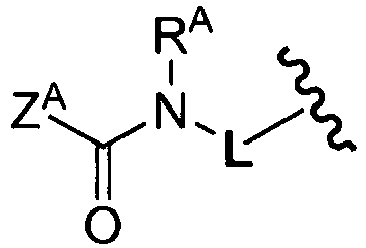
- Also within the genus, the invention encompasses a sixth sub-genus of compounds of Formula I wherein Z is

- Also within the genus, the invention encompasses a seventh sub-genus of compounds of Formula I wherein Z is

- Also within the genus, the invention encompasses an eighth sub-genus of compounds of Formula I wherein Z is

- Also within the genus, the invention encompasses a ninth sub-genus of compounds of Formula I wherein Z is


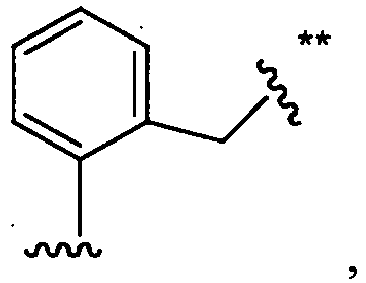
- Also within the genus, the invention encompasses a tenth sub-genus of compounds of Formula I of Formula Ia

- Within the tenth sub-genus, the invention encompasses a class of compounds of Formula Ia wherein:
- R is H or fluoro,
- Y3 is CH or N,
- XB and XC are independently selected from halo, -OCH3, -CF3 and-OCF3, and
- m and n are independently 0, 1 or 2.
- The invention encompasses a sub-class of compounds of Formula Ia wherein X is selected from: H, -NH2 and -N(H)-C(O)-OR8, and all other variables are as provided in the tenth sub-genus or class. The invention encompasses a group of compounds of Formula Ia wherein W1 is C, one XB group is present and substituted at the 4-position, one or two XC groups are present and substituted at the 3- or 3,5-positions respectively, and the XB group is a different group with respect to either XC group, and all other variables are as provided in the tenth subgenus, class or sub-class.
- The invention encompasses a group of compounds of Formula Ia whwerein ZA is selected from the group consisting of:
- (1) hydrogen,
- (2) C1-10 alkyl,
- (3) C2-10 alkenyl, and
- (4) C3-7 cycloalkyl,
- The invention encompasses a sub-group of compounds of Formula Ia whwerein ZA is C1-10 alkyl, optionally substituted with 1 to 6 substituents as allowed by valence independently selected from the group consiting of: fluoro and hydroxyl, and all other variables are as provided in the tenth sub-genus, class, sub-class or group as described above. The invention encompasses compounds of Formula Ia wherein ZA is -(CH2)0-4-CF3, and all other variables are as provided in the tenth sub-genus, class, sub-class, group or sub-group as described above.
- The present invention includes compounds of Formula I above and pharmaceutically acceptable salts thereof.
- Compounds of Formula Ia form a subset of the compounds included in Formula I. Any description which follows that refers to a compound of Formula I also applies to a compound of Formula Ia.
- Another embodiment of the present invention is a compound of Formula I, or a pharmaceutically acceptable salt thereof, as originally defined or as defined in any of the foregoing embodiments, aspects, classes, or subclasses, wherein the compound or its salt is in a substantially pure form. As used herein "substantially pure" means suitably at least about 60 wt.%, typically at least about 70 wt.%, preferably at least about 80 wt.%, more preferably at least about 90 wt.% (e.g., from about 90 wt.% to about 99 wt.%), even more preferably at least about 95 wt.% (e.g., from about 95 wt.% to about 99 wt.%, or from about 98 wt.% to 100 wt.%), and most preferably at least about 99 wt.% (e.g., 100 wt.%) of a product containing a compound of Formula I or its salt (e.g., the product isolated from a reaction mixture affording the compound or salt) consists of the compound or salt. The level of purity of the compounds and salts can be determined using a standard method of analysis such as thin layer chromatography, gel electrophoresis, high performance liquid chromatography, and/or mass spectrometry. If more than one method of analysis is employed and the methods provide experimentally significant differences in the level of purity determined, then the method providing the highest level of purity governs. A compound or salt of 100% purity is one which is free of detectable impurities as determined by a standard method of analysis. The compounds of the invention have two or more asymmetric centers and can occur as mixtures of stereoisomers. It is understood that a substantially pure compound can be either a substantially pure mixture of stereoisomers or a substantially pure individual diastereomer or enantiomer.
- Other embodiments of the present invention include the following:
- (a) A pharmaceutical composition comprising an effective amount of a compound of Formula I as defined above, or a pharmaceutically acceptable salt thereof, and a pharmaceutically acceptable carrier.
- (b) A pharmaceutical composition which comprises the product prepared by combining (e.g., mixing) an effective amount of a compound of Formula I as defined above, or a pharmaceutically acceptable salt thereof, and a pharmaceutically acceptable carrier.
- (c) The pharmaceutical composition of (a) or (b), further comprising an effective amount of an anti-HIV agent selected from the group consisting of HIV antiviral agents, immunomodulators, and anti-infective agents.
- (d) The pharmaceutical composition of (c), wherein the anti-HIV agent is an antiviral selected from the group consisting of HIV protease inhibitors, HIV reverse transcriptase inhibitors, HIV integrase inhibitors, HIV fusion inhibitors, HIV entry inhibitors, and HIV maturation inhibitors.
- (e) The pharmaceutical composition of (d), wherein the antiviral is selected from the group consisting of HIV reverse transcriptase inhibitors and HIV integrase inhibitors.
- (f) A combination which is (i) a compound of Formula I as defined above, or a pharmaceutically acceptable salt thereof, and (ii) an anti-HIV agent selected from the group consisting of HIV antiviral agents, immunomodulators, and anti-infective agents; wherein Compound I and the anti-HIV agent are each employed in an amount that renders the combination effective for inhibition of HIV protease, for treatment or prophylaxis of infection by HIV, or for treatment, prophylaxis of, or delay in the onset or progression of AIDS.
- (g) The combination of (f), wherein the anti-HIV agent is an antiviral selected from the group consisting of HIV protease inhibitors, HIV reverse transcriptase inhibitors, HIV integrase inhibitors, HIV fusion inhibitors, HIV entry inhibitors, and HIV maturation inhibitors.
- (h) The combination of (g), wherein the antiviral is selected from the group consisting of HIV reverse transcriptase inhibitors and HIV integrase inhibitors.
- (i) A method for the inhibition of HIV protease in a subject in need thereof which comprises administering to the subject an effective amount of a compound of Formula I or a pharmaceutically acceptable salt thereof.
- (j) A method for the prophylaxis or treatment of infection by HIV (e.g., HIV-1) in a subject in need thereof which comprises administering to the subject an effective amount of a compound of Formula I or a pharmaceutically acceptable salt thereof.
- (k) The method of (j), wherein the compound of Formula I is administered in combination with an effective amount of at least one other HIV antiviral selected from the group consisting of HIV protease inhibitors, HIV reverse transcriptase inhibitors, HIV integrase inhibitors, HIV fusion inhibitors, HIV entry inhibitors, and HIV maturation inhibitors.
- (l) The method of (k), wherein the at least one other HIV antiviral is selected from the group consisting of HIV reverse transcriptase inhibitors and HIV integrase inhibitors.
- (m) A method for the prophylaxis, treatment or delay in the onset or progression of AIDS in a subject in need thereof which comprises administering to the subject an effective amount of a compound of Formula I or a pharmaceutically acceptable salt thereof.
- (n) The method of (m), wherein the compound is administered in combination with an effective amount of at least one other HIV antiviral, selected from the group consisting of HIV protease inhibitors, HIV reverse transcriptase inhibitors, HIV integrase inhibitors, HIV fusion inhibitors, HIV entry inhibitors, and HIV maturation inhibitors.
- (o) The method of (n), wherein the at least one other HIV antiviral is selected from the group consisting of HIV reverse transcriptase inhibitors and HIV integrase inhibitors.
- (p) A method for the inhibition of HIV protease in a subject in need thereof which comprises administering to the subject the pharmaceutical composition of (a), (b), (c) or (d) or the combination of (e) or (f).
- (q) A method for the prophylaxis or treatment of infection by HIV (e.g., HN-1) in a subject in need thereof which comprises administering to the subject the pharmaceutical composition of (a), (b), (c), (d) or (e).
- (r) A method for the prophylaxis, treatment, or delay in the onset or progression of AIDS in a subject in need thereof which comprises administering to the subject the pharmaceutical composition of (a), (b), (c), (d) or (e).
- The present invention also includes a compound of Formula I, or a pharmaceutically acceptable salt thereof, (i) for use in, (ii) for use as a medicament for, or (iii) for use in the manufacture/preparation of a medicament for: (a) therapy (e.g., of the human body), (b) medicine, (c) inhibition of HIV protease, (d) treatment or prophylaxis of infection by HIV, or (e) treatment, prophylaxis of, or delay in the onset or progression of AIDS. In these uses, the compounds of the present invention can optionally be employed in combination with one or more other anti-HIV agents selected from HIV antiviral agents, anti-infective agents, and immunomodulators.
- Additional embodiments of the invention include the pharmaceutical compositions, combinations and methods set forth in (a)-(r) above and the uses (i)(a)-(e) through (iii)(a)-(e) set forth in the preceding paragraph, wherein the compound of the present invention employed therein is a compound of one of the embodiments, aspects, classes or subclasses described above. In all of these embodiments etc., the compound can optionally be used in the form of a pharmaceutically acceptable salt.
- Additional embodiments of the present invention include each of the pharmaceutical compositions, combinations, methods and uses set forth in the preceding paragraphs, wherein the compound of the present invention or its salt employed therein is substantially pure. With respect to a pharmaceutical composition comprising a compound of Formula I or a pharmaceutically acceptable carrier and optionally one or more excipients, it is understood that the term "substantially pure" is in reference to a compound of Formula I or its salt per se.
- As used herein, the term "alkyl" refers to a monovalent straight or branched chain, saturated aliphatic hydrocarbon radical having a number of carbon atoms in the specified range. Thus, for example, "C1-6 alkyl" (or "C1-C6 alkyl") refers to any of the hexyl alkyl and pentyl alkyl isomers as well as n-, iso-, sec- and t-butyl, n- and iso- propyl, ethyl and methyl. As another example, "C1-4 alkyl," refers to n-, iso-, sec- and t-butyl, n- and isopropyl, ethyl and methyl. As another example, "C1-3 alkyl" refers to n-propyl, isopropyl, ethyl and methyl.
- The term "alkylene" refers to any divalent linear or branched chain aliphatic hydrocarbon radical having a number of carbon atoms in the specified range. Thus, for example, "-C1-6 alkylene-" refers to any of the C1 to C6 linear or branched alkylenes, and "-C1-4 alkylene-" refers to any of the C1 to C4 linear or branched alkylenes. A class of alkylenes of interest with respect to the invention is -(CH2)1-6-, and sub-classes of particular interest include -(CH2)1-4-, -(CH2)2-4-, -(-CH2)1-3-, -(CH2)2-3-, -(-CH2)1-2-, and -CH2-. Another sub-class of interest is an alkylene selected from the group consisting of -CH2-, -CH(CH3)-, and -C(CH3)2-.
- The term "cycloalkyl" refers to any monocyclic ring of an alkane having a number of carbon atoms in the specified range. Thus, for example, "C3-6 cycloalkyl" (or "C3-C6 cycloalkyl") refers to cyclopropyl, cyclobutyl, cyclopentyl, and cyclohexyl, and "C3-5 cycloalkyl" refers to cyclopropyl, cyclobutyl, and cyclopentyl.
- The term "halogen" (or "halo") refers to fluorine, chlorine, bromine and iodine (alternatively referred to as fluoro, chloro, bromo, and iodo).
- The term "haloalkyl" refers to an alkyl group as defined above in which one or more of the hydrogen atoms have been replaced with a halogen (i.e., F, Cl, Br and/or I). Thus, for example, "C1-6 haloalkyl" (or "C1-C6 haloalkyl") refers to a C1 to C6 linear or branched alkyl group as defined above with one or more halogen substituents. The term "fluoroalkyl" has an analogous meaning except that the halogen substituents are restricted to fluoro. Suitable fluoroalkyls include the series (CH2)0-4CF3 (i.e., trifluoromethyl, 2,2,2-trifluoroethyl, 3,3,3-trifluoro-n-propyl, etc.). A fluoroalkyl of particular interest is CF3.
- The term "C(O)" refers to carbonyl. The terms "S(O)2" and "SO2" each refer to sulfonyl. The term "S(O)" refers to sulfinyl.
- The term "aryl" refers to phenyl and naphthyl. The aryl of particular interest is phenyl.
- The term "heteroaryl" refers to (i) a 5- or 6-membered heteroaromatic ring containing from 1 to 3 heteroatoms independently selected from N, O and S, or (ii) is a heterobicyclic ring selected from quinolinyl, isoquinolinyl, and quinoxalinyl. Suitable 5- and 6-membered heteroaromatic rings include, for example, pyridyl (also referred to as pyridinyl), pyrrolyl, pyrazinyl, pyrimidinyl, pyridazinyl, triazinyl, thienyl, furanyl, imidazolyl, pyrazolyl, triazolyl, oxazolyl, isooxazolyl, oxadiazolyl, oxatriazolyl, thiazolyl, isothiazolyl, and thiadiazolyl. Heteroaryls of particular interest are pyrrolyl, imidazolyl, pyridyl, pyrazinyl, quinolinyl (or quinolyl), isoquinolinyl (or isoquinolyl), and quinoxalinyl.
- Examples of 4- to 7-membered, saturated heterocyclic rings within the scope of this invention (see HetB) include, for example, azetidinyl, piperidinyl, morpholinyl, thiomorpholinyl, thiazolidinyl, isothiazolidinyl, oxazolidinyl, isoxazolidinyl, pyrrolidinyl, imidazolidinyl, piperazinyl, tetrahydrofuranyl, tetrahydrothienyl, pyrazolidinyl, hexahydropyrimidinyl, thiazinanyl, thiazepanyl, azepanyl, diazepanyl, tetrahydropyranyl, tetrahydrothiopyranyl, and dioxanyl. Examples of 4- to 7-membered, unsaturated heterocyclic rings within the scope of this invention (see HetB) include mono-unsaturated heterocyclic rings corresponding to the saturated heterocyclic rings listed in the preceding sentence in which a single bond is replaced with a double bond (e.g., a carbon-carbon single bond is replaced with a carbon-carbon double bond).
- It is understood that the specific rings listed above are not a limitation on the rings which can be used in the present invention. These rings are merely representative.
- Unless expressly stated to the contrary in a particular context, any of the various cyclic rings and ring systems described herein may be attached to the rest of the compound at any ring atom (i.e., any carbon atom or any heteroatom) provided that a stable compound results.
- Unless expressly stated to the contrary, all ranges cited herein are inclusive. For example, a heteroaromatic ring described as containing from "1 to 4 heteroatoms" means the ring can contain 1, 2, 3 or 4 heteroatoms. It is also understood that any range cited herein includes within its scope all of the sub-ranges within that range. Thus, for example, a heterocyclic ring described as containing from "1 to 4 heteroatoms" is intended to include as aspects thereof, heterocyclic rings containing 2 to 4 heteroatoms, 3 or 4 heteroatoms, 1 to 3 heteroatoms, 2 or 3 heteroatoms, 1 or 2 heteroatoms, 1 heteroatom, 2 heteroatoms, 3 heteroatoms, and 4 heteroatoms. As another example, an aryl or heteroaryl described as optionally substituted with "from 1 to 4 substituents" is intended to include as aspects thereof, an aryl or heteroaryl substituted with 1 to 4 substituents, 2 to 4 substituents, 3 to 4 substituents, 4 substituents, 1 to 3 substituents, 2 to 3 substituents, 3 substituents, 1 to 2 substituents, 2 substituents, and 1 substituent.
- When any variable (e.g., XA or XB) occurs more than one time in any constituent or in Formula I or in any other formula depicting and describing compounds of the present invention, its definition on each occurrence is independent of its definition at every other occurrence. Also, combinations of substituents and/or variables are permissible only if such combinations result in stable compounds.
- Unless expressly stated to the contrary, substitution by a named substituent is permitted on any atom in a ring (e.g., cycloalkyl, aryl, or heteroaryl) provided such ring substitution is chemically allowed and results in a stable compound.
- The compounds of the invention contain chiral centers and, as a result of the selection of substituents and substituent patterns, can contain additional chiral centers, and thus can occur as mixtures of stereoisomers, or as individual diastereomers, or enantiomers. All isomeric forms of these compounds, whether individually or in mixtures, are within the scope of the present invention.
- To the extent substituents and substituent patterns provide for the existence of tautomers (e.g., keto-enol tautomers) in the compounds of the invention, all tautomeric forms of these compounds, whether present individually or in mixtures, are within the scope of the present invention. Compounds of the present invention having a hydroxy substituent on a carbon atom of a heteroaromatic ring are understood to include compounds in which only the hydroxy is present, compounds in which only the tautomeric keto form (i.e., an oxo substitutent) is present, and compounds in which the keto and enol forms are both present.
- A "stable" compound is a compound which can be prepared and isolated and whose structure and properties remain or can be caused to remain essentially unchanged for a period of time sufficient to allow use of the compound for the purposes described herein (e.g., therapeutic or prophylactic administration to a subject). The compounds of the present invention are limited to stable compounds embraced by Formula I.
- The methods of the present invention involve the use of compounds of the present invention in the inhibition of HIV protease (e.g., wild type HIV-1 and/or mutant strains thereof), the prophylaxis or treatment of infection by human immunodeficiency virus (HIV) and the prophylaxis, treatment or delay in the onset or progression of consequent pathological conditions such as AIDS. Prophylaxis of AIDS, treating AIDS, delaying the onset or progression of AIDS, or treating or prophylaxis of infection by HIV is defined as including, but not limited to, treatment of a wide range of states of HIV infection: AIDS, ARC (AIDS related complex), both symptomatic and asymptomatic, and actual or potential exposure to HIV. For example, the present invention can be employed to treat infection by HIV after suspected past exposure to HIV by such means as blood transfusion, exchange of body fluids, bites, accidental needle stick, or exposure to patient blood during surgery.
- The compounds can be administered in the form of pharmaceutically acceptable salts. The term "pharmaceutically acceptable salt" refers to a salt which possesses the effectiveness of the parent compound and which is not biologically or otherwise undesirable (e.g., is neither toxic nor otherwise deleterious to the recipient thereof). Suitable salts include acid addition salts which may, for example, be formed by mixing a solution of the compound of the present invention with a solution of a pharmaceutically acceptable acid such as hydrochloric acid, sulfuric acid, acetic acid, or benzoic acid. When compounds employed in the present invention carry an acidic moiety (e.g., -COOH or a phenolic group), suitable pharmaceutically acceptable salts thereof can include alkali metal salts (e.g., sodium or potassium salts), alkaline earth metal salts (e.g., calcium or magnesium salts), and salts formed with suitable organic ligands such as quaternary ammonium salts.
- The term "administration" and variants thereof (e.g., "administering" a compound) in reference to a compound of Formula I mean providing the compound to the individual in need of treatment or prophylaxis. When a compound is provided in combination with one or more other active agents (e.g., antiviral agents useful for treating or prophylaxis of HIV infection or AIDS), "administration" and its variants are each understood to include provision of the compound and other agents at the same time or at different times. When the agents of a combination are administered at the same time, they can be administered together in a single composition or they can be administered separately.
- As used herein, the term "composition" is intended to encompass a product comprising the specified ingredients, as well as any product which results from combining the specified ingredients.
- By "pharmaceutically acceptable" is meant that the ingredients of the pharmaceutical composition must be compatible with each other and not deleterious to the recipient thereof.
- The term "subject" as used herein refers to an animal, preferably a mammal, most preferably a human, who has been the object of treatment, observation or experiment.
- The term "effective amount" as used herein means that amount of active compound or pharmaceutical agent that elicits the biological or medicinal response in a tissue, system, animal or human that is being sought by a researcher, veterinarian, medical doctor or other clinician. In one embodiment, the effective amount is a "therapeutically effective amount" for the alleviation of the symptoms of the disease or condition being treated. In another embodiment, the effective amount is a "prophylactically effective amount" for reduced likelihood of the symptoms of the disease or condition being prevented. The term also includes herein the amount of active compound sufficient to inhibit HIV protease (wild type and/or mutant strains thereof) and thereby elicit the response being sought (i.e., an "inhibition effective amount"). When the active compound (i.e., active ingredient) is administered as the salt, references to the amount of active ingredient are to the free form (i.e., the non-salt form) of the compound.
- In the methods of the present invention (e.g., inhibiting HIV protease, treating or prophylaxis of HIV infection or treating, prophylaxis of, or delaying the onset or progression of AIDS), the compounds of Formula I, optionally in the form of a salt, can be administered by any means that produces contact of the active agent with the agent's site of action. They can be administered by any conventional means available for use in conjunction with pharmaceuticals, either as individual therapeutic agents or in a combination of therapeutic agents. They can be administered alone, but typically are administered with a pharmaceutical carrier selected on the basis of the chosen route of administration and standard pharmaceutical practice. The compounds of the invention can, for example, be administered by one or more of the follwing routes: orally, parenterally (including subcutaneous injections, intravenous, intramuscular, intrasternal injection or infusion techniques), by inhalation spray, or rectally, in the form of a unit dosage of a pharmaceutical composition containing an effective amount of the compound and conventional non-toxic pharmaceutically acceptable carriers, adjuvants and vehicles. Liquid preparations suitable for oral administration (e.g., suspensions, syrups, elixirs and the like) can be prepared according to techniques known in the art and can employ any of the usual media such as water, glycols, oils, alcohols and the like. Solid preparations suitable for oral administration (e.g., powders, pills, capsules and tablets) can be prepared according to techniques known in the art and can employ such solid excipients as starches, sugars, kaolin, lubricants, binders, disintegrating agents and the like. Parenteral compositions can be prepared according to techniques known in the art and typically employ sterile water as a carrier and optionally other ingredients, such as a solubility aid. Injectable solutions can be prepared according to methods known in the art wherein the carrier comprises a saline solution, a glucose solution or a solution containing a mixture of saline and glucose. Further description of methods suitable for use in preparing pharmaceutical compositions for use in the present invention and of ingredients suitable for use in said compositions is provided in Remirigton's Pharmaceutical Sciences, 18th edition, edited by A. R. Gennaro, Mack Publishing Co., 1990 and in Remington - The Science and Practice of Pharmacy, 21st edition, Lippincott Williams & Wilkins, 2005.
- The compounds of Formula I can be administered orally in a dosage range of 0.001 to 1000 mg/kg of mammal (e.g., human) body weight per day in a single dose or in divided doses. One dosage range is 0.01 to 500 mg/kg body weight per day orally in a single dose or in divided doses. Another dosage range is 0.1 to 100 mg/kg body weight per day orally in single or divided doses. For oral administration, the compositions can be provided in the form of tablets or capsules containing 1.0 to 500 milligrams of the active ingredient, particularly 1, 5, 10, 15, 20, 25, 50, 75, 100, 150, 200, 250, 300, 400, and 500 milligrams of the active ingredient for the symptomatic adjustment of the dosage to the patient to be treated. The specific dose level and frequency of dosage for any particular patient may be varied and will depend upon a variety of factors including the activity of the specific compound employed, the metabolic stability and length of action of that compound, the age, body weight, general health, sex, diet, mode and time of administration, rate of excretion, drug combination, the severity of the particular condition, and the host undergoing therapy.
- As noted above, the present invention is also directed to use of a compound of Formula I with one or more anti-HIV agents. An "anti-HIV agent" is any agent which is directly or indirectly effective in the inhibition of HIV reverse transcriptase, protease, or another enzyme required for HIV replication or infection, the inhibition of HIV replication, the treatment or prophylaxis of HIV infection, and/or the treatment, prophylaxis or delay in the onset or progression of AIDS. It is understood that an anti-HIV agent is effective in treating, preventing, or delaying the onset or progression of HIV infection or AIDS and/or diseases or conditions arising therefrom or associated therewith. For example, the compounds of this invention may be effectively administered, whether at periods of pre-exposure and/or post-exposure, in combination with effective amounts of one or more anti-HIV agents selected from HIV antiviral agents, imunomodulators, antiinfectives, or vaccines useful for treating HIV infection or AIDS, such as those disclosed in Table 1 of
WO 01/38332 WO 02/30930 Table A - Antiviral Agents for Treating HIV infection or AIDS Name Type abacavir, ABC, Ziagen® nRTI abacavir +lamivudine, Epzicom® nRTI abacavir + lamivudine + zidovudine, Trizivir® nRTI amprenavir, Agenerase® PI atazanavir, Reyataz® PI AZT, zidovudine, azidothymidine, Retrovir® nRTI capravirine nnRTI darunavir, Prezista® PI ddC, zalcitabine, dideoxycytidine, Hivid® nRTI ddI, didanosine, dideoxyinosine, Videx® nRTI ddI (enteric coated), Videx EC® nRTI delavirdine, DLV, Rescriptor® nnRTI efavirenz, EFV, Sustiva®, Stocrin® nnRTI efavirenz + emtricitabine + tenofovir DF, Atripla® nnRTI + nRTI EFdA (4'-ethynyl-2-fluoro-2'-deoxyadenosine) nRTI emtricitabine, FTC, Emtriva® nRTI emtricitabine + tenofovir DF, Truvada® nRTI emvirine, Coactinon® nnRTI enfuvirtide, Fuzeon® FI enteric coated didanosine, Videx EC® nRTI etravirine, TMC-125 nnRTI fosamprenavir calcium, Lexiva® PI indinavir, Crixivan® PI lamivudine, 3TC, Epivir® nRTI lamivudine + zidovudine, Combivir® nRTI lopinavir PI lopinavir + ritonavir, Kaletra® PI maraviroc, Selzentry® EI nelfinavir, Viracept® PI nevirapine, NVP, Viramune® nnRTI PPL-100 (also known as PL-462) (Ambrilia) PI raltegravir, MK-0518, Isentress™ InI ritonavir, Norvir® PI saquinavir, Invirase®, Fortovase® PI stawdine, d4T,didehydrodeoxythymidine, Zerit® nRTI tenofovir DF (DF = disoproxil fumarate), TDF, Viread® nRTI Tenofovir, hexadecvloxypropyl (CMX-157) nRTI tipranavir, Aptivus® PI EI = entry inhibitor; FI = fusion inhibitor; InI = integrase inhibitor; PI = protease inhibitor; nRTI = nucleoside reverse transcriptase inhibitor; nnRTI = non-nucleoside reverse transcriptase inhibitor. Some of the drugs listed in the table are used in a salt form; e.g., abacavir sulfate, indinavir sulfate, atazanavir sulfate, nelfinavir mesylate. - It is understood that the scope of combinations of the compounds of this invention with anti-HIV agents is not limited to the HIV antivirals listed in Table A and/or listed in the above-referenced Tables in
WO 01/38332 WO 02/30930 - The compounds of this invention are also useful in the preparation and execution of screening assays for antiviral compounds. For example, the compounds of this invention are useful for isolating enzyme mutants, which are excellent screening tools for more powerful antiviral compounds. Furthermore, the compounds of this invention are useful in establishing or determining the binding site of other antivirals to HIV protease, e.g., by competitive inhibition. Thus the compounds of this invention are commercial products to be used for these purposes.
- In the compounds of Formula I, the atoms may exhibit their natural isotopic abundances, or one or more of the atoms may be artificially enriched in a particular isotope having the same atomic number, but an atomic mass or mass number different from the atomic mass or mass number predominantly found in nature. The present invention is meant to include all suitable isotopic variations of the compounds of generic Formula I. For example, different isotopic forms of hydrogen (H) include protium (1H) and deuterium (2H). Protium is the predominant hydrogen isotope found in nature. Enriching for deuterium may afford certain therapeutic advantages, such as increasing in vivo half-life or reducing dosage requirements, or may provide a compound useful as a standard for characterization of biological samples. Isotopically-enriched compounds within generic Formula I can be prepared without undue experimentation by conventional techniques well known to those skilled in the art or by processes analogous to those described in the Schemes and Examples herein using appropriate isotopically-enriched reagents and/or intermediates.
- Abbreviations employed herein include the following: Bn = benzyl; BOC (or Boc) = t-butyloxycarbonyl; Boc2O = di-t-butyl carbonate; BOP = benzotriazol-1-yloxytris-(dimethylamino)phosphonium; BSA = bovine serum albumin; CBS = Corey, Bakshi, Shibata chiral oxazaborolidine mediated ketone reduction; Cbz = benzyloxycarbonyl; DBU = 1,8-diazabicyclo[5.4.0]undec-7-one; DCAD = di-(4-chlorobenzyl) azodicarboxylate; DCE = 1,2-dichloroethane; DCM = dichloromethane; DEAD = diethyl azodicarboxylate; DIAD = diisopropylazodicarboxylate; Dibal-H = diisobutylaluminum hydride; DMAP = 4-dimethylaminopyridine; DMF = dimethylformamide; DMSO = dimethyl sulfoxide; EDC = 1-ethyl-3-(3-dimethylaminopropyl) carbodiimide; Et = ethyl; EtOAc = ethyl acetate; EtOH = ethanol; G-2G = Grubbs catalyst, 2nd generation; HOAt = 1-hydroxy-7-azabenzotriazole; HPLC = high performance liquid chromatography; HSU = hydroxysuccinimide; i-PrOH = isopropanol; LAH = lithium aluminum hydride; LC-MS = liquid chromatography-mass spectroscopy; Me = methyl; MeOH = methanol; MOC = methoxycarbonyl; Ms = mesyl or methanesulfonyl; NMR = nuclear magnetic resonance; Ph = phenyl; RCM = ring closing metathesis; Piv = pivaloyl; PPTS = pyridinium p-toluene sulfonate; PyBrOP = bromo-tris-pyrrolidinophosphonium hexafluorophosphate; SCX = strong cation exchange resin; STP = standard temperature and pressure (i.e., 25°C & 1 atmosphere); TBS = tert-butyldimethylsilyl; TBDPS = tert-butyl(diphenyl) silyl; TBDPSCl = tert-butyl(dimethyl)silyl chloride; TEA = triethylamine; TFA = trifluoroacetic acid; THF = tetrahydrofuran; TLC = thin layer chromatography; TMAF = tetramethyl ammonium fluoride; TMSCHN2 = trimethylsilyl diazomethane; TPAP = tetrapropylammonium perruthenate; TPP = triphenylphosphine.
- The compounds of the present invention can be readily prepared according to the following reaction schemes and examples, or modifications thereof, using readily available starting materials, reagents and conventional synthesis procedures. In these reactions, it is also possible to make use of variants which are themselves known to those of ordinary skill in this art, but are not mentioned in greater detail. Furthermore, other methods for preparing compounds of the invention will be readily apparent to the person of ordinary skill in the art in light of the following reaction schemes and examples. Unless otherwise indicated, all variables are as defined above. The term "Ar" appears in several of the schemes and refers to phenyl optionally substituted with one or more XA. In the examples that follow, when a nitrogen atom is depicted without the necessary hydrogen atoms to complete the valence, it is assumed those nitrogen atoms are present unless specifically depicted to the contrary.
-
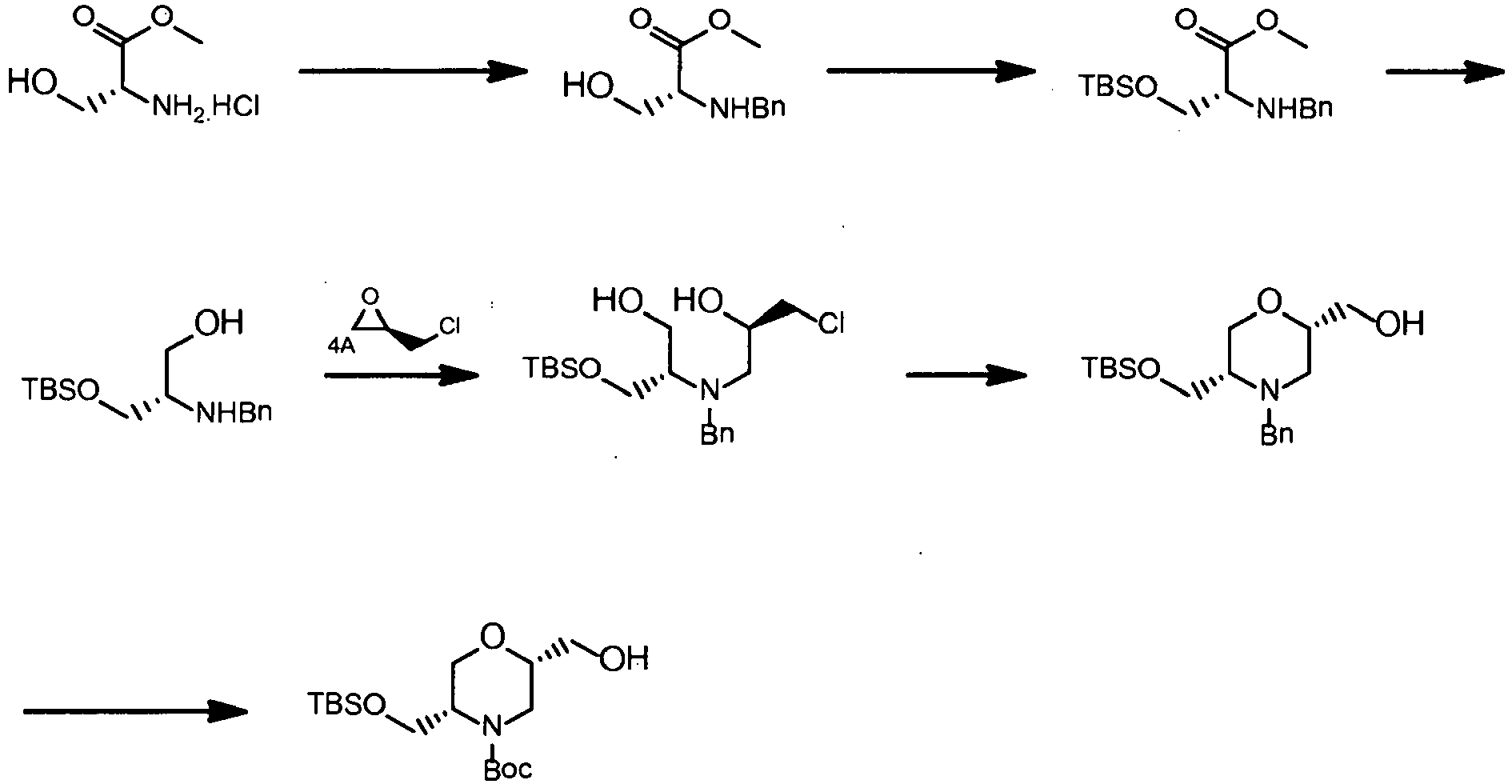


-
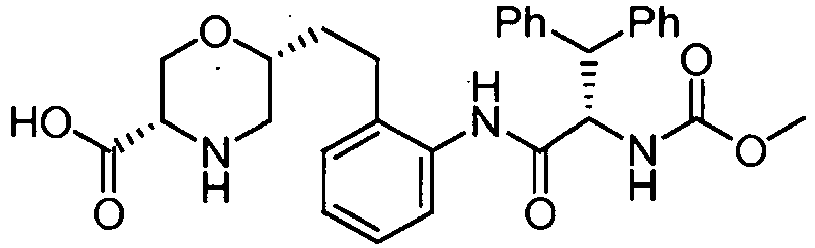
- To (2R)-3-hydroxy-1-methoxy-1-oxopropan-2-aminium chloride (1 eq.) in MeOH (1.3 M) at 0°C was added triethylamine (1 eq.). The reaction mixture was stirred for 10 minutes and benzaldehyde (1 eq) was added. The reaction mixture was stirred for 2 hours and NaBH4 (1.5 eq.) was added portionwise to the reaction mixture over 30 min. The reaction mixture was stirred at rt for 5hours and poured into a 1:1 mixture of saturated aqueous NH4Cl and EtOAc. The aqueous layer was extracted with EtOAc and the combined organic layers were washed with brine and water, dried over Na2SO4, filtered and concentrated. The crude product was used as such for the next step.
- To methyl N-benzyl-D-serinate (1 eq.) in CH2Cl2 (0.3 M) at rt were added triethylamine (1 eq) and DMAP (0.05 eq). The reaction mixture was cooled to 0°C and TBS-Cl (1.1 eq) was added. The reaction mixture was stirred at rt for 16hrs, water was added and the aqueous layer was extracted with CH2Cl2. The combined organic layers were washed with saturated aqueous NH4Cl, dried over Na2SO4, filtered and concentrated. The crude product was used as such for the next step.
- To methyl N-benzyl-O-[tert-butyl(dimethyl)silyl]-D-serinate (1 eq.) in THF (0.4 M) at rt were added 2M LiBH4 in THF (1.2 eq.) and MeOH (1.2 eq). The mixture was stirred at rt for 16hrs and quenched by the slow addition of saturated aqueous NH4Cl. The aqueous layer was extracted with EtOAc. The combined organic layers were dried over Na2SO4, filtered and concentrated. The crude product was used as such for the next step.
- To (2S)-2-(benzylamino)-3-{[tert-butyl(dimethyl)silyl]oxy}propan-1-ol (1 eq) in Toluene (0.3 M) at rt was added (R)-(-)-epichlorohydrin (1.3 eq.) and Lithium perchlorate (1.3 eq) was then slowly added over 2 hours. The mixture was stirred at rt for 48hrs and sodium methoxide (2.5 eq of a 25% solution of NaOMe in MeOH) was added. MeOH was then added to the reaction mixture to obtain a 4:1 ratio of toluene:MeOH as solvent. The reaction mixture was stirred for 48hrs at rt and diluted with saturated aqueous NH4Cl. The aqueous layer was extracted with EtOAc. The combined organic layers were washed with brine, dried over Na2SO4, filtered and concentrated. The crude product was purified by automated SiO2 flash chromatography system using solvent gradient of 0% EtOAc/Hex to 25% EtOAc/Hex to afford the desired compound.
- To ethyl [(2S,5S)-4-benzyl-5-({[tert-butyl(dimethyl)silyl]oxy}methyl)morpholin-2-yl]methanol (1 eq.) in EtOH (0.4 M) at rt were added BoC2O (1.2 eq), triethylamine (1 eq) and 20% Pd(OH)2 (0.2 eq.). The reaction was degassed and then shaken in a parr apparatus under 45 psi of H2 for 16hrs. The reaction mixture was filtered on celite and concentrated. The residue was diluted in EtOAc and the organic layer was washed with water and brine, dried over Na2SO4, filtered and concentrated. The crude product was used as such for the next step.
- To a stirred solution of oxalyl chloride (2 eq) in DCM (0.3 M) at -78 °C was added a solution of DMSO (5 eq) in DCM (0.5M). The reaction mixture was stirred at -78 °C for 30 min. A solution of tert-butyl (2S,5S)-5-({[tert-butyl(dimethyl)silyl]oxy}methyl)-2-(hydroxymethyl)morpholine-4-carboxylate (1 eq) in CH2Cl2 (0.2M) was added dropwise and stirred at -40 °C for 1.5 hours. It was then cooled to -78 °C and triethylamine (7 eq) was added and the reaction mixture was stirred at 0 °C for 1 h. Water was added and the reaction mixture was warmed to rt for 30 min. The mixture was diluted with CH2Cl2, the organic layer was washed with water and brine, dried over Na2SO4, filtered and concentrated. The crude product was used as such for the next step.
- To tert-butyl (2S,5S)-5-({[tert-butyl(dimethyl)silyl]oxy}methyl)-2-formylmorpholine-4-carboxylate (1 eq.) in DME (0.2 M) at rt were added (2-nitrobenzyl)(triphenyl)phosphonium bromide (1.1 eq.), potassium carbonate (2 eq.) and 18-C-6 (0.1 eq.). The reaction mixture was stirred at rt for 12hrs, filtered on celite and the filtrate was concentrated under reduced pressure. The crude product was purified by automated SiO2 flash chromatography system using solvent gradient of 10% to 60% EtOAc/Hex to afford the desired compound
- To tert-butyl (2R,5S)-5-({[tert-butyl(dimethyl)silyl]oxy}methyl)-2-[(E)-2-(2-nitrophenyl)ethenyl]morpholine-4-carboxylate (1 eq.) in 2,2,2,-trifluoroethanol (0.4 M) at rt was added 20% Pd(OH)2 (0.2 eq.). The reaction was degassed and then shaken under 1 atm of H2 for 24hrs. The reaction mixture was filtered on celite and concentrated to afford the desired compound.
- To tert-butyl (2R,5S)-2-[2-(2-aminophenyl)ethyl]-5-({[tert-butyl(dimethyl)silyl]oxy}methyl)morpholine-4-carboxylate (1 eq.) in DMF (0.15 M) at rt was added N-(methoxycarbonyl)-β-phenyl-L-phenylalanine (1.1 eq.), HATU (1.4 eq.) and 2,6-lutidine (3 eq.). The reaction mixture was stirred at rt for 16h and diluted with EtOAc and saturated aqueous NaHCO3. The aqueous layer was extracted with EtOAc. The combined organic layers were washed with brine, dried over Na2SO4, filtered and concentrated. The crude product was purified by automated SiO2 flash chromatography system using solvent gradient of 10% to 100% EtOAc/Hex to afford the desired compound.
- To tert-butyl (2R,5S)-5-({[tert-butyl(dimethyl)silyl]oxy}methyl)-2-[2-(2-{[N-(methoxycarbonyl)-β-phenyl-L-phenylalanyl]amino}phenyl)ethyl]morpholine-4-carboxylate in THF (0.1 M) at rt was added TBAF (1M in THF) (4 eq.). The mixture was stirred at rt for 2hrs, diluted with EtOAc and saturated aqueous NH4Cl and the aqueous layer was extracted with EtOAc. The combined organic layers were washed with brine, dried over Na2SO4, filtered and concentrated. The crude product was purified by automated SiO2 flash chromatography system using solvent gradient of 0-5% MeOH/CH2Cl2 to afford the desired compound.
- To tert-butyl (2R,5R)-5-(hydroxymethyl)-2-[2-(2-{[N-(methoxycarbonyl)-β-phenyl-L-phenylalanyl]amino}phenyl)ethyl]morpholine-4-carboxylate (1 eq) in DMF (0.1M) at rt were added PDC (10 eq) and 4A molecular sieve (1g/mmol of substrate). The reaction mixture was stirred at rt for 16hrs. The reaction mixture was then filtered on a celite and the celite pad was washed with EtOAc and water. The filtrate was extracted with EtOAc. The combined organic layers were washed with brine, 1N aqueous HCl and brine, dried over Na2SO4, filtered and concentrated. The crude product was used as such for next step.
- 4M HCl in dioxane was added to a solution of (3S,6R)-4-(tert-butoxycarbonyl)-6-[2-(2-{[N-(methoxycarbonyl)-β-phenyl-L-phenylalanyl]amino}phenyl)ethyl]moroholine-3-carboxylic acid in Dioxane at room temperature and the reaction stirred until complete by LC/MS (8 hrs). The solvent was removed in vacuo to afford the title compound, LC/MS.M+1, +ESI= 532.3
-

- HATU (1.4 eq) was added to a stirred mixture a solution of (3S,6R)-4-(tert-butoxycarbonyl)-6-[2-(2-{[N-(methoxycarbonyl)-β-phenyl-L-phenylalanyl]amino}phenyl)ethyl]morpholine-3-carboxylic acid (Example 1, step 11) (1 eq), benzyl amine(1.2 eq) and 2,6-lutidine (2 eq) in DMF (0.05 M) and the mixture was stirred at room temperature for 16 hrs. The mixture was diluted in EtOAc, The organic layer was washed with aqueous saturated NH4Cl and brine. The organic layer was dried over Na2SO4, filtered and evaporated. The residue was purified by automated silica gel flash chromatography system eluted with a gradient 10% to 100% of EtOAc/Hex to afford title compound.
- Tert-butyl (2R,5S)-5-(benzylcarbamoyl)-2-[2-(2-{[N-(methoxycarbonyl)-β-phenyl-L-phenylalanyl]amino}phenyl)ethyl]morpholine-4-carboxylate in a 1:1mixture of CH2Cl2/TFA (0.1 M) was stirred at rt for 1hr. The reaction mixture was concentrated under reduced pressure and the residue was co-evaporated twice with heptane and triturated in Et2O to afford the desired product as a TFA salt. Alternatively, the TFA salt, after concentration, could be neutralized with aqueous saturated NaHCO3, extracted with EtOAc, dried over Na2SO4, filtered and concentrated and then purified by automated SiO2 flash chromatography system using solvent gradient of 0% to 10% MeOH/CH2Cl2 to afford the desired compound. Alternatively, the free base could be purified by filtration on SCX SPE cartridge made of pTSA-SiO2 eluted first with MeOH to remove non basic impurities and eluted then with 10% NH4OH/MeOH to elute the free base and afford the desired compound after concentration under reduced pressure.
M+1, +ESI= 621.2 - The following examples (3 to 11) were synthesized from (3S,6R)-4-(tert-butoxycarbonyl)-6-[2-(2-{[N-(methoxycarbonyl)-β-phenyl-L-phenylalanyl]amino}phenyl)ethyl]morpholine-3-carboxylic acid (Example 1, step 11) according to the procedures described for the preparation of Example 2 and by using the appropriate reagents.
Ex Compound name Characte rization data 3 
N-(2-{2-[(2R,5S)-5-(ethylcarbamoyl)morpholin-2-yl]ethyl}phenyl)-Nα-(methoxycarbonyl)-β-phenyl-L-phenylalaninamide M+1, +ESI= 559.3 4 
Nα-(methoxycarbonyl)-β-phenyl-N-(2-{2-[(2R,5S)-5-(tetrahydrofuran-3-ylcarbamoyl)morpholin-2-y1]ethyl}phenyl)-L-phenylalaninamide M+1, +ESI= 601.3 5 
Nα-(methoxycarbonyl)-β-phenyl-N-(2-{2-[(2R,5S)-5-(pyrrolidin-1-ylcarbonyl)morpholin-2-yl]ethyl}phenyl)-L-phenylalaninamide M+1, +ESI= 585.3 6 
-Nα-(methoxycarbonyl)-β-phenyl-N-[2-(2-{(2R,5S)-5-[(2-phenylethyl)carbamoyl]morpholin-2-yl}ethyl)phenyl]-L-phenylalaninamide M+1, +ESI= 635.3 7 
Nα-(methoxycarbonyl)-β-phenyl-N-(2-{2-[(2R,5S)-5-(phenylcarbamoyl)morpholin-2-yl]ethyl}phenyl)-L-phenylalaninamide M+1, +ESI= 607.2 8 
N(2-{2-[(2R,5S)-5-(tert-butylcarbamoyl)morpholin-2-yl]ethyl}phenyl)-Nα-(methoxycarbonyl)-β-phenyl-L-phenylalaninamide M+1, +ESI= 587.2 9 
Nα-(methoxycarbonyl)-β-phenyl-N-[2-(2-{(2R,5S)-5-[(2-phenylhydrazinyl)carbonyl]morpholin-2-yl}ethyl)phenyl]-L-phenylalaninamide M+1, +ESI= 622.2 -

- EDC (1.5 eq) was added to a stirred mixture of (3S,6R)-4-(tert-butoxycarbonyl)-6-[2-(2-{[N-(methoxycarbonyl)-□β -phenyl-L-phenylalanyl]amino}phenyl)ethyl]morpholine-3-carboxylic (Example 1, Step 11) (1 eq), benzenesulfonamide (1.3 eq) and DMAP (1.5 eq) in DCM (0.06 M). The mixture was stirred at room temperature for 16hrs and then evaporated to dryness. The residue was purified by automated silica gel flash chromatography system eluted with a gradient 0% to 10% of MeOH/CH2Cl2 to afford tert-butyl (2R,5S)-2-[2-(2-{[N-(methoxycarbonyl)-β-phenyl-L-phenylalanyl]amino}phenyl)ethyl]-5-[(phenylsulfonyl)carbamoyl]morpholine-4-carboxylate which was then treated with TFA following the procedure described in step 2 of Example 2 to afford the title compound. M+1, +ESI= 671.7
-

- Methyl [(1S)-2-[(2-{2-[(2R,5S)-5-(aminocarbonyl)morpholin-2-yl]ethyl}phenyl)amino]-1-(diphenylmethyl)-2-oxoethyl]carbamate was prepared from (3S,6R)-4-(tert-butoxycarbonyl)-6-[2-(2-{[N-(methoxycarbonyl)-β-phenyl-L-phenylalanyl]amino}phenyl)ethyl]morpholine-3-carboxylic acid by following procedures described in Example 2 and by using the appropriate reagents.
M+1, +ESI= 531.40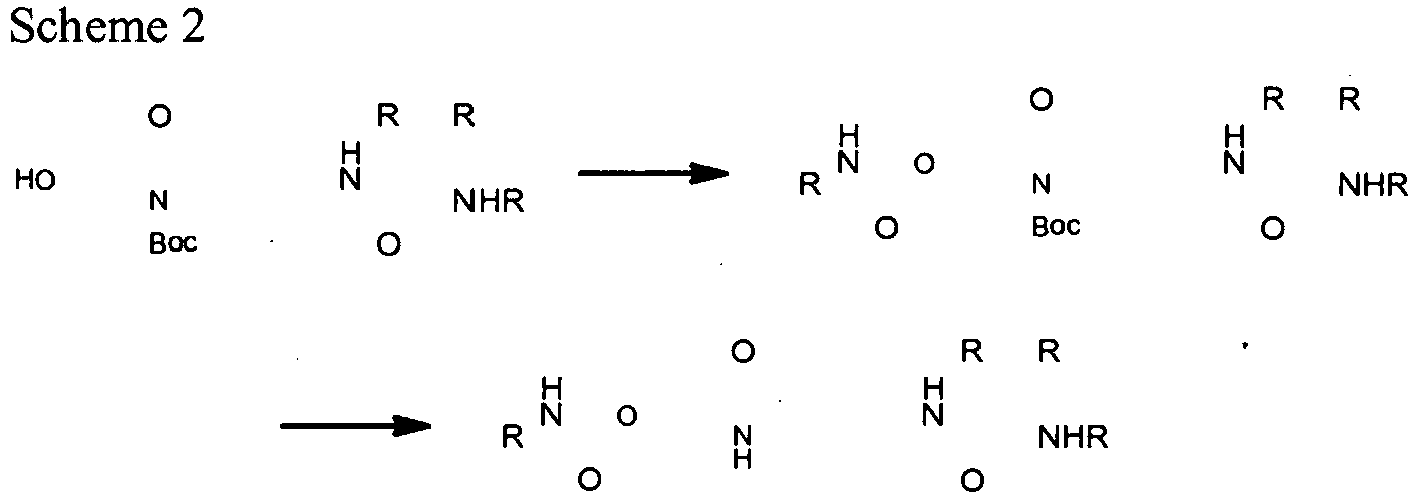
-

- A mixture of tert-butyl (2R,5R)-5-(hydroxymethyl)-2-[2-(2-{[N-(methoxycarbonyl)-β-phenyl-L-phenylalanyl]amino}phenyl)ethyl]morpholine-4-carboxylate (Example 1, step 10) (1 eq) and CDI (2.05 eq.) was dissolved in dry Pyridine (0.04 M) and the resulting solution stirred under N2 at rt for 5h and then at 49 °C for 0.5 h; then neat 2-fluorobenzylamine (6 eq.) was added and the resulting mixture further stirred at the same temperature for 12h. The crude reaction mixture was diluted with EtOAc, washed with 5% aq. KHSO4 then sat. NaHCO3, dried over Na2SO4, filtered and concentrated. The residue was purified by automated silicagel flash chromatography system eluted with a gradient 0% to 5% MeOH in DCM, to afford title compound.
- Tert-butyl (2R,5S)-5-({[(2-fluorobenzyl)carbamoyl]oxy}methyl)-2-[2-(2-{[N-(methoxycarbonyl)-β-phenyl-L-phenylalanyl]amino}phenyl)ethyl] morpholine-4-carboxylate in a 1:1 mixture of CH2Cl2/TFA (0.1 M) was stirred at rt for 1hr. The reaction mixture was concentrated under reduced pressure and the residue was co-evaporated twice with heptane and triturated in Et2O to afford the desired product as a TFA salt. Alternatively, the TFA salt, after concentration, could be neutralized with aqueous saturated NaHCO3, extracted with EtOAc, dried over Na2SO4, filtered and concentrated and then purified by automated SiO2 flash chromatography system using solvent gradient of 0% to 10% MeOH/CH2Cl2 to afford the desired compound. Alternatively, the free base could be purified by filtration on SCX SPE cartridge made of pTSA-SiO2 eluted first with MeOH to remove non basic impurities and eluted then with 10% NH4OH/MeOH to elute the free base and afford the desired compound after concentration under reduced pressure.
M+1, +ESI= 669.3 - The following examples (13 to 31) were synthesized from tert-butyl (2S,5S)-5-({[tert-butyl(dimethyl)silyl]oxy}methyl)-2-formylmorpholine-4-carboxylate (Example 1, step 6) according to the procedures described in steps 7-10 of Example 1 and n steps 1 and 2 from Example 12 and by using the appropriate reagents.
Example Compound name Character ization data 13 
N-(2-{2-[(2R,5S)-5-({[(3R,3aS,6aR)-hexahydrofuro[2,3-b]furan-3-ylcarbamoyl]oxy}methyl)morpholin-2-yl]ethyl}phenyl)-Nα-(methoxycarbonyl)-β-phenyl-L-phenylalaninamide M+1, +ESI= 673.2 14 
N-[2-(2-{(2R,5S)-5-[({[(1S,2R)-2-hydroxy-2,3-dihydro-1H-inden-1-yl]carbamoyl}oxy)methyl] morpholin-2-yl}ethyl)phenyl]-Nα-(methoxycarbonyl)-β-phenyl-L-phenylalaninamide M+1, +ESI= 693.2 15 
N-(2-{2-[(2R,5S)-5-{[(2,3-dihydro-1H-inden-1-ylcarbamoyl)oxy]methyl} morpholin-2-yl]ethyl}phenyl)-Nα-(methoxycarbonyl)-β-phenyl-L-phenylalaninamide M+1, +ESI= 677.2 Example Compound name Character ization: data 16 
methyl N-[(1S)-1-benzhydryl-2-[[2-[2-[(2R,5S)-5-[(4-fluorophenyl)methylcarbamoyloxymethyl]mor pholin-2-yl]ethyl]phenyl]amino]-2-oxoethyl]carbamate M+1, +ESI= 669.3 17 
methyl N-[(1S)-1-benzhydryl-2-oxo-2-[[2-[2-[(2R,5S)-5-(2,2,2-trifluoroethylcarbamoyloxymethyl)morpholin-2-yl]ethyl]phenyl]amino]ethyl]carbamate M+1, +ESI= 643.4 18 
methyl N-[(1S)-1-benzhydryl-2-[[2-[2-[(2R,5S)-5-(8-isoquinolylmethylcarbamoyloxymethyl)morph olin-2-yl]ethyl]phenyl]amino]-2-oxo-ethyl]carbamate M+1, +ESI= 702.6 19 
methyl N-[(1S)-1-benzhydryl-2-oxo-2-[[2-[2-[(2R,5S)-5-(thiazol-5-ylmethylcarbamoyloxymethyl)morpholin-2-yl]ethyl]phenyl]amino]ethyl]carbamate M+1, +ESI= 658.3 20 
methyl N-[(1S)-1-benzhydryl-2-oxo-2-[[2-[2-[(2R,5S)-5-(3-pyridylmethylcarbamoyloxymethyl)morpholin-2-yl]ethyl]phenyl]amino]ethyl]carbamate M+1, +ESI= 652.3 Example Compound name Character ization data 21 
methyl N-[(1S)-1-benzhydryl-2-[[2-[2-[(2R,5S)-5-(2,1,3-benzoxadiazol-5-ylmethylcarbamoyloxymethyl)morpholin-2-yl]ethyl]phenyl]amino]-2-oxo-ethyl]carbamate M+1, +ESI= 693.2 22 
methyl N-[(1S)-1-benzhydryl-2-[[2-[2-[(2R,5S)-5-(cyclopropylmethylcarbamoyloxymethyl)morp holin-2-yl]ethyl]phenyl]amino]-2-oxo-ethyl]carbamate M+1, +ESI= 615.3 23 
methyl N-[(1S)-1-benzhydryl-2-[[2-[2-[(2R,5S)-5-(cyclobutylcarbamoyloxymethyl)morpholin-2-yl]ethyl]phenyl]amino]-2-oxo-ethyl]carbamate M+1, +ESI= 615.3 24 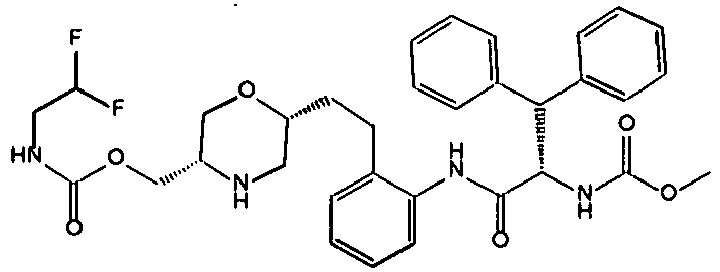
methyl N-[(1S)-1-benzhydryl-2-[[2-[2-[(2R,5S)-5-(2,2-difluoroethylcarbamoyloxymethyl)morpholin-2-yl]ethyl]phenyl]amino]-2-oxoethyl] carbamate M+1, +ESI= 625.4 25 
methyl N-[(1S)-1-benzhydryl-2-[[2-[2-[(2R,5S)-5-(diethylcarbamoyloxymethyl)morpholin-2-yl]ethyl]phenyl]amino]-2-oxo-ethyl]carbamate M+1, +ESI= 617.3 26 
methyl N-[(1S)-1-benzhydryl-2-[[2-[2-[(2R,5S)-5-(dimethylcarbamoyloxymethyl)morpholin-2-yl]ethyl]phenyl]amino]-2-oxo-ethyl]carbamate M+1, +ESI= 589.3 27 
[(3S,6R)-6-[2-[2-[[(2S)-2-(methoxycarbonylamino)-3,3-diphenyl-propanoyl]amino]phenyl]ethyl]morpholin-3-yl]methyl pyrrolidine-1-carboxylate M+1, +ESI= 615.3 28 
methyl N-[(1S)-1-benzhydryl-2-[[2-[2-[(2R,5S)-5-(2-dimethylaminoethylcarbamoyloxymethyl)morp holin-2-yl]ethyl]phenyl]amino]-2-oxoethyl] carbamate M+1, +ESI= 632.3 29 
N-[2-(2-{(2R,5S)-5-[({[(3S,4R)-4-fluorotetrahydrofuran-3-yl]carbamoyl}oxy) methyl]morpholin-2-yl}ethyl)phenyl]-Nα-(methoxycarbonyl)-β-phenyl-L-phenylalaninamide M+1, +ESI= 649.3 30 
Nα-(methoxycarbonyl)-N-(2-{2-[(2R,5S)-5-{[(methylcarbamoyl)oxy] methyl}morpholin-2-yl]ethyl}phenyl)-β-phenyl-L-phenylalaninamide M+1, +ESI= 575.2 31 
N-(2-{2-[(2R,5S)-5-({[(1-cyclopropyl-2,2,2-trifluoroethyl)carbamoyl]oxy} methyl)morpholin-2-yl]ethyl}phenyl)-Nα-(methoxycarbonyl)-β-phenyl-L-phenylalaninamide M+1, +ESI= 683.2 -

- A solution of tert-butyl (2R,5S)-5-({[tert-butyl(dimethyl)silyl]oxy}methyl)-2-ethynylmorpholine-4-carboxylate (1 eq) and 3-bromopyridin-2-amine (1.4 eq) in acetonitrile (0.1M) and triethylamine (25 eq) was flushed with nitrogen for 10 minutes. Then bis(triphenylphosphine)palladium(ii) chloride (0.1 eq) and copper(i) iodide (1.2 eq) were added and the mixture was flushed again with nitrogen for 10 minutes. The reaction mixture was stirred at 60 °C for 2 hours in the dark. It was concentrated to dryness and the residue was purified by automated SiO2 flash chromatography system using solvent gradient of 0% to 10% MeOH/CH2Cl2 to afford the desired compound.
- To tert-butyl (2R,5S)-2-[(2-aminopyridin-3-yl)ethynyl]-5-({[tert-butyl(dimethyl)silyl]oxy}methyl)morpholine-4-carboxylate (1 eq.) in 2,2,2,-trifluoroethanol (0.4 M) at rt was added 10% Pd/C (0.2 eq.). The reaction was degassed and then shaken under 1 atm of H2 for 24hrs. The reaction mixture was filtered on celite and concentrated to afford the desired compound.
- To N-(methoxycarbonyl)-β-phenyl-L-phenylalanine (1.1 eq.) in DMF (0.15 M) at rt were added HATU (1.4 eq.) and 2,6-lutidine (3 eq.). The reaction mixture was stirred for 30 min and tert-butyl (2R,5S)-2-[2-(2-aminopyridin-3-yl)ethyl]-5-({[tert-butyl(dimethyl)silyl]oxy}methyl)morpholine-4-carboxylate (1 eq) was added. The reaction mixture was stirred at 60°C for 16h and diluted with EtOAc and saturated aqueous NaHCO3. The aqueous layer was extracted with EtOAc. The combined organic layers were washed with brine, dried over Na2SO4, filtered and concentrated. The crude product was purified by automated SiO2 flash chromatography system using solvent gradient of 0% to 10% MeOH/CH2Cl2 to afford the desired compound. Alternatively, DMF could be replaced as solvent by pyridine to ease coupling involving less reactive amine.
- To tert-butyl (2R,5S)-5-({[tert-butyl(dimethyl)silyl]oxy}methyl)-2-[2-(2-{[N-(methoxycarbonyl)-β-phenyl-L-phenylalanyl]amino}pyridin-3-yl)ethyl]morpholine-4-carboxylate in THF (0.1 M) at rt was added TBAF (1M in THF) (4 eq.). The mixture was stirred at rt for 2hrs, diluted with EtOAc and saturated aqueous NH4Cl and the aqueous layer was extracted with EtOAc. The combined organic layers were washed with brine, dried over Na2SO4, filtered and concentrated. The crude product was purified by automated SiO2 flash chromatography system using solvent gradient of 0-10% MeOH/CH2Cl2 to afford the desired compound.
- A mixture of tert-butyl (2R,5R)-5-(hydroxymethyl)-2-[2-(2-{[N-(methoxycarbonyl)-β-phenyl-L-phenylalanyl]amino}pyridin-3-yl)ethyl]morpholine-4-carboxylate (1 eq) and CDI (2.05 eq.) was dissolved in dry Pyridine (0.04 M) and the resulting solution stirred under N2 at rt for 5h and then at 49 °C for 0.5h; then neat 4-fluorobenzylamine (6 eq.) was added and the resulting mixture further stirred at the same temperature for 12h. The crude reaction mixture was diluted with EtOAc, washed with 5% aq. KHSO4 then sat. NaHCO3, dried over Na2SO4, filtered and concentrated. The residue was purified by automated silicagel flash chromatography system eluted with a gradient 0% to 5% MeOH in DCM, to afford title compound.
- Tert-butyl (2R,5S)-5-({[(4-fluorobenzyl)carbamoyl]oxy}methyl)-2-[2-(2-{[N-(methoxycarbonyl)-β-phenyl-L-phenylalanyl]amino}pyridin-3-yl)ethyl]morpholine-4-carboxylate in a 1:1 mixture of CH2Cl2/TFA (0.1 M) was stirred at rt for 1hr. The reaction mixture was concentrated under reduced pressure and the residue was co-evaporated twice with heptane and triturated in Et2O to afford the desired product as a TFA salt. Alternatively, the TFA salt, after concentration, could be neutralized with aqueous saturated NaHCO3, extracted with EtOAc, dried over Na2SO4, filtered and concentrated and then purified by automated SiO2 flash chromatography system using solvent gradient of 0% to 10% MeOH/CH2Cl2 to afford the desired compound. Alternatively, the free base could be purified by filtration on SCX SPE cartridge made of pTSA=SiO2 eluted first with MeOH to remove non basic impurities and eluted then with 10% NH4OH/MeOH to elute the free base and afford the desired compound after concentration under reduced pressure.
M+1, +ESI= 670.1 - The following examples (33 to 39) were synthesized from tert-butyl (2R,5S)-5-({[tert-butyl(dimethyl)silyl]oxy}methyl)-2-ethynylmorpholine-4-carboxylate according to the procedures described for the preparation of Example 81 and by using the appropriate reagents.
Example Compound name Characteriz ation data 33 
N-(4-(2-[(2R,5S)-5-({[(4-fluorobenzyl)carbamoyl]oxy}methyl)m orpholin-2-yl]ethyl}pyridin-3-yl)-Nα-(methoxycarbonyl)-β-phenyl-L-phenylalaninamide M+1, +ESI= 670.3 34 
Nα-(methoxycarbonyl)-β-phenyl-N-(4-{2-[(2R,5S)-5-({[(2,2,2-trifluoroethyl) carbamoyl]oxy}methyl)morpholin-2-yl]ethyl}pyridin-3-yl)-L-phenylalaninamide M+1, +ESI= 644.2 35 
Nα-(methoxycarbonyl)-N-(2-methoxy-4-{2-[(2R,5S)-5-({[(2,2,2-trifluoroethyl)carbamoyl]oxy} methyl) morpholin-2-yl]ethyl]pyridin-3-yl)-(β-phenyl-L-phenylalaninamide M+1, +ESI= 674.2 36 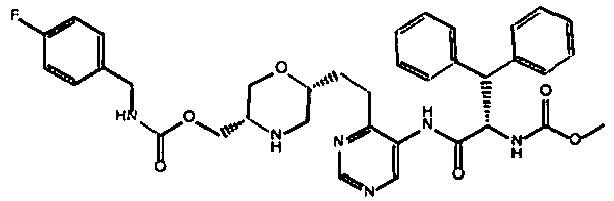
N-(4-{2-[(2R,5S)-5-({[(4-fluorobenzyl)carbamoyl]oxy}methyl)m orpholin -2-yl]ethyl}pyrimidin-5-yl)-Nα-(methoxycarbonyl)-β-phenyl-L-phenylalaninamide M+1, +ESI= 670.9 37 
Nα-(methoxycarbonyl)-β-phenyl-N-(4-{2-[(2R,5S)-5-({[(2,2,2-trifluoroethyl)carbamoyl]oxy}methyl)m orpholin-2-yl]ethyl}pyrimidin-5-yl)-L-phenylalaninamide M+1, +ESI= 645.3 38 
N-(4-{2-[(2R,5S)-5-({[(4-fluorobenzyl)carbamoyl]oxy}methyl) morpholin-2-yl]ethyl}-2-oxo-1,2-dihydropyridin-3-yl)-Na-(methoxycarbonyl)-β-phenyl-L-phenylalaninamide M+1, +ESI= 686.2 39 
Nα-(methoxycarbonyl)-N-(2-oxo-4-{2-[(2R,5S)-5-({[(2,2,2-trifluoroethyl)carbamoyl]oxy}methyl) morpholin-2-yl]ethyl}-1,2-dihydropyridin-3-yl)-β-phenyl-L-phenylalaninamide M+1, +ESI= 660.1 -

- To a stirred solution of oxalyl chloride (5 eq) in DCM (0.3 M) at -78°C was added a solution of DMSO (10 eq) in DCM (0.5M). The reaction mixture was stirred at -78°C for 30 min. A solution of tert-butyl (2R,5R)-5-(hydroxymethyl)-2-[2-(2-{[N-(methoxycarbonyl)-β-phenyl-L-phenylalanyl]amino}phenyl)ethyl]morpholine-4-carboxylate (Example 185, step 10) (1 eq) in CH2Cl2 (0.2M) was added dropwise and stirred at -40°C for 1.5 hours. It was then cooled to -78°C and triethylamine (10 eq)) was added and the reaction mixture was stirred at 0 °C for 1h. Water was added and the reaction mixture was warmed to rt for 30 min. The mixture was poured into aqueous sodium hydrogen carbonate and the aqueous layer was extracted with CH2Cl2.The combined organic layers were washed with brine, dried with MgSO4 and concentrated under vacuum to afford the title compound as a yellow gum. The material was used in the subsequent step without further purification.
- To a solution of tert-butyl (2R,5S)-5-formyl-2-[2-(2-{[N-(methoxycarbonyl)-b-phenyl-L-phenylalanyl]amino}phenyl)ethyl]morpholine-4-carboxylate (1eq.) in MeOH (0.05 M) was added benzylamine (7eq.), magnesium sulfate (1.2eq.) and acetic acid (7eq.). The solution was stirred for 30 minutes and sodium cyanoborohydride (2.3eq.) was added and the reaction mixture was further stirred for 2 hours. The reaction mixture was then quenched by the addition of aqueous sodium bicarbonate and the aqueous layer was extracted with ethyl acetate three times. The combined organic layers were washed with water, dried over Na2SO4, filtered and concentrated. The residue was purified by automated silica gel flash chromatography system eluted with a gradient 30% to 100% of EtOAc/Hex to afford title compound.
- To a solution of tert-butyl (2R,5R)-5-[(benzylamino)methyl]-2-[2-(2-{[N-(methoxycarbonyl)-β-phenyl-L-phenylalanyl]amino}phenyl)ethyl]morpholine-4-carboxylate (1eq.) in 2,2,2-trifluoroethanol (0.17M) was added Pd(OH)2 (0.33eq.). The reaction mixture was stirred for 16hrs under one atmosphere of hydrogen. The reaction mixture was filtered on celite and the filtrate was concentrated under reduced pressure. The residue was used as such for the next step.
- To a solution of tert-butyl (2R,5R)-5-(aminomethyl)-2-[2-(2-{[N-(methoxycarbonyl)-β-phenyl-L-phenylalanyl]amino}phenyl)ethyl]morpholine-4-carboxylate (1eq.) in DCM (0.1M) was added phenyl isocyanate (2.2 eq). The reaction mixture was stirred for 16hrs at room temperature, diluted with CH2Cl2 and the organic layer was washed with aqueous saturated sodium bicarbonate. The organic layer was dried over Na2SO4,fittered and concentrated under reduced pressure. The residue was purified by automated silica gel flash chromatography system eluted with a gradient 10% to 100% of EtOAc/Hex to afford title compound.
- Tert-butyl (2R,5R)-2-[2-(2-{[N-(methoxycarbonyl)-β-phenyl-L-phenylalanyl]amino}phenyl)ethyl]-5-{[(phenylcarbamoyl)amino]methyl}morpholine-4-carboxylate in a 1:1 mixture of CH2Cl2/TFA (0.1 M) was stirred at rt for 1hr. The reaction mixture was concentrated under reduced pressure and the residue was co-evaporated twice with heptane and triturated in Et2O to afford the desired product as a TFA salt. Alternatively, the TFA salt, after concentration, could be neutralized with aqueous saturated NaHCO3, extracted with EtOAc, dried over Na2SO4, filtered and concentrated and then purified by automated SiO2 flash chromatography system using solvent gradient of 0% to 10% MeOH/CH2Cl2 to afford the desired compound. Alternatively, the free base could be purified by filtration on SCX SPE cartridge made of pTSA-SiO2 eluted first with MeOH to remove non basic impurities and eluted then with 10% NH4OH/MeOH to elute the free base and afford the desired compound after concentration under reduced pressure.
M+1, +ESI= 636.2 - The following examples (41 to 43) were synthesized from tert-butyl (2R,5R)-5-(aminomethyl)-2-[2-(2-{[N-(methoxycarbonyl)-β-phenyl-L-phenylalanyl]amino}phenyl)ethyl]morpholine-4-carboxylate according to the procedures described for the preparation of Example 40 and by using the appropriate reagents.
Example Compound name Charac terizati on data 41 . 
methyl N-[(1S)-1-benzhydryl-2-oxo-2-[[2-[2-[(2R,5R)-5-[(pyridazin-3-ylcarbamoylamino)methyl]morpholin-2-yl]ethyl]phenyl]amino]ethyl]carbamate M+1, +ESI= 638.1 42 
methyl N-[(1S)-1-benzhydryl-2-oxo-2-[[2-[2-[(2R,5R)-5-[(2-pyridylcarbamoylamino)methyl]morpholin-2-yl]ethyl]phenyl]amino]ethyl]carbamate M+1, +ESI= 637.3 43 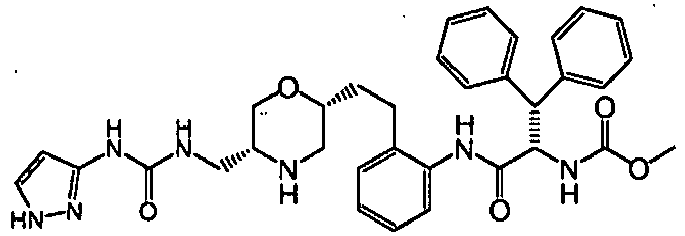
methyl N-[(1S)-1-benzhydryl-2-oxo-2-[[2-[2-[(2R,5R)-5-[(1H-pyrazol-3-ylcarbamoylamino)methyl]morpholin-2-yl]ethyl]phenyl]amino]ethyl]carbamate M+1, +ESI= 626.6 -

- To a solution of tert-butyl (2R,5R)-5-(aminomethyl)-2-[2-(2-{[N-(methoxycarbonyl)-p -phenyl- L-phenylalany 1] amino} phenyl)ethyl]morpholine-4-carboxyl ate (1eq.) in DCM (0.1M) were added pyridine (3 eq) and benzene sulfonyl chloride (1.3 eq). The reaction mixture was stirred for 4hrs at room temperature, diluted with CH2Cl2 and the organic layer was washed with aqueous saturated sodium bicarbonate. The organic layer was dried over Na2SO4, filtered and concentrated under reduced pressure. The residue was purified by automated silica gel flash chromatography system eluted with a gradient 10% to 100% of EtOAc/Hex to afford title compound.
- Tert-butyl (2R,5R)-2-[2-(2-{[N-(methoxycarbonyl)-β-phenyl-L-phenylalanyl]amino}phenyl)ethyl]-5-{[(phenylsulfonyl)amino]methyl}morpholine-4-carboxylate in a 1:1 mixture of CH2Cl2/TFA (0.1 M) was stirred at rt for 1hr. The reaction mixture was concentrated under reduced pressure and the residue was co-evaporated twice with heptane and triturated in Et2O to afford the desired product as a TFA salt. Alternatively, the TFA salt, after concentration, could be neutralized with aqueous saturated NaHCO3, extracted with EtOAc, dried over Na2SO4, filtered and concentrated and then purified by automated SiO2 flash chromatography system using solvent gradient of 0% to 10% MeOH/CH2Cl2 to afford the desired compound. Alternatively, the free base could be purified by filtration on SCX SPE cartridge made of pTSA-SiO2 eluted first with MeOH to remove non basic impurities and eluted then with 10% NH4OH/MeOH to elute the free base and afford the desired compound after concentration under reduced pressure.
M+1, +ESI= 657.4 - The following examples (45 to 51) were synthesized from tert-butyl (2R,5R)-5-(aminomethyl)-2-[2-(2-{[N-(methoxycarbonyl)-β-phenyl-L-phenylalanyl]amino}phenyl)ethyl]morpholine-4-carboxylate according to the procedures described for the preparation of Example 44 and by using the appropriate reagents and electrophiles.
Example Compound name Charact erizatio n data 45 
methyl N-[(1S)-1-benzhydryl-2-oxo-2-[[2-[2-[(2R,5R)-5-[(triazolo[1,5-a]pyridin-6-ylsulfonylamino)methyl]morpholin-2-yl]ethyl]phenyl]amino]ethyl]carbamate M+1, +ESI= 698.3 46 
methyl N-[(1S)-1-benzhydryl-2-oxo-2-[[2-[2-[(2R,5R)-5-[[[6-(trifluoromethyl)-2-pyridyl]sulfonylamino]methyl]morpholin-2-yl]ethyl]phenyl]amino]ethyl] carbamate M+1, +ESI= 726.3 47 
methyl N-[(1S)-1-benzhydryl-2-[[2-[2-[(2R,5R)-5-[(cyclopropylsulfonylamino)methyl]morpholin-2-yl]ethyl]phenyl]amino]-2-oxo-ethyl]carbamate M+1, +ESI= 621.3 48 
methyl N-[(1S)-1-benzhydryl-2-oxo-2-[[2-[2-[(2R,5R)-5-[(2-pyridylsulfonylamino)methyl]morpholin-2-yl]ethyl]phenyl]amino]ethyl]carbamate M+1, +ESI= 658.2 49 
N-(2-{2-[(2R,5R)-5-({[(4-aminophenyl)sulfonyl]amino}methyl) morpholin-2-yl]ethyl}phenyl)-Nα-(methoxycarbonyl)-(β-phenyl-L-phenylalaninamide M+1, +ESI= 672.2 50 
N-(2-{2-[(2R,5R)-5-{[(benzylsulfonyl)amino]methyl}morpholin-2-yl]ethyl}phenyl) -Nα-(methoxycarbonyl)-β-phenyl-L-phenylalaninamide M+1, +ESI= 671.2 51 
Nα-(methoxycarbonyl)-N-(2-{2-[(2R,5R)-5-{[(phenoxycarbonyl)amino]methyl}morpholin-2-yl]ethyl]phenyl)-β-phenyl-L-phenylalaninamide M+1, +ESI= 637.2 -

- HATU (1.4 eq) was added to a stirred mixture a solution of tert-butyl (2R,5R)-5-(aminomethyl)-2-[2-(2-{[N-(methoxycarbonyl)-□β-phenyl-L-phenylalanyl]amino}phenyl)ethyl]morpholine-4-carboxylate (1 eq), benzoic acid(1.2 eq) and 2,6-lutidine (2 eq) in DMF (0.05 M) and the mixture was stirred at room temperature for 16 hrs. The mixture was diluted in EtOAc, The organic layer was washed with aqueous saturated NH4Cl and brine. The organic layer was dried over Na2SO4, filtered and evaporated. The residue was purified by automated silica gel flash chromatography system eluted with a gradient 10% to 100% of EtOAc/Hex to afford title compound.
- Tert-butyl (2R,5R)-2-[2-(2-{[N-(methoxycarbonyl)-β-phenyl-L-phenylalanyl]amino}phenyl)ethyl]-5-{[(pheny]carbonyl)amino]methyl}morpholine-4-carboxylate in a 1: 1 mixture of CH2Cl2/TFA (0.1 M) was stirred at rt for 1hr. The reaction mixture was concentrated under reduced pressure and the residue was co-evaporated twice with heptane and triturated in Et2O to afford the desired product as a TFA salt. Alternatively, the TFA salt, after concentration, could be neutralized with aqueous saturated NaHCO3, extracted with EtOAc, dried over Na2SO4, filtered and concentrated and then purified by automated SiO2 flash chromatography system using solvent gradient of 0% to 10% MeOH/CH2Cl2 to afford the desired compound. Alternatively, the free base could be purified by filtration on SCX SPE cartridge made of pTSA-SiO2 eluted first with MeOH to remove non basic impurities and eluted then with 10% NH4OH/MeOH to elute the free base and afford the desired compound after concentration under reduced pressure.
M+1, +ESI= 621.4 - The following examples (53 to 60) were synthesized from tert-butyl (2R,5R)-5-(aminomethyl)-2-[2-(2-{[N-(methoxycarbonyl)-β-phenyl-L-phenylalanyl]amino}phenyl)ethyl]morpholine-4-carboxylate according to the procedures described for the preparation of Example 52 and by using the appropriate reagents.
Example Compound name Characteriza tion data 53 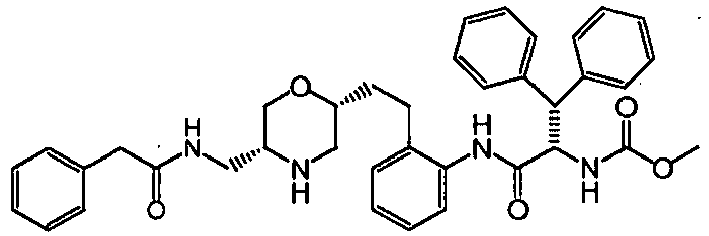
Nα-(methoxycarbonyl)-β-phenyl-N-(2-{2-[(2R,5R)-5-{[(phenylacetyl)amino]methyl}morpholin-2-yl]ethyl}phenyl)-L-phenylalaninamide M+1, +ESI= 635.3 54 
methyl N-[(1S)-1-benzhydryl-2-oxo-2-[[2-[2-[(2R,5R)-5-[(pyridazine-3-carbonylamino)methyl]morpholin-2-yl]ethyl]phenyl]amino]ethyl]carbamate M+1, +ESI= 623.3 55 
methyl N-[(1S)-1-benzhydryl-2-[[2-[2-[(2R,5R)-5-[[(2-chlorobenzoyl)amino]methyl]morpholin-2-yl]ethyl]phenyl]amino]-2-oxo-ethyl] carbamate M+1, +ESI= 655.3 56 
methyl N-[(1S)-1-benzhydryl-2-[[2-[2-[(2R,5R)-5-[(1H-indole-2-carbonylamino)methyl]morpholin-2-yl]ethyl]phenyl]amino]-2-oxoethyl]carbamate M+1, +ESI= 661.4 57 
methyl N-[(1S)-1-benzhydryl-2-[[2-[2-[(2R,5R)-5-[[(2,6-dimethylbenzoyl)amino]methyl]morpholin-2-yl]ethyl]phenyl]amino]-2-oxoethyl] carbamate M+1, +ESI= 649.3 58 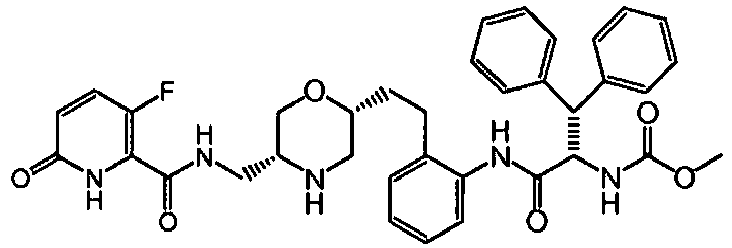
methyl N-[(1S)-1-benzhydryl-2-[[2-[2-[(2R,5R)-5-[[(3-fluoro-6-oxo-1H-pyridine-2-carbonyl)amino]methyl]morpholin-4-ium-2-yl]ethyl]phenyl]amino]-2-oxo-ethyl]carbamate M+1, +ESI= 656.3 59 
methyl N-[(1S)-1-benzhydryl-2-oxo-2-[[2-[2-[(2R,5R)-5-[(pyrazolo[1,5-a]pyrimidine-2-carbonylamino)methyl]morpholin-2-yl] ethyl]phenyl] amino] ethyl]carbamate M+1, +ESI= 662.2 60 
methyl N-[(1S)-1-benzhydryl-2-oxo-2-[[2-[2-[(2R,5R)-5-[[[5-(2-pyridyl)-1H-pyrazole-3-carbonyl]amino]methyl]morpholin-2-yl]ethyl]phenyl]amino]ethyl]carbamate M+1, +ESI= 688.3 -
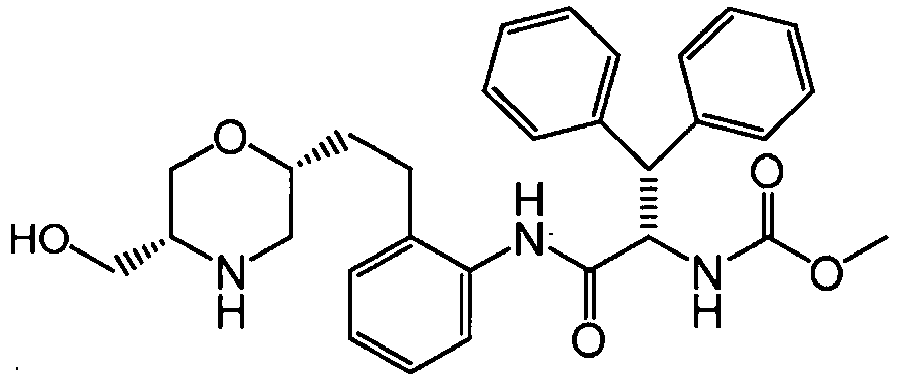
- N-(2-{2-[(2R,5R)-5-(hydroxymethyl)morpholin-2-yl]ethyl}phenyl)-Nα-(methoxycarbonyl)-β-phenyl-L-phenylalaninamide was prepared from (2R,5R)-5-Hydroxymethyl-2-{2-[2-((S)-2-methoxycarbonylamino-3,3-diphenyl-propionylamino)-phenyl]-ethyl}-morpholine-4-carboxylic acid tert-butyl ester using procedures described in step 2 of Example 2.
M+1, +ESI= 518.2 -

- Cyanomethylenetributylphosphorane (2 eq) was added to a stirred mixture of (2R,5R)-5-hydroxymethyl-2-{2-[2-((S)-2-methoxycarbonylamino-3,3-diphenyl-propionylamino)-phenyl]-ethyl}-morpholine-4-carboxylic acid tert-butyl ester (1 eq) and thiophenol (1.5 eq) in toluene (0.04 M). The mixture was stirred at.90 °C for 2 h, cooled to room temperature and evaporated to dryness. The residue was purified by automated silica gel flash chromatography system eluted with a gradient 0% to 100% of EtOAc/Hex to afford tert-butyl (2R,5S)-2-[2-(2-{[N-(methoxycarbonyl)-β-phenyl-L-phenylalanyl]amino}phenyl)ethyl]-5-[(phenylsulfanyl)methyl]morpholine-4-carboxylate which was then treated with TFA following the procedure described in step 2 of Example 2 to afford the title compound.
M+1,+ESI= 610.2 -

- Nα-(methoxycarbonyl)-N-(2-{2-[(2R,5S)-5-(phenoxymethyl)morpholin-2-yl]ethyl}phenyl)-β-phenyl-L-phenylalaninamide was prepared (2R,5R)-5-hydroxymethyl-2-{2-[2-((S)-2-methoxycarbonylamino-3,3-diphenyl-propionylamino)-phenyl]-ethyl}-morpholine-4-carboxylic acid tert-butyl ester using procedures described in step 1 of Example 62. M+1, +ESI= 594.2
-

- To a solution of tert-butyl (2R,5R)-5-(aminomethyl)-2-[2-(2-{[N-(methoxycarbonyl)-β-phenyl-L-phenylalanyl]amino}phenyl)ethyl]morpholine-4-carboxylate (1eq.) in CH2Cl2 (0.4M) was added copper(II) sulfate (0.02eq.) and sodium bicarbonate (1eq.) as a solution in water (NaHCO3/CuSO4)) (1M). To that mixture was added triflic azide (3.65eq.) as a solution in CH2Cl2 (0.4M). The heterogenous mixture was homogenized by the addition of methanol and the reaction was stirred at room temperature for 30 minutes. Upon completion by LCMS, solvents were evaporated and the evaporation residue was used as such for next step.
- To a solution of tert-butyl (2R,5R)-5-(azidomethyl)-2-[2-(2-{[N-(methoxycarbonyl)-β-phenyl-L-phenylalanyl]amino}phenyl)ethyl]morpholine-4-carboxylate (1eq.) in tetrahydrofuran (0.033M) were added phenylacetylene (3.9eq.) and Hunig's base (5eq.). Nitrogen was then bubbled for 5 minutes through the reaction mixture which was placed in a sealed tube. Copper(I) iodide (1.5eq.) was added to the reaction mixture and the temperature was raised to 70°C for 16hrs. The reaction mixture was evaporated to dryness and the evaporation residue was purified by automated silica gel flash chromatography system eluted with a gradient 0% to 10% of MeOH/CH2Cl2.
- Nα-(methoxycarbonyl)-β-phenyl-N-[2-(2-{(2R,5R)-5-[(4-phenyl-1H-1,2,3-triazol-1-yl)methyl]morpholin-2-yl}ethyl)phenyl]-L-phenylalaninamide was prepared from tert-butyl (2R,5R)-2-[2-(2-{[N-(methoxycarbonyl)-β-phenyl-L-phenylalanyl]amino]phenyl)ethyl]-5-[(4-phenyl-1H-1,2,3-triazol-1-yl)methyl]morpholine-4-carboxylate following the procedure described in step 2 of Example 2 to afford the title compound.
M+1, +ESI= 645.3 -
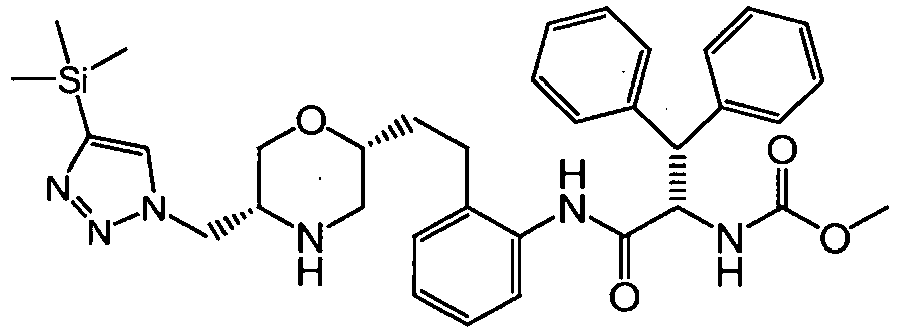
- Nα-(methoxycarbonyl)-β-phenyl-N-(2-{2-[(2R,5R)-5-{[4-(trimethylsilyl)-1H-1,2,3-triazol-1-yl]methyl}morpholin-2-yl]ethyl}phenyl)-L-phenylalaninamide was prepared from tert-butyl (2R,5R)-5-(azidomethyl)-2-[2-(2-{[N-(methoxycarbonyl)-β-phenyl-L-phenylalanyl]amino}phenyl)ethyl]morpholine-4-carboxylate by following procedures described in step 2 and 3 of Example 64 and by using the appropriate reagents.
M+1, +ESI= 641.2 -

- To a solution of Nα-(methoxycarbonyl)-β-phenyl-N-(2-{2-[(2R,5R)-5-{[4-(trimethylsilyl)-1H-1,2,3-triazol-1-yl]methyl}morpholin-2-yl]ethyl}phenyl)-L-phenylalaninamide (1eq.) in tetrahydrofuran (0.03M) was added TBAF (2.7eq.). The reaction mixture was then heated to 50°C for 16hrs. The reaction mixture was quenched with aqueous saturated sodium bicarbonate. The aqueous layer was extracted with CH2Cl2 and the combined organic layers were dried over Na2SO4, filtered and concentrated. The evaporation residue was purified by automated silica gel flash chromatography system eluted with a gradient 0% to 30% of MeOH/EtOAc
M+1, +ESI= 569.2 -

- To a cold (0 °C) suspension of phosphonium salt triphenyl(2-phenylethyl)phosphonium iodide (2.5 eq) in THF (0.1M) was added dropwise a solution of 1M lithium bis(trimethylsilyl)amide (3 eq) in THF. The reaction mixture was stirred at that temperature for 30 min then cooled to -78°C. A solution of tert-butyl (2R,5S)-5-formyl-2-[2-(2-{[N-(methoxycarbonyl)-β-phenyl-L-phenylalanyl]amino}phenyl)ethyl]morpholine-4-carboxylate (1eq) in THF (1M) was added dropwise. The reaction mixture was stirred at that temperature for 30 min then allowed to warm to rt for 30min, quenched with water and the organic layer was extracted twice with EtOAc. The combined organic layers were washed with brine, dried over Na2SO4, filtered and concentrated. The residue was purified by automated silica gel flash chromatography system eluted with a gradient 0% to 70% of EtOAc/Hex to afford the desired compound.
- Methyl {(1S)-1-(diphenylmethyl)-2-oxo-2-[(2-{2-[(2R,5R)-5-(3-phenylpropyl)morpholin-2-yl]ethyl}phenyl)amino]ethyl}carbamate was prepared from tert-butyl (2R,5R)-2-[2-(2-{[N-(methoxycarbonyl)-β-phenyl-L-phenylalanyl]amino}phenyl)ethyl]-5-[(1Z)-3-phenylprop-1-en-1-yl]morpholine-4-carboxylate by following procedures described in steps 7 and 12 of Example 1 and by using the appropriate reagents.
M+1, +ESI= 606.3 -

- (2-Nitrobenzyl)triphenylphosphonium bromide monohydrate (1.4 equiv), potassium carbonate (2.0 equiv) and 18-crown-6 (0.1 equiv) were combined in DME (0.16 M vs aldehyde). The mixture was stirred at room temperature for 5 min. tert-Butyl(2R,5S)-5-formyl-2-{2-[2-({(2S)-2-[(methoxycarbonyl)amino]-3,3-diphenylpropanoyl}amino)phenyl]ethyl}morpholine-4-carboxylate (1.0 equiv) was dissolved in DME (0.16 M) and added to the reaction mixture. The reaction mixture was stirred at room temperature for 18h, filtered over solka floc and concentrated. The crude product was purified using automated silica-gel flash chromatography using a solvent gradient of 0% to 100% of ethyl acetate and hexanes.
- Tert-Butyl(2R,5R)-2-{2-[2-({(2S)-2-[(methoxycarbonyl)amino]-3,3-diphenylpropanoyl}amino)phenyl]ethyl}-5-[2-(2-nitrophenyl)vinyl]morpholine-4-carboxylate (1.0 equiv) was dissolved in EtOH (0.07 M) in a Parr shaker vessel. Palladium on carbon (12 wt%) was added. The reaction mixture was flushed with nitrogen, and then submitted to 45 psi hydrogen with shaking for 18h. The crude mixture was flushed with nitrogen, filtered on solka floc and concentrated to yield the desired product.
- (2S)-2-[(methoxycarbonyl)amino]-3,3-diphenylpropanoic acid (1.2 equiv), HATU (1.4 equiv) and 2,6-lutidine (2.0 equiv) were combined in DMF (0.2 M vs aniline). tert-Butyl(2R,5R)-5-[2-(2-aminophenyl)ethyl]-2-{2-[2-({(2S)-2-[(methoxycarbonyl)amino]-3,3-diphenylpropanoyl}amino)phenyl]ethyl}morpholine-4-carboxylate (1.0 equiv) was dissolved in DMF 0.11 M) and was added to the reaction mixture. The reaction was stirred at room temperature for 18h and ethyl acetate and saturated sodium bicarbonate were added. Aqueous layer was extracted twice with ethyl acetate and combined organic layers were washed with brine, 10% aqueous lithium chloride, 1N HCl, brine, dried (Na2SO4), filtered and concentrated. The crude product was purified using automated silica-gel flash chromatography using a solvent gradient of 5% to 60% of ethyl acetate and hexanes.
- Tert-Butyl(2R,5R)-2,5-bis{2-[2-({(2S)-2-[(methoxycarbonyl)amino]-3,3-diphenyl propanoyl}amino)phenyl]ethyl}morpholine-4-carboxylate in a 1:1mixture of CH2Cl2/TFA (0.1 M) was stirred at rt for 1hr. The reaction mixture was concentrated under reduced pressure and the residue was co-evaporated twice with heptane and triturated in Et2O to afford the desired product as a TFA salt. Alternatively, the TFA salt, after concentration, could be neutralized with aqueous saturated NaHCO3, extracted with EtOAc, dried over Na2SO4; filtered and concentrated and then purified by automated SiO2 flash chromatography system using solvent gradient of 0% to 10% MeOH/CH2Cl2 to afford the desired compound. Alternatively, the free base could be purified by filtration on SCX SPE cartridge made of pTSA-SiO2 eluted first with MeOH to remove non basic impurities and eluted then with 10% NH4OH/MeOH to elute the free base and afford the desired compound after concentration under reduced pressure.
M+1, +ESI= 888.4 - The following examples (69 to 72) were synthesized from tert-Butyl(2R,5R)-5-[2-(2-aminophenyl)ethyl]-2-{2-[2-({(2S)-2-[(methoxycarbonyl)amino]-3,3-diphenylpropanoyl}amino)phenyl]ethyl}morpholine-4-carboxylate according to the procedures described for the preparation of Example 68 and by using the appropriate reagents.
Example Compound name Characterizati on data 69 
methyl N-[(1S)-1-benzhydryl-2-[[2-[2-[(2R,5R)-5-[2-[2-[[2-(methoxycarbonylamino)acetyl]amino] phenyl]ethyl]morpholin-2-yl]ethyl]phenyl]amino]-2-oxoethyl] carbamate M+1, +ESI= 722.2 70 
methyl N-[(1S)-1-benzhydryl-2-[[2-[2-[(2R,5R)-5-[2-[2-[(2-methoxyacetyl)amino]phenyl]ethyl]mor pholin-2-yl]ethyl]phenyl]amino]-2-oxoethyl] carbamate M+1, +ESI= 679.3 71 
methyl N-[(1S)-1-benzhydryl-2-oxo-2-[[2-[2-[(2R,5R)-5-[2-[2-(3-phenylpropanoylamino)phenyl]ethyl]m orpholin-2-yl]ethyl]phenyl]amino]ethyl]carbamate M+1, +ESI= 739.4 72 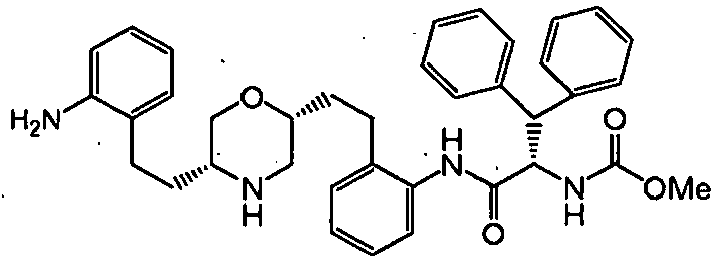
methyl N-[(1S)-1-[[2-[2-[(2R,5R)-5-[2-(2-aminophenyl)ethyl]morpholin-2-yl]ethyl]phenyl]carbamoyl]-2,2-diphenyl-ethyl]carbamate M+1, +ESI= 607.3 -
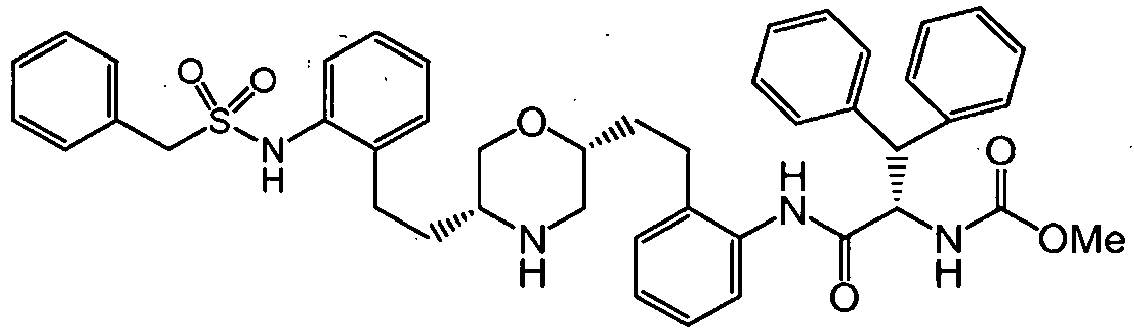
- To tert-Butyl(2R;5R)-5-[2-(2-aminophenyl)ethyl]-2-{2-[2-({(2S)-2-[(methoxycarbonyl)amino]-3,3-diphenylpropanoyl}amino)phenyl]ethyl}morpholine-4-carboxylate (1.0 equiv) in CH2Cl2 (0.1 M) were added triethylamine (3 eq) and phenylmethanesulfonyl chloride (1.5 eq). The reaction was stirred at room temperature for 18h and ethyl acetate and saturated sodium bicarbonate were added. Aqueous layer was extracted twice with ethyl acetate and combined organic layers were washed with brine, dried over Na2SO4, filtered and concentrated. The crude product was purified using automated silica-gel flash chromatography using a solvent gradient of 20% to 100% of ethyl acetate and hexanes to afford tert-butyl (2R,5R)-5-(2-{2-[(benzylsulfonyl)amino]phenyl}ethyl)-2-[2-(2-{[N-(methoxycarbonyl)-β-phenyl-L-phenylalanyl]amino}phenyl)ethyl]morpholinne-4-carboxylate which was treated with TFA by following procedure described in step 12 of Example 1 to afford the title compound.
M+1, +ESI= 761.2 - The following examples (74 to 77) were synthesized from tert-Butyl(2R,5R)-5-[2-(2-aminophenyl)ethyl]-2-{2-[2-({(2S)-2-[(methoxycarbonyl)amino]-3,3-diphenylpropanoyl}amino)phenyl]ethyl}morpholine-4-carboxylate according to the procedures described for the preparation of Example 73 and by using the appropriate reagents.
Exa mple Compound name Characterizati on data 74 
methyl N-[(1S)-1-benzhydryl-2-[[2-[2-[(2R,5R)-5-[2-(2-benzyloxycarbonylaminophenyl)ethyl]mor pholin-2-yl]ethyl]phenyl]amino]-2-oxoethyl] carbamate M+1, +ESI= 741.2 75 
methyl N-[(1S)-1-benzhydryl-2-[[2-[2-[(2R,5R)-5-[2-[2-(benzylcarbamoylamino)phenyl]ethyl]morp holin-2-yl]ethyl]phenyl]amino]-2-oxo-ethyl]carbamate M+1, +ESI= 740.3 76 
methyl N-[(1S)-1-benzhydryl-2-[[2-[2-[(2R,5R)-5-[2-[2-(methoxycarbonylamino)phenyl]ethyl]mor pholin-2-yl]ethyl]phenyl]amino]-2-oxoethyl]carbamate M+1, +ESI= 666.3 77 
methyl N-[(1S)-1-benzhydryl-2-[[2-[2-[(2R,5R)-5-[2-[2-(ethylcarbamoylamino)phenyl]ethyl]morph olin-2-yl]ethyl]phenyl]amino]-2-oxo-ethyl]carbamate M+1, +ESI= 679.1 -

- A freshly prepared solution of mercury(II) trifluoroacetate (2.7 eq.) in water (0.37 M) was added to a solution of tert-butyl (2R,5S)-5-({[tert-butyl(dimethyl)silyl]oxy)methyl)-2-[(Z)-2-(2-nitrophenyl)ethenyl]morpholine-4-carboxylate (1 eq) in THF (0.14 M) and stirred at r.t. for 36 h. Quenched with addition of saturated aqueous NaHCO3, diluted with DCM and washed with saturated aqueous NaCl, dried over MgSO4, filtered and concentrated. The yellow foam was dissolved in 2:1 THF:2-Propanol (0.1 M) and treated with sodium borohydride (1.23 eq.); stirred at rt for 60 min, quenched with sat. NaHCO3, diluted (DCM) washed with brine, dried over MgSO4 filtered and concentrated. The residue was purified by automated silicagel flash chromatography system eluted with a gradient 0% to 8% MeOH in DCM, to afford title compound as white foam.
- A solution of intermediate tert-butyl (2S,5R)-5-(hydroxymethyl)-2-[1-hydroxy-2-(2-nitrophenyl)ethyl] morpholine-4-carboxylate and imidazole (3.2 eq.) in dry DMF (0.43 M) was treated with neat TBDPS-Cl (1.1 eq.) and the final solution stirred at room temperature for 48h, diluted with DCM and heptane (excess) and concentrated. The residue was purified by automated silicagel flash chromatography system eluted with a gradient 10% to 50% EtOAc in hexanes, to afford title compound as white foam.
- A solution of alcohol tert-butyl (2S,5S)-5-({[tert-butyl(diphenyl)silyl]oxy}methyl)-2-[1-hydroxy-2-(2-nitrophenyl)ethyl]morpholine-4-carboxylate (1 eq.) in dry DCM (0.11 M), stirred at 0 °C under N2 atmosphere was treated with neat DAST (or any other suitable trifluorosulfanyl amine, 17 eq.) and the resulting dark solution further stirred at the same temperature for 2h, quenched at 0 °C by addition of sat. NaHCO3, diluted with DCM and washed with sat. NaHCO3, dried over MgSO4, filtered and concentrated. The residue was purified by automated silicagel flash chromatography system eluted with 100% DCM, to afford title compound as light yellow oil.
- A solution of intermediate tert-butyl (2S,5S)-5-({[tert-butyl(diphenyl)silyl]oxy}methyl)-2-[1-fluoro-2-(2-nitrophenyl)ethyl]morpholine-4-carboxylate (1 eq.) in a mixture 5:2:1 THF:MeOH:H2O (0.002 M) was warmed up to +59 °C and treated with solid iron (223 eq.). The mixture was further stirred at the same temperature for 45 min, diluted with DCM, washed with sat. NaHCO3, dried over MgSO4, filtered and concentrated. The product was submitted to the next step without further purification. Light yellow oil.
- N-(2-{2-fluoro-2-[(2S,5S)-5-({[(4-fluorobenzyl)carbamoyl]oxy}methyl) morpholin-2-yl]ethyl}phenyl)-Nα-(methoxycarbonyl)-β-phenyl-L-phenylalaninamide was prepared from tert-butyl (2S,5S)-2-[2-(2-aminophenyl)-1-fluoroethyl]-5-({[tert-butyl(diphenyl)silyl]oxy}methyl)morpholine-4-carboxylate by following the procedure described in steps 3 to 6 of Example 32.
M+1, +ESI= 687.2 -

-

- Pivaloyl chloride (18.8 mL, 153 mmol) was added to a solution of 3-amino-5-fluoropyridine (13.2 g, 118 mmol) and TEA (49.2 mL, 353 mmol) in Dichloromethane (235 mL) at 0 °C. The reaction was warmed to ambient temperature and stirred for 1 hour. The reaction was quenched with saturated aqueous NaHCO3 and the mixture was extracted with dichloromethane (x 3). The combined organic fractions were dried (MgSO4), filtered and the solvent was evaporated under reduced pressure to afford the title compound (22.5 g, 115 mmol, 97 % yield) as a light brown solid, MS (ESI): m/z = 197.35 (MH+), 100 % pure by LCMS.
-

- A 2.5M solution of n BuLi (30.6 mL, 76 mmol) in hexanes was added drop-wise to a solution of N-(5-fluoropyridin-3-yl)-2,2-dimethylpropanamide 5.0 g, 25.5 mmol) and TMEDA (11.54 mL, 76 mmol) in THF (127 mL) at -78 °C over 1 hour, while ensuring the internal temperature did not go above -70 °C. The resulting solution was stirred at -78 °C for 1 hour. Iodine (19.40 g, 76 mmol) in THF (20 mL) was added drop-wise over 30min ensuring the internal temperature remained below -70 °C. The resulting reaction was stirred for 1 hour at -78 °C. The reaction was quenched at -78 °C with water and then warmed to ambient temperature. 10% Aqueous sodium thiosulfate was added until the iodine color dissipated and the mixture was extracted with ethyl acetate (x 3). The combined organic fractions were dried (MgSO4), filtered and the solvent was evaporated under reduced pressure to afford the title compound (8.21 g, 25.5 mmol, 100 % yield), MS (ESI): m/z = 323.26 (MH+), 100 % pure by LCMS.
-

- N-(5-Fluoro-4-iodopyridin-3-yl)-2,2-dimethylpropanamide (8.46 g, 26.3 mmol) was heated at reflux in aqueous 3M HCl for 2 hours. The reaction was carefully quenched with aqueous sodium hydroxide (3M) until basic and the mixture was extracted with dichloromethane (x 3). The combined organic fractions were dried (MgSO4), filtered and the solvent was evaporated under reduced pressure to afford the title compound (5.16 g, 21.7 mmol, 83 % yield) as an off white solid, MS (ESI): m/z = 239.18 (MH+), 90 % pure by LCMS.
-
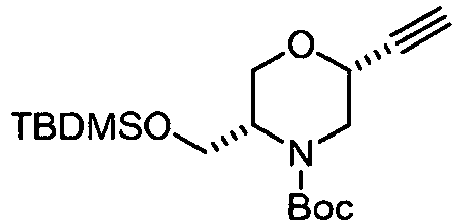
- Dimethyl (1-diazo-2-oxpropyl)phosphonate (3.90 mL, 26.0 mmol) was added to tert-butyl (2S,5S)-5-({[tert-butyl(dimethyl)silyl]oxy} methyl)-2-formylmorpholine-4-carboxylate (Example 1, step 6) (7.78 g, 21.6 mmol) and K2CO3 (5.98 g, 43.3 mmol) in anhydrous MeOH (216 mL) at ambient temperature. The reaction was stirred for 2 hours then filtered and concentrated in vacuo. Saturated aqueous KH2PO4 was added and the mixture was extracted with ethyl acetate (x3). The combined organic fractions were dried (MgSO4), filtered and the solvent was evaporated under reduced pressure. Purification on silica gel (750g) eluting with a gradient of 0-30 % EtOAc/hexanes afforded the title compound (4.60 g, 12.9 mmol, 60 % yield) as a colorless oil, MS (ESI): m/z = 256.01 (M+H-Boc).
-

- tert-Butyl (2R,5R)-2-ethynyl-5-(tert-butyldimethylsilyloxy-methyl)morpholine-4-carboxylate (2.75 g, 7.73 mmol), 5-fluoro-4-iodopyridin-3-amine (1.84 g, 7.73 mmol), bis(triphenylphosphine)palladium(II) chloride (0.380 g, 0.541 mmol), triethylamine (32.3 mL, 232 mmol), and copper(I) iodide (0.147 g, 0.773 mmol) were heated at 70 °C for 2 hours. The reaction was quenched with saturated aqueous KH2PO4 and the mixture was extracted with ethyl acetate (x 3). The combined organic fractions were dried (MgSO4), filtered and the solvent was evaporated under reduced pressure. Purification on silica gel (330g) eluting with a gradient of 0-100 % EtOAc/hexanes afforded the title compound (2.20 g, 12.9 mmol, 42 % yield) as a viscous oil, MS (ESI): m/z = 466.45 (MH+); 68 % pure by LCMS, remainder is un-reacted 5-fluoro-4-iodopyridin-3-amine, taken onto next reaction as mixture.
-

- Platinum(IV) oxide (0.536 g, 2.36 mmol) was suspended in nitrogen degassed trifluroroethanol. tert-Butyl (2R,5S-2-[(3-amino-5-fluoropyridin-4-yl)ethynyl]-5-({[tert-butyl(dimethyl)silyl]oxy}methyl)morpholine-4-carboxylate (2.20 g, 4.72 mmol) (68% pure) was dissolved in nitrogen degassed trifluorethanol (94 mL) and added to the suspension of platinum oxide. The reaction was shaken on the Parr at 50 psi hydrogen for 24hr. The reaction was degassed with nitrogen, filtered through celite and the solvent removed in vacuo. Purification on silica gel (330g) eluting with a gradient of 0-100 % EtOAc/hexanes afforded the title compound (1.52 g, 3.24 mmol, 69 % yield) as a white solid, MS (ESI): m/z = 470.51 (MH+); 100 % pure by LCMS
-

- POCl3 (0.579 mL, 6.21 mmol) was added to a solution of tert-Butyl (2R,5S)-2-[2-(3-amino-5-fluoropyridin-4-yl)ethyl]-5-({[tert-butyl(dimethyl)silyl]oxy}methyl)morpholine-4-carboxylate (2.65 g, 5.64 mmol) and N-(tert-butoxycarbonyl)-4-fluoro-β-(4-fluorophenyl)-L-phenylalanine [Patterson, D.E., et al. Org. Proc. Res. Dev. 2009, 13, 900-906.] (2.13 g, 5.64 mmol) in pyridine (28 mL) at -15°C. The reaction stirred for 30min then warmed to 0°C and stirred for 3 hours. The reaction was quenched with saturated aqueous KH2PO4, then brine and the mixture was extracted with ethyl acetate (x 3). The combined organic fractions were dried (MgSO4), filtered and the solvent was evaporated under reduced pressure to afford a brown viscous oil. The resulting oil was dissolved in THF (28 mL) and a 1M solution of TBAF (11.3 mL, 11.3 mmol) in THF was added and the reaction stirred at ambient temperature overnight. The reaction was quenched with saturated aqueous KH2PO4 and the mixture was extracted with ethyl acetate (x 3). The combined organic fractions were dried (MgSO4), filtered and the solvent was evaporated under reduced pressure. Purification on silica gel (330g) eluting with a gradient of 0-100 % CHCl3 to 70:20:10 CHCl3/EtOAc/MeOH afforded the title compound (2.07 g, 2.90 mmol, 51 % yield) as a white solid, MS (ESI): m/z = 715.48 (MH+); 100 % pure by LCMS.
-

- tert-Butyl (2R,5R)-2-[2-(3-{[N-(tert-butoxycarbonyl)-4-fluoro-β-(4-fluorophenyl)-L-phenylalanyl]amino}-5-fluoropyridin-4-yl)ethyl]-5-(hydroxymethyl)morpholine-4-carboxylate (1.50 g, 2.10 mmol) and CDI (0.425 g, 2.62 mmol) were heated at 60°C in Pyridine (21 mL) for 30min. 2,2,2-Trifluoroethylamine (3.29 mL, 42.0 mmol) was added and the reaction heated at 60 °C for 24 hours, A further aliquot of 2,2,2-Trifluoroethylamine (1.65 mL, 21.0 mmol) was added and the reaction heated at 60°C for a further 24 hours. The reaction was quenched with saturated aqueous KH2PO4 then brine and the mixture was extracted with ethyl acetate (x 3). The combined organic fractions were dried (MgSO4), filtered and the solvent was evaporated under reduced pressure. Purification on silica gel (220g) eluting with a gradient of 0-100 % EtOAc/hexanes afforded the title compound (1.29 g, 1.54 mmol, 73 % yield) as a white solid, MS (ESI): m/z = 840.46 (MH+); 100 % pure by LCMS.
-

- 4M HCl (3.54 mL, 14.17 mmol) in dioxane was added to a solution of tert-Butyl (2R,5S-2-[2-(3-{[N-(tert-butoxycarbonyl)-4-fluoro-β-(4-fluorophenyl)-L-phenylalanyl]amino}-5-fluoropyridin-4-yl)ethyl]-5-({[(2,2,2-trifluoroethyl)carbamoyl]oxy}methyl)morpholine-4-carboxylate (1.19 g, 1.42 mmol) in Dioxane (14 mL) at ambient temperature and the reaction stirred for 4 hours. The solvent was removed in vacuo and ether was added to the residue. The title compound was filtered off as a white solid (1.00 g, 1.34 mmol, 94 % yield), MS (ESI): m/z = 640.40 (MH+); 100 % pure by LCMS.
-

-

- Triphenylphosphine (31.2 g, 119 mmol) was added to a solution of 2-(bromomethyl)-1-fluoro-3-nitrobenzene (27.9 g, 119 mmol) in Acetonitrile (445 mL) (degassed with nitrogen) and the reaction stirred at ambient temperature for 10min then heated to 85 °C for 2 hrs. The solvent was evaporated under reduced pressure to afford the title compound (59.1 g, 119 mmol, 100 % yield) as a yellow powder, MS (ESI): m/z = 416.2 (MH+); 100 % pure by LCMS.
-

- A solution of (2-Fluoro-6-nitrobenzyl)(triphenyl)phosphonium bromide, 18-crown-6 (0.388 g, 1.469 mmol) and potassium carbonate (4.06 g, 29.4 mmol) were stirred in DME (100 mL) at ambient temperature for 10min to afford a deep purple solution. tert-Butyl (2S,5S)-5-({[tert-butyl(dimethyl)silyl]oxy}methyl)-2-formylmorpholine-4-carboxylate (Example 1, Step 6) (5.28 g, 14.69 mmol) in DME (50 mL) was added and the deep purple solution stirred overnight to afford a light brown suspension. The reaction was filtered through celite, rinsing with ether and concentrated under vacuum. Purification on silica gel (330g) eluting with a gradient of 0-40 % EtOAc/hexanes afforded the title compound (6.39 g, 12.9 mmol, 88 % yield) as a thick gum, MS (ESI): m/z = 497.5 (MH+); LCMS shows mixture of E & Z olefin.
-

- A solution of tert-Butyl (2R,5S)-5-({[tert-butyl(dimethyl)silyl]oxylmethyl)-2-[(E/Z)-2-(2-fluoro-6-nitrophenyl)ethenyl]morpholine-4-carboxylate (6.39 g, 12.9 mmol) in Trifluoroethanol was added to a suspension of nitrogen degassed Pearlman'sCatalyst (1.81 g, 2.57 mmol) in Trifluoroethanol (Total Trifluoroethanol (52 mL)). The reaction was shaken at 50 psi hydrogen pressure on a Parr for 24 hours. The reaction was degassed with nitrogen and filtered through celite, rinsing with Ethyl Acetate, and the solvent removed in vacuo. Purification on silica gel (330g) eluting with a gradient of 0-50 % EtOAc/hexanes affored the title compound (4.86 g, 10.4 mmol, 81 % yield) as a white solid, MS (ESI): m/z = 469.6 (MH+); 100 % pure by LCMS.
-

- POCl3 (1.094 mL, 11.74 mmol) was added to a solution of tert-Butyl (2R,5S)-2-[2-(2-amino-6-fluorophenyl)ethyl]-5-({[tert-butyl(dimethyl)silyl]oxy}methyl)morpholine-4-carboxylate (5.00 g, 10.7 mmol) and N-(tert-butoxycarbonyl)-4-fluoro-β-(4-fluorophenyl)-L-phenylalanine (4.03 g, 10.7 mmol) in Pyridine (53 mL) at -15 °C and the reaction stirred for 30min then warmed to 0°C and stirred for 1.5 hours. The reaction was quenched with saturated aqueous KH2PO4 (saturated) and the mixture was extracted with ethyl acetate (x3). The combined organic fractions were dried (MgSO4), filtered and the solvent was evaporated under reduced pressure to afford a viscous brown oil. The resulting oil was dissolved in THF (53 mL) and a 1M solution of TBAF (32.0 mL, 32.0 mmol) was added and the reaction stirred at ambient temperature for 4 hours. The reaction was quenched with saturated aqueous KH2PO4 and the mixture was extracted with ethyl acetate·(x 3). The combined organic fractions were dried (MgSO4), filtered and the solvent was evaporated under reduced pressure. Purification on silica gel (750g) eluting with a gradient of 0-100 % EtOAc/hexanes affored the title compound (4.40 g, 6.16 mmol, 58 % yield) as a white solid, MS (ESI): m/z = 714.6 (MH+); 100 % pure by LCMS.
-

- 4-Morpholinecarboxylic acid, 2-[2-[2-[[(2S)-2-[[(1,1-dimethylethoxy)carbonyl]amino]-3,3-bis(4-fluorophenyl)-1-oxopropyl]amino]-6-fluorophenyl]ethyl]-5-(hydroxymethyl)-, 1,1-dimethylethyl ester, (2R,5R)- (7.15 g, 10.0 mmol) and CDI (3.25 g, 20.0 mmol) were heated at 60 °C in Pyridine (100 mL) for 30min, then 2,2,2-Trifluoroethylamine (23.6 mL, 301 mmol) was added and the reaction heated at 60 °C for 20 hours. Another aliquot of 2,2,2-Trifluoroethylamine (7.86 mL, 100 mmol) was added and the reaction heated at 60 °C for 24 hours. The reaction was quenched with aqueous KH2PO4 then brine and the mixture was extracted with ethyl acetate (x 3). The combined organic fractions were dried (MgSO4), filtered and the solvent was evaporated under reduced pressure. Purification on silica gel (750g) eluting with a gradient of 0-100 % EtOAc/hexanes afforded the title compound (7.46 g, 8.89 mmol, 89 % yield) as a white solid, MS (ESI): m/z = 839.6 (MH+); 100 % pure by LCMS.
-

- 4M HCl (44.5 mL, 178 mmol) in dioxane was added to a solution of tert-Butyl (2R,5S)-2-[2-(2-{[N-(tert-butoxycarbonyl)-4-fluoro-β-(4-fluorophenyl)-L-phenylalanyl]amino}-6-fluorophenyl)ethyl]-5-({[(2,2,2-trifluoroethyl)carbamoyl]oxy}methyl)morpholine-4-carboxylate (7.46 g, 8.89 mmol) in Dioxane (89 mL) at 0 °C and then the reaction was stirred at rt for 4 hours. The solvent was removed in vacuo and ether was added to the residue to afford a white ppt. The ppt was triturated with ether (x3) and the residing white solid dried under high vacuum to afford the title compound (5.84 g, 8.21 mmol, 92 % yield) as a white powder, MS (ESI): m/z = 639.5 (MH+); 100 % pure by LCMS.
-

- To a mixture of tert-Butyl (2R,5R)-2-[2-(3-{[N-(tert-butoxycarbonyl)-4-fluoro-β-(4-fluorophenyl)-L-phenylalanyl]amino}-5-fluoropyridin-4-yl)ethyl]-5-(hydroxymethyl)morpholine-4-carboxylate (Example 149, Step 7) (677 mg, 0.95 mmol) and carbonyldiimidazole (154 mg, 0.95 mmol) was added dry pyridine (22.5 mL). The resulting solution was heated at 60 °C and stirred for 2 h. This solution was then distributed in 0.5 mL (0.021 mmol) aliquots to 45 2-dram sample vials, each containing a diverse amine (0.042 mmol); among them (6-chloropyridin-2-yl)methanamine. The resulting mixtures were stirred at 60 °C for 3 h. Solvent was removed under stream of N2 gas. The residues were diluted with 4 N HCl/diethyl ether (1 mL) and stirred at room temperature for 16 h. Solvent was removed under stream of N2 gas, and the residues were diluted with DMSO and purified by mass-guided reversed-phase HPLC (10-90% CH3CN:0.1% NH4OH/H2O). HRMS (ES) 683.2353 (M+H) found, 683.2355 required.
-

-

- To a stirring solution of sodium hydride (0.257 g, 6.43 mmol) (pre-washed in hexanes) in DMF (15.30 mL) at 0°C, tert-butyl (2S,5S)-5-({[tert-butyl(dimethyl)silyl]oxy}methyl)-2-(hydroxymethyl)morpholine-4-carboxylate (Example 1, Step 5) (1.66g, 4.59 mmol) in DMF (2mL) was added dropwise. The resulting mixture was stirred at 0°C for 1 hour. At this point, 1,2-difluoro-3-nitrobenzene (0.494 mL, 4.50 mmol) in 0.5 mL of DMF was added dropwise and the final solution was slowly warmed toward room temperature and stirred for 1 hour. Complete by LC/MS at this time. The contents were quenched by adding saturated aqueous sodium bicarbonate and then extracted between water and EtOAc (3x75mL). The organic layer was dried over MgSO4, filtered and concentrated. Purification on silica gel (120g) eluting with a gradient of 0-60% EtOAc/hexanes afforded the title compound (1.68 g, 3.36 mmol, 73% yield) as a yellow oil, MS (ESI): m/z = 401.11 (M+H-boc).
-

- Dissolved tert-butyl (2S,5S)-5-({[tert-butyl(dimethyl)silyl]oxy}methyl)-2-[(2-fluoro-6-nitrophenoxy)methyl]morpholine-4-carboxylate (1.68 g, 3.36 mmol) in ethyl acetate (11.19 mL) and to this solution, carefully added 10% Pd/C (0.714 g, 0.671 mmol). A hydrogen filled balloon was attached and the contents were evacuated and backfilled with H2 several times. Stirred at room temperature for 4 hours. Complete at this time by LC/MS. The solids were filtered off through a pad of celite and washed with ethyl acetate and ethanol. The contents were concentrated and then purified on silica gel (40g) eluting with a gradient of 0-90% EtOAc/hexanes afforded the title compound (1.57 g, 3.34 mmol, 100% yield) as a yellow oil, MS (ESI): m/z = 371.14 (M+H-boc); 100% pure by LC/MS.
-

- Phosphorus (V) oxychloride (118 µl, 1.262 mmol) was added to a solution of tert-butyl (2S,5S)-2-[(2-amino-6-fluorophenoxy)methyl]-5-({[tert-butyl(dimethyl)silyl]oxy}methyl)morpholine-4-carboxylate (540 mg, 1.147 mmol) and N-(tert-butoxycarbonyl)-4-fluoro-β-(4-fluorophenyl)-L-phenylanine (433 mg, 1.147 mmol) in pyridine (5.74 mL) at -15 °C. The reaction was stirred for 30 minutes then warmed to 0°C and stirred for another 1.5 hours. LC/MS at this time only shows pyridine and desired product. The reaction was quenched with a saturated aqueous solution of KH2PO4 and the mixture was extracted with ethyl acetate (3 x 50mL). The combined organic fractions were dried over MgSO4, filtered and the solvent was evaporated under reduced pressure to afford the title compound (977 mg, 1.106 mmol, 96% yield) as an off-white foam, MS (ESI): m/z = 730.51 (M+H-boc). 94% pure by LC/MS. The material was taken on crude to the next step.
-

- 1M TBAF (1766 µl, 1.766 mmol) in THF was added to a solution of tert-butyl (2S,5S)-2-[(2-{[N-(tert-butoxycarbonyl)-4-fluoro-β-(4-fluorophenyl)-L-phenylalanyl]amino}-6-fluorophenoxy)methyl]-5-({[tert-butyl(dimethyl)silyl]oxy}methyl)morpholine-4-carboxylate (977 mg, 1.177 mmol) in THF (5.89 mL) at room temperature and the reaction stirred at room temperature until completion (6 hours). The reaction was quenched with a saturated aqueous solution of KH2PO4 and the mixture was extracted with ethyl acetate (3 x 50 mL). The combined organic fractions were dried over MgSO4, filtered and the solvent was evaporated under reduced pressure. The crude material was then purified on silica gel (120g), eluting with a gradient of 0-100% a 7:2:1 CHCl3/EtOAc/MeOH blend in CHCl3 to afford the title compound (439 mg, 0.589 mmol, 50% yield) as a white foam, MS (ESI): m/z = 616.4 (M+H-boc); 96% pure by LC/MS.
-

- tert-butyl (2S,5R)-2-[(2-{[N-(tert-butoxycarbonyl)-4-fluoro-β-(4-fluorophenyl)-L-phenylalanyl]amino}-6-fluorophenoxy)methyl]-5-(hydroxymethyl)morpholine-4-carboxylate (350 mg, 0.489 mmol) and CDI (159 mg, 0.978 mmol) in pyridine (4.89 mL) were heated to 60 °C for 30min, LC/MS shows formation of desired intermediate. 2,2,2-trifluoroethylamine (1153 µl, 14.67 mmol) was then added and the reaction heated at 60 °C overnight (18 hours). LCMS shows complete conversion the next morning. The solvent was removed in vacuo and the residue was purified on silica gel (120g), eluting with a gradient of 10-100% EtOAc/hexanes to afford the title compound (310 mg, 0.361 mmol, 74% yield) as a white foam, MS (ESI): m/z = 841.4 (M+H); 98% pure by LC/MS.
-

- 4M HCl (922 µl, 3.69 mmol) in dioxane was added to a solution of tert-butyl (2S,5S)-2-[(2-{[N-(tert-butoxycarbonyl)-4-fluoro-β-(4-fluorophenyl)-L-phenylalanyl]amino}-6-fluorophenoxy)methyl]-5-[({[(2,2,2-trifluoroethyl)amino]carbonyl}oxy)methyl]morpholine-4-carboxylate (310mg, 0.369 mmol) in Dioxane (3.69 ml) at room temperature and the reaction stirred until complete by LC/MS (8 hrs). The solvent was removed in vacuo and ether was added to the residue. The desired product was filtered off to afford the title compound (253 mg, 0.355 mmol, 96% yield) as a white solid, MS (ESI): m/z = 641.4 (M+H); 100% pure by LC/MS.
-
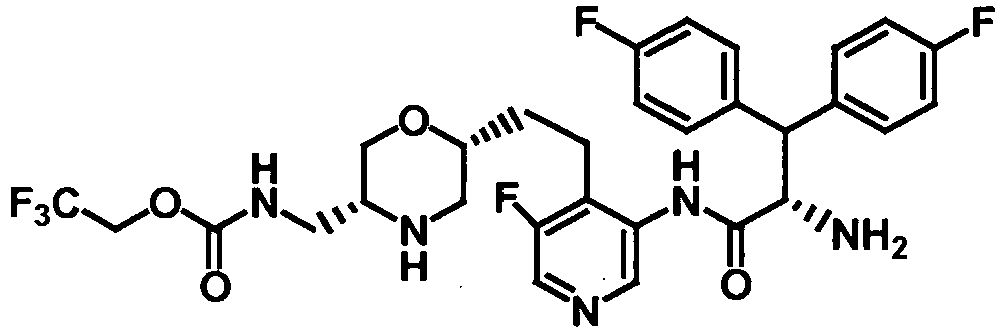
-

- To a solution of DMSO (0.226 mL, 3.19 mmol) in DCM (14.18 mL) at -78 °C was added oxallyl chloride (0.261 mL, 2.98 mmol). The mixture was stirred at -78°C for 15 min and then to it was added (2S)-tert-butyloxycarbonylamino-3,3-di-(4-fluorophenyl)-N-(5-fluoro-4-(2-((2R,5R)-4-tert-butyloxycarbonyl-5-(hydroxymethyl)morpholine-2-yl)ethyl)pyridin-3-yl)propanamide (Example 79, step 7) (1.52 g, 2.127 mmol) in DCM (3 mL). The mixture was stirred at -78 °C for 30 min. To the resuting mixture was added triethylamine (1.186 mL, 8.51 mmol) dropwise. The mixture was warmed to 0 °C over 1 h then quenched with brine and extracted with DCM. The combined organic extracts were dried (Na2SO4), filtered and concentrated to afford the title compound which was used in the next step without further purification.
-

- To a solution of the product from the previous step (1.516 g, 2.127 mmol) in CHCl3 (10.64 mL) at ambient temperature was added benzylamine (0.256 mL, 2.340 mmol).
- The mixture was stirred for 10 min and then sodium triacetoxyborohydride (0.902 g, 4.25 mmol) was added. The mixture was stirred at ambient temperature for 1 h, then quenched with water and extracted with DCM. The combined organic extracts were dried (Na2SO4), filtered and concentrated. Purification by silica gel chromatography (0-4% MeOH/DCM) on a 40 g silica gel column afforded the title compound as a beige solid. LCMS: RT=1.98 min, M+H=804.3 (3.75 min gradient).
-

- A solution of the product from the previous step (1.12 g, 1.393 mmol) in MeOH (13.93 mL) was bubbled with a stream of N2 for 5 min. Palladium hydroxide on carbon (0.978 g, 1.393 mmol) was then added and the mixture was hydrogenated with an H2 balloon at ambient temperature for 7 h. The catalyst was removed by filtration through celite and the filtrate was concentrated to afford the title compound as a beige solid. LCMS: RT=1.85 min, M+H=714.2 (3.75 min gradient).
-

- To a solution of the product from the previous step (40 mg, 0.056 mmol) in pyridine (280 µl) at ambient temperature was added CDI (18.17 mg, 0.112 mmol). The mixture was
heated to 65 °C for 1 h. Acyl imidazole formed by LCMS. To the resulting solution was added 2,2,2-trifluoroethanol (40.3 µl, 0.560 mmol). The mixture was heated at 90 °C for 3 h then concentrated. The crude product was purified by isco silica gel chromatography (15-100% Ethyl acetate/Hexane) on a 12 g silica gel column to afford the title compound as a white solid. LCMS: RT=2.56 min, M+H=840.3 (3.75 min gradient). -

- A solution of the product from the previous step (33.4 mg, 0.040 mmol) in ethyl acetate (795 µl) at 0 °C was saturated with HCl gas over 2 min. The mixture was warmed to ambient temperature and stirred for 10 min. The solvent was removed in vacuo to give the HCl salt of the title compound as a solid. LCMS: RT=1.12 min, M+H=640.1 (3.75 min gradient). The following compounds could be prepared using procedures used for Example 83.
Exampl e Structure IUPAC Name Mass [M+H]+ 84 
Nα-(methoxycarbonyl)-β-phenyl-N-(2-{2-[(2R,5R)-5-({[(tetrahydrofuran-3-yloxy)carbonyl]amino}methy 1)morpholin-2-yl]ethyl}phenyl)-L-phenylalaninamide 2,2,2-trifluoroethyl 631.3. 85 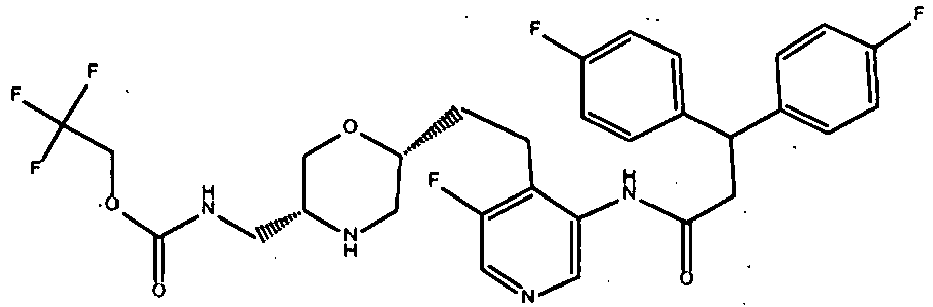
({(3R,6R)-6-[2-(3-{[3,3-bis(4-fluorophenyl)propanoyl]amin o}-5-fluoropyridin-4-yl)ethyl]morpholin-3-yl}methyl)carbamate 625.2 86 
(2S,3S)-2-Methoxycarbonylamino-3-(4-Fluorophenyl)-3-(3,5-difluorophenyl)-N-(5-fluoro-4-(2-((2R,5R)-5-(2,2,2-trifluoroethoxycarbonylamin omethyl)morpholine-2-yl)ethyl)pyridin-3-yl)propanamide 87 
2,2,2-trifluoroethyl ({(3R,6R)-6-[2-(2-{[3,3-bis(4-fluorophenyl)propanoyl] amin o}-6-fluorophenyl)ethyl]morpholi 624.2 n-3-yl}methyl)carbamate 88 
4-fluoro-β-(4-fluorophenyl)-N-(3-fluoro-2-{2-[(2R,5R)-5-({[(2,2,2-trifluoroethoxy)carbonyl]ami no}methyl)morpholin-2-yl]ethyl}phenyl)-L-phenylalaninamide 639.2 -

-

- To a solution of tert-butyl (2R,5R)-2-ethynyl-5-(tert-butyldimethylsilyloxy-methyl)morpholine-4-carboxylate (Example 79, step 4) (2.0 g, 5.7 mmol) in 20 mL of THF was added tetrabutylammonium fluoride (1.0 M in THF, 15 mL, 15 mmol). The solution was stirred at ambient temperature for 1 h and then diluted with EtOAc, washed with aqueous NH4Cl, and brine. The solution was dried (MgS04), filtered, and the solvent was removed in vacuo. The residue was chromatographed on an 80 g Si02 column using a gradient elution of 0-10% MeOH in CHCl3 to give the product as an oil.
-

- To a solution of tert-Butyl (2R,5R)-2-ethynyl-5-(hydroxymethyl)morpholine-4-carboxylate (0.51 g, 2.1 mmol) in 6 mL of pyridine was added carbonyldiimidazole (0.45 g, 2.8 mmol). The mixture was stirred at ambient temperature for 3 h. Trifluoroethylamine (4.1 mL, 53 mmol) was added, the vessel was sealed and heated to 50 °C for 24 h. The pyridine was removed in vacuo and the residue was dissolved in EtOAc and washed with water and brine. The EtOAc solution was dried (MgS04), filtered, and the solvent was removed in vacuo. The residue was chromatographed on a 40 g Si02 column using a gradient elution of 0-50% EtOAc in hexanes. Fractions containing product were combined and removal of solvents in vacuo gave a solid.
-

- A solution of tert-butyl (2R,5R)-2-ethynyl-5-(2,2,2-trifluoroethylaminocarbonyloxymethyl)morpholine-4-carboxylate (3.5 g, 9.6 mmol), 3-amino-5-fluoro-4-iodopyridine (2.5 g, 10.5 mmol), and triethylamine (40 mL, 290 mmol) in acetonitrile (50 mL) was purged with nitrogen gas for 2 min. To the solution was added CuI (180 mg, 0.96 mmol) and bis(triphenylphosphine)palladium(II) chloride (0.47 g, 0.67 mmol). The mixture was stirred and heated in an oil bath at 70 °C for 3 h. The mixture was cooled to ambient temperature and the solvents were removed in vacuo. The residue was partitioned between EtOAc and water. The water layer was removed and the organic phase was washed with water and brine, then dried (MgSO4), filtered, and the solvent was removed in vacuo. The residue was chromatographed on a 330 g SiO2 column eluting with a gradient of 0-7% MeOH in CHCl3 over 30 min. Fractions containing product were combined and the solvents were evaporated to give a gum. LC MS: RT=1.08 min, M+H=477 (2 min gradient)
-

- A solution of tert-butyl (2R,5R)-2-(3-amino-5-fluoropyridin-4-yl)ethynyl-5-(2,2,2-trifluoroethylaminocarbonyloxymethyl)morpholine-4-carboxylate (3.7 g, 7.8 mmol) in 50 mL of trifluoroethanol was purged with nitrogen gas for 2 min. To the solution was added PtO2 (700 mg) and the mixture was shaken on a Parr apparatus under 50 psi of hydrogen as for 48 h. LCMS analysis indicated conversion of the alkyne to the alkene. The catalyst was removed by filtration and the solvent was removed in vacuo. The residue was dissolved in 30 mL of MeOH. The solution was purged with nitrogen gas for 2 min. To the solution was added 10% palladium on carbon (700 mg) and the mixture was shaken on a Parr apparatus under 50 psi of hydrogen gas for 48 h. LCMS indicated partial conversion of the alkene to the desired product. The catalyst was removed by filtration and the solvent was removed in vacuo. The residue was dissolved in 30 mL of MeOH. The solution was purged with nitrogen gas for 2 min. To the solution was added 10% palladium on carbon (700 mg) and the mixture was shaken on a Parr apparatus under 50 psi of hydrogen gas for 48 h. LCMS indicated complete conversion to the desired product. The catalyst was removed by filtration and the solvent was removed in vacuo to give a gum. LC MS: RT=0.98 min, M+H=481 (2 min gradient)
-

- To a slurry of 3,5-difluorocinammic acid (6.3 g, 34 mmol) in CH2Cl2 (130 mL) was added thionyl chloride (6.2 mL, 85 mmol). The mixture was heated to reflux under a nitrogen atmosphere for 5 h, at which time all solids had dissolved. The solvents were removed in vacuo to give the acid chloride as a solid. A solution of (4R)-4-phenyl-1,3-oxazolidin-2-one (5.6 g, 34 mmol) in THF (100 mL) under an atmosphere of nitrogen was cooled to -10 °C in an ice-acetone bath. To the stirred solution was added nBuLi (13.6 mL of a 2.5 M solution in hexane, 34 mmol) dropwise over a period of 10 min. To this solution was added a solution of the acid chloride in 40 mL of THF dropwise over 10 min. The resulting solution was stirred at 0 °C in an ice-water bath for 1 h. The reaction was quenched with the addition of aqueous NaHC03, and the mixture was extracted three times with EtOAc. The combined organic extracts were washed with water and brine, then dried (MgSO4), filtered, and the solvent was removed in vacuo. The residue was chromatographed on a 330 g Si02 column using a gradient elution of 0-50% EtOAc:A, where A = 1:1 hexanes:CHCl3. Fractions containing product were combined and the solvents were removed in vacuo to give a solid.
-

- A solution of 4-fluorophenylmagnesium bromide (29 mL of a 2.0 M solution in THF, 58 mmol) and copper(I) bromide-dimethylsulfide complex (12 g, 59 mmol) in THF (100 mL) under an atmosphere of nitrogen was cooled to -40 °C in a dry ice-acetonitrile bath. To the stirred solution was added a solution of (4R)-3-[(2E)-3-(3,5-difluorophenyl)prop-2-enoyl]-4-phenyl-1,3-oxazolidin-2-one (7.7 g, 23 mmol) in 100 mL of THF dropwise over 15 min. The resulting mixture was stirred at -40 °C for 1.5 h, then the cooling bath was removed and the stirred mixture was allowed to warm to ambient temperature. The reaction was quenched by the addition of aqueous NH4Cl solution. The resulting mixture was stirred for 15 min then extracted with two portions of EtOAc. The combined organic phases were washed with water and brine, then dried (MgS04), filtered, and the solvents were removed in vacuo. The residue was chromatographed on a 330 g Si02 column using a gradient elution of 0-50% EtOAc:A, where A = 1:1 hexanes:CHCl3. Fractions containing product were combined and the solvents were removed in vacuo to give a solid.
-

- A solution of (4R)-3-[(3S)-3-(3,5-difluorophenyl)-3-(4-fluorophenyl)propanoyl]-4-phenyl-1,3-oxazolidin-2-one (7.3 g, 17 mmol) in 90 mL of THF and 30 mL of water was cooled to 0 °C in an ice-water bath. To the solution was added hydrogen peroxide (7.0 mL of a 30% solution in water, 69 mmol) and LiOH (0.83 g g, 35 mmol). After 45 min, a solution of sodium sulfite (8.7 g, 69 mmol) in 30 mL of water was added, followed by 170 mL of a 0.5 M solution of aqueous NaHCO3 (86 mmol). The stirred mixture was warmed to ambient temperature and most of the THF was removed in vacuo. The aqueous mixture was extracted with two portions of CH2Cl2 to remove the chiral auxiliary. The aqueous phase was then acidified to pH 1 with the addition of 6 N HCl and extracted with two portions of EtOAc. The combined EtOAc layers were dried (MgS04), filtered, and the solvent was removed in vacuo to give a solid.
-

- A solution of tert-butyl (2R,5R)-2-(2-(3-amino-5-fluoropyridin-4-yl)ethyl)-5-(2,2,2-trifluoroethylaminocarbonyloxymethyl)morpholine-4-carboxylate (75 mg, 0.16 mmol) and (3S)-3-(3,5-difluorophenyl)-3-(4-fluorophenyl)propanoic acid (44 mg, 0.16 mmol) in pyridine (1.0 mL) was cooled to -10 °C in an ice-acetone bath. To the stirred solution was added POCl3 (0.016 mL, 0.17 mmol) and the mixture was stirred for 30 min. The reaction was quenched by the addition of aqoueous NaHC03 solution and the resulting mixture was extracted with two portions of EtOAc. The combined EtOAc layers were dried (MgSO4), filtered, and the solvents were removed in vacuo. The residue was chromatographed on a 12 g Si02 column using a gradient elution of 0-70% EtOAc in hexanes. Fractions containing product were combined and the solvents were removed in vacuo to give a gum. LC MS: RT=1.41 min, M+H= 743 (2 min gradient)
-

- 3S-3-(4-Fluorophenyl)-3-(3,5-difluorophenyl)-N-(5-fluoro-4-(2-((2R,5R)-4-(tert-butyloxycarbonyl)- 5-(2,2,2-trifluoroethylaminocarbonyloxymethyl)morpholine-2-yl)ethyl)pyridin-3-yl)propanamide (43 mg, 0.058 mmol) was dissolved in 0.5 mL of 4.0 M HCl in dioxane. The solution was stirred at ambient temperature for 30 min then the solvent and excess HCl were removed in vacuo to give the HCl salt of the title compound as a solid. LC MS: RT=1.08 min, M+H= 643 (2 min gradient), hi-res MS calc'd 643.2150, found 643.2136.
-
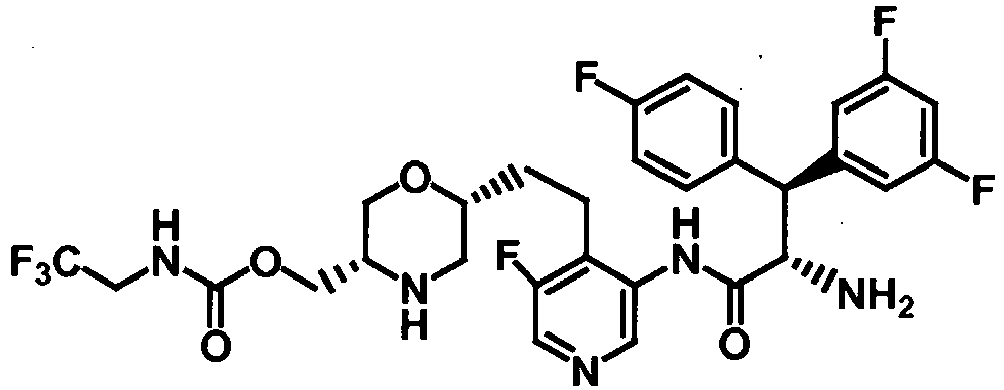
-

- To a solution of (3S)-3-(3,5-difluorophenyl)-3-(4-fluorophenyl)propanoic acid (Example 89, step 7) (3.0 g, 11 mmol) in CH2Cl2 (70 mL) was added thionyl chloride (2.0 mL, 27 mmol). The mixture was heated to reflux under a nitrogen atmosphere for 1 h. The solvents were removed in vacuo to give the acid chloride as a gum. A solution of (4S)-4-phenyl-1,3-oxazolidin-2-one (1.7 g, 11 mmol) in THF (60 mL) under an atmosphere of nitrogen was cooled to -10 °C in an ice-acetone bath. To the stirred solution was added nBuLi (4.3 mL of a 2.5 M solution in hexane, 11 mmol) dropwise over a period of 5 min. To this solution was added a solution of the acid chloride in 20 mL of THF dropwise over 5 min. The resulting solution was stirred at 0 °C in an ice-water bath for 1 h. The reaction was quenched with the addition of aqueous NaHC03, and the mixture was extracted three times with EtOAc. The combined organic extracts were washed with water and brine, then dried (MgSO4), filtered, and the solvent was removed in vacuo. The residue was chromatographed on a 120 g Si02 column using a gradient elution of 0-50% EtOAc:A, where A = 1:1 hexanes:CHCl3. Fractions containing product were combined and the solvents were removed in vacuo to give a solid.
-

- 10 mL of THF under an atmosphere of nitrogen was cooled to -78 °C in a dry ice-acetone bath and to the stirred solution was added sodium hexamethyldisilazide (9.1 mL of a 1.0 M solution in THF, 9.1 mmol). A solution of (4S)-3-[(3S)-3-(3,5-difluorophenyl)-3-(4-fluorophenyl)propanoyl]-4-phenyl-1,3-oxazolidin-2-one (3.5 g, 8.2 mmol) in 20 mL of THF under nitrogen atmosphere was cooled to -78 °C in a dry ice-acetone bath and added via cannula to the cold sodium hexamethyldisilazide solution. The resulting mixture was stirred at -78 °C for 30 min when trisyl azide (3.3 g, 11 mmol) was added as a solid. The solids dissolved and the cold solution was stirred for 2 min. To the cold solution was added HOAc (2.8 mL, 49 mmol) and solid tetramethylammonium acetate (4.4 g, 33 mmol). The cooling bath was removed and the mixture was stirred at ambient temperature for 4 h. The reaction was diluted with EtOAc and washed with brine. The aqueous phase was extracted with EtOAc, and the combined EtOAc layers were washed with aqueous Na HC03 and brine, then dried (MgS04), filtered, and the solvents were removed in vacuo. The residue was chromatographed on a 120 g SiO2 column using a gradient elution of 0-40% EtOAc in hexanes. Fractions containing product were combined and the solvents were removed in vacuo to give a solid.
-

- A solution of (4S)-3-[(2S,3S)-2-azido-3-(3,5-difluorophenyl)-3-(4-fluorophenyl)propanoyl]-4-phenyl-1,3-oxazolidin-2-one (3.1 g, 6.7 mmol) in 45 mL of THF and 15 mL of water was cooled to 0 °C in an ice-water bath. To the stirred solution was added hydrogen peroxide (2.7 mL of a 30% solution in water, 27 mmol) and LiOH (0.32 g, 13 mmol), and the mixture was stirred at 0 °C for 45 min. The reaction was quenched by the addition of a solution of sodium sulfite (3.4 g, 27 mmol) in 20 mL of water, followed by 67 mL of a 0.5 M solution of aqueous NaHC03 (33 mmol). The stirred mixture was warmed to ambient temperature and most of the THF was removed in vacuo. The aqueous mixture was extracted with two portions of CH2Cl2 to remove the chiral auxiliary. The aqueous phase was then acidified to pH 1 with the addition of 6 N HCl and extracted with two portions of EtOAc. The combined EtOAc layers were dried (MgS04), filtered, and the solvent was removed in vacuo to give a gum.
-

- A solution of tert-butyl (2R,5R)-2-(2-(3-amino-5-fluoropyridin-4-yl)ethyl)-5-(2,2,2-trifluoroethylaminocarbonyloxymethyl)morpholine-4-carboxylate (Example 89, step 4) (64 mg, 0.13 mmol) and (2S,3S)-2-azido-3-(3,5-difluorophenyl)-3-(4-fluorophenyl)propanoic acid (43 mg, 0.13 mmol) in pyridine (0.5 mL) was cooled to -10 °C in an ice-acetone bath. To the stirred solution was added POCl3 (0.014 mL, 0.15 mmol) and the mixture was stirred for 30 min. The reaction was quenched by the addition of aqoueous NaHC03 solution and the resulting mixture was extracted with two portions of EtOAc. The combined EtOAc layers were dried (MgS04), filtered, and the solvents were removed in vacuo. The residue was chromatographed on a 12 g Si02 column using a gradient elution of 0-80% EtOAc in hexanes. Fractions containing product were combined and the solvents were removed in vacuo to give a gum. LC MS: RT=1.48 min, M+H= 784 (2 min gradient)
-

- A solution of (2S,3S)-2-azido-3-(4-fluorophenyl)-3-(3,5-difluorophenyl)-N-(5-fluoro-4-(2-((2R,5R)-4-(tert-butyloxycarbonyl)- 5-(2,2,2-trifluoroethylaminocarbonyloxymethyl)morpholine-2-yl)ethyl)pyridin-3-yl)propanamide (36 mg, 0.046 mmol) in 1 mL of MeOH was purged with nitrogen gas for 1 min. To the solution was added 10% palladium on carbon (18 mg) and the mixture was stirred under 1 atmosphere of hydrogen gas for 4 h. The catalyst was removed by filtration and the filtrate solvents were removed in vacuo to give a gum. LC MS: RT=1.20 min, M+H= 758 (2 min gradient)
-

- (2S,3S)-2-Amino-3-(4-fluorophenyl)-3-(3,5-difluorophenyl)-N-(5-fluoro-4-(2-((2R,5R)-4-(tert-butyloxycarbonyl)-5-(2,2,2-trifluoroethylaminocarbonyloxymethyl)morpholine-2-yl)ethyl)pyridin-3-yl)propanamide (27 mg, 0.036 mmol) was dissolved in 0.5 mL of 4.0 M HCl in dioxane. The solution was stirred at ambient temperature for 45 min then the solvent and excess HCl were removed in vacuo to give the HCl salt of the title compound as a solid. LC MS: RT=0.9 min, M+H= 658 (2 min gradient), hi-res MS calc'd 658.2259, found 658.2257.
-

-

- To a stirred solution of (2S,3S)-2-amino-3-(4-fluorophenyl)-3-(3,5-difluorophenyl)-N-(5-fluoro-4-(2-((2R,5R)-4-(tert-butyloxycarbonyl)-5-(2,2,2-trifluoroethylaminocarbonyloxymethyl)morpholine-2-yl)ethyl)pyridin-3-yl)propanamide (Example 90, step 5) (64 mg, 0.084 mmol) in 1 mL of CH2Cl2 was added triethylamine (0.047 mL, 0.34 mmol) and methyl chloroformate (0.013 mL, 0.17 mmol). The mixture was stirred at ambient temperature for 1 h, then diluted with CH2Cl2 and washed with aqueous NaHC03 and brine. The organic phase was dried (MgS04), filtered, and the solvents were removed in vacuo. The residue was chromatographed on a 12 g SiO2 column using a gradient elution of 0-100% EtOc in hexanes. Fractions containing product were combined and the solvents were removed in vacuo to give a gum. LC MS: RT=1.38 min, M+H= 816 (2 min gradient)
-

- (2S,3S)-2-(Methoxycarbonylamino)-3-(4-fluorophenyl)-3-(3,5-difluorophenyl)-N-(5-fluoro-4-(2-((2R,5R)-4-(tert-butyloxycarbonyl)-5-(2,2,2-trifluoroethylaminocarbonyloxymethyl)morpholine-2-yl)ethyl)pyridin-3-yl)propanamide (57 mg, 0.070 mmol) was dissolved in 1.0 mL of 4.0 M HCL in dioxane. The solution was stirred at ambient temperature for 1 h. The solvent and excess HCl were removed in vacuo. The residue was purified by preparative reverse phase HPLC on a C18 column using a gradient elution of 5-95% CH3CN in water containing 0.1% TFA. Fractions containing product were combined and lyophilized to give the TFA salt of the title compound as a solid. LC MS: RT=1.08 min, M+H= 716 (2 min gradient), hi-res MS calc'd 716.2314, found 716.2295.
-

-

- To a slurry of 3-fluorocinammic acid (2.0 g, 12 mmol) in dichloromethane (25 mL) was added thionyl chloride (1.8 mL, 24 mmol). The mixture was heated to reflux under a nitrogen atmosphere for 6 h. The solvents were removed in vacuo to give the acid chloride as a solid. A solution of (4S)-4-phenyl-1,3-oxazolidin-2-one (2.0 g, 12 mmol) in THF (20 mL) under an atmosphere of nitrogen was cooled to -10 °C in an ice-acetone bath. To the stirred solution was added nBuLi (4.8 mL of a 2.5 M solution in hexane, 12 mmol) dropwise over a period of 10 min. To this cold solution was added a solution of the acid chloride in 15 mL of THF dropwise over 10 min. The resulting solution was stirred at 0 °C in an ice-water bath for 1 h. The reaction was quenched with the addition of aqueous NaHCO3, and the mixture was extracted three times with EtOAc. The combined organic extracts were washed with water and brine, then dried (MgSO4), filtered, and the solvent was removed in vacuo. The residue was chromatographed on a 80 g silica gel column using a gradient elution of 0-50% EtOAc:A, where A = 1:1 hexanes:CHCl3. Fractions containing product were combined and the solvents were removed in vacuo to give the title compound as a solid.
-

- A solution of 4-fluorophenylmagnesium bromide (12 mL of a 1.0 M solution in THF, 12 mmol) and copper(I) bromide-dimethylsulfide complex (2.4 g, 59 mmol) in THF (20 mL) under an atmosphere of nitrogen was cooled to -40 °C in a dry ice-acetonitrile bath. To the stirred cold solution was added a solution of the product from step 1 (1.5 g, 4.8 mmol) in 10 mL of THF dropwise over 10 min. The resulting mixture was stirred at -40 °C for 1.5 h, then the cooling bath was removed and the stirred mixture was allowed to warm to ambient temperature over 1 h. The reaction was quenched by the addition of aqueous NH4Cl solution. The resulting mixture was stirred for 15 min then extracted with two portions of EtOAc. The combined EtOAc extracts were washed with water and brine, then dried (MgSO4), filtered, and the solvents were removed in vacuo. The residue was chromatographed on an 80 g silica gel column using a gradient elution of 0-50% EtOAc:hexanes. Fractions containing product were combined and the solvents were removed in vacuo to give the title compound as a solid.
-

- 5 mL of THF under an atmosphere of nitrogen was cooled to -78 °C in a dry ice-acetone bath and to the stirred solution was added sodium hexamethyldisilazide (5.5 mL of a 1.0 M solution in THF, 5.5 mmol). A solution of the product from step 2 (1.5 g, 3.7 mmol) in 8 mL of THF under nitrogen atmosphere was cooled to -78 °C in a dry ice-acetone bath and added via cannula to the cold sodium hexamethyldisilazide solution. The resulting mixture was stirred at - 78 °C for 30 min when trisyl azide (1.5 g, 4.8 mmol) was added as a solid. The solids dissolved and the cold solution was stirred for 2 min. To the cold solution was added HOAc (1.3 mL, 22 mmol) and solid tetramethylammonium acetate (2.0 g, 15 mmol). The cooling bath was removed and the mixture was stirred at ambient temperature for 4 h. The reaction was diluted with EtOAc and washed with brine. The aqueous phase was extracted with EtOAc, and the combined EtOAc layers were washed with aqueous NaHCO3 and brine, then dried (MgSO4), filtered, and the solvents were removed in vacuo. The residue was chromatographed on an 80 g silica gel column using a gradient elution of 0-50% EtOAc in hexanes. Fractions containing product were combined and the solvents were removed in vacuo to give the title compound as a solid.
-

- A solution of the product from step 3 (0.7 g, 1.6 mmol) in 15 mL of THF and 5 mL of water was cooled to 0 °C in an ice-water bath. To the stirred solution was added hydrogen peroxide (0.7 mL of a 30% solution in water, 7 mmol) and LiOH (75 mg, 3.1 mmol), and the mixture was stirred at 0 °C for 45 min. The reaction was quenched by the addition of a solution of sodium sulfite (0.8 g, 7 mmol) in 5 mL of water, followed by a 0.5 M solution of aqueous NaHCO3 (16 mL, 8 mmol). The stirred mixture was warmed to ambient temperature and most of the THF was removed in vacuo. The aqueous mixture was extracted with two portions of dichloromethane to remove the chiral auxiliary. The aqueous phase was acidified to pH 1 with the addition of 6 N HCl and extracted with two portions of EtOAc. The combined EtOAc layers were dried (MgSO4), filtered, and the solvent was removed in vacuo to give the title compound as a gum.
-

- The title compound was prepared from the product of Step 4 using the procedures described in Example 90, steps 4 and 5 and Example 91, step 2 to give the TFA salt of the title compound as a solid. LCMS: RT=0.88 min (2 min gradient); high-resolution MS M+H calc'd 640.2353, found 623.2050.
-

-

- The title compound was prepared from 3-chlorocinnamic acid using the procedures described for Example 90, step 3.
-

- The title compound was prepared from the product of Step 1 using the procedure described for Example 90, step 4..LCMS: RT=1.51 min, M+H=782.5 (2 min gradient). Step 3. (2S,3S)-2-Amino-3-(3-chlorophenyl)-3-(4-fluorophenyl)-N-(5-fluoro-4-(2-((2R,5R)-4-(tert-butyloxycarbonyl)-5-(2,2,2-trifluoroethylaminocarbonyloxymethyl)morpholine-2-yl)ethyl)pyridin-3-yl)propanamide
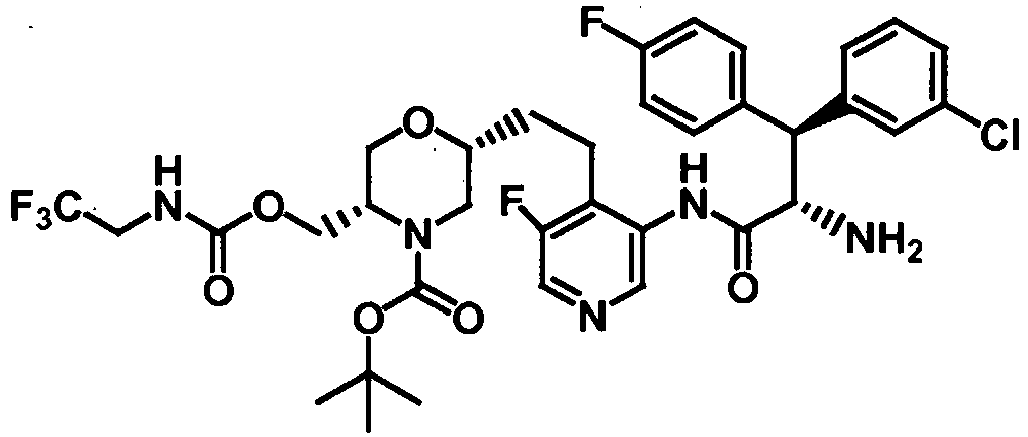
- The product from Step 2 (255 mg, 0.33 mmol) was dissolved in 3 mL THF and to the stirred solution was added triphenylphosphine (128 mg, 0.49 mmol) and water (0.3 mL). The mixture was heated to reflux for 24 h. The solvents were removed in vacuo and the residue was purified on a 12 g silica gel column eluting with a gradient of 0-30% EtOAc:hexanes. Fractions containing product were combined and the solvents were removed in vacuo to give a dense gum. LCMS: RT=1.23 min, M+H=756.5 (2 min gradient).
-

- The title compound was prepared from the product of Step 3 using the procedure described for Example 91, step 2. The TFA salt of the title compound was obtained as a solid. LCMS: RT=0.96 min (2 min gradient); high-resolution MS M+H calc'd 656.2058, found 656.2053.
-

-

- The title compound was prepared from 4-chloro-3-fluorocinnamic acid and 3-fluorophenylmagnesium bromide using the procedures given in Steps 1-4 of Example 92.
- The title compound was prepared from the product of step 1 using the procedures given in steps 2-4 of Example 93. MS (ES) m/z = 674 (M+H)+.
-

-

- The title compound was prepared from 4-chlorocinnamic acid and phenylmagnesium bromide using the procedures given in steps 1-4 of Example 92.
- The title compound was prepared from the product of step 1 using the procedures given in steps 2-4 of Example 93. MS (ES) m/z = 638 (M+H)+.
-

-

- The title compound was prepared from 3-(2-naphthyl)propenoic acid and 4-fluorophenylmagnesium bromide using the procedures given in steps 1-4 of Example 92.
- The title compound was prepared from the product of step 1 using the procedures given in steps 2-4 of Example 93. MS (ES) m/z = 672 (M+H)+.
-

-

- The title compound was prepared from 4-chlorocinnamic acid and 3,5-difluorophenylmagnesium bromide using the procedures given in steps 1-4 of Example 92.
-

- The product from step 1 (105 mg, 0.31 mmol) and the product from step 4 of Example 89 (150 mg, 0.31 mmol) were dissolved in pyridine (1 mL) and the stirred solution was cooled to -10 °C in an ice/acetone bath. To the cold solution was added POCl3 dropwise (0.035 mL, 0.38 mmol). The mixture was stirred at -10.°C for 30 min. The reaction was quenched by the addition of saturated aqueous NaHCO3 solution (1 mL) and the mixture was allowed to warm to ambient temperature. The mixture was diluted with water (10 mL) and extracted with dichloromethane (3 x 10 mL). The combined dichloromethane phases were dried (Na2SO4), filtered, and the filtrate solvents were removed in vacuo. The residue was purified on a 12 g silica gel column using a gradient elution of 0-70% EtOAc:hexanes. Fractions containing product were combined and the solvents were removed in vacuo to give the title compound as a gum. (M+H)+ = 800.6.
-

- The product from step 2 (150 mg, 0.19 mmol) and triphenylphosphine (74 mg, 0.28 mmol) were dissolved in THF (4 mL) and to the solution was added water (1 mL). The mixture was heated to reflux under a nitrogen atmosphere for 12 h. The mixture was cooled to ambient temperature and the solvents were removed in vacuo. The residue was purified on a 12 g silica gel column eluting with a gradient of 0-10% methanol:chloroform. Fractions containing product were combined and the solvents were removed in vacuo to give the title compound as a gum. (M+H)+ = 774.7.
- The product from step 3 (60 mg, 0.078 mmol) was dissolved in a solution of 4M HCl in dioxane (1 mL, 4 mmol) and the solution was stirred at ambient temperature for 1 h. The solvent was removed under reduced pressure and the residue was dried in vacuo for 12 h to give an HCl salt of the title compound as a solid. LCMS: RT = 0.95 min (2 min gradient), MS. (ES) m/z = 674.6 (M+H)+.
-
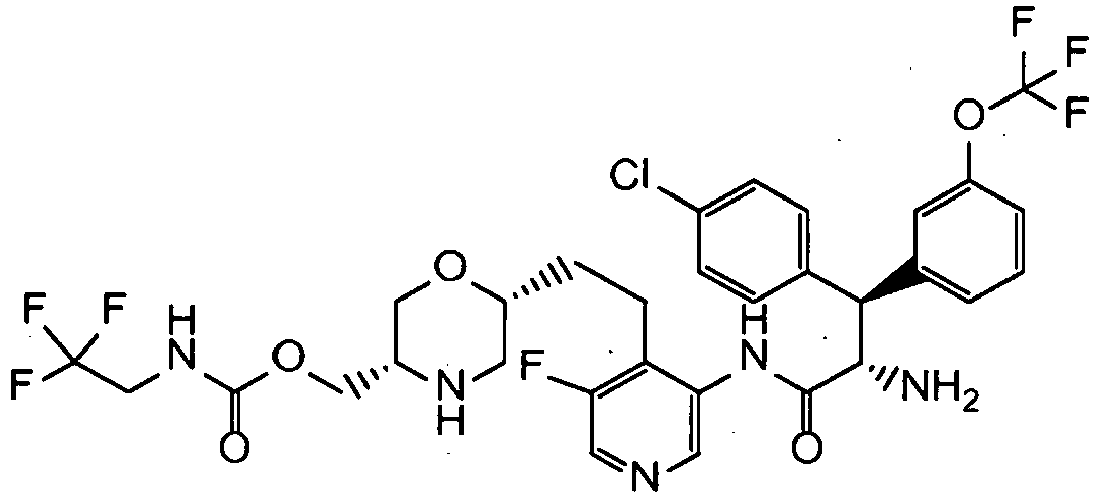
-

- The title compound was prepared from (4S)-4-phenyl-1,3-oxazolidin-2-one, 4-chlorobenzaldehyde, and 3-trifluoromethoxyphenylmagnesium bromide using the procedures given in steps 1-3 of Example 100 and steps 2-4 of Example 92.
- The title compound was prepared from the product of step 1 using the procedures given in steps 2-4 of Example 93. MS (ES) m/z = 722 (M+H)+.
-

-

- The title compound was prepared from (4S)-4-phenyl-1,3-oxazolidin-2-one, 3,4-difluorobenzaldehyde, and 3-fluorophenylmagnesium bromide using the procedures given in steps 1-3 of Example 100 and steps 2-4 of Example 92.
-

- To a solution of the product from step 2 of Example 80 (6.79 g, 13.67 mmol) in MeOH (120 mL) was added 1N HCl (41.0 mL, 41.0 mmol) dropwise over a period of 5 min. The mixture was stirred for 2 h at ambient temperature. To the solution was added 1N NaOH (41.0 mL, 41.0 mmol) dropwise over 10 min and the methanol was removed in vacuo. To the mixture was added water (150 mL) and ethyl acetate (50 mL). The layers were separated and the aqueous phase was extracted with two more 100 mL portions of ethyl acetate. The combined organic extracts were dried over Na2SO4, filtered, and concentrated in vacuo to give the title compound as a yellow oil. (M+H)+ = 383.4.
-

- A mixture of the product from step 2 (5.2 g, 13.60 mmol) and carbonyl-1,1-diimidazole (8.82 g, 54.4 mmol) in anhydrous pyridine (30 mL) was stirred for 18 h at ambient temperature. To the slurry was added 2,2,2-trifluoroethylamine (26.7 mL, 340 mmol) and the mixture was stirred at ambient temperature for 72 h. The mixture was diluted with water (150 mL) and extracted with three 75 mL portions of EtOAc. The combined organic extracts were dried over Na2SO4, filtered, and evaporated in vacuo. The residue was purified on an 80 g silica gel column column using a gradient elution of 20-50% EtOAc:hexane over 40 min. The fractions containing product were combined and evaporated in vacuo to give the title compound as a pale yellow solid. (M+H-tBu)+ = 452.4.6..
-

- A solution of the product from step 3 (6.9 g, 13.60 mmol) in trifluoroethanol (54 mL) was degassed with a stream of nitrogen. To the solution was added Pd(OH)2 (1.910 g, 2.72 mmol) and the mixture was shaken under an atmosphere of hygrogen gas at 49 psi for 20 h. The catalyst was removed by filtration under nitrogen through a pad of Celite, and the filtercake was washed with ethanol. The filtrate solvents were removed in vacuo and the residue was purified on a 120 g silica gel column using a gradient elution of 0-70% EtOAc:hexane over 40 min. The title compound was obtained as a pale yellow oil. (M+H)+ = 480.5.
-

- The product from step 1 (134 mg, 0.42 mmol) and the product from step 4 (200 mg, 0.42 mmol) were dissolved in pyridine (4 mL) and the stirred solution was cooled to -10 °C in an ice/acetone bath. To the cold solution was added POCl3 dropwise (0.04 mL, 0.46 mmol). The mixture was stirred at -10 °C for 30 min. The reaction was quenched by the addition of saturated aqueous NaHCO3 solution (5 mL) and the mixture was allowed to warm to ambient temperature. The mixture was diluted with water (20 mL) and extracted with dichloromethane (3 x 15 mL). The combined dichloromethane phases were dried (Na2SO4), filtered, and the filtrate solvents were removed in vacuo. The residue was purified on a 12 g silica gel column using a gradient elution of 0-100% EtOAc:hexanes. Fractions containing product were combined and the solvents were removed in vacuo to give the title compound as a gum. (M+H-Boc)+ = 683.
-

- A solution of the product from step 5 (160 mg, 0.20 mmol) in EtOAc (4.50 mL) was de-gassed with a stream of nitrogen for 10 min. To the solution was added 10% palladium on charcoal (20 mg), and the mixture was stirred under an atmosphere of hydrogen gas at 1 atm pressure for 16 h. The catalyst was removed by filtration through a Celite pad, and the filter cake was washed with EtOAc (100 mL). The filtrate solvents were removed under reduced pressure. The residue was purified on a 12 g C-80 column using CH3CN in H2O. Fractions containing product were combined and lyopilized to provide the title compound as an off-white solid. (M+H)+ = 757.
- To a solution of the product from step 6 (50 mg, 0.06 mmol) in CH2Cl2 (2.0 mL) was added trifluoroacetic acid (1.0 mL) and the reaction mixture was stirred at ambient temperature for 2 h. The solvents were removed under reduced pressure and the residue was purified by HPLC on a C18 column using a gradient of 10-90% acetonitrile/water as the mobile phase. Fractions containing product were combined and lyophilized to provide the TFA salt of the title compound as white solid. MS (ES) m/z = 657 (M+H)+.
-

-

- A solution of (4R)-4-phenyl-1,3-oxazolidin-2-one (100 g, 613 mmol) in THF (2 L) under a nitrogen atmosphere was cooled to -78 °C in dry ice-acetone bath. To the stirred solution was added n-BuLi (337 mL, 2 M solution in cyclohexane, 675 mmol) dropwise over a period of 30 min, followed by the addition of 2-bromoacetyl bromide (123.7 g, 613 mmol) over 15 min. The resulting solution was stirred at 25 °C for 2 h. The reaction was quenched with aqueous NH4Cl (500 mL), and the mixture was extracted three times with EtOAc (3 x 1 L). The combined organic extracts were washed with water (500 mL) and brine (500 mL), dried (MgSO4), filtered, and the solvent was removed under reduced pressure to give the title compound as a brown solid. The crude product was used directly in the next step.
-

- A solution of (R)-3-(2-bromoacetyl)-4-phenyloxazolidin-2-one (175g, 616 mmol) . and trimethyl phosphite (83.3 g, 671 mmol) in toluene (870 mL) was heated to reflux for 16 h. The reaction mixture was cooled to ambient temperature and the solvent was concentrated under reduced pressure to give a brown colored gum, which was triturated with 1:1 CH2Cl2 and hexanes (250 mL) to provide a brown solid. The solid was collected by filtration under reduced pressure and washed with CH2Cl2 (50 mL) to provide the product (98.8 g) as light brown solid.
-

- A solution of (R)-dimethyl 2-oxo-2-(2-oxo-4-phenyloxazolidin-3-yl)ethylphosphonate (60.7 g, 177.8 mmol) in dry THF (275 ml) under an atmosphere of N2 was cooled to 0 °C in an ice-water bath. Potassium tert-butoxide (23.9 g, 213.4 mmol, 1.0 M solution in THF) was added over a period of 45 min in a dropwise manner and the reaction mixture stirred at 0 °C for 30 min. A solution of 4-chlorobenzaldehyde (25.0 g, 177.84 mmol) in dry THF (100 ml) was added over a period of 20 min and the reaction mixture was stirred at ambient temperature for 16 h. The reaction mixture was cooled to 0 °C and quenched with saturated solution of ammonium chloride (250 mL) and diluted with EtOAc (1.5 L). The biphasic system was stirred at ambient temperature for 10 min and the layers were separated. The organic layer was washed with brine (250 mL), dried (Na2SO4), filtered and concentrated under reduced pressure. The residue was purified by SiO2 column using a gradient elution of 0-25% EtOAc in hexanes. Fractions containing product were combined and the solvents were removed in vacuo to provide the product (43.0 g, 74%) as a pale yellow solid.
-

- The title compound was prepared from the product of step 3 and 1,3-benzodioxol-5-ylmagnesium bromide using the procedures given in steps 6 and 7 of Example 89 and steps 1-3 of Example 90.
- The title compound was prepared from the product of step 1 and the product of step 4 of Example 99 using the procedures given in steps 2-4 of Example 93. MS (ES) m/z = 681 (M+H)+.
-
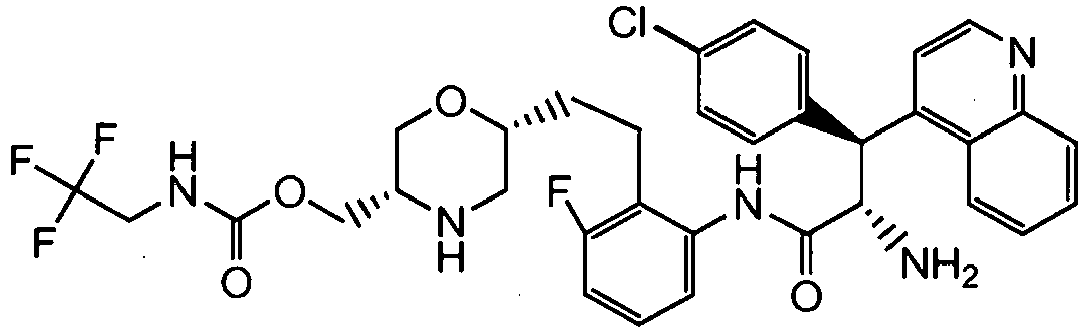
-

- The title compound was prepared from the product of step 2 of Example 100, quinoline-4-carbaldehyde, and 4-chlorophenylmagnesium bromide using the procedures given in steps 3 and 4 of Example 100.
- The title compound was prepared from the product of step 1 and the product of step 4 of Example 99 using the procedures given in steps 2-4 of Example 93. MS (ES) m/z = 688 (M+H)+.
-

-

- The title compound was prepared from 4-cyanocinammic acid and 3,4-difluorophenylmagnesium bromide using the procedures given in steps 5-7 of Example 89 and steps 1-3 of Example 90.
- The title compound was prepared from the product of step 1 and the product of step 4 of Example 99 using the procedures given in steps 2-4 of Example 93. MS (ES) m/z = 664 (M+H)+.
-

-

- The title compound was prepared from 4-chlorocinammic acid and 3-fluorophenylmagnesium bromide using the procedures given in steps 1-4 of Example 92. Step 2. (βS)-4-Chloro-β-(3-fluorophenyl)-N-(5-fluoro-4-{2-[(2R,5S)-5-({[(2,2,2-trifluoroethyl)carbamoyl]oxy}methyl)morpholin-2-yl]ethyl}pyridin-3-yl)-Nα-(methoxycarbonyl)-L-phenylalaninamide
- The title compound was prepared from the product of step 1 using the procedures given in steps 2 and 3 of Example 93 and steps 1 and 2 of Example 91. MS (ES) m/z = 714 (M+H)+.
-

-
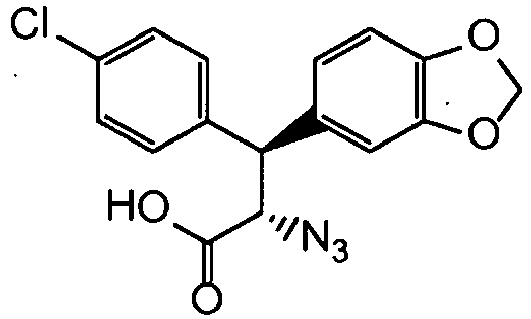
- The title compound was prepared from (4S)-4-phenyl-1,3-oxazolidin-2-one, 4-chlorobenzaldehyde, and 1,3-benzodioxol-5-ylmagnesium bromide using the procedures given in steps 1-3 of Example 100 and steps 2-4 of Example 92.
-

- The product from step 1 (55 mg, 0.16 mmol) and the product from step 4 of Example 89 (76 mg, 0.16 mmol) were dissolved in pyridine (2 mL) and the stirred solution was cooled to -10 °C in an ice/acetone bath. To the cold solution was added POCl3 (0.02 mL, 0.19 mmol). The mixture was stirred at -10 °C for 30 min. The reaction was quenched by the addition of saturated aqueous NaHCO3 solution (2 mL) and the mixture was allowed to warm to ambient temperature. The mixture was diluted with water (10 mL) and extracted with dichloromethane (3 x 10 mL). The combined dichloromethane phases were dried (Na2SO4), filtered, and the filtrate solvents were removed in vacuo. The residue was purified on a 12 g silica gel column using a gradient elution of 0-100% EtOAc:hexanes. Fractions containing product were combined and the solvents were removed in vacuo to give the title compound as a gum. (M+H)+ = 808.
-

- To a solution of the product from step 2 (80 mg, 0.102 mmol) in EtOAc (8 mL) and water (2 mL), was added trimethylphosphine (0.5 mL, 1M solution in THF, 0.5 mmol). The reaction mixture was stirred at ambient temperature for 2 h, then diluted with water (20 mL) and extracted with EtOAc (25 mL x 3). The combined organic extracts were washed with brine (25 mL), dried (Na2SO4), filtered, and concentrated under reduced pressure to provide the title compound as colorless oil. This material was used in the next step without any additional purification. (M+H-Boc)+ = 682.
-

- To a stirred solution of the product from step 3 (50 mg, 0.06 mmol) in dichloromethane (2 mL) was added triethylamine (0.02 mL, 0.13 mmol) and methyl chloroformate (0.006 mL, 0.07 mmol). The mixture was stirred at ambient temperature for 6 h, then diluted with dichloromethane (10 mL) and washed with aqueous NaHCO3 and brine. The organic phase was dried (MgSO4), filtered, and the solvents were removed in vacuo. The residue was chromatographed on a 12 g Si02 column using a gradient elution of 0-100% EtOc in hexanes. Fractions containing product were combined and the solvents were removed in vacuo to give the title compound as a gum. (M+H)+ = 840.
- To a solution of the product from step 4 (55 mg, 0.06 mmol) in CH2Cl2 (2.0 mL) was added trifluoroacetic acid (0.5 mL) and the reaction mixture was stirred at ambient temperature for 2 h. The solvents were removed under reduced pressure and the residue was purified by HPLC on a C18 column using a gradient of 10-90% acetonitrile/water as the mobile phase. Fractions containing product were combined and lyophilized to provide the TFA salt of the title compound as white solid. MS (ES) m/z = 740 (M+H)+.
-

- The title compound was prepared from (2S,3S)-2-azido-3-(4-chlorophenyl)-3-(3,5-difluorophenyl)propanoic acid (Example 1003, step 1) using the procedures given in steps 2 and 3 of Example 93 and steps 1 and 2 of Example 91. MS (ES) m/z = 732.7 (M+H)+.
-

- The title compound was prepared from (2S,3S)-2-azido-3-(4-chlorophenyl)-3-(3-(trifluoromethoxy)phenyl)propanoic acid (Example 1004, step 1) using the procedures given in steps 2 and 3 of Example 93 and steps 1 and 2 of Example 91. MS (ES) m/z = 780 (M+H)+.
-

- The title compound was prepared from (2S,3R)-2-azido-3-(4-chlorophenyl)-3-phenylpropanoic acid (Example 1001, step 1) using the procedures given in steps 2 and 3 of Example 93 and steps 1 and 2 of Example 91. MS (ES) m/z = 696 (M+H)+.
-

-

- The title compound was prepared from 4-chlorophenylmagnesium bromide using the procedures (4S)-4-phenyl-1,3-oxazolidin-2-one, 4-chlorobenzaldehyde, and 3-trifluoromethoxyphenylmagnesium bromide using the procedures given in steps 1-3 of Example 100 and steps 2-4 of Example 92.
- The title compound was prepared from the product of step 1 and the product of step 4 of Example 99 using the procedures given in steps 2 and 3 of Example 93 and steps 1 and 2 of Example 91. MS (ES) m/z = 729 (M+H)+.
-

-

- The title compound was prepared from 4-methoxy-3-chlorocinammic acid and phenylmagnesium bromide using the procedures given in steps 1-4 of Example 92.
-

- The product from step 1 (151 mg, 0.45 mmol) and the product from step 4 of Example 99 (200 mg, 0.42 mmol) were dissolved in pyridine (5 mL) and the stirred solution was cooled to -10 °C in an ice/acetone bath. To the cold solution was added POCl3 dropwise (0.04 mL, 0.45 mmol). The mixture was stirred at -10 °C for 30 min. The reaction was quenched by the addition of saturated aqueous NaHCO3 solution (5 mL) and the mixture was allowed to warm to ambient temperature. The mixture was diluted with water (20 mL) and extracted with dichloromethane (3 x 15 mL). The combined dichloromethane extracts were dried (Na2SO4), filtered, and the filtrate solvents were removed in vacuo. The residue was purified on a 12 g silica gel column using a gradient elution of 0-100% EtOAc:hexanes. Fractions containing product were combined and the solvents were removed in vacuo to give the title compound as a gum. (M+H-N2)+ = 764.
-

- To a solution of the product from step 2 (160 mg, 0.20 mmol) in EtOAc (8 mL) and water (2 mL), was added trimethylphosphine (1.0 mL, 1M solution in THF, 1.0 mmol). The reaction mixture was stirred at ambient temperature for 2 h, then diluted with water (20 mL) and extracted with EtOAc (25 mL x 3). The combined organic extracts were washed with brine (25 mL), dried (Na2SO4), filtered and concentrated under reduced pressure to provide the title compound as colorless oil. (M+H)+ = 767.
-

- To a stirred solution of the product from step 3 (80 mg, 0.1 mmol) in dichloromethane (2 mL) was added triethylamine (0.02 mL, 0.16 mmol) and methyl chloroformate (0.01 mL, 0.12 mmol). The mixture was stirred at ambient temperature for 6 h, then diluted with dichloromethane (10 mL) and washed with aqueous NaHC03 and brine. The organic phase was dried (MgSO4), filtered, and the solvents were removed in vacuo. The residue was chromatographed on a 12 g Si02 column using a gradient elution of 0-100% EtOc in hexanes. Fractions containing product were combined and the solvents were removed in vacuo to give the title compound as a gum. (M+H)+ = 825.
- To a solution of the product from step 4 (70 mg, 0.085 mmol) in CH2Cl2 (2.0 mL) was added trifluoroacetic acid (1.0 mL) and the reaction mixture was stirred at ambient temperature for 2 h. The solvents were removed under reduced pressure and the residue was purified by HPLC on a C18 column using a gradient of 10-90% acetonitrile/water as the mobile phase. Fractions containing product were combined and lyophilized to provide the TFA salt of the title compound as white solid. MS (ES) m/z = 725 (M+H)+.
-

- The title compound was prepared from (2S,3S)-2-azido-3-(benzo[d][1,3]dioxol-5-yl)-3-(4-chlorophenyl)propanoic acid (Example 1010, step 1) and the product of step 4 of Example 99 using the procedures given in steps 2 and 3 of Example 93 and steps 1 and 2 of Example 91. MS (ES) m/z = 739 (M+H)+.
-

-

- The title compound was prepared from 4-fluorocinammic acid and 2-trifluoromethoxy-phenylmagnesium bromide using the procedures given in steps 1-4 of Example 92.
- The title compound was prepared from the product of step 1 and the product of step 4 of Example 99 using the procedures given in steps 2 and 3 of Example 93 and steps 1 and 2 of Example 91. MS (ES) m/z = 763 (M+H)+.
-

-

- The title compound was prepared from 3-(4-pyridyl)propenoic acid and 4-fluorophenylmagnesium bromide using the procedures given in steps 1-4 of Example 92.
- The title compound was prepared from the product of step 1 and the product of step 4 of Example 99 using the procedures given in steps 2 and 3 of Example 93 and steps 1 and 2 of Example 91. MS (ES) m/z = 680 (M+H)+.
-

-

- The title compound was prepared from 4-methylsulfonylcinammic acid and 3-fluorophenylmagnesium bromide using the procedures given in steps 5-7 of Example 89.
-

- The product from step 1 (34 mg, 0.1 mmol) and the product from step 4 of Example 99 (50 mg, 0.1 mmol) were dissolved in pyridine (1 mL) and the stirred solution was cooled to -10 °C in an ice/acetone bath. To the cold solution was added POCl3 (0.01 mL, 0.12 mmol). The mixture was stirred at -10 °C for 30 min. The reaction was quenched by the addition of saturated aqueous NaHCO3 solution (1 mL) and the mixture was allowed to warm to ambient temperature. The mixture was diluted with water (10 mL) and extracted with dichloromethane (3 x 10 mL). The combined dichloromethane phases were dried (Na2SO4), filtered, and the filtrate solvents were removed in vacuo. The residue was purified on a 12 g silica gel column using a gradient elution of 0-100% EtOAc:hexanes. Fractions containing product were combined and the solvents were removed in vacuo to give the title compound as a gum. (M+H-Boc)+ = 684.
- To a solution of the product from step 2 (49 mg, 0.06 mmol) in CH2Cl2 (2.0 mL) was added trifluoroacetic acid (0.5 mL) and the reaction mixture was stirred at ambient temperature for 2 h. The solvents were removed under reduced pressure and the residue was purified by HPLC on a C18 column using a gradient of 10-90% acetonitrile/water as the mobile phase. Fractions containing product were combined and lyophilized to provide the TFA salt of the title compound as white solid. MS (ES) m/z = 684 (M+H)+.
-

-

- The title compound was prepared from 2,3-dihydrobenzofuran-5-carboxaldehyde and 4-chlorophenylmagnesium bromide using the procedures given in steps 1-3 of Example 100 and steps 6 and 7 of Example 89.
- The title compound was prepared from the product of step 1 using the procedures given in steps 8 and 9 of Example 89. MS (ES) m/z = 665 (M+H)+.
-

-

- The title compound was prepared from 4-cyanocinammic acid and 3,4-difluorophenylmagnesium bromide using the procedures given in steps 5-7 of Example 89.
-

- The product from step 1 (50 mg, 0.16 mmol) and the product from step 4 of Example 89 (78 mg, 0.16 mmol) were dissolved in pyridine (1 mL) and the stirred solution was cooled to -10 °C in an ice/acetone bath. To the cold solution was added POCl3 dropwise (0.02 mL, 0.18 mmol). The mixture was stirred at -10 °C for 30 min. The reaction was quenched by the addition of saturated aqueous NaHCO3 solution (1 mL) and the mixture was allowed to warm to ambient temperature. The mixture was diluted with water (10 mL) and extracted with dichloromethane (3 x 10 mL). The combined dichloromethane phases were dried (Na2SO4), filtered, and the filtrate solvents were removed in vacuo. The residue was purified on a 12 g silica gel column using a gradient elution of 0-100% EtOAc:hexanes. Fractions containing product were combined and the solvents were removed in vacuo to give the title compound as a gum. (M+H-Boc)+ = 650.
- To a solution of the product from step 2 (60 mg, 0.08 mmol) in CH2Cl2 (2.0 mL) was added trifluoroacetic acid (0.5 mL) and the reaction mixture was stirred at ambient temperature for 2 h. The solvents were removed under reduced pressure and the residue was purified by HPLC on a C18 column using a gradient of 10-90% acetonitrile/water as the mobile phase. Fractions containing product were combined and lyophilized to provide the TFA salt of the title compound as white solid. MS (ES) m/z = 650 (M+H)+.
-

- The title compound was prepared from N-(tert-butoxycarbonyl)-4-fluoro-β-(4-fluorophenyl)-L-phenylalanine and (2R, 5S)-tert-butyl 2-[(2-amino-6-fluorophenethyl)-5-((carbamoyloxy) methyl)] morpholine-4-carboxylate (Example 118, step 2) using the procedures given in steps 2-4 of Example 93. MS (ES) m/z = 557.5 (M+H)+.
-

-

- The title compound was prepared from 4-fluorocinammic acid and 3-fluorophenylmagnesium bromide using the procedures given in steps 1-4 of Example 92.
-

- To a solution of (2S,5S)-tert-butyl 5-{[(tert-butyldimethylsilyl)oxy]methyl}-2-(hydroxymethyl)morpholine-4-carboxylate (7.2 g, 19.9 mmol) and 2,4-di-fluoronitrobenzene (6.34 g, 39.8 mmol) in anhydrous toluene (100 mL) under a nitrogen atmosphere, was added potassium carbonate (5.5 g, 39.8 mmol) and potassium hydroxide (2.4 g, 39.8 mmol). The reaction mixture was heated at reflux with vigorous stirring for 16 h. The reaction was cooled to ambient temperature and the solids were removed by filtration under reduced pressure. The filtrate solvent was concentrated to afford an oil. The oil was purified on a 120 g SiO2 column using a gradient elution of 0-30% EtOAc in hexanes. Fractions containing product were combined and the solvents were removed in vacuo to provide the product (8.0 g) as a light yellow solid. LC MS: RT = 4.52 min, (M-Boc)+H = 401 (6 min gradient).
-

- To a solution of the product from step 2 (2.4 g, 4.8 mmol) in anhydrous THF (50 mL) under a nitrogen atmosphere was added a solution of tetra-n-butyl ammonium fluoride (1.0 M in THF, 9.6 mL) and the reaction mixture was stirred at ambient temperature for 2 h. The reaction mixture was diluted with EtOAc (200 mL) and washed with saturated solution of ammonium chloride (50 mL), brine (100 mL), dried (Na2SO4) and concentrated under reduced pressure. The residue was purified on a 40 g SiO2 column using a gradient elution of 20-50% EtOAc in hexanes. Fractions containing product were combined and the solvents were removed in vacuo to provide the product (1.6 g) as a yellow oil. LC MS: RT = 3.66 min, M+H = 387 (6 min gradient).
-
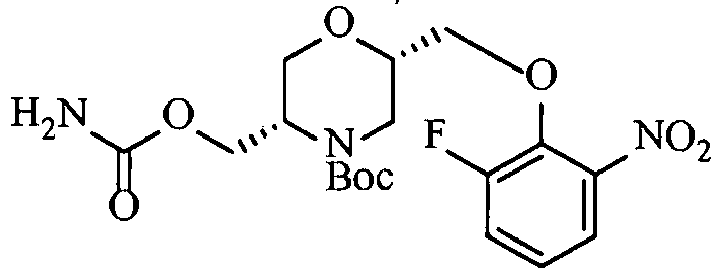
- To a solution of the product from step 3 (1.6 g, 4.1 mmol) in pyridine (12 mL) was added carbonyl diimidazole (2.0 g, 12.3 mmol) and the mixture was heated in a sealed tube at 60 °C for 2 h. The reaction mixture was cooled to ambient temperature and NH3 gas was bubbled into the solution for 5 min, and the mixture was heated in a sealed tube at 60 °C for 16 h. The reaction was cooled to ambient temperature and the solvent was concentrated under reduced pressure. The residue was purified on a 24 g SiO2 column using a gradient elution of 20-70% EtOAc in hexanes. Fractions containing product were combined and the solvents were removed under reduced pressure to provide the product (1.4 g) as a colorless oil. LC MS: RT = 3.60 min, M+H = 430 (6 min gradient).
-

- A solution of the product from step 4 (1.4 g, 3.3 mmol) was dissolved in ethyl acetate (50 mL) and the solution was de-gassed with a stream of nitrogen for 10 min. To the degassed solution was dded 5% palladium on charcoal (400 mg), and the mixture was stirred under a hydrogen atmosphere at ambient pressure for 16 h. The catalyst was removed by filtration through a celite pad, and the filter cake was washed with CH2Cl2 (200 mL). The filtrate solvents were removed under reduced pressure. The residue was purified on a 12 g SiO2 column using 20-50% EtOAc in hexanes to provide the product (700 mg) as a white solid. LC MS: RT = 3.49 min, M+H = 400 (6 min gradient).
- The title compound was prepared from the product of step 1 and the product of step 5 using the procedures given in steps 2-4 of Example 93. MS (ES) m/z = 617 (M+H)+.
-

-

- To a solution of (2R, 5R)-tert-butyl 2-[(E)-2-fluoro-6-nitrostyryl)-5-(hydroxymethyl)] morpholine-4-carboxylate (5 g, 13 mmol) from step 2 of Example 99 in pyridine (15 mL) was added carbonyl diimidazole (8.4 g, 52 mmol) and the mixture was heated in sealed tube at 60 °C for 2 h. The reaction mixture was cooled to ambient temperature, then purged with NH3 gas for 5 min and heated in a sealed tube at 60 °C for 16 h. The mixture was cooled to ambient temperature and the solvent was concentrated under reduced pressure. The residue was purified on an 80 g SiO2 column using gradient elution of 0-50% EtOAc in hexanes. Fractions containing product were combined and the solvents were removed under reduced pressure to give the product (5.50 g,) a pale yellow gum.
-

- A solution of the product from step 1 (5.5 g, 12.9 mmol) in EtOAc (50 mL) was de-gassed under a nitrogen atmosphere for 5 min. To the degassed solution was added 5% palladium on carbon (1.3 g) under a nitrogen atmosphere. The mixture was stirred under an atmosphere of hydrogen gas at ambient pressure for 16 h. The catalyst was removed by filtration through a celite pad and the filter cake was washed with EtOAc (100 mL). The filtrate solvent was removed under reduced pressure to give the product (4.80 g,) as an off-white solid. LC MS: RT= 2.37 min, M+H= 398 (5 min gradient).
- The title compound was prepared from (2S,3S)-2-azido-3-(3-fluorophenyl)-3-(4-fluorophenyl)propanoic acid (Example 117, step 1) and the product from step 2 using the procedures given in steps 2 and 3 of Example 93 and steps 1 and 2 of Example 91. MS (ES) m/z = 615 (M+H)+.
-

- The title compound was prepared from tert-Butyl (2R,5R)-2-[2-(3-{[N-(tert-butoxycarbonyl)-4-fluoro-β-(4-fluorophenyl)-L-phenylalanyl]amino}-5-fluoropyridin-4-yl)ethyl]-5-(hydroxymethyl)morpholine-4-carboxylate (Example 79, step 7) using the procedures given in Example 118, step 1 and Example 90, step 6. MS (ES) m/z = 558.5 (M+H)+.
-

- The title compound was prepared from (2S,3S)-2-azido-3-(3-fluorophenyl)-3-(4-fluorophenyl)propanoic acid (Example 117, step 1) and the product from step 2 of Example 118 using the procedures given in steps 2-4 of Example 93. MS (ES) m/z = 557 (M+H)+.
-

- The title compound was prepared from tert-butyl (2R,5R)-2-[2-(3-{[N-(tert-butoxycarbonyl)-4-fluoro-β-(4-fluorophenyl)-L-phenylalanyl]amino}-5-fluoropyridin-4-yl)ethyl]-5-(hydroxymethyl)morpholine-4-carboxylate (Example 79, step 7) and 1-amino-2-methylpropan-2-ol using the procedures described for Example 81 and step 2 of Example 91. MS (ES) m/z = 687.4 (M+H)+.
-

- The title compound was prepared from tert-butyl (2R,5R)-2-[2-(3-{[N-(tert-butoxycarbonyl)-4-fluoro-β-(4-fluorophenyl)-L-phenylalanyl]amino}-5-fluoropyridin-4-yl)ethyl]-5-(hydroxymethyl)morpholine-4-carboxylate (Example 79, step 7) and (S)-tetrahydro-2H-pyran-3-amine using the procedures described for Example 81. MS (ES) m/z = 641.4 (M+H)+.
-

- The title compound was prepared from tert-butyl (2R,5R)-2-[2-(3-{[N-(tert-butoxycarbonyl)-4-fluoro-β-(4-fluorophenyl)-L-phenylalanyl]amino}-5-fluoropyridin-4-yl)ethyl]-5-(hydroxymethyl)morpholine-4-carboxylate (Example 79, step 7) and (2-methyltetrahydrofuran-2-yl)methanamine using the procedures described for Example 81.
-

- The title compound was prepared from (2S,3R)-2-azido-3-(4-chloro-3-fluorophenyl)-3-(3-fluorophenyl)propanoic acid (Example 94, step 1) using the procedures described for Example 150, steps 4 and Example 151 using (R)-tetrahydro-2H-pyran-3-amine and Example 91, step 2. MS (ES) m/z = 733.5 (M+H)+.
-

- The title compound was prepared from (2R,3S)-2-azido-3-(3,5-difluorophenyl)-3-(4-fluorophenyl)propanoic acid (Example 90, step3) using the procedures described for Example 124. MS (ES) m/z = 718.5 (M+H)+.
-

- The title compound was prepared from tert-butyl (2R,5R)-2-[2-(3-{[N-(tert-butoxycarbonyl)-4-fluoro-β-(4-fluorophenyl)-L-phenylalanyl]amino}-5-fluoropyridin-4-yl)ethyl]-5-(hydroxymethyl)morpholine-4-carboxylate (Example 79, step 7) and (5-methylisoxazol-3-yl)methanamine using the procedures described for Example 81 and step 2 of Example 91. MS (ES) m/z = 710.5 (M+H)+.
-

-

- The title compound was prepared from tetrahydropyran-4-carboxaldehyde and 4-fluorophenylmagnesium bromide using the procedures given in steps 1-3 of Example 100, steps 6 and 7 of Example 89, and steps 1-3 of Example 90.
- The title compound was prepared from the product of step 1 and the product of step 4 of Example 89 using the procedures given in steps 2-4 of Example 93. MS (ES) m/z = 630 (M+H)+.
-

- The title compound was prepared from (2S,3R)-2-azido-3-(4-fluorophenyl)-3-(tetrahydro-2H-pyran-4-yl)propanoic acid (Example 1033, step 1) and the product of step 4 of Example 99 using the procedures given in steps 2-4 of Example 93. MS (ES) m/z = 629 (M+H)+.
-

-
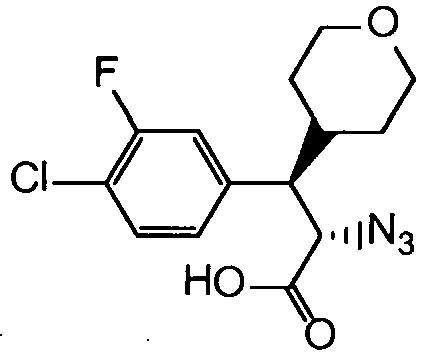
- The title compound was prepared from tetrahydropyran-4-carboxaldehyde and 4-chloro-3-fluorophenylmagnesium bromide using the procedures given in steps 1-3 of Example 100, steps 6 and 7 of Example 89, and steps 1-3 of Example 90.
- The title compound was prepared from the product of step 1 and the product of step 4 of Example 99 using the procedures given in steps 2 and 3 of Example 93 and steps 1 and 2 of Example 91. MS (ES) mlz = 721 (M+H)+.
-

- The title compound was prepared from (2S,3R)-2-azido-3-(4-fluorophenyl)-3-(tetrahydro-2H-pyran-4-yl)propanoic acid (Example 127, step 1) using the procedures given in step 2 of Example 129. MS (ES) m/z = 687 (M+H)+.
-

- The title compound was prepared from (2S,3R)-2-azido-3-(4-chloro-3-fluorophenyl)-3-(tetrahydro-2H-pyran-4-yl)propanoic acid (Example 1035, step 1) using the procedures and the product of step 4 of Example 99 using the procedures given in steps 2-4 of Example 93. MS (ES) m/z = 663 (M+H)+.
-

-

- The title compound was prepared from 5-fluoropyridine-3-carboxaldehyde and 4-chloro-3-fluorophenylmagnesium bromide using the procedures given in steps 3 and 4 of Example 100.
- The title compound was prepared from the product of step 1 and the product of step 4 of Example 99 using the procedures given in steps 2 and 3 of Example 93 and steps 1 and 2 of Example 91. MS (ES) m/z = 732 (M+H)+.
-

-

- The title compound was prepared from 2-trifluoromethylpyridine-5-carboxaldehyde and 4-fluorophenylmagnesium bromide using the procedures given in step 3 of Example 100 and steps 6 and 7 of Example 89.
- The title compound was prepared from the product of step 1 using the procedures given in steps 8 and 9 of Example 89. MS (ES) m/z = 676 (M+H)+.
-

-

- The title compound was prepared from 3-fluoropyridine-4-carboxaldehyde and 4-chlorophenylmagnesium bromide using the procedures given in step 3 and 4 of Example 100.
- The title compound was prepared from the product of step 1 and the product of step 4 from Example 99 using the procedures given in steps 2 and 3 of Example 93 and steps 1 and 2 of Example 91. MS (ES) m/z = 714 (M+H)+.
-

-

- The title compound was prepared from 3-fluoropyridine-5-carboxaldehyde and 3,4-difluorophenylmagnesium bromide using the procedures given in step 3 and 4 of Example 100.
- The title compound was prepared from the product of step 1 using the procedures given in steps 2 and 3 of Example 93 and steps 1 and 2 of Example 91. MS (ES) m/z = 717 (M+H)+.
-

- The title compound was prepared from (2S,3S)-2-azido-3-(4-chlorophenyl)-3-(3-fluoropyridin-4-yl)propanoic acid (Example 1040, step 1) and the product from step 4 of Example 99 using the procedures given in steps 2-4 of Example 93. MS (ES) m/z = 656 (M+H)+.
-

-

- The title compound was prepared from 3-fluoropyridine-5-carboxaldehyde and 4-chlorophenylmagnesium bromide using the procedures given in steps 3 and 4 of Example 100.
- The title compound was prepared from the product of step 1 and the product of step 4 of Example 99 using the procedures given in steps 2 and 3 of Example 93 and steps 1 and 2 of Example 91. MS (ES) m/z = 714 (M+H)+.
-

-

- The title compound was prepared from 3-fluoropyridine-4-carboxaldehyde and 4-fluorophenylmagnesium bromide using the procedures given in step 3 of Example 100 and steps 6 and 7 of Example 89.
- The title compound was prepared from the product of step 1 and the product of step 4 of Example 99 using the procedures given in steps 8 and 9 of Example 89. MS (ES) m/z = 625.5 (M+H)+.
-

-

- The title compound was prepared from 3-trifluoromethylpyridine-5-carboxaldehyde and 4-fluorophenylmagnesium bromide using the procedures using the procedures given in step 3 of Example 100 and steps 6 and 7 of Example 89.
- The title compound was prepared from the product of step 1 and the product of step 4 of Example 99 using the procedures given in steps 8 and 9 of Example 89. MS (ES) m/z = 675 (M+H)+.
-

-

- Boc2O (51 µl, 0.220 mmol) was added to a solution of 4-fluoro-β-(4-fluorophenyl)-N-(5-fluoro-4-{2-[(2R,5S)-5-({[(2,2,2-trifluoroethyl)carbamoyl]oxy}methyl)morpholin-2-yl]ethyl}pyridin-3-yl)-L-phenylalaninamide trihydrochloride (Example 79) (157 mg, 0.210 mmol) and triethylamine (146 µL, 1.05 mmol) in dichloromethane (1 mL) and the reaction stirred for 30 min at RT. The reaction was directly loaded onto a 12 g silica column and eluted with a gradient of 0-100% CHCl3 to 70:20:10 CHCl3/EtOAc/MeOH to afford the title compound (110 mg, 0.149 mmol) as a white solid.
-

- Isobutylchloroformate (3.7 µL, 0.028 mmol) was added to a solution of the product of step 1 (20 mg, 0.027 mmol) and triethylamine (19 µL, 0.135 mmol) in dichloromethane (1 mL) and the reaction stirred for 2.5 hours at RT. The reaction was directly loaded onto a 4g silica column and eluted with a gradient of 0-100% Hexanes to EtOAc to the title compound (14 mg, 0.013 mmol) as a white solid.
- 4M HCl in Dioxane (0.2 mL) was added directly to the product from step 2 (14 mg, 0.016 mmmol) and the reaction stirred at RT for I hour. The solvent was removed in vacuo and the residue was dissolved in MeOH and loaded onto a 400mg Porapak cartrdige (preconditioned with 5 mL of MeOH). The cartridge was washed with 10mL of MeOH, then the desired product was eluted with 10mL of 2M NH3 in MeOH. The solvent was removed in vacuo to afford 4-fluoro-β-(4-fluorophenyl)-N-(5-fluoro-4-{2-[(2R,5S)-5-({[(2,2,2-trifluoroethyl)carbamoyl]oxy}methyl)morpholin-2-yl]ethyl}pyridin-3-yl)-Nα-[(2-methylpropoxy)carbonyl]-L-phenylalaninamide (10 mg, 0.014 mmol) as a tan solid, LC MS: RT=1.94 min, M+H=740.4 (4 min gradient).
-

- The title compound was prepared using the procedures described for Example 140, steps 1-3, using trifluoroethyl chloroformate in step 2. MS (ES) m/z = 766.5 (M+H)+.
-

- The title compound was prepared using the procedures described for Example 140, steps 1-3, using 1-methylcyclopropanecarboxylic acid and EDC in step 2. MS (ES) m/z = 721.4 (M+H)+.
-

- The title compound was prepared using the procedures described for Example 85 using 3,3,3-trifluoropropanoic acid. MS (ES) m/z = 609.1 (M+H)+.
-
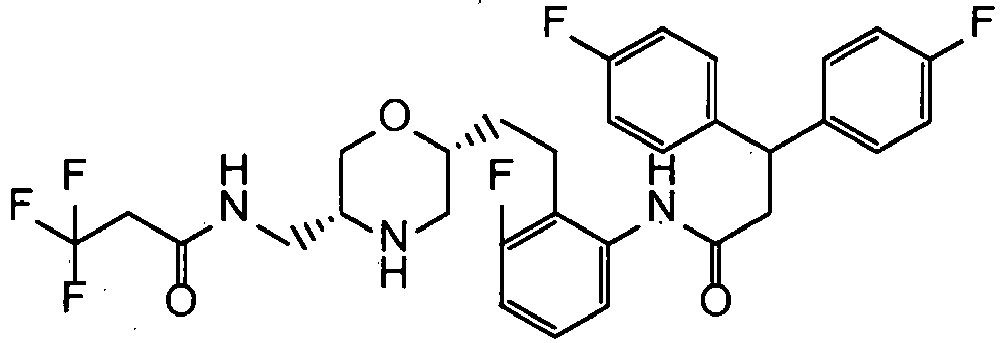
- The title compound was prepared using the procedures described for Example 87 using 3,3,3-trifluoropropanoic acid. MS (ES) m/z = 608.1 (M+H)+.
-

-

- To a solution of 2,5-difluoroaniline (0.56 g, 4.30 mmol) in THF (14.3 mL) was added DMAP (0.053 g, 0.430 mmol) and Boc2O (2.5 mL, 10.8 mmol). The contents were refluxed under nitrogen at 75 °C for 1 h, at which point LC/MS indicates that the reaction is complete. The solvent was evaporated to give di-tert-butyl (2,5-difluorophenyl)imidodicarbonate (1.48 g, 3.48 mmol) as a brown foam and taken on to the next step crude. MS (ESI): m/z = 218.2 (M+H-[t-Bu]2).
-

- Di-tert-butyl (2,5-difluorophenyl)imidodicarbonate (1.48 g, 4.49 mmol) was dissolved in DCM (15.0 mL) at rt. TFA (0.48 mL, 6.28 mmol) was added to the reaction and the contents were stirred for 1 h. LC/MS at this time shows that starting material has been consumed. The solution was then washed with saturated aqueous sodium bicarbonate. The organics were dried over MgSO4 filtered and concentrated. The crude product was purified on silica gel, eluting with 0-50% EtOAc in hexanes over 32 minutes to afford the title compound (758 mg, 2.88 mmol) as a pale yellow oil. MS (ESI): m/z = 174.2 (M+H-[t-Bu]).
-

- nBuLi (5.67 mL, 14.2 mmol) was added to a solution of tert-butyl (2,5-difluorophenyl)carbamate (1.08 g, 4.73 mmol) and TMEDA (2.14 mL, 14.2 mmol) in THF (21.6 mL) at -78 °C over 20 minutes, ensuring the internal temperature remained below -70°C. The resulting solution was stirred at -78 °C for 1 h. Iodine (3.60 g, 14.2 mmol) in THF (10 mL) was added dropwise over 30 min, also ensuring the internal temperature remained below -70°C. The resulting reaction was stirred for 1 h at -78 °C, The reaction was quenched at -78 °C with water and the reaction warmed to room temperature. 10% Sodium thiosulfate was added until the iodine color dissipated and the mixture was then extracted with ethyl acetate (3 x 50mL). The combined organic fractions were dried (MgSO4), filtered and concentrated. The crude material was purified on silica gel, eluting 0-60% EtOAc in hexanes over 28 minutes to afford tert-butyl (3,6-difluoro-2-iodophenyl)carbamate (1.14 g, 3.20 mmol) as a white crystalline solid. MS (ESI): m/z = 300.2 (M+H-[t-Bu]).
-

- 4M HCl (7.60 mL, 30.4 mmol) in dioxane was added to a solution of tert-butyl (3,6-difluoro-2-iodophenyl)carbamate (1.08g, 3.04 mmol) in THF (7.60 ml) at room temperature and then stirred overnight. The solvent was removed in vacuo, and then the contents were partitioned between DCM (3 x 50mL) and sat'd aqueous sodium bicarbonate. The organics were dried over MgSO4, filtered and concentrated. The crude material was purified on silica gel, eluting 0-50% EtOAc in hexanes over 16 minutes to afford 3,6-difluoro-2-iodoaniline (373 mg, 1.46 mmol) as a tan oil. MS (ESI): m/z = 256.2 (M+H-Boc).
- The title compound was prepared from the product of step 4 using the procedures described in Example 130. MS (ES) m/z = 733.5 (M+H)+.
Table 1: The following examples can be prepared using the procedures described above. Exa mple Structure IUPAC Name Mass [M+H]+ 146 
[(3S,6R)-6-(2-{3-[(3,3-diphenylpropanoyl)amino]-5-fluoropyridin-4-yl}ethyl)morpholin-3-yl]methyl (2,2,2-trifluoroethyl)carbamate 589.2 147 
{(3S,6R)-6-[2-(2-{[(3S)-3-(3,5-difluorophenyl)-3-(4-fluorophenyl)propanoyl]amin o}-6-fluorophenyl)ethyl]morpholi n-3-yl}methyl (2,2,2-trifluoroethyl)carbamate 642.2 148 
{(3S,6R)-6-[2-(3-{[(3R)-3-cyclohexyl-3-(4-fluorophenyl)propanoyl]amin o}-5-fluoropyridin-4-yl)ethyl]morpholin-3-yl}methyl (2,2,2-trifluoroethyl)carbamate 613.3 149 
{(3S,6R)-6-[2-(3-{[(3S)-3-(2,5-difluorophenyl)-3-(4-fluorophenyl)propanoyl]amin o]-5-fluoropyridin-4-yl)ethyl]morpholin-3-yl}methyl (2,2,2-trifluoroethyl)carbamate 643.2 150 
{(3S,6R)-6-[2-(2-{[(3R)-3-(4-chlorophenyl)-3-phenylpropanoyl]amino}-6-fluorophenyl)ethyl]morpholi n-3-yl}methyl (2,2,2-trifluoroethyl)carbamate 622.2 151 
{(3S,6R)-6-[2-(2-fluoro-6-{[(3S)-3-(4-fluorophenyl)-3-(4-methoxyphenyl)propanoyl]a mino}phenyl)ethyl]morpholi n-3-yl}methyl (2,2,2-trifluoroethyl)carbamate 636.2 152 
[(3S,6R)-6-(2-{2-[(3,3-diphenylpropanoyl)amino]-6-fluorophenyl}ethyl)morpholi n-3-yl]methyl carbamate 506.2 153 
{(3S,6R)-6-[2-(2-{[(3S)-3-(2,3-difluorophenyl)-3-(4-fluorophenyl)propanoyl]amin o}-6-fluorophenyl)ethyl]morpholi n-3-yl}methyl (2,2,2-trifluoroethyl)carbamate 642.2 154 
{(3S,6R)-6-[2-(2-{[(3R)-3-(4-chlorophenyl)-3-(4-fluorophenyl)propanoyl]amin o}-6-fluorophenyl)ethyl]morpholi n-3-yl}methyl (2,2,2-trifluoroethyl)carbamate 640.2 155 
{(3S,6R)-6-[2-(2-{[(3R)-3-(4-bromophenyl)-3-(4-fluorophenyl)propanoyl]amin o}-6-fluorophenyl)ethyl]morpholi n-3-yl}methyl (2,2,2-trifluoroethyl)carbamate 684.1 156 
{(3S,6R)-6-[2-(2-{[(3S)-3-(2,4-difluorophenyl)-3-(4-fluorophenyl)propanoyl]amin o}-6-fluorophenyl)ethyl]morpholi n-3-yl}methyl carbamate 560.2 157 
{(3S,6R)-6-[2-(2-fluoro-6-{[(3S)-3-(4-fluorophenyl)-3-(3-fluoropyridin-4-yl)propanoyl]amino}phenyl) ethyl]morpholin-3-yl}methyl carbamate 543.2 158 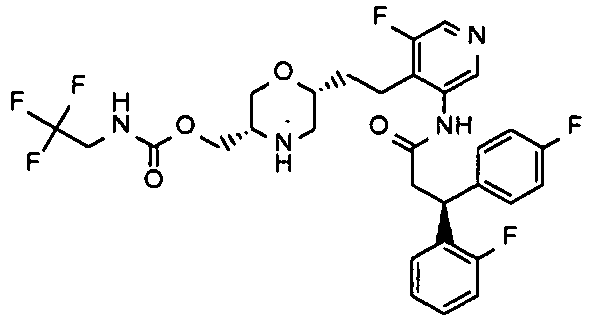
{(3S,6R)-6-[2-(3-fluoro-5-{[(3S)-3-(2-fluorophenyl)-3-(4-fluorophenyl)propanoyl]amin o}pyridin-4-yl)ethyl]morpholin-3-yl}methyl (2,2,2-trifluoroethyl)carbamate 625.2 159 
[(3S,6R)-6-{2-[2-fluoro-6-({(3R)-3-(4-fluorophenyl)-3-[4-(trifluoromethoxy)phenyl]pro panoyl}amino)phenyl]ethyl} morpholin-3-yl]methyl (2,2,2-trifluoroethyl)carbamate 690.2 160 
{(3S,6R)-6-[2-(2-{[(3S)-3-(3-cyanophenyl)-3-(4-fluorophenyl)propanoyl]amin o}-6-fluorophenyl)ethyl]morpholi n-3-yl}methyl (2,2,2-trifluoroethyl)carbamate 631.2 161 
{(3S,6R)-6-[2-(2-fluoro-6-{[(3R)-3-(4-fluorophenyl)-3-(5-fluoropyridin-3-yl)propanoyl]amino}phenyl) ethyl]morpholin-3-yl}methyl (2,2,2-trifluoroethyl)carbamate 625.2 162 
{(3S,6R)-6-[2-(2-fluoro-6-{[(3R)-3-phenyl-3-pyridin-4-ylpropanoyl]amino}phenyl)et hyl]morpholin-3-yl}methyl (2,2,2-trifluoroethyl)carbamate 589.2 163 
{(3S,6R)-6-[2-(2-{[(3S)-4-cyclopropyl-3-phenylbutanoyl]amino}-6-fluorophenyl)ethyl]morpholin-3-yl}methyl (2,2,2-trifluoroethyl)carbamate 566.3 164 
[(3S,6R)-6-{2-[2-({(3S)-3-(4-chlorophenyl)-3-[3-(methylsulfonyl)phenyl]prop anoyl}amino)-6-fluorophenyl]ethyl}morpholi n-3-yl]methyl (2,2,2-trifluoroethyl)carbamate 700.2 165 
{(3S,6R)-6-[2-(3-{[3,3-bis(4-fluorophenyl)propanoyl]amin o}-5-fluoropyridin-4-yl)ethyl]morpholin-3-yl}methyl[1-(hydroxymethyl)propyl]carba mate 615.3 166 
{(3S,6R)-6-[2-(3-{[3,3-bis(4-fluorophenyl)propanoyl]amin o}-5-fluoropyridin-4-yl)ethyl]morpholin-3-yl}methyl [(2-methyltetrahydrofuran-2-yl)methyl]carbamate 641.3 167 
{(3S,6R)-6-[2-(3-{[3,3-bis(4-fluorophenyl)propanoyl]amin o}-5-fluoropyridin-4-yl)ethyl]morpholin-3-yl}methyl [2,2,2-trifluoro-1-(hydroxymethyl)ethyl] carba mate 655.2 168 
{(3S,6R)-6-[2-(3- {[3,3-bis(4-fluorophenyl)propanoyl]amin o}-5-fluoropyridin-4-yl)ethyl]morpholin-3-yl}methyl [2-(phenylamino)ethyl]carbamat e 662.3 169 
{(3S,6R)-6-[2-(3-{[3,3-bis(4-fluorophenyl)propanoyl]amin o}-5-fluoropyridin-4-yl)ethyl]morpholin-3-yl}methyl (tetrahydrofuran-2-ylmethyl)carbamate 627.3 170 
{(3S,6R)-6-[2-(3- {[3,3-bis(4-fluorophenyl)propanoyl]amin o}-5-fluoropyridin-4-yl)ethyl]morpholin-3-yl}methyl (2-phenoxyethyl)carbamate 663.3 171 
{(3S,6R)-6-[2-(3-{[3,3-bis(4-fluorophenyl)propanoyl]amin o}-5-fluoropyridin-4-yl)ethyl]morpholin-3-yl}methyl[1-(tetrahydrofuran-2-yl)ethyl]carbamate 641.3 172 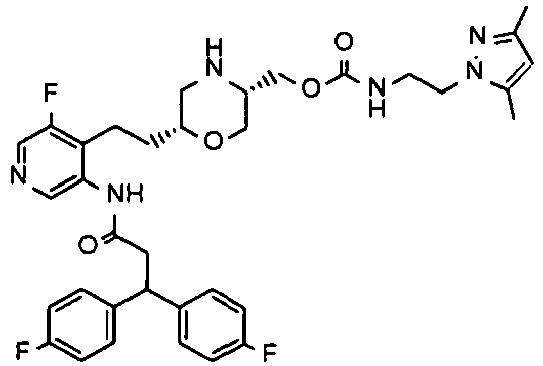
{(3S,6R)-6-[2-(3-{[3,3-bis(4-fluorophenyl)propanoyl]amin o}-5-fluoropyridin-4-yl)ethyl]morpholin-3-yl}methyl [2-(3,5-dimethyl-1H-pyrazol-1-yl)ethyl] carbamate 665.3 173 
{(3S,6R)-6-[2-(3-{[3,3-bis(4-fluorophenyl)propanoyl]amin o}-5-fluoropyridin-4-yl)ethyl]morpholin-3-yl}methyl tetrahydrofuran-3-ylcarbamate 613.3 174 
{(3S,6R)-6-[2-(3-{[3,3-bis(4-fluorophenyl)propanoyl]amin o}-5-fluoropyridin-4-yl)ethyl]morpholin-3-yl}methyl [(5-ethyl-1,2,4-oxadiazol-3-yl)methyl]carbamate 653.3 175 
{(3S,6R)-6-[2-(3-{[3,3-bis(4-fluorophenyl)propanoyl]amin o}-5-fluoropyridin-4-yl)ethyl]morpholin-3-yl}methyl (1-cyclopropyl-2-hydroxyethyl)carbamate 627.3 176 
{(3S,6R)-6-[2-(3-{[3,3-bis(4-fluorophenyl)propanoyl]amin o}-5-fluoropyridin-4-yl)ethyl]morpholin-3-yl}methyl (4-fluorobenzyl)carbamate 651.3 177 
{(3S,6R)-6-[2-(3-{[3,3-bis(4-fluorophenyl)propanoyl]amin o}-5-fluoropyridin-4-yl)ethyl]morpholin-3-yl}methyl methylcarbamate 557.2 178 
{(3S,6R)-6-[2-(2-{[(3S)-3-(2-cyanopyridin-3-yl)-3-(4-fluorophenyl)propanoyl] amin 632.2 o}-6-fluorophenyl)ethyl]morpholi n-3-yl}methyl (2,2,2-trifluoroethyl)carbamate 179 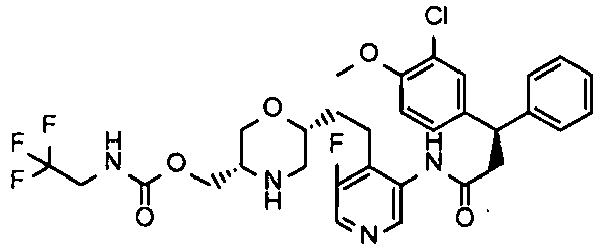
{(3S,6R)-6-[2-(3-{[(3R)-3-(3-chloro-4-methoxyphenyl)-3-phenylpropanoyl]amino}-5-fluoropyridin-4-yl)ethyl]morpholin-3-yl}methyl (2,2,2-trifluoroethyl)carbamate 653.2 180 
[(3S,6R)-6-{2-[3-fluoro-5-({(3S)-3-(4-fluorophenyl)-3-[2-(trifluoromethyl)phenyl]prop anoyl}amino)pyridin-4-yl]ethyl}morpholin-3-yl]methyl (2,2,2-trifluoroethyl)carbamate 675.2 181 
[(3S,6R)-6-{2-[3-fluoro-5-({(3R)-3-(4-fluorophenyl)-3-[4-(2-methoxyethoxy)phenyl]propa noyl}amino)pyridin-4-yl]ethyl}morpholin-3-yl]methyl (2,2,2-trifluoroethyl)carbamate 681.3 182 
{(3S,6R)-6-[2-(3-[(3R)-3-(4-chloro-3-fluorophenyl)-3-(4-fluorophenyl)propanoyl]amin o}-5-fluoropyridin-4-yl)ethyl]morpholin-3-yl}methyl (2,2,2-trifluoroethyl)carbamate 659.2 183 
{(3S,6R)-6-[2-(2-fluoro-6-{[(3S)-3-(4-fluorophenyl)-3-thiophen-3-ylpropanoyl]amino}phenyl)et hyl]morpholin-3-yl}methyl (2,2,2-trifluoroethyl)carbamate 612.2 184 
[(3S,6R)-6-{2-[3-fluoro-5-({(3S)-3-(4-fluorophenyl)-3-[5-(trifluoromethyl)pyridin-3-yl]propanoyl}amino)pyridin-4-yl]ethyl}morpholin-3-yl]methyl (2,2,2-trifluoroethyl)carbamate 676.2 185 
{(3S,6R)-6-[2-(3-{[3,3-bis(4-fluorophenyl)propanoyl]amin o}-5-fluoropyridin-4-yl)ethyl]morpholin-3-yl}methyl [(2R)-2-hydroxy-2,3-dihydro-1H-inden-1-yl]carbamate 675.3 186 
{(3S,6R)-6-[2-(3-{[3,3-bis(4-fluorophenyl)propanoyl]amin o}-5-fluoropyridin-4-yl)ethyl]morpholin-3-yl}methyl[2-methyl-1-(1-methylethyl)propyl]carbamat e 641.3 187 
{(3S,6R)-6-[2-(3-{[3,3-bis(4-fluorophenyl)propanoyl]amin o}-5-fluoropyridin-4-yl)ethyl]morpholin-3-yl}methyl [(2S)-2-carbamoylcyclohexyl]carbam ate 668.3 188 
{(3S,6R)-6-[2-(3-{[3,3-bis(4-fluorophenyl)propanoyl]amin o}-5-fluoropyridin-4-yl)ethyl]morpholin-3-yl}methyl (isoxazol-5-ylmethyl)carbamate 624.2 Table 2: The following examples can be prepared using the procedures described above. Example Structure IUPAC Name Mass [M+H]+ 189 
2-cyclopropyl-N-(5-fluoro-4-{2-[(2R,5S)-5-({[(2,2,2-trifluoroethyl)carbamoyl]oxy }methyl)morpholin-2-yl]ethyl}pyridin-3-yl)-L-phenylalaninamide 568.3 190 
{(3S,6R)-6-[2-(3-{[(2S)-2-amino-3-naphthalen-1-ylpropanoyl]amino}-5-fluoropyridin-4-yl)ethyl]morpholin-3-yl}methyl (2,2,2-trifluoroethyl)carbamate (non-preferred name) 578.2 191 
{(3S,6R)-6-[2-(3-{[(2S)-2-amino-3-naphthalen-1-ylpropanoyl]amino}-5-fluoropyridin-4-yl)ethyl]morpholin-3-yl}methyl(4-fluorobenzyl)carbamate (non-preferred name) 604.3 192 
N-(2-{2-[(2R,5S)-5-({[(2,2-difluoroethyl)carbamoyl]oxy }methyl)morpholin-2-yl]ethyl}-4-fluorophenyl)-β-phenyl-L-phenylalaninamide 585.3 193 
4-fluoro-β-(4-fluorophenyl)-N-(3-fluoro-2-{(1S)-1-[(2S,5S)-5-({[(2,2,2-trifluoroethyl)carbamoyl]oxy }methyl)morpholin-2-yl]ethoxy}phenyl)-L-phenylalaninamide 655.2 194 
4-fluoro-β-(4-fluorophenyl)-N-(5-fluoro-4-{2-[(2R,5S)-5-({[(1-pyridin-4-ylcyclobutyl)carbamoyl]oxy} methyl)morpholin-2-yl]ethyl}pyridin-3-yl)-L-phenylalaninamide 689.3 195 
4-fluoro-N-(3-fluoro-2-{(1S)-1-[(2S,5S)-5-({[(4-fluorobenzyl)carbamoyl]oxy } methyl)morpholin-2-yl]ethoxy}phenyl)-β-(4-fluorophenyl)-L-phenylalaninamide 681.3 196 
N-(4-fluoro-2-{2-[(2R,5S)-5-({[(2,2,2-trifluoroethyl)carbamoyl]oxy }methyl)morpholin-2-yl]ethyl}phenyl)-β-phenyl-L-phenylalaninamide 603.3 197 
{(3S,6R)-6-[2-(3-fluoro-5-{[4-fluoro-β-(4-fluorophenyl)-L-phenylalanyl]amino}pyridin-4-yl)ethyl]morpholin-3-yl}methyl morpholine-4-carboxylate 628.3 198 
4-fluoro-β-(4-fluorophenyl)-N-(3-fluoro-2-{2-[(2R,5S)-5-({[(pyridin-4-ylmethyl)carbamoyl]oxy}met hyl)morpholin-2-yl]ethyl}phenyl)-L-phenylalaninamide 648.3 199 
(βS)-N-(3-fluoro-2-{2-[(2R,5S)-5-({[(4-fluorobenzyl)carbamoyl]oxy }methyl)morpholin-2-yl]ethyl}phenyl)-β-propyl-L-phenylalaninamide 595.3 200 
4-fluoro-β-(4-fluorophenyl)-N-(2-fluoro-6-{[(2S,5S)-5-({[(2,2,2-trifluoroethyl)carbamoyl]oxy }methyl)morpholin-2-yl]methoxy}phenyl)-L-phenylalaninamide 641.2 201 
4-fluoro-β-(4-fluorophenyl)-N-(3-fluoro-2-{2-[(2R,5S)-5-({[(pyridin-3-ylmethyl)carbamoyl]oxy}met hyl)morpholin-2-yl]ethyl}phenyl)-L-phenylalaninamide 648.3 202 
4-fluoro-β-(4-fluorophenyl)-N-(5-fluoro-4-{2-[(2R,5S)-5-({[(2,2,2-trifluoroethyl)carbamoyl]oxy }methyl)morpholin-2-yl]ethyl}pyridin-3-yl)-Nα-methyl-L-phenylalaninamide 654.3 203 
4-fluoro-β-(4-fluorophenyl)-N-(5-fluoro-4-{[(2S,5S)-5-({[(2,2,2-trifluoroethyl)carbamoyl]oxy } methyl)morpholin-2-yl]methoxy}pyridin-3-yl)-L-phenylalaninamide 642.2 204 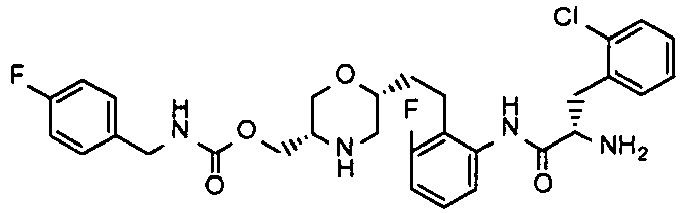
2-chloro-N-(3-fluoro-2-{2-[(2R,5S)-5-({[(4-fluorobenzyl)carbamoyl]oxy } methyl)morpholin-2-yl]ethyl}phenyl)-L-phenylalaninamide 587.2 205 
4-fluoro-N-(5-fluoro-4-{2-[(2R,5S)-5-{[(methylcarbamoyl)oxy]met hyl}morpholin-2-yl]ethyl}pyridin-3-yl)-β-(4-fluorophenyl)-L-phenylalaninamide 572.2 206 
N-[4-({(2S,5S)-5-[(carbamoyloxy)methyl]mor pholin-2-yl}methoxy)-5-fluoropyridin-3-yl]-4-fluoro-β-(4-fluorophenyl)-L-phenylalaninamide 560.2 207 
N-(4-{2-[(2R,4S)-5-{[(ethylcarbamoyl)oxy]meth yl}morpholin-2-yl]ethyl}-5-fluoropyridin-3-yl)-4-fluoro-β-(4-fluorophenyl)-L-phenylalaninamide 586.3 208 
4-fluoro-β-(4-fluorophenyl)-N-(5-fluoro-4-{2-[(2R,5S)-5-({[(tetrahydro-2H-pyran-4-ylmethyl)carbamoyl]oxy}met hyl)morpholin-2-yl]ethyl}pyridin-3-yl)-L-phenylalaninamide 656.3 209 
N-[4-(2-{(2R,5S)-5-[({[(1,1-dioxidotetrahydrothiophen-3-yl)methyl]carbamoyl}oxy)m ethyl]morpholin-2-yl}ethyl)-5-fluoropyridin-3-yl]-4-fluoro-β-(4-fluorophenyl)-L-phenylalaninamide 690.3 210 
4-fluoro-N-[3-fluoro-2-({(2S,5S)-5-[({[(1S)-1-(4-fluorophenyl)ethyl]carbamoy 1}oxy)methyl]morpholin-2-yl}methoxy)phenyl]-β-(4-fluorophenyl)-L-phenylalaninamide 681.3 211 
4-fluoro-N-[5-fluoro-4-(2-{(2R,5S)-5-[({[(3R,4R)-4-fluorotetrahydrofuran-3-yl]carbamoyl}oxy)methyl]m orpholin-2-yl}ethyl)pyridin-3-yl]-β-(4-fluorophenyl)-L-phenylalaninamide 646.3 212 
4-fluoro-N-[3-fluoro-2-(2-{(2R,5S)-5-[({[(1S)-1-(4-fluorophenyl)ethyl]carbamoy l}oxy)methyl]morpholin-2-yl}ethyl)phenyl]-β-(4-fluorophenyl)-L-phenylalaninamide 679.3 213 
4-fluoro-β-(4-fluorophenyl)-N-(5-fluoro-4-{2-[(2R,5S)-5-({[(tetrahydro-2H-pyran-2-ylmethyl)carbamoyl]oxy}met hyl)morpholin-2-yl]ethyl}pyridin-3-yl)-L-phenylalaninamide 656.3 214 
4-fluoro-β-(4-fluorophenyl)-N-(5-fluoro-4-{2-[(2R,5S)-5-({[(1-pyridin-2-ylcyclopropyl)carbamoyl]oxy }methyl)morpholin-2-yl]ethyl}pyridin-3-yl)-L-phenylalaninamide 675.3 215 
4-fluoro-β-(4-fluorophenyl)-N-[5-fluoro-4-(2-{(2R,5S)-5-[({[(2R)-tetrahydrofuran-2-ylmethyl] carbamoyl}oxy)met hyl]morpholin-2-yl}ethyl)pyridin-3-yl]-L-phenylalaninamide 642.3 216 
4-fluoro-β-(4-fluorophenyl)-N-[5-fluoro-4-(2-{(2R,5S)-5-[({[(1R)-1-(trifluoromethyl)propyl]carba moyl} oxy)methyl]morpholin -2-yl}ethyl)pyridin-3-yl]-L-phenylalaninamide 668.3 217 
N-(4-{2-[(2R,5S)-5-({[(3,3-difluorocyclobutyl)carbamoy l]oxy}methyl)morpholin-2-yl]ethyl}-5-fluoropyridin-3-yl)-4-fluoro-β-(4-fluorophenyl)-L-phenylalaninamide 648.3 218 
4-fluoro-N-(5-fluoro-4-{2-[(2R,5S)-5-({[(2-hydroxy-1,1-dimethylethyl)carbamoyl]oxy }methyl)morpholin-2-yl]ethyl}pyridin-3-yl)-β-(4-fluorophenyl)-L-phenylalaninamide 630.3 219 
(βR)-β-(4-fluorophenyl)-N-(3-fluoro-2- {2-[(2R,5S)-5-({[(2,2,2-trifluoroethyl)carbamoyl]oxy }methyl)morpholin-2-yl]ethyl}phenyl)-O-(trifluoromethyl)-L-tyrosinamide 705.2 220 
4-fluoro-N-(3-fluoro-2-{2-[(2R,5S)-5-{[({(1R)-1-[4-fluoro-2-(trifluoromethyl)phenyl]ethyl }carbamoyl)oxy]methyl}mor pholin-2-yl]ethyl}phenyl)-β-(4-fluorophenyl)-L-phenylalaninamide 747.3 221 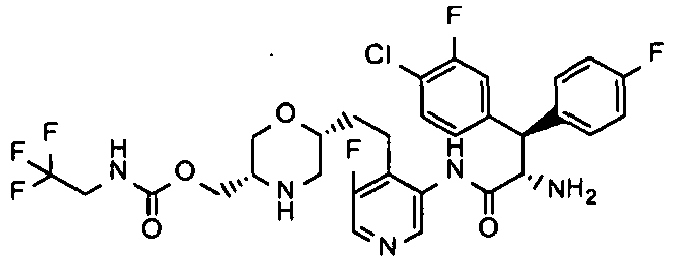
(βR)-β-(4-chloro-3-fluorophenyl)-4-fluoro-N-(5-fluoro-4- {2-[(2R,5S)-5-({[(2,2,2-trifluoroethyl)carbamoyl]oxy }methyl)morpholin-2-yl]ethyl}pyridin-3 -yl)-L-phenylalaninamide 674.2 222 
4-fluoro-N-(3-fluoro-2-{2-[(2R,5S)-5-({[(2-phenoxyethyl)carbamoyl]oxy }methyl)morpholin-2-yl]ethyl}phenyl)-β-(4-fluorophenyl)-L-phenylalaninamide 677.3 223 
4-fluoro-β-(4-fluorophenyl)-N-(3-fluoro-2-{2-[(2R,5S)-5-{[(tetrahydro-2H-pyran-4-ylcarbamoyl)oxy]methyl}mo rpholin-2-yl]ethyl}phenyl)-L-phenylalaninamide 641.3 224 
(βS)-β-(4-fluorophenyl)-N-(5-fluoro-4-{2-[(2R,5S)-5-({[(2,2,2-trifluoroethyl)carbamoyl]oxy }methyl)morpholin-2-yl]ethyl}pyridin-3-yl)-4-pyridin-3-yl-L-phenylalaninamide 699.3 225 
(βS)-N-(5-fluoro-4-{2-[(2R,5R)-5-(hydroxymethyl)morpholin-2-yl]ethyl}pyridin-3-yl)-β-quinolin-4-yl-D-phenylalaninamide 530.3 226 
4-fluoro-β-(4-fluorophenyl)-N-(3-methyl-2-{2-[(2R,5S)-5-({[(2,2,2-trifluoroethyl)carbamoyl]oxy }methyl)morpholin-2-yl]ethyl}phenyl)-L-phenylalaninamide 635.3 227 
(βR)-N-(3-fluoro-2-{2-[(2R,5S)-5-({[(2,2,2-trifluoroethyl)carbamoyl]oxy }methyl)morpholin-2-yl]ethyl}phenyl)-O,β-diphenyl-L-tyrosinamide 695.3 228 
(βR)-N-(3-fluoro-2-{2-[(2R,5S)-5-({[(2,2,2-trifluoroethyl)carbamoyl]oxy }methyl)morpholin-2-yl]ethyl}phenyl)-β-propyl-L-phenylalaninamide 569.3 229 
4-fluoro-N-(5-fluoro-4-(2-[(2R,5S)-5-({[(1-methylpyrrolidin-3-yl)carbamoyl]oxy}methyl)m orpholin-2-yl]ethyl}pyridin-3-yl)-β-(4-fluorophenyl)-L-phenylalaninamide 641.3 230 
(βS)-β-(4-fluorophenyl)-N-(3-fluoro-2-{2-[(2R,5S)-5-({[(2,2,2-trifluoroethyl)carbamoyl]oxy }methyl)morpholin-2-yl]methyl}phenyl)-O-phenyl-L-tyrosinamide 713.3 231 
(βS)-β-(4-fluorophenyl)-N-(3-fluoro-2-{2-[(2R,5S)-5-({[(2,2,2-trifluoroethyl)carbamoyl]oxy }methyl)morpholin-2-yl]ethyl]phenyl)-O-(trifluoromethyl)-L-tyrosinamide 705.2 232 
N-[3-fluoro-2-({(2S,5R)-5-[2-(methylsulfonyl)ethyl]morph olin-2-yl}methoxy)phenyl]-β-phenyl-L-phenylalaninamide 556.2 233 
4-fluoro-β-(4-fluorophenyl)-N-(5-fluoro-4-{2-[(2R,5S)-5-({[(2-pyrrolidin-1-ylethyl)carbamoyl]oxy}meth yl)morpholin-2-yl]ethyl}pyridin-3-yl)-L-phenylalaninamide 655.3 234 
β-phenyl-N-[2-{2-[(2R,5S)-5-({[(2,2,2-trifluoroethyl)carbamoyl]oxy } methyl)morpholin-2-yl]ethyl}-3-(trifluoromethyl)phenyl]-L-phenylalaninamide 653.3 235 
4-fluoro-N-(5-fluoro-4-{2-[(2R,5S)-5-{[({[(2S)-5-oxopyrrolidin-2-yl]methyl}carbamoyl)oxy]m ethyl}morpholin-2-yl]ethyl}pyridin-3-yl)-β-(4-fluorophenyl)-L-phenylalaninamide 655.3 236 
(βR)-N-(3-fluoro-2-{2-[(2R,5S)-5-({[(2,2,2-trifluoroethyl)carbamoyl]oxy }methyl)morpholin-2-yl]ethyl}phenyl)-β-phenyl-O-(trifluoromethyl)-L-tyrosinamide 687.2 237 
N-(2-{2-[(2R,5S)-5-({[(2,2-difluoroethyl)carbamoyl]oxy }methyl)morpholin-2-yl]ethyl}-5-fluorophenyl)-β-phenyl-L-phenylalaninamide 585.3 238 
(βR)-N-(5-fluoro-4-{2-[(2R,5S)-5-({[(2,2,2-trifluoroethyl)carbamoyl]oxy }methyl)morpholin-2-yl]ethyl}pyridin-3-yl)-β-phenyl-O-(trifluoromethyl)-L-tyrosinamide 688.2 239 
{(3S,6R)-6-[2-(3-fluoro-5-{[4-fluoro-β-(4-fluorophenyl)-L-phenylalanyl]amino}pyridin-4-yl)ethyl]morpholin-3-yl}methyl (isoquinolin-3-ylmethyl)carbamate 699.3 240 
4-fluoro-N-[5-fluoro-4-(2-{(2R,5S)-5-[({[(2-oxo-1,3-oxazolidin-5-yl)methyl]carbamoyl}oxy)m ethyl]morpholin-2-yl}ethyl)pyridin-3-yl]-β-(4-fluorophenyl)-L-phenylalaninamide 657.3 241 
(βR)-N-(3-fluoro-2-{2-[(2R,5S)-5-({[(2,2,2-trifluoroethyl)carbamoyl]oxy }methyl)morpholin-2-yl]ethyl}phenyl)-β-naphthalen-2-yl-L-phenylalaninamide 653.3 242 
4-fluoro-N-(5-fluoro-4-{2-[(2R,5S)-5-({[(3H-imidazo[4,5-c]pyridin-2-ylmethyl)carbamoyl]oxy}met 689.3 hyl)morpholin-2-yl]ethyl}pyridin-3-yl)-β-(4-fluorophenyl)-L-phenylalaninamide 243 
{(3S,6R)-6-[2-(3-fluoro-5-{[4-fluoro-β-(4-fluorophenyl)-L-phenylalanyl]amino}pyridin-4-yl)ethyl]morpholin-3-yl}methyl(quinolin-2-ylmethyl)carbamate 699.3 244 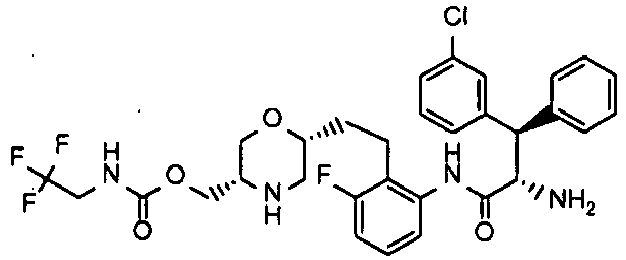
(βR)-3-chloro-N-(3-fluoro-2-{2-[(2R,5S)-5-({[(2,2,2-trifluoroethyl)carbamoyl]oxy }methyl)morpholin-2-yl]ethyl}phenyl)-β-phenyl-L-phenylalaninamide 637.2 245 
N-(3,5-difluoro-2-{[(2S,5S)-5-({[(2,2,2-trifluoroethyl)carbamoyl]oxy }methyl)morpholin-2-yl]methoxy}phenyl)-4-fluoro-β-(4-fluorophenyl)-L-phenylalaninamide 659.2 246 
(βS)-β-(4-fluorophenyl)-N-(5-fluoro-4- {2-[(2R,5S)-5-({[(2,2,2-trifluoroethyl)carbamoyl]oxy }methyl)morpholin-2-yl]ethyl}pyridin-3-yl)-O-(trifluoromethyl)-L-tyrosinamide 706.2 247 
N-(3,5-difluoro-2-{2-[(2R,5S)-5-({[(2,2,2-trifluoroethyl)carbamoyl]oxy }methyl)morpholin-2-yl]ethyl}phenyl)-4-fluoro-β-(4-fluorophenyl)-L-phenylalaninamide 657.2 248 
N-(4-{2-[(2R,5S)-5-({[(2-ethoxyethyl)carbamoyl]oxy} methyl)morpholin-2-yl]ethyl}-5-fluoropyridin-3-yl)-4-fluoro-β-(4-fluorophenyl)-L-phenylalaninamide 630.3 249 
(βS)-N-(5-fluoro-4-{2-[(2R,5R)-5-(hydroxymethyl)morpholin-2-yl]ethyl}pyridin-3-yl)-β-quinolin-4-yl-L-phenylalaninamide 530.3 250 
(βR)-β-(4-fluorophenyl)-N-(5-fluoro-4-{2-[(2R,5S)-5-({[(2,2,2-trifluoroethyl)carbamoyl]oxy } methyl)morpholin-2-yl]ethyl}pyridin-3-yl)-O-methyl-L-tyrosinamide 652.3 251 
(βS)-3,5-difluoro-β-(4-fluorophenyl)-N-(3-fluoro-2-{2-[(2R,5S)-5-({[(2,2,2-trifluoroethyl)carbamoyl]oxy }methyl)morpholin-2-yl]ethyl}phenyl)-L-phenylalaninamide 657.2 252 
4-fluoro-N-(5-fluoro-4-{2-[(2R,5S)-5-({[(1-methyl-2-oxopyrrolidin-3-yl)carbamoyl]oxy}methyl)m orpholin-2-yl]ethyl}pyridin-3-yl)-β-(4-fluorophenyl)-L-phenylalaninamide 655.3 253 
4-fluoro-β-(4-fluorophenyl)-N-(5-fluoro-4-{2-[(2R,5S)-5-{[(tetrahydro-2H-pyran-3-ylcarbamoyl)oxy]methyl}mo rpholin-2-yl]ethyl}pyridin-3-yl)-L-phenylalaninamide 642.3 254 
4-fluoro-N-(5-fluoro-4-{2-[(2R,5S)-5-{[({[(2R)-5-oxopyrrolidin-2-yl]methyl}carbamoyl)oxy]m ethyl}morpholin-2-yl]ethyl}pyridin-3-yl)-β-(4-fluorophenyl)-L-phenylalaninamide 655.3 255 
4-fluoro-N-(5-fluoro-4-{2-[(2R,5S)-5-({[(isoxazol-5-ylmethyl)carbamoyl]oxy}met hyl)morpholin-2-yl]ethyl}pyridin-3-yl)-β-(4-fluorophenyl)-L-phenylalaninamide 639.3 256 
(βR)-N-(5-fluoro-4-{2-[(2R,5S)-5-({[(2,2,2-trifluoroethyl)carbamoyl]oxy }methyl)morpholin-2-yl]ethyl}pyridin-3-yl)-O-methyl-β-phenyl-L-tyrosinamide 634.3 257 
(βR)-β-(3-chlorophenyl)-4-fluoro-N-(3-fluoro-2-{2-[(2R,5S)-5-({[(2,2,2-trifluoroethyl)carbamoyl]oxy } methyl)morpholin-2-yl]ethyl}phenyl)-L-phenylalaninamide 655.2 258 
N-[2-({(2S,5S)-5-[(carbamoyloxy)methyl]mor pholin-2-yl}methoxy)-3,5-difluorophenyl]-4-fluoro-β-(4-fluorophenyl)-L-phenylalaninamide 577.2 259 
(βR)-β-(3,4-difluorophenyl)-N-(5-fluoro-4-{2-[(2R,5S)-5-({[(2,2,2-trifluoroethyl)carbamoyl]oxy }methyl)morpholin-2-yl]ethyl}pyridin-3-yl)-L-phenylalaninamide 640.2 260 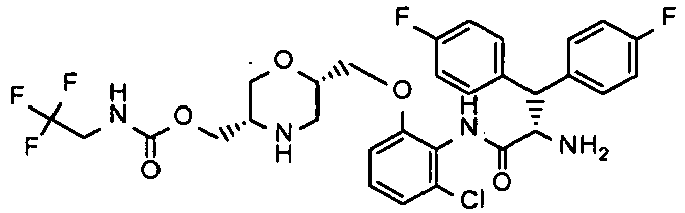
N-(2-chloro-6-{[(2S,5S)-5-({[(2,2,2-trifluoroethyl)carbamoyl]oxy }methyl)morpholin-2-yl]methoxy}phenyl)-4-fluoro-β-(4-fluorophenyl)-L-phenylalaninamide 657.2 261 
N-(2-chloro-6-{[(2S,5S)-5-({[(2,2,2-trifluoroethyl)carbamoyl]oxy 657.2 } methyl)morpholin-2-yl]methoxy}phenyl)-4-fluoro-β-(4-fluorophenyl)-L-phenylalaninamide 262 
3-fluoro-β-(3-fluorophenyl)-N-(3-fluoro-2-{2-[(2R,5S)-5-({[(2,2,2-trifluoroethyl)carbamoyl]oxy }methyl)morpholin-2-yl]ethyl}phenyl)-L-phenylalaninamide 639.2 263 
(βS)-4-fluoro-N-(3-fluoro-2-{2-[(2R,5S)-5-({[(2,2,2-trifluoroethyl)carbamoyl]oxy }methyl)morpholin-2-yl]ethyl}phenyl)-β-[3-(trifluoromethoxy)phenyl]-L-phenylalaninamide 705.2 264 
(βS)-β-(4-fluorophenyl)-N-(5-fluoro-4- {2-[(2R,5S)-5-({[(2,2,2-trifluoroethyl)carbamoyl]oxy } methyl)morpholin-2-yl]ethyl}pyridin-3-yl)-4-(trifluoromethyl)-L-phenylalaninamide 690.2 265 
(βS)-3,4-difluoro-β-(4-fluorophenyl)-N-(5-fluoro-4-{2-[(2R,5S)-5-({[(2,2,2-trifluoroethyl)carbamoyl]oxy } methyl)morpholin-2-yl]ethyl}pyridin-3-yl)-L-phenylalaninamide 658.2 266 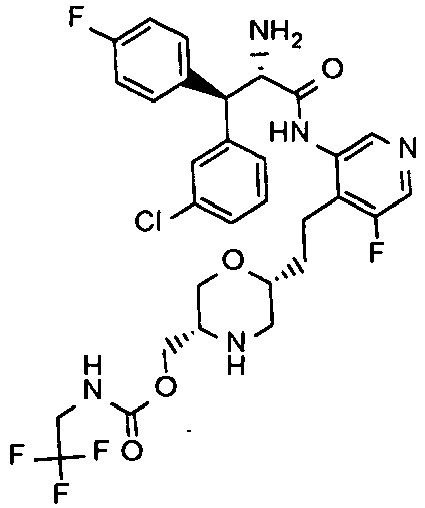
(βR)-3-chloro-β-(4-fluorophenyl)-N-(5-fluoro-4-{2-[(2R,5S)-5-({[(2,2,2-trifluoroethyl)carbamoyl]oxy } methyl)morpholin-2-yl]ethyl}pyridin-3-yl)-L-phenylalaninamide 656.2 267 
(βR)-β-(4-chlorophenyl)-4-fluoro-N-(5-fluoro-4-{2-[(2R,5S)-5-({[(2,2,2-trifluoroethyl)carbamoyl]oxy } methyl)morpholin-2-yl]ethyl} pyridin-3 -yl)-L-phenylalaninamide 656.2 268 
(βS)-2,5-difluoro-β-(4-fluorophenyl)-N-(5-fluoro-4-{2-[(2R,5S)-5-({[(2,2,2-trifluoroethyl)carbamoyl]oxy }methyl)morpholin-2-yl]ethyl}pyridin-3-yl)-L-phenylalaninamide 658.2 269 
(βR)-β-(3,4-difluorophenyl)-N-(3-fluoro-2-{2-[(2R,5S)-5-({[(2,2,2-trifluoroethyl)carbamoyl]oxy } methyl)morpholin-2-yl]ethyl}phenyl)-L-phenylalaninamide 639.2 270 
(βR)-β-(3,4-difluorophenyl)-4-fluoro-N-(3-fluoro-2-{2-[(2R,5S)-5-({[(2,2,2-trifluoroethyl)carbamoyl]oxy } methyl)morpholin-2-yl]ethyl}phenyl)-L-phenylalaninamide 657.2 271 
4-fluoro-N-[5-fluoro-4-(2-{(2R,5S)-5-[(2-hydroxyphenyl)carbamoyl]m orpholin-2-yl}ethyl)pyridin-3-yl]-β-(4-fluorophenyl)-L-phenylalaninamide 620.2 272 
(βS)-4-fluoro-N-(5-fluoro-4-{2-[(2R,5S)-5-({[(2,2,2-trifluoroethyl)carbamoyl]oxy } methyl)morpholin-2-yl]ethyl} pyridin-3-yl)-β-[3-(trifluoromethyl)phenyl]-L-phenylalaninamide 690.2 273 
(βR)-β-(4-chlorophenyl)-4-fluoro-N-(3-fluoro-2-{2-[(2R,5S)-5-({[(2,2,2-trifluoroethyl)carbamoyl]oxy } methyl)morpholin-2-yl]ethyl}phenyl)-L-phenylalaninamide 655.2 274 
(βS)-β-(4-chlorophenyl)-3-fluoro-N-(3-fluoro-2-{2-[(2R,5S)-5-({[(2,2,2-trifluoroethyl)carbamoyl]oxy }methyl)morpholin-2-yl]ethyl}phenyl)-L-phenylalaninamide 655.2 275 
(βR)-4-bromo-β-(4-fluorophenyl)-N-(5-fluoro-4-{2-[(2R,5S)-5-({[(2,2,2-trifluoroethyl)carbamoyl]oxy }methyl)morpholin-2-yl]ethyl}pyridin-3-yl)-L-phenylalaninamide 700.2 276 
4-fluoro-β-(4-fluorophenyl)-N-[5-fluoro-4-(2-{(2R,5S)-5-[({[3,3,3-trifluoro-1-(4-fluorophenyl)propyl]carbamo yl} oxy)methyl]morpholin-2-yl}ethyl)pyridin-3-yl]-L-phenylalaninamide 748.3 Table 3: The following examples can be prepared using the procedures described above. Example Structure IUPAC Name Mass [M+H]+ 277 
4-fluoro-β-(4-fluorophenyl)-N-(5-fluoro-4-{2-[(2R,5S)-5-({[(2,2,2-trifluoroethyl)carbamoyl]oxy } methyl)morpholin-2-yl]ethyl}pyridin-3-yl)-Nα-[(1-methylethoxy)carbonyl]-L-phenylalaninamide 726.3 278 
Nα-[(cyclopentyloxy)carbonyl]-4-fluoro-β-(4-fluorophenyl)-N-(5-fluoro-4-{2-[(2R,5S)-5-({[(2,2,2-trifluoroethyl)carbamoyl]oxy } methyl)morpholin-2-yl]ethyl}pyridin-3-yl)-L-phenylalaninamide 752.3 279 
4-fluoro-Nα-[(2-fluoroethoxy)carbonyl]-β-(4-fluorophenyl)-N-(5-fluoro-4-{2-[(2R,5S)-5-({[(2,2,2-trifluoroethyl)carbamoyl]oxy } methyl)morpholin-2-yl]ethyl}pyridin-3-yl)-L-phenylalaninamide 730.2 280 
3-fluoro-β-(3-fluorophenyl)-N-(5-fluoro-4-{2-[(2R,5S)-5-({[(2,2,2-trifluoroethyl)carbamoyl]oxy } methyl)morpholin-2-yl]ethyl}pyridin-3-yl)-Nα-(methoxycarbonyl)-L-phenylalaninamide 698.2 281 
(βS)-3-fluoro-β-(4-fluorophenyl)-N-(5-fluoro-4-{2-[(2R,5S)-5-({[(2,2,2-trifluoroethyl)carbamoyl]oxy }methyl)morpholin-2-yl]ethyl}pyridin-3-yl)-Nα-(methoxycarbonyl)-L-phenylalaninamide 697.3 282 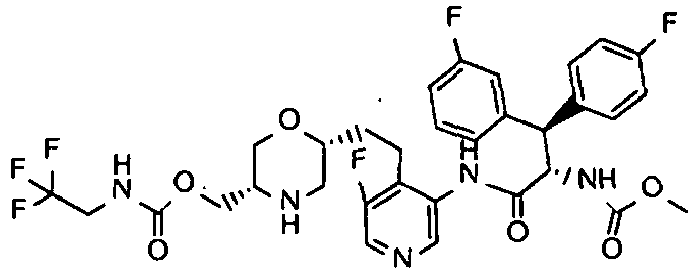
(βR)-4-fluoro-β-(3-fluorophenyl)-N-(5-fluoro-4-{2-[(2R,5S)-5-({[(2,2,2-trifluoroethyl)carbamoyl]oxy } methyl)morpholin-2-yl]ethyl}pyridin-3-yl)-Nα-(methoxycarbonyl)-L-phenylalaninamide 698.2 283 
(βS)-β-(4-fluorophenyl)-N-(5-fluoro-4- {2-[(2R,5S)-5-({[(2,2,2-trifluoroethyl)carbamoyl]oxy }methyl)morpholin-2-yl]ethyl}pyridin-3-yl)-Nα-(methoxycarbonyl)-O-(trifluoromethyl)-L-tyrosinamide 764.2 284 
N-[2-(2-{(2R,5S)-5-[(carbamoyloxy)methyl]mor pholin-2-yl]ethyl)-3-fluorophenyl]-4-fluoro-β-(4-fluorophenyl)-Nα-(methoxycarbonyl)-L-phenylalaninamide 615.2 285 
4-fluoro-β-(4-fluorophenyl)-N-(3-fluoro-2-{2-[(2R,5S)-5-({[(2,2,2-trifluoroethyl)carbamoyl]oxy }methyl)morpholin-2-yl]ethyl}phenyl)-Nα-(methoxycarbonyl)-L-phenylalaninamide 697.2 286 
(βS)-β-(4-fluorophenyl)-N-(5-fluoro-4- {2-[(2R,5S)-5-({[(2,2,2-trifluoroethyl)carbamoyl]oxy }methyl)morpholin-2-yl]ethyl}pyridin-3-yl)-Nα-(methoxycarbonyl)-4-(trifluoromethyl)-L-phenylalaninamide 748.2 287 
(βS)-3-fluoro-β-(4-fluorophenyl)-N-(3-fluoro-2-{2-[(2R,5S)-5-({[(2,2,2-trifluoroethyl)carbamoyl]oxy }methyl)morpholin-2-yl]ethyl}phenyl)-Nα-(methoxycarbonyl)-L-phenylalaninamide 697.2 288 
(βS)-3,4-difluoro-β-(4-fluorophenyl)-N-(5-fluoro-4-{2-[(2R,5S)-5-({[(2,2,2-trifluoroethyl)carbamoyl]oxy }methyl)morpholin-2-yl]methyl pyridin-3-yl)-Nα-(methoxycarbonyl)-L-phenylalaninamide 716.2 289 
(βR)-4-fluoro-N-(3-fluoro-2-{2-[(2R,5S)-5-({[(2,2,2-trifluoroethyl)carbamoyl]oxy }methyl)morpholin-2-yl]ethyl}phenyl)-Nα-(methoxycarbonyl)-β-naphthalen-2-yl-L-phenylalaninamide 729.3 290 
(βR)-N-(3-fluoro-2-{2-[(2R,5S)-5-({[(2,2,2-trifluoroethyl)carbamoyl]oxy } methyl)morpholin-2-yl]ethyl}phenyl)-Nα-(methoxycarbonyl)-(β-naphthalen-2-yl-L-phenylalaninamide 711.3 291 
(βR)-N-(5-fluoro-4-{2-[(2R,5S)-5-({[(2,2,2-trifluoroethyl)carbamoyl]oxy }methyl)morpholin-2-yl]ethyl}pyridin-3-yl)-Nα-(methoxycarbonyl)-β-phenyl-O-(trifluoromethyl)-L-tyrosinamide 746.2 292 
(βS)-3,5-difluoro-β-(4-fluorophenyl)-N-(3-fluoro-2-{2-[(2R,5S)-5-({[(2,2,2-trifluoroethyl)carbamoyl]oxy }methyl)morpholin-2-yl]ethyl}phenyl)-Nα-(methoxycarbonyl)-L-phenylalaninamide 715.2 293 
(βR)-N-(3-fluoro-2-{2-[(2R,5S)-5-({[(2,2,2-trifluoroethyl)carbamoyl]oxy }methyl)morpholin-2-yl]ethyl}phenyl)-Nα-(methoxycarbonyl)-β-propyl-L-phenylalaninamide 627.3 294 
(βR)-β-(3,4-difluorophenyl)-N-(3-fluoro-2-{2-[(2R,5S)-5-({[(2,2,2-trifluoroethyl)carbamoyl]oxy }methyl)morpholin-2-yl]ethyl}phenyl)-Nα-(methoxycarbonyl)-L-phenylalaninamide 697.2 295 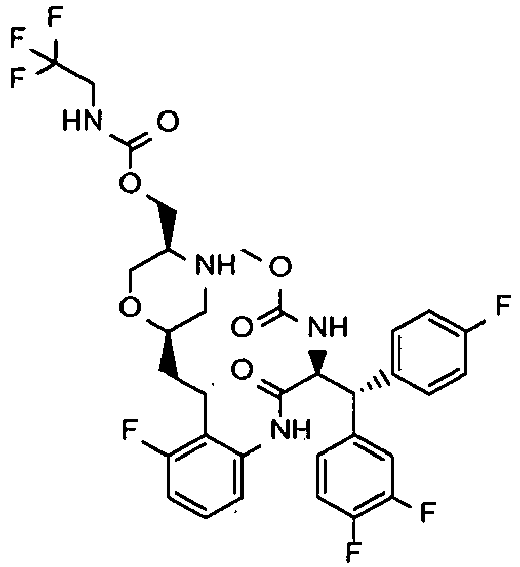
(βR)-β-(3,4-difluorophenyl)-4-fluoro-N-(3-fluoro-2-{2-[(2R,5S)-5-({[(2,2,2-trifluoroethyl)carbamoyl]oxy }methyl)morpholin-2-yl]ethyl}phenyl)-Nα-(methoxycarbonyl)-L-phenylalaninamide 715.2 296 
(βR)-N-(3-fluoro-2-{2-[(2R,5S)-5-({[(2,2,2-trifluoroethyl)carbamoyl]oxy }methyl)morpholin-2-yl]ethyl} phenyl)-Nα-(methoxycarbonyl)-O-methyl-β-phenyl-L-tyrosinamide 691.3 297 
(βR)-3,4-difluoro-β-(4-fluorophenyl)-N-(5-fluoro-4-{2-[(2R,5S)-5-({[(2,2,2-trifluoroethyl)carbamoyl]oxy }methyl)morpholin-2-yl]ethyl}pyridin-3-yl)-Nα-(methoxycarbonyl)-L-phenylalaninamide 716.2 298 
(βR)-β-(4-bromophenyl)-4-fluoro-N-(5-fluoro-4-{2-[(2R,5S)-5-({[(2,2,2-trifluoroethyl)carbamoyl]oxy }methyl)morpholin-2-yl]ethyl}pyridin-3-yl)-Nα-(methoxycarbonyl)-L-phenylalaninamide 758.2 299 
(βS)-β-(4-fluorophenyl)-N-(3-fluoro-2-{2-[(2R,5S)-5-({[(2,2,2-trifluoroethyl)carbamoyl]oxy }methyl)morpholin-2-yl]ethyl}phenyl)-Nα-(methoxycarbonyl)-O-methyl-L-tyrosinamide 709.3 300 
(βS)-2,5-difluoro-β-(4-fluorophenyl)-N-(5-fluoro-4-{2-[(2R,5S)-5-({[(2,2,2-trifluoroethyl)carbamoyl]oxy }methyl)morpholin-2-yl]ethyl}pyridin-3-yl)-Nα-(methoxycarbonyl)-L-phenylalaninamide 716.2 301 
(βS)-3-chloro-β-(4-fluorophenyl)-N-(5-fluoro-4-(2-[(2R,5S)-5-({[(2,2,2-trifluoroethyl)carbamoyl]oxy }methyl)morpholin-2-yl]ethyl} pyridin-3-yl)-Nα-(methoxycarbonyl)-L-phenylalaninamide 714.2 302 
(βS)-2,3-difluoro-β-(4-fluorophenyl)-N-(5-fluoro-4-{2-[(2R,5S)-5-({[(2,2,2-trifluoroethyl)carbamoyl]oxy }methyl)morpholin-2-yl]ethyl}pyridin-3-yl)-Nα-(methoxycarbonyl)-L-phenylalaninamide 716.2 303 
(βS)-4-fluoro-N-(3-fluoro-2-{2-[(2R,5S)-5-({[(2,2,2-trifluoroethyl)carbamoyl]oxy } methyl)morpholin-2-yl]ethyl}phenyl)-Nα-(methoxycarbonyl)-β-[3-(trifluoromethoxy)phenyl]-L-phenylalaninamide 763.2 304 
(βR)-β-(4-fluorophenyl)-N-(3-fluoro-2-{2-[(2R,5S)-5-({[(2,2,2-trifluoroethyl)carbamoyl]oxy }methyl)morphol in-2-yl]ethyl}phenyl)-Nα-(methoxycarbonyl)-O-(trifluoromethyl)-L-tyrosinamide 763.2 305 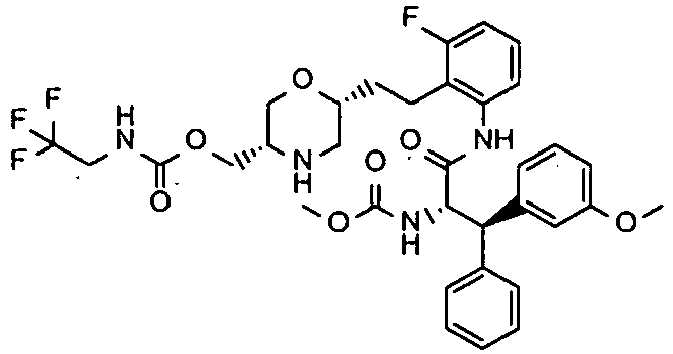
(βR)-N-(3-fluoro-2-{2-[(2R,5S)-5-({[(2,2,2-trifluoroethyl)carbamoyl]oxy } methyl)morpholin-2-yl]ethyl} }phenyl)-3-methoxy-Nα-(methoxycarbonyl)-(β-phenyl-L-phenylalaninamide 691.3 306 
(βR)-4-fluoro-N-(3-fluoro-2-{2-[(2R,5S)-5-({[(2,2,2-trifluoroethyl)carbamoyl]oxy }methyl)morpholin-2-yl]ethyl}phenyl)-Nα-(methoxycarbonyl)-β-(3-methoxyphenyl)-L-phenylalaninamide 709.3 307 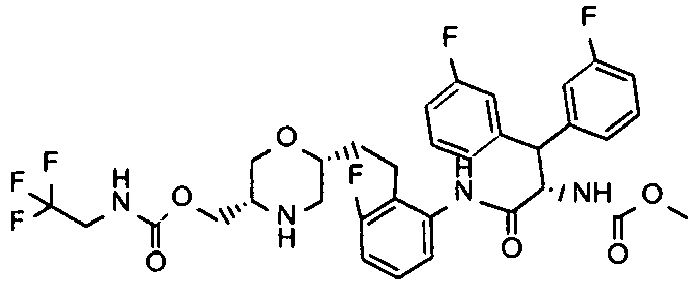
3-fluoro-β-(3-fluorophenyl)-N-(3-fluoro-2-{2-[(2R,5S)-5-({[(2,2,2-trifluoroethyl)carbamoyl]oxy }methyl)morpholin-2-yl]ethyl}phenyl)-Nα-(methoxycarbonyl)-L-phenylalaninamide 697.2 - Studies of the inhibition of the wildtype HIV-1 protease (which was expressed in Escherichia coli) were carried out with a peptide substrate [Val-Ser-Gln-Asn-(βnaphtyl)Ala-Pro-Ile-Val (SEQ IS NO 1)]. The inhibitor is first preincubated with the HIV-1 protease (wild type) enzyme in assay buffer (50 mM sodium acetate, pH 5.5, 100 mM NaCl, and 0.1% BSA) for 30 minutes at room temperature. Substrate is added to 400 micromolar in a total volume of 20 microliters containing 20 picomolar HIV-1 protease (final) and the reaction is incubated for 1 hour at 30°C. The reaction is quenched with the addition of formic acid and indinavir to 0.012% and 150 nM final concentrations, respectively. The product formation is determined after separation of product and substrate on a Zorbax Eclipse XDB-C18 column connected to an API 4000 mass spectrometer (Applied Biosystems) with multiple reaction monitoring (transitions were 644.5/428.9 and 615.4/422.2 (M1/M3) for product and indinavir respectively). The extent of inhibition of the reaction is determined from the peak area of the products. Analysis of the products, independently synthesized, provided quantitation standards and confirmation of the product composition. Representative compounds of the present invention exhibit inhibition of HIV-1 protease in this assay.
- Acute Infection Assay ("Spread") data were generated using HIV-1 (H9IIIB strain) infection of MT-4 human T-lymphoid cells in 10% FBS, and according to the methods disclosed by J. P. Vacca et al, "L-735,524: An orally bioavailable human immunodeficiency virus type 1 protease inhibitor," Proc. Natl. Acad. Sci. USA, Vol. 91, pp. 4096-4100 (April 1994).
- Data Tables 1 to 5 displays data regarding Pepcleave and Spread data for each of the example compounds. Both columns of data in the table reflect the mean of at least two independent experiments
Data Table 1. Example Pepcleav (nM) Spread (nM) 1 65 2 1.4 3 15 4 25 5 80 6 9.9 7 0.8 8 41 9 88 10 17 11 80 12 3.6 13 110 14 17 15 4.1 16 5.9 17 27 18 28 19 48 20 78 21 52 22 58 23 80 24 85 25 120 26 210 27 180 28 250 29 18 30 32 31 29 32 21 33 5.7 34 14 35 60 36 24 37 180 38 0.6 39 2.3 40 52 41 2.9 42 17 43 96 44 26 45 21 46 50 47 84 48 91 49 94 50 49 51 38 52 96 53 12 54 26 55 30 56 34 57 50 58 66 59 71 60 72 61 160 62 130 63 49 64 56 65 43 66 100 67 26 68 0.03 69 3.4 70 24 71 1.3 72 14 73 21 74 10 75 4.1 76 52 77 15 78 59 79 3.6 37 80 9.4 45 81 0.4 25 82 11 40 83 64 84 670 85 87 87 2200 88 450 89 1.4 13 90 2.4 49 91 3.0 16 92 4.4 43 93 1.7 52 Data Table 2 Example Pepcleav (nM) Spread (nM) 95 0.4 16 96 9.9 73 97 0.8 17 98 28 99 20 100 39 102 37 104 26 106 6.5 107 0.3 11 108 860 109 340 110 6.9 111 25 112 200 113 . 320 114 14 115 30 116 17 47 117 18 118 17 119 6.9 120 20 121 2.5 10 122 44 123 3.2 19 127 71 128 91 129 8.6 130 68 26 133 23 134 28 136 60 137 9.8 138 31 139 108 140 2.1 21 141 180 142 150 143 40 144 170 Data Table 3 Example Pepcleav (nM) Spread (nM) 146 13 47 147 4.9 120 148 22 150 149 1.4 14 150 11 130 151 100 290 152 88 153 130 154 5.1 150 155 6.1 58 156 10 26 157 9.6 18 158 34 159 380 160 31 161 12 70 162 510 163 1100 164 3.4 63 165 4.5 40 166 14 37 167 1.5 1250 168 13 169 73 170 61 171 68 172 60 173 37 174 120 175 39 176 73 177 41 178 85 179 240 180 310 181 50 182 17 183 690 184 15 185 68 186 66 187 210 188 50 Data Table 4 Example Pepcleav (nM) Spread (nM) 189 1730 190 510 191 130 192 130 193 120 1400 194 100 195 91 196 79 197 68 198 44 199 41 200 31 201 28 80 202 28 65 203 28 204 26 205 24 58 206 21 120 207 20 110 208 18 100 209 16 210 13 211 12 212 11 810 213 6.1 61 214 5.2 58 215 3.5 25 216 3.3 2000 217 2.7 94 218 2.1 219 140 221 1.1 22 222 53 223 1400 224 260 225 2700 226 360 227 340 228 190 229 190 230 180 231 150 232 150 233 110 234 110 235 97 5000 236 69 580 237 69 190 238 69 470 239 45 420 240 39 5000 241 32 360 242 25 600 243 24 240 244 22 120 245 16 360 246 13 390 247 12 260 248 9.8 55 249 9.4 3000 250 8.3 63 251 8.2 32 252 7.7 160 253 7.7 24 254 7.6 1100 255 6.4 210 256 5.7 100 257 5.1 51 258 5.0 260 259 5.0 66 260 4.8 190 261 4.3 170 262 4.0 15 263 3.7 48 264 3.6 77 265 3.1 36 266 3.1 50 267 3.1 51 268 2.8 44 269 2.7 25 270 2.1 22 271 2.0 810 272 2.0 32 273 1.4 20 274 1.3 11 275 0.4 25 276 0.2 28 Data Table 5 Example Pepcleav (nM) Spread (nM) 277 3.2 23 278 3.2 38 279 1.9 57 280 1.0 15 281 0.9 14 282 3.7 25 283 14 69 284 12 19 285 13 21 286 4.6 37 287 6.0 17 288 3.2 16 289 16 310 290 30 600 291 28 110 292 3.6 16 293 100 80 294 3.8 14 295 2.5 13 296 23 120 297 1.0 15 298 0.3 14 299 15 32 300 1.6 18 301 25 302 15 303 5.3 24 304 33 305 230 42 306 170 307 3.0 14 -
- <110> Merck Sharp & Dohme Corp.
Merck Canada Inc.
McCauley, John A.
Crane, Sheldon
Beaulieu, Christian
Bennett, David J.
Bungard, Christopher J.
Chang, Ronald K.
Greshok, Thomas J.
Hao, Li
Holloway, Kate
Manikowski, Jesse J.
McKay, Daniel
Molinaro, Carmela
Moradei, Oscar Miguel
Nantermet, Philippe G.
Nadeau, Christian
Satyanarayana, Tummanapalli
Shipe, William
Singh, Sanjay Kumar
Troung, Vouy Linh
Vijayasaradhi, Sivalenka
Willams, Peter D.
Wiscount, Catherine M. - <120> HIV PROTEASE INHBITORS
- <130> MCC-IFD-00008
- <150> 61/699,343
<151> 2012-09-11 - <160> 1
- <170> PatentIn version 3.5
- <210> 1
<211> 8
<212> PRT
<213> Artificial Sequence - <220>
<223> peptide - <220>
<221> MOD_RES
<222> (5)..(5)
<223> Xaa = betanapthyl alanine - <400> 1

Claims (18)
- A compound of Formula I:
 V is CH2 or O;Y1, Y2, Y3 and Y4 are independently selected from C(R) and N;each X is independently selected from H and NR7R8;Z is selected from the group consisting of


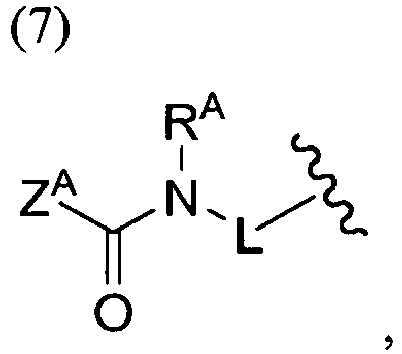


 L is a linker selected from(a) a bond,(b) -CH2-,(c) -C(O)-,(d) -CH2-C(O)-** or -C(O)-CH2-**,(e) -CH2-CH2-C(O)-** or -C(O)-CH2-CH2-**, and(f)
 R is selected from H, halo, hydroxy, C1-4alkyl, C1-4alkoxy, C1-4alkyl-S(O)k-, CF3, CN, benzyl, or two R groups on adjacent atoms may be joined together with the atoms to which they are attached to form a fused phenyl, pyridine, pyridazine, pyrimidine, pyrazine, or triazine, each of which is optionally substituted with 1 to 4 substituents independently selected from the group consisting of: halo, C1-4alkyl, C1-4alkoxy, CF3 and CN;each k is independently 0, 1 or 2;each r and t are independently 1, 2, 3 or 4;ZA is selected from the group consisting of:(1) hydrogen,(2) C1-10 alkyl,(3) C2-10alkenyl,(4) C3-7 cycloalkyl,(5) AryA,(6) HetA,(7) HetB, wherein said C1-10 alkyl, C2-10alkenyl and C3-7 cycloalky are optionally substituted with 1 to 6 substituents as allowed by valence independently selected from the group consisting of: fluoro, hydroxy, carbamoyl, C3-6 cycloalkyl, C(O)O-C1-6 alkyl, C(O)OH, C(O)-C1-6 alkyl, N(H)-C1-6 alkyl, N(-C1-6 alkyl)2, ArylA, HetA and HetB;each RA is independently H or C1-6 alkyl;or ZA and RA and the nitrogen atom to which they are attached may be joined together to form a 5-, 6- or 7-membered mono-cyclic, or 9- or 10-membered bi-cyclic, saturated, aromatic or partially aromatic ring, said ring optionally containing 1 to 3 additional heteroatoms selected from O, S and N, and said ring optionally substituted with from 1 to 3 XA;each R6 independently is:

 each R6A independently is H or C1-6 alkyl;alternatively, R6 and R6A together with the carbon to which they are attached form a C3-6 cycloalkyl which is optionally substituted with phenyl, wherein the phenyl is optionally substituted with from 1 to 3 XD.each XA, each XB, each XC, each XD, each YB and each YC are independently selected from the group consisting of:(1) C1-6 alkyl,(2) C3-6 cycloalkyl,(3) C1-6 haloalkyl,(4) OH,(5) O-C1-6 alkyl,(6) O-C1-6 haloalkyl,(7) O-C3-6 cycloalkyl,(8) SH,(9) S-C1-6 alkyl,(10) S-C1-6 haloalkyl,(11) S-C3-6 cycloalkyl,(12) halo,(13) CN,(14) N02,(15) NH2,(16) N(H)-C1-6 alkyl,(17) N(-C1-6 alkyl)2,(18) N(H)C(O)-C1-6 alkyl,(19) N(H)CH(O),(20) CH(O),(21) C(O)-C1-6 alkyl,(22) C(O)OH,(23) C(O)O-C1-6 alkyl,(24) C(O)NH2,(25) C(O)N(H)-C1-6 alkyl,(26) C(O)N(-C1-6 alkyl)2,(27) C(O)N(H)C(O)-C1-6 alkyl,(28) C(O)N(H)CH(O)(29) SO2H,(30) SO2-C1-6 alkyl;(31) phenyl, benzyl or phenoxy, each optionally substituted with 1 to 5 substituents _ selected from halogen and C1-6 alkyl,(32) HetA, -O-HetA or -CH2-HetA, optionally substituted with 1 to 5 substituents selected from halogen and C1-6 alkyl,(33) trimethylsilyl, and(34) C2-6alkenyl,
wherein C1-6 alkyl in each instance of (1), (3) (5), (6), (9), (10), (16), (17), (18), (21), (23), (25), (26), (27), (30), (31) and (32) above is optionally substituted with 1 to 6 substituents as allowed by valence selected from the group consisting of:(a) C1-6 haloalkyl,(b) OH(c) O-C1-6 alkyl,(d) O-C1-6 haloalkyl,(e) O-C3-6 cycloalkyl,(f) SH,(g) S-C1-6 alkyl,(h) halo,(i) CN,(j) NO2,(k) NH2,(l) N(H)-C1-6 alkyl,(m) N(-C1-6 alkyl)2,(n) C(O)-C1-6 alkyl,(o) C(O)OH,(p) C(O)O-C1-6 alkyl, and(q) SO2-C1-6 alkyl;T is O, S, S(O), or SO2;m is an integer equal to 0, 1, 2, or 3;n is an integer equal to 0, 1, 2, or 3;R7 is H, C1-6 alkyl, C3-6 cycloalkyl, C1-6 alkyl substituted with C3-6 cycloalkyl, C(O)-RK or SO2-RK;R8 is H, C1-6 alkyl, C1-6 haloalkyl and C3-6 cycloalkyl;RK is:(1) C1-6 alkyl,(2) C3-6 cycloalkyl,(3) C1-6 alkyl substituted with C3-6 cycloalkyl,(4) O-C1-6 alkyl,(5) O-C1-6 alkyl substituted with O-C1-6 alkyl,(6) O-C1-6 fluoroalkyl,(7) C(O)O-C1-6 alkyl,(8) C1-6 alkyl substituted with C(O)O-C1-6 alkyl,(9) C1-6 alkyl substituted with C(O)OH,(10) C1-6 alkyl substituted with C(O)-C1-6 alkyl,(11) N(H)-C1-6 alkyl,(12) N(-C1-6 alkyl)2,(13) C1-6 alkyl substituted with NH2, N(H)-C1-6 alkyl, or N(-C1-6 alkyl)2,(14) AryA,(15) C1-6 alkyl substituted with AryA,(16) O-C1-6 alkyl substituted with AryA,(17) HetA,(18) C1-6 alkyl substituted with HetA,(19) O-C1-6 alkyl substituted with HetA,(20) HetB,(21) O-HetB, or(22) O-C1-6 alkyl substituted with HetB;each AryA is an aryl which is independently phenyl or naphthyl, wherein the phenyl or naphthyl is optionally substituted with from 1 to 3 YB;each HetA is a heteroaryl which is independently (i) a 5- or 6-membered monocyclic heteroaromatic ring containing from 1 to 3 heteroatoms independently selected from N, O and S, or (ii) is a 9-, 10- or 11-membered bicyclic heteroaromatic ring containing from 1 to 4 heteroatoms independently selected from N, O and S; wherein the monocylcic ring (i) or the bicyclic ring (ii) is optionally substituted with from 1 to 3 YC; andeach HetB is independently a 4- to 7-membered, saturated or unsaturated, non-aromatic heterocyclic ring containing at least one carbon atom and from 1 to 4 heteroatoms independently selected from N, O and S, where each S is optionally oxidized to S(O) or S(O)2, and wherein the saturated or unsaturated heterocyclic ring is optionally substituted with from 1 to 3 substituents each of which is independently halogen, CN, C1-6 alkyl, OH, oxo, O-C1-6 alkyl, C1-6 haloalkyl, O-C1-6 haloalkyl, C(O)NH2, C(O)N(H)-C1-6 alkyl, C(O)N(-C1-6 alkyl)2, C(O)H, C(O)-C1-6 alkyl, CO2H, CO2-C1-6 alkyl, SO2H, or SO2-C1-6 alkyl. - The compound according to claim 1 wherein R6 is:

- The compound according to claim 1 or 2 wherein Z is

- The compound according to claim 1 or 2 wherein Z is


- The compound according to claim 1 or 2 wherein Z is

- The compound according to claim 1 or 2 wherein Z is


- The compound according to claim 1 of Formula Ia

- The compound according to claim 7 wherein:R is H or fluoro,Y3 is CH or N,XB and XC are independently selected from halo, -OCH3, -CF3 and-OCF3, andm and n are independently 0, 1 or 2.
- The compound according to claim 8 wherein X is selected from: H, -NH2 and -N(H)-C(O)-OR8.
- The compound according to any one of Claims 7 to 9, wherein W1 is C, one XB group is present and substituted at the 4-position, one or two XC groups are present and substituted at the 3- or 3,5-positions respectively, and the XB group is a different group with respect to either XC group.
- The compound according to any one of Claims 7 to 9 whwerein ZA is selected from the group consisting of:(1) hydrogen,(2) C1-10 alkyl,(3) C2-10alkenyl, and(4) C3-7 cycloalkyl,wherein said C1-10 alkyl, C2-10alkenyl and C3-7 cycloalky are optionally substituted with 1 to 6 substituents as allowed by valence independently selected from the group consiting of: fluoro, hydroxy, carbamoyl, C3-6 cycloalkyl, C(O)O-C1-6 alkyl, C(O)OH, C(O)-C1-6 alkyl, N(H)-C1-6 alkyl, N(-C1-6 alkyl)2, ArylA, HetA and HetB.
- The compound according to claim 11 wherein ZA is C1-10 alkyl, optionally substituted with 1 to 6 substituents as allowed by valence independently selected from the group consiting of: fluoro and hydroxy.
- The compound according to claim 12 whwerein ZA is -(CH2)0-4-CF3.
- A compound according to claim 1 selected from the group consisting of:(3S,6R)-6-[2-(2-{[N-(methoxycarbonyl)-β-phenyl-L-phenylalanyl]amino}phenyl)ethyl]morpholine-3-carboxylic acid;N-(2-{2-[(2R,5S)-5-(benzylcarbamoyl)morpholin-2-yl]ethyl}phenyl)-Nα-(methoxycarbonyl)-β-phenyl-L-phenylalaninamide;N-(2-{2-[(2R,5S)-5-(ethylcarbamoyl)morpholin-2-yl]ethyl)phenyl}-Nα-(methoxycarbonyl)-β-phenyl-L-phenylalaninamide;Nα-(methoxycarbonyl)-β-phenyl-N-(2-{2-[(2R,5S)-5-(tetrahydrofuran-3-ylcarbamoyl)morpholin-2-yl]ethyl}phenyl)-L-phenylalaninamide;Nα-(methoxycarbonyl)-β-phenyl-N-(2-{2-[(2R,5S)-5-(pyrrolidin-1-ylcarbonyl)morpholin-2-yl]ethyl}phenyl)-L-phenylalaninamide;Nα-(methoxycarbonyl)-β-phenyl-N-[2-(2-{(2R,5S)-5-[(2-phenylethyl)carbamoyl]morpholin-2-yl}ethyl)phenyl]-L-phenylalaninamide;Nα-(methoxycarbonyl)-β-phenyl-N-(2-{2-[(2R,5S)-5-(phenylcarbamoyl)morpholin-2-yl]ethyl}phenyl)-L-phenylalaninamide;N-(2-{2-[(2R,5S)-5-(tert-butylcarbamoyl)morpholin-2-yl]ethyl}phenyl)-Nα-(methoxycarbonyl)-β-phenyl-L-phenylalaninamide;Nα-(methoxycarbonyl)-β-phenyl-N-[2-(2-{(2R,5S)-5-[(2-phenylhydrazinyl)carbonyl]morpholin-2-yl} ethyl)phenyl]-L-phenylalaninamide;Nα-(methoxycarbonyl)-β-phenyl-N-[2-(2-{(2R,5S)-5-[(phenylsulfonyl)carbamoyl]morpholin-2-yl}ethyl)phenyl]-L-phenylalaninamide;methyl [(1S)-2-[(2-{2-[(2R,5R)-5-(aminocarbonyl)morpholin-2-yl]ethyl}phenyl)amino]-1-(diphenylmethyl)-2-oxoethyl]carbamate;N-(2-{2-[(2R,5S)-5-({[(2-fluorobenzyl)carbamoyl]oxy}methyl)morpholin-2-yl]ethyl}phenyl)-Nα-(methoxycarbonyl)-β-phenyl-L-phenylalaninamide;N-(2-{2-[(2R,5S)-5-({[(3R,3aS,6aR)-hexahydrofuro[2,3-b]furan-3-ylcarbamoyl]oxy}methyl)morpholin-2-yl]ethyl } phenyl)-Nα-(methoxycarbonyl)-β-phenyl-L-phenylalaninamide;N-[2-(2-{(2R,5S)-5-[({[(1S,2R)-2-hydroxy-2,3-dihydro-1H-inden-1-yl]carbamoyl}oxy)methyl]morpholin-2-yl}ethyl)phenyl]-Nα-(methoxycarbonyl)-β-phenyl- L-phenylalaninamide;N-(2-{2-[(2R,5S)-5-{[(2,3-dihydro-1H-inden-1-ylcarbamoyl)oxy]methyl} morpholin-2-yl]ethyl}phenyl)-Nα-(methoxycarbonyl)-β-phenyl-L-phenylalaninamide;methyl N-[(1S)-1-benzhydryl-2-[[2-[2-[(2R,5S)-5-[(4-fluorophenyl)methylcarbamoyloxymethyl]morpholin-2-yl]ethyl]phenyl]amino]-2-oxoethyl] carbamate;methyl N-[(1S)-1-benzhydryl-2-oxo-2-[[2-[2-[(2R,5S)-5-(2,2,2-trifluoroethylcarbamoyloxymethyl)morpholin-2-yl]ethyl]phenyl]amino]ethyl]carbamate;methyl N-[(1S)-1-benzhydryl-2-[[2-[2-[(2R,5S)-5-(8-isoquinolylmethylcarbamoyloxymethyl)morpholin-2-yl]ethyl]phenyl]amino]-2-oxoethyl]carbamate;methyl N-[(1S)-1-benzhydryl-2-oxo-2-[[2-[2-[(2R,5S)-5-(thiazol-5-ylmethylcarbamoyloxymethyl)morpholin-2-yl]ethyl]phenyl]amino]ethyl]carbamate;methyl N-[(1S)-1-benzhydryl-2-oxo-2-[[2-[2-[(2R,5S)-5-(3-pyridylmethylcarbamoyloxymethyl)morpholin-2-yl]ethyl]phenyl]amino]ethyl]carbamate;methyl N-[(1S)-1-benzhydryl-2-[[2-[2-[(2R,5S)-5-(2,1,3-benzoxadiazol-5-ylmethylcarbamoyloxymethyl)morpholin-2-yl]ethyl]phenyl]amino]-2-oxo-ethyl]carbamate;methyl N-[(1S)-1-benzhydryl-2-[[2-[2-[(2R,5S)-5-(cyclopropylmethylcarbamoyloxymethyl)morpholin-2-yl]ethyl]phenyl]amino]-2-oxo-ethyl]carbamate;methyl N-[(1S)-1-benzhydryl-2-[[2-[2-[(2R,5S)-5-(cyclobutylcarbamoyloxymethyl)morpholin-2-yl]ethyl]phenyl]amino]-2-oxo-ethyl]carbamate;methyl N-[(1S)-1-benzhydryl-2-[[2-[2-[(2R,5S)-5-(2,2-difluoroethylcarbamoyloxymethyl)morpholin-2-yl]ethyl]phenyl]amino]-2-oxo-ethyl]carbamate;methyl N-[(1S)-1-benzhydryl-2-[[2-[2-[(2R,5S)-5-(diethylcarbamoyloxymethyl)morpholin-2-yl]ethyl]phenyl]amino]-2-oxo-ethyl]carbamate;methyl N-[(1S)-1-benzhydryl-2-[[2-[2-[(2R,5S)-5-(dimethylcarbamoyloxymethyl)morpholin-2-yl]ethyl]phenyl]amino]-2-oxo-ethyl]carbamate;[(3S,6R)-6-[2-[2-[[(2S)-2-(methoxycarbonylamino)-3,3-diphenyl-propanoyl]amino]phenyl]ethyl]morpholin-3-yl]methyl pyrrolidine-1-carboxylate;methyl N-[(1S)-1-benzhydryl-2-[[2-[2-[(2R,5S)-5-(2-dimethylaminoethylcarbamoyloxymethyl)morpholin-2-yl]ethyl]phenyl]amino]-2-oxo-ethyl]carbamate;N-[2-(2-{(2R,5S)-5-[({[(3S,4R)-4-fluorotetrahydrofuran-3-yl]carbamoyl}oxy) methyl]morpholin-2-yl}ethyl)phenyl]-Nα-(methoxycarbonyl)-β-phenyl-L-phenylalaninamide;Nα-(methoxycarbonyl)-N-(2-{2-[(2R,5S)-5-{[(methylcarbamoyl)oxy] methyl}morpholin-2-yl]ethyl}phenyl)-β-phenyl-L-phenylalaninamide;N-(2-{2-[(2R,5S)-5-({[(1-cyclopropyl-2,2,2-trifluoroethyl)carbamoyl]oxy} methyl)morpholin-2-yl]ethyl}phenyl)-Nα-(methoxycarbonyl)-β-phenyl-L-phenylalaninamide;N-(3-{2-[(2R,5S)-5-({[(4-fluorobenzyl)carbamoyl]oxy}methyl)morpholin-2-yl]ethyl}pyridin-2-yl)-Nα-(methoxycarbonyl)-β-phenyl-L-phenylalaninamide;N-(4-{2-[(2R,5S)-5-({[(4-fluorobenzyl)carbamoyl]oxy}methyl)morpholin-2-yl]ethyl}pyridin-3-yl)-Nα-(methoxycarbonyl)-β-phenyl-L-phenylalaninamide;Nα-(methoxycarbonyl)-β-phenyl-N-(4-{2-[(2R,5S)-5-({[(2,2,2-trifluoroethyl) carbamoyl]oxy}methyl)morpholin-2-yl]ethyl}pyridin-3-yl)-L-phenylalaninamide;Nα-(methoxycarbonyl)-N-(2-methoxy-4-{2-[(2R,5S)-5-({[(2,2,2-trifluoroethyl)carbamoyl]oxy}methyl)morpholin-2-yl]ethyl}pyridin-3-yl)-β-phenyl-L-phenylalaninamide;N-(4-{2-[(2R,5S)-5-({[(4-fluorobenzyl)carbamoyl]oxy}methyl)morpholin -2-yl]ethyl}pyrimidin-5-yl)-Nα-(methoxycarbonyl)-β-phenyl-L-phenylalaninamide;Nα-(methoxycarbonyl)-β-phenyl-N-(4-{2-[(2R,5S)-5-({[(2,2,2-trifluoroethyl)carbamoyl]oxy}methyl)morpholin-2-yl]ethyl}pyrimidin-5-yl)-L-phenylalaninamide;N-(4-{2-[(2R,5S)-5-({[(4-fluorobenzyl)carbamoyl]oxy} methyl) morpholin-2-yl]ethyl}-2-oxo-1,2-dihydropyridin-3-yl)-Nα-(methoxycarbonyl)-β-phenyl-L-phenylalaninamide;Nα-(methoxycarbonyl)-N-(2-oxo-4-{2-[(2R,5S)-5-({[(2,2,2-trifluoroethyl)carbamoyl]oxy}methyl)morpholin-2-yl]ethyl}-1,2-dihydropyridin-3-yl)-β-phenyl-L-phenylalaninamide;N-α-(methoxycarbonyl)-β-phenyl-N-(2-{2-[(2R,5R)-5-{[(phenylcarbamoyl)amino]methyl}morpholin-2-yl]ethyl}phenyl)-L-phenylalaninamide;methyl N-[(1S)-1-benzhydryl-2-oxo-2-[[2-[2-[(2R,5R)-5-[(pyridazin-3-ylcarbamoylamino)methyl]morpholin-2-yl]ethyl]phenyl]amino]ethyl]carbamate;methyl N-[(1S)-1-benzhydryl-2-oxo-2-[[2-[2-[(2R,5R)-5-[(2-pyridylcarbamoylamino)methyl]morpholin-2-yl]ethyl]phenyl]amino]ethyl]carbamate;methyl N-[(1S)-1-benzhydryl-2-oxo-2-[[2-[2-[(2R,5R)-5-[(1H-pyrazol-3-ylcarbamoylamino)methyl]morpholin-2-yl]ethyl]phenyl]amino]ethyl]carbamate;methyl N-[(1S)-1-benzhydryl-2-oxo-2-[[2-[2-[(2R,5R)-5-[(triazolo[1,5-a]pyridin-6-ylsulfonylamino)methyl]morpholin-2-yl]ethyl]phenyl]amino]ethyl]carbamate;methyl N-[(1S)-1-benzhydryl-2-oxo-2-[[2-[2-[(2R,5R)-5-[[[6-(trifluoromethyl)-2-pyridyl]sulfonylamino]methyl]morpholin-2-yl]ethyl]phenyl]amino]ethyl]carbamate;methyl N-[(1S)-1-benzhydryl-2-[[2-[2-[(2R,5R)-5-[(cyclopropylsulfonylamino)methyl]morpholin-2-yl]ethyl]phenyl]amino]-2-oxo-ethyl]carbamate;methyl N-[(1S)-1-benzhydryl-2-oxo-2-[[2-[2-[(2R,5R)-5-[(2-pyridylsulfonylamino)methyl]morpholin-2-yl]ethyl]phenyl]amino]ethyl]carbamate;N-(2-{2-[(2R,5R)-5-({[(4-aminophenyl)sulfonyl]amino}methyl) morpholin-2-yl]ethyl}phenyl)-Nα-(methoxycarbonyl)-β-phenyl-L-phenylalaninamide;N-(2-{2-[(2R,5R)-5-{[(benzylsulfonyl)amino]methyl}morpholin-2-yl]ethyl}phenyl) -Nα-(methoxycarbonyl)-β-phenyl-L-phenylalaninamide;Nα-(methoxycarbonyl)-N-(2-{2-[(2R,5R)-5-{[(phenoxycarbonyl)amino]methyl}morpholin-2-yl]ethyl }phenyl)-(3-phenyl-L-phenylalaninamide;Nα-(methoxycarbonyl)-β-phenyl-N-(2-{2-[(2R,5R)-5-{[(phenylcarbonyl)amino]methyl}morpholin-2-yl]ethyl}phenyl)-L-phenylalaninamide;Nα-(methoxycarbonyl)-β-phenyl-N-(2-{2-[(2R,5R)-5-{[(phenylacetyl)amino]methyl}morpholin-2-yl]ethyl}phenyl)-L-phenylalaninamide;methyl N-[(1S)-1-benzhydryl-2-oxo-2-[[2-[2-[(2R,5R)-5-[(pyridazine-3-carbonylamino)methyl]morpholin-2-yl]ethyl]phenyl]amino]ethyl]carbamate;methyl N-[(1S)-1-benzhydryl-2-[[2-[2-[(2R,5R)-5-[[(2-chlorobenzoyl)amino]methyl]morpholin-2-yl]ethyl]phenyl]amino]-2-oxo-ethyl]carbamate;methyl N-[(1S)-1-benzhydryl-2-[[2-[2-[(2R,5R)-5-[(1H-indole-2-carbonylamino)methyl]morpholin-2-yl]ethyl]phenyl]amino]-2-oxo-ethyl]carbamate;methyl N-[(1S)-1-benzhydryl-2-[[2-[2-[(2R,5R)-5-[[(2,6-dimethylbenzoyl)amino]methyl]morpholin-2-yl]ethyl]phenyl]amino]-2-oxo-ethyl]carbamate;methyl N-[(1S)-1-benzhydryl-2-[[2-[2-[(2R,5R)-5-[[(3-fluoro-6-oxo-1H-pyridine-2-carbonyl)amino]methyl]morpholin-4-ium-2-yl]ethyl]phenyl]amino]-2-oxo-ethyl]carbamate;methyl N-[(1S)-1-benzhydryl-2-oxo-2-[[2-[2-[(2R,5R)-5-[(pyrazolo[1,5-a]pyrimidine-2-carbonylamino)methyl]morpholin-2-yl]ethyl]phenyl]amino]ethyl]carbamate;methyl N-[(1S)-1-benzhydryl-2-oxo-2-[[2-[2-[(2R,5R)-5-[[[5-(2-pyridyl)-1H-pyrazole-3-carbonyl]amino]methyl]morpholin-2-yl]ethyl]phenyl]amino]ethyl]carbamate;N-(2-{2-[(2R,5R)-5-(hydroxymethyl)morpholin-2-yl]ethyl}phenyl)-Nα-(methoxycarbonyl)-β-phenyl-L-phenylalaninamide;Nα-(methoxycarbonyl)-β-phenyl-N-[2-(2-{(2R,5S)-5-[(phenylsulfanyl)methyl]morpholin-2-yl} ethyl)phenyl]-L-phenylalaninamide;Nα-(methoxycarbonyl)-N-(2-{2-[(2R,5S)-5-(phenoxymethyl)morpholin-2-yl]ethyl}phenyl)-β-phenyl-L-phenylalaninamide;Nα-(methoxycarbonyl)-β-phenyl-N-[2-(2-{(2R,5R)-5-[(4-phenyl-1H-1,2,3-triazol-1-yl)methyl]morpholin-2-yl}ethyl)phenyl]-L-phenylalaninamide;Nα-(methoxycarbonyl)-β-phenyl-N-(2-{2-[(2R,5R)-5-{[4-(trimethylsilyl)-1H-1,2,3-triazol-1-yl]methyl}morpholin-2-yl]ethyl}phenyl)-L-phenylalaninamide;Nα-(methoxycarbonyl)-β-phenyl-N-(2-{2-[(2R,5R)-5-(1H-1,2,3-triazol-1-ylmethyl)morpholin-2-yl]ethyl}phenyl)-L-phenylalaninamide;methyl{(1S)-1-(diphenylmethyl)-2-oxo-2-[(2-{2-[(2R,5R)-5-(3-phenylpropyl)morpholin-2-yl]ethyl}phenyl)amino]ethyl}carbamate;dimethyl [(2R,5R)-morpholine-2,5-diylbis{ethane-2,1-diylbenzene-2,1-diylimino[(2S)-1-oxo-3,3-diphenylpropane-1,2-diyl]}]biscarbamate;methyl N-[(1S)-1-benzhydryl-2-[[2-[2-[(2R,5R)-5-[2-[2-[[2-(methoxycarbonylamino)acetyl]amino]phenyl]ethyl)morpholin-2-yl]ethyl]phenyl]amino]-2-oxo-ethyl]carbamate;methyl N-[(1S)-1-benzhydryl-2-[[2-[2-[(2R,5R)-5-[2-[2-[(2-methoxyacetyl)amino]phenyl]ethyl]morpholin-2-yl]ethyl]phenyl]amino]-2-oxo-ethyl]carbamate;methyl N-[(1S)-1-benzhydryl-2-oxo-2-[[2-[2-[(2R,5R)-5-[2-[2-(3-phenylpropanoylamino)phenyl]ethyl]morpholin-2-yl]ethyl]phenyl]amino]ethyl]carbamate;methyl N-[(1S)-1-[[2-[2-[(2R,5R)-5-[2-(2-aminophenyl)ethyl]morpholin-2-yl]ethyl]phenyl]carbamoyl]-2,2-diphenyl-ethyl]carbamate;N-(2-{2-[(2R,5R)-5-(2-[2-[(benzylsulfonyl)amino]phenyl}ethyl)morpholin-2-yl]ethyl}-phenyl)-Nα-(methoxycarbonyl)-β-phenyl-L-phenylalaninamide;methyl N-[(1S)-1-benzhydryl-2-[[2-[2-[(2R,5R)-5-[2-(2-benzyloxycarbonylaminophenyl)ethyl]morpholin-2-yl]ethyl]phenyl]amino]-2-oxo-ethyl]carbamate;methyl N-[(1S)-1-benzhydryl-2-[[2-[2-[(2R,5R)-5-[2-[2-(benzylcarbamoylamino)phenyl]ethyl]morpholin-2-yl]ethyl]phenyl]amino]-2-oxoethyl]carbamate;methyl N-[(1S)-1-benzhydryl-2-[[2-[2-[(2R,5R)-5-[2-[2-(methoxycarbonylamino)phenyl]ethyl]morpholin-2-yl]ethyl]phenyl]amino]-2-oxoethyl] carbamate;methyl N-[(1S)-1-benzhydryl-2-[[2-[2-[(2R,5R)-5-[2-[2-(ethylcarbamoylamino)phenyl]ethyl]morpholin-2-yl]ethyl]phenyl]amino]-2-oxo-ethyl]carbamate;N-(2-{2-fluoro-2-[(2S,5S)-5-({[(4-fluorobenzyl)carbamoyl]oxy}methyl) morpholin-2-yl]ethyl}phenyl)-Nα-(methoxycarbonyl)-β-phenyl-L-phenylalaninamide;4-Fluoro-β-(4-fluorophenyl)-N-(5-fluoro-4-{2-[(2R,5S)-5-({[(2,2,2-trifluoroethyl)carbamoyl]oxy}methyl)morpholin-2-yl]ethyl}pyridin-3-yl)-L-phenylalaninamide trihydrochloride;4-Fluoro-β-(4-fluorophenyl)-N-(3-fluoro-2-{2-[(2R,5S)-5-({[(2,2,2-trifluoroethyl)carbamoyl]oxy}methyl)morpholin-2-yl]ethyl}phenyl)-L-phenylalaninamide dihydrochloride;((3S,6R)-6-(2-(3-(3,3-bis(4-fluorophenyl)propanamido)-5-fluoropyridin-4-yl)ethyl)morpholin-3-yl)methyl ((6-chloropyridin-2-yt)methyl)carbamate;((3S,6S)-6-((2-((S)-2-amino-3,3-bis(4-fluorophenyl)propanamido)-6-fluorophenoxy)methyl)morpholin-3-yl)methyl (2,2,2-trifluoroethyl)carbamate;2S-Amino-3,3-di-(4-fluorophenyl)-N-(5-fluoro-4-(2-((2R,5R)-5-(2,2,2-trifluoroethoxycarbonylaminomethyl)morpholine-2-yl)ethyl)pyridin-3-yl)propanamide;Nα-(methoxycarbonyl)-β-phenyl-N-(2-{2-[(2R,5R)-5-({[(tetrahydrofuran-3-yloxy)carbonyl]amino}methyl)morpholin-2-yl]ethyl}phenyl)-L-phenylalaninamide;2,2,2-trifluoroethyl ({(3R,6R)-6-[2-(3-{[3,3-bis(4-fluorophenyl)propanoyl]amino}-5-fluoropyridin-4-yl)ethyl]morpholin-3-yl}methyl)carbamate;(2S,3S)-2-Methoxycarbonylamino-3-(4-Fluorophenyl)-3-(3,5-difluorophenyl)-N-(5-fluoro-4-(2-((2R,5R)-5-(2,2,2-trifluoroethoxycarbonylaminomethyl)morpholine-2-yl)ethyl)pyridin-3-yl)propanamide;2,2,2-trifluoroethyl ({(3R,6R)-6-[2-(2-{[3,3-bis(4-fluorophenyl)propanoyl]amino}-6-fluorophenyl)ethyl]morpholin-3-yl)methyl)carbamate;4-fluoro-β-(4-fluorophenyl)-N-(3-fluoro-2-{2-[(2R,5R)-5-({[(2,2,2-trifluoroethoxy)carbonyl]amino}methyl)morpholin-2-yl]ethyl}phenyl)-L-phenylalaninamide;(3S)-3-(4-Fluorophenyl)-3-(3,5-difluorophenyl)-N-(5-fluoro-4-(2-((2R,5R)-5-(2,2,2-trifluoroethylaminocarbonyloxymethyl)morpholine-2-yl)ethyl)pyridin-3-yl)propanamide;(2S,3S)-2-Amino-3-(4-fluorophenyl)-3-(3,5-difluorophenyl)-N-(5-fluoro-4-(2-((2R,5R)-5-(2,2,2-trifluoroethylaminocarbonyloxymethyl)morpholine-2-yl)ethyl)pyridin-3-yl)propanamide;(2S,3S)-2-(Methoxycarbonylamino)-3-(4-fluorophenyl)-3-(3,5-difluorophenyl)-N-(5-fluoro-4-(2-((2R,5R)-5-(2,2,2-trifluoroethylaminocarbonyloxymethyl)morpholine-2-yl)ethyl)pyridin-3-yl)propanamide;(2S,3R)-2-Amino-3-(3-fluorophenyl)-3-(4-fluorophenyl)-N-(5-fluoro-4-(2-((2R,5R)-5-(2,2,2-trifluoroethylaminocarbonyloxymethyl)morpholine-2-yl)ethyl)pyridin-3-yl)propanamide;(2S,3S)-2-Amino-3-(3-chlorophenyl)-3-(4-fluorophenyl)-N-(5-fluoro-4-(2-((2R,5R)-5-(2,2,2-trifluoroethylaminocarbonyloxymethyl)morpholine-2-yl)ethyl)pyridin-3-yl)propanamide;(βR)-4-Chloro-3-fluoro-β-(3-fluorophenyl)-N-(5-fluoro-4-{2-[(2R,5S)-5-({[(2,2,2-trifluoroethyl)carbamoyl]oxy}methyl)morpholin-2-yl]ethyl}pyridin-3-yl)-L-phenylalaninamide;(βR)-β-(4-Chlorophenyl)-N-(5-fluoro-4-{2-[(2R,5S)-5-({[(2,2,2-trifluoroethyl)carbamoyl]oxy}methyl)morpholin-2-yl]ethyl}pyridin-3-yl)-L-phenylalaninamide;(βR)-4-Fluoro-N-(5-fluoro-4-{2-[(2R,5S)-5-({[(2,2,2-trifluoroethyl)carbamoyl]oxy}methyl)morpholin-2-yl]ethyl}pyridin-3-yl)-β-naphthalen-2-yl-L-phenylalaninamide;(βS)-β-(4-Chlorophenyl)-3,5-difluoro-N-(5-fluoro-4-{2-[(2R,5S)-5-({[(2,2,2-trifluoroethyl)carbamoyl]oxy}methyl)morpholin-2-yl]ethyl}pyridin-3-yl)-L-phenylalaninamide;(βS)-β-(4-Chlorophenyl)-N-(5-fluoro-4-{2-[(2R,5S)-5-({[(2,2,2-trifluoroethyl)carbamoyl]oxy}methyl)morpholin-2-yl]ethyl}pyridin-3-yl)-3-(trifluoromethoxy)-L-phenylalaninamide;(βR)-β-(3,4-Difluorophenyl)-3-fluoro-N-(3-fluoro-2-{2-[(2R,5S)-5-({[(2,2,2-trifluoroethyl)carbamoyl]oxy}methyl)morpholin-2-yl]ethyl}phenyl)-L-phenylalaninamide;{(3S,6R)-6-[2-(2-{[(3R)-3-(1,3-Benzodioxol-5-yl)-3-(4-chlorophenyl)-L-alanyl]amino}-6-fluorophenyl)ethyl]morpholin-3-yl}methyl (2,2,2-trifluoroethyl)carbamate;{(3S,6R)-6-[2-(2-{[((βS)-4-Chloro-β-(quinolin-4-yl)-L-phenylalanyl]amino}-6-fluorophenyl)ethyl]morpholin-3-yl}methyl (2,2,2-trifluoroethyl)carbamate;(βR)-β-(4-Cyanophenyl)-3,4-difluoro-N-(3-fluoro-2-{2-[(2R,5S)-5-({[(2,2,2-trifluoroethyl)carbamoyl]oxy}methyl)morpholin-2-yl]ethyl}phenyl)-L-phenylalaninamide;(βS)-4-Chloro-β-(3-fluorophenyl)-N-(5-fluoro-4-{2-[(2R,5S)-5-({[(2,2,2-trifluoroethyl)carbamoyl]oxy} methyl)morpholin-2-yl]ethyl}pyridin-3-yl)-Nα-(methoxycarbonyl)-L-phenylalaninamide;(βS)-β-1,3-Benzodioxol-5-yl-4-chloro-N-(5-fluoro-4-{2-[(2R,5S)-5-({[(2,2,2-trifluoroethyl)carbamoyl]oxy} methyl)morpho lin-2-yl]ethyl }pyridin-3-yl)-Nα-(methoxycarbonyl)-L-phenylalaninamide;(βS)-β-(4-Chlorophenyl)-3,5-difluoro-N-(5-fluoro-4-{2-[(2R,5S)-5-({[(2,2,2-trifluoroethyl)carbamoyl]oxy} methyl)morpholin-2-yl]ethyl}pyridin-3-yl)-Nα-(methoxycarbonyl)-L-phenylalaninamide;(βS)-β-(4-Chlorophenyl)-N-(5-fluoro-4-{2-[(2R,5S)-5-({[(2,2,2-trifluoroethyl)carbamoyl]oxy}methyl)morpholin-2-yl]ethyl}pyridin-3-yl)-Nα-(methoxycarbonyl)-3-(trifluoromethoxy)-L-phenylalaninamide;(βR)-β-(4-Chlorophenyl)-N-(5-fluoro-4-{2-[(2R,5S)-5-({[(2,2,2-trifluoroethyl)carbamoyl]oxy}methyl)morpholin-2-yl]ethyl}pyridin-3-yl)-Nα-(methoxycarbonyl)-L-phenylalaninamide;4-Chloro-β-(4-chlorophenyl)-N-(3-fluoro-2-{2-[(2R,5S)-5-({[(2,2,2-trifluoroethyl)carbamoyl]oxy} methyl)morpholin-2-yl]ethyl} phenyl)-Nα-(methoxycarbonyl)-L-phenylalaninamide;(βR)-3-Chloro-N-(3-fluoro-2-{2-[(2R,5S)-5-({[(2,2,2-trifluoroethyl)carbamoyl]oxy}methyl)morpholin-2-yl]ethyl}phenyl)-Nα-(methoxycarbonyl)-O-methyl-β-phenyl-L-tyrosinamide;(βS)-β-1,3-Benzodioxol-5-yl-4-chloro-N-(3-fluoro-2-{2-[(2R,5S)-5-({[(2,2,2-trifluoroethyl)carbamoyl]oxy} methyl)morpholin-2-yl]ethyl}phenyl)-Nα-(methoxycarbonyl)-L-phenylalaninamide;(βS)-4-Fluoro-N-(3-fluoro-2-{2-[(2R,5S)-5-({[(2,2,2-trifluoroethyl)carbamoyl]oxy}methyl)morpholin-2-yl]ethyl}phenyl)-Nα-(methoxycarbonyl)-β-[2-(trifluoromethoxy)phenyl]-L-phenylalaninamide;(βR)-4-Fluoro-N-(3-fluoro-2-{2-[(2R,5S)-5-({[(2,2,2-trifluoroethyl)carbamoyl]oxy} methyl)morpholin-2-yl]ethyl}phenyl)-Nα-(methoxycarbonyl)-β-pyridin-4-yl-L-phenylalaninamide;[(3S,6R)-6-{2-[2-Fluoro-6-({(3R)-3-(3-fluorophenyl)-3-[4-(methylsulfonyl)phenyl]propanoyl}amino)phenyl]ethyl}morpholin-3-yl]methyl (2,2,2-trifluoroethyl)carbamate;{(3S,6R)-6-[2-(3-{[(3S)-3-(4-Chlorophenyl)-3-(2,3-dihydro-1-benzofuran-5-yl)propanoyl]amino}-5-fluoropyridin-4-yl)ethyl]morpholin-3-yl}methyl (2,2,2-trifluoroethyl)carbamate;{(3S,6R)-6-[2-(3- {[(3R)-3-(4-Cyanophenyl)-3-(3,4-difluorophenyl)propanoyl]amino}-5-fluoropyridin-4-yl)ethyl]morpholin-3-yl}methyl (2,2,2-trifluoroethyl)carbamate;N-[2-(2-{(2R,5S)-5-[(Carbamoyloxy)methyl]morpholin-2-yl}ethyl)-3-fluorophenyl]-4-fluoro-β-(4-fluorophenyl)-L-phenylalaninamide;(βS)-N-[2-({(2S,5S)-5-[(Carbamoyloxy)methyl]morpholin-2-yl}methoxy)-3-fluorophenyl]-4-fluoro-β-(3-fluorophenyl)-Nα-(methoxycarbonyl)-L-phenylalaninamide;(βS)-N-[2-(2-{(2R,5S)-5-[(Carbamoyloxy)methyl]morpholin-2-yl}ethyl)-3-fluorophenyl]-4-fluoro-β-(3-fluorophenyl)-Nα-(methoxycarbonyl)-L-phenylalaninamide;N-[4-(2-{(2R,5S)-5-[(Carbamoyloxy)methyl]morpholin-2-yl}ethyl)-5-fluoropyridin-3-yl]-4-fluoro-β-(4-fluorophenyl)-L-phenylalaninamide;(βS)-N-[2-(2-{(2R,5S)-5-[(Carbamoyloxy)methyl]morpholin-2-yl}ethyl)-3-fluorophenyl]-4-fluoro-β-(3-fluorophenyl)-L-phenylalaninamide;4-Fluoro-N-(3-fluoro-2-{2-[(2R,5S)-5-({[(2-hydroxy-2-methylpropyl)carbamoyl]oxy}methyl)morpholin-2-yl]ethyl}phenyl)-β-(4-fluorophenyl)-Nα-(methoxycarbonyl)-L-phenylalaninamide;4-Fluoro-β-(4-fluorophenyl)-N-(3-fluoro-2-{2-[(2R,5S)-5-({[(3S)-tetrahydro-2H-pyran-3-ylcarbamoyl]oxy}methyl)morpholin-2-yl]ethyl}phenyl)-L-phenylalaninamide;4-Fluoro-N-[5-fluoro-4-(2-{(2R,5S)-5-[({[(2-methyltetrahydrofuran-2-yl)methyl]carbamoyl}oxy)methyl]morpholin-2-yl}ethyl)pyridin-3-yl]-β-(4-fluorophenyl)-L-phenylalaninamide;(βR)-4-Chloro-3-fluoro-β-(3-fluorophenyl)-N-(3-fluoro-2-{2-[(2R,5S)-5-({[(3R)-tetrahydro-2H-pyran-3-ylcarbamoyl]oxy}methyl)morpholin-2-yl]ethyl}phenyl)-Nα-(methoxycarbonyl)-L-phenylalaninamide;(βS)-β-(3,5-Difluorophenyl)-4-fluoro-N-(5-fluoro-4-{2-[(2R,5S)-5-({[(3R)-tetrahydro-2H-pyran-3-ylcarbamoyl]oxy}methyl)morpholin-2-yl]ethyl}pyridin-3-yl)-Nα-(methoxycarbonyl)-D-phenylalaninamide;4-Fluoro-N-[3-fluoro-2-(2-{(2R,5S)-5-[({[(5-methylisoxazol-3-yl)methyl]carbamoyl}oxy)methyl]morpholin-2-yl}ethyl)phenyl]-β-(4-fluorophenyl)-Nα-(methoxycarbonyl)-L-phenylalaninamide;(βR)-4-Fluoro-N-(5-fluoro-4-{2-[(2R,5S)-5-({[(2,2,2-trifluoroethyl)carbamoyl]oxy)methyl)morpholin-2-yl]ethyl}pyridin-3-yl)-β-(tetrahydro-2H-pyran-4-yl)-L-phenylalaninamide;(βR)-4-Fluoro-N-(3-fluoro-2- {2-[(2R,5S)-5-({[(2,2,2-trifluoroethyl)carbamoyl]oxy}methyl)morpholin-2-yl]ethyl}phenyl)-β-(tetrahydro-2H-pyran-4-yl)-L-phenylalaninamide;(βR)-4-Chloro-3-fluoro-N-(3-fluoro-2-{2-[(2R,5S)-5-({[(2,2,2-trifluoroethyl)carbamoyl]oxy}methyl)morpholin-2-yl]ethyl}phenyl)-Nα-(methoxycarbonyl)-β-(tetrahydro-2H-pyran-4-yl)-L-phenylalaninamide;(βR)-4-Fluoro-N-(3-fluoro-2-{2-[(2R,5S)-5-({[(2,2,2-trifluoroethyl)carbamoyl]oxy} methyl)morpholin-2-yl]ethyl}phenyl)-Nα-(methoxycarbonyl)-β-(tetrahydro-2H-pyran-4-yl)-L-phenylalaninamide;(βR)-4-Chloro-3-fluoro-N-(3-fluoro-2-{2-[(2R,5S)-5-({[(2,2,2-trifluoroethyl)carbamoyl]oxy}methyl)morpholin-2-yl]ethyl}phenyl)-β-(tetrahydro-2H-pyran-4-yl)-L-phenylalaninamide;(βS)-4-Chloro-3-fluoro-β-(5-fluoropyridin-3-yl)-N-(3-fluoro-2-{2-[(2R,5S)-5-({[(2,2,2-trifluoroethyl)carbamoyl]oxylmethyl)morpholin-2-yl]ethyl}phenyl)-Nα-(methoxycarbonyl)-L-phenylalaninamide;[(3S,6R)-6-{2-[3-Fluoro-5-({(3S)-3-(4-fluorophenyl)-3-[6-(trifluoromethyl)pyridin-3-yl]propanoyl}amino)pyridin-4-yl]ethyl}morpholin-3-yl]methyl (2,2,2-trifluoroethyl)carbamate;(βS)-4-Chloro-β-(3-fluoropyridin-4-yl)-N-(3-fluoro-2-{2-[(2R,5S)-5-({[(2,2,2-trifluoroethyl)carbamoyl]oxy}methyl)morpholin-2-yl]ethyl}phenyl)-Nα-(methoxycarbonyl)-L-phenylalaninamide;(βS)-3,4-Difluoro-β-(5-fluoropyridin-3-yl)-N-(5-fluoro-4-{2-[(2R,5S)-5-({[(2,2,2-trifluoroethyl)carbamoyl]oxy} methyl)morpholin-2-yl]ethyl}pyridin-3-yl)-Nα-(methoxycarbonyl)-L-phenylalaninamide;(βS)-4-Chloro-β-(3-fluoropyridin-4-yl)-N-(3-fluoro-2-{2-[(2R,5S)-5-({[(2,2,2-trifluoroethyl)carbamoyl]oxy} methyl)morpholin-2-yl]ethyl} phenyl)-L-phenylalaninamide;((3S)-4-Chloro-(3-(5-fluoropyridin-3-yl)-N-(3-fluoro-2-{2-[(2R,5S)-5-({[(2,2,2-trifluoroethyl)carbamoyl]oxy}methyl)morpholin-2-yl]ethyl}phenyl)-Nα-(methoxycarbonyl)-L-phenylalaninamide;{(3S,6R)-6-[2-(2-Fluoro-6-{[(3S)-3-(4-fluorophenyl)-3-(3-fluoropyridin-4-yl)propanoyl]amino}phenyl)ethyl]morpholin-3-yl}methyl (2,2,2-trifluoroethyl)carbamate;[(3S,6R)-6-{2-[2-Fluoro-6-({(3S)-3-(4-fluorophenyl)-3-[5-(trifluoromethyl)pyridin-3-yl]propanoyl}amino)phenyl]ethyl}morpholin-3-yl]methyl (2,2,2-trifluoroethyl)carbamate;4-Fluoro-β-(4-fluorophenyl)-N-(5-fluoro-4-{2-[(2R,5S)-5-({[(2,2,2-trifluoroethyl)carbamoyl]oxy}methyl)morpholin-2-yl]ethyl}pyridin-3-yl)-Nα-[(2-methylpropoxy)carbonyl]-L-phenylalaninamide;4-Fluoro-β-(4-fluorophenyl)-N-(5-fluoro-4-{2-[(2R,5S)-5-({[(2,2,2-trifluoroethyl)carbamoyl]oxy} methyl)morpholin-2-yl]ethyl}pyridin-3-yl)-Nα-[(2,2,2-trifluoroethoxy)carbonyl]-L-phenylalaninamide;4-Fluoro-β-(4-fluorophenyl)-N-(3-fluoro-2-{2-[(2R,5S)-5-({[(2,2,2-trifluoroethyl)carbamoyl]oxy}methyl)morpholin-2-yl]ethyl}phenyl)-Nα-[(1-methylcyclopropyl)carbonyl]-L-phenylalaninamide;N-({(3R,6R)-6-[2-(3-{[3,3-Bis(4-fluorophenyl)propanoyl]amino}-5-fluoropyridin-4-yl)ethyl]morpholin-3-yl}methyl)-3,3,3-trifluoropropanamide;N-({(3R,6R)-6-[2-(2-{[3,3-Bis(4-fluorophenyl)propanoyl]amino}-6-fluorophenyl)ethyl]morpholin-3-yl}methyl)-3,3,3-trifluoropropanamide;(βS)-β-(3,5-Difluorophenyl)-N-(3,6-difluoro-2-{2-[(2R,5S)-5-({[(2,2,2-trifluoroethyl)carbamoyl]oxy}methyl)morpholin-2-yl]ethyl}phenyl)-4-fluoro-Nα-(methoxycarbonyl)-L-phenylalaninamide;[(3S,6R)-6-(2-{3-[(3,3-diphenylpropanoyl)amino]-5-fluoropyridin-4-yl}ethyl)morpholin-3-yl]methyl (2,2,2-trifluoroethyl)carbamate;((3S,6R)-6-[2-(2-{[(3S)-3-(3,5-difluorophenyl)-3-(4-fluorophenyl)propanoyl]amino}-6-fluorophenyl)ethyl]morpholin-3-yl}methyl (2,2,2-trifluoroethyl)carbamate;{(3S,6R)-6-[2-(3-{[(3R)-3-cyclohexyl-3-(4-fluorophenyl)propanoyl] amino} -5-fluoropyridin-4-yl)ethyl]morpholin-3-yl}methyl (2,2,2-trifluoroethyl)carbamate;{(3S,6R)-6-[2-(3-([(3S)-3-(2,5-difluorophenyl)-3-(4-fluorophenyl)propanoyl]amino}-5-fluoropyridin-4-yl)ethyl]morpholin-3-yl}methyl (2,2,2-trifluoroethyl)carbamate;{(3S,6R)-6-[2-(2-([(3R)-3-(4-chlorophenyl)-3-phenylpropanoyl]amino}-6-fluorophenyl)ethyl]morpholin-3-yl}methyl (2,2,2-trifluoroethyl)carbamate;{(3S,6R)-6-[2-(2-fluoro-6-{[(3S)-3-(4-fluorophenyl)-3-(4-methoxyphenyl)propanoyl]amino}phenyl)ethyl]morpholin-3-yl}methyl (2,2,2-trifluoroethyl)carbamate;[(3S,6R)-6-(2-{2-[(3,3-diphenylpropanoyl)amino]-6-fluorophenyl}ethyl)morpholin-3-yl]methyl carbamate;{(3S,6R)-6-[2-(2-{[(3S)-3-(2,3-difluorophenyl)-3-(4-fluorophenyl)propanoyl]amino}-6-fluorophenyl)ethyl]morpholin-3-yl}methyl (2,2,2-trifluoroethyl)carbamate;{(3S,6R)-6-[2-(2-{[(3R)-3-(4-chlorophenyl)-3-(4-fluorophenyl)propanoyl]amino}-6-fluorophenyl)ethyl]morpholin-3-yl}methyl (2,2,2-trifluoroethyl)carbamate;{(3S,6R)-6-[2-(2-{[(3R)-3-(4-bromophenyl)-3-(4-fluorophenyl)propanoyl]amino}-6-fluorophenyl)ethyl]morpholin-3-yl}methyl (2,2,2-trifluoroethyl)carbamate;{(3S,6R)-6-[2-(2-{[(3S)-3-(2,4-difluorophenyl)-3-(4-fluorophenyl)propanoyl]amino}-6-fluorophenyl)ethyl]morpholin-3-yl}methyl carbamate;{(3S,6R)-6-[2-(2-fluoro-6-{[(3S)-3-(4-fluorophenyl)-3-(3-fluoropyridin-4-yl)propanoyl]amino}phenyl)ethyl]morpholin-3-yl}methyl carbamate;{(3S,6R)-6-[2-(3-fluoro-5-{[(3S)-3-(2-fluorophenyl)-3-(4-fluorophenyl)propanoyl]amino}pyridin-4-yl)ethyl]morpholin-3-yl}methyl (2,2,2-trifluoroethyl)carbamate;[(3S,6R)-6-{2-[2-fluoro-6-({(3R)-3-(4-fluorophenyl)-3-[4-(trifluoromethoxy)phenyl]propanoyl}amino)phenyl]ethyl}morpholin-3-yl]methyl (2,2,2-trifluoroethyl)carbamate;{(3S,6R)-6-[2-(2-{[(3S)-3-(3-cyanophenyl)-3-(4-fluorophenyl)propanoyl]amino}-6-fluorophenyl)ethyl]morpholin-3-yl}methyl (2,2,2-trifluoroethyl)carbamate;{(3S,6R)-6-[2-(2-fluoro-6-{[(3R)-3-(4-fluorophenyl)-3-(5-fluoropyridin-3-yl)propanoyl]amino}phenyl)ethyl]morpholin-3-yl}methyl (2,2,2-trifluoroethyl)carbamate;{(3S,6R)-6-[2-(2-fluoro-6-{[(3R)-3-phenyl-3-pyridin-4-ylpropanoyl]amino}phenyl)ethyl]morpholin-3-yl}methyl (2,2,2-trifluoroethyl)carbamate;{(3S,6R)-6-[2-(2-{[(3S)-4-cyclopropyl-3-phenylbutanoyl]amino}-6-fluorophenyl)ethyl]morpholin-3-yl}methyl (2,2,2-trifluoroethyl)carbamate;[(3S,6R)-6-{2-[2-({(3S)-3-(4-chlorophenyl)-3-[3-(methylsulfonyl)phenyl]propanoyl}amino)-6-fluorophenyl]ethyl}morpholin-3-yl]methyl (2,2,2-trifluoroethyl)carbamate;{(3S,6R)-6-[2-(3-{[3,3-bis(4-fluorophenyl)propanoyl]amino}-5-fluoropyridin-4-yl)ethyl]morpholin-3-yl}methyl [1-(hydroxymethyl)propyl]carbamate;{(3S,6R)-6-[2-(3-{[3,3-bis(4-fluorophenyl)propanoyl]amino}-5-fluoropyridin-4-yl)ethyl]morpholin-3-yl}methyl [(2-methyltetrahydrofuran-2-yl)methyl]carbamate;{(3S,6R)-6-[2-(3-{[3,3-bis(4-fluorophenyl)propanoyl]amino}-5-fluoropyridin-4-yl)ethyl]morpholin-3-yl}methyl [2,2,2-trifluoro-1-(hydroxymethyl)ethyl]carbamate;{(3S,6R)-6-[2-(3-{[3,3-bis(4-fluorophenyl)propanoyl]amino}-5-fluoropyridin-4-yl)ethyl]morpholin-3-yl}methyl [2-(phenylamino)ethyl]carbamate;{(3S,6R)-6-[2-(3-{[3,3-bis(4-fluorophenyl)propanoyl]amino}-5-fluoropyridin-4-yl)ethyl]morpholin-3-yl}methyl (tetrahydrofuran-2-ylmethyl)carbamate;{(3S,6R)-6-[2-(3-{[3,3-bis(4-fluorophenyl)propanoyl]amino}-5-fluoropyridin-4-yl)ethyl]morpholin-3-yl}methyl (2-phenoxyethyl)carbamate;{(3S,6R)-6-[2-(3-{[3,3-bis(4-fluorophenyl)propanoyl]amino}-5-fluoropyridin-4-yl)ethyl]morpholin-3-yl}methyl [1-(tetrahydrofuran-2-yl)ethyl]carbamate;{(3S,6R)-6-[2-(3-{[3,3-bis(4-fluorophenyl)propanoyl]amino}-5-fluoropyridin-4-yl)ethyl]morpholin-3-yl}methyl [2-(3,5-dimethyl-1H-pyrazol-1-yl)ethyl]carbamate;{(3S,6R)-6-[2-(3-{[3,3-bis(4-fluorophenyl)propanoyl]amino}-5-fluoropyridin-4-yl)ethyl]morpholin-3-yl}methyl tetrahydrofuran-3-ylcarbamate;{(3S,6R)-6-[2-(3-{[3,3-bis(4-fluorophenyl)propanoyl]amino}-5-fluoropyridin-4-yl)ethyl]morpholin-3-yl}methyl [(5-ethyl-1,2,4-oxadiazol-3-yl)methyl]carbamate;{(3S,6R)-6-[2-(3-{[3,3-bis(4-fluorophenyl)propanoyl]amino}-5-fluoropyridin-4-yl)ethyl]morpholin-3-yl}methyl (1-cyclopropyl-2-hydroxyethyl)carbamate;{(3S,6R)-6-[2-(3-{[3,3-bis(4-fluorophenyl)propanoyl]amino}-5-fluoropyridin-4-yl)ethyl]morpholin-3-yl}methyl (4-fluorobenzyl)carbamate;{(3S,6R)-6-[2-(3-{[3,3-bis(4-fluorophenyl)propanoyl]amino}-5-fluoropyridin-4-yl)ethyl]morpholin-3-yl}methyl methylcarbamate;{(3S,6R)-6-[2-(2-{[(3S)-3-(2-cyanopyridin-3-yl)-3-(4-fluorophenyl)propanoyl]amino}-6-fluorophenyl)ethyl]morpholin-3-yl}methyl (2,2,2-trifluoroethyl)carbamate;{(3S,6R)-6-[2-(3-{[(3R)-3-(3-chloro-4-methoxyphenyl)-3-phenylpropanoyl]amino}-5-fluoropyridin-4-yl)ethyl]morpholin-3-yl}methyl (2,2,2-trifluoroethyl)carbamate;[(3S,6R)-6-{2-[3-fluoro-5-({(3S)-3-(4-fluorophenyl)-3-[2-(trifluoromethyl)phenyl]propanoyl}amino)pyridin-4-yl]ethyl}morpholin-3-yl]methyl (2,2,2-trifluoroethyl)carbamate;[(3S,6R)-6-{2-[3-fluoro-5-({(3R)-3-(4-fluorophenyl)-3-[4-(2-methoxyethoxy)phenyl]propanoyl}amino)pyridin-4-yl]ethyl}morpholin-3-yl]methyl (2,2,2-trifluoroethyl)carbamate;{(3S,6R)-6-[2-(3-{[(3R)-3-(4-chloro-3-fluorophenyl)-3-(4-fluorophenyl)propanoyl]amino}-5-fluoropyridin-4-yl)ethyl]morpholin-3-yl}methyl (2,2,2-trifluoroethyl)carbamate;{(3S,6R)-6-[2-(2-fluoro-6-{[(3S)-3-(4-fluorophenyl)-3-thiophen-3-ylpropanoyl]amino}phenyl)ethyl]morpholin-3-yl}methyl (2,2,2-trifluoroethyl)carbamate;[(3S,6R)-6-{2-[3-fluoro-5-({(3S)-3-(4-fluorophenyl)-3-[5-(trifluoromethyl)pyridin-3-yl]propanoyl}amino)pyridin-4-yl]ethyl}morpholin-3-yl]methyl (2,2,2-trifluoroethyl)carbamate;{(3S,6R)-6-[2-(3-{[3,3-bis(4-fluorophenyl)propanoyl]amino}-5-fluoropyridin-4-yl)ethyl]morpholin-3-yl}methyl [(2R)-2-hydroxy-2,3-dihydro-1H-inden-1-yl]carbamate;{(3S,6R)-6-[2-(3-{[3,3-bis(4-fluorophenyl)propanoyl]amino}-5-fluoropyridin-4-yl)ethyl]morpholin-3-yl}methyl [2-methyl-1-(1-methylethyl)propyl]carbamate;{(3S,6R)-6-[2-(3-{[3,3-bis(4-fluorophenyl)propanoyl]amino}-5-fluoropyridin-4-yl)ethyl]morpholin-3-yl}methyl [(2S)-2-carbamoylcyclohexyl]carbamate;{(3S,6R)-6-[2-(3-{[3,3-bis(4-fluorophenyl)propanoyl]amino}-5-fluoropyridin-4-yl)ethyl]morpholin-3-yl}methyl (isoxazol-5-ylmethyl)carbamate;2-cyclopropyl-N-(5-fluoro-4-{2-[(2R,5S)-5-({[(2,2,2-trifluoroethyl)carbamoyl]oxy}methyl)morpholin-2-yl]ethyl}pyridin-3-yl)-L-phenylalaninamide;{(3S,6R)-6-[2-(3-{[(2S)-2-amino-3-naphthalen-1-ylpropanoyl]amino}-5-fluoropyridin-4-yl)ethyl]morpholin-3-yl}methyl (2,2,2-trifluoroethyl)carbamate;{(3S,6R)-6-[2-(3-{[(2S)-2-amino-3-naphthalen-1-ylpropanoyl]amino}-5-fluoropyridin-4-yl)ethyl]morpholin-3-yl}methyl (4-fluorobenzyl)carbamate;N-(2-{2-[(2R,5S)-5-({[(2,2-difluoroethyl)carbamoyl]oxy}methyl)morpholin-2-yl]ethyl}-4-fluorophenyl)-β-phenyl-L-phenylalaninamide;4-fluoro-β-(4-fluorophenyl)-N-(3-fluoro-2-{(1S)-1-[(2S,5S)-5-({[(2,2,2-trifluoroethyl)carbamoyl]oxy}methyl)morpholin-2-yl]ethoxy}phenyl)-L-phenylalaninamide;4-fluoro-β-(4-fluorophenyl)-N-(5-fluoro-4-{2-[(2R,5S)-5-({[(1-pyridin-4-ylcyclobutyl)carbamoyl]oxy}methyl)morpholin-2-yl]ethyl}pyridin-3-yl)-L-phenylalaninamide;4-fluoro-N-(3-fluoro-2-{(1S)-1-[(2S,5S)-5-({[(4-fluorobenzyl)carbamoyl]oxy}methyl)morpholin-2-yl]ethoxy}phenyl)-β-(4-fluorophenyl)-L-phenylalaninamide;N-(4-fluoro-2-{2-[(2R,5S)-5-({[(2,2,2-trifluoroethyl)carbamoyl]oxy}methyl)morpholin-2-yl]ethyl}phenyl)-β-phenyl-L-phenylalaninamide;{(3S,6R)-6-[2-(3-fluoro-5-{[4-fluoro-β-(4-fluorophenyl)-L-phenylalanyl]amino}pyridin-4-yl)ethyl]morpholin-3-yl}methyl morpholine-4-carboxylate;4-fluoro-β-(4-fluorophenyl)-N-(3-fluoro-2-{2-[(2R,5S)-5-({[(pyridin-4-ylmethyl)carbamoyl]oxy}methyl)morpholin-2-yl]ethyl}phenyl)-L-phenylalaninamide;(βS)-N-(3-fluoro-2-{2-[(2R,5S)-5-({[(4-fluorobenzyl)carbamoyl]oxy}methyl)morpholin-2-yl]ethyl}phenyl)-β-propyl-L-phenylalaninamide;4-fluoro-β-(4-fluorophenyl)-N-(2-fluoro-6-{[(2S,5S)-5-({[(2,2,2-trifluoroethyl)carbamoyl]oxy}methyl)morpholin-2-yl]methoxy}phenyl)-L-phenylalaninamide;4-fluoro-β-(4-fluorophenyl)-N-(3-fluoro-2-{2-[(2R,5S)-5-({[(pyridin-3-ylmethyl)carbamoyl]oxy}methyl)morpholin-2-yl]ethyl}phenyl)-L-phenylalaninamide;4-fluoro-β-(4-fluorophenyl)-N-(5-fluoro-4-{2-[(2R,5S)-5-({[(2,2,2-trifluoroethyl)carbamoyl]oxy}methyl)morpholin-2-yl]ethyl}pyridin-3-yl)-Nα-methyl-L-phenylalaninamide;4-fluoro-β-(4-fluorophenyl)-N-(5-fluoro-4-{[(2S,5S)-5-({[(2,2,2-trifluoroethyl)carbamoyl]oxy}methyl)morpholin-2-yl]methoxy}pyridin-3-yl)-L-phenylalaninamide;2-chloro-N-(3-fluoro-2-{2-[(2R,5S)-5-({[(4-fluorobenzyl)carbamoyl]oxy}methyl)morpholin-2-yl]ethyl}phenyl)-L-phenylalaninamide;4-fluoro-N-(5-fluoro-4-{2-[(2R,5S)-5-{[(methylcarbamoyl)oxy]methyl}morpholin-2-yl]ethyl}pyridin-3-yl)-β-(4-fluorophenyl)-L-phenylalaninamide;N[4-({(2S,5S)-5-[(carbamoyloxy)methyl]morpholin-2-yl}methoxy)-5-fluoropyridin-3-yl]-4-fluoro-β-(4-fluorophenyl)-L-phenylalaninamide;N-(4-{2-[(2R,5S)-5-{[(ethylcarbamoyl)oxy]methyl}morpholin-2-yl]ethyl}-5-fluoropyridin-3-yl)-4-fluoro-p-(4-fluorophenyl)-L-phenylalaninamide;4-fluoro-β-(4-fluorophenyl)-N-(5-fluoro-4-{2-[(2R,5S)-5-({[(tetrahydro-2H-pyran-4-ylmethyl)carbamoyl]oxy}methyl)morpholin-2-yl]ethyl}pyridin-3-yl)-L-phenylalaninamide;N-[4-(2-((2R,5S)-5-[({[(1,1-dioxidotetrahydrothiophen-3-yl)methyl]carbamoyl}oxy)methyl]morpholin-2-yl}ethyl)-5-fluoropyridin-3-yl]-4-fluoro-β-(4-fluorophenyl)-L-phenylalaninamide;4-fluoro-N-[3-fluoro-2-({(2S,5S)-5-[({[(1S)-1-(4-fluorophenyl)ethyl]carbamoyl}oxy)methyl]morpholin-2-yl}methoxy)phenyl]-β-(4-fluorophenyl)-L-phenylalaninamide;4-fluoro-N-[5-fluoro-4-(2-{(2R,5S)-5-[({[(3R,4R)-4-fluorotetrahydrofuran-3-yl]carbamoyl}oxy)methyl]morpholin-2-yl}ethyl)pyridin-3-yl]-β-(4-fluorophenyl)-L-phenylalaninamide;4-fluoro-N-[3-fluoro-2-(2-{(2R,5S)-5-[({[(1S)-1-(4-fluorophenyl)ethyl]carbamoyl}oxy)methyl]morpholin-2-yl}ethyl)phenyl]-β-(4-fluorophenyl)-L-phenylalaninamide;4-fluoro-β-(4-fluorophenyl)-N-(5-fluoro-4-{2-[(2R,5S)-5-({[(tetrahydro-2H-pyran-2-ylmethyl)carbamoyl]oxy}methyl)morpholin-2-yl]ethyl}pyridin-3-yl)-L-phenylalaninamide;4-fluoro-β-(4-fluorophenyl)-N-(5-fluoro-4-{2-[(2R,5S)-5-({[(1-pyridin-2-ylcyclopropyl)carbamoyl]oxy}methyl)morpholin-2-yl]ethyl}pyridin-3-yl)-L-phenylalaninamide;4-fluoro-β-(4-fluorophenyl)-N-[5-fluoro-4-(2-((2R,5S)-5-[({[(2R)-tetrahydrofuran-2-ylmethyl]carbamoyl}oxy)methyl]morpholin-2-yl}ethyl)pyridin-3-yl]-L-phenylalaninamide;4-fluoro-β-(4-fluorophenyl)-N-[5-fluoro-4-(2-{(2R,5S)-5-[({[(1R)-1-(trifluoromethyl)propyl]carbamoyl}oxy)methyl]morpholin-2-yl}ethyl)pyridin-3-yl]-L-phenylalaninamide;N-(4-{2-[(2R,5S)-5-({[(3,3-difluorocyclobutyl)carbamoyl]oxy}methyl)morpholin-2-yl]ethyl}-5-fluoropyridin-3-yl)-4-fluoro-β-(4-fluorophenyl)-L-phenylalaninamide;4-fluoro-N-(5-fluoro-4-{2-[(2R,5S)-5-({[(2-hydroxy-1,1-dimethylethyl)carbamoyl]oxy}methyl)morpholin-2-yl]ethyl}pyridin-3-yl)-β-(4-fluorophenyl)-L-phenylalaninamide;(βR)-β-(4-fluorophenyl)-N-(3-fluoro-2-{2-[(2R,5S)-5-({[(2,2,2-trifluoroethyl)carbamoyl]oxy}methyl)morpholin-2-yl]ethyl}phenyl)-O-(trifluoromethyl)-L-tyrosinamide;4-fluoro-N-(3-fluoro-2-{2-[(2R,5S)-5-{[({(1R)-1-[4-fluoro-2-(trifluoromethyl)phenyl]ethyl}carbamoyl)oxy]methyl}morpholin-2-yl]ethyl}phenyl)-β-(4-fluorophenyl)-L-phenylalaninamide;(βR)-β-(4-chloro-3-fluorophenyl)-4-fluoro-N-(5-fluoro-4-{2-[(2R,5S)-5-({[(2,2,2-trifluoroethyl)carbamoyl]oxy}methyl)morpholin-2-yl]ethyl}pyridin-3-yl)-L-phenylalaninamide;4-fluoro-N-(3-fluoro-2-{2-[(2R,5S)-5-({[(2-phenoxyethyl)carbamoyl]oxy}methyl)morpholin-2-yl]ethyl}phenyl)-β-(4-fluorophenyl)-L-phenylalaninamide;4-fluoro-β-(4-fluorophenyl)-N-(3-fluoro-2-{2-[(2R,5S)-5-{[(tetrahydro-2H-pyran-4-ylcarbamoyl)oxy]methyl}morpholin-2-yl]ethyl}phenyl)-L-phenylalaninamide;(βS)-β-(4-fluorophenyl)-N-(5-fluoro-4-{2-[(2R,5S)-5-({[(2,2,2-trifluoroethyl)carbamoyl]oxy}methyl)morpholin-2-yl]ethyl}pyridin-3-yl)-4-pyridin-3-yl-L-phenylalaninamide;(βS)-N-(5-fluoro-4-{2-[(2R,5R)-5-(hydroxymethyl)morpholin-2-yl]ethyl}pyridin-3-yl)-β-quinolin-4-yl-D-phenylalaninamide;4-fluoro-β-(4-fluorophenyl)-N-(3-methyl-2-{2-[(2R,5S)-5-({[(2,2,2-trifluoroethyl)carbamoyl]oxy}methyl)morpholin-2-yl]ethyl}phenyl)-L-phenylalaninamide;(βR)-N-(3-fluoro-2-{2-[(2R,5S)-5-({[(2,2,2-trifluoroethyl)carbamoyl]oxy}methyl)morpholin-2-yl]ethyl}phenyl)-O,β-diphenyl-L-tyrosinamide;(βR)-N-(3-fluoro-2-{2-[(2R,5S)-5-({[(2,2,2-trifluoroethyl)carbamoyl]oxy}methyl)morpholin-2-yl]ethyl}phenyl)-β-propyl-L-phenylalaninamide;4-fluoro-N-(5-fluoro-4-{2-[(2R,5S)-5-({[(1-methylpyrrolidin-3-yl)carbamoyl]oxy}methyl)morpholin-2-yl]ethyl}pyridin-3-yl)-β-(4-fluorophenyl)-L-phenylalaninamide;(βS)-β-(4-fluorophenyl)-N-(3-fluoro-2-{2-[(2R,5S)-5-({[(2,2,2-trifluoroethyl)carbamoyl]oxy}methyl)morpholin-2-yl]ethyl}phenyl)-O-phenyl-L-tyrosinamide;(βS)-β-(4-fluorophenyl)-N-(3-fluoro-2-{2-[(2R,5S)-5-({[(2,2,2-trifluoroethyl)carbamoyl]oxy}methyl)morpholin-2-yl]ethyl}phenyl)-O-(trifluoromethyl)-L-tyrosinamide;N-[3-fluoro-2-({(2S,5R)-5-[2-(methylsulfonyl)ethyl]morpholin-2-yl}methoxy)phenyl]-β-phenyl-L-phenylalaninamide;4-fluoro-β-(4-fluorophenyl)-N-(5-fluoro-4-{2-[(2R,5S)-5-({[(2-pyrrolidin-1-ylethyl)carbamoyl]oxy}methyl)morpholin-2-yl]ethyl}pyridin-3-yl)-L-phenylalaninamide;β-phenyl-N-[2-{2-[(2R,5S)-5-({[(2,2,2-trifluoroethyl)carbamoyl]oxy}methyl)morpholin-2-yl]ethyl}-3-(trifluoromethyl)phenyl]-L-phenylalaninamide;4-fluoro-N-(5-fluoro-4-{2-[(2R,5S)-5-{[({[(2S)-5-oxopyrrolidin-2-yl]methyl}carbamoyl)oxy]methyl}morpholin-2-yl]ethyl}pyridin-3-yl)-β-(4-fluorophenyl)-L-phenylalaninamide;(βR)-N-(3-fluoro-2-{2-[(2R,5S)-5-({[(2,2,2-trifluoroethyl)carbamoyl]oxy}methyl)morpholin-2-yl]ethyl}phenyl)-β-phenyl-O-(trifluoromethyl)-L-tyrosinamide;N-(2-{2-[(2R,5S)-5-({[(2,2-difluoroethyl)carbamoyl]oxy}methyl)morpholin-2-yl]ethyl}-5-fluorophenyl)-β-phenyl-L-phenylalaninamide;(βR)-N-(5-fluoro-4-{2-[(2R,5S)-5-({[(2,2,2-trifluoroethyl)carbamoyl]oxy}methyl)morpholin-2-yl]ethyl}pyridin-3-yl)-β-phenyl-O-(trifluoromethyl)-L-tyrosinamide;{(3S,6R)-6-[2-(3-fluoro-5-{[4-fluoro-β-(4-fluorophenyl)-L-phenylalanyl]amino}pyridin-4-yl)ethyl]morpholin-3-yl}methyl (isoquinolin-3-ylmethyl)carbamate;4-fluoro-N-[5-fluoro-4-(2-{(2R,5S)-5-[({[(2-oxo-1,3-oxazolidin-5-yl)methyl]carbamoyl}oxy)methyl]morpholin-2-yl}ethyl)pyridin-3-yl]-β-(4-fluorophenyl)-L-phenylalaninamide;(βR)-N-(3-fluoro-2-{2-[(2R,5S)-5-({[(2,2,2-trifluoroethyl)carbamoyl]oxy}methyl)morpholin-2-yl]ethyl}phenyl)-β-naphthalen-2-yl-L-phenylalaninamide;4-fluoro-N-(5-fluoro-4-{2-[(2R,5S)-5-({[(3H-imidazo[4,5-c]pyridin-2-ylmethyl)carbamoyl]oxy}methyl)morpholin-2-yl]ethyl}pyridin-3-yl)-β-(4-fluorophenyl)-L-phenylalaninamide;{(3S,6R)-6-[2-(3-fluoro-5-{[4-fluoro-β-(4-fluorophenyl)-L-phenylalanyl]amino}pyridin-4-yl)ethyl]morpholin-3-yl}methyl (quinolin-2-ylmethyl)carbamate;(βR)-3-chloro-N-(3-fluoro-2-{2-[(2R,5S)-5-({[(2,2,2-trifluoroethyl)carbamoyl]oxy}methyl)morpholin-2-yl]ethyl}phenyl)-β-phenyl-L-phenylalaninamide;N-(3,5-difluoro-2-{[(2S,5S)-5-({[(2,2,2-trifluoroethyl)carbamoyl]oxy}methyl)morpholin-2-yl]methoxy}phenyl)-4-fluoro-β-(4-fluorophenyl)-L-phenylalaninamide;(βS)-β-(4-fluorophenyl)-N-(5-fluoro-4-{2-[(2R,5S)-5-({[(2,2,2-trifluoroethyl)carbamoyl]oxy}methyl)morpholin-2-yl]ethyl}pyridin-3-yl)-O-(trifluoromethyl)-L-tyrosinamide;N-(3,5-difluoro-2-{2-[(2R,5S)-5-({[(2,2,2-trifluoroethyl)carbamoyl]oxy}methyl)morpholin-2-yl]ethyl}phenyl)-4-fluoro-β-(4-fluorophenyl)-L-phenylalaninamide;N-(4-{2-[(2R,5S)-5-({[(2-ethoxyethyl)carbamoyl]oxy}methyl)morpholin-2-yl]ethyl}-5-fluoropyridin-3-yl)-4-fluoro-β-(4-fluorophenyl)-L-phenylalaninamide;(βS)-N-(5-fluoro-4-{2-[(2R,5R)-5-(hydroxymethyl)morpholin-2-yl]ethyl}pyridin-3-yl)-β-quinolin-4-yl-L-phenylalaninamide;(βR)-β-(4-fluorophenyl)-N-(5-fluoro-4-{2-[(2R,5S)-5-({[(2,2,2-trifluoroethyl)carbamoyl]oxy}methyl)morpholin-2-yl]ethyl}pyridin-3-yl)-O-methyl-L-tyrosinamide;(βS)-3,5-difluoro-β-(4-fluorophenyl)-N-(3-fluoro-2-{2-[(2R,5S)-5-({[(2,2,2-trifluoroethyl)carbamoyl]oxy}methyl)morpholin-2-yl]ethyl}phenyl)-L-phenylalaninamide;4-fluoro-N-(5-fluoro-4-{2-[(2R,5S)-5-({[(1-methyl-2-oxopyrrolidin-3-yl)carbamoyl]oxy}methyl)morpholin-2-yl]ethyl}pyridin-3-yl)-β-(4-fluorophenyl)-L-phenylalaninamide;4-fluoro-β-(4-fluorophenyl)-N-(5-fluoro-4-{2-[(2R,5S)-5-{[(tetrahydro-2H-pyran-3-ylcarbamoyl)oxy]methyl}morpholin-2-yl]ethyl}pyridin-3-yl)-L-phenylalaninamide;4-fluoro-N-(5-fluoro-4-{2-[(2R,5S)-5-{[({[(2R)-5-oxopyrrolidin-2-yl]methyl}carbamoyl)oxy]methyl}morpholin-2-yl]ethyl}pyridin-3-yl)-β-(4-fluorophenyl)-L-phenylalaninamide;4-fluoro-N-(5-fluoro-4-{2-[(2R,5S)-5-({[(isoxazol-5-ylmethyl)carbamoyl]oxy}methyl)morpholin-2-yl]ethyl}pyridin-3-yl)-β-(4-fluorophenyl)-L-phenylalaninamide;(βR)-N-(5-fluoro-4-{2-[(2R,5S)-5-({[(2,2,2-trifluoroethyl)carbamoyl]oxy}methyl)morpholin-2-yl]ethyl}pyridin-3-yl)-O-methyl-β-phenyl-L-tyrosinamide;(βR)-β-(3-chlorophenyl)-4-fluoro-N-(3-fluoro-2-{2-[(2R,5S)-5-({[(2,2,2-trifluoroethyl)carbamoyl]oxy}methyl)morpholin-2-yl]ethyl}phenyl)-L-phenylalaninamide;N-[2-({(2S,5S)-5-[(carbamoyloxy)methyl]morpholin-2-yl}methoxy)-3,5-difluorophenyl]-4-fluoro-β-(4-fluorophenyl)-L-phenylalaninamide;(βR)-β-(3,4-difluorophenyl)-N-(5-fluoro-4-{2-[(2R,5S)-5-({[(2,2,2-trifluoroethyl)carbamoyl]oxy}methyl)morpholin-2-yl]ethyl}pyridin-3-yl)-L-phenylalaninamide;N-(2-chloro-6-{[(2S,5S)-5-({[(2,2,2-trifluoroethyl)carbamoyl]oxy}methyl)morpholin-2-yl]methoxy}phenyl)-4-fluoro-β-(4-fluorophenyl)-L-phenylalaninamide;N-(2-chloro-6-{[(2S,5S)-5-({[(2,2,2-trifluoroethyl)carbamoyl]oxy}methyl)morpholin-2-yl]methoxy}phenyl)-4-fluoro-β-(4-fluorophenyl)-L-phenylalaninamide;3-fluoro-β-(3-fluorophenyl)-N-(3-fluoro-2-{2-[(2R,5S)-5-({[(2,2,2-trifluoroethyl)carbamoyl]oxy}methyl)morpholin-2-yl]ethyl}phenyl)-L-phenylalaninamide;(βS)-4-fluoro-N-(3-fluoro-2-{2-[(2R,5S)-5-({[(2,2,2-trifluoroethyl)carbamoyl]oxy}methyl)morpholin-2-yl]ethyl}phenyl)-β-[3-(trifluoromethoxy)phenyl]-L-phenylalaninamide;(βS)-β-(4-fluorophenyl)-N-(5-fluoro-4-{2-[(2R,5S)-5-({[(2,2,2-trifluoroethyl)carbamoyl]oxy}methyl)morpholin-2-yl]ethyl}pyridin-3-yl)-4-(trifluoromethyl)-L-phenylalaninamide;(βS)-3,4-difluoro-β-(4-fluorophenyl)-N-(5-fluoro-4-{2-[(2R,5S)-5-({[(2,2,2-trifluoroethyl)carbamoyl]oxy}methyl)morpholin-2-yl]ethyl}pyridin-3-yl)-L-phenylalaninamide;(βR)-3-chloro-β-(4-fluorophenyl)-N-(5-fluoro-4-{2-[(2R,5S)-5-({[(2,2,2-trifluoroethyl)carbamoyl]oxy}methyl)morpholin-2-yl]ethyl}pyridin-3-yl)-L-phenylalaninamide;(βR)-β-(4-chlorophenyl)-4-fluoro-N-(5-fluoro-4-{2-[(2R,5S)-5-({[(2,2,2-trifluoroethyl)carbamoyl]oxy}methyl)morpholin-2-yl]ethyl}pyridin-3-yl)-L-phenylalaninamide;(βS)-2,5-difluoro-β-(4-fluorophenyl)-N-(5-fluoro-4-{2-[(2R,5S)-5-({[(2,2,2-trifluoroethyl)carbamoyl]oxy}methyl)morpholin-2-yl]ethyl}pyridin-3-yl)-L-phenylalaninamide;(βR)-β-(3,4-difluorophenyl)-N-(3-fluoro-2-{2-[(2R,5S)-5-({[(2,2,2-trifluoroethyl)carbamoyl]oxy}methyl)morpholin-2-yl]ethyl}phenyl)-L-phenylalaninamide;(βR)-β-(3,4-difluorophenyl)-4-fluoro-N-(3-fluoro-2-{2-[(2R,5S)-5-({[(2,2,2-trifluoroethyl)carbamoyl]oxy}methyl)morpholin-2-yl]ethyl}phenyl)-L-phenylalaninamide;4-fluoro-N-[5-fluoro-4-(2-{(2R,5S)-5-[(2-hydroxyphenyl)carbamoyl]morpholin-2-yl}ethyl)pyridin-3-yl]-β-(4-fluorophenyl)-L-phenylalaninamide;(βS)-4-fluoro-N-(5-fluoro-4-{2-[(2R,5S)-5-({[(2,2,2-trifluoroethyl)carbamoyl]oxy}methyl)morpholin-2-yl]ethyl}pyridin-3-yl)-β-β-(trifluoromethyl)phenyl]-L-phenylalaninamide;(βR)-β-(4-chlorophenyl)-4-fluoro-N-(3-fluoro-2-{2-[(2R,5S)-5-({[(2,2,2-trifluoroethyl)carbamoyl]oxy}methyl)morpholin-2-yl]ethyl}phenyl)-L-phenylalaninamide;(βS)-β-(4-chlorophenyl)-3-fluoro-N-(3-fluoro-2-{2-[(2R,5S)-5-({[(2,2,2-trifluoroethyl)carbamoyl]oxy}methyl)morpholin-2-yl]ethyl}phenyl)-L-phenylalaninamide;(βR)-4-bromo-β-(4-fluorophenyl)-N-(5-fluoro-4-{2-[(2R,5S)-5-({[(2,2,2-trifluoroethyl)carbamoyl]oxy}methyl)morpholin-2-yl]ethyl}pyridin-3-yl)-L-phenylalaninamide;4-fluoro-β-(4-fluorophenyl)-N-[5-fluoro-4-(2-{(2R,5S)-5-[({[3,3,3-trifluoro-l-(4-fluorophenyl)propyl]carbamoyl}oxy)methyl]morpholin-2-yl}ethyl)pyridin-3-yl]-L-phenylalaninamide;4-fluoro-β-(4-fluorophenyl)-N-(5-fluoro-4-{2-[(2R,5S)-5-({[(2,2,2-trifluoroethyl)carbamoyl]oxy}methyl)morpholin-2-yl]ethyl}pyridin-3-yl)-Nα-[(1-methylethoxy)carbonyl]-L-phenylalaninamide;Nα-[(cyclopentyloxy)carbonyl]-4-fluoro-β-(4-fluorophenyl)-N-(5-fluoro-4-{2-[(2R,5S)-5-({[(2,2,2-trifluoroethyl)carbamoyl]oxy}methyl)morpholin-2-yl]ethyl}pyridin-3-yl)-L-phenylalaninamide;4-fluoro-Nα-[(2-fluoroethoxy)carbonyl]-β-(4-fluorophenyl)-N-(5-fluoro-4-{2-[(2R,5S)-5-({[(2,2,2-trifluoroethyl)carbamoyl]oxy}methyl)morpholin-2-yl]ethyl}pyridin-3-yl)-L-phenylalaninamide;3-fluoro-β-(3-fluorophenyl)-N-(5-fluoro-4-{2-[(2R,5S)-5-({[(2,2,2-trifluoroethyl)carbamoyl]oxy}methyl)morpholin-2-yl]ethyl}pyridin-3-yl)-Nα-(methoxycarbonyl)-L-phenylalaninamide;(βS)-3-fluoro-β-(4-fluorophenyl)-N-(5-fluoro-4-{2-[(2R,5S)-5-({[(2,2,2-trifluoroethyl)carbamoyl]oxy}methyl)morpholin-2-yl]ethyl}pyridin-3-yl)-Nα-(methoxycarbonyl)-L-phenylalaninamide;(βR)-4-fluoro-β-(3-fluorophenyl)-N-(5-fluoro-4-{2-[(2R,5S)-5-({[(2,2,2-trifluoroethyl)carbamoyl]oxy}methyl)morpholin-2-yl]ethyl}pyridin-3-yl)-Nα-(methoxycarbonyl)-L-phenylalaninamide;(βS)-β-(4-fluorophenyl)-N-(5-fluoro-4-{2-[(2R,5S)-5-({[(2,2,2-trifluoroethyl)carbamoyl]oxy}methyl)morpholin-2-yl]ethyl}pyridin-3-yl)-Nα-(methoxycarbonyl)-O-(trifluoromethyl)-L-tyrosinamide;N-[2-(2-{(2R,5S)-5-[(carbamoyloxy)methyl]morpholin-2-yl}ethyl)-3-fluorophenyl]-4-fluoro-β-(4-fluorophenyl)-Nα-(methoxycarbonyl)-L-phenylalaninamide;4-fluoro-β-(4-fluorophenyl)-N-(3-fluoro-2-{2-[(2R,5S)-5-({[(2,2,2-trifluoroethyl)carbamoyl]oxy}methyl)morpholin-2-yl]ethyl}phenyl)-Nα-(methoxycarbonyl)-L-phenylalaninamide;(βS)-β-(4-fluorophenyl)-N-(5-fluoro-4-{2-[(2R,5S)-5-({[(2,2,2-trifluoroethyl)carbamoyl]oxy}methyl)morpholin-2-yl]ethyl}pyridin-3-yl)-Nα-(methoxycarbonyl)-4-(trifluoromethyl)-L-phenylalaninamide;(βS)-3-fluoro-β-(4-fluorophenyl)-N-(3-fluoro-2-{2-[(2R,5S)-5-({[(2,2,2-trifluoroethyl)carbamoyl]oxy}methyl)morpholin-2-yl]ethyl}phenyl)-Nα-(methoxycarbonyl)-L-phenylalaninamide;(βS)-3,4-difluoro-β-(4-fluorophenyl)-N-(5-fluoro-4-{2-[(2R,5S)-5-({[(2,2,2-trifluoroethyl)carbamoyl]oxy}methyl)morpholin-2-yl]ethyl}pyridin-3-yl)-Nα-(methoxycarbonyl)-L-phenylalaninamide;(βR)-4-fluoro-N-(3-fluoro-2-{2-[(2R,5S)-5-({[(2,2,2-trifluoroethyl)carbamoyl]oxy}methyl)morpholin-2-yl]ethyl}phenyl)-Nα-(methoxycarbonyl)-β-naphthalen-2-yl-L-phenylalaninamide;(βR)-N-(3-fluoro-2-{2-[(2R,5S)-5-({[(2,2,2-trifluoroethyl)carbamoyl]oxy}methyl)morpholin-2-yl]ethyl}phenyl)-Nα-(methoxycarbonyl)-β-naphthalen-2-yl-L-phenylalaninamide;(βR)-N-(5-fluoro-4-{2-[(2R,5S)-5-({[(2,2,2-trifluoroethyl)carbamoyl]oxy}methyl)morpholin-2-yl]ethyl}pyridin-3-yl)-Nα-(methoxycarbonyl)-β-phenyl-O-(trifluoromethyl)-L-tyrosinamide;(βS)-3,5-difluoro-β-(4-fluorophenyl)-N-(3-fluoro-2-{2-[(2R,5S)-5-({[(2,2,2-trifluoroethyl)carbamoyl]oxy}methyl)morpholin-2-yl]ethyl}phenyl)-Nα-(methoxycarbonyl)-L-phenylalaninamide;(βR)-N-(3-fluoro-2-{2-[(2R,5S)-5-({[(2,2,2-trifluoroethyl)carbamoyl]oxy}methyl)morpholin-2-yl]ethyl}phenyl)-Nα-(methoxycarbonyl)-β-propyl-L-phenylalaninamide;(βR)-β-(3,4-difluorophenyl)-N-(3-fluoro-2-{2-[(2R,5S)-5-({[(2,2,2-trifluoroethyl)carbamoyl]oxy}methyl)morpholin-2-yl]ethyl}phenyl)-Nα-(methoxycarbonyl)-L-phenylalaninamide;(βR)-β-(3,4-difluorophenyl)-4-fluoro-N-(3-fluoro-2-{2-[(2R,5S)-5-({[(2,2,2-trifluoroethyl)carbamoyl]oxy}methyl)morpholin-2-yl]ethyl}phenyl)-Nα-(methoxycarbonyl)-L-phenylalaninamide;(βR)-N-(3-fluoro-2-{2-[(2R,5S)-5-({[(2,2,2-trifluoroethyl)carbamoyl]oxy}methyl)morpholin-2-yl]ethyl}phenyl)-Nα-(methoxycarbonyl)-O-methyl-β-phenyl-L-tyrosinamide;(βR)-3,4-difluoro-β-(4-fluorophenyl)-N-(5-fluoro-4-{2-[(2R,5S)-5-({[(2,2,2-trifluoroethyl)carbamoyl]oxy}methyl)morpholin-2-yl]ethyl}pyridin-3-yl)-Nα-(methoxycarbonyl)-L-phenylalaninamide;(βR)-β-(4-bromophenyl)-4-fluoro-N-(5-fluoro-4-{2-[(2R,5S)-5-({[(2,2,2-trifluoroethyl)carbamoyl]oxy}methyl)morpholin-2-yl]ethyl}pyridin-3-yl)-Nα-(methoxycarbonyl)-L-phenylalaninamide;(βS)-β-(4-fluorophenyl)-N-(3-fluoro-2-{2-[(2R,5S)-5-({[(2,2,2-trifluoroethyl)carbamoyl]oxy}methyl)morpholin-2-yl]ethyl}phenyl)-Nα-(methoxycarbonyl)-O-methyl-L-tyrosinamide;(βS)-2,5-difluoro-β-(4-fluorophenyl)-N-(5-fluoro-4-{2-[(2R,5S)-5-({[(2,2,2-trifluoroethyl)carbamoyl]oxy}methyl)morpholin-2-yl]ethyl}pyridin-3-yl)-Nα-(methoxycarbonyl)-L-phenylalaninamide;(βS)-3-chloro-β-(4-fluorophenyl)-N-(5-fluoro-4-{2-[(2R,5S)-5-({[(2,2,2-trifluoroethyl)carbamoyl]oxy}methyl)morpholin-2-yl]ethyl}pyridin-3-yl)-Nα-(methoxycarbonyl)-L-phenylalaninamide;(βS)-2,3-difluoro-β-(4-fluorophenyl)-N-(5-fluoro-4-{2-[(2R,5S)-5-({[(2,2,2-trifluoroethyl)carbamoyl]oxy}methyl)morpholin-2-yl]ethyl}pyridin-3-yl)-Nα-(methoxycarbonyl)-L-phenylalaninamide;(βS)-4-fluoro-N-(3-fluoro-2-{2-[(2R,5S)-5-({[(2,2,2-trifluoroethyl)carbamoyl]oxy}methyl)morpholin-2-yl]ethyl)phenyl)-Nα-(methoxycarbonyl)-β-[3-(trifluoromethoxy)phenyl]-L-phenylalaninamide;(βR)-β-(4-fluorophenyl)-N-(3-fluoro-2-{2-[(2R,5S)-5-({[(2,2,2-trifluoroethyl)carbamoyl]oxy}methyl)morpholin-2-yl]ethyl}phenyl)-Nα-(methoxycarbonyl)-O-(trifluoromethyl)-L-tyrosinamide;(βR)-N-(3-fluoro-2-{2-[(2R,5S)-5-({[(2,2,2-trifluoroethyl)carbamoyl]oxy}methyl)morpholin-2-yl]ethyl}phenyl)-3-methoxy-Nα-(methoxycarbonyl)-β-phenyl-L-phenylalaninamide;(βR)-4-fluoro-N-(3-fluoro-2-{2-[(2R,5S)-5-({[(2,2,2-trifluoroethyl)carbamoyl]oxy}methyl)morpholin-2-yl]ethyl}phenyl)-Nα-(methoxycarbonyl)-β-(3-methoxyphenyl)-L-phenylalaninamide; and3-fluoro-β-(3-fluorophenyl)-N-(3-fluoro-2-{2-[(2R,5S)-5-({[(2,2,2-trifluoroethyl)carbamoyl]oxy}methyl)morpholin-2-yl]ethyl}phenyl)-Nα-(methoxycarbonyl)-L-phenylalaninamide;and pharmaceutically acceptable salts thereof.
- A pharmaceutical composition comprising an effective amount of a compound according to any one of claims 1 to 14 or a pharmaceutically acceptable salt thereof, and a pharmaceutically acceptable carrier.
- A compound according to any one of claims 1 to 14, or a pharmaceutically acceptable salt thereof, for use in the preparation of a medicament for the inhibition of HIV protease, for the treatment or prophylaxis of infection by HIV, or for the treatment, prophylaxis, or delay in the onset of AIDS in a subject in need thereof.
- A pharmaceutical composition comprising an effective amount of a compound according to any one of claims 1 to 14, or a pharmaceutically acceptable salt thereof, and a pharmaceutically acceptable carrier and further comprising an effective amount of an anti-HIV agent selected from the group consisting of HIV antiviral agents, immunomodulators, and anti-infective agents.
- The pharmaceutical composition of Claim 17, wherein the anti-HIV agent is an antiviral selected from the group consisting of HIV protease inhibitors, HIV reverse transcriptase inhibitors, HIV integrase inhibitors, HIV fusion inhibitors, HIV entry inhibitors, and HIV maturation inhibitors.
Applications Claiming Priority (2)
| Application Number | Priority Date | Filing Date | Title |
|---|---|---|---|
| US201261699343P | 2012-09-11 | 2012-09-11 | |
| PCT/US2013/058724 WO2014043019A1 (en) | 2012-09-11 | 2013-09-09 | Hiv protease inhibitors |
Publications (2)
| Publication Number | Publication Date |
|---|---|
| EP2895482A1 EP2895482A1 (en) | 2015-07-22 |
| EP2895482B1 true EP2895482B1 (en) | 2016-10-19 |
Family
ID=49209558
Family Applications (1)
| Application Number | Title | Priority Date | Filing Date |
|---|---|---|---|
| EP13763164.4A Active EP2895482B1 (en) | 2012-09-11 | 2013-09-09 | Hiv protease inhibitors |
Country Status (12)
| Country | Link |
|---|---|
| US (1) | US9315475B2 (en) |
| EP (1) | EP2895482B1 (en) |
| JP (1) | JP2015527403A (en) |
| KR (1) | KR20150053971A (en) |
| CN (1) | CN104755475B (en) |
| AR (1) | AR092489A1 (en) |
| AU (1) | AU2013315833A1 (en) |
| BR (1) | BR112015005347A2 (en) |
| CA (1) | CA2882831A1 (en) |
| RU (1) | RU2015113091A (en) |
| TW (1) | TW201422597A (en) |
| WO (1) | WO2014043019A1 (en) |
Families Citing this family (8)
| Publication number | Priority date | Publication date | Assignee | Title |
|---|---|---|---|---|
| WO2015013835A1 (en) | 2013-07-31 | 2015-02-05 | Merck Sharp & Dohme Corp. | Piperazine derivatives as hiv protease inhibitors |
| WO2015095265A1 (en) | 2013-12-19 | 2015-06-25 | Merck Sharp & Dohme Corp. | Hiv protease inhibitors |
| WO2015095276A1 (en) | 2013-12-19 | 2015-06-25 | Merck Sharp & Dohme Corp. | Hiv protease inhibitors |
| WO2015134366A1 (en) * | 2014-03-06 | 2015-09-11 | Merck Sharp & Dohme Corp. | Hiv protease inhibitors |
| US10138255B2 (en) | 2014-03-10 | 2018-11-27 | Merck Sharp & Dohme Corp. | Piperazine derivatives as HIV protease inhibitors |
| CN104829627A (en) * | 2015-05-08 | 2015-08-12 | 东南大学 | Chiral hexahydrofuro [2,3-b] furan-3-methylamine, and preparation method and application thereof |
| CA3023255C (en) * | 2016-05-04 | 2024-09-24 | Oregon Health & Science University | 18f-fndp for pet imaging of soluble epoxide hydrolase (seh) |
| MX2021002503A (en) | 2018-09-04 | 2021-06-15 | Paratek Pharm Innc | Methods of treating mycobacterial infections using tetracycline compounds. |
Family Cites Families (21)
| Publication number | Priority date | Publication date | Assignee | Title |
|---|---|---|---|---|
| GB8927913D0 (en) | 1989-12-11 | 1990-02-14 | Hoffmann La Roche | Amino acid derivatives |
| US5413999A (en) | 1991-11-08 | 1995-05-09 | Merck & Co., Inc. | HIV protease inhibitors useful for the treatment of AIDS |
| IS2334B (en) | 1992-09-08 | 2008-02-15 | Vertex Pharmaceuticals Inc., (A Massachusetts Corporation) | Aspartyl protease inhibitor of a new class of sulfonamides |
| US5484926A (en) | 1993-10-07 | 1996-01-16 | Agouron Pharmaceuticals, Inc. | HIV protease inhibitors |
| IL111991A (en) | 1994-01-28 | 2000-07-26 | Abbott Lab | Liquid pharmaceutical composition of HIV protease inhibitors in organic solvent |
| IL129871A (en) * | 1994-05-06 | 2003-11-23 | Pharmacia & Upjohn Inc | Process for preparing 4-phenyl-substituted octanoyl-oxazolidin-2-one intermediates that are useful for preparing pyran-2-ones useful for treating retroviral infections |
| US5858397A (en) | 1995-10-11 | 1999-01-12 | University Of British Columbia | Liposomal formulations of mitoxantrone |
| WO2001038332A1 (en) | 1999-11-24 | 2001-05-31 | Merck & Co., Inc. | Gamma-hydroxy-2-(fluoroalkylaminocarbonyl)-1-piperazinepentanamides as hiv protease inhibitors |
| ATE430745T1 (en) | 2000-10-12 | 2009-05-15 | Merck & Co Inc | AZA- AND POLYAZA NAPHTHALENYL CARBOXAMIDES AS INHIBITORS OF HIV INTEGRASE |
| US8461189B2 (en) * | 2007-06-27 | 2013-06-11 | Merck Sharp & Dohme Corp. | Pyridyl derivatives as histone deacetylase inhibitors |
| WO2009042094A2 (en) | 2007-09-25 | 2009-04-02 | Merck & Co., Inc. | Hiv protease inhibitors |
| AU2008305678A1 (en) | 2007-09-25 | 2009-04-02 | Merck Sharp & Dohme Corp. | HIV protease inhibitors |
| JP2012528160A (en) * | 2009-05-27 | 2012-11-12 | メルク・シャープ・エンド・ドーム・コーポレイション | HIV protease inhibitor |
| EP2438037A1 (en) * | 2009-06-04 | 2012-04-11 | Merz Pharma GmbH & Co. KGaA | Glycine b antagonists |
| EP2613782B1 (en) | 2010-09-01 | 2016-11-02 | Merck Sharp & Dohme Corp. | Indazole derivatives useful as erk inhibitors |
| WO2012055031A1 (en) | 2010-10-28 | 2012-05-03 | Merck Canada Inc. | Hiv protease inhibitors |
| EP2632908B1 (en) | 2010-10-29 | 2016-05-25 | Merck Canada Inc. | Sulfonamides as hiv protease inhibitors |
| EP2771332B1 (en) | 2011-10-26 | 2016-06-29 | Merck Canada Inc. | Thiophen and thiazol sulfonamid derivatives as HIV protease inhibitors for the treatment of AIDS |
| WO2015013835A1 (en) | 2013-07-31 | 2015-02-05 | Merck Sharp & Dohme Corp. | Piperazine derivatives as hiv protease inhibitors |
| WO2015095265A1 (en) | 2013-12-19 | 2015-06-25 | Merck Sharp & Dohme Corp. | Hiv protease inhibitors |
| WO2015095276A1 (en) | 2013-12-19 | 2015-06-25 | Merck Sharp & Dohme Corp. | Hiv protease inhibitors |
-
2013
- 2013-09-09 BR BR112015005347A patent/BR112015005347A2/en not_active Application Discontinuation
- 2013-09-09 AU AU2013315833A patent/AU2013315833A1/en not_active Abandoned
- 2013-09-09 US US14/021,930 patent/US9315475B2/en active Active
- 2013-09-09 KR KR1020157009036A patent/KR20150053971A/en not_active Abandoned
- 2013-09-09 JP JP2015531275A patent/JP2015527403A/en active Pending
- 2013-09-09 AR ARP130103203A patent/AR092489A1/en unknown
- 2013-09-09 EP EP13763164.4A patent/EP2895482B1/en active Active
- 2013-09-09 RU RU2015113091A patent/RU2015113091A/en not_active Application Discontinuation
- 2013-09-09 CA CA2882831A patent/CA2882831A1/en not_active Abandoned
- 2013-09-09 CN CN201380056731.1A patent/CN104755475B/en not_active Expired - Fee Related
- 2013-09-09 WO PCT/US2013/058724 patent/WO2014043019A1/en not_active Ceased
- 2013-09-10 TW TW102132651A patent/TW201422597A/en unknown
Also Published As
| Publication number | Publication date |
|---|---|
| JP2015527403A (en) | 2015-09-17 |
| US9315475B2 (en) | 2016-04-19 |
| RU2015113091A (en) | 2016-11-10 |
| EP2895482A1 (en) | 2015-07-22 |
| US20140200197A1 (en) | 2014-07-17 |
| CN104755475A (en) | 2015-07-01 |
| KR20150053971A (en) | 2015-05-19 |
| CN104755475B (en) | 2016-12-28 |
| AU2013315833A1 (en) | 2015-03-05 |
| CA2882831A1 (en) | 2014-03-20 |
| AR092489A1 (en) | 2015-04-22 |
| WO2014043019A1 (en) | 2014-03-20 |
| BR112015005347A2 (en) | 2017-08-08 |
| TW201422597A (en) | 2014-06-16 |
Similar Documents
| Publication | Publication Date | Title |
|---|---|---|
| US9315475B2 (en) | HIV protease inhibitors | |
| EP3027593B1 (en) | Piperazine derivatives as hiv protease inhibitors | |
| EP3082822B1 (en) | Hiv protease inhibitors | |
| EP2632908B1 (en) | Sulfonamides as hiv protease inhibitors | |
| EP2632895B1 (en) | Hiv protease inhibitors | |
| EP2771332B1 (en) | Thiophen and thiazol sulfonamid derivatives as HIV protease inhibitors for the treatment of AIDS | |
| WO2018152368A1 (en) | Pyrrolo [1,2-b] pyridazine derivatives | |
| CA2922532A1 (en) | Aminoheteroaryl benzamides as kinase inhibitors | |
| EP3116862B1 (en) | Piperazine derivatives as hiv protease inhibitors | |
| EP3083609B1 (en) | Hiv protease inhibitors | |
| EP3113780B1 (en) | Hiv protease inhibitors | |
| EP3558285A1 (en) | Heterocyclic compounds as hiv protease inhibitors | |
| EA045696B1 (en) | RIP1 INHIBITORY COMPOUNDS AND METHODS OF THEIR PREPARATION AND APPLICATION |
Legal Events
| Date | Code | Title | Description |
|---|---|---|---|
| PUAI | Public reference made under article 153(3) epc to a published international application that has entered the european phase |
Free format text: ORIGINAL CODE: 0009012 |
|
| 17P | Request for examination filed |
Effective date: 20150413 |
|
| AK | Designated contracting states |
Kind code of ref document: A1 Designated state(s): AL AT BE BG CH CY CZ DE DK EE ES FI FR GB GR HR HU IE IS IT LI LT LU LV MC MK MT NL NO PL PT RO RS SE SI SK SM TR |
|
| AX | Request for extension of the european patent |
Extension state: BA ME |
|
| GRAP | Despatch of communication of intention to grant a patent |
Free format text: ORIGINAL CODE: EPIDOSNIGR1 |
|
| INTG | Intention to grant announced |
Effective date: 20160509 |
|
| GRAS | Grant fee paid |
Free format text: ORIGINAL CODE: EPIDOSNIGR3 |
|
| GRAA | (expected) grant |
Free format text: ORIGINAL CODE: 0009210 |
|
| AK | Designated contracting states |
Kind code of ref document: B1 Designated state(s): AL AT BE BG CH CY CZ DE DK EE ES FI FR GB GR HR HU IE IS IT LI LT LU LV MC MK MT NL NO PL PT RO RS SE SI SK SM TR |
|
| AX | Request for extension of the european patent |
Extension state: BA ME |
|
| REG | Reference to a national code |
Ref country code: GB Ref legal event code: FG4D |
|
| REG | Reference to a national code |
Ref country code: CH Ref legal event code: EP |
|
| REG | Reference to a national code |
Ref country code: AT Ref legal event code: REF Ref document number: 838217 Country of ref document: AT Kind code of ref document: T Effective date: 20161115 |
|
| REG | Reference to a national code |
Ref country code: IE Ref legal event code: FG4D |
|
| REG | Reference to a national code |
Ref country code: DE Ref legal event code: R096 Ref document number: 602013013030 Country of ref document: DE |
|
| REG | Reference to a national code |
Ref country code: NL Ref legal event code: MP Effective date: 20161019 |
|
| REG | Reference to a national code |
Ref country code: LT Ref legal event code: MG4D |
|
| PG25 | Lapsed in a contracting state [announced via postgrant information from national office to epo] |
Ref country code: LV Free format text: LAPSE BECAUSE OF FAILURE TO SUBMIT A TRANSLATION OF THE DESCRIPTION OR TO PAY THE FEE WITHIN THE PRESCRIBED TIME-LIMIT Effective date: 20161019 |
|
| REG | Reference to a national code |
Ref country code: AT Ref legal event code: MK05 Ref document number: 838217 Country of ref document: AT Kind code of ref document: T Effective date: 20161019 |
|
| PG25 | Lapsed in a contracting state [announced via postgrant information from national office to epo] |
Ref country code: LT Free format text: LAPSE BECAUSE OF FAILURE TO SUBMIT A TRANSLATION OF THE DESCRIPTION OR TO PAY THE FEE WITHIN THE PRESCRIBED TIME-LIMIT Effective date: 20161019 Ref country code: NO Free format text: LAPSE BECAUSE OF FAILURE TO SUBMIT A TRANSLATION OF THE DESCRIPTION OR TO PAY THE FEE WITHIN THE PRESCRIBED TIME-LIMIT Effective date: 20170119 Ref country code: SE Free format text: LAPSE BECAUSE OF FAILURE TO SUBMIT A TRANSLATION OF THE DESCRIPTION OR TO PAY THE FEE WITHIN THE PRESCRIBED TIME-LIMIT Effective date: 20161019 Ref country code: GR Free format text: LAPSE BECAUSE OF FAILURE TO SUBMIT A TRANSLATION OF THE DESCRIPTION OR TO PAY THE FEE WITHIN THE PRESCRIBED TIME-LIMIT Effective date: 20170120 |
|
| PG25 | Lapsed in a contracting state [announced via postgrant information from national office to epo] |
Ref country code: FI Free format text: LAPSE BECAUSE OF FAILURE TO SUBMIT A TRANSLATION OF THE DESCRIPTION OR TO PAY THE FEE WITHIN THE PRESCRIBED TIME-LIMIT Effective date: 20161019 Ref country code: IS Free format text: LAPSE BECAUSE OF FAILURE TO SUBMIT A TRANSLATION OF THE DESCRIPTION OR TO PAY THE FEE WITHIN THE PRESCRIBED TIME-LIMIT Effective date: 20170219 Ref country code: NL Free format text: LAPSE BECAUSE OF FAILURE TO SUBMIT A TRANSLATION OF THE DESCRIPTION OR TO PAY THE FEE WITHIN THE PRESCRIBED TIME-LIMIT Effective date: 20161019 Ref country code: HR Free format text: LAPSE BECAUSE OF FAILURE TO SUBMIT A TRANSLATION OF THE DESCRIPTION OR TO PAY THE FEE WITHIN THE PRESCRIBED TIME-LIMIT Effective date: 20161019 Ref country code: PT Free format text: LAPSE BECAUSE OF FAILURE TO SUBMIT A TRANSLATION OF THE DESCRIPTION OR TO PAY THE FEE WITHIN THE PRESCRIBED TIME-LIMIT Effective date: 20170220 Ref country code: ES Free format text: LAPSE BECAUSE OF FAILURE TO SUBMIT A TRANSLATION OF THE DESCRIPTION OR TO PAY THE FEE WITHIN THE PRESCRIBED TIME-LIMIT Effective date: 20161019 Ref country code: AT Free format text: LAPSE BECAUSE OF FAILURE TO SUBMIT A TRANSLATION OF THE DESCRIPTION OR TO PAY THE FEE WITHIN THE PRESCRIBED TIME-LIMIT Effective date: 20161019 Ref country code: PL Free format text: LAPSE BECAUSE OF FAILURE TO SUBMIT A TRANSLATION OF THE DESCRIPTION OR TO PAY THE FEE WITHIN THE PRESCRIBED TIME-LIMIT Effective date: 20161019 Ref country code: RS Free format text: LAPSE BECAUSE OF FAILURE TO SUBMIT A TRANSLATION OF THE DESCRIPTION OR TO PAY THE FEE WITHIN THE PRESCRIBED TIME-LIMIT Effective date: 20161019 Ref country code: BE Free format text: LAPSE BECAUSE OF FAILURE TO SUBMIT A TRANSLATION OF THE DESCRIPTION OR TO PAY THE FEE WITHIN THE PRESCRIBED TIME-LIMIT Effective date: 20161019 |
|
| REG | Reference to a national code |
Ref country code: DE Ref legal event code: R097 Ref document number: 602013013030 Country of ref document: DE |
|
| PG25 | Lapsed in a contracting state [announced via postgrant information from national office to epo] |
Ref country code: CZ Free format text: LAPSE BECAUSE OF FAILURE TO SUBMIT A TRANSLATION OF THE DESCRIPTION OR TO PAY THE FEE WITHIN THE PRESCRIBED TIME-LIMIT Effective date: 20161019 Ref country code: RO Free format text: LAPSE BECAUSE OF FAILURE TO SUBMIT A TRANSLATION OF THE DESCRIPTION OR TO PAY THE FEE WITHIN THE PRESCRIBED TIME-LIMIT Effective date: 20161019 Ref country code: DK Free format text: LAPSE BECAUSE OF FAILURE TO SUBMIT A TRANSLATION OF THE DESCRIPTION OR TO PAY THE FEE WITHIN THE PRESCRIBED TIME-LIMIT Effective date: 20161019 Ref country code: SK Free format text: LAPSE BECAUSE OF FAILURE TO SUBMIT A TRANSLATION OF THE DESCRIPTION OR TO PAY THE FEE WITHIN THE PRESCRIBED TIME-LIMIT Effective date: 20161019 Ref country code: EE Free format text: LAPSE BECAUSE OF FAILURE TO SUBMIT A TRANSLATION OF THE DESCRIPTION OR TO PAY THE FEE WITHIN THE PRESCRIBED TIME-LIMIT Effective date: 20161019 |
|
| REG | Reference to a national code |
Ref country code: FR Ref legal event code: PLFP Year of fee payment: 5 |
|
| PLBE | No opposition filed within time limit |
Free format text: ORIGINAL CODE: 0009261 |
|
| STAA | Information on the status of an ep patent application or granted ep patent |
Free format text: STATUS: NO OPPOSITION FILED WITHIN TIME LIMIT |
|
| PG25 | Lapsed in a contracting state [announced via postgrant information from national office to epo] |
Ref country code: IT Free format text: LAPSE BECAUSE OF FAILURE TO SUBMIT A TRANSLATION OF THE DESCRIPTION OR TO PAY THE FEE WITHIN THE PRESCRIBED TIME-LIMIT Effective date: 20161019 Ref country code: BG Free format text: LAPSE BECAUSE OF FAILURE TO SUBMIT A TRANSLATION OF THE DESCRIPTION OR TO PAY THE FEE WITHIN THE PRESCRIBED TIME-LIMIT Effective date: 20170119 Ref country code: SM Free format text: LAPSE BECAUSE OF FAILURE TO SUBMIT A TRANSLATION OF THE DESCRIPTION OR TO PAY THE FEE WITHIN THE PRESCRIBED TIME-LIMIT Effective date: 20161019 |
|
| 26N | No opposition filed |
Effective date: 20170720 |
|
| PG25 | Lapsed in a contracting state [announced via postgrant information from national office to epo] |
Ref country code: SI Free format text: LAPSE BECAUSE OF FAILURE TO SUBMIT A TRANSLATION OF THE DESCRIPTION OR TO PAY THE FEE WITHIN THE PRESCRIBED TIME-LIMIT Effective date: 20161019 |
|
| REG | Reference to a national code |
Ref country code: CH Ref legal event code: PL |
|
| PG25 | Lapsed in a contracting state [announced via postgrant information from national office to epo] |
Ref country code: MC Free format text: LAPSE BECAUSE OF FAILURE TO SUBMIT A TRANSLATION OF THE DESCRIPTION OR TO PAY THE FEE WITHIN THE PRESCRIBED TIME-LIMIT Effective date: 20161019 |
|
| REG | Reference to a national code |
Ref country code: IE Ref legal event code: MM4A |
|
| PG25 | Lapsed in a contracting state [announced via postgrant information from national office to epo] |
Ref country code: LU Free format text: LAPSE BECAUSE OF NON-PAYMENT OF DUE FEES Effective date: 20170909 |
|
| PG25 | Lapsed in a contracting state [announced via postgrant information from national office to epo] |
Ref country code: CH Free format text: LAPSE BECAUSE OF NON-PAYMENT OF DUE FEES Effective date: 20170930 Ref country code: LI Free format text: LAPSE BECAUSE OF NON-PAYMENT OF DUE FEES Effective date: 20170930 Ref country code: IE Free format text: LAPSE BECAUSE OF NON-PAYMENT OF DUE FEES Effective date: 20170909 |
|
| REG | Reference to a national code |
Ref country code: FR Ref legal event code: PLFP Year of fee payment: 6 |
|
| PG25 | Lapsed in a contracting state [announced via postgrant information from national office to epo] |
Ref country code: MT Free format text: LAPSE BECAUSE OF NON-PAYMENT OF DUE FEES Effective date: 20170909 |
|
| PG25 | Lapsed in a contracting state [announced via postgrant information from national office to epo] |
Ref country code: HU Free format text: LAPSE BECAUSE OF FAILURE TO SUBMIT A TRANSLATION OF THE DESCRIPTION OR TO PAY THE FEE WITHIN THE PRESCRIBED TIME-LIMIT; INVALID AB INITIO Effective date: 20130909 |
|
| PG25 | Lapsed in a contracting state [announced via postgrant information from national office to epo] |
Ref country code: CY Free format text: LAPSE BECAUSE OF FAILURE TO SUBMIT A TRANSLATION OF THE DESCRIPTION OR TO PAY THE FEE WITHIN THE PRESCRIBED TIME-LIMIT Effective date: 20161019 |
|
| PG25 | Lapsed in a contracting state [announced via postgrant information from national office to epo] |
Ref country code: MK Free format text: LAPSE BECAUSE OF FAILURE TO SUBMIT A TRANSLATION OF THE DESCRIPTION OR TO PAY THE FEE WITHIN THE PRESCRIBED TIME-LIMIT Effective date: 20161019 |
|
| PG25 | Lapsed in a contracting state [announced via postgrant information from national office to epo] |
Ref country code: TR Free format text: LAPSE BECAUSE OF FAILURE TO SUBMIT A TRANSLATION OF THE DESCRIPTION OR TO PAY THE FEE WITHIN THE PRESCRIBED TIME-LIMIT Effective date: 20161019 |
|
| PG25 | Lapsed in a contracting state [announced via postgrant information from national office to epo] |
Ref country code: AL Free format text: LAPSE BECAUSE OF FAILURE TO SUBMIT A TRANSLATION OF THE DESCRIPTION OR TO PAY THE FEE WITHIN THE PRESCRIBED TIME-LIMIT Effective date: 20161019 |
|
| REG | Reference to a national code |
Ref country code: DE Ref legal event code: R081 Ref document number: 602013013030 Country of ref document: DE Owner name: MERCK SHARP & DOHME LLC, RAHWAY, US Free format text: FORMER OWNERS: MERCK CANADA INC., KIRKLAND, QUEBEC, CA; MERCK SHARP & DOHME CORP., RAHWAY, N.J., US Ref country code: DE Ref legal event code: R081 Ref document number: 602013013030 Country of ref document: DE Owner name: MERCK CANADA INC., KIRKLAND, CA Free format text: FORMER OWNERS: MERCK CANADA INC., KIRKLAND, QUEBEC, CA; MERCK SHARP & DOHME CORP., RAHWAY, N.J., US |
|
| REG | Reference to a national code |
Ref country code: GB Ref legal event code: 732E Free format text: REGISTERED BETWEEN 20221013 AND 20221019 |
|
| PGFP | Annual fee paid to national office [announced via postgrant information from national office to epo] |
Ref country code: DE Payment date: 20250808 Year of fee payment: 13 |
|
| PGFP | Annual fee paid to national office [announced via postgrant information from national office to epo] |
Ref country code: GB Payment date: 20250814 Year of fee payment: 13 |
|
| PGFP | Annual fee paid to national office [announced via postgrant information from national office to epo] |
Ref country code: FR Payment date: 20250808 Year of fee payment: 13 |