EP2894143A1 - Method for producing optically active 2,3-dihydrofarnesal - Google Patents
Method for producing optically active 2,3-dihydrofarnesal Download PDFInfo
- Publication number
- EP2894143A1 EP2894143A1 EP13834738.0A EP13834738A EP2894143A1 EP 2894143 A1 EP2894143 A1 EP 2894143A1 EP 13834738 A EP13834738 A EP 13834738A EP 2894143 A1 EP2894143 A1 EP 2894143A1
- Authority
- EP
- European Patent Office
- Prior art keywords
- groups
- group
- optically active
- represented
- general formula
- Prior art date
- Legal status (The legal status is an assumption and is not a legal conclusion. Google has not performed a legal analysis and makes no representation as to the accuracy of the status listed.)
- Withdrawn
Links
- ITBYWGRSPHMAEE-ZROIWOOFSA-N (6z)-3,7,11-trimethyldodeca-6,10-dienal Chemical compound O=CCC(C)CC\C=C(\C)CCC=C(C)C ITBYWGRSPHMAEE-ZROIWOOFSA-N 0.000 title claims abstract description 28
- 238000004519 manufacturing process Methods 0.000 title claims abstract description 15
- -1 (2E)-farnesyl allylamine Chemical compound 0.000 claims abstract description 140
- VVJKKWFAADXIJK-UHFFFAOYSA-N allylamine Natural products NCC=C VVJKKWFAADXIJK-UHFFFAOYSA-N 0.000 claims abstract description 32
- JSNRRGGBADWTMC-UHFFFAOYSA-N (6E)-7,11-dimethyl-3-methylene-1,6,10-dodecatriene Chemical compound CC(C)=CCCC(C)=CCCC(=C)C=C JSNRRGGBADWTMC-UHFFFAOYSA-N 0.000 claims abstract description 23
- 150000001412 amines Chemical class 0.000 claims abstract description 20
- 238000000034 method Methods 0.000 claims abstract description 20
- 238000006317 isomerization reaction Methods 0.000 claims abstract description 19
- 238000003797 solvolysis reaction Methods 0.000 claims abstract description 13
- JSNRRGGBADWTMC-QINSGFPZSA-N (E)-beta-Farnesene Natural products CC(C)=CCC\C(C)=C/CCC(=C)C=C JSNRRGGBADWTMC-QINSGFPZSA-N 0.000 claims abstract description 11
- 238000005576 amination reaction Methods 0.000 claims abstract description 11
- YSNRTFFURISHOU-UHFFFAOYSA-N beta-farnesene Natural products C=CC(C)CCC=C(C)CCC=C(C)C YSNRTFFURISHOU-UHFFFAOYSA-N 0.000 claims abstract description 11
- 229910003002 lithium salt Inorganic materials 0.000 claims abstract description 8
- 159000000002 lithium salts Chemical class 0.000 claims abstract description 8
- 125000004432 carbon atom Chemical group C* 0.000 claims description 70
- 239000010948 rhodium Substances 0.000 claims description 39
- XYFCBTPGUUZFHI-UHFFFAOYSA-N Phosphine Chemical compound P XYFCBTPGUUZFHI-UHFFFAOYSA-N 0.000 claims description 30
- 239000003446 ligand Substances 0.000 claims description 24
- 125000000623 heterocyclic group Chemical group 0.000 claims description 20
- 125000003710 aryl alkyl group Chemical group 0.000 claims description 15
- 229910000073 phosphorus hydride Inorganic materials 0.000 claims description 15
- 125000004435 hydrogen atom Chemical group [H]* 0.000 claims description 14
- 229910052703 rhodium Inorganic materials 0.000 claims description 12
- MHOVAHRLVXNVSD-UHFFFAOYSA-N rhodium atom Chemical compound [Rh] MHOVAHRLVXNVSD-UHFFFAOYSA-N 0.000 claims description 12
- 125000002723 alicyclic group Chemical group 0.000 claims description 10
- 150000001336 alkenes Chemical class 0.000 claims description 7
- JRZJOMJEPLMPRA-UHFFFAOYSA-N olefin Natural products CCCCCCCC=C JRZJOMJEPLMPRA-UHFFFAOYSA-N 0.000 claims description 7
- KAKZBPTYRLMSJV-UHFFFAOYSA-N Butadiene Chemical compound C=CC=C KAKZBPTYRLMSJV-UHFFFAOYSA-N 0.000 claims description 6
- 229910001914 chlorine tetroxide Inorganic materials 0.000 claims description 6
- 229910052799 carbon Inorganic materials 0.000 claims description 5
- VYXHVRARDIDEHS-QGTKBVGQSA-N (1z,5z)-cycloocta-1,5-diene Chemical compound C\1C\C=C/CC\C=C/1 VYXHVRARDIDEHS-QGTKBVGQSA-N 0.000 claims description 4
- SJYNFBVQFBRSIB-UHFFFAOYSA-N norbornadiene Chemical compound C1=CC2C=CC1C2 SJYNFBVQFBRSIB-UHFFFAOYSA-N 0.000 claims description 4
- 125000000547 substituted alkyl group Chemical group 0.000 claims description 4
- 125000003107 substituted aryl group Chemical group 0.000 claims description 4
- RRKODOZNUZCUBN-CCAGOZQPSA-N (1z,3z)-cycloocta-1,3-diene Chemical compound C1CC\C=C/C=C\C1 RRKODOZNUZCUBN-CCAGOZQPSA-N 0.000 claims description 3
- VGGSQFUCUMXWEO-UHFFFAOYSA-N Ethene Chemical compound C=C VGGSQFUCUMXWEO-UHFFFAOYSA-N 0.000 claims description 3
- 239000005977 Ethylene Substances 0.000 claims description 3
- 125000001814 trioxo-lambda(7)-chloranyloxy group Chemical group *OCl(=O)(=O)=O 0.000 claims description 3
- YXFVVABEGXRONW-UHFFFAOYSA-N Toluene Chemical compound CC1=CC=CC=C1 YXFVVABEGXRONW-UHFFFAOYSA-N 0.000 description 42
- 238000006243 chemical reaction Methods 0.000 description 41
- 239000002904 solvent Substances 0.000 description 29
- WYURNTSHIVDZCO-UHFFFAOYSA-N Tetrahydrofuran Chemical compound C1CCOC1 WYURNTSHIVDZCO-UHFFFAOYSA-N 0.000 description 24
- 125000000217 alkyl group Chemical group 0.000 description 24
- 125000001424 substituent group Chemical group 0.000 description 23
- 239000003054 catalyst Substances 0.000 description 20
- OKKJLVBELUTLKV-UHFFFAOYSA-N Methanol Chemical compound OC OKKJLVBELUTLKV-UHFFFAOYSA-N 0.000 description 18
- 125000003118 aryl group Chemical group 0.000 description 18
- 125000003277 amino group Chemical group 0.000 description 17
- 125000003545 alkoxy group Chemical group 0.000 description 16
- VLKZOEOYAKHREP-UHFFFAOYSA-N n-Hexane Chemical compound CCCCCC VLKZOEOYAKHREP-UHFFFAOYSA-N 0.000 description 15
- 238000003756 stirring Methods 0.000 description 15
- 239000000126 substance Substances 0.000 description 15
- HEDRZPFGACZZDS-MICDWDOJSA-N Trichloro(2H)methane Chemical compound [2H]C(Cl)(Cl)Cl HEDRZPFGACZZDS-MICDWDOJSA-N 0.000 description 14
- 125000005843 halogen group Chemical group 0.000 description 13
- 238000004821 distillation Methods 0.000 description 12
- 239000000203 mixture Substances 0.000 description 12
- YLQBMQCUIZJEEH-UHFFFAOYSA-N tetrahydrofuran Natural products C=1C=COC=1 YLQBMQCUIZJEEH-UHFFFAOYSA-N 0.000 description 12
- 125000003808 silyl group Chemical group [H][Si]([H])([H])[*] 0.000 description 11
- RTZKZFJDLAIYFH-UHFFFAOYSA-N Diethyl ether Chemical compound CCOCC RTZKZFJDLAIYFH-UHFFFAOYSA-N 0.000 description 10
- LFQSCWFLJHTTHZ-UHFFFAOYSA-N Ethanol Chemical compound CCO LFQSCWFLJHTTHZ-UHFFFAOYSA-N 0.000 description 10
- 150000002081 enamines Chemical class 0.000 description 10
- 125000000956 methoxy group Chemical group [H]C([H])([H])O* 0.000 description 10
- 125000002496 methyl group Chemical group [H]C([H])([H])* 0.000 description 10
- 125000001997 phenyl group Chemical group [H]C1=C([H])C([H])=C(*)C([H])=C1[H] 0.000 description 10
- VZGDMQKNWNREIO-UHFFFAOYSA-N tetrachloromethane Chemical compound ClC(Cl)(Cl)Cl VZGDMQKNWNREIO-UHFFFAOYSA-N 0.000 description 10
- 125000001495 ethyl group Chemical group [H]C([H])([H])C([H])([H])* 0.000 description 9
- 125000004051 hexyl group Chemical group [H]C([H])([H])C([H])([H])C([H])([H])C([H])([H])C([H])([H])C([H])([H])* 0.000 description 9
- 125000001449 isopropyl group Chemical group [H]C([H])([H])C([H])(*)C([H])([H])[H] 0.000 description 9
- 125000000999 tert-butyl group Chemical group [H]C([H])([H])C(*)(C([H])([H])[H])C([H])([H])[H] 0.000 description 9
- IJGRMHOSHXDMSA-UHFFFAOYSA-N Atomic nitrogen Chemical compound N#N IJGRMHOSHXDMSA-UHFFFAOYSA-N 0.000 description 8
- 238000005481 NMR spectroscopy Methods 0.000 description 8
- CDBYLPFSWZWCQE-UHFFFAOYSA-L Sodium Carbonate Chemical compound [Na+].[Na+].[O-]C([O-])=O CDBYLPFSWZWCQE-UHFFFAOYSA-L 0.000 description 8
- QAOWNCQODCNURD-UHFFFAOYSA-N Sulfuric acid Chemical compound OS(O)(=O)=O QAOWNCQODCNURD-UHFFFAOYSA-N 0.000 description 8
- 239000000460 chlorine Substances 0.000 description 8
- 125000004122 cyclic group Chemical group 0.000 description 8
- 125000001301 ethoxy group Chemical group [H]C([H])([H])C([H])([H])O* 0.000 description 8
- 125000003253 isopropoxy group Chemical group [H]C([H])([H])C([H])(O*)C([H])([H])[H] 0.000 description 8
- 125000006606 n-butoxy group Chemical group 0.000 description 8
- 125000004108 n-butyl group Chemical group [H]C([H])([H])C([H])([H])C([H])([H])C([H])([H])* 0.000 description 8
- 125000003506 n-propoxy group Chemical group [H]C([H])([H])C([H])([H])C([H])([H])O* 0.000 description 8
- 230000003287 optical effect Effects 0.000 description 8
- 125000004213 tert-butoxy group Chemical group [H]C([H])([H])C(O*)(C([H])([H])[H])C([H])([H])[H] 0.000 description 8
- 238000001644 13C nuclear magnetic resonance spectroscopy Methods 0.000 description 7
- 238000005160 1H NMR spectroscopy Methods 0.000 description 7
- 230000002378 acidificating effect Effects 0.000 description 7
- 238000009835 boiling Methods 0.000 description 7
- 229910052744 lithium Inorganic materials 0.000 description 7
- 125000004123 n-propyl group Chemical group [H]C([H])([H])C([H])([H])C([H])([H])* 0.000 description 7
- 125000002914 sec-butyl group Chemical group [H]C([H])([H])C([H])([H])C([H])(*)C([H])([H])[H] 0.000 description 7
- 229910052723 transition metal Inorganic materials 0.000 description 7
- 150000003624 transition metals Chemical class 0.000 description 7
- XLYOFNOQVPJJNP-UHFFFAOYSA-N water Substances O XLYOFNOQVPJJNP-UHFFFAOYSA-N 0.000 description 7
- ZCYVEMRRCGMTRW-UHFFFAOYSA-N 7553-56-2 Chemical group [I] ZCYVEMRRCGMTRW-UHFFFAOYSA-N 0.000 description 6
- QTBSBXVTEAMEQO-UHFFFAOYSA-N Acetic acid Chemical compound CC(O)=O QTBSBXVTEAMEQO-UHFFFAOYSA-N 0.000 description 6
- UHOVQNZJYSORNB-UHFFFAOYSA-N Benzene Chemical compound C1=CC=CC=C1 UHOVQNZJYSORNB-UHFFFAOYSA-N 0.000 description 6
- VEXZGXHMUGYJMC-UHFFFAOYSA-N Hydrochloric acid Chemical compound Cl VEXZGXHMUGYJMC-UHFFFAOYSA-N 0.000 description 6
- RWRDLPDLKQPQOW-UHFFFAOYSA-N Pyrrolidine Chemical compound C1CCNC1 RWRDLPDLKQPQOW-UHFFFAOYSA-N 0.000 description 6
- 238000000862 absorption spectrum Methods 0.000 description 6
- 125000001931 aliphatic group Chemical group 0.000 description 6
- 125000006615 aromatic heterocyclic group Chemical group 0.000 description 6
- 125000002510 isobutoxy group Chemical group [H]C([H])([H])C([H])(C([H])([H])[H])C([H])([H])O* 0.000 description 6
- 125000000959 isobutyl group Chemical group [H]C([H])([H])C([H])(C([H])([H])[H])C([H])([H])* 0.000 description 6
- 125000005920 sec-butoxy group Chemical group 0.000 description 6
- 239000000758 substrate Substances 0.000 description 6
- ASNHGEVAWNWCRQ-UHFFFAOYSA-N 4-(hydroxymethyl)oxolane-2,3,4-triol Chemical compound OCC1(O)COC(O)C1O ASNHGEVAWNWCRQ-UHFFFAOYSA-N 0.000 description 5
- WKBOTKDWSSQWDR-UHFFFAOYSA-N Bromine atom Chemical compound [Br] WKBOTKDWSSQWDR-UHFFFAOYSA-N 0.000 description 5
- ZAMOUSCENKQFHK-UHFFFAOYSA-N Chlorine atom Chemical compound [Cl] ZAMOUSCENKQFHK-UHFFFAOYSA-N 0.000 description 5
- PXGOKWXKJXAPGV-UHFFFAOYSA-N Fluorine Chemical compound FF PXGOKWXKJXAPGV-UHFFFAOYSA-N 0.000 description 5
- KFZMGEQAYNKOFK-UHFFFAOYSA-N Isopropanol Chemical compound CC(C)O KFZMGEQAYNKOFK-UHFFFAOYSA-N 0.000 description 5
- WHXSMMKQMYFTQS-UHFFFAOYSA-N Lithium Chemical compound [Li] WHXSMMKQMYFTQS-UHFFFAOYSA-N 0.000 description 5
- 125000004423 acyloxy group Chemical class 0.000 description 5
- 150000001555 benzenes Chemical group 0.000 description 5
- 230000015572 biosynthetic process Effects 0.000 description 5
- GDTBXPJZTBHREO-UHFFFAOYSA-N bromine Substances BrBr GDTBXPJZTBHREO-UHFFFAOYSA-N 0.000 description 5
- 229910052794 bromium Inorganic materials 0.000 description 5
- 229910052801 chlorine Inorganic materials 0.000 description 5
- 125000001664 diethylamino group Chemical group [H]C([H])([H])C([H])([H])N(*)C([H])([H])C([H])([H])[H] 0.000 description 5
- 125000002147 dimethylamino group Chemical group [H]C([H])([H])N(*)C([H])([H])[H] 0.000 description 5
- 238000002451 electron ionisation mass spectrometry Methods 0.000 description 5
- 239000011737 fluorine Substances 0.000 description 5
- 229910052731 fluorine Inorganic materials 0.000 description 5
- 125000005842 heteroatom Chemical group 0.000 description 5
- 239000010410 layer Substances 0.000 description 5
- 125000001181 organosilyl group Chemical class [SiH3]* 0.000 description 5
- 125000005561 phenanthryl group Chemical group 0.000 description 5
- 125000003367 polycyclic group Chemical group 0.000 description 5
- 239000002994 raw material Substances 0.000 description 5
- 238000003786 synthesis reaction Methods 0.000 description 5
- 125000000383 tetramethylene group Chemical group [H]C([H])([*:1])C([H])([H])C([H])([H])C([H])([H])[*:2] 0.000 description 5
- 239000004215 Carbon black (E152) Substances 0.000 description 4
- YNAVUWVOSKDBBP-UHFFFAOYSA-N Morpholine Chemical compound C1COCCN1 YNAVUWVOSKDBBP-UHFFFAOYSA-N 0.000 description 4
- MZRVEZGGRBJDDB-UHFFFAOYSA-N N-Butyllithium Chemical compound [Li]CCCC MZRVEZGGRBJDDB-UHFFFAOYSA-N 0.000 description 4
- NQRYJNQNLNOLGT-UHFFFAOYSA-N Piperidine Chemical compound C1CCNCC1 NQRYJNQNLNOLGT-UHFFFAOYSA-N 0.000 description 4
- JUJWROOIHBZHMG-UHFFFAOYSA-N Pyridine Chemical compound C1=CC=NC=C1 JUJWROOIHBZHMG-UHFFFAOYSA-N 0.000 description 4
- 125000002252 acyl group Chemical class 0.000 description 4
- 239000003708 ampul Substances 0.000 description 4
- 125000001797 benzyl group Chemical group [H]C1=C([H])C([H])=C(C([H])=C1[H])C([H])([H])* 0.000 description 4
- 238000004440 column chromatography Methods 0.000 description 4
- 150000001875 compounds Chemical class 0.000 description 4
- PAFZNILMFXTMIY-UHFFFAOYSA-N cyclohexylamine Chemical compound NC1CCCCC1 PAFZNILMFXTMIY-UHFFFAOYSA-N 0.000 description 4
- 125000001511 cyclopentyl group Chemical group [H]C1([H])C([H])([H])C([H])([H])C([H])(*)C1([H])[H] 0.000 description 4
- 229930195733 hydrocarbon Natural products 0.000 description 4
- 150000002430 hydrocarbons Chemical class 0.000 description 4
- 125000002950 monocyclic group Chemical group 0.000 description 4
- 125000000449 nitro group Chemical group [O-][N+](*)=O 0.000 description 4
- 229910052757 nitrogen Inorganic materials 0.000 description 4
- 125000004433 nitrogen atom Chemical group N* 0.000 description 4
- 239000012044 organic layer Substances 0.000 description 4
- 125000004430 oxygen atom Chemical group O* 0.000 description 4
- 125000004817 pentamethylene group Chemical group [H]C([H])([*:2])C([H])([H])C([H])([H])C([H])([H])C([H])([H])[*:1] 0.000 description 4
- 125000000587 piperidin-1-yl group Chemical group [H]C1([H])N(*)C([H])([H])C([H])([H])C([H])([H])C1([H])[H] 0.000 description 4
- 125000005936 piperidyl group Chemical group 0.000 description 4
- 125000004076 pyridyl group Chemical group 0.000 description 4
- 125000002112 pyrrolidino group Chemical group [*]N1C([H])([H])C([H])([H])C([H])([H])C1([H])[H] 0.000 description 4
- 229910000029 sodium carbonate Inorganic materials 0.000 description 4
- 125000004434 sulfur atom Chemical group 0.000 description 4
- JOXIMZWYDAKGHI-UHFFFAOYSA-N toluene-4-sulfonic acid Chemical compound CC1=CC=C(S(O)(=O)=O)C=C1 JOXIMZWYDAKGHI-UHFFFAOYSA-N 0.000 description 4
- 125000003258 trimethylene group Chemical group [H]C([H])([*:2])C([H])([H])C([H])([H])[*:1] 0.000 description 4
- PDJQCHVMABBNQW-MIXQCLKLSA-L (1z,5z)-cycloocta-1,5-diene;rhodium;dichloride Chemical compound [Cl-].[Cl-].[Rh].[Rh].C\1C\C=C/CC\C=C/1.C\1C\C=C/CC\C=C/1 PDJQCHVMABBNQW-MIXQCLKLSA-L 0.000 description 3
- YHRUHBBTQZKMEX-YFVJMOTDSA-N (2-trans,6-trans)-farnesal Chemical compound CC(C)=CCC\C(C)=C\CC\C(C)=C\C=O YHRUHBBTQZKMEX-YFVJMOTDSA-N 0.000 description 3
- WEVYAHXRMPXWCK-UHFFFAOYSA-N Acetonitrile Chemical compound CC#N WEVYAHXRMPXWCK-UHFFFAOYSA-N 0.000 description 3
- WVDDGKGOMKODPV-UHFFFAOYSA-N Benzyl alcohol Chemical compound OCC1=CC=CC=C1 WVDDGKGOMKODPV-UHFFFAOYSA-N 0.000 description 3
- YMWUJEATGCHHMB-UHFFFAOYSA-N Dichloromethane Chemical compound ClCCl YMWUJEATGCHHMB-UHFFFAOYSA-N 0.000 description 3
- IAZDPXIOMUYVGZ-UHFFFAOYSA-N Dimethylsulphoxide Chemical compound CS(C)=O IAZDPXIOMUYVGZ-UHFFFAOYSA-N 0.000 description 3
- XEKOWRVHYACXOJ-UHFFFAOYSA-N Ethyl acetate Chemical compound CCOC(C)=O XEKOWRVHYACXOJ-UHFFFAOYSA-N 0.000 description 3
- VYPSYNLAJGMNEJ-UHFFFAOYSA-N Silicium dioxide Chemical compound O=[Si]=O VYPSYNLAJGMNEJ-UHFFFAOYSA-N 0.000 description 3
- HEMHJVSKTPXQMS-UHFFFAOYSA-M Sodium hydroxide Chemical compound [OH-].[Na+] HEMHJVSKTPXQMS-UHFFFAOYSA-M 0.000 description 3
- ZMANZCXQSJIPKH-UHFFFAOYSA-N Triethylamine Chemical compound CCN(CC)CC ZMANZCXQSJIPKH-UHFFFAOYSA-N 0.000 description 3
- 238000009876 asymmetric hydrogenation reaction Methods 0.000 description 3
- 125000003178 carboxy group Chemical class [H]OC(*)=O 0.000 description 3
- 125000000582 cycloheptyl group Chemical group [H]C1([H])C([H])([H])C([H])([H])C([H])([H])C([H])(*)C([H])([H])C1([H])[H] 0.000 description 3
- 125000000113 cyclohexyl group Chemical group [H]C1([H])C([H])([H])C([H])([H])C([H])(*)C([H])([H])C1([H])[H] 0.000 description 3
- 125000000640 cyclooctyl group Chemical group [H]C1([H])C([H])([H])C([H])([H])C([H])([H])C([H])(*)C([H])([H])C([H])([H])C1([H])[H] 0.000 description 3
- 125000002704 decyl group Chemical group [H]C([H])([H])C([H])([H])C([H])([H])C([H])([H])C([H])([H])C([H])([H])C([H])([H])C([H])([H])C([H])([H])C([H])([H])* 0.000 description 3
- 125000004663 dialkyl amino group Chemical group 0.000 description 3
- HPNMFZURTQLUMO-UHFFFAOYSA-N diethylamine Chemical compound CCNCC HPNMFZURTQLUMO-UHFFFAOYSA-N 0.000 description 3
- UAOMVDZJSHZZME-UHFFFAOYSA-N diisopropylamine Chemical compound CC(C)NC(C)C UAOMVDZJSHZZME-UHFFFAOYSA-N 0.000 description 3
- 125000003438 dodecyl group Chemical group [H]C([H])([H])C([H])([H])C([H])([H])C([H])([H])C([H])([H])C([H])([H])C([H])([H])C([H])([H])C([H])([H])C([H])([H])C([H])([H])C([H])([H])* 0.000 description 3
- 239000004210 ether based solvent Substances 0.000 description 3
- 239000000706 filtrate Substances 0.000 description 3
- 238000001914 filtration Methods 0.000 description 3
- 125000000524 functional group Chemical group 0.000 description 3
- 125000003187 heptyl group Chemical group [H]C([*])([H])C([H])([H])C([H])([H])C([H])([H])C([H])([H])C([H])([H])C([H])([H])[H] 0.000 description 3
- 125000001072 heteroaryl group Chemical group 0.000 description 3
- 229910052739 hydrogen Inorganic materials 0.000 description 3
- 239000001257 hydrogen Substances 0.000 description 3
- 125000002887 hydroxy group Chemical group [H]O* 0.000 description 3
- 125000002883 imidazolyl group Chemical group 0.000 description 3
- 125000001972 isopentyl group Chemical group [H]C([H])([H])C([H])(C([H])([H])[H])C([H])([H])C([H])([H])* 0.000 description 3
- 125000005956 isoquinolyl group Chemical group 0.000 description 3
- 150000002642 lithium compounds Chemical class 0.000 description 3
- CBRDOZLKUGRYOR-UHFFFAOYSA-N n,n-diethyl-3,7,11-trimethyldodeca-2,6,10-trien-1-amine Chemical compound CCN(CC)CC=C(C)CCC=C(C)CCC=C(C)C CBRDOZLKUGRYOR-UHFFFAOYSA-N 0.000 description 3
- 125000000740 n-pentyl group Chemical group [H]C([H])([H])C([H])([H])C([H])([H])C([H])([H])C([H])([H])* 0.000 description 3
- 125000001971 neopentyl group Chemical group [H]C([*])([H])C(C([H])([H])[H])(C([H])([H])[H])C([H])([H])[H] 0.000 description 3
- 239000012299 nitrogen atmosphere Substances 0.000 description 3
- 125000001400 nonyl group Chemical group [H]C([*])([H])C([H])([H])C([H])([H])C([H])([H])C([H])([H])C([H])([H])C([H])([H])C([H])([H])C([H])([H])[H] 0.000 description 3
- 125000002347 octyl group Chemical group [H]C([*])([H])C([H])([H])C([H])([H])C([H])([H])C([H])([H])C([H])([H])C([H])([H])C([H])([H])[H] 0.000 description 3
- 125000001147 pentyl group Chemical group C(CCCC)* 0.000 description 3
- 150000003003 phosphines Chemical group 0.000 description 3
- 125000004437 phosphorous atom Chemical group 0.000 description 3
- 229910052698 phosphorus Inorganic materials 0.000 description 3
- 238000000746 purification Methods 0.000 description 3
- 125000005493 quinolyl group Chemical group 0.000 description 3
- 150000003283 rhodium Chemical class 0.000 description 3
- 125000005346 substituted cycloalkyl group Chemical group 0.000 description 3
- 125000001981 tert-butyldimethylsilyl group Chemical group [H]C([H])([H])[Si]([H])(C([H])([H])[H])[*]C(C([H])([H])[H])(C([H])([H])[H])C([H])([H])[H] 0.000 description 3
- 238000011282 treatment Methods 0.000 description 3
- 125000000025 triisopropylsilyl group Chemical group C(C)(C)[Si](C(C)C)(C(C)C)* 0.000 description 3
- 125000000026 trimethylsilyl group Chemical group [H]C([H])([H])[Si]([*])(C([H])([H])[H])C([H])([H])[H] 0.000 description 3
- 125000002948 undecyl group Chemical group [H]C([*])([H])C([H])([H])C([H])([H])C([H])([H])C([H])([H])C([H])([H])C([H])([H])C([H])([H])C([H])([H])C([H])([H])C([H])([H])[H] 0.000 description 3
- 238000005406 washing Methods 0.000 description 3
- YHRUHBBTQZKMEX-PVMFERMNSA-N (2-cis,6-trans)-farnesal Chemical compound CC(C)=CCC\C(C)=C\CC\C(C)=C/C=O YHRUHBBTQZKMEX-PVMFERMNSA-N 0.000 description 2
- 125000004343 1-phenylethyl group Chemical group [H]C1=C([H])C([H])=C(C([H])=C1[H])C([H])(*)C([H])([H])[H] 0.000 description 2
- HYZJCKYKOHLVJF-UHFFFAOYSA-N 1H-benzimidazole Chemical group C1=CC=C2NC=NC2=C1 HYZJCKYKOHLVJF-UHFFFAOYSA-N 0.000 description 2
- 125000000094 2-phenylethyl group Chemical group [H]C1=C([H])C([H])=C(C([H])=C1[H])C([H])([H])C([H])([H])* 0.000 description 2
- CURLTUGMZLYLDI-UHFFFAOYSA-N Carbon dioxide Chemical compound O=C=O CURLTUGMZLYLDI-UHFFFAOYSA-N 0.000 description 2
- HEDRZPFGACZZDS-UHFFFAOYSA-N Chloroform Chemical compound ClC(Cl)Cl HEDRZPFGACZZDS-UHFFFAOYSA-N 0.000 description 2
- ZAFNJMIOTHYJRJ-UHFFFAOYSA-N Diisopropyl ether Chemical compound CC(C)OC(C)C ZAFNJMIOTHYJRJ-UHFFFAOYSA-N 0.000 description 2
- ROSDSFDQCJNGOL-UHFFFAOYSA-N Dimethylamine Chemical compound CNC ROSDSFDQCJNGOL-UHFFFAOYSA-N 0.000 description 2
- KRHYYFGTRYWZRS-UHFFFAOYSA-N Fluorane Chemical compound F KRHYYFGTRYWZRS-UHFFFAOYSA-N 0.000 description 2
- RRHGJUQNOFWUDK-UHFFFAOYSA-N Isoprene Chemical compound CC(=C)C=C RRHGJUQNOFWUDK-UHFFFAOYSA-N 0.000 description 2
- AFVFQIVMOAPDHO-UHFFFAOYSA-N Methanesulfonic acid Chemical compound CS(O)(=O)=O AFVFQIVMOAPDHO-UHFFFAOYSA-N 0.000 description 2
- ZMXDDKWLCZADIW-UHFFFAOYSA-N N,N-Dimethylformamide Chemical compound CN(C)C=O ZMXDDKWLCZADIW-UHFFFAOYSA-N 0.000 description 2
- LRHPLDYGYMQRHN-UHFFFAOYSA-N N-Butanol Chemical compound CCCCO LRHPLDYGYMQRHN-UHFFFAOYSA-N 0.000 description 2
- IMNFDUFMRHMDMM-UHFFFAOYSA-N N-Heptane Chemical compound CCCCCCC IMNFDUFMRHMDMM-UHFFFAOYSA-N 0.000 description 2
- CTQNGGLPUBDAKN-UHFFFAOYSA-N O-Xylene Chemical compound CC1=CC=CC=C1C CTQNGGLPUBDAKN-UHFFFAOYSA-N 0.000 description 2
- OFBQJSOFQDEBGM-UHFFFAOYSA-N Pentane Chemical compound CCCCC OFBQJSOFQDEBGM-UHFFFAOYSA-N 0.000 description 2
- NBIIXXVUZAFLBC-UHFFFAOYSA-N Phosphoric acid Chemical compound OP(O)(O)=O NBIIXXVUZAFLBC-UHFFFAOYSA-N 0.000 description 2
- 229910021607 Silver chloride Inorganic materials 0.000 description 2
- FAPWRFPIFSIZLT-UHFFFAOYSA-M Sodium chloride Chemical compound [Na+].[Cl-] FAPWRFPIFSIZLT-UHFFFAOYSA-M 0.000 description 2
- PPBRXRYQALVLMV-UHFFFAOYSA-N Styrene Chemical compound C=CC1=CC=CC=C1 PPBRXRYQALVLMV-UHFFFAOYSA-N 0.000 description 2
- DTQVDTLACAAQTR-UHFFFAOYSA-N Trifluoroacetic acid Chemical compound OC(=O)C(F)(F)F DTQVDTLACAAQTR-UHFFFAOYSA-N 0.000 description 2
- ANSOKCGDSQQISA-UHFFFAOYSA-N [1-(2-diphenylphosphanyl-5,6,7,8-tetrahydronaphthalen-1-yl)-5,6,7,8-tetrahydronaphthalen-2-yl]-diphenylphosphane Chemical group C1CCCC(C=2C=3C(=CC=C4CCCCC4=3)P(C=3C=CC=CC=3)C=3C=CC=CC=3)=C1C=CC=2P(C=1C=CC=CC=1)C1=CC=CC=C1 ANSOKCGDSQQISA-UHFFFAOYSA-N 0.000 description 2
- MXGXXBYVDMVJAO-UHFFFAOYSA-N [1-[2-bis(3,5-dimethylphenyl)phosphanylnaphthalen-1-yl]naphthalen-2-yl]-bis(3,5-dimethylphenyl)phosphane Chemical group CC1=CC(C)=CC(P(C=2C=C(C)C=C(C)C=2)C=2C(=C3C=CC=CC3=CC=2)C=2C3=CC=CC=C3C=CC=2P(C=2C=C(C)C=C(C)C=2)C=2C=C(C)C=C(C)C=2)=C1 MXGXXBYVDMVJAO-UHFFFAOYSA-N 0.000 description 2
- IOPQYDKQISFMJI-UHFFFAOYSA-N [1-[2-bis(4-methylphenyl)phosphanylnaphthalen-1-yl]naphthalen-2-yl]-bis(4-methylphenyl)phosphane Chemical compound C1=CC(C)=CC=C1P(C=1C(=C2C=CC=CC2=CC=1)C=1C2=CC=CC=C2C=CC=1P(C=1C=CC(C)=CC=1)C=1C=CC(C)=CC=1)C1=CC=C(C)C=C1 IOPQYDKQISFMJI-UHFFFAOYSA-N 0.000 description 2
- WHLQQRGHOPIIMQ-UHFFFAOYSA-N [2-(2-diphenylphosphanyl-6-methylphenyl)-3-methylphenyl]-diphenylphosphane Chemical group CC=1C=CC=C(P(C=2C=CC=CC=2)C=2C=CC=CC=2)C=1C=1C(C)=CC=CC=1P(C=1C=CC=CC=1)C1=CC=CC=C1 WHLQQRGHOPIIMQ-UHFFFAOYSA-N 0.000 description 2
- 238000004458 analytical method Methods 0.000 description 2
- 125000005428 anthryl group Chemical group [H]C1=C([H])C([H])=C2C([H])=C3C(*)=C([H])C([H])=C([H])C3=C([H])C2=C1[H] 0.000 description 2
- 125000004618 benzofuryl group Chemical group O1C(=CC2=C1C=CC=C2)* 0.000 description 2
- 125000001164 benzothiazolyl group Chemical group S1C(=NC2=C1C=CC=C2)* 0.000 description 2
- 125000004196 benzothienyl group Chemical group S1C(=CC2=C1C=CC=C2)* 0.000 description 2
- MUALRAIOVNYAIW-UHFFFAOYSA-N binap Chemical group C1=CC=CC=C1P(C=1C(=C2C=CC=CC2=CC=1)C=1C2=CC=CC=C2C=CC=1P(C=1C=CC=CC=1)C=1C=CC=CC=1)C1=CC=CC=C1 MUALRAIOVNYAIW-UHFFFAOYSA-N 0.000 description 2
- 125000000259 cinnolinyl group Chemical group N1=NC(=CC2=CC=CC=C12)* 0.000 description 2
- 239000012141 concentrate Substances 0.000 description 2
- 125000001995 cyclobutyl group Chemical group [H]C1([H])C([H])([H])C([H])(*)C1([H])[H] 0.000 description 2
- 125000002897 diene group Chemical group 0.000 description 2
- 239000000796 flavoring agent Substances 0.000 description 2
- 235000019634 flavors Nutrition 0.000 description 2
- 239000003205 fragrance Substances 0.000 description 2
- 125000002541 furyl group Chemical group 0.000 description 2
- 239000007789 gas Substances 0.000 description 2
- 125000004573 morpholin-4-yl group Chemical group N1(CCOCC1)* 0.000 description 2
- NCFSDGWPAKOPOU-UHFFFAOYSA-N n-ethylethanamine;lithium Chemical compound [Li].CCNCC NCFSDGWPAKOPOU-UHFFFAOYSA-N 0.000 description 2
- 125000001624 naphthyl group Chemical group 0.000 description 2
- 125000004923 naphthylmethyl group Chemical group C1(=CC=CC2=CC=CC=C12)C* 0.000 description 2
- 125000004593 naphthyridinyl group Chemical group N1=C(C=CC2=CC=CN=C12)* 0.000 description 2
- 239000003960 organic solvent Substances 0.000 description 2
- 125000002971 oxazolyl group Chemical group 0.000 description 2
- 125000004115 pentoxy group Chemical group [*]OC([H])([H])C([H])([H])C([H])([H])C(C([H])([H])[H])([H])[H] 0.000 description 2
- VLTRZXGMWDSKGL-UHFFFAOYSA-M perchlorate Chemical compound [O-]Cl(=O)(=O)=O VLTRZXGMWDSKGL-UHFFFAOYSA-M 0.000 description 2
- 125000004592 phthalazinyl group Chemical group C1(=NN=CC2=CC=CC=C12)* 0.000 description 2
- 125000004193 piperazinyl group Chemical group 0.000 description 2
- 125000001436 propyl group Chemical group [H]C([*])([H])C([H])([H])C([H])([H])[H] 0.000 description 2
- 125000003373 pyrazinyl group Chemical group 0.000 description 2
- UMJSCPRVCHMLSP-UHFFFAOYSA-N pyridine Natural products COC1=CC=CN=C1 UMJSCPRVCHMLSP-UHFFFAOYSA-N 0.000 description 2
- 125000002294 quinazolinyl group Chemical group N1=C(N=CC2=CC=CC=C12)* 0.000 description 2
- 125000001567 quinoxalinyl group Chemical group N1=C(C=NC2=CC=CC=C12)* 0.000 description 2
- 230000035484 reaction time Effects 0.000 description 2
- HKZLPVFGJNLROG-UHFFFAOYSA-M silver monochloride Chemical compound [Cl-].[Ag+] HKZLPVFGJNLROG-UHFFFAOYSA-M 0.000 description 2
- YDHABVNRCBNRNZ-UHFFFAOYSA-M silver perchlorate Chemical compound [Ag+].[O-]Cl(=O)(=O)=O YDHABVNRCBNRNZ-UHFFFAOYSA-M 0.000 description 2
- 229910000033 sodium borohydride Inorganic materials 0.000 description 2
- 239000012279 sodium borohydride Substances 0.000 description 2
- 125000000037 tert-butyldiphenylsilyl group Chemical group [H]C1=C([H])C([H])=C([H])C([H])=C1[Si]([H])([*]C(C([H])([H])[H])(C([H])([H])[H])C([H])([H])[H])C1=C([H])C([H])=C([H])C([H])=C1[H] 0.000 description 2
- 125000003718 tetrahydrofuranyl group Chemical group 0.000 description 2
- 125000001412 tetrahydropyranyl group Chemical group 0.000 description 2
- 125000005958 tetrahydrothienyl group Chemical group 0.000 description 2
- 125000000335 thiazolyl group Chemical group 0.000 description 2
- 125000001544 thienyl group Chemical group 0.000 description 2
- 238000006276 transfer reaction Methods 0.000 description 2
- 230000007704 transition Effects 0.000 description 2
- 125000002023 trifluoromethyl group Chemical group FC(F)(F)* 0.000 description 2
- 239000008096 xylene Substances 0.000 description 2
- OOOOFOPLSIWRAR-UHFFFAOYSA-N (+/-)-(E)-2,3-dihydrofarnesol Natural products OCCC(C)CCC=C(C)CCC=C(C)C OOOOFOPLSIWRAR-UHFFFAOYSA-N 0.000 description 1
- CKUFSMSJZBKVNR-UHFFFAOYSA-N (4-methylphenyl)-[3-(4-methylphenyl)phosphanyl-1-naphthalen-1-ylnaphthalen-2-yl]phosphane Chemical group C1(=CC=C(C=C1)PC=1C(=C(C2=CC=CC=C2C=1)C1=CC=CC2=CC=CC=C12)PC1=CC=C(C=C1)C)C CKUFSMSJZBKVNR-UHFFFAOYSA-N 0.000 description 1
- NWUYHJFMYQTDRP-UHFFFAOYSA-N 1,2-bis(ethenyl)benzene;1-ethenyl-2-ethylbenzene;styrene Chemical compound C=CC1=CC=CC=C1.CCC1=CC=CC=C1C=C.C=CC1=CC=CC=C1C=C NWUYHJFMYQTDRP-UHFFFAOYSA-N 0.000 description 1
- WNXJIVFYUVYPPR-UHFFFAOYSA-N 1,3-dioxolane Chemical compound C1COCO1 WNXJIVFYUVYPPR-UHFFFAOYSA-N 0.000 description 1
- RYHBNJHYFVUHQT-UHFFFAOYSA-N 1,4-Dioxane Chemical compound C1COCCO1 RYHBNJHYFVUHQT-UHFFFAOYSA-N 0.000 description 1
- DJMUYABFXCIYSC-UHFFFAOYSA-N 1H-phosphole Chemical compound C=1C=CPC=1 DJMUYABFXCIYSC-UHFFFAOYSA-N 0.000 description 1
- OOOOFOPLSIWRAR-NTEUORMPSA-N 3,7,11-Trimethyl-6E,10-dodecadien-1-ol Chemical compound OCCC(C)CC\C=C(/C)CCC=C(C)C OOOOFOPLSIWRAR-NTEUORMPSA-N 0.000 description 1
- BMYNFMYTOJXKLE-UHFFFAOYSA-N 3-azaniumyl-2-hydroxypropanoate Chemical compound NCC(O)C(O)=O BMYNFMYTOJXKLE-UHFFFAOYSA-N 0.000 description 1
- RBWNDBNSJFCLBZ-UHFFFAOYSA-N 7-methyl-5,6,7,8-tetrahydro-3h-[1]benzothiolo[2,3-d]pyrimidine-4-thione Chemical compound N1=CNC(=S)C2=C1SC1=C2CCC(C)C1 RBWNDBNSJFCLBZ-UHFFFAOYSA-N 0.000 description 1
- 241000158408 Aerides Species 0.000 description 1
- 241000256837 Apidae Species 0.000 description 1
- 244000248349 Citrus limon Species 0.000 description 1
- 235000005979 Citrus limon Nutrition 0.000 description 1
- 235000009088 Citrus pyriformis Nutrition 0.000 description 1
- GSNUFIFRDBKVIE-UHFFFAOYSA-N DMF Natural products CC1=CC=C(C)O1 GSNUFIFRDBKVIE-UHFFFAOYSA-N 0.000 description 1
- XTHFKEDIFFGKHM-UHFFFAOYSA-N Dimethoxyethane Chemical compound COCCOC XTHFKEDIFFGKHM-UHFFFAOYSA-N 0.000 description 1
- 241000196324 Embryophyta Species 0.000 description 1
- 208000033962 Fontaine progeroid syndrome Diseases 0.000 description 1
- UFHFLCQGNIYNRP-UHFFFAOYSA-N Hydrogen Chemical compound [H][H] UFHFLCQGNIYNRP-UHFFFAOYSA-N 0.000 description 1
- SIKJAQJRHWYJAI-UHFFFAOYSA-N Indole Chemical compound C1=CC=C2NC=CC2=C1 SIKJAQJRHWYJAI-UHFFFAOYSA-N 0.000 description 1
- 241001465754 Metazoa Species 0.000 description 1
- JUHARBSJQFPJRH-UHFFFAOYSA-N N,N-diethyl-3,7,11-trimethyldodeca-1,6,10-trien-1-amine Chemical compound C(C)N(C=CC(CCC=C(CCC=C(C)C)C)C)CC JUHARBSJQFPJRH-UHFFFAOYSA-N 0.000 description 1
- 241000233855 Orchidaceae Species 0.000 description 1
- 241001136846 Psithyrus Species 0.000 description 1
- WICOMOQAMCZOFZ-UHFFFAOYSA-N [1-[2-bis(4-methoxy-3,5-dimethylphenyl)phosphanyl-5,6,7,8-tetrahydronaphthalen-1-yl]-5,6,7,8-tetrahydronaphthalen-2-yl]-bis(4-methoxy-3,5-dimethylphenyl)phosphane Chemical group C1=C(C)C(OC)=C(C)C=C1P(C=1C(=C2CCCCC2=CC=1)C=1C(=CC=C2CCCCC2=1)P(C=1C=C(C)C(OC)=C(C)C=1)C=1C=C(C)C(OC)=C(C)C=1)C1=CC(C)=C(OC)C(C)=C1 WICOMOQAMCZOFZ-UHFFFAOYSA-N 0.000 description 1
- MKSPFBHJYJGYHW-UHFFFAOYSA-N [1-[2-bis(4-methoxy-3,5-dimethylphenyl)phosphanylnaphthalen-1-yl]naphthalen-2-yl]-bis(4-methoxy-3,5-dimethylphenyl)phosphane Chemical group C1=C(C)C(OC)=C(C)C=C1P(C=1C(=C2C=CC=CC2=CC=1)C=1C2=CC=CC=C2C=CC=1P(C=1C=C(C)C(OC)=C(C)C=1)C=1C=C(C)C(OC)=C(C)C=1)C1=CC(C)=C(OC)C(C)=C1 MKSPFBHJYJGYHW-UHFFFAOYSA-N 0.000 description 1
- KRJVQCZJJSUHHO-UHFFFAOYSA-N [2-(2-diphenylphosphanyl-6-methoxyphenyl)-3-methoxyphenyl]-diphenylphosphane Chemical group COC=1C=CC=C(P(C=2C=CC=CC=2)C=2C=CC=CC=2)C=1C=1C(OC)=CC=CC=1P(C=1C=CC=CC=1)C1=CC=CC=C1 KRJVQCZJJSUHHO-UHFFFAOYSA-N 0.000 description 1
- FNHLWKCEIWYLOM-UHFFFAOYSA-N [2-[2-bis(3,5-dimethylphenyl)phosphanyl-6-methylphenyl]-3-methylphenyl]-bis(3,5-dimethylphenyl)phosphane Chemical group CC1=CC(C)=CC(P(C=2C=C(C)C=C(C)C=2)C=2C(=C(C)C=CC=2)C=2C(=CC=CC=2C)P(C=2C=C(C)C=C(C)C=2)C=2C=C(C)C=C(C)C=2)=C1 FNHLWKCEIWYLOM-UHFFFAOYSA-N 0.000 description 1
- JSSIQFXOSWLAGA-UHFFFAOYSA-N [2-[2-bis(3,5-ditert-butyl-4-methoxyphenyl)phosphanyl-6-methoxyphenyl]-3-methoxyphenyl]-bis(3,5-ditert-butyl-4-methoxyphenyl)phosphane Chemical compound COC=1C=CC=C(P(C=2C=C(C(OC)=C(C=2)C(C)(C)C)C(C)(C)C)C=2C=C(C(OC)=C(C=2)C(C)(C)C)C(C)(C)C)C=1C=1C(OC)=CC=CC=1P(C=1C=C(C(OC)=C(C=1)C(C)(C)C)C(C)(C)C)C1=CC(C(C)(C)C)=C(OC)C(C(C)(C)C)=C1 JSSIQFXOSWLAGA-UHFFFAOYSA-N 0.000 description 1
- DTMVLPFJTUJZAY-UHFFFAOYSA-N [2-[2-bis(4-methylphenyl)phosphanyl-6-methoxyphenyl]-3-methoxyphenyl]-bis(4-methylphenyl)phosphane Chemical group COC=1C=CC=C(P(C=2C=CC(C)=CC=2)C=2C=CC(C)=CC=2)C=1C=1C(OC)=CC=CC=1P(C=1C=CC(C)=CC=1)C1=CC=C(C)C=C1 DTMVLPFJTUJZAY-UHFFFAOYSA-N 0.000 description 1
- GHUNCMLPKZAPJK-UHFFFAOYSA-N [2-[2-bis(4-methylphenyl)phosphanyl-6-methylphenyl]-3-methylphenyl]-bis(4-methylphenyl)phosphane Chemical group C1=CC(C)=CC=C1P(C=1C(=C(C)C=CC=1)C=1C(=CC=CC=1C)P(C=1C=CC(C)=CC=1)C=1C=CC(C)=CC=1)C1=CC=C(C)C=C1 GHUNCMLPKZAPJK-UHFFFAOYSA-N 0.000 description 1
- RZZDRSHFIVOQAF-UHFFFAOYSA-N [4-(5-diphenylphosphanyl-1,3-benzodioxol-4-yl)-1,3-benzodioxol-5-yl]-diphenylphosphane Chemical compound C=12OCOC2=CC=C(P(C=2C=CC=CC=2)C=2C=CC=CC=2)C=1C1=C2OCOC2=CC=C1P(C=1C=CC=CC=1)C1=CC=CC=C1 RZZDRSHFIVOQAF-UHFFFAOYSA-N 0.000 description 1
- ZNORAFJUESSLTM-UHFFFAOYSA-N [4-[5-bis(3,5-ditert-butyl-4-methoxyphenyl)phosphanyl-1,3-benzodioxol-4-yl]-1,3-benzodioxol-5-yl]-bis(3,5-ditert-butyl-4-methoxyphenyl)phosphane Chemical compound C1=C(C(C)(C)C)C(OC)=C(C(C)(C)C)C=C1P(C=1C(=C2OCOC2=CC=1)C=1C(=CC=C2OCOC2=1)P(C=1C=C(C(OC)=C(C=1)C(C)(C)C)C(C)(C)C)C=1C=C(C(OC)=C(C=1)C(C)(C)C)C(C)(C)C)C1=CC(C(C)(C)C)=C(OC)C(C(C)(C)C)=C1 ZNORAFJUESSLTM-UHFFFAOYSA-N 0.000 description 1
- 125000002777 acetyl group Chemical group [H]C([H])([H])C(*)=O 0.000 description 1
- 238000007259 addition reaction Methods 0.000 description 1
- 239000005456 alcohol based solvent Substances 0.000 description 1
- 150000001298 alcohols Chemical class 0.000 description 1
- 150000001338 aliphatic hydrocarbons Chemical class 0.000 description 1
- 125000004453 alkoxycarbonyl group Chemical group 0.000 description 1
- 229910000147 aluminium phosphate Inorganic materials 0.000 description 1
- 230000000845 anti-microbial effect Effects 0.000 description 1
- 125000001204 arachidyl group Chemical group [H]C([*])([H])C([H])([H])C([H])([H])C([H])([H])C([H])([H])C([H])([H])C([H])([H])C([H])([H])C([H])([H])C([H])([H])C([H])([H])C([H])([H])C([H])([H])C([H])([H])C([H])([H])C([H])([H])C([H])([H])C([H])([H])C([H])([H])C([H])([H])[H] 0.000 description 1
- 150000004945 aromatic hydrocarbons Chemical class 0.000 description 1
- 239000003849 aromatic solvent Substances 0.000 description 1
- 238000011914 asymmetric synthesis Methods 0.000 description 1
- 239000012298 atmosphere Substances 0.000 description 1
- 125000005872 benzooxazolyl group Chemical group 0.000 description 1
- 125000004541 benzoxazolyl group Chemical group O1C(=NC2=C1C=CC=C2)* 0.000 description 1
- 125000003236 benzoyl group Chemical group [H]C1=C([H])C([H])=C(C([H])=C1[H])C(*)=O 0.000 description 1
- 125000001231 benzoyloxy group Chemical group C(C1=CC=CC=C1)(=O)O* 0.000 description 1
- 235000019445 benzyl alcohol Nutrition 0.000 description 1
- 125000006267 biphenyl group Chemical group 0.000 description 1
- GPFIUEZTNRNFGD-UHFFFAOYSA-N bis(3,5-dimethylphenyl)phosphane Chemical compound CC1=CC(C)=CC(PC=2C=C(C)C=C(C)C=2)=C1 GPFIUEZTNRNFGD-UHFFFAOYSA-N 0.000 description 1
- RRSCGNXXNRAXJC-UHFFFAOYSA-N bis(4-methylphenyl)phosphane Chemical compound C1=CC(C)=CC=C1PC1=CC=C(C)C=C1 RRSCGNXXNRAXJC-UHFFFAOYSA-N 0.000 description 1
- 125000001246 bromo group Chemical group Br* 0.000 description 1
- 239000001569 carbon dioxide Substances 0.000 description 1
- 229910002092 carbon dioxide Inorganic materials 0.000 description 1
- 239000007795 chemical reaction product Substances 0.000 description 1
- 239000003153 chemical reaction reagent Substances 0.000 description 1
- 239000007810 chemical reaction solvent Substances 0.000 description 1
- 239000003795 chemical substances by application Substances 0.000 description 1
- 125000001309 chloro group Chemical group Cl* 0.000 description 1
- FOCAUTSVDIKZOP-UHFFFAOYSA-N chloroacetic acid Chemical compound OC(=O)CCl FOCAUTSVDIKZOP-UHFFFAOYSA-N 0.000 description 1
- 229940106681 chloroacetic acid Drugs 0.000 description 1
- PMOWTIHVNWZYFI-WAYWQWQTSA-N cis-2-coumaric acid Chemical compound OC(=O)\C=C/C1=CC=CC=C1O PMOWTIHVNWZYFI-WAYWQWQTSA-N 0.000 description 1
- 238000007796 conventional method Methods 0.000 description 1
- 125000000753 cycloalkyl group Chemical group 0.000 description 1
- ZBCKWHYWPLHBOK-UHFFFAOYSA-N cyclohexylphosphane Chemical compound PC1CCCCC1 ZBCKWHYWPLHBOK-UHFFFAOYSA-N 0.000 description 1
- 125000006547 cyclononyl group Chemical group [H]C1([H])C([H])([H])C([H])([H])C([H])([H])C([H])([H])C([H])(*)C([H])([H])C([H])([H])C1([H])[H] 0.000 description 1
- 125000001559 cyclopropyl group Chemical group [H]C1([H])C([H])([H])C1([H])* 0.000 description 1
- VJVGVDCTJLFWMY-UHFFFAOYSA-N dicyclohexyl-[1-(2-dicyclohexylphosphanylnaphthalen-1-yl)naphthalen-2-yl]phosphane Chemical group C1CCCCC1P(C=1C(=C2C=CC=CC2=CC=1)C=1C2=CC=CC=C2C=CC=1P(C1CCCCC1)C1CCCCC1)C1CCCCC1 VJVGVDCTJLFWMY-UHFFFAOYSA-N 0.000 description 1
- SKCMIKXIHUVXEG-UHFFFAOYSA-N dicyclohexyl-[2-(2-dicyclohexylphosphanyl-6-methylphenyl)-3-methylphenyl]phosphane Chemical group CC=1C=CC=C(P(C2CCCCC2)C2CCCCC2)C=1C=1C(C)=CC=CC=1P(C1CCCCC1)C1CCCCC1 SKCMIKXIHUVXEG-UHFFFAOYSA-N 0.000 description 1
- YKSVPNXPUFASOI-UHFFFAOYSA-N dicyclopentyl-[1-(2-dicyclopentylphosphanylnaphthalen-1-yl)naphthalen-2-yl]phosphane Chemical group C1CCCC1P(C=1C(=C2C=CC=CC2=CC=1)C=1C2=CC=CC=C2C=CC=1P(C1CCCC1)C1CCCC1)C1CCCC1 YKSVPNXPUFASOI-UHFFFAOYSA-N 0.000 description 1
- SBZXBUIDTXKZTM-UHFFFAOYSA-N diglyme Chemical compound COCCOCCOC SBZXBUIDTXKZTM-UHFFFAOYSA-N 0.000 description 1
- 229940043279 diisopropylamine Drugs 0.000 description 1
- WEHWNAOGRSTTBQ-UHFFFAOYSA-N dipropylamine Chemical compound CCCNCCC WEHWNAOGRSTTBQ-UHFFFAOYSA-N 0.000 description 1
- 125000003754 ethoxycarbonyl group Chemical group C(=O)(OCC)* 0.000 description 1
- 238000000605 extraction Methods 0.000 description 1
- 125000001153 fluoro group Chemical group F* 0.000 description 1
- 125000002485 formyl group Chemical group [H]C(*)=O 0.000 description 1
- 238000004817 gas chromatography Methods 0.000 description 1
- 229910052736 halogen Inorganic materials 0.000 description 1
- 150000002367 halogens Chemical class 0.000 description 1
- DKAGJZJALZXOOV-UHFFFAOYSA-N hydrate;hydrochloride Chemical compound O.Cl DKAGJZJALZXOOV-UHFFFAOYSA-N 0.000 description 1
- 239000012535 impurity Substances 0.000 description 1
- 125000003454 indenyl group Chemical group C1(C=CC2=CC=CC=C12)* 0.000 description 1
- 239000003456 ion exchange resin Substances 0.000 description 1
- 229920003303 ion-exchange polymer Polymers 0.000 description 1
- GWVMLCQWXVFZCN-UHFFFAOYSA-N isoindoline Chemical compound C1=CC=C2CNCC2=C1 GWVMLCQWXVFZCN-UHFFFAOYSA-N 0.000 description 1
- UBJFKNSINUCEAL-UHFFFAOYSA-N lithium;2-methylpropane Chemical compound [Li+].C[C-](C)C UBJFKNSINUCEAL-UHFFFAOYSA-N 0.000 description 1
- WGOPGODQLGJZGL-UHFFFAOYSA-N lithium;butane Chemical compound [Li+].CC[CH-]C WGOPGODQLGJZGL-UHFFFAOYSA-N 0.000 description 1
- 125000002960 margaryl group Chemical group [H]C([*])([H])C([H])([H])C([H])([H])C([H])([H])C([H])([H])C([H])([H])C([H])([H])C([H])([H])C([H])([H])C([H])([H])C([H])([H])C([H])([H])C([H])([H])C([H])([H])C([H])([H])C([H])([H])C([H])([H])[H] 0.000 description 1
- 238000004949 mass spectrometry Methods 0.000 description 1
- 239000000463 material Substances 0.000 description 1
- 229940098779 methanesulfonic acid Drugs 0.000 description 1
- 125000001160 methoxycarbonyl group Chemical group [H]C([H])([H])OC(*)=O 0.000 description 1
- DVSDBMFJEQPWNO-UHFFFAOYSA-N methyllithium Chemical compound C[Li] DVSDBMFJEQPWNO-UHFFFAOYSA-N 0.000 description 1
- 125000001421 myristyl group Chemical group [H]C([*])([H])C([H])([H])C([H])([H])C([H])([H])C([H])([H])C([H])([H])C([H])([H])C([H])([H])C([H])([H])C([H])([H])C([H])([H])C([H])([H])C([H])([H])C([H])([H])[H] 0.000 description 1
- 125000001196 nonadecyl group Chemical group [H]C([*])([H])C([H])([H])C([H])([H])C([H])([H])C([H])([H])C([H])([H])C([H])([H])C([H])([H])C([H])([H])C([H])([H])C([H])([H])C([H])([H])C([H])([H])C([H])([H])C([H])([H])C([H])([H])C([H])([H])C([H])([H])C([H])([H])[H] 0.000 description 1
- TVMXDCGIABBOFY-UHFFFAOYSA-N octane Chemical compound CCCCCCCC TVMXDCGIABBOFY-UHFFFAOYSA-N 0.000 description 1
- 125000000913 palmityl group Chemical group [H]C([*])([H])C([H])([H])C([H])([H])C([H])([H])C([H])([H])C([H])([H])C([H])([H])C([H])([H])C([H])([H])C([H])([H])C([H])([H])C([H])([H])C([H])([H])C([H])([H])C([H])([H])C([H])([H])[H] 0.000 description 1
- 125000002958 pentadecyl group Chemical group [H]C([*])([H])C([H])([H])C([H])([H])C([H])([H])C([H])([H])C([H])([H])C([H])([H])C([H])([H])C([H])([H])C([H])([H])C([H])([H])C([H])([H])C([H])([H])C([H])([H])C([H])([H])[H] 0.000 description 1
- 125000006678 phenoxycarbonyl group Chemical group 0.000 description 1
- NHKJPPKXDNZFBJ-UHFFFAOYSA-N phenyllithium Chemical compound [Li]C1=CC=CC=C1 NHKJPPKXDNZFBJ-UHFFFAOYSA-N 0.000 description 1
- RPGWZZNNEUHDAQ-UHFFFAOYSA-N phenylphosphine Chemical compound PC1=CC=CC=C1 RPGWZZNNEUHDAQ-UHFFFAOYSA-N 0.000 description 1
- 239000003016 pheromone Substances 0.000 description 1
- VXTFGYMINLXJPW-UHFFFAOYSA-N phosphinane Chemical compound C1CCPCC1 VXTFGYMINLXJPW-UHFFFAOYSA-N 0.000 description 1
- GWLJTAJEHRYMCA-UHFFFAOYSA-N phospholane Chemical compound C1CCPC1 GWLJTAJEHRYMCA-UHFFFAOYSA-N 0.000 description 1
- 235000017807 phytochemicals Nutrition 0.000 description 1
- 229930000223 plant secondary metabolite Natural products 0.000 description 1
- 239000002244 precipitate Substances 0.000 description 1
- 239000000047 product Substances 0.000 description 1
- 125000005412 pyrazyl group Chemical group 0.000 description 1
- 125000002098 pyridazinyl group Chemical group 0.000 description 1
- 125000000168 pyrrolyl group Chemical group 0.000 description 1
- 230000009257 reactivity Effects 0.000 description 1
- 239000000741 silica gel Substances 0.000 description 1
- 229910002027 silica gel Inorganic materials 0.000 description 1
- 239000000377 silicon dioxide Substances 0.000 description 1
- 239000011780 sodium chloride Substances 0.000 description 1
- 125000004079 stearyl group Chemical group [H]C([*])([H])C([H])([H])C([H])([H])C([H])([H])C([H])([H])C([H])([H])C([H])([H])C([H])([H])C([H])([H])C([H])([H])C([H])([H])C([H])([H])C([H])([H])C([H])([H])C([H])([H])C([H])([H])C([H])([H])C([H])([H])[H] 0.000 description 1
- 238000010189 synthetic method Methods 0.000 description 1
- 125000002889 tridecyl group Chemical group [H]C([*])([H])C([H])([H])C([H])([H])C([H])([H])C([H])([H])C([H])([H])C([H])([H])C([H])([H])C([H])([H])C([H])([H])C([H])([H])C([H])([H])C([H])([H])[H] 0.000 description 1
Classifications
-
- C—CHEMISTRY; METALLURGY
- C07—ORGANIC CHEMISTRY
- C07C—ACYCLIC OR CARBOCYCLIC COMPOUNDS
- C07C211/00—Compounds containing amino groups bound to a carbon skeleton
- C07C211/01—Compounds containing amino groups bound to a carbon skeleton having amino groups bound to acyclic carbon atoms
- C07C211/20—Compounds containing amino groups bound to a carbon skeleton having amino groups bound to acyclic carbon atoms of an acyclic unsaturated carbon skeleton
- C07C211/21—Monoamines
-
- C—CHEMISTRY; METALLURGY
- C07—ORGANIC CHEMISTRY
- C07B—GENERAL METHODS OF ORGANIC CHEMISTRY; APPARATUS THEREFOR
- C07B53/00—Asymmetric syntheses
-
- C—CHEMISTRY; METALLURGY
- C07—ORGANIC CHEMISTRY
- C07C—ACYCLIC OR CARBOCYCLIC COMPOUNDS
- C07C45/00—Preparation of compounds having >C = O groups bound only to carbon or hydrogen atoms; Preparation of chelates of such compounds
-
- C—CHEMISTRY; METALLURGY
- C07—ORGANIC CHEMISTRY
- C07C—ACYCLIC OR CARBOCYCLIC COMPOUNDS
- C07C47/00—Compounds having —CHO groups
- C07C47/20—Unsaturated compounds having —CHO groups bound to acyclic carbon atoms
- C07C47/21—Unsaturated compounds having —CHO groups bound to acyclic carbon atoms with only carbon-to-carbon double bonds as unsaturation
-
- C—CHEMISTRY; METALLURGY
- C07—ORGANIC CHEMISTRY
- C07C—ACYCLIC OR CARBOCYCLIC COMPOUNDS
- C07C51/00—Preparation of carboxylic acids or their salts, halides or anhydrides
- C07C51/42—Separation; Purification; Stabilisation; Use of additives
-
- C—CHEMISTRY; METALLURGY
- C07—ORGANIC CHEMISTRY
- C07B—GENERAL METHODS OF ORGANIC CHEMISTRY; APPARATUS THEREFOR
- C07B2200/00—Indexing scheme relating to specific properties of organic compounds
- C07B2200/07—Optical isomers
Definitions
- the present invention relates particularly to a method for producing an optically active 2,3-dihydrofarnesal in a short process, which is economically advantageous.
- the present invention relates to a method for producing an optically active 2,3-dihydrofarnesal in which the diene moiety of ⁇ -farnesene is subjected to selective amination to obtain (2E)-dihydrofarnesyl allylamine, the obtained (2E)-dihydrofarnesyl allylamine is subjected to asymmetric isomerization to obtain an optically active dihydrofarnesyl enamine, and the obtained optically active dihydrofarnesyl enamine is subjected to solvolysis to obtain the optically active 2,3-dihydrofarnesal.
- 2, 3-Dihydrofarnesal is known as a flavor and/or fragrance substance characterized in an aroma with a floral note (Japanese Patent Application Publication No. Hei 8-3092 ).
- 2, 3-Dihydrofarnesal is known to be present in animals and plants in the natural world.
- 2,3-Dihydrofarnesal is known to be present in an extract of Orchids (Aerides jarckianum), flower scent components of Citrus limon ( Phytochemical Analysis (1997), 8(4), pp. 159-166 ), pheromone components of Bumblebees and Cuckoo Bumblebees ( Chirality (2004), 16(4), pp. 228-233 ), and the like.
- 2,3-dihydrofarnesal also serves as an important raw material for (6E)-2,3-dihydrofarnesal, which has antimicrobial activity and which is useful as a muguet flavor and/or fragrance (Japanese Patent Application Publication No. Hei 8-245979 ).
- the report does not describe application to (2E,6E)-dihydrofarnesyl amine, which is a geometrical isomer, at all. Moreover, this report neither describes at all nor suggests which optically active isomer is formed by the isomerization reaction using an optically active isomer as the ligand in combination with the substrate, (2Z,6E)-isomer or (2E,6E)-isomer. Moreover, a method for obtaining (2Z,6E)-dihydrofarnesyl allylamine or the chemical purity thereof is not described. Hence, this report does not describe how to obtain (2Z,6E)-dihydrofarnesyl amine with a high chemical purity. Moreover, this report neither describes at all nor suggests how to obtain (2E,6E)-dihydrofarnesyl amine with a high chemical purity.
- an object of the present invention is to provide a method for producing an optically active 2,3-dihydrofarnesal with a high chemical purity and a high optical purity by a simple operation in a safe manner in a good yield.
- another object of the present invention is to provide a synthetic intermediate useful for obtaining an optically active 2,3-dihydrofarnesal with a high chemical purity and a high optical purity.
- Still another object of the present invention is to provide a method for efficiently producing a synthetic intermediate useful for obtaining an optically active 2,3-dihydrofarnesal.
- the present inventors have conducted intensive study to achieve the above-described objects, and found that (2E)-dihydrofarnesyl allylamine can be obtained with an extremely high chemical purity by selective amination of the diene moiety of ⁇ -farnesene, and that an optically active dihydrofarnesyl enamine, which is a novel compound, can be produced by asymmetric isomerization of the above-described (2E)-dihydrofarnesyl allylamine.
- the present inventors have further conducted study, and found that this novel optically active dihydrofarnesyl enamine is chemically stable, and can be stored, as it is, and the targeted optically active 2, 3-dihydrofarnesal can be obtained easily in a good yield with a high chemical purity and a high optical purity by the solvolysis of the optically active dihydrofarnesyl enamine.
- the present invention includes the following:
- (2E)-dihydrofarnesyl allylamine can be obtained with a high chemical purity by the amination of ⁇ -farnesene conducted in the first step.
- an optically active dihydrofarnesyl enamine which is a novel intermediate for producing an optically active 2,3-dihydrofarnesal
- an optically active 2,3-dihydrofarnesal can be produced by solvolysis of the optically active dihydrofarnesyl enamine, which is the novel intermediate.
- novel optically active dihydrofarnesyl enamine of the present invention is useful as an intermediate for producing an optically active 2,3-dihydrofarnesol.
- the scheme of the method for producing an optically active 2,3-dihydrofarnesal of the present invention includes the reactions shown below: wherein R 1 and R 2 are each independently selected from the group consisting of a hydrogen atom, optionally substituted alkyl groups having 1 to 20 carbon atoms, optionally substituted 3-to 8-membered alicyclic groups, optionally substituted aryl groups having 6 to 15 carbon atoms, optionally substituted heterocyclic groups having 2 to 15 carbon atoms, and optionally substituted aralkyl groups having 7 to 12 carbon atoms, provided that R 1 and R 2 do not represent hydrogen atoms at the same time, or R 1 and R 2 may be bonded to each other to form a ring, and * represents an asymmetric carbon atom.
- amination of ⁇ -farnesene represented by formula (2) is conducted in the presence of a lithium salt of an amine to obtain (2E)-farnesyl allylamine represented by general formula (3) with a high chemical purity.
- the (2E)-farnesyl allylamine is subjected to asymmetric isomerization to form the optically active farnesyl enamine represented by general formula (4).
- the optically active 2, 3-dihydrofarnesal represented by formula (1) can be obtained.
- the amine which is a raw material for producing the optically active 2,3-dihydrofarnesal of the present invention is described.
- the amine used in the present invention is represented by the following general formula (7): HNR 1 R 2 (7), wherein R 1 and R 2 are each independently selected from the group consisting of a hydrogen atom, optionally substituted alkyl groups having 1 to 20 carbon atoms, optionally substituted 3-to 8-membered alicyclic groups, optionally substituted aryl groups having 6 to 15 carbon atoms, optionally substituted heterocyclic groups having 2 to 15 carbon atoms, and optionally substituted aralkyl groups having 7 to 12 carbon atoms, provided that R 1 and R 2 do not represent hydrogen atoms at the same time, or R 1 and R 2 may be bonded to each other to form a ring.
- R 1 and R 2 are each independently selected from the group consisting of a hydrogen atom, optionally substituted alkyl groups having 1 to 20 carbon atoms, optionally substituted 3-to 8-membered alicyclic groups, optionally substituted aryl groups having 6 to 15 carbon atoms, optionally substituted
- the alkyl group having 1 to 20 and preferably 1 to 10 carbon atoms represented by R 1 or R 2 in general formula (7) may be linear or branched, and examples thereof include a methyl group, an ethyl group, a n-propyl group, an isopropyl group, a n-butyl group, an isobutyl group, a sec-butyl group, a tert-butyl group, a n-pentyl group, an iso-pentyl group, a neopentyl group, a hexyl group, a heptyl group, an octyl group, a nonyl group, a decyl group, an undecyl group, a dodecyl group, a tridecyl group, a tetradecyl group, a pentadecyl group, a hexadecyl group, a heptadec
- Examples of the 3- to 8-membered alicyclic group represented by R 1 or R 2 in general formula (7) include a cyclopropyl group, a cyclobutyl group, a cyclopentyl group, a cyclohexyl group, a cycloheptyl group, a cyclooctyl group, and the like.
- Examples of the aryl group represented by R 1 or R 2 in general formula (7) include aryl groups having 6 to 15 carbon atoms such as aromatic monocyclic or polycyclic groups including a phenyl group, a naphthyl group, an anthryl group, a phenanthryl group, an indenyl group, and the like.
- Other examples include metallocenyl groups such as a ferrocenyl group.
- the heterocyclic group represented by R 1 or R 2 in general formula (7) may be an aliphatic heterocyclic group or an aromatic heterocyclic group.
- the aliphatic heterocyclic group include 5- to 8-membered and preferably 5-or 6-membered monocyclic, polycyclic, or fused-cyclic aliphatic heterocyclic groups having 2 to 14 carbon atoms and at least one and preferably one to three heteroatoms such as nitrogen atoms, oxygen atoms, and sulfur atoms.
- aliphatic heterocyclic groups include a 2-oxopyrrolidyl group, a piperidyl group, a piperazinyl group, a morpholino group, a tetrahydrofuryl group, a tetrahydropyranyl group, a tetrahydrothienyl group, and the like.
- aromatic heterocyclic group include 5- to 8-membered and preferably 5- or 6-membered monocyclic, polycyclic, or fused-cyclic aromatic heterocyclic (heteroaryl) groups having 2 to 15 carbon atoms and at least one and preferably one to three heteroatoms such as nitrogen atoms, oxygen atoms, and sulfur atoms.
- aromatic heterocyclic groups include a furyl group, a thienyl group, a pyridyl group, apyridinyl group, a pyrazinyl group, a pyridazinyl group, an imidazolyl group, an oxazolyl group, a thiazolyl group, a benzofuryl group, a benzothienyl group, a quinolyl group, an isoquinolyl group, a quinoxalinyl group, a phthalazinyl group, a quinazolinyl group, a naphthyridinyl group, a cinnolinyl group, a benzoimidazoline group, a benzoxazolyl group, a benzothiazolyl group, and the like.
- the aralkyl group represented by R 1 or R 2 in general formula (7) may be, for example, an aralkyl group having 7 to 12 carbon atoms, and examples thereof include a benzyl group, a 1-phenylethyl group, a 2-phenylethyl group, and the like.
- the ring may be a cyclic amine having 2 to 15 carbon atoms, and examples thereof include cyclic amines such as piperidine, pyrrolidine, morpholine, indoline, and isoindoline.
- the alkyl group represented by R 1 or R 2 may have a substituent(s), and the substituents include aryl groups, aralkyl groups, alicyclic groups, halogen atoms, hydroxyl groups, alkoxy groups, tri-substituted organosilyl groups, carboxylgroups, acyl groups, acyloxy groups, substituted amino groups, heterocyclic groups, nitro groups, and the like.
- the alicyclic group, aryl group, heterocyclic group, or aralkyl group represented by R 1 or R 2 may have a substituent (s), and the substituents include alkyl groups, aryl groups, aralkyl groups, alicyclic groups, halogen atoms, hydroxyl groups, alkoxy groups, tri-substituted organosilyl groups, carboxyl groups, acyl groups, acyloxy groups, substituted amino groups, heterocyclic groups, nitro groups, and the like.
- substituents include alkyl groups, aryl groups, aralkyl groups, alicyclic groups, halogen atoms, hydroxyl groups, alkoxy groups, tri-substituted organosilyl groups, carboxyl groups, acyl groups, acyloxy groups, substituted amino groups, heterocyclic groups, nitro groups, and the like.
- alkyl groups serving as the substituents include alkyl groups having 1 to 6 carbon atoms such as methyl groups, ethyl groups, n-propyl groups, isopropyl groups, sec-butyl groups, tert-butyl groups, pentyl groups, and hexyl groups.
- aryl groups serving as the substituents include aryl groups having 6 to 14 carbon atoms such as phenyl groups, ⁇ -naphthyl groups, ⁇ -naphthyl groups, anthryl groups, phenanthryl groups, and biphenyl groups.
- the aralkyl groups serving as the substituents include aralkyl groups having 7 to 12 carbon atoms such as benzyl groups, 1-phenylethyl groups, 2-phenylethyl groups, ⁇ -naphthylmethyl groups, and ⁇ -naphthylmethyl groups.
- the alicyclic groups serving as the substituents include alicyclic groups having 5 to 8 carbon atoms such as cyclopentyl groups, cyclohexyl groups, methylcyclohexyl groups, cycloheptyl groups, and cyclooctyl groups.
- the halogen atoms serving as the substituents include fluorine atoms, chlorine atoms, bromine atoms, and iodine atoms.
- the alkoxy groups serving as the substituents include alkoxy groups having 1 to 4 carbon atoms such as methoxy groups, ethoxy groups, n-propoxy groups, isopropoxy groups, n-butoxy groups, isobutoxy groups, sec-butoxy groups, and tert-butoxy groups.
- the tri-substituted organosilyl groups serving as the substituents include tri(C1 to C6 alkyl)silyl groups such as trimethylsilyl groups, triethylsilyl groups, triisopropylsilyl groups, dimethylisopropylsilyl groups, diethylisopropylsilyl groups, dimethyl(2,3-dimethyl-2-butyl)silyl groups, tert-butyldimethylsilyl groups, and dimethylhexylsilyl groups.
- tri(C1 to C6 alkyl)silyl groups such as trimethylsilyl groups, triethylsilyl groups, triisopropylsilyl groups, dimethylisopropylsilyl groups, diethylisopropylsilyl groups, dimethyl(2,3-dimethyl-2-butyl)silyl groups, tert-butyldimethylsilyl groups, and dimethylhexyl
- the carboxyl groups serving as the substituents include alkoxycarbonyl groups having 2 to 6 carbon atoms such as methoxycarbonyl groups and ethoxycarbonyl groups and arylcarboxyl groups having 6 to 11 carbon atoms such as phenoxycarbonyl groups.
- the acyl groups serving as the substituents include acyl groups having 1 to 8 carbon atoms such as formyl groups, acetyl groups, propironyl groups, n-butyroyl groups, isobutyroyl groups, and benzoyl groups.
- the acyloxy groups serving as the substituents include acyloxy groups having 1 to 8 carbon atoms such as formyloxy groups, acyloxy groups, propionyloxy groups, n-butyroyloxy groups, isobutyroyloxy groups, and benzoyloxy groups.
- the substituted amino groups serving as the substituents include dialkylamino groups having alkyl groups having 1 to 12 carbon atoms as substituents, such as dimethylamino groups, diethylamino groups, diisopropylamino groups, piperidyl groups, and piperidyl groups.
- the heterocyclic groups serving as the substituents include aliphatic heterocyclic groups and aromatic heterocyclic groups.
- the aliphatic heterocyclic groups include 5- to 8-membered and preferably 5- or 6-membered monocyclic, polycyclic, or fused-cyclic aliphatic heterocyclic groups having 2 to 14 carbon atoms and at least one and preferably one to three heteroatoms such as nitrogen atoms, oxygen atoms, and sulfur atoms.
- aliphatic heterocyclic groups include 2-oxopyrrolidyl groups, piperidyl groups, piperazinyl groups, morpholino groups, tetrahydrofuryl groups, tetrahydropyranyl groups, tetrahydrothienyl groups, and the like.
- aromatic heterocyclic groups include 5- to 8-membered and preferably 5- or 6-membered monocyclic, polycyclic, or fused-cyclic aromatic heterocyclic (heteroaryl) groups having 2 to 15 carbon atoms and at least one and preferably one to three heteroatoms such as nitrogen atoms, oxygen atoms, and sulfur atoms.
- aromatic heterocyclic groups include furyl groups, thienyl groups, pyridyl groups, pyridinyl groups, pyrazinyl groups, pyradizinyl groups, imidazolyl groups, oxazolyl groups, thiazolyl groups, benzofuryl groups, benzothienyl groups, quinolyl groups, isoquinolyl groups, quinoxalinyl groups, phthalazinyl groups, quinazolinyl groups, naphthyridinyl groups, cinnolinyl groups, benzoimidazoline groups, benzooxazolyl groups, benzothiazolyl groups, and the like.
- amine used in the present invention include dimethylamine, diethylamine, di-n-propylamine, diisopropylamine, cyclohexylamine, cyclohexylamine, piperidine, pyrrolidine, morpholine, and the like.
- the amount of ⁇ -farnesene used relative to the amine is such that the amount of moles of ⁇ -farnesene is 1 to 100 times and preferably 1 to 10 times that of the amine.
- the lithium salt of an amine used in the present invention can be obtained by reacting the amine with a lithium catalyst.
- a lithium catalyst an organic lithium compound or lithium metal can be used.
- the lithium salt of an amine used in the present invention can be obtained by reacting an organic lithium compound with an amine.
- the lithium salt of an amine used in the present invention can also be prepared by a method in which lithium metal is reacted with an amine in the presence of a hydrogen acceptor olefin such as isoprene or styrene, or other methods. Any of these methods can be employed.
- the organic lithium compound includes methyllithium, n-butyllithium, sec-butyllithium, t-butyllithium, phenyllithium, and the like.
- the amount of moles of the lithium catalyst used in the amination is 0.001 to 1 time and preferably 0.05 to 0.5 times that of the amine used for the reaction.
- the amination reaction is conducted in an inert atmosphere with or without a solvent.
- a solvent a solvent capable of dissolving the lithium catalyst is used.
- Usable solvents include hydrocarbon solvents such as benzene and toluene, ether solvents such as tetrahydrofuran, and the like.
- the reaction temperature can be determined, as appropriate, by a person skilled in the art according to the raw material and reagent used, and is generally 0 to 150°C and preferably 50 to 100°C.
- the reaction time can be determined, as appropriate, by a person skilled in the art, and is generally several minutes to 24 hours, and preferably 1 to 10 hours.
- (2E)-Farnesyl allylamine (3) can be obtained from the mixture of the amination reaction of ⁇ -farnesene (2) conducted under the above-described reaction conditions in the presence of the lithium salt of the amine as follows. Specifically, after completion of the reaction, the lithium catalyst serving as the catalyst is inactivated by adding water, ethanol, carbon dioxide, or the like. Then, the oil layer is subjected to a purification process by, for example, distillation, column chromatography, or the like.
- the farnesyl allylamine is a compound having (2E)- and (2Z)-isomers.
- (2E)-farnesyl allylamine (3) which is the (2E)-isomer, has an extremely high chemical purity with the (2E)-isomer/(2Z)-isomer ratio being 99/1 to 100/0.
- the (2E)-farnesyl allylamine (3) may be used for the asymmetric isomerization in the subsequent step without fine distillation.
- An optically active farnesyl enamine (4) can be obtained by asymmetric isomerization of the (2E)-farnesyl allylamine (3) obtained by the above-described amination reaction.
- optically active transition metal complex used in the present invention, a complex containing a transition metal complex and an optically active ligand is preferably used.
- the ligand used in the optically active transition metal complex for the asymmetric isomerization of the (2E)-farnesyl allylamine (3) of the present invention may be a monodentate ligand, a polydentate ligand, or the like, and is preferably an optically active bidentate phosphine ligand.
- the optically active bidentate phosphine ligand includes optically active bidentate phosphine ligands represented by the following general formula (8): wherein R 3 to R 6 each independently represent an optionally substituted aromatic group having 6 to 15 carbon atoms or an optionally substituted cycloalkyl group having 3 to 10 carbon atoms, or each of the pairs of R 3 and R 4 and R 5 and R 6 may form a heterocycle together with the adjacent phosphorus atom; R 7 and R 8 each independently represent a hydrogen atom, an alkyl group having 1 to 5 carbon atoms, an alkoxy group having 1 to 5 carbon atoms, a di(C1 to C5 alkyl)amino group, a 5- to 8-membered cyclic amino group, or a halogen atom; and R 9 represents an alkyl group having 1 to 5 carbon atoms, an alkoxy group having 1 to 5 carbon atoms, a di (C1 to C5 alkyl) amino group, a
- R 3 to R 6 each independently represent an optionally substituted aromatic group having 6 to 15 carbon atoms or an optionally substituted cycloalkyl group having 3 to 10 carbon atoms, or each of the pairs of R 3 and R 4 and R 5 and R 6 may form a heterocycle together with the adjacent phosphorus atom.
- the aromatic group in the optionally substituted aromatic group includes hydrocarbon-based aromatic groups such as a phenyl group, a naphthyl group, and a phenanthryl group; heteroaromatic groups such as a pyrrolyl group, a pyridyl group, a pyrazyl group, a quinolyl group, an isoquinolyl group, and an imidazolyl group; and the like.
- substituents include alkyl groups having 1 to 12 carbon atoms such as methyl groups, ethyl groups, n-propyl groups, isopropyl groups, n-butyl groups, isobutyl groups, sec-butyl groups, tert-butyl groups, n-pentyl groups, isopentyl groups, neopentyl groups, hexyl groups, heptyl groups, octyl groups, nonyl groups, decyl groups, undecyl groups, and dodecyl groups; lower alkoxy groups having 1 to 4 carbon atoms such as methoxy groups, ethoxy groups, n-propoxy groups, isopropoxy groups, n-butoxy groups, isobutoxy groups, sec-butoxy groups, and tert-butoxy group; aryl groups having 6 to 15 carbon atoms such as phenyl groups, ⁇ -naphthyl groups, ⁇ -
- cycloalkyl group in the optionally substituted cycloalkyl group having 3 to 10 carbon atoms include a cyclopentyl group, a cyclobutyl group, a cyclopentyl group, a cyclohexyl group, a cycloheptyl group, a cyclooctyl group, a cyclononyl group, a cyclodecyl group, an octahydronaphthyl group, and the like.
- substituents include alkyl groups having 1 to 12 carbon atoms such as methyl groups, ethyl groups, n-propyl groups, isopropyl groups, n-butyl groups, isobutyl groups, sec-butyl groups, tert-butyl groups, n-pentyl groups, isopentyl groups, neopentyl groups, hexyl groups, heptyl groups, octyl groups, nonyl groups, decyl groups, undecyl groups, and dodecyl groups; lower alkoxy groups having 1 to 4 carbon atoms such as methoxy groups, ethoxy groups, n-propoxy groups, isopropoxy groups, n-butoxy groups, isobutoxy groups, sec-butoxy groups, and tert-butoxy group; aryl groups having 6 to 15 carbon atoms such as phenyl groups, ⁇ -naphthyl groups, ⁇ -
- heterocyclic include phosphole, tetrahydrophosphole, phosphorinane, and the like.
- the heterocycle may have 1 to 4 functional groups which are inactive in the reaction of the present invention as substituents.
- substituents include alkyl groups having 1 to 4 carbon atoms, alkoxy groups having 1 to 4 carbon atoms, halogen atoms, and the like.
- R 7 and R 8 in general formula (8) are each independently a hydrogen atom, an alkyl group having 1 to 5 carbon atoms, an alkoxy group having 1 to 5 carbon atoms, a di (C1 to C5 alkyl) amino group, a 5- to 8-membered cyclic amino group, or a halogen atom.
- alkyl group having 1 to 5 carbon atoms represented by R 7 or R 8 include a methyl group, an ethyl group, a n-propyl group, an isopropyl group, a n-butyl group, an isobutyl group, a sec-butyl group, a tert-butyl group, a pentyl group, and the like.
- alkoxy group having 1 to 5 carbon atoms represented by R 7 or R 8 include a methoxy group, an ethoxy group, a n-propoxy group, an isopropoxy group, a n-butoxy group, an isobutoxy group, a sec-butoxy group, a tert-butoxy group, a pentoxy group, and the like.
- di(C1 to C5 alkyl)amino group represented by R 7 or R 8 include a dimethylamino group, a diethylamino group, a di-n-propylamino group, a diisopropylamino group, a di-n-butylamino group, a diisobutylamino group, a di-sec-butylamino group, a di-tert-butylamino group, a dipentylamino group, and the like.
- R 7 and R 8 Specific examples of the 5- to 8-membered cyclic amino group represented by R 7 and R 8 include a pyrrolidino group, a piperidino group, and the like.
- halogen atom represented by R 7 and R 8 include fluorine, chlorine, bromine, and iodine atoms, and the like.
- R 7 and R 8 are each preferably a hydrogen atom; an alkyl group having 1 to 4 carbon atoms such as a methyl group, an ethyl group, a propyl group, an isopropyl group, a n-butyl group, a tert-butyl group, or a trifluoromethyl group; an alkoxy group such as a methoxy group, an ethoxy group, a n-propoxy group, an isopropoxy group, a n-butoxy group, or a tert-butoxy group; a dialkylamino group such as a dimethylamino group or a diethylamino group; a 5- to 8-membered cyclic amino group such as a pyrrolidino group or a piperidino group; or the like.
- an alkyl group having 1 to 4 carbon atoms such as a methyl group, an ethyl group, a propyl group, an is
- R 7 and R 8 are each particularly preferably a hydrogen atom or a methoxy group.
- R 9 in general formula (8) is each independently an alkyl group having 1 to 5 carbon atoms, an alkoxy group having 1 to 5 carbon atoms, a di(C1 to C5 alkyl)amino group, a 5- to 8-membered cyclic amino group, or a halogen atom.
- alkyl group having 1 to 5 carbon atoms represented by R 9 include a methyl group, an ethyl group, a n-propyl group, an isopropyl group, a n-butyl group, an isobutyl group, a sec-butyl group, a tert-butyl group, a pentyl group, and the like.
- alkoxy group having 1 to 5 carbon atoms represented by R 9 include a methoxy group, an ethoxy group, a n-propoxy group, an isopropoxy group, a n-butoxy group, an isobutoxy group, a sec-butoxy group, a tert-butoxy group, a pentoxy group, and the like.
- di(C1 to C5 alkyl)amino group represented by R 9 examples include a dimethylamino group, a diethylamino group, a di-n-propylamino group, a diisopropylamino group, a di-n-butylamino group, a diisobutylamino group, a di-sec-butylamino group, a di-tert-butylamino group, a dipentylamino group, and the like.
- R 9 Specific examples of the 5- to 8-membered cyclic amino group represented by R 9 include a pyrrolidino group, a piperidino group, and the like.
- halogen atom represented by R 9 include fluorine, chlorine, bromine, and iodine atoms, and the like.
- R 9 is preferably an alkyl group having 1 to 4 carbon atoms such as a methyl group, an ethyl group, a propyl group, an isopropyl group, a n-butyl group, a tert-butyl group, or a trifluoromethyl group; an alkoxy group such as a methoxy group, an ethoxy group, a n-propoxy group, an isopropoxy group, a n-butoxy group, or a tert-butoxy group; a dialkylamino group such as a dimethylamino group or a diethylamino group; a 5- to 8-membered cyclic amino group such as a pyrrolidino group or a piperidino group; or the like.
- R 9 is particularly preferably a methyl group or a methoxy group.
- each of the pairs of R 7 and R 8 and R 8 and R 9 may together form a condensed benzene ring, a condensed substituted benzene ring, a trimethylene group, a tetramethylene group, a pentamethylene group, a methylenedioxy group, an ethylenedioxy group, or a trimethylenedioxy group.
- R 8 and R 9 together form a condensed benzene ring, a condensed substituted benzene ring, a trimethylene group, a tetramethylene group, a pentamethylene group, a methylenedioxy group, an ethylenedioxy group, or a trimethylenedioxy group. It is particularly preferable that R 8 and R 9 together form a condensed benzene ring, a condensed substituted benzene ring, a tetramethylene group, a methylenedioxy group, a methylenedioxy group, or an ethylenedioxy group.
- condensed benzene ring, condensed substituted benzene ring, trimethylene group, tetramethylene group, pentamethylene group, methylenedioxy group, ethylenedioxy group, or trimethylenedioxy group may have, as substituents, functional groups which are inactive in asymmetric synthesis reaction.
- the number of the functional groups is preferably in the range of 0 to 4.
- examples of the substituents include alkyl groups having 1 to 4 carbon atoms such as methyl groups, ethyl groups, n-propyl groups, isopropyl groups, n-butyl groups, isobutyl groups, sec-butyl groups, and tert-butyl groups; hydroxyl groups; alkoxy groups having 1 to 4 carbon atoms such as methoxy groups, ethoxy groups, n-propoxy groups, isopropoxy groups, n-butoxy groups, isobutoxy groups, sec-butoxy groups, and tert-butoxy group; halogen atoms such as fluorine, chlorine, bromine, and iodine atoms; and the like.
- optically active bidentate phosphine ligands preferably used in general formula (8) include tertiary phosphines described in Japanese Patent Application Publication No. Sho 58-4749 , Japanese Patent Application Publication No. Sho 61-63690 , or Japanese Patent Application Publication No. Sho 62-265293 .
- examples of optically active bidentate phosphine ligands preferably used in general formula (8) also include tertiary phosphines described in Japanese Patent Application Publication No. Hei 4-139140 . Specific examples thereof are as follows: 2,2'-bis(diphenylphosphino)-5,5',6,6',7,7',8,8'-octahydrobi naphthyl (H8-BINAP), 2,2'-bis(di-p-tolylphosphino)-5,5',6,6',7,7',8,8'-octahydro binaphthyl (Tol-H8-BINAP), 2,2'-bis(di-(3,5-xylyl)phosphino)-5,5',6,6',7,7',8,8'-octah ydrobinaphthyl (DM-H8-BINAP), and 2,2'-bis(di-(4
- optically active bidentate phosphine ligands preferably used in general formula (8) also include tertiary phosphines described in Japanese Patent Application Publication No. Hei 11-269185 . Specific examples thereof are as follows:
- optically active bidentate phosphine ligands which may be represented by general formula (8) are as follows:
- an asymmetric hydrogenation reaction can be conducted by using an optically active transition metal complex comprising the above-described optically active bidentate phosphine ligand and a transition metal.
- optically active transition metal complex preferable for this asymmetric hydrogenation reaction include optically active rhodium complexes represented by general formula (5) and general formula (6): [Rh(olefin)L] + X - (5), wherein the olefin is ethylene, 1,3-butadiene, cyclooctadiene, norbornadiene, or cycloocta-1,5-diene, X is ClO 4 , BF 4 , PF 6 , or PCl 6 , and L is an optically active bidentate phosphine ligand, or [Rh(L) 2 ] + X - (6), wherein X and L have the same meanings as defined above.
- a method for producing the optically active rhodium complex represented by general formula (5) or general formula (6) is not particularly limited, and the optically active rhodium complex can be produced by, for example, the method shown below or a method based on the method shown below. Note that, in the formulae of transition metal-phosphine complexes shown below, cod represents cycloocta-1,5-diene, and nbd represents norbornadiene.
- optically active rhodium complex can be synthesized by reacting chloro(1,5-cyclooctadiene)rhodium(I) dimer ([Rh(cod)Cl] 2 ), silver perchlorate, and the above-described optically active bidentate phosphine ligand with each other according to any of the methods described in Japanese Patent Application Publication No. Sho 58-4748 , Japanese Patent Application Publication No. Sho 59-20294 , and Japanese Patent Application Publication No. Sho 60-61587 .
- optically active rhodium complexes represented by general formula (5) are as follows:
- optically active rhodium complexes represented by general formula (6) are as follows:
- Each of the optically active bidentate phosphine ligands exist in the (S)-form and the (R)-form. It is only necessary to select one of these forms according to the desired absolute configuration of the optically active farnesyl enamine (3). Specifically, when the substrate in the (E)-form is used, and, for example, when Tol-BINAP is used as the ligand, Tol-BINAP in the (S)-form is used to obtain the optically active farnesyl enamine (4) in the (R)-form. Meanwhile, Tol-BINAP in the (R) -form is used to obtain the optically active farnesyl enamine (4) in the (S)-form.
- Tol-BINAP in the (R)-form is used to obtain the optically active farnesyl enamine (4) in the (S)-form
- Tol-BINAP in the (S)-form is used to obtain the optically active farnesyl enamine (4) in the (R)-form.
- the amount of moles of the transition metal-optically active phosphine complex used is preferably approximately 1/100 to 1/50000 times that of the farnesyl allylamine (3).
- any suitable solvent can be used as the reaction solvent, as long as the solvent is capable of dissolving the raw material and the catalyst system of the asymmetric hydrogenation.
- aromatic hydrocarbon solvents such as toluene and xylene; aliphatic hydrocarbon solvents such as pentane and hexane; halogen-containing hydrocarbon solvents such as methylene chloride; ether solvents such as diethyl ether, diisopropyl ether, diethylene glycol dimethyl ether, tetrahydrofuran, and 1,3-dioxolane; alcohol solvents such as methanol, ethanol, 2-propanol, butanol, and benzyl alcohol; and heteroatom-containing organic solvents such as acetonitrile, DMF, and DMSO.
- aromatic hydrocarbon solvents such as toluene and xylene
- aliphatic hydrocarbon solvents such as pentane and hexane
- halogen-containing hydrocarbon solvents such
- an ether solvent or a mixture solvent with an ether solvent is determined based on the solubility of the reaction substrate and cost efficiency.
- the reaction can be conducted in a range from a low concentration of 1% or lower to a nearly solventless state depending on the substrate.
- the reaction is preferably conducted by using the solvent in an amount of 0.1 to 5.0 times by volume.
- the reaction temperature the reaction can be conducted at 0 to 150°C, and more preferably in a range from 70 to 120°C.
- the reaction time varies depending on reaction conditions such as the concentration of the reaction substrate, the temperature, and the pressure. The reaction is completed in several minutes to 30 hours. After completion of the reaction, the targeted optically active farnesyl enamine (4) can be isolated by ordinary post treatments.
- optically active farnesyl enamine (4) obtained by the above-described asymmetric isomerization is an unprecedented novel compound, which is stable, generally oily, and storable.
- the optically active farnesyl enamine (4) obtained by the above-described addition reaction may be, for example, subjected to a purification process such as a distillation or column chromatography treatment.
- the optically active farnesyl enamine (4) may be stored without conducting any purification process, and taken out from a storage container before use in the subsequent step for production.
- optically active 2,3-dihydrofarnesal (1) can be obtained by solvolysis of the optically active farnesyl enamine (4) obtained by the above-described asymmetric isomerization.
- an ordinary known or well-known method for solvolysis of an enamine can be used.
- a method may be used in which the reaction is conducted by using an acidic catalyst in a solvent.
- the acidic catalyst used in the solvolysis include hydrofluoric acid, hydrochloric acid, hydrobromic acid, sulfuric acid, phosphoric acid, methanesulfonic acid, p-toluenesulfonic acid, acetic acid, chloroacetic acid, trifluoroacetic acid, acidic ion-exchange resin, and the like.
- Preferred acidic catalysts include hydrochloric acid, sulfuric acid, p-toluenesulfonic acid, and the like, because these acidic catalysts are inexpensive and versatile and achieve a high reaction selectivity and a high reaction yield.
- One or a mixture of two or more of these acidic catalysts can be used, but a method using one of these acidic catalysts is preferable.
- the solvent used for the solvolysis may be any, as long as the solvolysis proceeds in the solvent.
- the solvent include water, alcohols such as methanol, ethanol, and isopropanol, and the like, as well as mixture solvents thereof.
- methanol and ethanol are preferable, because they are inexpensive and versatile, and achieve a high reaction selectivity and high reaction yield.
- an auxiliary solvent may be used.
- any solvent may be used, as long as the solvent does not participate in the reaction.
- the auxiliary solvent include organic solvents including ether solvents such as diethyl ether, diisopropyl ether, tetrahydrofuran, dimethoxyethane, and dioxane, hydrocarbon solvents such as hexane, heptane, and octane, aromatic solvents such as benzene, toluene, and xylene, and the like.
- the volume of the solvent is generally 0.5 to 100 times and preferably 1 to 30 times relative to 1 part by mass of the optically active farnesyl enamine (4).
- the reaction is conducted generally at a temperature of about 0 to 250°C and preferably at a temperature of about 20 to 100°C, and the reaction is completed in generally about 10 minutes to 20 hours preferably about 30 minutes to 10 hours.
- the target product can be isolated by ordinary post treatments by employing, if necessary, a method such as distillation or column chromatography.
- the reaction mode in the present invention may be batchwise or continuous.
- the configuration of the optically active farnesyl enamine (4) is kept.
- (3R)-farnesyl enamine is used, (3R)-dihydrofarnesal can be obtained with the optical purity being kept.
- the configuration of the optically active 2,3-dihydrofarnesal is controlled by the configuration of the optically active ligand used in the asymmetric isomerization reaction.
- a 30-ml pressure-resistant ampoule was purged with nitrogen, and 4.0 g (0.0196 mol) of ⁇ -farnesene (manufactured by Wako Pure Chemical Industries, Ltd.) was added thereto, followed by stirring at 15°C for 10 minutes. Next, the lithium diethylamine solution was added over 5 minutes, and then the mixture was heated with stirring at 70°C for 4 hours (conversion: 99% or higher).
Landscapes
- Chemical & Material Sciences (AREA)
- Organic Chemistry (AREA)
- Engineering & Computer Science (AREA)
- Oil, Petroleum & Natural Gas (AREA)
- Organic Low-Molecular-Weight Compounds And Preparation Thereof (AREA)
- Low-Molecular Organic Synthesis Reactions Using Catalysts (AREA)
Abstract

subjecting β-farnesene represented by formula (2) to amination in the presence of a lithium salt of an amine:

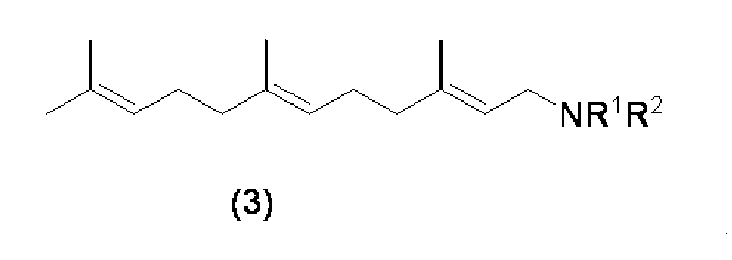

subjecting the optically active farnesyl enamine to solvolysis, wherein R1, R2, and * are as defined in claims of the present application.
Description
- The present invention relates particularly to a method for producing an optically active 2,3-dihydrofarnesal in a short process, which is economically advantageous. Specifically, the present invention relates to a method for producing an optically active 2,3-dihydrofarnesal in which the diene moiety of β-farnesene is subjected to selective amination to obtain (2E)-dihydrofarnesyl allylamine, the obtained (2E)-dihydrofarnesyl allylamine is subjected to asymmetric isomerization to obtain an optically active dihydrofarnesyl enamine, and the obtained optically active dihydrofarnesyl enamine is subjected to solvolysis to obtain the optically active 2,3-dihydrofarnesal.
- 2, 3-Dihydrofarnesal is known as a flavor and/or fragrance substance characterized in an aroma with a floral note (Japanese Patent Application Publication No.
Hei 8-3092 - Moreover, 2,3-dihydrofarnesal also serves as an important raw material for (6E)-2,3-dihydrofarnesal, which has antimicrobial activity and which is useful as a muguet flavor and/or fragrance (Japanese Patent Application Publication No.
Hei 8-245979 - As an example of synthesis of 2,3-dihydrofarnesal in an optically active form, a report is known in which (2E, 6E) -farnesal is subjected to asymmetric hydrogen transfer reaction to synthesize (3R)-2,3-dihydrofarnesal (Angewnate Chemie, International Edition (2006), 45(25), pp. 4193-4195). Actually, however, (2Z,6E)-farnesal used as the raw material has to be separated and purified from a mixture of geometrical isomers, (2E,6E)-farnesal and (2Z,6E)-farnesal, by fine distillation. Furthermore, the asymmetric hydrogen transfer reaction of (2E, 6E) -farnesal for obtaining the optically active 2,3-dihydrofarnesal requires an expensive and special asymmetric ligand.
- Meanwhile, as an example of synthesis of 2,3-dihydrofarnesal in a racemic form, a report is known in which (2Z,6E)-dihydrofarnesyl allylamine is subjected to isomerization reaction using bis-(α,α'-diphenylphosphino)-o-xylylene as a ligand to obtain (6E)-dihydrofarnesyl enamine in a racemic form, which is subsequently hydrolyzed using acetic acid to synthesize (6E) -dihydrofarnesal (Japanese Patent Application Publication No.
Sho 58-4748 - Under the above-described situation, an object of the present invention is to provide a method for producing an optically active 2,3-dihydrofarnesal with a high chemical purity and a high optical purity by a simple operation in a safe manner in a good yield. In addition, another object of the present invention is to provide a synthetic intermediate useful for obtaining an optically active 2,3-dihydrofarnesal with a high chemical purity and a high optical purity. Still another object of the present invention is to provide a method for efficiently producing a synthetic intermediate useful for obtaining an optically active 2,3-dihydrofarnesal.
- The present inventors have conducted intensive study to achieve the above-described objects, and found that (2E)-dihydrofarnesyl allylamine can be obtained with an extremely high chemical purity by selective amination of the diene moiety of β-farnesene, and that an optically active dihydrofarnesyl enamine, which is a novel compound, can be produced by asymmetric isomerization of the above-described (2E)-dihydrofarnesyl allylamine. The present inventors have further conducted study, and found that this novel optically active dihydrofarnesyl enamine is chemically stable, and can be stored, as it is, and the targeted optically active 2, 3-dihydrofarnesal can be obtained easily in a good yield with a high chemical purity and a high optical purity by the solvolysis of the optically active dihydrofarnesyl enamine. These findings have led to the completion of the present invention.
- Specifically, the present invention includes the following:
- [1] A method for producing an optically active 2,3-dihydrofarnesal represented by formula (1):

- subjecting β-farnesene represented by formula (2) to amination in the presence of a lithium salt of an amine:


- subsequently subjecting the (2E)-farnesyl allylamine to asymmetric isomerization to obtain an optically active farnesyl enamine represented by general formula (3):

* represents an asymmetric carbon atom; and
further subjecting the optically active farnesyl enamine to solvolysis.
- subjecting β-farnesene represented by formula (2) to amination in the presence of a lithium salt of an amine:
- [2] The production method according to the above-described [1], wherein
the asymmetric isomerization is conducted by using- a rhodium monocationic complex represented by general formula (5):
[Rh (olefin)L]+X- (5),
wherein the olefin is ethylene, 1,3-butadiene, cyclooctadiene, norbornadiene, or cycloocta-1,5-diene, X is ClO4, BF4, PF6, or PCl6, and L is an optically active bidentate phosphine ligand, or - a rhodium dinuclear complex represented by general formula (6):
[Rh(L)2]+X- (6),
- a rhodium monocationic complex represented by general formula (5):
- [3] An optically active farnesyl enamine represented by general formula (4):

- [4] The optically active farnesyl enamine according to the above-described [3], wherein
the configuration of the optically active farnesyl enamine represented by general formula (4) is in the 3S-form. - [5] The optically active farnesyl enamine according to the above-described [3], wherein the configuration of the optically active farnesyl enamine represented by general formula (4) is in the 3R-form.
- In the production method of the present invention, (2E)-dihydrofarnesyl allylamine can be obtained with a high chemical purity by the amination of β-farnesene conducted in the first step. For this reason, by using the (2E)-dihydrofarnesyl allylamine for the asymmetric isomerization in the subsequent step, an optically active dihydrofarnesyl enamine, which is a novel intermediate for producing an optically active 2,3-dihydrofarnesal, can be produced with an extremely high chemical purity and a high optical purity. In addition, in the case of the present invention, an optically active 2,3-dihydrofarnesal can be produced by solvolysis of the optically active dihydrofarnesyl enamine, which is the novel intermediate.
- In addition, the novel optically active dihydrofarnesyl enamine of the present invention is useful as an intermediate for producing an optically active 2,3-dihydrofarnesol.
- Hereinafter, a method for producing an optically active 2,3-dihydrofarnesal of the present invention will be described specifically.
- The scheme of the method for producing an optically active 2,3-dihydrofarnesal of the present invention includes the reactions shown below:

- In other words, amination of β-farnesene represented by formula (2) is conducted in the presence of a lithium salt of an amine to obtain (2E)-farnesyl allylamine represented by general formula (3) with a high chemical purity. Subsequently, the (2E)-farnesyl allylamine is subjected to asymmetric isomerization to form the optically active farnesyl enamine represented by general formula (4). Further, by solvolysis of the optically active farnesyl enamine, the optically active 2, 3-dihydrofarnesal represented by formula (1) can be obtained.
- The amine which is a raw material for producing the optically active 2,3-dihydrofarnesal of the present invention is described.
- The amine used in the present invention is represented by the following general formula (7):
HNR1R2 (7),
wherein
R1 and R2 are each independently selected from the group consisting of a hydrogen atom, optionally substituted alkyl groups having 1 to 20 carbon atoms, optionally substituted 3-to 8-membered alicyclic groups, optionally substituted aryl groups having 6 to 15 carbon atoms, optionally substituted heterocyclic groups having 2 to 15 carbon atoms, and optionally substituted aralkyl groups having 7 to 12 carbon atoms, provided that R1 and R2 do not represent hydrogen atoms at the same time, or R1 and R2 may be bonded to each other to form a ring. - The alkyl group having 1 to 20 and preferably 1 to 10 carbon atoms represented by R1 or R2 in general formula (7) may be linear or branched, and examples thereof include a methyl group, an ethyl group, a n-propyl group, an isopropyl group, a n-butyl group, an isobutyl group, a sec-butyl group, a tert-butyl group, a n-pentyl group, an iso-pentyl group, a neopentyl group, a hexyl group, a heptyl group, an octyl group, a nonyl group, a decyl group, an undecyl group, a dodecyl group, a tridecyl group, a tetradecyl group, a pentadecyl group, a hexadecyl group, a heptadecyl group, an octadecyl group, a nonadecyl group, an eicosyl group, and the like.
- Examples of the 3- to 8-membered alicyclic group represented by R1 or R2 in general formula (7) include a cyclopropyl group, a cyclobutyl group, a cyclopentyl group, a cyclohexyl group, a cycloheptyl group, a cyclooctyl group, and the like.
- Examples of the aryl group represented by R1 or R2 in general formula (7) include aryl groups having 6 to 15 carbon atoms such as aromatic monocyclic or polycyclic groups including a phenyl group, a naphthyl group, an anthryl group, a phenanthryl group, an indenyl group, and the like. Other examples include metallocenyl groups such as a ferrocenyl group.
- The heterocyclic group represented by R1 or R2 in general formula (7) may be an aliphatic heterocyclic group or an aromatic heterocyclic group. Examples of the aliphatic heterocyclic group include 5- to 8-membered and preferably 5-or 6-membered monocyclic, polycyclic, or fused-cyclic aliphatic heterocyclic groups having 2 to 14 carbon atoms and at least one and preferably one to three heteroatoms such as nitrogen atoms, oxygen atoms, and sulfur atoms. Specific examples of the aliphatic heterocyclic groups include a 2-oxopyrrolidyl group, a piperidyl group, a piperazinyl group, a morpholino group, a tetrahydrofuryl group, a tetrahydropyranyl group, a tetrahydrothienyl group, and the like. Meanwhile, examples of the aromatic heterocyclic group include 5- to 8-membered and preferably 5- or 6-membered monocyclic, polycyclic, or fused-cyclic aromatic heterocyclic (heteroaryl) groups having 2 to 15 carbon atoms and at least one and preferably one to three heteroatoms such as nitrogen atoms, oxygen atoms, and sulfur atoms. Specific examples of the aromatic heterocyclic groups include a furyl group, a thienyl group, a pyridyl group, apyridinyl group, a pyrazinyl group, a pyridazinyl group, an imidazolyl group, an oxazolyl group, a thiazolyl group, a benzofuryl group, a benzothienyl group, a quinolyl group, an isoquinolyl group, a quinoxalinyl group, a phthalazinyl group, a quinazolinyl group, a naphthyridinyl group, a cinnolinyl group, a benzoimidazoline group, a benzoxazolyl group, a benzothiazolyl group, and the like.
- The aralkyl group represented by R1 or R2 in general formula (7) may be, for example, an aralkyl group having 7 to 12 carbon atoms, and examples thereof include a benzyl group, a 1-phenylethyl group, a 2-phenylethyl group, and the like.
- When R1 and R2 in general formula (7) are bonded to each other to form a ring, the ring may be a cyclic amine having 2 to 15 carbon atoms, and examples thereof include cyclic amines such as piperidine, pyrrolidine, morpholine, indoline, and isoindoline.
- Here, the alkyl group represented by R1 or R2 may have a substituent(s), and the substituents include aryl groups, aralkyl groups, alicyclic groups, halogen atoms, hydroxyl groups, alkoxy groups, tri-substituted organosilyl groups, carboxylgroups, acyl groups, acyloxy groups, substituted amino groups, heterocyclic groups, nitro groups, and the like.
- Likewise, the alicyclic group, aryl group, heterocyclic group, or aralkyl group represented by R1 or R2 may have a substituent (s), and the substituents include alkyl groups, aryl groups, aralkyl groups, alicyclic groups, halogen atoms, hydroxyl groups, alkoxy groups, tri-substituted organosilyl groups, carboxyl groups, acyl groups, acyloxy groups, substituted amino groups, heterocyclic groups, nitro groups, and the like.
- Here, examples of the alkyl groups serving as the substituents include alkyl groups having 1 to 6 carbon atoms such as methyl groups, ethyl groups, n-propyl groups, isopropyl groups, sec-butyl groups, tert-butyl groups, pentyl groups, and hexyl groups.
- Examples of the aryl groups serving as the substituents include aryl groups having 6 to 14 carbon atoms such as phenyl groups, α-naphthyl groups, β-naphthyl groups, anthryl groups, phenanthryl groups, and biphenyl groups.
- The aralkyl groups serving as the substituents include aralkyl groups having 7 to 12 carbon atoms such as benzyl groups, 1-phenylethyl groups, 2-phenylethyl groups, α-naphthylmethyl groups, and β-naphthylmethyl groups.
- The alicyclic groups serving as the substituents include alicyclic groups having 5 to 8 carbon atoms such as cyclopentyl groups, cyclohexyl groups, methylcyclohexyl groups, cycloheptyl groups, and cyclooctyl groups.
- The halogen atoms serving as the substituents include fluorine atoms, chlorine atoms, bromine atoms, and iodine atoms.
- The alkoxy groups serving as the substituents include alkoxy groups having 1 to 4 carbon atoms such as methoxy groups, ethoxy groups, n-propoxy groups, isopropoxy groups, n-butoxy groups, isobutoxy groups, sec-butoxy groups, and tert-butoxy groups.
- The tri-substituted organosilyl groups serving as the substituents include tri(C1 to C6 alkyl)silyl groups such as trimethylsilyl groups, triethylsilyl groups, triisopropylsilyl groups, dimethylisopropylsilyl groups, diethylisopropylsilyl groups, dimethyl(2,3-dimethyl-2-butyl)silyl groups, tert-butyldimethylsilyl groups, and dimethylhexylsilyl groups.
- The carboxyl groups serving as the substituents include alkoxycarbonyl groups having 2 to 6 carbon atoms such as methoxycarbonyl groups and ethoxycarbonyl groups and arylcarboxyl groups having 6 to 11 carbon atoms such as phenoxycarbonyl groups.
- The acyl groups serving as the substituents include acyl groups having 1 to 8 carbon atoms such as formyl groups, acetyl groups, propironyl groups, n-butyroyl groups, isobutyroyl groups, and benzoyl groups.
- The acyloxy groups serving as the substituents include acyloxy groups having 1 to 8 carbon atoms such as formyloxy groups, acyloxy groups, propionyloxy groups, n-butyroyloxy groups, isobutyroyloxy groups, and benzoyloxy groups.
- The substituted amino groups serving as the substituents include dialkylamino groups having alkyl groups having 1 to 12 carbon atoms as substituents, such as dimethylamino groups, diethylamino groups, diisopropylamino groups, piperidyl groups, and piperidyl groups.
- The heterocyclic groups serving as the substituents include aliphatic heterocyclic groups and aromatic heterocyclic groups. Examples of the aliphatic heterocyclic groups include 5- to 8-membered and preferably 5- or 6-membered monocyclic, polycyclic, or fused-cyclic aliphatic heterocyclic groups having 2 to 14 carbon atoms and at least one and preferably one to three heteroatoms such as nitrogen atoms, oxygen atoms, and sulfur atoms. Specific examples of the aliphatic heterocyclic groups include 2-oxopyrrolidyl groups, piperidyl groups, piperazinyl groups, morpholino groups, tetrahydrofuryl groups, tetrahydropyranyl groups, tetrahydrothienyl groups, and the like. Meanwhile, examples of the aromatic heterocyclic groups include 5- to 8-membered and preferably 5- or 6-membered monocyclic, polycyclic, or fused-cyclic aromatic heterocyclic (heteroaryl) groups having 2 to 15 carbon atoms and at least one and preferably one to three heteroatoms such as nitrogen atoms, oxygen atoms, and sulfur atoms. Specific examples of the aromatic heterocyclic groups include furyl groups, thienyl groups, pyridyl groups, pyridinyl groups, pyrazinyl groups, pyradizinyl groups, imidazolyl groups, oxazolyl groups, thiazolyl groups, benzofuryl groups, benzothienyl groups, quinolyl groups, isoquinolyl groups, quinoxalinyl groups, phthalazinyl groups, quinazolinyl groups, naphthyridinyl groups, cinnolinyl groups, benzoimidazoline groups, benzooxazolyl groups, benzothiazolyl groups, and the like.
- Specific examples of the amine used in the present invention include dimethylamine, diethylamine, di-n-propylamine, diisopropylamine, cyclohexylamine, cyclohexylamine, piperidine, pyrrolidine, morpholine, and the like.
- The amount of β-farnesene used relative to the amine is such that the amount of moles of β-farnesene is 1 to 100 times and preferably 1 to 10 times that of the amine.
- The lithium salt of an amine used in the present invention can be obtained by reacting the amine with a lithium catalyst. As the lithium catalyst, an organic lithium compound or lithium metal can be used.
- The lithium salt of an amine used in the present invention can be obtained by reacting an organic lithium compound with an amine. The lithium salt of an amine used in the present invention can also be prepared by a method in which lithium metal is reacted with an amine in the presence of a hydrogen acceptor olefin such as isoprene or styrene, or other methods. Any of these methods can be employed.
- Here, the organic lithium compound includes methyllithium, n-butyllithium, sec-butyllithium, t-butyllithium, phenyllithium, and the like.
- The amount of moles of the lithium catalyst used in the amination is 0.001 to 1 time and preferably 0.05 to 0.5 times that of the amine used for the reaction.
- The amination reaction is conducted in an inert atmosphere with or without a solvent. When a solvent is used, a solvent capable of dissolving the lithium catalyst is used. Usable solvents include hydrocarbon solvents such as benzene and toluene, ether solvents such as tetrahydrofuran, and the like. The reaction temperature can be determined, as appropriate, by a person skilled in the art according to the raw material and reagent used, and is generally 0 to 150°C and preferably 50 to 100°C.
- The reaction time can be determined, as appropriate, by a person skilled in the art, and is generally several minutes to 24 hours, and preferably 1 to 10 hours.
- (2E)-Farnesyl allylamine (3) can be obtained from the mixture of the amination reaction of β-farnesene (2) conducted under the above-described reaction conditions in the presence of the lithium salt of the amine as follows. Specifically, after completion of the reaction, the lithium catalyst serving as the catalyst is inactivated by adding water, ethanol, carbon dioxide, or the like. Then, the oil layer is subjected to a purification process by, for example, distillation, column chromatography, or the like.
- The farnesyl allylamine is a compound having (2E)- and (2Z)-isomers. In the farnesyl allylamine obtained by the synthetic method of the present invention, however, (2E)-farnesyl allylamine (3), which is the (2E)-isomer, has an extremely high chemical purity with the (2E)-isomer/(2Z)-isomer ratio being 99/1 to 100/0. The (2E)-farnesyl allylamine (3) may be used for the asymmetric isomerization in the subsequent step without fine distillation.
- An optically active farnesyl enamine (4) can be obtained by asymmetric isomerization of the (2E)-farnesyl allylamine (3) obtained by the above-described amination reaction.
- As a method for asymmetric isomerization of the (2E)-farnesyl allylamine (3), a method for isomerization using an optically active transition metal complex as a catalyst can be employed.
- As the optically active transition metal complex used in the present invention, a complex containing a transition metal complex and an optically active ligand is preferably used.
- The ligand used in the optically active transition metal complex for the asymmetric isomerization of the (2E)-farnesyl allylamine (3) of the present invention may be a monodentate ligand, a polydentate ligand, or the like, and is preferably an optically active bidentate phosphine ligand.
- The optically active bidentate phosphine ligand includes optically active bidentate phosphine ligands represented by the following general formula (8):

- In general formula (8), R3 to R6 each independently represent an optionally substituted aromatic group having 6 to 15 carbon atoms or an optionally substituted cycloalkyl group having 3 to 10 carbon atoms, or each of the pairs of R3 and R4 and R5 and R6 may form a heterocycle together with the adjacent phosphorus atom.
- The aromatic group in the optionally substituted aromatic group includes hydrocarbon-based aromatic groups such as a phenyl group, a naphthyl group, and a phenanthryl group; heteroaromatic groups such as a pyrrolyl group, a pyridyl group, a pyrazyl group, a quinolyl group, an isoquinolyl group, and an imidazolyl group; and the like.
- Here, specific examples of the substituents include alkyl groups having 1 to 12 carbon atoms such as methyl groups, ethyl groups, n-propyl groups, isopropyl groups, n-butyl groups, isobutyl groups, sec-butyl groups, tert-butyl groups, n-pentyl groups, isopentyl groups, neopentyl groups, hexyl groups, heptyl groups, octyl groups, nonyl groups, decyl groups, undecyl groups, and dodecyl groups; lower alkoxy groups having 1 to 4 carbon atoms such as methoxy groups, ethoxy groups, n-propoxy groups, isopropoxy groups, n-butoxy groups, isobutoxy groups, sec-butoxy groups, and tert-butoxy group; aryl groups having 6 to 15 carbon atoms such as phenyl groups, α-naphthyl groups, β-naphthyl groups, and phenanthryl groups; aralkyl groups having 7 to 13 carbon atoms such as benzyl groups, α-phenylethyl groups, β-phenylethyl groups, α-phenylpropyl groups, β-phenylpropyl groups, γ-phenylpropyl groups, and naphthylmethyl groups; tri-substituted organosilyl groups including tri(C1 to C6 alkyl)silyl groups such as trimethylsilyl groups, triethylsilyl groups, triisopropylsilyl groups, dimethylisopropylsilyl groups, diethylisopropylsilyl groups, dimethyl(2,3-dimethyl-2-butyl)silyl groups, tert-butyldimethylsilyl groups, and dimethylhexylsilyl groups, di(C1 to C6 alkyl)-(C6 to C18 aryl)silyl groups such as dimethylcumylsilyl groups, di(C6 to C18 aryl)-(C1 to C6 alkyl)silyl groups such as tert-butyldiphenylsilyl groups and diphenylmethylsilyl groups, tri(C6 to C18 aryl)silyl groups such as triphenylsilyl groups, tri(C7 to 19 aralkyl)silyl groups such as tribenzylsilyl groups and tri-p-xylylsilyl groups, and the like; halogen atoms such as fluorine, chlorine, bromine, and iodine atoms; nitro groups; and the like.
- Specific examples of the cycloalkyl group in the optionally substituted cycloalkyl group having 3 to 10 carbon atoms include a cyclopentyl group, a cyclobutyl group, a cyclopentyl group, a cyclohexyl group, a cycloheptyl group, a cyclooctyl group, a cyclononyl group, a cyclodecyl group, an octahydronaphthyl group, and the like.
- Here, specific examples of the substituents include alkyl groups having 1 to 12 carbon atoms such as methyl groups, ethyl groups, n-propyl groups, isopropyl groups, n-butyl groups, isobutyl groups, sec-butyl groups, tert-butyl groups, n-pentyl groups, isopentyl groups, neopentyl groups, hexyl groups, heptyl groups, octyl groups, nonyl groups, decyl groups, undecyl groups, and dodecyl groups; lower alkoxy groups having 1 to 4 carbon atoms such as methoxy groups, ethoxy groups, n-propoxy groups, isopropoxy groups, n-butoxy groups, isobutoxy groups, sec-butoxy groups, and tert-butoxy group; aryl groups having 6 to 15 carbon atoms such as phenyl groups, α-naphthyl groups, β-naphthyl groups, and phenanthryl groups; aralkyl groups having 7 to 13 carbon atoms such as benzyl groups, α-phenylethyl groups, β-phenylethyl groups, α-phenylpropyl groups, β-phenylpropyl groups, γ-phenylpropyl groups, and naphthylmethyl groups; tri-substituted organosilyl groups including tri(C1 to C6 alkyl)silyl groups such as trimethylsilyl groups, triethylsilyl groups, triisopropylsilyl groups, dimethylisopropylsilyl groups, diethylisopropylsilyl groups, dimethyl(2,3-dimethyl-2-butyl)silyl groups, tert-butyldimethylsilyl groups, and dimethylhexylsilyl groups, di(C1 to C6 alkyl)-(C6 to C18 aryl)silyl groups such as dimethylcumylsilyl groups, di(C6 to C18 aryl)-(C1 to C6 alkyl)silyl groups such as tert-butyldiphenylsilyl groups and diphenylmethylsilyl groups, tri(C6 to C18 aryl)silyl groups such as triphenylsilyl groups, tri(C7 to 19 aralkyl)silyl groups such as tribenzylsilyl group and tri-p-xylylsilyl group, and the like; halogen atoms such as fluorine, chlorine, bromine, and iodine atoms; nitro groups; and the like.
- In a case where any of the pairs of R3 and R4 and R5 and R6 forms a heterocycle together with the adjacent phosphorus atom, specific examples of the heterocyclic include phosphole, tetrahydrophosphole, phosphorinane, and the like. The heterocycle may have 1 to 4 functional groups which are inactive in the reaction of the present invention as substituents. Examples of the substituents include alkyl groups having 1 to 4 carbon atoms, alkoxy groups having 1 to 4 carbon atoms, halogen atoms, and the like.
- R7 and R8 in general formula (8) are each independently a hydrogen atom, an alkyl group having 1 to 5 carbon atoms, an alkoxy group having 1 to 5 carbon atoms, a di (C1 to C5 alkyl) amino group, a 5- to 8-membered cyclic amino group, or a halogen atom.
- Specific examples of the alkyl group having 1 to 5 carbon atoms represented by R7 or R8 include a methyl group, an ethyl group, a n-propyl group, an isopropyl group, a n-butyl group, an isobutyl group, a sec-butyl group, a tert-butyl group, a pentyl group, and the like.
- Specific examples of the alkoxy group having 1 to 5 carbon atoms represented by R7 or R8 include a methoxy group, an ethoxy group, a n-propoxy group, an isopropoxy group, a n-butoxy group, an isobutoxy group, a sec-butoxy group, a tert-butoxy group, a pentoxy group, and the like.
- Specific examples of the di(C1 to C5 alkyl)amino group represented by R7 or R8 include a dimethylamino group, a diethylamino group, a di-n-propylamino group, a diisopropylamino group, a di-n-butylamino group, a diisobutylamino group, a di-sec-butylamino group, a di-tert-butylamino group, a dipentylamino group, and the like.
- Specific examples of the 5- to 8-membered cyclic amino group represented by R7 and R8 include a pyrrolidino group, a piperidino group, and the like.
- Specific examples of the halogen atom represented by R7 and R8 include fluorine, chlorine, bromine, and iodine atoms, and the like.
- Of these, R7 and R8 are each preferably a hydrogen atom; an alkyl group having 1 to 4 carbon atoms such as a methyl group, an ethyl group, a propyl group, an isopropyl group, a n-butyl group, a tert-butyl group, or a trifluoromethyl group; an alkoxy group such as a methoxy group, an ethoxy group, a n-propoxy group, an isopropoxy group, a n-butoxy group, or a tert-butoxy group; a dialkylamino group such as a dimethylamino group or a diethylamino group; a 5- to 8-membered cyclic amino group such as a pyrrolidino group or a piperidino group; or the like.
- R7 and R8 are each particularly preferably a hydrogen atom or a methoxy group.
- R9 in general formula (8) is each independently an alkyl group having 1 to 5 carbon atoms, an alkoxy group having 1 to 5 carbon atoms, a di(C1 to C5 alkyl)amino group, a 5- to 8-membered cyclic amino group, or a halogen atom.
- Specific examples of the alkyl group having 1 to 5 carbon atoms represented by R9 include a methyl group, an ethyl group, a n-propyl group, an isopropyl group, a n-butyl group, an isobutyl group, a sec-butyl group, a tert-butyl group, a pentyl group, and the like.
- Specific examples of the alkoxy group having 1 to 5 carbon atoms represented by R9 include a methoxy group, an ethoxy group, a n-propoxy group, an isopropoxy group, a n-butoxy group, an isobutoxy group, a sec-butoxy group, a tert-butoxy group, a pentoxy group, and the like.
- Specific examples of the di(C1 to C5 alkyl)amino group represented by R9 include a dimethylamino group, a diethylamino group, a di-n-propylamino group, a diisopropylamino group, a di-n-butylamino group, a diisobutylamino group, a di-sec-butylamino group, a di-tert-butylamino group, a dipentylamino group, and the like.
- Specific examples of the 5- to 8-membered cyclic amino group represented by R9 include a pyrrolidino group, a piperidino group, and the like.
- Specific examples of the halogen atom represented by R9 include fluorine, chlorine, bromine, and iodine atoms, and the like.
- Of these, R9 is preferably an alkyl group having 1 to 4 carbon atoms such as a methyl group, an ethyl group, a propyl group, an isopropyl group, a n-butyl group, a tert-butyl group, or a trifluoromethyl group; an alkoxy group such as a methoxy group, an ethoxy group, a n-propoxy group, an isopropoxy group, a n-butoxy group, or a tert-butoxy group; a dialkylamino group such as a dimethylamino group or a diethylamino group; a 5- to 8-membered cyclic amino group such as a pyrrolidino group or a piperidino group; or the like.
- R9 is particularly preferably a methyl group or a methoxy group.
- In general formula (8), each of the pairs of R7 and R8 and R8 and R9 may together form a condensed benzene ring, a condensed substituted benzene ring, a trimethylene group, a tetramethylene group, a pentamethylene group, a methylenedioxy group, an ethylenedioxy group, or a trimethylenedioxy group. Of these, it is preferable that R8 and R9 together form a condensed benzene ring, a condensed substituted benzene ring, a trimethylene group, a tetramethylene group, a pentamethylene group, a methylenedioxy group, an ethylenedioxy group, or a trimethylenedioxy group. It is particularly preferable that R8 and R9 together form a condensed benzene ring, a condensed substituted benzene ring, a tetramethylene group, a methylenedioxy group, a methylenedioxy group, or an ethylenedioxy group.
- In addition, the condensed benzene ring, condensed substituted benzene ring, trimethylene group, tetramethylene group, pentamethylene group, methylenedioxy group, ethylenedioxy group, or trimethylenedioxy group may have, as substituents, functional groups which are inactive in asymmetric synthesis reaction. The number of the functional groups is preferably in the range of 0 to 4. Here, examples of the substituents include alkyl groups having 1 to 4 carbon atoms such as methyl groups, ethyl groups, n-propyl groups, isopropyl groups, n-butyl groups, isobutyl groups, sec-butyl groups, and tert-butyl groups; hydroxyl groups; alkoxy groups having 1 to 4 carbon atoms such as methoxy groups, ethoxy groups, n-propoxy groups, isopropoxy groups, n-butoxy groups, isobutoxy groups, sec-butoxy groups, and tert-butoxy group; halogen atoms such as fluorine, chlorine, bromine, and iodine atoms; and the like.
- Examples of optically active bidentate phosphine ligands preferably used in general formula (8) include tertiary phosphines described in Japanese Patent Application Publication No.
Sho 58-4749 Sho 61-63690 Sho 62-265293 - Further, examples of optically active bidentate phosphine ligands preferably used in general formula (8) also include tertiary phosphines described in Japanese Patent Application Publication No.
Hei 4-139140 - Moreover, examples of optically active bidentate phosphine ligands preferably used in general formula (8) also include tertiary phosphines described in Japanese Patent Application Publication No.
Hei 11-269185 - ((5,6),(5',6')-bis(methylenedioxy)biphenyl-2,2'-diyl)bis(di phenylphosphine) (SEGPHOS),
- ((5,6),(5',6')-bis(methylenedioxy)biphenyl-2,2'-diyl)bis(di -p-tolylphosphine) (Tol-SEGPHOS),
- ((5,6),(5',6')-bis(methylenedioxy)biphenyl-2,2'-diyl)bis(di -3,5-xylylphosphine) (DM-SEGPHOS),
- ((5,6),(5',6')-bis(methylenedioxy)biphenyl-2,2'-diyl)bis(di -4-methoxy-3,5-dimethylphenylphosphine) (DMM-SEGPHOS),
- ((5,6),(5',6')-bis(methylenedioxy)biphenyl-2,2'-diyl)bis(di -4-methoxy-3,5-di-tert-butylphenylphosphine) (DTBM-SEGPHOS), and
- ((5,6),(5',6')-bis(methylenedioxy)biphenyl-2,2'-diyl)bis(di cyclohexylphosphine) (Cy-SEGPHOS).
- In addition to the above-described optically active bidentate phosphine ligands, optically active bidentate phosphine ligands which may be represented by general formula (8) are as follows:
- 2,2'-dimethyl-6,6'-bis(diphenylphosphino)-1,1'-biphenyl (BIPHEMP),
- 2,2'-dimethyl-6,6'-bis(di-p-tolylphosphino)-1,1'-biphenyl (Tol-BIPHEMP),
- 2,2'-dimethyl-6,6'-bis(di-3,5-xylylphosphino)-1,1'-biphenyl (DM-BIPHEMP),
- 2,2'-dimethyl-6,6'-bis(di-4-methoxy-3,5-dimethylphenylphosp hino)-1,1'-biphenyl (DMM-BIPHEMP),
- 2,2'-dimethyl-6,6'-bis(di-4-t-butoxy-3,5-dimethylphenylphos phino)-1,1'-biphenyl (DTBM-BIPHEMP),
- 2,2'-dimethyl-6,6'-bis(dicyclohexylphosphino)-1,1'-biphenyl (Cy-BIPHEMP),
- 2,2'-dimethoxy-6,6'-bis(diphenylphosphino)-1,1'-biphenyl (MeO-BIPHEP),
- 2,2'-dimethoxy-6,6'-bis(di-p-tolylphosphino)-1,1'-biphenyl (Tol-MeO-BIPHEP),
- 2,2'-dimethoxy-6,6'-bis(di-3,5-xylylphosphino)-1,1'-bipheny 1 (DM-MeO-BIPHEP),
- 2,2'-dimethoxy-6,6'-bis(di-4-methoxy-3,5-dimethylphenylphos phino)-1,1'-biphenyl (DMM-MeO-BIPHEP),
- 2,2'-dimethoxy-6,6'-bis(di-4-t-butoxy-3,5-dimethylphenylpho sphino)-1,1'-biphenyl (DTBM-MeO-BIPHEP),
- 2,2'-dimethoxy-6,6'-bis(dicyclohexylphosphino)-1,1'-bipheny 1 (Cy-MeO-BIPHEP),
- 2,2'-dimethyl-3,3'-dichloro-4,4'-dimethyl-6,6'-bis(di-p-tol ylphosphino)-1,1'-biphenyl (Tol-CM-BIPHEMP),
- 2,2'-dimethyl-3,3'-dichloro-4,4'-dimethyl-6,6'-bis(di-3,5-x ylylphosphino)-1,1'-biphenyl (DM-CM-BIPHEMP), and
- 2,2'-dimethyl-3,3'-dichloro-4,4'-dimethyl-6,6'-bis(di-4-met hoxy-3,5-dimethylphenylphosphino)-1,1'-biphenyl (DMM-CM-BIPHEMP).
- In the present invention, an asymmetric hydrogenation reaction can be conducted by using an optically active transition metal complex comprising the above-described optically active bidentate phosphine ligand and a transition metal. Examples of the optically active transition metal complex preferable for this asymmetric hydrogenation reaction include optically active rhodium complexes represented by general formula (5) and general formula (6):
[Rh(olefin)L]+X- (5),
wherein the olefin is ethylene, 1,3-butadiene, cyclooctadiene, norbornadiene, or cycloocta-1,5-diene, X is ClO4, BF4, PF6, or PCl6, and L is an optically active bidentate phosphine ligand, or
[Rh(L)2]+X- (6),
wherein X and L have the same meanings as defined above. - A method for producing the optically active rhodium complex represented by general formula (5) or general formula (6) is not particularly limited, and the optically active rhodium complex can be produced by, for example, the method shown below or a method based on the method shown below. Note that, in the formulae of transition metal-phosphine complexes shown below, cod represents cycloocta-1,5-diene, and nbd represents norbornadiene.
- A specific example of production of the optically active rhodium complex is as follows. Specifically, the optically active rhodium complex can be synthesized by reacting chloro(1,5-cyclooctadiene)rhodium(I) dimer ([Rh(cod)Cl]2), silver perchlorate, and the above-described optically active bidentate phosphine ligand with each other according to any of the methods described in Japanese Patent Application Publication No.
Sho 58-4748 Sho 59-20294 Sho 60-61587 - Specific examples of the rhodium complex are shown below.
- The optically active rhodium complexes represented by general formula (5) are as follows:
- [Rh (cod) (L) ] OTf, [Rh (cod) (L)]BF4, [Rh (cod) (L)]ClO4, [Rh(cod)(L)]SbF6, [Rh(cod)(L)]PF6, [Rh (cod) (L)]BPh4, [Rh (nbd) (L)] OTf, [Rh (nbd) (L)]BF4, [Rh (nbd) (L)]ClO4, [Rh (nbd) (L)] SbF6, [Rh (nbd) (L)]PF6, and [Rh (nbd) (L)]BPh4.
- The optically active rhodium complexes represented by general formula (6) are as follows:
- [Rh(L)2]OTf, [Rh(L)2BF4, [Rh(L)2ClO4, [Rh(L)2]SbF6, [Rh(L)2]PF6, and [Rh(L)2]BPh4.
- Each of the optically active bidentate phosphine ligands exist in the (S)-form and the (R)-form. It is only necessary to select one of these forms according to the desired absolute configuration of the optically active farnesyl enamine (3). Specifically, when the substrate in the (E)-form is used, and, for example, when Tol-BINAP is used as the ligand, Tol-BINAP in the (S)-form is used to obtain the optically active farnesyl enamine (4) in the (R)-form. Meanwhile, Tol-BINAP in the (R) -form is used to obtain the optically active farnesyl enamine (4) in the (S)-form. On the other hand, when the substrate in the (Z)-form is used, Tol-BINAP in the (R)-form is used to obtain the optically active farnesyl enamine (4) in the (S)-form, whereas Tol-BINAP in the (S)-form is used to obtain the optically active farnesyl enamine (4) in the (R)-form.
- Note that the amount of moles of the transition metal-optically active phosphine complex used is preferably approximately 1/100 to 1/50000 times that of the farnesyl allylamine (3).
- In addition, any suitable solvent can be used as the reaction solvent, as long as the solvent is capable of dissolving the raw material and the catalyst system of the asymmetric hydrogenation. For example, it is possible to use aromatic hydrocarbon solvents such as toluene and xylene; aliphatic hydrocarbon solvents such as pentane and hexane; halogen-containing hydrocarbon solvents such as methylene chloride; ether solvents such as diethyl ether, diisopropyl ether, diethylene glycol dimethyl ether, tetrahydrofuran, and 1,3-dioxolane; alcohol solvents such as methanol, ethanol, 2-propanol, butanol, and benzyl alcohol; and heteroatom-containing organic solvents such as acetonitrile, DMF, and DMSO. It is preferable to use an ether solvent or a mixture solvent with an ether solvent. The amount of the solvent is determined based on the solubility of the reaction substrate and cost efficiency. For example, the reaction can be conducted in a range from a low concentration of 1% or lower to a nearly solventless state depending on the substrate. However, the reaction is preferably conducted by using the solvent in an amount of 0.1 to 5.0 times by volume. Regarding the reaction temperature, the reaction can be conducted at 0 to 150°C, and more preferably in a range from 70 to 120°C. In addition, the reaction time varies depending on reaction conditions such as the concentration of the reaction substrate, the temperature, and the pressure. The reaction is completed in several minutes to 30 hours. After completion of the reaction, the targeted optically active farnesyl enamine (4) can be isolated by ordinary post treatments.
- The optically active farnesyl enamine (4) obtained by the above-described asymmetric isomerization is an unprecedented novel compound, which is stable, generally oily, and storable. For this reason, the optically active farnesyl enamine (4) obtained by the above-described addition reaction may be, for example, subjected to a purification process such as a distillation or column chromatography treatment. Alternatively, the optically active farnesyl enamine (4) may be stored without conducting any purification process, and taken out from a storage container before use in the subsequent step for production.
- The optically active 2,3-dihydrofarnesal (1) can be obtained by solvolysis of the optically active farnesyl enamine (4) obtained by the above-described asymmetric isomerization.
- As a method for the solvolysis, an ordinary known or well-known method for solvolysis of an enamine can be used. For example, a method may be used in which the reaction is conducted by using an acidic catalyst in a solvent. Examples of the acidic catalyst used in the solvolysis include hydrofluoric acid, hydrochloric acid, hydrobromic acid, sulfuric acid, phosphoric acid, methanesulfonic acid, p-toluenesulfonic acid, acetic acid, chloroacetic acid, trifluoroacetic acid, acidic ion-exchange resin, and the like. Preferred acidic catalysts include hydrochloric acid, sulfuric acid, p-toluenesulfonic acid, and the like, because these acidic catalysts are inexpensive and versatile and achieve a high reaction selectivity and a high reaction yield. One or a mixture of two or more of these acidic catalysts can be used, but a method using one of these acidic catalysts is preferable.
- In addition, the solvent used for the solvolysis may be any, as long as the solvolysis proceeds in the solvent. Examples of the solvent include water, alcohols such as methanol, ethanol, and isopropanol, and the like, as well as mixture solvents thereof. Especially, methanol and ethanol are preferable, because they are inexpensive and versatile, and achieve a high reaction selectivity and high reaction yield.
- Moreover, if necessary, an auxiliary solvent may be used. As the auxiliary solvent, any solvent may be used, as long as the solvent does not participate in the reaction. Examples of the auxiliary solvent include organic solvents including ether solvents such as diethyl ether, diisopropyl ether, tetrahydrofuran, dimethoxyethane, and dioxane, hydrocarbon solvents such as hexane, heptane, and octane, aromatic solvents such as benzene, toluene, and xylene, and the like.
- Regarding the amount of the solvent used, the volume of the solvent is generally 0.5 to 100 times and preferably 1 to 30 times relative to 1 part by mass of the optically active farnesyl enamine (4). In addition, the reaction is conducted generally at a temperature of about 0 to 250°C and preferably at a temperature of about 20 to 100°C, and the reaction is completed in generally about 10 minutes to 20 hours preferably about 30 minutes to 10 hours. These conditions can be modified, as appropriate, according to the solvent used and the amounts of the catalyst and the like.
- After completion of the reaction, the target product can be isolated by ordinary post treatments by employing, if necessary, a method such as distillation or column chromatography. In addition, the reaction mode in the present invention may be batchwise or continuous.
- Regarding the configuration of the asymmetric carbon atom at the 3-position of the optically active farnesyl enamine (4) in this reaction, the configuration of the optically active farnesyl enamine (4) is kept. For example, when (3R)-farnesyl enamine is used, (3R)-dihydrofarnesal can be obtained with the optical purity being kept. In other words, the configuration of the optically active 2,3-dihydrofarnesal is controlled by the configuration of the optically active ligand used in the asymmetric isomerization reaction.
- Hereinafter, the present invention will be described more specifically on the basis of Examples. However, the present invention is not limited to these examples at all.
- The analyses in Examples were conducted by using the following analytical instruments.
- NMR measuring instrument: AVANCE III 500 model (500 MHz; manufactured by Bruker BioSpin K.K.)
-
- Gas chromatograph-mass spectrometer: GCMS-QP2010 (manufactured by Shimadzu Corporation)
- Column used: BC-WAX (50 m×0.25 mm ID; manufactured by GL Sciences Inc.)
- Oven conditions: 70°C-217°C, 4°C/min
-
- Gas chromatograph: GC-2010 (manufactured by Shimadzu Corporation)
- Column used: BGB-174 (30 m×0.25 mm ID; manufactured by BGB Analytik AG)
- Oven conditions: 90°C-150°C, 0.4°C/min
- Infrared absorption spectrum measuring instrument: FT/IR-6100 (manufactured by JASCO Corporation)
- Window material: Sodium chloride
- Polarimeter: P-1020 (manufactured by JASCO Corporation)
- Under a nitrogen atmosphere, 4.29 g (0.0587 mol) of diethylamine was placed in a 20-ml flask and stirred at 5°C. Subsequently, 3.7 ml (1.6 mol/L, 0.0587 mol) of an n-butyllithium hexane solution was added thereto, and the mixture was stirred at 5°C for 10 minutes to form a lithium diethylamine solution.
- A 30-ml pressure-resistant ampoule was purged with nitrogen, and 4.0 g (0.0196 mol) of β-farnesene (manufactured by Wako Pure Chemical Industries, Ltd.) was added thereto, followed by stirring at 15°C for 10 minutes. Next, the lithium diethylamine solution was added over 5 minutes, and then the mixture was heated with stirring at 70°C for 4 hours (conversion: 99% or higher).
- After completion of the reaction, 40 ml of toluene was added, and then the mixture was washed with 8 ml of water. Subsequently, toluene was first removed by Claisen distillation, and then 4.48 g (GC chemical purity: 92.9% (2E, 6E-isomer), 1.8% (2Z,6E-isomer), 4.16 g (0.015 mol)) of N,N-diethyl-3,7,11-trimethyldodeca-2E,6E,10-trien-1-amine was obtained at a boiling point of 108 to 110°C/20 Pa in a yield of 77%.
-

1H-NMR (500 MHz, CHLOROFORM-D): δ 1.03 (t, J=7.2 Hz, 3H×2), δ 1.60 (s, 3H×2), δ 1.64 (s, 3H), δ 1.68 (s, 3H), δ 1.95-2.15 (m, 2H×4), δ 2.51 (q, J=7.2 Hz, 2H×2), δ 3.06 (d, J=6.8 Hz, 2H), δ 5.10 (t, J=6.8 Hz, 1H), δ 5.11 (t, J=6.8 Hz, 1H), δ 5.27 (t, J=6.8 Hz, 1H)
13C-NMR (125 MHz, CHLOROFORM-D): δ 11.86 (CH3×2), 16.04 (CH3), 16.36 (CH3), 17.68 (CH3), 25.70 (CH3), 26.44 (CH2), 26.79 (CH2), 39.75 (CH3), 39.85 (CH3), 46.72 (CH3×2), 50.57 (CH2), 121.79 (CH), 124.08 (CH), 124.42 (CH), 131.28 (C), 135.11 (C), 137.68 (C) - Under a nitrogen atmosphere, 24.7 mg (0.05 mmol) of chloro(1,5-cyclooctadiene)rhodium(I) dimer ([Rh(cod)Cl]2 and 20.7 mg (0.1 mmmol) of silver perchlorate (AgClO4) were placed in a 20-ml flask having a branch, and 6 ml of tetrahydrofuran was added thereto with stirring, followed by stirring at 15°C for 2 hours. Subsequently, 4 ml of a tetrahydrofuran solution containing 67.8 mg (0.1 mmmol) of (S)-Tol-BINAP was added thereto, followed by stirring at 15°C for 2 hours. Then, the silver chloride formed was removed by filtration, and the filtrate was used as a catalyst solution.
- A 200-ml pressure-resistant ampoule was purged with nitrogen, and 5 ml (0.05 mmmol) of the rhodium complex catalyst solution and 2 ml of tetrahydrofuran were added thereto. Finally, 3.36 g (GC purity: 92.9%, 3.12 g, 11.25 mmol) of N,N-diethyl-3,7,11-trimethyldodeca-2E,6E,10-trien-1-amine (obtained in Example 1) was added thereto, and the mixture was heated with stirring at 100°C for 14 hours (conversion: 99% or higher).
- After completion of the reaction, tetrahydrofuran was first removed by Claisen distillation, and then 2.65 g (GC purity: 93.5%, 0.915 g, 8.93 mmol) of (3R)-N,N-diethyl-3,7,11-trimethyldodeca-1,6E,10-trien-1-ami ne was obtained at a boiling point of 88 to 97°C/20 Pa in a yield of 79%.
-

1H-NMR (500 MHz, CHLOROFORM-D) : δ 0. 97 (d, J=6.7 Hz, 3H), δ 1.04 (t, J=7. 1 Hz, 3H×2), δ 1.2-1.35 (m, 2H), δ 1.59 (s, 3H), δ 1.60 (s, 3H), δ 1.68 (s, 3H), δ 1.95-2.1 (m, 7H), δ 2.93 (q, J=7.1 Hz, 2H×2), δ 4.04 (dd, J=8.2, 13.9 Hz, 1H), δ 5.1 (m, 1H×2), δ 5.80 (d, J=13.9 Hz, 1H)
13C-NMR (125 MHz, CHLOROFORM-D): δ 12.16 (CH3×2), 15.96 (CH3), 17.66 (CH3), 22.73 (CH3), 25.68 (CH3), 25.95 (CH3), 26.76 (CH2), 34 . 99 (CH), 38. 90 (CH2), 39.77 (CH2), 44.43 (CH3×2), 105. 07 (CH), 124.49 (CH), 125.15 (CH), 131.17 (C), 134.36 (C), 135.78 (CH) Infrared absorption spectrum (CCl4: cm-1): 2960, 1650, 1450, 1374, 1245, 1197, 1095, 935
EI-MS data (27 eV): 277 (M+; 5), 262 (5), 208 (50), 193 (5), 166 (5), 152 (5), 126 (100), 110 (5), 86 (20), 72 (15), 56 (15), 41 (15)
Specific rotation: [α]D 20 -36.8 (c 1.0, Pyridine) - Under a nitrogen atmosphere, 24.7 mg (0.05 mmol) of chloro(1,5-cyclooctadiene)rhodium(I) dimer ([Rh(cod)Cl]2 and 20.7 mg (0.1 mmol) of silver perchlorate (AgClO4) were placed in a 20-ml flask having a branch, and 6 ml of tetrahydrofuran was added thereto with stirring, followed by stirring at 15°C for 2 hours. Subsequently, 4 ml of a tetrahydrofuran solution containing 67.8 mg (0.1 mmol) of (R)-Tol-BINAP was added thereto, followed by stirring at 15°C for 2 hours. Then, the silver chloride formed was removed by filtration, and the filtrate was used as a catalyst solution.
- A 200-ml pressure-resistant ampoule was purged with nitrogen, and 2 ml (0.02 mmol) of the rhodium complex catalyst solution and 2 ml of tetrahydrofuran were added thereto. Finally, 1.12 g (GC purity: 92.9%, 1.04 g, 3.75 mmol) of N,N-diethyl-3,7,11-trimethyldodeca-2,6,10-trien-1-amine (obtained in Example 1) was added thereto, and the mixture was heated with stirring at 100°C for 14 hours (conversion: 99% or higher).
- After completion of the reaction, tetrahydrofuran was first removed by Claisen distillation, and then 1.00 g (GC purity: 91.5%, 0.915 g, 3.30 mmol) of (3S)-N,N-diethyl-3,7,11-trimethyldodeca-1,6E,10-trien-1-ami ne was obtained at a boiling point of 88 to 94°C/20 Pa in a yield of 88%.
-

1H-NMR (500 MHz, CHLOROFORM-D) : δ 0. 97 (d, J=6. 8 Hz, 3H), δ 1.04 (t, J=7. 1 Hz, 3H×2), δ 1.2-1.35 (m, 2H), δ 1.59 (s, 3H), δ 1.60 (s, 3H), δ 1.68 (s, 3H), δ 1.95-2.1 (m, 7H), δ 2.93 (q, J=7.1 Hz, 2H×2), δ 4.04 (dd, J=8.1, 13.9 Hz, 1H), δ 5.1 (m, 1H×2), δ 5.79 (d, J=13.9 Hz, 1H)
13C-NMR (125 MHz, CHLOROFORM-D): δ 12.16 (CH3×2), 15.96 (CH3), 17.66 (CH3), 22.73 (CH3), 25.68 (CH3), 25.95 (CH3), 26.76 (CH3), 34 . 99 (CH), 38. 90 (CH2), 39.77 (CH2), 44.43 (CH3×2), 105. 07 (CH), 124.49 (CH), 125.15 (CH), 131.17 (C), 134.36 (C), 135.78 (CH) Infrared absorption spectrum (CCl4: cm-1): 2960, 2924, 2865, 1650, 1450, 1374, 1245, 1197, 1095, 935
EI-MS data (27 eV): 277 (M+; 5), 262 (5), 208 (50), 193 (5), 166 (5), 152 (5), 126 (100), 110 (5), 86 (20), 72 (15), 56 (15), 41 (15)
Specific rotation: [α]D 20 +36.1 (c 1.0, Pyridine) - A 100 ml pressure-resistant ampoule was purged with nitrogen, and 1 ml (0.01 mmol) of the rhodium complex catalyst solution prepared in Example 3, and 2 ml of tetrahydrofuran were added thereto. Finally, 2.78 g (10 mmol, (GC purity: 59.3% (2E,6E-isomer), 22.2% (2Z,6E-isomer)) of N,N-diethyl-3,7,11-trimethyldodeca-2,6,10-trien-1-amine (obtained in Synthesis Example 1) was added thereto, and the mixture was heated with stirring at 100°C for 16 hours. The reaction product was analyzed by gas chromatography. The results showed that the conversion of the 2E, 6E-isomer was 67.3%, whereas the 2Z, 6E-isomer had a poor reactivity with a conversion of 47.6%.
- In a 300-ml flask, 100 g (1.0 mol) of concentrated hydrochloric acid was added, and stirred at 5°C for 10 minutes. Subsequently, 55.6 g (0.25 mol) of 6E-nerolidol was added thereto over 30 minutes, followed by stirring at 5°C for 3 hours. Subsequently, the mixture was neutralized with a 25% aqueous sodium hydroxide solution. Then, extraction was conducted with 100 ml of toluene, and then the aqueous layer was removed.
- To a 300-ml flask, the obtained organic layer was added, and then 36.6 g (0.5 mol) of diethylamine was added over 10 minutes. Further, 26.5 g (0.25 mol) of sodium carbonate was added thereto, followed by stirring at 45°C for 3 hours.
- After completion of the reaction, 100 ml of toluene was added, and then the precipitates were removed by filtration. The obtained filtrate was washed twice with 50 ml of water, and then toluene was removed by an evaporator to obtain 28.6 g of a concentrate.
- The obtained concentrate was subjected to silica column chromatography (silica gel: 300 g). First, impurities were removed with hexane:ethyl acetate=3:1, and then a fraction (13.0 g) rich in N,N-diethyl-3,7,11-trimethyldodeca-2,6,10-trien-1-amine was obtained using hexane:triethylamine=20:1. Subsequently, by Claisen distillation, 10.9 g (GC purity: 59.3% (2E,6E-isomer), 22.2% (2Z,6E-isomer)), 8.9 g, 0.032 mol) of N,N-diethyl-3,7,11-trimethyldodeca-2,6-10-trien-1-amine was obtained at a boiling point of 100 to 110°C/20 Pa in a yield of 13%.
-

1H-NMR (500 MHz, CHLOROFORM-D): δ 1.03 (t, J=7.2 Hz, 3H×2), δ 1.60 (s, 3H×2), δ 1.68 (s, 3H), δ 1.73 (s, 3H), δ 1.95-2.15 (m, 2H×4), δ 2.50 (q, J=7.2 Hz, 2H×2), δ 3.05 (d, J=6.8 Hz, 2H), δ 5.05-5.15 (m, 1H×2), δ 5.24-5.29 (m, 1H) 13C-NMR (125 MHz, CHLOROFORM-D) : δ 11.82 (CH3×2), 15.99 (CH3), 17.69 (CH3), 23.59 (CH3), 25.70 (CH3), 26.52 (CH3), 26.72 (CH3), 32.20 (CH3), 39.74 (CH3), 46.69 (CH3×2), 50.44 (CH2), 122.66 (CH), 123.97 (CH), 124.35 (CH), 131.34 (C), 135.34 (C), 137.85 (C) - To a 100-ml flask, 1.42 g (GC purity: 93.5%, 1.33g, 4.78 mmol) of N,N-diethyl-3,7,11-trimethyldodeca-1,6,10-trien-1-amine (obtained in Example 2), 70 ml of toluene, and 15 ml of 1 N aqueous sulfuric acid were added, and stirred at 15°C for 10 minutes (conversion: 99% or higher). After the aqueous layer was removed, the organic layer was washed twice with 30 ml of 10% sodium carbonate solution, and further washed twice with 30 ml of water.
- After completion of the washing, first, toluene was removed by Claisen distillation, and then 1.07 g (GC purity: 99.5%, optical purity: 95% e.e., 1.06 g, 4.78 mmol) of (3R)-dihydrofarnesal was obtained at a boiling point of 68 to 72°C/20 Pa in a yield of 100%.
-

1H-NMR (500 MHz, CHLOROFORM-D): δ 0.98 (d, J=6.7 Hz, 3H), δ 1.25-1.4 (m, 2H), δ 1.60 (s, 3H×2), δ 1.68 (s, 3H), δ 1.95-2.1 (m, 7H), δ 2.23 (ddd, J=2.7, 8.0, 16.0 Hz, 1H), δ 2.41 (ddd, J=2.1, 5.6, 16.0 Hz, 1H), δ 5.1 (m, 1H×2), δ 9.76 (t, J=2.7 Hz, 1H)
13C-NMR (125 MHz, CHLOROFORM-D): δ 15.96 (CH3), 17.65 (CH3), 19.87 (CH3), 25.27 (CH2), 25.66 (CH3), 26.65 (CH2), 27.79 (CH), 36.90 (CH3), 39.68 (CH2), 50.98 (CH2), 123.92 (CH), 124.28 (CH), 131.32 (C), 135.38 (C), 202.96 (CH=O)
Infrared absorption spectrum (CCl4: cm-1): 2963, 2921, 2712, 1726, 1450, 1379, 1106, 833
EI-MS data (27 eV): 222 (M+; 3), 204 (3), 189 (5), 179 (65), 161 (30), 135 (10), 123 (70), 109 (75), 93 (35), 81 (50), 69 (100), 55 (40), 41 (100)
Specific rotation: [α]D 20 +4.6 (c 1.0, MeOH) - To a 100-ml flask, 0.3 g (GC purity: 91.5%, 0.275 g, 0.99 mmmol) of N,N-diethyl-3,7-11-trimethyldodeca-1,6,10-trien-1-amine (obtained in Example 3), 50 ml of toluene, and 5 ml of 1 N aqueous sulfuric acid were added, and stirred at 15°C for 10 minutes (conversion: 99% or higher). After the aqueous layer was removed, the organic layer was washed twice with 20 ml of a 10% sodium carbonate solution, and further was washed twice with 20 ml of water.
- After completion of the washing, first, toluene was removed by Claisen distillation, and then 0.17 g (GC purity: 99.1%, optical purity: 89.0% e.e., 0.168 g, 0.76 mmol) of (3S)-dihydrofarnesal was obtained at a boiling point of 65 to 70°C/20 Pa in a yield of 77%.
-

1H-NMR (500 MHz, CHLOROFORM-D): δ 0.98 (d, J=6.7 Hz, 3H), δ 1.25-1.4 (m, 2H), δ 1.60 (s, 3H×2), δ 1.68 (s, 3H), δ 1.95-2.1 (m, 7H), δ 2.23 (ddd, J=2.7, 8.0, 16.0 Hz, 1H), δ 2.41 (ddd, J=2.1, 5.6, 16.0 Hz, 1H), δ 5.1 (m, 1H×2), δ 9.76 (t, J=2.7 Hz, 1H)
13C-NMR (125 MHz, CHLOROFORM-D): δ 15.97 (CH3), 17.67 (CH3), 19.89 (CH3), 25.28 (CH2), 25.67 (CH3), 26.67 (CH2), 27.80 (CH), 36.91 (CH3), 39.70 (CH2), 50.99 (CH2), 123.92 (CH), 124.29 (CH), 131.34 (C), 135.39 (C), 202.97 (CH=O)
Infrared absorption spectrum (CCl4: cm-1): 2963, 2921, 2712, 1726, 1450, 1379, 1106, 833
EI-MS data (27 eV): 222 (M+; 3), 204 (3), 189 (5), 179 (40), 161 (20), 135 (5), 123 (40), 109 (50), 93 (20), 81 (30), 69 (100), 55 (30), 41 (85)
Specific rotation: [α]D 20 -3.7 (c 0.5, MeOH) - To a 20-m; flask, 1.11 g (GC purity: 99.1%, 1.10 g, 4.95 mmol) of (3R)-dihydrofarnesal (obtained in Example 5) and 10 ml of methanol were added, and stirred at 15°C. Subsequently, 0.189 g (5 mmol) of sodium borohydride (NaBH4) was added thereto, followed by stirring at 15°C for 30 minutes (conversion: 99% or higher). After completion of the reaction, 10 ml of 1 N hydrochloric acid water and toluene were added, followed by stirring at 15°C for 10 minutes. Then, the aqueous layer was removed. Subsequently, the organic layer was washed once with 20 ml of a 10% sodium carbonate solution, and further twice with 20 ml of water.
- After completion of the washing, first, toluene was removed by Claisen distillation, and then 0.97 g (GC purity: 99.5%, 0.965 g, 4.30 mmol) of (3R)-dihydrofarnesol was obtained at a boiling point of 85 to 90°C/20 Pa in a yield of 87%.
-

1H-NMR (500 MHz, CHLOROFORM-D): δ 0.91 (d, J=6.7 Hz, 3H), δ 1.15-1.25 (m, 1H), δ 1.3-1.45 (m, 2H), δ 1.65-1.75 (m, 2H), δ 1.60 (s, 3H×2), δ 1.68 (s, 3H), δ 1.95-2.1 (m, 6H), δ 3.7 (m, 2H), δ 5.1 (m, 2H)
13C-NMR (125 MHz, CHLOROFORM-D): δ 15.94 (CH3), 17.65 (CH3), 19.55 (CH3), 25.33 (CH2), 25. 66 (CH3), 26.71 (CH2), 29. 19 (CH), 37.17 (CH2), 39.72 (CH2), 39.92 (CH2), 61.22 (CH2), 124.36 (CH), 124.58 (CH), 131.26 (C), 134.86 (C)
Infrared absorption spectrum (CCl4: cm-1): 3329, 2914, 1451, 1377, 1106, 1057, 1010, 835
EI-MS data (27 eV): 224 (M+; 2), 209 (2), 181 (30), 163 (20), 137 (5), 123 (55), 109 (15), 95 (50), 81 (80), 69 (100), 55 (30), 41 (70)
Specific rotation: [α]D 20 +5.0 (c 1.0, CHCl3)
(the compound was determined to be the 3R-isomer on the basis of comparison with the data in Reference Document: Acta. Chem. Scand., 25, 1685-1694 (1971))
Claims (5)
- A method for producing an optically active 2,3-dihydrofarnesal represented by formula (1):
 subjecting β-farnesene represented by formula (2) to amination in the presence of a lithium salt of an amine:
 subsequently subjecting the (2E)-farnesyl allylamine to asymmetric isomerization to obtain an optically active farnesyl enamine represented by general formula (3):
 further subjecting the optically active farnesyl enamine to solvolysis.
 - The production method according to claim 1, wherein the asymmetric isomerization is conducted by usinga rhodium monocationic complex represented by general formula (5):
[Rh (olefin) L]+X- (5),
wherein the olefin is ethylene, 1,3-butadiene, cyclooctadiene, norbornadiene, or cycloocta-1,5-diene, X is ClO4, BF4, PF6, or PCl6, and L is an optically active bidentate phosphine ligand, ora rhodium dinuclear complex represented by general formula (6):
[Rh(L)2]+X- (6),
wherein X and L have the same meanings as defined above. - An optically active farnesyl enamine represented by general formula (4):

- The optically active farnesyl enamine according to claim 3, wherein
the configuration of the optically active farnesyl enamine represented by general formula (4)is in the 3S-form. - The optically active farnesyl enamine according to claim 3, wherein
the configuration of the optically active farnesyl enamine represented by general formula (4) is in the 3R-form.
Applications Claiming Priority (2)
| Application Number | Priority Date | Filing Date | Title |
|---|---|---|---|
| JP2012197450A JP6054108B2 (en) | 2012-09-07 | 2012-09-07 | Process for producing optically active 2,3-dihydrofarnesal |
| PCT/JP2013/074108 WO2014038665A1 (en) | 2012-09-07 | 2013-09-06 | Method for producing optically active 2,3-dihydrofarnesal |
Publications (2)
| Publication Number | Publication Date |
|---|---|
| EP2894143A1 true EP2894143A1 (en) | 2015-07-15 |
| EP2894143A4 EP2894143A4 (en) | 2016-04-27 |
Family
ID=50237270
Family Applications (1)
| Application Number | Title | Priority Date | Filing Date |
|---|---|---|---|
| EP13834738.0A Withdrawn EP2894143A4 (en) | 2012-09-07 | 2013-09-06 | PROCESS FOR PRODUCTION OF OPTICALLY ACTIVE 2,3-DIHYDROFARNESAL |
Country Status (4)
| Country | Link |
|---|---|
| US (2) | US9284246B2 (en) |
| EP (1) | EP2894143A4 (en) |
| JP (1) | JP6054108B2 (en) |
| WO (1) | WO2014038665A1 (en) |
Cited By (4)
| Publication number | Priority date | Publication date | Assignee | Title |
|---|---|---|---|---|
| EP2905011A4 (en) * | 2012-10-01 | 2016-06-15 | Takasago Perfumery Co Ltd | PERFUME COMPOSITION |
| EP3153492A4 (en) * | 2014-06-04 | 2017-12-20 | Takasago International Corporation | Novel compound and fragrance composition containing same |
| DE102016224089A1 (en) | 2016-12-05 | 2018-06-07 | Clariant International Ltd | Amine derivatives of β-Farnesens |
| WO2019237005A1 (en) * | 2018-06-08 | 2019-12-12 | Amyris, Inc. | Synthesis of e,e-farnesol, farnesyl acetate and squalene from farnesene via farnesyl chloride |
Families Citing this family (1)
| Publication number | Priority date | Publication date | Assignee | Title |
|---|---|---|---|---|
| WO2016209953A1 (en) * | 2015-06-23 | 2016-12-29 | Fina Technology, Inc. | Dilithium initiators |
Family Cites Families (17)
| Publication number | Priority date | Publication date | Assignee | Title |
|---|---|---|---|---|
| JPS554748A (en) * | 1978-06-28 | 1980-01-14 | Hitachi Ltd | Frequency modulation circuit |
| JPS56156240A (en) * | 1980-05-02 | 1981-12-02 | Nissan Chem Ind Ltd | Preparation of 1-dimethylamino-3-methyl-2-butene |
| FI821896A7 (en) | 1981-06-05 | 1982-12-06 | Sandoz Ag | 4-Amino-benzylamine derivatives, process for their preparation and their use as pharmaceutical substances. |
| JPS584748A (en) | 1981-06-30 | 1983-01-11 | Takasago Corp | Preparation of enamine or imine |
| JPS58177943A (en) * | 1982-04-13 | 1983-10-18 | Takasago Corp | Preparation of dialkylfarnesylamine |
| JPS58177942A (en) * | 1982-04-13 | 1983-10-18 | Takasago Corp | Preparation of dialkylfarnesylamine |
| JPS5920294A (en) | 1982-07-28 | 1984-02-01 | Takasago Corp | Preparation of monovalent cationic complex of rhodium |
| JPS6042343A (en) * | 1983-08-18 | 1985-03-06 | Kuraray Co Ltd | Production of dihydropolyprenyl alcohol |
| JPS6061587A (en) | 1983-09-16 | 1985-04-09 | Takasago Corp | Rhodium-phosphine complex |
| JPS6163690A (en) | 1984-09-04 | 1986-04-01 | Takasago Corp | Ruthenium-phosphine complex |
| JPS62265293A (en) | 1986-05-13 | 1987-11-18 | Takasago Corp | Ruthenium-phosphine complex |
| JP2681057B2 (en) | 1990-10-01 | 1997-11-19 | 高砂香料工業株式会社 | 2,2'-bis (diphenylphosphino) -5,5 ', 6,6', 7,7 ', 8,8'-octahydro-1,1'-binaphthyl and transition metal having this as a ligand Complex |
| EP0684299B1 (en) | 1994-05-26 | 2000-11-22 | Givaudan SA | Dihydrofarnesal |
| JP3356242B2 (en) | 1995-03-08 | 2002-12-16 | 高砂香料工業株式会社 | (6E) Perfume containing 2,3-dihydrofarnesol |
| JP3549390B2 (en) | 1998-03-23 | 2004-08-04 | 高砂香料工業株式会社 | Ruthenium-phosphine complex and method for producing the same |
| JP2012503023A (en) | 2008-09-22 | 2012-02-02 | ザ プロクター アンド ギャンブル カンパニー | Certain polybranched polyaldehydes, polyalcohols, and surfactants, and consumer products based thereon |
| US8232431B2 (en) | 2008-09-22 | 2012-07-31 | The Procter & Gamble Company | Specific branched surfactants and consumer products |
-
2012
- 2012-09-07 JP JP2012197450A patent/JP6054108B2/en active Active
-
2013
- 2013-09-06 US US14/425,115 patent/US9284246B2/en active Active
- 2013-09-06 EP EP13834738.0A patent/EP2894143A4/en not_active Withdrawn
- 2013-09-06 WO PCT/JP2013/074108 patent/WO2014038665A1/en not_active Ceased
-
2016
- 2016-01-29 US US15/011,028 patent/US20160152550A1/en not_active Abandoned
Cited By (9)
| Publication number | Priority date | Publication date | Assignee | Title |
|---|---|---|---|---|
| EP2905011A4 (en) * | 2012-10-01 | 2016-06-15 | Takasago Perfumery Co Ltd | PERFUME COMPOSITION |
| US9464257B2 (en) | 2012-10-01 | 2016-10-11 | Takasago International Corporation | Fragrance composition |
| EP3153492A4 (en) * | 2014-06-04 | 2017-12-20 | Takasago International Corporation | Novel compound and fragrance composition containing same |
| US10294193B2 (en) | 2014-06-04 | 2019-05-21 | Takasago International Corporation | Compound, and flavor composition and/or fragrance composition containing same |
| DE102016224089A1 (en) | 2016-12-05 | 2018-06-07 | Clariant International Ltd | Amine derivatives of β-Farnesens |
| WO2018104176A1 (en) | 2016-12-05 | 2018-06-14 | Clariant International Ltd | Amine derivatives of the beta-farnesene |
| CN110035989A (en) * | 2016-12-05 | 2019-07-19 | 科莱恩国际有限公司 | β-farnesene amine derivative |
| WO2019237005A1 (en) * | 2018-06-08 | 2019-12-12 | Amyris, Inc. | Synthesis of e,e-farnesol, farnesyl acetate and squalene from farnesene via farnesyl chloride |
| CN112262116A (en) * | 2018-06-08 | 2021-01-22 | 阿迈瑞斯公司 | Synthesis of E, E-farnesol, farnesyl acetate and squalene from farnesene via farnesyl chloride |
Also Published As
| Publication number | Publication date |
|---|---|
| JP2014051461A (en) | 2014-03-20 |
| US9284246B2 (en) | 2016-03-15 |
| US20160152550A1 (en) | 2016-06-02 |
| US20150218072A1 (en) | 2015-08-06 |
| EP2894143A4 (en) | 2016-04-27 |
| WO2014038665A1 (en) | 2014-03-13 |
| JP6054108B2 (en) | 2016-12-27 |
Similar Documents
| Publication | Publication Date | Title |
|---|---|---|
| DE69635874T2 (en) | Process for the preparation of optically active alcohols | |
| JP5671456B2 (en) | Novel ruthenium carbonyl complex having a tridentate ligand, and production method and use thereof | |
| US5171892A (en) | Chiral phospholanes via chiral 1,4-diol cyclic sulfates | |
| JP5694275B2 (en) | Catalyst for homogeneous asymmetric hydrogenation | |
| DE69512415T2 (en) | HETEROAROMATIC DIPHOSPINE AS CHIRAL LIGANDS | |
| US9284246B2 (en) | Method for producing optically active 2,3-dihydrofarnesal | |
| US5274125A (en) | Chirale phosphines | |
| WO2012039098A1 (en) | Method for producing alcohol and/or amine from amide compound | |
| CN109651115B (en) | Method for preparing L-menthone | |
| JP2014114257A (en) | Method for reducing halogen-substituted benzoate ester using ruthenium carbonyl complex | |
| Quintard et al. | Synthesis of new calix [4] arene based chiral ligands bearing β-amino alcohol groups and their application in asymmetric transfer hydrogenation | |
| DE3935910A1 (en) | METHOD FOR PRODUCING OPTICALLY PURE 1,2,3,4-TETRAHYDRO-3-CARBOXYISOCHINOLINES | |
| Le Stang et al. | Convenient syntheses of fluorous phenols of the formula HOC6H5− n ((CH2) 3 (CF2) 7CF3) n (n= 1, 2) and the corresponding triarylphosphites | |
| WO2014077323A1 (en) | Method for producing optically active isopulegol and optically active menthol | |
| JP2017081933A (en) | Process for producing optically active 2,3-dihydrofarnesal | |
| US7135582B2 (en) | Transition metal complex having diphosphine compound as ligand | |
| WO2006088142A1 (en) | Catalyst for asymmetric synthesis, ligand for use therein, and process for producing optically active compound through asymmetric synthesis reaction using them | |
| CN109651437A (en) | A kind of chiral nitrogen phosphorus ligand and preparation method thereof and a kind of method for splitting racemization menthol | |
| JP4855196B2 (en) | Substituted optically active diphosphine compounds | |
| JP2015524398A (en) | Diphosphine ligands with chiral aromatic spiroketal skeleton and their preparation and application | |
| JP2011140469A (en) | New ligand, transition metal complex and method for producing optically active alcohol using the complex as catalyst | |
| EP1334976B1 (en) | Novel phosphine compound, transition metal complex containing said compound as ligand and asymetric synthesis catalyst containing said complex | |
| Gual Gozalbo | 1, 3-DIPHOSPHITE LIGANDS WITH FURANOSIDE BACKBONE: A POWERFUL TOOL IN ASYMMETRIC CATALYSIS |
Legal Events
| Date | Code | Title | Description |
|---|---|---|---|
| PUAI | Public reference made under article 153(3) epc to a published international application that has entered the european phase |
Free format text: ORIGINAL CODE: 0009012 |
|
| 17P | Request for examination filed |
Effective date: 20150309 |
|
| AK | Designated contracting states |
Kind code of ref document: A1 Designated state(s): AL AT BE BG CH CY CZ DE DK EE ES FI FR GB GR HR HU IE IS IT LI LT LU LV MC MK MT NL NO PL PT RO RS SE SI SK SM TR |
|
| AX | Request for extension of the european patent |
Extension state: BA ME |
|
| DAX | Request for extension of the european patent (deleted) | ||
| RA4 | Supplementary search report drawn up and despatched (corrected) |
Effective date: 20160330 |
|
| RIC1 | Information provided on ipc code assigned before grant |
Ipc: C07C 47/21 20060101ALI20160322BHEP Ipc: C07C 47/02 20060101ALI20160322BHEP Ipc: C07B 61/00 20060101ALI20160322BHEP Ipc: C07C 45/00 20060101AFI20160322BHEP Ipc: C07C 211/21 20060101ALI20160322BHEP Ipc: C07B 53/00 20060101ALI20160322BHEP |
|
| STAA | Information on the status of an ep patent application or granted ep patent |
Free format text: STATUS: THE APPLICATION IS DEEMED TO BE WITHDRAWN |
|
| 18D | Application deemed to be withdrawn |
Effective date: 20161026 |