EP2893642B1 - Symmetric puncturing for cqi/pci reporting on the hs-dpcch - Google Patents
Symmetric puncturing for cqi/pci reporting on the hs-dpcch Download PDFInfo
- Publication number
- EP2893642B1 EP2893642B1 EP13737692.7A EP13737692A EP2893642B1 EP 2893642 B1 EP2893642 B1 EP 2893642B1 EP 13737692 A EP13737692 A EP 13737692A EP 2893642 B1 EP2893642 B1 EP 2893642B1
- Authority
- EP
- European Patent Office
- Prior art keywords
- bit sequence
- bits
- produce
- puncturing pattern
- bit
- Prior art date
- Legal status (The legal status is an assumption and is not a legal conclusion. Google has not performed a legal analysis and makes no representation as to the accuracy of the status listed.)
- Active
Links
Images







Classifications
-
- H—ELECTRICITY
- H03—ELECTRONIC CIRCUITRY
- H03M—CODING; DECODING; CODE CONVERSION IN GENERAL
- H03M13/00—Coding, decoding or code conversion, for error detection or error correction; Coding theory basic assumptions; Coding bounds; Error probability evaluation methods; Channel models; Simulation or testing of codes
- H03M13/03—Error detection or forward error correction by redundancy in data representation, i.e. code words containing more digits than the source words
- H03M13/23—Error detection or forward error correction by redundancy in data representation, i.e. code words containing more digits than the source words using convolutional codes, e.g. unit memory codes
-
- H—ELECTRICITY
- H04—ELECTRIC COMMUNICATION TECHNIQUE
- H04B—TRANSMISSION
- H04B7/00—Radio transmission systems, i.e. using radiation field
- H04B7/02—Diversity systems; Multi-antenna system, i.e. transmission or reception using multiple antennas
- H04B7/04—Diversity systems; Multi-antenna system, i.e. transmission or reception using multiple antennas using two or more spaced independent antennas
- H04B7/0413—MIMO systems
- H04B7/0456—Selection of precoding matrices or codebooks, e.g. using matrices antenna weighting
-
- H—ELECTRICITY
- H03—ELECTRONIC CIRCUITRY
- H03M—CODING; DECODING; CODE CONVERSION IN GENERAL
- H03M13/00—Coding, decoding or code conversion, for error detection or error correction; Coding theory basic assumptions; Coding bounds; Error probability evaluation methods; Channel models; Simulation or testing of codes
- H03M13/63—Joint error correction and other techniques
- H03M13/635—Error control coding in combination with rate matching
- H03M13/6362—Error control coding in combination with rate matching by puncturing
-
- H—ELECTRICITY
- H03—ELECTRONIC CIRCUITRY
- H03M—CODING; DECODING; CODE CONVERSION IN GENERAL
- H03M13/00—Coding, decoding or code conversion, for error detection or error correction; Coding theory basic assumptions; Coding bounds; Error probability evaluation methods; Channel models; Simulation or testing of codes
- H03M13/65—Purpose and implementation aspects
- H03M13/6522—Intended application, e.g. transmission or communication standard
- H03M13/6525—3GPP LTE including E-UTRA
-
- H—ELECTRICITY
- H04—ELECTRIC COMMUNICATION TECHNIQUE
- H04B—TRANSMISSION
- H04B7/00—Radio transmission systems, i.e. using radiation field
- H04B7/02—Diversity systems; Multi-antenna system, i.e. transmission or reception using multiple antennas
- H04B7/04—Diversity systems; Multi-antenna system, i.e. transmission or reception using multiple antennas using two or more spaced independent antennas
- H04B7/0413—MIMO systems
- H04B7/0456—Selection of precoding matrices or codebooks, e.g. using matrices antenna weighting
- H04B7/0486—Selection of precoding matrices or codebooks, e.g. using matrices antenna weighting taking channel rank into account
-
- H—ELECTRICITY
- H04—ELECTRIC COMMUNICATION TECHNIQUE
- H04B—TRANSMISSION
- H04B7/00—Radio transmission systems, i.e. using radiation field
- H04B7/02—Diversity systems; Multi-antenna system, i.e. transmission or reception using multiple antennas
- H04B7/04—Diversity systems; Multi-antenna system, i.e. transmission or reception using multiple antennas using two or more spaced independent antennas
- H04B7/06—Diversity systems; Multi-antenna system, i.e. transmission or reception using multiple antennas using two or more spaced independent antennas at the transmitting station
- H04B7/0613—Diversity systems; Multi-antenna system, i.e. transmission or reception using multiple antennas using two or more spaced independent antennas at the transmitting station using simultaneous transmission
- H04B7/0615—Diversity systems; Multi-antenna system, i.e. transmission or reception using multiple antennas using two or more spaced independent antennas at the transmitting station using simultaneous transmission of weighted versions of same signal
- H04B7/0619—Diversity systems; Multi-antenna system, i.e. transmission or reception using multiple antennas using two or more spaced independent antennas at the transmitting station using simultaneous transmission of weighted versions of same signal using feedback from receiving side
- H04B7/0636—Feedback format
-
- H—ELECTRICITY
- H04—ELECTRIC COMMUNICATION TECHNIQUE
- H04L—TRANSMISSION OF DIGITAL INFORMATION, e.g. TELEGRAPHIC COMMUNICATION
- H04L1/00—Arrangements for detecting or preventing errors in the information received
- H04L1/0001—Systems modifying transmission characteristics according to link quality, e.g. power backoff
- H04L1/0023—Systems modifying transmission characteristics according to link quality, e.g. power backoff characterised by the signalling
- H04L1/0026—Transmission of channel quality indication
-
- H—ELECTRICITY
- H04—ELECTRIC COMMUNICATION TECHNIQUE
- H04L—TRANSMISSION OF DIGITAL INFORMATION, e.g. TELEGRAPHIC COMMUNICATION
- H04L1/00—Arrangements for detecting or preventing errors in the information received
- H04L1/0001—Systems modifying transmission characteristics according to link quality, e.g. power backoff
- H04L1/0023—Systems modifying transmission characteristics according to link quality, e.g. power backoff characterised by the signalling
- H04L1/0028—Formatting
- H04L1/0029—Reduction of the amount of signalling, e.g. retention of useful signalling or differential signalling
-
- H—ELECTRICITY
- H04—ELECTRIC COMMUNICATION TECHNIQUE
- H04L—TRANSMISSION OF DIGITAL INFORMATION, e.g. TELEGRAPHIC COMMUNICATION
- H04L1/00—Arrangements for detecting or preventing errors in the information received
- H04L1/004—Arrangements for detecting or preventing errors in the information received by using forward error control
- H04L1/0056—Systems characterized by the type of code used
- H04L1/0059—Convolutional codes
-
- H—ELECTRICITY
- H04—ELECTRIC COMMUNICATION TECHNIQUE
- H04L—TRANSMISSION OF DIGITAL INFORMATION, e.g. TELEGRAPHIC COMMUNICATION
- H04L1/00—Arrangements for detecting or preventing errors in the information received
- H04L1/004—Arrangements for detecting or preventing errors in the information received by using forward error control
- H04L1/0056—Systems characterized by the type of code used
- H04L1/0067—Rate matching
- H04L1/0068—Rate matching by puncturing
-
- H—ELECTRICITY
- H04—ELECTRIC COMMUNICATION TECHNIQUE
- H04L—TRANSMISSION OF DIGITAL INFORMATION, e.g. TELEGRAPHIC COMMUNICATION
- H04L1/00—Arrangements for detecting or preventing errors in the information received
- H04L1/004—Arrangements for detecting or preventing errors in the information received by using forward error control
- H04L1/0056—Systems characterized by the type of code used
- H04L1/0067—Rate matching
- H04L1/0068—Rate matching by puncturing
- H04L1/0069—Puncturing patterns
-
- H—ELECTRICITY
- H04—ELECTRIC COMMUNICATION TECHNIQUE
- H04L—TRANSMISSION OF DIGITAL INFORMATION, e.g. TELEGRAPHIC COMMUNICATION
- H04L1/00—Arrangements for detecting or preventing errors in the information received
- H04L1/004—Arrangements for detecting or preventing errors in the information received by using forward error control
- H04L1/0072—Error control for data other than payload data, e.g. control data
- H04L1/0073—Special arrangements for feedback channel
-
- H—ELECTRICITY
- H04—ELECTRIC COMMUNICATION TECHNIQUE
- H04L—TRANSMISSION OF DIGITAL INFORMATION, e.g. TELEGRAPHIC COMMUNICATION
- H04L1/00—Arrangements for detecting or preventing errors in the information received
- H04L1/12—Arrangements for detecting or preventing errors in the information received by using return channel
- H04L1/16—Arrangements for detecting or preventing errors in the information received by using return channel in which the return channel carries supervisory signals, e.g. repetition request signals
- H04L1/1607—Details of the supervisory signal
- H04L1/1671—Details of the supervisory signal the supervisory signal being transmitted together with control information
-
- H—ELECTRICITY
- H04—ELECTRIC COMMUNICATION TECHNIQUE
- H04B—TRANSMISSION
- H04B7/00—Radio transmission systems, i.e. using radiation field
- H04B7/02—Diversity systems; Multi-antenna system, i.e. transmission or reception using multiple antennas
- H04B7/04—Diversity systems; Multi-antenna system, i.e. transmission or reception using multiple antennas using two or more spaced independent antennas
- H04B7/06—Diversity systems; Multi-antenna system, i.e. transmission or reception using multiple antennas using two or more spaced independent antennas at the transmitting station
- H04B7/0613—Diversity systems; Multi-antenna system, i.e. transmission or reception using multiple antennas using two or more spaced independent antennas at the transmitting station using simultaneous transmission
- H04B7/0615—Diversity systems; Multi-antenna system, i.e. transmission or reception using multiple antennas using two or more spaced independent antennas at the transmitting station using simultaneous transmission of weighted versions of same signal
- H04B7/0619—Diversity systems; Multi-antenna system, i.e. transmission or reception using multiple antennas using two or more spaced independent antennas at the transmitting station using simultaneous transmission of weighted versions of same signal using feedback from receiving side
- H04B7/0621—Feedback content
- H04B7/0632—Channel quality parameters, e.g. channel quality indicator [CQI]
-
- H—ELECTRICITY
- H04—ELECTRIC COMMUNICATION TECHNIQUE
- H04B—TRANSMISSION
- H04B7/00—Radio transmission systems, i.e. using radiation field
- H04B7/02—Diversity systems; Multi-antenna system, i.e. transmission or reception using multiple antennas
- H04B7/04—Diversity systems; Multi-antenna system, i.e. transmission or reception using multiple antennas using two or more spaced independent antennas
- H04B7/06—Diversity systems; Multi-antenna system, i.e. transmission or reception using multiple antennas using two or more spaced independent antennas at the transmitting station
- H04B7/0613—Diversity systems; Multi-antenna system, i.e. transmission or reception using multiple antennas using two or more spaced independent antennas at the transmitting station using simultaneous transmission
- H04B7/0615—Diversity systems; Multi-antenna system, i.e. transmission or reception using multiple antennas using two or more spaced independent antennas at the transmitting station using simultaneous transmission of weighted versions of same signal
- H04B7/0619—Diversity systems; Multi-antenna system, i.e. transmission or reception using multiple antennas using two or more spaced independent antennas at the transmitting station using simultaneous transmission of weighted versions of same signal using feedback from receiving side
- H04B7/0636—Feedback format
- H04B7/0639—Using selective indices, e.g. of a codebook, e.g. pre-distortion matrix index [PMI] or for beam selection
Definitions
- the present disclosure relates to multi antenna wireless communication systems.
- HSPA High Speed Packet Access
- IMT-A International Mobile Telecommunications Advanced
- MIMO multiple-input multiple-output
- SNR signal to noise ratio
- the current HSPA system supports 1 or 2 transmit antennas at the base station (e.g., NodeB).
- a user equipment e.g., a mobile phone or any other wireless communication device
- this report consists of a channel quality indicator (CQI), which explicitly indicates rank indicator (RI), and precoding control indicator (PCI).
- CQI channel quality indicator
- RI rank indicator
- PCI precoding control indicator
- the UE sends this report periodically for every subframe (TTI).
- TTI subframe
- the NodeB uses this report in scheduling the UE.
- 3GPP Tdoc R1-123565 "Remaining issues on HS-SCCH design for Four Branch Downlink MIMO” discuss different channel coding and puncturing schemes and simulation results of such schemes for HS-SCCH design of four branch downlink MIMO.
- 3GPP Tdoc R1-123816 “Further discussions on HS-SCCH design” discuss different convolutional coding and puncturing schemes and simulation results of such schemes for HS-SCCH design of four branch downlink MIMO.
- 3GPP Tdoc R1-123566 "Remaining issues on feedback design for Four Branch Downlink MIMO” discuss and compares simulation results for some CQI coding schemes using convolutional coding/puncturing and block codes respectively.
- 3GPP Tdoc R1-99G51 "New puncturing scheme for convolutional codes” discuss different puncturing schemes for convolutional coding.
- a method for encoding control information generated by a user equipment is disclosed.
- the control information comprises a first bit sequence, a second bit sequence, and a third bit sequence.
- the method includes: arranging said bit sequences to produce a bit sequence X1; padding the bit sequence X1 with a bit sequence P1 to produce a bit sequence X1'; convolution encoding the bit sequence X1' to produce an encoded bit sequence Z1; and puncturing the bit sequence Z1 using a predefined puncturing pattern to produce a bit sequence R1, wherein the predefined puncturing pattern is a rotationally symmetric puncturing pattern.
- the first bit sequence may be a channel quality indicator, CQI, value; the second bit sequence may be a precoding control indicator, PCI, value; and the third bit sequence is value identifying a preferred number of layers.
- a user equipment is disclosed.
- the UE is adapted to: generate control information, the control information comprising a first bit sequence, a second bit sequence, and a third bit sequence; arrange said bit sequences to produce a bit sequence X1; pad the bit sequence X1 with a bit sequence P1 to produce a bit sequence X1'; convolution encode the bit sequence X1' to produce an encoded bit sequence Z1; and puncture bit sequence Z1 using a predefined puncturing pattern (700, 900) to produce a bit sequence R1.
- the predefined puncturing pattern is a rotationally symmetric puncturing pattern.
- the control information includes a first bit sequence, a second bit sequence, and a third bit sequence.
- the apparatus comprises: a multiplexor adapted to multiplex said bit sequences to produce a bit sequence X1; a padder adapted to pad the bit sequence X1 with a bit sequence P1 to produce a bit sequence X1'; a convolution encoder adapted to convolution encode the bit sequence X1' to produce an encoded bit sequence Z1; and a rate matcher adapted to puncture the bit sequence Z1 using a predefined puncturing pattern to produce a bit sequence R1.
- the predefined puncturing pattern is a rotationally symmetric puncturing pattern.
- this disclosure relates to an improved process for encoding control information transmitted from a UE to a base station in a MIMO system.
- the process may begin with the UE selecting and/or determining (i.e., "generating") control information to transmit to the base station.
- the generated control information may include: CQI, RI, and PCI, where each has a corresponding bit sequence.
- the bit sequences are arranged to produce a bit sequence X1, (in some embodiments X1 is fourteen bits).
- the first portion of X1 (e.g., the first eight bits of X1) are for the CQI
- the next portion of X1 e.g., the next two bits
- identify the RI i.e., the bits identify a rank
- the last portion of X1 e.g., the next four bits of X1
- X1 is padded with bit sequence P1 (in some embodiments P1 is eight bits in length) to produce bit sequence X1'.
- Bit sequence X1' is convolution encoded to produce encoded bit sequence Z1.
- Z1 may be, for example, 44 or 66 bits.
- the encoded bits Z1 are then punctured by a rate matcher using a predefined rotationally symmetric puncturing pattern to produce bit sequence R1(in some embodiments Z1 is punctured such that RI is 40 bits in length).
- RI is then spread by spreading factor 128, QPSK modulated, and transmitted using two slots.
- the rate matcher when the rate is 1/3, the following puncturing pattern is used by the rate matcher: [1 2 3 4 5 6 7 8 9 10 11 12 13 54 55 56 57 58 59 60 61 62 63 64 65 66]. That is, bits 1, 2, 3, 4, 5, 6, 7, 8, 9, 10, 11, 12, 13, 54, 55, 56, 57, 58, 59, 60, 61, 62, 63, 64, 65, and 66 are removed from Z1 by rate matcher to produce R1.
- the rate matcher when the rate is 1 ⁇ 2 and, the one of the following six puncturing patterns is used by the rate matcher: (1) [1 3 42 44]; (2) [1 2 43 44]; (3) [1 4, 41 44]; (4) [2 3 42 43]; (5) [2 4 41 43]; (6) [3 4 41 42]. That is, for example, if the first puncturing patterns is used, then bits 1, 3, 42 and 44 are removed from Z1 by rate matcher to produce R1.
- the disclosure relates to an improved UE for use in a MIMO system.
- the improved UE includes a receiver for receiving data intended for the UE.
- the UE may further include a channel measuring unit for generating control information to send to the base station serving the UE.
- the generated control information may include: CQI bits (e.g., 8 bits), RI bits (e.g., 2 bits), and PCI bits (e.g., 4 bits).
- the UE may further include a multiplexor for multiplexing the CQI bits, RI bits, and PCI bits to produce a bit sequence X1.
- the first 8 bits of X1 are the CQI bits, the next two bits of X1 are the RI bits, and the last four bits of X1 are the PCI bits (in some embodiments X1 is fourteen bits).
- the UE may also include a padder that pads X1 with bit sequence P (in some embodiments P is eight bits in length) to produce bit sequence X1'.
- the UE also includes a convolutional encoder that convolution encodes X1' to produce encoded bit sequence Z1. Depending on the length of X1' and on the rate of the convolutional encoder, Z1 may be, for example, 44 or 66 bits.
- the encoded bits Z1 are then punctured by a rate matcher using a predefined rotationally symmetric puncturing pattern to produce bit sequence RI (in some embodiments Z1 is punctured such that RI is 40 bits in length).
- the UE may also include modulator and transmitter that then spreads, modulates and transmits RI in one or more slots.
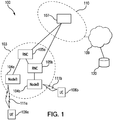
- FIG. 1 illustrates schematically a universal mobile telecommunications system, UMTS, network 100 in which the present methods and apparatuses can be implemented. It should be noted, however, that the skilled person will readily be able to perform implementations in other similar communication systems involving transmission of coded data between nodes.
- the UMTS network 100 comprises a core network 110 and a UMTS terrestrial radio access network, UTRAN, 103.
- the UTRAN 103 comprises a number of nodes in the form of radio network controllers (RNC) 105 (e.g., RNCs 105a,b), each of which is coupled to a set of neighbouring nodes in the form of one or more base stations 104 (e.g, NodeBs 104a,b).
- RNC radio network controllers
- Each NodeB 104 is responsible for a given geographical radio cell and the controlling RNC 105 is responsible for routing user and signalling data between that NodeB 104 and the core network 110. All of the RNC's 105 may be coupled to one another.
- a general outline of the UTRAN 103 is given in 3GPP technical specification TS 25.401 V3.2.0.
- FIG. 1 also illustrates communication devices 106 (a.k.a., user equipments (UEs) (e.g., UEs 106a, 106b) connected to a respective NodeB 104a, 104b in the UTRAN 103 via a respective air interface 111a, 111b.
- UEs served by one NodeB such as UE 106a served by NodeB 104a, are located in a so-called radio cell.
- the core network 110 comprises a number of nodes represented by node 107 and provides communication services to the UE 106 via the UTRAN 103, for example when communicating with the Internet 109 where, schematically, a server 120 illustrates an entity with which the UEs 106 may communicate.
- the network 100 in FIG. 1 may comprise a large number of similar functional units in the core network 110 and the UTRAN 103, and in typical realizations of networks, the number of mobile devices may be very large. Furthermore, communication between the nodes in the UTRAN 103 and the UEs 106 may follow the protocols as specified by 3GPP HSPA specifications.
- FIG. 2 is a functional block diagram schematically illustrating base station 104, according to some embodiments.
- the base station 104 represents a NodeB.
- the base station 104 comprises processing means, memory means and communication means in the form of a processor 202, a memory 204 and communication circuitry 206.
- the base station 104 communicates with other nodes via a first data path 208 and via a second data path 210.
- the first data path 208 can be connected to a RNC and the second data path 210 can connected to one or more antennas 212.
- the data paths 208, 210 can be any of uplink and downlink data paths, as the skilled person will realize.
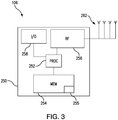
- FIG. 3 is a functional block diagram schematically illustrating UE 106, according to some embodiments.
- the UE 106 comprises processing means, memory means and communication means in the form of a processor 252, a memory 254 and radio circuitry 256.
- the UE 106 communicates with other nodes via a radio air interface with the use of one or more antennas 262.
- the UE 106 also comprises input/output circuitry 258 in the form of, e.g., a display, a keypad, a microphone, a camera etc.
- the methods to be described below can be implemented in the base station 104 and the UE 106, respectively.
- the method actions are realized by means of software instructions 205, 255 that are stored in the memory 204, 254 and are executable by the processor 202, 252.
- Such software instructions 205, 255 can be realized and provided in any suitable way, e.g. provided via the networks 110, 103 or being installed during manufacturing, as the skilled person will realize.
- the memory 204, 254, the processor 202, 252, as well as the communication circuitry 206 and radio circuitry 256 comprise software and/or firmware that, in addition to being configured such that it is capable of implementing the methods to be described, is configured to control the general operation of the base station 104 and the UE 106, respectively, when operating in a cellular mobile communication system such as the system 100 in FIG. 1 .
- a cellular mobile communication system such as the system 100 in FIG. 1 .
- FIG. 4 shows an example message exchange between a base station 104 (e.g., NodeB 104) and a UE 106 in a HSDPA system 100.
- the NodeB 104 transmits a pilot signal on a common pilot channel (e.g., the CPICH) 402.
- a common pilot channel e.g., the CPICH
- the pilot signal may be broadcast by the base station with constant power and of a known bit sequence.
- the UE receives the pilot signal and a channel measuring unit of the UE uses the pilot channel to determine a channel quality indicator (CQI) and a precoding channel indicator (PCI).
- CQI channel quality indicator
- PCI precoding channel indicator
- the PCI is the precoding information bits selected in the subset of the codebook corresponding to the rank information.
- the CQI and PCI along with other information is reported to the NodeB using, for example a high speed dedicated physical control channel (HS-DPCCH) 404.
- HS-DPCCH high speed dedicated physical control channel
- the periodicity of HS-DPPCH is one subframe (2msec).
- the structure of HS-DPCCH for a single carrier is shown in FIG. 5a .
- the NodeB receives this information, it allocates the required channelization codes, modulation and coding, precoding channel index to the UE after scheduling.
- This information 406 is conveyed to UE by shared control channel (HS-SCCH).
- HS-SCCH shared control channel
- the UE detects the HS-SCCH, downlink transmission 408 starts through data traffic channel using Physical Downlink Shared Channel (HS-PDSCH).
- HS-PDSCH Physical Downlink Shared Channel
- the UE transmits, to the base station via the HS-DPCCH, the following information: HARQ ACK information (same structure that of Release-7); CQI (8 bits); RI (i.e., information indicating the number of layers the UE prefers) (2bits); and PCI (Precoding Control Index in the RI) (4 bits).
- HARQ ACK information standard structure that of Release-7
- CQI 8 bits
- RI i.e., information indicating the number of layers the UE prefers
- PCI Precoding Control Index in the RI
- the HARQ ACK is transmitted in a first slot (10 bits) as per Release 7 structure.
- CQI, RI and PCI are transmitted in the 2nd and 3rd slots with 40 bits.
- a convolutional code of 1/3 code rate with puncturing pattern identifying 26 bits is recommended to encode the 14 CQI/RI/PCI information bits to 40 bits.
- a puncturing pattern selected per the rules in 3GPP TS 25.212 v10.2.0 results in the following puncturing pattern: [1 3 6 8 11 13 16 18 21 23 26 28 31 34 36 39 41 44 46 49 51 54 56 59 61 64]. This pattern is referred to herein as an "R99" puncturing pattern and is illustrated in FIG. 6 . This puncturing pattern is not optimal.
- FIG. 7 shows a puncturing pattern 700 that is rotationally symmetric and uses "end" puncturing, i.e. only beginning bits (e.g., bits 1-21) and ending bits (e.g. bits 46-66) are punctured, but not middle bits. Hence in this method all the bits are equally protected. Puncturing pattern 700 provides better results than the R99 puncturing pattern shown in FIG. 6 .
- FIG. 8 shows the BLER plot for these two patterns. It can be seen that pattern 700 performs better than the R99 puncturing by 0.25 dB.
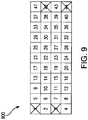
- FIG. 9 shows an example puncturing pattern 900 according to option 2.
- the puncturing patterns is [1 3 42 44].
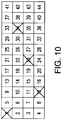
- FIG. 10 shows an R99 puncturing pattern 1000 (i.e., a puncturing pattern using the principles outlined in 3GPP TS 25.212 v10.2.0).
- Puncturing pattern 1000 is not rotationally symmetric (e.g., bit 1 is included in the pattern, but bit 1's corresponding bit (i.e., bit 44) is not included).
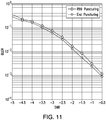
- FIG. 11 shows the BLER plot for these patterns 900 and 1000. It can be seen that puncturing pattern 900 performs better than the R99 puncturing pattern 1000.
- Alternative end puncturing patterns for 1 ⁇ 2 code rate are also contemplated. For example, the following five alternative puncturing patterns provide the same (or nearly the same) result as puncturing pattern 900: (1) [1 2 43 44], (2) [1 4 41 44], (3) [2 3 42 43], (4) [2 4 41 43] and (5) [3 4 41 42]. Like pattern 700, these alternative patterns are also rotationally symmetric.
- option 1 Upon a comparison of option 1 and option 2, it can be observed that the best performance is achieved using 1 ⁇ 2 code rate and using an end puncturing pattern that is rotationally symmetric. See e.g., FIG. 12 , which shows the BLER plot for the above described options.
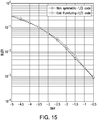
- FIG. 13 and 14 shows two example non-symmetric puncturing patterns
- FIGs. 15 and 16 show the BLER for these two respective patterns (also plotted are the result with rotationally symmetric end puncturing pattern). From the plots shown in FIG. 15 and 16 , it can be argued that a puncturing pattern with rotationally symmetry gives the best performance rather than a puncturing pattern arbitrarily punctured at the beginning and the end of the code sequence. This is because with a rotationally symmetric pattern there is an equal amount of puncturing at both the ends.
- An advantage of at least some of the preferred embodiments discussed herein includes requiring less power for control channel hence more throughputs for UL data traffic.
- FIG. 17 illustrates functional components of UE 106, according to some embodiment.
- UE 106 may include a channel measuring unit 800 for generating control information comprising a first bit sequence, a second bit sequence and a third bit sequence (e.g., CQI, RI, and PCI) to send to the base station serving the UE based on a pilot signal transmitted from the base station.
- the UE 106 also includes a multiplexer 801 for multiplexing the CQI, RI and PCI bits to produce bit sequence X1 (14 bits) (i.e., a fourth bit sequence).
- X1' is then encoded by a convolutional encoder 804 to convolutionally encode X1' to produce encoded bits Z1 (i.e., a sixth bit sequence).
- the encoded bits Z1 are then punctured by a rate matcher 806 according to a pre-defined puncturing pattern to produce bit sequence RI (i.e., a seventh bit sequence), where RI is 40 bits in length. RI is then spread by spreading factor 128, QPSK modulated, and transmitted. Further details are provided below.
- the rate matcher 806 when the rate is 1 ⁇ 2, the following puncturing pattern is used by the rate matcher 806: [1 3 42 44]. That is, bits 1, 3, 42 and 44 are removed ("punctured") from Z1 by rate matcher 806 to produce R1.
- the rate matcher 806 when the rate is 1 ⁇ 2 one of the following puncturing patterns is used by the rate matcher 806: [1 2 43 44], [1 4 41 44], [2 3 42 43], [2 4 41 43] or [3 4 41 42].
- the rate matcher 806 when the rate is 1/3 and, the following puncturing pattern is used by the rate matcher 806: [1 2 3 4 5 6 7 8 9 10 11 1213 54 55 56 57 58 59 60 61 62 63 64 65 66].
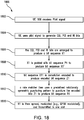
- FIG. 18 is a flow chart illustrating a process 1800 according to some embodiments, which process may be performed by UE 106.
- Process 1800 may begin in step 1802, where UE 106 receives a pilot signal.
- step 1804 the UE uses pilot signal to generate CQI, PCI and RI bits (i.e. three bit sequences).
- the CQI, PCI and RI bits are arranged to produce a bit sequence X1, i.e., a fourth bit sequence, (in some embodiments X1 is fourteen bits).
- X1 is fourteen bits.
- the first portion of X1 e.g., the first 8 bits of X1
- the next portion of X1 e.g., the next 2 bits
- the last portion of X1 e.g., the next four bits of X1 identify a PCI.
- bit sequence P1 in some embodiments P1 is eight bits in length
- bit sequence X1' i.e., a fifth bit sequence
- bit sequence X1' is convolution encoded to produce encoded bit sequence Z1 (i.e., a sixth bit sequence).
- bit sequence RI i.e., a seventh bit sequence
- Z1 is punctured such that RI is 40 bits in length
- RI is then spread (e.g.,. by spreading factor 188), modulated (e.g., QPSK modulated), and transmitted (step 1816).
- modulated e.g., QPSK modulated
Landscapes
- Engineering & Computer Science (AREA)
- Computer Networks & Wireless Communication (AREA)
- Signal Processing (AREA)
- Quality & Reliability (AREA)
- Physics & Mathematics (AREA)
- Probability & Statistics with Applications (AREA)
- Theoretical Computer Science (AREA)
- Mobile Radio Communication Systems (AREA)
- Error Detection And Correction (AREA)
Priority Applications (1)
| Application Number | Priority Date | Filing Date | Title |
|---|---|---|---|
| PL13737692T PL2893642T3 (pl) | 2012-09-10 | 2013-06-18 | Symetryczne wymazywanie dla raportowania CQI/PCI w kanale HS-DPCCH |
Applications Claiming Priority (2)
| Application Number | Priority Date | Filing Date | Title |
|---|---|---|---|
| US201261698868P | 2012-09-10 | 2012-09-10 | |
| PCT/SE2013/050717 WO2014038993A1 (en) | 2012-09-10 | 2013-06-18 | Symmetric puncturing for cqi/pci reporting on the hs-dpcch |
Publications (2)
| Publication Number | Publication Date |
|---|---|
| EP2893642A1 EP2893642A1 (en) | 2015-07-15 |
| EP2893642B1 true EP2893642B1 (en) | 2017-08-09 |
Family
ID=48794168
Family Applications (1)
| Application Number | Title | Priority Date | Filing Date |
|---|---|---|---|
| EP13737692.7A Active EP2893642B1 (en) | 2012-09-10 | 2013-06-18 | Symmetric puncturing for cqi/pci reporting on the hs-dpcch |
Country Status (7)
| Country | Link |
|---|---|
| US (1) | US9100069B2 (pl) |
| EP (1) | EP2893642B1 (pl) |
| DK (1) | DK2893642T3 (pl) |
| ES (1) | ES2646728T3 (pl) |
| HU (1) | HUE035466T2 (pl) |
| PL (1) | PL2893642T3 (pl) |
| WO (1) | WO2014038993A1 (pl) |
Families Citing this family (1)
| Publication number | Priority date | Publication date | Assignee | Title |
|---|---|---|---|---|
| CN107735953B (zh) * | 2015-07-03 | 2023-04-14 | 英特尔公司 | 用于在可穿戴装置中进行数据压缩的设备和方法 |
Family Cites Families (12)
| Publication number | Priority date | Publication date | Assignee | Title |
|---|---|---|---|---|
| HUP0200422A2 (en) * | 1999-03-19 | 2002-06-29 | Siemens Ag | Data transmission with interleaving and subsequent rate matching by puncturing or repetition |
| KR100421165B1 (ko) * | 2000-10-21 | 2004-03-04 | 삼성전자주식회사 | 통신시스템에서 블록부호 발생 장치 및 방법 |
| DE10226394B4 (de) * | 2002-06-13 | 2006-10-19 | Siemens Ag | Verfahren zur Datenübertragung |
| JP4308817B2 (ja) * | 2004-12-01 | 2009-08-05 | 三星電子株式会社 | パケットデータの伝送を支援する移動通信システムにおける信頼度の高いデータ送受信方法及び装置 |
| US7724656B2 (en) | 2005-01-14 | 2010-05-25 | Telefonaktiebolaget Lm Ericsson (Publ) | Uplink congestion detection and control between nodes in a radio access network |
| FI20055242A0 (fi) | 2005-05-20 | 2005-05-20 | Nokia Corp | Radioresurssien ohjaus HSUPA-järjestelmässä |
| KR100678580B1 (ko) * | 2005-10-14 | 2007-02-02 | 삼성전자주식회사 | 통신시스템에서 터보부호의 성능을 향상하기 위한 장치 및방법 |
| WO2010033066A1 (en) | 2008-09-18 | 2010-03-25 | Telefonaktiebolaget L M Ericsson (Publ) | A method and arrangement for determining a minimum transmit power gain factor for an enhanced uplink data communication |
| KR101863922B1 (ko) * | 2010-02-14 | 2018-06-01 | 엘지전자 주식회사 | Cce 혼동을 해소하기 위한 방법 및 이를 위한 장치 |
| US8781006B2 (en) * | 2010-05-21 | 2014-07-15 | Qualcomm Incorporated | Link adaptation in multi-carrier communication systems |
| US20130195008A1 (en) * | 2011-08-12 | 2013-08-01 | Interdigital Patent Holdings, Inc. | Providing Feedback For Multiple Downlink Multiple-Input-Multiple-Output (MIMO) Streams |
| EP2880792B1 (en) * | 2012-07-30 | 2016-07-06 | Telefonaktiebolaget LM Ericsson (publ) | Base station and method for transmitting control information to a user equipment (ue) |
-
2013
- 2013-06-18 EP EP13737692.7A patent/EP2893642B1/en active Active
- 2013-06-18 HU HUE13737692A patent/HUE035466T2/en unknown
- 2013-06-18 US US14/006,345 patent/US9100069B2/en active Active
- 2013-06-18 WO PCT/SE2013/050717 patent/WO2014038993A1/en not_active Ceased
- 2013-06-18 ES ES13737692.7T patent/ES2646728T3/es active Active
- 2013-06-18 PL PL13737692T patent/PL2893642T3/pl unknown
- 2013-06-18 DK DK13737692.7T patent/DK2893642T3/en active
Non-Patent Citations (1)
| Title |
|---|
| None * |
Also Published As
| Publication number | Publication date |
|---|---|
| ES2646728T3 (es) | 2017-12-15 |
| DK2893642T3 (en) | 2017-10-16 |
| WO2014038993A1 (en) | 2014-03-13 |
| HUE035466T2 (en) | 2018-05-02 |
| US9100069B2 (en) | 2015-08-04 |
| EP2893642A1 (en) | 2015-07-15 |
| US20140072069A1 (en) | 2014-03-13 |
| PL2893642T3 (pl) | 2018-01-31 |
Similar Documents
| Publication | Publication Date | Title |
|---|---|---|
| JP5647195B2 (ja) | 多重入出力システムにおけるチャンネル品質情報フィードバック方法、データ伝送方法、ユーザ機器及び基地局 | |
| EP2847884B1 (en) | Scheduling a user equipment in a communication system | |
| AU2012367933B2 (en) | Time multiplexed channel state information reporting in a multi antenna wireless communication system | |
| EP2498417A2 (en) | Method for transmitting channel quality information, and apparatus for the same | |
| US9515805B2 (en) | Channel quality reporting in a communications system | |
| CN104662831B (zh) | 对多天线无线通信系统中的混合自动重复请求确认编码 | |
| JP5481523B2 (ja) | チャネル品質情報の通信方式 | |
| US9414375B2 (en) | Base station and method for transmitting control information to a user equipment (UE) | |
| CN101536353A (zh) | 用于mimo系统中基于导频模式控制信令的方法和装置 | |
| KR20140085447A (ko) | 다중코드 단일-입력 단일-출력 및 다중-입력 다중-출력 병렬 채널을 위한 서명 수열 선택, 시스템 값 비트 탑재 및 에너지 할당 방법 및 장치 | |
| US9414365B2 (en) | Channel quality reporting in a wireless communication system | |
| US20110305204A1 (en) | Information transmission method and apparatus | |
| US9100069B2 (en) | Rate matching for high speed dedicated physical control channel in a multi antenna wireless communication system | |
| EP2901609B1 (en) | Systems and method for reporting downlink control channel information in a wireless communication system |
Legal Events
| Date | Code | Title | Description |
|---|---|---|---|
| PUAI | Public reference made under article 153(3) epc to a published international application that has entered the european phase |
Free format text: ORIGINAL CODE: 0009012 |
|
| 17P | Request for examination filed |
Effective date: 20150409 |
|
| AK | Designated contracting states |
Kind code of ref document: A1 Designated state(s): AL AT BE BG CH CY CZ DE DK EE ES FI FR GB GR HR HU IE IS IT LI LT LU LV MC MK MT NL NO PL PT RO RS SE SI SK SM TR |
|
| AX | Request for extension of the european patent |
Extension state: BA ME |
|
| DAX | Request for extension of the european patent (deleted) | ||
| 17Q | First examination report despatched |
Effective date: 20160115 |
|
| GRAP | Despatch of communication of intention to grant a patent |
Free format text: ORIGINAL CODE: EPIDOSNIGR1 |
|
| INTG | Intention to grant announced |
Effective date: 20170209 |
|
| GRAS | Grant fee paid |
Free format text: ORIGINAL CODE: EPIDOSNIGR3 |
|
| GRAA | (expected) grant |
Free format text: ORIGINAL CODE: 0009210 |
|
| AK | Designated contracting states |
Kind code of ref document: B1 Designated state(s): AL AT BE BG CH CY CZ DE DK EE ES FI FR GB GR HR HU IE IS IT LI LT LU LV MC MK MT NL NO PL PT RO RS SE SI SK SM TR |
|
| REG | Reference to a national code |
Ref country code: GB Ref legal event code: FG4D |
|
| REG | Reference to a national code |
Ref country code: CH Ref legal event code: EP Ref country code: AT Ref legal event code: REF Ref document number: 917854 Country of ref document: AT Kind code of ref document: T Effective date: 20170815 |
|
| REG | Reference to a national code |
Ref country code: IE Ref legal event code: FG4D |
|
| REG | Reference to a national code |
Ref country code: DE Ref legal event code: R096 Ref document number: 602013024780 Country of ref document: DE |
|
| REG | Reference to a national code |
Ref country code: DK Ref legal event code: T3 Effective date: 20171011 |
|
| REG | Reference to a national code |
Ref country code: SE Ref legal event code: TRGR |
|
| REG | Reference to a national code |
Ref country code: NL Ref legal event code: FP |
|
| REG | Reference to a national code |
Ref country code: ES Ref legal event code: FG2A Ref document number: 2646728 Country of ref document: ES Kind code of ref document: T3 Effective date: 20171215 |
|
| REG | Reference to a national code |
Ref country code: LT Ref legal event code: MG4D |
|
| PG25 | Lapsed in a contracting state [announced via postgrant information from national office to epo] |
Ref country code: FI Free format text: LAPSE BECAUSE OF FAILURE TO SUBMIT A TRANSLATION OF THE DESCRIPTION OR TO PAY THE FEE WITHIN THE PRESCRIBED TIME-LIMIT Effective date: 20170809 Ref country code: LT Free format text: LAPSE BECAUSE OF FAILURE TO SUBMIT A TRANSLATION OF THE DESCRIPTION OR TO PAY THE FEE WITHIN THE PRESCRIBED TIME-LIMIT Effective date: 20170809 Ref country code: HR Free format text: LAPSE BECAUSE OF FAILURE TO SUBMIT A TRANSLATION OF THE DESCRIPTION OR TO PAY THE FEE WITHIN THE PRESCRIBED TIME-LIMIT Effective date: 20170809 Ref country code: NO Free format text: LAPSE BECAUSE OF FAILURE TO SUBMIT A TRANSLATION OF THE DESCRIPTION OR TO PAY THE FEE WITHIN THE PRESCRIBED TIME-LIMIT Effective date: 20171109 |
|
| PG25 | Lapsed in a contracting state [announced via postgrant information from national office to epo] |
Ref country code: LV Free format text: LAPSE BECAUSE OF FAILURE TO SUBMIT A TRANSLATION OF THE DESCRIPTION OR TO PAY THE FEE WITHIN THE PRESCRIBED TIME-LIMIT Effective date: 20170809 Ref country code: GR Free format text: LAPSE BECAUSE OF FAILURE TO SUBMIT A TRANSLATION OF THE DESCRIPTION OR TO PAY THE FEE WITHIN THE PRESCRIBED TIME-LIMIT Effective date: 20171110 Ref country code: IS Free format text: LAPSE BECAUSE OF FAILURE TO SUBMIT A TRANSLATION OF THE DESCRIPTION OR TO PAY THE FEE WITHIN THE PRESCRIBED TIME-LIMIT Effective date: 20171209 Ref country code: RS Free format text: LAPSE BECAUSE OF FAILURE TO SUBMIT A TRANSLATION OF THE DESCRIPTION OR TO PAY THE FEE WITHIN THE PRESCRIBED TIME-LIMIT Effective date: 20170809 Ref country code: BG Free format text: LAPSE BECAUSE OF FAILURE TO SUBMIT A TRANSLATION OF THE DESCRIPTION OR TO PAY THE FEE WITHIN THE PRESCRIBED TIME-LIMIT Effective date: 20171109 |
|
| PG25 | Lapsed in a contracting state [announced via postgrant information from national office to epo] |
Ref country code: RO Free format text: LAPSE BECAUSE OF FAILURE TO SUBMIT A TRANSLATION OF THE DESCRIPTION OR TO PAY THE FEE WITHIN THE PRESCRIBED TIME-LIMIT Effective date: 20170809 Ref country code: CZ Free format text: LAPSE BECAUSE OF FAILURE TO SUBMIT A TRANSLATION OF THE DESCRIPTION OR TO PAY THE FEE WITHIN THE PRESCRIBED TIME-LIMIT Effective date: 20170809 |
|
| REG | Reference to a national code |
Ref country code: HU Ref legal event code: AG4A Ref document number: E035466 Country of ref document: HU |
|
| REG | Reference to a national code |
Ref country code: DE Ref legal event code: R097 Ref document number: 602013024780 Country of ref document: DE |
|
| PG25 | Lapsed in a contracting state [announced via postgrant information from national office to epo] |
Ref country code: EE Free format text: LAPSE BECAUSE OF FAILURE TO SUBMIT A TRANSLATION OF THE DESCRIPTION OR TO PAY THE FEE WITHIN THE PRESCRIBED TIME-LIMIT Effective date: 20170809 Ref country code: SK Free format text: LAPSE BECAUSE OF FAILURE TO SUBMIT A TRANSLATION OF THE DESCRIPTION OR TO PAY THE FEE WITHIN THE PRESCRIBED TIME-LIMIT Effective date: 20170809 Ref country code: SM Free format text: LAPSE BECAUSE OF FAILURE TO SUBMIT A TRANSLATION OF THE DESCRIPTION OR TO PAY THE FEE WITHIN THE PRESCRIBED TIME-LIMIT Effective date: 20170809 |
|
| PLBE | No opposition filed within time limit |
Free format text: ORIGINAL CODE: 0009261 |
|
| STAA | Information on the status of an ep patent application or granted ep patent |
Free format text: STATUS: NO OPPOSITION FILED WITHIN TIME LIMIT |
|
| REG | Reference to a national code |
Ref country code: FR Ref legal event code: PLFP Year of fee payment: 6 |
|
| 26N | No opposition filed |
Effective date: 20180511 |
|
| PG25 | Lapsed in a contracting state [announced via postgrant information from national office to epo] |
Ref country code: SI Free format text: LAPSE BECAUSE OF FAILURE TO SUBMIT A TRANSLATION OF THE DESCRIPTION OR TO PAY THE FEE WITHIN THE PRESCRIBED TIME-LIMIT Effective date: 20170809 |
|
| REG | Reference to a national code |
Ref country code: CH Ref legal event code: PL |
|
| REG | Reference to a national code |
Ref country code: IE Ref legal event code: MM4A |
|
| PG25 | Lapsed in a contracting state [announced via postgrant information from national office to epo] |
Ref country code: LU Free format text: LAPSE BECAUSE OF NON-PAYMENT OF DUE FEES Effective date: 20180618 Ref country code: MC Free format text: LAPSE BECAUSE OF FAILURE TO SUBMIT A TRANSLATION OF THE DESCRIPTION OR TO PAY THE FEE WITHIN THE PRESCRIBED TIME-LIMIT Effective date: 20170809 |
|
| PG25 | Lapsed in a contracting state [announced via postgrant information from national office to epo] |
Ref country code: IE Free format text: LAPSE BECAUSE OF NON-PAYMENT OF DUE FEES Effective date: 20180618 Ref country code: LI Free format text: LAPSE BECAUSE OF NON-PAYMENT OF DUE FEES Effective date: 20180630 Ref country code: CH Free format text: LAPSE BECAUSE OF NON-PAYMENT OF DUE FEES Effective date: 20180630 |
|
| REG | Reference to a national code |
Ref country code: AT Ref legal event code: UEP Ref document number: 917854 Country of ref document: AT Kind code of ref document: T Effective date: 20170809 |
|
| PG25 | Lapsed in a contracting state [announced via postgrant information from national office to epo] |
Ref country code: MT Free format text: LAPSE BECAUSE OF NON-PAYMENT OF DUE FEES Effective date: 20180618 |
|
| PG25 | Lapsed in a contracting state [announced via postgrant information from national office to epo] |
Ref country code: PT Free format text: LAPSE BECAUSE OF FAILURE TO SUBMIT A TRANSLATION OF THE DESCRIPTION OR TO PAY THE FEE WITHIN THE PRESCRIBED TIME-LIMIT Effective date: 20170809 |
|
| PG25 | Lapsed in a contracting state [announced via postgrant information from national office to epo] |
Ref country code: MK Free format text: LAPSE BECAUSE OF NON-PAYMENT OF DUE FEES Effective date: 20170809 Ref country code: CY Free format text: LAPSE BECAUSE OF FAILURE TO SUBMIT A TRANSLATION OF THE DESCRIPTION OR TO PAY THE FEE WITHIN THE PRESCRIBED TIME-LIMIT Effective date: 20170809 |
|
| PG25 | Lapsed in a contracting state [announced via postgrant information from national office to epo] |
Ref country code: AL Free format text: LAPSE BECAUSE OF FAILURE TO SUBMIT A TRANSLATION OF THE DESCRIPTION OR TO PAY THE FEE WITHIN THE PRESCRIBED TIME-LIMIT Effective date: 20170809 |
|
| PGFP | Annual fee paid to national office [announced via postgrant information from national office to epo] |
Ref country code: HU Payment date: 20220605 Year of fee payment: 10 |
|
| PGFP | Annual fee paid to national office [announced via postgrant information from national office to epo] |
Ref country code: PL Payment date: 20220606 Year of fee payment: 10 Ref country code: AT Payment date: 20220602 Year of fee payment: 10 |
|
| P01 | Opt-out of the competence of the unified patent court (upc) registered |
Effective date: 20230523 |
|
| REG | Reference to a national code |
Ref country code: AT Ref legal event code: MM01 Ref document number: 917854 Country of ref document: AT Kind code of ref document: T Effective date: 20230618 |
|
| PG25 | Lapsed in a contracting state [announced via postgrant information from national office to epo] |
Ref country code: AT Free format text: LAPSE BECAUSE OF NON-PAYMENT OF DUE FEES Effective date: 20230618 |
|
| PG25 | Lapsed in a contracting state [announced via postgrant information from national office to epo] |
Ref country code: HU Free format text: LAPSE BECAUSE OF NON-PAYMENT OF DUE FEES Effective date: 20230619 Ref country code: AT Free format text: LAPSE BECAUSE OF NON-PAYMENT OF DUE FEES Effective date: 20230618 |
|
| PGFP | Annual fee paid to national office [announced via postgrant information from national office to epo] |
Ref country code: GB Payment date: 20240627 Year of fee payment: 12 |
|
| PGFP | Annual fee paid to national office [announced via postgrant information from national office to epo] |
Ref country code: DE Payment date: 20240627 Year of fee payment: 12 |
|
| PGFP | Annual fee paid to national office [announced via postgrant information from national office to epo] |
Ref country code: DK Payment date: 20240625 Year of fee payment: 12 |
|
| PGFP | Annual fee paid to national office [announced via postgrant information from national office to epo] |
Ref country code: NL Payment date: 20240626 Year of fee payment: 12 |
|
| PGFP | Annual fee paid to national office [announced via postgrant information from national office to epo] |
Ref country code: FR Payment date: 20240625 Year of fee payment: 12 |
|
| PGFP | Annual fee paid to national office [announced via postgrant information from national office to epo] |
Ref country code: TR Payment date: 20240604 Year of fee payment: 12 Ref country code: SE Payment date: 20240627 Year of fee payment: 12 Ref country code: BE Payment date: 20240627 Year of fee payment: 12 |
|
| PGFP | Annual fee paid to national office [announced via postgrant information from national office to epo] |
Ref country code: IT Payment date: 20240619 Year of fee payment: 12 |
|
| PGFP | Annual fee paid to national office [announced via postgrant information from national office to epo] |
Ref country code: ES Payment date: 20240701 Year of fee payment: 12 |
|
| PG25 | Lapsed in a contracting state [announced via postgrant information from national office to epo] |
Ref country code: PL Free format text: LAPSE BECAUSE OF NON-PAYMENT OF DUE FEES Effective date: 20230618 |
|
| PG25 | Lapsed in a contracting state [announced via postgrant information from national office to epo] |
Ref country code: PL Free format text: LAPSE BECAUSE OF NON-PAYMENT OF DUE FEES Effective date: 20230618 |
|
| REG | Reference to a national code |
Ref country code: DE Ref legal event code: R119 Ref document number: 602013024780 Country of ref document: DE |
|
| REG | Reference to a national code |
Ref country code: DK Ref legal event code: EBP Effective date: 20250630 |
|
| REG | Reference to a national code |
Ref country code: SE Ref legal event code: EUG |
|
| REG | Reference to a national code |
Ref country code: NL Ref legal event code: MM Effective date: 20250701 |
|
| GBPC | Gb: european patent ceased through non-payment of renewal fee |
Effective date: 20250618 |
|
| REG | Reference to a national code |
Ref country code: BE Ref legal event code: MM Effective date: 20250630 |
|
| PG25 | Lapsed in a contracting state [announced via postgrant information from national office to epo] |
Ref country code: NL Free format text: LAPSE BECAUSE OF NON-PAYMENT OF DUE FEES Effective date: 20250701 |
|
| PG25 | Lapsed in a contracting state [announced via postgrant information from national office to epo] |
Ref country code: GB Free format text: LAPSE BECAUSE OF NON-PAYMENT OF DUE FEES Effective date: 20250618 |
|
| PG25 | Lapsed in a contracting state [announced via postgrant information from national office to epo] |
Ref country code: DE Free format text: LAPSE BECAUSE OF NON-PAYMENT OF DUE FEES Effective date: 20260101 |
|
| PG25 | Lapsed in a contracting state [announced via postgrant information from national office to epo] |
Ref country code: BE Free format text: LAPSE BECAUSE OF NON-PAYMENT OF DUE FEES Effective date: 20250630 Ref country code: IT Free format text: LAPSE BECAUSE OF NON-PAYMENT OF DUE FEES Effective date: 20250618 |
|
| PG25 | Lapsed in a contracting state [announced via postgrant information from national office to epo] |
Ref country code: FR Free format text: LAPSE BECAUSE OF NON-PAYMENT OF DUE FEES Effective date: 20250630 |