EP2893027B1 - Improved matrix stability compositions and methods - Google Patents
Improved matrix stability compositions and methods Download PDFInfo
- Publication number
- EP2893027B1 EP2893027B1 EP13758850.5A EP13758850A EP2893027B1 EP 2893027 B1 EP2893027 B1 EP 2893027B1 EP 13758850 A EP13758850 A EP 13758850A EP 2893027 B1 EP2893027 B1 EP 2893027B1
- Authority
- EP
- European Patent Office
- Prior art keywords
- reagent matrix
- relative humidity
- reagent
- deliquescent material
- test element
- Prior art date
- Legal status (The legal status is an assumption and is not a legal conclusion. Google has not performed a legal analysis and makes no representation as to the accuracy of the status listed.)
- Active
Links
Images



Classifications
-
- C—CHEMISTRY; METALLURGY
- C12—BIOCHEMISTRY; BEER; SPIRITS; WINE; VINEGAR; MICROBIOLOGY; ENZYMOLOGY; MUTATION OR GENETIC ENGINEERING
- C12Q—MEASURING OR TESTING PROCESSES INVOLVING ENZYMES, NUCLEIC ACIDS OR MICROORGANISMS; COMPOSITIONS OR TEST PAPERS THEREFOR; PROCESSES OF PREPARING SUCH COMPOSITIONS; CONDITION-RESPONSIVE CONTROL IN MICROBIOLOGICAL OR ENZYMOLOGICAL PROCESSES
- C12Q1/00—Measuring or testing processes involving enzymes, nucleic acids or microorganisms; Compositions therefor; Processes of preparing such compositions
- C12Q1/001—Enzyme electrodes
- C12Q1/004—Enzyme electrodes mediator-assisted
-
- G—PHYSICS
- G01—MEASURING; TESTING
- G01N—INVESTIGATING OR ANALYSING MATERIALS BY DETERMINING THEIR CHEMICAL OR PHYSICAL PROPERTIES
- G01N27/00—Investigating or analysing materials by the use of electric, electrochemical, or magnetic means
- G01N27/26—Investigating or analysing materials by the use of electric, electrochemical, or magnetic means by investigating electrochemical variables; by using electrolysis or electrophoresis
- G01N27/28—Electrolytic cell components
- G01N27/30—Electrodes, e.g. test electrodes; Half-cells
- G01N27/327—Biochemical electrodes, e.g. electrical or mechanical details for in vitro measurements
- G01N27/3271—Amperometric enzyme electrodes for analytes in body fluids, e.g. glucose in blood
- G01N27/3274—Corrective measures, e.g. error detection, compensation for temperature or hematocrit, calibration
-
- G—PHYSICS
- G01—MEASURING; TESTING
- G01N—INVESTIGATING OR ANALYSING MATERIALS BY DETERMINING THEIR CHEMICAL OR PHYSICAL PROPERTIES
- G01N27/00—Investigating or analysing materials by the use of electric, electrochemical, or magnetic means
- G01N27/26—Investigating or analysing materials by the use of electric, electrochemical, or magnetic means by investigating electrochemical variables; by using electrolysis or electrophoresis
- G01N27/28—Electrolytic cell components
- G01N27/30—Electrodes, e.g. test electrodes; Half-cells
- G01N27/327—Biochemical electrodes, e.g. electrical or mechanical details for in vitro measurements
- G01N27/3271—Amperometric enzyme electrodes for analytes in body fluids, e.g. glucose in blood
- G01N27/3272—Test elements therefor, i.e. disposable laminated substrates with electrodes, reagent and channels
-
- G—PHYSICS
- G01—MEASURING; TESTING
- G01N—INVESTIGATING OR ANALYSING MATERIALS BY DETERMINING THEIR CHEMICAL OR PHYSICAL PROPERTIES
- G01N33/00—Investigating or analysing materials by specific methods not covered by groups G01N1/00 - G01N31/00
- G01N33/48—Biological material, e.g. blood, urine; Haemocytometers
- G01N33/50—Chemical analysis of biological material, e.g. blood, urine; Testing involving biospecific ligand binding methods; Immunological testing
- G01N33/62—Chemical analysis of biological material, e.g. blood, urine; Testing involving biospecific ligand binding methods; Immunological testing involving urea
-
- Y—GENERAL TAGGING OF NEW TECHNOLOGICAL DEVELOPMENTS; GENERAL TAGGING OF CROSS-SECTIONAL TECHNOLOGIES SPANNING OVER SEVERAL SECTIONS OF THE IPC; TECHNICAL SUBJECTS COVERED BY FORMER USPC CROSS-REFERENCE ART COLLECTIONS [XRACs] AND DIGESTS
- Y10—TECHNICAL SUBJECTS COVERED BY FORMER USPC
- Y10T—TECHNICAL SUBJECTS COVERED BY FORMER US CLASSIFICATION
- Y10T29/00—Metal working
- Y10T29/49—Method of mechanical manufacture
- Y10T29/49002—Electrical device making
Definitions
- the present invention relates to a test element for determining the amount of an analyte in a sample fluid and a method for improving the stability of a biosensor test element.
- Biosensors are available to permit an individual to test the glucose level in a small sample of blood.
- Common meter designs use a disposable test element which, in combination with the meter, measures the amount of glucose in the blood sample electrochemically or optically.
- the information is typically displayed as a blood glucose value and perhaps the time and date the measurement was performed. This information is in most cases sufficient to allow diabetics to adjust their dietary intake and/or insulin dosage, and in the case of low glucose values may indicate the need for intake of sugar to avoid hypoglycemia.
- the electrochemical measurement of an analyte such as glucose may be achieved by dosing a sensor with a sample containing the analyte (for example, glucose in an aqueous blood sample) to initiate a chain of reactions such as the chain shown below for glucose.
- a sample containing the analyte for example, glucose in an aqueous blood sample
- the reduced form of the mediator is converted to the oxidized form.
- the current associated with this reaction is proportional with the mass of reduced mediator, and consequently with the glucose concentration.
- biosensor test elements such as glucose test strips
- Exposure of biosensor test elements (such as glucose test strips) to high humidity conditions may cause the mediator to degrade to the reduced form or to other products that are electrochemically active in the same potential range. Additionally, high humidity may cause the enzyme to degrade to a reduced form, and the reduced enzyme may react with the mediator, producing mediator in its reduced form.
- test strip reagent matrix The components of a test strip reagent matrix are often selected to dissolve quickly in an aqueous blood sample, thus providing a fast reaction time and a quick display of the result for the user.
- this provides the undesired consequence of making the matrix susceptible to degradation by environmental humidity, thus compromising the shelf stability of disposable test strips.
- EP 1174716 describes a biosensor including a second insulating substrate situated on a first substrate, tracks situated between the substrates, a testing reagent, a third substrate situated over the reagent on a portion of the second substrate, and a cover that extends over the third substrate.
- a desiccant may be permanently applied to the cover or the third substrate.
- US 2008/0031778 also describes a test element, wherein a desiccant is contained in the test element in a preferred embodiment.
- WO 02/50609 relates to electrochemical test strip cards that include an integral desiccant.
- WO 02/083273 relates to a desiccant composition comprising a deliquescent salt and modified starch. While test elements can be packaged and distributed in containers configured to prevent undesired ingress of moisture from the atmosphere or other sources, and while test elements can be packaged in containers with desiccant materials incorporated within the container (such as in the lid or cap of the container) or in an insert that is left in the container with the test elements, known methods have not been effective for eliminating the risks of sensor degradation.
- the present invention addresses that need.
- test element for determining the amount of an analyte in a sample fluid.
- the test element comprises a working electrode and a counter electrode, and a reagent matrix extending between the working electrode and the counter electrode and configured for an electrode reaction.
- the reagent matrix is provided with a deliquescent material, and the deliquescent material is selected and provided in an amount effective to protect one or more of the active ingredients from humidity in the atmosphere.
- a reagent matrix for a blood glucose biosensor comprising a mediator, an enzyme, and a deliquescent material selected and provided in an amount effective to preferentially and/or preemptively absorb water from the air when compared to the water absorption properties and rates of the other components of the reagent matrix, thus protecting the other components from degradation by water when the relative humidity exceeds the deliquescence point of the deliquescent material.
- the deliquescent material may be selected to preferentially absorb water when the environmental relative humidity exceeds any predetermined level, such as 40%, or 50%, or 60%, or 70%, or 75%, or 80%, etc., as desired.
- a method for improving the stability of a biosensor test element with respect to degradation of reagent components by humidity in the air wherein the test element comprises a base/supporting substrate, working and counter electrodes, and a reagent matrix extending between the working electrode and the counter electrode and configured for an electrode reaction.
- the inventive method comprises providing in the reagent matrix a deliquescent material selected and in an amount effective to decrease the sorption of water from the air by other components of the reagent matrix.
- This method may comprise providing in the reagent matrix a deliquescent material selected and in an amount effective to decrease the sorption of water from the air by other components of the reagent matrix.
- the deliquescent material is selected to be a material having a deliquescence point between 50% relative humidity and 80% relative humidity.
- the deliquescence point is preferably between 70% relative humidity and 80% relative humidity, while in other embodiments the deliquescent material has a deliquescence point at 75% relative humidity.
- the test element may be a glucose meter test strip having a glucose reagent matrix thereon, with the test strip reagent matrix including an enzyme system and a mediator.
- the enzyme system may comprise glucose dehydrogenase (GDH) enzyme and/or flavin adenine dinucleotide (FAD) cofactor.
- the mediator may comprise a nitrosoaniline mediator.
- a film former comprising polyvinylpyrrolidone (PVP) may also be included.
- the deliquescent material may comprise one or more members selected from the group consisting of sodium chloride, calcium chloride, magnesium chloride, zinc chloride, potassium carbonate, potassium phosphate, carnallite, ferric ammonium citrate, potassium hydroxide and sodium hydroxide.
- the deliquescent material may be provided in an amount effective to absorb water from the atmosphere at a rate that is faster than the rate at which the other components of the reagent matrix absorb water from the atmosphere.
- the deliquescent material may be provided in an amount effective to absorb water from the atmosphere at a rate that is faster than the rate at which the other components of the reagent matrix absorb water from the atmosphere when the relative humidity in the atmosphere exceeds about 75%.
- the deliquescent material may alternatively or additionally be selected and provided in an amount effective to preferentially absorb water from the atmosphere when compared to the water absorption properties of the other reagent components, thus protecting the other components of the reagent matrix from absorbing water from the atmosphere when the relative humidity exceeds the deliquescence point of the deliquescent material.
- Glucose biosensors typically use a reagent matrix comprising an enzyme/cofactor system and a mediator to test for glucose concentration in a blood sample.
- the strips may lose their functionality or become unstable.
- the present invention addresses that problem by formulating the test strip reagent matrix to include a deliquescent material that absorbs water from the atmosphere at a selected humidity level, thereby preventing the water from degrading the reagent matrix components.
- the deliquescent material is selected to protect the reagent components when exposed to a defined relative humidity, such as when the relative humidity in the atmosphere exceeds about 75%.
- the deliquescent material is preferably a salt, and is most preferably sodium chloride.
- Other known deliquescent materials include calcium chloride, magnesium chloride, zinc chloride, potassium carbonate, potassium phosphate, carnallite, ferric ammonium citrate, potassium hydroxide and sodium hydroxide.
- the reagent matrix stabilization materials and methods of the present invention have particular utility when used with test elements (such as a glucose test strip) having dry-film reagent systems that may degrade if exposed to excessive humidity, such as a relative humidity of 75%, or even 70% or less.
- test elements such as a glucose test strip
- dry-film reagent systems that may degrade if exposed to excessive humidity, such as a relative humidity of 75%, or even 70% or less.
- test elements such as a glucose test strip
- dry-film reagent systems that may degrade if exposed to excessive humidity, such as a relative humidity of 75%, or even 70% or less.
- test elements such as a glucose test strip
- dry-film reagent systems that may degrade if exposed to excessive humidity, such as a relative humidity of 75%, or even 70% or less.
- commonly-used glucose reaction mediators may degrade when exposed to humidity (water) in the air, producing a reduced form or other products which are electrochemically active and can result in a blank current in the
- the issue is exacerbated by the fact that the reagent matrix needs a degree of hydrophilicity in order to provide quick wetting of the reagent (and thus, a quick test readout).
- This issue is specifically presented, for example, when PVP-containing materials are used as a film former for a glucose reagent system. PVP adsorbs moisture from the air - bringing it into contact with the reagent system.
- the problem noted above is addressed by adding a component to the reagent matrix that causes the matrix as a whole to adsorb less water. While the invention is illustrated in this disclosure by adding a deliquescent material such as NaCl to a glucose reagent system including FADGDH and nitrosoaniline, the invention when construed broadly is intended to include other reagent systems and other deliquescent materials.
- the biosensor is a glucose test strip.
- test strips typically have working and counter electrodes, and are provided with a reagent matrix to electrochemically analyze a test strip reagent matrix.
- test elements are known and available in different forms, to which the present invention as a whole is applicable.
- test elements in the form of test strips, test tapes, test disks, foldable test elements (for example, according to the Leporello principle) and other forms as are known to persons skilled in the art.
- foldable test elements for example, according to the Leporello principle
- the test element typically comprises at least one test field having a test field surface.
- a test field is understood to mean a two- or three-dimensional region of the test element, which region is usable in principle for the detection of the analyte, which can be carried out qualitatively and/or quantitatively.
- the test field may be a dry test field, and may comprises at least one detection reagent which is selected to carry out a detectable reaction in the presence of the analyte.
- a test strip reagent matrix comprises an enzyme system and a mediator.
- the enzyme system may comprises glucose dehydrogenase enzyme (GDH) and/or flavin adenine dinucleotide cofactor (FAD), and the mediator may comprises a nitrosoaniline mediator.
- the reagent matrix may also include a film former, which may comprise polyvinylpyrrolidone (PVP).
- PVP polyvinylpyrrolidone
- Examples of other glucose-specific enzymatic detection reagents include, but are not limited to, deoxy reductases (e.g., GlucDOR/PQQ), dehydrogenases, oxidases, or similar enzymes, for example glucose oxidase (GOD) or glucose dehydrogenase.
- a mediator may also be included in the reagent mixture.
- the mediator may be any chemical species (generally electroactive), which can participate in a reaction scheme involving an enzyme, an analyte, and optionally a cofactor (and reaction products thereof), to produce a detectable electroactive reaction product.
- participation of the mediator in this reaction involves a change in its oxidation state (e.g., a reduction), upon interaction with any one of the analyte, the enzyme, or a cofactor, or a species that is a reaction product of one of these (e.g., a cofactor reacted to a different oxidation state).
- a variety of mediators exhibit suitable electrochemical behavior.
- a mediator can preferably also be stable in its oxidized form; may optionally exhibit reversible redox electrochemistry; can preferably exhibit good solubility in aqueous solutions; and preferably reacts rapidly to produce an electroactive reaction product.
- suitable mediators include benzoquinone, meldola blue, other transition metal complexes, potassium ferricyanide, and nitrosoanilines, see U.S. Patent No. 5,286,362 .
- the test field may further include carrier substances, auxiliary substances, pigments, fillers, buffer substances, etc.
- carrier substances auxiliary substances, pigments, fillers, buffer substances, etc.
- the chemistry of the reaction scheme of any chosen electrochemical detection method can be chosen in light of various chemical factors relating to the system, including the identity of the analyte and of the sample substance. Even then, for a given analyte or substance, various different reactive components may be useful in terms of a catalyst (often, a variety of enzymes will be useful), co-reactants (e.g., a variety of mediators may be useful), and cofactors (if needed, a variety may be useful). Many such reaction schemes and their reactive components and reaction products are known, and examples of a few different enzymes include those listed in Table 1.
- Triglycerides Lipoprotein lipase, Glycerol kinase, Glycerol-3-phosphate dehydrogenase and Diaphorase (see glucose) Phenazine methosultate, phenazine ethosulfate.
- Lactate Lactate oxidase see glucose
- 2, 5-Dichloro-1,4-benzoquinone Lactate Lactate dehydrogenase and Diaphorase see glucose
- Lactate Dehydrogenase Diaphorase see glucose
- Pyruvate Pyruvate oxidase see glucose
- Alcohol Alcohol oxidase see glucose
- Alcohol Alcohol dehydrogenase see glucose
- Diaphorase Uric acid Uricase see glucose
- 3-Hydroxybutric acid (ketone bodies) 3-Hydroxybutyrate dehydrogenase and Diaphorase see glucose
- a sample containing glucose can react with an enzyme (e.g., Glucose-Dye-Oxidoreductase (Gluc-Dor)) and optionally a cofactor, (e.g., pyrrolo-quinoline-quinone), in the presence a redox mediator (e.g., benzoquinone, ferricyanide, or nitrosoaniline derivatives), to produce the oxidized form of the analyte, gluconolactone, and the reduced form of the redox mediator.
- an enzyme e.g., Glucose-Dye-Oxidoreductase (Gluc-Dor)
- a cofactor e.g., pyrrolo-quinoline-quinone
- a redox mediator e.g., benzoquinone, ferricyanide, or nitrosoaniline derivatives
- a deliquescent material is added to the reagent matrix to protect components of the reagent from degradation by water.
- Preferred deliquescent materials include sodium chloride, calcium chloride, magnesium chloride, magnesium sulfate, zinc chloride, potassium carbonate, potassium phosphate, carnallite, ferric ammonium citrate, potassium hydroxide and sodium hydroxide, with salts such as sodium chloride being most preferred.
- the term "deliquescence” generally refers to a phase transition from solid to solution that occurs when the vapor pressure of a saturated aqueous solution of a substance is less than the vapor pressure of water in ambient air.
- a mixture of the solid and its saturated solution or an aqueous solution of the compound forms until the substance is dissolved and is in equilibrium with its environment.
- the relative humidity at which deliquescence occurs is a property of the specific substance. At this point the vapor pressure of water over the aqueous solution will equal the partial pressure of water in the atmosphere in contact with it. Accordingly, a salt particle will deliquesce in the atmosphere when the relative humidity surpasses the deliquescence point of the material.
- delivery material generally refers to materials having deliquescent properties, and may refer to materials, such as salts, that have a strong affinity for moisture and that will absorb relatively large amounts of water from the atmosphere if exposed to it, thus protecting other materials from absorbing water.
- the deliquescent material may be selected to be a material having a deliquescence point that protects the other reagent components when exposed to environmental humidity at a pre-determined level.
- a user identifies a particular environmental stress to be avoided, such as the environmental stress of a 75% relative humidity, and includes in the reagent mixture a deliquescent material selected to have a deliquescence point at slightly below that level.
- the deliquescence point of NaCl is near a relative humidity (RH) of 75%, so the addition of NaCl is particularly effective for use with test elements that may be exposed to a relative humidity that may exceed 75%.
- RH relative humidity
- the sodium chloride crystals absorb water faster than the other reagent materials, thus preempting absorption by the other components and protecting the other reagent materials from water degradation.
- the amount of deliquescent material added to the reagent matrix will depend on the material being used, the other components in the reagent matrix, and the environmental conditions likely to be faced.
- the deliquescent material will be provided in the reagent matrix in an amount effective to allow the deliquescent material to preemptively take on the water that would otherwise be taken on by other reagent components, and thus to prevent the other reagent components from deteriorating.
- the deliquescent material is preferably provided in an amount effective to absorb water from the atmosphere at a rate that is faster than the rate at which the other components of the reagent matrix will absorb water from the atmosphere, thus preventing the other components from absorbing water and degrading.
- the deliquescent material may be a combination of two or more deliquescent materials.
- a mixture of salts such as NaCl, MgSO 4 and CaCl 2 may be used.
- the deliquescent material(s) may be added to the reagent matrix in amounts effective to provide from about 1% to about 10% by weight percent deliquescent material in the dry film reagent, with amounts between about 2% and about 8% being more preferred.
- the deliquescent material is provided in the dry film reagent matrix in an amount between about 3% and about 7% by weight, with amounts between about 3% and about 6% being more preferred.
- the deliquescent material is included in the reagent material in an amount effective to provide at least about 2% deliquescent material in the dry film reagent matrix, while in another embodiment the deliquescent material is included in the reagent material in an amount effective to provide at least about 3% deliquescent material in the dry film reagent matrix.
- the deliquescent material may be added to the reagent material in amounts effective to provide no more than about 10% deliquescent material in the dry film reagent matrix.
- the deliquescent material was provided in an amount effective to provide about 3.0% NaCl in the dry film reagent. In another preferred embodiment the deliquescent material was provided in an amount effective to provide about 5.8% NaCl in the dry film reagent. In a third preferred embodiment the deliquescent material was provided in an amount that provides about 6.5% MgSO 4 in the dry film reagent.
- the principles of the invention described herein find particular utility in stabilizing reagents used in a test element for detecting at least one analyte in a sample, such as the detection of at least one metabolite in a body fluid, and particularly the detection of glucose in a blood sample. Accordingly, certain aspects and principles of the present invention are illustrated herein by describing one particularly preferred embodiment, namely, an embodiment in which NaCl is used as a deliquescent material in a reagent mixture containing PVP or a PVP-containing material.
- NaCl sodium chloride
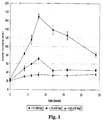
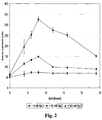
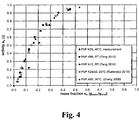
- ⁇ is the volume fraction of water (w) and polymer (P)
- ⁇ wP is the interaction parameter between the water and polymer.
- Deliquescent materials other than NaCl may also be used, as indicated above.
- dry film reagents that are protected with a MgSO 4 deliquescent material have been shown to be effective using the procedures described generally above.
- FIG. 7 shows that including MgSO 4 in the dry film reagent matrix provides protection against water degradation in humid environments.
- roll 2 shows data from a test of a dry film reagent comprising a FADGDH enzyme/cofactor system, a nitrosoaline mediator, PVP, and no deliquescent material.
- roll 11 shows data from a test of a dry film reagent having a reagent mixture that is comparable to the reagent mixture of roll 2, but with about 6% MgSO 4 added as a deliquescent material. In these tests the temperature was about 30°C, and the relative humidity was about 82%.
- Inspection of the data provided in FIG. 7 shows a significantly higher blank current from roll 2, where the dry film reagent matrix does not include a deliquescent material, than for roll 11, where the dry film reagent matrix does include a MgSO 4 deliquescent material. This indicates that including about 6% MgSO 4 in the dry film reagent mixture protects the reagent from degradation by water in the humid environment.
- phase equilibrium data is reported in the following papers. D. J. Cziczo, J. B. Nowak, J. H. Hu, J. P. D. Abbatt, Infrared spectroscopy of model tropospheric aerosols as a function of relative humidity: Observation of deliquescence and crystallization, J. Geophys. Res. 102 (D15) (1997) 18843-18850 .
Landscapes
- Life Sciences & Earth Sciences (AREA)
- Chemical & Material Sciences (AREA)
- Health & Medical Sciences (AREA)
- Engineering & Computer Science (AREA)
- Organic Chemistry (AREA)
- Immunology (AREA)
- Molecular Biology (AREA)
- General Health & Medical Sciences (AREA)
- Biochemistry (AREA)
- Physics & Mathematics (AREA)
- Analytical Chemistry (AREA)
- Proteomics, Peptides & Aminoacids (AREA)
- Wood Science & Technology (AREA)
- Zoology (AREA)
- Hematology (AREA)
- Biophysics (AREA)
- Microbiology (AREA)
- Biotechnology (AREA)
- Pathology (AREA)
- General Physics & Mathematics (AREA)
- General Engineering & Computer Science (AREA)
- Genetics & Genomics (AREA)
- Bioinformatics & Cheminformatics (AREA)
- Biomedical Technology (AREA)
- Electrochemistry (AREA)
- Chemical Kinetics & Catalysis (AREA)
- Urology & Nephrology (AREA)
- Cell Biology (AREA)
- Food Science & Technology (AREA)
- Medicinal Chemistry (AREA)
- Investigating Or Analysing Biological Materials (AREA)
- Investigating Or Analyzing Non-Biological Materials By The Use Of Chemical Means (AREA)
- Measuring Or Testing Involving Enzymes Or Micro-Organisms (AREA)
Applications Claiming Priority (2)
| Application Number | Priority Date | Filing Date | Title |
|---|---|---|---|
| US201261697535P | 2012-09-06 | 2012-09-06 | |
| PCT/EP2013/068238 WO2014037372A1 (en) | 2012-09-06 | 2013-09-04 | Improved matrix stability compositions and methods |
Publications (2)
| Publication Number | Publication Date |
|---|---|
| EP2893027A1 EP2893027A1 (en) | 2015-07-15 |
| EP2893027B1 true EP2893027B1 (en) | 2016-10-19 |
Family
ID=49117848
Family Applications (1)
| Application Number | Title | Priority Date | Filing Date |
|---|---|---|---|
| EP13758850.5A Active EP2893027B1 (en) | 2012-09-06 | 2013-09-04 | Improved matrix stability compositions and methods |
Country Status (9)
| Country | Link |
|---|---|
| US (1) | US9459230B2 (enExample) |
| EP (1) | EP2893027B1 (enExample) |
| JP (1) | JP6194001B2 (enExample) |
| KR (2) | KR20150052868A (enExample) |
| CN (1) | CN106170555B (enExample) |
| CA (1) | CA2880321C (enExample) |
| ES (1) | ES2603928T3 (enExample) |
| PL (1) | PL2893027T3 (enExample) |
| WO (1) | WO2014037372A1 (enExample) |
Families Citing this family (4)
| Publication number | Priority date | Publication date | Assignee | Title |
|---|---|---|---|---|
| GB201507508D0 (en) * | 2015-04-30 | 2015-06-17 | Inside Biometrics Ltd | Electrochemical Test Device |
| CN109313155B (zh) * | 2016-04-13 | 2022-02-25 | 聚合物工艺系统有限公司 | 用于电化学甘油三酯测定的系统和方法 |
| CA3035874C (en) | 2016-10-05 | 2025-09-09 | F. Hoffmann-La Roche Ag | DETECTION REAGENTS AND ELECTRODE ARRANGEMENTS FOR MULTI-ANALYTICAL DIAGNOSTIC TEST ELEMENTS, AS WELL AS THEIR METHODS OF USE |
| CN110383064B (zh) | 2016-10-24 | 2021-06-29 | 豪夫迈·罗氏有限公司 | 校正生物传感器的导电元件中的无补偿电阻的方法以及装置和系统 |
Family Cites Families (20)
| Publication number | Priority date | Publication date | Assignee | Title |
|---|---|---|---|---|
| US5128015A (en) | 1988-03-15 | 1992-07-07 | Tall Oak Ventures | Method and apparatus for amperometric diagnostic analysis |
| US5286362A (en) | 1990-02-03 | 1994-02-15 | Boehringer Mannheim Gmbh | Method and sensor electrode system for the electrochemical determination of an analyte or an oxidoreductase as well as the use of suitable compounds therefor |
| US5264103A (en) * | 1991-10-18 | 1993-11-23 | Matsushita Electric Industrial Co., Ltd. | Biosensor and a method for measuring a concentration of a substrate in a sample |
| US5962333A (en) * | 1996-01-25 | 1999-10-05 | Multisorb Technologies, Inc. | Medical diagnostic test strip with desiccant |
| US6689197B2 (en) * | 1996-09-19 | 2004-02-10 | Sud-Chemie Inc. | Desiccant composition |
| US6235219B1 (en) * | 1999-08-02 | 2001-05-22 | Thomas Beckenhauer | Compositions useful as desiccants and methods relating thereto |
| US6488828B1 (en) * | 2000-07-20 | 2002-12-03 | Roche Diagnostics Corporation | Recloseable biosensor |
| JP4627912B2 (ja) * | 2000-11-09 | 2011-02-09 | パナソニック株式会社 | バイオセンサ |
| US6558528B1 (en) * | 2000-12-20 | 2003-05-06 | Lifescan, Inc. | Electrochemical test strip cards that include an integral dessicant |
| JP2006502127A (ja) * | 2002-07-24 | 2006-01-19 | ビーエーエスエフ アクチェンゲゼルシャフト | アスコルビン酸塩の懸濁液及び酸化防止剤としての使用 |
| KR100554649B1 (ko) * | 2003-06-09 | 2006-02-24 | 주식회사 아이센스 | 전기화학적 바이오센서 |
| ES2675787T3 (es) * | 2003-06-20 | 2018-07-12 | F. Hoffmann-La Roche Ag | Método y reactivo para producir tiras reactivas estrechas y homogéneas |
| DE102004033317A1 (de) * | 2004-07-09 | 2006-02-09 | Roche Diagnostics Gmbh | Analytisches Testelement |
| US7501011B2 (en) | 2004-11-09 | 2009-03-10 | Multisorb Technologies, Inc. | Humidity control device |
| JP5069416B2 (ja) * | 2006-03-15 | 2012-11-07 | サントリーホールディングス株式会社 | 吸湿性の改善された飲食品用組成物 |
| EP2152416A1 (en) * | 2007-04-20 | 2010-02-17 | Quidel Corporation | Analytical devices with intedrated desiccant |
| US8008037B2 (en) * | 2008-03-27 | 2011-08-30 | Roche Diagnostics Operations, Inc. | Matrix composition with alkylphenazine quaternary salt and a nitrosoaniline |
| JP5380888B2 (ja) * | 2008-04-08 | 2014-01-08 | 東洋紡株式会社 | グルコースの定量方法ならびに定量組成物 |
| EP2387714B1 (en) * | 2009-01-23 | 2018-03-14 | Polymer Technology Systems, Inc. | Diagnostic multi-layer dry phase test strip with integrated biosensors |
| GB2499838A (en) * | 2012-03-02 | 2013-09-04 | Smartsensor Telemed Ltd | Biological test device |
-
2013
- 2013-09-04 CA CA2880321A patent/CA2880321C/en not_active Expired - Fee Related
- 2013-09-04 EP EP13758850.5A patent/EP2893027B1/en active Active
- 2013-09-04 PL PL13758850T patent/PL2893027T3/pl unknown
- 2013-09-04 CN CN201380045028.0A patent/CN106170555B/zh not_active Expired - Fee Related
- 2013-09-04 WO PCT/EP2013/068238 patent/WO2014037372A1/en not_active Ceased
- 2013-09-04 ES ES13758850.5T patent/ES2603928T3/es active Active
- 2013-09-04 KR KR1020157008689A patent/KR20150052868A/ko not_active Ceased
- 2013-09-04 KR KR1020167019099A patent/KR102005139B1/ko not_active Expired - Fee Related
- 2013-09-04 JP JP2015530370A patent/JP6194001B2/ja not_active Expired - Fee Related
-
2015
- 2015-03-05 US US14/639,621 patent/US9459230B2/en active Active
Also Published As
| Publication number | Publication date |
|---|---|
| CN106170555A (zh) | 2016-11-30 |
| JP2015527590A (ja) | 2015-09-17 |
| JP6194001B2 (ja) | 2017-09-06 |
| WO2014037372A1 (en) | 2014-03-13 |
| PL2893027T3 (pl) | 2017-03-31 |
| KR20160088950A (ko) | 2016-07-26 |
| CA2880321C (en) | 2017-04-11 |
| US20150177178A1 (en) | 2015-06-25 |
| US9459230B2 (en) | 2016-10-04 |
| KR102005139B1 (ko) | 2019-07-29 |
| KR20150052868A (ko) | 2015-05-14 |
| EP2893027A1 (en) | 2015-07-15 |
| CA2880321A1 (en) | 2014-03-13 |
| CN106170555B (zh) | 2019-10-22 |
| HK1231520A1 (zh) | 2017-12-22 |
| ES2603928T3 (es) | 2017-03-02 |
Similar Documents
| Publication | Publication Date | Title |
|---|---|---|
| US9233788B2 (en) | Biosensor desiccant system having enhanced measurement performance | |
| US20150104561A1 (en) | Method of Screen Printing On a Substrate | |
| EP2893027B1 (en) | Improved matrix stability compositions and methods | |
| US9702844B2 (en) | Measurement method using oxidase | |
| CN102890110B (zh) | 具有增强的测量性能的生物传感器除湿剂系统 | |
| JP6464067B2 (ja) | 確度改善性乾燥剤 | |
| HK1231520B (zh) | 改进的基质稳定性组合物和方法 | |
| HK1225410A1 (en) | Accuracy improving desiccants |
Legal Events
| Date | Code | Title | Description |
|---|---|---|---|
| PUAI | Public reference made under article 153(3) epc to a published international application that has entered the european phase |
Free format text: ORIGINAL CODE: 0009012 |
|
| 17P | Request for examination filed |
Effective date: 20150407 |
|
| AK | Designated contracting states |
Kind code of ref document: A1 Designated state(s): AL AT BE BG CH CY CZ DE DK EE ES FI FR GB GR HR HU IE IS IT LI LT LU LV MC MK MT NL NO PL PT RO RS SE SI SK SM TR |
|
| AX | Request for extension of the european patent |
Extension state: BA ME |
|
| DAX | Request for extension of the european patent (deleted) | ||
| REG | Reference to a national code |
Ref country code: DE Ref legal event code: R079 Ref document number: 602013013020 Country of ref document: DE Free format text: PREVIOUS MAIN CLASS: C12Q0001000000 Ipc: G01N0027327000 |
|
| GRAP | Despatch of communication of intention to grant a patent |
Free format text: ORIGINAL CODE: EPIDOSNIGR1 |
|
| RIC1 | Information provided on ipc code assigned before grant |
Ipc: G01N 27/327 20060101AFI20160318BHEP Ipc: C12Q 1/00 20060101ALI20160318BHEP |
|
| INTG | Intention to grant announced |
Effective date: 20160419 |
|
| GRAS | Grant fee paid |
Free format text: ORIGINAL CODE: EPIDOSNIGR3 |
|
| GRAA | (expected) grant |
Free format text: ORIGINAL CODE: 0009210 |
|
| RAP1 | Party data changed (applicant data changed or rights of an application transferred) |
Owner name: ROCHE DIABETES CARE GMBH Owner name: F.HOFFMANN-LA ROCHE AG |
|
| AK | Designated contracting states |
Kind code of ref document: B1 Designated state(s): AL AT BE BG CH CY CZ DE DK EE ES FI FR GB GR HR HU IE IS IT LI LT LU LV MC MK MT NL NO PL PT RO RS SE SI SK SM TR |
|
| REG | Reference to a national code |
Ref country code: GB Ref legal event code: FG4D |
|
| REG | Reference to a national code |
Ref country code: CH Ref legal event code: EP |
|
| REG | Reference to a national code |
Ref country code: AT Ref legal event code: REF Ref document number: 838770 Country of ref document: AT Kind code of ref document: T Effective date: 20161115 |
|
| REG | Reference to a national code |
Ref country code: IE Ref legal event code: FG4D |
|
| REG | Reference to a national code |
Ref country code: DE Ref legal event code: R096 Ref document number: 602013013020 Country of ref document: DE |
|
| REG | Reference to a national code |
Ref country code: NL Ref legal event code: FP |
|
| REG | Reference to a national code |
Ref country code: LT Ref legal event code: MG4D |
|
| PG25 | Lapsed in a contracting state [announced via postgrant information from national office to epo] |
Ref country code: LV Free format text: LAPSE BECAUSE OF FAILURE TO SUBMIT A TRANSLATION OF THE DESCRIPTION OR TO PAY THE FEE WITHIN THE PRESCRIBED TIME-LIMIT Effective date: 20161019 |
|
| REG | Reference to a national code |
Ref country code: AT Ref legal event code: MK05 Ref document number: 838770 Country of ref document: AT Kind code of ref document: T Effective date: 20161019 |
|
| PG25 | Lapsed in a contracting state [announced via postgrant information from national office to epo] |
Ref country code: NO Free format text: LAPSE BECAUSE OF FAILURE TO SUBMIT A TRANSLATION OF THE DESCRIPTION OR TO PAY THE FEE WITHIN THE PRESCRIBED TIME-LIMIT Effective date: 20170119 Ref country code: SE Free format text: LAPSE BECAUSE OF FAILURE TO SUBMIT A TRANSLATION OF THE DESCRIPTION OR TO PAY THE FEE WITHIN THE PRESCRIBED TIME-LIMIT Effective date: 20161019 Ref country code: LT Free format text: LAPSE BECAUSE OF FAILURE TO SUBMIT A TRANSLATION OF THE DESCRIPTION OR TO PAY THE FEE WITHIN THE PRESCRIBED TIME-LIMIT Effective date: 20161019 Ref country code: GR Free format text: LAPSE BECAUSE OF FAILURE TO SUBMIT A TRANSLATION OF THE DESCRIPTION OR TO PAY THE FEE WITHIN THE PRESCRIBED TIME-LIMIT Effective date: 20170120 |
|
| PG25 | Lapsed in a contracting state [announced via postgrant information from national office to epo] |
Ref country code: AT Free format text: LAPSE BECAUSE OF FAILURE TO SUBMIT A TRANSLATION OF THE DESCRIPTION OR TO PAY THE FEE WITHIN THE PRESCRIBED TIME-LIMIT Effective date: 20161019 Ref country code: IS Free format text: LAPSE BECAUSE OF FAILURE TO SUBMIT A TRANSLATION OF THE DESCRIPTION OR TO PAY THE FEE WITHIN THE PRESCRIBED TIME-LIMIT Effective date: 20170219 Ref country code: FI Free format text: LAPSE BECAUSE OF FAILURE TO SUBMIT A TRANSLATION OF THE DESCRIPTION OR TO PAY THE FEE WITHIN THE PRESCRIBED TIME-LIMIT Effective date: 20161019 Ref country code: RS Free format text: LAPSE BECAUSE OF FAILURE TO SUBMIT A TRANSLATION OF THE DESCRIPTION OR TO PAY THE FEE WITHIN THE PRESCRIBED TIME-LIMIT Effective date: 20161019 Ref country code: HR Free format text: LAPSE BECAUSE OF FAILURE TO SUBMIT A TRANSLATION OF THE DESCRIPTION OR TO PAY THE FEE WITHIN THE PRESCRIBED TIME-LIMIT Effective date: 20161019 Ref country code: BE Free format text: LAPSE BECAUSE OF FAILURE TO SUBMIT A TRANSLATION OF THE DESCRIPTION OR TO PAY THE FEE WITHIN THE PRESCRIBED TIME-LIMIT Effective date: 20161019 Ref country code: PT Free format text: LAPSE BECAUSE OF FAILURE TO SUBMIT A TRANSLATION OF THE DESCRIPTION OR TO PAY THE FEE WITHIN THE PRESCRIBED TIME-LIMIT Effective date: 20170220 |
|
| REG | Reference to a national code |
Ref country code: DE Ref legal event code: R097 Ref document number: 602013013020 Country of ref document: DE |
|
| PG25 | Lapsed in a contracting state [announced via postgrant information from national office to epo] |
Ref country code: SK Free format text: LAPSE BECAUSE OF FAILURE TO SUBMIT A TRANSLATION OF THE DESCRIPTION OR TO PAY THE FEE WITHIN THE PRESCRIBED TIME-LIMIT Effective date: 20161019 Ref country code: EE Free format text: LAPSE BECAUSE OF FAILURE TO SUBMIT A TRANSLATION OF THE DESCRIPTION OR TO PAY THE FEE WITHIN THE PRESCRIBED TIME-LIMIT Effective date: 20161019 Ref country code: RO Free format text: LAPSE BECAUSE OF FAILURE TO SUBMIT A TRANSLATION OF THE DESCRIPTION OR TO PAY THE FEE WITHIN THE PRESCRIBED TIME-LIMIT Effective date: 20161019 Ref country code: CZ Free format text: LAPSE BECAUSE OF FAILURE TO SUBMIT A TRANSLATION OF THE DESCRIPTION OR TO PAY THE FEE WITHIN THE PRESCRIBED TIME-LIMIT Effective date: 20161019 Ref country code: DK Free format text: LAPSE BECAUSE OF FAILURE TO SUBMIT A TRANSLATION OF THE DESCRIPTION OR TO PAY THE FEE WITHIN THE PRESCRIBED TIME-LIMIT Effective date: 20161019 |
|
| REG | Reference to a national code |
Ref country code: FR Ref legal event code: PLFP Year of fee payment: 5 |
|
| PLBE | No opposition filed within time limit |
Free format text: ORIGINAL CODE: 0009261 |
|
| STAA | Information on the status of an ep patent application or granted ep patent |
Free format text: STATUS: NO OPPOSITION FILED WITHIN TIME LIMIT |
|
| PG25 | Lapsed in a contracting state [announced via postgrant information from national office to epo] |
Ref country code: BG Free format text: LAPSE BECAUSE OF FAILURE TO SUBMIT A TRANSLATION OF THE DESCRIPTION OR TO PAY THE FEE WITHIN THE PRESCRIBED TIME-LIMIT Effective date: 20170119 Ref country code: SM Free format text: LAPSE BECAUSE OF FAILURE TO SUBMIT A TRANSLATION OF THE DESCRIPTION OR TO PAY THE FEE WITHIN THE PRESCRIBED TIME-LIMIT Effective date: 20161019 |
|
| 26N | No opposition filed |
Effective date: 20170720 |
|
| PG25 | Lapsed in a contracting state [announced via postgrant information from national office to epo] |
Ref country code: SI Free format text: LAPSE BECAUSE OF FAILURE TO SUBMIT A TRANSLATION OF THE DESCRIPTION OR TO PAY THE FEE WITHIN THE PRESCRIBED TIME-LIMIT Effective date: 20161019 |
|
| REG | Reference to a national code |
Ref country code: CH Ref legal event code: PL |
|
| PG25 | Lapsed in a contracting state [announced via postgrant information from national office to epo] |
Ref country code: MC Free format text: LAPSE BECAUSE OF FAILURE TO SUBMIT A TRANSLATION OF THE DESCRIPTION OR TO PAY THE FEE WITHIN THE PRESCRIBED TIME-LIMIT Effective date: 20161019 |
|
| REG | Reference to a national code |
Ref country code: IE Ref legal event code: MM4A |
|
| PG25 | Lapsed in a contracting state [announced via postgrant information from national office to epo] |
Ref country code: LU Free format text: LAPSE BECAUSE OF NON-PAYMENT OF DUE FEES Effective date: 20170904 |
|
| PG25 | Lapsed in a contracting state [announced via postgrant information from national office to epo] |
Ref country code: IE Free format text: LAPSE BECAUSE OF NON-PAYMENT OF DUE FEES Effective date: 20170904 Ref country code: CH Free format text: LAPSE BECAUSE OF NON-PAYMENT OF DUE FEES Effective date: 20170930 Ref country code: LI Free format text: LAPSE BECAUSE OF NON-PAYMENT OF DUE FEES Effective date: 20170930 |
|
| REG | Reference to a national code |
Ref country code: FR Ref legal event code: PLFP Year of fee payment: 6 |
|
| PG25 | Lapsed in a contracting state [announced via postgrant information from national office to epo] |
Ref country code: MT Free format text: LAPSE BECAUSE OF NON-PAYMENT OF DUE FEES Effective date: 20170904 |
|
| PG25 | Lapsed in a contracting state [announced via postgrant information from national office to epo] |
Ref country code: HU Free format text: LAPSE BECAUSE OF FAILURE TO SUBMIT A TRANSLATION OF THE DESCRIPTION OR TO PAY THE FEE WITHIN THE PRESCRIBED TIME-LIMIT; INVALID AB INITIO Effective date: 20130904 |
|
| PG25 | Lapsed in a contracting state [announced via postgrant information from national office to epo] |
Ref country code: CY Free format text: LAPSE BECAUSE OF FAILURE TO SUBMIT A TRANSLATION OF THE DESCRIPTION OR TO PAY THE FEE WITHIN THE PRESCRIBED TIME-LIMIT Effective date: 20161019 |
|
| PG25 | Lapsed in a contracting state [announced via postgrant information from national office to epo] |
Ref country code: MK Free format text: LAPSE BECAUSE OF FAILURE TO SUBMIT A TRANSLATION OF THE DESCRIPTION OR TO PAY THE FEE WITHIN THE PRESCRIBED TIME-LIMIT Effective date: 20161019 |
|
| PG25 | Lapsed in a contracting state [announced via postgrant information from national office to epo] |
Ref country code: TR Free format text: LAPSE BECAUSE OF FAILURE TO SUBMIT A TRANSLATION OF THE DESCRIPTION OR TO PAY THE FEE WITHIN THE PRESCRIBED TIME-LIMIT Effective date: 20161019 |
|
| PG25 | Lapsed in a contracting state [announced via postgrant information from national office to epo] |
Ref country code: AL Free format text: LAPSE BECAUSE OF FAILURE TO SUBMIT A TRANSLATION OF THE DESCRIPTION OR TO PAY THE FEE WITHIN THE PRESCRIBED TIME-LIMIT Effective date: 20161019 |
|
| PGFP | Annual fee paid to national office [announced via postgrant information from national office to epo] |
Ref country code: PL Payment date: 20200626 Year of fee payment: 8 |
|
| PGFP | Annual fee paid to national office [announced via postgrant information from national office to epo] |
Ref country code: NL Payment date: 20200814 Year of fee payment: 8 |
|
| PGFP | Annual fee paid to national office [announced via postgrant information from national office to epo] |
Ref country code: ES Payment date: 20201001 Year of fee payment: 8 |
|
| REG | Reference to a national code |
Ref country code: NL Ref legal event code: MM Effective date: 20211001 |
|
| PG25 | Lapsed in a contracting state [announced via postgrant information from national office to epo] |
Ref country code: NL Free format text: LAPSE BECAUSE OF NON-PAYMENT OF DUE FEES Effective date: 20211001 |
|
| REG | Reference to a national code |
Ref country code: ES Ref legal event code: FD2A Effective date: 20221107 |
|
| PG25 | Lapsed in a contracting state [announced via postgrant information from national office to epo] |
Ref country code: ES Free format text: LAPSE BECAUSE OF NON-PAYMENT OF DUE FEES Effective date: 20210905 |
|
| PG25 | Lapsed in a contracting state [announced via postgrant information from national office to epo] |
Ref country code: PL Free format text: LAPSE BECAUSE OF NON-PAYMENT OF DUE FEES Effective date: 20210904 |
|
| PGFP | Annual fee paid to national office [announced via postgrant information from national office to epo] |
Ref country code: DE Payment date: 20250820 Year of fee payment: 13 |
|
| PGFP | Annual fee paid to national office [announced via postgrant information from national office to epo] |
Ref country code: IT Payment date: 20250820 Year of fee payment: 13 |
|
| PGFP | Annual fee paid to national office [announced via postgrant information from national office to epo] |
Ref country code: GB Payment date: 20250820 Year of fee payment: 13 |
|
| PGFP | Annual fee paid to national office [announced via postgrant information from national office to epo] |
Ref country code: FR Payment date: 20250821 Year of fee payment: 13 |