EP2889792A1 - Method and system for identifying suspected phishing websites - Google Patents
Method and system for identifying suspected phishing websites Download PDFInfo
- Publication number
- EP2889792A1 EP2889792A1 EP15152018.6A EP15152018A EP2889792A1 EP 2889792 A1 EP2889792 A1 EP 2889792A1 EP 15152018 A EP15152018 A EP 15152018A EP 2889792 A1 EP2889792 A1 EP 2889792A1
- Authority
- EP
- European Patent Office
- Prior art keywords
- website
- identified
- address
- regular expression
- phishing
- Prior art date
- Legal status (The legal status is an assumption and is not a legal conclusion. Google has not performed a legal analysis and makes no representation as to the accuracy of the status listed.)
- Withdrawn
Links
Images

Classifications
-
- H—ELECTRICITY
- H04—ELECTRIC COMMUNICATION TECHNIQUE
- H04L—TRANSMISSION OF DIGITAL INFORMATION, e.g. TELEGRAPHIC COMMUNICATION
- H04L63/00—Network architectures or network communication protocols for network security
- H04L63/14—Network architectures or network communication protocols for network security for detecting or protecting against malicious traffic
- H04L63/1408—Network architectures or network communication protocols for network security for detecting or protecting against malicious traffic by monitoring network traffic
- H04L63/1416—Event detection, e.g. attack signature detection
-
- G—PHYSICS
- G06—COMPUTING OR CALCULATING; COUNTING
- G06F—ELECTRIC DIGITAL DATA PROCESSING
- G06F21/00—Security arrangements for protecting computers, components thereof, programs or data against unauthorised activity
- G06F21/30—Authentication, i.e. establishing the identity or authorisation of security principals
- G06F21/31—User authentication
-
- G—PHYSICS
- G06—COMPUTING OR CALCULATING; COUNTING
- G06F—ELECTRIC DIGITAL DATA PROCESSING
- G06F21/00—Security arrangements for protecting computers, components thereof, programs or data against unauthorised activity
- G06F21/50—Monitoring users, programs or devices to maintain the integrity of platforms, e.g. of processors, firmware or operating systems
- G06F21/55—Detecting local intrusion or implementing counter-measures
- G06F21/554—Detecting local intrusion or implementing counter-measures involving event detection and direct action
-
- G—PHYSICS
- G06—COMPUTING OR CALCULATING; COUNTING
- G06F—ELECTRIC DIGITAL DATA PROCESSING
- G06F21/00—Security arrangements for protecting computers, components thereof, programs or data against unauthorised activity
- G06F21/50—Monitoring users, programs or devices to maintain the integrity of platforms, e.g. of processors, firmware or operating systems
- G06F21/55—Detecting local intrusion or implementing counter-measures
- G06F21/56—Computer malware detection or handling, e.g. anti-virus arrangements
- G06F21/562—Static detection
- G06F21/564—Static detection by virus signature recognition
-
- H—ELECTRICITY
- H01—ELECTRIC ELEMENTS
- H01Q—ANTENNAS, i.e. RADIO AERIALS
- H01Q1/00—Details of, or arrangements associated with, antennas
- H01Q1/27—Adaptation for use in or on movable bodies
- H01Q1/32—Adaptation for use in or on road or rail vehicles
-
- H—ELECTRICITY
- H01—ELECTRIC ELEMENTS
- H01Q—ANTENNAS, i.e. RADIO AERIALS
- H01Q1/00—Details of, or arrangements associated with, antennas
- H01Q1/27—Adaptation for use in or on movable bodies
- H01Q1/32—Adaptation for use in or on road or rail vehicles
- H01Q1/3208—Adaptation for use in or on road or rail vehicles characterised by the application wherein the antenna is used
- H01Q1/3233—Adaptation for use in or on road or rail vehicles characterised by the application wherein the antenna is used particular used as part of a sensor or in a security system, e.g. for automotive radar, navigation systems
-
- H—ELECTRICITY
- H01—ELECTRIC ELEMENTS
- H01Q—ANTENNAS, i.e. RADIO AERIALS
- H01Q1/00—Details of, or arrangements associated with, antennas
- H01Q1/36—Structural form of radiating elements, e.g. cone, spiral, umbrella; Particular materials used therewith
-
- H—ELECTRICITY
- H01—ELECTRIC ELEMENTS
- H01Q—ANTENNAS, i.e. RADIO AERIALS
- H01Q1/00—Details of, or arrangements associated with, antennas
- H01Q1/36—Structural form of radiating elements, e.g. cone, spiral, umbrella; Particular materials used therewith
- H01Q1/38—Structural form of radiating elements, e.g. cone, spiral, umbrella; Particular materials used therewith formed by a conductive layer on an insulating support
-
- H—ELECTRICITY
- H01—ELECTRIC ELEMENTS
- H01Q—ANTENNAS, i.e. RADIO AERIALS
- H01Q19/00—Combinations of primary active antenna elements and units with secondary devices, e.g. with quasi-optical devices, for giving the antenna a desired directional characteristic
- H01Q19/10—Combinations of primary active antenna elements and units with secondary devices, e.g. with quasi-optical devices, for giving the antenna a desired directional characteristic using reflecting surfaces
-
- H—ELECTRICITY
- H04—ELECTRIC COMMUNICATION TECHNIQUE
- H04L—TRANSMISSION OF DIGITAL INFORMATION, e.g. TELEGRAPHIC COMMUNICATION
- H04L63/00—Network architectures or network communication protocols for network security
- H04L63/14—Network architectures or network communication protocols for network security for detecting or protecting against malicious traffic
- H04L63/1441—Countermeasures against malicious traffic
- H04L63/1483—Countermeasures against malicious traffic service impersonation, e.g. phishing, pharming or web spoofing
-
- H—ELECTRICITY
- H04—ELECTRIC COMMUNICATION TECHNIQUE
- H04L—TRANSMISSION OF DIGITAL INFORMATION, e.g. TELEGRAPHIC COMMUNICATION
- H04L63/00—Network architectures or network communication protocols for network security
- H04L63/16—Implementing security features at a particular protocol layer
- H04L63/168—Implementing security features at a particular protocol layer above the transport layer
-
- G—PHYSICS
- G06—COMPUTING OR CALCULATING; COUNTING
- G06F—ELECTRIC DIGITAL DATA PROCESSING
- G06F2221/00—Indexing scheme relating to security arrangements for protecting computers, components thereof, programs or data against unauthorised activity
- G06F2221/21—Indexing scheme relating to G06F21/00 and subgroups addressing additional information or applications relating to security arrangements for protecting computers, components thereof, programs or data against unauthorised activity
- G06F2221/2119—Authenticating web pages, e.g. with suspicious links
Definitions
- the invention relates to the field of computer technologies, and in particular, to a method and system for identifying suspected phishing websites.
- phishing website refers to a website that has a website address name very similar to that of a non-phishing business website address and aims to deceive users into giving over their personal information.
- a list of phishing websites refers to a list containing the addresses of already identified phishing websites.
- the phishing websites in the list may be obtained from users who file complaints regarding various websites that practice phishing.
- the phishing websites in the list may also be obtained by manually screening for websites that practice phishing.
- the phishing websites addresses in the list are those that have already been identified to harm users through their phishing activities.
- a list of websites to be protected contains the addresses of websites that need to be protected.
- Websites to be protected generally include those that are very popular in network transactions or electronic business. As a result, these websites are often the targets of imitation by phishing websites. Taobao, Facebook, and Alipay are some examples of websites to be protected.
- Existing identifying technologies provide for identifying websites that either need to be protected or are already known to be phishing websites by means of querying a database. Particularly, a website that needs to be protected and/or a phishing website may be identified by querying the list of websites to be protected and/or the list of phishing websites. Although already known phishing websites can be identified by using the existing identifying technologies, a defrauder may continue his/her scam by utilizing a new website address that is only a slight variation from the address of a previously identified phishing website. In addition, in existing technologies, the database is usually updated with new addresses of phishing websites only upon receiving a report of a scam or after the occurrence of a scam.
- existing identifying technologies are typically incapable of identifying and warning users of potentially harmful websites that have not yet been determined to be phishing websites.
- most existing identifying technologies use no more than a precise matching between a website address and an already known phishing website address to determine whether the website is a phishing website.
- a website is typically identified only when its address is already included in the database containing the list of websites to be protected or the list of addresses of already known phishing websites.
- EP 1 863 240 describes a method for detecting phishing attempts including retrieving specified addresses from source code, developing a normalized address list and removing specified addresses from it, then determining if the remaining addresses are from valid sources.
- US 2008/0271141 describes a technique to determine whether a symbol stream includes a pattern defined by a regular expression.
- the invention can be implemented in numerous ways, including as a process; an apparatus; a system; a composition of matter; a computer program product embodied on a computer readable storage medium; and/or a processor, such as a processor configured to execute instructions stored on and/or provided by a memory coupled to the processor.
- these implementations, or any other form that the invention may take, may be referred to as techniques.
- the order of the steps of disclosed processes may be altered within the scope of the invention.
- a component such as a processor or a memory described as being configured to perform a task may be implemented as a general component that is temporarily configured to perform the task at a given time or a specific component that is manufactured to perform the task.
- the term 'processor' refers to one or more devices, circuits, and/or processing cores configured to process data, such as computer program instructions.
- a uniform resource locator as an address of standard resource on Internet, is also called as an address of a website.
- the URL has been drafted as the Internet standard RFC1738 by World Wide Web Consortium.
- URL as an identifying method, is used for fully describing the addresses of web pages and other resources on the Internet.
- Each web page on the Internet has a unique name identification generally referred to as a URL address, which may be a local hard disc, or a computer in a local area network, or more generally a website in the Internet.
- URL is a Web address and is often called as a "website address”.
- a "suspected phishing website” refers to a website that has a similar address to the addresses of already identified phishing websites but has not yet itself been determined to practice phishing or other deceptive conduct that harms users.
- the website www.taopao.com cannot be labeled as an identified phishing website before it is determined that it has harmed the interests of www.taobao.com users.
- this website can still be determined as a suspected phishing website.
- a warning of the website's potential to practice deceptive conduct can be made to its users before they interact with the website. Thus, the warning can reduce the probability of users visiting harmful websites.
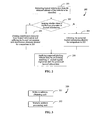
- FIG. 1 is a flow chart illustrating an embodiment of a process for identifying suspected phishing websites.
- Process 100 can be implemented on either the user terminal side or the network side. In some embodiments, process 100 may be implemented on system 300. As shown in FIG. 1 , process 100 includes the following:
- an address of a website to be identified is obtained.
- the address of the website to be identified may be obtained in many ways, without any limitation thereto.
- the address of the website may be obtained during chatting over instant messaging (IM) software.
- the address of the website may be obtained from the customized status message of a user. Examples of obtaining the address of the website are described in further detail below.
- the obtained address of the website can be used as the address of the website to be identified herein.
- the address of the website to be identified can be obtained via one or more application scenarios. For example, some particular application scenarios are described below.
- the address of the website to be identified can be obtained by use of an instant messaging tool.
- Some examples of particular application scenarios are described in the following scenarios.
- Scenario 1 when a user communicates by using an instant messaging tool (e.g. one-to-one chatting, chat rooms of multiple persons, chatting group, etc.), the user may obtain, when receiving an instant message, a URL address link from the contents of the received instant message.
- an instant messaging tool e.g. one-to-one chatting, chat rooms of multiple persons, chatting group, etc.
- Scenario 2 when a user clicks on a contact list of an instant messaging tool, a group member list or a contact list of any other form, the user may obtain a URL address link from the status message or signature message of a contact.
- the status message or signature message of a contact may be a message customized by the contact and appears when the user waves a cursor over the name of the contact in the contact list.
- Scenario 3 after a user has logged on an instant messaging platform, the user may obtain, when receiving an offline message (e.g. a message received when the user was not logged on), a URL address link from the contents of the received offline message.
- an offline message e.g. a message received when the user was not logged on
- instant messaging software generally contains floating messages which are presented as windows floating from the bottom-right corner of a system task bar area.
- a user may obtain a URL address link from the contents of the floating window.
- floating messages may include messages indicating a changed status of a member of the user's contact list (e.g. a contact logs on to the instant messaging software).
- a user may obtain a URL address link from the hyperlink associated with a clickable element.
- the method of obtaining the address of the website to be identified may be as follows:
- any obtained character string and/or text containing URL information is filtered and matched against a preset first regular expression to obtain a URL in proper form from a matching result.
- the first regular expression is a conventional format of a URL address and contains common feature(s) of a URL.
- the format of "www.websitename.com” may be taken as the preset first regular expression against which a filtered character string is matched.
- the proper URL obtained by the filtering and matching is the address of the website to be identified.
- the website to be identified may be obtained by matching any character string and/or text containing URL information using the preset first regular expression, regardless of the particular scenario.
- a clickable element e.g. a picture or text with an associated hyperlink
- a proper URL address e.g. the URL information from a clickable element is deemed to be in proper URL form. Therefore, matching using the preset first regular expression may not be needed when obtaining the address of a website to be identified in the field of browser technologies because the URL to which the element points may be obtained directly.
- the regular expression used to obtain the URL in proper form from the obtained character string and/or text may be referred to as the first regular expression in the following description.
- determining may include judging whether the address of the website to be identified is included in a database (such as a preset list) of websites to be protected. If the website is not included in the preset list of websites to be protected, then the website to be identified is not deemed to be a website to be protected. In some embodiments, determining may also include, judging whether the address of the website to be identified is included in a database (such as a preset list) of already identified phishing websites. If the website is not included in the present list of already identified phishing websites, then the website to be identified is not deemed to be a phishing website.
- judging whether the address of the website to be identified is included in a preset list of websites to be protected may be performed first. In some embodiments, judging whether the address of the website to be identified is included in a preset list of phishing websites may be performed first.
- the website to be identified can be determined as a website to be protected or a phishing website based on the result of the identification. If the website is determined to be either of these two natures, then process 100 ends.
- one or more suspected phishing website rules are applied, including matching of a second regular expression to the address of the website to be identified. If the matching is successful, then the website to be identified is determined to be a suspected phishing website.
- the regular expression used for determining suspected phishing website is called the second regular expression since in some embodiments a first regular expression is used to identify the address of the website.
- the second regular expression is at least one variation of a website address of a non-phishing website or a website to be protected.
- the second regular expression is comprised of important keywords that appear in the website address of a non-phishing website or a website to be protected and also variants of those keywords.
- suspected phishing website rules determine the combination of keywords and their variants that comprise the second regular expression.
- the user may be prompted in one of the following manners:
- the above illustration is based on an implementation of the method at the user terminal side to illustrate how to notify the user of the 103 determination result.
- the notifying method at the network side is similar to that of the user terminal side. The difference lies in that when the method is implemented at the network side, the determination result is first sent to the network side which then prompts the result to the user.
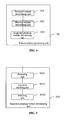
- FIG. 2 is a flow chart illustrating an embodiment of process for applying suspected phishing website rule.
- 103 is implemented with process 200.
- the uniform resource locator information of a host is extracted from the obtained address of the website to be identified.
- the path information, the protocol prefix and the like in the address are ignored, and only the hosturl information is extracted.
- the interference character may be any interference information that is often used by phishing websites to imitate non-phishing websites.
- Examples of the interference character include various separator symbols such as an underscore “_”, a hyphen “-”, a space “ “, and a comma “,” or the like.
- the interference character may be one of the above mentioned symbols or any combination thereof.
- matching using the second regular expression is performed for the processed hosturl information according to the suspected phishing website rules.
- the suspected phishing website rules describe the important keyword(s) of a host name of a website to be protected and the commonly used variants thereof that should comprise a second regular expression.
- the keyword refers to a word or any combination of words in the hosturl information which may be used to represent the website. For example, “taobao”, “alibaba”, “yahoo”, “ebay” or the like may be referred to as keywords for the websites of www.taobao.com, www.alibaba.com, www.yahoo.com, and www.ebay.com, respectively.
- the suspected phishing website rules are designed by manually determining the appropriate keywords to comprise a second regular expression for each of the websites included in the list of websites to be protected.
- the second regular expression described by the suspected phishing website rules may leave the interference character out of consideration.
- Process 200 may be performed at a user terminal or at the network side.
- the user terminal may include an instant messaging tool or a mobile terminal.
- Process 200 allows for identifying suspected phishing websites.
- a suspected phishing website can be identified and a warning given to a user before the user is harmed as a result of interacting with the potentially harmful website.
- FIG. 3 shows an embodiment of a system for identifying suspected phishing websites.
- System 300 may include a website address obtaining unit 301 and a website address processing unit 302.
- the units and subunits that comprise system 300 may be implemented as software components executing on one or more processors, as hardware such as programmable logic devices and/or Application Specific Integrated Circuits designed to perform certain functions or a combination thereof.
- the units and subunits can be embodied by a form of software products which can be stored in a nonvolatile storage medium (such as optical disk, flash storage device, mobile hard disk, etc.), including a number of instructions for making a computer device (such as personal computers, servers, network equipments, etc.) implement the methods described in the embodiments of the present invention.
- the units and subunits that comprise system 300 may be implemented on a single device or distributed across multiple devices.
- the website address obtaining unit 301 is adapted to obtain an address of a website to be identified.
- the address of the website may be obtained in many ways. Regardless of the way address of the website is obtained, the obtained address can be used as the address of the website to be identified herein.
- the address of the website may be obtained during the process of chatting over instant messaging (IM) software.
- the address of the website may be obtained from the customized status message of a user.
- the address of the website obtained by any of the various means can be used as the address of the website to be identified herein.
- the particular application scenarios are the same as the above embodiments and are omitted herein.
- the website address processing unit 302 is adapted to determine, according to the address of the website to be identified, that the website to be identified is neither a website to be protected nor a phishing website, perform a matching of a second regular expression to the address of the website to be identified by using suspected phishing website rules, and if the matching is successful, determine that the website to be identified is a suspected phishing website.
- system 300 may further include a prompting unit adapted to notify a result of a determination of a suspected phishing website to the user.
- FIG. 4 is a block diagram illustrating an embodiment of a website address processing unit.
- the website address processing unit may include a protected website determining unit 3021, a phishing website determining unit 3022, and a suspected phishing website determining unit 3023.
- Protected website determining unit 3021 is adapted to determine whether the address of the website to be identified is included in a preset list of websites to be protected, and therefore whether the website to be identified is a website to be protected.
- Phishing website determining unit 3022 is adapted to determine whether the address of the website to be identified is included in a preset list of phishing websites, and therefore whether the website to be identified is a phishing website.
- Suspected phishing website determining unit 3023 is adapted to match the second regular expression to the address of the website to be identified according to suspected phishing website rules, and determine whether the website to be identified is a suspected phishing website.
- FIG. 5 is a block diagram illustrating an embodiment of the structure of the suspected phishing website determining unit.
- the suspected phishing website determining unit may include an extracting unit 30231, a keyword obtaining unit 30232, and a matching unit 30233.
- the extracting unit 30231 is adapted to extract uniform resource locator information of a host from the obtained address of the website to be identified.
- the uniform resource locator information of a host is hosturl information, which may be extracted by deleting the path information, the protocol prefix, and the like from the obtained address of the website.
- the keyword obtaining unit 30232 is adapted to utilize the extracted uniform resource locator information of the host as a processed uniform resource locator information to be compared when there is no interference character in the uniform resource locator information of the host and when there is an interference character, delete the interference character from the uniform resource locator information of the host and utilize the uniform resource locator information of the host, with the interference character deleted, as the processed uniform resource locator information to be compared.
- interference character may be any interference information that is often used by imitating websites, such as various separator symbols including an underscore “_”, hyphen "-", a space “ “, and a comma “,” or the like. In some embodiments, the interference character may be one of the above mentioned symbols or any combination thereof.
- the matching unit 30233 is adapted to determine, by matching the second regular expression to the processed uniform resource locator information to be compared according to suspected phishing website rules, whether the website to be identified is a suspected phishing website.
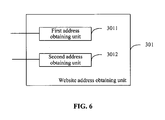
- FIG. 6 is a block diagram illustrating an embodiment of the structure of the website address obtaining unit.
- the website address obtaining unit may include a first address obtaining unit 3011, and a second address obtaining unit 3012.
- the first address obtaining unit 3011 is adapted to match, by using a preset first regular expression, any character string and/or text obtained by the apparatus according to common features of a URL, and obtain the address of the website to be identified in proper URL form from a result of the matching.
- the second address obtaining unit 3012 is adapted to obtain, given the obtained character string and/or text URL information from the first address obtaining unit 3011, the address of the website to be identified directly from the character string and/or text.
- the systems above are described to include a number of units, which in turn includes subunits.
- the units/subunits can be implemented as software components executing on one or more processors, as hardware such as programmable logic devices and/or Application Specific Integrated Circuits designed to perform certain functions or a combination thereof.
- the modules can be embodied by a form of software products which can be stored in a nonvolatile storage medium (such as optical disk, flash storage device, mobile hard disk, etc.), including a number of instructions for making a computer device (such as personal computers, servers, network equipments, etc.) implement the methods described in the embodiments of the present invention.
- the units/subunits may be implemented on a single device or distributed across multiple devices. The functions of the units may be merged into one another or further split into multiple subunits.
- All or part of the steps in the above method embodiments can be implemented by a program instructing relevant hardware.
- the program may be stored in a computer readable storage medium, such as ROM/RAM, magnetic disc, optical disc, or the like.
Landscapes
- Engineering & Computer Science (AREA)
- Computer Security & Cryptography (AREA)
- Computer Hardware Design (AREA)
- General Engineering & Computer Science (AREA)
- Theoretical Computer Science (AREA)
- Software Systems (AREA)
- General Physics & Mathematics (AREA)
- Signal Processing (AREA)
- Physics & Mathematics (AREA)
- Computer Networks & Wireless Communication (AREA)
- Computing Systems (AREA)
- Health & Medical Sciences (AREA)
- Virology (AREA)
- General Health & Medical Sciences (AREA)
- Radar, Positioning & Navigation (AREA)
- Remote Sensing (AREA)
- Information Transfer Between Computers (AREA)
- Information Retrieval, Db Structures And Fs Structures Therefor (AREA)
Priority Applications (2)
| Application Number | Priority Date | Filing Date | Title |
|---|---|---|---|
| EP16822749.4A EP3394926A1 (fr) | 2010-03-23 | 2016-12-20 | Antenne et système de détection anticollision comprenant cette antenne |
| CN201680073693.4A CN108370091A (zh) | 2010-03-23 | 2016-12-20 | 天线以及包括这种天线的防碰撞检测系统 |
Applications Claiming Priority (3)
| Application Number | Priority Date | Filing Date | Title |
|---|---|---|---|
| CN2009101293776A CN101504673B (zh) | 2009-03-24 | 2009-03-24 | 一种识别疑似仿冒网站的方法与系统 |
| US12/661,753 US8621616B2 (en) | 2009-03-24 | 2010-03-22 | Method and system for identifying suspected phishing websites |
| EP10756479.1A EP2411913B1 (en) | 2009-03-24 | 2010-03-23 | Method and system for identifying suspected phishing websites |
Related Parent Applications (2)
| Application Number | Title | Priority Date | Filing Date |
|---|---|---|---|
| EP10756479.1A Division EP2411913B1 (en) | 2009-03-24 | 2010-03-23 | Method and system for identifying suspected phishing websites |
| EP10756479.1A Division-Into EP2411913B1 (en) | 2009-03-24 | 2010-03-23 | Method and system for identifying suspected phishing websites |
Publications (1)
| Publication Number | Publication Date |
|---|---|
| EP2889792A1 true EP2889792A1 (en) | 2015-07-01 |
Family
ID=40976919
Family Applications (2)
| Application Number | Title | Priority Date | Filing Date |
|---|---|---|---|
| EP15152018.6A Withdrawn EP2889792A1 (en) | 2009-03-24 | 2010-03-23 | Method and system for identifying suspected phishing websites |
| EP10756479.1A Not-in-force EP2411913B1 (en) | 2009-03-24 | 2010-03-23 | Method and system for identifying suspected phishing websites |
Family Applications After (1)
| Application Number | Title | Priority Date | Filing Date |
|---|---|---|---|
| EP10756479.1A Not-in-force EP2411913B1 (en) | 2009-03-24 | 2010-03-23 | Method and system for identifying suspected phishing websites |
Country Status (5)
| Country | Link |
|---|---|
| US (1) | US8621616B2 (enExample) |
| EP (2) | EP2889792A1 (enExample) |
| JP (1) | JP5600160B2 (enExample) |
| CN (1) | CN101504673B (enExample) |
| WO (1) | WO2010110885A1 (enExample) |
Cited By (1)
| Publication number | Priority date | Publication date | Assignee | Title |
|---|---|---|---|---|
| DE102018125158B4 (de) | 2018-10-11 | 2024-11-07 | Bayerische Motoren Werke Aktiengesellschaft | Kraftfahrzeug-Wischerblatt |
Families Citing this family (38)
| Publication number | Priority date | Publication date | Assignee | Title |
|---|---|---|---|---|
| US8468597B1 (en) * | 2008-12-30 | 2013-06-18 | Uab Research Foundation | System and method for identifying a phishing website |
| US8495735B1 (en) * | 2008-12-30 | 2013-07-23 | Uab Research Foundation | System and method for conducting a non-exact matching analysis on a phishing website |
| CN103870554A (zh) * | 2009-12-11 | 2014-06-18 | 北京奇虎科技有限公司 | 一种实现浏览器地址栏铭牌的方法 |
| WO2011160273A1 (en) * | 2010-06-21 | 2011-12-29 | Nokia Corporation | Method and apparatus for bridging communication sessions |
| US9130988B2 (en) * | 2010-12-21 | 2015-09-08 | Microsoft Technology Licensing, Llc | Scareware detection |
| US8800033B2 (en) * | 2011-05-26 | 2014-08-05 | International Business Machines Corporation | Rotation of web site content to prevent E-mail spam/phishing attacks |
| CN103092832A (zh) * | 2011-10-27 | 2013-05-08 | 腾讯科技(深圳)有限公司 | 网址风险检测的处理方法及装置 |
| CN102520807A (zh) * | 2011-11-29 | 2012-06-27 | 深圳市万兴软件有限公司 | 一种输入字符控制方法和系统 |
| CN102523210B (zh) * | 2011-12-06 | 2014-11-05 | 中国科学院计算机网络信息中心 | 钓鱼网站检测方法及装置 |
| CN102647422B (zh) * | 2012-04-10 | 2014-09-17 | 中国科学院计算机网络信息中心 | 钓鱼网站检测方法及设备 |
| CN102737183B (zh) * | 2012-06-12 | 2014-08-13 | 腾讯科技(深圳)有限公司 | 网页安全访问的方法及装置 |
| CN103678342B (zh) * | 2012-09-07 | 2018-04-27 | 腾讯科技(深圳)有限公司 | 启动项识别方法及装置 |
| CN103778113B (zh) * | 2012-10-17 | 2017-04-19 | 腾讯科技(深圳)有限公司 | 终端、服务器及终端、服务器的网页处理方法 |
| US9344449B2 (en) | 2013-03-11 | 2016-05-17 | Bank Of America Corporation | Risk ranking referential links in electronic messages |
| JP6015546B2 (ja) * | 2013-04-30 | 2016-10-26 | キヤノンマーケティングジャパン株式会社 | 情報処理装置、情報処理方法、プログラム |
| US9621566B2 (en) | 2013-05-31 | 2017-04-11 | Adi Labs Incorporated | System and method for detecting phishing webpages |
| US10187476B2 (en) * | 2013-06-17 | 2019-01-22 | Beijing Xiaomi Mobile Software Co., Ltd. | Method and apparatus for bridging communication sessions |
| KR101696912B1 (ko) * | 2014-01-23 | 2017-01-16 | 한국전자통신연구원 | 문자 인식의 후처리 방법 및 이를 이용하는 문자 인식 장치 |
| US9398047B2 (en) * | 2014-11-17 | 2016-07-19 | Vade Retro Technology, Inc. | Methods and systems for phishing detection |
| US10164927B2 (en) | 2015-01-14 | 2018-12-25 | Vade Secure, Inc. | Safe unsubscribe |
| US9253208B1 (en) | 2015-03-05 | 2016-02-02 | AO Kaspersky Lab | System and method for automated phishing detection rule evolution |
| US9946874B2 (en) | 2015-08-06 | 2018-04-17 | International Business Machines Corporation | Authenticating application legitimacy |
| CN105447204B (zh) * | 2016-01-04 | 2017-12-12 | 北京百度网讯科技有限公司 | 网址识别方法和装置 |
| US10142366B2 (en) | 2016-03-15 | 2018-11-27 | Vade Secure, Inc. | Methods, systems and devices to mitigate the effects of side effect URLs in legitimate and phishing electronic messages |
| US10505979B2 (en) | 2016-05-13 | 2019-12-10 | International Business Machines Corporation | Detection and warning of imposter web sites |
| CN108073804B (zh) * | 2016-11-14 | 2022-11-29 | 百度在线网络技术(北京)有限公司 | 一种风险识别方法和装置 |
| US10567430B2 (en) | 2016-12-09 | 2020-02-18 | International Business Machines Corporation | Protecting against notification based phishing attacks |
| CN108255870B (zh) * | 2016-12-29 | 2021-06-01 | 中国移动通信集团浙江有限公司 | 一种网站数据爬取方法及装置 |
| CN108052602A (zh) * | 2017-12-13 | 2018-05-18 | 深圳市小满科技有限公司 | 信息收集方法、装置、电子设备及计算机可读存储介质 |
| US10893070B2 (en) * | 2019-04-18 | 2021-01-12 | Facebook, Inc. | Detecting a page for a real-world entity, an imposter of a real-world entity, or a non-real-world entity that complies with or violates a policy of an online system |
| US11379577B2 (en) * | 2019-09-26 | 2022-07-05 | Microsoft Technology Licensing, Llc | Uniform resource locator security analysis using malice patterns |
| US11831419B2 (en) * | 2019-09-27 | 2023-11-28 | Mcafee, Llc | Methods and apparatus to detect website phishing attacks |
| US11431751B2 (en) | 2020-03-31 | 2022-08-30 | Microsoft Technology Licensing, Llc | Live forensic browsing of URLs |
| US11575708B2 (en) * | 2020-05-29 | 2023-02-07 | Mcafee, Llc | Icon based phishing detection |
| CN111597557B (zh) * | 2020-06-30 | 2024-08-09 | 腾讯科技(深圳)有限公司 | 恶意应用程序的检测方法、系统、装置、设备及存储介质 |
| CN111737692B (zh) * | 2020-08-17 | 2020-12-18 | 腾讯科技(深圳)有限公司 | 应用程序的风险检测方法及装置、设备、存储介质 |
| CN112272176A (zh) * | 2020-10-23 | 2021-01-26 | 常州市同济科技有限公司 | 一种基于大数据平台的网络安全防护方法及系统 |
| CN113542280A (zh) * | 2021-07-16 | 2021-10-22 | 湖南大学 | 一种基于BA-BNN算法的LDoS攻击检测方法 |
Citations (6)
| Publication number | Priority date | Publication date | Assignee | Title |
|---|---|---|---|---|
| US20040078422A1 (en) | 2002-10-17 | 2004-04-22 | Toomey Christopher Newell | Detecting and blocking spoofed Web login pages |
| EP1863240A2 (en) | 2006-05-30 | 2007-12-05 | Xerox Corporation | Method and system for phishing detection |
| US20080082662A1 (en) * | 2006-05-19 | 2008-04-03 | Richard Dandliker | Method and apparatus for controlling access to network resources based on reputation |
| US20080172738A1 (en) | 2007-01-11 | 2008-07-17 | Cary Lee Bates | Method for Detecting and Remediating Misleading Hyperlinks |
| US20080271141A1 (en) | 2007-04-24 | 2008-10-30 | Juniper Networks, Inc. | Parallelized pattern matching using non-deterministic finite automata |
| US20090077383A1 (en) * | 2007-08-06 | 2009-03-19 | De Monseignat Bernard | System and method for authentication, data transfer, and protection against phishing |
Family Cites Families (19)
| Publication number | Priority date | Publication date | Assignee | Title |
|---|---|---|---|---|
| JP3898016B2 (ja) * | 2001-09-28 | 2007-03-28 | 三菱電機株式会社 | 情報検索装置、情報検索方法及び情報検索プログラム |
| JP4511817B2 (ja) * | 2003-10-27 | 2010-07-28 | 九州日本電気ソフトウェア株式会社 | スパムメールを利用したフィルタリングシステム、スパム処理サーバ、並びに、スパム処理方法、およびプログラム |
| JP4545540B2 (ja) * | 2004-10-01 | 2010-09-15 | 三菱電機株式会社 | アクセス防止装置 |
| US7634810B2 (en) | 2004-12-02 | 2009-12-15 | Microsoft Corporation | Phishing detection, prevention, and notification |
| US7580982B2 (en) | 2004-12-14 | 2009-08-25 | The Go Daddy Group, Inc. | Email filtering system and method |
| US7590698B1 (en) | 2005-03-14 | 2009-09-15 | Symantec Corporation | Thwarting phishing attacks by using pre-established policy files |
| JP4429971B2 (ja) * | 2005-06-03 | 2010-03-10 | 日本電信電話株式会社 | 正当サイト検証方法、装置、およびプログラム |
| US7769820B1 (en) * | 2005-06-30 | 2010-08-03 | Voltage Security, Inc. | Universal resource locator verification services using web site attributes |
| US7681234B2 (en) | 2005-06-30 | 2010-03-16 | Microsoft Corporation | Preventing phishing attacks |
| JP4200453B2 (ja) * | 2005-07-08 | 2008-12-24 | 株式会社クローバー・ネットワーク・コム | 不正防止プログラムおよびそのコンピュータ読み取り可能な記憶媒体 |
| JP2007058587A (ja) * | 2005-08-24 | 2007-03-08 | Matsushita Electric Ind Co Ltd | 信頼性検証システム |
| US7603699B2 (en) | 2005-08-25 | 2009-10-13 | Melih Abdulhayoglu | Method for establishing trust online |
| JP4422088B2 (ja) | 2005-09-27 | 2010-02-24 | Necネクサソリューションズ株式会社 | 画像配列型認証システム |
| US20070083670A1 (en) * | 2005-10-11 | 2007-04-12 | International Business Machines Corporation | Method and system for protecting an internet user from fraudulent ip addresses on a dns server |
| JP4612535B2 (ja) * | 2005-12-02 | 2011-01-12 | 日本電信電話株式会社 | 正当サイト検証手法におけるホワイトリスト収集方法および装置 |
| US7266693B1 (en) | 2007-02-13 | 2007-09-04 | U.S. Bancorp Licensing, Inc. | Validated mutual authentication |
| US7650310B2 (en) | 2007-10-30 | 2010-01-19 | Intuit Inc. | Technique for reducing phishing |
| US20090182818A1 (en) * | 2008-01-11 | 2009-07-16 | Fortinet, Inc. A Delaware Corporation | Heuristic detection of probable misspelled addresses in electronic communications |
| JP5166094B2 (ja) * | 2008-03-27 | 2013-03-21 | 株式会社野村総合研究所 | 通信中継装置、ウェブ端末、メールサーバ装置、電子メール端末およびサイトチェックプログラム |
-
2009
- 2009-03-24 CN CN2009101293776A patent/CN101504673B/zh not_active Expired - Fee Related
-
2010
- 2010-03-22 US US12/661,753 patent/US8621616B2/en active Active
- 2010-03-23 WO PCT/US2010/000875 patent/WO2010110885A1/en not_active Ceased
- 2010-03-23 JP JP2012502006A patent/JP5600160B2/ja not_active Expired - Fee Related
- 2010-03-23 EP EP15152018.6A patent/EP2889792A1/en not_active Withdrawn
- 2010-03-23 EP EP10756479.1A patent/EP2411913B1/en not_active Not-in-force
Patent Citations (6)
| Publication number | Priority date | Publication date | Assignee | Title |
|---|---|---|---|---|
| US20040078422A1 (en) | 2002-10-17 | 2004-04-22 | Toomey Christopher Newell | Detecting and blocking spoofed Web login pages |
| US20080082662A1 (en) * | 2006-05-19 | 2008-04-03 | Richard Dandliker | Method and apparatus for controlling access to network resources based on reputation |
| EP1863240A2 (en) | 2006-05-30 | 2007-12-05 | Xerox Corporation | Method and system for phishing detection |
| US20080172738A1 (en) | 2007-01-11 | 2008-07-17 | Cary Lee Bates | Method for Detecting and Remediating Misleading Hyperlinks |
| US20080271141A1 (en) | 2007-04-24 | 2008-10-30 | Juniper Networks, Inc. | Parallelized pattern matching using non-deterministic finite automata |
| US20090077383A1 (en) * | 2007-08-06 | 2009-03-19 | De Monseignat Bernard | System and method for authentication, data transfer, and protection against phishing |
Cited By (1)
| Publication number | Priority date | Publication date | Assignee | Title |
|---|---|---|---|---|
| DE102018125158B4 (de) | 2018-10-11 | 2024-11-07 | Bayerische Motoren Werke Aktiengesellschaft | Kraftfahrzeug-Wischerblatt |
Also Published As
| Publication number | Publication date |
|---|---|
| JP5600160B2 (ja) | 2014-10-01 |
| EP2411913B1 (en) | 2015-02-25 |
| EP2411913A1 (en) | 2012-02-01 |
| EP2411913A4 (en) | 2013-01-30 |
| HK1133720A1 (en) | 2010-04-01 |
| US8621616B2 (en) | 2013-12-31 |
| WO2010110885A1 (en) | 2010-09-30 |
| CN101504673A (zh) | 2009-08-12 |
| US20100251380A1 (en) | 2010-09-30 |
| JP2012521599A (ja) | 2012-09-13 |
| CN101504673B (zh) | 2011-09-07 |
Similar Documents
| Publication | Publication Date | Title |
|---|---|---|
| EP2411913B1 (en) | Method and system for identifying suspected phishing websites | |
| US10164988B2 (en) | External link processing | |
| US8448245B2 (en) | Automated identification of phishing, phony and malicious web sites | |
| EP2965472B1 (en) | Document classification using multiscale text fingerprints | |
| US20170142154A1 (en) | Dashboards for Displaying Threat Insight Information | |
| US10999322B1 (en) | Anti-phishing system and method using computer vision to match identifiable key information | |
| CN104462509A (zh) | 垃圾评论检测方法及装置 | |
| JP2019036305A (ja) | 視覚的な国際化ドメイン名衝突の識別 | |
| US10078750B1 (en) | Methods and systems for finding compromised social networking accounts | |
| CN104767747A (zh) | 点击劫持安全检测方法和装置 | |
| US8910281B1 (en) | Identifying malware sources using phishing kit templates | |
| CN104978423A (zh) | 网站类型的检测方法及装置 | |
| JP4564916B2 (ja) | フィッシング詐欺対策方法、端末、サーバ及びプログラム | |
| EP4120625A1 (en) | System, device and method for detecting social engineering attacks in digital communications | |
| TWI595373B (zh) | Method and system for identifying suspected phishing websites | |
| JP4617243B2 (ja) | 情報発信元検証方法および装置 | |
| HK1133720B (en) | Method and system for identifying suspected fake websites | |
| GB2490996A (en) | Instant messaging validation or look-ahead functionality | |
| HK1177352B (en) | Method and device for identifying fishing website | |
| HK1177352A1 (zh) | 一种识别钓鱼网站的方法及装置 | |
| HK1213705B (zh) | 使用多尺度文本指纹的文档分类 |
Legal Events
| Date | Code | Title | Description |
|---|---|---|---|
| PUAI | Public reference made under article 153(3) epc to a published international application that has entered the european phase |
Free format text: ORIGINAL CODE: 0009012 |
|
| 17P | Request for examination filed |
Effective date: 20150121 |
|
| AC | Divisional application: reference to earlier application |
Ref document number: 2411913 Country of ref document: EP Kind code of ref document: P |
|
| AK | Designated contracting states |
Kind code of ref document: A1 Designated state(s): AT BE BG CH CY CZ DE DK EE ES FI FR GB GR HR HU IE IS IT LI LT LU LV MC MK MT NL NO PL PT RO SE SI SK SM TR |
|
| R17P | Request for examination filed (corrected) |
Effective date: 20151215 |
|
| RBV | Designated contracting states (corrected) |
Designated state(s): AT BE BG CH CY CZ DE DK EE ES FI FR GB GR HR HU IE IS IT LI LT LU LV MC MK MT NL NO PL PT RO SE SI SK SM TR |
|
| 17Q | First examination report despatched |
Effective date: 20170314 |
|
| STAA | Information on the status of an ep patent application or granted ep patent |
Free format text: STATUS: THE APPLICATION IS DEEMED TO BE WITHDRAWN |
|
| 18D | Application deemed to be withdrawn |
Effective date: 20180727 |
|
| P01 | Opt-out of the competence of the unified patent court (upc) registered |
Effective date: 20230418 |