EP2889337B1 - µ-Polyoxo crosslinked phthalocyanine compound, preparing method thereof, and near infrared ray absorbing and reflecting composition using the same - Google Patents
µ-Polyoxo crosslinked phthalocyanine compound, preparing method thereof, and near infrared ray absorbing and reflecting composition using the same Download PDFInfo
- Publication number
- EP2889337B1 EP2889337B1 EP14152615.2A EP14152615A EP2889337B1 EP 2889337 B1 EP2889337 B1 EP 2889337B1 EP 14152615 A EP14152615 A EP 14152615A EP 2889337 B1 EP2889337 B1 EP 2889337B1
- Authority
- EP
- European Patent Office
- Prior art keywords
- near infrared
- infrared ray
- polyoxo
- crosslinked
- wavelength
- Prior art date
- Legal status (The legal status is an assumption and is not a legal conclusion. Google has not performed a legal analysis and makes no representation as to the accuracy of the status listed.)
- Active
Links
Images






Classifications
-
- C—CHEMISTRY; METALLURGY
- C08—ORGANIC MACROMOLECULAR COMPOUNDS; THEIR PREPARATION OR CHEMICAL WORKING-UP; COMPOSITIONS BASED THEREON
- C08G—MACROMOLECULAR COMPOUNDS OBTAINED OTHERWISE THAN BY REACTIONS ONLY INVOLVING UNSATURATED CARBON-TO-CARBON BONDS
- C08G79/00—Macromolecular compounds obtained by reactions forming a linkage containing atoms other than silicon, sulfur, nitrogen, oxygen, and carbon with or without the latter elements in the main chain of the macromolecule
-
- C—CHEMISTRY; METALLURGY
- C07—ORGANIC CHEMISTRY
- C07F—ACYCLIC, CARBOCYCLIC OR HETEROCYCLIC COMPOUNDS CONTAINING ELEMENTS OTHER THAN CARBON, HYDROGEN, HALOGEN, OXYGEN, NITROGEN, SULFUR, SELENIUM OR TELLURIUM
- C07F11/00—Compounds containing elements of Groups 6 or 16 of the Periodic Table
-
- C—CHEMISTRY; METALLURGY
- C08—ORGANIC MACROMOLECULAR COMPOUNDS; THEIR PREPARATION OR CHEMICAL WORKING-UP; COMPOSITIONS BASED THEREON
- C08K—Use of inorganic or non-macromolecular organic substances as compounding ingredients
- C08K5/00—Use of organic ingredients
- C08K5/56—Organo-metallic compounds, i.e. organic compounds containing a metal-to-carbon bond
-
- C—CHEMISTRY; METALLURGY
- C09—DYES; PAINTS; POLISHES; NATURAL RESINS; ADHESIVES; COMPOSITIONS NOT OTHERWISE PROVIDED FOR; APPLICATIONS OF MATERIALS NOT OTHERWISE PROVIDED FOR
- C09B—ORGANIC DYES OR CLOSELY-RELATED COMPOUNDS FOR PRODUCING DYES, e.g. PIGMENTS; MORDANTS; LAKES
- C09B47/00—Porphines; Azaporphines
- C09B47/04—Phthalocyanines abbreviation: Pc
- C09B47/045—Special non-pigmentary uses, e.g. catalyst, photosensitisers of phthalocyanine dyes or pigments
-
- C—CHEMISTRY; METALLURGY
- C09—DYES; PAINTS; POLISHES; NATURAL RESINS; ADHESIVES; COMPOSITIONS NOT OTHERWISE PROVIDED FOR; APPLICATIONS OF MATERIALS NOT OTHERWISE PROVIDED FOR
- C09B—ORGANIC DYES OR CLOSELY-RELATED COMPOUNDS FOR PRODUCING DYES, e.g. PIGMENTS; MORDANTS; LAKES
- C09B47/00—Porphines; Azaporphines
- C09B47/04—Phthalocyanines abbreviation: Pc
- C09B47/30—Metal-free phthalocyanines
-
- C—CHEMISTRY; METALLURGY
- C09—DYES; PAINTS; POLISHES; NATURAL RESINS; ADHESIVES; COMPOSITIONS NOT OTHERWISE PROVIDED FOR; APPLICATIONS OF MATERIALS NOT OTHERWISE PROVIDED FOR
- C09B—ORGANIC DYES OR CLOSELY-RELATED COMPOUNDS FOR PRODUCING DYES, e.g. PIGMENTS; MORDANTS; LAKES
- C09B69/00—Dyes not provided for by a single group of this subclass
- C09B69/10—Polymeric dyes; Reaction products of dyes with monomers or with macromolecular compounds
-
- C—CHEMISTRY; METALLURGY
- C09—DYES; PAINTS; POLISHES; NATURAL RESINS; ADHESIVES; COMPOSITIONS NOT OTHERWISE PROVIDED FOR; APPLICATIONS OF MATERIALS NOT OTHERWISE PROVIDED FOR
- C09B—ORGANIC DYES OR CLOSELY-RELATED COMPOUNDS FOR PRODUCING DYES, e.g. PIGMENTS; MORDANTS; LAKES
- C09B69/00—Dyes not provided for by a single group of this subclass
- C09B69/10—Polymeric dyes; Reaction products of dyes with monomers or with macromolecular compounds
- C09B69/108—Polymeric dyes; Reaction products of dyes with monomers or with macromolecular compounds containing a phthalocyanine dye
-
- G—PHYSICS
- G02—OPTICS
- G02B—OPTICAL ELEMENTS, SYSTEMS OR APPARATUS
- G02B1/00—Optical elements characterised by the material of which they are made; Optical coatings for optical elements
- G02B1/10—Optical coatings produced by application to, or surface treatment of, optical elements
-
- G—PHYSICS
- G02—OPTICS
- G02B—OPTICAL ELEMENTS, SYSTEMS OR APPARATUS
- G02B5/00—Optical elements other than lenses
- G02B5/08—Mirrors
- G02B5/0816—Multilayer mirrors, i.e. having two or more reflecting layers
- G02B5/0825—Multilayer mirrors, i.e. having two or more reflecting layers the reflecting layers comprising dielectric materials only
- G02B5/0841—Multilayer mirrors, i.e. having two or more reflecting layers the reflecting layers comprising dielectric materials only comprising organic materials, e.g. polymers
-
- G—PHYSICS
- G02—OPTICS
- G02B—OPTICAL ELEMENTS, SYSTEMS OR APPARATUS
- G02B5/00—Optical elements other than lenses
- G02B5/20—Filters
- G02B5/208—Filters for use with infrared or ultraviolet radiation, e.g. for separating visible light from infrared and/or ultraviolet radiation
-
- G—PHYSICS
- G02—OPTICS
- G02B—OPTICAL ELEMENTS, SYSTEMS OR APPARATUS
- G02B5/00—Optical elements other than lenses
- G02B5/20—Filters
- G02B5/22—Absorbing filters
- G02B5/223—Absorbing filters containing organic substances, e.g. dyes, inks or pigments
-
- G—PHYSICS
- G03—PHOTOGRAPHY; CINEMATOGRAPHY; ANALOGOUS TECHNIQUES USING WAVES OTHER THAN OPTICAL WAVES; ELECTROGRAPHY; HOLOGRAPHY
- G03G—ELECTROGRAPHY; ELECTROPHOTOGRAPHY; MAGNETOGRAPHY
- G03G5/00—Recording-members for original recording by exposure, e.g. to light, to heat or to electrons; Manufacture thereof; Selection of materials therefor
- G03G5/02—Charge-receiving layers
- G03G5/04—Photoconductive layers; Charge-generation layers or charge-transporting layers; Additives therefor; Binders therefor
- G03G5/06—Photoconductive layers; Charge-generation layers or charge-transporting layers; Additives therefor; Binders therefor characterised by the photoconductive material being organic
- G03G5/0664—Dyes
- G03G5/0696—Phthalocyanines
-
- G—PHYSICS
- G11—INFORMATION STORAGE
- G11B—INFORMATION STORAGE BASED ON RELATIVE MOVEMENT BETWEEN RECORD CARRIER AND TRANSDUCER
- G11B7/00—Recording or reproducing by optical means, e.g. recording using a thermal beam of optical radiation by modifying optical properties or the physical structure, reproducing using an optical beam at lower power by sensing optical properties; Record carriers therefor
- G11B7/24—Record carriers characterised by shape, structure or physical properties, or by the selection of the material
- G11B7/241—Record carriers characterised by shape, structure or physical properties, or by the selection of the material characterised by the selection of the material
- G11B7/242—Record carriers characterised by shape, structure or physical properties, or by the selection of the material characterised by the selection of the material of recording layers
- G11B7/244—Record carriers characterised by shape, structure or physical properties, or by the selection of the material characterised by the selection of the material of recording layers comprising organic materials only
- G11B7/246—Record carriers characterised by shape, structure or physical properties, or by the selection of the material characterised by the selection of the material of recording layers comprising organic materials only containing dyes
- G11B7/248—Record carriers characterised by shape, structure or physical properties, or by the selection of the material characterised by the selection of the material of recording layers comprising organic materials only containing dyes porphines; azaporphines, e.g. phthalocyanines
Definitions
- the present invention relates to a ⁇ -polyoxo crosslinked phthalocyanine compound, a preparing method thereof, and a near infrared ray absorbing and reflecting composition using the same, and more particularly, to a ⁇ -polyoxo crosslinked phthalocyanine compound having high absorption at a wavelength of 800 to 950 nm and high reflectance at a wavelength of 1200 nm or more, a preparing method of a ⁇ -polyoxo crosslinked phthalocyanine compound simultaneously having these near infrared ray absorption and reflection properties, and a near infrared ray absorbing and reflecting composition using the ⁇ -polyoxo crosslinked phthalocyanine compound.
- the present invention relates to a novel ⁇ -polyoxo crosslinked phthalocyanine compound and applications of a near infrared ray absorbing and reflecting composition using the same.
- An organic dye or pigment according to the related art has been widely used as a colorant, and particularly, some of the phthalocyanine based dyes have been widely used in an optical information recording medium field.
- These recording media in which data written once may be repeatedly read are referred to as write once read many (abbreviated as "WORM").
- WORM write once read many
- CD-R compact disk recordable, or so-called CD-R has been known at " Optical Data Storage 1989", Technical Digest Series, Vol.1 45 (1989 ).
- a phthalocyanine compound is one of the most important categories due to high absorption in a near infrared ray range (700 to 900 nm). As compared to other organic dyes such as cyanine, the phthalocyanine dye has more excellent light resistance, temperature resistance, and moisture resistance.
- Phthalocyanine compounds were disclosed as a constituent component of a record layer of an optical recording medium in the initial documents such as JP-A 154888 (1986) , 197280 (1986) , 246091 (1986) , US 4769307 (1987) , and JP-A 39388 (1988 ).
- the phthalocyanine compounds of the above-mentioned documents may not be considered as a suitable material for an optical recording medium in view of sensitivity, solubility, recording performance, and other related properties.
- phthalocyanine compounds having a larger substituent (having a larger steric hindrance effect) in a phenyl ring were provided in JP-A 62878 (1991 ).
- these materials were not suitable for a recording material.
- a phenyl-substituted phthalocyanine (also, referred to as naphthalocyanine) dye was suggested in US 5229507 (1993) , but solubility of this dye was insufficient. The dye sometimes precipitates during spin-coating under predetermined process conditions.
- a phthalocyanine compound in which a metal is introduced as a central atom has been disclosed in Korean Patent Laid-Open Publication Nos. 2003-96052 and 2005-20832 , but it was confirmed that in the above-mentioned phthalocyanine compound, which is a single metal phthalocyanine compound or oxo crosslinked, it was a different kind of metal phthalocyanine compound, mostly, near infrared ray absorption only at 800 nm or less was low, and properties such as light fastness, thermal stability, dispersibility, chemical resistance, solvent resistance, and the like, were weak Further, in the case of mixing the single metal phthalocyanine compound or oxo crosslinked, it was a different kind of metal phthalocyanine compound with a generally used color pigment and using the mixture, there is a disadvantage in that since it is difficult to clearly distinguish absorption spectra of near infrared ray absorber and the color pigment from each other due to an overlapping phenomenon of an absorption wavelength, various colors were not obtained
- An object of the present invention is to provide a ⁇ -polyoxo crosslinked phthalocyanine compound simultaneously having near infrared ray absorption and reflection properties.
- Another object of the present invention is to provide a preparing method of ⁇ -polyoxo crosslinked phthalocyanine compound.
- Still another object of the present invention is to provide a near infrared ray absorbing and reflecting composition using the ⁇ -polyoxo crosslinked phthalocyanine compound.
- a ⁇ -polyoxo crosslinked molybdenum phthalocyanine compound including: at least one non-metal phthalocyanine, wherein it has a structure represented by following Chemical Formula I; where, R is a moiety independently selected from the group consisting of hydrogen, halogen, hydroxyl, amino, hydroxysulfonyl, aminosulfonyl, (C 1 -C 5 )alkyl, SR 17 , OR 18 , and NHR 19 ; R 17 to R 19 are each independently selected from the group consisting of (C 1 -C 5 )alkyl, (C 1 -C 5 )alkoxy and phenyl selectively substituted with a substituent independently selected from the group consisting of halogen, hydroxyl, amino, hydroxysulfonyl, aminosulfonyl, (C 1 -C 5 )alkyl, and (C 1 -C 5 )
- the ⁇ -polyoxo crosslinked molybdenum phthalocyanine compound may absorb near infrared ray at a wavelength of 800 to 950 nm and reflect near infrared ray at a wavelength of 1200 nm or more.
- a difference between absorption of near infrared ray at a wavelength of 800 to 950 nm and reflectance of near infrared ray at a wavelength of 1200 nm or more may be 30% or more.
- a preparing method of the ⁇ -polyoxo crosslinked molybdenum phthalocyanine compound as described above comprising: oxo crosslinking at least one non-metal phthalocyanine and phthalocyanine substituted with a molybdenum metal to each other.
- a ⁇ -polyoxo crosslinked molybdenum phthalocyanine compound including: one different kind of metal phthalocyanine, wherein the different kind of metal is selected from the group consisting of nickel, lithium, magnesium and silicon, wherein it has a structure represented by following Chemical Formula II; where, R is a moiety independently selected from hydrogen, halogen, hydroxyl, amino, hydroxysulfonyl, aminosulfonyl, (C 1 -C 5 )alkyl , SR 17 , OR 18 , and NHR 19 ; R 17 to R 19 are each independently selected from the group consisting of (C1-C5)alkyl, (C1-C5)alkoxy and phenyl selectively substituted with a substituent independently selected from the group consisting of halogen, hydroxyl, amino, hydroxysulfonyl, aminosulfonyl, (C1-C5)alkyl and (C1-C5)
- the ⁇ -polyoxo crosslinked molybdenum phthalocyanine compound may absorb near infrared ray at a wavelength of 800 to 950 nm and reflect near infrared ray at a wavelength of 1200 nm or more.
- a difference between absorption of near infrared ray at a wavelength of 800 to 950 nm and reflectance of near infrared ray at a wavelength of 1200 nm or more may be 30% or more.
- a preparing method of the ⁇ -polyoxo crosslinked molybdenum phthalocyanine compound as described above including: oxo crosslinking at least one different kind of metal phthalocyanine and phthalocyanine substituted with a molybdenum metal to each other, wherein the different kind of metal is selected from the group consisting of nickel, lithium, magnesium and silicon, wherein the phthalocyanine is prepared using phthalic anhydride and urea.
- a near infrared ray absorbing and reflecting composition containing: the ⁇ -polyoxo crosslinked molybdenum phthalocyanine compound as described above; and at least one binder selected from an acrylic polymer, an alkyd resin, polyamide, polyurethane, polyester, polyethylene terephthalate, polycarbonate, and polypropylene.
- an optical device including: a recording layer containing the compound or the composition as described above, absorbing near infrared ray at a wavelength of 800 to 950 nm and reflecting near infrared ray at a wavelength of 1200 nm or more; and a reflecting layer on the recording layer.
- alkyl means saturated aliphatic radicals including straight chain alkyl groups, branched chain alkyl groups, cycloalkyl (alicyclic) groups, alkyl-substituted cycloalkyl groups, cycloalkyl-substituted alkyl groups.
- alkyl may include alkyl groups further including, an oxygen, nitrogen, sulfur, or phosphorus atom, that is, alkyl groups in which at least one carbon in a hydrocarbon main chain is substituted with, for example, an oxygen, nitrogen, sulfur, or phosphorus atom.
- the straight or branched chain alkyl has at most 20 carbon atoms (for example, (C 1 -C 20 ) straight chain or (C 3 -C 20 ) branched chain), preferably at most 15 carbon atoms, more preferably at most 10 carbon atoms, and most preferably at most 8 carbon atoms in a main chain thereof.
- cycloalkyl has preferably 3 to 10 carbon atoms, more preferably, 3 to 7 carbon atoms in a ring structure thereof.
- alkyl is intended to include both of unsubstituted alkyl and substituted alkyl meaning an alkyl moiety having a substituent replacing hydrogen on at least one carbon in a hydrocarbon main chain.
- substituent may include halogen, hydroxyl, alkylcarbonyloxy, arylcarbonyloxy, alkoxycarbonyloxy, aryloxycarbonyloxy, carboxylate, alkylcarbonyl, alkoxycarbonyl, aminocarbonyl, alkylthiocarbonyl, alkoxyl, phosphate, phosphonato, phosphinato, cyano, amino (including alkylamino, dialkylamino, arylamino, diarylamino, and alkylarylamino), acylamino (including alkylcarbonylamino, arylcarbonylamino, carbamoyl, and ureido), amidino, imino, sulfhydryl, al
- alkylaryl moiety is an alkyl substituted with an aryl (for example, phenylmethyl(benzyl).
- alkyl includes unsaturated aliphatic group capable of being substituted with the above-mentioned alkyl and having a similar length and may include at least one double or triple bond, respectively.
- a lower alkyl group may mean the above-defined alkyl group having 1 to 10, preferably 1 to 6, and more preferably 1 to 4 carbon atoms in a main straight or branched chain structure thereof.
- An example of the lower alkyl group includes methyl, ethyl, n-propyl, i-propyl, tert-butyl, hexyl, heptyl, octyl, and the like.
- the term "lower alkyl” includes straight chain alkyl having 4 or less carbon atoms in a main chain thereof, for example, (C 1 -C 4 )alkyl.
- alkoxyalkyl, polyaminoalkyl, and thioalkoxyalkyl means the above-mentioned alkyl groups further including an oxygen, nitrogen, or sulfur atom, that is, alkyl groups in which at least one carbon in a hydrocarbon main chain is substituted with, for example, an oxygen, nitrogen, or sulfur atom.
- aryl means a radical of aryl groups including 5- and 6-membered single-ring aromatic groups capable of having 0 to 4 hetero atoms, for example, benzene, pyrrole, furan, thiophene, imidazole, benzoxazole, benzothiazole, triazole, tetrazole, pyrazole, pyridine, pyrazine, pyridazine, pyrimidine, and the like.
- the aryl group includes polycyclic fused aromatic groups such as naphthyl, quinolyl, indolyl, and the like.
- aryl groups having a hetero atom in the ring structure may also be referred to as "aryl heterocycles", “heteroaryls” or “heteroaromatics".
- the aromatic ring may be substituted at one or more ring positions with the above-mentioned substituent, for example, halogen, hydroxyl, alkoxy, alkylcarbonyloxy, arylcarbonyloxy, alkoxycarbonyloxy, aryloxycarbonyloxy, carboxylate, alkylcarbonyl, alkoxycarbonyl, aminocarbonyl, alkylthiocarbonyl, phosphate, phosphonato, phosphinato, cyano, amino (including alkylamino, dialkylamino, arylamino, diarylamino, and alkylarylamino), acylamino (including alkylcarbonylamino, arylcarbonylamino, carbamoyl, and ureido), amidino, im
- the term "associated with” means a condition at which a chemical, a compound or a moiety thereof and a binding pocket or binding site of protein are closely positioned.
- the bond may be a non-covalent or covalent bond (energetically preferred by a hydrogen bond or van der Waals or electrostatic interaction).
- haloalkyl is intended to include the above-mentioned alkyl group mono-, di-, or poly-substituted with halogen, for example, fluoromethyl or trifluoromethyl.
- halogen means -F, -CI, -Br, or -I.
- hydroxyl means -OH.
- hetero atom means an atom of an arbitrary atom except for carbon or hydrogen.
- Preferable hetero atoms are nitrogen, oxygen, sulfur, and phosphorus.
- the term "selectively substituted” is intended to include unsubstituted or a group substituted with at least one suitable group except for hydrogen at one or more possible positions (may be equal to or different from each other), generally, 1, 2, 3, 4, or 5 positions.
- An example of the selective substituent includes a carbocyclic and heterocyclic group as well as hydroxyl, halogen, cyano, nitro, (C 1 -C 8 )alkyl, (C 2 -C 8 )alkenyl, (C 2 -C 8 )alkynyl, (C 1 -C 8 )alkoxy, (C 2 -C 8 )alkylether, (C 3 -C 8 )alkanone, (C 1 -C 8 )alkylthio, amino, mono- or di-((C 1 -C 8 )alkyl)amino, halo(C 1 -C 8 )alkyl, halo(C 1 -C 8 )alkoxy, (C 1 -C 8 )alkanoyl, (C 2 -C 8 )alkanoyloxy, (C 1 -C 8 )alkoxycarbonyl, -COOH, -CONH 2 , mono- or di
- selective substitution is described by a phase "substituted by 0 to X substituents", wherein X is the maximum number of possible substituent.
- a certain selectively substituted group is substituted with 0 to 2, 3 or 4 independently selected substituents (that is, the group is not substituted, or the number of substituents used for substitution is the above-mentioned maximum value or less).
- a description of a chemical functional group list in various arbitrary definitions includes various definitions thereof as an arbitrary single functional group of a combination of the described functional groups.
- description of various embodiments includes embodiments as a single embodiment, or another embodiment, or a combination thereof.
- a ⁇ -polyoxo crosslinked molybdenum phthalocyanine compound including at least one non-metal phthalocyanine and having a structure represented by the following Chemical Formula I.
- R is a moiety independently selected from hydrogen, halogen, hydroxyl, amino, hydroxysulfonyl, aminosulfonyl, (C 1 -C 5 )alkyl, SR 17 , OR 18 , and NHR 19 ;
- R 17 to R 19 are each independently selected from the group consisting of (C1-C5)alkyl, (C1-C5)alkoxy and phenyl selectively substituted with a substituent independently selected from the group consisting of halogen, hydroxyl, amino, hydroxysulfonyl, aminosulfonyl, (C1-C5)alkyl and (C1-C5)alkoxy;
- x is a rational number of 0.001 to 1; and
- n is an integer of 1 to 20.
- the ⁇ -polyoxo crosslinked molybdenum phthalocyanine compound having the structure represented by the following Chemical Formula I is a polymer compound in which at least one non-metal phthalocyanine (unsubstituted phthalocyanine) and at least one molybdenum phthalocyanine (phthalocyanine in which H covalently bonded to two nitrogen atoms existing at the center is substituted with a molybdenum metal) are crosslinked to each other via an oxo group.
- non-metal phthalocyanine may be defined as unsubstituted phthalocyanine in which H covalently bonded to two nitrogen atoms existing at the center is not substituted with a metal (in Chemical Formula I, molybdenum).
- non-metal phthalocyanine defined as unsubstituted phthalocyanine does not mean that H is necessarily bonded to two nitrogen atoms existing at the center.
- the number of repeating unit of non-metal phthalocyanine is defined as x
- the number of repeating unit of ⁇ -polyoxo crosslinked molybdenum phthalocyanine compound in which non-metal phthalocyanine and molybdenum phthalocyanine are oxo crosslinked to each other is defined as n.
- the ⁇ -polyoxo crosslinked molybdenum phthalocyanine compound may absorb near infrared ray at a wavelength of 800 to 950 nm and reflect near infrared ray at a wavelength of 1200 nm or more.
- a difference between absorption of near infrared ray at a wavelength of 800 to 950 nm and reflectance of near infrared ray at a wavelength of 1200nm or more may be 30% or more.
- a preparing method of a ⁇ -polyoxo crosslinked molybdenum phthalocyanine compound including oxo crosslinking at least one non-metal phthalocyanine and phthalocyanine substituted with the molybdenum metal to each other.
- a ⁇ -polyoxo crosslinked molybdenum phthalocyanine compound including at least one different kind of metal phthalocyanine and having a structure represented by the following Chemical Formula II.
- R is a moiety independently selected from hydrogen, halogen, hydroxyl, amino, hydroxysulfonyl, aminosulfonyl, (C 1 -C 5 )alkyl , SR 17 , OR 18 , and NHR 19 ;
- R 17 to R 19 are each independently selected from the group consisting of (C1-C5)alkyl, (C1-C5)alkoxy and phenyl selectively substituted with a substituent independently selected from the group consisting of halogen, hydroxyl, amino, hydroxysulfonyl, aminosulfonyl, (C1-C5)alkyl and (C1-C5)alkoxy;
- M is selected from the group consisting of nickel, lithium, magnesium, silicon, an oxide thereof and a halide hereof;
- y is a rational number of 0.001 to 2; and
- n is an integer of 1 to 20.
- the ⁇ -polyoxo crosslinked molybdenum phthalocyanine compound having the structure represented by the Chemical Formula II is a polymer compound in which at least one molybdenum phthalocyanine (phthalocyanine in which H covalently bonded to two nitrogen atoms existing at the center is substituted with a molybdenum metal) and at least one metal phthalocyanine substituted with a different kind of metal are crosslinked to each other via an oxo group.
- the different kind of metal may be independently selected from nickel, lithium, magnesium and silicon, and the different kind metal in phthalocyanine may be present as a metal salt, metal oxide, or metal halide.
- the number of repeating unit of phthalocyanine substituted with the metal is defined as y
- the number of repeating unit of ⁇ -polyoxo crosslinked molybdenum phthalocyanine compound in which different kind -metal phthalocyanine and molybdenum phthalocyanine are oxo crosslinked to each other is defined as n.
- the ⁇ -polyoxo crosslinked molybdenum phthalocyanine compound may absorb near infrared at a wavelength of 800 to 950 nm and reflect near infrared ray at a wavelength of 1200 nm or more.
- a difference between absorption of near infrared ray at a wavelength of 800 to 950 nm and reflectance of near infrared ray at a wavelength of 1200 nm or more may be 30% or more.
- a preparing method including oxo crosslinking at least one different kind of metal phthalocyanine and phthalocyanine substituted with the molybdenum metal to each other, wherein the different kind of metal is nickel, lithium, magnesium or silicon.
- a near infrared ray absorbing and reflecting composition containing: the ⁇ -polyoxo crosslinked molybdenum phthalocyanine compound; and at least one binder selected from an acrylic polymer, an alkyd resin, polyamide, polyurethane, polyester, polyethylene terephthalate, polycarbonate, and polypropylene.
- an optical recording medium including a printing layer containing the compound or the composition, absorbing near infrared ray at a wavelength of 800 to 950 nm, and reflecting near infrared ray at a wavelength of 1200 nm or more; and a reflecting layer on the recording layer.
- the compound or composition which is a composition in an ink form, may be used as a data carrier such as a check card, a credit card, or the like, and used to mark various optical recording media having a security function such as deeds, for example, an identification card, bank bills, a certificate, or the like.
- a 1 to A 4 may be each selectively substituted with a substituent independently selected from hydrogen, halogen, hydroxyl, amino, hydroxysulfonyl, aminosulfonyl, (C 1 -C 5 )alkyl, SR 17 , OR 18 , and NHR 19 according to the desired ⁇ -polyoxo crosslinked molybdenum phthalocyanine compound, and R 17 to R 19 may be each independently (C 1 -C 5 )alkyl, (C 1 -C 5 )alkoxy, or phenyl selectively substituted with a substituent independently selected from halogen, hydroxyl, amino, sulfonyl, hydroxysulfonyl, aminosulfonyl, (C 1 -C 5 )alkyl, and (C 1 -C 5 )alkoxy.
- a substituent independently selected from hydrogen, halogen, hydroxyl, amino, hydroxysulfonyl, aminosulfonyl,
- phthalic anhydride Since, in the case of mixing phthalic anhydride with water, reactivity of phthalic anhydride is significantly decreased as the phthalic anhydride is hydrolyzed, phthalic anhydride was used under anhydrous conditions, and as urea, a generally used product was used. In addition, the reaction was carried out using an n-alkylbenzene having a low polarity and high boiling point as a reaction solvent or without using a solvent.
- a ⁇ -polyoxo crosslinked molybdenum phthalocyanine compound (Chemical Formula I) including non-metal phthalocyanine according to the present invention was prepared. To this end, 51.8g of phthalic anhydride (0.35mol), 105.1g of urea (1.75mol), 21.15g of lithium chloride (0.5mol), and 0.52g of ammonium molybdate (0.0004mol) were put into a 1L three-neck round bottom flask, and stirred in alkyl benzene or without a solvent, and heated, followed by reaction at 175 to 200°C for 3 hours.
- the reactant was cooled by putting 2L of water thereinto, filtered, and treated with 1L of 0.35 to 0.5wt% hydrochloric acid solution and 2L of 2.5 to 3.0wt% sodium hydroxide solution, followed by washing.
- the precipitated metal complex was separated and dried. Results of element analysis of the obtained metal complex were shown in the following Table 1, and near infrared ray absorption and reflectance thereof were shown in FIG. 1 .
- a ⁇ -polyoxo crosslinked molybdenum phthalocyanine compound (Chemical Formula II) including a magnesium metal phthalocyanine compound according to the present invention was prepared. To this end, 51.8g of phthalic anhydride (0.35mol), 168.17 g of urea (2.8mol), 71.16 g of magnesium chloride (0.35mol), and 0.52g of ammonium molybdate (0.000525mol) were put into a 1L three-neck round bottom flask, and stirred in alkyl benzene or without a solvent, and heated, followed by reaction at 175 to 200°C for 3 to 6 hours.
- the reactant was cooled by putting 2L of water thereinto, filtered, and treated with 1L of 0.35 to 0.5wt% hydrochloric acid solution and 2L of 2.5 to 3.0wt% sodium hydroxide solution, followed by washing.
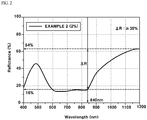
- the precipitated metal complex was separated and dried. Results of element analysis of the obtained metal complex were shown in the following Table 2, and near infrared ray absorption and reflectance thereof were shown in FIG. 2 .
- a ⁇ -polyoxo crosslinked molybdenum phthalocyanine compound including a silicon metal phthalocyanine compound according to the present invention was prepared. To this end, the compound was prepared by the same method as in Example 2 except for using silicon chloride instead of magnesium chloride.
- reflectance of the compound was 18% at 840 nm in near infrared region and 65% at 1200 nm, and a difference in reflectance ( ⁇ R %) was 47%.
- a ⁇ -polyoxo crosslinked molybdenum phthalocyanine compound including an aluminum metal phthalocyanine compound according to the present invention was prepared. To this end, the compound was prepared by the same method as in Example 2 except for using aluminum chloride instead of magnesium chloride.
- reflectance of the compound was 16% at 840 nm in near infrared region and 62% at 1200 nm, and a difference in reflectance ( ⁇ R %) was 46%.
- a ⁇ -polyoxo crosslinked molybdenum phthalocyanine compound including a silicon metal phthalocyanine compound according to the present invention was prepared.
- the compound was prepared by the same method as in Examples 2 and 3 except for using phthalic anhydride corresponding to the case in which A 1 was ethyl and A 2 to A 4 were hydrogen in Chemical Formula III.
- reflectance of the compound was 20% at 840 nm in near infrared region and 62% at 1200 nm, and a difference in reflectance ( ⁇ R %) was 42%.
- a ⁇ -polyoxo crosslinked molybdenum phthalocyanine compound including an aluminum metal phthalocyanine compound according to the present invention was prepared.
- the compound was prepared by the same method as in Examples 2 to 4 except for using phthalic anhydride corresponding to the case in which A 1 was propyl and A 2 to A 4 were hydrogen in Chemical Formula III.
- reflectance of the compound was 23% at 840 nm in near infrared region and 59% at 1200 nm, and a difference in reflectance ( ⁇ R %) was 36%.
- Carbon black had high absorption, which is an inherent property of carbon black, in a visible region at 400 nm or more and near infrared region at 800 to 1200 nm, but a difference in reflectance ( ⁇ R %) was less than 20%.
- reflectance of the yellow pigment was 36% at 880nm in near infrared region and 78% at 1200 nm, and a difference in reflectance ( ⁇ R %) was 42%.
- reflectance of the red pigment was 30% at 880 nm in near infrared region and 78% at 1200 nm, and a difference in reflectance ( ⁇ R %) was 48%.
- reflectance of the green dye was 38% at 880 nm in near infrared region and 79% at 1200 nm, and a difference in reflectance ( ⁇ R %) was 41 %.
- reflectance of the purple pigment was 24% at 880 nm in near infrared region and 75% at 1200 nm, and a difference in reflectance ( ⁇ R %) was 51 %.
- Intensities of absorption and reflection of near infrared light in a wavelength region of 400 to 1200 nm were measured and compared with respect to carbon black (absorption pigment), a black pigment formed of three primary colors (black pigment formed by mixing red, yellow, and blue pigments, which are reflecting pigments), a black pigment composed of three primary colors and including the compound (2%) separated and dried in Example 1, and the result was shown in FIG. 11 .
- an absorption property at 880 nm and a reflection property at 1200 nm or more may be confirmed by the naked eye using a near infrared light source (near infrared LED at 800 to 1200 nm) and a charge-coupled device (CCD) camera apparatus component.
- a near infrared light source near infrared LED at 800 to 1200 nm
- CCD charge-coupled device
- the ⁇ -polyoxo crosslinked molybdenum phthalocyanine compound according to the present invention has high absorption in a wavelength region of 800 to 950nm and high reflectance in a wavelength region of 1200 nm or more, and in the case of mixing the ⁇ -polyoxo crosslinked molybdenum phthalocyanine compound with a color pigment, various colors which it is difficult to use together with the near infrared ray absorber according to the related art such as a blue color, a green color, and the like, may be implemented.
- a ⁇ -polyoxo crosslinked molybdenum phthalocyanine compound capable of absorbing and reflecting near infrared ray at the same time. Since the compound has high thermal stability, the compound may stably exhibit optimal performance at a high processing temperature. In addition, the compound has improved light fastness and a wide near infrared ray absorbing and reflecting wavelength region as compared to commercialized products according to the related art, such that the compound may be applied in various fields.
Landscapes
- Chemical & Material Sciences (AREA)
- Physics & Mathematics (AREA)
- Organic Chemistry (AREA)
- General Physics & Mathematics (AREA)
- Optics & Photonics (AREA)
- Chemical Kinetics & Catalysis (AREA)
- Health & Medical Sciences (AREA)
- Medicinal Chemistry (AREA)
- Polymers & Plastics (AREA)
- Toxicology (AREA)
- Optical Filters (AREA)
- Nitrogen Condensed Heterocyclic Rings (AREA)
Description
- This application claims the benefit of Korean Patent Application No.
10-2013-0165804, filed on December 27, 2013 - The present invention relates to a µ-polyoxo crosslinked phthalocyanine compound, a preparing method thereof, and a near infrared ray absorbing and reflecting composition using the same, and more particularly, to a µ-polyoxo crosslinked phthalocyanine compound having high absorption at a wavelength of 800 to 950 nm and high reflectance at a wavelength of 1200 nm or more, a preparing method of a µ-polyoxo crosslinked phthalocyanine compound simultaneously having these near infrared ray absorption and reflection properties, and a near infrared ray absorbing and reflecting composition using the µ-polyoxo crosslinked phthalocyanine compound.
- The present invention relates to a novel µ-polyoxo crosslinked phthalocyanine compound and applications of a near infrared ray absorbing and reflecting composition using the same. An organic dye or pigment according to the related art has been widely used as a colorant, and particularly, some of the phthalocyanine based dyes have been widely used in an optical information recording medium field. These recording media in which data written once may be repeatedly read are referred to as write once read many (abbreviated as "WORM"). As an example of a disk format using this technology, a compact disk recordable, or so-called CD-R has been known at "Optical Data Storage 1989", Technical Digest Series, Vol.1 45 (1989).
- Among all of the organic dyes for optical recording medium, a phthalocyanine compound is one of the most important categories due to high absorption in a near infrared ray range (700 to 900 nm). As compared to other organic dyes such as cyanine, the phthalocyanine dye has more excellent light resistance, temperature resistance, and moisture resistance.
- Phthalocyanine compounds were disclosed as a constituent component of a record layer of an optical recording medium in the initial documents such as
JP-A 154888 (1986) 197280 (1986) 246091 (1986) US 4769307 (1987) , andJP-A 39388 (1988 - In order to overcome the above-mentioned disadvantages associated with the phthalocyanine compound used as an optical recording material, phthalocyanine compounds having a larger substituent (having a larger steric hindrance effect) in a phenyl ring were provided in
JP-A 62878 (1991 US 5229507 (1993) , but solubility of this dye was insufficient. The dye sometimes precipitates during spin-coating under predetermined process conditions. - A solubility issue was described in
US 5641879 (1997) by introducing various large substituents in a phenyl ring of phthalocyanine. However, inappropriate reflectance was observed. An effect of an isomer on solubility was studied inUS 5663326 . It was reported that in order to obtain the desired solubility, a composition of two isomers having a pair of alkoxy substituents facing each other should be 80% or more. It is obviously unpractical to accurately control the composition of the isomer for quality management in preparing process of a dye. - A phthalocyanine compound in which a metal is introduced as a central atom has been disclosed in Korean Patent Laid-Open Publication Nos.
2003-96052 2005-20832 - An object of the present invention is to provide a µ-polyoxo crosslinked phthalocyanine compound simultaneously having near infrared ray absorption and reflection properties.
- Another object of the present invention is to provide a preparing method of µ-polyoxo crosslinked phthalocyanine compound.
- Still another object of the present invention is to provide a near infrared ray absorbing and reflecting composition using the µ-polyoxo crosslinked phthalocyanine compound.
- Accoridng to an exemplary embodiment of the present invention, there is provided a µ-polyoxo crosslinked molybdenum phthalocyanine compound including: at least one non-metal phthalocyanine, wherein it has a structure represented by following Chemical Formula I;

R is a moiety independently selected from the group consisting of hydrogen, halogen, hydroxyl, amino, hydroxysulfonyl, aminosulfonyl, (C1-C5)alkyl, SR17, OR18, and NHR19; R17 to R19 are each independently selected from the group consisting of (C1-C5)alkyl, (C1-C5)alkoxy and phenyl selectively substituted with a substituent independently selected from the group consisting of halogen, hydroxyl, amino, hydroxysulfonyl, aminosulfonyl, (C1-C5)alkyl, and (C1-C5)alkoxy; x is a rational number of 0.001 to 1; and n is an integer of 1 to 20. - The µ-polyoxo crosslinked molybdenum phthalocyanine compound may absorb near infrared ray at a wavelength of 800 to 950 nm and reflect near infrared ray at a wavelength of 1200 nm or more.
- A difference between absorption of near infrared ray at a wavelength of 800 to 950 nm and reflectance of near infrared ray at a wavelength of 1200 nm or more may be 30% or more.
- According to another exemplary embodiment of the present invention, there is provided a preparing method of the µ-polyoxo crosslinked molybdenum phthalocyanine compound as described above, the preparing method comprising: oxo crosslinking at least one non-metal phthalocyanine and phthalocyanine substituted with a molybdenum metal to each other.
- According to another exemplary embodiment of the present invention, there is provided a µ-polyoxo crosslinked molybdenum phthalocyanine compound including: one different kind of metal phthalocyanine, wherein the different kind of metal is selected from the group consisting of nickel, lithium, magnesium and silicon, wherein it has a structure represented by following Chemical Formula II;


- The µ-polyoxo crosslinked molybdenum phthalocyanine compound may absorb near infrared ray at a wavelength of 800 to 950 nm and reflect near infrared ray at a wavelength of 1200 nm or more.
- A difference between absorption of near infrared ray at a wavelength of 800 to 950 nm and reflectance of near infrared ray at a wavelength of 1200 nm or more may be 30% or more.
- According to another exemplary embodiment of the present invention, there is provided a preparing method of the µ-polyoxo crosslinked molybdenum phthalocyanine compound as described above, the preparing method including: oxo crosslinking at least one different kind of metal phthalocyanine and phthalocyanine substituted with a molybdenum metal to each other, wherein the different kind of metal is selected from the group consisting of nickel, lithium, magnesium and silicon, wherein the phthalocyanine is prepared using phthalic anhydride and urea. According to another exemplary embodiment of the present invention, there is provided a near infrared ray absorbing and reflecting composition containing: the µ-polyoxo crosslinked molybdenum phthalocyanine compound as described above; and at least one binder selected from an acrylic polymer, an alkyd resin, polyamide, polyurethane, polyester, polyethylene terephthalate, polycarbonate, and polypropylene.
- According to another exemplary embodiment of the present invention, there is provided an optical device including: a recording layer containing the compound or the composition as described above, absorbing near infrared ray at a wavelength of 800 to 950 nm and reflecting near infrared ray at a wavelength of 1200 nm or more; and a reflecting layer on the recording layer.
-
-
FIGS. 1 and2 show measurement results of near infrared ray reflectance of a µ-polyoxo crosslinked molybdenum phthalocyanine compound according to Examples of the present invention. -
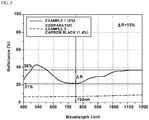
FIGS. 3 to 5 show measurement results of near infrared ray reflectance of a phthalocyanine compound according to Comparative Examples. -
FIGS. 6 to 11 show measurement results of near infrared ray reflectance of a µ-polyoxo crosslinked molybdenum phthalocyanine compound according to Application Examples of the present invention. - For convenience, specific terms will be defined in the present specification in order to allow the present invention to be easily understood. Unless otherwise defined, technical terms and scientific terms used in the present specification have the general meaning understood by those skilled in the art to which the present invention pertains. In addition, unless the context clearly indicates otherwise, it should be understood that a term in singular form includes the term in plural form, and a term in plural form includes the term in singular form.
- As used herein, the term "alkyl" means saturated aliphatic radicals including straight chain alkyl groups, branched chain alkyl groups, cycloalkyl (alicyclic) groups, alkyl-substituted cycloalkyl groups, cycloalkyl-substituted alkyl groups. The term "alkyl" may include alkyl groups further including, an oxygen, nitrogen, sulfur, or phosphorus atom, that is, alkyl groups in which at least one carbon in a hydrocarbon main chain is substituted with, for example, an oxygen, nitrogen, sulfur, or phosphorus atom. In preferable embodiments, the straight or branched chain alkyl has at most 20 carbon atoms (for example, (C1-C20) straight chain or (C3-C20) branched chain), preferably at most 15 carbon atoms, more preferably at most 10 carbon atoms, and most preferably at most 8 carbon atoms in a main chain thereof. Similarly, cycloalkyl has preferably 3 to 10 carbon atoms, more preferably, 3 to 7 carbon atoms in a ring structure thereof.
- In addition, the term "alkyl" is intended to include both of unsubstituted alkyl and substituted alkyl meaning an alkyl moiety having a substituent replacing hydrogen on at least one carbon in a hydrocarbon main chain. An example of the substituent may include halogen, hydroxyl, alkylcarbonyloxy, arylcarbonyloxy, alkoxycarbonyloxy, aryloxycarbonyloxy, carboxylate, alkylcarbonyl, alkoxycarbonyl, aminocarbonyl, alkylthiocarbonyl, alkoxyl, phosphate, phosphonato, phosphinato, cyano, amino (including alkylamino, dialkylamino, arylamino, diarylamino, and alkylarylamino), acylamino (including alkylcarbonylamino, arylcarbonylamino, carbamoyl, and ureido), amidino, imino, sulfhydryl, alkylthio, arylthio, thiocarboxylate, sulfate, sulfonato, sulfamoyl, sulfonamido, nitro, trifluoromethyl, cyano, azido, heterocyclyl, alkylaryl, or an aromatic or heteroaromatic moiety. It may be understood by those skilled in the art that a substituted moiety on the hydrocarbon chain may be spontaneously substituted in a suitable case. Cycloalkyl may be further substituted with, for example, the above-mentioned substituent. An alkylaryl moiety is an alkyl substituted with an aryl (for example, phenylmethyl(benzyl). In addition, the term "alkyl" includes unsaturated aliphatic group capable of being substituted with the above-mentioned alkyl and having a similar length and may include at least one double or triple bond, respectively.
- Unless the number of carbon atoms is described otherwise, a lower alkyl group may mean the above-defined alkyl group having 1 to 10, preferably 1 to 6, and more preferably 1 to 4 carbon atoms in a main straight or branched chain structure thereof. An example of the lower alkyl group includes methyl, ethyl, n-propyl, i-propyl, tert-butyl, hexyl, heptyl, octyl, and the like. In preferable embodiments, the term "lower alkyl" includes straight chain alkyl having 4 or less carbon atoms in a main chain thereof, for example, (C1-C4)alkyl.
- As used herein, the term "alkoxyalkyl, polyaminoalkyl, and thioalkoxyalkyl" means the above-mentioned alkyl groups further including an oxygen, nitrogen, or sulfur atom, that is, alkyl groups in which at least one carbon in a hydrocarbon main chain is substituted with, for example, an oxygen, nitrogen, or sulfur atom.
- As used herein, the term "aryl" means a radical of aryl groups including 5- and 6-membered single-ring aromatic groups capable of having 0 to 4 hetero atoms, for example, benzene, pyrrole, furan, thiophene, imidazole, benzoxazole, benzothiazole, triazole, tetrazole, pyrazole, pyridine, pyrazine, pyridazine, pyrimidine, and the like. In addition, the aryl group includes polycyclic fused aromatic groups such as naphthyl, quinolyl, indolyl, and the like. Those aryl groups having a hetero atom in the ring structure may also be referred to as "aryl heterocycles", "heteroaryls" or "heteroaromatics". The aromatic ring may be substituted at one or more ring positions with the above-mentioned substituent, for example, halogen, hydroxyl, alkoxy, alkylcarbonyloxy, arylcarbonyloxy, alkoxycarbonyloxy, aryloxycarbonyloxy, carboxylate, alkylcarbonyl, alkoxycarbonyl, aminocarbonyl, alkylthiocarbonyl, phosphate, phosphonato, phosphinato, cyano, amino (including alkylamino, dialkylamino, arylamino, diarylamino, and alkylarylamino), acylamino (including alkylcarbonylamino, arylcarbonylamino, carbamoyl, and ureido), amidino, imino, sulfhydryl, alkylthio, arylthio, thiocarboxylate, sulfate, sulfonato, sulfamoyl, sulfonamido, nitro, trifluoromethyl, cyano, azido, heterocyclyl, alkylaryl, or an aromatic or heteroaromatic moiety. Further, the aryl group may be fused or crosslinked with an alicyclic or heterocyclic ring which is not aromatic to thereby form a polycycle (for example, tetralin).
- As used herein, the term "associated with" means a condition at which a chemical, a compound or a moiety thereof and a binding pocket or binding site of protein are closely positioned. The bond may be a non-covalent or covalent bond (energetically preferred by a hydrogen bond or van der Waals or electrostatic interaction).
- As used herein, the term "haloalkyl" is intended to include the above-mentioned alkyl group mono-, di-, or poly-substituted with halogen, for example, fluoromethyl or trifluoromethyl.
- As used herein, the term "halogen" means -F, -CI, -Br, or -I.
- As used herein, the term "hydroxyl" means -OH.
- As used herein, the term "hetero atom" means an atom of an arbitrary atom except for carbon or hydrogen. Preferable hetero atoms are nitrogen, oxygen, sulfur, and phosphorus.
- As used herein, the term "selectively substituted" is intended to include unsubstituted or a group substituted with at least one suitable group except for hydrogen at one or more possible positions (may be equal to or different from each other), generally, 1, 2, 3, 4, or 5 positions.
- An example of the selective substituent includes a carbocyclic and heterocyclic group as well as hydroxyl, halogen, cyano, nitro, (C1-C8)alkyl, (C2-C8)alkenyl, (C2-C8)alkynyl, (C1-C8)alkoxy, (C2-C8)alkylether, (C3-C8)alkanone, (C1-C8)alkylthio, amino, mono- or di-((C1-C8)alkyl)amino, halo(C1-C8)alkyl, halo(C1-C8)alkoxy, (C1-C8)alkanoyl, (C2-C8)alkanoyloxy, (C1-C8)alkoxycarbonyl, -COOH, -CONH2, mono- or di-((C1-C8)alkyl)aminocarbonyl, -SO2NH2 and/or mono- or di-((C1-C8)alkyl)sulfonamide.
- In addition, selective substitution is described by a phase "substituted by 0 to X substituents", wherein X is the maximum number of possible substituent. A certain selectively substituted group is substituted with 0 to 2, 3 or 4 independently selected substituents (that is, the group is not substituted, or the number of substituents used for substitution is the above-mentioned maximum value or less).
- Here, a description of a chemical functional group list in various arbitrary definitions includes various definitions thereof as an arbitrary single functional group of a combination of the described functional groups. Here, description of various embodiments includes embodiments as a single embodiment, or another embodiment, or a combination thereof.
- According to an aspect of the present invention, there is provided a µ-polyoxo crosslinked molybdenum phthalocyanine compound including at least one non-metal phthalocyanine and having a structure represented by the following Chemical Formula I.

- Where, R is a moiety independently selected from hydrogen, halogen, hydroxyl, amino, hydroxysulfonyl, aminosulfonyl, (C1-C5)alkyl, SR17, OR18, and NHR19; R17 to R19 are each independently selected from the group consisting of (C1-C5)alkyl, (C1-C5)alkoxy and phenyl selectively substituted with a substituent independently selected from the group consisting of halogen, hydroxyl, amino, hydroxysulfonyl, aminosulfonyl, (C1-C5)alkyl and (C1-C5)alkoxy; x is a rational number of 0.001 to 1; and n is an integer of 1 to 20.
- The µ-polyoxo crosslinked molybdenum phthalocyanine compound having the structure represented by the following Chemical Formula I is a polymer compound in which at least one non-metal phthalocyanine (unsubstituted phthalocyanine) and at least one molybdenum phthalocyanine (phthalocyanine in which H covalently bonded to two nitrogen atoms existing at the center is substituted with a molybdenum metal) are crosslinked to each other via an oxo group.
- Here, non-metal phthalocyanine may be defined as unsubstituted phthalocyanine in which H covalently bonded to two nitrogen atoms existing at the center is not substituted with a metal (in Chemical Formula I, molybdenum). However, non-metal phthalocyanine defined as unsubstituted phthalocyanine does not mean that H is necessarily bonded to two nitrogen atoms existing at the center.
- In Chemical Formula I, the number of repeating unit of non-metal phthalocyanine is defined as x, and the number of repeating unit of µ-polyoxo crosslinked molybdenum phthalocyanine compound in which non-metal phthalocyanine and molybdenum phthalocyanine are oxo crosslinked to each other is defined as n.
- In an exemplary embodiment, the µ-polyoxo crosslinked molybdenum phthalocyanine compound may absorb near infrared ray at a wavelength of 800 to 950 nm and reflect near infrared ray at a wavelength of 1200 nm or more.
- In an exemplary embodiment, a difference between absorption of near infrared ray at a wavelength of 800 to 950 nm and reflectance of near infrared ray at a wavelength of 1200nm or more may be 30% or more.
- According to another aspect of the present invention, there is provided a preparing method of a µ-polyoxo crosslinked molybdenum phthalocyanine compound including oxo crosslinking at least one non-metal phthalocyanine and phthalocyanine substituted with the molybdenum metal to each other.
- According to another aspect of the present invention, there is provided a µ-polyoxo crosslinked molybdenum phthalocyanine compound including at least one different kind of metal phthalocyanine and having a structure represented by the following Chemical Formula II.


- Where, R is a moiety independently selected from hydrogen, halogen, hydroxyl, amino, hydroxysulfonyl, aminosulfonyl, (C1-C5)alkyl, SR17, OR18, and NHR19; R17 to R19 are each independently selected from the group consisting of (C1-C5)alkyl, (C1-C5)alkoxy and phenyl selectively substituted with a substituent independently selected from the group consisting of halogen, hydroxyl, amino, hydroxysulfonyl, aminosulfonyl, (C1-C5)alkyl and (C1-C5)alkoxy; M is selected from the group consisting of nickel, lithium, magnesium, silicon, an oxide thereof and a halide hereof; y is a rational number of 0.001 to 2; and n is an integer of 1 to 20.
- The µ-polyoxo crosslinked molybdenum phthalocyanine compound having the structure represented by the Chemical Formula II is a polymer compound in which at least one molybdenum phthalocyanine (phthalocyanine in which H covalently bonded to two nitrogen atoms existing at the center is substituted with a molybdenum metal) and at least one metal phthalocyanine substituted with a different kind of metal are crosslinked to each other via an oxo group.
- Here, the different kind of metal may be independently selected from nickel, lithium, magnesium and silicon, and the different kind metal in phthalocyanine may be present as a metal salt, metal oxide, or metal halide.
- In Chemical Formula II, the number of repeating unit of phthalocyanine substituted with the metal is defined as y, and the number of repeating unit of µ-polyoxo crosslinked molybdenum phthalocyanine compound in which different kind -metal phthalocyanine and molybdenum phthalocyanine are oxo crosslinked to each other is defined as n.
- In an exemplary embodiment, the µ-polyoxo crosslinked molybdenum phthalocyanine compound may absorb near infrared at a wavelength of 800 to 950 nm and reflect near infrared ray at a wavelength of 1200 nm or more.
- In an exemplary embodiment, a difference between absorption of near infrared ray at a wavelength of 800 to 950 nm and reflectance of near infrared ray at a wavelength of 1200 nm or more may be 30% or more.
- According to another aspect of the present invention, there is provided a preparing method including oxo crosslinking at least one different kind of metal phthalocyanine and phthalocyanine substituted with the molybdenum metal to each other, wherein the different kind of metal is nickel, lithium, magnesium or silicon. According to another aspect of the present invention, there is provided a near infrared ray absorbing and reflecting composition containing: the µ-polyoxo crosslinked molybdenum phthalocyanine compound; and at least one binder selected from an acrylic polymer, an alkyd resin, polyamide, polyurethane, polyester, polyethylene terephthalate, polycarbonate, and polypropylene.
- According to another aspect of the present invention, there is provided an optical recording medium including a printing layer containing the compound or the composition, absorbing near infrared ray at a wavelength of 800 to 950 nm, and reflecting near infrared ray at a wavelength of 1200 nm or more; and a reflecting layer on the recording layer. The compound or composition, which is a composition in an ink form, may be used as a data carrier such as a check card, a credit card, or the like, and used to mark various optical recording media having a security function such as deeds, for example, an identification card, bank bills, a certificate, or the like.
- Hereinafter, the present invention will be described in detail through the Examples. However, this example is only to illustrate the present invention and is not to be construed as limiting a scope of the present invention.
- Properties of a µ-polyoxo crosslinked molybdenum phthalocyanine compound in which non-metal or different kind of metal phthalocyanine is included were tested, wherein the compound (Chemical Formula I or II) was prepared using phthalic anhydride having a structure represented by the following Chemical Formula III.

- Where, A1 to A4 may be each selectively substituted with a substituent independently selected from hydrogen, halogen, hydroxyl, amino, hydroxysulfonyl, aminosulfonyl, (C1-C5)alkyl, SR17, OR18, and NHR19 according to the desired µ-polyoxo crosslinked molybdenum phthalocyanine compound, and R17 to R19 may be each independently (C1-C5)alkyl, (C1-C5)alkoxy, or phenyl selectively substituted with a substituent independently selected from halogen, hydroxyl, amino, sulfonyl, hydroxysulfonyl, aminosulfonyl, (C1-C5)alkyl, and (C1-C5)alkoxy. For example, in Examples 1 to 4, phthalic anhydride corresponding to the case in which A1 to A4 are hydrogen was used.
- Since, in the case of mixing phthalic anhydride with water, reactivity of phthalic anhydride is significantly decreased as the phthalic anhydride is hydrolyzed, phthalic anhydride was used under anhydrous conditions, and as urea, a generally used product was used. In addition, the reaction was carried out using an n-alkylbenzene having a low polarity and high boiling point as a reaction solvent or without using a solvent.
- Near infrared ray absorption and reflectance of the obtained compound were measured. In this case, absorption/reflectance was measured 5 times using UV-3101 spectrophotometer (Shimadzu) and D2 lamp (190-360 nm) and tungsten lamp (360-3200 nm) as light sources in a measuring range of 400 to 1200 nm at an integrating sphere slit width of 20 nm under sensor type conditions, and an accumulated average value of the measured values was calculated.
- A µ-polyoxo crosslinked molybdenum phthalocyanine compound (Chemical Formula I) including non-metal phthalocyanine according to the present invention was prepared. To this end, 51.8g of phthalic anhydride (0.35mol), 105.1g of urea (1.75mol), 21.15g of lithium chloride (0.5mol), and 0.52g of ammonium molybdate (0.0004mol) were put into a 1L three-neck round bottom flask, and stirred in alkyl benzene or without a solvent, and heated, followed by reaction at 175 to 200°C for 3 hours. Thereafter, the reactant was cooled by putting 2L of water thereinto, filtered, and treated with 1L of 0.35 to 0.5wt% hydrochloric acid solution and 2L of 2.5 to 3.0wt% sodium hydroxide solution, followed by washing. The precipitated metal complex was separated and dried. Results of element analysis of the obtained metal complex were shown in the following Table 1, and near infrared ray absorption and reflectance thereof were shown in
FIG. 1 . - Among numerical values indicating degrees of absorption or reflection, respectively, reflectance was 33% at 880 nm in near infrared region and 69% at 1200 nm, and a difference in reflectance (ΔR %) was 36%.
[Table 1] C H N O Mo Li Calculated value 66.6 2.9 19.4 2.8 8.3 0 Measured value 66.4 2.8 20.1 2.5 7.1 0.00259 - A µ-polyoxo crosslinked molybdenum phthalocyanine compound (Chemical Formula II) including a magnesium metal phthalocyanine compound according to the present invention was prepared. To this end, 51.8g of phthalic anhydride (0.35mol), 168.17 g of urea (2.8mol), 71.16 g of magnesium chloride (0.35mol), and 0.52g of ammonium molybdate (0.000525mol) were put into a 1L three-neck round bottom flask, and stirred in alkyl benzene or without a solvent, and heated, followed by reaction at 175 to 200°C for 3 to 6 hours. Thereafter, the reactant was cooled by putting 2L of water thereinto, filtered, and treated with 1L of 0.35 to 0.5wt% hydrochloric acid solution and 2L of 2.5 to 3.0wt% sodium hydroxide solution, followed by washing. The precipitated metal complex was separated and dried. Results of element analysis of the obtained metal complex were shown in the following Table 2, and near infrared ray absorption and reflectance thereof were shown in
FIG. 2 . - Among numerical values indicating degrees of absorption or reflection, respectively, reflectance was 16% at 840 nm in near infrared region and 64% at 1200 nm, and a difference in reflectance (ΔR %) was 48%.
[Table 2] C H N O Mo Mg Calculated value 66.0 2.8 19.3 3.7 5.5 2.8 Measured value 63.5 3.3 18.6 4.4 4.8 2.7 - After preparation, at the time of treating the reactant with acid and base in order to obtain µ-polyoxo crosslinked molybdenum-magnesium phthalocyanine compound, which is a hetero-metal phthalocyanine compound, contents of molybdenum and magnesium were slightly decreased.
- A µ-polyoxo crosslinked molybdenum phthalocyanine compound including a silicon metal phthalocyanine compound according to the present invention was prepared. To this end, the compound was prepared by the same method as in Example 2 except for using silicon chloride instead of magnesium chloride.
- Among numerical values indicating degrees of absorption or reflection, respectively, reflectance of the compound was 18% at 840 nm in near infrared region and 65% at 1200 nm, and a difference in reflectance (ΔR %) was 47%.
- A µ-polyoxo crosslinked molybdenum phthalocyanine compound including an aluminum metal phthalocyanine compound according to the present invention was prepared. To this end, the compound was prepared by the same method as in Example 2 except for using aluminum chloride instead of magnesium chloride.
- Among numerical values indicating degrees of absorption or reflection, respectively, reflectance of the compound was 16% at 840 nm in near infrared region and 62% at 1200 nm, and a difference in reflectance (ΔR %) was 46%.
- A µ-polyoxo crosslinked molybdenum phthalocyanine compound including a silicon metal phthalocyanine compound according to the present invention was prepared. To this end, the compound was prepared by the same method as in Examples 2 and 3 except for using phthalic anhydride corresponding to the case in which A1 was ethyl and A2 to A4 were hydrogen in Chemical Formula III.
- Among numerical values indicating degrees of absorption or reflection, respectively, reflectance of the compound was 20% at 840 nm in near infrared region and 62% at 1200 nm, and a difference in reflectance (ΔR %) was 42%.
- A µ-polyoxo crosslinked molybdenum phthalocyanine compound including an aluminum metal phthalocyanine compound according to the present invention was prepared. To this end, the compound was prepared by the same method as in Examples 2 to 4 except for using phthalic anhydride corresponding to the case in which A1 was propyl and A2 to A4 were hydrogen in Chemical Formula III.
- Among numerical values indicating degrees of absorption or reflection, respectively, reflectance of the compound was 23% at 840 nm in near infrared region and 59% at 1200 nm, and a difference in reflectance (ΔR %) was 36%.
- Intensities of absorption and reflection of near infrared light in a wavelength region of 400 to 1200 nm were measured and compared with respect to the compound separated and dried in Example 1 and a lithium phthalocyanine compound (Aldrich) having a structure represented by the following Chemical Formula IV, and the result was shown in
FIG. 3 .
- In the case of the lithium phthalocyanine compound having a structure represented by the following Chemical Formula IV, a point of inflection at which the reflectance increases was observed in the vicinity of 620 nm, and absorption was hardly shown at 800 nm or more in near infrared region but reflectance was shown at a level of 70%.
- Intensities of absorption and reflection of near infrared light in a wavelength region of 400 to 1200 nm were measured and compared with respect to the compound separated and dried in Example 1 and a molybdenum phthalocyanine compound having a structure represented by the following Chemical Formula V, and the result was shown in
FIG. 4 .
- In the case of the molybdenum phthalocyanine compound having a structure represented by the following Chemical Formula V, a deformed smooth spectrum was shown from in the vicinity of 750 nm, and absorption was shown even at 800 to 1200 nm or more in near infrared region but a difference in reflectance (ΔR %) was less than 20%.
- Intensities of absorption and reflection of near infrared light in a wavelength region of 400 to 1200 nm were measured and compared with respect to the compound separated and dried in Example 1 and carbon black (Cabot), and the result was shown in
FIG. 5 . - Carbon black had high absorption, which is an inherent property of carbon black, in a visible region at 400 nm or more and near infrared region at 800 to 1200 nm, but a difference in reflectance (ΔR %) was less than 20%.
- Intensities of absorption and reflection of near infrared light in a wavelength region of 400 to 1200 nm were measured and compared with respect to the compound separated and dried in Example 1, a general yellow pigment, and a yellow pigment to which the compound was applied, and the result was shown in
FIG. 6 . - Among numerical values indicating degrees of absorption or reflection of the yellow pigment to which the compound in Example 1 was applied, reflectance of the yellow pigment was 36% at 880nm in near infrared region and 78% at 1200 nm, and a difference in reflectance (ΔR %) was 42%.
- Intensities of absorption and reflection of near infrared light in a wavelength region of 400 to 1200 nm were measured and compared with respect to the compound separated and dried in Example 1, a general red pigment, and a red pigment to which the compound was applied, and the result was shown in
FIG. 7 . - Among numerical values indicating degrees of absorption or reflection of the red pigment to which the compound in Example 1 was applied, reflectance of the red pigment was 30% at 880 nm in near infrared region and 78% at 1200 nm, and a difference in reflectance (ΔR %) was 48%.
- Intensities of absorption and reflection of near infrared light in a wavelength region of 400 to 1200 nm were measured and compared with respect to the compound separated and dried in Example 1, a general blue pigment, and a blue pigment to which the compound was applied, and the result was shown in
FIG. 8 . - Among numerical values indicating degrees of absorption or reflection of the blue pigment to which the compound in Example 1 was applied, reflectance of the blue pigment was 27% at 880 nm in near infrared region and 76% at 1200 nm, and a difference in reflectance (ΔR %) was 49%.
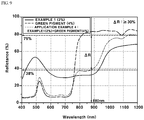
- Intensities of absorption and reflection of near infrared light in a wavelength region of 400 to 1200 nm were measured and compared with respect to the compound separated and dried in Example 1, a general green pigment, and a green pigment to which the compound was applied, and the result was shown in
FIG. 9 . - Among numerical values indicating degrees of absorption or reflection of the green dye to which the compound in Example 1 was applied, reflectance of the green dye was 38% at 880 nm in near infrared region and 79% at 1200 nm, and a difference in reflectance (ΔR %) was 41 %.
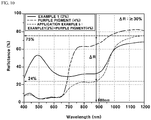
- Intensities of absorption and reflection of near infrared light in a wavelength region of 400 to 1200 nm were measured and compared with respect to the compound separated and dried in Example 1, a general purple pigment, and a purple pigment to which the compound was applied, and the result was shown in
FIG. 10 . - Among numerical values indicating degrees of absorption or reflection of the purple pigment to which the compound in Example 1 was applied, reflectance of the purple pigment was 24% at 880 nm in near infrared region and 75% at 1200 nm, and a difference in reflectance (ΔR %) was 51 %.
- Intensities of absorption and reflection of near infrared light in a wavelength region of 400 to 1200 nm were measured and compared with respect to carbon black (absorption pigment), a black pigment formed of three primary colors (black pigment formed by mixing red, yellow, and blue pigments, which are reflecting pigments), a black pigment composed of three primary colors and including the compound (2%) separated and dried in Example 1, and the result was shown in
FIG. 11 . - Based on the reflectance among numerical values indicating degrees of absorption or reflection, respectively, reflectance was low at 880 nm in near infrared region and high at 1200nm, and a difference in reflectance (ΔR %) was shown in the following Table 3.
- In addition, an absorption property at 880 nm and a reflection property at 1200 nm or more may be confirmed by the naked eye using a near infrared light source (near infrared LED at 800 to 1200 nm) and a charge-coupled device (CCD) camera apparatus component.
[Table 3] Carbon black (1.4%) Black formed of three primary colors (4%) Example 1 (2%) + Black formed of three primary colors (4%) Reflectance at 880nm (R %) 7 74 27 Reflectance at 1200nm (R %) 8.5 74 66 Difference in reflectance (ΔR%) 1.5 0 39 - According to the results of Application Examples 1-3 and 5, in the cases of the blue and green pigments among the general color pigments, a change in absorption of near infrared light in a wavelength region of 700 to 800 nm was confirmed. This indicates that since in most of the common near infrared ray absorbers, a change in absorption of near infrared light was shown in a wavelength region of 700 to 800 nm, absorption spectra thereof were overlapped with those of the blue and green color pigments, such that it is impossible to use the common near infrared ray absorbers together with the blue and green pigments.
- The µ-polyoxo crosslinked molybdenum phthalocyanine compound according to the present invention has high absorption in a wavelength region of 800 to 950nm and high reflectance in a wavelength region of 1200 nm or more, and in the case of mixing the µ-polyoxo crosslinked molybdenum phthalocyanine compound with a color pigment, various colors which it is difficult to use together with the near infrared ray absorber according to the related art such as a blue color, a green color, and the like, may be implemented.
- According to the exemplary embodiment of the present invention, there is provided a µ-polyoxo crosslinked molybdenum phthalocyanine compound capable of absorbing and reflecting near infrared ray at the same time. Since the compound has high thermal stability, the compound may stably exhibit optimal performance at a high processing temperature. In addition, the compound has improved light fastness and a wide near infrared ray absorbing and reflecting wavelength region as compared to commercialized products according to the related art, such that the compound may be applied in various fields.
Claims (12)
- A µ-polyoxo crosslinked molybdenum phthalocyanine compound comprising:at least one non-metal phthalocyanine,wherein it has a structure represented by following Chemical Formula I;
 R is a moiety independently selected from the group consisting of hydrogen, halogen, hydroxyl, amino, hydroxysulfonyl, aminosulfonyl, (C1-C5)alkyl, SR17, OR18 and NHR19;R17 to R19 are each independently selected from the group consisting of (C1-C5)alkyl, (C1-C5)alkoxy and phenyl selectively substituted with a substituent independently selected from the group consisting of halogen, hydroxyl, amino, hydroxysulfonyl, aminosulfonyl, (C1-C5)alkyl and (C1-C5)alkoxy;x is a rational number of 0.001 to 1; andn is an integer of 1 to 20.
 - The µ-polyoxo crosslinked molybdenum phthalocyanine compound of claim 1, wherein it absorbs near infrared ray at a wavelength of 800 to 950 nm and reflects near infrared ray at a wavelength of 1200 nm or more.
- The µ-polyoxo crosslinked molybdenum phthalocyanine compound of claim 1, wherein a difference between absorption of near infrared ray at a wavelength of 800 to 950 nm and reflectance of near infrared ray at a wavelength of 1200 nm or more is 30% or more.
- A preparing method of the µ-polyoxo crosslinked molybdenum phthalocyanine compound of claim 1, the preparing method comprising: oxo crosslinking at least one non-metal phthalocyanine and phthalocyanine substituted with a molybdenum metal to each other.
- A µ-polyoxo crosslinked molybdenum phthalocyanine compound comprising:one different kind of metal phthalocyanine, wherein the different kind of metal is selected from the group consisting of nickel, lithium, magnesium andsilicon,wherein it has a structure represented by following Chemical Formula II;
 R is a moiety independently selected from the group consisting of hydrogen, halogen, hydroxyl, amino, hydroxysulfonyl, aminosulfonyl, (C1-C5)alkyl, SR17, OR18 and NHR19;R17 to R19 are each independently selected from the group consisting of (C1-C5)alkyl, (C1-C5)alkoxy and phenyl selectively substituted with a substituent independently selected from the group consisting of halogen, hydroxyl, amino, hydroxysulfonyl, aminosulfonyl, (C1-C5)alkyl and (C1-C5)alkoxy;M is selected from the group consisting of nickel, lithium, magnesium, silicon, an oxide thereof and a halide thereof;y is a rational number of 0.001 to 2; andn is an integer of 1 to 20.
 - The µ-polyoxo crosslinked molybdenum phthalocyanine compound of claim 5, wherein it absorbs near infrared ray at a wavelength of 800 to 950 nm and reflects near infrared ray at a wavelength of 1200 nm or more.
- The µ-polyoxo crosslinked molybdenum phthalocyanine compound of claim 5, wherein a difference between absorption of near infrared ray at a wavelength of 800 to 950 nm and reflectance of near infrared ray at a wavelength of 1200 nm or more is 30% or more.
- A preparing method of the µ-polyoxo crosslinked molybdenum phthalocyanine compound of claim 5, the preparing method comprising:oxo crosslinking at least one different kind of metal phthalocyanine and phthalocyanine substituted with a molybdenum metal to each other,wherein the different kind of metal is selected from the group consisting of nickel, lithium, magnesium and siliconwherein the phthalocyanine is prepared using phthalic anhydride and urea.
- A near infrared ray absorbing and reflecting composition comprising:the µ-polyoxo crosslinked molybdenum phthalocyanine compound of claim 1; andat least one binder selected from the group consisting of an acrylic polymer, an alkyd resin, polyamide, polyurethane, polyester, polyethylene terephthalate, polycarbonate and polypropylene.
- A near infrared ray absorbing and reflecting composition comprising:the µ-polyoxo crosslinked molybdenum phthalocyanine compound of claim 5; andat least one binder selected from the group consisting of an acrylic polymer, an alkyd resin, polyamide, polyurethane, polyester, polyethylene terephthalate, polycarbonate and polypropylene.
- An optical equipment comprising:a printing layer containing the compound of claim 1 or the composition of claim 9, absorbing near infrared ray at a wavelength of 800 to 950 nm, and reflecting near infrared ray at a wavelength of 1200 nm or more; anda reflecting layer on the printing layer.
- An optical equipment comprising:a printing layer containing the compound of claim 5 or the composition of claim 10, absorbing near infrared ray at a wavelength of 800 to 950 nm, and reflecting near infrared ray at a wavelength of 1200 nm or more; anda reflecting layer on the printing layer.
Applications Claiming Priority (1)
| Application Number | Priority Date | Filing Date | Title |
|---|---|---|---|
| KR1020130165804A KR101577693B1 (en) | 2013-12-27 | 2013-12-27 | -Poly oxo crosslinked phthalocyanine compound method for production thereof and near infrared absorbing and reflecting composition using the same |
Publications (2)
| Publication Number | Publication Date |
|---|---|
| EP2889337A1 EP2889337A1 (en) | 2015-07-01 |
| EP2889337B1 true EP2889337B1 (en) | 2017-05-03 |
Family
ID=50000829
Family Applications (1)
| Application Number | Title | Priority Date | Filing Date |
|---|---|---|---|
| EP14152615.2A Active EP2889337B1 (en) | 2013-12-27 | 2014-01-27 | µ-Polyoxo crosslinked phthalocyanine compound, preparing method thereof, and near infrared ray absorbing and reflecting composition using the same |
Country Status (4)
| Country | Link |
|---|---|
| US (1) | US9382384B2 (en) |
| EP (1) | EP2889337B1 (en) |
| KR (1) | KR101577693B1 (en) |
| ES (1) | ES2635246T3 (en) |
Families Citing this family (2)
| Publication number | Priority date | Publication date | Assignee | Title |
|---|---|---|---|---|
| KR102044595B1 (en) * | 2016-04-18 | 2019-11-13 | 주식회사 엘지화학 | Reflector, back light unit and liquid crystal display comprising the same |
| KR101843875B1 (en) * | 2016-06-16 | 2018-03-30 | 나노씨엠에스(주) | Oxo crosslinked phthalocyanine compound with hydroxyl group, method for production thereof and ink composition using the same |
Citations (1)
| Publication number | Priority date | Publication date | Assignee | Title |
|---|---|---|---|---|
| EP1435545A1 (en) * | 2003-01-06 | 2004-07-07 | Orient Chemical Industries, Ltd. | Organic electrophotographic photo-receptor |
Family Cites Families (19)
| Publication number | Priority date | Publication date | Assignee | Title |
|---|---|---|---|---|
| GB8431924D0 (en) | 1984-12-18 | 1985-01-30 | Ici Plc | Optical recording medium |
| JPS61197280A (en) | 1985-02-27 | 1986-09-01 | Tdk Corp | Optical recording medium |
| JPS61246091A (en) | 1985-04-24 | 1986-11-01 | Tdk Corp | Optical recording medium |
| JPH0749231B2 (en) | 1985-08-13 | 1995-05-31 | 三菱化学株式会社 | Optical recording body |
| JPS6339388A (en) | 1986-08-05 | 1988-02-19 | Kao Corp | Optical information recording medium |
| JP2679060B2 (en) | 1987-10-08 | 1997-11-19 | 大日本インキ化学工業株式会社 | Interior materials |
| JPH0246091A (en) | 1988-08-08 | 1990-02-15 | Matsushita Electric Ind Co Ltd | Extension incoming call regulating device |
| EP0373643B1 (en) | 1988-12-15 | 1998-01-21 | MITSUI TOATSU CHEMICALS, Inc. | Near infrared absorbers and display/recording materials prepared by using same |
| EP0433220B1 (en) | 1989-11-22 | 1995-01-25 | Ciba-Geigy Ag | Substituted naphthalocyanine and its use |
| JPH062878A (en) | 1992-06-18 | 1994-01-11 | Daikin Ind Ltd | Air conditioner embedded in ceiling |
| US5456998A (en) * | 1994-04-26 | 1995-10-10 | Xerox Corporation | Photoconductive imaging members containing alkoxy-bridged metallophthalocyanine dimers |
| US5493016A (en) * | 1994-04-26 | 1996-02-20 | Xerox Corporation | Processes for the preparation of alkoxy-bridged metallophthalocyanine dimers |
| US5466796A (en) * | 1994-04-26 | 1995-11-14 | Xerox Corporation | Alkoxy-bridged metallophthalocyanine dimers |
| DE59508223D1 (en) | 1994-09-23 | 2000-05-31 | Ciba Sc Holding Ag | Phthalocyanines substituted with groups containing phosphorus |
| DE59507878D1 (en) | 1994-09-23 | 2000-04-06 | Ciba Sc Holding Ag | Mixtures of isomers of alkoxy-substituted phthalocyanines and process for their preparation |
| DE60319081T2 (en) * | 2002-06-10 | 2009-02-05 | Orient Chemical Industries, Ltd. | μ-OXO-NETWORKED PHTHALOCYANINE COMPOUND WITH UNBELIEVABLE METALS AND A METHOD FOR THE SELECTIVE PRODUCTION THEREOF |
| EP1375600B1 (en) | 2002-06-12 | 2006-04-05 | Nippon Shokubai Co., Ltd. | Phthalocyanine compound, near infrared absorbing dye and heat ray shielding |
| KR200396052Y1 (en) | 2005-06-09 | 2005-09-16 | 이인자 | Desk |
| JP2008216589A (en) | 2007-03-02 | 2008-09-18 | Orient Chem Ind Ltd | Optical film containing .mu.-oxo bridge-boron subphthalocyanine dimer |
-
2013
- 2013-12-27 KR KR1020130165804A patent/KR101577693B1/en active Active
-
2014
- 2014-01-27 EP EP14152615.2A patent/EP2889337B1/en active Active
- 2014-01-27 ES ES14152615.2T patent/ES2635246T3/en active Active
- 2014-01-28 US US14/166,114 patent/US9382384B2/en active Active
Patent Citations (1)
| Publication number | Priority date | Publication date | Assignee | Title |
|---|---|---|---|---|
| EP1435545A1 (en) * | 2003-01-06 | 2004-07-07 | Orient Chemical Industries, Ltd. | Organic electrophotographic photo-receptor |
Also Published As
| Publication number | Publication date |
|---|---|
| KR20150077010A (en) | 2015-07-07 |
| US9382384B2 (en) | 2016-07-05 |
| ES2635246T3 (en) | 2017-10-03 |
| KR101577693B1 (en) | 2015-12-15 |
| US20150183938A1 (en) | 2015-07-02 |
| EP2889337A1 (en) | 2015-07-01 |
Similar Documents
| Publication | Publication Date | Title |
|---|---|---|
| JP2010111750A (en) | Light-absorbing composition | |
| JP5419778B2 (en) | SQUARYLIUM COMPOUND, PROCESS FOR PRODUCING THE SAME, AND INfrared Absorber | |
| KR20110008062A (en) | Infrared absorptive compound and fine particles containing the compound | |
| KR101086509B1 (en) | Color filters, inkjet inks, electrophotographic toners and developers, and purple colorants for electronic inks | |
| WO2013050431A1 (en) | A salt for color filter application, a process for making the same, and a colorant comprising the same | |
| KR20210042029A (en) | Novel squarylium compounds, and compositions comprising same | |
| US9382384B2 (en) | μ-polyoxo crosslinked phthalocyanine compound, preparing method thereof, and near infrared ray absorbing and reflecting composition using the same | |
| JP2010533745A (en) | Particulate epsilon-copper phthalocyanine-pigment formulation | |
| JP2004010838A (en) | Pigment dispersion, color resist ink and color filter | |
| EP3447092B1 (en) | Black azo pigment and colorant | |
| CN109652064A (en) | A kind of special fluorescence falsification preventing material and its preparation method and application | |
| CN103270119A (en) | Surface-modified pigment preparations | |
| KR102027449B1 (en) | Phthalocyanine compound with high thermal stability and high chemical resistance, method for production thereof and ink composition and printing article using the same | |
| JP2010018688A (en) | Light absorbing composition | |
| TWI682004B (en) | Color material dispersion liquid, color resin composition, color material, color filter and production method thereof, liquid crystal display device, and light-emitting display device | |
| ES2531960T3 (en) | Luminescent pigments and their use in safety applications | |
| JP4084022B2 (en) | Near-infrared transmitting black azo pigment and pigment composition | |
| CA2495484A1 (en) | Liquid crystal display and colour filter with improved transparency for green light | |
| ES2266894T3 (en) | BETA-ISOINDIGO COLORS. | |
| KR20080012200A (en) | Light Absorption Dye and Light Absorber | |
| KR100649610B1 (en) | Infrared Absorption Ink Composition and Manufacturing Method Thereof | |
| US9458376B2 (en) | Electrochromic iptycenes | |
| JPH0569838B2 (en) | ||
| TW201900774A (en) | Dye compound | |
| JP2009209344A (en) | Coloring composition and inkjet recording ink |
Legal Events
| Date | Code | Title | Description |
|---|---|---|---|
| PUAI | Public reference made under article 153(3) epc to a published international application that has entered the european phase |
Free format text: ORIGINAL CODE: 0009012 |
|
| 17P | Request for examination filed |
Effective date: 20140127 |
|
| AK | Designated contracting states |
Kind code of ref document: A1 Designated state(s): AL AT BE BG CH CY CZ DE DK EE ES FI FR GB GR HR HU IE IS IT LI LT LU LV MC MK MT NL NO PL PT RO RS SE SI SK SM TR |
|
| AX | Request for extension of the european patent |
Extension state: BA ME |
|
| GRAJ | Information related to disapproval of communication of intention to grant by the applicant or resumption of examination proceedings by the epo deleted |
Free format text: ORIGINAL CODE: EPIDOSDIGR1 |
|
| GRAP | Despatch of communication of intention to grant a patent |
Free format text: ORIGINAL CODE: EPIDOSNIGR1 |
|
| GRAP | Despatch of communication of intention to grant a patent |
Free format text: ORIGINAL CODE: EPIDOSNIGR1 |
|
| INTG | Intention to grant announced |
Effective date: 20161124 |
|
| GRAS | Grant fee paid |
Free format text: ORIGINAL CODE: EPIDOSNIGR3 |
|
| GRAA | (expected) grant |
Free format text: ORIGINAL CODE: 0009210 |
|
| AK | Designated contracting states |
Kind code of ref document: B1 Designated state(s): AL AT BE BG CH CY CZ DE DK EE ES FI FR GB GR HR HU IE IS IT LI LT LU LV MC MK MT NL NO PL PT RO RS SE SI SK SM TR |
|
| AX | Request for extension of the european patent |
Extension state: BA ME |
|
| REG | Reference to a national code |
Ref country code: GB Ref legal event code: FG4D |
|
| REG | Reference to a national code |
Ref country code: AT Ref legal event code: REF Ref document number: 889948 Country of ref document: AT Kind code of ref document: T Effective date: 20170515 Ref country code: CH Ref legal event code: EP |
|
| REG | Reference to a national code |
Ref country code: IE Ref legal event code: FG4D |
|
| REG | Reference to a national code |
Ref country code: DE Ref legal event code: R096 Ref document number: 602014009164 Country of ref document: DE |
|
| REG | Reference to a national code |
Ref country code: NL Ref legal event code: MP Effective date: 20170503 |
|
| REG | Reference to a national code |
Ref country code: AT Ref legal event code: MK05 Ref document number: 889948 Country of ref document: AT Kind code of ref document: T Effective date: 20170503 |
|
| REG | Reference to a national code |
Ref country code: LT Ref legal event code: MG4D |
|
| REG | Reference to a national code |
Ref country code: ES Ref legal event code: FG2A Ref document number: 2635246 Country of ref document: ES Kind code of ref document: T3 Effective date: 20171003 |
|
| PG25 | Lapsed in a contracting state [announced via postgrant information from national office to epo] |
Ref country code: FI Free format text: LAPSE BECAUSE OF FAILURE TO SUBMIT A TRANSLATION OF THE DESCRIPTION OR TO PAY THE FEE WITHIN THE PRESCRIBED TIME-LIMIT Effective date: 20170503 Ref country code: HR Free format text: LAPSE BECAUSE OF FAILURE TO SUBMIT A TRANSLATION OF THE DESCRIPTION OR TO PAY THE FEE WITHIN THE PRESCRIBED TIME-LIMIT Effective date: 20170503 Ref country code: AT Free format text: LAPSE BECAUSE OF FAILURE TO SUBMIT A TRANSLATION OF THE DESCRIPTION OR TO PAY THE FEE WITHIN THE PRESCRIBED TIME-LIMIT Effective date: 20170503 Ref country code: LT Free format text: LAPSE BECAUSE OF FAILURE TO SUBMIT A TRANSLATION OF THE DESCRIPTION OR TO PAY THE FEE WITHIN THE PRESCRIBED TIME-LIMIT Effective date: 20170503 Ref country code: NO Free format text: LAPSE BECAUSE OF FAILURE TO SUBMIT A TRANSLATION OF THE DESCRIPTION OR TO PAY THE FEE WITHIN THE PRESCRIBED TIME-LIMIT Effective date: 20170803 |
|
| PG25 | Lapsed in a contracting state [announced via postgrant information from national office to epo] |
Ref country code: PL Free format text: LAPSE BECAUSE OF FAILURE TO SUBMIT A TRANSLATION OF THE DESCRIPTION OR TO PAY THE FEE WITHIN THE PRESCRIBED TIME-LIMIT Effective date: 20170503 Ref country code: IS Free format text: LAPSE BECAUSE OF FAILURE TO SUBMIT A TRANSLATION OF THE DESCRIPTION OR TO PAY THE FEE WITHIN THE PRESCRIBED TIME-LIMIT Effective date: 20170903 Ref country code: NL Free format text: LAPSE BECAUSE OF FAILURE TO SUBMIT A TRANSLATION OF THE DESCRIPTION OR TO PAY THE FEE WITHIN THE PRESCRIBED TIME-LIMIT Effective date: 20170503 Ref country code: SE Free format text: LAPSE BECAUSE OF FAILURE TO SUBMIT A TRANSLATION OF THE DESCRIPTION OR TO PAY THE FEE WITHIN THE PRESCRIBED TIME-LIMIT Effective date: 20170503 Ref country code: BG Free format text: LAPSE BECAUSE OF FAILURE TO SUBMIT A TRANSLATION OF THE DESCRIPTION OR TO PAY THE FEE WITHIN THE PRESCRIBED TIME-LIMIT Effective date: 20170803 Ref country code: LV Free format text: LAPSE BECAUSE OF FAILURE TO SUBMIT A TRANSLATION OF THE DESCRIPTION OR TO PAY THE FEE WITHIN THE PRESCRIBED TIME-LIMIT Effective date: 20170503 Ref country code: RS Free format text: LAPSE BECAUSE OF FAILURE TO SUBMIT A TRANSLATION OF THE DESCRIPTION OR TO PAY THE FEE WITHIN THE PRESCRIBED TIME-LIMIT Effective date: 20170503 |
|
| REG | Reference to a national code |
Ref country code: FR Ref legal event code: PLFP Year of fee payment: 5 |
|
| PG25 | Lapsed in a contracting state [announced via postgrant information from national office to epo] |
Ref country code: DK Free format text: LAPSE BECAUSE OF FAILURE TO SUBMIT A TRANSLATION OF THE DESCRIPTION OR TO PAY THE FEE WITHIN THE PRESCRIBED TIME-LIMIT Effective date: 20170503 Ref country code: SK Free format text: LAPSE BECAUSE OF FAILURE TO SUBMIT A TRANSLATION OF THE DESCRIPTION OR TO PAY THE FEE WITHIN THE PRESCRIBED TIME-LIMIT Effective date: 20170503 Ref country code: RO Free format text: LAPSE BECAUSE OF FAILURE TO SUBMIT A TRANSLATION OF THE DESCRIPTION OR TO PAY THE FEE WITHIN THE PRESCRIBED TIME-LIMIT Effective date: 20170503 Ref country code: EE Free format text: LAPSE BECAUSE OF FAILURE TO SUBMIT A TRANSLATION OF THE DESCRIPTION OR TO PAY THE FEE WITHIN THE PRESCRIBED TIME-LIMIT Effective date: 20170503 Ref country code: CZ Free format text: LAPSE BECAUSE OF FAILURE TO SUBMIT A TRANSLATION OF THE DESCRIPTION OR TO PAY THE FEE WITHIN THE PRESCRIBED TIME-LIMIT Effective date: 20170503 |
|
| REG | Reference to a national code |
Ref country code: DE Ref legal event code: R097 Ref document number: 602014009164 Country of ref document: DE |
|
| PG25 | Lapsed in a contracting state [announced via postgrant information from national office to epo] |
Ref country code: SM Free format text: LAPSE BECAUSE OF FAILURE TO SUBMIT A TRANSLATION OF THE DESCRIPTION OR TO PAY THE FEE WITHIN THE PRESCRIBED TIME-LIMIT Effective date: 20170503 |
|
| PLBE | No opposition filed within time limit |
Free format text: ORIGINAL CODE: 0009261 |
|
| STAA | Information on the status of an ep patent application or granted ep patent |
Free format text: STATUS: NO OPPOSITION FILED WITHIN TIME LIMIT |
|
| 26N | No opposition filed |
Effective date: 20180206 |
|
| PG25 | Lapsed in a contracting state [announced via postgrant information from national office to epo] |
Ref country code: SI Free format text: LAPSE BECAUSE OF FAILURE TO SUBMIT A TRANSLATION OF THE DESCRIPTION OR TO PAY THE FEE WITHIN THE PRESCRIBED TIME-LIMIT Effective date: 20170503 |
|
| REG | Reference to a national code |
Ref country code: CH Ref legal event code: PL |
|
| GBPC | Gb: european patent ceased through non-payment of renewal fee |
Effective date: 20180127 |
|
| PG25 | Lapsed in a contracting state [announced via postgrant information from national office to epo] |
Ref country code: LU Free format text: LAPSE BECAUSE OF NON-PAYMENT OF DUE FEES Effective date: 20180127 |
|
| REG | Reference to a national code |
Ref country code: IE Ref legal event code: MM4A |
|
| REG | Reference to a national code |
Ref country code: BE Ref legal event code: MM Effective date: 20180131 |
|
| PG25 | Lapsed in a contracting state [announced via postgrant information from national office to epo] |
Ref country code: CH Free format text: LAPSE BECAUSE OF NON-PAYMENT OF DUE FEES Effective date: 20180131 Ref country code: LI Free format text: LAPSE BECAUSE OF NON-PAYMENT OF DUE FEES Effective date: 20180131 Ref country code: GB Free format text: LAPSE BECAUSE OF NON-PAYMENT OF DUE FEES Effective date: 20180127 Ref country code: BE Free format text: LAPSE BECAUSE OF NON-PAYMENT OF DUE FEES Effective date: 20180131 |
|
| PG25 | Lapsed in a contracting state [announced via postgrant information from national office to epo] |
Ref country code: IE Free format text: LAPSE BECAUSE OF NON-PAYMENT OF DUE FEES Effective date: 20180127 |
|
| PG25 | Lapsed in a contracting state [announced via postgrant information from national office to epo] |
Ref country code: MC Free format text: LAPSE BECAUSE OF FAILURE TO SUBMIT A TRANSLATION OF THE DESCRIPTION OR TO PAY THE FEE WITHIN THE PRESCRIBED TIME-LIMIT Effective date: 20170503 |
|
| PG25 | Lapsed in a contracting state [announced via postgrant information from national office to epo] |
Ref country code: MT Free format text: LAPSE BECAUSE OF NON-PAYMENT OF DUE FEES Effective date: 20180127 |
|
| PG25 | Lapsed in a contracting state [announced via postgrant information from national office to epo] |
Ref country code: TR Free format text: LAPSE BECAUSE OF FAILURE TO SUBMIT A TRANSLATION OF THE DESCRIPTION OR TO PAY THE FEE WITHIN THE PRESCRIBED TIME-LIMIT Effective date: 20170503 |
|
| PG25 | Lapsed in a contracting state [announced via postgrant information from national office to epo] |
Ref country code: PT Free format text: LAPSE BECAUSE OF FAILURE TO SUBMIT A TRANSLATION OF THE DESCRIPTION OR TO PAY THE FEE WITHIN THE PRESCRIBED TIME-LIMIT Effective date: 20170503 |
|
| PG25 | Lapsed in a contracting state [announced via postgrant information from national office to epo] |
Ref country code: GR Free format text: LAPSE BECAUSE OF FAILURE TO SUBMIT A TRANSLATION OF THE DESCRIPTION OR TO PAY THE FEE WITHIN THE PRESCRIBED TIME-LIMIT Effective date: 20170503 Ref country code: MK Free format text: LAPSE BECAUSE OF NON-PAYMENT OF DUE FEES Effective date: 20170503 Ref country code: CY Free format text: LAPSE BECAUSE OF FAILURE TO SUBMIT A TRANSLATION OF THE DESCRIPTION OR TO PAY THE FEE WITHIN THE PRESCRIBED TIME-LIMIT Effective date: 20170503 Ref country code: HU Free format text: LAPSE BECAUSE OF FAILURE TO SUBMIT A TRANSLATION OF THE DESCRIPTION OR TO PAY THE FEE WITHIN THE PRESCRIBED TIME-LIMIT; INVALID AB INITIO Effective date: 20140127 |
|
| PG25 | Lapsed in a contracting state [announced via postgrant information from national office to epo] |
Ref country code: AL Free format text: LAPSE BECAUSE OF FAILURE TO SUBMIT A TRANSLATION OF THE DESCRIPTION OR TO PAY THE FEE WITHIN THE PRESCRIBED TIME-LIMIT Effective date: 20170503 |
|
| PGFP | Annual fee paid to national office [announced via postgrant information from national office to epo] |
Ref country code: ES Payment date: 20240208 Year of fee payment: 11 |
|
| PGFP | Annual fee paid to national office [announced via postgrant information from national office to epo] |
Ref country code: DE Payment date: 20240202 Year of fee payment: 11 |
|
| PGFP | Annual fee paid to national office [announced via postgrant information from national office to epo] |
Ref country code: IT Payment date: 20240131 Year of fee payment: 11 Ref country code: FR Payment date: 20240131 Year of fee payment: 11 |
|
| REG | Reference to a national code |
Ref country code: DE Ref legal event code: R119 Ref document number: 602014009164 Country of ref document: DE |
|
| PG25 | Lapsed in a contracting state [announced via postgrant information from national office to epo] |
Ref country code: DE Free format text: LAPSE BECAUSE OF NON-PAYMENT OF DUE FEES Effective date: 20250801 |
|
| PG25 | Lapsed in a contracting state [announced via postgrant information from national office to epo] |
Ref country code: FR Free format text: LAPSE BECAUSE OF NON-PAYMENT OF DUE FEES Effective date: 20250131 |
|
| PG25 | Lapsed in a contracting state [announced via postgrant information from national office to epo] |
Ref country code: IT Free format text: LAPSE BECAUSE OF NON-PAYMENT OF DUE FEES Effective date: 20250127 |
|
| REG | Reference to a national code |
Ref country code: ES Ref legal event code: FD2A Effective date: 20260304 |
|
| PG25 | Lapsed in a contracting state [announced via postgrant information from national office to epo] |
Ref country code: ES Free format text: LAPSE BECAUSE OF NON-PAYMENT OF DUE FEES Effective date: 20250128 |