EP2887103A1 - Künstlich aktivierte radioaktive Quelle für ein Bohrlochwerkzeug - Google Patents
Künstlich aktivierte radioaktive Quelle für ein Bohrlochwerkzeug Download PDFInfo
- Publication number
- EP2887103A1 EP2887103A1 EP13306854.4A EP13306854A EP2887103A1 EP 2887103 A1 EP2887103 A1 EP 2887103A1 EP 13306854 A EP13306854 A EP 13306854A EP 2887103 A1 EP2887103 A1 EP 2887103A1
- Authority
- EP
- European Patent Office
- Prior art keywords
- radioactive source
- radiation
- artificially activated
- downhole tool
- gamma
- Prior art date
- Legal status (The legal status is an assumption and is not a legal conclusion. Google has not performed a legal analysis and makes no representation as to the accuracy of the status listed.)
- Withdrawn
Links
Images



Classifications
-
- G—PHYSICS
- G01—MEASURING; TESTING
- G01V—GEOPHYSICS; GRAVITATIONAL MEASUREMENTS; DETECTING MASSES OR OBJECTS; TAGS
- G01V5/00—Prospecting or detecting by the use of ionising radiation, e.g. of natural or induced radioactivity
- G01V5/04—Prospecting or detecting by the use of ionising radiation, e.g. of natural or induced radioactivity specially adapted for well-logging
- G01V5/08—Prospecting or detecting by the use of ionising radiation, e.g. of natural or induced radioactivity specially adapted for well-logging using primary nuclear radiation sources or X-rays
- G01V5/085—Prospecting or detecting by the use of ionising radiation, e.g. of natural or induced radioactivity specially adapted for well-logging using primary nuclear radiation sources or X-rays using another radioactive source
-
- G—PHYSICS
- G21—NUCLEAR PHYSICS; NUCLEAR ENGINEERING
- G21G—CONVERSION OF CHEMICAL ELEMENTS; RADIOACTIVE SOURCES
- G21G1/00—Arrangements for converting chemical elements by electromagnetic radiation, corpuscular radiation or particle bombardment, e.g. producing radioactive isotopes
- G21G1/04—Arrangements for converting chemical elements by electromagnetic radiation, corpuscular radiation or particle bombardment, e.g. producing radioactive isotopes outside nuclear reactors or particle accelerators
- G21G1/12—Arrangements for converting chemical elements by electromagnetic radiation, corpuscular radiation or particle bombardment, e.g. producing radioactive isotopes outside nuclear reactors or particle accelerators by electromagnetic irradiation, e.g. with gamma or X-rays
Definitions
- This disclosure relates generally to downhole tools and, more particularly, to artificially activating a radioactive source for downhole well logging.
- a variety of downhole tools may be used to determine characteristics of the well and the surrounding geological formation.
- Certain downhole tools use gamma-rays to determine a characteristic of the surrounding geological formation known as the formation density.
- the formation density measurement obtained based on gamma-rays may also be referred to as a gamma density measurement.
- the formation density measurement may be used to determine the degree to which a formation is gas-filled or liquid-filled.
- a gamma-ray downhole tool that measures the formation density may emit radiation to cause gamma-rays to traverse the geological formation.
- the gamma-rays may Compton scatter from the electrons present in the formation before being detected by a gamma-ray detector in the downhole tool spaced some distance from the radiation source that caused the gamma-rays to occur in the formation. Since the electron concentration in the formation is proportional to the atomic number of the elements of the formation, and the degree to which the gamma-rays Compton scatter and return to the gamma-ray detector relates to the electron concentration, the density of the formation may be detected using this technique.
- radioisotopic sources such as 137 Cs or 241 AmBe may be undesirable, however, because such radioisotopic sources may present an environmental concern and may involve special handling requirements. Specifically, these radioisotopic sources each have a relatively long half-life and may remain radioactive for several years. In addition, these radioisotopic sources may take the form of small pieces of material that are welded to a cork-sized piece of metal, which could potentially be lost at a well site while continuously emitting undesirable gamma-rays.
- a method may involve irradiating an otherwise substantially non-radioactive material to produce an artificially activated radioactive source that emits radiation as the artificially activated radioactive source decays.
- the artificially activated radioactive source may be installed in a downhole tool.
- the downhole tool may be placed into a wellbore to perform a radiation-based logging operation using the radiation emitted by the artificially activated radioactive source.
- a downhole tool may include an artificially activated radioactive source that causes radiation to be emitted into a surrounding formation as the artificially activated radioactive source decays.
- One or more radiation detectors may detect radiation that results when the radiation caused by the artificially activated radioactive source to be emitted interacts with the surrounding formation to obtain a radiation-based well logging measurement.
- a downhole tool for obtaining a radiation-based well logging measurement may include a radioisotopic source having a half-life of less than one day.
- This disclosure relates to using an artificially activated radioactive source for radiation-based measurements in a downhole tool.
- a downhole tool may be part of a drill string used to drill a wellbore for an oil and/or gas well or may be a downhole tool of any other suitable conveyance, downhole tool conveyed by wireline or coiled tubing.
- the downhole tool may be equipped with the artificially activated radioactive source to cause radiation to be emitted into a surrounding geological formation to obtain radiation-based measurements (e.g., the artificially activated radioactive source may emit positrons that cause gamma-rays to form through annihilation of the positrons with nearby electrons, and the gamma rays may exit the downhole tool into the surrounding formation).
- the artificially activated radioactive source begins as a substantially non-radioactive source containing substantially just non-radioactive elements (e.g., stable isotopes of copper). Before being lowered into the well, the non-radioactive source may be irradiated with Bremsstrahlung radiation, which may cause some of the elements of the non-radioactive source (e.g., 65 Cu) to become radioactive elements with a relatively short half-life (e.g., 64 Cu). The half-life of the radioactive elements may be on the order of a few hours or days (e.g., 12.7 hours for 64 Cu), rather than a half-life on the order of years. The artificially activated radioactive source may be used for logging operations within the downhole tool.
- substantially just non-radioactive elements e.g., stable isotopes of copper.
- the non-radioactive source may be irradiated with Bremsstrahlung radiation, which may cause some of the elements of the non-radioactive source (e
- the source When the logging operations have completed, the source may have decayed into a stable (i.e., substantially non-radioactive) source that emits relatively little radiation.
- the resulting substantially non-radioactive source may be able to be handled without many of the special precautions and environmental concerns that may otherwise accompany a long-lived radioisotopic source.
- this disclosure describes, by way of example, irradiating an isotope of copper to obtain the artificially activated radioactive source, any other suitable element that can be irradiated to form an artificially activated radioactive source having a relatively short half-life (e.g., on the order of hours or days) may be used.
- FIG. 1 illustrates a drilling system 10 that may employ a downhole tool with such an artificially activated radiation source.
- the drilling system 10 of FIG. 1 may be used to drill a well into a geological formation 12 and obtain radiation-based measurements, such as gamma density measurements or photoelectric effect (PEF) measurements, to identify characteristics of the well.
- a drilling rig 14 at the surface 16 may rotate a drill string 18 that includes a drill bit 20 at its lower end.
- a drilling fluid pump 22 is used to pump drilling fluid, referred to as "mud” or “drilling mud,” downward through the center of the drill string 18 in the direction of the arrow 24 to the drill bit 20.
- the drilling fluid which is used to cool and lubricate the drill bit 20, exits the drill string 18 through ports (not shown) in the drill bit 20.
- the drilling fluid then carries drill cuttings away from the bottom of a borehole 26 as it flows back to the surface 16, as shown by the arrows 28 through an annulus 30 between the drill string 18 and the geological formation 12.
- formation fluid e.g., natural gas or oil
- the return drilling fluid is filtered and conveyed back to a mud pit 32 for reuse.
- the lower end of the drill string 18 includes a bottom-hole assembly (BHA) 34 that may include the drill bit 20 along with various downhole tools.
- the downhole tools may collect a variety of information relating to the geological formation 12 and/or the state of drilling of the well.
- a measurement-while-drilling (MWD) tool 36 may measure certain drilling parameters, such as the temperature, pressure, orientation of the drilling tool, and so forth.
- a logging-while-drilling (LWD) tool 38 may measure the physical properties of the geological formation 12, such as density, photoelectric effect (PEF), porosity, resistivity, and so forth.
- PEF photoelectric effect
- the LWD tool 38 may collect a variety of data 40 that may be stored and processed within the LWD tool 38 or, as illustrated in FIG. 1 , may be sent to the surface for processing.
- the LWD tool 38 may include a gamma density tool and/or a photoelectric effect (PEF) tool that may detect gamma-rays that result when radiation (e.g., positrons) emitted from an artificially activated radiation source cause gamma rays to be emitted into the surrounding formation 12.
- radiation e.g., positrons
- measurements such as gamma density or PEF may be determined.
- the data 40 that is collected may include counts and/or energies of gamma-rays that reach corresponding detectors in the LWD tool 38.
- the data 40 may be sent via a control and data acquisition system 42 to a data processing system 44.
- the control and data acquisition system 42 may receive the data 40 in any suitable way.
- the control and data acquisition system 42 may transfer the data 40 via electrical signals pulsed through the geological formation 12.
- the data 40 may be retrieved directly from the LWD tool 38 when the LWD tool 38 returns to the surface.
- the data processing system 44 may include a processor 46, memory 48, storage 50, and/or a display 52.
- the data processing system 44 may use the data 40 to determine various properties of the well using any suitable techniques.
- the processor 46 may execute instructions stored in the memory 48 and/or storage 50.
- the memory 48 and/or the storage 50 of the data processing system 44 may be any suitable article of manufacture that can store the instructions.
- the memory 46 and/or the storage 50 may be ROM memory, random-access memory (RAM), flash memory, an optical storage medium, or a hard disk drive, to name a few examples.
- the display 52 may be any suitable electronic display that can display well logs and/or other information relating to properties of the well as measured by the LWD tool 38.
- FIG. 1 illustrates a logging-while-drilling (LWD) tool 38 that includes an artificially activated radioactive source
- LWD logging-while-drilling
- an example gamma density tool 70 of FIG. 2 may use any suitable means of conveyance and may include an artificially activated radioactive source 72.
- the artificially activated radioactive source 72 may be a short-lived radioactive source formed from any suitable elements that can be activated at the surface to become radioactive.
- the artificially activated radioactive source 72 may be an amount of copper that has been activated at the surface to include a suitable concentration of the copper isotope 64 Cu.
- the copper isotope 64 Cu has a half-life of approximately 12.7 hours and emits a positron 74 when decaying into 64 Ni.
- gamma-rays 78 may be generated and emitted into the geological formation 12. These gamma-rays 78 may be used in a gamma density measurement.
- the collision between the positrons 74 and the electrons 76 causes both of these particles to be annihilated, producing two monochromatic gamma-rays 78 each having an energy of 511 keV.
- These monochromatic gamma-rays 78 may traverse the formation, occasionally Compton scattering against electrons in the geological formation 12.
- Gamma-ray detectors 80 and 82 disposed at different spacings from the artificially activated radioactive source 72 may detect different amounts and/or energies of the gamma-rays 78 depending on the amount of Compton scattering in the geological formation 12 by the gamma-rays 78.
- the signals detected by the gamma-ray detectors 80 and 82 may correspond to the concentration of electrons in the geological formation 12 and, accordingly, the density of the geological formation 12.
- the signals detected by the gamma-ray detectors 80 and 82 therefore may be processed to determine an estimate of the electron density of the geological formation 12, from which the bulk density of the geological formation 12 may be derived.
- the isotope 64 Cu may decay by approximately 18% by positron emission to 64 Ni, in the manner noted above, which results in the formation of monochromatic gamma-rays 78 of 511 keV when the positrons 74 collide with the electrons 76.
- the isotope 64 Cu may also decay in other ways as well, albeit in ways with less consequence for purposes of gamma density measurements.
- the isotope 64 Cu may decay by approximately 39% by beta decay to 64 Zn, approximately 43% by electron capture to 64 Ni, and approximately 0.5% through gamma radiation and/or internal conversion to emit directly emitted monochromatic gamma-rays 84.
- the bulk density of the geological formation 12 may be derived from accurate measurements of the electron density.
- the electron-density measurements are based on scattering (e.g., Compton scattering) of photons such as the gamma-rays 78 and 84 through the geological formation 12. Because the gamma-rays 78 and 84 derive from monochromatic sources with energies above 500 keV, the source energies of the gamma-rays 78 and 84 are far above the energy spectrum of the scattered-measured gamma-rays 78 and 84 that ultimately reach the detectors 80 and/or 82.
- scattering e.g., Compton scattering
- the artificially activated radioactive source 72 may have any suitable radioactivity to emit enough positrons 74 to result in enough gamma-rays 78 in the geological formation 12.
- the artificially activated radioactive source 72 may have an intensity of approximately 1.7 Curie ( Ci ), which corresponds to approximately 6*10 10 decays/s.
- the artificially activated radioactive source 72 may have an intensity that is suitably higher or lower depending on the particular parameters of the logging operation (e.g., duration, expected properties of the formation 12, drilling fluid in use, and so forth).
- an otherwise non-radioactive source e.g., substantially stable copper
- the artificially activated radioactive source 72 may become radioactive (e.g., to include 64 Cu)
- the otherwise non-radioactive source may be copper.
- the stable isotope 65 Cu constitutes about 31 % of copper.
- the radioactive isotope 64 Cu that is discussed above may be produced from the stable copper isotope 65 Cu by irradiation with photons (e.g., of greater than 10 MeV) from Bremsstrahlung radiation.
- the otherwise non-radioactive source to be copper, irradiation with Bremsstrahlung radiation may result in the creation of the radioactive isotope 64 Cu through nuclear reactions by the stable isotope 65 Cu.
- the time at which the irradiation ends may be noted to use as a reference for the decay of the artificially activated radioactive source 72 (e.g., for logging calibration).
- the artificially activated radioactive source 72 may be placed into the logging tool 70 (block 94) and the logging tool 70 may be placed downhole in the well (block 96). As mentioned above, the artificially activated radioactive source 72 emits positrons 78 that may collide with the electrons 76 to generate the gamma-rays 78.
- the gamma-ray detectors 80 and/or 82 of the downhole tool 70 may detect the gamma-rays 78 after they have scattered (e.g., Compton scattered) through the geological formation 12 (block 98).
- the signals from the gamma-ray detectors 80 and/or 82 therefore may vary depending on the concentration of electrons in the geological formation 12, and thus may be used to determine the density of the geological formation 12.
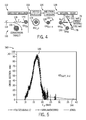
- the artificially activated radioactive source 72 may become radioactive after irradiation by Bremsstrahlung radiation in a process shown by a flow diagram 110 of FIG. 4 .
- the flow diagram 110 begins with a segment 112 in which an electron stream 114 is accelerated toward a conversion target 116 to produce Bremsstrahlung radiation 118. Namely, when the rapidly moving electron stream 114 reaches the conversion target 116, the electron stream 114 quickly decelerates. The rapid change in kinetic energy results in the photonic radiation known as Bremsstrahlung radiation 118. Some of the Bremsstrahlung radiation 118 may strike an otherwise non-radioactive source element 120, here illustrated as the stable copper isotope 65 Cu.
- the Bremsstrahlung radiation 118 may be generated using any suitable technique, such as using a linear accelerator (LINAC) or a laser, as will be described further below. As shown by a segment 122 of the flow diagram 110, when the non-radioactive source element 120
- an artificially activated radioactive source element 128 (e.g., 64 Cu) may result as a neutron 130 is ejected.
- the resulting artificially activated radioactive source element 128 may be a component of the artificially activated radioactive source 72, and may undergo a natural decay having a relatively short half-life.
- the artificially activated radioactive source element 128 may decay into a decay element 134 (e.g., 64 Ni), emitting a positron 74 in the process.
- a positron 74 collides with an electron 76 and both particles annihilate, two monochromatic gamma-rays 78 of 511 keV are generated.
- the nuclear reaction to generate the radioactive copper isotope 64 Cu from the stable copper isotope 65 Cu may be written as follows: Cu 65 + ⁇ > 10 ⁇ MeV ⁇ Cu 65 + n where the term ⁇ >10MeV describes the absorption of a gamma-ray of Bremsstrahlung radiation of greater than 10 MeV energy and the term n represents a neutron.
- a nuclear reaction cross section plot 140 of FIG. 5 illustrates the probability that the nuclear reaction of Equation 1 will occur given a particular energy of photonic radiation (e.g., the Bremsstrahlung radiation 118).
- the nuclear reaction cross section plot 140 compares an ordinate 142 representing the cross section (and therefore probability) of the reaction of Equation 1 in units of millibarn (mb) to an abscissa 144 representing the energy of the photonic radiation E ⁇ in units of MeV (e.g., the energy of the Bremsstrahlung radiation 118) that strikes the stable copper isotope 65 Cu.
- the reaction threshold is approximately 10 MeV and the reaction cross section reaches a peak 146 barely above 15 MeV. Because the nuclear reaction rate is proportional to the product between the cross section shown in the plot 140 and the flux of the Bremsstrahlung radiation 118, Bremsstrahlung radiation 118 having an energy of about 15 MeV may improve the likelihood that the reaction will occur. Bremsstrahlung radiation 118 of higher energy is also believed to be suitable to cause the nuclear reaction of Equation 1.
- the plot 140 illustrates that the reaction cross section is approximately 100 mb (millibarn).
- the artificially activated radioactive source 72 may have an intensity of 1.7 Ci, which corresponds to approximately 6*10 10 decays/s.
- the radioactive copper isotope 64 Cu is used as the artificially activated radioactive source element 128 as a component of the artificially activated radioactive source 72, approximately 3.6*10 20 reactions may be induced in the sample of the stable isotope of copper 65 Cu during the irradiation by Bremsstrahlung radiation 118.
- 10 -4 reactions by electron may be considered. This reaction rate may be increased by increasing the energy of the electron beam 114, the size of the sample of the otherwise non-radioactive source element 120 (e.g., 65 Cu), by optimizing the distance between the Bremsstrahlung target 116 and the sample of the otherwise non-radioactive source element 120 (e.g., 65 Cu), and so forth.
- an order of magnitude increase in the reaction rate may be obtained.
- the 12.7 hours half-life of 64 Cu limits the irradiation time before saturation. Saturation of approximately 99% is believed to occur substantially after ten times the half-life. At this amount of saturation, the 64 Cu decay rate may substantially match the irradiation rate.
- an irradiation intensity of Bremsstrahlung radiation 118 to produce at least 1.5A may be maintained during approximately 5 days to achieve approximately 99% saturation. To achieve lower saturations, shorter irradiation times may be employed.
- the Bremsstrahlung radiation 118 may be generated in any suitable manner.
- the Bremsstrahlung radiation 118 may be generated by an electron linear accelerator (LINAC) 150, as shown in FIG. 6 .
- the LINAC 150 includes an electron source 152 that emits electrons that are accelerated through a number of activation stages 154 to generate the electron beam 114.
- the activation stages 154 and the electron source 152 may be connected to an electrical signal generator 156.
- the electrical signal generator 156 may cause the electron source 152 to emit electrons at times when a first of the activation stages 154 generates a positive electrical field to draw the electron beam 114 out of the electron source 152 toward the conversion target 116.
- the electrical signal generator 156 may supply a current of opposite polarity. This causes the first of the activation stages 154 to generate a negative electrical field while a second of the activation stages 154 is generating a positive electrical field. This pattern may continue as the electron beam 114 moves through the LINAC 150, continually gaining energy as it accelerates toward the conversion target 116.
- the Bremsstrahlung radiation 118 may be of an energy greater than 10 MeV (e.g., 15 MeV)
- the LINAC 150 may accelerate the electron beam 114 to a corresponding energy. Thereafter, when the Bremsstrahlung radiation 118 strikes elements of 65 Cu, the artificially activated radioactive source element 64 Cu plus a neutron may be generated.
- the Bremsstrahlung radiation 118 used to activate the artificially activated radioactive source 72 may also be generated by a laser.
- a laser 162 may be focused to form a plasma 164 on a laser target 166, which may be a gas jet or a thin solid target (e.g., gold (Au) foil).
- the interaction of the laser 162 with the laser target 166 produces an electron distribution that may be quasi-Maxwellian, which is characterized by a hot electron temperature (e.g., up to a few tens of MeV) that scales approximately as the square root of the intensity of the laser 162.
- a resulting electron beam 114 or distribution may strike a conversion target 116 (e.g., Tantalum (Ta) or Tungsten (W)) set a few mm behind the laser target 166 to produce Bremsstrahlung radiation 118.
- the Bremsstrahlung radiation 118 may activate the non-radioactive source elements 120 which are set back a few cm behind the conversion target 116. This may allow measurements of the integrated flux of Bremsstrahlung radiation 118 while also producing radioactive source elements 128 of the artificially activated radioactive source 72.
- the Bremsstrahlung radiation 118 may, for instance, induce 65 Cu to react to form 64 Cu by ejecting a neutron 130.
- the mechanisms that have been proposed to explain electron acceleration caused by high-intensity lasers include, among other things, the ponderomotive potential of the laser 162, fast plasma waves from the plasma 164, and/or the laser field of laser 162 itself (e.g., Self-modulated Laser Wake Field (SMLWF) or Forced Laser Wake Field (FLWF)).
- SMLWF Self-modulated Laser Wake Field
- FLWF Forced Laser Wake Field
- Parameters that may affect the electron distributions may include the laser parameters (e.g., temporal and spatial distributions of the energy and wavelength of the laser 162), the nature of the target 166 (e.g., gas, thin foil, or thick solid target 166), and/or the angle of incidence of the laser 162 on the target 166.
- a gas jet target 166 may be used to obtain a better laser energy conversion into outgoing electrons with energy above 5 MeV.
- the electron beam 114 may be accelerated by focusing the laser 162 on the target 166 in the manner preformed by the "Salle gleich" laser system of the Laboratoire d'Optique Appliquee (LOA) at the Indiana Polytechnique.
- LOA Laboratoire d'Optique Appliquee
- a chirped pulse amplification (CPA) beam was generated using a Ti-sapphire laser system.
- the laser wavelength was 0.8 ⁇ m
- the pulse duration was 30 fs
- the instant energy on a laser target of gold (Au) was 1 J.
- the laser pulse was focused on a 10- ⁇ m-diameter spot on the laser target that included approximately 50% of the energy, using an off-axis parabolic mirror.
- the reaction rate may be increased by achieving a better laser energy conversion (e.g., via a gas jet target 166) into outgoing electrons with energies above 5 MeV (e.g., which may be approximately 0.1%), by increasing the laser 162 pulse energy and repetition rate.
- a better laser energy conversion e.g., via a gas jet target 166 into outgoing electrons with energies above 5 MeV (e.g., which may be approximately 0.1%), by increasing the laser 162 pulse energy and repetition rate.
- the artificially activated radiation source 72 may have an intensity of approximately 1.7 Ci, which corresponds to approximately 6*10 10 decays/s.
- the 12.7 hour half-life of 64 Cu limits the amount of time that may take place between irradiation and activation of the artificially activated radioactive source 72 and before saturation. Indeed, after 3.3 times the half-life, it is believed that the irradiation rate matches approximately 90% of the decay rate.
- an irradiation intensity of at least 5 ⁇ C/s may be used over a period of approximately 1.5 days using the laser activation system 160 to achieve a saturation of approximately 90%. To achieve a higher saturation, a longer irradiation period may be employed.
- Such an electron beam may be delivered, for example, by a 60 J laser activation system 160 operating at approximately 1 kHz.
- the laser system 160 may be located in a fixed facility, such as the LOA, or in a mobile facility, such as a mobile laser wake field accelerator of sufficient energy and/or time.
Landscapes
- Physics & Mathematics (AREA)
- High Energy & Nuclear Physics (AREA)
- Chemical & Material Sciences (AREA)
- Chemical Kinetics & Catalysis (AREA)
- General Chemical & Material Sciences (AREA)
- Engineering & Computer Science (AREA)
- General Engineering & Computer Science (AREA)
- Life Sciences & Earth Sciences (AREA)
- General Life Sciences & Earth Sciences (AREA)
- General Physics & Mathematics (AREA)
- Geophysics (AREA)
- Particle Accelerators (AREA)
Priority Applications (1)
| Application Number | Priority Date | Filing Date | Title |
|---|---|---|---|
| EP13306854.4A EP2887103A1 (de) | 2013-12-23 | 2013-12-23 | Künstlich aktivierte radioaktive Quelle für ein Bohrlochwerkzeug |
Applications Claiming Priority (1)
| Application Number | Priority Date | Filing Date | Title |
|---|---|---|---|
| EP13306854.4A EP2887103A1 (de) | 2013-12-23 | 2013-12-23 | Künstlich aktivierte radioaktive Quelle für ein Bohrlochwerkzeug |
Publications (1)
| Publication Number | Publication Date |
|---|---|
| EP2887103A1 true EP2887103A1 (de) | 2015-06-24 |
Family
ID=49949466
Family Applications (1)
| Application Number | Title | Priority Date | Filing Date |
|---|---|---|---|
| EP13306854.4A Withdrawn EP2887103A1 (de) | 2013-12-23 | 2013-12-23 | Künstlich aktivierte radioaktive Quelle für ein Bohrlochwerkzeug |
Country Status (1)
| Country | Link |
|---|---|
| EP (1) | EP2887103A1 (de) |
Cited By (3)
| Publication number | Priority date | Publication date | Assignee | Title |
|---|---|---|---|---|
| WO2018118054A1 (en) * | 2016-12-21 | 2018-06-28 | Halliburton Energy Services, Inc. | Downhole gamma-ray generatiors and systems to generate gamma-rays in a downhole environment |
| CN111896990A (zh) * | 2020-07-10 | 2020-11-06 | 成都理工大学 | 一种基于Frechet距离的放射源活度监测方法 |
| JP2021532365A (ja) * | 2018-08-02 | 2021-11-25 | エルイーエヌアール—シティーズ スイス エスエーアールエルLenr−Cities Suisse Sarl | 医療用途の放射性同位体を生成する方法及びシステム |
Citations (7)
| Publication number | Priority date | Publication date | Assignee | Title |
|---|---|---|---|---|
| US2133776A (en) * | 1936-02-18 | 1938-10-18 | Lane Wells Co | Subsurface prospecting device |
| US2760079A (en) * | 1948-11-12 | 1956-08-21 | Arps Jan Jacob | Well or bore hole logging |
| WO2003016947A2 (en) * | 2001-08-17 | 2003-02-27 | Bechtel Bwxt Idaho, Llc | Method and apparatus for photon activation positron annihilation analysis |
| WO2004075819A2 (en) * | 2003-02-28 | 2004-09-10 | The European Atomic Energy Community (Euratom), Represented By The European Commission | Activation and production of radiolabeled particles |
| US20050031074A1 (en) * | 2001-11-10 | 2005-02-10 | Fitzgerald John Barry | Fluid density measurement |
| EP2421006A1 (de) * | 2010-08-20 | 2012-02-22 | Ludwig-Maximilians-Universität München | Verfahren zur Herstellung von Isotopen, insbesondere Verfahren zur Herstellung von Radioisotopen mittels Gammastrahlung |
| US20120318968A1 (en) * | 2011-06-17 | 2012-12-20 | Baker Hughes Incorporated | Sourceless Density Measurement Using Activation |
-
2013
- 2013-12-23 EP EP13306854.4A patent/EP2887103A1/de not_active Withdrawn
Patent Citations (7)
| Publication number | Priority date | Publication date | Assignee | Title |
|---|---|---|---|---|
| US2133776A (en) * | 1936-02-18 | 1938-10-18 | Lane Wells Co | Subsurface prospecting device |
| US2760079A (en) * | 1948-11-12 | 1956-08-21 | Arps Jan Jacob | Well or bore hole logging |
| WO2003016947A2 (en) * | 2001-08-17 | 2003-02-27 | Bechtel Bwxt Idaho, Llc | Method and apparatus for photon activation positron annihilation analysis |
| US20050031074A1 (en) * | 2001-11-10 | 2005-02-10 | Fitzgerald John Barry | Fluid density measurement |
| WO2004075819A2 (en) * | 2003-02-28 | 2004-09-10 | The European Atomic Energy Community (Euratom), Represented By The European Commission | Activation and production of radiolabeled particles |
| EP2421006A1 (de) * | 2010-08-20 | 2012-02-22 | Ludwig-Maximilians-Universität München | Verfahren zur Herstellung von Isotopen, insbesondere Verfahren zur Herstellung von Radioisotopen mittels Gammastrahlung |
| US20120318968A1 (en) * | 2011-06-17 | 2012-12-20 | Baker Hughes Incorporated | Sourceless Density Measurement Using Activation |
Non-Patent Citations (1)
| Title |
|---|
| P R BYERLY ET AL: "Photodisintegration of Copper", PHYSICAL REVIEW, vol. 83, no. 1, 1 July 1951 (1951-07-01), pages 54 - 62, XP055449288, Retrieved from the Internet <URL:https://journals.aps.org/pr/pdf/10.1103/PhysRev.83.54> [retrieved on 20180208] * |
Cited By (5)
| Publication number | Priority date | Publication date | Assignee | Title |
|---|---|---|---|---|
| WO2018118054A1 (en) * | 2016-12-21 | 2018-06-28 | Halliburton Energy Services, Inc. | Downhole gamma-ray generatiors and systems to generate gamma-rays in a downhole environment |
| US10274638B2 (en) | 2016-12-21 | 2019-04-30 | Halliburton Energy Services, Inc. | Downhole gamma-ray generators and systems to generate gamma-rays in a downhole environment |
| JP2021532365A (ja) * | 2018-08-02 | 2021-11-25 | エルイーエヌアール—シティーズ スイス エスエーアールエルLenr−Cities Suisse Sarl | 医療用途の放射性同位体を生成する方法及びシステム |
| CN111896990A (zh) * | 2020-07-10 | 2020-11-06 | 成都理工大学 | 一种基于Frechet距离的放射源活度监测方法 |
| CN111896990B (zh) * | 2020-07-10 | 2023-01-24 | 成都理工大学 | 一种基于Frechet距离的放射源活度监测方法 |
Similar Documents
| Publication | Publication Date | Title |
|---|---|---|
| US6781115B2 (en) | Subsurface radiation phenomena detection with combined and azimuthally sensitive detectors | |
| Zemel | Tracers in the oil field | |
| AU762368B2 (en) | Neutron burst timing method and system for multiple measurement pulsed neutron formation evaluation | |
| US7960687B1 (en) | Sourceless downhole X-ray tool | |
| RU2502096C2 (ru) | Скважинное измерение посредством нейтронной активации | |
| US3780303A (en) | Pulsed neutron logging with background compensation | |
| US9897718B2 (en) | Neutron-absorbing gamma ray window in a downhole tool | |
| US10473802B2 (en) | Downhole energy calibration of gamma ray detectors | |
| US20150124921A1 (en) | Downhole Gamma Ray Source Using Neutron Activation | |
| US10520641B2 (en) | Gamma calibration | |
| US9417355B2 (en) | Composition-matched inelastic or capture spectroscopy tool | |
| US20170211382A1 (en) | Determining casing fluid capture cross section using gamma count rate ratio | |
| US10663617B2 (en) | Systems and methods for monitoring radiation in well logging | |
| US20190129061A1 (en) | Systems and methods to determine relative elemental concentrations from nuclear spectroscopy measurements | |
| EP2887103A1 (de) | Künstlich aktivierte radioaktive Quelle für ein Bohrlochwerkzeug | |
| US11867866B2 (en) | System and method for fissionable material detection with a short pulse neutron source | |
| US9696455B2 (en) | Automated control of electrically operated radiation generators | |
| AU2023200483B2 (en) | Neutron Time Of Flight Wellbore Logging | |
| US4180729A (en) | Uranium logging in earth formations | |
| US4209694A (en) | Assaying for uranium-bearing ore | |
| EP0527675B1 (de) | Neutronendetektoren | |
| JP2006300555A (ja) | 全地層検層方法及び装置 | |
| Borsaru | Selected topics in nuclear geophysics | |
| EP3797321B1 (de) | System und verfahren zur erkennung von spaltbarem material mit kurzpulsneutronenquelle | |
| Tian et al. | A new PGNAA borehole logging method for determining copper and nickel grade |
Legal Events
| Date | Code | Title | Description |
|---|---|---|---|
| PUAI | Public reference made under article 153(3) epc to a published international application that has entered the european phase |
Free format text: ORIGINAL CODE: 0009012 |
|
| 17P | Request for examination filed |
Effective date: 20131223 |
|
| AK | Designated contracting states |
Kind code of ref document: A1 Designated state(s): AL AT BE BG CH CY CZ DE DK EE ES FI FR GB GR HR HU IE IS IT LI LT LU LV MC MK MT NL NO PL PT RO RS SE SI SK SM TR |
|
| AX | Request for extension of the european patent |
Extension state: BA ME |
|
| R17P | Request for examination filed (corrected) |
Effective date: 20151216 |
|
| RBV | Designated contracting states (corrected) |
Designated state(s): AL AT BE BG CH CY CZ DE DK EE ES FI FR GB GR HR HU IE IS IT LI LT LU LV MC MK MT NL NO PL PT RO RS SE SI SK SM TR |
|
| 17Q | First examination report despatched |
Effective date: 20180214 |
|
| STAA | Information on the status of an ep patent application or granted ep patent |
Free format text: STATUS: THE APPLICATION IS DEEMED TO BE WITHDRAWN |
|
| 18D | Application deemed to be withdrawn |
Effective date: 20180626 |