EP2886715A1 - Artificial lawn - Google Patents
Artificial lawn Download PDFInfo
- Publication number
- EP2886715A1 EP2886715A1 EP13813564.5A EP13813564A EP2886715A1 EP 2886715 A1 EP2886715 A1 EP 2886715A1 EP 13813564 A EP13813564 A EP 13813564A EP 2886715 A1 EP2886715 A1 EP 2886715A1
- Authority
- EP
- European Patent Office
- Prior art keywords
- pile
- artificial turf
- length
- piles
- elasticity
- Prior art date
- Legal status (The legal status is an assumption and is not a legal conclusion. Google has not performed a legal analysis and makes no representation as to the accuracy of the status listed.)
- Withdrawn
Links
Images
Classifications
-
- E—FIXED CONSTRUCTIONS
- E01—CONSTRUCTION OF ROADS, RAILWAYS, OR BRIDGES
- E01C—CONSTRUCTION OF, OR SURFACES FOR, ROADS, SPORTS GROUNDS, OR THE LIKE; MACHINES OR AUXILIARY TOOLS FOR CONSTRUCTION OR REPAIR
- E01C13/00—Pavings or foundations specially adapted for playgrounds or sports grounds; Drainage, irrigation or heating of sports grounds
- E01C13/08—Surfaces simulating grass ; Grass-grown sports grounds
Definitions
- the present invention relates to an artificial turf in which piles are implanted in a base fabric, more specifically to a technique for improving the durability of the pile.
- An artificial turf in which the space between piles is filled with a filler has spread through various athletic sports facilities, such as a soccer field, a rugby field, and a baseball field, as an artificial turf surface having the characteristics close to natural turf.
- various athletic sports facilities such as a soccer field, a rugby field, and a baseball field
- the artificial turf has been increasingly used every year for school grounds taking advantage of the feature that the artificial turf is of an all-weather type, and the operating ratio of the artificial turf has been increased.
- the pile length is set longer than that for conventional artificial turf.
- the properties close to natural turf can be reproduced by filling the space between the long piles with a rubber chip and increasing the exposed length of the tip of the pile. Therefore, the long pile artificial turf is popular.
- the piles are liable to wear due to friction with various soles and be twisted or broken by repeated loads with the increase in the operating ratio, causing the tip of the pile to be fibrillated (to form fibrils).
- the fibrillation of the long pile artificial turf occurs when the long, projected piles are repeatedly trampled to undergo twisting stress, causing splitting and fracture starting from bending and buckling of the piles.
- the turf tip will be torn with the progress of fibrillation, which may not only adversely affect playability but also cause discomfort due to the adhesion of the torn piles to clothes and shoes by static electricity. Further, since the torn piles are carried outside the field, for example, the surroundings of a field have become dirty, causing a problem also for the keeper side.
- conventional piles for artificial turf are generally stretched about 5 to 7-times their original length and have high tensile strength.
- the conventional piles have low durability, and it has been difficult to prevent the fibrillation as described above.
- an object of the present invention is to provide an artificial turf which is not fibrillated over a long period of time but has stable durability.
- the present invention has several features to be described below.
- the pile comprises a flat filament yarn having a degree of crystal orientation of 0.75 to 0.90 (more preferably 0.75 to 0.85) produced by uniaxially stretching a crystalline plastic.
- the flattening ratio (W/H) of the pile is 3.0 to 7.0, wherein H represents the length in the minor axis direction of the cross section of the pile, and W represents the length in the major axis direction of the cross section of the pile.
- H represents the length in the minor axis direction of the cross section of the pile
- W represents the length in the major axis direction of the cross section of the pile.
- cross section refers to a cross section orthogonal to the pile length.
- the length H in the minor axis direction of the cross section of the pile is 180 to 350 ⁇ m.
- the tensile modulus of elasticity of the pile is 150 to 350 N/mm 2 .
- the crystalline plastic comprises a linear low density polyethylene having a density of 0.900 to 0.940.
- the flexibility of a pile can be improved by using, as a pile, a flat filament yarn having a degree of crystal orientation of 0.75 to 0.90 (more preferably 0.75 to 0.85) produced by uniaxially stretching a crystalline plastic, and the resulting artificial turf is not fibrillated over a long period of time but can have stable durability.
- the pile since the flattening ratio (W/H) of the pile is 3.0 to 7.0, wherein H represents the length in the minor axis direction of the cross section of the pile, and W represents the length in the major axis direction of the cross section of the pile, the pile is not liable to wear, and as a result, the progress of fibrillation can be prevented.
- the length H in the minor axis direction of the cross section of the pile is 180 to 350 ⁇ m, the durability of the pile is good.
- a length H of shorter than 180 ⁇ m is not preferred because when the length H is shorter than 180 ⁇ m, fibrillation will be liable to occur.
- a length H of longer than 350 ⁇ m is not preferred because when the length H is longer than 350 ⁇ m, the thickness of the pile will be increased to increase cost, and the pile will be liable to have a bending habit by bending, resulting in impairing the pliability and appearance as an artificial turf.
- the tensile modulus of elasticity of the pile is 150 to 350 N/mm 2 , the durability of the pile is good.
- a tensile modulus of elasticity of less than 150 N/mm 2 is not preferred because when the tensile modulus of elasticity is less than 150 N/mm 2 , elastic force will be weak; the pile is liable to be cut; and the processability will be reduced.
- a tensile modulus of elasticity of more than 350 N/mm 2 is not preferred because when the tensile modulus of elasticity is more than 350 N/mm 2 , the rigidity will be increased, thereby being liable to have a bending habit or cause buckling and impairing flexibility as an artificial turf.
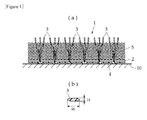
- Figure 1 is a sectional view schematically illustrating an artificial turf according to an embodiment of the present invention.
- an artificial turf 1 comprises a base fabric 2 formed in a sheet form and piles 3 implanted in the base fabric 2 with a predetermined interval, and a backing agent 4 for preventing dropping-off of the pile 3 is applied to the back side of the base fabric 2.
- a plain-weave fabric made of a thermoplastic resin such as polypropylene or polyethylene is used for the base fabric 2
- other woven fabrics than the plain-weave fabric may be used, and the shape and the material of the base fabric 2 are not particularly limited in the present invention.
- the pile 3 comprises a flat filament yarn having a degree of crystal orientation of 0.75 to 0.90 (more preferably 0.75 to 0.85) produced by uniaxially stretching a crystalline plastic (also referred to as a crystalline polymer).
- the pile 3 comprises a flat filament yarn and is formed so that the flattening ratio (W/H) of the pile 3 may be within the range of 3.0 to 7.0, wherein H represents the length in the minor axis direction of the cross section of the pile 3, and W represents the length in the major axis direction of the cross section of the pile 3.
- the length H in the minor axis direction of the cross section of the pile 3 is 180 to 350 ⁇ m (preferably 250 to 300 ⁇ m). That is, a length H of shorter than 180 ⁇ m is not preferred because when the length H is shorter than 180 ⁇ m, the fibrillation will be liable to occur.
- a long length H is not preferred because when the length H is long, the thickness of the pile will be increased to increase cost, and the pile will be liable to have a bending habit by bending, resulting in impairing the pliability and appearance as an artificial turf.
- the tensile modulus of elasticity of the pile 3 is 150 to 350 N/mm 2 . That is, a tensile modulus of elasticity of less than 150 N/mm 2 is not preferred because when the tensile modulus of elasticity is less than 150 N/mm 2 , elastic force will be weak; the pile is liable to be cut; and the processability will be reduced.
- a tensile modulus of elasticity of more than 350 N/mm 2 is not preferred because when the tensile modulus of elasticity is more than 350 N/mm 2 , the rigidity will be increased, thereby being liable to have a bending habit or cause buckling and impairing flexibility as an artificial turf.
- L-LDPE linear low density polyethylene
- crystalline plastic of the present invention As a material which satisfies each specification described above, a linear low density polyethylene (L-LDPE) having a density of 0.900 to 0.940 is used for the crystalline plastic of the present invention. Note that other crystalline plastics may be used as long as they satisfy each condition described above.
- the pile 3 comprises a single flat filament yarn having a predetermined fineness (dtex) implanted in the base fabric 2, but, for example, a flat filament yarn in which a plurality of the single flat filament yarns are twisted can be used.
- the use modes of the flat filament yarn are not particularly limited as long as each specification as described above is satisfied.
- a completed artificial turf 1 is laid on a predetermined base 10, and then the space between the piles 3 is filled with a rubber chip as a filler 5.
- the structure of the filler 5 and the base 10 is not particularly limited but may be arbitrarily changed depending on specification.
- a linear low density polyethylene resin composition (density: 0.926 g/cm 3 , MFR: 0.9 g/10 min) was melt extruded using an extruder having a diameter of 60 mm at a temperature of 180°C and solidified by cooling in a water tank at 30°C. Next, the extrudate was uniaxially stretched at 90 to 100°C using a roll stretching method and then subjected to relaxing heat treatment in a hot water tank at 90 to 100°C to obtain an artificial turf yarn having a fineness of about 1850 dtex.
- the original pile yarn was set to a sample stand so that the surface of the original pile yarn may be vertical to the direction of radiation of X rays and irradiated with X rays under the following conditions using an X-ray diffraction machine manufactured by Bruker-AXS Inc. (model: D8-DISCOVER- ⁇ HR-Hybrid).
- the degree of crystal orientation was calculated from the half width of the intensity distribution obtained from the peak of the resulting diffraction pattern.
- the original pile yarn was cut to a length of 50 mm, set on a tensile testing machine at a distance between chucks of 30 mm, and then pulled at a stress rate of 100 mm/min until the original pile yarn was broken, thus measuring the tensile load-strain curve (S-S curve).
- the tensile modulus of elasticity was calculated from the tangential gradient in the elastic deformation area of the S-S curve.
- An artificial turf was cut into a disc having a diameter of 100 mm.
- the disc was received on the bottom of a cylinder container that has a bottom and the same diameter as that of the disc, and the container was filled with a rubber chip to such an extent that the turf tip is exposed by 20 mm.
- the artificial turf is pressed by a compression element that can be inserted along the inner circumferential surface of the cylinder container with a load of 700 N.
- a urethane rubber having a hardness of 60 which has a grid pattern unevenness by which a sole is imagined is attached to the tip of the compression element.
- the cylinder container was reciprocally rotated at an angle of 15° at a rotational speed of 25 rpm, and a durability test of 100,000 counts was performed, in which one reciprocation was defined as one count.
- Ten piles of the artificial turf were extracted at random after performing the test, and the number of piles in which a crack has occurred was counted. When the number of piles in which a crack has occurred was zero, 1 to 3, or 4 or more, the durability was determined to be ⁇ , ⁇ , or ⁇ , respectively.
- processability means cutting properties of the pile of an artificial turf.
- Piles were implanted in an artificial turf with a tufting machine and evaluated as follows: piles being cut to a uniform height so as to have a pile length of 60 mm and having no defects such as residual loops were evaluated as ⁇ , and piles having defects were evaluated as ⁇ .
- Each artificial turf and natural turf were observed by ten athletes. When seven or more athletes felt that the dimension, shape, texture, and appearance between an artificial turf and natural turf were at an equal level, the artificial turf was evaluated as ⁇ , and when six or less athletes felt the same, the artificial turf was evaluated as ⁇ .
- a pile is rich in flexibility and effective against repetitive buckling or twist by suppressing the degree of crystal orientation.
- the pile becomes tolerant of filling and tough, thereby reducing stability.
Landscapes
- Engineering & Computer Science (AREA)
- Architecture (AREA)
- Civil Engineering (AREA)
- Structural Engineering (AREA)
- Road Paving Structures (AREA)
Abstract
Description
- The present invention relates to an artificial turf in which piles are implanted in a base fabric, more specifically to a technique for improving the durability of the pile.
- An artificial turf in which the space between piles is filled with a filler has spread through various athletic sports facilities, such as a soccer field, a rugby field, and a baseball field, as an artificial turf surface having the characteristics close to natural turf. Recently, the artificial turf has been increasingly used every year for school grounds taking advantage of the feature that the artificial turf is of an all-weather type, and the operating ratio of the artificial turf has been increased.
- As one of the artificial turf of this type, a so-called long pile artificial turf is known in which the pile length is set longer than that for conventional artificial turf. In the long pile artificial turf, the properties close to natural turf can be reproduced by filling the space between the long piles with a rubber chip and increasing the exposed length of the tip of the pile. Therefore, the long pile artificial turf is popular.
- Incidentally, since the surface of the artificial turf is loaded with various shoes, such as sports shoes with a rubber sole and spikes for various sports, the piles are liable to wear due to friction with various soles and be twisted or broken by repeated loads with the increase in the operating ratio, causing the tip of the pile to be fibrillated (to form fibrils).
- Therefore, wear-resistant polypropylene and high density polyethylene have been commonly employed for conventional piles for artificial turf in order to prevent the fibrillation as described above. For example, see
Patent Literatures - However, unlike the destructive structure in which conventional artificial turf containing sand is fibrillated, the fibrillation of the long pile artificial turf occurs when the long, projected piles are repeatedly trampled to undergo twisting stress, causing splitting and fracture starting from bending and buckling of the piles.
- Further, when the operating ratio of the artificial turf is high, the turf tip will be torn with the progress of fibrillation, which may not only adversely affect playability but also cause discomfort due to the adhesion of the torn piles to clothes and shoes by static electricity. Further, since the torn piles are carried outside the field, for example, the surroundings of a field have become dirty, causing a problem also for the keeper side.
- Further, conventional piles for artificial turf are generally stretched about 5 to 7-times their original length and have high tensile strength. On the other hand, the conventional piles have low durability, and it has been difficult to prevent the fibrillation as described above.
-
- Patent Literature 1:
Japanese Patent Application Publication No.6-184811 - Patent Literature 2:
Japanese Patent Application Publication No.11-269811 - Therefore, an object of the present invention is to provide an artificial turf which is not fibrillated over a long period of time but has stable durability.
- In order to achieve the object as described above, the present invention has several features to be described below. Specifically, in an artificial turf in which piles are implanted in a base fabric, the pile comprises a flat filament yarn having a degree of crystal orientation of 0.75 to 0.90 (more preferably 0.75 to 0.85) produced by uniaxially stretching a crystalline plastic.
- In a more preferred embodiment, the flattening ratio (W/H) of the pile is 3.0 to 7.0, wherein H represents the length in the minor axis direction of the cross section of the pile, and W represents the length in the major axis direction of the cross section of the pile. Note that, in the present invention, the "cross section" refers to a cross section orthogonal to the pile length.
- In a more preferred embodiment, the length H in the minor axis direction of the cross section of the pile is 180 to 350 µm.
- In another embodiment, the tensile modulus of elasticity of the pile is 150 to 350 N/mm2.
- In a more preferred embodiment, the crystalline plastic comprises a linear low density polyethylene having a density of 0.900 to 0.940.
- According to the above features of the present invention, the flexibility of a pile can be improved by using, as a pile, a flat filament yarn having a degree of crystal orientation of 0.75 to 0.90 (more preferably 0.75 to 0.85) produced by uniaxially stretching a crystalline plastic, and the resulting artificial turf is not fibrillated over a long period of time but can have stable durability.
- Further, since the flattening ratio (W/H) of the pile is 3.0 to 7.0, wherein H represents the length in the minor axis direction of the cross section of the pile, and W represents the length in the major axis direction of the cross section of the pile, the pile is not liable to wear, and as a result, the progress of fibrillation can be prevented.
- Furthermore, since the length H in the minor axis direction of the cross section of the pile is 180 to 350 µm, the durability of the pile is good. A length H of shorter than 180 µm is not preferred because when the length H is shorter than 180 µm, fibrillation will be liable to occur. Conversely, a length H of longer than 350 µm is not preferred because when the length H is longer than 350 µm, the thickness of the pile will be increased to increase cost, and the pile will be liable to have a bending habit by bending, resulting in impairing the pliability and appearance as an artificial turf.
- Further, since the tensile modulus of elasticity of the pile is 150 to 350 N/mm2, the durability of the pile is good. A tensile modulus of elasticity of less than 150 N/mm2 is not preferred because when the tensile modulus of elasticity is less than 150 N/mm2, elastic force will be weak; the pile is liable to be cut; and the processability will be reduced. Conversely, a tensile modulus of elasticity of more than 350 N/mm2 is not preferred because when the tensile modulus of elasticity is more than 350 N/mm2, the rigidity will be increased, thereby being liable to have a bending habit or cause buckling and impairing flexibility as an artificial turf.
- [
Figure 1] Figure 1 is a sectional view schematically illustrating an artificial turf according to an embodiment of the present invention. - Next, embodiments of the present invention will be described referring to the drawing, but the present invention is not limited to the drawing.
- As illustrated in
Figure 1 (a) , anartificial turf 1 comprises abase fabric 2 formed in a sheet form andpiles 3 implanted in thebase fabric 2 with a predetermined interval, and abacking agent 4 for preventing dropping-off of thepile 3 is applied to the back side of thebase fabric 2. - Although a plain-weave fabric made of a thermoplastic resin such as polypropylene or polyethylene is used for the
base fabric 2, other woven fabrics than the plain-weave fabric may be used, and the shape and the material of thebase fabric 2 are not particularly limited in the present invention. - The
pile 3 comprises a flat filament yarn having a degree of crystal orientation of 0.75 to 0.90 (more preferably 0.75 to 0.85) produced by uniaxially stretching a crystalline plastic (also referred to as a crystalline polymer). - Referring to
Figure 1 (b) , thepile 3 comprises a flat filament yarn and is formed so that the flattening ratio (W/H) of thepile 3 may be within the range of 3.0 to 7.0, wherein H represents the length in the minor axis direction of the cross section of thepile 3, and W represents the length in the major axis direction of the cross section of thepile 3. - That is, since the flattening ratio is 3.0 to 7.0, the pile is not liable to wear, and as a result, the progress of fibrillation can be prevented.
- In a more preferred embodiment, the length H in the minor axis direction of the cross section of the
pile 3 is 180 to 350 µm (preferably 250 to 300 µm). That is, a length H of shorter than 180 µm is not preferred because when the length H is shorter than 180 µm, the fibrillation will be liable to occur. - Conversely, a long length H is not preferred because when the length H is long, the thickness of the pile will be increased to increase cost, and the pile will be liable to have a bending habit by bending, resulting in impairing the pliability and appearance as an artificial turf.
- In a more preferred embodiment, the tensile modulus of elasticity of the
pile 3 is 150 to 350 N/mm2. That is, a tensile modulus of elasticity of less than 150 N/mm2 is not preferred because when the tensile modulus of elasticity is less than 150 N/mm2, elastic force will be weak; the pile is liable to be cut; and the processability will be reduced. - Conversely, a tensile modulus of elasticity of more than 350 N/mm2 is not preferred because when the tensile modulus of elasticity is more than 350 N/mm2, the rigidity will be increased, thereby being liable to have a bending habit or cause buckling and impairing flexibility as an artificial turf.
- As a material which satisfies each specification described above, a linear low density polyethylene (L-LDPE) having a density of 0.900 to 0.940 is used for the crystalline plastic of the present invention. Note that other crystalline plastics may be used as long as they satisfy each condition described above.
- In this example, the
pile 3 comprises a single flat filament yarn having a predetermined fineness (dtex) implanted in thebase fabric 2, but, for example, a flat filament yarn in which a plurality of the single flat filament yarns are twisted can be used. The use modes of the flat filament yarn are not particularly limited as long as each specification as described above is satisfied. - Further, a completed
artificial turf 1 is laid on apredetermined base 10, and then the space between thepiles 3 is filled with a rubber chip as afiller 5. However, in the present invention, the structure of thefiller 5 and thebase 10 is not particularly limited but may be arbitrarily changed depending on specification. - Next, specific Examples of the present invention were comparatively studied together with Comparative Examples. First, a pile was prepared by the following methods.
- A linear low density polyethylene resin composition (density: 0.926 g/cm3, MFR: 0.9 g/10 min) was melt extruded using an extruder having a diameter of 60 mm at a temperature of 180°C and solidified by cooling in a water tank at 30°C. Next, the extrudate was uniaxially stretched at 90 to 100°C using a roll stretching method and then subjected to relaxing heat treatment in a hot water tank at 90 to 100°C to obtain an artificial turf yarn having a fineness of about 1850 dtex.
- Six piles prepared according to the method as described above were twisted into a bundle to form one pile, which was implanted in a plain-weave fabric made of polypropylene using a 5/16-gauge tufting machine so that the pile height (pile length from a base fabric to the tip of the pile) may be 60 mm. Then, a SBR latex having a solid content of 70% was applied to the back side of the base fabric in a coating amount of 1100 g/m2 and dried at a high temperature of 105°C to obtain an artificial turf.
- Next, the pile and artificial turf prepared were subjected to measurement and various evaluations by the following methods.
- The original pile yarn was set to a sample stand so that the surface of the original pile yarn may be vertical to the direction of radiation of X rays and irradiated with X rays under the following conditions using an X-ray diffraction machine manufactured by Bruker-AXS Inc. (model: D8-DISCOVER-µHR-Hybrid). The degree of crystal orientation was calculated from the half width of the intensity distribution obtained from the peak of the resulting diffraction pattern.
-
- X-ray source: CuKα rays (multilayer mirror specification)
- Output: 50 kV, 22 mA
- Detector: scintillation counter
- The original pile yarn was cut to a length of 50 mm, set on a tensile testing machine at a distance between chucks of 30 mm, and then pulled at a stress rate of 100 mm/min until the original pile yarn was broken, thus measuring the tensile load-strain curve (S-S curve). The tensile modulus of elasticity was calculated from the tangential gradient in the elastic deformation area of the S-S curve.
- An artificial turf was cut into a disc having a diameter of 100 mm. The disc was received on the bottom of a cylinder container that has a bottom and the same diameter as that of the disc, and the container was filled with a rubber chip to such an extent that the turf tip is exposed by 20 mm. The artificial turf is pressed by a compression element that can be inserted along the inner circumferential surface of the cylinder container with a load of 700 N. A urethane rubber having a hardness of 60 which has a grid pattern unevenness by which a sole is imagined is attached to the tip of the compression element.
- In the state where the artificial turf was pressed by the compression element, the cylinder container was reciprocally rotated at an angle of 15° at a rotational speed of 25 rpm, and a durability test of 100,000 counts was performed, in which one reciprocation was defined as one count. Ten piles of the artificial turf were extracted at random after performing the test, and the number of piles in which a crack has occurred was counted. When the number of piles in which a crack has occurred was zero, 1 to 3, or 4 or more, the durability was determined to be ⊚, ○, or ×, respectively.
- In the present embodiment, processability means cutting properties of the pile of an artificial turf. Piles were implanted in an artificial turf with a tufting machine and evaluated as follows: piles being cut to a uniform height so as to have a pile length of 60 mm and having no defects such as residual loops were evaluated as ○, and piles having defects were evaluated as ×.
- Each artificial turf and natural turf were observed by ten athletes. When seven or more athletes felt that the dimension, shape, texture, and appearance between an artificial turf and natural turf were at an equal level, the artificial turf was evaluated as ○, and when six or less athletes felt the same, the artificial turf was evaluated as ×.
- Finally, overall evaluation of durability, processability, and appearance was performed. When all of the durability, processability, and appearance were evaluated as ○ or ⊚, the overall evaluation was determined to be "○", and when any one of the durability, processability, and appearance was evaluated as ×, the overall evaluation was determined to be "×".
-
- [Degree of crystal orientation] 0.81
- [Minor axis length H] 0.235 mm
- [Major axis length W] 1.16 mm
- [Flattening ratio W/H] 4.936
- [Tensile modulus of elasticity] 190 N/mm2
- [Durability] ⊚
- [Processability] ○
- [Appearance] ○
- [Overall evaluation] ○
-
- [Degree of crystal orientation] 0.75
- [Minor axis length H] 0.196 mm
- [Major axis length W] 1.37 mm
- [Flattening ratio W/H] 6.990
- [Tensile modulus of elasticity] 206 N/mm2
- [Durability] ⊚
- [Processability] ○
- [Appearance] ○
- [Overall evaluation] ○
-
- [Degree of crystal orientation] 0.90
- [Minor axis length H] 0.243 mm
- [Major axis length W] 1.12 mm
- [Flattening ratio W/H] 4.609
- [Tensile modulus of elasticity] 273 N/mm2
- [Durability] ○
- [Processability] ○
- [Appearance] ○
- [Overall evaluation] ○
-
- [Degree of crystal orientation] 0.85
- [Minor axis length H] 0.271 mm
- [Major axis length W] 0.91 mm
- [Flattening ratio W/H] 3.358
- [Tensile modulus of elasticity] 301 N/mm2
- [Durability] ⊚
- [Processability] ○
- [Appearance] ○
- [Overall evaluation] ○
-
- [Degree of crystal orientation] 0.92
- [Minor axis length H] 0.237 mm
- [Major axis length W] 1.11 mm
- [Flattening ratio W/H] 4.684
- [Tensile modulus of elasticity] 357 N/mm2
- [Durability] ×
- [Processability] ○
- [Appearance] ○
- [Overall evaluation] ×
-
- [Degree of crystal orientation] 0.91
- [Minor axis length H] 0.150 mm
- [Major axis length W] 1.80 mm
- [Flattening ratio W/H] 12.000
- [Tensile modulus of elasticity] 348 N/mm2
- [Durability] ×
- [Processability] ○
- [Appearance] ○
- [Overall evaluation] ×
-
- [Degree of crystal orientation] 0.72
- [Minor axis length H] 0.220 mm
- [Major axis length W] 1.12 mm
- [Flattening ratio W/H] 5.091
- [Tensile modulus of elasticity] 195 N/mm2
- [Durability] ○
- [Processability] ×
- [Appearance] ○
- [Overall evaluation] ×
- Examples 1 to 4 and Comparative Examples 1 to 3 are summarized in Table 1.
[Table 1] Example 1 Example 2 Example 3 Example 4 Comparative Example 1 Comparative Example 2 Comparative Example 3 Degree of crystal orientation 0.81 0.75 0.90 0.85 0.92 0.91 0.72 Minor axis length H (mm) 0.235 0.196 0.243 0.271 0.237 0.150 0.220 Major axis length W (mm) 1.16 1.37 1.12 0.91 1.11 1.80 1.12 Flattening ratio (W/H) 4.936 6.990 4.609 3.358 4.684 12.000 5.091 Tensile modulus of elasticity (N/mm2) 190 206 273 301 357 348 195 Durability ⊚ ⊚ ○ ⊚ × × ○ Processability ○ ○ ○ ○ ○ ○ × Appearance ○ ○ ○ ○ ○ ○ ○ Overall evaluation ○ ○ ○ ○ × × × - As described above, the following findings were obtained from Examples and Comparative Examples. Specifically,
- A pile is rich in flexibility and effective against repetitive buckling or twist by suppressing the degree of crystal orientation.
- When the degree of crystal orientation is reduced, the pile becomes tolerant of filling and tough, thereby reducing stability.
- When minor axis length (thickness) is increased, a cutting edge is difficult to enter the pile, thereby reducing cutting stability.
-
- 1
- Artificial turf
- 2
- Base fabric
- 3
- Pile
- 4
- Backing agent
- 5
- Filler
- 10
- Base
Claims (6)
- An artificial turf in which piles are implanted in a base fabric, wherein the pile comprises a flat filament yarn having a degree of crystal orientation of 0.75 to 0.90 produced by uniaxially stretching a crystalline plastic.
- The artificial turf according to claim 1, wherein the degree of crystal orientation of the pile is 0.75 to 0.85.
- The artificial turf according to claim 2, wherein the flattening ratio (W/H) of the pile is 3.0 to 7.0 where H represents a length in the minor axis direction of the cross section of the pile, and W represents a length in the major axis direction thereof.
- The artificial turf according to claim 3, wherein the length H in the minor axis direction of the cross section of the pile is 180 to 350 µm.
- The artificial turf according to any one of claims 1 to 4, wherein the tensile modulus of elasticity of the pile is 150 to 350 N/mm2.
- The artificial turf according to any one of claims 1 to 5, wherein the crystalline plastic comprises a linear low density polyethylene (L-LDPE) having a density of 0.900 to 0.940.
Applications Claiming Priority (2)
| Application Number | Priority Date | Filing Date | Title |
|---|---|---|---|
| JP2012148292A JP5794737B2 (en) | 2012-07-02 | 2012-07-02 | Artificial grass |
| PCT/JP2013/002225 WO2014006798A1 (en) | 2012-07-02 | 2013-04-01 | Artificial lawn |
Publications (2)
| Publication Number | Publication Date |
|---|---|
| EP2886715A1 true EP2886715A1 (en) | 2015-06-24 |
| EP2886715A4 EP2886715A4 (en) | 2016-03-09 |
Family
ID=49881576
Family Applications (1)
| Application Number | Title | Priority Date | Filing Date |
|---|---|---|---|
| EP13813564.5A Withdrawn EP2886715A4 (en) | 2012-07-02 | 2013-04-01 | ARTIFICIAL TURF |
Country Status (5)
| Country | Link |
|---|---|
| US (1) | US20150125633A1 (en) |
| EP (1) | EP2886715A4 (en) |
| JP (1) | JP5794737B2 (en) |
| CN (1) | CN104411886B (en) |
| WO (1) | WO2014006798A1 (en) |
Families Citing this family (4)
| Publication number | Priority date | Publication date | Assignee | Title |
|---|---|---|---|---|
| JP2016205048A (en) * | 2015-04-27 | 2016-12-08 | 住友ゴム工業株式会社 | Artificial grass |
| EP3235930A1 (en) * | 2016-04-18 | 2017-10-25 | Polytex Sportbeläge Produktions-GmbH | Artificial turf fiber with lldpe and ldpe |
| CA3027315A1 (en) * | 2016-07-27 | 2018-02-01 | Melos Gmbh | Artificial turf infill comprising natural fibers embedded in a vulcanized portion |
| IT202000003790A1 (en) * | 2020-02-24 | 2021-08-24 | Sofisport S R L | TURF SYSTEM FOR SPORTS OR DECORATIVE USE AND METHOD FOR INSTALLING THIS SYSTEM |
Family Cites Families (20)
| Publication number | Priority date | Publication date | Assignee | Title |
|---|---|---|---|---|
| JP3142672B2 (en) * | 1992-12-21 | 2001-03-07 | 三菱化学株式会社 | Yarn for artificial grass |
| JP2985684B2 (en) * | 1994-10-07 | 1999-12-06 | 東レ株式会社 | Artificial turf with sand |
| JP2992221B2 (en) * | 1995-06-07 | 1999-12-20 | ダイヤテックス株式会社 | Artificial grass |
| JP3659379B2 (en) * | 1997-11-28 | 2005-06-15 | 東洋紡績株式会社 | Artificial turf yarn and artificial turf using the same |
| JP3342661B2 (en) * | 1998-03-23 | 2002-11-11 | ダイヤテックス株式会社 | Artificial grass |
| JP2000027113A (en) * | 1998-07-15 | 2000-01-25 | Toray Ind Inc | Artificial grass and athletic stadium and artificial grass skiing area |
| JP4172888B2 (en) * | 1999-11-22 | 2008-10-29 | 旭化成せんい株式会社 | Monofilament and method for producing the same |
| EP1378592A1 (en) * | 2002-07-01 | 2004-01-07 | Ten Cate Thiolon B.V. | Artificial fibre as well as an artificial lawn for sports fields provided with such fibre |
| EP1469104A1 (en) * | 2003-04-16 | 2004-10-20 | ATOFINA Research Société Anonyme | Metallocene produced polyethylene for fibres applications |
| CN101029419B (en) * | 2003-05-28 | 2010-09-22 | 兰克霍斯特茵德泰克股份有限公司 | Wire for artificial grass lawn, artificial grass lawn containing the wire and sports ground |
| EP1672020A1 (en) * | 2004-12-20 | 2006-06-21 | Innovene Manufacturing Belgium NV | Polyethylene composition for artificial turf |
| JP2007016367A (en) * | 2005-07-11 | 2007-01-25 | Hagihara Industries Inc | Artificial grass pile yarn and artificial grass using the same |
| JP2007031876A (en) * | 2005-07-26 | 2007-02-08 | Tmt Machinery Inc | Spunbond nonwoven fabric manufacturing apparatus and manufacturing method |
| JP2007162144A (en) * | 2005-12-09 | 2007-06-28 | Toray Ind Inc | Carbon fiber bundle manufacturing method |
| US8617440B2 (en) * | 2006-01-19 | 2013-12-31 | Basell Polyolefine Gmbh | Polyethylene composition for stretched tape products |
| NL1033949C2 (en) * | 2007-06-07 | 2008-12-09 | Desseaux H Tapijtfab | Artificial grass constructed from fibers consisting of a core and a mantle, as well as an artificial grass field built from it. |
| JP4623750B2 (en) * | 2008-05-13 | 2011-02-02 | 住友ゴム工業株式会社 | Artificial turf structure using an artificial turf filling granule and the artificial turf filling granule |
| JP4623749B2 (en) * | 2008-05-13 | 2011-02-02 | 住友ゴム工業株式会社 | Artificial turf structure using an artificial turf filling granule and the artificial turf filling granule |
| JP5434187B2 (en) * | 2009-03-26 | 2014-03-05 | 東レ株式会社 | Polyacrylonitrile-based continuous carbon fiber bundle and method for producing the same |
| JP5358281B2 (en) * | 2009-05-12 | 2013-12-04 | 萩原工業株式会社 | Low temperature rise artificial grass |
-
2012
- 2012-07-02 JP JP2012148292A patent/JP5794737B2/en active Active
-
2013
- 2013-04-01 US US14/407,270 patent/US20150125633A1/en not_active Abandoned
- 2013-04-01 EP EP13813564.5A patent/EP2886715A4/en not_active Withdrawn
- 2013-04-01 WO PCT/JP2013/002225 patent/WO2014006798A1/en not_active Ceased
- 2013-04-01 CN CN201380034756.1A patent/CN104411886B/en not_active Expired - Fee Related
Also Published As
| Publication number | Publication date |
|---|---|
| JP2014009538A (en) | 2014-01-20 |
| EP2886715A4 (en) | 2016-03-09 |
| CN104411886B (en) | 2016-09-21 |
| WO2014006798A1 (en) | 2014-01-09 |
| CN104411886A (en) | 2015-03-11 |
| US20150125633A1 (en) | 2015-05-07 |
| JP5794737B2 (en) | 2015-10-14 |
Similar Documents
| Publication | Publication Date | Title |
|---|---|---|
| US7399514B2 (en) | Synthetic turf | |
| US4356220A (en) | Artificial turf-like product of thermoplastic polymers | |
| US20080187689A1 (en) | Artificial turf | |
| CN110036146B (en) | Anti-cracking fiber | |
| EA007555B1 (en) | Yarn for an artificial turf ground cover, artificial turf ground cover and playing field including such a yarn and method for producing such a yarn | |
| WO2007107307A2 (en) | Synthetic turf resembling a grass field | |
| US20150125633A1 (en) | Artificial lawn | |
| JP3342661B2 (en) | Artificial grass | |
| DE112012003692T5 (en) | Artificial turf and artificial turf equipment | |
| CN1185185A (en) | Tufted articles and method for making same | |
| JPH06184811A (en) | Raw fiber for artificial turf | |
| JP7073660B2 (en) | Artificial turf | |
| JP2016000950A (en) | Yarn for artificial turf pile and artificial turf using the same | |
| JPS6214659B2 (en) | ||
| JP2018178500A (en) | Artificial turf for golf and yarn used therefor | |
| JP6772552B2 (en) | Artificial turf | |
| WO2026052999A2 (en) | High density synthetic turf system | |
| JP2016164356A (en) | Artificial lawn and its manufacturing method | |
| JP2992221B2 (en) | Artificial grass | |
| Sandkuehler et al. | Artificial Turf | |
| JP2016205048A (en) | Artificial grass | |
| EP3538712A1 (en) | Artificial turf with water retaining base | |
| NZ753896B2 (en) | Split resistant fibre | |
| BRPI0805622A2 (en) | synthetic grass manufacturing process |
Legal Events
| Date | Code | Title | Description |
|---|---|---|---|
| PUAI | Public reference made under article 153(3) epc to a published international application that has entered the european phase |
Free format text: ORIGINAL CODE: 0009012 |
|
| 17P | Request for examination filed |
Effective date: 20150105 |
|
| AK | Designated contracting states |
Kind code of ref document: A1 Designated state(s): AL AT BE BG CH CY CZ DE DK EE ES FI FR GB GR HR HU IE IS IT LI LT LU LV MC MK MT NL NO PL PT RO RS SE SI SK SM TR |
|
| AX | Request for extension of the european patent |
Extension state: BA ME |
|
| DAX | Request for extension of the european patent (deleted) | ||
| RA4 | Supplementary search report drawn up and despatched (corrected) |
Effective date: 20160209 |
|
| RIC1 | Information provided on ipc code assigned before grant |
Ipc: E01C 13/08 20060101AFI20160203BHEP |
|
| GRAP | Despatch of communication of intention to grant a patent |
Free format text: ORIGINAL CODE: EPIDOSNIGR1 |
|
| STAA | Information on the status of an ep patent application or granted ep patent |
Free format text: STATUS: GRANT OF PATENT IS INTENDED |
|
| INTG | Intention to grant announced |
Effective date: 20170704 |
|
| GRAJ | Information related to disapproval of communication of intention to grant by the applicant or resumption of examination proceedings by the epo deleted |
Free format text: ORIGINAL CODE: EPIDOSDIGR1 |
|
| STAA | Information on the status of an ep patent application or granted ep patent |
Free format text: STATUS: REQUEST FOR EXAMINATION WAS MADE |
|
| GRAP | Despatch of communication of intention to grant a patent |
Free format text: ORIGINAL CODE: EPIDOSNIGR1 |
|
| STAA | Information on the status of an ep patent application or granted ep patent |
Free format text: STATUS: GRANT OF PATENT IS INTENDED |
|
| INTG | Intention to grant announced |
Effective date: 20180119 |
|
| STAA | Information on the status of an ep patent application or granted ep patent |
Free format text: STATUS: THE APPLICATION IS DEEMED TO BE WITHDRAWN |
|
| 18D | Application deemed to be withdrawn |
Effective date: 20180530 |