EP2884392A1 - Architecture tolérante aux fautes basée sur une triple redondance logicielle - Google Patents
Architecture tolérante aux fautes basée sur une triple redondance logicielle Download PDFInfo
- Publication number
- EP2884392A1 EP2884392A1 EP13290313.9A EP13290313A EP2884392A1 EP 2884392 A1 EP2884392 A1 EP 2884392A1 EP 13290313 A EP13290313 A EP 13290313A EP 2884392 A1 EP2884392 A1 EP 2884392A1
- Authority
- EP
- European Patent Office
- Prior art keywords
- virtual machine
- faulty
- fault
- messages
- message
- Prior art date
- Legal status (The legal status is an assumption and is not a legal conclusion. Google has not performed a legal analysis and makes no representation as to the accuracy of the status listed.)
- Granted
Links
Images
Classifications
-
- G—PHYSICS
- G06—COMPUTING OR CALCULATING; COUNTING
- G06F—ELECTRIC DIGITAL DATA PROCESSING
- G06F11/00—Error detection; Error correction; Monitoring
- G06F11/36—Prevention of errors by analysis, debugging or testing of software
- G06F11/3604—Analysis of software for verifying properties of programs
- G06F11/3612—Analysis of software for verifying properties of programs by runtime analysis
-
- G—PHYSICS
- G06—COMPUTING OR CALCULATING; COUNTING
- G06F—ELECTRIC DIGITAL DATA PROCESSING
- G06F11/00—Error detection; Error correction; Monitoring
- G06F11/07—Responding to the occurrence of a fault, e.g. fault tolerance
- G06F11/14—Error detection or correction of the data by redundancy in operations
- G06F11/1479—Generic software techniques for error detection or fault masking
- G06F11/1482—Generic software techniques for error detection or fault masking using middleware or operating system [OS] functionalities
- G06F11/1484—Generic software techniques for error detection or fault masking using middleware or operating system [OS] functionalities involving virtual machines
-
- G—PHYSICS
- G06—COMPUTING OR CALCULATING; COUNTING
- G06F—ELECTRIC DIGITAL DATA PROCESSING
- G06F11/00—Error detection; Error correction; Monitoring
- G06F11/07—Responding to the occurrence of a fault, e.g. fault tolerance
- G06F11/16—Error detection or correction of the data by redundancy in hardware
- G06F11/18—Error detection or correction of the data by redundancy in hardware using passive fault-masking of the redundant circuits
- G06F11/182—Error detection or correction of the data by redundancy in hardware using passive fault-masking of the redundant circuits based on mutual exchange of the output between redundant processing components
-
- G—PHYSICS
- G06—COMPUTING OR CALCULATING; COUNTING
- G06F—ELECTRIC DIGITAL DATA PROCESSING
- G06F11/00—Error detection; Error correction; Monitoring
- G06F11/36—Prevention of errors by analysis, debugging or testing of software
- G06F11/3668—Testing of software
- G06F11/3672—Test management
-
- G—PHYSICS
- G06—COMPUTING OR CALCULATING; COUNTING
- G06F—ELECTRIC DIGITAL DATA PROCESSING
- G06F11/00—Error detection; Error correction; Monitoring
- G06F11/36—Prevention of errors by analysis, debugging or testing of software
- G06F11/3698—Environments for analysis, debugging or testing of software
-
- G—PHYSICS
- G06—COMPUTING OR CALCULATING; COUNTING
- G06F—ELECTRIC DIGITAL DATA PROCESSING
- G06F11/00—Error detection; Error correction; Monitoring
- G06F11/07—Responding to the occurrence of a fault, e.g. fault tolerance
- G06F11/0703—Error or fault processing not based on redundancy, i.e. by taking additional measures to deal with the error or fault not making use of redundancy in operation, in hardware, or in data representation
- G06F11/0706—Error or fault processing not based on redundancy, i.e. by taking additional measures to deal with the error or fault not making use of redundancy in operation, in hardware, or in data representation the processing taking place on a specific hardware platform or in a specific software environment
- G06F11/0712—Error or fault processing not based on redundancy, i.e. by taking additional measures to deal with the error or fault not making use of redundancy in operation, in hardware, or in data representation the processing taking place on a specific hardware platform or in a specific software environment in a virtual computing platform, e.g. logically partitioned systems
-
- G—PHYSICS
- G06—COMPUTING OR CALCULATING; COUNTING
- G06F—ELECTRIC DIGITAL DATA PROCESSING
- G06F11/00—Error detection; Error correction; Monitoring
- G06F11/07—Responding to the occurrence of a fault, e.g. fault tolerance
- G06F11/0703—Error or fault processing not based on redundancy, i.e. by taking additional measures to deal with the error or fault not making use of redundancy in operation, in hardware, or in data representation
- G06F11/0751—Error or fault detection not based on redundancy
- G06F11/0754—Error or fault detection not based on redundancy by exceeding limits
- G06F11/0757—Error or fault detection not based on redundancy by exceeding limits by exceeding a time limit, i.e. time-out, e.g. watchdogs
-
- G—PHYSICS
- G06—COMPUTING OR CALCULATING; COUNTING
- G06F—ELECTRIC DIGITAL DATA PROCESSING
- G06F11/00—Error detection; Error correction; Monitoring
- G06F11/07—Responding to the occurrence of a fault, e.g. fault tolerance
- G06F11/16—Error detection or correction of the data by redundancy in hardware
- G06F11/1658—Data re-synchronization of a redundant component, or initial sync of replacement, additional or spare unit
-
- G—PHYSICS
- G06—COMPUTING OR CALCULATING; COUNTING
- G06F—ELECTRIC DIGITAL DATA PROCESSING
- G06F11/00—Error detection; Error correction; Monitoring
- G06F11/07—Responding to the occurrence of a fault, e.g. fault tolerance
- G06F11/16—Error detection or correction of the data by redundancy in hardware
- G06F11/18—Error detection or correction of the data by redundancy in hardware using passive fault-masking of the redundant circuits
- G06F11/187—Voting techniques
-
- G—PHYSICS
- G06—COMPUTING OR CALCULATING; COUNTING
- G06F—ELECTRIC DIGITAL DATA PROCESSING
- G06F2201/00—Indexing scheme relating to error detection, to error correction, and to monitoring
- G06F2201/805—Real-time
-
- G—PHYSICS
- G06—COMPUTING OR CALCULATING; COUNTING
- G06F—ELECTRIC DIGITAL DATA PROCESSING
- G06F2201/00—Indexing scheme relating to error detection, to error correction, and to monitoring
- G06F2201/865—Monitoring of software
-
- G—PHYSICS
- G06—COMPUTING OR CALCULATING; COUNTING
- G06F—ELECTRIC DIGITAL DATA PROCESSING
- G06F9/00—Arrangements for program control, e.g. control units
- G06F9/06—Arrangements for program control, e.g. control units using stored programs, i.e. using an internal store of processing equipment to receive or retain programs
- G06F9/44—Arrangements for executing specific programs
- G06F9/455—Emulation; Interpretation; Software simulation, e.g. virtualisation or emulation of application or operating system execution engines
- G06F9/45533—Hypervisors; Virtual machine monitors
Definitions
- This patent relates to the field of digital data processing and more particularly to the field of fault tolerance systems.
- TMR Triple Modular Redundancy
- rad-hard i.e. radiations hardened
- a rad-hard digital integrated circuit is a (manufacturing level) approach which consists in using particular process technologies (e.g. Silicon-on-Insulator - SOI) or/and circuit design patterns to improve the processor fault tolerance. Both approaches provide proven radiation fault tolerance effectiveness but they present several disadvantages.
- EP2498184 discloses a device which has a software layer i.e. hypervisor (202), centralizing exchanges between a processor and an application (201) and implementing management mechanisms of fault tolerances.
- a programmable electronic component forms an interface between the processor and a memory unit e.g. synchronous dynamic RAM and a data input and output interface.
- One of the mechanisms is a reset function at known state of the processor, where the function is periodical with a configurable period.
- the mechanism is reset to the known state by a resetting signal issued by the programmable electronic component.
- Embodiments of the present invention offer such solutions, at least in part.
- a computer implemented method of detecting a fault in a system comprising the steps of executing at least three virtual machines, each virtual machine executing a same application software, in separated and isolated memory segments and in a dedicated core of a multi-core processor; said virtual machines being synchronized and concurrently executed by a common hypervisor; wherein non-faulty virtual machines provide an identical output message within a predefined time-interval; detecting a fault in an output of a virtual machine, said fault corresponding to a different output message of said faulty virtual machine.
- Developments include a distributed vote mechanism, pull/push mechanisms, association of output vote messages with a safety extension comprising identification information, virtual machine recovery using data context.
- Cheaper and faster commercial processors can be used.
- satellite on-board payload applications can use modern processors, instead of traditional "rad-hard" digital integrated circuits.
- multi-core processors can be used (such processors are not manufactured for such radiation conditions existing in Space domain). Some embodiments thus enable high-bandwidth data processing and algorithm intensive computation. The tolerance of these multi-core processors to radiation-induced faults in Space domain is improved.
- COTS-based computing platform achieve comparable levels of availability (and dependability) as with redundant rad-hard hardware solutions.
- On-board satellites engineering is reduced, as well as purchase or acquisition costs while preserving application payload fault tolerance effectiveness to radiation-induced faults.
- Embodiments of the invention in general provide flexible, scalable and reusable systems in Space domain critical missions.
- the described mixed SW/HW architecture is mission independent, i.e. generic and therefore reusable.
- the "Size, Weight and Power" (SWaP) trade-off is optimized.
- the performance/power consumption ratio and reduction of hardware on-board size and weight is improved.
- Computing boards can comprise less (and better) chips which participates to reduce satellites size and weight.
- a "virtual machine” is also called a "replica".
- the triplication mechanism is introduced and is specifically implemented by way of virtualization. Instead of having a standard triplication where real hardware circuits are tripled, the triplication according to embodiments of the invention is virtualized in a special manner.
- the three virtual machines are executed in one multicore processor, using different cores of it (i.e. different subparts of the processor circuit).
- Each of the virtual machine a) executes a same application software b) executes in separated and isolated memory segments and c) executes in a dedicated core of a multi-core processor. In particular, it is noticeable that the three virtual machines are executed in parallel. Virtual machines are independent machines.
- the term “concurrently” can mean “simultaneously” in some embodiments, underlining the temporal aspect of the co-execution of virtual machines. Since the execution of an application in a virtual machine is deterministic, one can expect to get the same outputs from the three virtual machines and substantially the same execution durations for the three replicas resulting from the same inputs. Some lags can occur, due to the very complex underlying execution of operations at CPU level for example and, due to the competition regarding shared resources accesses at memory level for example. For example, CPU branch predictions or events may in the end slightly differ and a cascade of events may lead to a certain lag in time. Associated thresholds (e.g. dlmax) are introduced hereinafter.
- the deterministic criterion is enforced with worst case execution time estimations allowing the definition of maximum duration boundaries.
- ranges or time windows
- wdtime dlmax - dlmin
- replica determinism Another way to express this notion of replica determinism is that each virtual machine has to react on the same input stream, in the same way, producing the same output stream within the same time frame (at least substantially for all of these criteria).
- the three virtual machines do share a common hypervisor which can be assessed as the common denominator between the different subsystems according to the invention.
- a hypervisor is a software program, i.e. executable instructions by a computer. Replicas are associated with a "behaviour", i.e. deterministic results or outputs.
- the hypervisor can be a type I (1, one) hypervisor.
- This type of hypervisor generally corresponds to a software program running directly on top of the hardware layer, and is usually called "bare metal" hypervisor. It is generally a thin source code layer with a small memory footprint and runtime overhead. The advantage of this embodiment is that the small amount of code involved can render the overall solution less prone to errors.
- the hypervisor can be a type II (2, two) hypervisor. This type of hypervisor corresponds to a software program relying on an Operating System (OS), and is usually called Type II hypervisor.
- OS Operating System
- Type II hypervisor Such hypervisors generally provide richer features, are generally less hardware specific but they also generally lead to longer execution time.
- a hypervisor can be embodied as a firmware or digital integrated circuit, which can be more efficient (e.g. faster) than its software equivalents.
- a fault can be an error message in the message stream.
- a faulty behaviour can be associated with or result in a SEFI event (interrupt) or another abnormality.
- SEFI event interrupt
- a fault can be assessed at the expected duration to produce an output by a virtual machine.
- the virtual machine having produced a fault is qualified as "faulty" virtual machine.
- the fault is assessed by comparisons of output results of the (deterministic) virtual machines.
- the application software is replicated on a computing element (CE), - this expression encapsulating both processor core and memory segment - each of these circuits subparts running a replica or virtual machine, each executing on a dedicated processor core, and executing in isolated memory segments with defined Inter-Partition Communication (IPC) links.
- These replicas process the same data input context in a bounded time and produce the output messages (data values) to a Communication and Synchronization (CS) software layer of the framework.
- This layer interfaces the (space) application software (ASW) payload and synchronizes all replicas and their data output values or output messages (e.g. sequence numbering, global time stamping), structures them (e.g. header, payload, checksum, trailer fields) following a communication protocol and appends a specific (a.k.a. according to the replica number it resides on) safety extension to the trailer field in order to obtain a reliable message.
- the method further comprises the step of executing a distributed vote on output messages of the virtual machines to determine a voted output message.
- the method comprises a step of distributed vote.
- ASW application software
- CEs means Replicas
- the CEs or replicas act like one entity, i.e. are not "visible", i.e. the CP is the only global system to interact with.
- CEs/replicas are internal components. Each partition has a local unique message with those data ready to be sent to neighbouring replicas for vote.
- the communication and synchronization (CS) software layer of each replica deals with all inter-partitions' point-to-point message transmissions (e.g. redundancy of connections, time control and protocols) relying on a local communication stack.
- each virtual machine pulls or pushes an output message to the other virtual machines.
- each partition starts exchanges in a sender state to push its local message to all partitions (a.k.a. including the replica itself) through each specific IPC link. Then to continue exchanges, each partition changes to receiver state to pull all messages received from all partitions through their links.
- ASW application software
- the voting software layer of the framework is distributed around all partitions.
- each partition embeds an instance of the voter which is able to find an agreement and to commit data alone.
- the vote essentially consists of comparison functions; one for the data specified part of the whole message (e.g. a byte-wise compare) and another that analyses integrity of partial safety extension code.
- a voting function builds a voted message with the full safety extension if at least two messages have been identified correct.
- the output messages of each virtual machine are collected in a deposit box and a voted output message is determined out of the output messages.
- the distributed vote is made in two sub-steps.
- the distributed vote is performed after a prior step of collecting each replica's voting messages in a deposit box before starting the voting method.
- each voter is also triplicated. Since now, all replicas' messages are set at disposal of each partition in their deposit box and so all replicated instances of voter can perform a vote on their own. This means that three votes are performed in parallel on different cores, using the same redundant messages but located in different memory regions.
- the method further comprises the step of communicating the voted output message to an external system in communication with the system.
- the replicas act like one entity.
- each virtual machine is predefined as primary or as secondary, and wherein the voted output message is communicated by the primary virtual machine or by the secondary virtual machine if the primary virtual machine is faulty.
- each partition has a voted message with application software (ASW) output data messages or results ready to be sent outside the computing platform.
- ASW application software
- a partition is defined as primary (a.k.a. master sender if fault free) and another as secondary (in case of faulty primary partition).
- output messages of the virtual machines are numbered and/or time stamped and/or structured and/or annotated.
- Metadata about the data is added to the data.
- data can correspond to the application payload and metadata can correspond to a safety extension (e.g. a code according to the replica number the application resides on).
- output messages can also be structured or restructured (e.g. with header, payload, checksum, trailer fields) for example by following a communication protocol.
- data output values or output messages of the replicas or virtual machines can be numbered or ordered or time stamped (e.g. sequence numbering, global time stamping). Additionally, output messages can be annotated (metadata), i.e. a specific safety extension or annotation can be appended to the trailer field or associated with the output messages (a.k.a. according to the replica number it resides on).
- metadata i.e. a specific safety extension or annotation can be appended to the trailer field or associated with the output messages (a.k.a. according to the replica number it resides on).
- the technical effect (consequence) is that reliable output messages are obtained.
- the method of the preceding claim further comprises the step of associating a safety extension with an output message of a virtual machine, said safety extension comprising identification information about the virtual machine outputting the output message.
- the method further comprises the step of appending or associating a safety extension as metadata.
- This safety extension for example can the one disclosed in EP0977395 entitled "Method of secure monochannel transfer of data between nodes of a network, computer network and computer nodes".
- the safety attachment in one embodiment is an extension made by the sender of a message which allows the receiver to detect intentional or unintentional changes brought to the message during the message transfer.
- one computation channel (for example the primary or secondary sender) must preferably not be able to calculate a valid message alone. For computation of a valid message, at least two partitions have to be involved to generate a valid message.
- a safety extension can be appended to messages.
- the safety extension presents a fixed configured length (four up to ten bytes) to be added to metadata associated with a message.
- a defined process can be used to prevent each voter to calculate a valid message on their own.
- Each application appends a corrupted safety appendix to the message by omitting a part of the safety code corresponding to its location.
- All instances of voter can get the messages from all partitions (i.e. from the voter's partition itself and from neighbour partitions) with these partial safety signatures.
- the voters can assemble the full message by filling in the omitted parts of the single partitions.
- each voter can use two messages with different safety signatures (i.e. messages providing from different partitions).
- the voter can build a voted message with the full safety extension.
- each partition has a valid (i.e. voted) message with the correct length.
- the method further comprises the step of recovering the faulty virtual machine.
- the recovery can be handled in various ways.
- the method further comprises a step of recovering the faulty virtual machine, which step comprises using the data context of a non-faulty virtual machine to replace the data context of the faulty virtual machine.
- contextual data of the application is reinjected, for example to reboot a virtual machine.
- the data context or contextual data thus comprises data about the virtual machine itself (e.g. RAM allocation, IP addresses, etc) and also data about the application ASW (e.g. values of certain variables, states of GUI windows, state of events buffer, etc).
- data about the virtual machine itself e.g. RAM allocation, IP addresses, etc
- data about the application ASW e.g. values of certain variables, states of GUI windows, state of events buffer, etc.
- such contextual data is finite, i.e. there are de definite (and not infinite) set of parameters to be restored to recover from the failure.
- Experiments and prototypes have shown that a couple of
- the step of recovering the faulty virtual machine is performed at a re-synchronization point in time.
- the recovery strategy proposed herein can use an operational synchronization between the replicated processes running in parallel.
- the virtual machines execute in parallel and the synchronization can be handled at some - predefined or not - synchronization points.
- the software executed in parallel within the virtual machines can be partitioned in synchronized slots. The partitioning in slots can provide the synchronization points where parts (i.e. message broadcast, vote, recovery) of algorithm are started.
- the execution is sliced thanks an external hardware event that provides event-driven synchronization points.
- An embodiment to partition execution periodically for instance is a timer that provides time-driven synchronization points.
- One of these synchronization points triggers, in the replicated processes running concurrently in each virtual machine, the slot for the recovery strategy execution.
- time synchronization points are optional (they not required). They correspond to one particular embodiment.
- "heartbeat” synchronization can be implemented (i.e. synchronization occurs at defined time intervals, and not necessarily regular).
- the synchronization can be "event-driven” (i.e. particular events can trigger one or more synchronizations between virtual machines).
- a "clock” or a “timer” are entirely optional and are absolutely not required.
- a fault is associated with a failure chosen from the list comprising: crash failure, faulty value failure, byzantine failure, timer failure and combinations thereof.
- a voter solely operates on message streams. It does vote upon redundant messages and tries to find an agreement (i.e. vote on these messages). All faulty behaviours of one given replica manifest through abnormalities in the message stream. A voter can detect these unusual messages and can report back to the fault manager layer. The voter diagnoses errors in the message flow based on detections during predefined time windows.
- the fault "crash failure” designates a replica which does not send messages anymore, links between two replicas or sending parts on a replica which are broken (no longer working), software/hardware failure which leads to sending illegal messages on one replica (the other replicas have to deal with these erroneous messages).
- Such failures manifest themselves in faults which can be permanent or transient faults.
- Permanent faults are faults which influence the transmission of messages permanently.
- Transient faults are faults which influence the transmission of messages within a given time and are measured in percentage.
- a computer program comprising instructions for carrying out any one of the steps of the method when said computer program is executed on a suitable computer device.
- a computer readable medium having encoded thereon such a computer program.
- a system comprising means adapted to carry out any one of the steps of the method.
- COTS Commercial Off-The-Shelf
- SEU Single Event Upset
- SEFI Single Event Functional Interrupts
- TMR Triple Modular Redundancy
- ASW Application software
- CE Computing Elements
- CE Computing Platform
- CP Computing Platform
- TwR Fault Tolerant Framework architecture
- FDU Payload Data Unit
- SEU Single Event Upset
- SEFI Single Event Functional Interrupts
- SEU Single Event Upset
- a Computing Platform is a hardware machine which comprises installed on the COTS multi-core processor, memory units (e.g. RAM-based, EEPROM or PROM) and data input/output (I/O) interfaces (e.g. Ethernet, CAN, I2C buses).
- memory units e.g. RAM-based, EEPROM or PROM
- I/O data input/output
- Computing Elements are Virtual Machines (a.k.a. Partitions) with a set of virtual hardware resources such as one processing core, isolated memory segments and a subset of input/output interfaces based on the partitioning of computing platform (CP) hardware resources.
- Virtual Machines a.k.a. Partitions
- CP computing platform
- Provided examples disclose a system level approach with a combined SW (software)/HW (hardware) architecture to perform the computing platform radiation sensitivity mitigation.
- Embodiments of the methods and systems disclose Triple Software Redundancy (TSwR) Fault Tolerant Framework (FT-Fwk) architecture to operate the satellite payload application software (ASW) on a modern COTS multi-core processor with virtualization technology ) and EDAC-protected memory (i.e. Error Correction Code - ECC mechanisms).
- TwR Software Redundancy
- Fwk Fault Tolerant Framework
- ASW satellite payload application software
- EDAC-protected memory i.e. Error Correction Code - ECC mechanisms.
- a triple-software redundancy with virtual machines running in separated (and isolated) memory segments and simultaneously on top of a hypervisor software layer instead of a classical TMR solution.
- ASW triplicate application software
- the "voter” is “distributed” (i.e. over the three virtual machines) in order to minimize software single point of failure.
- This voter or these voters operate on redundant messages (i.e. try to find an agreement) with the ability of instantaneous detection of errors that manifest in heavily used resources. Errors can be corresponding to faulty behaviours resulting from SEU (Single Event Upset) events which manifest in anomalies on the message stream (for example "message is missing" or “message content is wrong") are detected ) and masked.
- SEU Single Event Upset
- a synchronized "monitoring" of replicas which operates on replicas' deterministic behaviour; non-faulty replicas provide an identical output behaviour within a given time-interval (e.g. even increased such as the Worst-Case Execution Time - WCET).
- ASW application software
- methods and systems comprise a triple-software redundancy (a.k.a. logical instead of physical) of Computing Elements (CEs) within fault tolerant framework architecture executing a threefold space application software (ASW) payload on a Computing Platform (CP).
- CEs Computing Elements
- ASW threefold space application software
- CP Computing Platform
- the principle is to use Virtual Machines (VMs) as CEs over one commercial multi-core processor-based computing platform (CP) instead of several physical CEs to realize a triplication redundancy of application software (ASW).
- each execution is monitored for fault detection.
- Faulty replicas are recovered and votes replicas are outputted with a safety distributed majority voting method.
- An Hypervisor software layer is used to predefine virtual machines to run from separated and isolated memory segments and to operate simultaneously on different processing cores. Both advantages reduce probabilities of application payload locking situation.
- fault management e.g. fault detection, diagnosis and reaction
- the recovery is a redundant data recovery type which uses the data context of a valid replica to replace the incorrect data context of the erroneous replica at a point in time (a.k.a. the recovery strategy uses an operational synchronization between the replicated processes running in parallel).
- the invention operates on a computing platform which comprises a modern commercial multi-core processor, memory units and data input/output interfaces.
- a Hypervisor software layer to allow executing several VMs concurrently on this computing platform (CP).
- the application software is replicated on each computing element (CE) which each contains a dedicated processing core, isolated memory segments and defined Inter-Partition Communication (IPC) links. These replicas process the same data input context in a bounded time and produces the data output values to a Communication and Synchronization (CS) software layer of the framework.
- This layer interfaces the space application software (ASW) payload and synchronizes all replicas and their data output values (e.g. sequence numbering, global time stamping), structures them (e.g. header, payload, checksum, trailer fields) following a communication protocol and appends a specific (a.k.a. according to the replica number it resides on) safety extension to the trailer field in order to obtain a reliable message.
- Each partition has a local unique message with those data ready to be sent to neighbouring replicas for vote.
- each replica deals with all inter-partitions' point-to-point message transmissions (e.g. redundancy of connections, time control and protocols) relying on a local communication stack.
- Each partition starts exchanges in a sender state to push its local message to all partitions (a.k.a. including the replica itself) through each specific IPC link. Then to continue exchanges, each partition changes to receiver state to pull all messages received from all partitions through their links.
- Each partition has the three instances of those data embodies in three messages recorded in a deposit-box ready for vote.
- the voting software layer of the framework is distributed around all partitions.
- each partition embeds an instance of the voter which is able to find an agreement and to commit data alone.
- the vote essentially consists of comparison functions; one for the data specified part of the whole message (e.g. a byte-wise compare) and another that analyses integrity of partial safety extension code.
- a voting function builds a voted message with the full safety extension if at least two messages have been identified correct.
- each partition has a voted message with application software (ASW) output data results ready to be sent outside the computing platform.
- ASW application software
- a partition is defined as primary (a.k.a. master sender if fault free) and another as secondary (in case of faulty primary partition).
- commercially available modern multi-core processors can be used for space applications (for example, PowerPCs or DSPs Digital Signal Processors).
- space applications for example, PowerPCs or DSPs Digital Signal Processors.
- SEU and SEFI effects can be managed by handling the following failures:
- a fault management software layer in charge of fault diagnosis and fault reaction based on fault detection information reported by different framework components can be used.
- a recovery strategy can be used to reintegrate a faulty replica during operation without interruption of service: for example, the faulty replica can be reloaded and restarted, with input data context from a correct replica (while neighbouring replicas make no progress for example).
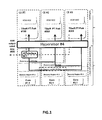
- FIG. 1 illustrates a system view of an exemplary embodiment of the Triple Software Redundancy (TSwR) Fault Tolerant Framework (FT-Fwk) architecture, with a multi-core processor appropriately selected and wisely configured:
- TwR Triple Software Redundancy
- Fwk Fault Tolerant Framework
- the computing platform (CP) hardware and its partitioned physical resources comprise a plurality of processing cores (for example #1.1, #2.1, and #3.1); a plurality of SDRAM-based (Synchronous Dynamic Random Access Memory) memory segments (for example #1.2, #2.2 and #3.2); and a plurality of shared memory channels (for example #12, #23, #31) and an I/O interface (for example #4.1).
- processing cores for example #1.1, #2.1, and #3.1
- SDRAM-based (Synchronous Dynamic Random Access Memory) memory segments for example #1.2, #2.2 and #3.2
- shared memory channels for example #12, #23, #31
- I/O interface for example #4.
- a computing platform can comprise a higher number of units (at least 2 and for example 186 units in replica configuration, or any other number, in correspondence with the number of cores of modern processors, whose roadmaps include 1000-cores processors or even more)
- the processing resource can be a quad-core processor (with one core disabled or forced to idle state) with hardware virtualization features (e.g. an additional privilege mode of execution at processor level), with one or two levels of cache memory including protection mechanisms (e.g. parity bits, an Error-Correcting Code - ECC) and with a Memory Management Unit (MMU) which segments the addressable memory space.
- hardware virtualization features e.g. an additional privilege mode of execution at processor level
- protection mechanisms e.g. parity bits, an Error-Correcting Code - ECC
- MMU Memory Management Unit
- the Hypervisor (HV) software layer #4 appropriately chosen, creates and manages the CEs, allocates physical resources to them and guarantees this allocation and their access during runtime.
- Hypervisor #4 is a thin software layer with services to manage events at processor level and in particular interrupts, running at the highest privilege mode of execution and offering open interfaces (APIs) for ad-hoc extensions.
- APIs open interfaces
- the computing elements #1, #2 and #3 are partitions, defined with dedicated set of virtual hardware resources based on the partitioning of actual hardware resources and running replicas #10, #20 and #30 of the application software (ASW) payload correctly interfaced to instances #100, #200 and #300 of the Triple Software Redundancy (TSwR) Fault Tolerant Framework (FT-Fwk).
- ASW application software
- TwR Triple Software Redundancy
- Fwk Fault Tolerant Framework
- the CE #3 is configured as primary channel for outside transmissions and the CE #1 is configured as secondary channel in case of CE #3 has been detected faulty.
- the CE #2 does not necessary need outside transmission channel.
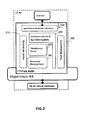
- Figure 2 details the system view of the software framework.
- the figure comprises an Application Runtime Interface 200, a Health Monitoring component 210, a Communication and Synchronization component 220, a Distributed voter 230, a recovery management component 240 and a Fault management component 250.
- An Application Runtime component 200 is an application component in charge of running the ASW in a replicate manner through well defined interfaces that minimize the ASW attachments to the TSwR framework and to manage the Virtual Channel (equivalent to OCS framework). As an example, it opens the Virtual Channel and establishes all underlying sub-channels connections. "Application" identifies a group of components of the TSwR framework interfacing with the domain ASW and running at the user level (in opposition to super-user and hypervisor).
- a Health Monitoring component 210 is a component in charge of implementing appropriate runtime mechanisms to control the safety of system. As an example, it monitors execution of hypervisor and replicas (e.g. timeouts, watchdog).
- a Communication & Synchronization component 220 is a core component in charge of various aspects such as the message queues services, the synchronicity of running ASW and the distribution of messages around all replicas. "Core" identifies a key layer of the TSwR framework to ensure deterministic behaviour and messages consistency.
- a Distributed Voter component 230 is a component scattered around all replicas that is in charge of finding an agreement on redundant messages from replicated ASW.
- the software components of this block are closely coupled with synchronization layer and fault manager.
- a Recovery Manager component 240 is a component in charge of reintegrating a faulty ASW replica during operation without interruption of service. As an example, it transfers the states and data information from a correct replica while application makes no progress.
- a Fault Manager component 250 is a core component in charge of fault diagnosis and fault reaction based on fault detection information reported by different framework components. It is responsible for executing the appropriate reaction upon faults and to handle redundancy management. "Core" identifies a key component of the TSwR framework to achieve fault tolerance need.
- the figure illustrates a functional outline of the software framework, comprising functional components, specific mechanisms and software building blocks.
- the figure shows a Computing Element CE #x (with its virtual Hardware), wherein x is a number of a CE, an application software (ASW) #x0 and a framework FT-Fwk #x00.
- This functional outline of invention can indeed apply to any Computing Element CE, application software (ASW) and FT-Fwk of the software architecture.
- the overlap of Hypervisor #4 and FT-Fwk #x00 illustrates that various variants for the software static breakdown architecture can be implemented.
- An Application Runtime Interface 200 is a component which can be in charge of running the application software (ASW) payload in a replicate manner through defined software interfaces which minimize the application software (ASW) payload attachments to the TSwR FT-Fwk architecture.
- the component on the one hand provides an interface as entry point to launch the application software (ASW) with the synchronized (and correct) data input context, and on the other hand provides a synchronization point interface which shall be called by the application software (ASW) at the end of each computing round with the produced data output values.
- the latter interface formats the produced data output values and round context information in a Payload Data Unit (PDU) message to pass to the communication and synchronization layer.
- PDU Payload Data Unit
- a Health Monitoring component 210 is a functional component in charge of implementing appropriate run-time mechanisms to control software and processor operations.
- the chosen processor provides a watchdog mechanism for each core configured and managed at hypervisor privilege level.
- the component monitors execution of hypervisor and of replicas (e.g. timeout expiration, watchdog). At this end, it provides an interface to ping, at a regular interval, the watchdog to notify it which all is operating correctly. In the absence of such ping call at the end of a predefined time period, the watchdog resets the core (or respectively the processor) executing the Computing Element CE #x (or respectively the Hypervisor #4) software.
- a hardware and /or software lock state is detected and can be rectified.
- this component can comprise means (and corresponding interfaces) for computing delays and triggering timeout expiration conditions (e.g. implementation of alarms or timers - start/stop/interrupt handler/flags).
- timeout expiration conditions e.g. implementation of alarms or timers - start/stop/interrupt handler/flags.
- an additional external hardware watchdog mechanism for activating the processor reset. The hypervisor sends, at a regular interval, a signal to this external mechanism to notify it which it is operating correctly. In absence of such a signal at the end of a predefined time period, the external hardware watchdog resets the processor.
- a Communication & Synchronization component 220 (“globalization module is a component which is mainly in charge of synchronization between application software (ASW) replicas (#10, #20 and #30), distribution of application software (ASW) replicas redundant data output values around all FT-Fwk instances (#100, #200 and #300).
- the computing platform (CP) is associated with a replicated configuration.
- Replicate instances of application software (ASW) are synchronized.
- the synchronization takes place when the application software (ASW) utilizes defined software interfaces, creating synchronous blocking points (also useful for a faulty replica reintegration).
- the fault detection is performed by comparison of the output behaviours which include the message sending behaviour of the application software (ASW) replicas (through the Application Runtime Interface 200).
- the central service of the synchronization layer module of FT-Fwk is the "globalization" of messages. This service defines which messages, available on one CE, are distributed. The service distributes messages in such a way that these messages are available in the same consistent manner on all CEs in the computing platform (CP).
- the strategy for invoking such globalization activity is to allow each replica entity to initiate a synchronization activity with the synchronous blocking point. All partner replicas can immediately respond to the started synchronization activity. In other words, the first replica starting the globalization sets a defined delay (e.g.
- this globalization module comprises means to build a computing platform (CP) "global time" for messages time stamping which is computed with fault-free (at this point in time) replicas local time.
- CP computing platform
- this component comprises means to exchange safety-relevant data over different existing transmission media (e.g. shared memory, Ethernet, I/Os Interface).
- the communication layer module of each FT-Fwk has an individual communication stack with a protocol layer, a data integrity layer and a device layer.
- the protocol layer is responsible for the control and the monitoring of the message transfer procedure, while the data integrity layer provides the received messages examination and the messages' construction for emission including the unique safety extension code.
- the task of the device layer consists essentially to structure and to monitor the data exchange completion according to requirements of existing transmission media cases.
- a Distributed Voter (231,232,233) is a component which is in charge of finding an agreement upon redundant messages from Computing Elements (CE#1, CE#2 and CE#3), determining and committing the correct message to outside computing platform (CP).
- Each voter is instantiated in each replica (within #100, #200 and #300), associates corresponding messages and puts this triplet in a deposit-box.
- a voter (layer) module (231,232,233) is closely coupled with the fault management component 250 for error reporting reasons and with the communication and synchronization component 220 for getting the received messages in deposit-box and for transmitting outside the voted message as well.
- a Recovery Manager component 240 is a component which is in charge of reintegrating a faulty replica during operation without interruption of service. As an example, it reloads and restarts a faulty replica providing the input data context (a.k.a. a functional execution context) from a correct replica while all application software (ASW) (ASW#1, ASW#2 and ASW#3) make no progress.
- ASW application software
- This recovery feature intends to improve the availability of payload application.
- This recovery by redundancy takes its roots in systems which have redundancy properties.
- the principle characteristic carried on is the existence of several instances (duplication at minimum) processing the same inputs and running simultaneously. This is one of the invention aims.
- This recovery strategy has to use the produced data of a valid instance to replace the incorrect data of the erroneous instance at a point in time.
- This replacement technique relies on an operational synchronization delivering a defined steady state between the replicas which run in parallel.
- This is one of the invention aims of the Communication and Synchronization component. It detects erroneous behaviour, reports this error to the Fault Management for a diagnosis and the suitable reaction.
- the online reintegration operations are blocking (i.e. recovery is not done in the background to payload application activity): during this recovery time slot, the payload application makes no progress, in order to maintain the input data context coherency.
- the recovery manager module is implemented within the Hypervisor #4 software layer. It runs in privilege execution mode, called at the end of processing round periods while replicas are waiting.
- a Fault Management component 250 is a component which is in charge of fault diagnosis and fault reaction based on fault detection information reported by different framework components. It is responsible for executing the proper reaction upon faults and to handle redundancy management: the membership status. To achieve a high level of SEU and SEFI fault tolerance, the invention aims to handle the following failures:
- the detection of these states is scattered around all TSwR FT-Fwk functional components which are responsible for fault reporting through a well defined fault management interface.
- the invention aims to improve the payload application availability executed on a COTS modern processor and for which purpose, the fault management manages the hereinafter kind of faults status and respective actions:
- CEs (#1, #2 and #3) are managed.
- a CE fails the synchronization protocol (e.g. a timeout expires) or a CE's message behaviour is detected faulty (e.g. message content error), an error is reported to Fault Management.
- This software layer diagnosis the status and the erroneous CE becomes a non-member for distributed voters and it is isolated. A non-member CE needs to be recovered before becoming member again.
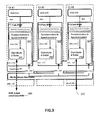
- Figure 3 illustrates an example of a communication and synchronization sequence.
- This voting method can be defined for 2-out-of-3 late commitment voting: two messages of the three messages need to be identical and the agreed result is committed either when all messages have been received or a predefined timeout expires.
- the comparison method and the diagnosis method (in case of comparison error) distinguish between data field and safety extension.
- An exemplary corresponding method or strategy can be:
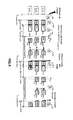
- Figure 4 illustrates the timeline of a Nominal and Faulty dynamic exemplary scenario. It represents an example of a dynamic scenario of a TSwR FT-Fwk in a nominal case (no SEU or SEFI event) and a in faulty case (a SEFI occurs and stops the CE #3 replica execution).
- the exemplary scenario is sliced in several stages identified with numbered references.
- CEs Three CEs are operated (CE#1, CE#2 and CE#3) from separated memory segments on different processing cores.
- the probability that a SEU or SEFI event locks the processor is thereby reduced.
- the functional components of the TSwR FT-Fwk architecture instantiated in each Computing Element (CE) detect and mask SEU event impacting a data memory location. It also detects SEFI event on a replica and this faulty replica is isolated and then it will be recovered.
- the CE#3 is faulty.
- the described methods and systems can reload completely the erroneous CE (e.g. virtual hardware configuration, application software (ASW) and FT-Fwk programs) and then restart the initialization stage during which the input data context is overwritten with correct ones coming from a valid CE (which implies an existing one).
- ASW application software
- FT-Fwk programs e.g. FT-Fwk programs
- the stage 1 corresponds to start-up and initialization of the overall computing platform (CP).
- the scenario starts from the power-up of computing platform (CP) (time marked t0) with the full initialization of computing platform (CP).
- the Hypervisor #4 layer loads and starts all Computing Elements (CEs) using only one program stored in a nonvolatile memory. According to appropriately predefined virtual machines configuration, the Hypervisor #4 loads three instances of this program in three isolated RAM segments.
- the ti,ReadyToStart is a point in time when all replicas (#1, #2 and #3) call to distributed fault management for diagnosis and reactions with respect to their status.
- the stage 2 corresponds to fault management steps which include the computing platform (CP) state diagnosis and respective reactions.
- replicas enter in this stage with a correct behaviour resulting in a nominal reaction; all replicas are voters' membership and no recovery action is performed.
- the ti,SynchroStart is a point in time when all replicas are blocked waiting for a synchronization signal to start a new processing round.
- the time duration (ti,SynchroStart - ti,ReadyToStart) is the time slot for distributed fault management and recovery strategy. Such a time slot can be mastered and advantageously limited.
- the global time, the round number and the input data context are updated to each replica.
- the stage 3 corresponds to the application payload execution time slot.
- the behaviour correctness of application software (ASW) processing round is monitored with a time window (a.k.a. allowing an execution time jitter) around the predefined ti,SynchroPoint with a minimum dlmin and a maximum dlmax delay to reach this point.
- the ti, SynchroPoint is a point in time when all application software (ASW) (ASW #10, ASW #20 and ASW #30) have produced output data values and they have called the Application Runtime Interface to build PDU message for communication and synchronization. Since ti,SynchroPoint until ti+1,SynchroStart, the application payload is suspended.
- the stage 4 corresponds to globalization, distributed vote and outside communication time slot.
- Communication and synchronization layer of each FT-Fwk (#100, 200 and #300) performs safety protocol steps in order to dispatch (in a point-to-point way) own messages to neighbouring replicas. Then, the voting method rolls out with comparison, agreement and commitment activities.
- This stage ends well and according to the example, the Computing Element CE#3, primary outside channel owner, transmits outside its voted message (including the full safety extension) before the ti+1,ReadyToStart deadline.
- the ti+1,ReadyToStart is a synchronization point in time when replicas (CE#1, CE#2 and CE#3) call to distributed fault management for diagnosis and reactions with respect to their status.
- the stage 5 corresponds to fault management activities or steps which include also the computing platform (CP) state diagnosis and respectively reactions.
- CP computing platform
- FT-Fwk #100 and #200 arrive approximately at the same time without any fault detected, the FT-Fwk #300 enters in this stage after and also without any fault detected. Therefore this correct behaviour results in nominal reaction; all replicas stay voters' membership and no recovery strategy is needed.
- the stage 6 starts with ti+1,SynchroStart synchronization point when all applications payload (ASW#10, ASW#20 and ASW#30) are suspended waiting for a synchronization signal to start a new processing round.
- the previous stage resumes each replica with new computed global time, next round number and recorded input data context.
- particle impact radiation
- the exemplary scenario assumes that this particle produces a SEFI event on the processing core allocated to Computing Element CE#3.
- the effect of the impact corresponds to a locking state of the core which could result either to an endless loop situation, a machine check exception or another blocking situation depending on the selected processor architecture.
- the application software (ASW) ASW#30 execution is corrupted and the associated core enters in a locking state which will be detected by one of Health Monitoring mechanisms (e.g. watchdog, exception handler, deadline timeout).
- Health Monitoring mechanisms e.g. watchdog, exception handler, deadline timeout.
- the Health Monitoring component reports a Severe Error status information to the Fault Management component which leads to redundancy management with an action for isolating this replica.
- application software (ASW) ASW#10 and ASW#20 continue their processing rounds to produce output data values and then they call the Application Runtime Interface entering to ti+1,SynchroPoint synchronization point.
- both FT-Fwk #100 and #200 report a Warning status information to the Fault Management component which in turn- confirms the redundancy management action:
- Computing Element CE#3 is then isolated from voters.
- the stage 6 rolls out message globalization, distributed vote and outside communication steps as introduced in stage 4 (step 404).
- Remaining FT-Fwk #100 and #200 send own messages to each other.
- the voting method applies only on both remaining members.
- the stage ends with Computing Element CE#1; secondary outside channel owner, transmission of its voted message to the outside.
- the recovery step is now described.
- both remaining replicas (#1 and #2) call to distributed fault management component which passes on to Hypervisor #4 layered fault management.
- the stage 7 is mainly done by Hypervisor #4 layer which contains the computing platform (CP) fault management and recovery strategy component.
- the computing platform (CP) fault management diagnoses a Severe Error from CE#3 and then activates the recovery strategy.
- the recovery can consist, for example, for the Hypervisor #4 to load the program to predefined RAM memory segment and to start over the program from the beginning. This restarted Computing Element CE#3 (re)joins the others replicas at the synchronization point ti+2,SynchroStart.
Landscapes
- Engineering & Computer Science (AREA)
- Theoretical Computer Science (AREA)
- Quality & Reliability (AREA)
- Physics & Mathematics (AREA)
- General Engineering & Computer Science (AREA)
- General Physics & Mathematics (AREA)
- Computer Hardware Design (AREA)
- Software Systems (AREA)
- Hardware Redundancy (AREA)
Priority Applications (4)
| Application Number | Priority Date | Filing Date | Title |
|---|---|---|---|
| EP13290313.9A EP2884392B1 (fr) | 2013-12-13 | 2013-12-13 | Architecture tolérante aux fautes basée sur une triple redondance logicielle |
| ES13290313T ES2696604T3 (es) | 2013-12-13 | 2013-12-13 | Arquitectura de marco tolerante a fallos con triple redundancia de software |
| PCT/EP2014/076820 WO2015086488A1 (fr) | 2013-12-13 | 2014-12-08 | Architecture de cadre insensible aux défaillances et à triple redondance logicielle |
| US15/103,806 US10095601B2 (en) | 2013-12-13 | 2014-12-08 | Triple software redundancy fault tolerant framework architecture |
Applications Claiming Priority (1)
| Application Number | Priority Date | Filing Date | Title |
|---|---|---|---|
| EP13290313.9A EP2884392B1 (fr) | 2013-12-13 | 2013-12-13 | Architecture tolérante aux fautes basée sur une triple redondance logicielle |
Publications (2)
| Publication Number | Publication Date |
|---|---|
| EP2884392A1 true EP2884392A1 (fr) | 2015-06-17 |
| EP2884392B1 EP2884392B1 (fr) | 2018-08-15 |
Family
ID=51846439
Family Applications (1)
| Application Number | Title | Priority Date | Filing Date |
|---|---|---|---|
| EP13290313.9A Active EP2884392B1 (fr) | 2013-12-13 | 2013-12-13 | Architecture tolérante aux fautes basée sur une triple redondance logicielle |
Country Status (4)
| Country | Link |
|---|---|
| US (1) | US10095601B2 (fr) |
| EP (1) | EP2884392B1 (fr) |
| ES (1) | ES2696604T3 (fr) |
| WO (1) | WO2015086488A1 (fr) |
Cited By (21)
| Publication number | Priority date | Publication date | Assignee | Title |
|---|---|---|---|---|
| US20150309831A1 (en) * | 2013-08-08 | 2015-10-29 | Architecture Technology Corporation | Fight-through nodes with disposable virtual machines and rollback of persistent state |
| US9766986B2 (en) | 2013-08-08 | 2017-09-19 | Architecture Technology Corporation | Fight-through nodes with disposable virtual machines and rollback of persistent state |
| WO2017167537A1 (fr) * | 2016-03-29 | 2017-10-05 | Siemens Aktiengesellschaft | Système, destiné en particulier à commander des postes d'aiguillage dans le trafic ferroviaire |
| DE102016206988A1 (de) * | 2016-04-25 | 2017-10-26 | Thales Deutschland Gmbh | Servereinrichtung betreibend eine Software zur Steuerung einer Funktion eines schienengebundenen Transportsicherungssystems |
| US9838415B2 (en) | 2011-09-14 | 2017-12-05 | Architecture Technology Corporation | Fight-through nodes for survivable computer network |
| FR3053140A1 (fr) * | 2016-06-27 | 2017-12-29 | Thales Sa | Architecture de calcul notamment pour un systeme embarque aeronautique |
| EP3273314A1 (fr) * | 2016-07-19 | 2018-01-24 | ABB Schweiz AG | Commande programmable comportant un système de gestion |
| US10061638B2 (en) | 2016-03-29 | 2018-08-28 | International Business Machines Corporation | Isolating faulty components in a clustered storage system with random redistribution of errors in data |
| US10095601B2 (en) * | 2013-12-13 | 2018-10-09 | Thales | Triple software redundancy fault tolerant framework architecture |
| US10114777B1 (en) * | 2017-06-08 | 2018-10-30 | Rockwell Collins, Inc. | I/O synchronization for high integrity multicore processing |
| US10200406B1 (en) | 2015-12-17 | 2019-02-05 | Architecture Technology Corporation | Configuration of application randomization mechanism |
| US10200401B1 (en) | 2015-12-17 | 2019-02-05 | Architecture Technology Corporation | Evaluating results of multiple virtual machines that use application randomization mechanism |
| US10284592B1 (en) | 2015-12-17 | 2019-05-07 | Architecture Technology Corporation | Application randomization mechanism |
| US10402179B1 (en) | 2015-12-17 | 2019-09-03 | Architecture Technology Corporation | Application randomization mechanism |
| US10412116B1 (en) | 2015-12-17 | 2019-09-10 | Architecture Technology Corporation | Mechanism for concealing application and operation system identity |
| US10412114B1 (en) | 2015-12-17 | 2019-09-10 | Architecture Technology Corporation | Application randomization mechanism |
| US10554685B1 (en) | 2017-05-25 | 2020-02-04 | Architecture Technology Corporation | Self-healing architecture for resilient computing services |
| CN113568710A (zh) * | 2021-08-03 | 2021-10-29 | 罗慧 | 一种虚拟机高可用实现方法、装置和设备 |
| CN118170724A (zh) * | 2022-12-08 | 2024-06-11 | 上海华为技术有限公司 | 数据处理方法、电子设备及计算机可读存储介质 |
| WO2024188515A1 (fr) * | 2023-03-13 | 2024-09-19 | Robert Bosch Gmbh | Procédé de transfert de données d'une pluralité de sources de données à un collecteur de données |
| EP4517531A1 (fr) * | 2023-08-30 | 2025-03-05 | Siemens Mobility GmbH | Procédé pour exécuter un processus technique en mode de contrôle et mode de réparation |
Families Citing this family (37)
| Publication number | Priority date | Publication date | Assignee | Title |
|---|---|---|---|---|
| US9992057B2 (en) * | 2014-04-25 | 2018-06-05 | International Business Machines Corporation | Yield tolerance in a neurosynaptic system |
| DE102015218898A1 (de) * | 2015-09-30 | 2017-03-30 | Robert Bosch Gmbh | Verfahren zur redundanten Verarbeitung von Daten |
| CN106371951B (zh) * | 2016-08-30 | 2020-01-31 | 中国科学院空间应用工程与技术中心 | 一种实施三模冗余的方法 |
| US10530468B2 (en) | 2016-10-19 | 2020-01-07 | Vector Launch Inc. | State transfer among virtualized nodes in spaceborne or airborne systems |
| US10805001B2 (en) | 2016-10-19 | 2020-10-13 | Lockheed Martin Corporation | State transfer among spaceborne and airborne devices |
| US9641238B1 (en) | 2016-10-19 | 2017-05-02 | Vector Launch Inc. | Virtualization-enabled satellite platforms |
| US9722692B1 (en) | 2016-10-19 | 2017-08-01 | Vector Launch Inc. | Statefulness among clustered satellite platforms |
| US10585755B2 (en) * | 2016-11-29 | 2020-03-10 | Ricoh Company, Ltd. | Electronic apparatus and method for restarting a central processing unit (CPU) in response to detecting an abnormality |
| JP6703687B2 (ja) * | 2017-03-06 | 2020-06-03 | 国立研究開発法人宇宙航空研究開発機構 | 飛行体用航法装置 |
| US9960837B1 (en) | 2017-07-19 | 2018-05-01 | Vector Launch Inc. | Pseudo-geosynchronous configurations in satellite platforms |
| US10757027B2 (en) * | 2017-07-19 | 2020-08-25 | Lockheed Martin Corporation | Quality of service management in a satellite platform |
| US9998207B1 (en) | 2017-07-19 | 2018-06-12 | Vector Launch Inc. | Orbital network layering in satellite platforms |
| US10069935B1 (en) | 2017-07-19 | 2018-09-04 | Vector Launch Inc. | Role-specialization in clustered satellite platforms |
| US10491710B2 (en) | 2017-07-19 | 2019-11-26 | Vector Launch Inc. | Role-specialization in spaceborne and airborne computing platforms |
| US10372901B1 (en) * | 2017-07-20 | 2019-08-06 | Rockwell Collins, Inc. | High assurance certifiable cryptographic system |
| US10630378B2 (en) | 2018-02-09 | 2020-04-21 | Lockheed Martin Corporation | Bandwidth optimizing range adjustments among satellites |
| CN108832990B (zh) * | 2018-06-08 | 2021-03-16 | 上海微小卫星工程中心 | 一种针对实时通信设备的空间单粒子效应即时恢复方法 |
| US10997029B2 (en) | 2019-03-07 | 2021-05-04 | International Business Machines Corporation | Core repair with failure analysis and recovery probe |
| CN110380934B (zh) * | 2019-07-23 | 2021-11-02 | 南京航空航天大学 | 一种分布式余度系统心跳检测方法 |
| US11390389B2 (en) * | 2019-11-16 | 2022-07-19 | Ami Industries, Inc. | Robust sequencer systems for ejection assembly |
| KR102914332B1 (ko) | 2020-01-29 | 2026-01-19 | 삼성전자주식회사 | 시스템 온 칩 및 이의 리셋 제어 방법 |
| US11797400B2 (en) * | 2020-05-19 | 2023-10-24 | EMC IP Holding Company LLC | Cost-optimized true zero recovery time objective for multiple applications based on interdependent applications |
| US11836512B2 (en) | 2020-05-19 | 2023-12-05 | EMC IP Holding Company LLC | Virtual machine replication strategy based on predicted application failures |
| US11899957B2 (en) | 2020-05-19 | 2024-02-13 | EMC IP Holding Company LLC | Cost-optimized true zero recovery time objective for multiple applications |
| US11934283B2 (en) | 2020-05-19 | 2024-03-19 | EMC IP Holding Company LLC | Cost-optimized true zero recovery time objective for multiple applications using failure domains |
| DE102020116959A1 (de) * | 2020-06-26 | 2021-12-30 | Infineon Technologies Ag | Watchdog-schaltung, schaltung, system-auf-chip, verfahren zum betrieb einer watchdog-schaltung, verfahren zum betrieb einer schaltung und verfahren zum betrieb eines systems-auf-chip |
| US11558468B2 (en) * | 2020-11-03 | 2023-01-17 | T-Mobile Usa, Inc. | Mobile client recovery using push notifications to execute exponential back-off procedure |
| US12056084B2 (en) * | 2020-12-09 | 2024-08-06 | The Boeing Company | Message synchronization system |
| EP4060946A1 (fr) | 2021-03-16 | 2022-09-21 | Siemens Aktiengesellschaft | Authentification d'un appareil dans un réseau de communication d'une installation d'automatisation |
| JP7589668B2 (ja) * | 2021-11-04 | 2024-11-26 | トヨタ自動車株式会社 | 情報処理装置、車両、及び情報処理方法 |
| US12117895B2 (en) * | 2022-03-31 | 2024-10-15 | Google Llc | Memory error recovery using write instruction signaling |
| US20240028809A1 (en) * | 2022-07-21 | 2024-01-25 | Silicon Technologies, Inc. | Integrated circuit design, contextual cells, design migration, and associated methods |
| US20240338284A1 (en) * | 2023-04-07 | 2024-10-10 | Apple Inc. | Modular redundancy |
| EP4521707B1 (fr) * | 2023-09-06 | 2026-04-01 | STMicroelectronics International N.V. | Architecture de réseau, véhicule et procédé correspondants |
| EP4530858B1 (fr) * | 2023-09-28 | 2026-04-15 | Siemens Mobility GmbH | Procédé de mise en uvre assistée par ordinateur d'un processus technique dans des unités de traitement |
| US12321773B1 (en) * | 2023-12-22 | 2025-06-03 | Parry Labs, Llc | System and method for a safety critical operating environment container architecture |
| CN118965342A (zh) * | 2024-08-13 | 2024-11-15 | 亿咖通(湖北)技术有限公司 | 虚拟化平台的安全监控方法、装置、设备及存储介质 |
Citations (3)
| Publication number | Priority date | Publication date | Assignee | Title |
|---|---|---|---|---|
| EP0977395A1 (fr) * | 1998-07-28 | 2000-02-02 | Alcatel | Méthode de transfert monocanal sécurisé de données entre les noeuds de calcul d'un réseau d'ordinateurs ainsi qu'un réseau d'ordinateurs et que des noeuds de calculs |
| US20080148015A1 (en) * | 2006-12-19 | 2008-06-19 | Yoshifumi Takamoto | Method for improving reliability of multi-core processor computer |
| US20110208997A1 (en) * | 2009-12-07 | 2011-08-25 | SPACE MICRO, INC., a corporation of Delaware | Radiation hard and fault tolerant multicore processor and method for ionizing radiation environment |
Family Cites Families (7)
| Publication number | Priority date | Publication date | Assignee | Title |
|---|---|---|---|---|
| GB2353113B (en) * | 1999-08-11 | 2001-10-10 | Sun Microsystems Inc | Software fault tolerant computer system |
| US8812871B2 (en) * | 2010-05-27 | 2014-08-19 | Cisco Technology, Inc. | Method and apparatus for trusted execution in infrastructure as a service cloud environments |
| FR2972548B1 (fr) | 2011-03-08 | 2013-07-12 | Thales Sa | Dispositif pour l'amelioration de la tolerance aux fautes d'un processeur |
| US9465632B2 (en) * | 2012-02-04 | 2016-10-11 | Global Supercomputing Corporation | Parallel hardware hypervisor for virtualizing application-specific supercomputers |
| ES2696604T3 (es) * | 2013-12-13 | 2019-01-17 | Thales Sa | Arquitectura de marco tolerante a fallos con triple redundancia de software |
| AU2016206826A1 (en) * | 2015-01-13 | 2016-12-22 | Hewlett Packard Enterprise Development Lp | Systems and methods for oprtimized signature comparisons and data replication |
| US10101913B2 (en) * | 2015-09-02 | 2018-10-16 | Commvault Systems, Inc. | Migrating data to disk without interrupting running backup operations |
-
2013
- 2013-12-13 ES ES13290313T patent/ES2696604T3/es active Active
- 2013-12-13 EP EP13290313.9A patent/EP2884392B1/fr active Active
-
2014
- 2014-12-08 US US15/103,806 patent/US10095601B2/en active Active
- 2014-12-08 WO PCT/EP2014/076820 patent/WO2015086488A1/fr not_active Ceased
Patent Citations (3)
| Publication number | Priority date | Publication date | Assignee | Title |
|---|---|---|---|---|
| EP0977395A1 (fr) * | 1998-07-28 | 2000-02-02 | Alcatel | Méthode de transfert monocanal sécurisé de données entre les noeuds de calcul d'un réseau d'ordinateurs ainsi qu'un réseau d'ordinateurs et que des noeuds de calculs |
| US20080148015A1 (en) * | 2006-12-19 | 2008-06-19 | Yoshifumi Takamoto | Method for improving reliability of multi-core processor computer |
| US20110208997A1 (en) * | 2009-12-07 | 2011-08-25 | SPACE MICRO, INC., a corporation of Delaware | Radiation hard and fault tolerant multicore processor and method for ionizing radiation environment |
Non-Patent Citations (3)
| Title |
|---|
| JEFFERY C M ET AL: "A Flexible Approach to Improving System Reliability with Virtual Lockstep", IEEE TRANSACTIONS ON DEPENDABLE AND SECURE COMPUTING, IEEE SERVICE CENTER, NEW YORK, NY, US, vol. 9, no. 1, 1 January 2012 (2012-01-01), pages 2 - 15, XP011398056, ISSN: 1545-5971, DOI: 10.1109/TDSC.2010.53 * |
| JEFFERY C M ET AL: "Towards Byzantine Fault Tolerance in Many-Core Computing Platforms", DEPENDABLE COMPUTING, 2007. PRDC 2007. 13TH PACIFIC RIM INTERNATIONAL SYMPOSIUM ON, IEEE, PISCATAWAY, NJ, USA, 17 December 2007 (2007-12-17), pages 256 - 259, XP031234599, ISBN: 978-0-7695-3054-3 * |
| RICARDO PAHARSINGH ET AL: "An Availability Model of a Virtual TMR System with Applications in Cloud/Cluster Computing", HIGH-ASSURANCE SYSTEMS ENGINEERING (HASE), 2011 IEEE 13TH INTERNATIONAL SYMPOSIUM ON, IEEE, 10 November 2011 (2011-11-10), pages 261 - 268, XP032083396, ISBN: 978-1-4673-0107-7, DOI: 10.1109/HASE.2011.11 * |
Cited By (30)
| Publication number | Priority date | Publication date | Assignee | Title |
|---|---|---|---|---|
| US9838415B2 (en) | 2011-09-14 | 2017-12-05 | Architecture Technology Corporation | Fight-through nodes for survivable computer network |
| US9769250B2 (en) * | 2013-08-08 | 2017-09-19 | Architecture Technology Corporation | Fight-through nodes with disposable virtual machines and rollback of persistent state |
| US9766986B2 (en) | 2013-08-08 | 2017-09-19 | Architecture Technology Corporation | Fight-through nodes with disposable virtual machines and rollback of persistent state |
| US20150309831A1 (en) * | 2013-08-08 | 2015-10-29 | Architecture Technology Corporation | Fight-through nodes with disposable virtual machines and rollback of persistent state |
| US10095601B2 (en) * | 2013-12-13 | 2018-10-09 | Thales | Triple software redundancy fault tolerant framework architecture |
| US10412114B1 (en) | 2015-12-17 | 2019-09-10 | Architecture Technology Corporation | Application randomization mechanism |
| US10412116B1 (en) | 2015-12-17 | 2019-09-10 | Architecture Technology Corporation | Mechanism for concealing application and operation system identity |
| US10402179B1 (en) | 2015-12-17 | 2019-09-03 | Architecture Technology Corporation | Application randomization mechanism |
| US10284592B1 (en) | 2015-12-17 | 2019-05-07 | Architecture Technology Corporation | Application randomization mechanism |
| US10200401B1 (en) | 2015-12-17 | 2019-02-05 | Architecture Technology Corporation | Evaluating results of multiple virtual machines that use application randomization mechanism |
| US10200406B1 (en) | 2015-12-17 | 2019-02-05 | Architecture Technology Corporation | Configuration of application randomization mechanism |
| US11161533B2 (en) | 2016-03-29 | 2021-11-02 | Siemens Mobility GmbH | System, in particular for controlling signal towers in rail traffic |
| US10061638B2 (en) | 2016-03-29 | 2018-08-28 | International Business Machines Corporation | Isolating faulty components in a clustered storage system with random redistribution of errors in data |
| WO2017167537A1 (fr) * | 2016-03-29 | 2017-10-05 | Siemens Aktiengesellschaft | Système, destiné en particulier à commander des postes d'aiguillage dans le trafic ferroviaire |
| DE102016206988A1 (de) * | 2016-04-25 | 2017-10-26 | Thales Deutschland Gmbh | Servereinrichtung betreibend eine Software zur Steuerung einer Funktion eines schienengebundenen Transportsicherungssystems |
| WO2018001956A1 (fr) * | 2016-06-27 | 2018-01-04 | Thales | Architecture de calcul notamment pour un systeme embarque aeronautique |
| FR3053140A1 (fr) * | 2016-06-27 | 2017-12-29 | Thales Sa | Architecture de calcul notamment pour un systeme embarque aeronautique |
| WO2018015454A1 (fr) * | 2016-07-19 | 2018-01-25 | Abb Schweiz Ag | Automate programmable industriel doté d'un système de gestion |
| EP3273314A1 (fr) * | 2016-07-19 | 2018-01-24 | ABB Schweiz AG | Commande programmable comportant un système de gestion |
| US11522904B2 (en) | 2017-05-25 | 2022-12-06 | Architecture Technology Corporation | Self-healing architecture for resilient computing services |
| US10554685B1 (en) | 2017-05-25 | 2020-02-04 | Architecture Technology Corporation | Self-healing architecture for resilient computing services |
| US10114777B1 (en) * | 2017-06-08 | 2018-10-30 | Rockwell Collins, Inc. | I/O synchronization for high integrity multicore processing |
| CN113568710A (zh) * | 2021-08-03 | 2021-10-29 | 罗慧 | 一种虚拟机高可用实现方法、装置和设备 |
| CN113568710B (zh) * | 2021-08-03 | 2023-07-21 | 罗慧 | 一种虚拟机高可用实现方法、装置和设备 |
| CN118170724A (zh) * | 2022-12-08 | 2024-06-11 | 上海华为技术有限公司 | 数据处理方法、电子设备及计算机可读存储介质 |
| WO2024188515A1 (fr) * | 2023-03-13 | 2024-09-19 | Robert Bosch Gmbh | Procédé de transfert de données d'une pluralité de sources de données à un collecteur de données |
| EP4517531A1 (fr) * | 2023-08-30 | 2025-03-05 | Siemens Mobility GmbH | Procédé pour exécuter un processus technique en mode de contrôle et mode de réparation |
| US20250077322A1 (en) * | 2023-08-30 | 2025-03-06 | Siemens Mobility GmbH | Method for performing a technical process in regular operation and repair operation |
| US12443473B2 (en) * | 2023-08-30 | 2025-10-14 | Siemens Mobility GmbH | Method for performing a technical process in regular operation and repair operation |
| AU2024213171B2 (en) * | 2023-08-30 | 2026-07-09 | Siemens Mobility GmbH | Method for performing a technical process in regular operation and repair operation |
Also Published As
| Publication number | Publication date |
|---|---|
| WO2015086488A1 (fr) | 2015-06-18 |
| US10095601B2 (en) | 2018-10-09 |
| US20160314057A1 (en) | 2016-10-27 |
| ES2696604T3 (es) | 2019-01-17 |
| EP2884392B1 (fr) | 2018-08-15 |
Similar Documents
| Publication | Publication Date | Title |
|---|---|---|
| US10095601B2 (en) | Triple software redundancy fault tolerant framework architecture | |
| El Salloum et al. | The ACROSS MPSoC–A new generation of multi-core processors designed for safety–critical embedded systems | |
| US8886994B2 (en) | Radiation hard and fault tolerant multicore processor and method for ionizing radiation environment | |
| US4937741A (en) | Synchronization of fault-tolerant parallel processing systems | |
| Guermouche et al. | Hydee: Failure containment without event logging for large scale send-deterministic mpi applications | |
| Fayyaz et al. | Survey and future directions of fault-tolerant distributed computing on board spacecraft | |
| Eles et al. | Synthesis of fault-tolerant embedded systems | |
| Gujarati et al. | Real-time replica consistency over ethernet with reliability bounds | |
| Rambo et al. | Replica-aware co-scheduling for mixed-criticality | |
| Kopetz | Why time-triggered architectures will succeed in large hard real-time systems | |
| Gujarati et al. | Quantifying the resiliency of fail-operational real-time networked control systems | |
| Aidemark et al. | A framework for node-level fault tolerance in distributed real-time systems | |
| Bondavalli et al. | State restoration in a COTS-based N-modular architecture | |
| Heidari et al. | Integrating open saf high availability solution with open stack | |
| Thekkilakattil et al. | Mixed criticality systems: Beyond transient faults | |
| Kopetz | Fault containment and error detection in TTP/C and FlexRay | |
| Resch et al. | Software composability and mixed criticality for triple modular redundant architectures | |
| Gujarati | Towards “Ultra-Reliable” CPS: Reliability Analysis of Distributed Real-Time Systems | |
| Snyder et al. | Robustness infrastructure for multi-agent systems | |
| Basile et al. | Active replication of multithreaded applications | |
| JP7689524B2 (ja) | キャリアの動作安全性にクリティカルである少なくとも1つのサービスを実施する、キャリア上に設置されるコンピュータシステム | |
| Proenza et al. | Using FTT and stars to simplify node replication in CAN-based systems | |
| Martens et al. | CrossCheck: A holistic approach for tolerating crash-faults and arbitrary failures | |
| Krings et al. | Scheduling issues in survivability applications using hybrid fault models | |
| Trawczynski | OF TECHNOLOGY |
Legal Events
| Date | Code | Title | Description |
|---|---|---|---|
| PUAI | Public reference made under article 153(3) epc to a published international application that has entered the european phase |
Free format text: ORIGINAL CODE: 0009012 |
|
| 17P | Request for examination filed |
Effective date: 20131213 |
|
| AK | Designated contracting states |
Kind code of ref document: A1 Designated state(s): AL AT BE BG CH CY CZ DE DK EE ES FI FR GB GR HR HU IE IS IT LI LT LU LV MC MK MT NL NO PL PT RO RS SE SI SK SM TR |
|
| AX | Request for extension of the european patent |
Extension state: BA ME |
|
| R17P | Request for examination filed (corrected) |
Effective date: 20151116 |
|
| RBV | Designated contracting states (corrected) |
Designated state(s): AL AT BE BG CH CY CZ DE DK EE ES FI FR GB GR HR HU IE IS IT LI LT LU LV MC MK MT NL NO PL PT RO RS SE SI SK SM TR |
|
| 17Q | First examination report despatched |
Effective date: 20170608 |
|
| GRAP | Despatch of communication of intention to grant a patent |
Free format text: ORIGINAL CODE: EPIDOSNIGR1 |
|
| RIC1 | Information provided on ipc code assigned before grant |
Ipc: G06F 11/14 20060101AFI20180328BHEP Ipc: G06F 11/07 20060101ALN20180328BHEP Ipc: G06F 11/16 20060101ALN20180328BHEP Ipc: G06F 11/18 20060101ALI20180328BHEP |
|
| INTG | Intention to grant announced |
Effective date: 20180424 |
|
| GRAS | Grant fee paid |
Free format text: ORIGINAL CODE: EPIDOSNIGR3 |
|
| GRAA | (expected) grant |
Free format text: ORIGINAL CODE: 0009210 |
|
| RAP1 | Party data changed (applicant data changed or rights of an application transferred) |
Owner name: THALES |
|
| AK | Designated contracting states |
Kind code of ref document: B1 Designated state(s): AL AT BE BG CH CY CZ DE DK EE ES FI FR GB GR HR HU IE IS IT LI LT LU LV MC MK MT NL NO PL PT RO RS SE SI SK SM TR |
|
| REG | Reference to a national code |
Ref country code: CH Ref legal event code: EP Ref country code: GB Ref legal event code: FG4D Ref country code: AT Ref legal event code: REF Ref document number: 1030564 Country of ref document: AT Kind code of ref document: T Effective date: 20180815 |
|
| REG | Reference to a national code |
Ref country code: IE Ref legal event code: FG4D |
|
| REG | Reference to a national code |
Ref country code: DE Ref legal event code: R096 Ref document number: 602013041970 Country of ref document: DE |
|
| REG | Reference to a national code |
Ref country code: NL Ref legal event code: MP Effective date: 20180815 |
|
| REG | Reference to a national code |
Ref country code: LT Ref legal event code: MG4D |
|
| REG | Reference to a national code |
Ref country code: AT Ref legal event code: MK05 Ref document number: 1030564 Country of ref document: AT Kind code of ref document: T Effective date: 20180815 |
|
| REG | Reference to a national code |
Ref country code: ES Ref legal event code: FG2A Ref document number: 2696604 Country of ref document: ES Kind code of ref document: T3 Effective date: 20190117 |
|
| PG25 | Lapsed in a contracting state [announced via postgrant information from national office to epo] |
Ref country code: BG Free format text: LAPSE BECAUSE OF FAILURE TO SUBMIT A TRANSLATION OF THE DESCRIPTION OR TO PAY THE FEE WITHIN THE PRESCRIBED TIME-LIMIT Effective date: 20181115 Ref country code: LT Free format text: LAPSE BECAUSE OF FAILURE TO SUBMIT A TRANSLATION OF THE DESCRIPTION OR TO PAY THE FEE WITHIN THE PRESCRIBED TIME-LIMIT Effective date: 20180815 Ref country code: IS Free format text: LAPSE BECAUSE OF FAILURE TO SUBMIT A TRANSLATION OF THE DESCRIPTION OR TO PAY THE FEE WITHIN THE PRESCRIBED TIME-LIMIT Effective date: 20181215 Ref country code: NL Free format text: LAPSE BECAUSE OF FAILURE TO SUBMIT A TRANSLATION OF THE DESCRIPTION OR TO PAY THE FEE WITHIN THE PRESCRIBED TIME-LIMIT Effective date: 20180815 Ref country code: SE Free format text: LAPSE BECAUSE OF FAILURE TO SUBMIT A TRANSLATION OF THE DESCRIPTION OR TO PAY THE FEE WITHIN THE PRESCRIBED TIME-LIMIT Effective date: 20180815 Ref country code: NO Free format text: LAPSE BECAUSE OF FAILURE TO SUBMIT A TRANSLATION OF THE DESCRIPTION OR TO PAY THE FEE WITHIN THE PRESCRIBED TIME-LIMIT Effective date: 20181115 Ref country code: GR Free format text: LAPSE BECAUSE OF FAILURE TO SUBMIT A TRANSLATION OF THE DESCRIPTION OR TO PAY THE FEE WITHIN THE PRESCRIBED TIME-LIMIT Effective date: 20181116 Ref country code: FI Free format text: LAPSE BECAUSE OF FAILURE TO SUBMIT A TRANSLATION OF THE DESCRIPTION OR TO PAY THE FEE WITHIN THE PRESCRIBED TIME-LIMIT Effective date: 20180815 Ref country code: AT Free format text: LAPSE BECAUSE OF FAILURE TO SUBMIT A TRANSLATION OF THE DESCRIPTION OR TO PAY THE FEE WITHIN THE PRESCRIBED TIME-LIMIT Effective date: 20180815 Ref country code: RS Free format text: LAPSE BECAUSE OF FAILURE TO SUBMIT A TRANSLATION OF THE DESCRIPTION OR TO PAY THE FEE WITHIN THE PRESCRIBED TIME-LIMIT Effective date: 20180815 |
|
| PG25 | Lapsed in a contracting state [announced via postgrant information from national office to epo] |
Ref country code: HR Free format text: LAPSE BECAUSE OF FAILURE TO SUBMIT A TRANSLATION OF THE DESCRIPTION OR TO PAY THE FEE WITHIN THE PRESCRIBED TIME-LIMIT Effective date: 20180815 Ref country code: LV Free format text: LAPSE BECAUSE OF FAILURE TO SUBMIT A TRANSLATION OF THE DESCRIPTION OR TO PAY THE FEE WITHIN THE PRESCRIBED TIME-LIMIT Effective date: 20180815 Ref country code: AL Free format text: LAPSE BECAUSE OF FAILURE TO SUBMIT A TRANSLATION OF THE DESCRIPTION OR TO PAY THE FEE WITHIN THE PRESCRIBED TIME-LIMIT Effective date: 20180815 |
|
| PG25 | Lapsed in a contracting state [announced via postgrant information from national office to epo] |
Ref country code: EE Free format text: LAPSE BECAUSE OF FAILURE TO SUBMIT A TRANSLATION OF THE DESCRIPTION OR TO PAY THE FEE WITHIN THE PRESCRIBED TIME-LIMIT Effective date: 20180815 Ref country code: IT Free format text: LAPSE BECAUSE OF FAILURE TO SUBMIT A TRANSLATION OF THE DESCRIPTION OR TO PAY THE FEE WITHIN THE PRESCRIBED TIME-LIMIT Effective date: 20180815 Ref country code: CZ Free format text: LAPSE BECAUSE OF FAILURE TO SUBMIT A TRANSLATION OF THE DESCRIPTION OR TO PAY THE FEE WITHIN THE PRESCRIBED TIME-LIMIT Effective date: 20180815 Ref country code: RO Free format text: LAPSE BECAUSE OF FAILURE TO SUBMIT A TRANSLATION OF THE DESCRIPTION OR TO PAY THE FEE WITHIN THE PRESCRIBED TIME-LIMIT Effective date: 20180815 Ref country code: PL Free format text: LAPSE BECAUSE OF FAILURE TO SUBMIT A TRANSLATION OF THE DESCRIPTION OR TO PAY THE FEE WITHIN THE PRESCRIBED TIME-LIMIT Effective date: 20180815 |
|
| REG | Reference to a national code |
Ref country code: DE Ref legal event code: R097 Ref document number: 602013041970 Country of ref document: DE |
|
| PG25 | Lapsed in a contracting state [announced via postgrant information from national office to epo] |
Ref country code: SK Free format text: LAPSE BECAUSE OF FAILURE TO SUBMIT A TRANSLATION OF THE DESCRIPTION OR TO PAY THE FEE WITHIN THE PRESCRIBED TIME-LIMIT Effective date: 20180815 Ref country code: DK Free format text: LAPSE BECAUSE OF FAILURE TO SUBMIT A TRANSLATION OF THE DESCRIPTION OR TO PAY THE FEE WITHIN THE PRESCRIBED TIME-LIMIT Effective date: 20180815 Ref country code: SM Free format text: LAPSE BECAUSE OF FAILURE TO SUBMIT A TRANSLATION OF THE DESCRIPTION OR TO PAY THE FEE WITHIN THE PRESCRIBED TIME-LIMIT Effective date: 20180815 |
|
| PLBE | No opposition filed within time limit |
Free format text: ORIGINAL CODE: 0009261 |
|
| STAA | Information on the status of an ep patent application or granted ep patent |
Free format text: STATUS: NO OPPOSITION FILED WITHIN TIME LIMIT |
|
| 26N | No opposition filed |
Effective date: 20190516 |
|
| REG | Reference to a national code |
Ref country code: CH Ref legal event code: PL |
|
| GBPC | Gb: european patent ceased through non-payment of renewal fee |
Effective date: 20181213 |
|
| PG25 | Lapsed in a contracting state [announced via postgrant information from national office to epo] |
Ref country code: SI Free format text: LAPSE BECAUSE OF FAILURE TO SUBMIT A TRANSLATION OF THE DESCRIPTION OR TO PAY THE FEE WITHIN THE PRESCRIBED TIME-LIMIT Effective date: 20180815 Ref country code: LU Free format text: LAPSE BECAUSE OF NON-PAYMENT OF DUE FEES Effective date: 20181213 Ref country code: MC Free format text: LAPSE BECAUSE OF FAILURE TO SUBMIT A TRANSLATION OF THE DESCRIPTION OR TO PAY THE FEE WITHIN THE PRESCRIBED TIME-LIMIT Effective date: 20180815 |
|
| REG | Reference to a national code |
Ref country code: IE Ref legal event code: MM4A |
|
| REG | Reference to a national code |
Ref country code: BE Ref legal event code: MM Effective date: 20181231 |
|
| PG25 | Lapsed in a contracting state [announced via postgrant information from national office to epo] |
Ref country code: IE Free format text: LAPSE BECAUSE OF NON-PAYMENT OF DUE FEES Effective date: 20181213 |
|
| PG25 | Lapsed in a contracting state [announced via postgrant information from national office to epo] |
Ref country code: BE Free format text: LAPSE BECAUSE OF NON-PAYMENT OF DUE FEES Effective date: 20181231 |
|
| PG25 | Lapsed in a contracting state [announced via postgrant information from national office to epo] |
Ref country code: LI Free format text: LAPSE BECAUSE OF NON-PAYMENT OF DUE FEES Effective date: 20181231 Ref country code: GB Free format text: LAPSE BECAUSE OF NON-PAYMENT OF DUE FEES Effective date: 20181213 Ref country code: CH Free format text: LAPSE BECAUSE OF NON-PAYMENT OF DUE FEES Effective date: 20181231 |
|
| PG25 | Lapsed in a contracting state [announced via postgrant information from national office to epo] |
Ref country code: MT Free format text: LAPSE BECAUSE OF NON-PAYMENT OF DUE FEES Effective date: 20181213 |
|
| PG25 | Lapsed in a contracting state [announced via postgrant information from national office to epo] |
Ref country code: TR Free format text: LAPSE BECAUSE OF FAILURE TO SUBMIT A TRANSLATION OF THE DESCRIPTION OR TO PAY THE FEE WITHIN THE PRESCRIBED TIME-LIMIT Effective date: 20180815 |
|
| PG25 | Lapsed in a contracting state [announced via postgrant information from national office to epo] |
Ref country code: PT Free format text: LAPSE BECAUSE OF FAILURE TO SUBMIT A TRANSLATION OF THE DESCRIPTION OR TO PAY THE FEE WITHIN THE PRESCRIBED TIME-LIMIT Effective date: 20180815 |
|
| PG25 | Lapsed in a contracting state [announced via postgrant information from national office to epo] |
Ref country code: HU Free format text: LAPSE BECAUSE OF FAILURE TO SUBMIT A TRANSLATION OF THE DESCRIPTION OR TO PAY THE FEE WITHIN THE PRESCRIBED TIME-LIMIT; INVALID AB INITIO Effective date: 20131213 Ref country code: MK Free format text: LAPSE BECAUSE OF NON-PAYMENT OF DUE FEES Effective date: 20180815 Ref country code: CY Free format text: LAPSE BECAUSE OF FAILURE TO SUBMIT A TRANSLATION OF THE DESCRIPTION OR TO PAY THE FEE WITHIN THE PRESCRIBED TIME-LIMIT Effective date: 20180815 |
|
| PGFP | Annual fee paid to national office [announced via postgrant information from national office to epo] |
Ref country code: DE Payment date: 20251119 Year of fee payment: 13 |
|
| PGFP | Annual fee paid to national office [announced via postgrant information from national office to epo] |
Ref country code: FR Payment date: 20251124 Year of fee payment: 13 |
|
| PGFP | Annual fee paid to national office [announced via postgrant information from national office to epo] |
Ref country code: ES Payment date: 20260115 Year of fee payment: 13 |