EP2881874B1 - System und Verfahren zur Suche nach neuem Material - Google Patents
System und Verfahren zur Suche nach neuem Material Download PDFInfo
- Publication number
- EP2881874B1 EP2881874B1 EP14196003.9A EP14196003A EP2881874B1 EP 2881874 B1 EP2881874 B1 EP 2881874B1 EP 14196003 A EP14196003 A EP 14196003A EP 2881874 B1 EP2881874 B1 EP 2881874B1
- Authority
- EP
- European Patent Office
- Prior art keywords
- matrix
- ion
- substitution
- substitution tendency
- tendency
- Prior art date
- Legal status (The legal status is an assumption and is not a legal conclusion. Google has not performed a legal analysis and makes no representation as to the accuracy of the status listed.)
- Not-in-force
Links
Images



Classifications
-
- G—PHYSICS
- G16—INFORMATION AND COMMUNICATION TECHNOLOGY [ICT] SPECIALLY ADAPTED FOR SPECIFIC APPLICATION FIELDS
- G16C—COMPUTATIONAL CHEMISTRY; CHEMOINFORMATICS; COMPUTATIONAL MATERIALS SCIENCE
- G16C60/00—Computational materials science, i.e. ICT specially adapted for investigating the physical or chemical properties of materials or phenomena associated with their design, synthesis, processing, characterisation or utilisation
-
- G—PHYSICS
- G06—COMPUTING OR CALCULATING; COUNTING
- G06F—ELECTRIC DIGITAL DATA PROCESSING
- G06F17/00—Digital computing or data processing equipment or methods, specially adapted for specific functions
- G06F17/10—Complex mathematical operations
-
- G—PHYSICS
- G06—COMPUTING OR CALCULATING; COUNTING
- G06F—ELECTRIC DIGITAL DATA PROCESSING
- G06F17/00—Digital computing or data processing equipment or methods, specially adapted for specific functions
- G06F17/10—Complex mathematical operations
- G06F17/18—Complex mathematical operations for evaluating statistical data, e.g. average values, frequency distributions, probability functions, regression analysis
-
- G—PHYSICS
- G06—COMPUTING OR CALCULATING; COUNTING
- G06F—ELECTRIC DIGITAL DATA PROCESSING
- G06F16/00—Information retrieval; Database structures therefor; File system structures therefor
- G06F16/90—Details of database functions independent of the retrieved data types
- G06F16/903—Querying
-
- G—PHYSICS
- G16—INFORMATION AND COMMUNICATION TECHNOLOGY [ICT] SPECIALLY ADAPTED FOR SPECIFIC APPLICATION FIELDS
- G16C—COMPUTATIONAL CHEMISTRY; CHEMOINFORMATICS; COMPUTATIONAL MATERIALS SCIENCE
- G16C20/00—Chemoinformatics, i.e. ICT specially adapted for the handling of physicochemical or structural data of chemical particles, elements, compounds or mixtures
- G16C20/50—Molecular design, e.g. of drugs
Definitions
- Example embodiments relate to a system and method for searching for a new material, and/or to a system and method in which a new material is searched for on the basis of predicted exchange tendency data of ions constituting a crystal of the material.
- new materials may be generally searched for through a method of generating a new material candidate group by using already known structures or composition data of materials and verifying the generated new material candidate group.
- Example embodiments relate to a system and method for searching for a new material in which an unknown ion substitution tendency may be predicted to ensure the diversity of new material candidate groups and accurately predict the probability of substitution of the new material.
- the calculating of the ion property matrix U includes calculating the ion property matrix U for minimizing.
- the calculating of the ion property matrix U may further include assigning a weight to X - UU T to exclude data indicating that a substitution tendency is unknown from elements of the substitution tendency matrix X during a process of the calculating.
- the method may further include acquiring a prior information matrix Y including prior information data, and the calculating of the ion property matrix U may include calculating the ion property matrix U based on the substitution tendency matrix X and the prior information matrix Y.
- the calculating of the ion property matrix U may include calculating the ion property matrix U by applying a matrix co-factorization model, which causes the ion property matrix U to be included in the substitution tendency matrix X and the prior information matrix Y in common, to the substitution tendency matrix X and the prior information matrix Y.
- the calculating of the ion property matrix U may include calculating the ion property matrix U under a constraint condition that element values of the ion property matrix U are not negative numbers.
- the prior information data may include at least one of oxidation number data of the ions and radius data of the ions.
- the acquiring of the prior information matrix Y may include determining element values of the prior information matrix Y based on a distribution of the prior information data.
- the method may further include generating the new predicted crystal structures in decreasing order of the probabilities of substitution of the new crystal structures.
- the substitution tendency extractor calculates the ion property matrix U for minimizing X - UU T .
- the substitution tendency extractor may assign a weight to X - UU T to exclude data indicating that a substitution tendency is unknown from elements of the substitution tendency matrix X during a process of the calculation.
- the system may further include a prior information model builder which calculates a prior information matrix Y including prior information data, and the substitution tendency extractor may calculate the ion property matrix U based on the substitution tendency matrix X and the prior information matrix Y.
- the substitution tendency extractor may calculate the ion property matrix U by applying a matrix co-factorization model, which causes the ion property matrix U to be included in the substitution tendency matrix X and the prior information matrix Y in common, to the substitution tendency matrix X and the prior information matrix Y.
- the substitution tendency extractor may calculate the ion property matrix U under a constraint condition that element values of the ion property matrix U are not negative numbers.
- the prior information model builder may determine element values of the prior information matrix Y based on a distribution of the prior information data.
- the system may further include a new crystal or molecular structure predictor configured to generate new predicted crystal structures in decreasing order of the probabilities of substitution of the new crystal structures.
- first, second, etc. may be used herein to describe various elements, components, regions, layers and/or sections, these elements, components, regions, layers and/or sections should not be limited by these terms. These terms are only used to distinguish one element, component, region, layer or section from another element, component, region, layer or section. Thus, a first element, component, region, layer or section discussed below could be termed a second element, component, region, layer or section without departing from the teachings of example embodiments.
- spatially relative terms such as “beneath,” “below,” “lower,” “above,” “upper” and the like, may be used herein for ease of description to describe one element or feature's relationship to another element(s) or feature(s) as illustrated in the figures. It will be understood that the spatially relative terms are intended to encompass different orientations of the device in use or operation in addition to the orientation depicted in the figures. For example, if the device in the figures is turned over, elements described as “below” or “beneath” other elements or features would then be oriented “above” the other elements or features. Thus, the example term “below” can encompass both an orientation of above and below. The device may be otherwise oriented (rotated 90 degrees or at other orientations) and the spatially relative descriptors used herein interpreted accordingly.
- Example embodiments are described herein with reference to cross-sectional illustrations that are schematic illustrations of idealized embodiments (and intermediate structures) of example embodiments. As such, variations from the shapes of the illustrations as a result, for example, of manufacturing techniques and/or tolerances, are to be expected. Thus, example embodiments should not be construed as limited to the particular shapes of regions illustrated herein but are to include deviations in shapes that result, for example, from manufacturing. For example, an implanted region illustrated as a rectangle will, typically, have rounded or curved features and/or a gradient of implant concentration at its edges rather than a binary change from implanted to non-implanted region.
- a buried region formed by implantation may result in some implantation in the region between the buried region and the surface through which the implantation takes place.
- the regions illustrated in the figures are schematic in nature and their shapes are not intended to illustrate the actual shape of a region of a device and are not intended to limit the scope of example embodiments.
- the cross-sectional view(s) of device structures illustrated herein provide support for a plurality of device structures that extend along two different directions as would be illustrated in a plan view, and/or in three different directions as would be illustrated in a perspective view.
- the two different directions may or may not be orthogonal to each other.
- the three different directions may include a third direction that may be orthogonal to the two different directions.
- the plurality of device structures may be integrated in a same electronic device.
- an electronic device may include a plurality of the device structures (e.g., memory cell structures or transistor structures), as would be illustrated by a plan view of the electronic device.
- the plurality of device structures may be arranged in an array and/or in a two-dimensional pattern.
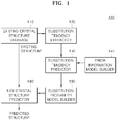
- FIG. 1 is a block diagram showing a system 100 for searching for a new material according to an example embodiment.
- the system 100 for searching for a new material may include an existing crystal or molecular structure database 110, a substitution tendency extractor 120, a substitution tendency predictor 130, a prior information model builder 140, a substitution probability model builder 150, and a new crystal structure predictor 160.
- the existing crystal or molecular structure database 110 may be a database including information on the crystal structures of already known materials.
- the information on the crystal structures may include the sizes of unit cells of the crystal structures, information on the relative positions of respective atoms included in the crystal structures in the unit cells, and so on.
- the substitution tendency extractor 120 may include a processor to group together materials having the same structure, on the basis of the information of an existing crystal structure database, and to analyze the materials which are grouped together based on their same structures and have different ions at the same structural position, thereby extracting or determining substitution tendencies of the ions.
- the materials may include a first material and a second material.
- the first material has a crystal structure C1
- the second material has a crystal structure C2.
- the crystal structure C1 is the same as the crystal structure C2
- a position P1 on the crystal structure C1 is the same as a position P2 on the crystal structure C2.
- an ion I1 located at the position P1 is different than an ion I2 located at the position P2.
- the processor may be an arithmetic logic unit, a digital signal processor, a microcomputer, a field programmable array, a programmable logic unit, a microprocessor or any other device capable of responding to and executing instructions in a defined manner such that the processor is programmed with instructions that configure the processing device as a special purpose computer to perform the operations illustrated in Figs. 4 and 5 .
- the instructions may be stored on a non-transitory computer readable medium.
- non-transitory computer-readable media examples include magnetic media such as hard disks, floppy disks, and magnetic tape; optical media such as CD ROM discs and DVDs; magneto-optical media such as optical discs; and hardware devices that are specially configured to store and perform program instructions, such as read-only memory (ROM), random access memory (RAM), flash memory, and the like.
- the non-transitory computer-readable media may also be a distributed network, so that the program instructions are stored and executed in a distributed fashion.
- the substitution tendency extractor 120 may collect the frequency that two ions (or elements) are present at the same position in two materials having the same structure, determine that the higher the frequency, the higher the probability of substitution, that is, the probability that two ions will be substituted for each other, and construct a substitution tendency matrix X according to the probability of substitution.
- the substitution tendency matrix X is described in detail later.
- the prior information model builder 140 may build a prior information model by using known prior information data.
- the prior information data may include at least one of oxidation number data of ions and radius data of the ions.
- the prior information model builder 140 may build a prior information matrix Y by using a distribution of the prior information data. This is described in detail later.
- the substitution tendency predictor 130 calculates substitution tendency prediction data by using the substitution tendency matrix X and the prior information matrix Y.
- the substitution tendency prediction data is a value which denotes an unknown ion substitution tendency.
- the substitution probability model builder 150 may calculate the probability of substitution on the basis of the substitution tendency prediction data calculated by the substitution tendency predictor 130.
- the probability of substitution between a material A and a material B may be calculated by using the following probability model.
- z is a value for causing the value of (.) function to satisfy a probability condition (that the sum of probability values is 1), and may be calculated by summing (.) values for all possible combinations of A and B.
- ⁇ cd is a parameter obtained where a c ion and d ion are substituted for each other
- Rs denotes the sum of all substitution tendency prediction data calculated as UU'
- Rcd denotes substitution tendency prediction data between the c ion and d ion.
- the new crystal structure predictor 160 may obtain an existing crystal structure from the existing crystal structure database 110 on the basis of the calculated probability of substitution, and generate a new crystal structure B of new composition by substituting an ion B for an ion A included in the obtained existing crystal structure.
- the new crystal structure predictor 160 may generate new crystal structures in order of decreasing probability of substitution.
- the new crystal structure predictor 160 may generate a new crystal structure only when the probability of substitution is a previously set or a desired value or more.
- FIGS. 2 and 3 are diagrams illustrating an ion exchange tendency.
- An ion exchange tendency may be a value which denotes the probability that two ions can be substituted for each other.
- calcium titanate (CaTiO 3 ) of FIG. 2(A) and barium titanium oxide (BaTiO 3 ) of FIG. 2(B) are materials having the same or equivalent structure, and a calcium ion (Ca 2+ ) 210 and a barium ion (Ba 2+ ) 220 are present at the same or equivalent position in the two materials, respectively.
- such an ion substitution tendency may be related to features of the ions. For example, when an ion A and an ion B have similar or the same properties, they may have similar or the same substitution tendencies. Also, when the ion A and the ion B have similar or the same substitution tendencies, they may have similar or the same properties.
- prediction of an unknown substitution tendency may be performed through a method of 1) extracting properties of an ion which are not directly observed from known substitution tendencies, and 2) predicting the unknown ion substitution tendency from the extracted properties of the ion.
- FIG. 4 is a flowchart of a method of searching for a new material.
- the system 100 for searching for a new material may calculate a substitution tendency matrix X (operation 410).
- the substitution tendency matrix X may include known substitution tendency data between ions.
- the substitution tendency matrix X is described in detail below.
- a substitution tendency of an ion may be expressed in the form of a vector.
- a vector x may have N components, and each of the N components may be a value denoting a substitution tendency of any one ion for one of the N ions.
- a first component x(1i) of x i may be a value denoting a substitution tendency of the i-th ion for a first ion
- a second component x(2i) of x i may be a value denoting a substitution tendency of the i-th ion for a second ion.
- a j-th component x(ji) of x i may be set to 0.
- substitution tendency vector x i may be expressed as a linear combination of several ion property vectors (u 1 , u 2 , ..., and u R ) as follows: x i ⁇ a 1 ⁇ i ⁇ u 1 + a 2 ⁇ i ⁇ u 2 + a 3 ⁇ i ⁇ u 3 + ⁇ + a Ri ⁇ u R .
- properties of the ion may be classified into R types, and each u j is a vector denoting a j-th property among the R property types. Meanwhile, u j may have the same size as x i . In other words, u j may have N components.
- each value of a ji may denote how important the j-th ion property vector is in expressing a substitution tendency of the i-th ion.
- each value of a ji may be a weight indicating how much of the j-th property the i-th ion has.
- the substitution tendency vector when a substitution tendency vector is expressed in the form of Expression 3, the substitution tendency vector may be expressed with a number of ion property vectors that is smaller than a number of existing ion property vectors. In other words, when the number of existing ion property vectors is Y, the substitution tendency vector may be expressed with only R ion property vectors obtained by condensing the properties of the ion.
- These ion property vectors may represent properties of the ion, which are not acquired from existing property data, in a simple form which is easy to recognize.
- substitution tendency vector x i of the i-th ion may be expressed as follows: x i ⁇ Ua i .
- An ion property matrix U includes ion property vectors u 1 , u 2 , ..., and u R of Expression 3.
- the size of the ion property matrix U may be N*R.
- a i is a weight vector.
- the weight vector a i has R components, which are the weights a 1i , a 2i , ..., and a Ri of Expression 3.
- substitution tendency vectors (x1, x2, ..., and xN) of the N ions may be expressed as one substitution tendency matrix X.
- each column of the substitution tendency matrix X may be configured to represent a substitution tendency vector of an ion, and thus an i-th column of the substitution tendency matrix X may represent the substitution tendency vector x i of the i-th ion.
- the size of the matrix X may be N*N, and the matrix X may be a square matrix.
- substitution tendency matrix X may be expressed as follows: X ⁇ UA T .
- U is an ion property matrix
- A is a weight matrix including weight vectors for the N ions.
- the size of the weight matrix A may be N*R.
- a T denotes a transpose matrix of the weight matrix A, which is obtained by interchanging rows and columns of the weight matrix A.
- the substitution tendency matrix X denotes the substitution tendency between two ions.
- (i, j) element the substitution tendency between the i-th ion and the j-th ion
- (j, i) element the substitution tendency between the j-th ion and the i-th ion
- substitution tendency matrix X has the form of a symmetric matrix.
- substitution tendency matrix X may be expressed by using the ion property matrix U as follows: X ⁇ UU T .
- the system 100 for searching for a new material may calculate the ion property matrix U by using an expression (operation 430). This is described in detail below.
- optimization may be performed to minimize a difference X - UU T between the substitution tendency matrix X and the matrix factorization model UU T so that the ion property matrix U is determined.
- Expression 7 may be expressed as follows: argmin U ⁇ W ⁇ X ⁇ UU T ⁇ F .
- W is a weight matrix, serving to exclude data indicating that the corresponding ion substitution tendency is unknown, that is, an element represented as 0 among elements of the substitution tendency matrix X.
- the weight matrix W may exclude data indicating that the corresponding ion substitution tendency is unknown so that the ion property matrix U may be calculated.
- the weight matrix W has the same size as the substitution tendency matrix X.
- An element of the weight matrix W may be set to 1 when the corresponding element of the substitution tendency matrix X has an observed value (in the case of a known ion substitution tendency), and to 0 when the corresponding element does not have an observed value (in the case of an unknown ion substitution tendency).
- substitution tendency of the i-th ion for the j-th ion is unknown and (i, j) element of the substitution tendency matrix X is 0, (i, j) element of the weight matrix W may also be set to 0.
- Equation 8 denotes multiplication of elements of matrices.
- Expression 8 makes it possible to prevent or reduce having an unobserved value (substitution tendency data indicating that the corresponding ion substitution tendency is unknown) among the elements of the substitution tendency matrix X from being used in an optimization process of calculating the ion property matrix U.
- the system 100 for searching for a new material may calculate a reconstructed substitution tendency matrix X' as follows, and thus acquire substitution tendency prediction data (operation 440).
- X ′ UU T
- the reconstructed substitution tendency matrix X' may include a predicted value (substitution tendency prediction data) for an ion substitution tendency which is not observed in the substitution tendency matrix X.
- an element represented as 0 in the substitution tendency matrix X may be represented as a predicted value (substitution tendency prediction data) of an ion substitution tendency other than 0 in the reconstructed ion exchange tendency matrix X'.
- the system 100 for searching for a new material may calculate the probability of substitution of a new crystal structure on the basis of the substitution tendency prediction data (operation 450).
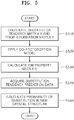
- FIG. 5 is a flowchart of a method of searching for a new material according to another described aspect.
- the system 100 for searching for a new material may expand a model to use additional data (prior information data) as well as substitution tendency data (a substitution tendency matrix X) and calculate an ion property matrix U.
- the system 100 for searching for a new material may calculate the substitution tendency matrix X and a prior information matrix Y (operation 510).
- the prior information matrix Y represents additional properties of ions, and each row of the prior information matrix Y may consist of vectors including additional property data of one ion.
- the prior information matrix Y may have a size of N*K.
- the prior information matrix Y is intended to calculate the ion property matrix U, and thus the system 100 for searching for a new material may apply a matrix co-factorization model to the prior information matrix Y as follows (operation 520): Y ⁇ UV T
- the ion property matrix U used in Expression 5 may be used as-is.
- a matrix V may be a matrix which represents weights for expressing the prior information matrix Y as properties of ions, or characteristics of additional information.
- weighted matrix factorization may be applied as in Expression 8, and then an optimization problem may be derived and expressed as follows: argmin U , V ⁇ W x ⁇ X ⁇ UU T ⁇ F + ⁇ ⁇ W y ⁇ Y ⁇ UV T ⁇ F .
- ⁇ is a parameter for balancing two matrix factorizations, and generally serves to compensate for a difference in size between the substitution tendency matrix X and the prior information matrix Y when the difference is large.
- the system 100 for searching for a new material may calculate the ion property matrix U by using Expression 11 (operation 530). This is described in detail below.
- an algorithm or process may be used in which repeated optimization is performed to find an answer in stages.
- the matrix V is fixed at an arbitrary value, and only the matrix U may be optimized (first operation).
- the matrix U is fixed at an arbitrary value, and only the matrix V may be optimized (second operation).
- the first and second operations are repeatedly performed until the matrices U and V converge, and thus optimum matrices U and V may be calculated.
- U may be calculated by using the following gradient descent method: U ⁇ U ⁇ ⁇ ⁇ E ⁇ U .
- ⁇ is a parameter for determining the speed of an algorithm or process.
- U may not converge to an arbitrary value, and when the value is small, the convergence speed of the algorithm may be low. Therefore, ⁇ may be determined to be a value which causes no problems in the process of testing the algorithm.
- V may be calculated by using the following gradient descent method: V ⁇ V ⁇ ⁇ ⁇ E ⁇ V .
- the ion property matrices U and V may be finally calculated.
- a constraint condition may be added to the ion property matrix U.
- a constraint condition may be added to the ion property matrix U.
- the values of respective elements of the ion property matrix U may not be negative numbers. Accordingly, elements of the substitution tendency matrix X may not have negative values.
- the third operation may be expressed as the following expression: U ⁇ f U ⁇ ⁇ ⁇ E ⁇ U .
- a function f(.) changes a given value into a value which is closest to the given value while satisfying the constraint condition.
- the constraint condition is that the values of the elements of the matrix U may not be negative numbers
- f(.) is used to simply change negative values among the elements of the matrix U calculated in the first operation into 0.
- the system 100 for searching for a new material may calculate the ion property matrix U by additionally using prior information data, and calculate a reconstructed substitution tendency matrix X' including substitution tendency prediction data by using the ion property matrix U (operation 540).
- the system 100 for searching for a new material may calculate the probability of substitution of a new crystal structure on the basis of the substitution tendency prediction data (operation 550).
- the number of ion property vectors (u 1 , u 2 , ..., and u R ) may be defined to be R.
- the number of ion property vectors (the number of columns of the ion property matrix U) is increased, the properties of an ion may be expressed more precisely.
- noise included in the calculated ion property matrix U may increase, and a calculation time also increases.
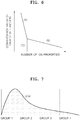
- FIG. 6 is a graph illustrating what value an objective function value of an optimization problem converges to according to the ion property number R in at least one described aspect.
- the objective function value is a difference between the substitution tendency matrix X and a factorization model for the substitution tendency matrix X.
- an appropriate number of ion properties that is, a number of ion properties that accurately reflect main property data may be determined.
- a method such as the Bayesian information criterion (BIC) method or the Akaike information criterion (AIC) method, may be used.
- BIC Bayesian information criterion
- AIC Akaike information criterion
- Prior information on an ion may include an ionic radius and an oxidation number. This is based on Goldberg's law that ion substitution of a crystal structure is enabled when two ions have similar or the same ionic radii and no significant difference in oxidation number.
- both an oxidation number and an ionic radius are not accurately determined values but are values distributed in a certain range.
- an ionic radius is not measured for a particular oxidation number.
- the prior information data may be expressed as a distribution curve p(s) as shown in FIG. 7 .
- the amount of ions distributed in a particular section may be used.
- the amount of i-th ions distributed in a j-th range group may be calculated, and the calculated value may be set as the value of (i, j) element of the prior information matrix Y.
- p i (s) denotes a distribution of prior information s on the i-th ion
- Bi and Ei denote a start point and an end point of a j-th property section, respectively.
- an (i, 1) element of the prior information matrix Y may be a value obtained by integrating the distribution curve p(s) from the zeroth radius to the first radius.
- an (i, 2) element of the prior information matrix Y may be a value obtained by integrating the distribution curve p(s) from the first radius to the second radius
- an (i, 3) element of the prior information matrix Y may be a value obtained by integrating the distribution curve p(s) from the second radius to the third radius
- an (i, 4) element of the prior information matrix Y may be a value obtained by integrating the distribution curve p(s) from the third radius to the fourth radius.
- a normal distribution with an average of +2 and a standard deviation of 1 may be used as a distribution for the oxidation number of the ion.
- the value of the standard deviation may be determined on the basis of known prior knowledge.
- ionic radii for all possible oxidation numbers may not be measured, and an unknown radius value may be present.
- the oxidation number of an ion may not be an integer but may be a real number. In this case, there may be no information on the ionic radius of the ion having an oxidation number which is a real number.
- the final distribution of prior information values may be determined through regression analysis.
- This relationship may be expressed by using a simple linear model. By probabilistically modeling the relationship and calculating a post probability, a distribution of ionic radius values for an arbitrary oxidation number may be determined.
- a likelihood of a known ionic radius value t may be expressed by using a normal distribution as follows: p t
- X is a matrix including input values, such as a given oxidation number, etc.
- a vector w is a parameter representing a linear relationship between an ionic radius and an oxidation number.
- ⁇ is a parameter indicating the error size of a model.
- a , b denotes a value corresponding to x in a normal distribution with an average of a and a variance of b.
- m 0 and S 0 are initial values of an average and a variance given to the parameter, respectively.
- a zero vector and an identity matrix are used as m 0 and S 0 .
- the post probability when the post probability is calculated from the likelihood and the prior probability according to Bayesian theory, the post probability may be expressed as follows: p w
- t N w
- FIG. 8 shows graphs of distributions of radius values of C, Fe, and Rb relative to oxidation numbers according to the above expression.
- the illustrated points shown in the graphs denote known valence-specific ionic radius data
- the linear straight lines denote distributions of ionic radii calculated for arbitrary oxidation numbers by using the data. Shaded areas denote standard deviations.
- the standard deviations in FIG. 8 are shown to be narrow in a predictable portion and wide in an unpredictable portion.
- a system and method for searching for a new material according to example embodiments are not limited to constitutions and methods of the above-described example embodiments, and all or some of the example embodiments may be selectively combined so that various modifications may be made.
- an unknown ion substitution tendency between ions may be predicted, and thus the reliability of results of a search for a new material may be increased.
- the probability of substitution of a plurality of candidate new materials it may be possible to synthesize those candidate new materials having a higher rather than a lower probability.
- the plurality of candidate new materials it may be suitable to synthesize some or all of those candidate new materials having one of the top N probabilities, where N is an integer between 0 and 10. It may also be suitable to synthesize those candidate new materials where the probability is greater than a predetermined threshold probability.
- Example embodiments allow for the prediction of new and yet-unknown material structures based on the high probability of ion substitution in a crystal structure corresponding to the new materials. As a result, new material structures may be discovered without having to undergo lengthy and expensive trial and error.
- example embodiments provide methods of conceiving new material structures.
- a Si-Ge (Group IV) semiconductor arranged in a diamond crystalline configuration and including one or more dopants may be predicted based on the probability of ion substitution of a dopant.
- Group III and Group V semiconductors forming a cubic-crystal configuration may also be predicted based on the ion substitution tendency of the atoms constituting the crystal, or on the ion substitution tendency of dopants.
- example embodiments can also be implemented through computer readable code/instructions in/on a medium, e.g., a computer readable medium, to control at least one processing element to implement any above described example embodiment.
- a medium e.g., a computer readable medium
- the medium can correspond to any medium/media permitting the storage and/or transmission of the computer readable code.
- the computer readable code can be recorded/transferred on a medium in a variety of ways, with examples of the medium including recording media, such as magnetic storage media (e.g., ROM, floppy disks, hard disks, etc.) and optical recording media (e.g., CD-ROMs, or DVDs), and transmission media such as Internet transmission media.
- the medium may be such a defined and measurable structure including or carrying a signal or information, such as a device carrying a bitstream according to one or more example embodiments.
- the media may also be a distributed network, so that the computer readable code is stored/transferred and executed in a distributed fashion.
- the processing element could include a processor or a computer processor, and processing elements may be distributed and/or included in a single device.
Landscapes
- Engineering & Computer Science (AREA)
- Physics & Mathematics (AREA)
- Theoretical Computer Science (AREA)
- Data Mining & Analysis (AREA)
- General Physics & Mathematics (AREA)
- Bioinformatics & Cheminformatics (AREA)
- Mathematical Physics (AREA)
- Life Sciences & Earth Sciences (AREA)
- Databases & Information Systems (AREA)
- Bioinformatics & Computational Biology (AREA)
- Computing Systems (AREA)
- Chemical & Material Sciences (AREA)
- Mathematical Analysis (AREA)
- Mathematical Optimization (AREA)
- Pure & Applied Mathematics (AREA)
- Computational Mathematics (AREA)
- General Engineering & Computer Science (AREA)
- Algebra (AREA)
- Software Systems (AREA)
- Crystallography & Structural Chemistry (AREA)
- Spectroscopy & Molecular Physics (AREA)
- Pharmacology & Pharmacy (AREA)
- Medicinal Chemistry (AREA)
- General Health & Medical Sciences (AREA)
- Health & Medical Sciences (AREA)
- Evolutionary Biology (AREA)
- Operations Research (AREA)
- Probability & Statistics with Applications (AREA)
- Computational Linguistics (AREA)
- Other Investigation Or Analysis Of Materials By Electrical Means (AREA)
Claims (12)
- Verfahren zum Suchen nach einem neuen Material unter Verwendung von computerlesbarem Code auf einem computerlesbaren Medium, um mindestens ein Verarbeitungselement zu steuern, um das Verfahren zu implementieren, wobei das Verfahren folgendes umfasst:Bestimmen (120, S410) einer Substitutionstendenzmatrix X, die Substitutionstendenzdaten von Ionen auf der Basis bestehender Kristallstrukturdaten aufweist;Berechnen (140, S430, S530) einer Ioneneigenschaftsmatrix U durch Anwenden eines symmetrischen Matrixfaktorisierungsmodells auf die Substitutionstendenzmatrix X, wobei das symmetrische Matrixfaktorisierungsmodell X ≈ UUT ist;Bestimmen (130, S440) von Substitutionstendenz-Prädiktionsdaten auf der Basis der berechneten Ioneneigenschaftsmatrix U; undBerechnen (150, 160, S450, S550) einer Messgröße der Wahrscheinlichkeit für das Vorhandensein neuer Kristallstrukturen durch Berechnen von Wahrscheinlichkeiten der Substitution von Ionen der neuen Kristallstrukturen in die bestehenden Kristallstrukturdaten auf der Basis der Substitutionstendenz-Prädiktionsdaten;wobei die Substitutionstendenzmatrix X Substitutionstendenzvektoren x enthält, die jeweils N Komponenten aufweisen, wobei jede der N Komponenten ein Wert ist, der eine Substitutionstendenz für ein beliebiges Ion für eines von N Ionen bezeichnet;wobei, wenn xi einen Substitutionstendenzvektor eines i-ten Ions der N Ionen bezeichnet, eine erste Komponente x(1i) von xi ein Wert ist, der eine Substitutionstendenz des i-ten Ions für ein erstes Ion bezeichnet, und wobei eine zweite Komponente x(2i) von xi ein Wert ist, der eine Substitutionstendenz des i-ten Ions für ein zweites Ion bezeichnet, und so weiter, und wobei, wenn eine Substitutionstendenz des i-ten Ions für ein j-tes Ion unbekannt ist, eine j-te Komponente x(ji) von xi auf 0 gesetzt wird;wobei der Substitutionstendenzvektor xi als eine lineare Kombination mehrerer loneneigenschaftsvektoren (u1, u2, ... und uR) wie folgt ausgedrückt werden kann:
 wobei die Eigenschaften des Ions in R Typen klassifiziert sind, und wobei jedes uj ein Vektor ist, der eine j-te Eigenschaft der R Eigenschaftstypen bezeichnet;wobei jeder Wert von aji bezeichnet, wie wichtig der j-te Eigenschaftsvektor ist, um eine Substitutionstendenz des i-ten Ions auszudrücken, so dass jeder Wert von aji eine Gewichtung sein kann, die anzeigt, welche Stärke der j-ten Eigenschaft das i-te Ion aufweist;wobei der Substitutionstendenzvektor mit einer Anzahl R von loneneigenschaftsvektoren ausgedrückt werden kann, die kleiner ist als eine Anzahl bestehender Ioneneigenschaftsvektoren, die durch Kondensieren der Eigenschaften des Ions erhalten werden;wobei der Substitutionstendenzvektor xi des i-ten Ions wie folgt ausgedrückt werden kann:
 wobei U eine Ioneneigenschaftsmatrix ist, die loneneigenschaftsvektoren u1, u2, ..., uR von Ausdruck 3 aufweist, wobei Zeilen Ionen bezeichnen und Spalten Eigenschaften der Ionen bezeichnen, wobei die Größe der Ioneneigenschaftsmatrix U N*R ist,und wobei ai ein Gewichtungsvektor ist, der R Komponenten aufweist, bei denen es sich um die Gewichtungen a1i, a2i, ..., aRi aus Ausdruck 3 oben handelt;wobei durch Anwenden eines grundlegenden Matrixfaktorisierungsmodells auf die Substitutionstendenzmatrix X die Substitutionstendenzmatrix X wie folgt ausgedrückt werden kann:
 wobei A eine Gewichtungsmatrix ist, welche die Gewichtungsfaktoren für die N Ionen aufweist, wobei die Größe der Gewichtungsmatrix N*R ist;und wobei AT eine transponierte Matrix der Gewichtungsmatrix A ist, die erhalten wird durch Austauschen der Zeilen und Spalten der Gewichtungsmatrix A;wobei die Substitutionsmatrix X, in welcher sowohl die Zeilen als auch die Spalten Ionen bezeichnen und symmetrisch zueinander sind, unter Verwendung der Ioneneigenschaftsmatrix U wie folgt ausgedrückt werden kann: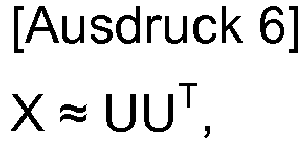
- Verfahren nach Anspruch 1, wobei das Berechnen der Ioneneigenschaftsmatrix U ferner das Zuweisen einer Gewichtungsmatrix W zu X - UUT umfasst, um Daten auszuschließen, die anzeigen, dass eine Substitutionstendenz aus den Elementen der Substitutionstendenzmatrix X während einem Prozess des Berechnens unbekannt ist.
- Verfahren nach Anspruch 1 oder 2, ferner umfassend das Erfassen (S510) einer früheren Informationsmatrix Y, die frühere Informationsdaten aufweist,
wobei das Berechnen der Ioneneigenschaftsmatrix U das Berechnen der Ioneneigenschaftsmatrix U auf der Basis der Substitutionstendenzmatrix X und der früheren Informationsmatrix Y umfasst. - Verfahren nach Anspruch 3, wobei die früheren Informationsdaten wenigstens eines der folgenden aufweisen: Oxidationsstufendaten und Radiusdaten.
- Verfahren nach einem der vorstehenden Ansprüche, ferner umfassend das Ermitteln (160) einer bestehenden Kristallstruktur aus den bestehenden Kristallstrukturdaten (110) und das Erzeugen (160) der neuen prädizierten Kristallstrukturen (PRÄDIZIERTE STRUKTUR) in der Reihenfolge der Wahrscheinlichkeiten der Substitution der neuen Kristallstrukturen.
- System zum Suchen nach einem neuen Material, umfassend:einen Substitutionstendenzextraktor (120), der so gestaltet ist, dass er eine Substitutionstendenzmatrix X berechnet, die Substitutionstendenzdaten auf der Basis bestehender Kristallstrukturdaten aufweist;einen Substitutionstendenzprädiktor (130), der so gestaltet ist, dass er eine Ioneneigenschaftsmatrix U durch Anwenden eines symmetrischen Matrixfaktorisierungsmodells auf die Substitutionstendenzmatrix X berechnet, und wobei er so gestaltet ist, dass er Substitutionstendenz-Prädiktionsdaten auf der Basis der Ioneneigenschaftsmatrix U erfasst, wobei das symmetrische Matrixfaktorisierungsmodell für die Substitutionstendenzmatrix X gleich X ≈ UUT ist; undeinen Substitutionswahrscheinlichkeitsmodellgestalter (150), der so gestaltet ist, dass er eine Messgröße der Wahrscheinlichkeit für das Vorhandensein neuer Materialien mit entsprechenden neuen Kristallstrukturen durch Berechnen von Wahrscheinlichkeiten der Substitution von Ionen der neuen Kristallstrukturen in die bestehenden Kristallstrukturdaten auf der Basis der Substitutionstendenz-Prädiktionsdaten berechnet;wobei die Substitutionstendenzmatrix X Substitutionstendenzvektoren x enthält, die jeweils N Komponenten aufweisen, wobei jede der N Komponenten ein Wert ist, der eine Substitutionstendenz für ein beliebiges Ion für eines von N Ionen bezeichnet;wobei, wenn xi einen Substitutionstendenzvektor eines i-ten Ions der N Ionen bezeichnet, eine erste Komponente x(1i) von xi ein Wert ist, der eine Substitutionstendenz des i-ten Ions für ein erstes Ion bezeichnet, und wobei eine zweite Komponente x(2i) von xi ein Wert ist, der eine Substitutionstendenz des i-ten Ions für ein zweites Ion bezeichnet, und so weiter, und wobei, wenn eine Substitutionstendenz des i-ten Ions für ein j-tes Ion unbekannt ist, eine j-te Komponente x(ji) von xi auf 0 gesetzt wird;wobei der Substitutionstendenzvektor xi als eine lineare Kombination mehrerer loneneigenschaftsvektoren (u1, u2, ... und uR) wie folgt ausgedrückt werden kann:
 wobei die Eigenschaften des Ions in R Typen klassifiziert sind, und wobei jedes uj ein Vektor ist, der eine j-te Eigenschaft der R Eigenschaftstypen bezeichnet;wobei jeder Wert von aji bezeichnet, wie wichtig der j-te Eigenschaftsvektor ist, um eine Substitutionstendenz des i-ten Ions auszudrücken, so dass jeder Wert von aji eine Gewichtung sein kann, die anzeigt, welche Stärke der j-ten Eigenschaft das i-te Ion aufweist;wobei der Substitutionstendenzvektor mit einer Anzahl R von loneneigenschaftsvektoren ausgedrückt werden kann, die kleiner ist als eine Anzahl bestehender loneneigenschaftsvektoren, die durch Kondensieren der Eigenschaften des Ions erhalten werden;wobei der Substitutionstendenzvektor xi des i-ten Ions wie folgt ausgedrückt werden kann:
 wobei U eine Ioneneigenschaftsmatrix ist, die loneneigenschaftsvektoren u1, u2, ..., uR von Ausdruck 3 aufweist, wobei Zeilen Ionen bezeichnen und Spalten Eigenschaften der Ionen bezeichnen, wobei die Größe der Ioneneigenschaftsmatrix U N*R ist,und wobei ai ein Gewichtungsvektor ist, der R Komponenten aufweist, bei denen es sich um die Gewichtungen a1i, a2i, ..., aRi aus Ausdruck 3 oben handelt;wobei durch Anwenden eines grundlegenden Matrixfaktorisierungsmodells auf die Substitutionstendenzmatrix X die Substitutionstendenzmatrix X wie folgt ausgedrückt werden kann:
 wobei A eine Gewichtungsmatrix ist, welche die Gewichtungsfaktoren für die N Ionen aufweist, wobei die Größe der Gewichtungsmatrix N*R ist;und wobei AT eine transponierte Matrix der Gewichtungsmatrix A ist, die erhalten wird durch Austauschen der Zeilen und Spalten der Gewichtungsmatrix A;wobei die Substitutionsmatrix X, in welcher sowohl die Zeilen als auch die Spalten Ionen bezeichnen und symmetrisch zueinander sind, unter Verwendung der Ioneneigenschaftsmatrix U wie folgt ausgedrückt werden kann:
- System nach Anspruch 6, wobei der Substitutionstendenzextraktor (120) so gestaltet ist, dass er X - UUT eine Gewichtungsmatrix W zuweist, um Daten auszuschließen, die anzeigen, dass eine Substitutionstendenz aus den Elementen der Substitutionstendenzmatrix X während einem Prozess des Berechnens unbekannt ist.
- System nach Anspruch 6 oder 7, ferner umfassend einen früheren Informationsmodellgestalter (140), der so gestaltet ist, dass er eine frühere Informationsmatrix Y berechnet, die frühere Informationsdaten aufweist;
wobei der Substitutionstendenzextraktor (120) so gestaltet ist, dass er die Ioneneigenschaftsmatrix U auf der Basis der Substitutionstendenzmatrix X und der früheren Informationsmatrix Y berechnet. - System nach Anspruch 8, wobei der Substitutionstendenzextraktor (120) so gestaltet ist, dass er die Ioneneigenschaftsmatrix U berechnet durch Anwenden eines Matrixcofaktorisierungsmodells, das bewirkt, dass die loneneigenschaftsmatrix U in der Substitutionstendenzmatrix X als auch in der früheren Informationsmatrix Y enthalten ist, auf die Substitutionstendenzmatrix X und die frühere Informationsmatrix Y.
- System nach Anspruch 8 oder 9, wobei der Substitutionstendenzextraktor (120) so gestaltet ist, dass er die Ioneneigenschaftsmatrix unter einer Zwangsbedingung berechnet, wobei die Elementwerte der Ioneneigenschaftsmatrix U keine negativen Zahlen sind.
- System nach Anspruch 8, 9 oder 10, wobei die früheren Informationsdaten wenigstens eines der folgenden aufweisen: Oxidationsstufendaten und Radiusdaten.
- System nach einem der Ansprüche 6 bis 11, ferner umfassend einen Prädiktor (160) für neue Kristallstrukturen, der so gestaltet ist, dass er neue prädizierte Kristallstrukturen in der Reihenfolge der Wahrscheinlichkeiten der Substitution der neuen Kristallstrukturen erzeugt.
Applications Claiming Priority (1)
| Application Number | Priority Date | Filing Date | Title |
|---|---|---|---|
| KR1020130149495A KR102224714B1 (ko) | 2013-12-03 | 2013-12-03 | 신규 물질 탐색 시스템 및 그 탐색 방법 |
Publications (2)
| Publication Number | Publication Date |
|---|---|
| EP2881874A1 EP2881874A1 (de) | 2015-06-10 |
| EP2881874B1 true EP2881874B1 (de) | 2019-08-28 |
Family
ID=52231800
Family Applications (1)
| Application Number | Title | Priority Date | Filing Date |
|---|---|---|---|
| EP14196003.9A Not-in-force EP2881874B1 (de) | 2013-12-03 | 2014-12-03 | System und Verfahren zur Suche nach neuem Material |
Country Status (5)
| Country | Link |
|---|---|
| US (1) | US20150154146A1 (de) |
| EP (1) | EP2881874B1 (de) |
| JP (1) | JP6456667B2 (de) |
| KR (1) | KR102224714B1 (de) |
| CN (1) | CN104699743B (de) |
Families Citing this family (9)
| Publication number | Priority date | Publication date | Assignee | Title |
|---|---|---|---|---|
| KR102457974B1 (ko) * | 2015-11-04 | 2022-10-21 | 삼성전자주식회사 | 신규 물질 탐색 방법 및 장치 |
| KR102523471B1 (ko) | 2016-05-24 | 2023-04-18 | 삼성전자주식회사 | 금속 쌍을 이용한 구조 결정 방법 및 장치 |
| CN108229090B (zh) * | 2017-12-29 | 2021-11-09 | 西北工业大学 | 一种晶体结构的预测方法 |
| US20210265020A1 (en) * | 2018-05-04 | 2021-08-26 | Shenzhen Jingtai Technology Co., Ltd. | High-precision energy ranking method used for crystal structure prediction of organic molecules |
| JP7398679B2 (ja) * | 2018-08-08 | 2023-12-15 | パナソニックIpマネジメント株式会社 | 材料記述子生成方法、材料記述子生成装置、材料記述子生成プログラム、予測モデル構築方法、予測モデル構築装置及び予測モデル構築プログラム |
| JP7252449B2 (ja) | 2019-05-16 | 2023-04-05 | 富士通株式会社 | 最適化装置、最適化システム、最適化方法および最適化プログラム |
| JP7283307B2 (ja) * | 2019-08-27 | 2023-05-30 | 富士通株式会社 | 設計プログラム、及び設計方法 |
| JP7358924B2 (ja) * | 2019-11-11 | 2023-10-11 | 富士通株式会社 | 化学物質探索方法、化学物質探索装置、及び化学物質探索プログラム |
| TWI737515B (zh) * | 2020-10-13 | 2021-08-21 | 國立中山大學 | 對稱非負矩陣的補值方法、電子裝置與電腦程式產品 |
Family Cites Families (8)
| Publication number | Priority date | Publication date | Assignee | Title |
|---|---|---|---|---|
| JP3633195B2 (ja) * | 1997-03-26 | 2005-03-30 | オルガノ株式会社 | イオン交換樹脂の性能評価方法及び水処理系の管理方法 |
| JP4600617B2 (ja) * | 2000-08-07 | 2010-12-15 | オルガノ株式会社 | 陰イオン交換樹脂の性能評価方法及び装置並びに復水脱塩装置 |
| US7180042B2 (en) * | 2002-08-14 | 2007-02-20 | Konica Minolta Holdings, Inc. | Radiographic image input apparatus which obtains image correction values based on a size or version of a radiographic recording member |
| US20090157369A1 (en) * | 2007-12-14 | 2009-06-18 | Nanoexa,Inc. | Fast and High-Throughput Search Engine for Materials for Lithium-Ion Batteries Using Quantum Simulations |
| JP5068228B2 (ja) * | 2008-08-04 | 2012-11-07 | 日本電信電話株式会社 | 非負値行列分解の数値計算方法、非負値行列分解の数値計算装置、プログラムおよび記憶媒体 |
| US20130297276A1 (en) * | 2010-08-31 | 2013-11-07 | Atonarp Inc. | Method and apparatus for finding candidate from data measured by sensor |
| KR101267408B1 (ko) | 2011-10-05 | 2013-05-30 | 주식회사 켐에쎈 | 순수한 유기화합물의 정상끓는점에서의 액체밀도를 예측하는 다중선형회귀-인공신경망 혼성모형 |
| CN102663214B (zh) * | 2012-05-09 | 2013-11-06 | 四川大学 | 一种集成药物靶标预测系统的构建和预测方法 |
-
2013
- 2013-12-03 KR KR1020130149495A patent/KR102224714B1/ko not_active Expired - Fee Related
-
2014
- 2014-12-02 US US14/558,260 patent/US20150154146A1/en not_active Abandoned
- 2014-12-03 EP EP14196003.9A patent/EP2881874B1/de not_active Not-in-force
- 2014-12-03 JP JP2014244730A patent/JP6456667B2/ja not_active Expired - Fee Related
- 2014-12-03 CN CN201410727635.1A patent/CN104699743B/zh not_active Expired - Fee Related
Non-Patent Citations (1)
| Title |
|---|
| None * |
Also Published As
| Publication number | Publication date |
|---|---|
| KR102224714B1 (ko) | 2021-03-08 |
| EP2881874A1 (de) | 2015-06-10 |
| KR20150064602A (ko) | 2015-06-11 |
| US20150154146A1 (en) | 2015-06-04 |
| CN104699743B (zh) | 2020-01-21 |
| JP6456667B2 (ja) | 2019-01-23 |
| CN104699743A (zh) | 2015-06-10 |
| JP2015109084A (ja) | 2015-06-11 |
Similar Documents
| Publication | Publication Date | Title |
|---|---|---|
| EP2881874A1 (de) | System und Verfahren zur Suche nach neuem Material | |
| Luo et al. | A locally weighted machine learning model for generalized prediction of drift capacity in seismic vulnerability assessments | |
| Mangalathu et al. | Classification of failure mode and prediction of shear strength for reinforced concrete beam-column joints using machine learning techniques | |
| Reif et al. | Efficient feature size reduction via predictive forward selection | |
| Baker et al. | Accelerating neural architecture search using performance prediction | |
| Tsymbal et al. | Ensemble feature selection with the simple Bayesian classification | |
| CN110473592B (zh) | 一种多视角人类协同致死基因预测方法 | |
| Ghorabaee et al. | Genetic algorithm for solving bi-objective redundancy allocation problem with k-out-of-n subsystems | |
| WO2015184729A1 (en) | Method and system for hyper-parameter optimization and feature tuning of machine learning algorithms | |
| JP2016218869A (ja) | 設定方法、設定プログラム、及び設定装置 | |
| US20180276555A1 (en) | Quantum optimization system | |
| CN108140146A (zh) | 用于使用绝热量子计算机进行机器学习的离散变分自动编码器系统和方法 | |
| Tay et al. | Feature-weighted elastic net: using “features of features” for better prediction | |
| Mücke et al. | Optimum-preserving QUBO parameter compression | |
| Assaleh et al. | Modeling nonlinear behavior of Buckling-Restrained Braces via different artificial intelligence methods | |
| Grathwohl et al. | Gradient-based optimization of neural network architecture | |
| Antoch et al. | Testing for multiple change points | |
| Wistuba | XferNAS: transfer neural architecture search | |
| Gnecco et al. | Matrix completion of world trade: An analysis of interpretability through Shapley values | |
| Hashemi et al. | Feature engineering for microstructure–property mapping in organic photovoltaics | |
| CN120237616A (zh) | 一种基于多样性正则化堆叠学习的负荷预测方法、系统、介质及产品 | |
| US20240111921A1 (en) | Method and device with battery model optimization | |
| Boulin et al. | High-dimensional variable clustering based on maxima of a weakly dependent random process | |
| Boström | Concurrent learning of large-scale random forests | |
| Ceylan et al. | A Comparison of differential evolution and harmony search methods for SVM model selection in hyperspectral image classification |
Legal Events
| Date | Code | Title | Description |
|---|---|---|---|
| PUAI | Public reference made under article 153(3) epc to a published international application that has entered the european phase |
Free format text: ORIGINAL CODE: 0009012 |
|
| 17P | Request for examination filed |
Effective date: 20141203 |
|
| AK | Designated contracting states |
Kind code of ref document: A1 Designated state(s): AL AT BE BG CH CY CZ DE DK EE ES FI FR GB GR HR HU IE IS IT LI LT LU LV MC MK MT NL NO PL PT RO RS SE SI SK SM TR |
|
| AX | Request for extension of the european patent |
Extension state: BA ME |
|
| R17P | Request for examination filed (corrected) |
Effective date: 20151210 |
|
| RBV | Designated contracting states (corrected) |
Designated state(s): AL AT BE BG CH CY CZ DE DK EE ES FI FR GB GR HR HU IE IS IT LI LT LU LV MC MK MT NL NO PL PT RO RS SE SI SK SM TR |
|
| STAA | Information on the status of an ep patent application or granted ep patent |
Free format text: STATUS: EXAMINATION IS IN PROGRESS |
|
| 17Q | First examination report despatched |
Effective date: 20180530 |
|
| REG | Reference to a national code |
Ref country code: DE Ref legal event code: R079 Ref document number: 602014052442 Country of ref document: DE Free format text: PREVIOUS MAIN CLASS: G06F0019000000 Ipc: G16C0020300000 |
|
| RIC1 | Information provided on ipc code assigned before grant |
Ipc: G16C 20/30 20190101AFI20190117BHEP |
|
| GRAP | Despatch of communication of intention to grant a patent |
Free format text: ORIGINAL CODE: EPIDOSNIGR1 |
|
| STAA | Information on the status of an ep patent application or granted ep patent |
Free format text: STATUS: GRANT OF PATENT IS INTENDED |
|
| INTG | Intention to grant announced |
Effective date: 20190306 |
|
| GRAS | Grant fee paid |
Free format text: ORIGINAL CODE: EPIDOSNIGR3 |
|
| GRAA | (expected) grant |
Free format text: ORIGINAL CODE: 0009210 |
|
| STAA | Information on the status of an ep patent application or granted ep patent |
Free format text: STATUS: THE PATENT HAS BEEN GRANTED |
|
| AK | Designated contracting states |
Kind code of ref document: B1 Designated state(s): AL AT BE BG CH CY CZ DE DK EE ES FI FR GB GR HR HU IE IS IT LI LT LU LV MC MK MT NL NO PL PT RO RS SE SI SK SM TR |
|
| REG | Reference to a national code |
Ref country code: GB Ref legal event code: FG4D |
|
| REG | Reference to a national code |
Ref country code: CH Ref legal event code: EP |
|
| REG | Reference to a national code |
Ref country code: AT Ref legal event code: REF Ref document number: 1173385 Country of ref document: AT Kind code of ref document: T Effective date: 20190915 |
|
| REG | Reference to a national code |
Ref country code: IE Ref legal event code: FG4D |
|
| REG | Reference to a national code |
Ref country code: DE Ref legal event code: R096 Ref document number: 602014052442 Country of ref document: DE |
|
| REG | Reference to a national code |
Ref country code: NL Ref legal event code: MP Effective date: 20190828 |
|
| REG | Reference to a national code |
Ref country code: LT Ref legal event code: MG4D |
|
| PG25 | Lapsed in a contracting state [announced via postgrant information from national office to epo] |
Ref country code: BG Free format text: LAPSE BECAUSE OF FAILURE TO SUBMIT A TRANSLATION OF THE DESCRIPTION OR TO PAY THE FEE WITHIN THE PRESCRIBED TIME-LIMIT Effective date: 20191128 Ref country code: HR Free format text: LAPSE BECAUSE OF FAILURE TO SUBMIT A TRANSLATION OF THE DESCRIPTION OR TO PAY THE FEE WITHIN THE PRESCRIBED TIME-LIMIT Effective date: 20190828 Ref country code: NL Free format text: LAPSE BECAUSE OF FAILURE TO SUBMIT A TRANSLATION OF THE DESCRIPTION OR TO PAY THE FEE WITHIN THE PRESCRIBED TIME-LIMIT Effective date: 20190828 Ref country code: PT Free format text: LAPSE BECAUSE OF FAILURE TO SUBMIT A TRANSLATION OF THE DESCRIPTION OR TO PAY THE FEE WITHIN THE PRESCRIBED TIME-LIMIT Effective date: 20191230 Ref country code: NO Free format text: LAPSE BECAUSE OF FAILURE TO SUBMIT A TRANSLATION OF THE DESCRIPTION OR TO PAY THE FEE WITHIN THE PRESCRIBED TIME-LIMIT Effective date: 20191128 Ref country code: LT Free format text: LAPSE BECAUSE OF FAILURE TO SUBMIT A TRANSLATION OF THE DESCRIPTION OR TO PAY THE FEE WITHIN THE PRESCRIBED TIME-LIMIT Effective date: 20190828 Ref country code: FI Free format text: LAPSE BECAUSE OF FAILURE TO SUBMIT A TRANSLATION OF THE DESCRIPTION OR TO PAY THE FEE WITHIN THE PRESCRIBED TIME-LIMIT Effective date: 20190828 Ref country code: SE Free format text: LAPSE BECAUSE OF FAILURE TO SUBMIT A TRANSLATION OF THE DESCRIPTION OR TO PAY THE FEE WITHIN THE PRESCRIBED TIME-LIMIT Effective date: 20190828 |
|
| PG25 | Lapsed in a contracting state [announced via postgrant information from national office to epo] |
Ref country code: AL Free format text: LAPSE BECAUSE OF FAILURE TO SUBMIT A TRANSLATION OF THE DESCRIPTION OR TO PAY THE FEE WITHIN THE PRESCRIBED TIME-LIMIT Effective date: 20190828 Ref country code: GR Free format text: LAPSE BECAUSE OF FAILURE TO SUBMIT A TRANSLATION OF THE DESCRIPTION OR TO PAY THE FEE WITHIN THE PRESCRIBED TIME-LIMIT Effective date: 20191129 Ref country code: IS Free format text: LAPSE BECAUSE OF FAILURE TO SUBMIT A TRANSLATION OF THE DESCRIPTION OR TO PAY THE FEE WITHIN THE PRESCRIBED TIME-LIMIT Effective date: 20191228 Ref country code: RS Free format text: LAPSE BECAUSE OF FAILURE TO SUBMIT A TRANSLATION OF THE DESCRIPTION OR TO PAY THE FEE WITHIN THE PRESCRIBED TIME-LIMIT Effective date: 20190828 Ref country code: LV Free format text: LAPSE BECAUSE OF FAILURE TO SUBMIT A TRANSLATION OF THE DESCRIPTION OR TO PAY THE FEE WITHIN THE PRESCRIBED TIME-LIMIT Effective date: 20190828 Ref country code: ES Free format text: LAPSE BECAUSE OF FAILURE TO SUBMIT A TRANSLATION OF THE DESCRIPTION OR TO PAY THE FEE WITHIN THE PRESCRIBED TIME-LIMIT Effective date: 20190828 |
|
| REG | Reference to a national code |
Ref country code: AT Ref legal event code: MK05 Ref document number: 1173385 Country of ref document: AT Kind code of ref document: T Effective date: 20190828 |
|
| PG25 | Lapsed in a contracting state [announced via postgrant information from national office to epo] |
Ref country code: TR Free format text: LAPSE BECAUSE OF FAILURE TO SUBMIT A TRANSLATION OF THE DESCRIPTION OR TO PAY THE FEE WITHIN THE PRESCRIBED TIME-LIMIT Effective date: 20190828 |
|
| PG25 | Lapsed in a contracting state [announced via postgrant information from national office to epo] |
Ref country code: RO Free format text: LAPSE BECAUSE OF FAILURE TO SUBMIT A TRANSLATION OF THE DESCRIPTION OR TO PAY THE FEE WITHIN THE PRESCRIBED TIME-LIMIT Effective date: 20190828 Ref country code: IT Free format text: LAPSE BECAUSE OF FAILURE TO SUBMIT A TRANSLATION OF THE DESCRIPTION OR TO PAY THE FEE WITHIN THE PRESCRIBED TIME-LIMIT Effective date: 20190828 Ref country code: EE Free format text: LAPSE BECAUSE OF FAILURE TO SUBMIT A TRANSLATION OF THE DESCRIPTION OR TO PAY THE FEE WITHIN THE PRESCRIBED TIME-LIMIT Effective date: 20190828 Ref country code: DK Free format text: LAPSE BECAUSE OF FAILURE TO SUBMIT A TRANSLATION OF THE DESCRIPTION OR TO PAY THE FEE WITHIN THE PRESCRIBED TIME-LIMIT Effective date: 20190828 Ref country code: AT Free format text: LAPSE BECAUSE OF FAILURE TO SUBMIT A TRANSLATION OF THE DESCRIPTION OR TO PAY THE FEE WITHIN THE PRESCRIBED TIME-LIMIT Effective date: 20190828 Ref country code: PL Free format text: LAPSE BECAUSE OF FAILURE TO SUBMIT A TRANSLATION OF THE DESCRIPTION OR TO PAY THE FEE WITHIN THE PRESCRIBED TIME-LIMIT Effective date: 20190828 |
|
| PG25 | Lapsed in a contracting state [announced via postgrant information from national office to epo] |
Ref country code: CZ Free format text: LAPSE BECAUSE OF FAILURE TO SUBMIT A TRANSLATION OF THE DESCRIPTION OR TO PAY THE FEE WITHIN THE PRESCRIBED TIME-LIMIT Effective date: 20190828 Ref country code: SK Free format text: LAPSE BECAUSE OF FAILURE TO SUBMIT A TRANSLATION OF THE DESCRIPTION OR TO PAY THE FEE WITHIN THE PRESCRIBED TIME-LIMIT Effective date: 20190828 Ref country code: IS Free format text: LAPSE BECAUSE OF FAILURE TO SUBMIT A TRANSLATION OF THE DESCRIPTION OR TO PAY THE FEE WITHIN THE PRESCRIBED TIME-LIMIT Effective date: 20200224 Ref country code: SM Free format text: LAPSE BECAUSE OF FAILURE TO SUBMIT A TRANSLATION OF THE DESCRIPTION OR TO PAY THE FEE WITHIN THE PRESCRIBED TIME-LIMIT Effective date: 20190828 |
|
| REG | Reference to a national code |
Ref country code: DE Ref legal event code: R097 Ref document number: 602014052442 Country of ref document: DE |
|
| PLBE | No opposition filed within time limit |
Free format text: ORIGINAL CODE: 0009261 |
|
| STAA | Information on the status of an ep patent application or granted ep patent |
Free format text: STATUS: NO OPPOSITION FILED WITHIN TIME LIMIT |
|
| PG2D | Information on lapse in contracting state deleted |
Ref country code: IS |
|
| REG | Reference to a national code |
Ref country code: CH Ref legal event code: PL |
|
| 26N | No opposition filed |
Effective date: 20200603 |
|
| REG | Reference to a national code |
Ref country code: BE Ref legal event code: MM Effective date: 20191231 |
|
| PG25 | Lapsed in a contracting state [announced via postgrant information from national office to epo] |
Ref country code: MC Free format text: LAPSE BECAUSE OF FAILURE TO SUBMIT A TRANSLATION OF THE DESCRIPTION OR TO PAY THE FEE WITHIN THE PRESCRIBED TIME-LIMIT Effective date: 20190828 Ref country code: SI Free format text: LAPSE BECAUSE OF FAILURE TO SUBMIT A TRANSLATION OF THE DESCRIPTION OR TO PAY THE FEE WITHIN THE PRESCRIBED TIME-LIMIT Effective date: 20190828 |
|
| PG25 | Lapsed in a contracting state [announced via postgrant information from national office to epo] |
Ref country code: IE Free format text: LAPSE BECAUSE OF NON-PAYMENT OF DUE FEES Effective date: 20191203 Ref country code: LU Free format text: LAPSE BECAUSE OF NON-PAYMENT OF DUE FEES Effective date: 20191203 |
|
| PG25 | Lapsed in a contracting state [announced via postgrant information from national office to epo] |
Ref country code: CH Free format text: LAPSE BECAUSE OF NON-PAYMENT OF DUE FEES Effective date: 20191231 Ref country code: LI Free format text: LAPSE BECAUSE OF NON-PAYMENT OF DUE FEES Effective date: 20191231 Ref country code: BE Free format text: LAPSE BECAUSE OF NON-PAYMENT OF DUE FEES Effective date: 20191231 |
|
| PG25 | Lapsed in a contracting state [announced via postgrant information from national office to epo] |
Ref country code: CY Free format text: LAPSE BECAUSE OF FAILURE TO SUBMIT A TRANSLATION OF THE DESCRIPTION OR TO PAY THE FEE WITHIN THE PRESCRIBED TIME-LIMIT Effective date: 20190828 |
|
| PG25 | Lapsed in a contracting state [announced via postgrant information from national office to epo] |
Ref country code: HU Free format text: LAPSE BECAUSE OF FAILURE TO SUBMIT A TRANSLATION OF THE DESCRIPTION OR TO PAY THE FEE WITHIN THE PRESCRIBED TIME-LIMIT; INVALID AB INITIO Effective date: 20141203 Ref country code: MT Free format text: LAPSE BECAUSE OF FAILURE TO SUBMIT A TRANSLATION OF THE DESCRIPTION OR TO PAY THE FEE WITHIN THE PRESCRIBED TIME-LIMIT Effective date: 20190828 |
|
| PG25 | Lapsed in a contracting state [announced via postgrant information from national office to epo] |
Ref country code: MK Free format text: LAPSE BECAUSE OF FAILURE TO SUBMIT A TRANSLATION OF THE DESCRIPTION OR TO PAY THE FEE WITHIN THE PRESCRIBED TIME-LIMIT Effective date: 20190828 |
|
| PGFP | Annual fee paid to national office [announced via postgrant information from national office to epo] |
Ref country code: GB Payment date: 20221117 Year of fee payment: 9 Ref country code: FR Payment date: 20221122 Year of fee payment: 9 Ref country code: DE Payment date: 20221116 Year of fee payment: 9 |
|
| P01 | Opt-out of the competence of the unified patent court (upc) registered |
Effective date: 20230520 |
|
| REG | Reference to a national code |
Ref country code: DE Ref legal event code: R119 Ref document number: 602014052442 Country of ref document: DE |
|
| GBPC | Gb: european patent ceased through non-payment of renewal fee |
Effective date: 20231203 |
|
| PG25 | Lapsed in a contracting state [announced via postgrant information from national office to epo] |
Ref country code: DE Free format text: LAPSE BECAUSE OF NON-PAYMENT OF DUE FEES Effective date: 20240702 |
|
| PG25 | Lapsed in a contracting state [announced via postgrant information from national office to epo] |
Ref country code: GB Free format text: LAPSE BECAUSE OF NON-PAYMENT OF DUE FEES Effective date: 20231203 |
|
| PG25 | Lapsed in a contracting state [announced via postgrant information from national office to epo] |
Ref country code: FR Free format text: LAPSE BECAUSE OF NON-PAYMENT OF DUE FEES Effective date: 20231231 |
|
| PG25 | Lapsed in a contracting state [announced via postgrant information from national office to epo] |
Ref country code: GB Free format text: LAPSE BECAUSE OF NON-PAYMENT OF DUE FEES Effective date: 20231203 Ref country code: FR Free format text: LAPSE BECAUSE OF NON-PAYMENT OF DUE FEES Effective date: 20231231 Ref country code: DE Free format text: LAPSE BECAUSE OF NON-PAYMENT OF DUE FEES Effective date: 20240702 |