EP2881173B1 - Catalyst composition for hydroformylation reaction and method for hydroformylation of olefin using same - Google Patents
Catalyst composition for hydroformylation reaction and method for hydroformylation of olefin using same Download PDFInfo
- Publication number
- EP2881173B1 EP2881173B1 EP14838850.7A EP14838850A EP2881173B1 EP 2881173 B1 EP2881173 B1 EP 2881173B1 EP 14838850 A EP14838850 A EP 14838850A EP 2881173 B1 EP2881173 B1 EP 2881173B1
- Authority
- EP
- European Patent Office
- Prior art keywords
- catalyst composition
- catalyst
- para position
- amount
- substituent group
- Prior art date
- Legal status (The legal status is an assumption and is not a legal conclusion. Google has not performed a legal analysis and makes no representation as to the accuracy of the status listed.)
- Active
Links
Classifications
-
- C—CHEMISTRY; METALLURGY
- C07—ORGANIC CHEMISTRY
- C07C—ACYCLIC OR CARBOCYCLIC COMPOUNDS
- C07C45/00—Preparation of compounds having >C = O groups bound only to carbon or hydrogen atoms; Preparation of chelates of such compounds
- C07C45/49—Preparation of compounds having >C = O groups bound only to carbon or hydrogen atoms; Preparation of chelates of such compounds by reaction with carbon monoxide
- C07C45/50—Preparation of compounds having >C = O groups bound only to carbon or hydrogen atoms; Preparation of chelates of such compounds by reaction with carbon monoxide by oxo-reactions
-
- B—PERFORMING OPERATIONS; TRANSPORTING
- B01—PHYSICAL OR CHEMICAL PROCESSES OR APPARATUS IN GENERAL
- B01J—CHEMICAL OR PHYSICAL PROCESSES, e.g. CATALYSIS OR COLLOID CHEMISTRY; THEIR RELEVANT APPARATUS
- B01J31/00—Catalysts comprising hydrides, coordination complexes or organic compounds
- B01J31/16—Catalysts comprising hydrides, coordination complexes or organic compounds containing coordination complexes
- B01J31/20—Carbonyls
-
- B—PERFORMING OPERATIONS; TRANSPORTING
- B01—PHYSICAL OR CHEMICAL PROCESSES OR APPARATUS IN GENERAL
- B01J—CHEMICAL OR PHYSICAL PROCESSES, e.g. CATALYSIS OR COLLOID CHEMISTRY; THEIR RELEVANT APPARATUS
- B01J31/00—Catalysts comprising hydrides, coordination complexes or organic compounds
- B01J31/16—Catalysts comprising hydrides, coordination complexes or organic compounds containing coordination complexes
- B01J31/24—Phosphines, i.e. phosphorus bonded to only carbon atoms, or to both carbon and hydrogen atoms, including e.g. sp2-hybridised phosphorus compounds such as phosphabenzene, phosphole or anionic phospholide ligands
- B01J31/2404—Cyclic ligands, including e.g. non-condensed polycyclic ligands, the phosphine-P atom being a ring member or a substituent on the ring
-
- B—PERFORMING OPERATIONS; TRANSPORTING
- B01—PHYSICAL OR CHEMICAL PROCESSES OR APPARATUS IN GENERAL
- B01J—CHEMICAL OR PHYSICAL PROCESSES, e.g. CATALYSIS OR COLLOID CHEMISTRY; THEIR RELEVANT APPARATUS
- B01J2231/00—Catalytic reactions performed with catalysts classified in B01J31/00
- B01J2231/30—Addition reactions at carbon centres, i.e. to either C-C or C-X multiple bonds
- B01J2231/32—Addition reactions to C=C or C-C triple bonds
- B01J2231/321—Hydroformylation, metalformylation, carbonylation or hydroaminomethylation
-
- B—PERFORMING OPERATIONS; TRANSPORTING
- B01—PHYSICAL OR CHEMICAL PROCESSES OR APPARATUS IN GENERAL
- B01J—CHEMICAL OR PHYSICAL PROCESSES, e.g. CATALYSIS OR COLLOID CHEMISTRY; THEIR RELEVANT APPARATUS
- B01J2531/00—Additional information regarding catalytic systems classified in B01J31/00
- B01J2531/80—Complexes comprising metals of Group VIII as the central metal
- B01J2531/82—Metals of the platinum group
- B01J2531/822—Rhodium
-
- B—PERFORMING OPERATIONS; TRANSPORTING
- B01—PHYSICAL OR CHEMICAL PROCESSES OR APPARATUS IN GENERAL
- B01J—CHEMICAL OR PHYSICAL PROCESSES, e.g. CATALYSIS OR COLLOID CHEMISTRY; THEIR RELEVANT APPARATUS
- B01J2531/00—Additional information regarding catalytic systems classified in B01J31/00
- B01J2531/80—Complexes comprising metals of Group VIII as the central metal
- B01J2531/82—Metals of the platinum group
- B01J2531/827—Iridium
-
- B—PERFORMING OPERATIONS; TRANSPORTING
- B01—PHYSICAL OR CHEMICAL PROCESSES OR APPARATUS IN GENERAL
- B01J—CHEMICAL OR PHYSICAL PROCESSES, e.g. CATALYSIS OR COLLOID CHEMISTRY; THEIR RELEVANT APPARATUS
- B01J2531/00—Additional information regarding catalytic systems classified in B01J31/00
- B01J2531/80—Complexes comprising metals of Group VIII as the central metal
- B01J2531/84—Metals of the iron group
- B01J2531/845—Cobalt
Definitions
- the present invention relates to a catalyst composition for hydroformylation reaction and a method of hydroformylating an olefin using the same. More particular, the present invention relates to a catalyst composition comprising a specific phosphine ligand, a transition metal catalyst, and further a ligand stabilizer used in hydroformylation reaction of an olefin, and a method of hydroformylating olefin using the same.
- CO carbon monoxide
- H 2 hydrogen
- Hydroformylation also known as oxo syntheisis is a very important reaction in connection with a homogeneous catalyst reaction. At present, approximately 12 million tons of a variety of aldehydes comprising alcohol derivatives are produced and consumed through oxo synthesis worldwide ( SRI report, November 2012, 70001 page 10 ).
- oxo synthesis a variety of aldehydes is oxidized or hydrogenated after condensation such as aldol and the like, thereby being transformed into a variety of acids and alcohols comprising long alkyl groups.
- hydrogenated alcohols of aldehydes through oxo synthesis are called oxo alcohols.
- Oxo alcohols are widely used in industry as solvents, additives, raw materials of a variety of plasticizers, synthetic lubricating oils, and the like.
- Co Co
- Rh rhodium
- N/I selectivity ratio of linear (normal) to branched (iso) isomers
- activity, and stability of the aldehydes depend on ligand types applied to these catalysts and driving conditions.
- oxo process-related plants use a low pressure oxo process, in which a large amount of a phosphine ligand is applied to a rhodium based catalyst, due to advantages such as high catalyst activity, a high N/I selectivity, and a relatively easy reaction conditions, in spite of drawbacks such as high catalyst costs, catalyst activity reduction due to poisoning, and the like.
- transition metals such as iridium (Ir), ruthenium (Ru), osmium (Os), platinum (Pt), palladium (Pd), iron (Fe), nickel (Ni), and the like may be used.
- transition metals such as iridium (Ir), ruthenium (Ru), osmium (Os), platinum (Pt), palladium (Pd), iron (Fe), nickel (Ni), and the like may be used.
- each of the metals is known to have the following catalyst activity relationship: Rh ⁇ Co > Ir, Ru > Os > Pt > Pd > Fe > Ni.
- CO, Rh, Pt, and Ru which are Group VIII transition metals, exhibit high catalyst activity in an oxo reaction. Pt and Ru are only used in academic research.
- rhodium and cobalt are mainly used in most industrial oxo processes.
- phosphine PR 3 , where R is C 6 H 5 , or n-C 4 H 9
- phosphite phosphine oxide
- TPP triphenylphosphine
- linear aldehyde derivatives of aldehydes, products of an oxo reaction are valuable and, as such, most research on catalysts has focused on increasing a ratio of linear aldehydes.
- US 4 260 828 A discloses catalyst systems and hydroformylation therewith, in which it is mandatory that a mixture of a triarylphosphine, including a multitude of specific p-substituted derivatives like TPTP and a monodentate alkyl diarylphosphine is used.
- the purpose of the alkyl-PAr 2 compound is to thermally stabilize the catalyst.
- EP 0 073 398 A1 discloses the specific combinations of inter alia TPP and CHDP, TPP or TPTP and bis-diphenylphosphinoethane monooxide in hydroformylation catalysts.
- inventors of the present invention confirmed that, when a specific phosphine ligand and a specific stabilizer are applied to hydroformylation of olefin, stability of catalyst is improved and a use amount of a ligand is reduced while improving selectivity for iso-aldehyde, during watchful research to overcome the above problems, thus, completing the present invention.
- the present invention has been made in view of the above problems, and it is one object of the present invention to provide a catalyst composition comprising a specific phosphine ligand, a transition metal catalyst, and a ligand stabilizer to exhibit superior catalyst activity and improve selectivity of iso-type aldehyde while improving stability of a catalyst and reducing a use amount of a ligand, and a method of hydroformylating olefin using the same.
- a catalyst composition for hydroformylation comprising a triphenyl phosphine-based compound having a substituent group at a para position, a diphenyl phosphine-based compound, and a transition metal catalyst, as defined in claim 1.
- a method of hydroformylating an olefin comprising reacting an olefin and synthesis gas (CO/H 2 ) in the presence of the catalyst composition described above to obtain aldehyde having a normal/iso (N/I) selectivity of 6 or less.
- the present invention advantageously provides a catalyst composition and a hydroformylation method using the same, which may maintain catalyst activity through improvement of catalyst stability and reduce a use amount of a ligand while improving selectivity for iso-aldehyde, by using a specific ligand to a transition metal catalyst and a ligand stabilizer together in hydroformylation of olefins.
- the ligand and the stabilizer may be directly applied to a continuous hydroformylation process to recover aldehyde and oxo synthesis industry.
- a catalyst composition for hydroformylation of the present invention comprises a specific one-coordinated phosphine compound as a ligand, stability of a catalyst is improved and a use amount of a ligand is reduced in hydroformylation of olefin. As a result, selectivity for iso-aldehydes is improved.
- the catalyst composition for hydroformylation according to the present invention comprises a triphenyl phosphine-based compound having a substituent group at a para position, a diphenyl phosphine-based compound, and a transition metal catalyst
- the triphenyl phosphine-based compound having the substituent group at the para position may be a compound having a substituent group independently selected from a C1 to C3 alkyl group and a C1 to C5 alkoxy group at the para position.
- the triphenyl phosphine-based compound having the substituent group at the para position may be a compound having, at the same time, a substituent group type selected from a C1 to C3 alkyl group and a C1 to C5 alkoxy group at the para position.
- the triphenyl phosphine-based compound having the substituent group at the para position may be one or more selected from tri-p-tolylphosphine (TPTP), tri-p-ethylphenylphosphine (TPEtPP), tris-p-methoxyphenyl phosphine, and tri-p-isopropoxyphenyl phosphine (TIPPP).
- TPTP tri-p-tolylphosphine
- TPEtPP tri-p-ethylphenylphosphine
- TIPPP tri-p-isopropoxyphenyl phosphine
- the triphenyl phosphine-based compound having the substituent group at the para position may function as a ligand to the transition metal catalyst in the present invention.
- a selected proper ligand may be added to a reactor. Accordingly, it is easy to apply the triphenyl phosphine-based compound to an actual process.
- stability of catalyst may be improved and a use amount of the ligand may be reduced while improving selectivity for iso-aldehyde through combination with a diphenyl-cycloalkyl phosphine-based compound.
- the amount of the triphenyl phosphine-based compound having the substituent group at the para position is preferably 0.5 to 200 mole fraction, and may be 1 to 100 mole fraction or 5 to 50 mole fraction, with respect to 1 mol of a central metal of the transition metal catalyst.
- the amount of the triphenyl phosphine-based compound is smaller than the lowest amount, reactivity of the catalyst may not be exhibited due to lack of the ligand.
- the amount of the triphenyl phosphine-based compound is larger than the largest amount, a reaction rate may not be improved due to a large amount of the compound.
- the amount of the triphenyl phosphine-based compound having the substituent group at the para position may be 0.5 to 6.0 wt%, or 1.0 to 5.0 wt% with respect to a total weight of the catalyst composition.
- the amount of the triphenyl phosphine-based compound is smaller than the lowest amount, catalyst stability may be affected.
- the amount of the triphenyl phosphine-based compound is larger than the largest amount, costs increase due to overuse of the expensive compound.
- the triphenyl phosphine-based compound having the substituent group at the para position may comprise tri-p-tolylphosphine (TPTP) in an amount of 1.0 to 5.0 wt%, or 1.0 to 4.0 wt%, with respect to a total weight of the catalyst composition.
- TPTP tri-p-tolylphosphine
- TPP triphenyl phosphine-based compound
- improved selectivity for iso-aldehyde may not be accomplished whenever the triphenyl phosphine-based compound (TPP) is used alone or with the diphenyl phosphine-based compound as a stabilizer.
- the diphenyl phosphine-based compound may comprise a C1 to C6 n-alkyl group, a C2 to C6 branched alkyl group, a C3 to C6 tert-alkyl group, or a C5 to C6 cycloalkyl group.
- the diphenyl phosphine-based compound comprises a C1 to C6 n-alkyl group, a C2 to C6 branched alkyl group, a C3 to C6 tert-alkyl group, or a C5 to C6 cycloalkyl group, and may have a substituent group independently selected from a C1 to C3 alkyl group and a C1 to C5 alkoxy group at the para position of diphenyl.
- the diphenyl phosphine-based compound may be 1 or more selected from n-alkyl diphenylphosphine, branched alkyl diphenylphosphine, tert-butyl diphenylphosphine, cyclohexyldiphenylphosphine, cyclohexylditolyl phosphine, and cycloheptyldiphenylphosphine.
- the diphenyl phosphine-based compound may be 1 or more selected from cyclohexyldiphenylphosphine, cyclohexylditolyl phosphine, and cycloheptyldiphenylphosphine.
- diphenyl phosphine-based compound of the present invention may function as a ligand stabilizer.
- the amount of the diphenyl phosphine-based compound is preferably 1 to 250 mole fraction, and may be 10 to 100 mole fraction or 10 to 60 mole fraction, with respect to 1 mol of a central metal of the transition metal catalyst.
- the amount of the diphenyl phosphine-based compound is smaller than the lowest amount, effects of stabilizing the ligand may be insignificant.
- the amount of the diphenyl phosphine-based compound is larger than the largest amount, a reaction rate may not be improved due to a large amount of the compound.
- the amount of the diphenyl phosphine-based compound may be 0.5 to 6.0 wt% or 1.0 to 5.5 wt%, with respect to a total weight of the catalyst composition.
- the amount of the diphenyl phosphine-based compound is smaller than the lowest amount, catalyst stability may be deteriorated.
- the amount of the diphenyl phosphine-based compound is larger than the largest amount, costs increase due to overuse of the expensive compound.
- the diphenyl phosphine-based compound may comprise cyclohexyldiphenylphosphine (CDHP) in an amount of 1.0 to 5.5 wt% or 1.0 to 5.0 wt%, with respect to a total weight of the catalyst composition.
- CDHP cyclohexyldiphenylphosphine
- the transition metal catalyst may be represented by Formula 1 below: [Formula 1] M(L1)x(L2)y(L3)z
- the transition metal catalyst may be one or more selected from cobalt carbonyl [Co 2 (CO) 8 ], acetylacetonate dicarbonyl rhodium [Rh(AcAc)(CO) 2 ], acetylacetonate carbonyl triphenylphosphine rhodium [Rh(AcAc)(CO)(TPP)], hydrido carbonyl tri(triphenylphosphine)rhodium [HRh(CO)(TPP) 3 ] , acetylacetonate dicarbonyl iridium [Ir(AcAc)(CO) 2 ], a and hydrido carbonyl tri(triphenylphosphine)iridium [HIr (CO) (TPP) 3 ].
- the amount of a central metal of the transition metal catalyst may be 10 to 1000 ppm, or 50 to 500 ppm based on a weight or volume of the central metal of the catalyst composition.
- the amount of the central metal of less than 10 ppm is industrially undesirable since hydroformylation rate reduces.
- the amount of the central metal is larger than 1000 ppm, costs increase due to expressive central metal and a reaction rate may not be proper.
- a method of hydroformylating the olefin using the catalyst composition may comprise obtaining aldehyde having a normal/iso (N/I) selectivity of 6 or less by reacting an olefin and synthesis gas (CO/H 2 ) in the presence of the catalyst composition.
- the olefin may comprise a compound represented by Formula 2 below: wherein R 4 and R 5 are each independently hydrogen, a C1 to C20 alkyl group, fluorine (F), chlorine (Cl), a bromo (Br) group, trifluoromethyl group (-CF 3 ) or a C6 to C20 aryl group having 0 to 5 substituent groups, and a substituent group of the aryl group is a nitro (-NO 2 ) group, fluorine (F), chlorine (Cl), bromine (Br), a methyl group, an ethyl group, a propyl group, or a butyl group.
- R 4 and R 5 are each independently hydrogen, a C1 to C20 alkyl group, fluorine (F), chlorine (Cl), a bromo (Br) group, trifluoromethyl group (-CF 3 ) or a C6 to C20 aryl group having 0 to 5 substituent groups, and a substituent group of the
- the olefin may be one or more selected from ethene, propene, 1-butene, 1-pentene, 1-hexene, 1-octene, and styrene.
- the synthesis gas used in the method of preparing aldehyde of the present invention is mixed gas of carbon monoxide and hydrogen.
- a mixing ratio of CO:H 2 may be 5:95 to 70:30, 40:60 to 60:40, or 50:50 to 40:60, but the mixing ratio is not limited thereto. When the mixing ratio is outside these ranges, unused gas is accumulated in a reactor and, as such, reactivity of the catalyst may be deteriorated.
- reaction conditions may be carried out through generally known methods.
- a reaction temperature of the olefin and the synthesis gas (CO/H 2 ) in the presence of the catalyst composition may, for example, be 20 to 180°C, 50 to 150°C, or 75 to 125°C, but the present invention is not limited thereto.
- the reaction temperature is less than 20°C, hydroformylation does not proceed.
- the reaction temperature is larger than 180°C, stability of the catalyst is seriously damaged and, as such, activity of the catalyst is deteriorated.
- pressure of the reaction may, for example, be 1 to 700 bar, 1 to 300 bar, or 5 to 30 bar.
- reaction pressure is less than 1 bar, the hydroformylation reaction proceeds too slowly.
- reaction pressure is larger than 700 bar, an expensive reactor must be used to prevent explosion, without improvement of activity, and, thus, industrialization may be difficult.
- the triphenyl phosphine-based compound having the substituent group at the para position, a transition metal catalyst (b), and a diphenyl-cycloalkyl phosphine-based compound are dissolved in a solvent such as benzene, toluene, ethanol, pentanol, octanol, texanol, butyraldehyde, pentyl aldehyde, or the like, to prepare a mixed solution.
- a solvent such as benzene, toluene, ethanol, pentanol, octanol, texanol, butyraldehyde, pentyl aldehyde, or the like
- the catalyst composition of the present invention may be prepared by dissolving in the solvent described above.
- a solvent used in the present invention is preferably one or more selected from aldehydes comprising propane aldehyde, butyraldehyde, pentyl aldehyde, valer aldehyde, and the like; ketones comprising acetone, methyl ethyl ketone, methyl isobutyl ketone, acetophenone, cyclohexanone, and the like; alcohols comprising ethanol, pentanol, octanol, texanol, and the like; aromatic compounds comprising benzene, toluene, xylene, and the like; halogenated aromatic compounds comprising ortho-dichlorobenzene, and the like; ethers comprising tetrahydrofuran, dimethoxyethane, dioxane, and the like
- an N/I selectivity of aldehyde is 3.1 to 3.7 and, thus, selectivity for iso-aldehyde is improved.
- a stabilization value of the catalyst is 60 to 61% after 15 hr, 72 to 80 % after 5 hr, and 78 to 92% after 2.5 hr, based on a catalyst activity value of 116 to 138% during supply of fresh.
- rhodium (Rh) as a transition metal catalyst
- 2.0 wt% of a diphenyl phosphine-based compound (cyclohexyl diphenyl phosphine) having a C6 cycloalkyl group, as a ligand stabilizer were dissolved in butylaldehyde to prepare 100 g of a total solvent.
- Example 1 to 2 using the specific ligand and the stabilizer to the ligand together of the present invention iso-aldehyde selectivity of aldehyde, an N/I selectivity of which is 3.1 to 3.7, is improved, and catalyst stability is dramatically improved showing 60 to 61% after 15 hr, 72 to 80 % after 5 hr, and 78 to 92% after 2.5 hr, based on a catalyst activity value of 116 to 138% during supply of fresh.
Landscapes
- Chemical & Material Sciences (AREA)
- Organic Chemistry (AREA)
- Chemical Kinetics & Catalysis (AREA)
- Inorganic Chemistry (AREA)
- Engineering & Computer Science (AREA)
- Materials Engineering (AREA)
- Organic Low-Molecular-Weight Compounds And Preparation Thereof (AREA)
- Low-Molecular Organic Synthesis Reactions Using Catalysts (AREA)
Description
- The present invention relates to a catalyst composition for hydroformylation reaction and a method of hydroformylating an olefin using the same. More particular, the present invention relates to a catalyst composition comprising a specific phosphine ligand, a transition metal catalyst, and further a ligand stabilizer used in hydroformylation reaction of an olefin, and a method of hydroformylating olefin using the same.
- Hydroformylation generating linear (normal) and branched (iso) aldehydes, in which the number of carbons increases by 1, by reacting a variety of olefins with a mixture of carbon monoxide (CO) and hydrogen (H2) generally called synthesis gas and in the presence of a homogeneous organometal catalyst and a ligand was first discovered by Otto Roelen of Germany in 1938.
- Hydroformylation also known as oxo syntheisis is a very important reaction in connection with a homogeneous catalyst reaction. At present, approximately 12 million tons of a variety of aldehydes comprising alcohol derivatives are produced and consumed through oxo synthesis worldwide (SRI report, November 2012, 70001 page 10).
- In oxo synthesis, a variety of aldehydes is oxidized or hydrogenated after condensation such as aldol and the like, thereby being transformed into a variety of acids and alcohols comprising long alkyl groups. In particular, hydrogenated alcohols of aldehydes through oxo synthesis are called oxo alcohols. Oxo alcohols are widely used in industry as solvents, additives, raw materials of a variety of plasticizers, synthetic lubricating oils, and the like.
- As a catalyst of the hydroformylation reaction, activity of a metal carbonyl compound catalyst was known. Cobalt (Co) and rhodium (Rh) based catalysts are mainly used in industry. An N/I selectivity (ratio of linear (normal) to branched (iso) isomers), activity, and stability of the aldehydes depend on ligand types applied to these catalysts and driving conditions.
- At present globally, 70% or more of oxo process-related plants use a low pressure oxo process, in which a large amount of a phosphine ligand is applied to a rhodium based catalyst, due to advantages such as high catalyst activity, a high N/I selectivity, and a relatively easy reaction conditions, in spite of drawbacks such as high catalyst costs, catalyst activity reduction due to poisoning, and the like.
- As a central metal of an oxo catalyst, in addition to cobalt (Co) and rhodium (Rh), transition metals such as iridium (Ir), ruthenium (Ru), osmium (Os), platinum (Pt), palladium (Pd), iron (Fe), nickel (Ni), and the like may be used. However, each of the metals is known to have the following catalyst activity relationship: Rh ≫ Co > Ir, Ru > Os > Pt > Pd > Fe > Ni. CO, Rh, Pt, and Ru, which are Group VIII transition metals, exhibit high catalyst activity in an oxo reaction. Pt and Ru are only used in academic research. At present, rhodium and cobalt are mainly used in most industrial oxo processes. As representative examples, there are HCo(CO)4, HCo(CO)3PBu3 and HRh(CO) (PR3)3.
- As ligand types used in an oxo process, there are phosphine (PR3, where R is C6H5, or n-C4H9), phosphine oxide (O=P(C6H5)3), and phosphite. When rhodium is used as a central metal, triphenylphosphine (TPP) as a ligand in connection with catalyst activity and stability is considered to be the best option. Therefore, in most oxo processes, rhodium (Rh) as a catalyst is used and TPP as a ligand is applied. In addition, it is known that TPP as a ligand is applied in an amount of 100 equivalents or more of a catalyst to improve catalyst stability.
- Generally, linear aldehyde derivatives of aldehydes, products of an oxo reaction are valuable and, as such, most research on catalysts has focused on increasing a ratio of linear aldehydes.
- However, there is an urgent need for technology to improve catalyst stability and reduce a use amount of ligands while improving selectivity for iso-aldehydes.
-
US 4 260 828 A discloses catalyst systems and hydroformylation therewith, in which it is mandatory that a mixture of a triarylphosphine, including a multitude of specific p-substituted derivatives like TPTP and a monodentate alkyl diarylphosphine is used. The purpose of the alkyl-PAr2 compound is to thermally stabilize the catalyst. -
EP 0 073 398 A1 discloses the specific combinations of inter alia TPP and CHDP, TPP or TPTP and bis-diphenylphosphinoethane monooxide in hydroformylation catalysts. - Accordingly, inventors of the present invention confirmed that, when a specific phosphine ligand and a specific stabilizer are applied to hydroformylation of olefin, stability of catalyst is improved and a use amount of a ligand is reduced while improving selectivity for iso-aldehyde, during watchful research to overcome the above problems, thus, completing the present invention.
- That is, the present invention has been made in view of the above problems, and it is one object of the present invention to provide a catalyst composition comprising a specific phosphine ligand, a transition metal catalyst, and a ligand stabilizer to exhibit superior catalyst activity and improve selectivity of iso-type aldehyde while improving stability of a catalyst and reducing a use amount of a ligand, and a method of hydroformylating olefin using the same.
- In accordance with one aspect of the present invention, provided is a catalyst composition for hydroformylation, comprising a triphenyl phosphine-based compound having a substituent group at a para position, a diphenyl phosphine-based compound, and a transition metal catalyst, as defined in claim 1. In accordance with another aspect of the present invention, provided is a method of hydroformylating an olefin comprising reacting an olefin and synthesis gas (CO/H2) in the presence of the catalyst composition described above to obtain aldehyde having a normal/iso (N/I) selectivity of 6 or less.
- As apparent from the fore-going, the present invention advantageously provides a catalyst composition and a hydroformylation method using the same, which may maintain catalyst activity through improvement of catalyst stability and reduce a use amount of a ligand while improving selectivity for iso-aldehyde, by using a specific ligand to a transition metal catalyst and a ligand stabilizer together in hydroformylation of olefins.
- Furthermore, the ligand and the stabilizer may be directly applied to a continuous hydroformylation process to recover aldehyde and oxo synthesis industry.
- Hereinafter, the present invention will be described in more detail.
- Since a catalyst composition for hydroformylation of the present invention comprises a specific one-coordinated phosphine compound as a ligand, stability of a catalyst is improved and a use amount of a ligand is reduced in hydroformylation of olefin. As a result, selectivity for iso-aldehydes is improved.
- In particular, the catalyst composition for hydroformylation according to the present invention comprises a triphenyl phosphine-based compound having a substituent group at a para position, a diphenyl phosphine-based compound, and a transition metal catalyst
- In one embodiment, the triphenyl phosphine-based compound having the substituent group at the para position may be a compound having a substituent group independently selected from a C1 to C3 alkyl group and a C1 to C5 alkoxy group at the para position.
- As a specific embodiment, the triphenyl phosphine-based compound having the substituent group at the para position may be a compound having, at the same time, a substituent group type selected from a C1 to C3 alkyl group and a C1 to C5 alkoxy group at the para position.
- As another embodiment, the triphenyl phosphine-based compound having the substituent group at the para position may be one or more selected from tri-p-tolylphosphine (TPTP), tri-p-ethylphenylphosphine (TPEtPP), tris-p-methoxyphenyl phosphine, and tri-p-isopropoxyphenyl phosphine (TIPPP).
- In particular, the triphenyl phosphine-based compound having the substituent group at the para position may function as a ligand to the transition metal catalyst in the present invention. In particular, since continuous consumption occurs in an aldehyde recovery process of a hydroformylation continuous process, a selected proper ligand may be added to a reactor. Accordingly, it is easy to apply the triphenyl phosphine-based compound to an actual process. In addition, stability of catalyst may be improved and a use amount of the ligand may be reduced while improving selectivity for iso-aldehyde through combination with a diphenyl-cycloalkyl phosphine-based compound.
- The amount of the triphenyl phosphine-based compound having the substituent group at the para position is preferably 0.5 to 200 mole fraction, and may be 1 to 100 mole fraction or 5 to 50 mole fraction, with respect to 1 mol of a central metal of the transition metal catalyst. When the amount of the triphenyl phosphine-based compound is smaller than the lowest amount, reactivity of the catalyst may not be exhibited due to lack of the ligand. On the other hand, when the amount of the triphenyl phosphine-based compound is larger than the largest amount, a reaction rate may not be improved due to a large amount of the compound.
- In one embodiment, the amount of the triphenyl phosphine-based compound having the substituent group at the para position may be 0.5 to 6.0 wt%, or 1.0 to 5.0 wt% with respect to a total weight of the catalyst composition. When the amount of the triphenyl phosphine-based compound is smaller than the lowest amount, catalyst stability may be affected. On the other hand, when the amount of the triphenyl phosphine-based compound is larger than the largest amount, costs increase due to overuse of the expensive compound.
- The triphenyl phosphine-based compound having the substituent group at the para position may comprise tri-p-tolylphosphine (TPTP) in an amount of 1.0 to 5.0 wt%, or 1.0 to 4.0 wt%, with respect to a total weight of the catalyst composition.
- Meanwhile, when a triphenyl phosphine-based compound (TPP), that is not substituted at the para position, is used, improved selectivity for iso-aldehyde may not be accomplished whenever the triphenyl phosphine-based compound (TPP) is used alone or with the diphenyl phosphine-based compound as a stabilizer.
- In one embodiment, the diphenyl phosphine-based compound may comprise a C1 to C6 n-alkyl group, a C2 to C6 branched alkyl group, a C3 to C6 tert-alkyl group, or a C5 to C6 cycloalkyl group.
- As a specific embodiment, the diphenyl phosphine-based compound comprises a C1 to C6 n-alkyl group, a C2 to C6 branched alkyl group, a C3 to C6 tert-alkyl group, or a C5 to C6 cycloalkyl group, and may have a substituent group independently selected from a C1 to C3 alkyl group and a C1 to C5 alkoxy group at the para position of diphenyl.
- As another embodiment, the diphenyl phosphine-based compound may be 1 or more selected from n-alkyl diphenylphosphine, branched alkyl diphenylphosphine, tert-butyl diphenylphosphine, cyclohexyldiphenylphosphine, cyclohexylditolyl phosphine, and cycloheptyldiphenylphosphine.
- As yet another embodiment, the diphenyl phosphine-based compound may be 1 or more selected from cyclohexyldiphenylphosphine, cyclohexylditolyl phosphine, and cycloheptyldiphenylphosphine.
- In particular, the diphenyl phosphine-based compound of the present invention may function as a ligand stabilizer.
- The amount of the diphenyl phosphine-based compound is preferably 1 to 250 mole fraction, and may be 10 to 100 mole fraction or 10 to 60 mole fraction, with respect to 1 mol of a central metal of the transition metal catalyst. When the amount of the diphenyl phosphine-based compound is smaller than the lowest amount, effects of stabilizing the ligand may be insignificant. On the other hand, when the amount of the diphenyl phosphine-based compound is larger than the largest amount, a reaction rate may not be improved due to a large amount of the compound.
- In one embodiment, the amount of the diphenyl phosphine-based compound may be 0.5 to 6.0 wt% or 1.0 to 5.5 wt%, with respect to a total weight of the catalyst composition. When the amount of the diphenyl phosphine-based compound is smaller than the lowest amount, catalyst stability may be deteriorated. On the other hand, when the amount of the diphenyl phosphine-based compound is larger than the largest amount, costs increase due to overuse of the expensive compound.
- The diphenyl phosphine-based compound may comprise cyclohexyldiphenylphosphine (CDHP) in an amount of 1.0 to 5.5 wt% or 1.0 to 5.0 wt%, with respect to a total weight of the catalyst composition.
- In one embodiment, the transition metal catalyst may be represented by Formula 1 below:
[Formula 1] M(L1)x(L2)y(L3)z
- wherein M is rhodium (Rh), iridium (Ir) or cobalt (Co), and
- L1, L2 and L3 are each independently hydrogen, CO, cyclooctadiene, norbornene, chlorine, triphenylphosphine, or acetylacetonate, x, y and z are each independently integer of 0 to 5, and at least one of x, y and z is not 0.
- As a specific embodiment, the transition metal catalyst may be one or more selected from cobalt carbonyl [Co2(CO)8], acetylacetonate dicarbonyl rhodium [Rh(AcAc)(CO)2], acetylacetonate carbonyl triphenylphosphine rhodium [Rh(AcAc)(CO)(TPP)], hydrido carbonyl tri(triphenylphosphine)rhodium [HRh(CO)(TPP)3], acetylacetonate dicarbonyl iridium [Ir(AcAc)(CO)2], a and hydrido carbonyl tri(triphenylphosphine)iridium [HIr (CO) (TPP)3].
- The amount of a central metal of the transition metal catalyst may be 10 to 1000 ppm, or 50 to 500 ppm based on a weight or volume of the central metal of the catalyst composition. The amount of the central metal of less than 10 ppm is industrially undesirable since hydroformylation rate reduces. On the other hand, when the amount of the central metal is larger than 1000 ppm, costs increase due to expressive central metal and a reaction rate may not be proper.
- In one embodiment, a method of hydroformylating the olefin using the catalyst composition may comprise obtaining aldehyde having a normal/iso (N/I) selectivity of 6 or less by reacting an olefin and synthesis gas (CO/H2) in the presence of the catalyst composition.
- In one embodiment, the olefin may comprise a compound represented by Formula 2 below:
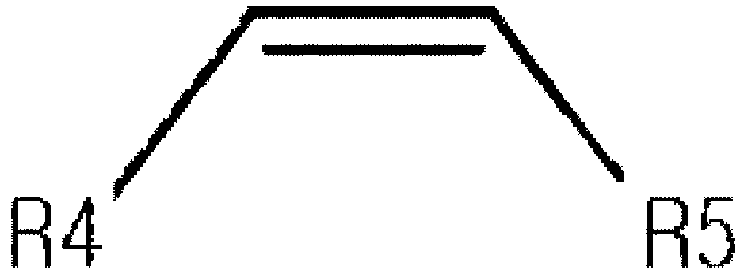
a substituent group of the aryl group is a nitro (-NO2) group, fluorine (F), chlorine (Cl), bromine (Br), a methyl group, an ethyl group, a propyl group, or a butyl group. - As a specific embodiment, the olefin may be one or more selected from ethene, propene, 1-butene, 1-pentene, 1-hexene, 1-octene, and styrene.
- The synthesis gas used in the method of preparing aldehyde of the present invention is mixed gas of carbon monoxide and hydrogen. A mixing ratio of CO:H2 may be 5:95 to 70:30, 40:60 to 60:40, or 50:50 to 40:60, but the mixing ratio is not limited thereto. When the mixing ratio is outside these ranges, unused gas is accumulated in a reactor and, as such, reactivity of the catalyst may be deteriorated.
- In addition to the method of hydroformylating the olefin according to the present invention, other reaction conditions may be carried out through generally known methods.
- In the method of preparing aldehyde of the present invention, a reaction temperature of the olefin and the synthesis gas (CO/H2) in the presence of the catalyst composition may, for example, be 20 to 180°C, 50 to 150°C, or 75 to 125°C, but the present invention is not limited thereto. When the reaction temperature is less than 20°C, hydroformylation does not proceed. On the other hand, when the reaction temperature is larger than 180°C, stability of the catalyst is seriously damaged and, as such, activity of the catalyst is deteriorated.
- In addition, pressure of the reaction may, for example, be 1 to 700 bar, 1 to 300 bar, or 5 to 30 bar. When the reaction pressure is less than 1 bar, the hydroformylation reaction proceeds too slowly. On the other hand, when the reaction pressure is larger than 700 bar, an expensive reactor must be used to prevent explosion, without improvement of activity, and, thus, industrialization may be difficult.
- When the process of hydroformylating the olefin according to the present invention is schematically described, the triphenyl phosphine-based compound having the substituent group at the para position, a transition metal catalyst (b), and a diphenyl-cycloalkyl phosphine-based compound are dissolved in a solvent such as benzene, toluene, ethanol, pentanol, octanol, texanol, butyraldehyde, pentyl aldehyde, or the like, to prepare a mixed solution. Subsequently, the olefin, and the synthesis gas of carbon monoxide and hydrogen with the mixed solution are added to the reactor and then hydroformylation is proceeded by elevating temperature and applying pressure, while stirring. As a result, iso-aldehyde having improved selectivity, particularly having a normal/iso (N/I) selectivity of 6 or less may be obtained.
- Concrete ingredients and contents of the catalyst composition according to the present invention are the same as described above. The catalyst composition of the present invention may be prepared by dissolving in the solvent described above. A solvent used in the present invention is preferably one or more selected from aldehydes comprising propane aldehyde, butyraldehyde, pentyl aldehyde, valer aldehyde, and the like; ketones comprising acetone, methyl ethyl ketone, methyl isobutyl ketone, acetophenone, cyclohexanone, and the like; alcohols comprising ethanol, pentanol, octanol, texanol, and the like; aromatic compounds comprising benzene, toluene, xylene, and the like; halogenated aromatic compounds comprising ortho-dichlorobenzene, and the like; ethers comprising tetrahydrofuran, dimethoxyethane, dioxane, and the like; halogenated paraffins comprising methylene chloride and the like; and paraffin hydrocarbons comprising heptane and the like, but the present invention is not limited thereto. In particular, the solvent may be an aldehyde generated through hydroformylation.
- In accordance with the catalyst composition and the method of hydroformylating olefin using the same of the present invention, although the ligand is used in a smaller amount than a conventionally used amount, an N/I selectivity of aldehyde is 3.1 to 3.7 and, thus, selectivity for iso-aldehyde is improved. In addition, a stabilization value of the catalyst is 60 to 61% after 15 hr, 72 to 80 % after 5 hr, and 78 to 92% after 2.5 hr, based on a catalyst activity value of 116 to 138% during supply of fresh.
- Hereinafter, preferred examples will be provided for better understanding of the present invention. It will be apparent to those skilled in the art that these examples are only provided to illustrate the present invention and various modifications and alterations are possible within the scope and technical range of the present invention. Such modifications and alterations fall within the scope of claims included herein.
- 250 ppm of rhodium (Rh) as a transition metal catalyst, 2.0 wt% of a triphenyl phosphine-based compound (tri-p-tolylphosphine), a substituent group at a para position of which is methyl, as a ligand to the catalyst, and 2.0 wt% of a diphenyl phosphine-based compound (cyclohexyl diphenyl phosphine) having a C6 cycloalkyl group, as a ligand stabilizer were dissolved in butylaldehyde to prepare 100 g of a total solvent.
- Mixed gas of propene:CO:H2 mixed in a molar ratio of 1:1:1 was added to the catalyst solution, and stirred for 1 hour at 90 °C while maintaining pressure of the reactor at 8 bar such that a reaction was carried out.
- Activity (%) of the fresh catalyst used in the reaction and a normal/iso selectivity of aldehyde prepared were measured according to methods described below. In addition, a degree of stability of the catalyst was measured maximally up to 15 hr through a stability test. Results are summarized in Tables 1 and 2.
-
- *Catalyst activity (%): a total amount of aldehyde generated in the reaction was measured by dividing into a molecular weight of butyraldehyde, a concentration of the used catalyst, and reaction time. A unit was mol(BAL)/mol(Rh)/h.
- *Normal/iso selectivity of aldehyde: resultant values are values obtained by dividing the amount of normal-butyraldehyde generated from the reaction into the amount of iso-butyraldehyde. A generation amount of each aldehyde was measured through gas chromatography (GC).
- *Stability test (againg test): mixed gas of CO and H2 mixed in a molar ratio of 1:1 was added to the solution to maintain pressure of the reactor pressure at 10 bar and an aging test was carried out while stirring at 120 °C. Aging activity change of the catalyst was recorded in %.
- An experiment was carried out in the same manner as in Example 1, except that 1.0 wt% of the triphenyl phosphine-based compound (tri-p-tolylphosphine), in which a substituent group at a para position is methyl, and 2.5 wt% of the diphenyl phosphine-based compound (cyclohexyl diphenyl phosphine) having a C6 cycloalkyl group, as a ligand stabilizer were used. Measured results are summarized in Tables 1 and 2.
- An experiment was carried out in the same manner as in Example 1, except that 4.0 wt% of the triphenyl phosphine-based compound (tri-p-tolylphosphine), in which a substituent group at a para position is methyl, was used and the diphenyl phosphine-based compound (cyclohexyl diphenyl phosphine) having a C6 cycloalkyl group, as a ligand stabilizer was not added. Measured results are summarized in Tables 1 and 2.
- An experiment was carried out in the same manner as in Example 1, except that 6.0 wt% of triphenyl phosphine, in which a substituent group does not exist at a para position, was used instead of the triphenyl phosphine-based compound (tri-p-tolylphosphine), in which a substituent group at a para position is methyl, and the diphenyl phosphine-based compound (cyclohexyl diphenyl phosphine) having a C6 cycloalkyl group, as a ligand stabilizer was not added. Measured results are summarized in Tables 1 and 2.
[Table 1] Classification Ligand Stabilizer of ligand Fresh catalyst activity (%) Normal/is o selectivi ty Example 1 Triphenyl Diphenylcycloalkylph 116 3.7 Example 2 phosphine -based compound, in which substitue nt group at para position is methyl osphine, which comprises C6 cycloalkyl and in which substituent group does not exist at para position 138 3.1 Comparative Example 1 - 98 6.4 Comparative Example 2 Triphenyl phosphine , in which substitue nt group does not exist at para position 100 9.1 [Table 2] Classification Ligand Stabilizer of ligand Catalyst stability test (aging time) Fresh 2.5 hr 5.0 hr 15.0 hr Example 1 Triphenylph osphine-based compound, in which substituent group at para position is methyl Diphenyl-cycloalkylph osphine, which comprises C6 cycloalkyl and in which substituent group does not exist at para position 116 78 72 60 Example 2 138 92 80 61 Comparative Example 1 - 98 63 59 54 Comparative Example 2 Triphenylph osphine, in which substituent group does not exist at para position 100 56 48 28 - As shown in Tables 1 and 2, it can be confirmed that, in Example 1 to 2 using the specific ligand and the stabilizer to the ligand together of the present invention, iso-aldehyde selectivity of aldehyde, an N/I selectivity of which is 3.1 to 3.7, is improved, and catalyst stability is dramatically improved showing 60 to 61% after 15 hr, 72 to 80 % after 5 hr, and 78 to 92% after 2.5 hr, based on a catalyst activity value of 116 to 138% during supply of fresh.
- On the other hand, it can be confirmed that, in Comparative Example 1 using only the ligand, without the stabilizer, in a total amount of the ligand and the stabilizer used in Examples 1 to 2, an N/I selectivity of aldehyde is 6.4 (an N/I selectivity of less than 6 is impossible) due to relative reduction of iso-aldehyde selectivity, and a stability value of the catalyst is reduced indicating 54% after 15 hr, 59 % after 5 hr, and 63% after 2.5 hr, based on a catalyst activity value of 98% during supply of fresh.
- Furthermore, it can be confirmed that, in Comparative Example 2 using only triphenylphosphine in which a substituent group does not exist at a para position, conventionally used instead of the ligand used in Examples 1 to 2, normal aldehyde selectivity is improved indicating an aldehyde N/I selectivity of 9.1, and a stability value of the catalyst poorly is 28% after 15 hr, 48% after 5 hr, and 56% after 2.5 hr, based on a catalyst activity value of 100% during fresh supply.
Claims (11)
- A catalyst composition for hydroformylation reaction, comprising a triphenyl phosphine compound having a substituent group at a para position, a diphenyl phosphine compound, a transition metal catalyst, and a solvent, wherein the triphenyl phosphine compound having a substituent group at a para position is a compound having a substituent group independently selected from a C1 to C3 alkyl group and a C1 to C5 alkoxy group at the para position and is used in an amount of 1.0 to 5.0 wt%, with respect to a total weight of the catalyst composition, and
wherein the diphenyl phosphine compound is one or more selected from the group consisting of cyclohexyldiphenylphosphine, cyclohexylditolyl phosphine, and cycloheptyldiphenylphosphine and is used in an amount of 1.0 to 5.5 wt%, with respect to a total weight of the catalyst composition. - The catalyst composition according to claim 1, wherein the triphenyl phosphine compound having the substituent group at the para position is a compound having, at the same time, a substituent group type selected from a C1 to C3 alkyl group and a C1 to C5 alkoxy group at the para position.
- The catalyst composition according to claim 1, wherein the diphenyl phosphine compound comprises a substituent group selected from a C1 to C3 alkyl group and a C1 to C5 alkoxy alkyl at the para position.
- The catalyst composition according to claim 1, wherein the transition metal catalyst is represented by Formula 1 below:
[Formula 1] M(L1)x(L2)y(L3)z
wherein M is rhodium (Rh), iridium (Ir) or cobalt (Co), andL1, L2 and L3 are each independently hydrogen, CO, cyclooctadiene, norbornene, chlorine, triphenylphosphine, or acetylacetonate, x, y and z are each independently integer of 0 to 5,and at least one of x, y and z is not 0. - The catalyst composition according to claim 1, wherein the transition metal catalyst is one or more selected from cobalt carbonyl [Co2(CO)8], acetylacetonate dicarbonyl rhodium [Rh(AcAc)(CO)2], acetylacetonate carbonyl triphenylphosphine rhodium [Rh(AcAc)(CO)(TPP)], hydrido carbonyl tri(triphenylphosphine)rhodium [HRh(CO)(TPP)3], acetylacetonate dicarbonyl iridium [Ir(AcAc)(CO)2], and hydrido carbonyl tri(triphenylphosphine)iridium [HIr(CO)(TPP)3].
- The catalyst composition according to claim 1, wherein an amount of a central metal of the transition metal catalyst is 10 to 1000 ppm based on a weight or volume of the catalyst composition.
- The catalyst composition according to claim 1, wherein an amount of the triphenyl phosphine compound having the substituent group at the para position is 0.5 to 200 mole fraction with respect to 1 mol of a central metal of the transition metal catalyst.
- The catalyst composition according to claim 1, wherein the triphenyl phosphine compound having the substituent group at the para position comprises tri-p-tolylphosphine (TPTP) in an amount of 1.0 to 5.0 wt% with respect to a total weight of the catalyst composition.
- The catalyst composition according to claim 1, wherein the diphenyl phosphine compound comprises cyclohexyldiphenylphosphine in an amount of 1.0 to 5.0 wt% with respect to a total weight of the catalyst composition.
- A method of hydroformylating an olefin, the method comprising obtaining aldehyde having a normal/iso (N/I) selectivity of 6 or less by reacting an olefin and synthesis gas (CO/H2) in the presence of the catalyst composition according to any one of claims 1 to 9.
- The method according to claim 10, wherein the solvent is one or more selected from propane aldehyde, butyraldehyde, pentyl aldehyde, valer aldehyde, acetone, methyl ethyl ketone, methyl isobutyl ketone, acetophenone, cyclohexanone, ethanol, pentanol, octanol, texanol, benzene, toluene, xylene, ortho dichlorobenzene, tetrahydrofuran, dimethoxyethane, dioxane, methylene chloride, and heptane.
Applications Claiming Priority (3)
| Application Number | Priority Date | Filing Date | Title |
|---|---|---|---|
| KR20130115828 | 2013-09-30 | ||
| KR1020140125425A KR101615028B1 (en) | 2013-09-30 | 2014-09-22 | Catalyst compositions for hydroformylation reaction and hydroformylation process of olefins using the same |
| PCT/KR2014/008978 WO2015046924A1 (en) | 2013-09-30 | 2014-09-25 | Catalyst composition for hydroformylation reaction and method for hydroformylation of olefin using same |
Publications (3)
| Publication Number | Publication Date |
|---|---|
| EP2881173A1 EP2881173A1 (en) | 2015-06-10 |
| EP2881173A4 EP2881173A4 (en) | 2016-06-08 |
| EP2881173B1 true EP2881173B1 (en) | 2017-06-14 |
Family
ID=52743950
Family Applications (1)
| Application Number | Title | Priority Date | Filing Date |
|---|---|---|---|
| EP14838850.7A Active EP2881173B1 (en) | 2013-09-30 | 2014-09-25 | Catalyst composition for hydroformylation reaction and method for hydroformylation of olefin using same |
Country Status (2)
| Country | Link |
|---|---|
| EP (1) | EP2881173B1 (en) |
| WO (1) | WO2015046924A1 (en) |
Families Citing this family (1)
| Publication number | Priority date | Publication date | Assignee | Title |
|---|---|---|---|---|
| KR101811102B1 (en) * | 2015-07-13 | 2017-12-20 | 주식회사 엘지화학 | Catalyst composition comprising phosphorus-based ligands and hydroformylation process using the same |
Family Cites Families (9)
| Publication number | Priority date | Publication date | Assignee | Title |
|---|---|---|---|---|
| US4260828A (en) * | 1980-04-16 | 1981-04-07 | Union Carbide Corporation | Hydroformylation process |
| US4491675A (en) * | 1981-08-17 | 1985-01-01 | Union Carbide Corporation | Hydroformylation process using triarylphosphine and bisphosphine monooxide ligands |
| US5693832A (en) * | 1994-06-27 | 1997-12-02 | Showa Denko K.K | Hydroformylation of allyl alcohol |
| CN101160272A (en) * | 2005-03-16 | 2008-04-09 | 佩什托普特殊化学股份公司 | Hydroformylation process with improved ISO-selectivity |
| KR100964099B1 (en) * | 2007-09-14 | 2010-06-16 | 주식회사 엘지화학 | Catalyst composition comprising phosphorus and hydroformylation method using same |
| KR20100092169A (en) * | 2009-02-12 | 2010-08-20 | 주식회사 엘지화학 | Methods for producing aldehyde using phosphorus-containing catalyst composition |
| EP2404671B2 (en) * | 2009-02-12 | 2018-07-25 | LG Chem, Ltd. | Catalyst composition for hydroformylation and method for preparing aldehydes using the same |
| KR101089488B1 (en) * | 2010-07-14 | 2011-12-02 | 주식회사 엘지화학 | Combined device of isotype aldehyde and alcohol from olefins and method for using same |
| KR101095775B1 (en) * | 2010-09-02 | 2011-12-21 | 주식회사 엘지화학 | Catalyst composition for hydroformylation reaction of olefinic compound and hydroformylation method of olefinic compound using same |
-
2014
- 2014-09-25 EP EP14838850.7A patent/EP2881173B1/en active Active
- 2014-09-25 WO PCT/KR2014/008978 patent/WO2015046924A1/en not_active Ceased
Non-Patent Citations (1)
| Title |
|---|
| None * |
Also Published As
| Publication number | Publication date |
|---|---|
| EP2881173A4 (en) | 2016-06-08 |
| WO2015046924A1 (en) | 2015-04-02 |
| EP2881173A1 (en) | 2015-06-10 |
Similar Documents
| Publication | Publication Date | Title |
|---|---|---|
| KR101411040B1 (en) | Catalyst compositions for hydroformylation reaction and hydroformylation process using the same | |
| US11534744B2 (en) | Composition including hydroformylation catalyst | |
| JP5134687B2 (en) | Catalyst composition for hydroformylation of phosphorus-containing olefinic compounds and hydroformylation method using the same | |
| KR101095775B1 (en) | Catalyst composition for hydroformylation reaction of olefinic compound and hydroformylation method of olefinic compound using same | |
| EP3156127B1 (en) | Catalytic composition containing phosphorus-based ligand and method for hydroformylation using same | |
| JP4571140B2 (en) | Catalyst composition containing phosphorus and hydroformylation method using the same | |
| US9616422B2 (en) | Catalyst composition for hydroformylation reaction and method of hydroformylating olefin using the same | |
| EP3213817B1 (en) | Catalyst composition containing phosphorus-based ligand and method for hydroformylation using same | |
| EP3466540B1 (en) | Catalyst composition for hydroformylation reaction and method for preparing aldehyde using same | |
| KR20100092169A (en) | Methods for producing aldehyde using phosphorus-containing catalyst composition | |
| KR20180130420A (en) | Catalyst compositions for hydroformylation reaction and method for preparing aldehyde using the same | |
| KR101962094B1 (en) | Catalyst composition for hydroformylation and hydroformylation process using the same | |
| EP2881173A1 (en) | Catalyst composition for hydroformylation reaction and method for hydroformylation of olefin using same | |
| KR101309918B1 (en) | Hydroformylation Method Having Improved Catalyst Stability In Reaction | |
| KR20170084792A (en) | Hydroformylation process using catalyst composition comprising phosphite ligands |
Legal Events
| Date | Code | Title | Description |
|---|---|---|---|
| PUAI | Public reference made under article 153(3) epc to a published international application that has entered the european phase |
Free format text: ORIGINAL CODE: 0009012 |
|
| 17P | Request for examination filed |
Effective date: 20150303 |
|
| AK | Designated contracting states |
Kind code of ref document: A1 Designated state(s): AL AT BE BG CH CY CZ DE DK EE ES FI FR GB GR HR HU IE IS IT LI LT LU LV MC MK MT NL NO PL PT RO RS SE SI SK SM TR |
|
| AX | Request for extension of the european patent |
Extension state: BA ME |
|
| RA4 | Supplementary search report drawn up and despatched (corrected) |
Effective date: 20160511 |
|
| RIC1 | Information provided on ipc code assigned before grant |
Ipc: B01J 31/24 20060101AFI20160504BHEP Ipc: B01J 23/72 20060101ALN20160504BHEP Ipc: C07C 45/50 20060101ALI20160504BHEP Ipc: B01J 23/46 20060101ALN20160504BHEP Ipc: B01J 31/20 20060101ALI20160504BHEP |
|
| DAX | Request for extension of the european patent (deleted) | ||
| REG | Reference to a national code |
Ref country code: DE Ref legal event code: R079 Ref document number: 602014010869 Country of ref document: DE Free format text: PREVIOUS MAIN CLASS: B01J0023460000 Ipc: B01J0031240000 |
|
| RIC1 | Information provided on ipc code assigned before grant |
Ipc: B01J 31/20 20060101ALI20161223BHEP Ipc: B01J 23/46 20060101ALN20161223BHEP Ipc: C07C 45/50 20060101ALI20161223BHEP Ipc: B01J 31/24 20060101AFI20161223BHEP Ipc: B01J 23/72 20060101ALN20161223BHEP |
|
| GRAP | Despatch of communication of intention to grant a patent |
Free format text: ORIGINAL CODE: EPIDOSNIGR1 |
|
| RIC1 | Information provided on ipc code assigned before grant |
Ipc: B01J 31/20 20060101ALI20170119BHEP Ipc: C07C 45/50 20060101ALI20170119BHEP Ipc: B01J 31/24 20060101AFI20170119BHEP |
|
| INTG | Intention to grant announced |
Effective date: 20170215 |
|
| GRAS | Grant fee paid |
Free format text: ORIGINAL CODE: EPIDOSNIGR3 |
|
| GRAA | (expected) grant |
Free format text: ORIGINAL CODE: 0009210 |
|
| AK | Designated contracting states |
Kind code of ref document: B1 Designated state(s): AL AT BE BG CH CY CZ DE DK EE ES FI FR GB GR HR HU IE IS IT LI LT LU LV MC MK MT NL NO PL PT RO RS SE SI SK SM TR |
|
| REG | Reference to a national code |
Ref country code: GB Ref legal event code: FG4D |
|
| REG | Reference to a national code |
Ref country code: CH Ref legal event code: EP Ref country code: AT Ref legal event code: REF Ref document number: 900441 Country of ref document: AT Kind code of ref document: T Effective date: 20170615 |
|
| REG | Reference to a national code |
Ref country code: SE Ref legal event code: TRGR |
|
| REG | Reference to a national code |
Ref country code: IE Ref legal event code: FG4D |
|
| REG | Reference to a national code |
Ref country code: DE Ref legal event code: R096 Ref document number: 602014010869 Country of ref document: DE |
|
| REG | Reference to a national code |
Ref country code: FR Ref legal event code: PLFP Year of fee payment: 4 |
|
| REG | Reference to a national code |
Ref country code: NL Ref legal event code: MP Effective date: 20170614 |
|
| REG | Reference to a national code |
Ref country code: LT Ref legal event code: MG4D |
|
| PG25 | Lapsed in a contracting state [announced via postgrant information from national office to epo] |
Ref country code: FI Free format text: LAPSE BECAUSE OF FAILURE TO SUBMIT A TRANSLATION OF THE DESCRIPTION OR TO PAY THE FEE WITHIN THE PRESCRIBED TIME-LIMIT Effective date: 20170614 Ref country code: GR Free format text: LAPSE BECAUSE OF FAILURE TO SUBMIT A TRANSLATION OF THE DESCRIPTION OR TO PAY THE FEE WITHIN THE PRESCRIBED TIME-LIMIT Effective date: 20170915 Ref country code: NO Free format text: LAPSE BECAUSE OF FAILURE TO SUBMIT A TRANSLATION OF THE DESCRIPTION OR TO PAY THE FEE WITHIN THE PRESCRIBED TIME-LIMIT Effective date: 20170914 Ref country code: LT Free format text: LAPSE BECAUSE OF FAILURE TO SUBMIT A TRANSLATION OF THE DESCRIPTION OR TO PAY THE FEE WITHIN THE PRESCRIBED TIME-LIMIT Effective date: 20170614 Ref country code: HR Free format text: LAPSE BECAUSE OF FAILURE TO SUBMIT A TRANSLATION OF THE DESCRIPTION OR TO PAY THE FEE WITHIN THE PRESCRIBED TIME-LIMIT Effective date: 20170614 |
|
| REG | Reference to a national code |
Ref country code: AT Ref legal event code: MK05 Ref document number: 900441 Country of ref document: AT Kind code of ref document: T Effective date: 20170614 |
|
| PG25 | Lapsed in a contracting state [announced via postgrant information from national office to epo] |
Ref country code: RS Free format text: LAPSE BECAUSE OF FAILURE TO SUBMIT A TRANSLATION OF THE DESCRIPTION OR TO PAY THE FEE WITHIN THE PRESCRIBED TIME-LIMIT Effective date: 20170614 Ref country code: BG Free format text: LAPSE BECAUSE OF FAILURE TO SUBMIT A TRANSLATION OF THE DESCRIPTION OR TO PAY THE FEE WITHIN THE PRESCRIBED TIME-LIMIT Effective date: 20170914 Ref country code: NL Free format text: LAPSE BECAUSE OF FAILURE TO SUBMIT A TRANSLATION OF THE DESCRIPTION OR TO PAY THE FEE WITHIN THE PRESCRIBED TIME-LIMIT Effective date: 20170614 Ref country code: LV Free format text: LAPSE BECAUSE OF FAILURE TO SUBMIT A TRANSLATION OF THE DESCRIPTION OR TO PAY THE FEE WITHIN THE PRESCRIBED TIME-LIMIT Effective date: 20170614 |
|
| PG25 | Lapsed in a contracting state [announced via postgrant information from national office to epo] |
Ref country code: SK Free format text: LAPSE BECAUSE OF FAILURE TO SUBMIT A TRANSLATION OF THE DESCRIPTION OR TO PAY THE FEE WITHIN THE PRESCRIBED TIME-LIMIT Effective date: 20170614 Ref country code: AT Free format text: LAPSE BECAUSE OF FAILURE TO SUBMIT A TRANSLATION OF THE DESCRIPTION OR TO PAY THE FEE WITHIN THE PRESCRIBED TIME-LIMIT Effective date: 20170614 Ref country code: EE Free format text: LAPSE BECAUSE OF FAILURE TO SUBMIT A TRANSLATION OF THE DESCRIPTION OR TO PAY THE FEE WITHIN THE PRESCRIBED TIME-LIMIT Effective date: 20170614 Ref country code: CZ Free format text: LAPSE BECAUSE OF FAILURE TO SUBMIT A TRANSLATION OF THE DESCRIPTION OR TO PAY THE FEE WITHIN THE PRESCRIBED TIME-LIMIT Effective date: 20170614 Ref country code: RO Free format text: LAPSE BECAUSE OF FAILURE TO SUBMIT A TRANSLATION OF THE DESCRIPTION OR TO PAY THE FEE WITHIN THE PRESCRIBED TIME-LIMIT Effective date: 20170614 |
|
| PG25 | Lapsed in a contracting state [announced via postgrant information from national office to epo] |
Ref country code: IT Free format text: LAPSE BECAUSE OF FAILURE TO SUBMIT A TRANSLATION OF THE DESCRIPTION OR TO PAY THE FEE WITHIN THE PRESCRIBED TIME-LIMIT Effective date: 20170614 Ref country code: SM Free format text: LAPSE BECAUSE OF FAILURE TO SUBMIT A TRANSLATION OF THE DESCRIPTION OR TO PAY THE FEE WITHIN THE PRESCRIBED TIME-LIMIT Effective date: 20170614 Ref country code: PL Free format text: LAPSE BECAUSE OF FAILURE TO SUBMIT A TRANSLATION OF THE DESCRIPTION OR TO PAY THE FEE WITHIN THE PRESCRIBED TIME-LIMIT Effective date: 20170614 Ref country code: ES Free format text: LAPSE BECAUSE OF FAILURE TO SUBMIT A TRANSLATION OF THE DESCRIPTION OR TO PAY THE FEE WITHIN THE PRESCRIBED TIME-LIMIT Effective date: 20170614 Ref country code: IS Free format text: LAPSE BECAUSE OF FAILURE TO SUBMIT A TRANSLATION OF THE DESCRIPTION OR TO PAY THE FEE WITHIN THE PRESCRIBED TIME-LIMIT Effective date: 20171014 |
|
| REG | Reference to a national code |
Ref country code: DE Ref legal event code: R097 Ref document number: 602014010869 Country of ref document: DE |
|
| PLBE | No opposition filed within time limit |
Free format text: ORIGINAL CODE: 0009261 |
|
| STAA | Information on the status of an ep patent application or granted ep patent |
Free format text: STATUS: NO OPPOSITION FILED WITHIN TIME LIMIT |
|
| PG25 | Lapsed in a contracting state [announced via postgrant information from national office to epo] |
Ref country code: DK Free format text: LAPSE BECAUSE OF FAILURE TO SUBMIT A TRANSLATION OF THE DESCRIPTION OR TO PAY THE FEE WITHIN THE PRESCRIBED TIME-LIMIT Effective date: 20170614 |
|
| REG | Reference to a national code |
Ref country code: CH Ref legal event code: PL |
|
| 26N | No opposition filed |
Effective date: 20180315 |
|
| PG25 | Lapsed in a contracting state [announced via postgrant information from national office to epo] |
Ref country code: MC Free format text: LAPSE BECAUSE OF FAILURE TO SUBMIT A TRANSLATION OF THE DESCRIPTION OR TO PAY THE FEE WITHIN THE PRESCRIBED TIME-LIMIT Effective date: 20170614 |
|
| REG | Reference to a national code |
Ref country code: IE Ref legal event code: MM4A |
|
| REG | Reference to a national code |
Ref country code: BE Ref legal event code: MM Effective date: 20170930 |
|
| PG25 | Lapsed in a contracting state [announced via postgrant information from national office to epo] |
Ref country code: LU Free format text: LAPSE BECAUSE OF NON-PAYMENT OF DUE FEES Effective date: 20170925 |
|
| PG25 | Lapsed in a contracting state [announced via postgrant information from national office to epo] |
Ref country code: CH Free format text: LAPSE BECAUSE OF NON-PAYMENT OF DUE FEES Effective date: 20170930 Ref country code: LI Free format text: LAPSE BECAUSE OF NON-PAYMENT OF DUE FEES Effective date: 20170930 Ref country code: IE Free format text: LAPSE BECAUSE OF NON-PAYMENT OF DUE FEES Effective date: 20170925 |
|
| REG | Reference to a national code |
Ref country code: FR Ref legal event code: PLFP Year of fee payment: 5 |
|
| PG25 | Lapsed in a contracting state [announced via postgrant information from national office to epo] |
Ref country code: SI Free format text: LAPSE BECAUSE OF FAILURE TO SUBMIT A TRANSLATION OF THE DESCRIPTION OR TO PAY THE FEE WITHIN THE PRESCRIBED TIME-LIMIT Effective date: 20170614 Ref country code: BE Free format text: LAPSE BECAUSE OF NON-PAYMENT OF DUE FEES Effective date: 20170930 |
|
| PG25 | Lapsed in a contracting state [announced via postgrant information from national office to epo] |
Ref country code: MT Free format text: LAPSE BECAUSE OF NON-PAYMENT OF DUE FEES Effective date: 20170925 |
|
| PG25 | Lapsed in a contracting state [announced via postgrant information from national office to epo] |
Ref country code: HU Free format text: LAPSE BECAUSE OF FAILURE TO SUBMIT A TRANSLATION OF THE DESCRIPTION OR TO PAY THE FEE WITHIN THE PRESCRIBED TIME-LIMIT; INVALID AB INITIO Effective date: 20140925 |
|
| PG25 | Lapsed in a contracting state [announced via postgrant information from national office to epo] |
Ref country code: CY Free format text: LAPSE BECAUSE OF FAILURE TO SUBMIT A TRANSLATION OF THE DESCRIPTION OR TO PAY THE FEE WITHIN THE PRESCRIBED TIME-LIMIT Effective date: 20170614 |
|
| PG25 | Lapsed in a contracting state [announced via postgrant information from national office to epo] |
Ref country code: MK Free format text: LAPSE BECAUSE OF FAILURE TO SUBMIT A TRANSLATION OF THE DESCRIPTION OR TO PAY THE FEE WITHIN THE PRESCRIBED TIME-LIMIT Effective date: 20170614 |
|
| PG25 | Lapsed in a contracting state [announced via postgrant information from national office to epo] |
Ref country code: TR Free format text: LAPSE BECAUSE OF FAILURE TO SUBMIT A TRANSLATION OF THE DESCRIPTION OR TO PAY THE FEE WITHIN THE PRESCRIBED TIME-LIMIT Effective date: 20170614 |
|
| PG25 | Lapsed in a contracting state [announced via postgrant information from national office to epo] |
Ref country code: PT Free format text: LAPSE BECAUSE OF FAILURE TO SUBMIT A TRANSLATION OF THE DESCRIPTION OR TO PAY THE FEE WITHIN THE PRESCRIBED TIME-LIMIT Effective date: 20170614 |
|
| PG25 | Lapsed in a contracting state [announced via postgrant information from national office to epo] |
Ref country code: AL Free format text: LAPSE BECAUSE OF FAILURE TO SUBMIT A TRANSLATION OF THE DESCRIPTION OR TO PAY THE FEE WITHIN THE PRESCRIBED TIME-LIMIT Effective date: 20170614 |
|
| PGFP | Annual fee paid to national office [announced via postgrant information from national office to epo] |
Ref country code: DE Payment date: 20250820 Year of fee payment: 12 |
|
| PGFP | Annual fee paid to national office [announced via postgrant information from national office to epo] |
Ref country code: GB Payment date: 20250820 Year of fee payment: 12 |
|
| PGFP | Annual fee paid to national office [announced via postgrant information from national office to epo] |
Ref country code: FR Payment date: 20250821 Year of fee payment: 12 |
|
| PGFP | Annual fee paid to national office [announced via postgrant information from national office to epo] |
Ref country code: SE Payment date: 20250821 Year of fee payment: 12 |