EP0073398A1 - Hydroformylation process using a rhodium complex catalyst with triarylphosphine and biphosphine monoxide ligands - Google Patents
Hydroformylation process using a rhodium complex catalyst with triarylphosphine and biphosphine monoxide ligands Download PDFInfo
- Publication number
- EP0073398A1 EP0073398A1 EP82107438A EP82107438A EP0073398A1 EP 0073398 A1 EP0073398 A1 EP 0073398A1 EP 82107438 A EP82107438 A EP 82107438A EP 82107438 A EP82107438 A EP 82107438A EP 0073398 A1 EP0073398 A1 EP 0073398A1
- Authority
- EP
- European Patent Office
- Prior art keywords
- ligand
- rhodium
- free
- radicals
- triarylphosphine
- Prior art date
- Legal status (The legal status is an assumption and is not a legal conclusion. Google has not performed a legal analysis and makes no representation as to the accuracy of the status listed.)
- Granted
Links
- 239000003446 ligand Substances 0.000 title claims abstract description 120
- 238000007037 hydroformylation reaction Methods 0.000 title claims abstract description 81
- 238000000034 method Methods 0.000 title claims abstract description 76
- 239000010948 rhodium Substances 0.000 title claims abstract description 71
- 229910052703 rhodium Inorganic materials 0.000 title claims abstract description 69
- MHOVAHRLVXNVSD-UHFFFAOYSA-N rhodium atom Chemical compound [Rh] MHOVAHRLVXNVSD-UHFFFAOYSA-N 0.000 title claims abstract description 69
- 230000008569 process Effects 0.000 title claims abstract description 61
- 239000003054 catalyst Substances 0.000 title claims description 64
- UGFAIRIUMAVXCW-UHFFFAOYSA-N Carbon monoxide Chemical compound [O+]#[C-] UGFAIRIUMAVXCW-UHFFFAOYSA-N 0.000 title claims description 31
- VURFVHCLMJOLKN-UHFFFAOYSA-N diphosphane Chemical compound PP VURFVHCLMJOLKN-UHFFFAOYSA-N 0.000 title 1
- 239000002243 precursor Substances 0.000 claims abstract description 26
- 230000003197 catalytic effect Effects 0.000 claims abstract description 10
- -1 hydrocarbon radical Chemical class 0.000 claims description 144
- 229910052698 phosphorus Inorganic materials 0.000 claims description 36
- 239000011574 phosphorus Substances 0.000 claims description 36
- 239000004215 Carbon black (E152) Substances 0.000 claims description 35
- OAICVXFJPJFONN-UHFFFAOYSA-N Phosphorus Chemical compound [P] OAICVXFJPJFONN-UHFFFAOYSA-N 0.000 claims description 35
- 150000001299 aldehydes Chemical class 0.000 claims description 35
- 229930195733 hydrocarbon Natural products 0.000 claims description 35
- RIOQSEWOXXDEQQ-UHFFFAOYSA-N triphenylphosphine Chemical compound C1=CC=CC=C1P(C=1C=CC=CC=1)C1=CC=CC=C1 RIOQSEWOXXDEQQ-UHFFFAOYSA-N 0.000 claims description 32
- 229910002091 carbon monoxide Inorganic materials 0.000 claims description 27
- 239000000203 mixture Substances 0.000 claims description 25
- 239000001257 hydrogen Substances 0.000 claims description 24
- 229910052739 hydrogen Inorganic materials 0.000 claims description 24
- 150000005840 aryl radicals Chemical class 0.000 claims description 22
- 239000002904 solvent Substances 0.000 claims description 20
- 239000007789 gas Substances 0.000 claims description 19
- 125000004432 carbon atom Chemical group C* 0.000 claims description 15
- 150000001875 compounds Chemical class 0.000 claims description 15
- 239000012429 reaction media Substances 0.000 claims description 15
- UFHFLCQGNIYNRP-UHFFFAOYSA-N Hydrogen Chemical compound [H][H] UFHFLCQGNIYNRP-UHFFFAOYSA-N 0.000 claims description 14
- 150000003254 radicals Chemical class 0.000 claims description 13
- 150000002431 hydrogen Chemical class 0.000 claims description 10
- 125000000217 alkyl group Chemical group 0.000 claims description 8
- GGRQQHADVSXBQN-FGSKAQBVSA-N carbon monoxide;(z)-4-hydroxypent-3-en-2-one;rhodium Chemical compound [Rh].[O+]#[C-].[O+]#[C-].C\C(O)=C\C(C)=O GGRQQHADVSXBQN-FGSKAQBVSA-N 0.000 claims description 8
- 229910052751 metal Inorganic materials 0.000 claims description 6
- 239000002184 metal Substances 0.000 claims description 6
- POILWHVDKZOXJZ-ARJAWSKDSA-M (z)-4-oxopent-2-en-2-olate Chemical compound C\C([O-])=C\C(C)=O POILWHVDKZOXJZ-ARJAWSKDSA-M 0.000 claims description 5
- 239000003960 organic solvent Substances 0.000 claims description 5
- LTQRDVHFRYSLIG-UHFFFAOYSA-N C(=O)=[P].[Rh] Chemical compound C(=O)=[P].[Rh] LTQRDVHFRYSLIG-UHFFFAOYSA-N 0.000 claims description 4
- 125000003118 aryl group Chemical group 0.000 claims description 4
- QVGXLLKOCUKJST-UHFFFAOYSA-N atomic oxygen Chemical compound [O] QVGXLLKOCUKJST-UHFFFAOYSA-N 0.000 claims description 4
- 229910052760 oxygen Inorganic materials 0.000 claims description 4
- 239000001301 oxygen Substances 0.000 claims description 4
- 229910052717 sulfur Inorganic materials 0.000 claims description 4
- NINIDFKCEFEMDL-UHFFFAOYSA-N Sulfur Chemical compound [S] NINIDFKCEFEMDL-UHFFFAOYSA-N 0.000 claims description 3
- 229910052799 carbon Inorganic materials 0.000 claims description 3
- 239000011593 sulfur Substances 0.000 claims description 3
- OKTJSMMVPCPJKN-UHFFFAOYSA-N Carbon Chemical compound [C] OKTJSMMVPCPJKN-UHFFFAOYSA-N 0.000 claims description 2
- 125000002877 alkyl aryl group Chemical group 0.000 claims description 2
- 125000003710 aryl alkyl group Chemical group 0.000 claims description 2
- 238000006243 chemical reaction Methods 0.000 description 41
- 239000000047 product Substances 0.000 description 22
- 238000002474 experimental method Methods 0.000 description 18
- 125000004805 propylene group Chemical group [H]C([H])([H])C([H])([*:1])C([H])([H])[*:2] 0.000 description 16
- QQONPFPTGQHPMA-UHFFFAOYSA-N propylene Natural products CC=C QQONPFPTGQHPMA-UHFFFAOYSA-N 0.000 description 15
- IJGRMHOSHXDMSA-UHFFFAOYSA-N Atomic nitrogen Chemical compound N#N IJGRMHOSHXDMSA-UHFFFAOYSA-N 0.000 description 14
- 239000000243 solution Substances 0.000 description 14
- ZTQSAGDEMFDKMZ-UHFFFAOYSA-N Butyraldehyde Chemical compound CCCC=O ZTQSAGDEMFDKMZ-UHFFFAOYSA-N 0.000 description 12
- 239000007858 starting material Substances 0.000 description 12
- 229910052757 nitrogen Inorganic materials 0.000 description 11
- FSHNFAOXXJLGJE-UHFFFAOYSA-N [Rh].[P] Chemical compound [Rh].[P] FSHNFAOXXJLGJE-UHFFFAOYSA-N 0.000 description 10
- 125000001997 phenyl group Chemical group [H]C1=C([H])C([H])=C(*)C([H])=C1[H] 0.000 description 9
- XYFCBTPGUUZFHI-UHFFFAOYSA-N Phosphine Natural products P XYFCBTPGUUZFHI-UHFFFAOYSA-N 0.000 description 6
- 230000000694 effects Effects 0.000 description 6
- 229910000073 phosphorus hydride Inorganic materials 0.000 description 6
- 239000012018 catalyst precursor Substances 0.000 description 5
- 238000012545 processing Methods 0.000 description 5
- 241000894007 species Species 0.000 description 5
- HGBOYTHUEUWSSQ-UHFFFAOYSA-N valeric aldehyde Natural products CCCCC=O HGBOYTHUEUWSSQ-UHFFFAOYSA-N 0.000 description 5
- UAXNXOMKCGKNCI-UHFFFAOYSA-N 1-diphenylphosphanylethyl(diphenyl)phosphane Chemical compound C=1C=CC=CC=1P(C=1C=CC=CC=1)C(C)P(C=1C=CC=CC=1)C1=CC=CC=C1 UAXNXOMKCGKNCI-UHFFFAOYSA-N 0.000 description 4
- 230000002411 adverse Effects 0.000 description 4
- 150000001336 alkenes Chemical class 0.000 description 4
- XXROGKLTLUQVRX-UHFFFAOYSA-N allyl alcohol Chemical compound OCC=C XXROGKLTLUQVRX-UHFFFAOYSA-N 0.000 description 4
- 238000009835 boiling Methods 0.000 description 4
- 239000006227 byproduct Substances 0.000 description 4
- 230000000875 corresponding effect Effects 0.000 description 4
- 239000011521 glass Substances 0.000 description 4
- 229910052736 halogen Inorganic materials 0.000 description 4
- 150000002367 halogens Chemical class 0.000 description 4
- 238000010952 in-situ formation Methods 0.000 description 4
- 239000007788 liquid Substances 0.000 description 4
- 125000004433 nitrogen atom Chemical group N* 0.000 description 4
- 238000002360 preparation method Methods 0.000 description 4
- 125000001424 substituent group Chemical group 0.000 description 4
- XLYOFNOQVPJJNP-UHFFFAOYSA-N water Substances O XLYOFNOQVPJJNP-UHFFFAOYSA-N 0.000 description 4
- HEMHJVSKTPXQMS-UHFFFAOYSA-M Sodium hydroxide Chemical compound [OH-].[Na+] HEMHJVSKTPXQMS-UHFFFAOYSA-M 0.000 description 3
- YXFVVABEGXRONW-UHFFFAOYSA-N Toluene Chemical compound CC1=CC=CC=C1 YXFVVABEGXRONW-UHFFFAOYSA-N 0.000 description 3
- 239000002168 alkylating agent Substances 0.000 description 3
- 229940100198 alkylating agent Drugs 0.000 description 3
- 125000004429 atom Chemical group 0.000 description 3
- 230000000536 complexating effect Effects 0.000 description 3
- 238000009833 condensation Methods 0.000 description 3
- 230000005494 condensation Effects 0.000 description 3
- 125000004093 cyano group Chemical group *C#N 0.000 description 3
- 125000004212 difluorophenyl group Chemical group 0.000 description 3
- RTZKZFJDLAIYFH-UHFFFAOYSA-N ether Substances CCOCC RTZKZFJDLAIYFH-UHFFFAOYSA-N 0.000 description 3
- 125000001207 fluorophenyl group Chemical group 0.000 description 3
- 230000007062 hydrolysis Effects 0.000 description 3
- 238000006460 hydrolysis reaction Methods 0.000 description 3
- 125000004464 hydroxyphenyl group Chemical group 0.000 description 3
- 238000011065 in-situ storage Methods 0.000 description 3
- 238000004519 manufacturing process Methods 0.000 description 3
- 125000000325 methylidene group Chemical group [H]C([H])=* 0.000 description 3
- 125000001624 naphthyl group Chemical group 0.000 description 3
- 125000000449 nitro group Chemical group [O-][N+](*)=O 0.000 description 3
- 150000002894 organic compounds Chemical class 0.000 description 3
- XYFCBTPGUUZFHI-UHFFFAOYSA-O phosphonium Chemical class [PH4+] XYFCBTPGUUZFHI-UHFFFAOYSA-O 0.000 description 3
- 125000002924 primary amino group Chemical group [H]N([H])* 0.000 description 3
- 239000000376 reactant Substances 0.000 description 3
- BDDWSAASCFBVBK-UHFFFAOYSA-N rhodium;triphenylphosphane Chemical compound [Rh].C1=CC=CC=C1P(C=1C=CC=CC=1)C1=CC=CC=C1 BDDWSAASCFBVBK-UHFFFAOYSA-N 0.000 description 3
- 125000003944 tolyl group Chemical group 0.000 description 3
- 125000002023 trifluoromethyl group Chemical group FC(F)(F)* 0.000 description 3
- 125000005023 xylyl group Chemical group 0.000 description 3
- 239000004711 α-olefin Substances 0.000 description 3
- XWJBRBSPAODJER-UHFFFAOYSA-N 1,7-octadiene Chemical compound C=CCCCCC=C XWJBRBSPAODJER-UHFFFAOYSA-N 0.000 description 2
- ZGEGCLOFRBLKSE-UHFFFAOYSA-N 1-Heptene Chemical compound CCCCCC=C ZGEGCLOFRBLKSE-UHFFFAOYSA-N 0.000 description 2
- AFFLGGQVNFXPEV-UHFFFAOYSA-N 1-decene Chemical compound CCCCCCCCC=C AFFLGGQVNFXPEV-UHFFFAOYSA-N 0.000 description 2
- CRSBERNSMYQZNG-UHFFFAOYSA-N 1-dodecene Chemical compound CCCCCCCCCCC=C CRSBERNSMYQZNG-UHFFFAOYSA-N 0.000 description 2
- LIKMAJRDDDTEIG-UHFFFAOYSA-N 1-hexene Chemical compound CCCCC=C LIKMAJRDDDTEIG-UHFFFAOYSA-N 0.000 description 2
- KWKAKUADMBZCLK-UHFFFAOYSA-N 1-octene Chemical compound CCCCCCC=C KWKAKUADMBZCLK-UHFFFAOYSA-N 0.000 description 2
- RYPKRALMXUUNKS-UHFFFAOYSA-N 2-Hexene Natural products CCCC=CC RYPKRALMXUUNKS-UHFFFAOYSA-N 0.000 description 2
- JMMZCWZIJXAGKW-UHFFFAOYSA-N 2-methylpent-2-ene Chemical compound CCC=C(C)C JMMZCWZIJXAGKW-UHFFFAOYSA-N 0.000 description 2
- ATUOYWHBWRKTHZ-UHFFFAOYSA-N Propane Chemical compound CCC ATUOYWHBWRKTHZ-UHFFFAOYSA-N 0.000 description 2
- PPBRXRYQALVLMV-UHFFFAOYSA-N Styrene Chemical compound C=CC1=CC=CC=C1 PPBRXRYQALVLMV-UHFFFAOYSA-N 0.000 description 2
- YRKCREAYFQTBPV-UHFFFAOYSA-N acetylacetone Chemical compound CC(=O)CC(C)=O YRKCREAYFQTBPV-UHFFFAOYSA-N 0.000 description 2
- SJNALLRHIVGIBI-UHFFFAOYSA-N allyl cyanide Chemical compound C=CCC#N SJNALLRHIVGIBI-UHFFFAOYSA-N 0.000 description 2
- 230000015572 biosynthetic process Effects 0.000 description 2
- 235000010290 biphenyl Nutrition 0.000 description 2
- 239000004305 biphenyl Substances 0.000 description 2
- 125000006267 biphenyl group Chemical group 0.000 description 2
- PVEOYINWKBTPIZ-UHFFFAOYSA-N but-3-enoic acid Chemical compound OC(=O)CC=C PVEOYINWKBTPIZ-UHFFFAOYSA-N 0.000 description 2
- WERYXYBDKMZEQL-UHFFFAOYSA-N butane-1,4-diol Chemical compound OCCCCO WERYXYBDKMZEQL-UHFFFAOYSA-N 0.000 description 2
- HGCIXCUEYOPUTN-UHFFFAOYSA-N cyclohexene Chemical compound C1CCC=CC1 HGCIXCUEYOPUTN-UHFFFAOYSA-N 0.000 description 2
- 230000003247 decreasing effect Effects 0.000 description 2
- FJKIXWOMBXYWOQ-UHFFFAOYSA-N ethenoxyethane Chemical compound CCOC=C FJKIXWOMBXYWOQ-UHFFFAOYSA-N 0.000 description 2
- 238000001914 filtration Methods 0.000 description 2
- 150000002430 hydrocarbons Chemical class 0.000 description 2
- 230000006872 improvement Effects 0.000 description 2
- 238000012986 modification Methods 0.000 description 2
- 230000004048 modification Effects 0.000 description 2
- CCCMONHAUSKTEQ-UHFFFAOYSA-N octadec-1-ene Chemical compound CCCCCCCCCCCCCCCCC=C CCCMONHAUSKTEQ-UHFFFAOYSA-N 0.000 description 2
- 238000005457 optimization Methods 0.000 description 2
- YWAKXRMUMFPDSH-UHFFFAOYSA-N pentene Chemical compound CCCC=C YWAKXRMUMFPDSH-UHFFFAOYSA-N 0.000 description 2
- QMMOXUPEWRXHJS-UHFFFAOYSA-N pentene-2 Natural products CCC=CC QMMOXUPEWRXHJS-UHFFFAOYSA-N 0.000 description 2
- ZUOUZKKEUPVFJK-UHFFFAOYSA-N phenylbenzene Natural products C1=CC=CC=C1C1=CC=CC=C1 ZUOUZKKEUPVFJK-UHFFFAOYSA-N 0.000 description 2
- 238000010926 purge Methods 0.000 description 2
- 230000009257 reactivity Effects 0.000 description 2
- 239000013638 trimer Substances 0.000 description 2
- 125000000391 vinyl group Chemical group [H]C([*])=C([H])[H] 0.000 description 2
- DAFHKNAQFPVRKR-UHFFFAOYSA-N (3-hydroxy-2,2,4-trimethylpentyl) 2-methylpropanoate Chemical compound CC(C)C(O)C(C)(C)COC(=O)C(C)C DAFHKNAQFPVRKR-UHFFFAOYSA-N 0.000 description 1
- YCTDZYMMFQCTEO-FNORWQNLSA-N (E)-3-octene Chemical compound CCCC\C=C\CC YCTDZYMMFQCTEO-FNORWQNLSA-N 0.000 description 1
- MBVAQOHBPXKYMF-LNTINUHCSA-N (z)-4-hydroxypent-3-en-2-one;rhodium Chemical compound [Rh].C\C(O)=C\C(C)=O.C\C(O)=C\C(C)=O.C\C(O)=C\C(C)=O MBVAQOHBPXKYMF-LNTINUHCSA-N 0.000 description 1
- WHBCCYZKPFWPLU-UHFFFAOYSA-N 1,1-diphenylpropylbenzene Chemical compound C=1C=CC=CC=1C(C=1C=CC=CC=1)(CC)C1=CC=CC=C1 WHBCCYZKPFWPLU-UHFFFAOYSA-N 0.000 description 1
- PRBHEGAFLDMLAL-UHFFFAOYSA-N 1,5-Hexadiene Natural products CC=CCC=C PRBHEGAFLDMLAL-UHFFFAOYSA-N 0.000 description 1
- ZQDPJFUHLCOCRG-UHFFFAOYSA-N 3-hexene Chemical compound CCC=CCC ZQDPJFUHLCOCRG-UHFFFAOYSA-N 0.000 description 1
- JSDZSLGMRRSAHD-UHFFFAOYSA-N 3-methylbutan-2-ylcyclopropane Chemical compound CC(C)C(C)C1CC1 JSDZSLGMRRSAHD-UHFFFAOYSA-N 0.000 description 1
- XTVRLCUJHGUXCP-UHFFFAOYSA-N 3-methyleneheptane Chemical compound CCCCC(=C)CC XTVRLCUJHGUXCP-UHFFFAOYSA-N 0.000 description 1
- OZYYQTRHHXLTKX-UHFFFAOYSA-N 7-octenoic acid Chemical compound OC(=O)CCCCCC=C OZYYQTRHHXLTKX-UHFFFAOYSA-N 0.000 description 1
- RMZIOVJHUJAAEY-UHFFFAOYSA-N Allyl butyrate Chemical compound CCCC(=O)OCC=C RMZIOVJHUJAAEY-UHFFFAOYSA-N 0.000 description 1
- CPELXLSAUQHCOX-UHFFFAOYSA-M Bromide Chemical compound [Br-] CPELXLSAUQHCOX-UHFFFAOYSA-M 0.000 description 1
- IDDWPJCUYIERQA-UHFFFAOYSA-N C1(=CC=CC=C1)P(C1=CC=CC=C1)C(C)P(C1=CC=CC=C1)C1=CC=CC=C1.C1(=CC=CC=C1)P(C1=CC=CC=C1)C1=CC=CC=C1 Chemical compound C1(=CC=CC=C1)P(C1=CC=CC=C1)C(C)P(C1=CC=CC=C1)C1=CC=CC=C1.C1(=CC=CC=C1)P(C1=CC=CC=C1)C1=CC=CC=C1 IDDWPJCUYIERQA-UHFFFAOYSA-N 0.000 description 1
- ZAMOUSCENKQFHK-UHFFFAOYSA-N Chlorine atom Chemical compound [Cl] ZAMOUSCENKQFHK-UHFFFAOYSA-N 0.000 description 1
- SNRUBQQJIBEYMU-UHFFFAOYSA-N Dodecane Natural products CCCCCCCCCCCC SNRUBQQJIBEYMU-UHFFFAOYSA-N 0.000 description 1
- OTMSDBZUPAUEDD-UHFFFAOYSA-N Ethane Chemical compound CC OTMSDBZUPAUEDD-UHFFFAOYSA-N 0.000 description 1
- 241000204888 Geobacter sp. Species 0.000 description 1
- VVQNEPGJFQJSBK-UHFFFAOYSA-N Methyl methacrylate Chemical compound COC(=O)C(C)=C VVQNEPGJFQJSBK-UHFFFAOYSA-N 0.000 description 1
- PJANXHGTPQOBST-VAWYXSNFSA-N Stilbene Natural products C=1C=CC=CC=1/C=C/C1=CC=CC=C1 PJANXHGTPQOBST-VAWYXSNFSA-N 0.000 description 1
- XTXRWKRVRITETP-UHFFFAOYSA-N Vinyl acetate Chemical compound CC(=O)OC=C XTXRWKRVRITETP-UHFFFAOYSA-N 0.000 description 1
- 230000002159 abnormal effect Effects 0.000 description 1
- 150000001298 alcohols Chemical class 0.000 description 1
- 229910000272 alkali metal oxide Inorganic materials 0.000 description 1
- 150000001340 alkali metals Chemical class 0.000 description 1
- 229910001860 alkaline earth metal hydroxide Inorganic materials 0.000 description 1
- 239000012670 alkaline solution Substances 0.000 description 1
- 125000003342 alkenyl group Chemical group 0.000 description 1
- 125000004946 alkenylalkyl group Chemical group 0.000 description 1
- 125000003545 alkoxy group Chemical group 0.000 description 1
- 125000002947 alkylene group Chemical group 0.000 description 1
- 125000003368 amide group Chemical group 0.000 description 1
- 125000001204 arachidyl group Chemical group [H]C([*])([H])C([H])([H])C([H])([H])C([H])([H])C([H])([H])C([H])([H])C([H])([H])C([H])([H])C([H])([H])C([H])([H])C([H])([H])C([H])([H])C([H])([H])C([H])([H])C([H])([H])C([H])([H])C([H])([H])C([H])([H])C([H])([H])C([H])([H])[H] 0.000 description 1
- AGEZXYOZHKGVCM-UHFFFAOYSA-N benzyl bromide Chemical compound BrCC1=CC=CC=C1 AGEZXYOZHKGVCM-UHFFFAOYSA-N 0.000 description 1
- 125000001797 benzyl group Chemical group [H]C1=C([H])C([H])=C(C([H])=C1[H])C([H])([H])* 0.000 description 1
- IEKXSSZASGLISC-UHFFFAOYSA-N but-3-enyl acetate Chemical compound CC(=O)OCCC=C IEKXSSZASGLISC-UHFFFAOYSA-N 0.000 description 1
- 125000000484 butyl group Chemical group [H]C([*])([H])C([H])([H])C([H])([H])C([H])([H])[H] 0.000 description 1
- 125000002915 carbonyl group Chemical group [*:2]C([*:1])=O 0.000 description 1
- 125000003178 carboxy group Chemical group [H]OC(*)=O 0.000 description 1
- UOCJDOLVGGIYIQ-PBFPGSCMSA-N cefatrizine Chemical group S([C@@H]1[C@@H](C(N1C=1C(O)=O)=O)NC(=O)[C@H](N)C=2C=CC(O)=CC=2)CC=1CSC=1C=NNN=1 UOCJDOLVGGIYIQ-PBFPGSCMSA-N 0.000 description 1
- 239000003795 chemical substances by application Substances 0.000 description 1
- 239000000460 chlorine Substances 0.000 description 1
- 229910052801 chlorine Inorganic materials 0.000 description 1
- 239000007859 condensation product Substances 0.000 description 1
- 239000000356 contaminant Substances 0.000 description 1
- 238000007796 conventional method Methods 0.000 description 1
- 230000002079 cooperative effect Effects 0.000 description 1
- 238000002425 crystallisation Methods 0.000 description 1
- 230000008025 crystallization Effects 0.000 description 1
- 125000000113 cyclohexyl group Chemical group [H]C1([H])C([H])([H])C([H])([H])C([H])(*)C([H])([H])C1([H])[H] 0.000 description 1
- 125000000640 cyclooctyl group Chemical group [H]C1([H])C([H])([H])C([H])([H])C([H])([H])C([H])(*)C([H])([H])C([H])([H])C1([H])[H] 0.000 description 1
- 125000001511 cyclopentyl group Chemical group [H]C1([H])C([H])([H])C([H])([H])C([H])(*)C1([H])[H] 0.000 description 1
- 125000002704 decyl group Chemical group [H]C([H])([H])C([H])([H])C([H])([H])C([H])([H])C([H])([H])C([H])([H])C([H])([H])C([H])([H])C([H])([H])C([H])([H])* 0.000 description 1
- 230000001627 detrimental effect Effects 0.000 description 1
- 125000004989 dicarbonyl group Chemical group 0.000 description 1
- 238000004821 distillation Methods 0.000 description 1
- 229940069096 dodecene Drugs 0.000 description 1
- 125000003438 dodecyl group Chemical group [H]C([H])([H])C([H])([H])C([H])([H])C([H])([H])C([H])([H])C([H])([H])C([H])([H])C([H])([H])C([H])([H])C([H])([H])C([H])([H])C([H])([H])* 0.000 description 1
- UIWXSTHGICQLQT-UHFFFAOYSA-N ethenyl propanoate Chemical compound CCC(=O)OC=C UIWXSTHGICQLQT-UHFFFAOYSA-N 0.000 description 1
- 125000002573 ethenylidene group Chemical group [*]=C=C([H])[H] 0.000 description 1
- 125000001495 ethyl group Chemical group [H]C([H])([H])C([H])([H])* 0.000 description 1
- 125000000219 ethylidene group Chemical group [H]C(=[*])C([H])([H])[H] 0.000 description 1
- RMLOZYVMENRVSS-UHFFFAOYSA-N formaldehyde;rhodium Chemical class [Rh].O=C RMLOZYVMENRVSS-UHFFFAOYSA-N 0.000 description 1
- 125000002541 furyl group Chemical group 0.000 description 1
- 125000001188 haloalkyl group Chemical group 0.000 description 1
- 125000005843 halogen group Chemical group 0.000 description 1
- 238000010438 heat treatment Methods 0.000 description 1
- UFLHIIWVXFIJGU-UHFFFAOYSA-N hex-3-en-1-ol Chemical compound CCC=CCCO UFLHIIWVXFIJGU-UHFFFAOYSA-N 0.000 description 1
- UOGFCIYBLKSQHL-UHFFFAOYSA-N hex-5-en-3-ol Chemical compound CCC(O)CC=C UOGFCIYBLKSQHL-UHFFFAOYSA-N 0.000 description 1
- RTKJOHNRJGFJQF-UHFFFAOYSA-N hex-5-enamide Chemical compound NC(=O)CCCC=C RTKJOHNRJGFJQF-UHFFFAOYSA-N 0.000 description 1
- PYGSKMBEVAICCR-UHFFFAOYSA-N hexa-1,5-diene Chemical compound C=CCCC=C PYGSKMBEVAICCR-UHFFFAOYSA-N 0.000 description 1
- XMBWDFGMSWQBCA-UHFFFAOYSA-N hydrogen iodide Chemical compound I XMBWDFGMSWQBCA-UHFFFAOYSA-N 0.000 description 1
- 125000004356 hydroxy functional group Chemical group O* 0.000 description 1
- 239000004615 ingredient Substances 0.000 description 1
- 125000001449 isopropyl group Chemical group [H]C([H])([H])C([H])(*)C([H])([H])[H] 0.000 description 1
- 230000007774 longterm Effects 0.000 description 1
- 239000000463 material Substances 0.000 description 1
- 238000006263 metalation reaction Methods 0.000 description 1
- JFZUABNDWZQLIJ-UHFFFAOYSA-N methyl 2-[(2-chloroacetyl)amino]benzoate Chemical compound COC(=O)C1=CC=CC=C1NC(=O)CCl JFZUABNDWZQLIJ-UHFFFAOYSA-N 0.000 description 1
- 125000002496 methyl group Chemical group [H]C([H])([H])* 0.000 description 1
- XJRBAMWJDBPFIM-UHFFFAOYSA-N methyl vinyl ether Chemical compound COC=C XJRBAMWJDBPFIM-UHFFFAOYSA-N 0.000 description 1
- TVMXDCGIABBOFY-UHFFFAOYSA-N n-Octanol Natural products CCCCCCCC TVMXDCGIABBOFY-UHFFFAOYSA-N 0.000 description 1
- 125000001280 n-hexyl group Chemical group C(CCCCC)* 0.000 description 1
- 125000000740 n-pentyl group Chemical group [H]C([H])([H])C([H])([H])C([H])([H])C([H])([H])C([H])([H])* 0.000 description 1
- YFFIURRZIVRPII-UHFFFAOYSA-N n-prop-2-enylmethanimine Chemical group C=CCN=C YFFIURRZIVRPII-UHFFFAOYSA-N 0.000 description 1
- 125000004123 n-propyl group Chemical group [H]C([H])([H])C([H])([H])C([H])([H])* 0.000 description 1
- 239000012299 nitrogen atmosphere Substances 0.000 description 1
- UZGCMRVEDHLBGY-UHFFFAOYSA-N oct-1-en-4-ol Chemical compound CCCCC(O)CC=C UZGCMRVEDHLBGY-UHFFFAOYSA-N 0.000 description 1
- MPQXHAGKBWFSNV-UHFFFAOYSA-N oxidophosphanium Chemical group [PH3]=O MPQXHAGKBWFSNV-UHFFFAOYSA-N 0.000 description 1
- 125000004430 oxygen atom Chemical group O* 0.000 description 1
- 230000001706 oxygenating effect Effects 0.000 description 1
- HVAMZGADVCBITI-UHFFFAOYSA-M pent-4-enoate Chemical compound [O-]C(=O)CCC=C HVAMZGADVCBITI-UHFFFAOYSA-M 0.000 description 1
- 125000000286 phenylethyl group Chemical group [H]C1=C([H])C([H])=C(C([H])=C1[H])C([H])([H])C([H])([H])* 0.000 description 1
- RDHJHIVIEXVZFX-UHFFFAOYSA-N phosphane;rhodium Chemical compound P.P.[Rh] RDHJHIVIEXVZFX-UHFFFAOYSA-N 0.000 description 1
- 150000003003 phosphines Chemical group 0.000 description 1
- LFGREXWGYUGZLY-UHFFFAOYSA-N phosphoryl Chemical group [P]=O LFGREXWGYUGZLY-UHFFFAOYSA-N 0.000 description 1
- 239000002574 poison Substances 0.000 description 1
- 231100000614 poison Toxicity 0.000 description 1
- 239000002244 precipitate Substances 0.000 description 1
- HJWLCRVIBGQPNF-UHFFFAOYSA-N prop-2-enylbenzene Chemical compound C=CCC1=CC=CC=C1 HJWLCRVIBGQPNF-UHFFFAOYSA-N 0.000 description 1
- 239000001294 propane Substances 0.000 description 1
- KJBRZWADVLEUIE-UHFFFAOYSA-N propyl oct-7-enoate Chemical compound CCCOC(=O)CCCCCC=C KJBRZWADVLEUIE-UHFFFAOYSA-N 0.000 description 1
- 125000001725 pyrenyl group Chemical group 0.000 description 1
- 238000007342 radical addition reaction Methods 0.000 description 1
- 150000003839 salts Chemical class 0.000 description 1
- 229920006395 saturated elastomer Polymers 0.000 description 1
- 125000002914 sec-butyl group Chemical group [H]C([H])([H])C([H])([H])C([H])(*)C([H])([H])[H] 0.000 description 1
- 229910001220 stainless steel Inorganic materials 0.000 description 1
- 239000010935 stainless steel Substances 0.000 description 1
- 125000004079 stearyl group Chemical group [H]C([*])([H])C([H])([H])C([H])([H])C([H])([H])C([H])([H])C([H])([H])C([H])([H])C([H])([H])C([H])([H])C([H])([H])C([H])([H])C([H])([H])C([H])([H])C([H])([H])C([H])([H])C([H])([H])C([H])([H])C([H])([H])[H] 0.000 description 1
- PJANXHGTPQOBST-UHFFFAOYSA-N stilbene Chemical compound C=1C=CC=CC=1C=CC1=CC=CC=C1 PJANXHGTPQOBST-UHFFFAOYSA-N 0.000 description 1
- 235000021286 stilbenes Nutrition 0.000 description 1
- 238000006467 substitution reaction Methods 0.000 description 1
- 125000000446 sulfanediyl group Chemical group *S* 0.000 description 1
- 125000004434 sulfur atom Chemical group 0.000 description 1
- 238000003786 synthesis reaction Methods 0.000 description 1
- 125000000999 tert-butyl group Chemical group [H]C([H])([H])C(*)(C([H])([H])[H])C([H])([H])[H] 0.000 description 1
- WXAZIUYTQHYBFW-UHFFFAOYSA-N tris(4-methylphenyl)phosphane Chemical compound C1=CC(C)=CC=C1P(C=1C=CC(C)=CC=1)C1=CC=C(C)C=C1 WXAZIUYTQHYBFW-UHFFFAOYSA-N 0.000 description 1
Classifications
-
- B—PERFORMING OPERATIONS; TRANSPORTING
- B01—PHYSICAL OR CHEMICAL PROCESSES OR APPARATUS IN GENERAL
- B01J—CHEMICAL OR PHYSICAL PROCESSES, e.g. CATALYSIS OR COLLOID CHEMISTRY; THEIR RELEVANT APPARATUS
- B01J31/00—Catalysts comprising hydrides, coordination complexes or organic compounds
- B01J31/16—Catalysts comprising hydrides, coordination complexes or organic compounds containing coordination complexes
- B01J31/24—Phosphines, i.e. phosphorus bonded to only carbon atoms, or to both carbon and hydrogen atoms, including e.g. sp2-hybridised phosphorus compounds such as phosphabenzene, phosphole or anionic phospholide ligands
- B01J31/2495—Ligands comprising a phosphine-P atom and one or more further complexing phosphorus atoms covered by groups B01J31/1845 - B01J31/1885, e.g. phosphine/phosphinate or phospholyl/phosphonate ligands
-
- C—CHEMISTRY; METALLURGY
- C07—ORGANIC CHEMISTRY
- C07C—ACYCLIC OR CARBOCYCLIC COMPOUNDS
- C07C45/00—Preparation of compounds having >C = O groups bound only to carbon or hydrogen atoms; Preparation of chelates of such compounds
- C07C45/49—Preparation of compounds having >C = O groups bound only to carbon or hydrogen atoms; Preparation of chelates of such compounds by reaction with carbon monoxide
- C07C45/50—Preparation of compounds having >C = O groups bound only to carbon or hydrogen atoms; Preparation of chelates of such compounds by reaction with carbon monoxide by oxo-reactions
-
- B—PERFORMING OPERATIONS; TRANSPORTING
- B01—PHYSICAL OR CHEMICAL PROCESSES OR APPARATUS IN GENERAL
- B01J—CHEMICAL OR PHYSICAL PROCESSES, e.g. CATALYSIS OR COLLOID CHEMISTRY; THEIR RELEVANT APPARATUS
- B01J31/00—Catalysts comprising hydrides, coordination complexes or organic compounds
- B01J31/02—Catalysts comprising hydrides, coordination complexes or organic compounds containing organic compounds or metal hydrides
- B01J31/0234—Nitrogen-, phosphorus-, arsenic- or antimony-containing compounds
- B01J31/0255—Phosphorus containing compounds
- B01J31/0267—Phosphines or phosphonium compounds, i.e. phosphorus bonded to at least one carbon atom, including e.g. sp2-hybridised phosphorus compounds such as phosphabenzene, the other atoms bonded to phosphorus being either carbon or hydrogen
-
- B—PERFORMING OPERATIONS; TRANSPORTING
- B01—PHYSICAL OR CHEMICAL PROCESSES OR APPARATUS IN GENERAL
- B01J—CHEMICAL OR PHYSICAL PROCESSES, e.g. CATALYSIS OR COLLOID CHEMISTRY; THEIR RELEVANT APPARATUS
- B01J31/00—Catalysts comprising hydrides, coordination complexes or organic compounds
- B01J31/26—Catalysts comprising hydrides, coordination complexes or organic compounds containing in addition, inorganic metal compounds not provided for in groups B01J31/02 - B01J31/24
- B01J31/28—Catalysts comprising hydrides, coordination complexes or organic compounds containing in addition, inorganic metal compounds not provided for in groups B01J31/02 - B01J31/24 of the platinum group metals, iron group metals or copper
-
- B—PERFORMING OPERATIONS; TRANSPORTING
- B01—PHYSICAL OR CHEMICAL PROCESSES OR APPARATUS IN GENERAL
- B01J—CHEMICAL OR PHYSICAL PROCESSES, e.g. CATALYSIS OR COLLOID CHEMISTRY; THEIR RELEVANT APPARATUS
- B01J2231/00—Catalytic reactions performed with catalysts classified in B01J31/00
- B01J2231/30—Addition reactions at carbon centres, i.e. to either C-C or C-X multiple bonds
- B01J2231/32—Addition reactions to C=C or C-C triple bonds
- B01J2231/321—Hydroformylation, metalformylation, carbonylation or hydroaminomethylation
-
- B—PERFORMING OPERATIONS; TRANSPORTING
- B01—PHYSICAL OR CHEMICAL PROCESSES OR APPARATUS IN GENERAL
- B01J—CHEMICAL OR PHYSICAL PROCESSES, e.g. CATALYSIS OR COLLOID CHEMISTRY; THEIR RELEVANT APPARATUS
- B01J2531/00—Additional information regarding catalytic systems classified in B01J31/00
- B01J2531/80—Complexes comprising metals of Group VIII as the central metal
- B01J2531/82—Metals of the platinum group
- B01J2531/822—Rhodium
-
- B—PERFORMING OPERATIONS; TRANSPORTING
- B01—PHYSICAL OR CHEMICAL PROCESSES OR APPARATUS IN GENERAL
- B01J—CHEMICAL OR PHYSICAL PROCESSES, e.g. CATALYSIS OR COLLOID CHEMISTRY; THEIR RELEVANT APPARATUS
- B01J31/00—Catalysts comprising hydrides, coordination complexes or organic compounds
- B01J31/16—Catalysts comprising hydrides, coordination complexes or organic compounds containing coordination complexes
- B01J31/18—Catalysts comprising hydrides, coordination complexes or organic compounds containing coordination complexes containing nitrogen, phosphorus, arsenic or antimony as complexing atoms, e.g. in pyridine ligands, or in resonance therewith, e.g. in isocyanide ligands C=N-R or as complexed central atoms
- B01J31/1845—Catalysts comprising hydrides, coordination complexes or organic compounds containing coordination complexes containing nitrogen, phosphorus, arsenic or antimony as complexing atoms, e.g. in pyridine ligands, or in resonance therewith, e.g. in isocyanide ligands C=N-R or as complexed central atoms the ligands containing phosphorus
- B01J31/1875—Phosphinites (R2P(OR), their isomeric phosphine oxides (R3P=O) and RO-substitution derivatives thereof)
-
- B—PERFORMING OPERATIONS; TRANSPORTING
- B01—PHYSICAL OR CHEMICAL PROCESSES OR APPARATUS IN GENERAL
- B01J—CHEMICAL OR PHYSICAL PROCESSES, e.g. CATALYSIS OR COLLOID CHEMISTRY; THEIR RELEVANT APPARATUS
- B01J31/00—Catalysts comprising hydrides, coordination complexes or organic compounds
- B01J31/16—Catalysts comprising hydrides, coordination complexes or organic compounds containing coordination complexes
- B01J31/24—Phosphines, i.e. phosphorus bonded to only carbon atoms, or to both carbon and hydrogen atoms, including e.g. sp2-hybridised phosphorus compounds such as phosphabenzene, phosphole or anionic phospholide ligands
- B01J31/2404—Cyclic ligands, including e.g. non-condensed polycyclic ligands, the phosphine-P atom being a ring member or a substituent on the ring
Definitions
- This invention relates to an improved process for preparing aldehydes by the hydroformylation of an olefinically unsaturated organic compound in the presence of a rhodium compler catalyst, free triarylphosphine ligand and free organic tertiary bisphosphine monooxide ligand.
- such bisphosphine monooxide ligands furnish the process with a rhodium complex catalyst having improved high temperature stability and do improve the processing selectivity of desired linear aldehyde product in terms of amount of linear aldehyde product per given amount of olefinic starting material
- such bisphosphine monooxide ligands also have the drawback of substantially reducing the reaction rate (gram moles of aldehyde product produced per liter per hour) of such hydroformylation processes in relation to that obtained when employing e.g. triphenylphosphine ligand.
- a generic aspect of this invention can be described as a process for producinq aldehydes comprising hydroformylating an olefinically unsaturated compound with carbon monoxide and hydrogen in a hydroformylation reaction medium containing a rhodium complex catalyst, free triarylphosphine ligand and free organic tertiary bisphosphine monooxide liqand having the general formula wherein Ar represents an identical or different substituted or unsubstituted aryl radical, each R 1 , R 2 and R 3 group represents an identical or different substituted or unsubstituted monovalent hydrocarbon radical and Y represents a divalent bridging group.
- Another generic aspect of this invention comprises rhodium complex catalyst precursor solutions suitable for use in said hydroformylation processes.
- the hydroformylation process of this invention comprises the reaction of an olefinically unsaturated compound, carbon monoxide and hydrogen in the presence of a rhodium complex catalyst, free triarylphosphine ligand and free bisphosphine monooxide ligand to produce saturated aldehydes.
- a rhodium complex catalyst free triarylphosphine ligand and free bisphosphine monooxide ligand
- Such processes for forming aldehydes by the hydroformylation reaction (oxo synthesis) employing known rhodium-phosphorus comolex catalysts and free phosphorus ligand are well known in the art as seer, for example, by U.S. Patent Nos. 3,527,809, 4,148,830 and 4,247,486. Accordingly, the reaction conditions and processing technioues of this invention may correspond to any of the known reaction conditions and processing technigues heretofore employed in conventional hydroformylation reactions designed to produce aldeh
- the hydroformylation process can be conducted in continuous, semi-continuous, or batch fashion and involve a liquid recycle or qas recycle operation as desired.
- the manner or order of addition of the reaction ingredients, catalyst and solvent are also not critical and may be accomplished in any conventional fashion.
- the hydroformylation reaction is preferably carried out in a liquid reaction medium that contains a solvent for the catalyst preferably one in which both the olefinically unsaturated compound and free phosphorus ligand are substantially soluble.
- the reaction conditions for effecting the hydroformylation process of this invention can be those heretofore conventionally used and may comprise a reaction temperature of 0,069 from about 45°C. to about 200°C. and pressures of from about 1 to 690 bar abs. 10,000 psia.
- the preferred hydroformylation process of this invention will be that process which is most efficient in producing normal aldehyde isomer product, i.e., straight chained aldehyde as distinguished from its isomeric or branched chain aldehyde product.
- the optimization of the reaction conditions necessary to achieve the best results and efficiency desired will be well within the knowledge of one skilled in the art and easily obtainable by following the more preferred aspects of this invention as explained more fully below and/or by simple routine experimentation.
- the total gas pressure of hydrogen, carbon monoxide and hydrogen of the hydroformylation process of this 0,069 690 bar abs. invention may range from about 1 to about 10,000 psia. More preferably however the present process of this invention is operated at low pressures, the preferred total gas pressure of hydrogen, carbon monoxide and olefinic unsaturated compound being 103,5 bar abs. less than about 1500 psia, more preferably less than about 34,5 bar abs. 24,15 bar abs. 500 psia and most preferably less than about 350 psia.
- reaction temperature of about 45°C. to about 150°C. and most preferably about 60°C. to about 100°C.
- reaction temperatures of about 50°C. td about 145°C. and more preferably from about 90°C. to about 120°C. have been conventionally advanced for the hydroformylation of ⁇ -olefins and ⁇ , ⁇ -dienes.
- reaction temperatures can be employed by the process of this invention, due to the high thermal stability of the rhodium complex catalyst present in this invention it has been found that the hydroformylation of ⁇ -olefins and ⁇ , ⁇ -dienes can be carried out at even higher temperatures such as preferably from about 120°C. to about 200°C. and more preferably from about 125°C. to about 150°C.
- the triarylphosphine ligands employable in this invention and/or methods for their preparation are well known in the art and may be represented by the formula Ar 3 P wherein each Ar radical represents an identical or different substituted or unsubstituted aryl radical.
- aryl radicals may contain from 6 to 12 carbon atoms, the most preferred aryl radical being phenyl, (C 6 H 5 -).
- Illustrative substituent groups that may be present on the aryl radicals include e.g.
- Illustrative aryl radicals represented by Ar include e.g. phenyl, naphthyl, diphenyl, fluorophenyl, difluorophenyl, benzoyloxyphenyl, carboethoxyphenyl, acetylphenyl, ethoxyphenyl, phenoxyphenyl, hydroxyphenyl, carboxyphenyl, trifluoromethylphenyl, methoxyethylphenyl, acetamidophenyl, dimethylcarbamylphenyl, tolyl, xylyl, and the like.
- Illustrative triarylphosphines include, e.g.
- triphenylphosphine tris-p-tolyl phosphine, tris-p-methoxyphenylphosphine, tris-p-fluorophenyl- phosphine, tris-p-chlorophenylphosphine, tris-dimethylaminoohenyl- phosphine, and the like, the most preferred triarylphosphine being triphenylphosphine.
- organic tertiary bisphosphine monooxide ligands employable in this invention as noted above are those having the general formula wherein Ar group represents an identical or different substituted or unsubstituted aryl radical, each R 1 , R 2 and R 3 group represents an identical or different substituted or unsubstituted monovalent hydrocarbon radical and Y represents a divalent bridging group.
- Such types of bisohosphine monooxides may be prepared by various conventional methods.
- a corresponding organic tertiary bisphosohine starting material can be oxidized with any suitable oxygenating agent such as oxygen or air, and the like to produce a mixture of moncoxidized and dioxidized bisphosphines and the desired bisphosphine monooxide recovered and isolated from such mixtures by any suitable method such as crystallization, distillation, and the like.
- Another method for preparing bisphosohine monooxides which may be employed comorises the free radical addition of secondary phosphine oxides (e.g.
- the organic tertiary bisphosphine monooxide ligands employable in this invention can be prepared by the novel procedure disclosed in assignee's U.S. patent application Serial No. 293,145 (Docket 13039) filed concurrently herewith. Said procedure comprises reacting a corresponding organic tertiary bisphosphine (e.g. Ar 2 P-Y-P-R 2 R 3 wherein Ar, R 2 , R 3 and Y are as defined herein) with an organic monofunctional alkylating agent (e.g.
- a corresponding organic tertiary bisphosphine e.g. Ar 2 P-Y-P-R 2 R 3 wherein Ar, R 2 , R 3 and Y are as defined herein
- an organic monofunctional alkylating agent e.g.
- a monovalent hydrocarbon halide such as an alkyl or aralkyl chloride, bromide or iodide, the preferred alkylating agent being benzyl bromide
- a suitable solvent for the bisphosphine starting material e.a., a hydrocarbon solvent such as toluene
- the intermediate monophosphonmium salt is then hydrolyzed with an aqueous alkaline solution (e.g., 1 to 20 percent by weight of an alkali metal or alkaline earth metal hydroxide such as sodium hydroxide in water) to the desired organic tertiary bisphosphine monooxides employable in this invention.
- aqueous alkaline solution e.g., 1 to 20 percent by weight of an alkali metal or alkaline earth metal hydroxide such as sodium hydroxide in water
- the bisphosphine monooxide product is a water insoluble precipitate that can be recovered by any suitable method such as filtration. Both procedural steps of said process are preferably conducted under nitrogen atmosphere and are essentially stoichiometric auantitative type reactions.
- the hydrolysis step it is preferred to employ an excess amount of water (e.g., from about a 100 percent stoichiometric excess on up to about a 10,000 percent stoichiometric excess or higher may be employed) in the hydrolysis step above that theoretical stoichiometric amount of water necessaryy to hydrolyze the monophosphonium salt to its desired bisphosphine monooxide product.
- the formation of the Intermediate monophosphonium salt can be carried out at any suitable temperature such as from about 20°C. up to the boiling point of the solvent, while the hydrolysis procedure can also h P carried out at any suitable temperature such as from about 20°C. to 100°C.
- Illustrative aryl radicals represented by the Ar group in the above bisphosphine monooxide formulas include both substituted and unsubstituted aryl groups. Such aryl radicals may contain from 6 to 12 carbon atoms, the most preferred aryl radical being phenyl, (C 6 H 5 -). Illustrative substituent groups that may be present on the aryl radicals, include e.g.
- Illustrative aryl radicals represented by Ar include e.g. phenyl, naphthyl, diphenyl, fluorophenyl, difluorophenyl, benzoyloxyphenyl, carboethoxyphenyl, acetylphenyl, ethoxyphenyl, phenoxyphenyl, hydroxyphenyl, carboxyphenyl, trifluoromethylphenyl, methoxyethylphenyl, acetamidophenyl, dimethylcarbamylphenyl, tolyl, xylyl, and the like.
- the Ar radical is phenyl.
- Monovalent hydrocarbon radicals represented by R 1 , R 2 and R 31 in the above formulas include those containing from 1 to 30 carbon atoms such as substituted or unsubstituted alkyl, aryl, alkaryl, aralkyl and alicyclic radicals.
- alkyl radicals including primary, secondary and tertiary alkyl radicals such as methyl, ethyl, n-propyl, isopropyl, butyl, sec-butyl, t-butyl, t-butylethyl, t-butylpropyl, n-hexyl, amyl, sec-amyl, t-amyl, iso-octyl, decyl, dodecyl, octadecyl, eicosyl, and the like; aryl radicals such as phenyl, naphthyl and the like, aralkyl radicals such as benzyl, phenylethyl, triphenylmethylethane and the like, alkaryl radicals such as tolyl, xylyl, and the like; and alicyclic radicals such as cycl
- Such monovalent hydrocarbon radicals may be substituted with any substituent which does not unduly adversely effect the process of this invention.
- Suitable illustrative substitutents that may be on the hydrocarbon radical are for example silyl radicals such as -Si(R 4 ) 3 ; amino radicals such as -N(R 4 ) 2 ; acyl radicals such as -C(O)R 4 ; acylcxy radicals such as -CO(O)R 4 ; amido radicals such as -C(O)N(R 4 ) 2 and -N(R 4 )C(O)R 4 ; sulfonyl radicals such as -SO 2 R 4 ; ether radicals such as -OR 4 , thionyl ether radicals such as -SR 4 as well as halogen, nitro, cyano, trifluoromethyl and hydroxy radicals, and the like, wherein each P 4 individually represents the same or different substituted or unsubsti
- Illustrative substituted monovalent hydrocarbon radicals include e.g., as well as fluorophenyl, difluorophenyl, benzoyloxyphenyl, carboethoxyphenyl, acetylphenyl, ethoxyphenyl, phenoxyphenyl, hydroxyphenyl, carboxyphenyl, trifluoromethylphenyl, furyl, pyryl, methoxyethylphenyl, acetamidophenyl, dimethylcarbamylphenyl, and the like.
- R 1 , R 2 , R 3 and R 4 are alkyl radicals having from 1 to 12 carbon atoms and aryl radicals having from 6 to 12 carbon atoms, the most preferred radicals being unsubstituted monovalent hydrocarbon radicals and the most preferred aryl radical being phenyl.
- organic tertiary bisphosphine monooxides are those such as wherein R 1 , R 2 and R 3 all represent an aryl radical, especially phenyl (C 6 H 5 -).
- the divalent bridging group represented by Y in the above formulas is a divalent radical containing from 1 to 30 carbon atoms selected from the group consisting of hydrocarbon radicals, oxygen containing hydrocarbon radicals (i.e. hydrocarbon radicals interrupted with an oxygen atom), sulfur containing hydrocarbon radicals (i.e. hydrocarbon radicals interrupted with a sulfur atom) and nitrogen containing hydrocarbon atoms (i.e. hydrocarbon radicals interrupted with a nitrogen atom).
- such radicals contain from 1 to 12 carbon atoms.
- Illustrative divalent hydrocarbon radicals include alkylene radicals (e.g.
- methylene (-CH 2 -), ethylene, propylene, isopropylene, butylene, 1,2-dimethylethylene, t-butylene, neopentylene, 2-methylpropylene, hexylene, 2-ethylhexylene, dodecylene, eicosylene, and the like); arylene radicals (e.g.
- alkylene containing arylene radicals e.g.methylenephenylene (-CH 2 C 6 H 4 -), ethylenephenylethylene (-C 2 H 4 C 6 H 4 -C 2 H 4 -), p henylenepropylphenylene (-C 6 H 4 C(CH 3 ) 2 C 6 H 4 -), and the like
- oxygen containing hydrocarbon radicals include alkyleneoxyalkylene radicals (e.g.
- ethylene-axymethylene (-C 2 H 4 OCH 2 -), propyleneoxymethylene (-C 3 H 6 OCH 2 -), ethyleneoxyethylene (-C 2 H 4 OC 2 H 4 -), 1,2-bis(ethyleneoxy) ethane -C 2 H 4 OC 2 H 4 OC 2 H 4 -), propyieneoxypropyiene (-C 3 H 6 OC 3 H 6 -) and the like); aryleneoxyalkylene radicals (e .g. phenyieneoxymethylene (-C 6 H 4 OCH 2 -), and the like); and the like.
- Illustrative sulfur or thio containing hydrocarbon radicals include alkylenethioalkylene radicals (e.g.
- ethylenethio- ethylene (-C 2 H 4 SC 2 H 4 -), 1,2-bis(ethylenethio)ethane (-C 2 H 4 SC 2 H 4 SC 2 H 4 -), p ro p ylenethiomethylene (-C 3 H 6 SCH 2 -), propylenethiopropylene (-C 3 H 6 SC 3 H 5 -), and the like); arylenethioalkylene radicals (e.g. phenylenethio- methylene (-C 3 H 6 SCH 2 -), and the like); and the like.
- Illustrative amino containing hydrocarbon radicals include alkyleneaminoalkylene radicals (e.g., methyleneaminomethyl- ethylene (-CH 2 H(CH 3 )C 2 H 4 -), ethyleneaminomethylethylene (-C 2 H 4 N(CH 3 )C 2 H 4 -), bis(ethyleneaminomethyl)ethane (-C 2 H 4 N(CH 3 )C 2 H 4 N(CH 3 )C 2 H 4 -), propyleneamino methylpropylene (-C 3 H 6 N(CH 3 )C 3 H 6 -) and the like); and the like.
- Y is a divalent hydrocarbon radical, especially a divalent alkylene radical containing from 2 to 8 carton atoms.
- organic ditertiary bisphosphine monooxides include, e.g. and the like.
- the rhodium complex catalyst present in the hydroformylation process of this invention consists essentially of a rhodium-phosphorus ligand complex, said phosphorus ligand being derived from the same triarylphosphine and/or the same organic _tertiary bisphosphine monooxide ligands already herein defined above.
- the active rhodium-phosphorus ligand complex catalyst While it is not certain as to the exact nature of the active rhodium-phosphorus ligand complex catalyst and while it is not intended to limit the present invention to any single explanation, theory or mechanistic discourse of how the rhodium is complexed with the triarylphosphine and/or bisphosphine monooxide, it appears that the active catalyst in its simplest form consists essentially of-a concentration of triarylphosphine ligand and/or organic tertiary bisphosphine monooxide ligand and carbon monoxide equal to a total of four moles in complex combination with one mole of rhodium.
- the term "complex” means a coordination compound formed by the union of one or more electronically rich molecules or atoms capable of independent existence with one or more electronically poor molecules or atoms, each of which is also capable of independent existence.
- the active species may comprise a complex catalyst mixture, in their monomeric forms, which are characterized by one, two and/or three phosphorus ligand molecules complexed with one molecule of rhodium.
- carbon monoxide which is also properly classified as a ligand
- the active catalyst species may also contain hydrogen as a ligand.
- the ultimate composition of the active complex species can be likened or attributed to the outcome of competing reactions between carbon monoxide and both phosphorus ligands for "complexing sites" with the rhodium element and these competing reactions can be disturbed or influenced, within significant limits, by increasing or decreasing the partial pressure due to carbon monoxide, or by increasing or decreasing the concentration of the triarylphosphine and/or bisphosphine monooxide ligand.
- the component (carbon monoxide or phosphorus ligand) which can shift the eouilibrium of the competing reaction in its favor should enjoy the greater opportunities of occupying the "complexing sites" with rhodium to give the active complex catalyst.
- the predominate rhodium complex species is one which contains at least one triarylphosphine ligand and at least one organic tertiary bisphosphine monooxide ligand bonded to the same rhodium atom.
- the rhodium complex catalysts of this invention can be formed by methods known in the art.
- the rhodium complex catalysts of this invention may be defined as consisting essentially of rhodium complexed with carbon monoxide, a triarylphosphine and/or an organic tertiary bisphosphine monooxide ligand as defined herein.
- the catalyst terminology “consisting essentially of is not meant to exclude, but rather include, hydrogen complexed with the rhodium, in addition to carbon monoxide and the phosphorus ligands.
- such terminology is meant to exclude other materials in amounts which unduly adversely poison or unduly deactivate the catalyst and thus most desirably is free of contaminants such as rhodium-bound halogen e.g.
- active rhodium catalyst of this invention and the catalyst terminology “consisting essentially of is also not meant to exclude, but include the possible presence of such types of alkyl substituted arylphosphine ligands and/or alkyl substituted aryl bisphosphine monooxide ligands complexed to the rhodium as well as other above mentioned complexing ligands.
- the olefinically unsaturated organic compounds that may be hydroformylated by the process of this invention as well as methods for their preparation are well known in the art and may contain from 2 to 20 carbon atoms.
- Said olefins may be straight chain or branched chain and may contain groups or substituents which do not essentially interfere whith the course of the hydroformylation orocess.
- olefins may contain one or more ethylenic bonds.
- Illustrative alpha olefinic compounds which can be employed as reactants include ethylene, propylene, 1-buten e, 1-pentene, 1-hexene, 1-heptene, 1-octene, 1-decene, 1-dodecene, 1-octadecene, 2-ethyl-l-hexene, styrene, 3-phenyl-1-propene, 1,5-hexadiene, 1,7-octadiene, 3-eyclohexyl-1-butene, allyl alcohol, hex-1-en-4-ol, oct-1-en-4-ol, vinyl acetate, allyl acetate, 3-butenyl acetate, vinyl propionate, allyl propionate, allyl butyrate, methyl methacrylate, vinyl ethyl ether, vinyl methyl ether, allyl ethyl ether, n-propyl 7-octen
- Illustrative internal olefinic compounds which can be employed as reactants include 2-pentene, 2-hexene, 3-hexene, 3-octene, 2-methyl-2-pentene, 3-hexen-l-ol, cyclohexene, and . stilbene, and the like.
- Preferred alpha olefinic compounds include alkenes, alkyl alkenoates, alkenyl alkanoates, alkenyl alkyl ethers and alkenols. The most preferred olefinic starting materials are alpha alkenes.
- free triarylphosphine ligand As noted above the hydroformylation process of this invention is carried out in the presence of both free triarylphosphine ligand and free organic tertiary bisphosphine monooxide ligand.
- free ligand as employed herein means ligand that is not tied or complexed with the rhodium of the rhodium complex catalyst of this invention.
- said free triarylphosphine ligand and said free bisphosphine monooxide ligand may correspond to any of the above triarylphosphines and bisphosphine monooxides discussed above.
- the phosphorus ligand of the rhodium-phosphorus complex catalyst and the free phosphorus ligand present in a given process of this invention are normally of the same type of triarylphosphine and/or bisphosphine monooxide, different types'of triarylphosphines and/or bisphosphine monooxides as well as, mixtures of two or more different triarylphosphines and/or bisphosphine monooxides may be employed for each purpose in any given process if desired.
- the mole ratio of total free phosphorus ligand i.e.
- free triarylphosphine ligand plus free bisphosphine monooxide ligand) per mole of catalytically active rhodium present in the hydroformylation reaction medium of this invention may be as little as about 10:1, while the upper limit does not appear to be critical and its concentration would be dictated largely by commercial, economic and solubility considerations. More preferably mole ratios of total phosphorus ligand per mole of catalytically active rhodium present in the hydroformylation reaction medium ranging from about 50:1 to 2000:1 should be sufficient for most purposes.
- the mole ratio of free triarylphosphine ligand to free organic tertiary bisphosphine monooxide ligand present in the hydroformylation reaction medium of the hydroformylation process of this invention may range from about 2:1 to about 30:1 more preferably from about 5:1 to about 15:1.
- the hydroformylation process of this invention is also preferably conducted in the presence of an organic solvent for the rhodium-phosphorus catalyst.
- an organic solvent for the rhodium-phosphorus catalyst Any suitable solvent which does not unduly adversely interfere with the intended hydroformylation process can be employed.
- solvents may include those heretofore commonly employed in kncwn hydroformylation processes such as e. g . disclosed in U.S. Patents 3,527,809 and 4,148,830. Of course mixtures of one or more different catalytic solvents may be employed if desired.
- aldehyde compounds corresponding to the aldehyde products desired to be produced e.g.
- n-butyraldehyde and/or higher boiling aldehyde condensation by-products as the primary solvent
- the higher boiling aldehyde liquid condensation by-products that are produced in situ during the hydroformylation process e.g. butyraldehyde trimers
- aldehyde condensation products can also be preformed if desired and used accordingly.
- higher boiling aldehyde condensation by-products and methods for their preparation are more fully described in U.S. Patents 4,148,830 and 4,247,486.
- the amount of solvent employed is not critical to the subject invention and need only be that amount sufficient to provide the hydroformylation reaction medium with the particular rhodium concentration desired for said hydroformylation process.
- the amount of solvent when employed may range from about 5 percent by weight up to about 95 percent by weight or more based on the total weight of the hydroformylation reaction medium.
- hydroformylation process of this invention it is generally preferred to carry out the hydroformylation process of this invention in a continuous manner.
- Such continuous hydroformylation processes are well known in the art and may involve a liquid recycle or gas recycle operation as desired.
- Such precursor compositions are prepared by forming a solution of rhodium dicarbonyl acetylacetonate, an organic solvent, a triarylphosphine and an organic tertiary bisphosphine monooxide as defined herein.
- the triarylphosohine or bisphosphine monoxide readily replaces one of the dicarbonyl ligands of the rhodium- acetylacetonate complex precursor at room temperature as witnessed by the evolution of carbon monoxide gas. This substitution reaction may be facilitated by heating the solution if desired.
- Any suitable solvent in which both the rhodium- dicarbonyl acetylacetonate complex precursor and rhodium carbonyl phosphorus acetylacetonate complex precursor are soluble can be employed. Suitable solvents of course include and are preferably those employable in the hydroformylation process of this invention.
- rhodium complex catalyst precursor organic solvent, triarylphosphine and bisphosphine monooxide, as well as their preferred embodiments present in such catalyst precursor compositions may obviously correspond to those amounts employable in the hydroformylation process of this invention and which have already been discussed herein above.
- acetylacetonate ligand of the precursor catalyst is very quickly replaced, within a matter of minutes, after the hydroformylation process has begun with a different ligand e.g. hydrogen, carbon monoxide, or phosphorus ligand, to form the active rhodium complex catalyst as explained above.
- aldehyde products of the hydroformylation process of this invention have a wide range of utility that is well known and documented in the prior art e.g. they are especially useful as starting materials for the production of alcohols.
- Example 1 The solvent employed in Examples 1 to 12 was Texanop (a mixture of butyraldehyde trimers), while Example 13 employed a mixture of Texanl® and 1,4-butanediol (2:1 volume ratio).
- Texanop a mixture of butyraldehyde trimers
- Example 13 employed a mixture of Texanl® and 1,4-butanediol (2:1 volume ratio).
- the hydroformylation reaction in each experiment was conducted at a total gas pressure 11 ,4 bar of about 165 psig, the target partial pressures of hydrogen, 6,9 bar abs.; 1,035 bar abs. carbon monoxide and propylene being about 100 psia; 15 psia, and 2,07 bar abs. 30 psia, respectively, the remainder being nitrogen.
- each experiment about 20 ml. of a freshly prepared rhodium catalytic precursor solution was charged to the reactor with a syringe after purging the system with nitrogen.
- Each precursor solution contained about 200-300 ppm rhodium calculated as free metal introduced as rhodium dicarbonyl acetylacetonate, a phosphorus ligand or mixture of phosphorus ligands and Texanol® as the solvent.
- the mole ratio of total free phosphorus ligand per mole of rhodium present in each precursor solution (P/Rh) and the mole ratio of each phosphorus ligand to each other in a given phosphorus mixture are shown in TABLE II-below.
Landscapes
- Chemical & Material Sciences (AREA)
- Organic Chemistry (AREA)
- Chemical Kinetics & Catalysis (AREA)
- Engineering & Computer Science (AREA)
- Materials Engineering (AREA)
- Inorganic Chemistry (AREA)
- Organic Low-Molecular-Weight Compounds And Preparation Thereof (AREA)
- Low-Molecular Organic Synthesis Reactions Using Catalysts (AREA)
- Catalysts (AREA)
Abstract
Description
- This invention relates to an improved process for preparing aldehydes by the hydroformylation of an olefinically unsaturated organic compound in the presence of a rhodium compler catalyst, free triarylphosphine ligand and free organic tertiary bisphosphine monooxide ligand.
- Processes for forming an aldehyde by the hydroformylation of an olefinically unsaturated organic compound in the presence of a rhodium-phosphorus complex catalyst and free phosphorus ligand are well known in the art, as seen, e.g., by U.S. Patents 3,527,809; 4,148,830; and 4,247,486. The most commonly recommended phosphorus ligands are monophosphines and monophosphite compounds, especially triphenylphosphine.
- In addition assignee's U.S. patent application Serial No. 293,190 (Pocket 13036) filed concurrently herewith is directed to an improved hydroformylation process wherein organic tertiary bisphosphine monooxide ligands are employed in place of such conventional phosphorus ligands. While the use of such bisphosphine monooxide ligands furnish the process with a rhodium complex catalyst having improved high temperature stability and do improve the processing selectivity of desired linear aldehyde product in terms of amount of linear aldehyde product per given amount of olefinic starting material, such bisphosphine monooxide ligands also have the drawback of substantially reducing the reaction rate (gram moles of aldehyde product produced per liter per hour) of such hydroformylation processes in relation to that obtained when employing e.g. triphenylphosphine ligand. This disadvantage is further magnified with regard to larae scale commercial type ooerations wherein a primary consideration in hydroformylation is the ability of the process to produce the maximum amount of aldehyde product within a given period of time rather than-per given amount of olefinic starting material.
- Thus practical considerations for a commercial hydroformylation process in producing normal or straight chain aldehyde product involve a balancing of such processing factors as e.g. the reaction rate, catalyst stability and the proporticn of normal to branched isomeric aldehyde products formed, and the balancec optimization of such processina factors is of major importance to the state of the art.
- It has now been surprisingly discovered that by employing both triarylphosphine ligand and bisphosphine monooxide ligand in the rhodium catalyzed hydroformylation of olefinically unsaturated organic starting materials excellent catalyst stability can be obtained while at the same time maintaining a high normal to branched chain isomer ratio with only a slight loss in the reaction rate of hydroformylation (catalyst activity) relative to that heretofore obtained when employing triphenylphosphine ligand alone. This ability to provide excellent catalyst stability at even high reaction temperatures without unduly adversely affecting such other primary processing factors as mentioned above affords the attainment of a much larger production of desired aldehyde over a given-time period while maintaining low rhodium and low olefinically unsaturated starting material concentrations.
- Thus it is an object of this invention to provide an improved rhodium complex catalyzed hydroformylation process for producing aldehydes wherein said process is conducted in the presence of both free triarylphosphine ligand and free organic tertiary bisphosphine monooxide liqand. It is also an object of this invention to provide rhodium complex catalytic precursor solutions suitable for use in said hydroformylation orocess. Other objects and advantages of this invention will become readily apparent from the following written description and appended claims.
- Accordingly a generic aspect of this invention can be described as a process for producinq aldehydes comprising hydroformylating an olefinically unsaturated compound with carbon monoxide and hydrogen in a hydroformylation reaction medium containing a rhodium complex catalyst, free triarylphosphine ligand and free organic tertiary bisphosphine monooxide liqand having the general formula

- Another generic aspect of this invention comprises rhodium complex catalyst precursor solutions suitable for use in said hydroformylation processes.
- Basically the hydroformylation process of this invention comprises the reaction of an olefinically unsaturated compound, carbon monoxide and hydrogen in the presence of a rhodium complex catalyst, free triarylphosphine ligand and free bisphosphine monooxide ligand to produce saturated aldehydes. Such processes for forming aldehydes by the hydroformylation reaction (oxo synthesis) employing known rhodium-phosphorus comolex catalysts and free phosphorus ligand are well known in the art as seer, for example, by U.S. Patent Nos. 3,527,809, 4,148,830 and 4,247,486. Accordingly, the reaction conditions and processing technioues of this invention may correspond to any of the known reaction conditions and processing technigues heretofore employed in conventional hydroformylation reactions designed to produce aldehydes, since such conditions are not critical to this invention.
- For instance, the hydroformylation process can be conducted in continuous, semi-continuous, or batch fashion and involve a liquid recycle or qas recycle operation as desired. Likewise, the manner or order of addition of the reaction ingredients, catalyst and solvent are also not critical and may be accomplished in any conventional fashion.
- In general, the hydroformylation reaction is preferably carried out in a liquid reaction medium that contains a solvent for the catalyst preferably one in which both the olefinically unsaturated compound and free phosphorus ligand are substantially soluble.
- The reaction conditions for effecting the hydroformylation process of this invention can be those heretofore conventionally used and may comprise a reaction temperature of 0,069 from about 45°C. to about 200°C. and pressures of from about 1 to 690 bar abs. 10,000 psia. However, the preferred hydroformylation process of this invention will be that process which is most efficient in producing normal aldehyde isomer product, i.e., straight chained aldehyde as distinguished from its isomeric or branched chain aldehyde product. The optimization of the reaction conditions necessary to achieve the best results and efficiency desired will be well within the knowledge of one skilled in the art and easily obtainable by following the more preferred aspects of this invention as explained more fully below and/or by simple routine experimentation.
- For instance, the total gas pressure of hydrogen, carbon monoxide and hydrogen of the hydroformylation process of this 0,069 690 bar abs. invention may range from about 1 to about 10,000 psia. More preferably however the present process of this invention is operated at low pressures, the preferred total gas pressure of hydrogen, carbon monoxide and olefinic unsaturated compound being 103,5 bar abs. less than about 1500 psia, more preferably less than about 34,5 bar abs. 24,15 bar abs. 500 psia and most preferably less than about 350 psia. While the minimum total pressure of the reactant gases is.not particularly critical and is limited predominantly only by the amount of reaction gases necessary to obtain a desired rate of reaction, the partial pressure of the carbon monoxide employed and the overall efficiency of hydroformylation desired. For instance in the hydroformylation of allyl alcohol to its desired straight chain aldehyde it is preferred to employ a reaction temperature of about 45°C. to about 150°C. and most preferably about 60°C. to about 100°C. On the other hand reaction temperatures of about 50°C. td about 145°C. and more preferably from about 90°C. to about 120°C. have been conventionally advanced for the hydroformylation of α-olefins and α,ω-dienes. While said reaction temperatures can be employed by the process of this invention, due to the high thermal stability of the rhodium complex catalyst present in this invention it has been found that the hydroformylation of α-olefins and α,ω-dienes can be carried out at even higher temperatures such as preferably from about 120°C. to about 200°C. and more preferably from about 125°C. to about 150°C.
- The triarylphosphine ligands employable in this invention and/or methods for their preparation are well known in the art and may be represented by the formula Ar3P wherein each Ar radical represents an identical or different substituted or unsubstituted aryl radical. Such aryl radicals may contain from 6 to 12 carbon atoms, the most preferred aryl radical being phenyl, (C6H5-). Illustrative substituent groups that may be present on the aryl radicals, include e.g. alkyl radicals, alkoxy radicals, silyl radicals such as -Si(R4)3; amino radicals such as -N(R4)2; acyl radicals such as -C(0)R4; carboxy radicals such as -C(O)OR4; acyloxy radicals such as -OC(O)R4; amido radicals such as -C(O)N(R4)2 and -N(R4)C(O)R4; sulfonyl radicals such as -SO2R4; ether radicals such as -OR4; thionyl ether radicals such as -SR4 as well as halogen, nitro, cyano, trifluoromethyl and hydroxy radicals, and the like, wherein each R4 individually represents the same or different substituted or unsubstituted monovalent hydrocarbon radical havinq the same meaning as defined for R1, R2 and R, below, with the proviso that in amino substituents such as -N(R4)2, each R4 taken together can also represent a divalent bridging group that forms a heterocyclic radical with the nitrogen atom and in amido substituents such as C(O)N(R4)2 and -N(R4)C(O)R4 each -R4 bonded to N can also be hydrogen. Illustrative aryl radicals represented by Ar include e.g. phenyl, naphthyl, diphenyl, fluorophenyl, difluorophenyl, benzoyloxyphenyl, carboethoxyphenyl, acetylphenyl, ethoxyphenyl, phenoxyphenyl, hydroxyphenyl, carboxyphenyl, trifluoromethylphenyl, methoxyethylphenyl, acetamidophenyl, dimethylcarbamylphenyl, tolyl, xylyl, and the like. Illustrative triarylphosphines include, e.g. triphenylphosphine, tris-p-tolyl phosphine, tris-p-methoxyphenylphosphine, tris-p-fluorophenyl- phosphine, tris-p-chlorophenylphosphine, tris-dimethylaminoohenyl- phosphine, and the like, the most preferred triarylphosphine being triphenylphosphine.
- The organic tertiary bisphosphine monooxide ligands employable in this invention as noted above are those having the general formula
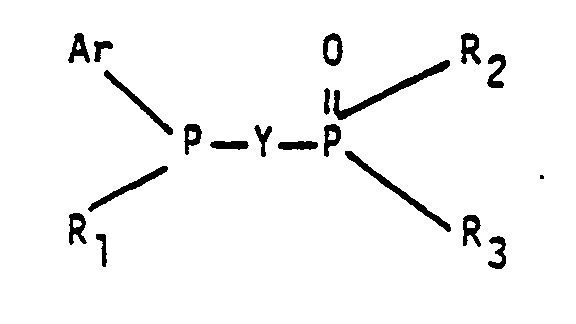
- Such types of bisohosphine monooxides may be prepared by various conventional methods. For example a corresponding organic tertiary bisphosohine starting material can be oxidized with any suitable oxygenating agent such as oxygen or air, and the like to produce a mixture of moncoxidized and dioxidized bisphosphines and the desired bisphosphine monooxide recovered and isolated from such mixtures by any suitable method such as crystallization, distillation, and the like. Another method for preparing bisphosohine monooxides which may be employed comorises the free radical addition of secondary phosphine oxides (e.g. HPR2R3 wherein R2 and R3 are as defined herein) with unsaturated tertiary phosphines (e.g Ar(R1)P-Y-CH=CH2 wherein Ar, R1 and Y are as defined herein), e.g. note PCT, International Publication Number 40 80/01690 published August 21, 1980. Alternative methods of preparing certain organic tertiary bisphosphine monooxides are found disclosed e.g. in U.S. Patent 3,426,021, "Unsymmetrical Bis-Phosphorus Ligands", by S. 0. Grim et al, Inorganic Chemistry Vol. 14, pp. 656-660 (1975) and "Abnormal Hydrolysis of Cyclic Phosphonium Salts", by A. M. Aguiar et al, J. Amer. Chem. Soc., Vol. 87, pp. 671-673 (1966).
- More preferably the organic tertiary bisphosphine monooxide ligands employable in this invention can be prepared by the novel procedure disclosed in assignee's U.S. patent application Serial No. 293,145 (Docket 13039) filed concurrently herewith. Said procedure comprises reacting a corresponding organic tertiary bisphosphine (e.g. Ar2P-Y-P-R2R3 wherein Ar, R2, R3 and Y are as defined herein) with an organic monofunctional alkylating agent (e.g. a monovalent hydrocarbon halide such as an alkyl or aralkyl chloride, bromide or iodide, the preferred alkylating agent being benzyl bromide) in the presence of a suitable solvent for the bisphosphine starting material (e.a., a hydrocarbon solvent such as toluene) to form an insoluble monophosphonium salt of the bisphosphine starting material which can be easily recovered by any suitable method such as filtration. The intermediate monophosphonmium salt is then hydrolyzed with an aqueous alkaline solution (e.g., 1 to 20 percent by weight of an alkali metal or alkaline earth metal hydroxide such as sodium hydroxide in water) to the desired organic tertiary bisphosphine monooxides employable in this invention. The bisphosphine monooxide product is a water insoluble precipitate that can be recovered by any suitable method such as filtration. Both procedural steps of said process are preferably conducted under nitrogen atmosphere and are essentially stoichiometric auantitative type reactions. However, while it is preferred to employ only about one mole of alkylating agent per mole of the bisphosphine starting material employed, it is preferred to employ an excess amount of water (e.g., from about a 100 percent stoichiometric excess on up to about a 10,000 percent stoichiometric excess or higher may be employed) in the hydrolysis step above that theoretical stoichiometric amount of water necesary to hydrolyze the monophosphonium salt to its desired bisphosphine monooxide product. The formation of the Intermediate monophosphonium salt can be carried out at any suitable temperature such as from about 20°C. up to the boiling point of the solvent, while the hydrolysis procedure can also hP carried out at any suitable temperature such as from about 20°C. to 100°C. This procedure is very efficient for preparing large yields of selectivity desired bisphosphine monooxides and can be found more fully described in said Serial No. 293,145 (Docket 13039) the entire disclosure of which is incorporated herein by reference thereto. Of course the organic tertiary bisphosphine starting materials and/or methods for their preparation are well known in the art.
- Illustrative aryl radicals represented by the Ar group in the above bisphosphine monooxide formulas include both substituted and unsubstituted aryl groups. Such aryl radicals may contain from 6 to 12 carbon atoms, the most preferred aryl radical being phenyl, (C6H5-). Illustrative substituent groups that may be present on the aryl radicals, include e.g. alkyl radicals, alkoxy radicals, silyl radicals such as -Si(R4)3; amino radicals such as -N(R4)2; acyl radicals such as -C(0)R4; carboxyl radicals such as -C(O)OR4; acyloxy radicals such as -OC(O)R4; amido radicals such as -C(O)N(R4)2 and -N(R4)C(O)R4; sulfonyl radicals such as -S02R4; ether radicals such as -OR4, thionyl ether radicals such as -SR4 as well as halogen, nitro, cyano, trifluoromethyl and hydroxy radicals, and the like, wherein each R4 individually represents the same or different substituted or unsubstituted monovalent hydrocarbon radical having the same meaning as defined for R1, R2 and R3 below, with the proviso that in amino substitutents.such as -N(R4)2, each R4 taken together can also represent a divalent bridging group that forms a heterocyclic radical with the nitrogen atom and in amido substituents such as C(0)N(R4)2 and -N(R4)C(O)R4 each -R4 bonded to N can also be hydrogen. Illustrative aryl radicals represented by Ar include e.g. phenyl, naphthyl, diphenyl, fluorophenyl, difluorophenyl, benzoyloxyphenyl, carboethoxyphenyl, acetylphenyl, ethoxyphenyl, phenoxyphenyl, hydroxyphenyl, carboxyphenyl, trifluoromethylphenyl, methoxyethylphenyl, acetamidophenyl, dimethylcarbamylphenyl, tolyl, xylyl, and the like. Most preferably the Ar radical is phenyl.
- Monovalent hydrocarbon radicals represented by R1, R2 and R31 in the above formulas include those containing from 1 to 30 carbon atoms such as substituted or unsubstituted alkyl, aryl, alkaryl, aralkyl and alicyclic radicals. Among the more specific unsubstituted monovalent hydrocarbon radicals that may be mentioned are alkyl radicals including primary, secondary and tertiary alkyl radicals such as methyl, ethyl, n-propyl, isopropyl, butyl, sec-butyl, t-butyl, t-butylethyl, t-butylpropyl, n-hexyl, amyl, sec-amyl, t-amyl, iso-octyl, decyl, dodecyl, octadecyl, eicosyl, and the like; aryl radicals such as phenyl, naphthyl and the like, aralkyl radicals such as benzyl, phenylethyl, triphenylmethylethane and the like, alkaryl radicals such as tolyl, xylyl, and the like; and alicyclic radicals such as cyclopentyl, cyclohexyl, cyclooctyl, cyclohexylethyl, and the like. In addition such monovalent hydrocarbon radicals may be substituted with any substituent which does not unduly adversely effect the process of this invention. Suitable illustrative substitutents that may be on the hydrocarbon radical are for example silyl radicals such as -Si(R4)3; amino radicals such as -N(R4)2; acyl radicals such as -C(O)R4; acylcxy radicals such as -CO(O)R4; amido radicals such as -C(O)N(R4)2 and -N(R4)C(O)R4; sulfonyl radicals such as -SO2R4; ether radicals such as -OR4, thionyl ether radicals such as -SR4 as well as halogen, nitro, cyano, trifluoromethyl and hydroxy radicals, and the like, wherein each P4 individually represents the same or different substituted or unsubstituted monovalent hydrocarbon radical having the same meaning as defined for R1, R2 and R31 with the proviso that in amino substitutents such as -N(R4)2, each R4 taken together can also represent a divalent bridging group that forms a heterocyclic radical with the nitrogen atom and in amido substitutents such as C(O)N(P4)2 and -N(R4)C(O)R4 each R4 bonded to N can also be hydrogen. Illustrative substituted monovalent hydrocarbon radicals include e.g.,

- The more preferred substituted and unsubstituted monovalent hydrocarbon radicals represented by R1, R2, R3 and R4 are alkyl radicals having from 1 to 12 carbon atoms and aryl radicals having from 6 to 12 carbon atoms, the most preferred radicals being unsubstituted monovalent hydrocarbon radicals and the most preferred aryl radical being phenyl.
- In general the more preferred organic tertiary bisphosphine monooxides are those such as wherein R1, R2 and R 3 all represent an aryl radical, especially phenyl (C6H5-).
- The divalent bridging group represented by Y in the above formulas is a divalent radical containing from 1 to 30 carbon atoms selected from the group consisting of hydrocarbon radicals, oxygen containing hydrocarbon radicals (i.e. hydrocarbon radicals interrupted with an oxygen atom), sulfur containing hydrocarbon radicals (i.e. hydrocarbon radicals interrupted with a sulfur atom) and nitrogen containing hydrocarbon atoms (i.e. hydrocarbon radicals interrupted with a nitrogen atom). Preferably such radicals contain from 1 to 12 carbon atoms. Illustrative divalent hydrocarbon radicals include alkylene radicals (e.g. methylene (-CH2-), ethylene, propylene, isopropylene, butylene, 1,2-dimethylethylene, t-butylene, neopentylene, 2-methylpropylene, hexylene, 2-ethylhexylene, dodecylene, eicosylene, and the like); arylene radicals (e.g. phenylene, diphenylene, and the like); as well as alkylene containing arylene radicals (e.g.methylenephenylene (-CH2C6H4-), ethylenephenylethylene (-C2H4C6H4-C2H4-), phenylenepropylphenylene (-C6H4C(CH3)2C6H4-), and the like); alkylidene radicals (e.g. ethylidene (-CH=CH-), and the like); and the like. Illustrative oxygen containing hydrocarbon radicals include alkyleneoxyalkylene radicals (e.g. ethylene-axymethylene (-C2H4OCH2-), propyleneoxymethylene (-C3H6OCH2-), ethyleneoxyethylene (-C2H4OC2H4-), 1,2-bis(ethyleneoxy) ethane -C2H4OC2H4OC2H4-), propyieneoxypropyiene (-C3H6OC3H6-) and the like); aryleneoxyalkylene radicals (e.g. phenyieneoxymethylene (-C6H4OCH2-), and the like); and the like. Illustrative sulfur or thio containing hydrocarbon radicals include alkylenethioalkylene radicals (e.g. ethylenethio- ethylene (-C2H4SC2H4-), 1,2-bis(ethylenethio)ethane (-C2H4SC2H4SC2H4-), propylenethiomethylene (-C3H6SCH2-), propylenethiopropylene (-C3H6SC3H5-), and the like); arylenethioalkylene radicals (e.g. phenylenethio- methylene (-C3H6SCH2-), and the like); and the like. Illustrative amino containing hydrocarbon radicals include alkyleneaminoalkylene radicals (e.g., methyleneaminomethyl- ethylene (-CH2H(CH3)C2H4-), ethyleneaminomethylethylene (-C2H4N(CH3)C2H4-), bis(ethyleneaminomethyl)ethane (-C2H4N(CH3)C2H4N(CH3)C2H4-), propyleneamino methylpropylene (-C3H6N(CH3)C3H6-) and the like); and the like. Preferably Y is a divalent hydrocarbon radical, especially a divalent alkylene radical containing from 2 to 8 carton atoms.
- Illustrative examples of such organic ditertiary bisphosphine monooxides include, e.g.
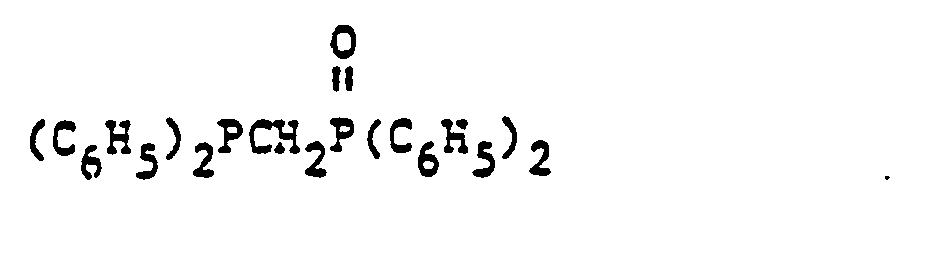


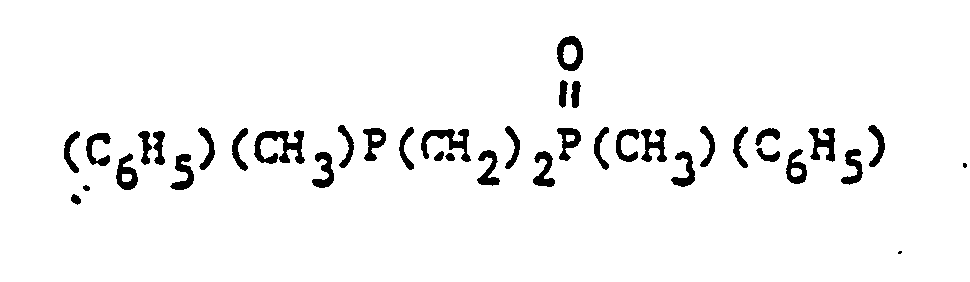






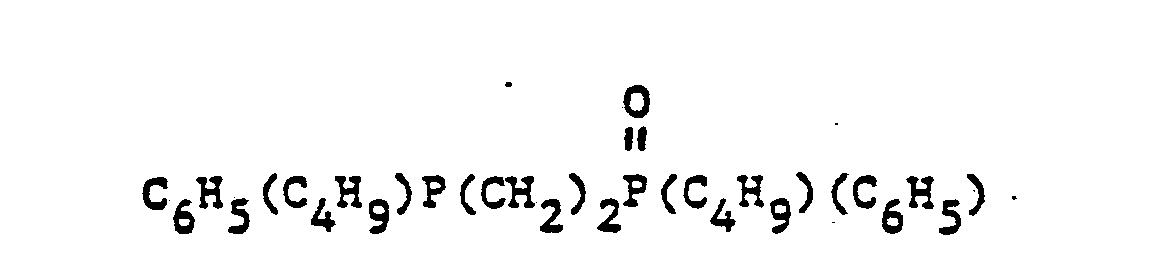


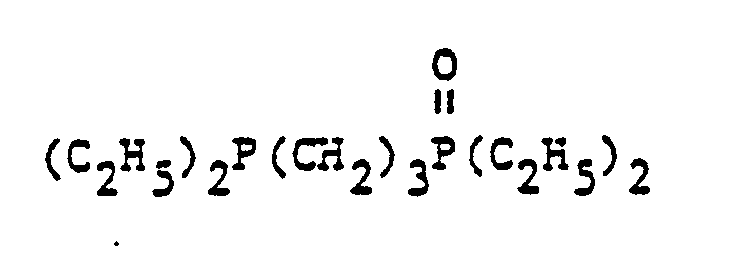


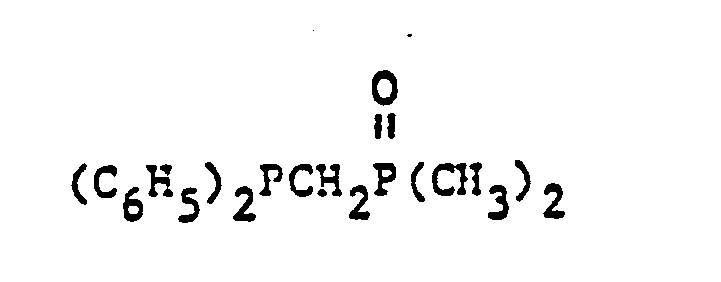


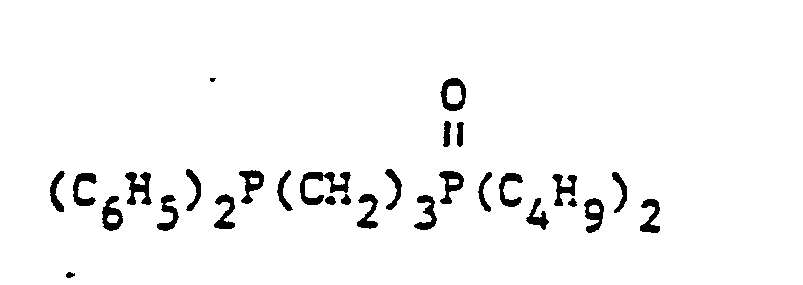


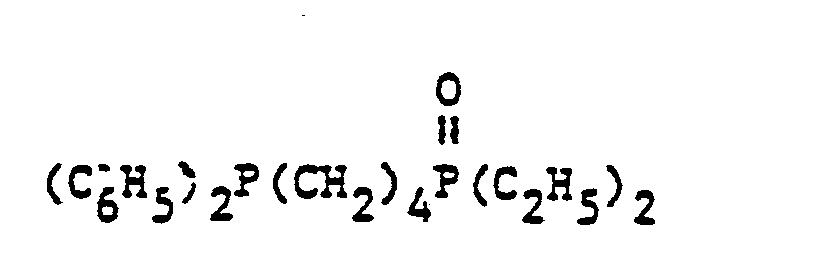




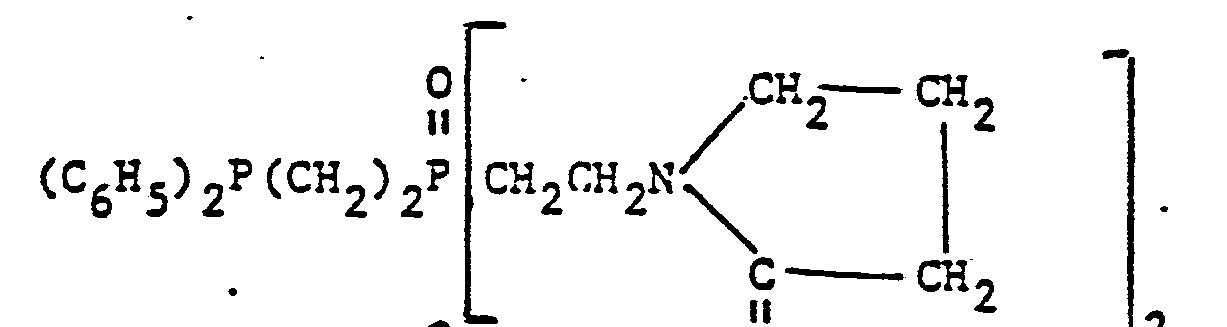

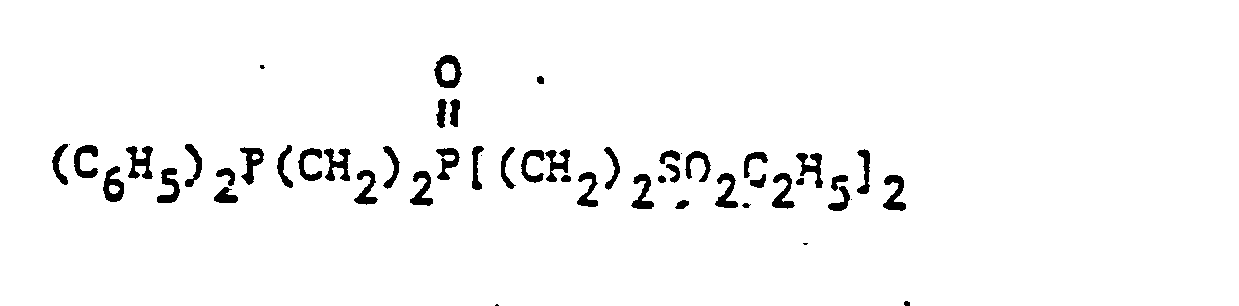






- The rhodium complex catalyst present in the hydroformylation process of this invention consists essentially of a rhodium-phosphorus ligand complex, said phosphorus ligand being derived from the same triarylphosphine and/or the same organic _tertiary bisphosphine monooxide ligands already herein defined above. While it is not certain as to the exact nature of the active rhodium-phosphorus ligand complex catalyst and while it is not intended to limit the present invention to any single explanation, theory or mechanistic discourse of how the rhodium is complexed with the triarylphosphine and/or bisphosphine monooxide, it appears that the active catalyst in its simplest form consists essentially of-a concentration of triarylphosphine ligand and/or organic tertiary bisphosphine monooxide ligand and carbon monoxide equal to a total of four moles in complex combination with one mole of rhodium. Of course it is to be understood that the term "complex" means a coordination compound formed by the union of one or more electronically rich molecules or atoms capable of independent existence with one or more electronically poor molecules or atoms, each of which is also capable of independent existence. Thus the active species may comprise a complex catalyst mixture, in their monomeric forms, which are characterized by one, two and/or three phosphorus ligand molecules complexed with one molecule of rhodium. As can be surmised from the above discussion, carbon monoxide (which is also properly classified as a ligand) is likewise present and complexed with the rhodium in the active species. Furthermore, the active catalyst species may also contain hydrogen as a ligand. Thus the ultimate composition of the active complex species can be likened or attributed to the outcome of competing reactions between carbon monoxide and both phosphorus ligands for "complexing sites" with the rhodium element and these competing reactions can be disturbed or influenced, within significant limits, by increasing or decreasing the partial pressure due to carbon monoxide, or by increasing or decreasing the concentration of the triarylphosphine and/or bisphosphine monooxide ligand. As a generalized statement therefore, the component (carbon monoxide or phosphorus ligand) which can shift the eouilibrium of the competing reaction in its favor should enjoy the greater opportunities of occupying the "complexing sites" with rhodium to give the active complex catalyst. Moreover one could view the function of the free triarylphosphine ligand and/or organic tertiary bisphosphine monooxide ligand as either maintaining the status quo of the various forms of active complex catalyst during the hydroformylation, or as a means for shifting the equilibrium of the competing reactions in its favor and therefore causing additional phosphorus ligand to enter into the complex combination with rhodium with the probable eviction of a similar number of carbon monoxide ligands from the complex catalyst. In addition it is believed that unlike triphenylphosphine, the organic tertiary bisphosphine monooxide ligand.s of this.invention are weakly chelated to the rhodium through their phosphorus-monooxide groups (e.g.
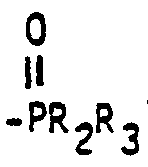
- Accordingly more specifically the rhodium complex catalysts of this invention may be defined as consisting essentially of rhodium complexed with carbon monoxide, a triarylphosphine and/or an organic tertiary bisphosphine monooxide ligand as defined herein. Of course it is to be understood that the catalyst terminology "consisting essentially of is not meant to exclude, but rather include, hydrogen complexed with the rhodium, in addition to carbon monoxide and the phosphorus ligands. However, such terminology is meant to exclude other materials in amounts which unduly adversely poison or unduly deactivate the catalyst and thus most desirably is free of contaminants such as rhodium-bound halogen e.g. chlorine, and the like. The hydrogen and/or carbonyl ligands of an active rhodium complex catalyst may be present as a result of being ligands bonded to a precursor catalyst and/or as a result of in situ formation due to the hydrogen and carbon monoxide gases employed in the hydroformylation process. Likewise as in the case of continuous hydroformylation process that has employed a rhodium triarylphosphine catalyst which results in the in situ formation of alkyl substituted arylphosphine ligands as explained in U.S.P. 4,260,828 during the hydroformylation process, it may be possible that some alkyl substituted arylphosphine ligands and/or alkyl substituted aryl bisphosphine monooxides (i.e. ligands whercin one the aryl groups of e.g., a Ar2P-group of an originally employed bisphosphine monooxide ligand has been replaced by an alkyl radical e.g. corresponding to the olefinically unsaturated starting material to be hydroformylated) are produced in situ in the hydroformylation process of this invention. Thus it should be understood that the active rhodium catalyst of this invention and the catalyst terminology "consisting essentially of is also not meant to exclude, but include the possible presence of such types of alkyl substituted arylphosphine ligands and/or alkyl substituted aryl bisphosphine monooxide ligands complexed to the rhodium as well as other above mentioned complexing ligands.
- Moreover it is clear that the amount of rhodium-phosphorus ligand complex catalyst present in the hydroformylation medium of the process of this invention need only be that minimum amount which is necessary to provide the rhodium concentration (which concentration in general may range from about 25 ppm to about 1000 ppm, and more oreferably from about 50 to about 400 ppm of rhodium calculated as free metal) desired to be employed and which will furnish the basis for at least that catalytic amount of rhodium necessary to catalyze the particular hydroformylation process desired.
- The olefinically unsaturated organic compounds that may be hydroformylated by the process of this invention as well as methods for their preparation are well known in the art and may contain from 2 to 20 carbon atoms. Said olefinic compounds are characterized by an internal or terminal ethylenic carbon to carbon bond, including alpha-olefins in which the terminal ethylenic group is a vinylidene group (CH2=C-) or a vinyl group (CH2=CH-). Said olefins may be straight chain or branched chain and may contain groups or substituents which do not essentially interfere whith the course of the hydroformylation orocess. such as carbonvl


- Illustrative alpha olefinic compounds which can be employed as reactants include ethylene, propylene, 1-buten e, 1-pentene, 1-hexene, 1-heptene, 1-octene, 1-decene, 1-dodecene, 1-octadecene, 2-ethyl-l-hexene, styrene, 3-phenyl-1-propene, 1,5-hexadiene, 1,7-octadiene, 3-eyclohexyl-1-butene, allyl alcohol, hex-1-en-4-ol, oct-1-en-4-ol, vinyl acetate, allyl acetate, 3-butenyl acetate, vinyl propionate, allyl propionate, allyl butyrate, methyl methacrylate, vinyl ethyl ether, vinyl methyl ether, allyl ethyl ether, n-propyl 7-octenoate, 3-butenoic acid, 7-octenoic acid, 3-butenenitrile, 5-hexenamide and the like. Illustrative internal olefinic compounds which can be employed as reactants include 2-pentene, 2-hexene, 3-hexene, 3-octene, 2-methyl-2-pentene, 3-hexen-l-ol, cyclohexene, and . stilbene, and the like. Preferred alpha olefinic compounds include alkenes, alkyl alkenoates, alkenyl alkanoates, alkenyl alkyl ethers and alkenols. The most preferred olefinic starting materials are alpha alkenes.
- As noted above the hydroformylation process of this invention is carried out in the presence of both free triarylphosphine ligand and free organic tertiary bisphosphine monooxide ligand. The term "free ligand" as employed herein means ligand that is not tied or complexed with the rhodium of the rhodium complex catalyst of this invention. Of course said free triarylphosphine ligand and said free bisphosphine monooxide ligand may correspond to any of the above triarylphosphines and bisphosphine monooxides discussed above. Thus the triarylphosphine ligands and organic tertiary bisphosphine ligands defined herein are employed in this invention as both the phosphorus ligand of the rhodium-phosphorus complex catalyst of the hydroformylation process of this inventioc as well as the free phosphorus ligand present in the reaction medium of the hydroformylation process of this invention. In addition is it to be understood that while the phosphorus ligand of the rhodium-phosphorus complex catalyst and the free phosphorus ligand present in a given process of this invention are normally of the same type of triarylphosphine and/or bisphosphine monooxide, different types'of triarylphosphines and/or bisphosphine monooxides as well as, mixtures of two or more different triarylphosphines and/or bisphosphine monooxides may be employed for each purpose in any given process if desired. The mole ratio of total free phosphorus ligand (i.e. free triarylphosphine ligand plus free bisphosphine monooxide ligand) per mole of catalytically active rhodium present in the hydroformylation reaction medium of this invention may be as little as about 10:1, while the upper limit does not appear to be critical and its concentration would be dictated largely by commercial, economic and solubility considerations. More preferably mole ratios of total phosphorus ligand per mole of catalytically active rhodium present in the hydroformylation reaction medium ranging from about 50:1 to 2000:1 should be sufficient for most purposes. On the other hand the mole ratio of free triarylphosphine ligand to free organic tertiary bisphosphine monooxide ligand present in the hydroformylation reaction medium of the hydroformylation process of this invention may range from about 2:1 to about 30:1 more preferably from about 5:1 to about 15:1.
- The hydroformylation process of this invention is also preferably conducted in the presence of an organic solvent for the rhodium-phosphorus catalyst. Any suitable solvent which does not unduly adversely interfere with the intended hydroformylation process can be employed. Such solvents may include those heretofore commonly employed in kncwn hydroformylation processes such as e.g. disclosed in U.S. Patents 3,527,809 and 4,148,830. Of course mixtures of one or more different catalytic solvents may be employed if desired. In general it is preferred to employ aldehyde compounds corresponding to the aldehyde products desired to be produced (e.g. n-butyraldehyde) and/or higher boiling aldehyde condensation by-products as the primary solvent such as the higher boiling aldehyde liquid condensation by-products that are produced in situ during the hydroformylation process (e.g. butyraldehyde trimers). Such aldehyde condensation products can also be preformed if desired and used accordingly. Moreover such higher boiling aldehyde condensation by-products and methods for their preparation are more fully described in U.S. Patents 4,148,830 and 4,247,486. Of course it is obvious that the amount of solvent employed is not critical to the subject invention and need only be that amount sufficient to provide the hydroformylation reaction medium with the particular rhodium concentration desired for said hydroformylation process. In general the amount of solvent when employed may range from about 5 percent by weight up to about 95 percent by weight or more based on the total weight of the hydroformylation reaction medium.
- It is generally preferred to carry out the hydroformylation process of this invention in a continuous manner. Such continuous hydroformylation processes are well known in the art and may involve a liquid recycle or gas recycle operation as desired.
- . A further aspect of this invention-can be described as a catalyst precursor composition consisting essentially of a solubilized rhodium carbonyl phosphorus acetylacetonate complex precursor catalyst, an organic solvent, free triarylphosphine, and free organic tertiary bisphosphine monooxide. Such precursor compositions are prepared by forming a solution of rhodium dicarbonyl acetylacetonate, an organic solvent, a triarylphosphine and an organic tertiary bisphosphine monooxide as defined herein. The triarylphosohine or bisphosphine monoxide readily replaces one of the dicarbonyl ligands of the rhodium- acetylacetonate complex precursor at room temperature as witnessed by the evolution of carbon monoxide gas. This substitution reaction may be facilitated by heating the solution if desired. Any suitable solvent in which both the rhodium- dicarbonyl acetylacetonate complex precursor and rhodium carbonyl phosphorus acetylacetonate complex precursor are soluble can be employed. Suitable solvents of course include and are preferably those employable in the hydroformylation process of this invention. Accordingly the amounts of rhodium complex catalyst precursor, organic solvent, triarylphosphine and bisphosphine monooxide, as well as their preferred embodiments present in such catalyst precursor compositions may obviously correspond to those amounts employable in the hydroformylation process of this invention and which have already been discussed herein above. Experience has shown that the acetylacetonate ligand of the precursor catalyst is very quickly replaced, within a matter of minutes, after the hydroformylation process has begun with a different ligand e.g. hydrogen, carbon monoxide, or phosphorus ligand, to form the active rhodium complex catalyst as explained above. The acetylacetone which is quickly freed from the precursor catalyst under hydroformylation conditions is removed from the reaction medium with the product aldehyde and thus is in no way detrimental to the hydroformylation process. The use of such preferred rhodium complex catalytic precursor compositions thus provide a simple economical and efficient method for handling the rhodium precursor metal and hydroformylation start-up.
- Finally, the aldehyde products of the hydroformylation process of this invention have a wide range of utility that is well known and documented in the prior art e.g. they are especially useful as starting materials for the production of alcohols.
- The following examples are illustrative of the present invention and are not to be regarded as limitative. It is to be understood that all of the parts, percentages and proportions referred to herein and in the appended claims are by weight unless otherwise indicated.
- A series of long term catalyst stability experiments were conducted in a glass reactor operating in a continuous propylene hydroformylation mode. The reactor consisted of a three ounce pressure bottle submersed in an oil bath with a glass front for viewing. In each experiment about 20 ml. of a freshly prepared rhodium catalytic precursor solution was charged to the reactor with a syringe after purging the system with nitrogen. Each precursor solution contained from 100 to 200 ppm rhodium calculated as free metal (as noted in TABLE I below) introduced as rhodium dicarbonyl acetylacetonate, a phosphorus ligand or mixture of phosphorus ligands and a solvent. The mole ratio of total free phosphorus ligand per mole of rhodium present in each precursor solution (P/Rh) and the mole ratio of each phosphorus ligand to each other in a given phosphorus mixture are shown in TABLE I below.
- The solvent employed in Examples 1 to 12 was Texanop (a mixture of butyraldehyde trimers), while Example 13 employed a mixture of Texanl® and 1,4-butanediol (2:1 volume ratio). After closing the reactor, the system was again purged with nitrogen and the oil bath was heated to furnish the desired hydroformylation reaction temperature. The hydroformylation reaction in each experiment was conducted at a total gas pressure 11,4 bar of about 165 psig, the target partial pressures of hydrogen, 6,9 bar abs.; 1,035 bar abs. carbon monoxide and propylene being about 100 psia; 15 psia, and 2,07 bar abs. 30 psia, respectively, the remainder being nitrogen. The flows of the feed gases (carbon monoxide, hydrogen and propylene) were controlled individually with mass flow meters and the feed gases dispersed into the precursor solution via fritted glass spargers. The unreacted portion of the feed gases stripped out the product aldehydes. Examples 1 to 8 were conducted at about 105°C. for one day and then the temperature raised to about 130°C. and the hydroformylation continued for four days. Examples 9 to 13 were conducted at about 105°C. over a weekend and then the temperature was raised to about 130°C. and the hydroformylation was continued for four days. The product aldehydes for each experiment were analyzed over the first day of continuous operation at 130°C. and over the fourth day of continuous operation at 130°C. and the average reaction rates for each experiment in terms of gram moles per liter per hour of total product aldehydes for the first and fourth days of continuous operation at the average measured partial pressures of hydrogen, carbon monoxide and propylene for said days are given in TABLE I below.
- The corrected reaction rates given in parenthesis a in TABLE I below were computed using the formula
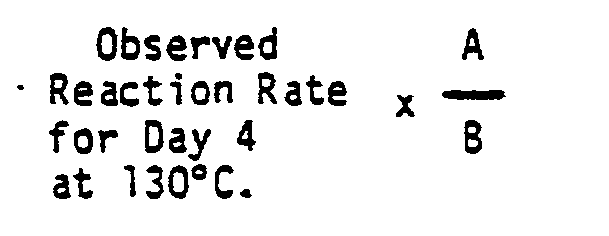


- The above data demonstrate that by employing mixtures of bis-phosphine monooxides and triarylphosphines (Examples 2, 4 and 6) significant thermal catalyst stability improvement is achieved relative to employing a triarylphosphine (Examples 1, 3 and 5). This thermal catalyst stability improvement is achieved with minimum loss of hydroformylation catalyst reactivity. Examples 9-13 show that by using mixtures of triphenylphosphine and bis-diphenylphosphino ethane monooxide ligands at different ratios result in varying degrees of catalyst reactivity and stability.
- Surprisingly the observed effect obtained with the mixed phosphorus ligands is not due to the mere addition of the individual effects of the two ligands, but rather to an unforeseen cooperative effect as seen by the fact that both the bis-phosphine monooxide ligand by itself (Example 9) used at the equal phosphine/rhodium mole ratios employed in Example 13, and the triphenylphosphine ligand by itself (Example 1) at even higher phosphine/rhodium mole ratios than that employed in Example 13 show inferior thermal stability.
- A series of continuous propylene hydroformylation reactions were conducted in a similar manner as described in Examples 1 to 13 except that the following conditions were .employed.
- In each experiment about 20 ml. of a freshly prepared rhodium catalytic precursor solution was charged to the reactor with a syringe after purging the system with nitrogen. Each precursor solution contained about 200-300 ppm rhodium calculated as free metal introduced as rhodium dicarbonyl acetylacetonate, a phosphorus ligand or mixture of phosphorus ligands and Texanol® as the solvent. The mole ratio of total free phosphorus ligand per mole of rhodium present in each precursor solution (P/Rh) and the mole ratio of each phosphorus ligand to each other in a given phosphorus mixture are shown in TABLE II-below.
- After closing the reactor, the system was again purged with nitrogen and the oil bath was heated to furnish the desired hydroformylation reaction temperature. The hydroformylation reaction in each experiment was conducted at a total gas pressure of about 165 psig, the target partial pressures of hydrogen, carbon monoxide and propylene being about 80 psia; 10 psia, and 30 psia, respectively, the remainder being nitrogen. The flows of the feed gases (carbon monoxide, hydrogen and propylene) were controlled individually with mass flow meters and the feed gases dispersed into the precursor solution via fritted glass spargers. The unreacted portion of the feed gases stripped out the product aldehydes. Each experiment was conducted at about 105°C. for two days and then the temperature raised to about 130°C. and the hydroformylation continued for 12 more days. During days 9 to 13 the carbon monoxide partial pressure was increased stepwise from 0,6 1,725 bar abs. 0,6 bar abs. about 10 to 25 psia and returned to about 10 psia for day 14. The product aldehydes for each experiment were analyzed over the sixth day of continuous operation at 130°C. and over the twelfth day of continuous operation at 130°C. and the average reaction rates for each experiment in terms of gram moles per liter per hour of total product aldehydes for the sixth and twelfth days of continuous operation at 130°C. and at the average measured partial pressures of hydrogen, carbon monoxide and propylene for said days are given in TABLE II below.
- The corrected reaction rates given in parenthesis a in TABLE II below were computed using the formula


- The data in Table II above demonstrates that the rhodium complex catalyst of Example 18 using mixed triphenylphosphine- bis-diphenylphosphinoethane monooxide maintained its catalyst activity and stability much better over a wider range of carbon monoxide partial pressure than that of Examples 14, 15, and 16 which employed only a single triarylphosphine ligand as well as that of Example 17 which employed a mixture of triphenylphosphine and cyclohexyldiphenylphospine.
- Propylene was continuously hydroformylated in a one gallon stainless steel autoclave employing a rhodium catalytic precursor solution containing about 300 ppm rhodium introduced as rhodium dicarbonyl acetylacetonate, about 19.2 weight percent triphenylphosphine, about 2.8 weight percent bis-diphenylphosphino ethane monooxide, and butyraldehyde as the solvent. The mole ratio of total phosphorus ligand per mole of rhodium in said precursor solution was about 300:1, while the mole ratio of triphenylphosphine to bis-diphenylphosphinoethane monooxide was about 10:1. A total gas pressure of about 194 psig and a 0,69 bar abs. CO/H2/propylene pressure of about 10 psia carbon monoxide, 6 2 bar abs. 3,45-3,79 bar abs. about 90 psia hydrogen and 50-55 psia propylene was employed, the remainder being nitrogen and propane byproduct. The continuous hydroformylation process was carried out over about eleven days at about 130°C. Gaseous aldehyde products were stripped from the reactor and condensed, the recovered unreacted feed gases being recycled to the reactor via a gas compressor. The product aldehydes were collected, weighed and analyzed and the results are given in Table III below.

- The above data demonstrates the excellent catalyst stability and high aldehyde productivity obtained over about eleven days of continuous hydroformylation using a mixture of triphenylphosphine and bis-diphenylphosphinoethane monooxide ligand.
- Various modifications and variations of this invention will be obvious to a worker skilled in the art and it is to be understood that such modifications and variations are to be included within the purview of this application and the spirit and scope of the appended claims.
Claims (8)


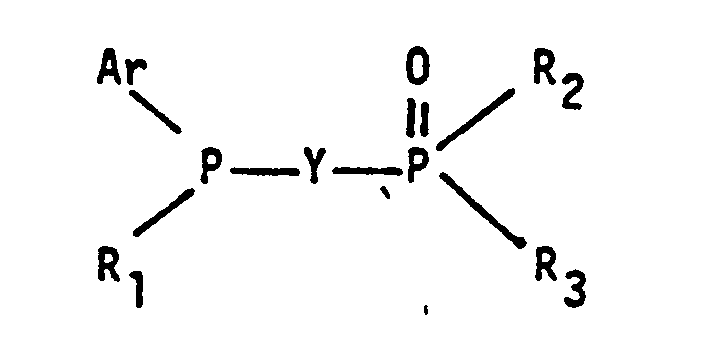
Applications Claiming Priority (2)
| Application Number | Priority Date | Filing Date | Title |
|---|---|---|---|
| US293189 | 1981-08-17 | ||
| US06/293,189 US4491675A (en) | 1981-08-17 | 1981-08-17 | Hydroformylation process using triarylphosphine and bisphosphine monooxide ligands |
Publications (2)
| Publication Number | Publication Date |
|---|---|
| EP0073398A1 true EP0073398A1 (en) | 1983-03-09 |
| EP0073398B1 EP0073398B1 (en) | 1984-12-19 |
Family
ID=23128059
Family Applications (1)
| Application Number | Title | Priority Date | Filing Date |
|---|---|---|---|
| EP82107438A Expired EP0073398B1 (en) | 1981-08-17 | 1982-08-16 | Hydroformylation process using a rhodium complex catalyst with triarylphosphine and biphosphine monoxide ligands |
Country Status (6)
| Country | Link |
|---|---|
| US (1) | US4491675A (en) |
| EP (1) | EP0073398B1 (en) |
| JP (1) | JPS5839637A (en) |
| KR (1) | KR870000200B1 (en) |
| CA (1) | CA1183123A (en) |
| DE (1) | DE3261623D1 (en) |
Cited By (7)
| Publication number | Priority date | Publication date | Assignee | Title |
|---|---|---|---|---|
| US4668809A (en) * | 1982-05-03 | 1987-05-26 | Exxon Research And Engineering | Transition metal complex catalysts |
| US5364970A (en) * | 1993-01-25 | 1994-11-15 | Shell Oil Company | Process for the hydroformylation of unsaturated carbonyl compounds |
| EP2611538A4 (en) * | 2010-09-02 | 2014-08-27 | Lg Chemical Ltd | Catalyst composition for hydroformylation reaction and a hydroformylation process using the same |
| EP2881173A4 (en) * | 2013-09-30 | 2016-06-08 | Lg Chemical Ltd | CATALYST COMPOSITION FOR HYDROFORMYLATION REACTION, AND METHOD FOR OLEFIN HYDROFORMYLATION USING THE SAME |
| US9616422B2 (en) | 2013-09-30 | 2017-04-11 | Lg Chem, Ltd. | Catalyst composition for hydroformylation reaction and method of hydroformylating olefin using the same |
| US11130725B2 (en) | 2018-05-30 | 2021-09-28 | Dow Technology Investments Llc | Methods for slowing deactivation of a catalyst and/or slowing tetraphosphine ligand usage in hydroformylation processes |
| US11344869B2 (en) | 2018-05-30 | 2022-05-31 | Dow Technology Investments Llc | Methods of controlling hydroformylation processes |
Families Citing this family (18)
| Publication number | Priority date | Publication date | Assignee | Title |
|---|---|---|---|---|
| CA1237728A (en) * | 1984-07-20 | 1988-06-07 | Anthony G. Abatjoglou | Production of carboxylic acids from alcohols using rhodium complex catalysts |
| US4927967A (en) * | 1984-07-20 | 1990-05-22 | Union Carbide Chemicals And Plastics Company Inc. | Production of carboxylic acids from organic formate esters using rhodium complex catalysts |
| US4885401A (en) * | 1985-09-05 | 1989-12-05 | Union Carbide Corporation | Bis-phosphite compounds |
| US4748261A (en) * | 1985-09-05 | 1988-05-31 | Union Carbide Corporation | Bis-phosphite compounds |
| US4668651A (en) * | 1985-09-05 | 1987-05-26 | Union Carbide Corporation | Transition metal complex catalyzed processes |
| JPS62177745A (en) * | 1986-01-30 | 1987-08-04 | Kato Denki Kk | Automatic replacing device for disk |
| JPS62177746A (en) * | 1986-01-30 | 1987-08-04 | Kato Denki Kk | Disk holding device |
| JPS6323263A (en) * | 1986-02-28 | 1988-01-30 | Kato Denki Kk | Automatic exchange device for disk |
| JPS63160056A (en) * | 1986-12-23 | 1988-07-02 | Dengen Autom Kk | Carrier equipment for floppy disk |
| US5001274A (en) * | 1989-06-23 | 1991-03-19 | Union Carbide Chemicals And Plastics Company Inc. | Hydroformylation process |
| WO1992004118A1 (en) * | 1990-08-31 | 1992-03-19 | The Governors Of The University Of Alberta | Carbonylation of methanol using a novel transition metal catalyst precursor |
| US5087763A (en) * | 1990-11-09 | 1992-02-11 | Union Carbide Chemicals & Plastics Technology Corporation | Hydroformylation process |
| CN101160272A (en) * | 2005-03-16 | 2008-04-09 | 佩什托普特殊化学股份公司 | Hydroformylation process with improved ISO-selectivity |
| CA2756936A1 (en) | 2009-03-31 | 2010-10-14 | Dow Technology Investment Llc | Hydroformylation process with a doubly open-ended bisphosphite ligand |
| US8383869B2 (en) * | 2009-09-01 | 2013-02-26 | Shell Oil Company | Olefin oligomer composition |
| US8741173B2 (en) | 2010-10-05 | 2014-06-03 | Dow Technology Investments Llc | Hydroformylation process |
| US9303101B2 (en) * | 2012-05-11 | 2016-04-05 | The University Of Tokyo | Catalyst for synthesizing polyolefins |
| MY207749A (en) | 2018-05-30 | 2025-03-16 | Dow Technology Investments Llc | Catalyst composition comprising the combination of a monophopsphine, a tetraphosphine ligand and a hydroformylation process using it |
Citations (2)
| Publication number | Priority date | Publication date | Assignee | Title |
|---|---|---|---|---|
| DE2922757A1 (en) * | 1978-06-05 | 1979-12-06 | Kuraray Co | PROCESS FOR THE HYDROFORMYLATION OF OLEFINIC COMPOUNDS |
| WO1980001690A1 (en) * | 1979-02-12 | 1980-08-21 | Exxon Research Engineering Co | Carbonylation process and novel transition metal catalysts |
Family Cites Families (18)
| Publication number | Priority date | Publication date | Assignee | Title |
|---|---|---|---|---|
| US3426021A (en) * | 1964-03-02 | 1969-02-04 | Dow Chemical Co | Phosphine compounds |
| US3624158A (en) * | 1966-08-23 | 1971-11-30 | Gulf Research Development Co | Hydroformylation process employing diorgano-halo phosphines as legands with cobalt carbonyl |
| US3527809A (en) * | 1967-08-03 | 1970-09-08 | Union Carbide Corp | Hydroformylation process |
| US3859359A (en) * | 1970-04-27 | 1975-01-07 | Ethyl Corp | Compound and method |
| US4148830A (en) * | 1975-03-07 | 1979-04-10 | Union Carbide Corporation | Hydroformylation of olefins |
| US4247486A (en) * | 1977-03-11 | 1981-01-27 | Union Carbide Corporation | Cyclic hydroformylation process |
| US4139565A (en) * | 1977-03-31 | 1979-02-13 | Celanese Corporation | Hydroformylation using improved catalysts comprising rhodium and diphosphino ligands |
| US4152344A (en) * | 1977-08-08 | 1979-05-01 | Celanese Corporation | Phosphino-ferrocene ligands |
| US4169861A (en) * | 1977-08-19 | 1979-10-02 | Celanese Corporation | Hydroformylation process |
| US4230641A (en) * | 1977-11-21 | 1980-10-28 | Air Products And Chemicals, Inc. | Hydroformylation of olefins |
| US4215077A (en) * | 1978-02-09 | 1980-07-29 | Kuraray Co., Ltd. | Hydroformylation of olefins |
| US4302401A (en) * | 1980-01-23 | 1981-11-24 | Exxon Research & Engineering Co. | Tetraalkyl phosphonium substituted phosphine and amine transition metal complexes |
| US4298541A (en) * | 1979-02-12 | 1981-11-03 | Exxon Research & Engineering Co. | Trihydrocarbyl silyl-substituted alkyl diaryl phosphine transition metal complexes and their use as homogeneous catalysts |
| US4283562A (en) * | 1979-10-26 | 1981-08-11 | Union Carbide Corporation | Hydroformylation process using stable rhodium catalyst |
| EP0033554B1 (en) * | 1980-02-04 | 1983-11-09 | Shell Internationale Researchmaatschappij B.V. | A process for the hydroformylation of conjugated dienes |
| US4260828A (en) * | 1980-04-16 | 1981-04-07 | Union Carbide Corporation | Hydroformylation process |
| US4429161A (en) * | 1981-08-17 | 1984-01-31 | Union Carbide Corporation | Process for preparing organic tertiary polyphosphine monooxides |
| US4400548A (en) * | 1981-08-17 | 1983-08-23 | Union Carbide Corporation | Hydroformylation process using bisphosphine monooxide ligands |
-
1981
- 1981-08-17 US US06/293,189 patent/US4491675A/en not_active Expired - Lifetime
-
1982
- 1982-07-23 CA CA000407975A patent/CA1183123A/en not_active Expired
- 1982-08-16 JP JP57141187A patent/JPS5839637A/en active Granted
- 1982-08-16 EP EP82107438A patent/EP0073398B1/en not_active Expired
- 1982-08-16 DE DE8282107438T patent/DE3261623D1/en not_active Expired
- 1982-08-16 KR KR8203667A patent/KR870000200B1/en not_active Expired
Patent Citations (2)
| Publication number | Priority date | Publication date | Assignee | Title |
|---|---|---|---|---|
| DE2922757A1 (en) * | 1978-06-05 | 1979-12-06 | Kuraray Co | PROCESS FOR THE HYDROFORMYLATION OF OLEFINIC COMPOUNDS |
| WO1980001690A1 (en) * | 1979-02-12 | 1980-08-21 | Exxon Research Engineering Co | Carbonylation process and novel transition metal catalysts |
Cited By (7)
| Publication number | Priority date | Publication date | Assignee | Title |
|---|---|---|---|---|
| US4668809A (en) * | 1982-05-03 | 1987-05-26 | Exxon Research And Engineering | Transition metal complex catalysts |
| US5364970A (en) * | 1993-01-25 | 1994-11-15 | Shell Oil Company | Process for the hydroformylation of unsaturated carbonyl compounds |
| EP2611538A4 (en) * | 2010-09-02 | 2014-08-27 | Lg Chemical Ltd | Catalyst composition for hydroformylation reaction and a hydroformylation process using the same |
| EP2881173A4 (en) * | 2013-09-30 | 2016-06-08 | Lg Chemical Ltd | CATALYST COMPOSITION FOR HYDROFORMYLATION REACTION, AND METHOD FOR OLEFIN HYDROFORMYLATION USING THE SAME |
| US9616422B2 (en) | 2013-09-30 | 2017-04-11 | Lg Chem, Ltd. | Catalyst composition for hydroformylation reaction and method of hydroformylating olefin using the same |
| US11130725B2 (en) | 2018-05-30 | 2021-09-28 | Dow Technology Investments Llc | Methods for slowing deactivation of a catalyst and/or slowing tetraphosphine ligand usage in hydroformylation processes |
| US11344869B2 (en) | 2018-05-30 | 2022-05-31 | Dow Technology Investments Llc | Methods of controlling hydroformylation processes |
Also Published As
| Publication number | Publication date |
|---|---|
| DE3261623D1 (en) | 1985-01-31 |
| KR870000200B1 (en) | 1987-02-16 |
| KR840001118A (en) | 1984-03-28 |
| US4491675A (en) | 1985-01-01 |
| JPS5839637A (en) | 1983-03-08 |
| JPS6338009B2 (en) | 1988-07-28 |
| EP0073398B1 (en) | 1984-12-19 |
| CA1183123A (en) | 1985-02-26 |
Similar Documents
| Publication | Publication Date | Title |
|---|---|---|
| EP0073961B1 (en) | Hydroformylation process using a rhodium complex catalyst with biphosphine monoxide ligands | |
| EP0073398B1 (en) | Hydroformylation process using a rhodium complex catalyst with triarylphosphine and biphosphine monoxide ligands | |
| AU605773B2 (en) | Hudroformylation using low volarile/organic soluble phosphine ligands | |
| EP0375573B1 (en) | Low pressure rhodium catalyzed hydroformylation of olefins | |
| AU597593B2 (en) | Transition metal complex catalyzed processes | |
| EP0024091B1 (en) | Hydroformylation process and novel transition metal catalysts | |
| EP0213639B1 (en) | Bis-phosphite compounds | |
| US4885401A (en) | Bis-phosphite compounds | |
| EP0697391B1 (en) | Stabilization of phosphite ligands in hydroformylation process | |
| SU1537134A3 (en) | Method of producing aldehydes c7, c9 or c15 | |
| EP0031590B1 (en) | Rhodium catalyzed hydroformylation process | |
| US4480137A (en) | Trihydrocarbyl silyl substituted alkyl diaryl phosphine transition metal complexes and their use as homogeneous carbonylation catalysts | |
| US4687874A (en) | Selective hydroformylation process using alkyl diaryl phosphine rhodium carbonyl hydride catalysts | |
| US4593011A (en) | Hydroformylation process using triarylphosphine and bisphosphine monooxide ligands | |
| US4108905A (en) | Catalytic reactions | |
| CA1263407A (en) | Process for the preparation of aldehydes | |
| US4522933A (en) | Hydroformylation catalyst containing bisphosphine monooxide ligands | |
| EP0028892B1 (en) | A heteronuclear-bridged rhodium cluster and its application as catalyst for hydroformylation of olefins | |
| US4687866A (en) | Ligand exchange process for producing alkyl diaryl phosphine rhodium carbonyl hydrides | |
| US4593141A (en) | Hydroformylation catalysis by branched alkyl diaryl phosphine rhodium complexes | |
| KR930002361B1 (en) | Process for producing aldehydes or mixtures of ketones and aldehydes |
Legal Events
| Date | Code | Title | Description |
|---|---|---|---|
| PUAI | Public reference made under article 153(3) epc to a published international application that has entered the european phase |
Free format text: ORIGINAL CODE: 0009012 |
|
| AK | Designated contracting states |
Designated state(s): BE DE FR GB IT NL SE |
|
| 17P | Request for examination filed |
Effective date: 19830411 |
|
| ITF | It: translation for a ep patent filed | ||
| GRAA | (expected) grant |
Free format text: ORIGINAL CODE: 0009210 |
|
| AK | Designated contracting states |
Designated state(s): BE DE FR GB IT NL SE |
|
| REF | Corresponds to: |
Ref document number: 3261623 Country of ref document: DE Date of ref document: 19850131 |
|
| ET | Fr: translation filed | ||
| PLBE | No opposition filed within time limit |
Free format text: ORIGINAL CODE: 0009261 |
|
| STAA | Information on the status of an ep patent application or granted ep patent |
Free format text: STATUS: NO OPPOSITION FILED WITHIN TIME LIMIT |
|
| 26N | No opposition filed | ||
| REG | Reference to a national code |
Ref country code: FR Ref legal event code: LD |
|
| ITTA | It: last paid annual fee | ||
| PGFP | Annual fee paid to national office [announced via postgrant information from national office to epo] |
Ref country code: NL Payment date: 19930831 Year of fee payment: 12 |
|
| PGFP | Annual fee paid to national office [announced via postgrant information from national office to epo] |
Ref country code: DE Payment date: 19940615 Year of fee payment: 13 |
|
| PGFP | Annual fee paid to national office [announced via postgrant information from national office to epo] |
Ref country code: GB Payment date: 19940622 Year of fee payment: 13 |
|
| PGFP | Annual fee paid to national office [announced via postgrant information from national office to epo] |
Ref country code: BE Payment date: 19940804 Year of fee payment: 13 |
|
| EAL | Se: european patent in force in sweden |
Ref document number: 82107438.2 |
|
| PG25 | Lapsed in a contracting state [announced via postgrant information from national office to epo] |
Ref country code: NL Effective date: 19950301 |
|
| NLV4 | Nl: lapsed or anulled due to non-payment of the annual fee | ||
| PG25 | Lapsed in a contracting state [announced via postgrant information from national office to epo] |
Ref country code: GB Effective date: 19950816 |
|
| PG25 | Lapsed in a contracting state [announced via postgrant information from national office to epo] |
Ref country code: BE Effective date: 19950831 |
|
| BERE | Be: lapsed |
Owner name: UNION CARBIDE CORP. Effective date: 19950831 |
|
| GBPC | Gb: european patent ceased through non-payment of renewal fee |
Effective date: 19950816 |
|
| PG25 | Lapsed in a contracting state [announced via postgrant information from national office to epo] |
Ref country code: DE Effective date: 19960501 |
|
| PGFP | Annual fee paid to national office [announced via postgrant information from national office to epo] |
Ref country code: FR Payment date: 20010801 Year of fee payment: 20 |
|
| PGFP | Annual fee paid to national office [announced via postgrant information from national office to epo] |
Ref country code: SE Payment date: 20010802 Year of fee payment: 20 |
|
| EUG | Se: european patent has lapsed |
Ref document number: 82107438.2 |