EP2880867B1 - Method and apparatus for adapting audio delays to picture frame rates - Google Patents
Method and apparatus for adapting audio delays to picture frame rates Download PDFInfo
- Publication number
- EP2880867B1 EP2880867B1 EP13708278.0A EP13708278A EP2880867B1 EP 2880867 B1 EP2880867 B1 EP 2880867B1 EP 13708278 A EP13708278 A EP 13708278A EP 2880867 B1 EP2880867 B1 EP 2880867B1
- Authority
- EP
- European Patent Office
- Prior art keywords
- digital cinema
- picture
- sound
- information
- delay
- Prior art date
- Legal status (The legal status is an assumption and is not a legal conclusion. Google has not performed a legal analysis and makes no representation as to the accuracy of the status listed.)
- Not-in-force
Links
- 238000000034 method Methods 0.000 title claims description 27
- 230000001934 delay Effects 0.000 title description 12
- 239000000203 mixture Substances 0.000 claims description 76
- 238000005259 measurement Methods 0.000 claims description 8
- 239000000945 filler Substances 0.000 claims description 4
- 238000009877 rendering Methods 0.000 claims description 2
- 238000012545 processing Methods 0.000 description 48
- 230000007704 transition Effects 0.000 description 23
- 230000008859 change Effects 0.000 description 16
- 230000008569 process Effects 0.000 description 11
- 230000000694 effects Effects 0.000 description 6
- 238000010586 diagram Methods 0.000 description 5
- 239000000872 buffer Substances 0.000 description 3
- 230000001419 dependent effect Effects 0.000 description 3
- 238000005516 engineering process Methods 0.000 description 3
- 230000001360 synchronised effect Effects 0.000 description 3
- 238000013459 approach Methods 0.000 description 2
- 230000006399 behavior Effects 0.000 description 2
- 230000008901 benefit Effects 0.000 description 2
- 230000005540 biological transmission Effects 0.000 description 2
- 230000003111 delayed effect Effects 0.000 description 2
- 230000003203 everyday effect Effects 0.000 description 2
- 230000010354 integration Effects 0.000 description 2
- 230000007246 mechanism Effects 0.000 description 2
- 238000012544 monitoring process Methods 0.000 description 2
- 230000003287 optical effect Effects 0.000 description 2
- 230000005236 sound signal Effects 0.000 description 2
- 238000012360 testing method Methods 0.000 description 2
- 230000003321 amplification Effects 0.000 description 1
- 230000000052 comparative effect Effects 0.000 description 1
- 238000012937 correction Methods 0.000 description 1
- 238000013461 design Methods 0.000 description 1
- 230000006870 function Effects 0.000 description 1
- 239000011521 glass Substances 0.000 description 1
- 230000003760 hair shine Effects 0.000 description 1
- 238000005286 illumination Methods 0.000 description 1
- 238000002347 injection Methods 0.000 description 1
- 239000007924 injection Substances 0.000 description 1
- 238000003780 insertion Methods 0.000 description 1
- 230000037431 insertion Effects 0.000 description 1
- 238000009434 installation Methods 0.000 description 1
- 238000003199 nucleic acid amplification method Methods 0.000 description 1
- 230000002250 progressing effect Effects 0.000 description 1
- 230000004044 response Effects 0.000 description 1
- 239000000243 solution Substances 0.000 description 1
- 230000003068 static effect Effects 0.000 description 1
- 238000012546 transfer Methods 0.000 description 1
Images




Classifications
-
- G—PHYSICS
- G11—INFORMATION STORAGE
- G11B—INFORMATION STORAGE BASED ON RELATIVE MOVEMENT BETWEEN RECORD CARRIER AND TRANSDUCER
- G11B27/00—Editing; Indexing; Addressing; Timing or synchronising; Monitoring; Measuring tape travel
- G11B27/10—Indexing; Addressing; Timing or synchronising; Measuring tape travel
- G11B27/19—Indexing; Addressing; Timing or synchronising; Measuring tape travel by using information detectable on the record carrier
- G11B27/28—Indexing; Addressing; Timing or synchronising; Measuring tape travel by using information detectable on the record carrier by using information signals recorded by the same method as the main recording
- G11B27/30—Indexing; Addressing; Timing or synchronising; Measuring tape travel by using information detectable on the record carrier by using information signals recorded by the same method as the main recording on the same track as the main recording
- G11B27/309—Table of contents
-
- H—ELECTRICITY
- H04—ELECTRIC COMMUNICATION TECHNIQUE
- H04N—PICTORIAL COMMUNICATION, e.g. TELEVISION
- H04N21/00—Selective content distribution, e.g. interactive television or video on demand [VOD]
- H04N21/40—Client devices specifically adapted for the reception of or interaction with content, e.g. set-top-box [STB]; Operations thereof
- H04N21/43—Processing of content or additional data, e.g. demultiplexing additional data from a digital video stream; Elementary client operations, e.g. monitoring of home network or synchronising decoder's clock; Client middleware
- H04N21/4302—Content synchronisation processes, e.g. decoder synchronisation
- H04N21/4307—Synchronising the rendering of multiple content streams or additional data on devices, e.g. synchronisation of audio on a mobile phone with the video output on the TV screen
- H04N21/43076—Synchronising the rendering of multiple content streams or additional data on devices, e.g. synchronisation of audio on a mobile phone with the video output on the TV screen of the same content streams on multiple devices, e.g. when family members are watching the same movie on different devices
-
- G—PHYSICS
- G03—PHOTOGRAPHY; CINEMATOGRAPHY; ANALOGOUS TECHNIQUES USING WAVES OTHER THAN OPTICAL WAVES; ELECTROGRAPHY; HOLOGRAPHY
- G03B—APPARATUS OR ARRANGEMENTS FOR TAKING PHOTOGRAPHS OR FOR PROJECTING OR VIEWING THEM; APPARATUS OR ARRANGEMENTS EMPLOYING ANALOGOUS TECHNIQUES USING WAVES OTHER THAN OPTICAL WAVES; ACCESSORIES THEREFOR
- G03B31/00—Associated working of cameras or projectors with sound-recording or sound-reproducing means
- G03B31/02—Associated working of cameras or projectors with sound-recording or sound-reproducing means in which sound track is on a moving-picture film
-
- G—PHYSICS
- G11—INFORMATION STORAGE
- G11B—INFORMATION STORAGE BASED ON RELATIVE MOVEMENT BETWEEN RECORD CARRIER AND TRANSDUCER
- G11B27/00—Editing; Indexing; Addressing; Timing or synchronising; Monitoring; Measuring tape travel
- G11B27/10—Indexing; Addressing; Timing or synchronising; Measuring tape travel
-
- H—ELECTRICITY
- H04—ELECTRIC COMMUNICATION TECHNIQUE
- H04N—PICTORIAL COMMUNICATION, e.g. TELEVISION
- H04N21/00—Selective content distribution, e.g. interactive television or video on demand [VOD]
- H04N21/40—Client devices specifically adapted for the reception of or interaction with content, e.g. set-top-box [STB]; Operations thereof
- H04N21/41—Structure of client; Structure of client peripherals
- H04N21/414—Specialised client platforms, e.g. receiver in car or embedded in a mobile appliance
- H04N21/41415—Specialised client platforms, e.g. receiver in car or embedded in a mobile appliance involving a public display, viewable by several users in a public space outside their home, e.g. movie theatre, information kiosk
-
- H—ELECTRICITY
- H04—ELECTRIC COMMUNICATION TECHNIQUE
- H04N—PICTORIAL COMMUNICATION, e.g. TELEVISION
- H04N21/00—Selective content distribution, e.g. interactive television or video on demand [VOD]
- H04N21/40—Client devices specifically adapted for the reception of or interaction with content, e.g. set-top-box [STB]; Operations thereof
- H04N21/43—Processing of content or additional data, e.g. demultiplexing additional data from a digital video stream; Elementary client operations, e.g. monitoring of home network or synchronising decoder's clock; Client middleware
- H04N21/4302—Content synchronisation processes, e.g. decoder synchronisation
- H04N21/4307—Synchronising the rendering of multiple content streams or additional data on devices, e.g. synchronisation of audio on a mobile phone with the video output on the TV screen
- H04N21/43072—Synchronising the rendering of multiple content streams or additional data on devices, e.g. synchronisation of audio on a mobile phone with the video output on the TV screen of multiple content streams on the same device
-
- H—ELECTRICITY
- H04—ELECTRIC COMMUNICATION TECHNIQUE
- H04N—PICTORIAL COMMUNICATION, e.g. TELEVISION
- H04N21/00—Selective content distribution, e.g. interactive television or video on demand [VOD]
- H04N21/40—Client devices specifically adapted for the reception of or interaction with content, e.g. set-top-box [STB]; Operations thereof
- H04N21/43—Processing of content or additional data, e.g. demultiplexing additional data from a digital video stream; Elementary client operations, e.g. monitoring of home network or synchronising decoder's clock; Client middleware
- H04N21/439—Processing of audio elementary streams
-
- H—ELECTRICITY
- H04—ELECTRIC COMMUNICATION TECHNIQUE
- H04N—PICTORIAL COMMUNICATION, e.g. TELEVISION
- H04N21/00—Selective content distribution, e.g. interactive television or video on demand [VOD]
- H04N21/40—Client devices specifically adapted for the reception of or interaction with content, e.g. set-top-box [STB]; Operations thereof
- H04N21/43—Processing of content or additional data, e.g. demultiplexing additional data from a digital video stream; Elementary client operations, e.g. monitoring of home network or synchronising decoder's clock; Client middleware
- H04N21/439—Processing of audio elementary streams
- H04N21/4392—Processing of audio elementary streams involving audio buffer management
-
- H—ELECTRICITY
- H04—ELECTRIC COMMUNICATION TECHNIQUE
- H04N—PICTORIAL COMMUNICATION, e.g. TELEVISION
- H04N21/00—Selective content distribution, e.g. interactive television or video on demand [VOD]
- H04N21/40—Client devices specifically adapted for the reception of or interaction with content, e.g. set-top-box [STB]; Operations thereof
- H04N21/43—Processing of content or additional data, e.g. demultiplexing additional data from a digital video stream; Elementary client operations, e.g. monitoring of home network or synchronising decoder's clock; Client middleware
- H04N21/44—Processing of video elementary streams, e.g. splicing a video clip retrieved from local storage with an incoming video stream or rendering scenes according to encoded video stream scene graphs
-
- H—ELECTRICITY
- H04—ELECTRIC COMMUNICATION TECHNIQUE
- H04N—PICTORIAL COMMUNICATION, e.g. TELEVISION
- H04N21/00—Selective content distribution, e.g. interactive television or video on demand [VOD]
- H04N21/40—Client devices specifically adapted for the reception of or interaction with content, e.g. set-top-box [STB]; Operations thereof
- H04N21/43—Processing of content or additional data, e.g. demultiplexing additional data from a digital video stream; Elementary client operations, e.g. monitoring of home network or synchronising decoder's clock; Client middleware
- H04N21/44—Processing of video elementary streams, e.g. splicing a video clip retrieved from local storage with an incoming video stream or rendering scenes according to encoded video stream scene graphs
- H04N21/44004—Processing of video elementary streams, e.g. splicing a video clip retrieved from local storage with an incoming video stream or rendering scenes according to encoded video stream scene graphs involving video buffer management, e.g. video decoder buffer or video display buffer
-
- H—ELECTRICITY
- H04—ELECTRIC COMMUNICATION TECHNIQUE
- H04N—PICTORIAL COMMUNICATION, e.g. TELEVISION
- H04N5/00—Details of television systems
- H04N5/04—Synchronising
-
- H—ELECTRICITY
- H04—ELECTRIC COMMUNICATION TECHNIQUE
- H04N—PICTORIAL COMMUNICATION, e.g. TELEVISION
- H04N9/00—Details of colour television systems
- H04N9/79—Processing of colour television signals in connection with recording
- H04N9/80—Transformation of the television signal for recording, e.g. modulation, frequency changing; Inverse transformation for playback
- H04N9/802—Transformation of the television signal for recording, e.g. modulation, frequency changing; Inverse transformation for playback involving processing of the sound signal
Definitions
- This invention relates to a technique for synchronizing sound (audio) information to picture (video) information.
- Typical digital theater sound processing systems exhibit a small audio latency, on the order of a few samples, and the latency remains either constant, or relatively so (i.e., the different between a two sample latency in a digital system at 48 KHz sample rate and at 96 KHz remains on the order of to be 1/48000 second).
- Packet latencies in a digital network also vary relatively little and the typical audience member does not perceive such latencies because each audio samples exists somewhere between 1/2000 to 1/4000 the duration of a single frame of the digital cinema composition.
- most digital cinema projectors exist as signal processing pipelines. Picture information flows into the projector on a pixel-by-pixel basis for storage in a frame buffer. The pixels in the frame buffer undergo color correction, and/or scaling, and/or cropping according to the projector settings. Finally, such processing places the digital image into a form suitable for driving the imagers in the digital projector.
- the processing associated with such digital cinema projection incurs an artifact in that the latency (image processing) from the time the first pixel undergoes transmission to the projector to the time an image appears on-screen.
- t PICTURE_LATENCY the projector latency
- image data advances frame-by-frame through the stages of processing, progressing by one stage every frame interval, until the frame is displayed.
- t PICTURE_LATENCY t FIXED ⁇ FRAMES FRAME _ RATE
- the frame rate of a digital cinema composition is determined by metadata within the composition itself. If the image assets of a composition are labeled as being 24 frames per second, the presentation is made at 24 frames per second. If the assets are labeled as being 48 frames per second, the presentation is made at that frame rate.
- the frame rate is represented as metadata within the composition, and commercial digital cinema devices do not offer the option to alter that frame rate. In a case where a digital cinema device is incapable of playing a composition at the specified frame rate, the device will refuse to play the composition.
- t SOUND_LATENCY t AUDIO _ DELAY + t TIME _ OF _ FLIGHT
- t DIFFERENTIAL_DELAY is adjusted by physically repositioning the optical soundtrack reader to be closer to or further from the film gate, along the film path, that is, moving the optical soundtrack reader closer to the film gate, t DIFFERENTIAL_DELAY is made more positive (i.e., the sound is read later).
- t DIFFERENTIAL_DELAY is a configuration available to a technician, but again, generally not made available to the everyday operator. In digital cinema installations, both t DIFFERENTIAL_DELAY and t AUDIO_DELAY must be correctly set to offset t PICTURE_LATENCY and t TIME_OF_FLIGHT .
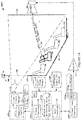
- FIGURES 1A and 1B depict exemplary block diagrams of first and second illustrative embodiments, respectively, of digital cinema theatre systems 100A and 100B, respectively, for practicing the sound and picture information synchronization technique of the present principles.
- the digital theater system 100A comprises a digital cinema digital cinema media block 130A for rendering multiple digital cinema compositions received at their specified frame rates from a digital cinema composition storage unit 131.
- the digital cinema media block 130A provides the rendered pictures to a digital cinema projector 140 and the corresponding sound to a theatrical sound processing system 150A (also known in the industry as a "B-chain").
- the digital cinema compositions can have different frame rates.
- most digital cinema compositions have a frame rate of 24 frames per second.
- some newer digital cinema compositions now have higher frame rates, typically, 48 or even 60 frames per second, which can give rise to synchronization difficulties with the corresponding sound (audio) information during play out because of certain latencies as discussed above.
- the digital cinema digital cinema media block 130A typically comprises various mechanisms for reading the data representative of picture and sound information for a digital cinema composition received from the digital cinema composition storage unit 131.
- the digital cinema media block 130A supplies data representative of the picture information to a picture processing module 132, and supplies the data representative of the sound information to a sound processing module 133.
- the digital cinema media block 130 will allow the picture processing module 132 to run ahead (or behind) the sound processing module 133 as defined by picture-to-sound differential delay value 134A, typically set to zero (0) mS.
- a delay of zero indicates that the first pixel of an image output by picture processing module 132 remains essentially synchronous with the sound output from sound processing module 133 associated with the first audio sample corresponding to that first pixel in the composition read from the storage unit 131.
- a delay memory 135A can supply a different setting for the differential delay 134A for each different frame rate of the digital cinema composition undergoing play out.
- the digital cinema media block 130A can calculate a delay setting from other data stored in the memory 135A, where "other data" might be, for example, an equation dependent on frame rate and having certain predetermined parameters, such as EQ. 1 and values for its variables t FIXED and FRAMES).
- the digital cinema media block 130A could obtain or calculate the delay from data returned from the digital cinema projector 140 following an inquiry regarding the inherent latency 145 of the projector, assuming the digital cinema projector 140 possesses the ability to report its inherent latency 145 for each particular frame rate, or return the parameters necessary for the calculation (e.g., t FIXED and FRAMES apropos to EQ. 1).
- the digital cinema media block 1 30A takes account of the frame rate of each digital cinema composition in a playlist and retrieves the appropriate differential delay value from the delay memory 135A for use whenever a change in frame rate becomes necessary.
- the digital cinema media block 130A, the digital cinema projector 140, and theatrical sound processing system 150A reside in a projection booth 120.
- a wall 108 separates the projection booth 120 from the auditorium 110.
- the wall 108 has a glass portal 109 through which the projection beam 142 generated by the digital cinema projector 140 shines through a projector lens 141 onto a screen 101.
- the digital cinema media block 130A and the digital cinema projector 140 can exist as a single integrated unit, rather than the two separate elements depicted in FIG. 1A .
- the theatrical sound processing system 150A provides audio through an amplifier 151 to one or more speakers 104 located behind the screen 101. (The speakers 104 bear the designation "main speakers” or “mains").
- the auditorium can include additional speakers (not shown) located elsewhere (also referred to as “surround speakers” or “surrounds.")
- additional speakers also referred to as “surround speakers” or “surrounds.”
- Some auditoriums also have special transducers (none shown), sometimes called subwoofers, designated for low-frequency effects (LFE), which generally lie behind or below the screen 101 and in that configuration, such special transducers have the same effect as the main speakers 104 for this discussion.
- LFE low-frequency effects
- the digital cinema projector 140 receives the picture information, generally a pixel at a time, from the digital cinema media block 130A.
- a projection pipeline 143 accepts the picture information for assembly and processing, often in several stages.
- the projection pipeline 143 typically comprises one or more frame buffers.
- the final stage of pipeline 143 delivers processed image data (the picture information) to a light engine 144 comprising a plurality of imagers (typically, one for each primary color), which modulates light provided by an illuminator (not shown).
- the lens 141 projects this modulated light from the imagers onto the screen 101 to render a picture for viewing by an audience.
- the digital cinema projector 140 has a measurable intrinsic latency 145 (t PICTURE_LATENCY ), from the time the digital cinema media block 130A sends first pixel from the picture processing module 132 to the digital cinema projector 140, to the time that pixel appears on the screen 101.
- the intrinsic latency of the digital cinema projector 140 typically comprises both constant and frame-rate dependent components.
- predetermined values can exist for the intrinsic latency for frame rates of concern.
- a projector manufacturer, theater operator or technician can empirically measure the latency by using an oscilloscope (not shown) and a photocell (not shown) responsive to the pixel illumination. With such equipment, the theater operator or technician can monitor the picture information transmitted from the digital cinema media block 130A to the digital cinema projector 140 and measure the delay until that picture information is projected on the screen at each of the different frame rates.
- intrinsic latency 145 may be determined from the projector's specifications.
- changes in intrinsic latency may be estimated based on synchronization changes observed or measured between the sound and picture (e.g., as may be measured using a synchronization checker such as the "Syncheck3" with appropriate test media, as manufactured and distributed by Pharoah Editorial, Inc. of New York, NY).
- the digital cinema projector 140 could report its intrinsic latency 145 for each frame rate to the digital cinema media block 130A, or to another controller (not shown). Then digital cinema media block 130A or the other controller (not shown) can take appropriate steps to compensate using the differential and audio delays 134A/152A.
- a hypothetical audience member 103 positioned in a "prime seat” 102 can represent the audience.
- the "prime seat” 102 can represent an actual seat (e.g., seat 102 in FIG. 1A ) or a hypothetical seat, e.g., a "prime seat” positioned in the middle of an aisle.
- the prime seat 102 generally lies toward the center of the theatre and serves as the reference position for setting the picture (video) and sound (audio) synchronization, as well as sound equalization, loudness, picture brightness, and other parameters expected to deviate more or less uniformly for seat positions increasingly distant from the prime seat.
- the measurements made by the theater operator can include the distance 105 between the head of the hypothetical audience member 103 and the center main speaker 104. In many cases, the theater operator will estimate this distance based on the distance from prime seat 102 to the screen 101, for example because the screen hides the speaker 104. In some cases, the theater operator can establish the distance 105 from a plan drawing of the auditorium. In other cases, the theater operator can define the distance 105 and use that defined distance to specify the location of prime seat 102 (along the centerline of the floor 107).
- the theater operator could establish a policy that dictates that "the prime seat shall lie 2.5 screen heights from the screen, along the centerline of the auditorium", in which case a 10-foot high screen would a priori result in an estimated prime-seat-to-speaker distance 105 of 25 feet.
- the sound from the surround sound speaker(s) could arrive coincidentally with the sound from the main speaker(s), but not before.
- the correct method for setting this fixed surround delay relative to the main speakers remains well known in the art and neither the value for its setting, nor the method of its setting, will change when applying the picture and sound synchronization technique of the present principles.
- the surround sound delay differs from the latency delay 152A associated with different frame rates. However, the latency delay 152A will affect the main, surround, and LFE channels equally and in addition to such prior art surround delays.
- FIG. 1B illustrates the alternate preferred embodiment 100B of a digital cinema theatre system for practicing the synchronization technique of the present principles.
- the digital cinema theatre system 100B of FIG. 1B possesses all the same or similar elements as the digital cinema theatre system 100A of FIG. 1A , where the similar elements are connected and/or function a little differently. Therefore, for those "similar" elements, reference numerals serve to identify like elements, except that the letter "B" rather than the letter "A" appears in FIG. 1B for the corresponding element in FIG. 1A .
- the digital cinema theatre system 100B of FIG. 1B differs from the digital cinema theatre system 100A of FIG. 1A by virtue of having a manually adjustable picture-to-sound differential delay 134B.
- digital theater system 100B automatically adjusts only audio delay 152B in the theatrical sound processing system 150B, according to an indication communicated by digital cinema media block 130B using the signal 136.
- the digital cinema media block 130B can recall preset values 135B for audio delay (t AUDIO_DELAY ) based on the signal 136, which is determined on the basis of frame rate for play out of a particular composition.
- the signal 136 could comprise data representative of the appropriate setting (t AUDIO_DELAY ) for audio delay 152B, in which case, the digital cinema media block 130B will directly read the presets for audio delay (t AUDIO_DELAY ) from the memory 135B for forwarding the delay 152B as the signal 136 (though with a connection of memory 135B to media block 130B, as shown for 135A to 130A).
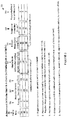
- FIG. 2 shows hypothetical exemplary data that a theater operator could expect to observe in the auditorium 100A when using present-day digital cinema technology without the benefit of the present invention (e.g., absent the differential delay preset values 135A for achieving picture and sound synchronization for different frame rates.).
- the fixed adjustments table 200 presents three rows of data, each representing the behavior of the system given digital cinema compositions presented at 24, 48, and 60 frames per second, respectively.
- the frame rate column 201 indicates the corresponding composition's play out rate in frames per second (f/s).
- the projector latency-related columns 202-204 indicate the delays the digital cinema projector 140 applies (in this and the following examples, in accordance with EQ.
- FRAMES pipeline latency component measured in frames
- FRAMES pipeline latency component measured in frames
- two or three frames of latency or some different number, as indicated by the "-2" value shown in column 202 for the digital cinema projector 140.
- FRAMES could plausibly be a non-integer value, for example if the projector's image processing architecture were to employ in a field-interlaced or block operating mode in any of its stages.
- the total projector latency (t PICTURE_LATENCY ), expressed in column 204, comprises the sum of the fixed latency component (column 203) plus the quotient of the frames of latency component (column 202) divided by the frame rate (column 201), per EQ. 1.
- the aggregate digital cinema projector latency drops.
- the digital cinema projector latency can only have a negative value because the projector can only display an image after receipt from the digital cinema media block and cannot induce delay in the sound at all.
- Column 206 of FIG. 2 indicates the delay setting 152A (here, 90mS) for the theatrical sound processing system 150A (i.e., the B-Chain of FIG. 1A ) or simply the value of the sound processing system delay if fixed or intrinsic.
- the sound processing system delay value remains unchanged at all frame rates. This value represents the delay of the sound (audio) relative to the picture (video), and can only have a positive value, since the theatrical sound processing system 150A cannot emit audio before its receipt and cannot induce delay in the picture at all.
- Column 207 indicates the audio delay induced by the time-of-flight of sound traversing the speaker-to-the prime seat distance 105, (which in the example of FIG. 1A constitutes 40 feet).
- the value of 40mS indicated in Column 207 for the delay represents a slight over approximation. (More precisely, in dry air at 20°C, the speed of sound is 1126 ft/second, giving a time-of-flight closer to 35.5 mS for 40 feet, slightly less if the air were humid, or slightly more if the air were colder). For the purposes of discussion, the approximation of one-foot of travel equals one millisecond of delay is convenient and sufficient. This approximation remains constant for all frame rates, but would change for differently sized auditoriums, or with a different choice for prime seat 102.
- the result shown in column 208 represents the picture-to-sound net latency (t SYNC_ERROR ) at the prime seat shown 102 of FIGS 1A and 1B at each frame rate in column 201 and should ideally always be zero in each row.
- the theater operator or technician has tuned the digital cinema system using conventional means to produce this ideal zero latency at 24 fps by setting the digital cinema media block differential latency (t DIFFERENTIAL_DELAY ) 134A manually.
- FIG. 2 represents values for a prior art auditorium and does not make use of the frame rate dependent differential delay preset values 135A of the present invention).
- the net latency in column 208 comprises the sum of the values in the columns 204, 205, 206, and 207, per EQ. 4, for the same row.
- setting the digital cinema media block differential delay 134A to a value -47 mS would result in a zero sum in the column 208 and perfectly synchronized picture and sound when observed from prime seat 102, but only at 24 fps.
- the fixed values set for each of columns 205 and 206 no longer produce the net latency of zero.
- FIG. 2 represents a substantial problem that either requires a distinct manual setting each time a digital cinema playlist presents a composition with a frame rate different than its predecessor, or subjects the audience to varying sound and picture synchronization each time a digital cinema composition has a different frame rate.
- Present-day digital cinema media blocks (whether in an integrated or external form-factor), such as those manufactured by Doremi Labs, Inc. of Burbank, CA; Dolby Laboratories, Inc of San Francisco, CA; GDC Technology (USA) LLC of Burbank, CA; Qube Cinema, Inc. of Burbank, CA; and Sony Professional Solutions of America of Los Angeles, CA; all operate in this way, providing at most a single setting for differential delay in the digital cinema media block independent of frame rate.
- a technician tuning a theatre can use a synchronization meter such as the Syncheck3 by Pharoah Editorial, Inc. of New York, NY, which offers a digital readout of whether the picture or audio lags the other and by how many milliseconds.
- a technician can also measure net latency with a two-channel oscilloscope, one channel monitoring the sound through a microphone and the other channel monitoring the picture with a photodetector.
- the technician will use special test clip of content to make such measurements, for example a clip having a single frame of white with the remaining frames in black.
- the single frame of white corresponds in the content to an audio tone burst and the frames of black correspond to silence.
- the technician can read either the meter or the oscilloscope to discern the net latency (as in column 208) to determine whether the sound (the burst of tone) or picture (the flash of white) arrived first at the prime seat, and by how much.
- a theater operator or technician can set the digital cinema media block synchronization empirically, by making whatever offsetting adjustments needed for the measured net latency. For example were such a meter to indicate that picture leads the sound by 10 mS, then the theater operator or a technician could adjust the differential delay 134A/134B by -10 mS, thereby delaying the picture more. (As discussed earlier, in accordance the convention used herein, negative values represent a greater delay of picture with respect to the sound).
- the theater operator or technician could adjust the audio delay 152A/152B by -10 mS, thereby reducing the audio delay, provided the delay 152A/152B had a value of at least 10 mS since the value of the delay 152A/152B cannot be less than zero.
- a combination of those adjusts may be made. Were the meter to indicate that sound leads the picture by 10 mS, then the theater operator or technician can increment either the differential delay 134A/134B or the delay 152A/152B by 10 mS to offset (delay) sound by an additional 10 mS with respect to the picture.
- the theater operator or technician could increment both differential delay 134A/134B and delay 152A/152B by 5 mS, or two different values that total 10 mS (e.g., 3 mS and 7 mS; -5 mS and 15 mS, etc.), as long as delay 152A/152B remains greater than or equal to zero.
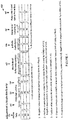
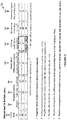
- the digital cinema system must make use of different values chosen for either or both of the delay values 134A/134B and 152A/152B for each different frame rate, as discussed in conjunction with FIGS. 3 , 4 , and 5 showing tables 300, 400, and 500, respectively.
- the projector 140 will presumably exhibit the same exemplary behavior consistent with respect to each of the selected frame rates, and the relative position of the prime seat 102 to the speaker 104 is presumed to be constant.
- the projector latency columns 202-204 and distance to prime seat values in column 207 remain the same in each of tables 200, 300,400, 500.
- table 300 shows exemplary values for each of the different frame rates of column 301, consistent with the configuration of digital theater system 100A in FIG. 1A , in which the delay setting 152A has a constant value shown throughout column 306 and only the digital cinema media block differential latency setting for the differential delay 134A varies, as shown in column 305.
- the values provided in column 305 achieve substantial synchronization of sound and picture at the prime seat 102 for each of the frame rates listed, as shown by the zero values in column 308.
- all the latencies of the differential delay values 134A have the same negative sign, that is, all the settings represent that the digital cinema media block 130A outputs the picture to the projector 140 some number of milliseconds after the corresponding sound has been output to the theatrical sound processing system 150A.
- table 400 shows a different configuration where the theatrical sound processing system 150A introduces negligible latency, represented by the zeros in column 406. These values could constitute actual settings of the delay 152A in the theatrical sound processing system 150A. Alternatively, the audio processing equipment might offer no delay setting 152A and this latency that is essentially zero for the B-Chain, as shown in column 406, is intrinsic. For each of the frame rates in column 401, the differential delay 134A in digital cinema media block 130A has a different setting, spanning both signs, as shown in column 405, depending on which of the sound or picture requires delay with respect to the other to achieve the zero values in column 408.
- table 500 shows the values for the digital cinema system 100B of FIG. 1B , in which the digital cinema media block 130B does not have variable differential delay 134A (or it is set to be zero). Instead, the digital cinema media block 130B, assures that the differential latency 134B between the picture and sound as emitted by the digital cinema media block remains zero, also called 'editorial sync'. (Alternative embodiments could have the digital cinema media block differential latency set manually to some constant value, often near zero, but some manufacturers of present day digital cinema media block equipment default to other non-zero values).
- the theatrical sound processing system (the B-Chain) 150B is automatically set to the different delay values in the column 506, which, as previously pointed out, cannot fall below zero. Since the delay 152B cannot have a value (t AUDIO_DELAY ) less than zero, some circumstances can produce cases where delay 152B cannot achieve perfect synchronization of picture and sound, as shown by the hashed entry in the 60 fps row of the column 506, where even the minimum delay setting of zero remains insufficient to compensate for the amount by which the sound (audio) arrives late to the prime seat 102.
- the unavoidable delay imposed on the sound by the time-of-flight from the speaker 104 remains greater than the total delay on the picture imposed by the projector 140 at 60 fps (listed in column 204), so that ultimately the minimum setting of the delay 152B to zero does not sufficiently compensate for the difference, with the result that, at 60 fps, some residual net latency will exist and the sound will arrive late by 7 mS at the prime seat 102, which for some situations may be completely acceptable.
- the digital cinema media block 130B of FIG. 1B could make or trigger the automatic setting of the delay 152B to the value (t AUDIO_DELAY ) provided in audio delay preset memory 135B in response to the signal 136, or to another control signal (not shown), e.g., from the projector 140 or a separate controller (none shown).
- the theatrical sound processing system 150B receives an indication of the current frame rate sufficient to determine what setting to use for audio delay 152B.
- the control signal to audio delay 152B may indicate the audio delay value (t AUDIO_DELAY ) itself.
- FIG. 6 shows an exemplary state transition diagram 600, corresponding to the delay settings presented in the table 400 of FIG. 4 .
- Each of the three states 610, 620, and 630 corresponds to the digital cinema media block 130A of FIG. 1A playing digital cinema compositions at 24, 48, and 60 fps, respectively.
- the picture-to-sound differential latency ⁇ L (used here as a more compact and convenient representation for t DIFFERENTIAL_DELAY ) will have the following values 43, 2, and -7 mS, respectively, in accordance with the contents of column 405 of FIG. 4 .
- transitions 612, 621, 623, 632, 613, and 631 among the states 610, 620, and 630 each indicate a minimum amount of padding to the sound or picture necessary to bridge a transition between the state's different differential latencies, ⁇ L.
- the transition 612 from the state 610 (24 fps) to the state 620 (48) fps causes the picture-to-sound differential latency ⁇ L to change from 43 mS to 2 mS.
- the differential latency changes by -41 mS which corresponds to a gap in the picture (because the picture is being more delayed by the media block to compensate for less delay by the projector), assuming that the sound (audio) from one digital cinema composition does not undergo cropping or overlapping (i.e., mixed or cross-faded) as will be discussed in more detail below.
- Some digital cinema media blocks or projectors can easily provide such a picture gap by providing black images at one or both of the frame rates represented in the transition (here, 24 or 48 fps).
- the differential latency change (here, - 41 mS) may not correspond to a convenient integer number of frames, in which case the number of blanked or black frames may be increased to the next integer count, and the difference between the duration of that number of frames and the minimum value can also be added as silence in the sound (audio output). In this way, whatever extra time the picture gap receives above the minimum, the sound will have a like added gap.
- transitions 623 and 613 produce differential latency changes of -9 mS and - 50 mS, respectively, requiring minimum blanking gaps for those durations introduced into the picture, respectively.
- transition 621 from state 620 to 610 causes ⁇ L to change from 2 mS to 43 mS, thus giving rise to a differential latency change of 41 mS that requires insertion of a 41 mS gap inserted into the audio track, to provide silence.
- transitions 632 and 631 produce differential latency changes of 9 mS and 50 mS, respectively, requiring corresponding gaps introduced into the audio track. As before, if for some reason a transition time longer than the minimum becomes necessary, then both sound and picture signals undergo padding by a like incremental amount above the minimum.
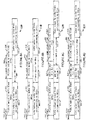
- FIG. 7A shows an exemplary timeline 700 advancing from left to right and corresponding to the transition 613 from the state 610, where digital cinema composition undergoes play out at 24 fps to the state 630 where digital cinema composition undergoes play out at 60 fps.
- the upper half of timeline 700 represents the picture (video) element of the digital cinema composition and the lower portion the sound (audio) element.
- the example timeline 700 exhibits consistency with the examples previously discussed with respect to the digital theater system 100A, table 400, and state diagram 600.
- ⁇ L is 43 mS, for which reason in the timeline 700, the picture element 701 and corresponding sound element 702 remain offset from each other by ⁇ L 703 in the amount of 43 mS.
- ⁇ L is -7 mS, resulting in picture element 704 and sound element 705 being offset by ⁇ L 706 in the amount of -7 mS.
- the difference in the differential latencies 703 and 706 produce a 50 mS gap 707 in the picture information of the timeline 700. If not incompatible with the requirements of digital cinema projector 140, for the interval represented by gap 707, the digital cinema media block 130A may simply cease to output picture elements following the picture element 701 until the beginning of picture element 704. Meanwhile, with respect to the output of sound information from the digital cinema media block 130A to the theatrical sound processing system 150A, no gap or interruption exists between the sound elements 702 and 705.
- FIG. 7B shows a different exemplary timeline 710 associated with a projector 140 that does not admit a gap 707.
- the digital cinema media block 130A will inject an appropriate number of black frames 717 into the picture stream of the timeline 710.
- the aggregate duration of frames 717 should substantially equal that of the gap 707, that is, 50 mS.
- 50 mS corresponds to three frames.
- the picture element 714 plays, having a ⁇ L 716 (-7 mS) with respect to the audio element 715.
- the digital media cinema block 130A outputs two consecutive sound elements 702 and 715 to the theatrical sound processing system 150A with no gap or interruption.
- FIG. 7C shows still another exemplary timeline 720 in connection with the projector 140 when the projector cannot switch from 24 fps to 60 fps in the amount of time corresponding to the change in ⁇ L (i.e., the duration of the gap 707).
- the digital cinema media block 130 will introduce an identical extra interval 'T' introduced into each of the picture and sound tracks of timeline 720.
- a gap 727 of duration 'T' is added, either before or after ('before' is shown) gap 729 corresponding to the change in ⁇ L (50 mS).
- elements 727 and 728 constitute be gaps in the corresponding signal or fill (also known as padding) representing frames of black for picture or silence for sound).
- the requirements of projector 140 and the theatrical sound processing system 150A will determine the length of such gaps.
- these can occur at 24 fps or 60 fps, and the duration T may correspond to the total duration of these black frames. Since timeline 720 assumes that gap 729 is acceptable, it is unlikely that black frames preceding the gap will be necessary.
- the gap 729 and the gap 727 representing the interval T could have a reverse order, with gap 727 containing padding of black frames at 60 fps to assist projector 140 in accommodating or synchronizing to the new frame rate.
- FIG. 7D shows a timeline 730, similar to the time line 720 of FIG. 7C , but with the gap 729 replaced with black frames 739, such that the picture track flows continuously from picture element 701 to fill 737 (black frames throughout duration 'T'), to the black frames 739, to picture element 734.
- the sound element 702 precedes the gap or silence 738, followed by the sound element 735, holding the picture-to-sound differential latency ⁇ L 736 with respect to the picture element 734.
- the fill 737 could comprise black frames at 24 fps, or at 60 fps, or both (24 fps then 60 fps) as needed to meet the requirements of the projector 140 for glitch-free operation (i.e., as needed to avoid any projection to screen 102 other than the pictures corresponding to elements 701 and 734 with an intervening interval of black for T + 50 mS).
- picture element 801 at 60 fps abuts the picture element 804 at 24 fps. This assumes that projector 140 and digital cinema media block 130A can support these values.
- the sound element 802 corresponding to picture element 801 runs ahead of the picture element 801 by ⁇ L 803 equal to -7 mS.
- the sound element 805 corresponding to picture element 804 runs behind picture element 804 by ⁇ L 806 equal to 43 mS, which results in a 50 mS gap 807 in the sound track of the timeline 800. This assumes that the theatrical sound processing system 150A will interpret that gap as a 50 mS silence without a glitch.
- FIG. 8B depicts a time line 810 analogous to the time line 710 of FIG. 7B .
- the timeline 810 depicts the digital cinema media block 130A padding the interval between sound elements 802 and 815 with 50 mS of silence 817.
- the sound element 815 follows corresponding picture element 814 by ⁇ L 816 equal to 43 mS, which produced the 50 msS interval between sound elements 802/815.
- FIG. 8C depicts a time line 820 analogous to the time line 720 of FIG. 7C .
- the timeline 820 of FIG. 8C assumes that the projector 140 (or the digital cinema media block 130A) cannot transition from 60 fps to 24 fps immediately, and requires some amount of time up to 'T' to successfully switch.
- the projector 140 or the digital cinema media block 130A
- the additional gap 828 for which silent fill could be substituted
- a corresponding gap or black frame fill 827 occurs between the picture elements 801 and 824.
- the picture element 824 corresponds to sound element 825, with ⁇ L 826 of 43 mS.
- FIG. 8D depicts a time line analogous to the time line 730 of FIG. 7D .
- the timeline 830 of FIG. uses the silence padding 838 and 839 for both the interval 'T' and the 50 mS difference between the differential latencies 803 and 836, respectively, for use in cases where the theatrical sound processing system 150A will not cleanly accept a loss of signal between the sound elements 802 and 835.
- the duration 'T' could have an arbitrary duration.
- the duration of 'T' may correspond to some number of frames of black at 60 fps or 24 fps, or both, to facilitate the transition to the new frame rate upon transitioning to the state 610.
- the digital cinema projector 140 may blank its output during the non-zero duration interval between picture elements as the digital cinema compositions transition from one frame rate to another, for example to hide glitches otherwise visible to the audience.
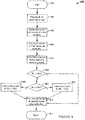
- FIG. 9 depicts an exemplary process 900, described with respect to the digital cinema system 100A of FIG. 1A , for managing the transition between two consecutive digital cinema compositions in case they might have different frame rates and thus induce a change in the differential latency ( ⁇ L).
- the transition management process exemplified by the process 900, would generally undergo execution by the digital cinema media block (e.g., 130A, 130B).
- some steps of the transition management process may require integration with projector 140 (e.g., in an embodiment, not shown, where projector 140 receives inquiries as to its latency 145 at different frame rates).
- the process may require integration with the theatrical sound processing system 150B (e.g., as in FIG. 1B , where the audio delay 152B becomes set by signal 136).
- the transition management process 900 begins at step 901, with the digital cinema media block 130A of FIG. 1A having a picture output connection to projector 140, and a sound output connection to the theatrical sound processing system 150A.
- the digital cinema media block 130A accepts a differential latency for each frame rate for which the system is configured to handle (e.g., by accepting values from a technician, or by querying the projector 140 or other source).
- These differential latencies ( ⁇ L) can reside in the memory 135A.
- the differential latency may be provided empirically for each frame rate as described above, or the component latencies and delays (such as those found in columns 202, 203, 306, 406) and distance or time-of-flight to the prime seat (such as specified in column 207) may be provided and the differential latencies calculated.
- the digital cinema media block 130A determines a first frame rate for a first digital cinema composition. For example, the digital cinema media block 130A could determine the frame rate by examining metadata in the digital cinema composition, or in any of the corresponding picture asset files.
- the digital cinema media block 130A recalls the differential latency ⁇ L 1 corresponding to the first frame rate from the memory 135A and applies that value when setting the differential delay 134A. If an additional delay becomes necessary to allow the digital cinema media block 130A or projector 140 to adjust to the newly set frame rate, that delay setting occurs during this step as well. Otherwise, or after which, the first digital cinema composition undergoes play out by the digital cinema media block 130A with differential delay 134A set to ⁇ L 1 . This results in a presentation to the audience with a proper net picture-to sound latency, which is to have a value of zero or nearly zero at the prime seat 102.
- step 905 the digital cinema media block 130A determines the second (next) frame rate corresponding to a second (next) digital cinema composition. During this step, the digital cinema media block 130A recalls the corresponding differential latency ⁇ L 2 from memory 135A.
- step 906 undergoes execution during which the digital cinema media block 130A makes comparison determine whether ⁇ L 1 is equal to ⁇ L 2 (or that the current and next frame rates equal each other). If so, then the process branches to step 910 during which time, the second (next) digital cinema plays with the same differential latency. Generally, this means that no gap or filler becomes needed between play out of the first and second digital cinema compositions.
- the digital cinema media block 130A can insert a gap and/or filler of appropriate type and duration into each of the sound and picture tracks before proceeding to play out the second digital cinema composition.
- step 906 the digital cinema media block 130A determines that ⁇ L 1 and ⁇ L 2 are unequal, then during step 907, the digital cinema media block makes a determination to whether the new differential latency ( ⁇ L 2 ) has a smaller value than the current latency ( ⁇ L 1 ). If so, then during step 909, as the sound element of the first digital cinema composition finishes playing, the digital cinema media block inserts a sound pad (either silence or a gap, as required) of duration ⁇ L 1 - ⁇ L 2 immediately afterward into the sound track (e.g., as with gap 807 or silent element 817), and processing continues at step 910. If ⁇ L 2 > ⁇ L 1 , then from step 907, the process 900 of FIG.
- step 9 branches to step 908 whereupon after the picture element of the first digital cinema composition finishes playing, the digital cinema media block 130A inserts a picture pad (either black frames or a gap, as required) of duration ⁇ L 2 - ⁇ L 1 immediately afterward into the picture track (e.g., as with gap 707 or black frames 717), and here too, processing continues at step 910.
- a picture pad either black frames or a gap, as required
- the digital cinema media block 130A begins to play the second digital cinema composition to follow the first, but with the differential delay 134A set to ⁇ L 2 .
- the second digital cinema composition undergoes play out immediately after the first digital cinema composition, with the sound element of the second digital cinema composition immediately following the sound element of the first digital cinema composition, or the sound pad, if inserted during step 909.
- the picture element of the second digital cinema composition immediately follows the picture element of the first digital cinema composition or the picture pad, if inserted during step 908.
- the digital cinema media block 130A inserts these into both the picture and sound tracks during step 910 with matching gaps 727 and 728, 737 and 738, 827 and 828, and 837 and 838. These matching gaps may occur before any inserted pads (at step 908 or 909) as shown in the timelines 720, 730, 820, 830; or they may be inserted after those pads (not shown).
- step 902 instead of calculating a differential latency (which is not used in digital theater system 100B), the appropriate audio delay settings (t AUDIO _ DELAY ) are provided instead, whether empirically, or by calculation.
- the maximum or minimum allowable settings for the audio delay 152B may be insufficient to achieve perfect picture-to-sound sync at the prime seat 120.
- the audio delay settings (t AUDIO_DELAY ) are being calculated, the calculated value gets clamped to the allowable range.
- the ideal audio delay value for the theatrical sound processing system would be -7 mS, but since that value exceeds the lower limit, the value gets clamped to the minimum allowable value (i.e., zero).
- ⁇ L n would get replaced by the corresponding (t AUDIO_DELAYn .
- FIG. 10 depicts one example user interface 1000 for practicing the picture and sound synchronization technique of the present principles, as might be used in step 902 for an embodiment that relies on manual configuration.
- the interface 1000 of FIG. 10 provides a suitable dialog 1010 to allow an operator to set a different differential delay for each frame rate in column 1020.
- the operator can enter specific differential delay information such shown in column 405 into the cells of column 1030 or can adjust such values using increment/decrement arrow buttons 1040 and 1042, respectively.
- the operator will press the OK button 1050 to store those settings to memory 135A, whereas pressing CANCEL button 1052 will abort any change to those settings.
- the media block 130A could compute from individual component values for projector latency (e.g., columns 202, 203), theatrical sound processing system audio delay (columns 306 or 406), and the prime seat distance 105 (e.g., as in column 207), the corresponding differential latency for delay 135A for any frame rate in question.
- projector latency e.g., columns 202, 203
- theatrical sound processing system audio delay e.g., 306 or 406
- the prime seat distance 105 e.g., as in column 207
- the digital media cinema block 130A will compute the corresponding differential latencies and store the values in the memory 135A.
- the digital cinema media block 130A will store parameters as given and compute the differential latencies whenever needed.
- the memory 135A serves to store data indicative of the differential latency for each necessary frame rate.
- the foregoing describes a method and apparatus for synchronizing picture (video) and sound (audio) for digital cinema compositions at different frame rates.
Landscapes
- Engineering & Computer Science (AREA)
- Multimedia (AREA)
- Signal Processing (AREA)
- Physics & Mathematics (AREA)
- General Physics & Mathematics (AREA)
- Two-Way Televisions, Distribution Of Moving Picture Or The Like (AREA)
Applications Claiming Priority (2)
| Application Number | Priority Date | Filing Date | Title |
|---|---|---|---|
| US201261678243P | 2012-08-01 | 2012-08-01 | |
| PCT/US2013/026251 WO2014021936A1 (en) | 2012-08-01 | 2013-02-15 | Method and apparatus for adapting audio delays to picture frame rates |
Publications (2)
| Publication Number | Publication Date |
|---|---|
| EP2880867A1 EP2880867A1 (en) | 2015-06-10 |
| EP2880867B1 true EP2880867B1 (en) | 2018-06-13 |
Family
ID=47843395
Family Applications (1)
| Application Number | Title | Priority Date | Filing Date |
|---|---|---|---|
| EP13708278.0A Not-in-force EP2880867B1 (en) | 2012-08-01 | 2013-02-15 | Method and apparatus for adapting audio delays to picture frame rates |
Country Status (6)
| Country | Link |
|---|---|
| US (1) | US9595299B2 (enExample) |
| EP (1) | EP2880867B1 (enExample) |
| JP (1) | JP2015529059A (enExample) |
| KR (1) | KR20150037949A (enExample) |
| CN (1) | CN104871550B (enExample) |
| WO (1) | WO2014021936A1 (enExample) |
Families Citing this family (6)
| Publication number | Priority date | Publication date | Assignee | Title |
|---|---|---|---|---|
| KR102342081B1 (ko) * | 2015-04-22 | 2021-12-23 | 삼성디스플레이 주식회사 | 멀티미디어 장치 및 이의 구동 방법 |
| JP2017103542A (ja) * | 2015-11-30 | 2017-06-08 | 株式会社小野測器 | 同期装置、同期方法及び同期プログラム |
| US10334254B2 (en) * | 2016-09-23 | 2019-06-25 | Apple Inc. | Feed-forward and feed-back metadata exchange in image processing pipelines to improve image quality |
| CN106572384B (zh) * | 2016-11-15 | 2017-12-19 | 深圳市环球数码科技有限公司 | 一种实时音效处理系统和实时音效处理方法 |
| KR102839252B1 (ko) | 2019-10-30 | 2025-07-25 | 주식회사 엘지에너지솔루션 | 순차 가압 포메이션 지그 및 이를 이용한 포메이션 방법 |
| KR20230057801A (ko) * | 2021-10-22 | 2023-05-02 | 삼성전자주식회사 | 전자 장치 및 전자 장치의 동작 방법 |
Family Cites Families (12)
| Publication number | Priority date | Publication date | Assignee | Title |
|---|---|---|---|---|
| US4677466A (en) * | 1985-07-29 | 1987-06-30 | A. C. Nielsen Company | Broadcast program identification method and apparatus |
| US7400653B2 (en) * | 2004-06-18 | 2008-07-15 | Dolby Laboratories Licensing Corporation | Maintaining synchronization of streaming audio and video using internet protocol |
| EP1657929A1 (fr) * | 2004-11-16 | 2006-05-17 | Thomson Licensing | Dispositif et méthode de synchronisation de différentes parties d'un service numérique |
| EP1854293A2 (en) * | 2005-02-07 | 2007-11-14 | Thomson Licensing | METHOD AND APPARATUS FOR REPLAYING A VIDEO SIGNAL AND ONE OR MORE AUDIO SIGNALS RELATED TO AUDIO/VIDEO DATA THAT ARE BASED ON A 24Hz FRAME FREQUENCY VIDEO SIGNAL |
| JP4991129B2 (ja) * | 2005-07-19 | 2012-08-01 | Necディスプレイソリューションズ株式会社 | 映像音声再生装置および映像音声再生方法 |
| KR100594995B1 (ko) | 2006-03-17 | 2006-07-03 | (주)동영아이텍 | 디지털 시네마 광고용 멀티미디어 파일 생성 시스템 |
| CN101622867B (zh) * | 2007-03-06 | 2013-03-06 | 汤姆森许可贸易公司 | 基于图像帧后采样的数字电影防偷拍方法和装置 |
| US7430018B1 (en) | 2008-03-24 | 2008-09-30 | International Business Machines Corporation | Timesharing of a display screen |
| GB0905317D0 (en) * | 2008-07-14 | 2009-05-13 | Musion Ip Ltd | Video processing and telepresence system and method |
| JP5286050B2 (ja) | 2008-11-28 | 2013-09-11 | 株式会社日立国際電気 | 符号化−復号化装置および映像伝送システム |
| KR20120018747A (ko) * | 2009-04-13 | 2012-03-05 | 쇼우스캔 디지탈 엘엘씨 | 동영상을 촬영하고 프로젝팅하기 위한 방법 및 장치 |
| US8525885B2 (en) * | 2011-05-15 | 2013-09-03 | Videoq, Inc. | Systems and methods for metering audio and video delays |
-
2013
- 2013-02-15 WO PCT/US2013/026251 patent/WO2014021936A1/en not_active Ceased
- 2013-02-15 CN CN201380040857.XA patent/CN104871550B/zh not_active Expired - Fee Related
- 2013-02-15 EP EP13708278.0A patent/EP2880867B1/en not_active Not-in-force
- 2013-02-15 JP JP2015525415A patent/JP2015529059A/ja active Pending
- 2013-02-15 KR KR1020157002605A patent/KR20150037949A/ko not_active Ceased
- 2013-02-15 US US14/414,630 patent/US9595299B2/en not_active Expired - Fee Related
Non-Patent Citations (1)
| Title |
|---|
| None * |
Also Published As
| Publication number | Publication date |
|---|---|
| US20150170712A1 (en) | 2015-06-18 |
| CN104871550A (zh) | 2015-08-26 |
| KR20150037949A (ko) | 2015-04-08 |
| JP2015529059A (ja) | 2015-10-01 |
| EP2880867A1 (en) | 2015-06-10 |
| US9595299B2 (en) | 2017-03-14 |
| CN104871550B (zh) | 2018-06-22 |
| WO2014021936A1 (en) | 2014-02-06 |
Similar Documents
| Publication | Publication Date | Title |
|---|---|---|
| US7400653B2 (en) | Maintaining synchronization of streaming audio and video using internet protocol | |
| US9595299B2 (en) | Method and apparatus for adapting audio delays to picture frame rates | |
| US8483414B2 (en) | Image display device and method for determining an audio output position based on a displayed image | |
| US8208069B2 (en) | Audio processing apparatus, video processing apparatus, and method for controlling the same | |
| US7333154B2 (en) | Method and apparatus for optimizing the presentation of audio visual works | |
| CN106331562B (zh) | 云端服务器、控制设备及音频视频同步方法 | |
| US20140376873A1 (en) | Video-audio processing device and video-audio processing method | |
| US9742965B2 (en) | Apparatus, systems and methods for user controlled synchronization of presented video and audio streams | |
| US20100007773A1 (en) | Video Processing and Telepresence System and Method | |
| TWI634792B (zh) | 投影圖像調整方法及投影機 | |
| US20110134207A1 (en) | Audio/video System | |
| KR20120105497A (ko) | 가정 극장을 위한 최적화 컨텐트 보정 | |
| US7423693B2 (en) | Video delay stabilization system and method | |
| Younkin et al. | Determining the amount of audio-video synchronization errors perceptible to the average end-user | |
| US20100166382A1 (en) | Video and audio reproduction system, distribution device, and synchronization adjustment method | |
| US20100091188A1 (en) | Synchronization of secondary decoded media streams with a primary media stream | |
| KR100677162B1 (ko) | A/v 동기를 자동 조정하는 av 시스템 | |
| Mori et al. | Kansei-based investigation of methods for projection of digital content | |
| JP2007221422A (ja) | 映像音声再生システムおよびこれを構成するavセンターならびにモニター | |
| JPH0374072B2 (enExample) | ||
| KR20050081067A (ko) | 자동 음성 조절방법 | |
| JP2000021141A (ja) | 同期制御方法、同期制御装置、及び映像再生システム |
Legal Events
| Date | Code | Title | Description |
|---|---|---|---|
| PUAI | Public reference made under article 153(3) epc to a published international application that has entered the european phase |
Free format text: ORIGINAL CODE: 0009012 |
|
| 17P | Request for examination filed |
Effective date: 20150121 |
|
| AK | Designated contracting states |
Kind code of ref document: A1 Designated state(s): AL AT BE BG CH CY CZ DE DK EE ES FI FR GB GR HR HU IE IS IT LI LT LU LV MC MK MT NL NO PL PT RO RS SE SI SK SM TR |
|
| AX | Request for extension of the european patent |
Extension state: BA ME |
|
| DAX | Request for extension of the european patent (deleted) | ||
| 17Q | First examination report despatched |
Effective date: 20160610 |
|
| RIC1 | Information provided on ipc code assigned before grant |
Ipc: G11B 27/30 20060101ALI20170111BHEP Ipc: H04N 9/802 20060101ALI20170111BHEP Ipc: H04N 21/43 20110101ALI20170111BHEP Ipc: H04N 5/04 20060101ALI20170111BHEP Ipc: H04N 21/44 20110101AFI20170111BHEP Ipc: H04N 21/414 20110101ALI20170111BHEP Ipc: H04N 21/439 20110101ALI20170111BHEP Ipc: G03B 31/02 20060101ALI20170111BHEP Ipc: G11B 27/10 20060101ALI20170111BHEP |
|
| GRAP | Despatch of communication of intention to grant a patent |
Free format text: ORIGINAL CODE: EPIDOSNIGR1 |
|
| STAA | Information on the status of an ep patent application or granted ep patent |
Free format text: STATUS: GRANT OF PATENT IS INTENDED |
|
| INTG | Intention to grant announced |
Effective date: 20170301 |
|
| GRAJ | Information related to disapproval of communication of intention to grant by the applicant or resumption of examination proceedings by the epo deleted |
Free format text: ORIGINAL CODE: EPIDOSDIGR1 |
|
| STAA | Information on the status of an ep patent application or granted ep patent |
Free format text: STATUS: EXAMINATION IS IN PROGRESS |
|
| INTC | Intention to grant announced (deleted) | ||
| GRAP | Despatch of communication of intention to grant a patent |
Free format text: ORIGINAL CODE: EPIDOSNIGR1 |
|
| STAA | Information on the status of an ep patent application or granted ep patent |
Free format text: STATUS: GRANT OF PATENT IS INTENDED |
|
| INTG | Intention to grant announced |
Effective date: 20180119 |
|
| INTG | Intention to grant announced |
Effective date: 20180124 |
|
| GRAS | Grant fee paid |
Free format text: ORIGINAL CODE: EPIDOSNIGR3 |
|
| GRAA | (expected) grant |
Free format text: ORIGINAL CODE: 0009210 |
|
| STAA | Information on the status of an ep patent application or granted ep patent |
Free format text: STATUS: THE PATENT HAS BEEN GRANTED |
|
| AK | Designated contracting states |
Kind code of ref document: B1 Designated state(s): AL AT BE BG CH CY CZ DE DK EE ES FI FR GB GR HR HU IE IS IT LI LT LU LV MC MK MT NL NO PL PT RO RS SE SI SK SM TR |
|
| REG | Reference to a national code |
Ref country code: GB Ref legal event code: FG4D |
|
| REG | Reference to a national code |
Ref country code: CH Ref legal event code: EP Ref country code: AT Ref legal event code: REF Ref document number: 1009739 Country of ref document: AT Kind code of ref document: T Effective date: 20180615 |
|
| REG | Reference to a national code |
Ref country code: IE Ref legal event code: FG4D |
|
| REG | Reference to a national code |
Ref country code: DE Ref legal event code: R096 Ref document number: 602013038833 Country of ref document: DE |
|
| REG | Reference to a national code |
Ref country code: NL Ref legal event code: MP Effective date: 20180613 |
|
| REG | Reference to a national code |
Ref country code: LT Ref legal event code: MG4D |
|
| PG25 | Lapsed in a contracting state [announced via postgrant information from national office to epo] |
Ref country code: SE Free format text: LAPSE BECAUSE OF FAILURE TO SUBMIT A TRANSLATION OF THE DESCRIPTION OR TO PAY THE FEE WITHIN THE PRESCRIBED TIME-LIMIT Effective date: 20180613 Ref country code: FI Free format text: LAPSE BECAUSE OF FAILURE TO SUBMIT A TRANSLATION OF THE DESCRIPTION OR TO PAY THE FEE WITHIN THE PRESCRIBED TIME-LIMIT Effective date: 20180613 Ref country code: BG Free format text: LAPSE BECAUSE OF FAILURE TO SUBMIT A TRANSLATION OF THE DESCRIPTION OR TO PAY THE FEE WITHIN THE PRESCRIBED TIME-LIMIT Effective date: 20180913 Ref country code: NO Free format text: LAPSE BECAUSE OF FAILURE TO SUBMIT A TRANSLATION OF THE DESCRIPTION OR TO PAY THE FEE WITHIN THE PRESCRIBED TIME-LIMIT Effective date: 20180913 Ref country code: CY Free format text: LAPSE BECAUSE OF FAILURE TO SUBMIT A TRANSLATION OF THE DESCRIPTION OR TO PAY THE FEE WITHIN THE PRESCRIBED TIME-LIMIT Effective date: 20180613 Ref country code: LT Free format text: LAPSE BECAUSE OF FAILURE TO SUBMIT A TRANSLATION OF THE DESCRIPTION OR TO PAY THE FEE WITHIN THE PRESCRIBED TIME-LIMIT Effective date: 20180613 Ref country code: ES Free format text: LAPSE BECAUSE OF FAILURE TO SUBMIT A TRANSLATION OF THE DESCRIPTION OR TO PAY THE FEE WITHIN THE PRESCRIBED TIME-LIMIT Effective date: 20180613 |
|
| PG25 | Lapsed in a contracting state [announced via postgrant information from national office to epo] |
Ref country code: GR Free format text: LAPSE BECAUSE OF FAILURE TO SUBMIT A TRANSLATION OF THE DESCRIPTION OR TO PAY THE FEE WITHIN THE PRESCRIBED TIME-LIMIT Effective date: 20180914 Ref country code: HR Free format text: LAPSE BECAUSE OF FAILURE TO SUBMIT A TRANSLATION OF THE DESCRIPTION OR TO PAY THE FEE WITHIN THE PRESCRIBED TIME-LIMIT Effective date: 20180613 Ref country code: LV Free format text: LAPSE BECAUSE OF FAILURE TO SUBMIT A TRANSLATION OF THE DESCRIPTION OR TO PAY THE FEE WITHIN THE PRESCRIBED TIME-LIMIT Effective date: 20180613 Ref country code: RS Free format text: LAPSE BECAUSE OF FAILURE TO SUBMIT A TRANSLATION OF THE DESCRIPTION OR TO PAY THE FEE WITHIN THE PRESCRIBED TIME-LIMIT Effective date: 20180613 |
|
| REG | Reference to a national code |
Ref country code: AT Ref legal event code: MK05 Ref document number: 1009739 Country of ref document: AT Kind code of ref document: T Effective date: 20180613 |
|
| PG25 | Lapsed in a contracting state [announced via postgrant information from national office to epo] |
Ref country code: NL Free format text: LAPSE BECAUSE OF FAILURE TO SUBMIT A TRANSLATION OF THE DESCRIPTION OR TO PAY THE FEE WITHIN THE PRESCRIBED TIME-LIMIT Effective date: 20180613 |
|
| PG25 | Lapsed in a contracting state [announced via postgrant information from national office to epo] |
Ref country code: AT Free format text: LAPSE BECAUSE OF FAILURE TO SUBMIT A TRANSLATION OF THE DESCRIPTION OR TO PAY THE FEE WITHIN THE PRESCRIBED TIME-LIMIT Effective date: 20180613 Ref country code: CZ Free format text: LAPSE BECAUSE OF FAILURE TO SUBMIT A TRANSLATION OF THE DESCRIPTION OR TO PAY THE FEE WITHIN THE PRESCRIBED TIME-LIMIT Effective date: 20180613 Ref country code: RO Free format text: LAPSE BECAUSE OF FAILURE TO SUBMIT A TRANSLATION OF THE DESCRIPTION OR TO PAY THE FEE WITHIN THE PRESCRIBED TIME-LIMIT Effective date: 20180613 Ref country code: EE Free format text: LAPSE BECAUSE OF FAILURE TO SUBMIT A TRANSLATION OF THE DESCRIPTION OR TO PAY THE FEE WITHIN THE PRESCRIBED TIME-LIMIT Effective date: 20180613 Ref country code: PL Free format text: LAPSE BECAUSE OF FAILURE TO SUBMIT A TRANSLATION OF THE DESCRIPTION OR TO PAY THE FEE WITHIN THE PRESCRIBED TIME-LIMIT Effective date: 20180613 Ref country code: IS Free format text: LAPSE BECAUSE OF FAILURE TO SUBMIT A TRANSLATION OF THE DESCRIPTION OR TO PAY THE FEE WITHIN THE PRESCRIBED TIME-LIMIT Effective date: 20181013 Ref country code: SK Free format text: LAPSE BECAUSE OF FAILURE TO SUBMIT A TRANSLATION OF THE DESCRIPTION OR TO PAY THE FEE WITHIN THE PRESCRIBED TIME-LIMIT Effective date: 20180613 |
|
| PG25 | Lapsed in a contracting state [announced via postgrant information from national office to epo] |
Ref country code: IT Free format text: LAPSE BECAUSE OF FAILURE TO SUBMIT A TRANSLATION OF THE DESCRIPTION OR TO PAY THE FEE WITHIN THE PRESCRIBED TIME-LIMIT Effective date: 20180613 Ref country code: SM Free format text: LAPSE BECAUSE OF FAILURE TO SUBMIT A TRANSLATION OF THE DESCRIPTION OR TO PAY THE FEE WITHIN THE PRESCRIBED TIME-LIMIT Effective date: 20180613 |
|
| REG | Reference to a national code |
Ref country code: DE Ref legal event code: R097 Ref document number: 602013038833 Country of ref document: DE |
|
| PLBE | No opposition filed within time limit |
Free format text: ORIGINAL CODE: 0009261 |
|
| STAA | Information on the status of an ep patent application or granted ep patent |
Free format text: STATUS: NO OPPOSITION FILED WITHIN TIME LIMIT |
|
| 26N | No opposition filed |
Effective date: 20190314 |
|
| PG25 | Lapsed in a contracting state [announced via postgrant information from national office to epo] |
Ref country code: SI Free format text: LAPSE BECAUSE OF FAILURE TO SUBMIT A TRANSLATION OF THE DESCRIPTION OR TO PAY THE FEE WITHIN THE PRESCRIBED TIME-LIMIT Effective date: 20180613 Ref country code: DK Free format text: LAPSE BECAUSE OF FAILURE TO SUBMIT A TRANSLATION OF THE DESCRIPTION OR TO PAY THE FEE WITHIN THE PRESCRIBED TIME-LIMIT Effective date: 20180613 |
|
| REG | Reference to a national code |
Ref country code: DE Ref legal event code: R119 Ref document number: 602013038833 Country of ref document: DE |
|
| REG | Reference to a national code |
Ref country code: CH Ref legal event code: PL |
|
| GBPC | Gb: european patent ceased through non-payment of renewal fee |
Effective date: 20190215 |
|
| PG25 | Lapsed in a contracting state [announced via postgrant information from national office to epo] |
Ref country code: MC Free format text: LAPSE BECAUSE OF FAILURE TO SUBMIT A TRANSLATION OF THE DESCRIPTION OR TO PAY THE FEE WITHIN THE PRESCRIBED TIME-LIMIT Effective date: 20180613 Ref country code: LU Free format text: LAPSE BECAUSE OF NON-PAYMENT OF DUE FEES Effective date: 20190215 |
|
| REG | Reference to a national code |
Ref country code: BE Ref legal event code: MM Effective date: 20190228 |
|
| REG | Reference to a national code |
Ref country code: IE Ref legal event code: MM4A |
|
| PG25 | Lapsed in a contracting state [announced via postgrant information from national office to epo] |
Ref country code: AL Free format text: LAPSE BECAUSE OF FAILURE TO SUBMIT A TRANSLATION OF THE DESCRIPTION OR TO PAY THE FEE WITHIN THE PRESCRIBED TIME-LIMIT Effective date: 20180613 |
|
| PG25 | Lapsed in a contracting state [announced via postgrant information from national office to epo] |
Ref country code: LI Free format text: LAPSE BECAUSE OF NON-PAYMENT OF DUE FEES Effective date: 20190228 Ref country code: CH Free format text: LAPSE BECAUSE OF NON-PAYMENT OF DUE FEES Effective date: 20190228 |
|
| PG25 | Lapsed in a contracting state [announced via postgrant information from national office to epo] |
Ref country code: DE Free format text: LAPSE BECAUSE OF NON-PAYMENT OF DUE FEES Effective date: 20190903 Ref country code: GB Free format text: LAPSE BECAUSE OF NON-PAYMENT OF DUE FEES Effective date: 20190215 Ref country code: IE Free format text: LAPSE BECAUSE OF NON-PAYMENT OF DUE FEES Effective date: 20190215 |
|
| PG25 | Lapsed in a contracting state [announced via postgrant information from national office to epo] |
Ref country code: BE Free format text: LAPSE BECAUSE OF NON-PAYMENT OF DUE FEES Effective date: 20190228 Ref country code: FR Free format text: LAPSE BECAUSE OF NON-PAYMENT OF DUE FEES Effective date: 20190228 |
|
| PG25 | Lapsed in a contracting state [announced via postgrant information from national office to epo] |
Ref country code: TR Free format text: LAPSE BECAUSE OF FAILURE TO SUBMIT A TRANSLATION OF THE DESCRIPTION OR TO PAY THE FEE WITHIN THE PRESCRIBED TIME-LIMIT Effective date: 20180613 |
|
| PG25 | Lapsed in a contracting state [announced via postgrant information from national office to epo] |
Ref country code: PT Free format text: LAPSE BECAUSE OF FAILURE TO SUBMIT A TRANSLATION OF THE DESCRIPTION OR TO PAY THE FEE WITHIN THE PRESCRIBED TIME-LIMIT Effective date: 20181015 Ref country code: MT Free format text: LAPSE BECAUSE OF NON-PAYMENT OF DUE FEES Effective date: 20190215 |
|
| PG25 | Lapsed in a contracting state [announced via postgrant information from national office to epo] |
Ref country code: HU Free format text: LAPSE BECAUSE OF FAILURE TO SUBMIT A TRANSLATION OF THE DESCRIPTION OR TO PAY THE FEE WITHIN THE PRESCRIBED TIME-LIMIT; INVALID AB INITIO Effective date: 20130215 |
|
| PG25 | Lapsed in a contracting state [announced via postgrant information from national office to epo] |
Ref country code: MK Free format text: LAPSE BECAUSE OF FAILURE TO SUBMIT A TRANSLATION OF THE DESCRIPTION OR TO PAY THE FEE WITHIN THE PRESCRIBED TIME-LIMIT Effective date: 20180613 |