EP2877151B1 - Haarfärbeverfahren - Google Patents
Haarfärbeverfahren Download PDFInfo
- Publication number
- EP2877151B1 EP2877151B1 EP13737616.6A EP13737616A EP2877151B1 EP 2877151 B1 EP2877151 B1 EP 2877151B1 EP 13737616 A EP13737616 A EP 13737616A EP 2877151 B1 EP2877151 B1 EP 2877151B1
- Authority
- EP
- European Patent Office
- Prior art keywords
- hair
- process according
- coloring
- composition
- aqueous
- Prior art date
- Legal status (The legal status is an assumption and is not a legal conclusion. Google has not performed a legal analysis and makes no representation as to the accuracy of the status listed.)
- Active
Links
- 0 COCCCNC(CCCCCCCCC(NCCC*)=O)=O Chemical compound COCCCNC(CCCCCCCCC(NCCC*)=O)=O 0.000 description 1
Images
Classifications
-
- A—HUMAN NECESSITIES
- A45—HAND OR TRAVELLING ARTICLES
- A45D—HAIRDRESSING OR SHAVING EQUIPMENT; EQUIPMENT FOR COSMETICS OR COSMETIC TREATMENTS, e.g. FOR MANICURING OR PEDICURING
- A45D44/00—Other cosmetic or toiletry articles, e.g. for hairdressers' rooms
- A45D44/005—Other cosmetic or toiletry articles, e.g. for hairdressers' rooms for selecting or displaying personal cosmetic colours or hairstyle
-
- A—HUMAN NECESSITIES
- A61—MEDICAL OR VETERINARY SCIENCE; HYGIENE
- A61K—PREPARATIONS FOR MEDICAL, DENTAL OR TOILETRY PURPOSES
- A61K8/00—Cosmetics or similar toiletry preparations
- A61K8/18—Cosmetics or similar toiletry preparations characterised by the composition
- A61K8/30—Cosmetics or similar toiletry preparations characterised by the composition containing organic compounds
- A61K8/46—Cosmetics or similar toiletry preparations characterised by the composition containing organic compounds containing sulfur
- A61K8/466—Cosmetics or similar toiletry preparations characterised by the composition containing organic compounds containing sulfur containing sulfonic acid derivatives; Salts
-
- A—HUMAN NECESSITIES
- A61—MEDICAL OR VETERINARY SCIENCE; HYGIENE
- A61K—PREPARATIONS FOR MEDICAL, DENTAL OR TOILETRY PURPOSES
- A61K8/00—Cosmetics or similar toiletry preparations
- A61K8/18—Cosmetics or similar toiletry preparations characterised by the composition
- A61K8/30—Cosmetics or similar toiletry preparations characterised by the composition containing organic compounds
- A61K8/49—Cosmetics or similar toiletry preparations characterised by the composition containing organic compounds containing heterocyclic compounds
- A61K8/4973—Cosmetics or similar toiletry preparations characterised by the composition containing organic compounds containing heterocyclic compounds with oxygen as the only hetero atom
- A61K8/498—Cosmetics or similar toiletry preparations characterised by the composition containing organic compounds containing heterocyclic compounds with oxygen as the only hetero atom having 6-membered rings or their condensed derivatives, e.g. coumarin
-
- A—HUMAN NECESSITIES
- A61—MEDICAL OR VETERINARY SCIENCE; HYGIENE
- A61Q—SPECIFIC USE OF COSMETICS OR SIMILAR TOILETRY PREPARATIONS
- A61Q5/00—Preparations for care of the hair
- A61Q5/06—Preparations for styling the hair, e.g. by temporary shaping or colouring
- A61Q5/065—Preparations for temporary colouring the hair, e.g. direct dyes
-
- A—HUMAN NECESSITIES
- A61—MEDICAL OR VETERINARY SCIENCE; HYGIENE
- A61K—PREPARATIONS FOR MEDICAL, DENTAL OR TOILETRY PURPOSES
- A61K2800/00—Properties of cosmetic compositions or active ingredients thereof or formulation aids used therein and process related aspects
- A61K2800/40—Chemical, physico-chemical or functional or structural properties of particular ingredients
- A61K2800/42—Colour properties
- A61K2800/43—Pigments; Dyes
- A61K2800/432—Direct dyes
- A61K2800/4322—Direct dyes in preparations for temporarily coloring the hair further containing an oxidizing agent
-
- A—HUMAN NECESSITIES
- A61—MEDICAL OR VETERINARY SCIENCE; HYGIENE
- A61K—PREPARATIONS FOR MEDICAL, DENTAL OR TOILETRY PURPOSES
- A61K2800/00—Properties of cosmetic compositions or active ingredients thereof or formulation aids used therein and process related aspects
- A61K2800/80—Process related aspects concerning the preparation of the cosmetic composition or the storage or application thereof
- A61K2800/88—Two- or multipart kits
- A61K2800/882—Mixing prior to application
Definitions
- Present invention relates to a hair coloring process which allows visualization of the color to be achieved prior to application of coloring composition onto hair using a sheet comprising two or more parts having each different natural hair color.
- Hair coloring is used in a daily hair dressing practice for beautifying hair.
- Coloring hair with oxidative dyes involves partly or completely degradation of existing hair natural and/or artificial color with the aid of oxidizing agents especially hydrogen peroxide and simultaneously changing hair color with polymerization of the oxidative dye precursors and/or couplers. In such a process it is relatively easy to provide a view to the customer the final color with the use of standard streaks provided by almost all hair color provider.
- a sheet comprising two or more parts colored with the color of various natural hair may easily be used to visualize the color finally be achieved on the head of customer by applying the coloring composition solely comprising hair direct dyes onto the said sheet.
- hair dresser providing the coloring service and customer willing to change hair color can easily review approximately the final color to be achieved at the end of the service.
- the first object of the present invention is a hair coloring process with an aqueous composition comprising solely one or more direct dye(s) wherein prior to application onto hair it is first applied onto a sheet (1), which is made of cellulosic wood free paper weighing 140 g/m 2 , comprising two or more areas (2) having each different natural hair color to visualize the color of hair at the end of the coloring process and applied the said composition onto hair and after processing 1 to 45 min rinsed off from hair, hair is optionally shampooed and optionally dried.
- a sheet (1) which is made of cellulosic wood free paper weighing 140 g/m 2 , comprising two or more areas (2) having each different natural hair color to visualize the color of hair at the end of the coloring process and applied the said composition onto hair and after processing 1 to 45 min rinsed off from hair, hair is optionally shampooed and optionally dried.
- aqueous hair coloring composition used in the process of the invention is resulting from mixing two or more ready to use hair coloring compositions comprising solely one or more hair direct dyes.
- the sheet (1) comprising two or more areas (2) having each different natural hair color comprises preferably 2 to 15 areas having each different natural hair color, more preferably 3 to 10, most preferably 4 to 8 and in particular 4 to 6 areas having each different hair color.
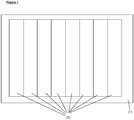
- the areas having different natural hair color are parallel to each other as on figure 1 .
- Figure 1 Sheet with areas having each different natural hair color
- the sheet is made of cellulosic wood free paper weighing 140 g/m 2 .
- Further object of the present invention is the use of a sheet (1) made of cellulosic wood free paper weighing 140 g/m 2 and comprising two or more areas (2) having each different natural hair color in a hair coloring process wherein hair coloring compositions comprising solely hair direct dyes.
- further object of the present invention is the use of a sheet made of cellulosic wood free paper weighing 140 g/m 2 and comprising two or more areas having each different natural hair color in a hair coloring process wherein hair coloring compositions comprising solely hair direct dyes for visualizing to be achieved hair color prior to actual hair coloring is carried out.
- Hair coloring composition used in the process of the present invention has a pH in the range of 1 to 10, preferably 1.5 to 9.5, more preferably 2 to 9, most preferably 2.2 to 8.5. pH of the compositions are adjusted with the well known organic and/or inorganic acids and basis.
- aqueous coloring composition comprises at least one carboxylic acid. Suitable ones are lactic acid, citric acid, malic acid, maleic acid. Most preferred is lactic acid.
- Aqueous coloring compositions may be in any form known in the art. Preferred are solutions, gels, foams, thickened liquids and emulsions. Most preferred are gels and emulsions.
- aqueous compositions in the form of gels comprise at least one gelling agent at a concentration in the range of 0.1 - 5 %, preferably 0.1 - 3% and most preferably 0.1 - 2% by weight calculated to the total composition.
- Suitable ones may be of the know polymers forming gel.
- Preferred are acrylates and derivatives, cellulose and its derivatives such as hydroxyalkyl celluloses, e.g. hydroxyethyl cellulose, hydroxypropyl cellulose, hydroxypropyl methyl cellulose, bio polymers such as bio-polyheterosaccharides such as xanthan gum, guar gum and the alkoxylation products thereof.
- the most preferred gelling agent is xanthan gum.
- aqueous composition in case aqueous composition is an emulsion then it comprises at least one fatty alcohol and at least one emulsifying agent.
- Aqueous colouring composition comprises at least one fatty alcohol or mixture of fatty alcohols having alkyl chain length of 14 to 22 C atoms which may be straight or branched, saturated or unsaturated.
- suitable fatty alcohols without limiting, are myristyl alcohol, cetyl alcohol, stearyl alcohol, behenyl alcohol, oleyl alcohol and cetostearyl alcohol, octyldodecanol.
- cetostearyl alcohol well known with its trade name Lanette O or as Lanette N in mixture with sodium cetearyl sulfate from Cognis.
- Total fatty alcohol concentration is in the range of 1 to 20% by weight, calculated to total composition.
- Aqueous coloring composition comprises emulsifying agents selected from anionic, non-ionic, amphoteric (or zwiterionic) and/or cationic surfactants. The most preferred are anionic, non-ionic and cationic surfactants.
- the preferred non-ionic emulsifiers are ethoxylated fatty alcohols with an alkyl chain of 12 to 24 C atoms and with number of ethoxyl groups of 2 to 50, preferably 10 to 30.
- Examples are ceteth-20, seteareth-30, palmeth-20, steareth -20, beheneth-20 etc. These compounds are named according to the fatty alcohol they are originating and number of ethoxyl groups is given at the end. These compounds are well known emulsifiers and found in any cosmetic ingredient book.
- nonionic surfactants are, especially in mixture with fatty alcohol ethoxylates, for example, long-chain fatty acid mono- and dialkanolamides, such as coco fatty acid mono- or diethanolamide and myristic fatty acid mono or diethanolamide, stearic acid mono or diethanolamide.
- alkyl polyglucosides of the general formula R 1 -O-(R 2 O) n -Z x , wherein R 1 is an alkyl group with 8 to 18 carbon atoms, R 2 is an ethylene or propylene group, Z is a saccharide group with 5 to 6 carbon atoms, n is a number from 0 to 10 and x is a number between 1 and 5.
- nonionic surfactants are, for example, the various sorbitan esters, such as polyethylene glycol sorbitan stearic acid ester, fatty acid polyglycol esters or poly-condensates of ethyleneoxide and propyleneoxide, as they are on the market, for example, under the trade name "Pluronics R ", as well as fatty alcohol ethoxylates.
- sorbitan esters such as polyethylene glycol sorbitan stearic acid ester, fatty acid polyglycol esters or poly-condensates of ethyleneoxide and propyleneoxide, as they are on the market, for example, under the trade name "Pluronics R ", as well as fatty alcohol ethoxylates.
- Anionic surfactants suitable are of the sulfate, sulfonate, carboxylate and alkyl phosphate types, for example, the known C 10 -C 18 -alkyl sulfates, and in particular the respective ether sulfates, for example, C 12 -C 14 -alkyl ether sulfate, lauryl ether sulfate, especially with 1 to 4 ethylene oxide groups in the molecule, monoglyceride (ether) sulfates, fatty acid amide sulfates obtained by ethoxylation and subsequent sulfatation of fatty acid alkanolamides, and the alkali salts thereof, as well as the salts of long-chain mono- and dialkyl phosphates.
- ether sulfates for example, the known C 10 -C 18 -alkyl sulfates, and in particular the respective ether sulfates, for example, C 12 -C 14 -alkyl
- Additional anionic surfactants useful within the scope of the invention are ⁇ -olefin sulfonates or the salts thereof, and in particular alkali salts of sulfosuccinic acid semiesters, for example, the disodium salt of monooctyl sulfosuccinate and alkali salts of long-chain monoalkyl ethoxysulfosuccinates.
- Suitable surfactants of the carboxylate type are alkyl polyether carboxylic acids and the salts thereof of the formula R 3 -(C 2 H 4 O) n -O-CH 2 COOX, wherein R 3 is a C 8 -C 20 -alkyl group, preferably a C 12 -C 14 -alkyl group, n is a number from 1 to 20, preferably 2 to 17, and X is H or preferably a cation of the group sodium, potassium, magnesium and ammonium, which can optionally be hydroxyalkyl-substituted, as well as alkyl amido polyether carboxylic acids of the general formula wherein R 3 and X have the above meanings, and n is in particular a number from 1 to 10, preferably 2.5 to 5.
- C 8 -C 20 -acyl isethionates are also useful, alone or in admixture with other anionic surfactants, as well as sulfofatty acids and the esters thereof.
- anionic surfactants are also C 8 -C 22 -acyl aminocarboxylic acids or the water-soluble salts thereof.
- N-lauroyl glutamate in particular as sodium salt
- N-lauroyl sarcosinate N-C 12 -C 18 -acyl asparaginic acid
- N-myristoyl sarcosinate N-oleoyl sarcosinate
- N-lauroyl methylalanine N-lauroyl lysine
- N-lauroyl aminopropyl glycine preferably in form of the water-soluble alkali or ammonium, in particular the sodium salts thereof, preferably in admixture with the above-named anionic surfactants.
- Suitable cationic surfactants are according to the formula, where R 4 is a saturated or unsaturated, branched or non-branched alkyl chain with 8-22 C atoms or R 8 CONH(CH 2 ) n where R 8 is saturated or unsaturated, branched or non-branched alkyl chain with 7-21 C atoms and n has typical value of 1 - 4 or R 9 COO(CH 2 ) n where R 9 is saturated or unsaturated, branched or non-branched alkyl chain with 7-21 C atoms and n has typical value of 1 - 4, and R 5 , R 6 and R 7 are substituted or unsubstituted, straight or branched, saturated or unsaturated lower alkyl chain with 1 to 4 C atoms, and X is typically chloride, bromide, methosulfate.
- Typical examples of those ingredients are cetyl trimethly ammonium chloride, stear trimonium chloride, stearamidopropyl trimonuim chloride, behentrimonium chloride, behenamidopropyl trimethylammonium chloride, stearoylethyltrimonium chloride.
- the colouring compositions according to the invention can also contain amphoteric or zwitterionic surfactants.
- amphoteric or zwitterionic surfactants Useful as such are in particular the various known betaines such as alkyl betaines, fatty acid amidoalkyl betaines and sulfobetaines, for example, lauryl hydroxysulfobetaine; long-chain alkyl amino acids, such as cocoaminoacetate, cocoaminopropionate and sodium cocoamphopropionate and -acetate have also proven suitable.
- Total surfactant concentration is in the range of 0.5 to 15%, preferably 1 to 10%, more preferably 1 to 7.5% by weight calculated to total composition.
- Composition of the present invention may further comprise one or more direct dyes. Suitable ones are cationic, anionic and neutral nitro dyes and their mixtures.
- Suitable non-limiting examples to cationic ones are Basic Blue 6, Basic Blue 7, Basic Blue 9, Basic Blue 26, Basic Blue 41, Basic Blue 99, Basic Brown 4, Basic Brown 16, Basic Brown 17, Natural Brown 7, Basic Green, Basic Orange 31, 1, Basic Red 2, Basic Red 12 Basic Red 22, Basic Red 76 Basic Red 51, Basic Violet 1, Basic Violet 2, Basic Violet 3, Basic Violet 10, Basic Violet 14, Basic Yellow 57 and Basic Yellow 87, and their mixtures.
- Suitable non-limiting examples to anionic ones are Acid Black 1, Acid Blue 1, Acid Blue 3, Food Blue 5, Acid Blue 7, Acid Blue 9, Acid Blue 74, Acid Orange 3, Acid Orange 6, Acid Orange 7, Acid Orange 10, Acid Red 1, Acid Red 14, Acid Red 18, Acid Red 27, Acid Red 50, Acid Red 52, Acid Red 73, Acid Red 87, Acid Red 88, Acid Red 92, Acid Red 155, Acid Red 180, Acid Violet 9, Acid Violet 43, Acid Violet 49, Acid Yellow 1, Acid Yellow 23, Acid Yellow 3, Food Yellow No. 8, D&C Brown No. 1, D&C Green No. 5, D&C Green No. 8, D&C Orange No. 4, D&C Orange No. 10, D&C Orange No. 11, D&C Red No. 21, D&C Red No. 27, D&C Red No.
- Suitable non-limiting examples to nitro dyes are HC Blue No.2, HC Blue No.4, HC Blue No.5, HC Blue No.6, HC Blue No.7, HC Blue No.8, HC Blue No.9, HC Blue No.10, HC Blue No.11, HC Blue No.12, HC Blue No.13, HC Brown No.1, HC Brown No.2, HC Green No.1, HC Orange No.1, HC Orange No.2, HC Orange No.3, HC Orange No.5, HC Red BN, HC Red No.1, HC Red No.3, HC Red No.7, HC Red No.8, HC Red No.9, HC Red No.10, HC Red No.11, HC Red No.13, HC Red No.54, HC Red No.14, HC Violet BS, HC Violet No.1, HC Violet No.2, HC Yellow No.2, HC Yellow No.4, HC Yellow No.5, HC Yellow No.6, HC Yellow No.7, HC Yellow No.8,
- Total concentration of one or more direct dyes is in the range of 0.001 to 15%, preferably 0.01 to 10%, more preferably 0.1 to 7.5% and most preferably 0.1 to 5% by weight calculated to total composition.
- Aqueous coloring composition can comprise additionally fatty acids with 0 to 3 ethylenic bonds and with fatty acyl chain length of 12 to 22 C atom. Concentration of the fatty acids can be in the range of 0.1 to 10%, preferably 0.1 to 7.5% and most preferably 0.2 to 5% by weight calculated to the total composition. Non-limiting examples are myristic acid, palmitic acid, behenic acid, steraic acid, oleic acid, linoleic acid. The most preferred fatty acid is oleic acid.
- Aqueous colouring composition can also contain cationic polymers as conditioning agents.
- cationic polymers know as Polymer JR type from Amerchol such as Polyquaternium 10 or cationic guar gum known with trade name Jaguar from Rhône-Poulenc and chemically for example Guar hydroxypropyl trimonium chloride.
- chitosan and chitin can also be included in the compositions as cationic natural polymers.
- those cationic polymers known with their CTFA category name Polyquaternium Typical examples of those Polyquaternium 6, Polyquaternium 7, Polyquaternium 10, Polyquaternium 11, Polyquaternium 16, Polyquaternium 22 and Polyquaternium 28, Polyquaternium 30, Polyquaternium 37, Polyquaternium 36, Polyquaternium 46.
- those the most preferred one is the Polyquaternium 11 as well known with its trade name Gafquat from ISP and as Luviquat PQ from BASF.
- Typical concentration range for any of the cationic conditioners mentioned above can be 0.01 - 5% by weight, preferably 0.03 - 2.5% by weight and more preferably 0.05 - 1.5% by weight.
- Hair dyeing composition of the present invention preferably comprise an organopolysiloxane wherein at least one silicium atom is linked to an alkylene group having a hetero-atom, in particular a nitrogen atom, with a poly-(N-acyl alkyleneimine) units of the formula wherein n is a number from 1 to 5 and R 14 is hydrogen, a C 1 -C 12 -alkyl or cycloalkyl, aralkyl or aryl group.
- Preferred organopolysiloxane polymers are those of the type disclosed in EP-A 640 643 , in particular optionally quaternized aminoalkyl, in particular aminopropyl dimethyl polysiloxane/polyethyl oxazoline copolymers of the formula wherein m and n each are numbers from 20 to 10,000, in particular 50 to 7,000, especially 100 to 5,000, x is a number between 1 and 5, preferably 3, and y is a number from 5 to 30, R 15 is a C 1 -C 12 -alkyl or aryl group, in particular a methyl, ethyl or benzyl group, and Y - is an anion.
- the proportion of graft copolymers in the hair colouring compositions according to the invention ranges from 0.05 % to 5 %, preferably 0.1 % to 2.5 %, in particular 0.5 % to 1.5 % by weight, calculated to the total composition.
- Aqueous coloring composition comprises preferably one or more organic solvents.
- organic solvents are benzyloxy ethanol, benzyl alcohol, phenoxy ethanol, phenoxy isopropanol, methyl phenoxy ethanol, benzyl glycerol, N-benzyl formide, N-methyl pyrrolidone, N-ethyl pyrrolidone, cinnamyl alcohol, phenethyl alcohol, p-methyl benzyl alcohol, propylene carbonate, butyl cellosolve, methyl carbitol, ethyl carbitol, propyl carbitol, butyl carbitol, diethyleneglycol, diethyl ether and dipropyleneglycol diethyl ether.
- concentration of those solvents can be in the range from 0.5% to 40%, preferably 1 - 35%, more preferably 5 - 30%, by weight calculated to the total composition.
- aqueous colouring composition can comprise further hair conditioning agents such as silicone oils either volatile or non-volatile, natural and synthetic oils.
- silicone oils those can be added to the colouring composition include dimethicone, dimethiconol, polydimethylsiloxane, DC fluid ranges from Dow Corning, natural oils such as olive oil, almond oil, avocado oil, weizenkeim oil, ricinus oil and the synthetic oils, such as mineral oil, isopropyl myristate, palmitate, stearate and isostearate, oleyl oleate, isocetyl stearate, hexyl laurate, dibutyl adipate, dioctyl adipate, myristyl myristate and oleyl erucate.
- Additional non-ionic conditioning agents may be polyols such as glycerin, glycol and derivatives, polyethyleneglycoles known with trade names Carbowax PEG from Union Carbide and Polyox WSR range from Amerchol, polyglycerin and polyethyleneglycol mono or di fatty acid esters.
- Compositions may further comprise at least one ubiquinone of the formula where n is a number between 1 and 10 at a concentration of 0.0001 to 1%, preferably from 0.0002 to 0.75%, more preferably from 0.0002 to 0.5% and most preferably from 0.0005 to 0.5% by weight, calculated to total composition.
- the composition comprises ubiquinone which is preferably selected from the ones where n is a number between 6 and 10 and more preferably it is ubichinone 50 where n is 10, also known as Coenzyme Q10.
- Composition can comprise at least one amino acid. At least one amino acid is comprised at a concentration of 0.01 to 10%, preferably 0.05 to 7.5% and more preferably 0.1 to 5% and most preferably 0.25 to 5% by weight calculated to total of each composition.
- Aqueous coloring composition can comprise one or more amino acids.
- Suitable amino acids are glycin, histidine, citrullin, asparagine, alanin, valin, leucin, isoleucin, pyrolin, tryptophane, phenylalanine, methionine, serine, tyrosine, threonine and gluatamine.
- the amino acid is selected from glycin, histidine, citrullin, asparagine, alanin, valin, leucin, isoleucin, pyrolin, serine, tyrosine, threonine and gluatamine.
- At least one amino acid is selected from glycin, histidine, asparagine, alanin, valin, leucin, pyrolin, serine, tyrosine and gluatamine, and most preferably at least one amino acid is selected from glycin, asparagine, alanin, valin, leucin, and serine.
- Aqueous colouring composition can comprise further ceramide type of compound at a concentration 0.01 to 3%, preferably 0.05 to 2.5% and more preferably 0.1 to 2% and most preferably 0.1 to 1.5% by weight calculated to total of each composition, with the general formula where R 10 and R 11 are independent from each other alkyl- or alkenyl group with 10 to 22 carbon atoms, R 12 is alkyl or hydroxyl alkyl with 1 to 4 carbon atoms group and n is a number between 1 to 6, preferably 2 or 3.
- Preferred compound according to the above chemical structure is cetyl-PG-hydroxyethylpalmitamide.
- sterols especially the phytosterols as preferred hair restructuring agents, at a concentration 0.01 to 3%, preferably 0.05 to 2.5% and more preferably 0.1 to 2% and most preferably 0.1 to 1.5% by weight calculated to total of each composition.
- Especially preferred ones are of plant origin for example ergosterol, sitosterol, stigmasterol, fucosterol, brassicasterol, fungisterol, campesterol, zymosterol, ascosterol, cerevisterol, episterol, faecosterol, spinasterol.
- the ones found in "Avocadin" which is the unsaponified fraction of the avocado oil is more preferred.
- Aqueous coloring composition can comprise at least one diamine compound.
- Preferred diamide compounds are according to the general structure wherein R 20 is a linear or branched, saturated or unsaturated alkyl chain with 1 to 12 C atoms which may be substituted with hydroxy and/or alkoxy groups, preferably R 20 is linear or branched, saturated or unsaturated alkyl chain with 1 to 12 C atoms which may be substituted by 1 to 3 substituents selected from a hydroxy group and C1 to C6 alkoxy group, more preferably R 20 is a unsubstituted alkyl group with 1 to 12 C atoms, and alkyl group with 2 to 12 C atoms substituted by one or two hydroxyl groups, by one alkoxy group with 1 to 6 C atoms or by one hydroxyl and one alkoxy group with 2 to 6 C atoms, R 21 is linear or branched alkyl chain with 1 to 5 C atoms, preferably linear or branched alkyl chain with 2 to 5 C
- Preferred individual diamide compounds are the ones according to the formula A to G.
- Particularly preferred diamide compound is the compound F which is bis (methoxypropylamido) isodocosane and commercially available from Kao Corporation - Japan.
- Concentration of diamide compound is in the range of 0.001 to 5%, preferably 0.002 to 3% more preferably 0.005 to 2% and most preferably 0.01 to 1% by weight calculated to total composition.
- Aqueous coloring composition can comprise additionally substances customarily found in colouring compositions such as preservatives, fragrance, sequestering agents.
- Example 1 The coloring composition of Example 1 was mixed with the following composition at various ratios. Acid orange 7 0.3 Acid violet 43 0.8 Ethanol 10 Propylene carbonate 20 Dimethicone 1 Lactic acid 4 Xanthan gum 1 Fragrance q.s Water to 100 Mixed coloring compositions A B C D E Example 1 10 25 50 35 75 Example 2 90 75 50 65 25
- compositions A, B, C and E were applied onto a sheet comprising 8 areas having each different natural hair color from level 3 (darkest) to 10 (lightest).
- the customer found the color to be achieved with the composition C too reddish and with the composition E too violet.
- composition D was produced and shown on the sheet what the color approximately be at the end of the coloring process. The color direction was perfectly matched with the expectation of the customer and medium brown hair of the customer was colored to a red violet direction. It was noted that without the aid of the sheet, experimentation without actually coloring hair could not be performed and customer satisfaction could not be achieved.
Landscapes
- Life Sciences & Earth Sciences (AREA)
- Health & Medical Sciences (AREA)
- Animal Behavior & Ethology (AREA)
- General Health & Medical Sciences (AREA)
- Public Health (AREA)
- Veterinary Medicine (AREA)
- Birds (AREA)
- Epidemiology (AREA)
- Cosmetics (AREA)
Claims (15)
- Haarfärbeverfahren mit einer wässrigen Zusammensetzung, welche einen oder mehrere Direktfarbstoffe als die einzigen färbenden Komponenten aufweist, wobei vor dem Aufbringen auf die Haare die wässrige Zusammensetzung zunächst auf ein Blatt (1) aufgebracht wird, welches aus cellulosischem holzfreien Papier eines Gewichts von 140 g/m2 hergestellt ist, das zwei oder mehr Bereiche (2) mit jeweils unterschiedlicher natürlicher Haarfarbe aufweist, um die Farbe der Haare am Ende des Färbeverfahrens zu visualisieren, und die Zusammensetzung auf die Haare aufgebracht wird und nach einem Einwirken von 1 min bis 45 min aus den Haaren ausgespült wird, die Haare gegebenenfalls shampooniert und gegebenenfalls getrocknet werden.
- Verfahren nach Anspruch 1, dadurch gekennzeichnet, dass die wässrige Färbezusammensetzung aus einem Vermischen von zwei oder mehr gebrauchsfertigen Haarfärbezusammensetzungen resultiert, welche lediglich einen oder mehrere Direktfarbstoffe für Haare aufweisen.
- Verfahren nach Anspruch 1 und 2, dadurch gekennzeichnet, dass das Blatt 2 bis 15 Bereiche mit jeweils unterschiedlicher natürlicher Haarfarbe aufweist.
- Verfahren nach einem der vorhergehenden Ansprüche, dadurch gekennzeichnet, dass die Bereiche mit jeweils unterschiedlicher natürlicher Haarfarbe parallel zueinander liegen.
- Verfahren nach einem der vorhergehenden Ansprüche, dadurch gekennzeichnet, dass die wässrige Färbezusammensetzung einen pH-Wert im Bereich von 1 bis 10 aufweist.
- Verfahren nach einem der vorhergehenden Ansprüche, dadurch gekennzeichnet, dass die wässrige Färbezusammensetzung einen pH-Wert im Bereich von 1,5 bis 9,5 aufweist.
- Verfahren nach einem der vorhergehenden Ansprüche, dadurch gekennzeichnet, dass die wässrige Färbezusammensetzung mindestens eine Carbonsäure aufweist, vorzugsweise ausgewählt aus Citronensäure, Äpfelsäure, Milchsäure und Maleinsäure.
- Verfahren nach einem der vorhergehenden Ansprüche, dadurch gekennzeichnet, dass die wässrige Färbezusammensetzung ein Gel ist und mindestens ein Geliermittel aufweist, wobei das Geliermittel vorzugsweise Xanthan ist.
- Verfahren nach Anspruch 1 bis 7, dadurch gekennzeichnet, dass die wässrige Färbezusammensetzung eine Emulsion ist und mindestens einen Fettalkohol und mindestens einen Emulgator aufweist, vorzugsweise ausgewählt aus anionischen, nicht-ionischen, amphoteren (oder zwitterionischen) und/oder kationischen Tensiden.
- Verfahren nach Anspruch 9, dadurch gekennzeichnet, dass mindestens ein nichtionischer Emulgator aus ethoxylierten Fettalkoholen ausgewählt ist und mindestens ein kationisches Tensid ausgewählt ist aus

R8CONH(CH2)n,
wobei R8 für eine gesättigte oder ungesättigte, verzweigte oder unverzweigte Alkylkette mit 7 bis 21 C-Atomen steht und n einen typischen Wert von 1 bis 4 aufweist, oder
R9COO(CH2)n
steht, wobei Rg für eine gesättigte oder ungesättigte, verzweigte oder unverzweigte Alkylkette mit 7 bis 21 C-Atomen steht und n einen typischen Wert von 1 bis 4 aufweist, und
R5, R6 und R7 für eine substituierte oder unsubstituierte, lineare oder verzweigte, gesättigte oder ungesättigte niedere Alkylkette mit 1 bis 4 C-Atomen stehen und X typischerweise für Chlorid, Bromid, Methosulfat steht. - Verfahren nach einem der vorhergehenden Ansprüche, dadurch gekennzeichnet, dass ein oder mehrere Haardirektfarbstoffe aus anionischen, kationischen und neutralen Nitrofarbstoffen ausgewählt sind.
- Verfahren nach Anspruch 11, dadurch gekennzeichnet, dass ein oder mehrere Direktfarbstoffe aus anionischen Farbstoffen ausgewählt sind.
- Verfahren nach einem der vorhergehenden Ansprüche, dadurch gekennzeichnet, dass die wässrige Färbezusammensetzung mindestens ein organisches Lösungsmittel aufweist.
- Verwendung eines Blatts, das aus cellulosischem holzfreien Papier eines Gewichts von 140 g/m2 hergestellt ist, das zwei oder mehr Bereiche, vorzugsweise 2 bis 15 Bereiche, mit jeweils unterschiedlicher natürlicher Haarfarbe aufweist, in einem Haarfärbeverfahren, wobei die Haarfärbezusammensetzungen lediglich Haardirektfarbstoffe aufweisen.
- Verwendung eines Blatts, das aus cellulosischem holzfreien Papier eines Gewichts von 140 g/m2 hergestellt ist, das zwei oder mehr Bereiche, vorzugsweise 2 bis 15 Bereiche, mit jeweils unterschiedlicher natürlicher Haarfarbe aufweist, in einem Haarfärbeverfahren, wobei die Haarfärbezusammensetzungen lediglich Haardirektfarbstoffe aufweisen, um eine Visualisierung der Haarfarbe zu erreichen, bevor die tatsächliche Haarfärbung durchgeführt wird.
Priority Applications (1)
| Application Number | Priority Date | Filing Date | Title |
|---|---|---|---|
| EP13737616.6A EP2877151B1 (de) | 2012-07-27 | 2013-07-18 | Haarfärbeverfahren |
Applications Claiming Priority (3)
| Application Number | Priority Date | Filing Date | Title |
|---|---|---|---|
| EP12178210.6A EP2689771A1 (de) | 2012-07-27 | 2012-07-27 | Haarfärbeverfahren |
| EP13737616.6A EP2877151B1 (de) | 2012-07-27 | 2013-07-18 | Haarfärbeverfahren |
| PCT/EP2013/065162 WO2014016193A1 (en) | 2012-07-27 | 2013-07-18 | Hair coloring process |
Publications (2)
| Publication Number | Publication Date |
|---|---|
| EP2877151A1 EP2877151A1 (de) | 2015-06-03 |
| EP2877151B1 true EP2877151B1 (de) | 2019-09-04 |
Family
ID=48794106
Family Applications (2)
| Application Number | Title | Priority Date | Filing Date |
|---|---|---|---|
| EP12178210.6A Withdrawn EP2689771A1 (de) | 2012-07-27 | 2012-07-27 | Haarfärbeverfahren |
| EP13737616.6A Active EP2877151B1 (de) | 2012-07-27 | 2013-07-18 | Haarfärbeverfahren |
Family Applications Before (1)
| Application Number | Title | Priority Date | Filing Date |
|---|---|---|---|
| EP12178210.6A Withdrawn EP2689771A1 (de) | 2012-07-27 | 2012-07-27 | Haarfärbeverfahren |
Country Status (3)
| Country | Link |
|---|---|
| US (1) | US9326585B2 (de) |
| EP (2) | EP2689771A1 (de) |
| WO (1) | WO2014016193A1 (de) |
Families Citing this family (1)
| Publication number | Priority date | Publication date | Assignee | Title |
|---|---|---|---|---|
| US11185485B2 (en) | 2019-05-31 | 2021-11-30 | L'oreal | Hair coloring compositions and methods of using the same |
Citations (2)
| Publication number | Priority date | Publication date | Assignee | Title |
|---|---|---|---|---|
| WO2001087245A2 (en) * | 2000-05-12 | 2001-11-22 | The Procter & Gamble Company | Method for analyzing hair and predicting achievable hair dyeing ending colors |
| JP2007212140A (ja) * | 2006-02-07 | 2007-08-23 | Kose Corp | 染毛色の予測方法 |
Family Cites Families (3)
| Publication number | Priority date | Publication date | Assignee | Title |
|---|---|---|---|---|
| EP0640643B1 (de) | 1993-08-10 | 2000-04-26 | Kao Corporation | Organopolysiloxane und ein Verfahren zum Haarfestigen unter Verwendung derselben |
| JP2004061439A (ja) * | 2002-07-31 | 2004-02-26 | Nicca Chemical Co Ltd | 調合染毛剤の染色結果予測方法および配合比率決定方法 |
| EP2022488A1 (de) * | 2007-08-07 | 2009-02-11 | KPSS-Kao Professional Salon Services GmbH | Färbemittelzusammensetzung |
-
2012
- 2012-07-27 EP EP12178210.6A patent/EP2689771A1/de not_active Withdrawn
-
2013
- 2013-07-18 EP EP13737616.6A patent/EP2877151B1/de active Active
- 2013-07-18 WO PCT/EP2013/065162 patent/WO2014016193A1/en not_active Ceased
- 2013-07-18 US US14/413,620 patent/US9326585B2/en not_active Expired - Fee Related
Patent Citations (2)
| Publication number | Priority date | Publication date | Assignee | Title |
|---|---|---|---|---|
| WO2001087245A2 (en) * | 2000-05-12 | 2001-11-22 | The Procter & Gamble Company | Method for analyzing hair and predicting achievable hair dyeing ending colors |
| JP2007212140A (ja) * | 2006-02-07 | 2007-08-23 | Kose Corp | 染毛色の予測方法 |
Non-Patent Citations (1)
| Title |
|---|
| DATABASE WPI Week 200766, Derwent World Patents Index; AN 2007-704519 * |
Also Published As
| Publication number | Publication date |
|---|---|
| US9326585B2 (en) | 2016-05-03 |
| US20150136168A1 (en) | 2015-05-21 |
| WO2014016193A1 (en) | 2014-01-30 |
| EP2877151A1 (de) | 2015-06-03 |
| EP2689771A1 (de) | 2014-01-29 |
Similar Documents
| Publication | Publication Date | Title |
|---|---|---|
| EP2358335B1 (de) | Zusammensetzung zum bleichen/strähnenfärben | |
| US8668746B2 (en) | Two-part hair colouring composition | |
| EP2358441B1 (de) | Zusammensetzung zum bleichen und für strähnchen | |
| EP2658510B2 (de) | Bleichzusammensetzung enthaltend gluconsäure und/oder deren salze | |
| EP2346483B1 (de) | Haarzusammensetzung und Behandlung | |
| AU2009221217B2 (en) | Bleaching/highlighting composition containing calcium salts | |
| EP2547315B1 (de) | Färbezusammensetzung für keratinfasern | |
| US8821840B2 (en) | Bleaching composition | |
| EP1656969B1 (de) | Konditionierende und Färbemittel fur die Haare | |
| EP2018843B1 (de) | Zusammensetzung zum Konditionieren und Färben des Haars | |
| US8632609B2 (en) | Bleaching composition | |
| EP2417964A1 (de) | Verfahren zur Verringerung der Bildung von Cysteinsäure in Keratinfasern | |
| EP2877151B1 (de) | Haarfärbeverfahren | |
| US20080260673A1 (en) | Conditioning Composition | |
| EP1925281B1 (de) | Haarkonditionierungsmittel | |
| US8617255B2 (en) | Bleaching composition comprising magnesium salt | |
| EP2717849B1 (de) | Färbungszusammensetzung | |
| EP1923039A1 (de) | Konditionierschaum |
Legal Events
| Date | Code | Title | Description |
|---|---|---|---|
| PUAI | Public reference made under article 153(3) epc to a published international application that has entered the european phase |
Free format text: ORIGINAL CODE: 0009012 |
|
| 17P | Request for examination filed |
Effective date: 20150205 |
|
| AK | Designated contracting states |
Kind code of ref document: A1 Designated state(s): AL AT BE BG CH CY CZ DE DK EE ES FI FR GB GR HR HU IE IS IT LI LT LU LV MC MK MT NL NO PL PT RO RS SE SI SK SM TR |
|
| AX | Request for extension of the european patent |
Extension state: BA ME |
|
| DAX | Request for extension of the european patent (deleted) | ||
| STAA | Information on the status of an ep patent application or granted ep patent |
Free format text: STATUS: EXAMINATION IS IN PROGRESS |
|
| 17Q | First examination report despatched |
Effective date: 20161207 |
|
| GRAP | Despatch of communication of intention to grant a patent |
Free format text: ORIGINAL CODE: EPIDOSNIGR1 |
|
| STAA | Information on the status of an ep patent application or granted ep patent |
Free format text: STATUS: GRANT OF PATENT IS INTENDED |
|
| RIC1 | Information provided on ipc code assigned before grant |
Ipc: A61Q 5/06 20060101ALI20190326BHEP Ipc: A61K 8/34 20060101ALI20190326BHEP Ipc: A61K 8/46 20060101ALI20190326BHEP Ipc: A61K 8/35 20060101ALI20190326BHEP Ipc: A61K 8/49 20060101AFI20190326BHEP |
|
| INTG | Intention to grant announced |
Effective date: 20190423 |
|
| GRAS | Grant fee paid |
Free format text: ORIGINAL CODE: EPIDOSNIGR3 |
|
| GRAA | (expected) grant |
Free format text: ORIGINAL CODE: 0009210 |
|
| STAA | Information on the status of an ep patent application or granted ep patent |
Free format text: STATUS: THE PATENT HAS BEEN GRANTED |
|
| AK | Designated contracting states |
Kind code of ref document: B1 Designated state(s): AL AT BE BG CH CY CZ DE DK EE ES FI FR GB GR HR HU IE IS IT LI LT LU LV MC MK MT NL NO PL PT RO RS SE SI SK SM TR |
|
| REG | Reference to a national code |
Ref country code: GB Ref legal event code: FG4D |
|
| REG | Reference to a national code |
Ref country code: CH Ref legal event code: EP |
|
| REG | Reference to a national code |
Ref country code: AT Ref legal event code: REF Ref document number: 1174334 Country of ref document: AT Kind code of ref document: T Effective date: 20190915 |
|
| REG | Reference to a national code |
Ref country code: DE Ref legal event code: R096 Ref document number: 602013060023 Country of ref document: DE |
|
| REG | Reference to a national code |
Ref country code: IE Ref legal event code: FG4D |
|
| REG | Reference to a national code |
Ref country code: NL Ref legal event code: MP Effective date: 20190904 |
|
| REG | Reference to a national code |
Ref country code: LT Ref legal event code: MG4D |
|
| PG25 | Lapsed in a contracting state [announced via postgrant information from national office to epo] |
Ref country code: LT Free format text: LAPSE BECAUSE OF FAILURE TO SUBMIT A TRANSLATION OF THE DESCRIPTION OR TO PAY THE FEE WITHIN THE PRESCRIBED TIME-LIMIT Effective date: 20190904 Ref country code: FI Free format text: LAPSE BECAUSE OF FAILURE TO SUBMIT A TRANSLATION OF THE DESCRIPTION OR TO PAY THE FEE WITHIN THE PRESCRIBED TIME-LIMIT Effective date: 20190904 Ref country code: NO Free format text: LAPSE BECAUSE OF FAILURE TO SUBMIT A TRANSLATION OF THE DESCRIPTION OR TO PAY THE FEE WITHIN THE PRESCRIBED TIME-LIMIT Effective date: 20191204 Ref country code: BG Free format text: LAPSE BECAUSE OF FAILURE TO SUBMIT A TRANSLATION OF THE DESCRIPTION OR TO PAY THE FEE WITHIN THE PRESCRIBED TIME-LIMIT Effective date: 20191204 Ref country code: SE Free format text: LAPSE BECAUSE OF FAILURE TO SUBMIT A TRANSLATION OF THE DESCRIPTION OR TO PAY THE FEE WITHIN THE PRESCRIBED TIME-LIMIT Effective date: 20190904 Ref country code: HR Free format text: LAPSE BECAUSE OF FAILURE TO SUBMIT A TRANSLATION OF THE DESCRIPTION OR TO PAY THE FEE WITHIN THE PRESCRIBED TIME-LIMIT Effective date: 20190904 |
|
| PG25 | Lapsed in a contracting state [announced via postgrant information from national office to epo] |
Ref country code: LV Free format text: LAPSE BECAUSE OF FAILURE TO SUBMIT A TRANSLATION OF THE DESCRIPTION OR TO PAY THE FEE WITHIN THE PRESCRIBED TIME-LIMIT Effective date: 20190904 Ref country code: GR Free format text: LAPSE BECAUSE OF FAILURE TO SUBMIT A TRANSLATION OF THE DESCRIPTION OR TO PAY THE FEE WITHIN THE PRESCRIBED TIME-LIMIT Effective date: 20191205 Ref country code: RS Free format text: LAPSE BECAUSE OF FAILURE TO SUBMIT A TRANSLATION OF THE DESCRIPTION OR TO PAY THE FEE WITHIN THE PRESCRIBED TIME-LIMIT Effective date: 20190904 Ref country code: AL Free format text: LAPSE BECAUSE OF FAILURE TO SUBMIT A TRANSLATION OF THE DESCRIPTION OR TO PAY THE FEE WITHIN THE PRESCRIBED TIME-LIMIT Effective date: 20190904 Ref country code: ES Free format text: LAPSE BECAUSE OF FAILURE TO SUBMIT A TRANSLATION OF THE DESCRIPTION OR TO PAY THE FEE WITHIN THE PRESCRIBED TIME-LIMIT Effective date: 20190904 |
|
| REG | Reference to a national code |
Ref country code: AT Ref legal event code: MK05 Ref document number: 1174334 Country of ref document: AT Kind code of ref document: T Effective date: 20190904 |
|
| PG25 | Lapsed in a contracting state [announced via postgrant information from national office to epo] |
Ref country code: PL Free format text: LAPSE BECAUSE OF FAILURE TO SUBMIT A TRANSLATION OF THE DESCRIPTION OR TO PAY THE FEE WITHIN THE PRESCRIBED TIME-LIMIT Effective date: 20190904 Ref country code: AT Free format text: LAPSE BECAUSE OF FAILURE TO SUBMIT A TRANSLATION OF THE DESCRIPTION OR TO PAY THE FEE WITHIN THE PRESCRIBED TIME-LIMIT Effective date: 20190904 Ref country code: NL Free format text: LAPSE BECAUSE OF FAILURE TO SUBMIT A TRANSLATION OF THE DESCRIPTION OR TO PAY THE FEE WITHIN THE PRESCRIBED TIME-LIMIT Effective date: 20190904 Ref country code: EE Free format text: LAPSE BECAUSE OF FAILURE TO SUBMIT A TRANSLATION OF THE DESCRIPTION OR TO PAY THE FEE WITHIN THE PRESCRIBED TIME-LIMIT Effective date: 20190904 Ref country code: PT Free format text: LAPSE BECAUSE OF FAILURE TO SUBMIT A TRANSLATION OF THE DESCRIPTION OR TO PAY THE FEE WITHIN THE PRESCRIBED TIME-LIMIT Effective date: 20200106 Ref country code: IT Free format text: LAPSE BECAUSE OF FAILURE TO SUBMIT A TRANSLATION OF THE DESCRIPTION OR TO PAY THE FEE WITHIN THE PRESCRIBED TIME-LIMIT Effective date: 20190904 Ref country code: RO Free format text: LAPSE BECAUSE OF FAILURE TO SUBMIT A TRANSLATION OF THE DESCRIPTION OR TO PAY THE FEE WITHIN THE PRESCRIBED TIME-LIMIT Effective date: 20190904 |
|
| PG25 | Lapsed in a contracting state [announced via postgrant information from national office to epo] |
Ref country code: SM Free format text: LAPSE BECAUSE OF FAILURE TO SUBMIT A TRANSLATION OF THE DESCRIPTION OR TO PAY THE FEE WITHIN THE PRESCRIBED TIME-LIMIT Effective date: 20190904 Ref country code: CZ Free format text: LAPSE BECAUSE OF FAILURE TO SUBMIT A TRANSLATION OF THE DESCRIPTION OR TO PAY THE FEE WITHIN THE PRESCRIBED TIME-LIMIT Effective date: 20190904 Ref country code: SK Free format text: LAPSE BECAUSE OF FAILURE TO SUBMIT A TRANSLATION OF THE DESCRIPTION OR TO PAY THE FEE WITHIN THE PRESCRIBED TIME-LIMIT Effective date: 20190904 Ref country code: IS Free format text: LAPSE BECAUSE OF FAILURE TO SUBMIT A TRANSLATION OF THE DESCRIPTION OR TO PAY THE FEE WITHIN THE PRESCRIBED TIME-LIMIT Effective date: 20200224 |
|
| REG | Reference to a national code |
Ref country code: DE Ref legal event code: R097 Ref document number: 602013060023 Country of ref document: DE |
|
| PLBE | No opposition filed within time limit |
Free format text: ORIGINAL CODE: 0009261 |
|
| STAA | Information on the status of an ep patent application or granted ep patent |
Free format text: STATUS: NO OPPOSITION FILED WITHIN TIME LIMIT |
|
| PG2D | Information on lapse in contracting state deleted |
Ref country code: IS |
|
| PG25 | Lapsed in a contracting state [announced via postgrant information from national office to epo] |
Ref country code: DK Free format text: LAPSE BECAUSE OF FAILURE TO SUBMIT A TRANSLATION OF THE DESCRIPTION OR TO PAY THE FEE WITHIN THE PRESCRIBED TIME-LIMIT Effective date: 20190904 Ref country code: IS Free format text: LAPSE BECAUSE OF FAILURE TO SUBMIT A TRANSLATION OF THE DESCRIPTION OR TO PAY THE FEE WITHIN THE PRESCRIBED TIME-LIMIT Effective date: 20200105 |
|
| 26N | No opposition filed |
Effective date: 20200605 |
|
| PG25 | Lapsed in a contracting state [announced via postgrant information from national office to epo] |
Ref country code: SI Free format text: LAPSE BECAUSE OF FAILURE TO SUBMIT A TRANSLATION OF THE DESCRIPTION OR TO PAY THE FEE WITHIN THE PRESCRIBED TIME-LIMIT Effective date: 20190904 |
|
| PG25 | Lapsed in a contracting state [announced via postgrant information from national office to epo] |
Ref country code: MC Free format text: LAPSE BECAUSE OF FAILURE TO SUBMIT A TRANSLATION OF THE DESCRIPTION OR TO PAY THE FEE WITHIN THE PRESCRIBED TIME-LIMIT Effective date: 20190904 |
|
| REG | Reference to a national code |
Ref country code: BE Ref legal event code: MM Effective date: 20200731 |
|
| PG25 | Lapsed in a contracting state [announced via postgrant information from national office to epo] |
Ref country code: LU Free format text: LAPSE BECAUSE OF NON-PAYMENT OF DUE FEES Effective date: 20200718 |
|
| PG25 | Lapsed in a contracting state [announced via postgrant information from national office to epo] |
Ref country code: BE Free format text: LAPSE BECAUSE OF NON-PAYMENT OF DUE FEES Effective date: 20200731 |
|
| PG25 | Lapsed in a contracting state [announced via postgrant information from national office to epo] |
Ref country code: IE Free format text: LAPSE BECAUSE OF NON-PAYMENT OF DUE FEES Effective date: 20200718 |
|
| PG25 | Lapsed in a contracting state [announced via postgrant information from national office to epo] |
Ref country code: TR Free format text: LAPSE BECAUSE OF FAILURE TO SUBMIT A TRANSLATION OF THE DESCRIPTION OR TO PAY THE FEE WITHIN THE PRESCRIBED TIME-LIMIT Effective date: 20190904 Ref country code: MT Free format text: LAPSE BECAUSE OF FAILURE TO SUBMIT A TRANSLATION OF THE DESCRIPTION OR TO PAY THE FEE WITHIN THE PRESCRIBED TIME-LIMIT Effective date: 20190904 Ref country code: CY Free format text: LAPSE BECAUSE OF FAILURE TO SUBMIT A TRANSLATION OF THE DESCRIPTION OR TO PAY THE FEE WITHIN THE PRESCRIBED TIME-LIMIT Effective date: 20190904 |
|
| PG25 | Lapsed in a contracting state [announced via postgrant information from national office to epo] |
Ref country code: MK Free format text: LAPSE BECAUSE OF FAILURE TO SUBMIT A TRANSLATION OF THE DESCRIPTION OR TO PAY THE FEE WITHIN THE PRESCRIBED TIME-LIMIT Effective date: 20190904 |
|
| P01 | Opt-out of the competence of the unified patent court (upc) registered |
Effective date: 20230426 |
|
| PGFP | Annual fee paid to national office [announced via postgrant information from national office to epo] |
Ref country code: CH Payment date: 20240801 Year of fee payment: 12 |
|
| PGFP | Annual fee paid to national office [announced via postgrant information from national office to epo] |
Ref country code: DE Payment date: 20250722 Year of fee payment: 13 |
|
| PGFP | Annual fee paid to national office [announced via postgrant information from national office to epo] |
Ref country code: GB Payment date: 20250724 Year of fee payment: 13 |
|
| PGFP | Annual fee paid to national office [announced via postgrant information from national office to epo] |
Ref country code: FR Payment date: 20250723 Year of fee payment: 13 |
|
| REG | Reference to a national code |
Ref country code: CH Ref legal event code: H13 Free format text: ST27 STATUS EVENT CODE: U-0-0-H10-H13 (AS PROVIDED BY THE NATIONAL OFFICE) Effective date: 20260224 |
|
| PG25 | Lapsed in a contracting state [announced via postgrant information from national office to epo] |
Ref country code: CH Free format text: LAPSE BECAUSE OF NON-PAYMENT OF DUE FEES Effective date: 20250731 |