EP2875968A1 - Pneumatic tire provided with inner liner - Google Patents
Pneumatic tire provided with inner liner Download PDFInfo
- Publication number
- EP2875968A1 EP2875968A1 EP13826154.0A EP13826154A EP2875968A1 EP 2875968 A1 EP2875968 A1 EP 2875968A1 EP 13826154 A EP13826154 A EP 13826154A EP 2875968 A1 EP2875968 A1 EP 2875968A1
- Authority
- EP
- European Patent Office
- Prior art keywords
- equal
- mass parts
- less
- mass
- styrene
- Prior art date
- Legal status (The legal status is an assumption and is not a legal conclusion. Google has not performed a legal analysis and makes no representation as to the accuracy of the status listed.)
- Granted
Links
Images

Classifications
-
- B—PERFORMING OPERATIONS; TRANSPORTING
- B60—VEHICLES IN GENERAL
- B60C—VEHICLE TYRES; TYRE INFLATION; TYRE CHANGING; CONNECTING VALVES TO INFLATABLE ELASTIC BODIES IN GENERAL; DEVICES OR ARRANGEMENTS RELATED TO TYRES
- B60C1/00—Tyres characterised by the chemical composition or the physical arrangement or mixture of the composition
- B60C1/0008—Compositions of the inner liner
-
- B—PERFORMING OPERATIONS; TRANSPORTING
- B32—LAYERED PRODUCTS
- B32B—LAYERED PRODUCTS, i.e. PRODUCTS BUILT-UP OF STRATA OF FLAT OR NON-FLAT, e.g. CELLULAR OR HONEYCOMB, FORM
- B32B25/00—Layered products comprising a layer of natural or synthetic rubber
- B32B25/04—Layered products comprising a layer of natural or synthetic rubber comprising rubber as the main or only constituent of a layer, which is next to another layer of the same or of a different material
- B32B25/08—Layered products comprising a layer of natural or synthetic rubber comprising rubber as the main or only constituent of a layer, which is next to another layer of the same or of a different material of synthetic resin
-
- B—PERFORMING OPERATIONS; TRANSPORTING
- B32—LAYERED PRODUCTS
- B32B—LAYERED PRODUCTS, i.e. PRODUCTS BUILT-UP OF STRATA OF FLAT OR NON-FLAT, e.g. CELLULAR OR HONEYCOMB, FORM
- B32B27/00—Layered products comprising a layer of synthetic resin
- B32B27/06—Layered products comprising a layer of synthetic resin as the main or only constituent of a layer, which is next to another layer of the same or of a different material
- B32B27/08—Layered products comprising a layer of synthetic resin as the main or only constituent of a layer, which is next to another layer of the same or of a different material of synthetic resin
-
- B—PERFORMING OPERATIONS; TRANSPORTING
- B32—LAYERED PRODUCTS
- B32B—LAYERED PRODUCTS, i.e. PRODUCTS BUILT-UP OF STRATA OF FLAT OR NON-FLAT, e.g. CELLULAR OR HONEYCOMB, FORM
- B32B27/00—Layered products comprising a layer of synthetic resin
- B32B27/18—Layered products comprising a layer of synthetic resin characterised by the use of special additives
-
- B—PERFORMING OPERATIONS; TRANSPORTING
- B32—LAYERED PRODUCTS
- B32B—LAYERED PRODUCTS, i.e. PRODUCTS BUILT-UP OF STRATA OF FLAT OR NON-FLAT, e.g. CELLULAR OR HONEYCOMB, FORM
- B32B27/00—Layered products comprising a layer of synthetic resin
- B32B27/30—Layered products comprising a layer of synthetic resin comprising vinyl (co)polymers; comprising acrylic (co)polymers
- B32B27/302—Layered products comprising a layer of synthetic resin comprising vinyl (co)polymers; comprising acrylic (co)polymers comprising aromatic vinyl (co)polymers, e.g. styrenic (co)polymers
-
- B—PERFORMING OPERATIONS; TRANSPORTING
- B60—VEHICLES IN GENERAL
- B60C—VEHICLE TYRES; TYRE INFLATION; TYRE CHANGING; CONNECTING VALVES TO INFLATABLE ELASTIC BODIES IN GENERAL; DEVICES OR ARRANGEMENTS RELATED TO TYRES
- B60C5/00—Inflatable pneumatic tyres or inner tubes
- B60C5/12—Inflatable pneumatic tyres or inner tubes without separate inflatable inserts, e.g. tubeless tyres with transverse section open to the rim
- B60C5/14—Inflatable pneumatic tyres or inner tubes without separate inflatable inserts, e.g. tubeless tyres with transverse section open to the rim with impervious liner or coating on the inner wall of the tyre
-
- C—CHEMISTRY; METALLURGY
- C08—ORGANIC MACROMOLECULAR COMPOUNDS; THEIR PREPARATION OR CHEMICAL WORKING-UP; COMPOSITIONS BASED THEREON
- C08K—Use of inorganic or non-macromolecular organic substances as compounding ingredients
- C08K3/00—Use of inorganic substances as compounding ingredients
- C08K3/02—Elements
- C08K3/06—Sulfur
-
- C—CHEMISTRY; METALLURGY
- C08—ORGANIC MACROMOLECULAR COMPOUNDS; THEIR PREPARATION OR CHEMICAL WORKING-UP; COMPOSITIONS BASED THEREON
- C08L—COMPOSITIONS OF MACROMOLECULAR COMPOUNDS
- C08L21/00—Compositions of unspecified rubbers
-
- C—CHEMISTRY; METALLURGY
- C08—ORGANIC MACROMOLECULAR COMPOUNDS; THEIR PREPARATION OR CHEMICAL WORKING-UP; COMPOSITIONS BASED THEREON
- C08L—COMPOSITIONS OF MACROMOLECULAR COMPOUNDS
- C08L23/00—Compositions of homopolymers or copolymers of unsaturated aliphatic hydrocarbons having only one carbon-to-carbon double bond; Compositions of derivatives of such polymers
- C08L23/02—Compositions of homopolymers or copolymers of unsaturated aliphatic hydrocarbons having only one carbon-to-carbon double bond; Compositions of derivatives of such polymers not modified by chemical after-treatment
- C08L23/18—Homopolymers or copolymers of hydrocarbons having four or more carbon atoms
- C08L23/20—Homopolymers or copolymers of hydrocarbons having four or more carbon atoms having four to nine carbon atoms
- C08L23/22—Copolymers of isobutene; Butyl rubber; Homopolymers or copolymers of other iso-olefins
-
- C—CHEMISTRY; METALLURGY
- C08—ORGANIC MACROMOLECULAR COMPOUNDS; THEIR PREPARATION OR CHEMICAL WORKING-UP; COMPOSITIONS BASED THEREON
- C08L—COMPOSITIONS OF MACROMOLECULAR COMPOUNDS
- C08L53/00—Compositions of block copolymers containing at least one sequence of a polymer obtained by reactions only involving carbon-to-carbon unsaturated bonds; Compositions of derivatives of such polymers
-
- C—CHEMISTRY; METALLURGY
- C08—ORGANIC MACROMOLECULAR COMPOUNDS; THEIR PREPARATION OR CHEMICAL WORKING-UP; COMPOSITIONS BASED THEREON
- C08L—COMPOSITIONS OF MACROMOLECULAR COMPOUNDS
- C08L7/00—Compositions of natural rubber
-
- C—CHEMISTRY; METALLURGY
- C08—ORGANIC MACROMOLECULAR COMPOUNDS; THEIR PREPARATION OR CHEMICAL WORKING-UP; COMPOSITIONS BASED THEREON
- C08L—COMPOSITIONS OF MACROMOLECULAR COMPOUNDS
- C08L9/00—Compositions of homopolymers or copolymers of conjugated diene hydrocarbons
-
- B—PERFORMING OPERATIONS; TRANSPORTING
- B32—LAYERED PRODUCTS
- B32B—LAYERED PRODUCTS, i.e. PRODUCTS BUILT-UP OF STRATA OF FLAT OR NON-FLAT, e.g. CELLULAR OR HONEYCOMB, FORM
- B32B2250/00—Layers arrangement
- B32B2250/24—All layers being polymeric
-
- B—PERFORMING OPERATIONS; TRANSPORTING
- B32—LAYERED PRODUCTS
- B32B—LAYERED PRODUCTS, i.e. PRODUCTS BUILT-UP OF STRATA OF FLAT OR NON-FLAT, e.g. CELLULAR OR HONEYCOMB, FORM
- B32B2274/00—Thermoplastic elastomer material
-
- B—PERFORMING OPERATIONS; TRANSPORTING
- B32—LAYERED PRODUCTS
- B32B—LAYERED PRODUCTS, i.e. PRODUCTS BUILT-UP OF STRATA OF FLAT OR NON-FLAT, e.g. CELLULAR OR HONEYCOMB, FORM
- B32B2307/00—Properties of the layers or laminate
- B32B2307/50—Properties of the layers or laminate having particular mechanical properties
- B32B2307/51—Elastic
-
- B—PERFORMING OPERATIONS; TRANSPORTING
- B32—LAYERED PRODUCTS
- B32B—LAYERED PRODUCTS, i.e. PRODUCTS BUILT-UP OF STRATA OF FLAT OR NON-FLAT, e.g. CELLULAR OR HONEYCOMB, FORM
- B32B2307/00—Properties of the layers or laminate
- B32B2307/50—Properties of the layers or laminate having particular mechanical properties
- B32B2307/54—Yield strength; Tensile strength
-
- B—PERFORMING OPERATIONS; TRANSPORTING
- B32—LAYERED PRODUCTS
- B32B—LAYERED PRODUCTS, i.e. PRODUCTS BUILT-UP OF STRATA OF FLAT OR NON-FLAT, e.g. CELLULAR OR HONEYCOMB, FORM
- B32B2307/00—Properties of the layers or laminate
- B32B2307/70—Other properties
- B32B2307/712—Weather resistant
-
- B—PERFORMING OPERATIONS; TRANSPORTING
- B32—LAYERED PRODUCTS
- B32B—LAYERED PRODUCTS, i.e. PRODUCTS BUILT-UP OF STRATA OF FLAT OR NON-FLAT, e.g. CELLULAR OR HONEYCOMB, FORM
- B32B2605/00—Vehicles
- B32B2605/08—Cars
-
- B—PERFORMING OPERATIONS; TRANSPORTING
- B60—VEHICLES IN GENERAL
- B60C—VEHICLE TYRES; TYRE INFLATION; TYRE CHANGING; CONNECTING VALVES TO INFLATABLE ELASTIC BODIES IN GENERAL; DEVICES OR ARRANGEMENTS RELATED TO TYRES
- B60C5/00—Inflatable pneumatic tyres or inner tubes
- B60C5/12—Inflatable pneumatic tyres or inner tubes without separate inflatable inserts, e.g. tubeless tyres with transverse section open to the rim
- B60C5/14—Inflatable pneumatic tyres or inner tubes without separate inflatable inserts, e.g. tubeless tyres with transverse section open to the rim with impervious liner or coating on the inner wall of the tyre
- B60C2005/145—Inflatable pneumatic tyres or inner tubes without separate inflatable inserts, e.g. tubeless tyres with transverse section open to the rim with impervious liner or coating on the inner wall of the tyre made of laminated layers
-
- C—CHEMISTRY; METALLURGY
- C08—ORGANIC MACROMOLECULAR COMPOUNDS; THEIR PREPARATION OR CHEMICAL WORKING-UP; COMPOSITIONS BASED THEREON
- C08K—Use of inorganic or non-macromolecular organic substances as compounding ingredients
- C08K3/00—Use of inorganic substances as compounding ingredients
- C08K3/18—Oxygen-containing compounds, e.g. metal carbonyls
- C08K3/20—Oxides; Hydroxides
- C08K3/22—Oxides; Hydroxides of metals
- C08K2003/2296—Oxides; Hydroxides of metals of zinc
-
- Y—GENERAL TAGGING OF NEW TECHNOLOGICAL DEVELOPMENTS; GENERAL TAGGING OF CROSS-SECTIONAL TECHNOLOGIES SPANNING OVER SEVERAL SECTIONS OF THE IPC; TECHNICAL SUBJECTS COVERED BY FORMER USPC CROSS-REFERENCE ART COLLECTIONS [XRACs] AND DIGESTS
- Y02—TECHNOLOGIES OR APPLICATIONS FOR MITIGATION OR ADAPTATION AGAINST CLIMATE CHANGE
- Y02T—CLIMATE CHANGE MITIGATION TECHNOLOGIES RELATED TO TRANSPORTATION
- Y02T10/00—Road transport of goods or passengers
- Y02T10/80—Technologies aiming to reduce greenhouse gasses emissions common to all road transportation technologies
- Y02T10/86—Optimisation of rolling resistance, e.g. weight reduction
Definitions
- the present invention relates to a pneumatic tire including an inner liner.
- butyl-based rubber containing isobutylene-isoprene rubber by 70 to 100 mass% and natural rubber by 30 to 0 mass% is used to improve the air permeation resistance of a tire.
- butyl-based rubber contains isoprene by about 1 mass% in addition to butylene, and it enables crosslinking with adjacent rubber cojointly with sulfur, vulcanization accelerator, and zinc white.
- the butyl-based rubber described above requires in a normal blending a thickness of about 0.6 to 1.0 mm for a tire of a passenger car, and a thickness of about 1.0 to 2.0 mm for a tire of a bus and a truck.
- thermoplastic elastomer which is superior in an air permeation resistance than butyl-based rubber and is capable of reducing a thickness of an inner liner layer, for an inner liner to reduce a weight of a tire.
- the thermoplastic elastomer which has a smaller thickness than butyl-based rubber and exhibits a high air permeation resistance, has less vulcanization adherence with insulation rubber or carcass rubber adjacent to the inner liner as compared to butyl-based rubber.
- an inner liner has a low vulcanization adherence, an air-in phenomenon occurs in which air is added between an inner liner and an insulation or a carcass to cause a large numbers of small bubbles to appear.
- PTD 1 Japanese Patent Laying-Open No. 9-165469
- a pneumatic tire which can improve an adhesiveness between an inner liner and a rubber composition forming an inner portion of a tire or a carcass layer by forming the inner liner layer with use of nylon having a low air permeability.
- steps are complicated disadvantageously.
- an inner liner portion of a pneumatic tire is likely to generate heat during traveling of a vehicle. Under a high-temperature condition, a stiffness is likely to be lowered, and an operation stability may be deteriorated. Thus, in view of the safety, an inner liner capable of improving the operation stability is also requested.
- An object of the present invention is to provide a pneumatic tire including an inner linear having sufficient non-vulcanization stickiness and vulcanization adhesiveness with an adjacent member and exhibiting a superior air isolation performance, and reducing a rolling resistance and having a superior operation stability.
- the present invention is a pneumatic tire including an inner liner made of a polymer sheet, and the polymer sheet is made of a polymer composition.
- the polymer composition includes a polymer component of styrene-isobutylene-styrene triblock copolymer by greater than or equal to 5 mass% and less than or equal to 80 mass%, and a rubber component of at least one kind selected from the group consisting of natural rubber, isoprene rubber, and isobutylene-isoprene rubber by greater than or equal to 20 mass% and less than or equal to 95 mass%.
- the polymer composition includes sulfur by greater than or equal to 0.1 mass parts and less than or equal to 5 mass parts with respect to the polymer component by 100 mass parts.
- the polymer sheet has a thickness T1 of 0.6 mm ⁇ T1 ⁇ 4.0 mm.
- the present invention is a pneumatic tire including an inner liner made of a polymer laminate, and the polymer laminate includes a first layer and a second layer.
- the first layer is made of a polymer composition
- the polymer composition includes a polymer component of a styrene-isobutylene-styrene triblock copolymer by greater than or equal to 5 mass% and less than or equal to 80 mass%, and a rubber component of at least one kind selected from the group consisting of natural rubber, isoprene rubber, and isobutylene-isoprene rubber by greater than or equal to 20 mass% and less than or equal to 95 mass%.
- the polymer composition includes sulfur by greater than or equal to 0.1 mass parts and less than or equal to 5 mass parts with respect to the polymer component by 100 mass parts.
- the second layer includes a thermoplastic resin composition, and the thermoplastic resin composition includes sulfur by greater than or equal to 0.1 mass parts and less than or equal to 5 mass parts with respect to thermoplastic elastomer by 100 mass parts.
- the polymer laminate has a thickness T2 of 0.6 mm ⁇ T2 ⁇ 4.0 mm.
- the thermoplastic elastomer is at least one kind selected from the group consisting of a styrene-isoprene-styrene triblock copolymer, a styrene-isobutylene diblock copolymer, a styrene-butadiene-styrene triblock copolymer, a styrene-isoprene/butadiene-styrene triblock copolymer, a styrene-ethylene/butene-styrene triblock copolymer, a styrene-ethylene/propylene-styrene triblock copolymer, a styrene-ethylene/ethylene/propylene-styrene triblock copolymer, a styrene-butadiene/butylene-styrene triblock copolymer, and epoxy
- the styrene-isobutylene-styrene triblock copolymer has a weight-average molecular weight of greater than or equal to 50,000 and less than or equal to 400,000 and a styrene unit content of greater than or equal to 10 mass% and less than or equal to 30 mass%.
- the styrene-isoprene-styrene triblock copolymer has a weight-average molecular weight of greater than or equal to 100,000 and less than or equal to 290,000 and a styrene unit content of greater than or equal to 10 mass% and less than or equal to 30 mass%.
- the styrene-isobutylene diblock copolymer has a straight-chain shape, and has a weight-average molecular weight of greater than or equal to 40,000 and less than or equal to 120,000, and a styrene unit content of greater than or equal to 10 mass% and less than or equal to 35 mass%.
- the epoxy modified styrene-butadiene-styrene triblock copolymer has a weight-average molecular weight of greater than or equal to 10,000 and less than or equal to 400,000 and a styrene unit content of greater than or equal to 10 mass% and less than or equal to 30 mass%.
- the polymer composition further includes stearic acid by greater than or equal to 1 mass parts and less than or equal to 5 mass parts, zinc oxide by greater than or equal to 0.1 mass parts and less than or equal to 8 mass parts, an anti-aging agent by greater than or equal to 0.1 mass parts and less than or equal to 5 mass parts, and a vulcanization accelerator by greater than or equal to 0.1 mass parts and less than or equal to 5 mass parts with respect to the polymer component by 100 mass parts.
- stearic acid by greater than or equal to 1 mass parts and less than or equal to 5 mass parts
- zinc oxide by greater than or equal to 0.1 mass parts and less than or equal to 8 mass parts
- an anti-aging agent by greater than or equal to 0.1 mass parts and less than or equal to 5 mass parts
- a vulcanization accelerator by greater than or equal to 0.1 mass parts and less than or equal to 5 mass parts with respect to the polymer component by 100 mass parts.
- the thermoplastic resin composition further includes stearic acid by greater than or equal to 1 mass parts and less than or equal to 5 mass parts, zinc oxide by greater than or equal to 0.1 mass parts and less than or equal to 8 mass parts, an anti-aging agent by greater than or equal to 0.1 mass parts and less than or equal to 5 mass parts, and a vulcanization accelerator by greater than or equal to 0.1 mass parts and less than or equal to 5 mass parts with respect to the thermoplastic elastomer by 100 mass parts.
- stearic acid by greater than or equal to 1 mass parts and less than or equal to 5 mass parts
- zinc oxide by greater than or equal to 0.1 mass parts and less than or equal to 8 mass parts
- an anti-aging agent by greater than or equal to 0.1 mass parts and less than or equal to 5 mass parts
- a vulcanization accelerator by greater than or equal to 0.1 mass parts and less than or equal to 5 mass parts with respect to the thermoplastic elastomer by 100 mass parts.
- the second layer further includes, in addition to the thermoplastic resin composition, a rubber component of at least one kind selected from the group consisting of natural rubber, isoprene rubber, and isobutylene-isoprene rubber, and includes the rubber content by greater than or equal to 20 mass% and less than or equal to 90 mass% with respect to a sum total of the thermoplastic resin composition and the rubber component.
- a rubber component of at least one kind selected from the group consisting of natural rubber, isoprene rubber, and isobutylene-isoprene rubber includes the rubber content by greater than or equal to 20 mass% and less than or equal to 90 mass% with respect to a sum total of the thermoplastic resin composition and the rubber component.
- a tread of the pneumatic tire is made of a rubber composition including styrene-butadiene rubber by greater than or equal to 50 mass% in the rubber component.
- the rubber composition further includes silica by greater than or equal to 15 mass parts and less than or equal to 150 mass parts with respect to the rubber component by 100 mass parts, and a silane coupling agent.
- the silane coupling agent is a block copolymer or a random copolymer prepared by copolymerizing a bonding unit A expressed by the following general formula (1) and a bonding unit B expressed by the following general formula (2) with respect to a total amount of the bonding unit A and the bonding unit B with the bonding unit B in a ratio of 1 molar% to 70 molar%, and is included by greater than or equal to 2 mass parts and less than or equal to 20 mass parts with respect to silica of 100 mass parts: (In the formulas, x and y are integers greater than or equal to 1.
- R 1 may be hydrogen, a halogen atom, an alkyl group of branched or non-branched carbon 1 to 30, an alkenyl group of branched or non-branched carbon 2 to 30, or an element having an end of the alkyl group or the alkenyl group substituted by a hydroxyl group or a carboxyl group.
- R 2 represents hydrogen, an alkyl group of branched or non-branched carbon 1 to 30, or an alkenyl group of branched or non-branched carbon 2 to 30.
- R 1 and R 2 may form a ring structure.).
- a pneumatic tire which includes an inner liner having sufficient non-vulcanization stickiness and vulcanization adhesiveness with an adjacent member and being superior in an air isolation performance, and reducing a rolling resistance and having a superior operation stability.
- FIG. 1 A structure of a pneumatic tire in one embodiment of the present invention will be described with reference to Fig. 1 .
- a pneumatic tire 1 may be used for a passenger car, a truck/bus, and a heavy machinery.
- Pneumatic tire 1 has a tread portion 2, a side wall portion 3, and a bead portion 4. Further, a bead core 5 is embedded in bead portion 4.
- a carcass 6 provided across one bead portion 4 to the other bead portion and having both ends folded to engage with bead core 5, and a belt layer 7 constituted of two plies on an outer side of a crown portion of carcass 6 are arranged.
- an inner liner 9 extending from one bead portion 4 to the other bead portion 4 is arranged.
- Belt layer 7 is arranged so that two plies constituted of steel cords or aramid fibers intersect each other between the plies to have the cords typically oriented at the angle of 5 to 30 degrees with respect to the circumferential direction of the tire.
- the carcass have organic fiber cords of polyester, nylon , aramid, or the like disposed at approximately 90°in the circumferential direction, and a bead apex 8 extending from an upper end of bead core 5 in the side wall direction is arranged in the region surrounded by the carcass and folded portions of the carcass.
- An insulation may be arranged between inner liner 9 and carcass 6.
- an inner liner is made of a polymer sheet.
- the polymer sheet is made of a polymer composition.
- a polymer component includes a styrene-isobutylene-styrene triblock copolymer (in the following, also referred to as "SIBS") by greater than or equal to 5 mass% and less than or equal to 80 mass%, and a rubber component of at least one kind selected from the group consisting of natural rubber, isoprene rubber, and isobutylene-isoprene rubber by greater than or equal to 20 mass% and less than or equal to 95%.
- SIBS styrene-isobutylene-styrene triblock copolymer
- the polymer composition includes sulfur by greater than or equal to 0.1 mass parts and less than or equal to 5 mass parts with respect to the polymer component by 100 mass parts.
- the polymer composition includes SIBS, a rubber component, and sulfur.
- SIBS a vulcanization reaction occurs between the rubber component and sulfur during heating and mixing, so that a sea-island structure is formed which has SIBS as a matrix (sea) and the rubber component as an island.
- the polymer composition having the sea-island structure has an air isolation performance derived from a matrix phase of SIBS.
- the rubber component forming an island phase has a non-vulcanization stickiness with an adjacent member including a rubber component.
- a vulcanization reaction with the rubber component of an adjacent member occurs during heating and mixing, it also has a vulcanization adhesiveness with an adjacent member.
- the polymer sheet made of the polymer composition is superior in an air isolation performance as well as a non-vulcanization stickiness and a vulcanization adhesiveness with an adjacent member.
- the isobutylene block of SIBS provides a superior air permeation resistance to a polymer sheet including the SIBS.
- a polymer sheet including SIBS is used for an inner liner, a pneumatic tire having a superior air permeation resistance can be obtained.
- SIBS air permeation resistance
- high-density halogenated rubber such as halogenated isobutylene-isoprene rubber having been conventionally used for providing an air permeation resistance is not used. Even when the high-density halogenated rubber is used, the amount of use can be reduced. Accordingly, a tire can be light-weighted, and an effect of improving fuel consumption can be obtained.
- a molecular weight of the SIBS is not particularly limited. However, in view of a fluidity, a molding step, and a rubber elasticity, it is preferable that a weight-average molecular weight according to the GPC method is greater than or equal to 50,000 and less than or equal to 400,000. When the weight-average molecular weight is less than 50,000, a tensile strength and a tensile elongation are likely to be lowered. When the weight-average molecular weight exceeds 400,000, an extrusion performance may be deteriorated. Thus, it is not preferable.
- SIGBS generally includes a styrene unit of greater than or equal to 10 mass% and less than or equal to 40 mass%. On the point that an air permeation resistance and a durability become more favorable, it is preferable that the content of the styrene unit in SIBS is greater than or equal to 10 mass% and less than or equal to 30 mass%.
- SIBS has a molar ratio of an isobutylene unit and a styrene unit (isobutylene unit/styrene unit) of 40/60 to 95/5 in view of the rubber elasticity of the copolymer.
- a degree of polymerization of each block is approximately 10,000 to 150,000 in an isobutylene block (it is liquefied when the degree of polymerization is less than 10,000) and 5,000 to 30,000 in a styrene block in view of the rubber elasticity and handling.
- SIBS can be obtained by a general method for polymerizing a vinyl-based compound. For example, it can be obtained by a living cationic polymerization method.
- Japanese Patent Laying-Open No. 62-48704 and Japanese Patent Laying-Open No. 64-62308 disclose that the living cationic polymerization of isobutylene and other vinyl compound can be conducted, and that a polyisobutylene-based block copolymer can be manufactured by using isobutylene and other compound for a vinyl compound.
- methods for manufacturing a vinyl compound with use of the living cationic polymerization method are disclosed in, for example, U.S. Patent No. 4,946,899 , U.S. Patent No. 5,219,948 , and Japanese Patent Laying-Open No. 3-174403 .
- SIBS does not have a double bond other than the aromatic series in a molecule
- a stability with respect to an ultraviolet radiation is higher and a weather resistance is better than a polymer such as polybutadiene having a double bond in a molecule.
- the content of SIBS is greater than or equal to 5 mass% and less than or equal to 80 mass% in the polymer component of the polymer composition.
- the content of SIBS is less than 5 mass%, an air isolation performance of the polymer sheet may be lowered.
- the content of SIBS exceeds 80 mass%, a vulcanization adhesiveness with an adjacent member may be insufficient.
- the content of SIBS in the polymer component is preferably greater than or equal to 10 mass%, more preferably less than or equal to 40 mass%, and yet more preferably less than or equal to 30 mass%.
- the polymer composition constituting the polymer sheet includes a rubber component.
- the rubber component can provide the polymer composition with a non-vulcanization stickiness with an adjacent member including a rubber component.
- a vulcanization reaction with sulfur can provide the polymer composition with a vulcanization adhesiveness with an adjacent member such as a carcass or an insulation.
- the rubber component includes at least one kind selected from the group consisting of natural rubber, isoprene rubber, and isobutylene-isoprene rubber. Among those, it is preferable to include natural rubber in view of a fracture strength and an adhesiveness.
- the content of the rubber component is greater than or equal to 20 mass% and less than or equal to 95 mass% in the polymer component of the polymer composition.
- the content of the rubber component is less than 20 mass%, a viscosity of the polymer composition is raised, and an extrusion performance is deteriorated. Therefore, a polymer sheet is not to be thinned at the time of manufacturing the polymer sheet.
- the content of the rubber component exceeds 95 mass%, the air isolation performance of the polymer sheet may be lowered.
- the content of the rubber component in the polymer component is preferably greater than or equal to 60 mass%, more preferably greater than or equal to 70%, and preferably less than or equal to 90 mass%.
- the polymer composition constituting the polymer sheet includes sulfur.
- sulfur sulfur generally used in a rubber industry at the time of vulcanization may be used. Particularly, it is preferable to use insoluble sulfur.
- the content of sulfur is greater than or equal to 0.1 mass parts and less than or equal to 5 mass parts with respect to the polymer component by 100 mass parts.
- the content of sulfur is less than 0.1 mass parts, a vulcanizing effect of the rubber component cannot be obtained.
- the content of sulfur exceeds 5 mass parts, a hardness of the polymer composition increases. Therefore, when the polymer sheet is used for the inner liner, a durability of the pneumatic tire is likely to be lowered.
- the content of sulfur is greater than or equal to 0.3 mass parts and less than or equal to 3.0 mass parts.
- the polymer composition constituting the polymer sheet can include an additive such as stearic acid, zinc oxide, an anti-aging agent, a vulcanization accelerator, or the like.
- the stearic acid serves as a vulcanization assistant for the rubber component.
- the content of the stearic acid is preferably greater than or equal to 1 mass parts and less than or equal to 5 mass parts with respect to the polymer component by 100 mass parts. When the content of the stearic acid is less than 1 mass parts, an effect as a vulcanization assistant cannot be obtained. On the other hand, when the content of the stearic acid exceeds 5 mass parts, a viscosity of the polymer composition is lowered, and a fracture strength is lowered, thus it is not preferable. More preferably, the content of the stearic acid is greater than or equal to 1 mass parts and less than or equal to 4 mass parts.
- Zinc oxide serves as a vulcanization assistant of the rubber component.
- the content of zinc oxide is preferably greater than or equal to 0.1 mass parts and less than or equal to 8 mass parts with respect to the polymer component by 100 mass parts.
- an effect as a vulcanization assistant cannot be obtained.
- the content of zinc oxide exceeds 8 mass parts, a hardness of the polymer composition is raised. Therefore, when the polymer sheet is used for the inner liner, a durability of the pneumatic tire may be lowered. More preferably, the content of zinc oxide is greater than or equal to 0.5 mass parts and less than or equal to 6 mass parts.
- the anti-aging agent has a function of preventing a series of deterioration such as oxidation deterioration, heat deterioration, ozone deterioration, and fatigue deterioration, which are called aging.
- the anti-aging agent is grouped into a primary anti-aging agent including amines and phenols, and a secondary anti-aging agent including a sulfur compound and phosphites.
- the primary anti-aging agent has a function of providing hydrogen to various polymer radicals and stopping a chain reaction of autoxidation, and the secondary anti-aging agent exhibits a stabilizing action of changing hydroxy peroxide into stable alcohol.
- the anti-aging agent includes amines, phenols, imidazoles, phosphoros, and thio urea.
- the amines include phenyl-a-naphthylamine, a 2,2,4-trimethyl-1,2-dihydroquinoline polymer, 6-ethoxy-2,2,4-trimethyl-1,2-dihydroquinoline, p,p'-dioctyl diphenylamine, p,p'-dicumyl diphenylamine, N,N'-di-2-naphthyl-p-phenylenediamine, N,N'-diphenyl-p-phenylenediamine, N-phenyl-N'-isopropyl-p-phenylenediamine, N-phenyl-N'-1,3-dimethyl butyl-p-phenylenediamine, N-(1,3-dimethyl butyl)-N'-phenyl-p-phenylenediamine, and the like.
- Phenols include 2,6-di-tert-butyl-4-methyl phenol, 2,6-di-tert-butyl-4-methyl phenol, stirenated methyl phenol, 2, 2'-methylene bis (4-ethyl-6-tert-butyl phenol), 2, 2'-methylene bis (4-methyl-6-tert-butyl phenol), 4,4'-butylidene bis (3-methyl-6-tert-butyl phenol), 4,4-thio bis (3-methyl-6-tert-butyl phenol), 2,5-di-tert-butyl hydroquinone, 2,5-di-tert-amyl hydroquinone, and the like.
- Imidazoles include 2-mercaptobenzimidazole, zinc salt of 2-mercaptobenzimidazole, dibutyl dithiocarbamate nickel, and the like.
- phosphorous such as tris (nonylated phenyl) phosphite, thio urea such as 1,3-bis (dimethylaminopropyl)-2-thio urea, and tributyl thio urea, ozone deterioration prevention wax, and the like may be used.
- the anti-aging agents described above may be used individually with one kind or in combination of two or more kinds. Among those, it is preferable to use N-(1,3-dimethyl butyl)-N'-phenyl-p-phenylenediamine.
- the content of the anti-aging agent is greater than or equal to 0.1 mass parts and less than or equal to 5 mass parts with respect to the polymer component by 100 mass parts.
- the content of the anti-aging agent is less than 0.1 mass parts, the anti-aging effect cannot be obtained.
- the content of the anti-aging agent exceeds 5 mass parts, a blooming phenomenon occurs in the polymer composition. It is more preferable that the content of the anti-aging agent is greater than or equal to 0.3 mass parts and less than or equal to 4 mass parts.
- thiurams thiazoles, thio urea, dithiocarbamates, guanidines, sulfenamides, and the like can be used.
- the thiurams include tetramethyl thiuram monosulfide, tetramethyl thiuram disulfide, tetraethylthiuram disulfide, tetrabutyl thiuram disulfide, dipentamethylene thiuram tetrasulfide, and the like.
- the thiazoles include 2-mercaptobenzothiazole, dibenzothiadyl disulfide, N-cyclohexyl benzothiazole, N-cyclohexyl-2-benzothiazole sulfenamide, N-oxydiethylene-2-benzothiazole sulfenamide, N-tert-butyl-2-benzothiazole sulfenamide, N,N-dicyclohexyl-2-benzothiazole sulfenamide, N-tert-butyl-2-benzothiazolyl I sulfenamide, and the like.
- the thio urea includes N,N'-diethyl thiourea, ethylene thio urea, trimethyl thio urea, and the like.
- the dithiocarbamates include dimethyl dithiocarbamate zinc, diethyl dithiocarbamate zinc, dibutyl dithiocarbamate zinc, dimethyl dithiocarbamate sodium, diethyl dithiocarbamate sodium, dimethyl dithiocarbamate copper, dimethyl dithiocarbamate iron III), diethyl dithiocarbamate selenium, diethyl dithiocarbamate tellurium, and the like.
- the guanidines include di-o-tolylguanidine, 1,3-diphenylguanidine, 1-o-tolylbiguanide, di-o-tolylguanidine salt of dicatechol borate, and the like.
- the sulfenamides include N-cyclohexyl-2-benzothiazilsulfenamide, and the like.
- the vulcanization accelerator described above may be used individually with one kind or in combination of two or more kinds. Among those, it is preferable to use dibenzothiazyl disulfide.
- the content of the vulcanization accelerator is greater than or equal to 0.1 mass parts and less than or equal to 5 mass parts with respect to the polymer component by 100 mass parts.
- the content of the vulcanization accelerator is less than 0.1 mass parts, the vulcanization accelerating effect cannot be obtained.
- the content of the vulcanization accelerator exceeds 5 mass parts, a hardness of the polymer composition is raised. Therefore, when the polymer sheet is used for the inner liner, a durability of the pneumatic tire may be lowered. Further, the raw material cost of the polymer composition is raised. More preferably, the content of the vulcanization accelerator is greater than or equal to 0.3 mass parts and less than or equal to 4 mass parts.
- the polymer sheet has a thickness T1 of 0.6 mm ⁇ T1 ⁇ 4.0 mm.
- T1 thickness of the polymer sheet
- the thickness of the polymer sheet is less than or equal to 0.6 mm, a favorable operation stability cannot be obtained in the pneumatic tire having the polymer sheet applied to the inner liner.
- the thickness of the polymer sheet exceeds 4.0 mm, a tire weight and a rolling resistance are increased, so that low fuel consumption performance is lowered. It is preferable that the thickness of the polymer sheet is greater than or equal to 0.8 mm and less than or equal to 3.8 mm.
- the polymer sheet can be manufactured, for example, by the following method.
- Each compounding agent is placed into a two-axis extruder and kneaded under the condition of about 150 to 280°C and 50 to 300 rpm to obtain a pellet of a polymer composition having dynamically crosslinked SIBS, rubber component, sulfur, and various additives as needed.
- the obtained pellet is placed into a T-die extruder to obtain a polymer sheet having a desired thickness.
- SIBS as a thermoplastic resin composition attains a matrix phase, and the rubber component attains an island phase. Then, they are dispersed. Further, in the two-axis extruder, the rubber component and the additive component react with each other, so that a crosslinking reaction occurs in the rubber component in an island phase. Since the rubber component is dynamically crosslinked in the two-axis extruder, it is called dynamic crosslinking. Even when the rubber component crosslinks in the two-axis extruder, since the matrix phase of the system is composed of the thermoplastic resin component, a shear viscosity is low in the whole system, and extrusion can be conducted.
- the pellet of the dynamically crosslinked polymer composition obtained by the two-axis extruder includes the crosslinked rubber component.
- the thermoplastic resin component in the matrix phase maintains its plasticity and serves to provide a plasticity for the whole system. Therefore, since the plasticity is exhibited in the T-die extrusion, it can be formed into a sheet-like shape.
- the pallet of the dynamically crosslinked polymer composition has the crosslinked rubber component, intrusion of the polymer composition of the inner liner to the carcass layer can be prevented even when the polymer sheet manufactured with use of the pellet is applied to the inner layer and the pneumatic tire is heated at the time of manufacturing the pneumatic tire.
- the tread of the pneumatic tire is made of the rubber composition including styrene-butadiene rubber (in the following, also referred to as "SBR") by greater than or equal to 50 mass% in the rubber component.
- SBR styrene-butadiene rubber
- the SBR is not particularly limited, and SBR generally used in a tire industry such as emulsion-polymerized styrene-butadiene rubber (E-SBR), solution-polymerized styrene-butadiene rubber (S-SBR), and the like can be used. Among those, S-SBR is preferable.
- E-SBR emulsion-polymerized styrene-butadiene rubber
- S-SBR solution-polymerized styrene-butadiene rubber
- the styrene unit content of the SBR is preferably greater than or equal to 25 mass%, and more preferably greater than or equal to 35 mass%. When the content is less than 25 mass%, there is a tendency that a sufficient wet-grip performance cannot be obtained. Moreover, the styrene component content is preferably less than or equal to 60 mass%, and more preferably less than or equal to 50 mass%. There is a tendency that a wear resistance is lowered when the content exceeds 60 mass%.
- the styrene component content of the SBR is calculated by the 1H-NMR measurement.
- the content of the SBR in the rubber component by 100 mass% is preferably greater than or equal to 50 mass%, more preferably greater than or equal to 70 mass%, and yet more preferably greater than or equal to 80 mass%. There is a tendency that a sufficient wet-grip performance cannot be obtained when the content is less than 50 mass%.
- an upper limit of the content of SBR is not particularly limited, and it may be 100 mass%.
- the rubber component other than SBR there may be used, for example, natural rubber (NR), isoprene rubber (IR), butadiene rubber (BR), styrene isoprene butadiene rubber (SIBR), ethylene propylene diene rubber (EPDM), chloroprene rubber (CR), acrylonitrile-butadiene rubber (NBR), isobutylene-isoprene rubber (IIR), and the like.
- NR natural rubber
- IR isoprene rubber
- BR butadiene rubber
- SIBR styrene isoprene butadiene rubber
- EPDM ethylene propylene diene rubber
- CR chloroprene rubber
- NBR acrylonitrile-butadiene rubber
- IIR isobutylene-isoprene rubber
- the tread rubber composition preferably includes silica. Accordingly, the wet-grip performance can be improved, and the effect of improving the wear resistance and operation stability can be obtained, so that the effect of the present invention can be obtained more favorably.
- Silica includes, for example, dry silica (anhydrous silica), wet silica (hydrous silica), and the like. Among those, the wet silica is preferable on the reason that there are many silanol groups.
- a nitrogen absorption specific surface area (N 2 SA) of silica is preferably greater than or equal to 40 m 2 /g, more preferably greater than or equal to 70 m 2 /g, yet more preferably greater than or equal to 110 m 2 /g. There is a tendency that the wear resistance is lowered when the area is less than 40m 2 /g. Moreover, the N 2 SA of silica is preferably less than or equal to 220 m 2 /g, and more preferably 200 m 2 /g. When the area exceeds 220 m 2 /g, silica becomes less likely to disperse, and the wear resistance may to be deteriorated.
- the N 2 SA of silica is a value measured by the BET method in accordance with ASTM D3037-93.
- the content of silica is preferably greater than or equal to 15 mass parts, more preferably greater than or equal to 20 mass parts by the rubber component by 100 mass parts. When the content is less than 15 mass parts, sufficient wet-grip performance and wear resistance may not be obtained.
- the content of the silica is preferably less than or equal to 150 mass parts, more preferably less than or equal to 140 mass parts, yet more preferably less than or equal to 130 mass parts. When the content exceeds 150 mass parts, silica becomes less likely to disperse, and the wear resistance may be deteriorated.
- silica When silica is blended to the tread rubber composition, it is preferable to blend a silane coupling agent with silica.
- the silane coupling agent is not particularly limited, and it may be the silane coupling agent conventionally used with silica in the tire industry.
- a silane coupling agent which is a block copolymer or a random copolymer prepared by copolymerizing a bonding unit A expressed by the following general formula (1) and a bonding unit B expressed by the following general formula (2) with the bonding unit B in a ratio of 1 molar% to 70 molar% with respect to a total amount of the bonding unit A and the bonding unit B, and is included by greater than or equal to 2 mass parts and less than or equal to 20 mass parts with respect to silica of 100 mass parts: (In the formula, x and y are integers greater than or equal to 1.
- R 1 may be hydrogen, a halogen atom, an alkyl group of branched or non-branched carbon 1 to 30, an alkenyl group of branched or non-branched carbon 2 to 30, or an element having an end of the alkyl group or the alkenyl group substituted by a hydroxyl group or a carboxyl group.
- R 2 represents hydrogen, an alkyl group of branched or non-branched carbon 1 to 30, or an alkenyl group of branched or non-branched carbon 2 to 30.
- R 1 and R 2 may form a ring structure.
- the silane coupling agent includes, for example, bis (3-triethoxysilyl propyl) polysulfide, bis (2-triethoxysilyl ethyl) polysulfide, bis (3-trimethoxysilyl propyl) polysulfide, bis (2-trimethoxysilyl ethyl) polysulfide, bis (4-triethoxysilyl butyl) polysulfide, bis (4-trimethoxysilyl butyl) polysulfide, and the like.
- These silane coupling agents may be used individually or in combination of two or more kinds.
- the content of the silane coupling agent is preferably greater than or equal to 1 mass parts, more preferably 2 mass parts with respect to silica by 100 mass parts. There is a tendency that the wear resistance is likely to be lowered when the content of the silane coupling agent is less than 1 mass parts. Moreover, the content of the silane coupling agent is preferably less than or equal to 20 weight parts, more preferably 15 weight parts. When the content of the silane coupling agent exceeds 20 weight parts, there is a tendency that the improving effect by blending of the silane coupling agent cannot be obtained and the cost is increased.
- the inner liner is made of a polymer laminate.
- the polymer laminate includes a first layer and a second layer.
- the first layer of the polymer laminate may be used which is similar to the polymer sheet of First Embodiment.
- the second layer includes a thermoplastic resin composition having thermoplastic elastomer and sulfur.
- the second layer may further include, in addition to the thermoplastic resin composition, a rubber component of at least one kind selected from the group consisting of natural rubber, isoprene rubber, and isobutylene-isoprene rubber.
- thermoplastic resin composition includes thermoplastic elastomer and sulfur.
- sulfur By adding sulfur to thermoplastic elastomer, a non-vulcanization stickiness and a vulcanization adhesiveness with the first layer are improved. Further, a non-vulcanization stickiness and a vulcanization adhesiveness with an adjacent member such as a carcass or an insulation are also improved.
- the thermoplastic elastomer which can be used may be at least one kind selected from the group consisting of a styrene-isoprene-styrene triblock copolymer, a styrene-isobutylene diblock copolymer, a styrene-butadiene-styrene triblock copolymer, a styrene-isoprene/butadiene-styrene triblock copolymer, a styrene-ethylene/butene-styrene triblock copolymer, a styrene-ethylene/propylene-styrene triblock copolymer, a styrene-ethylene/ethylene/propylene-styrene triblock copolymer, and a styrene-butadiene/butylene-styrene triblock copolymer.
- thermoplastic elastomers may be an epoxy modified thermoplastic elastomer having an epoxy group.
- styrene-isoprene-styrene triblock copolymer the styrene-isobutylene diblock copolymer, or the epoxy modified styrene-butadiene-styrene triblock copolymer.
- the styrene-isoprene-styrene triblock copolymer, the styrene-isobutylene diblock copolymer, and the epoxy modified styrene butadiene styrene triblock copolymer will be described.
- thermoplastic resin composition including SIS is likely to exhibit a vulcanization adhesion to the rubber component.
- thermoplastic resin composition including SIS is used for the polymer laminate, since the polymer laminate is superior in an adhesiveness with an adjacent rubber forming the carcass or insulation, a pneumatic tire capable of preventing the air-in and superior in the durability can be obtained.
- the molecular weight of SIS is not particularly limited. However, in view of the rubber elasticity and moldability, it is preferable that the weight-average molecular weight according to the GPC method is greater than or equal to 100,000 and less than or equal to 290,000. When the weight-average molecular weight is less than 100,000, the tensile strength is likely to be lowered. When the weight-average molecular weight exceeds 290,000, the extrusion performance is deteriorated. Therefore, it is not preferable.
- the content of the styrene unit in the SIS is greater than or equal to 10 mass% and less than or equal to 30 mass% in view of the stickiness, adhesiveness, and rubber elasticity.
- SIS has a molar ratio of the isoprene unit and the styrene unit (isoprene unit/styrene unit) of 90/10 to 70/30.
- a degree of polymerization of each block is approximately 500 to 5,000 for the isoprene block and approximately 50 to 1,500 for the styrene block in view of the rubber elasticity and handling.
- SIS can be obtained by a general method for polymerizing a vinyl-based compound.
- it can be obtained by, for example, the living cationic polymerization method.
- the second layer including SIS can be obtained by a general method of mixing SIS, sulfur, and other additive in a Banbury mixer and forming a sheet of thermoplastic resin and thermoplastic elastomer by extrusion and calender molding.
- the isobutylene block of the styrene-isobutylene-diblock copolymer (in the following, also referred to as "SIB") is a soft segment
- the thermoplastic resin composition including SIB is likely to exhibit a vulcanization-adhesion to a rubber component.
- the thermoplastic resin composition including SIB is used for the polymer laminate, since the polymer laminate is superior in an adhesiveness with adjacent rubber forming a carcass and an insulation for example, the air-in can be prevented, and a pneumatic tire superior in the durability can be obtained.
- SIB it is preferable to use SIB having a straight chain shape in view of the rubber elasticity and the adhesiveness.
- the weight-average molecular weight according to the GPC method is greater than or equal to 40,000 and less than or equal to 120,000 in view of the rubber elasticity and the moldability.
- the weight-average molecular weight is less than 40,000, the tensile strength is likely to be lowered.
- the weight-average molecular weight exceeds 120,000, the extrusion property is likely to be deteriorated. Thus, it is not preferable.
- the content of the styrene unit in SIB is greater than or equal to 10 mass% and less than or equal to 35 mass% in view of the stickiness, the adhesiveness, and the rubber elasticity.
- SIB has a molar ratio of the isobutylene unit and the styrene unit (isobutylene unit/styrene unit) of 90/10 to 65/35.
- a degree of polymerization for each block is approximately 300 to 3,000 for the isobutylene block and approximately 10 to 1,500 for the styrene block in view of the rubber elasticity and handling.
- SIB can be obtained by the general method for polymerizing a vinyl-based compound. For example, it can be obtained by the living cationic polymerization method.
- WO2005/033035 discloses a manufacturing method for obtaining SIB by adding methylcyclohexane, n-butyl chloride, and cumyl chloride to an agitator, cooling to -70°C, allowing a reaction to performed for two hours, adding a large amount of methanol to stop the reaction, and performing vacuum-drying at 60°C.
- the second layer including SIB can be obtained by a general method of mixing SIB, sulfur, and other additive in the Banbury mixer, and forming a sheet of thermoplastic resin and thermoplastic elastomer by extrusion and calender molding.
- epoxy modified styrene-butadiene-styrene triblock copolymer (in the following, also referred to as "epoxy modified SBS") is thermoplastic elastomer having a polystyrene block as a hard segment and a butadiene block as a soft segment, and a non-saturated double-bond portion included in the butadiene block is epoxidated. Since epoxy modified SBS has a soft segment, the thermoplastic resin composition including epoxy modified SBS is likely to exhibit a vulcanization adhesion to the rubber component.
- thermoplastic resin composition including epoxy modified SBS is used for the polymer laminate for an inner liner, since the polymer laminate is superior in the adhesiveness with adjacent rubber forming a carcass or an insulation for example, the air-in can be prevented, and a pneumatic tire superior in the durability can be obtained.
- the weight-average molecular weight according to the GPC method is greater than or equal to 10,000 and less than or equal to 400,000 in view of the rubber elasticity and the moldability.
- the weight-average molecular weight is less than 10,000, the reinforcing effect may be lowered.
- the weight-average molecular weight exceeds 400,000, the viscosity of the thermoplastic resin composition may be raised. Therefore, it is not preferable.
- the content of the styrene unit in epoxy modified SBS is greater than or equal to 10 mass% and less than or equal to 30 mass% in view of the stickiness, the adhesiveness, and the rubber elasticity.
- epoxy modified SBS has a molar ratio of the butadiene unit and the styrene unit (butadiene unit/styrene unit) of 90/10 to 70/30.
- a degree of polymerization of each block is approximately 500 to 5,000 for the butadiene block and approximately 50 to 1,500 for the styrene block in view of the rubber elasticity and handling.
- the second layer including epoxy modified SBS can be obtained by a general method of mixing SIB, sulfur, and other additive in the Banbury mixer and forming a sheet of thermoplastic resin and thermoplastic elastomer by extrusion and calender molding.
- the second layer can include a rubber component in addition to the thermoplastic elastomer composition.
- rubber component rubber of at least one kind selected from the group consisting of natural rubber, isoprene rubber, and isobutylene-isoprene rubber can be used.
- the content of the rubber component is greater than or equal to 20 mass% and less than or equal to 90 mass%, more preferably greater than or equal to 30 mass% and less than or equal to 80 mass% with respect to the sum total of the thermoplastic resin composition and the rubber component.
- the second layer is less likely to exhibit a vulcanization adhesion to the carcass layer.
- it exceeds 90 mass% the second layer and the carcass layer are likely to exhibit a vulcanization adhesion too much.
- the content of sulfur is greater than or equal to 0.1 mass parts and less than or equal to 5 mass parts with respect to the thermoplastic elastomer by 100 mass parts.
- the content of sulfur is less than 0.1 mass parts, the crosslinking reaction may not occur.
- the content of sulfur exceeds 5 mass parts, the crosslinking density of the thermoplastic resin composition may be raised, and the viscosity may be raised. It is more preferable that the content of sulfur is greater than or equal t0 0.3 mass parts and less than or equal to 3 mass parts.
- thermoplastic resin composition constituting the polymer laminate for the inner liner can include additive such as stearic acid, zinc oxide, an anti-aging agent, and a vulcanization accelerator. These additives can be similar to those of First Embodiment.
- the content of the stearic acid is greater than or equal to 1 mass parts and less than or equal to 5 mass parts with respect to the thermoplastic elastomer by 100 mass parts.
- the content of the stearic acid is less than 1 mass parts, the vulcanization may not occur.
- the content of the stearic acid exceeds 5 mass parts, the fracture strength of the thermoplastic resin composition may be lowered. It is more preferable that the content of the stearic acid is greater than or equal to 1 mass parts and less than or equal to 4 mass parts.
- the content of zinc oxide is greater than or equal to 0.1 mass parts and less than or equal to 8 mass parts with respect to the thermoplastic elastomer by 100 mass parts.
- the content of zinc oxide is less than 0.1 mass parts, the vulcanization may not be performed.
- the content of zinc oxide exceeds 8 mass parts, the hardness of the thermoplastic resin composition may be raised, and the durability may be lowered. It is more preferable that the content of zinc oxide is greater than or equal to 0.5 mass parts and less than or equal to 6 mass parts.
- the content of the anti-aging agent is greater than or equal to 0.1 mass parts and less than or equal to 5 mass parts with respect to the thermoplastic elastomer by 100 mass parts.
- the content of the anti-aging agent is less than 0.1 mass parts, the anti-aging effect may not be obtained.
- the content of the anti-aging agent exceeds 5 mass parts, the blooming phenomenon may occur. It is more preferable that the content of the anti-aging agent is greater than or equal to 0.3 mass parts and less than or equal to 4 mass parts.
- the content of the vulcanization accelerator is greater than or equal to 0.1 mass parts and less than or equal to 5 mass parts with respect to the thermoplastic elastomer by 100 mass parts.
- the content of the vulcanization accelerator is less than 0.1 mass parts, the vulcanization-accelerating effect may not be obtained.
- the content of the vulcanization accelerator exceeds 5 mass parts, the hardness of the thermoplastic resin composition may be raised, and the durability may be lowered. Further, the cost of raw material of the thermoplastic resin composition is raised. It is more preferable that the content of the vulcanization accelerator is greater than or equal to 0.3 mass parts and less than or equal to 4 mass parts.
- the polymer laminate has a thickness T1 of 0.6 mm ⁇ T1 ⁇ 4.0 mm.
- T1 thickness of the polymer laminate
- the thickness of the polymer laminate is less than or equal to 0.6 mm, a favorable operation stability cannot be obtained with a pneumatic tire having the polymer sheet applied to an inner liner.
- the thickness of the polymer laminate exceeds 4.0 mm, the tire weight and the rolling resistance are increased to lower the low fuel consumption performance. It is more preferable that the thickness of the polymer laminate is greater than or equal to 0.8 mm and less than or equal to 3.8 mm.
- the polymer laminate can be manufactured, for example, by the following method.
- the first layer is manufactured by the method similar to the method for manufacturing the inner liner polymer sheet of First Embodiment.
- the second layer is manufactured by forming a sheet of the thermoplastic resin composition by the extrusion and calender molding.
- the polymer laminate is manufacture by attaching the first layer and the second layer to each other.
- it can be manufactured by a laminate extrusion or a co-extrusion of pellets of the polymer composition and the thermoplastic resin composition.
- a tread can be used which is similar to the tread of First Embodiment.
- the pneumatic tire according to the first embodiment of the present invention can be manufactured, for example, by the following method.
- a green tire is manufactured by applying the polymer sheet and the polymer laminate described above to the inner liner portion.
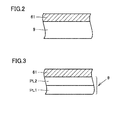
- the polymer sheet When the polymer sheet is used, it is so arranged that the polymer sheet forming inner liner 9 and carcass 61 are arranged to contact with each other as shown in Fig. 2 , for example.
- the polymer laminate When the polymer laminate is used, it is arranged toward an outer side in the radius direction of the tire so that a second layer PL2 of the polymer laminate comes in contact with carcass 61 as shown in Fig. 3 , for example.
- the second layer and an adjacent member such as a carcass or an insulation can exhibit a vulcanization adhesion.
- the inner layer and the adjacent member are favorably adhered in the obtained pneumatic tire, superior air permeation resistance and durability can be provided.
- the green tire is mounted to a die, and pressed and heated by a bladder at 150 to 180°C for 3 to 50 minutes, so that the vulcanized tire is obtained.
- the obtained vulcanized tire is preferably cooled at 50 to 120°C for 10 to 300 seconds.
- the pneumatic tire has a polymer sheet or a polymer laminate applied to the inner liner. Since SIBS, SIS, SIB, epoxy modified SBS, and the like constituting the polymer sheet or polymer laminate are thermoplastic resin, when for example heated to 150 to 180°C in the step of obtaining the vulcanized tire, it is rendered to be in a softened state in the die. Since the thermoplastic resin in the softened state improves the reactivity more than in the solid state, it is welded to the adjacent member. In other words, the inner liner in contact with an outer surface of the expanded bladder is softened by heating and welded to the bladder.
- the inner liner is peeled off from an adjacent insulation or carcass, so that the air-in phenomenon may occur. Moreover, the shape of the tire itself may be deformed.
- thermoplastic resin used for the inner liner can be solidified.
- the welding between the inner liner and the bladder is eliminated, so that peeling performance at the time of taking vulcanized tire from the die is improved.
- the cooling temperature is 50 to 120°C.
- the cooling temperature is less than 50°C, it would be necessary to prepare a special cooling medium, which may deteriorate the productivity.
- the cooling temperature exceeds 120°C, the thermoplastic resin is not sufficiently cooled, and the inner liner remains welded to the bladder at the time of releasing from the die, so that the air-in phenomenon may occur. It is more preferable that the cooling temperature is 70 to 100°C.
- the cooling time is 10 to 300 seconds. If the cooling time is less than 10 seconds, the thermoplastic resin is not sufficiently cooled, and the inner liner remains welded to the bladder at the time of releasing from the die, so that the air-in phenomenon may occur. When the cool time exceeds 300 seconds, the productivity is deteriorated. It is more preferable that the cool time is 30 to 180 seconds.
- the step of cooling the vulcanized tire is performed after cooling the bladder. Since the bladder is hollow, a cooling medium adjusted to the cooling temperature can be introduced to the bladder after the vulcanization step is terminated.
- the step of cooling the vulcanized tire can be performed by providing a cooling structure to the die while cooling the bladder.
- the cooling medium it is preferable to use one or more kind selected from the group consisting of air, steam, water, and oil. Among those, it is preferable to use water which is superior in the cooling efficiency.
- each compounding agent was placed into the two-axis extruder (screw diameter: ⁇ 50 mm, L/D: 30, cylinder temperature: 200°C), and kneaded at 200 rpm to form a pellet.
- the obtained pellet was placed into the T-die extruder (screw diameter: ⁇ 80 mm, L/D: 50, die grip width: 500 mm, cylinder temperature: 220°C, film gauge: 4.0 mm) to create a polymer sheet having a thickness of 4.0 mm.
- the obtained polymer sheet was used to conduct the following evaluation.
- a sheet of the carcass layer (blend: styrene-butadiene rubber by 100 mass parts, carbon black by 50 mass parts, sulfur by 2 mass parts, thickness: 2.0 mm) was prepared.
- non-vulcanization stickiness non- vulcanization stickiness of each Manufacturing Example / non - vulcanization stickiness of Manufacturing Example 1 x 100
- a vulcanization adherence of each manufacturing example was presented as an index with Manufacturing Example 1 as a reference (100). It represents that a vulcanization adherence is stronger as a vulcanization adherence index is greater, and thus it is preferable.
- vulcanization adherence index vulcanization adherence of each Manufacturing Example / vulcanization adherence of Manufacturing Example 1 x 100
- Manufacturing Examples 3 to 14 represent polymer sheets including SIBS and one kind selected from the group consisting of natural rubber, isoprene rubber, and isobutylene-isoprene rubber. As the content of SIBS increased, the non-vulcanization stickiness and the vulcanization adherence with the carcass layer were lowered. Particularly in Examples 12 to 14, the non-vulcanization stickiness and the vulcanization adherence with the carcass layer were significantly lowered as compared to Manufacturing Example 1.
- Polymer sheets having the blending similar to those of Manufacturing examples 1 to 11 were prepared.
- the thicknesses of the polymer sheets were set to have the thicknesses shown in Table 2.
- Green tires were prepared by applying the polymer sheets to the inner liners of the tires.
- the vulcanized tires having a 195/65R15 size were manufactured by press-molding the green tires in the die at 170°C for 20 minutes. After cooling the vulcanized tire at 100°C for 3 minutes, the vulcanized tires were taken out from the die to obtain the pneumatic tire.
- the obtained pneumatic tires were used to conduct the following evaluation.
- the manufactured tire having the 195/65R15 size was assembled to the JIS Standard Rim 15x6JJ, and an initial air pressure of 300 Kpa was contained, and the tire was left at a room temperature for 90 days, and then a lowering rate of the air pressure (%/month) was calculated.
- the air permeation resistance of each Example and Comparative example was presented by an index with Comparative Example 1-9 as a reference (100). As the index is smaller, the air permeability is smaller, thus it is preferable.
- air permeation resistance index lowering rate of air pressure in each Example and Comparative Example / lowering rate of air pressure in Comparative Example 1 - 9 x 100
- a rolling resistance testing machine manufactured by Kobe Steel, Ltd. was used to assemble the manufactured pneumatic tire having the 195/65R15 size to the JIS Standard Rim 15x6JJ, and the tire traveled at a room temperature (38°C) under the condition having the load of 3.4 kN, the air pressure of 230 kPa, and the velocity of 80 km/hour, to measure the rolling resistance.
- the rolling resistance of each Example and Comparative Example was presented by an index with Comparative Example 1-9 as a reference (100). As the rolling resistance index is greater, the rolling resistance is reduced, thus it is preferable.
- rolling resistance index rolling resistances of Comparative Example 1 - 9 / rolling resistance of each Example and Comparative Example x 100
- the pneumatic tires were mounted to all of wheels of a vehicle (FF2000cc made in Japan) and the vehicle ran the test course, so that the operation stability was evaluated in accordance with a driver's sensual evaluation.
- the evaluation was conducted with 10 points as full points, and the relative evaluation was conducted with Comparative Example 1-9 scored 6 points. It would be favorable as the evaluation point is greater.
- Examples 1-1 to 1-8 are pneumatic tires using polymer sheets having a thickness of 0.7 mm to 4.0 mm.
- the tires had an air permeation resistance which is equal to or higher than Comparative Example 1-9, and the rolling resistance was reduced, and the operation stability was improved.
- Comparative Examples 1-1, 1-3, 1-5, and 1-8 are pneumatic tires using polymer sheets having a thickness of 0.5 mm to 0.6 mm. As compared to Comparative Example 1-9, there is a tendency that the operation stability and the air permeation resistance are worse.
- Comparative Examples 1-2, 1-4, 1-6, and 1-7 are pneumatic tires using polymer sheets having a thickness of 5.0 mm. As compared to Comparative Example 1-9, the rolling resistance was increased.
- Methylcyclohexane (dried with molecular sieves) of 589 mL, n-butyl chloride (dried with molecular sieves) of 613 mL, and cumyl chloride of 0.550g were added to a 2L reaction container having an agitator. After cooling the reaction container to - 70°C, ⁇ -picoline (2-methylpyridine) of 0.35 mL and isobutylene of 179 mL were added. Titanium tetrachloride of 9.4 mL was further added, and the polymerization was stared. The solution was agitated at -70°C and allowed to react for 2.0 hours.
- styrene of 59 mL was added to the reaction container, and the reaction was continued for 60 minutes. After that, a large amount of methanol was added to stop the reaction. After a solvent and the like were removed from the reaction solution, the polymer was dissolved in toluene and washed twice. The toluene solution was added to a methanol mixture to deposit the polymer, and the obtained polymer was dried at 60°C for 24 hours to obtain a styrene-isobutylene diblock copolymer.
- thermoplastic resin sheets After mixing each compounding agent in accordance with the blending formulas shown in Table 3, thermoplastic resin sheets where manufactured by the method similar to that for the polymer sheets described above. The following evaluation was conducted for the obtained thermoplastic resin sheets.
- non-vulcanization stickiness was measured by the method which is similar to that for the polymer sheets described above, and a non-vulcanization stickiness for each Manufacturing Example was presented by an index with Manufacturing Example 1 as a reference (100). As the non-vulcanization stickiness index is greater, the non-vulcanization stickiness is stronger, thus it is preferable.
- non - vulcanization stickness index non - vulcanization stickness of each Manufacturing Example / non - vulcanization stickiness of Manufacturing Example 1 x 100
- vulcanization adherence index vulcanization adherence for each Manufacturing Example / vulcanization adherence for Manufacturing Example 1 x 100
- thermoplastic resin sheets made of a thermoplastic resin component including SIS, SIB, or epoxy modified SBS and additive such as sulfur.
- the thermoplastic resin sheets had sufficient non-vulcanization stickiness and vulcanization adherence with a carcass layer.
- thermoplastic resin sheets made of a thermoplastic resin composition made of SIS, SIB, or epoxy modified SBS and not including additive.
- the thermoplastic resin sheets had insufficient vulcanization adherence with a carcass layer.
- Each compounding agent was placed into the two-axis extruder (screw diameter: ⁇ 50 mm, L/D: 30, cylinder temperature: 200°C) in accordance with the blending formula of Manufacturing Example numbers shown in Table 4, and kneaded at 200 rpm to form a pellet.
- the obtained pellet was placed into a co-extruder (cylinder temperature: 200°C) to obtain a polymer laminate constituted of two layers.
- a thickness of each polymer laminate was adjusted to have a thickness shown in Table 4.
- the obtained polymer laminate was applied to the inner liner portion of the tire to prepare a green tire.
- the polymer laminate had a first layer arranged at the most inner side in the radial direction of the green tire, and a second layer arranged to come in contact with a carcass layer of the green tire.
- the green tire was press-molded in the die at 170°C for 20 minutes to manufacture a vulcanized tire having the 196/65R15 size. After cooling the vulcanized tire at 100°C for 3 minutes, the vulcanized tire was taken out from the die to obtain the pneumatic tire.
- the obtained pneumatic tire was used to conduct the following evaluation.
- a rolling resistance of the pneumatic tire was measured by the method which is similar to that for Example 1-1. With the following formula, the rolling resistance of the pneumatic tire having each polymer laminate was presented by an index with Comparative Example 1-9 as a reference (100). As the rolling resistance index is greater, the rolling resistance is reduced, and thus it is preferable.
- rolling resistance index rolling resistance of Comparative Example 1 - 9 / rolling resistance of each and Comparative Example x 100
- the pneumatic tires are mounted to all of wheels of a vehicle (FF2000cc made in Japan), and the operation stability was evaluated based on a driver's sensual evaluation.
- the evaluation was made with 10 points as full points, and a relative evaluation was conducted with Comparative Example 1-9 as scored 6 points. It is preferable when the evaluation point is greater.
- Examples 2-1 to 2-8 are pneumatic tires using the polymer sheets of Manufacturing Examples 6 to 11 as a first layer and thermplastic resin sheets of Manufacturing Examples 16, 18, and 12 as a second layer, and applying the polymer laminate having a thickness of 0.7 mm to 4.0 mm to the inner liner.
- the tires had an air permeation resistance equal to or higher than Comparative Example 1-9, and the rolling resistance was reduced, and the operation stability was improved.
- Comparative Examples 2-1, 2-3, 2-5, and 2-8 had a polymer laminate having a thickness of 0.4 mm to 0.6 mm. The tire exhibited worse operation stability as compared to Comparative Example 1-9.
- Comparative Examples 2-2, 2-4, 2-6, and 2-7 had a polymer laminate having a thickness of 5.0 mm. The tire had an increased rolling resistance as compared to Comparative Example 1-9.
Landscapes
- Chemical & Material Sciences (AREA)
- Health & Medical Sciences (AREA)
- Chemical Kinetics & Catalysis (AREA)
- Medicinal Chemistry (AREA)
- Polymers & Plastics (AREA)
- Organic Chemistry (AREA)
- Engineering & Computer Science (AREA)
- Mechanical Engineering (AREA)
- Tires In General (AREA)
- Compositions Of Macromolecular Compounds (AREA)
- Laminated Bodies (AREA)
Abstract
Description
- The present invention relates to a pneumatic tire including an inner liner.
- In recent years, a weight reduction of a tire has been attempted in accordance with strong social requests with respect to a reduction of fuel consumption for a vehicle. Among tire members, a weight reduction has been attempted also for an inner liner which is arranged on an inner side of a tire in a radial direction and serves to improve an air permeation resistance by reducing an amount of leakage of air from inside to outside of a pneumatic tire (air permeation amount).
- Currently, as a rubber composition for an inner liner, butyl-based rubber containing isobutylene-isoprene rubber by 70 to 100 mass% and natural rubber by 30 to 0 mass% is used to improve the air permeation resistance of a tire. Moreover, butyl-based rubber contains isoprene by about 1 mass% in addition to butylene, and it enables crosslinking with adjacent rubber cojointly with sulfur, vulcanization accelerator, and zinc white. The butyl-based rubber described above requires in a normal blending a thickness of about 0.6 to 1.0 mm for a tire of a passenger car, and a thickness of about 1.0 to 2.0 mm for a tire of a bus and a truck.
- Therefore, it has been proposed to use thermoplastic elastomer, which is superior in an air permeation resistance than butyl-based rubber and is capable of reducing a thickness of an inner liner layer, for an inner liner to reduce a weight of a tire. However, the thermoplastic elastomer, which has a smaller thickness than butyl-based rubber and exhibits a high air permeation resistance, has less vulcanization adherence with insulation rubber or carcass rubber adjacent to the inner liner as compared to butyl-based rubber. When an inner liner has a low vulcanization adherence, an air-in phenomenon occurs in which air is added between an inner liner and an insulation or a carcass to cause a large numbers of small bubbles to appear. Since this phenomenon involves small dot patterns inside of a tire, it disadvantageously gives an impression to a user that an appearance is not good. Further, since an insulation or a carcass is peeled from an inner liner due to air as a starting point during traveling, a crack may occur in the inner liner to lower an internal pressure of the tire. Then, the tire may burst in the worst case.
- In PTD 1 (Japanese Patent Laying-Open No.
9-165469 - Moreover, an inner liner portion of a pneumatic tire is likely to generate heat during traveling of a vehicle. Under a high-temperature condition, a stiffness is likely to be lowered, and an operation stability may be deteriorated. Thus, in view of the safety, an inner liner capable of improving the operation stability is also requested.
- In PTD 2 (Japanese Patent Laying-Open No.
2011-057940 -
- PTD 1: Japanese Patent Laying-Open No.
9-165469 - PTD 1: Japanese Patent Laying-Open No.
2011-057940 - An object of the present invention is to provide a pneumatic tire including an inner linear having sufficient non-vulcanization stickiness and vulcanization adhesiveness with an adjacent member and exhibiting a superior air isolation performance, and reducing a rolling resistance and having a superior operation stability.
- The present invention is a pneumatic tire including an inner liner made of a polymer sheet, and the polymer sheet is made of a polymer composition. The polymer composition includes a polymer component of styrene-isobutylene-styrene triblock copolymer by greater than or equal to 5 mass% and less than or equal to 80 mass%, and a rubber component of at least one kind selected from the group consisting of natural rubber, isoprene rubber, and isobutylene-isoprene rubber by greater than or equal to 20 mass% and less than or equal to 95 mass%. The polymer composition includes sulfur by greater than or equal to 0.1 mass parts and less than or equal to 5 mass parts with respect to the polymer component by 100 mass parts. The polymer sheet has a thickness T1 of 0.6 mm<T1≤4.0 mm.
- The present invention is a pneumatic tire including an inner liner made of a polymer laminate, and the polymer laminate includes a first layer and a second layer. The first layer is made of a polymer composition, and the polymer composition includes a polymer component of a styrene-isobutylene-styrene triblock copolymer by greater than or equal to 5 mass% and less than or equal to 80 mass%, and a rubber component of at least one kind selected from the group consisting of natural rubber, isoprene rubber, and isobutylene-isoprene rubber by greater than or equal to 20 mass% and less than or equal to 95 mass%. The polymer composition includes sulfur by greater than or equal to 0.1 mass parts and less than or equal to 5 mass parts with respect to the polymer component by 100 mass parts. The second layer includes a thermoplastic resin composition, and the thermoplastic resin composition includes sulfur by greater than or equal to 0.1 mass parts and less than or equal to 5 mass parts with respect to thermoplastic elastomer by 100 mass parts. The polymer laminate has a thickness T2 of 0.6 mm<T2≤4.0 mm.
- Preferably, in the pneumatic tire of the present invention, the thermoplastic elastomer is at least one kind selected from the group consisting of a styrene-isoprene-styrene triblock copolymer, a styrene-isobutylene diblock copolymer, a styrene-butadiene-styrene triblock copolymer, a styrene-isoprene/butadiene-styrene triblock copolymer, a styrene-ethylene/butene-styrene triblock copolymer, a styrene-ethylene/propylene-styrene triblock copolymer, a styrene-ethylene/ethylene/propylene-styrene triblock copolymer, a styrene-butadiene/butylene-styrene triblock copolymer, and epoxy modified thermoplastic elastomers thereof.
- Preferably, in the pneumatic tire of the present invention, the styrene-isobutylene-styrene triblock copolymer has a weight-average molecular weight of greater than or equal to 50,000 and less than or equal to 400,000 and a styrene unit content of greater than or equal to 10 mass% and less than or equal to 30 mass%.
- Preferably, in the pneumatic tire of the present invention, the styrene-isoprene-styrene triblock copolymer has a weight-average molecular weight of greater than or equal to 100,000 and less than or equal to 290,000 and a styrene unit content of greater than or equal to 10 mass% and less than or equal to 30 mass%.
- Preferably, in the pneumatic tire of the present invention, the styrene-isobutylene diblock copolymer has a straight-chain shape, and has a weight-average molecular weight of greater than or equal to 40,000 and less than or equal to 120,000, and a styrene unit content of greater than or equal to 10 mass% and less than or equal to 35 mass%.
- Preferably, in the pneumatic tire of the present invention, the epoxy modified styrene-butadiene-styrene triblock copolymer has a weight-average molecular weight of greater than or equal to 10,000 and less than or equal to 400,000 and a styrene unit content of greater than or equal to 10 mass% and less than or equal to 30 mass%.
- Preferably, in the pneumatic tire of the present invention, the polymer composition further includes stearic acid by greater than or equal to 1 mass parts and less than or equal to 5 mass parts, zinc oxide by greater than or equal to 0.1 mass parts and less than or equal to 8 mass parts, an anti-aging agent by greater than or equal to 0.1 mass parts and less than or equal to 5 mass parts, and a vulcanization accelerator by greater than or equal to 0.1 mass parts and less than or equal to 5 mass parts with respect to the polymer component by 100 mass parts.
- Preferably, in the pneumatic tire of the present invention, the thermoplastic resin composition further includes stearic acid by greater than or equal to 1 mass parts and less than or equal to 5 mass parts, zinc oxide by greater than or equal to 0.1 mass parts and less than or equal to 8 mass parts, an anti-aging agent by greater than or equal to 0.1 mass parts and less than or equal to 5 mass parts, and a vulcanization accelerator by greater than or equal to 0.1 mass parts and less than or equal to 5 mass parts with respect to the thermoplastic elastomer by 100 mass parts.
- Preferably, in the pneumatic tire of the present invention, the second layer further includes, in addition to the thermoplastic resin composition, a rubber component of at least one kind selected from the group consisting of natural rubber, isoprene rubber, and isobutylene-isoprene rubber, and includes the rubber content by greater than or equal to 20 mass% and less than or equal to 90 mass% with respect to a sum total of the thermoplastic resin composition and the rubber component.
- Preferably, in the pneumatic tire of the present invention, a tread of the pneumatic tire is made of a rubber composition including styrene-butadiene rubber by greater than or equal to 50 mass% in the rubber component.
- Preferably, in the pneumatic tire of the present invention, the rubber composition further includes silica by greater than or equal to 15 mass parts and less than or equal to 150 mass parts with respect to the rubber component by 100 mass parts, and a silane coupling agent. The silane coupling agent is a block copolymer or a random copolymer prepared by copolymerizing a bonding unit A expressed by the following general formula (1) and a bonding unit B expressed by the following general formula (2) with respect to a total amount of the bonding unit A and the bonding unit B with the bonding unit B in a ratio of 1 molar% to 70 molar%, and is included by greater than or equal to 2 mass parts and less than or equal to 20 mass parts with respect to silica of 100 mass parts:
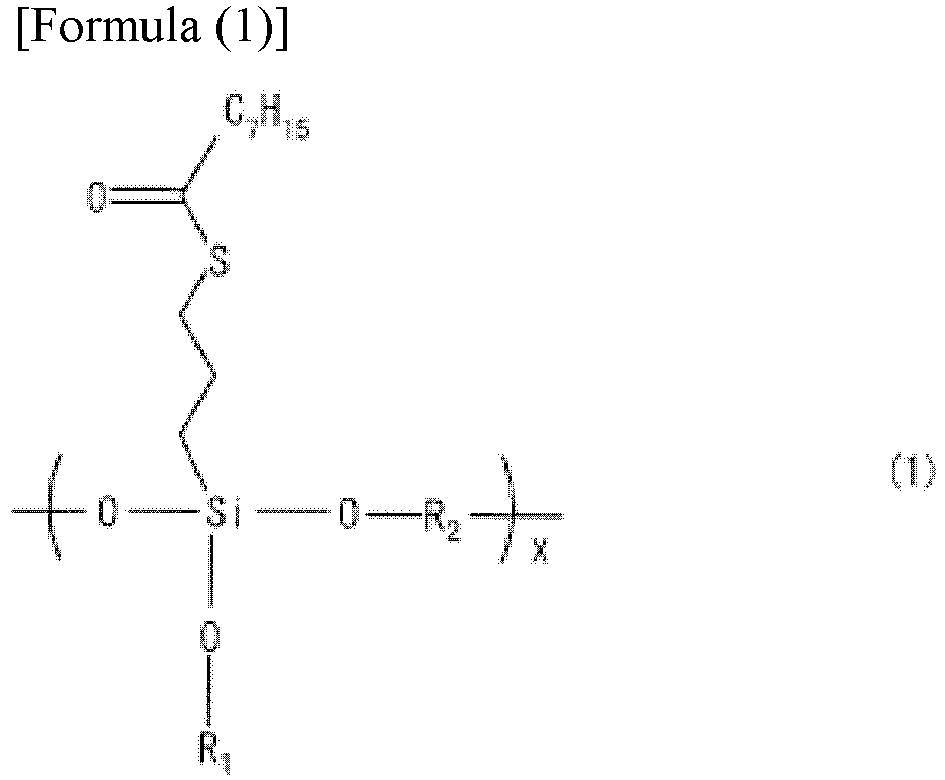

non-branched carbon 2 to 30, or an element having an end of the alkyl group or the alkenyl group substituted by a hydroxyl group or a carboxyl group. R2 represents hydrogen, an alkyl group of branched or non-branched carbon 1 to 30, or an alkenyl group of branched ornon-branched carbon 2 to 30. R1 and R2 may form a ring structure.). - According to the present invention, a pneumatic tire can be provided which includes an inner liner having sufficient non-vulcanization stickiness and vulcanization adhesiveness with an adjacent member and being superior in an air isolation performance, and reducing a rolling resistance and having a superior operation stability.
-
-
Fig. 1 is a schematic cross-sectional view representing a right half of a pneumatic tire in one embodiment of the present invention. -
Fig. 2 is a schematic cross-sectional view representing an example of an arrangement of an inner liner in the pneumatic tire. -
Fig. 3 is a schematic cross-sectional view representing one example of an arrangement of an inner liner in the pneumatic tire. - A structure of a pneumatic tire in one embodiment of the present invention will be described with reference to
Fig. 1 . - A pneumatic tire 1 may be used for a passenger car, a truck/bus, and a heavy machinery. Pneumatic tire 1 has a
tread portion 2, aside wall portion 3, and a bead portion 4. Further, abead core 5 is embedded in bead portion 4. Moreover, acarcass 6 provided across one bead portion 4 to the other bead portion and having both ends folded to engage withbead core 5, and abelt layer 7 constituted of two plies on an outer side of a crown portion ofcarcass 6 are arranged. On an inner side ofcarcass 6 in a radial direction of the tire, aninner liner 9 extending from one bead portion 4 to the other bead portion 4 is arranged.Belt layer 7 is arranged so that two plies constituted of steel cords or aramid fibers intersect each other between the plies to have the cords typically oriented at the angle of 5 to 30 degrees with respect to the circumferential direction of the tire. Moreover, the carcass have organic fiber cords of polyester, nylon , aramid, or the like disposed at approximately 90°in the circumferential direction, and abead apex 8 extending from an upper end ofbead core 5 in the side wall direction is arranged in the region surrounded by the carcass and folded portions of the carcass. An insulation may be arranged betweeninner liner 9 andcarcass 6. - In one embodiment of the present invention, an inner liner is made of a polymer sheet.
- The polymer sheet is made of a polymer composition. In the polymer composition, a polymer component includes a styrene-isobutylene-styrene triblock copolymer (in the following, also referred to as "SIBS") by greater than or equal to 5 mass% and less than or equal to 80 mass%, and a rubber component of at least one kind selected from the group consisting of natural rubber, isoprene rubber, and isobutylene-isoprene rubber by greater than or equal to 20 mass% and less than or equal to 95%. Further, the polymer composition includes sulfur by greater than or equal to 0.1 mass parts and less than or equal to 5 mass parts with respect to the polymer component by 100 mass parts.
- The polymer composition includes SIBS, a rubber component, and sulfur. When the rubber component and sulfur are added to the SIBS and then heated and mixed, a vulcanization reaction occurs between the rubber component and sulfur during heating and mixing, so that a sea-island structure is formed which has SIBS as a matrix (sea) and the rubber component as an island.
- The polymer composition having the sea-island structure has an air isolation performance derived from a matrix phase of SIBS. The rubber component forming an island phase has a non-vulcanization stickiness with an adjacent member including a rubber component. Moreover, since a vulcanization reaction with the rubber component of an adjacent member occurs during heating and mixing, it also has a vulcanization adhesiveness with an adjacent member. Thus, the polymer sheet made of the polymer composition is superior in an air isolation performance as well as a non-vulcanization stickiness and a vulcanization adhesiveness with an adjacent member.
- The isobutylene block of SIBS provides a superior air permeation resistance to a polymer sheet including the SIBS. Thus, when a polymer sheet including SIBS is used for an inner liner, a pneumatic tire having a superior air permeation resistance can be obtained.
- Further, since a molecular structure of SIBS other than aromatic series is completely saturated, deterioration hardening is suppressed, and a superior durability is provided. Thus, when a polymer sheet including SIBS is used for an inner liner, a pneumatic tire having a superior durability can be obtained.
- When a pneumatic tire is manufactured by applying a polymer sheet including SIBS to an inner liner, the inclusion of SIBS assures an air permeation resistance. Therefore, high-density halogenated rubber such as halogenated isobutylene-isoprene rubber having been conventionally used for providing an air permeation resistance is not used. Even when the high-density halogenated rubber is used, the amount of use can be reduced. Accordingly, a tire can be light-weighted, and an effect of improving fuel consumption can be obtained.
- A molecular weight of the SIBS is not particularly limited. However, in view of a fluidity, a molding step, and a rubber elasticity, it is preferable that a weight-average molecular weight according to the GPC method is greater than or equal to 50,000 and less than or equal to 400,000. When the weight-average molecular weight is less than 50,000, a tensile strength and a tensile elongation are likely to be lowered. When the weight-average molecular weight exceeds 400,000, an extrusion performance may be deteriorated. Thus, it is not preferable.
- SIGBS generally includes a styrene unit of greater than or equal to 10 mass% and less than or equal to 40 mass%. On the point that an air permeation resistance and a durability become more favorable, it is preferable that the content of the styrene unit in SIBS is greater than or equal to 10 mass% and less than or equal to 30 mass%.
- It is preferable that SIBS has a molar ratio of an isobutylene unit and a styrene unit (isobutylene unit/styrene unit) of 40/60 to 95/5 in view of the rubber elasticity of the copolymer. In SIBS, it is preferable that a degree of polymerization of each block is approximately 10,000 to 150,000 in an isobutylene block (it is liquefied when the degree of polymerization is less than 10,000) and 5,000 to 30,000 in a styrene block in view of the rubber elasticity and handling.
- SIBS can be obtained by a general method for polymerizing a vinyl-based compound. For example, it can be obtained by a living cationic polymerization method.
- Japanese Patent Laying-Open No.
62-48704 64-62308 U.S. Patent No. 4,946,899 ,U.S. Patent No. 5,219,948 , and Japanese Patent Laying-Open No.3-174403 - Since SIBS does not have a double bond other than the aromatic series in a molecule, a stability with respect to an ultraviolet radiation is higher and a weather resistance is better than a polymer such as polybutadiene having a double bond in a molecule.
- The content of SIBS is greater than or equal to 5 mass% and less than or equal to 80 mass% in the polymer component of the polymer composition. When the content of SIBS is less than 5 mass%, an air isolation performance of the polymer sheet may be lowered. On the other hand, when the content of SIBS exceeds 80 mass%, a vulcanization adhesiveness with an adjacent member may be insufficient. In view of assuring the air isolation performance, the content of SIBS in the polymer component is preferably greater than or equal to 10 mass%, more preferably less than or equal to 40 mass%, and yet more preferably less than or equal to 30 mass%.
- In First Embodiment, the polymer composition constituting the polymer sheet includes a rubber component. The rubber component can provide the polymer composition with a non-vulcanization stickiness with an adjacent member including a rubber component. Further, a vulcanization reaction with sulfur can provide the polymer composition with a vulcanization adhesiveness with an adjacent member such as a carcass or an insulation.
- The rubber component includes at least one kind selected from the group consisting of natural rubber, isoprene rubber, and isobutylene-isoprene rubber. Among those, it is preferable to include natural rubber in view of a fracture strength and an adhesiveness.
- The content of the rubber component is greater than or equal to 20 mass% and less than or equal to 95 mass% in the polymer component of the polymer composition. When the content of the rubber component is less than 20 mass%, a viscosity of the polymer composition is raised, and an extrusion performance is deteriorated. Therefore, a polymer sheet is not to be thinned at the time of manufacturing the polymer sheet. On the other hand, when the content of the rubber component exceeds 95 mass%, the air isolation performance of the polymer sheet may be lowered. In view of the non-vulcanization stickiness and the vulcanization adhesiveness, the content of the rubber component in the polymer component is preferably greater than or equal to 60 mass%, more preferably greater than or equal to 70%, and preferably less than or equal to 90 mass%.
- In First Embodiment, the polymer composition constituting the polymer sheet includes sulfur.
- As sulfur, sulfur generally used in a rubber industry at the time of vulcanization may be used. Particularly, it is preferable to use insoluble sulfur. The insoluble sulfur is sulfur having a high molecular weight of Sx (x=100,000 to 300,000) by heating and quenching natural sulfur S8. Using the insoluble sulfur can prevent blooming which generally occurs when sulfur is used as a rubber vulcanizing agent.
- The content of sulfur is greater than or equal to 0.1 mass parts and less than or equal to 5 mass parts with respect to the polymer component by 100 mass parts. When the content of sulfur is less than 0.1 mass parts, a vulcanizing effect of the rubber component cannot be obtained. On the other hand, when the content of sulfur exceeds 5 mass parts, a hardness of the polymer composition increases. Therefore, when the polymer sheet is used for the inner liner, a durability of the pneumatic tire is likely to be lowered. More preferably, the content of sulfur is greater than or equal to 0.3 mass parts and less than or equal to 3.0 mass parts.
- In First Embodiment, the polymer composition constituting the polymer sheet can include an additive such as stearic acid, zinc oxide, an anti-aging agent, a vulcanization accelerator, or the like.
- The stearic acid serves as a vulcanization assistant for the rubber component. The content of the stearic acid is preferably greater than or equal to 1 mass parts and less than or equal to 5 mass parts with respect to the polymer component by 100 mass parts. When the content of the stearic acid is less than 1 mass parts, an effect as a vulcanization assistant cannot be obtained. On the other hand, when the content of the stearic acid exceeds 5 mass parts, a viscosity of the polymer composition is lowered, and a fracture strength is lowered, thus it is not preferable. More preferably, the content of the stearic acid is greater than or equal to 1 mass parts and less than or equal to 4 mass parts.
- Zinc oxide serves as a vulcanization assistant of the rubber component. The content of zinc oxide is preferably greater than or equal to 0.1 mass parts and less than or equal to 8 mass parts with respect to the polymer component by 100 mass parts. When the content of zinc oxide is less than 0.1 mass parts, an effect as a vulcanization assistant cannot be obtained. On the other hand, when the content of zinc oxide exceeds 8 mass parts, a hardness of the polymer composition is raised. Therefore, when the polymer sheet is used for the inner liner, a durability of the pneumatic tire may be lowered. More preferably, the content of zinc oxide is greater than or equal to 0.5 mass parts and less than or equal to 6 mass parts.
- The anti-aging agent has a function of preventing a series of deterioration such as oxidation deterioration, heat deterioration, ozone deterioration, and fatigue deterioration, which are called aging. The anti-aging agent is grouped into a primary anti-aging agent including amines and phenols, and a secondary anti-aging agent including a sulfur compound and phosphites. The primary anti-aging agent has a function of providing hydrogen to various polymer radicals and stopping a chain reaction of autoxidation, and the secondary anti-aging agent exhibits a stabilizing action of changing hydroxy peroxide into stable alcohol.
- The anti-aging agent includes amines, phenols, imidazoles, phosphoros, and thio urea.
- The amines include phenyl-a-naphthylamine, a 2,2,4-trimethyl-1,2-dihydroquinoline polymer, 6-ethoxy-2,2,4-trimethyl-1,2-dihydroquinoline, p,p'-dioctyl diphenylamine, p,p'-dicumyl diphenylamine, N,N'-di-2-naphthyl-p-phenylenediamine, N,N'-diphenyl-p-phenylenediamine, N-phenyl-N'-isopropyl-p-phenylenediamine, N-phenyl-N'-1,3-dimethyl butyl-p-phenylenediamine, N-(1,3-dimethyl butyl)-N'-phenyl-p-phenylenediamine, and the like.
- Phenols include 2,6-di-tert-butyl-4-methyl phenol, 2,6-di-tert-butyl-4-methyl phenol, stirenated methyl phenol, 2, 2'-methylene bis (4-ethyl-6-tert-butyl phenol), 2, 2'-methylene bis (4-methyl-6-tert-butyl phenol), 4,4'-butylidene bis (3-methyl-6-tert-butyl phenol), 4,4-thio bis (3-methyl-6-tert-butyl phenol), 2,5-di-tert-butyl hydroquinone, 2,5-di-tert-amyl hydroquinone, and the like.
- Imidazoles include 2-mercaptobenzimidazole, zinc salt of 2-mercaptobenzimidazole, dibutyl dithiocarbamate nickel, and the like.
- Other than those described above, phosphorous such as tris (nonylated phenyl) phosphite, thio urea such as 1,3-bis (dimethylaminopropyl)-2-thio urea, and tributyl thio urea, ozone deterioration prevention wax, and the like may be used.
- The anti-aging agents described above may be used individually with one kind or in combination of two or more kinds. Among those, it is preferable to use N-(1,3-dimethyl butyl)-N'-phenyl-p-phenylenediamine.
- Preferably, it is preferable that the content of the anti-aging agent is greater than or equal to 0.1 mass parts and less than or equal to 5 mass parts with respect to the polymer component by 100 mass parts. When the content of the anti-aging agent is less than 0.1 mass parts, the anti-aging effect cannot be obtained. On the other hand, when the content of the anti-aging agent exceeds 5 mass parts, a blooming phenomenon occurs in the polymer composition. It is more preferable that the content of the anti-aging agent is greater than or equal to 0.3 mass parts and less than or equal to 4 mass parts.
- As the vulcanization accelerator, thiurams, thiazoles, thio urea, dithiocarbamates, guanidines, sulfenamides, and the like can be used.
- The thiurams include tetramethyl thiuram monosulfide, tetramethyl thiuram disulfide, tetraethylthiuram disulfide, tetrabutyl thiuram disulfide, dipentamethylene thiuram tetrasulfide, and the like.
- The thiazoles include 2-mercaptobenzothiazole, dibenzothiadyl disulfide, N-cyclohexyl benzothiazole, N-cyclohexyl-2-benzothiazole sulfenamide, N-oxydiethylene-2-benzothiazole sulfenamide, N-tert-butyl-2-benzothiazole sulfenamide, N,N-dicyclohexyl-2-benzothiazole sulfenamide, N-tert-butyl-2-benzothiazolyl I sulfenamide, and the like.
- The thio urea includes N,N'-diethyl thiourea, ethylene thio urea, trimethyl thio urea, and the like.
- The dithiocarbamates include dimethyl dithiocarbamate zinc, diethyl dithiocarbamate zinc, dibutyl dithiocarbamate zinc, dimethyl dithiocarbamate sodium, diethyl dithiocarbamate sodium, dimethyl dithiocarbamate copper, dimethyl dithiocarbamate iron III), diethyl dithiocarbamate selenium, diethyl dithiocarbamate tellurium, and the like.
- The guanidines include di-o-tolylguanidine, 1,3-diphenylguanidine, 1-o-tolylbiguanide, di-o-tolylguanidine salt of dicatechol borate, and the like.
- The sulfenamides include N-cyclohexyl-2-benzothiazilsulfenamide, and the like. The vulcanization accelerator described above may be used individually with one kind or in combination of two or more kinds. Among those, it is preferable to use dibenzothiazyl disulfide.
- Preferably, the content of the vulcanization accelerator is greater than or equal to 0.1 mass parts and less than or equal to 5 mass parts with respect to the polymer component by 100 mass parts. When the content of the vulcanization accelerator is less than 0.1 mass parts, the vulcanization accelerating effect cannot be obtained. On the other hand, when the content of the vulcanization accelerator exceeds 5 mass parts, a hardness of the polymer composition is raised. Therefore, when the polymer sheet is used for the inner liner, a durability of the pneumatic tire may be lowered. Further, the raw material cost of the polymer composition is raised. More preferably, the content of the vulcanization accelerator is greater than or equal to 0.3 mass parts and less than or equal to 4 mass parts.
- In First Embodiment, the polymer sheet has a thickness T1 of 0.6 mm<T1≤4.0 mm. When the thickness of the polymer sheet is less than or equal to 0.6 mm, a favorable operation stability cannot be obtained in the pneumatic tire having the polymer sheet applied to the inner liner.
- On the other hand, when the thickness of the polymer sheet exceeds 4.0 mm, a tire weight and a rolling resistance are increased, so that low fuel consumption performance is lowered. It is preferable that the thickness of the polymer sheet is greater than or equal to 0.8 mm and less than or equal to 3.8 mm.
- In First Embodiment, the polymer sheet can be manufactured, for example, by the following method. Each compounding agent is placed into a two-axis extruder and kneaded under the condition of about 150 to 280°C and 50 to 300 rpm to obtain a pellet of a polymer composition having dynamically crosslinked SIBS, rubber component, sulfur, and various additives as needed. The obtained pellet is placed into a T-die extruder to obtain a polymer sheet having a desired thickness.
- In the two-axis extruder, SIBS as a thermoplastic resin composition attains a matrix phase, and the rubber component attains an island phase. Then, they are dispersed. Further, in the two-axis extruder, the rubber component and the additive component react with each other, so that a crosslinking reaction occurs in the rubber component in an island phase. Since the rubber component is dynamically crosslinked in the two-axis extruder, it is called dynamic crosslinking. Even when the rubber component crosslinks in the two-axis extruder, since the matrix phase of the system is composed of the thermoplastic resin component, a shear viscosity is low in the whole system, and extrusion can be conducted.
- The pellet of the dynamically crosslinked polymer composition obtained by the two-axis extruder includes the crosslinked rubber component. However, the thermoplastic resin component in the matrix phase maintains its plasticity and serves to provide a plasticity for the whole system. Therefore, since the plasticity is exhibited in the T-die extrusion, it can be formed into a sheet-like shape.
- Further, since the pallet of the dynamically crosslinked polymer composition has the crosslinked rubber component, intrusion of the polymer composition of the inner liner to the carcass layer can be prevented even when the polymer sheet manufactured with use of the pellet is applied to the inner layer and the pneumatic tire is heated at the time of manufacturing the pneumatic tire.
- In one embodiment of the present invention, it is preferable that the tread of the pneumatic tire is made of the rubber composition including styrene-butadiene rubber (in the following, also referred to as "SBR") by greater than or equal to 50 mass% in the rubber component.
- The SBR is not particularly limited, and SBR generally used in a tire industry such as emulsion-polymerized styrene-butadiene rubber (E-SBR), solution-polymerized styrene-butadiene rubber (S-SBR), and the like can be used. Among those, S-SBR is preferable.
- The styrene unit content of the SBR is preferably greater than or equal to 25 mass%, and more preferably greater than or equal to 35 mass%. When the content is less than 25 mass%, there is a tendency that a sufficient wet-grip performance cannot be obtained. Moreover, the styrene component content is preferably less than or equal to 60 mass%, and more preferably less than or equal to 50 mass%. There is a tendency that a wear resistance is lowered when the content exceeds 60 mass%. The styrene component content of the SBR is calculated by the 1H-NMR measurement.
- The content of the SBR in the rubber component by 100 mass% is preferably greater than or equal to 50 mass%, more preferably greater than or equal to 70 mass%, and yet more preferably greater than or equal to 80 mass%. There is a tendency that a sufficient wet-grip performance cannot be obtained when the content is less than 50 mass%. Moreover, an upper limit of the content of SBR is not particularly limited, and it may be 100 mass%.
- As the rubber component other than SBR, there may be used, for example, natural rubber (NR), isoprene rubber (IR), butadiene rubber (BR), styrene isoprene butadiene rubber (SIBR), ethylene propylene diene rubber (EPDM), chloroprene rubber (CR), acrylonitrile-butadiene rubber (NBR), isobutylene-isoprene rubber (IIR), and the like. These rubber components may be used individually or in combination of two or more kinds.
- The tread rubber composition preferably includes silica. Accordingly, the wet-grip performance can be improved, and the effect of improving the wear resistance and operation stability can be obtained, so that the effect of the present invention can be obtained more favorably. Silica includes, for example, dry silica (anhydrous silica), wet silica (hydrous silica), and the like. Among those, the wet silica is preferable on the reason that there are many silanol groups.
- A nitrogen absorption specific surface area (N2SA) of silica is preferably greater than or equal to 40 m2/g, more preferably greater than or equal to 70 m2/g, yet more preferably greater than or equal to 110 m2/g. There is a tendency that the wear resistance is lowered when the area is less than 40m2/g. Moreover, the N2SA of silica is preferably less than or equal to 220 m2/g, and more preferably 200 m2/g. When the area exceeds 220 m2/g, silica becomes less likely to disperse, and the wear resistance may to be deteriorated. The N2SA of silica is a value measured by the BET method in accordance with ASTM D3037-93.
- The content of silica is preferably greater than or equal to 15 mass parts, more preferably greater than or equal to 20 mass parts by the rubber component by 100 mass parts. When the content is less than 15 mass parts, sufficient wet-grip performance and wear resistance may not be obtained. The content of the silica is preferably less than or equal to 150 mass parts, more preferably less than or equal to 140 mass parts, yet more preferably less than or equal to 130 mass parts. When the content exceeds 150 mass parts, silica becomes less likely to disperse, and the wear resistance may be deteriorated.
- When silica is blended to the tread rubber composition, it is preferable to blend a silane coupling agent with silica. The silane coupling agent is not particularly limited, and it may be the silane coupling agent conventionally used with silica in the tire industry.
- Particularly, it is preferable to use a silane coupling agent which is a block copolymer or a random copolymer prepared by copolymerizing a bonding unit A expressed by the following general formula (1) and a bonding unit B expressed by the following general formula (2) with the bonding unit B in a ratio of 1 molar% to 70 molar% with respect to a total amount of the bonding unit A and the bonding unit B, and is included by greater than or equal to 2 mass parts and less than or equal to 20 mass parts with respect to silica of 100 mass parts:


non-branched carbon 2 to 30, or an element having an end of the alkyl group or the alkenyl group substituted by a hydroxyl group or a carboxyl group. R2 represents hydrogen, an alkyl group of branched or non-branched carbon 1 to 30, or an alkenyl group of branched ornon-branched carbon 2 to 30. R1 and R2 may form a ring structure.) - The silane coupling agent includes, for example, bis (3-triethoxysilyl propyl) polysulfide, bis (2-triethoxysilyl ethyl) polysulfide, bis (3-trimethoxysilyl propyl) polysulfide, bis (2-trimethoxysilyl ethyl) polysulfide, bis (4-triethoxysilyl butyl) polysulfide, bis (4-trimethoxysilyl butyl) polysulfide, and the like. These silane coupling agents may be used individually or in combination of two or more kinds.
- The content of the silane coupling agent is preferably greater than or equal to 1 mass parts, more preferably 2 mass parts with respect to silica by 100 mass parts. There is a tendency that the wear resistance is likely to be lowered when the content of the silane coupling agent is less than 1 mass parts. Moreover, the content of the silane coupling agent is preferably less than or equal to 20 weight parts, more preferably 15 weight parts. When the content of the silane coupling agent exceeds 20 weight parts, there is a tendency that the improving effect by blending of the silane coupling agent cannot be obtained and the cost is increased.
- In one embodiment of the present invention, the inner liner is made of a polymer laminate.
- The polymer laminate includes a first layer and a second layer.
- In Second Embodiment, the first layer of the polymer laminate may be used which is similar to the polymer sheet of First Embodiment.
- In Second Embodiment, the second layer includes a thermoplastic resin composition having thermoplastic elastomer and sulfur. The second layer may further include, in addition to the thermoplastic resin composition, a rubber component of at least one kind selected from the group consisting of natural rubber, isoprene rubber, and isobutylene-isoprene rubber.
- The thermoplastic resin composition includes thermoplastic elastomer and sulfur. By adding sulfur to thermoplastic elastomer, a non-vulcanization stickiness and a vulcanization adhesiveness with the first layer are improved. Further, a non-vulcanization stickiness and a vulcanization adhesiveness with an adjacent member such as a carcass or an insulation are also improved.
- The thermoplastic elastomer which can be used may be at least one kind selected from the group consisting of a styrene-isoprene-styrene triblock copolymer, a styrene-isobutylene diblock copolymer, a styrene-butadiene-styrene triblock copolymer, a styrene-isoprene/butadiene-styrene triblock copolymer, a styrene-ethylene/butene-styrene triblock copolymer, a styrene-ethylene/propylene-styrene triblock copolymer, a styrene-ethylene/ethylene/propylene-styrene triblock copolymer, and a styrene-butadiene/butylene-styrene triblock copolymer. These thermoplastic elastomers may be an epoxy modified thermoplastic elastomer having an epoxy group. Among those, it is preferable to use the styrene-isoprene-styrene triblock copolymer, the styrene-isobutylene diblock copolymer, or the epoxy modified styrene-butadiene-styrene triblock copolymer. In the following, the styrene-isoprene-styrene triblock copolymer, the styrene-isobutylene diblock copolymer, and the epoxy modified styrene butadiene styrene triblock copolymer will be described.
- Since an isoprene block of the styrene-isoprene-styrene triblock copolymer (in the following, also referred to as "SIS") is a soft segment, the thermoplastic resin composition including SIS is likely to exhibit a vulcanization adhesion to the rubber component. Thus, when the thermoplastic resin composition including SIS is used for the polymer laminate, since the polymer laminate is superior in an adhesiveness with an adjacent rubber forming the carcass or insulation, a pneumatic tire capable of preventing the air-in and superior in the durability can be obtained.
- The molecular weight of SIS is not particularly limited. However, in view of the rubber elasticity and moldability, it is preferable that the weight-average molecular weight according to the GPC method is greater than or equal to 100,000 and less than or equal to 290,000. When the weight-average molecular weight is less than 100,000, the tensile strength is likely to be lowered. When the weight-average molecular weight exceeds 290,000, the extrusion performance is deteriorated. Therefore, it is not preferable.
- It is preferable that the content of the styrene unit in the SIS is greater than or equal to 10 mass% and less than or equal to 30 mass% in view of the stickiness, adhesiveness, and rubber elasticity.
- It is preferable that SIS has a molar ratio of the isoprene unit and the styrene unit (isoprene unit/styrene unit) of 90/10 to 70/30. In SIS, it is preferable that a degree of polymerization of each block is approximately 500 to 5,000 for the isoprene block and approximately 50 to 1,500 for the styrene block in view of the rubber elasticity and handling.
- SIS can be obtained by a general method for polymerizing a vinyl-based compound. For example, it can be obtained by, for example, the living cationic polymerization method.
- The second layer including SIS can be obtained by a general method of mixing SIS, sulfur, and other additive in a Banbury mixer and forming a sheet of thermoplastic resin and thermoplastic elastomer by extrusion and calender molding.
- Since the isobutylene block of the styrene-isobutylene-diblock copolymer (in the following, also referred to as "SIB") is a soft segment, the thermoplastic resin composition including SIB is likely to exhibit a vulcanization-adhesion to a rubber component. Thus, when he thermoplastic resin composition including SIB is used for the polymer laminate, since the polymer laminate is superior in an adhesiveness with adjacent rubber forming a carcass and an insulation for example, the air-in can be prevented, and a pneumatic tire superior in the durability can be obtained.
- As SIB, it is preferable to use SIB having a straight chain shape in view of the rubber elasticity and the adhesiveness.
- Although the molecular weight of SIB is not limited, it is preferable that the weight-average molecular weight according to the GPC method is greater than or equal to 40,000 and less than or equal to 120,000 in view of the rubber elasticity and the moldability. When the weight-average molecular weight is less than 40,000, the tensile strength is likely to be lowered. When the weight-average molecular weight exceeds 120,000, the extrusion property is likely to be deteriorated. Thus, it is not preferable.
- It is preferable that the content of the styrene unit in SIB is greater than or equal to 10 mass% and less than or equal to 35 mass% in view of the stickiness, the adhesiveness, and the rubber elasticity.
- It is preferable that SIB has a molar ratio of the isobutylene unit and the styrene unit (isobutylene unit/styrene unit) of 90/10 to 65/35. In SIB, it is preferable that a degree of polymerization for each block is approximately 300 to 3,000 for the isobutylene block and approximately 10 to 1,500 for the styrene block in view of the rubber elasticity and handling.
- SIB can be obtained by the general method for polymerizing a vinyl-based compound. For example, it can be obtained by the living cationic polymerization method.
-
WO2005/033035 discloses a manufacturing method for obtaining SIB by adding methylcyclohexane, n-butyl chloride, and cumyl chloride to an agitator, cooling to -70°C, allowing a reaction to performed for two hours, adding a large amount of methanol to stop the reaction, and performing vacuum-drying at 60°C. - The second layer including SIB can be obtained by a general method of mixing SIB, sulfur, and other additive in the Banbury mixer, and forming a sheet of thermoplastic resin and thermoplastic elastomer by extrusion and calender molding.
- The epoxy modified styrene-butadiene-styrene triblock copolymer (in the following, also referred to as "epoxy modified SBS") is thermoplastic elastomer having a polystyrene block as a hard segment and a butadiene block as a soft segment, and a non-saturated double-bond portion included in the butadiene block is epoxidated. Since epoxy modified SBS has a soft segment, the thermoplastic resin composition including epoxy modified SBS is likely to exhibit a vulcanization adhesion to the rubber component. Thus, when the thermoplastic resin composition including epoxy modified SBS is used for the polymer laminate for an inner liner, since the polymer laminate is superior in the adhesiveness with adjacent rubber forming a carcass or an insulation for example, the air-in can be prevented, and a pneumatic tire superior in the durability can be obtained.
- Although the molecular weight of epoxy modified SBS is not particularly limited, it is preferable that the weight-average molecular weight according to the GPC method is greater than or equal to 10,000 and less than or equal to 400,000 in view of the rubber elasticity and the moldability. When the weight-average molecular weight is less than 10,000, the reinforcing effect may be lowered. When the weight-average molecular weight exceeds 400,000, the viscosity of the thermoplastic resin composition may be raised. Therefore, it is not preferable.
- It is preferable that the content of the styrene unit in epoxy modified SBS is greater than or equal to 10 mass% and less than or equal to 30 mass% in view of the stickiness, the adhesiveness, and the rubber elasticity.
- It is preferable that epoxy modified SBS has a molar ratio of the butadiene unit and the styrene unit (butadiene unit/styrene unit) of 90/10 to 70/30. In epoxy modified SBS, it is preferable that a degree of polymerization of each block is approximately 500 to 5,000 for the butadiene block and approximately 50 to 1,500 for the styrene block in view of the rubber elasticity and handling.
- The second layer including epoxy modified SBS can be obtained by a general method of mixing SIB, sulfur, and other additive in the Banbury mixer and forming a sheet of thermoplastic resin and thermoplastic elastomer by extrusion and calender molding.
- The second layer can include a rubber component in addition to the thermoplastic elastomer composition.
- As the rubber component, rubber of at least one kind selected from the group consisting of natural rubber, isoprene rubber, and isobutylene-isoprene rubber can be used.
- It is preferable that the content of the rubber component is greater than or equal to 20 mass% and less than or equal to 90 mass%, more preferably greater than or equal to 30 mass% and less than or equal to 80 mass% with respect to the sum total of the thermoplastic resin composition and the rubber component. When it is less than 20 mass%, the second layer is less likely to exhibit a vulcanization adhesion to the carcass layer. When it exceeds 90 mass%, the second layer and the carcass layer are likely to exhibit a vulcanization adhesion too much.
- Sulfur which is similar to that of First Embodiment can be used.
- The content of sulfur is greater than or equal to 0.1 mass parts and less than or equal to 5 mass parts with respect to the thermoplastic elastomer by 100 mass parts. When the content of sulfur is less than 0.1 mass parts, the crosslinking reaction may not occur. On the other hand, when the content of sulfur exceeds 5 mass parts, the crosslinking density of the thermoplastic resin composition may be raised, and the viscosity may be raised. It is more preferable that the content of sulfur is greater than or equal t0 0.3 mass parts and less than or equal to 3 mass parts.
- In Second Embodiment, the thermoplastic resin composition constituting the polymer laminate for the inner liner can include additive such as stearic acid, zinc oxide, an anti-aging agent, and a vulcanization accelerator. These additives can be similar to those of First Embodiment.
- It is preferable that the content of the stearic acid is greater than or equal to 1 mass parts and less than or equal to 5 mass parts with respect to the thermoplastic elastomer by 100 mass parts. When the content of the stearic acid is less than 1 mass parts, the vulcanization may not occur. On the other hand, when the content of the stearic acid exceeds 5 mass parts, the fracture strength of the thermoplastic resin composition may be lowered. It is more preferable that the content of the stearic acid is greater than or equal to 1 mass parts and less than or equal to 4 mass parts.
- It is preferable that the content of zinc oxide is greater than or equal to 0.1 mass parts and less than or equal to 8 mass parts with respect to the thermoplastic elastomer by 100 mass parts. When the content of zinc oxide is less than 0.1 mass parts, the vulcanization may not be performed. On the other hand, when the content of zinc oxide exceeds 8 mass parts, the hardness of the thermoplastic resin composition may be raised, and the durability may be lowered. It is more preferable that the content of zinc oxide is greater than or equal to 0.5 mass parts and less than or equal to 6 mass parts.
- It is preferable that the content of the anti-aging agent is greater than or equal to 0.1 mass parts and less than or equal to 5 mass parts with respect to the thermoplastic elastomer by 100 mass parts. When the content of the anti-aging agent is less than 0.1 mass parts, the anti-aging effect may not be obtained. On the other hand, when the content of the anti-aging agent exceeds 5 mass parts, the blooming phenomenon may occur. It is more preferable that the content of the anti-aging agent is greater than or equal to 0.3 mass parts and less than or equal to 4 mass parts.
- It is preferable that the content of the vulcanization accelerator is greater than or equal to 0.1 mass parts and less than or equal to 5 mass parts with respect to the thermoplastic elastomer by 100 mass parts. When the content of the vulcanization accelerator is less than 0.1 mass parts, the vulcanization-accelerating effect may not be obtained. On the other hand, when the content of the vulcanization accelerator exceeds 5 mass parts, the hardness of the thermoplastic resin composition may be raised, and the durability may be lowered. Further, the cost of raw material of the thermoplastic resin composition is raised. It is more preferable that the content of the vulcanization accelerator is greater than or equal to 0.3 mass parts and less than or equal to 4 mass parts.
- In Second Embodiment, it is preferable that the polymer laminate has a thickness T1 of 0.6 mm<T1≤4.0 mm. When the thickness of the polymer laminate is less than or equal to 0.6 mm, a favorable operation stability cannot be obtained with a pneumatic tire having the polymer sheet applied to an inner liner.
- On the other hand, when the thickness of the polymer laminate exceeds 4.0 mm, the tire weight and the rolling resistance are increased to lower the low fuel consumption performance. It is more preferable that the thickness of the polymer laminate is greater than or equal to 0.8 mm and less than or equal to 3.8 mm.
- In Second Embodiment, the polymer laminate can be manufactured, for example, by the following method.
- The first layer is manufactured by the method similar to the method for manufacturing the inner liner polymer sheet of First Embodiment. The second layer is manufactured by forming a sheet of the thermoplastic resin composition by the extrusion and calender molding. The polymer laminate is manufacture by attaching the first layer and the second layer to each other.
- Moreover, it can be manufactured by a laminate extrusion or a co-extrusion of pellets of the polymer composition and the thermoplastic resin composition.
- In the present embodiment, a tread can be used which is similar to the tread of First Embodiment.
- The pneumatic tire according to the first embodiment of the present invention can be manufactured, for example, by the following method.
- A green tire is manufactured by applying the polymer sheet and the polymer laminate described above to the inner liner portion.
- When the polymer sheet is used, it is so arranged that the polymer sheet forming
inner liner 9 andcarcass 61 are arranged to contact with each other as shown inFig. 2 , for example. - When the polymer laminate is used, it is arranged toward an outer side in the radius direction of the tire so that a second layer PL2 of the polymer laminate comes in contact with
carcass 61 as shown inFig. 3 , for example. - With such an arrangement, in the tire vulcanization step, the second layer and an adjacent member such as a carcass or an insulation can exhibit a vulcanization adhesion. Thus, since the inner layer and the adjacent member are favorably adhered in the obtained pneumatic tire, superior air permeation resistance and durability can be provided.
- Next, the green tire is mounted to a die, and pressed and heated by a bladder at 150 to 180°C for 3 to 50 minutes, so that the vulcanized tire is obtained. Next, the obtained vulcanized tire is preferably cooled at 50 to 120°C for 10 to 300 seconds.
- The pneumatic tire has a polymer sheet or a polymer laminate applied to the inner liner. Since SIBS, SIS, SIB, epoxy modified SBS, and the like constituting the polymer sheet or polymer laminate are thermoplastic resin, when for example heated to 150 to 180°C in the step of obtaining the vulcanized tire, it is rendered to be in a softened state in the die. Since the thermoplastic resin in the softened state improves the reactivity more than in the solid state, it is welded to the adjacent member. In other words, the inner liner in contact with an outer surface of the expanded bladder is softened by heating and welded to the bladder. If the vulcanized tire is attempted to be taken out from the die in the state where the inner liner and the outer surface of the bladder are welded, the inner liner is peeled off from an adjacent insulation or carcass, so that the air-in phenomenon may occur. Moreover, the shape of the tire itself may be deformed.
- Therefore, by quenching the obtained vulcanized tire immediately at or less than 120°C for 10 seconds or longer, the thermoplastic resin used for the inner liner can be solidified. When the thermoplastic resin is solidified, the welding between the inner liner and the bladder is eliminated, so that peeling performance at the time of taking vulcanized tire from the die is improved.
- It is preferable that the cooling temperature is 50 to 120°C. When the cooling temperature is less than 50°C, it would be necessary to prepare a special cooling medium, which may deteriorate the productivity. When the cooling temperature exceeds 120°C, the thermoplastic resin is not sufficiently cooled, and the inner liner remains welded to the bladder at the time of releasing from the die, so that the air-in phenomenon may occur. It is more preferable that the cooling temperature is 70 to 100°C.
- It is preferable that the cooling time is 10 to 300 seconds. If the cooling time is less than 10 seconds, the thermoplastic resin is not sufficiently cooled, and the inner liner remains welded to the bladder at the time of releasing from the die, so that the air-in phenomenon may occur. When the cool time exceeds 300 seconds, the productivity is deteriorated. It is more preferable that the cool time is 30 to 180 seconds.
- It is preferable that the step of cooling the vulcanized tire is performed after cooling the bladder. Since the bladder is hollow, a cooling medium adjusted to the cooling temperature can be introduced to the bladder after the vulcanization step is terminated.
- The step of cooling the vulcanized tire can be performed by providing a cooling structure to the die while cooling the bladder.
- As the cooling medium, it is preferable to use one or more kind selected from the group consisting of air, steam, water, and oil. Among those, it is preferable to use water which is superior in the cooling efficiency.
- According to the blending formula shown in Table 1, each compounding agent was placed into the two-axis extruder (screw diameter: ϕ50 mm, L/D: 30, cylinder temperature: 200°C), and kneaded at 200 rpm to form a pellet. The obtained pellet was placed into the T-die extruder (screw diameter: ϕ80 mm, L/D: 50, die grip width: 500 mm, cylinder temperature: 220°C, film gauge: 4.0 mm) to create a polymer sheet having a thickness of 4.0 mm.
- The obtained polymer sheet was used to conduct the following evaluation.
- A sheet of the carcass layer (blend: styrene-butadiene rubber by 100 mass parts, carbon black by 50 mass parts, sulfur by 2 mass parts, thickness: 2.0 mm) was prepared.
- The polymer sheet and the sheet of the carcass layer are attached to each other, and retained at 100 gf for 30 seconds, and thereafter the force required for peeling was measured as the non-vulcanization stickiness. With the following formula, a non-vulcanization stickiness for each manufacturing example was presented as an index with Manufacturing Example 1 as a reference (100). It shows that a non-vulcanization stickiness is stronger as a non-vulcanization stickiness index is greater, and thus it is preferable.

- The polymer sheet and the sheet of the carcass layer are attached to each other and heated at 170°C for 20 minutes to manufacture a sample for a vulcanization adherence measurement. The peel force was measured by a tensile peeling test to determine a vulcanization adherence. With the following formula, a vulcanization adherence of each manufacturing example was presented as an index with Manufacturing Example 1 as a reference (100). It represents that a vulcanization adherence is stronger as a vulcanization adherence index is greater, and thus it is preferable.

- The result is shown in Table 1.


- Manufacturing Examples 3 to 14 represent polymer sheets including SIBS and one kind selected from the group consisting of natural rubber, isoprene rubber, and isobutylene-isoprene rubber. As the content of SIBS increased, the non-vulcanization stickiness and the vulcanization adherence with the carcass layer were lowered. Particularly in Examples 12 to 14, the non-vulcanization stickiness and the vulcanization adherence with the carcass layer were significantly lowered as compared to Manufacturing Example 1.
- Polymer sheets having the blending similar to those of Manufacturing examples 1 to 11 were prepared. The thicknesses of the polymer sheets were set to have the thicknesses shown in Table 2. Green tires were prepared by applying the polymer sheets to the inner liners of the tires. The vulcanized tires having a 195/65R15 size were manufactured by press-molding the green tires in the die at 170°C for 20 minutes. After cooling the vulcanized tire at 100°C for 3 minutes, the vulcanized tires were taken out from the die to obtain the pneumatic tire.
- The obtained pneumatic tires were used to conduct the following evaluation.
- The manufactured tire having the 195/65R15 size was assembled to the JIS Standard Rim 15x6JJ, and an initial air pressure of 300 Kpa was contained, and the tire was left at a room temperature for 90 days, and then a lowering rate of the air pressure (%/month) was calculated. With the following formula, the air permeation resistance of each Example and Comparative example was presented by an index with Comparative Example 1-9 as a reference (100). As the index is smaller, the air permeability is smaller, thus it is preferable.

- A rolling resistance testing machine manufactured by Kobe Steel, Ltd. was used to assemble the manufactured pneumatic tire having the 195/65R15 size to the JIS Standard Rim 15x6JJ, and the tire traveled at a room temperature (38°C) under the condition having the load of 3.4 kN, the air pressure of 230 kPa, and the velocity of 80 km/hour, to measure the rolling resistance. With the following formula, the rolling resistance of each Example and Comparative Example was presented by an index with Comparative Example 1-9 as a reference (100). As the rolling resistance index is greater, the rolling resistance is reduced, thus it is preferable.

- The pneumatic tires were mounted to all of wheels of a vehicle (FF2000cc made in Japan) and the vehicle ran the test course, so that the operation stability was evaluated in accordance with a driver's sensual evaluation. The evaluation was conducted with 10 points as full points, and the relative evaluation was conducted with Comparative Example 1-9 scored 6 points. It would be favorable as the evaluation point is greater.
- The test result is shown in Table 2.

- Examples 1-1 to 1-8 are pneumatic tires using polymer sheets having a thickness of 0.7 mm to 4.0 mm. The tires had an air permeation resistance which is equal to or higher than Comparative Example 1-9, and the rolling resistance was reduced, and the operation stability was improved.
- Comparative Examples 1-1, 1-3, 1-5, and 1-8 are pneumatic tires using polymer sheets having a thickness of 0.5 mm to 0.6 mm. As compared to Comparative Example 1-9, there is a tendency that the operation stability and the air permeation resistance are worse.
- Comparative Examples 1-2, 1-4, 1-6, and 1-7 are pneumatic tires using polymer sheets having a thickness of 5.0 mm. As compared to Comparative Example 1-9, the rolling resistance was increased.
- Methylcyclohexane (dried with molecular sieves) of 589 mL, n-butyl chloride (dried with molecular sieves) of 613 mL, and cumyl chloride of 0.550g were added to a 2L reaction container having an agitator. After cooling the reaction container to - 70°C, α-picoline (2-methylpyridine) of 0.35 mL and isobutylene of 179 mL were added. Titanium tetrachloride of 9.4 mL was further added, and the polymerization was stared. The solution was agitated at -70°C and allowed to react for 2.0 hours. Next, styrene of 59 mL was added to the reaction container, and the reaction was continued for 60 minutes. After that, a large amount of methanol was added to stop the reaction. After a solvent and the like were removed from the reaction solution, the polymer was dissolved in toluene and washed twice. The toluene solution was added to a methanol mixture to deposit the polymer, and the obtained polymer was dried at 60°C for 24 hours to obtain a styrene-isobutylene diblock copolymer.
- After mixing each compounding agent in accordance with the blending formulas shown in Table 3, thermoplastic resin sheets where manufactured by the method similar to that for the polymer sheets described above. The following evaluation was conducted for the obtained thermoplastic resin sheets.
- The non-vulcanization stickiness was measured by the method which is similar to that for the polymer sheets described above, and a non-vulcanization stickiness for each Manufacturing Example was presented by an index with Manufacturing Example 1 as a reference (100). As the non-vulcanization stickiness index is greater, the non-vulcanization stickiness is stronger, thus it is preferable.

- The vulcanization adherence was measured by the method which is similar to that for the polymer sheets described above, and the vulcanization adherence for each Manufacturing Example was presented by an index with Manufacturing Example 1 as a reference (100). As the vulcanization adherence index is greater, the vulcanization adherence is stronger, thus it is preferable.

- The test result is shown in Table 3.

- Manufacturing Examples 16, 18, and 20 are thermoplastic resin sheets made of a thermoplastic resin component including SIS, SIB, or epoxy modified SBS and additive such as sulfur. The thermoplastic resin sheets had sufficient non-vulcanization stickiness and vulcanization adherence with a carcass layer.
- Manufacturing Examples 15, 17, and 19 are thermoplastic resin sheets made of a thermoplastic resin composition made of SIS, SIB, or epoxy modified SBS and not including additive. The thermoplastic resin sheets had insufficient vulcanization adherence with a carcass layer.
- Each compounding agent was placed into the two-axis extruder (screw diameter: ϕ50 mm, L/D: 30, cylinder temperature: 200°C) in accordance with the blending formula of Manufacturing Example numbers shown in Table 4, and kneaded at 200 rpm to form a pellet. The obtained pellet was placed into a co-extruder (cylinder temperature: 200°C) to obtain a polymer laminate constituted of two layers. A thickness of each polymer laminate was adjusted to have a thickness shown in Table 4.
- The obtained polymer laminate was applied to the inner liner portion of the tire to prepare a green tire. The polymer laminate had a first layer arranged at the most inner side in the radial direction of the green tire, and a second layer arranged to come in contact with a carcass layer of the green tire. The green tire was press-molded in the die at 170°C for 20 minutes to manufacture a vulcanized tire having the 196/65R15 size. After cooling the vulcanized tire at 100°C for 3 minutes, the vulcanized tire was taken out from the die to obtain the pneumatic tire.
- The obtained pneumatic tire was used to conduct the following evaluation.
- By the method similar to Example 1-1, a lowering rate of an air pressure of the pneumatic tire was measured. With the following formula, the air permeation resistance for each Example and Comparative Example was presented by an index with Comparative Example 1-9 as a reference (100). As the index is smaller, the air permeability is smaller, thus it is preferable.

- A rolling resistance of the pneumatic tire was measured by the method which is similar to that for Example 1-1. With the following formula, the rolling resistance of the pneumatic tire having each polymer laminate was presented by an index with Comparative Example 1-9 as a reference (100). As the rolling resistance index is greater, the rolling resistance is reduced, and thus it is preferable.

- The pneumatic tires are mounted to all of wheels of a vehicle (FF2000cc made in Japan), and the operation stability was evaluated based on a driver's sensual evaluation. The evaluation was made with 10 points as full points, and a relative evaluation was conducted with Comparative Example 1-9 as scored 6 points. It is preferable when the evaluation point is greater.
- The test result is shown in Table 4.

- Examples 2-1 to 2-8 are pneumatic tires using the polymer sheets of Manufacturing Examples 6 to 11 as a first layer and thermplastic resin sheets of Manufacturing Examples 16, 18, and 12 as a second layer, and applying the polymer laminate having a thickness of 0.7 mm to 4.0 mm to the inner liner. The tires had an air permeation resistance equal to or higher than Comparative Example 1-9, and the rolling resistance was reduced, and the operation stability was improved.
- Comparative Examples 2-1, 2-3, 2-5, and 2-8 had a polymer laminate having a thickness of 0.4 mm to 0.6 mm. The tire exhibited worse operation stability as compared to Comparative Example 1-9.
- Comparative Examples 2-2, 2-4, 2-6, and 2-7 had a polymer laminate having a thickness of 5.0 mm. The tire had an increased rolling resistance as compared to Comparative Example 1-9.
- It should be understood that the embodiments and examples disclosed herein are illustrative and non-restrictive in every respect. The scope of the present invention is defined by the terms of the claims, rather than the description of the embodiments set forth above, and is intended to include any modifications within the scope and meaning equivalent to the terms of the claims.
- 1 pneumatic tire; 2 tread portion; 3 side wall portion; 4 bead portion; 5 bead core; 6, 61 carcass; 7 belt layer; 8 bead apex; 9 inner liner; PL1 first layer; PL2 second layer.
Claims (12)
- A pneumatic tire comprising an inner liner made of a polymer sheet,
said polymer sheet being made of a polymer composition,
said polymer composition including a polymer component of styrene-isobutylene-styrene triblock copolymer by greater than or equal to 5 mass% and less than or equal to 80 mass%, and a rubber component of at least one kind selected from the group consisting of natural rubber, isoprene rubber, and isobutylene-isoprene rubber by greater than or equal to 20 mass% and less than or equal to 95 mass%, and
said polymer composition including sulfur by greater than or equal to 0.1 mass parts and less than or equal to 5 mass parts with respect to said polymer component by 100 mass parts, and
said polymer sheet having a thickness T1 of 0.6 mm<T1≤4.0 mm. - A pneumatic tire comprising an inner liner made of a polymer laminate,
said polymer laminate including a first layer and a second layer, and
said first layer being made of a polymer composition, and
said polymer composition including a polymer component of a styrene-isobutylene-styrene triblock copolymer by greater than or equal to 5 mass% and less than or equal to 80 mass%, and a rubber component of at least one kind selected from the group consisting of natural rubber, isoprene rubber, and isobutylene-isoprene rubber by greater than or equal to 20 mass% and less than or equal to 95 mass%, and
said polymer composition including sulfur by greater than or equal to 0.1 mass parts and less than or equal to 5 mass parts with respect to said polymer component by 100 mass parts, and
said second layer including a thermoplastic resin composition, and said thermoplastic resin composition including sulfur by greater than or equal to 0.1 mass parts and less than or equal to 5 mass parts with respect to thermoplastic elastomer by 100 mass parts, and
said polymer laminate having a thickness T2 of 0.6 mm<T2≤4.0 mm. - The pneumatic tire according to claim 2, wherein said thermoplastic elastomer is at least one kind selected from the group consisting of a styrene-isoprene-styrene triblock copolymer, a styrene-isobutylene diblock copolymer, a styrene-butadiene-styrene triblock copolymer, a styrene-isoprene/butadiene-styrene triblock copolymer, a styrene-ethylene/butene-styrene triblock copolymer, a styrene-ethylene/propylene-styrene triblock copolymer, a styrene-ethylene/ethylene/propylene-styrene triblock copolymer, a styrene-butadiene/butylene-styrene triblock copolymer, and epoxy modified thermoplastic elastomers thereof.
- The pneumatic tire according to any one of claims 1 to 3, wherein said styrene-isobutylene-styrene triblock copolymer has a weight-average molecular weight of greater than or equal to 50,000 and less than or equal to 400,000 and a styrene unit content of greater than or equal to 10 mass% and less than or equal to 30 mass%.
- The pneumatic tire according to claim 3 or 4, wherein said styrene-isoprene-styrene triblock copolymer has a weight-average molecular weight of greater than or equal to 100,000 and less than or equal to 290,000 and a styrene unit content of greater than or equal to 10 mass% and less than or equal to 30 mass%.
- The pneumatic tire according to any one of claims 3 to 5, wherein said styrene-isobutylene diblock copolymer has a straight-chain shape, and has a weight-average molecular weight of greater than or equal to 40,000 and less than or equal to 120,000, and a styrene unit content of greater than or equal to 10 mass% and less than or equal to 35 mass%.
- The pneumatic tire according to any one of claims 3 to 6, wherein said epoxy modified styrene-butadiene-styrene triblock copolymer has a weight-average molecular weight of greater than or equal to 10,000 and less than or equal to 400,000 and a styrene unit content of greater than or equal to 10 mass% and less than or equal to 30 mass%, and an epoxy equivalent of greater than or equal to 50 and less than or equal to 1,000.
- The pneumatic tire according to any one of claims 1 to 7, wherein said polymer composition further includes stearic acid by greater than or equal to 1 mass parts and less than or equal to 5 mass parts, zinc oxide by greater than or equal to 0.1 mass parts and less than or equal to 8 mass parts, an anti-aging agent by greater than or equal to 0.1 mass parts and less than or equal to 5 mass parts, and a vulcanization accelerator by greater than or equal to 0.1 mass parts and less than or equal to 5 mass parts with respect to said polymer component by 100 mass parts.
- The pneumatic tire according to any one of claims 2 to 8, wherein said thermoplastic resin composition further includes stearic acid by greater than or equal to 1 mass parts and less than or equal to 5 mass parts, zinc oxide by greater than or equal to 0.1 mass parts and less than or equal to 8 mass parts, an anti-aging agent by greater than or equal to 0.1 mass parts and less than or equal to 5 mass parts, and a vulcanization accelerator by greater than or equal to 0.1 mass parts and less than or equal to 5 mass parts with respect to said thermoplastic elastomer by 100 mass parts.
- The pneumatic tire according to any one of claims 2 to 9, wherein said second layer further includes, in addition to said thermoplastic resin composition, a rubber component of at least one kind selected from the group consisting of natural rubber, isoprene rubber, and isobutylene-isoprene rubber, and includes said rubber component by greater than or equal to 20 mass% and less than or equal to 90 mass% with respect to a sum total of said thermoplastic resin composition and said rubber component.
- The pneumatic tire according to any one of claims 1 to 10, wherein a tread of said pneumatic tire is made of a rubber composition including styrene-butadiene rubber by greater than or equal to 50 mass% in the rubber component.
- The pneumatic tire according to claim 11, wherein said rubber composition further includes silica by greater than or equal to 15 mass parts and less than or equal to 150 mass parts with respect to the rubber component by 100 mass parts, and a silane coupling agent, and the silane coupling agent is a block copolymer or a random copolymer prepared by copolymerizing a bonding unit A expressed by a following general formula (1) and a bonding unit B expressed by a following general formula (2) with respect to a total amount of said bonding unit A and said bonding unit B with the bonding unit B in a ratio of 1 molar% to 70 molar%, and is included by greater than or equal to 2 mass parts and less than or equal to 20 mass parts with respect to silica of 100 mass parts:


Applications Claiming Priority (2)
| Application Number | Priority Date | Filing Date | Title |
|---|---|---|---|
| JP2012171049A JP5443554B2 (en) | 2012-08-01 | 2012-08-01 | Pneumatic tire with inner liner |
| PCT/JP2013/061905 WO2014020956A1 (en) | 2012-08-01 | 2013-04-23 | Pneumatic tire provided with inner liner |
Publications (3)
| Publication Number | Publication Date |
|---|---|
| EP2875968A1 true EP2875968A1 (en) | 2015-05-27 |
| EP2875968A4 EP2875968A4 (en) | 2016-03-09 |
| EP2875968B1 EP2875968B1 (en) | 2018-01-31 |
Family
ID=50027650
Family Applications (1)
| Application Number | Title | Priority Date | Filing Date |
|---|---|---|---|
| EP13826154.0A Active EP2875968B1 (en) | 2012-08-01 | 2013-04-23 | Pneumatic tire provided with inner liner |
Country Status (6)
| Country | Link |
|---|---|
| US (1) | US10272721B2 (en) |
| EP (1) | EP2875968B1 (en) |
| JP (1) | JP5443554B2 (en) |
| CN (1) | CN104507706B (en) |
| BR (1) | BR112015001017A2 (en) |
| WO (1) | WO2014020956A1 (en) |
Cited By (1)
| Publication number | Priority date | Publication date | Assignee | Title |
|---|---|---|---|---|
| WO2017097948A1 (en) * | 2015-12-10 | 2017-06-15 | Compagnie Generale Des Etablissements Michelin | Process for manufacturing a tyre containing microcapsules, and said tyre |
Families Citing this family (5)
| Publication number | Priority date | Publication date | Assignee | Title |
|---|---|---|---|---|
| US10028753B2 (en) | 2008-09-26 | 2018-07-24 | Relievant Medsystems, Inc. | Spine treatment kits |
| JP5688022B2 (en) | 2008-09-26 | 2015-03-25 | リリーバント メドシステムズ、インコーポレイテッド | System and method for guiding an instrument through the interior of a bone |
| WO2018139165A1 (en) * | 2017-01-24 | 2018-08-02 | 住友ゴム工業株式会社 | Tire |
| JP7306638B2 (en) | 2018-04-26 | 2023-07-11 | 株式会社ブリヂストン | RESIN-RUBBER COMPOSITE, TIRE, AND METHOD FOR MANUFACTURING RESIN-RUBBER COMPOSITE |
| JP7753634B2 (en) * | 2020-10-26 | 2025-10-15 | 住友ゴム工業株式会社 | pneumatic tires |
Family Cites Families (77)
| Publication number | Priority date | Publication date | Assignee | Title |
|---|---|---|---|---|
| GB1190766A (en) | 1966-08-10 | 1970-05-06 | Dunlop Company Ltd Formerly Du | Improvements in and relating to Pneumatic Tyres |
| US4569382A (en) | 1981-05-11 | 1986-02-11 | The Goodyear Tire & Rubber Company | Composite of rubber and metal reinforcement therefor |
| DE3650231T2 (en) | 1985-06-20 | 1995-08-24 | Univ Akron | Living catalysts, complexes and polymers made from them. |
| US4910321A (en) | 1985-06-20 | 1990-03-20 | University Of Akron | Living catalysts, complexes and polymers therefrom |
| EP0265053B1 (en) | 1986-08-25 | 1996-10-23 | Joseph Paul Kennedy | Living polymerization of olefins to end-functionalized polymers |
| US4946899A (en) | 1988-12-16 | 1990-08-07 | The University Of Akron | Thermoplastic elastomers of isobutylene and process of preparation |
| JPH0759601B2 (en) | 1989-05-08 | 1995-06-28 | 日本ゼオン株式会社 | Method for producing polymer |
| US5219948A (en) | 1992-02-21 | 1993-06-15 | University Of Southern Mississippi | Process for cationic polymerizations |
| IL106891A (en) | 1992-09-04 | 1997-07-13 | Moore Co | ENR-NR composition |
| JPH06179306A (en) | 1992-12-16 | 1994-06-28 | Yokohama Rubber Co Ltd:The | Pneumatic tire |
| EP0706878B1 (en) | 1994-09-13 | 2000-08-23 | Gunze Limited | Laminate |
| JPH0919987A (en) | 1995-07-07 | 1997-01-21 | Gunze Ltd | Laminate |
| US6079465A (en) | 1995-01-23 | 2000-06-27 | The Yokohama Rubber Co., Ltd. | Polymer composition for tire and pneumatic tire using same |
| US5491196A (en) | 1995-02-24 | 1996-02-13 | The Goodyear Tire & Rubber Company | Halobutyl/solution polymerized SBR innerliner |
| JP3692370B2 (en) | 1995-10-13 | 2005-09-07 | 住友ゴム工業株式会社 | Pneumatic tire |
| JP4191807B2 (en) | 1997-08-12 | 2008-12-03 | 株式会社ブリヂストン | Pneumatic tire |
| JP2999188B1 (en) | 1998-11-25 | 2000-01-17 | 横浜ゴム株式会社 | Thermoplastic elastomer composition and pneumatic tire and hose using the same |
| EP1195405A4 (en) * | 1999-06-04 | 2009-07-08 | Kaneka Corp | Curable composition and method of use thereof |
| JP2001279051A (en) | 2000-03-31 | 2001-10-10 | Kanegafuchi Chem Ind Co Ltd | Vulcanized rubber |
| JP2001316560A (en) * | 2000-05-09 | 2001-11-16 | Kanegafuchi Chem Ind Co Ltd | Rubber composition |
| US20060229402A1 (en) | 2001-02-13 | 2006-10-12 | Varma Rajesh K | Essentially gas-impermeable thermoplastic sealant |
| JP4188580B2 (en) | 2001-07-10 | 2008-11-26 | 住友ゴム工業株式会社 | Pneumatic radial tire |
| US20040030036A1 (en) | 2001-10-16 | 2004-02-12 | Waddell Walter H. | Elastomeric composition |
| JP4090264B2 (en) | 2002-04-18 | 2008-05-28 | 株式会社ブリヂストン | Rubber composition for inner liner and tire |
| KR20030094907A (en) * | 2002-06-10 | 2003-12-18 | 한국타이어 주식회사 | Rubber composition for innerliner of tubeless type radial pneumatic tire for truck and bus |
| JP2004090589A (en) | 2002-09-04 | 2004-03-25 | Yokohama Rubber Co Ltd:The | Steel cord topping method |
| JP3970151B2 (en) | 2002-10-17 | 2007-09-05 | 横浜ゴム株式会社 | Pneumatic tire |
| WO2005033035A1 (en) | 2003-10-02 | 2005-04-14 | Kaneka Corporation | Sealing material for double-glazing pane comprising resin composition with excellent gas-barrier property and hot-melt tackiness |
| JP2005343379A (en) | 2004-06-04 | 2005-12-15 | Yokohama Rubber Co Ltd:The | Pneumatic tire |
| JP4138729B2 (en) | 2004-11-01 | 2008-08-27 | 住友ゴム工業株式会社 | Rubber composition and tire comprising the same |
| JP2006167919A (en) * | 2004-12-10 | 2006-06-29 | Bridgestone Corp | Laminate, its manufacturing method and tire using the laminate |
| CA2627338C (en) * | 2005-10-27 | 2011-08-02 | Exxonmobil Chemical Patents Inc. | Construction comprising tie layer |
| DE602006014352D1 (en) | 2005-12-19 | 2010-07-01 | Sumitomo Rubber Ind | Innerliner and tire rubber composition containing the same |
| JP5041726B2 (en) | 2006-04-26 | 2012-10-03 | 住友ゴム工業株式会社 | Pneumatic tire |
| US7927695B2 (en) | 2006-05-31 | 2011-04-19 | Exxonmobil Chemical Patents Inc. | Composite roofing and methods of producing composite roofing |
| EP1862947A1 (en) * | 2006-06-01 | 2007-12-05 | Nagracard S.A. | Security device for connecting to an audio/video signal processing unit and method using such a device |
| JP2007326909A (en) | 2006-06-06 | 2007-12-20 | Toyo Tire & Rubber Co Ltd | Pneumatic tire |
| JP5001597B2 (en) | 2006-07-24 | 2012-08-15 | 株式会社ブリヂストン | Pneumatic tire |
| JP5132133B2 (en) | 2006-11-20 | 2013-01-30 | 東洋ゴム工業株式会社 | Rubber composition for inner liner and pneumatic tire |
| DE602007003303D1 (en) * | 2006-12-28 | 2009-12-31 | Sumitomo Rubber Ind | Tire blank and method of making a pneumatic tire |
| JP5066921B2 (en) | 2007-01-17 | 2012-11-07 | 横浜ゴム株式会社 | Pneumatic tire |
| KR101461253B1 (en) * | 2007-05-15 | 2014-11-12 | 스미토모 고무 고교 가부시키가이샤 | Rubber composition for tire and pneumatic tire |
| FR2916679B1 (en) | 2007-05-29 | 2009-08-21 | Michelin Soc Tech | PNEUMATIC OBJECT COMPRISING A GAS SEALED LAYER BASED ON A THERMOPLASTIC ELASTOMER |
| FR2917010B1 (en) | 2007-06-08 | 2009-08-21 | Michelin Soc Tech | MULTILAYER LAMINATE GAS TIGHT AND ANTI-CURVING AND PNEUMATIC OBJECT COMPRISING SAME |
| JP2009173051A (en) | 2008-01-21 | 2009-08-06 | Yokohama Rubber Co Ltd:The | Pneumatic tire and its manufacturing method |
| JP4435253B2 (en) | 2008-03-26 | 2010-03-17 | 住友ゴム工業株式会社 | Inner liner and pneumatic tire |
| JP2010013647A (en) | 2008-03-26 | 2010-01-21 | Sumitomo Rubber Ind Ltd | Sidewall-protective film and pneumatic tire |
| JP6085077B2 (en) * | 2008-04-30 | 2017-02-22 | 株式会社ブリヂストン | Rubber composition and tire using the same |
| FR2932712B1 (en) * | 2008-06-24 | 2010-08-20 | Michelin Soc Tech | AIR-LAMINATED LAMINATE AND ANTICREVAISON FOR PNEUMATIC OBJECT. |
| JP2010100675A (en) | 2008-10-21 | 2010-05-06 | Kaneka Corp | Composition for inner liner of pneumatic tire, and the inner liner of pneumatic tire |
| FR2939076B1 (en) | 2008-12-03 | 2011-10-21 | Michelin Soc Tech | AIR-LAYERED MULTILAYER LAMINATE FOR PNEUMATIC OBJECT |
| FR2939145B1 (en) | 2008-12-03 | 2010-12-31 | Soc Tech Michelin | PNEUMATIC OBJECT COMPRISING A SELF-SEALING AND GAS-SEALED LAYER BASED ON THERMOPLASTIC ELASTOMER AND EXTENSION OIL |
| JP2010144039A (en) | 2008-12-18 | 2010-07-01 | Sumitomo Rubber Ind Ltd | Rubber composition for base tread and tire |
| JP4709911B2 (en) | 2009-03-13 | 2011-06-29 | 住友ゴム工業株式会社 | Heavy duty tire |
| FR2948320B1 (en) | 2009-07-27 | 2011-07-29 | Michelin Soc Tech | PNEUMATIC OBJECT COMPRISING A GAS SEALED LAYER BASED ON A THERMOPLASTIC ELASTOMER AND A LAMELLAR LOAD. |
| JP4831706B2 (en) | 2009-09-04 | 2011-12-07 | 住友ゴム工業株式会社 | Polymer laminate and pneumatic tire using the same for inner liner |
| JP4888868B2 (en) | 2009-09-08 | 2012-02-29 | 住友ゴム工業株式会社 | Pneumatic tire |
| JP5524548B2 (en) | 2009-09-14 | 2014-06-18 | 住友ゴム工業株式会社 | Rubber composition for inner liner of competition tire and competition tire |
| JP5300679B2 (en) | 2009-09-30 | 2013-09-25 | 住友ゴム工業株式会社 | Polymer composition for inner liner and pneumatic tire using the same |
| JP5426349B2 (en) * | 2009-12-15 | 2014-02-26 | 住友ゴム工業株式会社 | Rubber composition for inner liner and pneumatic tire |
| FR2954335B1 (en) | 2009-12-23 | 2013-01-11 | Michelin Soc Tech | PNEUMATIC OBJECT COMPRISING A GAS-SEALED LAYER BASED ON A MIXTURE OF A THERMOPLASTIC ELASTOMER AND A PARTIALLY RETICULATED BUTYL RUBBER |
| JP5536539B2 (en) | 2010-05-24 | 2014-07-02 | 住友ゴム工業株式会社 | Rubber composition for tire and pneumatic tire |
| JP5243512B2 (en) | 2010-06-29 | 2013-07-24 | 住友ゴム工業株式会社 | Pneumatic tire manufacturing method and pneumatic tire |
| JP5330350B2 (en) | 2010-07-07 | 2013-10-30 | 住友ゴム工業株式会社 | Polymer sheet for inner liner and pneumatic tire using the same |
| JP5200134B2 (en) | 2010-07-16 | 2013-05-15 | 住友ゴム工業株式会社 | Rubber composition for tread and pneumatic tire |
| EP2415617B1 (en) * | 2010-07-30 | 2014-05-14 | Sumitomo Rubber Industries, Ltd. | Polymer sheet for inner liner, polymer laminate for inner liner, and pneumatic tire |
| JP5798316B2 (en) * | 2010-08-06 | 2015-10-21 | 住友ゴム工業株式会社 | Pneumatic tire |
| JP2012051150A (en) | 2010-08-31 | 2012-03-15 | Toyo Tire & Rubber Co Ltd | Method for producing pneumatic tire |
| JP5632684B2 (en) | 2010-09-03 | 2014-11-26 | 住友ゴム工業株式会社 | Pneumatic tire and manufacturing method thereof |
| JP4944239B1 (en) | 2010-11-17 | 2012-05-30 | 住友ゴム工業株式会社 | Pneumatic tire manufacturing method |
| JP5225431B2 (en) | 2010-12-06 | 2013-07-03 | 住友ゴム工業株式会社 | Strip, method for producing the same, and method for producing a pneumatic tire |
| EP2708379A4 (en) | 2011-05-13 | 2015-10-28 | Sumitomo Rubber Ind | TIRE |
| EP2738017B1 (en) | 2011-07-28 | 2017-07-26 | Sumitomo Rubber Industries, Ltd. | Pneumatic tire |
| EP2774779B1 (en) | 2011-11-09 | 2016-11-02 | Sumitomo Rubber Industries, Ltd. | Pneumatic tire |
| JP5349630B2 (en) | 2012-02-06 | 2013-11-20 | 住友ゴム工業株式会社 | Pneumatic tire |
| JP5457484B2 (en) * | 2012-02-27 | 2014-04-02 | 住友ゴム工業株式会社 | Heavy duty pneumatic tire |
| JP5342684B1 (en) | 2012-09-11 | 2013-11-13 | 住友ゴム工業株式会社 | Pneumatic tire with inner liner |
-
2012
- 2012-08-01 JP JP2012171049A patent/JP5443554B2/en not_active Expired - Fee Related
-
2013
- 2013-04-23 BR BR112015001017A patent/BR112015001017A2/en not_active IP Right Cessation
- 2013-04-23 WO PCT/JP2013/061905 patent/WO2014020956A1/en not_active Ceased
- 2013-04-23 EP EP13826154.0A patent/EP2875968B1/en active Active
- 2013-04-23 CN CN201380038220.7A patent/CN104507706B/en not_active Expired - Fee Related
- 2013-04-23 US US14/413,675 patent/US10272721B2/en not_active Expired - Fee Related
Cited By (2)
| Publication number | Priority date | Publication date | Assignee | Title |
|---|---|---|---|---|
| WO2017097948A1 (en) * | 2015-12-10 | 2017-06-15 | Compagnie Generale Des Etablissements Michelin | Process for manufacturing a tyre containing microcapsules, and said tyre |
| FR3045059A1 (en) * | 2015-12-10 | 2017-06-16 | Michelin & Cie | PROCESS FOR MANUFACTURING PNEUMATIC TIRE CONTAINING MICROCAPSULES AND PNEUMATIC |
Also Published As
| Publication number | Publication date |
|---|---|
| JP5443554B2 (en) | 2014-03-19 |
| JP2014031038A (en) | 2014-02-20 |
| BR112015001017A2 (en) | 2017-06-27 |
| EP2875968B1 (en) | 2018-01-31 |
| US20150202923A1 (en) | 2015-07-23 |
| EP2875968A4 (en) | 2016-03-09 |
| CN104507706A (en) | 2015-04-08 |
| WO2014020956A1 (en) | 2014-02-06 |
| US10272721B2 (en) | 2019-04-30 |
| CN104507706B (en) | 2018-01-30 |
Similar Documents
| Publication | Publication Date | Title |
|---|---|---|
| EP2883714B1 (en) | Pneumatic tire provided with inner liner | |
| JP5508347B2 (en) | Polymer laminate for inner liner and pneumatic tire | |
| JP4638933B2 (en) | Rubber composition for tire | |
| JP5437951B2 (en) | Rubber composition for pneumatic tread and pneumatic tire | |
| EP2875968B1 (en) | Pneumatic tire provided with inner liner | |
| EP2527161B1 (en) | Pneumatic tire | |
| JP2012051544A (en) | Pneumatic tire | |
| EP2803500B1 (en) | Pneumatic tire | |
| WO2022102459A1 (en) | Elastomer composition and tire | |
| JP2008297457A (en) | Rubber composition for sidewall reinforcing layer of run flat tire | |
| JP7786152B2 (en) | tire | |
| JP6262646B2 (en) | Pneumatic tire | |
| WO2019044086A1 (en) | Pneumatic tire | |
| JP5053452B1 (en) | Pneumatic tire | |
| JP2013001184A (en) | Pneumatic tire | |
| JP2015013616A (en) | Tire for truck or bus |
Legal Events
| Date | Code | Title | Description |
|---|---|---|---|
| PUAI | Public reference made under article 153(3) epc to a published international application that has entered the european phase |
Free format text: ORIGINAL CODE: 0009012 |
|
| 17P | Request for examination filed |
Effective date: 20150210 |
|
| AK | Designated contracting states |
Kind code of ref document: A1 Designated state(s): AL AT BE BG CH CY CZ DE DK EE ES FI FR GB GR HR HU IE IS IT LI LT LU LV MC MK MT NL NO PL PT RO RS SE SI SK SM TR |
|
| AX | Request for extension of the european patent |
Extension state: BA ME |
|
| DAX | Request for extension of the european patent (deleted) | ||
| RA4 | Supplementary search report drawn up and despatched (corrected) |
Effective date: 20160208 |
|
| RIC1 | Information provided on ipc code assigned before grant |
Ipc: C08K 5/09 20060101ALI20160209BHEP Ipc: C08K 3/36 20060101ALI20160209BHEP Ipc: C08L 9/00 20060101ALI20160209BHEP Ipc: C08L 53/02 20060101ALI20160209BHEP Ipc: B32B 25/08 20060101ALI20160209BHEP Ipc: C08L 7/00 20060101ALI20160209BHEP Ipc: C08K 5/372 20060101ALI20160209BHEP Ipc: C08K 3/06 20060101ALI20160209BHEP Ipc: B60C 5/14 20060101AFI20160209BHEP Ipc: C08L 23/22 20060101ALI20160209BHEP Ipc: B60C 1/00 20060101ALI20160209BHEP Ipc: C08K 3/22 20060101ALI20160209BHEP |
|
| STAA | Information on the status of an ep patent application or granted ep patent |
Free format text: STATUS: EXAMINATION IS IN PROGRESS |
|
| 17Q | First examination report despatched |
Effective date: 20161125 |
|
| GRAP | Despatch of communication of intention to grant a patent |
Free format text: ORIGINAL CODE: EPIDOSNIGR1 |
|
| STAA | Information on the status of an ep patent application or granted ep patent |
Free format text: STATUS: GRANT OF PATENT IS INTENDED |
|
| RIC1 | Information provided on ipc code assigned before grant |
Ipc: C08L 53/00 20060101ALI20170705BHEP Ipc: B60C 5/14 20060101AFI20170705BHEP Ipc: B60C 1/00 20060101ALI20170705BHEP Ipc: B32B 25/08 20060101ALI20170705BHEP |
|
| INTG | Intention to grant announced |
Effective date: 20170801 |
|
| GRAS | Grant fee paid |
Free format text: ORIGINAL CODE: EPIDOSNIGR3 |
|
| GRAA | (expected) grant |
Free format text: ORIGINAL CODE: 0009210 |
|
| STAA | Information on the status of an ep patent application or granted ep patent |
Free format text: STATUS: THE PATENT HAS BEEN GRANTED |
|
| AK | Designated contracting states |
Kind code of ref document: B1 Designated state(s): AL AT BE BG CH CY CZ DE DK EE ES FI FR GB GR HR HU IE IS IT LI LT LU LV MC MK MT NL NO PL PT RO RS SE SI SK SM TR |
|
| REG | Reference to a national code |
Ref country code: GB Ref legal event code: FG4D Ref country code: CH Ref legal event code: EP |
|
| REG | Reference to a national code |
Ref country code: AT Ref legal event code: REF Ref document number: 966997 Country of ref document: AT Kind code of ref document: T Effective date: 20180215 |
|
| REG | Reference to a national code |
Ref country code: IE Ref legal event code: FG4D |
|
| REG | Reference to a national code |
Ref country code: DE Ref legal event code: R096 Ref document number: 602013032768 Country of ref document: DE |
|
| REG | Reference to a national code |
Ref country code: FR Ref legal event code: PLFP Year of fee payment: 6 |
|
| REG | Reference to a national code |
Ref country code: NL Ref legal event code: MP Effective date: 20180131 |
|
| REG | Reference to a national code |
Ref country code: LT Ref legal event code: MG4D |
|
| REG | Reference to a national code |
Ref country code: AT Ref legal event code: MK05 Ref document number: 966997 Country of ref document: AT Kind code of ref document: T Effective date: 20180131 |
|
| PG25 | Lapsed in a contracting state [announced via postgrant information from national office to epo] |
Ref country code: NO Free format text: LAPSE BECAUSE OF FAILURE TO SUBMIT A TRANSLATION OF THE DESCRIPTION OR TO PAY THE FEE WITHIN THE PRESCRIBED TIME-LIMIT Effective date: 20180430 Ref country code: FI Free format text: LAPSE BECAUSE OF FAILURE TO SUBMIT A TRANSLATION OF THE DESCRIPTION OR TO PAY THE FEE WITHIN THE PRESCRIBED TIME-LIMIT Effective date: 20180131 Ref country code: NL Free format text: LAPSE BECAUSE OF FAILURE TO SUBMIT A TRANSLATION OF THE DESCRIPTION OR TO PAY THE FEE WITHIN THE PRESCRIBED TIME-LIMIT Effective date: 20180131 Ref country code: LT Free format text: LAPSE BECAUSE OF FAILURE TO SUBMIT A TRANSLATION OF THE DESCRIPTION OR TO PAY THE FEE WITHIN THE PRESCRIBED TIME-LIMIT Effective date: 20180131 Ref country code: ES Free format text: LAPSE BECAUSE OF FAILURE TO SUBMIT A TRANSLATION OF THE DESCRIPTION OR TO PAY THE FEE WITHIN THE PRESCRIBED TIME-LIMIT Effective date: 20180131 Ref country code: HR Free format text: LAPSE BECAUSE OF FAILURE TO SUBMIT A TRANSLATION OF THE DESCRIPTION OR TO PAY THE FEE WITHIN THE PRESCRIBED TIME-LIMIT Effective date: 20180131 |
|
| PG25 | Lapsed in a contracting state [announced via postgrant information from national office to epo] |
Ref country code: IS Free format text: LAPSE BECAUSE OF FAILURE TO SUBMIT A TRANSLATION OF THE DESCRIPTION OR TO PAY THE FEE WITHIN THE PRESCRIBED TIME-LIMIT Effective date: 20180531 Ref country code: GR Free format text: LAPSE BECAUSE OF FAILURE TO SUBMIT A TRANSLATION OF THE DESCRIPTION OR TO PAY THE FEE WITHIN THE PRESCRIBED TIME-LIMIT Effective date: 20180501 Ref country code: AT Free format text: LAPSE BECAUSE OF FAILURE TO SUBMIT A TRANSLATION OF THE DESCRIPTION OR TO PAY THE FEE WITHIN THE PRESCRIBED TIME-LIMIT Effective date: 20180131 Ref country code: SE Free format text: LAPSE BECAUSE OF FAILURE TO SUBMIT A TRANSLATION OF THE DESCRIPTION OR TO PAY THE FEE WITHIN THE PRESCRIBED TIME-LIMIT Effective date: 20180131 Ref country code: LV Free format text: LAPSE BECAUSE OF FAILURE TO SUBMIT A TRANSLATION OF THE DESCRIPTION OR TO PAY THE FEE WITHIN THE PRESCRIBED TIME-LIMIT Effective date: 20180131 Ref country code: RS Free format text: LAPSE BECAUSE OF FAILURE TO SUBMIT A TRANSLATION OF THE DESCRIPTION OR TO PAY THE FEE WITHIN THE PRESCRIBED TIME-LIMIT Effective date: 20180131 Ref country code: BG Free format text: LAPSE BECAUSE OF FAILURE TO SUBMIT A TRANSLATION OF THE DESCRIPTION OR TO PAY THE FEE WITHIN THE PRESCRIBED TIME-LIMIT Effective date: 20180430 Ref country code: PL Free format text: LAPSE BECAUSE OF FAILURE TO SUBMIT A TRANSLATION OF THE DESCRIPTION OR TO PAY THE FEE WITHIN THE PRESCRIBED TIME-LIMIT Effective date: 20180131 |
|
| PG25 | Lapsed in a contracting state [announced via postgrant information from national office to epo] |
Ref country code: EE Free format text: LAPSE BECAUSE OF FAILURE TO SUBMIT A TRANSLATION OF THE DESCRIPTION OR TO PAY THE FEE WITHIN THE PRESCRIBED TIME-LIMIT Effective date: 20180131 Ref country code: RO Free format text: LAPSE BECAUSE OF FAILURE TO SUBMIT A TRANSLATION OF THE DESCRIPTION OR TO PAY THE FEE WITHIN THE PRESCRIBED TIME-LIMIT Effective date: 20180131 Ref country code: AL Free format text: LAPSE BECAUSE OF FAILURE TO SUBMIT A TRANSLATION OF THE DESCRIPTION OR TO PAY THE FEE WITHIN THE PRESCRIBED TIME-LIMIT Effective date: 20180131 Ref country code: IT Free format text: LAPSE BECAUSE OF FAILURE TO SUBMIT A TRANSLATION OF THE DESCRIPTION OR TO PAY THE FEE WITHIN THE PRESCRIBED TIME-LIMIT Effective date: 20180131 |
|
| REG | Reference to a national code |
Ref country code: DE Ref legal event code: R097 Ref document number: 602013032768 Country of ref document: DE |
|
| PG25 | Lapsed in a contracting state [announced via postgrant information from national office to epo] |
Ref country code: MC Free format text: LAPSE BECAUSE OF FAILURE TO SUBMIT A TRANSLATION OF THE DESCRIPTION OR TO PAY THE FEE WITHIN THE PRESCRIBED TIME-LIMIT Effective date: 20180131 Ref country code: DK Free format text: LAPSE BECAUSE OF FAILURE TO SUBMIT A TRANSLATION OF THE DESCRIPTION OR TO PAY THE FEE WITHIN THE PRESCRIBED TIME-LIMIT Effective date: 20180131 Ref country code: SM Free format text: LAPSE BECAUSE OF FAILURE TO SUBMIT A TRANSLATION OF THE DESCRIPTION OR TO PAY THE FEE WITHIN THE PRESCRIBED TIME-LIMIT Effective date: 20180131 Ref country code: SK Free format text: LAPSE BECAUSE OF FAILURE TO SUBMIT A TRANSLATION OF THE DESCRIPTION OR TO PAY THE FEE WITHIN THE PRESCRIBED TIME-LIMIT Effective date: 20180131 Ref country code: CZ Free format text: LAPSE BECAUSE OF FAILURE TO SUBMIT A TRANSLATION OF THE DESCRIPTION OR TO PAY THE FEE WITHIN THE PRESCRIBED TIME-LIMIT Effective date: 20180131 |
|
| REG | Reference to a national code |
Ref country code: CH Ref legal event code: PL |
|
| PLBE | No opposition filed within time limit |
Free format text: ORIGINAL CODE: 0009261 |
|
| STAA | Information on the status of an ep patent application or granted ep patent |
Free format text: STATUS: NO OPPOSITION FILED WITHIN TIME LIMIT |
|
| REG | Reference to a national code |
Ref country code: BE Ref legal event code: MM Effective date: 20180430 |
|
| GBPC | Gb: european patent ceased through non-payment of renewal fee |
Effective date: 20180430 |
|
| 26N | No opposition filed |
Effective date: 20181102 |
|
| REG | Reference to a national code |
Ref country code: IE Ref legal event code: MM4A |
|
| PG25 | Lapsed in a contracting state [announced via postgrant information from national office to epo] |
Ref country code: LU Free format text: LAPSE BECAUSE OF NON-PAYMENT OF DUE FEES Effective date: 20180423 |
|
| PG25 | Lapsed in a contracting state [announced via postgrant information from national office to epo] |
Ref country code: LI Free format text: LAPSE BECAUSE OF NON-PAYMENT OF DUE FEES Effective date: 20180430 Ref country code: BE Free format text: LAPSE BECAUSE OF NON-PAYMENT OF DUE FEES Effective date: 20180430 Ref country code: SI Free format text: LAPSE BECAUSE OF FAILURE TO SUBMIT A TRANSLATION OF THE DESCRIPTION OR TO PAY THE FEE WITHIN THE PRESCRIBED TIME-LIMIT Effective date: 20180131 Ref country code: GB Free format text: LAPSE BECAUSE OF NON-PAYMENT OF DUE FEES Effective date: 20180430 Ref country code: CH Free format text: LAPSE BECAUSE OF NON-PAYMENT OF DUE FEES Effective date: 20180430 |
|
| PG25 | Lapsed in a contracting state [announced via postgrant information from national office to epo] |
Ref country code: IE Free format text: LAPSE BECAUSE OF NON-PAYMENT OF DUE FEES Effective date: 20180423 |
|
| PG25 | Lapsed in a contracting state [announced via postgrant information from national office to epo] |
Ref country code: MT Free format text: LAPSE BECAUSE OF NON-PAYMENT OF DUE FEES Effective date: 20180423 |
|
| PG25 | Lapsed in a contracting state [announced via postgrant information from national office to epo] |
Ref country code: TR Free format text: LAPSE BECAUSE OF FAILURE TO SUBMIT A TRANSLATION OF THE DESCRIPTION OR TO PAY THE FEE WITHIN THE PRESCRIBED TIME-LIMIT Effective date: 20180131 |
|
| PG25 | Lapsed in a contracting state [announced via postgrant information from national office to epo] |
Ref country code: PT Free format text: LAPSE BECAUSE OF FAILURE TO SUBMIT A TRANSLATION OF THE DESCRIPTION OR TO PAY THE FEE WITHIN THE PRESCRIBED TIME-LIMIT Effective date: 20180131 |
|
| PG25 | Lapsed in a contracting state [announced via postgrant information from national office to epo] |
Ref country code: MK Free format text: LAPSE BECAUSE OF NON-PAYMENT OF DUE FEES Effective date: 20180131 Ref country code: CY Free format text: LAPSE BECAUSE OF FAILURE TO SUBMIT A TRANSLATION OF THE DESCRIPTION OR TO PAY THE FEE WITHIN THE PRESCRIBED TIME-LIMIT Effective date: 20180131 Ref country code: HU Free format text: LAPSE BECAUSE OF FAILURE TO SUBMIT A TRANSLATION OF THE DESCRIPTION OR TO PAY THE FEE WITHIN THE PRESCRIBED TIME-LIMIT; INVALID AB INITIO Effective date: 20130423 |
|
| PGFP | Annual fee paid to national office [announced via postgrant information from national office to epo] |
Ref country code: DE Payment date: 20220302 Year of fee payment: 10 |
|
| P01 | Opt-out of the competence of the unified patent court (upc) registered |
Effective date: 20230510 |
|
| REG | Reference to a national code |
Ref country code: DE Ref legal event code: R119 Ref document number: 602013032768 Country of ref document: DE |
|
| PG25 | Lapsed in a contracting state [announced via postgrant information from national office to epo] |
Ref country code: DE Free format text: LAPSE BECAUSE OF NON-PAYMENT OF DUE FEES Effective date: 20231103 |
|
| PGFP | Annual fee paid to national office [announced via postgrant information from national office to epo] |
Ref country code: FR Payment date: 20250310 Year of fee payment: 13 |