EP2873458A1 - Butadiene catalyst for fluidized bed reactor prepared by oxidizing and dehydrogenating butylene, and preparation method and use thereof - Google Patents
Butadiene catalyst for fluidized bed reactor prepared by oxidizing and dehydrogenating butylene, and preparation method and use thereof Download PDFInfo
- Publication number
- EP2873458A1 EP2873458A1 EP13816830.7A EP13816830A EP2873458A1 EP 2873458 A1 EP2873458 A1 EP 2873458A1 EP 13816830 A EP13816830 A EP 13816830A EP 2873458 A1 EP2873458 A1 EP 2873458A1
- Authority
- EP
- European Patent Office
- Prior art keywords
- catalyst
- butadiene
- butene
- temperature
- oxydehydrogenation
- Prior art date
- Legal status (The legal status is an assumption and is not a legal conclusion. Google has not performed a legal analysis and makes no representation as to the accuracy of the status listed.)
- Withdrawn
Links
Images
Classifications
-
- B—PERFORMING OPERATIONS; TRANSPORTING
- B01—PHYSICAL OR CHEMICAL PROCESSES OR APPARATUS IN GENERAL
- B01J—CHEMICAL OR PHYSICAL PROCESSES, e.g. CATALYSIS OR COLLOID CHEMISTRY; THEIR RELEVANT APPARATUS
- B01J23/00—Catalysts comprising metals or metal oxides or hydroxides, not provided for in group B01J21/00
- B01J23/70—Catalysts comprising metals or metal oxides or hydroxides, not provided for in group B01J21/00 of the iron group metals or copper
- B01J23/76—Catalysts comprising metals or metal oxides or hydroxides, not provided for in group B01J21/00 of the iron group metals or copper combined with metals, oxides or hydroxides provided for in groups B01J23/02 - B01J23/36
- B01J23/83—Catalysts comprising metals or metal oxides or hydroxides, not provided for in group B01J21/00 of the iron group metals or copper combined with metals, oxides or hydroxides provided for in groups B01J23/02 - B01J23/36 with rare earths or actinides
-
- B—PERFORMING OPERATIONS; TRANSPORTING
- B01—PHYSICAL OR CHEMICAL PROCESSES OR APPARATUS IN GENERAL
- B01J—CHEMICAL OR PHYSICAL PROCESSES, e.g. CATALYSIS OR COLLOID CHEMISTRY; THEIR RELEVANT APPARATUS
- B01J23/00—Catalysts comprising metals or metal oxides or hydroxides, not provided for in group B01J21/00
- B01J23/002—Mixed oxides other than spinels, e.g. perovskite
-
- B—PERFORMING OPERATIONS; TRANSPORTING
- B01—PHYSICAL OR CHEMICAL PROCESSES OR APPARATUS IN GENERAL
- B01J—CHEMICAL OR PHYSICAL PROCESSES, e.g. CATALYSIS OR COLLOID CHEMISTRY; THEIR RELEVANT APPARATUS
- B01J23/00—Catalysts comprising metals or metal oxides or hydroxides, not provided for in group B01J21/00
- B01J23/70—Catalysts comprising metals or metal oxides or hydroxides, not provided for in group B01J21/00 of the iron group metals or copper
- B01J23/74—Iron group metals
-
- B—PERFORMING OPERATIONS; TRANSPORTING
- B01—PHYSICAL OR CHEMICAL PROCESSES OR APPARATUS IN GENERAL
- B01J—CHEMICAL OR PHYSICAL PROCESSES, e.g. CATALYSIS OR COLLOID CHEMISTRY; THEIR RELEVANT APPARATUS
- B01J23/00—Catalysts comprising metals or metal oxides or hydroxides, not provided for in group B01J21/00
- B01J23/70—Catalysts comprising metals or metal oxides or hydroxides, not provided for in group B01J21/00 of the iron group metals or copper
- B01J23/76—Catalysts comprising metals or metal oxides or hydroxides, not provided for in group B01J21/00 of the iron group metals or copper combined with metals, oxides or hydroxides provided for in groups B01J23/02 - B01J23/36
- B01J23/78—Catalysts comprising metals or metal oxides or hydroxides, not provided for in group B01J21/00 of the iron group metals or copper combined with metals, oxides or hydroxides provided for in groups B01J23/02 - B01J23/36 with alkali- or alkaline earth metals
-
- B—PERFORMING OPERATIONS; TRANSPORTING
- B01—PHYSICAL OR CHEMICAL PROCESSES OR APPARATUS IN GENERAL
- B01J—CHEMICAL OR PHYSICAL PROCESSES, e.g. CATALYSIS OR COLLOID CHEMISTRY; THEIR RELEVANT APPARATUS
- B01J23/00—Catalysts comprising metals or metal oxides or hydroxides, not provided for in group B01J21/00
- B01J23/70—Catalysts comprising metals or metal oxides or hydroxides, not provided for in group B01J21/00 of the iron group metals or copper
- B01J23/76—Catalysts comprising metals or metal oxides or hydroxides, not provided for in group B01J21/00 of the iron group metals or copper combined with metals, oxides or hydroxides provided for in groups B01J23/02 - B01J23/36
- B01J23/80—Catalysts comprising metals or metal oxides or hydroxides, not provided for in group B01J21/00 of the iron group metals or copper combined with metals, oxides or hydroxides provided for in groups B01J23/02 - B01J23/36 with zinc, cadmium or mercury
-
- B—PERFORMING OPERATIONS; TRANSPORTING
- B01—PHYSICAL OR CHEMICAL PROCESSES OR APPARATUS IN GENERAL
- B01J—CHEMICAL OR PHYSICAL PROCESSES, e.g. CATALYSIS OR COLLOID CHEMISTRY; THEIR RELEVANT APPARATUS
- B01J23/00—Catalysts comprising metals or metal oxides or hydroxides, not provided for in group B01J21/00
- B01J23/70—Catalysts comprising metals or metal oxides or hydroxides, not provided for in group B01J21/00 of the iron group metals or copper
- B01J23/76—Catalysts comprising metals or metal oxides or hydroxides, not provided for in group B01J21/00 of the iron group metals or copper combined with metals, oxides or hydroxides provided for in groups B01J23/02 - B01J23/36
- B01J23/84—Catalysts comprising metals or metal oxides or hydroxides, not provided for in group B01J21/00 of the iron group metals or copper combined with metals, oxides or hydroxides provided for in groups B01J23/02 - B01J23/36 with arsenic, antimony, bismuth, vanadium, niobium, tantalum, polonium, chromium, molybdenum, tungsten, manganese, technetium or rhenium
- B01J23/843—Arsenic, antimony or bismuth
- B01J23/8437—Bismuth
-
- B—PERFORMING OPERATIONS; TRANSPORTING
- B01—PHYSICAL OR CHEMICAL PROCESSES OR APPARATUS IN GENERAL
- B01J—CHEMICAL OR PHYSICAL PROCESSES, e.g. CATALYSIS OR COLLOID CHEMISTRY; THEIR RELEVANT APPARATUS
- B01J23/00—Catalysts comprising metals or metal oxides or hydroxides, not provided for in group B01J21/00
- B01J23/70—Catalysts comprising metals or metal oxides or hydroxides, not provided for in group B01J21/00 of the iron group metals or copper
- B01J23/76—Catalysts comprising metals or metal oxides or hydroxides, not provided for in group B01J21/00 of the iron group metals or copper combined with metals, oxides or hydroxides provided for in groups B01J23/02 - B01J23/36
- B01J23/84—Catalysts comprising metals or metal oxides or hydroxides, not provided for in group B01J21/00 of the iron group metals or copper combined with metals, oxides or hydroxides provided for in groups B01J23/02 - B01J23/36 with arsenic, antimony, bismuth, vanadium, niobium, tantalum, polonium, chromium, molybdenum, tungsten, manganese, technetium or rhenium
- B01J23/847—Vanadium, niobium or tantalum or polonium
- B01J23/8472—Vanadium
-
- B—PERFORMING OPERATIONS; TRANSPORTING
- B01—PHYSICAL OR CHEMICAL PROCESSES OR APPARATUS IN GENERAL
- B01J—CHEMICAL OR PHYSICAL PROCESSES, e.g. CATALYSIS OR COLLOID CHEMISTRY; THEIR RELEVANT APPARATUS
- B01J23/00—Catalysts comprising metals or metal oxides or hydroxides, not provided for in group B01J21/00
- B01J23/70—Catalysts comprising metals or metal oxides or hydroxides, not provided for in group B01J21/00 of the iron group metals or copper
- B01J23/76—Catalysts comprising metals or metal oxides or hydroxides, not provided for in group B01J21/00 of the iron group metals or copper combined with metals, oxides or hydroxides provided for in groups B01J23/02 - B01J23/36
- B01J23/84—Catalysts comprising metals or metal oxides or hydroxides, not provided for in group B01J21/00 of the iron group metals or copper combined with metals, oxides or hydroxides provided for in groups B01J23/02 - B01J23/36 with arsenic, antimony, bismuth, vanadium, niobium, tantalum, polonium, chromium, molybdenum, tungsten, manganese, technetium or rhenium
- B01J23/85—Chromium, molybdenum or tungsten
- B01J23/86—Chromium
- B01J23/862—Iron and chromium
-
- B—PERFORMING OPERATIONS; TRANSPORTING
- B01—PHYSICAL OR CHEMICAL PROCESSES OR APPARATUS IN GENERAL
- B01J—CHEMICAL OR PHYSICAL PROCESSES, e.g. CATALYSIS OR COLLOID CHEMISTRY; THEIR RELEVANT APPARATUS
- B01J23/00—Catalysts comprising metals or metal oxides or hydroxides, not provided for in group B01J21/00
- B01J23/70—Catalysts comprising metals or metal oxides or hydroxides, not provided for in group B01J21/00 of the iron group metals or copper
- B01J23/76—Catalysts comprising metals or metal oxides or hydroxides, not provided for in group B01J21/00 of the iron group metals or copper combined with metals, oxides or hydroxides provided for in groups B01J23/02 - B01J23/36
- B01J23/84—Catalysts comprising metals or metal oxides or hydroxides, not provided for in group B01J21/00 of the iron group metals or copper combined with metals, oxides or hydroxides provided for in groups B01J23/02 - B01J23/36 with arsenic, antimony, bismuth, vanadium, niobium, tantalum, polonium, chromium, molybdenum, tungsten, manganese, technetium or rhenium
- B01J23/85—Chromium, molybdenum or tungsten
- B01J23/86—Chromium
- B01J23/868—Chromium copper and chromium
-
- B—PERFORMING OPERATIONS; TRANSPORTING
- B01—PHYSICAL OR CHEMICAL PROCESSES OR APPARATUS IN GENERAL
- B01J—CHEMICAL OR PHYSICAL PROCESSES, e.g. CATALYSIS OR COLLOID CHEMISTRY; THEIR RELEVANT APPARATUS
- B01J23/00—Catalysts comprising metals or metal oxides or hydroxides, not provided for in group B01J21/00
- B01J23/70—Catalysts comprising metals or metal oxides or hydroxides, not provided for in group B01J21/00 of the iron group metals or copper
- B01J23/76—Catalysts comprising metals or metal oxides or hydroxides, not provided for in group B01J21/00 of the iron group metals or copper combined with metals, oxides or hydroxides provided for in groups B01J23/02 - B01J23/36
- B01J23/84—Catalysts comprising metals or metal oxides or hydroxides, not provided for in group B01J21/00 of the iron group metals or copper combined with metals, oxides or hydroxides provided for in groups B01J23/02 - B01J23/36 with arsenic, antimony, bismuth, vanadium, niobium, tantalum, polonium, chromium, molybdenum, tungsten, manganese, technetium or rhenium
- B01J23/889—Manganese, technetium or rhenium
- B01J23/8892—Manganese
-
- B—PERFORMING OPERATIONS; TRANSPORTING
- B01—PHYSICAL OR CHEMICAL PROCESSES OR APPARATUS IN GENERAL
- B01J—CHEMICAL OR PHYSICAL PROCESSES, e.g. CATALYSIS OR COLLOID CHEMISTRY; THEIR RELEVANT APPARATUS
- B01J23/00—Catalysts comprising metals or metal oxides or hydroxides, not provided for in group B01J21/00
- B01J23/70—Catalysts comprising metals or metal oxides or hydroxides, not provided for in group B01J21/00 of the iron group metals or copper
- B01J23/76—Catalysts comprising metals or metal oxides or hydroxides, not provided for in group B01J21/00 of the iron group metals or copper combined with metals, oxides or hydroxides provided for in groups B01J23/02 - B01J23/36
- B01J23/84—Catalysts comprising metals or metal oxides or hydroxides, not provided for in group B01J21/00 of the iron group metals or copper combined with metals, oxides or hydroxides provided for in groups B01J23/02 - B01J23/36 with arsenic, antimony, bismuth, vanadium, niobium, tantalum, polonium, chromium, molybdenum, tungsten, manganese, technetium or rhenium
- B01J23/889—Manganese, technetium or rhenium
- B01J23/8898—Manganese, technetium or rhenium containing also molybdenum
-
- B—PERFORMING OPERATIONS; TRANSPORTING
- B01—PHYSICAL OR CHEMICAL PROCESSES OR APPARATUS IN GENERAL
- B01J—CHEMICAL OR PHYSICAL PROCESSES, e.g. CATALYSIS OR COLLOID CHEMISTRY; THEIR RELEVANT APPARATUS
- B01J35/00—Catalysts, in general, characterised by their form or physical properties
- B01J35/50—Catalysts, in general, characterised by their form or physical properties characterised by their shape or configuration
- B01J35/51—Spheres
-
- B—PERFORMING OPERATIONS; TRANSPORTING
- B01—PHYSICAL OR CHEMICAL PROCESSES OR APPARATUS IN GENERAL
- B01J—CHEMICAL OR PHYSICAL PROCESSES, e.g. CATALYSIS OR COLLOID CHEMISTRY; THEIR RELEVANT APPARATUS
- B01J37/00—Processes, in general, for preparing catalysts; Processes, in general, for activation of catalysts
- B01J37/0009—Use of binding agents; Moulding; Pressing; Powdering; Granulating; Addition of materials ameliorating the mechanical properties of the product catalyst
-
- B—PERFORMING OPERATIONS; TRANSPORTING
- B01—PHYSICAL OR CHEMICAL PROCESSES OR APPARATUS IN GENERAL
- B01J—CHEMICAL OR PHYSICAL PROCESSES, e.g. CATALYSIS OR COLLOID CHEMISTRY; THEIR RELEVANT APPARATUS
- B01J37/00—Processes, in general, for preparing catalysts; Processes, in general, for activation of catalysts
- B01J37/0009—Use of binding agents; Moulding; Pressing; Powdering; Granulating; Addition of materials ameliorating the mechanical properties of the product catalyst
- B01J37/0018—Addition of a binding agent or of material, later completely removed among others as result of heat treatment, leaching or washing,(e.g. forming of pores; protective layer, desintegrating by heat)
-
- B—PERFORMING OPERATIONS; TRANSPORTING
- B01—PHYSICAL OR CHEMICAL PROCESSES OR APPARATUS IN GENERAL
- B01J—CHEMICAL OR PHYSICAL PROCESSES, e.g. CATALYSIS OR COLLOID CHEMISTRY; THEIR RELEVANT APPARATUS
- B01J37/00—Processes, in general, for preparing catalysts; Processes, in general, for activation of catalysts
- B01J37/0009—Use of binding agents; Moulding; Pressing; Powdering; Granulating; Addition of materials ameliorating the mechanical properties of the product catalyst
- B01J37/0027—Powdering
- B01J37/0045—Drying a slurry, e.g. spray drying
-
- B—PERFORMING OPERATIONS; TRANSPORTING
- B01—PHYSICAL OR CHEMICAL PROCESSES OR APPARATUS IN GENERAL
- B01J—CHEMICAL OR PHYSICAL PROCESSES, e.g. CATALYSIS OR COLLOID CHEMISTRY; THEIR RELEVANT APPARATUS
- B01J37/00—Processes, in general, for preparing catalysts; Processes, in general, for activation of catalysts
- B01J37/0009—Use of binding agents; Moulding; Pressing; Powdering; Granulating; Addition of materials ameliorating the mechanical properties of the product catalyst
- B01J37/0063—Granulating
-
- B—PERFORMING OPERATIONS; TRANSPORTING
- B01—PHYSICAL OR CHEMICAL PROCESSES OR APPARATUS IN GENERAL
- B01J—CHEMICAL OR PHYSICAL PROCESSES, e.g. CATALYSIS OR COLLOID CHEMISTRY; THEIR RELEVANT APPARATUS
- B01J37/00—Processes, in general, for preparing catalysts; Processes, in general, for activation of catalysts
- B01J37/02—Impregnation, coating or precipitation
- B01J37/03—Precipitation; Co-precipitation
-
- B—PERFORMING OPERATIONS; TRANSPORTING
- B01—PHYSICAL OR CHEMICAL PROCESSES OR APPARATUS IN GENERAL
- B01J—CHEMICAL OR PHYSICAL PROCESSES, e.g. CATALYSIS OR COLLOID CHEMISTRY; THEIR RELEVANT APPARATUS
- B01J37/00—Processes, in general, for preparing catalysts; Processes, in general, for activation of catalysts
- B01J37/02—Impregnation, coating or precipitation
- B01J37/03—Precipitation; Co-precipitation
- B01J37/031—Precipitation
-
- B—PERFORMING OPERATIONS; TRANSPORTING
- B01—PHYSICAL OR CHEMICAL PROCESSES OR APPARATUS IN GENERAL
- B01J—CHEMICAL OR PHYSICAL PROCESSES, e.g. CATALYSIS OR COLLOID CHEMISTRY; THEIR RELEVANT APPARATUS
- B01J37/00—Processes, in general, for preparing catalysts; Processes, in general, for activation of catalysts
- B01J37/06—Washing
-
- B—PERFORMING OPERATIONS; TRANSPORTING
- B01—PHYSICAL OR CHEMICAL PROCESSES OR APPARATUS IN GENERAL
- B01J—CHEMICAL OR PHYSICAL PROCESSES, e.g. CATALYSIS OR COLLOID CHEMISTRY; THEIR RELEVANT APPARATUS
- B01J37/00—Processes, in general, for preparing catalysts; Processes, in general, for activation of catalysts
- B01J37/08—Heat treatment
-
- B—PERFORMING OPERATIONS; TRANSPORTING
- B01—PHYSICAL OR CHEMICAL PROCESSES OR APPARATUS IN GENERAL
- B01J—CHEMICAL OR PHYSICAL PROCESSES, e.g. CATALYSIS OR COLLOID CHEMISTRY; THEIR RELEVANT APPARATUS
- B01J37/00—Processes, in general, for preparing catalysts; Processes, in general, for activation of catalysts
- B01J37/12—Oxidising
-
- C—CHEMISTRY; METALLURGY
- C07—ORGANIC CHEMISTRY
- C07C—ACYCLIC OR CARBOCYCLIC COMPOUNDS
- C07C11/00—Aliphatic unsaturated hydrocarbons
- C07C11/12—Alkadienes
- C07C11/16—Alkadienes with four carbon atoms
-
- C—CHEMISTRY; METALLURGY
- C07—ORGANIC CHEMISTRY
- C07C—ACYCLIC OR CARBOCYCLIC COMPOUNDS
- C07C5/00—Preparation of hydrocarbons from hydrocarbons containing the same number of carbon atoms
- C07C5/42—Preparation of hydrocarbons from hydrocarbons containing the same number of carbon atoms by dehydrogenation with a hydrogen acceptor
- C07C5/48—Preparation of hydrocarbons from hydrocarbons containing the same number of carbon atoms by dehydrogenation with a hydrogen acceptor with oxygen as an acceptor
-
- B—PERFORMING OPERATIONS; TRANSPORTING
- B01—PHYSICAL OR CHEMICAL PROCESSES OR APPARATUS IN GENERAL
- B01J—CHEMICAL OR PHYSICAL PROCESSES, e.g. CATALYSIS OR COLLOID CHEMISTRY; THEIR RELEVANT APPARATUS
- B01J2523/00—Constitutive chemical elements of heterogeneous catalysts
-
- C—CHEMISTRY; METALLURGY
- C07—ORGANIC CHEMISTRY
- C07C—ACYCLIC OR CARBOCYCLIC COMPOUNDS
- C07C2521/00—Catalysts comprising the elements, oxides or hydroxides of magnesium, boron, aluminium, carbon, silicon, titanium, zirconium or hafnium
- C07C2521/10—Magnesium; Oxides or hydroxides thereof
-
- C—CHEMISTRY; METALLURGY
- C07—ORGANIC CHEMISTRY
- C07C—ACYCLIC OR CARBOCYCLIC COMPOUNDS
- C07C2523/00—Catalysts comprising metals or metal oxides or hydroxides, not provided for in group C07C2521/00
- C07C2523/02—Catalysts comprising metals or metal oxides or hydroxides, not provided for in group C07C2521/00 of the alkali- or alkaline earth metals or beryllium
-
- C—CHEMISTRY; METALLURGY
- C07—ORGANIC CHEMISTRY
- C07C—ACYCLIC OR CARBOCYCLIC COMPOUNDS
- C07C2523/00—Catalysts comprising metals or metal oxides or hydroxides, not provided for in group C07C2521/00
- C07C2523/06—Catalysts comprising metals or metal oxides or hydroxides, not provided for in group C07C2521/00 of zinc, cadmium or mercury
-
- C—CHEMISTRY; METALLURGY
- C07—ORGANIC CHEMISTRY
- C07C—ACYCLIC OR CARBOCYCLIC COMPOUNDS
- C07C2523/00—Catalysts comprising metals or metal oxides or hydroxides, not provided for in group C07C2521/00
- C07C2523/16—Catalysts comprising metals or metal oxides or hydroxides, not provided for in group C07C2521/00 of arsenic, antimony, bismuth, vanadium, niobium, tantalum, polonium, chromium, molybdenum, tungsten, manganese, technetium or rhenium
- C07C2523/18—Arsenic, antimony or bismuth
-
- C—CHEMISTRY; METALLURGY
- C07—ORGANIC CHEMISTRY
- C07C—ACYCLIC OR CARBOCYCLIC COMPOUNDS
- C07C2523/00—Catalysts comprising metals or metal oxides or hydroxides, not provided for in group C07C2521/00
- C07C2523/16—Catalysts comprising metals or metal oxides or hydroxides, not provided for in group C07C2521/00 of arsenic, antimony, bismuth, vanadium, niobium, tantalum, polonium, chromium, molybdenum, tungsten, manganese, technetium or rhenium
- C07C2523/24—Chromium, molybdenum or tungsten
- C07C2523/28—Molybdenum
-
- C—CHEMISTRY; METALLURGY
- C07—ORGANIC CHEMISTRY
- C07C—ACYCLIC OR CARBOCYCLIC COMPOUNDS
- C07C2523/00—Catalysts comprising metals or metal oxides or hydroxides, not provided for in group C07C2521/00
- C07C2523/16—Catalysts comprising metals or metal oxides or hydroxides, not provided for in group C07C2521/00 of arsenic, antimony, bismuth, vanadium, niobium, tantalum, polonium, chromium, molybdenum, tungsten, manganese, technetium or rhenium
- C07C2523/32—Manganese, technetium or rhenium
- C07C2523/34—Manganese
-
- C—CHEMISTRY; METALLURGY
- C07—ORGANIC CHEMISTRY
- C07C—ACYCLIC OR CARBOCYCLIC COMPOUNDS
- C07C2523/00—Catalysts comprising metals or metal oxides or hydroxides, not provided for in group C07C2521/00
- C07C2523/70—Catalysts comprising metals or metal oxides or hydroxides, not provided for in group C07C2521/00 of the iron group metals or copper
- C07C2523/74—Iron group metals
- C07C2523/745—Iron
-
- C—CHEMISTRY; METALLURGY
- C07—ORGANIC CHEMISTRY
- C07C—ACYCLIC OR CARBOCYCLIC COMPOUNDS
- C07C2523/00—Catalysts comprising metals or metal oxides or hydroxides, not provided for in group C07C2521/00
- C07C2523/70—Catalysts comprising metals or metal oxides or hydroxides, not provided for in group C07C2521/00 of the iron group metals or copper
- C07C2523/74—Iron group metals
- C07C2523/75—Cobalt
-
- C—CHEMISTRY; METALLURGY
- C07—ORGANIC CHEMISTRY
- C07C—ACYCLIC OR CARBOCYCLIC COMPOUNDS
- C07C2523/00—Catalysts comprising metals or metal oxides or hydroxides, not provided for in group C07C2521/00
- C07C2523/70—Catalysts comprising metals or metal oxides or hydroxides, not provided for in group C07C2521/00 of the iron group metals or copper
- C07C2523/74—Iron group metals
- C07C2523/755—Nickel
-
- C—CHEMISTRY; METALLURGY
- C07—ORGANIC CHEMISTRY
- C07C—ACYCLIC OR CARBOCYCLIC COMPOUNDS
- C07C2523/00—Catalysts comprising metals or metal oxides or hydroxides, not provided for in group C07C2521/00
- C07C2523/70—Catalysts comprising metals or metal oxides or hydroxides, not provided for in group C07C2521/00 of the iron group metals or copper
- C07C2523/76—Catalysts comprising metals or metal oxides or hydroxides, not provided for in group C07C2521/00 of the iron group metals or copper combined with metals, oxides or hydroxides provided for in groups C07C2523/02 - C07C2523/36
- C07C2523/78—Catalysts comprising metals or metal oxides or hydroxides, not provided for in group C07C2521/00 of the iron group metals or copper combined with metals, oxides or hydroxides provided for in groups C07C2523/02 - C07C2523/36 with alkali- or alkaline earth metals or beryllium
-
- C—CHEMISTRY; METALLURGY
- C07—ORGANIC CHEMISTRY
- C07C—ACYCLIC OR CARBOCYCLIC COMPOUNDS
- C07C2523/00—Catalysts comprising metals or metal oxides or hydroxides, not provided for in group C07C2521/00
- C07C2523/70—Catalysts comprising metals or metal oxides or hydroxides, not provided for in group C07C2521/00 of the iron group metals or copper
- C07C2523/76—Catalysts comprising metals or metal oxides or hydroxides, not provided for in group C07C2521/00 of the iron group metals or copper combined with metals, oxides or hydroxides provided for in groups C07C2523/02 - C07C2523/36
- C07C2523/80—Catalysts comprising metals or metal oxides or hydroxides, not provided for in group C07C2521/00 of the iron group metals or copper combined with metals, oxides or hydroxides provided for in groups C07C2523/02 - C07C2523/36 with zinc, cadmium or mercury
-
- C—CHEMISTRY; METALLURGY
- C07—ORGANIC CHEMISTRY
- C07C—ACYCLIC OR CARBOCYCLIC COMPOUNDS
- C07C2523/00—Catalysts comprising metals or metal oxides or hydroxides, not provided for in group C07C2521/00
- C07C2523/70—Catalysts comprising metals or metal oxides or hydroxides, not provided for in group C07C2521/00 of the iron group metals or copper
- C07C2523/76—Catalysts comprising metals or metal oxides or hydroxides, not provided for in group C07C2521/00 of the iron group metals or copper combined with metals, oxides or hydroxides provided for in groups C07C2523/02 - C07C2523/36
- C07C2523/83—Catalysts comprising metals or metal oxides or hydroxides, not provided for in group C07C2521/00 of the iron group metals or copper combined with metals, oxides or hydroxides provided for in groups C07C2523/02 - C07C2523/36 with rare earths or actinides
-
- C—CHEMISTRY; METALLURGY
- C07—ORGANIC CHEMISTRY
- C07C—ACYCLIC OR CARBOCYCLIC COMPOUNDS
- C07C2523/00—Catalysts comprising metals or metal oxides or hydroxides, not provided for in group C07C2521/00
- C07C2523/70—Catalysts comprising metals or metal oxides or hydroxides, not provided for in group C07C2521/00 of the iron group metals or copper
- C07C2523/76—Catalysts comprising metals or metal oxides or hydroxides, not provided for in group C07C2521/00 of the iron group metals or copper combined with metals, oxides or hydroxides provided for in groups C07C2523/02 - C07C2523/36
- C07C2523/84—Catalysts comprising metals or metal oxides or hydroxides, not provided for in group C07C2521/00 of the iron group metals or copper combined with metals, oxides or hydroxides provided for in groups C07C2523/02 - C07C2523/36 with arsenic, antimony, bismuth, vanadium, niobium, tantalum, polonium, chromium, molybdenum, tungsten, manganese, technetium or rhenium
- C07C2523/843—Arsenic, antimony or bismuth
-
- C—CHEMISTRY; METALLURGY
- C07—ORGANIC CHEMISTRY
- C07C—ACYCLIC OR CARBOCYCLIC COMPOUNDS
- C07C2523/00—Catalysts comprising metals or metal oxides or hydroxides, not provided for in group C07C2521/00
- C07C2523/70—Catalysts comprising metals or metal oxides or hydroxides, not provided for in group C07C2521/00 of the iron group metals or copper
- C07C2523/76—Catalysts comprising metals or metal oxides or hydroxides, not provided for in group C07C2521/00 of the iron group metals or copper combined with metals, oxides or hydroxides provided for in groups C07C2523/02 - C07C2523/36
- C07C2523/84—Catalysts comprising metals or metal oxides or hydroxides, not provided for in group C07C2521/00 of the iron group metals or copper combined with metals, oxides or hydroxides provided for in groups C07C2523/02 - C07C2523/36 with arsenic, antimony, bismuth, vanadium, niobium, tantalum, polonium, chromium, molybdenum, tungsten, manganese, technetium or rhenium
- C07C2523/847—Vanadium, niobium or tantalum
-
- C—CHEMISTRY; METALLURGY
- C07—ORGANIC CHEMISTRY
- C07C—ACYCLIC OR CARBOCYCLIC COMPOUNDS
- C07C2523/00—Catalysts comprising metals or metal oxides or hydroxides, not provided for in group C07C2521/00
- C07C2523/70—Catalysts comprising metals or metal oxides or hydroxides, not provided for in group C07C2521/00 of the iron group metals or copper
- C07C2523/76—Catalysts comprising metals or metal oxides or hydroxides, not provided for in group C07C2521/00 of the iron group metals or copper combined with metals, oxides or hydroxides provided for in groups C07C2523/02 - C07C2523/36
- C07C2523/84—Catalysts comprising metals or metal oxides or hydroxides, not provided for in group C07C2521/00 of the iron group metals or copper combined with metals, oxides or hydroxides provided for in groups C07C2523/02 - C07C2523/36 with arsenic, antimony, bismuth, vanadium, niobium, tantalum, polonium, chromium, molybdenum, tungsten, manganese, technetium or rhenium
- C07C2523/85—Chromium, molybdenum or tungsten
- C07C2523/86—Chromium
-
- C—CHEMISTRY; METALLURGY
- C07—ORGANIC CHEMISTRY
- C07C—ACYCLIC OR CARBOCYCLIC COMPOUNDS
- C07C2523/00—Catalysts comprising metals or metal oxides or hydroxides, not provided for in group C07C2521/00
- C07C2523/70—Catalysts comprising metals or metal oxides or hydroxides, not provided for in group C07C2521/00 of the iron group metals or copper
- C07C2523/76—Catalysts comprising metals or metal oxides or hydroxides, not provided for in group C07C2521/00 of the iron group metals or copper combined with metals, oxides or hydroxides provided for in groups C07C2523/02 - C07C2523/36
- C07C2523/84—Catalysts comprising metals or metal oxides or hydroxides, not provided for in group C07C2521/00 of the iron group metals or copper combined with metals, oxides or hydroxides provided for in groups C07C2523/02 - C07C2523/36 with arsenic, antimony, bismuth, vanadium, niobium, tantalum, polonium, chromium, molybdenum, tungsten, manganese, technetium or rhenium
- C07C2523/889—Manganese, technetium or rhenium
Definitions
- the invention pertains to the technical field of catalysis, and relates to a catalyst for preparation of butadiene by oxydehydrogenation of butene in a fluidized bed reactor, a method of preparing the same, and use of the same.
- a fluidized bed reactor In a fluidized bed reactor, the heat produced by oxydehydrogenation of butene can be removed easily, and operation at constant temperature may be realized. Consequently, the catalyst life can be extended, and the catalyst usability can be improved. Moreover, owing to its relatively simple structure, a fluidized bed reactor is easy to manufacture and process, facilitating its industrial scale-up. However, an industrial fixed bed catalyst for oxydehydrogenation of butene cannot be applied to a fluidized reactor for reasons of shape, mechanical strength, wear resistance, etc. It is critically important to synthesize a catalyst which not only is suitable for oxydehydrogenation of butene in a fluidized bed, but also has good wear resistance, high activity, long-term stability in operation, etc.
- CN 1184705A and CN1072110A disclose an iron-based catalyst for the preparation of butadiene by oxydehydrogenation of butene. Although this catalyst shows some activity and/or selectivity when used in a baffled fluidized bed, the yield of butadiene is rather low, and severe loss of the catalyst is witnessed, because the catalyst has irregular shape and large particle size.
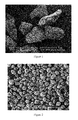
- the SEM image of the irregularly shaped catalyst is shown in Fig. 1 .
- CN101674883 discloses a process for preparing 1, 3-butadiene using a zinc ferrite catalyst, wherein a composition comprising zinc ferrite is used, and it's difficult to achieve an ideal catalytic effect. Furthermore, this catalyst is used in a fixed bed reactor. The temperature at the catalyst bed is increased unduly, and the energy consumption is high. Similarly, the wear problem of the catalyst in the fixed bed reactor can not be solved either.
- US 8003840B2 discloses a process for preparing 1, 3- butadiene using a series of bismuth molybdenate catalysts. This series of catalysts are used in a fixed bed reactor, and the problems of wear resistance and high mobility of the catalysts are not solved. Moreover, the catalyst only has moderate catalytic activity.
- the technical problem to be solved by the present invention is to improve the wear resistance and the mobility of a catalyst in a fluidized bed reactor, so as to reduce the loss of the catalyst and enhance the activity, conversion and selectivity of the catalyst.
- One object of the invention is to provide a method of preparing a catalyst for preparation of butadiene by oxydehydrogenation of butene in a fluidized bed reactor.
- the catalyst prepared by spray drying granulation according to the method provided in this disclosure exhibits higher wear resistance (i.e. mechanical strength) and achieves higher butadiene yield, such that the requirements of a catalyst for synthesizing butadiene in a modern industrial fluidized bed are met.
- Another object of the invention is to provide method of butene oxydehydrogenation reaction using the catalyst prepared according to the method of the invention to prepare 1, 3-butadiene at a high yield.
- the method provided in this disclosure comprises the following steps: (1) reacting a metal precursor with an alkaline substance to obtain aslurry containing insoluble compound, followed by filtering and washing the slurry; (2) adding an appropriate amount of a binder and deionized water, followed by sufficient agitation to regulate the solid content of the slurry to 10-50% (mass percentage); (3) subjecting the slurry obtained in step (2) to spray drying granulation in a spray drying granulation device, wherein the temperature at the feed port is controlled between 200-400°C and the temperature at the discharge port is controlled between 100-160°C to obtain catalyst microspheres; and (4)drying and then calcining the catalyst microspheres to obtain a catalyst having a general formula FeX a Y b Z c O d , wherein X is one or more of Ni, Co, Zn, Cu, Sn, Mn, Y is one or more of Bi, Mo, Cr, V, La, Zr, Z is one or more of Mg, Ca, Sr, Ba,
- the reaction between the metal precursor and the alkaline substance is carried out at 10-90°C, preferably 30-80°C, and the pH for this reaction is 5-11, preferably 6-10.
- the slurry in step (1) is filtered and washed to a pH of 7-7.5.
- the catalyst microspheres are dried in step (4) at 80-200°C, preferably 80-180°C for 1-24h, preferably 4-16h.
- the catalyst microspheres are calcined in step (4) at 500-900°C, preferably 520-820°C for 4-24h, preferably 4-18h.
- the method provided in this disclosure comprises the following steps: (1) reacting a metal precursor with an alkaline substance at 10-90°C and a pH of 5-11 to obtain a slurry containing insoluble compound, followed by filtering and washing the slurry to a pH of 7-7.5; (2) adding an appropriate amount of a binder and deionized water, followed by sufficient agitation to regulate the solid content of the slurry to 10-50%, preferably 20-45% (mass percentage); (3) subjecting the slurry obtained in step (2) to spray drying granulation in a spray drying granulation device, wherein the temperature at the feed port is controlled between 200-400°C, preferably 220-350°C and the temperature at the discharge port is controlled between 100-160°C, preferably 110-150°C, to obtain catalyst microspheres having a preferred particle size of 20-600 ⁇ m; and (4) drying the catalyst microspheres at 80-200°C for 1-24h, and then calcining it at 500-900°C for 4-24h to obtain a
- the metal precursor is selected from a group consisting of nitrates, chlorides, sulfates, hydroxides, oxides, ammonium metallates, and a mixture of two or more of the above substances.
- the alkaline substance is selected from a group consisting of sodium hydroxide, potassium hydroxide, sodium carbonate, sodium dicarbonate, potassium carbonate, potassium dicarbonate, aqueous ammonia, urea, and a mixture of two or more of the above substances.
- the reaction between the metal precursor and the alkaline substance is carried out by adding the metal precursor dropwise to the alkaline substance, or adding the alkaline substance dropwise to the metal precursor, or adding the metal precursor and the alkaline substance dropwise and concurrently, and controlling the final pH to 6-10.
- the metal precursor and the alkaline substance react at 30-80°C.
- the binder is selected from the group consisting of silica gel, alumina gel, methylcellulose, polyvinyl alcohol, sesbania powder, and a mixture of two or more of the above substances; and the binder is added at an amount of 1-5% (mass percentage).
- the solid content of the slurry is 20-45% (mass percentage).
- the spray drying granulation device is a pressure spray drying granulation device, pneumatic spray drying granulation device, or a centrifugal spray drying granulation device.
- the temperature at the feed port is 220-350°C
- the temperature at the discharge port is 110-150°C
- microspheres having a particle size of 20-600 ⁇ m are obtained.
- the drying is carried out at 80-180°C for 4-16h.
- the calculation is carried out at 520-820°C for 4-18h.
- the invention further provides a method of preparing 1,3-butadiene using the catalyst prepared according to the invention, comprising: carrying out a reaction at 300-400°C, ambient pressure in the presence of the catalyst prepared according to the invention to obtain 1,3-butadiene, wherein the molar ratio of water to butene is 6-16, the molar ratio of oxygen to butene is 0.4-1.0, and the volume space velocity of butene is 100-600h -1 .
- the catalyst prepared according to the invention has the following beneficial effects: (1) owing to the selection of a suitable raw material composition and operational conditions in the preparation of the catalyst, the catalyst has good catalytic performances such as catalytic activity, conversion and selectivity; (2) owing to the selection of spray drying granulation as the shaping process and suitable operational conditions, the resulting catalyst has higher wear resistance and mobility than a catalyst prepared using the traditional methods, and meets the requirements of a fluidized bed reactor for industrial production of butadiene by oxydehydrogenation of butene; and (3) an increased yield of butadiene can be achieved by using this catalyst, and this catalyst has a long service lifetime, low wear and high usability.
- a mixed solution A of ferric nitrate, manganese nitrate, zinc nitrate and cobalt nitrate was formulated, wherein the concentrations of Fe 3+ , Mn 2+ , Zn 2+ and Co 2+ ions were 1mol/L, 1mol/L, 1mol/L and 1mol/L respectively.
- a 0.5 mol/L sodium carbonate solution was also formulated. Solution A and the sodium carbonate solution were added cocurrently and dropwise to a reaction kettle under strong agitation, wherein 2000mL solution A was added dropwise to the reaction kettle, the reaction temperature was controlled at 60°C, and the pH was 8-9.
- a slurry containing insoluble compound was obtained, and then the slurry was filtered and washed until the pH reached 7-7.5. After washing, 2% methylcellulose and deionized water were added to the above slurry under full agitation, and the solid content was regulated to 20%.
- the fully agitated slurry was fed to a pressure spray drying granulation device to obtain catalyst microspheres, wherein the temperature at the feed port was controlled at 280°C and that the temperature at the discharge port was controlled at 130°C.
- the microspheres obtained by the spray drying granulation were dried at 120°C for 14h, and then calcined at 700°C for 10h to obtain a finial catalyst product.
- a mixed solution A of ferric chloride, cupric chloride, cobalt nitrate and barium chloride was formulated, wherein the concentrations of Fe 3+ , Cu 2+ , Co 2+ and Ba 2+ ions were 1mol/L, 1mol/L, 1mol/L and 1mol/L respectively.
- a 0.37 mol/L potassium hydroxide solution was also formulated. Firstly, 2000mL solution A was added to a reaction kettle, and then the potassium hydroxide solution was added dropwisely to the reaction kettle under intense agitation. The reaction temperature was controlled at 30°C, and the pH was controlled at 10-11. A slurry containing insoluble compound was obtained, and then the slurry was filtered and washed to a pH of 7-7.5.
- a mixed solution A wherein the concentrations of Fe 3+ , Ni 2+ , Mg 2+ , Ba 2+ and Bi 3+ ions were 1 mol/L, 1mol/L, 0.2 mol/L, 0.3mol/L and 1mol/L, respectively.
- a mixed solution A of ferric nitrate, manganese chloride, tin chloride and calcium chloride was formulated, wherein the concentrations of Fe 3+ , Mn 2+ , Sn 4+ and Ca 2+ ions were 1mol/L, 0.1mol/L, 0.4mol/L and 0.6mol/L, respectively.
- a 18% aqueous ammonia was also formulated.
- Solution A and the aqueous ammonia solution were added concurrently and dropwisely to a reaction kettle under intense agitation, wherein 2000mL solution A was added dropwise to the reaction kettle, the reaction temperature was controlled at 40°C, and the pH was 9-10.
- a slurry containing insoluble compound was obtained, and then the slurry was filtered and washed to a pH of 7-7.5. After washing, 1% sesbania powder, 1% alumina gel and deionized water were added to the above stated slurry under full agitation, and the solid content was regulated to 45%.
- the fully agitated slurry was fed to a centrifugal spray drying granulation device to obtain catalyst microspheres, wherein the temperature at the feed port was controlled at 220°C and that the temperature at the discharge port was controlled at 100°C.
- the microspheres obtained by spray drying granulation were dried at 100°C for 16h, and then calcined at 900°C for 4h to obtain a finial catalyst product.
- a mixed solution A of ferric chloride, zinc nitrate, lanthanum nitrate and barium chloride was formulated, wherein the concentrations of Fe 3+ , Zn 2+ , La 3+ and Ba 2+ ions were 1 mol/L, 0.1mol/L, 0.5mol/L and 0.3mol/L, respectively.
- a 0.4 mol/L potassium carbonate solution was also formulated. Firstly, 2000mL solution A was added to a reaction kettle, and then the potassium carbonate solution was added dropwisely to the reaction kettle under intense agitation. The reaction temperature was controlled at 90°C, and the pH was 8-9. A slurry containing insoluble compound was obtained, and then the slurry was filtered and washed to a pH of 7-7.5.
- 3% methylcellulose and deionized water were added to the above stated slurry under full agitation, and the solid content was regulated to 25%.
- the fully agitated slurry was fed to a centrifugal spray drying granulation device to obtain catalyst microspheres, wherein the temperature at the feed port was controlled at 400°C and that the temperature at the discharge port was controlled at 160°C.
- the microspheres obtained by spray drying granulation were dried at 200°C for 2h, and then calcined at 650°C for 15h to obtain a finial catalyst product.
- a mixed solution A of ferric nitrate, nickel nitrate, zinc chloride and strontium chloride was formulated, wherein the concentrations of Fe 3+ , Ni 2+ , Zn 2+ and Sr 2+ ions were 1 mol/L, 0.8mol/L, 0.7mol/L and 0.8mol/L, respectively.
- a 0.45 mol/L urea solution was also formulated. Firstly, 2000mL solution A was added to a reaction kettle, and then the urea solution was added dropwise to the reaction kettle under intense agitation. The reaction temperature was controlled at 80°C, and the pH was 7-8. A slurry containing insoluble compound was obtained, and then the slurry was filtered and washed to a pH of 7-7.5.
- 1% methylcellulose and deionized water were added to the above stated slurry under full agitation, and the solid content was regulated to 10%.
- the fully agitated slurry was fed to a pressure spray drying granulation device to obtain catalyst microspheres, wherein the temperature at the feed port was controlled at 200°C and temperature at the discharge port was controlled at 150°C.
- the microspheres obtained by spray drying granulation were dried at 150°C for 12h, and then calcined at 500°C for 23h to obtain a finial catalyst product.
- a mixed solution A of ferric chloride, manganese nitrate, zirconium nitrate and ammonium dimolybdate was formulated, wherein the concentrations of Fe 3+ , Mn 2+ , Zr 4+ and Mo 6+ ions were 1 mol/L, 2.2mol/L, 0.5mol/L and 0.3mol/L respectively.
- a 0.6mol/L potassium dicarbonate solution was also formulated. Firstly, 2000mL of the potassium dicarbonate solution was added to a reaction kettle, and then said solution A was added dropwise to the reaction kettle under intense agitation. The reaction temperature was controlled at 10°C, and the pH was 6-7.
- a slurry containing insoluble compound was obtained, and then the slurry was filtered and washed to a pH of 7-7.5. After washing, 2% alumina gel and deionized water were added to the above stated slurry under full agitation, and the solid content was regulated to 30%.
- the fully agitated slurry was fed to a pneumatic spray drying granulation device to obtain catalyst microspheres, wherein the temperature at the feed port was controlled at 230°C and that the temperature at the discharge port was controlled at 110°C.
- the microspheres obtained by spray drying granulation were dried at 160°C for 8h, and then calcined at 600°C for 14h to obtain a finial catalyst product.
- a mixed solution A of ferric chloride, cupric sulfate and chromic chloride was formulated, wherein the concentrations of Fe 3+ , Cu 2+ and Cr 3+ ions were 1 mol/L, 1.2mol/L and 0.6mol/L, respectively.
- a 0.5mol/L sodium hydroxide solution was also formulated. Firstly, 2000mL of the sodium hydroxide solution was added to a reaction kettle, and then the solution A was added dropwise to the reaction kettle under intense agitation. The reaction temperature was controlled at 50°C, and the pH was 7.5-8. A slurry containing insoluble compound was obtained, and then the slurry was filtered and washed to a pH of 7-7.5.
- 2% alumina gel and deionized water were added to the above stated slurry under full agitation, and the solid content was regulated to 40%.
- the fully agitated slurry was fed to a pneumatic spray drying granulation device to obtain catalyst microspheres, wherein the temperature at the feed port was controlled at 260°C and the temperature at the discharge port was controlled at 140°C.
- the microspheres obtained by spray drying granulation were dried at 130°C for 10h, and then calcined at 750°C for 10h to obtain a finial catalyst product.
- a mixed solution A of ferric chloride, zinc chloride and vanadium trichloride was formulated, wherein the concentrations of Fe 3+ , Zn 2+ , V 3+ ions were 1 mol/L, 0.9mol/L and 0.7mol/L, respectively.
- a 0.65mol/L potassium dicarbonate solution was also formulated. Firstly, 2000mL of the potassium dicarbonate solution was added to a reaction kettle, and then solution A was added dropwise to the reaction kettle under intense agitation. The reaction temperature was controlled at 65°C, and pH was 8-8.5. A slurry containing insoluble compound was obtained, and then the slurry was filtered and washed to pH 7-7.5.
- the SEM image of the final spherical catalyst product obtained using the method of the invention is shown in Fig. 2 .
- the catalyst prepared according to the inventive method has a spherical shape, good mobility and high wear resistance.
- the catalyst of the present application is apparently distinguishable from the catalyst of the prior art which has irregular shape.
- the catalysts prepared in Examples 1-9 were compressed into tablet and pulverized, and then particles with a particle size of 20-40 mesh were sieved out and loaded in a 10mL fixed bed reactor, wherein the volume space velocity of butene was 400 h -1 , the molar ratio of oxygen to butene was 0.67, the molar ratio of water to butene was 12, the reaction temperature was 340°C, and the reaction was conducted at ambient pressure. The reaction lasted for 6h, and the contents contained in the reaction system were sampled every 2h, and the average of the measurement results was taken as the final result. Gas chromatography was used to determine the products.
- the catalysts obtained according to the invention affords butadiene with yield and selectivity improved to a certain degree. Particularly, the yield of butadiene is enhanced significantly.
Landscapes
- Chemical & Material Sciences (AREA)
- Organic Chemistry (AREA)
- Engineering & Computer Science (AREA)
- Materials Engineering (AREA)
- Chemical Kinetics & Catalysis (AREA)
- Physics & Mathematics (AREA)
- Thermal Sciences (AREA)
- Catalysts (AREA)
- Organic Low-Molecular-Weight Compounds And Preparation Thereof (AREA)
- Low-Molecular Organic Synthesis Reactions Using Catalysts (AREA)
Abstract
Description
- The invention pertains to the technical field of catalysis, and relates to a catalyst for preparation of butadiene by oxydehydrogenation of butene in a fluidized bed reactor, a method of preparing the same, and use of the same.
- The rapid development of the rubber and resin industry leads to an evergrowing demand for butadiene in the market. Notwithstanding 1,3-butadiene obtained from naphtha cracking process accounts for 90% of the total production of butadiene, the shortage of the butadiene required has to be covered by oxydehydrogenation of butene due to the domestic limitation of the naphtha output and the cracking units.
- Synthesis of butadiene in an industrial scale may be conducted by dehydrogenation or oxydehydrogenation of butene at present. Direct dehydrogenation of butene is a strong endothermic reaction requiring high temperature and low pressure conditions, which suffers from low yield and difficulty in commercialization. In contrast, oxydehydrogenation of butene produces butadiene and water. It is a strong exothermic reaction, and thus the reaction temperature may be decreased appropriately.
C4H8 → C4H6 + H2 ΔH 298 K, 1 MPa = 113.6 kJ.mol-1
C4H8+1/2 O2 → C4H6 + H2O - ΔH 298 K, 1 MPa = 127.9 kJ.mol-1
- Industrial production of butadiene is carried out by passing a mixed C4 feedstock, steam and air through a fixed or fluidized bed in the presence of a catalyst to produce butadiene. Since the oxydehydrogenation of butene is a strong exothermic reaction, while removal of heat from a fixed bed reactor is difficult, excessive increase of temperature in the catalyst bed is resulted, which is undesirable for temperature control. For a traditional fixed bed reactor used for oxydehydrogenation of butene, a temperature difference of 150-250°C exists between the feed port and the discharge port, and two reactors, one in preparation and the other in operation, are needed.
- In a fluidized bed reactor, the heat produced by oxydehydrogenation of butene can be removed easily, and operation at constant temperature may be realized. Consequently, the catalyst life can be extended, and the catalyst usability can be improved. Moreover, owing to its relatively simple structure, a fluidized bed reactor is easy to manufacture and process, facilitating its industrial scale-up. However, an industrial fixed bed catalyst for oxydehydrogenation of butene cannot be applied to a fluidized reactor for reasons of shape, mechanical strength, wear resistance, etc. It is critically important to synthesize a catalyst which not only is suitable for oxydehydrogenation of butene in a fluidized bed, but also has good wear resistance, high activity, long-term stability in operation, etc.
-
CN 1184705A andCN1072110A disclose an iron-based catalyst for the preparation of butadiene by oxydehydrogenation of butene. Although this catalyst shows some activity and/or selectivity when used in a baffled fluidized bed, the yield of butadiene is rather low, and severe loss of the catalyst is witnessed, because the catalyst has irregular shape and large particle size. The SEM image of the irregularly shaped catalyst is shown inFig. 1 . -
CN101674883 discloses a process for preparing 1, 3-butadiene using a zinc ferrite catalyst, wherein a composition comprising zinc ferrite is used, and it's difficult to achieve an ideal catalytic effect. Furthermore, this catalyst is used in a fixed bed reactor. The temperature at the catalyst bed is increased unduly, and the energy consumption is high. Similarly, the wear problem of the catalyst in the fixed bed reactor can not be solved either. -
US 8003840B2 discloses a process for preparing 1, 3- butadiene using a series of bismuth molybdenate catalysts. This series of catalysts are used in a fixed bed reactor, and the problems of wear resistance and high mobility of the catalysts are not solved. Moreover, the catalyst only has moderate catalytic activity. - The technical problem to be solved by the present invention is to improve the wear resistance and the mobility of a catalyst in a fluidized bed reactor, so as to reduce the loss of the catalyst and enhance the activity, conversion and selectivity of the catalyst.
- One object of the invention is to provide a method of preparing a catalyst for preparation of butadiene by oxydehydrogenation of butene in a fluidized bed reactor. As compared with a catalyst prepared using a traditional method, the catalyst prepared by spray drying granulation according to the method provided in this disclosure exhibits higher wear resistance (i.e. mechanical strength) and achieves higher butadiene yield, such that the requirements of a catalyst for synthesizing butadiene in a modern industrial fluidized bed are met. Another object of the invention is to provide method of butene oxydehydrogenation reaction using the catalyst prepared according to the method of the invention to prepare 1, 3-butadiene at a high yield.
- The invention is fulfilled by the following technical solution:
- The method provided in this disclosure comprises the following steps: (1) reacting a metal precursor with an alkaline substance to obtain aslurry containing insoluble compound, followed by filtering and washing the slurry; (2) adding an appropriate amount of a binder and deionized water, followed by sufficient agitation to regulate the solid content of the slurry to 10-50% (mass percentage); (3) subjecting the slurry obtained in step (2) to spray drying granulation in a spray drying granulation device, wherein the temperature at the feed port is controlled between 200-400°C and the temperature at the discharge port is controlled between 100-160°C to obtain catalyst microspheres; and (4)drying and then calcining the catalyst microspheres to obtain a catalyst having a general formula FeXaYbZcOd, wherein X is one or more of Ni, Co, Zn, Cu, Sn, Mn, Y is one or more of Bi, Mo, Cr, V, La, Zr, Z is one or more of Mg, Ca, Sr, Ba, a is 0.1-3, b is 0-1, c is 0-1, and the value of d depends on the valence requirement of the other metal elements.
- In a preferred embodiment, the reaction between the metal precursor and the alkaline substance is carried out at 10-90°C, preferably 30-80°C, and the pH for this reaction is 5-11, preferably 6-10.
- In another preferred embodiment, the slurry in step (1) is filtered and washed to a pH of 7-7.5.
- In another preferred embodiment, the catalyst microspheres are dried in step (4) at 80-200°C, preferably 80-180°C for 1-24h, preferably 4-16h.
- In another preferred embodiment, the catalyst microspheres are calcined in step (4) at 500-900°C, preferably 520-820°C for 4-24h, preferably 4-18h.
- Preferably, the method provided in this disclosure comprises the following steps: (1) reacting a metal precursor with an alkaline substance at 10-90°C and a pH of 5-11 to obtain a slurry containing insoluble compound, followed by filtering and washing the slurry to a pH of 7-7.5; (2) adding an appropriate amount of a binder and deionized water, followed by sufficient agitation to regulate the solid content of the slurry to 10-50%, preferably 20-45% (mass percentage); (3) subjecting the slurry obtained in step (2) to spray drying granulation in a spray drying granulation device, wherein the temperature at the feed port is controlled between 200-400°C, preferably 220-350°C and the temperature at the discharge port is controlled between 100-160°C, preferably 110-150°C, to obtain catalyst microspheres having a preferred particle size of 20-600µm; and (4) drying the catalyst microspheres at 80-200°C for 1-24h, and then calcining it at 500-900°C for 4-24h to obtain a catalyst having a general formula FeXaYbZcOd, wherein X is one or more of Ni, Co, Zn, Cu, Sn, Mn, Y is one or more of Bi, Mo, Cr, V, La, Zr, Z is one or more of Mg, Ca, Sr, Ba, a is 0.1-3, b is 0-1, c is 0-1, and the value of d depends on the valence requirement of the other metal elements.
- In a preferred embodiment of the inventive method, the metal precursor is selected from a group consisting of nitrates, chlorides, sulfates, hydroxides, oxides, ammonium metallates, and a mixture of two or more of the above substances.
- In a preferred embodiment of the inventive method, the alkaline substance is selected from a group consisting of sodium hydroxide, potassium hydroxide, sodium carbonate, sodium dicarbonate, potassium carbonate, potassium dicarbonate, aqueous ammonia, urea, and a mixture of two or more of the above substances.
- In a preferred embodiment of the inventive method, the reaction between the metal precursor and the alkaline substance is carried out by adding the metal precursor dropwise to the alkaline substance, or adding the alkaline substance dropwise to the metal precursor, or adding the metal precursor and the alkaline substance dropwise and concurrently, and controlling the final pH to 6-10.
- In a preferred embodiment of the inventive method, the metal precursor and the alkaline substance react at 30-80°C.
- In a preferred embodiment of the inventive method, the binder is selected from the group consisting of silica gel, alumina gel, methylcellulose, polyvinyl alcohol, sesbania powder, and a mixture of two or more of the above substances; and the binder is added at an amount of 1-5% (mass percentage).
- In a preferred embodiment of the inventive method, the solid content of the slurry is 20-45% (mass percentage).
- In a preferred embodiment of the inventive method, the spray drying granulation device is a pressure spray drying granulation device, pneumatic spray drying granulation device, or a centrifugal spray drying granulation device.
- In a preferred embodiment of the inventive method, the temperature at the feed port is 220-350°C, the temperature at the discharge port is 110-150°C, and microspheres having a particle size of 20-600µm are obtained.
- In a preferred embodiment of the inventive method, the drying is carried out at 80-180°C for 4-16h.
- In a preferred embodiment of the inventive method, the calculation is carried out at 520-820°C for 4-18h.
- The invention further provides a method of preparing 1,3-butadiene using the catalyst prepared according to the invention, comprising: carrying out a reaction at 300-400°C, ambient pressure in the presence of the catalyst prepared according to the invention to obtain 1,3-butadiene, wherein the molar ratio of water to butene is 6-16, the molar ratio of oxygen to butene is 0.4-1.0, and the volume space velocity of butene is 100-600h-1.
- The catalyst prepared according to the invention has the following beneficial effects: (1) owing to the selection of a suitable raw material composition and operational conditions in the preparation of the catalyst, the catalyst has good catalytic performances such as catalytic activity, conversion and selectivity; (2) owing to the selection of spray drying granulation as the shaping process and suitable operational conditions, the resulting catalyst has higher wear resistance and mobility than a catalyst prepared using the traditional methods, and meets the requirements of a fluidized bed reactor for industrial production of butadiene by oxydehydrogenation of butene; and (3) an increased yield of butadiene can be achieved by using this catalyst, and this catalyst has a long service lifetime, low wear and high usability.
-
-
Fig. 1 shows a SEM image of an irregularly shaped catalyst according to the prior art. -
Fig. 2 shows a SEM image of a spherical catalyst prepared according to the method of the invention. - The features of the invention will be illustrated in detail with reference to the following examples.
- A mixed solution A of ferric nitrate, manganese nitrate, zinc nitrate and cobalt nitrate was formulated, wherein the concentrations of Fe3+, Mn2+, Zn2+ and Co2+ ions were 1mol/L, 1mol/L, 1mol/L and 1mol/L respectively. A 0.5 mol/L sodium carbonate solution was also formulated. Solution A and the sodium carbonate solution were added cocurrently and dropwise to a reaction kettle under strong agitation, wherein 2000mL solution A was added dropwise to the reaction kettle, the reaction temperature was controlled at 60°C, and the pH was 8-9. A slurry containing insoluble compound was obtained, and then the slurry was filtered and washed until the pH reached 7-7.5. After washing, 2% methylcellulose and deionized water were added to the above slurry under full agitation, and the solid content was regulated to 20%. The fully agitated slurry was fed to a pressure spray drying granulation device to obtain catalyst microspheres, wherein the temperature at the feed port was controlled at 280°C and that the temperature at the discharge port was controlled at 130°C. The microspheres obtained by the spray drying granulation were dried at 120°C for 14h, and then calcined at 700°C for 10h to obtain a finial catalyst product.
- A mixed solution A of ferric chloride, cupric chloride, cobalt nitrate and barium chloride was formulated, wherein the concentrations of Fe3+, Cu2+, Co2+ and Ba2+ ions were 1mol/L, 1mol/L, 1mol/L and 1mol/L respectively. A 0.37 mol/L potassium hydroxide solution was also formulated. Firstly, 2000mL solution A was added to a reaction kettle, and then the potassium hydroxide solution was added dropwisely to the reaction kettle under intense agitation. The reaction temperature was controlled at 30°C, and the pH was controlled at 10-11. A slurry containing insoluble compound was obtained, and then the slurry was filtered and washed to a pH of 7-7.5. After washing, 1.8% polyvinyl alcohol having a molecule weight of 6000 and deionized water were added to the above slurry under full agitation, and the solid content was regulated to 35%. The fully agitated slurry was fed to a pneumatic spray drying granulation device to obtain catalyst microspheres, wherein the temperature at the feed port was controlled at 300°C and that the temperature at the discharge port was controlled at 140°C. The microspheres obtained by spray drying granulation were dried at 80°C for 23h, and then calcined at 800°C for 9h to obtain a finial catalyst product.
- 560mL of 65% concentrated nitric acid was diluted to 2000mL by adding distilled water therein, and then iron chips and nickel powder were added slowly. After the iron chips and nickel powder were dissolved completely, magnesia, barium hydroxide and bismuth chloride were added under intense agitation to obtain a mixed solution A, wherein the concentrations of Fe3+, Ni2+, Mg2+, Ba2+ and Bi3+ ions were 1 mol/L, 1mol/L, 0.2 mol/L, 0.3mol/L and 1mol/L, respectively. A mixed solution B of 0.25 mol/L sodium dicarbonate and 0.25 mol/L sodium hydroxide was also formulated. Firstly, 2000mL solution B was added to a reaction kettle, and then said solution A was added dropwisely to the reaction kettle under intense agitation. The reaction temperature was controlled at 50°C, and the pH was 5-6. A slurry containing insoluble compound was obtained, and then the slurry was filtered and washed to a pH of 7-7.5. After washing, 5% silica gel and deionized water were added to the above stated slurry under full agitation, and the solid content was regulated to 50%. The fully agitated slurry was fed to a pneumatic spray drying granulation device to obtain catalyst microspheres, wherein the temperature at the feed port was controlled at 350°C and that the temperature at the discharge port was controlled at 120°C. The microspheres obtained by spray drying granulation were dried at 180°C for 6h, and then calcined at 520°C for 18h to obtain a finial catalyst product.
- A mixed solution A of ferric nitrate, manganese chloride, tin chloride and calcium chloride was formulated, wherein the concentrations of Fe3+, Mn2+, Sn4+ and Ca2+ ions were 1mol/L, 0.1mol/L, 0.4mol/L and 0.6mol/L, respectively. A 18% aqueous ammonia was also formulated. Solution A and the aqueous ammonia solution were added concurrently and dropwisely to a reaction kettle under intense agitation, wherein 2000mL solution A was added dropwise to the reaction kettle, the reaction temperature was controlled at 40°C, and the pH was 9-10. A slurry containing insoluble compound was obtained, and then the slurry was filtered and washed to a pH of 7-7.5. After washing, 1% sesbania powder, 1% alumina gel and deionized water were added to the above stated slurry under full agitation, and the solid content was regulated to 45%. The fully agitated slurry was fed to a centrifugal spray drying granulation device to obtain catalyst microspheres, wherein the temperature at the feed port was controlled at 220°C and that the temperature at the discharge port was controlled at 100°C. The microspheres obtained by spray drying granulation were dried at 100°C for 16h, and then calcined at 900°C for 4h to obtain a finial catalyst product.
- A mixed solution A of ferric chloride, zinc nitrate, lanthanum nitrate and barium chloride was formulated, wherein the concentrations of Fe3+, Zn2+, La3+ and Ba2+ ions were 1 mol/L, 0.1mol/L, 0.5mol/L and 0.3mol/L, respectively. A 0.4 mol/L potassium carbonate solution was also formulated. Firstly, 2000mL solution A was added to a reaction kettle, and then the potassium carbonate solution was added dropwisely to the reaction kettle under intense agitation. The reaction temperature was controlled at 90°C, and the pH was 8-9. A slurry containing insoluble compound was obtained, and then the slurry was filtered and washed to a pH of 7-7.5. After washing, 3% methylcellulose and deionized water were added to the above stated slurry under full agitation, and the solid content was regulated to 25%. The fully agitated slurry was fed to a centrifugal spray drying granulation device to obtain catalyst microspheres, wherein the temperature at the feed port was controlled at 400°C and that the temperature at the discharge port was controlled at 160°C. The microspheres obtained by spray drying granulation were dried at 200°C for 2h, and then calcined at 650°C for 15h to obtain a finial catalyst product.
- A mixed solution A of ferric nitrate, nickel nitrate, zinc chloride and strontium chloride was formulated, wherein the concentrations of Fe3+, Ni2+, Zn2+ and Sr2+ ions were 1 mol/L, 0.8mol/L, 0.7mol/L and 0.8mol/L, respectively. A 0.45 mol/L urea solution was also formulated. Firstly, 2000mL solution A was added to a reaction kettle, and then the urea solution was added dropwise to the reaction kettle under intense agitation. The reaction temperature was controlled at 80°C, and the pH was 7-8. A slurry containing insoluble compound was obtained, and then the slurry was filtered and washed to a pH of 7-7.5. After washing, 1% methylcellulose and deionized water were added to the above stated slurry under full agitation, and the solid content was regulated to 10%. The fully agitated slurry was fed to a pressure spray drying granulation device to obtain catalyst microspheres, wherein the temperature at the feed port was controlled at 200°C and temperature at the discharge port was controlled at 150°C. The microspheres obtained by spray drying granulation were dried at 150°C for 12h, and then calcined at 500°C for 23h to obtain a finial catalyst product.
- A mixed solution A of ferric chloride, manganese nitrate, zirconium nitrate and ammonium dimolybdate was formulated, wherein the concentrations of Fe3+, Mn2+, Zr4+ and Mo6+ ions were 1 mol/L, 2.2mol/L, 0.5mol/L and 0.3mol/L respectively. A 0.6mol/L potassium dicarbonate solution was also formulated. Firstly, 2000mL of the potassium dicarbonate solution was added to a reaction kettle, and then said solution A was added dropwise to the reaction kettle under intense agitation. The reaction temperature was controlled at 10°C, and the pH was 6-7. A slurry containing insoluble compound was obtained, and then the slurry was filtered and washed to a pH of 7-7.5. After washing, 2% alumina gel and deionized water were added to the above stated slurry under full agitation, and the solid content was regulated to 30%. The fully agitated slurry was fed to a pneumatic spray drying granulation device to obtain catalyst microspheres, wherein the temperature at the feed port was controlled at 230°C and that the temperature at the discharge port was controlled at 110°C. The microspheres obtained by spray drying granulation were dried at 160°C for 8h, and then calcined at 600°C for 14h to obtain a finial catalyst product.
- A mixed solution A of ferric chloride, cupric sulfate and chromic chloride was formulated, wherein the concentrations of Fe3+, Cu2+ and Cr3+ ions were 1 mol/L, 1.2mol/L and 0.6mol/L, respectively. A 0.5mol/L sodium hydroxide solution was also formulated. Firstly, 2000mL of the sodium hydroxide solution was added to a reaction kettle, and then the solution A was added dropwise to the reaction kettle under intense agitation. The reaction temperature was controlled at 50°C, and the pH was 7.5-8. A slurry containing insoluble compound was obtained, and then the slurry was filtered and washed to a pH of 7-7.5. After washing, 2% alumina gel and deionized water were added to the above stated slurry under full agitation, and the solid content was regulated to 40%. The fully agitated slurry was fed to a pneumatic spray drying granulation device to obtain catalyst microspheres, wherein the temperature at the feed port was controlled at 260°C and the temperature at the discharge port was controlled at 140°C. The microspheres obtained by spray drying granulation were dried at 130°C for 10h, and then calcined at 750°C for 10h to obtain a finial catalyst product.
- A mixed solution A of ferric chloride, zinc chloride and vanadium trichloride was formulated, wherein the concentrations of Fe3+, Zn2+, V3+ ions were 1 mol/L, 0.9mol/L and 0.7mol/L, respectively. A 0.65mol/L potassium dicarbonate solution was also formulated. Firstly, 2000mL of the potassium dicarbonate solution was added to a reaction kettle, and then solution A was added dropwise to the reaction kettle under intense agitation. The reaction temperature was controlled at 65°C, and pH was 8-8.5. A slurry containing insoluble compound was obtained, and then the slurry was filtered and washed to pH 7-7.5. After washing, 2.2% sesbania powder and deionized water were added to the above stated slurry under full agitation, and the solid content was regulated to 36%. The fully agitated slurry was fed to a centrifugal spray drying granulation device to obtain catalyst microspheres, wherein the temperature at the feed port was controlled at 320°C and the temperature at the discharge port was controlled at 120°C. The microspheres obtained by spray drying granulation were dried at 190°C for 5h, and then calcined at 820°C for 8h to obtain a finial catalyst product.
- The SEM image of the final spherical catalyst product obtained using the method of the invention is shown in
Fig. 2 . As indicated by comparison betweenFig. 1 and Fig. 2 , the catalyst prepared according to the inventive method has a spherical shape, good mobility and high wear resistance. The catalyst of the present application is apparently distinguishable from the catalyst of the prior art which has irregular shape. - The catalysts prepared in Examples 1-9 were compressed into tablet and pulverized, and then particles with a particle size of 20-40 mesh were sieved out and loaded in a 10mL fixed bed reactor, wherein the volume space velocity of butene was 400 h-1, the molar ratio of oxygen to butene was 0.67, the molar ratio of water to butene was 12, the reaction temperature was 340°C, and the reaction was conducted at ambient pressure. The reaction lasted for 6h, and the contents contained in the reaction system were sampled every 2h, and the average of the measurement results was taken as the final result. Gas chromatography was used to determine the products. At the same time, comparative tests were conducted under the same conditions using catalyst I and catalyst II which were commercially available and generally used for preparation of butadiene by oxydehydrogenation of butene, and the test results were shown in Table 1 below.
Table 1 Test results of the catalysts Butadiene Yield (%) Butadiene Selectivity (%) Example 1 83.9 94.7 Example 2 85.2 94.2 Example 3 83.1 95.2 Example 4 80.2 96.5 Example 5 78.4 95.4 Example 6 84.2 94.5 Example 7 84.6 95.8 Example 8 81.9 94.9 Example 9 82.3 96.7 Catalyst □ 75.5 94.4 Catalyst □ 76.2 93.8 - As indicated by Table 1, as compared with the catalysts of the prior art, the catalysts obtained according to the invention affords butadiene with yield and selectivity improved to a certain degree. Particularly, the yield of butadiene is enhanced significantly.
Claims (12)
- A method of preparing a catalyst for preparation of butadiene by oxydehydrogenation of butene in a fluidized bed reactor, comprising the following steps: (1) reacting a metal precursor with an alkaline substance to obtain a slurry containing insoluble compound, followed by filtering and washing the slurry; (2) adding an appropriate amount of a binder and deionized water, followed by sufficient agitation to regulate the solid content of the slurry to 10-50%, preferably 20-45%, wherein the percentage is calculated by mass; (3) subjecting the slurry obtained in step (2) to spray drying granulation in a spray drying granulation device, wherein the temperature at the feed port is controlled between 200-400°C, preferably 220-350°C, and the temperature at the discharge port is controlled between 100-160°C, preferably 110-150°C to obtain catalyst microspheres having a preferred particle size of 20-600µm; and (4)drying and calcining the catalyst microspheres to obtain a catalyst having a general formula of FeXaYbZcOd, wherein X is one or more of Ni, Co, Zn, Cu, Sn, Mn, Y is one or more of Bi, Mo, Cr, V, La, Zr, Z is one or more of Mg, Ca, Sr, Ba, a is 0.1-3, b is 0-1, c is 0-1, and the value of d depends on the valence requirement of the other metal elements.
- The method of preparing a catalyst for preparation of butadiene by oxydehydrogenation of butene in a fluidized bed reactor according to claim 1, wherein the reaction between the metal precursor and the alkaline substance is carried out at a temperature of 10-90°C, preferably 30-80°C, and a pH of 5-11.
- The method of preparing a catalyst for preparation of butadiene by oxydehydrogenation of butene in a fluidized bed reactor according to claim 1, wherein the slurry in step (1) is filtered and washed to a pH of 7-7.5.
- The method of preparing a catalyst for preparation of butadiene by oxydehydrogenation of butene in a fluidized bed reactor according to claim 1, wherein the catalyst microspheres are dried in step (4) at a temperature of 80-200°C, preferably 80-180°C for 1-24h, preferably 4-16h.
- The method of preparing a catalyst for preparation of butadiene by oxydehydrogenation of butene in a fluidized bed reactor according to claim 1, wherein the catalyst microspheres are calcined in step (4) at a temperature of 500-900°C, preferably 520-820°C for 4-24h, preferably 4-18h.
- A method of preparing a catalyst for preparation of butadiene by oxydehydrogenation of butene in a fluidized bed reactor, comprising the following steps: (1) reacting a metal precursor with an alkaline substance at a temperature of 10-90°C, preferably 30-80°C, and a pH of 5-11 to obtain a slurry containing insoluble compound, followed by filtering and washing the slurry to a pH of 7-7.5; (2) adding an appropriate amount of a binder and deionized water, followed by sufficient agitation to regulate the solid content of the slurry to 10-50%, preferably 20-45%, wherein the percentage is calculated by mass; (3) subjecting the slurry obtained in step (2) to spray drying granulation in a spray drying granulation device, wherein the temperature at the feed port is controlled between 200-400°C, preferably 220-350°C, and the temperature at the discharge port is controlled between 100-160°C, preferably 110-150°C to obtain catalyst microspheres having a preferred particle size of 20-600µm; and (4) drying the catalyst microspheres at a temperature of 80-200°C, preferably 80-180°C for 1-24h, preferably 4-16h, and then calcining the catalyst microspheres at a temperature of 500-900°C, preferably 520-820°C for 4-24h, preferably 4-18h to obtain a catalyst having a general formula of FeXaYbZcOd, wherein X is one or more of Ni, Co, Zn, Cu, Sn, Mn, Y is one or more of Bi, Mo, Cr, V, La, Zr, Z is one or more of Mg, Ca, Sr, Ba, a is 0.1-3, b is 0-1, c is 0-1, and the value of d depends on the valence requirement of the other metal elements.
- The method of preparing a catalyst for preparation of butadiene by oxydehydrogenation of butene in a fluidized bed reactor according to claim 1 or 6, wherein the metal precursor is selected from a group consisting of nitrates, chlorides, sulfates, hydroxides, oxides, ammonium metallates, and , and a mixture of two or more of the above substances.
- The method of preparing a catalyst for preparation of butadiene by oxydehydrogenation of butene in a fluidized bed reactor according to claim 1 or 6, wherein the alkaline substance is selected from a group consisting of sodium hydroxide, potassium hydroxide, sodium carbonate, sodium dicarbonate, potassium carbonate, potassium dicarbonate, ammonia, urea, and a mixture of two or more of the above substances.
- The method of preparing a catalyst for preparation of butadiene by oxydehydrogenation of butene in a fluidized bed reactor according to claim 1 or 6, wherein the reaction between the metal precursor and the alkaline substance is carried out by adding the metal precursor dropwise to the alkaline substance, or adding the alkaline substance dropwise to the metal precursor, or adding the metal precursor and the alkaline substance dropwise and concurrently, and controlling the final pH to 6-10.
- The method of preparing a catalyst for preparation of butadiene by oxydehydrogenation of butene in a fluidized bed reactor according to claim 1 or 6, wherein the binder selected from a group consisting of silica gel, alumina gel, methylcellulose, polyvinyl alcohol, sesbania powder, and a mixture of two or more of the above substances, and is added at an amount of 1-5% by mass.
- A catalyst prepared according to the method of claim 1 or 6 for preparation of butadiene by oxydehydrogenation of butene in a fluidized bed reactor, wherein the catalyst has a general formula of FeXaYbZcOd, wherein X is one or more of Ni, Co, Zn, Cu, Sn, Mn, Y is one or more of Bi, Mo, Cr, V, La, Zr, Z is one or more of Mg, Ca, Sr, Ba, a is 0.1-3, b is 0-1, c is 0-1, and the value of d depends on the valence requirement of the other metal elements.
- A method of preparing 1, 3-butadiene using the catalyst of claim 11, wherein a reaction is carried out at a temperature of 300-400°C and the ambient pressure in the presence of the catalyst of claim 11 to obtain 1,3-butadiene, wherein the molar ratio of water to butene is 6-16, the molar ratio of oxygen to butene is 0.4-1.0, and the volume space velocity of butene is 100-600h-1.
Applications Claiming Priority (2)
| Application Number | Priority Date | Filing Date | Title |
|---|---|---|---|
| CN201210241468.0A CN102716754B (en) | 2012-07-12 | 2012-07-12 | Catalyst for preparing butadiene by oxidative dehydrogenation of butene in fluidized bed reactor and preparation method and application thereof |
| PCT/CN2013/079212 WO2014008865A1 (en) | 2012-07-12 | 2013-07-11 | Butadiene catalyst for fluidized bed reactor prepared by oxidizing and dehydrogenating butylene, and preparation method and use thereof |
Publications (2)
| Publication Number | Publication Date |
|---|---|
| EP2873458A1 true EP2873458A1 (en) | 2015-05-20 |
| EP2873458A4 EP2873458A4 (en) | 2015-11-04 |
Family
ID=46942699
Family Applications (1)
| Application Number | Title | Priority Date | Filing Date |
|---|---|---|---|
| EP13816830.7A Withdrawn EP2873458A4 (en) | 2012-07-12 | 2013-07-11 | BUTADIENE CATALYST FOR FLUIDIZED BED REACTOR PREPARED BY OXIDATION AND DEHYDROGENATION OF BUTYLENE, PREPARATION METHOD AND USE THEREOF |
Country Status (7)
| Country | Link |
|---|---|
| US (1) | US9764317B2 (en) |
| EP (1) | EP2873458A4 (en) |
| JP (1) | JP6304830B2 (en) |
| KR (1) | KR20150036205A (en) |
| CN (1) | CN102716754B (en) |
| SG (1) | SG11201408728UA (en) |
| WO (1) | WO2014008865A1 (en) |
Cited By (2)
| Publication number | Priority date | Publication date | Assignee | Title |
|---|---|---|---|---|
| EP2817096A4 (en) * | 2012-02-20 | 2016-01-20 | Saudi Basic Ind Corp | Oxidative dehydrogenation of olefins catalyst and methods of making and using the same |
| WO2017122103A1 (en) | 2016-01-11 | 2017-07-20 | Sabic Global Technologies B.V. | Methods for the oxidative dehydrogenation of butene to produce butadiene |
Families Citing this family (21)
| Publication number | Priority date | Publication date | Assignee | Title |
|---|---|---|---|---|
| CN102716754B (en) * | 2012-07-12 | 2014-06-18 | 上海碧科清洁能源技术有限公司 | Catalyst for preparing butadiene by oxidative dehydrogenation of butene in fluidized bed reactor and preparation method and application thereof |
| EA201591089A1 (en) * | 2012-12-06 | 2016-01-29 | Басф Се | CATALYST AND METHOD OF OXIDATIVE DEHYDROGENATION OF N-BUTENES IN BUTADIENE |
| CN104117373B (en) * | 2013-04-27 | 2016-06-01 | 上海碧科清洁能源技术有限公司 | Mixed metal oxide catalyst of P Modification and its preparation method and application |
| CN104117364B (en) * | 2013-04-27 | 2016-05-11 | 上海碧科清洁能源技术有限公司 | A kind of mixed metal oxide catalyst and its preparation method and application |
| CN103483130B (en) * | 2013-09-23 | 2015-05-20 | 浙江大学 | Method for synthesizing 1,3-butadiene by adopting Bi/Mo/La/Fe four-component composite oxide catalyst |
| CN103736489B (en) * | 2013-12-24 | 2015-10-28 | 天津众智科技有限公司 | The preparation method of preparing butadiene with butylene oxo-dehydrogenation fluid catalyst |
| CN105562007B (en) * | 2014-10-13 | 2019-04-26 | 上海碧科清洁能源技术有限公司 | A kind of ferrous metals oxide catalyst and its preparation method and application |
| CN105618064B (en) * | 2014-11-26 | 2018-09-04 | 中国石油天然气股份有限公司 | Preparation method of butene oxidative dehydrogenation catalyst |
| CN105749930B (en) * | 2014-12-15 | 2018-11-16 | 中国石油天然气股份有限公司 | Catalyst for oxidative dehydrogenation of butene to butadiene and preparation method thereof |
| CN106881099B (en) * | 2015-12-16 | 2020-02-18 | 上海华谊新材料有限公司 | Catalyst for preparing butadiene by oxidative dehydrogenation of butylene, preparation method and application thereof |
| CN106944051B (en) * | 2016-01-07 | 2019-06-11 | 中国石油化工股份有限公司 | A kind of hydrogenation catalyst predecessor, hydrogenation catalyst and preparation method thereof |
| CN106964335A (en) * | 2016-01-13 | 2017-07-21 | 中国科学院大连化学物理研究所 | A kind of support type Mo-VMgO catalyst, its preparation method and application |
| KR101902108B1 (en) * | 2016-03-30 | 2018-09-28 | 주식회사 엘지화학 | Ferrite catalysts, method of preparing the same and method of preparing butadiene using the same |
| CN107970945A (en) * | 2016-10-21 | 2018-05-01 | 中国石油化工股份有限公司 | Catalyst and its process for Oxidative Dehydrogenation of Butene into Butadiene |
| CN108014833B (en) * | 2016-11-04 | 2021-05-28 | 中国石油化工股份有限公司 | Catalyst for preparing butadiene by oxidative dehydrogenation of butylene |
| CN108014831B (en) * | 2016-11-04 | 2021-05-28 | 中国石油化工股份有限公司 | Catalyst for preparing butadiene by oxidative dehydrogenation of butylene |
| CN106807453A (en) * | 2017-01-23 | 2017-06-09 | 山东三维石化工程股份有限公司 | The method of preparing butadiene with butylene oxo-dehydrogenation catalyst |
| KR102353147B1 (en) | 2018-03-13 | 2022-01-18 | 주식회사 엘지화학 | Method for preparing ferrite-based coating catalysts and method for butadiene using the same |
| CN112569951B (en) * | 2019-09-30 | 2023-03-03 | 中国石油化工股份有限公司 | Dehydrogenation catalyst and preparation method and application thereof |
| CN114425364B (en) * | 2020-10-15 | 2024-03-29 | 中国石油化工股份有限公司 | Catalyst for preparing butadiene by oxidative dehydrogenation of butene, preparation method and application |
| CN114632523B (en) * | 2022-04-25 | 2023-08-25 | 西南化工研究设计院有限公司 | Catalyst for preparing olefin by dehydrogenation of alkane chemical chains and preparation method thereof |
Family Cites Families (30)
| Publication number | Priority date | Publication date | Assignee | Title |
|---|---|---|---|---|
| US3414631A (en) * | 1965-06-10 | 1968-12-03 | Standard Oil Co | Oxydehydrogenation process |
| US3595810A (en) * | 1969-06-24 | 1971-07-27 | Gulf Research & Chemical Co | Zinc chromium ferrite catalyst |
| US3716496A (en) * | 1969-09-06 | 1973-02-13 | Nitto Chemical Industry Co Ltd | Catalyst composition for the oxidation and the oxidative dehydrogenation of olefins |
| US3843745A (en) * | 1970-02-13 | 1974-10-22 | Petro Tex Chem Corp | Oxidative dehydrogenation process catalyzed by magnesium ferrite |
| US3644549A (en) * | 1970-09-09 | 1972-02-22 | Gulf Research Development Co | Dehydrogenation of ethylbenzene to styrene using so2 and ferrite catalysis in the form of spinels or perovskites |
| US3911039A (en) * | 1974-01-23 | 1975-10-07 | Standard Oil Co Ohio | Process for the preparation of botadiene from N-butene |
| FR2411169A1 (en) * | 1977-12-12 | 1979-07-06 | Shell France | DEHYDROGENATION PROCESS WITHOUT OXIDATION AND CATALYTIC COMPOSITION FOR IMPLEMENTING THIS PROCESS |
| JPS5916817B2 (en) * | 1979-04-18 | 1984-04-18 | 宇部興産株式会社 | Catalyst for acrylonitrile production |
| CN1013247B (en) * | 1986-11-27 | 1991-07-24 | 中国科学院兰州化学物理研究所 | Butylene oxidation-dehydrogenation catalyst |
| US4973793A (en) * | 1989-06-08 | 1990-11-27 | Texas Petrochemicals Corporation | Oxidative dehydrogenation of amylenes |
| DE69129028T2 (en) * | 1990-07-18 | 1998-09-17 | Precision Valve Corp | MULTIPLE GASKET FOR THE CLOSING OF AEROSOL CONTAINERS |
| CN1072110A (en) | 1991-11-01 | 1993-05-19 | 中国科学院兰州化学物理研究所 | Butylene oxidation dehydrogenation catalyst for fluidized bed |
| CN1088624C (en) | 1996-09-25 | 2002-08-07 | 中国科学院兰州化学物理研究所 | Iron group catalyst for producing butadiene by oxidative dehydrogenation of bytylene |
| CA2420547A1 (en) | 2000-08-28 | 2002-03-07 | Research Triangle Institute | Attrition resistant bulk iron catalysts and processes for preparing and using same |
| KR101170177B1 (en) | 2006-04-18 | 2012-07-31 | 에스케이종합화학 주식회사 | Bismuth molybdate-based catalysts, method of preparing thereof and method of preparing 1,3-Butadiene using thereof |
| KR100847206B1 (en) * | 2007-05-10 | 2008-07-17 | 에스케이에너지 주식회사 | Zinc ferrite catalyst, preparation method thereof and preparation method of 1,3-butadiene using the same |
| JP5100551B2 (en) * | 2007-07-30 | 2012-12-19 | 日揮触媒化成株式会社 | Oxychlorination catalyst composition and method for producing the same |
| US10086365B2 (en) | 2007-08-30 | 2018-10-02 | Res Usa, Llc | Strengthened iron catalyst for slurry reactors |
| KR100888143B1 (en) * | 2007-12-12 | 2009-03-13 | 에스케이에너지 주식회사 | Hybrid Manganese Ferrite Catalyst, Method for Preparing the Same, and Method for Preparing 1,3-Butadiene Using the Same |
| KR101086731B1 (en) | 2008-10-17 | 2011-11-25 | 금호석유화학 주식회사 | Bismuth molybdenum iron composite oxide catalyst and method for producing 1,3-butadiene in the oxidation / dehydrogenation of 1-butene |
| CA2764367C (en) | 2009-06-03 | 2014-08-19 | Rentech, Inc. | Slurry bed fischer-tropsch catalysts with silica/alumina structural promoters |
| JP5595005B2 (en) * | 2009-10-19 | 2014-09-24 | 日揮触媒化成株式会社 | Method for producing catalyst for oxychlorination |
| JP5649849B2 (en) * | 2010-04-19 | 2015-01-07 | 日揮触媒化成株式会社 | Method for producing carbon monoxide reduction catalyst and carbon monoxide reduction catalyst |
| JP2012067047A (en) * | 2010-09-27 | 2012-04-05 | Asahi Kasei Chemicals Corp | Method for producing butadiene |
| JP2012072076A (en) * | 2010-09-28 | 2012-04-12 | Asahi Kasei Chemicals Corp | Production method of conjugated diolefin |
| CN102391062A (en) | 2011-07-27 | 2012-03-28 | 天津市泰旭物流有限公司 | Production method for producing 1,3-butadiene by performing oxidative dehydrogenation on butylene |
| US20130217568A1 (en) * | 2012-02-20 | 2013-08-22 | Saudi Basic Industries Corporation | Oxidative dehydrogenation of olefins catalyst and methods of making and using the same |
| CN102716754B (en) * | 2012-07-12 | 2014-06-18 | 上海碧科清洁能源技术有限公司 | Catalyst for preparing butadiene by oxidative dehydrogenation of butene in fluidized bed reactor and preparation method and application thereof |
| CN103831114B (en) * | 2012-11-21 | 2016-08-24 | 上海华谊丙烯酸有限公司 | Ferrate catalyst, Preparation Method And The Use |
| US9399606B2 (en) * | 2012-12-06 | 2016-07-26 | Basf Se | Catalyst and process for the oxidative dehydrogenation of N-butenes to butadiene |
-
2012
- 2012-07-12 CN CN201210241468.0A patent/CN102716754B/en not_active Expired - Fee Related
-
2013
- 2013-07-11 KR KR1020157002056A patent/KR20150036205A/en not_active Ceased
- 2013-07-11 US US14/414,085 patent/US9764317B2/en not_active Expired - Fee Related
- 2013-07-11 JP JP2015520810A patent/JP6304830B2/en not_active Expired - Fee Related
- 2013-07-11 EP EP13816830.7A patent/EP2873458A4/en not_active Withdrawn
- 2013-07-11 WO PCT/CN2013/079212 patent/WO2014008865A1/en not_active Ceased
- 2013-07-11 SG SG11201408728UA patent/SG11201408728UA/en unknown
Cited By (3)
| Publication number | Priority date | Publication date | Assignee | Title |
|---|---|---|---|---|
| EP2817096A4 (en) * | 2012-02-20 | 2016-01-20 | Saudi Basic Ind Corp | Oxidative dehydrogenation of olefins catalyst and methods of making and using the same |
| WO2017122103A1 (en) | 2016-01-11 | 2017-07-20 | Sabic Global Technologies B.V. | Methods for the oxidative dehydrogenation of butene to produce butadiene |
| US10532963B2 (en) | 2016-01-11 | 2020-01-14 | Sabic Global Technologies B.V. | Methods for the oxidative dehydrogenation of butene to produce butadiene |
Also Published As
| Publication number | Publication date |
|---|---|
| KR20150036205A (en) | 2015-04-07 |
| JP6304830B2 (en) | 2018-04-04 |
| US9764317B2 (en) | 2017-09-19 |
| US20150165432A1 (en) | 2015-06-18 |
| CN102716754B (en) | 2014-06-18 |
| JP2015527190A (en) | 2015-09-17 |
| CN102716754A (en) | 2012-10-10 |
| SG11201408728UA (en) | 2015-02-27 |
| EP2873458A4 (en) | 2015-11-04 |
| WO2014008865A1 (en) | 2014-01-16 |
Similar Documents
| Publication | Publication Date | Title |
|---|---|---|
| US9764317B2 (en) | Catalysts for preparation of butadiene by oxydehydrogenation of butene in fluidized bed reactor and method of preparing same and use of same | |
| US9731280B2 (en) | Ferrite catalyst and preparation method thereof | |
| CN106040271B (en) | A kind of preparing propylene by dehydrogenating propane catalyst and preparation method thereof | |
| CN108380216B (en) | Preparation method and application of cobalt-based catalyst for catalyzing carbon dioxide to ethanol | |
| CN103551154B (en) | Preparation methods and catalysis method of dimethyl maleate hydrogenation catalyst | |
| CN102500382B (en) | Catalyst for synthesizing methanol and preparation method thereof | |
| CN101912779B (en) | Catalyst for catalytic synthesis of N-methylpyrrolidine and application thereof | |
| CN106799232A (en) | Iron based ammonia synthesis catalyst of Nanoscale Iron modification prepared by a kind of solid state chemical reaction and its preparation method and application | |
| JP2000344724A (en) | Unsaturated nitrile production method | |
| CN104117373B (en) | Mixed metal oxide catalyst of P Modification and its preparation method and application | |
| CN112642435B (en) | Catalyst for preparing low-carbon olefin from synthesis gas and preparation method and application thereof | |
| EP3778007B1 (en) | Method for producing metal complex catalyst, and metal complex catalyst produced by same | |
| CN105478132B (en) | Catalyst for phenylethylene dehydrogenation of low-carbon type and its preparation method and application | |
| US7507863B2 (en) | Process for producing nitrogen-containing compounds | |
| CN103157484B (en) | Catalysts and its preparation method | |
| CN107952448A (en) | A kind of O composite metallic oxide catalyst and its preparation method and application | |
| CN111992209A (en) | Catalyst for synthesizing dimethyl oxalate and preparation method and application thereof | |
| JPS60257837A (en) | Catalyst for decomposing/reforming methanol and its preparation | |
| CN103769160A (en) | Propylene selective oxidation catalyst and application thereof | |
| JP3032816B2 (en) | Method for producing styrene monomer | |
| CN105175207B (en) | Method for synthesizing 1,3-butadiene by Bi/Mo/Co/La/Fe five-component mixed-oxide catalyst moving bed | |
| CN116060092A (en) | Catalyst for preparing propylene carbonate from urea and propylene glycol, preparation method and application | |
| CN108014831B (en) | Catalyst for preparing butadiene by oxidative dehydrogenation of butylene | |
| CN104549319B (en) | A kind of catalyst and preparation method of preparing 2-methylfuran by gas-phase hydrogenation of furaldehyde | |
| JPH03262537A (en) | Gamma fe2o3 type dehydrogenating catalyst and production thereof |
Legal Events
| Date | Code | Title | Description |
|---|---|---|---|
| PUAI | Public reference made under article 153(3) epc to a published international application that has entered the european phase |
Free format text: ORIGINAL CODE: 0009012 |
|
| 17P | Request for examination filed |
Effective date: 20141217 |
|
| AK | Designated contracting states |
Kind code of ref document: A1 Designated state(s): AL AT BE BG CH CY CZ DE DK EE ES FI FR GB GR HR HU IE IS IT LI LT LU LV MC MK MT NL NO PL PT RO RS SE SI SK SM TR |
|
| AX | Request for extension of the european patent |
Extension state: BA ME |
|
| DAX | Request for extension of the european patent (deleted) | ||
| RIC1 | Information provided on ipc code assigned before grant |
Ipc: B01J 35/08 20060101ALI20150922BHEP Ipc: B01J 23/843 20060101ALI20150922BHEP Ipc: B01J 23/78 20060101ALI20150922BHEP Ipc: B01J 37/03 20060101ALI20150922BHEP Ipc: B01J 37/06 20060101ALI20150922BHEP Ipc: B01J 23/889 20060101AFI20150922BHEP Ipc: C07C 5/48 20060101ALI20150922BHEP Ipc: B01J 23/86 20060101ALI20150922BHEP Ipc: B01J 23/80 20060101ALI20150922BHEP Ipc: B01J 23/83 20060101ALI20150922BHEP Ipc: B01J 23/847 20060101ALI20150922BHEP Ipc: C07C 11/16 20060101ALI20150922BHEP |
|
| RA4 | Supplementary search report drawn up and despatched (corrected) |
Effective date: 20151001 |
|
| RIC1 | Information provided on ipc code assigned before grant |
Ipc: B01J 37/06 20060101ALI20150925BHEP Ipc: B01J 23/847 20060101ALI20150925BHEP Ipc: B01J 23/80 20060101ALI20150925BHEP Ipc: B01J 23/78 20060101ALI20150925BHEP Ipc: B01J 37/03 20060101ALI20150925BHEP Ipc: B01J 35/08 20060101ALI20150925BHEP Ipc: B01J 23/889 20060101AFI20150925BHEP Ipc: B01J 23/86 20060101ALI20150925BHEP Ipc: B01J 23/843 20060101ALI20150925BHEP Ipc: C07C 5/48 20060101ALI20150925BHEP Ipc: C07C 11/16 20060101ALI20150925BHEP Ipc: B01J 23/83 20060101ALI20150925BHEP |
|
| STAA | Information on the status of an ep patent application or granted ep patent |
Free format text: STATUS: REQUEST FOR EXAMINATION WAS MADE |
|
| STAA | Information on the status of an ep patent application or granted ep patent |
Free format text: STATUS: THE APPLICATION IS DEEMED TO BE WITHDRAWN |
|
| 18D | Application deemed to be withdrawn |
Effective date: 20210202 |