EP2873166B1 - Geofencing - Google Patents
Geofencing Download PDFInfo
- Publication number
- EP2873166B1 EP2873166B1 EP13816293.8A EP13816293A EP2873166B1 EP 2873166 B1 EP2873166 B1 EP 2873166B1 EP 13816293 A EP13816293 A EP 13816293A EP 2873166 B1 EP2873166 B1 EP 2873166B1
- Authority
- EP
- European Patent Office
- Prior art keywords
- balloon
- zone
- payload
- predetermined
- envelope
- Prior art date
- Legal status (The legal status is an assumption and is not a legal conclusion. Google has not performed a legal analysis and makes no representation as to the accuracy of the status listed.)
- Not-in-force
Links
- 230000007717 exclusion Effects 0.000 claims description 66
- 238000000034 method Methods 0.000 claims description 65
- 230000004044 response Effects 0.000 claims description 34
- 230000007613 environmental effect Effects 0.000 claims description 24
- 238000011084 recovery Methods 0.000 claims description 6
- 230000007257 malfunction Effects 0.000 claims description 5
- 238000013022 venting Methods 0.000 claims description 3
- 230000003287 optical effect Effects 0.000 description 59
- 238000004891 communication Methods 0.000 description 53
- 230000006870 function Effects 0.000 description 42
- 239000007789 gas Substances 0.000 description 21
- 239000000463 material Substances 0.000 description 12
- 230000033001 locomotion Effects 0.000 description 11
- 239000013598 vector Substances 0.000 description 9
- 238000010586 diagram Methods 0.000 description 8
- 230000008859 change Effects 0.000 description 7
- 229910001120 nichrome Inorganic materials 0.000 description 7
- 239000005437 stratosphere Substances 0.000 description 6
- 238000004590 computer program Methods 0.000 description 5
- 230000001419 dependent effect Effects 0.000 description 4
- 238000010438 heat treatment Methods 0.000 description 4
- 230000008569 process Effects 0.000 description 4
- XLYOFNOQVPJJNP-UHFFFAOYSA-N water Substances O XLYOFNOQVPJJNP-UHFFFAOYSA-N 0.000 description 4
- 230000008901 benefit Effects 0.000 description 3
- 238000006243 chemical reaction Methods 0.000 description 3
- 238000005520 cutting process Methods 0.000 description 3
- 230000007246 mechanism Effects 0.000 description 3
- UFHFLCQGNIYNRP-UHFFFAOYSA-N Hydrogen Chemical compound [H][H] UFHFLCQGNIYNRP-UHFFFAOYSA-N 0.000 description 2
- 230000009471 action Effects 0.000 description 2
- 230000003044 adaptive effect Effects 0.000 description 2
- 230000001413 cellular effect Effects 0.000 description 2
- 238000013500 data storage Methods 0.000 description 2
- 239000001307 helium Substances 0.000 description 2
- 229910052734 helium Inorganic materials 0.000 description 2
- SWQJXJOGLNCZEY-UHFFFAOYSA-N helium atom Chemical compound [He] SWQJXJOGLNCZEY-UHFFFAOYSA-N 0.000 description 2
- 239000001257 hydrogen Substances 0.000 description 2
- 229910052739 hydrogen Inorganic materials 0.000 description 2
- 238000010248 power generation Methods 0.000 description 2
- 238000000926 separation method Methods 0.000 description 2
- 230000003068 static effect Effects 0.000 description 2
- 229920002799 BoPET Polymers 0.000 description 1
- 235000008694 Humulus lupulus Nutrition 0.000 description 1
- 238000000342 Monte Carlo simulation Methods 0.000 description 1
- 239000005041 Mylar™ Substances 0.000 description 1
- 239000004677 Nylon Substances 0.000 description 1
- 238000005299 abrasion Methods 0.000 description 1
- 230000009172 bursting Effects 0.000 description 1
- YACLQRRMGMJLJV-UHFFFAOYSA-N chloroprene Chemical compound ClC(=C)C=C YACLQRRMGMJLJV-UHFFFAOYSA-N 0.000 description 1
- 238000001816 cooling Methods 0.000 description 1
- 238000009826 distribution Methods 0.000 description 1
- 229920001971 elastomer Polymers 0.000 description 1
- 239000002360 explosive Substances 0.000 description 1
- 230000002349 favourable effect Effects 0.000 description 1
- 239000000835 fiber Substances 0.000 description 1
- 230000010006 flight Effects 0.000 description 1
- 230000005484 gravity Effects 0.000 description 1
- 230000003993 interaction Effects 0.000 description 1
- 239000004816 latex Substances 0.000 description 1
- 229920000126 latex Polymers 0.000 description 1
- 239000007788 liquid Substances 0.000 description 1
- 238000012423 maintenance Methods 0.000 description 1
- 238000004519 manufacturing process Methods 0.000 description 1
- 230000006855 networking Effects 0.000 description 1
- 230000007935 neutral effect Effects 0.000 description 1
- 229920001778 nylon Polymers 0.000 description 1
- 230000005180 public health Effects 0.000 description 1
- 238000005086 pumping Methods 0.000 description 1
- 239000000523 sample Substances 0.000 description 1
- 238000010008 shearing Methods 0.000 description 1
- 238000004088 simulation Methods 0.000 description 1
- 238000003860 storage Methods 0.000 description 1
Images



Classifications
-
- B—PERFORMING OPERATIONS; TRANSPORTING
- B64—AIRCRAFT; AVIATION; COSMONAUTICS
- B64B—LIGHTER-THAN AIR AIRCRAFT
- B64B1/00—Lighter-than-air aircraft
- B64B1/40—Balloons
-
- B—PERFORMING OPERATIONS; TRANSPORTING
- B64—AIRCRAFT; AVIATION; COSMONAUTICS
- B64B—LIGHTER-THAN AIR AIRCRAFT
- B64B1/00—Lighter-than-air aircraft
- B64B1/58—Arrangements or construction of gas-bags; Filling arrangements
- B64B1/62—Controlling gas pressure, heating, cooling, or discharging gas
-
- B—PERFORMING OPERATIONS; TRANSPORTING
- B64—AIRCRAFT; AVIATION; COSMONAUTICS
- B64D—EQUIPMENT FOR FITTING IN OR TO AIRCRAFT; FLIGHT SUITS; PARACHUTES; ARRANGEMENT OR MOUNTING OF POWER PLANTS OR PROPULSION TRANSMISSIONS IN AIRCRAFT
- B64D1/00—Dropping, ejecting, releasing or receiving articles, liquids, or the like, in flight
- B64D1/02—Dropping, ejecting, or releasing articles
-
- G—PHYSICS
- G05—CONTROLLING; REGULATING
- G05D—SYSTEMS FOR CONTROLLING OR REGULATING NON-ELECTRIC VARIABLES
- G05D1/00—Control of position, course, altitude or attitude of land, water, air or space vehicles, e.g. using automatic pilots
- G05D1/10—Simultaneous control of position or course in three dimensions
- G05D1/101—Simultaneous control of position or course in three dimensions specially adapted for aircraft
- G05D1/105—Simultaneous control of position or course in three dimensions specially adapted for aircraft specially adapted for unpowered flight, e.g. glider, parachuting, forced landing
-
- G—PHYSICS
- G05—CONTROLLING; REGULATING
- G05D—SYSTEMS FOR CONTROLLING OR REGULATING NON-ELECTRIC VARIABLES
- G05D1/00—Control of position, course, altitude or attitude of land, water, air or space vehicles, e.g. using automatic pilots
- G05D1/10—Simultaneous control of position or course in three dimensions
- G05D1/101—Simultaneous control of position or course in three dimensions specially adapted for aircraft
- G05D1/106—Change initiated in response to external conditions, e.g. avoidance of elevated terrain or of no-fly zones
-
- H—ELECTRICITY
- H04—ELECTRIC COMMUNICATION TECHNIQUE
- H04B—TRANSMISSION
- H04B10/00—Transmission systems employing electromagnetic waves other than radio-waves, e.g. infrared, visible or ultraviolet light, or employing corpuscular radiation, e.g. quantum communication
- H04B10/11—Arrangements specific to free-space transmission, i.e. transmission through air or vacuum
- H04B10/112—Line-of-sight transmission over an extended range
- H04B10/1129—Arrangements for outdoor wireless networking of information
-
- H—ELECTRICITY
- H04—ELECTRIC COMMUNICATION TECHNIQUE
- H04W—WIRELESS COMMUNICATION NETWORKS
- H04W84/00—Network topologies
- H04W84/02—Hierarchically pre-organised networks, e.g. paging networks, cellular networks, WLAN [Wireless Local Area Network] or WLL [Wireless Local Loop]
Definitions
- United States Patent Application US 2005/014499 which is considered being the closest prior art, relates to unmanned lighter-than-air platforms operating in the stratosphere.
- United States Patent Application US 2,871,597 discloses a dropping mechanism particularly adapted to be attached to high altitude balloons for dropping units of the payload of the balloon at predetermined intervals.
- a method in a first aspect, includes determining a position of a balloon with respect to a predetermined zone.
- the predetermined zone includes an exclusion zone and a shadow zone.
- the balloon includes a cut-down device, a payload, and an envelope.
- the method also includes causing, using the cut-down device, at least the payload to land in response to a determination that the position of the balloon is within the predetermined zone.
- a balloon in a second aspect, includes an envelope, a payload, a cut-down device, and a control system.
- the cut-down device is configured to cause at least the payload to land.
- the control system is configured to: i) determine a position of the balloon with respect to a predetermined zone, which includes an exclusion zone and a shadow zone; and ii) cause the cut-down device to cause at least the payload to land in response to a determination that the position of the balloon is within the predetermined zone.
- a non-transitory computer readable medium having stored instructions is provided.
- the instructions are executable by a computing device to cause the computing device to perform functions.
- the functions include determining a position of a balloon with respect to a predetermined zone.
- the predetermined zone includes an exclusion zone and a shadow zone.
- the balloon includes a cut-down device, a payload, and an envelope.
- the functions also include causing, using the cut-down device, at least the payload to land in response to a determination that the position of the balloon is within the predetermined zone.
- a method in a fourth aspect, includes determining a condition of a balloon.
- the balloon includes a cut-down device, a payload, and an envelope.
- the method also includes causing, using the cut-down device, at least the payload to land in response to a determination that the condition of the balloon matches at least one of a plurality of predetermined conditions.
- Example methods and systems are described herein. Any example embodiment or feature described herein is not necessarily to be construed as preferred or advantageous over other embodiments or features.
- the example embodiments described herein are not meant to be limiting. It will be readily understood that certain aspects of the disclosed systems and methods can be arranged and combined in a wide variety of different configurations, all of which are contemplated herein.
- Example embodiments disclosed herein relate to determining a position of a balloon with respect to a predetermined zone that includes an exclusion zone and a shadow zone.
- the balloon includes a cut-down device, a payload, and an envelope.
- the example embodiments further relate to causing, using the cut-down device, at least the payload to land in response to a determination that the position of the balloon is within the predetermined zone.
- a method and apparatus could be used to prevent a balloon in a high-altitude balloon network from entering certain airspaces by causing at least a payload of a balloon to land based on a position of the balloon.
- a cut-down device could cause at least the payload to land when the balloon reaches a predetermined "geo-fence'" or predetermined zone.
- the geo-fence may or may not include vertical bounds. For example, one zone might include any airspace above a particular country while another zone might only include airspace within 10 kilometres of a particular airport that is also below 60,000 feet.
- the geo-fence could enclose a geographic area or any other type of restricted airspace, which may be termed an exclusion zone.
- the geo-fence could alternatively or additionally include both the exclusion zone and a shadow zone around the exclusion zone.
- the shadow zone could include locations from which the balloon would be likely to drift into the exclusion zone based on, e.g., historic weather patterns or expected environmental conditions.
- the shadow zone could be determined based on, for example, a probability of the balloon entering the exclusion zone. For example, the shadow zone may extend beyond the boundaries of the exclusion zone to locations where wind patterns cause the balloon to be more likely than a predetermined likelihood to enter the exclusion zone compared to other locations outside the shadow zone.
- the shadow zone may be determined based on the probability that a payload would enter the exclusion zone after a cut-down event.
- a shadow zone might include the union of those regions where the probability that without cut-down, the balloon would enter an exclusion zone is higher than a first threshold probability and those regions where the probability that after cutdown the payload would land in an exclusion zone is higher than a second threshold probability.
- the boundaries of the shadow zone could be based on the condition of the balloon. For instance, a hardware and/or a software malfunction (e.g., the parachute deployment system is not working) could cause the boundaries of the shadow zone to be adjusted. The boundaries of the shadow zone could also be based on the ability of the balloon to steer or be steered away from the exclusion zone.
- the shadow zone for a balloon that has the ability to adjust its position either horizontally or vertically might contain those regions from which there is a greater than a threshold probability that the balloon would necessarily enter an exclusion zone regardless of any attempts to steer away.
- the shadow zone could be based on conditions elsewhere. For example, a country controlling an airspace could give permission for the balloon to enter its airspace. The shadow zone and/or the exclusion zone could be adjusted accordingly. Further, the exclusion zone or shadow zone might be based on the type of balloon. For example, airspaces might be restricted to only allow balloons smaller than a certain size, or to only allow balloons that include or do not include certain capabilities.
- a balloon in the high-altitude balloon networks could determine its position with respect to the predetermined zone.
- the predetermined zone could include an exclusion zone (e.g., a zone in which the balloon may be prohibited from entering), and a shadow zone (e.g., a zone in which the balloon is more likely than a predetermined likelihood to enter the exclusion zone based on expected environmental conditions and expected ability to for such expected environmental conditions to influence the balloon's position).
- the balloon could determine its position with respect to the predetermined zone using, for instance, at least one of a global positioning system (GPS), an inertial navigation system (INS), and a map of at least the predetermined zone.
- GPS global positioning system
- INS inertial navigation system
- the expected environmental conditions could be determined using various methods. For instance, the expected environmental conditions could be determined based on sensor data from sensors on the balloon (e.g., an airspeed sensor, a barometric sensor, etc.). In other embodiments, the expected environmental conditions could be determined based on information from sensors not on-board the balloon (e.g., sensors on other balloons, satellite imagery, etc.). In further embodiments, the expected environmental conditions could be determined based on atmospheric models. In yet other embodiments, the expected environmental conditions could be determined based on a historical record of wind speed and wind direction. The boundaries of the shadow zone could be determined based on at least a combination of the expected environmental conditions and the boundaries of the exclusion zone.
- the method could include the balloon causing a cut-down device to cause at least the payload to land.
- the envelope could be physically separated from the payload.
- ballast could be added and/or a lifting gas could be vented from the envelope to reduce a buoyancy of the envelope.
- Other means of causing at least a payload to land are possible.
- the position of the balloon with respect to the predetermined zone could be determined by a server networks.
- the server network could receive information regarding expected environmental conditions for the balloon and determine the boundaries of the shadow zone based at least on the expected environmental conditions and the boundaries of the exclusion zone.
- the server network could be operable to cause (e.g., by transmitting a control instruction to the balloon) the cut-down device to cause at least the payload to land in response to determining that the position of the balloon is within the predetermined zone.
- the example balloon could include an envelope, a payload, a cut-down device, and a control system.
- the cut-down device could be configured to cause at least the payload to land.
- the control system could be configured to: i) determine a position of the balloon with respect to a predetermined zone; and ii) cause the cut-down device to cause at least the payload to land in response to a determination that the position of the balloon is within the predetermined zone.
- the predetermined zone could include an exclusion zone and a shadow zone.
- the balloon could be a balloon in a high-altitude balloon network.
- the cut-down device may include a cord and a wire proximate to the cord.
- the cord is mechanically connected to the envelope and to the payload.
- the wire e.g., a nichrome wire
- the cord may be operable to heat up in response to an electrical signal from the cut-down device.
- the cord could be configured to sever in response to the heat emitted from the wire.
- the cut-down device could be operable to cause the envelope to deflate (e.g., venting the lifting gas from the envelope) and/or take on more ballast (via a pump) so as to cause the payload and part or all of the envelope to descend to the ground.
- the balloon could include more or fewer elements than those disclosed herein. Further the elements of the balloon could be configured and/or be operable to perform more or fewer functions within the context of the present disclosure.
- each of the elements of the balloon could be incorporated into at least one balloon in a high-altitude balloon network.
- some or all of the elements could include a system, the elements of which may be located apart from other elements disclosed herein. Thus, the system could operate in a distributed manner.
- Non-transitory computer readable media with stored instructions.
- the instructions could be executable by a computing device to cause the computing device to perform functions similar to those described in the aforementioned methods.
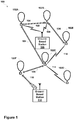
- FIG. 1 is a simplified block diagram illustrating a balloon network 100, according to an example embodiment.
- balloon network 100 includes balloons 102A to 102F, which are configured to communicate with one another via free-space optical links 104.
- Balloons 102A to 102F could additionally or alternatively be configured to communicate with one another via RF links 114.
- Balloons 102A to 102F may collectively function as a mesh network for packet-data communications.
- at least some of balloons 102A and 102B may be configured for RF communications with ground-based stations 106 and 112 via respective RF links 108.
- some balloons, such as balloon 102F could be configured to communicate via optical link 110 with ground-based station 112.
- balloons 102A to 102F are high-altitude balloons, which are deployed in the stratosphere.
- the stratosphere includes altitudes between approximately 10 kilometers (km) and 50 km altitude above the surface.
- the stratosphere starts at an altitude of approximately 8 km.
- high-altitude balloons may be generally configured to operate in an altitude range within the stratosphere that has relatively low wind speed (e.g., between 5 and 20 miles per hour (mph)).
- balloons 102A to 102F may generally be configured to operate at altitudes between 18 km and 25 km (although other altitudes are possible). This altitude range may be advantageous for several reasons.
- this layer of the stratosphere generally has relatively low wind speeds (e.g., winds between 5 and 20 mph) and relatively little turbulence.
- winds between 18 km and 25 km may vary with latitude and by season, the variations can be modeled in a reasonably accurate manner.
- altitudes above 18 km are typically above the maximum flight level designated for commercial air traffic. Therefore, interference with commercial flights is not a concern when balloons are deployed between 18 km and 25 km.
- a given balloon 102A to 102F may be configured to transmit an optical signal via an optical link 104.
- a given balloon 102A to 102F may use one or more high-power light-emitting diodes (LEDs) to transmit an optical signal.
- LEDs high-power light-emitting diodes
- some or all of balloons 102A to 102F may include laser systems for free-space optical communications over optical links 104. Other types of free-space optical communication are possible.
- a given balloon 102A to 102F may include one or more optical receivers. Additional details of example balloons are discussed in greater detail below, with reference to Figure 3 .
- balloons 102A to 102F may utilize one or more of various different RF air-interface protocols for communication with ground-based stations 106 and 112 via respective RF links 108.
- some or all of balloons 102A to 102F may be configured to communicate with ground-based stations 106 and 112 using protocols described in IEEE 802.11 (including any of the IEEE 802.11 revisions), various cellular protocols such as GSM, CDMA, UMTS, EV-DO, WiMAX, and/or LTE, and/or one or more propriety protocols developed for balloon-ground RF communication, among other possibilities.
- an example network may also include downlink balloons, which could provide a high-capacity air-ground link.
- balloon 102F is configured as a downlink balloon.
- a downlink balloon 102F may be operable for optical communication with other balloons via optical links 104.
- a downlink balloon 102F may also be configured for free-space optical communication with a ground-based station 112 via an optical link 110.
- Optical link 110 may therefore serve as a high-capacity link (as compared to an RF link 108) between the balloon network 100 and the ground-based station 112.
- a downlink balloon 102F may additionally be operable for RF communication with ground-based stations 106. In other cases, a downlink balloon 102F may only use an optical link for balloon-to-ground communications. Further, while the arrangement shown in Figure 1 includes just one downlink balloon 102F, an example balloon network can also include multiple downlink balloons. On the other hand, a balloon network can also be implemented without any downlink balloons.
- a downlink balloon may be equipped with a specialized, high-bandwidth RF communication system for balloon-to-ground communications, instead of, or in addition to, a free-space optical communication system.
- the high-bandwidth RF communication system may take the form of an ultra-wideband system, which may provide an RF link with substantially the same capacity as one of the optical links 104. Other forms are also possible.
- Ground-based stations such as ground-based stations 106 and/or 112 may take various forms.
- a ground-based station may include components such as transceivers, transmitters, and/or receivers for communication via RF links and/or optical links with a balloon network.
- a ground-based station may use various air-interface protocols in order to communicate with a balloon 102A to 102F over an RF link 108.
- ground-based stations 106 and 112 may be configured as an access point via which various devices can connect to balloon network 100.
- Ground-based stations 106 and 112 may have other configuration and/or serve other purposes without departing from the scope of the invention.
- balloons 102A to 102F could be configured to establish a communication link with space-based satellites in addition to, or as an alternative to, a ground-based communication link.
- a balloon may communicate with a satellite via an optical link.
- other types of satellite communications are possible.
- ground-based stations such as ground-based stations 106 and 112 may be configured as gateways between balloon network 100 and one or more other networks. Such ground-based stations 106 and 112 may thus serve as an interface between the balloon network and the Internet, a cellular service provider's network, and/or other types of networks. Variations on this configuration and other configuration of ground-based stations 106 and 112 are also possible.
- balloons 102A to 102F may collectively function as a mesh network. More specifically, since balloons 102A to 102F may communicate with one another using free-space optical links, the balloons may collectively function as a free-space optical mesh network.
- each balloon 102A to 102F may function as a node of the mesh network, which is operable to receive data directed to it and to route data to other balloons.
- data may be routed from a source balloon to a destination balloon by determining an appropriate sequence of optical links between the source balloon and the destination balloon.
- These optical links may be collectively referred to as a "lightpath" for the connection between the source and destination balloons.
- each of the optical links may be referred to as a "hop" on the lightpath.
- balloons 102A to 102F may employ various routing techniques and self-healing algorithms.
- a balloon network 100 may employ adaptive or dynamic routing, where a lightpath between a source and destination balloon is determined and set-up when the connection is needed, and released at a later time. Further, when adaptive routing is used, the lightpath may be determined dynamically depending upon the current state, past state, and/or predicted state of the balloon network.
- an example balloon network 100 may apply a mesh protocol to update the state of the network as the topology of the network changes.
- balloon network 100 may employ and/or adapt various techniques that are employed in mobile ad hoc networks (MANETs). Other examples are possible as well.
- MANETs mobile ad hoc networks
- a balloon network 100 may be configured as a transparent mesh network. More specifically, in a transparent balloon network, the balloons may include components for physical switching that is entirely optical, without any electrical components involved in the physical routing of optical signals. Thus, in a transparent configuration with optical switching, signals travel through a multi-hop lightpath that is entirely optical.
- the balloon network 100 may implement a free-space optical mesh network that is opaque.
- some or all balloons 102A to 102F may implement optical-electrical-optical (OEO) switching.
- some or all balloons may include optical cross-connects (OXCs) for OEO conversion of optical signals.
- OEO optical-electrical-optical
- Other opaque configuration are also possible.
- network configuration are possible that include routing paths with both transparent and opaque sections.
- balloons in an example balloon networks 100 may implement wavelength division multiplexing (WDM), which may help to increase link capacity.
- WDM wavelength division multiplexing
- physical lightpaths through the balloon network may be subject to the "wavelength continuity constrain.” More specifically, because the switching in a transparent network is entirely optical, it may be necessary to assign the same wavelength for all optical links on a given lightpath.
- An opaque configuration may avoid the wavelength continuity constraint.
- balloons in an opaque balloon network may include the OEO switching systems operable for wavelength conversion.
- balloons can convert the wavelength of an optical signal at each hop along a lightpath.
- optical wavelength conversion could take place at only selected hops along the lightpath.
- various routing algorithms may be employed in an opaque configuration. For example, to determine a primary lightpath and/or one or more diverse backup lightpath for a given connection, example balloons may apply or consider shortest-path routing techniques such as Dijkstra's algorithm and k-shortest path, and/or edge and node-diverse or disjoint routing such as Suurballe's algorithm, among others. Additionally or alternatively, techniques for maintaining a particular quality of service (QoS) may be employed when determining a lightpath. Other techniques are also possible.
- QoS quality of service
- a balloon network 100 may implement station-keeping functions to help provide a desired network topology. For example, station-keeping may involve each balloon 102A to 102F maintaining and/or moving into a certain position relative to one or more other balloons in the network (and possibly in a certain position relative to the ground). As part of this process, each balloon 102A to 102F may implement station-keeping functions to determine its desired positioning within the desired topology, and if necessary, to determine how to move to the desired position.
- the desired topology may vary depending upon the particular implementation.
- balloons may implement station-keeping to provide a substantially uniform topology.
- a given balloon 102A to 102F may implement station-keeping functions to position itself at substantially the same distance (or within a certain range of distances) from adjacent balloons in the balloon network 100.
- a balloon network 100 may have a non-uniform topology.
- example embodiments may involve topologies where balloons are distributed more or less densely in certain areas, for various reasons.
- balloons may be clustered more densely over urban areas.
- the distribution of balloons may be denser over land than over large bodies of water.
- Many other examples of non-uniform topologies are possible.
- the topology of an example balloon network may be adaptable.
- station-keeping functionality of example balloons may allow the balloons to adjust their respective positioning in accordance with a change in the desired topology of the network. For example, one or more balloons could move to new positions to increase or decrease the density of balloons in a given area. Other examples are possible.
- a balloon network 100 may employ an energy function to determine if and/or how balloons should move to provide a desired topology.
- the state of a given balloon and the states of some or all nearby balloons may be input to an energy function.
- the energy function may apply the current states of the given balloon and the nearby balloons to a desired network state (e.g., a state corresponding to the desired topology).
- a vector indicating a desired movement of the given balloon may then be determined by determining the gradient of the energy function.
- the given balloon may then determine appropriate actions to take in order to effectuate the desired movement. For example, a balloon may determine an altitude adjustment or adjustments such that winds will move the balloon in the desired manner.
- FIG. 2 is a block diagram illustrating a balloon-network control system, according to an example embodiment.
- Figure 2 shows a distributed control system, which includes a central control system 200 and a number of regional control-systems 202A to 202B.
- Such a control system may be configured to coordinate certain functionality for balloon network 204, and as such, may be configured to control and/or coordinate certain functions for balloons 206A to 206I.
- central control system 200 may be configured to communicate with balloons 206A to 206I via a number of regional control systems 202A to 202C. These regional control systems 202A to 202C may be configured to receive communications and/or aggregate data from balloons in the respective geographic areas that they cover, and to relay the communications and/or data to central control system 200. Further, regional control systems 202A to 202C may be configured to route communications from central control system 200 to the balloons in their respective geographic areas.
- regional control system 202A may relay communications and/or data between balloons 206A to 206C and central control system 200
- regional control system 202B may relay communications and/or data between balloons 206D to 206F and central control system 200
- regional control system 202C may relay communications and/or data between balloons 206G to 206I and central control system 200.
- each regional control system 202A to 202C may be configured to communicate with the downlink balloon or balloons in the respective geographic area it covers.
- balloons 206A, 206F, and 206I are configured as downlink balloons.
- regional control systems 202A to 202C may respectively communicate with balloons 206A, 206F, and 2061 via optical links 206, 208, and 210, respectively.
- balloons 206A to 206I are configured as downlink balloons.
- the balloons 206A, 206F, and 2061 that are configured as downlink balloons may relay communications from central control system 200 to other balloons in the balloon network, such as balloons 206B to 206E, 206G, and 206H.
- balloons 206B to 206E, 206G, and 206H may function as downlink balloons.
- Figure 2 shows multiple balloons configured as downlink balloons, it is also possible for a balloon network to include only one downlink balloon, or possibly even no downlink balloons.
- a regional control system 202A to 202C may in fact just be a particular type of ground-based station that is configured to communicate with downlink balloons (e.g., such as ground-based station 112 of Figure 1 ).
- a control system may be implemented in conjunction with other types of ground-based stations (e.g., access points, gateways, etc.).
- the central control system 200 may coordinate certain mesh-networking functions for balloon network 204.
- balloons 206A to 2061 may send the central control system 200 certain state information, which the central control system 200 may utilize to determine the state of balloon network 204.
- the state information from a given balloon may include location data, optical-link information (e.g., the identity of other balloons with which the balloon has established an optical link, the bandwidth of the link, wavelength usage and/or availability on a link, etc.), wind data collected by the balloon, and/or other types of information.
- the central control system 200 may aggregate state information from some or all of the balloons 206A to 2061 in order to determine an overall state of the network.
- the overall state of the network may then be used to coordinate and/or facilitate certain mesh-networking functions such as determining lightpaths for connections.
- the central control system 200 may determine a current topology based on the aggregate state information from some or all of the balloons 206A to 2061.
- the topology may provide a picture of the current optical links that are available in balloon network and/or the wavelength availability on the links. This topology may then be sent to some or all of the balloons so that a routing technique may be employed to select appropriate lightpath (and possibly backup lightpaths) for communications through the balloon network 204.
- the central control system 200 may also coordinate certain station-keeping functions for balloon network 204.
- the central control system 200 may input state information that is received from balloons 206A to 206I to an energy function, which may effectively compare the current topology of the network to a desired topology, and provide a vector indicating a direction of movement (if any) for each balloon, such that the balloons can move towards the desired topology.
- the central control system 200 may use altitudinal wind data to determine respective altitude adjustments that may be initiated to achieve the movement towards the desired topology.
- the central control system 200 may provide and/or support other station-keeping functions as well.
- Figure 2 shows a distributed arrangement that provides centralized control, with regional control systems 202A to 202C coordinating communications between a central control system 200 and a balloon network 204.
- Such an arrangement may be useful to provide centralized control for a balloon network that covers a large geographic area.
- a distributed arrangement may even support a global balloon network that provides coverage everywhere on earth.
- a distributed-control arrangement may be useful in other scenarios as well.
- control-system arrangements are also possible.
- some implementations may involve a centralized control system with additional layers (e.g., sub-region systems within the regional control systems, and so on).
- control functions may be provided by a single, centralized, control system, which communicates directly with one or more downlink balloons.
- control and coordination of a balloon network may be shared by a ground-based control system and a balloon network to varying degrees, depending upon the implementation. In fact, in some embodiments, there may be no ground-based control systems. In such an embodiment, all network control and coordination functions may be implemented by the balloon network itself. For example, certain balloons may be configured to provide the same or similar functions as central control system 200 and/or regional control systems 202A to 202C. Other examples are also possible.
- control and/or coordination of a balloon network may be decentralized. For example, each balloon may relay state information to, and receive state information from, some or all nearby balloons. Further, each balloon may relay state information that it receives from a nearby balloon to some or all nearby balloons. When all balloons do so, each balloon may be able to individually determine the state of the network. Alternatively, certain balloons may be designated to aggregate state information for a given portion of the network. These balloons may then coordinate with one another to determine the overall state of the network.
- control of a balloon networks may be partially or entirely localized, such that it is not dependent on the overall state of the network.
- individual balloons may implement station-keeping functions that only consider nearby balloons.
- each balloon may implement an energy function that takes into account its own state and the states of nearby balloons. The energy function may be used to maintain and/or move to a desired position with respect to the nearby balloons, without necessarily considering the desired topology of the network as a whole.
- the balloon network as a whole may maintain and/or move towards the desired topology.
- each balloon A may receive distance information d 1 to d k with respect to each of its k closest neighbors.
- Each balloon A may treat the distance to each of the k balloons as a virtual spring with vector representing a force direction from the first nearest neighbor balloon i toward balloon A and with force magnitude proportional to d i .
- the balloon A may sum each of the k vectors and the summed vector is the vector of desired movement for balloon A. Balloon A may attempt to achieve the desired movement by controlling its altitude.
- this process could assign the force magnitude of each of these virtual forces equal to d i x d i , wherein d i is proportional to the distance to the second nearest neighbor balloon, for instance.
- Other algorithms for assigning force magnitudes for respective balloons in a mesh network are possible.
- each balloon could transmit its planned movement vector to its local neighbors. Further rounds of refinement to each balloon's planned movement vector can be made based on the corresponding planned movement vectors of its neighbors. It will be evident to those skilled in the art that other algorithms could be implemented in a balloon network in an effort to maintain a set of balloon spacings and/or a specific networks capacity level over a given geographic location.
- FIG. 3 shows a high-altitude balloon 300, according to an example embodiment.
- the balloon 300 includes an envelope 302, a skirt 304, a payload 306, and a cut-down device 308, which is attached between the balloon 302 and payload 306.
- the envelope 302 and skirt 304 may take various forms, which may be currently well-known or yet to be developed.
- the envelope 302 and/or skirt 304 may be made of materials including metalized Mylar or BoPet. Additionally or alternatively, some or all of the envelope 302 and/or skirt 304 may be constructed from a highly-flexible latex material or a rubber material such as chloroprene. Other materials are also possible. Further, the shape and size of the envelope 302 and skirt 304 may vary depending upon the particular implementation. Additionally, the envelope 302 may be filled with various different types of gases, such as helium and/or hydrogen. Other types of gases are possible as well.
- the payload 306 of balloon 300 may include a processor 313 and on-board data storage, such as memory 314.
- the memory 314 may take the form of or include a non-transitory computer-readable medium.
- the non-transitory computer-readable medium may have instructions stored thereon, which can be accessed and executed by the processor 313 in order to carry out the balloon functions described herein.
- processor 313, in conjunction with instructions stored in memory 314, and/or other components, may function as a computer system 312 and further as a controller of balloon 300.
- the payload 306 of balloon 300 may also include various other types of equipment and systems to provide a number of different functions.
- payload 306 may include an optical communication system 316, which may transmit optical signals via an ultra-bright LED system 320, and which may receive optical signals via an optical-communication receiver 322 (e.g., a photodiode receiver system).
- payload 306 may include an RF communication system 318, which may transmit and/or receive RF communications via an antenna system 340.
- the payload 306 may also include a power supply 326 to supply power to the various components of balloon 300.
- the power supply 326 could include a rechargeable battery. In other embodiments, the power supply 326 may additionally or alternatively represent other means known in the art for producing power.
- the balloon 300 may include a solar power generation system 327.
- the solar power generation system 327 may include solar panels and could be used to generate power that charges and/or is distributed by the power supply 326.
- the payload 306 may additionally include a positioning system 324.
- the positioning system 324 could include, for example, a global positioning system (GPS), an inertial navigation system, and/or a star-tracking system.
- the positioning system 324 may additionally or alternatively include various motion sensors (e.g., accelerometers, magnetometers, gyroscopes, and/or compasses).
- the positioning system 324 may additionally or alternatively include one or more video and/or still cameras, and/or various sensors for capturing environmental data.
- Some or all of the components and systems within payload 306 may be implemented in a radiosonde or other probe, which may be operable to measure, e.g., pressure, altitude, geographical position (latitude and longitude), temperature, relative humidity, and/or wind speed and/or wind direction, among other information.
- a radiosonde or other probe which may be operable to measure, e.g., pressure, altitude, geographical position (latitude and longitude), temperature, relative humidity, and/or wind speed and/or wind direction, among other information.
- balloon 300 includes an ultra-bright LED system 320 for free-pace optical communication with other balloons.
- optical communication system 316 may be configured to transmit a free-space optical signal by modulating the ultra-bright LED system 320.
- the optical communication system 316 may be implemented with mechanical systems and/or with hardware, firmware, and/or software. Generally, the manner in which an optical communication system is implemented may vary, depending upon the particular application. The optical communication system 316 and other associated components are described in further detail below.
- balloon 300 may be configured for altitude control.
- balloon 300 may include a variable buoyancy system, which is configured to change the altitude of the balloon 300 by adjusting the volume and/or density of the gas in the balloon 300.
- a variable buoyancy system may take various forms, and may generally be any system that can change the volume and/or density of gas in the envelope 302.
- a variable buoyancy system may include a bladder 310 that is located inside of envelope 302.
- the bladder 310 could be an elastic chamber configured to hold liquid and/or gas.
- the bladder 310 need not be inside the envelope 302.
- the bladder 310 could be a rigid bladder that could be pressurized well beyond neutral pressure.
- the buoyancy of the balloon 300 may therefore be adjusted by changing the density and/or volume of the gas in bladder 310.
- balloon 300 may be configured with systems and/or mechanisms for heating and/or cooling the gas in bladder 310.
- balloon 300 may include pumps or other features for adding gas to and/or removing gas from bladder 310.
- balloon 300 may include release valves or other features that are controllable to allow gas to escape from bladder 310.
- Multiple bladders 310 could be implemented within the scope of this disclosure. For instance, multiple bladders could be used to improve balloon stability.
- the envelope 302 could be filled with helium, hydrogen or other lighter-than-air material.
- the envelope 302 could thus have an associated upward buoyancy force.
- air in the bladder 310 could be considered a ballast tank that may have an associated downward ballast force.
- the amount of air in the bladder 310 could be changed by pumping air (e.g., with an air compressor) into and out of the bladder 310. By adjusting the amount of air in the bladder 310, the ballast force may be controlled. In some embodiments, the ballast force may be used, in part, to counteract the buoyancy force and/or to provide altitude stability.
- the envelope 302 could be substantially rigid and include an enclosed volume. Air could be evacuated from envelope 302 while the enclosed volume is substantially maintained. In other words, at least a partial vacuum could be created and maintained within the enclosed volume. Thus, the envelope 302 and the enclosed volume could become lighter than air and provide a buoyancy force. In yet other embodiments, air or another material could be controllably introduced into the partial vacuum of the enclosed volume in an effort to adjust the overall buoyancy force and/or to provide altitude control.
- a portion of the envelope 302 could be a first color (e.g., black) and/or a first material from the rest of envelope 302, which may have a second color (e.g., write) and/or a second material.
- the first color and/or first material could be configured to absorb a relatively larger amount of solar energy than the second color and/or second material.
- the buoyancy force of the balloon could be adjusted by changing the temperature/volume of gas inside the envelope 302 using solar energy.
- a bladder 310 may not be a necessary element of balloon 300.
- altitude control of balloon 300 could be achieved, at least in part, by adjusting the rotation of the balloon with respect to the sun.
- a balloon 306 may include a navigation system (not shown).
- the navigation system may implement station-keeping functions to maintain position within and/or move to a position in accordance with a desired topology.
- the navigation system may use altitudinal wind data to determine altitudinal adjustments that result in the wind carrying the balloon in a desired direction and/or to a desired location.
- the altitude-control system may then make adjustments to the density of the balloon chamber in order to effectuate the determined altitudinal adjustments and cause the balloon to move laterally to the desired direction and/or to the desired location.
- the altitudinal adjustments may be computed by a ground-based or satellite-based control system and communicated to the high-altitude balloon.
- specific balloons in a heterogeneous balloon network may be configured to compute altitudinal adjustments for other balloons and transmit the adjustment commands to those other balloons.
- the balloon 300 also includes a cut-down device 308.
- the cut-down device 308 may be configured to cause at least the payload 306 to land.
- the cut-down device 308 could include at least one cord, such as a balloon cord, connecting the payload 306 to the envelope 302 and a means for severing the cord (e.g., a shearing mechanism or an explosive bolt).
- the balloon cord which may be nylon, is wrapped with a nichrome wire. An electrical signal could be passed through the nichrome wire to heat it and melt the cord, thereby cutting the payload 306 away from the envelope 302.
- the cut-down device 308 could receive a control instruction from a control system that may determine, for example, that the balloon 300 is within a predetermined zone, which could relate to exclusion zone and/or a shadow zone. In response to the control instruction, the cut-down device 308 could pass a current through the nichrome wire so as to sever the balloon cord between the payload 306 and the envelope 302. In other words, the control system could cause the cut-down device 308 to cut the payload 306 away from the envelope 302 if the balloon is determined to be within the predetermined zone. Other triggers are possible to cause the cut-down device 308 to separate the payload 306 from the envelope 302.
- the cut-down device 308 could include a means for reducing a buoyancy of the envelope such that the payload 306 may land with the envelope 302. Reducing the buoyancy of the envelope could be performed in various ways.
- the envelope could be deflated by reducing the volume of lifting gas in the envelope.
- a pump could be used to reduce the volume of lifting gas in the envelope.
- the cut-down device 308 could be operable to perforate or tear the envelope such that lifting gas could gradually escape.
- the cut-down device 308 could be operable such that the envelope could be substantially vented by overturning the envelope such that the lifting gas exits the envelope.
- ballast could be added to the envelope in order to reduce the buoyancy of the envelope.
- a pump could be used to introduce air or other gas into the envelope, thereby reducing the buoyancy of the envelope.
- the cut-down device 308 could alternatively or additionally use other means to cause at least the payload 306 to land in response to the balloon 300 entering a predetermined zone.
- the cut-down device 308 may be operable if, for example, the payload needs to be accessed on the ground, such as to remove balloon 300 from a balloon network, when maintenance is due on systems within payload 306, and/or when power supply 326 needs to be recharged or replaced.
- a balloon need not include a cut-down device 308.
- the navigation system may be operable to navigate the balloon to a landing location in the event the balloon needs to be removed from the network and/or accessed on the ground.
- a balloon may be self-sustaining, such that it does not need to be accessed on the ground.
- in-flight balloons may be serviced by specific service balloons or another type of service aerostat or service aircraft.
- a high-altitude-balloon network may include super-node balloons, which communicate with one another via optical links, as well as sub-node balloons, which communicate with super-node balloons via RF links.
- the optical links between super-node balloons may be configured to have more bandwidth than the RF links between super-node and sub-node balloons.
- the super-node balloons may function as the backbone of the balloon network, while the sub-nodes may provide sub-networks providing access to the balloon network and/or connecting the balloon network to other networks.
- Figure 4 is a simplified block diagram illustrating a balloon networks that includes super-nodes and sub-nodes, according to an example embodiments. More specifically, Figure 4 illustrates a portion of a balloon network 400 that includes super-node balloons 410A to 410C (which may also be referred to as "super-nodes”) and sub-node balloons 420 (which may also be referred to as "sub-nodes").
- super-node balloons 410A to 410C which may also be referred to as "super-nodes”
- sub-node balloons 420 which may also be referred to as "sub-nodes”
- Each super-node balloon 410A to 410C may include a free-space optical communication system that is operable for packet-data communication with other super-node balloons.
- super-nodes may communicate with one another over optical links.
- super-node 410A and super-node 401B may communicate with one another over optical link 402
- super-node 410A and supper-node 401C may communicate with one another over optical link 404.
- Each of the sub-node balloons 420 may include a radio-frequency (RF) communication system that is operable for packet-data communication over one or more RF air interfaces. Accordingly, each super-node balloon 410A to 410C may include an RF communication system that is operable to route packet data to one or more nearby sub-node balloons 420. When a sub-node 420 receives packet data from a super-node 410, the sub-node 420 may use its RF communication system to route the packet data to a ground-based station 430 via an RF air interface.
- RF radio-frequency
- the super-nodes 410A to 410C may be configured for both longer-range optical communication with other super-nodes and shorter-range RF communications with nearby sub-nodes 420.
- super-nodes 410A to 410C may use using high-power or ultra-bright LEDs to transmit optical signals over optical links 402, 404, which may extend for as much as 100 miles, or possibly more.
- the super-nodes 410A to 410C may be capable of optical communications at data rates of 10 to 50 GBit/sec or more.
- a larger number of high-altitude balloons may then be configured as sub-nodes, which may communicate with ground-based Internet nodes at data rates on the order of approximately 10 MBit/sec.
- the sub-nodes 420 may be configured to connect the super-nodes 410 to other networks and/or directly to client devices.
- the super-nodes 410A to 410C may function as a core network, while the sub-nodes 420 function as one or more access networks to the core network.
- some or all of the sub-nodes 420 may also function as gateways to the balloon network 400.
- some or all of ground-based stations 430 may function as gateways to the balloon network 400.
- any of the example systems described herein could be operable to determine a position of a balloon with respect to a predetermined zone, which includes an exclusion zone and a shadow zone.
- the example systems could additionally cause a cut-down device to cause at least a payload of the balloon to land in response to a determination that the position of the balloon is within the predetermined zone.
- Figures 5A and 5B illustrate overhead and elevation views, respectively, of a balloon operating scenario 500 at a first time.
- a balloon 502 could be subject to historical or prevailing winds 504.
- the balloon 502 could be above a body of water 10. In other embodiments, the balloon 502 need not be above a body of water 510.
- An exclusion zone 508 could include airspace above a restricted area 514.
- restricted area 514 is a land area.
- a restricted area could include a body of water.
- a shadow zone 506 could be defined as extending substantially westward from the exclusion zone 508.
- the shadow zone 506 could include a set of locations from which the balloon 502 is more likely than a predetermined likelihood to enter the exclusion zone 508.
- Various methods for determining the boundaries of the shadow zone 506 are described elsewhere in the present disclosure.
- the respective boundaries of the shadow zone 506 and/or the exclusion zone 508 could be based on altitude. For example, since wind speeds and wind direction could differ based on altitudes, the boundaries of the shadow zone could vary based on altitude as well. Thus, as shown in the combination of Figures 5A and 5B , one or more boundaries of the shadow zone may include 'sloped' zones that may account for varying altitudinal wind data, ascent/descent/lateral movement rates of the balloon 502, and/or a parachute glide path 531. Other altitude-dependent boundaries of the shadow zone 506 are possible.
- the boundaries of the shadow zone 506 could be determined dynamically based on, for example, the boundaries of the exclusion zone 508, the expected environmental conditions, and/or the current speed and heading of the balloon 502. In other embodiments, the boundaries of the shadow zone 506 could be static and could be based on the boundaries of the exclusion zone 508 and historical wind data. In yet other embodiments, at least one boundary of the shadow zone 506 could remain static (e.g., maximum and minimum balloon operating altitudes), while other boundaries of the shadow zone 506 could be adjusted based on real-time information. Other ways to determine and/or define the boundaries of the shadow zone 506 are possible.
- the combination of the exclusion zone 508 and the shadow zone 506 could represent a predetermined zone.
- a control system in the balloon 502 could determine the location of the balloon with respect to the predetermined zone.
- the control system could alternatively be located in part or fully outside the balloon 502.
- Figure 5C illustrates a balloon operating scenario 520 at a second time.
- the second time could represent a point in time later than the first time.
- the second time could illustrate a point in time after the control system determines the balloon is within the predetermined zone.
- the balloon 522 may have crossed a boundary of the shadow zone 526 and thus moved within the predetermined zone.
- the control system may cause the cut-down device to separate the payload 524 from the envelope 522.
- the control system may deliver an electrical signal through a wire that is proximal to the balloon cord, which may connect the envelope 522 to the payload 524.
- the wire which could be made of nichrome, may be configured to emit heat in response to an electrical signal.
- the balloon cord may sever due to the emitted heat and the payload 524 may be separated from the envelope 522.
- a parachute 530 may be deployed in an effort to slow the descent of the payload 524.
- the payload 524 may descend by gravity via a parachute glide path 531 to a recovery area 528.
- the parachute 530 may be steerable so as to steer the payload 524 toward the recovery area 528.
- the computer system of the payload 524 or another computer system e.g., a server networks
- parachute 530 could represent a ram-air parafoil-type parachute.
- Other types of parachutes such as Rogallo wing, round, and cruciform (square) parachutes, are possible within the context of the present disclosure.
- the Figure 5C illustrates separation of the payload 524 from the envelope 522 of the balloon in response to the balloon entering the shadow zone 526; however, other ways of causing at least the payload 524 to land are possible within the context of the present disclosure.
- the cut-down device could be operable to reduce a buoyancy of the envelope 522 (e.g., by adding ballast and/or venting a lifting gas) so as to cause the balloon to land.
- Figure 5D illustrates a scenario 532 in which exclusion zones 536 and 538 are defined by a maximum altitude (ceiling) 516 and/or a minimum altitude (hard deck) 518. These maximum and minimum altitudes could restrict or limit the operational altitudes for balloon 534. Such minimum and maximum altitudes could be established to improve public safety, balloon longevity, operational performance, and operating cost, among other reasons.
- Exclusion zones 536 and 538 related to a maximum altitude 516 and/or a minimum altitude 518 could include shadow zones 540 and 542 that could include locations from which the balloon 534 is likely to enter one of the exclusion zones 536 or 538.
- the shadow zone could be determined based on the historical/prevailing winds 504, as well as the position, speed, and heading of balloon 534.
- the altitudes that define the shadow zone and/or the exclusion zone could be dependent on ground position, as shown in Figure 5D . In other embodiments, the altitudes that define shadow zone and/or the exclusion zone could be substantially independent of ground position.
- the cut-down device could be used to cause at least the payload of the balloon 534 to land.
- the predetermined zone could be based on geographical information (e.g., depend fully or substantially on altitude). For instance, the predetermined zone could be any altitude below 50,000 feet. In other embodiments, the predetermined zone could be partially or fully based on geographical information. For example, the predetermined zone could be any altitude below 55,000 feet above the United States and the predetermined zone could be any altitude below 50,000 feet everywhere else. Other ways to define the boundaries of the predetermined zone are possible.
- an exclusion zone and shadow zone defined by a restricted area could be combined with an exclusion zone and shadow zone defined by altitudes (e.g., as shown in Figure 5D ).
- a method 600 for causing a cut-down device of a balloon to cause at least a payload of the balloon to land in response to a determination that a position of the balloon is within a predetermined zone, which includes an exclusion zone and a shadow zone.
- the method could be performed using any of the apparatus shown and described in reference to Figures 1-4 , however, other configuration could be used.
- Figure 6A illustrates the steps in an example method, however, it is understood that in other embodiments, the steps may appear in different order and steps could be added or subtracted.
- Step 602 includes determining a position of a balloon with respect to a predetermined zone.
- the predetermined zone includes an exclusion zone and a shadow zone.
- the balloon includes a cut-down device, a payload, and an envelope.
- the position of the balloon could be determined with respect to the predetermined zone in several different ways.
- the balloon could determine the position of the balloon using a global positioning system (GPS), an inertial navigation system (INS), and/or a map.
- GPS global positioning system
- INS inertial navigation system
- the determination of the position of the balloon with respect to the predetermined zone could be performed in part or in full by a server network.
- the map could include at least geographic information about the predetermined zone. Other forms of information could be included in the map, such as maximum and minimum altitude limits, exclusion zones, shadow zones, and/or historical or expected environmental conditions (e.g., wind speed and direction).
- the map could include other information as well.
- the map could be associated and/or stored using the computer system of the balloon (e.g., computer system 312).
- the map could alternatively be stored fully or in part using other computer systems, such as a server network.
- the predetermined zone could include at least two portions.
- an exclusion zone could represent any type of restricted airspace that the balloon should not enter.
- the exclusion zone could include an altitude maximum and/or minimum (hard deck).
- the altitude maximum could represent an altitude above which the balloon could become inoperable, ineffective, and/or in danger of bursting.
- the altitude minimum could represent an altitude below which the balloon could be ineffective, inoperable, collide with objects on the ground, or be within commercial airspace. Altitude minimums and maximums may be established based on other rationale as well.
- the exclusion zone could include a restricted area (e.g., an airbase, a tall building, etc.), airspace above a restricted area, a foreign country, a populated area, or any other undesirable flying area.
- the exclusion zone could include an enclosed volume of airspace.
- the enclosed volume of airspace may represent a flight path or a volume of airspace around an object such as an airplane or any other object that may need to be avoided.
- Other examples of exclusion zones are possible.
- a shadow zone could represent a location from which the balloon is more likely than a predetermined likelihood to enter the exclusion zone based on expected environmental conditions. Boundaries of the shadow zone could be based on the current or historical wind direction and/or wind speed. For instance, if a prevailing wind direction is from the west at 5 miles per hour, a shadow zone could extend substantially in a westward direction from the exclusion zone. In particular, the shadow zone could be defined to be the set of locations from which the balloon could be more likely than a predetermined likelihood (e.g., 50% probability) to enter the exclusion zone based on the prevailing winds. That is, the boundaries of the shadow zone could be defined to include the locations from which the balloon is more than 50% likely to move into the exclusion zone.
- a predetermined likelihood e.g. 50% probability
- the expected environmental conditions could be determined by the balloon and/or a computer system elsewhere.
- the expected environmental conditions could be based on real-time sensor data regarding, for instance, wind speed, wind direction, and other environmental information.
- the expected environmental conditions could be based on weather forecasts and/or historical wind data.
- other balloons in the high-altitude balloon network could relay information about their respective local environments.
- the expected environmental conditions could be determined based at least on the information from the other balloons. Other ways to obtain information about the expected environmental conditions are possible.
- the balloon could move into the exclusion zone due to, for instance, prevailing winds. In one embodiment, the balloon could get blown into the exclusion zone. Other embodiments are possible.
- the likelihood of a balloon entering an exclusion zone based on expected environmental conditions could be determined by a computer system on the balloon or elsewhere (e.g., a server network).
- the determination could include various simulations that could include the expected environmental conditions, the boundaries of the exclusion zone, and the current position, speed, and/or heading of the balloon.
- a plurality of Monte Carlo simulations could be run by a computer system in an effort to predict the likelihood of the balloon to enter the exclusion zone.
- Other computer algorithms are possible to estimate the likelihood of the balloon to enter the exclusion zone.
- the computer system could provide a heat map that could represent the likelihood of the balloon to enter the exclusion zone from a given point in three-dimensional space.
- the shadow zone could be determined.
- the shadow zone could include all points in the heat map that correspond to at least a predetermined likelihood of 50% that the balloon will enter the exclusion zone.
- Other predetermined likelihoods and ways to determine the boundaries of the shadow zone are possible.
- Step 604 includes causing the cut-down device to cause at least the payload of the balloon to land in response to a determination that the position of the balloon is within the predetermined zone.
- the cut-down device could be similar to the cut-down device 308.
- the cut-down device could deliver an electrical signal, such as an electric current, to pass through a nichrome wire wrapped around the balloon cord.
- an electrical signal such as an electric current
- the nichrome wire may emit heat.
- the balloon cord could be configured to melt and sever. This could separate the payload from the envelope.
- the cut-down device could be operable to cause at least the payload of the balloon using other means.
- the aforementioned heating method could be used to burst the envelope, form a hole in the envelope, and/or cause the envelope to tear. Methods other than heating could also be used (e.g., cutting, perforation, abrasion, etc.).
- the envelope could be caused to land with the payload of the balloon, so as to improve public health and safety, among other benefits.
- the payload may deploy a parachute configured to control the rate of descent of the payload.
- the parachute may also be configured to steer the payload towards a recovery area. Upon reaching the recovery area, the payload and, in some cases, the entire balloon, could be recovered.
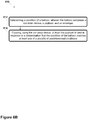
- FIG. 6B another method 610 is provided for determining a condition of a balloon, which includes a cut-down device, a payload, and an envelope, and causing, using the cut-down device, at least the payload to land in response to a determination that the condition of the balloon matches at least one of a plurality of predetermined conditions.
- the method could be performed using any of the apparatus shown and described in reference to Figures 1-4 , however, other configurations could be used.
- Figure 6B illustrates the steps in an example method, however, it is understood that in other embodiments, the steps may appear in different order and steps could be added or subtracted.
- Method step 612 includes determining a condition of a balloon.
- the balloon includes a cut-down device, a payload, and an envelope.
- the balloon could be the same or similar to balloon 300 as described in reference to Figure 3 .
- the balloon could be part of a high-altitude balloon network.
- Determining the condition of the balloon could include using sensor data or other data to determine information about the location, heading, and/or speed the balloon. Determining the condition of the balloon could additionally or alternatively include obtaining information about the operational status of various hardware and software associated with the balloon. Also, determining the condition of the balloon could represent obtaining information about current and/or historical weather conditions, airspace permissions, current events, other flying bodies, etc.
- Method step 614 includes causing, using the cut-down device, at least the payload to land in response to a determination that the condition of the balloon matches at least one of a plurality of predetermined conditions.
- the plurality of predetermined conditions could represent any number of conditions and/or states that could make it desirable and/or favorable to cause at least the payload to land.
- the plurality of predetermined conditions could include at least one of: a hardware malfunction, a software malfunction, a low battery, the balloon being located within a predetermined zone (e.g., as described above for Figures 5A-5D ), and an uncertainty in the location of the balloon.
- Other predetermined conditions could be possible.
- a computer system located with the balloon or located elsewhere could be configured to determine if a match exists between the condition of the balloon and one or more of the plurality of predetermined conditions.
- an instruction could be transmitted to the cut-down device so as to cause at least the payload to land.
- Causing at least the payload to land using the cut-down device could include separating the payload from the envelope as described elsewhere in this disclosure.
- the cut-down device could be operable to cause the envelope and the payload to descend to the ground substantially together.
- the cut-down device could introduce holes into the envelope (e.g., by heating or cutting the envelope).
- the cut-down device could add ballast to the envelope, reducing the buoyance of the envelope.
- Other means of causing at least the payload to land in response to the determination that the condition of the balloon matches at least one of the plurality of predetermined conditions are implicitly considered herein.
- Example methods such as method 600 of Figure 6A and/or method 610 of Figure 6B , may be carried out in whole or in part by one or more balloons and their respective subsystems. Accordingly, example methods could be described by way of example herein as being implemented by the balloon. However, it should be understood that an example method may be implemented in whole or in part by other computing devices. For example, an example method may be implemented in whole or in part by a server system, which receives data from the balloon or from elsewhere. Other examples of computing devices or combinations of computing devices that can implement an example method are possible.
- the disclosed methods may be implemented as computer program instructions encoded on a non-transitory computer-readable storage media in a machine-readable format, or on other non-transitory media or articles of manufacture.
- Figure 7 is a schematic illustrating a conceptual partial view of an example computer program product that includes a computer program for executing a computer process on a computing device, arranged according to at least some embodiments presented herein.
- the example computer program product 700 is provided using a signal bearing medium 702.
- the signal bearing medium 702 may include one or more programming instructions 704 that, when executed by one or more processors may provide functionality or portions of the functionality described above with respect to Figures 1-6 .
- the signal bearing medium 702 may encompass a computer-readable medium 706, such as, but not limited to, a hard disk drive, a Compact Disc (CD), a Digital Video Disk (DVD), a digital tape, memory, etc.
- the signal bearing medium 702 may encompass a computer recordable medium 708, such as, but not limited to, memory, read/write (R/W) CDs, R/W DVDs, etc.
- the signal bearing medium 702 may encompass a communications medium 710, such as, but not limited to, a digital and/or an analog communication medium (e.g., a fiber optic cable, a waveguide, a wired communications link, a wireless communication link, etc.).
- a communications medium 710 such as, but not limited to, a digital and/or an analog communication medium (e.g., a fiber optic cable, a waveguide, a wired communications link, a wireless communication link, etc.).
- the signal bearing medium 702 may be conveyed by a wireless form of the communications medium 710.
- the one or more programming instructions 704 may be, for example, computer executable and/or logic implemented instructions.
- a computing device such as the computer system 312 of Figure 3 may be configured to provide various operations, functions, or actions in response to the programming instructions 704 conveyed to the computer system 312 by one or more of the computer readable medium 706, the computer recordable medium 708, and/or the communications medium 710.
- the non-transitory computer readable medium could also be distributed among multiple data storage elements, which could be remotely located from each other.
- the computing device that executes some or all of the stored instructions could be a device, such as the balloon 300 shown and described in reference to Figure 3 .
- the computing device that executes some or all of the stored instructions could be another computing device, such as a server.
Landscapes
- Engineering & Computer Science (AREA)
- Aviation & Aerospace Engineering (AREA)
- Physics & Mathematics (AREA)
- Mechanical Engineering (AREA)
- General Physics & Mathematics (AREA)
- Radar, Positioning & Navigation (AREA)
- Remote Sensing (AREA)
- Signal Processing (AREA)
- Automation & Control Theory (AREA)
- Computer Networks & Wireless Communication (AREA)
- Electromagnetism (AREA)
- Computing Systems (AREA)
- Mobile Radio Communication Systems (AREA)
- Toys (AREA)
- Position Fixing By Use Of Radio Waves (AREA)
Claims (15)
- Verfahren, das Folgendes umfasst:Bestimmen der Position eines Ballons (300) im Verhältnis zu einer vorher festgelegten Zone, wobei die vorher festgelegte Zone eine Sperrzone (508) und eine Schattenzone (506) umfasst, wobei die Sperrzone den Luftraum über einem vorher festgelegten geographischen Gebiet umfasst und die Schattenzone den Luftraum über einem geographischen Gebiet neben dem vorher festgelegten geographischen Gebiet umfasst und wobei der Ballon ein Gerät zum Abtrennen (308), eine Nutzlast (306) und eine Hülle (302) umfasst; undVeranlassen mithilfe des Abtrenngeräts, dass zumindest die Nutzlast in Reaktion auf die Bestimmung landet, dass sich die Position des Ballons innerhalb der vorher festgelegten Zone befindet.
- Verfahren nach Anspruch 1, wobei das Veranlassen, dass zumindest die Nutzlast landet, das Abtrennen der Nutzlast (306) von der Hülle (302) umfasst.
- Verfahren nach Anspruch 1, wobei das Veranlassen, dass zumindest die Nutzlast (306) landet, das Verringern des Auftriebs der Hülle (302) umfasst, beispielsweise durch Hinzufügen von Ballast zur Hülle oder durch Ablassen von zumindest einem Teil des Traggases aus der Hülle.
- Verfahren nach Anspruch 1, wobei das Veranlassen mithilfe des Abtrenngeräts (308), dass zumindest die Nutzlast (302) in Reaktion auf die Bestimmung landet, dass sich die Position des Ballons (300) innerhalb der vorher festgelegten Zone befindet, Folgendes umfasst:Bestimmen, dass der Ballon eine Grenze der Schattenzone (506) überschritten hat; undVeranlassen in Reaktion darauf, dass das Abtrenngerät (308) die Nutzlast (306) von der Hülle (302) abtrennt.
- Verfahren nach Anspruch 1, wobei die Schattenzone (506) eine Zone umfasst, aus der der Ballon (300) basierend auf den erwarteten Umweltbedingungen mit einer Wahrscheinlichkeit größer als die vorher festgelegte Wahrscheinlichkeit die Sperrzone (508) erreicht.
- Verfahren nach Anspruch 1, das weiterhin das Veranlassen des Auslösens mindestens eines Fallschirms (530) in Reaktion auf die Bestimmung umfasst, dass sich die Position des Ballons (522) innerhalb der vorher festgelegten Zone befindet, wobei der mindestens eine Fallschirm mit der Nutzlast (524) verbunden ist.
- Verfahren nach Anspruch 6, das weiterhin das Bergen der Nutzlast (524) in einer Bergungszone (528) nach Auslösen des mindestens einen Fallschirms (530) umfasst.
- Ballon (300), der Folgendes umfasst:eine Hülle (302);eine Nutzlast (306);ein Abtrenngerät (308), das dazu konfiguriert ist, zu veranlassen, dass zumindest die Nutzlast landet; undein Steuersystem (312), das dazu konfiguriert ist: i) die Position des Ballons im Verhältnis zu einer vorher festgelegten Zone zu bestimmen, wobei die vorher festgelegte Zone eine Sperrzone (508) und eine Schattenzone (506) umfasst, wobei die Sperrzone den Luftraum über einem vorher festgelegten geographischen Gebiet umfasst und die Schattenzone den Luftraum über einem geographischen Gebiet neben dem vorher festgelegten geographischen Gebiet umfasst; und ii) das Abtrenngerät dazu zu veranlassen, zumindest die Nutzlast dazu zu veranlassen, in Reaktion auf die Bestimmung zu landen, dass sich die Position des Ballons innerhalb der vorher festgelegten Zone befindet.
- Ballon nach Anspruch 8, der dazu konfiguriert ist, ein Verfahren nach einem der Ansprüche 2 bis 7 durchzuführen.
- Ballon nach Anspruch 8 oder 9, wobei das Steuersystem (312) dazu konfiguriert ist, die Position des Ballons im Verhältnis zu einer vorher festgelegten Zone zu bestimmen, indem es zumindest eines der folgenden verwendet: ein Globales Positionsbestimmungssystem (GPS), ein inertiales Navigationssystem (INS) oder eine Karte von zumindest der vorher festgelegten Zone.
- Ballon nach Anspruch 8, 9 oder 10, der weiterhin eine Leitungsschnur und einen Draht nahe der Leitungsschnur umfasst, wobei die Leitungsschnur mechanisch mit der Hülle (302) und der Nutzlast (306) verbunden ist, wobei der Draht dazu konfiguriert ist, in Reaktion auf ein elektrisches Signal des Abtrenngeräts (308) Wärme abzugeben, wobei die Leitungsschnur dazu konfiguriert ist, in Reaktion auf die abgegebene Wärme zu reißen.
- Ballon nach Anspruch 8 oder 9, der weiterhin mindestens einen Fallschirm (530) umfasst, der mit der Nutzlast (524) verbunden ist, wobei der mindestens eine Fallschirm dazu konfiguriert ist, sich in Reaktion auf die Bestimmung, dass sich die Position des Ballons (522) innerhalb der vorher festgelegten Zone befindet, zu öffnen.
- Dauerhaftes computerlesbares Speichermedium, in dem von einem Computersystem ausführbare Befehle gespeichert sind, die das Computersystem dazu veranlassen, ein Verfahren nach einem der Ansprüche 1 bis 7 durchzuführen.
- Verfahren nach Anspruch 1, das Folgendes einschließt:Veranlassen mithilfe des Abtrenngeräts (308), dass zumindest die Nutzlast (306) in Reaktion auf die Bestimmung landet, dass der Zustand des Ballons (300) zumindest einem von einer Vielzahl von vorher festgelegten Zuständen entspricht.
- Verfahren nach Anspruch 14, wobei die Vielzahl von vorher festgelegten Zuständen zumindest einen der folgenden umfasst: eine Hardware-Fehlfunktion, eine Software-Fehlfunktion, ein niedriger Batterieladezustand, Position des Ballons innerhalb einer vorher festgelegten Zone oder Unklarheit über die Position des Ballons (300).
Applications Claiming Priority (2)
| Application Number | Priority Date | Filing Date | Title |
|---|---|---|---|
| US13/547,503 US20140014770A1 (en) | 2012-07-12 | 2012-07-12 | Geo-Fencing |
| PCT/US2013/040324 WO2014011316A1 (en) | 2012-07-12 | 2013-05-09 | Geo-fencing |
Publications (3)
| Publication Number | Publication Date |
|---|---|
| EP2873166A1 EP2873166A1 (de) | 2015-05-20 |
| EP2873166A4 EP2873166A4 (de) | 2015-08-26 |
| EP2873166B1 true EP2873166B1 (de) | 2017-10-18 |
Family
ID=49913129
Family Applications (1)
| Application Number | Title | Priority Date | Filing Date |
|---|---|---|---|
| EP13816293.8A Not-in-force EP2873166B1 (de) | 2012-07-12 | 2013-05-09 | Geofencing |
Country Status (4)
| Country | Link |
|---|---|
| US (2) | US20140014770A1 (de) |
| EP (1) | EP2873166B1 (de) |
| CN (1) | CN104604154B (de) |
| WO (1) | WO2014011316A1 (de) |
Cited By (1)
| Publication number | Priority date | Publication date | Assignee | Title |
|---|---|---|---|---|
| DE102019208986A1 (de) * | 2019-06-19 | 2020-12-24 | Fraunhofer-Gesellschaft zur Förderung der angewandten Forschung e.V. | Vorrichtung und netzwerk zur drahtlosen, optischen kommunikation |
Families Citing this family (41)
| Publication number | Priority date | Publication date | Assignee | Title |
|---|---|---|---|---|
| US10574614B2 (en) | 2009-08-03 | 2020-02-25 | Picpocket Labs, Inc. | Geofencing of obvious geographic locations and events |
| US9544379B2 (en) | 2009-08-03 | 2017-01-10 | Wolfram K. Gauglitz | Systems and methods for event networking and media sharing |
| US8825847B1 (en) | 2012-02-03 | 2014-09-02 | Google Inc. | Location-aware “ghost” caching in a balloon network |
| US9281896B2 (en) | 2012-02-03 | 2016-03-08 | Google Inc. | Location-aware profiles in a balloon network |
| US9532174B2 (en) | 2012-12-03 | 2016-12-27 | X Development Llc | Method for ensuring data localization on an ad hoc moving data network |
| US9153854B1 (en) * | 2012-12-12 | 2015-10-06 | Google Inc. | Integration of antenna structures into balloon envelopes |
| US9520940B2 (en) | 2012-12-14 | 2016-12-13 | X Development Llc | Method for preventing storage of prohibited data on an Ad Hoc moving data network |
| US9694910B2 (en) | 2013-02-22 | 2017-07-04 | World View Enterprises Inc. | Near-space operation systems |
| EP2815967A1 (de) * | 2013-06-18 | 2014-12-24 | Nagravision S.A. | Fallschirmanordnung zum Einsatz eines drahtlosen Mesh-Netzwerks |
| US9010691B1 (en) * | 2013-11-05 | 2015-04-21 | Google Inc. | Parachute deployment system |
| US9580161B1 (en) * | 2013-12-20 | 2017-02-28 | X Development Llc | Reinforcing ripstop tape for burst mitigation |
| US9463863B1 (en) * | 2013-12-30 | 2016-10-11 | Google Inc. | Superpressure balloon with ballonet cut from contiguous gores |
| EP3404954B1 (de) * | 2014-03-18 | 2020-03-18 | Telefonaktiebolaget LM Ericsson (publ) | Bereitstellung von abdeckung eines drahtloskommunikationsnetzwerks durch verwendung mobiler basistationen auf robotern oder dronen |
| CN104058095B (zh) * | 2014-06-12 | 2016-06-29 | 深圳市哈博森科技有限公司 | 飞行器降落伞控制系统及方法 |
| US9346531B1 (en) | 2014-09-09 | 2016-05-24 | Google Inc. | Balloon gas release flight termination system |
| FI126435B (fi) * | 2014-10-17 | 2016-11-30 | Skycat Oy | Menetelmä ja laite esineen laukaisemiseksi lentävästä laitteesta |
| KR102297389B1 (ko) * | 2015-01-05 | 2021-09-02 | 픽포켓, 아이엔시. | 모바일 타겟과 관련된 미디어 공유와 집합을 제어하는 다이나믹 지오펜스의 용도 |
| US10787268B2 (en) | 2015-03-09 | 2020-09-29 | World View Enterprises Inc. | Rigidized assisted opening system for high altitude parafoils |
| US9860256B2 (en) | 2015-11-02 | 2018-01-02 | Box, Inc. | Geofencing of data in a cloud-based environment |
| US9665103B1 (en) * | 2015-12-09 | 2017-05-30 | X Development Llc | Efficient aerostat navigation by moving between atmospheric layers |
| US9540091B1 (en) * | 2016-02-11 | 2017-01-10 | World View Enterprises Inc. | High altitude balloon systems and methods |
| US9956701B2 (en) * | 2016-05-03 | 2018-05-01 | Harris Corporation | Payload deployment system |
| US9908609B1 (en) | 2016-06-02 | 2018-03-06 | X Development Llc | Explosive strip for venting gas from a balloon |
| CN106200654A (zh) * | 2016-09-28 | 2016-12-07 | 北京小米移动软件有限公司 | 无人机飞行速度的控制方法和装置 |
| CN106646560A (zh) * | 2016-12-30 | 2017-05-10 | 重庆多道电子技术有限公司 | 基于位置数据来判断目标进出指定区域的装置 |
| CN106713473A (zh) * | 2016-12-30 | 2017-05-24 | 重庆多道电子技术有限公司 | 服务器 |
| CN106772485A (zh) * | 2016-12-30 | 2017-05-31 | 重庆多道电子技术有限公司 | 基于位置数据来判断目标进出指定区域的方法 |
| US10336432B1 (en) | 2017-01-09 | 2019-07-02 | World View Enterprises Inc. | Lighter than air balloon systems and methods |
| US10124875B1 (en) | 2017-01-09 | 2018-11-13 | World View Enterprises Inc. | Continuous multi-chamber super pressure balloon |
| US10359784B2 (en) * | 2017-04-04 | 2019-07-23 | Northrop Crumman Systems Corporation | Balloon maneuvering/positioning system |
| US10225011B1 (en) * | 2017-04-05 | 2019-03-05 | X Development Llc | Free-space optical communications network |
| CN109510655B (zh) * | 2017-09-15 | 2021-04-13 | 山东科技大学 | 临近空间平台面向任务编队组网分布式协同飞行控制方法 |
| US10419946B1 (en) | 2018-03-07 | 2019-09-17 | Loon Llc | Systems and methods for planning high altitude platform-based communication networks |
| JOP20210037B1 (ar) | 2018-09-06 | 2023-09-17 | L3Vel Llc | نظم وطرق لبناء شبكات تداخلية لاسلكية |
| CN110162101A (zh) * | 2019-04-11 | 2019-08-23 | 中国科学院西安光学精密机械研究所 | 一种基于视觉导引的精确空投系统及方法 |
| US11208097B2 (en) | 2019-05-06 | 2021-12-28 | Caterpillar Inc. | Geofence body height limit with hoist prevention |
| US11208191B2 (en) | 2019-08-28 | 2021-12-28 | Aerostar International, Inc. | Flight termination system for tethered aerial vehicles |
| US11262749B2 (en) | 2019-12-23 | 2022-03-01 | Northrop Grumman Systems Corporation | Vehicle control system |
| US20220276662A1 (en) * | 2021-02-26 | 2022-09-01 | Loon Llc | Real-time Vehicle State Estimation and Sensor Management |
| CA3214677A1 (en) * | 2021-04-08 | 2022-10-13 | Pradeep SHINDE | Apparatus, method and system for balloon altitude control by in-situ characterization and active energy management |
| US12325504B2 (en) | 2022-11-07 | 2025-06-10 | World View Enterprises Inc. | Magnetic ballast dispenser |
Family Cites Families (13)
| Publication number | Priority date | Publication date | Assignee | Title |
|---|---|---|---|---|
| US2871597A (en) | 1956-04-02 | 1959-02-03 | Gen Mills Inc | Dropping mechanism |
| DE4023112C2 (de) * | 1990-07-20 | 1994-06-09 | Gehse Hartmut | Aerostatischer offener oder geschlossener Freiballon, insbesondere für den Einsatz in grossen Höhen |
| US7356390B2 (en) * | 1999-06-29 | 2008-04-08 | Space Data Corporation | Systems and applications of lighter-than-air (LTA) platforms |
| US6628941B2 (en) * | 1999-06-29 | 2003-09-30 | Space Data Corporation | Airborne constellation of communications platforms and method |
| AU2001230871A1 (en) * | 2000-01-10 | 2001-07-24 | The Johns-Hopkins University | Optical communication system using a high altitude tethered balloon |
| US20030055540A1 (en) * | 2001-09-20 | 2003-03-20 | Hansen James K. | Anti-terrorism aircraft flight control system |
| US6744382B1 (en) * | 2002-04-19 | 2004-06-01 | Rockwell Collins | Method and apparatus for guiding an aircraft through a cluster of hazardous areas |
| US7496070B2 (en) * | 2004-06-30 | 2009-02-24 | Symbol Technologies, Inc. | Reconfigureable arrays of wireless access points |
| KR100701146B1 (ko) * | 2005-10-28 | 2007-03-28 | 한국전자통신연구원 | 위치 파악 기능을 포함한 모바일 장치 및 모바일장치에서의 위치 파악 방법 |
| US8061648B2 (en) * | 2008-02-26 | 2011-11-22 | Lachenmeier Timothy T | System for tactical balloon launch and payload return |
| US8068038B2 (en) * | 2009-02-05 | 2011-11-29 | Honeywell International Inc. | System and method for rendering a primary flight display having a conformal terrain avoidance guidance element |
| US8531293B2 (en) * | 2009-12-23 | 2013-09-10 | Lockheed Martin Corporation | Predictive geofence crossing |
| FR2989205B1 (fr) * | 2012-04-06 | 2015-04-10 | Thales Sa | Systeme d'aide au guidage d'un aeronef circulant sur une zone aeroportuaire |
-
2012
- 2012-07-12 US US13/547,503 patent/US20140014770A1/en not_active Abandoned
-
2013
- 2013-05-09 CN CN201380046082.7A patent/CN104604154B/zh not_active Expired - Fee Related
- 2013-05-09 WO PCT/US2013/040324 patent/WO2014011316A1/en not_active Ceased
- 2013-05-09 EP EP13816293.8A patent/EP2873166B1/de not_active Not-in-force
-
2018
- 2018-05-22 US US15/986,078 patent/US20180334236A1/en not_active Abandoned
Non-Patent Citations (1)
| Title |
|---|
| None * |
Cited By (2)
| Publication number | Priority date | Publication date | Assignee | Title |
|---|---|---|---|---|
| DE102019208986A1 (de) * | 2019-06-19 | 2020-12-24 | Fraunhofer-Gesellschaft zur Förderung der angewandten Forschung e.V. | Vorrichtung und netzwerk zur drahtlosen, optischen kommunikation |
| DE102019208986B4 (de) | 2019-06-19 | 2023-05-04 | Fraunhofer-Gesellschaft zur Förderung der angewandten Forschung e.V. | Vorrichtung und netzwerk zur drahtlosen, optischen kommunikation |
Also Published As
| Publication number | Publication date |
|---|---|
| US20140014770A1 (en) | 2014-01-16 |
| EP2873166A1 (de) | 2015-05-20 |
| EP2873166A4 (de) | 2015-08-26 |
| CN104604154A (zh) | 2015-05-06 |
| CN104604154B (zh) | 2018-08-28 |
| WO2014011316A9 (en) | 2014-06-19 |
| US20180334236A1 (en) | 2018-11-22 |
| WO2014011316A1 (en) | 2014-01-16 |
Similar Documents
| Publication | Publication Date | Title |
|---|---|---|
| US20180334236A1 (en) | Geo-fencing | |
| EP2802953B1 (de) | Relative positionierung von ballons mithilfe von höhenkontrolle und winddaten | |
| US8812176B1 (en) | Collapsible envelope for descent of balloon with envelope still attached | |
| EP2802512B1 (de) | Höhenkontrolle über rotation eines ballons zur einstellung der ballondichte | |
| EP2850745B1 (de) | Ballonballung zur bereitstellung einer benötigten bandbreite im voraus | |
| US9016634B1 (en) | Payload cut-down mechanism | |
| US8998128B2 (en) | Umbrella valves to inflate bladder in balloon envelope | |
| EP2803149B1 (de) | Ballonnetzwerk mit optischer freiraumkommunikation zwischen super-node-ballons und hf-kommunikation zwischen super-node- und sub-node-ballons | |
| US9174720B1 (en) | Actuated umbrella valves to deflate bladder in balloon envelope | |
| US9096301B1 (en) | Drag plate for controlled descent of balloon | |
| EP2873167B1 (de) | Angereizte rückgewinnung von ballonmaterialien | |
| US9174738B1 (en) | Drag disk, small | |
| US9139278B1 (en) | Methods and systems for turning an envelope into a parachute | |
| US9321517B1 (en) | Methods and systems for altitude control of balloons to improve wind data | |
| US9174718B1 (en) | Internal toroid balloon | |
| US9211942B1 (en) | Controlled balloon descent using straws | |
| WO2014025622A1 (en) | Combined balloon shipping container and deployment system | |
| US9573670B2 (en) | Ballonet for a balloon |
Legal Events
| Date | Code | Title | Description |
|---|---|---|---|
| PUAI | Public reference made under article 153(3) epc to a published international application that has entered the european phase |
Free format text: ORIGINAL CODE: 0009012 |
|
| 17P | Request for examination filed |
Effective date: 20150109 |
|
| AK | Designated contracting states |
Kind code of ref document: A1 Designated state(s): AL AT BE BG CH CY CZ DE DK EE ES FI FR GB GR HR HU IE IS IT LI LT LU LV MC MK MT NL NO PL PT RO RS SE SI SK SM TR |
|
| AX | Request for extension of the european patent |
Extension state: BA ME |
|
| RA4 | Supplementary search report drawn up and despatched (corrected) |
Effective date: 20150724 |
|
| RIC1 | Information provided on ipc code assigned before grant |
Ipc: B64B 1/40 20060101ALI20150720BHEP Ipc: H04W 84/02 20090101ALI20150720BHEP Ipc: G05D 1/10 20060101ALI20150720BHEP Ipc: H04B 7/185 20060101AFI20150720BHEP Ipc: H04W 4/00 20090101ALI20150720BHEP Ipc: H04B 10/112 20130101ALI20150720BHEP Ipc: B64D 1/02 20060101ALI20150720BHEP Ipc: B64B 1/62 20060101ALI20150720BHEP |
|
| DAX | Request for extension of the european patent (deleted) | ||
| 17Q | First examination report despatched |
Effective date: 20161007 |
|
| RAP1 | Party data changed (applicant data changed or rights of an application transferred) |
Owner name: X DEVELOPMENT LLC |
|
| GRAP | Despatch of communication of intention to grant a patent |
Free format text: ORIGINAL CODE: EPIDOSNIGR1 |
|
| INTG | Intention to grant announced |
Effective date: 20170426 |
|
| GRAS | Grant fee paid |
Free format text: ORIGINAL CODE: EPIDOSNIGR3 |
|
| GRAA | (expected) grant |
Free format text: ORIGINAL CODE: 0009210 |
|
| AK | Designated contracting states |
Kind code of ref document: B1 Designated state(s): AL AT BE BG CH CY CZ DE DK EE ES FI FR GB GR HR HU IE IS IT LI LT LU LV MC MK MT NL NO PL PT RO RS SE SI SK SM TR |
|
| REG | Reference to a national code |
Ref country code: GB Ref legal event code: FG4D |
|
| REG | Reference to a national code |
Ref country code: CH Ref legal event code: EP |
|
| REG | Reference to a national code |
Ref country code: AT Ref legal event code: REF Ref document number: 938784 Country of ref document: AT Kind code of ref document: T Effective date: 20171115 Ref country code: IE Ref legal event code: FG4D |
|
| REG | Reference to a national code |
Ref country code: DE Ref legal event code: R096 Ref document number: 602013028210 Country of ref document: DE |
|
| REG | Reference to a national code |
Ref country code: NL Ref legal event code: MP Effective date: 20171018 |
|
| REG | Reference to a national code |
Ref country code: LT Ref legal event code: MG4D |
|
| REG | Reference to a national code |
Ref country code: AT Ref legal event code: MK05 Ref document number: 938784 Country of ref document: AT Kind code of ref document: T Effective date: 20171018 |
|
| PG25 | Lapsed in a contracting state [announced via postgrant information from national office to epo] |
Ref country code: NL Free format text: LAPSE BECAUSE OF FAILURE TO SUBMIT A TRANSLATION OF THE DESCRIPTION OR TO PAY THE FEE WITHIN THE PRESCRIBED TIME-LIMIT Effective date: 20171018 |
|
| PG25 | Lapsed in a contracting state [announced via postgrant information from national office to epo] |
Ref country code: ES Free format text: LAPSE BECAUSE OF FAILURE TO SUBMIT A TRANSLATION OF THE DESCRIPTION OR TO PAY THE FEE WITHIN THE PRESCRIBED TIME-LIMIT Effective date: 20171018 Ref country code: NO Free format text: LAPSE BECAUSE OF FAILURE TO SUBMIT A TRANSLATION OF THE DESCRIPTION OR TO PAY THE FEE WITHIN THE PRESCRIBED TIME-LIMIT Effective date: 20180118 Ref country code: FI Free format text: LAPSE BECAUSE OF FAILURE TO SUBMIT A TRANSLATION OF THE DESCRIPTION OR TO PAY THE FEE WITHIN THE PRESCRIBED TIME-LIMIT Effective date: 20171018 Ref country code: LT Free format text: LAPSE BECAUSE OF FAILURE TO SUBMIT A TRANSLATION OF THE DESCRIPTION OR TO PAY THE FEE WITHIN THE PRESCRIBED TIME-LIMIT Effective date: 20171018 Ref country code: SE Free format text: LAPSE BECAUSE OF FAILURE TO SUBMIT A TRANSLATION OF THE DESCRIPTION OR TO PAY THE FEE WITHIN THE PRESCRIBED TIME-LIMIT Effective date: 20171018 |
|
| REG | Reference to a national code |
Ref country code: FR Ref legal event code: PLFP Year of fee payment: 6 |
|
| PG25 | Lapsed in a contracting state [announced via postgrant information from national office to epo] |
Ref country code: LV Free format text: LAPSE BECAUSE OF FAILURE TO SUBMIT A TRANSLATION OF THE DESCRIPTION OR TO PAY THE FEE WITHIN THE PRESCRIBED TIME-LIMIT Effective date: 20171018 Ref country code: BG Free format text: LAPSE BECAUSE OF FAILURE TO SUBMIT A TRANSLATION OF THE DESCRIPTION OR TO PAY THE FEE WITHIN THE PRESCRIBED TIME-LIMIT Effective date: 20180118 Ref country code: AT Free format text: LAPSE BECAUSE OF FAILURE TO SUBMIT A TRANSLATION OF THE DESCRIPTION OR TO PAY THE FEE WITHIN THE PRESCRIBED TIME-LIMIT Effective date: 20171018 Ref country code: GR Free format text: LAPSE BECAUSE OF FAILURE TO SUBMIT A TRANSLATION OF THE DESCRIPTION OR TO PAY THE FEE WITHIN THE PRESCRIBED TIME-LIMIT Effective date: 20180119 Ref country code: RS Free format text: LAPSE BECAUSE OF FAILURE TO SUBMIT A TRANSLATION OF THE DESCRIPTION OR TO PAY THE FEE WITHIN THE PRESCRIBED TIME-LIMIT Effective date: 20171018 Ref country code: IS Free format text: LAPSE BECAUSE OF FAILURE TO SUBMIT A TRANSLATION OF THE DESCRIPTION OR TO PAY THE FEE WITHIN THE PRESCRIBED TIME-LIMIT Effective date: 20180218 Ref country code: HR Free format text: LAPSE BECAUSE OF FAILURE TO SUBMIT A TRANSLATION OF THE DESCRIPTION OR TO PAY THE FEE WITHIN THE PRESCRIBED TIME-LIMIT Effective date: 20171018 |
|
| REG | Reference to a national code |
Ref country code: DE Ref legal event code: R097 Ref document number: 602013028210 Country of ref document: DE |
|
| PG25 | Lapsed in a contracting state [announced via postgrant information from national office to epo] |
Ref country code: SK Free format text: LAPSE BECAUSE OF FAILURE TO SUBMIT A TRANSLATION OF THE DESCRIPTION OR TO PAY THE FEE WITHIN THE PRESCRIBED TIME-LIMIT Effective date: 20171018 Ref country code: CZ Free format text: LAPSE BECAUSE OF FAILURE TO SUBMIT A TRANSLATION OF THE DESCRIPTION OR TO PAY THE FEE WITHIN THE PRESCRIBED TIME-LIMIT Effective date: 20171018 Ref country code: DK Free format text: LAPSE BECAUSE OF FAILURE TO SUBMIT A TRANSLATION OF THE DESCRIPTION OR TO PAY THE FEE WITHIN THE PRESCRIBED TIME-LIMIT Effective date: 20171018 Ref country code: EE Free format text: LAPSE BECAUSE OF FAILURE TO SUBMIT A TRANSLATION OF THE DESCRIPTION OR TO PAY THE FEE WITHIN THE PRESCRIBED TIME-LIMIT Effective date: 20171018 |
|
| PLBE | No opposition filed within time limit |
Free format text: ORIGINAL CODE: 0009261 |
|
| STAA | Information on the status of an ep patent application or granted ep patent |
Free format text: STATUS: NO OPPOSITION FILED WITHIN TIME LIMIT |
|
| PG25 | Lapsed in a contracting state [announced via postgrant information from national office to epo] |
Ref country code: PL Free format text: LAPSE BECAUSE OF FAILURE TO SUBMIT A TRANSLATION OF THE DESCRIPTION OR TO PAY THE FEE WITHIN THE PRESCRIBED TIME-LIMIT Effective date: 20171018 Ref country code: RO Free format text: LAPSE BECAUSE OF FAILURE TO SUBMIT A TRANSLATION OF THE DESCRIPTION OR TO PAY THE FEE WITHIN THE PRESCRIBED TIME-LIMIT Effective date: 20171018 Ref country code: IT Free format text: LAPSE BECAUSE OF FAILURE TO SUBMIT A TRANSLATION OF THE DESCRIPTION OR TO PAY THE FEE WITHIN THE PRESCRIBED TIME-LIMIT Effective date: 20171018 Ref country code: SM Free format text: LAPSE BECAUSE OF FAILURE TO SUBMIT A TRANSLATION OF THE DESCRIPTION OR TO PAY THE FEE WITHIN THE PRESCRIBED TIME-LIMIT Effective date: 20171018 |
|
| 26N | No opposition filed |
Effective date: 20180719 |
|
| PG25 | Lapsed in a contracting state [announced via postgrant information from national office to epo] |
Ref country code: SI Free format text: LAPSE BECAUSE OF FAILURE TO SUBMIT A TRANSLATION OF THE DESCRIPTION OR TO PAY THE FEE WITHIN THE PRESCRIBED TIME-LIMIT Effective date: 20171018 |
|
| REG | Reference to a national code |
Ref country code: DE Ref legal event code: R119 Ref document number: 602013028210 Country of ref document: DE |
|
| REG | Reference to a national code |
Ref country code: CH Ref legal event code: PL |
|
| GBPC | Gb: european patent ceased through non-payment of renewal fee |
Effective date: 20180509 |
|
| REG | Reference to a national code |
Ref country code: BE Ref legal event code: MM Effective date: 20180531 |
|
| PG25 | Lapsed in a contracting state [announced via postgrant information from national office to epo] |
Ref country code: MC Free format text: LAPSE BECAUSE OF FAILURE TO SUBMIT A TRANSLATION OF THE DESCRIPTION OR TO PAY THE FEE WITHIN THE PRESCRIBED TIME-LIMIT Effective date: 20171018 |
|
| REG | Reference to a national code |
Ref country code: IE Ref legal event code: MM4A |
|
| PG25 | Lapsed in a contracting state [announced via postgrant information from national office to epo] |
Ref country code: LI Free format text: LAPSE BECAUSE OF NON-PAYMENT OF DUE FEES Effective date: 20180531 Ref country code: CH Free format text: LAPSE BECAUSE OF NON-PAYMENT OF DUE FEES Effective date: 20180531 |
|
| PG25 | Lapsed in a contracting state [announced via postgrant information from national office to epo] |
Ref country code: LU Free format text: LAPSE BECAUSE OF NON-PAYMENT OF DUE FEES Effective date: 20180509 |
|
| PG25 | Lapsed in a contracting state [announced via postgrant information from national office to epo] |
Ref country code: DE Free format text: LAPSE BECAUSE OF NON-PAYMENT OF DUE FEES Effective date: 20181201 Ref country code: GB Free format text: LAPSE BECAUSE OF NON-PAYMENT OF DUE FEES Effective date: 20180509 Ref country code: IE Free format text: LAPSE BECAUSE OF NON-PAYMENT OF DUE FEES Effective date: 20180509 |
|
| PG25 | Lapsed in a contracting state [announced via postgrant information from national office to epo] |
Ref country code: BE Free format text: LAPSE BECAUSE OF NON-PAYMENT OF DUE FEES Effective date: 20180531 |
|
| PG25 | Lapsed in a contracting state [announced via postgrant information from national office to epo] |
Ref country code: MT Free format text: LAPSE BECAUSE OF NON-PAYMENT OF DUE FEES Effective date: 20180509 |
|
| PG25 | Lapsed in a contracting state [announced via postgrant information from national office to epo] |
Ref country code: TR Free format text: LAPSE BECAUSE OF FAILURE TO SUBMIT A TRANSLATION OF THE DESCRIPTION OR TO PAY THE FEE WITHIN THE PRESCRIBED TIME-LIMIT Effective date: 20171018 |
|
| PG25 | Lapsed in a contracting state [announced via postgrant information from national office to epo] |
Ref country code: PT Free format text: LAPSE BECAUSE OF FAILURE TO SUBMIT A TRANSLATION OF THE DESCRIPTION OR TO PAY THE FEE WITHIN THE PRESCRIBED TIME-LIMIT Effective date: 20171018 |
|
| PG25 | Lapsed in a contracting state [announced via postgrant information from national office to epo] |
Ref country code: CY Free format text: LAPSE BECAUSE OF FAILURE TO SUBMIT A TRANSLATION OF THE DESCRIPTION OR TO PAY THE FEE WITHIN THE PRESCRIBED TIME-LIMIT Effective date: 20171018 Ref country code: HU Free format text: LAPSE BECAUSE OF FAILURE TO SUBMIT A TRANSLATION OF THE DESCRIPTION OR TO PAY THE FEE WITHIN THE PRESCRIBED TIME-LIMIT; INVALID AB INITIO Effective date: 20130509 Ref country code: MK Free format text: LAPSE BECAUSE OF NON-PAYMENT OF DUE FEES Effective date: 20171018 |
|
| PG25 | Lapsed in a contracting state [announced via postgrant information from national office to epo] |
Ref country code: AL Free format text: LAPSE BECAUSE OF FAILURE TO SUBMIT A TRANSLATION OF THE DESCRIPTION OR TO PAY THE FEE WITHIN THE PRESCRIBED TIME-LIMIT Effective date: 20171018 |
|
| PGFP | Annual fee paid to national office [announced via postgrant information from national office to epo] |
Ref country code: FR Payment date: 20200528 Year of fee payment: 8 |
|
| PG25 | Lapsed in a contracting state [announced via postgrant information from national office to epo] |
Ref country code: FR Free format text: LAPSE BECAUSE OF NON-PAYMENT OF DUE FEES Effective date: 20210531 |